EP1195420A1 - Aqueous water-and-oil repellant dispersion - Google Patents
Aqueous water-and-oil repellant dispersion Download PDFInfo
- Publication number
- EP1195420A1 EP1195420A1 EP00913094A EP00913094A EP1195420A1 EP 1195420 A1 EP1195420 A1 EP 1195420A1 EP 00913094 A EP00913094 A EP 00913094A EP 00913094 A EP00913094 A EP 00913094A EP 1195420 A1 EP1195420 A1 EP 1195420A1
- Authority
- EP
- European Patent Office
- Prior art keywords
- oil
- water
- surfactant
- dispersion
- organic solvent
- Prior art date
- Legal status (The legal status is an assumption and is not a legal conclusion. Google has not performed a legal analysis and makes no representation as to the accuracy of the status listed.)
- Withdrawn
Links
Classifications
-
- D—TEXTILES; PAPER
- D06—TREATMENT OF TEXTILES OR THE LIKE; LAUNDERING; FLEXIBLE MATERIALS NOT OTHERWISE PROVIDED FOR
- D06M—TREATMENT, NOT PROVIDED FOR ELSEWHERE IN CLASS D06, OF FIBRES, THREADS, YARNS, FABRICS, FEATHERS OR FIBROUS GOODS MADE FROM SUCH MATERIALS
- D06M13/00—Treating fibres, threads, yarns, fabrics or fibrous goods made from such materials, with non-macromolecular organic compounds; Such treatment combined with mechanical treatment
- D06M13/52—Treating fibres, threads, yarns, fabrics or fibrous goods made from such materials, with non-macromolecular organic compounds; Such treatment combined with mechanical treatment combined with mechanical treatment
- D06M13/53—Cooling; Steaming or heating, e.g. in fluidised beds; with molten metals
-
- C—CHEMISTRY; METALLURGY
- C09—DYES; PAINTS; POLISHES; NATURAL RESINS; ADHESIVES; COMPOSITIONS NOT OTHERWISE PROVIDED FOR; APPLICATIONS OF MATERIALS NOT OTHERWISE PROVIDED FOR
- C09K—MATERIALS FOR MISCELLANEOUS APPLICATIONS, NOT PROVIDED FOR ELSEWHERE
- C09K3/00—Materials not provided for elsewhere
- C09K3/18—Materials not provided for elsewhere for application to surfaces to minimize adherence of ice, mist or water thereto; Thawing or antifreeze materials for application to surfaces
-
- D—TEXTILES; PAPER
- D06—TREATMENT OF TEXTILES OR THE LIKE; LAUNDERING; FLEXIBLE MATERIALS NOT OTHERWISE PROVIDED FOR
- D06M—TREATMENT, NOT PROVIDED FOR ELSEWHERE IN CLASS D06, OF FIBRES, THREADS, YARNS, FABRICS, FEATHERS OR FIBROUS GOODS MADE FROM SUCH MATERIALS
- D06M13/00—Treating fibres, threads, yarns, fabrics or fibrous goods made from such materials, with non-macromolecular organic compounds; Such treatment combined with mechanical treatment
- D06M13/10—Treating fibres, threads, yarns, fabrics or fibrous goods made from such materials, with non-macromolecular organic compounds; Such treatment combined with mechanical treatment with compounds containing oxygen
- D06M13/165—Ethers
- D06M13/17—Polyoxyalkyleneglycol ethers
-
- D—TEXTILES; PAPER
- D06—TREATMENT OF TEXTILES OR THE LIKE; LAUNDERING; FLEXIBLE MATERIALS NOT OTHERWISE PROVIDED FOR
- D06M—TREATMENT, NOT PROVIDED FOR ELSEWHERE IN CLASS D06, OF FIBRES, THREADS, YARNS, FABRICS, FEATHERS OR FIBROUS GOODS MADE FROM SUCH MATERIALS
- D06M13/00—Treating fibres, threads, yarns, fabrics or fibrous goods made from such materials, with non-macromolecular organic compounds; Such treatment combined with mechanical treatment
- D06M13/322—Treating fibres, threads, yarns, fabrics or fibrous goods made from such materials, with non-macromolecular organic compounds; Such treatment combined with mechanical treatment with compounds containing nitrogen
- D06M13/46—Compounds containing quaternary nitrogen atoms
- D06M13/463—Compounds containing quaternary nitrogen atoms derived from monoamines
-
- D—TEXTILES; PAPER
- D06—TREATMENT OF TEXTILES OR THE LIKE; LAUNDERING; FLEXIBLE MATERIALS NOT OTHERWISE PROVIDED FOR
- D06M—TREATMENT, NOT PROVIDED FOR ELSEWHERE IN CLASS D06, OF FIBRES, THREADS, YARNS, FABRICS, FEATHERS OR FIBROUS GOODS MADE FROM SUCH MATERIALS
- D06M15/00—Treating fibres, threads, yarns, fabrics, or fibrous goods made from such materials, with macromolecular compounds; Such treatment combined with mechanical treatment
- D06M15/19—Treating fibres, threads, yarns, fabrics, or fibrous goods made from such materials, with macromolecular compounds; Such treatment combined with mechanical treatment with synthetic macromolecular compounds
- D06M15/21—Macromolecular compounds obtained by reactions only involving carbon-to-carbon unsaturated bonds
- D06M15/263—Macromolecular compounds obtained by reactions only involving carbon-to-carbon unsaturated bonds of unsaturated carboxylic acids; Salts or esters thereof
- D06M15/277—Macromolecular compounds obtained by reactions only involving carbon-to-carbon unsaturated bonds of unsaturated carboxylic acids; Salts or esters thereof containing fluorine
-
- D—TEXTILES; PAPER
- D06—TREATMENT OF TEXTILES OR THE LIKE; LAUNDERING; FLEXIBLE MATERIALS NOT OTHERWISE PROVIDED FOR
- D06M—TREATMENT, NOT PROVIDED FOR ELSEWHERE IN CLASS D06, OF FIBRES, THREADS, YARNS, FABRICS, FEATHERS OR FIBROUS GOODS MADE FROM SUCH MATERIALS
- D06M2200/00—Functionality of the treatment composition and/or properties imparted to the textile material
- D06M2200/10—Repellency against liquids
- D06M2200/11—Oleophobic properties
-
- D—TEXTILES; PAPER
- D06—TREATMENT OF TEXTILES OR THE LIKE; LAUNDERING; FLEXIBLE MATERIALS NOT OTHERWISE PROVIDED FOR
- D06M—TREATMENT, NOT PROVIDED FOR ELSEWHERE IN CLASS D06, OF FIBRES, THREADS, YARNS, FABRICS, FEATHERS OR FIBROUS GOODS MADE FROM SUCH MATERIALS
- D06M2200/00—Functionality of the treatment composition and/or properties imparted to the textile material
- D06M2200/10—Repellency against liquids
- D06M2200/12—Hydrophobic properties
Definitions
- the present invention relates to an aqueous water- and oil-repellent dispersion comprising a polymer containing a polymerizable compound having a perfluoroalkyl or perfluoroalkenyl group and an acrylate or methacrylate group, which can impart the water- and oil-repellency to various fibers.
- a polymer of a polymerizable compound having a perfluoroalkyl or perfluoroalkenyl group and an acrylate or methacrylate group can be used as a water- and oil-repellent for a fibrous fabric.
- An aqueous dispersion which is prepared by dispersing the polymer in an aqueous medium by means of an emulsifier is widely and industrially used.
- the water- and oil-repellency of a fibrous fabric treated with usual conventional aqueous dispersions is not satisfactory for resistance, namely durability, to physical action such as friction.
- the conventional aqueous dispersions do not have excellent storage stability even if they have the durable water- and oil-repellency.
- One of the objects of the present invention is to provide an aqueous water- and oil-repellent dispersion having durable water- and oil-repellency and excellent storage stability.
- the present invention provides an aqueous water- and oil-repellent dispersion comprising:
- the former compound is in the amount of at least 25 % by weight, preferably at least 40 % by weight based on the weight of the copolymer.
- the another copolymerizable compound are various.
- Examples of the another copolymerizable compound include: (1) acrylic acid and methacrylic acid, and methyl, ethyl, butyl, isobutyl, t-butyl, propyl, 2-ethylhexyl, hexyl, decyl, isodecyl, lauryl, stearyl, isostearyl, isobornyl, ⁇ -hydroxyethyl, glycidyl, phenyl, benzyl and 4-cyanophenyl esters thereof; (2) vinyl esters of fatty acids such as acetic acid, propionic acid, caprylic acid, lauric acid and stearic acid; (3) styrene compounds such as styrene, ⁇ -methylstyrene and p-methylstyrene; (4) vinyl halides and vinylidene compounds such as vinyl fluoride, vinyl chloride, vinyl bromide,
- the surfactant (B) comprises (B-1) a cationic surfactant and (B-2) a nonionic surfactant comprising an alkylene oxide adduct of a higher aliphatic secondary alcohol.
- the cationic surfactant includes dodecyl trimethyl ammonium acetate, trimethyl tetradecyl ammonium chloride, hexadecyl trimethyl ammonium bromide, trimethyl octadecyl ammonium chloride, behenyl trimethyl ammonium chloride, (dodecylmethylbenzyl) trimethyl ammonium chloride, didodecyl dimethyl ammonium chloride, dioctadecyl dimethyl ammonium chloride, benzyl dedecyl dimethyl ammonium chloride, benzyl tetradecyl dimethyl ammonium chloride, benzyl octadecyl dimethyl ammonium chloride, methyl dodecyl di(hydropolyoxyethylene) ammonium chloride, benzyl dodecyl di(hydropolyoxyethylene) ammonium chloride and N-[2-(diethylamino)ethyl]
- the nonionic surfactant (B-2) comprises an alkylene oxide adduct of a higher aliphatic secondary alcohol.
- the higher aliphatic secondary alcohol is preferably a monohydric alcohol having 8-30 carbon atoms, for example 10-18 carbon atoms, particularly 11-15 carbon atoms.
- the alkylene oxide may be ethylene oxide or propylene oxide.
- the polymerization degree of alkylene oxide may be for example, from 2 to 50, particularly from 5 to 30.
- a weight ratio of the cationic surfactant (B-1) to the nonionic surfactant (B-2) is from 1:9 to 9:1, for example, from 1:9 to 5:5.
- the amount of the surfactant (B) may be from 0.01 to 30 parts by weight, for example from 1 to 20 parts by weight, based on 100 parts by weight of the polymer (A).
- the high flash point organic solvent (C) may be a water-soluble glycol organic solvent having a flash point of at least 70°C.
- organic solvent (C) examples include propylene glycol, dipropylene glycol, dipropylene glycol monomethyl ether, dipropylene glycol monoethyl ether, tripropylene glycol, tripropylene glycol monomethyl ether, 1,6-hexanediol and 1,5-pentanediol.
- the amount of the organic solvent (C) may be from 5 to 200 parts by weight, for example from 10 to 100 parts by weight, particularly from 20 to 80 parts by weight, based on 100 parts of the polymer (A).
- the dispersion according to the present invention can be prepared by emulsion-polymerizing the polymerizable compound(s) in water accompanied by the organic solvent (C) in the presence of the surfactant (B) to give an emulsion of the polymer (A).
- Water and/or surfactant may be added to the emulsion of the polymer (A).
- Examples of a suitable substrate, to which the dispersion according to the present invention is applied include a film, a fiber, a yarn, a woven fabric, a carpet, a filament made from a natural polymer material, a modified natural polymer material and a synthetic polymer material, and a product made from a fiber and a yarn.
- the substrate is preferably a textile which is in the form of a fiber, a yarn or a fabric.
- the dispersion according to the present invention can be applied to the substrate preferably by coating, dipping, spraying, padding, roll coating, or combination of these procedures.
- a padding bath having the bath solid content of 0.1 to 10 % by weight can be used.
- the substrate is padded in the bath, and then excess liquid is usually removed by a squeezing roll to give the dry pickup amount (the weight of dry polymer on the substrate) of from 0.01 to 10 % by weight based on the weight of the substrate.
- the treated substrate is preferably heated at 100-200 °C.
- the polymer dispersion liquid is diluted with water to give a treatment liquid having a solid content of 0.08 % by weight.
- a polyester fabric is immersed in the treatment liquid, squeezed with a mangle to give a wet pickup of 65%, dried at 100°C for two minutes, heated at 160°C for one hour, and then subjected to an evaluation of water- and oil-repellency.
- the water-repellency is expressed by the water repellency No. (cf. the following Table 1) determined by the spray method according to JIS (Japanese Industrial Standard) L-1092.
- the oil-repellency is determined by dropping several drops of a test solution shown in the following Table 2 according to AATCC-TM118 on two positions of a surface of a test cloth and observing the penetration state of the drops after 30 seconds. The maximum point at which the test solution exhibits no penetration is expressed by the oil-repellency. Water repellency No.
- the aqueous dispersion is diluted with tap water to give a solid content of 0.2 % by weight.
- the diluted dispersion is stirred in a homomixer at 3,000 rpm for 10 minutes and generated scum is filtered with a black cotton fabric.
- the aqueous dispersion is diluted with tap water to give a solid content of 0.6 % by weight. 0.03 % by weight of a fixing agent for nylon is added to the diluted dispersion and intimately stirred. The generation of agglomeration is observed.
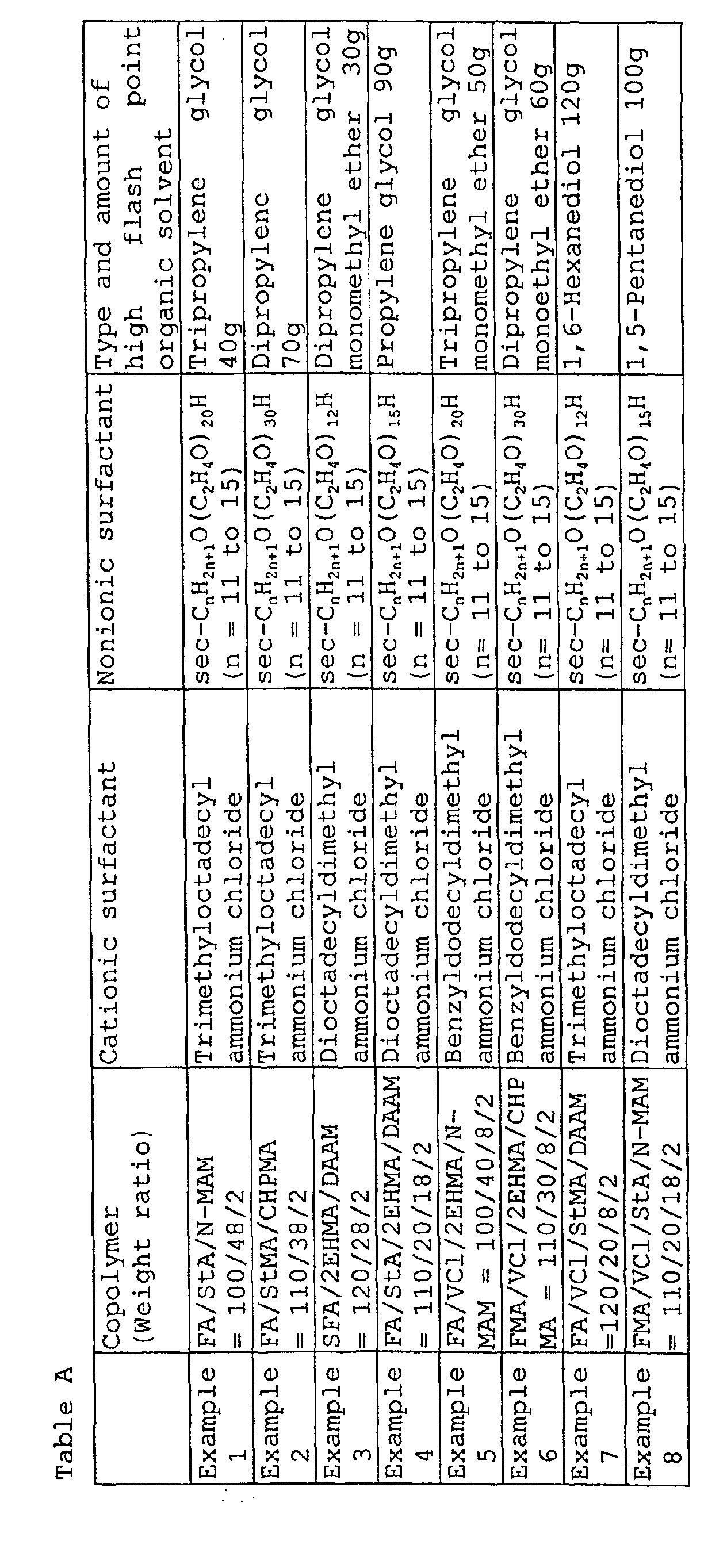
- Example 2 The same procedure as in Example 1 was repeated except that the type of the monomer, the type of the cationic surfactant, the type of the nonionic surfactant and the type and amount of the high flash point organic solvent were changed as shown in Table A. The results are shown in Table B.
- Example 5 The same procedure as in Example 5 was repeated except that the type of the monomer, the type of the cationic surfactant, the type of the nonionic surfactant and the type and amount of the high flash point organic solvent were changed as shown in Table A. The results are shown in Table B.
- Example 2 The same procedure as in Example 1 was repeated except that trimethyl octadecyl ammonium chloride was not used.
- Example 5 The same procedure as in Example 5 was repeated except that benzyldodecyldimethyl ammonium chloride was not used.
- the aqueous dispersion according to the present invention has durable water- and oil-repellency and excellent storage stability.
Landscapes
- Engineering & Computer Science (AREA)
- Chemical & Material Sciences (AREA)
- Textile Engineering (AREA)
- Combustion & Propulsion (AREA)
- Materials Engineering (AREA)
- Organic Chemistry (AREA)
- Mechanical Engineering (AREA)
- Chemical Kinetics & Catalysis (AREA)
- Treatments For Attaching Organic Compounds To Fibrous Goods (AREA)
- Materials Applied To Surfaces To Minimize Adherence Of Mist Or Water (AREA)
- Addition Polymer Or Copolymer, Post-Treatments, Or Chemical Modifications (AREA)
Abstract
Description
a copolymer comprising said polymerizable compound and another compound copolymerizable therewith,




R1 is a hydrogen atom or an alkyl group having 1 to 10 carbon atoms,
R2 is an alkylene group having 1 to 10 carbon atoms,
R3 is a hydrogen atom or a methyl group,
Ar is an aryl group which optionally has a substituent group, and
n is an integer of 1 to 10.


| Water repellency No. | State |
| 5 | No wet on the surface |
| 4 | Slight wet on the surface |
| 3 | Partial wet on the surface |
| 2 | Wet on the surface |
| 1 | Wet over the whole surface |
| Oil-repellency | Test solution | Surface tension (dyne/cm, 25°C) |
| 8 | n-Heptane | 20.0 |
| 7 | n-Octane | 21.8 |
| 6 | n-Decane | 23.5 |
| 5 | n-Dodecane | 25.0 |
| 4 | n-Tetradecane | 26.7 |
| 3 | n-Hexadecane | 27.3 |
| 2 | n-Hexadecane/Nujol mixture solution (35/65 by weight) | 29.6 |
| 1 | Nujol | 31.2 |
| 0 | Inferior to 1 | - |
FA: CnF2n+1CH2CH2OCOCH=CH2(n = 6,8,10,12,14; Average is 8)
FMA: CnF2n+1CH2CH2OCOC(CH3)=CH2(n = 6,8,10,12,14; Average is 8)
SFA: C8 F17SO2 N (CH3)CH2 CH2 OCOCH=CH2
StA: Stearyl acrylate
StMA: Stearyl methacrylate
2EHMA: 2-Ethylhexyl methacrylate
VCl: Vinyl chloride
N-MAM: N-Methylol acrylamide
CHPMA: 3-Chloro-2-hydroxypropyl methacrylate
DAAM: Diacetone acrylamide


Claims (4)
- An aqueous water- and oil-repellent dispersion comprising:(A) a homopolymer or copolymer comprising at least one polymerizable compound having a perfluoroalkyl or perfluoroalkenyl group and an acrylate or methacrylate group, or
a copolymer comprising said polymerizable compound and another compound copolymerizable therewith,(B) a surfactant comprising a cationic surfactant and a nonionic surfactant comprising an alkylene oxide adduct of a higher aliphatic secondary alcohol, and(C) a high flash-point organic solvent. - The dispersion according to claim 1, wherein the high flash point organic solvent is a water-soluble glycol organic solvent having a flash point of at least 70°C.
- A textile, to which the dispersion according to claim 1 is applied.
- A method of processing a textile, comprising treating the textile with the dispersion according to claim 1.
Applications Claiming Priority (3)
| Application Number | Priority Date | Filing Date | Title |
|---|---|---|---|
| JP9997899 | 1999-04-07 | ||
| JP9997899 | 1999-04-07 | ||
| PCT/JP2000/002169 WO2000061696A1 (en) | 1999-04-07 | 2000-04-04 | Aqueous water-and-oil repellant dispersion |
Publications (2)
| Publication Number | Publication Date |
|---|---|
| EP1195420A1 true EP1195420A1 (en) | 2002-04-10 |
| EP1195420A4 EP1195420A4 (en) | 2007-01-03 |
Family
ID=14261770
Family Applications (1)
| Application Number | Title | Priority Date | Filing Date |
|---|---|---|---|
| EP00913094A Withdrawn EP1195420A4 (en) | 1999-04-07 | 2000-04-04 | AQUEOUS DISPERSION HYDROPHOBUS AND OL OPHOBE |
Country Status (6)
| Country | Link |
|---|---|
| US (1) | US7015275B1 (en) |
| EP (1) | EP1195420A4 (en) |
| KR (1) | KR20010110719A (en) |
| CN (2) | CN101362935A (en) |
| TW (1) | TWI260343B (en) |
| WO (1) | WO2000061696A1 (en) |
Cited By (4)
| Publication number | Priority date | Publication date | Assignee | Title |
|---|---|---|---|---|
| US6979711B2 (en) | 2003-11-18 | 2005-12-27 | E. I. Du Pont De Nemours And Company | Fluorine efficient finishes for textiles |
| WO2006069101A1 (en) * | 2004-12-22 | 2006-06-29 | E.I. Du Pont De Nemours And Company | Viscosity control for reduced fluorosurfactant aqueous fluoropolymer dispersions by the addition of cationic surfactant |
| US7666928B2 (en) | 2006-05-31 | 2010-02-23 | E.I. Du Pont De Nemours And Company | Staged addition of non-fluorinated anionic surfactant to reduced fluorosurfactant fluoropolymer dispersion |
| EP2829572A4 (en) * | 2012-03-23 | 2016-01-20 | Daikin Ind Ltd | AQUEOUS EMULSION COMPOSITION |
Families Citing this family (12)
| Publication number | Priority date | Publication date | Assignee | Title |
|---|---|---|---|---|
| EP1236783A1 (en) * | 2001-02-27 | 2002-09-04 | Ciba Spezialitätenchemie Pfersee GmbH | Aqueous dispersions of a fluoropolymer and a stabilising agent |
| EP1477543A4 (en) * | 2002-01-21 | 2007-10-31 | Daikin Ind Ltd | AQUEOUS DISPERSION WATERPROOFING AND OIL |
| KR100807451B1 (en) * | 2004-04-20 | 2008-02-25 | 다이킨 고교 가부시키가이샤 | Water- and Oil-Repellent Composition and Process for Production Thereof |
| KR101347989B1 (en) * | 2006-03-30 | 2014-01-07 | 아사히 가라스 가부시키가이샤 | Liquid repellent composition, method for liquid-repellent finishing, and articles with liquid-repellent films |
| WO2009113589A1 (en) * | 2008-03-12 | 2009-09-17 | 旭硝子株式会社 | Copolymer and method for producing the same |
| KR20120104576A (en) * | 2009-12-25 | 2012-09-21 | 아사히 가라스 가부시키가이샤 | Water-and-oil repellant composition, process for producing same, and method for treating article |
| CN102516451B (en) * | 2011-12-14 | 2013-12-18 | 太仓中化环保化工有限公司 | Water dispersive fluorine-containing water and oil repellent and preparation method thereof |
| US9534343B2 (en) | 2012-10-18 | 2017-01-03 | The Chemours Company Fc, Llc | Partially fluorinated copolymer emulsions containing fatty acids and esters |
| CN102995404A (en) * | 2012-11-29 | 2013-03-27 | 常熟市新达纬编厂 | Manufacture method of waterproof cotton-nylon blended fabric |
| TWI691532B (en) * | 2014-07-18 | 2020-04-21 | 日商大阪化成股份有限公司 | Manufacturing method of anti-virus processing products and anti-virus processing products obtained by the manufacturing method |
| TWI676723B (en) * | 2014-09-18 | 2019-11-11 | 日商大阪化成股份有限公司 | Antibacterial/antifungal processed product preparation method and antibacterial/antifungal processed product obtained by the same |
| CN109162098A (en) * | 2018-08-03 | 2019-01-08 | 广东德美精细化工集团股份有限公司 | A kind of short fluorocarbon chain waterproof and oilproof of resistance to disperse dyes dispersion liquid |
Family Cites Families (11)
| Publication number | Priority date | Publication date | Assignee | Title |
|---|---|---|---|---|
| JPS6040182A (en) | 1983-08-16 | 1985-03-02 | Asahi Glass Co Ltd | Water- and oil-repellent having high ignition point |
| JP2508343B2 (en) * | 1990-02-21 | 1996-06-19 | 旭硝子株式会社 | Fluorine-based water and oil repellent composition |
| JPH0617034A (en) | 1992-07-03 | 1994-01-25 | Asahi Glass Co Ltd | Water / oil repellent composition and method for producing the same |
| JP3484708B2 (en) | 1992-07-15 | 2004-01-06 | 旭硝子株式会社 | Water / oil repellent composition |
| JPH07179528A (en) * | 1993-12-21 | 1995-07-18 | N O K Kluber Kk | Production of high-flash point emulsion type water and oil repellent |
| JPH0925478A (en) * | 1995-07-07 | 1997-01-28 | Sunstar Inc | Aqueous dispersion-type water-and-oil-repellent composition |
| JPH09302335A (en) | 1996-05-13 | 1997-11-25 | Asahi Glass Co Ltd | Highly stable water-dispersed water and oil repellent composition |
| JPH108041A (en) | 1996-06-21 | 1998-01-13 | Daikin Ind Ltd | Water-dispersed fluorine-based water / oil repellent |
| JP3876495B2 (en) * | 1997-09-12 | 2007-01-31 | ユニマテック株式会社 | Water and oil repellent and method for producing the same |
| JP3807130B2 (en) * | 1998-11-13 | 2006-08-09 | 旭硝子株式会社 | Water-dispersed antifouling agent composition |
| US6753376B1 (en) * | 1998-12-22 | 2004-06-22 | Daikin Industries Ltd. | Aqueous water-and oil-repellent dispersion |
-
2000
- 2000-04-04 WO PCT/JP2000/002169 patent/WO2000061696A1/en not_active Ceased
- 2000-04-04 EP EP00913094A patent/EP1195420A4/en not_active Withdrawn
- 2000-04-04 CN CNA2008102128095A patent/CN101362935A/en active Pending
- 2000-04-04 US US09/958,078 patent/US7015275B1/en not_active Expired - Fee Related
- 2000-04-04 CN CN00805908A patent/CN1346394A/en active Pending
- 2000-04-04 KR KR1020017012648A patent/KR20010110719A/en not_active Ceased
- 2000-04-05 TW TW089106252A patent/TWI260343B/en not_active IP Right Cessation
Cited By (6)
| Publication number | Priority date | Publication date | Assignee | Title |
|---|---|---|---|---|
| US6979711B2 (en) | 2003-11-18 | 2005-12-27 | E. I. Du Pont De Nemours And Company | Fluorine efficient finishes for textiles |
| WO2006069101A1 (en) * | 2004-12-22 | 2006-06-29 | E.I. Du Pont De Nemours And Company | Viscosity control for reduced fluorosurfactant aqueous fluoropolymer dispersions by the addition of cationic surfactant |
| US8329836B2 (en) | 2004-12-22 | 2012-12-11 | E I Du Pont De Nemours And Company | Viscosity control for reduced fluorosurfactant aqueous fluoropolymer dispersions by the addition of cationic surfactants |
| US7666928B2 (en) | 2006-05-31 | 2010-02-23 | E.I. Du Pont De Nemours And Company | Staged addition of non-fluorinated anionic surfactant to reduced fluorosurfactant fluoropolymer dispersion |
| EP2829572A4 (en) * | 2012-03-23 | 2016-01-20 | Daikin Ind Ltd | AQUEOUS EMULSION COMPOSITION |
| US9932504B2 (en) | 2012-03-23 | 2018-04-03 | Daikin Industries, Ltd. | Aqueous emulsion composition |
Also Published As
| Publication number | Publication date |
|---|---|
| US7015275B1 (en) | 2006-03-21 |
| WO2000061696A1 (en) | 2000-10-19 |
| EP1195420A4 (en) | 2007-01-03 |
| CN1346394A (en) | 2002-04-24 |
| CN101362935A (en) | 2009-02-11 |
| TWI260343B (en) | 2006-08-21 |
| KR20010110719A (en) | 2001-12-13 |
Similar Documents
| Publication | Publication Date | Title |
|---|---|---|
| US7015275B1 (en) | Aqueous water-and oil-repellent dispersion | |
| JP4816455B2 (en) | Water and oil repellent composition | |
| JP5915641B2 (en) | Water and oil repellent composition | |
| JP2010043277A (en) | Aqueous water- and oil-repellent dispersion | |
| EP0609456B1 (en) | Soil remover for dry cleaning | |
| EP1365000A1 (en) | Water- and oil-repellent composition, process for producing the same and use thereof | |
| JP4760707B2 (en) | Water / oil repellent composition and process for producing the same | |
| JP3744035B2 (en) | Water-dispersed water / oil repellent composition with excellent stability | |
| JP2005054020A (en) | Water and oil repellant | |
| US20050090600A1 (en) | Aqueous water-and oil-repellent dispersion | |
| JPWO2000037583A1 (en) | Water and oil repellent aqueous dispersion | |
| JP5125625B2 (en) | Fluoropolymer and antifouling agent | |
| ES2376058T3 (en) | COMPOSITION OF WATER EMULSION. | |
| JP2002220539A (en) | Water-dispersed fluorine-based copolymer composition | |
| JPH0344593B2 (en) | ||
| JPH0674409B2 (en) | Water and oil repellent aqueous dispersion | |
| JP2001158877A (en) | Method for producing aqueous dispersion of water and oil repellent | |
| JPWO2000061696A1 (en) | Water and oil repellent aqueous dispersion |
Legal Events
| Date | Code | Title | Description |
|---|---|---|---|
| PUAI | Public reference made under article 153(3) epc to a published international application that has entered the european phase |
Free format text: ORIGINAL CODE: 0009012 |
|
| 17P | Request for examination filed |
Effective date: 20011106 |
|
| AK | Designated contracting states |
Kind code of ref document: A1 Designated state(s): AT BE CH CY DE DK ES FI FR GB GR IE IT LI LU MC NL PT SE |
|
| RBV | Designated contracting states (corrected) |
Designated state(s): DE FR IT |
|
| A4 | Supplementary search report drawn up and despatched |
Effective date: 20061205 |
|
| RIC1 | Information provided on ipc code assigned before grant |
Ipc: C09K 3/18 20060101AFI20001023BHEP |
|
| 17Q | First examination report despatched |
Effective date: 20070612 |
|
| STAA | Information on the status of an ep patent application or granted ep patent |
Free format text: STATUS: THE APPLICATION IS DEEMED TO BE WITHDRAWN |
|
| 18D | Application deemed to be withdrawn |
Effective date: 20100504 |