EP1195315A2 - Vehicular frame assembly including hollow frame member that houses electrical battery - Google Patents
Vehicular frame assembly including hollow frame member that houses electrical battery Download PDFInfo
- Publication number
- EP1195315A2 EP1195315A2 EP01308519A EP01308519A EP1195315A2 EP 1195315 A2 EP1195315 A2 EP 1195315A2 EP 01308519 A EP01308519 A EP 01308519A EP 01308519 A EP01308519 A EP 01308519A EP 1195315 A2 EP1195315 A2 EP 1195315A2
- Authority
- EP
- European Patent Office
- Prior art keywords
- battery
- vehicle
- frame assembly
- structural member
- vehicle frame
- Prior art date
- Legal status (The legal status is an assumption and is not a legal conclusion. Google has not performed a legal analysis and makes no representation as to the accuracy of the status listed.)
- Withdrawn
Links
Images


Classifications
-
- B—PERFORMING OPERATIONS; TRANSPORTING
- B62—LAND VEHICLES FOR TRAVELLING OTHERWISE THAN ON RAILS
- B62D—MOTOR VEHICLES; TRAILERS
- B62D23/00—Combined superstructure and frame, i.e. monocoque constructions
- B62D23/005—Combined superstructure and frame, i.e. monocoque constructions with integrated chassis in the whole shell, e.g. meshwork, tubes, or the like
-
- B—PERFORMING OPERATIONS; TRANSPORTING
- B60—VEHICLES IN GENERAL
- B60K—ARRANGEMENT OR MOUNTING OF PROPULSION UNITS OR OF TRANSMISSIONS IN VEHICLES; ARRANGEMENT OR MOUNTING OF PLURAL DIVERSE PRIME-MOVERS IN VEHICLES; AUXILIARY DRIVES FOR VEHICLES; INSTRUMENTATION OR DASHBOARDS FOR VEHICLES; ARRANGEMENTS IN CONNECTION WITH COOLING, AIR INTAKE, GAS EXHAUST OR FUEL SUPPLY OF PROPULSION UNITS IN VEHICLES
- B60K1/00—Arrangement or mounting of electrical propulsion units
- B60K1/04—Arrangement or mounting of electrical propulsion units of the electric storage means for propulsion
Definitions
- This invention relates in general to the manufacture of vehicle frame assemblies.
- this invention relates to an improved structure for a vehicular frame assembly including one or more hollow members, wherein at least one of the hollow members houses an electrical battery for use in operating an electrical system for the vehicle.
- body and frame assemblies that is supported upon a plurality of ground-engaging wheels by a resilient suspension system.
- the structures of known body and frame assemblies can be divided into two general categories, namely, separate and unitized.
- the structural components of the body portion and the frame portion of the vehicle are separate and independent from one another.
- the frame portion of the assembly is resiliently supported upon the vehicle wheels by the suspension system and serves as a platform upon which the body portion of the assembly and other components of the vehicle can be mounted.
- the various components of vehicular body and frame assemblies have been formed from open channel structural members, i.e., structural members that have a non-continuous cross sectional shape (such as U-shaped or C-shaped channel members, for example).
- open channel structural members i.e., structural members that have a non-continuous cross sectional shape (such as U-shaped or C-shaped channel members, for example).
- U-shaped or C-shaped channel members for example
- it is known to use one or more open channel structural members to form the side rails, the cross members, and other components of a ladder frame type of separate body and frame assembly has been found to be undesirable for several reasons.
- one or more of the components of the vehicular body and frame assemblies from closed channel structural members, i.e., structural members that have a continuous cross sectional shape (such as tubular or box-shaped channel members, for example).
- This cross sectional shape is advantageous because it provides strength and rigidity to the vehicle body and frame component.
- vertically and horizontally oriented surfaces are provided that are well adapted to have the body mount support brackets discussed above secured thereto.
- closed channel structural member are well suited to be deformed to a desired shape by hydroforming, which is a well known process that uses pressurized fluid supplied within the closed channel structural member to deform it into conformance with a surrounding die.
- Hydroforming has been found to be a desirable forming process because portions of a closed channel structural member can be quickly and easily deformed to have a complex cross sectional shape.
- a typical vehicle electrical system includes a battery or similar device that stores electrical energy.
- the battery is electrically connected through an ignition switch to a starter motor.
- the alternator converts mechanical energy (typically in the form of a rotatably driven input member) into electrical energy.
- the alternator can be driven to generate electrical energy to operate various electrical accessories provided on the vehicle and to re-charge the battery for subsequent use.
- the battery In most vehicles, the battery is housed in a single, relatively large, rectilinearly-shaped enclosure that is supported on (and, in some instances, secured to) a generally flat bracket that is provided within the engine compartment.
- this type of battery supporting structure has been employed successfully for many years, it has recently been found to be somewhat inconvenient because the amount of available space within the engine compartment has been decreasing in recent years.
- the battery when the battery is supported within the engine compartment in the manner described above, it is exposed to the environment in a relatively direct manner.
- This invention relates to an improved structure for a vehicular frame assembly including one or more hollow members, wherein at least one of the hollow members houses an electrical battery for use in operating an electrical system for the vehicle.
- the combined vehicle frame assembly and battery for a vehicle includes a plurality of structural members that are joined together to form a vehicle frame assembly, such as a ladder frame or space frame assembly.
- One of the plurality of structural members is formed as a closed channel structural member defining a hollow interior.
- a battery is disposed within the interior of the hollow structural member.
- the structural member is formed in such a manner as to support and retain the battery therein to prevent relative movement during operation of the vehicle.
- the battery can be composed of either a single battery or a plurality of separate battery cells that are electrically connected together to provide electrical energy to the electrical system of the vehicle.
- a vehicle frame assembly indicated generally at 10, in accordance with this invention.
- the illustrated vehicle frame assembly 10 is intended to be representative of any type of frame assembly for use in any type of vehicle. Thus, this invention is not intended to be limited to the specific structure of the vehicle frame assembly 10 illustrated in Fig. 1.
- the illustrated vehicle frame assembly is an automobile space frame, i.e., a frame for an automobile including a plurality of components that are connected together to generally define an enclosed space for the occupants.
- the vehicle frame assembly 10 may be embodied, for example, as a ladder frame type of vehicle frame assembly or other type of separate body and frame assembly, such as described above.
- the illustrated vehicle frame assembly 10 is composed of four different types of structural members which are secured together.
- the first type of structural member is referred to as a straight member, such as shown at 11, that can be characterized as being generally linear and elongated in shape.
- the second type of structural member is referred to as a curved member, such as shown at 12, that can be characterized as extending generally non-linearly.
- the third type of structural member is referred to as a joint node, such as shown at 13, that can be characterized as being relatively short in length and provided to join adjacent ones of the structural members together at a joint.
- the fourth type of structural member is referred to as a member node, such as shown at 14, that can be characterized as being relatively long in length and also provided to join adjacent ones of the structural members together at a joint.
- the structural members 11, 12, 13, and 14 can be formed of any suitable materials or combination of materials, such as steel, aluminum, and the like, and can be secured together using any suitable method, such as metal inert gas welding, adhesives, electromagnetic pulse welding, and the like.
- a battery, indicated generally at 20, is disposed within one of the hollow structural members, such as one of the straight members 11 for example, of the vehicle frame assembly 10.
- the structures of the hollow structural member 11 and the battery 20 are best shown in Fig. 2.
- the illustrated battery 20 is composed of a plurality of individual battery cells 21 that are connected in series together to provide a source of electrical energy for the vehicle.
- the plurality of battery cells 21 can include seven individual six volt battery cells that, when electrically connected together, function as a forty-two volt battery system for the vehicle.
- the individual battery cells 21 can be electrically connected together by any suitable manner, such as one or more electrical conductors (not shown).
- the battery cells 21 can, for example, be arranged in a stacked end-to-end arrangement within the hollow interior of the structural member 11 of the vehicle frame assembly 10. Although this invention will be described and illustrated in the context of the seven individual six volt battery cells 21, it will be appreciated that the illustrated battery 20 is intended to be representative of any single device or group of devices, or portions thereof, that can store electrical energy for subsequent use in the manner described below.
- the battery cells 21 are preferably formed having a shape that is generally complementary to the shape of the structural member within which they are disposed.
- the battery cells 21 can be formed having generally cylindrical shapes that are complementary to the generally hollow cylindrical straight member 11 within which they are disposed.
- the battery cells 21 can be formed having any desired shape.
- a support member such as a sleeve 22
- the support sleeve 22 can be embodied as any suitable structure that supports the battery cells 21 within the hollow interior of the structural member 11 and prevents them from moving relative to such structural member 11 during operation of the vehicle.
- the support sleeve 22 is preferably attached to or otherwise fixed in position relative to the structural member 11. This can be done in any suitable manner, such as by adhesives, frictional engagement, fasteners, and the like.
- the support sleeve 52 may be formed having an outer surface that is complementary in shape to the inner surface of the structural member 11, although such is not required.
- the battery cells 21 are preferably attached to or otherwise fixed in position relative to the support sleeve 21. This can also be done in any suitable manner, such as by adhesives, frictional engagement, fasteners, and the like.
- the support sleeve 22 can be formed from of any suitable material, such as a plastic or elastomeric material.
- one or more portions of the structural member 11 can be deformed, such as shown at 11a in Fig. 2, to provide a positive stop for retaining the battery cells 21 and/or the support sleeve 22 therein.
- the stop 11a can be formed in any conventional manner, such as during the hydroforming process for initially forming the structural member to have a desired shape.
- the illustrated stop 11a extends inwardly within the interior of the structural member 11 and is adapted to be engaged by either a portion of the support sleeve 22, a portion of one of the battery cells 21, or both.
- the stops 11a may engage any desired portions of the support sleeve 22 or the battery cells 21 to support such battery cells 21 and to prevent them from moving relative to the structural member 11 during operation of the vehicle.
- the stops 11a may extend outwardly from the interior of the structural member 11 if desired.
- the structural member 11 can also include one or more depressions (not shown) that are formed into the wall thereof. These depressions could, for example, support the battery cells 21 in a lateral direction with respect to the elongated structural member 11. Thus, if the overall length of the plurality of the battery cells 21 is less than the overall length of the structural member 11, a depression can be formed in a portion of the structural member 11 to receive the battery cells 21 therein.
- the portion of the structural member 11 in which the battery cells 21 are disposed is a closed channel structural member having a continuous cross-section configuration.
- the structural member 11 may be formed having an opening (not shown) that can provide access to the interior of the structural member 11.
- This opening can be sufficiently large to allow the battery cells 12 to be removed and replaced as desired.
- this opening can be relatively small to permit only a pair of electrical conductors (not shown) to connect the battery cells 21 to the other components of the electrical system of the vehicle, as described below.
- a removable access panel (not shown) can be provided to close the opening during normal operation of the vehicle.
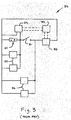
- FIG. 3 there is illustrated a schematic diagram of a vehicle electrical system, indicated generally at 30, that is conventional in the art.
- The includes the battery 20 that is housed within the structural member 11 of the vehicle frame assembly 10, as discussed above.
- the battery 20 is connected through an electrical ignition switch 31 to a starter motor 32.
- the starter 32 is mechanically coupled to an engine 33, such as a conventional internal combustion or diesel engine.
- an engine 33 such as a conventional internal combustion or diesel engine.
- the starter motor 32 is energized to start the vehicle engine 33 in a conventional manner.
- the engine 33 is mechanically connected to an electrical generating device, such as an alternator 34.
- the alternator 34 converts mechanical energy into electrical energy to charge the battery 20 while the vehicle is being operated.
- the alternator 34 can also provide electrical energy to various accessories 35 and 36 provided within the vehicle, including radios, horns, lights, power door locks, power windows, wipers, ventilation systems, window defrosters, and the like. As shown in Fig. 3, some of such accessories 35 can be connected to be run from the battery 20 regardless of the position of the ignition switch 31, while other of such accessories 36 can be connected to be run from the battery 20 only when the ignition switch 31 is moved to the closed position.
Landscapes
- Engineering & Computer Science (AREA)
- Chemical & Material Sciences (AREA)
- Combustion & Propulsion (AREA)
- Transportation (AREA)
- Mechanical Engineering (AREA)
- Battery Mounting, Suspending (AREA)
- Arrangement Or Mounting Of Propulsion Units For Vehicles (AREA)
Abstract
Description
Claims (8)
- A combined vehicle frame assembly and battery for a vehicle comprising:a plurality of structural members that are joined together to form a vehicle frame assembly, one of said plurality of structural members being a closed channel structural member defining an interior; anda battery disposed within said interior of said one of said plurality of structural members.
- The combined vehicle frame assembly and battery for a vehicle defined in Claim 1 wherein said plurality of structural members are joined together to form a space frame type of vehicle frame assembly.
- The combined vehicle frame assembly and battery for a vehicle defined in Claim 1 wherein said battery includes a plurality of battery cells that are disposed within said interior of said structural member and are electrically connected to one other.
- The combined vehicle frame assembly and battery for a vehicle defined in Claim 1 wherein said one of said plurality of structural members has a stop formed therein that is engaged by said battery.
- The combined vehicle frame assembly and battery for a vehicle defined in Claim 1 further including a support member that is disposed within said interior of said one of said plurality of structural members, said battery being disposed within said support member.
- The combined vehicle frame assembly and battery for a vehicle defined in Claim 5 wherein said support structure is a support sleeve that is disposed about said battery.
- The combined vehicle frame assembly and battery for a vehicle defined in Claim 5 wherein said one of said plurality of structural members has a stop formed therein that is engaged by said support structure.
- The combined vehicle frame assembly and battery for a vehicle defined in Claim 1 further including a vehicle electrical system that is electrically connected to said battery.
Applications Claiming Priority (2)
| Application Number | Priority Date | Filing Date | Title |
|---|---|---|---|
| US23870200P | 2000-10-07 | 2000-10-07 | |
| US238702P | 2000-10-07 |
Publications (2)
| Publication Number | Publication Date |
|---|---|
| EP1195315A2 true EP1195315A2 (en) | 2002-04-10 |
| EP1195315A3 EP1195315A3 (en) | 2003-01-15 |
Family
ID=22898972
Family Applications (1)
| Application Number | Title | Priority Date | Filing Date |
|---|---|---|---|
| EP01308519A Withdrawn EP1195315A3 (en) | 2000-10-07 | 2001-10-05 | Vehicular frame assembly including hollow frame member that houses electrical battery |
Country Status (2)
| Country | Link |
|---|---|
| US (1) | US20020079153A1 (en) |
| EP (1) | EP1195315A3 (en) |
Cited By (3)
| Publication number | Priority date | Publication date | Assignee | Title |
|---|---|---|---|---|
| CN102442190A (en) * | 2010-10-08 | 2012-05-09 | 财团法人金属工业研究发展中心 | Vehicle frame with battery module structure and applied chassis and electric vehicle |
| WO2012130409A1 (en) * | 2011-03-28 | 2012-10-04 | Li-Tec Battery Gmbh | Construction component having an electrochemical cell and method for producing same |
| CN106697055A (en) * | 2016-12-22 | 2017-05-24 | 江苏萝卜交通科技有限公司 | Frame assembly for electric vehicle |
Families Citing this family (7)
| Publication number | Priority date | Publication date | Assignee | Title |
|---|---|---|---|---|
| US7185724B2 (en) * | 2004-04-05 | 2007-03-06 | Ford Global Technologies, Llc | Battery support structure |
| US20110240386A1 (en) * | 2010-04-05 | 2011-10-06 | Coda Automotive, Inc. | Electric vehicle with structurally integrated components |
| JP2013001162A (en) * | 2011-06-13 | 2013-01-07 | Suzuki Motor Corp | Battery unit mounting structure for vehicle |
| US20180065461A1 (en) * | 2016-09-07 | 2018-03-08 | Thunder Power New Energy Vehicle Development Company Limited | Cross member in the floor with special geometry for mounting the battery pack |
| CN106741179B (en) * | 2016-12-22 | 2023-07-28 | 江苏萝卜交通科技有限公司 | Frame for electric vehicle |
| KR20230100767A (en) * | 2021-12-28 | 2023-07-06 | 현대자동차주식회사 | Structural battery for electric vehicle |
| JP7808250B2 (en) * | 2022-01-27 | 2026-01-29 | 株式会社発明屋 | Frame member type battery device, structure, mobile body, manufacturing method of structure, and battery-oriented structural design method |
Family Cites Families (3)
| Publication number | Priority date | Publication date | Assignee | Title |
|---|---|---|---|---|
| FR867778A (en) * | 1940-11-23 | 1941-11-27 | Chassis for electric vehicles or others | |
| US4660345A (en) * | 1984-10-10 | 1987-04-28 | Mr. Gasket Company | Vehicle space frame, castings therefor and method for remote construction |
| FR2740092B1 (en) * | 1995-10-23 | 1998-01-02 | Thuliez Jean Luc | ULTRA-LIGHT ROAD VEHICLE |
-
2001
- 2001-10-04 US US09/962,018 patent/US20020079153A1/en not_active Abandoned
- 2001-10-05 EP EP01308519A patent/EP1195315A3/en not_active Withdrawn
Cited By (4)
| Publication number | Priority date | Publication date | Assignee | Title |
|---|---|---|---|---|
| CN102442190A (en) * | 2010-10-08 | 2012-05-09 | 财团法人金属工业研究发展中心 | Vehicle frame with battery module structure and applied chassis and electric vehicle |
| WO2012130409A1 (en) * | 2011-03-28 | 2012-10-04 | Li-Tec Battery Gmbh | Construction component having an electrochemical cell and method for producing same |
| CN106697055A (en) * | 2016-12-22 | 2017-05-24 | 江苏萝卜交通科技有限公司 | Frame assembly for electric vehicle |
| CN106697055B (en) * | 2016-12-22 | 2023-08-15 | 江苏萝卜交通科技有限公司 | Frame assembly for electric automobile |
Also Published As
| Publication number | Publication date |
|---|---|
| US20020079153A1 (en) | 2002-06-27 |
| EP1195315A3 (en) | 2003-01-15 |
Similar Documents
| Publication | Publication Date | Title |
|---|---|---|
| US11524736B2 (en) | Method of assembling vehicle including an integrated interior module and top-hat | |
| CA2466241C (en) | Modular underbody for a motor vehicle | |
| US6434907B1 (en) | Closed channel structural member having internal reinforcement for vehicle body and frame assembly | |
| US20040140693A1 (en) | Hybrid space frame for motor vehicle | |
| EP0676315A1 (en) | Energy absorbing vehicle pillar structure | |
| US20030085591A1 (en) | Modular front end for a motor vehicle | |
| EP1298038A2 (en) | Unitary cross member and body mount support bracket for a vehicle body and frame assembly | |
| US20030085592A1 (en) | Front end apron assembly for a motor vehicle | |
| EP1195315A2 (en) | Vehicular frame assembly including hollow frame member that houses electrical battery | |
| US7044535B2 (en) | Structural composite body closure panels for use with a vehicular space frame assembly | |
| JPH05201356A (en) | Car body structure of electric automobile | |
| US7163076B2 (en) | Drive train assembly for a motor vehicle | |
| CA2455286A1 (en) | Cast aluminum node for connecting vehicle frame members and method of manufacturing same | |
| US20020057004A1 (en) | Frame assembly for a motor vehicle | |
| JP3403290B2 (en) | Aluminum alloy extruded square tube for front side member with excellent axial compression characteristics | |
| JP2006176107A (en) | Movable window assembly for vehicle sliding door and manufacturing method | |
| JPH06270692A (en) | Energy absorption control structure for electric vehicles | |
| JPH08310253A (en) | Motor unit mounting method and mounting structure | |
| JPH0999867A (en) | Subframe support structure for automobiles | |
| JP2006182312A (en) | Door structure | |
| JP3385715B2 (en) | Pillar trim mounting structure | |
| US12122238B2 (en) | Vehicle body structure | |
| JP2997332B2 (en) | How to assemble a car body | |
| EP1544084A1 (en) | Support structure for a dashboard of a vehicle | |
| KR0162153B1 (en) | A reinforcing structure of a center pillar |
Legal Events
| Date | Code | Title | Description |
|---|---|---|---|
| PUAI | Public reference made under article 153(3) epc to a published international application that has entered the european phase |
Free format text: ORIGINAL CODE: 0009012 |
|
| AK | Designated contracting states |
Kind code of ref document: A2 Designated state(s): AT BE CH CY DE DK ES FI FR GB GR IE IT LI LU MC NL PT SE TR |
|
| AX | Request for extension of the european patent |
Free format text: AL;LT;LV;MK;RO;SI |
|
| PUAL | Search report despatched |
Free format text: ORIGINAL CODE: 0009013 |
|
| AK | Designated contracting states |
Kind code of ref document: A3 Designated state(s): AT BE CH CY DE DK ES FI FR GB GR IE IT LI LU MC NL PT SE TR |
|
| AX | Request for extension of the european patent |
Free format text: AL;LT;LV;MK;RO;SI |
|
| 17P | Request for examination filed |
Effective date: 20030708 |
|
| AKX | Designation fees paid |
Designated state(s): DE FR GB IT |
|
| 17Q | First examination report despatched |
Effective date: 20031016 |
|
| STAA | Information on the status of an ep patent application or granted ep patent |
Free format text: STATUS: THE APPLICATION IS DEEMED TO BE WITHDRAWN |
|
| 18D | Application deemed to be withdrawn |
Effective date: 20051104 |