BACKGROUND OF THE INVENTION
Field of the Invention
The present invention relates to a heat-sensitive
recording material, and in particular to a heat-sensitive
recording material capable of forming high-density color images
with little background fogging and having good image
preservability.
Description of the Related Art
Heat-sensitive recording materials are widely used in the
art because they are relatively inexpensive and capable of being
processed in compact recording appliances not requiring
specific maintenance. In order to increase the density of the
color images to be formed on such heat-sensitive recording
materials and to improve the image preservability of the
materials, various studies are now being made relating to
electron-donating leuco-dyes and electron-receiving compounds
and to the layer constitution of heat-sensitive recording
materials.
2,2-bis(4-hydroxyphenyl)propane (i.e., bisphenol A,
referred to as "BPA") has been widely used as an electron-receiving
compound with respect to electron-donating leuco-dyes
used in such heat-sensitive recording materials. However,
a heat-sensitive recording material having satisfactory
sensitivity, ability to prevent background fogging, and good
image preservability has not been obtained.
Japanese Patent Application Publication (JP-B) No. 2-25354
discloses a heat-sensitive recording paper in which
N-(4-hydroxyphenyl)-p-toluenesulfonamide is used as an
electron-receiving compound. However, with the advancement in
recent years of high-speed thermal head printers, even such
heat-sensitive recording papers are unsatisfactory in terms of
sensitivity, ability to prevent background fogging, and also
in terms of thermal head matching properties such as adhesion
of contaminants to the thermal heads and abrading the thermal
heads.
In addition, heat-sensitive recording materials
generally have weak surface strength and inferior printability ,
which gives rise to problems such as peeling of the paper during
offset printing. In order to avoid such problems, it is
possible to increase the amount of adhesive included in the
heat-sensitive color-forming layer. However, increasing the
amount of adhesive is problematic in that the color density of
the heat-sensitive recording material is lowered. Thus, in
order to solve these problems, there has been a strong demand
for heat-sensitive recording materials that can ensure high
color density and have good printability.
Further, inkjet printers have become widespread in
offices as means for outputting from personal computers.
Respective recording surfaces of the inkjet recording materials
and heat-sensitive recording materials are often put together.
However, conventional heat-sensitive recording materials are
not satisfactorily resistant to ink for inkjet printers.
Therefore, when the recording surface of the heat-sensitive
recording material contacts the recording surface of the inkjet
recording material, there has been the problem of fogging in
the background area of the heat-sensitive recording material
and density of the image area being lowered.
Moreover, due to a heightening awareness of the
environment in recent years, there has been a demand for
heat-sensitive recording materials that utilize supports in
which waste pulp (so-called recycled paper) forms the main
constituent. However, it has not always been the case that
satisfactory heat-sensitive recording materials have been
obtained, because background fogging and image preservability
become worse as a result of using recycled paper as the support.
In particular, when BPA is used as a developer for the recycled
paper, background fogging and image preservability
deteriorate.
Japanese Patent Application Laid-Open (JP-A) No. 3-140287
discloses a heat-sensitive recording material with which
recording sensitivity is improved without attendant background
contamination, and that can be applied to ultra-high speed
printers as a result. This is due to the use of a recycled paper,
wherein a measured value of a base paper by a regular
reflection-type surface smoothness sensor under a pressure of
20 kg/cm2 is no less than 8%. The heat-sensitive recording
material disclosed in JP-A No. 3-140287 uses a developer
comprising a phenol (such as bisphenol), a sulfone and a
hydroxybenzoic acid. However, the image preservability of the
heat-sensitive recording material is insufficient.
JP-A No. 4-21486 discloses obtaining a heat-sensitive
recording material that has excellent recoloring potential
(coloring after preservation) , even when recycled paper is used
as the support, by using as the developer bis(4-hydroxyphenyl)acetate-n-butyl,
4-hydroxy-4-isopropoxydiphenyl
sulfone, 4,4'-thiobis(3-methyl-6-tert-butylphenol)
or N,N'-diphenylthiourea. However, resistance
to background fogging and image preservability of the heat-sensitive
recording material disclosed in JP-A No. 4-21486 are
still insufficient.
SUMMARY OF THE INVENTION
It is a first object of the present invention to provide
a heat-sensitive recording material that ensures increased
color density, little background fogging and good image
preservability.
It is a second object of the present invention to provide
a heat-sensitive recording material having good chemical
resistance.
It is a third object of the present invention to provide
a heat-sensitive recording material that well matches thermal
heads, without leaving contaminants on the thermal heads and
without abrading the thermal heads.
It is a fourth object of the present invention to provide
a heat-sensitive recording material having good printability.
It is a fifth object of the present invention to provide
a heat-sensitive recording material resistant to ink used in
inkjet recording systems.
It is a sixth object of the present invention to provide
a heat-sensitive recording material which comprises recycled
paper of essentially waste pulp as the support and which
therefore has the advantage of reducing the burden upon the
environment.
It is a seventh object of the present invention to provide
a heat-sensitive recording material having sticking
resistance.
Specifically, the present invention provides a heat-sensitive
recording material comprising support having
disposed thereon a heat-sensitive color-forming layer that
includes an electron-donating leuco-dye and an electron-receiving
compound, wherein the heat-sensitive color-forming
layer includes N-(4-hydroxyphenyl)-p-toluenesulfonamide as
the electron-receiving compound and includes a sensitizer of
2-benzyloxynaphthalene.
With the heat-sensitive recording material comprising
the above structure, color density is raised, there is little
background fogging, and preservability of image areas and
chemical resistance is excellent in comparision with
conventional heat-sensitive recording materials.
The present invention also provides a heat-sensitive
recording material comprising a support having disposed thereon
a heat-sensitive color-forming layer that includes an
electron-donating leuco-dye and an electron-receiving
compound, wherein the heat-sensitive color-forming layer
includes N-(4-hydroxyphenyl)-p-toluenesulfonamide as the
electron-receiving compound and includes an inorganic pigment
of calcite-type precipitated calcium carbonate light and/or
aluminium hydroxide.
With the heat-sensitive recording material comprising
the above structure, color density is raised, there is little
background, preservability of image areas is excellent, and
compatibility with thermal heads is excellent (contaminants do
not adhere to the thermal heads and the thermal heads are not
abraded) in comparison with conventional heat-sensitive
recording materials.
The present invention also provides a heat-sensitive
recording material comprising a support having disposed thereon
a heat-sensitive color-forming layer that includes an
electron-donating leuco-dye and an electron-receiving
compound, wherein the heat-sensitive color-forming layer
includes N-(4-hydroxyphenyl)-p-toluenesulfonamide as the
electron-receiving compound and includes an adhesive of
polyvinyl alcohol having a degree of saponification of 85 to
99 mol% and a degree of polymerization of 200 to 2000.
With the heat-sensitive recording material comprising
the above structure, sensitivity is increased, there is little
background fogging, and preservability of image areas and
offset printability are improved in comparison with
conventional heat-sensitive recording materials.
The present invention also provides a heat-sensitive
recording material comprising a support having disposed thereon
a heat-sensitive color-forming layer that includes an
electron-donating leuco-dye and an electron-receiving
compound, with a protective layer being disposed on the
heat-sensitive color-forming layer, wherein the heat-sensitive
color-forming layer includes N-(4-hydroxyphenyl)-p-toluenesulfonamide
as the electron-receiving compound and
the protective layer includes an inorganic pigment and a
water-soluble polymer.
With the heat-sensitive recording material comprising
the above structure, inkjet ink resistance and sensitivity are
improved, there is little background fogging, and color image
preservability is excellent.
The present invention also provides a heat-sensitive
recording material comprising a support having disposed thereon
a heat-sensitive color-forming layer that includes an
electron-donating leuco-dye and an electron-receiving
compound, wherein the heat-sensitive color-forming layer
includes N-(4-hydroxyphenyl)-p-toluenesulfonamide as the
electron-receiving compound and the support comprises
essentially waste pulp.
Alhough recycled paper is used as the support, by using
a specific developer, the heat-sensitive recording material of
the present invention has well-balanced properties of high
sensitivity, little background fogging and excellent image
preservability.
The present invention also provides a heat-sensitive
recording material comprising a support having disposed thereon
a heat-sensitive color-forming layer that includes an
electron-donating leuco-dye and an electron-receiving
compound, wherein the heat-sensitive color-forming layer
includes N-(4-hydroxyphenyl) -p-toluenesulfonamide as the
electron-receiving compound, and includes, as a sensitizer,
2-benzyloxynaphthalene and methylolstearic acid amide, with a
ratio (x/y) of the 2-benzyloxynaphthalene (x) to the
methylolstearic acid amide (y) being 95/5 to 40/60, and includes,
as an image stabilizer, 1,1,3-tris(2-methyl-4-hydroxy-5-tert-butylphenyl)butane
and/or 1,1,3-tris(2-methyl-4-hydroxy-5-cyclohexylphenyl)butane.
With the heat-sensitive recording material comprising
the above structure, color density is raised, there is little
background fogging, and preservability of image areas, chemical
resistance and sticking resistance are imrpoved in comparison
with conventional heat-sensitive recording materials.
DETAILED DESCRIPTION OF THE PREFERRED EMBODIMENTS
A heat-sensitive recording material of the present
invention will be described below. The heat-sensitive recording
material comprises a support having disposed thereon a
heat-sensitive color-forming layer that includes an
electron-donating leuco-dye and an electron-receiving
compound, with the heat-sensitive color-forming layer
including N-(4-hydroxyphenyl)-p-toluenesulfonamide as the
electron-receiving compound. Conventional, well known
supports can be used as the support in the present invention.
Specifically, the support may comprise paper, such as woodfree
paper, a paper to which a resin or pigment has been coated,
resin-laminated paper, base paper having an undercoat layer
(especially, woodfree paper having an undercoat layer), a
synthetic paper, or a plastic film.
In order to improve thermal head matching property, base
paper having an undercoat layer is preferable. A base paper to
which an undercoat layer that includes an oil-absorbing pigment
has been disposed with a blade coater is even more preferable.
In this case, it is preferable that the Stoeckigt sizing degree
of the support is at least 5 seconds.
As the above support, a smooth support having a surface
smoothness of at least 300 seconds, as stipulated by JIS-P8119,
is preferable from the standpoint of good dot reproducibility.
More preferably, the degree of surface smoothness of the support
falls between 300 seconds and 500 seconds.
A support including waste pulp as a main constituent, i.e.,
a support in which waste pulp occupies 50wt.% of the support,
can also be used.
Waste pulp is generally made from a combination of three
steps:
If desired, the fibers may be bleached while they are
deinked or in another step.
Using 100wt.% of the waste pulp thus obtained, or using
a mixture of the waste pulp combined less than 50wt.% of virgin
pulp, the support for the heat-sensitive recording material is
formed according to ordinary processes.
From the standpoint of good dot reproducibility, a smooth
support having a surface smoothness of at least 100 seconds,
and preferably 150 seconds, as stipulated by JIS-P8119, is
preferable as the support in which waste pulp forms the main
constituent.
Moreover, the support used in the present invention may
have an undercoat layer. The undercoat layer preferably has
pigment as a main component. All general inorganic and organic
pigments may be used. However, the pigment is preferably one
having a degree of oil absorption of at least 40 ml/100 g (cc/100
g), as stipulated by JIS-K5101. Specific examples include
calcium carbonate, magnesium carbonate, barium sulfate,
aluminium oxide, aluminium hydroxide, kaolin, calcined kaolin,
amorphous silica, calcined diatomaceous earth, aluminium
silicate, magnesium aluminosilicate, and urea-formalin resin
powder. Among these, calcined kaolin having a degree of oil
absorption of 70 ml/100 g to 80 ml/100 g is preferred.
When these pigments are coated on the support, the amount
of the pigment is preferably at least 2 g/m2, more preferably
at least 4 g/m2, and even more preferably 7 g/m2 to 12 g/m2.
Examples of the binder used in the undercoat layer include
water-soluble polymers and aqueous binders. These may be used
singly, or in combination of two or more different.
Examples of the water-soluble polymer include starch,
polyvinyl alcohol, polyacrylamide, carboxymethyl cellulose,
methyl cellulose and casein.
The aqueous binder generally comprises synthetic rubber
latex or synthetic resin emulsion. Examples thereof include
styrene-butadiene rubber latex, acrylonitrile-butadiene
rubber latex, methyl acrylate-butadiene rubber latex and vinyl
acetate emulsion.
The amount of the binder used is determined in view of
film strength of the coating layer and heat sensitivity of the
heat-sensitivity color-forming layer. The amount of the
binder with respect to the pigment added to the undercoat layer
is 3 to 100wt.%, preferably 5 to 50wt.%, and more preferably
8 to 15wt.%. The undercoat layer may also include, for example,
wax, color erasure inhibitors and surfactants.
Any known coating method can be employed to apply the
undercoat layer. Specifically, methods can be used that use
air-knife coaters, roll coaters, blade coaters, gravure coaters,
and curtain coaters. Among these, methods that use blade caters
are preferable. Further, a smoothing treatment such as
calendering may also be administered to the undercoat layer as
needed.
Methods that use blade coaters are not limited to methods
that used bevel blade coaters or vented blade coaters, and
include methods that use rod blade coaters and bill blade
coaters. These methods are also not limited to off-machine
coaters. The undercoat layer may be applied by an on-machine
coater disposed in a papermaking machine. For enhancing
flowability when the undercoat layer is applied by the blade
coater, and to obtain excellent smoothness and planar shape,
carboxymethyl cellulose having a degree of etherification of
0.6 to 0.8 and a weight-average molecular weight of 20000 to
200000 may be added to the coating liquid at 1% to 5% by weight,
preferably 1% to 3% by weight, with respect to the pigment.
The heat-sensitive color-forming layer formed on the
support includes at least an electron-donating leuco-dye and
an electron-receiving compound, and may optionally include
sensitizers, inorganic pigments, image stabilizers, adhesives,
UV absorbents and crosslinking agents.
The electron-donating leuco-dye is preferably at least
one selected from 2-anilino-3-methyl-6-diethylaminofluoran,
2-anilino-3-methyl-6-(N-ethyl-N-isoamylamino)fluoran and 2-anilino-3-methyl-6-(N-ethyl-N-propylamino)fluoran.
These
may be used singly, or two or more may be used in combination.
By using at least one selected from 2-anilino-3-methyl-6-diethylaminofluoran,
2-anilino-3-methyl-6-(N-ethyl-N-isoamylamino)fluoran
and 2-anilino-3-methyl-6-(N-ethyl-N-propylamino)fluoran
as the electron-donating leuco-dye,
color density, preservability of image areas and chemical
resistance can be further improved.
In addition to the above, for example, 3-di(n-butylamino)-6-methyl-7-anilinofluoran,
2-anilino-3-methyl-6-N-ethyl-N-sec-butylaminofluoran,
3-di(n-pentylamino)-6-methyl-7-anilinofluoran,
3-(N-isoamyl-N-ethylamino)-6-methyl-7-anilinofluoran,
3-(N-n-hexyl-N-ethylamino)-6-methyl-7-anilinofluoran,
3-[N-(3-ethoxypropyl)-N-ethylamino]-6-methyl-7-anilinofluoran,
3-di(n-butylamino)-7-(2-chloroanilino)fluoran,
3-diethylamino-7-(2-chloroanilino)fluoran,
3-diethylamino-6-methyl-7-anilinofluoran,
and 3-(N-cyclohexyl-N-methylamino)-6-methyl-7-anilinofluoran
may also be used as the electron-donating
leuco-dye.
Other than 2-anilino-3-methyl-6-diethylaminofluoran,and
the like, from the standpoint of
background fogging of non-image areas, 3-di(n-butylamino)-6-methyl-7-anilinofluoran,
2-anilino-3-methyl-6-N-ethyl-N-sec-butylaminofluoran
and 3-diethylamino-6-methyl-7-anilinofluoran
are preferable as the electron-donating
leuco-dye.
The coating amount of the electron-donating leuco-dye is
preferably 0.1 to 1.0 g/m2, and more preferably 0.2 and 0.5 g/m2
in view of color density and background fogging density.
The heat-sensitive recording material of the present
invention includes N-(4-hydroxyphenyl)-p-toluenesulfonamide
as the electron-receiving compound. By including N-(4-hydroxyphenyl)-p-toluenesulfonamide
as the electron-receiving
compound, color density is raised, background fogging
is reduced and preservability of image areas is improved.
The amount of the electron-receiving compound is
preferably 50 to 400% by weight, more preferably 10 to 300% by
weight, and even more preferably 100 to 300% by weight with
respect to the electron-donating leuco-dye.
Well known electron-receiving compounds other than N-(4-hydroxyphenyl)-p-toluenesulfonamide
may also be used
together therewith as the electron-receiving compound in the
present invention as long as the effects of the present
invention are not compromised.
Although any electron-receiving compound may be suitably
selected for use in the invention, phenolic compounds or
salicylic acid derivatives and their polyvalent metal salts are
preferable from the standpoint of preventing background
fogging.
Examples of the phenolic compounds include 2,2'-bis(4-hydroxyphenol)propane
(bisphenol A), 4-t-butylphenol,
4-phenylphenol, 4-hydroxy-diphenoxide, 1,1'-bis(4-hydroxyphenyl)cyclohexane,
1,1'-bis(3-chloro-4-hydroxyphenyl)cyclohexane,
1,1'-bis(3-chloro-4-hydroxyphenyl)-2-ethylbutane,
4,4'-sec-isooctylidene-diphenol,
4,4'-sec-butylidene-diphenol, 4-tert-octylphenol,
4-p-methylphenylphenol, 4,4'-methylcyclohexylidene-phenol,
4,4'-isopentylidene-phenol, 4-hydroxy-4-isopropyloxydiphenyl
sulfone, benzyl p-hydroxybenzoate,
4,4'-dihydroxydiphenyl sulfone, and 2,4'-dihydroxydiphenyl
sulfone.
Examples of the salicylic acid derivatives and their
polyvalent metal salts include 4-pentadecylsalicylic acid,
3,5-di(α-methylbenzyl)salicylic acid, 3,5-di(tert-octyl)salicylic
acid, 5-octadecylsalicylic acid, 5-α-(p-α-methylbenzylphenyl)ethylsalicylic
acid, 3-α-methylbenzyl-5-tert-octylsalicylic
acid, 5-tetradecylsalicylic acid, 4-hexyloxysalicylic
acid, 4-cyclohexyloxysalicylic acid, 4-decyloxysalicylic
acid, 4-docecyloxysalicylic acid, 4-pentadecyloxysalicylic
acid, 4-octadecyloxysalicylic acid,
and their salts with zinc, aluminium, calcium, copper or lead.
When N-(4-hydroxyphenyl)-p-toluenesulfonamide is used
together with any of the above-mentioned known electron-donating
compounds, the amount of N-(4-hydroxyphenyl)-p-toluenesulfonamide
is preferably at least 50% by weight, more
preferably at least 70% by weight of the total of the
electron-donating compounds.
In preparing the coating liquid for the heat-sensitive
color-forming layer, the volume-average particle diameter of
the particles of the electron-donating compound is preferably
at most 1.0 µm, more preferably 0.4 to 0.7 µm, and even more
preferably 0.5 to 0.7 µm. If the volume-average particle
diameter of the particles exceeds 1.0 µm, sometimes the heat
sensitivity is lowered. The volume-average particle diameter
can be readily measured with a laser-diffractometric particle
size distribution analyzer (e.g., LA500, manufactured by
Horiba).
The heat-sensitive color-forming layer in the heat-sensitive
recording material of the present invention may
include a sensitizer. Examples thereof include 2-benzyloxynaphthalene,
aliphatic monoamides such as stearic
acid amides (especially, methylolstearic acid amide) and
palmitic acid amides, as well as stearylurea, p-benzylbiphenyl,
di(2-methylphenoxy)ethane, di(2-methoxyphenoxy)ethane, β-naphthol
(p-methylbenzyl) ether, α-naphthyl benzyl ether,
1,4-butanediol p-methylphenyl ether, 1,4-butanediol p-isopropylphenyl
ether, 1,4-butanediol p-tert-octylphenyl
ether, 1-phenoxy-2-(4-ethylphenoxy)ethane, 1-phenoxy-2-(chlorophenoxy)ethane,
1,4-butanediol phenyl ether,
diethylene glycol bis(4-methoxyphenyl) ether, m-terphenyl,
methyl oxalate benzyl ether, 1,2-diphenoxymethylbenzene, and
1,2-bis(3-methylphenoxy)ethane, 1,4-bis(phenoxymethyl)benzene.
By including such sensitizers,
the sensitivity of the recording material is significantly
increased. Among the above sensitizers, 2-benzyloxynaphthalene
and aliphatic monoamides are preferable,
and 2-benzyloxynaphthalene is particularly preferable. When
2-benzyloxynaphthalene and methylolstearic acid amide are
included, it is possible to greatly improve sensitivity while
suppressing generation of background fogging.
The amount of the sensitizer added is preferably 75 to
200 parts by weight, and more preferably 100 to 150 parts by
weight, relative to 100 parts by weight of N-(4-hydroxyphenyl)-p-toluenesulfonamide,
which is the electron-receiving
compound. When the amount of the sensitizer is within
the range of 75 to 200 parts by weight, the effects of improved
sensitivity become more pronounced and image preservability is
also good.
When 2-benzyloxynaphthalene and methylolstearic acid
amide are included, the ratio (x/y) of 2-benzyloxynaphthalene
(x) to methylolstearic acid amide (y) by weight is preferably
95/5 to 40/60. When the ratio is smaller than 95/5 or is greater
than 40/60, in either case sensitivity becomes low. The ratio
by weight is more preferably 90/10 to 50/50, and even more
preferably 85/15 to 70/30.
The heat-sensitive color-forming layer in the heat-sensitive
recording material of the present invention may
include as an inorganic pigment calcium carbonate (e.g.,
calcite-type, cubic system), aluminium hydroxide, barium
sulfate, magnesium carbonate, magnesium oxide, lithopone,
agalmatolite, kaolin, calcined kaolin and amorphous silica.
Among these, basic pigments such as calcium carbonate,
aluminium hydroxide, basic magnesium carbonate and magnesium
oxide are preferably used, from the standpoint of obtaining a
heat-sensitive recording material in which there is little
background fogging. When calcite-type precipitated calcium
carbonate light and/or aluminium hydroxide are included, there
is little background fogging, little abrading of the thermal
head, little contaminants adhere to the thermal head them and
sticking resistance is improved.
Precipitated calcium carbonate light is preferable. The
crystal form of the precipitated calcium carbonate light is
generally, for example, calcite (burr-like configuration),
aragonite or vaterite. However, calcite-type precipitated
calcium carbonate light is preferable in view of absorbability,
hardness and color density when recorded by a thermal head.
Calcite-type precipitated calcium carbonate light whose
particle shapes are spindle-like or scalenohedral is even more
preferable.
Well known methods can be used to manufacture the
calcite-type precipitated calcium carbonate light.
The amount of the inorganic pigment to be in the
heat-sensitive color-forming layer is preferably 50 to 250
parts by weight, more preferably 70 to 170 parts by weight, and
even more preferably 90 to 140 parts by weight, relative to 100
parts by weight of the electron-receiving compound in the layer,
in view of color density and reducing adhesion of contaminants
to the thermal head. The amount of the pigment is preferably
50 to 1000% by weight, and more preferably 100 to 500% by weight,
with respect to the electron-donating leuco-dye.
With respect to the particle diameter of the inorganic
pigment, the volume-average particle diameter is preferably 0.6
to 2.5 µm, more preferably 0.8 to 2.0 µm, and even more preferably
1.0 to 1.6 µm, in view of color density and reducing adhesion
of contaminants to the thermal head. Moreover, a burr-like
(calcite-type) calcium carbonate having a particle diameter of
1 to 3 µm can be preferably used. Further, kaolin having a
particle diameter 1 to 3 µm can also be preferably used. The
mean particle diameter of the other pigments such as aluminium
hydroxide is preferably within the range of 0.3 to 1.5 µm, and
more preferably 0.5 to 0.9 µm.
When calcite-type precipitated calcium carbonate light
(x) and aluminium hydroxide (y) are used together, the weight
ratio (x/y) is preferably 80/20 to 20/80, and more preferably
60/40 to 40/60.
When calcite-type precipitated calcium carbonate light
and aluminium hydroxide are combined with other inorganic
pigments, it is preferable that the ratio (v/w) by weight of
the total amount (v) of calcite-type precipitated calcium
carbonate light and aluminium hydroxide to the total amount (w)
of the other inorganic pigments is 100/0 to 60/40, and more
preferably 100/0 to 80/20.
It is also preferable for basic magnesium carbonate and
magnesium oxide to be combined with other pigments and used,
in view of background fogging. In this case, the amount of basic
magnesium carbonate and magnesium oxide is preferably 3 to 50%
by weight, and more preferably 5 to 30% by weight, of the total
pigments.
The heat-sensitive color-forming layer may include as an
adhesive polyvinyl alcohol (hereinafter, sometimes referred to
as "PVA") having a degree of saponification of 85 to 99 mol%
and a degree of polymerization of 200 to 2000. By including
such PVA as an adhesive in the heat-sensitive color-forming
layer, adhesion between the heat-sensitive color-forming layer
and the support is increased and problems such as paper peeling
that arise during offset printing are prevented, whereby
printability is improved.
PVA that has a degree of saponification of 85 to 99 mol%
can be used in the present invention. When the degree of
saponification of the PVA is less than 85 mol%, resistance to
moisture used in offset printing is insufficient and it becomes
easy for paper peeling to occur. Alternatively, when the amount
of PVA added is increased in order to prevent paper peeling,
color density is lowered. Further, when the degree of
saponification exceeds 99 mol%, it becomes easy for undissolved
matter to arise at the time the coating solution is prepared,
which leads to defects and is therefore undesirable.
PVA that has a degree of polymerization within the range
of 200 to 2000 can also be used in the present invention. When
the degree of polymerization of the PVA is less than 200, it
becomes easy for paper peeling to occur at the time of offset
printing. When the amount of PVA added is increased in order
to prevent paper peeling, color density is lowered. When the
degree of polymerization exceeds 2000, it becomes difficult for
the PVA to be dissolved in the solvent and the viscosity of the
coating solution increases, whereby it becomes difficult to
prepare and coat the coating solution. The degree of
polymerization referred to herein indicates a mean degree of
polymerization measured by methods disclosed in JIS-K6726
(1994).
The PVA content in the heat - sensitive color- forming layer
is preferably 30 to 300 parts by weight relative to 100 parts
by weight of the electron-donating leuco-dye, in view of color
density and offset printability of the recording material (no
paper peeling, etc.). The PVA content is more preferably 70
and 200 parts by weight, and even more preferably 100 to 170
parts by weight. The PVA in the heat-sensitive color-forming
layer of the present invention acts not only as an adhesive for
increasing adhesion between the support and the heat-sensitive
color-forming layer, but also as a dispersant and a binder.
Any PVA that having a degree of saponification of 85 to
99 mol% and a degree of polymerization of 200 and 2000 can be
suitable used. However, at least one selected from sulfo-modified
polyvinyl alcohol, diacetone-modified polyvinyl
alcohol and acetoacetyl-modified polyvinyl alcohol is
preferable in view of color density in recording by a thermal
head.
The sulfo-modified polyvinyl alcohol, diacetone-modified
polyvinyl alcohol and acetoacetyl-modified polyvinyl
alcohol may be used either singly or in combination, or may be
further combined with another PVA. When combined with another
PVA, the amount of sulfo-modified polyvinyl alcohol,
diacetone-modified polyvinyl alcohol and/or acetoacetyl-modified
polyvinyl alcohol is preferably at least 10% by weight,
and more preferably at least 20% by weight, with respect to the
total amount of the PVA.
The sulfo-modified polyvinyl alcohol can be prepared by
several different methods, such as: a method in which an
olefinsulfonic acid or its salt, such as ethylenesulfonic acid,
allylsulfonic acid or methallylsulfonic acid, is polymerized
with a vinyl ester such as vinyl acetate in an alcohol or in
a mixed solvent of alcohol/water, followed by saponifying the
resultant polymer; a method in which a sulfonamide sodium salt
is copolymerized with vinyl ester such as vinyl acetate,
followed by saponifying the resultant copolymer; a method in
which a PVA is treated with bromine or iodine, followed by
heating the treated PVA in an aqueous solution of acidic sodium
sulfite; a method in which a PVA is heated in an aqueous solution
of concentrated sulfuric acid; and a method in which a PVA is
acetalyzed with an aldehyde compound having a sulfonic acid
group.
The diacetone-modified polyvinyl alcohol is a partially
or completely saponified product of a copolymer of a vinyl ester
and a monomer having a diacetone group. The diacetone-modified
polyvinyl alcohol is prepared, for example, by saponifying a
resin obtained by copolymerizing a vinyl ester and a monomer
having a diacetone group.
In the diacetone-modified polyvinyl alcohol, there are
no particular limitations on the amount of the monomer having
the diacetone group (repetitive unit structure).
The acetoacetyl-modified polyvinyl alcohol is generally
prepared by adding a liquid or gaseous diketene to a solution,
dispersion or powder of polyvinyl alcohol resin and reacting
them. The degree of acetylation of the acetoacetyl-modified
polyvinyl alcohol can be suitably determined in accordance with
the desired quality of the heat-sensitive recording material.
The heat-sensitive color-forming layer may also include
image stabilizers and UV absorbents.
For the image stabilizer, phenolic compounds, especially
hindered phenol compounds are effective. Example thereof
include 1,1,3-tris(2-methyl-4-hydroxy-5-tert-butylphenyl)butane,
1,1,3-tris(2-ethyl-4-hydroxy-5-cyclohexylphenyl)butane,
1,1,3-tris(2-methyl-4-hydroxy-5-cyclohexylphenyl)butane,
1,1,3-tris(3,5-di-tert-butyl-4-hydroxyphenyl)butane,
1,1,3-tris(2-methyl-4-hydroxy-5-tert-butylphenyl)propane,
2,2'-methylene-bis(6-tert-butyl-4-methylphenol),
2,2'-methylene-bis(6-tert-butyl-4-ethylphenol),
4,4'-butylidene-bis(6-tert-butyl-3-methylphenol),
and 4,4'-thio-bis(3-methyl-6-tert-butylphenol).
Among these, 1,1,3-tris(2-methyl-4-hydroxy-5-tert-butylphenyl)butane
is preferable. A combination of
1,1,3-tris(2-methyl-4-hydroxy-5-tert-butylphenyl)butane and
1,1,3-tris(2-methyl-4-hydroxy-5-cyclohexylphenyl)butane is
also preferable. When the heat-sensitive color-forming layer
includes N-(4-hydroxyphenyl)-p-toluenesulfonamide and 2-benzyloxynaphthalene,
background fogging is reduced by the
interaction between the image stabilizer and N-(4-hydroxyphenyl)-p-toluenesulfonamide
and 2-benzyloxynaphthalene,
and preservability of image areas is
further improved.
The amount of the image stabilizer in the heat-sensitive
color-forming layer is preferably 10 is 100 parts by weight,
more preferably 20 to 60 parts by weight, and even more
preferably 30 to 60 parts by weight, with respect to 100 parts
by weight of the electron-donating leuco dye in the layer, from
the standpoint of effectively reducing background fogging and
improving image preservability.
When 1,1,3-tris(2-methyl-4-hydroxy-5-tert-butylphenyl)butane
(α) and 1,1,3-tris(2-methyl-4-hydroxy-5-cyclohexylphenyl)butane
(β) are combined, the ratio (α/β) by
weight is preferably 20/80 to 80/20, and more preferably 40/60
to 60/40.
When 1,1,3-tris(2-methyl-4-hydroxy-5-tert-butylphenyl)butane
and/or 1,1,3-tris(2-methyl-4-hydroxy-5-cyclohexylphenyl)butane
is combined with another image
stabilizer, the amount of 1,1,3-tris(2-methyl-4-hydroxy-5-tert-butylphenyl)butane
and/or 1,1,3-tris(2-methyl-4-hydroxy-5-cyclohexylphenyl)butane
is preferably at least 50%
by weight, and more preferably at least 70% by weight, of the
total amount of the image stabilizer.
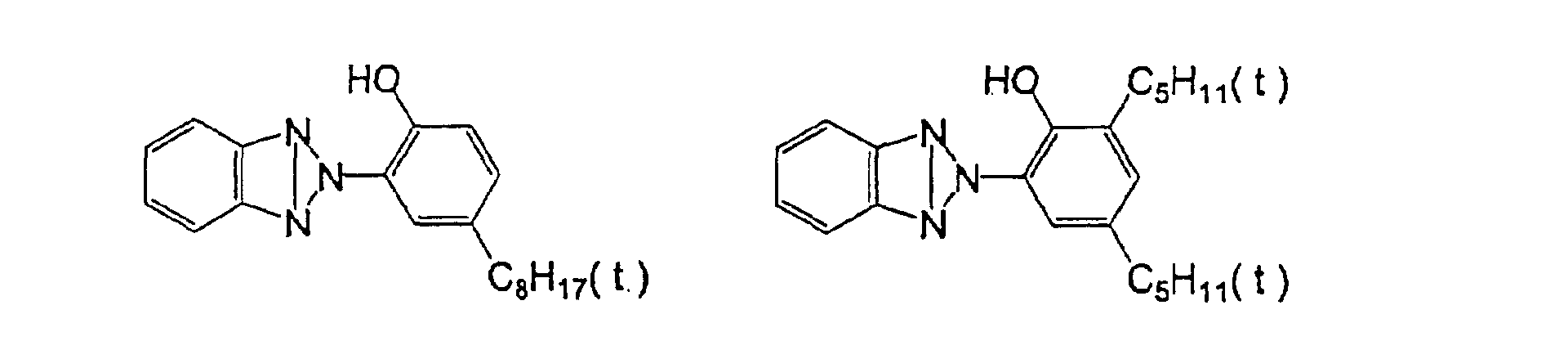
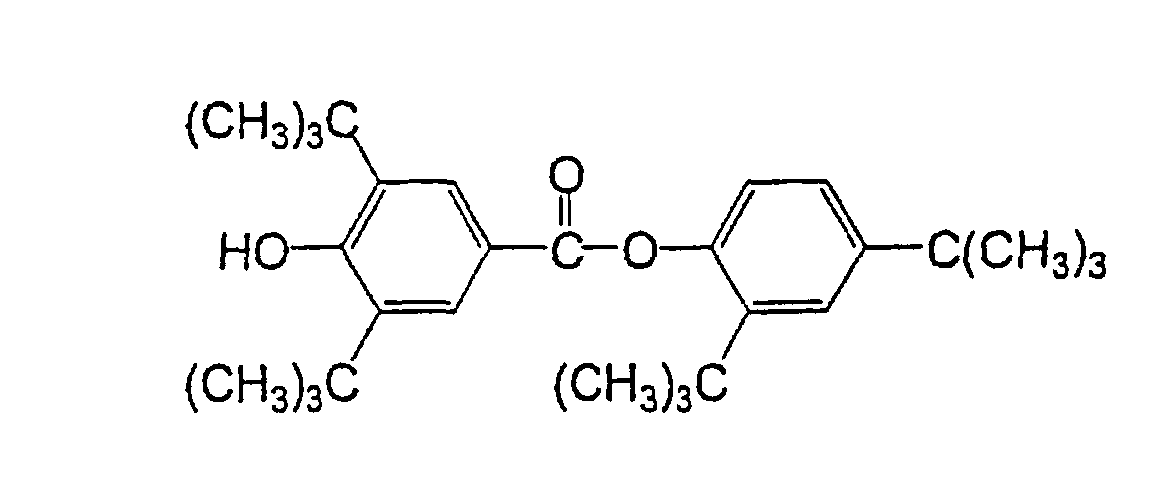
Examples of the UV absorbents include the following UV
absorbents.
The heat-sensitive color-forming layer may also include
a crosslinking agent to crosslink the PVA that serves as the
adhesive. By the heat-sensitive color-forming layer including
such a crosslinking agent, moisture resistance of the heat-sensitive
recording material is improved.
As long as the crosslinking agent is capable of
crosslinking the PVA, any crosslinking agent can be suitably
used. However, aldehyde compounds such as glyoxal, and
dihydrazide compounds such as adipic acid dihydrazide, are
particularly preferable.
The amount of the crosslinking agent is preferably 1 to
50 parts by weight, and more preferably 3 to 20 parts by weight,
with respect to 100 parts by weight of the polyvinyl alcohol
to be crosslinked by the crosslinking agent and included in the
heat-sensitive color-forming layer. It is preferable that the
amount of the crosslinking agent is within the range of 1 to
50 parts by weight with respect to the PVA, in view of resistance
to moisture.
In the present invention, the electron-donating
leuco-dye and the electron-receiving compound can be dispersed
in the adhesive or in a water-soluble binder. The water-soluble
binder is preferably a compound in which at least 5% by weight
is dissolved in water at 25°C.
Examples of the water-soluble binder include polyvinyl
alcohol, methyl cellulose, carboxymethyl cellulose, starches
(including modified starches), gelatin, arabic gum, casein, and
saponified copolymers of styrene and maleic anhydride.
The binder may be used not only at the time of dispersion,
but also for improving the film strength of the heat-sensitive
color-forming layer. To this end, the water-soluble binder may
be combined with a synthetic polymer latex binder such as
styrene-butadiene copolymer, vinyl acetate copolymer,
acrylonitrile-butadiene copolymer, methyl acrylate-butadiene
copolymer or polyvinylidene chloride.
The electron-donating leuco-dye and electron-receiving
compound may be dispersed together or separately by using a
stirring grinder such as a ball mill, an attritor or a sand mill,
to then be prepared as the coating liquid. The coating liquid
may include metal soaps, waxes, surfactantes, antistatic agents,
defoaming agents and fluorescent dyes as needed.
Metal salts of higher fatty acids, such as zinc stearate,
calcium stearate and aluminium stearate, can be used as the
metal soap.
Paraffin wax, microcrystalline wax, carnauba wax,
methylolstearic acid amide, polyethylene wax, polystyrene wax
and fatty acid amide-type wax can be used for the wax, either
singly or in combination. For the surfactant, alkali metal
salts and ammonium salts of alkylbenzenesulfonates, alkali
metal salts of sulfosuccinic acids, and surfactants including
fluorine can be used.
After these materials are mixed, they are applied to the
support. There are no particular limitations on the method for
coating. For example, the mixture can be applied with air-knife
coaters, roll coaters, blade coaters or curtain coaters,
dried, and then leveled with a calender. However, in the
present invention, a method that utilizes a curtain coater is
particularly preferable, because the heat-sensitive color-forming
layer can be coated uniformly, and because sensitivity
and image preservability are effectively improved.
There are no particular limitations on the amount of the
heat-sensitive color-forming layer. Ordinarily, an amount in
which the dry weight thereof is 2 and 7 g/m2 is preferable.
If desired, a protective layer may be provided on the
heat-sensitive color-forming layer. The protective layer may
include organic fine powders, inorganic fine powders (inorganic
pigments), binders, surfactants, and hot-melting substances.
Examples of the inorganic pigment include calcium carbonate,
silica, zinc oxide, titanium oxide, aluminium oxide, titanium
dioxide, silicon dioxide, aluminium hydroxide, zinc hydroxide,
barium sulfate, zinc sulfate, kaolin, clay, calcined clay, talc,
colloidal silica, surface processed calcium and silica. For
the organic fine powder, urea-formalin resin, copolymers of
styrene and methacrylic acid, and polystyrene can be used.
Preferable examples of the inorganic pigment include
aluminium hydroxide and kaolin. Aluminium hydroxide having a
mean particle diameter of 0.5 to 0.9 µm is even more preferable,
in view of color density when recording by a thermal head.
The amount of the inorganic pigment added is preferably
10 to 90% by weight, and more preferably 30 to 70% by weight,
with respect to the solid content of the coating liquid for the
protective layer.
The proportion at which the inorganic pigment and the
water-soluble polymer are mixed varies depending on the type
of inorganic pigment and the type of water-soluble polymer.
However, the amount of the water-soluble polymer is preferably
50 to 400% by weight, and more preferably 100 to 250% by weight,
with respect to the inorganic pigment.
The sum of the inorganic pigment and the water-soluble
polymer binder in the protective layer is at least 50% by weight
of the layer.
Examples of the binder in the protective layer include
water-soluble polymers such as polyvinyl alcohol, modified
polyvinyl alcohol (e.g., carboxy-modified polyvinyl alcohol,
silicon-modified polyvinyl alcohol, acetoacetyl-modified
polyvinyl alcohol, diacetone-modified polyvinyl alcohol,
amide-modified polyvinyl alcohol, sulfo-modified polyvinyl
alcohol), vinyl acetate-acrylamide copolymer, starch,
oxidized starch, modified starch (e.g., urea phosphate-modified
starch), methyl cellulose, carboxymethyl cellulose,
hydroxymethyl cellulose, gelatins, arabic gum, casein,
copolymers of styrene and maleic anhydride, alkyl esters of
copolymers of styrene and maleic anhydride, hydrolyzed
coploymers of styrene and maleic acid, polymers having carboxyl
groups such as copolymers of styrene and acrylic acid,
polyacrylamide derivatives, and polyvinyl pyrrolidone, as well
as latexes such as styrene-butadiene rubber latex,
acrylonitrile-butadiene rubber latex, methyl acrylate-butadiene
rubber latex, and polyvinyl acetate emulsion. Among
these, water-soluble polymers are preferable.
Among water-soluble polymers, polyvinyl alcohol,
modified polyvinyl alcohol, oxidized starch, and urea
phosphate-modified starch are preferable. It is even more
preferable to mix polyvinyl alcohol and/or modified polyvinyl
alcohol with oxidized starch and/or urea phosphate-modified
starch in a ratio by weight of 90/10 to 10/90. When these three
are combined, it is preferable to use the oxidized starch and
urea phosphate-modified starch in a ratio of 10/90 to 90/10 by
weight.
For the modified polyvinyl alcohol, acetoacetyl-modified
polyvinyl alcohol, diacetone-modified polyvinyl alcohol,
silicon-modified polyvinyl alcohol, and amide-modified
polyvinyl alcohol are preferably used. In addition to these,
sulfo-modified polyvinyl alcohol and carboxyl-modified
polyvinyl alcohol can be used. When a crosslinking agent is
combined to react with these polyvinyl alcohols, more
preferable results are obtained.
The amount of the water-soluble polymer added is
preferably 10 and 90% by weight, and more preferably 30 to 70%
by weight, with respect to the solid content of the coating
liquid for the protective layer.
A moisture resistance enhancer (crosslinking agent) can
be added to crosslink the binder component in the protective
layer and further improve the storage stability of the
heat-sensitive recording material. Examples of the moisture
resistance enhancer include: N-methylolurea, N-methylolmelamine,
water-soluble precondensates such as
urea-formalin; methylolated phenol; polyamine compounds such
as ethylenediamine; polyaldehydes including dialdehyde
compounds such as glyoxal, and glutaraldehyde; dihydrazide
compounds such as adipic acid dihydrazide, and phthalic acid
dihydrazide; polyfunctional epoxy compounds; polyvalent metal
salts (with Al, Ti, Zr, Mg, etc.), inorganic crosslinking agents
such as boric acid, borax, and colloidal silica; and
polyamide-epichlorohydrin.
When the polyvinyl alcohol and/or modified polyvinyl
alcohol are used, the ratio of the crosslinking agent to these
polyvinyl alcohols is preferably 2 to 30% by weight, and more
preferably 5 to 20% by weight. By using the crosslinking agent,
film strength and moisture resistance are improved.
Polyaldehyde compounds and dihydrazide compounds are
preferable as the crosslinking agent in the present invention.
By adding a surfactant to the coating liquid for the
protective layer, better inkjet ink compatibility and chemical
resistance are obtained. Preferable examples of the
surfactant include salts of alkylbenzenesulfonates such as
sodium dodecylbenzenesulfonates; salts of
alkylsulfosuccinates such as sodium dioctylsulfosuccinate, as
well as polyoxyethylene alkyl ether phosphates, sodium
hexametaphosphate, and salts of perfluoroalkylcarboxylic
acids. Among these, salts of alkylsulfosuccinates are more
preferable. The amount of the surfactant is preferably 0.1 to
5% by weight, and more preferably 0.5 to 3% by weight, with
respect to the solid content of the coating liquid for the
protective layer.
The coating liquid for the protective layer may further
include lubricants, defoaming agents, fluorescent brighteners
and chromatic organic pigments as long as the effects of the
prevent invention are not compromised. Examples of the
lubricant include metal soaps, such as zinc stearate and calcium
stearate, and waxes, such as paraffin wax, microcrystalline wax,
carnauba wax and synthetic polymer wax.
EXAMPLES
The present invention will now be specifically described
with reference to the following Examples, which, however, are
not intended to restrict the scope of the present invention.
Unless otherwise indicated, "parts" and "%" in the following
Examples are all by weight. Also, unless otherwise indicated,
"mean particle size" means "volume-average particle size"
measured with an LA-500 (manufactured by Horiba).
Example 1:
«Fabrication of heat-sensitive recording material»
<Preparation of coating liquid for heat-sensitive color-forming
layer>
(Preparation of dispersion A)
The following ingredients were dispersed in a ball mill
to prepare a dispersion A having a mean particle size of 0.7
µm.
[Composition of dispersion A]
| 2-Anilino-3-methyl-6-diethylaminofluoran (electron-donating leuco-dye) |
10 parts |
| 2.5 % Solution of polyvinyl alcohol (Kuraray's PVA-105) |
50 parts |
(Preparation of dispersion B)
The following ingredients were dispersed in a ball mill
to prepare a dispersion B having a mean particle size of 0.7
µm.
[Composition of dispersion B]
| N-(4-hydroxyphenyl)-p-toluenesulfonamide (electron-receiving compound) |
20 parts |
| 2.5 % Solution of polyvinyl alcohol (Kuraray's PVA-105) |
100 parts |
(Preparation of dispersion C)
The following ingredients were dispersed in a ball mill
to prepare a dispersion C having a mean particle size of 0.7
µm.
[Composition of dispersion C]
| 2-Benzyloxynaphthalene (sensitizer) |
20 parts |
| 2.5 % Solution of polyvinyl alcohol (Kuraray's PVA-105) |
100 parts |
(Preparation of pigment dispersion D)
The following ingredients were dispersed in a sand mill
to prepare a pigment dispersion D having a mean particle size
of 2.0 µm.
[Composition of pigment dispersion D]
| Calcite type precipitated calcium carbonate light |
40 parts |
| Sodium polyacrylate |
1 part |
| Distilled water |
60 parts |
The following compounds were mixed to prepare a coating
liquid for a heat-sensitive color-forming layer.
[Composition of coating liquid for heat-sensitive color-forming
layer]
| Dispersion A |
60 parts |
| Dispersion B |
120 parts |
| Dispersion C |
120 parts |
| Pigment dispersion D |
101 parts |
| 30 % Dispersion of zinc stearate |
15 parts |
| Paraffin wax (30 %) |
15 parts |
| Sodium dodecylbenzenesulfonate (25 %) |
4 parts |
<Fabrication of heat-sensitive recording material>
Using a blade coater, a coating liquid for an undercoat
layer was applied onto base paper having a Stoeckigt sizing
degree of 5 seconds and a basic weight of 50 g/m2 to form thereon
an undercoat layer consisting essentially of pigment and binder
and having a dry weight of 8 g/m2. The base paper was thus coated
with the undercoat layer. Next, using a curtain coater, the
coating liquid for a heat-sensitive color-forming layer
prepared in the above was applied onto the undercoat layer of
the coated base paper to form thereon a heat-sensitive
color-forming layer having a dry weight of 4 g/m2. After dried,
the heat-sensitive color-forming layer was then calendered.
Thus was obtained a heat-sensitive recording material of
Example 1.
Example 2:
A heat-sensitive recording material of Example 2 was
fabricated in the same manner as in Example 1, except that the
amount of the dispersion C used was 90 parts and not 120 parts.
Example 3:
A heat-sensitive recording material of Example 3 was
fabricated in the same manner as in Example 1, except that the
amount of the dispersion C used was 240 parts and not 120 parts.
Example 4:
A heat-sensitive recording material of Example 4 was
fabricated in the same manner as in Example 1, except that the
dispersion A used included 2-anilino-3-methyl-6-(N-ethyl-N-isoamylamino)fluoran
in place of 2-anilino-3-methyl-6-diethylaminofluoran.
Example 5:
A heat-sensitive recording material of Example 5 was
fabricated in the same manner as in Example 1, except that the
dispersion A used included 2-anilino-3-methyl-6-(N-ethyl-N-isopropylamino)fluoran
in place of 2-anilino-3-methyl-6-diethylaminofluoran.
Example 6:
A heat-sensitive recording material of Example 6 was
fabricated in the same manner as in Example 1, except that the
amount of the dispersion C used was 60 parts and not 120 parts.
Example 7:
A heat-sensitive recording material of Example 7 was
fabricated in the same manner as in Example 1, except that the
amount of the dispersion C used was 300 parts and not 120 parts.
Example 8:
A heat-sensitive recording material of Example 8 was
fabricated in the same manner as in Example 1, except that the
dispersion A used included 2-anilino-3-methyl-6-dibutylaminofluoran
in place of 2-anilino-3-methyl-6-diethylaminofluoran.
Example 9:
A heat-sensitive recording material of Example 9 was
fabricated in the same manner as in Example 1, except that the
dispersion C used included stearic acid amide in place of
2-benzyloxynaphthalene.
Example 10:
A heat-sensitive recording material of Example 10 was
fabricated in the same manner as in Example 1, except that the
dispersion C used included p-benzylbiphenyl in place of 2-benzyloxynaphthalene.
Example 11:
«Fabrication of heat-sensitive recording material»
<Preparation of coating liquid for heat-sensitive color-forming
layer>
(Preparation of dispersion A)
The following ingredients were dispersed in a sand mill
to prepare a dispersion A having a mean particle size of 0.6
µm.
[Composition of dispersion A]
| 2-Anilino-3-methyl-6-diethylaminofluoran (electron-donating leuco-dye) |
10 parts |
| 2.5 % Solution of polyvinyl alcohol (Kuraray's PVA-105) |
50 parts |
(Preparation of dispersion B)
The following ingredients were dispersed in a sand mill
to prepare a dispersion B having a mean particle size of 0.6
µm.
[Composition of dispersion B]
| N-(4-hydroxyphenyl)-p-toluenesulfonamide (electron-receiving compound) |
25 parts |
| 2.5 % Solution of polyvinyl alcohol (Kuraray's PVA-105) |
100 parts |
(Preparation of dispersion C)
The following ingredients were dispersed in a sand mill
to prepare a dispersion C having a mean particle size of 0.6
µm.
[Composition of dispersion C]
| 2-Benzyloxynaphthalene (sensitizer) |
25 parts |
| 2.5 % Solution of polyvinyl alcohol (Kuraray's PVA-105) |
100 parts |
(Preparation of pigment dispersion D)
The following ingredients were dispersed in a sand mill
to prepare a pigment dispersion D having a mean particle size
of 1.2 µm.
[Composition of pigment dispersion D]
| Calcite-type precipitated calcium carbonate light (Shiraishi Industry's Uniber 70) |
30 parts |
| Sodium hexametaphosphate |
0.3 part |
| Distilled water |
40 parts |
The following compounds were mixed to prepare a coating
liquid for a heat-sensitive color-forming layer.
[Composition of coating liquid for heat-sensitive color-forming
layer]
| Dispersion A |
60 parts |
| Dispersion B |
125 parts |
| Dispersion C |
125 parts |
| Pigment dispersion D |
70 parts |
| 30 % Dispersion of zinc stearate |
15 parts |
| Paraffin wax (30 %) |
15 parts |
| Sodium dodecylbenzenesulfonate (25 %) |
4 parts |
(Preparation of coating liquid for undercoat layer)
Using a dissolver, the following ingredients were stirred
and mixed, to which were added 20 parts of SBR (styrene-butadiene
latex) and 25 parts of oxidized starch (25 %) to
prepare a coating liquid for an undercoat layer.
[Composition of coating liquid for undercoat layer]
| Calcined kaolin (having a degree of oil absorption of 75 ml/100 g) |
100 parts |
| Sodium hexametaphosphate |
1 part |
| Distilled water |
110 parts |
<Fabrication of heat-sensitive recording material>
Using a blade coater, the coating liquid for an undercoat
layer prepared in the above was applied onto woodfree base paper
having a Stoeckigt sizing degree of 10 seconds and a basic weight
of 50 g/m2 to form thereon an undercoat layer having a dry weight
of 8 g/m2. After dried, the layer was then calendered. The base
paper was thus coated with the undercoat layer. Next, using
a curtain coater, the coating liquid for a heat-sensitive
color-forming layer prepared in the above was applied onto the
undercoat layer of the coated base paper to form thereon a
heat-sensitive color-forming layer having a dry weight of 4 g/m2.
After dried, the heat-sensitive color-forming layer was then
calendered. Thus was obtained a heat-sensitive recording
material of Example 11.
Example 12:
A heat-sensitive recording material of Example 12 was
fabricated in the same manner as in Example 11, except that the
pigment dispersion D used included calcite-type precipitated
calcium carbonate light, Okutama Industry's Tamapearl 121, in
place of Uniber 70.
Example 13:
A heat-sensitive recording material of Example 13 was
fabricated in the same manner as in Example 11, except that the
pigment dispersion D used included aluminium oxide, Showa
Denko's Higilite H42, in place of calcite-type precipitated
calcium carbonate light, Uniber 70.
Example 14:
A heat-sensitive recording material of Example 14 was
fabricated in the same manner as in Example 11, except that the
amount of the pigment dispersion D used was 35 parts and not
70 parts.
Example 15:
A heat-sensitive recording material of Example 15 was
fabricated in the same manner as in Example 11, except that the
amount of the pigment dispersion D used was 140 parts and not
70 parts.
Example 16:
A heat-sensitive recording material of Example 16 was
fabricated in the same manner as in Example 11, except that the
amount of the pigment dispersion D used was 17.5 parts and not
70 parts.
Example 17:
A heat-sensitive recording material of Example 17 was
fabricated in the same manner as in Example 11, except that the
amount of the pigment dispersion D used was 210 parts and not
70 parts.
Example 18:
A heat-sensitive recording material of Example 18 was
fabricated in the same manner as in Example 11, except that the
mean particle size of the dispersion D used was 2.2 µm and not
1.2 µm.
Example 19:
A heat-sensitive recording material of Example 19 was
fabricated in the same manner as in Example 11, except that the
mean particle size of the dispersion D used was 0.8 µm and not
1.2 µm.
Example 20:
A heat-sensitive recording material of Example 20 was
fabricated in the same manner as in Example 11, except that the
mean particle size of the dispersion D used was 0.5 µm and not
1.2 µm.
Example 21:
A heat-sensitive recording material of Example 21 was
fabricated in the same manner as in Example 11, except that the
mean particle size of the dispersion D used was 3.0 µm and not
1.2 µm.
Example 22:
A heat-sensitive recording material of Example 22 was
fabricated in the same manner as in Example 11, except that
woodfree base paper to be the support was undercoated as
follows: Using an air-knife coater and not a blade coater, a
coating liquid for an undercoat layer mentioned below was
applied onto woodfree base paper having a Stoeckigt sizing
degree of 10 seconds and a basic weight of 50 g/m2 to form thereon
an undercoat layer having a dry weight of 8 g/m2. After dried,
the layer was then calendered. The thus-undercoated, woodfree
base paper was used for the support.
(Preparation of coating liquid for undercoat layer)
Using a dissolver, the following ingredients were stirred
and mixed, to which were added 20 parts of SBR (styrene-butadiene
latex) and 25 parts of oxidized starch (25 %) to
prepare a coating liquid for an undercoat layer.
[Composition of coating liquid for undercoat layer]
| Calcined kaolin (having a degree of oil absorption of 75 ml/100 g) |
100 parts |
| Sodium hexametaphosphate |
1 part |
| Distilled water |
314 parts |
Example 23:
A heat-sensitive recording material of Example 23 was
fabricated in the same manner as in Example 11, except that the
heat-sensitive color-forming layer was formed on the undercoat
layer by the use of an air-knife coater and not a curtain coater.
Example 24:
A heat-sensitive recording material of Example 24 was
fabricated in the same manner as in Example 11, except that the
pigment dispersion D used included kaolin, Shiraishi Industrial
Calcium's Kaogloss, in place of calcite-type precipitated
calcium carbonate light, Uniber 70.
Example 25:
A heat-sensitive recording material of Example 25 was
fabricated in the same manner as in Example 11, except that the
pigment dispersion D used included aragonite-type calcium
carbonate, Shiraishi Industry's Cal-light SA, in place of
calcite-type precipitated calcium carbonate light, Uniber 70.
Comparative Example 1:
A heat-sensitive recording material of Comparative
Example 1 was fabricated in the same manner as in Example 11,
except that the dispersion B used included 2,2-bis(4-hydroxyphenyl)propane
(bisphenol A) in place of N-(4-hydroxyphenyl)-p-toluenesulfonamide.
Example 26:
«Fabrication of heat-sensitive recording material»
<Preparation of coating liquid for heat-sensitive color-forming
layer>
(Preparation of dispersion A)
The following ingredients were dispersed in a ball mill
to prepare a dispersion A having a mean particle size of 0.6
µm.
[Composition of dispersion A]
| 2-Anilino-3-methyl-6-diethylaminofluoran (electron-donating leuco-dye) |
10 parts |
| 2.5 % Solution of polyvinyl alcohol (Kuraray's PVA-110, having a degree of saponification of 98.5 mol% and a degree of polymerization of 1000) |
50 parts |
(Preparation of dispersion B)
The following ingredients were dispersed in a ball mill
to prepare a dispersion B having a mean particle size of 0.6
µm.
[Composition of dispersion B]
| N-(4-hydroxyphenyl)-p-toluenesulfonamide (electron-receiving compound) |
20 parts |
| 2.5% Solution of polyvinyl alcohol (Kuraray's PVA-110, having a degree of saponification of 98.5 mol% and a degree of polymerization of 1000) |
100 parts |
(Preparation of dispersion C)
The following ingredients were dispersed in a ball mill
to prepare a dispersion C having a mean particle size of 0.6
µm.
[Composition of dispersion C]
| 2-Benzyloxynaphthalene (sensitizer) |
20 parts |
| 2.5% Solution of polyvinyl alcohol (Kuraray's PVA-110, having a degree of saponification of 98.5 mol% and a degree of polymerization of 1000) |
100 parts |
(Preparation of pigment dispersion D)
The following ingredients were dispersed in a sand mill
to prepare a pigment dispersion D having a mean particle size
of 2.0 µm.
[Composition of pigment dispersion D]
| Precipitated calcium carbonate light |
40 parts |
| Sodium polyacrylate |
1 part |
| Water |
60 parts |
The following compounds were mixed to prepare a coating
liquid for a heat-sensitive color-forming layer.
[Composition of coating liquid for heat-sensitive color-forming
layer]
| Dispersion A |
60 parts |
| Dispersion B |
120 parts |
| Dispersion C |
120 parts |
| Pigment dispersion D |
101 parts |
| 30 % Dispersion of zinc stearate |
15 parts |
| Paraffin wax (30 %) |
15 parts |
| Sodium dodecylbenzenesulfonate (25 %) |
4 parts |
<Fabrication of heat-sensitive recording material>
Using a blade coater, a coating liquid for an undercoat
layer was applied onto base paper having a basic weight of 50
g/m2 to form thereon an undercoat layer consisting essentially
of calcined kaolin (having a degree of oil absorption of 78
ml/100 g), SBR and oxidized starch, and having a dry weight of
8 g/m2. The base paper was thus coated with the undercoat layer.
Next, using a curtain coater, the coating liquid for a
heat-sensitive color-forming layer prepared in the above was
applied onto the undercoat layer of the coated base paper to
form thereon a heat-sensitive color-forming layer having a dry
weight of 4 g/m2. After dried, the heat-sensitive color-forming
layer was then calendered. Thus was obtained a
heat-sensitive recording material of Example 26.
Example 27:
A heat-sensitive recording material of Example 27 was
fabricated in the same manner as in Example 26, except that the
coating liquid for the heat-sensitive color-forming layer
additionally included 125 parts of a 8 % solution of PVA-117
(from Kuraray, having a degree of saponification of 98.5 mol%
and a degree of polymerization of 1750).
Example 28:
A heat-sensitive recording material of Example 28 was
fabricated in the same manner as in Example 27, except that the
dispersions A, B and C used included Nippon Gosei Kagaku's
Gohseran L-3266 (sulfo-modified polyvinyl alcohol, having a
degree of saponification of 88 mol% and a degree of
polymerization of 300) in place of PVA-110.
Example 29:
A heat-sensitive recording material of Example 29 was
fabricated in the same manner as in Example 27, except that the
dispersions A, B and C used included Unitika's D-500
(diacetone-modified polyvinyl alcohol, having a degree of
saponification of 98.5 mol% and a degree of polymerization of
500) in place of PVA-110.
Example 30:
A heat-sensitive recording material of Example 30 was
fabricated in the same manner as in Example 27, except that the
dispersions A, B and C used included Nippon Gosei Kagaku's
Gohsefimer Z200 (acetoacetyl-modified polyvinyl alcohol,
having a degree of saponification of 98.5 mol% and a degree of
polymerization of 1000) in place of PVA-110.
Example 31:
A heat-sensitive recording material of Example 31 was
fabricated in the same manner as in Example 28, except that an
air-knife coater was used in forming the heat-sensitive
color-forming layer.
Example 32:
A heat-sensitive recording material of Example 32 was
fabricated in the same manner as in Example 26, except that the
dispersions A, B and C used included Kuraray's PVA-405
(polyvinyl alcohol, having a degree of saponification of 80 mol%
and a degree of polymerization of 500) in place of PVA-110.
Example 33:
A heat-sensitive recording material of Example 33 was
fabricated in the same manner as in Example 26, except that the
dispersions A, B and C used included Kuraray's PVA-417
(polyvinyl alcohol, having a degree of saponification of 80 mol%
and a degree of polymerization of 1750) in place of PVA-110.
Comparative Example 2:
A heat-sensitive recording material of Comparative
Example 2 was fabricated in the same manner as in Example 26,
except that the dispersion C used included 2,2-bis(4-hydroxyphenyl)propane
(bisphenol A) in place of N-(4-hydroxyphenyl)-p-toluenesulfonamide.
Example 34:
(Preparation of coating liquid for heat-sensitive color-forming
layer)
<Preparation of liquid A (electron-donating leuco-dye)>
In a ball mill, the following ingredients were mixed to
prepare a dispersion having a mean particle size of 0.8 µm.
| 3-Diethylamino-6-methyl-7-anilinofluoran | 10 parts |
| 2.5 % Solution of polyvinyl alcohol (Kuraray's PVA-105, having a degree of saponification of 98.5 mol% and a degree of polymerization of 500) | 50 parts |
In a ball mill, the following ingredients were mixed to
prepare a dispersion having a mean particle size of 0.8 µm.
| N-(4-hydroxyphenyl)-p-toluenesulfonamide | 20 parts |
| 2.5 % Solution of polyvinyl alcohol (PVA-105) | 100 parts |
In a ball mill, the following ingredients were mixed to
prepare a dispersion having a mean particle size of 0.8 µm.
| 2-Benzyloxynaphthalene | 20 parts |
| 2.5 % Solution of polyvinyl alcohol (PVA-105) | 100 parts |
In a sand mill, the following ingredients were mixed to
prepare a pigment dispersion having a mean particle size of 2.0
µm.
| Calcium carbonate | 40 parts |
| Sodium polyacrylate | 1 part |
| Water | 60 parts |
60 parts of the liquid A, 120 parts of the liquid B, 120
parts of the liquid C, 101 parts of the liquid D, 15 parts of
a 30 % dispersion of zinc stearate, 15 parts of paraffin wax
(30 % dispersion), and 4 parts of sodium
dodecylbenzenesulfonate (25 %) were mixed to prepare a coating
liquid for a heat-sensitive color-forming layer.
<Preparation of coating liquid for protective layer>
In a sand mill, the following ingredients were mixed to
prepare a pigment dispersion having a mean particle size of 2
µm.
| Calcium carbonate | 40 parts |
| Sodium polyacrylate | 1 part |
| Water | 60 parts |
60 parts of water was added to 240 parts of a 25 % aqueous
solution of styrene-maleic anhydride copolymer alkyl ester
(Arakawa Chemical's Polymalon 385), which was then mixed with
the pigment dispersion prepared in the above. Then, this was
further mixed with 25 parts of an emulsified dispersion of zinc
stearate having a mean particle size of 0.15 µm (Chukyo Yushi's
Hidorin F115), and 125 parts of a 2 % aqueous solution of sodium
salt of 2-ethylhexyl sulfosuccinate to prepare a coating liquid
for a protective layer.
(Fabrication of heat-sensitive recording material)
Using a curtain coater, the coating liquid for a
heat-sensitive color-forming layer prepared in the above was
applied onto woodfree paper having a basic weight of 50 g/m2
and coated with an undercoat layer (10 g/m2 - this consists
essentially of pigment and binder) to form thereon a heat-sensitive
color-forming layer having a dry weight of 4 g/m2.
After thus coated, this was dried and calendered. Next, using
a curtain coater, the coating liquid for a protective layer
prepared in the above was applied onto the heat-sensitive
color-forming layer to form thereon a protective layer having
a dry weight of 2 g/m2. After thus coated, this was dried and
calendered, and a heat-sensitive recording material was thus
obtained.
Example 35:
A heat-sensitive recording material of Example 35 was
fabricated in the same manner as in Example 34, except that the
protective layer included aluminium hydroxide having a mean
particle size of 1 µm (Showa Denko's Higilite H42) in place of
calcium carbonate.
Example 36:
A heat-sensitive recording material of Example 36 was
fabricated in the same manner as in Example 34, except that the
protective layer included kaolin (Shiraishi Kogyo's Kaobright)
in place of calcium carbonate.
Example 37:
A heat-sensitive recording material of Example 37 was
fabricated in the same manner as in Example 35, except that 400
parts of a 15 % aqueous solution of polyvinyl alcohol (Kuraray's
PVA105) was used in place of 240 parts of the 25 % aqueous
solution of styrene-maleic anhydride copolymer alkyl ester
(Arakawa Chemical's Polymalon 385) used in Example 35.
Example 38:
A heat-sensitive recording material of Example 38 was
fabricated in the same manner as in Example 35, except that 400
parts of a 15 % aqueous solution of oxidized starch (Nippon
Shokuhin Kako's MS3800) was used in place of 240 parts of the
25 % aqueous solution of styrene-maleic anhydride copolymer
alkyl ester (Arakawa Chemical's Polymalon 385) used in Example
35.
Example 39:
A heat-sensitive recording material of Example 39 was
fabricated in the same manner as in Example 35, except that 400
parts of a 15 % aqueous solution of urea phosphate-modified
starch (Nippon Shokuhin Kako's MS4600) was used in place of 240
parts of the 25 % aqueous solution of styrene-maleic anhydride
copolymer alkyl ester (Arakawa Chemical's Polymalon 385) used
in Example 35.
Example 40:
A heat-sensitive recording material of Example 40 was
fabricated in the same manner as in Example 35, except that 200
parts of a 15 % aqueous solution of oxidized starch (Nippon
Shokuhin Kako's MS3800) and 200 parts of a 15 % aqueous solution
of polyvinyl alcohol (Kuraray's PVA105) were used in place of
240 parts of the 25 % aqueous solution of styrene-maleic
anhydride copolymer alkyl ester (Arakawa Chemical's Polymalon
385) used in Example 35.
Example 41:
A heat-sensitive recording material of Example 41 was
fabricated in the same manner as in Example 35, except that 200
parts of a 15 % aqueous solution of urea phosphate-modified
starch (Nippon Shokuhin Kako's MS4600) and 200 parts of a 15 %
aqueous solution of polyvinyl alcohol (Kuraray's PVA105) were
used in place of 240 parts of the 25 % aqueous solution of
styrene-maleic anhydride copolymer alkyl ester (Arakawa
Chemical's Polymalon 385) used in Example 35.
Example 42:
A heat-sensitive recording material of Example 42 was
fabricated in the same manner as in Example 40, except that
aluminium hydroxide having a mean particle size of 0.6 µm
(Sumitomo Chemical's C-3005) was used in place of aluminium
hydroxide having a mean particle size of 1 µm used in Example
40.
Example 43:
A heat-sensitive recording material of Example 43 was
fabricated in the same manner as in Example 42, except that 400
parts of a 7.5 % aqueous solution of silicon-modified polyvinyl
alcohol (Kuraray's R-1130) was used in place of 240 parts of
the 15 % aqueous solution of polyvinyl alcohol (Kuraray's
PVA105) used in Example 42.
Example 44:
A heat-sensitive recording material of Example 44 was
fabricated in the same manner as in Example 42, except that 400
parts of a 7.5 % aqueous solution of diacetone-modified
polyvinyl alcohol (Unitika's D-700) was used in place of 200
parts of the 15 % aqueous solution of polyvinyl alcohol
(Kuraray's PVA105) used in Example 42, and 30 parts of a 5 %
aqueous solution of adipic acid dihydrazide was added thereto.
Example 45:
A heat-sensitive recording material of Example 45 was
fabricated in the same manner as in Example 42, except that 400
parts of a 7.5 % aqueous solution of acetoacetyl-modified
polyvinyl alcohol (Nippon Gosei Kagaku's Gohsefimer Z-200) was
used in place of 200 parts of the 15 % aqueous solution of
polyvinyl alcohol (Kuraray's PVA105) used in Example 42, and
30 parts of a 10 % aqueous solution of glyoxal was added thereto.
Example 46:
A heat-sensitive recording material of Example 46 was
fabricated in the same manner as in Example 42, except that 400
parts of a 7.5 % aqueous solution of amide-modified polyvinyl
alcohol (Nippon Gosei Kagaku's NP20H) was used in place of 200
parts of the 15 % aqueous solution of polyvinyl alcohol
(Kuraray's PVA105) used in Example 42, and 30 parts of a 10 %
aqueous solution of glyoxal was added thereto.
Example 47:
A heat-sensitive recording material of Example 47 was
fabricated in the same manner as in Example 43, except that an
air-knife coater was used in forming the heat-sensitive
color-forming layer.
Comparative Example 3:
A heat-sensitive recording material of Comparative
Example 3 was fabricated in the same manner as in Example 34,
except that bisphenol A was used in place of N-(4-hydroxyphenyl)-p-toluenesulfonamide
in preparing the liquid
B.
Example 48:
A heat-sensitive recording material of Example 48 was
fabricated in the same manner as in Example 34, except that the
protective layer was not provided.
Example 49:
(Preparation of coating liquid for heat-sensitive color-forming
layer)
<Preparation of liquid A (electron-donating leuco-dye)>
In a ball mill, the following ingredients were mixed to
prepare a dispersion having a mean particle size of 0.8 µm.
| 3-Diethylamino-6-methyl-7-anilinofluoran | 10 parts |
| 2.5 % Solution of polyvinyl alcohol (Kuraray's PVA-105, having a degree of saponification of 98.5 mol% and a degree of polymerization of 500) | 50 parts |
In a ball mill, the following ingredients were mixed to
prepare a dispersion having a mean particle size of 0.8 µm.
| N-(4-hydroxyphenyl)-p-toluenesulfonamide | 20 parts |
| 2.5 % Solution of polyvinyl alcohol (PVA-105) | 100 parts |
In a ball mill, the following ingredients were mixed to
prepare a dispersion having a mean particle size of 0.8 µm.
| 2-Benzyloxynaphthalene | 20 parts |
| 2.5 % Solution of polyvinyl alcohol (PVA-105) | 100 parts |
In a sand mill, the following ingredients were mixed to
prepare a pigment dispersion having a mean particle size of 2.0
µm.
| Amorphous silica (Mizusawa Chemical's Mizukasil P-832) | 20 parts |
| Sodium polyacrylate | 1 part |
| Water | 80 parts |
60 parts of the liquid A, 120 parts of the liquid B, 120
parts of the liquid C, 101 parts of the liquid D, 15 parts of
a 30 % dispersion of zinc stearate, 15 parts of paraffin wax
(30 %), and 4 parts of sodium dodecylbenzenesulfonate (25 %)
were mixed to prepare a coating liquid for a heat-sensitive
color-forming layer.
(Fabrication of heat-sensitive recording material)
Using a curtain coater, the coating liquid for a
heat-sensitive color-forming layer prepared in the above was
applied onto base paper that had been prepared by coating
recycled paper (50 g/m2 - this is composed of 70 % of waste pulp
and 30 % of LBKP, and has a surface smoothness measured according
to JIS-P8119 of 170 seconds) with an undercoat layer (10 g/m2
- this consists essentially of pigment and binder), to thereby
form thereon a heat-sensitive color-forming layer having a dry
weight of 4 g/m2. After thus coated, this was dried and
calendered. Thus was obtained a heat-sensitive recording
material.
Example 50:
A heat-sensitive recording material of Example 50 was
fabricated in the same manner as in Example 49, except that 40
parts of cubic-system calcium carbonate (Shiraishi Kogyo's
Brilliant 15) was used in preparing the liquid D, in place of
amorphous silica used in Example 49.
Example 51:
A heat-sensitive recording material of Example 51 was
fabricated in the same manner as in Example 49, except that 40
parts of aluminium hydroxide (Showa Denko's Higilite H42,
having a mean particle size of 1.0 µ) was used in preparing the
liquid D, in place of amorphous silica used in Example 49.
Example 52:
A heat-sensitive recording material of Example 52 was
fabricated in the same manner as in Example 49, except that 40
parts of aluminium hydroxide (Sumitomo Chemical's C-3005,
having a mean particle size of 0.6 µm) was used in preparing
the liquid D, in place of amorphous silica used in Example 49.
Example 53:
A heat-sensitive recording material of Example 53 was
fabricated in the same manner as in Example 49, except that 40
parts of burr-like calcium carbonate (Shiraishi Kogyo's Uniber
70, having a mean particle size of 1.5 µm) was used in preparing
the liquid D, in place of amorphous silica used in Example 49.
Example 54:
A heat-sensitive recording material of Example 54 was
fabricated in the same manner as in Example 49, except that 30
parts of aluminium hydroxide (Sumitomo Chemical's C-3005,
having a mean particle size of 0.6 µm) and 10 parts of basic
magnesium carbonate (Kamishima Chemical's Kinsei, having a mean
particle size of 0.6 µm) were used in place of amorphous silica.
Example 55:
A heat-sensitive recording material of Example 55 was
fabricated in the same manner as in Example 49, except that 30
parts of aluminium hydroxide (Sumitomo Chemical's C-3005,
having a mean particle size of 0.6 µm) and 10 parts of magnesium
oxide (Kamishima Chemical's Starmag M, having a mean particle
size of 0.5 µm) were used in place of amorphous silica.
Example 56:
A heat-sensitive recording material of Example 56 was
fabricated in the same manner as in Example 53, except that an
air-knife coater was used in forming the heat-sensitive
color-forming layer.
Comparative Example 4:
A heat-sensitive recording material of Comparative
Example 4 was fabricated in the same manner as in Example 49,
except that bisphenol A was used in preparing the liquid B, in
place of N-(4-hydroxyphenyl)-p-toluenesulfonamide used in
Example 49.
Example 57:
A heat-sensitive recording material of Example 57 was
fabricated in the same manner as in Example 49, except that
woodfree paper composed of 50 % NBKP and 50 % LBKP and having
a degree of surface smoothness measured according to JIS-P8119
of 170 seconds was used in place of the recycled paper used in
Example 49.
Comparative Example 5:
A heat-sensitive recording material of Comparative
Example 5 was fabricated in the same manner as in Comparative
Example 4, except that woodfree paper composed of 50 % NBKP and
50 % LBKP and having a degree of surface smoothness measured
according to JIS-P8119 of 170 seconds was used in place of the
recycled paper used in Comparative Example 4.
Example 58:
<<Fabrication of heat-sensitive recording material>>
<Preparation of coating liquid for heat-sensitive color-forming
layer>
(Preparation of dispersion A)
The following ingredients were dispersed in a sand mill
to prepare a dispersion A having a mean particle size of 0.7
µm.
[Composition of dispersion A]
| 2-Anilino-3-methyl-6-diethylaminofluoran (electron-donating leuco-dye) |
10 parts |
| 2.5 % Solution of polyvinyl alcohol (Kuraray's PVA-105) |
50 parts |
(Preparation of dispersion B)
The following ingredients were dispersed in a sand mill
to prepare a dispersion B having a mean particle size of 0.7
µm.
[Composition of dispersion B]
| N-(4-hydroxyphenyl)-p-toluenesulfonamide (electron-receiving compound) |
20 parts |
| 2.5 % Solution of polyvinyl alcohol (Kuraray's PVA-105) |
100 parts |
(Preparation of dispersion C)
The following ingredients were dispersed in a sand mill
to prepare a dispersion C having a mean particle size of 0.7
µm.
[Composition of dispersion C]
| 2-Benzyloxynaphthalene (sensitizer) |
20 parts |
| 2.5 % Solution of polyvinyl alcohol (Kuraray's PVA-105) |
100 parts |
(Preparation of dispersion D)
The following ingredients were dispersed in a sand mill
to prepare a dispersion D having a mean particle size of 0.7
µm.
[Composition of dispersion D]
| Methylolstearic acid amide (sensitizer) |
10 parts |
| 2.5 % Solution of polyvinyl alcohol (Kuraray's PVA-105) |
40 parts |
(Preparation of dispersion E)
The following ingredients were dispersed in a sand mill
to prepare a dispersion E having a mean particle size of 0.7
µm.
[Composition of dispersion E]
| 1,1,3-Tris(2-methyl-4-hydroxy-5-tert-butylphenyl)butane (image stabilizer) |
5 parts |
| 2.5 % Solution of polyvinyl alcohol (Kuraray's PVA-105) |
25 parts |
(Preparation of pigment dispersion F)
The following ingredients were dispersed in a sand mill
to prepare a pigment dispersion F having a mean particle size
of 2.0 µm.
[Composition of pigment dispersion F]
| Calcite type precipitated calcium carbonate light |
40 parts |
| Sodium polyacrylate |
1 part |
| Water |
60 parts |
The following compounds were mixed to prepare a coating
liquid for a heat-sensitive color-forming layer.
[Composition of coating liquid for heat-sensitive color-forming
layer]
| Dispersion A |
60 parts |
| Dispersion B |
120 parts |
| Dispersion C |
120 parts |
| Dispersion D |
50 parts |
| Dispersion E |
30 parts |
| Pigment dispersion F |
101 parts |
| 30 % Dispersion of zinc stearate |
15 parts |
| Paraffin wax (30 %) |
15 parts |
| Sodium dodecylbenzenesulfonate (25 %) |
4 parts |
(Preparation of coating liquid for undercoat layer)
Using a dissolver, the following ingredients were stirred
and mixed, to which were added 20 parts of SBR and 25 parts of
oxidized starch (25 %) to prepare a coating liquid for an
undercoat layer.
[Composition of coating liquid for undercoat layer]
| Calcined kaolin (having a degree of oil absorption of 75 ml/100 g) |
100 parts |
| Sodium hexametaphosphate |
1 part |
| Distilled water |
110 parts |
<Fabrication of heat-sensitive recording material>
Using a blade coater, the coating liquid for an undercoat
layer prepared in the above was applied onto base paper having
a basic weight of 50 g/m2 to form thereon an undercoat layer
having a dry weight of 8 g/m2. After dried, the base paper was
thus coated with the undercoat layer. Next, using a curtain
coater, the coating liquid for a heat-sensitive color-forming
layer prepared in the above was applied onto the undercoat layer
of the coated base paper to form thereon a heat-sensitive
color-forming layer having a dry weight of 4.5 g/m2. After dried,
the heat-sensitive color-forming layer was then calendered.
Thus was obtained a heat-sensitive recording material of
Example 58.
Example 59:
A heat-sensitive recording material of Example 59 was
fabricated in the same manner as in Example 58, except that the
amount of the dispersion C used was 150 parts and not 120 parts,
and the amount of the dispersion D used was 25 parts and not
50 parts.
Example 60:
A heat-sensitive recording material of Example 60 was
fabricated in the same manner as in Example 58, except that the
amount of the dispersion C used was 165 parts and not 120 parts,
and the amount of the dispersion D used was 12.5 parts and not
50 parts.
Example 61:
A heat-sensitive recording material of Example 61 was
fabricated in the same manner as in Example 58, except that the
amount of the dispersion C used was 75 parts and not 120 parts,
and the amount of the dispersion D used was 87.5 parts and not
50 parts.
Example 62:
A heat-sensitive recording material of Example 62 was
fabricated in the same manner as in Example 58, except that the
dispersion E used included 1,1,3-tris(2-methyl-4-hydroxy-5-cyclohexylphenyl)butane
in place of 1,1,3-tris(2-methyl-4-hydroxy-5-tert-butylphenyl)butane.
Example 63:
A heat-sensitive recording material of Example 63 was
fabricated in the same manner as in Example 58, except that the
amount of the dispersion E used was 10 parts and not 30 parts.
Example 64:
A heat-sensitive recording material of Example 64 was
fabricated in the same manner as in Example 58, except that the
amount of the dispersion E used was 50 parts and not 30 parts.
Example 65:
A heat-sensitive recording material of Example 65 was
fabricated in the same manner as in Example 58, except that the
amount of the dispersion E used was 3 parts and not 30 parts.
Example 66:
A heat-sensitive recording material of Example 66 was
fabricated in the same manner as in Example 58, except that an
air-knife coater and not a curtain coater was used in forming
the heat-sensitive color-forming layer.
Example 67:
A heat-sensitive recording material of Example 67 was
fabricated in the same manner as in Example 63, except that a
protective layer was provided. Precisely, using a curtain
coater, a coating liquid for a protective layer mentioned below
was applied onto the heat-sensitive color-forming layer before
the heat-sensitive color-forming layer was calendered, and then
dried to thereby form thereon a protective layer having a dry
weight of 2 g/m2. After thus coated, the protective layer was
then calendered.
<Preparation of coating liquid for protective layer>
First, in a sand mill, the compounds mentioned below were
dispersed to prepare a pigment dispersion having a mean particle
size of 2 µm. On the other hand, 60 parts of water was added
to 200 parts of a 15 % aqueous solution of urea phosphate-modified
starch (Nippon Shokuhin Kako's MS4600) and 200 parts
of a 15 % aqueous solution of polyvinyl alcohol (Kuraray's
PVA-105), which was then mixed with the pigment dispersion
prepared in the above. Then, this was further mixed with 25
parts of an emulsified dispersion of zinc stearate having a mean
particle size of 0.15 µm (Chukyo Yushi's Hidorin F115), and 125
parts of a 2 % aqueous solution of sodium salt of 2-ethylhexyl
sulfosuccinate to prepare a coating liquid for a protective
layer.
[Composition of coating liquid for protective layer]
| Aluminium hydroxide (Showa Denko's Higilite H42, having a mean particle size of 1 µm) |
40 parts |
| Sodium polyacrylate |
1 part |
| Water |
60 parts |
Example 68:
A heat-sensitive recording material of Example 68 was
fabricated in the same manner as in Example 58, except that the
dispersion C was not used and the amount of the dispersion D
used was 60 parts and not 50 parts.
Example 69:
A heat-sensitive recording material of Example 69 was
fabricated in the same manner as in Example 58, except that the
amount of the dispersion C used was 36 parts and not 120 parts
and the amount of the dispersion D used was 120 parts and not
50 parts.
Example 70:
A heat-sensitive recording material of Example 70 was
fabricated in the same manner as in Example 58, except that the
dispersion E was not used.
Comparative Example 6:
A heat-sensitive recording material of Comparative
Example 6 was fabricated in the same manner as in Example 58,
except that the dispersion B used included 2,2-bis(4-hydroxyphenyl)propane
(bisphenol A) in place of N-(4-hydroxyphenyl)-p-toluenesulfonamide.
Example 71:
A heat-sensitive recording material of Example 71 was
fabricated in the same manner as in Example 58, except that the
dispersion E used included 2,2'-methylenebis(4-methyl-6-tert-butylphenol)
in place of 1,1,3-tris(2-methyl-4-hydroxy-5-tert-butylphenyl)butane.
Example 72:
A heat-sensitive recording material of Example 72 was
fabricated in the same manner as in Example 58, except that the
dispersion D was not used and the amount of the dispersion C
used was 170 parts and not 120 parts.
<<Evaluation>>
The heat-sensitive recording materials of Examples 1 to
10 were tested for sensitivity, background fogging, image
preservability and chemical resistance, and the test results
are shown in Table 1. The heat-sensitive recording materials
of Examples 11 to 25 and Comparative Example 1 were tested for
sensitivity, background fogging, image preservability,
chemical resistance, contaminant deposition on thermal heads
and abrasion of thermal heads, and the test results are shown
in Table 2. The heat-sensitive recording materials of Examples
26 to 33 and Comparative Example 2 were tested for sensitivity,
background fogging, image preservability and printability, and
the test results are shown in Table 3. The heat-sensitive
recording materials of Examples 34 to 48 and Comparative Example
3 were tested for sensitivity, background fogging, image
preservability and inkjet ink resistance, and the test results
are shown in Table 4. The heat-sensitive recording materials
of Examples 49 to 57 and Comparative Examples 4 and 5 were tested
for sensitivity, background fogging and image preservability,
and the test results are shown in Table 5. The heat-sensitive
recording materials of Examples 58 to 72 and Comparative Example
6 were tested for sensitivity, background fogging, image
preservability, chemical resistance and sticking resistance,
and the test results are shown in Table 6.
The test methods are described below.
(1) Sensitivity:
Using a printer equipped with a thermal head (Kyosera's
KJT-216-8MPD1) and a pressure roll which was disposed just
before the thermal head and applied a pressure of 100kg/cm2 to
the materials, the heat-sensitive recording materials were
printed. The head voltage was 24 V; the pulse repetition period
was 10 ms; and each sample to be printed was pressed against
the pressure roll. The print density was measured with a
Macbeth reflection densitometer, RD-918. The pulse width was
2.1 ms for Examples 1 to 10 and 26 to 72 and Comparative Examples
2 to 6, and was 1.8 ms for Examples 11 to 25 and Comparative
Example 1.
(2) Background fogging:
The heat-sensitive recording materials of Examples 1 to
25 and 34 to 72, and Comparative Examples 1 and 3 to 6 were left
at 60°C and 20 % RH for 24 hours; and those of Examples 26 to
33 and Comparative Example 2 were at 60°C and 30 % RH for 24
hours. After having been thus left, the density of the
background was measured with a Macbeth reflection densitometer,
RD-918. The samples having a lower value are better.
(3) Image preservability:
Using the same device under the same condition as in the
above (1), the heat-sensitive recording materials were printed
to record images thereon. After having been thus printed, those
of Examples 1 to 25 and 34 to 72, and Comparative Examples 1
and 3 to 6 were left at 60°C and 20 % RH for 24 hours, while
those of Examples 26 to 33 and Comparative Example 2 were at
60°C and 30 % RH for 24 hours. Then, their image density was
measured with a Macbeth reflection densitometer, RD-918. On
the other hand, the heat-sensitive recording materials were
also printed to record images thereon, using the same device
under the same condition as in the above (1), and their image
density was immediately measured without being aged. From the
data, the image density retentiveness of the aged samples was
obtained according to the following equation. The samples
having a higher value of image density retentiveness have better
image preservability.
Image preservability (%)
= (image density after aged/image density not aged) × 100.
(4) Chemical resistance:
Using a fluorescent ink pen (Zebra 2-Pink Fluorescent Pen
from Zebra), an image was written on the surface of each
heat-sensitive recording material. After left for 1 day, the
materials were visually checked as to whether or not the
background area was fogged and the image was kept stable, and
were evaluated according to the following criteria.
[Criteria for Evaluation]
○ : No fogging was present, and the image did not change.
Δ: Some fogging was present, and the image changed somewhat
thin.
×: A lot of fogging were present, and the image almost
disappeared.
(5) Contaminant deposition on thermal head:
A roll of the heat-sensitive recording material to be
tested was set in a facsimile (Sanyo Electric's SFX85). Using
a No. 3 Chart by the Electronic Image Society of Japan as a test
chart, an image was printed on the roll of about 100 m.
Thereafter, the thermal head was checked for contaminant
deposition thereon. The materials thus tested were evaluated
according to the following criteria.
[Criteria for Evaluation]
○ : Little contaminant deposition was found on the thermal head,
and no void defects were seen in the prints.
Δ: Some contaminant deposition was found on the thermal head,
but no void defects were seen in the prints.
× : Much contaminant deposition was found on the thermal head,
and some void defects were seen in the prints.
(6) Abrasion of thermal head:
A4-size sheets of the heat-sensitive recording material
to be tested were set in a word processor (Toshiba's Rupo JV),
and using a test chart having an image in 20 % of the test chart,
the image was printed on 1000 sheets of the material. After
this, the serial thermal head was checked for the level of
abrasion. The materials thus tested were evaluated according
to the following criteria.
[Criteria for Evaluation]
○ : The thermal head abraded little, and no void defects were
seen in the prints.
Δ: The thermal head abraded a little, but no void defects were
seen in the prints.
×: The thermal head much abraded, and some void defects were
seen in the prints.
(7) Printability (print strength):
Using an RI tester (Akari Seisakusho's RI-3 Model), 1 g
of ink (Toka's SMX Tackgreat Ink 15) was transferred onto each
heat-sensitive recording material. With that, the ink-transferred
surface of the material was visually checked for
surface delamination. The materials thus tested were
evaluated according to the following criteria.
[Criteria for Evaluation]
○○ : No surface delamination was found on the ink-transferred
surface.
○ : Some surface delamination was found on the ink-transferred
surface, but the surface condition was good.
×: The ink-transferred surface was delaminated, and the
materials are unacceptable for practical use.
(8) Inkjet ink resistance:
Using an inkjet printer (Epson MJ930C), an image was
printed on printing paper in a mode of high-quality printing.
On the other hand, the heat-sensitive recording material to be
tested was printed thereon in the same manner as in the test
<1> for sensitivity. The image-printed surface of the former
was kept in contact with that of the latter, at 25°C for 48 hours.
After this, the image density of the heat-sensitive recording
material was measured with Macbeth RD918. In addition, the
image density of the heat-sensitive recording material not kept
in contact with the inkjet printed paper was also measured.
From the data, obtained was the ratio of the image density of
the sample kept in contact with the inkjet printed paper to that
of the sample not kept in contact with it. This indicates the
image density retentiveness of the sample kept in contact with
the inkjet printed paper. The samples having a larger value
of the ratio have better retention of inkjet ink.
(9) Sticking resistance:
The heat-sensitive recording material to be tested was
set in a facsimile (Sanyo Electric's SFX85), and using a test
chart, No. 3 Chart by the Electronic Image Society of Japan,
an image was printed thereon. While driven, the facsimile was
checked for noises. The prints were visually checked for void
defects. Based on these, the materials tested were evaluated
according to the following criteria.
[Criteria for Evaluation]
○ : There was no noise except the printing beat, and no void
defects were seen in the prints.
Δ: There was some noise, and some void defects were seen in
the prints.
×: There was much noise (as the material stuck to the head),
and many void defects were seen in the prints.
| |
Sensitivity |
Background Fogging |
Image Preservability |
Chemical Resistance |
| Example 1 |
1.33 |
0.08 |
85 % |
○ |
| Example 2 |
1.30 |
0.08 |
83 % |
○ |
| Example 3 |
1.31 |
0.09 |
79 % |
○ |
| Example 4 |
1.30 |
0.09 |
82 % |
○ |
| Example 5 |
1.30 |
0.07 |
78 % |
○ |
| Example 6 |
1.25 |
0.10 |
65 % |
○ |
| Example 7 |
1.26 |
0.08 |
78 % |
○ |
| Example 8 |
1.30 |
0.08 |
40 % |
Δ |
| Example 9 |
1.24 |
0.13 |
32 % |
Δ |
| Example 10 |
1.25 |
0.14 |
58 % |
○ |
From Table 1, it is understood that the heat-sensitive
recording materials of Examples 1 to 8 of the invention all have
high sensitivity, good background fogging resistance, good
color image preservability and good chemical resistance. When
the data in Examples 1 to 5 are compared with those in Examples
6 and 7, it is understood that the heat-sensitive recording
materials in which the ratio by weight, i/p × 100, of the
sensitizer (i) to the electron-receiving compound (p) falls
between 75 and 200 % have better image preservability. When
the data in Examples 1 to 5 are compare with those in Example
8, it is understood that the heat-sensitive recording materials
including, as the electron-donating leuco-dye, any of 2-anilino-3-methyl-6-diethylaminofluoran,
2-anilino-3-methyl-6-(N-ethyl-N-isoamylamino)fluoran
or 2-anilino-3-methyl-6-(N-ethyl-N-propylamino)fluoran
have better image
preservability and better chemical resistance.
From Table 1, it is understood that none of the
sensitivity, the background fogging resistance, the image
preservability and the chemical resistance of the heat-sensitive
recording material of Example 9 which includes, as
the sensitizer, stearic acid amide was satisfactory. It is also
understood that the sensitivity of the heat-sensitive recording
material of Example 10 which includes, as the sensitizer,
p-benzylbiphenyl is also not good.
| | Sensitivity | Background Fogging | Image preservability | Chemical Resistance | Contaminant Deposition on Head | Abrasion of Head |
| Example 11 | 1.30 | 0.08 | 85 | ○ | ○ | ○ |
| Example 12 | 1.29 | 0.08 | 83 | ○ | ○ | ○ |
| Example 13 | 1.31 | 0.09 | 80 | ○ | ○ | ○ |
| Example 14 | 1.31 | 0.08 | 84 | ○ | ○ | ○ |
| Example 15 | 1.28 | 0.07 | 79 | ○ | ○ | ○ |
| Example 16 | 1.30 | 0.10 | 80 | ○ | Δ | ○ |
| Example 17 | 1.27 | 0.08 | 76 | ○ | ○ | ○ |
| Example 18 | 1.28 | 0.08 | 80 | ○ | ○ | ○ |
| Example 19 | 1.30 | 0.08 | 81 | ○ | Δ | ○ |
| Example 20 | 1.30 | 0.10 | 78 | ○ | Δ | ○ |
| Example 21 | 1.27 | 0.08 | 75 | ○ | ○ | ○ |
| Example 22 | 1.26 | 0.08 | 65 | ○ | ○ | ○ |
| Example 23 | 1.27 | 0.09 | 76 | ○ | Δ | ○ |
| Example 24 | 1.23 | 0.10 | 74 | ○ | Δ | × |
| Example 25 | 1.22 | 0.10 | 76 | ○ | x | ○ |
| Comparative Example 1 | 1.30 | 0.08 | 43 | × | ○ | ○ |
From Table 2, it is understood that the heat-sensitive
recording materials of Examples 11 to 23 all have high
sensitivity, good background fogging resistance, good image
preservability and good chemical resistance, and they leave
little contaminants on heads and do not abrade heads. In
particular, those in which the amount of the inorganic pigment
falls between 50 and 250 % of the electron-receiving compound
therein are better than the others. When Example 11 is compared
with Example 22, it is understood that the undercoat layer
formed by the use of a blade coater enhances the image
preservability of the recording material.
The heat-sensitive recording materials of Examples 24 and
25 and Comparative Example 1 are inferior to those of Examples
11 to 23 in point of some of their properties. In particular,
the image preservability of the material including, as the
electron-receiving compound, bisphenol A is extremely poor.
| | Sensitivity | Background Fogging | Image Preservability | Printability |
| Example 26 | 1.28 | 0.08 | 80 | ○ |
| Example 27 | 1.25 | 0.07 | 85 | ○○ |
| Example 28 | 1.28 | 0.08 | 83 | ○○ |
| Example 29 | 1.27 | 0.07 | 84 | ○○ |
| Example 30 | 1.26 | 0.08 | 83 | ○○ |
| Example 31 | 1.25 | 0.08 | 81 | ○○ |
| Example 32 | 1.25 | 0.12 | 75 | × |
| Example 33 | 1.19 | 0.11 | 77 | ○ |
| Comparative Example 2 | 1.33 | 0.10 | 50 | ○ |
From Table 3, it is understood that the heat-sensitive
recording materials, in which N-(4-hydroxyphenyl)-p-toluenesulfonamide
was used as the electron-receiving compound
and in which the degree of saponification and the degree of
polymerization of the adhesive were within the range of the
present invention, all have high sensitivity, good background
fogging resistance, good image preservability and good
printability. In particular, those of Examples 27 to 30 which
include PVA having a high degree of polymerization have
especially good printability.
However, the heat-sensitive recording materials of
Examples 32 and 33 which include PVA having a degree of
saponification of smaller than 85 mol% are not so good in point
of the sensitivity and the printability. The heat-sensitive
recording material of Comparative Example 2 which includes, as
the electron-receiving compound, bisphenol A is extremely bad
in point of the image preservability.
| | Sensitivity | Background Fogging | Image Preservability | Inkjet Ink Resistance |
| Example 34 | 1.23 | 0.09 | 85 | 88 |
| Example 35 | 1.25 | 0.08 | 87 | 90 |
| Example 36 | 1.26 | 0.09 | 86 | 92 |
| Example 37 | 1.25 | 0.08 | 87 | 93 |
| Example 38 | 1.23 | 0.08 | 88 | 95 |
| Example 39 | 1.23 | 0.08 | 87 | 94 |
| Example 40 | 1.25 | 0.08 | 85 | 95 |
| Example 41 | 1.25 | 0.08 | 87 | 95 |
| Example 42 | 1.26 | 0.08 | 88 | 96 |
| Example 43 | 1.29 | 0.08 | 90 | 97 |
| Example 44 | 1.26 | 0.07 | 88 | 98 |
| Example 45 | 1.26 | 0.08 | 90 | 97 |
| Example 46 | 1.26 | 0.08 | 91 | 98 |
| Example 47 | 1.25 | 0.08 | 88 | 95 |
| Comparative Example 3 | 1.28 | 0.10 | 50 | 50 |
| Example 48 | 1.28 | 0.08 | 80 | 78 |
As is obvious from Table 4, the heat-sensitive recording
materials that include, as the electron-receiving compound,
N-(4-hydroxyphenyl)-p-toluenesulfonamide, and have a
protective layer including an inorganic pigment and a
water-soluble polymer all have high sensitivity, good
background fogging resistance, good image preservability and
good inkjet ink resistance. However, the heat-sensitive
recording material of Comparative Example 3 which has the same
protective layer as in those but includes, as the electron-receiving
compound, bisphenol A is not good in point of the
inkjet ink resistance, the background fogging resistance and
the image preservability. The heat-sensitive recording
material of Example 48 which includes the electron-receiving
compound defined herein but does not has a protective layer is
not so good in point of the image preservability and the inkjet
ink resistance, through its sensitivity is high and its
background fogging resistance is good.
| | Sensitivity | Background Fogging | Image Preservability |
| Example 49 | 1.25 | 0.09 | 80 |
| Example 50 | 1.25 | 0.07 | 85 |
| Example 51 | 1.25 | 0.07 | 83 |
| Example 52 | 1.29 | 0.07 | 84 |
| Example 53 | 1.28 | 0.07 | 83 |
| Example 54 | 1.28 | 0.06 | 85 |
| Example 55 | 1.27 | 0.06 | 83 |
| Example 56 | 1.25 | 0.07 | 83 |
| Comparative Example 4 | 1.30 | 0.12 | 30 |
| Example 57 | 1.25 | 0.07 | 85 |
| Comparative Example 5 | 1.30 | 0.08 | 50 |
As is obvious from the data in Table 5, the heat-sensitive
recording materials of the invention all have high sensitivity,
good background fogging resistance and good color image
preservability, though having, as the support, recycled paper
consisting essentially of waste pulp. As opposed to these, the
material having, as the support, such recycled paper but
including, as the developer, bisphenol A is not good in point
of the background fogging resistance and the image
preservability. Even though its support is made of woodfree
paper, the material including, as the developer, bisphenol A
is often not good in point of the image preservability.
| | Sensitivity | Background Fogging | Image Preservability | Chemical Resistance | Sticking Resistance |
| Example 58 | 1.31 | 0.07 | 88 | ○ | ○ |
| Example 59 | 1.29 | 0.07 | 86 | ○ | ○ |
| Example 60 | 1.27 | 0.07 | 87 | ○ | ○ |
| Example 61 | 1.28 | 0.08 | 86 | ○ | ○ |
| Example 62 | 1.28 | 0.08 | 70 | ○ | ○ |
| Example 63 | 1.28 | 0.06 | 71 | Δ | ○ |
| Example 64 | 1.27 | 0.08 | 88 | ○ | Δ |
| Example 65 | 1.28 | 0.06 | 61 | ○ | ○ |
| Example 66 | 1.28 | 0.08 | 87 | Δ | ○ |
| Example 67 | 1.25 | 0.08 | 92 | ○ | ○ |
| Example 68 | 1.22 | 0.12 | 30 | Δ | ○ |
| Example 69 | 1.24 | 0.09 | 38 | Δ | ○ |
| Example 70 | 1.21 | 0.09 | 28 | Δ | ○ |
| Comparative Example 6 | 1.32 | 0.08 | 70 | × | Δ |
| Example 71 | 1.28 | 0.08 | 32 | Δ | × |
| Example 72 | 1.18 | 0.08 | 85 | ○ | ○ |
From Table 6, it is understood that the heat-sensitive
recording materials of Examples 58 to 66 of the invention all
have high sensitivity, good background fogging resistance, good
color image preservability, good chemical resistance and good
sticking resistance.
The data in Example 58 are compared with those in Examples
63 and 65, and it is understood that, when the amount of the
image stabilizer in the heat-sensitive recording materials is
not smaller than 10 parts by weight, especially not smaller than
20 parts by weight relative to the electron-donating leuco-dye
therein, the image preservability and the chemical
resistance of the materials are especially good. The data in
Example 58 are compared with those in Example 64, and it is
understood that, when the image stabilizer content of the
heat-sensitive recording material is not larger than 60 parts
by weight, the sticking resistance thereof is especially good.
When the data in Example 58 are compared with those in
Example 66, it is understood that the heat-sensitive recording
material in which the heat-sensitive color-forming layer was
formed by the use of a curtain coater has higher sensitivity,
better background fogging resistance and better image
preservability.
When the data in Example 63 are compared with those in
Example 67, it is understood that the heat-sensitive recording
material coated with a protective layer has better image
preservability and better chemical resistance.
As opposed to these, the heat-sensitive recording
material of Example 68 not including 2-benzyloxynaphthalene is
not good in point of the background fog resistance and the image
preservability, as in Table 6. The heat-sensitive recording
material of Example 69 in which the ratio by weight of 2-benzyloxynaphthalene
to methylolstearic acid amide does not
fall between 95/5 and 40/60 is not so good in point of the image
preservability. The heat-sensitive recording material of
Example 70 which does not include an image stabilizer is not
also so good in point of the image preservability.
The heat-sensitive recording material of Comparative
Example 6 which includes, as the electron-receiving compound,
bisphenol A is not good in point of the image preservability
and the sticking resistance, and, in addition, its chemical
resistance is extremely poor. The heat-sensitive recording
material of Example 71 in which the image stabilizer is neither
1,1,3-tris(2-methyl-4-hydroxy-5-tert-butylphenyl)butane nor
1,1,3-tris(2-methyl-4-hydroxy-5-cyclohexylphenyl)butane is
not so good in point of the image preservability and the sticking
resistance.