EP1195064B1 - Procede d'evaluation de la qualite de sequences audiovisuelles - Google Patents
Procede d'evaluation de la qualite de sequences audiovisuelles Download PDFInfo
- Publication number
- EP1195064B1 EP1195064B1 EP00951590A EP00951590A EP1195064B1 EP 1195064 B1 EP1195064 B1 EP 1195064B1 EP 00951590 A EP00951590 A EP 00951590A EP 00951590 A EP00951590 A EP 00951590A EP 1195064 B1 EP1195064 B1 EP 1195064B1
- Authority
- EP
- European Patent Office
- Prior art keywords
- vector
- subjective
- training
- scores
- nsr
- Prior art date
- Legal status (The legal status is an assumption and is not a legal conclusion. Google has not performed a legal analysis and makes no representation as to the accuracy of the status listed.)
- Expired - Lifetime
Links
- 238000000034 method Methods 0.000 title claims description 64
- 239000013598 vector Substances 0.000 claims description 88
- 238000012549 training Methods 0.000 claims description 23
- 230000015556 catabolic process Effects 0.000 claims description 22
- 238000006731 degradation reaction Methods 0.000 claims description 22
- 238000009826 distribution Methods 0.000 claims description 14
- 238000011156 evaluation Methods 0.000 claims description 11
- 238000011002 quantification Methods 0.000 claims description 9
- 230000008569 process Effects 0.000 description 23
- 238000013459 approach Methods 0.000 description 16
- 238000000638 solvent extraction Methods 0.000 description 12
- 230000000875 corresponding effect Effects 0.000 description 11
- 238000005259 measurement Methods 0.000 description 11
- 238000012360 testing method Methods 0.000 description 11
- 238000013139 quantization Methods 0.000 description 10
- 230000015572 biosynthetic process Effects 0.000 description 7
- 238000010276 construction Methods 0.000 description 7
- 230000035945 sensitivity Effects 0.000 description 7
- 230000005540 biological transmission Effects 0.000 description 6
- 238000004422 calculation algorithm Methods 0.000 description 6
- 241000135309 Processus Species 0.000 description 4
- 238000004364 calculation method Methods 0.000 description 4
- 238000011161 development Methods 0.000 description 4
- MTHSVFCYNBDYFN-UHFFFAOYSA-N diethylene glycol Chemical compound OCCOCCO MTHSVFCYNBDYFN-UHFFFAOYSA-N 0.000 description 4
- 238000012797 qualification Methods 0.000 description 4
- 230000002123 temporal effect Effects 0.000 description 4
- 238000013528 artificial neural network Methods 0.000 description 3
- 230000000694 effects Effects 0.000 description 3
- 230000006870 function Effects 0.000 description 3
- 238000013441 quality evaluation Methods 0.000 description 3
- 230000009467 reduction Effects 0.000 description 3
- 230000004044 response Effects 0.000 description 3
- 230000005236 sound signal Effects 0.000 description 3
- 230000000007 visual effect Effects 0.000 description 3
- 238000004458 analytical method Methods 0.000 description 2
- 230000008901 benefit Effects 0.000 description 2
- 238000002474 experimental method Methods 0.000 description 2
- 235000019557 luminance Nutrition 0.000 description 2
- 210000002569 neuron Anatomy 0.000 description 2
- 238000005192 partition Methods 0.000 description 2
- 238000012545 processing Methods 0.000 description 2
- 238000001303 quality assessment method Methods 0.000 description 2
- 238000009827 uniform distribution Methods 0.000 description 2
- KRQUFUKTQHISJB-YYADALCUSA-N 2-[(E)-N-[2-(4-chlorophenoxy)propoxy]-C-propylcarbonimidoyl]-3-hydroxy-5-(thian-3-yl)cyclohex-2-en-1-one Chemical compound CCC\C(=N/OCC(C)OC1=CC=C(Cl)C=C1)C1=C(O)CC(CC1=O)C1CCCSC1 KRQUFUKTQHISJB-YYADALCUSA-N 0.000 description 1
- 230000003416 augmentation Effects 0.000 description 1
- 230000006399 behavior Effects 0.000 description 1
- 230000008859 change Effects 0.000 description 1
- 238000007635 classification algorithm Methods 0.000 description 1
- 238000004891 communication Methods 0.000 description 1
- 230000000052 comparative effect Effects 0.000 description 1
- 230000006835 compression Effects 0.000 description 1
- 238000007906 compression Methods 0.000 description 1
- 230000002596 correlated effect Effects 0.000 description 1
- 238000005516 engineering process Methods 0.000 description 1
- 235000021183 entrée Nutrition 0.000 description 1
- 239000000284 extract Substances 0.000 description 1
- 238000000605 extraction Methods 0.000 description 1
- 238000001914 filtration Methods 0.000 description 1
- 238000002513 implantation Methods 0.000 description 1
- 238000004519 manufacturing process Methods 0.000 description 1
- 238000013507 mapping Methods 0.000 description 1
- 239000000463 material Substances 0.000 description 1
- 238000012544 monitoring process Methods 0.000 description 1
- 238000009828 non-uniform distribution Methods 0.000 description 1
- 210000000056 organ Anatomy 0.000 description 1
- 238000012567 pattern recognition method Methods 0.000 description 1
- 238000007781 pre-processing Methods 0.000 description 1
- 230000000717 retained effect Effects 0.000 description 1
- 238000000926 separation method Methods 0.000 description 1
- 230000009466 transformation Effects 0.000 description 1
- 238000011282 treatment Methods 0.000 description 1
Images


Classifications
-
- G—PHYSICS
- G10—MUSICAL INSTRUMENTS; ACOUSTICS
- G10L—SPEECH ANALYSIS TECHNIQUES OR SPEECH SYNTHESIS; SPEECH RECOGNITION; SPEECH OR VOICE PROCESSING TECHNIQUES; SPEECH OR AUDIO CODING OR DECODING
- G10L25/00—Speech or voice analysis techniques not restricted to a single one of groups G10L15/00 - G10L21/00
- G10L25/48—Speech or voice analysis techniques not restricted to a single one of groups G10L15/00 - G10L21/00 specially adapted for particular use
- G10L25/69—Speech or voice analysis techniques not restricted to a single one of groups G10L15/00 - G10L21/00 specially adapted for particular use for evaluating synthetic or decoded voice signals
-
- H—ELECTRICITY
- H04—ELECTRIC COMMUNICATION TECHNIQUE
- H04L—TRANSMISSION OF DIGITAL INFORMATION, e.g. TELEGRAPHIC COMMUNICATION
- H04L1/00—Arrangements for detecting or preventing errors in the information received
- H04L1/20—Arrangements for detecting or preventing errors in the information received using signal quality detector
-
- H—ELECTRICITY
- H04—ELECTRIC COMMUNICATION TECHNIQUE
- H04L—TRANSMISSION OF DIGITAL INFORMATION, e.g. TELEGRAPHIC COMMUNICATION
- H04L1/00—Arrangements for detecting or preventing errors in the information received
- H04L1/24—Testing correct operation
- H04L1/242—Testing correct operation by comparing a transmitted test signal with a locally generated replica
-
- H—ELECTRICITY
- H04—ELECTRIC COMMUNICATION TECHNIQUE
- H04N—PICTORIAL COMMUNICATION, e.g. TELEVISION
- H04N17/00—Diagnosis, testing or measuring for television systems or their details
- H04N17/004—Diagnosis, testing or measuring for television systems or their details for digital television systems
Definitions
- the subject of the present invention is a method evaluation of the quality of an audiovisual sequence, such a sequence being defined, in its most form general, such as including audio and / or video signals.
- Digitization of audio and video signals has opened the possibility of being able to copy, store or transmit this type of information by maintaining a consistent quality.
- the large amount of information conveyed by audiovisual signals in practice requires the use of digital compression to reduce bit rate.
- the MPEG2 standard describes a certain type of techniques applicable for flow reduction. These algorithms are called “lossy” because the signals restored after decoding are no longer identical to originals. In order to maintain acceptable quality for the end viewer the reduction algorithms flow take into account the perceptual properties of the human eye and ear. Despite this, the imposed constraints, bandwidth or bandwidth available for transmission, as well as the content of signals imply the appearance of degradations characteristics on the signal after decoding. These degradations introduced by the global MPEG2 chain - coding and transmission - directly affect the perceived final quality.
- the notion of quality is essentially relative. Indeed, even the viewer placed in usual observation conditions (at home) judge the quality of the signals presented to it compared to a reference. In this case, it is made up of expectations or habits.
- a method of objective quality assessment performs an analysis degradations introduced by the system on the signals taking into account the reference signals present at the input of the system.
- the study of metrics objectives therefore requires, on the one hand, an analysis of faults introduced in the signals, and on the other hand by that of the human perceptual system and its properties.
- the different approaches are based either on the calculation of the error signal, either on the identification of signatures particular artifacts introduced by the system audio-visual.
- the application of perceptual models allows to assess the importance of degradations for the system perceptual human SPH.
- the first method gives a grade for a 10 second video clip. Must present successively the two sequences A and A ', respectively original and degraded (see Figure 1).
- the second method overcomes the signals of benchmark to intrinsically assess a given sequence.
- Figure 2 shows a curve of subjective ratings performed over a long sequence of 30 minutes.
- the abscissa axis represents the axis of the time.
- a sample of the subjective rating is read every N seconds.
- Y-axis represents the quality grading scale.
- the curve shows the impact on the subjective quality of all disturbances suffered by the sequence.
- Reference signals S ref representing for example an audiovisual sequence
- signals S D of this sequence degraded by an audiovisual system SA
- a MID module for identifying faults
- a note NT is assigned to them by comparison to a MOD model.
- the signal to noise ratio can be considered a quality factor. But we observe in practice that it is not very representative of subjective quality. Indeed, this parameter is very globalizing, and is therefore not able to to grasp the local degradations, typical of systems digital. In addition, the signal-to-noise ratio allows to assess a very strict fidelity of degraded signals compared to the originals, which is different from a overall perceptual quality.
- test images such as ranges uniforms of luminances, or spatial frequencies or temporal, allowed to determine experimentally the sensitivity of the visual system and the values of just noticeable contrasts associated.
- the SVH has a logarithmic response to the intensity of the light, and optimal frequency sensitivity spatial towards 5 cycles / degree. The application of these results should be done with caution, as this are visibility threshold values. This explains the difficulty predicting the extent of degradations strong amplitude.
- audiovisual signals are complex in terms of wealth of information.
- the use of this type of models for audiovisual signals raises several problems.
- exact spatial and temporal mapping sequences is essential. This approach can therefore find applications in equipment evaluation located in the same laboratory, such as an encoder, or in some cases of transmission such as satellite, for which the transmitter and the receiver can be in the same room.
- Objective measurements applied to signals audio and / or video are indicators of the content of signals and degradations they suffered. Indeed, the relevance of these parameters depends on their representativeness in terms of sensitivity to faults.
- the first category I approach is based on the same transformation or the same calculation of parameters on the reference signal and the degraded signal.
- the development of a quality score overall lies in the comparison of the results from of the two treatments. The difference measured reflects the damage to the signal.
- the second category II approach does requires no knowledge of the original signal, but only to know the characteristics specific damage. It is then possible to calculate an indicator by type of degradation or more. Indeed, low bit rate coding and disturbed broadcasting digital television signals generate faults identifiable characteristics: block effect, gel images etc. Factors detecting these faults can be developed and used as indicators of quality.
- the approach is to compare the two images (reference image and degraded image) only on the base of parameters characteristic of their content.
- the choice of these parameters is linked to their sensitivity to certain degradations that the system to be evaluated introduced.
- a quality measure is constructed by correlation using a series of subjective measurements.
- the spatial information considered to be important here is that of the contours.
- a measurement based on these two pieces of information makes it possible to highlight the change in content between the input of the video system (S ref ) and its output (S s ), by different comparisons.
- the weighting coefficients ( ⁇ , ⁇ , ⁇ , ⁇ ) are calculated by an iterative MIN procedure of minimization of distortion between objective scores Q and the subjective scores obtained on the same lot images. Indeed, it is a question of finding by iteration the parameters of the combinatorial model. In this way, the estimated objective measure will best approach the score subjective.
- the performance index of the model is given by the correlation coefficient.
- An object of the invention is a method which allows a good correspondence between objective measures and subjective ratings that would give a panel of spectators.
- Another object of the invention is a method allowing an audiovisual sequence evaluation of absolutely, that is to say without having access to a original sequence not degraded.
- Another object of the invention is a method which allows you to easily and effectively assess the quality of audiovisual signals in a network of television broadcasting of audio and / or video signals.
- This allocation can be made by example by assigning the sequence the corresponding note to the nearest learning vector.
- the allocation is made from the significant learning note NSR j corresponding to the reference dictionary to which the closest reference vector VR e belongs.
- the significant NSR j learning scores can be distributed uniformly along a rating scale, or better still non-uniformly, which makes the measures more meaningful, for example by the fact that some at least reference dictionaries can then contain substantially the same number of reference vectors.
- the distribution of the significant learning scores NSRj is carried out by learning.
- the method is then characterized in that it comprises, between a and b, an identification of the k learning notes meanings NSR j , from the subjective notes NS i each of which is considered to be a one-dimensional vector, by searching for a minimum distance between the set of N o subjective scores NS i and the k significant learning scores.
- the invention is presented as a process objective evaluation of the quality of audio signals and video based on a set of parameters.
- the process does not require defining new settings. Its basic idea is to offer a general model based on vector quantization for the exploitation of these measures. It's about a learning approach that gives grades quality objectives for audiovisual signals. This evaluation is carried out in correlation with the subjective scoring using a perceptual model goal. To do this, the model operates in two stages.
- This phase provides knowledge relevant for the qualification of the quality of signals.
- the second stage which corresponds to the operational phase of the process, the latter performs a use of knowledge. Indeed, at each time it is necessary to qualify the quality of a audiovisual sequence, the model extracts of parameters representative of the degradations. Over there next, he confronts the result of the calculations with his base of knowledge. This operation gives a note objective very close to the subjective note that could have give a representative panel.
- the process used in the present invention uses quantification Vector. The principle is to find in dictionaries the representative vector closest to the vector of parameters calculated on the audio signals and video. The subjective score generated can for example be the one associated with the dictionary containing the closest representative vector.
- quadratic error is one of the most used for vector quantization.
- the name distance here is not exact, it is, in fact, the square of a distance in the mathematical sense of the term. ( A, B ) two vectors of dimension t .
- Vector quantization is used in the context of the present invention to develop a objective perceptual model: This model will be used to quantify the quality of audiovisual signals.
- E a set of N o audio sequences S i of n seconds each. They are all composed of a series of video images and audio samples.
- NS i represents the Subjective Score obtained by the sequence S i of the set E.
- Each sequence S i corresponds to a vector MO i (see FIG. 5).
- These vectors are composed of t parameters V j calculated on the audio and / or video signals. These parameters can be comparative (category I) or intrinsic (category II). They provide information on the content and the degradations suffered by the sequence.
- a distribution into k classes of notes EA j is carried out.
- the value of the subjective score NS i assigned to the sequence S i is used .
- the evolution interval of NS i is therefore fragmented into k distinct segments I J with which the k learning sets EA J are associated .
- a representative subjective score NSR J is associated with each segment j. This operation results in a grouping in each class of note EA J of the data relating to the sequences the quality of which was judged similar or equivalent.
- a distribution over a number of classes lower or higher can be envisaged according to the needs of precision of the metrology equipment.
- the reference dictionary composed of N vectors, is the one that best represents the whole initial vector. It employs a group of vectors with the smallest distance or average distortion with respect to all the M vectors of the set among other candidate dictionaries possible. Dictionary construction is based on training of the best representative vectors.
- Classification algorithms are used, so as to develop a vector dictionary representative from an initial set; this last one is called “training set” or set learning.
- N j k dictionaries D j , composed respectively of N j vectors are associated with the k classes or ranges of subjective scores.
- the value of N j is chosen according to the initial number of vectors of the class of notes EA j and according to the precision desired for the model.
- Each dictionary D j is therefore associated with an interval I j of subjective notes.
- an automatic device signal quality evaluation is to provide a final evaluation score for said signals.
- the process described in the present invention is declined according to two processes (see figure 7).
- the first lies in the processing of audio and / or video samples of the audiovisual sequence to be evaluated by SAE in order to extract the parameters.
- a vector V i of audio and / or video quality indicators is formed according to the categories I and / or II described above. It allows to represent the relevant characteristics for the qualification of the signals.
- the second process matches by vector qualification to the vector V i of input parameters which is assigned to an audiovisual sequence to be evaluated, the index j of the nearest dictionary. To this end, the distortion between the incident vector and all the vectors of the k dictionaries is minimized. It identifies the dictionary D j to which the vector U closest to V i belongs, and therefore the index j .
- the operation advantageously used in this approach is vector quantization. It makes it possible to find the closest neighbors of a vector V i and therefore its best representative in a dictionary or in a set of dictionaries. To an input vector V i presented, the vector quantization determines which vector of which dictionary it is closest to, and attributes to this vector the significant learning note NSR j of this dictionary D j .
- each of the dictionaries presents some importance. Indeed, the number of vectors directly influences the representativeness of the dictionary, and therefore the effectiveness of the vector quantization.
- the position of the note ranges is just as important. You have to know which notes we will associate them. We can for example book a large range of notes for poor quality as well as soon as the quality degrades a minimum, the quantifier will detect it. We can also do the otherwise, reserving a small beach for the wrong quality, with this the quantifier will not detect the poor video quality only if it is strongly degraded.
- each class is defined by the learning set EA J of objective measures, and an interval I j of the scale of subjective scores NS i .
- the model is used here to illustrate its possibilities on a digital television program containing degradations.
- the subjective scores were obtained according to the SSCQE protocol, that is to say a score every half-second. We then consider that the program is made up of a series of as many short sequences S i of half a second, as there are notes.
- Figure 12 shows the joint evolution of the subjective note NS over half an hour. We observe that the objective score assigned NSR follows precisely the score subjective NS (dotted).
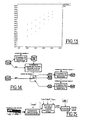
- the following figure 13 shows in a synthetic way the correspondence between the note predicted by the model and the real subjective note, for the same experiment, as well as the precision of the model.
- the graph represents the average of the actual subjective scores (Avg) given by the observers.
- Avg actual subjective scores
- the operational phase is then applied each time the quality of an audiovisual sequence must be predicted.
- This phase uses the knowledge acquired by the model during the learning phase.
- an objective quality score is calculated.
- the objective parameters MO are supplied by a processor for calculating parameters which may be arbitrary.
Landscapes
- Engineering & Computer Science (AREA)
- Signal Processing (AREA)
- Multimedia (AREA)
- Computer Networks & Wireless Communication (AREA)
- Health & Medical Sciences (AREA)
- Computational Linguistics (AREA)
- Human Computer Interaction (AREA)
- Physics & Mathematics (AREA)
- Acoustics & Sound (AREA)
- Audiology, Speech & Language Pathology (AREA)
- Quality & Reliability (AREA)
- Biomedical Technology (AREA)
- General Health & Medical Sciences (AREA)
- Testing, Inspecting, Measuring Of Stereoscopic Televisions And Televisions (AREA)
Description
- DSCQS : protocole dit "Double Stimulus Continuous Quality Scale".
- SSCQE : protocole dit "Single Stimulus Continuous Quality Evaluation".


- c1) le choix parmi les vecteurs de référence VR1 des k dictionnaires de référence, du vecteur de référence VRe' le plus proche dudit vecteur MO.
- la figure 1 et la figure 2 illustrent les deux méthodes d'évaluation de l'Art Antérieur, respectivement dénommés DSCQS et SSCQE ;
- la figure 3 illustre une approche connue mettant en oeuvre des modèles perceptuels ;
- la figure 4 illustre une méthode développée par l'ITS ;
- la figure 5 illustre une réalisation préférée de la mise en oeuvre de l'invention ;
- la figure 6 illustre la formation d'un dictionnaire Dj selon l'invention ;
- la figure 7 illustre le processus de notation d'une séquence à évaluer, selon l'invention ;
- la figure 8 illustre une répartition uniforme des intervalles de notes subjectives ;
- la figure 9 est un exemple de la fréquence d'apparition des notes subjectives NSi ;
- la figure 10 illustre un processus d'identification de notes subjectives représentatives selon l'invention ;
- la figure 11 est un exemple de répartition non uniforme des notes subjectives obtenues selon le processus illustré par la figure 10 ;
- les figures 12 et 13 illustrent la précision d'une évaluation selon l'invention ;
- et les figures 14 et 15 représentent une mise en oeuvre de l'invention en ce qui concerne respectivement la phase d'apprentissage et la phase opérationnelle.
- une base de notes subjectives (BDNS),
- une base de mesures objectives extraites des signaux audio et vidéo (BDMO),
- la formation de vecteurs à partir des informations à coder,
- la formation du dictionnaire à partir d'un ensemble d'apprentissage,
- la recherche du plus proche voisin à l'aide d'une distance appropriée.

- Nuées dynamiques, ou Algorithme LBG,
- Méthode du réseau de neurones de Kohonen.
- la taille de chaque dictionnaire
- la position des plages de notes de chaque dictionnaire.
- d'une part, de la Base de Données de Mesures Objectives (BDMO), obtenue à partir de signaux audio et/ou vidéo et d'un processeur (non représenté) de calcul de paramètres (MO, Mesures Objectives).
- d'autre part, d'une Base de Notes Subjectives (DBNS) obtenue à partir des mêmes signaux audio et/ou vidéo que la base BDMO et d'un ensemble d'observateurs.
Claims (6)
- Procédé d'évaluation de la qualité d'une séquence audiovisuelle, caractérisé en ce qu'il met en oeuvre :a) un apprentissage comprenant l'attribution d'une note subjective NSi à chacune de No séquences d'apprentissage Si (avec i = 1,2...No ) présentant des dégradations identifiées par un vecteur d'apprentissage MOi qui est affecté à chaque séquence Si selon un premier procédé de vectorisation, pour constituer une base de données composée des No vecteurs d'apprentissage MOi comportant seulement lesdites dégradations identifiées et des notes subjectives NSi ;b) le classement des No vecteurs d'apprentissage MOi en k classes de notes en fonction des notes subjectives NSi qui leur ont été attribuées, pour former k ensembles d'apprentissage EAj (avec j = 1,2...k) auxquels sont attribués k notes d'apprentissage significatives NSRj .;c) pour ladite séquence audiovisuelle à évaluer l'élaboration d'un vecteur MO selon ledit premier procédé de vectorisation ;d) attribution à la séquence audiovisuelle à évaluer de la note d'apprentissage significative NSRj , correspondant à l'ensemble d'apprentissage EAj contenant le vecteur le plus proche du vecteur MO au sens de la quantification vectorielle.
- Procédé selon la revendication 1, caractérisé en ce qu'il comporte entre b) et c) :et entre c) et d) :b1) pour chaque ensemble d'apprentissage EAj , l'élaboration par quantification vectorielle selon un deuxième procédé de vectorisation d'un dictionnaire de référence Dj composé de Nj vecteurs de référence VRl (avec l = 1 ,2...Nj ) ;et en ce que d met en oeuvre l'attribution à la séquence audiovisuelle à évaluer de la note d'apprentissage significative NSRj, correspondant au dictionnaire de référence auquel appartient ledit vecteur de référence VRl le plus proche.c1) le choix parmi les vecteurs de référence VRl des k dictionnaires de référence, du vecteur de référence VRe , le plus proche dudit vecteur MO ;
- Procédé selon une des revendications 1 ou 2, caractérisé en ce que les notes d'apprentissage significatives NSRj sont réparties de manière uniforme le long de l'échelle de notation.
- Procédé selon la revendication 1, caractérisé en ce les notes d'apprentissages significatives NSRj d'au moins certains des k dictionnaires de référence sont réparties de manière non uniforme le long de l'échelle de notation.
- Procédé selon la revendication 4, caractérisé en ce que ladite répartition est telle qu'au moins certains des dictionnaires de référence contiennent sensiblement le même nombre de vecteurs de référence.
- Procédé selon une des revendications 4 ou 5, caractérisé en ce qu'il comprend, entre a et b, une identification des k notes d'apprentissage significations NSRj , à partir des notes subjectives NSi dont chacune est considérée comme un vecteur à une dimension, en recherchant une distance minimale entre l'ensemble des No notes subjectives NSi et les k notes d'apprentissage significatives.
Applications Claiming Priority (3)
| Application Number | Priority Date | Filing Date | Title |
|---|---|---|---|
| FR9908008 | 1999-06-23 | ||
| FR9908008A FR2795578B1 (fr) | 1999-06-23 | 1999-06-23 | Procede d'evaluation de la qualite de sequences audiovisuelles |
| PCT/FR2000/001659 WO2001001705A1 (fr) | 1999-06-23 | 2000-06-15 | Procede d'evaluation de la qualite de sequences audiovisuelles |
Publications (2)
| Publication Number | Publication Date |
|---|---|
| EP1195064A1 EP1195064A1 (fr) | 2002-04-10 |
| EP1195064B1 true EP1195064B1 (fr) | 2003-08-27 |
Family
ID=9547198
Family Applications (1)
| Application Number | Title | Priority Date | Filing Date |
|---|---|---|---|
| EP00951590A Expired - Lifetime EP1195064B1 (fr) | 1999-06-23 | 2000-06-15 | Procede d'evaluation de la qualite de sequences audiovisuelles |
Country Status (6)
| Country | Link |
|---|---|
| US (1) | US7107251B1 (fr) |
| EP (1) | EP1195064B1 (fr) |
| CA (1) | CA2377808C (fr) |
| DE (1) | DE60004852T2 (fr) |
| FR (1) | FR2795578B1 (fr) |
| WO (1) | WO2001001705A1 (fr) |
Families Citing this family (12)
| Publication number | Priority date | Publication date | Assignee | Title |
|---|---|---|---|---|
| US6876381B2 (en) * | 2001-01-10 | 2005-04-05 | Koninklijke Philips Electronics N.V. | System and method for providing a scalable objective metric for automatic video quality evaluation employing interdependent objective metrics |
| US7010159B2 (en) * | 2001-04-25 | 2006-03-07 | Koninklijke Philips Electronics N.V. | Apparatus and method for combining random set of video features in a non-linear scheme to best describe perceptual quality of video sequences using heuristic search methodology |
| US6822675B2 (en) * | 2001-07-03 | 2004-11-23 | Koninklijke Philips Electronics N.V. | Method of measuring digital video quality |
| US6829005B2 (en) * | 2001-11-21 | 2004-12-07 | Tektronix, Inc. | Predicting subjective quality ratings of video |
| FR2835124B1 (fr) | 2002-01-24 | 2004-03-19 | Telediffusion De France Tdf | Procede de synchronisation de deux flux de donnees numeriques de meme contenu |
| FR2854535B1 (fr) * | 2003-04-30 | 2005-09-16 | France Telecom | Procede et terminal de mesure de qualite de communication vocale par paquets |
| FR2879387B1 (fr) | 2004-12-15 | 2007-04-27 | Tdf Sa | Procede de transmission a debit binaire variable a travers un canal de transmission. |
| EP1862017A4 (fr) * | 2005-03-25 | 2011-03-23 | Algolith Inc | Dispositif et procede d'evaluation objective de la qualite d'une video codee en format dct avec ou sans sequence video d'origine |
| EP2564592A4 (fr) * | 2010-04-30 | 2015-06-17 | Thomson Licensing | Procédé et dispositif de mesure de la qualité vidéo au moyen d'au moins un régresseur d'apprentissage semi-supervisé pour la prédiction d'une note d'observation moyenne |
| CA2967369A1 (fr) * | 2014-11-14 | 2016-05-19 | Videopura, Llc | Systeme et procede destines a la lecture video en continu adaptative ayant une segmentation et une diffusion a qualite equivalente |
| CN108537703A (zh) * | 2018-04-17 | 2018-09-14 | 吉林省晨明网络通信有限公司 | 一种消防单位的训练考核数据管理方法及相关装置 |
| CN112822482B (zh) * | 2020-12-31 | 2022-11-08 | 上海掌门科技有限公司 | 一种确定音视频通话的评估得分的方法与设备 |
Family Cites Families (1)
| Publication number | Priority date | Publication date | Assignee | Title |
|---|---|---|---|---|
| US5446492A (en) * | 1993-01-19 | 1995-08-29 | Wolf; Stephen | Perception-based video quality measurement system |
-
1999
- 1999-06-23 FR FR9908008A patent/FR2795578B1/fr not_active Expired - Fee Related
-
2000
- 2000-06-15 CA CA002377808A patent/CA2377808C/fr not_active Expired - Fee Related
- 2000-06-15 WO PCT/FR2000/001659 patent/WO2001001705A1/fr not_active Ceased
- 2000-06-15 DE DE60004852T patent/DE60004852T2/de not_active Expired - Lifetime
- 2000-06-15 US US10/018,661 patent/US7107251B1/en not_active Expired - Fee Related
- 2000-06-15 EP EP00951590A patent/EP1195064B1/fr not_active Expired - Lifetime
Also Published As
| Publication number | Publication date |
|---|---|
| CA2377808C (fr) | 2006-10-03 |
| EP1195064A1 (fr) | 2002-04-10 |
| US7107251B1 (en) | 2006-09-12 |
| DE60004852T2 (de) | 2004-07-15 |
| CA2377808A1 (fr) | 2001-01-04 |
| WO2001001705A1 (fr) | 2001-01-04 |
| DE60004852D1 (de) | 2003-10-02 |
| FR2795578A1 (fr) | 2000-12-29 |
| FR2795578B1 (fr) | 2002-04-05 |
Similar Documents
| Publication | Publication Date | Title |
|---|---|---|
| Ghadiyaram et al. | Massive online crowdsourced study of subjective and objective picture quality | |
| EP1468416B1 (fr) | Procede d'evaluation qualitative d'un signal audio numerique. | |
| Mozhaeva et al. | Full reference video quality assessment metric on base human visual system consistent with PSNR | |
| CA2377808C (fr) | Procede d'evaluation de la qualite de sequences audiovisuelles | |
| EP2419900A1 (fr) | Procede et dispositif d'evaluation objective de la qualite vocale d'un signal de parole prenant en compte la classification du bruit de fond contenu dans le signal | |
| KR20090126316A (ko) | 비디오 품질 평가 방법 및 시스템 | |
| WO2014044948A1 (fr) | Calibration optimisee d'un systeme de restitution sonore multi haut-parleurs | |
| FR3035729A1 (fr) | Procede d'analyse d'une sequence video et equipement pour la mise en oeuvre du procede | |
| EP0410826B1 (fr) | Procédé itératif d'estimation de mouvement, entre une image de référence et une image courante, et dispositif pour la mise en oeuvre de ce procédé | |
| CN119323970B (zh) | 摄食强度检测方法及相关装置、设备和存储介质 | |
| CA2237814C (fr) | Processus d'apprentissage | |
| EP4356606A1 (fr) | Procédés et dispositifs de décodage d'une partie au moins d'un flux de données, programme d'ordinateur et flux de données associés | |
| EP4280560A1 (fr) | Procédé pour détecter des anomalies de routage entre systèmes autonomes | |
| Anitha et al. | Quality assessment of resultant images after processing | |
| CA2428539C (fr) | Caracterisation d'images | |
| Mello et al. | Reference-free speech quality assessment for mobile phones based on audio perception | |
| EP4660883A1 (fr) | Procédé d analyse et d ajustement d'un réseau de neurones artificiels | |
| Reibman et al. | A probabilistic pairwise-preference predictor for image quality | |
| FR3083354A1 (fr) | Procede de modelisation pour le controle des resultats fournis par un reseau de neurones artificiels et autres procedes associes | |
| Möller et al. | Crowdsourcing Quality of Experience Experiments | |
| EP0421859A1 (fr) | Procédé et dispositif de segmentation automatique d'images par analyse de texture | |
| EP2339764B1 (fr) | Procédé et système d'identification automatique non coopérative d'un système d'émission radioélectrique | |
| FR3156568A1 (fr) | Procédé de prédiction des caractéristiques physiques actuelles ou futures d’une partie d’un corps humain et dispositifs associés | |
| FR3117597A1 (fr) | Procédé de contrôle non destructif pour une pièce aéronautique | |
| Matulin et al. | Development of Fuzzy Relationships between Different Quality of Experience Parameters |
Legal Events
| Date | Code | Title | Description |
|---|---|---|---|
| PUAI | Public reference made under article 153(3) epc to a published international application that has entered the european phase |
Free format text: ORIGINAL CODE: 0009012 |
|
| 17P | Request for examination filed |
Effective date: 20020117 |
|
| AK | Designated contracting states |
Kind code of ref document: A1 Designated state(s): AT BE CH CY DE DK ES FI FR GB GR IE IT LI LU MC NL PT SE |
|
| AX | Request for extension of the european patent |
Free format text: AL;LT;LV;MK;RO;SI |
|
| 17Q | First examination report despatched |
Effective date: 20020514 |
|
| GRAH | Despatch of communication of intention to grant a patent |
Free format text: ORIGINAL CODE: EPIDOS IGRA |
|
| GRAH | Despatch of communication of intention to grant a patent |
Free format text: ORIGINAL CODE: EPIDOS IGRA |
|
| RIN1 | Information on inventor provided before grant (corrected) |
Inventor name: BRETILLON, PIERRE Inventor name: BAINA, JAMAL |
|
| GRAA | (expected) grant |
Free format text: ORIGINAL CODE: 0009210 |
|
| AK | Designated contracting states |
Designated state(s): DE FR GB NL |
|
| REG | Reference to a national code |
Ref country code: GB Ref legal event code: FG4D Free format text: NOT ENGLISH |
|
| REG | Reference to a national code |
Ref country code: IE Ref legal event code: FG4D Free format text: FRENCH |
|
| REF | Corresponds to: |
Ref document number: 60004852 Country of ref document: DE Date of ref document: 20031002 Kind code of ref document: P |
|
| GBT | Gb: translation of ep patent filed (gb section 77(6)(a)/1977) |
Effective date: 20031220 |
|
| LTIE | Lt: invalidation of european patent or patent extension |
Effective date: 20030827 |
|
| REG | Reference to a national code |
Ref country code: IE Ref legal event code: FD4D |
|
| PLBE | No opposition filed within time limit |
Free format text: ORIGINAL CODE: 0009261 |
|
| STAA | Information on the status of an ep patent application or granted ep patent |
Free format text: STATUS: NO OPPOSITION FILED WITHIN TIME LIMIT |
|
| 26N | No opposition filed |
Effective date: 20040528 |
|
| REG | Reference to a national code |
Ref country code: FR Ref legal event code: PLFP Year of fee payment: 16 |
|
| REG | Reference to a national code |
Ref country code: FR Ref legal event code: PLFP Year of fee payment: 17 |
|
| REG | Reference to a national code |
Ref country code: FR Ref legal event code: PLFP Year of fee payment: 18 |
|
| PGFP | Annual fee paid to national office [announced via postgrant information from national office to epo] |
Ref country code: NL Payment date: 20170524 Year of fee payment: 18 |
|
| PGFP | Annual fee paid to national office [announced via postgrant information from national office to epo] |
Ref country code: GB Payment date: 20170526 Year of fee payment: 18 Ref country code: DE Payment date: 20170522 Year of fee payment: 18 Ref country code: FR Payment date: 20170523 Year of fee payment: 18 |
|
| REG | Reference to a national code |
Ref country code: DE Ref legal event code: R119 Ref document number: 60004852 Country of ref document: DE |
|
| REG | Reference to a national code |
Ref country code: NL Ref legal event code: MM Effective date: 20180701 |
|
| GBPC | Gb: european patent ceased through non-payment of renewal fee |
Effective date: 20180615 |
|
| PG25 | Lapsed in a contracting state [announced via postgrant information from national office to epo] |
Ref country code: NL Free format text: LAPSE BECAUSE OF NON-PAYMENT OF DUE FEES Effective date: 20180701 |
|
| PG25 | Lapsed in a contracting state [announced via postgrant information from national office to epo] |
Ref country code: FR Free format text: LAPSE BECAUSE OF NON-PAYMENT OF DUE FEES Effective date: 20180630 Ref country code: DE Free format text: LAPSE BECAUSE OF NON-PAYMENT OF DUE FEES Effective date: 20190101 Ref country code: GB Free format text: LAPSE BECAUSE OF NON-PAYMENT OF DUE FEES Effective date: 20180615 |