EP1194965B1 - Performance enhancing additives for electrochemical cells - Google Patents
Performance enhancing additives for electrochemical cells Download PDFInfo
- Publication number
- EP1194965B1 EP1194965B1 EP00941732A EP00941732A EP1194965B1 EP 1194965 B1 EP1194965 B1 EP 1194965B1 EP 00941732 A EP00941732 A EP 00941732A EP 00941732 A EP00941732 A EP 00941732A EP 1194965 B1 EP1194965 B1 EP 1194965B1
- Authority
- EP
- European Patent Office
- Prior art keywords
- type
- metal oxide
- cell according
- tio
- additive
- Prior art date
- Legal status (The legal status is an assumption and is not a legal conclusion. Google has not performed a legal analysis and makes no representation as to the accuracy of the status listed.)
- Expired - Lifetime
Links
- 239000000654 additive Substances 0.000 title claims abstract description 87
- 230000002708 enhancing effect Effects 0.000 title description 5
- GWEVSGVZZGPLCZ-UHFFFAOYSA-N Titan oxide Chemical compound O=[Ti]=O GWEVSGVZZGPLCZ-UHFFFAOYSA-N 0.000 claims abstract description 261
- 230000000996 additive effect Effects 0.000 claims abstract description 64
- ZKATWMILCYLAPD-UHFFFAOYSA-N niobium pentoxide Chemical compound O=[Nb](=O)O[Nb](=O)=O ZKATWMILCYLAPD-UHFFFAOYSA-N 0.000 claims abstract description 52
- 150000004706 metal oxides Chemical class 0.000 claims abstract description 43
- 229910044991 metal oxide Inorganic materials 0.000 claims abstract description 41
- 239000002019 doping agent Substances 0.000 claims abstract description 40
- XOLBLPGZBRYERU-UHFFFAOYSA-N tin dioxide Chemical compound O=[Sn]=O XOLBLPGZBRYERU-UHFFFAOYSA-N 0.000 claims abstract description 30
- 239000003792 electrolyte Substances 0.000 claims abstract description 24
- WMWLMWRWZQELOS-UHFFFAOYSA-N bismuth(iii) oxide Chemical compound O=[Bi]O[Bi]=O WMWLMWRWZQELOS-UHFFFAOYSA-N 0.000 claims abstract description 16
- VYPSYNLAJGMNEJ-UHFFFAOYSA-N Silicium dioxide Chemical compound O=[Si]=O VYPSYNLAJGMNEJ-UHFFFAOYSA-N 0.000 claims abstract description 14
- DLYUQMMRRRQYAE-UHFFFAOYSA-N tetraphosphorus decaoxide Chemical compound O1P(O2)(=O)OP3(=O)OP1(=O)OP2(=O)O3 DLYUQMMRRRQYAE-UHFFFAOYSA-N 0.000 claims abstract description 10
- MCMNRKCIXSYSNV-UHFFFAOYSA-N Zirconium dioxide Chemical compound O=[Zr]=O MCMNRKCIXSYSNV-UHFFFAOYSA-N 0.000 claims abstract description 7
- 229910052681 coesite Inorganic materials 0.000 claims abstract description 7
- 229910052906 cristobalite Inorganic materials 0.000 claims abstract description 7
- 239000000377 silicon dioxide Substances 0.000 claims abstract description 7
- 229910052682 stishovite Inorganic materials 0.000 claims abstract description 7
- 229910052905 tridymite Inorganic materials 0.000 claims abstract description 7
- 229910002113 barium titanate Inorganic materials 0.000 claims abstract description 6
- YBMRDBCBODYGJE-UHFFFAOYSA-N germanium dioxide Chemical compound O=[Ge]=O YBMRDBCBODYGJE-UHFFFAOYSA-N 0.000 claims abstract description 6
- PJXISJQVUVHSOJ-UHFFFAOYSA-N indium(III) oxide Inorganic materials [O-2].[O-2].[O-2].[In+3].[In+3] PJXISJQVUVHSOJ-UHFFFAOYSA-N 0.000 claims abstract description 6
- ZNOKGRXACCSDPY-UHFFFAOYSA-N tungsten(VI) oxide Inorganic materials O=[W](=O)=O ZNOKGRXACCSDPY-UHFFFAOYSA-N 0.000 claims abstract description 6
- 229910002116 Bi12TiO20 Inorganic materials 0.000 claims abstract description 5
- 229910002971 CaTiO3 Inorganic materials 0.000 claims abstract description 5
- 229910004829 CaWO4 Inorganic materials 0.000 claims abstract description 5
- 229910019096 CoTiO3 Inorganic materials 0.000 claims abstract description 5
- 229910017676 MgTiO3 Inorganic materials 0.000 claims abstract description 5
- 229910002370 SrTiO3 Inorganic materials 0.000 claims abstract description 5
- 229910007477 ZnMn2O4 Inorganic materials 0.000 claims abstract description 5
- UBEWDCMIDFGDOO-UHFFFAOYSA-N cobalt(II,III) oxide Inorganic materials [O-2].[O-2].[O-2].[O-2].[Co+2].[Co+3].[Co+3] UBEWDCMIDFGDOO-UHFFFAOYSA-N 0.000 claims abstract description 5
- 238000010348 incorporation Methods 0.000 claims abstract description 5
- YADSGOSSYOOKMP-UHFFFAOYSA-N lead dioxide Inorganic materials O=[Pb]=O YADSGOSSYOOKMP-UHFFFAOYSA-N 0.000 claims abstract description 5
- KMUONIBRACKNSN-UHFFFAOYSA-N potassium dichromate Chemical compound [K+].[K+].[O-][Cr](=O)(=O)O[Cr]([O-])(=O)=O KMUONIBRACKNSN-UHFFFAOYSA-N 0.000 claims abstract description 5
- JEIPFZHSYJVQDO-UHFFFAOYSA-N iron(III) oxide Inorganic materials O=[Fe]O[Fe]=O JEIPFZHSYJVQDO-UHFFFAOYSA-N 0.000 claims abstract description 4
- HFLAMWCKUFHSAZ-UHFFFAOYSA-N niobium dioxide Inorganic materials O=[Nb]=O HFLAMWCKUFHSAZ-UHFFFAOYSA-N 0.000 claims abstract description 4
- PBCFLUZVCVVTBY-UHFFFAOYSA-N tantalum pentoxide Inorganic materials O=[Ta](=O)O[Ta](=O)=O PBCFLUZVCVVTBY-UHFFFAOYSA-N 0.000 claims abstract description 4
- 229910003005 LiNiO2 Inorganic materials 0.000 claims abstract description 3
- 229910004369 ThO2 Inorganic materials 0.000 claims abstract description 3
- LJCFOYOSGPHIOO-UHFFFAOYSA-N antimony pentoxide Inorganic materials O=[Sb](=O)O[Sb](=O)=O LJCFOYOSGPHIOO-UHFFFAOYSA-N 0.000 claims abstract description 3
- ZCUFMDLYAMJYST-UHFFFAOYSA-N thorium dioxide Chemical compound O=[Th]=O ZCUFMDLYAMJYST-UHFFFAOYSA-N 0.000 claims abstract description 3
- NUJOXMJBOLGQSY-UHFFFAOYSA-N manganese dioxide Chemical compound O=[Mn]=O NUJOXMJBOLGQSY-UHFFFAOYSA-N 0.000 claims description 36
- KWYUFKZDYYNOTN-UHFFFAOYSA-M Potassium hydroxide Chemical compound [OH-].[K+] KWYUFKZDYYNOTN-UHFFFAOYSA-M 0.000 claims description 34
- 239000011701 zinc Substances 0.000 claims description 18
- 150000001768 cations Chemical class 0.000 claims description 14
- 239000002245 particle Substances 0.000 claims description 13
- HCHKCACWOHOZIP-UHFFFAOYSA-N Zinc Chemical compound [Zn] HCHKCACWOHOZIP-UHFFFAOYSA-N 0.000 claims description 8
- 229910052725 zinc Inorganic materials 0.000 claims description 6
- 229910010252 TiO3 Inorganic materials 0.000 claims description 5
- 239000012670 alkaline solution Substances 0.000 claims description 2
- -1 K2TiO3 Inorganic materials 0.000 abstract description 24
- ODINCKMPIJJUCX-UHFFFAOYSA-N Calcium oxide Chemical compound [Ca]=O ODINCKMPIJJUCX-UHFFFAOYSA-N 0.000 abstract description 5
- QHGNHLZPVBIIPX-UHFFFAOYSA-N tin(II) oxide Inorganic materials [Sn]=O QHGNHLZPVBIIPX-UHFFFAOYSA-N 0.000 abstract description 4
- XLOMVQKBTHCTTD-UHFFFAOYSA-N zinc oxide Inorganic materials [Zn]=O XLOMVQKBTHCTTD-UHFFFAOYSA-N 0.000 abstract description 4
- IVMYJDGYRUAWML-UHFFFAOYSA-N cobalt(II) oxide Inorganic materials [Co]=O IVMYJDGYRUAWML-UHFFFAOYSA-N 0.000 abstract description 2
- 235000012239 silicon dioxide Nutrition 0.000 abstract 1
- 210000004027 cell Anatomy 0.000 description 96
- 239000000203 mixture Substances 0.000 description 38
- 239000000463 material Substances 0.000 description 31
- OGIDPMRJRNCKJF-UHFFFAOYSA-N titanium oxide Inorganic materials [Ti]=O OGIDPMRJRNCKJF-UHFFFAOYSA-N 0.000 description 24
- 239000010955 niobium Substances 0.000 description 16
- 235000010215 titanium dioxide Nutrition 0.000 description 16
- 239000004408 titanium dioxide Substances 0.000 description 15
- 229910052739 hydrogen Inorganic materials 0.000 description 14
- UFHFLCQGNIYNRP-UHFFFAOYSA-N Hydrogen Chemical compound [H][H] UFHFLCQGNIYNRP-UHFFFAOYSA-N 0.000 description 13
- 239000001257 hydrogen Substances 0.000 description 13
- 230000006872 improvement Effects 0.000 description 13
- 239000012298 atmosphere Substances 0.000 description 12
- 238000006243 chemical reaction Methods 0.000 description 12
- QVGXLLKOCUKJST-UHFFFAOYSA-N atomic oxygen Chemical compound [O] QVGXLLKOCUKJST-UHFFFAOYSA-N 0.000 description 11
- 238000002156 mixing Methods 0.000 description 11
- 229910052760 oxygen Inorganic materials 0.000 description 11
- 239000001301 oxygen Substances 0.000 description 11
- SOQBVABWOPYFQZ-UHFFFAOYSA-N oxygen(2-);titanium(4+) Chemical class [O-2].[O-2].[Ti+4] SOQBVABWOPYFQZ-UHFFFAOYSA-N 0.000 description 11
- 238000012360 testing method Methods 0.000 description 10
- 239000013078 crystal Substances 0.000 description 9
- OKTJSMMVPCPJKN-UHFFFAOYSA-N Carbon Chemical compound [C] OKTJSMMVPCPJKN-UHFFFAOYSA-N 0.000 description 7
- 239000010439 graphite Substances 0.000 description 7
- 229910002804 graphite Inorganic materials 0.000 description 7
- 238000010438 heat treatment Methods 0.000 description 7
- XEEYBQQBJWHFJM-UHFFFAOYSA-N iron Substances [Fe] XEEYBQQBJWHFJM-UHFFFAOYSA-N 0.000 description 7
- PXHVJJICTQNCMI-UHFFFAOYSA-N nickel Substances [Ni] PXHVJJICTQNCMI-UHFFFAOYSA-N 0.000 description 7
- 239000008188 pellet Substances 0.000 description 7
- 239000010936 titanium Substances 0.000 description 7
- 230000001965 increasing effect Effects 0.000 description 6
- 239000000843 powder Substances 0.000 description 6
- 150000003839 salts Chemical class 0.000 description 6
- 229920002125 Sokalan® Polymers 0.000 description 5
- 230000000694 effects Effects 0.000 description 5
- 229910052758 niobium Inorganic materials 0.000 description 5
- 239000004065 semiconductor Substances 0.000 description 5
- 239000011230 binding agent Substances 0.000 description 4
- 230000015572 biosynthetic process Effects 0.000 description 4
- 229920001577 copolymer Polymers 0.000 description 4
- 239000002270 dispersing agent Substances 0.000 description 4
- 230000001747 exhibiting effect Effects 0.000 description 4
- 238000000034 method Methods 0.000 description 4
- GUCVJGMIXFAOAE-UHFFFAOYSA-N niobium atom Chemical compound [Nb] GUCVJGMIXFAOAE-UHFFFAOYSA-N 0.000 description 4
- 230000008707 rearrangement Effects 0.000 description 4
- OKKJLVBELUTLKV-UHFFFAOYSA-N Methanol Chemical compound OC OKKJLVBELUTLKV-UHFFFAOYSA-N 0.000 description 3
- HEMHJVSKTPXQMS-UHFFFAOYSA-M Sodium hydroxide Chemical compound [OH-].[Na+] HEMHJVSKTPXQMS-UHFFFAOYSA-M 0.000 description 3
- 238000002441 X-ray diffraction Methods 0.000 description 3
- 238000013459 approach Methods 0.000 description 3
- 239000007864 aqueous solution Substances 0.000 description 3
- 239000000919 ceramic Substances 0.000 description 3
- 239000003086 colorant Substances 0.000 description 3
- 229910052751 metal Inorganic materials 0.000 description 3
- 239000002184 metal Substances 0.000 description 3
- 229910052759 nickel Inorganic materials 0.000 description 3
- 230000035484 reaction time Effects 0.000 description 3
- 238000005245 sintering Methods 0.000 description 3
- 239000007787 solid Substances 0.000 description 3
- 239000000243 solution Substances 0.000 description 3
- 229910052720 vanadium Inorganic materials 0.000 description 3
- IJGRMHOSHXDMSA-UHFFFAOYSA-N Atomic nitrogen Chemical compound N#N IJGRMHOSHXDMSA-UHFFFAOYSA-N 0.000 description 2
- VYZAMTAEIAYCRO-UHFFFAOYSA-N Chromium Chemical compound [Cr] VYZAMTAEIAYCRO-UHFFFAOYSA-N 0.000 description 2
- ZOKXTWBITQBERF-UHFFFAOYSA-N Molybdenum Chemical compound [Mo] ZOKXTWBITQBERF-UHFFFAOYSA-N 0.000 description 2
- 229910000831 Steel Inorganic materials 0.000 description 2
- RTAQQCXQSZGOHL-UHFFFAOYSA-N Titanium Chemical group [Ti] RTAQQCXQSZGOHL-UHFFFAOYSA-N 0.000 description 2
- QCWXUUIWCKQGHC-UHFFFAOYSA-N Zirconium Chemical compound [Zr] QCWXUUIWCKQGHC-UHFFFAOYSA-N 0.000 description 2
- 150000001553 barium compounds Chemical class 0.000 description 2
- 239000006227 byproduct Substances 0.000 description 2
- 229910052804 chromium Inorganic materials 0.000 description 2
- 239000011651 chromium Substances 0.000 description 2
- 229910017052 cobalt Inorganic materials 0.000 description 2
- 239000010941 cobalt Substances 0.000 description 2
- GUTLYIVDDKVIGB-UHFFFAOYSA-N cobalt atom Chemical compound [Co] GUTLYIVDDKVIGB-UHFFFAOYSA-N 0.000 description 2
- 150000001875 compounds Chemical class 0.000 description 2
- 230000006835 compression Effects 0.000 description 2
- 238000007906 compression Methods 0.000 description 2
- 239000008367 deionised water Substances 0.000 description 2
- 239000008151 electrolyte solution Substances 0.000 description 2
- 239000003349 gelling agent Substances 0.000 description 2
- 238000000227 grinding Methods 0.000 description 2
- 229910052735 hafnium Inorganic materials 0.000 description 2
- VBJZVLUMGGDVMO-UHFFFAOYSA-N hafnium atom Chemical compound [Hf] VBJZVLUMGGDVMO-UHFFFAOYSA-N 0.000 description 2
- 229910052742 iron Inorganic materials 0.000 description 2
- 229910052750 molybdenum Inorganic materials 0.000 description 2
- 239000011733 molybdenum Substances 0.000 description 2
- 239000004570 mortar (masonry) Substances 0.000 description 2
- 230000007935 neutral effect Effects 0.000 description 2
- 239000011255 nonaqueous electrolyte Substances 0.000 description 2
- 238000010587 phase diagram Methods 0.000 description 2
- 229920005646 polycarboxylate Polymers 0.000 description 2
- 229920001343 polytetrafluoroethylene Polymers 0.000 description 2
- 239000004810 polytetrafluoroethylene Substances 0.000 description 2
- 239000000047 product Substances 0.000 description 2
- 238000007873 sieving Methods 0.000 description 2
- 239000007858 starting material Substances 0.000 description 2
- 239000010959 steel Substances 0.000 description 2
- 238000006467 substitution reaction Methods 0.000 description 2
- 229910052715 tantalum Inorganic materials 0.000 description 2
- GUVRBAGPIYLISA-UHFFFAOYSA-N tantalum atom Chemical compound [Ta] GUVRBAGPIYLISA-UHFFFAOYSA-N 0.000 description 2
- WFKWXMTUELFFGS-UHFFFAOYSA-N tungsten Chemical compound [W] WFKWXMTUELFFGS-UHFFFAOYSA-N 0.000 description 2
- 229910052721 tungsten Inorganic materials 0.000 description 2
- 239000010937 tungsten Substances 0.000 description 2
- GPPXJZIENCGNKB-UHFFFAOYSA-N vanadium Chemical compound [V]#[V] GPPXJZIENCGNKB-UHFFFAOYSA-N 0.000 description 2
- 229910052726 zirconium Inorganic materials 0.000 description 2
- VHUUQVKOLVNVRT-UHFFFAOYSA-N Ammonium hydroxide Chemical compound [NH4+].[OH-] VHUUQVKOLVNVRT-UHFFFAOYSA-N 0.000 description 1
- 229910001369 Brass Inorganic materials 0.000 description 1
- IAYPIBMASNFSPL-UHFFFAOYSA-N Ethylene oxide Chemical compound C1CO1 IAYPIBMASNFSPL-UHFFFAOYSA-N 0.000 description 1
- 102100029777 Eukaryotic translation initiation factor 3 subunit M Human genes 0.000 description 1
- 101001012700 Homo sapiens Eukaryotic translation initiation factor 3 subunit M Proteins 0.000 description 1
- 229920001732 Lignosulfonate Polymers 0.000 description 1
- 229910019142 PO4 Inorganic materials 0.000 description 1
- 229920003171 Poly (ethylene oxide) Polymers 0.000 description 1
- 229920002873 Polyethylenimine Polymers 0.000 description 1
- 229920000388 Polyphosphate Polymers 0.000 description 1
- GOOHAUXETOMSMM-UHFFFAOYSA-N Propylene oxide Chemical compound CC1CO1 GOOHAUXETOMSMM-UHFFFAOYSA-N 0.000 description 1
- 239000004115 Sodium Silicate Substances 0.000 description 1
- QAOWNCQODCNURD-UHFFFAOYSA-L Sulfate Chemical compound [O-]S([O-])(=O)=O QAOWNCQODCNURD-UHFFFAOYSA-L 0.000 description 1
- ULUAUXLGCMPNKK-UHFFFAOYSA-N Sulfobutanedioic acid Chemical class OC(=O)CC(C(O)=O)S(O)(=O)=O ULUAUXLGCMPNKK-UHFFFAOYSA-N 0.000 description 1
- BWAUNFSJHREQNX-UHFFFAOYSA-F [Zn+2].[C+4].[Cl-].[Zn+2].[Cl-].[Cl-].[Cl-].[Cl-].[Cl-].[Cl-].[Cl-] Chemical compound [Zn+2].[C+4].[Cl-].[Zn+2].[Cl-].[Cl-].[Cl-].[Cl-].[Cl-].[Cl-].[Cl-] BWAUNFSJHREQNX-UHFFFAOYSA-F 0.000 description 1
- 230000002378 acidificating effect Effects 0.000 description 1
- 239000011149 active material Substances 0.000 description 1
- 238000005054 agglomeration Methods 0.000 description 1
- 230000002776 aggregation Effects 0.000 description 1
- 229910052783 alkali metal Inorganic materials 0.000 description 1
- 150000001340 alkali metals Chemical class 0.000 description 1
- 229910052784 alkaline earth metal Inorganic materials 0.000 description 1
- 150000001342 alkaline earth metals Chemical class 0.000 description 1
- 150000004645 aluminates Chemical class 0.000 description 1
- 229910052782 aluminium Inorganic materials 0.000 description 1
- XAGFODPZIPBFFR-UHFFFAOYSA-N aluminium Chemical compound [Al] XAGFODPZIPBFFR-UHFFFAOYSA-N 0.000 description 1
- 229910021383 artificial graphite Inorganic materials 0.000 description 1
- 125000004429 atom Chemical group 0.000 description 1
- 239000002585 base Substances 0.000 description 1
- 150000001642 boronic acid derivatives Chemical class 0.000 description 1
- 239000010951 brass Substances 0.000 description 1
- 229910052799 carbon Inorganic materials 0.000 description 1
- 230000015556 catabolic process Effects 0.000 description 1
- 210000003850 cellular structure Anatomy 0.000 description 1
- 239000002800 charge carrier Substances 0.000 description 1
- 239000007795 chemical reaction product Substances 0.000 description 1
- 238000003776 cleavage reaction Methods 0.000 description 1
- 230000002860 competitive effect Effects 0.000 description 1
- 239000004020 conductor Substances 0.000 description 1
- 238000010276 construction Methods 0.000 description 1
- 238000001816 cooling Methods 0.000 description 1
- 238000005260 corrosion Methods 0.000 description 1
- 230000007797 corrosion Effects 0.000 description 1
- 230000001351 cycling effect Effects 0.000 description 1
- 230000007423 decrease Effects 0.000 description 1
- 238000006731 degradation reaction Methods 0.000 description 1
- 238000000151 deposition Methods 0.000 description 1
- 239000012789 electroconductive film Substances 0.000 description 1
- 238000000265 homogenisation Methods 0.000 description 1
- 150000002431 hydrogen Chemical class 0.000 description 1
- XLYOFNOQVPJJNP-UHFFFAOYSA-M hydroxide Chemical compound [OH-] XLYOFNOQVPJJNP-UHFFFAOYSA-M 0.000 description 1
- 238000005286 illumination Methods 0.000 description 1
- 239000012535 impurity Substances 0.000 description 1
- ZMFWDTJZHRDHNW-UHFFFAOYSA-N indium;trihydrate Chemical compound O.O.O.[In] ZMFWDTJZHRDHNW-UHFFFAOYSA-N 0.000 description 1
- 150000007529 inorganic bases Chemical class 0.000 description 1
- 229910001416 lithium ion Inorganic materials 0.000 description 1
- 239000011656 manganese carbonate Substances 0.000 description 1
- 229910000016 manganese(II) carbonate Inorganic materials 0.000 description 1
- 238000004519 manufacturing process Methods 0.000 description 1
- 239000007769 metal material Substances 0.000 description 1
- 150000002739 metals Chemical class 0.000 description 1
- 238000003801 milling Methods 0.000 description 1
- 150000007522 mineralic acids Chemical class 0.000 description 1
- PSZYNBSKGUBXEH-UHFFFAOYSA-N naphthalene-1-sulfonic acid Chemical class C1=CC=C2C(S(=O)(=O)O)=CC=CC2=C1 PSZYNBSKGUBXEH-UHFFFAOYSA-N 0.000 description 1
- 229910052757 nitrogen Inorganic materials 0.000 description 1
- 239000012811 non-conductive material Substances 0.000 description 1
- 150000007524 organic acids Chemical class 0.000 description 1
- 235000005985 organic acids Nutrition 0.000 description 1
- 150000007530 organic bases Chemical class 0.000 description 1
- 239000003960 organic solvent Substances 0.000 description 1
- 238000012856 packing Methods 0.000 description 1
- 235000021317 phosphate Nutrition 0.000 description 1
- 150000003013 phosphoric acid derivatives Chemical class 0.000 description 1
- 150000003014 phosphoric acid esters Chemical class 0.000 description 1
- 239000011941 photocatalyst Substances 0.000 description 1
- 229920002401 polyacrylamide Polymers 0.000 description 1
- 239000001205 polyphosphate Substances 0.000 description 1
- 235000011176 polyphosphates Nutrition 0.000 description 1
- 229920002689 polyvinyl acetate Polymers 0.000 description 1
- 239000011118 polyvinyl acetate Substances 0.000 description 1
- 229920000036 polyvinylpyrrolidone Polymers 0.000 description 1
- 239000001267 polyvinylpyrrolidone Substances 0.000 description 1
- 235000013855 polyvinylpyrrolidone Nutrition 0.000 description 1
- 238000003825 pressing Methods 0.000 description 1
- 230000008569 process Effects 0.000 description 1
- 239000000376 reactant Substances 0.000 description 1
- 230000009467 reduction Effects 0.000 description 1
- 230000007017 scission Effects 0.000 description 1
- 230000035945 sensitivity Effects 0.000 description 1
- 150000004760 silicates Chemical class 0.000 description 1
- 229910000108 silver(I,III) oxide Inorganic materials 0.000 description 1
- 235000019351 sodium silicates Nutrition 0.000 description 1
- 238000001694 spray drying Methods 0.000 description 1
- 238000003860 storage Methods 0.000 description 1
- 229910052719 titanium Inorganic materials 0.000 description 1
- LSGOVYNHVSXFFJ-UHFFFAOYSA-N vanadate(3-) Chemical class [O-][V]([O-])([O-])=O LSGOVYNHVSXFFJ-UHFFFAOYSA-N 0.000 description 1
- XLYOFNOQVPJJNP-UHFFFAOYSA-N water Substances O XLYOFNOQVPJJNP-UHFFFAOYSA-N 0.000 description 1
- 239000011592 zinc chloride Substances 0.000 description 1
- JIAARYAFYJHUJI-UHFFFAOYSA-L zinc dichloride Chemical compound [Cl-].[Cl-].[Zn+2] JIAARYAFYJHUJI-UHFFFAOYSA-L 0.000 description 1
Images




Classifications
-
- H—ELECTRICITY
- H01—ELECTRIC ELEMENTS
- H01M—PROCESSES OR MEANS, e.g. BATTERIES, FOR THE DIRECT CONVERSION OF CHEMICAL ENERGY INTO ELECTRICAL ENERGY
- H01M6/00—Primary cells; Manufacture thereof
- H01M6/04—Cells with aqueous electrolyte
- H01M6/045—Cells with aqueous electrolyte characterised by aqueous electrolyte
-
- H—ELECTRICITY
- H01—ELECTRIC ELEMENTS
- H01M—PROCESSES OR MEANS, e.g. BATTERIES, FOR THE DIRECT CONVERSION OF CHEMICAL ENERGY INTO ELECTRICAL ENERGY
- H01M4/00—Electrodes
- H01M4/02—Electrodes composed of, or comprising, active material
- H01M4/62—Selection of inactive substances as ingredients for active masses, e.g. binders, fillers
-
- H—ELECTRICITY
- H01—ELECTRIC ELEMENTS
- H01M—PROCESSES OR MEANS, e.g. BATTERIES, FOR THE DIRECT CONVERSION OF CHEMICAL ENERGY INTO ELECTRICAL ENERGY
- H01M6/00—Primary cells; Manufacture thereof
- H01M6/04—Cells with aqueous electrolyte
- H01M6/06—Dry cells, i.e. cells wherein the electrolyte is rendered non-fluid
-
- H—ELECTRICITY
- H01—ELECTRIC ELEMENTS
- H01M—PROCESSES OR MEANS, e.g. BATTERIES, FOR THE DIRECT CONVERSION OF CHEMICAL ENERGY INTO ELECTRICAL ENERGY
- H01M6/00—Primary cells; Manufacture thereof
- H01M6/14—Cells with non-aqueous electrolyte
- H01M6/16—Cells with non-aqueous electrolyte with organic electrolyte
- H01M6/162—Cells with non-aqueous electrolyte with organic electrolyte characterised by the electrolyte
- H01M6/168—Cells with non-aqueous electrolyte with organic electrolyte characterised by the electrolyte by additives
-
- Y—GENERAL TAGGING OF NEW TECHNOLOGICAL DEVELOPMENTS; GENERAL TAGGING OF CROSS-SECTIONAL TECHNOLOGIES SPANNING OVER SEVERAL SECTIONS OF THE IPC; TECHNICAL SUBJECTS COVERED BY FORMER USPC CROSS-REFERENCE ART COLLECTIONS [XRACs] AND DIGESTS
- Y02—TECHNOLOGIES OR APPLICATIONS FOR MITIGATION OR ADAPTATION AGAINST CLIMATE CHANGE
- Y02E—REDUCTION OF GREENHOUSE GAS [GHG] EMISSIONS, RELATED TO ENERGY GENERATION, TRANSMISSION OR DISTRIBUTION
- Y02E60/00—Enabling technologies; Technologies with a potential or indirect contribution to GHG emissions mitigation
- Y02E60/10—Energy storage using batteries
Definitions
- This invention relates to electrochemical cells, particularly to additives for the anodes, cathodes and/or electrolytes of such cells for the purpose of enhancing electrochemical performance of the cells.
- One approach that has been used to improve the discharge capacity and/or cycle life of electrochemical cells is to use performance enhancing additives in the negative electrode, positive electrode and/or electrolyte. Such additives may affect these improvements by reducing the internal resistance of the cells, increasing ionic conductivity, preventing the formation of undesirable byproducts, and so forth.
- Evans discloses a nonaqueous cell with an organic solvent electrolyte and a cathode containing MnO 2 and a minor amount of an additive selected from the group consisting of borates, silicates, molybdates, phosphates, aluminates, niobates, tantalates, titanates, vanadates, zirconates, manganates, cobaltates and tungstenates of alkali metals or alkaline earth metals.
- Langan discloses a nonaqueous cell with a cathode containing MnO 2 and a minor amount of MnCO 3 .
- additives are to minimize the increase in internal impedance of the cell during storage or discharge.
- the additive is believed to prevent degradation of the electrolyte caused by reaction of the electrolyte with surface acidic groups on the MnO 2 or incompletely neutralized salts used in preparing the electrolyte solution.
- Taucher et al. (PCT Patent Publication No. WO 93/12551) disclose primary and rechargeable alkaline Zn/MnO 2 cells with barium compounds (e.g., oxide, hydroxide or sulfate) added to the cathode to improve cell capacity.
- the barium compound slows down the formation of hetaerolite, which cannot participate in the cycling process and tends to expand and destroy the cathode structure.
- Cathode additives for improving the capacity of alkaline Zn/MnO 2 cells have been disclosed. Swierbut et al.
- This invention provides electrochcmical cells exhibiting improved discharge capacity, especially on high current drains; and rechargeable electrochemical cells exhibiting improved cycle life.
- the present invention provides an alkaline electrochemical battery cell comprising: an anode comprising zinc; a cathode comprising manganese dioxide; a separator between the anode and cathode; and an electrolyte comprising an aqueous alkaline solution; wherein: at least one of the anode, cathode and electrolyte contains n-type metal oxide particles as an additive, wherein the n-type metal oxide is selected from n-type BaTiO 3 , n-type K 2 TiO 3 , n-type CoTiO 3 , n-type SrTiO 3 , n-type CaTiO 3 , n-type MgTiO 3 , n-type SiO 2 , n-type CaO, n-type TiO 2 , n-type Co 3 O 4 , n-type ZnO, n-type SnO, n-type SnO 2 , n-type PbO 2
- n-type semiconductor is a semiconductor (a non-metallic material that has a filled valence band at 0 K and a relatively narrow energy band gap with room temperature electrical conductivity ranging between about 10 -6 and 10 4 (ohm-m) -1 ) for which the predominant charge carriers responsible for electrical conduction are electrons.
- donor impurity atoms give rise to the excess electrons, which contribute to the conductivity.
- Another way to produce excess electrons is by heat treating under a reducing atmosphere, resulting in a non-stoichiometric composition with excess metal content (e.g., Ti 1+ x O 2 ).
- Electrochemical cells of this invention include both primary and rechargeable cells for use in batteries.
- the cells may have aqueous or nonaqueous electrolytes.
- cell types with nonaqueous electrolytes are Li/MnO 2 and lithium ion cells.
- Examples of cells having an aqueous electrolyte include cells having an alkaline electrolyte, such as an aqueous solution of KOH and/or NaOH.
- Other cells having an aqueous electrolyte include zinc chloride carbon-zinc cells with electrolytes comprising aqueous solutions of NH 4 OH and ZnCl 2 .
- Suitable electrochemical systems having an aqueous alkaline electrolyte include Zn/MnO 2 , Mg/MnO 2 , Al/MnO 2 , Zn/Ag 2 O, Zn/HgO, Ni/Cd, NiMeH, and NiH.
- Zn/MnO 2 is a preferred system.
- Preferred metal oxides are those which, without being modified, have performance-enhancing effects on electrochemical cells.
- Preferred metal oxides generally, though not always, have a 2 + to 6 + valence cation.
- the metal oxides are selected from BaTiO 3 , K 2 TiO 3 , CoTiO 3 , SrTiO 3 , CaTiO 3 , MgTiO3, SiO 2 , CaO, TiO 2 , Co 3 O 4 , ZnO, SnO, SnO 2 , PbO 2 , Bi 2 O 3 , Bi 2 O 3 •3ZrO 3 , Bi 12 TiO 20 , Fe 2 O 3 -TiO 2 , Nb 2 O 5 , CaWO 4 , ZnMn 2 O 4 and K 2 Cr 2 O 7 .
- the metal oxides SiO 2, TiO 2 and SnO 2 are preferred, with TiO 2 being the most preferred. When TiO 2 is used, the TiO 2 may be either anatase or rutile.
- Suitable dopants are incorporated into the metal oxide structure to produce a doped additive (modified additive) that is an n-type material which is stable in the internal environment of the cell.
- Cations of the dopant may be incorporated into the metal oxide structure by substitution for a portion of the cations of the metal oxide, by occlusion into the spaces of the lattice structure of the metal oxide, or by replacement of dopant cations for some of the cations in the lattice structure.
- a preferred dopant will modify the physical and/or electrochemical properties of the additive in a desired way, preferably by reducing the resistivity of the additive, improving the ionic exchange characteristics of the additive, and/or reducing the formation of undesired corrosion or discharge reaction byproducts (such as hydrogen gas).
- Examples of dopants that are suitable for doping TiO 2 for use as an additive in an alkaline cell include NbO 2 , Nb 2 O 5 , Ta 2 O 5 , WO 3 , GeO 2 , ZrO 2 , SnO 2 , ThO 2 , Fe 2 O 3 , In 2 O 3 , LiNiO 2 and P 2 O 5 , with Nb 2 O 5 being a preferred dopant.
- Suitable dopants for SnO 2 include In 2 O 3 , Sb 2 O 5 , Nb 2 O 5 , WO 3 and P 2 O 5 .
- the optimum amount of dopant depends on the additive and the electrochemical system of the cell. Phase Diagrams for Ceramists , Second Edition 1969, The American Ceramic Society, Columbus, Ohio, 1964, contains phase diagrams for many metal oxides and potential dopants. This can be useful in selecting dopants and suitable metal oxide dopant ratios. Generally, at least about 0.01 to less than about 50 mol percent dopant cation, based on the total cation content of the doped metal oxide, is suitable for use in the present invention. Preferably about 0.1 to about 30 mol percent, and more preferably about 0.1 to about 20 mol percent dopant cation is used.
- the preferred amount of dopant is about 1 to about 20 mol percent, more preferably about 5 to about 15 mol percent and most preferably about 10 mol percent based on the total cation content of the doped TiO 2 .
- a preferred amount of Nb 2 O 5 dopant is about 5 mol percent of the doped TiO 2 , which is equivalent to 10 mol percent Nb doped into TiO 2 , based on the total Nb + Ti content.
- a preferred niobium-doped TiO 2 for use in an alkaline Zn/MnO 2 cell is, therefore, Ti 0.9 Nb 0.1 O 2 .
- doped SnO 2 is the additive, the mol percent of the dopant required may be significantly less than with doped TiO 2 .
- the doped or modified additive may initially be put into one or more of the negative electrode, positive electrode, and electrolyte. After the cell is assembled, the modified additive may migrate to other parts of the cell.
- the preferred initial location of the modified additive can depend upon a number of factors, including the cell component to be affected, the desired type of effect, and the mobility of the modified additive. Preferred additives are insoluble in the electrolyte.
- the amount of modified additive used in the cell depends on a number of factors.
- the preferred amount of unmodified additive is a good indicator of the preferred amount of modified additive. However, by increasing the effectiveness of the additive, it may be possible to achieve the same effect with less modified additive, or, if the modified additive has a lower resistivity, it may be possible to add more of the modified additive without increasing the internal resistance of the cell to an undesirable level.
- the amount of modified additive is no more than about 20 wt%, based on the weight of active material in either the anode or the cathode, whichever contains less. If the modified additive has sufficient electrical conductivity, it may be possible to reduce the amount of inert conductive material used in the electrode and still further increase the capacity of the cell.
- TiO 2 is a preferred cathode additive. Examples of suitable methods of doping TiO 2 are disclosed in US Patent No. 5,419,824; US Patent No. 5,364,508; Journal of Physical Chemistry , 97 (1993) 1184-1189; Sensors and Actuators A , 24 (1990) 55-60; Sensors and Actuators B , 18-19 (1994) 474-477; and Solar Energy Materials , 2 (1980) 413-421.
- An alternative to doping the metal oxide additive is to modify the metal oxide by reducing it., e.g., with hydrogen, to produce an n-type material.
- the metal oxide is TiO 2
- either anatase or rutile TiO 2 may be used as a starting material.
- Suitable n-type TiO 2 may also be either anatase or rutile, depending upon the method used to reduce the TiO 2 .
- a preferred embodiment of the present invention is an alkaline Zn/MnO 2 cell with n-type TiO 2 added to the cathode.
- TiO 2 is doped with Nb 2 O 5 or reduced with H 2 to lower its resistivity.
- the compounds used in this invention are reduced doped titanium oxides that are highly conductive (have a low electrical resistivity) as compared with conventional titanium dioxide additives used for enhancing performance of electrochemical battery cells.
- a conductive form of titanium oxide for alkaline battery cathodes is desired to improve the conductivity of the cathode while continuing to provide the performance improvement associated with traditional insulating titanium dioxide additives.
- the reduced doped titanium oxides used in accordance with this aspect of the invention are represented by the formula Th 1-x M x O 2-y , where M is an element having an octagonal coordination structure, x is from about 0.01 to about 0.5, and y is from about 0.05 to about 0.25.
- the conductive, doped titanium oxides used in accordance with this aspect of the invention have an electrical conductivity that is comparable to that of the Magneli phase substoichiometric titanium oxides.
- the conductive, doped titanium oxides used in accordance with this aspect of the invention have an expanded rutile crystal structure, that is substantially the same as the rutile structure of conventional insulating titanium dioxide additives that provide significant performance improvements in alkaline electrochemical battery cells, whereas the Magneli phase substoichiometric titanium oxides have a significantly different crystal structure.
- Element M in the conductive, doped titanium oxides used in this invention is selected from elements that can be substituted for a titanium atom in the rutile crystal lattice. Such elements are generally metals having an octagonal coordination structure. Suitable elements M include but are not limited to niobium, vanadium, tantalum, tungsten, zirconium, hafnium, iron, cobalt, nickel, chromium and molybdenum, with niobium being preferred.
- the value of x is from about 0.01 to about 0.5, with values from about 0.05 to about 0.2 being preferred, and a value of from about 0.07 to about 0.2 being more preferred.
- Conductive, doped titanium oxide compounds used in accordance with the invention are believed to exhibit the best performance enhancing characteristics when used as an additive for a manganese dioxide electrode when the value of x is about 0.1.
- the value of y for the conductive, doped titanium oxides represented by the above formula is from about 0.05 to about 0.25, preferably from about 0.1 to about 0.25, and more preferably from about 0.15 to about 0.25. In general, higher values of y are more electrically conductive (have a lower electrical resistivity). Accordingly, compounds having a value of y that approaches 0.25 are preferred.
- Titanium dioxide occurs in nature in three crystalline forms: anatase, brookite, and rutile.
- Rutile is the thermodynamically stable form at all temperatures. Calorimetric studies have demonstrated that rutile is more stable than anatase and that brookite has a stability intermediate between anatase and rutile.
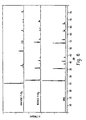
- Fig. 6 compares the X-ray diffraction patterns of anatase titanium dioxide, rutile titanium dioxide, and a conductive, niobium-doped titanium oxide (NTO) in accordance with an aspect of this invention.
- the doping of Nb 5+ for Ti 4+ in the rutile structure causes this expanded lattice for NTO.
- the lattice parameters for NTO may be measured from the powder diffraction pattern and are compared with pure rutile titanium dioxide in Table 1.
- the space groups and lattice parameters for anatase titanium dioxide are also shown to further highlight the differences among the materials.
- the crystal structures of the Magneli phases are comprised of rutile titanium dioxide blocks separated by TiO layers.
- the number of TiO layers increases as n (in the formula Ti n O 2 n -1 ) decreases from 10 to 4.
- the diffraction pattern of a commercially available Magneli phase material is compared with the diffraction pattern of NTO in Fig. 7. The two materials clearly have different structures. NTO retains the rutile titanium dioxide structure upon loss of oxygen, whereas the Magneli phase material transforms to a different structure as it loses oxygen.
- Anatase titanium dioxide and rutile titanium dioxide are white powders, whereas NTO and commercially available Magneli materials are dark blue-black.
- the color of a material may be further described more quantitatively using the Munsell notation.
- the Munsell notation system is described in The Munsell Book of Color , Munsell Color, Macbeth Division of Kollmorgen Instruments Corporation, New York.
- the Munsell Color-order system is a way of precisely specifying colors and showing the relationship among colors. Every color has three qualities or attributes: hue, value and chroma. Munsell established numerical scales with visually uniform steps for each of these attributes.
- the Munsell Book of Color displays a collection of colored chips arranged according to the scales. Each chip is identified numerically using these scales.
- the color of any material can be identified by comparing it to the chips under proper illumination and viewing conditions. The colors are then identified by hue, value and chroma. These attributes are given the symbols H, V and C, and are written in a form "H V/C," which is called the Munsell notation.
- H V/C the Munsell notation
- NTO may be described as having a hue of 10B, a value of 3, and a chroma of 2.
- the notation for a neutral color, under the Munsell notation system is written as "N V/.”
- the chroma of a neutral color is 0, but is customarily omitted from the notation.
- the Munsell color notation for anatase titanium dioxide is "N 9/.”
- the conductive, doped titanium oxides used in accordance with an aspect of this invention exhibit significantly improved electrical conductivity as compared with anatase titanium dioxide.
- the improved conductivity is attributed to the loss of oxygen from the lattice upon heating in a reducing atmosphere.
- the resistivity of NTO is comparable to that of commercially available Magneli phase materials.
- Anatase titanium dioxide has a resistivity of about 10 6 ohm-cm.
- the commercially available Magneli phase materials and the conductive doped titanium oxide materials used in accordance with an aspect of this invention have electrical resistivities that are several orders of magnitude less than anatase titanium dioxide.
- the resistivities of the conductive, doped titanium oxide materials used in accordance with an aspect of this invention are less than 100 ohm-cm, and are preferably about 10 ohm-cm or less.
- the conductive, doped titanium oxides used in accordance with an aspect of this invention prepared by high temperature reaction of titanium dioxide and an oxide of M in a reducing atmosphere to form an electrically conductive ceramic powder with the formula Ti 1- x M x O 2- y .
- the reaction of titanium dioxide with Nb 2 O 5 is represented as follows: wherein y is defined above.
- the conductive doped titanium oxide materials used in this invention may be prepared by intimately mixing a titanium dioxide with an oxide of an element selected from niobium, vanadium, tantalum, tungsten, zirconium, hafnium, iron, cobalt, nickel, chromium and molybdenum.
- a suitable degree of mixing may be achieved by wet mechanical mixing or by dry mechanical mixing. It is highly desirable to achieve intimate mixing to minimize the distance that material must travel in the solid state. Stated differently, the more intimate the mixing of the titanium dioxide and the dopant, the faster, the reaction will progress to completion. In order to achieve the desired intimate mixing, it is preferred that smaller panicle sizes be used.
- Suitable particle sizes for the titanium dioxide and the dopant are from about 1 microns to about 5 microns, with particle sizes below 2 microns being preferred. Larger particle sizes may be used, but will tend to increase the time and/or amount of heat needed to complete the reaction in high yield.
- the titanium dioxide starting material may comprise any phase (e.g., brookite, rutile or anatase).
- suitable dopants include Nb 2 O 5 , NbO 2 , Ta 2 O 5 , WO 3 , ZrO 2 Fe 2 O 3 , etc.
- the amount of dopant material that is mixed with the titanium dioxide is determined stoichiometrically based on the desired value of x in the formula Ti 1- x M x O 2- y .
- Suitable dispersants include inorganic acids, inorganic bases, organic acids, organic bases, poly(acrylic acid), salts of poly(acrylic acid), poly(methacrylic acid), salts of poly(methacrylic acid), copolymers of poly(acrylic acid), salts of copolymers of poly(acrylic acid), copolymers of poly(methacrylic acid), salts of copolymers of poly(methacrylic acid), poly(ethyleneimine), polyvinylpyrrolidone, polyacrylamide, lignosulfonates, poly(ethylene oxide), adducts of ethylene oxide, adducts of propylene oxide, polycarboxylates, salts of polycarboxylates, naphthalene sulfonates, sulfosuccinates, polyphosphates, sodium silicates, phosphate
- a suitable commercially available dispersant is sold under the name "Darvan® 821A" (R. T. Vanderbilt Corp.).
- a suitable amount of dispersant is, for example, about 0.5% of the total weight of the titanium dioxide and dopant materials.
- the mixture is dried, such as by spray drying, to recover a powder.
- a binder such as polyvinylacetate.
- a binder When a binder is used, it is typically used in an amount of about 1% or less by weight. When a binder is used, it will decompose at the reaction temperatures, and, therefore, will not appreciably affect the properties of the reaction product.
- the reaction of the titanium dioxide with the dopant is typically conducted at a temperature of from about 1100°C to about 1400°C, with the reaction time being from about 30 minutes to several hours. For any particular mixture, there is a tradeoff between temperature and reaction time, i.e., the reaction will proceed to completion more quickly at higher temperatures.
- the element M e.g., niobium
- the element M is incorporated into the titanium dioxide structure (anatase, rutile or brookite), and any anatase or brookite is rearranged to form rutile.
- the incorporation of the dopant element (M) into the titanium dioxide structure, and any rearrangement from brookite or anatase to rutile, is preferably achieved before oxygen is removed from the crystal lattice to prevent formation of the Magneli phases.
- the desired incorporation of dopant element and any necessary rearrangement from anatase or brookite to rutile may be achieved in a reducing atmosphere by initially heating the mixture to a temperature at which substitution of the dopant element into the titanium dioxide structure and rearrangement occur at an appreciable rate, but oxygen removal from the crystal lattice does not occur at an appreciable rate, and gradually increasing the temperature of the mixture to a level at which oxygen removal does occur at an appreciable rate.
- the desired conductive, doped titanium oxide materials may be prepared by heating the mixture in an oxygen atmosphere to cause a dopant element in the mixture to become incorporated into the titanium dioxide structure, and to cause any brookite or anatase to be converted to rutile, and subsequently removing the oxygen atmosphere and replacing it with a reducing atmosphere.
- An example of a suitable reducing atmosphere is an atmosphere comprised of a mixture of hydrogen and nitrogen. Higher hydrogen concentrations are more effective (i.e., result in faster removal of oxygen from the crystal lattice). However, for purposes of safety a hydrogen content of about 5% by weight may be preferred.
- Suitable apparatuses for heating the mixture to achieve the desired reaction include rotary furnaces, push or belt furnaces, and batch furnaces.
- Rotary furnaces are preferred because of their ability to achieve complete reaction in a residence time of as little as about 30 minutes, whereas a typical reaction time for a push or belt furnace is about 5.5 hours using the same temperatures and reactants.
- Batch furnaces are not preferred because they require heating and cooling of the furnace for each batch.
- the product is preferably allowed to cool in an oxygen-free atmosphere to prevent oxygen from being incorporated into the crystal lattice. It is desirable that the product is allowed to cool in an oxygen-free atmosphere to a temperature of about 300°C or less, more preferably to a temperature of about 100°C or less, and even more preferably to a temperature of about 50°C or less.
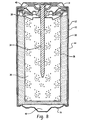
- FIG. 8 there is shown a cutaway view of an alkaline battery, including a steel can 10 having a cylindrical shape.
- a cathode 32 formed of a mixture comprising manganese dioxide, a conductive, doped titanium oxide compound in accordance with the invention, graphite, potassium hydroxide solution, de-ionized water, an aqueous solution, and additives, is formed about the interior surface of can 10.
- a separator 36 is located about the interior surface of cathode 32.
- An electrolyte 30 formed of potassium hydroxide is disposed in the interior of separator 36.
- An anode which may be formed of zinc powder, a gelling agent and other additives, is disposed within electrolyte 30 in contact with a current collector 34.
- the alkaline battery shown in Fig. 8 is illustrative of a battery employing the conductive, doped titanium oxide materials of this invention in an electrode of a battery.
- the doped titanium dioxides of this invention may be employed in various other types of batteries, including both primary and secondary batteries, and in batteries having various configurations.
- TiO 2 was reduced with H 2 by heating TiO 2 for 100 minutes at 980°C in a hydrogen atmosphere (5% H 2 in N 2 was used for safety, though a higher concentration would be more effective.)
- the reduced material was a fine powder that did not require grinding and sieving before use.
- Dry cathode mix was prepared by blending EMD and synthetic graphite, in a 25:1 ratio (by weight), in an analytical mill (Techmar model A-10) for 15 seconds, except that 1.6 wt% of the EMD, based on the total cathode weight, was replaced with the reduced TiO 2 as a cathode additive.
- the EMD used was from Kerr McGee and the graphite was grade GA17 from Superior Graphite.
- the TiO 2 used was anatase and the reduced n-TiO 2 was rutile.
- Anatase TiO 2 was doped with Nb 2 O 5 by: (a) mixing the desired weight ratios of TiO 2 and Nb 2 O 5 with a mortar and pestle, along with methanol for easier homogenization, (b) pressing the mixture into a pellet, (c) sintering at 1200°C-1250°C for 20 hours, and (d) milling. Steps (c) and (d) were repeated for a total of 80 hours of sintering. TiO 2 was doped with both 10 wt% and 20 wt% Nb 2 O 5 .
- the sintering temperature was 1200°C for the material with 10% dopant and 1250°C for the material with 20% dopant
- the Nb 2 O 5 -doped TiO 2 had a rutile structure. It was then prepared for use by grinding with a moitarand pestle and sieving through a 53 ⁇ m sieve. Dry cathode mix was prepared in the same manner as in Example 1, but using Nb 2 O 5 -doped TiO 2 as the additive.
- the resistances of the dry cathode mixes described were tested by placing three grams of dry mix into a cylinder made of an electrically nonconductive material, having a 0.50 inch inside diameter and having an electrically conductive base pad. The mix was compressed with an electrically conductive plunger, and the resistance was measured between the plunger and pad during compression of the mix. Results of the resistance test are shown in Fig. 1, which shows the cathode resistance in ohms as a function of pressure in k Pa Each curve represents the average of three samples.
- the curve labeled "+1.6% TiO 2 " represents the cathode mix with anatase TiO 2 as an additive
- the curve labeled "TiO 2 +H 2 " represents the cathode mix with hydrogen-reduced TiO 2 as an additive
- the curve labeled "TiO 2 +10%Nb 2 O 5 " represents the cathode mix with TiO 3 doped with 10 wt% Nb 2 O 5
- the curved labeled "TiO 2 +20%Nb 2 O 5 " represents the cathode mix with TiO 2 doped with 20wt% Nb 2 O 5 .
- Miniature alkaline Zn/MnO 2 cells were made and discharged to evaluate the effects on cell capacity when using doped or hydrogen-reduced TiO 2 as a cathode additive.
- a portion of each of the cathode mixes from Examples 1 and 2 was mixed with 3 wt% of 45% aqueous KOH solution and blended with a mortar and pestle for 5 minutes to produce a wet mix.
- the wet mix was formed into pellets weighting 0.7175 gram.
- Each pellet was placed into an IEC R44-size nickel-plated steel can with an inside diameter of 1.14cm (0.447 inch). The can served as the cathode container and positive terminal of the cell.
- a nickel mesh screen 1.14cm (0.447 inch) in diameter was placed on top of the pellet as the current collector, and the pellet was compressed with a hydraulic press to a height of approximately 0.22cm (0.085 inch) from the inside surface of the can bottom, producing a formed cathode with about 72 percent solids packing by volume.
- Two separator discs were placed in the can on top of the formed cathode.
- a fixture to hold the anode was placed on the top of the can, and an excess amount of gelled anode, based on the theoretical capacity of the cathode pellet, was put into the fixture.
- the anode contained 70 wt% zinc powder in a 37 wt% aqueous KOH solution gelled with Carbopol.
- Dry cathode mixes were made as described in Example 1, except with EMD:graphite weight ratios of 15:1 and 20:1, rather than 25:1. At each of these two EMD:graphite levels, one mix was made with no cathode additive and the other was made with 1.6 wt% of 10% Nb 2 O 5 - doped TiO 2 added, as described in Example 2. Each dry mix was made into a wet mix, pellets were formed and put into cans, and formed cathodes were made as described in Example 2, except that no separators were put into the cans. Each of the formed cathodes was discharged in flooded half cells at 85.5 mA to 1.18 volt, against a zinc reference electrode.
- the reference electrode contained zinc metal in a gelled 37% aqueous KOH solution.
- the results of the flooded half cell testing are summarized in Figs. 3-5.
- Fig. 3 shows the relative discharge durations.
- the cells with the doped TiO 2 additive performed better than the cells with no additive.
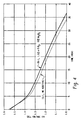
- the actual discharge curves are shown in Figs. 4 and 5.
- a series of AAA size batteries were prepared with a cathode composition comprising 93.22 wt% electrolytic manganese dioxide (EMD), 3.68 wt% graphite, 3.05 wt% of a 45% aqueous potassium hydroxide solution, and 0.05 wt% of polytetrafluoroethylene (PTFE) binder.
- the anode composition comprised 70.00 wt% zinc, 0.02% In(OH) 3 , 0.42% gelling agent, 1.17 wt% de-ionized water, and the balance being a potassium hydroxide solution at a concentration sufficient to provide a potassium hydroxide concentration of 37% in the cell electrolyte after assembly.
- Each cell contained 4.96 grams of the cathode composition and an excess of the anode composition, with an additional 0.95 grams of 37% potassium hydroxide solution added to each cell.
- the cells were prepared in a conventional manner.
- the basic steps in cell construction include making a cathode mixture, forming the cathode mixture into rings, inserting the rings into a cell container (can) and compressing the ring to form a cathode with a central cavity, inserting a separator into the central cavity of the cathode, making an anode mixture, depositing the anode mixture in the cavity of the cathode with the separator disposed between the cathode and the anode, adding additional electrolyte solution, and adding an appropriate anode collector and seal for the cell.
- These cells were used as a standard or control for evaluating batteries prepared with the additives of this invention.
- a second series of AAA cells was prepared in a substantially identical manner except that a portion of the EMD was replaced with a conventional anatase titanium dioxide additive so that the cathode contained 1.6% of the additive by weight, or a weight ration of additive to EMD of about 0.018 to 1.
- a third series of AAA cells was prepared that was identical to the second set, except that the conventional anatase titanium dioxide additive was replaced with a niobium-doped rutile titanium oxide in accordance with the invention.
- the cells containing the anatase did not exhibit an improvement over the control cells.
- the cells containing a niobium-doped titanium oxide in accordance with the invention exhibited a 4% service improvement over the control cells.
- the cells containing a niobium-doped rutile titanium dioxide additive in accordance with the invention outperformed the cells containing the conventional anatase titanium dioxide additive.
- test cells in accordance with the invention exhibited a 3% service improvement over the control cells, whereas the cells containing the anatase additive did not perform as well as the control cells, when subjected to a 600 mA continuous discharge to 0.9 volts.
- cells with half the amount of niobium-doped rutile titanium dioxide performed better than cells with no additive or cells with a 0.018 to 1 anatase TiO 2 to EMD weight ratio.
- Even lower levels of the NTO additive of the present invention may be sufficient for improving performance.
- the cells containing a niobium-doped rutile titanium dioxide additive in accordance with the invention exhibited a 25% service improvement as compared with the control, whereas the cells containing the anatase additive did not perform as well as the control cells.
- electrochemical cell of the present invention has been described in the above examples as a primary Zn/MnO 2 cell having an aqueous KOH electrolyte, it will be appreciated by those skilled in the art that the present invention may be used for primary and rechargeable cells.
Landscapes
- Chemical & Material Sciences (AREA)
- Chemical Kinetics & Catalysis (AREA)
- Electrochemistry (AREA)
- General Chemical & Material Sciences (AREA)
- Engineering & Computer Science (AREA)
- Manufacturing & Machinery (AREA)
- Hybrid Cells (AREA)
- Primary Cells (AREA)
- Battery Electrode And Active Subsutance (AREA)
- Secondary Cells (AREA)
- Cell Separators (AREA)
Abstract
Description
- This invention relates to electrochemical cells, particularly to additives for the anodes, cathodes and/or electrolytes of such cells for the purpose of enhancing electrochemical performance of the cells.
- Battery manufacturers are continually trying to improve the electrochemical performance of their batteries, since even relatively small improvements of performance characteristics such as discharge capacity, cycle life and shelf life can provide advantages in a highly competitive market. At the same time, the current requirements of electronic devices that are powered by batteries are increasing, and the capacity at higher discharge rates is becoming a more important characteristic for these batteries. This is particularly true of both primary and rechargeable alkaline batteries.
- One approach that has been used to improve the discharge capacity and/or cycle life of electrochemical cells is to use performance enhancing additives in the negative electrode, positive electrode and/or electrolyte. Such additives may affect these improvements by reducing the internal resistance of the cells, increasing ionic conductivity, preventing the formation of undesirable byproducts, and so forth.
- Evans (US Patent No. 4,465,747) discloses a nonaqueous cell with an organic solvent electrolyte and a cathode containing MnO2 and a minor amount of an additive selected from the group consisting of borates, silicates, molybdates, phosphates, aluminates, niobates, tantalates, titanates, vanadates, zirconates, manganates, cobaltates and tungstenates of alkali metals or alkaline earth metals. Langan (US Patent No. 4,478,921) discloses a nonaqueous cell with a cathode containing MnO2 and a minor amount of MnCO3. The purpose of these additives is to minimize the increase in internal impedance of the cell during storage or discharge. The additive is believed to prevent degradation of the electrolyte caused by reaction of the electrolyte with surface acidic groups on the MnO2 or incompletely neutralized salts used in preparing the electrolyte solution.
- Taucher et al. (PCT Patent Publication No. WO 93/12551) disclose primary and rechargeable alkaline Zn/MnO2 cells with barium compounds (e.g., oxide, hydroxide or sulfate) added to the cathode to improve cell capacity. The barium compound slows down the formation of hetaerolite, which cannot participate in the cycling process and tends to expand and destroy the cathode structure. Cathode additives for improving the capacity of alkaline Zn/MnO2 cells have been disclosed. Swierbut et al. disclose the use of one or more of SnO2, Fe2O3-TiO2, TiO2 (P-25), BaTiO3, K2TiO3, Nb2O5 and SnO in US Patent No. 5,599,644. Nardi et al. disclose the use of at least one of SrTiO3 or CoTiO3 in US Patent No. 5,895,734. CaWO4, MgTiO3, BaTiO3, CaTiO3, ZnMn2O4 and Bi12TiO20 are disclosed by Davis et al. in US Patent No. 5,532,085. Mieczkowska et al. disclose the use of Bi2O3, PbO2, SnO2, Co3O4, CoO, Bi2O3•3ZrO3 and K2Cr2O7 in US Patent No. 5,516,604. In US Patent No. 5,342,712, Mieczkowska et al. teach that the useful service life of primary alkaline Zn/MnO2 cells can be extended as a result of increased mobility of ionic flow during discharge by adding anatase TiO2 to the cathode.
- While there may be advantages to using such additives, in many cases the advantages can be at least partially offset, particularly on heavy drains, by the relatively high resistivities of the additives which increase the internal resistance of the cell.
- It is known that the physical and electrochemical properties of semiconductor materials such as SiO2, TiO2 and SnO2 can be modified by doping those materials with other cations. This approach has been used to modify materials for use in the fields of semiconductors, photoelectrochemistry and solid state sensors. For example, Unexamined Japanese Patent Publication No. 10-316,429 discloses that anatase TiO2 is suitable for use as a white electroconductive powder in the manufacture of semiconductors if it is doped with zinc or aluminum and its surface is coated with an electroconductive film of metal oxide. Karakitsou et al. disclose the use of cation doped TiO2 exhibiting improved performance as a photocatalyst in water cleavage in the Journal of Physical Chemistry, 1993, vol. 97, pages 1184-1189. Katayama et al. disclose the use of Nb2O5-doped TiO2 ceramics exhibiting improved humidity sensitivity.
- This invention provides electrochcmical cells exhibiting improved discharge capacity, especially on high current drains; and rechargeable electrochemical cells exhibiting improved cycle life.
- Accordingly, the present invention provides an alkaline electrochemical battery cell comprising: an anode comprising zinc; a cathode comprising manganese dioxide; a separator between the anode and cathode; and an electrolyte comprising an aqueous alkaline solution; wherein: at least one of the anode, cathode and electrolyte contains n-type metal oxide particles as an additive, wherein the n-type metal oxide is selected from n-type BaTiO3, n-type K2TiO3, n-type CoTiO3, n-type SrTiO3, n-type CaTiO3, n-type MgTiO3, n-type SiO2, n-type CaO, n-type TiO2, n-type Co3O4, n-type ZnO, n-type SnO, n-type SnO2, n-type PbO2, n-type Bi2O3, n-type BiO3·3ZrO3, n-type Bi12TiO20, n-type Fe2O3-TiO2, n-type Nb2O5, n-type CaWO4, n-type ZnMn2O4 and n-type K2Cr2O7.
-
- Fig. 1 is a graph of dry cathode resistance as a function of cathode compression for cathodes made according to the present invention.
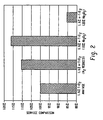
- Fig. 2 is a comparison of relative discharge durations of miniature cells with cathodes made according to the present invention.
- Fig. 3 is a comparison of relative discharge durations of flooded half cells with cathodes made according to the present invention.
- Fig. 4 is a comparison of discharge curves of flooded half cells having cathodes made according to the prior art and flooded half cells having cathodes made according to the present invention.
- Fig. 5 is a comparison of discharge curves of flooded half cells having cathodes made according to the prior art and flooded half cells having cathodes made according to the present invention.
- Fig. 6 is a X-ray diffraction pattern comparing anatase titanium dioxide, rutile titanium dioxide and a conductive, niobium-doped titanium oxide in accordance with the invention.
- Fig. 7 is a comparison of the X-ray diffraction pattern of a commercially available Magneli material with the diffraction pattern of a conductive, niobium-doped titanium oxide in accordance with the invention.
- Fig. 8 is a cutaway view of an alkaline battery employing an additive in accordance with the invention.
-
- It has been found that, by modifying performance-enhancing additives to electrochemical cells to make the additives n-type materials, the performance of electrochemical cells can be further enhanced. In particular, additives which improve discharge capacity, especially on high rate discharge, have been found to be even more effective in doing so when reduced with hydrogen or doped with cations to reduce their resistivities.
- An n-type semiconductor is a semiconductor (a non-metallic material that has a filled valence band at 0 K and a relatively narrow energy band gap with room temperature electrical conductivity ranging between about 10-6 and 104 (ohm-m)-1) for which the predominant charge carriers responsible for electrical conduction are electrons.
- Normally, donor impurity atoms give rise to the excess electrons, which contribute to the conductivity. Another way to produce excess electrons is by heat treating under a reducing atmosphere, resulting in a non-stoichiometric composition with excess metal content (e.g., Ti1+ x O2).
- Electrochemical cells of this invention include both primary and rechargeable cells for use in batteries. The cells may have aqueous or nonaqueous electrolytes. Examples of cell types with nonaqueous electrolytes are Li/MnO2 and lithium ion cells. Examples of cells having an aqueous electrolyte include cells having an alkaline electrolyte, such as an aqueous solution of KOH and/or NaOH. Other cells having an aqueous electrolyte include zinc chloride carbon-zinc cells with electrolytes comprising aqueous solutions of NH4OH and ZnCl2. Examples of suitable electrochemical systems having an aqueous alkaline electrolyte include Zn/MnO2 , Mg/MnO2 , Al/MnO 2 , Zn/Ag2O, Zn/HgO, Ni/Cd, NiMeH, and NiH. Zn/MnO2 is a preferred system.
- Examples of metal oxides that are suitable for preparing additives for use in the invention include metal oxides which are stable in the internal environment of the cell and can be modified to n-type materials, such as by reduction (e.g., with hydrogen) or by doping with cations of other elements. Preferred metal oxides are those which, without being modified, have performance-enhancing effects on electrochemical cells. Preferred metal oxides generally, though not always, have a 2+ to 6+ valence cation. The metal oxides are selected from BaTiO3, K2TiO3, CoTiO3, SrTiO3, CaTiO3, MgTiO3, SiO2, CaO, TiO2, Co3O4, ZnO, SnO, SnO2, PbO2, Bi2O3, Bi2O3•3ZrO3, Bi12TiO20, Fe2O3-TiO2, Nb2O5, CaWO4, ZnMn2O4 and K2Cr2O7. The metal oxides SiO2, TiO2 and SnO2 are preferred, with TiO2 being the most preferred. When TiO2 is used, the TiO2 may be either anatase or rutile.
- Suitable dopants are incorporated into the metal oxide structure to produce a doped additive (modified additive) that is an n-type material which is stable in the internal environment of the cell. Cations of the dopant may be incorporated into the metal oxide structure by substitution for a portion of the cations of the metal oxide, by occlusion into the spaces of the lattice structure of the metal oxide, or by replacement of dopant cations for some of the cations in the lattice structure. A preferred dopant will modify the physical and/or electrochemical properties of the additive in a desired way, preferably by reducing the resistivity of the additive, improving the ionic exchange characteristics of the additive, and/or reducing the formation of undesired corrosion or discharge reaction byproducts (such as hydrogen gas). Examples of dopants that are suitable for doping TiO2 for use as an additive in an alkaline cell include NbO2, Nb2O5, Ta2O5, WO3, GeO2, ZrO2, SnO2, ThO2, Fe2O3, In2O3, LiNiO2 and P2O5, with Nb2O5 being a preferred dopant. Suitable dopants for SnO2 include In2O3, Sb2O5, Nb2O5, WO3 and P2O5.
- The optimum amount of dopant depends on the additive and the electrochemical system of the cell. Phase Diagrams for Ceramists, Second Edition 1969, The American Ceramic Society, Columbus, Ohio, 1964, contains phase diagrams for many metal oxides and potential dopants. This can be useful in selecting dopants and suitable metal oxide dopant ratios. Generally, at least about 0.01 to less than about 50 mol percent dopant cation, based on the total cation content of the doped metal oxide, is suitable for use in the present invention. Preferably about 0.1 to about 30 mol percent, and more preferably about 0.1 to about 20 mol percent dopant cation is used. For an alkaline Zn/MnO2 cell with doped TiO2 additive, the preferred amount of dopant is about 1 to about 20 mol percent, more preferably about 5 to about 15 mol percent and most preferably about 10 mol percent based on the total cation content of the doped TiO2. For example, when TiO2 is doped with Nb2O5, a preferred amount of Nb2O5 dopant is about 5 mol percent of the doped TiO2, which is equivalent to 10 mol percent Nb doped into TiO2, based on the total Nb + Ti content. A preferred niobium-doped TiO2 for use in an alkaline Zn/MnO2 cell is, therefore, Ti0.9Nb0.1O2. When doped SnO2 is the additive, the mol percent of the dopant required may be significantly less than with doped TiO2.
- The doped or modified additive may initially be put into one or more of the negative electrode, positive electrode, and electrolyte. After the cell is assembled, the modified additive may migrate to other parts of the cell. The preferred initial location of the modified additive can depend upon a number of factors, including the cell component to be affected, the desired type of effect, and the mobility of the modified additive. Preferred additives are insoluble in the electrolyte.
- The amount of modified additive used in the cell depends on a number of factors. The preferred amount of unmodified additive is a good indicator of the preferred amount of modified additive. However, by increasing the effectiveness of the additive, it may be possible to achieve the same effect with less modified additive, or, if the modified additive has a lower resistivity, it may be possible to add more of the modified additive without increasing the internal resistance of the cell to an undesirable level. Preferably the amount of modified additive is no more than about 20 wt%, based on the weight of active material in either the anode or the cathode, whichever contains less. If the modified additive has sufficient electrical conductivity, it may be possible to reduce the amount of inert conductive material used in the electrode and still further increase the capacity of the cell.
- Any suitable method may be used for doping the metal oxide of the present invention. TiO2 is a preferred cathode additive. Examples of suitable methods of doping TiO2 are disclosed in US Patent No. 5,419,824; US Patent No. 5,364,508; Journal of Physical Chemistry, 97 (1993) 1184-1189; Sensors and Actuators A, 24 (1990) 55-60; Sensors and Actuators B, 18-19 (1994) 474-477; and Solar Energy Materials, 2 (1980) 413-421.
- An alternative to doping the metal oxide additive is to modify the metal oxide by reducing it., e.g., with hydrogen, to produce an n-type material. When the metal oxide is TiO2, either anatase or rutile TiO2 may be used as a starting material. Suitable n-type TiO2 may also be either anatase or rutile, depending upon the method used to reduce the TiO2.
- A preferred embodiment of the present invention is an alkaline Zn/MnO2 cell with n-type TiO2 added to the cathode. In the examples below, TiO2 is doped with Nb2O5 or reduced with H2 to lower its resistivity.
- The compounds used in this invention are reduced doped titanium oxides that are highly conductive (have a low electrical resistivity) as compared with conventional titanium dioxide additives used for enhancing performance of electrochemical battery cells. A conductive form of titanium oxide for alkaline battery cathodes is desired to improve the conductivity of the cathode while continuing to provide the performance improvement associated with traditional insulating titanium dioxide additives. The reduced doped titanium oxides used in accordance with this aspect of the invention are represented by the formula Th1-xMxO2-y, where M is an element having an octagonal coordination structure, x is from about 0.01 to about 0.5, and y is from about 0.05 to about 0.25. The conductive, doped titanium oxides used in accordance with this aspect of the invention have an electrical conductivity that is comparable to that of the Magneli phase substoichiometric titanium oxides. However, the conductive, doped titanium oxides used in accordance with this aspect of the invention have an expanded rutile crystal structure, that is substantially the same as the rutile structure of conventional insulating titanium dioxide additives that provide significant performance improvements in alkaline electrochemical battery cells, whereas the Magneli phase substoichiometric titanium oxides have a significantly different crystal structure.
- Element M in the conductive, doped titanium oxides used in this invention is selected from elements that can be substituted for a titanium atom in the rutile crystal lattice. Such elements are generally metals having an octagonal coordination structure. Suitable elements M include but are not limited to niobium, vanadium, tantalum, tungsten, zirconium, hafnium, iron, cobalt, nickel, chromium and molybdenum, with niobium being preferred.
- The value of x is from about 0.01 to about 0.5, with values from about 0.05 to about 0.2 being preferred, and a value of from about 0.07 to about 0.2 being more preferred. Conductive, doped titanium oxide compounds used in accordance with the invention are believed to exhibit the best performance enhancing characteristics when used as an additive for a manganese dioxide electrode when the value of x is about 0.1.
- The value of y for the conductive, doped titanium oxides represented by the above formula is from about 0.05 to about 0.25, preferably from about 0.1 to about 0.25, and more preferably from about 0.15 to about 0.25. In general, higher values of y are more electrically conductive (have a lower electrical resistivity). Accordingly, compounds having a value of y that approaches 0.25 are preferred.
- Titanium dioxide occurs in nature in three crystalline forms: anatase, brookite, and rutile. Rutile is the thermodynamically stable form at all temperatures. Calorimetric studies have demonstrated that rutile is more stable than anatase and that brookite has a stability intermediate between anatase and rutile.
- Fig. 6 compares the X-ray diffraction patterns of anatase titanium dioxide, rutile titanium dioxide, and a conductive, niobium-doped titanium oxide (NTO) in accordance with an aspect of this invention. The diffraction peaks for NTO are shifted to a slightly lower 2 value compared with pure rutile titanium dioxide. From Bragg's Law (n λ= 2d sin ), the lower 2 value corresponds to a higher d spacing and an expanded lattice. The doping of Nb5+ for Ti4+ in the rutile structure causes this expanded lattice for NTO. The lattice parameters for NTO may be measured from the powder diffraction pattern and are compared with pure rutile titanium dioxide in Table 1. The space groups and lattice parameters for anatase titanium dioxide are also shown to further highlight the differences among the materials.
Material Space Group a(Å) c(Å) NTO P42/mnm 4.619 2.971 Rutile-TiO2 P42/mnm 4.593 2.959 Anatase-TiO2 I41/amd 3.785 9.514 - The crystal structures of the Magneli phases are comprised of rutile titanium dioxide blocks separated by TiO layers. The number of TiO layers increases as n (in the formula Ti n O2 n -1) decreases from 10 to 4. The diffraction pattern of a commercially available Magneli phase material is compared with the diffraction pattern of NTO in Fig. 7. The two materials clearly have different structures. NTO retains the rutile titanium dioxide structure upon loss of oxygen, whereas the Magneli phase material transforms to a different structure as it loses oxygen.
- Anatase titanium dioxide and rutile titanium dioxide are white powders, whereas NTO and commercially available Magneli materials are dark blue-black. The color of a material may be further described more quantitatively using the Munsell notation. The Munsell notation system is described in The Munsell Book of Color, Munsell Color, Macbeth Division of Kollmorgen Instruments Corporation, New York. The Munsell Color-order system is a way of precisely specifying colors and showing the relationship among colors. Every color has three qualities or attributes: hue, value and chroma. Munsell established numerical scales with visually uniform steps for each of these attributes. The Munsell Book of Color displays a collection of colored chips arranged according to the scales. Each chip is identified numerically using these scales. The color of any material can be identified by comparing it to the chips under proper illumination and viewing conditions. The colors are then identified by hue, value and chroma. These attributes are given the symbols H, V and C, and are written in a form "H V/C," which is called the Munsell notation. Using the Munsell notation system, NTO may be described as having a hue of 10B, a value of 3, and a chroma of 2. The notation for a neutral color, under the Munsell notation system, is written as "N V/." The chroma of a neutral color is 0, but is customarily omitted from the notation. The Munsell color notation for anatase titanium dioxide is "N 9/."
- The conductive, doped titanium oxides used in accordance with an aspect of this invention exhibit significantly improved electrical conductivity as compared with anatase titanium dioxide. The improved conductivity is attributed to the loss of oxygen from the lattice upon heating in a reducing atmosphere. The resistivity of NTO is comparable to that of commercially available Magneli phase materials. Anatase titanium dioxide has a resistivity of about 106 ohm-cm. The commercially available Magneli phase materials and the conductive doped titanium oxide materials used in accordance with an aspect of this invention have electrical resistivities that are several orders of magnitude less than anatase titanium dioxide. In particular, the resistivities of the conductive, doped titanium oxide materials used in accordance with an aspect of this invention are less than 100 ohm-cm, and are preferably about 10 ohm-cm or less.
- The conductive, doped titanium oxides used in accordance with an aspect of this invention prepared by high temperature reaction of titanium dioxide and an oxide of M in a reducing atmosphere to form an electrically conductive ceramic powder with the formula Ti1- x MxO2- y . As an example, the reaction of titanium dioxide with Nb2O5 is represented as follows:wherein y is defined above.

- The conductive doped titanium oxide materials used in this invention may be prepared by intimately mixing a titanium dioxide with an oxide of an element selected from niobium, vanadium, tantalum, tungsten, zirconium, hafnium, iron, cobalt, nickel, chromium and molybdenum. A suitable degree of mixing may be achieved by wet mechanical mixing or by dry mechanical mixing. It is highly desirable to achieve intimate mixing to minimize the distance that material must travel in the solid state. Stated differently, the more intimate the mixing of the titanium dioxide and the dopant, the faster, the reaction will progress to completion. In order to achieve the desired intimate mixing, it is preferred that smaller panicle sizes be used. Suitable particle sizes for the titanium dioxide and the dopant are from about 1 microns to about 5 microns, with particle sizes below 2 microns being preferred. Larger particle sizes may be used, but will tend to increase the time and/or amount of heat needed to complete the reaction in high yield. The titanium dioxide starting material may comprise any phase (e.g., brookite, rutile or anatase). Examples of suitable dopants include Nb2O5, NbO2, Ta2O5, WO3, ZrO2Fe2O3, etc.
- The amount of dopant material that is mixed with the titanium dioxide is determined stoichiometrically based on the desired value of x in the formula Ti1- x M x O2- y .
- When wet mixing is used, it is desirable to add a dispersant to prevent agglomeration of the titanium dioxide and dopant particles. Suitable dispersants are well known and include inorganic acids, inorganic bases, organic acids, organic bases, poly(acrylic acid), salts of poly(acrylic acid), poly(methacrylic acid), salts of poly(methacrylic acid), copolymers of poly(acrylic acid), salts of copolymers of poly(acrylic acid), copolymers of poly(methacrylic acid), salts of copolymers of poly(methacrylic acid), poly(ethyleneimine), polyvinylpyrrolidone, polyacrylamide, lignosulfonates, poly(ethylene oxide), adducts of ethylene oxide, adducts of propylene oxide, polycarboxylates, salts of polycarboxylates, naphthalene sulfonates, sulfosuccinates, polyphosphates, sodium silicates, phosphate esters, and mixtures thereof. An example of a suitable commercially available dispersant is sold under the name "Darvan® 821A" (R. T. Vanderbilt Corp.). A suitable amount of dispersant is, for example, about 0.5% of the total weight of the titanium dioxide and dopant materials.
- After wet mechanical mixing, the mixture is dried, such as by spray drying, to recover a powder.
- In order to improve material handling properties, such as flowability and pumpability, of the mixture of titanium dioxide and dopant, it may be desirable to add a small amount of a binder, such as polyvinylacetate. When a binder is used, it is typically used in an amount of about 1% or less by weight. When a binder is used, it will decompose at the reaction temperatures, and, therefore, will not appreciably affect the properties of the reaction product.
- The reaction of the titanium dioxide with the dopant is typically conducted at a temperature of from about 1100°C to about 1400°C, with the reaction time being from about 30 minutes to several hours. For any particular mixture, there is a tradeoff between temperature and reaction time, i.e., the reaction will proceed to completion more quickly at higher temperatures. During the heating process, the element M (e.g., niobium) from the dopant is incorporated into the titanium dioxide structure (anatase, rutile or brookite), and any anatase or brookite is rearranged to form rutile. The incorporation of the dopant element (M) into the titanium dioxide structure, and any rearrangement from brookite or anatase to rutile, is preferably achieved before oxygen is removed from the crystal lattice to prevent formation of the Magneli phases. The desired incorporation of dopant element and any necessary rearrangement from anatase or brookite to rutile may be achieved in a reducing atmosphere by initially heating the mixture to a temperature at which substitution of the dopant element into the titanium dioxide structure and rearrangement occur at an appreciable rate, but oxygen removal from the crystal lattice does not occur at an appreciable rate, and gradually increasing the temperature of the mixture to a level at which oxygen removal does occur at an appreciable rate. Alternatively, the desired conductive, doped titanium oxide materials may be prepared by heating the mixture in an oxygen atmosphere to cause a dopant element in the mixture to become incorporated into the titanium dioxide structure, and to cause any brookite or anatase to be converted to rutile, and subsequently removing the oxygen atmosphere and replacing it with a reducing atmosphere. An example of a suitable reducing atmosphere is an atmosphere comprised of a mixture of hydrogen and nitrogen. Higher hydrogen concentrations are more effective (i.e., result in faster removal of oxygen from the crystal lattice). However, for purposes of safety a hydrogen content of about 5% by weight may be preferred.
- Suitable apparatuses for heating the mixture to achieve the desired reaction include rotary furnaces, push or belt furnaces, and batch furnaces. Rotary furnaces are preferred because of their ability to achieve complete reaction in a residence time of as little as about 30 minutes, whereas a typical reaction time for a push or belt furnace is about 5.5 hours using the same temperatures and reactants. Batch furnaces are not preferred because they require heating and cooling of the furnace for each batch.
- After the reactions have been completed (i.e., incorporation of a dopant element into the titanium structure, any rearrangement from anatase or brookite to rutile, and a desired amount of oxygen removal from the crystal lattice), the product is preferably allowed to cool in an oxygen-free atmosphere to prevent oxygen from being incorporated into the crystal lattice. It is desirable that the product is allowed to cool in an oxygen-free atmosphere to a temperature of about 300°C or less, more preferably to a temperature of about 100°C or less, and even more preferably to a temperature of about 50°C or less.
- In Fig. 8, there is shown a cutaway view of an alkaline battery, including a steel can 10 having a cylindrical shape. A
cathode 32 formed of a mixture comprising manganese dioxide, a conductive, doped titanium oxide compound in accordance with the invention, graphite, potassium hydroxide solution, de-ionized water, an aqueous solution, and additives, is formed about the interior surface ofcan 10. Aseparator 36 is located about the interior surface ofcathode 32. Anelectrolyte 30 formed of potassium hydroxide is disposed in the interior ofseparator 36. An anode, which may be formed of zinc powder, a gelling agent and other additives, is disposed withinelectrolyte 30 in contact with acurrent collector 34. The alkaline battery shown in Fig. 8 is illustrative of a battery employing the conductive, doped titanium oxide materials of this invention in an electrode of a battery. However, those having ordinary skill in the art will understand that the doped titanium dioxides of this invention may be employed in various other types of batteries, including both primary and secondary batteries, and in batteries having various configurations. - Certain aspects of the invention are described below with respect to specific illustrative examples. These examples are intended to facilitate understanding of the principles and advantages of the invention. However, the scope of the invention is not limited by the illustrative examples.
- TiO2 was reduced with H2 by heating TiO2 for 100 minutes at 980°C in a hydrogen atmosphere (5% H2 in N2 was used for safety, though a higher concentration would be more effective.) The reduced material was a fine powder that did not require grinding and sieving before use. Dry cathode mix was prepared by blending EMD and synthetic graphite, in a 25:1 ratio (by weight), in an analytical mill (Techmar model A-10) for 15 seconds, except that 1.6 wt% of the EMD, based on the total cathode weight, was replaced with the reduced TiO2 as a cathode additive. The EMD used was from Kerr McGee and the graphite was grade GA17 from Superior Graphite. The TiO2 used was anatase and the reduced n-TiO2 was rutile.
- Anatase TiO2 was doped with Nb2O5 by: (a) mixing the desired weight ratios of TiO2 and Nb2O5 with a mortar and pestle, along with methanol for easier homogenization, (b) pressing the mixture into a pellet, (c) sintering at 1200°C-1250°C for 20 hours, and (d) milling. Steps (c) and (d) were repeated for a total of 80 hours of sintering. TiO2 was doped with both 10 wt% and 20 wt% Nb2O5. The sintering temperature was 1200°C for the material with 10% dopant and 1250°C for the material with 20% dopant The Nb2O5-doped TiO2 had a rutile structure. It was then prepared for use by grinding with a moitarand pestle and sieving through a 53µm sieve. Dry cathode mix was prepared in the same manner as in Example 1, but using Nb2O5-doped TiO2 as the additive.
- The resistances of the dry cathode mixes described were tested by placing three grams of dry mix into a cylinder made of an electrically nonconductive material, having a 0.50 inch inside diameter and having an electrically conductive base pad. The mix was compressed with an electrically conductive plunger, and the resistance was measured between the plunger and pad during compression of the mix. Results of the resistance test are shown in Fig. 1, which shows the cathode resistance in ohms as a function of pressure in k Pa Each curve represents the average of three samples. The curve labeled "+1.6% TiO2" represents the cathode mix with anatase TiO2 as an additive, the curve labeled "TiO2+H2" represents the cathode mix with hydrogen-reduced TiO2 as an additive, the curve labeled "TiO2+10%Nb2O5" represents the cathode mix with TiO3 doped with 10 wt% Nb 2O5, and the curved labeled "TiO2+20%Nb2O5" represents the cathode mix with TiO2 doped with 20wt% Nb2O5. These curves show that the mix containing hydrogen-reduced TiO2 and the mix containing Nb2O5- doped TiO2 have lower resistance than the mix containing anatase TiO2.
- Miniature alkaline Zn/MnO2 cells were made and discharged to evaluate the effects on cell capacity when using doped or hydrogen-reduced TiO2 as a cathode additive. A portion of each of the cathode mixes from Examples 1 and 2 was mixed with 3 wt% of 45% aqueous KOH solution and blended with a mortar and pestle for 5 minutes to produce a wet mix. The wet mix was formed into pellets weighting 0.7175 gram. Each pellet was placed into an IEC R44-size nickel-plated steel can with an inside diameter of 1.14cm (0.447 inch). The can served as the cathode container and positive terminal of the cell. A nickel mesh screen 1.14cm (0.447 inch) in diameter was placed on top of the pellet as the current collector, and the pellet was compressed with a hydraulic press to a height of approximately 0.22cm (0.085 inch) from the inside surface of the can bottom, producing a formed cathode with about 72 percent solids packing by volume. Two separator discs were placed in the can on top of the formed cathode. A fixture to hold the anode was placed on the top of the can, and an excess amount of gelled anode, based on the theoretical capacity of the cathode pellet, was put into the fixture. The anode contained 70 wt% zinc powder in a 37 wt% aqueous KOH solution gelled with Carbopol. An indium-burnished brass nail was inserted into the anode gel from the top of the anode fixture as a current collector. Each cell was discharged continuously at 85.5 mA to 1.0 volt. This discharge rate was selected because the current density is about equivalent to a 1000 mA discharge rate in an IEC LR6 size cell, based on the interfacial surface area. Results of this test are shown in Fig. 2. Cells with both the hydrogen-reduced and 10% Nb2O5-doped TiO2 cathode additives performed significantly better than cells with an untreated anatase TiO2 additive. Cells with 20% Nb2O5 as the cathode additive performed poorly even though the cathode resistance (Fig. 1) was low. It is believed that the capacity was low because not all of the Nb2O5 was doped into the TiO2, so there was an excess of Nb 2O5 present. The cells with hydrogen-reduced TiO2 additive did not perform as well as would be expected based solely on the cathode resistance test results, possibly due to poor stability of hydrogen-reduced TiO2 with EMD in the KOH electrolyte.
- Dry cathode mixes were made as described in Example 1, except with EMD:graphite weight ratios of 15:1 and 20:1, rather than 25:1. At each of these two EMD:graphite levels, one mix was made with no cathode additive and the other was made with 1.6 wt% of 10% Nb2O5- doped TiO2 added, as described in Example 2. Each dry mix was made into a wet mix, pellets were formed and put into cans, and formed cathodes were made as described in Example 2, except that no separators were put into the cans. Each of the formed cathodes was discharged in flooded half cells at 85.5 mA to 1.18 volt, against a zinc reference electrode. The reference electrode contained zinc metal in a gelled 37% aqueous KOH solution. The results of the flooded half cell testing are summarized in Figs. 3-5. Fig. 3 shows the relative discharge durations. At both EMD:graphite ratios, the cells with the doped TiO2 additive performed better than the cells with no additive. The actual discharge curves are shown in Figs. 4 and 5.
- A series of AAA size batteries were prepared with a cathode composition comprising 93.22 wt% electrolytic manganese dioxide (EMD), 3.68 wt% graphite, 3.05 wt% of a 45% aqueous potassium hydroxide solution, and 0.05 wt% of polytetrafluoroethylene (PTFE) binder. The anode composition comprised 70.00 wt% zinc, 0.02% In(OH)3, 0.42% gelling agent, 1.17 wt% de-ionized water, and the balance being a potassium hydroxide solution at a concentration sufficient to provide a potassium hydroxide concentration of 37% in the cell electrolyte after assembly. Each cell contained 4.96 grams of the cathode composition and an excess of the anode composition, with an additional 0.95 grams of 37% potassium hydroxide solution added to each cell. The cells were prepared in a conventional manner. The basic steps in cell construction include making a cathode mixture, forming the cathode mixture into rings, inserting the rings into a cell container (can) and compressing the ring to form a cathode with a central cavity, inserting a separator into the central cavity of the cathode, making an anode mixture, depositing the anode mixture in the cavity of the cathode with the separator disposed between the cathode and the anode, adding additional electrolyte solution, and adding an appropriate anode collector and seal for the cell. These cells were used as a standard or control for evaluating batteries prepared with the additives of this invention.
- A second series of AAA cells was prepared in a substantially identical manner except that a portion of the EMD was replaced with a conventional anatase titanium dioxide additive so that the cathode contained 1.6% of the additive by weight, or a weight ration of additive to EMD of about 0.018 to 1.
- A third series of AAA cells was prepared that was identical to the second set, except that the conventional anatase titanium dioxide additive was replaced with a niobium-doped rutile titanium oxide in accordance with the invention.
- On average, when cells were subjected to a 400 mA continuous discharge to 0.9 volts, the cells containing the anatase did not exhibit an improvement over the control cells. The cells containing a niobium-doped titanium oxide in accordance with the invention exhibited a 4% service improvement over the control cells. At a higher current drain the cells containing a niobium-doped rutile titanium dioxide additive in accordance with the invention outperformed the cells containing the conventional anatase titanium dioxide additive. In particular, the test cells in accordance with the invention exhibited a 3% service improvement over the control cells, whereas the cells containing the anatase additive did not perform as well as the control cells, when subjected to a 600 mA continuous discharge to 0.9 volts. In separate testing, even cells with half the amount of niobium-doped rutile titanium dioxide performed better than cells with no additive or cells with a 0.018 to 1 anatase TiO2 to EMD weight ratio. Even lower levels of the NTO additive of the present invention may be sufficient for improving performance.
- Another series of tests substantially identical to those in Example 4 were conducted, except the final potassium hydroxide concentration in the electrolytes in the AAA cells was 35% rather than 37%. In these tests, cells containing an additive in accordance with the invention significantly outperformed cells containing a conventional anatase titanium dioxide additive. For the 400 mA continuous discharge to 0.9 volts, the cells containing a niobium-doped rutile titanium dioxide additive of the invention exhibited a 15% service improvement with respect to the control, whereas the cells containing the anatase titanium dioxide additive only exhibited a 4% improvement with respect to the control. At a 600 mA continuous discharge to 0.9 volts, the cells containing a niobium-doped rutile titanium dioxide additive in accordance with the invention exhibited a 25% service improvement as compared with the control, whereas the cells containing the anatase additive did not perform as well as the control cells.
- A series of tests similar to those in Examples 4 and 5 were conducted on additives in accordance with the invention to determine the effect of particle size of the additive on service improvement. Additives having an average particle size of 15 µm, 60 µm and 84 µm were tested. All of the additives provided service improvement on both the 400 mA and 600 mA continuous discharge tests. However, the smaller particle sizes appeared to provide the greatest service improvement.
- Although the electrochemical cell of the present invention has been described in the above examples as a primary Zn/MnO2 cell having an aqueous KOH electrolyte, it will be appreciated by those skilled in the art that the present invention may be used for primary and rechargeable cells.
Claims (20)
- An alkaline electrochemical battery cell comprising:wherein:an anode comprising zinc;a cathode comprising manganese dioxide;a separator between the anode and cathode; andan electrolyte comprising an aqueous alkaline solution;at least one of the anode, cathode and electrolyte contains n-type metal oxide particles as an additive, wherein the n-type metal oxide is selected from n-type BaTiO3, n-type K2TiO3, n-type CoTiO3, n-type SrTiO3, n-type CaTiO3, n-type MgTiO3, n-type SiO2, n-type CaO, n-type TiO2, n-type Co3O4, n-type ZnO, n-type SnO, n-type SnO2, n-type PbO2, n-type Bi2O3, n-type BiO3·3ZrO3, n-type Bi12TiO20, n-type Fe2O3-TiO2, n-type Nb2O5, n-type CaWO4, n-type ZnMn2O4 and n-type K2Cr2O7.
- The cell according to claim 1, wherein the n-type metal oxide additive is a doped metal oxide, comprising a metal oxide modified by incorporation of a dopant.
- The cell according to claim 1, wherein the n-type metal oxide additive is a reduced metal oxide.
- The cell according to claim 2, wherein the metal oxide is selected from the group consisting of SiO2, TiO2 and SnO2.
- The cell according to claim 2, wherein the dopant comprises a cation that, when added to the structure of the undoped metal oxide, reduced the resistivity of the metal oxide.
- The cell according to claim 5, wherein the metal oxide is TiO2 and the dopant is selected from the group consisting of NbO2, Nb2O5, Ta2O5, WO3, GeO2, ZrO2, SnO2, ThO2, Fe2O3, In2O3, LiNiO2 and P2O5.
- The cell according to claim 6, wherein the dopant is Nb2O5.
- The cell according to claim 4, wherein the metal oxide is SnO2 and the dopant is selected from the group consisting of In2O3, Sb2O5, Nb2O5, WO3 and P2O5.
- The cell according to claim 1, wherein the metal oxide additive is initially contained in the cathode.
- The cell according to claim 4, wherein the metal oxide is TiO2 and the dopant is Nb2O5.
- The cell according to claim 10, wherein the n-type metal oxide has an average particle size of about 60 µm or less.
- The cell according to claim 11, wherein the average particle size is 15 µm or less.
- The cell according to claim 12, wherein the average particle size is 1 to 5 µm.
- The cell according to claim 13, wherein the average particle size is 1 to 2 µm.
- The cell according to claim 1, wherein the n-type metal oxide has a resistivity less than 100 ohm-cm.
- The cell according to claim 15, wherein the resistivity is 10 ohm-cm or less.
- The cell according to claim 1 wherein the n-type metal oxide additive is a niobium-doped TiO2 additive having a resistivity less than 100 ohm-cm.
- The cell according to claim 17, wherein the electrolyte comprises 35 to 37 weight percent potassium hydroxide.
- The cell according to claim 17, wherein the weight ratio of niobium-doped TiO2 to MnO2 is 0.018 to 1 or less.
- The cell according to claim 19, wherein the weight ratio of niobium-doped TiO2 to MnO2 is 0.009 to 1 or less.
Applications Claiming Priority (5)
| Application Number | Priority Date | Filing Date | Title |
|---|---|---|---|
| US14059099P | 1999-06-23 | 1999-06-23 | |
| US140590P | 1999-06-23 | ||
| US21229500P | 2000-06-17 | 2000-06-17 | |
| US212295P | 2000-06-17 | ||
| PCT/US2000/017561 WO2000079622A1 (en) | 1999-06-23 | 2000-06-21 | Performance enhancing additives for electrochemical cells |
Publications (2)
| Publication Number | Publication Date |
|---|---|
| EP1194965A1 EP1194965A1 (en) | 2002-04-10 |
| EP1194965B1 true EP1194965B1 (en) | 2003-09-03 |
Family
ID=26838322
Family Applications (1)
| Application Number | Title | Priority Date | Filing Date |
|---|---|---|---|
| EP00941732A Expired - Lifetime EP1194965B1 (en) | 1999-06-23 | 2000-06-21 | Performance enhancing additives for electrochemical cells |
Country Status (5)
| Country | Link |
|---|---|
| EP (1) | EP1194965B1 (en) |
| JP (1) | JP2003502825A (en) |
| AT (1) | ATE249101T1 (en) |
| DE (1) | DE60005015T2 (en) |
| WO (1) | WO2000079622A1 (en) |
Families Citing this family (12)
| Publication number | Priority date | Publication date | Assignee | Title |
|---|---|---|---|---|
| US6524750B1 (en) | 2000-06-17 | 2003-02-25 | Eveready Battery Company, Inc. | Doped titanium oxide additives |
| FR2828335B1 (en) * | 2001-08-03 | 2004-09-17 | Conseil Et De Prospective Scie | ZINC ANODE FOR ALKALINE SECONDARY ELECTROCHEMICAL GENERATORS |
| FR2828336B1 (en) | 2001-08-03 | 2006-07-07 | Conseil Et De Prospective Scie | ZINC ANODE ALKALINE SECONDARY ELECTROCHEMICAL GENERATORS |
| CN1293659C (en) | 2002-07-12 | 2007-01-03 | 日立万胜株式会社 | Alkaline battery and manufacturing method thereof |
| ES2209656B2 (en) * | 2002-12-13 | 2005-06-16 | Celaya Emparanza Y Galdos, S.A. (Cegasa) | AN ELECTROCHEMICAL OR BATTERY ELEMENT AND A CATHODE FOR THE SAME. |
| JPWO2005064719A1 (en) * | 2003-12-26 | 2007-12-20 | 杉浦 吏 | battery |
| TW200941804A (en) * | 2007-12-12 | 2009-10-01 | Umicore Nv | Homogeneous nanoparticle core doping of cathode material precursors |
| MX2017017091A (en) * | 2015-06-30 | 2018-03-06 | Zhang Yuhong | Doped conductive oxide and improved electrochemical energy storage device polar plate based on same. |
| US10978748B2 (en) * | 2016-03-24 | 2021-04-13 | Uchicago Argonne, Llc | Materials to improve the performance of lithium and sodium batteries |
| CN114552030B (en) * | 2022-02-23 | 2024-12-17 | 华北电力大学 | Low-cost environment-friendly water-based zinc ion battery positive electrode material and preparation method thereof |
| KR102793994B1 (en) * | 2022-06-22 | 2025-04-09 | 국립공주대학교 산학협력단 | Artificial layer made of bimodal sized dielectric material and Zn-Mn secondary battery including thereof |
| JP7655302B2 (en) * | 2022-12-21 | 2025-04-02 | トヨタ自動車株式会社 | Water-based batteries |
Family Cites Families (6)
| Publication number | Priority date | Publication date | Assignee | Title |
|---|---|---|---|---|
| HU211445B (en) * | 1991-04-05 | 1995-11-28 | Battery Technologies Inc | Manganese dioxide cathode with improved supercharge characteristics for rechargeable alcaline manganese dioxide cells |
| DE19546333A1 (en) * | 1994-12-17 | 1996-06-20 | Grillo Werke Ag | Extending service time of zinc-alkali-manganese cell |
| US5599644A (en) * | 1995-06-07 | 1997-02-04 | Eveready Battery Company, Inc. | Cathodes for electrochemical cells having additives |
| US5532085A (en) * | 1995-08-22 | 1996-07-02 | Duracell Inc. | Additives for alkaline electrochemical cells having manganese dioxide cathodes |
| DK0931362T3 (en) * | 1996-10-10 | 2001-08-27 | Merck Patent Gmbh | Modified electrode material and its use |
| US5895734A (en) * | 1997-04-01 | 1999-04-20 | Eveready Battery Company, Inc. | Alkaline cell having a cathode including a titanate additive |
-
2000
- 2000-06-21 EP EP00941732A patent/EP1194965B1/en not_active Expired - Lifetime
- 2000-06-21 JP JP2001505086A patent/JP2003502825A/en active Pending
- 2000-06-21 AT AT00941732T patent/ATE249101T1/en not_active IP Right Cessation
- 2000-06-21 WO PCT/US2000/017561 patent/WO2000079622A1/en not_active Ceased
- 2000-06-21 DE DE60005015T patent/DE60005015T2/en not_active Expired - Lifetime
Also Published As
| Publication number | Publication date |
|---|---|
| DE60005015T2 (en) | 2004-07-08 |
| EP1194965A1 (en) | 2002-04-10 |
| WO2000079622A1 (en) | 2000-12-28 |
| DE60005015D1 (en) | 2003-10-09 |
| JP2003502825A (en) | 2003-01-21 |
| ATE249101T1 (en) | 2003-09-15 |
Similar Documents
| Publication | Publication Date | Title |
|---|---|---|
| US6524750B1 (en) | Doped titanium oxide additives | |
| US6818347B1 (en) | Performance enhancing additives for electrochemical cells | |
| US7488465B2 (en) | Solid state synthesis of lithium ion battery cathode material | |
| US6322928B1 (en) | Modified lithium vanadium oxide electrode materials and products | |
| EP1446848B1 (en) | Zinc-alkaline battery containing lambda-mn02 | |
| JP6095626B2 (en) | High density and high voltage stable cathode materials for secondary batteries | |
| US6004697A (en) | Modified lithium vanadium oxide electrode materials products and methods | |
| EP1194965B1 (en) | Performance enhancing additives for electrochemical cells | |
| US7537863B2 (en) | Primary alkaline battery containing bismuth metal oxide | |
| GB2257426A (en) | Manganese dioxide-based material | |
| KR20040044170A (en) | Active material for positive electrode of lithium secondary battery | |
| KR20000038919A (en) | Anode active material for secondary lithium battery | |
| US10804536B2 (en) | Substituted lambda manganese dioxides in an alkaline electrochemical cell | |
| CN117393740B (en) | Positive electrode material, preparation method thereof and sodium ion battery | |
| Morales et al. | New doped Li-M-Mn-O (M= Al, Fe, Ni) spinels as cathodes for rechargeable 3 V lithium batteries | |
| US4564567A (en) | Electronically conductive ceramics for high temperature oxidizing environments | |
| EP0427192A1 (en) | Nickel electrode for alkaline batteries | |
| JP5646088B1 (en) | High density and high voltage stable cathode materials for secondary batteries | |
| JP3578503B2 (en) | Positive active material for lithium secondary battery and secondary battery using the same | |
| US20220199990A1 (en) | Lithium titanate sintered body plate | |
| KR102941454B1 (en) | Cathode active material for sodium ion battery, and sodium ion battery comprising the same | |
| US7081235B2 (en) | Cathode materials for primary batteries | |
| US20240128449A1 (en) | Sodium Nickelate Cathode Material Synthesis Utilizing Persulfate Desodiation and Oxidation and Uses Thereof | |
| US20230361293A1 (en) | Pre-aged sodium nickelate cathode materials and uses thereof | |
| KR20230091004A (en) | Positive electrode active material and electrochemical cell comprising the positive electrode active material |
Legal Events
| Date | Code | Title | Description |
|---|---|---|---|
| PUAI | Public reference made under article 153(3) epc to a published international application that has entered the european phase |
Free format text: ORIGINAL CODE: 0009012 |
|
| 17P | Request for examination filed |
Effective date: 20011221 |
|
| AK | Designated contracting states |
Kind code of ref document: A1 Designated state(s): AT BE CH CY DE DK ES FI FR GB GR IE IT LI LU MC NL PT SE |
|
| AX | Request for extension of the european patent |
Free format text: AL;LT;LV;MK;RO;SI |
|
| 17Q | First examination report despatched |
Effective date: 20020513 |
|
| GRAH | Despatch of communication of intention to grant a patent |
Free format text: ORIGINAL CODE: EPIDOS IGRA |
|
| GRAH | Despatch of communication of intention to grant a patent |
Free format text: ORIGINAL CODE: EPIDOS IGRA |
|
| GRAA | (expected) grant |
Free format text: ORIGINAL CODE: 0009210 |
|
| AK | Designated contracting states |
Kind code of ref document: B1 Designated state(s): AT BE CH CY DE DK ES FI FR GB GR IE IT LI LU MC NL PT SE |
|
| PG25 | Lapsed in a contracting state [announced via postgrant information from national office to epo] |
Ref country code: AT Free format text: LAPSE BECAUSE OF FAILURE TO SUBMIT A TRANSLATION OF THE DESCRIPTION OR TO PAY THE FEE WITHIN THE PRESCRIBED TIME-LIMIT Effective date: 20030903 Ref country code: NL Free format text: LAPSE BECAUSE OF FAILURE TO SUBMIT A TRANSLATION OF THE DESCRIPTION OR TO PAY THE FEE WITHIN THE PRESCRIBED TIME-LIMIT Effective date: 20030903 Ref country code: CH Free format text: LAPSE BECAUSE OF FAILURE TO SUBMIT A TRANSLATION OF THE DESCRIPTION OR TO PAY THE FEE WITHIN THE PRESCRIBED TIME-LIMIT Effective date: 20030903 Ref country code: IT Free format text: LAPSE BECAUSE OF FAILURE TO SUBMIT A TRANSLATION OF THE DESCRIPTION OR TO PAY THE FEE WITHIN THE PRESCRIBED TIME-LIMIT;WARNING: LAPSES OF ITALIAN PATENTS WITH EFFECTIVE DATE BEFORE 2007 MAY HAVE OCCURRED AT ANY TIME BEFORE 2007. THE CORRECT EFFECTIVE DATE MAY BE DIFFERENT FROM THE ONE RECORDED. Effective date: 20030903 Ref country code: FI Free format text: LAPSE BECAUSE OF FAILURE TO SUBMIT A TRANSLATION OF THE DESCRIPTION OR TO PAY THE FEE WITHIN THE PRESCRIBED TIME-LIMIT Effective date: 20030903 Ref country code: FR Free format text: LAPSE BECAUSE OF FAILURE TO SUBMIT A TRANSLATION OF THE DESCRIPTION OR TO PAY THE FEE WITHIN THE PRESCRIBED TIME-LIMIT Effective date: 20030903 Ref country code: CY Free format text: LAPSE BECAUSE OF FAILURE TO SUBMIT A TRANSLATION OF THE DESCRIPTION OR TO PAY THE FEE WITHIN THE PRESCRIBED TIME-LIMIT Effective date: 20030903 Ref country code: LI Free format text: LAPSE BECAUSE OF FAILURE TO SUBMIT A TRANSLATION OF THE DESCRIPTION OR TO PAY THE FEE WITHIN THE PRESCRIBED TIME-LIMIT Effective date: 20030903 |
|
| REG | Reference to a national code |
Ref country code: GB Ref legal event code: FG4D |
|
| REG | Reference to a national code |
Ref country code: CH Ref legal event code: EP |
|
| REF | Corresponds to: |
Ref document number: 60005015 Country of ref document: DE Date of ref document: 20031009 Kind code of ref document: P |
|
| REG | Reference to a national code |
Ref country code: IE Ref legal event code: FG4D |
|
| PG25 | Lapsed in a contracting state [announced via postgrant information from national office to epo] |
Ref country code: GR Free format text: LAPSE BECAUSE OF FAILURE TO SUBMIT A TRANSLATION OF THE DESCRIPTION OR TO PAY THE FEE WITHIN THE PRESCRIBED TIME-LIMIT Effective date: 20031203 Ref country code: DK Free format text: LAPSE BECAUSE OF FAILURE TO SUBMIT A TRANSLATION OF THE DESCRIPTION OR TO PAY THE FEE WITHIN THE PRESCRIBED TIME-LIMIT Effective date: 20031203 Ref country code: SE Free format text: LAPSE BECAUSE OF FAILURE TO SUBMIT A TRANSLATION OF THE DESCRIPTION OR TO PAY THE FEE WITHIN THE PRESCRIBED TIME-LIMIT Effective date: 20031203 |
|
| PG25 | Lapsed in a contracting state [announced via postgrant information from national office to epo] |
Ref country code: ES Free format text: LAPSE BECAUSE OF FAILURE TO SUBMIT A TRANSLATION OF THE DESCRIPTION OR TO PAY THE FEE WITHIN THE PRESCRIBED TIME-LIMIT Effective date: 20031214 |
|
| NLV1 | Nl: lapsed or annulled due to failure to fulfill the requirements of art. 29p and 29m of the patents act | ||
| PG25 | Lapsed in a contracting state [announced via postgrant information from national office to epo] |
Ref country code: PT Free format text: LAPSE BECAUSE OF FAILURE TO SUBMIT A TRANSLATION OF THE DESCRIPTION OR TO PAY THE FEE WITHIN THE PRESCRIBED TIME-LIMIT Effective date: 20040203 |
|
| LTIE | Lt: invalidation of european patent or patent extension |
Effective date: 20030903 |
|
| REG | Reference to a national code |
Ref country code: CH Ref legal event code: PL |
|
| PG25 | Lapsed in a contracting state [announced via postgrant information from national office to epo] |
Ref country code: LU Free format text: LAPSE BECAUSE OF NON-PAYMENT OF DUE FEES Effective date: 20040621 Ref country code: IE Free format text: LAPSE BECAUSE OF NON-PAYMENT OF DUE FEES Effective date: 20040621 |
|
| PG25 | Lapsed in a contracting state [announced via postgrant information from national office to epo] |
Ref country code: MC Free format text: LAPSE BECAUSE OF NON-PAYMENT OF DUE FEES Effective date: 20040630 |
|
| PLBE | No opposition filed within time limit |
Free format text: ORIGINAL CODE: 0009261 |
|
| STAA | Information on the status of an ep patent application or granted ep patent |
Free format text: STATUS: NO OPPOSITION FILED WITHIN TIME LIMIT |
|
| 26N | No opposition filed |
Effective date: 20040604 |
|
| EN | Fr: translation not filed | ||
| REG | Reference to a national code |
Ref country code: IE Ref legal event code: MM4A |
|
| PGFP | Annual fee paid to national office [announced via postgrant information from national office to epo] |
Ref country code: GB Payment date: 20110628 Year of fee payment: 12 |
|
| PGFP | Annual fee paid to national office [announced via postgrant information from national office to epo] |
Ref country code: BE Payment date: 20110627 Year of fee payment: 12 |
|
| PGFP | Annual fee paid to national office [announced via postgrant information from national office to epo] |
Ref country code: DE Payment date: 20110629 Year of fee payment: 12 |
|
| BERE | Be: lapsed |
Owner name: *EVEREADY BATTERY CY INC. Effective date: 20120630 |
|
| GBPC | Gb: european patent ceased through non-payment of renewal fee |
Effective date: 20120621 |
|
| REG | Reference to a national code |
Ref country code: DE Ref legal event code: R119 Ref document number: 60005015 Country of ref document: DE Effective date: 20130101 |
|
| PG25 | Lapsed in a contracting state [announced via postgrant information from national office to epo] |
Ref country code: GB Free format text: LAPSE BECAUSE OF NON-PAYMENT OF DUE FEES Effective date: 20120621 Ref country code: DE Free format text: LAPSE BECAUSE OF NON-PAYMENT OF DUE FEES Effective date: 20130101 Ref country code: BE Free format text: LAPSE BECAUSE OF NON-PAYMENT OF DUE FEES Effective date: 20120630 |