EP1192588B1 - Black text printing from page description languages - Google Patents
Black text printing from page description languages Download PDFInfo
- Publication number
- EP1192588B1 EP1192588B1 EP00936218A EP00936218A EP1192588B1 EP 1192588 B1 EP1192588 B1 EP 1192588B1 EP 00936218 A EP00936218 A EP 00936218A EP 00936218 A EP00936218 A EP 00936218A EP 1192588 B1 EP1192588 B1 EP 1192588B1
- Authority
- EP
- European Patent Office
- Prior art keywords
- text
- black
- color
- black text
- background
- Prior art date
- Legal status (The legal status is an assumption and is not a legal conclusion. Google has not performed a legal analysis and makes no representation as to the accuracy of the status listed.)
- Expired - Lifetime
Links
Images



Classifications
-
- G—PHYSICS
- G06—COMPUTING OR CALCULATING; COUNTING
- G06K—GRAPHICAL DATA READING; PRESENTATION OF DATA; RECORD CARRIERS; HANDLING RECORD CARRIERS
- G06K15/00—Arrangements for producing a permanent visual presentation of the output data, e.g. computer output printers
- G06K15/02—Arrangements for producing a permanent visual presentation of the output data, e.g. computer output printers using printers
-
- G—PHYSICS
- G06—COMPUTING OR CALCULATING; COUNTING
- G06K—GRAPHICAL DATA READING; PRESENTATION OF DATA; RECORD CARRIERS; HANDLING RECORD CARRIERS
- G06K2215/00—Arrangements for producing a permanent visual presentation of the output data
- G06K2215/0002—Handling the output data
- G06K2215/0062—Handling the output data combining generic and host data, e.g. filling a raster
- G06K2215/0071—Post-treatment of the composed image, e.g. compression, rotation
-
- G—PHYSICS
- G06—COMPUTING OR CALCULATING; COUNTING
- G06K—GRAPHICAL DATA READING; PRESENTATION OF DATA; RECORD CARRIERS; HANDLING RECORD CARRIERS
- G06K2215/00—Arrangements for producing a permanent visual presentation of the output data
- G06K2215/0082—Architecture adapted for a particular function
- G06K2215/0094—Colour printing
Definitions
- the invention relates to the printing of color documents. More particularly, the invention relates to the printing of black text over a colored background.
- Any color visible to the human naked eye can be mapped to a single point of a three dimensional space.
- the CIE Centre International de l'éclairage
- Such spaces have taken denominations such as Lab, CIE-RGB, and Luv.
- a good example of this color three dimensionality is the use of three phosphores in any commercial CRT (video monitor) to display a wide range of colors on a screen. In such case, the three color vectors are red, green, and blue.
- only three inks should be sufficient to render any color on a piece of white paper.
- Printing is an additive process. Accordingly, cyan, magenta, and yellow inks should be able to do the job of printing any color on white materials.
- a fast growing category of color print device is that of color laser printers, which include optical and digital devices. All of these devices print color documents in four successive passes, where the four inks are first deposited in sequence onto an imaging drum which, in turn, imposes the media.
- Fig. 1 is a schematic diagram showing the printing on a page 10 of a black strip 12 on top of a yellow strip 14 according to the prior art. It can be seen that, where process black (k + y) is printed, that is where the black strip is over the yellow strip, there is an objectionable black density and hue shift.
- CA 2 210 596 A discloses an approach for trapping of a dark image object on a lighter colored background.
- black image areas such as text, lines, graphic objects and the like
- the approach may be employed as a disabling of the undercolor removal system of a colored area that would otherwise be present under the black object.
- Systems using black plus at least one other toners or ink color can usefully employ the approach.
- the trapping approach may also be employed on an object-oriented basis, such that different image object types are trapped according to this approach and at least one other trapping system.
- the invention provides a technique for printing black text on a colored background.
- a Page Description Language (PDL) data file e.g . Adobe Postscript -PS- or Hewlett-Packard PCL
- the graphic objects are broken down into three categories: text, polygons (also referred to as line drawing or vectors), and images (also referred to as bitmaps or raster data).
- text e.g. Adobe Postscript -PS- or Hewlett-Packard PCL
- images also referred to as bitmaps or raster data.
- the object is not a text object, it is processed in a normal manner.
- a determination is made if the color of the object is black.
- the object is not a black text object, it is processed in a normal manner.
- special processing and rasterization techniques are applied.
- the invention exploits to advantage the fact that it is possible in most PDL instances to treat black text differently from other black objects.
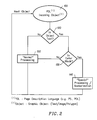
- Fig. 2 is a flow diagram showing a technique for printing black text on a colored background according to the invention.
- the incoming graphic information is a Page Description Language (PDL) data file (e.g . Adobe Postscript -PS- or Hewlett-Packard (HP) PCL) (100)
- PDL Page Description Language
- the graphic objects are broken down into three categories: text (120), polygons (also referred to as line drawing or vectors), and images (also referred to as bitmaps or raster data). Note that this breaking down into three categories is inherent to any PDL.
- the object is processed in a normal manner (150). If the object is a text object, a determination is made if the color of the object is black (130). A text object is provided with a 'context' which supplies e.g . color, typeface, and size. If the object is not a black text object, it is processed in a normal manner (150). If the object is a black text object, special processing and rasterization techniques disclosed herein are applied (140). For example, the background color is first printed. For those locations on which black text is to be printed, the contiguous background color information is saved and used to print the background color to those locations. The black text is then overprinted on the background color, i.e . the background color information is added to the black text information. In this way, any gaps that may result from misregistration are filled by the background color. Thus, the invention exploits to advantage the fact that it is possible in most PDL instances to treat black text differently from other black objects.
- the invention selectively applies techniques that circumvent black misregistration issues solely with regard to the printing of black text on a color background. Indeed, negative side effects that are likely to show up on non-selective techniques (e.g . as shown on Fig. 1 ) are greatly reduced by the invention because printed black text is, in most cases, so thin that any slight density or hue shifts within black characters that may result from application of the invention are not noticeable to the naked eye.
- a black text overprint implementation for the Postscript opaque, 4-byte, case is as follows (in pseudo C-code):
- PCL uses a three dimensional color representation, i.e . in the PCL data stream, and inside the PCL interpreter, each color is represented by only three components: c, m, and y. For convenience, each color is encoded on four bytes, where the k-byte is unused until the final conversion of cmy to cmyk, immediately before physical printing.
- the expression c,m,y,k(b) is the cmyk value of the background immediately before the text is to be rendered.
- the expression c,m,y,k(d) is the color that results from combining the source with the background according to a predefined function F.
- the expression c,m,y,k(t) is the cmyk value of a temporary color needed in this implementation of the invention.
- Fig. 3 is a schematic diagram showing the printing of black text over a colored background according to the invention, as compared with that for the prior art.
- standard black text is shown printed on top of a cyan background 30.
- a standard processing path 34 and a black text overprint processing path according to the invention 36 are shown.
- each square 32 represent a printed pixel and the black plane is misregistered by one-half pixel to the right to demonstrate the result in each case.
- the standard processing path produces a print 38 in which misregistration results in some pixels that are part white (W) because no ink is deposited at these locations and part black (K), and others that are part cyan (C) and part black overprinted on cyan (C+K). Visually, an unattractive white gap is produced at one edge of the black text.
- the processing path according to the invention produces a print 40 in which misregistration results in a cyan background (C) over which black text is printed (C+K).
- C cyan background
- C+K black text is printed
- Fig. 4 is a block schematic diagram of an apparatus for printing black text on a colored background according to the invention.
- a graphic information file 40 is provided from a source such as a scanner or a file stored on a computer memory. Means are provided for testing the graphic information 41 to determine the type of objects contained therein. If the objects are non-text, e.g . polygons or images, the PDL processor 43 processes the graphic information in a standard fashion as is known in the art and the information is then routed to a printer 46. If the graphic information contains text objects, a determining means 42 determines whether the text is black text or other text. If the text is other text, it is processed by the PDL processor in a standard fashion.
- any underlying color background information is saved in a memory or register 44 and means are provided for combining the color background information with the black text information 45 (using techniques, for example, as are discussed above).
- the combined black text and background color information are provided to the PDL processor for further processing as may be necessary pursuant to printing the information, and the combined information is then printed on the printer.
Landscapes
- Engineering & Computer Science (AREA)
- General Engineering & Computer Science (AREA)
- Physics & Mathematics (AREA)
- General Physics & Mathematics (AREA)
- Theoretical Computer Science (AREA)
- Record Information Processing For Printing (AREA)
- Color Image Communication Systems (AREA)
- Color, Gradation (AREA)
Description
- The invention relates to the printing of color documents. More particularly, the invention relates to the printing of black text over a colored background.
- Any color visible to the human naked eye can be mapped to a single point of a three dimensional space. The CIE (Centre International de l'éclairage) has normalized color representation in three-dimensional spaces. Such spaces have taken denominations such as Lab, CIE-RGB, and Luv. A good example of this color three dimensionality is the use of three phosphores in any commercial CRT (video monitor) to display a wide range of colors on a screen. In such case, the three color vectors are red, green, and blue. Similarly, and in theory, only three inks should be sufficient to render any color on a piece of white paper. Printing is an additive process. Accordingly, cyan, magenta, and yellow inks should be able to do the job of printing any color on white materials.
- Unfortunately, because of chemical interactions between the colorants themselves, and because of interactions between the colorants and the printed material, it is nearly impossible to print grays consistently with only three colorants. Therefore, a fourth ink, i.e. black, is almost always added to cyan, magenta, and yellow in any printing devices. This technique is applied in the industry from traditional industrial offset printing to state of the art digital printers.
- A fast growing category of color print device is that of color laser printers, which include optical and digital devices. All of these devices print color documents in four successive passes, where the four inks are first deposited in sequence onto an imaging drum which, in turn, imposes the media.
- Although these digital devices can vary greatly in their specific ways of depositing colorants onto a white media, most of them are subject to color plane misregistration, where the same logical position on a page is actually mapped to different, albeit close by, physical locations on the printed materials for the four color planes. Mechanically, it is indeed very difficult for high resolution devices to have the four color planes perfectly superimposed.
- One striking example where this misregistration issue is most acute is when black text is printed on top of a saturated color background. For the reasons explained above, the text is most likely to be rendered using the black colorant only, while the saturated colored background is rendered by using large amounts of cyan, magenta, or yellow colorants, or a combination of these colorants, without any or with hardly any black colorant. Because of the plane misregistrations, it is very likely that the printed sample displays a thin white border surrounding text printed on saturated colored backgrounds. As a result, black text print quality is significantly degraded.
- This misregistration issue is well known in the industry and several attempts have been made to remedy it. See, for example R.Coleman, Non Uniform Modification of Process Black Colorants To Achieve Conflicting Quality Requirements,
U.S. Patent No. 5,737,088 (7 April 1998); R. Coleman , Automatic Algorithmic Determination of Process Black Over A Color Field,U.S. Patent No. 5,784,172 (21 July 1998); N Goodman, P. Torpey, S. Harrington, B. Smith , Registration of color imagex, European Patent Application No.EP 0 833 216 (filed 22 September 1997); R. Coleman , Method and system for digital color printing, European Patent Application No.EP 0 782 098 (filed 20 December 1996 ); and R. Dermer, E. Reifenstein, Method for Determining Color Boundaries For Correcting For Plate Misregistration in Color Printing,U.S. Patent No. 5,313,570 (17 May 1994 ). - Such known techniques unfortunately spawn undesirable side effects, even if they fix the black vs. colored background misregistration problem. For example, if the technique of Coleman (
EP 0 782 098 ) is applied, it is likely that a continuous thick black strip running on top of a white area of the page and, e.g. a yellow area of the page, show a noticeable density shift, even possibly a hue shift at the white/yellow border. See, for example,Fig. 1 which is a schematic diagram showing the printing on apage 10 of ablack strip 12 on top of ayellow strip 14 according to the prior art. It can be seen that, where process black (k + y) is printed, that is where the black strip is over the yellow strip, there is an objectionable black density and hue shift. -
CA 2 210 596 A discloses an approach for trapping of a dark image object on a lighter colored background. In a system using a page description language including overprint operators, black image areas (such as text, lines, graphic objects and the like) can be set to overprint colored background areas in a manner that eliminates rendered image defects including page-colored "halo" effect that can occur when the cutout background area underlying the black object is misregistered with the black object that was intended to cover the cutout area. In other systems, the approach may be employed as a disabling of the undercolor removal system of a colored area that would otherwise be present under the black object. Systems using black plus at least one other toners or ink color (such as cyan, magenta and/or yellow or many other colors) can usefully employ the approach. The trapping approach may also be employed on an object-oriented basis, such that different image object types are trapped according to this approach and at least one other trapping system. - The invention provides a technique for printing black text on a colored background. When the incoming graphic information is a Page Description Language (PDL) data file (e.g. Adobe Postscript -PS- or Hewlett-Packard PCL), the graphic objects are broken down into three categories: text, polygons (also referred to as line drawing or vectors), and images (also referred to as bitmaps or raster data). If the object is not a text object, it is processed in a normal manner. If the object is a text object, a determination is made if the color of the object is black. If the object is not a black text object, it is processed in a normal manner. If the object is a black text object, special processing and rasterization techniques are applied. Thus, the invention exploits to advantage the fact that it is possible in most PDL instances to treat black text differently from other black objects.
-
-
Fig. 1 is a schematic diagram showing the printing on a page of a black strip on top of a yellow strip according to the prior art; -
Fig. 2 is a flow diagram showing a technique for printing black text on a colored background according to the invention; -
Fig. 3 is a schematic diagram showing the printing of black text over a colored background according to the invention, as compared with that for the prior art; and -
Fig. 4 is a block schematic diagram of an apparatus for printing black text on a colored background according to the invention. -
Fig. 2 is a flow diagram showing a technique for printing black text on a colored background according to the invention. When the incoming graphic information is a Page Description Language (PDL) data file (e.g. Adobe Postscript -PS- or Hewlett-Packard (HP) PCL) (100), the graphic objects are broken down into three categories: text (120), polygons (also referred to as line drawing or vectors), and images (also referred to as bitmaps or raster data). Note that this breaking down into three categories is inherent to any PDL. An object the user intends to paint or draw on a page is either text, a path (outline) with stroking/painting information (=polygons) or images (raster data). If the object is not a text object, it is processed in a normal manner (150). If the object is a text object, a determination is made if the color of the object is black (130). A text object is provided with a 'context' which supplies e.g. color, typeface, and size. If the object is not a black text object, it is processed in a normal manner (150). If the object is a black text object, special processing and rasterization techniques disclosed herein are applied (140). For example, the background color is first printed. For those locations on which black text is to be printed, the contiguous background color information is saved and used to print the background color to those locations. The black text is then overprinted on the background color, i.e. the background color information is added to the black text information. In this way, any gaps that may result from misregistration are filled by the background color. Thus, the invention exploits to advantage the fact that it is possible in most PDL instances to treat black text differently from other black objects. - The invention selectively applies techniques that circumvent black misregistration issues solely with regard to the printing of black text on a color background. Indeed, negative side effects that are likely to show up on non-selective techniques (e.g. as shown on
Fig. 1 ) are greatly reduced by the invention because printed black text is, in most cases, so thin that any slight density or hue shifts within black characters that may result from application of the invention are not noticeable to the naked eye. - An example is provided below of such a technique applied to a PS and a PCL document.
- Whenever a source object of color S is to be applied onto a colored background of color B, the resulting (destination) color D is computed according to a predefined scheme F:

- For instance, one case is when the print process is opaque and D = S. This is the default rendering algorithm for the Adobe's postscript language. In general, PDLs allow for more elaborate combinations where the destination color is a non-trivial combination of the source and the background. HP's PCL language is a good example of this.
- Another major difference between the two languages is that color representation inside the Postscript interpreter is encoded on four bytes, cmyk, while the PCL interpreter only concerns three byte data cmy (or rgb, which is logically equivalent).
- The following are two specific implementations of the invention for PS and PCL, bearing in mind that the invention herein can be easily applied to other PDLs, whether they use three or four byte color encoding. Also, for clarity, the overprint operations are described for both cases, i.e. where the black text overprint mechanism is enabled and disabled.
- A black text overprint implementation for the Postscript opaque, 4-byte, case is as follows (in pseudo C-code):
- c,m,y,k(b) is the cmyk value of the background immediately before the text is to be rendered; and
- c,m,y,k(d) is the resulting color.
- If the black text overprint mechanism is disabled, the result (regardless of source types and color) is:

- If the black text overprint mechanism is enabled, the result is:
      if (object to be rendered is text and color is black: c=m=y=0, k= 255)
      {
            /* black text overprint*/
             c,m,y,k(d) = c,m,y(b),255
             /* background color value is added to the black information in
             the k-byte*/
      }
      else
      {
             /* 'normal' path */
             c,m,y,k(d) = c,m,y,k(s)
      }

      if (object to be rendered is text and color is black: c=m=y=255)
      {
             if (background color is not white - either c or m or y is not 0)
             {
            /* black text overprint*/
                  c,m,y,k(t) = c,m,y,k(b) /* original background color is saved */
                  if(k(b) = 255) /* background k-byte is 255 from previous
            operations*/
                         c,m,y,k(b) = 255,255,255,0
                  c,m,y,k(d) = F(black text(source),c,m,y,k(b))
                   if (destination is process black) /* c=m=y=255, k=0*/
                         c,m,y,k(d) = c,m,y(t),255 /* background color value
                   is added to the black information in the k-byte*/
            }
            else /* 'normal' path */
            {
                   c,m,y,k(d) = F(black text(source),c,m,y,k(b))
            }
     }
- cmyk(i) is the input color from the PCL interpreter
- cmyk(o) is the output color sent to the printer
- cmy(t) is a temporary 3-byte color

- where T is a printer specific transform.
      if (k(i) = 255) /* it is black text overprint */
      {
           cmy(o) = T(cmy(i))
            k(o) = 255
     }
     else/* 'normal' path */
     {
            cmyk(o) = T(cmy(i))
     }
Claims (7)
- A method for printing black text on a colored background, the method comprising:receiving a data file of incoming graphic information (40) that includes a plurality of objects;determining if an object in the incoming graphic information (40) is a text object;if the object is not a text object, processing the object using a Page Description Language processor (43);if the object is a text object, determining a color of the text object;if the color of the text object is not black, processing the object using the Page Description Language processor (43); andif the color of the text object is black, applying a black text overprint process to the object, wherein the black text overprint process comprises:saving contiguous background color information for locations on which black text is to be printed;printing the background color where black text is to be printed; andoverprinting the black text on the background color.
- The method of Claim 1, wherein the black text overprint process further comprises adding background color information to the black text information.
- The method of Claim 1, wherein the incoming graphic information (40) comprises a Page Description Language data file.
- The method of Claim 3, wherein the Page Description Language data file comprises any of a Postscript or PCL file.
- The method of Claim 1, further comprising breaking down the incoming graphic information (40) into categories comprised of the objects.
- The method of Claim 5, wherein the incoming graphic information (40) is broken down into at least three categories comprising text, polygons, and images. ,
- An apparatus for printing black text on a colored background, the apparatus comprising means for carrying out the steps of the method of any of Claims 1-6.
Applications Claiming Priority (3)
| Application Number | Priority Date | Filing Date | Title |
|---|---|---|---|
| US329656 | 1999-06-10 | ||
| US09/329,656 US6856428B1 (en) | 1999-06-10 | 1999-06-10 | Black text printing from page description languages |
| PCT/US2000/014174 WO2000077723A1 (en) | 1999-06-10 | 2000-05-23 | Black text printing from page description languages |
Publications (2)
| Publication Number | Publication Date |
|---|---|
| EP1192588A1 EP1192588A1 (en) | 2002-04-03 |
| EP1192588B1 true EP1192588B1 (en) | 2010-03-31 |
Family
ID=23286421
Family Applications (1)
| Application Number | Title | Priority Date | Filing Date |
|---|---|---|---|
| EP00936218A Expired - Lifetime EP1192588B1 (en) | 1999-06-10 | 2000-05-23 | Black text printing from page description languages |
Country Status (5)
| Country | Link |
|---|---|
| US (1) | US6856428B1 (en) |
| EP (1) | EP1192588B1 (en) |
| AU (1) | AU761578B2 (en) |
| DE (1) | DE60044086D1 (en) |
| WO (1) | WO2000077723A1 (en) |
Families Citing this family (9)
| Publication number | Priority date | Publication date | Assignee | Title |
|---|---|---|---|---|
| US6748111B1 (en) * | 1999-12-02 | 2004-06-08 | Adobe Systems Incorporated | Recognizing text in a multicolor image |
| US6906707B2 (en) | 2000-02-24 | 2005-06-14 | Canon Kabushiki Kaisha | Image processing apparatus and method |
| US20020059489A1 (en) * | 2000-11-14 | 2002-05-16 | Davis Ray Charles | Remote printing |
| US7145676B2 (en) * | 2001-01-31 | 2006-12-05 | Hewlett-Packard Development Company, L.P. | Compound document image compression using multi-region two layer format |
| US7227988B2 (en) * | 2002-07-01 | 2007-06-05 | Xerox Corporation | Prioritized PDL segmentation producing two bit selector |
| JP4091489B2 (en) * | 2003-07-17 | 2008-05-28 | 株式会社東芝 | Printer apparatus, image forming apparatus, and printer apparatus program |
| US7505171B2 (en) | 2003-08-27 | 2009-03-17 | Xerox Corporation | Full user-intent color data stream imaging methods and systems |
| US8520262B2 (en) * | 2009-11-17 | 2013-08-27 | Infoprint Solutions Company, Llc | Post color conversion mechanism for gray/black text and graphics objects |
| JP6238656B2 (en) * | 2013-09-12 | 2017-11-29 | キヤノン株式会社 | Image processing apparatus and image processing method |
Family Cites Families (25)
| Publication number | Priority date | Publication date | Assignee | Title |
|---|---|---|---|---|
| US4546700A (en) | 1981-12-30 | 1985-10-15 | Kollmorgen Technologies Corporation | Method and apparatus for sensing and maintaining color registration |
| US4857715A (en) | 1988-04-01 | 1989-08-15 | National Computer Systems, Inc. | Overprint registration system for printing a customized survey form and scannable form therefor |
| US5208663A (en) * | 1989-03-22 | 1993-05-04 | Konica Corporation | Color image processing apparatus provided with an image discrimination means |
| GB8908612D0 (en) | 1989-04-17 | 1989-06-01 | Quantel Ltd | Video graphics system |
| US5668646A (en) | 1990-02-06 | 1997-09-16 | Canon Kabushiki Kaisha | Apparatus and method for decoding differently encoded multi-level and binary image data, the later corresponding to a color in the original image |
| US5295236A (en) * | 1991-03-04 | 1994-03-15 | Aldus Corporation | Applying traps to a printed page specified in a page description language format |
| US5542052A (en) | 1991-03-04 | 1996-07-30 | Adobe Systems Incorporated | Applying traps to a printed page specified in a page description language format |
| US5412577A (en) | 1992-10-28 | 1995-05-02 | Quad/Tech International | Color registration system for a printing press |
| US5613046A (en) | 1993-03-31 | 1997-03-18 | Miles Inc. | Method and apparatus for correcting for plate misregistration in color printing |
| US5313570A (en) | 1993-03-31 | 1994-05-17 | Miles, Inc. | Method for determining color boundaries for correcting for plate misregistration in color printing |
| US5668931A (en) | 1993-03-31 | 1997-09-16 | Dermer; Richard A. | Method for automatic trap selection for correcting for plate misregistration in color printing |
| US6229623B1 (en) | 1993-05-14 | 2001-05-08 | 3M Innovative Properties Company | Digital color proofing system |
| EP0674289B1 (en) | 1994-01-27 | 2000-03-29 | Hewlett-Packard Company | Automatic optimization of hardcopy output |
| US5666543A (en) | 1994-03-23 | 1997-09-09 | Adobe Systems Incorporated | Method of trapping graphical objects in a desktop publishing program |
| US6006013A (en) * | 1994-05-18 | 1999-12-21 | Xerox Corporation | Object optimized printing system and method |
| US5581667A (en) | 1994-12-23 | 1996-12-03 | Xerox Corporation | Electronic trapping system for digitized text and images |
| US6259536B1 (en) | 1995-12-27 | 2001-07-10 | Xerox Corporation | Color printing yielding a background dependent black image (i.e. intelligent black) |
| US5737088A (en) | 1996-05-24 | 1998-04-07 | Xerox Corporation | Non uniform modification of process black colorants to achieve conflicting quality requirements |
| US5784172A (en) | 1996-05-24 | 1998-07-21 | Xerox Corporation | Automatic algorithmic determination of process black over a color field |
| CA2210552C (en) | 1996-09-27 | 2001-05-15 | Xerox Corporation | System and method for mitigating the visual effects of halo |
| US5923821A (en) | 1996-09-27 | 1999-07-13 | Xerox Corporation | Digital image trapping system |
| US6031544A (en) | 1997-02-28 | 2000-02-29 | Adobe Systems Incorporated | Vector map planarization and trapping |
| US6067405A (en) | 1997-03-04 | 2000-05-23 | Hewlett-Packard Company | Multipass color printmasks based on location rules to minimize hue shift, banding and coalescence |
| US5819655A (en) | 1997-08-20 | 1998-10-13 | Bristol-Myers Squibb Company | Cyclinder color printing method and product using improved misregistration detection |
| US6049390A (en) | 1997-11-05 | 2000-04-11 | Barco Graphics Nv | Compressed merging of raster images for high speed digital printing |
-
1999
- 1999-06-10 US US09/329,656 patent/US6856428B1/en not_active Expired - Lifetime
-
2000
- 2000-05-23 WO PCT/US2000/014174 patent/WO2000077723A1/en not_active Ceased
- 2000-05-23 AU AU51567/00A patent/AU761578B2/en not_active Ceased
- 2000-05-23 DE DE60044086T patent/DE60044086D1/en not_active Expired - Lifetime
- 2000-05-23 EP EP00936218A patent/EP1192588B1/en not_active Expired - Lifetime
Also Published As
| Publication number | Publication date |
|---|---|
| US6856428B1 (en) | 2005-02-15 |
| EP1192588A1 (en) | 2002-04-03 |
| AU5156700A (en) | 2001-01-02 |
| AU761578B2 (en) | 2003-06-05 |
| WO2000077723A1 (en) | 2000-12-21 |
| DE60044086D1 (en) | 2010-05-12 |
Similar Documents
| Publication | Publication Date | Title |
|---|---|---|
| EP0718793B1 (en) | Electronic trapping system for digitized text and images | |
| EP0881822B1 (en) | Luminance-based color resolution enhancement | |
| CA2346545C (en) | Performance optimization of monochrome pages in a color printing system | |
| EP0862136B1 (en) | Vector map planarization and trapping | |
| KR100660453B1 (en) | Method, apparatus, and program for image processing, and medium storing the program | |
| WO1996010239A1 (en) | Method for object based color matching when printing a color document | |
| US20070153308A1 (en) | Apparatus and Method for Reducing Ink/ Toner Consumption of Color Printers | |
| US6856428B1 (en) | Black text printing from page description languages | |
| US5588093A (en) | Color mapping to preserve detail | |
| US7835031B2 (en) | Output pure color tints or black for full-color input | |
| EP3026881B1 (en) | Image processing apparatus and image processing method | |
| US7295342B2 (en) | Method for identifing objects on white background for optimized rendering | |
| US6031630A (en) | Method and apparatus for undercolor removal during page pipeline processing | |
| US7856140B2 (en) | Method, computer program, computer and printing system for trapping image data | |
| EP1513097B1 (en) | Colour image rendering data stream | |
| EP1553753B1 (en) | Color printing | |
| US5982991A (en) | Method and apparatus for switching between binary and arithmetic operators during raster operations | |
| US8542925B2 (en) | System and method to enable correction to application of substantially colorless material over identified text via segmentation | |
| EP1553755B1 (en) | Color printing by replacing chromatic black dots with monochrome black dots | |
| JP3225506B2 (en) | Information processing method of print information for color printing | |
| JP2007088741A (en) | Image processing apparatus and image processing method | |
| EP3901904B1 (en) | Decision system, control method of decision system, and program | |
| US20050264582A1 (en) | Method and system for application page description in print device color space | |
| EP1302328B1 (en) | Method to determine a characteristic of a printing system | |
| JP2006129007A (en) | Print control apparatus, data processing method of print control apparatus, and storage medium storing computer-readable program |
Legal Events
| Date | Code | Title | Description |
|---|---|---|---|
| PUAI | Public reference made under article 153(3) epc to a published international application that has entered the european phase |
Free format text: ORIGINAL CODE: 0009012 |
|
| 17P | Request for examination filed |
Effective date: 20011123 |
|
| AK | Designated contracting states |
Kind code of ref document: A1 Designated state(s): AT BE CH CY DE DK ES FI FR GB GR IE IT LI LU MC NL PT SE |
|
| AX | Request for extension of the european patent |
Free format text: AL;LT;LV;MK;RO;SI |
|
| RBV | Designated contracting states (corrected) |
Designated state(s): DE FR GB NL |
|
| 17Q | First examination report despatched |
Effective date: 20061222 |
|
| GRAP | Despatch of communication of intention to grant a patent |
Free format text: ORIGINAL CODE: EPIDOSNIGR1 |
|
| GRAS | Grant fee paid |
Free format text: ORIGINAL CODE: EPIDOSNIGR3 |
|
| GRAA | (expected) grant |
Free format text: ORIGINAL CODE: 0009210 |
|
| AK | Designated contracting states |
Kind code of ref document: B1 Designated state(s): DE FR GB NL |
|
| REG | Reference to a national code |
Ref country code: GB Ref legal event code: FG4D |
|
| REG | Reference to a national code |
Ref country code: NL Ref legal event code: T3 |
|
| REF | Corresponds to: |
Ref document number: 60044086 Country of ref document: DE Date of ref document: 20100512 Kind code of ref document: P |
|
| PLBE | No opposition filed within time limit |
Free format text: ORIGINAL CODE: 0009261 |
|
| STAA | Information on the status of an ep patent application or granted ep patent |
Free format text: STATUS: NO OPPOSITION FILED WITHIN TIME LIMIT |
|
| 26N | No opposition filed |
Effective date: 20110104 |
|
| REG | Reference to a national code |
Ref country code: FR Ref legal event code: PLFP Year of fee payment: 17 |
|
| REG | Reference to a national code |
Ref country code: FR Ref legal event code: PLFP Year of fee payment: 18 |
|
| REG | Reference to a national code |
Ref country code: FR Ref legal event code: PLFP Year of fee payment: 19 |
|
| PGFP | Annual fee paid to national office [announced via postgrant information from national office to epo] |
Ref country code: NL Payment date: 20190515 Year of fee payment: 20 |
|
| PGFP | Annual fee paid to national office [announced via postgrant information from national office to epo] |
Ref country code: DE Payment date: 20190508 Year of fee payment: 20 |
|
| PGFP | Annual fee paid to national office [announced via postgrant information from national office to epo] |
Ref country code: FR Payment date: 20190410 Year of fee payment: 20 |
|
| PGFP | Annual fee paid to national office [announced via postgrant information from national office to epo] |
Ref country code: GB Payment date: 20190522 Year of fee payment: 20 |
|
| REG | Reference to a national code |
Ref country code: DE Ref legal event code: R071 Ref document number: 60044086 Country of ref document: DE |
|
| REG | Reference to a national code |
Ref country code: NL Ref legal event code: MK Effective date: 20200522 |
|
| REG | Reference to a national code |
Ref country code: GB Ref legal event code: PE20 Expiry date: 20200522 |
|
| PG25 | Lapsed in a contracting state [announced via postgrant information from national office to epo] |
Ref country code: GB Free format text: LAPSE BECAUSE OF EXPIRATION OF PROTECTION Effective date: 20200522 |