EP1191312A2 - System and method for optimization of parameters of liquid-handling instruments - Google Patents
System and method for optimization of parameters of liquid-handling instruments Download PDFInfo
- Publication number
- EP1191312A2 EP1191312A2 EP01121802A EP01121802A EP1191312A2 EP 1191312 A2 EP1191312 A2 EP 1191312A2 EP 01121802 A EP01121802 A EP 01121802A EP 01121802 A EP01121802 A EP 01121802A EP 1191312 A2 EP1191312 A2 EP 1191312A2
- Authority
- EP
- European Patent Office
- Prior art keywords
- liquid
- pipetting
- parameters
- precision
- handling
- Prior art date
- Legal status (The legal status is an assumption and is not a legal conclusion. Google has not performed a legal analysis and makes no representation as to the accuracy of the status listed.)
- Withdrawn
Links
- 238000000034 method Methods 0.000 title claims abstract description 44
- 238000005457 optimization Methods 0.000 title claims description 13
- 239000007788 liquid Substances 0.000 claims abstract description 207
- 238000002474 experimental method Methods 0.000 claims abstract description 103
- 238000012216 screening Methods 0.000 claims abstract description 49
- 230000000694 effects Effects 0.000 claims abstract description 36
- 238000010993 response surface methodology Methods 0.000 claims abstract description 25
- 238000012795 verification Methods 0.000 claims abstract description 21
- 238000004458 analytical method Methods 0.000 claims abstract description 15
- 238000013401 experimental design Methods 0.000 claims abstract description 13
- 238000013461 design Methods 0.000 claims description 86
- 230000004044 response Effects 0.000 claims description 57
- 238000011156 evaluation Methods 0.000 claims description 37
- 238000012360 testing method Methods 0.000 claims description 33
- 238000012545 processing Methods 0.000 claims description 28
- 238000004590 computer program Methods 0.000 claims description 18
- 238000011157 data evaluation Methods 0.000 claims description 10
- 230000010076 replication Effects 0.000 claims description 5
- 238000012803 optimization experiment Methods 0.000 claims 2
- 239000002131 composite material Substances 0.000 abstract description 10
- 238000013400 design of experiment Methods 0.000 abstract description 10
- 238000003052 fractional factorial design Methods 0.000 abstract description 4
- 230000003993 interaction Effects 0.000 description 22
- 230000008569 process Effects 0.000 description 10
- IAZDPXIOMUYVGZ-UHFFFAOYSA-N Dimethylsulphoxide Chemical compound CS(C)=O IAZDPXIOMUYVGZ-UHFFFAOYSA-N 0.000 description 6
- 238000011161 development Methods 0.000 description 5
- 150000001875 compounds Chemical class 0.000 description 4
- 230000000977 initiatory effect Effects 0.000 description 4
- 238000005259 measurement Methods 0.000 description 4
- 238000011160 research Methods 0.000 description 4
- 238000001514 detection method Methods 0.000 description 3
- 238000003055 full factorial design Methods 0.000 description 3
- XLYOFNOQVPJJNP-UHFFFAOYSA-N water Substances O XLYOFNOQVPJJNP-UHFFFAOYSA-N 0.000 description 3
- 102000003712 Complement factor B Human genes 0.000 description 2
- 108090000056 Complement factor B Proteins 0.000 description 2
- LFQSCWFLJHTTHZ-UHFFFAOYSA-N Ethanol Chemical compound CCO LFQSCWFLJHTTHZ-UHFFFAOYSA-N 0.000 description 2
- 238000002835 absorbance Methods 0.000 description 2
- 238000003556 assay Methods 0.000 description 2
- 230000008901 benefit Effects 0.000 description 2
- 230000008033 biological extinction Effects 0.000 description 2
- 230000000903 blocking effect Effects 0.000 description 2
- 238000011284 combination treatment Methods 0.000 description 2
- 230000001419 dependent effect Effects 0.000 description 2
- 238000007876 drug discovery Methods 0.000 description 2
- 230000003252 repetitive effect Effects 0.000 description 2
- 238000005316 response function Methods 0.000 description 2
- 238000013474 audit trail Methods 0.000 description 1
- 238000010256 biochemical assay Methods 0.000 description 1
- 230000008859 change Effects 0.000 description 1
- 238000006243 chemical reaction Methods 0.000 description 1
- 230000000052 comparative effect Effects 0.000 description 1
- 238000011109 contamination Methods 0.000 description 1
- 238000013480 data collection Methods 0.000 description 1
- 230000004069 differentiation Effects 0.000 description 1
- 238000007865 diluting Methods 0.000 description 1
- 239000003085 diluting agent Substances 0.000 description 1
- 229940079593 drug Drugs 0.000 description 1
- 239000003814 drug Substances 0.000 description 1
- 238000009509 drug development Methods 0.000 description 1
- 238000005516 engineering process Methods 0.000 description 1
- 230000006870 function Effects 0.000 description 1
- 230000010365 information processing Effects 0.000 description 1
- 238000009413 insulation Methods 0.000 description 1
- 238000012417 linear regression Methods 0.000 description 1
- 238000004519 manufacturing process Methods 0.000 description 1
- 239000000463 material Substances 0.000 description 1
- 230000007246 mechanism Effects 0.000 description 1
- 238000012986 modification Methods 0.000 description 1
- 230000004048 modification Effects 0.000 description 1
- 238000005375 photometry Methods 0.000 description 1
- 230000037452 priming Effects 0.000 description 1
- 238000004886 process control Methods 0.000 description 1
- 238000012887 quadratic function Methods 0.000 description 1
- 102000005962 receptors Human genes 0.000 description 1
- 108020003175 receptors Proteins 0.000 description 1
- 230000009467 reduction Effects 0.000 description 1
- 230000003362 replicative effect Effects 0.000 description 1
- 210000002966 serum Anatomy 0.000 description 1
- 238000012546 transfer Methods 0.000 description 1
- 238000011282 treatment Methods 0.000 description 1
- 239000013598 vector Substances 0.000 description 1
- 230000000007 visual effect Effects 0.000 description 1
Images



Classifications
-
- B—PERFORMING OPERATIONS; TRANSPORTING
- B01—PHYSICAL OR CHEMICAL PROCESSES OR APPARATUS IN GENERAL
- B01L—CHEMICAL OR PHYSICAL LABORATORY APPARATUS FOR GENERAL USE
- B01L3/00—Containers or dishes for laboratory use, e.g. laboratory glassware; Droppers
- B01L3/02—Burettes; Pipettes
-
- B—PERFORMING OPERATIONS; TRANSPORTING
- B01—PHYSICAL OR CHEMICAL PROCESSES OR APPARATUS IN GENERAL
- B01L—CHEMICAL OR PHYSICAL LABORATORY APPARATUS FOR GENERAL USE
- B01L3/00—Containers or dishes for laboratory use, e.g. laboratory glassware; Droppers
- B01L3/02—Burettes; Pipettes
- B01L3/021—Pipettes, i.e. with only one conduit for withdrawing and redistributing liquids
-
- G—PHYSICS
- G01—MEASURING; TESTING
- G01F—MEASURING VOLUME, VOLUME FLOW, MASS FLOW OR LIQUID LEVEL; METERING BY VOLUME
- G01F25/00—Testing or calibration of apparatus for measuring volume, volume flow or liquid level or for metering by volume
- G01F25/20—Testing or calibration of apparatus for measuring volume, volume flow or liquid level or for metering by volume of apparatus for measuring liquid level
-
- G—PHYSICS
- G01—MEASURING; TESTING
- G01F—MEASURING VOLUME, VOLUME FLOW, MASS FLOW OR LIQUID LEVEL; METERING BY VOLUME
- G01F3/00—Measuring the volume flow of fluids or fluent solid material wherein the fluid passes through the meter in successive and more or less isolated quantities, the meter being driven by the flow
- G01F3/02—Measuring the volume flow of fluids or fluent solid material wherein the fluid passes through the meter in successive and more or less isolated quantities, the meter being driven by the flow with measuring chambers which expand or contract during measurement
- G01F3/20—Measuring the volume flow of fluids or fluent solid material wherein the fluid passes through the meter in successive and more or less isolated quantities, the meter being driven by the flow with measuring chambers which expand or contract during measurement having flexible movable walls, e.g. diaphragms, bellows
- G01F3/22—Measuring the volume flow of fluids or fluent solid material wherein the fluid passes through the meter in successive and more or less isolated quantities, the meter being driven by the flow with measuring chambers which expand or contract during measurement having flexible movable walls, e.g. diaphragms, bellows for gases
- G01F3/222—Measuring the volume flow of fluids or fluent solid material wherein the fluid passes through the meter in successive and more or less isolated quantities, the meter being driven by the flow with measuring chambers which expand or contract during measurement having flexible movable walls, e.g. diaphragms, bellows for gases characterised by drive mechanism for valves or membrane index mechanism
- G01F3/223—Measuring the volume flow of fluids or fluent solid material wherein the fluid passes through the meter in successive and more or less isolated quantities, the meter being driven by the flow with measuring chambers which expand or contract during measurement having flexible movable walls, e.g. diaphragms, bellows for gases characterised by drive mechanism for valves or membrane index mechanism with adjustment of stroke or timing; Calibration thereof; Testing
-
- G—PHYSICS
- G01—MEASURING; TESTING
- G01N—INVESTIGATING OR ANALYSING MATERIALS BY DETERMINING THEIR CHEMICAL OR PHYSICAL PROPERTIES
- G01N35/00—Automatic analysis not limited to methods or materials provided for in any single one of groups G01N1/00 - G01N33/00; Handling materials therefor
- G01N35/00584—Control arrangements for automatic analysers
-
- G—PHYSICS
- G01—MEASURING; TESTING
- G01N—INVESTIGATING OR ANALYSING MATERIALS BY DETERMINING THEIR CHEMICAL OR PHYSICAL PROPERTIES
- G01N35/00—Automatic analysis not limited to methods or materials provided for in any single one of groups G01N1/00 - G01N33/00; Handling materials therefor
- G01N35/10—Devices for transferring samples or any liquids to, in, or from, the analysis apparatus, e.g. suction devices, injection devices
-
- B—PERFORMING OPERATIONS; TRANSPORTING
- B01—PHYSICAL OR CHEMICAL PROCESSES OR APPARATUS IN GENERAL
- B01L—CHEMICAL OR PHYSICAL LABORATORY APPARATUS FOR GENERAL USE
- B01L2200/00—Solutions for specific problems relating to chemical or physical laboratory apparatus
- B01L2200/14—Process control and prevention of errors
- B01L2200/148—Specific details about calibrations
-
- G—PHYSICS
- G01—MEASURING; TESTING
- G01N—INVESTIGATING OR ANALYSING MATERIALS BY DETERMINING THEIR CHEMICAL OR PHYSICAL PROPERTIES
- G01N35/00—Automatic analysis not limited to methods or materials provided for in any single one of groups G01N1/00 - G01N33/00; Handling materials therefor
- G01N35/00584—Control arrangements for automatic analysers
- G01N35/0092—Scheduling
- G01N2035/0094—Scheduling optimisation; experiment design
-
- Y—GENERAL TAGGING OF NEW TECHNOLOGICAL DEVELOPMENTS; GENERAL TAGGING OF CROSS-SECTIONAL TECHNOLOGIES SPANNING OVER SEVERAL SECTIONS OF THE IPC; TECHNICAL SUBJECTS COVERED BY FORMER USPC CROSS-REFERENCE ART COLLECTIONS [XRACs] AND DIGESTS
- Y10—TECHNICAL SUBJECTS COVERED BY FORMER USPC
- Y10T—TECHNICAL SUBJECTS COVERED BY FORMER US CLASSIFICATION
- Y10T436/00—Chemistry: analytical and immunological testing
- Y10T436/12—Condition responsive control
-
- Y—GENERAL TAGGING OF NEW TECHNOLOGICAL DEVELOPMENTS; GENERAL TAGGING OF CROSS-SECTIONAL TECHNOLOGIES SPANNING OVER SEVERAL SECTIONS OF THE IPC; TECHNICAL SUBJECTS COVERED BY FORMER USPC CROSS-REFERENCE ART COLLECTIONS [XRACs] AND DIGESTS
- Y10—TECHNICAL SUBJECTS COVERED BY FORMER USPC
- Y10T—TECHNICAL SUBJECTS COVERED BY FORMER US CLASSIFICATION
- Y10T436/00—Chemistry: analytical and immunological testing
- Y10T436/25—Chemistry: analytical and immunological testing including sample preparation
- Y10T436/2575—Volumetric liquid transfer
Definitions
- the present invention is generally related to liquid handling equipment. More particularly, the present invention relates to a method and system for evaluating and optimizing liquid-handling parameters for a liquid class.
- Liquid-handling equipment has always been important to biomedical research and life science applications. Pipettes need to be accurate and resist contamination, but still work quickly and efficiently in repetitive procedures. Although pipettes remain a key component of experimental protocols, new types of large-scale research require more automation and miniaturization in liquid handling capabilities.
- Pipettes have evolved to diverse devices that may be electronic, multichannel, automated or robotic. They are typically slender and light, have thermal insulation, preset volumes, built-in tip ejectors, and mechanisms to program the devices to repeatedly deliver the same volume.
- Robotic systems perform the highly repetitive task of liquid handling and can be programmed to pipette, dilute, dispense, heat, cool, wash plates, and transfer liquids. Robotic systems also provide an audit trail, tracking and recording every step of the process.
- One of the most important benefits of automated liquid-handling is the precision and reproducibility of assays.
- DOE Design of Experiments
- a screening design is one in which relatively few experimental runs are used to efficiently study a large number of experimental factors to screen out those few that are most active from the remainder that are relatively inactive over the ranges being considered.
- Response Surface Methodology is an experimental technique to find the optimal response with the specified ranges of the factors. RSM designs assist in quantifying the relationships between one or more measured responses and the vital input facts.
- the full and fractional factorials are types of screening designs. These are experiments in which many factors are considered with the purpose of identifying those factors, if any, that have large effects on the result being studied. Full factorials contain all possible combinations of a set of factors and are used to estimate the effects of all interactions. Fractional factorials are used to screen many factors to find a few that are significant. An experimental design including a subset of all possible combinations of factor levels causes some of the effects to be aliased. The successful use of fractional factorial designs is based on three key concepts: (1) the sparsity-of-effect principle; (2) the projection property; (3) sequential experimentation.
- the sparsity-of-effect principle is that when there are several variables, the system or process is likely to be driven primarily by some of the main effects and low-order interactions. Fractional factorial designs can be projected into stronger (larger) designs and the subset of significant factors. It is also possible to combine the runs of two or more fractional factorials to assemble sequentially a larger design to estimate the factor effects and interactions with interest.
- RSM designs assist in quantifying the relationships between measured responses and the vital input factors.
- a two-level factorial screening design may be appropriate for five or more factors.
- RSM designs are capable of fitting a second order prediction equation for the response. The quadratic term in these equations model the curvature in the true response function. If a maximum or minimum response exists inside the factor region, a response surface model can pinpoint it.
- the central composite is a design for response surface methods that is composed of a core two-level factorial plus axial points and center points. It is widely used for fitting a second-order response surface.
- the factorial points can be divided in such a way that the blocked effect is eliminated before computation of the model.
- the first one or more blocks consists of the factorial design with some center points.
- the remaining block consists of the star points with additional center points.
- the central composite design is simple and flexible, requires fewer treatment combinations than 3n factorials to estimate quadratic response surface equations, provides blocking options for the designs, and is a very efficient design in situations that call for a non-sequential batch response surface experiment.
- Block(ing) - Group of trials based on a common factor Blocking is advantageous when there is a known factor that may influence the experimental result, but the effect is not of interest.
- Confounding - Factor or factor interaction is confounded (or aliased) with another factor or faction interaction when the individual effects of the factors or factor interactions cannot be separated from each other because of the limitations of the experimental data. In a complete or full factorial design, there is no confounding.
- Liquid class - Parameters for pipetting control software to define the pipetting of a specific liquid Liquid class - Parameters for pipetting control software to define the pipetting of a specific liquid.
- OFAT One Factor at a Time
- Design resolution refers to the separate identification of factor effects and interactions that the design supports. This is only relevant for multifactor, not OFAT, experiments. Design resolution is usually expressed as Resolution III, IV, V with the higher resolution designs being labeled with the larger roman numerals.
- the present invention provides an automated method of optimizing and evaluating liquid class parameters for liquid-handling based on the principles of Design of Experiments.
- the invention provides a methodology to execute, gather and document the designs, experimental data and resulting conclusions produced during the development of a liquid class. All control and interfacing with liquid-handling instruments and devices is provided by external pipetting control software packages.
- the instruments supported by the present invention are dependent upon those external pipetting control software packages and the hardware support they provide.
- the present invention is dependent on features of a pipetting software package for control of a robotic instrument.
- the software for optimizing and evaluating liquid class parameters of the present invention requires a computer platform with performance equivalent to or greater than that of a Pentium II 266 MHz processor with 128 Megabytes (MB) of random access memory (RAM).
- MB Megabytes
- Target operating systems are Microsoft Windows NT 4.0 and Microsoft Windows 2000.
- the software itself is produced using the Borland C++ Builder, Borland Delphi and Microsoft Visual C++ development tools.
- the liquid-handling optimization software includes ten modules designed to aid in the development and evaluation of the liquid classes used by the liquid-handling instruments pipetting control software package.
- liquid classes is used herein, there are other terms used by manufacturers of liquid-handling products to refer to the set of parameters for pipetting control software to define the pipetting of a specific liquid, e.g. performance profiles.
- the Factor Screening module generates a liquid handling robotic instrument worklist, implementing a two-level factorial experiment. This experiment is designed to identify the factors that influence the pipetting precision of a liquid under study.
- the configuration of the instrument to be used is automatically loaded from the configuration file of the active data directory for the liquid-handling instruments software package.
- the Screening Data Evaluation module accepts as input the experimental design and result data from an experiment generated by the Factor Screening module.
- An option for the Screening Data Evaluation module is provided to allow automated initiation by the liquid handling instruments pipetting control software package once a pipetting experiment is complete.
- the Screening Data Evaluation module calculates and reports the estimated effects and interactions of each of the factors employed in the experiment.
- the Response Surface Design module accepts input from the Screening Data Evaluation module or from a user interface that allows the user to arbitrarily select factors to optimize.
- the Response Surface Design module generates a standard worklist designed to conduct an experiment to optimize the factors previously found to influence pipetting precision.
- the Response Surface Evaluation module accepts as input the design of, and data from, an experiment generated by the Response Surface Design module.
- a driver for the Response Surface Evaluation module enables automated initiation by the liquid-handling instruments pipetting control software package one a pipetting experiment is complete.
- the Response Surface Evaluation module calculates and reports the optimal levels of each of the factors in the experiment.
- the Range-Finding Design module accepts input from the Optimization Evaluation module or from a user interface that allows the user to arbitrarily select the "optimal" condition around which to optimize.
- the Range-Finding Design module generates a standard worklist to conduct an experiment designed to determine the optimization around the volume used in previous optimizations.
- the Range-Finding Evaluation module accepts as input the design of and data from an experiment generated by the Range-Finding Design module.
- a driver for the Range-Finding Evaluation module enables automated initiation by the liquid-handling instruments pipetting control software package once a pipetting experiment is complete.
- the Range-Finding Evaluation module calculates and reports the precision for each measured point, and whether each meets the user-defined criteria for adequate precision.
- the Accuracy Calibration module provides for calibration of either or both single and multi-pipetting. It takes as input the calibration data for the type of detection being used. This data might take the form of pre-measured extinction coefficient data or instructions for acquiring that data, e.g., from plates placed on the pipetting deck. A second required input is the liquid class to be tested.
- the Accuracy Calibration module generates a standard worklist designed to generate a calibration coefficient for the liquid class under study.
- the Calibration module accepts as input the parameters and data from the Accuracy Calibration module directed experiment in a standard format.
- the Calibration module generates the calibration coefficient and adjustment volume for the liquid class under study from the experimental data and input parameters from the Accuracy Calibration module.
- the final Liquid Class Verification module takes as input an existing liquid class, which may be a master liquid class containing multiple volume ranges. The user can specify all or some of these volume ranges to test and whether or not both single and multi-pipetting should be tested.
- the final Liquid Class Verification module generates a worklist designed to test the precision and accuracy of a liquid class. Since only a single set of conditions is tested, a large number of applicable samples are used as the default.
- the final Liquid Class Evaluation module accepts as data the parameters from the final Liquid Class Verification module and data from the resulting pipetting experiment.
- the final Liquid Class Verification module evaluates all volume ranges of a liquid class in either single or multi-pipetting mode in a singe automated run.
- the final liquid class evaluation module evaluates the precision and accuracy of the liquid class based on the experimental design and data provided from the final Liquid Class Verification module.
- the present invention uses the concept of a "liquid class" to arrange and describe the parameters needed for the accurate pipetting of a type of liquid using liquid-handling instruments, such as the Genesis and MiniPrep liquid-handling instrument series available from TECAN, US, Inc.
- liquid-handling instruments such as the Genesis and MiniPrep liquid-handling instrument series available from TECAN, US, Inc.
- Each type of liquid that is used in an instrument requires a corresponding liquid class to ensure accurate pipetting of that liquid.
- the pipetting control software comes with a default set of liquid classes already defined for the following liquid types: dimethylsulfoxide (DMSO), ethanol, serum, water, water on liquid level, micro DMSO, micro priming liquid and micro water (the last three liquid types are used only if the instrument has the required nanopipetting hardware).
- DMSO dimethylsulfoxide
- ethanol ethanol
- serum serum
- water water on liquid level
- micro DMSO micro priming liquid
- micro water the last three liquid types are used only if the instrument
- Each liquid class has more than thirty parameters that can be altered by the user.
- the task of finding the optimum combination of parameters for a particular liquid is extremely time-consuming and often prone to error.
- the precision of the pipetting is the first result that is analyzed. Once the precision has been optimized, the liquid class factors can be optimized to perfect the accuracy of the pipetting. With the present invention a new method for automating this process has been established using statistical Design of Experiment methodologies and liquid-handling instrumentation technologies.
- the first step in the inventive process of creating and/or optimizing a liquid class is the determination of which of the liquid class parameters are important to pipetting precision for the liquid under study. This varies greatly depending on the type of liquid, the volume of the liquid being aspirated or dispensed, and the configuration of the instrument doing the pipetting. To perform this step, an experiment using a two-level fractional factorial screening design is used.
- a screening design is one in which relatively few experimental runs are used to efficiently study a large number of experimental factors to "screen out" those few that are most active from the remainder that are relatively inactive over the ranges being considered. Such designs are very useful in the early stages of sequential experimentation in order to conserve resources and identify the most influential experimentation factors for more detailed study.
- the objective of the screening design is "problem reduction".
- Factorial designs are a variety of screening designs. These are experiments in which many variables are considered with the purpose of identifying those factors that have large effects on the result or process being studied. Full and fractional designs usually set each factor to only two levels, represented by a plus sign (+) and a negative sign (-).
- Full factorials contain all possible combinations of a set of factors and thus are used to estimate the effects of all interactions. For n variables, the two-level full factorial design requires 2n data points. An example of the data that can be gained from a two level, 7-factor full factorial design is seen in Table 1. Interactions Average Main effects 2-factor 3-factor 4-factor 5-factor 6-factor 7-factor 1 7 21 35 35 21 7 1
- Fractional factorials take advantage of the fact that high order interactions in factorial designs (of many factors) tend to have negligible effect. Because these interactions have very little effect, they can thus be properly disregarded.
- fractional versions of full factorials available. These include the 1 ⁇ 2, 1 ⁇ 4, 1/8, 1/16, 1/32, 1/64 factorials. The choice on which of these to use is generally based on the number of factors to be studied and the desired accuracy of the results.
- a fractional experiment design including only a subset of all possible combinations of factor levels causes some of the effects to be aliased and thus some interactions to be hidden. For example, if an experiment involves 10 factors then the loss of resolution involved in using, for example, a 1/16 factorial may be a reasonable trade off if it means that only 64 observations need to be made rather than 1024.
- the fractional factorial design is used to generate a set of liquid classes that include the different settings at the levels and combinations dictated by the design. These liquid classes are used in pipetting a test volume to a microplate or series of microplates or a precision balance. The raw results from reading these plates in the appropriate fluorescence or absorbance reader or from utilizing the balance are used to determine the main effects and interaction effects of each of the parameters in question.
- main effect y + - y - where y + is the average of the result or response variable when the variable for which the effect is being calculated is set to its high (+) level and y - is the average of the result when the variable is set to its low (-) level.
- a * B interaction ( y A+ - y A- ) B+ - ( y A+ - y A- ) B- 2
- the A * B interaction is calculated by taking the difference of the main effect of factor A with factor B set high (+) and the main effect of factor A with factor B set low (-) and dividing by 2.
- RSM Response Surface Methodology
- phase one of the response surface study, the objective is to determine if the current levels of the factors being studied are close to the optimum or in some other region of the design space.
- This phase makes use of the first order model and the "method of steepest ascent".
- phase two of the response surface experiment a second order polynomial equation is used to fully model the curve of the response.
- the quadratic terms in these equations model the curvature in the true response function. If a maximum or minimum exists inside the factor region, this phase of RSM can find it.
- RSM designs are used for modeling a curved surface (quadratic) to continuous factors (see Fig. 1 for an exemplary response surface for two factors). Because three distinct values for each factor are necessary to fit a quadratic function, the standard two-level factorial designs cannot fit curved surfaces and thus cannot be used alone.
- the method of least squares is used to estimate the parameters (the ⁇ 's) of the equations above.
- At least some of the factors for RSM designs must be quantitative, continuous variables.
- the objective is to find a desirable location in the design space. This can be a maximum, a minimum, or an area where the response is stable over a range of the factors. Goals can include meeting a set of specifications for several responses simultaneously.
- the present invention provides the ability to target either precision, accuracy, or both as the response variables.
- the "Central Composite Design” is a response surface design that is composed of a core, Resolution V, two-level factorial plus axial points and center points. It is widely used for fitting a second-order response surface.
- the factorial points can be divided in such a way that any blocked effect is eliminated before computation of the model.
- the first one or more blocks consist of the factorial design with some center points.
- the remaining block consists of the star points with additional center points.
- the central composite designs are 2n factorial treatment designs with 2n additional treatment combinations called axial points along the coordinate axes of the coded factor levels.
- the coordinates for the axial points on the coded factor axes are ( ⁇ a, 0, 0,..., 0), (0, ⁇ a, 0,..., 0), (0, 0, 0,..., ⁇ a).
- m replications are added to the center of the design at coordinate (0, 0,..., 0).
- phase one and phase two a central composite design is used to generate a set of liquid classes using different levels of the parameters to be studied. These liquid classes are then used to pipette a test volume using a liquid-handling instrument (robot) to randomized locations on a microplate or a precision balance. The raw experimental data from that pipetting is then gathered using the appropriate fluorescence or absorbance reader or through utilization of the balance. This data is then used to solve the first or second order equation depending on the phase of the experiment. The response surface can then be graphed using all of the factors under study (if three or less) or a user chosen subset.
- robot liquid-handling instrument
- a range-finding experiment is used to determine the precision obtained at higher and low volumes.
- the design of this experiment is (by default) a one-dimensional central composite design, with volume as the varied parameter.
- the precision determined at each point may be used to define the volume limits outside of which the liquid class should not be used. If desired, limits between the actual experimentally determined points may be assigned based on solution of the second order equation and interpolation to estimate the volumes at which the precision remains adequate.
- an accuracy calibration experiment is used to determine the volume adjustment coefficient to resolve the accuracy of the volume to be pipetted. This coefficient is used in the liquid class to calculate an adjustment volume to combine with the requested volume to ensure accurate liquid delivery.
- the accuracy calibration experiment is performed by selecting a user-defined number of volumes spread evenly within the volume range of the liquid class. For each of these volumes, eight (or a user-configured number) replications pipetted by the instrument (using the precision settings established in the previous screening and RSM experiments) are placed on a microplate. If a reader is being utilized for data collection, four (or user-configured number) hand-pipetted control volumes are also placed on the microplate. A reader blank control or controls is also necessary for the accuracy calibration.
- the final stage in creating or optimizing the liquid class is the verification experiment. This experiment is used to evaluate the effectiveness of both the accuracy and precision settings that were arrived at in the process of the screening, RSM and calibration experiments.
- the protocol for this experiment is as follows:
- the standard deviation (s) is calculated as follows:
- the software provides a graphical user interface. This user interface permits the user to access, view and change parameters and methods of the liquid class optimization process as described above.
- the software utilizes ten internal subsystems designed to aid in the development and evaluation of the liquid classes used by the pipetting control software.
- the outputs and relationship of these modules are illustrated in Fig. 2.
- the subsystems include the Factor Screening module 210, the Screening Data Evaluation module 220, the Response Surface Design module 230, the Response Surface Evaluation module 240, the Range-Finding Design Module 244, the Range-Finding Evaluation module, 248, the Accuracy Calibration module 260, the Calibration Coefficient module 270, the Final Liquid Class Verification module 280, and the Final Liquid Class Evaluation module 290.
- the features of each module are discussed in more detail below.
- the Screening Design module 210 generates a pipetting control software package worklist (i.e., file containing pipetting commands) implementing a two-level factorial experiment. This experiment is designed to identify the factors that influence the pipetting precision of the liquid under study.
- the user enters a name for the liquid class experiment and input data concerning the physical configuration of the robot, including data on the exact type of tip. Not all data fields necessary to specify the intended configuration corresponding to a liquid class are included in that liquid class. For example, the exact type of tip and whether the tubing is low volume or not is data included in the liquid class data file. A facile fix for this omission is to include a comment field for each liquid class, with default text suggesting that these specifics be entered. The user selects whether the experiment should test either single pipetting (the default), or multi-pipetting.
- the configuration of the instrument used is automatically loaded from the configuration file of the active data directory of the software package.
- the user is able to control the size of the experiment by varying the resolution of the factorial, and by eliminating any factor levels the user does not want to consider.
- the experiment designs supported by the Screening Design module are fractional factorials with the fractions ranging in size from 1 ⁇ 2 to 1/2048.
- the user is presented with a list of all the liquid class parameters.
- the user then has the option to select the parameters to be used as experiment factors and to input the high and low levels of each factor selected.
- the parameters not selected as experiment factors are held constant throughout the experiment at the default values or at an inputted value.
- the default values for parameters are set when the user selects an existing liquid class on which to base the experiment.
- the user receives constant and immediate feedback on the size of the experiment in terms of the number of data points, microplates, and the estimated time to run the experiment. This data is adjusted as factors are selected and the resolution of the design is changed.
- the Factor Screening module generates a standard script, worklist and liquid class data file. These files are designed to conduct a 2-level fractional factorial experiment including all pipetting and reader control.
- the worklist and script are designed for pipetting into microplates to be read by a spectrophotometer, followed by instructions for placing and reading the microplates that are generated.
- the worklist includes pipetting of a diluent to insure that the final volumes of all wells are equal and sufficient for photometric measurement. Alternatively, a precision balance may be used in place of a spectrophotometer. In this case the pipetting and data gathering sequence will be altered as appropriate to this type of instrumentation.
- the pipetting control software script can optionally include robotic manipulator arm (RoMa) vectors to allow movement of plates to and from the reader. If a RoMa device is not present on the instrument, the user is required to manually handle the process of reading each plate.
- the output data from the reader is converted into a standard output to be used by subsequent modules of the liquid-handling parameters opimization software.
- the information provided on the physical configuration, the level of the factorial, the factors which have been included and excluded, and the high and low levels of all factors are written to a text file for later use.
- the Screening Data Evaluation module accepts as input the experiment design and result data from an experiment generated by the Screening Design module.
- the Screening Data Evaluation module calculates and reports the coefficient of variation (c.v., or standard error) for each data point (i.e., pipetting condition) employed in the experiment.
- the variation between tips is analyzed where possible, and a warning message is generated for tips that generate significantly different results from the mean.
- the Screening Data Evaluation module can perform an analysis of the experimental data with two response variables being evaluated. This allows the software to evaluate factor combinations for both precision and accuracy in the case of little differentiation between factor combinations and precision. The outputs are written to a file suitable for input to subsequent modules of the liquid class parameter optimization software.
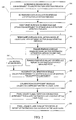
- Fig. 3 illustrates the processing logic for conducting a screening experiment in accordance with the present invention. It covers steps performed by the Factor Screening module, as well as by the Screening Evaluation module.
- the user selects parameters of interest and the levels of the parameter as indicated in logic block 300.
- a fractional factorial experiment design is generated, as indicated in logic block 310.
- a set of liquid classes based on the factorial design is then created as indicated in logic block 320.
- the user selects locations for test plates and source liquids as indicated in logic block 330.
- a worklist and script is then created as shown in logic block 340.
- the script and worklist are then executed using the liquid classes of the pipetting control software, as indicated in logic block 350.
- the data output from the reader for each plate is merged into the experiment table, as indicated in logic block 360.
- This logic block is the first step performed by the Screening Evaluation module. Effects analysis is then performed and the results are displayed as indicated in logic block 370.
- the Response Surface Design module accepts inputs in two forms. First, output from the previous Screening Data Evaluation module is accepted. Second, a user interface allowing the user to arbitrarily select factors to optimize is also provided. Fields for the fixed values of the other options are provided; an option to load an existing liquid class as a template is included to allow rapid entry of the data.
- the Response Surface Design module generates standard pipetting control software script, worklist and liquid class data files. These files are designed to conduct a response surface experiment using a central composite design to gather data to be used to optimize the levels of the factors found or that are believed to influence pipetting precision. The same considerations used in the Factor Screening module apply to this output. The output is in a standardized format suitable for further use by the Accuracy Calibration module.
- the Response Surface Evaluation module accepts as input the design of, and data from, an experiment generated by the Response Surface Design module.
- An option for the Response Surface Evaluation module is provided to allow automated initiation by the pipetting control software once a pipetting experiment is complete.
- the Response Surface Evaluation module calculates and reports the coefficient of variation (CV or standard error) for each data point (i.e., pipetting condition) employed in the experiment. The CVs for all conditions tested are then analyzed to estimate the optimal level of each factor. This estimate is produced utilizing response surface methodology as described in section above.
- Fig. 4 illustrates the processing logic for an RSM experiment in accordance with the present invention. It contains steps related to the Response Surface Design module, as well as to the Response Surface Evaluation module. Processing starts in logic block 400 with the user selecting parameters of interest and levels based on the output from the screening experiment. A central composite experimental design is then generated as indicated in logic block 410. Next, a set of liquid classes based on the central composite experiment design is then created as indicated in logic block 420. At this point, the user selects locations for test plates and source liquids as indicated in logic block 430. A pipetting control software worklist and script is then created as indicated in logic block 440. The pipetting control software is directed to execute the script and worklist using the liquid classes as indicated in logic block 450. Next, in logic block 460, the data output from the reader or balance for each experiment is merged into the experiment table. This is the first step of the Response Surface Evaluation module. RSM analysis is then performed and the results displayed as indicated in logic block 470.
- Fig. 5 illustrating the processing logic for a range-finding experiment in accordance with the present invention. It contains steps related to the Range-Finder Design module, as well as to the Range-Finding Evaluation module.
- Range-finding has two inputs. The first type is user-entered or default ranges for the pipetting to be tested. Five volumes are tested in one exemplary embodiment. The second type of input is the liquid class to be tested. This liquid class has a precision that has been optimized by the previous screening and response surface experiments. The user indicates which volume range to calibrate; the default range will be the range determined in the Range-Finding Evaluation module. The user will have the option to overwrite these defaults. The user has the option of determining the useful precise range of either single or multi-pipetting.
- the user enters the number of data points for each measurement. Constant and immediate feedback on the resulting number of data points, plates and estimated pipetting time are displayed to the user.
- the Range-Finding Design module generates a standard pipetting control software worklist designed to determine the useful range for a predefined acceptable precision for the liquid class under study. The same considerations used in the Factor Screening module apply to this output.
- the Range-Finding Evaluation module accepts as input the parameters and data from the Range-Finding Design module directed experiment in a standard format, including a user-entered criterion for acceptable precision.
- the Range-Finding Evaluation module calculates and displays the precision calculated at each of the volumes examined. This module defines the volume limits of the liquid class based on comparison of the measured precision to this criterion. The user may manually override these volume limits.
- Fig. 5 includes steps performed by the Range-Finding Design module, as well as the Range-Finding Evaluation module. Processing begins with three user input steps.
- the user selects the liquid class, starting volume, and range of test volumes to be used for the experiment.
- the user inputs any other required parameters.
- the user selects locations for the test plates and source liquids in logic block 520.
- a pipetting control software worklist and script is then created as indicated in logic block 530.
- the pipetting control software is directed to execute the script and worklist using the liquid classes as indicated in logic block 540.
- the data output from the balance or from the reader for each plate is merged into the experiment table as indicated in logic block 550.
- the Range Finding Evaluation module then performs analysis and displays results as indicated in logic block 560.
- the liquid class with volume limit data is written to a file.
- the Accuracy Calibration module requires two types of input.
- the first type of input is the calibration data for the type of detection being used. This data can take the form of pre-measured extinction coefficient data or instructions for acquiring that data, e.g., from plates placed on the pipetting deck.
- the second type of input is the liquid class to be tested. This liquid class has a precision that has been optimized by the previous screening and response surface and range-finding experiments. The user indicates which volume range to calibrate.
- the user has the option of calibrating the accuracy of either single or multi-pipetting.
- An option to overwrite the existing calibration coefficient for newly generated classes is provided; the default is to create a new liquid class based on the original.
- the user enters the number of data points for each measurement. Constant and immediate feedback on the resulting number of data points, plates and estimated pipetting time are displayed to the user.
- the Accuracy Calibration module generates a standard pipetting control software worklist designed to generate a calibration coefficient for the liquid class under study. The same considerations used in the Factor Screening module apply to this output.
- the Calibration Coefficient module accepts as input the parameters and data from the Accuracy Calibration Module directed experiment in a standard format.
- the Calibration Coefficient module generates the calibration coefficient and the offset volume for the liquid class and volume range under study from the experimental data and input parameters from the Accuracy Calibration module.
- An assessment of the quality of the line representing the measured relationship is assigned (R-squared value) and this is displayed with the statistical summary of the data.
- the calibration information is saved to either the existing liquid class or to a new liquid class based on user input.
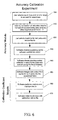
- Fig. 6 illustrates the processing logic for the Accuracy Calibration experiment in accordance with the present invention. It includes steps performed by the Accuracy module, as well as the Calibration Coefficient module. Processing begins with three user input steps. In logic block 600, the user selects the liquid class and volume range to be used for the experiment. In logic block 610 the user inputs the location of calibration data for the type of detection being used, and any other required parameters. The user then selects locations for the test plates and source liquids in logic block 620. A pipetting control software worklist and script is then created as indicated in logic block 630. Next, the pipetting control software is directed to execute the script and worklist using the liquid classes as indicated in logic block 640.
- the data output from the balance or from the reader for each plate is merged into the experiment table as indicated in logic block 650.
- the Calibration Coefficient module then performs analysis and displays results as indicated in logic block 660. Finally, as indicated in logic block 670, the liquid class with calibration data is written to a file.
- the Liquid Class Verification module takes as input an existing liquid class, whether or not developed with liquid-handling parameter optimization software. This can be a master liquid class containing multiple volume ranges. The user specifies all or some of these volume ranges to test, and whether single-pipetting, multi-pipetting, or both, should be tested.
- the Liquid Class Verification module generates a pipetting control software worklist designed to test the precision and accuracy of a liquid class. Since only a single set of conditions are tested, a large number of replicative samples are used as the default; other numbers can be specified at the user's discretion.
- the Liquid Class Verification module is capable of evaluating all volume ranges of a liquid class in both single and multi-pipetting modes in a single automated run.
- the Final Liquid Class Evaluation module accepts as data the parameters from the Final Liquid Class Verification module and data from the resulting pipetting experiment.
- the Final Liquid Class Evaluation module evaluates the precision and accuracy of the liquid class on the basis of the experimental design and data provided from the Final Liquid Class Verification module. The precision and accuracy at all measured points are tabulated and presented graphically. Additionally, the data files resulting from the development of the liquid class are reformatted into a logical report summarizing the data and final parameters.
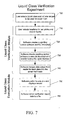
- Fig. 7 illustrates the processing logic for the liquid class verification experiment in accordance with the present invention. It includes processing logic for the Liquid Class Verification module, as well as the Liquid Class Evaluation module.
- the first two steps are user input steps.
- the user selects the liquid class and volume ranges to be used for the experiment.
- the user selects locations for the test plates or balance and source liquids.
- the Liquid Class Verification Module creates a pipetting control software worklist and script as indicated in logic block 720.
- the Liquid Class Verification Module then directs the pipetting control software to execute the script and worklist using the liquid classes as indicated in logic block 730.
- the data output from the balance or from the reader for each plate is merged into the experiment table as indicated in logic block 740.
- the Liquid Class Evaluation module then performs analysis and displays results as indicated in logic block 750.
- the verification report data is written to a file as indicated in logic block 760.
- the present invention can be realized in software or a combination of hardware and software. Any kind of computer system or other apparatus adapted for carrying out the methods described herein is suited.
- a typical combination of hardware and software could be a general purpose computer system with a computer program that, when loaded and executed, controls the computer system such that it carries out the methods described herein.
- the present invention can also be embedded in a computer program product, which includes all the features enabling the implementation of the methods described herein, and which, when loaded in a computer system, is able to carry out these methods.
- Computer program instructions or computer program in the present context means any expression in any language, code or notation, or a set of instructions intended to cause a system having an information processing capability to perform a particular function, either directly or when either or both of the following occur: (a) conversion to another language, code or notation; (b) reproduction in a different material form.
Landscapes
- Chemical & Material Sciences (AREA)
- Physics & Mathematics (AREA)
- General Physics & Mathematics (AREA)
- Health & Medical Sciences (AREA)
- Analytical Chemistry (AREA)
- Clinical Laboratory Science (AREA)
- Chemical Kinetics & Catalysis (AREA)
- Life Sciences & Earth Sciences (AREA)
- Fluid Mechanics (AREA)
- Biochemistry (AREA)
- General Health & Medical Sciences (AREA)
- Immunology (AREA)
- Pathology (AREA)
- Management, Administration, Business Operations System, And Electronic Commerce (AREA)
- Control Of Non-Electrical Variables (AREA)
- Measurement Of Levels Of Liquids Or Fluent Solid Materials (AREA)
Abstract
Description
- Fig. 1
- illustrates an exemplary response surface for two independent variables using response surface methodology.
- Fig. 2
- illustrates software modules of the liquid class parameters optimization and evaluation software in accordance with an exemplary embodiment of the present invention.
- Fig. 3
- illustrates the processing logic for a screening experiment in accordance with an exemplary embodiment of the present invention.
- Fig. 4
- illustrates the processing logic for a response surface methodology experiment in accordance with an exemplary embodiment of the present invention.
- Fig. 5
- illustrates the processing logic for a range-finding experiment in accordance with an exemplary embodiment of the present invention.
- Fig. 6
- illustrates the processing logic for an accuracy calibration experiment in accordance with an exemplary embodiment of the present invention.
- Fig. 7
- illustrates the processing logic for a liquid class verification experiment in accordance with an exemplary embodiment of the present invention.
| Interactions | |||||||
| Average | Main effects | 2-factor | 3-factor | 4-factor | 5-factor | 6-factor | 7- |
| 1 | 7 | 21 | 35 | 35 | 21 | 7 | 1 |


Processing begins with three user input steps. In
Since only a single set of conditions are tested, a large number of replicative samples are used as the default; other numbers can be specified at the user's discretion. The Liquid Class Verification module is capable of evaluating all volume ranges of a liquid class in both single and multi-pipetting modes in a single automated run.
Claims (32)
- An automated method for optimizing liquid-handling parameters for liquid-handling instruments comprising the steps of:identifying a plurality of factors that determine a pipetting precision of a liquid class for a liquid under test; andperforming an optimization experiment to optimize the levels of identified factors determining the pipetting precision.
- The automated method for optimizing liquid-handling parameters of claim 1 further comprising the step of generating a range-finding experiment to determine a volume range for the optimized pipetting parameters of the liquid class.
- The automated method for optimizing liquid-handling parameters of claim 1 further comprising the steps of generating an accuracy calibration coefficient for the liquid class under test and verifying and evaluating the precision and accuracy of the liquid class under test.
- The automated method for optimizing liquid-handling parameters of claim 1 wherein the liquid class includes a plurality of parameters for a pipetting control processing logic to define pipetting of a specific liquid.
- The automated method for optimizing liquid-handling parameters of claim 1 wherein the precision of a liquid class is a measure of a variance among a plurality of pipetting replications with a given liquid, volume, and set of parameters.
- The automated method for optimizing liquid-handling parameters of claim 3 wherein the accuracy of a liquid class under test is a measure of a variance between an amount of liquid that the liquid-handling instrument is instructed to pipette and a volume of liquid that is actually pipetted.
- The automated method for optimizing liquid-handling parameters of claim 2 further comprising the steps of generating an accuracy calibration coefficient for the liquid class under test and verifying and evaluating the precision and accuracy of the liquid class under test.
- The automated method for optimizing liquid-handling parameters of claim 1 wherein the step of identifying the plurality of factors determining precision includes the steps of:automatically generating a screening experimental design based on user-selected parameters and levels to determine the plurality of factors that can be eliminated from any additional evaluation;creating a set of liquid classes based on the screening experiment design;directing a pipetting control processing logic to execute a plurality of pipetting commands corresponding to the liquid classes; andperforming an effects analysis to determine the plurality of factors determining pipetting precision.
- The automated method for optimizing liquid-handling parameters of claim 1 wherein the step of optimizing the levels of identified factors determining pipetting precision includes the steps of:automatically generating a response surface experimental design based on the identified factors;creating a set of liquid classes based on the response surface experimental design;directing a pipetting control processing logic to execute a plurality of pipetting commands corresponding to the set of liquid classes; andperforming a response surface methodology analysis to determine the optimized level of factors determining precision.
- The automated method for optimizing liquid-handling parameters of claim 9 wherein the step of performing a response surface methodology analysis includes calculating a coefficent of variation for each pipetting condition in a response surface methodology experiment and analyzing the coefficent of variation for each pipetting condition to estimate an optimal level for each factor.
- The automated method for optimizing liquid-handling parameters of claim 1 further comprising the step of determining a calibration coefficient and an adjustment volume for the liquid class under test.
- The automated method for optimizing liquid-handling parameters of claim 3 wherein the step of verifying and evaluating the precision and accuracy of the liquid class under test comprises the steps of:evaluating all volume ranges specified for a liquid class in a single automated run;generating the set of final liquid class parameters; andtabulating and graphically presenting the precision and accuracy at all measured data points.
- The automated method for optimizing liquid-handling parameters of claim 2 wherein the step of generating a range-finding experiment comprises determining the volume range meeting pre-specified precision requirements for the liquid class under test.
- A system for optimizing parameters for liquid-handling, comprising:a liquid-handling instrument that delivers a specified volume of a liquid;a pipetting control processing logic operating on a processor device that directs the actions of the liquid-handling instrument; anda liquid-handling parameters optimization processing logic operating on the processor device, and cooperative with the pipetting control processing logic that automatically optimizes liquid-handling parameters.
- The system for optimizing parameters for liquid-handling of claim 14, wherein the liquid handling parameters optimization processing logic comprises:a screening design module that identifies a plurality of factors affecting the pipetting precision of a liquid class;a data evaluation module that generates a list of factors affecting precision;a response surface design module that collects data for use in optimizing the levels of factors affecting pipetting precision; anda response surface evaluation module that determines an optimal level for each factor based on a computed standard error for each pipetting condition used in a test.
- The system for optimizing parameters for liquid-handling of claim 14, wherein the liquid handling parameters optimization processing logic further comprises:a range-finding design module that collects data for use in determining a plurality of limits of precise pipetting for a liquid class optimized at a particular volume; anda range-finding evaluation module that determines a plurality of volume limits of a liquid class based on user-defined criteria.
- The system for optimizing parameters for liquid-handling of claim 14, wherein the liquid handling parameters optimization processing logic further comprises:an accuracy calibration module that generates data for determining a calibration coefficient for a liquid class; anda calibration coefficient module that generates the calibration coefficient and an offset volume for the liquid class and selected volume ranges.
- The system for optimizing parameters for liquid-handling of claim 14 wherein the liquid handling parameters optimization processing logic further comprises:a liquid class verification module that generates data for determining the precision and accuracy of a liquid class; anda liquid class evaluation module that tabulates and presents the precision and accuracy of the liquid class.
- The system for optimizing parameters for liquid-handling of claim 16 wherein the liquid handling parameters optimization processing logic further comprises:an accuracy calibration module that generates data for determining a calibration coefficient for a liquid class;a calibration coefficient module that generates the calibration coefficient and an offset volume for the liquid class and selected volume ranges;a liquid class verification module that generates data for determining the precision and accuracy of a liquid class; anda liquid class evaluation module that tabulates and presents the precision and accuracy of the liquid class.
- A computer readable medium containing a computer program product for optimizing liquid-handling parameters for liquid-handling instruments, the computer program product comprising:program instructions that identify a plurality of factors that determine a pipetting precision of a liquid class for a liquid under test; andprogram instructions that perform an optimization experiment to optimize the levels of identified factors determining the pipetting precision.
- The computer program product for optimizing liquid-handling parameters of claim 20 further comprising program instructions that generate a range-finding experiment to determine a volume range for the optimized pipetting parameters of the liquid class.
- The computer program product for optimizing liquid-handling parameters of claim 20 further comprising program instructions that generate an accuracy calibration coefficient for the liquid class under test and verify and evaluate the precision and accuracy of the liquid class under test.
- The computer program product for optimizing liquid-handling parameters of claim 20 wherein the liquid class includes a plurality of parameters for a pipetting control processing logic to define pipetting of a specific liquid.
- The computer program product for optimizing liquid-handling parameters of claim 20 wherein the precision of a liquid class is a measure of a variance among a plurality of pipetting replications with a given liquid, volume, and set of parameters.
- The computer program product for optimizing liquid-handling parameters of claim 22 wherein the accuracy of a liquid class under test is a measure of a variance between an amount of liquid that the liquid-handling instrument is instructed to pipette and a volume of liquid that is actually pipetted.
- The computer program product for optimizing liquid-handling parameters of claim 21 further comprising program instructions that generate an accuracy calibration coefficient for the liquid class under test and verify and evaluate the precision and accuracy of the liquid class under test.
- The computer program product for optimizing liquid-handling parameters of claim 20 wherein the program instructions that identify the plurality of factors determining precision comprise:program instructions that automatically generate a screening experimental design based on user-selected parameters and levels to determine the plurality of factors that can be eliminated from any additional evaluation;program instructions that create a set of liquid classes based on the screening experiment design;program instructions that direct a pipetting control processing logic to execute a plurality of pipetting commands corresponding to the liquid classes; andprogram instructions that perform an effects analysis to determine the plurality of factors determining pipetting precision.
- The computer program product for optimizing liquid-handling parameters of claim 20 wherein the program instructions that optimize the levels of identified factors determining pipetting precision comprise:program instructions that automatically generate a response surface experimental design based on the identified factors;program instructions that create a set of liquid classes based on the response surface experimental design;program instructions that direct a pipetting control processing logic to execute a plurality of pipetting commands corresponding to the set of liquid classes; andprogram instructions that perform a response surface methodology analysis to determine the optimized level of factors determining precision.
- The computer program product for optimizing liquid-handling parameters of claim 28 wherein the program instructions that perform a response surface methodology analysis include program instructions that calculate a coefficent of variation for each pipetting condition in a response surface methodology experiment and analyze the coefficent of variation for each pipetting condition to estimate an optimal level for each factor.
- The computer program products for optimizing liquid-handling parameters of claim 20 further comprising program instructions that determine a calibration coefficient and an adjustment volume for the liquid class under test.
- The computer program product for optimizing liquid-handling parameters of claim 22 wherein the program instructions that verify and evaluate the precision and accuracy of the liquid class under test comprise:program instructions that evaluate all volume ranges specified for a liquid class in a single automated run;program instructions that generate the set of final liquid class parameters; andprogram instructions that tabulate and graphically present the precision and accuracy at all measured data points.
- The computer program product for optimizing liquid-handling parameters of claim 21 wherein the program instructions that generate a range-finding experiment comprise program instructions that determine the volume range meeting pre-specified precision requirements for the liquid class under test.
Applications Claiming Priority (2)
| Application Number | Priority Date | Filing Date | Title |
|---|---|---|---|
| US23413200P | 2000-09-21 | 2000-09-21 | |
| US234132P | 2000-09-21 |
Publications (2)
| Publication Number | Publication Date |
|---|---|
| EP1191312A2 true EP1191312A2 (en) | 2002-03-27 |
| EP1191312A3 EP1191312A3 (en) | 2004-12-22 |
Family
ID=22880064
Family Applications (1)
| Application Number | Title | Priority Date | Filing Date |
|---|---|---|---|
| EP01121802A Withdrawn EP1191312A3 (en) | 2000-09-21 | 2001-09-11 | System and method for optimization of parameters of liquid-handling instruments |
Country Status (2)
| Country | Link |
|---|---|
| US (1) | US20020076818A1 (en) |
| EP (1) | EP1191312A3 (en) |
Cited By (6)
| Publication number | Priority date | Publication date | Assignee | Title |
|---|---|---|---|---|
| WO2008017735A1 (en) * | 2006-08-11 | 2008-02-14 | Biohit Oyj | Method for testing pipettes |
| US7463982B2 (en) | 2004-12-22 | 2008-12-09 | Lawrence Livermore National Security, Llc | Liquid class predictor for liquid handling of complex mixtures |
| EP1966731A4 (en) * | 2005-12-19 | 2009-11-11 | Siemens Healthcare Diagnostics | METHOD FOR DETERMINING THE PRESENCE OF INTERFERING SUBSTANCES IN SMALL LIQUID SAMPLES IN AN AUTOMATIC CLINICAL ANALYZER |
| EP2945033A1 (en) * | 2014-05-13 | 2015-11-18 | Tecan Trading AG | Method for defining a process in a fluid handling system |
| WO2020204883A1 (en) * | 2019-03-29 | 2020-10-08 | Siemens Aktiengesellschaft | Method and system for optimizing process parameters in an additive manufacturing process |
| WO2021136932A1 (en) | 2019-12-31 | 2021-07-08 | Synthace Ltd | Systems and methods for improved automation of laboratory processes |
Families Citing this family (6)
| Publication number | Priority date | Publication date | Assignee | Title |
|---|---|---|---|---|
| US7875463B2 (en) * | 2004-03-26 | 2011-01-25 | Agilent Technologies, Inc. | Generalized pulse jet ejection head control model |
| JP2009049382A (en) * | 2007-07-26 | 2009-03-05 | Panasonic Corp | Dry etching method and dry etching apparatus |
| EP3543707B1 (en) * | 2018-03-22 | 2023-07-05 | Tecan Trading AG | Optimizing liquid classes for a laboratory automation device |
| DE102019122572A1 (en) * | 2019-08-22 | 2021-02-25 | Analytik Jena Ag | Method for pipetting at least one substance |
| CN116184922A (en) * | 2023-03-01 | 2023-05-30 | 苏州华兴源创科技股份有限公司 | Pipetting control method, device, computer equipment, storage medium |
| GB202305498D0 (en) | 2023-04-14 | 2023-05-31 | Synthace Ltd | Methods for optimisation of liquid handling processes |
Family Cites Families (19)
| Publication number | Priority date | Publication date | Assignee | Title |
|---|---|---|---|---|
| US4436812A (en) * | 1980-10-29 | 1984-03-13 | Fuji Electric Co., Ltd. | Process of calibrating a blood sugar analyzing apparatus |
| US4671123A (en) * | 1984-02-16 | 1987-06-09 | Rainin Instrument Co., Inc. | Methods and apparatus for pipetting and/or titrating liquids using a hand held self-contained automated pipette |
| US4896270A (en) * | 1986-03-21 | 1990-01-23 | Matrix Technologies Corporation | Computer controlled pipetting system |
| FR2607407B1 (en) * | 1986-11-27 | 1991-08-02 | Marteau D Autry Eric | METHOD AND DEVICE FOR CALIBRATING A PIPETTE FOR SAMPLING AND DOSING |
| US5306510A (en) * | 1988-01-14 | 1994-04-26 | Cyberlab, Inc. | Automated pipetting system |
| US5055263A (en) * | 1988-01-14 | 1991-10-08 | Cyberlab, Inc. | Automated pipetting system |
| US5006312A (en) * | 1989-08-31 | 1991-04-09 | Murphy Jr Lawrence J | Gravimetric titration apparatus for the determination of the iodine number of carbon black |
| US5646046A (en) * | 1989-12-01 | 1997-07-08 | Akzo Nobel N.V. | Method and instrument for automatically performing analysis relating to thrombosis and hemostasis |
| US5260030A (en) * | 1992-06-03 | 1993-11-09 | Bio-Plas, Inc. | Calibrated pipette tip and method |
| US6203759B1 (en) * | 1996-05-31 | 2001-03-20 | Packard Instrument Company | Microvolume liquid handling system |
| JP3318629B2 (en) * | 1993-06-18 | 2002-08-26 | ソニー株式会社 | Liquid suction / discharge device and method |
| US5463564A (en) * | 1994-09-16 | 1995-10-31 | 3-Dimensional Pharmaceuticals, Inc. | System and method of automatically generating chemical compounds with desired properties |
| US6044212A (en) * | 1996-05-24 | 2000-03-28 | Advanced Life Sciences, Inc. | Use of automated technology in chemical process research and development |
| US5998218A (en) * | 1996-09-09 | 1999-12-07 | Sherwood Services Ag | Calibration system for an electronically monitored mechanical pipette |
| DE69837230T2 (en) * | 1997-04-10 | 2007-12-20 | Hitachi, Ltd. | Automatic analyzer |
| US6074611A (en) * | 1997-04-28 | 2000-06-13 | Apogee Designs, Ltd. | Micro-pipettor apparatus |
| JP3727481B2 (en) * | 1999-02-04 | 2005-12-14 | 株式会社日立製作所 | Automatic analysis method and apparatus |
| US20030207464A1 (en) * | 1999-02-19 | 2003-11-06 | Tony Lemmo | Methods for microfluidic aspirating and dispensing |
| ATE443570T1 (en) * | 2000-12-21 | 2009-10-15 | Siemens Healthcare Diagnostics | METHOD FOR AVOIDING CONTAMINATION OF NEGATIVE SAMPLE MATERIAL BY SAMPLES CONTAINING ANALYTES WHEN USING AUTOMATIC PIPETTING MACHINES |
-
2001
- 2001-09-11 EP EP01121802A patent/EP1191312A3/en not_active Withdrawn
- 2001-09-12 US US09/955,409 patent/US20020076818A1/en not_active Abandoned
Cited By (12)
| Publication number | Priority date | Publication date | Assignee | Title |
|---|---|---|---|---|
| US7463982B2 (en) | 2004-12-22 | 2008-12-09 | Lawrence Livermore National Security, Llc | Liquid class predictor for liquid handling of complex mixtures |
| EP1966731A4 (en) * | 2005-12-19 | 2009-11-11 | Siemens Healthcare Diagnostics | METHOD FOR DETERMINING THE PRESENCE OF INTERFERING SUBSTANCES IN SMALL LIQUID SAMPLES IN AN AUTOMATIC CLINICAL ANALYZER |
| WO2008017735A1 (en) * | 2006-08-11 | 2008-02-14 | Biohit Oyj | Method for testing pipettes |
| JP2010500541A (en) * | 2006-08-11 | 2010-01-07 | ビオヒット オイイ | Pipette test method |
| US8141410B2 (en) | 2006-08-11 | 2012-03-27 | Biohit Oyj | Method for testing pipettes |
| RU2467294C2 (en) * | 2006-08-11 | 2012-11-20 | Сарториус Биохит Ликвид Хэндлинг Ой | Method for testing droppers |
| EP2945033A1 (en) * | 2014-05-13 | 2015-11-18 | Tecan Trading AG | Method for defining a process in a fluid handling system |
| WO2020204883A1 (en) * | 2019-03-29 | 2020-10-08 | Siemens Aktiengesellschaft | Method and system for optimizing process parameters in an additive manufacturing process |
| CN114026510A (en) * | 2019-03-29 | 2022-02-08 | 西门子能源全球有限两合公司 | Method and system for optimizing process parameters in an additive manufacturing process |
| CN114026510B (en) * | 2019-03-29 | 2024-02-13 | 西门子能源全球有限两合公司 | Methods and systems for optimizing process parameters in additive manufacturing processes |
| US12330217B2 (en) | 2019-03-29 | 2025-06-17 | Siemens Energy Global GmbH & Co. KG | Method and system for optimizing process parameters in an additive manufacturing process |
| WO2021136932A1 (en) | 2019-12-31 | 2021-07-08 | Synthace Ltd | Systems and methods for improved automation of laboratory processes |
Also Published As
| Publication number | Publication date |
|---|---|
| EP1191312A3 (en) | 2004-12-22 |
| US20020076818A1 (en) | 2002-06-20 |
Similar Documents
| Publication | Publication Date | Title |
|---|---|---|
| KR102634499B1 (en) | Dynamically controlling an automated system | |
| US6326147B1 (en) | Methods, apparatus, articles of manufacture, and user interfaces for performing automated biological assay preparation and macromolecule purification | |
| US20020076818A1 (en) | System and method for liquid handling parameters optimization | |
| US9880135B2 (en) | Automatically controlling a plurality of devices of a separation and detection process for quantitative sample analysis | |
| Taylor et al. | A standard operating procedure for assessing liquid handler performance in high-throughput screening | |
| Hanson et al. | Modeling error in experimental assays using the bootstrap principle: understanding discrepancies between assays using different dispensing technologies | |
| JP2011174844A (en) | Clinical test information managing device, clinical inspection information management system, and computer program | |
| CN103282873A (en) | Systems and methods for laboratory assay validation or verification | |
| Felton | Product review: Liquid handling: Dispensing reliability | |
| Ahene et al. | Ligand binding assays in the 21st century laboratory: automation | |
| Hardin et al. | Automating combinatorial chemistry: A primer on benchtop robotic systems | |
| US20040073558A1 (en) | Method and apparatus for providing an automated information management for high throughput screening | |
| WO2016196220A1 (en) | System and method for defining and utilizing flow cytometry protocols | |
| Nippa et al. | Accelerating compound synthesis in drug discovery: the role of digitalisation and automation | |
| Yap et al. | A Bayesian Optimisation with segmentation approach to optimising liquid handling parameters | |
| Gu et al. | Dilution effect in multichannel liquid-handling system equipped with fixed tips: problems and solutions for bioanalytical sample preparation | |
| from Euro-Diagnostica | 510 (k) Substantial Equivalence Determination Decision Summary | |
| US20070059207A1 (en) | System and method for high throughput sample loading and processing | |
| US20220404269A1 (en) | Automated System and Method for Single Dye Volumetric Verification and Calibration of Automated Liquid Handling and Pipetting Systems | |
| Garai | Automation in Clinical Laboratories: Bridging Manual to Automated Precision | |
| Bradford | Getting it Right the First Time | |
| Hentz | The importance of liquid handling quality assurance through the drug discovery process | |
| Kleinschmidt et al. | Case Study: Robustness Investigations | |
| WO2026053120A1 (en) | Microdroplet actuating system | |
| WO2024213903A1 (en) | Methods for optimisation of liquid handling processes |
Legal Events
| Date | Code | Title | Description |
|---|---|---|---|
| PUAI | Public reference made under article 153(3) epc to a published international application that has entered the european phase |
Free format text: ORIGINAL CODE: 0009012 |
|
| AK | Designated contracting states |
Kind code of ref document: A2 Designated state(s): AT BE CH CY DE DK ES FI FR GB GR IE IT LI LU MC NL PT SE TR |
|
| AX | Request for extension of the european patent |
Free format text: AL;LT;LV;MK;RO;SI |
|
| PUAL | Search report despatched |
Free format text: ORIGINAL CODE: 0009013 |
|
| AK | Designated contracting states |
Kind code of ref document: A3 Designated state(s): AT BE CH CY DE DK ES FI FR GB GR IE IT LI LU MC NL PT SE TR |
|
| AX | Request for extension of the european patent |
Extension state: AL LT LV MK RO SI |
|
| AKX | Designation fees paid |
Designated state(s): AT BE CH CY DE DK ES FI FR GB GR IE IT LI LU MC NL PT SE TR |
|
| STAA | Information on the status of an ep patent application or granted ep patent |
Free format text: STATUS: THE APPLICATION IS DEEMED TO BE WITHDRAWN |
|
| 18D | Application deemed to be withdrawn |
Effective date: 20050701 |