EP1191113A1 - Metal-collecting apparatus and method for elution and recovery of metal from metal-collecting material - Google Patents
Metal-collecting apparatus and method for elution and recovery of metal from metal-collecting material Download PDFInfo
- Publication number
- EP1191113A1 EP1191113A1 EP00917459A EP00917459A EP1191113A1 EP 1191113 A1 EP1191113 A1 EP 1191113A1 EP 00917459 A EP00917459 A EP 00917459A EP 00917459 A EP00917459 A EP 00917459A EP 1191113 A1 EP1191113 A1 EP 1191113A1
- Authority
- EP
- European Patent Office
- Prior art keywords
- metal
- collecting material
- eluent
- collecting
- collector
- Prior art date
- Legal status (The legal status is an assumption and is not a legal conclusion. Google has not performed a legal analysis and makes no representation as to the accuracy of the status listed.)
- Granted
Links
Images


Classifications
-
- B—PERFORMING OPERATIONS; TRANSPORTING
- B01—PHYSICAL OR CHEMICAL PROCESSES OR APPARATUS IN GENERAL
- B01J—CHEMICAL OR PHYSICAL PROCESSES, e.g. CATALYSIS OR COLLOID CHEMISTRY; THEIR RELEVANT APPARATUS
- B01J20/00—Solid sorbent compositions or filter aid compositions; Sorbents for chromatography; Processes for preparing, regenerating or reactivating thereof
- B01J20/28—Solid sorbent compositions or filter aid compositions; Sorbents for chromatography; Processes for preparing, regenerating or reactivating thereof characterised by their form or physical properties
- B01J20/28014—Solid sorbent compositions or filter aid compositions; Sorbents for chromatography; Processes for preparing, regenerating or reactivating thereof characterised by their form or physical properties characterised by their form
- B01J20/28033—Membrane, sheet, cloth, pad, lamellar or mat
-
- B—PERFORMING OPERATIONS; TRANSPORTING
- B01—PHYSICAL OR CHEMICAL PROCESSES OR APPARATUS IN GENERAL
- B01D—SEPARATION
- B01D15/00—Separating processes involving the treatment of liquids with solid sorbents; Apparatus therefor
-
- B—PERFORMING OPERATIONS; TRANSPORTING
- B01—PHYSICAL OR CHEMICAL PROCESSES OR APPARATUS IN GENERAL
- B01J—CHEMICAL OR PHYSICAL PROCESSES, e.g. CATALYSIS OR COLLOID CHEMISTRY; THEIR RELEVANT APPARATUS
- B01J20/00—Solid sorbent compositions or filter aid compositions; Sorbents for chromatography; Processes for preparing, regenerating or reactivating thereof
- B01J20/22—Solid sorbent compositions or filter aid compositions; Sorbents for chromatography; Processes for preparing, regenerating or reactivating thereof comprising organic material
- B01J20/26—Synthetic macromolecular compounds
-
- B—PERFORMING OPERATIONS; TRANSPORTING
- B01—PHYSICAL OR CHEMICAL PROCESSES OR APPARATUS IN GENERAL
- B01J—CHEMICAL OR PHYSICAL PROCESSES, e.g. CATALYSIS OR COLLOID CHEMISTRY; THEIR RELEVANT APPARATUS
- B01J20/00—Solid sorbent compositions or filter aid compositions; Sorbents for chromatography; Processes for preparing, regenerating or reactivating thereof
- B01J20/28—Solid sorbent compositions or filter aid compositions; Sorbents for chromatography; Processes for preparing, regenerating or reactivating thereof characterised by their form or physical properties
- B01J20/28002—Solid sorbent compositions or filter aid compositions; Sorbents for chromatography; Processes for preparing, regenerating or reactivating thereof characterised by their form or physical properties characterised by their physical properties
- B01J20/28004—Sorbent size or size distribution, e.g. particle size
-
- B—PERFORMING OPERATIONS; TRANSPORTING
- B01—PHYSICAL OR CHEMICAL PROCESSES OR APPARATUS IN GENERAL
- B01J—CHEMICAL OR PHYSICAL PROCESSES, e.g. CATALYSIS OR COLLOID CHEMISTRY; THEIR RELEVANT APPARATUS
- B01J20/00—Solid sorbent compositions or filter aid compositions; Sorbents for chromatography; Processes for preparing, regenerating or reactivating thereof
- B01J20/28—Solid sorbent compositions or filter aid compositions; Sorbents for chromatography; Processes for preparing, regenerating or reactivating thereof characterised by their form or physical properties
- B01J20/28014—Solid sorbent compositions or filter aid compositions; Sorbents for chromatography; Processes for preparing, regenerating or reactivating thereof characterised by their form or physical properties characterised by their form
- B01J20/28023—Fibres or filaments
-
- B—PERFORMING OPERATIONS; TRANSPORTING
- B01—PHYSICAL OR CHEMICAL PROCESSES OR APPARATUS IN GENERAL
- B01J—CHEMICAL OR PHYSICAL PROCESSES, e.g. CATALYSIS OR COLLOID CHEMISTRY; THEIR RELEVANT APPARATUS
- B01J20/00—Solid sorbent compositions or filter aid compositions; Sorbents for chromatography; Processes for preparing, regenerating or reactivating thereof
- B01J20/28—Solid sorbent compositions or filter aid compositions; Sorbents for chromatography; Processes for preparing, regenerating or reactivating thereof characterised by their form or physical properties
- B01J20/28014—Solid sorbent compositions or filter aid compositions; Sorbents for chromatography; Processes for preparing, regenerating or reactivating thereof characterised by their form or physical properties characterised by their form
- B01J20/28052—Several layers of identical or different sorbents stacked in a housing, e.g. in a column
-
- B—PERFORMING OPERATIONS; TRANSPORTING
- B01—PHYSICAL OR CHEMICAL PROCESSES OR APPARATUS IN GENERAL
- B01J—CHEMICAL OR PHYSICAL PROCESSES, e.g. CATALYSIS OR COLLOID CHEMISTRY; THEIR RELEVANT APPARATUS
- B01J20/00—Solid sorbent compositions or filter aid compositions; Sorbents for chromatography; Processes for preparing, regenerating or reactivating thereof
- B01J20/30—Processes for preparing, regenerating, or reactivating
- B01J20/32—Impregnating or coating ; Solid sorbent compositions obtained from processes involving impregnating or coating
- B01J20/3231—Impregnating or coating ; Solid sorbent compositions obtained from processes involving impregnating or coating characterised by the coating or impregnating layer
- B01J20/3242—Layers with a functional group, e.g. an affinity material, a ligand, a reactant or a complexing group
-
- B—PERFORMING OPERATIONS; TRANSPORTING
- B01—PHYSICAL OR CHEMICAL PROCESSES OR APPARATUS IN GENERAL
- B01J—CHEMICAL OR PHYSICAL PROCESSES, e.g. CATALYSIS OR COLLOID CHEMISTRY; THEIR RELEVANT APPARATUS
- B01J20/00—Solid sorbent compositions or filter aid compositions; Sorbents for chromatography; Processes for preparing, regenerating or reactivating thereof
- B01J20/30—Processes for preparing, regenerating, or reactivating
- B01J20/34—Regenerating or reactivating
- B01J20/345—Regenerating or reactivating using a particular desorbing compound or mixture
- B01J20/3475—Regenerating or reactivating using a particular desorbing compound or mixture in the liquid phase
-
- C—CHEMISTRY; METALLURGY
- C22—METALLURGY; FERROUS OR NON-FERROUS ALLOYS; TREATMENT OF ALLOYS OR NON-FERROUS METALS
- C22B—PRODUCTION AND REFINING OF METALS; PRETREATMENT OF RAW MATERIALS
- C22B3/00—Extraction of metal compounds from ores or concentrates by wet processes
- C22B3/02—Apparatus therefor
-
- C—CHEMISTRY; METALLURGY
- C22—METALLURGY; FERROUS OR NON-FERROUS ALLOYS; TREATMENT OF ALLOYS OR NON-FERROUS METALS
- C22B—PRODUCTION AND REFINING OF METALS; PRETREATMENT OF RAW MATERIALS
- C22B3/00—Extraction of metal compounds from ores or concentrates by wet processes
- C22B3/20—Treatment or purification of solutions, e.g. obtained by leaching
- C22B3/22—Treatment or purification of solutions, e.g. obtained by leaching by physical processes, e.g. by filtration, by magnetic means, or by thermal decomposition
- C22B3/24—Treatment or purification of solutions, e.g. obtained by leaching by physical processes, e.g. by filtration, by magnetic means, or by thermal decomposition by adsorption on solid substances, e.g. by extraction with solid resins
-
- C—CHEMISTRY; METALLURGY
- C02—TREATMENT OF WATER, WASTE WATER, SEWAGE, OR SLUDGE
- C02F—TREATMENT OF WATER, WASTE WATER, SEWAGE, OR SLUDGE
- C02F1/00—Treatment of water, waste water, or sewage
- C02F1/28—Treatment of water, waste water, or sewage by sorption
-
- C—CHEMISTRY; METALLURGY
- C02—TREATMENT OF WATER, WASTE WATER, SEWAGE, OR SLUDGE
- C02F—TREATMENT OF WATER, WASTE WATER, SEWAGE, OR SLUDGE
- C02F2101/00—Nature of the contaminant
- C02F2101/10—Inorganic compounds
- C02F2101/20—Heavy metals or heavy metal compounds
-
- Y—GENERAL TAGGING OF NEW TECHNOLOGICAL DEVELOPMENTS; GENERAL TAGGING OF CROSS-SECTIONAL TECHNOLOGIES SPANNING OVER SEVERAL SECTIONS OF THE IPC; TECHNICAL SUBJECTS COVERED BY FORMER USPC CROSS-REFERENCE ART COLLECTIONS [XRACs] AND DIGESTS
- Y02—TECHNOLOGIES OR APPLICATIONS FOR MITIGATION OR ADAPTATION AGAINST CLIMATE CHANGE
- Y02P—CLIMATE CHANGE MITIGATION TECHNOLOGIES IN THE PRODUCTION OR PROCESSING OF GOODS
- Y02P10/00—Technologies related to metal processing
- Y02P10/20—Recycling
Definitions
- An aspect of the present invention relates to a structure of metal collector using a fibrous collecting material for use in water to collect a metal in a liquid medium such as seawater or river water.
- the metal collector using a fibrous collecting material of the present invention can be used to collect valuable metals such as uranium, vanadium or titanium contained in seawater as well as to remove noxious heavy metal ions from seawater or river water or industrial wastewater.
- Another aspect of the present invention relates to a process for efficiently separating and recovering valuable metals or noxious metals from a metal collecting material having collected said valuable metals from seawater or noxious metals from river water or wastewater with the least possible waste generation.
- Conventional means for adsorbing and removing minor amounts of noxious substances or valuable metals from large amounts of aqueous media such as seawater or river water typically involves passing seawater or river water through a column or the like packed with a granular adsorbent such as an ion exchange resin to remove the noxious substances or valuable metals.
- seawater is rich in valuable metals such as uranium, titanium, cobalt and vanadium. If these almost totally imported metals could be collected from seawater, a long-cherished Japanese wish for self-supply of energy would be fulfilled and oversea dependence on valuable rare metals would be decreased, and it would also contribute to protection of the global environment.
- valuable metals such as uranium, titanium, cobalt and vanadium.
- amidoxime groups were found to be effective for collecting valuable metals such as uranium.
- functional materials were extensively developed by radiation-induced graft polymerization, and collecting materials incorporating an amidoxime group into a graft side chain of existing polyolefin fibers were proposed to further improve performance.
- Fibrous metal collecting materials comprising a fibrous material having a metal-adsorbing function have a large surface area and are effective for adsorbing/removing minor metal ions in aqueous media such as seawater or river water.
- fibrous collecting materials are so bulky that aqueous media to be treated cannot be sufficiently directed to the vicinity of the collecting materials unless some measures are taken to successfully support them in aqueous media such as seawater or river water.
- a large channel is provided in a metal collector incorporating a metal collecting material to direct aqueous media such as seawater or river water, the amount of the collecting material that can be contained in the collector decreases and therefore, the amount of metals collected by the collector as a whole decreases. If the amount of the collecting material in the collector is increased, however, the amount of aqueous media flowing into the collector decreases and therefore, the amount of metals collected by the collector as a whole also decreases.
- Metal collecting materials can also be used to collect and remove noxious heavy metals or the like from river water or industrial wastewater, in which case the collected metals are eluted and individually recovered and treated while the collecting materials are recycled. If some of the metals are not recovered but discarded during elution, they may invite the problems of environmental pollution or the like.
- Stepwise elution with an eluent at an increasing concentration has been common in the field of ion exchange.
- a regeneration method is adopted starting with sulfuric acid at a low concentration and then stepwise increasing the concentration to prevent formation of gypsum (CaSO 4 ), thereby completing regeneration through several stages, and called as stepwise regeneration.
- this method was intended to ensure normal regeneration by removing the cause of clogging, but not to positively separate and recover adsorbed substances.
- ion exchange resins have a three-dimensional network structure consisting of styrene skeletons crosslinked with divinylbenzene to form a rigid polymer chain and ion exchange groups such as sulfone group or quaternary ammonium group are introduced into said rigid polymer chain, whereby they have low ion adsorption speed or diffusion speed.
- an object of the present invention is to provide a novel structure of metal collector using a fibrous collecting material for use in water to collect a metal in a liquid medium such as seawater or river water, and another object is to provide a process for efficiently separating and recovering valuable metals or noxious metals from a metal collecting material having collected said valuable metals from seawater or noxious metals from river water or wastewater with the least possible waste generation.
- an aspect of the present invention relates to a metal collector formed by stacking at least partially alternate layers of a fibrous metal collecting material with a spacer for introducing a liquid to be treated into said collecting material, wherein the area of spacer side faces represents 25-75% of the total area of collecting material side faces and spacer side faces in the side faces of the stack.
- the present invention also relates to a method for collecting a metal in a stream current, comprising placing said metal collector in the stream current.
- Another aspect of the present invention relates to a process for eluting and recovering a metal from a metal collecting material comprising the steps of: (1) contacting the metal collecting material having adsorbed a metal with a dilute eluent, (2) contacting the metal collecting material with an eluent more concentrated than in step 1 to recover the metal in the eluent; and (3) contacting a metal resorbing material with the eluate from step 2 to resorb the metal.
- the fibrous metal collecting material used in the metal collector of the present invention is a fibrous material such as a nonwoven fabric having a metal adsorbing function.
- materials having a metal adsorbing function include, for example, polymer materials having an amidoxime group or an imidodioxime group which has an ability to adsorb valuable metals such as uranium, vanadium and titanium; polymer materials having an iminodiacetate group which has an ability to adsorb iron, copper, cobalt, nickel or the like; and polymer materials having a thiol group which has an ability to adsorb mercury.
- Radiation-induced graft polymerization also includes various manners of contact between a monomer and a substrate, such as liquid phase graft polymerization performed with a substrate immersed in a monomer solution, gas phase graft polymerization performed with a substrate in contact with the vapor of a monomer, or immersion gas phase graft polymerization performed by immersing a substrate in a monomer solution and then removing it from the monomer solution for a reaction in a gas phase, any of which can be used in the present invention.
- woven/nonwoven fabrics are the most preferred materials for use as a substrate for collecting materials in the present invention, and are well suitable for use in the immersion gas phase graft polymerization because they tend to retain monomer solutions.
- a polymerizable monomer having an amidoxime group or an imidodioxime group can be used as a graft monomer to conduct graft-polymerization, and then reacted with a hydroxylamine to convert the nitrile group into an amidoxime group or an imidodioxime group.
- Suitable spacers to be stacked with collecting materials in metal collectors of the present invention may be in any form that allows a stream of water to be introduced into the collectors from side faces of the spacers and to flow in contact with the collecting materials along the spacers, but preferably in the form of a diagonal net as shown in Fig. 3 considering flow resistance and diffusion of the stream.
- Materials for spacers include, but not limited to, polyolefin-based polymers such as polyethylene or polypropylene and polyesters.
- Fig. 1 is a general view of a metal collector according to an aspect of the present invention
- Fig. 2 is an enlarged view of part A of Fig. 1.
- the metal collector of the embodiment shown in Fig. 1 is formed by alternately stacking layers of a metal collecting material consisting of a nonwoven fabric 11 with a spacer 12 and fixing the stack with fastening members 13.
- seawater is introduced into the collector along the spacer from the side faces of the stack, i.e., from any horizontal direction of the collector while little seawater flows in the vertical direction of the collector.
- the seawater introduced into the collector is diffused by the spacer and comes into contact with the collecting material, whereby metals contained in the seawater is adsorbed to the collecting material.
- Metal collectors of the present invention can be packed in a basket made of a metal net, for example, and moored in seawater or river water.
- the number of layers of the collecting material, the size and shape of the collecting material, the thickness per layer of the collecting material, the thickness of the spacer and the like are determined taking into consideration the number of days for which collectors are moored, the target level of metals to be collected, how to elute the metals collected, the speed of the ocean current, water temperature, handling properties or other factors.
- the place in which metal collectors of the present invention are immersed should have some speed of stream current.
- Metal collectors of the present invention are immersed in this stream current preferably for several to several tens of days, and therefore, the thickness of the collecting material and others must be determined taking into consideration shape retention of the collecting material and deposition of organisms during then, and shape retention and handling properties during various processes such as removal of deposited organisms by washing during recovery of the collecting material or elution. Diffusion of stream into collectors also must be considered.
- the thickness per layer of the collecting material is preferably about 0.5-3.0 mm
- the thickness of the spacer is preferably about 0.5-5.0 mm.
- Metal collectors of the present invention can be used, for example, in an ocean current to collect valuable metals such as uranium, vanadium or titanium in seawater, or can be used in river water to collect and remove noxious metals such as cadmium, lead or copper in the river water, or can be used in industrial wastewater to collect and remove noxious metals such as mercury or remove nickel from nickel plating wastewater.
- a process for eluting and recovering a metal from a metal collecting material according to another aspect of the present invention comprises the steps of: (1) contacting the metal collecting material having adsorbed a metal with a dilute eluent, (2) contacting the metal collecting material with an eluent more concentrated than in step 1 to recover the metal into the eluent; and (3) contacting a metal resorbing material with the eluate from step 2 to resorb the metal.
- a process of the present invention for eluting and recovering valuable metals such as uranium or vanadium adsorbed and collected from a metal collecting material consisting of a chelate resin based on an amidoxime group used to adsorb and collect said valuable metals from seawater is explained below.
- the process for recovering uranium or the like from a collecting material having adsorbed and collected uranium or the like from seawater as illustrated below is only an example to which the present invention can be applied, but those skilled in the art can readily appreciate that the present invention can also be applied to recover other metals from a collecting material having collected such metals.
- a metal collecting material consisting of a chelate resin based on an amidoxime group, which has been immersed in seawater for several tens of days to adsorb uranium or vanadium or the like, is brought into contact with a dilute eluent such as 0.01-0.1 N hydrochloric acid.
- a dilute eluent such as 0.01-0.1 N hydrochloric acid.
- magnesium and calcium are initially eluted while uranium and vanadium are not eluted.
- the collecting material is brought into contact with an eluent more concentrated than the first eluent at step 2.
- the collecting material When the collecting material is brought into contact with 0.5 N hydrochloric acid, for example, 90% or more of uranium adsorbed to the collecting material is eluted.
- the uranium level in the eluate is in the order of several tens of ppm, which means that the seawater level of 3 ppb can be concentrated 10000-fold.
- the eluate from step 2 contains little impurities such as magnesium and calcium, showing that purification also took place.
- the type of the eluent is appropriately selected depending on the nature of the target metal to be recovered, how to purify the recovered metal, elution tendency, the nature of the functional group or durability.
- the target metal to be recovered is uranium or vanadium, for example, hydrochloric acid is preferably used as an eluent.
- hydrochloric acid or sulfuric acid is preferably used as an eluent.
- Chelate resins can be preferably used as collecting and metal resorbing materials.
- Chelate resins used for this purpose may have a skeleton of a three-dimensional network structure obtained by crosslinking polystyrenes, but chelate resins based on graft polymerization are more advantageous in the respects of adsorption speed, diffusion speed in eluent, separation efficiency from other metals. etc.
- Materials having a functional group especially having affinity for a specific metal such as inclusion compounds can also be used as collecting materials and/or metal resorbing materials.
- the concentration of the eluent used in each elution step should be selected to elute only a desired specific metal ion. Such a concentration varies with the nature of the metal ion to be recovered or the type of the eluent used, but can be experimentally determined by preliminary tests.
- the eluate of a specific metal ion from each step is used to resorb the target metal to a metal resorbing material at step 3.
- the eluent having been used for metal resorption treatment in step 3 of the process of the present invention has a concentration somewhat lower than the concentration of the eluate from step 2, and thus can be used as an eluent in step 1 after it is appropriately diluted.
- the eluate from step 1 and/or 3 can be effectively recycled in the process.
- the metal resorbing material to which the target metal has been resorbed during step 3 contains the target metal highly concentrated.
- the resin can be removed and disassembled to recover the target metal.
- An eluent further concentrated than the eluent used in step 3 can also be brought into contact with the metal resorbing material to which the target metal has been resorbed to recover said metal in the eluent.
- the metal collecting material that can be treated by the process of the present invention is a metal collecting material containing an amidoxime group and/or imidodioxime group as a functional group.
- the amidoxime chelate functional group is the most preferred chelate functional group for the purpose of recovering uranium from seawater because of the high stability constant for complexation with valuable metals such as uranium in seawater.
- the amidoxime group is said to be readily converted into an imidodioxime group via deammoniation, but either functional group can be used for the metal collecting material.
- the collecting material having such a functional group can be moored in an ocean current to collect valuable metals such as uranium in seawater with the aid of natural current such as ocean current.
- Other examples of metal collecting materials include collecting materials having an iminodiacetate group for adsorbing iron, copper, cobalt or nickel, and collecting materials having a thiol group for adsorbing mercury.
- the metal collecting material that can be treated by the process of the present invention may be in the form of a woven or nonwoven fabric material consisting of a fiber assembly.
- Collecting materials in the form of a woven or nonwoven fabric take advantage of the large surface area of fibers and are convenient for the adsorption system linked to ocean current because woven or nonwoven fabrics can be easily shaped into any form.
- the amount of valuable metals adsorbed increases as the amount of seawater flown into the collecting material increases. In the case of conventional bead-like resins, the inflow amount of seawater was small because they were used in a packed column system suffering large pressure losses.
- the metal collecting material that can be treated by the present invention is preferably obtained by introducing a polymer side chain having a desired chelate functional group onto a backbone of a polymer substrate via radiation-induced graft polymerization. Adsorption and elution characteristics of the metal collecting material is significantly influenced by not only the type of the chelating group but also the structure of the polymer chain.
- the graft side chain introduced onto a backbone of a polymer substrate as described above is not crosslinked, so that high adsorption speed and diffusion speed can be obtained because of very high mobility.
- such a material is especially excellent for efficiently adsorbing uranium present in an amount as small as 3 ppb in seawater that is a high saline solution and other valuable metals and fractionally eluting them at high efficiency.
- Radiation-induced graft polymerization is the most preferred method for the purpose of the present invention, because it is a method that permits a desired graft polymer side chain to be introduced into a polymer substrate by irradiating the substrate to produce a radical and reacting it with a graft monomer and characterized in that the number or length of the graft chain can be relatively freely controlled and the polymer side chain can be introduced into existing polymer materials in various shapes including woven or nonwoven fabrics.
- Radiations that can be used in radiation-induced graft polymerization include ⁇ -rays, ⁇ -rays, ⁇ -rays, electron rays, UV ray, etc., among which ⁇ -rays and electron rays are especially preferred.
- Radiation-induced graft polymerization includes pre-irradiation graft polymerization involving preliminarily irradiating a substrate and then bringing it into contact with a polymerizable monomer for graft polymerization reaction, and simultaneous irradiation graft polymerization involving simultaneously irradiating a substrate and a polymerizable monomer, both of which can be used for the preparation of metal collecting materials to be treated by the process of the present invention.
- the amidoxime group and/or imidodioxime group can be formed by graft-polymerizing a polymerizable monomer (graft monomer) consisting of acrylonitrile and amidoximizing it with hydroxylamine or the like.
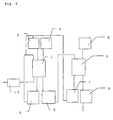
- Fig. 5 is a flow sheet showing a process according to an embodiment of the present invention. A process for recovering a valuable metal such as uranium or vanadium from seawater is explained along the flow sheet.
- various reference numbers represent the following elements: 1: metal collecting material elution tank (steps 1 and 2); 2: metal resorbing material tank (step 3); 3: first eluent; 4: second eluent; 5: storage tank for eluate from step 1; 6: storage tank for eluate from step 2; 7: waste liquor after resorption from step 3; 8: eluent for metal resorbing material; 9: eluate of metal resorbing material; 10: effluent treatment equipment.
- Metal collecting materials having adsorbed valuable metals in seawater after mooring in an ocean current for a given period are packed into metal collecting material elution tank 1.
- Collecting materials on which a mass of marine organisms or secretes are deposited can be washed with eluate 5 from step 1 to remove the deposits.
- Waste liquor 7 after resorption from step 3 may be appropriately diluted and used as a washing solution.
- the washing waste liquor from this washing step is discharged after some water treatment to meet a regulatory value for effluent in effluent treatment equipment 10 because it contains solids or organic matters derived from organisms.
- washing takes place in elution tank 1 in Fig. 5, washing may also take place in another washing tank not shown when washing efficiency is low.
- step 2 the collecting materials are brought into contact with a second eluent 4 more concentrated than the first eluent such as hydrochloric acid of 0.5 N or more to elute a valuable metal such as uranium or vanadium (step 2).
- the eluate is stored in storage tank 6.
- This eluate contains a valuable metal such as uranium or vanadium at some concentration (in the order of several ppm to several tens of ppm).
- a driving solution is preferably further passed after the eluent to drive the eluent remaining in the collecting materials.
- the driving solution used for this purpose may be water or optionally tap water-treated water or seawater.
- metal resorbing material tank 2 is packed with a chelate resin or the like capable of resorbing the target metal.
- metal resorbing material tank 2 can be packed with a resin based on an amidoxime group.
- the target metal is resorbed to the resin (step 3).
- Effluent 7 from step 3 is somewhat less concentrated than the second eluent because it contains the driving solution and washing solution, but it is sufficiently useful as the first eluent so that it can be used as first eluent 3 by appropriately adjusting the concentration.
- effluent 7 can be used as a washing solution before step 1.
- the target metal resorbed on the metal resorbing material can be directly recovered by disassembling the resin.
- the resin can be contacted with a further concentrated eluent 7 such as further concentrated hydrochloric acid (for example, 1-5 N) to elute the metal adsorbed on the resin in eluate 9 again.
- the target metal is contained at a very high level in eluate 9 so that it can be recovered by methods known in the art.
- This column containing the chelate resin having resorbed uranium was eluted again with 150 ml of 2 N hydrochloric acid to recover 200 ml of a solution containing 40 mg/l uranium.
- metal collectors With metal collectors according to an aspect of the present invention, valuable metals in seawater or heavy metal ions in river water can be efficiently collected with the aid of natural forces. Thus, metal collectors of the present invention are very promising as a solution to energy, resource and environmental issues in future.
- Processes for eluting and recovering a metal from a metal collecting material allow a target metal to be recovered in a purified state from a metal collecting material, so that recovery efficiency can be remarkably increased if they are applied to the technique for collecting valuable metals such as uranium or vanadium from seawater, or collecting and removing noxious metals such as cadmium, lead or copper in river water, or collecting and removing noxious metals such as mercury from industrial wastewater; or removing nickel from nickel plating wastewater.
- the eluent can be reused as many times as possible, whereby reducing costs for recovery. Therefore, processes of the present invention are very promising as a solution to energy, resource and environmental issues in future.
Landscapes
- Chemical & Material Sciences (AREA)
- Analytical Chemistry (AREA)
- Organic Chemistry (AREA)
- Chemical Kinetics & Catalysis (AREA)
- Engineering & Computer Science (AREA)
- Geology (AREA)
- Manufacturing & Machinery (AREA)
- Life Sciences & Earth Sciences (AREA)
- Materials Engineering (AREA)
- Mechanical Engineering (AREA)
- Metallurgy (AREA)
- Geochemistry & Mineralogy (AREA)
- General Life Sciences & Earth Sciences (AREA)
- Environmental & Geological Engineering (AREA)
- Solid-Sorbent Or Filter-Aiding Compositions (AREA)
- Manufacture And Refinement Of Metals (AREA)
Abstract
Description
| Spacer (mm) | Number of collecting materials | Opening area ratio (%) | Total weight of collecting materials (g) | Eluted uranium (mg) | Adsorbed uranium per unit weight of collecting materials (µg/g) | Collected uranium per collector (mg) |
| 0.3 | 205 | 22 | 1330 | 264 | 198 | 263 |
| 0.5 | 176 | 32 | 1129 | 460 | 407 | 460 |
| 0.8 | 151 | 43 | 979 | 485 | 495 | 485 |
| 1.2 | 122 | 53 | 790 | 555 | 703 | 555 |
| 1.8 | 94 | 63 | 622 | 436 | 701 | 436 |
| 2.5 | 76 | 70 | 490 | 401 | 818 | 400 |
| 4 | 53 | 79 | 348 | 353 | 1014 | 353 |
| 10 | 25 | 91 | 156 | 162 | 1038 | 162 |
Claims (17)
- A metal collector formed by stacking at least partially alternate layers of a fibrous metal collecting material with a spacer for introducing a liquid to be treated into said collecting material, wherein the area of spacer side faces represents 25-75% of the total area of collecting material side faces and spacer side faces in the side faces of the stack.
- The metal collector of Claim 1 wherein said collecting material is in the form of a woven and/or nonwoven fabric consisting of a fiber assembly.
- The metal collector of Claim 1 or 2 wherein said collecting material has a metal adsorbing functional group introduced into a fiber substrate via radiation-induced graft polymerization.
- The metal collector of any one of Claims 1 to 3 wherein said collecting material has a metal adsorbing functional group including an amidoxime group and/or imidodioxime group.
- The metal collector of any one of Claims 1 to 4 wherein said collecting material has a thickness of 0.5-3.0 mm.
- The metal collector of Claim 4 wherein the target metal to be collected is uranium, vanadium or titanium.
- A method for collecting a metal in a stream current comprising placing the metal collector of any one of Claims 1 to 6 in the stream current.
- The method of Claim 7 wherein the stream current is an ocean current and the target metal to be collected is uranium, vanadium or titanium.
- A process for eluting and recovering a metal from a metal collecting material comprising the steps of: (1) contacting the metal collecting material having absorbed a metal with a dilute eluent, (2) contacting the metal collecting material with an eluent more concentrated than in step 1 to recover the metal in the eluent; and (3) contacting a metal resorbing material with the eluate from step 2 to resorb the metal.
- The process of Claim 9 further comprising, between steps 1 and 2, the step of contacting the collecting material with an eluent having a concentration higher than that of the eluent in step 1 but lower than that of the eluent in step 2.
- The process of Claim 10 further comprising two or more elution steps between steps 1 and 2 wherein the eluent in later steps is adjusted at a concentration higher than in early steps in said further elution steps.
- The process of any one of Claims 9 to 11 further comprising the step of washing the collecting material before step 1 with the effluent from step 1 and/or the effluent from step 3 (effluent from resorption of the target metal to a metal resorbing material).
- The process of any one of Claims 9 to 12 wherein the effluent from step 3 (effluent from resorption of the target metal to a metal resorbing material) is used as an eluent in step 1.
- The process of any one of Claims 9 to 13 further comprising the step (4) of contacting the metal resorbing material having resorbed the target metal from step 3 with an eluent more concentrated than the eluent used in step 3 to recover the target metal in the eluent.
- The process of any one of Claims 9 to 14 wherein the metal collecting material to be treated contains an amidoxime group and/or imidodioxime group.
- The process of any one of Claims 9 to 15 wherein the metal collecting material to be treated is in the form of a woven or nonwoven fabric consisting of a fiber assembly.
- The process of any one of Claims 9 to 16 wherein the metal collecting material to be treated is prepared by using radiation-induced graft polymerization.
Applications Claiming Priority (5)
| Application Number | Priority Date | Filing Date | Title |
|---|---|---|---|
| JP11917899 | 1999-04-27 | ||
| JP11918199 | 1999-04-27 | ||
| JP11119178A JP2000313925A (en) | 1999-04-27 | 1999-04-27 | Elution and recovery of metals from metal collectors |
| JP11918199A JP4099543B2 (en) | 1999-04-27 | 1999-04-27 | Metal collector |
| PCT/JP2000/002699 WO2000065107A1 (en) | 1999-04-27 | 2000-04-25 | Metal-collecting apparatus and method for elution and recovery of metal from metal-collecting material |
Publications (3)
| Publication Number | Publication Date |
|---|---|
| EP1191113A1 true EP1191113A1 (en) | 2002-03-27 |
| EP1191113A4 EP1191113A4 (en) | 2005-05-04 |
| EP1191113B1 EP1191113B1 (en) | 2008-09-17 |
Family
ID=26456960
Family Applications (1)
| Application Number | Title | Priority Date | Filing Date |
|---|---|---|---|
| EP00917459A Expired - Lifetime EP1191113B1 (en) | 1999-04-27 | 2000-04-25 | Metal-collecting apparatus and method for elution and recovery of metal from metal-collecting material |
Country Status (4)
| Country | Link |
|---|---|
| US (1) | US6852233B1 (en) |
| EP (1) | EP1191113B1 (en) |
| DE (1) | DE60040288D1 (en) |
| WO (1) | WO2000065107A1 (en) |
Cited By (1)
| Publication number | Priority date | Publication date | Assignee | Title |
|---|---|---|---|---|
| US6977314B2 (en) | 2001-12-19 | 2005-12-20 | Rohm And Haas Company | Metal-doped sulfonated ion exchange resin catalysts |
Families Citing this family (4)
| Publication number | Priority date | Publication date | Assignee | Title |
|---|---|---|---|---|
| JP4683820B2 (en) * | 2001-01-31 | 2011-05-18 | 中部キレスト株式会社 | Method for treating metal and / or metal-containing solution |
| US8252186B1 (en) * | 2007-11-20 | 2012-08-28 | The Administrators Of The Tulane Educational Fund | Making and using porous acrylonitrile-based hydrogel particles to treat water |
| US8722757B2 (en) | 2011-07-22 | 2014-05-13 | Ut-Battelle, Llc | Fiber-based adsorbents having high adsorption capacities for recovering dissolved metals and methods thereof |
| JP6300340B2 (en) * | 2013-03-27 | 2018-03-28 | 国立研究開発法人量子科学技術研究開発機構 | Metal collector |
Family Cites Families (18)
| Publication number | Priority date | Publication date | Assignee | Title |
|---|---|---|---|---|
| US2900305A (en) | 1952-04-15 | 1959-08-18 | Gen Aniline & Film Corp | Preparation of iodine polyvinylpyrrolidone adducts |
| US2826532A (en) | 1952-04-15 | 1958-03-11 | Gen Aniline & Film Corp | Process of stabilizing polyvinyl pyrrolidone-iodine compositions |
| BE615889A (en) | 1952-04-15 | 1900-01-01 | ||
| GB749762A (en) * | 1953-04-22 | 1956-05-30 | Permutit Co Ltd | Improvements relating to the recovery of uranium by ion-exchange |
| US3660283A (en) * | 1969-10-07 | 1972-05-02 | Ecodyne Corp | Method for regenerating cation exchange resin |
| JPS5167216A (en) * | 1974-12-09 | 1976-06-10 | Kanebo Ltd | |
| JPS52138062A (en) * | 1976-05-13 | 1977-11-17 | Sumitomo Genshiryoku Kogyo | Adsorbent block moving in the sea |
| SE417913B (en) * | 1979-04-18 | 1981-04-27 | Lagstroem Emil Goeran | SET AND DEVICE TO SEE WORLDWIDE WATERFUL LIQUID, LOST AND SUSPENDED SUBJECTS |
| JPS5687634A (en) * | 1979-12-20 | 1981-07-16 | Asahi Chem Ind Co Ltd | Controlling method for metallic element separating operation |
| JPS58205544A (en) * | 1982-05-26 | 1983-11-30 | Japan Atom Energy Res Inst | Uranium adsorbent and its production |
| JPS58205545A (en) * | 1982-05-26 | 1983-11-30 | Japan Atom Energy Res Inst | Uranium adsorbent containing both amidoxime group and neutral hydrophilic group and its production |
| US4747954A (en) * | 1985-09-16 | 1988-05-31 | The Dow Chemical Company | Removal of metals from solutions |
| US4765909A (en) * | 1987-04-23 | 1988-08-23 | Gte Laboratories Incorporated | Ion exchange method for separation of scandium and thorium |
| JP2508162B2 (en) * | 1987-11-28 | 1996-06-19 | 住友化学工業株式会社 | Heavy metal recovery method |
| US5126272A (en) * | 1989-03-02 | 1992-06-30 | United States Of America | System for detecting transition and rare earth elements in a matrix |
| JP2868264B2 (en) * | 1989-03-31 | 1999-03-10 | オルガノ株式会社 | Uranium adsorbent |
| US4968504A (en) * | 1989-10-19 | 1990-11-06 | Gte Laboratories Incorporated | Recovery of scandium and uranium |
| JPH09290272A (en) | 1996-04-26 | 1997-11-11 | Ebara Corp | Slime control method and control water receiver |
-
2000
- 2000-04-25 WO PCT/JP2000/002699 patent/WO2000065107A1/en not_active Ceased
- 2000-04-25 DE DE60040288T patent/DE60040288D1/en not_active Expired - Lifetime
- 2000-04-25 US US09/926,382 patent/US6852233B1/en not_active Expired - Fee Related
- 2000-04-25 EP EP00917459A patent/EP1191113B1/en not_active Expired - Lifetime
Cited By (1)
| Publication number | Priority date | Publication date | Assignee | Title |
|---|---|---|---|---|
| US6977314B2 (en) | 2001-12-19 | 2005-12-20 | Rohm And Haas Company | Metal-doped sulfonated ion exchange resin catalysts |
Also Published As
| Publication number | Publication date |
|---|---|
| DE60040288D1 (en) | 2008-10-30 |
| EP1191113B1 (en) | 2008-09-17 |
| EP1191113A4 (en) | 2005-05-04 |
| WO2000065107A1 (en) | 2000-11-02 |
| US6852233B1 (en) | 2005-02-08 |
Similar Documents
| Publication | Publication Date | Title |
|---|---|---|
| Saito et al. | Recovery of uranium from seawater using amidoxime hollow fibers | |
| US4963264A (en) | Process for selective dialysis using polymeric affinity adsorbents and size selective membranes | |
| JP6697205B2 (en) | Chelate microfiltration membrane manufacturing method, recycling method and application | |
| CN109289803A (en) | Preparation and use of multifunctional ion-exchange fibers modified with polyamine group/amidoxime group | |
| JP7108622B2 (en) | Method for producing ultrapure water | |
| JPH0643378B2 (en) | Method of salt removal from aqueous alkanolamine using electrodialysis cell with ion exchange membrane | |
| JP4119966B2 (en) | Elution recovery of metal from metal collector and method of regenerating eluent | |
| US6447684B2 (en) | Filtration and purification system for pH neutral solutions | |
| US6333078B1 (en) | Collector of dissolved metal from sea water having an amidoxime group and a hydrophilic group, a method for production thereof | |
| US6852233B1 (en) | Metal-collecting apparatus and method for elution and recovery of metal from metal-collecting material | |
| JP2003251118A (en) | Filter cartridge with high capacity metal capture capability | |
| Berdous et al. | Recovery of metals by Donnan dialysis with ion exchange textiles | |
| JP4099543B2 (en) | Metal collector | |
| JP2000313925A (en) | Elution and recovery of metals from metal collectors | |
| JP2002018245A (en) | Antistaining porous filter membrane | |
| JP2000178531A (en) | Collecting material, collecting material cassette laminated with the collecting material, and method for adsorbing and recovering dissolved metal from seawater using the same | |
| JP2007077508A (en) | Method and apparatus for recovering metal elution from metal collector | |
| Saito | Preparation of Polymeric Adsorbents by Radiation-Induced Graft Polymerization | |
| JP4186190B2 (en) | Chelate adsorbents that can be used in the entire range of acids and alkalis | |
| CN115738771B (en) | A renewable heavy metal wastewater filtration membrane and its preparation method | |
| Bhattacharyya et al. | Functionalised membranes remove and recover dissolved heavy metals | |
| JP2008296155A (en) | Cation adsorbent and method for producing the same | |
| CN113877541B (en) | High-load ZIF-67 film material and preparation method thereof | |
| JP2007000752A (en) | High-speed arsenic adsorbing material and method for producing the same | |
| Saito et al. | Revolution in the Form of Polymeric Adsorbents 2: Fibers, Films, and Particles |
Legal Events
| Date | Code | Title | Description |
|---|---|---|---|
| PUAI | Public reference made under article 153(3) epc to a published international application that has entered the european phase |
Free format text: ORIGINAL CODE: 0009012 |
|
| 17P | Request for examination filed |
Effective date: 20011016 |
|
| AK | Designated contracting states |
Kind code of ref document: A1 Designated state(s): DE FR GB IT |
|
| A4 | Supplementary search report drawn up and despatched |
Effective date: 20050317 |
|
| 17Q | First examination report despatched |
Effective date: 20050921 |
|
| 17Q | First examination report despatched |
Effective date: 20050921 |
|
| GRAP | Despatch of communication of intention to grant a patent |
Free format text: ORIGINAL CODE: EPIDOSNIGR1 |
|
| GRAS | Grant fee paid |
Free format text: ORIGINAL CODE: EPIDOSNIGR3 |
|
| GRAA | (expected) grant |
Free format text: ORIGINAL CODE: 0009210 |
|
| AK | Designated contracting states |
Kind code of ref document: B1 Designated state(s): DE FR GB IT |
|
| REG | Reference to a national code |
Ref country code: GB Ref legal event code: FG4D |
|
| REF | Corresponds to: |
Ref document number: 60040288 Country of ref document: DE Date of ref document: 20081030 Kind code of ref document: P |
|
| PLBE | No opposition filed within time limit |
Free format text: ORIGINAL CODE: 0009261 |
|
| STAA | Information on the status of an ep patent application or granted ep patent |
Free format text: STATUS: NO OPPOSITION FILED WITHIN TIME LIMIT |
|
| 26N | No opposition filed |
Effective date: 20090618 |
|
| PG25 | Lapsed in a contracting state [announced via postgrant information from national office to epo] |
Ref country code: IT Free format text: LAPSE BECAUSE OF FAILURE TO SUBMIT A TRANSLATION OF THE DESCRIPTION OR TO PAY THE FEE WITHIN THE PRESCRIBED TIME-LIMIT Effective date: 20080917 |
|
| PGFP | Annual fee paid to national office [announced via postgrant information from national office to epo] |
Ref country code: FR Payment date: 20110426 Year of fee payment: 12 Ref country code: DE Payment date: 20110420 Year of fee payment: 12 |
|
| PGFP | Annual fee paid to national office [announced via postgrant information from national office to epo] |
Ref country code: GB Payment date: 20110420 Year of fee payment: 12 |
|
| GBPC | Gb: european patent ceased through non-payment of renewal fee |
Effective date: 20120425 |
|
| REG | Reference to a national code |
Ref country code: FR Ref legal event code: ST Effective date: 20121228 |
|
| PG25 | Lapsed in a contracting state [announced via postgrant information from national office to epo] |
Ref country code: GB Free format text: LAPSE BECAUSE OF NON-PAYMENT OF DUE FEES Effective date: 20120425 |
|
| REG | Reference to a national code |
Ref country code: DE Ref legal event code: R119 Ref document number: 60040288 Country of ref document: DE Effective date: 20121101 |
|
| PG25 | Lapsed in a contracting state [announced via postgrant information from national office to epo] |
Ref country code: FR Free format text: LAPSE BECAUSE OF NON-PAYMENT OF DUE FEES Effective date: 20120430 |
|
| PG25 | Lapsed in a contracting state [announced via postgrant information from national office to epo] |
Ref country code: DE Free format text: LAPSE BECAUSE OF NON-PAYMENT OF DUE FEES Effective date: 20121101 |