EP1190987A1 - Method of synthesizing carbon nanotubes and apparatus used for the same - Google Patents
Method of synthesizing carbon nanotubes and apparatus used for the same Download PDFInfo
- Publication number
- EP1190987A1 EP1190987A1 EP01303763A EP01303763A EP1190987A1 EP 1190987 A1 EP1190987 A1 EP 1190987A1 EP 01303763 A EP01303763 A EP 01303763A EP 01303763 A EP01303763 A EP 01303763A EP 1190987 A1 EP1190987 A1 EP 1190987A1
- Authority
- EP
- European Patent Office
- Prior art keywords
- catalyst
- reactor
- gas
- heating
- metal
- Prior art date
- Legal status (The legal status is an assumption and is not a legal conclusion. Google has not performed a legal analysis and makes no representation as to the accuracy of the status listed.)
- Withdrawn
Links
- OKTJSMMVPCPJKN-UHFFFAOYSA-N Carbon Chemical compound [C] OKTJSMMVPCPJKN-UHFFFAOYSA-N 0.000 title claims abstract description 79
- 239000002041 carbon nanotube Substances 0.000 title claims abstract description 63
- 229910021393 carbon nanotube Inorganic materials 0.000 title claims abstract description 63
- 238000000034 method Methods 0.000 title claims abstract description 54
- 230000002194 synthesizing effect Effects 0.000 title claims abstract description 37
- 239000003054 catalyst Substances 0.000 claims abstract description 113
- 239000007789 gas Substances 0.000 claims abstract description 70
- 238000010438 heat treatment Methods 0.000 claims abstract description 40
- 229910052799 carbon Inorganic materials 0.000 claims abstract description 16
- RWSOTUBLDIXVET-UHFFFAOYSA-N Dihydrogen sulfide Chemical compound S RWSOTUBLDIXVET-UHFFFAOYSA-N 0.000 claims abstract description 11
- UFHFLCQGNIYNRP-UHFFFAOYSA-N Hydrogen Chemical compound [H][H] UFHFLCQGNIYNRP-UHFFFAOYSA-N 0.000 claims abstract description 7
- 229910000037 hydrogen sulfide Inorganic materials 0.000 claims abstract description 7
- 230000001939 inductive effect Effects 0.000 claims abstract description 7
- 238000004093 laser heating Methods 0.000 claims abstract description 6
- 239000011261 inert gas Substances 0.000 claims abstract description 4
- 239000000758 substrate Substances 0.000 claims description 34
- XEEYBQQBJWHFJM-UHFFFAOYSA-N Iron Chemical compound [Fe] XEEYBQQBJWHFJM-UHFFFAOYSA-N 0.000 claims description 19
- 239000000843 powder Substances 0.000 claims description 19
- 239000000376 reactant Substances 0.000 claims description 18
- 229910052723 transition metal Inorganic materials 0.000 claims description 16
- 150000003624 transition metals Chemical class 0.000 claims description 16
- PXHVJJICTQNCMI-UHFFFAOYSA-N Nickel Chemical compound [Ni] PXHVJJICTQNCMI-UHFFFAOYSA-N 0.000 claims description 11
- 229910052751 metal Inorganic materials 0.000 claims description 11
- 239000002184 metal Substances 0.000 claims description 11
- HSFWRNGVRCDJHI-UHFFFAOYSA-N alpha-acetylene Natural products C#C HSFWRNGVRCDJHI-UHFFFAOYSA-N 0.000 claims description 10
- 239000002243 precursor Substances 0.000 claims description 9
- XLYOFNOQVPJJNP-UHFFFAOYSA-N water Substances O XLYOFNOQVPJJNP-UHFFFAOYSA-N 0.000 claims description 9
- 229910052742 iron Inorganic materials 0.000 claims description 7
- UHOVQNZJYSORNB-UHFFFAOYSA-N Benzene Chemical compound C1=CC=CC=C1 UHOVQNZJYSORNB-UHFFFAOYSA-N 0.000 claims description 6
- 239000012018 catalyst precursor Substances 0.000 claims description 5
- 229910017052 cobalt Inorganic materials 0.000 claims description 5
- 239000010941 cobalt Substances 0.000 claims description 5
- GUTLYIVDDKVIGB-UHFFFAOYSA-N cobalt atom Chemical compound [Co] GUTLYIVDDKVIGB-UHFFFAOYSA-N 0.000 claims description 5
- 229910052759 nickel Inorganic materials 0.000 claims description 5
- ATUOYWHBWRKTHZ-UHFFFAOYSA-N Propane Chemical compound CCC ATUOYWHBWRKTHZ-UHFFFAOYSA-N 0.000 claims description 4
- 150000001875 compounds Chemical class 0.000 claims description 4
- 125000002534 ethynyl group Chemical group [H]C#C* 0.000 claims description 4
- 239000003779 heat-resistant material Substances 0.000 claims description 4
- VNWKTOKETHGBQD-UHFFFAOYSA-N methane Chemical compound C VNWKTOKETHGBQD-UHFFFAOYSA-N 0.000 claims description 4
- 238000001354 calcination Methods 0.000 claims description 3
- 238000003763 carbonization Methods 0.000 claims description 3
- KTWOOEGAPBSYNW-UHFFFAOYSA-N ferrocene Chemical group [Fe+2].C=1C=C[CH-]C=1.C=1C=C[CH-]C=1 KTWOOEGAPBSYNW-UHFFFAOYSA-N 0.000 claims description 3
- 229910052976 metal sulfide Inorganic materials 0.000 claims description 3
- 230000009467 reduction Effects 0.000 claims description 3
- 230000005540 biological transmission Effects 0.000 claims description 2
- 238000000151 deposition Methods 0.000 claims description 2
- 238000005470 impregnation Methods 0.000 claims description 2
- 238000005342 ion exchange Methods 0.000 claims description 2
- 150000004706 metal oxides Chemical class 0.000 claims description 2
- 150000002894 organic compounds Chemical class 0.000 claims description 2
- 238000010422 painting Methods 0.000 claims description 2
- 239000001294 propane Substances 0.000 claims description 2
- 230000008016 vaporization Effects 0.000 claims description 2
- 230000000903 blocking effect Effects 0.000 claims 1
- 229910044991 metal oxide Inorganic materials 0.000 claims 1
- 150000003839 salts Chemical class 0.000 claims 1
- 239000007921 spray Substances 0.000 claims 1
- VYPSYNLAJGMNEJ-UHFFFAOYSA-N silicon dioxide Inorganic materials O=[Si]=O VYPSYNLAJGMNEJ-UHFFFAOYSA-N 0.000 description 14
- 229910052814 silicon oxide Inorganic materials 0.000 description 13
- 239000011521 glass Substances 0.000 description 10
- 238000010586 diagram Methods 0.000 description 7
- 239000004215 Carbon black (E152) Substances 0.000 description 5
- 230000003197 catalytic effect Effects 0.000 description 5
- 229930195733 hydrocarbon Natural products 0.000 description 5
- 150000002430 hydrocarbons Chemical class 0.000 description 5
- 239000004033 plastic Substances 0.000 description 5
- IFSWBZCGMGEHLE-UHFFFAOYSA-L cobalt(2+);naphthalene-2-carboxylate Chemical compound [Co+2].C1=CC=CC2=CC(C(=O)[O-])=CC=C21.C1=CC=CC2=CC(C(=O)[O-])=CC=C21 IFSWBZCGMGEHLE-UHFFFAOYSA-L 0.000 description 4
- 239000012153 distilled water Substances 0.000 description 3
- 230000001965 increasing effect Effects 0.000 description 3
- 239000000463 material Substances 0.000 description 3
- 239000002861 polymer material Substances 0.000 description 3
- 238000010926 purge Methods 0.000 description 3
- 125000004432 carbon atom Chemical group C* 0.000 description 2
- INPLXZPZQSLHBR-UHFFFAOYSA-N cobalt(2+);sulfide Chemical compound [S-2].[Co+2] INPLXZPZQSLHBR-UHFFFAOYSA-N 0.000 description 2
- QSQUFRGBXGXOHF-UHFFFAOYSA-N cobalt(III) nitrate Inorganic materials [Co].O[N+]([O-])=O.O[N+]([O-])=O.O[N+]([O-])=O QSQUFRGBXGXOHF-UHFFFAOYSA-N 0.000 description 2
- IVMYJDGYRUAWML-UHFFFAOYSA-N cobalt(ii) oxide Chemical compound [Co]=O IVMYJDGYRUAWML-UHFFFAOYSA-N 0.000 description 2
- 238000007796 conventional method Methods 0.000 description 2
- 230000005672 electromagnetic field Effects 0.000 description 2
- 230000001678 irradiating effect Effects 0.000 description 2
- 239000007788 liquid Substances 0.000 description 2
- TWNQGVIAIRXVLR-UHFFFAOYSA-N oxo(oxoalumanyloxy)alumane Chemical compound O=[Al]O[Al]=O TWNQGVIAIRXVLR-UHFFFAOYSA-N 0.000 description 2
- 239000007787 solid Substances 0.000 description 2
- 239000012692 Fe precursor Substances 0.000 description 1
- 229910017147 Fe(CO)5 Inorganic materials 0.000 description 1
- MBMLMWLHJBBADN-UHFFFAOYSA-N Ferrous sulfide Chemical compound [Fe]=S MBMLMWLHJBBADN-UHFFFAOYSA-N 0.000 description 1
- 229920000557 Nafion® Polymers 0.000 description 1
- 239000012494 Quartz wool Substances 0.000 description 1
- UCKMPCXJQFINFW-UHFFFAOYSA-N Sulphide Chemical compound [S-2] UCKMPCXJQFINFW-UHFFFAOYSA-N 0.000 description 1
- 239000004809 Teflon Substances 0.000 description 1
- 229920006362 Teflon® Polymers 0.000 description 1
- 238000001241 arc-discharge method Methods 0.000 description 1
- 125000004429 atom Chemical group 0.000 description 1
- 239000012159 carrier gas Substances 0.000 description 1
- 230000008859 change Effects 0.000 description 1
- 229910000428 cobalt oxide Inorganic materials 0.000 description 1
- 230000008021 deposition Effects 0.000 description 1
- 238000007599 discharging Methods 0.000 description 1
- 238000001704 evaporation Methods 0.000 description 1
- -1 for example Inorganic materials 0.000 description 1
- 239000001257 hydrogen Substances 0.000 description 1
- 229910052739 hydrogen Inorganic materials 0.000 description 1
- VCJMYUPGQJHHFU-UHFFFAOYSA-N iron(III) nitrate Inorganic materials [Fe+3].[O-][N+]([O-])=O.[O-][N+]([O-])=O.[O-][N+]([O-])=O VCJMYUPGQJHHFU-UHFFFAOYSA-N 0.000 description 1
- 238000004519 manufacturing process Methods 0.000 description 1
- 238000012986 modification Methods 0.000 description 1
- 230000004048 modification Effects 0.000 description 1
- 239000010453 quartz Substances 0.000 description 1
- 238000005507 spraying Methods 0.000 description 1
- 239000000126 substance Substances 0.000 description 1
- WWNBZGLDODTKEM-UHFFFAOYSA-N sulfanylidenenickel Chemical compound [Ni]=S WWNBZGLDODTKEM-UHFFFAOYSA-N 0.000 description 1
- 238000002230 thermal chemical vapour deposition Methods 0.000 description 1
- 229910002001 transition metal nitrate Inorganic materials 0.000 description 1
- 229910000314 transition metal oxide Inorganic materials 0.000 description 1
- 229910000385 transition metal sulfate Inorganic materials 0.000 description 1
Images


Classifications
-
- C—CHEMISTRY; METALLURGY
- C01—INORGANIC CHEMISTRY
- C01B—NON-METALLIC ELEMENTS; COMPOUNDS THEREOF; METALLOIDS OR COMPOUNDS THEREOF NOT COVERED BY SUBCLASS C01C
- C01B32/00—Carbon; Compounds thereof
- C01B32/05—Preparation or purification of carbon not covered by groups C01B32/15, C01B32/20, C01B32/25, C01B32/30
-
- B—PERFORMING OPERATIONS; TRANSPORTING
- B82—NANOTECHNOLOGY
- B82Y—SPECIFIC USES OR APPLICATIONS OF NANOSTRUCTURES; MEASUREMENT OR ANALYSIS OF NANOSTRUCTURES; MANUFACTURE OR TREATMENT OF NANOSTRUCTURES
- B82Y30/00—Nanotechnology for materials or surface science, e.g. nanocomposites
-
- C—CHEMISTRY; METALLURGY
- C01—INORGANIC CHEMISTRY
- C01B—NON-METALLIC ELEMENTS; COMPOUNDS THEREOF; METALLOIDS OR COMPOUNDS THEREOF NOT COVERED BY SUBCLASS C01C
- C01B32/00—Carbon; Compounds thereof
- C01B32/15—Nano-sized carbon materials
- C01B32/158—Carbon nanotubes
- C01B32/16—Preparation
- C01B32/162—Preparation characterised by catalysts
-
- B—PERFORMING OPERATIONS; TRANSPORTING
- B82—NANOTECHNOLOGY
- B82B—NANOSTRUCTURES FORMED BY MANIPULATION OF INDIVIDUAL ATOMS, MOLECULES, OR LIMITED COLLECTIONS OF ATOMS OR MOLECULES AS DISCRETE UNITS; MANUFACTURE OR TREATMENT THEREOF
- B82B3/00—Manufacture or treatment of nanostructures by manipulation of individual atoms or molecules, or limited collections of atoms or molecules as discrete units
-
- B—PERFORMING OPERATIONS; TRANSPORTING
- B82—NANOTECHNOLOGY
- B82Y—SPECIFIC USES OR APPLICATIONS OF NANOSTRUCTURES; MEASUREMENT OR ANALYSIS OF NANOSTRUCTURES; MANUFACTURE OR TREATMENT OF NANOSTRUCTURES
- B82Y40/00—Manufacture or treatment of nanostructures
-
- B—PERFORMING OPERATIONS; TRANSPORTING
- B01—PHYSICAL OR CHEMICAL PROCESSES OR APPARATUS IN GENERAL
- B01J—CHEMICAL OR PHYSICAL PROCESSES, e.g. CATALYSIS OR COLLOID CHEMISTRY; THEIR RELEVANT APPARATUS
- B01J23/00—Catalysts comprising metals or metal oxides or hydroxides, not provided for in group B01J21/00
- B01J23/70—Catalysts comprising metals or metal oxides or hydroxides, not provided for in group B01J21/00 of the iron group metals or copper
- B01J23/74—Iron group metals
- B01J23/745—Iron
-
- B—PERFORMING OPERATIONS; TRANSPORTING
- B01—PHYSICAL OR CHEMICAL PROCESSES OR APPARATUS IN GENERAL
- B01J—CHEMICAL OR PHYSICAL PROCESSES, e.g. CATALYSIS OR COLLOID CHEMISTRY; THEIR RELEVANT APPARATUS
- B01J23/00—Catalysts comprising metals or metal oxides or hydroxides, not provided for in group B01J21/00
- B01J23/70—Catalysts comprising metals or metal oxides or hydroxides, not provided for in group B01J21/00 of the iron group metals or copper
- B01J23/74—Iron group metals
- B01J23/75—Cobalt
-
- Y—GENERAL TAGGING OF NEW TECHNOLOGICAL DEVELOPMENTS; GENERAL TAGGING OF CROSS-SECTIONAL TECHNOLOGIES SPANNING OVER SEVERAL SECTIONS OF THE IPC; TECHNICAL SUBJECTS COVERED BY FORMER USPC CROSS-REFERENCE ART COLLECTIONS [XRACs] AND DIGESTS
- Y10—TECHNICAL SUBJECTS COVERED BY FORMER USPC
- Y10S—TECHNICAL SUBJECTS COVERED BY FORMER USPC CROSS-REFERENCE ART COLLECTIONS [XRACs] AND DIGESTS
- Y10S977/00—Nanotechnology
- Y10S977/84—Manufacture, treatment, or detection of nanostructure
- Y10S977/842—Manufacture, treatment, or detection of nanostructure for carbon nanotubes or fullerenes
- Y10S977/843—Gas phase catalytic growth, i.e. chemical vapor deposition
-
- Y—GENERAL TAGGING OF NEW TECHNOLOGICAL DEVELOPMENTS; GENERAL TAGGING OF CROSS-SECTIONAL TECHNOLOGIES SPANNING OVER SEVERAL SECTIONS OF THE IPC; TECHNICAL SUBJECTS COVERED BY FORMER USPC CROSS-REFERENCE ART COLLECTIONS [XRACs] AND DIGESTS
- Y10—TECHNICAL SUBJECTS COVERED BY FORMER USPC
- Y10S—TECHNICAL SUBJECTS COVERED BY FORMER USPC CROSS-REFERENCE ART COLLECTIONS [XRACs] AND DIGESTS
- Y10S977/00—Nanotechnology
- Y10S977/84—Manufacture, treatment, or detection of nanostructure
- Y10S977/842—Manufacture, treatment, or detection of nanostructure for carbon nanotubes or fullerenes
- Y10S977/844—Growth by vaporization or dissociation of carbon source using a high-energy heat source, e.g. electric arc, laser, plasma, e-beam
-
- Y—GENERAL TAGGING OF NEW TECHNOLOGICAL DEVELOPMENTS; GENERAL TAGGING OF CROSS-SECTIONAL TECHNOLOGIES SPANNING OVER SEVERAL SECTIONS OF THE IPC; TECHNICAL SUBJECTS COVERED BY FORMER USPC CROSS-REFERENCE ART COLLECTIONS [XRACs] AND DIGESTS
- Y10—TECHNICAL SUBJECTS COVERED BY FORMER USPC
- Y10S—TECHNICAL SUBJECTS COVERED BY FORMER USPC CROSS-REFERENCE ART COLLECTIONS [XRACs] AND DIGESTS
- Y10S977/00—Nanotechnology
- Y10S977/902—Specified use of nanostructure
- Y10S977/932—Specified use of nanostructure for electronic or optoelectronic application
- Y10S977/949—Radiation emitter using nanostructure
- Y10S977/95—Electromagnetic energy
- Y10S977/951—Laser
Definitions
- the present invention relates to synthesizing carbon nanotubes, and more particularly, to a method of synthesizing carbon nanotubes through local heating and an apparatus used for the same.
- a carbon nanotube is microscopically constituted such that a single carbon element is combined with three neighboring carbon atoms, a hexagonal ring is formed by the combination among the carbon atoms, and a plane composed of repeated hexagonal rings like a honeycomb is rolled to thereby form a cylindrical shape.
- the carbon nanotube is characterized by the diameter being usually several angstroms through several tens of nanometers, and the length being several tens through several thousands of times longer than the diameter. It is known that such a carbon nanotube has both metal property and semiconductive property, thereby having excellent physical and electrical properties. Accordingly, the carbon nanotube has been widely applied to a variety of fields using its conductivity and/ or semiconductivity.
- carbon nanotubes are synthesized by a method such as arc discharge method, a laser evaporation method, a thermal chemical vapor deposition (CVD) method, a catalytic synthesizing method or a plasma synthesizing method. These methods are performed at a high temperature of several hundreds through several thousands of degrees centigrade or under a vacuum to release the high temperature condition.
- a method such as arc discharge method, a laser evaporation method, a thermal chemical vapor deposition (CVD) method, a catalytic synthesizing method or a plasma synthesizing method.
- an entire reactor is heated to meet a reaction temperature for synthesizing carbon nanotubes.
- all substances such as reactant gases and a catalyst which are supplied into the reactor are heated. Accordingly, when a catalyst is loaded on a support or a substrate the support or the substrate should be formed of a heat-resistant material which can tolerate a high reaction temperature as described above. In other words, selection of a support or a substrate for loading a catalyst is restricted.
- a method of synthesizing carbon nanotubes In the method, a catalyst is introduced in a reactor, a reactant gas containing a carbon source gas is supplied over the catalyst, the catalyst in the reactor is locally and selectively heated, and carbon nanotubes are grown from the heated catalyst.
- the local heating of the catalyst can be achieved by irradiation of microwaves, electromagnetic inductive heating, laser heating or radio frequency heating.
- an apparatus for synthesizing carbon nanotubes includes a reactor for receiving a catalyst, a reactant gas supplier for supplying a reactant gas containing carbon source gas into the reactor, and a local heater for selectively heating the catalyst received in the reactor.
- the apparatus may also include a catalyst gas supplier for supplying the catalyst into the reactor in gas phase.
- the local heater may include a microwave generator for generating microwaves, and a microwave guide connected to the reactor, the microwave guide guiding the microwaves to the reactor.
- the local heater may include a high-frequency coil installed around the reactor, and a power supply for applying high-frequency current to the high-frequency coil.
- the local heater may include a radio frequency generator installed near the reactor.
- the local heater may include a laser beam generator installed near the reactor, and a lens for focusing laser beams generated by the laser beam generator.
- carbon nanotubes can be synthesized under the condition of lower temperature, that is, in a state where the entire reactor is maintained at a low temperature, through local heating. Therefore, a substrate or a support for loading a catalyst thereon can be formed of polymer material or glass.
- a method of synthesizing carbon nanotubes according to an embodiment of the present invention can be performed using a carbon nanotube synthesizing apparatus as shown in FIG. 6.
- the carbon nanotube synthesizing apparatus of FIG. 6 is suggested as a means for realizing the conception of local heating proposed by the embodiment of the present invention.
- the carbon nanotube synthesizing apparatus of FIG. 6 includes a reactor 100 for receiving a boat 150 which loads with catalyst powder 135' or a substrate 131 which loads with a catalyst 135.
- the catalytic powder 135' is manufactured by loading a catalyst 135 of FIG. 2 formed of, for example, a transition metal on a support 130.
- the reactor 100 can be realized as a quartz tube.
- the reactor 100 is provided with a local heater 200 for supplying microwaves to locally heat the catalyst powder 135', substantially, the catalyst 135.
- the local heater 200 may include a microwave generator 250 for generating microwaves and a microwave guide 210 for guiding the microwaves to the reactor 100.
- a reactant gas supplier 300 for supplying a reactant gas used for synthesizing carbon nanotubes and a discharger 600 for discharging a gas after reaction are installed to the reactor 100.
- the reactant gas supplier 300 may include gas bombes for supplying a carbon source gas such as hydrocarbon or hydrogen sulfide (H 2 S), or supplying hydrogen gas (H 2 ) or an inert gas which can be supplied together with the carbon source gas and mass flow controllers (MFCs) and on/off valves 350 which are installed to ducts between the gas bombes and the reactor 100 for controlling a gas flow rate.
- MFCs mass flow controllers
- a plurality of sets of the bombe, MFC 310 and the on/off valve 350 may be provided.
- the catalyst 135 may be supplied in such a form of loading a transition metal or the precursor of a transition metal on the support 130 or the substrate 131, as shown in FIGS. 2 and 3, but it may be supplied in gas phase at need.
- a metal such as iron (Fe), nickel (Ni) or cobalt (Co)
- ferrocene (FeC 10 H 10 ) or iron pentacarbonyl (Fe(CO) 5 ) as a catalyst supplied in gas phase
- such a precursor which mostly exits in a liquid or solid state, needs to be vaporized in order to be supplied to the reactor 100.
- a catalytic gas supplier 400 may be additionally installed to the reactor 100.
- the catalytic gas supplier 400 includes a saturator 410 for vaporizing a solid or liquid catalyst or a catalyst precursor, a water bath 430 for accommodating the saturator 410 and a circulator 450 for controlling the temperature of water in the water bath 430 and circulating the water.
- a gaseous catalyst generated by the saturator 410 is supplied into the reactor 100 via a duct and acts as a catalyst in the reactor 100.
- a four-port 370 is provided at the intersection of the ducts connected to the reactant gas supplier 300 and the catalytic gas supplier 400, respectively, for inducing the flow of a gas.
- a temperature controller 500 may be provided for maintaining the catalyst in gas phase.
- the temperature controller 500 includes a slidax and a temperature readout unit.
- the temperature controller 500 measures the internal temperature of the reactor 100 using a thermocouple and the like, reads out the measured result and maintains the internal temperature such that a catalyst can be injected into the reactor 100 in gas phase.
- a catalyst 135 of FIG. 2 or 3 is introduced in the reactor 100, as shown in FIG. 6.
- the catalyst 135 may be manufactured by loading a transition metal or the precursor of a transition metal on the powder type support 130, as shown in FIG. 2, or on the substrate 131, as shown in FIG. 3.
- the catalyst powder 135' manufactured by loading the catalyst 135 on the powder type support 130 may be put on the boat 150 and the like and introduced in the reactor 100.
- the substrate 131 may be introduced in the reactor 100.
- a transition metal such as iron, nickel or cobalt or a compound containing the transition metal
- metal sulfide such as cobalt sulfide, iron sulfide or nickel sulfide, metal carbide containing the transition metal, metal oxide, metal nitrate or metal sulfate
- an organic compound such as cobalt naphtenate containing the transition metal described above can be used as the catalyst 135.
- the catalyst 135 is manufactured by loading the precursor of a transition metal containing iron, nickel or cobalt on the support 130 of FIG. 2 using an impregnation method, an incipient wetness method or an ion-exchange method.
- an impregnation method an impregnation method, an incipient wetness method or an ion-exchange method.
- Thus-manufactured catalyst 135 may be dried and used in the form of the catalyst powder 135' or may be used after undergoing reduction and calcination or sulfiding and carbonization to make the catalyst 135 have a variety properties.
- the support 130 or the substrate 131 may be formed of a material such as silicon oxide (SiO 2 ) or aluminum oxide (Al 2 O 3 ) which is not heated by microwaves.
- the powder type support 130 formed of carbon (C) which can be heated by microwaves and the like may be used.
- the catalyst 135 loaded on the support 130 may be put on the boat 150 of FIG. 6 and introduced in the reactor 100 in a powder state.
- the catalyst 135 may be loaded on the substrate 131 using deposition, spraying or painting. After the loading, the catalyst 135 may be used after being just dried or after undergoing reduction and calcination or sulfiding and carbonization.
- a method of loading the catalyst 135 on the support 130 will be described below with reference to examples.
- Fe of 5 wt% is impregnated into the support 130 of carbon by dissolving a Fe-precursor such as Fe(NO 3 ) 3 9H 2 O in distilled water.
- a Fe-precursor such as Fe(NO 3 ) 3 9H 2 O
- the resultant thing is dried at about 110°C for about 24 hours and then reduced at about 500°C for 3 hours in a hydrogen atmosphere, thereby obtaining the catalyst powder 135' of Fe (5 wt%)/C, as shown in FIG. 2. It is apparent that other various methods can be used for loading the catalyst 135 on the support 130 or the substrate 131.
- the catalyst 135 loaded on the support 130 or the substrate 131 is put on the boat 150 and introduced in the reactor 100, and then the reactor 100 is filled with a heat-resistant material such as quartz wool 190 to block heat transmission from the inside to the outside. Thereafter, in step 1200 of FIG. 1, a reactant gas is supplied into the reactor 100.
- the reactant gas preferably contains a carbon source gas.
- the catalyst 135 is locally heated by irradiating microwaves on the reactor 100 accommodating the catalyst 135 or the catalyst powder 135'. Since the catalyst 135 is formed of a material which can be dielectrically heated by microwaves, the catalyst 135 is heated by microwaves applied thereto, as shown in FIG. 2 or 3. The microwaves can be generated with 2.45 GHz and 800 W power.
- Such heating can be selectively restricted to the catalyst 135 such that the reactant gas, the support 130, the substrate 131 or the boat 150 supplied into the reactor 100 are not heated.
- the support 130, the boat 150 or the substrate 131 may be formed of glass or polymer material such as plastic.
- carbon nanotubes 170 are grown from the catalyst 135 by the reaction of the reactant gas containing a carbon source gas supplied on the catalyst 135 that is locally heated, in step 1300 of FIG. 1.
- a carbon source gas supplied on the catalyst 135 that is locally heated.
- hydrocarbon gas such as methane gas, acetylene gas, propane gas or benzene
- a reactant gas in which hydrocarbon gas is mixed with hydrogen gas may be used.
- an inert gas can be used as a carrier gas.
- both the catalyst 135 and the support 130 can be heated.
- the catalyst 135 when the catalyst 135 is loaded on the support 130 or the substrate 131 formed of a material such as silicon oxide (SiO 2 ) or glass which is not heated by microwaves, only the catalyst 135 can be heated without heating the support 130 or the substrate 131.
- hydrogen sulfide (H 2 S) gas may be injected as a reactant gas together with hydrocarbon gas to grow carbon nanotubes.
- Co of 10 wt% is impregnated into the support 130 of SiO 2 by dissolving a Co-precursor such as Co(NO 3 ) 3 6H 2 O in distilled water.
- the resultant thing is dried at about 110°C for about 24 hours and then reduced at 500°C, which is obtained by increasing a temperature at a rate of 5°C/min while flowing hydrogen gas, for 3 hours, thereby obtaining the catalyst powder 135' of Co (10 wt%)/SiO 2 .
- Thus-made catalyst powder 135' is put on the boat 150 and introduced in the reactor 100.
- FIG. 8 is a SEM picture showing the generated carbon nanotubes.
- a compound containing the transition metal can be used as a catalyst and locally heated by microwaves to synthesize carbon nanotubes.
- the support 130 can be formed of SiO 2 which is not heated by microwaves, and a sulfide of the transition metal can be used to generate carbon nanotubes.
- Co of 10 wt% is impregnated into the support 130 of SiO 2 by dissolving Co(NO 3 ) 3 6H 2 O in distilled water.
- the resultant thing is dried at about 110°C for about 24 hours.
- a temperature is increased at a rate of 5°C/min while flowing hydrogen gas over the dried catalyst, and then the catalyst is reduced at 500°C for 3 hours, thereby obtaining a catalyst of Co (10 wt%)/SiO 2 .
- FIG. 9 is a SEM picture showing carbon nanotubes which has been grown by the reaction.
- carbon nanotubes can be synthesized by microwave heating.
- Cobalt black which is substantially cobalt oxide
- a nafion solution is mixed with a nafion solution.
- the surface of a substrate formed of teflon is painted with the mixed result and dried at 110°C for a day.
- the dried substrate surface is sulfurized at 300°C for 10 hours by flowing a 10 volume% mixed gas of H 2 S and H 2 over the substrate surface at a flow rate of 30 ml/min, thereby obtaining a catalyst of cobalt sulfide.
- a 10 volume% mixed gas of H 2 S and H 2 over the substrate surface at a flow rate of 30 ml/min, thereby obtaining a catalyst of cobalt sulfide.
- C 2 H 2 and H 2 is flown in the reactor at a flow rate of 10 ml/min:40 ml/min to purge the reactor, and microwaves are irradiated on the substrate for 30 seconds for the reaction of the catalyst.
- FIG. 10 is a SEM picture showing carbon nanotubes which has been grown by the reaction.
- carbon nanotubes can be synthesized.
- a glass substrate is painted with cobalt naphtenate and dried to load the cobalt naphtenate on the glass substrate as a catalyst.
- the glass substrate loaded with the cobalt naphtenate, i.e., the catalyst, is inserted into a reactor.
- C 2 H 2 and H 2 S is flown in the reactor at a flow rate of 10 ml/min:3 ml/min to purge the reactor.
- microwaves are irradiated on the glass substrate for 9 minutes.
- the glass substrate is substantially not heated, and only the catalyst is selectively and locally heated, thereby synthesizing carbon nanotubes.
- FIG. 11 shows a SEM picture of the synthesized carbon nanotubes.
- C 2 H 2 and H 2 S is diluted with H 2 and flowed in the reactor at a flow rate of 10 ml/min:3 ml/min: 117 ml/min while microwaves are being irradiated on the substrate for 5 minutes to provoke the reaction of the catalyst with the C 2 H 2 , H 2 S and H 2 gas so that carbon nanotubes can be synthesized.
- FIG. 12 shows a SEM picture of thus-synthesized carbon nanotubes.
- a catalyst can be supplied into the reactor 100 in gas phase not in a powder state.
- a catalyst precursor such as a compound such as ferrocene or iron pentacarbonyl containing metal atoms is vaporized by the saturator 410 of FIG. 6 or the like and supplied into the reactor 100.
- catalyst precursors or catalysts supplied into the reactor 100 are heated by a local heating method, for example, a microwave heating method.
- the catalysts may float in the reactor 100.
- Carbon nanotubes can be grown on the floating catalysts by the reaction of hydrocarbon or the like supplied into the reactor 100.
- By supplying catalysts in gas phase as described above, carbon nanotubes can be synthesized in gas phase. Accordingly, the mass production of carbon nanotubes can be realized.
- FIG. 13 is a schematic diagram illustrating an example of a carbon nanotube synthesizing apparatus suitable for an electromagnetic inductive heating method used in the embodiment of the present invention.
- a carbon nanotube synthesizing apparatus as shown in FIG. 6 is used for irradiating microwaves to realize local heating proposed by the embodiment of the present invention.
- the local heating can be performed by an electromagnetic inductive heating method.
- a carbon nanotube synthesizing apparatus including a local heater 200' which is configured such that a high-frequency coil 215 is provided around the reactor 100, and the high-frequency coil 215 is connected to a high-frequency power supply 255 can be proposed.
- High-frequency current applied to the high-frequency coil 215 forms an electromagnetic field around the high-frequency coil 215. Due to a change in the electromagnetic field, the catalyst 135 introduced in the reactor 100 can be selectively heated.
- FIG. 14 is a schematic diagram illustrating an example of a carbon nanotube synthesizing apparatus suitable for a laser heating method used in the embodiment of the present invention.
- the local heating can be performed by a laser heating method-as shown in FIG. 14.
- a laser beam generator 710 is provided near the reactor 100.
- Laser beams 750 generated by the laser beam generator 710 are focused on a lens 725 held by a lens holder 727 so that the local heating proposed by the embodiment of the present invention can be performed.
- the catalyst 135 or the catalyst powder 135' introduced in the reactor 100 can be selectively heated by controlling the focusing of the laser beams 750.
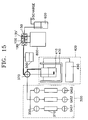
- FIG. 15 is a schematic diagram illustrating an example of a carbon nanotube synthesizing apparatus suitable for a radio frequency heating method used in the embodiment of the present invention.
- the local heating can be performed by a radio frequency heating method as shown in FIG. 15.
- a RF generator 800 is provided near the reactor 100.
- the local heating of the embodiment of the present invention can be performed using RF generated by the RF generator 800.
- the catalyst 135 in gas phase or the catalyst powder 135' can be selectively heated.
- the present invention described above improves a conventional method of synthesizing carbon nanotubes at a high temperature range by heating an entire reactor.
- carbon nanotubes can be synthesized even an entire reactor is maintained at a lower temperature. Even if the temperature of the entire reactor is maintained low, a temperature required for synthesizing carbon nanotubes can be obtained by a local heating method for selectively heating a catalyst. Accordingly, a substrate or a support formed of glass or polymer material such as plastic which cannot be used under the condition of a high temperature can be used.
Landscapes
- Chemical & Material Sciences (AREA)
- Engineering & Computer Science (AREA)
- Nanotechnology (AREA)
- Materials Engineering (AREA)
- Organic Chemistry (AREA)
- Crystallography & Structural Chemistry (AREA)
- General Physics & Mathematics (AREA)
- Physics & Mathematics (AREA)
- Condensed Matter Physics & Semiconductors (AREA)
- Inorganic Chemistry (AREA)
- Manufacturing & Machinery (AREA)
- Composite Materials (AREA)
- Chemical Kinetics & Catalysis (AREA)
- Carbon And Carbon Compounds (AREA)
- Catalysts (AREA)
- Inorganic Fibers (AREA)
Abstract
Description
- The present invention relates to synthesizing carbon nanotubes, and more particularly, to a method of synthesizing carbon nanotubes through local heating and an apparatus used for the same.
- It is known that a carbon nanotube is microscopically constituted such that a single carbon element is combined with three neighboring carbon atoms, a hexagonal ring is formed by the combination among the carbon atoms, and a plane composed of repeated hexagonal rings like a honeycomb is rolled to thereby form a cylindrical shape. The carbon nanotube is characterized by the diameter being usually several angstroms through several tens of nanometers, and the length being several tens through several thousands of times longer than the diameter. It is known that such a carbon nanotube has both metal property and semiconductive property, thereby having excellent physical and electrical properties. Accordingly, the carbon nanotube has been widely applied to a variety of fields using its conductivity and/ or semiconductivity.
- Conventionally, carbon nanotubes are synthesized by a method such as arc discharge method, a laser evaporation method, a thermal chemical vapor deposition (CVD) method, a catalytic synthesizing method or a plasma synthesizing method. These methods are performed at a high temperature of several hundreds through several thousands of degrees centigrade or under a vacuum to release the high temperature condition.
- Moreover, in these conventional methods, an entire reactor is heated to meet a reaction temperature for synthesizing carbon nanotubes. Here, all substances such as reactant gases and a catalyst which are supplied into the reactor are heated. Accordingly, when a catalyst is loaded on a support or a substrate the support or the substrate should be formed of a heat-resistant material which can tolerate a high reaction temperature as described above. In other words, selection of a support or a substrate for loading a catalyst is restricted.
- To solve the above problems, it is a first feature of the present invention to provide a method of synthesizing carbon nanotubes, which allows a support or a substrate for loading a catalyst not to be heated to a high temperature by locally heating the catalyst.
- It is a second feature of the present invention to provide a carbon nanotube synthesizing apparatus used for performing the above method.
- Accordingly, to achieve the first feature of the invention, there is provided a method of synthesizing carbon nanotubes. In the method, a catalyst is introduced in a reactor, a reactant gas containing a carbon source gas is supplied over the catalyst, the catalyst in the reactor is locally and selectively heated, and carbon nanotubes are grown from the heated catalyst.
- The local heating of the catalyst can be achieved by irradiation of microwaves, electromagnetic inductive heating, laser heating or radio frequency heating.
- To achieve the second feature of the invention, there is provided an apparatus for synthesizing carbon nanotubes. The apparatus includes a reactor for receiving a catalyst, a reactant gas supplier for supplying a reactant gas containing carbon source gas into the reactor, and a local heater for selectively heating the catalyst received in the reactor.
- The apparatus may also include a catalyst gas supplier for supplying the catalyst into the reactor in gas phase.
- The local heater may include a microwave generator for generating microwaves, and a microwave guide connected to the reactor, the microwave guide guiding the microwaves to the reactor. The local heater may include a high-frequency coil installed around the reactor, and a power supply for applying high-frequency current to the high-frequency coil. The local heater may include a radio frequency generator installed near the reactor. The local heater may include a laser beam generator installed near the reactor, and a lens for focusing laser beams generated by the laser beam generator.
- According to the present invention, carbon nanotubes can be synthesized under the condition of lower temperature, that is, in a state where the entire reactor is maintained at a low temperature, through local heating. Therefore, a substrate or a support for loading a catalyst thereon can be formed of polymer material or glass.
- The above features and advantages of the present invention will become more apparent by describing in detail a preferred embodiment thereof with reference to the attached drawings in which:
- FIG. 1 is a schematic flowchart illustrating a method of synthesizing carbon nanotubes according to an embodiment of the present invention;
- FIGS. 2 and 3 are schematic cross-sectional views illustrating a method of locally heating a catalyst according to the embodiment of the present invention;
- FIGS. 4 and 5 are schematic cross-sectional views illustrating the growth of carbon nanotubes according to the embodiment of the present invention;
- FIG. 6 is a schematic diagram illustrating an example of a carbon nanotube synthesizing apparatus having a microwave generator, which is used in the embodiment of the present invention;
- FIGS. 7 through 12 are the scanning electron microscope (SEM) pictures of carbon nanotubes synthesized by a method of synthesizing carbon nanotubes according to the embodiment of the present invention;
- FIG. 13 is a schematic diagram illustrating an example of a carbon nanotube synthesizing apparatus suitable for an inductive heating method used in the embodiment of the present invention;
- FIG. 14 is a schematic diagram illustrating an example of a carbon nanotube synthesizing apparatus suitable for a laser heating method used in the embodiment of the present invention; and
- FIG. 15 is a schematic diagram illustrating an example of a carbon nanotube synthesizing apparatus suitable for a radio frequency heating method used in the embodiment of the present invention.
-
- Hereinafter, an embodiment of the present invention will be described in detail with reference to the attached drawings. The present invention is not restricted to the following embodiments, and many variations are possible within the sprit and scope of the present invention. The embodiment of the present invention is provided in order to more completely explain the present invention to anyone skilled in the art. In the drawings, the shapes of members are exaggerated for clarity and the same reference numerals denote the same members.
- Referring to FIG. 1, a method of synthesizing carbon nanotubes according to an embodiment of the present invention can be performed using a carbon nanotube synthesizing apparatus as shown in FIG. 6. The carbon nanotube synthesizing apparatus of FIG. 6 is suggested as a means for realizing the conception of local heating proposed by the embodiment of the present invention.
- Referring to FIGS. 2, 3 and 6, the carbon nanotube synthesizing apparatus of FIG. 6 includes a
reactor 100 for receiving aboat 150 which loads with catalyst powder 135' or asubstrate 131 which loads with acatalyst 135. The catalytic powder 135' is manufactured by loading acatalyst 135 of FIG. 2 formed of, for example, a transition metal on asupport 130. Thereactor 100 can be realized as a quartz tube. - The
reactor 100 is provided with alocal heater 200 for supplying microwaves to locally heat the catalyst powder 135', substantially, thecatalyst 135. Thelocal heater 200 may include amicrowave generator 250 for generating microwaves and amicrowave guide 210 for guiding the microwaves to thereactor 100. - In addition, a
reactant gas supplier 300 for supplying a reactant gas used for synthesizing carbon nanotubes and adischarger 600 for discharging a gas after reaction are installed to thereactor 100. Thereactant gas supplier 300 may include gas bombes for supplying a carbon source gas such as hydrocarbon or hydrogen sulfide (H2S), or supplying hydrogen gas (H2) or an inert gas which can be supplied together with the carbon source gas and mass flow controllers (MFCs) and on/offvalves 350 which are installed to ducts between the gas bombes and thereactor 100 for controlling a gas flow rate. A plurality of sets of the bombe, MFC 310 and the on/offvalve 350 may be provided. - The
catalyst 135 may be supplied in such a form of loading a transition metal or the precursor of a transition metal on thesupport 130 or thesubstrate 131, as shown in FIGS. 2 and 3, but it may be supplied in gas phase at need. When using the precursor of a metal such as iron (Fe), nickel (Ni) or cobalt (Co), for example, ferrocene (FeC10H10) or iron pentacarbonyl (Fe(CO)5) as a catalyst supplied in gas phase, such a precursor, which mostly exits in a liquid or solid state, needs to be vaporized in order to be supplied to thereactor 100. - To meet this necessity, a
catalytic gas supplier 400 may be additionally installed to thereactor 100. Thecatalytic gas supplier 400 includes asaturator 410 for vaporizing a solid or liquid catalyst or a catalyst precursor, awater bath 430 for accommodating thesaturator 410 and acirculator 450 for controlling the temperature of water in thewater bath 430 and circulating the water. A gaseous catalyst generated by thesaturator 410 is supplied into thereactor 100 via a duct and acts as a catalyst in thereactor 100. - Here, a four-
port 370 is provided at the intersection of the ducts connected to thereactant gas supplier 300 and thecatalytic gas supplier 400, respectively, for inducing the flow of a gas. When supplying a catalyst in gas phase, atemperature controller 500 may be provided for maintaining the catalyst in gas phase. Thetemperature controller 500 includes a slidax and a temperature readout unit. Thetemperature controller 500 measures the internal temperature of thereactor 100 using a thermocouple and the like, reads out the measured result and maintains the internal temperature such that a catalyst can be injected into thereactor 100 in gas phase. - A method of synthesizing carbon nanotubes using such a carbon nanotube synthesizing apparatus as described above will be described with reference to the flowchart of FIG. 1. In
step 1100, acatalyst 135 of FIG. 2 or 3 is introduced in thereactor 100, as shown in FIG. 6. Here, thecatalyst 135 may be manufactured by loading a transition metal or the precursor of a transition metal on thepowder type support 130, as shown in FIG. 2, or on thesubstrate 131, as shown in FIG. 3. The catalyst powder 135' manufactured by loading thecatalyst 135 on thepowder type support 130 may be put on theboat 150 and the like and introduced in thereactor 100. Alternatively, when thecatalyst 135 is loaded on thesubstrate 131, thesubstrate 131 may be introduced in thereactor 100. - For the
catalyst 135, a transition metal such as iron, nickel or cobalt or a compound containing the transition metal, for example, metal sulfide such as cobalt sulfide, iron sulfide or nickel sulfide, metal carbide containing the transition metal, metal oxide, metal nitrate or metal sulfate, can be used. Besides, an organic compound such as cobalt naphtenate containing the transition metal described above can be used as thecatalyst 135. - The
catalyst 135 is manufactured by loading the precursor of a transition metal containing iron, nickel or cobalt on thesupport 130 of FIG. 2 using an impregnation method, an incipient wetness method or an ion-exchange method. Thus-manufacturedcatalyst 135 may be dried and used in the form of the catalyst powder 135' or may be used after undergoing reduction and calcination or sulfiding and carbonization to make thecatalyst 135 have a variety properties. - The
support 130 or thesubstrate 131 may be formed of a material such as silicon oxide (SiO2) or aluminum oxide (Al2O3) which is not heated by microwaves. Alternatively, thepowder type support 130 formed of carbon (C) which can be heated by microwaves and the like may be used. Thecatalyst 135 loaded on thesupport 130 may be put on theboat 150 of FIG. 6 and introduced in thereactor 100 in a powder state. Alternatively, thecatalyst 135 may be loaded on thesubstrate 131 using deposition, spraying or painting. After the loading, thecatalyst 135 may be used after being just dried or after undergoing reduction and calcination or sulfiding and carbonization. - A method of loading the
catalyst 135 on thesupport 130 will be described below with reference to examples. - Fe of 5 wt% is impregnated into the
support 130 of carbon by dissolving a Fe-precursor such as Fe(NO3)39H2O in distilled water. The resultant thing is dried at about 110°C for about 24 hours and then reduced at about 500°C for 3 hours in a hydrogen atmosphere, thereby obtaining the catalyst powder 135' of Fe (5 wt%)/C, as shown in FIG. 2. It is apparent that other various methods can be used for loading thecatalyst 135 on thesupport 130 or thesubstrate 131. - The
catalyst 135 loaded on thesupport 130 or thesubstrate 131 is put on theboat 150 and introduced in thereactor 100, and then thereactor 100 is filled with a heat-resistant material such asquartz wool 190 to block heat transmission from the inside to the outside. Thereafter, instep 1200 of FIG. 1, a reactant gas is supplied into thereactor 100. The reactant gas preferably contains a carbon source gas. - In
step 1300, thecatalyst 135 is locally heated by irradiating microwaves on thereactor 100 accommodating thecatalyst 135 or the catalyst powder 135'. Since thecatalyst 135 is formed of a material which can be dielectrically heated by microwaves, thecatalyst 135 is heated by microwaves applied thereto, as shown in FIG. 2 or 3. The microwaves can be generated with 2.45 GHz and 800 W power. - Such heating can be selectively restricted to the
catalyst 135 such that the reactant gas, thesupport 130, thesubstrate 131 or theboat 150 supplied into thereactor 100 are not heated. Accordingly, thesupport 130, theboat 150 or thesubstrate 131 may be formed of glass or polymer material such as plastic. - As shown in FIGS. 3 and 4,
carbon nanotubes 170 are grown from thecatalyst 135 by the reaction of the reactant gas containing a carbon source gas supplied on thecatalyst 135 that is locally heated, instep 1300 of FIG. 1. Here, hydrocarbon gas such as methane gas, acetylene gas, propane gas or benzene can be used as the carbon source gas. Alternatively, a reactant gas in which hydrocarbon gas is mixed with hydrogen gas may be used. In addition, an inert gas can be used as a carrier gas. - The result of synthesizing carbon nanotubes using the catalyst powder 135' of Fe (5 wt%)/C as described above is clearly presented in the scanning electron microscope (SEM) picture of FIG. 7.
- As described above, in the case of the catalyst powder 135' of Fe (5 wt%)/C, both the
catalyst 135 and thesupport 130 can be heated. However, when thecatalyst 135 is loaded on thesupport 130 or thesubstrate 131 formed of a material such as silicon oxide (SiO2) or glass which is not heated by microwaves, only thecatalyst 135 can be heated without heating thesupport 130 or thesubstrate 131. In this case, hydrogen sulfide (H2S) gas may be injected as a reactant gas together with hydrocarbon gas to grow carbon nanotubes. - Co of 10 wt% is impregnated into the
support 130 of SiO2 by dissolving a Co-precursor such as Co(NO3)36H2O in distilled water. The resultant thing is dried at about 110°C for about 24 hours and then reduced at 500°C, which is obtained by increasing a temperature at a rate of 5°C/min while flowing hydrogen gas, for 3 hours, thereby obtaining the catalyst powder 135' of Co (10 wt%)/SiO2. Thus-made catalyst powder 135' is put on theboat 150 and introduced in thereactor 100. Next, acetylene (C2H2) gas and hydrogen sulfide (H2S) gas is flown in thereactor 100 at flow rates of 10 ml/min and 3 ml/min to purge thereactor 100. Then, microwaves are irradiated for 30 minutes. Thesupport 130 of SiO2 is not heated by the microwaves, but the Co is heated by the microwaves so that carbon nanotubes are generated. FIG. 8 is a SEM picture showing the generated carbon nanotubes. - Instead of using a transition metal such as iron, cobalt or nickel as a catalyst, a compound containing the transition metal can be used as a catalyst and locally heated by microwaves to synthesize carbon nanotubes. The
support 130 can be formed of SiO2 which is not heated by microwaves, and a sulfide of the transition metal can be used to generate carbon nanotubes. - As described above, Co of 10 wt% is impregnated into the
support 130 of SiO2 by dissolving Co(NO3)36H2O in distilled water. The resultant thing is dried at about 110°C for about 24 hours. A temperature is increased at a rate of 5°C/min while flowing hydrogen gas over the dried catalyst, and then the catalyst is reduced at 500°C for 3 hours, thereby obtaining a catalyst of Co (10 wt%)/SiO2. Then, a temperature is increased at a rate of 10°C/min while flowing H2S(10%)/H2 gas over the catalyst of Co (10 wt%)/SiO2, and the catalyst of Co (10 wt%)/SiO2 is sulfurized at 400°C for 2 hours, thereby obtaining a catalyst of Co (10 wt%)Sx/SiO2. Thus-made catalyst is put on theboat 150 and introduced in thereactor 100. Next, only acetylene (C2H2) gas is flown in thereactor 100 at a flow rate of 10 ml/min for 5 minutes for reaction. FIG. 9 is a SEM picture showing carbon nanotubes which has been grown by the reaction. - Meanwhile, also in the case of using plastic to form the
support 130, carbon nanotubes can be synthesized by microwave heating. - Cobalt black, which is substantially cobalt oxide, is mixed with a nafion solution. The surface of a substrate formed of teflon is painted with the mixed result and dried at 110°C for a day. The dried substrate surface is sulfurized at 300°C for 10 hours by flowing a 10 volume% mixed gas of H2S and H2 over the substrate surface at a flow rate of 30 ml/min, thereby obtaining a catalyst of cobalt sulfide. Thus-made catalyst on the plastic substrate is inserted into the reactor. C2H2 and H2 is flown in the reactor at a flow rate of 10 ml/min:40 ml/min to purge the reactor, and microwaves are irradiated on the substrate for 30 seconds for the reaction of the catalyst. FIG. 10 is a SEM picture showing carbon nanotubes which has been grown by the reaction.
- Also, when a glass substrate instead of a plastic substrate is used as a support, carbon nanotubes can be synthesized.
- A glass substrate is painted with cobalt naphtenate and dried to load the cobalt naphtenate on the glass substrate as a catalyst. The glass substrate loaded with the cobalt naphtenate, i.e., the catalyst, is inserted into a reactor. Then, C2H2 and H2S is flown in the reactor at a flow rate of 10 ml/min:3 ml/min to purge the reactor. Next, microwaves are irradiated on the glass substrate for 9 minutes. Here, the glass substrate is substantially not heated, and only the catalyst is selectively and locally heated, thereby synthesizing carbon nanotubes. FIG. 11 shows a SEM picture of the synthesized carbon nanotubes. Alternatively, C2H2 and H2S is diluted with H2 and flowed in the reactor at a flow rate of 10 ml/min:3 ml/min: 117 ml/min while microwaves are being irradiated on the substrate for 5 minutes to provoke the reaction of the catalyst with the C2H2, H2S and H2 gas so that carbon nanotubes can be synthesized. FIG. 12 shows a SEM picture of thus-synthesized carbon nanotubes.
- Meanwhile, in a method of synthesizing carbon nanotubes according to the embodiment of the present invention, a catalyst can be supplied into the
reactor 100 in gas phase not in a powder state. For example, a catalyst precursor such as a compound such as ferrocene or iron pentacarbonyl containing metal atoms is vaporized by thesaturator 410 of FIG. 6 or the like and supplied into thereactor 100. - In this case, catalyst precursors or catalysts supplied into the
reactor 100 are heated by a local heating method, for example, a microwave heating method. The catalysts may float in thereactor 100. Carbon nanotubes can be grown on the floating catalysts by the reaction of hydrocarbon or the like supplied into thereactor 100. By supplying catalysts in gas phase as described above, carbon nanotubes can be synthesized in gas phase. Accordingly, the mass production of carbon nanotubes can be realized. - FIG. 13 is a schematic diagram illustrating an example of a carbon nanotube synthesizing apparatus suitable for an electromagnetic inductive heating method used in the embodiment of the present invention. A carbon nanotube synthesizing apparatus as shown in FIG. 6 is used for irradiating microwaves to realize local heating proposed by the embodiment of the present invention. The local heating can be performed by an electromagnetic inductive heating method. For example, as shown in FIG. 13, a carbon nanotube synthesizing apparatus including a local heater 200' which is configured such that a high-
frequency coil 215 is provided around thereactor 100, and the high-frequency coil 215 is connected to a high-frequency power supply 255 can be proposed. High-frequency current applied to the high-frequency coil 215 forms an electromagnetic field around the high-frequency coil 215. Due to a change in the electromagnetic field, thecatalyst 135 introduced in thereactor 100 can be selectively heated. - FIG. 14 is a schematic diagram illustrating an example of a carbon nanotube synthesizing apparatus suitable for a laser heating method used in the embodiment of the present invention. The local heating can be performed by a laser heating method-as shown in FIG. 14. For example, a
laser beam generator 710 is provided near thereactor 100.Laser beams 750 generated by thelaser beam generator 710 are focused on alens 725 held by alens holder 727 so that the local heating proposed by the embodiment of the present invention can be performed. In this case, thecatalyst 135 or the catalyst powder 135' introduced in thereactor 100 can be selectively heated by controlling the focusing of thelaser beams 750. - FIG. 15 is a schematic diagram illustrating an example of a carbon nanotube synthesizing apparatus suitable for a radio frequency heating method used in the embodiment of the present invention. The local heating can be performed by a radio frequency heating method as shown in FIG. 15. For example, a
RF generator 800 is provided near thereactor 100. The local heating of the embodiment of the present invention can be performed using RF generated by theRF generator 800. By using the RF, thecatalyst 135 in gas phase or the catalyst powder 135' can be selectively heated. - The present invention described above improves a conventional method of synthesizing carbon nanotubes at a high temperature range by heating an entire reactor. According to the present invention, carbon nanotubes can be synthesized even an entire reactor is maintained at a lower temperature. Even if the temperature of the entire reactor is maintained low, a temperature required for synthesizing carbon nanotubes can be obtained by a local heating method for selectively heating a catalyst. Accordingly, a substrate or a support formed of glass or polymer material such as plastic which cannot be used under the condition of a high temperature can be used.
- Although the invention has been described with reference to a particular embodiment, it will be apparent to one of ordinary skill in the art that modifications to the described embodiment may be made without departing from the spirit and scope of the invention.
Claims (23)
- A method of synthesizing carbon nanotubes comprising the steps of:introducing a catalyst into a reactor;supplying a reactant gas containing a carbon source gas over the catalyst; selectively and locally heating the catalyst in the reactor; andgrowing carbon nanotubes from the heated catalyst.
- A method as claimed in claim 1 wherein the catalyst is formed of a transition metal selected from the group consisting of iron, nickel and cobalt; a metal sulfide, metal carbide, metal oxide or metal salt of the transition metal; or an organic compound containing the transition metal.
- A method as claimed in claim 1 or 2 wherein the catalyst is loaded on a support by an impregnation method, an incipient wetness method or an ion-exchange method and is supplied into the reactor in a powder state.
- A method as claimed in claim 1 or 2 wherein the catalyst to be supplied into the reactor is loaded on a substrate by a deposition method, a painting method or a spray method.
- A method as claimed in claim 1 wherein a metal precursor is loaded onto a substrate or a support and changed into a metal phase through reduction, calcination, sulfiding or carbonization to obtain a metal catalyst, and the metal catalyst is supplied into the reactor.
- A method as claimed in claim 1 wherein a metal sulfide obtained by sulfiding a metal precursor with hydrogen sulfide is used as the catalyst.
- A method as claimed in claim 1 wherein the catalyst is supplied into the reactor in the form of a catalyst precursor in the gas phase.
- A method as claimed in claim 7 wherein the catalyst precursor is ferrocene or iron pentacarbonyl.
- A method as claimed in any preceding claim wherein the carbon source gas contains one gas selected from the group consisting of acetylene, methane, propane and benzene.
- A method as claimed in any preceding claim wherein the reactant gas further comprises hydrogen gas or an inert gas.
- A method as claimed in any preceding claim wherein the reactant gas further comprises hydrogen sulfide (H2S) gas.
- A method as claimed in any preceding claim wherein the local heating of the catalyst is performed by irradiation with microwaves.
- A method as claimed in any of claims 1 to 11 wherein the local heating of the catalyst is performed by electromagnetic inductive heating.
- A method as claimed in any of claims 1 to 11 wherein the local heating of the catalyst is performed by laser heating.
- A method as claimed in any of claims 1 to 11 wherein the local heating of the catalyst is performed by radiofrequency heating.
- An apparatus for synthesizing carbon nanotubes comprising:a reactor for receiving a catalyst;a reactant gas supplier for supplying a carbon source gas into the reactor; anda local heater for selectively heating the catalyst received in the reactor.
- An apparatus as claimed in claim 16 further comprising a heat-resistant material provided inside or outside the reactor, the heat-resistant material blocking heat transmission from the reactor to the outside.
- An apparatus as claimed in claim 16 or 17 further comprising a catalyst gas supplier for supplying the catalyst into the reactor in the gas phase.
- An apparatus as claimed in claim 18 wherein the catalyst gas supplier comprises:a saturator for vaporizing a compound which is a precursor of the catalyst;a water bath for accommodating the saturator; anda circulator connected to the water bath.
- An apparatus as claimed in any of claims 16 to 19 wherein the local heater comprises:a microwave generator for generating microwaves; anda microwave guide connected to the reactor, the microwave guide guiding the microwaves to the reactor.
- An apparatus as claimed in any of claims 16 to 19 wherein the local heater comprises:a high-frequency coil installed around the reactor; anda power supply for applying high-frequency current to the high-frequency coil.
- An apparatus as claimed in any of claims 16 to 19 wherein the local heater comprises a radio frequency generator installed near the reactor.
- An apparatus as claimed in any of claims 16 to 19 wherein the local heater comprises:a laser beam generator installed near the reactor; anda lens for focussing laser beams generated by the laser beam generator.
Applications Claiming Priority (2)
| Application Number | Priority Date | Filing Date | Title |
|---|---|---|---|
| KR10-2000-0055829A KR100382879B1 (en) | 2000-09-22 | 2000-09-22 | Method of synthesizing carbon nanotubes and apparatus being used therein. |
| KR2000055829 | 2000-09-22 |
Publications (1)
| Publication Number | Publication Date |
|---|---|
| EP1190987A1 true EP1190987A1 (en) | 2002-03-27 |
Family
ID=19690004
Family Applications (1)
| Application Number | Title | Priority Date | Filing Date |
|---|---|---|---|
| EP01303763A Withdrawn EP1190987A1 (en) | 2000-09-22 | 2001-04-25 | Method of synthesizing carbon nanotubes and apparatus used for the same |
Country Status (5)
| Country | Link |
|---|---|
| US (1) | US6759025B2 (en) |
| EP (1) | EP1190987A1 (en) |
| JP (1) | JP3481925B2 (en) |
| KR (1) | KR100382879B1 (en) |
| CN (1) | CN1164484C (en) |
Cited By (10)
| Publication number | Priority date | Publication date | Assignee | Title |
|---|---|---|---|---|
| WO2003011755A1 (en) * | 2001-07-27 | 2003-02-13 | University Of Surrey | Production of carbon nanotubes |
| WO2003106030A1 (en) * | 2002-06-13 | 2003-12-24 | National University Of Singapore | Selective area growth of aligned carbon nanotubes on a modified catalytic surface |
| WO2004106234A1 (en) * | 2003-02-07 | 2004-12-09 | Bussan Nanotech Research Institute Inc. | Process for producing monolayer carbon nanotube with uniform diameter |
| WO2006009316A2 (en) | 2004-07-23 | 2006-01-26 | Showa Denko K.K. | Production method of vapor-grown varbon fiber and apparatus therefor |
| EP1582501A4 (en) * | 2003-01-09 | 2009-01-28 | Sony Corp | PROCESS FOR PRODUCING TUBULAR CARBON MOLECULE AND TUBULAR CARBON MOLECULE, METHOD FOR PRODUCING RECORDING DEVICE AND RECORDING DEVICE, METHOD FOR PRODUCING FIELD ELECTRON EMISSION ELEMENT, AND FIELD ELECTRON EMISSION ELEMENT , AND METHOD FOR PRODUCING DISPLAY UNIT |
| US8142568B2 (en) * | 2005-08-19 | 2012-03-27 | Tsinghua University | Apparatus for synthesizing a single-wall carbon nanotube array |
| US8617650B2 (en) | 2006-09-28 | 2013-12-31 | The Hong Kong University Of Science And Technology | Synthesis of aligned carbon nanotubes on double-sided metallic substrate by chemical vapor depositon |
| US9334167B2 (en) | 2005-05-11 | 2016-05-10 | Surrey Nanosystems Limited | Nanostructure production methods and apparatus |
| CN106898494A (en) * | 2017-03-15 | 2017-06-27 | 西安理工大学 | A kind of preparation method of carbonaceous mesophase spherules carbon nano tube compound material |
| EP4421029A4 (en) * | 2021-10-19 | 2025-04-30 | LG Chem, Ltd. | PROCESS FOR THE SYNTHESIS OF CARBON NANOTUBES |
Families Citing this family (144)
| Publication number | Priority date | Publication date | Assignee | Title |
|---|---|---|---|---|
| KR100688138B1 (en) | 1998-11-03 | 2007-03-09 | 윌리엄 마쉬 라이스 유니버시티 | Vapor phase nucleation method and growth method of single-walled carbon nanotubes from high pressure carbon monoxide |
| US20040151835A1 (en) * | 2001-02-26 | 2004-08-05 | Mirko Croci | Method for forming a coating film, consisting of carbon nanotubes, on the surface of a substrate |
| KR20030013552A (en) * | 2001-08-08 | 2003-02-15 | 엘지전자 주식회사 | Purifying method for carbon nanotube |
| JP3579689B2 (en) * | 2001-11-12 | 2004-10-20 | 独立行政法人 科学技術振興機構 | Manufacturing method of functional nanomaterial using endothermic reaction |
| TWI236505B (en) * | 2002-01-14 | 2005-07-21 | Nat Science Council | Thermal cracking chemical vapor deposition process for nanocarbonaceous material |
| KR100450028B1 (en) * | 2002-04-03 | 2004-09-24 | (주) 나노텍 | Method And Apparatus For Synthesis Of Single-walled Carbon Nanotubes Through Explosion Of Hydrocarbon Compounds |
| KR20030080521A (en) * | 2002-04-09 | 2003-10-17 | (주) 나노텍 | Method and Apparatus for Synthesis of Single-walled Carbon Nanotubes by Using Plasma |
| FR2844510B1 (en) * | 2002-09-12 | 2006-06-16 | Snecma Propulsion Solide | THREE-DIMENSIONAL FIBROUS STRUCTURE OF REFRACTORY FIBERS, PROCESS FOR THE PRODUCTION THEREOF AND APPLICATION TO THERMOSTRUCTURAL COMPOSITE MATERIALS |
| CN1248959C (en) * | 2002-09-17 | 2006-04-05 | 清华大学 | Carbon nano pipe array growth method |
| CN1239387C (en) * | 2002-11-21 | 2006-02-01 | 清华大学 | Carbon nano transistor array and grwoth method thereof |
| CN1234604C (en) * | 2002-11-27 | 2006-01-04 | 清华大学 | Carbon nano pipe, its preparation process and equipment |
| US7713583B2 (en) * | 2002-11-27 | 2010-05-11 | Tsinghua University | Method for forming isotope-doped light element nanotube |
| JP3962773B2 (en) * | 2002-12-05 | 2007-08-22 | 独立行政法人科学技術振興機構 | Raw material spray type carbon nanostructure manufacturing method and apparatus |
| US20040265212A1 (en) * | 2002-12-06 | 2004-12-30 | Vijay Varadan | Synthesis of coiled carbon nanotubes by microwave chemical vapor deposition |
| JP4161191B2 (en) * | 2003-01-09 | 2008-10-08 | ソニー株式会社 | Method for manufacturing field electron emission device |
| WO2004083113A1 (en) | 2003-03-20 | 2004-09-30 | Cheol-Jin Lee | Massive synthesis method of double-walled carbon nanotubes using the vapor phase growth |
| JP2004292231A (en) * | 2003-03-26 | 2004-10-21 | Canon Inc | Method for producing nanocarbon material |
| KR100982419B1 (en) * | 2003-05-01 | 2010-09-15 | 삼성전자주식회사 | Method for forming wiring of semiconductor device using carbon nanotube and semiconductor device manufactured by this method |
| US7097906B2 (en) * | 2003-06-05 | 2006-08-29 | Lockheed Martin Corporation | Pure carbon isotropic alloy of allotropic forms of carbon including single-walled carbon nanotubes and diamond-like carbon |
| US7666381B2 (en) * | 2003-06-10 | 2010-02-23 | Plasmet Corporation | Continuous production of carbon nanomaterials using a high temperature inductively coupled plasma |
| US20050000437A1 (en) * | 2003-07-03 | 2005-01-06 | Tombler Thomas W. | Apparatus and method for fabrication of nanostructures using decoupled heating of constituents |
| JP4524546B2 (en) * | 2003-07-15 | 2010-08-18 | ソニー株式会社 | Carbon nanotube and method for producing the same |
| KR20070026370A (en) * | 2003-12-15 | 2007-03-08 | 레슬리 그린가드 | Electromagnetic Control of Chemical Catalysis |
| US7504136B2 (en) * | 2003-12-15 | 2009-03-17 | California Institute Of Technology | Method and system for forming a film of material using plasmon assisted chemical reactions |
| US7998538B2 (en) * | 2003-12-15 | 2011-08-16 | California Institute Of Technology | Electromagnetic control of chemical catalysis |
| US7311776B2 (en) * | 2003-12-30 | 2007-12-25 | The Regents Of The University Of California | Localized synthesis and self-assembly of nanostructures |
| KR100562701B1 (en) * | 2004-01-07 | 2006-03-23 | 삼성전자주식회사 | Electronic source and open defect inspection device and method using the same |
| US7144563B2 (en) * | 2004-04-22 | 2006-12-05 | Clemson University | Synthesis of branched carbon nanotubes |
| KR100663717B1 (en) * | 2004-05-12 | 2007-01-03 | 성균관대학교산학협력단 | Mass synthesis of thin multilayer carbon nanotubes using chemical vapor deposition |
| US20110024697A1 (en) * | 2004-05-18 | 2011-02-03 | Board Of Trustees Of The University Of Arkansas | Methods of Producing Carbon Nanotubes and Applications of Same |
| US7365289B2 (en) * | 2004-05-18 | 2008-04-29 | The United States Of America As Represented By The Department Of Health And Human Services | Production of nanostructures by curie point induction heating |
| TW200609371A (en) * | 2004-05-18 | 2006-03-16 | Univ Arkansas | Apparatus and methods of making nanostructures by inductive heating |
| US7473873B2 (en) * | 2004-05-18 | 2009-01-06 | The Board Of Trustees Of The University Of Arkansas | Apparatus and methods for synthesis of large size batches of carbon nanostructures |
| EP1751052A1 (en) | 2004-05-20 | 2007-02-14 | Korea Advanced Institute of Science and Technology | Method and apparatus for manufacturing carbon nano tube |
| CN1960942B (en) * | 2004-06-04 | 2013-04-10 | 独立行政法人科学技术振兴机构 | Highly efficient process for producing carbon nanostructure through raw material blasting and apparatus tehrefor |
| US9346673B2 (en) * | 2004-06-23 | 2016-05-24 | Samsung Sdi Co., Ltd. | Electrode for fuel cell, membrane-electrode assembly for fuel cell comprising the same, fuel cell system comprising the same, and method for preparing the electrode |
| JPWO2006025393A1 (en) * | 2004-08-31 | 2008-05-08 | 独立行政法人科学技術振興機構 | Manufacturing method of nano-scale low-dimensional quantum structure and manufacturing method of integrated circuit using the manufacturing method |
| KR100578981B1 (en) | 2004-09-08 | 2006-05-12 | 삼성에스디아이 주식회사 | Electrode for fuel cell, fuel cell system comprising same |
| WO2006137852A2 (en) * | 2004-09-17 | 2006-12-28 | Board Of Trustees Of The University Of Arkansas | Apparatus and methods for synthesis of large size batches of carbon nanostructures |
| KR100656985B1 (en) * | 2004-11-02 | 2006-12-13 | 한국에너지기술연구원 | Nano filter media manufacturing method and manufacturing apparatus |
| KR100657913B1 (en) | 2004-11-20 | 2006-12-14 | 삼성전자주식회사 | Single-walled carbon nanotube synthesis at room temperature and pressure |
| KR100658675B1 (en) * | 2004-11-26 | 2006-12-15 | 삼성에스디아이 주식회사 | Electrode for fuel cell, fuel cell comprising same and method for manufacturing electrode for fuel cell |
| KR100669456B1 (en) * | 2004-11-26 | 2007-01-15 | 삼성에스디아이 주식회사 | Electrode for fuel cell, fuel cell comprising same and method for manufacturing electrode for fuel cell |
| KR100649744B1 (en) * | 2005-02-17 | 2006-11-27 | (주)씨엔티 | Carbon nanotube mass synthesis device and mass synthesis method |
| US20060198956A1 (en) * | 2005-03-04 | 2006-09-07 | Gyula Eres | Chemical vapor deposition of long vertically aligned dense carbon nanotube arrays by external control of catalyst composition |
| KR100664545B1 (en) * | 2005-03-08 | 2007-01-03 | (주)씨엔티 | Carbon nanotube mass synthesis device and mass synthesis method |
| US7754183B2 (en) * | 2005-05-20 | 2010-07-13 | Clemson University Research Foundation | Process for preparing carbon nanostructures with tailored properties and products utilizing same |
| US20080199389A1 (en) * | 2005-05-23 | 2008-08-21 | Chiu Wilson K S | Method and device for producing carbon nanotubes |
| KR100684797B1 (en) * | 2005-07-29 | 2007-02-20 | 삼성에스디아이 주식회사 | Electrode for fuel cell, membrane-electrode assembly comprising same and fuel cell system comprising same |
| BRPI0614329A2 (en) * | 2005-08-08 | 2011-03-22 | Cabot Corp | nanotube-containing polymeric compositions |
| KR100741401B1 (en) * | 2005-08-10 | 2007-07-20 | 한국기계연구원 | Separation and purification method of nanotubes using microwaves and apparatus for separation and purification of nanotubes used therein |
| WO2007026213A1 (en) * | 2005-08-29 | 2007-03-08 | University Of The Witwatersrand, Johannesburg | A process for producing carbon nanotubes |
| RU2302371C1 (en) * | 2005-10-05 | 2007-07-10 | Институт химической физики им. Н.Н. Семенова РАН (ИХФ РАН) | Method for producing one-wall carbon nanotube, device for realization of the method and method for producing composite carbon targets |
| CN100482580C (en) * | 2005-10-13 | 2009-04-29 | 鸿富锦精密工业(深圳)有限公司 | Preparation device of carbon nano-tube and its method |
| KR100772661B1 (en) | 2005-11-17 | 2007-11-01 | 학교법인 포항공과대학교 | Method for producing nanowires through electromagnetic radiation without the use of catalysts and nanowires produced thereby |
| KR100741078B1 (en) * | 2005-11-22 | 2007-07-20 | 삼성에스디아이 주식회사 | Medium-sized porous carbon, method for manufacturing the same, and fuel cell using the same |
| KR100749542B1 (en) * | 2005-12-07 | 2007-08-14 | 세메스 주식회사 | Device for recovering carbon nanotubes |
| KR100749541B1 (en) * | 2005-12-07 | 2007-08-14 | 세메스 주식회사 | Catalyst Coating Apparatus for Carbon Nanotube Production |
| KR100732516B1 (en) * | 2005-12-16 | 2007-06-27 | 세메스 주식회사 | Apparatus and method for carbon nanotube synthesis |
| KR100732623B1 (en) * | 2006-01-17 | 2007-06-27 | (주)씨엔티 | Carbon Nanotube Mass Synthesis Device |
| US7955479B2 (en) * | 2006-03-07 | 2011-06-07 | Cem Corporation | Method and apparatus for conducting microwave assisted organic reactions with gas-phase reactants |
| KR100832300B1 (en) * | 2006-03-22 | 2008-05-26 | 한국에너지기술연구원 | Manufacturing method of high efficiency metal filter in which nanotubes or nanofibers are directly synthesized and grown |
| US20070281086A1 (en) * | 2006-06-05 | 2007-12-06 | Hon Hai Precision Industry Co., Ltd. | Apparatus and method for producing carbon nanotubes |
| CN101205059B (en) * | 2006-12-20 | 2010-09-29 | 清华大学 | Preparation method of carbon nanotube array |
| US9005755B2 (en) | 2007-01-03 | 2015-04-14 | Applied Nanostructured Solutions, Llc | CNS-infused carbon nanomaterials and process therefor |
| US8951631B2 (en) | 2007-01-03 | 2015-02-10 | Applied Nanostructured Solutions, Llc | CNT-infused metal fiber materials and process therefor |
| US8951632B2 (en) | 2007-01-03 | 2015-02-10 | Applied Nanostructured Solutions, Llc | CNT-infused carbon fiber materials and process therefor |
| US8092778B2 (en) * | 2007-01-24 | 2012-01-10 | Eden Energy Ltd. | Method for producing a hydrogen enriched fuel and carbon nanotubes using microwave assisted methane decomposition on catalyst |
| US8075869B2 (en) * | 2007-01-24 | 2011-12-13 | Eden Energy Ltd. | Method and system for producing a hydrogen enriched fuel using microwave assisted methane decomposition on catalyst |
| US8021448B2 (en) * | 2007-01-25 | 2011-09-20 | Eden Energy Ltd. | Method and system for producing a hydrogen enriched fuel using microwave assisted methane plasma decomposition on catalyst |
| US7794797B2 (en) * | 2007-01-30 | 2010-09-14 | Cfd Research Corporation | Synthesis of carbon nanotubes by selectively heating catalyst |
| KR100829759B1 (en) * | 2007-04-04 | 2008-05-15 | 삼성에스디아이 주식회사 | Carbon nanotube hybrid using carbide-derived carbon, electron emission source including the same, and electron emission device including the electron emission source |
| RU2350555C2 (en) * | 2007-04-26 | 2009-03-27 | Московская государственная академия тонкой химической технологии им. М.В. Ломоносова | Method of carbon nanofibre production |
| KR20080113805A (en) * | 2007-06-26 | 2008-12-31 | 주식회사 비코 | Mass synthesis apparatus of carbon nanotube using high frequency heating furnace |
| KR100936774B1 (en) * | 2007-08-01 | 2010-01-15 | 세메스 주식회사 | Catalyst supply method, catalyst supply device and carbon nanotube synthesis device having same |
| KR100901455B1 (en) * | 2007-08-02 | 2009-06-08 | 세메스 주식회사 | Vertical Carbon Nanotube Synthesis Device |
| KR101443222B1 (en) | 2007-09-18 | 2014-09-19 | 삼성전자주식회사 | Graphene pattern and process for preparing the same |
| KR100924945B1 (en) | 2007-11-12 | 2009-11-05 | 한국과학기술연구원 | Antibacterial Media Manufacturing Equipment |
| US20090205254A1 (en) * | 2008-02-14 | 2009-08-20 | Zhonghua John Zhu | Method And System For Converting A Methane Gas To A Liquid Fuel |
| KR100898071B1 (en) * | 2008-08-27 | 2009-05-18 | 삼성에스디아이 주식회사 | Electron emitting device, electron emitting display device having same and manufacturing method thereof |
| KR20100026432A (en) * | 2008-08-29 | 2010-03-10 | 삼성전자주식회사 | Method of fabricating carbon nano tube plate |
| WO2010120572A1 (en) * | 2009-02-16 | 2010-10-21 | Board Of Trustees Of The University Of Arkansas | Methods of producing carbon nanotubes and applications of same |
| EP2401416B1 (en) | 2009-02-27 | 2021-03-17 | Applied NanoStructured Solutions, LLC | Low temperature carbon nanotube growth using gas-preheat method |
| US20100224129A1 (en) | 2009-03-03 | 2010-09-09 | Lockheed Martin Corporation | System and method for surface treatment and barrier coating of fibers for in situ cnt growth |
| EP2417286B1 (en) * | 2009-04-10 | 2015-05-20 | Applied Nanostructured Solutions, Inc. | Apparatus and method for the production of carbon nanotubes on a continuously moving substrate |
| MY160277A (en) | 2009-04-17 | 2017-02-28 | Seerstone Llc | Method of producing solid carbon by reducing carbon oxides |
| DE102009023467B4 (en) * | 2009-06-02 | 2011-05-12 | Fraunhofer-Gesellschaft zur Förderung der angewandten Forschung e.V. | Coating plant and process |
| WO2011014258A2 (en) | 2009-07-31 | 2011-02-03 | Massachusetts Institute Of Technology | Systems and methods related to the formation of carbon-based nanostructures |
| WO2011017200A1 (en) | 2009-08-03 | 2011-02-10 | Lockheed Martin Corporation | Incorporation of nanoparticles in composite fibers |
| KR101135767B1 (en) * | 2010-02-03 | 2012-04-16 | 고려대학교 산학협력단 | Method of manufacturing carbon nano tube with sea urchin shape, conductive filler-polymer composite materials and composite separator for fuel cell using the metal-polymer composite materials |
| US20110223343A1 (en) * | 2010-03-01 | 2011-09-15 | Auburn University, Office Of Technology Transfer | Novel nanocomposite for sustainability of infrastructure |
| AU2011302314A1 (en) | 2010-09-14 | 2013-02-28 | Applied Nanostructured Solutions, Llc | Glass substrates having carbon nanotubes grown thereon and methods for production thereof |
| BR112013005529A2 (en) | 2010-09-22 | 2016-05-03 | Applied Nanostructured Sols | carbon fiber substrates having carbon nanotubes developed therein, and processes for producing them |
| WO2012091789A1 (en) | 2010-10-28 | 2012-07-05 | Massachusetts Institute Of Technology | Carbon-based nanostructure formation using large scale active growth structures |
| CN102191485A (en) * | 2011-03-23 | 2011-09-21 | 长春理工大学 | Manufacturing method for growing graphene through laser heating |
| KR101304216B1 (en) * | 2011-04-25 | 2013-09-05 | 한국에너지기술연구원 | Synthesis method of carbon-nanowire, with nano-scaled intermetallic compounds, and materials thereof |
| CN102161481B (en) * | 2011-05-18 | 2012-11-28 | 浙江大学 | Preparation method for synthesizing carbon nanotubes in quantity and with low cost |
| RU2497752C2 (en) * | 2011-11-29 | 2013-11-10 | Инфра Текнолоджис Лтд. | Method of obtaining long carbon nanopipes and device for thereof realisation |
| KR101424910B1 (en) * | 2012-01-11 | 2014-07-31 | 주식회사 엘지화학 | Cnt and method for manufacturing thereof |
| NO2749379T3 (en) | 2012-04-16 | 2018-07-28 | ||
| EP2838841A4 (en) * | 2012-04-16 | 2015-12-23 | Seerstone Llc | METHODS OF USING METAL CATALYSTS IN CATALYTIC CARBON OXIDE CONVERTERS |
| WO2013158158A1 (en) | 2012-04-16 | 2013-10-24 | Seerstone Llc | Methods for treating an offgas containing carbon oxides |
| US9796591B2 (en) | 2012-04-16 | 2017-10-24 | Seerstone Llc | Methods for reducing carbon oxides with non ferrous catalysts and forming solid carbon products |
| JP6242858B2 (en) | 2012-04-16 | 2017-12-06 | シーアストーン リミテッド ライアビリティ カンパニー | Method and system for capturing and sequestering carbon and reducing the mass of carbon oxide in a waste gas stream |
| WO2013158160A1 (en) | 2012-04-16 | 2013-10-24 | Seerstone Llc | Method for producing solid carbon by reducing carbon dioxide |
| US9896341B2 (en) | 2012-04-23 | 2018-02-20 | Seerstone Llc | Methods of forming carbon nanotubes having a bimodal size distribution |
| KR101381646B1 (en) * | 2012-04-30 | 2014-04-14 | 한국에너지기술연구원 | Method for preparing metal-carbon composite having core-shell structure using co-vaporization, and metal-carbon composite having core-shell structure prepared thereby |
| KR101341550B1 (en) * | 2012-06-20 | 2013-12-13 | 한국에너지기술연구원 | Preparation method of catalyst for fuel cell electrode using covaporization and preparation method of fuel cell electrode including catalyst prepared by and fuel cell including the same |
| US10815124B2 (en) | 2012-07-12 | 2020-10-27 | Seerstone Llc | Solid carbon products comprising carbon nanotubes and methods of forming same |
| JP6284934B2 (en) | 2012-07-12 | 2018-02-28 | シーアストーン リミテッド ライアビリティ カンパニー | Solid carbon product containing carbon nanotubes and method of forming the same |
| MX2015000580A (en) | 2012-07-13 | 2015-08-20 | Seerstone Llc | Methods and systems for forming ammonia and solid carbon products. |
| US9779845B2 (en) | 2012-07-18 | 2017-10-03 | Seerstone Llc | Primary voltaic sources including nanofiber Schottky barrier arrays and methods of forming same |
| WO2014039509A2 (en) | 2012-09-04 | 2014-03-13 | Ocv Intellectual Capital, Llc | Dispersion of carbon enhanced reinforcement fibers in aqueous or non-aqueous media |
| CN104812701B (en) * | 2012-11-22 | 2016-09-07 | 捷恩智株式会社 | The manufacture method of carbon nano pipe array, weaving source component, tectosome and composite construction |
| MX382104B (en) | 2012-11-29 | 2025-03-13 | Seerstone Llc | Reactors and methods for producing solid carbon materials |
| CN103013441B (en) * | 2013-01-10 | 2014-03-19 | 贵州大学 | Method for growing low helical carbon nanotube composite microwave absorbing material by in-situ catalysis |
| JP6029482B2 (en) * | 2013-02-06 | 2016-11-24 | 日立造船株式会社 | Carbon nanotube peeling device |
| ES2663666T3 (en) | 2013-02-28 | 2018-04-16 | N12 Technologies, Inc. | Nanostructure film cartridge based dispensing |
| US10086349B2 (en) | 2013-03-15 | 2018-10-02 | Seerstone Llc | Reactors, systems, and methods for forming solid products |
| WO2014151898A1 (en) | 2013-03-15 | 2014-09-25 | Seerstone Llc | Systems for producing solid carbon by reducing carbon oxides |
| WO2014151144A1 (en) | 2013-03-15 | 2014-09-25 | Seerstone Llc | Carbon oxide reduction with intermetallic and carbide catalysts |
| WO2014150944A1 (en) | 2013-03-15 | 2014-09-25 | Seerstone Llc | Methods of producing hydrogen and solid carbon |
| EP3129321B1 (en) | 2013-03-15 | 2021-09-29 | Seerstone LLC | Electrodes comprising nanostructured carbon |
| JP6355969B2 (en) * | 2014-05-22 | 2018-07-11 | 国立研究開発法人宇宙航空研究開発機構 | Graphene production apparatus and graphene production method |
| KR101805405B1 (en) * | 2014-12-19 | 2017-12-07 | 이화여자대학교 산학협력단 | Inorganic nanoparticle-carbon nanotube composite, and preparing method of the same |
| JP6418690B2 (en) * | 2015-02-20 | 2018-11-07 | 学校法人早稲田大学 | Carbon nanotube production equipment |
| RU2614966C2 (en) * | 2015-09-17 | 2017-03-31 | Федеральное государственное унитарное предприятие "Центральный научно-исследовательский институт машиностроения" (ФГУП ЦНИИмаш) | Method of producing carbon nanotubes in supersonic flow and apparatus for implementing thereof |
| US11752459B2 (en) | 2016-07-28 | 2023-09-12 | Seerstone Llc | Solid carbon products comprising compressed carbon nanotubes in a container and methods of forming same |
| FR3068028B1 (en) * | 2017-06-26 | 2021-06-11 | Nawatechnologies | PROCESS FOR MANUFACTURING CARBON NANOTUBES FIXED ON A SUBSTRATE |
| CN107803208A (en) * | 2017-11-14 | 2018-03-16 | 湘潭大学 | A kind of microwave catalyst, its preparation method and the method that hydrogen sulfide is catalytically decomposed |
| KR102059337B1 (en) | 2018-05-04 | 2019-12-26 | 주식회사 화인카보텍 | Decomposing apparatus of acetylene gas using chemical vapor deposition and decomposing method of the same |
| KR101993604B1 (en) | 2018-05-04 | 2019-06-27 | 주식회사 화인카보텍 | Manufacturing method of metal filter containing carbon nanotube using chemical vapor depositon |
| CN108511682B (en) * | 2018-06-11 | 2021-02-12 | 信丰永冠塑电科技有限公司 | Positive pole piece of lithium ion battery |
| US20210379558A1 (en) * | 2018-10-30 | 2021-12-09 | University Of Washington | Radiation-assisted nanostructure synthesis and compositions thereof |
| CN110479310B (en) * | 2019-09-04 | 2022-03-25 | 西南石油大学 | Preparation and application of supported cobalt sulfide catalyst for selective synthesis of carbon nanotubes |
| CN111517304B (en) * | 2020-05-30 | 2021-11-30 | 海宏(唐河)新能源科技有限公司 | Lithium ion battery cathode material and preparation method thereof |
| EP3988207A1 (en) | 2020-10-22 | 2022-04-27 | Bestrong International Limited | Supported metal structure |
| CN112909259A (en) * | 2021-02-04 | 2021-06-04 | 陕西科技大学 | Method for preparing carbon nanotube material catalytically grown from FeNi alloy by electromagnetic induction heating method |
| CN116135307B (en) * | 2021-11-16 | 2024-12-03 | 山东大展纳米材料有限公司 | Method and device for rapidly preparing carbon nano tube catalyst |
| WO2023122668A1 (en) | 2021-12-22 | 2023-06-29 | Nabors Energy Transition Solutions Llc | Sulfur doped carbon-based nanomaterial and methods of forming the same |
| US12606441B2 (en) | 2022-03-04 | 2026-04-21 | Nabors Energy Transition Solutions Llc | Boron doped carbon-based nanomaterial and methods of forming the same |
| CN116251537A (en) * | 2022-06-22 | 2023-06-13 | 中晶城康资源再生利用技术有限公司 | A device for preparing metal-carbon materials by methane cracking method and its preparation method |
| KR102812801B1 (en) * | 2022-08-12 | 2025-05-23 | 대주전자재료 주식회사 | Method and apparatus for synthesizing carbon nanotube using thermal plasma |
| CN116947023A (en) * | 2023-07-05 | 2023-10-27 | 西北工业大学 | Method for synchronously realizing rapid carbonization of MOF array and rapid surface autogenous CNTs |
Citations (3)
| Publication number | Priority date | Publication date | Assignee | Title |
|---|---|---|---|---|
| JPH11116218A (en) * | 1997-10-17 | 1999-04-27 | Osaka Gas Co Ltd | Production of single layered nanotube |
| EP1061043A1 (en) * | 1999-06-15 | 2000-12-20 | Iljin Nanotech Co., Ltd. | Low-temperature synthesis of carbon nanotubes using metal catalyst layer for decomposing carbon source gas |
| WO2001023303A1 (en) * | 1999-09-29 | 2001-04-05 | Electrovac, Fabrikation Elektrotechnischer Spezialartikel Gesellschaft M.B.H. | Method for producing a nanotube layer on a substrate |
Family Cites Families (7)
| Publication number | Priority date | Publication date | Assignee | Title |
|---|---|---|---|---|
| US5707916A (en) * | 1984-12-06 | 1998-01-13 | Hyperion Catalysis International, Inc. | Carbon fibrils |
| US5165909A (en) * | 1984-12-06 | 1992-11-24 | Hyperion Catalysis Int'l., Inc. | Carbon fibrils and method for producing same |
| JP3363759B2 (en) * | 1997-11-07 | 2003-01-08 | キヤノン株式会社 | Carbon nanotube device and method of manufacturing the same |
| US6045769A (en) * | 1997-12-08 | 2000-04-04 | Nanogram Corporation | Process for carbon production |
| ATE440073T1 (en) * | 1998-09-18 | 2009-09-15 | Univ Rice William M | CHEMICAL DERIVATIZATION OF SINGLE-WALLED CARBON NANO TUBES TO FACILITATE THEIR SOLVATATION AND USE OF DERIVATIZED NANO TUBES |
| JP2000223012A (en) * | 1999-01-31 | 2000-08-11 | Futaba Corp | Electron emitting source and manufacture thereof |
| KR100371161B1 (en) * | 1999-12-18 | 2003-02-07 | 엘지전자 주식회사 | Fabricating method of field emission device |
-
2000
- 2000-09-22 KR KR10-2000-0055829A patent/KR100382879B1/en not_active Expired - Lifetime
-
2001
- 2001-04-25 EP EP01303763A patent/EP1190987A1/en not_active Withdrawn
- 2001-04-27 CN CNB011155477A patent/CN1164484C/en not_active Expired - Fee Related
- 2001-04-27 US US09/842,714 patent/US6759025B2/en not_active Expired - Fee Related
- 2001-07-26 JP JP2001226015A patent/JP3481925B2/en not_active Expired - Fee Related
Patent Citations (3)
| Publication number | Priority date | Publication date | Assignee | Title |
|---|---|---|---|---|
| JPH11116218A (en) * | 1997-10-17 | 1999-04-27 | Osaka Gas Co Ltd | Production of single layered nanotube |
| EP1061043A1 (en) * | 1999-06-15 | 2000-12-20 | Iljin Nanotech Co., Ltd. | Low-temperature synthesis of carbon nanotubes using metal catalyst layer for decomposing carbon source gas |
| WO2001023303A1 (en) * | 1999-09-29 | 2001-04-05 | Electrovac, Fabrikation Elektrotechnischer Spezialartikel Gesellschaft M.B.H. | Method for producing a nanotube layer on a substrate |
Non-Patent Citations (3)
| Title |
|---|
| DATABASE WPI Section Ch Week 199927, Derwent World Patents Index; Class E36, AN 1999-323246, XP002154696 * |
| NATH M ET AL: "Production of bundles of aligned carbon and carbon-nitrogen nanotubes by the pyrolysis of precursors on silica-supported iron and cobalt catalysts", CHEMICAL PHYSICS LETTERS, 26 MAY 2000, ELSEVIER, NETHERLANDS, vol. 322, no. 5, pages 333 - 340, XP001035018, ISSN: 0009-2614 * |
| QIN L C ET AL: "GROWING CARBON NANOTUBES BY MICROWAVE PLASMA-ENHANCED CHEMICAL VAPOR DEPOSITION", APPLIED PHYSICS LETTERS, AMERICAN INSTITUTE OF PHYSICS. NEW YORK, US, vol. 72, no. 26, 29 June 1998 (1998-06-29), pages 3437 - 3439, XP000771159, ISSN: 0003-6951 * |
Cited By (15)
| Publication number | Priority date | Publication date | Assignee | Title |
|---|---|---|---|---|
| WO2003011755A1 (en) * | 2001-07-27 | 2003-02-13 | University Of Surrey | Production of carbon nanotubes |
| US8715790B2 (en) | 2001-07-27 | 2014-05-06 | University Of Surrey | Production of carbon nanotubes |
| WO2003106030A1 (en) * | 2002-06-13 | 2003-12-24 | National University Of Singapore | Selective area growth of aligned carbon nanotubes on a modified catalytic surface |
| US7828620B2 (en) | 2003-01-09 | 2010-11-09 | Sony Corporation | Method of manufacturing tubular carbon molecule and tubular carbon molecule, method of manufacturing field electron emission device and field electron emission device, and method of manufacturing display unit and display unit |
| EP1582501A4 (en) * | 2003-01-09 | 2009-01-28 | Sony Corp | PROCESS FOR PRODUCING TUBULAR CARBON MOLECULE AND TUBULAR CARBON MOLECULE, METHOD FOR PRODUCING RECORDING DEVICE AND RECORDING DEVICE, METHOD FOR PRODUCING FIELD ELECTRON EMISSION ELEMENT, AND FIELD ELECTRON EMISSION ELEMENT , AND METHOD FOR PRODUCING DISPLAY UNIT |
| WO2004106234A1 (en) * | 2003-02-07 | 2004-12-09 | Bussan Nanotech Research Institute Inc. | Process for producing monolayer carbon nanotube with uniform diameter |
| WO2006009316A2 (en) | 2004-07-23 | 2006-01-26 | Showa Denko K.K. | Production method of vapor-grown varbon fiber and apparatus therefor |
| US7846415B2 (en) | 2004-07-23 | 2010-12-07 | Showa Denko K.K. | Production method of vapor-grown carbon fiber and apparatus therefor |
| WO2006009316A3 (en) * | 2004-07-23 | 2006-03-16 | Showa Denko Kk | Production method of vapor-grown varbon fiber and apparatus therefor |
| US9334167B2 (en) | 2005-05-11 | 2016-05-10 | Surrey Nanosystems Limited | Nanostructure production methods and apparatus |
| US8142568B2 (en) * | 2005-08-19 | 2012-03-27 | Tsinghua University | Apparatus for synthesizing a single-wall carbon nanotube array |
| US8617650B2 (en) | 2006-09-28 | 2013-12-31 | The Hong Kong University Of Science And Technology | Synthesis of aligned carbon nanotubes on double-sided metallic substrate by chemical vapor depositon |
| CN106898494A (en) * | 2017-03-15 | 2017-06-27 | 西安理工大学 | A kind of preparation method of carbonaceous mesophase spherules carbon nano tube compound material |
| CN106898494B (en) * | 2017-03-15 | 2018-09-25 | 西安理工大学 | A kind of preparation method of carbonaceous mesophase spherules-carbon nano tube compound material |
| EP4421029A4 (en) * | 2021-10-19 | 2025-04-30 | LG Chem, Ltd. | PROCESS FOR THE SYNTHESIS OF CARBON NANOTUBES |
Also Published As
| Publication number | Publication date |
|---|---|
| KR100382879B1 (en) | 2003-05-09 |
| JP3481925B2 (en) | 2003-12-22 |
| KR20020023522A (en) | 2002-03-29 |
| JP2002121015A (en) | 2002-04-23 |
| CN1164484C (en) | 2004-09-01 |
| US6759025B2 (en) | 2004-07-06 |
| US20020127170A1 (en) | 2002-09-12 |
| CN1345694A (en) | 2002-04-24 |
Similar Documents
| Publication | Publication Date | Title |
|---|---|---|
| US6759025B2 (en) | Method of synthesizing carbon nanotubes and apparatus used for the same | |
| US20070020167A1 (en) | Method of preparing catalyst for manufacturing carbon nanotubes | |
| US7445817B2 (en) | Plasma-assisted formation of carbon structures | |
| US7824649B2 (en) | Apparatus and method for synthesizing a single-wall carbon nanotube array | |
| EP1948562B1 (en) | Carbon nanotubes functionalized with fullerenes | |
| EP1644287B1 (en) | Method, and apparatus for continuous synthesis of single-walled carbon nanotubes | |
| US20090278114A1 (en) | Control of carbon nanotube diameter using cvd or pecvd growth | |
| EP1501631A1 (en) | Plasma-assisted formation of carbon structures | |
| US20060093740A1 (en) | Method and device for manufacturing nanofilter media | |
| KR20030028296A (en) | Plasma enhanced chemical vapor deposition apparatus and method of producing a cabon nanotube using the same | |
| JP3463091B2 (en) | Method for producing carbon nanotube | |
| WO2003011755B1 (en) | Production of carbon nanotubes | |
| US20090263310A1 (en) | Method for making carbon nanotubes | |
| CN117980262A (en) | Synthesis method of carbon nanotubes | |
| US20140363586A1 (en) | Laser-based method for growing an array of carbon nanotubes | |
| US20080153691A1 (en) | Method of Making Catalyst For Carbon Nanotubes and Carbon Nanofibers and Catalyst For Carbon Nanotubes and Nanofibers Thereof | |
| US20070281086A1 (en) | Apparatus and method for producing carbon nanotubes | |
| JP2004051432A (en) | Substrate for producing carbon nanotube and method for producing carbon nanotube using the same | |
| KR100372335B1 (en) | Synthesis method for controlling diameter of carbonnanotubes using catalytic metal fine patterns | |
| EP4291689A1 (en) | Arc-beam scanning for suppressing anode overgrowth in picvd system | |
| KR100793172B1 (en) | Carbon nanotube manufacturing facility and manufacturing method of carbon nanotube using the same | |
| Tang et al. | Preparation of Size-Selected Pt Cluster Catalysts for Hydrogenation of Styrene | |
| EP2597068B1 (en) | Micro coil manufacturing method and manufacturing device thereof | |
| US7799307B2 (en) | Method of growing single-walled carbon nanotubes | |
| JP2009018953A (en) | Carbon nanostructure manufacturing method and carbon nanostructure manufacturing apparatus |
Legal Events
| Date | Code | Title | Description |
|---|---|---|---|
| PUAI | Public reference made under article 153(3) epc to a published international application that has entered the european phase |
Free format text: ORIGINAL CODE: 0009012 |
|
| 17P | Request for examination filed |
Effective date: 20010514 |
|
| AK | Designated contracting states |
Kind code of ref document: A1 Designated state(s): AT BE CH CY DE DK ES FI FR GB GR IE IT LI LU MC NL PT SE TR Kind code of ref document: A1 Designated state(s): DE FR GB IT NL |
|
| AX | Request for extension of the european patent |
Free format text: AL;LT;LV;MK;RO;SI |
|
| AKX | Designation fees paid |
Free format text: DE FR GB IT NL |
|
| STAA | Information on the status of an ep patent application or granted ep patent |
Free format text: STATUS: THE APPLICATION IS DEEMED TO BE WITHDRAWN |
|
| 18D | Application deemed to be withdrawn |
Effective date: 20071102 |