EP1189010A2 - Process for making a plastic counterflow heat exchanger - Google Patents
Process for making a plastic counterflow heat exchanger Download PDFInfo
- Publication number
- EP1189010A2 EP1189010A2 EP01000455A EP01000455A EP1189010A2 EP 1189010 A2 EP1189010 A2 EP 1189010A2 EP 01000455 A EP01000455 A EP 01000455A EP 01000455 A EP01000455 A EP 01000455A EP 1189010 A2 EP1189010 A2 EP 1189010A2
- Authority
- EP
- European Patent Office
- Prior art keywords
- inner ducts
- ducts
- mold
- forming
- providing
- Prior art date
- Legal status (The legal status is an assumption and is not a legal conclusion. Google has not performed a legal analysis and makes no representation as to the accuracy of the status listed.)
- Withdrawn
Links
Images





Classifications
-
- F—MECHANICAL ENGINEERING; LIGHTING; HEATING; WEAPONS; BLASTING
- F28—HEAT EXCHANGE IN GENERAL
- F28F—DETAILS OF HEAT-EXCHANGE AND HEAT-TRANSFER APPARATUS, OF GENERAL APPLICATION
- F28F21/00—Constructions of heat-exchange apparatus characterised by the selection of particular materials
- F28F21/06—Constructions of heat-exchange apparatus characterised by the selection of particular materials of plastics material
- F28F21/067—Details
-
- B—PERFORMING OPERATIONS; TRANSPORTING
- B60—VEHICLES IN GENERAL
- B60H—ARRANGEMENTS OF HEATING, COOLING, VENTILATING OR OTHER AIR-TREATING DEVICES SPECIALLY ADAPTED FOR PASSENGER OR GOODS SPACES OF VEHICLES
- B60H1/00—Heating, cooling or ventilating devices
- B60H1/00507—Details, e.g. mounting arrangements, desaeration devices
- B60H1/00557—Details of ducts or cables
- B60H1/00564—Details of ducts or cables of air ducts
-
- B—PERFORMING OPERATIONS; TRANSPORTING
- B60—VEHICLES IN GENERAL
- B60H—ARRANGEMENTS OF HEATING, COOLING, VENTILATING OR OTHER AIR-TREATING DEVICES SPECIALLY ADAPTED FOR PASSENGER OR GOODS SPACES OF VEHICLES
- B60H1/00—Heating, cooling or ventilating devices
- B60H1/00507—Details, e.g. mounting arrangements, desaeration devices
- B60H1/00557—Details of ducts or cables
- B60H1/00571—Details of ducts or cables of liquid ducts, e.g. for coolant liquids or refrigerants
-
- F—MECHANICAL ENGINEERING; LIGHTING; HEATING; WEAPONS; BLASTING
- F28—HEAT EXCHANGE IN GENERAL
- F28D—HEAT-EXCHANGE APPARATUS, NOT PROVIDED FOR IN ANOTHER SUBCLASS, IN WHICH THE HEAT-EXCHANGE MEDIA DO NOT COME INTO DIRECT CONTACT
- F28D9/00—Heat-exchange apparatus having stationary plate-like or laminated conduit assemblies for both heat-exchange media, the media being in contact with different sides of a conduit wall
- F28D9/0031—Heat-exchange apparatus having stationary plate-like or laminated conduit assemblies for both heat-exchange media, the media being in contact with different sides of a conduit wall the conduits for one heat-exchange medium being formed by paired plates touching each other
- F28D9/0037—Heat-exchange apparatus having stationary plate-like or laminated conduit assemblies for both heat-exchange media, the media being in contact with different sides of a conduit wall the conduits for one heat-exchange medium being formed by paired plates touching each other the conduits for the other heat-exchange medium also being formed by paired plates touching each other
-
- F—MECHANICAL ENGINEERING; LIGHTING; HEATING; WEAPONS; BLASTING
- F28—HEAT EXCHANGE IN GENERAL
- F28F—DETAILS OF HEAT-EXCHANGE AND HEAT-TRANSFER APPARATUS, OF GENERAL APPLICATION
- F28F21/00—Constructions of heat-exchange apparatus characterised by the selection of particular materials
- F28F21/06—Constructions of heat-exchange apparatus characterised by the selection of particular materials of plastics material
- F28F21/065—Constructions of heat-exchange apparatus characterised by the selection of particular materials of plastics material the heat-exchange apparatus employing plate-like or laminated conduits
-
- B—PERFORMING OPERATIONS; TRANSPORTING
- B29—WORKING OF PLASTICS; WORKING OF SUBSTANCES IN A PLASTIC STATE IN GENERAL
- B29C—SHAPING OR JOINING OF PLASTICS; SHAPING OF MATERIAL IN A PLASTIC STATE, NOT OTHERWISE PROVIDED FOR; AFTER-TREATMENT OF THE SHAPED PRODUCTS, e.g. REPAIRING
- B29C2791/00—Shaping characteristics in general
- B29C2791/001—Shaping in several steps
-
- B—PERFORMING OPERATIONS; TRANSPORTING
- B29—WORKING OF PLASTICS; WORKING OF SUBSTANCES IN A PLASTIC STATE IN GENERAL
- B29C—SHAPING OR JOINING OF PLASTICS; SHAPING OF MATERIAL IN A PLASTIC STATE, NOT OTHERWISE PROVIDED FOR; AFTER-TREATMENT OF THE SHAPED PRODUCTS, e.g. REPAIRING
- B29C2793/00—Shaping techniques involving a cutting or machining operation
- B29C2793/009—Shaping techniques involving a cutting or machining operation after shaping
-
- B—PERFORMING OPERATIONS; TRANSPORTING
- B29—WORKING OF PLASTICS; WORKING OF SUBSTANCES IN A PLASTIC STATE IN GENERAL
- B29C—SHAPING OR JOINING OF PLASTICS; SHAPING OF MATERIAL IN A PLASTIC STATE, NOT OTHERWISE PROVIDED FOR; AFTER-TREATMENT OF THE SHAPED PRODUCTS, e.g. REPAIRING
- B29C51/00—Shaping by thermoforming, i.e. shaping sheets or sheet like preforms after heating, e.g. shaping sheets in matched moulds or by deep-drawing; Apparatus therefor
-
- B—PERFORMING OPERATIONS; TRANSPORTING
- B29—WORKING OF PLASTICS; WORKING OF SUBSTANCES IN A PLASTIC STATE IN GENERAL
- B29L—INDEXING SCHEME ASSOCIATED WITH SUBCLASS B29C, RELATING TO PARTICULAR ARTICLES
- B29L2031/00—Other particular articles
- B29L2031/18—Heat-exchangers or parts thereof
-
- F—MECHANICAL ENGINEERING; LIGHTING; HEATING; WEAPONS; BLASTING
- F28—HEAT EXCHANGE IN GENERAL
- F28F—DETAILS OF HEAT-EXCHANGE AND HEAT-TRANSFER APPARATUS, OF GENERAL APPLICATION
- F28F2250/00—Arrangements for modifying the flow of the heat exchange media, e.g. flow guiding means; Particular flow patterns
- F28F2250/10—Particular pattern of flow of the heat exchange media
- F28F2250/108—Particular pattern of flow of the heat exchange media with combined cross flow and parallel flow
Definitions
- the present invention relates to a plastic counterflow heat exchanger and more particularly to a counterflow heat exchanger that is inexpensive to manufacture and yet is efficient and effective.
- Inexpensive plastic heat exchangers are very useful because of low manufacturing cost and because such heat exchangers can be custom molded to fit specific spaces, such as those in crowded, free-standing equipment cabinets commonly used to house telecommunications equipment.
- the fluid to be cooled is air from a sealed equipment compartment.
- the cooling fluid typically, is ambient air.
- the fluids being handled are not usually corrosive, nor is high pressure involved.
- Cross flow heat exchangers are typically constructed of rectangular panels or sheets which are stacked together and which have small projections on one of their major surfaces to space one sheet from the next.
- the cooled fluid enters from one side of the rectangular stack and exits from an opposite side.
- the cooling fluid enters the stack from a side 90 degrees removed from the flow of the cooled fluid and exits through an opposite side.
- the fluid flows alternate between sheets, and seals are provided at the corners of the stack to separate the two flows. Such seals are generally adequate in cross flow heat exchangers.
- the present invention resolves some of the problems of the related art by providing a process for forming a plastic counterflow heat exchanger comprising the steps of molding a plurality of inner ducts, each duct having larger end portions and a smaller middle portion, stacking the inner ducts on their end portions whereby spaces exist around the middle portions, forming a seal around each stack of end portions, molding an outer duct, and positioning the outer duct about the stack of inner ducts.
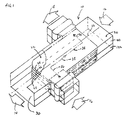
- FIGURE 1 is a diagrammatic isometric view, partially broken away, of a plastic heat exchanger.
- FIGURE 2 is a diagrammatic elevation view of an electrical cabinet illustrating the basic concept of a heat exchanger in such an environment.
- FIGURE 3 is a front elevation view of an inner duct that may be used in the heat exchanger shown in FIGURE 1.
- FIGURE 4 is a side elevation view of the inner duct shown in FIGURE 3.
- FIGURE 5 is a sectional plan view of the inner duct shown in FIGURES 3 and 4 and taken along the line 5-5 of FIGURE 3.
- FIGURE 6 is a plan view of a heat exchanger similar to that shown in FIGURE 1.
- FIGURE 7 is a diagrammatic isometric view of a stack of inner ducts.
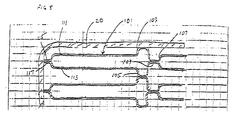
- FIGURE 8 is a partial diagrammatic section view of a modified heat exchanger.
- FIGURE 9 is a front elevation view of mirror image molds for forming an inner duct.
- FIGURE 10 is a front elevation view of mirror image molds for forming an outer duct.
- FIGURE 11 is a diagrammatic plan view of a stack of inner ducts disposed in a mold.
- FIGURE 12 is a diagrammatic plan view of the inner ducts of FIGURE 11 after removal of the mold and after a cutting operation.
- FIGURE 13 is a diagrammatic isometric view showing the stack inner ducts being received by an open mold.
- FIGURE 14 is a diagrammatic plan view of a stack of inner ducts disposed in a seal cup.
- FIGURE 15 is a diagrammatic plan view of the inner ducts after cutting of the seal cup and of a portion of the inner ducts.
- FIGURE 16 is a diagrammatic isometric view of a stack of inner ducts having a seal press fitted to the stack.
- FIGURE 17 is a front elevation view of the seal shown in FIGURE 16.
- FIGURE 18 is a side elevation view of the seal shown in FIGURES 16 and 17.
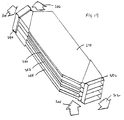
- FIGURE 19 is a diagrammatic isometric view of another variation of a stack of inner ducts.
- FIGURE 20 is a front elevation view of the inner duct shown in FIGURE 19.
- FIGURE 21 is a side elevation view of the inner duct shown in FIGURES 19 and 20.
- FIGURE 22 is a plan view of the inner duct shown in FIGURES 19-21.
- the heat exchanger 10 includes an outer duct 20 which is generally tubular in shape and a stack 22 of inner ducts, such as the inner ducts 24, 26 and 28. The stacked inner ducts are disposed in an interior chamber 30 formed within the outer duct.
- the heat exchanger 10 is simply constructed and arranged although a commercial heat exchanger will have many more inner ducts as will be explained below.
- the heat exchanger 10 of the present invention is a counterflow heat exchanger even though the cooled fluid path 12, 14 and the cooling fluid path 16, 18 begin and end generally perpendicular to each other.
- the cooled fluid path 12, 14 establishes a first direction represented by a phantom line 32.
- the cooling fluid path 16, 18 is represented by a curved phantom line 34 which diagrammatically may be divided into an inlet portion 36, a middle portion 38 and an outlet portion 40. During the time that the cooling fluid path is in its middle portion, it is disposed substantially parallel to the first direction 32 but opposite to it. In this way a counterflow arrangement is created.
- counterflow heat exchangers are more efficient when compared to cross flow heat exchangers, all other variables being equal.
- the heat exchanger 10 may be used in an electrical enclosure or cabinet 50 as shown in diagrammatic form in FIGURE 2 where the heat exchanger is placed in a sealed equipment chamber or compartment 52.
- a fan 54 draws air to be cooled from the compartment through an inlet vent 56, through the heat exchanger along a downward flow path and then back to the compartment through an outlet vent 58.
- cooling air from outside the cabinet is drawn in by a fan 60 through a vent 62 in an outer wall of the cabinet, and through an inlet vent 64 of the heat exchanger.
- the air moves along an upwardly directed flow path through the heat exchanger in a parallel but opposite direction from the cooled air, and then through a heat exchanger outlet vent 66. Thereafter, the cooling air is exhausted through a vent 68 in another outer wall of the cabinet.
- the heat exchanged between the two air flows takes place without the cooling or cooled air ever mixing.
- the compartment 52 remains sealed even though its air is cooled.
- the cooling and cooled fluid flows may move in an opposite direction from that shown if desired, and the cooling fluid may be represented by the arrows 12, 14 and the cooled fluid may be represented by the arrows 16, 18.
- the duct 25 is a curved conduit forming a fluid passage with end portions 80, 82 and a middle portion 84.
- the vertical distance of the inner duct in FIGURE 3 is defined as the length
- the horizontal distance is defined as the width
- the vertical distance in FIGURE 5 is defined as the depth. It is quite apparent that the depth dimension of the end portions 80, 82 is about twice the depth dimension of most of the middle portion 84.
- the upper and lower surfaces 86, 88, 90 and 92, FIGURE 5, of the end portions are planar.
- the passage for fluid formed within the inner duct is initially generally horizontal through the inlet end portion 82 as shown in FIGURE 3, then generally vertical through the middle portion 84 and then generally horizontal again through the outlet end portion 80.
- the inlet and outlet flow paths of the inner duct are generally perpendicular to the flow path through the middle portion of the duct. This feature allows the flow path through the middle portion 84 of the inner duct to be approximately parallel to the direction 32, FIGURE 1, of the flow path through the outer duct. It is to be understood that the specific design of the inner and outer ducts may be varied from what is shown depending upon the availability of space or the specific geometry of the intended enclosure.
- the inner duct 25 may also include projecting ribs 81, 83, 85 on one side of the middle portion 84 and another set of projecting ribs 87, 89, 91 on the opposite side of the middle portion. These ribs strengthen the walls of the inner duct, prevent flexing due to air pressure, may be used to optimize airflow (so as to eliminate dead spots) and provide additional surfaces to contact an adjacent inner duct when stacked as shown in FIGURE 6. The ribs also increase the surface area between air flows which enhances heat transfer. It is to be noted that the inner ducts 24, 26, 28, FIGURE 1, are a slightly different embodiment from inner duct 25 in that no projecting ribs are formed. Hence, it is understood that more or less ribs may be used, or none at all. Also, the shape of the ribs may be varied without departing from the present invention.
- FIGURES 6 and 7 three inner ducts 25, 27 and 29 are shown in a stacked disposition.
- the larger end portions ensure that there is a space to each side of the middle portion such as the space 100 between the inner ducts 25 and 27 and the space 102 between the inner ducts 27 and 29.
- a first seal 110 is provided around the first end portions of the stacked inner ducts and a second seal 112 is provided around the second end portions of the stacked inner ducts.
- the fluid passages for the cooling air may begin at the inlet end portions 94 of the stacked inner ducts, continue through the middle portions and exhaust through the stacked outlet end portions 96.
- the fluid passageways for the cooled air are formed by the spaces between the middle portions of the inner ducts inboard of the two seals 110, 112.
- the inner duct 101 includes upper projecting rib 103 and lower projecting rib 105. Inboard of these projecting ribs are receding ribs, upper receding rib 107 and lower receding rib 109.
- the receding ribs may be used to strengthen the inner duct and to provide regions or webs for attachment, such as by welding.
- an upper half 111 of the inner duct may be welded to a lower half 113 of the inner duct at the receding ribs 107,109. This may be done to enhance the welds made along upper peripheral lip 115 and lower peripheral lip 117 of the inner duct halves. Greater strength of the walls and of the welds may be required if the pressure of the flowing air is increased.
- the inner ducts of FIGURE 8 are stacked within the outer duct 20.
- the inner ducts may be inexpensively manufactured using a pair of mirror image molds 120, 122, FIGURE 9, and a blow molding or thermoforming technique. These techniques are well known to those skilled in the art.
- the outer duct 20 may be made inexpensively using a pair of mirror image molds 130, 132, FIGURE 10, and a blow molding or thermoforming technique.
- the inner and outer ducts may be split evenly so that the molds are identical except for orientation. Referring to FIGURE 1, the two halves 140, 142 of the outer duct are clearly shown. The same is true of the two halves 144, 146 of the inner duct 24 as shown in FIGURE 4.
- Each of the duct halves may include a peripheral lip, such as the lip 150, FIGURE 9 and the lip 152, FIGURE 10. As mentioned, these are used to attach the duct halves together such as by ultrasonic welding or perhaps by an adhesive. These attachment techniques are also well known by those skilled in the art. Wall thicknesses for both the inner ducts and the outer duct are within the range of 0.010 to 0.020 inches and a thermoplastic plastic material, such as polycarbonate may be used for both ducts. Less expensive plastics may also be used but other characteristics of such plastics may not meet customer requirements for use in outdoor equipment cabinets. Under some circumstances, a heat conductive resin may be desirable, and it may be desirable to use an injection molding technique for forming the ducts.
- a heat exchanger for an equipment cabinet may fall within the approximate dimensions of thirty inches in length, eighteen inches in width and six inches in depth. Also a heat exchanger may include thirty to sixty inner ducts within one outer duct.
- FIGURES 11, 12, and 13 one process for forming the seals about the end portions of the inner ducts is illustrated.
- a stack of four inner ducts 160, 162, 164, 166 are placed adjoining one another. It is to be noted that the end portions 170, 172, 174, 176, respectively, of the four ducts are initially sealed. The end portions are formed with peripheral lips 180, 182, 184, 186, 188, 190, 192 and 194, respectively.
- the first end portions are placed into a mold 200. Thereafter, a castable adhesive sealant 202 is placed into the mold such as by pouring.
- the mold which may be in two halves 204, 206, is removed.
- a "cut line" is established, such as represented in FIGURE 11 by the horizontal phantom line 210 and a part of the end portion is removed.
- a molding procedure may be used without causing any blockage of the ducts. The cut opens the end portions, and thereby the ducts, while maintaining the seal 212 as shown in FIGURE 12.
- Molds and castable adhesive sealants are well known by those skilled in the art.
- FIGURES 14 and 15 A variation of the process is shown in FIGURES 14 and 15.
- a seal cup 220 is used to receive four end portions 222, 224, 226, 228 of four stacked inner ducts 230, 232, 234, 236, respectively.
- a castable adhesive sealant 240 is poured into the cup and then the sealant is allowed to cure.
- a cut line, represented by the phantom line 242, is established and a cut is made to open the ducts and form the geometry shown in FIGURE 15. The remains of the seal cup are then removed and a seal 244 remains around the stacked inner duct end portions.
- FIGURES 16, 17 and 18 illustrate yet another variation of forming a seal around the end portions of a stacked group of inner ducts.
- four end portions 250, 252, 254, 256 of inner ducts are stacked, and a seal 260 is force fitted over and around the stacked inner ducts.
- the seal itself may be formed from an extrusion that has been cut to the desired thickness. Either variation, molding the seal or press fitting the seal is a relatively inexpensive procedure in which relatively inexpensive elements are employed.
- FIGURES 19-22 There is illustrated still another variation of an inner duct 270 having a middle portion 272 and two end portions, an inlet end portion 274 and an outlet end portion 276.
- the end portions have a greater depth than the middle portion to allow the inner ducts to be stacked one upon the other while providing a space between two adjacent inner ducts and between the end inner ducts and the outer duct.
- FIGURE 19 shows four inner ducts 270, 280, 282, 284 are stacked and where the stack has surrounding seals 290, 292 about the end portions of the inner ducts.
- An outer duct (not shown) is formed about the stack to form a passageway for cooling fluid flow while the cooled fluid flow passes through the inner ducts. It is to be noted that the outer duct may be formed by portions of the cabinet or enclosure if desired or if suggested by design constraints. Thus, inner walls of the enclosure may be used as the outer duct.
- the inner duct 270 An important feature of the inner duct 270 is that the inlet end portion 274 and the outlet end portion 276 form with the middle portion a relatively straight flow path or passage 277. Also, the arrangement of the inner ducts, when stacked, continues to exhibit a relatively straight flow path or passageway 279. It can be seen that the counterflows are roughly parallel along the entire heat exchanger. This is contrasted to the FIGURES 1 and 3 variations where the inlet and outlet flow paths are generally perpendicular to the flow paths around the middle portions.
- FIGURE 19 To illustrate the flow paths of the FIGURES 19-22 variation, reference is made to FIGURE 19 where the inlet cooled fluid path is represented by the arrow 300, the outlet cooled fluid path is represented by the arrow 302, the inlet cooling fluid path is represented by the arrow 304 and the outlet cooling fluid path is represented by the arrow 306. Once again, these paths may be reversed and the cooled air and cooling air flow paths exchanged.
- the specification describes in detail several embodiments or variations of the present invention. Other modifications and variations will, under the doctrine of equivalents, come within the scope of the appended claims.
- the halves of the ducts may be sealed without use of the lips.
- the ducts may be molded as a single piece followed by a trimming step. Sizes and shapes may also vary. All of these are considered equivalent structures. Still other alternatives will also be equivalent as will many new technologies. There is no desire or intention here to limit in any way the application of the doctrine of equivalents.
Landscapes
- Engineering & Computer Science (AREA)
- Physics & Mathematics (AREA)
- Thermal Sciences (AREA)
- Mechanical Engineering (AREA)
- General Engineering & Computer Science (AREA)
- Heat-Exchange Devices With Radiators And Conduit Assemblies (AREA)
Abstract
A process for making inner (160-166) and outer ducts for a simple but effective plastic heat exchanger by a
simple blow molding or thermoforming technique. Seals are formed by providing initially closed inner ducts (160-166) which
are stacked on one another and the end portions (170-176)
of the inner ducts (160-166) are placed in a mold (200). A castable adhesive sealant (202)
is placed in the mold (200) and around the stacked inner ducts (160-166). After curing, the mold (200) and the stacked inner ducts (160-166) are
separated and a portion of the stack and a portion of the seal material (202) are cut and removed. Thereafter, the outer
duct is positioned about the stacked inner ducts (160-166) so that two different flow paths are formed. Instead of molding the
seal, a preformed seal may be press fitted to the stack of inner ducts (160-166).
Description
- The present invention relates to a plastic counterflow heat exchanger and more particularly to a counterflow heat exchanger that is inexpensive to manufacture and yet is efficient and effective.
- Inexpensive plastic heat exchangers are very useful because of low manufacturing cost and because such heat exchangers can be custom molded to fit specific spaces, such as those in crowded, free-standing equipment cabinets commonly used to house telecommunications equipment. In such equipment cabinets, the fluid to be cooled is air from a sealed equipment compartment. The cooling fluid, typically, is ambient air. Hence, the fluids being handled are not usually corrosive, nor is high pressure involved.
- Most plastic heat exchangers are of the cross flow type as exemplified by U.S. Patent Nos. 4,997,031 and 4,858,685; and PCT applications SE82/00393 and GB98/03368. Cross flow heat exchangers are typically constructed of rectangular panels or sheets which are stacked together and which have small projections on one of their major surfaces to space one sheet from the next. The cooled fluid enters from one side of the rectangular stack and exits from an opposite side. In a like fashion the cooling fluid enters the stack from a
side 90 degrees removed from the flow of the cooled fluid and exits through an opposite side. The fluid flows alternate between sheets, and seals are provided at the corners of the stack to separate the two flows. Such seals are generally adequate in cross flow heat exchangers. - An example of a plastic counterflow heat exchanger is UK patent application No. GB 2,158,569. However, ducting to and from the heat exchanger is not addressed in the application even though it is an important consideration in the design of such units. Further, seals for plastic counterflow heat exchangers are difficult to arrange. Hence, there is still a need for effective, efficient and low cost counterflow heat exchangers.
- The present invention resolves some of the problems of the related art by providing a process for forming a plastic counterflow heat exchanger comprising the steps of molding a plurality of inner ducts, each duct having larger end portions and a smaller middle portion, stacking the inner ducts on their end portions whereby spaces exist around the middle portions, forming a seal around each stack of end portions, molding an outer duct, and positioning the outer duct about the stack of inner ducts.
- It is an object of the present invention to provide a process for making a plastic counterflow heat exchanger which is simple, reliable and inexpensive. Another aim of the present invention is to provide a plastic counterflow heat exchanger having low tooling costs. Yet another aspect of the present invention is to provide a plastic counterflow heat exchanger process which allows inexpensive custom designs and dimensions for numerous different applications. Still another aspect of the present invention is to provide a plastic counterflow heat exchanger which is very efficient and highly effective.
- A more complete understanding of the present invention and other objects, aspects, aims and advantages thereof will be gained from a consideration of the following description of the preferred embodiments read in conjunction with the accompanying drawings provided herein.
- FIGURE 1 is a diagrammatic isometric view, partially broken away, of a plastic heat exchanger.
- FIGURE 2 is a diagrammatic elevation view of an electrical cabinet illustrating the basic concept of a heat exchanger in such an environment.
- FIGURE 3 is a front elevation view of an inner duct that may be used in the heat exchanger shown in FIGURE 1.
- FIGURE 4 is a side elevation view of the inner duct shown in FIGURE 3.
- FIGURE 5 is a sectional plan view of the inner duct shown in FIGURES 3 and 4 and taken along the line 5-5 of FIGURE 3.
- FIGURE 6 is a plan view of a heat exchanger similar to that shown in FIGURE 1.
- FIGURE 7 is a diagrammatic isometric view of a stack of inner ducts.
- FIGURE 8 is a partial diagrammatic section view of a modified heat exchanger.
- FIGURE 9 is a front elevation view of mirror image molds for forming an inner duct.
- FIGURE 10 is a front elevation view of mirror image molds for forming an outer duct.
- FIGURE 11 is a diagrammatic plan view of a stack of inner ducts disposed in a mold.
- FIGURE 12 is a diagrammatic plan view of the inner ducts of FIGURE 11 after removal of the mold and after a cutting operation.
- FIGURE 13 is a diagrammatic isometric view showing the stack inner ducts being received by an open mold.
- FIGURE 14 is a diagrammatic plan view of a stack of inner ducts disposed in a seal cup.
- FIGURE 15 is a diagrammatic plan view of the inner ducts after cutting of the seal cup and of a portion of the inner ducts.
- FIGURE 16 is a diagrammatic isometric view of a stack of inner ducts having a seal press fitted to the stack.
- FIGURE 17 is a front elevation view of the seal shown in FIGURE 16.
- FIGURE 18 is a side elevation view of the seal shown in FIGURES 16 and 17.
- FIGURE 19 is a diagrammatic isometric view of another variation of a stack of inner ducts.
- FIGURE 20 is a front elevation view of the inner duct shown in FIGURE 19.
- FIGURE 21 is a side elevation view of the inner duct shown in FIGURES 19 and 20.
- FIGURE 22 is a plan view of the inner duct shown in FIGURES 19-21.
- While the present invention is open to various modifications and alternative constructions, the preferred embodiments shown in the drawings will be described herein in detail. It is understood, however, that there is no intention to limit the invention to the particular forms disclosed. On the contrary, the intention is to cover all modifications, equivalent structures and methods, and alternative constructions falling within the spirit and scope of the invention as expressed in the appended claims.
- Referring now to FIGURE 1, there is illustrated a
heat exchanger 10 with counterflowing fluid paths, one path to be cooled and represented by anarrow 12 as the fluid enters the heat exchanger and anotherarrow 14 as the cooled fluid exits the heat exchanger, and a fluid path for a fluid doing the cooling represented by an arrow 16 for the cooling fluid entering the heat exchanger and anarrow 18 for the cooling fluid exiting the heat exchanger. For purposes of illustration, the heat exchanger includes anouter duct 20 which is generally tubular in shape and a stack 22 of inner ducts, such as theinner ducts 24, 26 and 28. The stacked inner ducts are disposed in aninterior chamber 30 formed within the outer duct. As can be seen, theheat exchanger 10 is simply constructed and arranged although a commercial heat exchanger will have many more inner ducts as will be explained below. - As can also be appreciated, the
heat exchanger 10 of the present invention is a counterflow heat exchanger even though the cooledfluid path cooling fluid path 16, 18 begin and end generally perpendicular to each other. The cooledfluid path phantom line 32. Thecooling fluid path 16, 18 is represented by acurved phantom line 34 which diagrammatically may be divided into an inlet portion 36, a middle portion 38 and an outlet portion 40. During the time that the cooling fluid path is in its middle portion, it is disposed substantially parallel to thefirst direction 32 but opposite to it. In this way a counterflow arrangement is created. As already mentioned, counterflow heat exchangers are more efficient when compared to cross flow heat exchangers, all other variables being equal. - It is contemplated that the
heat exchanger 10 may be used in an electrical enclosure or cabinet 50 as shown in diagrammatic form in FIGURE 2 where the heat exchanger is placed in a sealed equipment chamber orcompartment 52. A fan 54 draws air to be cooled from the compartment through aninlet vent 56, through the heat exchanger along a downward flow path and then back to the compartment through an outlet vent 58. Meanwhile, cooling air from outside the cabinet is drawn in by afan 60 through avent 62 in an outer wall of the cabinet, and through aninlet vent 64 of the heat exchanger. The air moves along an upwardly directed flow path through the heat exchanger in a parallel but opposite direction from the cooled air, and then through a heatexchanger outlet vent 66. Thereafter, the cooling air is exhausted through avent 68 in another outer wall of the cabinet. It is noted, that the heat exchanged between the two air flows takes place without the cooling or cooled air ever mixing. Thus, thecompartment 52 remains sealed even though its air is cooled. - The cooling and cooled fluid flows may move in an opposite direction from that shown if desired, and the cooling fluid may be represented by the
arrows arrows 16, 18. - Referring now to FIGURES 3, 4 and 5, another embodiment of an inner duct is shown in more detail. The
duct 25 is a curved conduit forming a fluid passage withend portions middle portion 84. To help understand the relative dimensions of the duct, the vertical distance of the inner duct in FIGURE 3 is defined as the length, the horizontal distance is defined as the width and the vertical distance in FIGURE 5 is defined as the depth. It is quite apparent that the depth dimension of theend portions middle portion 84. Also, the upper andlower surfaces large area inlet 94 and a similarlarge area outlet 96 to the flow of fluid, such as the coolingair 16, 18. - The passage for fluid formed within the inner duct is initially generally horizontal through the
inlet end portion 82 as shown in FIGURE 3, then generally vertical through themiddle portion 84 and then generally horizontal again through theoutlet end portion 80. As can be readily appreciated, the inlet and outlet flow paths of the inner duct are generally perpendicular to the flow path through the middle portion of the duct. This feature allows the flow path through themiddle portion 84 of the inner duct to be approximately parallel to thedirection 32, FIGURE 1, of the flow path through the outer duct. It is to be understood that the specific design of the inner and outer ducts may be varied from what is shown depending upon the availability of space or the specific geometry of the intended enclosure. - The
inner duct 25 may also include projectingribs middle portion 84 and another set of projectingribs inner ducts 24, 26, 28, FIGURE 1, are a slightly different embodiment frominner duct 25 in that no projecting ribs are formed. Hence, it is understood that more or less ribs may be used, or none at all. Also, the shape of the ribs may be varied without departing from the present invention. - Referring now to FIGURES 6 and 7, three
inner ducts space 100 between theinner ducts space 102 between theinner ducts bottom spaces inner duct 25 and theouter duct 20 and theinner duct 29 and theouter duct 20, respectively. These spaces form fluid passageways within the outer duct, where the passageways are coincident with thespaces first seal 110 is provided around the first end portions of the stacked inner ducts and asecond seal 112 is provided around the second end portions of the stacked inner ducts. The fluid passages for the cooling air (or cooled air) may begin at theinlet end portions 94 of the stacked inner ducts, continue through the middle portions and exhaust through the stackedoutlet end portions 96. The fluid passageways for the cooled air (or cooling air) are formed by the spaces between the middle portions of the inner ducts inboard of the twoseals - Referring now to FIGURE 8, yet another embodiment of the inner duct is shown. The
inner duct 101 includes upper projectingrib 103 and lower projectingrib 105. Inboard of these projecting ribs are receding ribs, upper recedingrib 107 and lower receding rib 109. The receding ribs may be used to strengthen the inner duct and to provide regions or webs for attachment, such as by welding. For example, an upper half 111 of the inner duct may be welded to alower half 113 of the inner duct at the receding ribs 107,109. This may be done to enhance the welds made along upper peripheral lip 115 and lower peripheral lip 117 of the inner duct halves. Greater strength of the walls and of the welds may be required if the pressure of the flowing air is increased. Again, the inner ducts of FIGURE 8 are stacked within theouter duct 20. - The inner ducts may be inexpensively manufactured using a pair of
mirror image molds 120, 122, FIGURE 9, and a blow molding or thermoforming technique. These techniques are well known to those skilled in the art. In a like manner, theouter duct 20 may be made inexpensively using a pair ofmirror image molds halves 140, 142 of the outer duct are clearly shown. The same is true of the two halves 144, 146 of theinner duct 24 as shown in FIGURE 4. - Each of the duct halves may include a peripheral lip, such as the
lip 150, FIGURE 9 and thelip 152, FIGURE 10. As mentioned, these are used to attach the duct halves together such as by ultrasonic welding or perhaps by an adhesive. These attachment techniques are also well known by those skilled in the art. Wall thicknesses for both the inner ducts and the outer duct are within the range of 0.010 to 0.020 inches and a thermoplastic plastic material, such as polycarbonate may be used for both ducts. Less expensive plastics may also be used but other characteristics of such plastics may not meet customer requirements for use in outdoor equipment cabinets. Under some circumstances, a heat conductive resin may be desirable, and it may be desirable to use an injection molding technique for forming the ducts. - The actual size of a heat exchanger for an equipment cabinet may fall within the approximate dimensions of thirty inches in length, eighteen inches in width and six inches in depth. Also a heat exchanger may include thirty to sixty inner ducts within one outer duct.
- Referring now to FIGURES 11, 12, and 13, one process for forming the seals about the end portions of the inner ducts is illustrated. A stack of four
inner ducts peripheral lips adhesive sealant 202 is placed into the mold such as by pouring. After the sealant hardens, the mold, which may be in twohalves horizontal phantom line 210 and a part of the end portion is removed. By initially closing the end portions, a molding procedure may be used without causing any blockage of the ducts. The cut opens the end portions, and thereby the ducts, while maintaining the seal 212 as shown in FIGURE 12. Molds and castable adhesive sealants are well known by those skilled in the art. - A variation of the process is shown in FIGURES 14 and 15. Instead of a mold, a
seal cup 220 is used to receive four end portions 222, 224, 226, 228 of four stackedinner ducts adhesive sealant 240 is poured into the cup and then the sealant is allowed to cure. A cut line, represented by thephantom line 242, is established and a cut is made to open the ducts and form the geometry shown in FIGURE 15. The remains of the seal cup are then removed and a seal 244 remains around the stacked inner duct end portions. - FIGURES 16, 17 and 18 illustrate yet another variation of forming a seal around the end portions of a stacked group of inner ducts. As shown in FIGURE 16, four
end portions seal 260 is force fitted over and around the stacked inner ducts. In this situation, there may be no need to seal the ends of the inner ducts nor is there a need for a cutting step. The seal itself may be formed from an extrusion that has been cut to the desired thickness. Either variation, molding the seal or press fitting the seal is a relatively inexpensive procedure in which relatively inexpensive elements are employed. - Reference is now made to FIGURES 19-22. There is illustrated still another variation of an
inner duct 270 having amiddle portion 272 and two end portions, aninlet end portion 274 and anoutlet end portion 276. As with the FIGURES 1 and 3 variations, the end portions have a greater depth than the middle portion to allow the inner ducts to be stacked one upon the other while providing a space between two adjacent inner ducts and between the end inner ducts and the outer duct. This is shown in FIGURE 19, where fourinner ducts seals - An important feature of the
inner duct 270 is that theinlet end portion 274 and theoutlet end portion 276 form with the middle portion a relatively straight flow path orpassage 277. Also, the arrangement of the inner ducts, when stacked, continues to exhibit a relatively straight flow path orpassageway 279. It can be seen that the counterflows are roughly parallel along the entire heat exchanger. This is contrasted to the FIGURES 1 and 3 variations where the inlet and outlet flow paths are generally perpendicular to the flow paths around the middle portions. - To illustrate the flow paths of the FIGURES 19-22 variation, reference is made to FIGURE 19 where the inlet cooled fluid path is represented by the
arrow 300, the outlet cooled fluid path is represented by thearrow 302, the inlet cooling fluid path is represented by thearrow 304 and the outlet cooling fluid path is represented by the arrow 306. Once again, these paths may be reversed and the cooled air and cooling air flow paths exchanged. - The specification describes in detail several embodiments or variations of the present invention. Other modifications and variations will, under the doctrine of equivalents, come within the scope of the appended claims. For example, the halves of the ducts may be sealed without use of the lips. Or, the ducts may be molded as a single piece followed by a trimming step. Sizes and shapes may also vary. All of these are considered equivalent structures. Still other alternatives will also be equivalent as will many new technologies. There is no desire or intention here to limit in any way the application of the doctrine of equivalents.
Claims (11)
- A process for forming a plastic counterflow heat exchanger comprising the steps of:molding a plurality of inner ducts, each duct having two end portions and a middle portion wherein said end portions have a larger depth dimension than the depth dimension of said middle portion;stacking said plurality of inner ducts on said end portions wherein a space is formed between middle portions of adjacent inner ducts;forming a seal around each stack of end portions;forming an outer duct; andpositioning said inner ducts in said outer duct whereby two flow paths are formed, a plurality of passages through said inner ducts and passageways through said outer duct, around the middle portions of said stacked inner ducts and between the seals at the end portions.
- A process as claimed in claim 1 wherein:said step of molding inner ducts includes the steps of providing two molds, mirror images of one another, and molding one-half of each inner duct in each of said two molds.
- A process as claimed in claim 1 wherein:said step of molding inner ducts includes the step of molding said end portions with at least two planar surfaces; andsaid stacking step includes aligning planar surfaces of adjacent inner ducts whereby said inner ducts are stacked one upon another.
- A process as claimed in claim 1 wherein:said step of forming said outer duct includes the steps of providing two molds, mirror images of one another, and molding one-half of said outer duct in each of said two molds.
- A process as claimed in claim 2 including the step of:molding each half of an inner duct with a peripheral lip.
- A process as claimed in claim 4 including the step of:molding each half of an outer duct with a peripheral lip.
- A process as claimed in claim 1 including the steps of:providing a mold for forming a seal;providing a castable adhesive sealant;providing a stack of inner ducts with closed ends;placing said stack of inner ducts into said mold;placing said sealant into said mold;curing said sealant;removing said mold; andcutting said sealant and said closed ends of said stack of inner ducts.
- A process as claimed in claim 1 including the steps of:providing a seal; andplacing said seal around the end portions of a stack of inner ducts.
- A process as claimed in claim 3 wherein:said step of forming said outer duct includes the steps of providing two molds, mirror images of one another, and molding one-half of said outer duct in each of said two molds; and including the steps of:providing a mold for forming a seal;providing a castable adhesive sealant;providing a stack of inner ducts with closed ends;placing said stack of inner ducts into said mold;placing said sealant into said mold;curing said sealant;removing said mold; andcutting said sealant and said closed ends of said stack of inner ducts.
- A process for making a plastic heat exchanger comprising the steps of:providing a tool for forming with a thermoplastic material a fluid passing inner duct;forming said inner duct with enlarged end portions, a smaller middle portion, and a peripheral lip;forming additional inner ducts;stacking a plurality of inner ducts;forming a seal around the enlarged end portions of said inner ducts; providing a tool for forming with thermoplastic material an outer duct; forming said outer duct; andplacing said outer duct around said stacked inner ducts.
- A process for forming a seal around an object comprising:providing a mold for forming a seal;providing a castable adhesive sealant;providing an object around which the seal is to be placed;placing said object into said mold;placing said sealant into said mold;curing said sealant;removing said mold; andcutting said sealant and a portion of said object.
Applications Claiming Priority (2)
| Application Number | Priority Date | Filing Date | Title |
|---|---|---|---|
| US664624 | 1984-10-25 | ||
| US09/664,624 US6660198B1 (en) | 2000-09-19 | 2000-09-19 | Process for making a plastic counterflow heat exchanger |
Publications (1)
| Publication Number | Publication Date |
|---|---|
| EP1189010A2 true EP1189010A2 (en) | 2002-03-20 |
Family
ID=24666748
Family Applications (1)
| Application Number | Title | Priority Date | Filing Date |
|---|---|---|---|
| EP01000455A Withdrawn EP1189010A2 (en) | 2000-09-19 | 2001-09-13 | Process for making a plastic counterflow heat exchanger |
Country Status (2)
| Country | Link |
|---|---|
| US (1) | US6660198B1 (en) |
| EP (1) | EP1189010A2 (en) |
Cited By (1)
| Publication number | Priority date | Publication date | Assignee | Title |
|---|---|---|---|---|
| EP3964374A1 (en) * | 2020-09-03 | 2022-03-09 | TI Automotive Technology Center GmbH | Tube assembly for transporting temperature control media |
Families Citing this family (10)
| Publication number | Priority date | Publication date | Assignee | Title |
|---|---|---|---|---|
| US6983788B2 (en) * | 1998-11-09 | 2006-01-10 | Building Performance Equipment, Inc. | Ventilating system, heat exchanger and methods |
| US7740533B2 (en) * | 2004-10-25 | 2010-06-22 | Igt | Method and apparatus for playing video poker with a redraw function |
| US8580171B2 (en) * | 2006-03-24 | 2013-11-12 | Sgl Carbon Ag | Process for manufacture of a latent heat storage device |
| KR101435792B1 (en) * | 2007-03-30 | 2014-08-29 | 엘지전자 주식회사 | Tube manufacturing method of heat exchanger |
| US8256503B2 (en) * | 2008-07-17 | 2012-09-04 | Cox Richard D | Plastic heat exchanger with extruded shell |
| FR2985010A1 (en) * | 2011-12-21 | 2013-06-28 | Elyt 3 | PLATE FOR THERMAL EXCHANGER |
| IL255877B (en) * | 2017-11-23 | 2019-12-31 | Dulberg Sharon | Device for extraction of water from air, and dehumidifying with high energy efficiency and methods for manufacturing thereof |
| US12264884B2 (en) | 2018-11-05 | 2025-04-01 | Zehnder Group International Ag | Method for providing a heat exchanger block with a housing as well as heat exchanger block having such a housing |
| EP3919262B1 (en) * | 2020-06-03 | 2025-05-07 | TI Automotive Technology Center GmbH | Method for producing a pipe assembly for the transport of temperature control medium |
| CN116697793B (en) * | 2023-06-05 | 2025-12-12 | 西北大学 | A heat exchange system based on inorganic phase change heat storage rods |
Citations (3)
| Publication number | Priority date | Publication date | Assignee | Title |
|---|---|---|---|---|
| GB2158569A (en) | 1984-05-01 | 1985-11-13 | Univ Birmingham | A gas-to-gas heat exchanger |
| US4858685A (en) | 1982-12-06 | 1989-08-22 | Energigazdalkodasi Intezet | Plate-type heat exchanger |
| US4997031A (en) | 1987-11-17 | 1991-03-05 | Shinwa Sangyo Company, Ltd. | Heat exchanger for cooling tower |
Family Cites Families (14)
| Publication number | Priority date | Publication date | Assignee | Title |
|---|---|---|---|---|
| US2337584A (en) * | 1940-09-25 | 1943-12-28 | Fred Goat Co Inc | Heat exchange tube |
| US2313315A (en) * | 1941-05-03 | 1943-03-09 | Western Cartridge Co | Composite soldered heat exchanger |
| US3435893A (en) * | 1967-07-31 | 1969-04-01 | Du Pont | Heat exchanger component formed with flexible plastic tubes |
| CH489259A (en) * | 1968-06-08 | 1970-04-30 | Dietzsch Gmbh Hans Joachim | Process for the production of capillary exchangers |
| US3579810A (en) * | 1969-06-13 | 1971-05-25 | Us Army | Method of making capillary assemblies for oxygenators and the like |
| DE2204167A1 (en) * | 1972-01-29 | 1973-08-09 | Krupp Gmbh | HEAT EXCHANGER AND PROCESS FOR ITS MANUFACTURING |
| GB1390379A (en) * | 1972-06-28 | 1975-04-09 | Serck Industries Ltd | Method of manufacturing hollow articles eg heat exchangers |
| NO141963L (en) * | 1975-03-19 | |||
| US4177816A (en) * | 1978-03-27 | 1979-12-11 | Sci-Med Life Systems, Inc. | Heat exchanger for blood |
| SE443870B (en) | 1981-11-26 | 1986-03-10 | Alfa Laval Ab | PLATE HEAT EXCHANGERS WITH CORRUGATED PLATES WHICH CORRUGATES SUPPORTS NEARBY PLATES CORRUGATIONS WITHOUT A NUMBER OF CONSUMPTION PARTIES |
| JPS5963491A (en) * | 1982-10-05 | 1984-04-11 | Japan Vilene Co Ltd | Counterflow type heat exchanger |
| FR2596425B1 (en) | 1986-03-26 | 1988-05-20 | Staubli Sa Ets | ROTARY RATIERE FOR WEAVING MACHINES |
| CA2086916A1 (en) * | 1992-01-17 | 1993-07-18 | John D. Culter | Flexible bottle having an improved, integral closure |
| GB9723812D0 (en) | 1997-11-12 | 1998-01-07 | Reltec Uk Limited | Heat exchanger |
-
2000
- 2000-09-19 US US09/664,624 patent/US6660198B1/en not_active Expired - Fee Related
-
2001
- 2001-09-13 EP EP01000455A patent/EP1189010A2/en not_active Withdrawn
Patent Citations (3)
| Publication number | Priority date | Publication date | Assignee | Title |
|---|---|---|---|---|
| US4858685A (en) | 1982-12-06 | 1989-08-22 | Energigazdalkodasi Intezet | Plate-type heat exchanger |
| GB2158569A (en) | 1984-05-01 | 1985-11-13 | Univ Birmingham | A gas-to-gas heat exchanger |
| US4997031A (en) | 1987-11-17 | 1991-03-05 | Shinwa Sangyo Company, Ltd. | Heat exchanger for cooling tower |
Cited By (4)
| Publication number | Priority date | Publication date | Assignee | Title |
|---|---|---|---|---|
| EP3964374A1 (en) * | 2020-09-03 | 2022-03-09 | TI Automotive Technology Center GmbH | Tube assembly for transporting temperature control media |
| CN114321542A (en) * | 2020-09-03 | 2022-04-12 | Ti汽车技术中心有限责任公司 | Piping units for conveying temperature-controlled media |
| US12235051B2 (en) | 2020-09-03 | 2025-02-25 | Ti Automotive Technology Center Gmbh | Pipe arrangement for transporting temperature control media |
| CN114321542B (en) * | 2020-09-03 | 2025-06-13 | Ti汽车技术中心有限责任公司 | Pipeline devices for conveying temperature control media |
Also Published As
| Publication number | Publication date |
|---|---|
| US6660198B1 (en) | 2003-12-09 |
Similar Documents
| Publication | Publication Date | Title |
|---|---|---|
| US6364007B1 (en) | Plastic counterflow heat exchanger | |
| EP1624271B1 (en) | Heat exchanger | |
| US6660198B1 (en) | Process for making a plastic counterflow heat exchanger | |
| KR100314246B1 (en) | Moulded Baffle Heat Exchanger | |
| US7866379B2 (en) | Heat exchanger | |
| US20100071887A1 (en) | Heat exchanging element | |
| US4874035A (en) | Heat exchanger for cooling tower | |
| CN110418934A (en) | Heat exchanger | |
| US20050051313A1 (en) | Thermoplastic heat exchanger | |
| US20100012303A1 (en) | Hollow plate heat exchangers | |
| KR100940967B1 (en) | Heating element storage box chiller | |
| US4967836A (en) | Heat exchanger and method of making a gasket seal of the heat exhanger | |
| US12326303B2 (en) | Method for manufacturing counter flow total heat exchanger | |
| JP3023546B2 (en) | Heat exchanger elements | |
| GB2025023A (en) | Expansion tank and header box arrangement for a tubular heat exchanger such as a motor vehicle radiator | |
| JP7345662B2 (en) | Heat exchangers and heat exchange ventilation systems | |
| US6923250B2 (en) | Louver assembly | |
| AU2003300586B2 (en) | Heat exchanger, methods and means for making same | |
| US20020166657A1 (en) | Plastic heat exchanger and core thereof | |
| KR20070026815A (en) | heat transmitter | |
| JP2007093137A (en) | Heat exchanger | |
| JPS61289291A (en) | Heat exchanger | |
| US9234708B2 (en) | Heat exchanger folded from a single metal sheet and having two separate chambers | |
| CN1708669A (en) | Heat exchanger and manufacturing method thereof | |
| GB2311845A (en) | Ventilation heat recovery heat exchanger |
Legal Events
| Date | Code | Title | Description |
|---|---|---|---|
| PUAI | Public reference made under article 153(3) epc to a published international application that has entered the european phase |
Free format text: ORIGINAL CODE: 0009012 |
|
| AK | Designated contracting states |
Kind code of ref document: A2 Designated state(s): AT BE CH CY DE DK ES FI FR GB GR IE IT LI LU MC NL PT SE TR |
|
| AX | Request for extension of the european patent |
Free format text: AL;LT;LV;MK;RO;SI |
|
| STAA | Information on the status of an ep patent application or granted ep patent |
Free format text: STATUS: THE APPLICATION HAS BEEN WITHDRAWN |
|
| 18W | Application withdrawn |
Withdrawal date: 20021009 |