EP1188685A2 - Packaging system for a family of products - Google Patents
Packaging system for a family of products Download PDFInfo
- Publication number
- EP1188685A2 EP1188685A2 EP01108627A EP01108627A EP1188685A2 EP 1188685 A2 EP1188685 A2 EP 1188685A2 EP 01108627 A EP01108627 A EP 01108627A EP 01108627 A EP01108627 A EP 01108627A EP 1188685 A2 EP1188685 A2 EP 1188685A2
- Authority
- EP
- European Patent Office
- Prior art keywords
- cushion
- break
- products
- family
- portions
- Prior art date
- Legal status (The legal status is an assumption and is not a legal conclusion. Google has not performed a legal analysis and makes no representation as to the accuracy of the status listed.)
- Withdrawn
Links
Images



Classifications
-
- B—PERFORMING OPERATIONS; TRANSPORTING
- B65—CONVEYING; PACKING; STORING; HANDLING THIN OR FILAMENTARY MATERIAL
- B65D—CONTAINERS FOR STORAGE OR TRANSPORT OF ARTICLES OR MATERIALS, e.g. BAGS, BARRELS, BOTTLES, BOXES, CANS, CARTONS, CRATES, DRUMS, JARS, TANKS, HOPPERS, FORWARDING CONTAINERS; ACCESSORIES, CLOSURES, OR FITTINGS THEREFOR; PACKAGING ELEMENTS; PACKAGES
- B65D81/00—Containers, packaging elements, or packages, for contents presenting particular transport or storage problems, or adapted to be used for non-packaging purposes after removal of contents
- B65D81/02—Containers, packaging elements, or packages, for contents presenting particular transport or storage problems, or adapted to be used for non-packaging purposes after removal of contents specially adapted to protect contents from mechanical damage
- B65D81/05—Containers, packaging elements, or packages, for contents presenting particular transport or storage problems, or adapted to be used for non-packaging purposes after removal of contents specially adapted to protect contents from mechanical damage maintaining contents at spaced relation from package walls, or from other contents
- B65D81/107—Containers, packaging elements, or packages, for contents presenting particular transport or storage problems, or adapted to be used for non-packaging purposes after removal of contents specially adapted to protect contents from mechanical damage maintaining contents at spaced relation from package walls, or from other contents using blocks of shock-absorbing material
- B65D81/113—Containers, packaging elements, or packages, for contents presenting particular transport or storage problems, or adapted to be used for non-packaging purposes after removal of contents specially adapted to protect contents from mechanical damage maintaining contents at spaced relation from package walls, or from other contents using blocks of shock-absorbing material of a shape specially adapted to accommodate contents
-
- B—PERFORMING OPERATIONS; TRANSPORTING
- B65—CONVEYING; PACKING; STORING; HANDLING THIN OR FILAMENTARY MATERIAL
- B65D—CONTAINERS FOR STORAGE OR TRANSPORT OF ARTICLES OR MATERIALS, e.g. BAGS, BARRELS, BOTTLES, BOXES, CANS, CARTONS, CRATES, DRUMS, JARS, TANKS, HOPPERS, FORWARDING CONTAINERS; ACCESSORIES, CLOSURES, OR FITTINGS THEREFOR; PACKAGING ELEMENTS; PACKAGES
- B65D21/00—Nestable, stackable or joinable containers; Containers of variable capacity
- B65D21/08—Containers of variable capacity
- B65D21/083—Containers of variable capacity by means of additional elements, e.g. modular
Definitions
- the present invention relates generally to product packaging, and more particularly to packaging systems adapted for use with a family.of products.
- Products such as computers, electronics, autochangers, and the like are fragile and must be securely packaged for transportation.
- Flexible cushions surrounding a product have been used to protect the product as it is transported on a pallet, dolly, or the like, transferred to a corrugated box, and then shipped to a customer.
- These flexible cushions may be manufactured from an impact-absorbent material such as expanded polystyrene or the like.
- Each cushion may have an inner surface which abuts a particular side of the product being transported and an outer surface which abuts the inner surface of the corrugated box.
- each product would have associated therewith a top cushion, a bottom cushion, and at least two side cushions.
- a family of products may be comprised of a plurality of units in different combinations.
- an autochanger family may be comprised of three separate products: a one-unit product, a two-unit product having two units stacked one on top of the other, and a three-unit product having three units stacked one on top of another.
- Each of these products may have associated therewith four to six cushions, whereby at least the side cushions are typically not interchangeable among the products.
- a family of three products would require up to eighteen separate packaging cushions.
- these cushions are usually separate pieces which do not interlock in any manner or fit securely on the product.
- one or more cushions may easily fall off the product as it is being transferred to or taken out of a corrugated box. Should one or more cushions have cutouts on the outer side thereof for accessories such as cords, documentation, etc., a cushion which falls off the product, for example as a customer is opening the box, may result in the loss or damage of such accessories.
- the present invention is directed to a packaging system for a family of products that may be comprised of a plurality of units in varying combinations.
- the packaging system may comprise a top cushion adapted to be placed on the top side of any of the products in the family, and a bottom cushion which is identical to and interchangeable with the top cushion and is adapted to be placed on said bottom side of any of the products in the family.
- the packaging system may further comprise two to four side cushions adapted to be placed on the sides of a product in the family.
- the side cushions have at least one break-away portion which allows them to be utilized on more than one product in the family, whether the product is comprised of one, two, or three or more units.
- Each of the cushions have interlocking portions adapted to securely, removably interlock the top cushion and the bottom cushion with the side cushions to form a packaging unit. Removing the side cushions unlocks the packaging unit.
- the interlocking portions may be comprised of extending portions received within receiving portions on each of the cushions. Any of the cushions may comprise at least one cutout portion adapted to receive and retain accessories.
- the top/bottom cushion may comprise a plurality of relief areas which allow a customer, forklift, etc., to grasp the packaged product.
- the present invention may also be directed to a method for packaging a family of products.
- a top cushion, a bottom cushion which is interchangeable with the top cushion, a first side cushion and a second side cushion each having a plurality of break-away portions are provided.
- a top cushion is placed on the top side and a bottom cushion is placed on the bottom side of one of the products.
- the next step may comprise breaking off at least one of the break-away portions of the each of the side cushions.
- each of the side cushions are placed on the sides of the product so that the side cushions interlock with the top and bottom cushions.
- Fig. 1 is a schematic illustration of a family 10 of products 12, 14, 16 on which the packaging system 100 (Figs. 2 and 3) of the present invention may be utilized.
- the products 12, 14, 16 may be, for example, autochangers or the like which may be comprised of substantially identical units 18 in varying combinations. It is to be understood, however, that the packaging system 100 of the present invention is not limited to use on an autochanger. Instead, the packaging system 100 may be utilized on a family of products comprised of identical or diverse units, as discussed in more detail below.
- the first product 12 may be a one-unit product comprising a single unit 18, the second product 14 may be a two-unit product comprising two units 18 stacked one on top of the other, and the third product 16 may be a three-unit product comprising three stacked units 18.
- the first product 12 may comprise a top side 22, a bottom side 24, a first side 26, a second side 28, a third side 30, and a fourth side 32.
- the second product 14 may comprise a top side 42, a bottom side 44, a first side 46, a second side 48, a third side 50, and a fourth side 52.
- the third product 16 may comprise a top side 62, a bottom side 64, a first side 66, a second side 68, a third side 70, and a fourth side 72.
- a packaging system 100 for a three-unit product 16 (Fig. 1) is shown in Figs. 2 and 3.
- the packaging system 100 may comprise a top cushion 102 adapted to be placed on the top side 22, 42, 62 of a product 12, 14, 16; a bottom cushion 104 adapted to be placed on the bottom side 24, 44, 64 of a product 12, 14, 16; a first side cushion 106 adapted to be placed on a first side 26, 46, 66 of a product 12, 14, 16; and a second side cushion 108 adapted to be placed on a second side 28, 48, 68 of a product 12, 14, 16.
- These cushions 102, 104, 106, 108 will be described in more detail with reference to Figs. 4-10 below. As shown in Fig.
- the cushions 102, 104, 106, 108 comprise interlocking portions 110 adapted to securely, removably interlock the top cushion 102 and the bottom cushion 104 with the first side cushion 106 and the second side cushion 108 on the product 16 to form a single packaging unit 101, Fig. 2.
- Fig. 3 which is a partially exploded isometric view, removing the side cushions 106, 108 unlocks the packaging unit.
- a third side cushion and a fourth side cushion may also be provided which are adapted to be placed on the third side 30, 50, 70 and fourth side 32, 52, 72, respectively, of a product 12, 14, 16 in order to form a fully-enclosed packaging unit (not shown).
- the third and fourth side cushions must also be removed prior to removing the top and bottom cushions 102, 104 in order to unlock the packaging unit. All of the cushions may be manufactured from an impact-absorbent material such as expanded polystyrene or the like, or from any suitable packaging material.
- the packaging system 100 shown in Figs. 2 and 3 may be utilized on a one-unit product 12 or a two-unit product 14 (Fig. 1) by breaking away portions of the side cushions 106, 108 prior to placing them on the product.
- the first side cushion 106 may comprise break-away portions 112, 113, 114 and the second side cushion 108 may comprise break away portions 116, 117, 118 which are preferably identical to break-away portions 112, 113, 114.
- a one-unit product 12 (Fig.
- Figs. 4-6 illustrate either a top cushion 102 or a bottom cushion 104.
- the top cushion 102 and the bottom cushion 104 are identical and interchangeable.
- the top/bottom cushion 102, 104 may comprise an inner surface 120 which is adapted to abut the top side 22, 42, 62 or the bottom side 24, 44, 64 of any of the products 12, 14, 16 in the family 10 (Fig. 1). While a particular inner surface 120 configuration is shown in Fig. 4, it is to be understood that the inner surface 120 may have any surface configuration, and that this configuration may vary depending on the top/bottom surface configuration of the product it is used on. It is common practice to design the inner surface configuration such that the packaging abuts the product at a "strong" point on the product. An example of an alternate inner surface 120 configuration is shown in Fig. 5.
- the top/bottom cushion 102, 104 may also comprise an outer surface 122 having an outermost surface area 124 which is generally flat and adapted to abut the inside of a corrugated box (not shown) within which the product and packaging may be placed for shipment.
- the outer surface 122 may further comprise one or more cutout portions 126 which are adapted to receive and retain accessories such as cords, documentation, etc.
- the cutout portions 126 may be any size and configuration, so long as there is sufficient outermost surface area 124 to support the cushion 102, 104 and product therein.
- the top/bottom cushion 102, 104 may further comprise a first side 128, a second side 130, a third side 132, and a fourth side 134.
- the first and second sides 128, 130 may extend generally laterally to the inner and outer surfaces 120, 122 and partially over the product, e.g., 16, as shown in Fig. 2.
- the first side 128 may comprise a pair of interlocking portions 110 which may be comprised of extending portions 136 and receiving portions 138. Each of the receiving portions 138 are recessed from the extending portions 136 (e.g., the receiving portions 138 may simply be cutouts).
- the receiving portions 138 are recessed from the extending portions 136 (e.g., the receiving portions 138 may simply be cutouts).
- the second side 130 may also comprise a pair of interlocking portions 110 which may also be comprised of extending portions 140 and receiving portions 142. Again, each of the receiving portions 142 are recessed from the extending portions 140 (e.g., the receiving portions 142 may simply be cutouts). As shown in Figs. 4-6, the first and second sides 128, 130 of the top/bottom cushion 102, 104 may further comprise "relief" areas 144, which may be recessed areas or cutouts, to allow the packaged product to be grasped and lifted up by a customer, forklift, etc.
- Figs. 7-10 illustrate the first side cushion 106 and the second side cushion 108. While these cushions 106, 108 are not identical in the figures, it is to be understood that, depending on the product it is used on, these cushions may be identical and interchangeable.
- the first side cushion 106 may comprise an inner surface 150, an outer surface 152, a top side 154, and a bottom side 156.
- the first side cushion 106 may further comprise a first side 158 and a second side 160 which extend generally laterally to the inner and outer surfaces 150, 152.
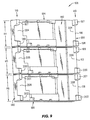
- the inner surface 150, Fig. 7, is adapted to.abut the first side 26, 46, 66 of any of the products 12, 14, 16 in the family 10 (Fig. 1).
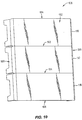
- the outer surface 152, Fig. 8, is preferably generally flat as shown and is adapted to abut the inside of a corrugated box (not shown) within which the product and packaging may be placed for shipment.
- the first side cushion 106 may comprise a first break-away portion 112, a second break-away portion 113, and a third break-away portion 114.
- the second and third break-away portions 113, 114 may be broken away (and utilized on other units if desired), leaving only the first break-away portion 112.
- the first side cushion 106, comprising only the first break-away portion 112, may then be placed on the first side 26 of a one-unit product 12 (Fig. 1).
- a two-unit product 14 (Fig.
- first side cushion 106 comprising the first and second break-away portions 112, 113, may then be placed on the first side 46 of a two-unit product 14 (Fig. 1). While the break-away portions 112, 113, 114 may be identical as shown in Figs. 7 and 8, these portions may be distinct so that the first side cushion 106 may be utilized on a product having distinct units. In other words, the break-away portions may have either identical or distinct inner surface configurations and identical or different heights H1, H2, H3, depending on the surface configuration of the product it is being used on.
- the break-away portions 112, 113, 114 may be held together by attachment portions 162, 164.
- These attachment portions 162, 164 are preferably strong enough to hold the break-away portions 112, 113, 114 together when the first side cushion 106 is utilized on a two-unit 14 or three-unit product 16 (Fig. 1), yet allow the break-away portions 112, 114, 116 to be relatively easily separated from one another.
- the first side cushion 106 may further comprise a plurality of extending portions 165, 166, 167, 168, 169, 170 on the first and second sides 158, 160 thereof.
- the first side cushion 106 may also comprise a plurality of receiving portions 172, 174, 176 on the first and second sides 158, 160 thereof.
- the receiving portions 172, 174,176 are recessed from the extending portions 165, etc., and may simply be cutouts as shown in Fig. 7.
- the second side cushion 108 may comprise an inner surface 180, an outer surface 182, a top side 184, and a bottom side 186.
- the second side cushion 108 may further comprise a first side 188 and a second side 190 which extend generally laterally to the inner and outer surfaces 180, 182.
- the inner surface 180, Fig. 9, is adapted to abut the second side 28, 48, 68 of any of the products 12, 14, 16 in the family 10 (Fig. 1).
- the outer surface 182, Fig. 10 is preferably generally flat as shown and is adapted to abut the inside of a corrugated box (not shown) within which the product and packaging may be placed for shipment.
- the second side cushion 108 may comprise a first break-away portion 116, a second break-away portion 117, and a third break-away portion 118.
- the second and third break-away portions 117, 118 may be broken away (and utilized on other units if desired), leaving only the first break-away portion 116.
- the second side cushion 108, comprising only the first break-away portion 116, may then be placed on the second side 28 of a one-unit product 12 (Fig. 1).
- a two-unit product 14 (Fig.
- the break-away portions 116, 117, 118 may then be placed on the second side 48 of a two-unit product 14 (Fig. 1). While the break-away portions 116, 117, 118 may be identical as shown in Figs. 9 and 10, these portions may be distinct so that the second side cushion 108 may be utilized on a product having distinct units. In other words, the break-away portions may have either identical or distinct inner surface configurations and identical or different heights H4, H5, H6, depending on the surface configuration of the product it is being used on.
- the heights H4, H5, H6 of the break-away portions 116, 117, 118 on the second side cushion 108 preferably correspond to the height H1, H2, H3 of the break-away portions 112, 113, 114 on the first side cushion 106 (Fig. 7) so that these cushions 106, 108 can be utilized on the same family of products.
- H1 is equal to H4, H2 is equal to H5, and H3 is equal to H6.
- the break-away portions 116, 117, 118 may be held together by attachment portions 192, 194.
- the attachment portions 192, 194 are preferably strong enough to hold the break-away portions 116, 117, 118 together when the second side cushion 108 is utilized on a two-unit 14 or three-unit product 16 (Fig. 1), yet allow the break-away portions 116, 117, 118 to be relatively easily separated from one another.
- first and second side cushions having five break-away portions may be manufactured in accordance with the present invention.
- inner surface configurations are shown in Figs. 7 and 9, it is to be understood that the inner surface 150, 180 of the first and second side cushions 106, 108, respectively, may have any surface configuration, and that this configuration may vary depending on the surface configurations of the sides of the product these cushions are being used on.
- first and second side cushions 106, 108 may be identical, if desired, making the first and second side cushions 106, 108 identical and interchangeable.
- a third side cushion and a fourth side cushion may also be provided which are adapted to be placed on the third side 30, 50, 70 and fourth side 32, 52, 72, respectively, of a product 12, 14, 16 in order to form a fully-enclosed packaging unit (not shown).
- the third side cushion and the fourth side cushion each have inner surfaces and outer surfaces which may be identical to or distinct from one another, and also may be identical to or distinct from the inner surfaces 150, 180 and outer surfaces 152, 182 of the first and second side cushions 106, 108, respectively.
- the second side cushion 108 may further comprise a plurality of extending portions 197, 198, 199, 200, 201, 202 on the first and second sides 188, 190 thereof.
- the second side cushion 108 may also comprise a plurality of receiving portions 204, 206, 208 on the first and second sides 188, 190 thereof.
- the receiving portions 204, 206, 208 are recessed from the extending portions 197, etc., and may simply be cutouts as shown in Fig. 9.
- these cushions securely, removably interlock with each other and with the top cushion and the bottom cushion to form a packaging unit as noted above and shown in Fig. 2.
- Each of the side cushions must be removed prior to removing the top and bottom cushions in order to unlock the packaging unit.
- the top side 154 (Figs. 7-8) of the first side cushion 106 is adjacent to and preferably abuts the first side 132 (Figs. 4-6) of the top cushion 102
- the bottom side 156 (Figs. 7-8) of the first side cushion 106 is adjacent to and preferably abuts the first side 132 (Figs.
- the top side 184 (Figs. 9-10) of the second side cushion 108 is adjacent to and preferably abuts the second side 134 (Figs. 4-6) of the top cushion 102
- the bottom side 186 (Figs. 9-10) of the second cushion 108 is adjacent to and preferably abuts the second side 134 (Figs. 4-6) of the bottom cushion 104.
- receiving portions 138, 142 (Figs. 4-6) on the top and bottom cushions 102, 104 receive extending portions 165, 170 (Fig. 7) on the first side cushion 106 and extending portions 197, 202 (Fig. 9) on the second side cushion 108.
- Fig. 11 illustrates a method 210 for packaging a family 10 of products 12, 14, 16 (Fig. 1).
- the first step 212 involves providing the packaging system 10 as described above. Specifically, a top cushion 102, an identical bottom cushion 104, and two side cushions 106, 108 each having a plurality of break-away portions 112, 113, 114, 116, 117, 118 are provided.
- the next step 214 involves placing the top cushion 102 on the top side 22, 42, 62 and the bottom cushion 104 on the bottom side 24, 44, 64 of one of the products 12, 14, 16.
- the next step 216 involves placing the first side cushion 106 on a first side 26, 46, 66 of one of the products 12, 14, 16 so that the first side cushion 106 interlocks with the top cushion 102 and the bottom cushion 104.
- the next step 218 involves placing the second side cushion 108 on a second side 28, 48, 68 of one of the products 12, 14, 16 so that the second side cushion 108 interlocks with the top cushion 102 and the bottom cushion 108.
- Alternative steps 220, 222 may be performed prior to the previous two steps 216, 218. These steps 220, 222 involve breaking off at least one of the break-away portions 112, 113, 114 and 116, 117, 118 of each of the first side cushion 106 and second side cushion 108, respectively. These alternative steps 220, 222 would be performed for products comprising fewer units (e.g., one or two) than the product with the most units (e.g., three) in a family.
Landscapes
- Engineering & Computer Science (AREA)
- Mechanical Engineering (AREA)
- Buffer Packaging (AREA)
- Packaging Of Machine Parts And Wound Products (AREA)
Abstract
Description
Claims (10)
- A packaging system (100) for a family (10) of products (12, 14, 16), each of said products (12, 14, 16) comprising a top side (22, 42, 62), a bottom side (24, 44, 64), a first side (26, 46, 66), a second side (28, 48, 68), a third side (30, 50, 70), and a fourth side (32, 52, 72), said packaging system (100) comprising:a) a top cushion (102) adapted to be placed on said top side (22, 42, 62) of any of said products (12, 14, 16) in said family (10);b) a bottom cushion (104) which is identical to and interchangeable with said top cushion (102), said bottom cushion (104) being adapted to be placed on said bottom side (24, 44, 64) of any of said products (12, 14, 16) in said family (10);c) a first side cushion (106) adapted to be placed on said first side (26) of a first one (12) of said products in said family (10), said first side cushion (106) comprising at least two break-away portions (112, 113, 114) which allows said first side cushion (106) to be utilized on said first side (44) of at least a second one (14) of said products in said family (10);d) a second side cushion (108) adapted to be placed on said second side (28) of said first one (12) of said products in said family (10), said second side cushion (108) comprising at least two break-away portions (116, 117, 118) which allows said second side cushion (108) to be utilized on said second side (48) of at least said second one (14) of said products in said family (10); ande) interlocking portions (110) adapted to securely, removably interlock said top cushion (102) and said bottom cushion (104) with said first side cushion (106) and said second side cushion (108) to form a packaging unit (101), wherein removing said first side cushion (106) and said second side cushion (108) unlocks said packaging unit (101).
- A packaging system (100) for a family (10) of products comprised of at least a one-unit product (12), a two-unit product (14), and a three-unit product (16), and each of said products (12, 14, 16) having a top side (22, 42, 62), a bottom side (24, 44, 64), a first side (26, 46, 66), a second side (28, 48, 68), a third side (30, 50, 70), and a fourth side (32, 52, 72), said packaging system (100) comprising:a) a top cushion (102) adapted to be placed on said top side (22, 42, 62) of any of said products (12, 14, 16) in said family (10);b) a bottom cushion (104) which is identical to and interchangeable with said top cushion (102), said bottom cushion (104) being adapted to be placed on said bottom side (24, 44, 64) of any of said products (12, 14, 16) in said family (10);c) a first side cushion (106) adapted to be placed on said first side (26, 46, 66) of any of said products (12, 14, 16) in said family (10), said first side cushion (106) comprising at least a first break-away portion (112), a second break-away portion (113), and a third break-away portion (114) which allows said first side cushion (106) to be utilized on any of said products (12, 14, 16) in said family (10), wherein said first break-away portion (112) is adapted for use on said one-unit product (12), said first break-away portion (112) and said second break-away portion (113) are adapted for use on said two-unit product (14), and said first break-away portion (112), said second break-away portion (113), and said third break-away portion (114) are adapted for use on said three-unit product (16);d) a second side cushion (108) adapted to be placed on said second side (28, 48, 68) of any of said products (12, 14, 16) in said family (10), said second side cushion (108) comprising at least a first break-away portion (116), a second break-away portion (117), and a third break-away portion (118) which allows said second side cushion (108) to be utilized on any of said products (12, 14, 16) in said family (10), wherein said first break-away portion (116) is adapted for use on said one-unit product (12), said first break-away portion (116) and said second break-away portion (117) are adapted for use on said two-unit product (14), and said first break-away portion (116), said second break-away portion (117), and said third break-away portion (118) are adapted for use on said three-unit product (16); ande) interlocking portions (110) adapted to securely, removably interlock said top cushion (102) and said bottom cushion (104) with said first side cushion (106) and said second side cushion (108) to form a packaging unit (101), wherein removing said first side cushion (106) and said second side cushion (108) unlocks said packaging unit (101).
- The packaging system (100) of claim 1, wherein:a) said first side cushion (106) comprises three break-away portions (112, 113, 114) which allow said first side cushion (106) to be utilized on said first side (66) of a third one (16) of said products in said family (10); andb) said second side cushion (108) comprises three break-away portions (116, 117, 118) which allow said second side cushion (108) to be utilized on said second side (68) of said third one (16) of said products in said family (10).
- The packaging system (100) of claim 1 or 2, said family (10) of products (12, 14, 16) being comprised of substantially identical units (18), wherein each of said break-away portions (112, 113, 114) on said first side cushion (106) are substantially identical, and each of said break-away portions (116, 117, 118) on said second side cushion (108) are substantially identical.
- The packaging system (100) of claim 1 or 2 wherein said second side cushion (108) is identical to and interchangeable with said first side cushion (106).
- The packaging system (100) of claim 1 or 2, said interlocking portions (110) comprising:a) extending portions (136, 140, 165, 166, 167, 168, 169, 170, 197, 198, 199, 200, 201, 202) on each of said top cushion (102), said bottom cushion (104), said first side cushion (106) and said second side cushion (108); andb) receiving portions (138, 142, 172, 174, 176, 204, 206, 208) on each of said top cushion (102), said bottom cushion (104), said first side cushion (106) and said second side cushion (108), said receiving portions (138, 142, 172, 174, 176, 204, 206, 208) being recessed from said extending portions (136, 140, 165, 166, 167, 168, 169, 170, 197, 198, 199, 200, 201, 202), whereby said receiving portions are adapted to receive and interlock with said extending portions.
- The packaging system (100) of claim 1, further comprising:a) a third side cushion adapted to be placed on said third side (30) of said first one (12) of said products in said family (10), said third side cushion comprising at least two break-away portions which allows said third side cushion to be utilized on said third side (50) of at least said second one (14) of said products in said family (10); andb) a fourth side cushion adapted to be placed on said fourth side (32) of said first one (12) of said products in said family (10), said fourth side cushion comprising at least two break-away portions which allows said fourth side cushion to be utilized on said fourth side (52) of at least said second one (14) of said products in said family.
- The packaging system (100) of claim 2, further comprising:a) a third side cushion adapted to be placed on said third side (30, 50, 70) of any of said products (12, 14, 16) in said family (10), said third side cushion comprising at least a first break-away portion, a second break-away portion, and a third break-away portion which allows said third side cushion to be utilized on any of said products (12, 14, 16) in said family (10), wherein said first break-away portion is adapted for use on said one-unit product (12), said first break-away portion and said second break-away portion are adapted for use on said two-unit product (14), and said first break-away portion, said second break-away portion, and said third break-away portion are adapted for use on said three-unit product (16); andb) a fourth side cushion adapted to be placed on said fourth side (32, 52, 72) of any of said products (12, 14, 16) in said family (10), said fourth side cushion comprising at least a first break-away portion, a second break-away portion, and a third break-away portion which allows said fourth side cushion to be utilized on any of said products (12, 14, 16) in said family (10), wherein said first break-away portion is adapted for use on said one-unit product (12), said first break-away portion and said second break-away portion are adapted for use on said two-unit product (14), and said first break-away portion, said second break-away portion, and said third break-away portion are adapted for use on said three-unit product (16).
- A method (210) for packaging a family (10) of products (12, 14, 16), comprising:a) (212) providing a top cushion (102), a bottom cushion (104) which is interchangeable with said top cushion (102), a first side cushion (106) and a second side cushion (108) each having a plurality of break-away portions (112, 113, 114, 116, 117, 118);b) (214) placing said top cushion (102) on the top side (22, 42, 62) of one of said products (12, 14, 16) and said bottom cushion (108) on the bottom side (24, 44, 64) of said one of said products (12, 14, 16);c) (216) placing said first side cushion (106) on a first side (26, 46, 66) of said one of said products (12, 14, 16) so that said first side cushion (106) interlocks with said top cushion (102) and said bottom cushion (104); andd) (218) placing said second side cushion (108) on a second side (28, 48, 68) of said one of said products (12, 14, 16) so that said second side cushion (108) interlocks with said top cushion (102) and said bottom cushion (104).
- The method of claim 9 further comprising, prior to the step (216) of placing said first side cushion (106) on a first side (26, 46, 66) of said one of said products (12, 14, 16):a) (220) breaking off at least one of said break-away portions (112, 113, 114) of said first side cushion (106); andb) (222) breaking off at least one of said break-away portions (116, 117, 118) of said second side cushion (108).
Applications Claiming Priority (2)
| Application Number | Priority Date | Filing Date | Title |
|---|---|---|---|
| US09/660,673 US6382422B1 (en) | 2000-09-13 | 2000-09-13 | Packaging system for a family of products |
| US660673 | 2000-09-13 |
Publications (2)
| Publication Number | Publication Date |
|---|---|
| EP1188685A2 true EP1188685A2 (en) | 2002-03-20 |
| EP1188685A3 EP1188685A3 (en) | 2003-07-16 |
Family
ID=24650499
Family Applications (1)
| Application Number | Title | Priority Date | Filing Date |
|---|---|---|---|
| EP01108627A Withdrawn EP1188685A3 (en) | 2000-09-13 | 2001-04-05 | Packaging system for a family of products |
Country Status (4)
| Country | Link |
|---|---|
| US (1) | US6382422B1 (en) |
| EP (1) | EP1188685A3 (en) |
| JP (1) | JP2002104525A (en) |
| DE (1) | DE1188685T1 (en) |
Cited By (11)
| Publication number | Priority date | Publication date | Assignee | Title |
|---|---|---|---|---|
| WO2005002989A1 (en) * | 2003-07-04 | 2005-01-13 | Fagerdala Benelus Sa | Packing element consisting of plastic foam |
| EP1600403A1 (en) * | 2004-05-29 | 2005-11-30 | BLANCO GmbH + Co KG | Packing for a sink |
| WO2007028508A1 (en) * | 2005-09-08 | 2007-03-15 | Blanco Gmbh + Co Kg | Packaging for a sink unit |
| US7240792B2 (en) | 2004-05-29 | 2007-07-10 | Blanco Gmbh + Co Kg | Packaging for a sink |
| USD546928S1 (en) | 2005-05-11 | 2007-07-17 | Blanco Gmbh + Co Kg | Sink |
| USD546929S1 (en) | 2006-03-24 | 2007-07-17 | Blanco Gmbh + Co Kg | Sink |
| USD546926S1 (en) | 2005-10-11 | 2007-07-17 | Blanco Gmbh + Co Kg | Sink |
| USD554241S1 (en) | 2005-05-11 | 2007-10-30 | Blanco Gmbh + Co Kg | Sink |
| US7478443B2 (en) | 2003-11-25 | 2009-01-20 | Blanco Gmbh + Co Kg | Apparatus for fitting a sink to a worktop |
| US7494556B2 (en) | 2002-08-16 | 2009-02-24 | Blanco Gmbh + Co Kg | Installation elements and methods for fastening an installation element to a work surface |
| EP2208688A1 (en) * | 2009-01-14 | 2010-07-21 | Blanco GmbH & Co. KG | Packaging for a sink |
Families Citing this family (16)
| Publication number | Priority date | Publication date | Assignee | Title |
|---|---|---|---|---|
| JP3709799B2 (en) * | 2001-03-14 | 2005-10-26 | ソニー株式会社 | Packing material for packaging |
| US6868965B2 (en) * | 2002-10-09 | 2005-03-22 | Dell Products L.P. | Method and system for multi-product packaging |
| US20040211409A1 (en) * | 2003-04-25 | 2004-10-28 | Mary Ellet | Adjustable, protective and decorative hearth guard |
| US20040211408A1 (en) * | 2003-04-25 | 2004-10-28 | Mary Ellet | Adjustable, protective and decorative hearth guard |
| US6976587B2 (en) * | 2003-12-02 | 2005-12-20 | International Business Machines Corporation | Flexible interlocking-column packaging assembly |
| JP4984594B2 (en) * | 2006-03-28 | 2012-07-25 | 船井電機株式会社 | Packing equipment set |
| TW200811006A (en) * | 2006-08-29 | 2008-03-01 | Aopen Inc | Packaging cushion and cushion assembly |
| EP2102069A1 (en) * | 2006-12-15 | 2009-09-23 | Kohler Co. | Panel packaging system |
| US20080277312A1 (en) * | 2007-05-07 | 2008-11-13 | International Business Machines Corporation | Reconfigurable Packaging Material and Packages |
| CN201472843U (en) * | 2009-07-08 | 2010-05-19 | 鸿富锦精密工业(深圳)有限公司 | Packing pad |
| JP5550381B2 (en) * | 2010-02-26 | 2014-07-16 | 日立コンシューマエレクトロニクス株式会社 | Package containing flat display device and package of flat display device |
| CN102556505A (en) * | 2010-12-31 | 2012-07-11 | 鸿富锦精密工业(深圳)有限公司 | Packaging device |
| TW201408552A (en) * | 2012-08-27 | 2014-03-01 | Hon Hai Prec Ind Co Ltd | Packing device |
| US10577146B2 (en) * | 2017-03-31 | 2020-03-03 | Proxibid, Inc. | Overbox packaging system |
| JP7844839B2 (en) * | 2021-11-08 | 2026-04-14 | 京セラドキュメントソリューションズ株式会社 | Packaging materials |
| JP2024014432A (en) * | 2022-07-22 | 2024-02-01 | 京セラドキュメントソリューションズ株式会社 | Packing materials |
Family Cites Families (10)
| Publication number | Priority date | Publication date | Assignee | Title |
|---|---|---|---|---|
| US3410474A (en) * | 1967-05-10 | 1968-11-12 | Keil Brothers Inc | Protective corner pad for packing |
| DE2007542A1 (en) * | 1970-02-19 | 1971-09-09 | Norddeutsche Mende Rundfunk Kg, 2800 Bremen | Packaging cushion made of foamed plastic |
| US3938661A (en) * | 1974-10-17 | 1976-02-17 | Republic Packaging Corporation | Packing brace |
| IT1077140B (en) * | 1977-02-17 | 1985-05-04 | Eurodomestici Ind Riunite | PACKAGING FOR OBJECTS IN THE FORM OF A PARALLELEPIPED OR A CUBE, ESPECIALLY FOR DOMESTIC APPLIANCES |
| DE3408614A1 (en) * | 1984-03-09 | 1985-09-19 | Dynamit Nobel Ag, 5210 Troisdorf | Reusable package with a pallet |
| JPS6312474A (en) * | 1986-07-04 | 1988-01-19 | 株式会社日立製作所 | Buffer packaging structure |
| US5398808A (en) * | 1994-07-20 | 1995-03-21 | Umax Data System Inc. | Buffer device for packings |
| JPH10291566A (en) * | 1997-04-16 | 1998-11-04 | Nobuaki Shiromoto | Cushioning material with groove for folding and cutting off |
| US6003706A (en) * | 1998-09-17 | 1999-12-21 | Polyfoam Packers Corporation | Adjustable depth insulated container |
| US6082543A (en) * | 1999-12-06 | 2000-07-04 | Polyform A.G.P. Inc. | Packing protector |
-
2000
- 2000-09-13 US US09/660,673 patent/US6382422B1/en not_active Expired - Fee Related
-
2001
- 2001-04-05 EP EP01108627A patent/EP1188685A3/en not_active Withdrawn
- 2001-04-05 DE DE1188685T patent/DE1188685T1/en active Pending
- 2001-08-23 JP JP2001252604A patent/JP2002104525A/en active Pending
Cited By (21)
| Publication number | Priority date | Publication date | Assignee | Title |
|---|---|---|---|---|
| US7494556B2 (en) | 2002-08-16 | 2009-02-24 | Blanco Gmbh + Co Kg | Installation elements and methods for fastening an installation element to a work surface |
| WO2005002989A1 (en) * | 2003-07-04 | 2005-01-13 | Fagerdala Benelus Sa | Packing element consisting of plastic foam |
| US7478443B2 (en) | 2003-11-25 | 2009-01-20 | Blanco Gmbh + Co Kg | Apparatus for fitting a sink to a worktop |
| EP1600403A1 (en) * | 2004-05-29 | 2005-11-30 | BLANCO GmbH + Co KG | Packing for a sink |
| US7753208B2 (en) | 2004-05-29 | 2010-07-13 | Blanco Gmbh + Co Kg | Packaging for a sink |
| US7240792B2 (en) | 2004-05-29 | 2007-07-10 | Blanco Gmbh + Co Kg | Packaging for a sink |
| USD551743S1 (en) | 2005-05-11 | 2007-09-25 | Blanco Gmbh + Co. Kg | Sink |
| USD547835S1 (en) | 2005-05-11 | 2007-07-31 | Blanco Gmbh + Co Kg | Sink |
| USD547840S1 (en) | 2005-05-11 | 2007-07-31 | Blanco Gmbh + Co Kg | Sink |
| USD547837S1 (en) | 2005-05-11 | 2007-07-31 | Blanco Gmbh + Co Kg | Sink |
| USD547836S1 (en) | 2005-05-11 | 2007-07-31 | Blanco Gmbh + Co Kg | Sink |
| USD547834S1 (en) | 2005-05-11 | 2007-07-31 | Blanco Gmbh + Co Kg | Sink |
| USD547842S1 (en) | 2005-05-11 | 2007-07-31 | Blanco Gmbh + Co Kg | Sink |
| USD546927S1 (en) | 2005-05-11 | 2007-07-17 | Blanco Gmbh + Co Kg | Sink |
| USD547841S1 (en) | 2005-05-11 | 2007-07-31 | Blanco Gmbh + Co Kg | Sink |
| USD546928S1 (en) | 2005-05-11 | 2007-07-17 | Blanco Gmbh + Co Kg | Sink |
| USD554241S1 (en) | 2005-05-11 | 2007-10-30 | Blanco Gmbh + Co Kg | Sink |
| WO2007028508A1 (en) * | 2005-09-08 | 2007-03-15 | Blanco Gmbh + Co Kg | Packaging for a sink unit |
| USD546926S1 (en) | 2005-10-11 | 2007-07-17 | Blanco Gmbh + Co Kg | Sink |
| USD546929S1 (en) | 2006-03-24 | 2007-07-17 | Blanco Gmbh + Co Kg | Sink |
| EP2208688A1 (en) * | 2009-01-14 | 2010-07-21 | Blanco GmbH & Co. KG | Packaging for a sink |
Also Published As
| Publication number | Publication date |
|---|---|
| JP2002104525A (en) | 2002-04-10 |
| US6382422B1 (en) | 2002-05-07 |
| EP1188685A3 (en) | 2003-07-16 |
| DE1188685T1 (en) | 2002-10-02 |
Similar Documents
| Publication | Publication Date | Title |
|---|---|---|
| US6382422B1 (en) | Packaging system for a family of products | |
| US6186328B1 (en) | Nestable can tray with contoured wall structure | |
| US6006912A (en) | Nestable crate for beverage bottles | |
| CA2274538C (en) | Modular loose egg cooling, storage and transport system and method | |
| MXPA06003470A (en) | Modular packaging system for shipping and displaying palletized retail products. | |
| US5813536A (en) | Packaging structure for a bundle of panels | |
| HUP0103608A2 (en) | Pallet stacking device | |
| US4579489A (en) | Interlocking, stacking and nesting container system | |
| US20110278198A1 (en) | Edge protector with transverse weakness for easy separation of protector when one stack is lifted from another | |
| EP1325871B1 (en) | Palletized tray system | |
| KR101809842B1 (en) | Pallet for transporting tire wheels of vehicle | |
| US3137388A (en) | Shipping apparatus | |
| US5845768A (en) | Packing for rubber and other commodities | |
| JP4105306B2 (en) | Transport container | |
| CN1070804C (en) | Nestable display crate | |
| JP2001130571A (en) | Pallet for carriage | |
| EP1837284A1 (en) | Stackable containing means | |
| KR200149468Y1 (en) | Fruit box using laminated panel | |
| JP5205178B2 (en) | Connecting container | |
| JP3133834U (en) | Food tray | |
| EP0449062B1 (en) | Support structure for cardboard containers to be handled by fork lift trucks | |
| JP3201581B2 (en) | Skid palette | |
| JP2003267372A (en) | Thin metal plate transport pallet | |
| WO2003047986A1 (en) | Container | |
| US20040022609A1 (en) | Method and apparatus for transporting a group of containers |
Legal Events
| Date | Code | Title | Description |
|---|---|---|---|
| PUAI | Public reference made under article 153(3) epc to a published international application that has entered the european phase |
Free format text: ORIGINAL CODE: 0009012 |
|
| AK | Designated contracting states |
Kind code of ref document: A2 Designated state(s): AT BE CH CY DE DK ES FI FR GB GR IE IT LI LU MC NL PT SE TR |
|
| AX | Request for extension of the european patent |
Free format text: AL;LT;LV;MK;RO;SI |
|
| EL | Fr: translation of claims filed | ||
| DET | De: translation of patent claims | ||
| PUAL | Search report despatched |
Free format text: ORIGINAL CODE: 0009013 |
|
| AK | Designated contracting states |
Designated state(s): AT BE CH CY DE DK ES FI FR GB GR IE IT LI LU MC NL PT SE TR |
|
| AX | Request for extension of the european patent |
Extension state: AL LT LV MK RO SI |
|
| 17P | Request for examination filed |
Effective date: 20030904 |
|
| AKX | Designation fees paid |
Designated state(s): DE FR GB |
|
| 17Q | First examination report despatched |
Effective date: 20040803 |
|
| GRAP | Despatch of communication of intention to grant a patent |
Free format text: ORIGINAL CODE: EPIDOSNIGR1 |
|
| STAA | Information on the status of an ep patent application or granted ep patent |
Free format text: STATUS: THE APPLICATION IS DEEMED TO BE WITHDRAWN |
|
| 18D | Application deemed to be withdrawn |
Effective date: 20051025 |