EP1187463A2 - Image processing method and recording medium thereof - Google Patents
Image processing method and recording medium thereof Download PDFInfo
- Publication number
- EP1187463A2 EP1187463A2 EP01307720A EP01307720A EP1187463A2 EP 1187463 A2 EP1187463 A2 EP 1187463A2 EP 01307720 A EP01307720 A EP 01307720A EP 01307720 A EP01307720 A EP 01307720A EP 1187463 A2 EP1187463 A2 EP 1187463A2
- Authority
- EP
- European Patent Office
- Prior art keywords
- media
- color
- white
- device side
- white point
- Prior art date
- Legal status (The legal status is an assumption and is not a legal conclusion. Google has not performed a legal analysis and makes no representation as to the accuracy of the status listed.)
- Granted
Links
- 238000003672 processing method Methods 0.000 title claims description 9
- 238000000034 method Methods 0.000 claims abstract description 53
- 230000009466 transformation Effects 0.000 claims abstract description 48
- 230000004456 color vision Effects 0.000 claims abstract description 29
- 238000004737 colorimetric analysis Methods 0.000 claims abstract description 21
- 230000006978 adaptation Effects 0.000 claims description 16
- 239000003086 colorant Substances 0.000 claims description 13
- 230000001131 transforming effect Effects 0.000 claims description 6
- 230000014509 gene expression Effects 0.000 description 10
- 230000004044 response Effects 0.000 description 9
- 230000016776 visual perception Effects 0.000 description 6
- 238000013507 mapping Methods 0.000 description 4
- 238000005516 engineering process Methods 0.000 description 2
- 230000001105 regulatory effect Effects 0.000 description 2
- 241001270131 Agaricus moelleri Species 0.000 description 1
- 238000010521 absorption reaction Methods 0.000 description 1
- 230000007547 defect Effects 0.000 description 1
- 238000006073 displacement reaction Methods 0.000 description 1
- 239000011159 matrix material Substances 0.000 description 1
- 238000005457 optimization Methods 0.000 description 1
- 238000011426 transformation method Methods 0.000 description 1
- 230000000007 visual effect Effects 0.000 description 1
Images


Classifications
-
- H—ELECTRICITY
- H04—ELECTRIC COMMUNICATION TECHNIQUE
- H04N—PICTORIAL COMMUNICATION, e.g. TELEVISION
- H04N1/00—Scanning, transmission or reproduction of documents or the like, e.g. facsimile transmission; Details thereof
- H04N1/46—Colour picture communication systems
- H04N1/56—Processing of colour picture signals
- H04N1/60—Colour correction or control
- H04N1/6097—Colour correction or control depending on the characteristics of the output medium, e.g. glossy paper, matt paper, transparency or fabrics
-
- H—ELECTRICITY
- H04—ELECTRIC COMMUNICATION TECHNIQUE
- H04N—PICTORIAL COMMUNICATION, e.g. TELEVISION
- H04N1/00—Scanning, transmission or reproduction of documents or the like, e.g. facsimile transmission; Details thereof
- H04N1/46—Colour picture communication systems
- H04N1/56—Processing of colour picture signals
- H04N1/60—Colour correction or control
- H04N1/603—Colour correction or control controlled by characteristics of the picture signal generator or the picture reproducer
- H04N1/6052—Matching two or more picture signal generators or two or more picture reproducers
Definitions
- the present invention relates to a correction based on media white points in case of creating data used in a color matching process.
- Fig. 1 is a conceptional view showing a general color matching process executed among different devices.
- Input data being R (red), G (green) and B (blue) data is transformed to X, Y and Z data on a color space not depending on the device, by an input profile. Since colors other than colors in a color reproduction range (gamut) of an output device can not be represented by the output device, color gamut mapping is executed to the input data to obtain data on the color space not depending on the device such that all of the colors can be included in the color reproduction range of the output device. After executing the color gamut mapping, the input data is transformed from the data on the color space not depending on the device to C (cyan), M (magenta), Y (yellow) and K (black) data on a color space depending on the output device.
- a reference white point and environment light are fixed.
- PCS Profile Connection Space
- XYZ values i.e., X, Y and Z values
- Lab values under the reference of D50. Therefore, correct color reproduction for input originals and print outputs can be guaranteed in case of performing observation under a light source of which characteristic is defined by the reference of D50, and the correct color reproduction can not be guaranteed under a light source of other characteristics.
- the XYZ values for the sample to be observed are naturally differed in their values.
- transformation systems such as a prediction expression and the like according to (1) ratio transformation, (2) Von Kries transformation, (3) color perception model, and the like.
- the ratio transformation is such a method of performing a ratio transformation of W2/W1 in order to transform XYZ values under a reference white point W1 to XYZ values under a reference white point W2.
- this method is adopted to a Lab uniform color space, Lab values under the W1 coincide with Lab values under the W2.
- XYZ values for a sample under the W1(Xw1, Yw1, Zw1) are assumed as XYZ values (X1, Y1, Z1)
- XYZ values for a sample under the W2(Xw2, Yw2, Zw2) are assumed as XYZ values (X2, Y2, Z2)
- X2 (Xw2/Xw1) ⁇ X1
- Y2 (Yw2/Yw1) ⁇ Y1
- Z2 (Zw2/Zw1) ⁇ Z1
- the Von Kries transformation is such a method of performing a ratio transformation of W2'/W1' on a human's color perception space PQR in order to transform the XYZ values under the W1 to the XYZ values under the W2.
- this method is adopted to the Lab uniform color space, the Lab values under the W1 are not coincided with the Lab values under the W2.
- the prediction expression according to the color perception model is a method of performing transformation by utilizing, for example, a human's color perception space QMH (or JCH) such as a space related in the CIECAM97s in order to transform XYZ values under an observation condition VC1 (including W1) to XYZ values under an observation condition VC2 (including W2).
- QMH a human's color perception space
- QMH denotes brightness
- M denotes colorfulness
- symbol H denotes huequadrature or hueangle
- Symbol J in the abbreviation JCH denotes lightness
- symbol C denotes chroma
- symbol H denotes huequadrature or hueangle.
- This phenomenon occurs due to a fact that human's visual perception is adapted to the color of white. And, if the XYZ values under the same light source are only to be coincided, the XYZ values for the color to be printed may be coincided, however, the whiteness in paper in a background is remained in different state, and there is possibility of overlapping the color on a white background.
- the black points represented on media are different from each other according to each device.
- the person perceives the blackness on the paper as "black”. Therefore, it is considered that the human's visual perception is also adapted to the color of black.
- Problems in the color matching process executed among devices having different color reproduction ranges can be avoided by the color gamut mapping technology.
- a dark portion adjacent to the black point there sometimes occurred blocked up color (or broken color) even if the color gamut mapping technology is used.
- the expression (4) and the expression (5) are both based on the ratio transformation on a XYZ color space, the obtained result was not fitted to the human's color perception. Furthermore, the expression (4) has a defect that chromaticity of the white point is varied due to the XYZ values of the black point.
- An object of the present invention is to solve these problems.
- the present invention has the following constitution.
- An image processing method of creating transformation data used in transformation performed between data on a color space depending on a device and data on a color space not depending on a device is characterized in that a colorimetry value of a sample is corrected on a human's color perception space on the basis of a media white point, and the transformation data is created on the basis of the corrected colorimetry value.
- An image processing method of creating transformation data used in a color matching process executed between a source device and a destination device is characterized in that a white point correction for transforming colors on media at the source device side to colors on media at the destination device side is performed on a human's color perception space on the basis of white points on media at the source device side and white points on media at the destination device side.
- a recording medium for recording a program of realizing an image processing method of creating transformation data used in transformation performed between data on a color space depending on a device and data on a color space not depending on a device is characterized in that a colorimetry value of a sample is corrected on a human's color perception space on the basis of a media white point, and a program for creating the transformation data on the basis of the corrected colorimetry value is recorded.
- a recording medium for recording a program of realizing an image processing method of creating transformation data used in a color matching process executed between a source device and a destination device is characterized in that a program for performing a white point correction for transforming colors on media at the source device side to colors on media at the destination device side on a human's color perception space on the basis of white points on media at the source device side and white points on media at the destination device side is recorded.
- color of a sample outputted by the printer is measured.
- a colorimetry value is corrected on a color perception space on the basis of the relationship between the "white point of light source” and the “media white point” and the relationship between the "black point of light source” and the “media black point”.
- the profile is created on the basis of the corrected colorimetry value.
- values of the "media white point” and the "media black point colorimetry values corresponding to the above definition are used.
- the creation of the profile and the color matching process are realized in a manner that a CPU uses a RAM as a work memory on the basis of an OS stored in a ROM and a application program used for realizing the following processes on a personal computer connected to, for example, a target device and a colorimeter.
- Figs. 2A and 2B are views where a result (Fig. 2A) obtained by performing a correction according to a white point on medium is compared with a result (Fig. 2B) obtained by performing a correction according to the white point and a black point on medium.
- the left side indicates a source device side and the right side indicates a destination device side.
- a white point correction or a black point correction is performed to colorimetry values (X, Y, Z) obtained by the colorimeter, then the ICC profile is created using colorimetry values (X', Y', Z') to which the correction was performed.
- a target scene is limited on medium, it is understood that human's color perception is adapted to the white point on medium rather than adapted to the white point of light source. Also, as to the black point on medium, it is similarly understood that the human's color perception is adapted to the black point on medium.
- a color space PQR transformed by the 3 ⁇ 3 matrix [M] corresponds to human's cone-response for the white point.
- the color adaptation model for adapting the human's visual perception to the white point and the black point on medium can be fetched. That is, when the white point on medium is assumed as MW1(Xmw1, Ymw1, Zmw1), the black point on medium is assumed as MK1(Xmk1, Ymk1, Zmk1), the white point of light source on the PCS under the reference of D50 is assumed as IW2(Xiw2, Yiw2, Ziw2) and the black point (0, 0, 0) of light source on the PCS is assumed as IK2(Xik2, Yik2, Zik2), the relationship between the sample (X1, Y1, Z1) on medium and the sample (X2, Y2, Z2) on the PCS is indicated as follows, for example, if the Von Kries transformation is used as the color adaptation model.
- the color transformation can be performed such that gray scales (color arrangement of connecting white point with black point) on different media are coincided with each other on the human's color perception space, and the color matching process more approximate to the human's color perception can be realized.
- the expressions (6), (9) and (10) indicate a case that a process is executed through the PCS.
- the white point at the source device side can be corresponded to the white point at the destination device side
- the black point at the source device side can be corresponded to the black point at the destination device side not through the PCS.
- the colorimetry value under each observation condition is stored as it is without storing the PCS value, and this method is used in a color matching module (CMM) which performs the color matching process by utilizing that information.
- CCMM color matching module
- the white point on medium at the source device side is assumed as MW1(Xmw1, Ymw1, Zmw1)
- the black point on medium at the source device side is assumed as MK1(Xmk1, Ymk1, Zmk1)
- the white point on medium at the destination device side is assumed as MW2(Xmw2, Ymw2, Zmw2)
- the black point on medium at the destination device side is assumed as MK2(Xmk2, Ymk2, Zmk2)
- the relationship between the sample (X1, Y1, Z1) on medium at the source device side and the sample (X2, Y2, Z2) on medium at the destination device side is indicated as follows, for example, if the Von Kries transformation is used as the color adaptation model.
- the Von Kries transformation is utilized as the color adaptation model, however, the Bradford transformation can be also utilized.
- D F - F/[1 + 2(L A 1/4 ) + (L A 2 )/300]
- Rc [D(1.0/(Rw-Rk)) + 1 - D](R - Rk)
- Gc [D(1.0/(Gw-Gk)) + 1 - D](G - Gk)
- Bc [D(1.0/(Bw-Bk) P ) + 1 - D]
- p ((Bw-Bk)/1.0) 0.0834
- D F - F/[1 + 2(L A 1/4 ) + (L A 2 )/300] is utilized.
- Rw, Gw, and Bw indicate R, G and B for the white point on medium
- Rk, Gk, and Bk indicate R, G and B for the black point on medium.
- the similar displacement is performed in a color adaptation transformation of a CIECAM97s inverse transformation.
- the profile it may be structured that a user can select whether or not the white point correction and the black point correction are performed for the colorimetry value, on the user interface (Fig. 3) of setting a profile creation condition.
- category of the color adaptation model or the color perception model used in the white point correction and the black point correction can be selected. Accordingly, the correction according to a user's preference and a using purpose can be realized.
- the white point correction and the black point correction are performed for the white points and the black points on media at the source device side and the white points and the black points on media at the destination device side as processing condition of the color matching process by using the interface as shown in Fig. 4.
- category of the color adaptation model or the color perception model to be adopted in the correction can be selected.
- the color matching process more approximate to the human's color perception can be executed also among media having different white points by utilizing the color adaptation model such as the Von Kries transformation or the like, or the color perception model such as the CIECAM97s or the like in the white point correction performed among the media.
- the color adaptation model such as the Von Kries transformation or the like
- the color perception model such as the CIECAM97s or the like in the white point correction performed among the media.
- color reproducibility of a dark portion can be improved by performing not only the white point correction but also the black point correction on the human's color perception space.
Landscapes
- Engineering & Computer Science (AREA)
- Multimedia (AREA)
- Signal Processing (AREA)
- Facsimile Image Signal Circuits (AREA)
- Color Image Communication Systems (AREA)
- Image Processing (AREA)
Abstract
Description
- The present invention relates to a correction based on media white points in case of creating data used in a color matching process.
- Fig. 1 is a conceptional view showing a general color matching process executed among different devices. Input data being R (red), G (green) and B (blue) data is transformed to X, Y and Z data on a color space not depending on the device, by an input profile. Since colors other than colors in a color reproduction range (gamut) of an output device can not be represented by the output device, color gamut mapping is executed to the input data to obtain data on the color space not depending on the device such that all of the colors can be included in the color reproduction range of the output device. After executing the color gamut mapping, the input data is transformed from the data on the color space not depending on the device to C (cyan), M (magenta), Y (yellow) and K (black) data on a color space depending on the output device.
- In the color matching process, a reference white point and environment light are fixed. For example, in profiles regulated by ICC (International Color Consortium), PCS (Profile Connection Space) for connecting profiles has XYZ values (i.e., X, Y and Z values) and Lab values under the reference of D50. Therefore, correct color reproduction for input originals and print outputs can be guaranteed in case of performing observation under a light source of which characteristic is defined by the reference of D50, and the correct color reproduction can not be guaranteed under a light source of other characteristics.
- In case of observing the same sample (e.g., an image) under different light sources, the XYZ values for the sample to be observed are naturally differed in their values. In order to make a prediction of the XYZ values under the different light sources, there are transformation systems such as a prediction expression and the like according to (1) ratio transformation, (2) Von Kries transformation, (3) color perception model, and the like.
- The ratio transformation is such a method of performing a ratio transformation of W2/W1 in order to transform XYZ values under a reference white point W1 to XYZ values under a reference white point W2. When this method is adopted to a Lab uniform color space, Lab values under the W1 coincide with Lab values under the W2. For example, when XYZ values for a sample under the W1(Xw1, Yw1, Zw1) are assumed as XYZ values (X1, Y1, Z1), and XYZ values for a sample under the W2(Xw2, Yw2, Zw2) are assumed as XYZ values (X2, Y2, Z2), following relationship is obtained according to the ratio transformation.
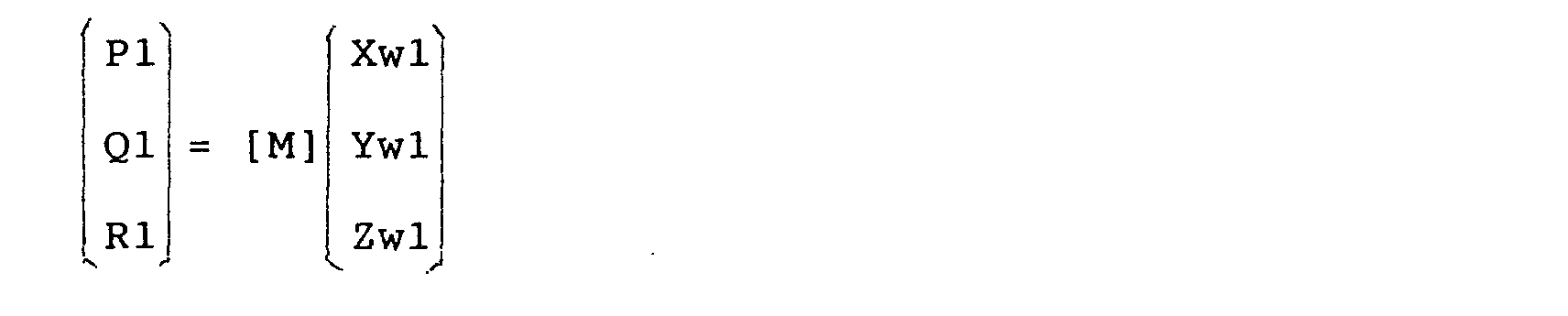
- The Von Kries transformation is such a method of performing a ratio transformation of W2'/W1' on a human's color perception space PQR in order to transform the XYZ values under the W1 to the XYZ values under the W2. When this method is adopted to the Lab uniform color space, the Lab values under the W1 are not coincided with the Lab values under the W2. For example, when the XYZ values for the sample under the W1(Xw1, Yw1, Zw1) are assumed as the XYZ values (X1, Y1, Z1), and the XYZ values for the sample under the W2(Xw2, Yw2, Zw2) are assumed as the XYZ values (X2, Y2, Z2), following relationship is obtained according to the Von Kries transformation.where,



- The prediction expression according to the color perception model is a method of performing transformation by utilizing, for example, a human's color perception space QMH (or JCH) such as a space related in the CIECAM97s in order to transform XYZ values under an observation condition VC1 (including W1) to XYZ values under an observation condition VC2 (including W2). Where, symbol Q in the abbreviation QMH denotes brightness, symbol M denotes colorfulness and symbol H denotes huequadrature or hueangle. Symbol J in the abbreviation JCH denotes lightness, symbol C denotes chroma and symbol H denotes huequadrature or hueangle.
- For example, when the XYZ values for the sample under the W1(Xw1, Yw1, Zw1) are assumed as the XYZ values (X1, Y1, Z1), and the XYZ values for the sample under the W2(Xw2, Yw2, Zw2) are assumed as the XYZ values (X2, Y2, Z2), the following transformation is performed according to the color perception model.
- That is,
transformation] → (Q, M, H) or (J, C, H) → [CIECAM97s
inverse transformation] → (X2, Y2, Z2) - However, the above description depends on a case that the sample is represented on ideal media (white point on medium corresponds to complete reflection and black point on medium corresponds to complete absorption), while the media actually used have different conditions.
- For example, since colors displayed on a monitor are represented by light source colors, a white point on medium for color data of R = G = B = 225 can be considered as relative brightness of Y = 100%, however, a black point on medium for color data of R = G = B = 0 does not correspond to relative brightness of Y = 0%. Since color of printed matter corresponds to color of the object (or objective color), whiteness in paper represented by C = M = Y = K = 0% has a certain reflection ratio γ, therefore, the relative brightness of Y = 100% can not be obtained. Even color represented by C = M = Y = K = 100% being the most dark color is not resulted in the relative brightness of Y = 0%.
- Since the whiteness in paper of the printed matter does not have characteristic of complete reflection, it does not coincide with the white point (e.g., D50) of light source to be irradiated. Similarly, black (C = M = Y = K = 100%) available in a device does not exist on a gray axis of the light source (chroma identical to that of the light source) to be irradiated.
- Hereinafter, a white point (color corresponding to R = G = B = 255 in an RGB device, and corresponding to C = M - Y = K = 0% in a CMYK device) represented on medium of each device is defined as "media white point". A black point (color corresponding to R = G = B = 0 in the RGB device, and corresponding to C = M = Y = K = 100% in the CMYK device) represented on medium of each device is defined as "media black point".
- As in the above description, since "white point of light source", "media white point", "black point of light source" and "media black point" are different, in case of performing comparison of images on different media under the same light source, there sometimes occurs a case that impressions of those images are different from each other. For example, in a case where white points on media are different from each other such as white points on a blank (white) paper and newspaper (or a recycled paper), when those media are laterally arranged for the comparison, it is obviously recognized by a person that the whiteness in paper are different from each other. However, in case of individually performing the comparison for each of media, even if a media white point is considerably different from other media white points, like the newspaper, the person perceives the whiteness on a paper as "white". This phenomenon occurs due to a fact that human's visual perception is adapted to the color of white. And, if the XYZ values under the same light source are only to be coincided, the XYZ values for the color to be printed may be coincided, however, the whiteness in paper in a background is remained in different state, and there is possibility of overlapping the color on a white background.
- Similarly, with respect to the media black point, the black points represented on media are different from each other according to each device. In case of individually performing the comparison for each of media, even if the black points on media are different from each other, the person perceives the blackness on the paper as "black". Therefore, it is considered that the human's visual perception is also adapted to the color of black. Problems in the color matching process executed among devices having different color reproduction ranges can be avoided by the color gamut mapping technology. However, with respect to a dark portion adjacent to the black point, there sometimes occurred blocked up color (or broken color) even if the color gamut mapping technology is used.
- In order to solve these problems, it is required to execute the color matching process not only coinciding the XYZ values under the same light source but also considering the media white point and the media black point.
- In the conventional white point correction and black point correction performed on media, there utilized a simple method of executing a scaling process in accordance with brightness (or reflection ratio) after correcting the XYZ values of the sample by using the black point. That is, when a white point on medium is assumed as MW1(Xmw1, Ymw1, Zmw1) and a black point on medium is assumed as MK1(Xmk1, Ymk1, Zmk1), the relationship between the sample (X1, Y1, Z1) on medium and the correction sample (X2, Y2, Z2) was indicated as follows:
- "White point correction and black point correction on
media"
-
- In the profile regulated by the ICC, in case of representing the XYZ values for the sample on medium on the PCS (D50), it is recommended that the XYZ values are to be relative relation to the media white point. However, that transformation method is not yet established, and a simple method as mentioned below has been used (ICC specification). That is, when a white point on medium is assumed as MW2(Xmw2, Ymw2, Zmw2), and a white point of the light source on the PCS is assumed as IW3(Xiw3, Yiw3, Ziw3), the relationship between the sample (X2, Y2, Z2) on medium and a sample (X3, Y3, Z3) on the PCS was indicated as follows:
- "Correction from white points on media to white points
on PCS (D50)"
-
- However, since the expression (4) and the expression (5) are both based on the ratio transformation on a XYZ color space, the obtained result was not fitted to the human's color perception. Furthermore, the expression (4) has a defect that chromaticity of the white point is varied due to the XYZ values of the black point.
- That is, in the color matching process executed among media having different white points and different black points, there were the following problems:
- how the color matching process executed among the media having different white points is to be treated; and
- how the color matching process executed among the media having different black points is to be treated.
-
- An object of the present invention is to solve these problems.
- To achieve the above object, the present invention has the following constitution.
- An image processing method of creating transformation data used in transformation performed between data on a color space depending on a device and data on a color space not depending on a device is characterized in that a colorimetry value of a sample is corrected on a human's color perception space on the basis of a media white point, and the transformation data is created on the basis of the corrected colorimetry value.
- An image processing method of creating transformation data used in a color matching process executed between a source device and a destination device is characterized in that a white point correction for transforming colors on media at the source device side to colors on media at the destination device side is performed on a human's color perception space on the basis of white points on media at the source device side and white points on media at the destination device side.
- A recording medium for recording a program of realizing an image processing method of creating transformation data used in transformation performed between data on a color space depending on a device and data on a color space not depending on a device is characterized in that a colorimetry value of a sample is corrected on a human's color perception space on the basis of a media white point, and a program for creating the transformation data on the basis of the corrected colorimetry value is recorded.
- A recording medium for recording a program of realizing an image processing method of creating transformation data used in a color matching process executed between a source device and a destination device is characterized in that a program for performing a white point correction for transforming colors on media at the source device side to colors on media at the destination device side on a human's color perception space on the basis of white points on media at the source device side and white points on media at the destination device side is recorded.
- The above and other objects of the present invention will become apparent from the following detailed description in conjunction with the attached drawings.
-
- Fig. 1 is a view for explaining a color matching process;
- Figs. 2A and 2B are views for explaining a white point correction and a black point correction;
- Fig. 3 is a view indicating a user interface for performing setting related to the white point correction and the black point correction under a condition of forming profiles; and
- Fig. 4 is a view indicating a user interface for performing setting related to the white point correction and the black point correction under a condition of executing the color matching process.
-
- Hereinafter, a method of considering the relationship between "white point of light source" and "media white point" and the relationship between "black point of light source" and "media black point" in case of creating a profile used in a color matching process will be explained.
- For example, in the creation of a profile of a printer, color of a sample outputted by the printer is measured. A colorimetry value is corrected on a color perception space on the basis of the relationship between the "white point of light source" and the "media white point" and the relationship between the "black point of light source" and the "media black point". Then, the profile is created on the basis of the corrected colorimetry value. As values of the "media white point" and the "media black point", colorimetry values corresponding to the above definition are used.
- The creation of the profile and the color matching process are realized in a manner that a CPU uses a RAM as a work memory on the basis of an OS stored in a ROM and a application program used for realizing the following processes on a personal computer connected to, for example, a target device and a colorimeter.
- Figs. 2A and 2B are views where a result (Fig. 2A) obtained by performing a correction according to a white point on medium is compared with a result (Fig. 2B) obtained by performing a correction according to the white point and a black point on medium. In Figs. 2A and 2B, the left side indicates a source device side and the right side indicates a destination device side.
- In order to realize the color matching process considering white points and black points on media on an ICC profile, a white point correction or a black point correction is performed to colorimetry values (X, Y, Z) obtained by the colorimeter, then the ICC profile is created using colorimetry values (X', Y', Z') to which the correction was performed.
- If a target scene is limited on medium, it is understood that human's color perception is adapted to the white point on medium rather than adapted to the white point of light source. Also, as to the black point on medium, it is similarly understood that the human's color perception is adapted to the black point on medium.
- In a method of transforming the white point on medium to the white point on the PCS (D50), it is assumed that human's visual perception is adapted to the media white point, and a color adaptation model is adopted. That is, when the white point on medium is assumed as MW2(Xmw2, Ymw2, Zmw2), and the white point of light source on the PCS under the reference of D50 is assumed as IW3(Xiw3, Yiw3, Ziw3), the relationship between the sample (X2, Y2, Z2) on medium and the sample (X3, Y3, Z3) on the PCS is indicated as follows, for example, if the Von Kries transformation is used as the color adaptation model.where,


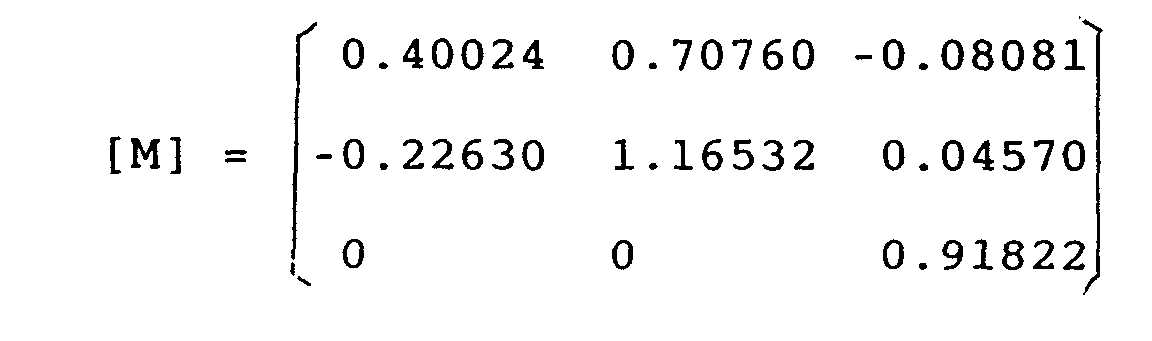

- Where, a color space PQR transformed by the 3 × 3 matrix [M] corresponds to human's cone-response for the white point.
- In case of performing only the white point correction as in Fig. 2A, since the white point on medium is transformed to the white point under the reference of D50, it is understood that lightness of the black point on the PCS (Lab) is increased due to the correction. This phenomenon does not become a problem in a case where brightness (or reflection ratio) of the white point on medium at the source device side is almost same as that at the destination device side, however, if the difference in the brightness becomes larger, this situation causes a black floating (fogging) phenomenon or the like.
- On the other hand, in case of performing the white point correction and the black point correction as in Fig. 2B, since the white point and the black point at the source device side coincide with the white point and the black point at the destination device side, a visual dynamic range can be kept and the black floating (fogging) phenomenon can be prevented.
- In the Von Kries transformation, when cone-response for a white point under a light source IA is assumed to be defined as (Pw, Qw, Rw), and cone-response for arbitrary color N under the light source IA is assumed to be defined as (P, Q, R), the following relationship is to be formed between the cone-response (Pw, Qw, Rw) and cone-response (Pw', Qw', Rw') for a white point under a light source IB, and between the cone-response (P, Q, R) and cone-response (P', Q', R') for arbitrary color N under the light source IB.
- Expanding this relationship, when the influence by cone-response (Pk, Qk, Rk) for a black point under the light source IA and cone-response (Pk', Qk', Rk') for a black point under the light source IB is considered, the following relationship is given.
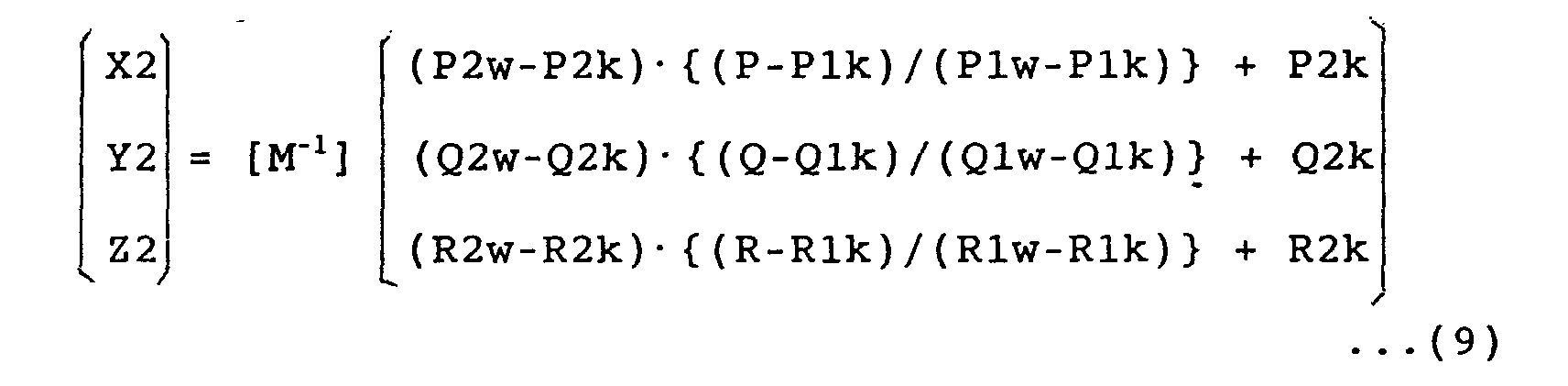
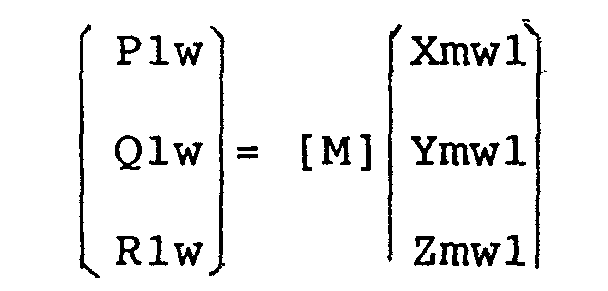
- When the above relationship is adopted to a method of transforming the white point and the black point on medium to those on the PCS (D50), the color adaptation model for adapting the human's visual perception to the white point and the black point on medium can be fetched. That is, when the white point on medium is assumed as MW1(Xmw1, Ymw1, Zmw1), the black point on medium is assumed as MK1(Xmk1, Ymk1, Zmk1), the white point of light source on the PCS under the reference of D50 is assumed as IW2(Xiw2, Yiw2, Ziw2) and the black point (0, 0, 0) of light source on the PCS is assumed as IK2(Xik2, Yik2, Zik2), the relationship between the sample (X1, Y1, Z1) on medium and the sample (X2, Y2, Z2) on the PCS is indicated as follows, for example, if the Von Kries transformation is used as the color adaptation model.where,

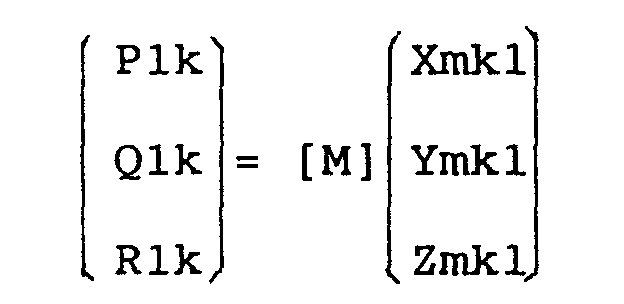


- Also, the expression (9) can be modified as follows.where,


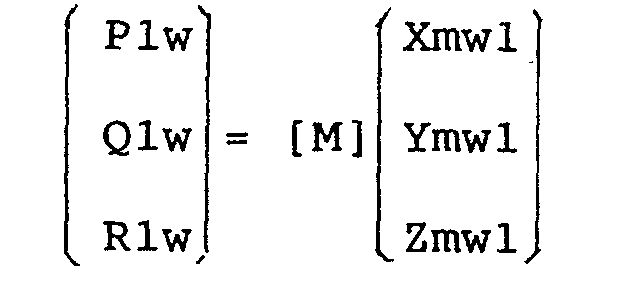
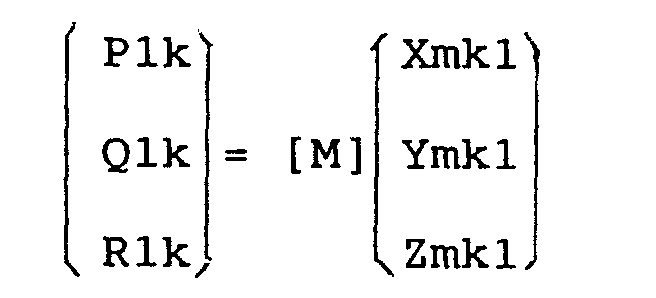

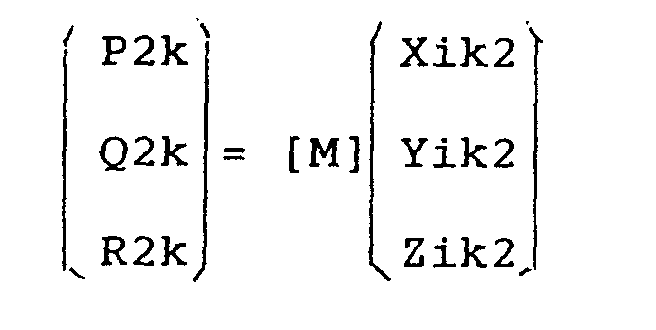

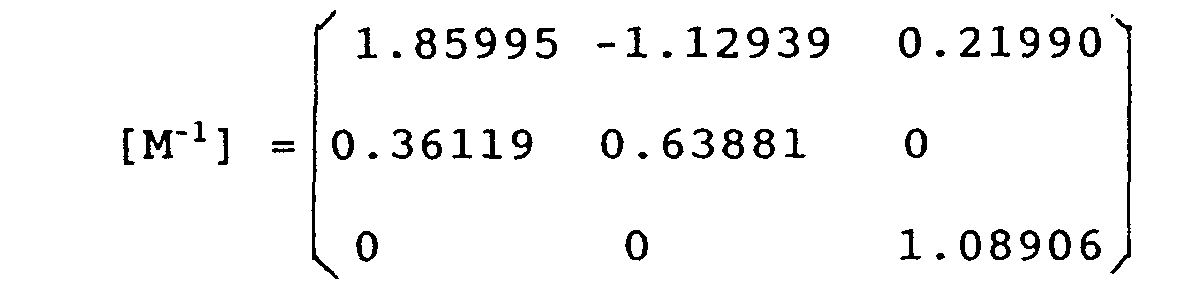
- As above, by creating a profile using the white point correction and the black point correction of the present embodiment according to the white point and the black point on media, the color transformation can be performed such that gray scales (color arrangement of connecting white point with black point) on different media are coincided with each other on the human's color perception space, and the color matching process more approximate to the human's color perception can be realized.
- In the above embodiment, the expressions (6), (9) and (10) indicate a case that a process is executed through the PCS. However, the white point at the source device side can be corresponded to the white point at the destination device side, and the black point at the source device side can be corresponded to the black point at the destination device side not through the PCS. With respect to the above method, in a private tag or the like of the ICC profile, the colorimetry value under each observation condition is stored as it is without storing the PCS value, and this method is used in a color matching module (CMM) which performs the color matching process by utilizing that information.
- In a method of converting the white points on media at the source device side to the white points on media at the destination device side, it is assumed that the human's visual perception is adapted to the white point on each of media, and the color adaptation model is adopted. That is, when the white point on medium at the source device side is assumed as MW1(Xmw1, Ymw1, Zmw1), and the white point on medium at the destination device side is assumed as MW2(Xmw2, Ymw2, Zmw2), the relationship between the sample (X1, Y1, Z1) on medium at the source device side and the sample (X2, Y2, Z2) on medium at the destination device side is indicated as follows, for example, if the Von Kries transformation is used as the color adaptation model.where,

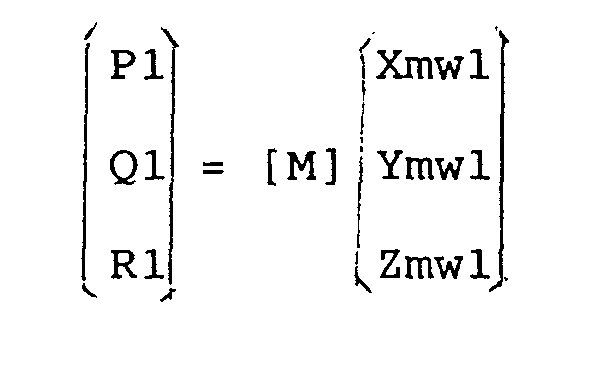
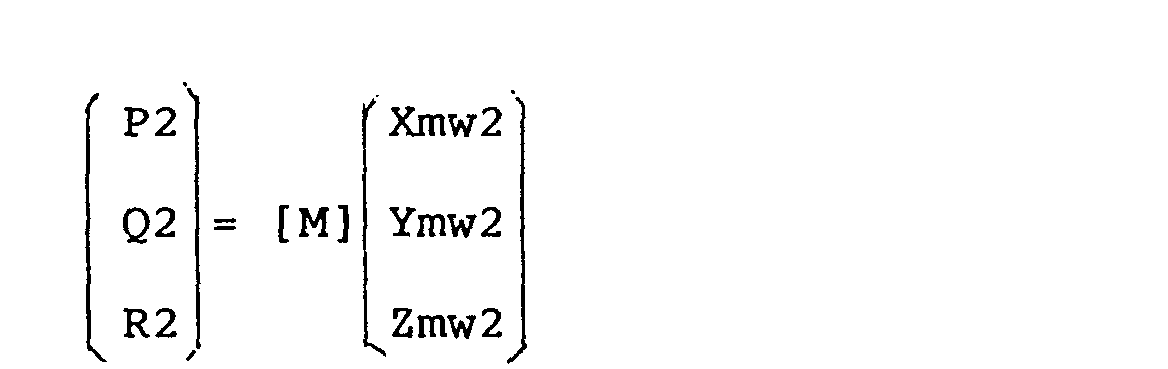
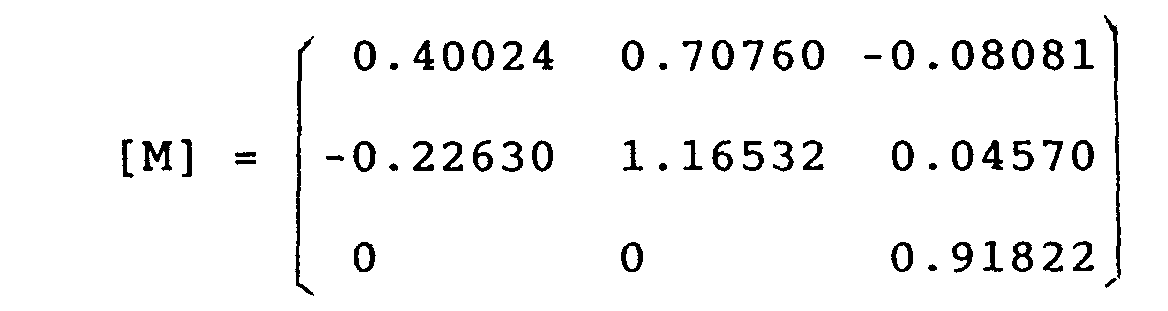

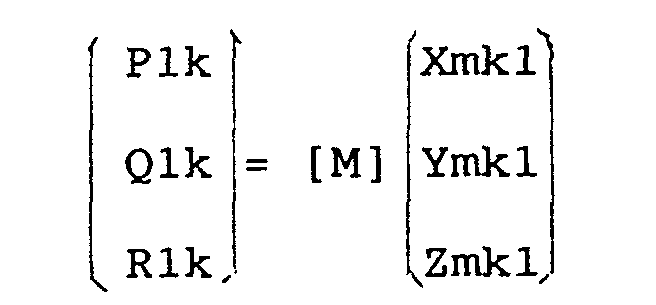
- In a method of converting the white points and the black points on media at the source device side to the white points and the black points on media at the destination device side, it is assumed that the human's visual perception is adapted to the white points and the black points on media, and the color adaptation model is adopted. That is, when the white point on medium at the source device side is assumed as MW1(Xmw1, Ymw1, Zmw1), the black point on medium at the source device side is assumed as MK1(Xmk1, Ymk1, Zmk1), the white point on medium at the destination device side is assumed as MW2(Xmw2, Ymw2, Zmw2) and the black point on medium at the destination device side is assumed as MK2(Xmk2, Ymk2, Zmk2), the relationship between the sample (X1, Y1, Z1) on medium at the source device side and the sample (X2, Y2, Z2) on medium at the destination device side is indicated as follows, for example, if the Von Kries transformation is used as the color adaptation model.where,

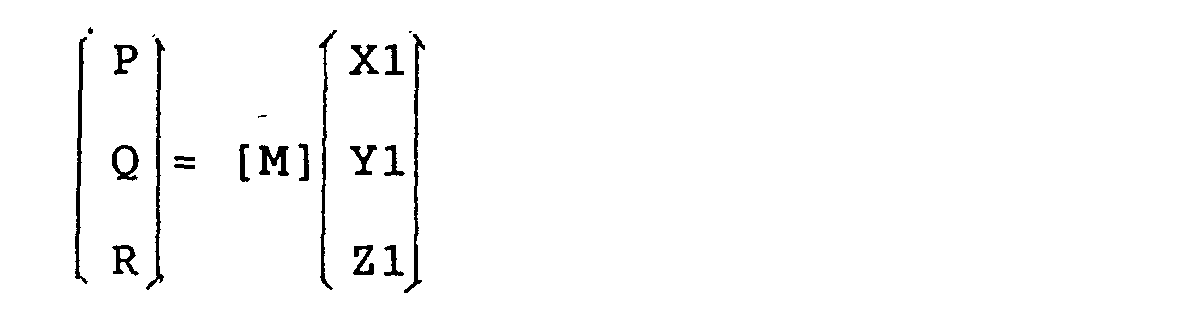
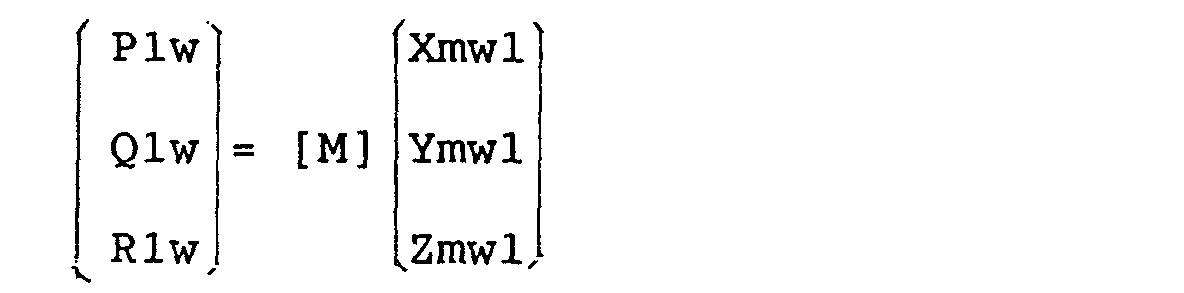

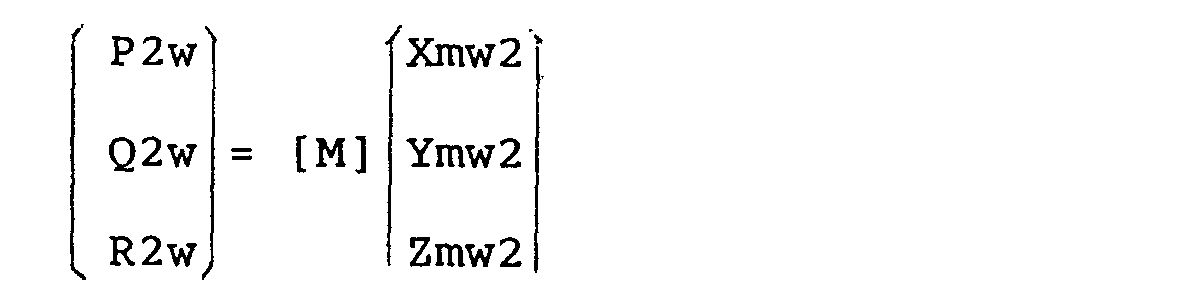

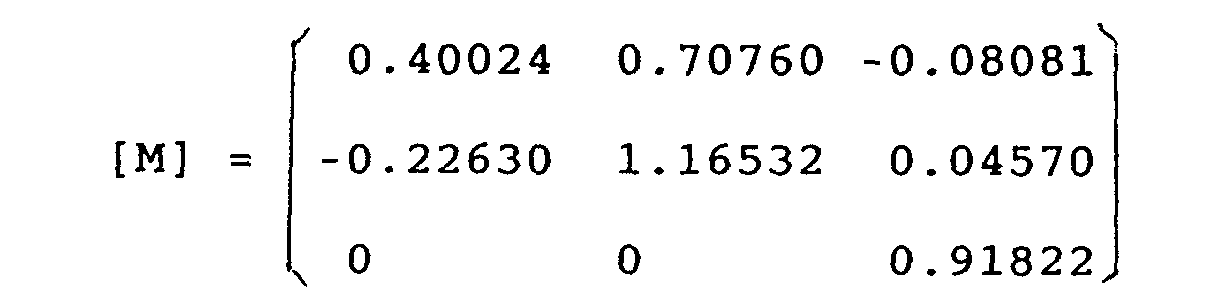

- The expression (12) can be modified as follows.where,





- In the above embodiment, the Von Kries transformation is utilized as the color adaptation model, however, the Bradford transformation can be also utilized.
- In case of utilizing the Bradford transformation, instead of the 3x3 matrices [M] and [M-1] in the expressions (6), (9) and (10), and the expressions (11), (12) and (13), the following 3x3 matrices [MB] and [MB -1] are adopted.


- In case of adopting the CIECAM97s as a color perception model by utilizing the color perception model instead of the color adaptation model, the following method is adopted in a color adaptation transformation of a CIECAM97s forward transformation.
- Instead of D = F - F/[1 + 2(LA 1/4) + (LA 2)/300],
- Here, Rw, Gw, and Bw indicate R, G and B for the white point on medium,- and Rk, Gk, and Bk indicate R, G and B for the black point on medium. Also, in a color adaptation transformation of a CIECAM97s inverse transformation, the similar displacement is performed.
- In case of creating the profile, it may be structured that a user can select whether or not the white point correction and the black point correction are performed for the colorimetry value, on the user interface (Fig. 3) of setting a profile creation condition.
- In Fig. 3, since the white point correction and the black point correction are the processes for the colorimetry value as mentioned above, it is possible to set as "colorimetry value options".
- As other options, it may be structured that "category regarding optimization" and "accuracy" for the selection of a creating method can be selected as a creation condition of a profile (LUT) to be created on the basis of the colorimetry value.
- Furthermore, it may be structured that category of the color adaptation model or the color perception model used in the white point correction and the black point correction can be selected. Accordingly, the correction according to a user's preference and a using purpose can be realized.
- Furthermore, in the condition of "in case of executing process not through PCS", it may be structured that it can be selected whether or not the white point correction and the black point correction are performed for the white points and the black points on media at the source device side and the white points and the black points on media at the destination device side as processing condition of the color matching process by using the interface as shown in Fig. 4. Also, it may be structured that category of the color adaptation model or the color perception model to be adopted in the correction can be selected.
- According to the each embodiment explained in the above description, the color matching process more approximate to the human's color perception can be executed also among media having different white points by utilizing the color adaptation model such as the Von Kries transformation or the like, or the color perception model such as the CIECAM97s or the like in the white point correction performed among the media.
- Furthermore, color reproducibility of a dark portion can be improved by performing not only the white point correction but also the black point correction on the human's color perception space.
- As above, the present invention has been explained on the basis of the preferred embodiment. However, the present invention is not limited to the above embodiment, but may be modified in various manners within the spirit and scope of the appended claims.
Claims (9)
- An image processing method of creating transformation data used in transformation performed between data on a color space depending on a device and data on a color space not depending on a device,
wherein a colorimetry value of a sample is corrected on a human's color perception space on the basis of a media white point, and the transformation data is created on the basis of the corrected colorimetry value. - A method according to Claim 1, wherein the colorimetry value of the sample is corrected on the basis of the media white point and a media black point.
- A method according to Claim 1, wherein it is set whether or not correction of the media white point is performed on the basis of an instruction given by a user.
- A method according to Claim 1, wherein a method used in the correction can be selected among plural methods.
- A method according to Claim 1, wherein the plural methods include a color adaptation model and a color perception model.
- An image processing method of creating transformation data used in a color matching process executed between a source device and a destination device,
wherein a white point correction for transforming colors on media at the source device side to colors on media at the destination device side is performed on a human's color perception space on the basis of white points on media at the source device side and white points on media at the destination device side. - A method according to Claim 6, wherein a black point correction is further performed on a human's color perception space on the basis of black points on media at the source device side and black points on media at the destination device side.
- A recording medium for recording a program of realizing an image processing method of creating transformation data used in transformation performed between data on a color space depending on a device and data on a color space not depending on a device,
wherein a colorimetry value of a sample is corrected on a human's color perception space on the basis of a media white point, and a program for creating the transformation data on the basis of the corrected colorimetry value is recorded. - A recording medium for recording a program of realizing an image processing method of creating transformation data used in a color matching process executed between a source device and a destination device,
wherein a program for performing a white point correction for transforming colors on media at the source device side to colors on media at the destination device side on a human's color perception space on the basis of white points on media at the source device side and white points on media at the destination device side is recorded.
Applications Claiming Priority (2)
| Application Number | Priority Date | Filing Date | Title |
|---|---|---|---|
| JP2000276478 | 2000-09-12 | ||
| JP2000276478A JP3420560B2 (en) | 2000-09-12 | 2000-09-12 | Image processing method and recording medium |
Publications (3)
| Publication Number | Publication Date |
|---|---|
| EP1187463A2 true EP1187463A2 (en) | 2002-03-13 |
| EP1187463A3 EP1187463A3 (en) | 2003-01-29 |
| EP1187463B1 EP1187463B1 (en) | 2013-07-31 |
Family
ID=18761934
Family Applications (1)
| Application Number | Title | Priority Date | Filing Date |
|---|---|---|---|
| EP01307720.1A Expired - Lifetime EP1187463B1 (en) | 2000-09-12 | 2001-09-11 | Image processing method and recording medium thereof |
Country Status (3)
| Country | Link |
|---|---|
| US (1) | US6760108B2 (en) |
| EP (1) | EP1187463B1 (en) |
| JP (1) | JP3420560B2 (en) |
Cited By (1)
| Publication number | Priority date | Publication date | Assignee | Title |
|---|---|---|---|---|
| WO2023191884A1 (en) * | 2022-03-29 | 2023-10-05 | Hewlett-Packard Development Company, L.P. | Print color adjustment |
Families Citing this family (13)
| Publication number | Priority date | Publication date | Assignee | Title |
|---|---|---|---|---|
| JP4652535B2 (en) * | 2000-07-25 | 2011-03-16 | キヤノン株式会社 | Image processing apparatus and method |
| JP3890211B2 (en) * | 2001-09-14 | 2007-03-07 | キヤノン株式会社 | Image processing method, image processing apparatus, program, and storage medium |
| JP4111699B2 (en) * | 2001-09-27 | 2008-07-02 | 富士フイルム株式会社 | Image processing apparatus, image processing method, and program for executing the method |
| US7068380B2 (en) * | 2001-12-21 | 2006-06-27 | Microsoft Corporation | Print media catalog service |
| JP3984852B2 (en) | 2002-04-02 | 2007-10-03 | キヤノン株式会社 | Color processing apparatus and method |
| JP2007329770A (en) | 2006-06-08 | 2007-12-20 | Canon Inc | Image processing apparatus and image processing method |
| JP4666069B2 (en) * | 2008-02-18 | 2011-04-06 | 富士ゼロックス株式会社 | Color correction coefficient generating apparatus and program |
| JP4623137B2 (en) * | 2008-05-14 | 2011-02-02 | 富士ゼロックス株式会社 | Color processing apparatus, method and program |
| JP2010102398A (en) * | 2008-10-21 | 2010-05-06 | Riso Kagaku Corp | Printer driver program, printing controller and printing system |
| WO2010084560A1 (en) * | 2009-01-23 | 2010-07-29 | 日本電気株式会社 | Image processing method, image processing device and recording medium |
| US8666190B1 (en) | 2011-02-01 | 2014-03-04 | Google Inc. | Local black points in aerial imagery |
| KR102047355B1 (en) * | 2016-07-14 | 2019-11-21 | 휴렛-팩커드 디벨롭먼트 컴퍼니, 엘.피. | Image forming apparatus and control method thereof |
| US10777167B2 (en) | 2019-02-05 | 2020-09-15 | Sergey N. Bezryadin | Color image display adaptation to ambient light |
Citations (3)
| Publication number | Priority date | Publication date | Assignee | Title |
|---|---|---|---|---|
| EP0753752A1 (en) | 1995-07-11 | 1997-01-15 | UNION SWITCH & SIGNAL Inc. | Apparatus and method for sensing motionlessness in a vehicle |
| EP1009161A2 (en) | 1998-12-07 | 2000-06-14 | Sony Corporation | Image-processing apparatus and image-processing method |
| US6108442A (en) | 1997-06-27 | 2000-08-22 | Minnesota Mining And Manufacturing Company | Characterization of color imaging systems |
Family Cites Families (8)
| Publication number | Priority date | Publication date | Assignee | Title |
|---|---|---|---|---|
| US5416890A (en) * | 1991-12-11 | 1995-05-16 | Xerox Corporation | Graphical user interface for controlling color gamut clipping |
| EP0604755B1 (en) * | 1992-12-15 | 1999-05-12 | E.I. Du Pont De Nemours And Company | Color matching method and apparatus |
| JPH07222011A (en) * | 1994-01-31 | 1995-08-18 | Canon Inc | Color reproduction range expression method and image processing method and apparatus |
| US5699491A (en) | 1995-06-15 | 1997-12-16 | Canon Information Systems, Inc. | Printer driver having gamut-mapped colors |
| US5754448A (en) | 1995-07-12 | 1998-05-19 | Minnesota Mining And Manufacturing Company | System and method for color characterization and transformation |
| US6480299B1 (en) * | 1997-11-25 | 2002-11-12 | University Technology Corporation | Color printer characterization using optimization theory and neural networks |
| JP2001036758A (en) | 1999-07-16 | 2001-02-09 | Fuji Photo Film Co Ltd | Color correction processing method and device therefor |
| EP1079606A3 (en) | 1999-08-11 | 2003-07-09 | Canon Kabushiki Kaisha | Color space adjustment for multiple different substrates |
-
2000
- 2000-09-12 JP JP2000276478A patent/JP3420560B2/en not_active Expired - Lifetime
-
2001
- 2001-09-07 US US09/947,394 patent/US6760108B2/en not_active Expired - Lifetime
- 2001-09-11 EP EP01307720.1A patent/EP1187463B1/en not_active Expired - Lifetime
Patent Citations (3)
| Publication number | Priority date | Publication date | Assignee | Title |
|---|---|---|---|---|
| EP0753752A1 (en) | 1995-07-11 | 1997-01-15 | UNION SWITCH & SIGNAL Inc. | Apparatus and method for sensing motionlessness in a vehicle |
| US6108442A (en) | 1997-06-27 | 2000-08-22 | Minnesota Mining And Manufacturing Company | Characterization of color imaging systems |
| EP1009161A2 (en) | 1998-12-07 | 2000-06-14 | Sony Corporation | Image-processing apparatus and image-processing method |
Cited By (1)
| Publication number | Priority date | Publication date | Assignee | Title |
|---|---|---|---|---|
| WO2023191884A1 (en) * | 2022-03-29 | 2023-10-05 | Hewlett-Packard Development Company, L.P. | Print color adjustment |
Also Published As
| Publication number | Publication date |
|---|---|
| US20020057434A1 (en) | 2002-05-16 |
| JP2002094811A (en) | 2002-03-29 |
| EP1187463A3 (en) | 2003-01-29 |
| JP3420560B2 (en) | 2003-06-23 |
| US6760108B2 (en) | 2004-07-06 |
| EP1187463B1 (en) | 2013-07-31 |
Similar Documents
| Publication | Publication Date | Title |
|---|---|---|
| EP1047263B1 (en) | Color image reproduction with accurate inside-gamut colors and enhanced outside-gamut colors | |
| EP1301025B1 (en) | Color correction table forming method and apparatus, control program and storage medium | |
| EP1187463A2 (en) | Image processing method and recording medium thereof | |
| EP2421240B1 (en) | Image processing apparatus and image processing method | |
| US8116561B2 (en) | Color processing apparatus and method | |
| US7312891B2 (en) | Image processing method and apparatus | |
| EP2421242B1 (en) | Print controlling terminal and method for compensating colors | |
| EP1085749B1 (en) | Image processing method and apparatus | |
| EP1854276B1 (en) | Color processing method and color processing device | |
| JP3984852B2 (en) | Color processing apparatus and method | |
| US20060232803A1 (en) | Image processing method, profile creation method, and image processing apparatus | |
| EP1892949A2 (en) | Image processor, computer readable medium storing image processing program, and image processing method | |
| JP2012253774A (en) | Color printing method and color printing system | |
| JP4466037B2 (en) | Image processing apparatus and image processing method | |
| US20040160642A1 (en) | Color printer and control method thereof | |
| JP2008042711A (en) | Color converter, color converting method, color conversion program, color conversion coefficient creating apparatus, color conversion coefficient creating method, and color conversion coefficient creation program | |
| US8988748B2 (en) | Output profile for colour reproduction system | |
| JP4411228B2 (en) | Color processing method and apparatus | |
| KR100517510B1 (en) | ICC profile generating method | |
| JP2009165056A (en) | Color gamut standardization method and color data conversion apparatus for printing apparatus | |
| JP4983509B2 (en) | Image processing apparatus, image forming apparatus, and program | |
| JP4858097B2 (en) | Image processing device | |
| JP2009165055A (en) | Color data conversion method and apparatus | |
| JP2008147828A (en) | 2-color printing data creation method |
Legal Events
| Date | Code | Title | Description |
|---|---|---|---|
| PUAI | Public reference made under article 153(3) epc to a published international application that has entered the european phase |
Free format text: ORIGINAL CODE: 0009012 |
|
| AK | Designated contracting states |
Kind code of ref document: A2 Designated state(s): AT BE CH CY DE DK ES FI FR GB GR IE IT LI LU MC NL PT SE TR |
|
| AX | Request for extension of the european patent |
Free format text: AL;LT;LV;MK;RO;SI |
|
| PUAL | Search report despatched |
Free format text: ORIGINAL CODE: 0009013 |
|
| AK | Designated contracting states |
Designated state(s): AT BE CH CY DE DK ES FI FR GB GR IE IT LI LU MC NL PT SE TR |
|
| AX | Request for extension of the european patent |
Extension state: AL LT LV MK RO SI |
|
| 17P | Request for examination filed |
Effective date: 20030612 |
|
| AKX | Designation fees paid |
Designated state(s): DE FR GB IT |
|
| 17Q | First examination report despatched |
Effective date: 20090123 |
|
| GRAP | Despatch of communication of intention to grant a patent |
Free format text: ORIGINAL CODE: EPIDOSNIGR1 |
|
| RIN1 | Information on inventor provided before grant (corrected) |
Inventor name: OHGA, MANABU |
|
| GRAS | Grant fee paid |
Free format text: ORIGINAL CODE: EPIDOSNIGR3 |
|
| GRAA | (expected) grant |
Free format text: ORIGINAL CODE: 0009210 |
|
| AK | Designated contracting states |
Kind code of ref document: B1 Designated state(s): DE FR GB IT |
|
| REG | Reference to a national code |
Ref country code: GB Ref legal event code: FG4D |
|
| REG | Reference to a national code |
Ref country code: DE Ref legal event code: R096 Ref document number: 60148193 Country of ref document: DE Effective date: 20130926 |
|
| PG25 | Lapsed in a contracting state [announced via postgrant information from national office to epo] |
Ref country code: IT Free format text: LAPSE BECAUSE OF FAILURE TO SUBMIT A TRANSLATION OF THE DESCRIPTION OR TO PAY THE FEE WITHIN THE PRESCRIBED TIME-LIMIT Effective date: 20130731 |
|
| PLBE | No opposition filed within time limit |
Free format text: ORIGINAL CODE: 0009261 |
|
| STAA | Information on the status of an ep patent application or granted ep patent |
Free format text: STATUS: NO OPPOSITION FILED WITHIN TIME LIMIT |
|
| REG | Reference to a national code |
Ref country code: FR Ref legal event code: ST Effective date: 20140530 |
|
| 26N | No opposition filed |
Effective date: 20140502 |
|
| REG | Reference to a national code |
Ref country code: DE Ref legal event code: R097 Ref document number: 60148193 Country of ref document: DE Effective date: 20140502 |
|
| PG25 | Lapsed in a contracting state [announced via postgrant information from national office to epo] |
Ref country code: FR Free format text: LAPSE BECAUSE OF NON-PAYMENT OF DUE FEES Effective date: 20130930 |
|
| PGFP | Annual fee paid to national office [announced via postgrant information from national office to epo] |
Ref country code: GB Payment date: 20170929 Year of fee payment: 17 |
|
| PGFP | Annual fee paid to national office [announced via postgrant information from national office to epo] |
Ref country code: DE Payment date: 20171130 Year of fee payment: 17 |
|
| REG | Reference to a national code |
Ref country code: DE Ref legal event code: R119 Ref document number: 60148193 Country of ref document: DE |
|
| GBPC | Gb: european patent ceased through non-payment of renewal fee |
Effective date: 20180911 |
|
| PG25 | Lapsed in a contracting state [announced via postgrant information from national office to epo] |
Ref country code: DE Free format text: LAPSE BECAUSE OF NON-PAYMENT OF DUE FEES Effective date: 20190402 |
|
| PG25 | Lapsed in a contracting state [announced via postgrant information from national office to epo] |
Ref country code: GB Free format text: LAPSE BECAUSE OF NON-PAYMENT OF DUE FEES Effective date: 20180911 |