EP1187381A2 - Method and apparatus for receiving digital broadcast transmissions using different receiving modes - Google Patents
Method and apparatus for receiving digital broadcast transmissions using different receiving modes Download PDFInfo
- Publication number
- EP1187381A2 EP1187381A2 EP01306337A EP01306337A EP1187381A2 EP 1187381 A2 EP1187381 A2 EP 1187381A2 EP 01306337 A EP01306337 A EP 01306337A EP 01306337 A EP01306337 A EP 01306337A EP 1187381 A2 EP1187381 A2 EP 1187381A2
- Authority
- EP
- European Patent Office
- Prior art keywords
- card
- receiving
- digital broadcasting
- limited
- limited receiving
- Prior art date
- Legal status (The legal status is an assumption and is not a legal conclusion. Google has not performed a legal analysis and makes no representation as to the accuracy of the status listed.)
- Withdrawn
Links
Images




Classifications
-
- H—ELECTRICITY
- H04—ELECTRIC COMMUNICATION TECHNIQUE
- H04N—PICTORIAL COMMUNICATION, e.g. TELEVISION
- H04N21/00—Selective content distribution, e.g. interactive television or video on demand [VOD]
- H04N21/40—Client devices specifically adapted for the reception of or interaction with content, e.g. set-top-box [STB]; Operations thereof
- H04N21/41—Structure of client; Structure of client peripherals
- H04N21/418—External card to be used in combination with the client device, e.g. for conditional access
-
- H—ELECTRICITY
- H04—ELECTRIC COMMUNICATION TECHNIQUE
- H04H—BROADCAST COMMUNICATION
- H04H60/00—Arrangements for broadcast applications with a direct linking to broadcast information or broadcast space-time; Broadcast-related systems
- H04H60/09—Arrangements for device control with a direct linkage to broadcast information or to broadcast space-time; Arrangements for control of broadcast-related services
- H04H60/14—Arrangements for conditional access to broadcast information or to broadcast-related services
- H04H60/23—Arrangements for conditional access to broadcast information or to broadcast-related services using cryptography, e.g. encryption, authentication, key distribution
-
- H—ELECTRICITY
- H04—ELECTRIC COMMUNICATION TECHNIQUE
- H04H—BROADCAST COMMUNICATION
- H04H60/00—Arrangements for broadcast applications with a direct linking to broadcast information or broadcast space-time; Broadcast-related systems
- H04H60/09—Arrangements for device control with a direct linkage to broadcast information or to broadcast space-time; Arrangements for control of broadcast-related services
- H04H60/14—Arrangements for conditional access to broadcast information or to broadcast-related services
- H04H60/16—Arrangements for conditional access to broadcast information or to broadcast-related services on playing information
-
- H—ELECTRICITY
- H04—ELECTRIC COMMUNICATION TECHNIQUE
- H04N—PICTORIAL COMMUNICATION, e.g. TELEVISION
- H04N21/00—Selective content distribution, e.g. interactive television or video on demand [VOD]
- H04N21/40—Client devices specifically adapted for the reception of or interaction with content, e.g. set-top-box [STB]; Operations thereof
- H04N21/41—Structure of client; Structure of client peripherals
- H04N21/418—External card to be used in combination with the client device, e.g. for conditional access
- H04N21/4181—External card to be used in combination with the client device, e.g. for conditional access for conditional access
-
- H—ELECTRICITY
- H04—ELECTRIC COMMUNICATION TECHNIQUE
- H04N—PICTORIAL COMMUNICATION, e.g. TELEVISION
- H04N21/00—Selective content distribution, e.g. interactive television or video on demand [VOD]
- H04N21/40—Client devices specifically adapted for the reception of or interaction with content, e.g. set-top-box [STB]; Operations thereof
- H04N21/43—Processing of content or additional data, e.g. demultiplexing additional data from a digital video stream; Elementary client operations, e.g. monitoring of home network or synchronising decoder's clock; Client middleware
- H04N21/436—Interfacing a local distribution network, e.g. communicating with another STB or one or more peripheral devices inside the home
-
- H—ELECTRICITY
- H04—ELECTRIC COMMUNICATION TECHNIQUE
- H04N—PICTORIAL COMMUNICATION, e.g. TELEVISION
- H04N21/00—Selective content distribution, e.g. interactive television or video on demand [VOD]
- H04N21/40—Client devices specifically adapted for the reception of or interaction with content, e.g. set-top-box [STB]; Operations thereof
- H04N21/43—Processing of content or additional data, e.g. demultiplexing additional data from a digital video stream; Elementary client operations, e.g. monitoring of home network or synchronising decoder's clock; Client middleware
- H04N21/442—Monitoring of processes or resources, e.g. detecting the failure of a recording device, monitoring the downstream bandwidth, the number of times a movie has been viewed, the storage space available from the internal hard disk
-
- H—ELECTRICITY
- H04—ELECTRIC COMMUNICATION TECHNIQUE
- H04N—PICTORIAL COMMUNICATION, e.g. TELEVISION
- H04N21/00—Selective content distribution, e.g. interactive television or video on demand [VOD]
- H04N21/40—Client devices specifically adapted for the reception of or interaction with content, e.g. set-top-box [STB]; Operations thereof
- H04N21/45—Management operations performed by the client for facilitating the reception of or the interaction with the content or administrating data related to the end-user or to the client device itself, e.g. learning user preferences for recommending movies, resolving scheduling conflicts
- H04N21/462—Content or additional data management e.g. creating a master electronic programme guide from data received from the Internet and a Head-end or controlling the complexity of a video stream by scaling the resolution or bit-rate based on the client capabilities
- H04N21/4622—Retrieving content or additional data from different sources, e.g. from a broadcast channel and the Internet
-
- H—ELECTRICITY
- H04—ELECTRIC COMMUNICATION TECHNIQUE
- H04N—PICTORIAL COMMUNICATION, e.g. TELEVISION
- H04N7/00—Television systems
- H04N7/16—Analogue secrecy systems; Analogue subscription systems
- H04N7/167—Systems rendering the television signal unintelligible and subsequently intelligible
-
- H—ELECTRICITY
- H04—ELECTRIC COMMUNICATION TECHNIQUE
- H04N—PICTORIAL COMMUNICATION, e.g. TELEVISION
- H04N7/00—Television systems
- H04N7/16—Analogue secrecy systems; Analogue subscription systems
- H04N7/167—Systems rendering the television signal unintelligible and subsequently intelligible
- H04N7/1675—Providing digital key or authorisation information for generation or regeneration of the scrambling sequence
Definitions
- the present invention relates to a digital broadcasting receiving apparatus, and a method for receiving digital broadcasting.
- Embodiments of the present invention relate to a digital broadcasting receiving apparatus and the like structured in such a manner that it identifies to what limited receiving mode an integrated circuit (IC) card, mounted to an integrated circuit (IC) card interface section thereof, for controlling contract information and scramble key information necessary for limited receiving processing corresponds.
- the apparatus performs limited receiving processing for the above-described digital data using the contract information and the scramble key information controlled by this IC card.
- This structure makes it possible to provide a receiving apparatus for receiving digital broadcasting signals from a plurality of broadcasting companies in different limited receiving modes from each other at low cost.
- Embodiments of the present invention can provide a digital broadcasting receiving apparatus and the like capable of structuring a receiving apparatus for receiving digital broadcasting signals from a plurality of broadcasting companies in different limited receiving modes from each other at low cost.
- a digital broadcasting receiving apparatus includes: a receiver for selectively receiving a plurality of digital broadcasting signals, and then for outputting digital data corresponding to the received digital broadcasting signals; a processor for selectively performing limited receiving processing for the digital data corresponding to a plurality of different limited receiving modes; an IC card interface section for performing communication with an IC card which controls contract information and scramble key information necessary for the limited receiving processing; an identifier for identifying to what limited receiving mode the IC card mounted to the IC card interface section corresponds; and a controller for controlling the processor to perform limited receiving processing for the digital data output from the receiver by use of the contract information and the scramble key information, when the controller judges, based on the result of identification by the identifier, that the IC card mounted to the IC card interface section corresponds to the limited receiving mode of the digital data output from the receiver.
- a method for receiving digital broadcasting includes the steps of: selectively receiving a plurality of digital broadcasting signals, and then outputting digital data corresponding to the received digital broadcasting signals; identifying to what limited receiving mode the IC card which has been mounted to the IC card interface section and controls contract information and scramble key information controlled by the IC card necessary for limited receiving processing corresponds; and performing limited receiving processing for the digital data output from the receiver by use of the contract information and the scramble key information, when the controller judges, based on the result of identification by the identifier, that the IC card mounted to the IC card interface section corresponds to the limited receiving mode of the digital data output from the receiver.
- a plurality of digital broadcasting signals are selectively received by the receiver.
- the receiver outputs digital data corresponding to the received digital broadcasting signals.
- an IC card interface section is provided, and an IC card is mounted to the IC card interface section.
- the IC card is used to control contract information and scramble key information required for limited receiving processing.
- An identifier identifies to what limited receiving mode the IC card mounted to the IC card interface section corresponds.
- a processor performs limited receiving processing for the digital data by use of the contract information and the scramble key information which are controlled by the IC card.
- the scramble given to the digital data is released by use of the scramble key information controlled by the IC card.
- the IC card mounted to the IC card interface section corresponds. If the IC card corresponds to the limited receiving mode of the digital data output from the receiver, limited receiving processing is performed for the digital data by use of the contract information and the scramble key information controlled by the IC card.
- This structure makes it possible to provide a receiving apparatus for receiving digital broadcasting signals from a plurality of broadcasting companies in different limited receiving modes from each other at low cost.
- a digital broadcasting receiving apparatus includes: a receiver for selectively receiving a plurality of digital broadcasting signals, and then for outputting digital data corresponding to the received digital broadcasting signals; a processor for selectively performing limited receiving processing for the digital data corresponding to a plurality of different limited receiving modes; a plurality of IC card interface sections for performing communication with IC cards each of which controls contract information and scramble key information necessary for the limited receiving processing; an identifier for identifying to what limited receiving mode the IC cards mounted to the plurality of IC card interface sections correspond; and a controller for controlling the processor to perform limited receiving processing for the digital data output from the receiver by use of the contract information and the scramble key information controlled by the predetermined IC card, when the controller judges, based on the result of identification by the identifier, that a predetermined IC card mounted to at least either one of the plurality of IC card interface sections corresponds to the limited receiving mode of the digital data output from the receiver.
- a method for receiving digital broadcasting includes the steps of: selectively receiving a plurality of digital broadcasting signals, and then outputting digital data corresponding to the received digital broadcasting signals; identifying to what limited receiving mode the IC cards mounted to the plurality of IC card interface sections and that control contract information and scramble key information necessary for limited receiving processing correspond; and performing limited receiving processing for the digital data output from the receiver by use of the contract information and the scramble key information controlled by the predetermined IC card, when the controller judges, based on the result of identification by the identifier, that a predetermined IC card mounted to at least either one of the plurality of IC card interface sections corresponds to the limited receiving mode of the digital data output from the receiver.
- a plurality of digital broadcasting signals are selectively received by the receiver.
- the receiver outputs digital data corresponding to the received digital broadcasting signals.
- a plurality of IC card interface sections are provided, and one or a plurality of IC cards are mounted to the IC card interface sections.
- the IC cards are used to control contract information and scramble key information required for limited receiving processing.
- An identifier identifies to what limited receiving mode one or a plurality of IC cards mounted to a plurality of IC card interface sections correspond.
- a processor performs limited receiving processing for the digital data by use of the contract information and the scramble key information which are controlled by the predetermined IC card.
- FIG. 1 is a diagram showing a structure of a digital broadcasting receiving apparatus 100 according to an embodiment of the present invention.
- the receiving apparatus 100 includes a central processing unit (CPU) 101 as a controller for controlling an entire operation of the apparatus.
- the CPU 101 is connected to a bus 102 in a control system and information system.
- To the bus 102 connected are a flash memory 103 and a dynamic random access memory (DRAM) 104.
- the flash memory 103 stores data and programs required for the operation of the CPU 101.
- the DRAM 104 stores data generated in accordance with the control performed by the CPU 101, and addition data obtained from MPEG2 transport stream TS as will be described later.
- the DRAM 104 also serves as a working area.
- the receiving apparatus 100 is constituted by an operating section 105 on which a plurality of operating keys are provided, and a liquid crystal display element, and the like.
- the receiving apparatus 100 also includes a displaying section 106 for displaying the state of the receiving apparatus 100, and an IC card interface section 108 for performing communication with IC cards 107A and 107B mounted thereto.
- the operating section 105, the displaying section 106, and the interface section 108 are respectively connected to the CPU 101.
- the IC cards 107A and 107B respectively control contract information and scramble key information required for limited receiving processing.
- the IC cards 107A and 107B also have the following function. That is, they judge whether listening and watching of a program is possible or impossible, based on the limited receiving information sent from the CPU 101 via the interface section 108. If listening and watching of the program is possible, the IC cards 107A and 107B send the scramble key information to the CPU 101 via the interface section 108.
- the IC card (IC card A) 107A corresponds to the limited receiving mode of a broadcasting company A.
- the IC card (IC card B) 107B corresponds to the limited receiving mode of a broadcasting company B.
- These IC cards 107A and 107B are in conformity with, for example, an international standard ISO 7816 for an IC card with an external terminal.
- the international standard ISO 7816 is a standard which defines command/response in the limited receiving mode that each of broadcasting companies exclusively uses, in addition to the communication protocol between the IC cards and the receiving apparatus.
- the receiving apparatus 100 also includes an antenna 111A, a tuner (tuner A) 112A, an antenna 111B, and a tuner (tuner B) 112B.
- the antenna 111A receives digital broadcasting signals from the broadcasting company A.
- the tuner 112A selects a broadcasting signal of a predetermined RF channel from digital broadcasting signals in a plurality of RF channels received by the antenna 111A, so as to obtain moving picture experts groups 2 (MPEG2) transport stream TSa which corresponds to the broadcasting signal of the predetermined RF channel.
- MPEG2 moving picture experts groups 2
- the antenna 111B receives digital broadcasting signals from the broadcasting company B.
- the tuner 112B selects a broadcasting signal of a predetermined RF channel from digital broadcasting signals in a plurality of RF channels received by the antenna 111B, so as to obtain moving picture experts groups 2 (MPEG2) transport stream TSb which corresponds to the broadcasting signal of the predetermined RF channel.
- MPEG2 moving picture experts groups 2
- the receiving apparatus 100 also includes a switch 113 for selectively taking out and outputting the transport stream TSa from the tuner 112A or the transport stream TSb from the tuner 112B.
- the transport stream TSa from the tuner 112A is supplied to a fixed terminal at the side a of the switch 113.
- the transport stream TSb from the tuner 112B is supplied to a fixed terminal at the side b of the switch 113.
- the operations of the tuner 112A and the tuner 112B, and the switching of the switch 113 are controlled by the CPU 101. Specifically, when a user operates the operating section 105 to make a request for selecting a program relating to the digital broadcasting A supplied by the broadcasting company A, the CPU 101 actuates the tuner 112A, and controls it to select the digital broadcasting signal including the required program. Then, the CPU 101 switches the switch 113 to the side a in such a manner that the switch 113 takes out the transport stream TSa output from the tuner 112A.
- the CPU 101 actuates the tuner 112B, and controls it to select the digital broadcasting signal including the required program. Then, the CPU 101 switches the switch 113 to the side b in such a manner that the switch 113 takes out the transport stream TSb output from the tuner 112B.
- the receiving apparatus 100 also includes a descrambling section 114 and a demultiplexing section 115.
- the descrambling section 114 performs processing of releasing scramble for a packet of scrambled video data and audio data which constitute the transport stream TS (digital data) taken out by the switch 113.
- the demultiplexing section 115 separates a packet of video data and audio data of the program designated by the user through operating the operating section 105, and also separates a packet of addition data of the designated program. The addition data is supplied to the CPU 101 via the bus 102.
- the receiving apparatus 100 also includes a MPEG decoding section 116, a NTSC encoding section 117, an output terminal 118, a sound signal D/A section 119, and an output terminal 120.
- a packet of video data and audio data which have been separated by the demultiplexing section 115 is input into the MPEG decoding section 116.
- the MPEG decoding section 116 performs data elongation for the input packet, and then outputs video data and audio data.
- the NTSC encoding section 117 processes the video data which has been output from the decoding section 116, so as to obtain a visual signal SV in NTSC mode. This visual signal SV is output from the output terminal 118.
- the sound signal D/A section 119 converts the audio data output from the MPEG decoding section 116 from the digital signal into analog signal, so as to obtain a sound signal SA.
- This sound signal SA is output from the output terminal 120.
- the descrambling section 114, the demutiplexing section 115, and the MPEG decoding section 116 described above are respectively connected to the bus 102.
- the MPEG decoding section 116 includes an on screen display (OSD) processing section 116a which enables an OSD display.
- OSD on screen display
- Digital broadcasting signals in a plurality of RF channels, which have been received by the antenna 111A, are supplied to the tuner 112A.
- digital broadcasting signals in a plurality of RF channels, which have been received by the antenna 111B are supplied to the tuner 112B.
- the CPU 101 When a user operates the operating section 105 to make a request for selecting a program relating to the digital broadcasting A supplied by the broadcasting company A, the CPU 101 actuates the tuner 112A, and controls it to select the digital broadcasting signal including the required program. Then, the CPU 101 switches the switch 113 to the side a. The switch 113 takes out the transport stream TSa relating to the selected digital broadcasting signal.
- the CPU 101 actuates the tuner 112B, and controls it to select the digital broadcasting signal including the required program. Then, the CPU 101 switches the switch 113 to the side b. The switch 113 takes out the transport stream TSb relating to the selected digital broadcasting signal.
- the transport stream TS which has been taken out by the switch 113, is supplied to the demultiplexing section 115 via the descrambling section 114.
- the demultiplexing section 115 separates the packet of the video data and audio data of the program designated by the user operation, and also separates the packet of the addition data of the designated program.
- the CPU 101 confirms the result of identification as to what limited receiving mode the IC card mounted to the IC card interface section 108 corresponds. If the IC card mounted to the IC card interface section 108 is an effective IC card which corresponds to the limited receiving mode of the transport stream TS taken out by the switch 113, the CPU 101 transmits the limited receiving information, extracted from the addition data, to the IC card via the interface section 108.
- the IC card to which the limited receiving information has been sent from the CPU 101 as described above, judges whether watching and listening of the program is possible or impossible, based on the limited receiving information.
- this IC card sends scramble key information to the CPU 101 via the interface section 108.
- the CPU 101 sets the key information to the descrambling section 114.
- the descrambling section 114 releases the scramble of the packet of scrambled video data and audio data. Accordingly, the data of the packet of video and audio is separated in the demultiplexing section 115 in the state where the data is already released from the scrambled state.
- the identification whether or not the IC card mounted to the IC card interface section 108 corresponds to a predetermined limited receiving mode is performed at the time when the IC card is mounted to the interface section 108.
- a flow chart of Fig. 2 shows processing for identifying an IC card. This processing is initiated when an IC card is mounted to the interface section 108. First, in Step ST1, electric power and a clock are supplied to the IC card to reset the IC card. Then, in Step ST2, it is judged whether or not the resetting has been done successfully. In the resetting, the transmission rate is set and the exchange of signals at the time of starting communication is confirmed. If the resetting has been failed, the processing proceeds to Step ST3 where the IC card is regarded as an "abnormal IC card". Then, the processing is finished.
- Step ST4 an initial setting command determined in a predetermined limited receiving mode is sent to the IC card.
- Step ST5 it is judged whether or not the response which the IC card sends to the receiving apparatus in responding to the transmitted initial setting command indicates normal termination of the processing.
- the process proceeds to Step ST6 where the IC card is regarded as an IC card effective for the limited receiving mode having the transmitted initial setting command.
- the processing is finished.
- Step ST7 when the response indicates abnormal termination of the processing, the process proceeds to Step ST7 where the IC card is regarded as an IC card ineffective for the limited receiving mode having the transmitted initial setting command. Then, the processing is finished.
- the data of the packet of video and audio, separated by the demultiplexing section 115, is supplied to the MPEG decoding section 116.
- the MPEG decoding section 116 performs data elongation for the data of the packet of video, so as to obtain video data.
- the MPEG decoding section 116 performs data elongation for the data of the packet of audio, so as to obtain audio data.
- the video data, obtained in the MPEG decoding section 116, is supplied to the NTSC encoding section 117.
- the NTSC encoding section 117 processes the video data, so as to obtain a visual signal SV in NTSC mode. Then, NTSC encoding section 117 outputs the visual signal SV to the output terminal 118.
- the audio data, obtained in the MPEG decoding section 116, is supplied to the sound signal D/A section 119 where the audio data is converted from the digital signal to the analog signal.
- the resultant analog sound signal SA is output to the output terminal 120.
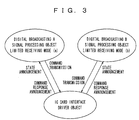
- Fig. 3 is a diagram showing an object structure of software in the digital broadcasting receiving apparatus 100 shown in Fig. 1.
- a digital broadcasting A signal processing object is an object for performing control necessary for processing and utilizing the signal of the digital broadcasting A provided by the broadcasting company A.
- the digital broadcasting A signal processing object has a function of attaining communication protocol between an IC card and the receiving apparatus defined in the limited receiving mode (a) that the digital broadcasting A uses.
- a digital broadcasting B signal processing object is an object for performing control necessary for processing and utilizing the signal of the digital broadcasting B provided by the broadcasting company B.
- the digital broadcasting B signal processing object has a function of attaining communication protocol between an IC card and the receiving apparatus defined in the limited receiving mode (b) that the digital broadcasting B uses.
- An IC card interface drive object is a driver object of the IC card interface which performs control in accordance with a basic portion (for example, ISO7816-1, 2, 3, and 4) of a communication protocol which is common to the limited receiving mode (a) and the limited receiving mode (b).
- a basic portion for example, ISO7816-1, 2, 3, and 4
- the IC card interface drive object detects that the IC card has been mounted to the IC card interface section 108. Based on this detection, the IC card interface drive object supplies necessary electric power to the IC card, and performs necessary resetting. Then, the drive object announces the results of the resetting operation to the digital broadcasting A signal processing object and the digital broadcasting B signal processing object.
- the two signal processing objects upon receiving the result of resetting of the IC card, respectively perform processing of identifying the IC card (Steps ST4 and thereafter in Fig. 2), so as to obtain the results of identification.
- the digital broadcasting A signal processing object receives this request, and based on this request, starts processing of selecting the program.
- the object confirms the result of identification of IC card.
- the object obtains necessary scramble key information by use of the IC card, and attempts to release the scramble.
- the IC card mounted corresponds to the limited receiving mode (a)
- the user has permission for receiving the designated program, the user can watch and listen to the program.
- the digital broadcasting A signal processing object judges the IC card mounted as an "ineffective IC card". In this case, it is impossible to release the scramble.
- the IC card mounted to the IC card interface section 108 corresponds. If the IC card is an effective IC card which corresponds to the limited receiving mode of the transport stream TS output from the switch 113, limited receiving processing is performed for the transport stream TS by use of the contract information and scramble key information controlled by the IC card.
- the digital broadcasting signal from the broadcasting company A can be received by mounting the IC card corresponding to the limited receiving mode of the broadcasting company A to the interface section 108.
- the digital broadcasting signal from the broadcasting company B can be received by mounting the IC card corresponding to the limited receiving mode of the broadcasting company B to the interface section 108. Therefore, this structure allows to provide a receiving apparatus for receiving digital broadcasting signals from the broadcasting companies A and B in different limited receiving modes from each other at low cost.
- FIG. 4 is a diagram showing a digital broadcasting receiving apparatus 100A according to another embodiment of the present invention.
- the same constituent elements as of the receiving apparatus 100 shown in Fig. 1 are denoted by identical reference numerals, and their descriptions will be omitted.
- the receiving apparatus 100A includes two IC card interface sections 108-1 and 108-2. Each of the interface sections 108-1, 108-2 is connected to the CPU 101. Other portions of the receiving apparatus 100A are in the same structures as of the receiving apparatus 100 shown in Fig. 1.
- the receiving apparatus 100A when the program designated by the user operation is of the limited receiving, the CPU 101 confirms the result of identification as to what limited receiving mode the IC cards mounted to the IC card interface sections 108-1 and 108-2 correspond.
- the receiving apparatus 100A performs limited receiving processing by use of the IC card.
- the CPU 101 transmits limited receiving information, extracted from addition data, to the IC card via the interface section 108-1.
- the IC card judges whether watching and listening of the program is possible or impossible, based on the limited receiving information.
- the IC card sends scramble key information to the CPU 101 via the interface section 108-1.
- the CPU 101 sets the key information to the descrambling section 114.
- the descrambling section 114 releases scramble from the packet of scrambled video data and audio data. Accordingly, the data of the packet of video and audio is separated in the demultiplexing section 115 in the state where the data is already released from the scrambled state.
- Fig. 5 is a diagram showing an object of software in the digital broadcasting receiving apparatus 100A shown in Fig. 4.
- IC card interface 1 driver object On top of the digital broadcasting A signal processing object and the digital B signal processing object, there are also an IC card interface 1 driver object and an IC card interface 2 driver object which respectively correspond to the IC card interface sections 108-1 and 108-2.
- IC card interface 2 driver object On top of the digital broadcasting A signal processing object and the digital B signal processing object, there are also an IC card interface 1 driver object and an IC card interface 2 driver object which respectively correspond to the IC card interface sections 108-1 and 108-2.
- the relationship between one IC card interface driver object and two digital broadcasting signal processing objects are the same as of Fig. 3.
- the IC card interface 1 driver object, and the IC card interface 2 driver object respectively detect that the IC card has been mounted thereto. Based on this detection, the drive object supplies necessary electric power to the IC card, and performs necessary resetting. Then, the drive object announces the results of the resetting operation to the digital broadcasting A signal processing object and the digital broadcasting B signal processing object.
- the two signal processing objects upon receiving the result of resetting of the IC card, respectively perform processing of identifying the IC card mounted to each of the interface sections 108-1 and 108-2 (Steps ST4 and thereafter in Fig. 2), so as to obtain the results of identification.
- the digital broadcasting A signal processing object receives this request, and based on this request, starts processing of selection. If the designated program is of the limited receiving, the object confirms the result of identification of IC cards mounted to the interface sections 108-1 and 108-2. When the IC card corresponding to the limited receiving mode (a) and therefore identified that an effective IC card is mounted to either one of the interface sections 108-1 and 108-2, the object obtains necessary scramble key information by use of the IC card, and attempts to release the scramble.
- the user can watch and listen to the program.
- the digital broadcasting A signal processing object judges the IC card mounted as an "ineffective IC card". In this case, it is impossible to release the scramble.
- the IC card mounted to the IC card interface sections 108-1 and 108-2 correspond. If the IC card mounted at least either one of the interface sections 108-1 and 108-2 is an effective IC card which corresponds to the limited receiving mode of the transport stream TS output from the switch 113, limited receiving processing is performed for the transport stream TS by use of the contract information and scramble key information controlled by the IC card.
- the digital broadcasting signal from the broadcasting company A can be received by mounting the IC card corresponding to the limited receiving mode of the broadcasting company A to either one of the interface section 108-1 and 108-2.
- the digital broadcasting signal from the broadcasting company B can be received by mounting the IC card corresponding to the limited receiving mode of the broadcasting company B to either one of the interface section 108-1 and 108-2.
- the receiving apparatus 100A such as shown in Fig. 4, if IC cards corresponding to an identical limited receiving mode are inserted to both of the interface sections 108-1 and 108-2, the following problems arise. That is, the receiving apparatus 100A cannot determine which contract condition between two IC cards should be effective. In addition, when the user watches and listens to a program purchased at deferred payment, the receiving apparatus 100A cannot determine to which IC card the information about the purchase of the program should be stored.
- this state may be announced to the user by displaying this state on the displaying section 106 or by OSD display.
- This announcement may be sound announcement or any other kinds of announcements.
- the present invention has been applied to the receiving apparatuses 100 and 100A each of which is capable of receiving digital broadcasting signals from the broadcasting companies A and B in different limited receiving modes from each other. It is obvious, however, that the present invention is also applicable to a receiving apparatus capable of receiving digital broadcasting signals in three or more kinds of limited receiving modes.
Landscapes
- Engineering & Computer Science (AREA)
- Signal Processing (AREA)
- Multimedia (AREA)
- Databases & Information Systems (AREA)
- Theoretical Computer Science (AREA)
- Computer Networks & Wireless Communication (AREA)
- Computer Security & Cryptography (AREA)
- Two-Way Televisions, Distribution Of Moving Picture Or The Like (AREA)
- Circuits Of Receivers In General (AREA)
Abstract
Description
If the IC card corresponds to the limited receiving mode of the digital data output from the receiver, limited receiving processing is performed for the digital data by use of the contract information and the scramble key information controlled by the IC card. This structure makes it possible to provide a receiving apparatus for receiving digital broadcasting signals from a plurality of broadcasting companies in different limited receiving modes from each other at low cost.
Claims (12)
- A digital broadcasting receiving apparatus comprising:a receiver for selectively receiving a plurality of digital broadcasting signals, and then for outputting digital data corresponding to the received digital broadcasting signals;a processor for selectively performing limited receiving processing for the digital data corresponding to a plurality of different limited receiving modes;an IC card interface section for performing communication with an IC card which controls contract information and scramble key information necessary for the limited receiving processing;an identifier for identifying to what limited receiving mode the IC card mounted to the IC card interface section corresponds; anda controller for controlling the processor to perform limited receiving processing for the digital data output from the receiver by use of the contract information and the scramble key information controlled by the IC card, when the controller judges, based on the result of identification by the identifier, that the IC card mounted to the IC card interface section corresponds to the limited receiving mode of the digital data output from the receiver.
- A digital broadcasting receiving apparatus comprising:a receiver for selectively receiving a plurality of digital broadcasting signals, and then for outputting digital data corresponding to the received digital broadcasting signals;a processor for selectively performing limited receiving processing for the digital data corresponding to a plurality of different limited receiving modes;a plurality of IC card interface sections for performing communication with IC cards each of which controls contract information and scramble key information necessary for the limited receiving processing;an identifier for identifying to what limited receiving mode the IC cards mounted to the plurality of IC card interface sections correspond; anda controller for controlling the processor to perform limited receiving processing for the digital data output from the receiver by use of the contract information and the scramble key information controlled by the predetermined IC card, when the controller judges, based on the result of identification by the identifier, that a predetermined IC card mounted to at least either one of the plurality of IC card interface sections corresponds to the limited receiving mode of the digital data output from the receiver.
- The digital broadcasting receiving apparatus according to claim 2, further comprising an announcer for announcing to a user that two or more IC cards corresponding to an identical limited receiving mode are mounted to the plurality of IC card interface sections.
- The digital broadcasting receiving apparatus according to claim 3, wherein the announcer performs the announcement to a user by a display on a displaying section, or by OSD display.
- The digital broadcasting receiving apparatus according to claim 3, wherein the announcer performs the announcement by a sound.
- The digital broadcasting receiving apparatus according to claim 2, wherein, when two or more IC cards corresponding to an identical limited receiving mode are mounted to the plurality of IC card interface sections, the selection of either one of the IC cards as an effective IC card is made by GUI such as menu.
- A method for receiving digital broadcasting comprising the steps of:selectively receiving a plurality of digital broadcasting signals, and then outputting digital data corresponding to the received digital broadcasting signals;identifying to what limited receiving mode the IC card which has been mounted to the IC card interface section and controls contract information and scramble key information necessary for limited receiving processing corresponds; andperforming limited receiving processing for the digital data output from the receiver by use of the contract information and the scramble key information controlled by the IC card, the when the controller judges, based on the result of the identification by the identifier, that the IC card mounted to the IC card interface section corresponds to the limited receiving mode of the digital data output.
- A method for receiving digital broadcasting comprising the steps of:selectively receiving a plurality of digital broadcasting signals, and then outputting digital data corresponding to the received digital broadcasting signals;identifying to what limited receiving mode the IC cards which have been mounted to the plurality of IC card interface sections and control contract information and scramble key information necessary for limited receiving processing correspond; andperforming limited receiving processing for the digital data output by use of the contract information and the scramble key information controlled by the predetermined IC card, when the controller judges, based on the result of the identification by the identifier, that a predetermined IC card mounted to at least either one of the plurality of IC card interface sections corresponds to the limited receiving mode of the digital data output.
- The method for receiving digital broadcasting according to claim 8, further comprising the step of announcing to a user that two or more IC cards corresponding to an identical limited receiving mode are mounted to the plurality of IC card interface sections.
- The method for receiving digital broadcasting according to claim 9, wherein the announcement to a user is performed by a display on a displaying section, or by OSD display.
- The method for receiving digital broadcasting according to claim 9, wherein the announcement is performed by a sound.
- The method for receiving digital broadcasting according to claim 8, wherein, when two or more IC cards corresponding to an identical limited receiving mode are mounted to the plurality of IC card interface sections, the selection of either one of the IC cards as an effective IC card is made by GUI such as menu.
Applications Claiming Priority (2)
| Application Number | Priority Date | Filing Date | Title |
|---|---|---|---|
| JP2000229639A JP2002044638A (en) | 2000-07-28 | 2000-07-28 | Digital broadcast receiving apparatus and digital broadcast receiving method |
| JP2000229639 | 2000-07-28 |
Publications (2)
| Publication Number | Publication Date |
|---|---|
| EP1187381A2 true EP1187381A2 (en) | 2002-03-13 |
| EP1187381A3 EP1187381A3 (en) | 2005-12-21 |
Family
ID=18722723
Family Applications (1)
| Application Number | Title | Priority Date | Filing Date |
|---|---|---|---|
| EP01306337A Withdrawn EP1187381A3 (en) | 2000-07-28 | 2001-07-24 | Method and apparatus for receiving digital broadcast transmissions using different receiving modes |
Country Status (5)
| Country | Link |
|---|---|
| US (1) | US6968018B2 (en) |
| EP (1) | EP1187381A3 (en) |
| JP (1) | JP2002044638A (en) |
| KR (1) | KR100817654B1 (en) |
| CN (1) | CN1236571C (en) |
Families Citing this family (13)
| Publication number | Priority date | Publication date | Assignee | Title |
|---|---|---|---|---|
| US20040055013A1 (en) * | 2002-07-04 | 2004-03-18 | Toshiyuki Ishioka | Broadcast receive/play system and broadcast reception apparatus |
| JP4284155B2 (en) * | 2003-10-31 | 2009-06-24 | 株式会社東芝 | Video display system, broadcast signal processing unit, and video display device |
| KR100608594B1 (en) * | 2004-07-01 | 2006-08-03 | 삼성전자주식회사 | Payment information notification method in a broadcast receiver and the broadcast receiver |
| JP2006129243A (en) * | 2004-10-29 | 2006-05-18 | Toshiba Corp | Digital broadcast receiving apparatus and method |
| KR100709348B1 (en) | 2005-02-17 | 2007-04-20 | 삼성전자주식회사 | Video player and channel map update method for channel map update |
| CN100433805C (en) * | 2005-06-29 | 2008-11-12 | 上海广电(集团)有限公司中央研究院 | Digital TV receiver and signal transmitting method thereof |
| US7813449B2 (en) * | 2005-07-14 | 2010-10-12 | Radio Shack, Corporation | Remotely controlled antenna and method |
| KR100793793B1 (en) | 2006-04-18 | 2008-01-11 | 엘지전자 주식회사 | Broadcast receiver and receiving method |
| JP2009016991A (en) * | 2007-07-02 | 2009-01-22 | Sanyo Electric Co Ltd | Decoding processing apparatus, decoding processing method, and digital broadcast receiving apparatus |
| JP5040502B2 (en) * | 2007-07-30 | 2012-10-03 | 富士通株式会社 | Broadcast receiving apparatus, method and program |
| JP2011044878A (en) * | 2009-08-20 | 2011-03-03 | Toshiba Corp | Broadcast receiver and information output method |
| US9002259B2 (en) * | 2010-08-13 | 2015-04-07 | Bose Corporation | Transmission channel substitution |
| JP5317230B2 (en) * | 2011-07-27 | 2013-10-16 | ヒロテック株式会社 | Interphone video distribution system and card adapter |
Family Cites Families (12)
| Publication number | Priority date | Publication date | Assignee | Title |
|---|---|---|---|---|
| US5036537A (en) * | 1984-11-19 | 1991-07-30 | General Instrument Corp. | Geographic black-out method for direct broadcast satellite system |
| DE69310255T2 (en) * | 1992-03-04 | 1997-08-14 | Thomson Multimedia Sa | Method and device for checking several chip cards |
| MY125706A (en) * | 1994-08-19 | 2006-08-30 | Thomson Consumer Electronics | High speed signal processing smart card |
| US6035037A (en) * | 1995-08-04 | 2000-03-07 | Thomson Electronic Consumers, Inc. | System for processing a video signal via series-connected high speed signal processing smart cards |
| JPH0993558A (en) * | 1995-09-28 | 1997-04-04 | Toshiba Corp | Multiple scramble system broadcasting system and decoder |
| JP3743810B2 (en) * | 1996-01-12 | 2006-02-08 | カシオ計算機株式会社 | Service information receiving apparatus and recording medium |
| JP3639400B2 (en) * | 1997-02-12 | 2005-04-20 | 三洋電機株式会社 | Digital signal receiver |
| KR19990025666A (en) * | 1997-09-13 | 1999-04-06 | 전주범 | Television with channel switching voice guidance |
| KR19990037403A (en) * | 1997-10-27 | 1999-05-25 | 이데이 노부유끼 | Digital broadcasting receiver |
| JP3586082B2 (en) * | 1997-11-11 | 2004-11-10 | 株式会社東芝 | Digital signal receiving terminal |
| IT1303242B1 (en) * | 1998-08-11 | 2000-11-02 | Cselt Ct Studi E Lab T | PROCEDURE AND SYSTEM FOR THE CONTROLLED DELIVERY OF NUMERICAL SERVICES SUCH AS, FOR EXAMPLE, MULTIMEDIA TELEMATIC SERVICES. |
| JP2001145076A (en) * | 1999-11-12 | 2001-05-25 | Toshiba Corp | Receiver |
-
2000
- 2000-07-28 JP JP2000229639A patent/JP2002044638A/en active Pending
-
2001
- 2001-07-23 KR KR1020010044106A patent/KR100817654B1/en not_active Expired - Fee Related
- 2001-07-24 EP EP01306337A patent/EP1187381A3/en not_active Withdrawn
- 2001-07-27 CN CNB01124660XA patent/CN1236571C/en not_active Expired - Fee Related
- 2001-07-30 US US09/917,976 patent/US6968018B2/en not_active Expired - Fee Related
Also Published As
| Publication number | Publication date |
|---|---|
| KR100817654B1 (en) | 2008-03-27 |
| CN1236571C (en) | 2006-01-11 |
| CN1336736A (en) | 2002-02-20 |
| KR20020010493A (en) | 2002-02-04 |
| JP2002044638A (en) | 2002-02-08 |
| EP1187381A3 (en) | 2005-12-21 |
| US6968018B2 (en) | 2005-11-22 |
| US20020071498A1 (en) | 2002-06-13 |
Similar Documents
| Publication | Publication Date | Title |
|---|---|---|
| JP4135047B2 (en) | Information transmission system, information output device, information input device, and connection relation specifying method | |
| US9179101B2 (en) | Video receiving apparatus and broadcast receiving apparatus | |
| EP1187381A2 (en) | Method and apparatus for receiving digital broadcast transmissions using different receiving modes | |
| EP2445139A2 (en) | Television apparatus, display control device, and display control method | |
| JP4366741B2 (en) | Digital broadcast receiving apparatus and digital signal processing apparatus recognition method | |
| JP3328046B2 (en) | Information receiving system | |
| US7039936B1 (en) | Receiving system for digital broadcasting, data transmitting method in digital broadcasting receiving system, and receiving apparatus for digital broadcasting | |
| JP2000188725A5 (en) | Recognition method of digital broadcast receiver and digital signal processing equipment | |
| JP2005123877A (en) | Digital broadcast receiving apparatus and digital broadcast receiving method | |
| CN103024507B (en) | The methods, devices and systems of picture-in-picture are realized in home network | |
| US20050076391A1 (en) | Picture displaying apparatus, receiving apparatus and method of presenting commercial message | |
| US20090328086A1 (en) | Apparatus for Monitoring Use Status of Image Apparatus, Method of Monitoring External Connection Apparatus and Television Receiving Apparatus | |
| JPH1132312A (en) | Data broadcasting method and broadcast receiving device | |
| EP1187470A3 (en) | Television programme selection means | |
| US20050105003A1 (en) | Television receiving system | |
| JP5040502B2 (en) | Broadcast receiving apparatus, method and program | |
| KR100432452B1 (en) | Digital broadcast receiving device and digital broadcast receiving method | |
| KR100230859B1 (en) | Descrambler | |
| JP2005017817A (en) | Video signal supply device, video display terminal device, and signal input terminal selecting method for the same | |
| JP4084999B2 (en) | Device for receiving digital radio signals | |
| JP4939160B2 (en) | CATV system terminal device | |
| KR101248341B1 (en) | Terminal and digital multimedia broadcasting receiving method thereof | |
| KR0139141B1 (en) | Television receiver | |
| JP2010200205A (en) | Broadcast receiver and control method therefor | |
| KR20150031737A (en) | Display apparatus, paid broadcast processing apparatus and control method thereof |
Legal Events
| Date | Code | Title | Description |
|---|---|---|---|
| PUAI | Public reference made under article 153(3) epc to a published international application that has entered the european phase |
Free format text: ORIGINAL CODE: 0009012 |
|
| AK | Designated contracting states |
Kind code of ref document: A2 Designated state(s): AT BE CH CY DE DK ES FI FR GB GR IE IT LI LU MC NL PT SE TR |
|
| AX | Request for extension of the european patent |
Free format text: AL;LT;LV;MK;RO;SI |
|
| PUAL | Search report despatched |
Free format text: ORIGINAL CODE: 0009013 |
|
| AK | Designated contracting states |
Kind code of ref document: A3 Designated state(s): AT BE CH CY DE DK ES FI FR GB GR IE IT LI LU MC NL PT SE TR |
|
| AX | Request for extension of the european patent |
Extension state: AL LT LV MK RO SI |
|
| 17P | Request for examination filed |
Effective date: 20060217 |
|
| AKX | Designation fees paid |
Designated state(s): DE FR GB |
|
| STAA | Information on the status of an ep patent application or granted ep patent |
Free format text: STATUS: THE APPLICATION IS DEEMED TO BE WITHDRAWN |
|
| 18D | Application deemed to be withdrawn |
Effective date: 20130201 |