EP1187132A2 - Information providing apparatus and method, and recording medium - Google Patents
Information providing apparatus and method, and recording medium Download PDFInfo
- Publication number
- EP1187132A2 EP1187132A2 EP01118068A EP01118068A EP1187132A2 EP 1187132 A2 EP1187132 A2 EP 1187132A2 EP 01118068 A EP01118068 A EP 01118068A EP 01118068 A EP01118068 A EP 01118068A EP 1187132 A2 EP1187132 A2 EP 1187132A2
- Authority
- EP
- European Patent Office
- Prior art keywords
- information
- category
- features
- acquiring
- unit
- Prior art date
- Legal status (The legal status is an assumption and is not a legal conclusion. Google has not performed a legal analysis and makes no representation as to the accuracy of the status listed.)
- Withdrawn
Links
Images


Classifications
-
- G—PHYSICS
- G06—COMPUTING OR CALCULATING; COUNTING
- G06F—ELECTRIC DIGITAL DATA PROCESSING
- G06F16/00—Information retrieval; Database structures therefor; File system structures therefor
- G06F16/40—Information retrieval; Database structures therefor; File system structures therefor of multimedia data, e.g. slideshows comprising image and additional audio data
- G06F16/48—Retrieval characterised by using metadata, e.g. metadata not derived from the content or metadata generated manually
- G06F16/483—Retrieval characterised by using metadata, e.g. metadata not derived from the content or metadata generated manually using metadata automatically derived from the content
-
- G—PHYSICS
- G11—INFORMATION STORAGE
- G11B—INFORMATION STORAGE BASED ON RELATIVE MOVEMENT BETWEEN RECORD CARRIER AND TRANSDUCER
- G11B27/00—Editing; Indexing; Addressing; Timing or synchronising; Monitoring; Measuring tape travel
- G11B27/10—Indexing; Addressing; Timing or synchronising; Measuring tape travel
- G11B27/19—Indexing; Addressing; Timing or synchronising; Measuring tape travel by using information detectable on the record carrier
- G11B27/28—Indexing; Addressing; Timing or synchronising; Measuring tape travel by using information detectable on the record carrier by using information signals recorded by the same method as the main recording
-
- G—PHYSICS
- G06—COMPUTING OR CALCULATING; COUNTING
- G06F—ELECTRIC DIGITAL DATA PROCESSING
- G06F16/00—Information retrieval; Database structures therefor; File system structures therefor
- G06F16/40—Information retrieval; Database structures therefor; File system structures therefor of multimedia data, e.g. slideshows comprising image and additional audio data
-
- G—PHYSICS
- G11—INFORMATION STORAGE
- G11B—INFORMATION STORAGE BASED ON RELATIVE MOVEMENT BETWEEN RECORD CARRIER AND TRANSDUCER
- G11B27/00—Editing; Indexing; Addressing; Timing or synchronising; Monitoring; Measuring tape travel
- G11B27/02—Editing, e.g. varying the order of information signals recorded on, or reproduced from, record carriers
- G11B27/031—Electronic editing of digitised analogue information signals, e.g. audio or video signals
- G11B27/034—Electronic editing of digitised analogue information signals, e.g. audio or video signals on discs
-
- G—PHYSICS
- G11—INFORMATION STORAGE
- G11B—INFORMATION STORAGE BASED ON RELATIVE MOVEMENT BETWEEN RECORD CARRIER AND TRANSDUCER
- G11B27/00—Editing; Indexing; Addressing; Timing or synchronising; Monitoring; Measuring tape travel
- G11B27/10—Indexing; Addressing; Timing or synchronising; Measuring tape travel
- G11B27/11—Indexing; Addressing; Timing or synchronising; Measuring tape travel by using information not detectable on the record carrier
-
- G—PHYSICS
- G11—INFORMATION STORAGE
- G11B—INFORMATION STORAGE BASED ON RELATIVE MOVEMENT BETWEEN RECORD CARRIER AND TRANSDUCER
- G11B20/00—Signal processing not specific to the method of recording or reproducing; Circuits therefor
- G11B20/00086—Circuits for prevention of unauthorised reproduction or copying, e.g. piracy
- G11B20/00884—Circuits for prevention of unauthorised reproduction or copying, e.g. piracy involving a watermark, i.e. a barely perceptible transformation of the original data which can nevertheless be recognised by an algorithm
-
- G—PHYSICS
- G11—INFORMATION STORAGE
- G11B—INFORMATION STORAGE BASED ON RELATIVE MOVEMENT BETWEEN RECORD CARRIER AND TRANSDUCER
- G11B2220/00—Record carriers by type
- G11B2220/20—Disc-shaped record carriers
Definitions
- the present invention relates to an information providing apparatus and method, and to a recording medium. More particularly, the present invention relates to an information providing apparatus and method capable of providing information more quickly, and to a recording medium.
- an acoustic signal is segmented into a plurality of frequency band signals by bandpass filters, the moments of which are used as the features and compared.
- the quick search algorithm using the histogram as the features allows for a quicker search than that of the above approach in which moments of signals are detected as the features; however, it takes a long time to search through a large number of objects.
- the digital watermark approach makes it possible to perform a quick search; however, since a different code for each title must be inserted as a digital watermark, the existence of a plurality of information providers makes it difficult to manage a unique code for each information provider. Thus, this approach cannot be easily put into practice.
- an object of the present invention to provide an information providing system capable of quickly and reliably providing desired information.
- an information providing apparatus includes: a storage unit for storing information, relevant information which is relevant to the information, and features of the information for each category of the information; an acquiring unit for acquiring information to be searched for; a determining unit for determining a category to which the information acquired by the acquiring unit belongs; an extracting unit for extracting features of the information acquired by the acquiring unit; a comparing unit for comparing the features of the information which belongs to the category determined by the determining unit with the features extracted by the extracting unit, the former features being stored in the storage unit; and a searching unit for searching for the target relevant information stored in the storage unit based on the result of the comparison performed by the comparing unit.
- the category may have a hierarchical structure.
- the determining unit may determine the category based on a digital watermark that has been inserted in the information acquired by the acquiring unit.
- An information providing method includes the steps of: storing information, relevant information which is relevant to the information, and features of the information for each category of the information; acquiring information to be searched for; determining a category to which the information acquired in the acquiring step belongs; extracting features of the information acquired in the acquiring step; comparing the features of the information which belongs to the category determined in the determining step with the features extracted in the extracting step, the former features being stored in the storing step; and searching for the target relevant information stored in the storing step based on the result of the comparison performed in the comparing step.
- a recording medium having a computer-readable program implementing a method including the steps of: storing information, relevant information which is relevant to the information, and features of the information for each category of the information; acquiring information to be searched for; determining a category to which the information acquired in the acquiring step belongs; extracting features of the information acquired in the acquiring step; comparing the features of the information which belongs to the category determined in the determining step with the features extracted in the extracting step, the former features being stored in the storing step; and searching for the target relevant information stored in the storing step based on the result of the comparison performed in the comparing step.
- a category of information which has been acquired is determined, while features of the acquired information is extracted.
- the features of information which belongs to the category, which are stored, are compared with the extracted features. Based on the result of the comparison, the target relevant information which is stored is searched for. Therefore, the desired information can be quickly and reliably searched for and provided.
- an information providing apparatus includes: an acquiring unit for acquiring information to be stored; a determining unit for determining a category to which the information acquired by the acquiring unit belongs; an inserting unit for inserting a digital watermark in the information acquired by the acquiring unit so that the digital watermark may correspond to the category determined by the determining unit; a storage unit for storing the information in which the digital watermark is inserted by the inserting unit; and a delivery unit for delivering the information stored in the storage unit via a network.
- An information providing method includes the steps of: acquiring information to be stored; determining a category to which the information acquired in the acquiring step belongs; inserting a digital watermark in the information acquired in the acquiring step, the digital watermark corresponding to the category determined in the determining step; storing the information in which the digital watermark is inserted in the inserting step; and delivering the information stored in the storing step via a network.
- a recording medium having a computer-readable program implementing a method including the steps of: acquiring information to be stored; determining a category to which the information acquired in the acquiring step belongs; inserting a digital watermark in the information acquired in the acquiring step, the digital watermark corresponding to the category determined in the determining step; storing the information in which the digital watermark is inserted in the inserting step; and delivering the information stored in the storing step via a network.
- a category of information which has been acquired is determined, and a digital watermark corresponding to the determined category is inserted in the information.
- the information having the digital watermark inserted therein is stored, and is also delivered via a network, by broadcasting, or by communication. Therefore, the desired information can be quickly and reliably searched for and provided.
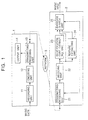
- Fig. 1 is a block diagram of an information providing system according to the present invention.
- the information providing system includes a terminal device 1 and an identification device 2 which are linked with each other via a network 3 such as the Internet.
- a network 3 such as the Internet.
- the terminal device 1 includes a recording unit 11 for recording music data which is to be transferred to the identification device 2, an encoding unit 12, a transmitting/receiving unit 13, and an output unit 14.
- the encoding unit 12 encodes a portion of the music information recorded by the recording unit 11, and forwards the encoded portion to the transmitting/receiving unit 13.
- the transmitting/receiving unit 13 transmits the portion of the music information which is forwarded by the encoding unit 12 to the identification device 2 via the network 3.
- the transmitting/receiving unit 13 also receives information transmitted from the identification device 2 via the network 3, and outputs it to the output unit 14 such as a monitor.
- the identification device 2 includes a transmitting/receiving unit 21 for receiving the music data transmitted 0from the terminal device 1 via the network 3.
- the transmitting/receiving unit 21 also outputs the title output from a database search unit 25 to the terminal device 1 via the network 3.
- the identification device 2 further includes a decoding unit 22, an identification code extracting unit 23, and a feature extracting unit 24.
- the decoding unit 22 decodes or decompresses the music data transmitted from the transmitting/receiving unit 21, and forwards the resulting data to the identification code extracting unit 23 and the feature extracting unit 24.
- the identification code extracting unit 23 extracts an identification code which has been inserted as a digital watermark in the music data forwarded by the decoding unit 22, and supplies it to the database search unit 25.
- the feature extracting unit 24 extracts features of the music data sent from the decoding unit 22.
- the features are implemented as at least one of a waveform, an intensity, a data value, a spectrum of the music data, and the histogram thereof. Otherwise, the features disclosed in the United States Patent No. 5,210,820 or the features described by Kashino et al., as previously noted, may be used.
- the database search unit 25 searches for the music title using both the identification code provided from the identification code extracting unit 23 and the features provided from the feature extracting unit 24.
- the resulting music title is output to a device (not shown), and is also forwarded to the transmitting/receiving unit 21, so that the result is transferred to the terminal device 1 via the network 3.
- the database search unit 25 also has music data registered therein which is forwarded from the decoding unit 22, if necessary.
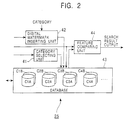
- the database search unit 25 includes a category selecting unit 41, a digital watermark inserting unit 42, a database 43, and a feature comparing unit 44.
- the category selecting unit 41 selects a category corresponding to the input identification code. The selected category is forwarded to the database 43.
- the digital watermark inserting unit 42 inserts a digital watermark, which represents the associated music category, in the music data.
- the feature comparing unit 44 compares the features extracted by the feature extracting unit 24 with the features registered in the database 43. If a match is found therebetween, the feature comparing unit 44 reads and outputs the music title corresponding to the features from the database 43.
- the database 43 contains music data and information relevant thereto, such as the title, composer, lyric writer, and performer of the music, for each category.
- the music data of a first category is stored in a database C1B, and the information relevant thereto is stored in a database C1A.
- the music data of an i-th category is stored in a database CiB, and the information relevant thereto is stored in a database CiA.
- the information provided via the network 3 has a digital watermark corresponding to the associated category inserted therein.
- a digital watermark corresponding to the associated category For example, as illustrated in Fig. 3, music data which is classified into 16 categories is stored in the database 43.
- the categories may be represented by 4-bit codes from "0000" to "1111".
- Fig. 4 schematically illustrates a music signal in which numbers representing the category to which this music signal belongs are digitally watermarked.
- the category of this music signal is represented as "1001".
- the music signal contains the 4-bit value "1001" indicative of a category which is arranged on a bit-by-bit basis in a predetermined unit of music data.
- 8 units make up one period in which a digital watermark is inserted.
- the MSB most significant bit
- the MSB indicated by numeral 1 is recorded four times
- the second bit indicated by numeral 2 is recorded two times
- the third bit indicated by numeral 3 is recorded once
- the LSB indicated by numeral 4 is also recorded once.
- the MSB is identified by a flag or the like.
- a category which is represented by a 4-bit value can be hierarchically expressed.
- the category of the music data shown in Fig. 4 is represented as "1001," and the music data containing all of the bits indicated by numerals 1 to 4 would allow a category to be uniquely identified.
- the music data in which the bits indicated by numerals 1 and 2 only are digitally watermarked is provided, i.e., a portion of the music data which is shown by shading in Fig. 4 is provided, it is understood that the upper two bits are "10". Therefore, categories of the music data which are represented by "1000", “1001", “1010", or "1011" are possibly identified.
- Fig. 5 is a flowchart of the process of registering music data in the database 43.
- the process begins with step S1, where data to be registered is acquired.
- the transmitting/receiving unit 21 of the identification device 2 receives music data to be registered in the database 43 from any other server (not shown) via the network 3, and the decoding unit 22 decodes it.
- a manager of the database 43 reads the music signal decoded by the decoding unit 22, and determines which category (for example, classical music, jazz, or popular music) the data belongs to at step S2. The determined category is input to the digital watermark inserting unit 42.
- the digital watermark inserting unit 42 inserts a digital watermark of numbers corresponding to the category directed by the manager in the music data which is forwarded by the decoding unit 22.
- the digital watermarking used may be a technique disclosed in Japanese Unexamined Patent Application Publication No. 2000-89796.
- the feature extracting unit 24 extracts features of the music data from the decoding unit 22, and the resulting features are forwarded to the database 43.
- the features supplied from the feature extracting unit 24 are stored in the database 43 for each category so as to be associated with information relevant to the music data, such as the title, composer, lyric writer, performer, etc., which is specified by the manager.
- the database 43 also contains the music data supplied from the decoding unit 22. For example, for the first category, the relevant information is stored in the database C1A, and the music data is stored in the database C1B.
- the music data delivered from any other device via the network 3 is received by the database 43, and is stored therein, if necessary.
- the stored music data in which a digital watermark corresponding to the associated category is inserted is further transferred from the database 43 via the network 3.
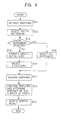
- Fig. 6 is a flowchart showing how the identification device 2 operates when a portion of the music data is transferred to the identification device 2 from the terminal device 1 via the network 3 and when a search request for the title is issued from the terminal device 1.
- the user of the terminal device 1 records music data, of which the title is desired to be known, in the recording unit 11.
- a music signal recorded on the recording unit 11 is read therein, and is then input to the encoding unit 12 for encoding.
- the music data encoded by the encoding unit 12 is transmitted to the identification device 2 from the transmitting/receiving unit 13 via the network 3.
- the transmitting/receiving unit 21 of the identification device 2 which receives the music data forwards it to the decoding unit 22 for decoding.
- the music data decoded by the decoding unit 22 is supplied to the feature extracting unit 24.
- the feature extracting unit 24 extracts features of the input music data, and supplies the resulting features to the feature comparing unit 44.
- the music data decoded by the decoding unit 22 is also supplied to the identification code extracting unit 23.
- the identification code extracting unit 23 detects the digital watermark that has been inserted in the music data supplied from the decoding unit 22.
- the music data delivered via the network 3 has a digital watermark representing the associated category inserted therein.
- tat music data has a digital watermark inserted therein. The inserted digital watermark is then detected.
- the identification code extracting unit 23 determines at step S13 whether or not a digital watermark has been extracted. If a digital watermark has been extracted, the identification code, indicative of a category, corresponding to that digital watermark is extracted at step S14, and is then forwarded to the category selecting unit 41 in the database search unit 25.
- the category selecting unit 41 selects the category corresponding to the identification code obtained by the identification code extracting unit 23, and outputs it to the database 43.
- the identification code extracting unit 23 determines at step S13 that a digital watermark is not extracted, and outputs the result of the determination to the category selecting unit 41.
- the category selecting unit 41 selects all categories as the possible category of that music data, and outputs the result to the database 43.
- the database 43 retrieves the features corresponding to a single category from the database containing the categories supplied from the category selecting unit 41 out of the features stored therein, and outputs it to the feature comparing unit 44.
- the features stored in the database C1A are read, and are then supplied to the feature comparing unit 44.
- the feature comparing unit 44 compares the features supplied from the feature extracting unit 24, i.e., the features extracted at step S11, with the features read from the database 43, i.e., the features acquired at step S17, and determines whether or not a match is found between both features. If a match is not found, the feature comparing unit 44 acquires the features of another music data which belongs to the same category from the database 43, and compares the acquired features with the features supplied from the feature extracting unit 24. The same operation is repeated until a match is found between both features, and, then, at step S19, the feature comparing unit 44 reads the relevant information, such as the title, which is stored in the database 43 according to the features. The relevant information is supplied from the feature comparing unit 44 to the transmitting/receiving unit 21 as a search result output. The transmitting/receiving unit 21 transmits the relevant information to the terminal device 1 via the network 3.
- the relevant information transmitted via the network 3 is received by the transmitting/receiving unit 13 in the terminal device 1, and is then output to the output unit 14 for display. This enables the user of the terminal device 1 to know the music title etc. corresponding to the music data that he transmits to the identification device 2.
- the feature-based search process should be only performed on one of 16 categories. This allows the processing for the search task to be reduced to 1/16 of the case where the feature-based search process is performed on all categories if the features of the categories are the same. If the music data containing the upper 2 bits out of the 4 bits representing a category is transmitted, the feature-based search process should be only performed on four categories represented as "1000", “1001", "1010", and "1011", thereby reducing the processing for the search task to 1/4 of the case where the feature-based search process is performed on all categories.
- the present invention may be applied to the identification of data other than music, such as video, image, text, or information appropriately combining these materials, such as commercials.
- the series of steps may be implemented by hardware, and may also be implemented by software.
- a program for the software is installed via a network or from a recording medium to a computer incorporating the dedicated hardware, or to a general-purpose personal computer to which various programs are installed to execute various functions.
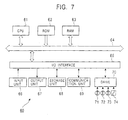
- Fig. 7 illustrates a personal computer 60 which embodies this type of computer.
- the personal computer 60 includes a CPU (central processing unit) 61, a ROM (read only memory) 62, and a RAM (random access memory) 63.
- the CPU 61 executes various processes according to programs stored in the ROM 62 or programs that are loaded in the RAM 63 from a storage unit 68.
- the RAM 63 also contains information necessary for the CPU 61 to execute the various processes, if any.
- the CPU 61, the ROM 62, and the RAM 63 are connected to each other through a bus 64.
- An I/O interface 65 is also connected to the bus 64.
- An input unit 66 including a keyboard and a mouse, a display such as a CRT or an LCD, and an output unit 67 including a speaker are connected to the I/O interface 65.
- the storage unit 68 including a hard disk, and a communication unit 69 including a modem and a terminal adapter are further connected to the I/O interface 65.
- the communication unit 69 performs communication via the network 3.
- a drive 70 is also connected to the I/O interface 65, if necessary, and a magnetic disk 71, an optical disk 72, a magneto-optical disk 73, or a semiconductor memory 74 is appropriately attached to the drive 70 so that a computer program read therefrom is installed in the storage unit 68 as necessary.
- a recording medium for providing programs is separate from the personal computer 70, as shown in Fig. 7, and comprises packaged media including the magnetic disk 71 such as a floppy disk, the optical disk 72 such as a CD-ROM (compact disk-read only memory) and a DVD (digital versatile disk), the magneto-optical disk 73 such as an MD (mini-disk), and the semiconductor memory 74, which is distributed to provide programs for users.
- the recording medium further comprises the ROM 62 having programs recorded thereon, and the hard disk incorporated in the storage unit 68, which are provided for users as being incorporated in advance into computers.
- the steps implemented by programs recorded on the recording medium may be applied to the process which is performed in a time-series manner along the illustrated sequence, as well as to a process which is performed in parallel or individually even if it is not performed in a time-series manner.
- system indicates an overall apparatus, device, arrangement, instrument, facilities, and the like which comprises a plurality of apparatuses, devices, arrangements, instrument, facilities, and the like.
Landscapes
- Engineering & Computer Science (AREA)
- Theoretical Computer Science (AREA)
- Multimedia (AREA)
- General Physics & Mathematics (AREA)
- Physics & Mathematics (AREA)
- General Engineering & Computer Science (AREA)
- Databases & Information Systems (AREA)
- Data Mining & Analysis (AREA)
- Library & Information Science (AREA)
- Storage Device Security (AREA)
- Television Systems (AREA)
- Information Retrieval, Db Structures And Fs Structures Therefor (AREA)
- Television Signal Processing For Recording (AREA)
- Reverberation, Karaoke And Other Acoustics (AREA)
Abstract
Description
Claims (8)
- An information providing apparatus comprising:storage means for storing information, relevant information which is relevant to the information, and features of the information for each category of the information;acquiring means for acquiring information to be searched for;determining means for determining a category to which the information acquired by said acquiring means belongs;extracting means for extracting features of the information acquired by said acquiring means;comparing means for comparing the features of the information which belongs to the category determined by said determining means with the features extracted by said extracting means, the former features being stored in said storage means; andsearching means for searching for the target relevant information stored in said storage means based on the result of the comparison performed by said comparing means.
- An information providing apparatus according to Claim 1, wherein the category has a hierarchical structure.
- An information providing apparatus according to Claim 1, wherein said determining means determines the category based on a digital watermark, the digital watermark being inserted in the information acquired by said acquiring means.
- An information providing method comprising the steps of:storing information, relevant information which is relevant to the information, and features of the information for each category of the information;acquiring information to be searched for;determining a category to which the information acquired in said acquiring step belongs;extracting features of the information acquired in said acquiring step;comparing the features of the information which belongs to the category determined in said determining step with the features extracted in said extracting step, the former features being stored in said storing step; andsearching for the target relevant information stored in said storing step based on the result of the comparison performed in said comparing step.
- A recording medium having a computer-readable program implementing a method comprising the steps of:storing information, relevant information which is relevant to the information, and features of the information for each category of the information;acquiring information to be searched for;determining a category to which the information acquired in said acquiring step belongs;extracting features of the information acquired in said acquiring step;comparing the features of the information which belongs to the category determined in said determining step with the features extracted in said extracting step, the former features being stored in said storing step; andsearching for the target relevant information stored in said storing step based on the result of the comparison performed in said comparing step.
- An information providing apparatus comprising:acquiring means for acquiring information to be stored;determining means for determining a category to which the information acquired by said acquiring means belongs;inserting means for inserting a digital watermark in the information acquired by said acquiring means, the digital watermark corresponding to the category determined by said determining means;storage means for storing the information in which the digital watermark is inserted by said inserting means; anddelivery means for delivering the information stored in said storage means via a network.
- An information providing method comprising the steps of:acquiring information to be stored;determining a category to which the information acquired in said acquiring step belongs;inserting a digital watermark in the information acquired in said acquiring step, the digital watermark corresponding to the category determined in said determining step;storing the information in which the digital watermark is inserted in said inserting step; anddelivering the information stored in said storing step via a network.
- A recording medium having a computer-readable program implementing a method comprising the steps of:acquiring information to be stored;determining a category to which the information acquired in said acquiring step belongs;inserting a digital watermark in the information acquired in said acquiring step, the digital watermark corresponding to the category determined in said determining step;storing the information in which the digital watermark is inserted in said inserting step; anddelivering the information stored in said storing step via a network.
Applications Claiming Priority (2)
| Application Number | Priority Date | Filing Date | Title |
|---|---|---|---|
| JP2000233333 | 2000-08-01 | ||
| JP2000233333A JP2002049631A (en) | 2000-08-01 | 2000-08-01 | Information providing apparatus and method, and recording medium |
Publications (2)
| Publication Number | Publication Date |
|---|---|
| EP1187132A2 true EP1187132A2 (en) | 2002-03-13 |
| EP1187132A3 EP1187132A3 (en) | 2002-06-26 |
Family
ID=18725865
Family Applications (1)
| Application Number | Title | Priority Date | Filing Date |
|---|---|---|---|
| EP01118068A Withdrawn EP1187132A3 (en) | 2000-08-01 | 2001-07-25 | Information providing apparatus and method, and recording medium |
Country Status (3)
| Country | Link |
|---|---|
| US (1) | US20020059208A1 (en) |
| EP (1) | EP1187132A3 (en) |
| JP (1) | JP2002049631A (en) |
Families Citing this family (36)
| Publication number | Priority date | Publication date | Assignee | Title |
|---|---|---|---|---|
| US7711564B2 (en) * | 1995-07-27 | 2010-05-04 | Digimarc Corporation | Connected audio and other media objects |
| US7562392B1 (en) * | 1999-05-19 | 2009-07-14 | Digimarc Corporation | Methods of interacting with audio and ambient music |
| US6505160B1 (en) * | 1995-07-27 | 2003-01-07 | Digimarc Corporation | Connected audio and other media objects |
| US6829368B2 (en) * | 2000-01-26 | 2004-12-07 | Digimarc Corporation | Establishing and interacting with on-line media collections using identifiers in media signals |
| US7302574B2 (en) * | 1999-05-19 | 2007-11-27 | Digimarc Corporation | Content identifiers triggering corresponding responses through collaborative processing |
| US8326584B1 (en) | 1999-09-14 | 2012-12-04 | Gracenote, Inc. | Music searching methods based on human perception |
| US8121843B2 (en) * | 2000-05-02 | 2012-02-21 | Digimarc Corporation | Fingerprint methods and systems for media signals |
| ATE445190T1 (en) * | 2000-08-23 | 2009-10-15 | Gracenote Inc | METHOD FOR IMPROVED INFORMATION Rendering, CLIENT SYSTEM AND SERVER SYSTEM |
| WO2002051063A1 (en) * | 2000-12-21 | 2002-06-27 | Digimarc Corporation | Methods, apparatus and programs for generating and utilizing content signatures |
| CN1235408C (en) * | 2001-02-12 | 2006-01-04 | 皇家菲利浦电子有限公司 | Generating and matching hashes of multimedia content |
| US7248715B2 (en) * | 2001-04-06 | 2007-07-24 | Digimarc Corporation | Digitally watermarking physical media |
| US7046819B2 (en) | 2001-04-25 | 2006-05-16 | Digimarc Corporation | Encoded reference signal for digital watermarks |
| WO2003012739A1 (en) * | 2001-07-27 | 2003-02-13 | Koninklijke Philips Electronics N.V. | Embedding auxiliary data in a signal |
| US20030028796A1 (en) * | 2001-07-31 | 2003-02-06 | Gracenote, Inc. | Multiple step identification of recordings |
| CN1628302A (en) | 2002-02-05 | 2005-06-15 | 皇家飞利浦电子股份有限公司 | Efficient storage of fingerprints |
| DE60326743D1 (en) * | 2002-09-30 | 2009-04-30 | Gracenote Inc | FINGERPRINT EXTRACTION |
| JP2006505821A (en) * | 2002-11-12 | 2006-02-16 | コーニンクレッカ フィリップス エレクトロニクス エヌ ヴィ | Multimedia content with fingerprint information |
| JP4243862B2 (en) | 2004-10-26 | 2009-03-25 | ソニー株式会社 | Content utilization apparatus and content utilization method |
| JPWO2006075457A1 (en) * | 2005-01-11 | 2008-06-12 | 松下電器産業株式会社 | Recording device |
| JP4595555B2 (en) | 2005-01-20 | 2010-12-08 | ソニー株式会社 | Content playback apparatus and content playback method |
| JP4741267B2 (en) | 2005-03-28 | 2011-08-03 | ソニー株式会社 | Content recommendation system, communication terminal, and content recommendation method |
| JP2007011928A (en) | 2005-07-04 | 2007-01-18 | Sony Corp | Content providing system, content providing device, content distribution server, content receiving terminal, and content providing method |
| JP5133508B2 (en) | 2005-07-21 | 2013-01-30 | ソニー株式会社 | Content providing system, content providing device, content distribution server, content receiving terminal, and content providing method |
| US20070106405A1 (en) * | 2005-08-19 | 2007-05-10 | Gracenote, Inc. | Method and system to provide reference data for identification of digital content |
| JP4403415B2 (en) * | 2005-09-20 | 2010-01-27 | ソニー株式会社 | Content reproduction method and content reproduction apparatus |
| JP4811046B2 (en) | 2006-02-17 | 2011-11-09 | ソニー株式会社 | Content playback apparatus, audio playback device, and content playback method |
| US20080027931A1 (en) * | 2006-02-27 | 2008-01-31 | Vobile, Inc. | Systems and methods for publishing, searching, retrieving and binding metadata for a digital object |
| JP4577520B2 (en) * | 2006-06-21 | 2010-11-10 | オンキヨー株式会社 | Content recording apparatus and program thereof |
| JP4835844B2 (en) * | 2006-06-21 | 2011-12-14 | オンキヨー株式会社 | Content recording apparatus and program thereof |
| JP4595948B2 (en) * | 2007-02-09 | 2010-12-08 | ヤマハ株式会社 | Data reproducing apparatus, data reproducing method and program |
| US20080274687A1 (en) | 2007-05-02 | 2008-11-06 | Roberts Dale T | Dynamic mixed media package |
| JP5157265B2 (en) * | 2007-06-07 | 2013-03-06 | ヤマハ株式会社 | Audio playback system and speaker terminal |
| JP5282374B2 (en) * | 2007-06-20 | 2013-09-04 | ヤマハ株式会社 | Content reproduction system and center apparatus |
| US7797300B2 (en) * | 2007-09-10 | 2010-09-14 | Rowe International, Inc. | Systems and methods for conducting searches of multiple music libraries |
| JP5817713B2 (en) * | 2012-12-26 | 2015-11-18 | ヤマハ株式会社 | Content reproduction system and center apparatus |
| JP6020479B2 (en) * | 2014-01-29 | 2016-11-02 | Jfeスチール株式会社 | Cold rolling equipment and cold rolling method |
Family Cites Families (8)
| Publication number | Priority date | Publication date | Assignee | Title |
|---|---|---|---|---|
| EP0822502A1 (en) * | 1996-07-31 | 1998-02-04 | BRITISH TELECOMMUNICATIONS public limited company | Data access system |
| JP3747589B2 (en) * | 1997-09-17 | 2006-02-22 | コニカミノルタビジネステクノロジーズ株式会社 | Image feature amount comparison device and recording medium storing image feature amount comparison program |
| US6298343B1 (en) * | 1997-12-29 | 2001-10-02 | Inventec Corporation | Methods for intelligent universal database search engines |
| JP3156667B2 (en) * | 1998-06-01 | 2001-04-16 | 日本電気株式会社 | Digital watermark insertion system, digital watermark characteristic table creation device |
| JP3849320B2 (en) * | 1998-09-25 | 2006-11-22 | 凸版印刷株式会社 | Multimedia database apparatus and multimedia database registration / update method |
| US6678389B1 (en) * | 1998-12-29 | 2004-01-13 | Kent Ridge Digital Labs | Method and apparatus for embedding digital information in digital multimedia data |
| JP3651319B2 (en) * | 1999-07-16 | 2005-05-25 | 日本ビクター株式会社 | Digital watermark information recording method, reproduction method, digital watermark information recording apparatus, and reproduction apparatus |
| EP1098522A1 (en) * | 1999-11-05 | 2001-05-09 | Sony United Kingdom Limited | Method and apparatus for identifying a digital signal with a watermark |
-
2000
- 2000-08-01 JP JP2000233333A patent/JP2002049631A/en not_active Withdrawn
-
2001
- 2001-07-25 EP EP01118068A patent/EP1187132A3/en not_active Withdrawn
- 2001-07-26 US US09/915,622 patent/US20020059208A1/en not_active Abandoned
Also Published As
| Publication number | Publication date |
|---|---|
| JP2002049631A (en) | 2002-02-15 |
| US20020059208A1 (en) | 2002-05-16 |
| EP1187132A3 (en) | 2002-06-26 |
Similar Documents
| Publication | Publication Date | Title |
|---|---|---|
| EP1187132A2 (en) | Information providing apparatus and method, and recording medium | |
| US10497378B2 (en) | Systems and methods for recognizing sound and music signals in high noise and distortion | |
| Cano et al. | Audio fingerprinting: concepts and applications | |
| CN107633078B (en) | Audio-frequency fingerprint extracting method, audio-video detection method, device and terminal | |
| EP1506548A2 (en) | Watermark embedding and retrieval | |
| AU2004219418A1 (en) | Improved data retrieval method and system | |
| JP4164494B2 (en) | Digital data sequence identification | |
| WO2008050718A1 (en) | Right information extracting device, right information extracting method and program | |
| US20080215889A1 (en) | Efficient Watermark Detection | |
| CN109271501B (en) | Audio database management method and system | |
| US20140245018A1 (en) | Systems and Methods for Media Recognition | |
| JP2000276478A (en) | Method for detecting time-series data, device therefor, and recording medium recording program therefor | |
| JP5353485B2 (en) | Content data management system, management method, utilization device, and management device | |
| Bardeli | Robust identification of time-scaled audio | |
| JP2011013712A (en) | Digital content data management system, management method, utilizing device and alteration detecting device |
Legal Events
| Date | Code | Title | Description |
|---|---|---|---|
| PUAI | Public reference made under article 153(3) epc to a published international application that has entered the european phase |
Free format text: ORIGINAL CODE: 0009012 |
|
| AK | Designated contracting states |
Kind code of ref document: A2 Designated state(s): AT BE CH CY DE DK ES FI FR GB GR IE IT LI LU MC NL PT SE TR |
|
| AX | Request for extension of the european patent |
Free format text: AL;LT;LV;MK;RO;SI |
|
| PUAL | Search report despatched |
Free format text: ORIGINAL CODE: 0009013 |
|
| AK | Designated contracting states |
Kind code of ref document: A3 Designated state(s): AT BE CH CY DE DK ES FI FR GB GR IE IT LI LU MC NL PT SE TR |
|
| AX | Request for extension of the european patent |
Free format text: AL;LT;LV;MK;RO;SI |
|
| RIC1 | Information provided on ipc code assigned before grant |
Free format text: 7G 11B 27/00 A, 7G 06F 17/30 B |
|
| 17P | Request for examination filed |
Effective date: 20021126 |
|
| AKX | Designation fees paid |
Designated state(s): DE FR GB |
|
| 17Q | First examination report despatched |
Effective date: 20040122 |
|
| GRAP | Despatch of communication of intention to grant a patent |
Free format text: ORIGINAL CODE: EPIDOSNIGR1 |
|
| STAA | Information on the status of an ep patent application or granted ep patent |
Free format text: STATUS: THE APPLICATION IS DEEMED TO BE WITHDRAWN |
|
| 18D | Application deemed to be withdrawn |
Effective date: 20061213 |