EP1186599A1 - Novel processes for the preparation of substituted propenone derivatives - Google Patents
Novel processes for the preparation of substituted propenone derivatives Download PDFInfo
- Publication number
- EP1186599A1 EP1186599A1 EP00929908A EP00929908A EP1186599A1 EP 1186599 A1 EP1186599 A1 EP 1186599A1 EP 00929908 A EP00929908 A EP 00929908A EP 00929908 A EP00929908 A EP 00929908A EP 1186599 A1 EP1186599 A1 EP 1186599A1
- Authority
- EP
- European Patent Office
- Prior art keywords
- optionally substituted
- formula
- compound
- hydrogen
- substituted alkyl
- Prior art date
- Legal status (The legal status is an assumption and is not a legal conclusion. Google has not performed a legal analysis and makes no representation as to the accuracy of the status listed.)
- Withdrawn
Links
- 0 *c1nc(C(O)=O)n[n]1 Chemical compound *c1nc(C(O)=O)n[n]1 0.000 description 3
- MVRGLMCHDCMPKD-UHFFFAOYSA-N Nc1nc(C(O)=O)n[nH]1 Chemical compound Nc1nc(C(O)=O)n[nH]1 MVRGLMCHDCMPKD-UHFFFAOYSA-N 0.000 description 2
- KDIAMAVWIJYWHN-UHFFFAOYSA-N CCCC1CCCC1 Chemical compound CCCC1CCCC1 KDIAMAVWIJYWHN-UHFFFAOYSA-N 0.000 description 1
- HMZXQVSKTQUDJK-SXGWCWSVSA-N CN/C=N\CC(/C=C(/C1OC(Cc(cc2)ccc2F)=CC1)\O)=O Chemical compound CN/C=N\CC(/C=C(/C1OC(Cc(cc2)ccc2F)=CC1)\O)=O HMZXQVSKTQUDJK-SXGWCWSVSA-N 0.000 description 1
- HYBBIBNJHNGZAN-UHFFFAOYSA-N O=Cc1ccc[o]1 Chemical compound O=Cc1ccc[o]1 HYBBIBNJHNGZAN-UHFFFAOYSA-N 0.000 description 1
- FWIQIDYJWKRMFG-UHFFFAOYSA-N OC(c1ccc[o]1)c1ccccc1 Chemical compound OC(c1ccc[o]1)c1ccccc1 FWIQIDYJWKRMFG-UHFFFAOYSA-N 0.000 description 1
- LJVQHXICFCZRJN-UHFFFAOYSA-N OC(c1n[nH]cn1)=O Chemical compound OC(c1n[nH]cn1)=O LJVQHXICFCZRJN-UHFFFAOYSA-N 0.000 description 1
Images





Classifications
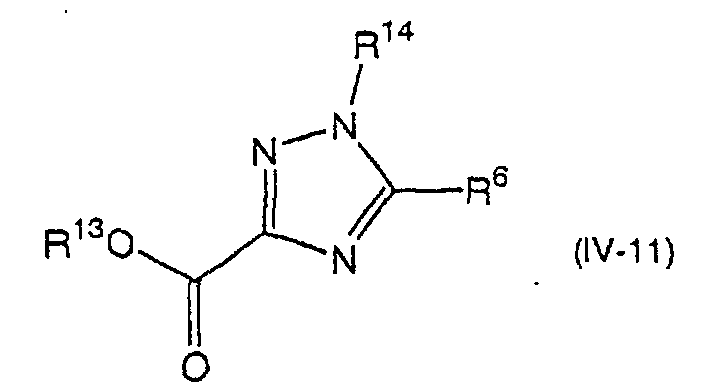
-
- C—CHEMISTRY; METALLURGY
- C07—ORGANIC CHEMISTRY
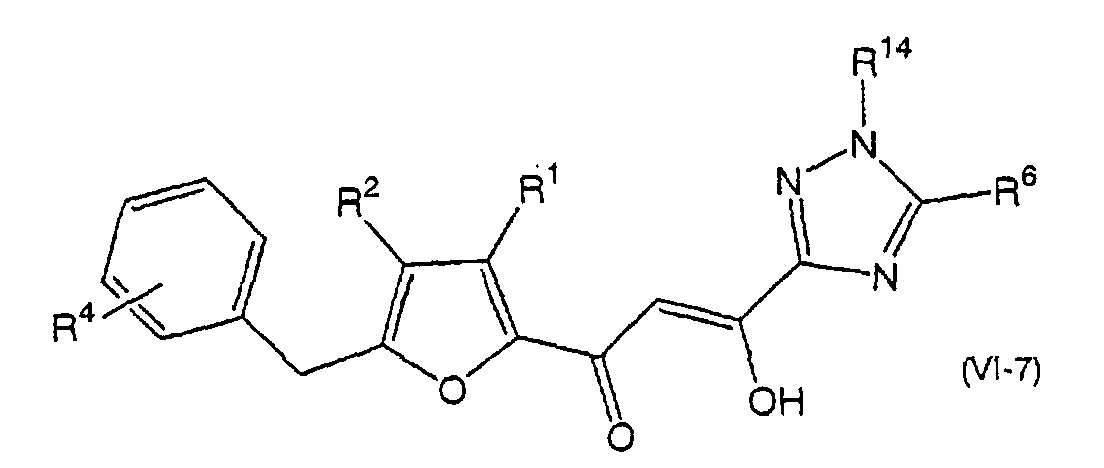
- C07D—HETEROCYCLIC COMPOUNDS
- C07D307/00—Heterocyclic compounds containing five-membered rings having one oxygen atom as the only ring hetero atom
- C07D307/02—Heterocyclic compounds containing five-membered rings having one oxygen atom as the only ring hetero atom not condensed with other rings
- C07D307/34—Heterocyclic compounds containing five-membered rings having one oxygen atom as the only ring hetero atom not condensed with other rings having two or three double bonds between ring members or between ring members and non-ring members
- C07D307/38—Heterocyclic compounds containing five-membered rings having one oxygen atom as the only ring hetero atom not condensed with other rings having two or three double bonds between ring members or between ring members and non-ring members with substituted hydrocarbon radicals attached to ring carbon atoms
- C07D307/40—Radicals substituted by oxygen atoms
- C07D307/46—Doubly bound oxygen atoms, or two oxygen atoms singly bound to the same carbon atom
-
- C—CHEMISTRY; METALLURGY
- C07—ORGANIC CHEMISTRY
- C07D—HETEROCYCLIC COMPOUNDS
- C07D405/00—Heterocyclic compounds containing both one or more hetero rings having oxygen atoms as the only ring hetero atoms, and one or more rings having nitrogen as the only ring hetero atom
- C07D405/02—Heterocyclic compounds containing both one or more hetero rings having oxygen atoms as the only ring hetero atoms, and one or more rings having nitrogen as the only ring hetero atom containing two hetero rings
- C07D405/06—Heterocyclic compounds containing both one or more hetero rings having oxygen atoms as the only ring hetero atoms, and one or more rings having nitrogen as the only ring hetero atom containing two hetero rings linked by a carbon chain containing only aliphatic carbon atoms
-
- A—HUMAN NECESSITIES
- A61—MEDICAL OR VETERINARY SCIENCE; HYGIENE
- A61P—SPECIFIC THERAPEUTIC ACTIVITY OF CHEMICAL COMPOUNDS OR MEDICINAL PREPARATIONS
- A61P31/00—Antiinfectives, i.e. antibiotics, antiseptics, chemotherapeutics
- A61P31/12—Antivirals
- A61P31/14—Antivirals for RNA viruses
- A61P31/18—Antivirals for RNA viruses for HIV
-
- Y—GENERAL TAGGING OF NEW TECHNOLOGICAL DEVELOPMENTS; GENERAL TAGGING OF CROSS-SECTIONAL TECHNOLOGIES SPANNING OVER SEVERAL SECTIONS OF THE IPC; TECHNICAL SUBJECTS COVERED BY FORMER USPC CROSS-REFERENCE ART COLLECTIONS [XRACs] AND DIGESTS
- Y02—TECHNOLOGIES OR APPLICATIONS FOR MITIGATION OR ADAPTATION AGAINST CLIMATE CHANGE
- Y02P—CLIMATE CHANGE MITIGATION TECHNOLOGIES IN THE PRODUCTION OR PROCESSING OF GOODS
- Y02P20/00—Technologies relating to chemical industry
- Y02P20/50—Improvements relating to the production of bulk chemicals
- Y02P20/55—Design of synthesis routes, e.g. reducing the use of auxiliary or protecting groups
Definitions
- the present invention relates to processes for the preparation of novel substituted propenone derivatives and their crystals, in detail processes for the preparation of their intermediates, 2-acyl-5-benzylfuran derivatives and 1,2,4-triazole-3-carboxylic acid ester derivatives.
- 2-Acyl-5-alkylfuran derivatives which are similar to 2-acyl-5-benzylfuran derivatives, can be prepared by introducing an acyl group to 2-alkyfuran derivatives through Friedel Crafts reaction (Japanese Patent Publication (Kokoku) 1995-78056, Japanese Patent Publication (Kokoku) 1995-78056 and Japanese Patent Publication (Kokai) 1986-53275).
- 2-Alkylfuran derivatives can be prepared by introducing an alkyl group to furan derivatives through Friedel Crafts reaction (Chem. France. 1962, 1166).
- 1,2,4-triazole-3-carboxylic acid can be prepared by converting an amino group of 3-amino-1,2,4-triazole-5-carboxylic acid to a diazo group, isolating the diazonium salt and reducing.
- 1,2,4-triazole-3-carboxylic acid ester can be prepared by heating acylamidrazone over its melting point (150 to 200 °C) to cyclize (Collect. Czech. Chem. Commun., 49, 1984, 2492-2495, J. Heterocyclic Chem., 25, 651-654, 1998).
- the document describes that a large scale of cyclization must be preformed under reduced pressure with heating over its melting point for removing the generated water.
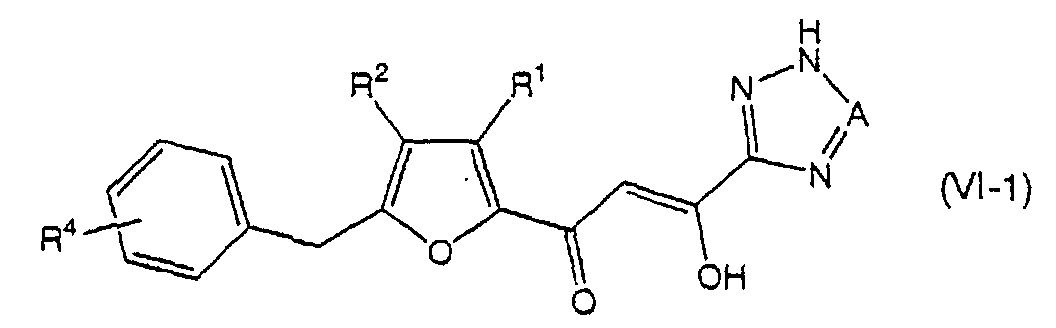
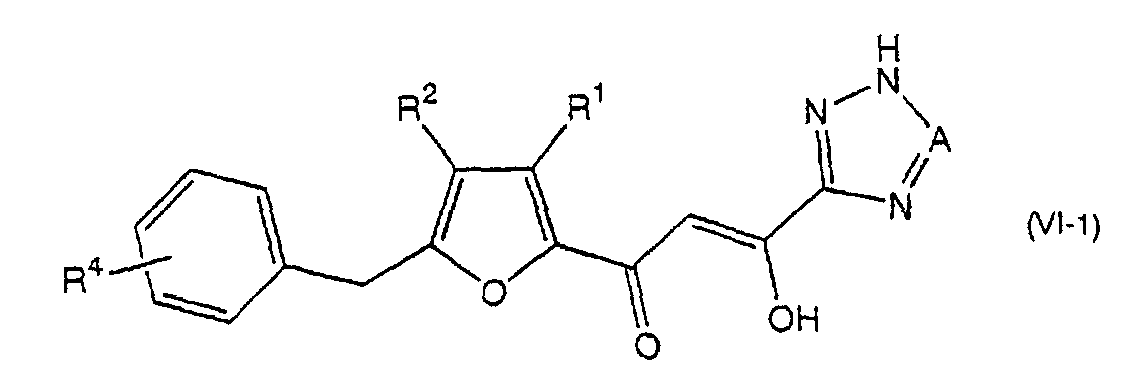
- a compound of the formula (VI-1) can be prepared in the following method. wherein R 1 , R 2 , R 4 and A are as defined above; Q is a protecting group; and L is a leaving group.
- any ring may be substituted with optionally substituted alkyl, optionally substituted alkoxy and/or halogen.
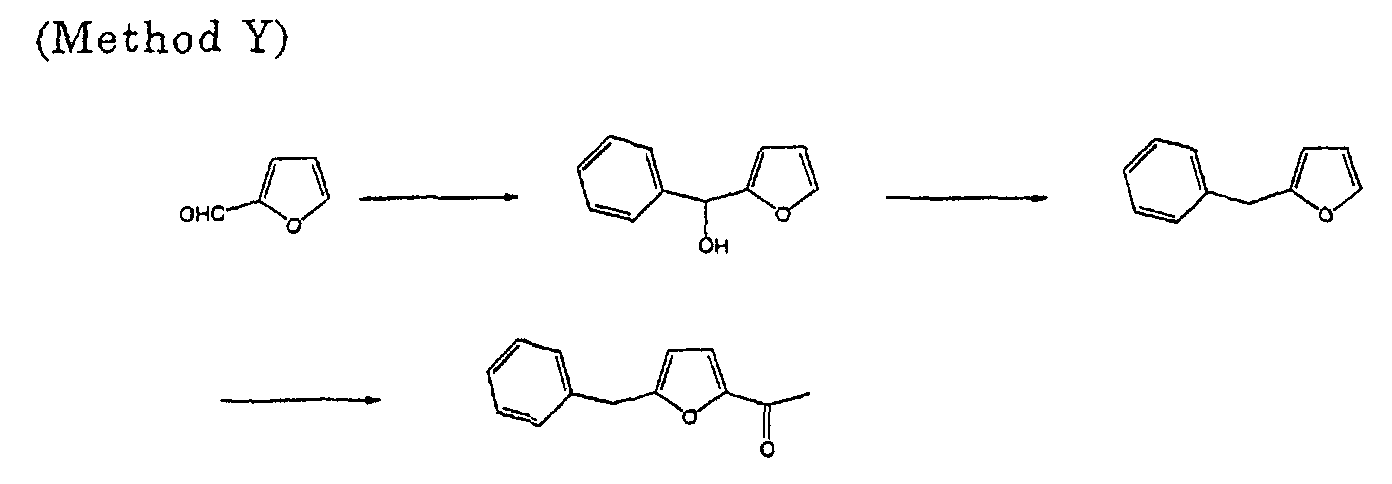
- the present inventors have solved the above problems on methods X and Y, and found out industrial and commercial processes for the preparation of 2-acyl-5-benzylfuran derivatives can be achieved through Friedel Crafts reaction of 2-acylfuran derivatives.
- the present inventions of 2-acylfuran derivatives include;
- a conventional process for the preparation of 1,2,4-triazole-3-carboxlic acid comprising a reduction of an isolated diazonium salt is accompanied with danger of explosion when a large amount of a diazonium salt is treated, so this process is not suitable to industrial production.
- a process for the preparation of 1,2,4-triazole-3-carboxilic acid ester comprising a cyclization of acylamidrazone requires heating over a melting point, so this process is not suitable in an industrial scale, too.
- the present inventions of 1,2,4-triazole-3-carboxilic acid ester derivatives include;
- the present inventions for the preparation of substituted propenone derivatives accompanied by the above A) and/or B) include;
- the present inventions for a crystal of the above novel substituted propenone derivative include;
- alkyl includes C1 to C6 straight or branched alkyl, for example, methyl, ethyl, n-propyl, isopropyl, n-butyl, isobutyl, sec-butyl, tert-butyl, n-pentyl, isopentyl, neopentyl, tert-pentyl, n-hexyl, isohexyl or the like.
- Preferred is methyl or ethyl.
- alkylene includes C2 to C6 straight or branched alkylene, for example, ethylene, propylene, trimethylene, ethylethylene, tetramethylene or the like. Preferred is trimethylene.
- alkoxy includes C1 to C6 straight or branched alkoxy, for example, methoxy, ethoxy, n-propoxy, isopropoxy, n-butoxy, isobutoxy, sec-butoxy, tert-butoxy, n-pentyloxy, isopentyloxy, neopentyloxy, tert-pentyloxy, n-hexyloxy, isohexyloxy or the like.
- Preferred is methoxy or ethoxy.
- alkoxymethyl includes methyl group substituted with the above alkyloxy, for example, methoxymethyl, ethoxymethyl, n-propoxymethyl, isopropoxymethyl, n-butoxymethyl, isobutoxymethyl, sec-butoxymethyl, tert-butoxymethyl, n-pentyloxymethyl, isopentyloxymethyl, neopentyloxymethyl, tert-pentyloxymethyl, n-hexyloxymethyl, isohexyloxymethyl or the like.
- Preferred is methoxy or ethoxymethyl.
- aryl includes C6 to C14 aromatic carbocycle, for example, phenyl, naphthyl, anthryl, phenanthryl or the like. Preferred is phenyl.
- halogen includes fluoro, chloro, bromo or iodo.
- Preferred in X is chloro or bromo.
- Preferred in R 13 is fluoro, especially para-substituted fluoro.
- trityl means a group of the formula: -CPh 3 wherein Ph is phenyl.
- optionally substituted sulfamoyl includes unsubstituted sulfamoyl and sulfamoyl mono- or di-substituted with alkyl, for example, sulfamoyl, N-methylsulfamoyl, N,N-dimethylsulfamoyl, N-ethylsulfamoyl, N,N-diethylsulfamoyl or the like.
- substituents of "optionally substituted alkyl", “optionally substituted alkoxymethyl” and “optionally substituted alkylene” include aryl (e.g., phenyl or the like), cycloalkyl (e.g., cyclopropyl, cyclopentyl, cyclohexyl or the like), cyano, nitro, hydroxy, amino, halogenated alkyl (e.g., trifluoromethyl or the like) or the like.
- substituents of "optionally substituted aryl” include alkyl (e.g, methyl, ethyl or the like), alkenyl (e.g., vinyl, allyl or the like), halogen, hydroxy, alkoxy (e.g., methoxy, ethoxy or the like), halogenated alkyl (e.g., trifluoromethyl or the like), nitro, sulfamoyl, amino, alkyl-substituted amino (e.g., methylamino, dimethylamino or the like), carboxy, alkoxycarbonyl (e.g., methoxycarbonyl or the like), cyano or the like.
- alkyl e.g, methyl, ethyl or the like
- alkenyl e.g., vinyl, allyl or the like
- halogenated alkyl e.g., trifluoromethyl or the like
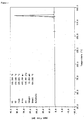
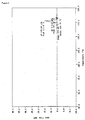
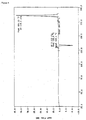
- Figure 1 shows a powder X-ray diffraction chart of a crystal (type I) of 1-[5-(4-fluorobenzyl)furan-2-yl]-3-hydroxy-3-(1 H -1,2,4-triazole-3-yl)propenone.
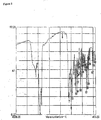
- Figure 2 shows an infrared absorption spectrum chart of a crystal (type I) of 1-[5-(4-fluorobenzyl)furan-2-yl]-3-hydroxy-3-(1 H -1,2,4-triazole-3-yl)propenone.
- Figure 3 shows a diffrential scanning calorimetry chart of a crystal (type I) of 1-[5-(4-fluorobenzyl)furan-2-yl]-3-hydroxy-3-(1 H -1,2,4-triazole-3-yl)propenone.
- Figure 4 shows a powder X-ray diffraction chart of a crystal (type II) of 1-(5-(4-fluorobenzyl)furan-2-yl]-3-hydroxy-3-(1 H -1,2,4-triazole-3-yl)propenone.
- Figure 5 shows an infrared absorption spectrum chart of a crystal (type II) of 1-(5-(4-fluorobenzyl)furan-2-yl]-3-hydroxy-3-(1 H -1,2,4-triazole-3-yl)propenone.
- Figure 6 shows a diffrential scanning calorimetry chart of a crystal (type II) of 1-(5-(4-fluorobenzyl)furan-2-yl]-3-hydroxy-3-(1 H -1,2,4-triazole-3-yl)propenone.
- Figure 7 shows a powder X-ray diffraction chart of a crystal (type III) of 1-[5-(4-fluorobenzyl)furan-2-yl]-3-hydroxy-3-(1 H -1,2,4-triazole-3-yl)propenone.
- Figure 8 shows an infrared absorption spectrum chart of a crystal (type III) of 1-[5-(4-fluorobenzyl)furan-2-yl]-3-hydroxy-3-(1 H -1,2,4-triazole-3-yl)propenone.
- Figure 9 shows a diffrential scanning calorimetry chart of a crystal (type III) of 1-[5-(4-fluorobenzyl)furan-2-yl]-3-hydroxy-3-(1 H -1,2,4-triazole-3-yl)propenone.
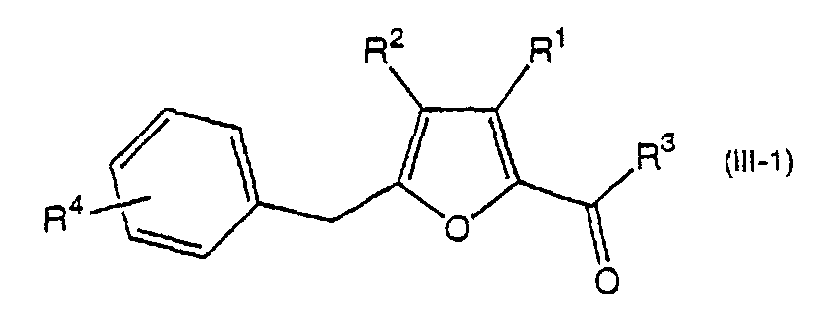
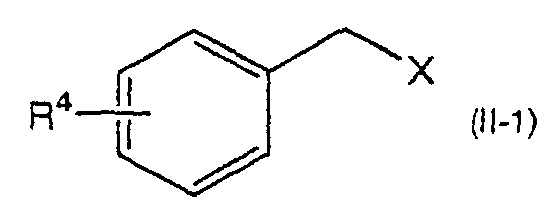
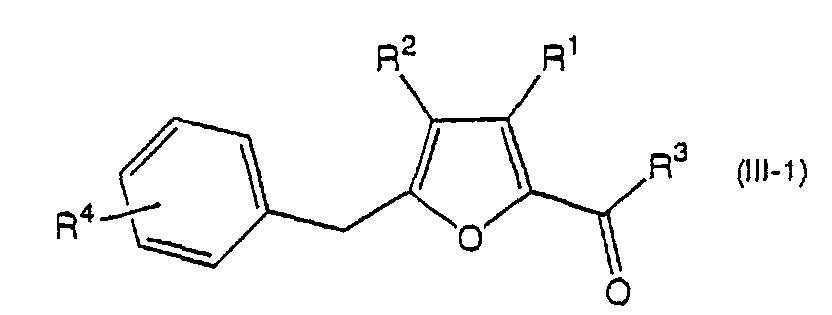
- R 1 , R 2 and R 4 each is independently hydrogen, optionally substituted alkyl, optionally substituted alkoxy or halogen; R 3 is optionally substituted alkyl or optionally substituted alkoxy.
- This scheme shows a process for the preparation of 2-acyl-5-benzylfuran derivatives (III-1) which comprises reacting 2-acylfuran derivatives (I-1) with benzylhalide derivatives (II-1) in the presence of a Lewis acid through Friedel Crafts reaction.
- the compound (I-1) includes 2-acetylfuran, 2-acetyl-3-methylfuran, 2-acetyl-4-methylfuran, 2-acetyl-3,4-dimethylfuran, 2-acetyl-3-methoxyfuran, 2-acetyl-4-methoxyfuran, 2-acetyl-3,4-dimethoxyfuran, 2-acetyl-3-chlorofuran, 2-acetyl-4-chlorofuran, 2-acetyl-3,4-dichlorofuran, 2-propionylfuran, 3-methyl-2-propionylfuran, 4-methyl-2-propionylfuran, 3,4-dimethyl-2-propionylfuran, 3-methoxy-2-propionylfuran, 4-methoxy-2-propionylfuran, 3.,4-dimethoxy-2-propionylfuran, 3-chloro-2-propionylfuran, 4-chloro-2-propionylfuran, 3,4-d
- the compound (II-1) includes benzylchloride, benzylbromide, 4-methylbenzylchloride, 4-methylbenzylbromide, 4-methoxybenzylchloride, 4-methoxybenzylbromide, 4-fluorobenzylchloride, 4-fluorobenzylbromide, 4-chlorobenzylchloride, 4-chlorobenzylbromide, 3-methylbenzylchloride, 3-methylbenzylbromide, 3-methoxybenzylchloride, 3-methoxybenzylbromide, 3-fluorobenzylchloride, 3-fluorobenzylbromide, 3-chlorobenzylchloride, 3-chlorobenzylbromide or the like.
- Preferred is 4-fluorobenzylchloride or 4-fluorobenzylbromide.
- a Lewis acid includes zinc chloride (ZnCl 2 ), stannic chloride (SnCl 4 ), ferric chloride (III) (FeCl 3 ), aluminum chloride (AlCl 3 ), BF 3 /ether or the like. Preferred is zinc chloride or stannic chloride.
- This process can be performed without a reaction solvent.
- a reaction solvent water, carbon disulfide, methylene chloride, dichloroethane, chloroform or the like can be used. Preferred is water or methylene chloride.
- the produced compound (III-1) forms a complex with a Lewis acid, a crystal of which is precipitated in the reaction solvent.
- the crystal is filtered off, dissolved in water, extracted with an organic solvent to give the compound (III-1) in high quality.
- reaction When water is used as a reaction solvent, the reaction can be performed mildly, which is economically and environmentally preferable.
- the reaction temperature is -50 to 150 °C, preferably, 0 to 100 °C.
- the reaction time is 1 to 48 hours, preferably 1 to 24 hours.
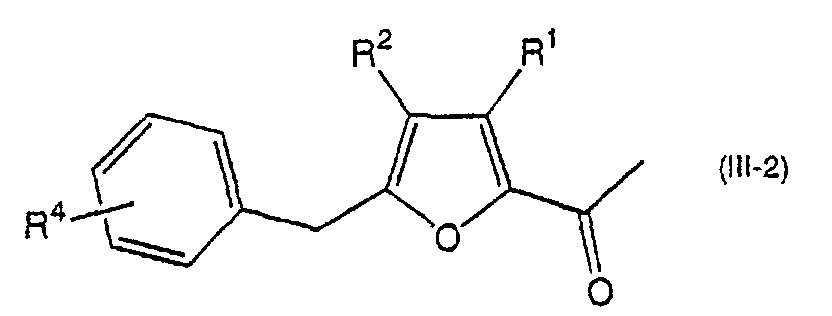
- 2-Acyl-5-benzylfuran derivatives such as a compound (III-1) or (III-2) can be prepared through the following processes such as Process A-2 and A-3 besides the above Process A1.
- R 1 , R 2 and R 4 each is independently hydrogen, optionally substituted alkyl, optionally substituted alkoxy or halogen.
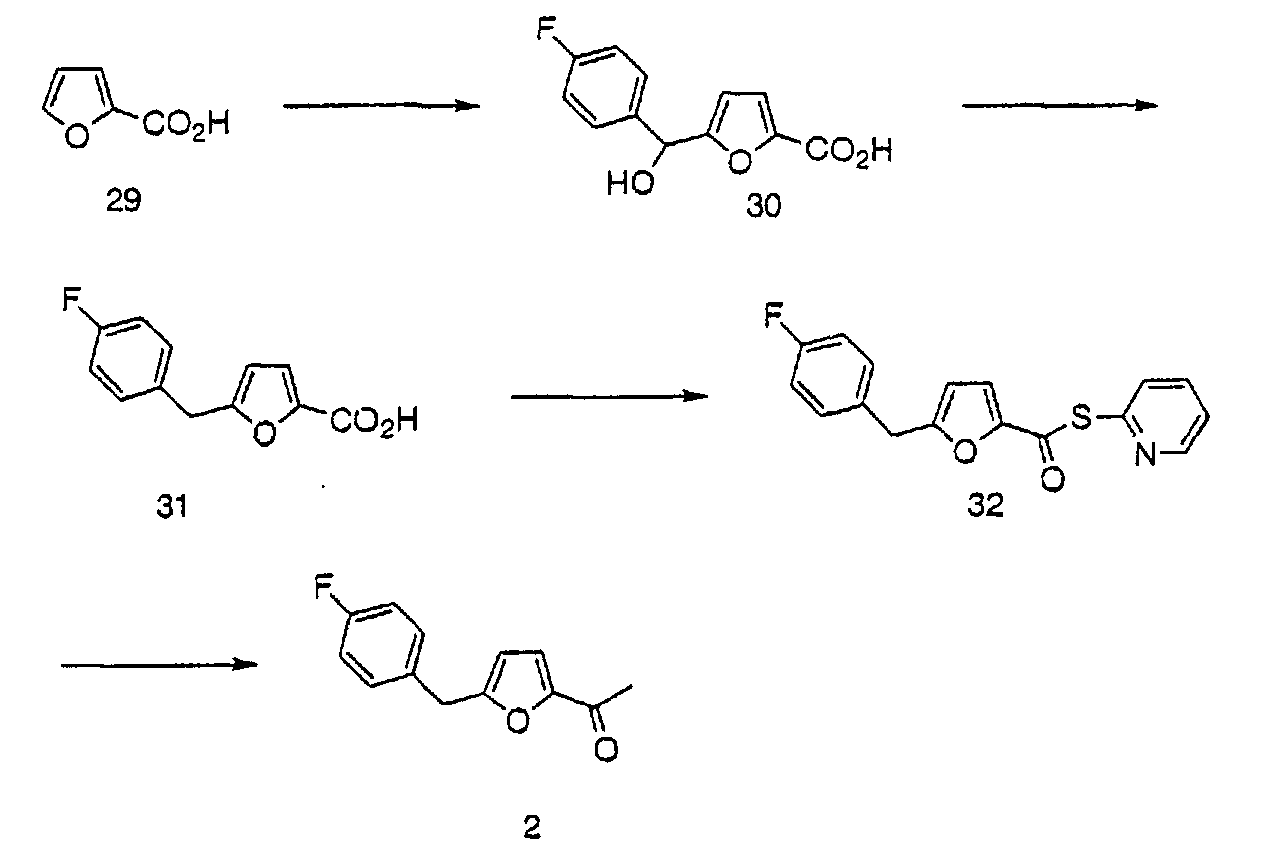
- the above process includes the following four steps. First, a coupling reaction of a compound (I-2) and (II-2) produces a compound (III-3). Second, a dehydroxy reaction of the compound (III-3) produces a compound (III-4). Third, an introduction of a leaving group to a carboxy group of the compound (III-4) produces a compound (III-5). Finally, a reaction of the compound (III-5) with methyl magnesium halide (e.g., methyl magnesium bromide) produces a compound (III-2).
- methyl magnesium halide e.g., methyl magnesium bromide
- the above coupling reaction can be performed in the presence of a base (e.g., LDA) under cooling.
- a base e.g., LDA
- the dehydroxy reaction can be preformed by reduction with trimethyl chlorosilane and sodium iodide.
- This reaction can be performed by a hydrogenation in the presence of palladium carbon after an acetylation with acetic anhydride in the presence of triethylamine.
- the converting of a carboxy group to an acetyl group can be performed by the following steps.
- a compound (III-4) is reacted with thionylhalide (e.g., thionylchloride) in the presence of a catalytic amount of dimethylformamide or the like.
- thionylhalide e.g., thionylchloride
- the obtained compound is reacted with methyl magnesium halide (e.g., methyl magnesium chloride) in the presence of a catalytic amount of ironic acetyl acetonate.
- methyl magnesium halide e.g., methyl magnesium chloride
- the above process for the preparation of a compound (III-2) comprises reacting a compound (I-3), a starting material, with a compound (II-3), removing a hydroxy group, and Friedel-Crafts reaction.
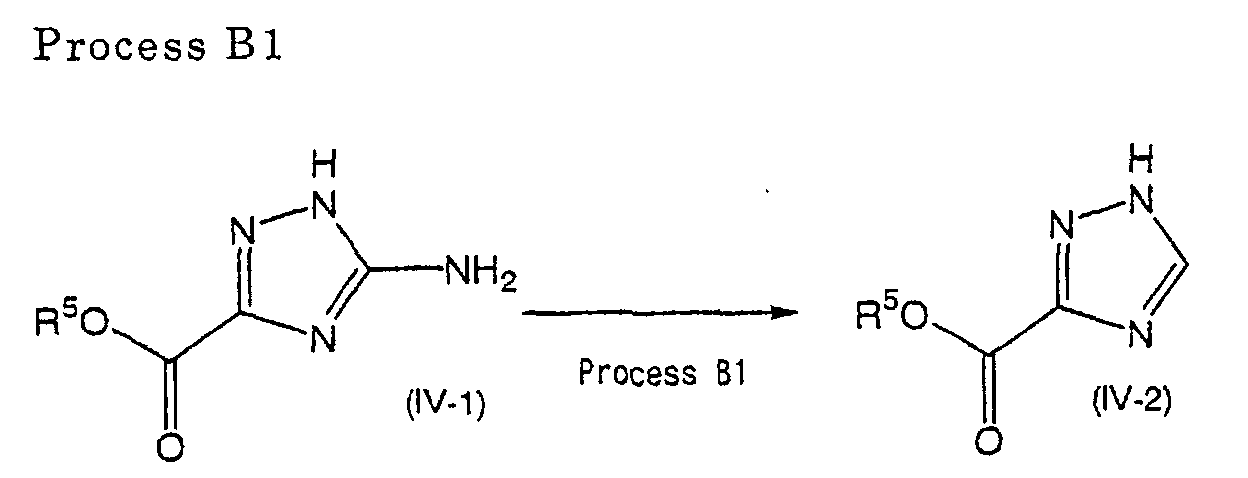
- R 5 is hydrogen or optionally substituted alkyl.
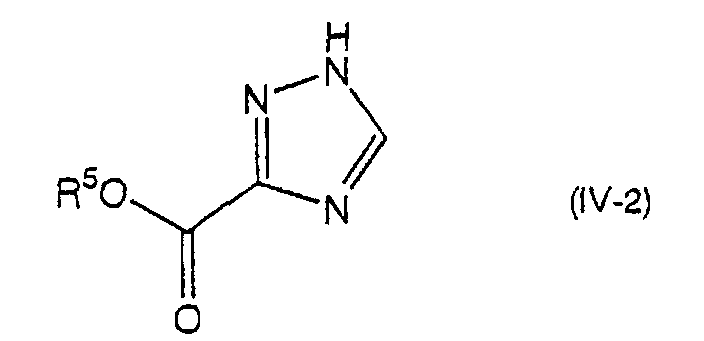
- This scheme shows a process for the preparation of a compound (IV-2) which includes a deamination of a compound (IV-1), in detail, a directly deamination without isolating a diazonium salt.
- An alkali metal nitrite to be used includes sodium nitrite, potassium nitrite, lithium nitrite or the like. Preferred is sodium nitrite.
- An alkaline-earth metal nitrite can be used in place of alkali metal nitrite.
- An alkaline-earth metal nitrite includes calcium nitrite or the like.
- a reducing agent includes hypophosphorous acid (H 3 PO 2 ), phosphorous acid (H 3 PO 3 ), Ca(H 2 PO 2 ) 2 , NaBH(OAc) 3 , PhSH, H 2 CO or the like.
- hypophosphorous acid H 3 PO 2 ).
- a compound (IV-1) is added an aqueous solution of a reducing agent (e.g., hypophosphorous acid) and warmed at 30 to 60 °C (preferably, 40 to 50 °C).
- a reducing agent e.g., hypophosphorous acid
- To the suspension is added dropwise under stirring at 30 to 60 °C (preferably, under 50 °C) for approximately 10 to 60 minutes (preferably approximately 30 minutes) an aqueous solution of an alkali metal nitrite or an alkaline-earth metal nitrite.
- the reaction mixture is stirred at the same temperature for 10 to 60 minutes (preferably 30 minutes), cooled to 0 - 20 °C (preferably, approximately 5 °C) and stirred for 10 to 60 minutes (preferably, approximately 30 minutes).
- the objective, a compound (IV-2) can be prepared by filtering the obtained suspension.
- This process may be performed in the presence of a diluted hydrochloric acid (e.g., 6 % hydrochloric acid) or the like.
- a diluted hydrochloric acid e.g., 6 % hydrochloric acid
- Preferred in this process is an addition of a small amount (1-10 (v/v) %, preferably, 2-3 (v/v) % to all volume of a solvent to be used, or approximately 0.2 mole equivalent to a compound (I)) of alcohol.
- a gas is produced for approximately 10 minutes by adding an aqueous solution of an alkali metal nitrite.
- An addition of alcohol suppresses a vigorous production of the gas as well as controlling the adding rate of an aqueous solution of an alkali metal nitrite.
- An alcohol includes an alkyl alcohol, for example, isopropylalcohol, isobutanol, methanol, ethanol, n-propylalcohol, n-butanol or the like. Preferred is isopropylalcohol or isobutanol.
- a compound (IV-1) includes 3-amino-1,2,4-triazole-5-carboxylic acid and its alkyl ester derivatives (e.g., 3-amino-1,2,4-triazole-5-carboxylic acid methyl ester, 3-amino-1,2,4-triazole-5-carboxylic acid ethyl ester).
- R 5 is hydrogen, 3-amino-1,2,4-triazole-5-carboxylic acid.
- reaction temperature should be controlled for preventing its ester part from converting to carboxylic acid.
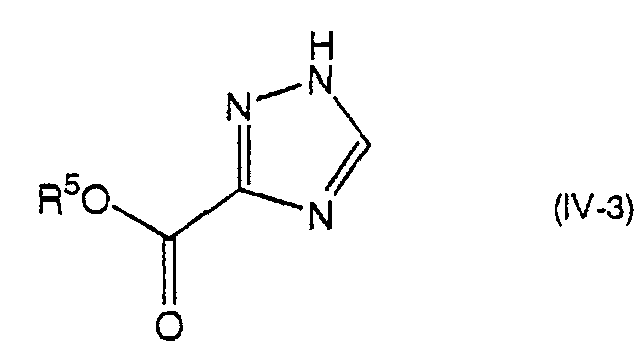
- This scheme shows a process for the preparation of a compound (IV-3) which comprises esterifing 1,2,4-triazole-3-carboxylic acid prepared through the process B1 wherein R 1 is hydrogen.
- a carboxylic acid can be esterified in accordance with the usual manner of reacting it with alcohol in the presence of an acid catalyst.
- 1,2,4-triazole-3-carboxylic acid in alcohol (e.g., methanol, ethanol, n-propanol, n-butanol, benzylalcohol) is added dropwise under cooling with stirring, thionylhalide (e.g., thionylchloride, thionylbromide).
- thionylhalide e.g., thionylchloride, thionylbromide
- the mixture is stirred at 60 to 90 °C (preferably, approximately 70 °C) for 1 to 10 hours (preferably, approximately 4 hours).
- the solvent is removed under reduced pressure, and the residue was filtered off and washed with an appropriate organic solvent (e.g., ether, ethylacetate, n-hexane) to give the objective, a compound (IV-3).
- a condensing agent such as DCC, EDC or the like can be used in a coupling reaction of carboxylic acid and alcohol.
- Another method of an esterifing reaction includes a method reacting with halogenated alkyl (e.g., methyl iodide, ethylbromide) in the presence of a base, a method reacting with diazomethane or trimethylscilyl diazomethane, a method reacting with alkene (e.g., isobutylene) or the like.
- halogenated alkyl e.g., methyl iodide, ethylbromide
- alkene e.g., isobutylene
- This scheme shows a process for the preparation of a compound (IV-4) which comprises a cyclization of a compound (V).
- this process should be performed at a high temperature (over melting point of a compound (V).
- This process can be performed by using the present invention at lower temperature, suitable to industrial production.
- This process includes two kinds of methods, as shown below.
- trialkylorthoester e.g., triethyl orthoformate, trimethyl orthoformate, triethyl orthoacetic acid, trimethyl orthoacetic acid, triethyl orthobenzoic acid, trimethyl orthobenzoic acid, triethyl orthoproprionic acid, trimethyl orthoproprionic acid
- organic solvent e.g., benzene, toluene, xylene
- the mixture is stirred at 100 to 130 °C (preferably, 110 to 120 °C) for 1 to 10 hours (preferably, approximately 2.5 hours).
- a by-product, alcohol produced from trialkylortho ester
- the distilled product is cooled at 0 to 20 °C (preferably, under 10 °C) and allowed to stand for 0.5 to 10 hours (preferably, approximately 1 hour).
- the objective, a compound (IV-4) can be obtained by filtering the precipitated crystal.
- a catalytic amount (0.01-0.5, preferably, approximately 0.1 mole equivalent to a compound (V)) of an acid (e.g., methane sulfonic acid, benzene sulfonic acid, p-toluenesulfonic acid, p-toluenesulfonic acid mono hydrate, hydrochloric acid, sulfuric acid, nitric acid, polyphosphoric acid) and an organic solvent (e.g., dimethylformamide, N-methylpyrrolidone).
- an acid e.g., methane sulfonic acid, benzene sulfonic acid, p-toluenesulfonic acid, p-toluenesulfonic acid mono hydrate, hydrochloric acid, sulfuric acid, nitric acid, polyphosphoric acid
- an organic solvent e.g., dimethylformamide, N-methylpyrrolidone
- the reaction mixture is cooled at 0 to 20 °C (preferably, under 10 °C), mixed with an organic solvent (e.g., benzene, toluene, xylene) and stirred under cooling for 0.5 to 10 hours (preferably, approximately 1.5hours).
- an organic solvent e.g., benzene, toluene, xylene
- the objective, a compound (IV-4) can be obtained by a filtration of the precipitated crystal.
- a compound (V) can be prepared by reacting thioformimidate with acylhydrazine (Collect. Czech. Chem. Commun., 49, 1984, 2492-2495, J. Heterocyclic Chem., 25, 651-654, 1998) as well as by reacting formimidate with acyl hydrazine.
- a compound (V) includes ethyl ⁇ formyl oxalylamidrazone (a compound wherein R 5 is ethyl; and R 6 is hydrogen), methyl ⁇ formyl oxalylamidrazone (a compound wherein R 5 is methyl; and R 6 is hydrogen), ethyl ⁇ acetyloxalylamidrazone (a compound wherein R 5 is ethyl; and R 6 is methyl), methyl ⁇ acetyloxalylamidrazone (a compound wherein R 5 is methyl; and R 6 is methyl), ethyl ⁇ propionyloxalylamidrazone (a compound wherein R 5 is ethyl; and R 6 is ethyl), methyl ⁇ propionyloxalylamidrazone (a compound wherein R 5 is methyl; and R 6 is ethyl), methyl ⁇ propionyloxalylamidrazone (a compound wherein R 5 is methyl; and R 6
- R 5 is optionally substituted alkyl
- R 6 is hydrogen, optionally substituted alkyl or optionally substituted aryl
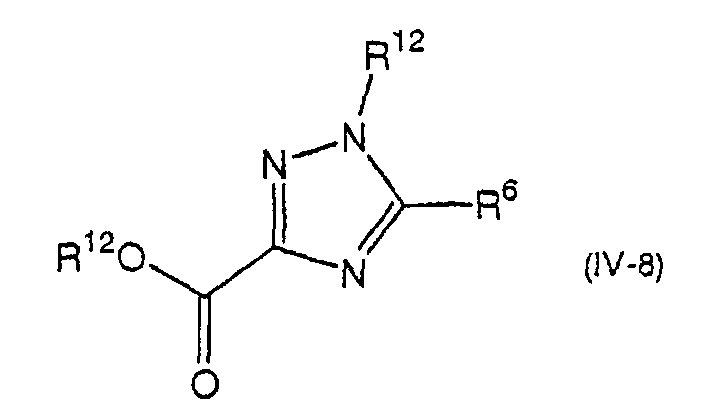
- R 12 is a group of the formula: -R 7 wherein R 7 is trityl, optionally substituted sulfamoyl or optionally substituted alkoxymethyl, a group of the formula: -C(OR 8 )R 9 -CHR 10 R 11 wherein R 8 is optionally substituted alkyl; R 9 , R 10 and R 11 each is independently hydrogen or optionally substituted alkyl; or R 8 and R 10 may be taken together to form optionally substituted alkylene, or hydroxy methyl.
- This process includes a process for the preparation of a compound (IV-6) which comprises introducing a protecting group (R 12 ) to a compound (IV-5).
- an organic solvent e.g., tetrahydrofuran, dimethylformamide.
- an organic solvent e.g., tetrahydrofuran, dimethylformamide.
- an organic solvent e.g., tetrahydrofuran, dimethylformamide.
- an organic solvent e.g., tetrahydrofuran, dimethylformamide.
- R 7 X a compound of the formula: R 7 X wherein R 7 is trityl, optionally substituted sulfamoyl or optionally substituted alkoxy methyl; and X is halogen, to a compound (IV-5), if desired, in the presence of one or more mole equivalent, preferably approximately 1.1 mole equivalent of a base (e.g., sodium hydride, N, N-dimethylacetamide) to a compound (IV-5).
- a base e.g., sodium hydride, N, N-dimethylacetamide
- an acid e.g., methane sulfonic acid, benzene sulfonic acid, p-toluene
- reaction mixture is stirred for 0.5 to 10 hours, preferably approximately 2 hours at room temperature, if desired, under heating.
- the mixture is extracted, washed, removed under reduced pressure and filtered to give the objective compound (IV-6).
- a compound (IV-5) When introducing tetrahydropyran-2-yl as a protecting group, a compound (IV-5) can be reacted with 3,4-dihydro-2 H -pyran in the presence of an acid in THF.
- the acid can be used equivalent to a compound (IV-5) or in a catalytic amount.
- the acid includes p-toluene sulfonic acid, benzene sulfonic acid or the like.
- a compound When introducing 1-methoxy-1-methylethyl as a protecting group, a compound can be reacted with 2-methoxypropene in the presence of an acid in THF.
- the acid can be used equivalent to a compound (IV-5) or in a catalytic amount.
- the acid includes p-toluene sulfonic acid, benzene sulfonic acid or the like.
- a compound of the formula: R 7 X includes tritylchloride, tritylbromide, methoxymethylchloride, methoxymethylbromide, ethoxymethylchloride, ethoxymethylbromide, sulfamoyl chloride, N,N-dimethylsulfamoyl chloride, sulfamoyl bromide, N,N-dimethylsulfamoyl bromide or the like.
- a compound of the formula: (R 8 O)R 9 C CR 10
- R 11 includes 3,4-dihydro-2H-pyran (a compound wherein R 8 and R 10 are taken together to form trimethylene; and R 9 and R 11 each is hydrogen), 2-methoxypropenone (a compound wherein R 8 and R 9 each is methyl; and R 10 and R 11 each is hydrogen), 2-ethoxypropene (a compound wherein R 8 is ethyl; R 9 is methyl; and R 10 and R 11 each is hydrogen), methylvinyl ether (a compound wherein R 8 is methyl; and R 9 , R 10 and R 11 each is hydrogen), ethylvinyl ether (a compound wherein R 8 is ethyl; and R 9 , R 10 and R 11 each is hydrogen), n-propylvinyl ether.
- R 8 is n-propyl; and R 9 , R 10 and R 11 each is hydrogen
- n-butylvinyl ether a compound wherein R 8 is n-butyl; and R 9 , R 10 and R 11 each is hydrogen
- isobutylvinyl ether a compound wherein R 8 is isobutyl; and R 9 , R 10 and R 11 each is hydrogen
- a hydroxymethyl group can be introduced as a protecting group to a compound (IV-5) by reacting with formaldehyde in accordance with a method described in A.R.Katritzky and K.Akutagawa, J. Org. Chem., 54, 2929 (1989).
- R 6 is hydrogen, optionally substituted alkyl or optionally substituted aryl
- R 12 is a group of the formula: -R 7 wherein R 7 is trityl, optionally substituted sulfamoyl or optionally substituted alkoxy methyl, a group of the formula: -C(OR 8 )R 9 -CHR 10 R 11 wherein R 8 is optionally substituted alkyl; R 9 , R 10 and R 11 each is independently hydrogen or optionally substituted alkyl; or R 8 and R 10 may be taken together to form optionally substituted alkylene, or hydroxy group.
- This process includes a process for the preparation of a compound (VI-8) which comprises introducing protective groups (R 12 ) at two positions to a compound (IV-7).
- the introduction of a protecting group at two positions at the same time can reduce the number of steps, thus being efficient and useful for industrial production.
- R 1 , R 2 and R 4 each is independently hydrogen, optionally substituted alkyl, optionally substituted alkoxy or halogen;
- A is CR 6 or N;
- R 6 is hydrogen, optionally substituted alkyl or optionally substituted aryl;
- L is a leaving group; and
- Q is a protecting group.
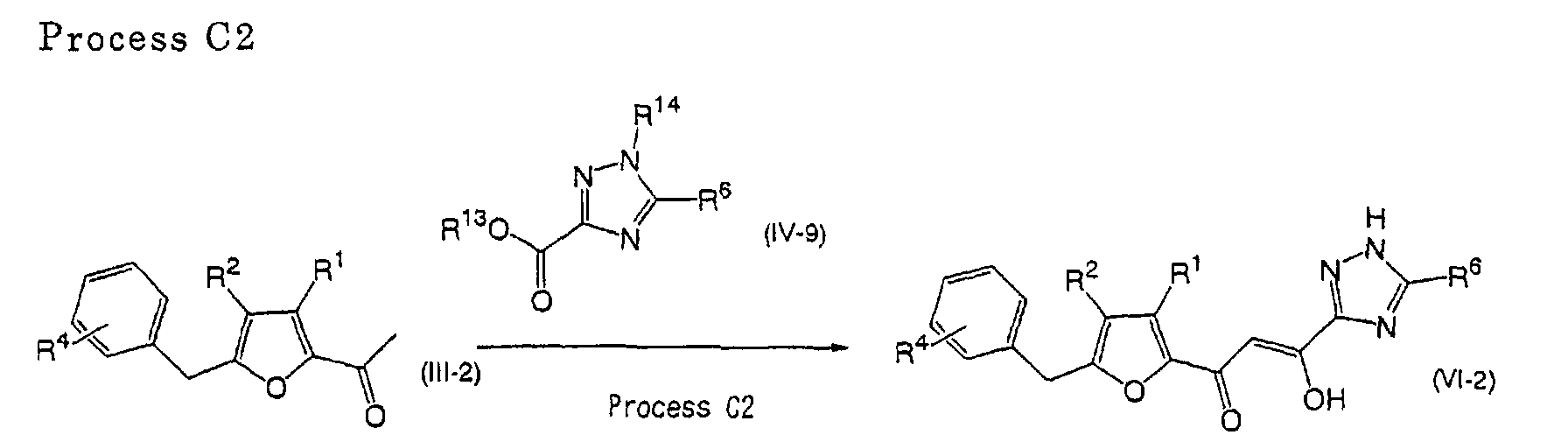
- This scheme shows a process for the preparation of 1-[5-benzylfuran-2-yl]-3-hydroxy-3-(1 H -1,2,4-triazole-3-yl)propenone derivatives from 2-acetyl-5-benzylfuran derivatives.
- This step can be carried out in the presence of a base, and followed by deprotection of a protecting group (Q) on tetrazolyl or triazolyl.
- a compound (III-2), a compound (III-1) wherein R 3 is methyl can be used.
- a compound of the formula (III-2) includes 2-acetyl-5-benzylfuran, 2-acetyl-5-(4-methylbenzyl)furan, 2-acetyl-5-(4-methoxybenzyl)furan, 2-acetyl-5-(4-fluorobenzyl)furan, 2-acetyl-5-(4-chlorobenzyl)furan, 2-acetyl-5-(3-methylbenzyl)furan, 2-acetyl-5-(3-methoxybenzyl)furan, 2-acetyl-5-(3-fluorobenzyl)furan, 2-acetyl-5-(3-chlorobenzyl)furan or the like.
- Preferred is 2-acetyl-5-(4-fluorobenzyl)furan.
- a compound of the formula (IV-10) includes 2-trityl-2H-tetrazole-5-carboxylic acid ethyl ester, 1-trityl-1 H -1,2,4-triazole-3-carboxylic acid methyl ester, 1-trityl-1 H -1,2,4-triazole-3-carboxylic acid ethyl ester or the like.
- Preferred is 1-trityl-1 H -1,2,4-triazole-3-carboxylic acid ethyl ester, 1-trityl-1 H -1,2,4-triazole-3-carboxylic acid methyl ester.
- a protecting group (Q) includes methoxymethyl, dialkoxy methyl, tert-butoxycarbonyl, 9-fluorenylmethoxycarbonyl, tosyl, trityl, allyl, formyl or the like.
- a protecting group includes a group of the formula: -R 7 wherein R 7 is trityl, optionally substituted sulfamoyl or optionally substituted alkoxymethyl, a group of the formula: -C(OR 8 )R 9 -CHR 10 R 11 wherein R 8 is optionally substituted alkyl; R 9 , R 10 and R 11 each is independently hydrogen or optionally substituted alkyl; or R 8 and R 10 may be taken together to form optionally substituted alkylene, or hydroxy methyl.
- a deprotection of these protecting groups can be carried out, depending on the kind of protecting groups. The deprotection can be carried out by hydrolysis under an acidic condition or a basic condition.
- a leaving group (L) includes alkoxy (methoxy, ethoxy, isopropoxy, tert-butoxy, biphenylmethoxy), heteroaryl (imidazolyl, tetrazolyl), cyano or the like. Preferred is methoxy or ethoxy.
- a base includes sodium methoxide, sodium ethoxide, potassium tert-butoxide, n-butyllithium, lithiumbistrimethylscilylamide or the like. Preferred is sodium methoxide.
- a reaction solvent includes dimethylformamide, tetrahydrofuran, dioxane, alcohols (e.g., methanol, ethanol, isopropylalcohol) or the like.
- a mixed solvent can be used as a reaction solvent. Preferred is tetrahydrofuran, methanol or a mixed solvent thereof.
- a reaction temperature is -100 to 100 °C, preferably -50 to 50 °C.
- a reaction time is 1 to 48 hours, preferably 1 to 24 hours.
- a compound of the formula (III-2), a compound of the formula (IV-10) and a base can be added in any order.
- a base may be added to a compound of the formula (III-2), and after a couple of minutes or hours a compound of the formula (IV-10) may be added thereto.
- a base or a solvent comprising a base
- R 1 , R 2 and R 4 each is independently hydrogen, optionally substituted alkyl, optionally substituted alkoxy or halogen;
- R 6 is hydrogen, optionally substituted alkyl or optionally substituted aryl;
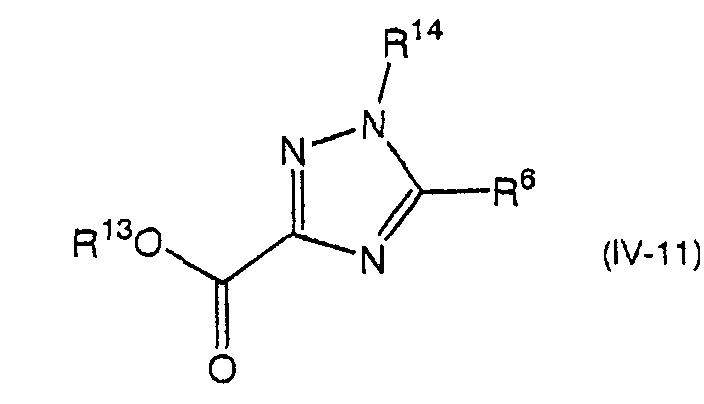
- R 13 is optionally substituted alkyl, a group of the formula: -R 7 wherein R 7 is trityl, optionally substituted sulfamoyl or optionally substituted alkoxymethyl, a group of the formula: - C(OR 8 )R 9 -CHR 10 R 11 wherein R 8 is optionally substituted alkyl; R 9 , R 10 and R 11 each is independently hydrogen or optionally substituted alkyl; or R 8 and R 10 may be taken together to form optionally substituted alkylene, or hydroxymethyl; and
- R 14 is a group of the formula: -R 7 wherein R 7 is as defined above, a group of the formula: -C(OR 8 )R 9 -CHR 10 R
- This scheme shows a process for the preparation of a compound of the formula (VI-2) which comprises reacting a compound of the formula (IV-9) obtained in process B4 or B5 with a compound of the formula (III-2) in the presence of a base and deprotecting R 14 on triazole.
- a compound of the formula (III-2), a base, a reaction solvent, a reaction temperature and a reaction time are the same as Process C1.
- a preferred compound of the formula (IV-9) includes a compound of the formula (IV-9): wherein R 6 is hydrogen or alkyl; R 13 is alkyl, a group of the formula: -R 7 wherein R 7 is trityl, optionally substituted sulfamoyl or alkoxy methyl, a group of the formula: -C(OR 8 )R 9 -CHR 10 R 11 wherein R 8 is alkyl; R 9 , R 10 and R 11 each is independently hydrogen or alkyl; or R 8 and R 10 may be taken together to form alkylene, or hydroxymethyl; and R 14 is a group of the formula: -R 7 wherein R 7 is as defined above, a group of the formula: -C(OR 8 )R 9 -CHR 10 R 11 wherein R 8 , R 9 , R 10 and R 11 are defied above, or hydroxymethyl; provided that a compound wherein R 6 is hydrogen; R 13 is methyl; and R 14 is trityl
- a compound of the formula (IV-9) includes 1-trityl-1 H -1,2,4-triazole-3-carboxylic acid methyl ester, 1-trityl-1 H -1,2,4-triazole-3-carboxylic acid ethyl ester, 1-(tetrahydropyran-2-yl)-1 H -1,2,4-triazole-3-carboxylic acid ethyl ester, 1-hydroxy methyl-1 H -1,2,4-triazole-3-carboxylic acid ethyl ester, 1-methoxymethyl-1 H -1,2,4-triazole-3-carboxylic acid ethyl ester, 1-[(1-methoxy-1-methyl)ethyl]-1 H -1,2,4-triazole-3-carboxylic acid ethyl ester, 1-[(1-ethoxy)ethyl)-1 H -1,2,4-triazole-3-carboxylic acid ethyl ester,
- This process can be carried out as shown below.
- an organic solvent e.g., tetrahydrofuran, dioxane, diethylether
- a compound of the formula (III-2) 1.0 to 3.0 mole equivalent, preferably approximately 2 mole equivalent of a base described above to a compound of the formula (III-2) is added thereto at -80 to -10 °C, preferably -30 to -25 °C.
- the mixture is stirred at the same temperature for 1 to 10 hours, preferably approximately 1.5 hours.
- a solution of a compound of the formula (IV-9) in an organic solvent is added thereto at -80 to -5 °C (preferably, -32 to -7 °C).
- the mixture is warmed up to the room temperature (approximately 25 °C) and stirred for 1 to 10 hours (approximately 2 hours).
- the reaction mixture is poured into an acid (e.g., dilute hydrochloric acid) for neutralizing excess of a base, extracted with an organic solvent (e.g., methylene chloride, chloroform, ethylacetate), washed with water, concentrated under reduced pressure and filtered to give a crystal.
- an organic solvent e.g., methylene chloride, chloroform, ethylacetate
- a protected derivative includes a compound of the formula (IV-7): wherein R 1 , R 2 and R 4 each is independently hydrogen, optionally substituted alkyl, optionally substituted alkoxy or halogen; R 6 is hydrogen, optionally substituted alkyl or optionally substituted aryl; and R 14 is a group of the formula: -R 7 wherein R 7 is trityl, optionally substituted sulfamoyl or optionally substituted alkoxy methyl, a group of the formula: -C(OR 8 )R 9 -CHR 10 R 11 wherein R 8 is alkyl; R 9 , R 10 and R 11 each is independently hydrogen or optionally substituted alkyl; or R 8 and R 10 may be taken together to form alkylene, or hydroxymethyl.
- R 4 is 4-fluoro; R 1 , R 2 and R 6 each is hydrogen; and R 14 is trityl, tetrahydropyran-2-yl, hydroxymethyl, methoxymethyl, ethoxymethyl, N,N-dimethylsulfamoyl, (1-methoxy-1-methyl)ethyl, (1-ethoxy)ethyl, (1-ethoxy-1-methyl)ethyl, (1-n-propoxy)ethyl, (1-n-butoxy)ethyl or (1-isobutoxy)ethyl.
- a protecting group R 14 on triazole 0.01 - 10.0 mole equivalent, preferably 0.1 - 5.0 mole equivalent of an acid (e.g., hydrochloric acid, sulfuric acid, nitric acid) or a base (e.g., potassium carbonate, sodium hydroxide, potassium hydroxide, sodium hydrogencarbonate, sodium carbonate, sodium methoxide, sodium ethoxide) to a compound of the formula (III-2).
- the mixture is stirred at 0 to 100 °C (preferably 20 to 70 °C) for 1 to 10 hours (e.g., approximately 1 hour).
- An acid or a base can be used as a catalyst, which depends on a kind of protecting groups. When 1-methoxy-1-methylethyl group is used as a protecting group, it can be removed by using a catalytic amount of sulfuric acid.
- the objective compound of the formula (VI-2) can be obtained by cooling the reaction mixture and filtering the precipitated crystal.
- a compound of the formula (VI-2) forms a salt with an acid. Therefore, the objective compound of the formula (VI-2) can be obtained by cooling the reaction mixture, adding 1.0 - 4.0 mole equivalent, preferably approximately 3.0 mole equivalent of a base (e.g., sodium hydroxide, potassium hydroxide, sodium carbonate, sodium hydrogencarbonate) for neutralizing excess of an acid to form a acid-free crystal, and filtering the precipitated crystal.
- a base e.g., sodium hydroxide, potassium hydroxide, sodium carbonate, sodium hydrogencarbonate
- Impurities or the like can be removed by isolating a crystal as a salt.
- the obtained salt can be changed to a free form by adding a basic aqueous solution or the like after drying or without drying.
- the obtained salt can be changed to a free form by adding to an aqueous solution or THF containing water without neutralizing it with a base, which depends on a kind of acids.
- Preferred as a salt is a salt with hydrochloride or the like.
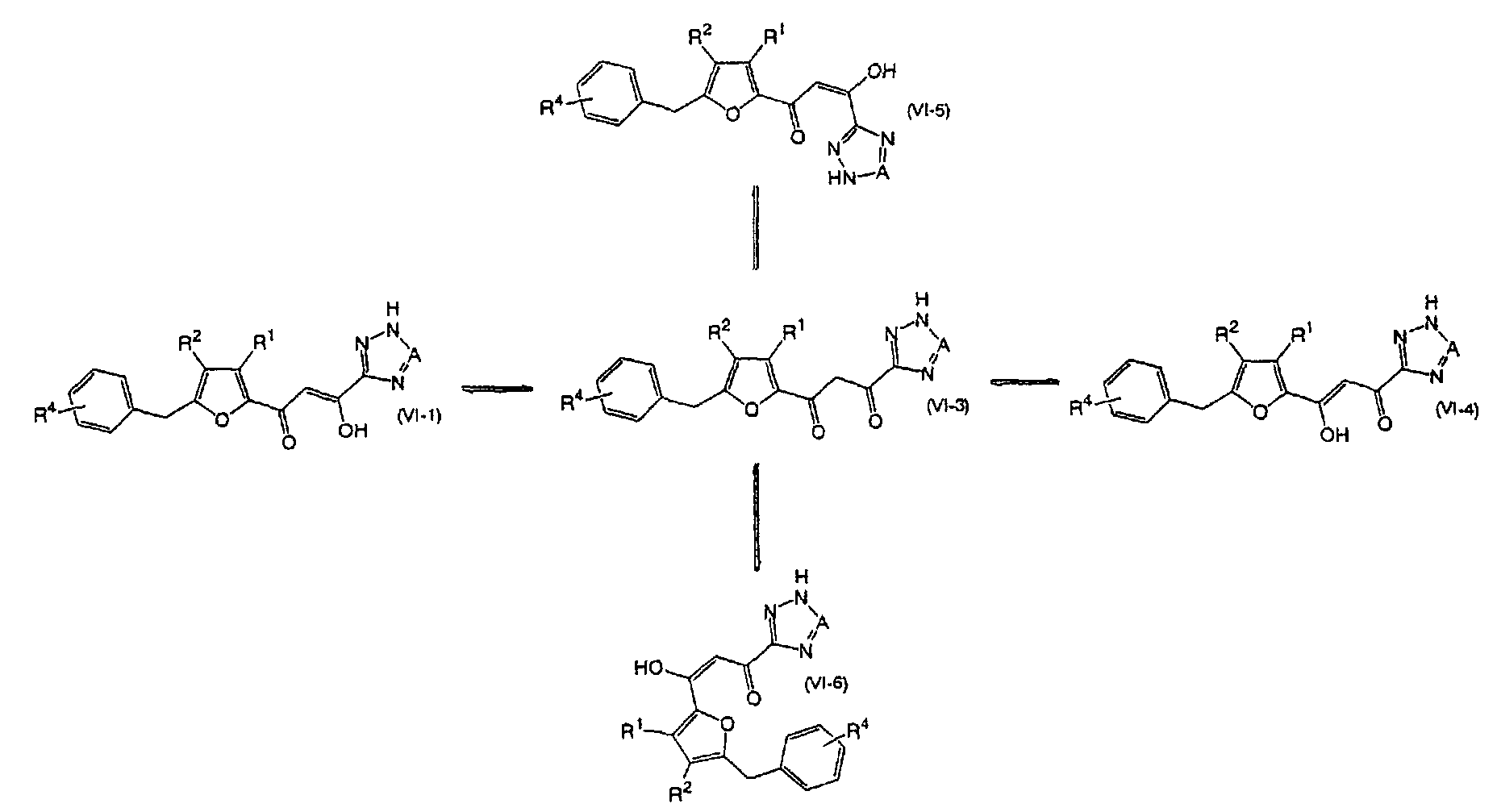
- the obtained propenone derivatives can form keto-enol isomers or cis-trans isomers as shown below. In a solution, these isomers are at the equilibrium. Each isomer can be isolated as a crystal by selecting a crystallizing condition (e.g., crystallizing solvent, crystallizing temperature, time).
- a crystallizing condition e.g., crystallizing solvent, crystallizing temperature, time.
- a compound of the formula (VI-1) includes all of the above isomers.
- an isomer having a structure of the formula (VI-1) means an isomer having a specific structure represented by the formula (VI-1).
- a compound of the formula (VI-1) is 1-[5-(4-fluorobenzyl)furan-2-yl]-3-hydroxy-3-(1 H -1,2,4-triazole-3-yl)propenone (a compound of the formula (VI-1) wherein R 1 and R 2 each is hydrogen; R 4 is p-fluoro; and A is CH), the following three crystals (type I, type II and type III) can be obtained.
- a crystal (type I) is an isomer having a structure of the formula (VI-1).
- a crystal (type I) can be obtained by generally known crystallizing methods.
- a crystal (type I) can be obtained by dissolving a compound of the formula (VI-1) in a warmed organic solvent, removing impurities by a plaited filter paper and cooling the solution.
- Any organic solvent as far as a compound of the formula (VI-1) can be dissolved, can be used, for example, an organic solvent such as tetrahydrofuran, dimethylformamide, ethanol, methanol, isopropanol, ether, isopropylether, ethylacetate, methylene chloride, chloroform, dioxane or the like, a mixed solvent thereof (e.g., tetrahydrofuran/ethanol) or a solvent containing water (e.g., tetrahydrofuran/water).
- an organic solvent such as tetrahydrofuran, dimethylformamide, ethanol, methanol, isopropanol, ether, isopropylether, ethylacetate, methylene chloride, chloroform, dioxane or the like, a mixed solvent thereof (e.g., tetrahydrofuran/ethanol) or a solvent containing water (e.g., tetrahydr
- a crystal (type II) is an isomer having a structure of the formula (VI-4).
- a crystal (type II) can be obtained by dissolving a compound of the formula (VI-1) in an organic solvent at a lower concentration than that for obtaining a crystal (type I) and keeping it for several hours to several days.
- Preferred as an organic solvent for obtaining a crystal (type II) is an organic solvent which can gradually be vaporized even at room temperature (e.g., ethylacetate).
- a crystal (type II) can be precipitated by dissolving a compound of the formula (VI-1) in an organic solvent and naturally vaporizing the solvent at room temperature for several hours or several days.
- a crystal (type III) can be obtained by adding an alcohol (e.g., methanol, ethanol) or the like to a hydrochloride of a compound of the formula (VI-1) under heating and stirring, concentrating the alcohol under reduced pressure, adding an alcohol, repeating the same steps and filtering the precipitated crystal.
- an alcohol e.g., methanol, ethanol
- crystals (type I), (type II) and (type III) are at the equilibrium in vivo and have anti-HIV activities. Therefore, all crystals are useful as anti-HIV agents.
- crystal (type I), (type II) and (type III) preferred is a crystal (type I), because it can easily be prepared and stably be provided.
- crystals can be identified by single crystal X-ray diffraction, powder X-ray diffraction, infrared absorption spectrum and diffrential scanning calorimetry. Each crystal can be identified by these instrumental analysis.
- a crystalline substance can be identified by crystal parameter of single crystal X-ray diffraction such as unit cell constants and its space group.
- Unit cell constants are represented by lengths of its side faces, relative angles between its side faces and volume of itself.
- the lengths of its side faces are represented by a, b and c.
- the relative angles between its side faces are determined by ⁇ , ⁇ and ⁇ .
- the volume of itself is determined by V.
- a unit cell is precisely explained in X-Ray Structure Determination; A Practical Guide, Macmirian, Staut and Jensen, New York (1968).
- Single crystal X-ray diffraction can be performed under the condition of CuK ⁇ , 1.54 ⁇ (monochrometer), voltage 60kV and electricity 300mA.
- a measuring data includes experimental errors.
- measuring peaks may include more or less experimental errors, which depend on a measuring equipment or measuring condition.
- a data of a diffraction angle (2 ⁇ ) may include experimental errors of approximately ⁇ 0.2, and even if using very precise equipment, may include experimental errors of approximately ⁇ 0.1. Therefore, exparimental errors can be considered for identifing each crystal. Even if such experimental errors are taken into consideration, characteristic peaks of powder X-ray diffraction of the above crystals are different from each other. Therefore, each crystal can easily be identified.
- Powder X-ray diffraction can be performed under the condition of CuK ⁇ , 1.54 ⁇ (monochrometer), voltage 40kV and electricity 40mA.
- Each crystal can be identified by its characteristic absorption band of an infrared absorption spectrum.
- the absorption band may include a few experimental errors, which depend on measuring assemblies, measuring conditions and measuring methods such as a film method, a solution method, a nujol mull method and a KBr method.
- the absorption band may include a few experimental errors, which depend on a solvent to be used (e.g., CCl 4 , CS 2 , CHCCl 3 , CH 2 CL 2 ).
- a solvent to be used e.g., CCl 4 , CS 2 , CHCCl 3 , CH 2 CL 2 .
- each crystal has its own characteristic peaks. These characteristic peaks can be determined by the obtained measuring charts. Each crystal can be identified by peaks (melting points) or change of energy of mass unit of a sample ( ⁇ H). Approximately 1 to 3 mg of a sample is used for measuring. A scanning speed is 10.0 °C/min. A measuring can be preformed between 25.0 to 200 °C.
- Example 1(1) Example of using methylene chloride as a reaction solvent.
- Example 1(3) Example of using water as a reaction solvent.
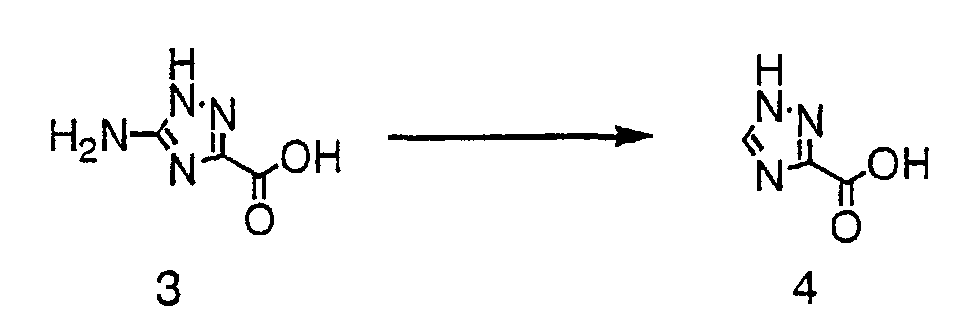
- Example 2 A process for the preparation of 1 H -1,2,4-triazole-3-carboxylic acid.
- Example 2(1) Example of adding diluted hydrochloric acid.
- Example 2(2) When a diluted hydrochloric acid is not added.
- Example 3 A process for the preparation of 1 H -1,2,4-triazole-3-carboxylic acid ethyl ester hydrochloride.
- Example 4 A process for the preparation of ethyl ⁇ -formyl oxalamidrazone.
- the solution was added dropwise under 10 °C for approximately 20 minutes to a solution of formylhydrazine in methanol (prepared from 872 ml of methanol, 73 g (1.46 mol) of hydrazine monohydrate and 119.2 g (1.6 mol) of ethylformate ester). After addition, the mixture was stirred at 5 to 10 °C for 1 hour. 702.4 g of a 10 % aqueous solution of sodium hydroxide was added dropwise thereto at the same temperature for approximately 30 minutes to make the pH of the reaction solution pH 7. The neutralized solution was heated at 45 °C under reduced pressure and approximately 1850 ml of methanol was removed.
- Example 5 A process for the preparation of 1 H -1,2,4-triazole-3-carboxylic acid ethyl ester.
- Example 5(2) Example in the presence of p-toluenesulfonic acid.
- Example 6 A process for the preparation of 1-(tetrahydropyran-2-yl)-1,2,4-triazole-3-carboxylic acid ethyl ester.
- Example 6(1) Example of using p-toluenesulfonic acid.
- Example 6(2) Example of using benzene sulfonic acid.
- Example 7 A process for the preparation of 1-trityl-1,2,4-triazole-3-carboxylic acid ethyl ester.
- Example 8 Process for the preparation of 1-(N,N-dimethylsulfamoyl)-1,2,4-triazole-3-carboxylic acid ethyl ester.
- Example 9(1) A process for the preparation of 1-(1-methoxy-1-methylethyl)-1 H -1,2,4-triazole-3-carboxylic acid ethyl.
- Example 9(2) 1-(1-Ethoxyethyl)-1 H -1,2,4-triazole-3-carboxylic acid ethyl.
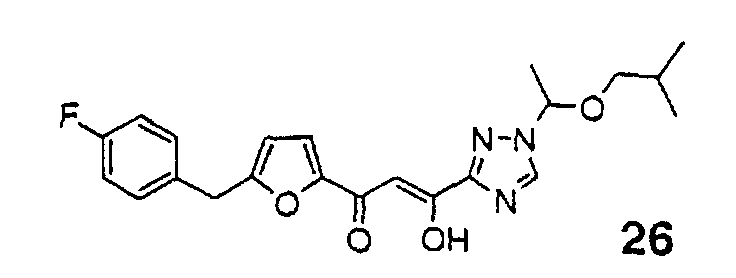
- Example 9(3) 1-(1-Isobutoxyethyl)-1 H -1,2,4-triazole-3-carboxylic acid ethyl.
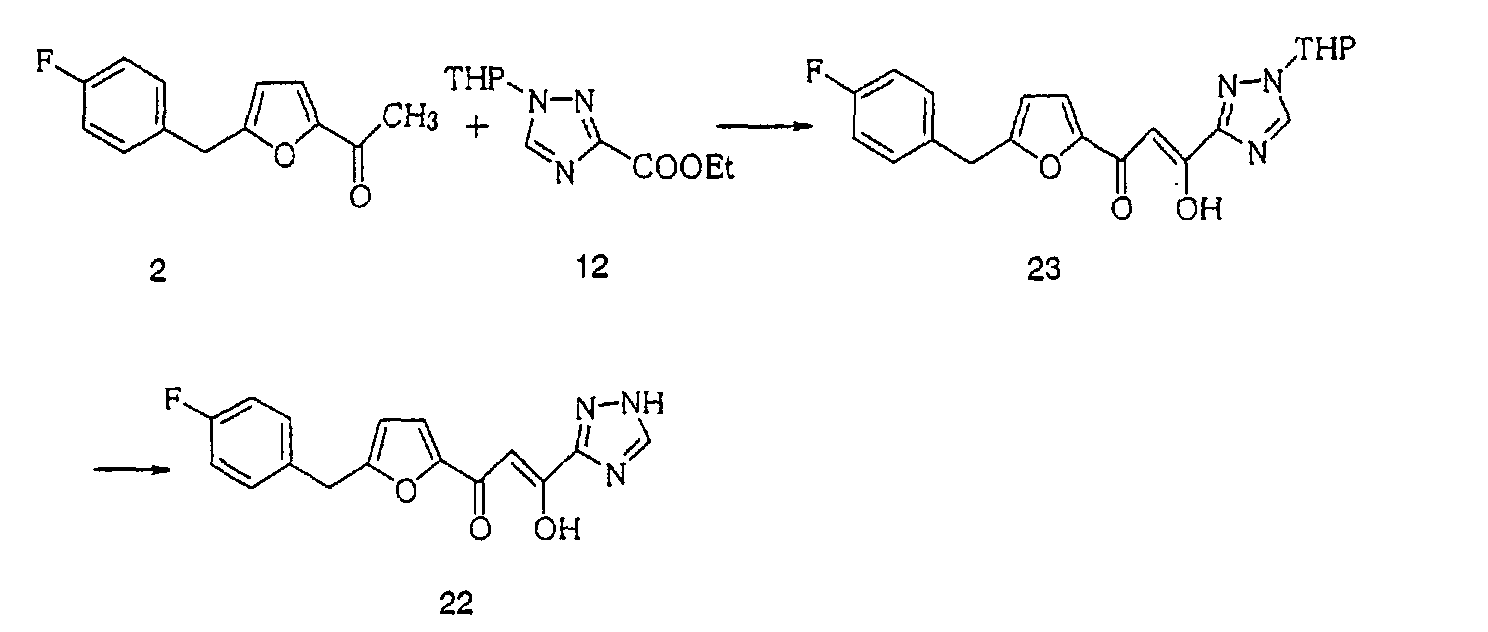
- Example 10 A process for the preparation of 1-[5-(4-Fluorobenzyl)furan-2-yl]-3-hydroxy-3-(1 H -1,2,4-triazole-3-yl)propenone.
- Example 10(1) Example of using trityl as a protecting group.
- the crystal was suspended in 7.5 L of dioxane and mixed with 2.74 L (3.0 eq) of 1.5 N hydrochloric acid. The mixture was stirred at 70 °C for 1 hour. After cooling, 2.74 L (3.0 eq) of 1.5 N sodium hydroxide was added thereto and the precipitated crystal was filtered. The crystal was suspended in ethylacetate and dissolved in a diluted aqueous solution of sodium hydroxide. After the separation of water layer, an aqueous solution was acidified with concentrated hydrochloride to pH 4. The precipitated crystal was filtered and recrystallized from tetrahydrofuran/ethylalcohol to give 548 g of the titled compound. Yield: 64 %.
- Example 10(2) Example of using tetrahydropyran-2-yl as a protecting group.
- Example 11 (1) Process for the preparation of 1-[5-(4-fluorobenzyl)furan-2-yl]-3-hydroxy-3-[1-(1-methoxy-1-methylethyl)-1 H -1,2,4-triazole-3-yl]propenone.
- Example 11(2) to 11(5) were prepared in accordance with the same manner of Example 11(1).
- Example 11(3) 1-[5-(4-Fluorobenzyl)furan-2-yl]-3-hydroxy-3-[1-(1-isobutoxyethyl)-1 H -1,2,4-triazole-3-yl]propenone.
- Example 11 1-[5-(4-Fluorobenzyl)furan-2-yl]-3-hydroxy-3-[1-(1-propoxyethyl)-1 H -1,2,4-triazole-3-yl]propenone.
- Example 12 1-[5-(4-Fluorobenzyl)furan-2-yl]-3-hydroxy-3-(1 H -1,2,4-triazole-3-yl)propenone.
- Example 11 1-[5-(4-fluorobenzyl)furan-2-yl]-3-hydroxy-3-(1 H -1,2,4-triazole-3-yl)propenone was prepared from a compound obtained in Example 11(2) - 11(5) after deprotection such as Example 12.
- Example 13(1) A preparation of a crystal (type I) of 1-[5-(4-fluorobenzyl)furan-2-yl]-3-hydroxy-3-(1 H -1,2,4-triazole-3-yl)propenone.
- a crystal (type I) was a isomer having a chemical structure of the formula: Elementary analysis for C 16 H 12 FN 3 O 3 . Calcd (%): C, 61.34; H, 3.86; N, 13.41; F, 6.06. Found (%): C, 61.22; H, 3.72; N, 13.41; F, 6.03. Crystal parameters of single crystal X-ray diffraction
- Example 13(2) A preparation of a crystal (type I) of 1-[5-(4-fluorobenzyl)furan-2-yl]-3-hydroxy-3-(1 H -1,2,4,triazole-3-yl)propenone.
- Example 13(3) A preparation of a crystal (type II) of 1-[5-(4-fluorobenzyl)furan-2-yl]-3-hydroxy-3-(1 H -1,2,4-triazole-3-yl)propenone
- Example 13(4) A preparation of a crystal (III) of 1-[5-(4-fluorobenzyl)furan-2-yl]-3-hydroxy-3-(1 H -1,2,4-triazole-3-yl)propenone
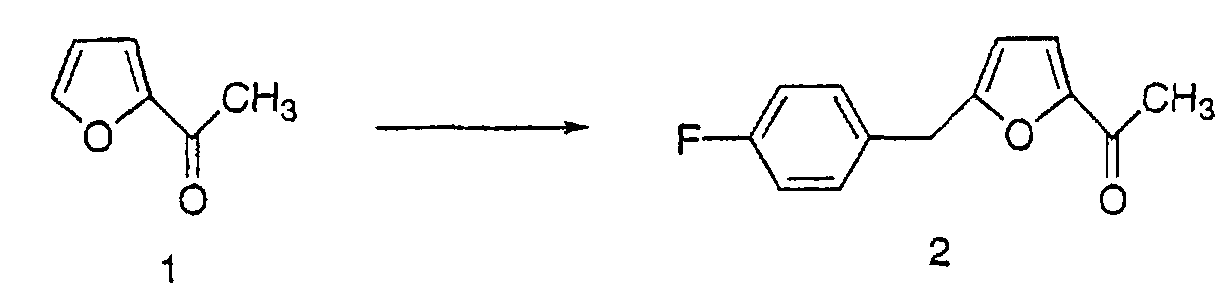
- Example 14(2) A process for the preparation of 2-acetyl-5-(4-fluorobenzyl)furan (Another route 2)
- HIV-1 integrase inhibitory activities of propenone derivatives were examined in accordance with the following assay.
- Substrate DNA and target DNA which sequences were indicated below, were synthesized by Amersham Pharmacia Biotech and dissolved in KTE buffer (composition: 100 mM KCl, 1 mM EDTA, 10 mM Tris-HCl (pH 7.6)) at concentration of 2 pmol/ ⁇ l and 5 pmol/ ⁇ l, respectively.
- KTE buffer composition: 100 mM KCl, 1 mM EDTA, 10 mM Tris-HCl (pH 7.6)
- the DNA solutions were annealed with each complement by slowly cooling after heating.
- Streptavidin obtained from Vector Laboratories, was dissolved in 0.1 M carbonate buffer (composition: 90 mM Na 2 CO 3 , 10 mM NaHCO 3 ) at concentration of 40 ⁇ g/ml. After coating each well of microtiter plates (obtained from NUNC) with 50 ⁇ l of the above solution at 4 °C over night, each well was washed twice with PBS (composition: 13.7 mM NaCl, 0.27 mM KCl, 0.43 mM Na 2 HPO 4 , 0.14 mM KH 2 PO 4 ) and blocked with 300 ⁇ l of 1% skim milk in PBS for 30 min.
- PBS composition: 13.7 mM NaCl, 0.27 mM KCl, 0.43 mM Na 2 HPO 4 , 0.14 mM KH 2 PO 4
- each well was washed twice with PBS and added 50 ⁇ l of substrate DNA solution (2 pmol/ ⁇ l).
- the microtiter plates were kept at room temperature for 30 min. Then, each well was washed twice with PBS and once with H 2 O.
- reaction buffer prepared from 12 ⁇ l of the buffer (composition: 150 mM MOPS (pH 7.2), 75 mM MnCl 2 , 50 mM 2-mercaptoethanol, 25% glycerol, 500 ⁇ g/ml bovine serum albumin-fraction V), 1 ⁇ l of target DNA (5 pmol/ ⁇ l), and 32 ⁇ l of the distilled water.
- 6 ⁇ l of either a test compound in DMSO or DMSO for positive control(PC) was mixed with the above reaction buffer, then 9 ⁇ l of an integrase solution (30 pmol) was added and mixed well.
- NC negative control
- microtiter plates were incubated at 30 °C for 1 hour. The reaction solution was removed and each well was washed twice with PBS. Subsequently, each well of the microtiter plates was filled with 100 ⁇ l of anti-digoxigenin antibody labeled with alkaline phosphatase (Sheep Fab fragment: obtained from Boehringer) and incubated at 30 °C for 1 hour. Then, each well was washed twice with 0.05% Tween20 in PBS and once with PBS.
- alkaline phosphatase Sheep Fab fragment: obtained from Boehringer
- Alkaline phosphatase reaction buffer composition: 10mM p -Nitrophenylphosphate (obtained from Vector Laboratories), 5 mM MgCl 2 , 100 mM NaCl, 100 mM Tris-HCl (pH 9.5)
- the microtiter plates were incubated at 30 °C for 2 hours and the reaction was terminated by the addition of 50 ⁇ l of 1 N NaOH solution.
- the optical density (OD) at 405 nm of each well was measured and the percent inhibition was determined by the following expression.
- the percent inhibition (%) 100[1- ⁇ (C abs.- NC abs.) / (PC abs.- NC abs.) ⁇ ]
- IC 50 values the concentration of the compounds at percent inhibition 50%, are shown in the following Table 1.
- 2-Acyl-5-benzylfuran derivatives can be industrially and commercially prepared through Friedel Crafts reaction of 2-acylfuran derivatives.
- the present invention provides an industrial process for the preparation of 1,2,4-triazole-3-carboxylic acid ester derivatives. These processes can contribute to stable mass-production of an integrase inhibitor, an anti-HIV agent, or a compound (IV-1) or (IV-2).
Landscapes
- Organic Chemistry (AREA)
- Chemical & Material Sciences (AREA)
- Health & Medical Sciences (AREA)
- Life Sciences & Earth Sciences (AREA)
- Virology (AREA)
- General Chemical & Material Sciences (AREA)
- Pharmacology & Pharmacy (AREA)
- Oncology (AREA)
- Molecular Biology (AREA)
- Chemical Kinetics & Catalysis (AREA)
- Tropical Medicine & Parasitology (AREA)
- Medicinal Chemistry (AREA)
- Nuclear Medicine, Radiotherapy & Molecular Imaging (AREA)
- AIDS & HIV (AREA)
- Communicable Diseases (AREA)
- Animal Behavior & Ethology (AREA)
- General Health & Medical Sciences (AREA)
- Public Health (AREA)
- Veterinary Medicine (AREA)
- Plural Heterocyclic Compounds (AREA)
- Pharmaceuticals Containing Other Organic And Inorganic Compounds (AREA)
- Saccharide Compounds (AREA)
- Organic Low-Molecular-Weight Compounds And Preparation Thereof (AREA)
Abstract

Description


which comprises reacting a compound of the formula (I-1):

with a compound of the formula (II-1):
in the presence of a Lewis acid,

which comprises reacting a compound of the formula (IV-1):
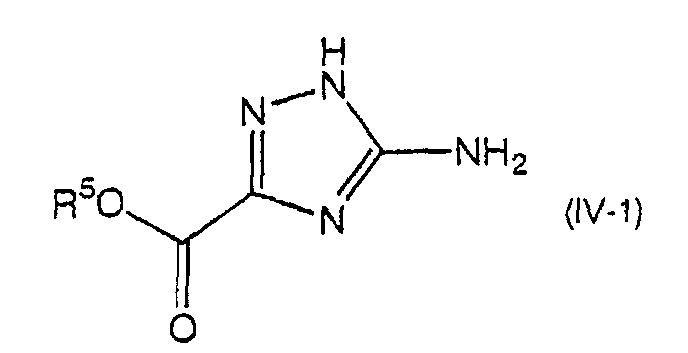
with an alkaline metal nitrite or an alkaline-earth metal nitrite in the presence of a reducing agent,

which comprises preparing 1,2,4-triazole-3-carboxilic acid through the process according to the above B-4) and esterifing the obtained compound,

which comprises cyclizing a compound of the formula (V):
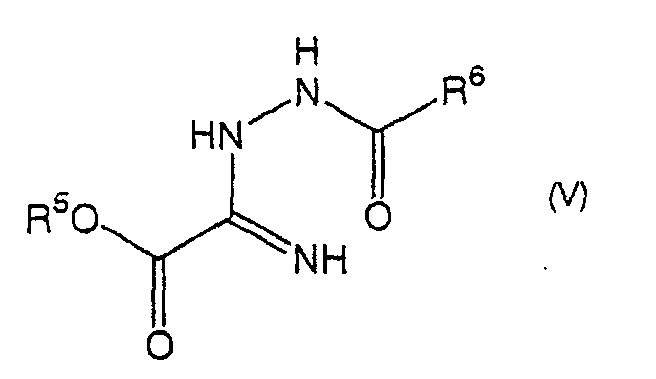
in the presence of trialkylorthoester or a catalytic amount of an acid,

which comprises preparing a compound of the formula (IV-5):

wherein R8, R9, R10 and R11 are as defined above, or formaldehyde,

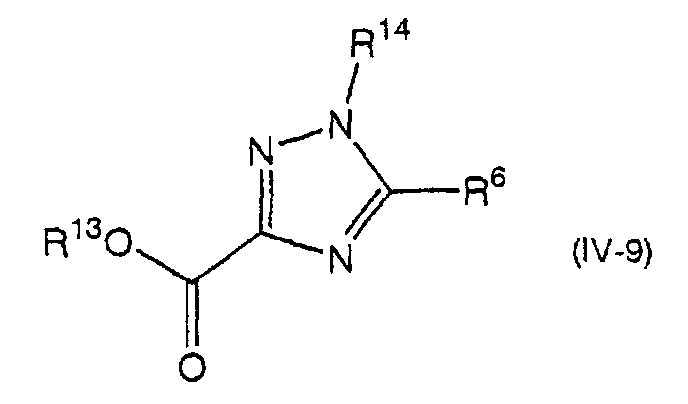
provided that a compound wherein R6 is hydrogen; R13 is methyl; and R14 is trityl, a compound wherein R6 is hydrogen; R13 is methyl; and R14 is tetrahydropyran-2-yl, and a compound wherein R6 is hydrogen; R13 is ethyl; and R14 is trityl are excluded,







wherein R5 is optionally substituted alkyl.




1H NMR δ (CDCl3) : 2.43 (s, 3H), 4.01 (s, 2H), 6.09 (d, J= 3.5 Hz, 1H), 6.96-7.26 (m, 5H)
Mp: 146 - 149 °C.
1H NMR(d6-DMSO) δ 8.53(s,3H)
Mp: 145 - 150 °C.

Mp: 115 - 120 °C.
1H NMR(d6-DMSO) δ 1.26(t, 3H, J=7.2Hz) 4.28(q,2H, J=7.2Hz) 8.61(s ,1H) 9.19(s,2H)
13C NMR(d6-DMSO) δ 14.0, 60.8, 142.8, 145.6, 159.09


Mp: 180 - 182 °C.
1H NMR(CDCl3) δ 1.30(t, 3H, J=6.9Hz) 4.22(q,2H, J=6.9Hz) 8.66(s ,1H)
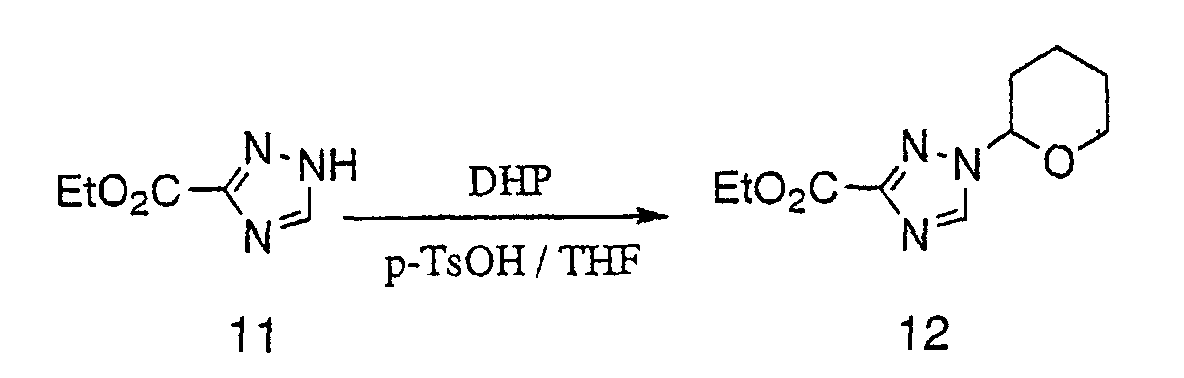
NMR(CDCl3) δ 1.43(t,3H,J=7.2Hz) 1.66-1.74(m,3H) 2.01-2.05(m,2H) 2.21-2.25(m,1H) 3.72-3.77(m,1H) 4.07-4.11(m,1H) 4.48(q,2H,J=7.2Hz) 5.54(dd,1H, J=2.7, 9.0Hz) 8.37(s,1H)
IR(neat) 1738 cm-1

NMR(CDCl3) δ: 1.41(3H, t,J=7.2Hz), 4.45(2H, q, J=7.2Hz), 7.11-7.13(6H, m), 7.32-7.36, 8.01(1H, s).

Mp: 78.5 - 81.5 °C.
NMR(CDCl3) δ 1.44(t,3H,J=7.2Hz) 3.06(s,6H) 4.50(q,2H,J=7.2Hz) 8.63(s,1H)
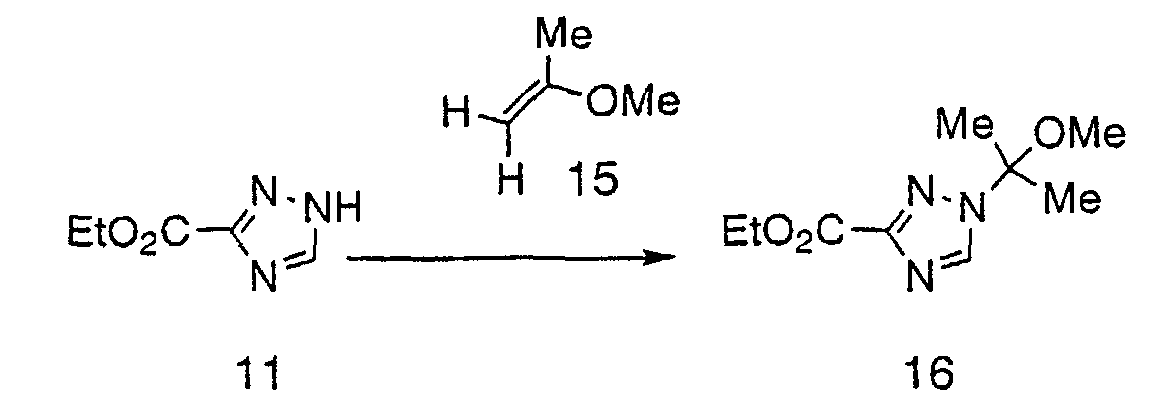
NMR(CDCl3) δ 1.44(t,3H J=7.2Hz) 1.84(s,6H) 3.20(s,3H) 4.49(q,2H J=7.2Hz) 8.38(s,1H)
HPLC tR=26.7min
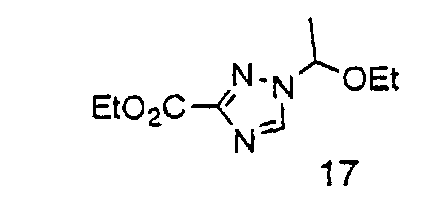
Mp: 59 - 60 °C.

Mp: 67 °C.

Mp: 42 - 43 °C.
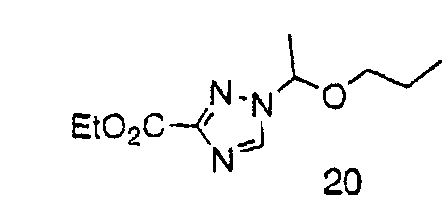
Mp: 31 - 32 °C.

Mp: 183 - 185 °C.
Elementary analysis for C16H12FN3O3
Calcd (%): C, 61.34; H, 3.86; N, 13.41; F, 6.06.
Found (%): C, 61.22; H, 3.72; N, 13.41; F, 6.03.
NMR(d6-DMSO) δ 4.15(2H, s), 6.47(1H, d, J=3.3Hz), 6.93(1H, s), 7.17(2H, t, J=9.0Hz) 7.31-7.37(2H, m), 7.50(1H, d, J=3.3Hz), 8.70(1H, brs).
Mp: 128 - 130 °C.
NMR(CDCl3) δ 1.66-1.76(m,3H) 2.03-2.08(m,2H) 2.21-2.27(m,1H) 3.70-3.78(m,1H) 3.99-4.13(m,1H) 4.04(s,2H) 5.55(dd, 1H,J=3.0,9.0Hz) 6.15(d,1H, J=3.3Hz) 6.99-7.25(m,5H) 7.02(s,1H) 8.36(s,1H)

NMR(CDCl3) δ 1.86(s,6H) 3.22(s,3H) 4.05(s,2H) 6.16(d,1H, J=3.3Hz) 6.99-7.05(m,2H) 7.02(s,1H) 7.20-7.25(m,3H) 8.38(s,1H)
Mp: 111 °C.

Mp: 85 - 87 °C.
Mp: 70 °C.

IR(neat) = 3117, 2960, 2935, 2874, 1736, 1714, 1606 cm-1

Mp: 67 - 68 °C.


Calcd (%): C, 61.34; H, 3.86; N, 13.41; F, 6.06.
Found (%): C, 61.22; H, 3.72; N, 13.41; F, 6.03.
Crystal parameters of single crystal X-ray diffraction
| Diffraction angle (2) | Intensity |
| 20.380 | 5945 |
| 21.280 | 5455 |
| 21.340 | 4958 |
| 23.140 | 4053 |
| 23.360 | 7218 |
| 23.540 | 8173 |
| 25.860 | 4615 |
| 27.460 | 4138 |
| 27.500 | 4068 |
| 28.100 | 5143 |
| 28.180 | 4980 |
| 29.400 | 4528 |
| 29.480 | 4848 |
| Peak (°C) | ΔH (J/g) |
| 185.831 | 149.181 |

| Diffraction angle (2) | Intensity |
| 8.760 | 12805 |
| 19.600 | 8023 |
| 22.080 | 8473 |
| 23.760 | 20195 |
| 26.200 | 33235 |
| 27.580 | 11623 |
| 29.080 | 4913 |
| Peak (°C) | ΔH (J/g) |
| 177.8 | 142.09 |
| 184.07 | 3.616 |
Elementary analysis for C16H12FN3O3
Calcd: C, 61.43; H, 3.86; F, 6.06; N, 13.41; Cl 0.00.
Found: C, 60.23; H, 3.98; F, 5.85; N, 13.38; Cl <0.10.
| Diffraction angle (2) | Intensity |
| 10.520 | 4020 |
| 13.860 | 10368 |
| 15.680 | 11768 |
| 18.160 | 4363 |
| 22.840 | 6723 |
| 26.180 | 6335 |
| 28.120 | 3928 |
| Peak (°C) | ΔH (J/g) |
| 130.8 | -9.116 |
| 186.13 | 144.3 |

Mp: 121 - 123 °C. Recrystallized from ether.
Elementary analysis for C15H11FN4O8
Calcd (%): C, 57.33; H, 3.53; N, 17.83; F, 6.04.
Found (%): C, 57.25; H, 3.58; N, 17.53; F, 5.81.
NMR(d6-DMSO) δ 4.16(2H, s), 6.51(1H, d, J=3.6Hz), 7.05(1H, s), 7.18(2H, t, J=8.7Hz), 7.32-7.38(2H, m), 7.65(1H, d, J=3.6Hz).
Mp: 179-182 °C. Recrystallized from ethylacetate.
Elementary analysis for C17H14FN3O3
Calcd (%): C, 62.38; H, 4.31; N, 12.84; F, 5.80.
Found (%): C, 62.29; H, 4.16; N, 11.65; F, 5.78.
NMR(d6-DMSO) δ 2.43(3H, s), 4.14(2H, s), 6.46(1H, d, J=3.3Hz), 6.88(1H, s), 7.15-7.20(2H, m), 7.31-7.36(2H, m), 7.49(1H, d, J=3.3Hz), 14.3(1H, brs).
Mp: 96-99 °C. Recrystallized from ethanol.
Elementary analysis for C16H12ClN3O3
Calcd (%): C, 58.28; H, 3.67; N, 12.74; Cl, 10.75.
Found (%): C, 58.16; H, 3.80; N, 12.40; Cl, 10.50.
NMR(d6-DMSO) δ 4.16(2H, s), 6.49(1H, d, J=3.6Hz), 6.93(1H, s), 7.30-7.43(4H, m), 7.52(1H, d, J=3.6Hz), 8.75(1H, brs).
Mp: 176-179 °C. Recrystallized from ethylacetate.
Elementary analysis for C16H13N3O3 0.15 C4H8O2
Calcd (%): C, 64.63; H, 4.64; N, 13.62.
Found (%): C, 64.41; H, 4.40; N, 13.42.
NMR(d6-DMSO) δ 4.14(2H, s), 6.48(1H, d, J=3.6Hz), 6.93(1H, s), 7.24-7.38(5H, m), 7.51(1H, d, J=3.6Hz), 8.72(1H, brs), 14.7(1H, brs).
Mp: 191-192 °C. Recrystallized from ethylacetate.
Elementary analysis for C17H14FN3O3
Calcd (%): C, 62.38; H, 4.31; N, 12.84; F, 5.80.
Found (%): C, 62.23; H, 4.29; N, 12.79; F, 5.79.
NMR(d6-DMSO) δ 2.36(3H, s), 4.10(2H, s), 6.34(1H, s), 6.89(1H, s), 7.18(2H, t, J=9.0Hz) 7.32-7.37(2H, m), 8.70(1H, brs).
Mp: 114-116 °C. Recrystallized from ethylacetate.
Elementary analysis for C17H15N3O4
Calcd (%): C, 62.76; H, 4.65; N, 12.92.
Found (%): C, 62.90; H, 4.57; N, 12.26.
NMR(d6-DMSO) δ 3.73(3H, s), 4.07(2H, s), 6.44(1H, d, J=3.3Hz), 6.91(2H, d, J=8.7Hz), 6.92(1H, s), 7.22(2H, d, J=8.7Hz), 7.50(1H, d, J=3.3Hz), 8.77(1H, brs).
Mp: 140-143 °C. Recrystallized from ethanol.
Elementary analysis for C16H12FN3O3
Calcd (%): C, 61.34; H, 3.86; N, 13.41; F, 6.06.
Found (%): C, 61.41; H, 3.84; N, 13.05; F, 5.97.
NMR(d6-DMSO) δ 4.19 s), 6.52(1H, d, J=3.3Hz), 6.95(1H, s), 7.10-7.18(3H, m), 7.36-7.41(1H, m), 7.52(1H, d, J=3.3Hz), 8.77(1H, brs), 14.7(1H, brs).
Mp: 182-184 °C. Recrystallized from ethanol/ether.
Elementary analysis for C16H12FN3O3
Calcd (%): C, 61.34; H, 3.86; N, 13.41; F, 6.06.
Found (%): C, 61.47; H, 3.90; N, 13.04; F, 5.99.
NMR(d6-DMSO) δ 4.18(2H, s), 6.46(1H, d, J=3.3Hz), 6.94(1H, s), 7.17-7.26(2H, m), 7.32-7.40(2H, m), 7.51(1H, d, J=3.3Hz), 8.79(1H, brs).
Mp: 166-167 °C. Recrystallized from ethylacetate.
Elementary analysis for C17H15N3O3 0.1 C4H8O2
Calcd (%): C, 65.69; H, 5.01; N, 13.21.
Found (%): C, 65.45; H, 4.93; N, 13.37.
NMR(d6-DMSO) δ 2.28(3H, s), 4.09(2H, s), 6.46(1H, d, J=3.6Hz), 6.93(1H, s), 7.13-7.18(4H, m), 7.51(1H, d, J=3.6Hz), 8.76(1H, brs), 14.7(1H, brs).




Claims (39)
- A process for the preparation of a compound of the formula (III-1):wherein R1 and R2 each is independently hydrogen, optionally substituted alkyl, optionally substituted alkoxy or halogen; R3 is optionally substituted alkyl or optionally substituted alkoxy; and R4 is hydrogen, optionally substituted alkyl, optionally substituted alkoxy or halogen,
which comprises reacting a compound of the formula (I-1):wherein R1, R2 and R3 each is as defined above,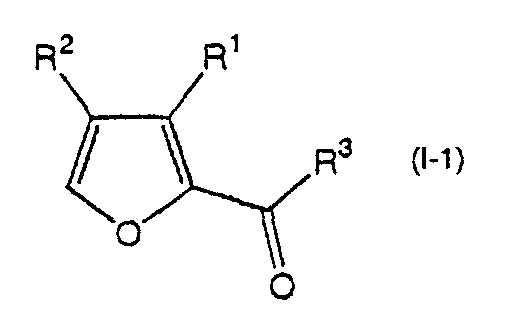
with a compound of the formula (II-1):wherein R4 is as defined above; and X is halogen,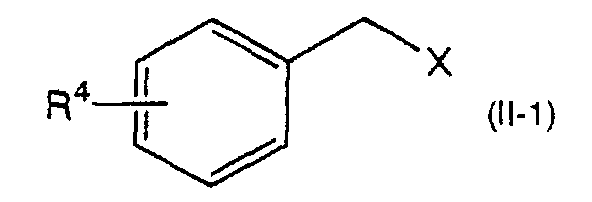
in the presence of a Lewis acid. - The process according to claim 1 wherein a reaction solvent is methylene chloride.
- The process according to claim 1 wherein a reaction solvent is water.
- The process according to any one of claims 1-3 wherein R3 is methyl.
- The process according to any one of claims 1-4 wherein R1 and R2 each is hydrogen.
- The process according to any one of claims 1-5 wherein R4 is 4-fluoro.
- A process for the preparation of a compound of the formula (IV-2):wherein R5 is hydrogen or optionally substituted alkyl,
which comprises reacting a compound of the formula (IV-1):wherein R5 is as defined above,
with an alkaline metal nitrite or an alkaline-earth metal nitrite in the presence of a reducing agent. - The process according to claim 7 which comprises reacting a compound of the formula (IV-1) with an alkaline metal nitrite in the presence of hypophosphorous acid as the reducing agent.
- The process according to claim 7 or 8 which is carried out under the addition of a small amount of alchol.
- The process according to any one of claims 7-9 wherein R5 is hydrogen.
- A process for the preparation of a compound of the formula (IV-3):wherein R5 is optionally substituted alkyl,
which comprises preparing 1,2,4-triazole-3-carboxilic acid through the process according to claim 10 and esterifing the obtained compound, - A process for a compound of the formula (IV-4):wherein R5 is hydrogen or optionally substituted alkyl; and R6 is hydrogen, optionally substituted alkyl or optionally substituted aryl,
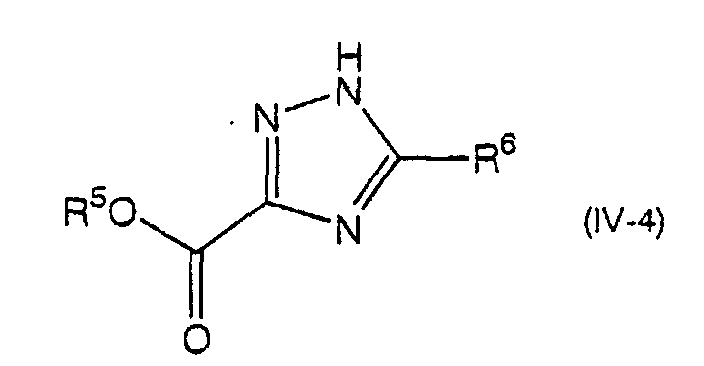
which comprises cyclizing a compound of the formula (V):wherein R5 and R6 are as defined above,
in the presence of trialkylorthoester or a catalytic amount of an acid. - The process according to claim 12 wherein R5 is optionally substituted alkyl.
- The process according to claim 12 wherein R5 is optionally substituted alkyl; and R6 is hydrogen.
- A process for the preparation of a compound of the formula (IV-6):wherein R5 is optionally substituted alkyl; R6 is hydrogen, optionally substituted alkyl or optionally substituted aryl; and R12 is a group of the formula: -R7 wherein R7 is trityl, optionally substituted sulfamoyl or optionally substituted alkoxymethyl, a group of the formula: -C(OR8)R9-CHR10R11 wherein R8 is optionally substituted alkyl; R9, R10 and R11 each is independently hydrogen or optionally substituted alkyl; or R8 and R10 may be taken together to form optionally substituted alkylene, or hydroxymethyl, which comprises preparing a compound of the formula (IV-5):
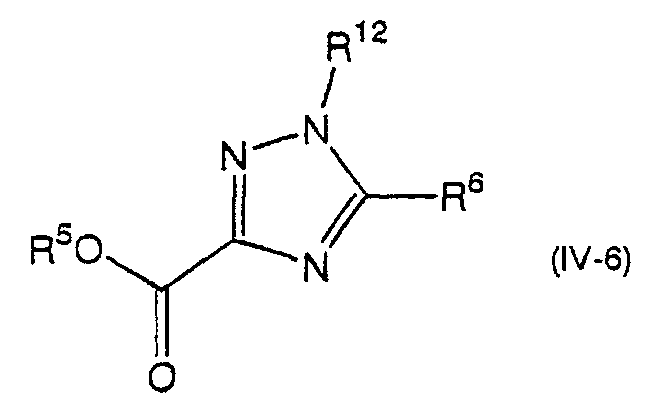 wherein R5 and R6 are as defined above, through the process according to any one of claims 7-9 and 11-14, and reacting the obtained compound with a compound of the formula: R7X wherein R7 is as defined above; and X is halogen, a compound of the formula: (R8O)R9C=CR10R11 wherein R8, R9, R10 and R11 are as defined above, or formaldehyde.
- A process of the preparation of a compound of the formula (IV-8):wherein R6 is hydrogen, optionally substituted alkyl or optionally substituted aryl; and R12 is a group of the formula: -R7 wherein R7 is trityl, optionally substituted sulfamoyl or optionally substituted alkoxymethyl, a group of the formula: -C(OR8)R9-CHR10R11 wherein R8 is optionally substituted alkyl; R9, R10 and R11 each is independently hydrogen or optionally substituted alkyl, or R8 and R10 may be taken together to form optionally substituted alkylene, or hydroxymethyl, which comprises preparing a compound of the formula (IV-7):
 wherein R6 is as defined above, through the process according to claim 10 or 12, and reacting the obtained compound with a compound of the formula: R7X wherein R7 is as defined above; and X is halogen, a compound of the formula: (R8O)R9C=CR10R11 wherein R8, R9, R10 and R11 are as defined above, or formaldehyde.
- The process according to claim 15 or 16 which comprises reacting with a compound of the formula: R7X wherein R7 is trityl.
- The process according to claim 15 or 16 which comprises reacting with a compound of the formula: (R8O)R9C=CR10R11 wherein R8 and R10 are taken together to form trimethylene; and R9 and R11 each is hydrogen.
- The process according to claim 15 or 16 which comprises reacting with a compound of the formula: (R8O)R9C=CR10R11 wherein R8 and R9 each is methyl; and R10 and R11 each is hydrogen.
- A compound of the formula (IV-9):wherein R6 is hydrogen or alkyl; R13 is alkyl, a group of the formula: -R7 wherein R7 is trityl, optionally substituted sulfamoyl or alkoxymethyl, a group of the formula: -C(OR8)R9-CHR10R11 wherein R8 is alkyl; R9, R10 and R11 each is independently hydrogen or alkyl; or R8 and R10 may be taken together to form alkylene, or hydroxymethyl; and R14 is a group of the formula: -R7 wherein R7 is as defined above, a group of the formula: -C(OR8R9-CHR10R11 wherein R8, R9, R10 and R11 are defined above, or hydroxymethyl,
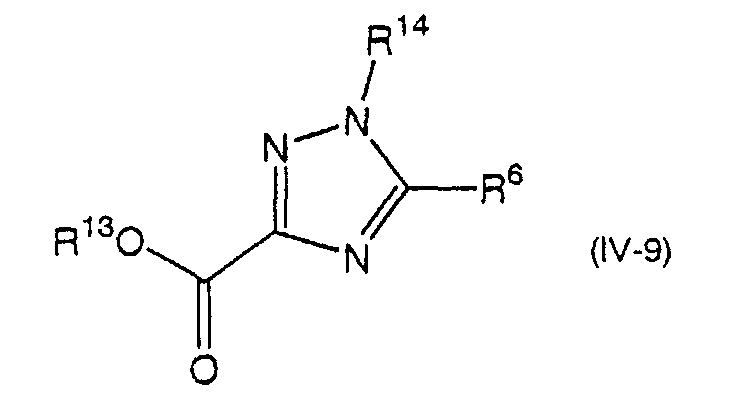
provided that a compound wherein R6 is hydrogen; R13 is methyl; and R14 is trityl, a compound wherein R6 is hydrogen; R13 is methyl; and R14 is tetrahydropyran-2-yl, and a compound wherein R6 is hydrogen; R13 is ethyl; and R14 is trityl are excluded. - The compound according to claim 20 wherein R6 is hydrogen; R13 is methyl or ethyl; R14 is tetrahydropyran-2-yl, hydroxymethyl, methoxymethyl, ethoxymethyl, N,N-dimethylsulfamoyl, (1-methoxy-1-methyl)ethyl, (1-ethoxy)ethyl, (1-ethoxy-1-methyl)ethyl, (1-n-propoxy)ethyl, (1-n-butoxy)ethyl or (1-isobutoxy)ethyl.
- A process for the preparation of a compound of the formula (VI-1):wherein R1, R2 and R4 each is independently hydrogen, optionally substituted alkyl, optionally substituted alkoxy or halogen; A is CR6 or N; and R6 is hydrogen, optionally substituted alkyl or optionally substituted aryl, which comprises preparing a compound of the formula (III-2):
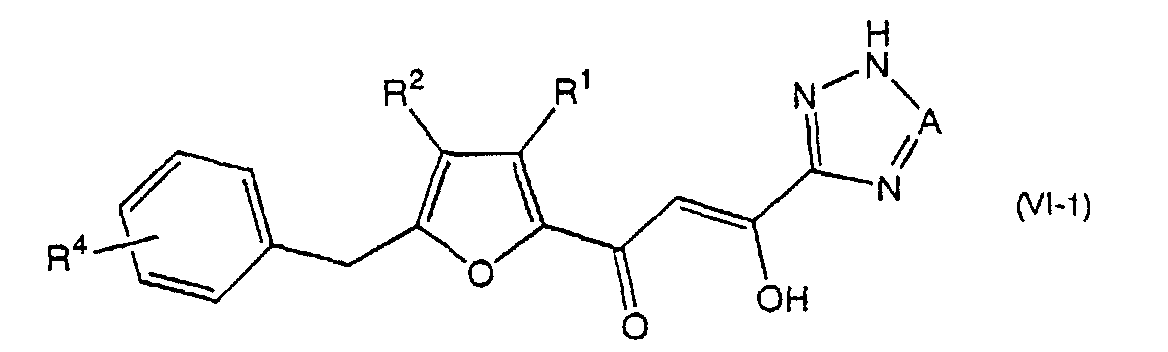 wherein R1, R2 and R4 are as defined above, through the process according to claim4, reacting the compound of the formula (III-2) with a compound of the formula (IV-10):
 wherein A is as defined above, Q is a protecting group; and L is a leaving group, in the presence of a base, and deprotecting Q.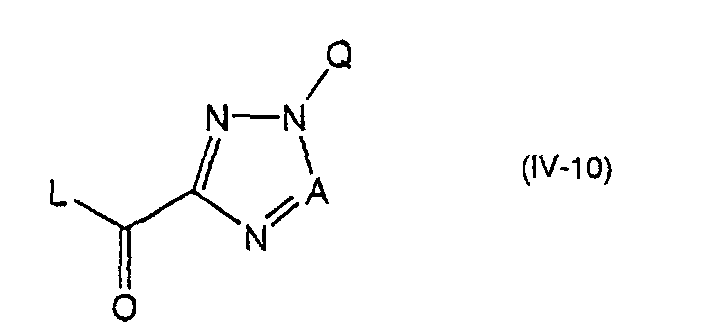
- The process according to claim 22 wherein R1 and R2 each is hydrogen; and R4 is halogen.
- The process according to claim 22 or 23 wherein R4 is 4-fluoro.
- The process according to any one of claims 22-24 wherein A is CH.
- A process for the preparation of a compound of the formula (IV-2):wherein R1, R2 and R4 each is independently hydrogen, optionally substituted alkyl, optionally substituted alkoxy or halogen; and R6 is hydrogen, optionally substituted alkyl or optionally substituted aryl, which comprises preparing a compound of the formula (IV-11):
 wherein R6 is as defined above, R13 is optionally substituted alkyl, a group of the formula: -R7 wherein R7 is trityl, optionally substituted sulfamoyl or optionally substituted alkoxymethyl, a group of the formula: C(OR8)R9-CHR10R11 wherein R8 is alkyl; R9, R10 and R11 each is independently hydrogen or optionally substituted alkyl; or R8 and R10 may be taken together to form alkylene, or hydroxymethyl; and R14 is a group of the formula: -R7 wherein R7 is as defined above, a group of the formula: -C(OR8)R9-CHR10R11 wherein R8, R9, R10 and R11 are defined above, or hydroxymethyl, through the process according to claim 15 or 16, reacting the obtained compound with a compound of the formula(III-2):
 wherein R1, R2 and R4 are as defined above, and deprotecting R14,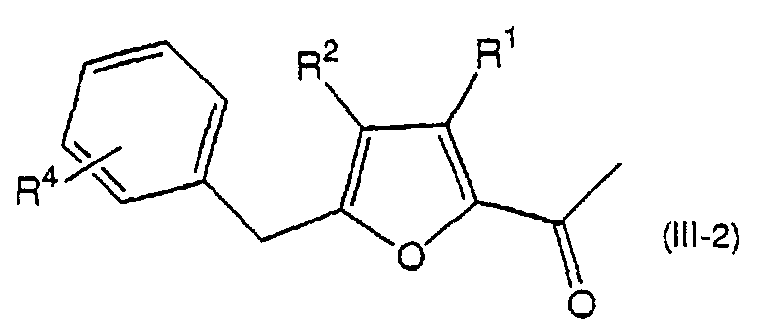
- The process according to claim 26 which comprises preparing the compound of the formula (III-2):wherein R1, R2 and R4 each is independently hydrogen, optionally substituted alkyl, optionally substituted alkoxy or halogen through the process according to claim 4.

- The process according to claim 26 or 27 wherein R1, R2 and R6 each is hydrogen; and R4 is halogen.
- A compound of the formula (VI-7):wherein R1, R2 and R4 each is independently hydrogen, optionally substituted alkyl, optionally substituted alkoxy or halogen; R6 is hydrogen, optionally substituted alkyl or optionally substituted aryl; and R14 is a group of the formula: -R7 wherein R7 is trityl, optionally substituted sulfamoyl or optionally substituted alkoxymethyl, a group of the formula: -C(OR8)R9-CHR10R11 wherein R8 is alkyl; R9, R10 and R11 each is independently hydrogen or optionally substituted alkyl; or R8 and R10 may be taken together to form alkylene, or hydroxymethyl.

- The compound according to claim 29 wherein R4 is 4-fluoro, R1, R2 and R6 each is hydrogen, and R14 is trityl, tetrahydropyran-2-yl, hydroxymethyl, methoxymethyl, ethoxymethyl, N,N-dimethylsulfamoyl, (1-methoxy-1-methyl)ethyl, (1-ethoxy)ethyl, (1-ethoxy-1-methyl)ethyl, (1-n-propoxy)ethyl, (1-n-butoxy)ethyl or (1-isobutoxy)ethyl.
- A crystal of an isomer having a chemical structure of the formula (VI-1):wherein A is CR6 or N; R6 is hydrogen, optionally substituted alkyl or optionally substituted aryl; and R1, R2 and R4 each is independently hydrogen, optionally substituted alkyl, optionally substituted alkoxy or halogen.
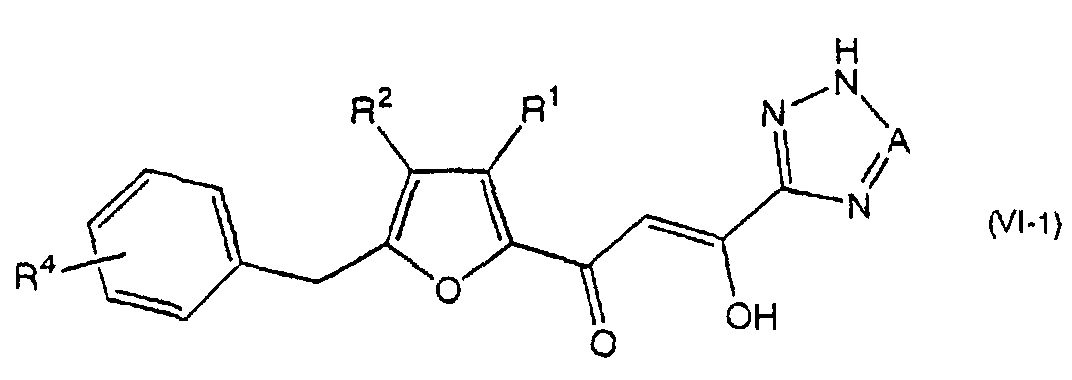
- The crystal according to claim 31 wherein R1 and R2 each is hydrogen; R4 is p-fluoro; and A is CH.
- The crystal according to claim 32 of which crystal parameters by single crystal X-ray diffraction are unit cell constants a = 32.432(2) Å, b = 10.886(2) Å, c = 7.960(2) Å, α = 90.00°, β = 90.00°, γ = 90.00°, V = 2810(1) Å3, Z = 8, a space group Pbca; and density of 1.481 g/cm3.
- The crystal according to claim 32 of which diffraction angles (2) of main peaks by powder X-ray diffraction are 20.380, 21.280, 21.340, 23.140, 23.360, 23.540, 25.860, 27.460, 27.500, 28.100, 28.180, 29.400 and 29.480 (degree).
- A crystal of an isomer having a chemical structure of the formula (VI-4):wherein A is, CR6 or N; R6 is hydrogen, optionally substituted alkyl or optionally substituted aryl; and R1, R2 and R4 each is independently hydrogen, optionally substituted alkyl, optionally substituted alkoxy or halogen.
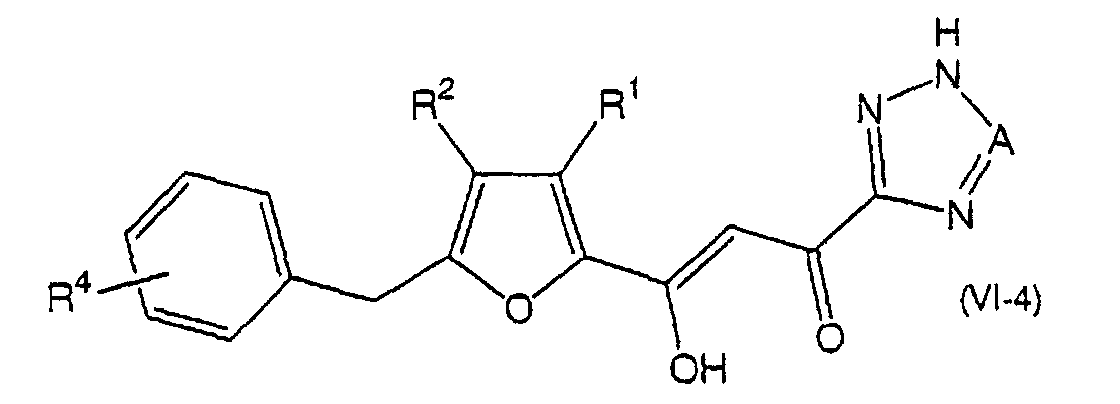
- The crystal according to claim 35 wherein R1 and R2 each is hydrogen; R4 is p-fluoro; and A is CH.
- The crystal according to claim 36 of which crystal parameters by single crystal X-ray diffraction are unit cell constants a = 11.9003(7)Å, b = 9.7183(5)Å, c = 13.2617(8)Å, α = 90.00°, β = 109.450(4)°, γ = 90.00°, V = 1446.2(1)Å3 and Z = 4; a space group P21/n; and density of 1.439 g/cm3.
- The crystal according to claim 36 of which diffraction angles (2) of main peaks by powder X-ray diffraction are 8.760, 19.600, 22.080, 23.760, 26.200, 27.580 and 29.080 (degree).
- A crystal of an isomer of 1-[5-(4-fluorobenzyl)furan-2-yl]-3-hydroxy-3-(1H-1,2,4-triazole-3-yl)propenone of which diffraction angles (2) of main peaks by powder X-ray diffraction are 10.520, 13.860, 15.680, 18.160, 22.840, 26.180 and 28.120 (degree).
Applications Claiming Priority (5)
| Application Number | Priority Date | Filing Date | Title |
|---|---|---|---|
| JP15550399 | 1999-06-02 | ||
| JP15550399 | 1999-06-02 | ||
| JP23030599 | 1999-08-17 | ||
| JP23030599 | 1999-08-17 | ||
| PCT/JP2000/003456 WO2000075122A1 (en) | 1999-06-02 | 2000-05-29 | Novel processes for the preparation of substituted propenone derivatives |
Publications (2)
| Publication Number | Publication Date |
|---|---|
| EP1186599A1 true EP1186599A1 (en) | 2002-03-13 |
| EP1186599A4 EP1186599A4 (en) | 2003-02-26 |
Family
ID=26483489
Family Applications (1)
| Application Number | Title | Priority Date | Filing Date |
|---|---|---|---|
| EP00929908A Withdrawn EP1186599A4 (en) | 1999-06-02 | 2000-05-29 | Novel processes for the preparation of substituted propenone derivatives |
Country Status (10)
| Country | Link |
|---|---|
| US (1) | US6831177B1 (en) |
| EP (1) | EP1186599A4 (en) |
| KR (1) | KR100423781B1 (en) |
| CN (1) | CN1367784A (en) |
| AU (1) | AU763231B2 (en) |
| BR (1) | BR0011246A (en) |
| CA (1) | CA2376043A1 (en) |
| MX (1) | MXPA01012299A (en) |
| TR (2) | TR200202129T2 (en) |
| WO (1) | WO2000075122A1 (en) |
Cited By (2)
| Publication number | Priority date | Publication date | Assignee | Title |
|---|---|---|---|---|
| EP1196384A4 (en) * | 1999-06-25 | 2002-10-23 | Merck & Co Inc | 1,3-PROPANEDIONES-1- (SUBSTITUTED AROMATIC OR HETEROAROMATIC) -3- (SUBSTITUTED HETEROAROMATIC) AND THEIR USE |
| WO2007054105A3 (en) * | 2005-11-14 | 2007-11-08 | Lundbeck & Co As H | Method for the preparation of escitalopram |
Families Citing this family (9)
| Publication number | Priority date | Publication date | Assignee | Title |
|---|---|---|---|---|
| KR20030019423A (en) * | 2000-06-13 | 2003-03-06 | 시오노기세이야쿠가부시키가이샤 | Medicinal compositions containing propenone derivatives |
| WO2004035577A2 (en) | 2002-10-16 | 2004-04-29 | Gilead Sciences, Inc. | Pre-organized tricyclic integrase inhibitor compounds |
| WO2005028478A1 (en) | 2003-09-19 | 2005-03-31 | Gilead Sciences, Inc. | Aza-quinolinol phosphonate integrase inhibitor compounds |
| WO2007136714A2 (en) * | 2006-05-16 | 2007-11-29 | Gilead Sciences, Inc. | Integrase inhibitors |
| CN101977610B (en) | 2008-01-25 | 2012-05-16 | 奇默里克斯公司 | Methods of treating viral infections |
| SG176983A1 (en) | 2009-07-08 | 2012-02-28 | Dermira Canada Inc | Tofa analogs useful in treating dermatological disorders or conditions |
| PT2534150T (en) | 2010-02-12 | 2017-05-02 | Chimerix Inc | Methods of treating viral infection |
| BR112013000925A2 (en) | 2010-07-15 | 2020-12-01 | Bayer Intellectual Property Gmbh | heterocyclic compounds as pesticides |
| WO2014064697A1 (en) | 2012-10-25 | 2014-05-01 | Technion Research And Development Foundation Ltd. | Method of treatment of disease |
Family Cites Families (12)
| Publication number | Priority date | Publication date | Assignee | Title |
|---|---|---|---|---|
| GB1481990A (en) | 1974-12-23 | 1977-08-03 | May & Baker Ltd | Herbicidal 3-benzyl-pyridazine derivatives |
| JPS5268182A (en) | 1975-11-29 | 1977-06-06 | Sumitomo Chem Co Ltd | Preparation of novel triazole derivatives |
| JPS6153275A (en) | 1984-08-23 | 1986-03-17 | Arakawa Chem Ind Co Ltd | Production of acylfuran compound |
| GB2271566A (en) | 1992-10-14 | 1994-04-20 | Merck & Co Inc | HIV integrase inhibitors |
| JP2530102B2 (en) | 1993-07-14 | 1996-09-04 | 株式会社東芝 | Semiconductor disk device and control method thereof |
| JPH0778057A (en) | 1993-06-25 | 1995-03-20 | Casio Comput Co Ltd | Printer control system |
| WO1996040255A2 (en) * | 1995-06-07 | 1996-12-19 | G.D. Searle & Co. | Method to treat cardiofibrosis with a combination therapy of an angiotensin ii antagonist and an epoxy-steroidal aldosterone antagonist |
| GB2306476A (en) | 1995-10-27 | 1997-05-07 | Merck & Co Inc | Hiv integrase inhibitors |
| US5759842A (en) * | 1996-10-24 | 1998-06-02 | Merck & Co., Inc. | In vitro HIV integrase inhibitors |
| AU6271098A (en) | 1997-02-06 | 1998-08-26 | Merck & Co., Inc. | Hiv integrase inhibitors |
| EP1069111A4 (en) | 1998-03-26 | 2001-06-06 | Shionogi & Co | Indole derivatives with antiviral activity |
| PL348596A1 (en) * | 1998-12-25 | 2002-06-03 | Shionogi & Co | Aromatic heterocycle compounds having hiv integrase inhibiting activities |
-
2000
- 2000-05-29 AU AU47827/00A patent/AU763231B2/en not_active Ceased
- 2000-05-29 KR KR10-2001-7015443A patent/KR100423781B1/en not_active Expired - Fee Related
- 2000-05-29 WO PCT/JP2000/003456 patent/WO2000075122A1/en not_active Ceased
- 2000-05-29 TR TR2002/02129T patent/TR200202129T2/en unknown
- 2000-05-29 MX MXPA01012299A patent/MXPA01012299A/en unknown
- 2000-05-29 US US09/980,578 patent/US6831177B1/en not_active Expired - Fee Related
- 2000-05-29 CA CA002376043A patent/CA2376043A1/en not_active Abandoned
- 2000-05-29 CN CN00811155A patent/CN1367784A/en active Pending
- 2000-05-29 EP EP00929908A patent/EP1186599A4/en not_active Withdrawn
- 2000-05-29 BR BR0011246-1A patent/BR0011246A/en not_active IP Right Cessation
- 2000-05-29 TR TR2001/03801T patent/TR200103801T2/en unknown
Cited By (2)
| Publication number | Priority date | Publication date | Assignee | Title |
|---|---|---|---|---|
| EP1196384A4 (en) * | 1999-06-25 | 2002-10-23 | Merck & Co Inc | 1,3-PROPANEDIONES-1- (SUBSTITUTED AROMATIC OR HETEROAROMATIC) -3- (SUBSTITUTED HETEROAROMATIC) AND THEIR USE |
| WO2007054105A3 (en) * | 2005-11-14 | 2007-11-08 | Lundbeck & Co As H | Method for the preparation of escitalopram |
Also Published As
| Publication number | Publication date |
|---|---|
| CA2376043A1 (en) | 2000-12-14 |
| TR200202129T2 (en) | 2003-03-21 |
| KR20020020718A (en) | 2002-03-15 |
| TR200103801T2 (en) | 2002-04-22 |
| WO2000075122A1 (en) | 2000-12-14 |
| AU4782700A (en) | 2000-12-28 |
| EP1186599A4 (en) | 2003-02-26 |
| CN1367784A (en) | 2002-09-04 |
| MXPA01012299A (en) | 2002-07-30 |
| US6831177B1 (en) | 2004-12-14 |
| BR0011246A (en) | 2002-03-05 |
| AU763231B2 (en) | 2003-07-17 |
| KR100423781B1 (en) | 2004-03-22 |
Similar Documents
| Publication | Publication Date | Title |
|---|---|---|
| CN102906087B (en) | Prepare the method for chiral triazole ketone | |
| CN114057743A (en) | Process for preparing imidazotriazine and pyrrolopyrimidine derivatives as inhibitors of KRAS G12C | |
| CN1809559B (en) | Pyrazole derivatives as phosphodiesterase 4 inhibitors | |
| US6831177B1 (en) | Processes for the preparation of substituted propenone derivatives | |
| CN111848599A (en) | A class of oxygen-containing five-membered heterocyclic compounds, synthesis method, pharmaceutical composition and use | |
| US20060247439A1 (en) | Mchir antagonists | |
| JP2003524010A (en) | Pyridinyl imidazole | |
| CA2195697A1 (en) | Novel substituted guanidine derivatives, process for production thereof, and pharmaceutical uses thereof | |
| JP2020515557A (en) | Synthesis of MCL-1 inhibitor | |
| IE56127B1 (en) | Imidazolylalkylthienyl-tetrahydropyridazines and processes for their preparation | |
| IE870837L (en) | Heterocyclic carboxamides. | |
| JP3947216B2 (en) | Palladium-catalyzed ring closure of triazolyl tryptamine. | |
| EP2687516A1 (en) | Inhibitors of C-FMS Kinase | |
| KR920001670B1 (en) | Process for the preparation of hetero cyclic compounds | |
| WO2019015112A1 (en) | Benzoimidazole compound and preparation method therefor | |
| KR100851800B1 (en) | Water-soluble triazole fungicide | |
| JP2830268B2 (en) | Method for producing ascorbic acid derivative | |
| CN105228987B (en) | Method for preparing pyridazine compound | |
| ZA200109784B (en) | Processes for preparation of substituted propenone derivatives. | |
| Chen et al. | An efficient synthesis of the indole acetic acid metabolite of MK-0462 | |
| JPWO2000075122A1 (en) | Method for producing novel substituted propenone derivatives | |
| JPS6129354B2 (en) | ||
| US5739382A (en) | Derivatives of 2-aminobenzenesulphonic acid and of 2-aminobenzenesulphonyl chloride, their preparation and their use as synthetic intermediates | |
| Kobayashi et al. | Synthesis of 11 H-Indolo [3, 2-c] quinoline Derivatives Carrying a Substituent at the 6-Position | |
| JP2008539181A (en) | Furan compounds useful as EP1 receptor antagonists |
Legal Events
| Date | Code | Title | Description |
|---|---|---|---|
| PUAI | Public reference made under article 153(3) epc to a published international application that has entered the european phase |
Free format text: ORIGINAL CODE: 0009012 |
|
| 17P | Request for examination filed |
Effective date: 20011228 |
|
| AK | Designated contracting states |
Kind code of ref document: A1 Designated state(s): AT BE CH CY DE DK ES FI FR GB GR IE IT LI LU MC NL PT SE |
|
| AX | Request for extension of the european patent |
Free format text: AL;LT;LV;MK;RO;SI |
|
| RIC1 | Information provided on ipc code assigned before grant |
Free format text: 7C 07D 307/46 A, 7C 07D 307/68 B, 7C 07D 307/58 B, 7C 07D 249/10 B, 7C 07D 405/04 B, 7C 07D 405/06 B, 7A 61K 31/4196 B, 7A 61P 31/18 B, 7A 61K 31/41 B, 7C 07D 307/12 B, 7C 07D 407/06 B |
|
| A4 | Supplementary search report drawn up and despatched |
Effective date: 20030113 |
|
| 17Q | First examination report despatched |
Effective date: 20030806 |
|
| GRAP | Despatch of communication of intention to grant a patent |
Free format text: ORIGINAL CODE: EPIDOSNIGR1 |
|
| STAA | Information on the status of an ep patent application or granted ep patent |
Free format text: STATUS: THE APPLICATION IS DEEMED TO BE WITHDRAWN |
|
| 18D | Application deemed to be withdrawn |
Effective date: 20050310 |