EP1186243A1 - Process for producing functional bread crumbs - Google Patents
Process for producing functional bread crumbs Download PDFInfo
- Publication number
- EP1186243A1 EP1186243A1 EP99924016A EP99924016A EP1186243A1 EP 1186243 A1 EP1186243 A1 EP 1186243A1 EP 99924016 A EP99924016 A EP 99924016A EP 99924016 A EP99924016 A EP 99924016A EP 1186243 A1 EP1186243 A1 EP 1186243A1
- Authority
- EP
- European Patent Office
- Prior art keywords
- bread crumbs
- powdery
- starch
- functional
- protein
- Prior art date
- Legal status (The legal status is an assumption and is not a legal conclusion. Google has not performed a legal analysis and makes no representation as to the accuracy of the status listed.)
- Granted
Links
Classifications
-
- A—HUMAN NECESSITIES
- A23—FOODS OR FOODSTUFFS; TREATMENT THEREOF, NOT COVERED BY OTHER CLASSES
- A23L—FOODS, FOODSTUFFS OR NON-ALCOHOLIC BEVERAGES, NOT OTHERWISE PROVIDED FOR; PREPARATION OR TREATMENT THEREOF
- A23L13/00—Meat products; Meat meal; Preparation or treatment thereof
- A23L13/50—Poultry products, e.g. poultry sausages
- A23L13/55—Treatment of original pieces or parts
- A23L13/57—Coating with a layer or stuffing
-
- A—HUMAN NECESSITIES
- A23—FOODS OR FOODSTUFFS; TREATMENT THEREOF, NOT COVERED BY OTHER CLASSES
- A23L—FOODS, FOODSTUFFS OR NON-ALCOHOLIC BEVERAGES, NOT OTHERWISE PROVIDED FOR; PREPARATION OR TREATMENT THEREOF
- A23L13/00—Meat products; Meat meal; Preparation or treatment thereof
- A23L13/03—Coating with a layer; Stuffing, laminating, binding, or compressing of original meat pieces
-
- A—HUMAN NECESSITIES
- A23—FOODS OR FOODSTUFFS; TREATMENT THEREOF, NOT COVERED BY OTHER CLASSES
- A23L—FOODS, FOODSTUFFS OR NON-ALCOHOLIC BEVERAGES, NOT OTHERWISE PROVIDED FOR; PREPARATION OR TREATMENT THEREOF
- A23L7/00—Cereal-derived products; Malt products; Preparation or treatment thereof
- A23L7/10—Cereal-derived products
- A23L7/157—Farinaceous granules for dressing meat, fish or the like
-
- A—HUMAN NECESSITIES
- A23—FOODS OR FOODSTUFFS; TREATMENT THEREOF, NOT COVERED BY OTHER CLASSES
- A23P—SHAPING OR WORKING OF FOODSTUFFS, NOT FULLY COVERED BY A SINGLE OTHER SUBCLASS
- A23P20/00—Coating of foodstuffs; Coatings therefor; Making laminated, multi-layered, stuffed or hollow foodstuffs
- A23P20/10—Coating with edible coatings, e.g. with oils or fats
- A23P20/12—Apparatus or processes for applying powders or particles to foodstuffs, e.g. for breading; Such apparatus combined with means for pre-moistening or battering
Definitions
- the present invention relates to a process for producing functional bread crumbs, and more particularly to a process for producing functional bread crumbs which readily and reliably adhere to a food ingredient even when the crumbs are applied directly thereto, and when the food ingredient coated with the crumbs is deep-fried in oil, the resultant coating assumes an appropriate color, a crispy texture with tenderness (hereinafter tenderness in this context will be referred to as "sakumi" ), and a favorable flavor, and when the food ingredient is meat, the juicy (i.e., tender and tasteful) texture of the meat is maintained.
- Deep-fried foods are produced through cooking at high temperature by use of a large amount of oil.
- a food ingredient is heated to its core within a short period of time, and therefore loss of nutrients is relatively small.
- Deep-frieds are a type of foods favored by many people, since they assume a taste of oil or fat and an appetizing flavor.
- cutlet is produced typically through the following process: flour is applied to raw meat, such as pork, beef, or chicken (this step is called “uchiko” ); the resultant meat is dipped in beaten egg; dried bread crumbs are caused to adhere to the dipped meat; and the meat covered with the crumbs is deep fried in oil.
- Japanese Patent Application Laid-Open ( kokai ) No. 55-150870 Japanese Patent Application Laid-Open ( kokai ) No.
- a process for producing bread crumbs characterized in that a coating solution is sprayed onto bread crumbs while the bread crumbs are rotated and/or a fluidized bed of the bread crumbs is formed, and the resultant bread crumbs are dried to thereby allow a coating material to adhere to the bread crumbs (Japanese Patent Application Laid-Open ( kokai ) No. 8-228705).
- an object of the present invention is to provide a process for producing functional bread crumbs which can be produced easily and which can be caused to adhere sufficiently to a food ingredient even when the crumbs are applied directly to the food ingredient, and after the food ingredient coated with the bread crumbs is deep-fried in oil, the resultant coating assumes excellent texture and color, and, when the food ingredient is meat, juicy texture of the meat can be maintained.
- the present inventors have performed extensive studies in order to attain the aforementioned object, and have found that when fresh bread crumbs are mixed with powdery starch and/or powdery protein, and the resultant mixture is dried to thereby cause the powdery starch and/or powdery protein to adhere to the bread crumbs, there can be produced functional bread crumbs which can be caused to adhere sufficiently to a food ingredient, without uchiko and dipping in beaten egg, even when the crumbs are applied directly to the food ingredient, and that after the food ingredient coated with the bread crumbs is deep-fried in oil, the resultant coating assumes excellent texture, color, and flavor, and, when the food ingredient is meat, juicy texture of the meat can be maintained.
- the present invention has been accomplished on the basis of this finding.
- the present invention provides a process for producing functional bread crumbs comprising mixing fresh bread crumbs with powdery starch and/or powdery protein; and drying the resultant mixture to thereby cause the powdery starch and/or powdery protein to adhere to the bread crumbs.
- the present invention also provides functional bread crumbs comprising bread crumbs, and powdery starch and/or powdery protein adhered thereto.
- the term "bread crumbs” refers to dried bread crumbs. Dried bread crumbs are produced through, for example, the following process: flour, yeast, sugar, lard, etc. are mixed together, and the resultant mixture is fermented by means of, for example, a straight dough method, followed by baking at low temperature, cooling, pulverization, and drying.
- fresh bread crumbs refers to bread crumbs obtained before drying, which is the final step of the aforementioned process for producing dried bread crumbs. Such fresh bread crumbs contain water usually in an amount of 15-60 wt.%, preferably 25-50 wt.%.
- the average crumb size is preferably 100 ⁇ m to 7 mm, more preferably 200 ⁇ m to 5 mm.
- average crumb (or particle) size refers to central accumulative value as measured by use of Microtrac FSA.
- Starch, protein, or sugar used in the present invention must assume a powdery form.
- the average particle size of the powder is preferably 20-500 ⁇ m, more preferably 40-100 ⁇ m. When the average particle size exceeds 500 ⁇ m, the powder adheres insufficiently to fresh bread crumbs, whereas when the average particle size is less than 20 ⁇ m, there arise problems, including generation of lumps of the powder during mixing with fresh bread crumbs, and dispersion of the powder during production of functional bread crumbs, which is not preferable.
- starch examples include potato starch, sweet potato starch, flour starch, cornstarch, waxy cornstarch, and gelatinized starch or modified starch thereof. These may be used singly or in combination of two or more species. Of these, water-soluble gelatinized starch is particularly preferred.
- protein examples include egg proteins such as whole egg, egg yolk, egg white, and ovalbumin and ovoglobulin separated therefrom; milk proteins such as nonfat powdered milk, fat powdered milk, and whey protein; animal proteins such as gelatin and collagen; and vegetable proteins such as soybean protein and flour protein. These may be used singly or in combination of two or more species.
- sugar examples include monosaccharides such as glucose and fructose; oligosaccharides such as sucrose, maltose, lactose, and stachyose; and polysaccharides such as syrup and starch sugar. These may be used singly or in combination of two or more species.
- powdery starch and/or powdery protein must be caused to adhere uniformly to bread crumbs.
- powdery starch and/or powdery protein powdery sugar is caused to adhere to the bread crumbs.
- No particular limitation is imposed on the method for causing such powder to adhere to bread crumbs. Since fresh bread crumbs contain moisture on their surfaces, powdery starch, etc. can be caused to adhere to the fresh bread crumbs merely by mixing with the bread crumbs and stirring the mixture appropriately.
- powdery starch When two or more species of powdery starch, powdery protein, and powdery sugar are caused to adhere to fresh bread crumbs, these are preferably mixed together uniformly in advance (hereinafter, a mixture obtained through uniform mixing of powdery starch and/or powdery protein, and, if desired, powdery sugar will be referred to as a "functional mixture").
- powdery starch, powdery protein, and powdery sugar if desired, powdery seasoning, powdery thickener, powdery surfactant, liquid or solid oil or fat, salt, colorant, perfume, spice, sweetening agent, etc. may be caused to adhere to fresh bread crumbs, so long as such additives do not impede the effects of the present invention.
- the adhesion amount of a functional mixture is preferably 2-60 parts by weight, more preferably 5-60 parts by weight, much more preferably 10-60 parts by weight, most preferably 20-40 parts by weight.
- the adhesion amount of the functional mixture is less than 2 parts by weight, the resultant functional bread crumbs tends to adhere insufficiently to meat, etc.
- the adhesion amount of the functional mixture exceeds 60 parts by weight, lumps are easily generated during production of functional bread crumbs, and the resultant bread crumbs tend to provide a hard texture after deep-frying.
- the incorporation amount of the powdery sugar is preferably 0.01-80 parts by weight, more preferably 2-80 parts by weight, much more preferably 20-50 parts by weight, on the basis of the total incorporation amount of powdery starch and/or powdery protein (100 parts by weight).
- the incorporation amount of the powdery sugar exceeds 80 parts by weight, depending on the type of the sugar, the resultant functional bread crumbs tend to become sticky.
- the fresh bread crumbs to which a functional mixture adheres are dried, to thereby produce the functional bread crumbs of the present invention.
- hot-air drying is preferably carried out.
- the fresh bread crumbs are dried uniformly while the bread crumbs are fluidized or rotated continuously.
- the water content of the functional bread crumbs is preferably 2-20 wt.%, more preferably 3-10 wt.%, in order to cause the bread crumbs to adhere sufficiently to meat, etc., and to obtain excellent texture, color, and flavor after deep-frying.
- the amount of the functional mixture which adheres to 100 parts by weight of the bread crumbs is preferably 3-86 parts by weight, more preferably 7-86 parts by weight, much more preferably 14-86 parts by weight.
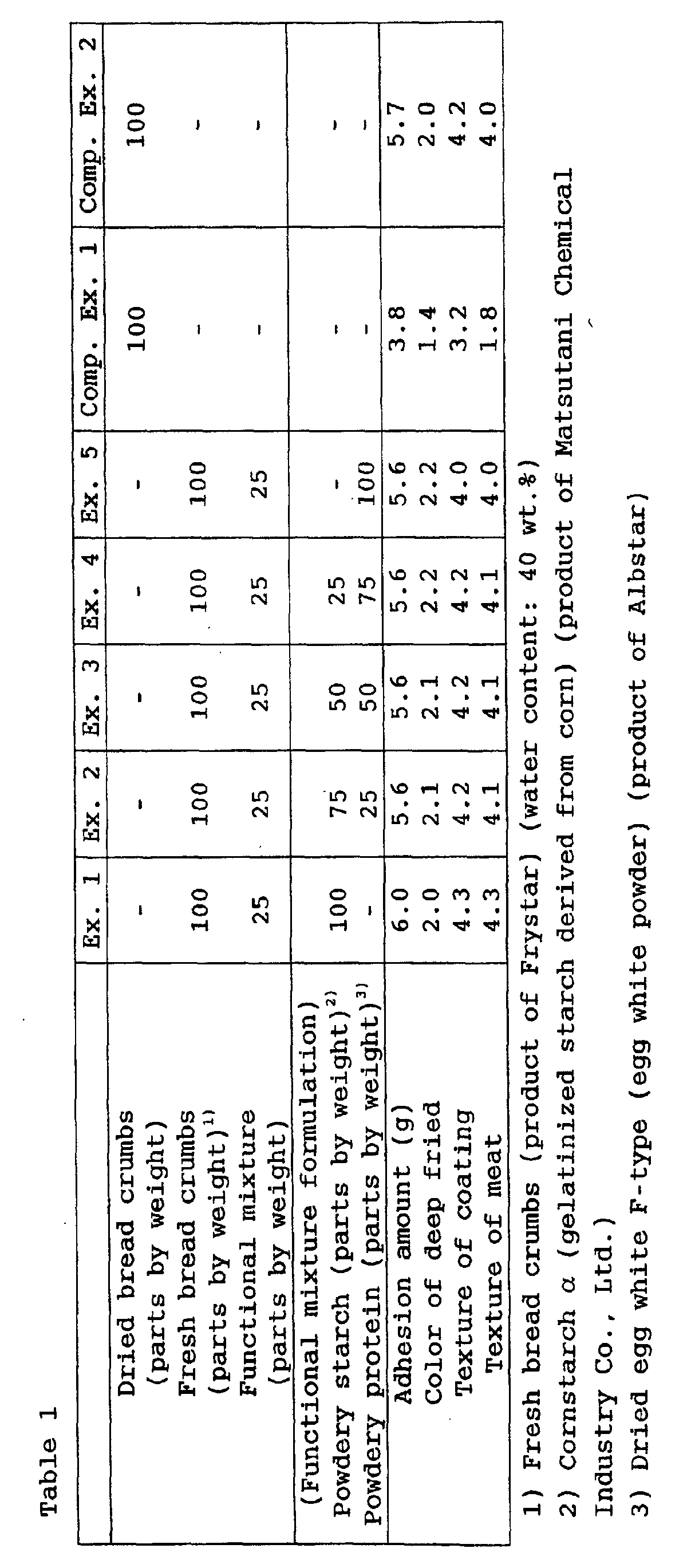
- Example 1 powdery starch alone was used as a functional mixture, and in Example 5, powdery protein alone was used as a functional mixture.
- Example 2 powdery starch (75 parts by weight) and powdery protein (25 parts by weight) were mixed together, and the resultant mixture was stirred uniformly, to thereby prepare a functional mixture.
- Example 3 the procedure of Example 2 was repeated, except that the amounts of powdery starch and powdery protein were changed as shown in Table 1, to thereby prepare a functional mixture.
- Test Example 1 evaluation of functional bread crumbs of Examples 1 through 5 and Comparative Examples 1 and 2 when used in chicken cutlet
- Examples 1 through 5 and Comparative Example 1 The above-produced functional bread crumbs or dried bread crumbs were applied directly to chicken breast (four pieces, 20 g each), and the amount of the bread crumbs which adhered thereto was measured. Subsequently, the resultant chicken breast was deep-fried in oil at 170°C for three minutes. The color of the deep fried, the texture of the coating, and the texture of the meat were evaluated on the basis of the below-described standards (Examples 1 through 5 and Comparative Example 1). In Comparative Example 2, chicken breast (four pieces, 20 g each) was subjected to uchiko, and dipped in beaten egg in a manner similar to that of a conventional method, followed by application of dried bread crumbs.
- Functional bread crumbs were produced by use of functional mixtures in which the incorporation amounts of powdery starch and/or powdery protein and powdery sugar were varied.
- Example 6 powdery starch (100 parts by weight) and powdery sugar (30 parts by weight) were mixed together, and the resultant mixture was stirred uniformly, to thereby prepare a functional mixture.
- Example 7 through 13 the procedure of Example 6 was repeated, except that the incorporation amounts of powdery starch, powdery protein, and powdery sugar were changed as shown in Table 2, to thereby prepare functional mixtures. Subsequently, functional bread crumbs were produced in a manner similar to that of Examples 1 through 5.
- Test Example 2 evaluation of functional bread crumbs of Examples 6 through 13 when used in chicken cutlet
- Functional bread crumbs were produced by changing the incorporation amount of a functional mixture on the basis of the amount of fresh bread crumbs.
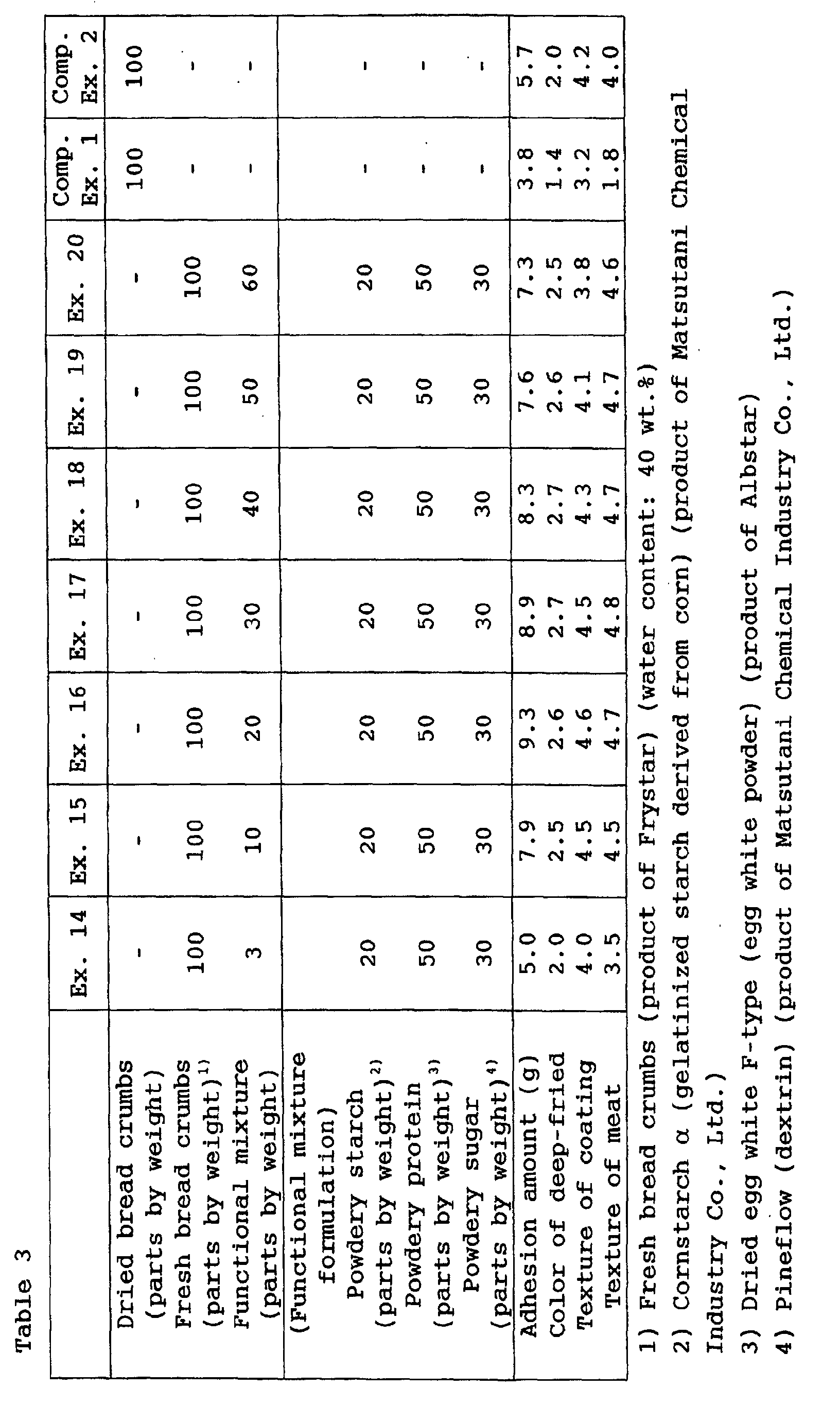
- Example 14 powdery starch (20 parts by weight), powdery protein (50 parts by weight), and powdery sugar (30 parts by weight) were mixed together, and the resultant mixture was stirred uniformly, to thereby prepare a functional mixture. Subsequently, the functional mixture (3 parts by weight) was mixed with fresh bread crumbs (100 parts by weight), the resultant mixture was stirred uniformly, and the mixture was dried by use of a fluidized-bed drying apparatus until the water content of the mixture became 6 wt.%, to thereby produce functional bread crumbs. In Examples 15 through 20, the procedure of Example 14 was repeated, except that the incorporation amounts of the functional mixture and fresh bread crumbs were changed as shown in Table 3, to thereby produce functional bread crumbs.
- Test Example 3 evaluation of functional bread crumbs of Examples 14 through 20 when used in chicken cutlet
- Example 14 through 20 the amount of the functional bread crumbs which adhere to meat was large, and the color of the deep-fried, etc. were excellent. Particularly in Examples 15 through 19, without a troublesome procedure, there was obtained a deep-fried which was more excellent, in terms of adhesion amount of bread crumbs, color, etc. than that obtained in Comparative Example 2 in which dried bread crumbs are applied through the conventional method.
- Example 20 there was obtained a deep-fried which was more excellent than that of Comparative Example 2 in terms of adhesion amount of bread crumbs, the deep-fried being similar to that of Comparative Example 2 in terms of color, etc.
Landscapes
- Life Sciences & Earth Sciences (AREA)
- Chemical & Material Sciences (AREA)
- Engineering & Computer Science (AREA)
- Food Science & Technology (AREA)
- Polymers & Plastics (AREA)
- Health & Medical Sciences (AREA)
- Nutrition Science (AREA)
- Zoology (AREA)
- Oil, Petroleum & Natural Gas (AREA)
- Grain Derivatives (AREA)
Abstract
Description
No particular limitation is imposed on the size of an individual fresh bread crumb, but the average crumb size is preferably 100 µm to 7 mm, more preferably 200 µm to 5 mm.
As used herein, the term "average crumb (or particle) size" refers to central accumulative value as measured by use of Microtrac FSA.

Claims (6)
- A process for producing functional bread crumbs comprising mixing fresh bread crumbs with powdery starch and/or powdery protein; and drying the resultant mixture to thereby cause the powdery starch and/or powdery protein to adhere to the bread crumbs.
- The process for producing functional bread crumbs according to claim 1, wherein the powdery starch and/or powdery protein in a total amount of 2-60 parts by weight are caused to adhere to 100 parts by weight of the fresh bread crumbs.
- A process for producing functional bread crumbs according to claim 1, wherein, in addition to the powdery starch and/or powdery protein, powdery sugar is caused to adhere to the fresh bread crumbs.
- The process for producing functional bread crumbs according to claim 3, wherein the powdery starch, powdery protein, and powdery sugar in a total amount of 2-60 parts by weight are caused to adhere to 100 parts by weight of the fresh bread crumbs.
- The process for producing functional bread crumbs according to claim 3 or 4, wherein 0.01-80 parts by weight of the powdery sugar is mixed with 100 parts by weight of the powdery starch and powdery protein.
- Functional bread crumbs comprising bread crumbs, and powdery starch and/or powdery protein adhered thereto.
Applications Claiming Priority (1)
| Application Number | Priority Date | Filing Date | Title |
|---|---|---|---|
| PCT/JP1999/003148 WO2000076331A1 (en) | 1998-04-15 | 1999-06-14 | Process for producing functional bread crumbs |
Publications (3)
| Publication Number | Publication Date |
|---|---|
| EP1186243A1 true EP1186243A1 (en) | 2002-03-13 |
| EP1186243A4 EP1186243A4 (en) | 2005-03-09 |
| EP1186243B1 EP1186243B1 (en) | 2007-03-07 |
Family
ID=14235950
Family Applications (1)
| Application Number | Title | Priority Date | Filing Date |
|---|---|---|---|
| EP99924016A Expired - Lifetime EP1186243B1 (en) | 1999-06-14 | 1999-06-14 | Process for producing functional bread crumbs |
Country Status (7)
| Country | Link |
|---|---|
| EP (1) | EP1186243B1 (en) |
| KR (1) | KR100670109B1 (en) |
| AU (1) | AU770009B2 (en) |
| CA (1) | CA2377218C (en) |
| DE (1) | DE69935459T2 (en) |
| ES (1) | ES2283115T3 (en) |
| WO (1) | WO2000076331A1 (en) |
Cited By (4)
| Publication number | Priority date | Publication date | Assignee | Title |
|---|---|---|---|---|
| EP1929887A1 (en) * | 2006-10-19 | 2008-06-11 | Birds Eye IP Co Ltd | Crumb coating |
| US20160262430A1 (en) * | 2015-03-09 | 2016-09-15 | Frito-Lay North America, Inc. | Method of producing dual-textured frozen food products |
| WO2018151244A1 (en) | 2017-02-17 | 2018-08-23 | 日清フーズ株式会社 | Bread crumbs, bread crumb mix, and container for shake-out-type bread crumbs |
| EP3578058A4 (en) * | 2017-02-06 | 2020-07-08 | Nisshin Foods Inc. | BREADCRUME MIX |
Families Citing this family (3)
| Publication number | Priority date | Publication date | Assignee | Title |
|---|---|---|---|---|
| DE10352575B3 (en) | 2003-11-11 | 2005-05-04 | Leica Microsystems Nussloch Gmbh | Cryostat with an inner container for receiving a microtome |
| JP5875792B2 (en) * | 2011-07-25 | 2016-03-02 | キッコーマン株式会社 | Clothing composition for deep-fried food and set of ingredients for side dish |
| JP6753797B2 (en) * | 2017-02-17 | 2020-09-09 | 日清フーズ株式会社 | Bread crumbs quality evaluation method |
Family Cites Families (8)
| Publication number | Priority date | Publication date | Assignee | Title |
|---|---|---|---|---|
| DE2308412A1 (en) * | 1973-02-21 | 1974-08-29 | Helmut Fricpe | Pre-packed dressings for meat, fish etc. - by compounding white bread crumbs, egg and spices and packing in semi liquid or dry state |
| JPS5716777B2 (en) * | 1974-03-12 | 1982-04-07 | ||
| JPS5294441A (en) * | 1976-01-27 | 1977-08-09 | Keizou Yamazaki | Production of raw bread crumbs |
| JPS55150870A (en) * | 1979-05-15 | 1980-11-25 | Nisshin Oil Mills Ltd:The | Coating mix for frying bread crumb |
| JPS58116645A (en) * | 1981-12-28 | 1983-07-11 | Nisshin Flour Milling Co Ltd | Preparation of raw bread crumb |
| JP2958262B2 (en) * | 1994-12-27 | 1999-10-06 | 花王株式会社 | Processed bread crumbs, food material for cooking prepared by attaching the same, and method for producing food |
| JP2888778B2 (en) * | 1994-12-27 | 1999-05-10 | 花王株式会社 | Manufacturing method of processed bread crumbs |
| JPH0975024A (en) * | 1995-09-12 | 1997-03-25 | Kao Corp | Processed bread crumbs, method for producing the same, food material for heating and cooking to which the same is attached, and method for producing food |
-
1999
- 1999-06-14 KR KR1020017015710A patent/KR100670109B1/en not_active Expired - Fee Related
- 1999-06-14 CA CA002377218A patent/CA2377218C/en not_active Expired - Fee Related
- 1999-06-14 WO PCT/JP1999/003148 patent/WO2000076331A1/en not_active Ceased
- 1999-06-14 DE DE69935459T patent/DE69935459T2/en not_active Expired - Lifetime
- 1999-06-14 EP EP99924016A patent/EP1186243B1/en not_active Expired - Lifetime
- 1999-06-14 ES ES99924016T patent/ES2283115T3/en not_active Expired - Lifetime
- 1999-06-14 AU AU40617/99A patent/AU770009B2/en not_active Ceased
Cited By (7)
| Publication number | Priority date | Publication date | Assignee | Title |
|---|---|---|---|---|
| EP1929887A1 (en) * | 2006-10-19 | 2008-06-11 | Birds Eye IP Co Ltd | Crumb coating |
| US20160262430A1 (en) * | 2015-03-09 | 2016-09-15 | Frito-Lay North America, Inc. | Method of producing dual-textured frozen food products |
| EP3578058A4 (en) * | 2017-02-06 | 2020-07-08 | Nisshin Foods Inc. | BREADCRUME MIX |
| WO2018151244A1 (en) | 2017-02-17 | 2018-08-23 | 日清フーズ株式会社 | Bread crumbs, bread crumb mix, and container for shake-out-type bread crumbs |
| EP3583856A4 (en) * | 2017-02-17 | 2020-12-09 | Nisshin Foods Inc. | BREAD CRUMBS, BREAD CRUMB MIX AND CONTAINER FOR PACKABLE BREAD CRUMBS |
| AU2018222305B2 (en) * | 2017-02-17 | 2022-12-15 | Nisshin Seifun Welna Inc. | Bread crumbs, bread crumb mix, and container for shake-out-type bread crumbs |
| US11606964B2 (en) | 2017-02-17 | 2023-03-21 | Nisshin Seifun Welna Inc. | Bread crumb-coated food item and methods of making |
Also Published As
| Publication number | Publication date |
|---|---|
| EP1186243A4 (en) | 2005-03-09 |
| DE69935459T2 (en) | 2007-11-29 |
| AU770009B2 (en) | 2004-02-12 |
| WO2000076331A1 (en) | 2000-12-21 |
| ES2283115T3 (en) | 2007-10-16 |
| AU4061799A (en) | 2001-01-02 |
| EP1186243B1 (en) | 2007-03-07 |
| KR20020062151A (en) | 2002-07-25 |
| CA2377218A1 (en) | 2000-12-21 |
| KR100670109B1 (en) | 2007-01-17 |
| CA2377218C (en) | 2008-08-19 |
| DE69935459D1 (en) | 2007-04-19 |
Similar Documents
| Publication | Publication Date | Title |
|---|---|---|
| US4068009A (en) | Bread crumb coating composition and process | |
| EP0034227B1 (en) | Composition for use in preparing a baked coated commestible and process therefor | |
| US5266340A (en) | Process for preparing batter-coated, chilled food products | |
| JPH07508170A (en) | Method for producing gel-coated foods | |
| JP3782711B2 (en) | Method for producing frozen fried food | |
| US5266339A (en) | Process for preparing batter-coated, heated food products | |
| JP4444973B2 (en) | Fabric mix for clothing containing modified starch | |
| EP0603879A2 (en) | Fried food and process for producing same | |
| JP3035287B2 (en) | Method for producing functional bread crumbs | |
| CA2114204A1 (en) | Batter-like coating | |
| AU770009B2 (en) | Process for producing functional bread crumbs | |
| JP2000069926A (en) | Batter material for fried food and production of fried food | |
| GB2097646A (en) | Coated edible products and processes for their preparation | |
| JPH06153823A (en) | Manufacturing method of food containing seasoning liquid | |
| CN113163818A (en) | Dough-spreading mixture for fried food | |
| JPH0975024A (en) | Processed bread crumbs, method for producing the same, food material for heating and cooking to which the same is attached, and method for producing food | |
| JP2717413B2 (en) | Food for frying and method for producing the same | |
| JPH0775514A (en) | Cellulose-containing bread crumb, cellulose-containing batter mix and production of fried food for microwave-oven cook-and-heating coated with bread crumb and already fried with oil using the bread crumb and the batter mix | |
| JP7058227B2 (en) | Bread crumbs mix | |
| JPH0126663B2 (en) | ||
| CA1063421A (en) | Dry mix for coating foods and process | |
| JP7305486B2 (en) | Method for producing battered food for oven cooking | |
| JP3418309B2 (en) | Manufacturing method of frozen tempura that does not crumble | |
| JP6753797B2 (en) | Bread crumbs quality evaluation method | |
| HK40112879A (en) | Fried food batter material |
Legal Events
| Date | Code | Title | Description |
|---|---|---|---|
| PUAI | Public reference made under article 153(3) epc to a published international application that has entered the european phase |
Free format text: ORIGINAL CODE: 0009012 |
|
| 17P | Request for examination filed |
Effective date: 20011213 |
|
| AK | Designated contracting states |
Kind code of ref document: A1 Designated state(s): DE ES FR GB IT |
|
| RAP1 | Party data changed (applicant data changed or rights of an application transferred) |
Owner name: NISSHIN FOODS INC. |
|
| A4 | Supplementary search report drawn up and despatched |
Effective date: 20050124 |
|
| GRAP | Despatch of communication of intention to grant a patent |
Free format text: ORIGINAL CODE: EPIDOSNIGR1 |
|
| GRAS | Grant fee paid |
Free format text: ORIGINAL CODE: EPIDOSNIGR3 |
|
| GRAA | (expected) grant |
Free format text: ORIGINAL CODE: 0009210 |
|
| AK | Designated contracting states |
Kind code of ref document: B1 Designated state(s): DE ES FR GB IT |
|
| REG | Reference to a national code |
Ref country code: GB Ref legal event code: FG4D |
|
| REF | Corresponds to: |
Ref document number: 69935459 Country of ref document: DE Date of ref document: 20070419 Kind code of ref document: P |
|
| ET | Fr: translation filed | ||
| REG | Reference to a national code |
Ref country code: ES Ref legal event code: FG2A Ref document number: 2283115 Country of ref document: ES Kind code of ref document: T3 |
|
| PLBE | No opposition filed within time limit |
Free format text: ORIGINAL CODE: 0009261 |
|
| STAA | Information on the status of an ep patent application or granted ep patent |
Free format text: STATUS: NO OPPOSITION FILED WITHIN TIME LIMIT |
|
| 26N | No opposition filed |
Effective date: 20071210 |
|
| PGFP | Annual fee paid to national office [announced via postgrant information from national office to epo] |
Ref country code: GB Payment date: 20140611 Year of fee payment: 16 |
|
| PGFP | Annual fee paid to national office [announced via postgrant information from national office to epo] |
Ref country code: DE Payment date: 20140611 Year of fee payment: 16 Ref country code: ES Payment date: 20140513 Year of fee payment: 16 Ref country code: IT Payment date: 20140613 Year of fee payment: 16 |
|
| PGFP | Annual fee paid to national office [announced via postgrant information from national office to epo] |
Ref country code: FR Payment date: 20140609 Year of fee payment: 16 |
|
| REG | Reference to a national code |
Ref country code: DE Ref legal event code: R079 Ref document number: 69935459 Country of ref document: DE Free format text: PREVIOUS MAIN CLASS: A23L0001176000 Ipc: A23L0007157000 |
|
| REG | Reference to a national code |
Ref country code: DE Ref legal event code: R119 Ref document number: 69935459 Country of ref document: DE |
|
| PG25 | Lapsed in a contracting state [announced via postgrant information from national office to epo] |
Ref country code: IT Free format text: LAPSE BECAUSE OF NON-PAYMENT OF DUE FEES Effective date: 20150614 |
|
| GBPC | Gb: european patent ceased through non-payment of renewal fee |
Effective date: 20150614 |
|
| REG | Reference to a national code |
Ref country code: FR Ref legal event code: ST Effective date: 20160229 |
|
| PG25 | Lapsed in a contracting state [announced via postgrant information from national office to epo] |
Ref country code: DE Free format text: LAPSE BECAUSE OF NON-PAYMENT OF DUE FEES Effective date: 20160101 Ref country code: GB Free format text: LAPSE BECAUSE OF NON-PAYMENT OF DUE FEES Effective date: 20150614 |
|
| PG25 | Lapsed in a contracting state [announced via postgrant information from national office to epo] |
Ref country code: FR Free format text: LAPSE BECAUSE OF NON-PAYMENT OF DUE FEES Effective date: 20150630 |
|
| REG | Reference to a national code |
Ref country code: ES Ref legal event code: FD2A Effective date: 20170131 |
|
| PG25 | Lapsed in a contracting state [announced via postgrant information from national office to epo] |
Ref country code: ES Free format text: LAPSE BECAUSE OF NON-PAYMENT OF DUE FEES Effective date: 20150615 |