EP1184646A2 - Particle resistant thermal flow sensor - Google Patents
Particle resistant thermal flow sensor Download PDFInfo
- Publication number
- EP1184646A2 EP1184646A2 EP01106396A EP01106396A EP1184646A2 EP 1184646 A2 EP1184646 A2 EP 1184646A2 EP 01106396 A EP01106396 A EP 01106396A EP 01106396 A EP01106396 A EP 01106396A EP 1184646 A2 EP1184646 A2 EP 1184646A2
- Authority
- EP
- European Patent Office
- Prior art keywords
- diaphragm
- taper
- air flow
- flow rate
- type air
- Prior art date
- Legal status (The legal status is an assumption and is not a legal conclusion. Google has not performed a legal analysis and makes no representation as to the accuracy of the status listed.)
- Withdrawn
Links
Images




Classifications
-
- F—MECHANICAL ENGINEERING; LIGHTING; HEATING; WEAPONS; BLASTING
- F02—COMBUSTION ENGINES; HOT-GAS OR COMBUSTION-PRODUCT ENGINE PLANTS
- F02D—CONTROLLING COMBUSTION ENGINES
- F02D41/00—Electrical control of supply of combustible mixture or its constituents
- F02D41/02—Circuit arrangements for generating control signals
- F02D41/18—Circuit arrangements for generating control signals by measuring intake air flow
- F02D41/187—Circuit arrangements for generating control signals by measuring intake air flow using a hot wire flow sensor
-
- G—PHYSICS
- G01—MEASURING; TESTING
- G01F—MEASURING VOLUME, VOLUME FLOW, MASS FLOW OR LIQUID LEVEL; METERING BY VOLUME
- G01F1/00—Measuring the volume flow or mass flow of fluid or fluent solid material wherein the fluid passes through a meter in a continuous flow
- G01F1/68—Measuring the volume flow or mass flow of fluid or fluent solid material wherein the fluid passes through a meter in a continuous flow by using thermal effects
- G01F1/684—Structural arrangements; Mounting of elements, e.g. in relation to fluid flow
- G01F1/6845—Micromachined devices
Definitions
- This invention relates to a heated type air flow rate sensor for measuring an air flow rate by using a heating resistor formed in a diagram of which circumference is fixed, and more particularly, a heated type air flow sensor having a structure suitable for measuring the intake pipe pressure of an automobile internal combustion engine.
- a prior art heated resistor type sensor utilizes a structure as shown in Japanese Patent Prepublication No. 502966/1991.
- a silicon rim to which p-type doping has been effected is positioned between a silicon substrate having the (100) crystal orientation and a thin dielectric diaphragm and under the highest point of a sandwich structure and a sensing element, and the silicon substrate has a taper formation thereon facing the silicon rim.
- An object of this invention is to provide a heated type air flow rate sensor which prevents it from characteristic-deteriorating due to dust contained in air, and thereby enables to make the amount of emission of air pollutant and the amount of consumption of fuel small.
- a heated type air flow rate sensor in which a mask with an opening is formed on the backside of the Si monocrystal substitute having a thin film formed thereabove, the substrate is removed partially by carrying out etching and the thin film diaphragm and a fixing portion for supporting this are formed, etching is carried out using a mask having an opening which is smaller than a final substrate removed portion, and thereafter the diaphragm and the diaphragm fixing portion are formed by carrying out the etching with the mask opening being expanded, and whereby the destruction of the diaphragm is avoided.
- Fig. 1 is a front sectional view of a sensor chip of a heated type air flow rate sensor according to the embodiment of this invention.
- Fig. 2 is a plan view thereof.
- Fig. 1 shows the section taken along A-A in Fig. 2.
- a substrate 1 which is the sensor chip a lower insulation film 2 is formed above this lower insulation film 2 .
- a resistive element 3 is formed in part.
- an upper insulation film 4 is formed above this resistive element.
- the resistive element 3 is in the form of a D-shaped pattern starting from electric poles 6.
- the backside of the substrate 1, a depression 7 is formed in part.
- a diaphragm 8 is formed in the form of a thin dielectric body.
- the area between right and left intersecting points of tapers 31 as described later with the lower insulation film 2 is referred to a diaphragm region.
- the diaphragm region is not limited to this.
- the thin dielectric body portion may be called the diaphragm region.
- This diaphragm 8 is fixed by a diaphragm fixing flange 50.
- the diaphragm fixing flange 50 is made up a diaphragm fixing portion 51 and a flexible support portion 52.
- the diaphragm fixing portion 51 and the flexible support portion 52 have a taper 31 and a taper 32, respectively, formed thereon. These tapers provide a two-stage taper configuration. It should be appreciated that this invention is not limited to this 2-stage taper configuration. As is shown in Fig. 3, the number of stages may be selected to over two.
- the angle of the inside taper 32 is made smaller than the angle of the outside taper 31.
- the diaphragm 8 is fixed to the diaphragm fixing portion 51, and is supported by the flexible support portion 52.
- the flexible support portion acts as a deformable absorber as well as a collision energy absorber, and has extremely high flexibility as compared with the diaphragm fixing portion 51.
- Fig. 3 shows a sample of modification of the embodiment in Fig. 1.
- the diaphragm fixing flange 50 has two tapers, in the sample in Fig. 3 a buckling portion 9 is formed as a rounded buckling portion 10.
- Other parts are the same as those in Fig. 1, it provides the similar quality.
- the example in Fig. 1 is explained generally.
- Fig. 4 is the side sectional view of the package portion.
- Fig. 5 is the B-B section in Fig. 4.
- the sensor chip 5 is built in a package 11 as shown in Fig. 4 and Fig. 5. That is, the sensor chip 5 is bonded on a tab 12 by means of an adhesive 13. Wires 15 connect between one lead 15 and one electric pole 6 on the sensor chip 5 and between the other lead 15 and the other electric pole 6, respectively. Furthermore, resin 16 is molded. The sensor chip 5 is built in so that its front face is exposed outside and its side face is covered by the resin, as shown in Fig. 4. By this, it is possible to cause air which is the measured object to flow through the front face of sensor chip 5, and to prevent the sensor chip 5 from peeling off from the resin 16. Also, a connector portion 17 is formed at the same time as the molding of the resin 16. Furthermore, at the head portion of this package 11, a straightening plate 18 is bonded by an adhesive 19. Furthermore, this package 11 is incorporated within the intake pipe 21 of the engine as shown in Fig. 6.
- the resistive element in Fig. 1 In operation, the resistive element in Fig. 1 generates heat due to the fact that an electric current flows through it, and its temperature increases.
- air flow 22 occurs within the intake pipe 21 in Fig. 6, air 22 flows toward the front face of the sensor chip 5, and whereby it becomes the air flow 22 on the resistive element 3 in Fig. 1.
- the resistive element 3 is cooled and the temperature of the resistive element 3 changes.
- the resistance value of the resistive element 3 varies depending upon the temperature coefficient of resistance of the material of the resistive element 3. By detecting this variation, it is possible to detect the air flow rate.
- Fig. 1 as the substrate silicon monocrystal is used, as the resistive element 3 polycrystalline silicon is used, and as the insulation films 2 and 4 a composite film comprised of SiO 2 and Si 3 n 4 formed using CVD.
- the insulation films 2 and 4 a composite film comprised of SiO 2 and Si 3 n 4 formed using CVD.
- the thickness t of the diaphragm 8 As for the thickness t of the diaphragm 8, if it is thickened, since heat which was generated by the resistive element 3 results in its transmission to the substrate 1, the temperature variation of the resistive element 3 due to the air flow 22 becomes imperceptible. As a result, it becomes impossible to measure the flow rate. Consideration concerning various values in thickness was made. In result, it was found that a thickness under 2 ⁇ m is suitable for the measurement. In this embodiment, the thickness of 1.5 ⁇ m was selected which provide sufficiently high measurement accuracy.
- the relationship between the thickness H of the substrate 1 and the efficiency of chip handling was considered. As a result, it was found that the thickness of the substrate which is over 150 ⁇ m is suitable for provide good handling capability. In this embodiment, the value of 200 ⁇ m was utilized.
- the heat generating resistor is attached to the diaphragm and the air flow rate is measured using the electric resistance value, said diaphragm is made thin toward said heat generating resistor in a taper way, and is supported by the flexible support portion integrated with the diaphragm fixing portion in said diaphragm fixing flange.
- the tab 12 and the leads 14 is made of an Fe-Ni alloy and the bonds 13 and 19, and the resin 16 are composed of an epoxy material.
- the resin 16 are composed of an epoxy material.
- An epoxy material is used as the material of the straightening plate 18. By this, the distortion of the straightening plate 18 can be avoided.
- An Al material is used as the material of the electric poles 6 and the wires 15. By this, high connection strength can be provided.
- the substrate 1 has at its diaphragm fixing position the two-stage taper pattern in which the thin inside taper 32 is formed on the inside of the thick outside taper 31, and the angle of the inside taper 32 is smaller than the angle of the outside taper 31.
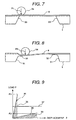
- the diaphragm fixing flange is in the form of a one-stage large angle taper 33, or even though the taper patter is in the form of a multi-stage, as shown in Fig. 12 the taper angle of the inside taper is larger than that of the outside taper. So, as shown in Fig. 7, the ability of deformation absorption at the time when dust 34 collided with the portion of the diaphragm 8 on the immediate inside of the fixing flange thereof is small. That is, in the prior art structure, its diaphragm supporting was a rigid structure which does not take into consideration the damage of the diaphragm due to the collusion with the dust.
- the load P1 applied to the diaphragm 8 becomes a large value as shown by 35 in Fig. 9.
- the distortion energy is the area 36 indicated by the hatched portion in Fig. 9 in which P-ä curves which exhibit the relationship the load and displacement are shown (the hatched portion 36 defined by the downside of the P-ä curve 35 indicates an example of the distortion energy in the prior art device). If the angle of a taper is larger it is more difficult for the taper portion to deform.
- the inclination of the curve 35 which indicates the example of the P-ä curve in the prior art device is large.
- the area of the portion 36 on the downside of the P-ä curve 35 being constant, when the inclination of the P-ä curve is made large, the value of the maximum load P1 results in a large value.
- the destructive boundary load of the membrane is the level 37 in Fig. 9, and in this case, the diaphragm 8 cannot stand the load which is generated on the diaphragm 8, and whereby the destruction occurs.
- the size of the dust is usually under 100 ⁇ m. Under this conditioned size, the requirement that the diaphragm 8 is not destructed was evaluated. As a result, it was found that the angle è of the inside taper 32 shown in Fig. 1 is needed to be under 15 degrees, preferable under 5 degrees, the thickness h of the base or root of this taper is needed to be above 12 ⁇ m, preferably 30 ⁇ m.
- the flexible support portion is installed with the diaphragm fixing portion of said diaphragm fixing flange, the taper formation is shaped which extends from the taper root portion of said flexible support portion, said flexible support portion has the taper formation having the angle of within 15 degrees, the taper root portion is made over 12 ⁇ m, the angle of the taper formation of said diaphragm fixing portion, and the buckling shape is formed by the two taper formations.
- the heated type air flow rate sensor is provided in which said diaphragm fixing portion has the member for supporting said diaphragm having the taper configuration of which angle is within 15 degrees, thinned toward said heat generating resistor in a taper way.
- the heated type air flow rate sensor is provided in which said diaphragm fixing flange has the support member providing the taper configuration of which length from the taper root portion to the head is within 1/2 of the distance between the taper root portion and the center of the diaphragm.
- the substrate 1 In the structure of the prior art device shown in Fig. 7, if the taper angle is forcibly made smaller, the substrate 1 must be made thinner extremely. Therefore, it is impossible to effect the handling of the chip, which preclude the production. Also, in case where the taper angle is large, it can be thought that the extremely thickened diaphragm 8 can avoid the destruction. However, with such thickened diaphragm 8, the heat generated in the resistive element which is within the diaphragm 8 is easily transmitted to the fixing portion of the substrate 1, and therefore the temperature change of the resistor due to the flow of air which is the measurement object is lost and it becomes impossible to measure the air flow rate. On the ground of this, the diagram cannot thickened.
- Fig. 5 shows an arrangement in which the embodiment of this invention is applied to an automobile.
- the air flow rate in the intake pipe 21 of an automobile internal combustion engine is measured using the above mentioned sensor 11, a control unit 27 calculates an appropriate fuel injection timing and its amount on the basis of a control signal generated, a signal generated on the basis thereof is transmitted to a fuel injection device 28, and the fuel injection is carried out in the fuel injection device 28.
- the sensor of high precision and without deterioration is used, it is possible to maintain the control of the fuel injection of high precision over the long term and provide the saving of the amount of fuel consumption and the decrease of the amount of discharge of air pollutants.
- a method of forming the taper configuration in this embodiment using Fig. 10 The Si monocrystal of the (100) face is used and a KOH aqueous solution is used for etching.
- a depression 41 which is smaller than the depression finally formed is formed by a usual anisotropic etching method.
- Fig. 10(b) a portion 43 surrounding the depression 41 in the mask 42 of the back face 42 is removed. Further, under this condition, by effecting the etching during an appropriate period of time, a two-stage taper configuration is formed at the diaphragm fixing flange position as shown in Fig. 10(c) using such a nature that an etching speed varies depending upon a crystal orientation.
- the angle of the inside taper 32 can be formed to be smaller than the angle of the outside taper 31. It is also found from the measurement of the angle of the inside taper 32 that it can be formed to be under 5 degrees. Incidentally, it was found that the angle of the outside taper 31 is formed to be 55 degrees. By effecting such formation, it was found that with the thickness of the substrate being held appropriately, it is possible to make the angle of the inside taper small and prevent the damage of the diaphragm due to the collusion of dust.
- Fig. 11 shows another embodiment of this invention.
- the diaphragm fixing flange, especially the flexible support portion 52 thereof was formed by the Si monocrystal, whereas in this embodiment a flexible support portion 44 is made of a resin.
- the resinic flexible support portion 44 can be formed as follows: The diaphragm is formed in a usual method, then a resin before hardening is applied to the edge portion of the back face of the diaphragm, and thereafter heat hardening is carried out. Since a resin is smaller in Young's modulus than the Si monocrystal, to use the resin can provides appropriate deformation absorption capability even though the taper angle is made large.
- the material of the resin polyimide may be used since it provides good heat resistance. In case where the polyimide is used, it was found that by making the taper angle under for example 11 degrees, it is possible to provide sufficient capability for resisting dust. Resist material may be used. However, the thickness of the root of the resinic flexible support portion is necessary to be preferably made over 40 ⁇ m. On the other hand, as in the above-mentioned embodiment, the advantage that the Si monocrystal is used for the inside taper is to enable the saving of material since there is no need to apply the resin.
- said diaphragm is supported by the flexible support portion which is thinned toward said resistor in a taper way and integrated with the diaphragm fixing portion of said diaphragm fixing flange, and said flexible support portion is made of a resin.
Landscapes
- Engineering & Computer Science (AREA)
- Chemical & Material Sciences (AREA)
- Combustion & Propulsion (AREA)
- Mechanical Engineering (AREA)
- General Engineering & Computer Science (AREA)
- Physics & Mathematics (AREA)
- Fluid Mechanics (AREA)
- General Physics & Mathematics (AREA)
- Measuring Volume Flow (AREA)
Abstract
Description
Claims (13)
- A heated type air flow rate sensor having a resistive element heated by a current, a diaphragm mounting said resistive element and a diaphragm fixing portion coupled to said diaphragm, wherein said diaphragm fixing portion comprises a diaphragm fixing edge and a flexible support connected to said diaphragm fixing edge.
- A heated type air flow rate sensor having a diaphragm fixing flange for fixing the diaphragm, and a heat generating resistive element mounted to the diaphragm, so that the air flow rate is measured using an electric resistance value, wherein said diaphragm is supported by a flexible support portion thinned toward said heat generating resistive element in a taper way and integrated with a diaphragm fixing portion of said diaphragm fixing flange.
- A heated type air flow rate sensor according to claim 1, wherein said flexible support portion is formed in the form of the shape having a taper of which angle is within 15 degrees.
- A heated type air flow rate sensor according to claim 1, wherein said flexible support portion is formed in the form of the shape having a taper of which angle is within 5 degrees.
- A heated type air flow rate sensor according to claim 1, wherein said diaphragm fixing portion has a taper shape formed from the tapered root portion of said flexible support portion, and the tapered taper angle of said flexible support portion is made smaller than the tapered taper angle of said diaphragm fixing portion.
- A heated type air flow rate sensor according to claim 1, wherein the length from the tapered root portion of said flexible support portion to the head is made within 1/2 of the distance between the tapered root portion and the center of the diaphragm.
- A heated type air flow rate sensor according to claim 1, wherein said flexible support portion is made of a resin.
- A heated type air flow rate sensor having a diaphragm fixing flange for fixing the diaphragm, and a heat generating resistive element mounted to the diaphragm, so that the air flow rate is measured using an electric resistance value, wherein a flexible support portion is set up to a diaphragm fixing portion of said diaphragm fixing flange and a taper shape is formed from the root portion of said flexible support portion, wherein said flexible support portion has a tapered shape of which angle is within 15 degrees, and the taper root portion is made above 12ìm, and wherein the angle of the taper shape of said diaphragm fixing portion is made above 15 degrees, and a buckling shape is formed by the two taper shapes.
- A heated type air flow rate sensor having a diaphragm fixing flange for fixing the diaphragm, and a heat generating resistive element mounted to the diaphragm, so that the air flow rate is measured using an electric resistance value, wherein said diaphragm fixing flange has a member for supporting said diaphragm, said member having a taper shape of which angle is within 15 degrees, said taper shape being thinned forward said heat generating resistive element in a taper way.
- A heated type air flow rate sensor having a diaphragm fixing flange for fixing the diaphragm, and a heat generating resistive element mounted to the diaphragm, so that the air flow rate is measured using an electric resistance value, wherein said diaphragm fixing flange has a taper shape of which length from the taper root portion to the taper head is within 1/2 of the distance between the taper root portion and the center of the diaphragm.
- A heated type air flow rate sensor according to claim 1, wherein it is used in an automobile internal combustion engine controlling apparatus.
- A method of forming a heated type air flow rate sensor, wherein a mask having an opening portion is formed the backside of a substrate of Si monocrystal having a thin film formed on the front side thereof, the substrate is partially removed by carrying out etching, and a thin film diaphragm and a fixing portion for supporting this are formed, and wherein the etching is carried out using a mask having an opening which is smaller than a final substrate removed portion, and thereafter the diaphragm and the diaphragm fixing portion are formed by carrying out the etching so that the mask opening is expanded.
- A method of forming a heated type air flow rate sensor, wherein two or more staged tapers are formed by multiple-staged etching, and the diaphragm fixing portion is formed by making the angle of the most inside taper smaller than the angle of a taper on the outside thereof.
Applications Claiming Priority (2)
| Application Number | Priority Date | Filing Date | Title |
|---|---|---|---|
| JP2000260109A JP3577269B2 (en) | 2000-08-30 | 2000-08-30 | Thermal air flow sensor and method of forming the same |
| JP2000260109 | 2000-08-30 |
Publications (2)
| Publication Number | Publication Date |
|---|---|
| EP1184646A2 true EP1184646A2 (en) | 2002-03-06 |
| EP1184646A3 EP1184646A3 (en) | 2002-10-09 |
Family
ID=18748169
Family Applications (1)
| Application Number | Title | Priority Date | Filing Date |
|---|---|---|---|
| EP01106396A Withdrawn EP1184646A3 (en) | 2000-08-30 | 2001-03-20 | Particle resistant thermal flow sensor |
Country Status (3)
| Country | Link |
|---|---|
| US (1) | US6698282B2 (en) |
| EP (1) | EP1184646A3 (en) |
| JP (1) | JP3577269B2 (en) |
Cited By (2)
| Publication number | Priority date | Publication date | Assignee | Title |
|---|---|---|---|---|
| EP1746393A1 (en) * | 2005-07-13 | 2007-01-24 | Hitachi, Ltd. | Thermal type gas flow measuring apparatus comprising a diaphragm |
| US20140000376A1 (en) * | 2012-06-27 | 2014-01-02 | Continental Automotive Systems, Inc. | Pressure sensing device with stepped cavity to minimize thermal noise |
Families Citing this family (9)
| Publication number | Priority date | Publication date | Assignee | Title |
|---|---|---|---|---|
| JP2006516327A (en) * | 2003-03-11 | 2006-06-29 | ローベルト ボツシユ ゲゼルシヤフト ミツト ベシユレンクテル ハフツング | Diaphragm sensor |
| US7211873B2 (en) * | 2003-09-24 | 2007-05-01 | Denso Corporation | Sensor device having thin membrane and method of manufacturing the same |
| DE102005035058B4 (en) * | 2005-07-27 | 2016-01-21 | Robert Bosch Gmbh | Micromechanical device, micromechanical sensor and method |
| JP2009031066A (en) * | 2007-07-25 | 2009-02-12 | Denso Corp | Thin film semiconductor sensor manufacturing method and thin film semiconductor sensor |
| JP2010038905A (en) | 2008-07-10 | 2010-02-18 | Denso Corp | Sensor device |
| WO2012049742A1 (en) * | 2010-10-13 | 2012-04-19 | 日立オートモティブシステムズ株式会社 | Flow sensor and production method therefor, and flow sensor module and production method therefor |
| CN104364615B (en) * | 2012-06-15 | 2017-04-05 | 日立汽车系统株式会社 | Thermal flowmeter |
| JP5936744B1 (en) * | 2015-05-15 | 2016-06-22 | 三菱電機株式会社 | Flow measuring device |
| CN112730886A (en) * | 2020-12-21 | 2021-04-30 | 上海交通大学 | Flexible MEMS flow velocity sensor based on amorphous germanium thermal resistor |
Family Cites Families (4)
| Publication number | Priority date | Publication date | Assignee | Title |
|---|---|---|---|---|
| JPS62123318A (en) * | 1985-08-13 | 1987-06-04 | Nippon Soken Inc | Direct heat type flow rate sensor |
| US5056362A (en) * | 1990-07-25 | 1991-10-15 | Siemens Automotive L.P. | Strengthening a silicon micromachined mass air flow sensor in the region of its hot element |
| JP2784286B2 (en) * | 1991-12-09 | 1998-08-06 | 三菱電機株式会社 | Method for manufacturing semiconductor sensor device |
| DE4215722C2 (en) | 1992-05-13 | 1997-02-13 | Bosch Gmbh Robert | Sensor substrate with a membrane and method for its production |
-
2000
- 2000-08-30 JP JP2000260109A patent/JP3577269B2/en not_active Expired - Fee Related
-
2001
- 2001-03-20 EP EP01106396A patent/EP1184646A3/en not_active Withdrawn
- 2001-03-20 US US09/811,439 patent/US6698282B2/en not_active Expired - Fee Related
Cited By (6)
| Publication number | Priority date | Publication date | Assignee | Title |
|---|---|---|---|---|
| EP1746393A1 (en) * | 2005-07-13 | 2007-01-24 | Hitachi, Ltd. | Thermal type gas flow measuring apparatus comprising a diaphragm |
| US20140000376A1 (en) * | 2012-06-27 | 2014-01-02 | Continental Automotive Systems, Inc. | Pressure sensing device with stepped cavity to minimize thermal noise |
| CN103512683A (en) * | 2012-06-27 | 2014-01-15 | 大陆汽车系统公司 | Pressure Sensing Device with Stepped Cavity for Minimizing Thermal Noise |
| GB2506919A (en) * | 2012-06-27 | 2014-04-16 | Continental Automotive Systems | Pressure sensing device with stepped cavity to minimise thermal noise |
| US8833172B2 (en) | 2012-06-27 | 2014-09-16 | Continental Automotive Systems, Inc | Pressure sensing device with stepped cavity to minimize thermal noise |
| CN103512683B (en) * | 2012-06-27 | 2018-09-11 | 大陆汽车系统公司 | Pressure Sensing Device with Stepped Cavity for Minimizing Thermal Noise |
Also Published As
| Publication number | Publication date |
|---|---|
| US6698282B2 (en) | 2004-03-02 |
| US20020023487A1 (en) | 2002-02-28 |
| EP1184646A3 (en) | 2002-10-09 |
| JP2002071415A (en) | 2002-03-08 |
| JP3577269B2 (en) | 2004-10-13 |
Similar Documents
| Publication | Publication Date | Title |
|---|---|---|
| US7685874B2 (en) | Thermal type flow sensor with a constricted measuring passage | |
| EP1184646A2 (en) | Particle resistant thermal flow sensor | |
| US7467891B2 (en) | Sensor arrangement for measuring a pressure and a temperature in a fluid | |
| US6732589B2 (en) | Pressure sensor, a method for manufacturing a pressure sensor and a combustion engine having a pressure sensor | |
| US6997058B2 (en) | Pressure sensor | |
| EP2270455B1 (en) | Force sensor apparatus | |
| US8733175B2 (en) | Pressure sensor | |
| US8186213B2 (en) | Thermal-type flowmeter | |
| US20100219490A1 (en) | Semiconductor sensor and method of manufacturing the same | |
| JP3455473B2 (en) | Thermal flow sensor | |
| US6829945B2 (en) | Sensor device for registering strain | |
| US8935959B2 (en) | Thermal type flow rate sensor | |
| JP2008233012A (en) | Thermal flowmeter | |
| US6935182B2 (en) | Pressure sensor apparatus including stems provided with strain measuring arrangement | |
| US6644113B2 (en) | Flow-rate detecting device for heat-sensitive type flow sensor | |
| JP5455848B2 (en) | Thermal flow sensor | |
| EP1790964B1 (en) | A sensor arrangement for measuring a pressure and a temperature in a fluid | |
| JPH08107219A (en) | Semiconductor acceleration sensor and its manufacture | |
| JP2003302299A (en) | Manufacturing method of physical quantity detection device | |
| JP3603447B2 (en) | Flow measurement device | |
| JP2006258675A (en) | Flow sensor | |
| US7418871B2 (en) | Method for detecting a pressure of a medium and pressure measuring device | |
| JP3274288B2 (en) | Semiconductor microsensor and manufacturing method thereof | |
| JP3772079B2 (en) | Pressure sensor and automotive internal combustion engine control device using the same | |
| JP2002174541A (en) | Thermal flow meter |
Legal Events
| Date | Code | Title | Description |
|---|---|---|---|
| PUAI | Public reference made under article 153(3) epc to a published international application that has entered the european phase |
Free format text: ORIGINAL CODE: 0009012 |
|
| AK | Designated contracting states |
Kind code of ref document: A2 Designated state(s): AT BE CH CY DE DK ES FI FR GB GR IE IT LI LU MC NL PT SE TR |
|
| AX | Request for extension of the european patent |
Free format text: AL;LT;LV;MK;RO;SI |
|
| PUAL | Search report despatched |
Free format text: ORIGINAL CODE: 0009013 |
|
| AK | Designated contracting states |
Kind code of ref document: A3 Designated state(s): AT BE CH CY DE DK ES FI FR GB GR IE IT LI LU MC NL PT SE TR |
|
| AX | Request for extension of the european patent |
Free format text: AL;LT;LV;MK;RO;SI |
|
| 17P | Request for examination filed |
Effective date: 20030217 |
|
| AKX | Designation fees paid |
Designated state(s): DE FR GB IT |
|
| 17Q | First examination report despatched |
Effective date: 20060822 |
|
| 17Q | First examination report despatched |
Effective date: 20060822 |
|
| GRAP | Despatch of communication of intention to grant a patent |
Free format text: ORIGINAL CODE: EPIDOSNIGR1 |
|
| GRAS | Grant fee paid |
Free format text: ORIGINAL CODE: EPIDOSNIGR3 |
|
| RAP1 | Party data changed (applicant data changed or rights of an application transferred) |
Owner name: HITACHI CAR ENGINEERING CO., LTD. Owner name: HITACHI, LTD. |
|
| STAA | Information on the status of an ep patent application or granted ep patent |
Free format text: STATUS: THE APPLICATION IS DEEMED TO BE WITHDRAWN |
|
| 18D | Application deemed to be withdrawn |
Effective date: 20091001 |