EP1184461A2 - Creation of gene targeting vectors using homologous recombination in yeast - Google Patents
Creation of gene targeting vectors using homologous recombination in yeast Download PDFInfo
- Publication number
- EP1184461A2 EP1184461A2 EP01307021A EP01307021A EP1184461A2 EP 1184461 A2 EP1184461 A2 EP 1184461A2 EP 01307021 A EP01307021 A EP 01307021A EP 01307021 A EP01307021 A EP 01307021A EP 1184461 A2 EP1184461 A2 EP 1184461A2
- Authority
- EP
- European Patent Office
- Prior art keywords
- gene
- mammalian
- cells
- bacterial
- targeted
- Prior art date
- Legal status (The legal status is an assumption and is not a legal conclusion. Google has not performed a legal analysis and makes no representation as to the accuracy of the status listed.)
- Withdrawn
Links
- 239000013598 vector Substances 0.000 title claims abstract description 80
- 238000010363 gene targeting Methods 0.000 title claims abstract description 62
- 240000004808 Saccharomyces cerevisiae Species 0.000 title claims description 63
- 238000002744 homologous recombination Methods 0.000 title claims description 52
- 230000006801 homologous recombination Effects 0.000 title claims description 52
- 108090000623 proteins and genes Proteins 0.000 claims abstract description 114
- 238000000034 method Methods 0.000 claims abstract description 72
- 210000004962 mammalian cell Anatomy 0.000 claims abstract description 42
- 241000699670 Mus sp. Species 0.000 claims abstract description 34
- 206010064571 Gene mutation Diseases 0.000 claims abstract description 13
- 239000003550 marker Substances 0.000 claims description 105
- 210000004027 cell Anatomy 0.000 claims description 93
- 230000001580 bacterial effect Effects 0.000 claims description 74
- 241000699666 Mus <mouse, genus> Species 0.000 claims description 46
- 230000010076 replication Effects 0.000 claims description 20
- 230000008685 targeting Effects 0.000 claims description 14
- 210000005253 yeast cell Anatomy 0.000 claims description 14
- 210000001671 embryonic stem cell Anatomy 0.000 claims description 12
- 210000001161 mammalian embryo Anatomy 0.000 claims description 12
- 108091034117 Oligonucleotide Proteins 0.000 claims description 11
- 241000588724 Escherichia coli Species 0.000 claims description 10
- 238000010367 cloning Methods 0.000 claims description 8
- 210000000130 stem cell Anatomy 0.000 claims description 7
- JLCPHMBAVCMARE-UHFFFAOYSA-N [3-[[3-[[3-[[3-[[3-[[3-[[3-[[3-[[3-[[3-[[3-[[5-(2-amino-6-oxo-1H-purin-9-yl)-3-[[3-[[3-[[3-[[3-[[3-[[5-(2-amino-6-oxo-1H-purin-9-yl)-3-[[5-(2-amino-6-oxo-1H-purin-9-yl)-3-hydroxyoxolan-2-yl]methoxy-hydroxyphosphoryl]oxyoxolan-2-yl]methoxy-hydroxyphosphoryl]oxy-5-(5-methyl-2,4-dioxopyrimidin-1-yl)oxolan-2-yl]methoxy-hydroxyphosphoryl]oxy-5-(6-aminopurin-9-yl)oxolan-2-yl]methoxy-hydroxyphosphoryl]oxy-5-(6-aminopurin-9-yl)oxolan-2-yl]methoxy-hydroxyphosphoryl]oxy-5-(6-aminopurin-9-yl)oxolan-2-yl]methoxy-hydroxyphosphoryl]oxy-5-(6-aminopurin-9-yl)oxolan-2-yl]methoxy-hydroxyphosphoryl]oxyoxolan-2-yl]methoxy-hydroxyphosphoryl]oxy-5-(5-methyl-2,4-dioxopyrimidin-1-yl)oxolan-2-yl]methoxy-hydroxyphosphoryl]oxy-5-(4-amino-2-oxopyrimidin-1-yl)oxolan-2-yl]methoxy-hydroxyphosphoryl]oxy-5-(5-methyl-2,4-dioxopyrimidin-1-yl)oxolan-2-yl]methoxy-hydroxyphosphoryl]oxy-5-(5-methyl-2,4-dioxopyrimidin-1-yl)oxolan-2-yl]methoxy-hydroxyphosphoryl]oxy-5-(6-aminopurin-9-yl)oxolan-2-yl]methoxy-hydroxyphosphoryl]oxy-5-(6-aminopurin-9-yl)oxolan-2-yl]methoxy-hydroxyphosphoryl]oxy-5-(4-amino-2-oxopyrimidin-1-yl)oxolan-2-yl]methoxy-hydroxyphosphoryl]oxy-5-(4-amino-2-oxopyrimidin-1-yl)oxolan-2-yl]methoxy-hydroxyphosphoryl]oxy-5-(4-amino-2-oxopyrimidin-1-yl)oxolan-2-yl]methoxy-hydroxyphosphoryl]oxy-5-(6-aminopurin-9-yl)oxolan-2-yl]methoxy-hydroxyphosphoryl]oxy-5-(4-amino-2-oxopyrimidin-1-yl)oxolan-2-yl]methyl [5-(6-aminopurin-9-yl)-2-(hydroxymethyl)oxolan-3-yl] hydrogen phosphate Polymers Cc1cn(C2CC(OP(O)(=O)OCC3OC(CC3OP(O)(=O)OCC3OC(CC3O)n3cnc4c3nc(N)[nH]c4=O)n3cnc4c3nc(N)[nH]c4=O)C(COP(O)(=O)OC3CC(OC3COP(O)(=O)OC3CC(OC3COP(O)(=O)OC3CC(OC3COP(O)(=O)OC3CC(OC3COP(O)(=O)OC3CC(OC3COP(O)(=O)OC3CC(OC3COP(O)(=O)OC3CC(OC3COP(O)(=O)OC3CC(OC3COP(O)(=O)OC3CC(OC3COP(O)(=O)OC3CC(OC3COP(O)(=O)OC3CC(OC3COP(O)(=O)OC3CC(OC3COP(O)(=O)OC3CC(OC3COP(O)(=O)OC3CC(OC3COP(O)(=O)OC3CC(OC3COP(O)(=O)OC3CC(OC3COP(O)(=O)OC3CC(OC3CO)n3cnc4c(N)ncnc34)n3ccc(N)nc3=O)n3cnc4c(N)ncnc34)n3ccc(N)nc3=O)n3ccc(N)nc3=O)n3ccc(N)nc3=O)n3cnc4c(N)ncnc34)n3cnc4c(N)ncnc34)n3cc(C)c(=O)[nH]c3=O)n3cc(C)c(=O)[nH]c3=O)n3ccc(N)nc3=O)n3cc(C)c(=O)[nH]c3=O)n3cnc4c3nc(N)[nH]c4=O)n3cnc4c(N)ncnc34)n3cnc4c(N)ncnc34)n3cnc4c(N)ncnc34)n3cnc4c(N)ncnc34)O2)c(=O)[nH]c1=O JLCPHMBAVCMARE-UHFFFAOYSA-N 0.000 claims description 6
- 238000004519 manufacturing process Methods 0.000 claims description 6
- 230000008488 polyadenylation Effects 0.000 claims description 6
- 230000001131 transforming effect Effects 0.000 claims description 6
- 238000009402 cross-breeding Methods 0.000 claims description 3
- 210000003705 ribosome Anatomy 0.000 claims description 3
- 230000014616 translation Effects 0.000 claims description 3
- 108020004999 messenger RNA Proteins 0.000 claims description 2
- 239000006152 selective media Substances 0.000 claims description 2
- 108020004414 DNA Proteins 0.000 description 86
- 235000014680 Saccharomyces cerevisiae Nutrition 0.000 description 55
- 230000035772 mutation Effects 0.000 description 29
- 239000013612 plasmid Substances 0.000 description 26
- 102000004190 Enzymes Human genes 0.000 description 18
- 108090000790 Enzymes Proteins 0.000 description 18
- 238000003752 polymerase chain reaction Methods 0.000 description 18
- 239000000047 product Substances 0.000 description 14
- LFQSCWFLJHTTHZ-UHFFFAOYSA-N Ethanol Chemical compound CCO LFQSCWFLJHTTHZ-UHFFFAOYSA-N 0.000 description 12
- 230000006870 function Effects 0.000 description 12
- 102000004169 proteins and genes Human genes 0.000 description 12
- 241000894006 Bacteria Species 0.000 description 11
- 239000002609 medium Substances 0.000 description 11
- 210000002257 embryonic structure Anatomy 0.000 description 10
- 230000002068 genetic effect Effects 0.000 description 10
- 239000000203 mixture Substances 0.000 description 10
- 239000000523 sample Substances 0.000 description 10
- SBUJHOSQTJFQJX-NOAMYHISSA-N kanamycin Chemical compound O[C@@H]1[C@@H](O)[C@H](O)[C@@H](CN)O[C@@H]1O[C@H]1[C@H](O)[C@@H](O[C@@H]2[C@@H]([C@@H](N)[C@H](O)[C@@H](CO)O2)O)[C@H](N)C[C@@H]1N SBUJHOSQTJFQJX-NOAMYHISSA-N 0.000 description 9
- 230000008569 process Effects 0.000 description 9
- 108091008146 restriction endonucleases Proteins 0.000 description 9
- 238000004520 electroporation Methods 0.000 description 8
- 229930027917 kanamycin Natural products 0.000 description 8
- 229960000318 kanamycin Drugs 0.000 description 8
- 229930182823 kanamycin A Natural products 0.000 description 8
- 229920001817 Agar Polymers 0.000 description 7
- KCXVZYZYPLLWCC-UHFFFAOYSA-N EDTA Chemical compound OC(=O)CN(CC(O)=O)CCN(CC(O)=O)CC(O)=O KCXVZYZYPLLWCC-UHFFFAOYSA-N 0.000 description 7
- 239000008272 agar Substances 0.000 description 7
- 238000004458 analytical method Methods 0.000 description 7
- 238000012217 deletion Methods 0.000 description 7
- 230000037430 deletion Effects 0.000 description 7
- 238000002474 experimental method Methods 0.000 description 7
- 239000012634 fragment Substances 0.000 description 7
- 239000000499 gel Substances 0.000 description 7
- 239000012528 membrane Substances 0.000 description 7
- 108020004684 Internal Ribosome Entry Sites Proteins 0.000 description 6
- 230000029087 digestion Effects 0.000 description 6
- 238000012216 screening Methods 0.000 description 6
- 239000011543 agarose gel Substances 0.000 description 5
- HEDRZPFGACZZDS-UHFFFAOYSA-N Chloroform Chemical compound ClC(Cl)Cl HEDRZPFGACZZDS-UHFFFAOYSA-N 0.000 description 4
- 108091026890 Coding region Proteins 0.000 description 4
- 102000053602 DNA Human genes 0.000 description 4
- 241001465754 Metazoa Species 0.000 description 4
- 108091028043 Nucleic acid sequence Proteins 0.000 description 4
- 238000002105 Southern blotting Methods 0.000 description 4
- 238000011161 development Methods 0.000 description 4
- 230000018109 developmental process Effects 0.000 description 4
- 210000004602 germ cell Anatomy 0.000 description 4
- 238000013507 mapping Methods 0.000 description 4
- 238000004806 packaging method and process Methods 0.000 description 4
- 238000002360 preparation method Methods 0.000 description 4
- 230000006798 recombination Effects 0.000 description 4
- 238000005215 recombination Methods 0.000 description 4
- 238000011160 research Methods 0.000 description 4
- 239000000243 solution Substances 0.000 description 4
- 230000009466 transformation Effects 0.000 description 4
- 238000011282 treatment Methods 0.000 description 4
- XLYOFNOQVPJJNP-UHFFFAOYSA-N water Chemical compound O XLYOFNOQVPJJNP-UHFFFAOYSA-N 0.000 description 4
- IAZDPXIOMUYVGZ-UHFFFAOYSA-N Dimethylsulphoxide Chemical compound CS(C)=O IAZDPXIOMUYVGZ-UHFFFAOYSA-N 0.000 description 3
- 108010067770 Endopeptidase K Proteins 0.000 description 3
- 101100059658 Mus musculus Cetn4 gene Proteins 0.000 description 3
- 238000012408 PCR amplification Methods 0.000 description 3
- ISWSIDIOOBJBQZ-UHFFFAOYSA-N Phenol Chemical compound OC1=CC=CC=C1 ISWSIDIOOBJBQZ-UHFFFAOYSA-N 0.000 description 3
- 239000007983 Tris buffer Substances 0.000 description 3
- 230000002776 aggregation Effects 0.000 description 3
- 238000004220 aggregation Methods 0.000 description 3
- 210000002459 blastocyst Anatomy 0.000 description 3
- 239000000872 buffer Substances 0.000 description 3
- 230000000295 complement effect Effects 0.000 description 3
- 238000010790 dilution Methods 0.000 description 3
- 239000012895 dilution Substances 0.000 description 3
- 238000000605 extraction Methods 0.000 description 3
- 239000011521 glass Substances 0.000 description 3
- 230000000415 inactivating effect Effects 0.000 description 3
- 210000003734 kidney Anatomy 0.000 description 3
- 239000011159 matrix material Substances 0.000 description 3
- 238000002156 mixing Methods 0.000 description 3
- 230000036961 partial effect Effects 0.000 description 3
- 238000012360 testing method Methods 0.000 description 3
- 210000001519 tissue Anatomy 0.000 description 3
- 238000001890 transfection Methods 0.000 description 3
- LENZDBCJOHFCAS-UHFFFAOYSA-N tris Chemical compound OCC(N)(CO)CO LENZDBCJOHFCAS-UHFFFAOYSA-N 0.000 description 3
- QKNYBSVHEMOAJP-UHFFFAOYSA-N 2-amino-2-(hydroxymethyl)propane-1,3-diol;hydron;chloride Chemical compound Cl.OCC(N)(CO)CO QKNYBSVHEMOAJP-UHFFFAOYSA-N 0.000 description 2
- 108700028369 Alleles Proteins 0.000 description 2
- 101100163849 Arabidopsis thaliana ARS1 gene Proteins 0.000 description 2
- KFZMGEQAYNKOFK-UHFFFAOYSA-N Isopropanol Chemical compound CC(C)O KFZMGEQAYNKOFK-UHFFFAOYSA-N 0.000 description 2
- 108090000364 Ligases Proteins 0.000 description 2
- 102000003960 Ligases Human genes 0.000 description 2
- 101100097319 Schizosaccharomyces pombe (strain 972 / ATCC 24843) ala1 gene Proteins 0.000 description 2
- FAPWRFPIFSIZLT-UHFFFAOYSA-M Sodium chloride Chemical compound [Na+].[Cl-] FAPWRFPIFSIZLT-UHFFFAOYSA-M 0.000 description 2
- 108010012715 Superoxide dismutase Proteins 0.000 description 2
- 238000000246 agarose gel electrophoresis Methods 0.000 description 2
- 229960000723 ampicillin Drugs 0.000 description 2
- 230000003321 amplification Effects 0.000 description 2
- 102000005936 beta-Galactosidase Human genes 0.000 description 2
- 108010005774 beta-Galactosidase Proteins 0.000 description 2
- 210000004556 brain Anatomy 0.000 description 2
- 238000004113 cell culture Methods 0.000 description 2
- 230000022131 cell cycle Effects 0.000 description 2
- 239000003153 chemical reaction reagent Substances 0.000 description 2
- 230000002759 chromosomal effect Effects 0.000 description 2
- 230000001332 colony forming effect Effects 0.000 description 2
- 150000001875 compounds Chemical class 0.000 description 2
- 238000005138 cryopreservation Methods 0.000 description 2
- 238000005520 cutting process Methods 0.000 description 2
- 229940079593 drug Drugs 0.000 description 2
- 239000003814 drug Substances 0.000 description 2
- 238000005516 engineering process Methods 0.000 description 2
- IRSCQMHQWWYFCW-UHFFFAOYSA-N ganciclovir Chemical compound O=C1NC(N)=NC2=C1N=CN2COC(CO)CO IRSCQMHQWWYFCW-UHFFFAOYSA-N 0.000 description 2
- 229960002963 ganciclovir Drugs 0.000 description 2
- 230000012010 growth Effects 0.000 description 2
- 230000002779 inactivation Effects 0.000 description 2
- 238000011534 incubation Methods 0.000 description 2
- 230000004048 modification Effects 0.000 description 2
- 238000012986 modification Methods 0.000 description 2
- 238000003199 nucleic acid amplification method Methods 0.000 description 2
- 230000035479 physiological effects, processes and functions Effects 0.000 description 2
- 230000003362 replicative effect Effects 0.000 description 2
- 239000008223 sterile water Substances 0.000 description 2
- 239000000126 substance Substances 0.000 description 2
- 239000000725 suspension Substances 0.000 description 2
- 231100000331 toxic Toxicity 0.000 description 2
- 230000002588 toxic effect Effects 0.000 description 2
- 238000013518 transcription Methods 0.000 description 2
- 230000035897 transcription Effects 0.000 description 2
- 101710163881 5,6-dihydroxyindole-2-carboxylic acid oxidase Proteins 0.000 description 1
- 229920000936 Agarose Polymers 0.000 description 1
- 102000002260 Alkaline Phosphatase Human genes 0.000 description 1
- 108020004774 Alkaline Phosphatase Proteins 0.000 description 1
- 108020005544 Antisense RNA Proteins 0.000 description 1
- 241000244203 Caenorhabditis elegans Species 0.000 description 1
- 108010069241 Connexin 43 Proteins 0.000 description 1
- 102000016928 DNA-directed DNA polymerase Human genes 0.000 description 1
- 108010014303 DNA-directed DNA polymerase Proteins 0.000 description 1
- 206010012335 Dependence Diseases 0.000 description 1
- 241000255601 Drosophila melanogaster Species 0.000 description 1
- 108010042407 Endonucleases Proteins 0.000 description 1
- 102000004533 Endonucleases Human genes 0.000 description 1
- 241000701867 Enterobacteria phage T7 Species 0.000 description 1
- 241000701959 Escherichia virus Lambda Species 0.000 description 1
- 101150009006 HIS3 gene Proteins 0.000 description 1
- 208000009889 Herpes Simplex Diseases 0.000 description 1
- 208000026350 Inborn Genetic disease Diseases 0.000 description 1
- 108091092195 Intron Proteins 0.000 description 1
- 239000006142 Luria-Bertani Agar Substances 0.000 description 1
- 241000124008 Mammalia Species 0.000 description 1
- 101000771687 Mus musculus Apolipoprotein E Proteins 0.000 description 1
- 101100268556 Mus musculus App gene Proteins 0.000 description 1
- 101000744431 Mus musculus E3 ubiquitin-protein ligase RAG1 Proteins 0.000 description 1
- 101000686995 Mus musculus Protein phosphatase 1 regulatory subunit 1B Proteins 0.000 description 1
- FUSGACRLAFQQRL-UHFFFAOYSA-N N-Ethyl-N-nitrosourea Chemical compound CCN(N=O)C(N)=O FUSGACRLAFQQRL-UHFFFAOYSA-N 0.000 description 1
- 229930193140 Neomycin Natural products 0.000 description 1
- 206010028980 Neoplasm Diseases 0.000 description 1
- 108020005187 Oligonucleotide Probes Proteins 0.000 description 1
- 208000018737 Parkinson disease Diseases 0.000 description 1
- 102000045595 Phosphoprotein Phosphatases Human genes 0.000 description 1
- 108700019535 Phosphoprotein Phosphatases Proteins 0.000 description 1
- 108091000080 Phosphotransferase Proteins 0.000 description 1
- 241001304248 Progne modesta Species 0.000 description 1
- 102000008866 Prostaglandin E receptors Human genes 0.000 description 1
- 108010088540 Prostaglandin E receptors Proteins 0.000 description 1
- 101100394989 Rhodopseudomonas palustris (strain ATCC BAA-98 / CGA009) hisI gene Proteins 0.000 description 1
- 102000038012 SFKs Human genes 0.000 description 1
- 108091008118 SFKs Proteins 0.000 description 1
- 241000700584 Simplexvirus Species 0.000 description 1
- 229920006328 Styrofoam Polymers 0.000 description 1
- 229930006000 Sucrose Natural products 0.000 description 1
- CZMRCDWAGMRECN-UGDNZRGBSA-N Sucrose Chemical compound O[C@H]1[C@H](O)[C@@H](CO)O[C@@]1(CO)O[C@@H]1[C@H](O)[C@@H](O)[C@H](O)[C@@H](CO)O1 CZMRCDWAGMRECN-UGDNZRGBSA-N 0.000 description 1
- 102000019197 Superoxide Dismutase Human genes 0.000 description 1
- 102000008221 Superoxide Dismutase-1 Human genes 0.000 description 1
- 108010021188 Superoxide Dismutase-1 Proteins 0.000 description 1
- 210000001744 T-lymphocyte Anatomy 0.000 description 1
- 241000255588 Tephritidae Species 0.000 description 1
- 102000006601 Thymidine Kinase Human genes 0.000 description 1
- 108020004440 Thymidine kinase Proteins 0.000 description 1
- 239000002253 acid Substances 0.000 description 1
- 230000002378 acidificating effect Effects 0.000 description 1
- 230000004931 aggregating effect Effects 0.000 description 1
- 230000004075 alteration Effects 0.000 description 1
- AVKUERGKIZMTKX-NJBDSQKTSA-N ampicillin Chemical compound C1([C@@H](N)C(=O)N[C@H]2[C@H]3SC([C@@H](N3C2=O)C(O)=O)(C)C)=CC=CC=C1 AVKUERGKIZMTKX-NJBDSQKTSA-N 0.000 description 1
- 230000006933 amyloid-beta aggregation Effects 0.000 description 1
- 239000000427 antigen Substances 0.000 description 1
- 108091007433 antigens Proteins 0.000 description 1
- 102000036639 antigens Human genes 0.000 description 1
- 238000003556 assay Methods 0.000 description 1
- 230000010310 bacterial transformation Effects 0.000 description 1
- 239000011324 bead Substances 0.000 description 1
- 108010081355 beta 2-Microglobulin Proteins 0.000 description 1
- 238000009395 breeding Methods 0.000 description 1
- 230000001488 breeding effect Effects 0.000 description 1
- 244000309466 calf Species 0.000 description 1
- 230000006721 cell death pathway Effects 0.000 description 1
- 230000011712 cell development Effects 0.000 description 1
- 230000024245 cell differentiation Effects 0.000 description 1
- 108091092356 cellular DNA Proteins 0.000 description 1
- 238000005119 centrifugation Methods 0.000 description 1
- 230000008859 change Effects 0.000 description 1
- 239000002962 chemical mutagen Substances 0.000 description 1
- 238000012761 co-transfection Methods 0.000 description 1
- 239000002299 complementary DNA Substances 0.000 description 1
- 239000003184 complementary RNA Substances 0.000 description 1
- 238000007796 conventional method Methods 0.000 description 1
- 230000007547 defect Effects 0.000 description 1
- 230000002939 deleterious effect Effects 0.000 description 1
- 238000007865 diluting Methods 0.000 description 1
- 201000010099 disease Diseases 0.000 description 1
- 208000037265 diseases, disorders, signs and symptoms Diseases 0.000 description 1
- 230000009977 dual effect Effects 0.000 description 1
- 230000013020 embryo development Effects 0.000 description 1
- ZMMJGEGLRURXTF-UHFFFAOYSA-N ethidium bromide Chemical compound [Br-].C12=CC(N)=CC=C2C2=CC=C(N)C=C2[N+](CC)=C1C1=CC=CC=C1 ZMMJGEGLRURXTF-UHFFFAOYSA-N 0.000 description 1
- 229960005542 ethidium bromide Drugs 0.000 description 1
- 239000004060 excitotoxin Substances 0.000 description 1
- 239000012530 fluid Substances 0.000 description 1
- 238000011010 flushing procedure Methods 0.000 description 1
- 230000004927 fusion Effects 0.000 description 1
- 108020001507 fusion proteins Proteins 0.000 description 1
- 102000037865 fusion proteins Human genes 0.000 description 1
- 238000003167 genetic complementation Methods 0.000 description 1
- 208000016361 genetic disease Diseases 0.000 description 1
- 230000008826 genomic mutation Effects 0.000 description 1
- PCHJSUWPFVWCPO-UHFFFAOYSA-N gold Chemical compound [Au] PCHJSUWPFVWCPO-UHFFFAOYSA-N 0.000 description 1
- 239000010931 gold Substances 0.000 description 1
- 229910052737 gold Inorganic materials 0.000 description 1
- 239000001963 growth medium Substances 0.000 description 1
- 238000009396 hybridization Methods 0.000 description 1
- -1 i.e. Substances 0.000 description 1
- 239000007943 implant Substances 0.000 description 1
- 238000001727 in vivo Methods 0.000 description 1
- 238000002347 injection Methods 0.000 description 1
- 239000007924 injection Substances 0.000 description 1
- 230000000968 intestinal effect Effects 0.000 description 1
- 238000002955 isolation Methods 0.000 description 1
- BWHLPLXXIDYSNW-UHFFFAOYSA-N ketorolac tromethamine Chemical compound OCC(N)(CO)CO.OC(=O)C1CCN2C1=CC=C2C(=O)C1=CC=CC=C1 BWHLPLXXIDYSNW-UHFFFAOYSA-N 0.000 description 1
- 101150066555 lacZ gene Proteins 0.000 description 1
- 231100000518 lethal Toxicity 0.000 description 1
- 230000001665 lethal effect Effects 0.000 description 1
- 238000009630 liquid culture Methods 0.000 description 1
- 210000004698 lymphocyte Anatomy 0.000 description 1
- 239000002184 metal Substances 0.000 description 1
- 229910052751 metal Inorganic materials 0.000 description 1
- 239000002480 mineral oil Substances 0.000 description 1
- 235000010446 mineral oil Nutrition 0.000 description 1
- 238000002703 mutagenesis Methods 0.000 description 1
- 231100000350 mutagenesis Toxicity 0.000 description 1
- 239000003471 mutagenic agent Substances 0.000 description 1
- 231100000707 mutagenic chemical Toxicity 0.000 description 1
- 229960004927 neomycin Drugs 0.000 description 1
- 235000015097 nutrients Nutrition 0.000 description 1
- 239000002751 oligonucleotide probe Substances 0.000 description 1
- 210000003101 oviduct Anatomy 0.000 description 1
- 230000036542 oxidative stress Effects 0.000 description 1
- 230000008447 perception Effects 0.000 description 1
- 102000020233 phosphotransferase Human genes 0.000 description 1
- 230000001766 physiological effect Effects 0.000 description 1
- 239000004033 plastic Substances 0.000 description 1
- 238000007747 plating Methods 0.000 description 1
- 238000005498 polishing Methods 0.000 description 1
- 229940124606 potential therapeutic agent Drugs 0.000 description 1
- 239000002244 precipitate Substances 0.000 description 1
- 238000003825 pressing Methods 0.000 description 1
- 230000037452 priming Effects 0.000 description 1
- 150000003180 prostaglandins Chemical class 0.000 description 1
- 230000000384 rearing effect Effects 0.000 description 1
- 230000009467 reduction Effects 0.000 description 1
- 230000001105 regulatory effect Effects 0.000 description 1
- 201000000980 schizophrenia Diseases 0.000 description 1
- 238000010187 selection method Methods 0.000 description 1
- 230000035945 sensitivity Effects 0.000 description 1
- 239000011780 sodium chloride Substances 0.000 description 1
- 239000007787 solid Substances 0.000 description 1
- 230000002269 spontaneous effect Effects 0.000 description 1
- 238000010186 staining Methods 0.000 description 1
- 239000008261 styrofoam Substances 0.000 description 1
- 239000000758 substrate Substances 0.000 description 1
- 239000005720 sucrose Substances 0.000 description 1
- 239000006228 supernatant Substances 0.000 description 1
- 230000004083 survival effect Effects 0.000 description 1
- 230000001225 therapeutic effect Effects 0.000 description 1
- 229940104230 thymidine Drugs 0.000 description 1
- 239000003053 toxin Substances 0.000 description 1
- 231100000765 toxin Toxicity 0.000 description 1
- 238000012546 transfer Methods 0.000 description 1
- 230000009261 transgenic effect Effects 0.000 description 1
- 238000013519 translation Methods 0.000 description 1
- 230000014621 translational initiation Effects 0.000 description 1
- 210000004881 tumor cell Anatomy 0.000 description 1
- 241001515965 unidentified phage Species 0.000 description 1
- 210000004291 uterus Anatomy 0.000 description 1
- 238000003260 vortexing Methods 0.000 description 1
- 210000004340 zona pellucida Anatomy 0.000 description 1
Images

Classifications
-
- C—CHEMISTRY; METALLURGY
- C12—BIOCHEMISTRY; BEER; SPIRITS; WINE; VINEGAR; MICROBIOLOGY; ENZYMOLOGY; MUTATION OR GENETIC ENGINEERING
- C12N—MICROORGANISMS OR ENZYMES; COMPOSITIONS THEREOF; PROPAGATING, PRESERVING, OR MAINTAINING MICROORGANISMS; MUTATION OR GENETIC ENGINEERING; CULTURE MEDIA
- C12N15/00—Mutation or genetic engineering; DNA or RNA concerning genetic engineering, vectors, e.g. plasmids, or their isolation, preparation or purification; Use of hosts therefor
- C12N15/09—Recombinant DNA-technology
- C12N15/87—Introduction of foreign genetic material using processes not otherwise provided for, e.g. co-transformation
- C12N15/90—Stable introduction of foreign DNA into chromosome
- C12N15/902—Stable introduction of foreign DNA into chromosome using homologous recombination
-
- A—HUMAN NECESSITIES
- A01—AGRICULTURE; FORESTRY; ANIMAL HUSBANDRY; HUNTING; TRAPPING; FISHING
- A01K—ANIMAL HUSBANDRY; AVICULTURE; APICULTURE; PISCICULTURE; FISHING; REARING OR BREEDING ANIMALS, NOT OTHERWISE PROVIDED FOR; NEW BREEDS OF ANIMALS
- A01K2217/00—Genetically modified animals
- A01K2217/07—Animals genetically altered by homologous recombination
- A01K2217/075—Animals genetically altered by homologous recombination inducing loss of function, i.e. knock out
-
- C—CHEMISTRY; METALLURGY
- C12—BIOCHEMISTRY; BEER; SPIRITS; WINE; VINEGAR; MICROBIOLOGY; ENZYMOLOGY; MUTATION OR GENETIC ENGINEERING
- C12N—MICROORGANISMS OR ENZYMES; COMPOSITIONS THEREOF; PROPAGATING, PRESERVING, OR MAINTAINING MICROORGANISMS; MUTATION OR GENETIC ENGINEERING; CULTURE MEDIA
- C12N2800/00—Nucleic acids vectors
- C12N2800/10—Plasmid DNA
- C12N2800/102—Plasmid DNA for yeast
-
- C—CHEMISTRY; METALLURGY
- C12—BIOCHEMISTRY; BEER; SPIRITS; WINE; VINEGAR; MICROBIOLOGY; ENZYMOLOGY; MUTATION OR GENETIC ENGINEERING
- C12N—MICROORGANISMS OR ENZYMES; COMPOSITIONS THEREOF; PROPAGATING, PRESERVING, OR MAINTAINING MICROORGANISMS; MUTATION OR GENETIC ENGINEERING; CULTURE MEDIA
- C12N2840/00—Vectors comprising a special translation-regulating system
- C12N2840/20—Vectors comprising a special translation-regulating system translation of more than one cistron
- C12N2840/203—Vectors comprising a special translation-regulating system translation of more than one cistron having an IRES
-
- C—CHEMISTRY; METALLURGY
- C12—BIOCHEMISTRY; BEER; SPIRITS; WINE; VINEGAR; MICROBIOLOGY; ENZYMOLOGY; MUTATION OR GENETIC ENGINEERING
- C12N—MICROORGANISMS OR ENZYMES; COMPOSITIONS THEREOF; PROPAGATING, PRESERVING, OR MAINTAINING MICROORGANISMS; MUTATION OR GENETIC ENGINEERING; CULTURE MEDIA
- C12N2840/00—Vectors comprising a special translation-regulating system
- C12N2840/44—Vectors comprising a special translation-regulating system being a specific part of the splice mechanism, e.g. donor, acceptor
Definitions
- the present invention relates to the development of gene targeting vectors, i.e., vectors that are useful for causing directed mutation(s) in a target gene. More particularly, the preferred use of the gene targeting vectors of the present invention is for the mutation of genes in embryonic stem cells, wherein these mutated stem cells are then useful for the production of mutated whole animals, particularly mice.
- Mutations have long been a tool used to understand gene function. By observing the physical or biochemical defects that result when a gene is perturbed we can deduce, at least in part, the function of that gene. See. e.g . Castle and Allen, Proc. Am. Acad. Arts Sci., 38 :603-621, 1903. Mutations can be found as spontaneous events in populations of organisms or induced with mutagens, such as the chemical mutagen N-ethyl-N-nitrosourea. Basic understanding of a mutation involves mapping it or grouping it into a "complementation group" in order to define what gene a given mutation belongs to, or whether the mutation defines a novel gene.
- mapping and genetic complementation testing involves breeding experiments, typically over several generations of the organism in question.
- simple organisms such as the bacteria Escherichia coli , the yeast Saccharomyces cerevisiae , the round worm Caenorhabditis elegans , and the fruit fly Drosophila melanogaster , all with relatively short generation times, have been popular for experiments whereby novel mutations are induced through mutagenesis protocols and then characterized by genetic mapping and complementation testing.
- mice which are a popular organism for studying aspects of human physiology because of their relative physiological similarity, have not been as popular for studying genetics.
- mice have a much longer generation time, and their size and husbandry requirements do not typically permit the rearing of the large numbers required in classical genetic experiments.
- mice In late 1980's it became possible to create mutations in specific genes of interest in mice by the isolation of mouse embryonic stem cells (see. e.g . Martin, Proc. Natl. Acad. Sci. USA, 78: 634-638; 1981, Evans and Kaufman, Nature, 309: 154-156, 1981), and the discovery that the phenomenon of "homologous recombination" could occur in mammalian cells (see. e.g. Smithies, et al. , Nature, 317: 230-234, 1985). These combined discoveries quickly led to a procedure that allowed one to inactivate a specific gene by first inactivating that gene in embryonic stem cells, and then transferring embryonic stem cells bearing the desired mutation into developing mouse embryos. See.
- the ⁇ -2-microglobulin gene was found to be necessary for the efficient development of the CD-4 - ,CD-8 + class of T-cells, and consequently for the efficient production of certain classes of antibodies to certain antigens. See. e.g. Koller, et al. , Science, 248: 1227-1230; 1990; Spriggs, et al. , Proc. Natl. Acad. Sci. USA, 89: 6070-6074, 1992.
- the connexin 43 gene initially regarded as important in some of the very first cell differentiation events of mouse embryogenesis, was found to be most important in the developing heart. See. e.g . Reaume, et al. , Science, 216: 1831-1833, 1995.
- the JNK-3 gene was shown to be necessary in the cell death pathway in the brains of mice treated with the excitotoxin kanic acid. See. e.g . Yang, et al. , Nature, 389: 865-870, 1997.
- U.S. Patent No. 5,777,195 describes a knockout of the mouse DARPP-32 gene and its utility as a screening model for potential therapeutic agents useful in the treatment of schizophrenia, Parkinson's disease, and the treatment of addictions, especially those involving drugs of abuse.
- U.S. Patent No. 5,814,300 describes gene-targeted heterozygous and homozygous SOD-1 null non-human mammals and their use for determining the effectiveness of a compound for counteracting the deleterious effects of oxidative stress.
- U.S. Patent No. 5,859,307 describes gene targeted mutants for the mouse RAG-1 gene and their potential use in the establishment of continuous lymphoid cell lines, as well as the establishment of animals developing tumors for use in studying tumor cell developments and treatments.
- mice The method of making gene-targeted mutations in mice has proven particularly useful for the complex issue of deciphering the functions of individual family members in gene families.
- Audoly, et al. , Am. J. Physiol., 277: H924-30, (1999) have shown that only the prostaglandin E2R EP1 member is responsible for perception of certain pain stimuli.
- Disruption of all 3 superoxide dismutase genes has shown that only Mn-superoxide dismutase is absolutely essential for survival. See. e.g. Carlsson, et al. , Proc. Natl. Acad.
- the method of homologous recombination allows one to also make subtle changes in a gene without completely disrupting its function.
- the creation of a series of mutant versions of the gene that still possess partial activity has proven to be a complementary tool to completely inactivating a gene. See. e.g . Nagy, et al. , Curr. Biol., 8: 661-664, 1998.
- mutations associated with human genetic disorders do not inactivate the gene but rather alter its function or constitute a "gain of function”.
- Homologous recombination strategies that create more subtle changes can be employed in order to recapitulate these sorts of mutations in mice. For example, Sullivan, et al. , J. Biol.
- mice in which the A ⁇ portion of the mouse APP gene has been replaced with the human version of the gene in order to more faithfully replicate the physiology of A ⁇ deposition in the human brain, while providing a more sensitive assay with which to track A ⁇ levels.
- This invention generally involves a process with which to create gene-targeting vectors in a rapid method by use of a specialized genomic DNA library, homologous recombination in yeast, and a subsequent selection system in E. coli . More particularly, this invention concerns a process with which to create gene-targeting vectors that may be used in mouse embryonic stem cells.
- the method involves using homologous recombination in yeast to simultaneously: 1) screen for genomic clones of interest and 2) build a gene targeting vector by virtue of replacing a defined portion of a gene of interest with a positive selection marker that can be used in both E. coli and mammalian cell culture.
- the present invention provides a method of preparing a gene targeting vector, said method comprising transforming yeast cells with a RKO clone and a yeast targeting cassette (YTC), wherein said RKO clone comprises a genomic clone insert, a yeast replication element, a yeast selectable marker, a bacterial origin of replication, optionally a bacterial selectable marker, and optionally a mammalian negative selection marker, and wherein said YTC comprises a bacterial/mammalian positive selection marker flanked by recombinogenic arms, maintaining said yeast cells under conditions wherein said RKO clone and said YTC undergo homologous recombination via said genomic clone insert and said recombinogenic arms to produce a gene targeting vector, selecting transformed yeast cells by their expression of said yeast selectable marker on said gene targeting vector or on said RKO clone, isolating said gene targeting vector and said RKO clone from said selected yeast cells, transforming bacterial cells with said gene
- the present invention provides a method of preparing gene targeted mammalian cells having a targeted gene mutation, said method comprising transforming mammalian cells with said gene targeting vector of the first embodiment of the invention, maintaining said mammalian cells under conditions wherein said gene targeting vector and the genome of said mammalian cells undergo homologous recombination to produce a gene targeted mammalian cell, and selecting gene targeted mammalian cells wherein homologous recombination has occurred by selecting gene targeted mammalian cells for their expression of said bacterial/mammalian positive selection marker, thereby obtaining gene targeted mammalian cells containing said targeted gene mutation.
- the present invention provides a method of making gene targeted mice, said method comprising combining a gene targeted mouse cell according to the second embodiment of the invention with an early mouse embryo to produce a gene targeted embryonic construct, and introducing said gene targeted embryonic construct into a female host mouse, wherein said gene targeted embryonic construct is allowed to mature into a chimeric live whole mouse, said whole mouse thereby having a genome that includes said targeted gene mutation.
- the present invention provides a gene targeting vector comprising a yeast replication element, a yeast selectable marker, a bacterial origin of replication, optionally a bacterial selectable marker, optionally a mammalian negative selection marker, and a genomic clone insert containing a bacterial mammalian positive selection marker inserted therein.
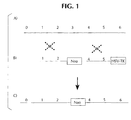
- FIGURE 1 provides a general paradigm for introducing mutations into a mammalian genome using homologous recombination.
- homologous recombination between elements A and B results in a product C wherein region 3 has been replaced by a marker segment (Neo).
- the negative selection marker (Hsv-TK) is separated from the positive selection marker in the process of homologous recombination.
- FIGURE 2 provides a plasmid map of a preferred RKO backbone according to the present invention.
- ARS1 is a yeast autonomous replicating sequence that serves as a yeast replication element.
- CEN4 is a yeast centromeric sequence that helps to stabilize propagation of the vector in yeast.
- TRP1 is a yeast selectable marker.
- Ori is a bacterial origin of replication.
- Amp is a bacterial selectable marker.
- the hsv-TK cassette is a mammalian negative selection marker. Addition of the genomic clone insert to this plasmid would yield an RKO clone. In a preferred embodiment, genomic clone inserts would be inserted into the multiple cloning site (MCS) shown in this plasmid to create the RKO clone. Addition of Cos sites allow the RKO clone to be packaged in lambda phage as a cosmid clone for propagation purposes.
- MCS multiple cloning site
- FIGURE 3 depicts an example of a preferred yeast-targeting cassette (YTC) as described in this invention.
- the bacterial/mammalian selection marker cassette is flanked by recombinogenic arms (RA).
- a promoter T7 allows transcription of the bacterial/mammalian positive selection marker (Neo r ) to occur in bacteria.
- An internal ribosome entry site (IRES) element allows translational initiation of the said selection marker to occur when the said marker is transcribed by a promoter in the genomic region of interest (GRI).
- GRI genomic region of interest
- SD Shine-Dalgarno element
- Fusion of the coding sequence for the said selection marker with the coding sequence for a reporter protein such as bacterial beta galactosidase (lacZ) creates a reporter system for the GRI so that it may be easily possible to determine when a gene of interest is being expressed.
- a polyadenylation signal (pA) is desirable if transcription in mammalian cells initiates from the (GRI).
- Arms of Homology A pair of DNA segments that is present in the gene targeting vector; these segments are homologous to two portions of the target gene. Because of this homology, the arms of homology will be able to undergo homologous recombination with the target gene.
- the arms of homology are preferably at least 200 bp in length to allow for appreciable rates of homologous recombination to occur in mammalian cells. More preferably, the arms of homology will be at least 2 kb or greater in length.
- Bacterial Origin of Replication A genetic element that enables replication of the DNA sequence of which it is a part during each cell cycle in a bacterium, such that the DNA sequence will be maintained in each daughter cell. Examples include pMB1, pSC101 and pUC.
- Bacterial Selectable Marker A genetic element encoding a protein that when expressed in bacteria enables selection of the bacteria by the presence of the protein. Thus, any bacteria that contain and express a bacterial selectable marker can be differentiated from otherwise similar bacteria that do not contain and express the marker. Examples include Amp r , Tet r , and Kan r .
- Bacterial/Mammalian Positive Selection Marker A genetic element encoding a protein that when expressed in a bacterial or mammalian cell enables selection of the cell for the presence of the protein. In an appropriate selective environment, only cells expressing the marker protein should survive and multiply. Thus, any cell that contains and expresses a bacterial/mammalian positive selection marker can be differentiated from otherwise similar cells that do not contain and express the marker. Examples include Neo r , Zeo r and bsd.
- Early Mouse Embryo A mouse embryo that is capable of being combined with a gene targeted mouse cell as defined herein and developing into a chimeric adult mouse.
- an early mouse embryo has developed 2.5 days post-coitus (dpc) to 3.5 dpc, which is approximately equivalent to the 8-cell stage through the blastocyst stage in development.
- Embryonic Stem Cells Stem cells of embryonic origin.
- embryonic stem cells are derived from embryos that have developed to 3.5 dpc, which is approximately equivalent to the blastocyst stage in development.
- Gene Targeted Cell A cell containing a non-naturally occurring genomic mutation as a result of homologous recombination between the cell genome and a gene targeting vector as defined herein.
- Gene Targeted Embryonic Construct An embryo resulting from the combination of an early mouse embryo with a gene targeted cell. When introduced into a female host mouse, a gene targeted embryonic construct is capable of developing into a chimeric live whole mouse.
- Gene Targeting Vector A DNA molecule that results from homologous recombination between a RKO clone and a YTC as defined herein.
- a gene-targeting vector contains a mutated target gene that is ready to knockout or otherwise mutate its counterpart gene via homologous recombination when inserted into a cell containing that counterpart gene.
- Genomic Clone Insert A DNA segment that originates from the genome of a particular organism of interest.
- a genomic clone insert is part of a RKO clone as defined herein. Typically, this segment is derived from the creation of a library of clones from a genome.
- One aspect of the present invention is the selection of a specific desired genomic clone insert during the process of creating the gene-targeting vector.
- RKO clones are produced that contain numerous genomic clone inserts, not only the desired one, and thus this term encompasses all such DNA segments derived from the genomic library.
- Genomic Region of Interest A contiguous sequence of genomic DNA comprising greater than 100 base pairs and which one wants to specifically alter using the present invention.
- the GRI will include the coding portion of a gene of interest but could also include a regulatory region that one wants to alter in a specific way.
- Still another example involves an intervening sequence between a gene(s) of interest that one may want to alter in some way in a multistep process, part of which involves creating specific alterations using the present invention.
- Homologous Sequence A sequence that is at least about 90% identical to the comparison sequence, and is preferably greater than 95% identical. Sequence identity, as used throughout the present application and claims, is defined using the BLAST software for making sequence comparisons.
- Mammalian Negative Selection Marker A genetic element that when present in a mammalian cell enables selection of the mammalian cell for the absence of the element. In an appropriate selective environment, any cells expressing the marker protein will not survive and/or multiply. Thus, any mammalian cell that contains a mammalian negative selection marker can be differentiated from otherwise similar cells that do not contain and express the marker. Examples include Herpes Simplex Virus-Thymidine Kinase (HSV-TK), Diptheria toxin (DT), and a promoter that makes antisense RNA designed to inactivate a positive selection marker (Skryabin and Schmauss, Transgenic Res., 6: 27-35, 1997). Examples of negative selection markers useful in the present invention are described in U.S. Patent No. 5,464,764.
- a DNA segment that is optionally present in the RKO clone comprises a series of very closely situated restriction enzyme recognition and cutting sites. In fact, the sites are frequently adjacent and possibly even overlapping.
- Mutation A change in the sequence of a DNA segment, such that the sequence is no longer identical to a naturally occurring sequence.
- RAs Recombinogenic Arms
- the RAs are preferably at least 20 bp in length to allow for appreciable rates of homologous recombination to occur in yeast. More preferably, the RAs will be at least 100 bp in length.
- RKO Backbone This is the RKO clone without the genomic clone insert. Because this vector is grown in bacterial cells to create and manipulate it, a bacterial selectable marker is typically present, and therefore still present in the RKO clone. However, the presence of this marker is unnecessary for practicing the methods of the present invention.
- RKO Clone A DNA molecule comprising a genomic clone insert, a yeast replication element, a yeast selectable marker, a bacterial origin of replication, optionally a bacterial selectable marker, and optionally a mammalian negative selection marker, each as defined herein.
- the RKO clone may include additional genetic elements as well.
- RKO is an acronym for Rapid KnockOut, which is the terminology used to describe the preferred use of the present invention, for rapidly building a gene-targeting vector. . Homologous recombination in yeast between a YTC and an RKO clone yields a gene-targeting vector.
- Stem Cells Pluripotent or totipotent cells that are capable of being combined with an early embryo and subsequently maturing into a chimeric adult.
- Substantially Isogenic A sequence that is at least about 97-98% identical to the comparison sequence, and preferably is at least about 99% identical.
- Targeted Gene Mutation A mutation created in the GRI by practice of the present invention.
- the mutation is created by virtue of homologous recombination occurring between the RAs(recombinogenic arms) of the YTC and the genomic clone insert of the RKO clone so as to create a gene-targeting vector.
- the targeted gene mutation is subsequently transferred into the genome of the target cell and/or organism by homologous recombination between the gene-targeting vector and the endogenous GRI within said target cell.
- Yeast Replication Element A genetic element that enables replication of the DNA sequence of which it is a part during each cell cycle in yeast, such that the DNA sequence will be maintained in each daughter cell. Examples include 2 ⁇ origin of replication, a yeast autonomous replicating sequence (ARS) including those sequences which may be found in the genomes of other organisms that allow replication in yeast (Larionov, et al. , Proc. Natl. Acad. Sci. USA, 93: 491-496, 1996).
- ARS yeast autonomous replicating sequence
- Yeast Selectable Marker A genetic element encoding a protein that when expressed in yeast that enables selection of the yeast cell by the presence of the protein.
- any yeast cell that contains and expresses a yeast selectable marker can be differentiated from otherwise similar yeast cells that do not contain and express the marker. Examples include TRP1, HIS3, URA3, and LEU2.
- Yeast Targeting Construct A DNA molecule comprising a bacterial/mammalian positive selection marker flanked by recombinogenic arms, each as defined herein.
- the YTC may comprise additional genetic elements as well.
- the bacterial/mammalian positive selection marker is constructed in such a way that, while capable of being expressed in bacteria under all normal growth conditions, it is only expressed in mammalian cells if it is inserted within a gene of the mammalian cell.
- the bacterial/mammalian positive selection marker has no mammalian promoter but has a bacterial promoter and an internal ribosomal entry site (IRES) element
- IRS internal ribosomal entry site
- mammalian positive selection will only occur if the bacterial/mammalian positive selection marker is inserted within a gene that is being expressed.
- the bacterial/mammalian positive selection marker lacks a polyadenylation signal then again mammalian positive selection will only occur if the marker is inserted within a gene that has a polyadenylation signal (as should be the case in most gene-targeting experiments).
- Figure 1 depicts the general paradigm for introducing mutations into a mammalian genome using homologous recombination (reviewed in Capecchi, Trends Genet, 217: 70-76, 1989; and Koller and Smithies, Ann. Rev. Immunol, 218: 705-30, 1992).
- This general paradigm is applicable to the methods of the present invention, as well as to prior art methods.
- a length of genomic DNA is first depicted by organizing it into regions (numbered 0-6 in FIG. 1, element A). In FIG. 1, region 3 is designated to be deleted.
- Homologous recombination using a gene-targeting vector is utilized.
- the type of gene-targeting vector used for the deletion of a gene is termed a replacement or deletion vector.
- “Deletion vector” refers to a vector that includes one or more selectable marker sequences and two sequences of DNA homologous to the genomic DNA that flank the DNA gene sequence to be deleted. These flanking sequences are termed arms of homology. In FIG. 1, element B, the arms of homology are represented by regions 1-2 and 4-5. Preferably, these arms of homology are substantially isogenic for the corresponding flanking sequences in the cell being targeted or "target cell.” The use of DNA that is substantially isogenic to the target cells DNA helps assure high efficiency of recombination with the target sequences (See U.S. Pat. No. 5,789,215).
- the deletion vector preferably includes at least a positive selection marker within the arms of homology to enable the scoring of recombination.
- Such positive selection markers can confer a phenotype not normally exhibited by wild-type mammals; for example, resistance to a substance normally toxic to the target cells.
- the deletion vector also includes one or more negative selection markers outside the arms of homology to facilitate identification of proper homologous recombinants.
- U.S. Patent No. 5,464,764 describes the use of such "positive-negative" selection methods.
- the negative selection markers can confer, for example, sensitivity to a substance not normally toxic to the target cell.
- the selection markers can be gene cassettes, i.e., include both a promoter and an accompanying coding sequence. The result of homologous recombination of the gene-targeting vector with cellular DNA in the paradigm is shown in FIG. 1, product C.
- region 3 has been replaced by the positive selection marker.
- the positive selection marker is incorporated into the genome within the arms of homology in place of the deleted gene segment, while the negative selection marker is excluded.
- gene-targeted cells are grown in culture medium containing the appropriate positive and negative selective compounds.
- the "target cells” are those cells to be mutagenized.
- the target cells preferred for use in the present invention are mouse embryonic stem cells. However, other cells can be utilized. If embryonic stem cells are to be targeted then one can utilize properly identified gene targeted cells to combine with early mouse embryos to create a gene targeted embryonic construct. Preferred methods for combining gene-targeted cells with early embryos include blastocyst injection and aggregation methods.
- the gene targeted embryonic construct is then transferred to a host animal, preferably a pseudopregnant female mouse. Some of the resulting offspring mice will mature and produce gametes that bear the desired mutation. These particular mice are referred to as "germline chimeras".
- heterozygotes Some of the offspring of germline chimeras bear one mutant copy of the gene of interest in all of the cells in their body and are referred to as "heterozygotes”. If two of these heterozygotes are mated to each other some of their offspring will bear two mutant copies of the gene of interest and are referred to as homozygotes.
- the method described herein uses a genomic DNA library made in a vector with the following features:
- the library is to be a cosmid library then at least one Cos site must be included.
- the vector includes two Cos sites in the same orientation in tandem repeat with a unique restriction site separating the two.
- a region adjacent to the negative selection marker is a multiple cloning site containing a large number of rare cutters (e.g., 6 or more base pairs in the recognition sites).
- these sites are strategically placed.
- a BamH I site which is often used as a recipient site to receive genomic DNA that has been partially digested with the enzyme Sau 3A (see Maniatis, et al., supra ), would preferably be placed in a center position relative to the total collection of enzyme sites in this region.
- a genomic DNA library may be constructed making a RKO clone with the features described above.
- the source of DNA is preferably from an isogenic source. Such would be the case if mouse cells were to be targeted and genomic DNA used to make the gene targeting vector was isolated from the same strain of mice. Further description on the use of isogenic DNA can be found in U.S. Pat. No. 5,789,215. Methods used to make genomic DNA libraries are described in Maniatis et al., supra.
- a preferred embodiment of this invention involves screening a genomic library comprising the above features by combining a DNA library (an aliquot of DNA representing either the entire library of recombinant genomic clones or a subset of the library) with a fragment of DNA called the yeast targeting cassette (YTC).
- a DNA aliquot representing the entire library can be obtained by inoculating a culture with a number of colony forming units or plaque forming units equal to or greater than the total number of independent genomic clones known to be in the library. An aliquot of DNA appropriately prepared from this culture would then represent the entire genomic library. Similarly if the culture was initially inoculated with fewer clones than what represented the entire library then DNA prepared from this culture would represent a subset of the entire library.
- a preferred method of screening the library involves dividing the library into pools of recombinant clones representing subsets of the library. All of the pools are screened by either conventional polymerase chain reaction (PCR) methods designed to identify a GRI or by hybridizing radioactively labeled probes to samples of the pools that have been blotted onto a suitable membrane. Clones bearing the GRI are then further isolated by mixing them with the YTC and performing the procedures described herein.
- PCR polymerase chain reaction
- the YTC comprises a bacterial/mammalian positive selection marker flanked by regions of sequence identity to the GRI. These regions of sequence identity will serve as recombinogenic arms.
- the bacterial/mammalian positive selection marker can be flanked by loxP or FRT sites, thereby allowing for excision of the bacterial/mammalian positive selection marker (see, for example, U.S. Pat. No. 4,959,317).
- the bacterial/mammalian positive selection marker is constructed in such a way that, while capable of being expressed in bacteria under all normal growth conditions, it is only expressed in mammalian cells if it is inserted within a gene of the mammalian cell.
- the bacterial/mammalian positive selection marker has no mammalian promoter but has a bacterial promoter and an internal ribosomal entry site (IRES) element, then mammalian positive selection will only occur if the bacterial/mammalian positive selection marker is inserted within a gene that is being expressed.
- IRS internal ribosomal entry site
- the bacterial/mammalian positive selection marker lacks a polyadenylation signal then again mammalian positive selection will only occur if the marker is inserted within a gene that has a polyadenylation signal (as should be the case in most gene targeting experiments).
- the YTC will bear a reporter system capable of being expressed when inserted within the GRI.
- the bacterial/mammalian positive selection marker may be a fusion protein between a reporter protein (such as betagalactosidase) and a selection protein (such as neo').
- the reporter protein can be expressed by the GRI by virtue of an IRES element that allows reporter protein translation to occur from mRNA transcripts driven by the native promoter in the GRI.
- a preferred embodiment of this invention involves creating the YTC by use of a single PCR reaction using 2 chimeric oligonucleotides.
- the 3' portion of each oligonucleotide bears sequence identity to the selected mammalian positive selection marker.
- the 5' portion of each oligonucleotide bears sequence identity to the GRI.
- a conventional PCR reaction is performed using these two oligonucleotides and a plasmid bearing the bacterial/mammalian positive selection marker as a template.
- the resulting amplified product will be a bacterial/mammalian positive selection marker flanked by RAs, thereby forming the YTC.
- the RAs are meant to allow homologous recombination to occur in yeast between genomic clones bearing the GRI (i.e., a RKO clone) and the YTC.
- Figure 2 illustrates aspects of the YTC and its regions of sequence identity with the GRI.
- Both RAs should be derived from the same chromosomal region of the GRI and must be oriented in the same direction and order as they are positioned in their endogenous chromosomal location. See e.g. WO 93/03183. They may either represent contiguous elements in the genome from which they are derived or be spaced by a gap. Preferably any gap is less than 2 million base pairs in size.
- the mixture is transfected into a yeast strain bearing a mutation in a gene that is complemented by the yeast selectable marker.
- the transfected yeast are grown on minimal medium agar plates (selective conditions). All of the colonies that grow on these plates represent individually transfected yeast cells.
- yeast colonies that bear a genomic clone of interest and were also transfected by the YTC are susceptible to undergoing homologous recombination between the GRI and the YTC by virtue of the RAs flanking the YTC.
- Figure 1 illustrates the process of homologous recombination between the YTC and the GRI.
- yeast cells receiving a genomic clone bearing the GRI will undergo homologous recombination with the YTC and thereby incorporate the positive selection marker associated with the YTC.
- the RAs on the YTC represent contiguous elements from the gene of interest then no deletion within the GRI occurs.
- the regions of sequence identity represent noncontiguous elements from the GRI then the result of homologous recombination in yeast is a deletion of the entire region between the corresponding RAs. This latter strategy is useful for inactivating a gene of interest.
- an appropriate number of yeast colonies are scraped off the agar plates. For example, if the library aliquot used represented 1,000 different genomic clones then 500 times this number, or 500,000 yeast clones, would preferably be scraped off of the agar plates. If the library aliquot represented 100 genomic clones, then 500 times this number, or 50,000 yeast clones, would preferably be scraped off of the agar plates.
- the yeast clones that were scraped off would then preferably be subjected to one of several methods available to shuttle plasmids from yeast to bacteria such as the "smash and grab" procedure or ZymoprepTM (Zymo Research, Orange, CA) method. Briefly, the former method involves sonicating or vortexing the yeast cells in the presence of glass beads and phenol in order to crudely extract plasmid DNA. The crude DNA extract is then transfected into E. coli by conventional bacterial transformation protocols.
- the former method involves sonicating or vortexing the yeast cells in the presence of glass beads and phenol in order to crudely extract plasmid DNA.
- the crude DNA extract is then transfected into E. coli by conventional bacterial transformation protocols.
- the transfected E. coli are then plated onto nutrient rich agar plates containing a drug that selects for the positive selection marker present in the YTC. Only genomic clones that bear the GRI and underwent homologous recombination with the YTC in yeast should bear a stable copy of the marker present in the YTC.
- genomic clones bearing the region of interest are isolated and simultaneously manipulated in order create a gene-targeting vector for mammalian cells.
- the product that is created by homologous recombination in yeast bears two arms of homology in the correct orientation, separated by a positive selection marker and flanked on one side by a negative selection marker.
- the relatively small recombinogenic arms of the YTC have essentially been increased in size by merging with the larger genomic clone insert of the RKO clone, thereby creating arms of homology, which are typically much larger than recombinogenic arms.
- RAs can be relatively small, as shorter segments will recombine in yeast at acceptable rates, whereas relatively longer homologous sequences are required for homologous recombination to occur at acceptable rates in mammalian cells.
- the gene-targeting vector is then preferably used to prepare gene targeted mammalian cells.
- these cells are mouse cells, and can later be used to create a mouse carrying a targeted gene mutation.
- mammalian cells are transformed with the gene-targeting vector by any method. There are numerous methods known in the art, and many more will likely be developed. Which method is used is not deemed critical to the practice of the present invention.
- the cells are maintained under conditions that will allow gene-targeting vector to undergo homologous recombination with the GRI, thereby producing a gene targeted mammalian cell.
- Cells wherein homologous recombination has occurred may be selected by their expression of the bacterial/mammalian positive selection marker, which will have been inserted into the genome by the recombination event.
- the gene targeting vector included a mammalian negative selection marker outside the arms of homology, then the transformed mammalian cells wherein homologous recombination have occurred may be selected by their non-expression of this negative marker.
- the mammalian cells used be stem cells. Even more preferred is the use of embryonic stem cells. However, any cell in which it would be desirable to create a targeted gene mutation may be used.
- the gene-targeted cell as described above is used to grow a new whole live mouse.
- this is done by taking the gene targeted mouse stem cell and combining it with an early mouse embryo to produce a gene targeted embryonic construct.
- an early mouse embryo that includes at least one cell carrying the targeted gene mutation as desired.
- the gene targeted embryonic construct is introduced into a female host mouse, preferably a pseudo-pregnant female host mouse.
- the gene targeted embryonic construct will then be able to implant itself in the host mouse uterus, and mature in normal fashion into a live baby mouse.
- This baby mouse will be chimeric, with some cells derived from the early mouse embryo cells, and others derived from the gene targeted mouse stem cell.
- this mouse is bred to other regular mice, some of their offspring will be heterozygotes whose genome includes the gene-targeted mutation.
- mice that are homozygous for the gene-targeted mutation It is frequently desirable to produce mice that are homozygous for the gene-targeted mutation. This is done by merely crossbreeding heterozygotes until a homozygote offspring is born. In some cases, the mutation will be lethal, and it will not be possible to obtain live homozygous mice. In other cases, it will be possible but extremely difficult.
- the CEN4, ARS1, TRP1, Amp r , and pUC ori elements of YCplac22 were amplified by polymerase chain reaction (PCR) (Mullis and F.A., Methods Enzymol., 155: 335-350, 1987) using primers 44413-12A(CGC TTC GAA ATC GCT GGG CCA TTC TCA TGA; SEQ ID NO:1) and 44413-12B (CGC ATT TAA ATT CTT CCG CTT CCT CGC TCA CT; SEQ ID NO:2) which hybridize to the 5' end of the CEN4 domain and the 3' end of the pUC ori respectively.
- PCR polymerase chain reaction
- This PCR product was digested with the restriction endonucleases BstB I and Swa I to create sticky ends.
- the 2 Cos sites of plasmid SuperCos (Stratagene Inc., La Jolla, Calif.) were amplified using primers 44413-12C (GAC CGC TTA TCA TCG ATA AGC; SEQ ID NO:3) and 44413-12D (CGC ATT TAA ATG AAG GCT CTC AAG GGC ATC GG; SEQ ID NO:4).
- This PCR product was digested with the restriction endonucleases Swa l and Cla I to create sticky ends.
- the two digested PCR products were purified using agarose gel electrophoresis and ligated using T4 ligase.
- the ligation mixture was used to transform competent E. coli cells, and clones were identified that represented the correct product carrying the appropriate fragment of YCplac22 fused to the 2 Cos sites from pSuperCos. This construct was called YCpCos.
- YCpCos was PCR amplified with primers 44413-12E (CGC GGA TCC TAG CCT GGC CAT CCG GGC CAT CGC TGG GCC ATT CTC ATG A; SEQ ID NO:5) and 44413-12F (CGC ATC GAT TTC GAT AAG CTC TGC TTT TTG T; SEQ ID NO:6).
- This PCR product was digested with the restriction endonucleases BamH I and Cla I to create sticky ends.
- the herpes simplex virus thymidine kinase (hsvTK) expression cassette was amplified from the plasmid pJNS using the primers 44413-12G (CGC TTC GAA CTA CCG GGT AGG GGA GGC GCT; SEQ ID NO:7) and 44413H (CGC AGA TCT TCC GAT GGC CGC AGC GGC CTC TGA TGG AAT TAG AAC TTG GCA; SEQ ID NO:8).
- This PCR product was digested with the restriction endonucleases BstB I and Bgl II to create sticky ends.
- the two digested PCR products were purified using agarose gel electrophoresis and ligated using T4 ligase.
- the ligation mixture was used to transform competent E. coli cells, and clones were identified that represented the correct product carrying the hsvTK cassette fused into YCpCos.
- the construct was called YCpCosTK.
- the multiple cloning site (MCS; GGCCGCTGCTTCCAGGCTAACACTTATATAGGCATTGGTACTGAGATACAGCG AGATACCGTGTAACTATAACGGTCCTAAGGTAGCGAAGGCTAACACTTATATA GGCATTGGTACTGAGATACAGCGAGATACCGTGCGGCCGCTGCGGCCAATTA ACCCTCACTAAAGGGAGGCCTATGCATACTAGTCCATGGGATATCCCCGGGG TTAACCCGCGGCTCGAGATCGATGAATTCGGCCGGCCGTTTAAACGGATCCG GCGCCTTAATTAAAAGCTTCATATGTCTAGAGTCGACGAGCTCGGTACCGG GCCCGCATGCTGGCCAAGGCCTAGATCTCCCTATAGTGAGTCGTATTATGGC AAACAGCTATTATGGGTAGGCCATCCGGGCCGCGGCCGCTTCC ATCCGGGCC; SEQ ID NO:9) was created using a series of overlapping and complementing oligonucleotides and clone
- Mouse genomic DNA was isolated from one kidney of a female DBA/1lacJ mouse using a standard proteinase K digestion followed by phenol/chloroform extraction and ethanol spooling of the DNA. Briefly, the kidney was bisected approxiamately 10-15 times with sterile scissors. The minced kidney was incubated in 5 ml of a tissue digestion buffer (50mM Tris Cl (pH 8.0), 100 mM EDTA (pH 8.0), 100mM NaCl, 1% SDS, 600 ⁇ g/ml proteinase K (Roche, Cat. No. 1 373 196)) overnight at 55°C. The digestion was then extracted with an equal volume of a 1:1 phenol/chloroform mixture.
- a tissue digestion buffer 50mM Tris Cl (pH 8.0), 100 mM EDTA (pH 8.0), 100mM NaCl, 1% SDS, 600 ⁇ g/ml proteinase K (Roche, Cat. No. 1 373 196)
- DNA was then precipitated by adding two volumes of ethanol and spooling the DNA using a sterile glass rod. Finally, spooled DNA was scraped off of the glass rod into a 1.5 ml tube and resuspended in 300 ⁇ l of TE (10 mM Tris Cl (pH 7.5) 1mM EDTA). Quality of the isolated DNA was checked by running uncut DNA on a pulse field agarose gel apparatus along with molecular weight markers (Low Range PFG Marker; New England Biolabs® Inc., Beverly, MA).
- CHEF-DR® II apparatus BioRAD, Hercules, CA
- a CHEF-DR® II apparatus BioRAD, Hercules, CA
- the gel was run for 11 hours.
- Good quality DNA was at least 150 kb or larger.
- a series of partial digests of the genomic DNA with the enzyme Sau 3A were performed by mixing 15 ⁇ l of DNA with 1.5 units of enzyme (Boerhringer Manheim) in a 100 ⁇ l reaction volume. The mixture was preheated to 37°C before adding enzyme. 15 ⁇ l aliquots were removed at 0, 1, 2, 3, 4, 8, and 15 minutes after adding enzyme.
- the 1 ml reaction was loaded onto a 17 ml 40%-10% sucrose gradient (see Maniatis et al., infra ) and spun at 26K rpm for 24 hours at 15°C. Every third aliquot was ethanol precipitated, and resuspended in 50 ⁇ l of TE (10 mM Tris (pH 7.5), 1 mM EDTA). 10 ⁇ l of each TE-resuspended aliquot was run on a pulse field gel with markers as described above. From this analysis it was inferred which aliquots contained mostly fragments that were between 30 and 40 kb. The 30-40 kb-prevalent aliquots were pooled.
- PCosRKO vector DNA was prepared by digestion with Pvu II, treatment with calf intestinal phosphatase, and then digestion with Bam HI. Individual vector arms were isolated on a 0.7% agarose TBE gel using Qiagen® gel extraction kit (Qiagen, Valencia, CA). One ⁇ g of the double digested pCosRKO vector was ligated to 4.0 ⁇ g of the size selected Sau 3A genomic DNA in a 10 ⁇ l reaction volume. Ligation was performed at 4°C overnight. Then, the ligation reaction 1 ⁇ l of the ligation mixture was packaged using Gigapack Gold packaging extract (Stratagene, LaJolla, CA).
- the titer of the library was determined by diluting the packaging reaction 1:10, 1:50, and 1:100 in SM buffer, adsorbing phage to properly prepared XL-1 Blue MRA cells (Stratagene, La Jolla, CA), and plating on LB-ampicillin plates as described by the packaging extract manufacturer (Stratagene, La Jolla, CA). Numbers of colonies from each of the dilutions was determined. A titer is calculated by multiplying the number of colonies produced for a given dilution by the dilution factor and is expressed as colony forming units (cfu) per ⁇ l.
- the library was plated in DNA format by inoculating 1000 cfu into 7 ml of semisolid LB-agar and grown for 48 hours at 30°C in 8-hole tubes (Autogen , Framingham, MA; cat no. AGP3210-10022) as described in the GeneTrapperTM protocol for semi-solid amplification of plasmid cDNA libraries (Life Technologies, Bethesda, MD). Colonies were harvested from the semisolid agar by centrifuging at 3000 rpm for 30 minutes. The agar was decanted and a conventional cosmid preparation procedure performed on an Autogen 740 robot (Autogen, Framingham, MA).
- PCR primers are designed to amplify a region of genomic DNA, preferably about 300 bp in size.
- a 1 ⁇ l aliquot from each of the 74 row, column, and plate pools described above is used to PCR screen the pools in 96-well plate format using a conventional PCR amplification with a Perkin Elmer GeneAmp® PCR System 9600 (Applied Biosystems Inc., Norwalk, CT). Positive row, column, and plate pools identified by this method are used to identify which of the 960 pools in the entire library of pools contain genomic clones of interest.
- a YTC can be generated by PCR.
- a YTC is created by PCR amplification of a bacterial/mammalian positive selection marker using chimeric oligonucleotides that also bear identity to the gene of interest.
- Bacterial/mammalian positive selection markers that are routinely used include the neomycin neo r -cassette driven by dual bacterial/mammalian promoter in the plasmids pDual (Stratagene, La Jolla, CA) and a modified variant of pDual in which a NotI site has been inserted between the promoters and the neo r coding sequence (pDual-NotI).
- the primers 44413-29FA are used to amplify a neo r -cassette from pDual-Notl.
- each of these primers bears identity to the 5' and 3' border of the pDual-Notl neo r -cassette, respectively, while the 5' 103 base pairs of each oligonucleotide bear identity to regions in the hsvTK cassette of pCosRKO that we will call RA1 and RA2.
- the 1.6 kb product is gel isolated by running the PCR reaction out on a 0.8% TBE agarose gel and extracting the band using a Qiagen® gel extraction kit (Qiagen, Valencia, CA).
- an analogue of pCosRKO was made such that the regions RA1 and RA2 were deleted by cutting pCosRKO with the enzymes Age I and Bsp EI, "polishing" the ends with T4 DNA polymerase, and religating the plasmid.
- This control plasmid was called pCosRKOdelta.
- pCosRKOdelta plasmid DNA was mixed with pCosRKO plasmid DNA in molar ratios of 1:1, 1:10, 1:100, and 1:1000.
- DNA was linearized with the enzyme I-Ceul that cuts between two 50 base pair repeats in order to enhance transfection efficiency as described by Raymond et al. (BioTechniques, 27: 892-96 (1999)).
- the DGY63 yeast strain R.D.
- 0.5 ⁇ l is diluted to 100 ⁇ l with sterile water and plated onto a 100 mm SC-Trp plate (Agatep et al., Technical Tips Online, (http://tto.trends.com) (1998)).
- 5 ⁇ l , 50 ⁇ l, and 500 ⁇ l were diluted to 3 ml and plated onto 500 cm 2 SC-Trp plates (Agatep et al., Technical Tips Online, (http://tto.trends.com) (1998)).
- the 1.0 ⁇ l aliquots were used to deduce the yeast transformation efficiency per ⁇ g of DNA. From this efficiency the number of colonies on each of the 500 cm 2 plates was estimated.
- the yeast colonies were scraped off of each plate into 1-10 ml of YAPD media, spun down by centrifugation, and plasmid DNA prepared using ZymoprepTM (Zymo Research, Orange, CA). From the approximately 50 ⁇ l solution of DNA that was prepared, 3 ⁇ l was used to electroporate GeneHogs® electrocompetent bacterial cells (Research Genetics, Huntsville, AL). The electroporated bacteria were plated onto LB plates containing kanamycin (5 ⁇ g/ml). The number of kanamycin resistant clones was recored. Table 1 shows the results of this experiment.
- the YTC was targeted into the TK cassette of the pCosRKO backbone.
- a YTC is directed to the GRI by making the appropriate chimeric oligonucleotides when PCR-amplifying the YTC. Since the library is divided into 960 pools of 1000 clones/pool, typically only one clone/pool or 1/1000th of the DNA in a positive pool would be a target for the YTC. A Qiagen robot will yield approximately 3 ⁇ g of DNA for each pool.
- One tenth of this DNA (i.e., 300 ng) is used for the yeast electroporation along with 160 ng of the appropriate YTC for the GRI. This will yield at least 450,000 yeast transformants according to the yeast transformation efficiencies shown above. Of these, an estimated 450 will be transformed for the particular clone bearing the GRI. Based on the demonstrated homologous recombination frequency, approximately 4 will have undergone homologous recombination with the YTC and will be recovered as kanamycin resistant E. coli colonies. Plasmid DNA from any one of these colonies is suitable to be prepared and used for targeting ES cells.
- NotI cuts all clones in the vector DNA at either end of the cloned insert, leaving a T3 bacteriophage promoter attached to one end of the insert and a T7 bacteriophage promoter attached to the other end.
- the Notl-digested DNA is then partially digested with the enzyme EcoR I, as an example, using limiting amounts of enzyme (0.2 units/ ⁇ g DNA), in an 84 ⁇ l reaction volume at 37°C. Aliquots (26 ⁇ l) are removed after 3 minutes, 12 minutes, and 40 minutes, and the reaction is stopped by the addition of 1 ⁇ l of 0.5M EDTA.
- DNA from all three time points is resolved on a 0.7% agarose gel, visualized by ethidium bromide staining, and then transferred to a GeneScreen Plus® membrane (NEN Research Products, Boston, Mass.) by capillary transfer (Maniatis et al.,supra ).
- the membrane is hybridized with an alkaline phosphatase labeled oligonucleotide that is specific for the T3 promoter (supplied with the FLASHTM kit) using reagents and methods supplied by the kit manufacturer. After hybridization, the membrane is washed and developed with a chemiluminescent-yielding substrate and then exposed to X-ray film in the dark for approximately 60 minutes.
- the oligonucleotide probes effectively label one end of the insert.
- These results are then complemented by stripping the probe off of the membrane, and rehybridizing with a T7-specific oligonucleotide in order to determine the positions of the EcoR I sites relative to the T7 end of the insert. This process is repeated using other 6 base pair-recognition site restriction endonucleases.
- EXAMPLE 5 Using a gene targeting vector generated from a pCosRKO genomic library
- the DBA-252 ES cells are created as described (Roach, et al., Exp. Cell Res., 221 :520-525,1995). The cells are also grown as described therein.
- DNA is prepared for a gene targeting experiment by growing up a preparation of a gene targeting vector clone obtained by the above procedures and isolating DNA using a Qiagen® Maxi Kit (Qiagen, Valencia, CA). 400 ⁇ g of targeting vector DNA are prepared for electroporation by linearizing the plasmid with either the enzyme Swal or PI-Pspl in a 1 ml reaction volume. The DNA is then precipitated by the addition of ethanol, washed with 70% ethanol, and resuspended in 500 ⁇ l of sterile water.
- the linearized targeting vector DNA is then electroporated into ES cells using a Bio-Rad Gene PulserTM System (Bio-Rad Laboratories, Hercules, Calif.) as follows.
- a Bio-Rad Gene PulserTM System Bio-Rad Laboratories, Hercules, Calif.
- 40 ⁇ g of DNA is electroporated into 5 x 10 6 cells suspended in 0.8 ml ES cell medium.
- the electroporation conditions are 250 V and 500 ⁇ F, which typically result in time constants ranging between 5.7-6.2 seconds.
- After electroporation the cells are incubated for 20 minutes at room temperature in the electroporation cuvettes. All the electroporated cells are then pooled and distributed approximately equally onto 20 tissue culture plates (100 mm x 15 mm).
- the plates are aspirated and fresh ES cell medium is added.
- the medium in 19 plates is replaced with ES cell medium supplemented with 150 ⁇ g/mL of G418 (Life Technologies, Bethesda, MD) and 0.2 ⁇ M gancyclovir (Syntex, Palo Alto, CA).
- the medium in one plate is supplemented with 150 ⁇ g/mL of G418 alone.
- resultant individual ES cell colonies are picked off of the plates and separately expanded in individual wells of 24 well plates as described (Wurst and Joyner, Gene targeting, 126 :33-61, 1993).
- a comparison of the number of colonies that grow on the plates supplemented with G418 and gancyclovir versus the number that grow on the plates supplemented with G418 alone is used to determine the efficiency of negative selection, which typically between 3-10 fold.
- the cells are washed with PBS and then dispersed with two drops of trypsin-EDTA. Trypsinization is stopped by the addition of 1 ml of ES cell medium. An aliquot (0.5 mL) of this suspension is transferred to each of two wells of separate 24-well plates. After the cells have grown to near confluence, one of the plates is used for cryopreservation of the cell line while the other is used as a source of DNA for each of the cloned cell lines.
- the cells in a 24-well plate are first chilled by placing the plate on ice.
- the medium is then replaced with fresh ES cell medium supplemented with 10% DMSO and 25% FBS.
- the plate is then cooled at approximately 0.5°C/minute by insulating the plate in a Styrofoam box and placing it in a -70 °C freezer.
- the medium in each well is replaced with 500 ⁇ l of digestion buffer (100 mM Tris-HCl, pH8.5, 5 mM EDTA, 0.2% SDS, 200 mM NaCI, and 100 ⁇ g/ml proteinase K) and incubated overnight at 37°C. After overnight incubation, 500 ⁇ l of isopropanol is added to each well and the plate is agitated for 15 minutes on an orbital shaker. The supernatant fluid is aspirated and replaced with 500 ⁇ l of 70% ethanol and the plate is shaken for an additional 15 minutes. The DNA precipitate is picked out of the well and dissolved in 50 ⁇ l of TE solution (10 mM Tris-HCl pH 7.5, 1 mM EDTA).
- digestion buffer 100 mM Tris-HCl, pH8.5, 5 mM EDTA, 0.2% SDS, 200 mM NaCI, and 100 ⁇ g/ml proteinase K
- the analysis for a gene targeting event of the GRI involves a Southern hybridization screen of endonuclease digested ES cell DNA.
- the enzymes chosen for this procedure are ones that do not cut in one or the other homology arm of the gene targeting vector but do cut in the corresponding flanking MCS of the targeting arm.
- an enzyme is chosen that does not cut in the left arm of the targeting vector but does cut in the MCS immediately flanking the left arm.
- a second enzyme for a complementary digest would be chosen that does not cut in the right arm but does cut in the MCS immediately flanking the right arm.
- the probe for this analysis is derived from the bacterial/mammalian positive selection cassette.
- a probe is prepared by isolating the 350 base pair fragment obtained by digesting pDual-NotI with PvuII and Not I.
- the right arm probe is prepared by isolating the 660 base pair fragment obtained by digesting pDual-Notl with Notl and Cspl.
- Gene-targeted ES cells described above are used to make chimeric mice by aggregating the ES cells to E2.5 embryos and transferring the aggregated embryos to pseudopregnant females (See, e.g., Wood et al., Nature, 365 :87-89, 1993). ES cells are prepared for aggregation by limited trypsinization to produce clumps that averaged 10-15 cells. E2.5 embryos are collected from superovulated CD-1 female mice (albino) by oviduct flushing as described by Hogan et al. (Manipulating the Mouse Embryo: A Laboratory Manual, Cold Spring Harbor Laboratory, Cold Spring Harbor, N.Y., 1986; incorporated herein by reference).
- the zona pellucida is removed from the embryos using acidic Tyrode's solution (Sigma Chemical Co., St. Louis, MO). Aggregation wells are created by pressing a blunt metal instrument (i.e., a darning needle) into tissue culture plastic. Embryos are then placed in a well together with a clump of approximately 10-15 ES cells in a small drop (approximately 20 ⁇ l) of M16 medium (Sigma Chemical Co., St. Louis, MO) under mineral oil. After an overnight incubation (37 °C, 100% humidity, 5% CO 2 in air), approximately 20 of the aggregated embryos are transferred to the uterine horns of each pseudopregnant female (Hogan et al., supra ).
- ES cells to the offspring Contribution of the ES cells to the offspring is scored by the appearance of pigmented coat color. Pigmented mice are termed chimeric founders. Germline contribution by the ES cells is scored by the appearance of pigmented offspring from a cross between the chimeric founders and CD-1 females.
- the germline chimeras are then used to establish lines of mice bearing a copy of the mutation in the GRI.
- the presence of the gene-targeted mutation in the pigmented offspring is determined using the Southern blot strategy described above with genomic DNA prepared from a tail sample (Hogan et al., supra ). Mice that are homozygous for the mutation in the GRI are established by crossing 2 heterozygous mice and are identified using the same Southern blot strategy.
Landscapes
- Genetics & Genomics (AREA)
- Health & Medical Sciences (AREA)
- Life Sciences & Earth Sciences (AREA)
- Engineering & Computer Science (AREA)
- Zoology (AREA)
- Wood Science & Technology (AREA)
- Organic Chemistry (AREA)
- Biomedical Technology (AREA)
- Chemical & Material Sciences (AREA)
- Biotechnology (AREA)
- General Engineering & Computer Science (AREA)
- Molecular Biology (AREA)
- Bioinformatics & Cheminformatics (AREA)
- Microbiology (AREA)
- Physics & Mathematics (AREA)
- Plant Pathology (AREA)
- Biophysics (AREA)
- Biochemistry (AREA)
- General Health & Medical Sciences (AREA)
- Mycology (AREA)
- Micro-Organisms Or Cultivation Processes Thereof (AREA)
Abstract
Description
| Condition | Yeast cfu/plate | KAN cfu/plate | Transformation Efficiency |
| 1:1 | 163 | lawn | 3.26X10⁶ |
| 1630 | 77 | ||
| 16,300 | 66 | ||
| 163,000 | 14 | ||
| 1:10 | 438 | 119 | 8.76X10⁶ |
| 4380 | 50 | ||
| 43,800 | 0-arc | ||
| 438,000 | 14-arc | ||
| 1:100 | 477 | 68 | 9.54X10⁶ |
| 4770 | 11 | ||
| 47,700 | 13 | ||
| 477,000 | 39 | ||
| 1:1000 | 732 | 11 | 1.46X10⁶ |
| 7320 | 0 | ||
| 73,200 | 39 | ||
| 732,000 | 296 |
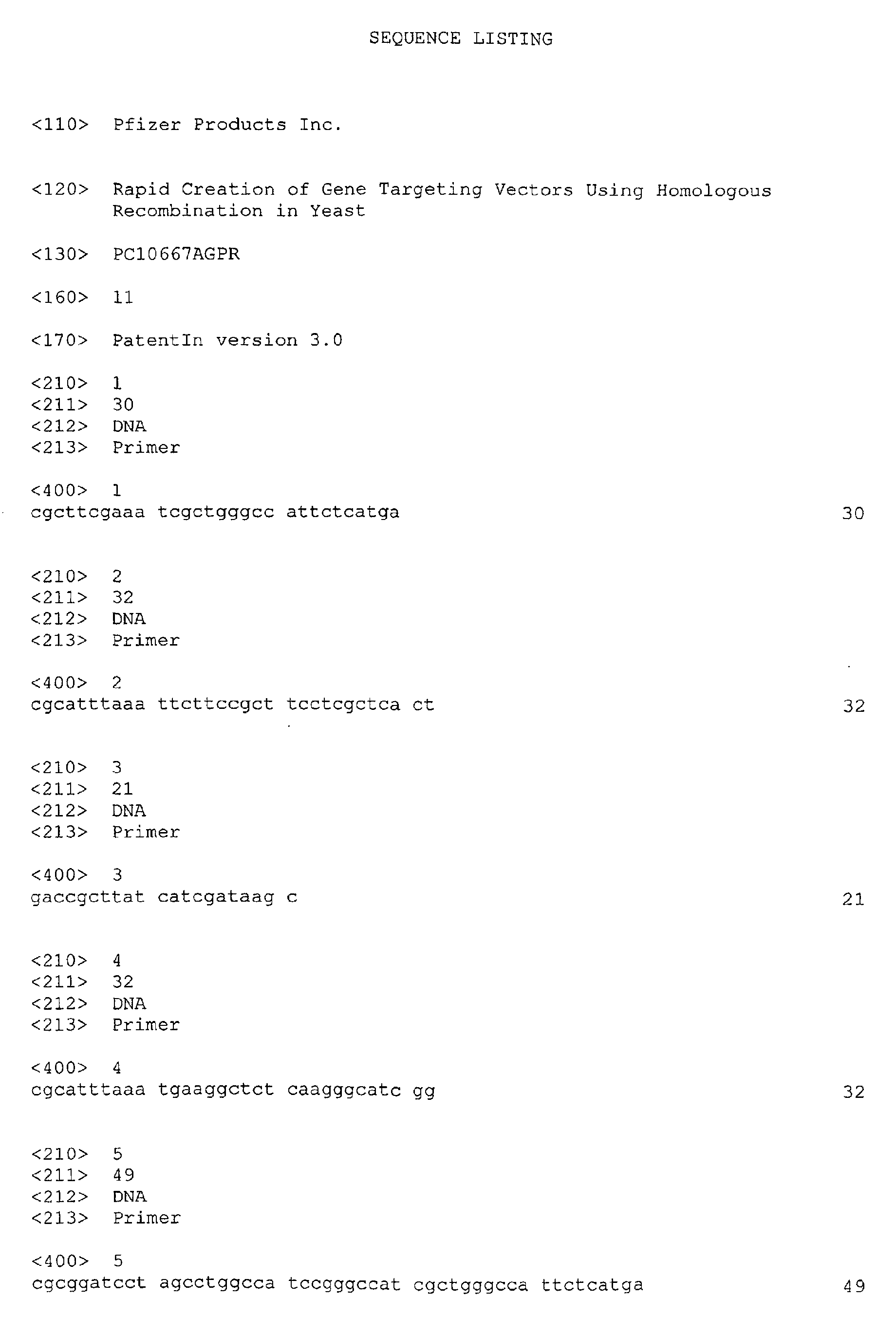
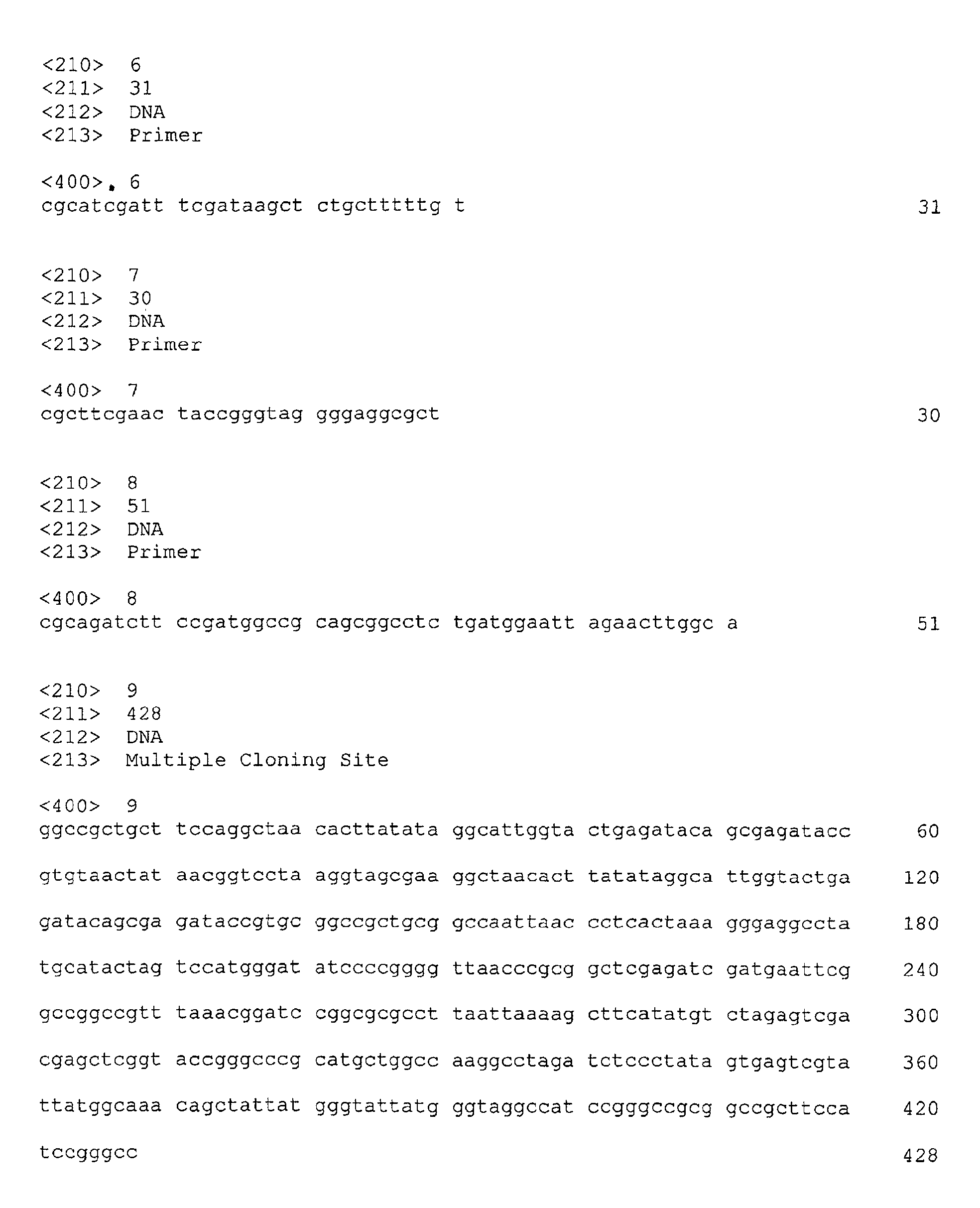
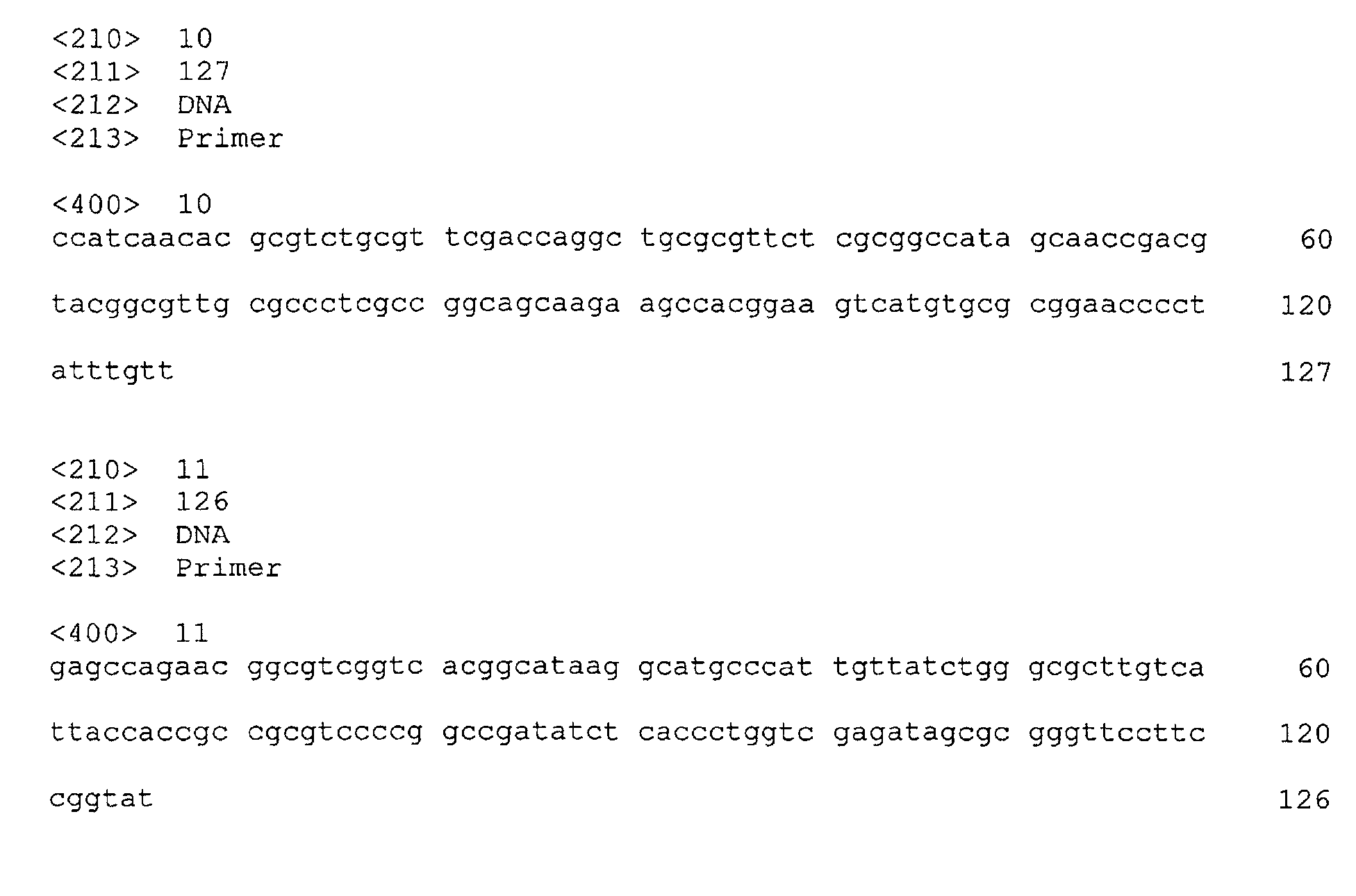
Claims (20)
- A method of preparing a gene vector, said method comprising:a) transforming yeast cells with a RKO clone and a yeast targeting cassette (YTC), wherein said RKO clone comprises a genomic clone insert, a yeast replication element, a yeast selectable marker, a bacterial origin of replication, optionally a bacterial selectable marker, and optionally a mammalian negative selection marker, and wherein said YTC comprises a bacterial/mammalian positive selection marker flanked by recombinogenic arms;b) maintaining said yeast cells under conditions wherein said RKO clone and said YTC undergo homologous recombination via said genomic clone insert and said recombinogenic arms to produce a gene targeting vector;c) selecting transformed yeast cells by their expression of said yeast selectable marker on said gene targeting vector or on said RKO clone;d) isolating said gene targeting vector and said RKO clone from said selected yeast cells;e) transforming bacterial cells with said gene targeting vector and said RKO clone;f) selecting transformed bacterial cells that grow on selective media that is selective for bacterial cells expressing said bacterial/mammalian positive selection marker, thereby selecting for bacterial cells transformed with said gene targeting vector; andg) isolating said gene targeting vector from said selected bacterial cells.
- The method of claim 1 wherein said bacterial cells are Escherichia coli.
- The method of claim 1 wherein said RKO clone is a cosmid and further comprises at least 1 Cos site.
- The method of claim 1 wherein said RKO clone further comprises a multiple cloning site, and wherein said genomic clone insert is present within said multiple cloning site.
- The method of claim 1 wherein said YTC further comprises loxP or FRT sites flanking said mammalian positive selection marker.
- The method of claim 1 wherein said RKO clone comprises a mammalian negative selection marker.
- The method of claim 1 wherein said YTC is generated by a PCR reaction using chimeric oligonucleotides bearing sequence identity to both the bacterial/mammalian positive selection marker and the GRI.
- The method of claim 1 wherein said YTC comprises an internal ribosomal entry site (IRES) element that allows protein translation of said bacterial/mammalian positive selection marker in mammalian cells to occur from mRNA transcripts driven by a promoter in the GRI.
- The method of claim 1 wherein said bacterial/mammalian positive selection marker lacks a polyadenylation site on the 3' end thereof.
- A method of preparing gene targeted mammalian cells having a targeted gene mutation, said method comprising:a) transforming mammalian cells with said gene targeting vector of claim 1;b) maintaining said mammalian cells under conditions wherein said gene targeting vector and the genome of said mammalian cells undergo homologous recombination to produce a gene targeted mammalian cell; andc) selecting gene targeted mammalian cells wherein homologous recombination has occurred by selecting gene targeted mammalian cells for their expression of said bacterial/mammalian positive selection marker, thereby obtaining gene targeted mammalian cells containing said targeted gene mutation.
- The method of claim 10 wherein said mammalian cells are stem cells.
- The method of claim 10 wherein said mammalian cells are embryonic stem cells.
- The method of claim 10 wherein said RKO clone comprises a mammalian negative selection marker, and said gene targeted mammalian cells are selected for their expression of said bacterial/mammalian positive selection marker and by their non-expression of said mammalian negative selection marker.
- A method of making gene targeted mice, said method comprising:a) combining a gene targeted mouse cell according to claim 11 with an early mouse embryo to produce a gene targeted embryonic construct, andb) introducing said gene targeted embryonic construct into a female host mouse, wherein said gene targeted embryonic construct is allowed to mature into a chimeric live whole mouse, said whole mouse thereby having a genome that includes said targeted gene mutation.
- A method of making homozygous gene targeted mice, said method comprising cross-breeding male and female mice obtained by the method of claim 14 to produce offspring mice, and selecting offspring mice from said cross-breeding that are homozygous for said targeted gene mutation.
- A gene targeting vector comprising a yeast replication element, a yeast selectable marker, a bacterial origin of replication, optionally a bacterial selectable marker, optionally a mammalian negative selection marker, and a genomic clone insert containing a bacterial/mammalian positive selection marker inserted therein.
- The gene targeting vector of claim 16 wherein said gene targeting vector comprises a mammalian negative selection marker.
- The gene targeting vector of claim 16 further comprising at least 1 Cos site.
- The gene targeting vector of claim 16 further comprising a multiple cloning site, and wherein said genomic clone insert is present within said multiple cloning site.
- The gene targeting vector of claim 16 further comprising loxP or FRT sites flanking said mammalian positive selection marker.
Applications Claiming Priority (2)
| Application Number | Priority Date | Filing Date | Title |
|---|---|---|---|
| US22846700P | 2000-08-25 | 2000-08-25 | |
| US228467P | 2000-08-25 |
Publications (2)
| Publication Number | Publication Date |
|---|---|
| EP1184461A2 true EP1184461A2 (en) | 2002-03-06 |
| EP1184461A3 EP1184461A3 (en) | 2002-05-22 |
Family
ID=22857289
Family Applications (1)
| Application Number | Title | Priority Date | Filing Date |
|---|---|---|---|
| EP01307021A Withdrawn EP1184461A3 (en) | 2000-08-25 | 2001-08-17 | Creation of gene targeting vectors using homologous recombination in yeast |
Country Status (6)
| Country | Link |
|---|---|
| EP (1) | EP1184461A3 (en) |
| JP (1) | JP2002291471A (en) |
| AU (1) | AU6361301A (en) |
| CA (1) | CA2355403A1 (en) |
| IL (1) | IL144993A0 (en) |
| SG (1) | SG164274A1 (en) |
Families Citing this family (1)
| Publication number | Priority date | Publication date | Assignee | Title |
|---|---|---|---|---|
| JP6256911B2 (en) * | 2013-10-31 | 2018-01-10 | 国立研究開発法人産業技術総合研究所 | New counter selection method |
Family Cites Families (4)
| Publication number | Priority date | Publication date | Assignee | Title |
|---|---|---|---|---|
| US5814300A (en) * | 1995-03-03 | 1998-09-29 | Cephalon, Inc. | Gene-targeted non-human mammals deficient in the SOD-1 gene |
| WO1998037175A1 (en) * | 1997-02-21 | 1998-08-27 | Michael Nehls | Method of constructing vectors for homologous recombination directed mutagenesis |
| US6090554A (en) * | 1997-10-31 | 2000-07-18 | Amgen, Inc. | Efficient construction of gene targeting vectors |
| DE10016523A1 (en) * | 2000-04-03 | 2001-10-04 | Ingenium Pharmaceuticals Ag | Cloning system for the construction of homologous recombination vectors |
-
2001
- 2001-08-07 SG SG200104743-0A patent/SG164274A1/en unknown
- 2001-08-17 EP EP01307021A patent/EP1184461A3/en not_active Withdrawn
- 2001-08-20 IL IL14499301A patent/IL144993A0/en unknown
- 2001-08-21 JP JP2001250528A patent/JP2002291471A/en active Pending
- 2001-08-23 AU AU63613/01A patent/AU6361301A/en not_active Abandoned
- 2001-08-23 CA CA002355403A patent/CA2355403A1/en not_active Abandoned
Also Published As
| Publication number | Publication date |
|---|---|
| CA2355403A1 (en) | 2002-02-25 |
| SG164274A1 (en) | 2010-09-29 |
| JP2002291471A (en) | 2002-10-08 |
| EP1184461A3 (en) | 2002-05-22 |
| AU6361301A (en) | 2002-02-28 |
| IL144993A0 (en) | 2002-06-30 |
Similar Documents
| Publication | Publication Date | Title |
|---|---|---|
| AU2018203515B2 (en) | Targeted genome editing in zygotes of domestic large animals | |
| JP4518401B2 (en) | Isolation, selection, and expansion of animal transgenic stem cells | |
| JPH07503848A (en) | Homozygous mating due to gene targeting phenomenon | |
| JP2018532415A (en) | Large genomic DNA knock-ins and uses thereof | |
| Chen et al. | Generation of a Twist1 conditional null allele in the mouse | |
| JP2003530113A (en) | Novel chromosomal vector and its use | |
| US6090554A (en) | Efficient construction of gene targeting vectors | |
| Torres | 5 The Use of Embryonic Stem Cells for the Genetic Manipulation of the Mouse | |
| JP2005511050A (en) | Gene targeting methods and vectors | |
| JPWO2002013602A1 (en) | Transgenic non-human mammal, method for producing same, animal disease model, and method for elucidating gene function | |
| US20030092183A1 (en) | Rapid creation of gene targeting vectors using homologous recombination in yeast | |
| US6221647B1 (en) | Efficient construction of gene targeting using phage-plasmid recombination | |
| US6929909B2 (en) | Gene targeting vectors comprising conditional positive selection markers | |
| WO1998037175A1 (en) | Method of constructing vectors for homologous recombination directed mutagenesis | |
| AU6361301A (en) | Rapid creation of gene targeting vectors using homologous recombination in yeast | |
| US20050172349A1 (en) | Genetic modification of C57 mice | |
| US20060242726A1 (en) | Methods and vectors for making knockout animals | |
| Arnak et al. | Yeast artificial chromosomes | |
| WO2000024246A2 (en) | Transgenic fish carrying plasmid for mutation detection and methods | |
| USH2056H1 (en) | Model for von Hippel-Lindau disease | |
| JP2002345477A (en) | Knockout animals | |
| WO2025126797A1 (en) | High-efficiency site-specific knock-in method for long-chain nucleic acid sequence | |
| Pickel | Germline Transgenesis | |
| ZWAKA | 15, Part A | |
| Gong et al. | Large Insert Transgenesis |
Legal Events
| Date | Code | Title | Description |
|---|---|---|---|
| PUAI | Public reference made under article 153(3) epc to a published international application that has entered the european phase |
Free format text: ORIGINAL CODE: 0009012 |
|
| 17P | Request for examination filed |
Effective date: 20010827 |
|
| AK | Designated contracting states |
Kind code of ref document: A2 Designated state(s): AT BE CH CY DE DK ES FI FR GB GR IE IT LI LU MC NL PT SE TR |
|
| AX | Request for extension of the european patent |
Free format text: AL;LT;LV;MK;RO;SI |
|
| PUAL | Search report despatched |
Free format text: ORIGINAL CODE: 0009013 |
|
| RIC1 | Information provided on ipc code assigned before grant |
Free format text: 7C 12N 15/64 A, 7C 12N 5/18 B, 7A 01K 67/027 B, 7C 12N 15/85 B, 7C 12N 15/90 B |
|
| AX | Request for extension of the european patent |
Free format text: AL;LT;LV;MK;RO;SI |
|
| AKX | Designation fees paid |
Designated state(s): AT BE CH CY DE DK ES FI FR GB GR IE IT LI LU MC NL PT SE TR |
|
| STAA | Information on the status of an ep patent application or granted ep patent |
Free format text: STATUS: THE APPLICATION IS DEEMED TO BE WITHDRAWN |
|
| 18D | Application deemed to be withdrawn |
Effective date: 20060301 |