EP1184076A1 - Polymer-supported lewis acid catalyst - Google Patents
Polymer-supported lewis acid catalyst Download PDFInfo
- Publication number
- EP1184076A1 EP1184076A1 EP00969995A EP00969995A EP1184076A1 EP 1184076 A1 EP1184076 A1 EP 1184076A1 EP 00969995 A EP00969995 A EP 00969995A EP 00969995 A EP00969995 A EP 00969995A EP 1184076 A1 EP1184076 A1 EP 1184076A1
- Authority
- EP
- European Patent Office
- Prior art keywords
- lewis acid
- polymer
- supported
- group
- acid catalyst
- Prior art date
- Legal status (The legal status is an assumption and is not a legal conclusion. Google has not performed a legal analysis and makes no representation as to the accuracy of the status listed.)
- Granted
Links
- QYINCSDHMJPJRV-UHFFFAOYSA-N CC(C)(CN)C=C Chemical compound CC(C)(CN)C=C QYINCSDHMJPJRV-UHFFFAOYSA-N 0.000 description 1
Classifications
-
- B—PERFORMING OPERATIONS; TRANSPORTING
- B01—PHYSICAL OR CHEMICAL PROCESSES OR APPARATUS IN GENERAL
- B01J—CHEMICAL OR PHYSICAL PROCESSES, e.g. CATALYSIS OR COLLOID CHEMISTRY; THEIR RELEVANT APPARATUS
- B01J31/00—Catalysts comprising hydrides, coordination complexes or organic compounds
- B01J31/02—Catalysts comprising hydrides, coordination complexes or organic compounds containing organic compounds or metal hydrides
- B01J31/06—Catalysts comprising hydrides, coordination complexes or organic compounds containing organic compounds or metal hydrides containing polymers
- B01J31/08—Ion-exchange resins
- B01J31/10—Ion-exchange resins sulfonated
-
- B—PERFORMING OPERATIONS; TRANSPORTING
- B01—PHYSICAL OR CHEMICAL PROCESSES OR APPARATUS IN GENERAL
- B01J—CHEMICAL OR PHYSICAL PROCESSES, e.g. CATALYSIS OR COLLOID CHEMISTRY; THEIR RELEVANT APPARATUS
- B01J31/00—Catalysts comprising hydrides, coordination complexes or organic compounds
- B01J31/02—Catalysts comprising hydrides, coordination complexes or organic compounds containing organic compounds or metal hydrides
- B01J31/0215—Sulfur-containing compounds
- B01J31/0225—Sulfur-containing compounds comprising sulfonic acid groups or the corresponding salts
- B01J31/0227—Sulfur-containing compounds comprising sulfonic acid groups or the corresponding salts being perfluorinated, i.e. comprising at least one perfluorinated moiety as substructure in case of polyfunctional compounds
-
- C—CHEMISTRY; METALLURGY
- C07—ORGANIC CHEMISTRY
- C07B—GENERAL METHODS OF ORGANIC CHEMISTRY; APPARATUS THEREFOR
- C07B37/00—Reactions without formation or introduction of functional groups containing hetero atoms, involving either the formation of a carbon-to-carbon bond between two carbon atoms not directly linked already or the disconnection of two directly linked carbon atoms
- C07B37/02—Addition
-
- C—CHEMISTRY; METALLURGY
- C07—ORGANIC CHEMISTRY
- C07C—ACYCLIC OR CARBOCYCLIC COMPOUNDS
- C07C227/00—Preparation of compounds containing amino and carboxyl groups bound to the same carbon skeleton
- C07C227/26—Preparation of compounds containing amino and carboxyl groups bound to the same carbon skeleton from compounds containing carboxyl groups by reaction with HCN, or a salt thereof, and amines, or from aminonitriles
-
- C—CHEMISTRY; METALLURGY
- C07—ORGANIC CHEMISTRY
- C07C—ACYCLIC OR CARBOCYCLIC COMPOUNDS
- C07C253/00—Preparation of carboxylic acid nitriles
-
- C—CHEMISTRY; METALLURGY
- C07—ORGANIC CHEMISTRY
- C07C—ACYCLIC OR CARBOCYCLIC COMPOUNDS
- C07C253/00—Preparation of carboxylic acid nitriles
- C07C253/08—Preparation of carboxylic acid nitriles by addition of hydrogen cyanide or salts thereof to unsaturated compounds
-
- C—CHEMISTRY; METALLURGY
- C07—ORGANIC CHEMISTRY
- C07C—ACYCLIC OR CARBOCYCLIC COMPOUNDS
- C07C29/00—Preparation of compounds having hydroxy or O-metal groups bound to a carbon atom not belonging to a six-membered aromatic ring
- C07C29/36—Preparation of compounds having hydroxy or O-metal groups bound to a carbon atom not belonging to a six-membered aromatic ring increasing the number of carbon atoms by reactions with formation of hydroxy groups, which may occur via intermediates being derivatives of hydroxy, e.g. O-metal
- C07C29/38—Preparation of compounds having hydroxy or O-metal groups bound to a carbon atom not belonging to a six-membered aromatic ring increasing the number of carbon atoms by reactions with formation of hydroxy groups, which may occur via intermediates being derivatives of hydroxy, e.g. O-metal by reaction with aldehydes or ketones
-
- C—CHEMISTRY; METALLURGY
- C07—ORGANIC CHEMISTRY
- C07C—ACYCLIC OR CARBOCYCLIC COMPOUNDS
- C07C327/00—Thiocarboxylic acids
- C07C327/20—Esters of monothiocarboxylic acids
- C07C327/22—Esters of monothiocarboxylic acids having carbon atoms of esterified thiocarboxyl groups bound to hydrogen atoms or to acyclic carbon atoms
-
- C—CHEMISTRY; METALLURGY
- C07—ORGANIC CHEMISTRY
- C07C—ACYCLIC OR CARBOCYCLIC COMPOUNDS
- C07C67/00—Preparation of carboxylic acid esters
- C07C67/30—Preparation of carboxylic acid esters by modifying the acid moiety of the ester, such modification not being an introduction of an ester group
- C07C67/333—Preparation of carboxylic acid esters by modifying the acid moiety of the ester, such modification not being an introduction of an ester group by isomerisation; by change of size of the carbon skeleton
- C07C67/343—Preparation of carboxylic acid esters by modifying the acid moiety of the ester, such modification not being an introduction of an ester group by isomerisation; by change of size of the carbon skeleton by increase in the number of carbon atoms
-
- C—CHEMISTRY; METALLURGY
- C07—ORGANIC CHEMISTRY
- C07D—HETEROCYCLIC COMPOUNDS
- C07D263/00—Heterocyclic compounds containing 1,3-oxazole or hydrogenated 1,3-oxazole rings
- C07D263/02—Heterocyclic compounds containing 1,3-oxazole or hydrogenated 1,3-oxazole rings not condensed with other rings
- C07D263/30—Heterocyclic compounds containing 1,3-oxazole or hydrogenated 1,3-oxazole rings not condensed with other rings having two or three double bonds between ring members or between ring members and non-ring members
- C07D263/34—Heterocyclic compounds containing 1,3-oxazole or hydrogenated 1,3-oxazole rings not condensed with other rings having two or three double bonds between ring members or between ring members and non-ring members with hetero atoms or with carbon atoms having three bonds to hetero atoms with at the most one bond to halogen, e.g. ester or nitrile radicals, directly attached to ring carbon atoms
- C07D263/36—One oxygen atom
- C07D263/38—One oxygen atom attached in position 2
-
- B—PERFORMING OPERATIONS; TRANSPORTING
- B01—PHYSICAL OR CHEMICAL PROCESSES OR APPARATUS IN GENERAL
- B01J—CHEMICAL OR PHYSICAL PROCESSES, e.g. CATALYSIS OR COLLOID CHEMISTRY; THEIR RELEVANT APPARATUS
- B01J2231/00—Catalytic reactions performed with catalysts classified in B01J31/00
- B01J2231/30—Addition reactions at carbon centres, i.e. to either C-C or C-X multiple bonds
- B01J2231/32—Addition reactions to C=C or C-C triple bonds
- B01J2231/324—Cyclisations via conversion of C-C multiple to single or less multiple bonds, e.g. cycloadditions
- B01J2231/326—Diels-Alder or other [4+2] cycloadditions, e.g. hetero-analogues
-
- B—PERFORMING OPERATIONS; TRANSPORTING
- B01—PHYSICAL OR CHEMICAL PROCESSES OR APPARATUS IN GENERAL
- B01J—CHEMICAL OR PHYSICAL PROCESSES, e.g. CATALYSIS OR COLLOID CHEMISTRY; THEIR RELEVANT APPARATUS
- B01J2231/00—Catalytic reactions performed with catalysts classified in B01J31/00
- B01J2231/30—Addition reactions at carbon centres, i.e. to either C-C or C-X multiple bonds
- B01J2231/34—Other additions, e.g. Monsanto-type carbonylations, addition to 1,2-C=X or 1,2-C-X triplebonds, additions to 1,4-C=C-C=X or 1,4-C=-C-X triple bonds with X, e.g. O, S, NH/N
- B01J2231/341—1,2-additions, e.g. aldol or Knoevenagel condensations
- B01J2231/342—Aldol type reactions, i.e. nucleophilic addition of C-H acidic compounds, their R3Si- or metal complex analogues, to aldehydes or ketones
-
- B—PERFORMING OPERATIONS; TRANSPORTING
- B01—PHYSICAL OR CHEMICAL PROCESSES OR APPARATUS IN GENERAL
- B01J—CHEMICAL OR PHYSICAL PROCESSES, e.g. CATALYSIS OR COLLOID CHEMISTRY; THEIR RELEVANT APPARATUS
- B01J2231/00—Catalytic reactions performed with catalysts classified in B01J31/00
- B01J2231/30—Addition reactions at carbon centres, i.e. to either C-C or C-X multiple bonds
- B01J2231/34—Other additions, e.g. Monsanto-type carbonylations, addition to 1,2-C=X or 1,2-C-X triplebonds, additions to 1,4-C=C-C=X or 1,4-C=-C-X triple bonds with X, e.g. O, S, NH/N
- B01J2231/341—1,2-additions, e.g. aldol or Knoevenagel condensations
- B01J2231/342—Aldol type reactions, i.e. nucleophilic addition of C-H acidic compounds, their R3Si- or metal complex analogues, to aldehydes or ketones
- B01J2231/343—Aldol type reactions, i.e. nucleophilic addition of C-H acidic compounds, their R3Si- or metal complex analogues, to aldehydes or ketones to prepare cyanhydrines, e.g. by adding HCN or TMSCN
-
- B—PERFORMING OPERATIONS; TRANSPORTING
- B01—PHYSICAL OR CHEMICAL PROCESSES OR APPARATUS IN GENERAL
- B01J—CHEMICAL OR PHYSICAL PROCESSES, e.g. CATALYSIS OR COLLOID CHEMISTRY; THEIR RELEVANT APPARATUS
- B01J2231/00—Catalytic reactions performed with catalysts classified in B01J31/00
- B01J2231/40—Substitution reactions at carbon centres, e.g. C-C or C-X, i.e. carbon-hetero atom, cross-coupling, C-H activation or ring-opening reactions
- B01J2231/44—Allylic alkylation, amination, alkoxylation or analogues
-
- B—PERFORMING OPERATIONS; TRANSPORTING
- B01—PHYSICAL OR CHEMICAL PROCESSES OR APPARATUS IN GENERAL
- B01J—CHEMICAL OR PHYSICAL PROCESSES, e.g. CATALYSIS OR COLLOID CHEMISTRY; THEIR RELEVANT APPARATUS
- B01J2531/00—Additional information regarding catalytic systems classified in B01J31/00
- B01J2531/30—Complexes comprising metals of Group III (IIIA or IIIB) as the central metal
- B01J2531/35—Scandium
-
- B—PERFORMING OPERATIONS; TRANSPORTING
- B01—PHYSICAL OR CHEMICAL PROCESSES OR APPARATUS IN GENERAL
- B01J—CHEMICAL OR PHYSICAL PROCESSES, e.g. CATALYSIS OR COLLOID CHEMISTRY; THEIR RELEVANT APPARATUS
- B01J2531/00—Additional information regarding catalytic systems classified in B01J31/00
- B01J2531/30—Complexes comprising metals of Group III (IIIA or IIIB) as the central metal
- B01J2531/37—Lanthanum
-
- B—PERFORMING OPERATIONS; TRANSPORTING
- B01—PHYSICAL OR CHEMICAL PROCESSES OR APPARATUS IN GENERAL
- B01J—CHEMICAL OR PHYSICAL PROCESSES, e.g. CATALYSIS OR COLLOID CHEMISTRY; THEIR RELEVANT APPARATUS
- B01J2531/00—Additional information regarding catalytic systems classified in B01J31/00
- B01J2531/30—Complexes comprising metals of Group III (IIIA or IIIB) as the central metal
- B01J2531/38—Lanthanides other than lanthanum
-
- B—PERFORMING OPERATIONS; TRANSPORTING
- B01—PHYSICAL OR CHEMICAL PROCESSES OR APPARATUS IN GENERAL
- B01J—CHEMICAL OR PHYSICAL PROCESSES, e.g. CATALYSIS OR COLLOID CHEMISTRY; THEIR RELEVANT APPARATUS
- B01J31/00—Catalysts comprising hydrides, coordination complexes or organic compounds
- B01J31/16—Catalysts comprising hydrides, coordination complexes or organic compounds containing coordination complexes
- B01J31/165—Polymer immobilised coordination complexes, e.g. organometallic complexes
- B01J31/1658—Polymer immobilised coordination complexes, e.g. organometallic complexes immobilised by covalent linkages, i.e. pendant complexes with optional linking groups, e.g. on Wang or Merrifield resins
-
- B—PERFORMING OPERATIONS; TRANSPORTING
- B01—PHYSICAL OR CHEMICAL PROCESSES OR APPARATUS IN GENERAL
- B01J—CHEMICAL OR PHYSICAL PROCESSES, e.g. CATALYSIS OR COLLOID CHEMISTRY; THEIR RELEVANT APPARATUS
- B01J31/00—Catalysts comprising hydrides, coordination complexes or organic compounds
- B01J31/16—Catalysts comprising hydrides, coordination complexes or organic compounds containing coordination complexes
- B01J31/22—Organic complexes
- B01J31/2204—Organic complexes the ligands containing oxygen or sulfur as complexing atoms
- B01J31/2208—Oxygen, e.g. acetylacetonates
- B01J31/2226—Anionic ligands, i.e. the overall ligand carries at least one formal negative charge
-
- B—PERFORMING OPERATIONS; TRANSPORTING
- B01—PHYSICAL OR CHEMICAL PROCESSES OR APPARATUS IN GENERAL
- B01J—CHEMICAL OR PHYSICAL PROCESSES, e.g. CATALYSIS OR COLLOID CHEMISTRY; THEIR RELEVANT APPARATUS
- B01J31/00—Catalysts comprising hydrides, coordination complexes or organic compounds
- B01J31/40—Regeneration or reactivation
- B01J31/4015—Regeneration or reactivation of catalysts containing metals
-
- C—CHEMISTRY; METALLURGY
- C07—ORGANIC CHEMISTRY
- C07B—GENERAL METHODS OF ORGANIC CHEMISTRY; APPARATUS THEREFOR
- C07B2200/00—Indexing scheme relating to specific properties of organic compounds
- C07B2200/07—Optical isomers
-
- C—CHEMISTRY; METALLURGY
- C07—ORGANIC CHEMISTRY
- C07C—ACYCLIC OR CARBOCYCLIC COMPOUNDS
- C07C2601/00—Systems containing only non-condensed rings
- C07C2601/12—Systems containing only non-condensed rings with a six-membered ring
- C07C2601/14—The ring being saturated
-
- Y—GENERAL TAGGING OF NEW TECHNOLOGICAL DEVELOPMENTS; GENERAL TAGGING OF CROSS-SECTIONAL TECHNOLOGIES SPANNING OVER SEVERAL SECTIONS OF THE IPC; TECHNICAL SUBJECTS COVERED BY FORMER USPC CROSS-REFERENCE ART COLLECTIONS [XRACs] AND DIGESTS
- Y02—TECHNOLOGIES OR APPLICATIONS FOR MITIGATION OR ADAPTATION AGAINST CLIMATE CHANGE
- Y02P—CLIMATE CHANGE MITIGATION TECHNOLOGIES IN THE PRODUCTION OR PROCESSING OF GOODS
- Y02P20/00—Technologies relating to chemical industry
- Y02P20/50—Improvements relating to the production of bulk chemicals
- Y02P20/584—Recycling of catalysts
Definitions
- Lewis acid-surfactant linked catalysts comprising scandium, tris(dodecylsulfate), scandium tris(dodecylsulfonate) or the like (Kobayashi, S., Wakabayashi, T., Tetrahedron Lett. 1998, 39, 5389; Kobayashi, S., Chem. Lett. 1991, 2187; Kobayashi, S., Nagayama, S., Busujima, T., J. Am. Chem. Soc. 1998, 120, 8287).
- the polymer chain used in the present invention is a solid substance insoluble in water or aqueous mediums.
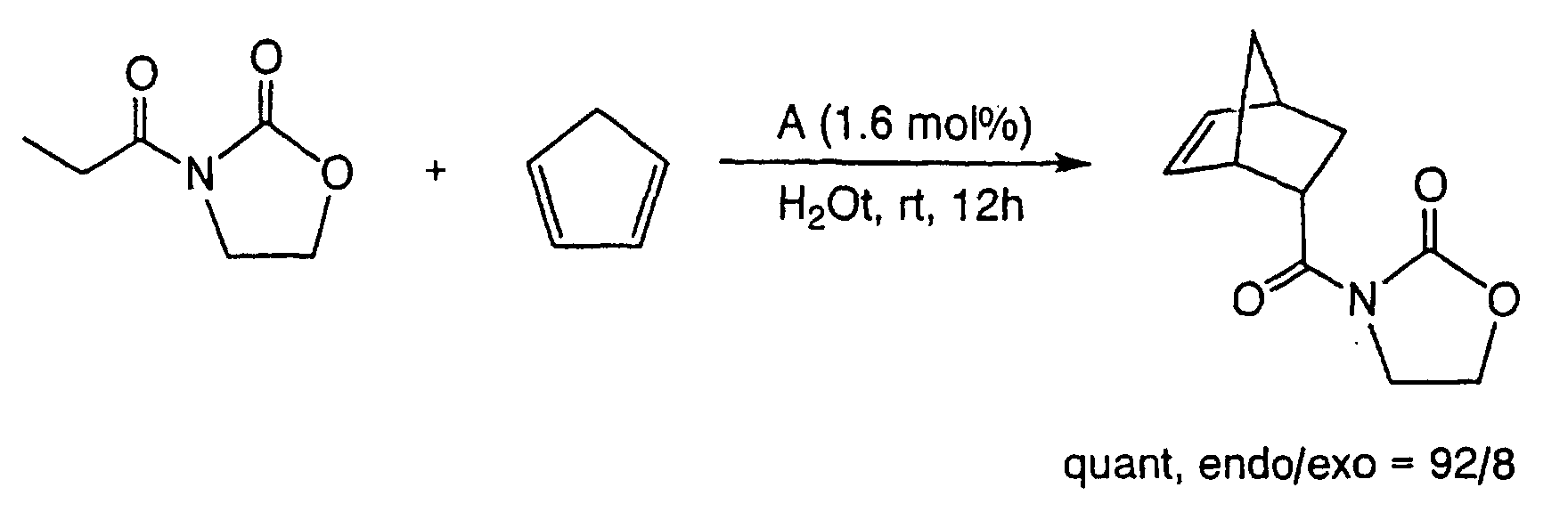
- a polymer-supported scandium catalyst (A) was prepared as a polymer-supported Lewis acid catalyst of the present invention, according to the following reaction scheme:
- the invention of the present application provides a novel Lewis acid catalyst, which shows high reaction activity in aqueous medium, is easily recovered, and is excellent in reusability, as well as a method of organic synthesis using such novel catalyst.
Landscapes
- Chemical & Material Sciences (AREA)
- Organic Chemistry (AREA)
- Chemical Kinetics & Catalysis (AREA)
- Engineering & Computer Science (AREA)
- Materials Engineering (AREA)
- Health & Medical Sciences (AREA)
- Toxicology (AREA)
- Catalysts (AREA)
- Organic Low-Molecular-Weight Compounds And Preparation Thereof (AREA)
- Heterocyclic Carbon Compounds Containing A Hetero Ring Having Nitrogen And Oxygen As The Only Ring Hetero Atoms (AREA)
- Low-Molecular Organic Synthesis Reactions Using Catalysts (AREA)
Abstract
Description

| 13C SR-MAS NMR (CDCl3) ; δ = 24.1, 31.1, 35.8, 40.6, 125.7, 128.3, 128.6, 135.1, 142.2, 145.23, 199.8. |
| IR (neat) 1679 cm-1. |
| 13C SR-MAS NMR (CDCl3); δ = 24.0, 30.6, 31.1, 35.8, 38.1, 40.4, 125.7, 127.9, 128.3, 134.9, 142.2, 145.2, 199.8. |
| IR (neat) 1679 cm-1. |
| 13C SR-MAS NMR (CDCl3) ; δ = 24.8, 29.0, 31.3, 35.5, 35.9, 40.4, 125.7, 128.2, 139.9, 142.7, 145.5. |
IR (neat) 1679 cm-1.

| Conditions | Solvents | Catalysts (mol%) | Yields (%) |
| 1 | H2O | 3.2 | 92 (93, 90) |
| 2 | H2O | 1.6 | 95 (90, 92) |
| 3 | H2O | 0.8 | 84 |
| 4 | CH2Cl2 | 3.2 | 38 |
| 5 | CH3CN | 3.2 | 15 |
| 6 | Benzene | 3.2 | 28 |
| 7 | EtOH | 3.2 | 20 |
| 8 | DMF | 3.2 | trace |

| Conditions | R1 | R2 | Yields (%) |
| 1 | Ph | H | 82 |
| 2 | Ph(CH2)2 | H | quantative |
| 3 | c-C5H11 | H | 72 |
| 4 | (E)-PhCH=CH | H | 99 |
| 5 | 2-pyridyl | H | 83 |
| 6 | PhCO | H | 90 |
| 7 | Ph(CH2)2 | Me | quantative |
| 8 | (E)-PhCH=CH | Me | 91 |
| 9 | Ph | CO2Et | 90 |
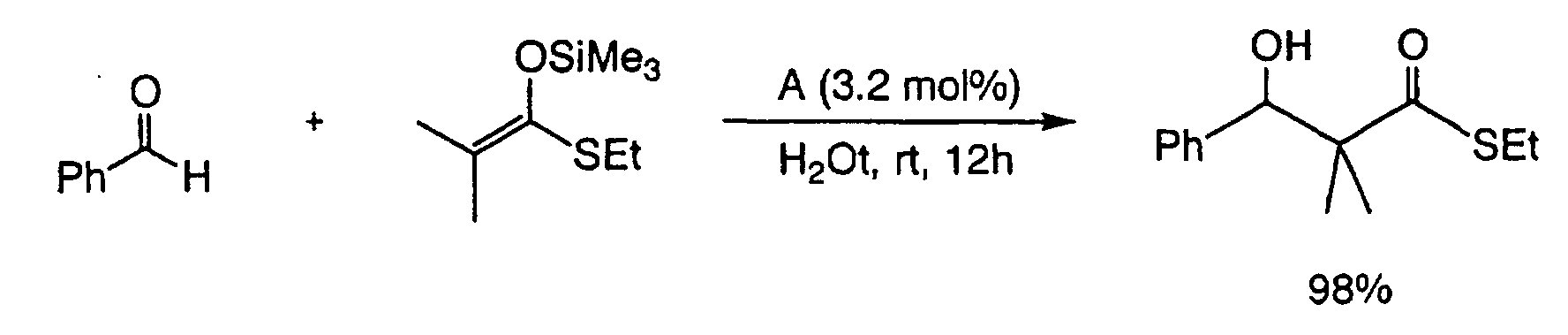
| S-Ethyl-3-hydroxy-2,2-dimethyl-3-phenylpropanethioate |
| 1H NMR (CDCl3) ; d = 1.05 (s, 3H) , 1.15 (s, 3H) , 1.18 (t, 3H, 7.4 Hz), 2.81 (q, 2H, 7.4 Hz), 2.90 (br, 1H) , 4.87 (s, 1H) , 7.19-7.25 (m, 5H). |
| 13C NMR (CDCl3) ; d = 14.4, 20.0, 23.3, 23.6, 54.3, 78.9, 127.7, 127.8, 139.9, 207.9. |
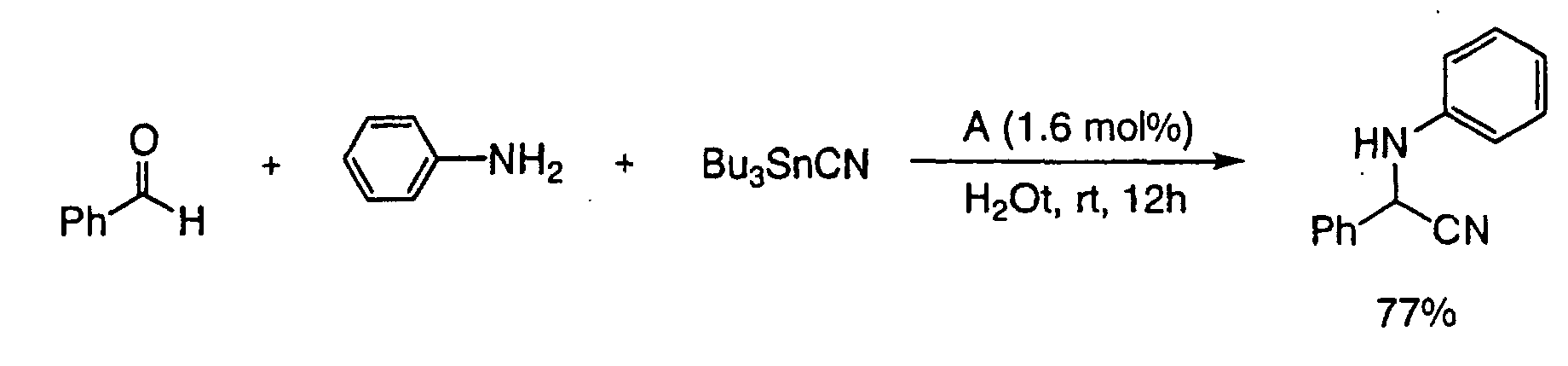
| 1-Phenyl-1-phenylaminonitrile |
| 1H NMR (CDCl3) ; d = 4.20 (d, 1H, J. = 9.23 Hz), 5.61 (d, 1H, J. = 9.24 Hz), 6.75-6.78 (m, 2H), 6.88-7.00 (m, 2H), 7.22-7.36 (m, 6H). |
| 13C NMR (CDCl3); d = 46.04, 104.5, 114.5, 117.5, 126.7, 127.1, 127.2, 129.5, 136.7, 144.0. |
Claims (8)
- A polymer-supported Lewis acid catalyst comprising a Lewis acid group expressed by the following general formula (I) :
- The polymer-supported Lewis acid catalyst according to claim 1, comprising the Lewis acid group expressed by the following general formula (II):
- The polymer-supported Lewis acid catalyst according to claim 2, wherein the spacer chain is a hydrocarbon group.
- The polymer-supported Lewis acid catalyst according to claim 3, wherein the spacer chain is expressed by the following general formula (III):
- The polymer-supported Lewis acid catalyst according to any one of claims 1 to 4, wherein the polymeric chain comprises a polymer obtained by the addition polymerization of aromatic monomers.
- The polymer-supported Lewis acid catalyst according to any one of claims 1 to 5, wherein the polyvalent element (M) is a lanthanoid element.
- A method of organic synthesis using the polymer-supported Lewis acid catalyst according to any one of claims 1 to 6, wherein the reaction is performed in water or an aqueous medium.
- The method of organic synthesis according to claim 7, which comprises the formation of a carbon-carbon bond.
Applications Claiming Priority (3)
| Application Number | Priority Date | Filing Date | Title |
|---|---|---|---|
| JP32742499A JP3389176B2 (en) | 1999-11-17 | 1999-11-17 | Polymer-supported Lewis acid catalyst |
| JP32742499 | 1999-11-17 | ||
| PCT/JP2000/007386 WO2001036095A1 (en) | 1999-11-17 | 2000-10-23 | Polymer-supported lewis acid catalyst |
Publications (3)
| Publication Number | Publication Date |
|---|---|
| EP1184076A1 true EP1184076A1 (en) | 2002-03-06 |
| EP1184076A4 EP1184076A4 (en) | 2005-04-13 |
| EP1184076B1 EP1184076B1 (en) | 2010-04-21 |
Family
ID=18199019
Family Applications (1)
| Application Number | Title | Priority Date | Filing Date |
|---|---|---|---|
| EP00969995A Expired - Lifetime EP1184076B1 (en) | 1999-11-17 | 2000-10-23 | Polymer-supported lewis acid catalyst |
Country Status (5)
| Country | Link |
|---|---|
| US (1) | US6916761B1 (en) |
| EP (1) | EP1184076B1 (en) |
| JP (1) | JP3389176B2 (en) |
| DE (1) | DE60044248D1 (en) |
| WO (1) | WO2001036095A1 (en) |
Cited By (3)
| Publication number | Priority date | Publication date | Assignee | Title |
|---|---|---|---|---|
| EP1997555A4 (en) * | 2006-03-10 | 2009-09-23 | Japan Science & Tech Agency | FIXED LEWIS ACID CATALYSTS COATED WITH IONIC LIQUIDS AND USE THEREOF |
| CN102993253A (en) * | 2012-12-18 | 2013-03-27 | 浙江先锋科技有限公司 | Preparation method of 2',3'-bi-O-acetyl-5'-deoxy-5-fulurocytidine |
| EP2545991A4 (en) * | 2010-03-09 | 2013-11-20 | Japan Science & Tech Agency | SCANDIUM-BASED CATALYST SUPPORTED ON A NANOMETRIC STRUCTURE WITH A HIGH GOLD MOLECULAR CONTENT AND USE THEREOF |
Families Citing this family (1)
| Publication number | Priority date | Publication date | Assignee | Title |
|---|---|---|---|---|
| WO2016113761A1 (en) | 2015-01-15 | 2016-07-21 | Council Of Scientific & Industrial Research | Hydrophobic polymer-supported lewis acid catalyst and process for the preparation thereof |
Family Cites Families (11)
| Publication number | Priority date | Publication date | Assignee | Title |
|---|---|---|---|---|
| CH526494A (en) * | 1967-09-08 | 1972-08-15 | Veba Chemie Ag | Process for the production of methyl isobutyl ketone |
| JPS60179148A (en) | 1984-02-28 | 1985-09-13 | Du Pont Mitsui Fluorochem Co Ltd | Manufacture of oxidizing catalyst consisting of perfluorocarbon polymer and carbonyl compound |
| US5288677A (en) * | 1991-06-28 | 1994-02-22 | Exxon Chemical Patents Inc. | Immobilized Lewis acid catalysts |
| US5916837A (en) * | 1994-01-12 | 1999-06-29 | E.I. Du Pont De Nemours And Company | Porous microcomposite of metal cation exchanged perfluorinated ion-exchanged polymer and network of metal oxide, silica or metal oxide and silica |
| JP3197836B2 (en) | 1996-03-08 | 2001-08-13 | 修 小林 | Immobilized Lewis acid catalyst |
| JPH09262479A (en) | 1996-03-29 | 1997-10-07 | Kuraray Co Ltd | Lewis acid catalyst |
| JPH09290163A (en) | 1996-04-25 | 1997-11-11 | Mitsui Toatsu Chem Inc | Acid catalyst, method for producing the same, and method for producing allyl alcohols using the same |
| EP0964844B1 (en) * | 1997-01-08 | 2003-09-10 | Eastman Chemical Resins, Inc. | Fluorinated solid acids as catalysts for the preparation of hydrocarbon resins |
| JPH10230166A (en) | 1997-02-20 | 1998-09-02 | Asahi Chem Ind Co Ltd | Catalyst containing immobilized bisperfluoroalkylsulfonylimide metal salt |
| JP3751145B2 (en) | 1998-03-05 | 2006-03-01 | 独立行政法人科学技術振興機構 | Surface active Lewis acid catalyst |
| US6197715B1 (en) * | 1999-03-23 | 2001-03-06 | Cryovac, Inc. | Supported catalysts and olefin polymerization processes utilizing same |
-
1999
- 1999-11-17 JP JP32742499A patent/JP3389176B2/en not_active Expired - Fee Related
-
2000
- 2000-10-23 WO PCT/JP2000/007386 patent/WO2001036095A1/en not_active Ceased
- 2000-10-23 DE DE60044248T patent/DE60044248D1/en not_active Expired - Lifetime
- 2000-10-23 EP EP00969995A patent/EP1184076B1/en not_active Expired - Lifetime
- 2000-10-23 US US09/889,406 patent/US6916761B1/en not_active Expired - Fee Related
Cited By (5)
| Publication number | Priority date | Publication date | Assignee | Title |
|---|---|---|---|---|
| EP1997555A4 (en) * | 2006-03-10 | 2009-09-23 | Japan Science & Tech Agency | FIXED LEWIS ACID CATALYSTS COATED WITH IONIC LIQUIDS AND USE THEREOF |
| US8871668B2 (en) | 2006-03-10 | 2014-10-28 | Japan Science And Technology Agency | Immobilized lewis acid catalysts coated with ionic liquids and use thereof |
| EP2545991A4 (en) * | 2010-03-09 | 2013-11-20 | Japan Science & Tech Agency | SCANDIUM-BASED CATALYST SUPPORTED ON A NANOMETRIC STRUCTURE WITH A HIGH GOLD MOLECULAR CONTENT AND USE THEREOF |
| US8735522B2 (en) | 2010-03-09 | 2014-05-27 | Japan Science And Technology Agency | Gold-polymer nanostructure-immobilized scandium catalyst and its use |
| CN102993253A (en) * | 2012-12-18 | 2013-03-27 | 浙江先锋科技有限公司 | Preparation method of 2',3'-bi-O-acetyl-5'-deoxy-5-fulurocytidine |
Also Published As
| Publication number | Publication date |
|---|---|
| DE60044248D1 (en) | 2010-06-02 |
| EP1184076B1 (en) | 2010-04-21 |
| US6916761B1 (en) | 2005-07-12 |
| WO2001036095A1 (en) | 2001-05-25 |
| JP2001137710A (en) | 2001-05-22 |
| JP3389176B2 (en) | 2003-03-24 |
| EP1184076A4 (en) | 2005-04-13 |
Similar Documents
| Publication | Publication Date | Title |
|---|---|---|
| US7488698B2 (en) | Microencapsulated metal catalyst | |
| US6916761B1 (en) | Polymer-supported Lewis acid catalyst | |
| JP5142178B2 (en) | Immobilized Lewis acid catalyst coated with ionic liquid and use thereof | |
| JP2005254115A (en) | Hydrophobic polymer immobilized Lewis acid catalyst | |
| JP4234307B2 (en) | Acid catalyst composition | |
| JP3031851B2 (en) | Method for producing alcohols | |
| KR100965633B1 (en) | Method for Preparation of M-toluic Acid by Liquid Phase Oxidation of M-Xylene in Water | |
| Kanemoto et al. | Cr (III) or Ce (IV) impregnated perfluorinated resin-sulfonic acid catalyst for the oxidation of alcohols. | |
| JPH0812601A (en) | Method for producing α-alkylstyrene multimers | |
| WO2006003803A1 (en) | Modified ion exchange resin and process for producing bisphenols | |
| US6809059B2 (en) | Catalyst | |
| JPH03127753A (en) | Production of 4-chloro-4'-hydroxybenzophenones | |
| US3780084A (en) | Preparation of cyanoalkane carboxylic acids | |
| JP3537763B2 (en) | Catalyst for asymmetric aldol reaction in aqueous solution | |
| JPH04145039A (en) | Production of 4,4'-(1-phenylethylidene)bisphenol | |
| JP2011121911A (en) | Method of producing pyridyl ethanethiol compound | |
| JP3459986B2 (en) | Polystyrene-supported optically active ammonium salt having polyethylene glycol linker, method for producing the same, polymer-supported optically active phase transfer catalyst comprising the same, and chemical reaction method using the catalyst | |
| JPH06256248A (en) | Method for producing aldol compound | |
| JP2003326173A (en) | Lewis acid catalyst composition | |
| JPH06166652A (en) | Production of aldol compound | |
| JPH10511107A (en) | Hydroformylation method | |
| JP3608252B2 (en) | Method for producing cycloalkanol and cycloalkanone | |
| JP4352130B2 (en) | Polymer-immobilized titanium compound, method for producing the same, and polymer-immobilized Lewis acid catalyst comprising the same | |
| JPS62161737A (en) | Carbonylation method of olefins | |
| JP3160922B2 (en) | Palladium complex compound and method for producing butyrate using the same |
Legal Events
| Date | Code | Title | Description |
|---|---|---|---|
| PUAI | Public reference made under article 153(3) epc to a published international application that has entered the european phase |
Free format text: ORIGINAL CODE: 0009012 |
|
| AK | Designated contracting states |
Kind code of ref document: A1 Designated state(s): AT BE CH CY DE DK ES FI FR GB GR IE IT LI LU MC NL PT SE |
|
| 17P | Request for examination filed |
Effective date: 20020128 |
|
| RBV | Designated contracting states (corrected) |
Designated state(s): DE FR GB |
|
| RAP1 | Party data changed (applicant data changed or rights of an application transferred) |
Owner name: JAPAN SCIENCE AND TECHNOLOGY AGENCY |
|
| RIC1 | Information provided on ipc code assigned before grant |
Ipc: 7B 01J 31/26 B Ipc: 7C 07B 37/00 B Ipc: 7B 01J 31/16 B Ipc: 7B 01J 31/10 B Ipc: 7B 01J 31/06 A Ipc: 7C 07C 45/72 B |
|
| A4 | Supplementary search report drawn up and despatched |
Effective date: 20050228 |
|
| 17Q | First examination report despatched |
Effective date: 20090505 |
|
| GRAP | Despatch of communication of intention to grant a patent |
Free format text: ORIGINAL CODE: EPIDOSNIGR1 |
|
| RIC1 | Information provided on ipc code assigned before grant |
Ipc: B01J 31/06 20060101ALN20090929BHEP Ipc: C07C 45/72 20060101ALI20090929BHEP Ipc: C07C 29/40 20060101ALI20090929BHEP Ipc: C07B 37/12 20060101ALI20090929BHEP Ipc: B01J 31/10 20060101AFI20090929BHEP Ipc: B01J 31/02 20060101ALI20090929BHEP Ipc: C07C 227/26 20060101ALI20090929BHEP Ipc: B01J 31/26 20060101ALN20090929BHEP |
|
| GRAS | Grant fee paid |
Free format text: ORIGINAL CODE: EPIDOSNIGR3 |
|
| GRAA | (expected) grant |
Free format text: ORIGINAL CODE: 0009210 |
|
| AK | Designated contracting states |
Kind code of ref document: B1 Designated state(s): DE FR GB |
|
| REG | Reference to a national code |
Ref country code: GB Ref legal event code: FG4D |
|
| REF | Corresponds to: |
Ref document number: 60044248 Country of ref document: DE Date of ref document: 20100602 Kind code of ref document: P |
|
| PLBE | No opposition filed within time limit |
Free format text: ORIGINAL CODE: 0009261 |
|
| STAA | Information on the status of an ep patent application or granted ep patent |
Free format text: STATUS: NO OPPOSITION FILED WITHIN TIME LIMIT |
|
| 26N | No opposition filed |
Effective date: 20110124 |
|
| PGFP | Annual fee paid to national office [announced via postgrant information from national office to epo] |
Ref country code: FR Payment date: 20131009 Year of fee payment: 14 Ref country code: DE Payment date: 20131016 Year of fee payment: 14 Ref country code: GB Payment date: 20131023 Year of fee payment: 14 |
|
| REG | Reference to a national code |
Ref country code: DE Ref legal event code: R119 Ref document number: 60044248 Country of ref document: DE |
|
| GBPC | Gb: european patent ceased through non-payment of renewal fee |
Effective date: 20141023 |
|
| PG25 | Lapsed in a contracting state [announced via postgrant information from national office to epo] |
Ref country code: DE Free format text: LAPSE BECAUSE OF NON-PAYMENT OF DUE FEES Effective date: 20150501 Ref country code: GB Free format text: LAPSE BECAUSE OF NON-PAYMENT OF DUE FEES Effective date: 20141023 |
|
| REG | Reference to a national code |
Ref country code: FR Ref legal event code: ST Effective date: 20150630 |
|
| PG25 | Lapsed in a contracting state [announced via postgrant information from national office to epo] |
Ref country code: FR Free format text: LAPSE BECAUSE OF NON-PAYMENT OF DUE FEES Effective date: 20141031 |