EP1183028B1 - Use of certain macrolide compounds for inducing chondrogenic differentiation - Google Patents
Use of certain macrolide compounds for inducing chondrogenic differentiation Download PDFInfo
- Publication number
- EP1183028B1 EP1183028B1 EP00931634A EP00931634A EP1183028B1 EP 1183028 B1 EP1183028 B1 EP 1183028B1 EP 00931634 A EP00931634 A EP 00931634A EP 00931634 A EP00931634 A EP 00931634A EP 1183028 B1 EP1183028 B1 EP 1183028B1
- Authority
- EP
- European Patent Office
- Prior art keywords
- group
- hydrogen atom
- hydroxy
- och
- alkyl
- Prior art date
- Legal status (The legal status is an assumption and is not a legal conclusion. Google has not performed a legal analysis and makes no representation as to the accuracy of the status listed.)
- Expired - Lifetime
Links
Images
Classifications
-
- A—HUMAN NECESSITIES
- A61—MEDICAL OR VETERINARY SCIENCE; HYGIENE
- A61K—PREPARATIONS FOR MEDICAL, DENTAL OR TOILETRY PURPOSES
- A61K31/00—Medicinal preparations containing organic active ingredients
- A61K31/33—Heterocyclic compounds
- A61K31/395—Heterocyclic compounds having nitrogen as a ring hetero atom, e.g. guanethidine or rifamycins
- A61K31/40—Heterocyclic compounds having nitrogen as a ring hetero atom, e.g. guanethidine or rifamycins having five-membered rings with one nitrogen as the only ring hetero atom, e.g. sulpiride, succinimide, tolmetin, buflomedil
- A61K31/407—Heterocyclic compounds having nitrogen as a ring hetero atom, e.g. guanethidine or rifamycins having five-membered rings with one nitrogen as the only ring hetero atom, e.g. sulpiride, succinimide, tolmetin, buflomedil condensed with other heterocyclic ring systems, e.g. ketorolac, physostigmine
-
- A—HUMAN NECESSITIES
- A61—MEDICAL OR VETERINARY SCIENCE; HYGIENE
- A61K—PREPARATIONS FOR MEDICAL, DENTAL OR TOILETRY PURPOSES
- A61K31/00—Medicinal preparations containing organic active ingredients
- A61K31/33—Heterocyclic compounds
- A61K31/395—Heterocyclic compounds having nitrogen as a ring hetero atom, e.g. guanethidine or rifamycins
- A61K31/435—Heterocyclic compounds having nitrogen as a ring hetero atom, e.g. guanethidine or rifamycins having six-membered rings with one nitrogen as the only ring hetero atom
- A61K31/4353—Heterocyclic compounds having nitrogen as a ring hetero atom, e.g. guanethidine or rifamycins having six-membered rings with one nitrogen as the only ring hetero atom ortho- or peri-condensed with heterocyclic ring systems
- A61K31/436—Heterocyclic compounds having nitrogen as a ring hetero atom, e.g. guanethidine or rifamycins having six-membered rings with one nitrogen as the only ring hetero atom ortho- or peri-condensed with heterocyclic ring systems the heterocyclic ring system containing a six-membered ring having oxygen as a ring hetero atom, e.g. rapamycin
-
- A—HUMAN NECESSITIES
- A61—MEDICAL OR VETERINARY SCIENCE; HYGIENE
- A61P—SPECIFIC THERAPEUTIC ACTIVITY OF CHEMICAL COMPOUNDS OR MEDICINAL PREPARATIONS
- A61P19/00—Drugs for skeletal disorders
-
- A—HUMAN NECESSITIES
- A61—MEDICAL OR VETERINARY SCIENCE; HYGIENE
- A61P—SPECIFIC THERAPEUTIC ACTIVITY OF CHEMICAL COMPOUNDS OR MEDICINAL PREPARATIONS
- A61P19/00—Drugs for skeletal disorders
- A61P19/02—Drugs for skeletal disorders for joint disorders, e.g. arthritis, arthrosis
Definitions
- This invention relates to the use of certain macrolide compounds for manufacturing an agent for treating or preventing chondrodystrophy or osteoporosis, or for regenerating connective tissue and/or bone tissue.
- Migita et al. (Clin. Exp. Immunol., 1996; 104: 86 - 91) describe the effects of rapamycin on synovial cell growth induced by platelet-derived growth factor which suggests a beneficial effect in rheumatoid arthritis.
- Fukui et al. (Ensho, 1998 ; 18 : 25 - 30 ; STN Database accession no. 128 : 188461 XP 002158448) describe the effects of tacrolimus in an experimental arthritis model in rats.
- the inventors of this invention have surprisingly found that specific macrolide compounds mentioned here-in-below have an inducing activity of chondrogenic differentiation, and are useful for the treatment and prevention of chondrodystrophy and osteoporosis and the regeneration of connective tissue and bone tissue.
- this invention provides the use of the specific macrolide compounds manufacturing an agent for treating or preventing chondrodystrophy and osteoporosis and regenerating connective tissue and/or bone tissue, with the proviso that the agent is not intended for preventing or treating rheumatoid arthritis.
- macrolide compound for use in accordance with the invention is the generic name of compounds with 12 members or more, which belong to macrocyclic lactones.
- lower means, unless otherwise indicated, a group having 1 to 6 carbon atoms.
- alkyl groups and an alkyl moiety of the "alkoxy group” include a straight or branched chain aliphatic hydrocarbon residue, for example, a lower alkyl group such as methyl, ethyl, propyl, isopropyl, butyl, isobutyl, pentyl, neopentyl and hexyl.
- alkenyl groups include a straight or branched chain aliphatic hydrocarbon residue having one double-bond, for example, a lower alkenyl group such as vinyl, propenyl (e.g., allyl group), butenyl, methylpropenyl, pentenyl and hexenyl.
- a lower alkenyl group such as vinyl, propenyl (e.g., allyl group), butenyl, methylpropenyl, pentenyl and hexenyl.
- aryl groups include phenyl, tolyl, xylyl, cumenyl, mesityl and naphthyl.
- Preferable protective groups in the "protected hydroxy groups" and the "protected amino" are 1-(lower alkylthio)-(lower)alkyl group such as a lower alkylthiomethyl group (e.g., methylthiomethyl, ethylthiomethyl, propylthiomethyl, isopropylthiomethyl, butylthiomethyl, isobutylthiomethyl, hexylthiomethyl, etc.), more preferably C 1 -C 4 alkylthiomethyl group, most preferably methylthiomethyl group; trisubstituted silyl group such as a tri(lower)alkylsilyl (e.g., trimethylsilyl, triethylsilyl, tributylsilyl, tertbutyldimethylsilyl, tri-tert-butylsilyl, etc.) or lower alkyl-diarylsilyl (e.g., methyldipheny
- aliphatic acyl groups include a lower alkanoyl group optionally having one or more suitable substituents such as carboxy, e.g., formyl, acetyl, propionyl, butyryl, isobutyryl, valeryl, isovaleryl, pivaloyl, hexanoyl, carboxyacetyl, carboxypropionyl, carboxybutyryl, carboxyhexanoyl, etc.; a cyclo(lower)alkoxy(lower)alkanoyl group optionally having one or more suitable substituents such as lower alkyl, e.g., cyclopropyloxyacetyl, cyclobutyloxypropionyl, cycloheptyloxybutyryl, menthyloxyacetyl, menthyloxypropionyl, menthyloxybutyryl, menthyloxypentanoyl, menthyloxyhexanoyl
- aromatic acyl groups include an aroyl group optionally having one or more suitable substituents such as nitro, e.g., benzoyl, toluoyl, xyloyl, naphthoyl, nitrobenzoyl, dinitrobenzoyl, nitronaphthoyl, etc.; and an arenesulfonyl group optionally having one or more suitable substituents such as halogen, e.g., benzenesulfonyl, toluenesulfonyl, xylenesulfonyl, naphthalenesulfonyl, fluorobenzenesulfonyl, chlorobenzenesulfonyl, bromobenzenesulfonyl, iodobenzenesulfonyl, etc.
- suitable substituents such as nitro, e.g., benzoyl, toluoyl, xy
- Examples of the aliphatic acyl groups substituted by an aromatic group include ar(lower)alkanoyl group optionally having one or more suitable substituents such as lower alkoxy or trihalo(lower)alkyl, e.g., phenylacetyl, phenylpropionyl, phenylbutyryl, 2-trifluoromethyl-2-methoxy-2-phenylacetyl, 2-ethyl-2-trifluoromethyl-2-phenylacetyl, 2-trifluoromethyl-2-propoxy-2-phenylacetyl, etc.
- suitable substituents such as lower alkoxy or trihalo(lower)alkyl, e.g., phenylacetyl, phenylpropionyl, phenylbutyryl, 2-trifluoromethyl-2-methoxy-2-phenylacetyl, 2-ethyl-2-trifluoromethyl-2-phenylacetyl, 2-trifluoromethyl-2-
- acyl groups among the aforesaid acyl groups are C 1 -C 4 alkanoyl group optionally having carboxy, cyclo(C 5 -C 6 )alkoxy(C 1 -C 4 )alkanoyl group having two (C 1 -C 4 ) alkyls at the cycloalkyl moiety, camphorsulfonyl group, carboxy-(C 1 -C 4 )alkylcarbamoyl group, tri (C 1 -C 4 ) alkylsilyl (C 1 -C 4 ) alkoxycarbonyl (C 1 -C 4 )-alkylcarbamoyl group, benzoyl group optionally having one or two nitro groups, benzenesulfonyl group having halogen, or phenyl(C 1 -C 4 )alkanoyl group having C 1 -C 4 alkoxy and trihalo(C 1 -C 4 )alkyl group
- the most preferable ones are acetyl, carboxypropionyl, menthyloxyacetyl, camphorsulfonyl, benzoyl, nitrobenzoyl, dinitrobenzoyl, iodobenzenesulfonyl and 2-trifluoromethyl-2-methoxy-2-phenylacetyl.
- Preferable examples of the "5- or 6-membered nitrogen, sulfur and/or oxygen containing heterocyclic ring" include a pyrrolyl group and a tetrahydrofuryl group.
- R 24 is an optionally substituted ring system which may contain one or more heteroatoms, Preferable R 24 may be cyclo(C 5-7 )alkyl group optionally having suitable substituents, and the following ones can be exemplified.
- a heteroaryl which may be substituted by suitable substituents moiety of the "heteroaryloxy which may be substituted by suitable substituents” may be the ones exemplified for R 1 of the compound of the formula of EP-A-532,088, with preference given to 1-hydroxyethylindol -5-yl, the disclosure of which is incorporated herein by reference.
- the tricyclic compounds (I) and its pharmaceutically acceptable salt for use in accordance with this invention are well known to have excellent immunosuppressive activity, antimicrobial activity and other pharmacological activities and, as such, be of value for the treatment or prevention of rejection reactions by transplantation of organs or tissues, graft-vs-host diseases, autoimmune diseases, and infectious diseases [EP-A-0184162, EP-A-0323042, EP-A-423714, EP-A-427680, EP-A-465426, EP-A-480623, EP-A-532088, EP-A-532089, EP-A-569337, EP-A-626385, WO89/05303, WO93/05058, WO96/31514, WO91/13889, WO91/19495, WO93/04680, WO93/5059, etc.], the disclosures of which are incorporated herein by reference.
- FK506 (general name: tacrolimus) of the following chemical formula, in particular, is a representative compound.
- the preferred examples of the tricyclic compounds (I) are the ones, wherein each of adjacent pairs of R 3 and R 4 or R 5 and R 6 independently form another bond formed between the carbon atoms to which they are attached; each of R 8 and R 23 is independently a hydrogen atom; R 9 is a hydroxy group; R 10 is a methyl group, an ethyl group, a propyl group or an allyl group; X is (a hydrogen atom and a hydrogen atom) or an oxo group; Y is an oxo group; each of R 14 , R 15 , R 16 , R 17 , R 18 , R 19 , and R 22 is a methyl group; R 24 is a 3-R 20 -4-R 21 -cyclohexyl group, in which
- tricyclic compounds (I) are, in addition to FK506, ascomycin derivatives such as halogenated-ascomycin (e.g., 33-epi-chloro-33-desoxyascomycin), which is disclosed in EP 427,680, example 66a.
- ascomycin derivatives such as halogenated-ascomycin (e.g., 33-epi-chloro-33-desoxyascomycin), which is disclosed in EP 427,680, example 66a.
- the tricyclic compounds (I) have a similar basic stucture, i.e., tricyclic macrolide structure, and at least one of the similar biological properties (for example, immunosupressive activity).
- the tricylic compounds (I) may be in a form of its salt, which includes conventional non-toxic and pharmaceutically acceptable salts such as the salt with inorganic or organic bases, specifically, an alkali metal salt such as sodium salt and potassium salt, an alkali earth metal salt such as calcium salt and magnesium salt, an ammonium salt and an amine salt such as triethylamine salt and N-benzyl-N-methylamine salt.
- an alkali metal salt such as sodium salt and potassium salt
- an alkali earth metal salt such as calcium salt and magnesium salt
- an ammonium salt and an amine salt such as triethylamine salt and N-benzyl-N-methylamine salt.
- the macrolide compound used in the present invention there may be conformers and one or more stereoisomers such as optical and geometrical isomers due to asymmetric carbon atom(s) or double bond(s), and such conformers and isomers are also included within the scope of macrolide compound in the present invention.
- the macrolide compounds can be in the form of a solvate, which is included within the scope of the present invention.
- the solvate preferably include a hydrate and an ethanolate.
- the macrolide compounds usable in the present invention may be administrered as pure compounds or mixtures of compounds or preferably, in a pharmaceutical vehicle or carrier.
- compositions of this invention can be used in the form of a pharmaceutical preparation, for example, in solid, semisolid or liquid form, which contains the macrolide compounds of the present invention, as an active ingredient, in admixture with an organic or inorganic carrier or excipient suitable for external (topical), enteral, intravenous, intramuscular, or parenteral applications.
- the active ingredient may be compounded, for example, with the usual non-toxic, pharmaceutically acceptable, carriers for tablets, pellets, capsules, eye drops, suppositories, solutions (saline, for example), emulsion, suspensions (olive oil, for example), ointment and any other form suitable for use.
- the carriers which can be used are water, glucose, lactose, gum acacia, gelatin, mannitol, starch paste, magnesium trisilicate, talc, corn starch, keratin, colloidal silica, potato starch, urea and other carriers suitable for use in manufacturing preparations, in solid, semisolid, or liquid form, and in addition auxiliary, stabilizing, thickening and coloring agents and perfumes may be used.
- the active object compound is included in the pharmaceutical composition in an effective amount sufficient to produce the desired effect upon the process or condition of the disease.
- Mammals which may be treated include livestock mammals such as cows, horses, etc., domestic animals such a dogs, cats, rats, etc. and humans.
- a daily dose of about 0.0001-1000 mg, preferably 0.001-500 mg and more preferably 0.01-100 mg of the active ingredient is generally given for treating diseases, and an average single dose of about 0.001-0.01mg, 0.2-0.5 mg, 1 mg, 5 mg, 10 mg, 50 mg, 100 mg, 250 mg and 500 mg is generally administered.
- Daily doses for chronic administration in humans will be in the range of about 0.1-0.3 mg/kg/day.
- FK 506 Substance 1 g Hydroxypropyl methylcellulose 2910 (TC-5R) 1 g Lactose 2 g Croscarmellose sodium (Ac-Di-Sol) 1 g
- the FK 506 Substance (1 g) was dissolved in ethanol (10 ml), and thereto was added hydroxypropyl methylcellulose 2910 (TC-5R) (1 g) to prepare a suspension. To this suspension was added dichloromethane (5 ml) to prepare a homogeneous solution. Lactose (2 g) and croscarmellose sodium (Trade Mark: Ac-Di-Sol, maker: Asahi Chemical Industry) were homogeneously suspended to this solution, and then the organic solvent was removed by evaporation.
- the residual product was dried under reduced pressure for 10 hours by vacuum dryer, milled for 2 minutes by coffee mill and then passed through a sieve (32 mesh) to give the solid dispersion composition of FK 506 Substance (5 g).
- This composition was capsulated by a conventional manner to provide capsules containing 1 mg or 5 mg of FK 506 Substance per each capsule.
- the solution comprising the ingredients stated above is prepared by dissolving the FK506 Substance and HCO-60 in ethanol by a conventional manner. It can be administered via intravenous infusion by diluting with a proper volume of physiological saline.
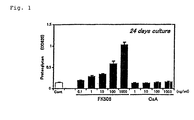
- ATDC5 cells were incubated with FK506 or CsA for 24 days and the amount of proteoglycan was assayed. The result is shown in Fig. 1.
- FK506 induced differentiation into chondrocyte in a concentration-dependent manner (1-1000 ng/ml).
- CsA did not induce the differentiation.
- the macrolides of the present invention is also useful for regeneration of tissues, such as connective tissue (e.g., cartilaginous tissue) and/or bone tissue.
- tissues such as connective tissue (e.g., cartilaginous tissue) and/or bone tissue.
- Such tissue regeneration does not include the prevention or treatment of rheumatoid arthritis.
Landscapes
- Health & Medical Sciences (AREA)
- Animal Behavior & Ethology (AREA)
- Public Health (AREA)
- Veterinary Medicine (AREA)
- General Health & Medical Sciences (AREA)
- Life Sciences & Earth Sciences (AREA)
- Medicinal Chemistry (AREA)
- Chemical & Material Sciences (AREA)
- Pharmacology & Pharmacy (AREA)
- Epidemiology (AREA)
- Nuclear Medicine, Radiotherapy & Molecular Imaging (AREA)
- Chemical Kinetics & Catalysis (AREA)
- Organic Chemistry (AREA)
- Physical Education & Sports Medicine (AREA)
- General Chemical & Material Sciences (AREA)
- Engineering & Computer Science (AREA)
- Bioinformatics & Cheminformatics (AREA)
- Rheumatology (AREA)
- Immunology (AREA)
- Orthopedic Medicine & Surgery (AREA)
- Pharmaceuticals Containing Other Organic And Inorganic Compounds (AREA)
- Nitrogen And Oxygen Or Sulfur-Condensed Heterocyclic Ring Systems (AREA)
- Saccharide Compounds (AREA)
Applications Claiming Priority (3)
| Application Number | Priority Date | Filing Date | Title |
|---|---|---|---|
| AUPQ0787A AUPQ078799A0 (en) | 1999-06-04 | 1999-06-04 | New use |
| AUPQ078799 | 1999-06-04 | ||
| PCT/JP2000/003533 WO2000074665A2 (en) | 1999-06-04 | 2000-05-31 | New use of macrolide compounds for inducing chondrogenic differentiation |
Publications (2)
| Publication Number | Publication Date |
|---|---|
| EP1183028A2 EP1183028A2 (en) | 2002-03-06 |
| EP1183028B1 true EP1183028B1 (en) | 2003-07-23 |
Family
ID=3814984
Family Applications (1)
| Application Number | Title | Priority Date | Filing Date |
|---|---|---|---|
| EP00931634A Expired - Lifetime EP1183028B1 (en) | 1999-06-04 | 2000-05-31 | Use of certain macrolide compounds for inducing chondrogenic differentiation |
Country Status (7)
| Country | Link |
|---|---|
| US (1) | US6489340B1 (enExample) |
| EP (1) | EP1183028B1 (enExample) |
| JP (1) | JP2003501382A (enExample) |
| AU (1) | AUPQ078799A0 (enExample) |
| DE (1) | DE60004044T2 (enExample) |
| ES (1) | ES2202130T3 (enExample) |
| WO (1) | WO2000074665A2 (enExample) |
Families Citing this family (5)
| Publication number | Priority date | Publication date | Assignee | Title |
|---|---|---|---|---|
| US20070032853A1 (en) | 2002-03-27 | 2007-02-08 | Hossainy Syed F | 40-O-(2-hydroxy)ethyl-rapamycin coated stent |
| AU2003901023A0 (en) * | 2003-03-04 | 2003-03-20 | Fujisawa Pharmaceutical Co., Ltd. | New use |
| US20050118344A1 (en) | 2003-12-01 | 2005-06-02 | Pacetti Stephen D. | Temperature controlled crimping |
| ITMI20051826A1 (it) * | 2005-09-29 | 2007-03-30 | Novachem S A | Kit per la somministrazione parenterale di medicamenti |
| KR20100051829A (ko) * | 2007-07-31 | 2010-05-18 | 리머릭 바이오파르마 인코오포레이티드 | 인산화된 피론 유사체 및 방법 |
Family Cites Families (1)
| Publication number | Priority date | Publication date | Assignee | Title |
|---|---|---|---|---|
| US7754202B1 (en) | 1998-01-08 | 2010-07-13 | Stanford University | Methods of controlling cell differentiation and growth using a fusion protein and a drug |
-
1999
- 1999-06-04 AU AUPQ0787A patent/AUPQ078799A0/en not_active Abandoned
-
2000
- 2000-05-31 EP EP00931634A patent/EP1183028B1/en not_active Expired - Lifetime
- 2000-05-31 WO PCT/JP2000/003533 patent/WO2000074665A2/en not_active Ceased
- 2000-05-31 JP JP2001501202A patent/JP2003501382A/ja not_active Withdrawn
- 2000-05-31 ES ES00931634T patent/ES2202130T3/es not_active Expired - Lifetime
- 2000-05-31 DE DE60004044T patent/DE60004044T2/de not_active Expired - Fee Related
- 2000-05-31 US US09/926,700 patent/US6489340B1/en not_active Expired - Fee Related
Also Published As
| Publication number | Publication date |
|---|---|
| JP2003501382A (ja) | 2003-01-14 |
| AUPQ078799A0 (en) | 1999-06-24 |
| ES2202130T3 (es) | 2004-04-01 |
| US6489340B1 (en) | 2002-12-03 |
| DE60004044D1 (de) | 2003-08-28 |
| WO2000074665A3 (en) | 2001-05-17 |
| WO2000074665A2 (en) | 2000-12-14 |
| EP1183028A2 (en) | 2002-03-06 |
| DE60004044T2 (de) | 2004-04-15 |
Similar Documents
| Publication | Publication Date | Title |
|---|---|---|
| EP1056454B1 (en) | Use of macrolide compounds for treating glaucoma | |
| EP0581959B1 (en) | Use of macrolide compounds for eye diseases | |
| WO1991019495A1 (en) | Use of a macrolide compound such as fk 506 for manufacturing a medicament for treating idiopathic thrombocytopenic purpura and basedow's disease | |
| EP1093371A1 (en) | Use of fk506 and related macrolides in the manufacture of a medicament for treatment or prevention of pain | |
| EP1059921B1 (en) | Use of macrolide compounds for the treatment of acute lung injury | |
| EP1183028B1 (en) | Use of certain macrolide compounds for inducing chondrogenic differentiation | |
| US6833353B1 (en) | Use of immunosuppressants for MMP mediated diseases | |
| AU687025B2 (en) | Use of macrolides for the treatment of cerebral ischemia | |
| WO1991017754A1 (en) | Methods for treating and preventing inflammation of mucosa and blood vessels using fk 506 and related compounds | |
| US5643901A (en) | Medicament for treating idiopathic thrombocytopenic purpura | |
| GB2279006A (en) | Treatment of amyotrophic lateral sclerosis | |
| WO2001024784A2 (en) | New use | |
| US20050143411A1 (en) | Method for treating pulmonary disease | |
| WO2000007594A1 (en) | Use of il-2 inhibitors in the treatment of rheumatoid arthritis | |
| ES et al. | VERWENDUNG VON MAKROLIDEN ZUR BEHANDLUNG VON AKUTEN LUNGENVERLETZUNGEN UTILISATION DE MACROLIDES POUR LE TRAITEMENT DES LESIONS DES POUMONS | |
| HK1012229B (en) | Use of macrolides for the treatment of cerebral ischemia | |
| HK1036406B (en) | Use of macrolide compounds for the treatment of ards |
Legal Events
| Date | Code | Title | Description |
|---|---|---|---|
| PUAI | Public reference made under article 153(3) epc to a published international application that has entered the european phase |
Free format text: ORIGINAL CODE: 0009012 |
|
| 17P | Request for examination filed |
Effective date: 20011129 |
|
| AK | Designated contracting states |
Kind code of ref document: A2 Designated state(s): AT BE CH CY DE DK ES FI FR GB GR IE IT LI LU MC NL PT SE |
|
| 17Q | First examination report despatched |
Effective date: 20020326 |
|
| GRAH | Despatch of communication of intention to grant a patent |
Free format text: ORIGINAL CODE: EPIDOS IGRA |
|
| RTI1 | Title (correction) |
Free format text: USE OF CERTAIN MACROLIDE COMPOUNDS FOR INDUCING CHONDROGENIC DIFFERENTIATION |
|
| GRAH | Despatch of communication of intention to grant a patent |
Free format text: ORIGINAL CODE: EPIDOS IGRA |
|
| GRAA | (expected) grant |
Free format text: ORIGINAL CODE: 0009210 |
|
| AK | Designated contracting states |
Designated state(s): DE ES FR GB IT |
|
| REG | Reference to a national code |
Ref country code: GB Ref legal event code: FG4D |
|
| REG | Reference to a national code |
Ref country code: IE Ref legal event code: FG4D |
|
| REF | Corresponds to: |
Ref document number: 60004044 Country of ref document: DE Date of ref document: 20030828 Kind code of ref document: P |
|
| REG | Reference to a national code |
Ref country code: ES Ref legal event code: FG2A Ref document number: 2202130 Country of ref document: ES Kind code of ref document: T3 |
|
| ET | Fr: translation filed | ||
| PLBE | No opposition filed within time limit |
Free format text: ORIGINAL CODE: 0009261 |
|
| STAA | Information on the status of an ep patent application or granted ep patent |
Free format text: STATUS: NO OPPOSITION FILED WITHIN TIME LIMIT |
|
| 26N | No opposition filed |
Effective date: 20040426 |
|
| REG | Reference to a national code |
Ref country code: IE Ref legal event code: MM4A |
|
| REG | Reference to a national code |
Ref country code: FR Ref legal event code: CD Ref country code: FR Ref legal event code: TP |
|
| PGFP | Annual fee paid to national office [announced via postgrant information from national office to epo] |
Ref country code: DE Payment date: 20070524 Year of fee payment: 8 Ref country code: ES Payment date: 20070524 Year of fee payment: 8 |
|
| PGFP | Annual fee paid to national office [announced via postgrant information from national office to epo] |
Ref country code: GB Payment date: 20070530 Year of fee payment: 8 |
|
| PGFP | Annual fee paid to national office [announced via postgrant information from national office to epo] |
Ref country code: IT Payment date: 20070508 Year of fee payment: 8 |
|
| PGFP | Annual fee paid to national office [announced via postgrant information from national office to epo] |
Ref country code: FR Payment date: 20070510 Year of fee payment: 8 |
|
| GBPC | Gb: european patent ceased through non-payment of renewal fee |
Effective date: 20080531 |
|
| REG | Reference to a national code |
Ref country code: FR Ref legal event code: ST Effective date: 20090119 |
|
| PG25 | Lapsed in a contracting state [announced via postgrant information from national office to epo] |
Ref country code: DE Free format text: LAPSE BECAUSE OF NON-PAYMENT OF DUE FEES Effective date: 20081202 Ref country code: FR Free format text: LAPSE BECAUSE OF NON-PAYMENT OF DUE FEES Effective date: 20080602 |
|
| PG25 | Lapsed in a contracting state [announced via postgrant information from national office to epo] |
Ref country code: GB Free format text: LAPSE BECAUSE OF NON-PAYMENT OF DUE FEES Effective date: 20080531 |
|
| REG | Reference to a national code |
Ref country code: ES Ref legal event code: FD2A Effective date: 20080602 |
|
| PG25 | Lapsed in a contracting state [announced via postgrant information from national office to epo] |
Ref country code: IT Free format text: LAPSE BECAUSE OF NON-PAYMENT OF DUE FEES Effective date: 20080531 |
|
| PG25 | Lapsed in a contracting state [announced via postgrant information from national office to epo] |
Ref country code: ES Free format text: LAPSE BECAUSE OF NON-PAYMENT OF DUE FEES Effective date: 20080602 |