EP1182867A2 - Use of superpixels to enhance image quality in printing devices - Google Patents
Use of superpixels to enhance image quality in printing devices Download PDFInfo
- Publication number
- EP1182867A2 EP1182867A2 EP01119109A EP01119109A EP1182867A2 EP 1182867 A2 EP1182867 A2 EP 1182867A2 EP 01119109 A EP01119109 A EP 01119109A EP 01119109 A EP01119109 A EP 01119109A EP 1182867 A2 EP1182867 A2 EP 1182867A2
- Authority
- EP
- European Patent Office
- Prior art keywords
- image
- superpixels
- level
- value
- colorimetric
- Prior art date
- Legal status (The legal status is an assumption and is not a legal conclusion. Google has not performed a legal analysis and makes no representation as to the accuracy of the status listed.)
- Withdrawn
Links
Images


Classifications
-
- H—ELECTRICITY
- H04—ELECTRIC COMMUNICATION TECHNIQUE
- H04N—PICTORIAL COMMUNICATION, e.g. TELEVISION
- H04N1/00—Scanning, transmission or reproduction of documents or the like, e.g. facsimile transmission; Details thereof
- H04N1/46—Colour picture communication systems
- H04N1/52—Circuits or arrangements for halftone screening
Definitions
- This invention relates generally to machines and procedures for incremental printing of text or graphics on printing media such as paper, transparency stock, or other glossy media, or textiles; and more particularly to a scanning thermal-inkjet machine (whether printer, copier or facsimile receiver) and method that construct text or images ⁇ but primarily high-quality photograph-like images ⁇ incrementally from individual ink spots created on a print medium, in a two-dimensional pixel array.
- the invention is especially valuable for very large images, and when processing speed is constrained by use of economical off-the-shelf processors without hardware assist, i. e. without the aid of an application-specific integrated circuit ("ASIC”), but it is not limited to use in connection with such constraints.
- ASIC application-specific integrated circuit
- Image-quality defects however, included patterning in area fills due to dithering, and objectionable artifacts arising from the replication. (Close inspection would reveal that 24 dot/mm pixels were identical across pixel groupings.) Naturally the method is inflexible in that the total number of drops printed in a certain area is the number of pixels set to one ("1") in the rendered image, times the scaling factor.
- the present invention introduces such refinement.
- the present invention has several aspects or facets that can be used independently, although they are preferably employed together to optimize their benefits.
- the invention is a method for printing an image.
- the method includes the step of ⁇ for at least each colorimetric level that will be found in rendering the image ⁇ defining plural different superpixels.
- the levels that will be found in rendering are part of a set that is ordinarily well known in advance of beginning the online steps. They are design elements of the overall operating method.
- the invention also includes the step of generating or receiving data for the image. Another step is rendering the image by a process that finds, for positions within the image:
- the method also includes the step of applying the randomized value to select a superpixel from the plural superpixels for each found colorimetric level. Yet another step is printing the image using the selected superpixels.
- this facet of the invention also provides a kind of simulated 24 dot/mm (600 dpi) rendition ⁇ out of a 12 dot/mm (300 dpi) rendition process. That is to say, a close inspection of the finished printing will show that in general adjacent 24 dot/mm pixels are different from one another, even though the error diffusion is performed at 12 dots/mm.
- this aspect of the invention does not suffer from the kinds of image artifacts associated with e. g. pixel replication.
- the rendering step operate in a computational space that has one dimension for each colorant available, plus at least one dummy dimension which generates the randomized value. If this preference is observed, then there are two alternative subpreferences:
- the invention is a method for printing an image. Like the first, this method includes defining plural different superpixels for each available colorimetric level, and generating or receiving data for the image ⁇ and also printing the image using selected superpixels.
- This method also includes steps that are different.
- One of these is rendering the image by a process that finds colorimetric levels for positions within the image.
- Another is deriving or maintaining a matrix of randomized values.
- Yet another step is mapping a particular location in the matrix to a particular position in the image.
- the result of this step is choice of a randomized value, at the particular location in the matrix, for selection of a superpixel to use at the particular position in the image.
- this approach to obtaining randomized values for selection of superpixels is nearly free in terms of processing time, and quite economical in terms of information-storage requirements.
- the randomized matrix can be large if desired; however, it need not be very large.
- the matrix is derived or corrected to possess a blue-noise property of the randomized values.
- mapping step include interpreting:
- mapping step include using the found randomized value for control of superpixels in all color planes.
- the matrix include a set of smaller matrices, each of which contains randomized numbers corresponding to available superpixels; and that successive ones of the smaller matrices be progressively stepped across the larger, first-mentioned matrix.
- the superpixels defined for at least one colorimetric level vary in colorimetric value so as to express that colorimetric level, on average, as a nonintegral number of colorant quanta. (As will be seen from earlier discussion, however, an alternative preference is that the superpixels have substantially the same colorimetric value.)
- the invention is a method for printing an image.
- this method includes defining plural different superpixels for each available colorimetric level, and generating or receiving data for the image ⁇ and also printing the image using selected superpixels.
- the method further includes the step of selecting a superpixel from the plural superpixels for the found colorimetric level. Yet further included in the method is the step of controlling the defining or selecting step, or both, to impart a blue-noise property to the selected superpixels ⁇ considered as an aggregate.
- the method also includes the step of printing the image using the selected superpixels.
- this facet of the invention is particularly noteworthy in that it provides an extraordinarily sophisticated solution to a subtle but important problem. This problem takes the visible form of distinctly different kinds of graininess, or clumping tendency, at different levels of colorant saturation.
- noise randomness or so-called “noise” that is generated in ED when operating the invention near the error threshold values, is commonly white noise ⁇ i. e., roughly flat in spectral distribution. (The reason is that the "error” being diffused is substantially zero, so that the color "signal" consists of values from a controlling random number generator ⁇ and such values ordinarily are by definition random, i. e. white.) Noise from the error-diffusion process generally, however, is representatively blue noise.
- this third facet of the invention strongly facilitates equalization of the graininess property for different colorimetric levels, within each color plane. The result is to thereby make images appear more uniform in esthetic quality.
- the defining step includes screening the superpixels for spatial-frequency characteristics.
- the superpixels defined for at least one colorimetric level vary in colorimetric value so as to express that colorimetric level, on average, as a nonintegral number of colorant quanta.
- the superpixel approach to developing 24 dot/mm appearance is in essence exploited to provide finer gradations in colorimetric level as invoked by input level variations throughout the image.
- the present invention is apparatus for printing an image.
- This apparatus includes some means for defining plural different superpixels for each available colorimetric level. For purposes of breadth and generality in discussing the invention, these means will be called simply the "defining means”.
- the apparatus also comprises some means for generating or receiving data for the image. Again for generality and breadth, these will be called the "data means”.
- the apparatus includes some means for rendering the image by a process that finds colorimetric levels for positions within the image. These, again for like reasons, will be called the "rendering means”.
- Random-value means some means for generating or receiving a randomized value for each of the positions within the image. These may be called the "random-value means”.
- the apparatus also includes "applying means” for applying the randomized value, in common for all color planes, to select for each color plane a respective superpixel from the plural superpixels for the found colorimetric level. Additionally included are “printing means” for printing the image using the selected superpixels.
- the applying means include means for employing a randomized value which corresponds to a compatible set of superpixels for different color planes.
- the compatible set of superpixels includes coordinated placement of colorant quantity in the different color planes to achieve a certain image-quality objective. Still further if this subpreference is observed then preferably the coordinated placement includes elimination of substantially all drop-on-drop placement across planes, within highlight regions of the image.
- the superpixels defined for at least one colorimetric level vary in colorimetric value so as to express that colorimetric level, on average, as a nonintegral number of colorant quanta.
- the benefits of each main aspect can thus be enjoyed in combination with the enhanced smoothness of gradation achieved by generating superpixels whose average is a fractional colorimetric level; and this broad preference may be regarded as a fifth principal aspect of the invention.
- Preferred embodiments of the invention combine the benefits of multilevel error diffusion and fine colorimetric resolution, to virtually eliminate both patterning and color contouring.
- the invention is applicable to systems in which the final printing stage is actually either multilevel or binary.
- the multilevel ED processing may be only an intermediate step ⁇ and binary operation may precede, or follow, or both.
- multilevel final output produces the finest quality.
- the inventors' first effort to divert system capability from spatial resolution into colors was deterministic, mapping different intensity levels of the primary colors to a particular cell ⁇ denominated a "superpixel" ⁇ in the image.
- interaction between regular patterns generated by the halftoning and various repeating physical errors in the printer produced conspicuous artifacts.
- the inventors obtained further reduction in regularity.
- the differences among the superpixels also artificially provided a variation in level from pixel to pixel ⁇ thereby maintaining a seeming fine texture to the image even if very closely inspected.
- the invention achieves, in an extremely economical system, an excellent rich environment for reproduction of continuous-tone images. While presenting a simulated fine spatial resolution it is essentially free of patterning and contouring.
- Randomizing the selection of superpixels had two negative consequences. One was the computational overhead of generating a random number for each pixel. That overhead is large enough to eradicate the performance benefit over binary halftoning.
- a starting point is four-weight binary error diffusion that somewhat randomizes the distribution of error by perturbing the ED weights.
- Serpentine raster processing was adopted to further reduce directionality artifacts. Extension of that algorithm to multilevel representations is straightforward; lookup tables are used in the error processing to avoid the computational burden of doing comparisons and distributing the errors arithmetically.
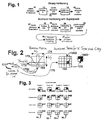
- CMYK contone data 11 (eight bits per plane), assumed to be already color corrected, are scaled 12 to the device resolution. 13. Then they are halftoned 14 using error diffusion to obtain one bit 15 per plane at the device resolution.
- the present multilevel approach by contrast, performs the scaling in two steps.
- the first uses a conventional method, bilinear scaling 22, to bring the image 21 to the resolution 23 used for the halftoning (rendering resolution).
- ED variant 2 which generates five planes 25: CMYK, and "random", with m bits each ⁇ where m is small, i. e. 2, 3 or 4.
- CMYKcm including dilute cyan and magenta, are part of a particularly preferred embodiment.
- the random plane together with a predefined set of superpixels, will later be used to scale up to the final device resolution by mapping each of the levels (defined by m bits) to a superpixel 26.
- the superpixel itself can be assumed binary, although this is by no means a requirement of the invention. That is, in both the earlier binary halftoning and the present multilevel halftoning, the final output can be four binary planes 27 with the same resolution (K ⁇ R).
- the final device is binary. This means that for the rest of the system it is irrelevant that one intermediate step uses multilevel processing ⁇ except that, as noted earlier, this is a particularly economical, rapid and effective way to process the data.
- the final device supports multilevel printing, however, such printing is readily supported by providing multilevel (nonbinary) superpixels.
- the invention is extremely versatile with regard to the final output form.
- Multilevel ED with random superpixels has at least three major advantages:
- this tactic has an interesting and very beneficial side-effect: it enables definition of a family of superpixels, one for each plane ⁇ that are likely to be printed together.
- the superpixels in each set can be designed to minimize interactions between color planes, so that some plane-dependent benefits are obtained even though the halftoning is nominally plane independent.
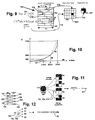
- the index into the array is computed from the input pixel coordinates ( x , y ) by counting the number of pixels from the top left corner of the page to this pixel (while traversing the page left-to-right and top-to-bottom), and calculating the relative offset of this value inside the array ( i. e., ( y ⁇ W x + x ) mod V x ).
- the random number 173, 174 in the array 162' corresponding to that index, together with the input level 179, is used to select the superpixel cell 91, 167A from a lookup table 163.
- V x and W x are chosen relatively prime of each other so that the pattern does not repeat across many lines.
- This scheme can be generalized by using multiple 1D arrays ( i. e. , N arrays), possibly of different sizes, and using array i for rows of the input image i , i + N , i +2 N , ... wrapping this array around within this subset of rows. (Other, less-systematic stepping is also feasible and may be preferable.) This interleaving makes the pattern even less repeatable across lines.
- a way to simplify the problem is rotation of the roles of the planes for each random choice: this reduces by a factor of four the number of superpixels to be selected. Also whenever possible it is desirable to use the stacking property that ensures monotonic behavior: a superpixel of a higher level includes a superpixel of lower level for the same plane and random choice.
- Superpixel selection is advantageously based upon the goals and principles introduced above. The process of selecting superpixels, however, is not yet fully automated.
- the technique uses a lower-rank superpixel that performs reasonably well, and adds extra drops one by one in each random set. For each one added, a Fourier analysis is performed to ensure that the design goals are reasonably met.
- n the number of intensity levels.
- n the number of intensity levels.
- Each one is the result of inserting the superpixels for that particular level using that random entry; this is repeated for each plane if different behavior across planes is expected.
- the random matrix has 256 by 256 entries and the system is to use two-by-two binary superpixels with four input levels, then four binary matrices of 512 by 512 will be generated. Then a 2D-FFT (magnitude) of each of these four matrices is computed.
- a display of such an FFT level 1 shows a reasonable blue-noise spectrum. It has little low-frequency content 31 (Fig. 4) and reasonable high-frequency content (the rest of the image, including some peripheral energy clusters 33).
- a like display for level 2 also has limited low-frequency response 32. Also, both show reasonable symmetry ⁇ as opposed to an example that derives from use of superpixels in level 2 (two drops per superpixel) that only have vertical and diagonal entries, no horizontal ones. In the latter case the result is an extended vertical structure 34 (Fig. 6), with large lobes 36 at top and bottom, linked to the central, low-frequency concentration 35.
- the image is obtained by firing an integral number of drops into a pixel grid.
- Multidrop devices can fire N drops in every cell of the grid, with N an integer and N ⁇ 1 ( i. e. 1, 2, 3, ).
- the halftoning process determines the number of dots that correspond to each cell of the grid.
- the drop size of the pen is fixed ⁇ establishing a discrete relationship between the amount of ink per pixel and the number of drops. This relationship in combination with the media ink-absorption characteristic ("drop gain") determines a finite set of pairs in the L* curve (Fig. 10) ⁇ or, more precisely, optical-density curve.
- a particularly useful application of this technique is to obtain intermediate values 51 (Fig. 11), 52 (Fig. 12) in the linearization of output density 171, 155-158 to device states 165-168.
- the superpixeling is used primarily to print at higher resolution than the halftoning resolution, it can also provide intermediate values along the dot axis ⁇ i. e. on average a nonintegral number of dots.
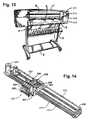
- the invention is amenable to implementation in a great variety of products. It can be embodied in a printer/plotter that includes a main case 1 (Fig. 13) with a window 2, and a left-hand pod 3 which encloses one end of the chassis. Within that enclosure are carriage-support and -drive mechanics and one end of the printing-medium advance mechanism, as well as a pen-refill station with supplemental ink cartridges.
- the printer/plotter also includes a printing-medium roll cover 4, and a receiving bin 5 for lengths or sheets of printing medium on which images have been formed, and which have been ejected from the machine.
- a bottom brace and storage shelf 6 spans the legs which support the two ends of the case 1.
- an entry slot 7 for receipt of continuous lengths of printing medium 4. Also included are a lever 8 for control of the gripping of the print medium by the machine.
- a front-panel display 211 and controls 212 are mounted in the skin of the right-hand pod 213. That pod encloses the right end of the carriage mechanics and of the medium advance mechanism, and also a printhead cleaning station. Near the bottom of the right-hand pod for readiest access is a standby switch 214.
- a cylindrical platen 241 (Fig. 15) ⁇ driven by a motor 242, worm and worm gear (not shown) under control of signals from a digital electronic processor 71 ⁇ rotates to drive sheets or lengths of printing medium 4A in a medium-advance direction. Print medium 4A is thereby drawn out of the print-medium roll cover 4.
- a pen-holding carriage assembly 220 (Figs. 14 and 15) carries several pens 223-226 (Fig. 14) back and forth across the printing medium, along a scanning track ⁇ perpendicular to the medium-advance direction ⁇ while the pens eject ink.
- a printer may have six pens or more, to hold different colors ⁇ or different dilutions of the same colors as in the more-typical four pens.
- the medium 4A thus receives inkdrops for formation of a desired image, and is ejected into the print-medium bin 5.
- a very finely graduated encoder strip 233, 236 (Fig. 15) is extended taut along the scanning path of the carriage assembly 220 and read by another, very small automatic optoelectronic sensor 237 to provide position and speed information 237B for the microprocessor.
- One advantageous location for the encoder strip is shown in several of the earlier cross-referenced patent documents at 236, immediately behind the pens.
- a currently preferred position for the encoder strip 33 (Fig. 14), however, is near the rear of the pen-carriage tray ⁇ remote from the space into which a user's hands are inserted for servicing of the pen refill cartridges.
- the sensor 237 is disposed with its optical beam passing through orifices or transparent portions of a scale formed in the strip.
- the pen-carriage assembly 220, 220' (Fig. 15) is driven in reciprocation by a motor 231 ⁇ along dual support and guide rails 232, 234 ⁇ through the intermediary of a drive belt 235.
- the motor 231 is under the control of signals from digital processors 71.
- the pen-carriage assembly includes a forward bay structure 222 for pens ⁇ preferably at least four pens 223-226 holding ink of four different colors respectively. Most typically the inks are yellow in the leftmost pen 223, then cyan 224, magenta 225 and black 226. As a practical matter, chromatic-color and black pens may be in a single printer, either in a common carriage or plural carriages.
- a rear tray 221 carrying various electronics.
- Figs. 13 and 14 most specifically represent a system such as the Hewlett Packard printer/plotter model "DesignJet 2000CP", which does not include the present invention. These drawings, however, also illustrate certain embodiments of the invention, and ⁇ with certain detailed differences mentioned below ⁇ a printer/plotter that includes preferred embodiments of the invention.
- the pen-carriage assembly is represented separately at 220 when traveling to the left 216 while discharging ink 218, and at 220' when traveling to the right 217 while discharging ink 219. It will be understood that both 220 and 220' represent the same pen carriage.
- the previously mentioned digital processor 71 provides control signals 220B, 220'B to fire the pens with correct timing, coordinated with platen drive control signals 242A to the platen motor 242, and carriage drive control signals 231A to the carriage drive motor 231.
- the processor 71 develops these carriage drive signals 231A based partly upon information about the carriage speed and position derived from the encoder signals 237B provided by the encoder 237.
- the codestrip 233, 236 thus enables formation of color inkdrops at ultrahigh precision during scanning of the carriage assembly 220 in each direction ⁇ i. e., either left to right (forward 220') or right to left (back 220).
- New image data 70 are received 191 into an image-processing stage 73, which may conventionally include a contrast and color adjustment or correction module 72, and an error-diffusion (ED) rendition module 76 which operates at relatively low resolution e. g. 12 dots/mm.
- the color module 72 provides paired pixel-position and pixel-color data points to the ED module 76.
- the pixel-position data pass to a module 81 that generates or receives random numbers for the operation of the present invention.
- the random numbers are preassembled into a matrix 84 as described earlier.
- One of those numbers when needed is read out at 193 by two pointers 82, 83, which respectively respond to the output tone value 77 found by the error-diffusion block 76, and the pixel-position information 75 provided from the color module 72 ⁇ also as earlier explained.
- a third pointer namely identity of a color plane being rendered, may be employed as well; however, this third pointer is not shown here, as it can be unnecessary if the system will use superpixel sets that are interplane coordinated.
- the apparatus has some means 85 defining groups of superpixels ⁇ a separate group 91C ... 94K for each tone value 77, 192 output by the ED module 76.
- Each superpixel has a higher resolution, e. g. 24 dots/mm, than the ED resolution e. g. 12 dots/mm.
- Each superpixel group typically includes several choices, here four, for each colorant; thus there may be four cyan choices 91C, 92C, 93C, 94C for the particular tone level 192.
- the random number 193 read out from the matrix 84 is used by a number-applying module 86 to select for printing just one superpixel choice 94C for example.
- the target color 192 also contains another subtractive primary, yellow for example, then a superpixel 94Y (continuing the same example) for that specific colorant is automatically selected from a prearranged compatible set of superpixels 94C-94K which includes the chosen superpixel 94C.
- Fig. 15 the superpixels are shown in a rank-and-file arrangement.
- the choices of a specific colorant appear as the ranks; the compatible set of which each choice is a part appear as files.
- the choice 94C was in the cyan rank, and the compatible set was the file 94C-94K.
- a selected superpixel, or members of a superpixel set are read out as data 194 representing one or more selected superpixels 87.
- This selected superpixel, or group of superpixels has the higher resolution sought for use in printing ⁇ in response to the lower resolution employed in the error diffusion 76.
- the superpixel or group of superpixels next proceeds as information 195 from the image-processing stage 73 to enter the printmasking and final-output module 88 ⁇ for specific pass and nozzle assignments, and development of control signals 220B, 231A, 220'B, 242A to drive the printing stage 220, 220', 241, 242 seen at right.
- Integrated circuits 71 may be distributive ⁇ being partly in the printer, partly in an associated computer, and partly in a separately packaged raster image processor. Alternatively the circuits may be primarily or wholly in just one or two of such devices.
- circuits also may comprise a general-purpose processor (e. g. the central processor of a general-purpose computer) operating software such as may be held for instance in a computer hard drive, or operating firmware (e. g. held in a ROM 70 and for distribution 66 to other components), or both; and may comprise application-specific integrated circuitry. Combinations of these may be used instead.
- a general-purpose processor e. g. the central processor of a general-purpose computer
- operating software such as may be held for instance in a computer hard drive, or operating firmware (e. g. held in a ROM 70 and for distribution 66 to other components), or both; and may comprise application-specific integrated circuitry. Combinations of these may be used instead.
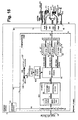
- the system retrieves 301 (Fig. 16) its operating program appropriately ⁇ i. e., by reading instructions from memory in case of a firmware or software implementation, or by simply operating dedicated hardware in case of an ASIC or like implementation. Once prepared in this way, the method proceeds to the procedure 302 through 325 as illustrated.
- the second and third groups of frequencies are advantageously managed separately.
- the second for instance, is advantageously constrained by Fourier-prescreening the superpixels themselves; and the third by precomputing a randomized matrix.
Landscapes
- Engineering & Computer Science (AREA)
- Multimedia (AREA)
- Signal Processing (AREA)
- Facsimile Image Signal Circuits (AREA)
- Image Processing (AREA)
- Ink Jet (AREA)
- Color, Gradation (AREA)
- Color Image Communication Systems (AREA)
Abstract
Description
- in one preference, the superpixels defined for each available colorimetric level are all colorimetrically equivalent; and
- in the other preference, the superpixels defined for at least one colorimetric level vary in colorimetric value ― in such a way as to express that colorimetric level, on average, as a nonintegral number of colorant quanta.
- in one case, operation of the rendering step in the
at least one dummy dimension includes using at least
one least-significant bit that:
- results from the rendering step in a colorant dimension, but
- is substantially decorrelated from colorimetric levels found by the rendering step; and
- in the other case, operation of the rendering step in the at least one dummy dimension includes deriving or maintaining a matrix of randomized values; and the applying step includes mapping a particular location in the matrix to a particular position in the image ― to choose a random value at the particular location in the matrix for selection of a superpixel to use at the particular position in the image.
- the value, found at each location in the matrix, as a pointer into a certain dimension of a table of superpixels;
- an input or output colorimetric level, for the particular position in the image, as a pointer into a certain dimension of the table of superpixels; or
- both ― but with regard to different (i. e. first and
second) "certain" dimensions, respectively.
Another preference is that the mapping step include interpreting identification of a color plane being rendered, as a pointer into a third dimension of the table of superpixels.
- the stepped smaller matrices also be tiled across the larger matrix and wrapped around at an edge of the larger matrix;
- the smaller matrices all be substantially identical;
- the smaller matrices include plural different interleaved arrays (in which case it is also preferred that the plural different arrays be different sizes); and
- the smaller matrices be one-dimensional matrices.
- original resolution ― resolution of the image before any scaling;
- rendering resolution ― resolution of the image just before halftoning (this might include some scaling during the rasterization);
- device resolution ― resolution of the image just before printing (this might be different from rendering resolution if some scaling is performed after halftoning) ; and
- superpixel ― a mapping from the rendering to the device resolution, which expands into a two-dimensional cell each of the output levels of the halftoning.
- that
random entry 173 as anabscissa pointer 174, - the
intensity level 171 as anordinate pointer 179, and - if desired, the plane being rendered as plane pointer
(not shown).
The last-mentioned choice is actually not necessary in preferred embodiments, since the same random entry advantageously is used for all planes to gain the plane-dependent properties noted earlier.
- the spatial frequencies inherent in any image, any
picture 306 as such ― the frequencies corresponding to elements of a picture, e. g. faces, railway trains, trees and so on ― which ordinarily vary broadly over an extremely wide range of frequencies unless a printing device is used exclusively to print area fills; - the spatial frequencies actually appearing in
superpixels 87, 91-94 selected to present the image; and - the frequencies that occur in randomized-number
matrices or
sequences 84, 193, or other mechanisms that are used to select superpixels.
Claims (13)
- A method for printing an image; said method comprising:for at least each colorimetric level (77; 25, 171, 179) that will be found in rendering the image, defining (302) plural different superpixels (91-94);generating or receiving (306) data (70; 21-23) for the image;rendering (307) the image by a process (76, 24) that finds, for positions within the image:colorimetric levels (77), anda randomized value (193, 173, 174) corresponding to substantially each found colorimetric level;applying (323, 193) the randomized value to select a superpixel (87) from the plural superpixels (91-94) for each found colorimetric level; andprinting (325) the image using the selected superpixels (87).
- The method of claim 1, wherein the rendering step operates in a computational space (311) that has:one dimension (24, 25) for each colorant available; plusat least one dummy dimension (25, 172r; 322) which generates said randomized value (173, 174).
- The method of claim 2, wherein:operation of the rendering step in the at least one dummy dimension comprises using (322) at least one least-significant bit that:results from the rendering step in a colorant dimension, butis substantially decorrelated from the colorimetric levels found by the rendering step.
- The method of claim 2, wherein:operation of the rendering step in the at least one dummy dimension comprises deriving or maintaining (312) a matrix (162, 162', 84) of randomized values; andthe applying step (323) comprises mapping (321, 83) a particular location (173) in the matrix to a particular position (171, 172r) in the image, to choose a random value (174) at said particular location in the matrix for selection (166D) of a superpixel (166D') to use at said particular position in the image.
- The method of claim 4, wherein:the matrix comprises a set (162') of smaller matrices (41), each of which contains randomized numbers corresponding to available superpixels; andsuccessive ones of the smaller matrices are progressively stepped (Fig. 9) across the first-mentioned matrix.
- The method of claim 4, wherein:the mapping step (321) comprises interpreting (86) the value (174, 193), found at each location in the matrix (162, 162', 84), as a pointer into a certain dimension (abscissa) of a table (163) of superpixels.
- The method of claim 4, wherein:the mapping step comprises interpreting (192) an input or output colorimetric level (179), for the particular position in the image, as a pointer into a certain dimension (ordinate) of the table (163) of superpixels.
- The method of any one of claims 1 to 7, wherein:the rendering step (24, 76, 307) operates by error diffusion.
- The method of any one of claims 1 to 8, wherein:the image consists of color values (25) in each of a large multiplicity of pixels;said positions comprise substantially each pixel of the image, at a reduced (N) resolution relative to the printing (27) step.
- The method of any one of claims 1 to 9, further comprising the step of:controlling (305, 318) the defining or applying step, or both, to impart a blue-noise property to the selected superpixels as an aggregate.
- The method of any one of claims 1 to 10, wherein:the defining step comprises screening (319) the superpixels for spatial-frequency characteristics;whereby spatial frequencies, other than information in the image, appear substantially consistent in the printed image.
- The method of any preceding claim, wherein:the superpixels (91-94) defined for at least one colorimetric level (171, 156) vary in colorimetric value (304) so as to express (172, 174, 179) that colorimetric level, on average, as a nonintegral number (51, 52) of colorant quanta.
- Apparatus for printing an image; said apparatus comprising:means (85) for defining plural different superpixels (91-94, CMYK) for each available colorimetric level (77, 192);means (70) for generating or receiving data for the image;means (76) for rendering the image by a process that finds colorimetric levels (77) for positions (75) within the image;means (81) for generating or receiving a randomized value (193) for each of the positions within the image;means (86) for applying the randomized value, in common for all color planes (CMYK), to select for each color plane a respective superpixel (87C, 87M, 87Y, 87K) from the plural superpixels for the found colorimetric level; andmeans (88, 220, 220', 231, 241) for printing the image using the selected superpixels.
Applications Claiming Priority (2)
| Application Number | Priority Date | Filing Date | Title |
|---|---|---|---|
| US642416 | 1991-01-17 | ||
| US09/642,416 US7031021B1 (en) | 2000-08-19 | 2000-08-19 | Randomized superpixels to enhance multilevel image quality in economical, fast incremental-printing error diffusion |
Publications (2)
| Publication Number | Publication Date |
|---|---|
| EP1182867A2 true EP1182867A2 (en) | 2002-02-27 |
| EP1182867A3 EP1182867A3 (en) | 2004-06-16 |
Family
ID=24576452
Family Applications (1)
| Application Number | Title | Priority Date | Filing Date |
|---|---|---|---|
| EP01119109A Withdrawn EP1182867A3 (en) | 2000-08-19 | 2001-08-08 | Use of superpixels to enhance image quality in printing devices |
Country Status (3)
| Country | Link |
|---|---|
| US (1) | US7031021B1 (en) |
| EP (1) | EP1182867A3 (en) |
| JP (1) | JP2002190963A (en) |
Families Citing this family (11)
| Publication number | Priority date | Publication date | Assignee | Title |
|---|---|---|---|---|
| US7768669B2 (en) * | 2000-09-12 | 2010-08-03 | Canon Kabushiki Kaisha | Image processing apparatus, printer using this apparatus, digital camera using this apparatus, consumable material holder for printer, and printer for digital camera |
| US7469985B2 (en) * | 2006-04-11 | 2008-12-30 | Canon Kabushiki Kaisha | Data processing apparatus, printing apparatus and method of creating mask |
| US8363281B2 (en) * | 2009-03-17 | 2013-01-29 | Eastman Kodak Company | Efficient image printing with printing systems employing printheads with drop ejectors providing multiple-sized dots |
| US8482793B2 (en) * | 2009-12-22 | 2013-07-09 | Xerox Corporation | Memory efficient electronic registration method that compensates image content and prevents halftone moiré |
| US8243998B2 (en) * | 2010-03-30 | 2012-08-14 | Hewlett-Packard Development Company, L.P. | Repeating band print artifact evaluation |
| JP5916642B2 (en) * | 2013-01-30 | 2016-05-11 | 富士フイルム株式会社 | Image processing apparatus and method, program, and image forming apparatus |
| JP6434817B2 (en) * | 2014-03-07 | 2018-12-05 | 株式会社ミマキエンジニアリング | Printing apparatus and printing method |
| WO2016121346A1 (en) * | 2015-01-30 | 2016-08-04 | Canon Kabushiki Kaisha | Image processing apparatus, image processing method, and appearance reproduction apparatus |
| DE102017205505B4 (en) * | 2017-03-31 | 2019-03-07 | Heidelberger Druckmaschinen Ag | Method for compensating for tonal fluctuations in an inkjet printing press |
| JP7242272B2 (en) * | 2018-11-30 | 2023-03-20 | キヤノン株式会社 | Dither matrix generation device, generation method, image processing device using dither matrix, image processing method, and program |
| JP7647077B2 (en) * | 2020-12-07 | 2025-03-18 | セイコーエプソン株式会社 | Print media processing system and print media processing method |
Family Cites Families (5)
| Publication number | Priority date | Publication date | Assignee | Title |
|---|---|---|---|---|
| DE69430605T2 (en) * | 1993-02-17 | 2002-10-17 | Canon K.K., Tokio/Tokyo | Coded data method and device |
| JP3423491B2 (en) * | 1995-07-28 | 2003-07-07 | キヤノン株式会社 | Image processing method, printing method, image processing device, printing device, and display device |
| US5625756A (en) * | 1996-04-23 | 1997-04-29 | Hewlett-Packard Company | Efficient use of dither matrix based gray level patterns |
| US6185002B1 (en) * | 1998-03-16 | 2001-02-06 | Hewlett-Packard Company | Reduction of periodic artifacts in incremental printing, through use of asymmetric randomized superpixels |
| JP3610250B2 (en) * | 1998-11-05 | 2005-01-12 | キヤノン株式会社 | Ink jet recording apparatus and recording control method thereof |
-
2000
- 2000-08-19 US US09/642,416 patent/US7031021B1/en not_active Expired - Lifetime
-
2001
- 2001-08-08 EP EP01119109A patent/EP1182867A3/en not_active Withdrawn
- 2001-08-17 JP JP2001247560A patent/JP2002190963A/en active Pending
Also Published As
| Publication number | Publication date |
|---|---|
| EP1182867A3 (en) | 2004-06-16 |
| JP2002190963A (en) | 2002-07-05 |
| US7031021B1 (en) | 2006-04-18 |
Similar Documents
| Publication | Publication Date | Title |
|---|---|---|
| US11637946B2 (en) | Iterative uniformity compensation mechanism | |
| US6113210A (en) | Method and apparatus for ink-jet recording with inks having different densities | |
| US11443152B1 (en) | Secondary color uniformity compensation mechanism | |
| US6351320B1 (en) | Memory-saving printer driver | |
| US11632487B1 (en) | Secondary color uniformity compensation mechanism | |
| JP3423491B2 (en) | Image processing method, printing method, image processing device, printing device, and display device | |
| WO2022186214A1 (en) | Defective nozzle correction mechanism | |
| US11630975B1 (en) | Secondary color uniformity compensation mechanism | |
| US6068361A (en) | Method and apparatus for multiple drop error diffusion in a liquid ink printer | |
| US11758074B2 (en) | Color uniformity compensation mechanism | |
| US20220286578A1 (en) | Secondary color uniformity compensation mechanism | |
| US6454389B1 (en) | Multipass inkjet printing using print masking | |
| EP0864429A1 (en) | Random printmasks in a multilevel inkjet printer | |
| US7031021B1 (en) | Randomized superpixels to enhance multilevel image quality in economical, fast incremental-printing error diffusion | |
| US20080123147A1 (en) | Control Of Ink Ejection Amount Based on Dot Formation Order | |
| JP4240210B2 (en) | Print control apparatus, print control method, and print control program | |
| US11734536B2 (en) | Color uniformity compensation mechanism | |
| US7196817B2 (en) | Printing of digital images using reduced colorant amounts while preserving perceived color | |
| EP0998126B1 (en) | Reduction of banding in incremental printing, through selection among colorimetric equivalents | |
| US6185002B1 (en) | Reduction of periodic artifacts in incremental printing, through use of asymmetric randomized superpixels | |
| JP4003046B2 (en) | PRINT CONTROL DEVICE, PRINT CONTROL METHOD, PRINT SYSTEM, PRINT CONTROL PROGRAM, AND MEDIUM CONTAINING PRINT CONTROL PROGRAM | |
| EP0954164B1 (en) | Printer with progressive column error diffusion system and method of using the same for improved printer throughput | |
| US6739772B2 (en) | Printing method and apparatus | |
| EP0814602B1 (en) | Jitter-form background control for minimizing spurious gray cast in scanned images | |
| US6995863B1 (en) | Discretionary dotting for artifact control in incremental printing |
Legal Events
| Date | Code | Title | Description |
|---|---|---|---|
| PUAI | Public reference made under article 153(3) epc to a published international application that has entered the european phase |
Free format text: ORIGINAL CODE: 0009012 |
|
| AK | Designated contracting states |
Kind code of ref document: A2 Designated state(s): AT BE CH CY DE DK ES FI FR GB GR IE IT LI LU MC NL PT SE TR |
|
| AX | Request for extension of the european patent |
Free format text: AL;LT;LV;MK;RO;SI |
|
| PUAL | Search report despatched |
Free format text: ORIGINAL CODE: 0009013 |
|
| AK | Designated contracting states |
Kind code of ref document: A3 Designated state(s): AT BE CH CY DE DK ES FI FR GB GR IE IT LI LU MC NL PT SE TR |
|
| AX | Request for extension of the european patent |
Extension state: AL LT LV MK RO SI |
|
| 17P | Request for examination filed |
Effective date: 20041020 |
|
| AKX | Designation fees paid |
Designated state(s): DE FR GB IT |
|
| STAA | Information on the status of an ep patent application or granted ep patent |
Free format text: STATUS: THE APPLICATION IS DEEMED TO BE WITHDRAWN |
|
| 18D | Application deemed to be withdrawn |
Effective date: 20070301 |