EP1182547A1 - Programmkopplungsmethode - Google Patents
Programmkopplungsmethode Download PDFInfo
- Publication number
- EP1182547A1 EP1182547A1 EP00118436A EP00118436A EP1182547A1 EP 1182547 A1 EP1182547 A1 EP 1182547A1 EP 00118436 A EP00118436 A EP 00118436A EP 00118436 A EP00118436 A EP 00118436A EP 1182547 A1 EP1182547 A1 EP 1182547A1
- Authority
- EP
- European Patent Office
- Prior art keywords
- function
- string
- format
- java
- programming language
- Prior art date
- Legal status (The legal status is an assumption and is not a legal conclusion. Google has not performed a legal analysis and makes no representation as to the accuracy of the status listed.)
- Withdrawn
Links
Classifications
-
- G—PHYSICS
- G06—COMPUTING OR CALCULATING; COUNTING
- G06F—ELECTRIC DIGITAL DATA PROCESSING
- G06F9/00—Arrangements for program control, e.g. control units
- G06F9/06—Arrangements for program control, e.g. control units using stored programs, i.e. using an internal store of processing equipment to receive or retain programs
- G06F9/46—Multiprogramming arrangements
- G06F9/54—Interprogram communication
- G06F9/547—Remote procedure calls [RPC]; Web services
-
- G—PHYSICS
- G06—COMPUTING OR CALCULATING; COUNTING
- G06F—ELECTRIC DIGITAL DATA PROCESSING
- G06F9/00—Arrangements for program control, e.g. control units
- G06F9/06—Arrangements for program control, e.g. control units using stored programs, i.e. using an internal store of processing equipment to receive or retain programs
- G06F9/44—Arrangements for executing specific programs
- G06F9/448—Execution paradigms, e.g. implementations of programming paradigms
- G06F9/4482—Procedural
- G06F9/4484—Executing subprograms
-
- G—PHYSICS
- G06—COMPUTING OR CALCULATING; COUNTING
- G06F—ELECTRIC DIGITAL DATA PROCESSING
- G06F9/00—Arrangements for program control, e.g. control units
- G06F9/06—Arrangements for program control, e.g. control units using stored programs, i.e. using an internal store of processing equipment to receive or retain programs
- G06F9/46—Multiprogramming arrangements
- G06F9/54—Interprogram communication
- G06F9/541—Interprogram communication via adapters, e.g. between incompatible applications
Definitions
- the invention relates to the coupling of different programming languages, especially the calling of subroutines in function-oriented programming languages from object-oriented Programming languages and vice versa.
- a variety of programming systems are known with whose help creates programs for data processing systems can be. Widely and in the following as an example the programming languages JAVA and C are used. To the abstract Specification of the programming language include translators, that generate program code. These translators are thus tools that the computer can use for a particular Behavior can be set up.
- serialization uses a technique called serialization and the under http://java.sun.com/docs/books/ tutorial / essential / io / serializing.html is described.
- serialization method is conventionally called 'writeObject' and is applied recursively to all data elements of a class.
- the recursion is carried out by the runtime system 'JAVA Virtual Machine', which dynamically determines the fields to be processed from the objects to be serialized, ie only during the runtime, and outputs them in a canonical manner if they are basic types and, if there are references to Objects are treated recursively.
- the 'toX' method is used for serialization. It gives as String back the value in a canonical form where on an indicator, here "I", the value in decimal digits follows, which is closed by a semicolon.
- the 'fromX' method expects a string that ends with a Element starts in exactly this format, i.e. with an indicator which should always be "I", the value in decimal digits, and a semicolon. The position of the latter will determined in line 10. 'formX' returns the rest of the string back after the value for the object is taken and was stored in 'val'.
- the two functions 'toX' and 'fromX' are therefore inverse to each other; in particular causes x.fromX (x.toX ()) where x is an object of the class 'myInt', that the value is read by 'toX' and set by 'fromX'.
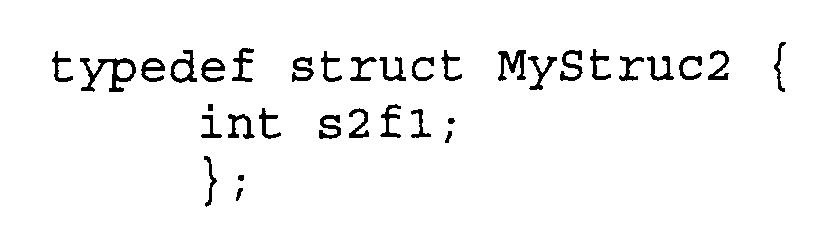
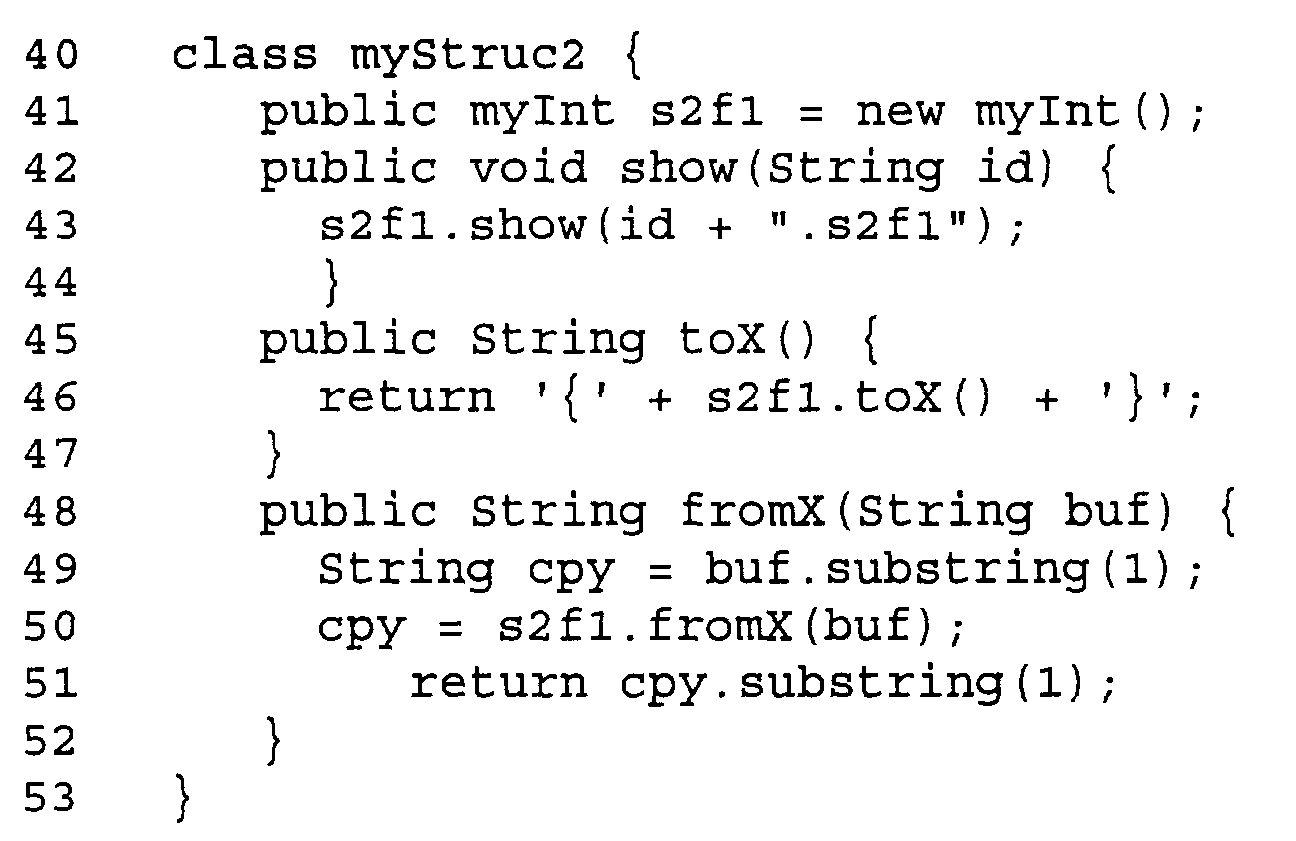
- the 'myFloat' class is defined accordingly: Assume that there is a simple structure in C: This is implemented in the following JAVA class: Line 41 defines data field s2f1; the 'show' method is used to display the value.
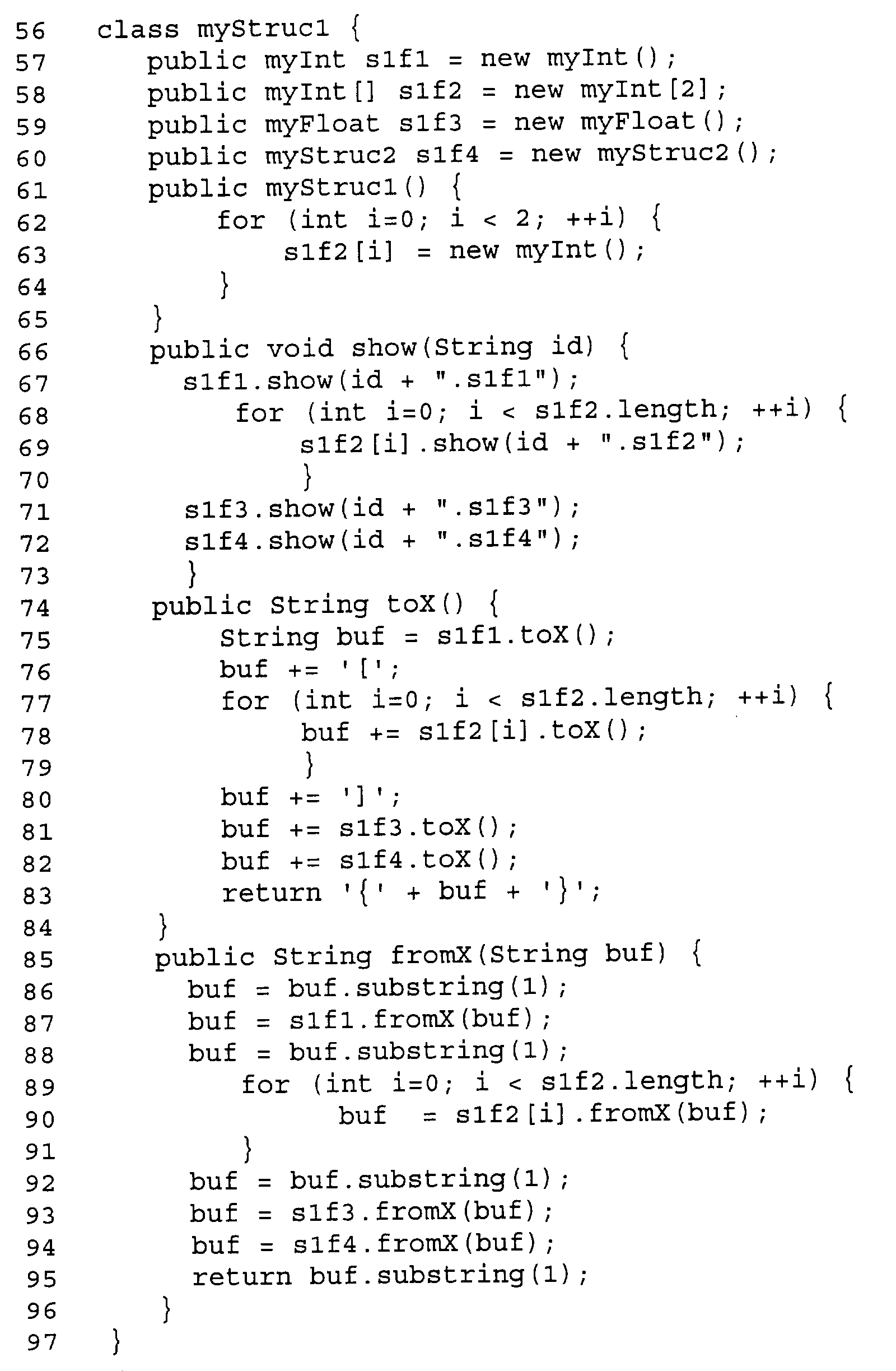
- the 'toX' method creates the value, encased in curly Brackets, as a string. 'fromX' provides the way back. Both methods, like the 'show' method, use recursive Call to the appropriate functions for the Execute structural elements.
- a class 'CallC' is also provided for this example:
- This class only contains the execC method, which the Displays arguments and modifies the given string, by replacing the number "9876" with "6789".
- This Method represents a call to a Function in C, as will be explained in more detail later.
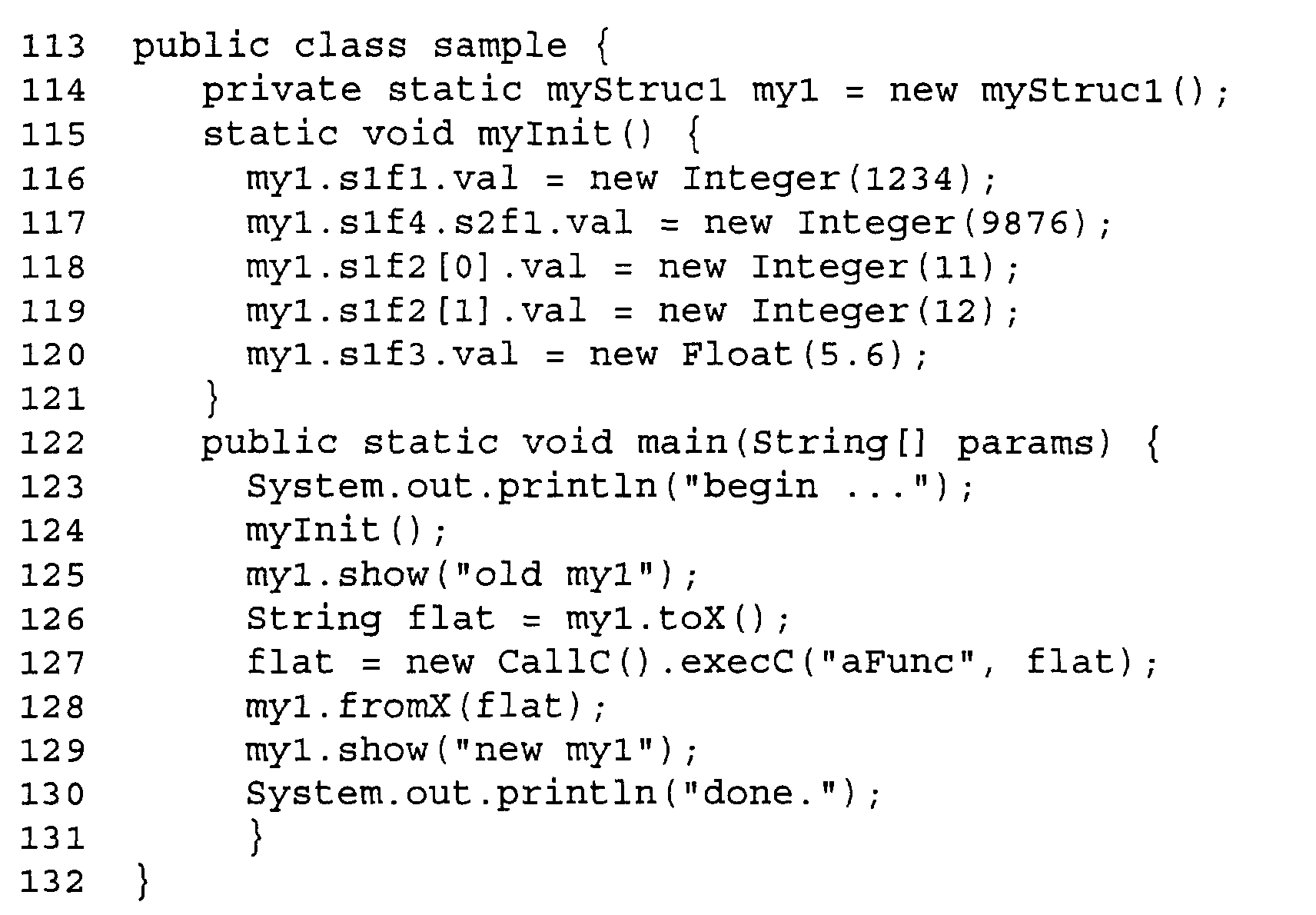
- a main program 'main' is defined in the class 'sample': In line 115-121 the object 'my1' of the class 'myStruc1' is filled with sample values. For the sake of clarity, this is done here by direct access to the fields of the objects. Appropriate methods would be used in a realistic application, the wording of which, however, is shaped by the content of the application and is therefore of no importance here.
- the object created in line 114 is initialized. The values are displayed in line 125.
- the object is called by - recursively - calling 'toX' in the variable 'flat' as a canonical linear representation generated.
- the method 'execC' called normally as a C function via the JNI called, but is simulated here with a JAVA class and a possibly changed structure in linearized normal form returns that remains in the variable 'flat'.
- This string is used by - recursively - calling 'fromX' now these, possibly changed, values in the objects.
- serialization In contrast to the serialization function already known from JAVA, it should first be noted that the in Serialization function used in the present invention creates a certain order of fields, namely the order in which the fields are defined in the structure are. Serialization also changes the format the structure according to the functional language C into a very represented simple form. The one already in JAVA Serialization, on the other hand, stores information about the Objects, but naturally does not contain any structural information with regard to the assigned C structures.
- This linearized form of storage provided with type indicators the content can now be independent of the definition of the Structures are implemented in a memory layout that the corresponds to the respective C structure.
- the type indicator indicates a simple variable, the following digits are converted and into a memory field of the appropriate length and Alignment stored binary. Identifies the type indicator a structure, so in some implementations Alignment, often on the double word boundary, may be necessary even if the structure consists only of bytes that do not Need alignment.
- This editing is specific to the respective compiler system for the language C and corresponds the techniques well known from compiler construction, which may be from the source code of the corresponding compiler be taken over.
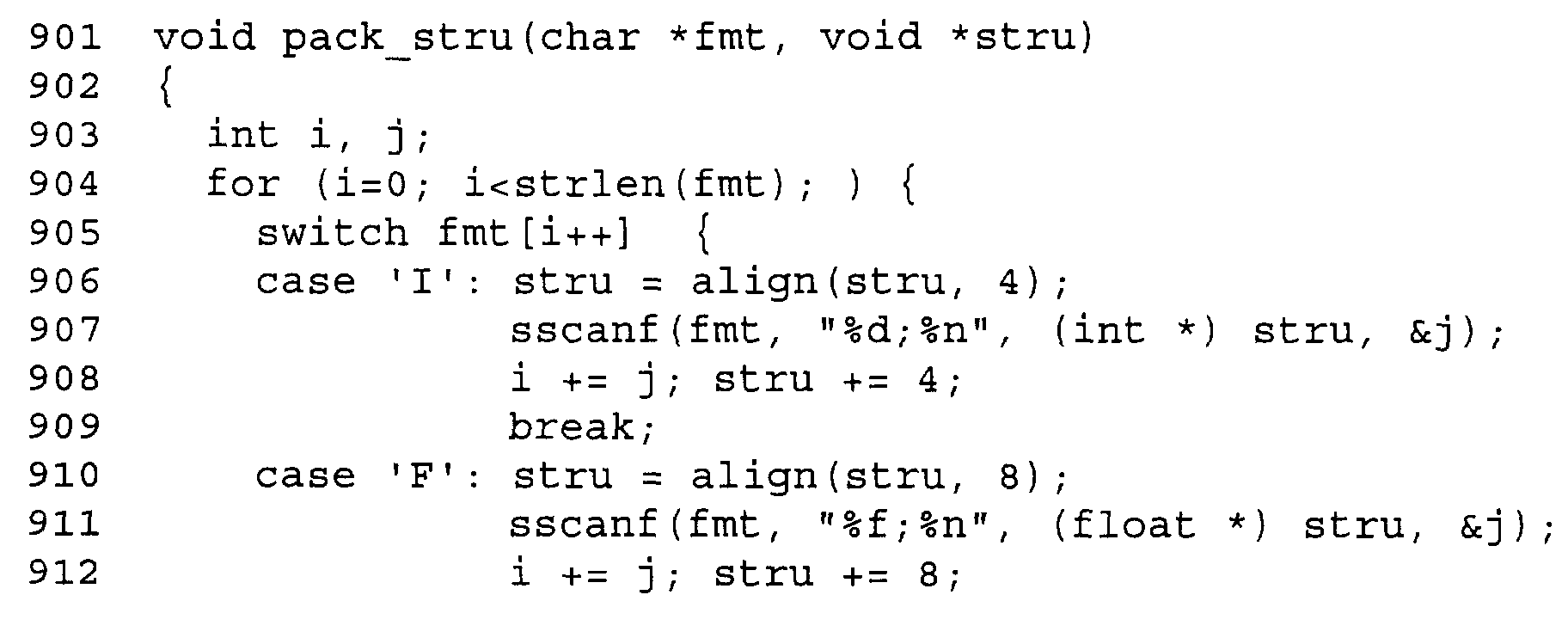
- the 'pack_stru' function has two parameters, a pointer on the combined format and data string as well as the points to a (sufficiently large) memory area in which the structure is to be built. This is independent of type as 'void *' defined.
- the loop from line 904 to 923 works now the combined format and data string.
- the 'align' function in lines 906, 910, 914 and 916, an alignment of the address on a multiple of the second parameter is not shown here because it depends heavily on the respective compiler system.
- Lines 907 and 911 use the library function 'sscanf' the value is taken from the string 'fmt' and in the Storage area stored, which by pointing 'stru' is addressed, here for the sake of formal correctness a type adjustment is made.
- the number of characters edited is output and for switching the format and Data strings used.
- the 'array' indicators '[' and ']' have no effect here; this also depends on the respective Implementation.
- the name of the C function to be called and pass a string that matches the C function contains encoded structure.
- the execC method is called via the JNI as a C function and converts the String now, as shown, in that of the structure according to storage format. Then the first Parameter specified C function called and a pointer passed to the storage structure.
- the function creates 'execC' from the memory structure again the canonical Presentation.
- the character string passed is used for this, which describes the memory structure, and again processed.
- the type indicators are copied and each then insert the value of the memory location or the existing value replaced.
- the step forward in the memory address is done according to the same rules for length and Alignment as when it was created. Will the numerical values stored with a fixed (maximum) length, so you can easily Overwrite.
- the 'execC' function therefore gives the linearized representation of the values of the memory structure. This will then then recursively using the 'fromX' method analyzed and to update the values of the fields in used the objects.
- the type indicators and the values are stored mixed in the same string. It is of course also possible to create both separately in two strings. Out ⁇ I1234; [I11; I12;] ⁇ F5.6; ⁇ 19876 ⁇ then becomes the format string ⁇ I [II] F ⁇ and the data string 1234; 11; 12; 5.6; 9876;
- the method described can also be used to create a Calling the JAVA method from a C function.
- the format string can either be available statically or created ad hoc by calling the serialization method become. In the latter case, the instantiation and Initialization of the required objects can be brought forward.
- the C structure can now be used the unpacking function can be converted into serial form. At the latest now the required objects must be instantiated and initialized. The calls required for this are provided in the JNI.
- the JNI The intended means are the deserialization method 'fromX' of the object corresponding to the structure called and then the final JAVA method to be called Object, primarily from those assigned to the structures Objects is independent. After returning to the Usually the corresponding process is reversed or the first part run accordingly when calling C from JAVA.
Landscapes
- Engineering & Computer Science (AREA)
- Software Systems (AREA)
- Theoretical Computer Science (AREA)
- Physics & Mathematics (AREA)
- General Engineering & Computer Science (AREA)
- General Physics & Mathematics (AREA)
- Devices For Executing Special Programs (AREA)
- Stored Programmes (AREA)
Abstract
Description
http://java.sun.com/docs/books/
tutorial/native1.1/index.html
zu finden. Darin wird ausdrücklich darauf hingewiesen, daß die C-Funktionen angepaßt werden müssen: 'While "in the real world" you probably have existing C functions that you wish to integrate with Java programs, you will still need to modify the signatures for these C functions to work with the JNI.' Es ist also nicht ohne weiteres möglich, eine vorgegebene C-Funktion aus JAVA heraus aufzurufen, ohne eine üblicherweise als 'wrapper function' bezeichnete Hilfsfunktion für jede so aufzurufende Funktion zu erstellen. Insbesondere ist die Verwendung von Strukturen in C als Parameter jeweils individuell umzusetzen, da es Strukturen in JAVA nicht gibt.
http://java.sun.com/docs/books/
tutorial/essential/io/serializing.html
beschrieben ist. Bei dieser sind in jeder Klasse jeweils eine Methode zum Serialisieren und eine für die Gegenrichtung vorhanden. Die Methode zum Serialisieren heißt per Konvention 'writeObject' und wird rekursiv auf alle Datenelemente einer Klasse angewendet. Die Rekursion übernimmt dabei das Laufzeitsystem 'JAVA Virtual Machine', das aus den zu serialiserenden Objekten dynamisch, d.h. erst während der Laufzeit, die zu bearbeitenden Felder ermittelt, diese auf kanonische Art ausgibt, wenn es sich um Basistypen handelt und, sofern es Verweise auf Objekte sind, rekursiv behandelt.

x.fromX(x.toX())
wobei x ein Objekt der Klasse 'myInt' ist, daß der Wert durch 'toX' ausgelesen und durch 'fromX' wieder gesetzt wird.





{I1234; [I11;I12;]F5.6;{19876;}}
wird dann der Formatstring
{I[II]F{}}
und der Datenstring
1234;11;12;5.6;9876;
Claims (6)
- Methode zum Aufruf einer Funktion einer funktionsorientierten Programmiersprache (C), wobei die Funktion eine Struktur als Parameter erwartet, aus einer objektorientierten Programmiersprache (JAVA), wobei den Feldern der Struktur entsprechende Klassen in JAVA zugeordnet sind, mit folgenden Schritten:eine die Struktur beschreibende Zeichenkette wird in einem Formatstring bereitgestellt,durch rekursiven Aufruf einer Serialisierungmethode (toX) werden die Inhalte der die in der Struktur verwendeten Felder entnommen und in einer dem Formatstring entsprechenden Reihenfolge in einem Datenstring abgelegt,eine Packfunktion wandelt den Datenstring unter Verwendung des Formatstrings in ein Speicherabbild der Struktur um,die Funktion der funktionsorientierten Programmiersprache wird mit dem Speicherabbild als Parameter für die Struktur aufgerufen.
- Methode nach Anspruch 1, mit folgenden weiteren Schritten:eine Entpackfunktion wandelt das Speicherabbild unter Verwendung des Formatstrings in einen Datenstring um,durch rekursiven Aufruf einer Deserialisierungmethode (fromX) werden die in der Struktur verwendeten Felder in einer dem Formatstring entsprechenden Reihenfolge aus dem Datenstring entnommen und in den Feldern der Objekte abgelegt.
- Methode nach Anspruch 1 oder 2, wobei der Datenstring und der Formatstring zu einem gemeinsamen String gemischt sind, der mittels der Serialsierunsmethode erzeugt wird.
- Methode zum Aufruf einer Methode einer objektorientierten Programmiersprache (JAVA) als eine Funktion einer funktionsorientierten Programmiersprache (C), wobei in dem Aufruf der Funktion eine Struktur als Parameter übergeben wird und den Feldern der Struktur entsprechende Klassen in JAVA zugeordnet sind, mit folgenden Schritten:das der Struktur entsprechende Objekt einschließlich benötigter Unterobjekte wird erzeugt,eine die Struktur beschreibende Zeichenkette wird in einem Formatstring bereitgestellt,eine Entpackfunktion wandelt das Speicherabbild unter Verwendung des Formatstrings in einen Datenstring um,durch rekursiven Aufruf einer Deserialisierungmethode (fromX) werden die in der Struktur verwendeten Felder in einer dem Formatstring entsprechenden Reihenfolge aus dem Datenstring entnommen und in den Feldern der Objekte abgelegt,die Methode wird aufgerufen.
- Methode nach Anspruch 4, mit folgenden weiteren Schritten:durch rekursiven Aufruf einer Serialisierungmethode (toX) werden die Inhalte der die in der Struktur verwendeten Felder entnommen und in einer dem Formatstring entsprechenden Reihenfolge in einem Datenstring abgelegt,eine Packfunktion ersetzt unter Verwendung des Formatstrings in dem Speicherabbild der Struktur die Felder aus den in dem Datenstring vorhandenen Werten.
- Methode zur Erstellung der für die Durchführung der vorherigen Methoden benötigten Programme, bei der aus der in der der funktionsorientierten Programmiersprache beschriebenen Struktur zumindest die Programmtexte der Serialisierungs- bzw. Deserialisierungsmethoden erzeugt werden.
Priority Applications (5)
| Application Number | Priority Date | Filing Date | Title |
|---|---|---|---|
| EP00118436A EP1182547A1 (de) | 2000-08-24 | 2000-08-24 | Programmkopplungsmethode |
| CA002413735A CA2413735A1 (en) | 2000-08-24 | 2001-07-12 | Programme coupling method |
| PCT/DE2001/002617 WO2002017063A2 (de) | 2000-08-24 | 2001-07-12 | Programmkopplungsmethode |
| CN01814435A CN1447938A (zh) | 2000-08-24 | 2001-07-12 | 程序连接方法 |
| US10/332,630 US7174539B2 (en) | 2000-08-24 | 2001-07-21 | Program coupling method |
Applications Claiming Priority (1)
| Application Number | Priority Date | Filing Date | Title |
|---|---|---|---|
| EP00118436A EP1182547A1 (de) | 2000-08-24 | 2000-08-24 | Programmkopplungsmethode |
Publications (1)
| Publication Number | Publication Date |
|---|---|
| EP1182547A1 true EP1182547A1 (de) | 2002-02-27 |
Family
ID=8169641
Family Applications (1)
| Application Number | Title | Priority Date | Filing Date |
|---|---|---|---|
| EP00118436A Withdrawn EP1182547A1 (de) | 2000-08-24 | 2000-08-24 | Programmkopplungsmethode |
Country Status (5)
| Country | Link |
|---|---|
| US (1) | US7174539B2 (de) |
| EP (1) | EP1182547A1 (de) |
| CN (1) | CN1447938A (de) |
| CA (1) | CA2413735A1 (de) |
| WO (1) | WO2002017063A2 (de) |
Cited By (1)
| Publication number | Priority date | Publication date | Assignee | Title |
|---|---|---|---|---|
| CN109189505A (zh) * | 2018-07-06 | 2019-01-11 | 武汉斗鱼网络科技有限公司 | 一种减少对象序列化占用存储空间的方法及系统 |
Families Citing this family (12)
| Publication number | Priority date | Publication date | Assignee | Title |
|---|---|---|---|---|
| CN100337203C (zh) * | 2004-04-05 | 2007-09-12 | 中国科学院计算技术研究所 | 一种遗产代码向现代语言变换过程中的控制流变换方法 |
| US8707257B2 (en) * | 2007-11-28 | 2014-04-22 | Red Hat, Inc. | Automatic object instantiation |
| US8504986B2 (en) * | 2008-01-23 | 2013-08-06 | Red Hat, Inc. | Calling functions as methods |
| US8959492B2 (en) * | 2010-12-14 | 2015-02-17 | Ngmoco, Llc | Communication protocol between a high-level language and a native language |
| CN102662772A (zh) * | 2012-03-08 | 2012-09-12 | 河海大学 | 多语言开发系统中实现不同语言间数据通信的方法 |
| CN102981885A (zh) * | 2012-12-11 | 2013-03-20 | 中国工程物理研究院流体物理研究所 | C语言程序设计中基于对象编程的方法及系统 |
| US9600546B2 (en) * | 2013-06-06 | 2017-03-21 | Oracle International Corporation | System and method for marshaling massive database data from native layer to java using linear array |
| US9747341B2 (en) | 2013-06-06 | 2017-08-29 | Oracle International Corporation | System and method for providing a shareable global cache for use with a database environment |
| US9569472B2 (en) | 2013-06-06 | 2017-02-14 | Oracle International Corporation | System and method for providing a second level connection cache for use with a database environment |
| US9720970B2 (en) | 2013-06-06 | 2017-08-01 | Oracle International Corporation | Efficient storage and retrieval of fragmented data using pseudo linear dynamic byte array |
| US9672141B1 (en) | 2015-11-25 | 2017-06-06 | International Business Machines Corporation | Generic language application programming interface interpreter |
| JP7253172B2 (ja) * | 2021-04-30 | 2023-04-06 | 株式会社ソフトギア | シリアル化方法、逆シリアル化方法、情報処理プログラム、情報処理装置及び通信システム |
Citations (2)
| Publication number | Priority date | Publication date | Assignee | Title |
|---|---|---|---|---|
| US5754849A (en) * | 1996-01-30 | 1998-05-19 | Wayfarer Communications, Inc. | Self-describing object providing dynamic manipulation of heterogeneous data values and semantic identity between memory and transmission representations |
| US6066181A (en) * | 1997-12-08 | 2000-05-23 | Analysis & Technology, Inc. | Java native interface code generator |
Family Cites Families (6)
| Publication number | Priority date | Publication date | Assignee | Title |
|---|---|---|---|---|
| US6009517A (en) * | 1997-10-06 | 1999-12-28 | Sun Microsystems, Inc. | Mixed execution stack and exception handling |
| US6269373B1 (en) * | 1999-02-26 | 2001-07-31 | International Business Machines Corporation | Method and system for persisting beans as container-managed fields |
| US6671853B1 (en) * | 1999-07-15 | 2003-12-30 | International Business Machines Corporation | Method and system for selectively streaming markup language documents |
| US6601072B1 (en) * | 2000-06-21 | 2003-07-29 | International Business Machines Corporation | Method and system for distribution of application data to distributed databases of dissimilar formats |
| US20030120593A1 (en) * | 2001-08-15 | 2003-06-26 | Visa U.S.A. | Method and system for delivering multiple services electronically to customers via a centralized portal architecture |
| WO2003036464A2 (en) * | 2001-10-22 | 2003-05-01 | Sun Microsystems, Inc. | Inter-process communication using different programming languages |
-
2000
- 2000-08-24 EP EP00118436A patent/EP1182547A1/de not_active Withdrawn
-
2001
- 2001-07-12 CA CA002413735A patent/CA2413735A1/en not_active Abandoned
- 2001-07-12 CN CN01814435A patent/CN1447938A/zh active Pending
- 2001-07-12 WO PCT/DE2001/002617 patent/WO2002017063A2/de not_active Ceased
- 2001-07-21 US US10/332,630 patent/US7174539B2/en not_active Expired - Fee Related
Patent Citations (2)
| Publication number | Priority date | Publication date | Assignee | Title |
|---|---|---|---|---|
| US5754849A (en) * | 1996-01-30 | 1998-05-19 | Wayfarer Communications, Inc. | Self-describing object providing dynamic manipulation of heterogeneous data values and semantic identity between memory and transmission representations |
| US6066181A (en) * | 1997-12-08 | 2000-05-23 | Analysis & Technology, Inc. | Java native interface code generator |
Non-Patent Citations (2)
| Title |
|---|
| BARTOLI A: "A NOVEL APPROACH TO MARSHALLING", SOFTWARE PRACTICE & EXPERIENCE,GB,JOHN WILEY & SONS LTD. CHICHESTER, vol. 27, no. 1, 1997, pages 63 - 85, XP000655617, ISSN: 0038-0644, Retrieved from the Internet <URL:http://www3.interscience.wiley.com/cgi-bin/fulltext?ID=7258&PLACEBO=IE.pdf> [retrieved on 20010302] * |
| MAYBEE M J ET AL: "Multilanguage interoperability in distributed systems. Experience report", PROCEEDINGS OF THE 18TH INTERNATIONAL CONFERENCE ON SOFTWARE ENGINEERING (CAT. NO.96CB35918), PROCEEDINGS OF IEEE 18TH INTERNATIONAL CONFERENCE ON SOFTWARE ENGINEERING, BERLIN, GERMANY, 25 March 1996 (1996-03-25) - 30 March 1996 (1996-03-30), 1996, Los Alamitos, CA, USA, IEEE Comput. Soc. Press, USA, pages 451 - 463, XP000598681, ISBN: 0-8186-7247-1, Retrieved from the Internet <URL:http://dev.acm.org/pubs/articles/proceedings/soft/227726/p451-maybee/p451-maybee.pdf> [retrieved on 20010302] * |
Cited By (2)
| Publication number | Priority date | Publication date | Assignee | Title |
|---|---|---|---|---|
| CN109189505A (zh) * | 2018-07-06 | 2019-01-11 | 武汉斗鱼网络科技有限公司 | 一种减少对象序列化占用存储空间的方法及系统 |
| CN109189505B (zh) * | 2018-07-06 | 2021-11-09 | 武汉斗鱼网络科技有限公司 | 一种减少对象序列化占用存储空间的方法及系统 |
Also Published As
| Publication number | Publication date |
|---|---|
| US7174539B2 (en) | 2007-02-06 |
| CN1447938A (zh) | 2003-10-08 |
| US20040054986A1 (en) | 2004-03-18 |
| WO2002017063A3 (de) | 2002-05-10 |
| WO2002017063A2 (de) | 2002-02-28 |
| CA2413735A1 (en) | 2002-12-20 |
Similar Documents
| Publication | Publication Date | Title |
|---|---|---|
| DE69126805T2 (de) | Datenformatumwandlung | |
| DE60011479T2 (de) | Xml-roboter | |
| DE68924389T2 (de) | Verfahren und Einrichtung zur Anzeige einer Vielzahl von graphischen Bildern. | |
| DE69126857T2 (de) | Objektorientierte Programmierungsplattform | |
| DE69924857T2 (de) | Programm-kode-umwandlung | |
| DE3688107T2 (de) | Verfahren zur Behaltung der Anpassungsfähigkeit von mit verschiedenen Eingabe-/Ausgabearten. | |
| DE69526289T2 (de) | Optimierungsverfahren für effiziente Bilderzeugung | |
| DE69324966T2 (de) | Verwendung einer eingebetteten interpretativen Programmiersprache zum Realisieren eines interaktiven Werkzeugs für die Definition einer Benutzerschnittstelle | |
| DE69518123T2 (de) | Visualisierung von objektorientierter Software | |
| DE69723180T2 (de) | Herunterladen eines Interpreters in einen Drucker | |
| DE69516891T2 (de) | Verfahren zum übersetzen von quellkode aus einer computer-hochsprache in eine andere | |
| DE3788877T2 (de) | Einrichtung zur software-emulation. | |
| DE69931540T2 (de) | Fernprozeduraufrufe mit Um- und Rückwandlung von beliebigen, nicht-übereinstimmenden Zeigergrössen | |
| DE69427008T2 (de) | Verfahren zur automatischen Wiederherstellung der Konsistenz einer hierarchischen Objektstruktur in einem Computer nach Bedienereingriff und Computer mit einem derartigen System | |
| DE2748991A1 (de) | Einrichtung zur umsetzung von datenformaten | |
| DE69028269T2 (de) | Virtuelles Adressierungsverfahren zum Betrieb eines Speichers in einer Datenverarbeitungsanlage und Einrichtung zur Ausführung besagten Verfahrens | |
| DE1499201B2 (de) | Schaltungsanordnung zur Umwandlung von Informationen in gepackter Bytedar stellung in eine ungepackte Darstellung | |
| DE3788782T2 (de) | Verfahren zur Herstellung einer Meldungsdatei in einem Computer. | |
| DE69710478T2 (de) | System zur übersetzung von dateien mit visuellen wiedergabeobjekten und methode zur durchführung | |
| WO2002017063A2 (de) | Programmkopplungsmethode | |
| DE4313958A1 (de) | Einrichtung und verfahren zum steuern der darstellung einer vorlage | |
| DE69129339T2 (de) | Graphisches ausgangssystem mit begrenzter aktualisierung. | |
| DE3209187A1 (de) | Verfahren zur darstellung eines textes auf einer einzeiligen anzeigevorrichtung eines texterstellungsgeraetes | |
| DE69807412T2 (de) | Prozessorarchitekturschema und Befehlssatz zur Maximierung verfügbarer Opcodes und zum Einsetzen verschiedener Adressierungsmodi | |
| DE10054001A1 (de) | Automatisierte Schnittstellengenerierung für Computerprogramme in unterschiedlichen Umgebungen |
Legal Events
| Date | Code | Title | Description |
|---|---|---|---|
| PUAI | Public reference made under article 153(3) epc to a published international application that has entered the european phase |
Free format text: ORIGINAL CODE: 0009012 |
|
| AK | Designated contracting states |
Kind code of ref document: A1 Designated state(s): AT BE CH CY DE DK ES FI FR GB GR IE IT LI LU MC NL PT SE |
|
| AX | Request for extension of the european patent |
Free format text: AL;LT;LV;MK;RO;SI |
|
| 17P | Request for examination filed |
Effective date: 20020622 |
|
| RAP1 | Party data changed (applicant data changed or rights of an application transferred) |
Owner name: WINCOR NIXDORF INTERNATIONAL GMBH |
|
| AKX | Designation fees paid |
Free format text: AT BE CH CY DE DK ES FI FR GB GR IE IT LI LU MC NL PT SE |
|
| 17Q | First examination report despatched |
Effective date: 20070529 |
|
| STAA | Information on the status of an ep patent application or granted ep patent |
Free format text: STATUS: THE APPLICATION HAS BEEN WITHDRAWN |
|
| 18W | Application withdrawn |
Effective date: 20070912 |