EP1180522A1 - Gemische von Alkoxysilyl-Propyl-Polysulfanen und Kautschukmischungen, die diese Gemische enthalten - Google Patents
Gemische von Alkoxysilyl-Propyl-Polysulfanen und Kautschukmischungen, die diese Gemische enthalten Download PDFInfo
- Publication number
- EP1180522A1 EP1180522A1 EP00117799A EP00117799A EP1180522A1 EP 1180522 A1 EP1180522 A1 EP 1180522A1 EP 00117799 A EP00117799 A EP 00117799A EP 00117799 A EP00117799 A EP 00117799A EP 1180522 A1 EP1180522 A1 EP 1180522A1
- Authority
- EP
- European Patent Office
- Prior art keywords
- rubber
- compounds
- mixtures
- propyltrichlorosilane
- general formula
- Prior art date
- Legal status (The legal status is an assumption and is not a legal conclusion. Google has not performed a legal analysis and makes no representation as to the accuracy of the status listed.)
- Withdrawn
Links
- 229920001971 elastomer Polymers 0.000 title claims abstract description 43
- 239000005060 rubber Substances 0.000 title claims abstract description 43
- 239000000203 mixture Substances 0.000 title claims description 35
- 229910000057 polysulfane Inorganic materials 0.000 title description 2
- 150000001875 compounds Chemical class 0.000 claims abstract description 22
- 239000000460 chlorine Substances 0.000 claims abstract description 16
- 150000003961 organosilicon compounds Chemical class 0.000 claims abstract description 15
- 229910052801 chlorine Inorganic materials 0.000 claims abstract description 7
- 238000002360 preparation method Methods 0.000 claims abstract description 7
- 239000000945 filler Substances 0.000 claims abstract description 6
- ZAMOUSCENKQFHK-UHFFFAOYSA-N Chlorine atom Chemical compound [Cl] ZAMOUSCENKQFHK-UHFFFAOYSA-N 0.000 claims abstract description 5
- 229910052739 hydrogen Inorganic materials 0.000 claims abstract description 4
- 239000005053 propyltrichlorosilane Substances 0.000 claims description 23
- DOEHJNBEOVLHGL-UHFFFAOYSA-N trichloro(propyl)silane Chemical compound CCC[Si](Cl)(Cl)Cl DOEHJNBEOVLHGL-UHFFFAOYSA-N 0.000 claims description 23
- 238000000034 method Methods 0.000 claims description 17
- 230000008569 process Effects 0.000 claims description 12
- 125000004767 (C1-C4) haloalkoxy group Chemical group 0.000 claims description 3
- 125000000229 (C1-C4)alkoxy group Chemical group 0.000 claims description 3
- 229910021645 metal ion Inorganic materials 0.000 claims description 3
- QGZKDVFQNNGYKY-UHFFFAOYSA-O Ammonium Chemical compound [NH4+] QGZKDVFQNNGYKY-UHFFFAOYSA-O 0.000 claims description 2
- 150000003944 halohydrins Chemical class 0.000 claims description 2
- 150000001298 alcohols Chemical class 0.000 claims 1
- 125000003545 alkoxy group Chemical group 0.000 abstract description 4
- 125000004438 haloalkoxy group Chemical group 0.000 abstract description 2
- 125000004435 hydrogen atom Chemical group [H]* 0.000 abstract description 2
- OKTJSMMVPCPJKN-UHFFFAOYSA-N Carbon Chemical compound [C] OKTJSMMVPCPJKN-UHFFFAOYSA-N 0.000 abstract 2
- 229910052799 carbon Inorganic materials 0.000 abstract 2
- 125000001309 chloro group Chemical group Cl* 0.000 abstract 2
- 125000005843 halogen group Chemical group 0.000 abstract 2
- 239000001257 hydrogen Substances 0.000 abstract 1
- NINIDFKCEFEMDL-UHFFFAOYSA-N Sulfur Chemical compound [S] NINIDFKCEFEMDL-UHFFFAOYSA-N 0.000 description 14
- 239000011593 sulfur Substances 0.000 description 14
- 229910052717 sulfur Inorganic materials 0.000 description 14
- 238000006243 chemical reaction Methods 0.000 description 13
- 238000002156 mixing Methods 0.000 description 13
- LFQSCWFLJHTTHZ-UHFFFAOYSA-N Ethanol Chemical compound CCO LFQSCWFLJHTTHZ-UHFFFAOYSA-N 0.000 description 12
- VYPSYNLAJGMNEJ-UHFFFAOYSA-N Silicium dioxide Chemical compound O=[Si]=O VYPSYNLAJGMNEJ-UHFFFAOYSA-N 0.000 description 12
- 238000004519 manufacturing process Methods 0.000 description 11
- 239000000047 product Substances 0.000 description 10
- 238000005660 chlorination reaction Methods 0.000 description 9
- KAKZBPTYRLMSJV-UHFFFAOYSA-N Butadiene Chemical compound C=CC=C KAKZBPTYRLMSJV-UHFFFAOYSA-N 0.000 description 7
- LRHPLDYGYMQRHN-UHFFFAOYSA-N N-Butanol Chemical compound CCCCO LRHPLDYGYMQRHN-UHFFFAOYSA-N 0.000 description 6
- 239000002904 solvent Substances 0.000 description 6
- PPBRXRYQALVLMV-UHFFFAOYSA-N Styrene Chemical compound C=CC1=CC=CC=C1 PPBRXRYQALVLMV-UHFFFAOYSA-N 0.000 description 5
- 239000003795 chemical substances by application Substances 0.000 description 5
- 229920001577 copolymer Polymers 0.000 description 5
- 238000010992 reflux Methods 0.000 description 5
- 239000000377 silicon dioxide Substances 0.000 description 5
- VTHOKNTVYKTUPI-UHFFFAOYSA-N triethoxy-[3-(3-triethoxysilylpropyltetrasulfanyl)propyl]silane Chemical compound CCO[Si](OCC)(OCC)CCCSSSSCCC[Si](OCC)(OCC)OCC VTHOKNTVYKTUPI-UHFFFAOYSA-N 0.000 description 5
- 238000004073 vulcanization Methods 0.000 description 5
- BLRPTPMANUNPDV-UHFFFAOYSA-N Silane Chemical compound [SiH4] BLRPTPMANUNPDV-UHFFFAOYSA-N 0.000 description 4
- 239000002318 adhesion promoter Substances 0.000 description 4
- 239000006227 byproduct Substances 0.000 description 4
- 239000007788 liquid Substances 0.000 description 4
- 229910000077 silane Inorganic materials 0.000 description 4
- 150000004756 silanes Chemical class 0.000 description 4
- 229920003048 styrene butadiene rubber Polymers 0.000 description 4
- -1 trichlorosilyl group Chemical group 0.000 description 4
- OYGYKEULCAINCL-UHFFFAOYSA-N triethoxy(hexadecyl)silane Chemical compound CCCCCCCCCCCCCCCC[Si](OCC)(OCC)OCC OYGYKEULCAINCL-UHFFFAOYSA-N 0.000 description 4
- OWRCNXZUPFZXOS-UHFFFAOYSA-N 1,3-diphenylguanidine Chemical compound C=1C=CC=CC=1NC(=N)NC1=CC=CC=C1 OWRCNXZUPFZXOS-UHFFFAOYSA-N 0.000 description 3
- WEVYAHXRMPXWCK-UHFFFAOYSA-N Acetonitrile Chemical compound CC#N WEVYAHXRMPXWCK-UHFFFAOYSA-N 0.000 description 3
- YMWUJEATGCHHMB-UHFFFAOYSA-N Dichloromethane Chemical compound ClCCl YMWUJEATGCHHMB-UHFFFAOYSA-N 0.000 description 3
- RTZKZFJDLAIYFH-UHFFFAOYSA-N Diethyl ether Chemical compound CCOCC RTZKZFJDLAIYFH-UHFFFAOYSA-N 0.000 description 3
- XEKOWRVHYACXOJ-UHFFFAOYSA-N Ethyl acetate Chemical compound CCOC(C)=O XEKOWRVHYACXOJ-UHFFFAOYSA-N 0.000 description 3
- OKKJLVBELUTLKV-UHFFFAOYSA-N Methanol Chemical compound OC OKKJLVBELUTLKV-UHFFFAOYSA-N 0.000 description 3
- 239000005062 Polybutadiene Substances 0.000 description 3
- 230000015572 biosynthetic process Effects 0.000 description 3
- 239000003054 catalyst Substances 0.000 description 3
- 238000004821 distillation Methods 0.000 description 3
- 238000011049 filling Methods 0.000 description 3
- 150000001282 organosilanes Chemical class 0.000 description 3
- 239000002994 raw material Substances 0.000 description 3
- 239000011541 reaction mixture Substances 0.000 description 3
- 239000007858 starting material Substances 0.000 description 3
- 239000000126 substance Substances 0.000 description 3
- 238000012360 testing method Methods 0.000 description 3
- OOXSLJBUMMHDKW-UHFFFAOYSA-N trichloro(3-chloropropyl)silane Chemical compound ClCCC[Si](Cl)(Cl)Cl OOXSLJBUMMHDKW-UHFFFAOYSA-N 0.000 description 3
- UUEWCQRISZBELL-UHFFFAOYSA-N 3-trimethoxysilylpropane-1-thiol Chemical compound CO[Si](OC)(OC)CCCS UUEWCQRISZBELL-UHFFFAOYSA-N 0.000 description 2
- KZBUYRJDOAKODT-UHFFFAOYSA-N Chlorine Chemical compound ClCl KZBUYRJDOAKODT-UHFFFAOYSA-N 0.000 description 2
- HEDRZPFGACZZDS-UHFFFAOYSA-N Chloroform Chemical compound ClC(Cl)Cl HEDRZPFGACZZDS-UHFFFAOYSA-N 0.000 description 2
- VQTUBCCKSQIDNK-UHFFFAOYSA-N Isobutene Chemical compound CC(C)=C VQTUBCCKSQIDNK-UHFFFAOYSA-N 0.000 description 2
- 239000006087 Silane Coupling Agent Substances 0.000 description 2
- XUIMIQQOPSSXEZ-UHFFFAOYSA-N Silicon Chemical group [Si] XUIMIQQOPSSXEZ-UHFFFAOYSA-N 0.000 description 2
- 235000021355 Stearic acid Nutrition 0.000 description 2
- WYURNTSHIVDZCO-UHFFFAOYSA-N Tetrahydrofuran Chemical compound C1CCOC1 WYURNTSHIVDZCO-UHFFFAOYSA-N 0.000 description 2
- XLOMVQKBTHCTTD-UHFFFAOYSA-N Zinc monoxide Chemical compound [Zn]=O XLOMVQKBTHCTTD-UHFFFAOYSA-N 0.000 description 2
- 238000005299 abrasion Methods 0.000 description 2
- 150000001343 alkyl silanes Chemical class 0.000 description 2
- 230000003197 catalytic effect Effects 0.000 description 2
- MVPPADPHJFYWMZ-UHFFFAOYSA-N chlorobenzene Chemical compound ClC1=CC=CC=C1 MVPPADPHJFYWMZ-UHFFFAOYSA-N 0.000 description 2
- 238000005859 coupling reaction Methods 0.000 description 2
- 239000006185 dispersion Substances 0.000 description 2
- 230000006870 function Effects 0.000 description 2
- QIQXTHQIDYTFRH-UHFFFAOYSA-N octadecanoic acid Chemical compound CCCCCCCCCCCCCCCCCC(O)=O QIQXTHQIDYTFRH-UHFFFAOYSA-N 0.000 description 2
- OQCDKBAXFALNLD-UHFFFAOYSA-N octadecanoic acid Natural products CCCCCCCC(C)CCCCCCCCC(O)=O OQCDKBAXFALNLD-UHFFFAOYSA-N 0.000 description 2
- 239000003973 paint Substances 0.000 description 2
- 229920002857 polybutadiene Polymers 0.000 description 2
- 229920001195 polyisoprene Polymers 0.000 description 2
- 229920000642 polymer Polymers 0.000 description 2
- BDERNNFJNOPAEC-UHFFFAOYSA-N propan-1-ol Chemical compound CCCO BDERNNFJNOPAEC-UHFFFAOYSA-N 0.000 description 2
- 238000007086 side reaction Methods 0.000 description 2
- 239000011734 sodium Substances 0.000 description 2
- 239000008117 stearic acid Substances 0.000 description 2
- 238000003860 storage Methods 0.000 description 2
- 229920003051 synthetic elastomer Polymers 0.000 description 2
- 239000005061 synthetic rubber Substances 0.000 description 2
- SNYHRPNTNQYJMD-UHFFFAOYSA-N trichloro(1-chloropropyl)silane Chemical compound CCC(Cl)[Si](Cl)(Cl)Cl SNYHRPNTNQYJMD-UHFFFAOYSA-N 0.000 description 2
- ICALQSALKQBNME-UHFFFAOYSA-N trichloro(2-chloropropyl)silane Chemical compound CC(Cl)C[Si](Cl)(Cl)Cl ICALQSALKQBNME-UHFFFAOYSA-N 0.000 description 2
- 239000001993 wax Substances 0.000 description 2
- YXIWHUQXZSMYRE-UHFFFAOYSA-N 1,3-benzothiazole-2-thiol Chemical class C1=CC=C2SC(S)=NC2=C1 YXIWHUQXZSMYRE-UHFFFAOYSA-N 0.000 description 1
- LUHFFAFBORUUNF-UHFFFAOYSA-N 1-chloropropyl(triethoxy)silane Chemical compound CCO[Si](OCC)(OCC)C(Cl)CC LUHFFAFBORUUNF-UHFFFAOYSA-N 0.000 description 1
- CXBDYQVECUFKRK-UHFFFAOYSA-N 1-methoxybutane Chemical compound CCCCOC CXBDYQVECUFKRK-UHFFFAOYSA-N 0.000 description 1
- TVYXSFBEKKZTSF-UHFFFAOYSA-N 2-chloropropyl(triethoxy)silane Chemical compound CCO[Si](CC(C)Cl)(OCC)OCC TVYXSFBEKKZTSF-UHFFFAOYSA-N 0.000 description 1
- XVEASTGLHPVZNA-UHFFFAOYSA-N 3,4-dichlorobut-1-ene Chemical compound ClCC(Cl)C=C XVEASTGLHPVZNA-UHFFFAOYSA-N 0.000 description 1
- KSCAZPYHLGGNPZ-UHFFFAOYSA-N 3-chloropropyl(triethoxy)silane Chemical compound CCO[Si](OCC)(OCC)CCCCl KSCAZPYHLGGNPZ-UHFFFAOYSA-N 0.000 description 1
- NLHHRLWOUZZQLW-UHFFFAOYSA-N Acrylonitrile Chemical compound C=CC#N NLHHRLWOUZZQLW-UHFFFAOYSA-N 0.000 description 1
- 0 C*[Si](*Cl)(*=C)I Chemical compound C*[Si](*Cl)(*=C)I 0.000 description 1
- 101100008047 Caenorhabditis elegans cut-3 gene Proteins 0.000 description 1
- 239000004971 Cross linker Substances 0.000 description 1
- ZAFNJMIOTHYJRJ-UHFFFAOYSA-N Diisopropyl ether Chemical compound CC(C)OC(C)C ZAFNJMIOTHYJRJ-UHFFFAOYSA-N 0.000 description 1
- 102000004190 Enzymes Human genes 0.000 description 1
- 108090000790 Enzymes Proteins 0.000 description 1
- VGGSQFUCUMXWEO-UHFFFAOYSA-N Ethene Chemical compound C=C VGGSQFUCUMXWEO-UHFFFAOYSA-N 0.000 description 1
- 244000043261 Hevea brasiliensis Species 0.000 description 1
- DGAQECJNVWCQMB-PUAWFVPOSA-M Ilexoside XXIX Chemical compound C[C@@H]1CC[C@@]2(CC[C@@]3(C(=CC[C@H]4[C@]3(CC[C@@H]5[C@@]4(CC[C@@H](C5(C)C)OS(=O)(=O)[O-])C)C)[C@@H]2[C@]1(C)O)C)C(=O)O[C@H]6[C@@H]([C@H]([C@@H]([C@H](O6)CO)O)O)O.[Na+] DGAQECJNVWCQMB-PUAWFVPOSA-M 0.000 description 1
- RRHGJUQNOFWUDK-UHFFFAOYSA-N Isoprene Natural products CC(=C)C=C RRHGJUQNOFWUDK-UHFFFAOYSA-N 0.000 description 1
- KFZMGEQAYNKOFK-UHFFFAOYSA-N Isopropanol Chemical compound CC(C)O KFZMGEQAYNKOFK-UHFFFAOYSA-N 0.000 description 1
- 238000005481 NMR spectroscopy Methods 0.000 description 1
- 229910052779 Neodymium Inorganic materials 0.000 description 1
- 239000006057 Non-nutritive feed additive Substances 0.000 description 1
- CBENFWSGALASAD-UHFFFAOYSA-N Ozone Chemical compound [O-][O+]=O CBENFWSGALASAD-UHFFFAOYSA-N 0.000 description 1
- 239000002202 Polyethylene glycol Substances 0.000 description 1
- NPYPAHLBTDXSSS-UHFFFAOYSA-N Potassium ion Chemical compound [K+] NPYPAHLBTDXSSS-UHFFFAOYSA-N 0.000 description 1
- XBDQKXXYIPTUBI-UHFFFAOYSA-M Propionate Chemical compound CCC([O-])=O XBDQKXXYIPTUBI-UHFFFAOYSA-M 0.000 description 1
- 229910018540 Si C Inorganic materials 0.000 description 1
- 229910003902 SiCl 4 Inorganic materials 0.000 description 1
- FKNQFGJONOIPTF-UHFFFAOYSA-N Sodium cation Chemical compound [Na+] FKNQFGJONOIPTF-UHFFFAOYSA-N 0.000 description 1
- GSEJCLTVZPLZKY-UHFFFAOYSA-N Triethanolamine Chemical compound OCCN(CCO)CCO GSEJCLTVZPLZKY-UHFFFAOYSA-N 0.000 description 1
- KXKVLQRXCPHEJC-UHFFFAOYSA-N acetic acid trimethyl ester Natural products COC(C)=O KXKVLQRXCPHEJC-UHFFFAOYSA-N 0.000 description 1
- 230000009471 action Effects 0.000 description 1
- 239000012190 activator Substances 0.000 description 1
- 239000013543 active substance Substances 0.000 description 1
- 239000000853 adhesive Substances 0.000 description 1
- 230000001070 adhesive effect Effects 0.000 description 1
- 230000032683 aging Effects 0.000 description 1
- 238000006136 alcoholysis reaction Methods 0.000 description 1
- 125000001931 aliphatic group Chemical group 0.000 description 1
- 230000003712 anti-aging effect Effects 0.000 description 1
- 239000010692 aromatic oil Substances 0.000 description 1
- 239000003849 aromatic solvent Substances 0.000 description 1
- 239000010426 asphalt Substances 0.000 description 1
- 230000008901 benefit Effects 0.000 description 1
- 238000009835 boiling Methods 0.000 description 1
- 239000007767 bonding agent Substances 0.000 description 1
- 125000004432 carbon atom Chemical group C* 0.000 description 1
- 150000001733 carboxylic acid esters Chemical class 0.000 description 1
- 239000012876 carrier material Substances 0.000 description 1
- 150000008280 chlorinated hydrocarbons Chemical class 0.000 description 1
- 229920003193 cis-1,4-polybutadiene polymer Polymers 0.000 description 1
- 238000001816 cooling Methods 0.000 description 1
- 230000008878 coupling Effects 0.000 description 1
- 238000010168 coupling process Methods 0.000 description 1
- 238000004132 cross linking Methods 0.000 description 1
- 238000013016 damping Methods 0.000 description 1
- 230000006735 deficit Effects 0.000 description 1
- 239000012990 dithiocarbamate Substances 0.000 description 1
- 150000004659 dithiocarbamates Chemical class 0.000 description 1
- 238000000921 elemental analysis Methods 0.000 description 1
- 238000005516 engineering process Methods 0.000 description 1
- HQQADJVZYDDRJT-UHFFFAOYSA-N ethene;prop-1-ene Chemical group C=C.CC=C HQQADJVZYDDRJT-UHFFFAOYSA-N 0.000 description 1
- 150000002170 ethers Chemical class 0.000 description 1
- 230000007717 exclusion Effects 0.000 description 1
- 238000009472 formulation Methods 0.000 description 1
- 238000004817 gas chromatography Methods 0.000 description 1
- 230000008570 general process Effects 0.000 description 1
- 150000002357 guanidines Chemical class 0.000 description 1
- 150000008282 halocarbons Chemical class 0.000 description 1
- 238000010438 heat treatment Methods 0.000 description 1
- TZMQHOJDDMFGQX-UHFFFAOYSA-N hexane-1,1,1-triol Chemical compound CCCCCC(O)(O)O TZMQHOJDDMFGQX-UHFFFAOYSA-N 0.000 description 1
- 239000002815 homogeneous catalyst Substances 0.000 description 1
- 239000012442 inert solvent Substances 0.000 description 1
- JMMWKPVZQRWMSS-UHFFFAOYSA-N isopropanol acetate Natural products CC(C)OC(C)=O JMMWKPVZQRWMSS-UHFFFAOYSA-N 0.000 description 1
- 229940011051 isopropyl acetate Drugs 0.000 description 1
- GWYFCOCPABKNJV-UHFFFAOYSA-N isovaleric acid Chemical compound CC(C)CC(O)=O GWYFCOCPABKNJV-UHFFFAOYSA-N 0.000 description 1
- 238000004811 liquid chromatography Methods 0.000 description 1
- 239000007791 liquid phase Substances 0.000 description 1
- 238000005058 metal casting Methods 0.000 description 1
- 229910044991 metal oxide Inorganic materials 0.000 description 1
- 150000004706 metal oxides Chemical class 0.000 description 1
- 238000000465 moulding Methods 0.000 description 1
- DEQZTKGFXNUBJL-UHFFFAOYSA-N n-(1,3-benzothiazol-2-ylsulfanyl)cyclohexanamine Chemical compound C1CCCCC1NSC1=NC2=CC=CC=C2S1 DEQZTKGFXNUBJL-UHFFFAOYSA-N 0.000 description 1
- 229920003052 natural elastomer Polymers 0.000 description 1
- 229920001194 natural rubber Polymers 0.000 description 1
- QEFYFXOXNSNQGX-UHFFFAOYSA-N neodymium atom Chemical compound [Nd] QEFYFXOXNSNQGX-UHFFFAOYSA-N 0.000 description 1
- 239000003921 oil Substances 0.000 description 1
- 150000001367 organochlorosilanes Chemical class 0.000 description 1
- 238000013031 physical testing Methods 0.000 description 1
- 239000004033 plastic Substances 0.000 description 1
- 229920003023 plastic Polymers 0.000 description 1
- 239000004014 plasticizer Substances 0.000 description 1
- 229920001223 polyethylene glycol Polymers 0.000 description 1
- 229910001414 potassium ion Inorganic materials 0.000 description 1
- 239000002244 precipitate Substances 0.000 description 1
- 230000036316 preload Effects 0.000 description 1
- 238000007639 printing Methods 0.000 description 1
- 230000001681 protective effect Effects 0.000 description 1
- 230000001012 protector Effects 0.000 description 1
- 239000012758 reinforcing additive Substances 0.000 description 1
- 239000000565 sealant Substances 0.000 description 1
- 238000007789 sealing Methods 0.000 description 1
- 238000007493 shaping process Methods 0.000 description 1
- 229910010271 silicon carbide Inorganic materials 0.000 description 1
- 229910052708 sodium Inorganic materials 0.000 description 1
- QDRKDTQENPPHOJ-UHFFFAOYSA-N sodium ethoxide Chemical compound [Na+].CC[O-] QDRKDTQENPPHOJ-UHFFFAOYSA-N 0.000 description 1
- 229910001415 sodium ion Inorganic materials 0.000 description 1
- 239000007787 solid Substances 0.000 description 1
- 239000004071 soot Substances 0.000 description 1
- 239000003381 stabilizer Substances 0.000 description 1
- 238000003756 stirring Methods 0.000 description 1
- 238000005486 sulfidation Methods 0.000 description 1
- QAOWNCQODCNURD-UHFFFAOYSA-N sulfuric acid Substances OS(O)(=O)=O QAOWNCQODCNURD-UHFFFAOYSA-N 0.000 description 1
- 239000000725 suspension Substances 0.000 description 1
- 238000009864 tensile test Methods 0.000 description 1
- YLQBMQCUIZJEEH-UHFFFAOYSA-N tetrahydrofuran Natural products C=1C=COC=1 YLQBMQCUIZJEEH-UHFFFAOYSA-N 0.000 description 1
- 230000000930 thermomechanical effect Effects 0.000 description 1
- 150000003585 thioureas Chemical class 0.000 description 1
- PMYWEHSCMHTFEC-UHFFFAOYSA-N trichloro(3,3-dichloropropyl)silane Chemical class ClC(Cl)CC[Si](Cl)(Cl)Cl PMYWEHSCMHTFEC-UHFFFAOYSA-N 0.000 description 1
- ZDHXKXAHOVTTAH-UHFFFAOYSA-N trichlorosilane Chemical compound Cl[SiH](Cl)Cl ZDHXKXAHOVTTAH-UHFFFAOYSA-N 0.000 description 1
- 239000005052 trichlorosilane Substances 0.000 description 1
- 239000011800 void material Substances 0.000 description 1
- 239000011787 zinc oxide Substances 0.000 description 1
Classifications
-
- C—CHEMISTRY; METALLURGY
- C07—ORGANIC CHEMISTRY
- C07F—ACYCLIC, CARBOCYCLIC OR HETEROCYCLIC COMPOUNDS CONTAINING ELEMENTS OTHER THAN CARBON, HYDROGEN, HALOGEN, OXYGEN, NITROGEN, SULFUR, SELENIUM OR TELLURIUM
- C07F7/00—Compounds containing elements of Groups 4 or 14 of the Periodic Table
- C07F7/02—Silicon compounds
- C07F7/08—Compounds having one or more C—Si linkages
-
- C—CHEMISTRY; METALLURGY
- C08—ORGANIC MACROMOLECULAR COMPOUNDS; THEIR PREPARATION OR CHEMICAL WORKING-UP; COMPOSITIONS BASED THEREON
- C08K—Use of inorganic or non-macromolecular organic substances as compounding ingredients
- C08K5/00—Use of organic ingredients
- C08K5/54—Silicon-containing compounds
- C08K5/548—Silicon-containing compounds containing sulfur
-
- C—CHEMISTRY; METALLURGY
- C07—ORGANIC CHEMISTRY
- C07F—ACYCLIC, CARBOCYCLIC OR HETEROCYCLIC COMPOUNDS CONTAINING ELEMENTS OTHER THAN CARBON, HYDROGEN, HALOGEN, OXYGEN, NITROGEN, SULFUR, SELENIUM OR TELLURIUM
- C07F7/00—Compounds containing elements of Groups 4 or 14 of the Periodic Table
- C07F7/02—Silicon compounds
- C07F7/08—Compounds having one or more C—Si linkages
- C07F7/12—Organo silicon halides
-
- C—CHEMISTRY; METALLURGY
- C07—ORGANIC CHEMISTRY
- C07F—ACYCLIC, CARBOCYCLIC OR HETEROCYCLIC COMPOUNDS CONTAINING ELEMENTS OTHER THAN CARBON, HYDROGEN, HALOGEN, OXYGEN, NITROGEN, SULFUR, SELENIUM OR TELLURIUM
- C07F7/00—Compounds containing elements of Groups 4 or 14 of the Periodic Table
- C07F7/02—Silicon compounds
- C07F7/08—Compounds having one or more C—Si linkages
- C07F7/18—Compounds having one or more C—Si linkages as well as one or more C—O—Si linkages
- C07F7/1804—Compounds having Si-O-C linkages
Definitions
- the present invention relates to Organosilicon compounds, a process for their use Manufacture and its use in rubber compounds.
- sulfur-containing organosilicon compounds such as 3-mercaptopropyltrimethoxysilane or Bis- (3- [triethoxysilyl] propyl) tetrasulfane, as Silane coupling agent or reinforcing additive in oxidic filled rubber compounds, such as for Treads and other parts of car tires (DE 2 141 159, DE 2 212 239, US 3 978 103, US 4 048 206).
- sulfur-containing Silane coupling agent in the manufacture of Sealants, molds for metal casting, paint and Protective paints, adhesives, asphalt mixtures and oxidically filled plastics, fixation of active substances and functional units on inorganic Carrier materials, for example in the immobilization of homogeneous catalysts and enzymes, fixed bed catalysts and used in liquid chromatography.
- the object of the present invention is based on the Byproduct propyltrichlorosilane new adhesion promoters for To develop rubber applications that are inexpensive can be produced and at least the same effective such as bis- (3- [triethoxysilyl] propyl) tetrasulfan are.
- the " ⁇ " in formula (I) represent a chemical bond that can be bound to each of the three C atoms of the C 3 H 5 (Y) group and the 5 hydrogens and the group Y each occupy free valences.
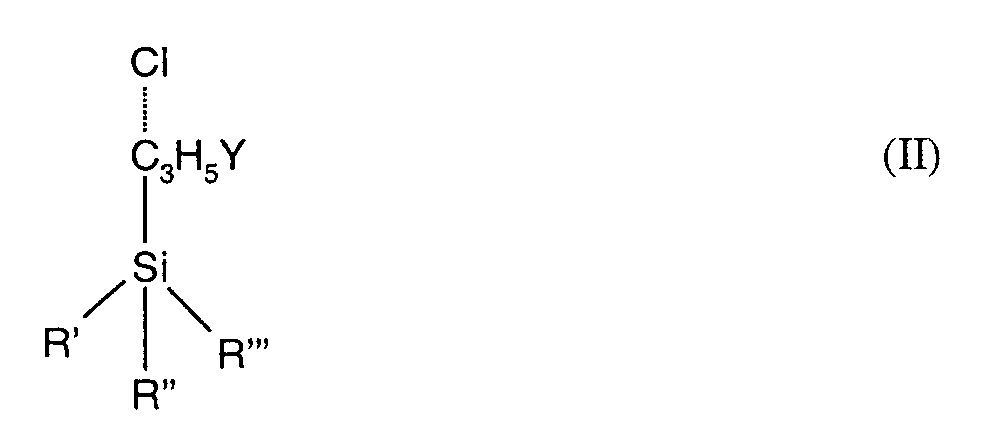
- the invention further relates to a process for the preparation of organosilicon compounds of the general formula I, which is characterized in that compounds of the general formula (II) and / or mixtures thereof, where R ', R'',R''', Y and " ⁇ " have the meaning according to formula I, with MSH, M 2 S z or with M 2 S / S, where M is an ammonium ion or metal ion , for example sodium ion or potassium ion, and z is a number between 2 and 6 on average.
- a solvent preferably in an inert solvent or mixtures thereof, as in an aromatic solvent, for example Chlorobenzene, a halogenated hydrocarbon, for example chloroform or methylene chloride, one Ethers, for example diisopropyl ether, tert. Butyl methyl ether, tetrahydrofuran or diethyl ether, Acetonitrile, carboxylic acid esters, for example Ethyl acetate, methyl acetate or Isopropyl acetate, an alcohol, for example Methanol, ethanol, n-propanol, i-propanol, n-butanol, sec. Butanol or tert. Butanol.
- the reaction temperatures can be between 20 ° C and 150 ° C, preferably 35 ° C to 100 ° C, particularly preferably 55 ° C to 85 ° C.
- the compound of the formula II can be added to a suspension of MSH, M 2 S / S or M 2 S z in a solvent.
- the reaction can take up to 24 hours, preferably 1 to 8 hours, be.
- the compounds of formula I according to the invention can be used as clear, yellow to red colored liquids remain.
- ethanol can be used as Solvents are used.
- the Implementations under absolute conditions, that is under Exclusion of moisture. It can predried solvents such as ethanol p.a., can be used.
- Sodium can be used as a particularly suitable metal ion of the compounds MSH, M 2 S z , M 2 S.
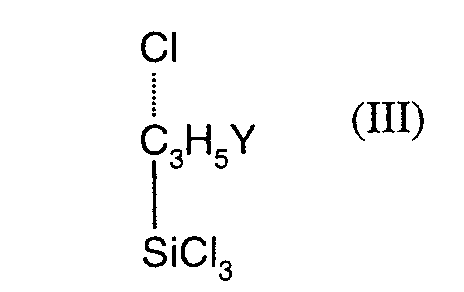
- Compounds of the general formula (II) and / or mixtures thereof can be obtained from mixtures of the compounds of the general formula (III) by suitable reactions (for example alkoxy compounds by alcoholysis, haloalkoxy compounds by reaction with haloalcohols), where Y and " ⁇ " have the aforementioned meaning, are produced.
- Compounds of the general formula (III) and / or mixtures thereof can be obtained by thermal chlorination of propyltrichlorosilane (PTS) (Cl 3 Si-C 3 H 7 + Cl 2 ⁇ Cl ⁇ ⁇ C 3 H 5 Y- (SiCl 3 ) + HCl) at temperatures of 70 ° to 150 °.
- PTS propyltrichlorosilane
- Propyltrichlorosilane and chlorine can be used in a molar ratio of 1: 0.5 to 1: 1/6. This reaction does not require any catalysts or light.
- the trichlorosilyl group of organochlorosilanes is inert to the chlorination, which means that, for example, no SiCl 4 is split off.
- the reaction can expediently take place in the liquid phase at the boiling point of the propyltrichlorosilane.
- the chlorine gas can be dried beforehand and passed through the reaction mixture in finely divided gaseous form.
- the HCl generated as a by-product can leave the system via a reflux condenser.
- the chlorination can expediently be carried out when the chlorine deficit is high in order to statistically avoid the formation of dichlorides.
- Analogous processes are known and are used on an industrial scale, for example for the production of mono-chloroalkanes (Ullmann Volume 9, "Chlorinated hydrocarbons, aliphatic"). These chlorinations can be carried out in such a way that part of the chlorination mixture, which contains a large excess of propyltrichlorosilane, is continuously separated into the starting material and product by distillation and the starting material propyltrichlorosilane is returned to the reaction space. This results in a continuous mode of operation and the formation of undesired dichloropropyltrichlorosilanes is largely suppressed.
- PTS Propyltrichlorosilane
- Rubber compounds which are characterized by that they are rubber, filler, preferably precipitated Silica and / or soot, at least one Organosilicon compound of formula (I) and optionally contain further rubber auxiliaries.
- the rubber mixtures according to the invention can be further Auxiliary rubber products include, among others Reaction accelerators, retarders, anti-aging agents, Stabilizers, processing aids, plasticizers, Waxes, metal oxides and activators such as triethanolamine, Polyethylene glycol, hexanetriol, that of the rubber industry are known.
- the rubber auxiliaries are in usual amounts, the depend, among other things, on the intended use, used. Usual amounts are, for example, amounts of 0.1 up to 50% by weight based on rubber.
- Sulfur or organic can be used as crosslinkers Serve sulfur donors.
- Rubber compounds can also be used Vulcanization accelerator included.
- Suitable vulcanization accelerators are Mercaptobenzthiazoles, sulfenamides, guanidines, thiurams, Dithiocarbamates, thioureas and thiocarbonates.
- the vulcanization accelerators and sulfur can be in Amounts of 0.1 to 10% by weight, preferably 0.1 to 5% by weight, based on rubber, are used.
- the mixing of the rubbers with the filler, optionally rubber auxiliaries and the organosilanes can be used in conventional mixing units, such as rollers, internal mixers and mixing extruders.
- rubber compounds are used in internal mixers manufactured, initially in one or more successive thermomechanical mixing stages Rubbers, the filler, the organosilanes and the Rubber auxiliaries are mixed in at 100 to 170 ° C.
- the order of addition and the The time of addition of the individual components is decisive for the obtained mixing properties affect.
- the so rubber mixture obtained is then usually in with an internal mixer or on a roller at 40-110 ° C crosslinking chemicals and the so-called Raw mix for the subsequent process steps, such as Example shaping and vulcanization, processed.
- the vulcanization of the rubber mixtures according to the invention can at temperatures of 80 to 200 ° C, preferably 130 to 180 ° C, optionally under pressure from 10 to 200 bar respectively.
- the rubber mixtures according to the invention are suitable for Manufacture of moldings, for example for the Manufacture of pneumatic tires, tire treads, Cable jackets, hoses, drive belts, conveyor belts, Roll coverings, tires, shoe soles, sealing rings and Damping elements.
- the inventive method has the advantage that the production of bis- (3- [triethoxysilyl] propyl) Tetrasulfan by-product in large quantities Propyltrichlorosilane is used sensibly.
- the product formed has the following composition (% by weight): 9.95% 1-chloropropyltrichlorosilane, 42.11% 2-chloropropyltrichlorosilane, 45.48% 3-chloropropyltrichlorosilane and 2.73% dichlorinated products (6 isomers in total).
- the formulation used for the rubber compounds is given in Table 1 below.
- the unit phr means parts by weight based on 100 parts of the raw rubber used.
- the general process for the production of rubber mixtures and their vulcanizates is described in the following book: "Rubber Technology Handbook", W. Hofmann, Hanser Verlag 1994.
- the polymer VSL 5025-1 is a in solution polymerized SBR copolymer from Bayer AG with a Styrene content of 25% by weight and a butadiene content of 75 Wt .-%. Of the butadiene, 73% are 1,2, 10% cis 1,4 and 17 % trans 1.4 linked.
- the copolymer contains 37.5 phr oil and has a Mooney viscosity (ML 1 + 4/100 ° C) of 50 ⁇ 4 on.
- the polymer Buna CB 24 is a cis 1,4-polybutadiene (Neodymium type) from Bayer AG with cis 1,4-content of 97%, a trans 1,4-content of 2%, a 1,2-content of 1% and a Mooney viscosity of 44 ⁇ 5.
- Vulkanox 4020 is 6PPD the Bayer AG and Protektor G35P is an ozone protection wax from HB Fuller GmbH.
- Vulkacit D (DPG) and Vulkazit CZ (CBS) are Trading products from Bayer AG.
- Ultrasil 7000 GR is a well dispersible precipitated silica from Degussa-Hüls AG with a BET surface area of 170 m 2 / g.
- the monofunctional silane hexadecyltriethoxysilane (HDTES) from Degussa-Hüls AG is used as a reference.
- step 1 settings mixing unit Werner & Pfleiderer E-type rotational speed 70 min -1 stamp printing 5.5 bar void 1.58 L filling level 0.56 Flow temp 80 ° C mixing process 0 to 1 min Buna VSL 5025-1 + Buna CB 24 1 to 3 min 1/2 silica, ZnO, Stearic acid, Naftolen ZD, silane 3 to 4 min 1/2 silica, protection against aging 4 min Clean 4 to 5 min Mix 5 min Clean 5 to 6 min Mix and extend Batch temp. 145-150 ° C storage 24 h at room temperature
- Table 3 lists the methods for rubber testing. Physical testing Standard / Conditions ML 1 + 4, 100 ° C, 3rd stage DIN 53523/3, ISO 667 Vulkameter test, 165 ° C DIN 53529/3, ISO 6502 Dmax-Dmin (dNm) t10% and t90% (min) Tensile test on the ring, 23 ° C DIN 53504, ISO 37 Tensile strength (Mpa) Voltage values (Mpa) Elongation at break (%) Shore A hardness, 23 ° C (SH) DIN 53 505 Viscoelastic properties, DIN 53 513, ISO 2856 0 to 60 ° C, 16 Hz, 50 N preload and 25 N amplitude force Memory module E '(Mpa) Loss module E '' (Mpa) Loss factor tan ⁇ () Ball rebound, 23 ° C (%) ASTM D 5308 DIN output, 10 N force (mm 3 ) DIN 53 516 Dispersion () ISO / DIS 11345
- the reference mixture (A) with 5 phr des Alkylsilane hexadecyltriethoxysilane and 2.2 phr sulfur with the mixture (B), the 6.4 phr of the invention Contains silanes according to Example 3 and 1.5 phr sulfur, compared.
- the amounts of sulfur are chosen so that the Amounts of mobile sulfur are comparable.
- the Alkylsilane Hexadecyltriethoxysilan hydrophobized only the silica. A connection to Rubber cannot be made.
- Table 4 shows the results of the rubber test.
- Mixture (A) is vulcanized for 40 minutes and mixture (B) at 165 ° C. for 20 minutes.
Landscapes
- Chemical & Material Sciences (AREA)
- Organic Chemistry (AREA)
- Health & Medical Sciences (AREA)
- Chemical Kinetics & Catalysis (AREA)
- Medicinal Chemistry (AREA)
- Polymers & Plastics (AREA)
- Compositions Of Macromolecular Compounds (AREA)
- Polymers With Sulfur, Phosphorus Or Metals In The Main Chain (AREA)
Abstract
Die Erfindung betrifft Organosiliciumverbindungen der allgemeinen Formel I, <IMAGE> Die Organosiliciumverbindungen werden hergestellt aus einer Verbindung der allg. Formel (II) <IMAGE> durch Umsetzung mit MSH, M2Sz oder M2S/S. Die Organosiliciumverbindungen können in Kautschukmischungen verwendet werden.
Description
Die vorliegende Erfindung betrifft
Organosiliciumverbindungen, ein Verfahren zu ihrer
Herstellung und ihrer Verwendung in Kautschukmischungen.
Es ist bekannt, schwefelhaltige Organosiliciumverbindungen,
wie 3-Mercaptopropyltrimethoxysilan oder
Bis-(3-[Triethoxysilyl]-propyl)tetrasulfan, als
Silanhaftvermittler oder Verstärkungsadditiv in oxidisch
gefüllten Kautschukmischungen, wie zum Beispiel für
Laufflächen und andere Teile von Autoreifen, einzusetzen
(DE 2 141 159, DE 2 212 239, US 3 978 103, US 4 048 206).
Des weiteren ist bekannt, daß schwefelhaltige
Silanhaftvermittler bei der Herstellung von
Dichtungsmassen, Gießformen für den Metallguß, Farb- und
Schutzanstrichen, Klebstoffen, Asphaltmischungen und
oxidisch gefüllten Kunststoffen, Fixierung von Wirkstoffen
und funktionellen Einheiten auf anorganischen
Trägermaterialien, zum Beispiel bei der Immobilisierung von
homogenen Katalysatoren und Enzymen, Festbettkatalysatoren
und bei der Flüssigkeitschromatographie verwendet werden.
Es ist aus EP 0 969 033 bekannt, dass schwefelfunktionelle
Organosilane, die mehr als eine Polysulfanfunktion pro
Siliciumeinheit besitzen, und daher polymere oder oligomere
Strukturen ausbilden, durch erhöhte Kopplungsausbeuten ein
verbessertes Eigenschaftsbild in Kautschukmischungen
besitzen. Diese Silane haben allerdings den Nachteil, dass
die für ihre Herstellung als Rohstoff benötigten
olefinischen Dichloride, wie zum Beispiel 3,4-Dichlorbuten,
nicht in großtechnischen Mengen zur Verfügung stehen.
Bei der Herstellung von 3-Chlorpropyltrichlorsilan, welches
als Ausgangsmaterial zur Herstellung von
organofunktionellen Silanen, wie zum Beispiel 3-Mercaptopropyltrimethoxysilan
oder
Bis-(3-[triethoxysilyl]-propyl)tetrasulfan, in großen
Mengen benötigt wird, entstehen durch eine unerwünschte
Nebenreaktion große Mengen an Propyltrichlorsilan (PTS) (EP
0 519 181). Diese Nebenreaktion verbraucht zusätzlich das
heute als Rohstoff knappe Trichlorsilan und macht dadurch
das Verfahren zu ihrer Herstellung der oben genannten
Haftvermittler teuer.
Nachteile der bekannten Organosiliciumverbindungen sind die
teuren Ausgangsverbindungen beziehungsweise ist die Bildung
von großen Mengen an Nebenprodukten wie
Propyltrichlorsilan.
Aufgabe der vorliegenden Erfindung ist es auf Basis des
Nebenproduktes Propyltrichlorsilan neue Haftvermittler für
Kautschukanwendungen zu entwickeln, die preiswert
hergestellt werden können und mindestens genauso
wirkungsvoll wie zum Beispiel Bis-(3-[triethoxysilyl]propyl)tetrasulfan
sind.
Gegenstand der Erfindung sind Organosiliciumverbindungen,
welche dadurch gekennzeichnet sind, dass diese der
allgemeinen Formel I entsprechen,
 wobei
wobei
Die "·····" in Formel (I) stellen eine chemische Bindung dar,
die an jedes der drei C-Atome der C3H5(Y)-Gruppe gebunden
sein kann und die 5 Wasserstoffe sowie die Gruppe Y die
jeweils freien Valenzen besetzen.
Ein weiterer Gegenstand der Erfindung ist ein Verfahren zur
Herstellung von Organosiliciumverbindungen der allgemeinen
Formel I, welches dadurch gekennzeichnet ist, dass man
Verbindungen der allgemeinen Formel (II) und/oder deren
Gemische,
 wobei R', R'', R''', Y und "·····" die Bedeutung gemäß Formel
I haben, mit MSH, M2Sz oder mit M2S/S, wobei M ein
Ammoniumion oder Metallion, beispielsweise Natriumion oder
Kaliumion, und z im statistischen Mittel eine Zahl zwischen
2 und 6 ist, umsetzt.
wobei R', R'', R''', Y und "·····" die Bedeutung gemäß Formel
I haben, mit MSH, M2Sz oder mit M2S/S, wobei M ein
Ammoniumion oder Metallion, beispielsweise Natriumion oder
Kaliumion, und z im statistischen Mittel eine Zahl zwischen
2 und 6 ist, umsetzt.
In einer Ausführungsform des erfindungsgemäßen Verfahrens
kann die Umsetzung in einem Lösungsmittel, vorzugsweise in
einem inerten Lösungsmittel oder Gemischen davon, wie in
einem aromatischen Lösungsmittel, beispielsweise
Chlorbenzol, einem halogenierten Kohlenwasserstoff,
beispielsweise Chloroform oder Methylenchlorid, einem
Ether, beispielsweise Diisopropylether, tert.
Butylmethylether, Tetrahydrofuran oder Diethylether,
Acetonitril, Carbonsäureester, beispielsweise
Essigsäureethylester, Essigsäuremethylester oder
Essigsäureisopropylester, einem Alkohol, beispielsweise
Methanol, Ethanol, n-Propanol, i-Propanol, n-Butanol, sec.
Butanol oder tert. Butanol, durchgeführt werden.
Die Reaktionstemperaturen können zwischen 20°C und 150°C,
vorzugsweise 35°C bis 100°C, besonderes bevorzugt 55 °C bis
85°C, betragen.
Gegebenenfalls kann die Umsetzung unter katalytischen
Bedingungen bei Drücken zwischen Normaldruck oder einem
Überdruck bis zu 6 bar erfolgen.
Zu einer Suspension von MSH, M2S/S oder M2Sz in einem
Lösungsmittel kann die Verbindung der Formel II zugegeben
werden.
Die Umsetzungsdauer kann bis 24 h, vorzugsweise 1 bis 8 h,
betragen.
Nach Reaktionsende kann vom entstandenen Niederschlag
abfiltiert und das Lösungsmittel entfernt werden.
Die erfindungsgemäßen Verbindungen der Formel I können als
klare, gelb bis rot gefärbte Flüssigkeiten zurückbleiben.
In einer bevorzugten Ausführungsform kann Ethanol als
Lösungsmittel verwendet werden. Vorzugsweise können die
Umsetzungen unter absoluten Bedingungen, das heißt unter
Feuchtigkeitsausschluß, durchgeführt werden. Es können
vorgetrocknete Lösungsmittel, wie beispielsweise Ethanol
p.a., verwendet werden.
Besonders geeignet als Metallion der Verbindungen MSH,
M2Sz, M2S kann Natrium verwendet werden.
Verfahren zur Sulfidierung sind und in JP 722 8588,
US-A 54 05 985 und US-A 54 66 848 beschrieben. Die
Umsetzung kann katalysiert erfolgen. Der Katalysator kann
dabei in katalytischen oder stöchiometrischen Mengen
eingesetzt werden.
Verbindungen der allgemeinen Formel(II) und/oder deren
Gemische können durch geeignete Reaktionen (z.B.
Alkoxyverbindungen durch Alkoholyse, Haloalkoxyverbindungen
durch Umsetzung mit Haloalkoholen) aus Gemischen der
Verbindungen der allgemeinen Formel (III),
 wobei Y und "·····" die vorgenannte Bedeutung haben,
hergestellt werden. Verbindungen der allgemeinen Formel
(III) und/oder deren Gemische können durch thermische
Chlorierung von Propyltrichlorsilan
(PTS) ( Cl3Si-C3H7 + Cl2 → Cl·····C3H5Y-(SiCl3) + HCl ) bei
Temperaturen von 70° bis 150° hergestellt werden.
Propyltrichlorsilan und Chlor können in einem molaren
Verhältnis von 1:0,5 bis 1:1/6 verwendet werden. Diese
Reaktion erfordert keinerlei Katalysatoren oder Licht. Die
Trichlorsilylgruppe von Organochlorsilanen ist gegenüber
der Chlorierung inert, das heißt es wird beispielsweise
kein SiCl4 abgespalten. Die Reaktion kann zweckmäßiger
Weise in flüssiger Phase beim Siedepunkt des
Propyltrichlorsilan erfolgen. Das Chlorgas kann vorher
getrocknet und fein verteilt gasförmig durch die
Reaktionsmischung geleitet werden. Das als Nebenprodukt
entstehende HCl kann über einen Rückflusskühler das System
verlassen. Die Chlorierung kann zweckmäßigerweise bei hohem
Chlorunterschuss durchgeführt werden, um die Bildung von
Dichloriden statistisch zu vermeiden. Analoge Verfahren
sind bekannt und werden beispielsweise für die Herstellung
von Mono-Chloralkanen großtechnisch angewendet (Ullmann
Band 9, "Chlorkohlenwasserstoffe, aliphatische"). Diese
Chlorierungen können so betrieben werden, dass ständig ein
Teil der Chlorierungsmischung, die einen hohen Überschuss
an Propyltrichlorsilan enthält, destillativ in Edukt und
Produkt aufgetrennt wird und das Edukt Propyltrichlorsilan
in den Reaktionsraum zurückgeführt wird. Somit ist eine
kontinuierliche Fahrweise gegeben und die Bildung von
unerwünschten Dichlorpropyltrichlorsilanen weitestgehend
unterdrückt. Propyltrichlorsilan (PTS), deren drei mögliche
Isomeren 1-Chlorpropyltrichlorsilan, 2-Chlorpropyltrichlorsilan
und 3-Chlorpropyltrichlorsilan
(Verhältnis ca. 1:4:4), sowie die in geringem Maße
gebildeten höher chlorierten Produkte lassen sich
destillativ trennen.
wobei Y und "·····" die vorgenannte Bedeutung haben,
hergestellt werden. Verbindungen der allgemeinen Formel
(III) und/oder deren Gemische können durch thermische
Chlorierung von Propyltrichlorsilan
(PTS) ( Cl3Si-C3H7 + Cl2 → Cl·····C3H5Y-(SiCl3) + HCl ) bei
Temperaturen von 70° bis 150° hergestellt werden.
Propyltrichlorsilan und Chlor können in einem molaren
Verhältnis von 1:0,5 bis 1:1/6 verwendet werden. Diese
Reaktion erfordert keinerlei Katalysatoren oder Licht. Die
Trichlorsilylgruppe von Organochlorsilanen ist gegenüber
der Chlorierung inert, das heißt es wird beispielsweise
kein SiCl4 abgespalten. Die Reaktion kann zweckmäßiger
Weise in flüssiger Phase beim Siedepunkt des
Propyltrichlorsilan erfolgen. Das Chlorgas kann vorher
getrocknet und fein verteilt gasförmig durch die
Reaktionsmischung geleitet werden. Das als Nebenprodukt
entstehende HCl kann über einen Rückflusskühler das System
verlassen. Die Chlorierung kann zweckmäßigerweise bei hohem
Chlorunterschuss durchgeführt werden, um die Bildung von
Dichloriden statistisch zu vermeiden. Analoge Verfahren
sind bekannt und werden beispielsweise für die Herstellung
von Mono-Chloralkanen großtechnisch angewendet (Ullmann
Band 9, "Chlorkohlenwasserstoffe, aliphatische"). Diese
Chlorierungen können so betrieben werden, dass ständig ein
Teil der Chlorierungsmischung, die einen hohen Überschuss
an Propyltrichlorsilan enthält, destillativ in Edukt und
Produkt aufgetrennt wird und das Edukt Propyltrichlorsilan
in den Reaktionsraum zurückgeführt wird. Somit ist eine
kontinuierliche Fahrweise gegeben und die Bildung von
unerwünschten Dichlorpropyltrichlorsilanen weitestgehend
unterdrückt. Propyltrichlorsilan (PTS), deren drei mögliche
Isomeren 1-Chlorpropyltrichlorsilan, 2-Chlorpropyltrichlorsilan
und 3-Chlorpropyltrichlorsilan
(Verhältnis ca. 1:4:4), sowie die in geringem Maße
gebildeten höher chlorierten Produkte lassen sich
destillativ trennen.
Ein weiterer Gegenstand der Erfindung sind
Kautschukmischungen, welche dadurch gekennzeichnet sind,
daß sie Kautschuk, Füllstoff, vorzugsweise gefällte
Kieselsäure und/oder Ruß, mindestens eine
Organosiliciumverbindung der Formel (I) und gegebenenfalls
weitere Kautschukhilfsmittel enthalten.
Für die Herstellung erfindungsgemäßer Kautschukmischungen
eignen sich neben Naturkautschuk auch Synthesekautschuke.
Bevorzugte Synthesekautschuke sind beispielsweise bei W.
Hofmann, Kautschuktechnologie, Genter Verlag, Stuttgart
1980, beschrieben. Sie umfassen u.a.
- Polybutadien (BR)
- Polyisopren (IR)
- Styrol/Butadien-Copolymerisate mit Styrolgehalten von 1 bis 60, vorzugsweise 5 bis 50 Gew.-% (SBR)
- Isobutylen/Isopren-Copolymerisate (IIR)
- Butadien/Acrylnitril-Copolymere mit Acrylnitrilgehalten von 5 bis 60, vorzugsweise 10 bis 50 Gew. -% (NBR)
- Ethylen/Propylen/Dien-Copolymerisate (EPDM)
Die erfindungsgemäßen Kautschukmischungen können weitere
Kautschukhilfsprodukte enthalten wie unter anderem
Reaktionsbeschleuniger, -verzögerer, Alterungsschutzmittel,
Stabilisatoren, Verarbeitungshilfsmittel, Weichmacher,
Wachse, Metalloxide sowie Aktivatoren, wie Triethanolamin,
Polyethylenglykol, Hexantriol, die der Kautschukindustrie
bekannt sind.
Die Kautschukhilfsmittel werden in üblichen Mengen, die
sich unter anderem nach dem Verwendungszweck richten,
eingesetzt. Übliche Mengen sind zum Beispiel Mengen von 0,1
bis 50 Gew.-% bezogen auf Kautschuk.
Als Vernetzer können Schwefel oder organische
Schwefelspender dienen. Die erfindungsgemäßen
Kautschukmischungen können darüber hinaus
Vulkanisationsbeschleuniger enthalten.
Beispiele für geeignete Vulkanisationsbeschleuniger sind
Mercaptobenzthiazole, Sulfenamide, Guanidine, Thiurame,
Dithiocarbamate, Thioharnstoffe und Thiocarbonate.
Die Vulkanisationsbeschleuniger und Schwefel können in
Mengen von 0,1 bis 10 Gew.-%, bevorzugt 0,1 bis 5 Gew.-%,
bezogen auf Kautschuk, eingesetzt werden.
Die Abmischung der Kautschuke mit dem Füllstoff,
gegebenenfalls Kautschukhilfsmitteln und der Organosilane
kann in üblichen Mischaggregaten, wie Walzen, Innenmischern
und Mischextrudern, durchgeführt werden. Üblicherweise
werden solche Kautschukmischungen im Innenmischern
hergestellt, wobei zunächst in einer oder mehreren
aufeinanderfolgenden thermomechanischen Mischstufen die
Kautschuke, der Füllstoff, die Organosilane und die
Kautschukhilfsmittel bei 100 bis 170°C eingemischt werden.
Dabei kann sich die Zugabereihenfolge und der
Zugabezeitpunkt der Einzelkomponenten entscheidend auf die
erhaltenen Mischungseigenschaften auswirken. Die so
erhaltene Kautschukmischung wird dann üblicherweise in
einem Innenmischer oder auf einer Walze bei 40-110°C mit
den Vernetzungschemikalien versetzt und zur sogenannten
Rohmischung für die nachfolgenden Prozeßschritte, wie zum
Beispiel Formgebung und Vulkanisation, verarbeitet.
Die Vulkanisation der erfindungsgemäßen Kautschukmischungen
kann bei Temperaturen von 80 bis 200°C, bevorzugt 130 bis
180°C, gegebenenfalls unter Druck von 10 bis 200 bar
erfolgen.
Die erfindungsgemäßen Kautschukmischungen eignen sich zur
Herstellung von Formkörpern, zum Beispiel für die
Herstellung von Luftreifen, Reifenlaufflächen,
Kabelmänteln, Schläuchen, Treibriemen, Förderbändern,
Walzenbelägen, Reifen, Schuhsolen, Dichtungsringen und
Dämpfungselementen.
Das erfindungsgemäße Verfahren hat den Vorteil, daß das bei
der Herstellung von Bis- (3-[triethoxysilyl]-propyl)
tetrasulfan in großen Mengen anfallende Nebenprodukt
Propyltrichlorsilan sinnvoll verwertet wird.
Durch die thermische Chlorierung von Propyltrichlorsilan
(PTS) wird ein einfacher und preiswerter Zugang zu
schwefelfunktionellen Haftvermittlern erhalten. Die
Wirkungsweise als Haftvermittler in Kautschukmischungen ist
mit derjenigen von Bis-(3-[triethoxysilyl]propyl)tetrasulfan
identisch. Bei erhöhtem Anteil von
Polysulfanfunktionen pro Siliciumeinheit kann, welche durch
überstöchiometrische Chlorierung erzielt werden kann, die
Wirksamkeit als Haftvermittler sogar gesteigert werden.
In einem 11-Vierhalskolben mit Gaseinleitungsrohr,
Tropftrichter, Rückflußkühler, Heizpilz und
Innenthermometer werden 500 g Propyltrichlorsilan vorgelegt
und zum Rückfluss erhitzt. Über einen Auslass am Boden des
Kolbens werden mittels einer Dosierpumpe pro Stunde ca. 400
ml Flüssigkeit entnommen und auf eine Destillationskolonne
gegeben, die in der Lage ist, die chlorierten Produkte als
Sumpf sauber abzutrennen. Das Kopfprodukt dieser Kolonne
enthält somit fast reines Propyltrichlorsilan, welches
zurück in den Reaktionskolben fließt. Nachdem sich hier ein
stabiler Kreislauf gebildet hat, wird mit der Dosierung von
40 g Chlorgas pro Stunde begonnen, welches zuvor mittels
Durchleiten durch konzentrierte Schwefelsäure getrocknet
wird. Gleichzeitig werden über den Tropftrichter 100 g
Propyltrichlorsilan pro Stunde dosiert, sodass sich
insgesamt ein kontinuierlicher Betrieb ergibt. Am Boden der
Kolonne werden nach Einstellung eines stationären
Betriebszustands pro Stunde ca. 120 g chloriertes Produkt
abgezogen. Durch diese Fahrweise ergibt sich rechnerisch
bei der Chlorierung ein molarer vierfacher Propyltrichlorsilan
-Überschuss, so dass die Bildung von
Dichloriden zurückgedrängt wird.
Das gebildete Produkt besitzt laut Gaschromatographie folgende Zusammensetzung (Gew%): 9,95% 1-Chlorpropyltrichlorsilan, 42,11% 2-Chlorpropyltrichlorsilan, 45,48% 3-Chlorpropyltrichlorsilan und 2,73% dichlorierter Produkte (insgesamt 6 Isomere).
Das gebildete Produkt besitzt laut Gaschromatographie folgende Zusammensetzung (Gew%): 9,95% 1-Chlorpropyltrichlorsilan, 42,11% 2-Chlorpropyltrichlorsilan, 45,48% 3-Chlorpropyltrichlorsilan und 2,73% dichlorierter Produkte (insgesamt 6 Isomere).
460,5 g des Produktgemisches aus Beispiel 1 werden in einem
1 l-Dreihalskolben mit Gaseinleitungsrohr, Rückflusskühler
und Rührer tropfenweise unter Durchleiten von N2 (um
entstehendes HCl auszutreiben) mit 413 ml Ethanol (10%
Überschuss) versetzt. Nach Beendigung der Zugabe wird noch
1 h unter Rühren erhitzt. Nach Abkühlung wird die
Reaktionsmischung durch Zugabe von 50 ml Natriumethanolat
neutralisiert und anschließend filtriert. Man erhält 492,1
g einer klaren Flüssigkeit, die NMR-analytisch als Gemisch
aus 30% 3-Chlorpropyltriethoxysilan, 33% 2-Chlorpropyltriethoxysilan,
8% 1-Chlorpropyltriethoxysilan
sowie geringen Anteile anderer Verbindungen identifiziert
wird.
158,9 g des Silangemisches aus Beispiel 2 werden in 160 ml
Ethanol gelöst und mit 34,9 g Schwefel vermischt.
Anschließend gibt man 28,3 g getrocknetes Na2S zu, wobei
die Reaktionswärme die gerührte Reaktionsmischung zum
Sieden bringt. Man läßt 2 h unter Rückfluss reagieren,
kühlt ab und filtriert von dem entstanden Feststoff ab.
Nach Abdestillieren des Lösungsmittels verbleiben 141,9 g
einer roten, klaren Flüssigkeit, die nach Elementaranalyse
19,8 Gew% Schwefel enthält, zurück.
Die für die Kautschukmischungen verwendete Rezeptur ist in
der folgenden Tabelle 1 angegeben. Dabei bedeutet die
Einheit phr Gewichtsanteile bezogen auf 100 Teile des
eingesetzten Rohkautschuks. Das allgemeine Verfahren zur
Herstellung von Kautschukmischungen und deren Vulkanisate
ist in dem folgenden Buch beschrieben: "Rubber Technology
Handbook", W. Hofmann, Hanser Verlag 1994.
| Substanz | Bsp. (phr) |
| 1. Stufe | |
| Buna VSL 5025-1 | 96 |
| Buna CB 24 | 30 |
| Ultrasil 7000 GR | 80 |
| ZnO | 3 |
| Stearinsäure | 2 |
| Naftolen ZD | 10 |
| Vulkanox 4020 | 1,5 |
| Protector G 35 P | 1 |
| Silane gemäß Bsp. | variabel |
| 2. Stufe | |
| Batch Stufe 1 | |
| 3. Stufe | |
| Batch Stufe 2 | |
| Vulkacit D | 1 |
| Vulkacit CZ | 1,5 |
| Schwefel | variabel |
Bei dem Polymer VSL 5025-1 handelt es sich um ein in Lösung
polymerisiertes SBR-Copolymer der Bayer AG mit einem
Styrolgehalt von 25 Gew.-% und einem Butadiengehalt von 75
Gew.-%. Von dem Butadien sind 73 % 1,2, 10 % cis 1,4 und 17
% trans 1,4 verknüpft. Das Copolymer enthält 37,5 phr Öl
und weist eine Mooney-Viskosität (ML 1+4/100°C) von 50 ±4
auf.
Bei dem Polymer Buna CB 24 handelt es sich um ein cis 1,4-Polybutadien
(Neodymtyp) der Bayer AG mit cis 1,4-Gehalt
von 97 %, einem trans 1,4-Gehalt von 2 %, einem 1,2-Gehalt
von 1 % und einer Mooney-Viskosität von 44 ±5.
Als aromatisches Öl wird Naftolen ZD der Chemetall
verwendet. Bei Vulkanox 4020 handelt es sich um 6PPD der
Bayer AG und Protektor G35P ist ein Ozonschutzwachs der HB-Fuller
GmbH. Vulkacit D (DPG) und Vulkazit CZ (CBS) sind
Handelsprodukte der Bayer AG.
Ultrasil 7000 GR ist eine gut dispergierbare gefällte
Kieselsäure der Degussa-Hüls AG mit einer BET Oberfläche
von 170 m2/g. Das monofunktionelle Silan
Hexadecyltriethoxysilan (HDTES) von der Degussa-Hüls AG
wird als Referenz verwendet.
Die Kautschukmischungen werden in einem Innenmischer
entsprechend der Mischvorschrift in Tabelle 2 hergestellt.
| Stufe 1 | |
| Einstellungen | |
| Mischaggregat | Werner & Pfleiderer E-Typ |
| Drehzahl | 70 min-1 |
| Stempeldruck | 5,5 bar |
| Leervolumen | 1,58 L |
| Füllgrad | 0,56 |
| Durchflußtemp | 80°C |
| Mischvorgang | |
| 0 bis 1 min | Buna VSL 5025-1 + Buna CB 24 |
| 1 bis 3 min | 1/2 Kieselsäure, ZnO, |
| Stearinsäure,Naftolen ZD, Silan | |
| 3 bis 4 min | 1/2 Kieselsäure, Alterungsschutz |
| 4 min | Säubern |
| 4 bis 5 min | Mischen |
| 5 min | Säubern |
| 5 bis 6 min | Mischen und ausfahren |
| Batch-Temp. | 145-150°C |
| Lagerung | 24 h bei Raumtemperatur |
| Stufe 2 | |
| Einstellungen | |
| Mischaggregat | wie in Stufe 1 bis auf: |
| Drehzahl | 80 min-1 |
| Durchflußtemp. | 80°C |
| Füllgrad | 0,53 |
| Mischvorgang | |
| 0 bis 2 min | Batch Stufe 1 aufbrechen |
| 2 bis 5 min | Batchtemperatur 150°C durch |
| Drehzahlvariation halten | |
| 5 min | Ausfahren |
| Batch-Temp. | 150°C |
| Lagerung | 4 h bei Raumtemperatur |
| Stufe 3 | |
| Einstellungen | |
| Mischaggregat | wie in Stufe 1 bis auf |
| Drehzahl | 40 min-1 |
| Füllgrad | 0,51 |
| Durchflußtemp | 50°C |
| Mischvorgang | |
| 0 bis 2 min | Batch Stufe 2, Beschleuniger,Schwefel |
| 2 min | ausfahren und auf Labormischwalzwerk |
| Fell bilden, (Durchmesser 200 mm, Länge 450 mm, Duchflußtemperatur 50°C) | |
| Homogenisieren: | |
| 3* links, 3* rechts einschneiden und | |
| umklappen sowie | |
| 8* bei weitem Walzenspalt (1 mm) und | |
| 3* bei engem Walzenspalt (3,5 mm) | |
| stürzen | |
| Fell ausziehen | |
| Batch-Temp | 85-95°C |
In Tabelle 3 sind die Methoden für die Gummitestung
zusammengestellt.
| Physikalische Testung | Norm/Bedingungen |
| ML 1+4, 100°C, 3. Stufe | DIN 53523/3, ISO 667 |
| Vulkameterprüfung, 165°C | DIN 53529/3, ISO 6502 |
| Dmax-Dmin (dNm) | |
| t10% und t90% (min) | |
| Zugversuch am Ring, 23°C | DIN 53504, ISO 37 |
| Zugfestigkeit (Mpa) | |
| Spannungswerte (Mpa) | |
| Bruchdehnung (%) | |
| Shore-A-Härte, 23°C (SH) | DIN 53 505 |
| Viskoelastische Eigenschaften, | DIN 53 513, ISO 2856 |
| 0 bis 60°C, 16 Hz, 50 N Vorkraft | |
| und 25 N Amplitudenkraft | |
| Speichermodul E' (Mpa) | |
| Verlustsmodul E'' (Mpa) | |
| Verlustfaktor tan δ () | |
| Ball Rebound, 23°C (%) | ASTM D 5308 |
| DIN-Abtrieb, 10 N Kraft (mm3) | DIN 53 516 |
| Dispersion ( ) | ISO/DIS 11345 |
In dem Beispiel wird die Referenzmischung (A) mit 5 phr des
Alkylsilans Hexadecyltriethoxysilan und 2,2 phr Schwefel
mit der Mischung (B), die 6,4 phr des erfindungsgemäßen
Silans gemäß Beispiel 3 und 1,5 phr Schwefel enthält,
verglichen. Die Schwefelmengen sind so gewählt, dass die
Mengen an mobilem Schwefel vergleichbar sind. Das
Alkylsilan Hexadecyltriethoxysilan hydrophobiert
ausschließlich die Kieselsäure. Eine Anbindung zum
Kautschuk kann nicht erfolgen.
Tabelle 4 zeigt die Ergebnisse der gummitechnischen
Prüfung. Die Mischung (A) wird 40 Minuten und die Mischung
(B) 20 min bei 165°C vulkanisiert.
| (A) | (B) | ||
| ML (1+4) | (ME) | 50 | 65 |
| Dmax-Dmin | (dNm) | 12,6 | 17,5 |
| t10% | (min) | 3,0 | 1,4 |
| t90% | (min) | 22,0 | 9,9 |
| Shore-A-Härte | (SH) | 51 | 63 |
| Zugfestigkeit | (MPa) | 10,9 | 16,9 |
| Spannungswert 100% | (MPa) | 0,9 | 1,7 |
| Spannungswert 300% | (MPa) | 2,9 | 8,2 |
| Bruchdehnung | (%) | 660 | 480 |
| DIN-Abrieb | (mm3) | 203 | 84 |
| Ball-Rebound | (%) | 27,5 | 33,0 |
| E' (0°C) | (MPa) | 11,1 | 14,2 |
| E" (0°C) | (MPa) | 5,3 | 6,8 |
| tan δ (0°C) | ( ) | 0,480 | 0,475 |
| E' (60°C) | (MPa) | 5,2 | 6,5 |
| E" (60°C) | (MPa) | 0,8 | 0,9 |
| tan δ (60°C) | ( ) | 0,153 | 0,135 |
| Dispersion | ( ) | 7 | 9 |
Wie man anhand der Daten in Tabelle 4 eindeutig erkennt,
liegt das Gummiwertebild der Mischung (B) mit dem
erfindungsgemäßen Silan deutlich über dem der Referenz (A).
Unter anderem belegen die höheren Spannungswerte, der
niedrigere DIN-Abrieb und der niedrigere tan δ (60°C) Wert
eine Kopplungsreaktion zwischen Füllstoff und Kautschuk.
Claims (7)
- Organosiliciumverbindungen, dadurch gekennzeichnet, dass diese der allgemeinen Formel I entsprechen,wobei
 R', R'', R''' unabhängig voneinander, (C1 - C4)Alkoxy, (C1- C4)Haloalkoxy oder Cl undY, H oder Cl bedeuten,x = 0 - 6 undn = 0 - 30 ist.
 - Verfahren zur Herstellung der Organosiliciumverbindungen nach Anspruch 1, dadurch gekennzeichnet, dass man Verbindungen der allgemeinen Formel (II) und/oder deren Gemische,wobei R', R'', R''' und Y die Bedeutung gemäß Formel I haben, mit MSH, M2Sz oder mit M2S/S, wobei M ein Ammoniumion oder Metallion, und z im statistischen Mittel eine Zahl zwischen 2 und 6 ist, umsetzt.
- Verfahren zur Herstellung der Organosiliciumverbindungen nach Anspruch 2, dadurch gekennzeichnet, daß man Verbindungen der allgemeinen Formel (III) und/oder deren Gemische,wobei Y die Bedeutung gemäß Formel I hat, mit Alkoholen oder Haloalkoholen zu Verbindungen der allgemeinen Formel (II) umsetzt.
- Verfahren zur Herstellung der Organosiliciumverbindungen nach Anspruch 3, dadurch gekennzeichnet, daß man Propyltrichlorsilan mit Chlor bei Temperaturen von 70° bis 150° zu Verbindungen der allgemeinen Formel (III) umsetzt.
- Verfahren zur Herstellung der Organosiliciumverbindungen nach Anspruch 4, dadurch gekennzeichnet, daß man Propyltrichlorsilan und Chlor in einem molaren Verhältnis von 1:0,5 bis 1:1/6 verwendet.
- Verwendung der Organosiliciumverbindungen nach Anspruch 1 in Kautschukmischungen.
- Kautschukmischungen, dadurch gekennzeichnet, daß sie Kautschuk, Füllstoff, mindestens eine Organosiliciumverbindung gemäß Anspruch 1 und gegebenenfalls weitere Kautschukhilfsmittel enthalten.
Priority Applications (5)
| Application Number | Priority Date | Filing Date | Title |
|---|---|---|---|
| EP00117799A EP1180522A1 (de) | 2000-08-18 | 2000-08-18 | Gemische von Alkoxysilyl-Propyl-Polysulfanen und Kautschukmischungen, die diese Gemische enthalten |
| KR1020010049274A KR20020014734A (ko) | 2000-08-18 | 2001-08-16 | 유기 규소 화합물 |
| US09/931,163 US20020042533A1 (en) | 2000-08-18 | 2001-08-17 | Organosilicon compounds |
| JP2001248980A JP2002193977A (ja) | 2000-08-18 | 2001-08-20 | 有機ケイ素化合物、その製法、その使用、およびそれを含有するゴム混合物 |
| CN01124186A CN1339438A (zh) | 2000-08-18 | 2001-08-20 | 有机硅化合物 |
Applications Claiming Priority (1)
| Application Number | Priority Date | Filing Date | Title |
|---|---|---|---|
| EP00117799A EP1180522A1 (de) | 2000-08-18 | 2000-08-18 | Gemische von Alkoxysilyl-Propyl-Polysulfanen und Kautschukmischungen, die diese Gemische enthalten |
Publications (1)
| Publication Number | Publication Date |
|---|---|
| EP1180522A1 true EP1180522A1 (de) | 2002-02-20 |
Family
ID=8169570
Family Applications (1)
| Application Number | Title | Priority Date | Filing Date |
|---|---|---|---|
| EP00117799A Withdrawn EP1180522A1 (de) | 2000-08-18 | 2000-08-18 | Gemische von Alkoxysilyl-Propyl-Polysulfanen und Kautschukmischungen, die diese Gemische enthalten |
Country Status (5)
| Country | Link |
|---|---|
| US (1) | US20020042533A1 (de) |
| EP (1) | EP1180522A1 (de) |
| JP (1) | JP2002193977A (de) |
| KR (1) | KR20020014734A (de) |
| CN (1) | CN1339438A (de) |
Families Citing this family (1)
| Publication number | Priority date | Publication date | Assignee | Title |
|---|---|---|---|---|
| CN105153216A (zh) * | 2015-08-07 | 2015-12-16 | 荆州市江汉精细化工有限公司 | 一种3-巯丙基三甲氧基硅烷的制备方法 |
Citations (4)
| Publication number | Priority date | Publication date | Assignee | Title |
|---|---|---|---|---|
| EP0732362A1 (de) * | 1995-03-14 | 1996-09-18 | The Goodyear Tire & Rubber Company | Mit Kieselsäure verstärkte Kautschukzusammensetzung und ihre Verwendung in Reifen |
| EP0819694A2 (de) * | 1996-07-18 | 1998-01-21 | Degussa Aktiengesellschaft | Gemische von Organilanpolysulfanen und ein Verfahren zur Herstellung von diese Gemische enthaltenden Kautschukmischungen |
| EP0839816A1 (de) * | 1996-10-31 | 1998-05-06 | The Goodyear Tire & Rubber Company | Herstellung von Schwefelhaltigen Organosiliziumverbindungen |
| EP0845472A2 (de) * | 1996-11-29 | 1998-06-03 | Shin-Etsu Chemical Co., Ltd. | Entschwefelung von Polysulfidsilanen |
-
2000
- 2000-08-18 EP EP00117799A patent/EP1180522A1/de not_active Withdrawn
-
2001
- 2001-08-16 KR KR1020010049274A patent/KR20020014734A/ko not_active Withdrawn
- 2001-08-17 US US09/931,163 patent/US20020042533A1/en not_active Abandoned
- 2001-08-20 CN CN01124186A patent/CN1339438A/zh active Pending
- 2001-08-20 JP JP2001248980A patent/JP2002193977A/ja active Pending
Patent Citations (4)
| Publication number | Priority date | Publication date | Assignee | Title |
|---|---|---|---|---|
| EP0732362A1 (de) * | 1995-03-14 | 1996-09-18 | The Goodyear Tire & Rubber Company | Mit Kieselsäure verstärkte Kautschukzusammensetzung und ihre Verwendung in Reifen |
| EP0819694A2 (de) * | 1996-07-18 | 1998-01-21 | Degussa Aktiengesellschaft | Gemische von Organilanpolysulfanen und ein Verfahren zur Herstellung von diese Gemische enthaltenden Kautschukmischungen |
| EP0839816A1 (de) * | 1996-10-31 | 1998-05-06 | The Goodyear Tire & Rubber Company | Herstellung von Schwefelhaltigen Organosiliziumverbindungen |
| EP0845472A2 (de) * | 1996-11-29 | 1998-06-03 | Shin-Etsu Chemical Co., Ltd. | Entschwefelung von Polysulfidsilanen |
Also Published As
| Publication number | Publication date |
|---|---|
| US20020042533A1 (en) | 2002-04-11 |
| JP2002193977A (ja) | 2002-07-10 |
| KR20020014734A (ko) | 2002-02-25 |
| CN1339438A (zh) | 2002-03-13 |
Similar Documents
| Publication | Publication Date | Title |
|---|---|---|
| EP1491547B1 (de) | Organosiliciumverbindungen | |
| EP1298163B1 (de) | Geblockte Mercaptosilane, Verfahren zu deren Herstellung und die enthaltenden Kautschukmischungen | |
| EP1043357B2 (de) | Kautschukmischungen | |
| EP1683801B1 (de) | Mercaptosilane | |
| EP1285926B1 (de) | Organosiliciumverbindungen | |
| DE60306779T3 (de) | Organosilankonzentrat | |
| EP0997489B1 (de) | Schwefelfunktionelle Polyorganosiloxane | |
| EP2026982B1 (de) | Kautschukmischungen | |
| EP0992505A2 (de) | Sulfanylsilane | |
| DE19825796A1 (de) | Neue oligomere Organosilanpolysulfane, deren Verwendung in Kautschukmischungen und zur Herstellung von Formkörpern | |
| EP1273612A2 (de) | Siloxan-Oligomere, Verfahren zu deren Herstellung und deren Verwendung | |
| EP1273613A2 (de) | Oligomere Organosilane, Verfahren zu deren Herstellung und deren Verwendung | |
| DE10163945C1 (de) | Geblockte Mercaptosilane, ein Verfahren zu ihrer Herstellung sowie ihre Verwendung | |
| EP2834294B1 (de) | Mercaptosilan-russ-abmischung | |
| EP1754749B1 (de) | Kautschukmischungen | |
| EP3094686A1 (de) | Oligomere organosilane, deren herstellung und verwendung in kautschukmischungen | |
| DE19829390A1 (de) | Neue oligomere Organosiliciumverbindungen, deren Verwendung in Kautschukmischungen und zur Herstellung von Formkörpern | |
| EP1394166B1 (de) | Organosiliciumverbindungen | |
| EP1094067B1 (de) | Organosiliciumverbindung, Verfahren zu ihrer Herstellung und deren Verwendung | |
| WO2019105758A1 (de) | Silanmischungen und verfahren zu deren herstellung | |
| EP1180522A1 (de) | Gemische von Alkoxysilyl-Propyl-Polysulfanen und Kautschukmischungen, die diese Gemische enthalten | |
| DE10163941C1 (de) | Organosiliciumverbindungen, ein Verfahren zu ihrer Herstellung, sowie ihre Verwendung | |
| EP1270658A1 (de) | Kautschukmischungen |
Legal Events
| Date | Code | Title | Description |
|---|---|---|---|
| PUAI | Public reference made under article 153(3) epc to a published international application that has entered the european phase |
Free format text: ORIGINAL CODE: 0009012 |
|
| 17P | Request for examination filed |
Effective date: 20000818 |
|
| AK | Designated contracting states |
Kind code of ref document: A1 Designated state(s): AT BE CH CY DE DK ES FI FR GB GR IE IT LI LU MC NL PT SE |
|
| AX | Request for extension of the european patent |
Free format text: AL;LT;LV;MK;RO;SI |
|
| AKX | Designation fees paid |
Free format text: AT BE CH CY DE DK ES FI FR GB GR IE IT LI LU MC NL PT SE |
|
| STAA | Information on the status of an ep patent application or granted ep patent |
Free format text: STATUS: THE APPLICATION IS DEEMED TO BE WITHDRAWN |
|
| 18D | Application deemed to be withdrawn |
Effective date: 20020821 |