EP1179539A1 - Novel protein having hemolytic activity and gene encoding the protein - Google Patents
Novel protein having hemolytic activity and gene encoding the protein Download PDFInfo
- Publication number
- EP1179539A1 EP1179539A1 EP01915654A EP01915654A EP1179539A1 EP 1179539 A1 EP1179539 A1 EP 1179539A1 EP 01915654 A EP01915654 A EP 01915654A EP 01915654 A EP01915654 A EP 01915654A EP 1179539 A1 EP1179539 A1 EP 1179539A1
- Authority
- EP
- European Patent Office
- Prior art keywords
- amino acid
- protein
- acid sequence
- hemolytic activity
- seq
- Prior art date
- Legal status (The legal status is an assumption and is not a legal conclusion. Google has not performed a legal analysis and makes no representation as to the accuracy of the status listed.)
- Granted
Links
Classifications
-
- C—CHEMISTRY; METALLURGY
- C07—ORGANIC CHEMISTRY
- C07K—PEPTIDES
- C07K14/00—Peptides having more than 20 amino acids; Gastrins; Somatostatins; Melanotropins; Derivatives thereof
- C07K14/435—Peptides having more than 20 amino acids; Gastrins; Somatostatins; Melanotropins; Derivatives thereof from animals; from humans
- C07K14/43504—Peptides having more than 20 amino acids; Gastrins; Somatostatins; Melanotropins; Derivatives thereof from animals; from humans from invertebrates
- C07K14/43595—Peptides having more than 20 amino acids; Gastrins; Somatostatins; Melanotropins; Derivatives thereof from animals; from humans from invertebrates from coelenteratae, e.g. medusae
-
- A—HUMAN NECESSITIES
- A61—MEDICAL OR VETERINARY SCIENCE; HYGIENE
- A61P—SPECIFIC THERAPEUTIC ACTIVITY OF CHEMICAL COMPOUNDS OR MEDICINAL PREPARATIONS
- A61P7/00—Drugs for disorders of the blood or the extracellular fluid
- A61P7/02—Antithrombotic agents; Anticoagulants; Platelet aggregation inhibitors
-
- A—HUMAN NECESSITIES
- A61—MEDICAL OR VETERINARY SCIENCE; HYGIENE
- A61P—SPECIFIC THERAPEUTIC ACTIVITY OF CHEMICAL COMPOUNDS OR MEDICINAL PREPARATIONS
- A61P7/00—Drugs for disorders of the blood or the extracellular fluid
- A61P7/04—Antihaemorrhagics; Procoagulants; Haemostatic agents; Antifibrinolytic agents
-
- A—HUMAN NECESSITIES
- A61—MEDICAL OR VETERINARY SCIENCE; HYGIENE
- A61K—PREPARATIONS FOR MEDICAL, DENTAL OR TOILETRY PURPOSES
- A61K38/00—Medicinal preparations containing peptides
Definitions
- the present invention relates to novel proteins having a hemolytic activity and genes encoding thereof. More specifically, the present invention relates to novel proteins having the hemolytic activity, a process for producing thereof, reagents, pesticides and medicines utilizing physiological activities thereof.
- the sting injury by the jellyfish in sea bathing has occurred in various parts of the world.
- the sting injury by Carybdea rastonii or Physalia physalis has also occurred frequently in Japan every year in the season of sea bathing of the summertime.
- the degree of the symptom by sting differs by species of a jellyfish and the individual differences of patients.
- the first symptom is dermotoses, such as pain, flare, papule, vesicle and so on in the sting site.
- patients may die with generating of hemorrhagic maculae and the necrosis, and also constitutional symptom, such as headache, high fever, nausea, dyspnea, and the fluctuation of a pulse.
- the determination and pharmacological properties of the toxic components of jellyfish have not been studied intensively. Therefore, the development of medicines for treatment of the sting by the jellyfish is hardly performed before the present invention.
- the problems to be solved by the present invention is providing an approach to development of the drugs for treatment of the sting injury by the jellyfish by means of isolating the proteins or peptides having as potent hemolytic activity as possible, in the state where the physiologic activity is retained.
- the present invention further provides the approach to study similarities on embryology or structure, and the species specificity of the protein having hemolytic activity to evaluate the structure-activity relationship thereof.
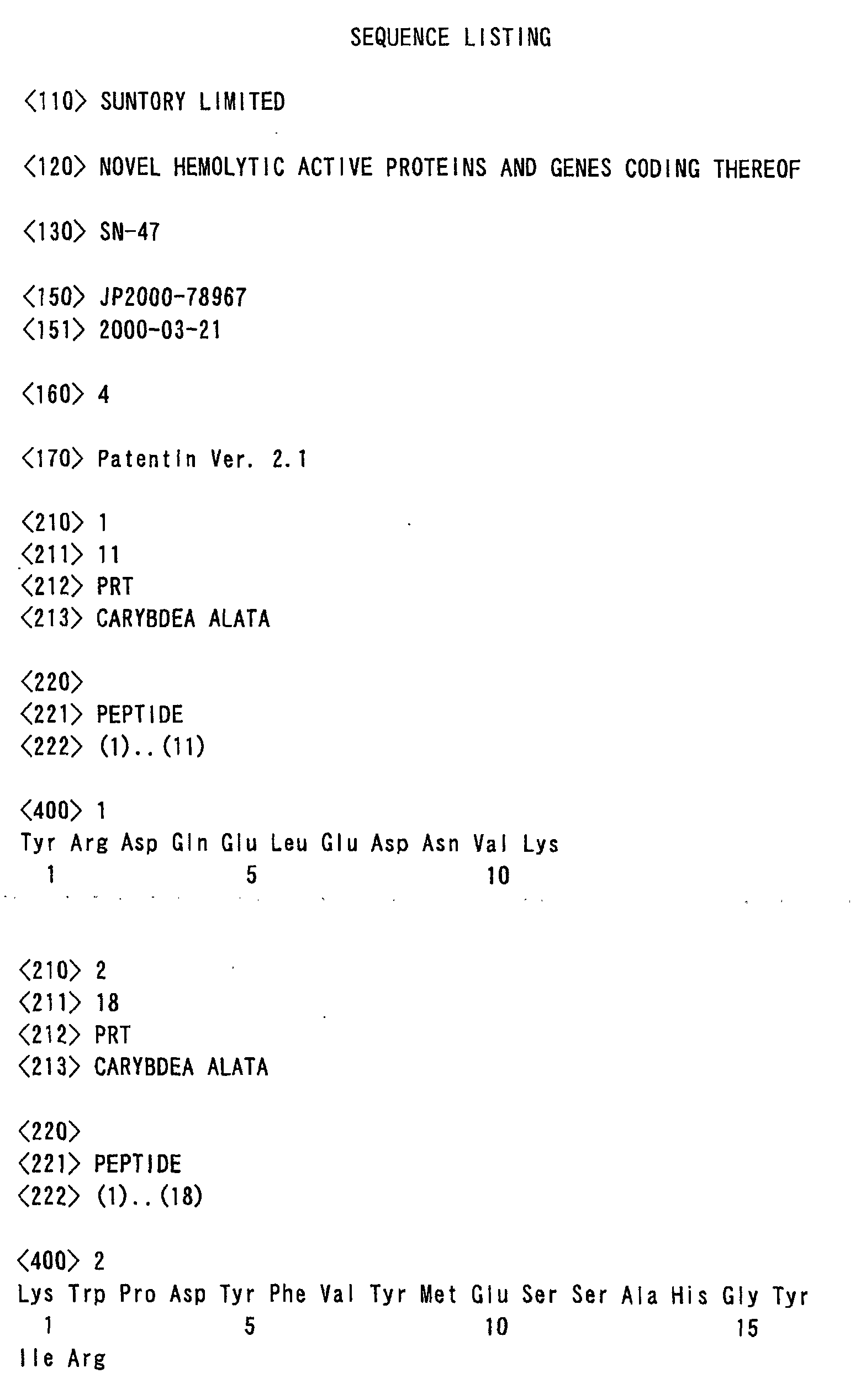
- the inventors extensively performed the research for isolating the proteins having the hemolytic activity from the nematocyst of Carybdea alata using the hemolytic activity as the parameter, while retaining these hemolytic activities. As the result, they found out the process for isolating and purifying the proteins retaining hemolytic activities, and clarified the protein from Carybdea alata having the partial chemical structure consisting the following amino acid sequences (1) and (2), and the molecular weight of about 50,000 Da (determined by SDS gel electrophoresis).
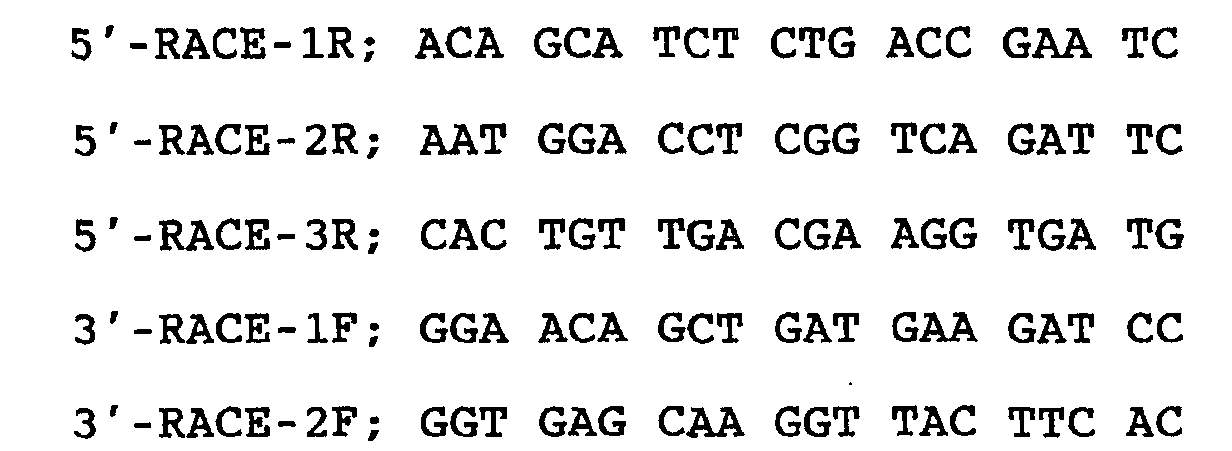
- the primers prepared the primers based on their partial chemical structures of the protein, and analyzed the gene sequence of about 900 base pair of said protein by conducting the RT-PCR to total RNA prepared from the tentacle of Carybdea alata by using these primers. Consequently, they further determined the full primary amino acid sequence of the hemolytic active protein of Carybdea alata by means of analyzing the gene sequence in 5'-end and 3'-end using the 5' RACE method and 3' RACE method.
- one embodiment of the present invention provides the specific protein having the amino acid sequence represented by SEQ ID NO 3, or the amino acid sequence modified by the addition and deletion of one or more amino acid, and/or the substitution by other amino acid to said amino acid sequence, with the above-mentioned physiological, physical and chemical properties.
- Another embodiment of the present invention also provides the process for preparing such proteins.
- Another embodiment provides the gene encoding such proteins, the process for preparing the specific proteins using the gene, and the drugs or the pesticides using the same.
- the present invention further provides the pharmaceutical compositions containing the proteins using these properties, particularly, the pharmaceutical compositions having the platelet agglutination effect etc., or the pesticides utilizing the cytotoxic properties of the proteins.
- the present invention also provides the pharmaceutical compositions containing said antibody.
- the isolation and purification of the proteins having the specific physiological activity provided by the present invention can specifically be performed as follows.
- the ultrasonication of the nematocyst of Carybdea alata is carried out in phosphoric acid buffer solution, and then supernatants are collected by the centrifugal separation to obtain a crude extract.
- the object proteins can be separated and purified by subjecting this crude extract to ion exchange high performance liquid chromatography using an ion exchange column such as TSK-GEL (Toso Co.), and the gel filtration high performance liquid chromatography with a gel filtrate column such as Superdex-75 (Pharmacia Co.).
- the structure of the protein provided according to the present invention obtained in this way can be determined by combining the analysis procedure of the amino acid sequence by the selective degradation using the enzyme, and the analysis procedure of a gene sequence using the PCR method etc.
- the amino acid sequence can be determined by processing the protein separated and purified as mentioned above with a lysylendopeptidase, fractionating the fragment using a high performance liquid chromatography, and analyzing it using an amino acid sequencer etc.
- the gene sequence of the proteins can be determined by RT-PCR method etc. using the primers prepared on the basis of the amino acid sequence.
- the full primary amino acid sequence of the proteins can be clarified by determining the amino acid sequence on the basis of the gene sequence.
- the protein provided according to the present invention has the molecular weight of about 50,000 Da (measured by SDS gel electrophoresis), and the partial amino acid sequences have the above-mentioned amino acid sequences (1) and (2).
- the method for preparing the specific protein of the present invention by separation and purification is characterized in retaining the hemolytic activity.
- the separation and the purification in the state of retaining such hemolytic activity are attained by performing the processing such as ultrasonication using the above-mentioned phosphoric acid buffer solution or various high performance liquid chromatography in 10 mM phosphoric acid buffer solution (pH 6.0) containing above 0.1 M NaCl, preferably above 0.3 M, and more preferably above 0.5 M, at below 10°C, preferably below 5°C.
- the present invention also provides the method for preparing the protein by extracting and purifying them from the nematocyst of the Carybdea alata in the state of retaining the physiological activity.
- the specific protein of the present invention also can be prepared by the gene recombination method.
- Preparation by the gene recombination method can be performed according to a conventional method. For example, it can be obtained by preparing the vector integrated with the gene represented by SEQ ID NO 4, transforming a host cell by the vector, incubating or growing the host cell, and isolating and purifying the proteins having hemolytic activity of interest from the host cell or culture solution.
- the protein provided according to the present invention has a hemolytic activity, for example, it may be used for the medicaments having the cytolysis effect and for the reagents for research on a hemolysis. Furthermore, it provides the new approach for the development of drugs, such as a drug for treating the sting by the jellyfish, and development of pesticides, such as an insecticide, using the hemolytic or cytotoxic activity.
- drugs such as a drug for treating the sting by the jellyfish
- pesticides such as an insecticide
- the above-mentioned column was equilibrated with 10 mM phosphoric acid buffer solution (pH 6.0) containing 0.3 M NaCl. After the equilibration, the supernatant fluids obtained by extraction in the operation of the above-mentioned 1) were combined and diluted with 10 mM phosphoric acid buffer solution (pH 6.0) to 4 times. The solution was loaded onto the above-mentioned column at a flow rate of the 3 ml/min. The column was washed with 100 ml of 10 mM phosphoric acid buffer solutions (pH 6.0) after the sample application.
- the elution was carried out by the 60 minutes gradient in 0 to 0.7 M NaCl concentration (in 10 mM phosphoric acid buffer solution: pH 6.0). Hemolytic activity was showed in many fractions eluting between 45 and 65 minutes after start of the gradient. In addition, hemolytic activity was examined about the hemolytic effect to sheep hemocytes (see the after-mentioned example 2).
- the above-mentioned column was well equilibrated with 10 mM phosphoric acid buffer solution (pH 6.0) containing 0.3 M NaCl.
- the hemolytic active fractions obtained by purifying operation of the above-mentioned 2) were diluted with 10 mM phosphoric acid buffer solution (pH 6.0) to 4 times.
- the solution was loaded onto the above-mentioned column at the flow rate of 2 ml/min.
- the column was washed with 30 ml of 10 mM phosphoric acid buffer solutions (pH 6.0) after the sample application. After washing, the elution was performed by the 60 min gradient in 0 to 0.8 M NaCl concentration (in 10 mM phosphoric acid buffer solution: pH 6.0).
- Fractions having hemolytic activity were eluted between 25 and 35 minutes after start of the gradient, and each fraction was applied to SDS-PAGE. The separating condition of the active component was verified, and the portions separated well were collected and used in the next step. On the contrary, the portions not separated were further performed by chromatography to complete the separation of the active component.
- the column was well equilibrated with 10 mM phosphoric acid buffer solution (pH 6.0) containing 0.3 M NaCl.
- the hemolytic active fractions obtained by purifying operation of above-mentioned 3) were diluted with 10 mM phosphoric acid buffer solution (pH 6.0) to 4 times.
- the solution was loaded onto the above-mentioned column at the flow rate of 2 ml/min.
- the column was washed with 30 ml of 10 mM phosphoric acid buffer solutions (pH 6.0) after the sample application. After washing, 10 mM phosphoric acid buffer solution (pH 6.0) containing 0.8 M NaCl was then rinsed and the sample adhered into the column was allowed to elute. In about 5 minutes after exchange of the solvent, the portion of the hemolytic active component condensed and eluted at a stretch was collected.
- Hemolytic activity was measured by hemolysis to a sheep erythrocyte. That is, every 200 ⁇ l of PBS(+) buffer solution containing 0.8% of sheep erythrocyte was put into the microwell plates of 96 wells (round bottom type). 10 ⁇ l of the solution dissolved the fraction obtained in each purification step of the above-mentioned Example 1 in 10 mM phosphoric acid buffer solution (pH 6.0) was added to the plate. It was allowed to stand at room temperature for 3 hours, and the hemolytic condition of the sheep erythrocyte of each plate was observed. In addition, the presence or absence of the retention of the hemolytic activity was determined by whether the fraction obtained in each purification step exhibits a perfect hemolysis.
- the single band visualized by applying the protein of the present invention having the hemolytic activity obtained by purification operation of 5) in Example 1 to SDS gel electrophoresis (SDS-PAGE) according to the conventional method was compared with the protein molecular-weight marker (Pharmacia Co.). As the result, it was identified that the molecular weight of the protein of the present invention are about 50,000 Da.
- the protein was decomposed by adding 3 pM of Achromobacter Protease I (derived from Achromobacter lyticus M497-1: Takara Shuzo Co.) to 10 ⁇ g of protein according to the present invention having the hemolytic activity obtained by purification operation of the above-mentioned 5) in Example 1, and incubating in 10 mM of Tris-HCl buffer solution (pH 9.0) at 30°C for 20 hours.
- the protein digested with the enzyme was applied to the high performance liquid chromatography (column: Bakerbond wide pore ODS), and separated with the 60 min gradient in 10 to 62% of acetonitrile concentration (in water containing 0.1% of trifluoroacetic acid) at the flow rate of 0.7 ml/min. Consequently, two peptide fragments eluting respectively at a retention time 25 and 49 minutes were obtained.
- the amino acid sequence of three peptide fragments obtained as mentioned above was determined according to the conventional method using Shimadzu PSQ-1 protein sequencer (Shimadzu Co.).
- Example 4 Determination of the full amino acid sequence of the protein and the gene encoding the amino acids
- the tentacle (about 0.5 g in wet weights) of Carybdea alata was crushed in the liquid nitrogen, and homogenized in 5 ml TRIzol (registered trademark) reagent (GIBCO BRL Co.). To this mixture was added 1 ml of chloroform, and the mixture was agitated, and centrifuged with the cooling centrifuge (Sakuma Co.) [13,000rpm, for 15 minutes, at 4°C]. The upper aqueous layer was fractionated, and to this solution was added 2.5 ml of isopropanol, then, the mixture was allowed to stand at room temperature for 10 minutes.
- TRIzol registered trademark
- the supernatant fluid was removed after the centrifugal separation (13,000rpm, for 10 minutes, at 4°C) using the cooling centrifuge, and then 5 ml of 75% ethanol was added the residue.
- the supernatant fluid was removed after the centrifuge (10,000rpm, for 5 minutes, at 4°C) to obtain the residue, then, the air-drying of the residue was performed for about 10 minutes.
- 100 ⁇ l of RNase-free water was added to the resulting residue, and the mixture was incubated for 10 minutes at 60°C to lyse RNA. About 0.5 mg of total RNA was obtained according to the above-mentioned method.
- single-strand cDNA was synthesized using SUPERSCRIPT (registered trademark) Preamplification System for First Strand cDNA Synthesis. That is, 1 ⁇ g of total RNA , oligo(dT) 12-18 , and DEPC-treated water were mixed, and the mixture was allowed to stand for 10 minutes at 70°C. Then, PCR buffer, 25 mM MgCl 2 , 10 mM dNTP mix, and 0.1 M DTT were added to this mixture, and the resulting mixture was pre-incubated for 5 minutes at 42°C. Superscript II RT (200 units/ ⁇ l) was added to this mixture, and the mixture was incubated for 50 minutes at 42°C and for 15 minutes at 70°C. The RNase H was added to the mixture, and then, the resulting mixture was incubated for 20 minutes at 37°C to obtain 1st-strand cDNA.
- SUPERSCRIPT registered trademark
- PCR was performed using GeneAmp PCR System 2400 thermal cycler (Perkin-Elmer Co.). That is, 1st-strand cDNA, PCR buffer, dNTP mix, F-primer, R-primer, TaKaRa Ex Taq (registered trademark, Takara Shuzo Co.), and water were mixed.
- the reaction was performed by heating the mixture at 94°C for 5 minutes, then repeating 3 cycles of 30 seconds at 94°C, 30 seconds at 45°C and 2 minutes at 72°C, and further 27 cycles of 30 seconds at 94°C, 30 seconds at 55°C and 2 minutes at 72°C.
- the reactant was then treated for 5 minutes at 72°C.
- the obtained reaction solution was electrophoresed on 0.8% agarose gel to confirm the amplified PCR product in the combination of F-primer and R-primer.
- the size of the PCR product was about 900bp.
- the PCR product was inserted into TA cloning vector pCR2.1 (Invitrogene Co.), and the recombinant was transformed to the Escherichia coli JM109.
- the transformant was cultured on LB (containing 50 ⁇ g/ ⁇ l of ampicillin) agar medium. According to the following conditions , colony PCR was performed to the colonies obtained as a template using the M13 universal primer.
- the strain of Escherlchia coli , PCR buffer, dNTP mix, M13 FW primer, M13 RV primer, TaKaRa Ex Tag (registered trademark, Takara Shuzo Co.), and water were mixed.
- the reaction was performed by heating the mixture at 90°C for 10 minutes, then repeating 30 cycles of 30 seconds at 94°C, 30 seconds at 55°C and 2 minutes at 72°C, and further heating at 72°C for 5 minutes.
- the reaction solution was electrophoresed on 0.8% agarose gel and the target colony PCR product was purified on the spin column of MicroSpin (registered trademark) S-400 (Amersham Pharmacia Co.). Then, the sequencing of the obtained product was conducted by using ABI PRISM 310 Genetic Analyzer (Applied Biosystems Co.).
- the obtained sequence was analyzed using gene analysis soft ware GENETYX-MAC (Software Development Co.). As the result, the partial cDNA sequence of about 900 bp was analyzed.
- RNA, cDMA synthesis buffer, dNTP mix, 5'-RACE-1R, AMV reverse transcriptase, and DEPC-treated water were mixed, and the mixture was incubated for 60 minutes at 55°C and for 10 minutes at 65°C to obtain 1st-strand cDNA.
- 1st-strand cDNA thus obtained was purified on the spin column, then, reaction buffer and 2mM dATP were added to the 1st-strand cDNA, and the mixture was allowed to stand for 3 minutes at 94°C. Terminal transferase (10 units/ ⁇ l) was added to the mixture, and the resulting mixture was incubated for 20 minutes at 37°C. After the incubation, 1st-strand cDNA, PCR buffer, dNTP mix, 5'-RACE-2R, oligo(dT)-anchor primer, and water were added to the above mixture.
- the reaction was performed by heating the mixture at 94°C for 5 minutes, then repeating 30 cycles of 30 seconds at 94°C, 30 seconds at 55°C and 1 minute at 72°C, and further heating at 72°C for 5 minutes . Consequently, the nested-PCR was performed to the 1st-PCR product as a template using the combination of 5'-RACE-3R and PCR anchor primer under the same condition as 1st-PCR.
- the 1st-PCR product and the nested-PCR product were electrophoresed on 1.5% agarose gel to confirm the band of about 600bp.
- This nested-PCR product was inserted into TA cloning vector, and the sequencing was performed according to the determination of the base sequence of cDNA described in the above-mentioned 4-3), then the sequence was analyzed.
- RNA, cDNA synthesis buffer, dNTP mix, oligo(dT)-anchor primer, AMV reverse transcriptase, and DEPC-treated water were mixed, and the mixture was incubated for 60 minutes at 55°C. Subsequently, the reactant was treated for 10 minutes at 65°C to obtain 1st-strand cDNA.
- 1st-PCR thus obtained was performed under the following condition. 1st-strand cDNA, PCR buffer, dNTP mix, 3'-RACE-1F, PCR anchor primer, TaKaRaExTaq (registered trademark, Takara Shuzo Co.), and water were mixed. The reaction was performed by heating the mixture at 94°C for 5 minutes, then repeating 30 cycles of 30 seconds at 94°C, 30 seconds at 55°C and 2 minutes at 72°C, and further heating at 72°C for 5 minutes. The nested-PCR was performed to the 1st-PCR product as a template using the combination of 3'-RACE-2F and PCR anchor primer under the same condition as 1st-PCR.
- the 1st-PCR product and the nested-PCR product were electrophoresed on 1.5% agarose gel to confirm the band of about 600 bp.
- the nested-PCR product was inserted into TA cloning vector, the sequencing was performed according to the determination of the base sequence of cDNA described in the above-mentioned 4-3), and the sequence was analyzed.
- the size (2000bp) and the sequence of cDNA encoding the novel hemolytic active protein of Carybdea alata , and the number (463aa) and the sequence of amino acid of the protein became clear. That is, the hemolytic active protein of Carybdea alata has the amino acid sequence represented by SEQ ID NO 3, and the gene encoding thereof has the base sequence represented by SEQ ID NO 4.
- novel protein of the present invention obtained as mentioned above is the specific protein having the following physiological activity, and physical and chemical property, as indicated by the example:
- the protein having the hemolytic activity derived from the nematocyst of Carybdea alata provided according to the present invention is a novel protein which is not similar to known protein, as a result of the homology search on the partial amino acid sequence and the full primary amino acid sequences, it is useful as a biochemical reagent for example, elucidating the mechanism of a hemolysis etc.
- drugs such as the medicine for treating the sting by the jellyfish, on the basis of study of correlation of the structural activity in a molecular level, and the antibody on the protein or the partial peptide, etc.
- drugs having a platelet agglutination effect etc., and pesticides using a hemolytic activity.
Landscapes
- Health & Medical Sciences (AREA)
- Chemical & Material Sciences (AREA)
- Life Sciences & Earth Sciences (AREA)
- Organic Chemistry (AREA)
- Medicinal Chemistry (AREA)
- General Health & Medical Sciences (AREA)
- Veterinary Medicine (AREA)
- Zoology (AREA)
- Chemical Kinetics & Catalysis (AREA)
- Nuclear Medicine, Radiotherapy & Molecular Imaging (AREA)
- Hematology (AREA)
- Pharmacology & Pharmacy (AREA)
- Diabetes (AREA)
- Animal Behavior & Ethology (AREA)
- Bioinformatics & Cheminformatics (AREA)
- Public Health (AREA)
- Engineering & Computer Science (AREA)
- Tropical Medicine & Parasitology (AREA)
- Toxicology (AREA)
- General Chemical & Material Sciences (AREA)
- Gastroenterology & Hepatology (AREA)
- Biochemistry (AREA)
- Biophysics (AREA)
- Genetics & Genomics (AREA)
- Molecular Biology (AREA)
- Proteomics, Peptides & Aminoacids (AREA)
- Peptides Or Proteins (AREA)
- Medicines That Contain Protein Lipid Enzymes And Other Medicines (AREA)
- Preparation Of Compounds By Using Micro-Organisms (AREA)
- Micro-Organisms Or Cultivation Processes Thereof (AREA)
- Medicines Containing Antibodies Or Antigens For Use As Internal Diagnostic Agents (AREA)
- Medicines Containing Material From Animals Or Micro-Organisms (AREA)
- Agricultural Chemicals And Associated Chemicals (AREA)
Abstract
Description







Claims (16)
- A protein having following properties:(1) having hemolytic activity;(2) having a molecular weight of about 50,000 Da (determined by SDS gel electrophoresis); and(3) having the amino acid sequence represented by any of SEQ ID NO 1 and SEQ ID NO 2 as a partial amino acid sequence.
- The protein according to claim 1, wherein the protein is obtained from nematocyst of Carybdea alata.
- A protein having the hemolytic activity which has the same amino acid sequence as the hemolytic active protein according to claim 1, or the amino acid sequence modified by the addition and deletion of one or more amino acid, and/or the substitution by other amino acid to said amino acid sequence, and which is obtained from the cultivated product of the transformed cell prepared by genetic recombinant technique.
- A protein having amino acid sequence represented by SEQ ID NO 3, or the amino acid sequence modified by the addition and deletion of one or more amino acid, and/or the substitution by other amino acid to said amino acid sequence, and having hemolytic activity.
- The protein having hemolytic activity according to claim 3 or 4, wherein said protein is obtained from cultivated solution of transformed cell prepared by genetic recombinant technique using polynucleotide which hybridizes with polynucleotide encoding at least one of the amino acid sequences represented by SEQ ID NO 1 and SEQ ID NO 2.
- A process for preparing the protein according to claims 1, 2, or 4 comprising of ultrasonicating the nematocyst of Carybdea alata in phosphoric acid buffer solution, and extracting and purifying the supernatant fluid after centrifugation by ion exchange high performance liquid chromatography and gel filtration high performance liquid chromatography to obtain the protein.
- A process for preparing the protein according to claim 6, characterized by carrying out the ultrasonication for a nematocyst in phosphoric acid buffer solution, or treating by ion exchange high performance liquid chromatography and gel filtration high performance liquid chromatography in 10mM phosphoric acid buffer solution (pH6.0) containing not less than 0.1M NaCl at not more than 10°C.
- A gene encoding the amino acid sequence of the protein having a hemolytic activity according to any one of claims 1 to 5.
- A vector comprising the gene according to claim 8.
- A host cell transformed by the vector as claimed in claim 9.
- A process for preparing a protein having hemolytic activity comprising culturing or growing a host cell as claimed in claim 10, and recovering the protein from said host cell or culture solution.
- A pharmaceutical composition comprising the protein according to any one of claims 1 to 5 as an active component.
- The pharmaceutical composition according to claim 12, wherein the composition has platelet agglutination effect.
- An antibody whose antigens are protein according to any one of claims 1 to 5, or those partial peptides.
- A pharmaceutical composition using the antibody according to claim 14.
- A pesticide comprising the protein according to any one of claims 1 to 5 as an active component.
Applications Claiming Priority (3)
| Application Number | Priority Date | Filing Date | Title |
|---|---|---|---|
| JP2000078967 | 2000-03-21 | ||
| JP2000078967A JP3802729B2 (en) | 2000-03-21 | 2000-03-21 | Novel hemolytically active protein and gene encoding the protein |
| PCT/JP2001/002209 WO2001070799A1 (en) | 2000-03-21 | 2001-03-21 | Novel protein having hemolytic activity and gene encoding the protein |
Publications (3)
| Publication Number | Publication Date |
|---|---|
| EP1179539A1 true EP1179539A1 (en) | 2002-02-13 |
| EP1179539A4 EP1179539A4 (en) | 2002-08-21 |
| EP1179539B1 EP1179539B1 (en) | 2007-01-17 |
Family
ID=18596295
Family Applications (1)
| Application Number | Title | Priority Date | Filing Date |
|---|---|---|---|
| EP01915654A Expired - Lifetime EP1179539B1 (en) | 2000-03-21 | 2001-03-21 | Protein having hemolytic activity and gene encoding the protein |
Country Status (7)
| Country | Link |
|---|---|
| US (2) | US6855803B2 (en) |
| EP (1) | EP1179539B1 (en) |
| JP (1) | JP3802729B2 (en) |
| AU (1) | AU779885B2 (en) |
| BR (1) | BR0105179A (en) |
| DE (1) | DE60126026T2 (en) |
| WO (1) | WO2001070799A1 (en) |
Families Citing this family (1)
| Publication number | Priority date | Publication date | Assignee | Title |
|---|---|---|---|---|
| US20080300790A1 (en) * | 2007-05-29 | 2008-12-04 | James Kirunda Kakaire | Environmental data delivery - edd |
Family Cites Families (1)
| Publication number | Priority date | Publication date | Assignee | Title |
|---|---|---|---|---|
| WO1999050294A1 (en) | 1998-04-01 | 1999-10-07 | Suntory Limited | Novel hemolytic active proteins and genes encoding the same |
-
2000
- 2000-03-21 JP JP2000078967A patent/JP3802729B2/en not_active Expired - Fee Related
-
2001
- 2001-03-21 US US09/979,275 patent/US6855803B2/en not_active Expired - Fee Related
- 2001-03-21 AU AU42733/01A patent/AU779885B2/en not_active Ceased
- 2001-03-21 DE DE60126026T patent/DE60126026T2/en not_active Expired - Lifetime
- 2001-03-21 WO PCT/JP2001/002209 patent/WO2001070799A1/en not_active Ceased
- 2001-03-21 EP EP01915654A patent/EP1179539B1/en not_active Expired - Lifetime
- 2001-03-21 BR BR0105179-2A patent/BR0105179A/en not_active Application Discontinuation
-
2004
- 2004-12-30 US US11/024,428 patent/US7282577B2/en not_active Expired - Fee Related
Also Published As
| Publication number | Publication date |
|---|---|
| DE60126026D1 (en) | 2007-03-08 |
| EP1179539B1 (en) | 2007-01-17 |
| JP2001258566A (en) | 2001-09-25 |
| US6855803B2 (en) | 2005-02-15 |
| US20040110919A1 (en) | 2004-06-10 |
| AU4273301A (en) | 2001-10-03 |
| US7282577B2 (en) | 2007-10-16 |
| EP1179539A4 (en) | 2002-08-21 |
| BR0105179A (en) | 2002-03-05 |
| JP3802729B2 (en) | 2006-07-26 |
| WO2001070799A1 (en) | 2001-09-27 |
| US20050106676A1 (en) | 2005-05-19 |
| AU779885B2 (en) | 2005-02-17 |
| DE60126026T2 (en) | 2007-05-24 |
Similar Documents
| Publication | Publication Date | Title |
|---|---|---|
| Calamita et al. | Molecular cloning and characterization of AqpZ, a water channel from Escherichia coli | |
| US6329516B1 (en) | Lepidopteran GABA-gated chloride channels | |
| Bayne et al. | Immune-relevant (including acute phase) genes identified in the livers of rainbow trout, Oncorhynchus mykiss, by means of suppression subtractive hybridization | |
| Wang et al. | Biological activity of Manduca sexta paralytic and plasmatocyte spreading peptide and primary structure of its hemolymph precursor | |
| Ando et al. | Molecular cloning, sequencing, and characterization of cDNA for sarcotoxin IIA, an inducible antibacterial protein of Sarcophaga peregrina (flesh fly) | |
| Cha et al. | The cDNA sequence of mouse LAMP-2. Evidence for two classes of lysosomal membrane glycoproteins. | |
| Wang et al. | A new cytolysin from the sea anemone, Heteractis magnifica: isolation, cDNA cloning and functional expression | |
| JP3015969B2 (en) | Squamous cell carcinoma-associated antigen protein and DNA encoding the protein | |
| DK172259B1 (en) | Polypeptides as well as their preparation and use | |
| CN108265039A (en) | A kind of mutation T aqDNA polymerases and its purification process | |
| Ogata et al. | cDNA clone spanning the alpha-gamma subunit junction in the precursor of the murine fourth complement component (C4). | |
| Chan et al. | Characterization of cDNA encoding human pregnancy-specific β1-glycoprotein from placenta and extraplacental tissues and their comparison with carcinoembryonic antigen | |
| Barroga et al. | The proteins encoded by the rbs operon of Escherichia coli: I. Overproduction, purification, characterization, and functional analysis of RbsA | |
| US6447996B1 (en) | Galanin receptors, nucleic acids, transformed cells and uses thereof | |
| Jaso-Friedmann et al. | The antigen receptor (NCCRP-1) on catfish and zebrafish nonspecific cytotoxic cells belongs to a new gene family characterized by an F-box-associated domain | |
| Shrivastava et al. | Protein purification, cDNA cloning and characterization of a protease inhibitor from the Indian tasar silkworm, Antheraea mylitta | |
| EP1179539B1 (en) | Protein having hemolytic activity and gene encoding the protein | |
| US7250491B2 (en) | Hemolytic active proteins and genes encoding the same | |
| US6228631B1 (en) | Recombinant α-N-acetylgalactosaminidase enzyme and cDNA encoding said enzyme | |
| JPH10504452A (en) | Novel topoisomerase IV, corresponding nucleotide sequences and uses thereof | |
| EP0726313A2 (en) | DNA coding for mammalian L-asparaginase | |
| Lee et al. | Molecular cloning of cDNA for sapecin B, an antibacterial protein of Sarcophaga, and its detection in larval brain | |
| JP2002125676A (en) | Novel hemolytically active protein and gene encoding the protein | |
| JPWO1999050294A1 (en) | Novel hemolytic protein and gene encoding said protein | |
| SI9400363A (en) | Human macrophage migration inhibitory factor of nonlymphoid origin, expression of mif in e. coli and purification of recombinant protein |
Legal Events
| Date | Code | Title | Description |
|---|---|---|---|
| PUAI | Public reference made under article 153(3) epc to a published international application that has entered the european phase |
Free format text: ORIGINAL CODE: 0009012 |
|
| 17P | Request for examination filed |
Effective date: 20011106 |
|
| AK | Designated contracting states |
Kind code of ref document: A1 Designated state(s): AT BE CH CY DE DK ES FI FR GB GR IE IT LI LU MC NL PT SE TR |
|
| A4 | Supplementary search report drawn up and despatched |
Effective date: 20020709 |
|
| AK | Designated contracting states |
Kind code of ref document: A4 Designated state(s): AT BE CH CY DE DK ES FI FR GB GR IE IT LI LU MC NL PT SE TR |
|
| 17Q | First examination report despatched |
Effective date: 20040528 |
|
| RTI1 | Title (correction) |
Free format text: PROTEIN HAVING HEMOLYTIC ACTIVITY AND GENE ENCODING THE PROTEIN |
|
| GRAP | Despatch of communication of intention to grant a patent |
Free format text: ORIGINAL CODE: EPIDOSNIGR1 |
|
| GRAS | Grant fee paid |
Free format text: ORIGINAL CODE: EPIDOSNIGR3 |
|
| GRAA | (expected) grant |
Free format text: ORIGINAL CODE: 0009210 |
|
| AK | Designated contracting states |
Kind code of ref document: B1 Designated state(s): AT BE CH CY DE DK ES FI FR GB GR IE IT LI LU MC NL PT SE TR |
|
| PG25 | Lapsed in a contracting state [announced via postgrant information from national office to epo] |
Ref country code: NL Free format text: LAPSE BECAUSE OF FAILURE TO SUBMIT A TRANSLATION OF THE DESCRIPTION OR TO PAY THE FEE WITHIN THE PRESCRIBED TIME-LIMIT Effective date: 20070117 Ref country code: DK Free format text: LAPSE BECAUSE OF FAILURE TO SUBMIT A TRANSLATION OF THE DESCRIPTION OR TO PAY THE FEE WITHIN THE PRESCRIBED TIME-LIMIT Effective date: 20070117 Ref country code: LI Free format text: LAPSE BECAUSE OF FAILURE TO SUBMIT A TRANSLATION OF THE DESCRIPTION OR TO PAY THE FEE WITHIN THE PRESCRIBED TIME-LIMIT Effective date: 20070117 Ref country code: CH Free format text: LAPSE BECAUSE OF FAILURE TO SUBMIT A TRANSLATION OF THE DESCRIPTION OR TO PAY THE FEE WITHIN THE PRESCRIBED TIME-LIMIT Effective date: 20070117 Ref country code: AT Free format text: LAPSE BECAUSE OF FAILURE TO SUBMIT A TRANSLATION OF THE DESCRIPTION OR TO PAY THE FEE WITHIN THE PRESCRIBED TIME-LIMIT Effective date: 20070117 Ref country code: FI Free format text: LAPSE BECAUSE OF FAILURE TO SUBMIT A TRANSLATION OF THE DESCRIPTION OR TO PAY THE FEE WITHIN THE PRESCRIBED TIME-LIMIT Effective date: 20070117 |
|
| REG | Reference to a national code |
Ref country code: GB Ref legal event code: FG4D |
|
| REG | Reference to a national code |
Ref country code: CH Ref legal event code: EP |
|
| REG | Reference to a national code |
Ref country code: IE Ref legal event code: FG4D |
|
| REF | Corresponds to: |
Ref document number: 60126026 Country of ref document: DE Date of ref document: 20070308 Kind code of ref document: P |
|
| PG25 | Lapsed in a contracting state [announced via postgrant information from national office to epo] |
Ref country code: SE Free format text: LAPSE BECAUSE OF FAILURE TO SUBMIT A TRANSLATION OF THE DESCRIPTION OR TO PAY THE FEE WITHIN THE PRESCRIBED TIME-LIMIT Effective date: 20070417 |
|
| PG25 | Lapsed in a contracting state [announced via postgrant information from national office to epo] |
Ref country code: ES Free format text: LAPSE BECAUSE OF FAILURE TO SUBMIT A TRANSLATION OF THE DESCRIPTION OR TO PAY THE FEE WITHIN THE PRESCRIBED TIME-LIMIT Effective date: 20070428 |
|
| PG25 | Lapsed in a contracting state [announced via postgrant information from national office to epo] |
Ref country code: PT Free format text: LAPSE BECAUSE OF FAILURE TO SUBMIT A TRANSLATION OF THE DESCRIPTION OR TO PAY THE FEE WITHIN THE PRESCRIBED TIME-LIMIT Effective date: 20070618 |
|
| NLV1 | Nl: lapsed or annulled due to failure to fulfill the requirements of art. 29p and 29m of the patents act | ||
| REG | Reference to a national code |
Ref country code: CH Ref legal event code: PL |
|
| ET | Fr: translation filed | ||
| PLBE | No opposition filed within time limit |
Free format text: ORIGINAL CODE: 0009261 |
|
| STAA | Information on the status of an ep patent application or granted ep patent |
Free format text: STATUS: NO OPPOSITION FILED WITHIN TIME LIMIT |
|
| 26N | No opposition filed |
Effective date: 20071018 |
|
| PG25 | Lapsed in a contracting state [announced via postgrant information from national office to epo] |
Ref country code: BE Free format text: LAPSE BECAUSE OF FAILURE TO SUBMIT A TRANSLATION OF THE DESCRIPTION OR TO PAY THE FEE WITHIN THE PRESCRIBED TIME-LIMIT Effective date: 20070117 |
|
| PG25 | Lapsed in a contracting state [announced via postgrant information from national office to epo] |
Ref country code: IE Free format text: LAPSE BECAUSE OF NON-PAYMENT OF DUE FEES Effective date: 20070321 Ref country code: MC Free format text: LAPSE BECAUSE OF NON-PAYMENT OF DUE FEES Effective date: 20070331 |
|
| PG25 | Lapsed in a contracting state [announced via postgrant information from national office to epo] |
Ref country code: IT Free format text: LAPSE BECAUSE OF FAILURE TO SUBMIT A TRANSLATION OF THE DESCRIPTION OR TO PAY THE FEE WITHIN THE PRESCRIBED TIME-LIMIT Effective date: 20070117 Ref country code: GR Free format text: LAPSE BECAUSE OF FAILURE TO SUBMIT A TRANSLATION OF THE DESCRIPTION OR TO PAY THE FEE WITHIN THE PRESCRIBED TIME-LIMIT Effective date: 20070418 |
|
| PG25 | Lapsed in a contracting state [announced via postgrant information from national office to epo] |
Ref country code: CY Free format text: LAPSE BECAUSE OF FAILURE TO SUBMIT A TRANSLATION OF THE DESCRIPTION OR TO PAY THE FEE WITHIN THE PRESCRIBED TIME-LIMIT Effective date: 20070117 |
|
| PG25 | Lapsed in a contracting state [announced via postgrant information from national office to epo] |
Ref country code: LU Free format text: LAPSE BECAUSE OF NON-PAYMENT OF DUE FEES Effective date: 20070321 |
|
| PG25 | Lapsed in a contracting state [announced via postgrant information from national office to epo] |
Ref country code: TR Free format text: LAPSE BECAUSE OF FAILURE TO SUBMIT A TRANSLATION OF THE DESCRIPTION OR TO PAY THE FEE WITHIN THE PRESCRIBED TIME-LIMIT Effective date: 20070117 |
|
| REG | Reference to a national code |
Ref country code: FR Ref legal event code: TP |
|
| PGFP | Annual fee paid to national office [announced via postgrant information from national office to epo] |
Ref country code: FR Payment date: 20110317 Year of fee payment: 11 |
|
| PGFP | Annual fee paid to national office [announced via postgrant information from national office to epo] |
Ref country code: DE Payment date: 20110316 Year of fee payment: 11 Ref country code: GB Payment date: 20110316 Year of fee payment: 11 |
|
| GBPC | Gb: european patent ceased through non-payment of renewal fee |
Effective date: 20120321 |
|
| REG | Reference to a national code |
Ref country code: FR Ref legal event code: ST Effective date: 20121130 |
|
| REG | Reference to a national code |
Ref country code: DE Ref legal event code: R119 Ref document number: 60126026 Country of ref document: DE Effective date: 20121002 |
|
| PG25 | Lapsed in a contracting state [announced via postgrant information from national office to epo] |
Ref country code: GB Free format text: LAPSE BECAUSE OF NON-PAYMENT OF DUE FEES Effective date: 20120321 Ref country code: FR Free format text: LAPSE BECAUSE OF NON-PAYMENT OF DUE FEES Effective date: 20120402 |
|
| PG25 | Lapsed in a contracting state [announced via postgrant information from national office to epo] |
Ref country code: DE Free format text: LAPSE BECAUSE OF NON-PAYMENT OF DUE FEES Effective date: 20121002 |