EP1179522A1 - Liquid crystalline compound having a difluoropropyleneoxy group as bonding group, liquid crystal composition and liquid crystal display element - Google Patents
Liquid crystalline compound having a difluoropropyleneoxy group as bonding group, liquid crystal composition and liquid crystal display element Download PDFInfo
- Publication number
- EP1179522A1 EP1179522A1 EP01118826A EP01118826A EP1179522A1 EP 1179522 A1 EP1179522 A1 EP 1179522A1 EP 01118826 A EP01118826 A EP 01118826A EP 01118826 A EP01118826 A EP 01118826A EP 1179522 A1 EP1179522 A1 EP 1179522A1
- Authority
- EP
- European Patent Office
- Prior art keywords
- group
- liquid crystal
- compound
- independently represent
- ring
- Prior art date
- Legal status (The legal status is an assumption and is not a legal conclusion. Google has not performed a legal analysis and makes no representation as to the accuracy of the status listed.)
- Granted
Links
- 150000001875 compounds Chemical class 0.000 title claims abstract description 225
- 239000004973 liquid crystal related substance Substances 0.000 title claims abstract description 129
- 239000000203 mixture Substances 0.000 title claims abstract description 111
- -1 difluoropropyleneoxy group Chemical group 0.000 title claims abstract description 54
- 239000007788 liquid Substances 0.000 title claims abstract description 51
- 125000005647 linker group Chemical group 0.000 title abstract description 9
- 229910052731 fluorine Inorganic materials 0.000 claims abstract description 279
- 239000011737 fluorine Substances 0.000 claims abstract description 43
- 229910052739 hydrogen Inorganic materials 0.000 claims abstract description 43
- 239000001257 hydrogen Substances 0.000 claims abstract description 43
- 125000004955 1,4-cyclohexylene group Chemical group [H]C1([H])C([H])([H])C([H])([*:1])C([H])([H])C([H])([H])C1([H])[*:2] 0.000 claims abstract description 33
- UFHFLCQGNIYNRP-UHFFFAOYSA-N Hydrogen Chemical compound [H][H] UFHFLCQGNIYNRP-UHFFFAOYSA-N 0.000 claims abstract description 28
- 125000001140 1,4-phenylene group Chemical group [H]C1=C([H])C([*:2])=C([H])C([H])=C1[*:1] 0.000 claims abstract description 23
- 125000000217 alkyl group Chemical group 0.000 claims abstract description 15
- 125000004432 carbon atom Chemical group C* 0.000 claims abstract description 12
- 229910052736 halogen Inorganic materials 0.000 claims abstract description 11
- 150000002367 halogens Chemical class 0.000 claims abstract description 11
- 125000004093 cyano group Chemical group *C#N 0.000 claims abstract description 10
- 150000002431 hydrogen Chemical class 0.000 claims abstract description 5
- PXGOKWXKJXAPGV-UHFFFAOYSA-N Fluorine Chemical compound FF PXGOKWXKJXAPGV-UHFFFAOYSA-N 0.000 claims abstract 5
- 125000000876 trifluoromethoxy group Chemical group FC(F)(F)O* 0.000 claims description 54
- 235000019000 fluorine Nutrition 0.000 claims description 53
- 125000001153 fluoro group Chemical group F* 0.000 claims description 45
- 125000004435 hydrogen atom Chemical group [H]* 0.000 claims description 37
- 125000002023 trifluoromethyl group Chemical group FC(F)(F)* 0.000 claims description 6
- 229910052801 chlorine Inorganic materials 0.000 claims description 5
- ZAMOUSCENKQFHK-UHFFFAOYSA-N Chlorine atom Chemical group [Cl] ZAMOUSCENKQFHK-UHFFFAOYSA-N 0.000 claims description 4
- 239000000460 chlorine Chemical group 0.000 claims description 4
- 125000003545 alkoxy group Chemical group 0.000 claims description 3
- 125000004786 difluoromethoxy group Chemical group [H]C(F)(F)O* 0.000 claims description 3
- 125000001028 difluoromethyl group Chemical group [H]C(F)(F)* 0.000 claims description 3
- 125000004216 fluoromethyl group Chemical group [H]C([H])(F)* 0.000 claims description 3
- 125000005450 2,3-difluoro-1,4-phenylene group Chemical group [H]C1=C([*:2])C(F)=C(F)C([*:1])=C1[H] 0.000 claims description 2
- 125000005714 2,5- (1,3-dioxanylene) group Chemical group [H]C1([H])OC([H])([*:1])OC([H])([H])C1([H])[*:2] 0.000 claims description 2
- YXFVVABEGXRONW-UHFFFAOYSA-N Toluene Chemical compound CC1=CC=CC=C1 YXFVVABEGXRONW-UHFFFAOYSA-N 0.000 description 120
- 239000000243 solution Substances 0.000 description 58
- YMWUJEATGCHHMB-UHFFFAOYSA-N Dichloromethane Chemical compound ClCCl YMWUJEATGCHHMB-UHFFFAOYSA-N 0.000 description 48
- IMNFDUFMRHMDMM-UHFFFAOYSA-N N-Heptane Chemical compound CCCCCCC IMNFDUFMRHMDMM-UHFFFAOYSA-N 0.000 description 34
- WYURNTSHIVDZCO-UHFFFAOYSA-N Tetrahydrofuran Chemical compound C1CCOC1 WYURNTSHIVDZCO-UHFFFAOYSA-N 0.000 description 34
- XLYOFNOQVPJJNP-UHFFFAOYSA-N water Substances O XLYOFNOQVPJJNP-UHFFFAOYSA-N 0.000 description 33
- 238000003756 stirring Methods 0.000 description 28
- 0 C*c1ccc(*c2ccc(*c3c(*)c(*)c(*)c(*)c3*C)cc2)cc1 Chemical compound C*c1ccc(*c2ccc(*c3c(*)c(*)c(*)c(*)c3*C)cc2)cc1 0.000 description 24
- 239000002904 solvent Substances 0.000 description 23
- CSNNHWWHGAXBCP-UHFFFAOYSA-L Magnesium sulfate Chemical compound [Mg+2].[O-][S+2]([O-])([O-])[O-] CSNNHWWHGAXBCP-UHFFFAOYSA-L 0.000 description 17
- 238000000034 method Methods 0.000 description 16
- LFQSCWFLJHTTHZ-UHFFFAOYSA-N Ethanol Chemical compound CCO LFQSCWFLJHTTHZ-UHFFFAOYSA-N 0.000 description 14
- PCLIMKBDDGJMGD-UHFFFAOYSA-N N-bromosuccinimide Chemical compound BrN1C(=O)CCC1=O PCLIMKBDDGJMGD-UHFFFAOYSA-N 0.000 description 14
- 239000010410 layer Substances 0.000 description 14
- 239000011541 reaction mixture Substances 0.000 description 14
- 239000012299 nitrogen atmosphere Substances 0.000 description 13
- 238000010898 silica gel chromatography Methods 0.000 description 13
- VEXZGXHMUGYJMC-UHFFFAOYSA-N Hydrochloric acid Chemical compound Cl VEXZGXHMUGYJMC-UHFFFAOYSA-N 0.000 description 12
- 239000013078 crystal Substances 0.000 description 12
- 239000012071 phase Substances 0.000 description 12
- 239000000126 substance Substances 0.000 description 12
- ZMANZCXQSJIPKH-UHFFFAOYSA-N Triethylamine Chemical compound CCN(CC)CC ZMANZCXQSJIPKH-UHFFFAOYSA-N 0.000 description 11
- RTZKZFJDLAIYFH-UHFFFAOYSA-N Diethyl ether Chemical compound CCOCC RTZKZFJDLAIYFH-UHFFFAOYSA-N 0.000 description 10
- CDBYLPFSWZWCQE-UHFFFAOYSA-L Sodium Carbonate Chemical compound [Na+].[Na+].[O-]C([O-])=O CDBYLPFSWZWCQE-UHFFFAOYSA-L 0.000 description 10
- YCKRFDGAMUMZLT-UHFFFAOYSA-N Fluorine atom Chemical compound [F] YCKRFDGAMUMZLT-UHFFFAOYSA-N 0.000 description 9
- HEMHJVSKTPXQMS-UHFFFAOYSA-M Sodium hydroxide Chemical compound [OH-].[Na+] HEMHJVSKTPXQMS-UHFFFAOYSA-M 0.000 description 9
- 239000012046 mixed solvent Substances 0.000 description 9
- 230000000704 physical effect Effects 0.000 description 9
- HEDRZPFGACZZDS-MICDWDOJSA-N Trichloro(2H)methane Chemical compound [2H]C(Cl)(Cl)Cl HEDRZPFGACZZDS-MICDWDOJSA-N 0.000 description 8
- 239000000463 material Substances 0.000 description 8
- 238000006243 chemical reaction Methods 0.000 description 7
- 230000001965 increasing effect Effects 0.000 description 7
- 229920006395 saturated elastomer Polymers 0.000 description 7
- QGJOPFRUJISHPQ-UHFFFAOYSA-N Carbon disulfide Chemical compound S=C=S QGJOPFRUJISHPQ-UHFFFAOYSA-N 0.000 description 6
- 238000010992 reflux Methods 0.000 description 6
- 150000003839 salts Chemical class 0.000 description 6
- WKBOTKDWSSQWDR-UHFFFAOYSA-N Bromine atom Chemical compound [Br] WKBOTKDWSSQWDR-UHFFFAOYSA-N 0.000 description 5
- 239000000706 filtrate Substances 0.000 description 5
- 239000002198 insoluble material Substances 0.000 description 5
- GRJJQCWNZGRKAU-UHFFFAOYSA-N pyridin-1-ium;fluoride Chemical compound F.C1=CC=NC=C1 GRJJQCWNZGRKAU-UHFFFAOYSA-N 0.000 description 5
- 229910000029 sodium carbonate Inorganic materials 0.000 description 5
- TYZNCUASDJPXMP-UHFFFAOYSA-N 4-[4-(4-ethylcyclohexyl)phenyl]-1,2-difluorobenzene Chemical compound C1CC(CC)CCC1C1=CC=C(C=2C=C(F)C(F)=CC=2)C=C1 TYZNCUASDJPXMP-UHFFFAOYSA-N 0.000 description 4
- 239000007818 Grignard reagent Substances 0.000 description 4
- 239000004988 Nematic liquid crystal Substances 0.000 description 4
- UIIMBOGNXHQVGW-UHFFFAOYSA-M Sodium bicarbonate Chemical compound [Na+].OC([O-])=O UIIMBOGNXHQVGW-UHFFFAOYSA-M 0.000 description 4
- GDTBXPJZTBHREO-UHFFFAOYSA-N bromine Substances BrBr GDTBXPJZTBHREO-UHFFFAOYSA-N 0.000 description 4
- 229910052794 bromium Inorganic materials 0.000 description 4
- 239000003054 catalyst Substances 0.000 description 4
- 125000000113 cyclohexyl group Chemical group [H]C1([H])C([H])([H])C([H])([H])C([H])(*)C([H])([H])C1([H])[H] 0.000 description 4
- 238000013213 extrapolation Methods 0.000 description 4
- 150000004795 grignard reagents Chemical class 0.000 description 4
- 238000002156 mixing Methods 0.000 description 4
- 238000002360 preparation method Methods 0.000 description 4
- 230000007704 transition Effects 0.000 description 4
- 238000004293 19F NMR spectroscopy Methods 0.000 description 3
- 238000005160 1H NMR spectroscopy Methods 0.000 description 3
- 125000004361 3,4,5-trifluorophenyl group Chemical group [H]C1=C(F)C(F)=C(F)C([H])=C1* 0.000 description 3
- CZUIAAPRFKADFL-GARHLSDISA-N C1C[C@@H](CCC)CC[C@@H]1[C@@H]1CC[C@@H](CCC(O)=O)CC1 Chemical compound C1C[C@@H](CCC)CC[C@@H]1[C@@H]1CC[C@@H](CCC(O)=O)CC1 CZUIAAPRFKADFL-GARHLSDISA-N 0.000 description 3
- XEKOWRVHYACXOJ-UHFFFAOYSA-N Ethyl acetate Chemical compound CCOC(C)=O XEKOWRVHYACXOJ-UHFFFAOYSA-N 0.000 description 3
- OKKJLVBELUTLKV-UHFFFAOYSA-N Methanol Chemical compound OC OKKJLVBELUTLKV-UHFFFAOYSA-N 0.000 description 3
- KEAYESYHFKHZAL-UHFFFAOYSA-N Sodium Chemical compound [Na] KEAYESYHFKHZAL-UHFFFAOYSA-N 0.000 description 3
- 229920006362 Teflon® Polymers 0.000 description 3
- 150000001732 carboxylic acid derivatives Chemical class 0.000 description 3
- 239000002019 doping agent Substances 0.000 description 3
- CFHGBZLNZZVTAY-UHFFFAOYSA-N lawesson's reagent Chemical compound C1=CC(OC)=CC=C1P1(=S)SP(=S)(C=2C=CC(OC)=CC=2)S1 CFHGBZLNZZVTAY-UHFFFAOYSA-N 0.000 description 3
- VNWKTOKETHGBQD-UHFFFAOYSA-N methane Natural products C VNWKTOKETHGBQD-UHFFFAOYSA-N 0.000 description 3
- 239000011259 mixed solution Substances 0.000 description 3
- 239000007800 oxidant agent Substances 0.000 description 3
- 150000002989 phenols Chemical class 0.000 description 3
- 239000012312 sodium hydride Substances 0.000 description 3
- 229910000104 sodium hydride Inorganic materials 0.000 description 3
- 230000003595 spectral effect Effects 0.000 description 3
- 125000005407 trans-1,4-cyclohexylene group Chemical group [H]C1([H])C([H])([H])[C@]([H])([*:2])C([H])([H])C([H])([H])[C@@]1([H])[*:1] 0.000 description 3
- JTBITCBCOSMHQB-UHFFFAOYSA-N 2,6-difluoro-4-(4-pentylphenyl)benzaldehyde Chemical compound C1=CC(CCCCC)=CC=C1C1=CC(F)=C(C=O)C(F)=C1 JTBITCBCOSMHQB-UHFFFAOYSA-N 0.000 description 2
- OOUZNKQDMCMSQB-UHFFFAOYSA-N 2-(2-bromoethyl)-1,3-difluoro-5-(4-pentylphenyl)benzene Chemical compound C1=CC(CCCCC)=CC=C1C1=CC(F)=C(CCBr)C(F)=C1 OOUZNKQDMCMSQB-UHFFFAOYSA-N 0.000 description 2
- NVRNERLFALNPDB-UHFFFAOYSA-N 2-[2,6-difluoro-4-(4-pentylphenyl)phenyl]acetaldehyde Chemical compound C1=CC(CCCCC)=CC=C1C1=CC(F)=C(CC=O)C(F)=C1 NVRNERLFALNPDB-UHFFFAOYSA-N 0.000 description 2
- JLOMRTKYRVWVSS-UHFFFAOYSA-N 2-[2,6-difluoro-4-(4-pentylphenyl)phenyl]ethanol Chemical compound C1=CC(CCCCC)=CC=C1C1=CC(F)=C(CCO)C(F)=C1 JLOMRTKYRVWVSS-UHFFFAOYSA-N 0.000 description 2
- 125000004777 2-fluoroethyl group Chemical group [H]C([H])(F)C([H])([H])* 0.000 description 2
- ZRTWIJKGTUGZJY-UHFFFAOYSA-N 3,4,5-trifluorophenol Chemical compound OC1=CC(F)=C(F)C(F)=C1 ZRTWIJKGTUGZJY-UHFFFAOYSA-N 0.000 description 2
- ZGCXBHSOMYMUQI-UHFFFAOYSA-N 3-[2,6-difluoro-4-(4-pentylphenyl)phenyl]propanedithioic acid Chemical compound C1=CC(CCCCC)=CC=C1C1=CC(F)=C(CCC(S)=S)C(F)=C1 ZGCXBHSOMYMUQI-UHFFFAOYSA-N 0.000 description 2
- VHYFNPMBLIVWCW-UHFFFAOYSA-N 4-Dimethylaminopyridine Chemical compound CN(C)C1=CC=NC=C1 VHYFNPMBLIVWCW-UHFFFAOYSA-N 0.000 description 2
- ZCYVEMRRCGMTRW-UHFFFAOYSA-N 7553-56-2 Chemical compound [I] ZCYVEMRRCGMTRW-UHFFFAOYSA-N 0.000 description 2
- YVVKLBVFFBYBHS-VVPTUSLJSA-N C1C[C@@H](CCC)CC[C@@H]1[C@@H]1CC[C@@H](C=CC(=O)OCC)CC1 Chemical compound C1C[C@@H](CCC)CC[C@@H]1[C@@H]1CC[C@@H](C=CC(=O)OCC)CC1 YVVKLBVFFBYBHS-VVPTUSLJSA-N 0.000 description 2
- HEIZQYDDQOGCQA-IFSQOONMSA-N C1C[C@@H](CCC)CC[C@@H]1[C@@H]1CC[C@@H](CCC(=O)OC=2C(=C(F)C(OCC)=CC=2)F)CC1 Chemical compound C1C[C@@H](CCC)CC[C@@H]1[C@@H]1CC[C@@H](CCC(=O)OC=2C(=C(F)C(OCC)=CC=2)F)CC1 HEIZQYDDQOGCQA-IFSQOONMSA-N 0.000 description 2
- ARIURVNFUKQEIV-IFSQOONMSA-N C1C[C@@H](CCCCC)CC[C@@H]1[C@@H]1CC[C@@H](C=CC(=O)OCC)CC1 Chemical compound C1C[C@@H](CCCCC)CC[C@@H]1[C@@H]1CC[C@@H](C=CC(=O)OCC)CC1 ARIURVNFUKQEIV-IFSQOONMSA-N 0.000 description 2
- ZOSCNWTYRWKKRG-IFSQOONMSA-N C1C[C@@H](CCCCC)CC[C@@H]1[C@@H]1CC[C@@H](CCC(=O)OC=2C=C(F)C(F)=C(F)C=2)CC1 Chemical compound C1C[C@@H](CCCCC)CC[C@@H]1[C@@H]1CC[C@@H](CCC(=O)OC=2C=C(F)C(F)=C(F)C=2)CC1 ZOSCNWTYRWKKRG-IFSQOONMSA-N 0.000 description 2
- BEXBGDZPDHEYBG-VVPTUSLJSA-N C1C[C@@H](CCCCC)CC[C@@H]1[C@@H]1CC[C@@H](CCC(O)=O)CC1 Chemical compound C1C[C@@H](CCCCC)CC[C@@H]1[C@@H]1CC[C@@H](CCC(O)=O)CC1 BEXBGDZPDHEYBG-VVPTUSLJSA-N 0.000 description 2
- MHAJPDPJQMAIIY-UHFFFAOYSA-N Hydrogen peroxide Chemical compound OO MHAJPDPJQMAIIY-UHFFFAOYSA-N 0.000 description 2
- KFSLWBXXFJQRDL-UHFFFAOYSA-N Peracetic acid Chemical compound CC(=O)OO KFSLWBXXFJQRDL-UHFFFAOYSA-N 0.000 description 2
- 239000004809 Teflon Substances 0.000 description 2
- DTQVDTLACAAQTR-UHFFFAOYSA-N Trifluoroacetic acid Chemical compound OC(=O)C(F)(F)F DTQVDTLACAAQTR-UHFFFAOYSA-N 0.000 description 2
- 125000003302 alkenyloxy group Chemical group 0.000 description 2
- 125000005108 alkenylthio group Chemical group 0.000 description 2
- 230000003466 anti-cipated effect Effects 0.000 description 2
- 238000007796 conventional method Methods 0.000 description 2
- GEKGFOCFHZOVLW-UHFFFAOYSA-N ethyl 2-diethylphosphanylacetate Chemical compound CCOC(=O)CP(CC)CC GEKGFOCFHZOVLW-UHFFFAOYSA-N 0.000 description 2
- 238000001914 filtration Methods 0.000 description 2
- 238000002290 gas chromatography-mass spectrometry Methods 0.000 description 2
- 238000010438 heat treatment Methods 0.000 description 2
- 229910052740 iodine Inorganic materials 0.000 description 2
- 239000011630 iodine Substances 0.000 description 2
- 238000005259 measurement Methods 0.000 description 2
- AUHZEENZYGFFBQ-UHFFFAOYSA-N mesitylene Substances CC1=CC(C)=CC(C)=C1 AUHZEENZYGFFBQ-UHFFFAOYSA-N 0.000 description 2
- 125000001827 mesitylenyl group Chemical group [H]C1=C(C(*)=C(C([H])=C1C([H])([H])[H])C([H])([H])[H])C([H])([H])[H] 0.000 description 2
- UKVIEHSSVKSQBA-UHFFFAOYSA-N methane;palladium Chemical compound C.[Pd] UKVIEHSSVKSQBA-UHFFFAOYSA-N 0.000 description 2
- 125000000740 n-pentyl group Chemical group [H]C([H])([H])C([H])([H])C([H])([H])C([H])([H])C([H])([H])* 0.000 description 2
- 125000004123 n-propyl group Chemical group [H]C([H])([H])C([H])([H])C([H])([H])* 0.000 description 2
- 230000007935 neutral effect Effects 0.000 description 2
- HVRUGFJYCAFAAN-UHFFFAOYSA-N o-C2H5C6H4Br Natural products CCC1=CC=CC=C1Br HVRUGFJYCAFAAN-UHFFFAOYSA-N 0.000 description 2
- 239000012044 organic layer Substances 0.000 description 2
- 125000001997 phenyl group Chemical group [H]C1=C([H])C([H])=C(*)C([H])=C1[H] 0.000 description 2
- 229920000642 polymer Polymers 0.000 description 2
- LPNYRYFBWFDTMA-UHFFFAOYSA-N potassium tert-butoxide Chemical compound [K+].CC(C)(C)[O-] LPNYRYFBWFDTMA-UHFFFAOYSA-N 0.000 description 2
- 229910000030 sodium bicarbonate Inorganic materials 0.000 description 2
- 235000017557 sodium bicarbonate Nutrition 0.000 description 2
- 125000001424 substituent group Chemical group 0.000 description 2
- 238000003786 synthesis reaction Methods 0.000 description 2
- 150000007970 thio esters Chemical class 0.000 description 2
- ITMCEJHCFYSIIV-UHFFFAOYSA-M triflate Chemical compound [O-]S(=O)(=O)C(F)(F)F ITMCEJHCFYSIIV-UHFFFAOYSA-M 0.000 description 2
- NAWXUBYGYWOOIX-SFHVURJKSA-N (2s)-2-[[4-[2-(2,4-diaminoquinazolin-6-yl)ethyl]benzoyl]amino]-4-methylidenepentanedioic acid Chemical compound C1=CC2=NC(N)=NC(N)=C2C=C1CCC1=CC=C(C(=O)N[C@@H](CC(=C)C(O)=O)C(O)=O)C=C1 NAWXUBYGYWOOIX-SFHVURJKSA-N 0.000 description 1
- OBOYCOSBIKGKKI-UHFFFAOYSA-N (4-butoxyphenyl) 4-propylcyclohexane-1-carboxylate Chemical compound C1=CC(OCCCC)=CC=C1OC(=O)C1CCC(CCC)CC1 OBOYCOSBIKGKKI-UHFFFAOYSA-N 0.000 description 1
- JAYBMJPZPJBTQZ-UHFFFAOYSA-N (4-ethoxyphenyl) 4-butylcyclohexane-1-carboxylate Chemical compound C1CC(CCCC)CCC1C(=O)OC1=CC=C(OCC)C=C1 JAYBMJPZPJBTQZ-UHFFFAOYSA-N 0.000 description 1
- MQMODHKFYZEGRC-UHFFFAOYSA-N (4-ethoxyphenyl) 4-pentylcyclohexane-1-carboxylate Chemical compound C1CC(CCCCC)CCC1C(=O)OC1=CC=C(OCC)C=C1 MQMODHKFYZEGRC-UHFFFAOYSA-N 0.000 description 1
- DCCOHKNJQHHEHV-UHFFFAOYSA-N (4-ethoxyphenyl) 4-propylcyclohexane-1-carboxylate Chemical compound C1CC(CCC)CCC1C(=O)OC1=CC=C(OCC)C=C1 DCCOHKNJQHHEHV-UHFFFAOYSA-N 0.000 description 1
- HJIVFZUPTYADSP-UHFFFAOYSA-N (4-methoxyphenyl) 4-pentylcyclohexane-1-carboxylate Chemical compound C1CC(CCCCC)CCC1C(=O)OC1=CC=C(OC)C=C1 HJIVFZUPTYADSP-UHFFFAOYSA-N 0.000 description 1
- CXWGKAYMVASWDQ-UHFFFAOYSA-N 1,2-dithiane Chemical class C1CCSSC1 CXWGKAYMVASWDQ-UHFFFAOYSA-N 0.000 description 1
- QCMGPUNAKTZLQT-UHFFFAOYSA-N 1,3-difluoro-5-(4-pentylphenyl)benzene Chemical compound C1=CC(CCCCC)=CC=C1C1=CC(F)=CC(F)=C1 QCMGPUNAKTZLQT-UHFFFAOYSA-N 0.000 description 1
- FEWLNYSYJNLUOO-UHFFFAOYSA-N 1-Piperidinecarboxaldehyde Chemical compound O=CN1CCCCC1 FEWLNYSYJNLUOO-UHFFFAOYSA-N 0.000 description 1
- 125000004973 1-butenyl group Chemical group C(=CCC)* 0.000 description 1
- HNEGJTWNOOWEMH-UHFFFAOYSA-N 1-fluoropropane Chemical group [CH2]CCF HNEGJTWNOOWEMH-UHFFFAOYSA-N 0.000 description 1
- 125000006023 1-pentenyl group Chemical group 0.000 description 1
- AUXIEQKHXAYAHG-UHFFFAOYSA-N 1-phenylcyclohexane-1-carbonitrile Chemical compound C=1C=CC=CC=1C1(C#N)CCCCC1 AUXIEQKHXAYAHG-UHFFFAOYSA-N 0.000 description 1
- 125000006017 1-propenyl group Chemical group 0.000 description 1
- 125000004206 2,2,2-trifluoroethyl group Chemical group [H]C([H])(*)C(F)(F)F 0.000 description 1
- 125000000069 2-butynyl group Chemical group [H]C([H])([H])C#CC([H])([H])* 0.000 description 1
- ABFPKTQEQNICFT-UHFFFAOYSA-M 2-chloro-1-methylpyridin-1-ium;iodide Chemical compound [I-].C[N+]1=CC=CC=C1Cl ABFPKTQEQNICFT-UHFFFAOYSA-M 0.000 description 1
- 125000001494 2-propynyl group Chemical group [H]C#CC([H])([H])* 0.000 description 1
- 125000005653 3,5-difluoro-1,4-phenylene group Chemical group [H]C1=C(F)C([*:2])=C(F)C([H])=C1[*:1] 0.000 description 1
- BMYNFMYTOJXKLE-UHFFFAOYSA-N 3-azaniumyl-2-hydroxypropanoate Chemical compound NCC(O)C(O)=O BMYNFMYTOJXKLE-UHFFFAOYSA-N 0.000 description 1
- 125000004975 3-butenyl group Chemical group C(CC=C)* 0.000 description 1
- 125000000474 3-butynyl group Chemical group [H]C#CC([H])([H])C([H])([H])* 0.000 description 1
- NSGMZTNTQKRAFA-UHFFFAOYSA-N 4-(4-heptylcyclohexyl)benzonitrile Chemical compound C1CC(CCCCCCC)CCC1C1=CC=C(C#N)C=C1 NSGMZTNTQKRAFA-UHFFFAOYSA-N 0.000 description 1
- FURZYCFZFBYJBT-UHFFFAOYSA-N 4-(4-pentylcyclohexyl)benzonitrile Chemical compound C1CC(CCCCC)CCC1C1=CC=C(C#N)C=C1 FURZYCFZFBYJBT-UHFFFAOYSA-N 0.000 description 1
- OFAKCHSSNAJPAJ-UHFFFAOYSA-N 4-(4-pentylcyclohexyl)cyclohexane-1-carbaldehyde Chemical compound C1CC(CCCCC)CCC1C1CCC(C=O)CC1 OFAKCHSSNAJPAJ-UHFFFAOYSA-N 0.000 description 1
- XXUSEPRYHRDKFV-UHFFFAOYSA-N 4-(4-propylcyclohexyl)benzonitrile Chemical compound C1CC(CCC)CCC1C1=CC=C(C#N)C=C1 XXUSEPRYHRDKFV-UHFFFAOYSA-N 0.000 description 1
- MDRULEIRSQHRHT-UHFFFAOYSA-N 4-(4-propylcyclohexyl)cyclohexane-1-carbaldehyde Chemical compound C1CC(CCC)CCC1C1CCC(C=O)CC1 MDRULEIRSQHRHT-UHFFFAOYSA-N 0.000 description 1
- QKEBUASRTJNJJS-UHFFFAOYSA-N 4-[4-(4-pentylcyclohexyl)phenyl]benzonitrile Chemical compound C1CC(CCCCC)CCC1C1=CC=C(C=2C=CC(=CC=2)C#N)C=C1 QKEBUASRTJNJJS-UHFFFAOYSA-N 0.000 description 1
- PKIYFPSPIFCDDB-UHFFFAOYSA-N 4-ethoxy-2,3-difluorophenol Chemical compound CCOC1=CC=C(O)C(F)=C1F PKIYFPSPIFCDDB-UHFFFAOYSA-N 0.000 description 1
- DXFHMMVZUZLQFU-UHFFFAOYSA-N 5-[4-(4-ethylcyclohexyl)cyclohexyl]-1,2,3-trifluorobenzene Chemical compound C1CC(CC)CCC1C1CCC(C=2C=C(F)C(F)=C(F)C=2)CC1 DXFHMMVZUZLQFU-UHFFFAOYSA-N 0.000 description 1
- BTBUEUYNUDRHOZ-UHFFFAOYSA-N Borate Chemical compound [O-]B([O-])[O-] BTBUEUYNUDRHOZ-UHFFFAOYSA-N 0.000 description 1
- XEVIEOWPQIYJTD-UHFFFAOYSA-N CC(CC=C1C)C(F)=C1F Chemical compound CC(CC=C1C)C(F)=C1F XEVIEOWPQIYJTD-UHFFFAOYSA-N 0.000 description 1
- DREGEFFNBHFXIM-UHFFFAOYSA-N CC1C(F)=CC(C)=CC1F Chemical compound CC1C(F)=CC(C)=CC1F DREGEFFNBHFXIM-UHFFFAOYSA-N 0.000 description 1
- XDTMQSROBMDMFD-UHFFFAOYSA-N Cyclohexane Chemical compound C1CCCCC1 XDTMQSROBMDMFD-UHFFFAOYSA-N 0.000 description 1
- QOSSAOTZNIDXMA-UHFFFAOYSA-N Dicylcohexylcarbodiimide Chemical compound C1CCCCC1N=C=NC1CCCCC1 QOSSAOTZNIDXMA-UHFFFAOYSA-N 0.000 description 1
- FYYHWMGAXLPEAU-UHFFFAOYSA-N Magnesium Chemical compound [Mg] FYYHWMGAXLPEAU-UHFFFAOYSA-N 0.000 description 1
- 239000004983 Polymer Dispersed Liquid Crystal Substances 0.000 description 1
- DWAQJAXMDSEUJJ-UHFFFAOYSA-M Sodium bisulfite Chemical compound [Na+].OS([O-])=O DWAQJAXMDSEUJJ-UHFFFAOYSA-M 0.000 description 1
- DPOPAJRDYZGTIR-UHFFFAOYSA-N Tetrazine Chemical compound C1=CN=NN=N1 DPOPAJRDYZGTIR-UHFFFAOYSA-N 0.000 description 1
- 101100020289 Xenopus laevis koza gene Proteins 0.000 description 1
- 239000002253 acid Substances 0.000 description 1
- 125000003342 alkenyl group Chemical group 0.000 description 1
- 125000004183 alkoxy alkyl group Chemical group 0.000 description 1
- 125000006350 alkyl thio alkyl group Chemical group 0.000 description 1
- 125000004414 alkyl thio group Chemical group 0.000 description 1
- 125000000304 alkynyl group Chemical group 0.000 description 1
- 125000005336 allyloxy group Chemical group 0.000 description 1
- HSFWRNGVRCDJHI-UHFFFAOYSA-N alpha-acetylene Natural products C#C HSFWRNGVRCDJHI-UHFFFAOYSA-N 0.000 description 1
- PYKYMHQGRFAEBM-UHFFFAOYSA-N anthraquinone Natural products CCC(=O)c1c(O)c2C(=O)C3C(C=CC=C3O)C(=O)c2cc1CC(=O)OC PYKYMHQGRFAEBM-UHFFFAOYSA-N 0.000 description 1
- 150000004056 anthraquinones Chemical class 0.000 description 1
- 239000012298 atmosphere Substances 0.000 description 1
- 125000000751 azo group Chemical group [*]N=N[*] 0.000 description 1
- 125000005337 azoxy group Chemical group [N+]([O-])(=N*)* 0.000 description 1
- 150000001555 benzenes Chemical class 0.000 description 1
- 230000005540 biological transmission Effects 0.000 description 1
- 238000009835 boiling Methods 0.000 description 1
- 239000004327 boric acid Substances 0.000 description 1
- 244000309464 bull Species 0.000 description 1
- 125000000484 butyl group Chemical group [H]C([*])([H])C([H])([H])C([H])([H])C([H])([H])[H] 0.000 description 1
- 125000001309 chloro group Chemical group Cl* 0.000 description 1
- 239000012141 concentrate Substances 0.000 description 1
- 230000003247 decreasing effect Effects 0.000 description 1
- 125000002704 decyl group Chemical group [H]C([H])([H])C([H])([H])C([H])([H])C([H])([H])C([H])([H])C([H])([H])C([H])([H])C([H])([H])C([H])([H])C([H])([H])* 0.000 description 1
- 238000011161 development Methods 0.000 description 1
- FIGYBMDNOMRNFK-UHFFFAOYSA-N dithian-1-ium trifluoromethanesulfonate Chemical compound FC(S(=O)(=O)[O-])(F)F.[SH+]1SCCCC1 FIGYBMDNOMRNFK-UHFFFAOYSA-N 0.000 description 1
- 150000002022 dithiocarboxylic acid derivatives Chemical class 0.000 description 1
- 230000000694 effects Effects 0.000 description 1
- 230000003028 elevating effect Effects 0.000 description 1
- 238000005538 encapsulation Methods 0.000 description 1
- 230000007613 environmental effect Effects 0.000 description 1
- 150000002148 esters Chemical class 0.000 description 1
- 125000001301 ethoxy group Chemical group [H]C([H])([H])C([H])([H])O* 0.000 description 1
- 125000006232 ethoxy propyl group Chemical group [H]C([H])([H])C([H])([H])OC([H])([H])C([H])([H])C([H])([H])* 0.000 description 1
- 125000005745 ethoxymethyl group Chemical group [H]C([H])([H])C([H])([H])OC([H])([H])* 0.000 description 1
- 125000001495 ethyl group Chemical group [H]C([H])([H])C([H])([H])* 0.000 description 1
- 125000006351 ethylthiomethyl group Chemical group [H]C([H])([H])C([H])([H])SC([H])([H])* 0.000 description 1
- 125000002534 ethynyl group Chemical group [H]C#C* 0.000 description 1
- 239000012025 fluorinating agent Substances 0.000 description 1
- 150000002221 fluorine Chemical class 0.000 description 1
- 125000004785 fluoromethoxy group Chemical group [H]C([H])(F)O* 0.000 description 1
- 150000005171 halobenzenes Chemical class 0.000 description 1
- 125000003187 heptyl group Chemical group [H]C([*])([H])C([H])([H])C([H])([H])C([H])([H])C([H])([H])C([H])([H])C([H])([H])[H] 0.000 description 1
- 125000004051 hexyl group Chemical group [H]C([H])([H])C([H])([H])C([H])([H])C([H])([H])C([H])([H])C([H])([H])* 0.000 description 1
- 238000011835 investigation Methods 0.000 description 1
- 125000001449 isopropyl group Chemical group [H]C([H])([H])C([H])(*)C([H])([H])[H] 0.000 description 1
- 239000007791 liquid phase Substances 0.000 description 1
- DLEDOFVPSDKWEF-UHFFFAOYSA-N lithium butane Chemical compound [Li+].CCC[CH2-] DLEDOFVPSDKWEF-UHFFFAOYSA-N 0.000 description 1
- 239000011777 magnesium Substances 0.000 description 1
- 229910052749 magnesium Inorganic materials 0.000 description 1
- 239000011159 matrix material Substances 0.000 description 1
- DZVCFNFOPIZQKX-LTHRDKTGSA-M merocyanine Chemical compound [Na+].O=C1N(CCCC)C(=O)N(CCCC)C(=O)C1=C\C=C\C=C/1N(CCCS([O-])(=O)=O)C2=CC=CC=C2O\1 DZVCFNFOPIZQKX-LTHRDKTGSA-M 0.000 description 1
- SJFNDMHZXCUXSA-UHFFFAOYSA-M methoxymethyl(triphenyl)phosphanium;chloride Chemical compound [Cl-].C=1C=CC=CC=1[P+](C=1C=CC=CC=1)(COC)C1=CC=CC=C1 SJFNDMHZXCUXSA-UHFFFAOYSA-M 0.000 description 1
- 125000002496 methyl group Chemical group [H]C([H])([H])* 0.000 description 1
- 125000004372 methylthioethyl group Chemical group [H]C([H])([H])SC([H])([H])C([H])([H])* 0.000 description 1
- 125000004373 methylthiopropyl group Chemical group [H]C([H])([H])SC([H])([H])C([H])([H])C([H])([H])* 0.000 description 1
- MZRVEZGGRBJDDB-UHFFFAOYSA-N n-Butyllithium Substances [Li]CCCC MZRVEZGGRBJDDB-UHFFFAOYSA-N 0.000 description 1
- 125000001400 nonyl group Chemical group [H]C([*])([H])C([H])([H])C([H])([H])C([H])([H])C([H])([H])C([H])([H])C([H])([H])C([H])([H])C([H])([H])[H] 0.000 description 1
- 125000002347 octyl group Chemical group [H]C([*])([H])C([H])([H])C([H])([H])C([H])([H])C([H])([H])C([H])([H])C([H])([H])C([H])([H])[H] 0.000 description 1
- 230000003287 optical effect Effects 0.000 description 1
- 238000006053 organic reaction Methods 0.000 description 1
- 230000001590 oxidative effect Effects 0.000 description 1
- 125000001147 pentyl group Chemical group C(CCCC)* 0.000 description 1
- VLTRZXGMWDSKGL-UHFFFAOYSA-M perchlorate Inorganic materials [O-]Cl(=O)(=O)=O VLTRZXGMWDSKGL-UHFFFAOYSA-M 0.000 description 1
- VLTRZXGMWDSKGL-UHFFFAOYSA-N perchloric acid Chemical compound OCl(=O)(=O)=O VLTRZXGMWDSKGL-UHFFFAOYSA-N 0.000 description 1
- 150000002978 peroxides Chemical class 0.000 description 1
- NCNISYUOWMIOPI-UHFFFAOYSA-N propane-1,1-dithiol Chemical compound CCC(S)S NCNISYUOWMIOPI-UHFFFAOYSA-N 0.000 description 1
- ZJLMKPKYJBQJNH-UHFFFAOYSA-N propane-1,3-dithiol Chemical compound SCCCS ZJLMKPKYJBQJNH-UHFFFAOYSA-N 0.000 description 1
- 150000003151 propanoic acid esters Chemical class 0.000 description 1
- 125000006233 propoxy propyl group Chemical group [H]C([H])([H])C([H])([H])C([H])([H])OC([H])([H])C([H])([H])C([H])([H])* 0.000 description 1
- 125000006225 propoxyethyl group Chemical group [H]C([H])([H])C([H])([H])C([H])([H])OC([H])([H])C([H])([H])* 0.000 description 1
- 125000005767 propoxymethyl group Chemical group [H]C([H])([H])C([H])([H])C([H])([H])[#8]C([H])([H])* 0.000 description 1
- 125000001436 propyl group Chemical group [H]C([*])([H])C([H])([H])C([H])([H])[H] 0.000 description 1
- IZMJMCDDWKSTTK-UHFFFAOYSA-N quinoline yellow Chemical compound C1=CC=CC2=NC(C3C(C4=CC=CC=C4C3=O)=O)=CC=C21 IZMJMCDDWKSTTK-UHFFFAOYSA-N 0.000 description 1
- 229910000033 sodium borohydride Inorganic materials 0.000 description 1
- 239000012279 sodium borohydride Substances 0.000 description 1
- 229940079827 sodium hydrogen sulfite Drugs 0.000 description 1
- 235000010267 sodium hydrogen sulphite Nutrition 0.000 description 1
- 125000005504 styryl group Chemical group 0.000 description 1
- 239000000725 suspension Substances 0.000 description 1
- YLQBMQCUIZJEEH-UHFFFAOYSA-N tetrahydrofuran Natural products C=1C=COC=1 YLQBMQCUIZJEEH-UHFFFAOYSA-N 0.000 description 1
- 239000010409 thin film Substances 0.000 description 1
- ITMCEJHCFYSIIV-UHFFFAOYSA-N triflic acid Chemical compound OS(=O)(=O)C(F)(F)F ITMCEJHCFYSIIV-UHFFFAOYSA-N 0.000 description 1
- 125000000391 vinyl group Chemical group [H]C([*])=C([H])[H] 0.000 description 1
- 229920002554 vinyl polymer Polymers 0.000 description 1
Classifications
-
- C—CHEMISTRY; METALLURGY
- C09—DYES; PAINTS; POLISHES; NATURAL RESINS; ADHESIVES; COMPOSITIONS NOT OTHERWISE PROVIDED FOR; APPLICATIONS OF MATERIALS NOT OTHERWISE PROVIDED FOR
- C09K—MATERIALS FOR MISCELLANEOUS APPLICATIONS, NOT PROVIDED FOR ELSEWHERE
- C09K19/00—Liquid crystal materials
- C09K19/04—Liquid crystal materials characterised by the chemical structure of the liquid crystal components, e.g. by a specific unit
- C09K19/42—Mixtures of liquid crystal compounds covered by two or more of the preceding groups C09K19/06 - C09K19/40
- C09K19/46—Mixtures of liquid crystal compounds covered by two or more of the preceding groups C09K19/06 - C09K19/40 containing esters
-
- C—CHEMISTRY; METALLURGY
- C09—DYES; PAINTS; POLISHES; NATURAL RESINS; ADHESIVES; COMPOSITIONS NOT OTHERWISE PROVIDED FOR; APPLICATIONS OF MATERIALS NOT OTHERWISE PROVIDED FOR
- C09K—MATERIALS FOR MISCELLANEOUS APPLICATIONS, NOT PROVIDED FOR ELSEWHERE
- C09K19/00—Liquid crystal materials
- C09K19/04—Liquid crystal materials characterised by the chemical structure of the liquid crystal components, e.g. by a specific unit
- C09K19/06—Non-steroidal liquid crystal compounds
- C09K19/34—Non-steroidal liquid crystal compounds containing at least one heterocyclic ring
-
- C—CHEMISTRY; METALLURGY
- C09—DYES; PAINTS; POLISHES; NATURAL RESINS; ADHESIVES; COMPOSITIONS NOT OTHERWISE PROVIDED FOR; APPLICATIONS OF MATERIALS NOT OTHERWISE PROVIDED FOR
- C09K—MATERIALS FOR MISCELLANEOUS APPLICATIONS, NOT PROVIDED FOR ELSEWHERE
- C09K19/00—Liquid crystal materials
- C09K19/04—Liquid crystal materials characterised by the chemical structure of the liquid crystal components, e.g. by a specific unit
- C09K19/06—Non-steroidal liquid crystal compounds
- C09K19/08—Non-steroidal liquid crystal compounds containing at least two non-condensed rings
- C09K19/10—Non-steroidal liquid crystal compounds containing at least two non-condensed rings containing at least two benzene rings
- C09K19/20—Non-steroidal liquid crystal compounds containing at least two non-condensed rings containing at least two benzene rings linked by a chain containing carbon and oxygen atoms as chain links, e.g. esters or ethers
-
- C—CHEMISTRY; METALLURGY
- C09—DYES; PAINTS; POLISHES; NATURAL RESINS; ADHESIVES; COMPOSITIONS NOT OTHERWISE PROVIDED FOR; APPLICATIONS OF MATERIALS NOT OTHERWISE PROVIDED FOR
- C09K—MATERIALS FOR MISCELLANEOUS APPLICATIONS, NOT PROVIDED FOR ELSEWHERE
- C09K19/00—Liquid crystal materials
- C09K19/04—Liquid crystal materials characterised by the chemical structure of the liquid crystal components, e.g. by a specific unit
- C09K19/06—Non-steroidal liquid crystal compounds
- C09K19/08—Non-steroidal liquid crystal compounds containing at least two non-condensed rings
- C09K19/30—Non-steroidal liquid crystal compounds containing at least two non-condensed rings containing saturated or unsaturated non-aromatic rings, e.g. cyclohexane rings
- C09K19/3001—Cyclohexane rings
-
- C—CHEMISTRY; METALLURGY
- C09—DYES; PAINTS; POLISHES; NATURAL RESINS; ADHESIVES; COMPOSITIONS NOT OTHERWISE PROVIDED FOR; APPLICATIONS OF MATERIALS NOT OTHERWISE PROVIDED FOR
- C09K—MATERIALS FOR MISCELLANEOUS APPLICATIONS, NOT PROVIDED FOR ELSEWHERE
- C09K19/00—Liquid crystal materials
- C09K19/04—Liquid crystal materials characterised by the chemical structure of the liquid crystal components, e.g. by a specific unit
- C09K19/06—Non-steroidal liquid crystal compounds
- C09K19/08—Non-steroidal liquid crystal compounds containing at least two non-condensed rings
- C09K19/30—Non-steroidal liquid crystal compounds containing at least two non-condensed rings containing saturated or unsaturated non-aromatic rings, e.g. cyclohexane rings
- C09K19/3001—Cyclohexane rings
- C09K19/3066—Cyclohexane rings in which the rings are linked by a chain containing carbon and oxygen atoms, e.g. esters or ethers
-
- C—CHEMISTRY; METALLURGY
- C09—DYES; PAINTS; POLISHES; NATURAL RESINS; ADHESIVES; COMPOSITIONS NOT OTHERWISE PROVIDED FOR; APPLICATIONS OF MATERIALS NOT OTHERWISE PROVIDED FOR
- C09K—MATERIALS FOR MISCELLANEOUS APPLICATIONS, NOT PROVIDED FOR ELSEWHERE
- C09K19/00—Liquid crystal materials
- C09K19/04—Liquid crystal materials characterised by the chemical structure of the liquid crystal components, e.g. by a specific unit
- C09K19/42—Mixtures of liquid crystal compounds covered by two or more of the preceding groups C09K19/06 - C09K19/40
-
- C—CHEMISTRY; METALLURGY
- C09—DYES; PAINTS; POLISHES; NATURAL RESINS; ADHESIVES; COMPOSITIONS NOT OTHERWISE PROVIDED FOR; APPLICATIONS OF MATERIALS NOT OTHERWISE PROVIDED FOR
- C09K—MATERIALS FOR MISCELLANEOUS APPLICATIONS, NOT PROVIDED FOR ELSEWHERE
- C09K19/00—Liquid crystal materials
- C09K19/04—Liquid crystal materials characterised by the chemical structure of the liquid crystal components, e.g. by a specific unit
- C09K19/42—Mixtures of liquid crystal compounds covered by two or more of the preceding groups C09K19/06 - C09K19/40
- C09K19/44—Mixtures of liquid crystal compounds covered by two or more of the preceding groups C09K19/06 - C09K19/40 containing compounds with benzene rings directly linked
-
- C—CHEMISTRY; METALLURGY
- C09—DYES; PAINTS; POLISHES; NATURAL RESINS; ADHESIVES; COMPOSITIONS NOT OTHERWISE PROVIDED FOR; APPLICATIONS OF MATERIALS NOT OTHERWISE PROVIDED FOR
- C09K—MATERIALS FOR MISCELLANEOUS APPLICATIONS, NOT PROVIDED FOR ELSEWHERE
- C09K19/00—Liquid crystal materials
- C09K19/04—Liquid crystal materials characterised by the chemical structure of the liquid crystal components, e.g. by a specific unit
- C09K2019/0444—Liquid crystal materials characterised by the chemical structure of the liquid crystal components, e.g. by a specific unit characterized by a linking chain between rings or ring systems, a bridging chain between extensive mesogenic moieties or an end chain group
- C09K2019/0448—Liquid crystal materials characterised by the chemical structure of the liquid crystal components, e.g. by a specific unit characterized by a linking chain between rings or ring systems, a bridging chain between extensive mesogenic moieties or an end chain group the end chain group being a polymerizable end group, e.g. -Sp-P or acrylate
-
- C—CHEMISTRY; METALLURGY
- C09—DYES; PAINTS; POLISHES; NATURAL RESINS; ADHESIVES; COMPOSITIONS NOT OTHERWISE PROVIDED FOR; APPLICATIONS OF MATERIALS NOT OTHERWISE PROVIDED FOR
- C09K—MATERIALS FOR MISCELLANEOUS APPLICATIONS, NOT PROVIDED FOR ELSEWHERE
- C09K19/00—Liquid crystal materials
- C09K19/04—Liquid crystal materials characterised by the chemical structure of the liquid crystal components, e.g. by a specific unit
- C09K2019/0444—Liquid crystal materials characterised by the chemical structure of the liquid crystal components, e.g. by a specific unit characterized by a linking chain between rings or ring systems, a bridging chain between extensive mesogenic moieties or an end chain group
- C09K2019/0451—Liquid crystal materials characterised by the chemical structure of the liquid crystal components, e.g. by a specific unit characterized by a linking chain between rings or ring systems, a bridging chain between extensive mesogenic moieties or an end chain group the end chain group being a CH3CH=CHCH2CH2- chain
-
- C—CHEMISTRY; METALLURGY
- C09—DYES; PAINTS; POLISHES; NATURAL RESINS; ADHESIVES; COMPOSITIONS NOT OTHERWISE PROVIDED FOR; APPLICATIONS OF MATERIALS NOT OTHERWISE PROVIDED FOR
- C09K—MATERIALS FOR MISCELLANEOUS APPLICATIONS, NOT PROVIDED FOR ELSEWHERE
- C09K19/00—Liquid crystal materials
- C09K19/04—Liquid crystal materials characterised by the chemical structure of the liquid crystal components, e.g. by a specific unit
- C09K19/06—Non-steroidal liquid crystal compounds
- C09K19/08—Non-steroidal liquid crystal compounds containing at least two non-condensed rings
- C09K19/30—Non-steroidal liquid crystal compounds containing at least two non-condensed rings containing saturated or unsaturated non-aromatic rings, e.g. cyclohexane rings
- C09K19/3001—Cyclohexane rings
- C09K19/3003—Compounds containing at least two rings in which the different rings are directly linked (covalent bond)
- C09K2019/3027—Compounds comprising 1,4-cyclohexylene and 2,3-difluoro-1,4-phenylene
-
- C—CHEMISTRY; METALLURGY
- C09—DYES; PAINTS; POLISHES; NATURAL RESINS; ADHESIVES; COMPOSITIONS NOT OTHERWISE PROVIDED FOR; APPLICATIONS OF MATERIALS NOT OTHERWISE PROVIDED FOR
- C09K—MATERIALS FOR MISCELLANEOUS APPLICATIONS, NOT PROVIDED FOR ELSEWHERE
- C09K2323/00—Functional layers of liquid crystal optical display excluding electroactive liquid crystal layer characterised by chemical composition
Definitions
- the present invention relates to a liquid crystalline compound and a liquid crystal composition, more specifically, to a liquid crystalline compound having a difluoropropyleneoxy group as a bonding group, which shows physical properties particularly suited as a component of a liquid crystal composition for a TN mode, an STN mode, a TFT mode and an OCB mode, a liquid crystal composition comprising the same and a liquid crystal display element containing this liquid crystal composition.
- a liquid crystalline compound herein means a compound showing a liquid crystal phase and also a compound which does not show a liquid crystal phase but is useful as a component of a liquid crystal composition.
- a liquid crystal display element makes use of optical anisotropy and dielectric anisotropy of a liquid crystal substance and is classified into various modes such as a twisted nematic (TN) mode, a dynamic scattering (DS) mode, a guest-host (GH) mode, a "deformation of aligned phases (DAP)" mode, a super twisted nematic (STN) mode, a voltage controlling birefringence (VCB, ECB or TB) mode, a vertical alignment (VA) mode, a multidomain vertical alignment (MVA) mode and an OCB mode according to a display mode thereof.
- TN twisted nematic
- GH guest-host
- DAP deformation of aligned phases
- STN super twisted nematic
- VVB voltage controlling birefringence
- VA vertical alignment
- MVA multidomain vertical alignment
- OCB mode OCB mode
- any single compound satisfying all the above characteristics is not available, and several to twenty or more kinds of liquid crystalline compounds are mixed to prepare a liquid crystal composition, which is used for a liquid crystal display element.
- liquid crystalline compounds used as components of a composition have to show good compatibility with each other. Recently, they have been required to be used under various environments, and therefore, to have a good compatibility particularly at a very low temperature.
- a liquid crystal display element has been required to show higher display performances in a contrast, a display volume, a response time, and the like.
- a display element of an active matrix mode represented by a TFT (thin film transistor) mode mainly in the fields of televisions and viewfinders.
- a display element of an STN mode is produced in a simple process at a low cost while having a large display volume, so that it is generally used in the display fields of portable telephones, personal computers and the like.
- liquid crystal display elements As seen in TV and note type personal computers. Accordingly, liquid crystalline compounds having a low driving voltage, i.e., those which can reduce a threshold voltage, and liquid crystal compositions having a low threshold voltage which comprise the above compounds have been required as liquid crystal materials used in this case.
- a substituent having a large dipole moment such as a cyano group and a trifluoromethyl group may be introduced as a terminal group of the molecule.
- a method of substituting a 1,4-phenylene group constituting the compound with fluorine so that the dipole moment turns toward the same molecular axis direction as a dipole moment in a terminal group.
- the number of fluorine substituted on a 1,4-phenylene group is relative to the viscosity, and a clearing point of the compound is reduced as the number of substituted fluorine increases. Accordingly, it has so far been considered difficult to elevate only ⁇ while preventing both rise in the viscosity and reduction in the clearing point.
- liquid crystal display elements have become widely used in information terminals and portable games. These display elements are driven by batteries, and therefore, it is requested that the threshold voltage is low and the power consumption is low from a viewpoint of use for long time. Particularly in order to reduce a power consumption of an element itself, a reflective display element not requiring backlight has actively been developed recently, and increase in use thereof for portable telephones is anticipated. Liquid crystal compositions used for these reflective display elements are required to have a small refractive anisotropy (An) as well as a low threshold voltage. Accordingly, it is important in this field to develop a liquid crystalline compound having a large dielectric anisotropy and a small refractive anisotropy as a liquid crystal material constituting the composition.
- An refractive anisotropy
- JP-A 2-233626 can be shown as a representative liquid crystal material for driving a display element at a low voltage, which is used for a liquid crystal display element of a TFT mode: wherein R represents an alkyl group.
- Both the compounds (13) and (14) have a 3,4,5-trifluorophenyl group at a terminal of a molecule and are expected as a liquid crystal material for driving a display element at a low voltage.
- IPS in-plain switching
- VA vertical alignment
- MVA multidomain vertical alignment
- OCB OCB
- Liquid crystal compositions used for the liquid crystal display elements of these modes are characterized in that they have a relatively small refractive anisotropy and a negative dielectric anisotropy.
- the following compound (15) is reported as a compound showing a large negative dielectric anisotropy (V. Reiffenrath et al., Liq. Cryst., 5 (1), 159 (1989)).
- An object of the present invention is to overcome the disadvantages of conventional techniques described above and provide a liquid crystalline compound which has a large absolute value (
- the present inventors have made intensive investigations in order to achieve the above object and, as a result, found that the compound having a difluoropropyleneoxy group as a bonding group represented by Formula (1) has a large absolute value (
- the present invention comprises the followings.
- the first aspect of the present invention relates to:
- the compound of the present invention represented by Formula (1) is characterized by having a moiety in which -O- in a difluoropropyleneoxy group is bonded directly to a 1,4-phenylene group which may be substituted with fluorine.
- the compound of Formula (1) in which both Y 1 and Y 2 are hydrogens shows a neutral or positive dielectric anisotropy.
- the compound in which at least one of Y 3 and Y 4 is fluorine shows a large positive dielectric anisotropy.
- the compound of Formula (1) in which both Y 1 and Y 3 are fluorines and both Y 2 and Y 4 are hydrogens shows a large negative dielectric anisotropy. Further, the compound of Formula (1) shows almost the same refractive anisotropy, while having a high clearing point, as compared with the compound in which a bonding group corresponding to a difluoropropyleneoxy group in the present invention is a single bond. As seen from these matters, the compound of Formula (1) has suitable characteristics as a liquid crystalline compound constituting a liquid crystal composition for a VA mode or an MVA mode as well as a reflective liquid crystal display element described in the
- the liquid crystalline compound represented by Formula (1) is classified into the group of the compounds represented by Formulas (1-1) to (1-6) by suitably selecting k, 1, m and n: wherein R 1 , R 2 , rings A 1 to A 5 , Z 1 to Z 4 and Y 1 to Y 4 have the same meanings as described above.
- a compound of two-ring system represented by Formula (1-1) has a relatively large absolute value of ⁇ and a relatively small ⁇ n, and it has a low viscosity and a good compatibility at low temperature.
- this compound is used as a component for a liquid crystal composition, a viscosity of the composition can be reduced while maintaining an absolute value of ⁇ thereof, and therefore, a liquid crystal composition for high-speed response can be provided.
- a compound of three-ring system represented by Formula (1-2) or (1-3) has a large absolute value of ⁇ and a relatively small ⁇ n, and it shows a liquid crystal phase in a relatively wide temperature range.
- This compound as a component for a liquid crystal composition can elevate an absolute value of ⁇ of the composition without lowering a clearing point thereof, and therefore, it can provide a liquid crystal composition for driving a display element at a low voltage.
- Compounds of four-ring system represented by Formulas (1-4) to (1-6) have a large absolute value of ⁇ and show a relatively small ⁇ n. Further, a liquid crystal phase is shown at high temperature in the wide range. Accordingly, when this compound is used as a component for a liquid crystal composition, an absolute value of ⁇ can be increased, and a liquid crystal phase temperature range shown by the liquid crystal composition can be extended to a high temperature range.
- the compounds of these Formulas in which at least one of Y 1 , Y 2 , Y 3 and Y 4 is fluorine are characterized by having an excellent compatibility at low temperature.
- Z 1 to Z 4 each independently represent a single bond, -CH 2 CH 2 -, -CH 2 O-, -OCH 2 -,
- R 1 and R 2 represent hydrogen, halogen, a cyano group, an alkyl group, an alkoxy group, an alkoxyalkyl group, an alkylthio group, an alkylthioalkyl group, an alkenyl group, an alkenyloxy group, an alkenylthio group, an alkynyl group, a fluoro-substituted alkyl group, a fluoro-substituted alkoxy group, a fluoro-substituted alkenyl group, a fluoro-substituted alkenyloxy group, a fluoro-substituted alkenylthio group and a fluoro-substituted alkynyl group.
- they represent fluorine, chlorine, bromine, methyl, ethyl, propyl, isopropyl, butyl, pentyl, hexyl, heptyl, octyl, nonyl, decyl, methoxy, ethoxy, propoxy, butoxy, pentoxy, heptyloxy, octyloxy, methoxymethyl, ethoxymethyl, propoxymethyl, propoxyethyl, methoxypropyl, ethoxypropyl, propoxypropyl, methylthio, ethylthio, propylthio, butylthio, pentylthio, hexylthio, heptylthio, octylthio, methylthiomethyl, ethylthiomethyl, propylthiomethyl, butylthiomethyl, methylthioethylthioethyl, propylthiomethyl, buty
- rings A 1 to A 5 preferably have ring structures represented by Formulas (r-1) to (r-24):
- the liquid crystal composition of the present invention may comprise only the first component comprising at least one liquid crystalline compound represented by Formula (1), and preferably, it may further comprises as a second component at least one compound (hereinafter referred to as second component A) selected from the group consisting of the compounds represented by Formulas (2), (3) and (4) described above and/or at least one compound (hereinafter referred to as second component B) selected from the group consisting of the compounds represented by Formulas (5) and (6).
- second component A at least one compound selected from the group consisting of the compounds represented by Formulas (2), (3) and (4) described above
- second component B at least one compound selected from the group consisting of the compounds represented by Formulas (5) and (6).
- the composition can comprise at least one compound selected from the group consisting of the compounds represented by Formulas (7), (8) and (9) as a third component for the purpose of controlling a threshold voltage, a liquid crystal temperature range, a refractive anisotropy, a dielectric anisotropy, a viscosity, etc.
- the respective components of the liquid crystal composition used for the present invention make little difference in physical properties, and therefore, they may be analogues comprising isotopes of the respective elements.
- These compounds represented by Formulas (2) to (4) show a positive dielectric anisotropy and are very excellent in heat stability and chemical stability, so that they are used primarily for liquid crystal compositions for TFT.
- an amount of the above compounds may preferably be in the range of 1 to 99% by weight, more preferably 10 to 97% by weight and further preferably 40 to 95% by weight based on the total amount of the liquid crystal composition.
- the compounds represented by Formulas (10) to (12) may further be added for the purpose of controlling the viscosity.
- These compounds represented by Formulas (5) and (6) have a positive dielectric anisotropy, and a value thereof is very large, so that they are used mainly for liquid crystal compositions for STN and TN. These compounds are used as a component of the composition particularly for the purpose of reducing a threshold voltage. Further, they are used for the purposes of controlling the viscosity and the refractive anisotropy, expanding the liquid crystal phase temperature range, and also improving the steepness.
- an amount of the compounds of the Formulas (5) and (6) may preferably be in the range of 0.1 to 99.9% by weight, more preferably 10 to 97% by weight and further preferably 40 to 95% by weight.
- a third component described later can be mixed for the purpose of controlling the threshold voltage, the liquid crystal phase temperature range, the refractive anisotropy, the dielectric anisotropy, the viscosity, etc.
- composition comprising at least one compound (hereinafter referred to as second component C) selected from the group consisting of the compounds represented by Formulas (7) to (9).
- second component C selected from the group consisting of the compounds represented by Formulas (7) to (9).
- the compounds represented by Formulas (7) to (9) among the second component C are the following compounds of Formulas (7-1) to (7-3), (8-1) to (8-5) and (9-1) to (9-3), respectively.
- R 6 and R 7 have the same meanings as described above.
- the compounds represented by Formulas (7) to (9) have a negative dielectric anisotropy.
- the compound of Formula (7) is a compound of two-ring system and therefore used mainly for the purpose of controlling the threshold voltage, the viscosity or the refractive anisotropy.
- the compound of Formula (8) is used for the purpose of not only expanding the nematic range but also reducing the threshold voltage and increasing the refractive anisotropy.
- the compounds represented by Formulas (7) to (9) are used mainly for a liquid crystal composition for a VA mode having a negative dielectric anisotropy. If an amount thereof is increased, the composition has a reduced threshold voltage but it may also have an increased viscosity. Therefore, an amount thereof is preferably reduced as long as a required value of the threshold voltage is satisfied. However, an absolute value of the dielectric anisotropy is 5 or less, and if an amount of the compounds represented by Formulas (7) to (9) are less than 40% by weight, the liquid crystal composition may not be driven. Accordingly, an amount of the compounds represented by Formulas (7) to (9) is preferably 40% by weight or more when preparing the composition for a VA mode. It is more preferably in the range of 50 to 95% by weight.
- the compounds represented by Formulas (7) to (9) may be added to the liquid crystal composition having a positive dielectric anisotropy for the purpose of controlling the elastic constant and a voltage transmission curve of the composition.
- an amount of the compounds represented by Formulas (7) to (9) is preferably 30% by weight or less.
- the compounds represented by Formulas (10) to (12) have a small absolute value of a dielectric anisotropy and are almost neutral.
- the compound of Formula (10) is used mainly for the purpose of controlling the viscosity or the refractive anisotropy.
- the compounds of Formulas (11) and (12) are used for the purpose of expanding the nematic range by elevating the clearing point, or controlling the refractive anisotropy.
- the liquid crystal composition has an elevated threshold voltage and a reduced viscosity. Therefore, the compounds represented by the Formulas (10) to (12) are preferably used in a large amount in order to make low voltage driving possible as long as a required value of the threshold voltage of the liquid crystal composition is satisfied.
- an amount of the compounds represented by Formulas (10) to (12) is preferably 40% by weight or less, more preferably 35% by weight or less.
- an amount of the compounds represented by Formulas (10) to (12) is preferably 70% by weight or less, more preferably 60% by weight or less.
- the liquid crystal composition of the present invention preferably comprises at least one of the liquid crystalline compounds represented by Formula (1) in the proportion of 0.1 to 99% by weight in order to make low voltage driving possible.
- the above liquid crystal composition is usually prepared by a publicly known method, for example, a method of dissolving various components at high temperature. Further, a chiral dopant is added if necessary, whereby the liquid crystal composition can be improved for each purpose and optimized. Any chiral dopant may be used as long as it can induce a helical structure of liquid crystals to adjust a required twist angle and prevent reverse twist. For example, the following optically active compounds can be given as the chiral dopant.
- these optically active compounds are usually added to adjust a pitch of twist.
- the pitch of twist is preferably adjusted in the range of 40 to 200 ⁇ m in the case of the liquid crystal compositions for TFT and TN.
- the liquid crystal composition for STN it is preferably adjusted in the range of 6 to 20 ⁇ m.
- the liquid crystal composition for a bistable TN mode it is preferably adjusted in the range of 1.5 to 4 ⁇ m.
- Two or more optically active compounds may be added for the purpose of controlling a temperature dependency of the pitch.
- the liquid crystal composition of the present invention can also be used as a liquid crystal composition for a G-H mode by adding a dichroic dye such as merocyanine, styryl, azo, azomethine, azoxy, quinophthalone, anthraquinone and tetrazine.
- the composition according to the present invention can also be used as a liquid crystal composition for NCAP prepared by the micro-encapsulation of nematic liquid crystals, for a polymer dispersed liquid crystal display element (PDLCD) such as a polymer network liquid crystal display element (PNLCD) in which a three-dimensional polymer is formed in liquid crystals, and for an electrically controlled birefringence mode (ECB) or DS mode liquid crystal displays.
- a dichroic dye such as merocyanine, styryl, azo, azomethine, azoxy, quinophthalone, anthraquinone and tetrazine.
- the compounds represented by Formula (1) according to the present invention can be produced by suitably selecting and combining methods described in publications or publicly known literatures on organic synthesis such as Jikken Kagaku Koza (Experimental Chemistry Course) 4th Edition (Maruzen), Organic Synthesis (John Wiley & Sons, Inc.) or Organic Reactions (John Wiley & Sons, Inc.).
- the compound represented by Formula (1) can be prepared by the following method, for example.
- a propionic acid ester derivative (16) obtained by a method described in JP-A 59-76027, JP-A 60-197637 or JP-A 60-204743 is converted to a thioester derivative (17) with a Lawesson's reagent (Fieser 13, 38) according to a method disclosed in JP-A 10-204016.
- the derivative (17) is reacted with HF-pyridine in the presence of an oxidizing agent such as N-bromosuccinimide (hereinafter abbreviated as NBS) according to a method disclosed in JP-A 5-255165.
- NBS N-bromosuccinimide
- R 1 , R 2 , rings A 1 to A 5 , Z 1 to Z 4 , Y 1 to Y 4 , k, 1, m and n have the same meanings as described above.
- the compound represented by Formula (1) can suitably be prepared by the following method as well. According to a method described in JP-A 10-17544, a Grignard reagent is prepared from a halobenzene derivative (18) and then reacted with carbon disulfide to obtain a dithiocarboxylic acid derivative (19). The derivative (19) is then reacted with sodium hydride in the presence of a phenol derivative (20) and further oxidized with iodine to obtain the thioester derivative (17). The derivative (17) thus obtained is reacted with HF-pyridine in the presence of an oxidizing agent such as NBS to give the desired compound (1).
- an oxidizing agent such as NBS
- R 1 , R 2 , rings A 1 to A 5 , Z 1 to Z 4 , Y 1 to Y 4 , k, 1, m and n have the same meanings as described above, hydrogen on a benzene ring may be substituted with fluorine, and X represents chlorine or bromine.
- the phenol derivative (20) used above can be prepared according to a method of R. L. Kidwell, et al. (Org. Synth., V, 918 (1973)), for example, by reacting trialkyl borate with a Grignard reagent prepared from a benzene derivative (21) to give a boric acid ester derivative and then oxidizing this derivative with a peroxide such as hydrogen peroxide and peracetic acid.
- R 2 , rings A 4 and A 5 , Z 3 , Z 4 , Y 1 to Y 4 , m and n have the same meanings as described above
- R 10 represents an alkyl group
- X' represents a chlorine atom or a bromine atom.
- the compound represented by Formula (1) can preferably be prepared by the following method as well. Specifically, carboxylic acid derivative (22) is reacted with propanedithiol and a strong acid such as trifluoroacetic acid in a suitable solvent such as toluene to obtain a dithianium salt (23). The reaction is carried out at room temperature to the boiling point of the solvent, and preferably at 100°C or higher with removing produced water to isolate the salt in a stable form.
- the salt (23) can be tetrafluoroborate or perchlorate in addition to dithianium trifluoromethanesulfonate.
- the salt (23) is reacted with a base such as triethylamine in a suitable solvent such as methylene chloride in the presence of a phenol derivative (20) to obtain dithioortho ester derivative (24).
- the derivative (24) is then oxidatively fluorinated to obtain the compound (1) by reacting with a fluorinating agent such as triethylamine-3HF, and further, with an oxidizing agent such as NBS and bromine.
- the reaction is carried out at lower temperature, preferably at -100°C to -50°C for practical reasons.
- R 1 , R 2 , rings A 1 to A 5 , Z 1 to Z 4 , Y 1 to Y 4 , k, 1, m and n have the same meanings as described above, and hydrogen on a benzene ring may be substituted with fluorine.
- Cr represents crystal
- N represents a nematic phase
- Iso represents an isotropic liquid phase
- this oily substance was dissolved in 150 ml of ethanol, and 50 ml (100 mmol) of a 2M aqueous sodium hydroxide solution was added thereto, followed by heating the solution under reflux for 3 hours. 300 ml of water was added thereto, and insoluble materials deposited were filtered and recrystallized from toluene to obtain 4.9 g of 3-(trans-4-(trans-4-pentylcyclohexyl)-cyclohexyl)propionic acid as pale yellow crystals.
- the toluene layer was washed twice in turn with 200 ml of water, 150 ml of a saturated aqueous sodium carbonate solution and 200 ml of water and dried over anhydrous magnesium sulfate, and then toluene was distilled off under reduced pressure.
- the residue was purified by means of a silica gel column chromatography with heptane as a developing solvent to obtain 0.9 g of 3,4,5-trifluorophenyl 3-(trans-4-(trans-4-pentylcyclohexyl)cyclohexyl)thione-O-propionate.
- the separated toluene layer was washed in order with 100 ml of a saturated aqueous sodium carbonate solution and 150 ml of water and then dried over anhydrous magnesium sulfate. Toluene was distilled off under reduced pressure, and the residue was purified by means of a silica gel column chromatography with heptane as a developing solvent to obtain 6.5 g of 2-(2,6-difluoro-4-(4-pentylphenyl)phenyl)-bromoethane.
- Toluene was distilled off under reduced pressure, and the residue was purified by means of a silica gel column chromatography with a mixed solvent of heptane/toluene (95/5) as a developing solvent to obtain 4.4 g of 3-fluoro-4-trifluoromethoxyphenyl 3-(2,6-difluoro-4-(4-pentylphenyl)phenyl)thione-O-propionate.
- the solvent was distilled off under reduced pressure, and the residue was purified by means of a silica gel column chromatography with a mixed solvent of heptane/toluene (95/5) as a developing solvent and recrystallized from a mixed solution of equal amount of heptane/ethanol to obtain 2.1 g of desired 1-(3-(2,6-difluoro-4-(4-pentylphenyl)phenyl)-1,1-difluoropropyleneoxy)-3-fluoro-4-trifluoromethoxybenzene.
- the solvent was distilled off from the reaction solution under reduce pressure to obtain 56.4 g of a concentrated substance, which was then purified by means of a silica gel column chromatography with a mixed solvent of heptane/ethyl acetate (7/3) used as a developing solvent to obtain 51.4 g of 2,3-difluoro-4-ethoxyphenyl 3-(trans-4-(trans-4-propylcyclohexyl)cyclohexyl)propionate as colorless crystals.
- the extracted layer was washed in order with 500 ml of water, 300 ml of a saturated aqueous sodium hydrogencarbonate solution and 1000 ml of water and then dried over anhydrous magnesium sulfate.
- the solvent was distilled off from the reaction solution under reduce pressure to obtain a concentrated substance, which was then purified by means of a silica gel column chromatography with a mixed solvent of toluene/heptane (1/1) as a developing solvent to obtain 14.2 g of 2,3-difluoro-4-ethoxyphenyl 3-(trans-4-(trans-4-propylcyclohexyl)cyclohexyl)thione-O-propionate as yellow crystals.
- a nematic liquid crystal composition (hereinafter referred to as a liquid crystal composition A) comprising cyanophenylcyclohexane liquid crystalline compounds: 4-(4-propylcyclohexyl)benzonitrile 24% 4-(4-pentylcyclohexyl)benzonitrile 36% 4-(4-heptylcyclohexyl)benzonitrile 25% 4-(4-(4-pentylcyclohexyl)phenyl)benzonitrile 15% has the following properties.
- T NI Clearing point
- Vth threshold voltage
- ⁇ 11.0
- ⁇ n 0.137
- a liquid crystal composition comprising 85% by weight of this liquid crystal composition A and 15% by weight of 1-(3-(trans-4-(trans-4-pentylcyclohexyl)-cyclohexyl)-1,1-difluoropropyleneoxy)-3,4,5-trifluorobenzene (Compound No. 40) obtained in Example 1 was prepared. It had the following properties: Clearing point (T NI ): 75.8°C; threshold voltage (Vth) in a cell thickness of 8.9 ⁇ m: 1.70 V; ⁇ : 11.4; ⁇ n: 0.128; viscosity ( ⁇ ) at 20°C: 28.4 mPa ⁇ s.
- Compound No. 40 had the following physical properties, which were calculated from those of the liquid crystal composition and the mixing ratio of the compounds according to an extrapolation: Clearing point (T NI ): 99.0°C; ⁇ : 13.7; ⁇ n: 0.077; viscosity ( ⁇ ) at 20°C: 31.8 mPa ⁇ s.
- a liquid crystal composition comprising 85% by weight of the liquid crystal composition A shown in Example 5 and 15% by weight of 1-(3-(4'-propyl-3,5-difluorobiphenyl-4-yl)-1,1-difluoropropyleneoxy)-3,4,5-trifluorobenzene (Compound No. 63) was prepared. It had the following properties: Clearing point (T NI ): 61.4°C; threshold voltage (Vth) in a cell thickness of 8.9 ⁇ m: 1.50 V; ⁇ : 13.5; ⁇ n: 0.133; viscosity ( ⁇ ) at 20°C: 30.0 mPa ⁇ s.
- the compound had the following physical properties, which were calculated from those of the liquid crystal composition and the mixing ratio of the compounds according to an extrapolation: Clearing point (T NI ): 4.4°C; ⁇ : 24.3; ⁇ n: 0.110; viscosity ( ⁇ ) at 20°C: 45.3 mPa ⁇ s.
- a nematic liquid crystal composition (hereinafter referred to as a liquid crystal composition B): 4-ethoxyphenyl 4-propylcyclohexanecarboxylate 17.2% 4-butoxyphenyl 4-propylcyclohexanecarboxylate 27.6% 4-ethoxyphenyl 4-butylcyclohexanecarboxylate 20.7% 4-methoxyphenyl 4-pentylcyclohexanecarboxylate 20.7% 4-ethoxyphenyl 4-pentylcyclohexanecarboxylate 13.8% has the following properites. Clearing point (T NI ): 74.0°C; ⁇ : -1.3; ⁇ n: 0.087; viscosity ( ⁇ ) at 20°C: 18.9 mPa ⁇ s.
- a liquid crystal composition comprising 85% by weight of this liquid crystal composition B and 15% by weight of 1-(3-(trans-4-(trans-4-propylcyclohexyl)cyclohexyl)-1,1-difluoropropyleneoxy)-2,3-difluoro-4-ethoxybenzene (Compound No. 46) obtained in Example 4 was prepared. It had the following properties: Clearing point (T NI ): 84.9°C; ⁇ : -1.72; ⁇ n: 0.089; viscosity ( ⁇ ) at 20°C: 24.3 mPa ⁇ s.
- Compound No. 46 had the following physical properties, which were calculated from those of the liquid crystal composition and the mixing ratio of the compounds according to an extrapolation: Clearing point (T NI ): 143.3°C; ⁇ : -3.70; ⁇ n: 0.100; viscosity ( ⁇ ) at 20°C: 48.1 mPa ⁇ s.
- a liquid crystal composition comprising 85% by weight of the liquid crystal composition B and 15% by weight of 1-(3-(2,3-difluoro-4-ethoxyphenyl)-1,1-difluoropropyleneoxy)-4-(trans-4-propylcyclohexyl)benzene (Compound No. 201) was prepared according to Example 7. It had the following properties: Clearing point (T NI ): 77.9°C; ⁇ : -1.88; ⁇ n: 0.092; viscosity ( ⁇ ) at 20°C: 24.2 mPa ⁇ s.
- Compound No. 201 had the following physical properties, which were calculated from those of the liquid crystal composition and the mixing ratio of the compounds according to an extrapolation: Clearing point (T NI ): 96.6°C; ⁇ : -4.88; ⁇ n: 0.120; viscosity ( ⁇ ) at 20°C: 48.0 mPa ⁇ s.
- Examples 9 to 53 Shown in the following Examples 9 to 53 are the components and the physical properties of the nematic liquid crystal compositions of the present invention comprising as the first component, the compounds of Formula (1) synthesized by the methods described above.
- compositions are represented by the symbols in each column of a left terminal group, a bonding group, a ring structure and a right terminal group of the following Table 2.
- the numbers of the compounds contained in the compositions are the same as those shown in the examples described above, and the unit of contents of the compounds is % by weight unless otherwise described.
- NI non-isotropic liquid transition temperature or clearing point
- ⁇ viscosity; measured at 20.0°C
- ⁇ n reffractive anisotropy; measured at 25.0°C
- ⁇ dielectric anisotropy; measured at 25.0°C
- Vth threshold voltage; measured at 25.0°C
- the pitch was 10.7 ⁇ m.
- the pitch was 77.5 ⁇ m.
- the present invention provides a liquid crystalline compound, which is excellent in compatibility with other liquid crystalline compounds and has a low viscosity and a low threshold voltage.
- the present invention also provides a novel liquid crystal composition comprising the above liquid crystalline compound as a component, which has the desired physical properties as shown in the above examples by suitably selecting rings, substituents and bonding groups constituting the above liquid crystalline compound, and further provides a liquid crystal display element comprising the above liquid crystal composition.
Landscapes
- Chemical & Material Sciences (AREA)
- Crystallography & Structural Chemistry (AREA)
- Engineering & Computer Science (AREA)
- Materials Engineering (AREA)
- Organic Chemistry (AREA)
- Liquid Crystal Substances (AREA)
- Organic Low-Molecular-Weight Compounds And Preparation Thereof (AREA)
Abstract

Description
- The present invention relates to a liquid crystalline compound and a liquid crystal composition, more specifically, to a liquid crystalline compound having a difluoropropyleneoxy group as a bonding group, which shows physical properties particularly suited as a component of a liquid crystal composition for a TN mode, an STN mode, a TFT mode and an OCB mode, a liquid crystal composition comprising the same and a liquid crystal display element containing this liquid crystal composition. A liquid crystalline compound herein means a compound showing a liquid crystal phase and also a compound which does not show a liquid crystal phase but is useful as a component of a liquid crystal composition.
- A liquid crystal display element makes use of optical anisotropy and dielectric anisotropy of a liquid crystal substance and is classified into various modes such as a twisted nematic (TN) mode, a dynamic scattering (DS) mode, a guest-host (GH) mode, a "deformation of aligned phases (DAP)" mode, a super twisted nematic (STN) mode, a voltage controlling birefringence (VCB, ECB or TB) mode, a vertical alignment (VA) mode, a multidomain vertical alignment (MVA) mode and an OCB mode according to a display mode thereof. Liquid crystal substances suited to the respective modes have different properties.
- All liquid crystal substances, regardless of the modes, are required to have the following properties:
- 1) stability to external environmental factors such as moisture, air, heat and light;
- 2) a liquid crystal phase in a wide temperature range around room temperature;
- 3) a low viscosity;
- 4) a reduced driving voltage when driving a display element;
- 5) a suitable dielectric anisotropy (Δε); and
- 6) a suitable refractive anisotropy (An).
-
- Under the present circumstances, however, any single compound satisfying all the above characteristics is not available, and several to twenty or more kinds of liquid crystalline compounds are mixed to prepare a liquid crystal composition, which is used for a liquid crystal display element.
- Accordingly, liquid crystalline compounds used as components of a composition have to show good compatibility with each other. Recently, they have been required to be used under various environments, and therefore, to have a good compatibility particularly at a very low temperature.
- In recent years, a liquid crystal display element has been required to show higher display performances in a contrast, a display volume, a response time, and the like. In order to meet the requirement, there has been a demand for a display element of an active matrix mode represented by a TFT (thin film transistor) mode mainly in the fields of televisions and viewfinders.
- A display element of an STN mode is produced in a simple process at a low cost while having a large display volume, so that it is generally used in the display fields of portable telephones, personal computers and the like.
- A recent development in these fields has mainly been in miniaturization and portability of liquid crystal display elements as seen in TV and note type personal computers. Accordingly, liquid crystalline compounds having a low driving voltage, i.e., those which can reduce a threshold voltage, and liquid crystal compositions having a low threshold voltage which comprise the above compounds have been required as liquid crystal materials used in this case.
- As known well, a threshold voltage (Vth) is shown by the following equation (H. J. Deuling, et al., Mol. Cryst. Liq. Cryst., 27 (1975) 81):
- As seen from the above equation, increasing Δε or decreasing K can be considered as a method for reducing Vth. However, it is still difficult to actually control an elastic constant K of a liquid crystal material by conventional techniques, and a liquid crystal material having large Δε has generally been used to meet the requirement. Under such circumstances, liquid crystalline compounds having large Δε have actively been developed.
- As a well-known method for increasing Δε in a liquid crystalline compound, a substituent having a large dipole moment such as a cyano group and a trifluoromethyl group may be introduced as a terminal group of the molecule. Also effective is a method of substituting a 1,4-phenylene group constituting the compound with fluorine so that the dipole moment turns toward the same molecular axis direction as a dipole moment in a terminal group. In general, however, the number of fluorine substituted on a 1,4-phenylene group is relative to the viscosity, and a clearing point of the compound is reduced as the number of substituted fluorine increases. Accordingly, it has so far been considered difficult to elevate only Δε while preventing both rise in the viscosity and reduction in the clearing point.
- In recent years, liquid crystal display elements have become widely used in information terminals and portable games. These display elements are driven by batteries, and therefore, it is requested that the threshold voltage is low and the power consumption is low from a viewpoint of use for long time. Particularly in order to reduce a power consumption of an element itself, a reflective display element not requiring backlight has actively been developed recently, and increase in use thereof for portable telephones is anticipated. Liquid crystal compositions used for these reflective display elements are required to have a small refractive anisotropy (An) as well as a low threshold voltage. Accordingly, it is important in this field to develop a liquid crystalline compound having a large dielectric anisotropy and a small refractive anisotropy as a liquid crystal material constituting the composition. The following compounds (13) and (14) (JP-A 2-233626) can be shown as a representative liquid crystal material for driving a display element at a low voltage, which is used for a liquid crystal display element of a TFT mode:
 wherein R represents an alkyl group.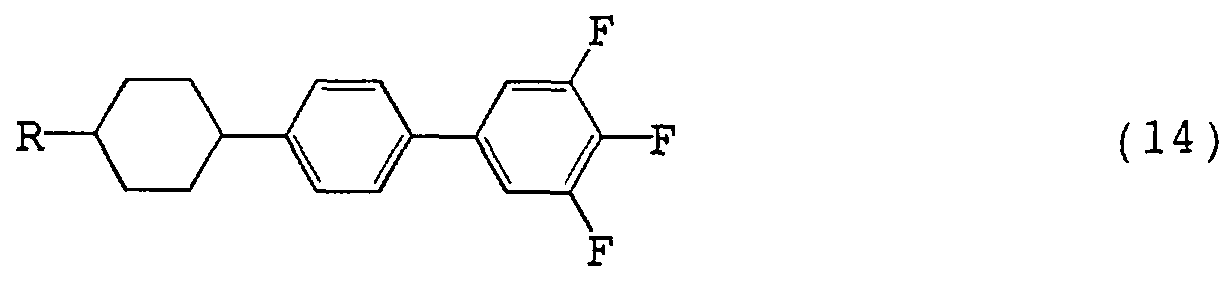
- Both the compounds (13) and (14) have a 3,4,5-trifluorophenyl group at a terminal of a molecule and are expected as a liquid crystal material for driving a display element at a low voltage. However, the compound (13) has a small dielectric anisotropy (Δε = about 10) for use in the reflective display element described above, and the compound (14) has a satisfactory dielectric anisotropy (Δε = about 12) but has a large refractive anisotropy of about 0.12, so that it is considered difficult to prepare a liquid crystal composition which can sufficiently satisfy the above requirements by using these compounds.
- In recent years, novel modes such as an in-plain switching (IPS) mode, a vertical alignment (VA) mode, a multidomain vertical alignment (MVA) mode and an OCB mode have been developed as a mode for overcoming a narrow view angle which is the largest problem of a liquid crystal display element. Among these modes, the VA mode and the MVA mode are particularly excellent in response and have a wide view angle, and further, a high contrast, so that they have been actively developed by respective display makers. Liquid crystal compositions used for the liquid crystal display elements of these modes are characterized in that they have a relatively small refractive anisotropy and a negative dielectric anisotropy. For example, the following compound (15) is reported as a compound showing a large negative dielectric anisotropy (V. Reiffenrath et al., Liq. Cryst., 5 (1), 159 (1989)).

- It can be found from the above literature that the compound (15) shows a large negative dielectric anisotropy (Δε = -4.1), but it has a large refractive anisotropy (Δn = 0.18). Accordingly, it is anticipated that the above compound hardly satisfies the requirements of the VA mode or the MVA mode described above.
- As explained above, a liquid crystalline compound having a large positive or negative dielectric anisotropy and showing a relatively small refractive anisotropy has been desired.
- An object of the present invention is to overcome the disadvantages of conventional techniques described above and provide a liquid crystalline compound which has a large absolute value (|Δε|) of a dielectric anisotropy and shows a relatively small refractive anisotropy, a liquid crystal composition comprising this compound which makes it possible to drive display elements of various modes at a low voltage, and a liquid crystal display element containing this liquid crystal composition.
- The present inventors have made intensive investigations in order to achieve the above object and, as a result, found that the compound having a difluoropropyleneoxy group as a bonding group represented by Formula (1) has a large absolute value (|Δε|) of a dielectric anisotropy and shows a relatively small refractive anisotropy. Further, they have found that a liquid crystal composition comprising this compound is the most suitable material for driving various liquid crystal display elements at a low voltage, and thus completed the present invention.
- The present invention comprises the followings.
- The first aspect of the present invention relates to:
- [1] A liquid crystalline compound represented by
Formula (1):
wherein R1 and R2 each independently represent hydrogen, halogen, a cyano group or an alkyl group having 1 to 20 carbon atoms, in which at least one -CH2- may be substituted with -CH=CH-, -C≡C-, -O- or -S- but -O- is not adjacent to another -O-, and in which at least one hydrogen may be substituted with halogen; rings A1 to A5 each independently represent a 1,4-cyclohexylene group in which at least one -CH2- not adjacent to each other may be substituted with -O- or -S-, a 1,4-cyclohexenylene group, or a 1,4-phenylene group in which at least one =CH- may be substituted with =Nand hydrogen on the ring may be substituted with halogen; Z1 to Z4 each independently represent a single bond, -CH2CH2-, -CH2O-, -OCH2-, -COO-, -OCO-, -CH=CH-, -C≡C-, -CF2O- or -OCF2-; Y1, Y2, Y3 and Y4 each independently represent hydrogen or fluorine; and k, 1, m and n each independently represent 0 or 1. The first embodiment of the present invention is described in the following items [2] to [13].

- [2]The liquid crystalline compound represented by
Formula (1-1) to (1-6):




 wherein R1, R2, rings A1 to A5, Z1 to Z4 and Y1 to Y4 have the same meanings as described above.
- [3] The liquid crystalline compound of Formula (1), wherein ring A3 is a 1,4-cyclohexylene group.
- [4] The liquid crystalline compound of Formula (1), wherein both Y1 and Y3 are fluorine atoms, and both Y2 and Y4 are hydrogens.
- [5] The liquid crystalline compound of Formula (1), wherein both Y1 and Y2 are hydrogens.
- [6] The liquid crystalline compound of Formula (1-1), wherein ring A3 is a 1,4-cyclohexylene group, both Y1 and Y3 are fluorines, and both Y2 and Y4 are hydrogens.
- [7] The liquid crystalline compound of Formula (1-1), wherein ring A3 is a 1,4-cyclohexylene group, and both Y1 and Y2 are hydrogens.
- [8] The liquid crystalline compound of Formula (1-2), wherein both ring A2 and ring A3 are 1,4-cyclohexylene groups, both Y1 and Y3 are fluorines, and both Y2 and Y4 are hydrogens.
- [9]The liquid crystalline compound of Formula (1-2), wherein both ring A2 and ring A3 are 1,4-cyclohexylene groups, both Y1 and Y3 are hydrogens, both Y2 and Y4 are fluorines, and R2 is an alkoxy group.
- [10] The liquid crystalline compound of Formula (1-2), wherein both ring A2 and ring A3 are 1,4-cyclohexylene groups; and both Y1 and Y2 are hydrogens.
- [11] The liquid crystalline compound of Formula (1-2), wherein both ring A2 and ring A3 are 1,4-cyclohexylene groups, both Y1 and Y2 are hydrogens, both Y3 and Y4 are fluorines, and R2 is fluorine.
- [12]The liquid crystalline compound of Formula (1-2), wherein both ring A2 and ring A3 are 1,4-phenylene groups in which hydrogen on the ring may be substituted with fluorine, Z2 is a single bond, both Y1 and Y2 are hydrogens, both Y3 and Y4 are fluorines, and R2 is fluorine.
- [13] The liquid crystalline compound of Formula (1-3), wherein ring A3 is a 2,3-difluoro-1,4-phenylene group. The second aspect of the present invention relates to:
- [14]A liquid crystal composition comprising at least one liquid crystalline compound as described in any one of the items [1] to [13]. The embodiment thereof is described in the following items [15] to [21].
- [15] The liquid crystal composition as described in the
item [14], further comprising at least one compound selected
from the group consisting of compounds represented by
Formulas (2), (3) and (4) as a second component:

 wherein R3 represents an alkyl group having 1 to 10 carbon atoms, in which any -CH2- not adjacent to each other may be substituted with -O- or -CH=CH- and any hydrogen may be substituted with fluorine; X1 represents fluorine, chlorine, -OCF3, -OCF2H, -CF3, -CF2H, -CFH2, -OCF2CF2H or -OCF2CFHCF3; L1 and L2 each independently represent hydrogen or fluorine; Z5 and Z6 each independently represent -(CH2)2-, -(CH2)4-, -COO-, -CF2O-, -OCF2-, -CH=CH- or a single bond; rings A and B each independently represent 1,4-cyclohexylene, 1,3-dioxane-2,5-diyl, or 1,4-phenylene in which hydrogen may be substituted with fluorine; and ring C represents 1,4-cyclohexylene, or 1,4-phenylene in which hydrogen may be substituted with fluorine.
- [16] The liquid crystal composition as described in the
item [14], further comprising at least one compound selected
from the group consisting of compounds represented by
Formulas (5) and (6) as a second component:
 wherein R4 and R5 each independently represent an alkyl group having 1 to 10 carbon atoms, in which any -CH2- not adjacent to each other may be substituted with -O- or -CH=CH- and any hydrogen may be substituted with fluorine; X2 represents -CN or -C≡C-CN; ring D represents 1,4-cyclohexylene, 1,4-phenylene, 1,3-dioxane-2,5-diyl or pyrimidine-2,5-diyl; ring E represents 1,4-cyclohexylene, 1,4-phenylene in which hydrogen may be substituted with fluorine, or pyrimidine-2,5-diyl; ring F represents 1,4-cyclohexylene or 1,4-phenylene; Z7 represents -(CH2)2-, -COO-, -CF2O-, -OCF2- or a single bond; L3, L4 and L5 each independently represent hydrogen or fluorine; and b, c and d each independently represent 0 or 1.
- [17] The liquid crystal composition as described in the
item [14], further comprising at least one compound selected
from the group consisting of compounds represented by
Formulas (7), (8) and (9) as a second component:

 wherein R6 and R7 each independently represent an alkyl group having 1 to 10 carbon atoms, in which any -CH2- not adjacent to each other may be substituted with -O- or -CH=CH- and any hydrogen may be substituted with fluorine; rings G and I each independently represent 1,4-cyclohexylene or 1,4-phenylene; L6 and L7 each independently represent hydrogen or fluorine, but L6 and L7 are not hydrogens at the same time; and Z8 and Z9 each independently represent -(CH2)2-, -COO- or a single bond.
- [18] The liquid crystal composition as described in the
item [14], further comprising at least one compound selected
from the group consisting of the compounds represented by
Formulas (2), (3) and (4) as a second component and at least
one compound selected from the group consisting of compounds
represented by Formulas (10), (11) and (12) as a third
component:

 wherein R8 and R9 each independently represent an alkyl group having 1 to 10 carbon atoms, in which any -CH2- not adjacent to each other may be substituted with -O- or -CH=CH- and any hydrogen may be substituted with fluorine; rings J, K and M each independently represent 1,4-cyclohexylene, pyrimidine-2,5-diyl, or 1,4-phenylene in which hydrogen may be substituted with fluorine; and Z10 and Z11 each independently represent -C≡C-, -COO-, -(CH2)2-, -CH=CH- or a single bond.
- [19] The liquid crystal composition as described in the item [14], further comprising at least one compound selected from the group consisting of the compounds represented by Formulas (5) and (6) as a second component and at least one compound selected from the group consisting of the compounds represented by Formulas (10), (11) and (12) as a third component.
- [20] The liquid crystal composition as described in the item [14], further comprising at least one compound selected from the group consisting of the compounds represented by Formulas (7), (8) and (9) as a second component and at least one compound selected from the group consisting of the compounds represented by Formulas (10), (11) and (12) as a third component.
- [21] The liquid crystal composition as described in the item [14], further comprising at least one compound selected from the group consisting of the compounds represented by Formulas (2), (3) and (4) as a second component, at least one compound selected from the group consisting of the compounds represented by Formulas (5) and (6) as a third component and at least one compound selected from the group consisting of the compounds represented by Formulas (10), (11) and (12) as a fourth component. The third aspect of the present invention relates to:
- [22]A liquid crystal composition comprising at least one liquid crystal composition as described in any one of the items [14] to [21], and further, at least one optically active compound. The fourth aspect of the present invention relates to:
- [23]A liquid crystal display element comprising the liquid crystal composition as described in any one of the items [14] to [22].
-
- The compound of the present invention represented by Formula (1) is characterized by having a moiety in which -O- in a difluoropropyleneoxy group is bonded directly to a 1,4-phenylene group which may be substituted with fluorine. The compound of Formula (1) in which ring A3 is a 1,4-cyclohexylene group has a high clearing point, and the compound in which ring A3 is a 1,4-phenylene group has a large absolute value of dielectric anisotropy. Further, the compound of Formula (1) in which both Y1 and Y2 are hydrogens shows a neutral or positive dielectric anisotropy. Especially, the compound in which at least one of Y3 and Y4 is fluorine shows a large positive dielectric anisotropy. For example, the compound of the present invention (compound No. 40) shown in the example described later has a dielectric anisotropy Δε of 13.7, which is a much larger value than that of a compound in which a bonding group corresponding to a difluoropropyleneoxy group is a single bond ((13-1): Δε = 9.7).


- On the other hand, the compound of Formula (1) in which both Y1 and Y3 are fluorines and both Y2 and Y4 are hydrogens shows a large negative dielectric anisotropy. Further, the compound of Formula (1) shows almost the same refractive anisotropy, while having a high clearing point, as compared with the compound in which a bonding group corresponding to a difluoropropyleneoxy group in the present invention is a single bond. As seen from these matters, the compound of Formula (1) has suitable characteristics as a liquid crystalline compound constituting a liquid crystal composition for a VA mode or an MVA mode as well as a reflective liquid crystal display element described in the
- Compounds having a difluoropropyleneoxy group as a bonding group are partly described in WO97/37959 and represented by a general Formula similar to that of the present invention, but any structural Formula or physical properties of a specific compound is not disclosed. The excellent characteristics of the compound of the present invention described above have newly been found by the present inventors.
- The liquid crystalline compound represented by Formula (1) is classified into the group of the compounds represented by Formulas (1-1) to (1-6) by suitably selecting k, 1, m and n:




 wherein R1, R2, rings A1 to A5, Z1 to Z4 and Y1 to Y4 have the same meanings as described above.
- Among these compounds of more specific concept, a compound of two-ring system represented by Formula (1-1) has a relatively large absolute value of Δε and a relatively small Δn, and it has a low viscosity and a good compatibility at low temperature. When this compound is used as a component for a liquid crystal composition, a viscosity of the composition can be reduced while maintaining an absolute value of Δε thereof, and therefore, a liquid crystal composition for high-speed response can be provided.
- Further, a compound of three-ring system represented by Formula (1-2) or (1-3) has a large absolute value of Δε and a relatively small Δn, and it shows a liquid crystal phase in a relatively wide temperature range. This compound as a component for a liquid crystal composition can elevate an absolute value of Δε of the composition without lowering a clearing point thereof, and therefore, it can provide a liquid crystal composition for driving a display element at a low voltage.
- Compounds of four-ring system represented by Formulas (1-4) to (1-6) have a large absolute value of Δε and show a relatively small Δn. Further, a liquid crystal phase is shown at high temperature in the wide range. Accordingly, when this compound is used as a component for a liquid crystal composition, an absolute value of Δε can be increased, and a liquid crystal phase temperature range shown by the liquid crystal composition can be extended to a high temperature range.
- Further, the compounds of these Formulas in which at least one of Y1, Y2, Y3 and Y4 is fluorine are characterized by having an excellent compatibility at low temperature.
- In the compound represented by Formula (1), R1 and R2 each independently represent hydrogen, halogen, a cyano group, or an alkyl group having 1 to 20 carbon atoms, in which -CH2- may be substituted with -CH=CH-, -C≡C-, -O- or -S- but -O- is not adjacent to another -O-, and in which at least one hydrogen may be substituted with halogen; rings A1 to A5 each independently represent a 1,4-cyclohexylene group in which at least one -CH2- not adjacent to each other may be substituted with -O- or -S-, a 1,4-cyclohexenylene group, or a 1,4-phenylene group in which at least one =CH- may be substituted with =N- and hydrogen on the ring may be substituted with halogen; Z1 to Z4 each independently represent a single bond, -CH2CH2-, -CH2O-, -OCH2-, -COO-, -OCO-, -CH=CH-, -C≡C-, -CF2O- or -OCF2-; Y1, Y2, Y3 and Y4 each independently represent hydrogen or fluorine; and k, 1, m and n each independently represent 0 or 1.
- Specifically, R1 and R2 represent hydrogen, halogen, a cyano group, an alkyl group, an alkoxy group, an alkoxyalkyl group, an alkylthio group, an alkylthioalkyl group, an alkenyl group, an alkenyloxy group, an alkenylthio group, an alkynyl group, a fluoro-substituted alkyl group, a fluoro-substituted alkoxy group, a fluoro-substituted alkenyl group, a fluoro-substituted alkenyloxy group, a fluoro-substituted alkenylthio group and a fluoro-substituted alkynyl group.
- More specifically, they represent fluorine, chlorine, bromine, methyl, ethyl, propyl, isopropyl, butyl, pentyl, hexyl, heptyl, octyl, nonyl, decyl, methoxy, ethoxy, propoxy, butoxy, pentoxy, heptyloxy, octyloxy, methoxymethyl, ethoxymethyl, propoxymethyl, propoxyethyl, methoxypropyl, ethoxypropyl, propoxypropyl, methylthio, ethylthio, propylthio, butylthio, pentylthio, hexylthio, heptylthio, octylthio, methylthiomethyl, ethylthiomethyl, propylthiomethyl, butylthiomethyl, methylthioethyl, ethylthioethyl, propylthioethyl, methylthiopropyl, ethylthiopropyl, propylthiopropyl, vinyl, 1-propenyl, 1-butenyl, 1-pentenyl, 3-butenyl, 3-pentenyl, ethynyl, 2-propynyl, 2-butynyl, 3-butynyl, 3-pentynyl, allyloxy, trifluoromethyl, fluoromethyl, 2-fluoroethyl, difluoromethyl, 2,2,2-trifluoroethyl, 1,1,2,2-tetrafluoroethyl, 2-fluoroethyl, 3-fluoropropyl, 4-fluorobutyl, 5-fluoropentyl, fluoromethoxy, trifluoromethoxy, difluoromethoxy, pentafluoroethoxy, 1,1,2,2-tetrafluoroethoxy, heptafluoropropoxy, 1,1,2,3,3,3-hexafluoropropoxy, trifluoromethoxymethyl, 2-fluoroethenyl, 2,2-difluoroethenyl, 1,2,2-trifluoroethenyl, 3-fluoro-1-butenyl, 4-fluoro-1-butenyl, trifluoromethylthio, difluoromethylthio, 1,1,2,2-tetrafluoroethylthio, 2,2,2-trifluoroethylthio and the like.
- Specifically, rings A1 to A5 preferably have ring structures represented by Formulas (r-1) to (r-24):


- The liquid crystal composition of the present invention may comprise only the first component comprising at least one liquid crystalline compound represented by Formula (1), and preferably, it may further comprises as a second component at least one compound (hereinafter referred to as second component A) selected from the group consisting of the compounds represented by Formulas (2), (3) and (4) described above and/or at least one compound (hereinafter referred to as second component B) selected from the group consisting of the compounds represented by Formulas (5) and (6). Further, the composition can comprise at least one compound selected from the group consisting of the compounds represented by Formulas (7), (8) and (9) as a third component for the purpose of controlling a threshold voltage, a liquid crystal temperature range, a refractive anisotropy, a dielectric anisotropy, a viscosity, etc. The respective components of the liquid crystal composition used for the present invention make little difference in physical properties, and therefore, they may be analogues comprising isotopes of the respective elements.
- Among the compounds represented by Formulas (2), (3) and (4) as the second component A described above, preferable examples are the following compounds of Formulas (2-1) to (2-9), (3-1) to (3-97) and (4-1) to (4-33), respectively.










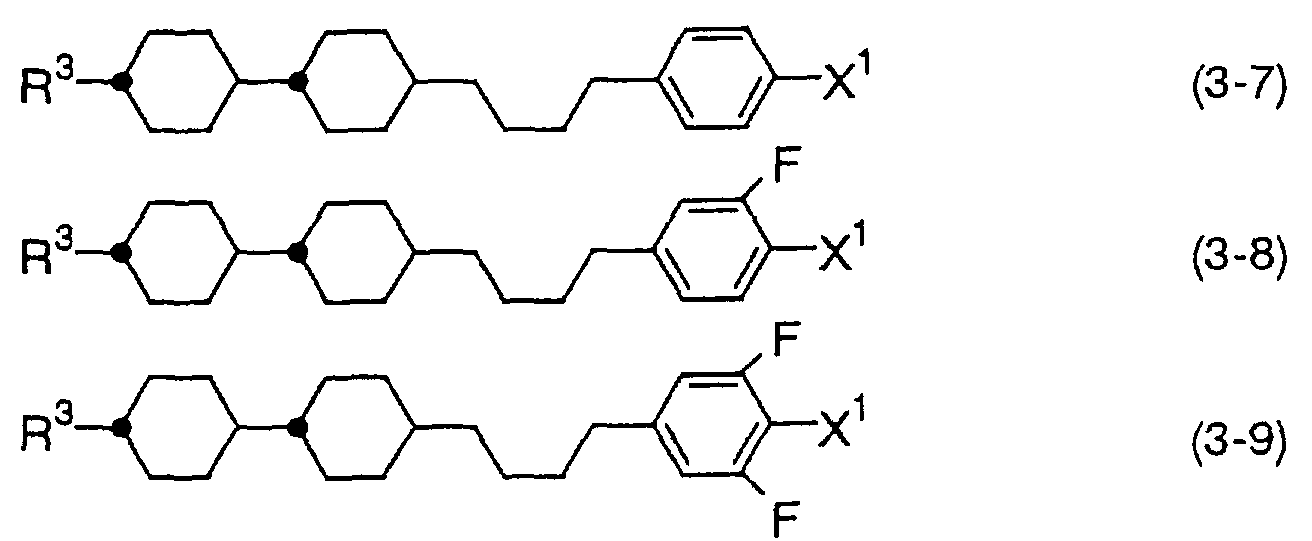


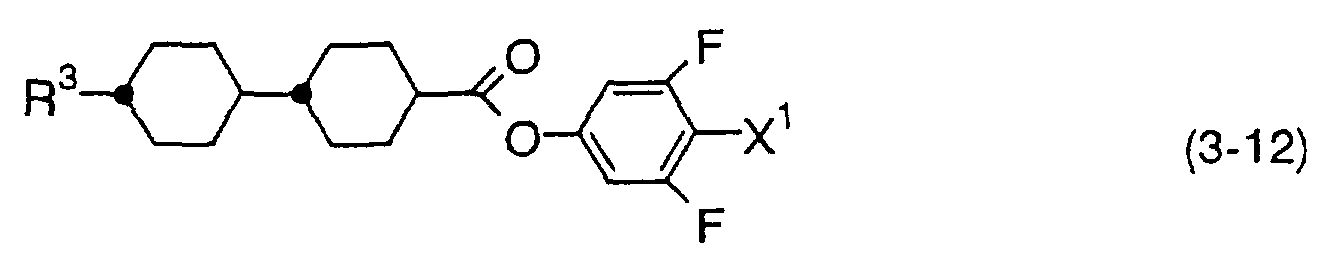







































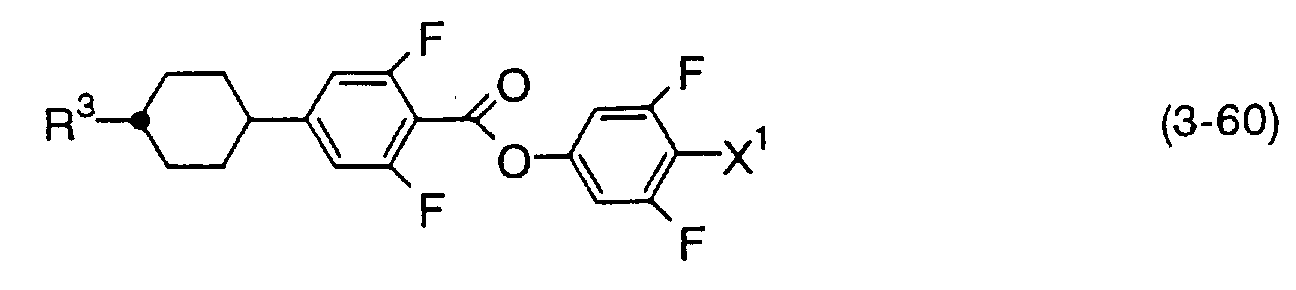




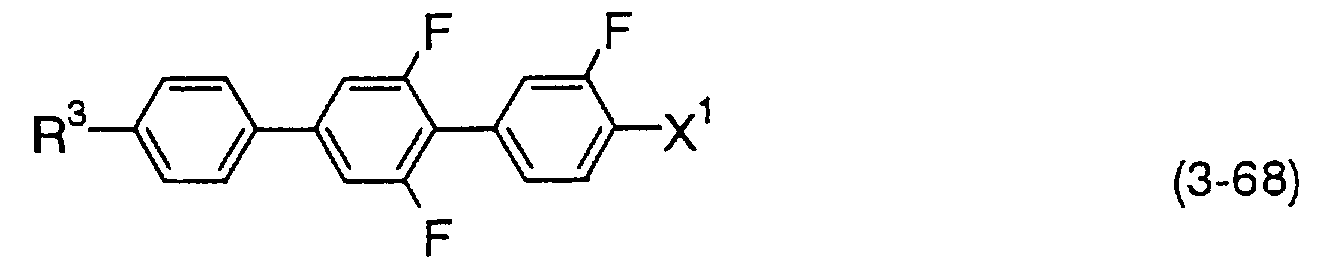


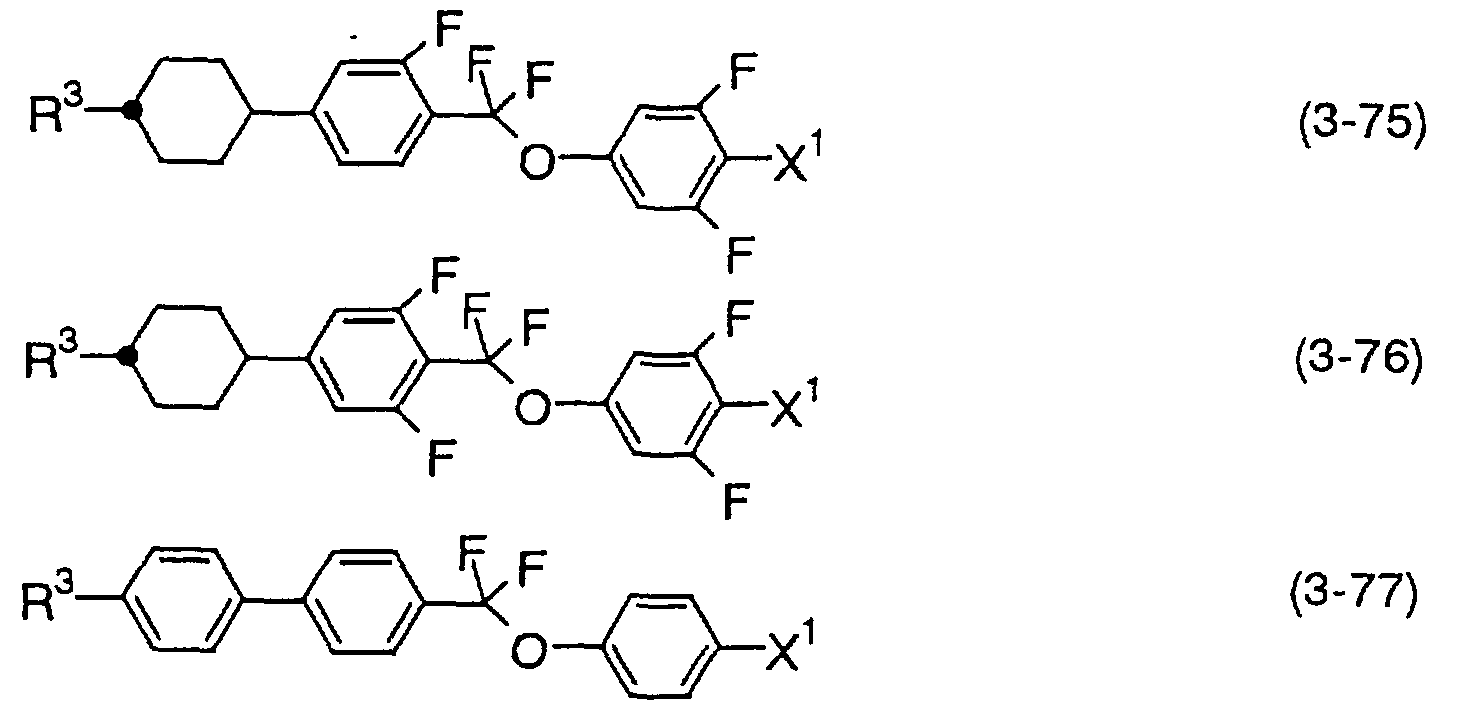

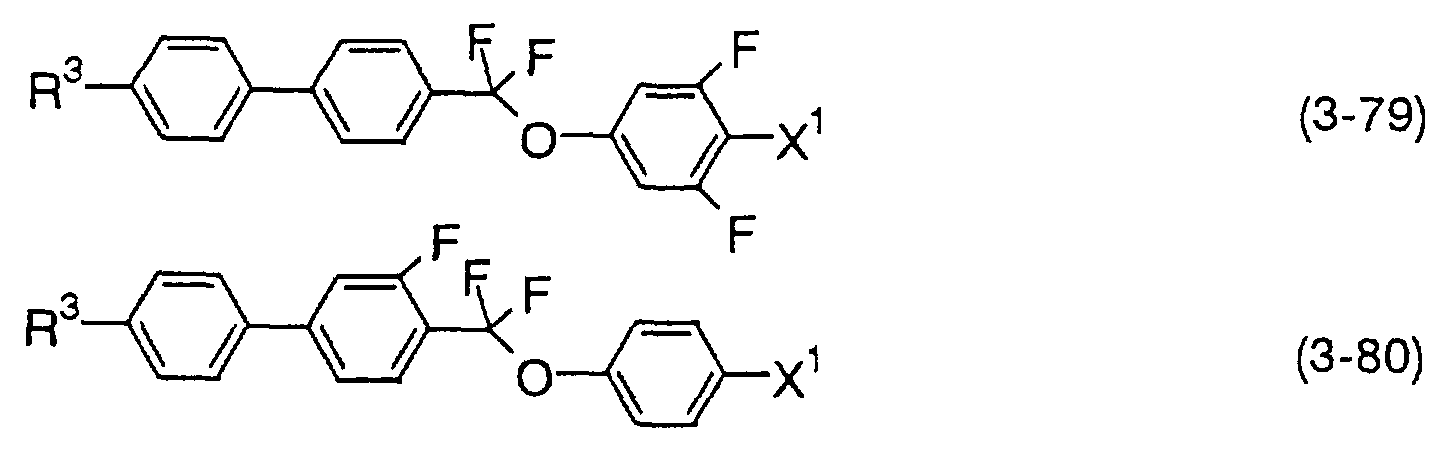

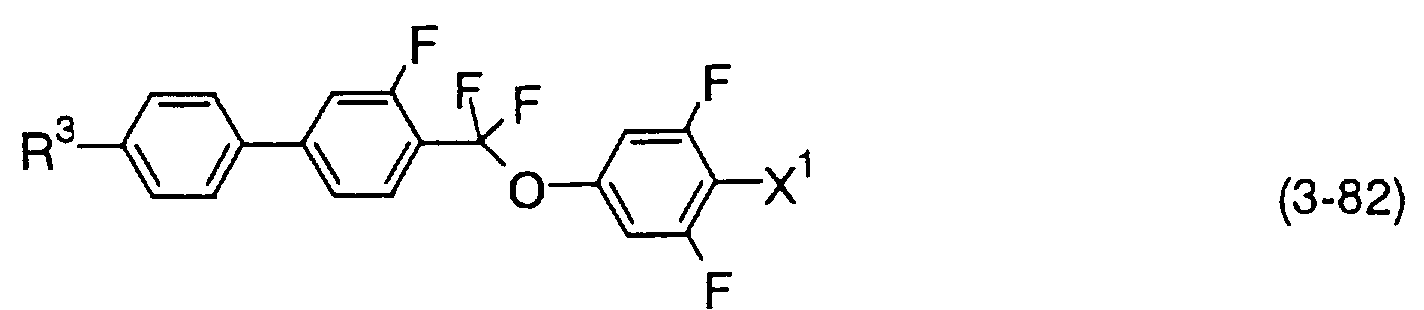

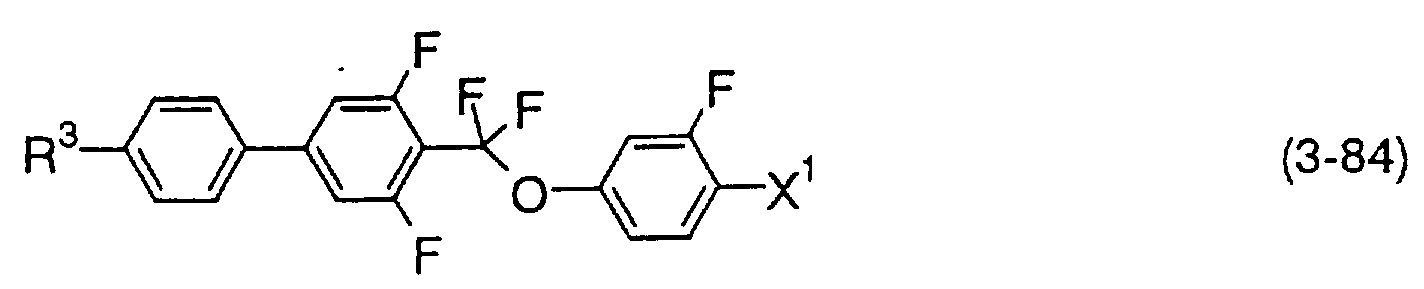
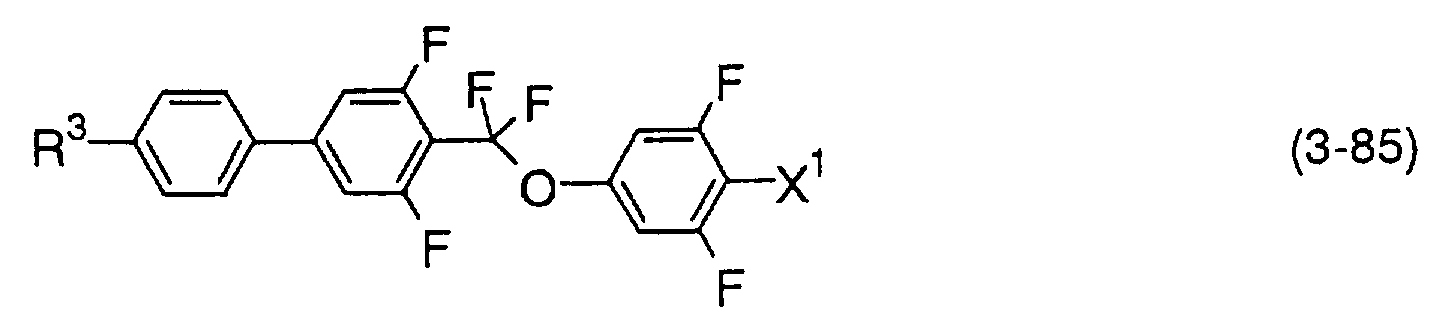















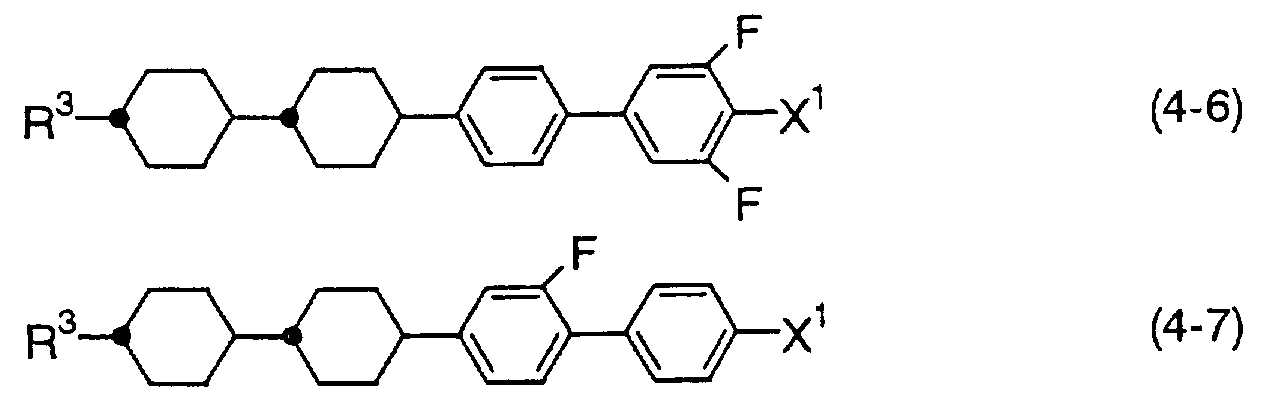









 In Formulas, R3 and X1 have the same meanings as described above.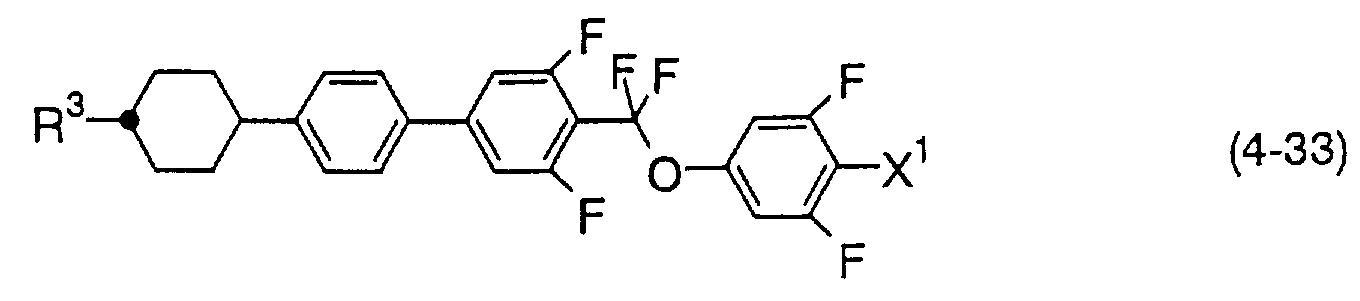
- These compounds represented by Formulas (2) to (4) show a positive dielectric anisotropy and are very excellent in heat stability and chemical stability, so that they are used primarily for liquid crystal compositions for TFT. When preparing a liquid crystal composition for TFT, an amount of the above compounds may preferably be in the range of 1 to 99% by weight, more preferably 10 to 97% by weight and further preferably 40 to 95% by weight based on the total amount of the liquid crystal composition. The compounds represented by Formulas (10) to (12) may further be added for the purpose of controlling the viscosity.
- Among the compounds represented by Formulas (5) and (6) as the second component B described above, preferable examples are the following compounds of Formulas (5-1) to (5-58) and (6-1) to (6-3), respectively.















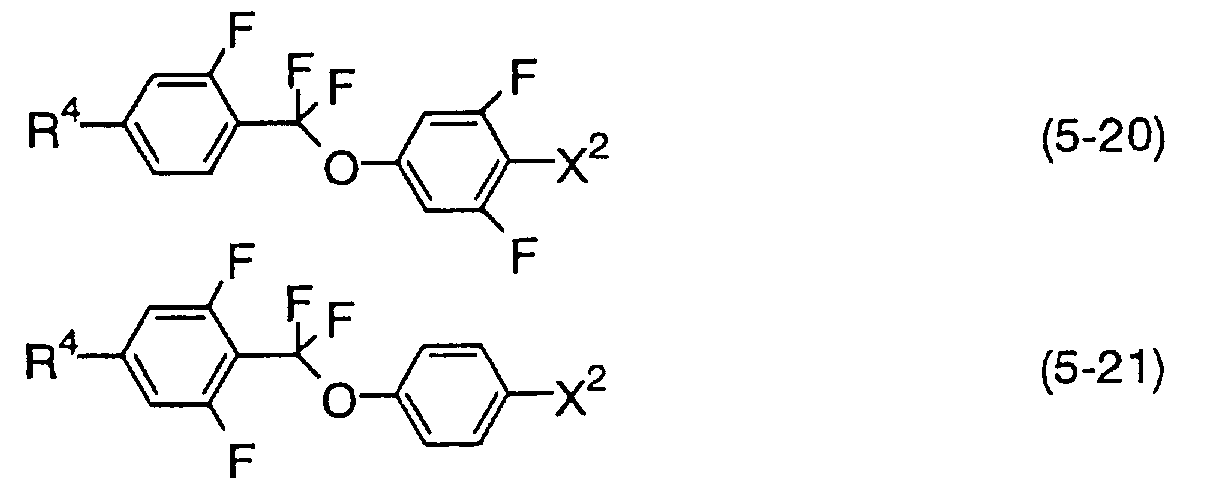







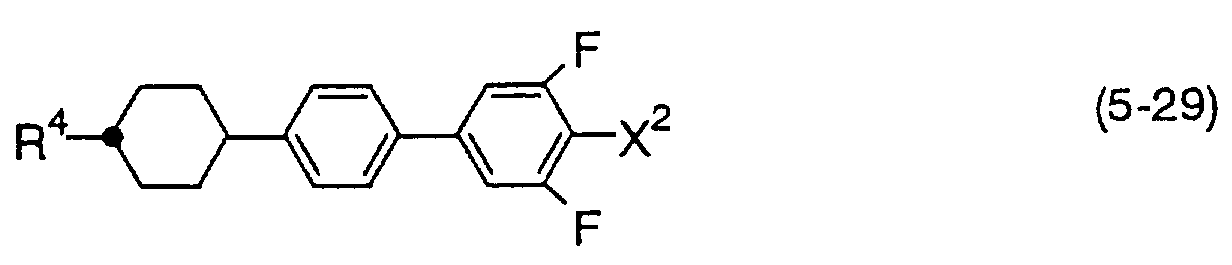













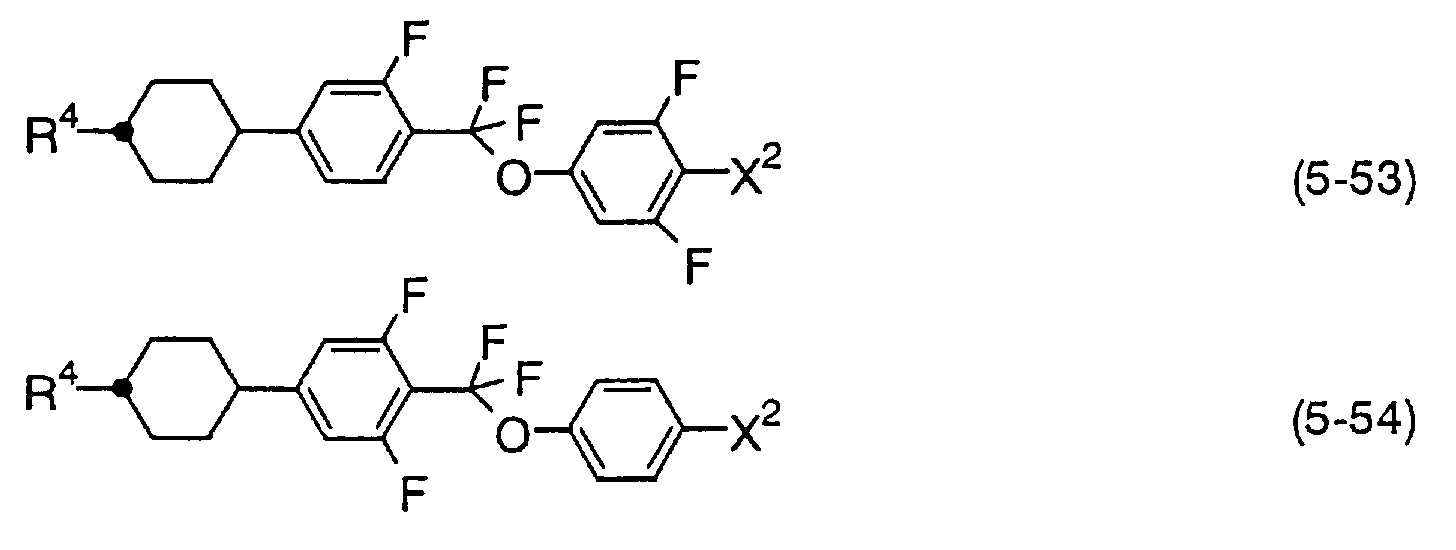

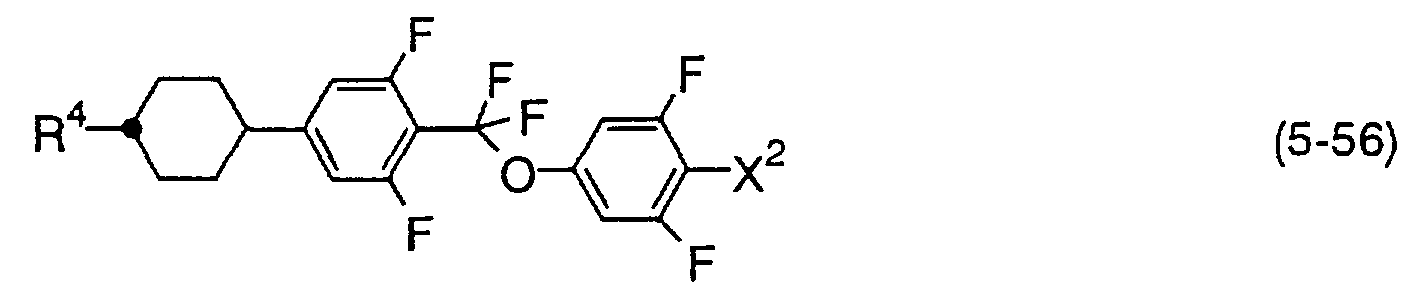



 In Formulas, R4, R5 and X2 have the same meanings as described above.
- These compounds represented by Formulas (5) and (6) have a positive dielectric anisotropy, and a value thereof is very large, so that they are used mainly for liquid crystal compositions for STN and TN. These compounds are used as a component of the composition particularly for the purpose of reducing a threshold voltage. Further, they are used for the purposes of controlling the viscosity and the refractive anisotropy, expanding the liquid crystal phase temperature range, and also improving the steepness. When preparing a liquid crystal composition for STN or TN, an amount of the compounds of the Formulas (5) and (6) may preferably be in the range of 0.1 to 99.9% by weight, more preferably 10 to 97% by weight and further preferably 40 to 95% by weight. A third component described later can be mixed for the purpose of controlling the threshold voltage, the liquid crystal phase temperature range, the refractive anisotropy, the dielectric anisotropy, the viscosity, etc.
- When preparing a liquid crystal composition for a vertical alignment mode (VA mode), etc. having a negative dielectric anisotropy, preferable is the composition comprising at least one compound (hereinafter referred to as second component C) selected from the group consisting of the compounds represented by Formulas (7) to (9). Preferable examples of the compounds represented by Formulas (7) to (9) among the second component C are the following compounds of Formulas (7-1) to (7-3), (8-1) to (8-5) and (9-1) to (9-3), respectively.









 In Formulas, R6 and R7 have the same meanings as described above.
- The compounds represented by Formulas (7) to (9) have a negative dielectric anisotropy. The compound of Formula (7) is a compound of two-ring system and therefore used mainly for the purpose of controlling the threshold voltage, the viscosity or the refractive anisotropy. The compound of Formula (8) is used for the purpose of not only expanding the nematic range but also reducing the threshold voltage and increasing the refractive anisotropy.
- The compounds represented by Formulas (7) to (9) are used mainly for a liquid crystal composition for a VA mode having a negative dielectric anisotropy. If an amount thereof is increased, the composition has a reduced threshold voltage but it may also have an increased viscosity. Therefore, an amount thereof is preferably reduced as long as a required value of the threshold voltage is satisfied. However, an absolute value of the dielectric anisotropy is 5 or less, and if an amount of the compounds represented by Formulas (7) to (9) are less than 40% by weight, the liquid crystal composition may not be driven. Accordingly, an amount of the compounds represented by Formulas (7) to (9) is preferably 40% by weight or more when preparing the composition for a VA mode. It is more preferably in the range of 50 to 95% by weight.
- Further, the compounds represented by Formulas (7) to (9) may be added to the liquid crystal composition having a positive dielectric anisotropy for the purpose of controlling the elastic constant and a voltage transmission curve of the composition. In this case, an amount of the compounds represented by Formulas (7) to (9) is preferably 30% by weight or less.
- Among the compounds represented by Formulas (10) to (12) as the third component for the liquid crystal composition of the present invention, preferable examples are the following compounds of Formulas (10-1) to (10-11), (11-1) to (11-12) and (12-1) to (12-6), respectively.

























 In Formulas, R8 and R9 have the same meanings as described above.
- The compounds represented by Formulas (10) to (12) have a small absolute value of a dielectric anisotropy and are almost neutral. The compound of Formula (10) is used mainly for the purpose of controlling the viscosity or the refractive anisotropy. The compounds of Formulas (11) and (12) are used for the purpose of expanding the nematic range by elevating the clearing point, or controlling the refractive anisotropy.
- If an amount of the compounds represented by Formulas (10) to (12) is increased, the liquid crystal composition has an elevated threshold voltage and a reduced viscosity. Therefore, the compounds represented by the Formulas (10) to (12) are preferably used in a large amount in order to make low voltage driving possible as long as a required value of the threshold voltage of the liquid crystal composition is satisfied. When preparing the liquid crystal composition for TFT, an amount of the compounds represented by Formulas (10) to (12) is preferably 40% by weight or less, more preferably 35% by weight or less. When preparing the liquid crystal composition for STN or TN, an amount of the compounds represented by Formulas (10) to (12) is preferably 70% by weight or less, more preferably 60% by weight or less.
- The liquid crystal composition of the present invention preferably comprises at least one of the liquid crystalline compounds represented by Formula (1) in the proportion of 0.1 to 99% by weight in order to make low voltage driving possible.
- The above liquid crystal composition is usually prepared by a publicly known method, for example, a method of dissolving various components at high temperature. Further, a chiral dopant is added if necessary, whereby the liquid crystal composition can be improved for each purpose and optimized. Any chiral dopant may be used as long as it can induce a helical structure of liquid crystals to adjust a required twist angle and prevent reverse twist. For example, the following optically active compounds can be given as the chiral dopant.





- In the liquid crystal composition of the present invention, these optically active compounds are usually added to adjust a pitch of twist. The pitch of twist is preferably adjusted in the range of 40 to 200 µm in the case of the liquid crystal compositions for TFT and TN. In the case of the liquid crystal composition for STN, it is preferably adjusted in the range of 6 to 20 µm. Further, in the case of the liquid crystal composition for a bistable TN mode, it is preferably adjusted in the range of 1.5 to 4 µm. Two or more optically active compounds may be added for the purpose of controlling a temperature dependency of the pitch.
- The liquid crystal composition of the present invention can also be used as a liquid crystal composition for a G-H mode by adding a dichroic dye such as merocyanine, styryl, azo, azomethine, azoxy, quinophthalone, anthraquinone and tetrazine. The composition according to the present invention can also be used as a liquid crystal composition for NCAP prepared by the micro-encapsulation of nematic liquid crystals, for a polymer dispersed liquid crystal display element (PDLCD) such as a polymer network liquid crystal display element (PNLCD) in which a three-dimensional polymer is formed in liquid crystals, and for an electrically controlled birefringence mode (ECB) or DS mode liquid crystal displays.
- The compounds represented by Formula (1) according to the present invention can be produced by suitably selecting and combining methods described in publications or publicly known literatures on organic synthesis such as Jikken Kagaku Koza (Experimental Chemistry Course) 4th Edition (Maruzen), Organic Synthesis (John Wiley & Sons, Inc.) or Organic Reactions (John Wiley & Sons, Inc.).
- The compound represented by Formula (1) can be prepared by the following method, for example. First, a propionic acid ester derivative (16) obtained by a method described in JP-A 59-76027, JP-A 60-197637 or JP-A 60-204743 is converted to a thioester derivative (17) with a Lawesson's reagent (Fieser 13, 38) according to a method disclosed in JP-A 10-204016. Further, the derivative (17) is reacted with HF-pyridine in the presence of an oxidizing agent such as N-bromosuccinimide (hereinafter abbreviated as NBS) according to a method disclosed in JP-A 5-255165.In Formulas, R1, R2, rings A1 to A5, Z1 to Z4, Y1 to Y4, k, 1, m and n have the same meanings as described above.

- The compound represented by Formula (1) can suitably be prepared by the following method as well. According to a method described in JP-A 10-17544, a Grignard reagent is prepared from a halobenzene derivative (18) and then reacted with carbon disulfide to obtain a dithiocarboxylic acid derivative (19). The derivative (19) is then reacted with sodium hydride in the presence of a phenol derivative (20) and further oxidized with iodine to obtain the thioester derivative (17). The derivative (17) thus obtained is reacted with HF-pyridine in the presence of an oxidizing agent such as NBS to give the desired compound (1).In Formulas, R1, R2, rings A1 to A5, Z1 to Z4, Y1 to Y4, k, 1, m and n have the same meanings as described above, hydrogen on a benzene ring may be substituted with fluorine, and X represents chlorine or bromine.
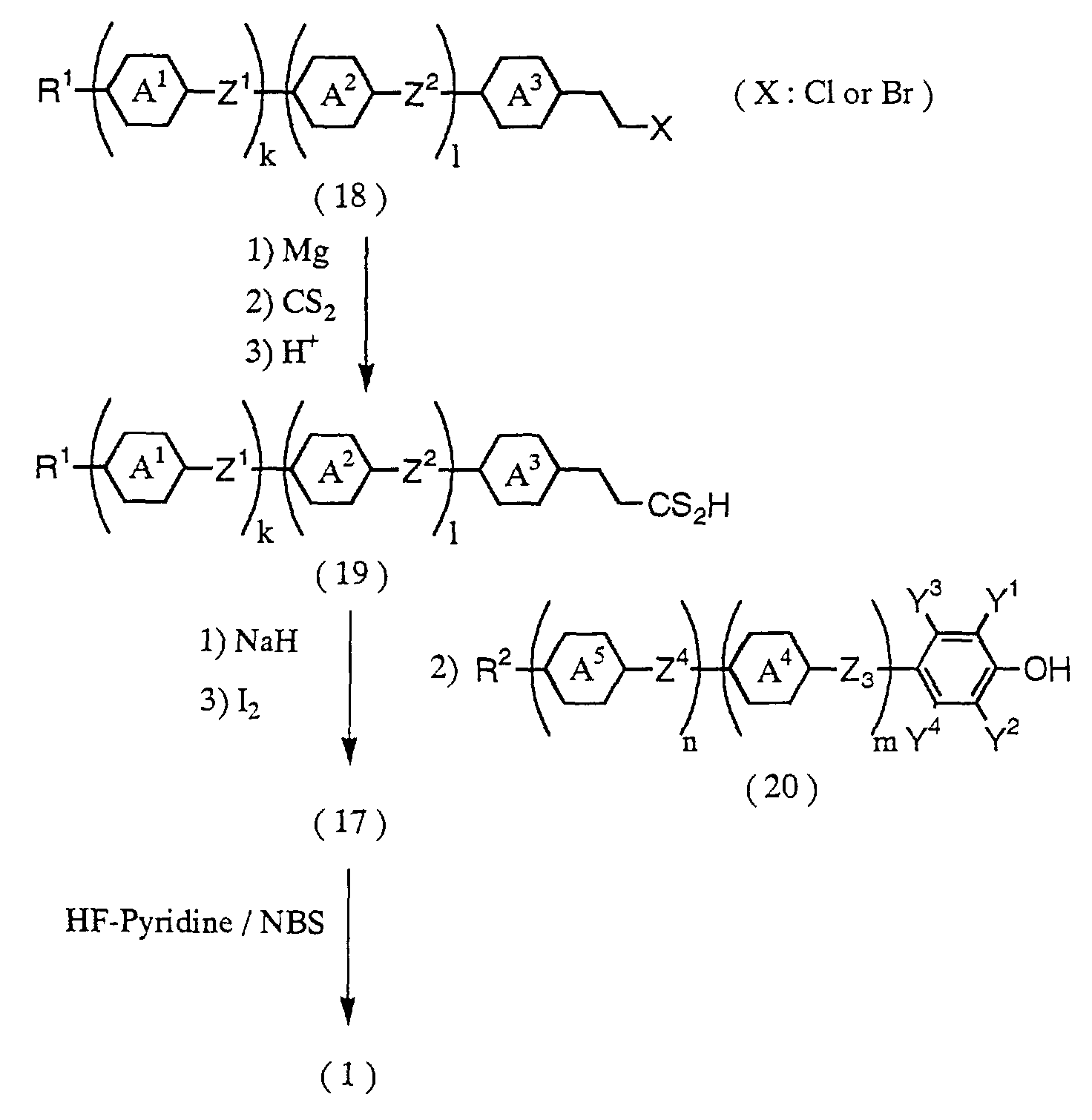
- The phenol derivative (20) used above can be prepared according to a method of R. L. Kidwell, et al. (Org. Synth., V, 918 (1973)), for example, by reacting trialkyl borate with a Grignard reagent prepared from a benzene derivative (21) to give a boric acid ester derivative and then oxidizing this derivative with a peroxide such as hydrogen peroxide and peracetic acid.In Formulas, R2, rings A4 and A5, Z3, Z4, Y1 to Y4, m and n have the same meanings as described above, R10 represents an alkyl group, and X' represents a chlorine atom or a bromine atom.
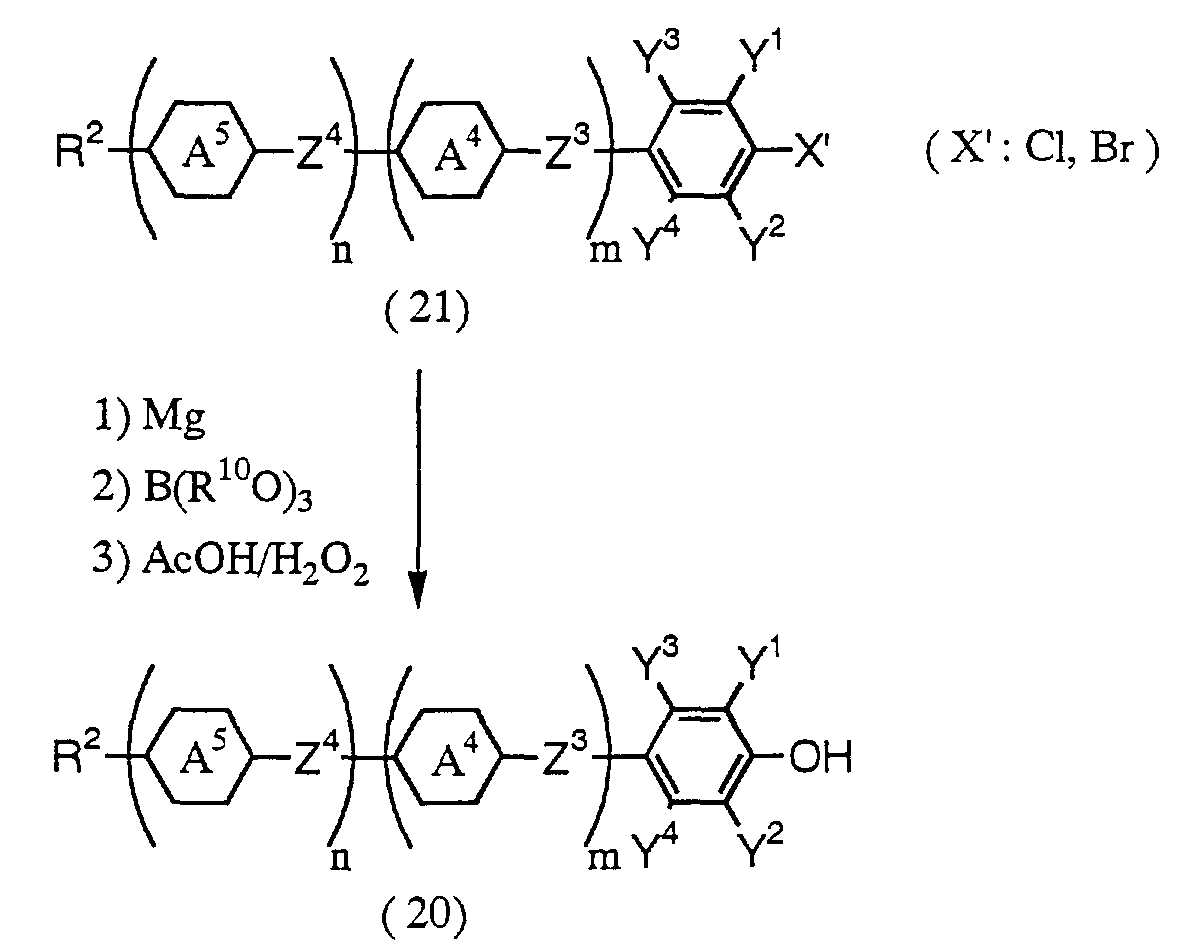
- The compound represented by Formula (1) can preferably be prepared by the following method as well. Specifically, carboxylic acid derivative (22) is reacted with propanedithiol and a strong acid such as trifluoroacetic acid in a suitable solvent such as toluene to obtain a dithianium salt (23). The reaction is carried out at room temperature to the boiling point of the solvent, and preferably at 100°C or higher with removing produced water to isolate the salt in a stable form. The salt (23) can be tetrafluoroborate or perchlorate in addition to dithianium trifluoromethanesulfonate. Subsequently, the salt (23) is reacted with a base such as triethylamine in a suitable solvent such as methylene chloride in the presence of a phenol derivative (20) to obtain dithioortho ester derivative (24). The derivative (24) is then oxidatively fluorinated to obtain the compound (1) by reacting with a fluorinating agent such as triethylamine-3HF, and further, with an oxidizing agent such as NBS and bromine. The reaction is carried out at lower temperature, preferably at -100°C to -50°C for practical reasons.In Formulas, R1, R2, rings A1 to A5, Z1 to Z4, Y1 to Y4, k, 1, m and n have the same meanings as described above, and hydrogen on a benzene ring may be substituted with fluorine.
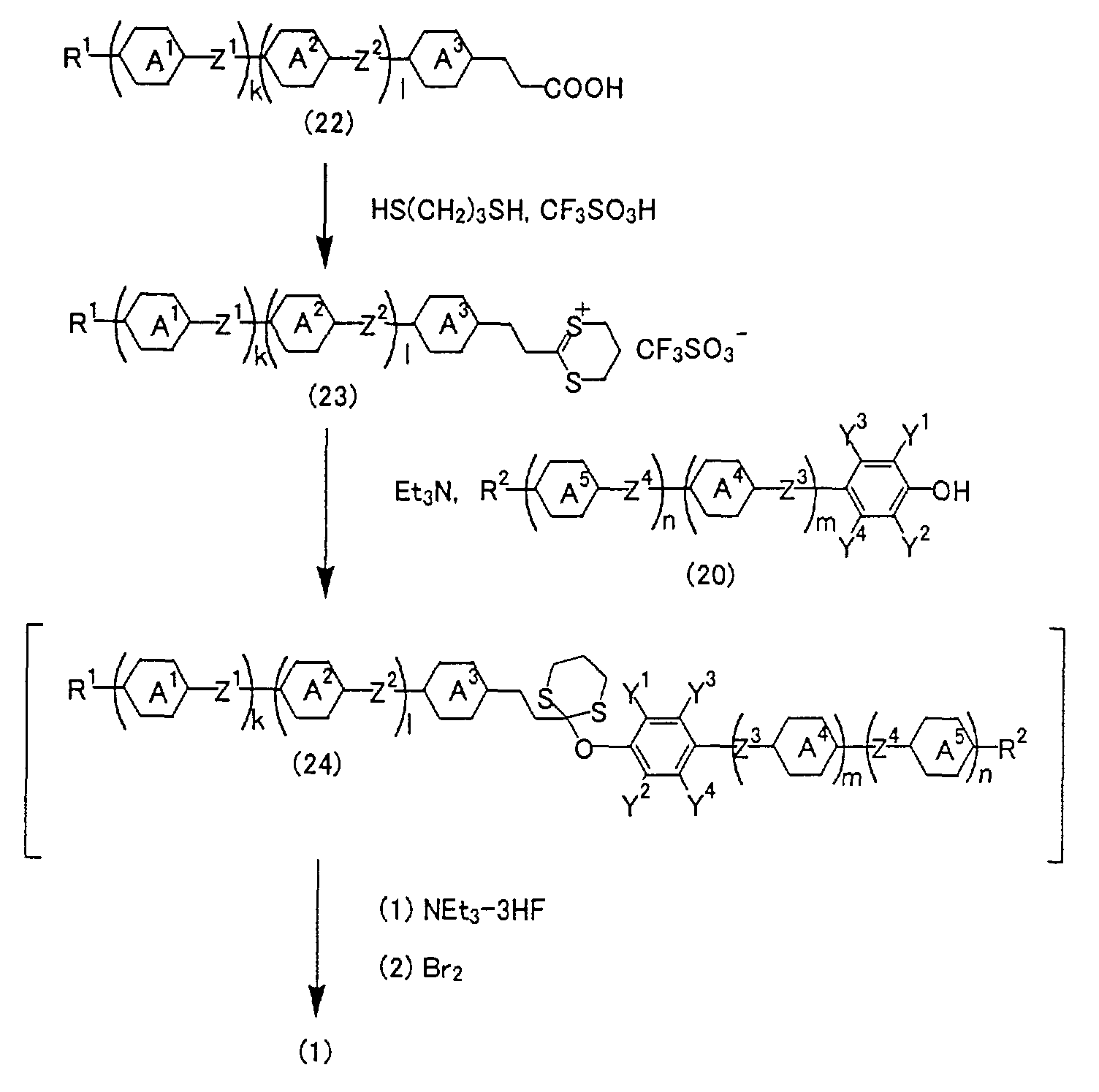
- The present invention shall further be explained below in details with reference to examples.
- In the respective examples, Cr represents crystal, N represents a nematic phase, and Iso represents an isotropic liquid phase.
- Preparation of 1-(3-(trans-4-(trans-4-pentylcyclohexyl)-cyclohexyl)-1,1-difluoropropyleneoxy)-3,4,5-trifluorobenzene (the compound of Formula (1), wherein 1 = 1 and k = m = n = 0; R1 is n-pentyl; both ring A2 and ring A3 are trans-1,4-cyclohexylene groups; Z2 is a single bond; both Y1 and Y2 are hydrogen atoms; and all of Y3, Y4 and R2 are fluorine atoms (Compound No. 40))
- In a 1-L three-neck flask equipped with a stirrer, a thermometer and a dropping funnel, 27.6 g (122.9 mmol) of ethyl diethylphosphinoacetate was dissolved in 350 ml of tetrahydrofuran (hereinafter abbreviated as THF) under nitrogen atmosphere and the solution was cooled down to -5°C while stirring. 15.2 g (135.2 mmol) of potassium t-butoxide was added thereto, and the solution was stirred at room temperature for 2 hours. The solution was cooled down again to 0°C, and a solution of 25.0 g (94.5 mmol) of trans-4-(trans-4-pentylcyclohexyl)cyclohexanecarbaldehyde dissolved in 100 ml of THF was added dropwise. Further, the solution was stirred at room temperature for 14 hours, and then 200 ml of water and 400 ml of toluene were added to the reaction mixture and stirred. The separated toluene layer was washed twice with 200 ml of water and dried over anhydrous magnesium sulfate, and then toluene was distilled off under reduced pressure. The residue was purified by means of a silica gel column chromatography with toluene used as a developing solvent to obtain 12.8 g of ethyl 3-(trans-4-(trans-4-pentylcyclohexyl)cyclohexyl)propenoate (yellow oily substance).
- In 100-ml flask, 12.8 g (38.3 mmol) of ethyl 3-(trans-4-(trans-4-pentylcyclohexyl)cyclohexyl)propenoate obtained above was dissolved in a mixed solvent of toluene/ethanol (50 ml/30 ml). 2.0 g of a 5% palladium-carbon catalyst was added thereto, and the mixture was stirred at room temperature under a hydrogen pressure of 0.1 MPa for 8 hours. The catalyst was separated by filtration, and then the filtrate was concentrated to obtain 13.5 g of a yellow oily substance. Then, this oily substance was dissolved in 150 ml of ethanol, and 50 ml (100 mmol) of a 2M aqueous sodium hydroxide solution was added thereto, followed by heating the solution under reflux for 3 hours. 300 ml of water was added thereto, and insoluble materials deposited were filtered and recrystallized from toluene to obtain 4.9 g of 3-(trans-4-(trans-4-pentylcyclohexyl)-cyclohexyl)propionic acid as pale yellow crystals.
- In a 100-ml three-neck flask equipped with a stirrer, a thermometer and a condenser, 4.9 g (16.0 mmol) of 3-(trans-4-(trans-4-pentylcyclohexyl)cyclohexyl)propionic acid obtained above, 2.9 g (19.2 mmol) of 3,4,5-trifluorophenol, 4.9 g (19.2 mmol) of 2-chloro-1-methylpyridinium iodide (Kazuhiko Saigo, Teruaki Mukaiyama et al., Bull. Chem. Soc. Jpn., 50 (7), 1863 (1977)) and 3.9 g (38.4 mmol) of triethylamine were dissolved in 50 ml of toluene under nitrogen atmosphere, and the solution was heated under reflux for 3 hours while stirring. 50 ml of 6M hydrochloric acid and 100 ml of toluene were added to the reaction mixture, and the solution was stirred. The toluene layer was washed with water (150 ml × 3) and dried over anhydrous magnesium sulfate, and then toluene was distilled off under reduced pressure. The residue was purified by means of a silica gel column chromatography with a mixed solvent of heptane/toluene (75/25) as a developing solvent to obtain 6.4 g of 3,4,5-trifluorophenyl 3-(trans-4-(trans-4-pentylcyclohexyl)cyclohexyl)propionate as colorless crystals.
- In a 300-ml three-neck flask equipped with a stirrer, a thermometer and a condenser, 6.4 g (14.5 mmol) of 3,4,5-trifluorophenyl 3-(trans-4-(trans-4-pentylcyclohexyl)cyclohexyl)propionate obtained above, 11.7 g (29.0 mmol) of Lawesson's reagent and 85 ml of mesitylene were heated under reflux for 8 hours under nitrogen atmosphere while stirring. The solution was cooled down to room temperature, insoluble materials were removed, and the filtrate was extracted with toluene. The toluene layer was washed twice in turn with 200 ml of water, 150 ml of a saturated aqueous sodium carbonate solution and 200 ml of water and dried over anhydrous magnesium sulfate, and then toluene was distilled off under reduced pressure. The residue was purified by means of a silica gel column chromatography with heptane as a developing solvent to obtain 0.9 g of 3,4,5-trifluorophenyl 3-(trans-4-(trans-4-pentylcyclohexyl)cyclohexyl)thione-O-propionate.
- In a 200-ml three-neck Teflon flask equipped with a stirrer, a thermometer and a dropping funnel, 1.1 g (5.8 mmol) of NBS was dissolved in 15 ml of dichloromethane, and 1 ml of 70% HF-pyridine was added at -60°C or lower while stirring, followed by further stirring for 30 minutes. Then, 0.9 g (2.0 mmol) of 3,4,5-trifluorophenyl 3-(trans-4-(trans-4-pentylcyclohexyl)cyclohexyl)thione-O-propionate obtained in the above step was dissolved in 20 ml of dichloromethane to prepare a solution, which was added dropwise to the reaction mixture. After dropwise adding, the solution was stirred at -10 to 0°C for 2 hours. The reaction mixture was poured into 100 ml of a saturated aqueous sodium carbonate solution, and the dichloromethane layer was separated. It was washed three times with 150 ml of water and dried over anhydrous magnesium sulfate, and then the solvent was distilled off under reduced pressure. The residue was purified by means of a silica gel column chromatography with heptane as a developing solvent and recrystallized from a mixed solvent of equal amount of heptane/ethanol to obtain 0.7 g of the desired 1-(3-(trans-4-(trans-4-pentylcyclohexyl)cyclohexyl)-1,1-difluoropropyleneoxy)-3,4,5-trifluorobenzene (colorless crystals). This has a liquid crystal phase, and a transition point thereof is shown below.
Cr 65.5 (Sm 50.76); N 116.9 Iso - The measurements of the various spectral data strongly supported the structure thereof.
1H-NMR (δ ppm, CDCl3): 0.8-2.2 (m, 35H), 6.85-6.88 (m, 2H)
19F-NMR (δ ppm): -79.26 (t, 2F, -CF2O-), -133.53 to -133.65 (m, 2F), -165.00 to -165.06 (m, 1F)
GC-MS(EI): 460(M+, 12.5%), 148(92.4), 97(93.6), 83(100), 81(55.0), 69(54.9), 55(76.4), 41(30.7) - Preparation of 1-(-3-(2,6-difluoro-4-(4-pentylphenyl)phenyl)-1,1-difluoropropyleneoxy)-3-fluoro-4-trifluoromethoxybenzene (the compound of Formula (1), wherein 1 = 1 and k = m = n = 0; R1 is n-pentyl; ring A2 is a 1,4-phenylene group; ring A3 is a 3,5-difluoro-1,4-phenylene group; Z2 is a single bond; all of Y1, Y2 and Y4 are hydrogen atoms; Y3 is a fluorine atom; and R2 is trifluoromethoxy (Compound No. 66))
- In a 500-ml three-neck flask equipped with a stirrer, a thermometer and a dropping funnel, 15.0 g (57.6 mmol) of 2,6-difluoro-4-(4-pentylphenyl)benzene was dissolved in 100 ml of THF under nitrogen atmosphere, and 43 ml (69.1 mmol) of n-BuLi (1.6M cyclohexane solution) was added dropwise at -65°C or lower while stirring, followed by further stirring for one hour. Then, 7.2 g (63.4 mmol) of formylpiperidine was added dropwise thereto at -65°C or lower, and the solution was further stirred for 2 hours. 200 ml of water was added to the reaction mixture, which was extracted with 400 ml of toluene, and the toluene layer was washed twice with 200 ml of water and then dried over anhydrous magnesium sulfate. Toluene was distilled off under reduced pressure, and the residue was purified by means of a silica gel column chromatography with toluene as a developing solvent to obtain 13.1 g of 2,6-difluoro-4-(4-pentylphenyl)benzaldehyde.
- In a 500-ml three-neck flask equipped with a stirrer, a thermometer and a dropping funnel, 21.1 g (54.6 mmol) of methoxymethyltriphenylphosphonium chloride was suspended in 80 ml of THF under nitrogen atmosphere, and 6.4 g (57.3 mmol) of potassium t-butoxide was added at -30°C or lower while stirring, followed by stirring at 0°C for 2 hours. This mixture was cooled down again to -30°C or lower, and 100 ml of a THF solution of 13.1 g (45.5 mmol) of 2,6-difluoro-4-(4-pentylphenyl)benzaldehyde obtained in the above step was added dropwise, followed by stirring at room temperature for 6 hours. 150 ml of water and 200 ml of heptane were added to the reaction mixture and insoluble materials were removed. Then, the separated heptane layer was washed twice with 150 ml of water and dried over anhydrous magnesium sulfate, and heptane was distilled off under reduced pressure to obtain a concentrated residue. The residue thus obtained was dissolved in a mixed solution of 150 ml of THF and 30 ml of 6M hydrochloric acid, and the solution was stirred at room temperature for 8 hours under nitrogen atmosphere. THF was distilled off under reduced pressure to obtain a concentrate, and 200 ml of toluene and 150 ml of water were added thereto. The separated toluene layer was washed twice with 150 ml of water and dried over anhydrous magnesium sulfate, and then the solvent was distilled off under reduced pressure. The residue was purified by means of a silica gel column chromatography with toluene as a developing solvent to obtain 9.5 g of 2-(2,6-difluoro-4-(4-pentylphenyl)phenyl)acetaldehyde.
- In a 100-ml three-neck flask equipped with a stirrer, a thermometer and a condenser, 9.5 g (31.4 mmol) of 2-(2,6-difluoro-4-(4-pentylphenyl)phenyl)acetaldehyde obtained in the above step was dissolved in 150 ml of methanol under nitrogen atmosphere, and 1.8 g (47.1 mmol) of sodium borohydride was added thereto at 5°C while stirring, followed by further stirring for 2 hours. 50 ml of 6M hydrochloric acid and 150 ml of toluene were added to the reaction mixture, and the separated toluene layer was washed three times with 150 ml of water and dried over anhydrous magnesium sulfate. Toluene was distilled off under reduced pressure to obtain 9.5 g of 2-(2,6-difluoro-4-(4-pentylphenyl)phenyl)ethanol.
- In a 300-ml three-neck flask equipped with a stirrer, a condenser and a Dean-Stark dehydrator, 9.5 g (31.2 mmol) of 2-(2,6-difluoro-4-(4-pentylphenyl)-phenyl)ethanol obtained in the above step was dissolved in 100 ml of toluene, and 13.4 g (78.0 mmol) of 47% hydrobromic acid was added, followed by heating under reflux for 4 hours. The solution was cooled down to a room temperature, and then 100 ml of water and 100 ml of toluene were added. The separated toluene layer was washed in order with 100 ml of a saturated aqueous sodium carbonate solution and 150 ml of water and then dried over anhydrous magnesium sulfate. Toluene was distilled off under reduced pressure, and the residue was purified by means of a silica gel column chromatography with heptane as a developing solvent to obtain 6.5 g of 2-(2,6-difluoro-4-(4-pentylphenyl)phenyl)-bromoethane.
- In a 200-ml three-neck flask equipped with a stirrer, a thermometer and a dropping funnel, 0.5 g (19.6 mmol) of magnesium shavings were suspended in 10 ml of THF under nitrogen atmosphere, and 6.5 g (17.8 mmol) of 2-(2,6-difluoro-4-(4-pentylphenyl)phenyl)bromoethane obtained in the above step was added dropwise thereto at 60°C or lower while stirring to prepare a Grignard reagent. Then, this Grignard reagent was cooled down to 5°C, and 3.4 g (44.5 mmol) of carbon disulfide was added dropwise, followed by stirring at room temperature for 2 hours. 50 ml of 6M hydrochloric acid and 150 ml of diethyl ether were added to the reaction mixture, and the separated ether layer was washed twice with 100 ml of water and then dried over anhydrous magnesium sulfate. The solvent was distilled off under reduced pressure, and the residue was recrystallized from heptane to obtain 4.8 g of 3-(2,6-difluoro-4-(4-pentylphenyl)phenyl)dithiopropionic acid.
- In a 300-ml three-neck flask equipped with a stirrer, a thermometer and a dropping funnel, 0.7 g (27.7 mmol) of sodium hydride (60% oil based) was suspended in 10 ml of THF under nitrogen atmosphere, and 10 ml of a THF solution of 2.6 g (13.2 mmol) of 3-fluoro-4-tifluoromethoxyphenol was added dropwise thereto while stirring, followed by stirring at room temperature for 30 minutes. 20 ml of a THF solution of 4.8 g (13.2 mmol) of 3-(2,6-difluoro-4-(4-pentylphenyl)phenyl)dithiopropionic acid obtained in the above step was added dropwise thereto, and the solution was stirred at 60°C for one hour. Then, 25 ml of a THF solution of 4.0 g (15.8 mmol) of iodine was added dropwise thereto at 60°C, and the solution was further stirred for 2 hours. 100 ml of water and 150 ml of toluene were added to the reaction mixture, and the separated toluene layer was washed twice in order with 50 ml of a 10% aqueous sodium hydrogensulfite solution and 100 ml of water and then dried over anhydrous magnesium sulfate. Toluene was distilled off under reduced pressure, and the residue was purified by means of a silica gel column chromatography with a mixed solvent of heptane/toluene (95/5) as a developing solvent to obtain 4.4 g of 3-fluoro-4-trifluoromethoxyphenyl 3-(2,6-difluoro-4-(4-pentylphenyl)phenyl)thione-O-propionate.
- In a 200-ml three-neck Teflon flask equipped with a stirrer, a thermometer and a dropping funnel, 4.6 g (25.3 mmol) of NBS was dissolved in 50 ml of dichloromethane and 5 ml of 70% HF-pyridine was added at -60°C or lower while stirring, followed by further stirring for 30 minutes. Then, 40 ml of a dichloromethane solution of 4.4 g (8.4 mmol) of 3-fluoro-4-trifluoromethoxyphenyl 3-(2,6-difluoro-4-(4-pentylphenyl)phenyl)thione-O-propionate obtained in the above step was added dropwise thereto, and then the solution was stirred at -10 to 0°C for 2 hours. The reaction mixture was poured into 200 ml of a saturated aqueous sodium carbonate solution, and then the separated dichloromethane layer was washed three times with 150 ml of water and dried over anhydrous magnesium sulfate. The solvent was distilled off under reduced pressure, and the residue was purified by means of a silica gel column chromatography with a mixed solvent of heptane/toluene (95/5) as a developing solvent and recrystallized from a mixed solution of equal amount of heptane/ethanol to obtain 2.1 g of desired 1-(3-(2,6-difluoro-4-(4-pentylphenyl)phenyl)-1,1-difluoropropyleneoxy)-3-fluoro-4-trifluoromethoxybenzene.
- Preparation of 1-(3-(trans-4-propylcyclohexyl)cyclohexyl)-1,1-difluoropropyleneoxy)-3,4,5-trifluorobenzene (the compound of Formula (1), wherein 1 = 1 and k = m = n = 0; R1 is n-propyl; both ring A2 and ring A3 are trans-1,4-cyclohexylene groups; Z2 is a single bond; both Y1 and Y2 are hydrogen atoms; and all of Y3, Y4 and R2 are fluorine atoms (Compound No. 39))
- In a flask equipped with a stirrer, a thermometer and a dropping funnel, 3.36 g of sodium hydride was dissolved in 50 ml of THF under nitrogen atmosphere and the solution was cooled down to -5°C with stirring. 30 ml of a THF solution of ethyl diethylphosphinoacetate (18.8 g) was added dropwise thereto, and the solution was further stirred for 2 hours. After observing hydrogen gas generation, 50 ml of a THF solution of trans-4-(trans-4-propylcyclohexyl)-cyclohexanecarbaldehyde (16.5 g) was added dropwise. Further, the solution was warmed to room temperature and stirred for 3 hours. After stirring, water was added to the reaction mixture and extracted with toluene (50 ml × 3). The organic layer was washed with water, dried over anhydrous magnesium sulfate, and then concentrated under reduced pressure to obtain 10.0 g of ethyl 3-(trans-4-(trans-4-propylcyclohexyl)cyclohexyl)propenoate.
- 10.0 g of ethyl 3-(trans-4-(trans-4-propylcyclohexyl)cyclohexyl)propenoate obtained above was dissolved in a mixed solvent of toluene/ethanol (1/1, 80 ml). 1.8 g of a 5% palladium-carbon catalyst was added thereto, and the mixture was stirred under hydrogen atmosphere for 8 hours. After stirring, the catalyst was separated by filtration, and then the filtrate was concentrated under reduced pressure to obtain a yellow oily substance. Then, this oily substance was dissolved in 80 ml of ethanol, and 30 ml of a 2N aqueous sodium hydroxide solution was added thereto, followed by stirring the solution at room temperature for 8 hours. After stirring, water was added to the solution, which was adjusted to pH 4 with 2N hydrochloric acid, and precipitated crystals were filtered. The resulting crystals were recrystallized from THF/ether (1/8, 50 ml) to obtain 4.0 g of 3-(trans-4-(trans-4-propylcyclohexyl)cyclohexyl)propionic acid as white crystals.
- To the suspension of 5.0 of 3-(trans-4-(trans-4-propylcyclohexyl)cyclohexyl)propionic acid obtained above in toluene was added 2.5 g of 1,3-propanedithiol, and the mixture was heated to 50°C with stirring. 3.5 g of trifluoromethanesulfonic acid was added dropwise thereto over 30 minutes, and the mixture was then heated under reflux for 4 hours to remove produced water by using a Dean-Stark apparatus. The reaction solution was concentrated under reduced pressure, and diethyl ether was added to precipitate crystals. The crystals were filtered to obtain 4.0 g of 2-(2-(trans-4-(trans-4-propylcyclohexyl)-cyclohexyl)ethyl)-1,3-dithianilium triflate.
- 1.27 g of 3,4,5-trifluorophenol and 870 mg of triethylamine were dissolved in 10 ml of methylene chloride, and the solution was stirred at -78°C. To the solution was added dropwise 5 ml of a methylene chloride solution of 2-(2-(trans-4-(trans-4-propylcyclohexyl)cyclohexyl)ethyl)-1,3-dithianilium triflate obtained above (3.8 g), and the solution was further stirred for one hour. 6.24 ml of Et3N·3HF was then added, and a methylene chloride solution of bromine (6.24 g) was further added dropwise. After stirring at -70°C for one hour, the reaction solution was allowed to gradually warm up. It was poured into 100 ml of a cold 3N sodium hydroxide solution at 0°C and extracted with methylene chloride (30 ml × 3). The organic layer was washed with water, dried over anhydrous magnesium sulfate, and then concentrated under reduced pressure. The resulting yellow oily substance was isolated and purified by a silica gel column chromatography with heptane as a developing solvent to obtain 1.0 g of 1-(3-(trans-4-propylcyclohexyl)cyclohexyl)-1,1-difluoropropyleneoxy)-3,4,5-trifluorobenzene as colorless crystals. A transition point thereof is shown below.
Cr 68.6 N 113.16 I (°C) - The various spectral data strongly supported the structure thereof.
1H-NMR (δ ppm, CDCl3): 0.8-2.2 (31H, m), 6.85-6.88 (2H, m)
19F-NMR (δ ppm, CDCl3): -79.26 (2F, t), -133.53 to -133.65 (2F, m), -165.00 to -165.06 (1F, m,)
GC-MS(EI): 432(M+, 18.5%), 69(100), 148(80.1), 83(75.5), 81(47.5), 95(42.7), 82(42.8), 55(39.0) - Preparation of 1-(3-(trans-4-(trans-4-propylcyclohexyl)-cyclohexyl)-1,1-difluoropropyleneoxy)-2,3-difluoro-4-ethoxybenzene (the compound of Formula (1), wherein 1 = 1 and k = m = n = 0; R1 is n-propyl; both ring A2 and ring A3 are trans-1,4-cyclohexylene groups; Z2 is a single bond; both Y2 and Y4 are hydrogen atoms; both Y1 and Y3 are fluorine atoms; and R2 is ethoxy (Compound No. 46))
- In a 3-L three-neck flask equipped with a stirrer, a thermometer and a dropping funnel, 32.0 g (114.9 mmol) of 3-(trans-4-(trans-4-propylcyclohexyl)cyclohexyl)propionic acid and 20.0 g (114.9 mmol) of 2,3-difluoro-4-ethoxyphenol were dissolved in 1000 ml of dichloromethane at room temperature under nitrogen atmosphere, and 15.4 g (126.4 mmol) of 4-dimethylaminopyridine was added thereto. The solution was stirred for 30 minutes thereafter, and then 26.1 g (126.4 mmol) of dicyclohexylcarbodiimide was dissolved in 400 ml of dichloromethane to prepare a solution, which was added dropwise to the reaction mixture at room temperature. After dropwise adding, the solution was stirred at room temperature for 14 hours. 500 ml of water was added to the reaction solution, insoluble materials were filtered, and then the filtrate was washed with 300 ml of 3M hydrochloric acid, 300 ml of water, 300 ml of a saturated aqueous sodium hydrogencarbonate solution and 600 ml of water and dried over anhydrous magnesium sulfate. The solvent was distilled off from the reaction solution under reduce pressure to obtain 56.4 g of a concentrated substance, which was then purified by means of a silica gel column chromatography with a mixed solvent of heptane/ethyl acetate (7/3) used as a developing solvent to obtain 51.4 g of 2,3-difluoro-4-ethoxyphenyl 3-(trans-4-(trans-4-propylcyclohexyl)cyclohexyl)propionate as colorless crystals.
- In a 2-L three-neck flask equipped with a stirrer, a thermometer and a dropping funnel, 51.4 g (118.0 mmol) of 2,3-difluoro-4-ethoxyphenyl 3-(trans-4-(trans-4-propylcyclohexyl)cyclohexyl)propionate obtained above, 95.5 g (236.0 mmol) of a Lawesson's reagent and 470 ml of mesitylene were mixed under nitrogen atmosphere and heated under reflux for 4 hours while stirring. The solution was cooled down to room temperature, insoluble materials were filter off, then 500 ml of water was added to the filtrate, and the solution was extracted with 400 ml of toluene. The extracted layer was washed in order with 500 ml of water, 300 ml of a saturated aqueous sodium hydrogencarbonate solution and 1000 ml of water and then dried over anhydrous magnesium sulfate. The solvent was distilled off from the reaction solution under reduce pressure to obtain a concentrated substance, which was then purified by means of a silica gel column chromatography with a mixed solvent of toluene/heptane (1/1) as a developing solvent to obtain 14.2 g of 2,3-difluoro-4-ethoxyphenyl 3-(trans-4-(trans-4-propylcyclohexyl)cyclohexyl)thione-O-propionate as yellow crystals.
- In a 500-ml three-neck Teflon® flask equipped with a stirrer, a thermometer and a dropping funnel, 5.5 g (31.0 mmol) of NBS was dissolved in 130 ml of dichloromethane under nitrogen atmosphere and 14 ml of 70% HF-pyridine was added at -60°C or lower while stirring, followed by further stirring for 30 minutes. Then, 7.00 g (15.5 mmol) of 2,3-difluoro-4-ethoxyphenyl 3-(trans-4-(trans-4-propylcyclohexyl)cyclohexyl)thione-O-propionate obtained in the above step was dissolved in 65 ml of dichloromethane to prepare a solution, which was added dropwise to the reaction mixture. After dropwise adding, the solution was stirred at -10°C for 3 hours. The reaction mixture was poured into 500 ml of a saturated aqueous sodium carbonate solution, and then the dichloromethane layer was separated. It was washed three times with 200 ml of water and dried over anhydrous magnesium sulfate. The solvent was distilled off under reduced pressure, and the residue was purified by means of a silica gel column chromatography with a mixed solvent of toluene/heptane (3/7) as a developing solvent and further recrystallized from a mixed solution of equal amount of heptane/ethanol to obtain 2.7 g of the desired 1-(3-(trans-4-(trans-4-propylcyclohexyl)cyclohexyl)-1,1-difluoropropyleneoxy)-2,3-difluoro-4-ethoxybenzene.
This has a liquid crystal phase, and a transition point thereof is shown below.
Cr 47.4 Cr 51.9 SA 99.5 N 164.0 Iso - The measurements of the various spectral data strongly supported the structure thereof.
1H-NMR (δ ppm, CDCl3): 0.82-1.12 (m, 13H), 1.12-1.34 (m, 5H), 1.45 (t, 3H), 1.50-1.55 (m, 3H), 1.68-1.80 (m, 8H), 2.12-2.20 (m, 2H), 4.10 (q, 2H), 6.63-6.67 (m, 1H), 6.94-6.97 (m, 1H)
19F-NMR (δ ppm): -72.0 to -72.1 (t, 2F), -150.8 to -150.9 (m, 1F), -156.5 to -156.6 (m, 1F) - The following Compounds No. 1 to No. 204 can be prepared based on the descriptions in Examples 1 to 4 and Detailed Description of the Invention. The compounds obtained in Examples 1 to 4 are also shown as follows.
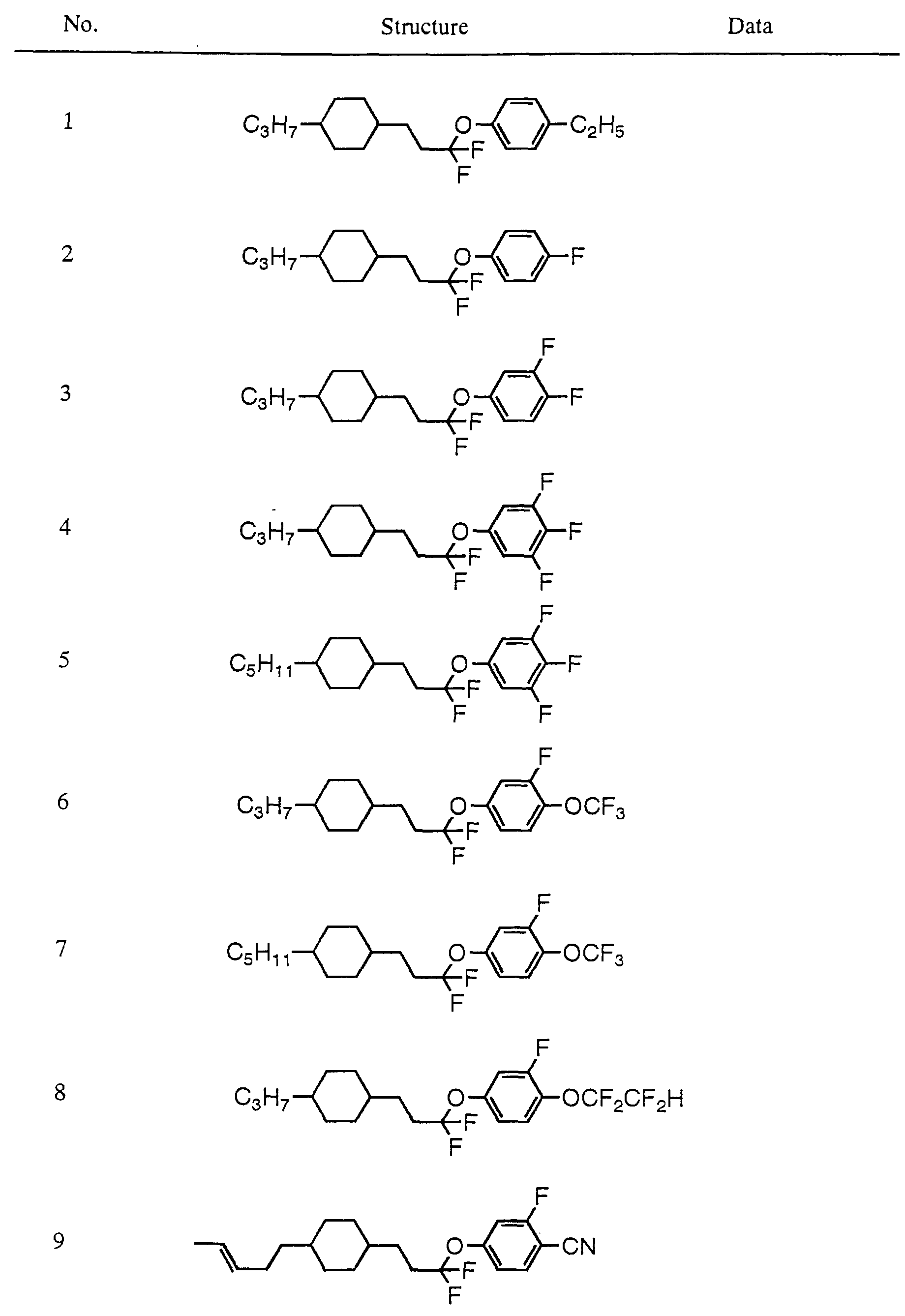
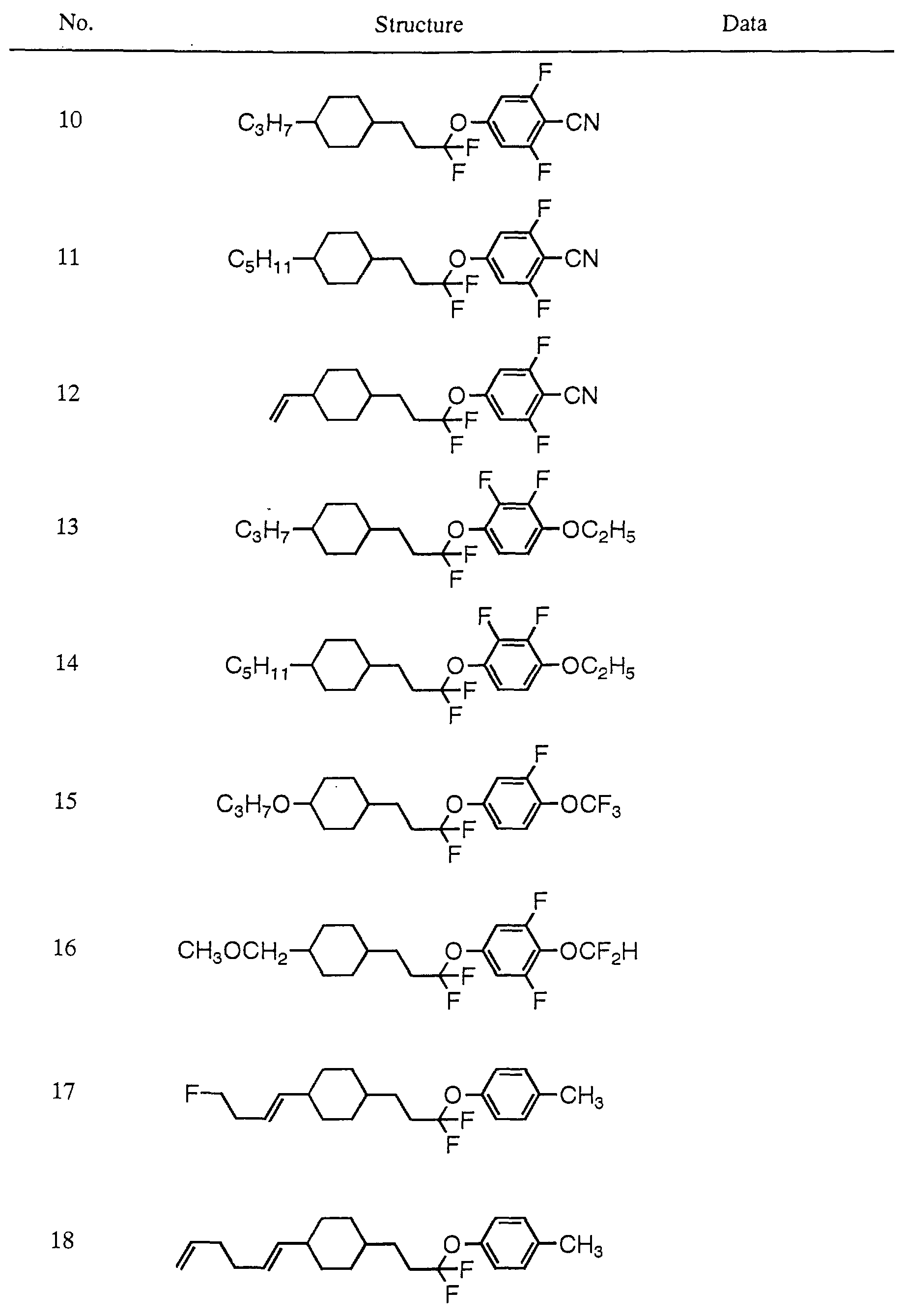

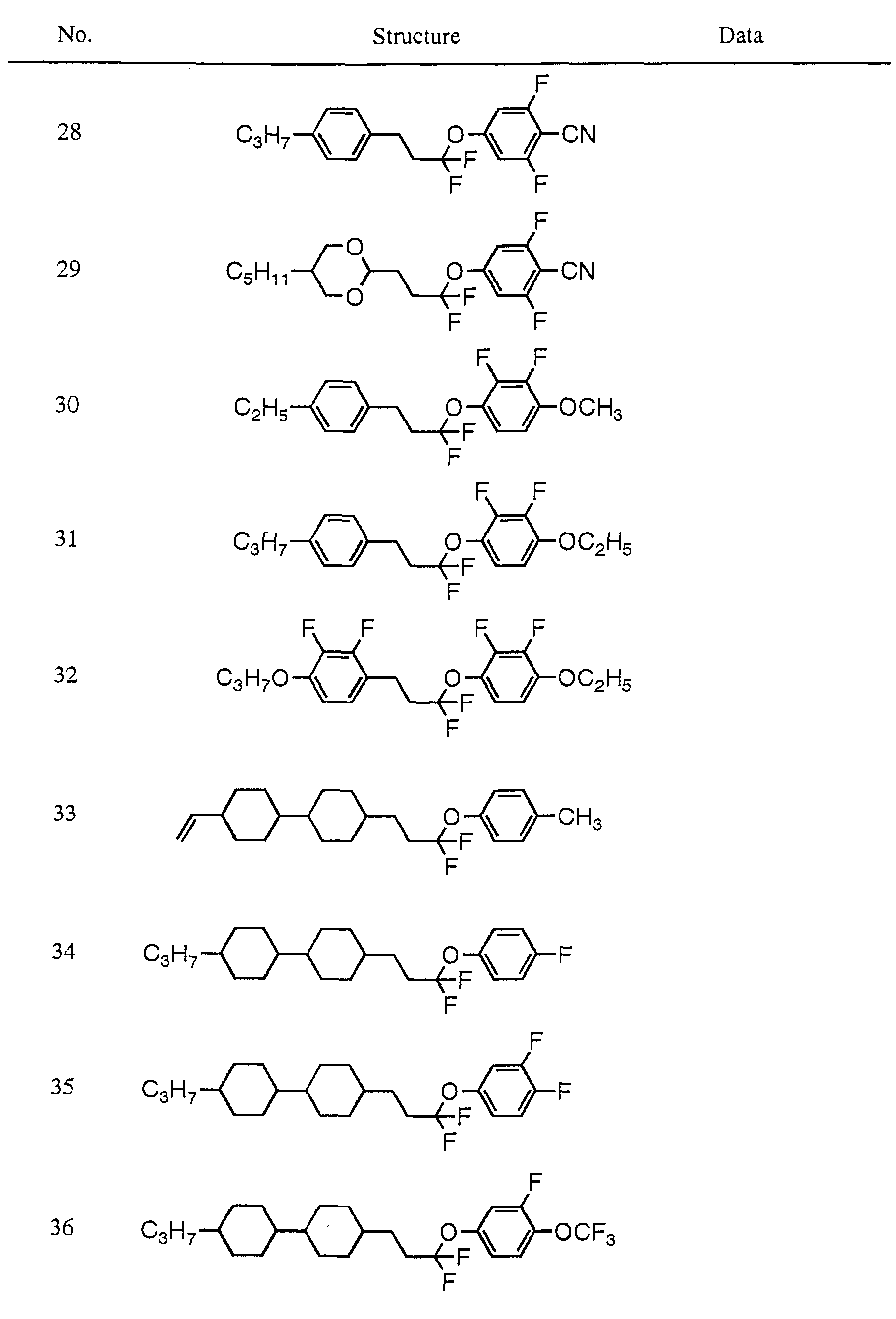

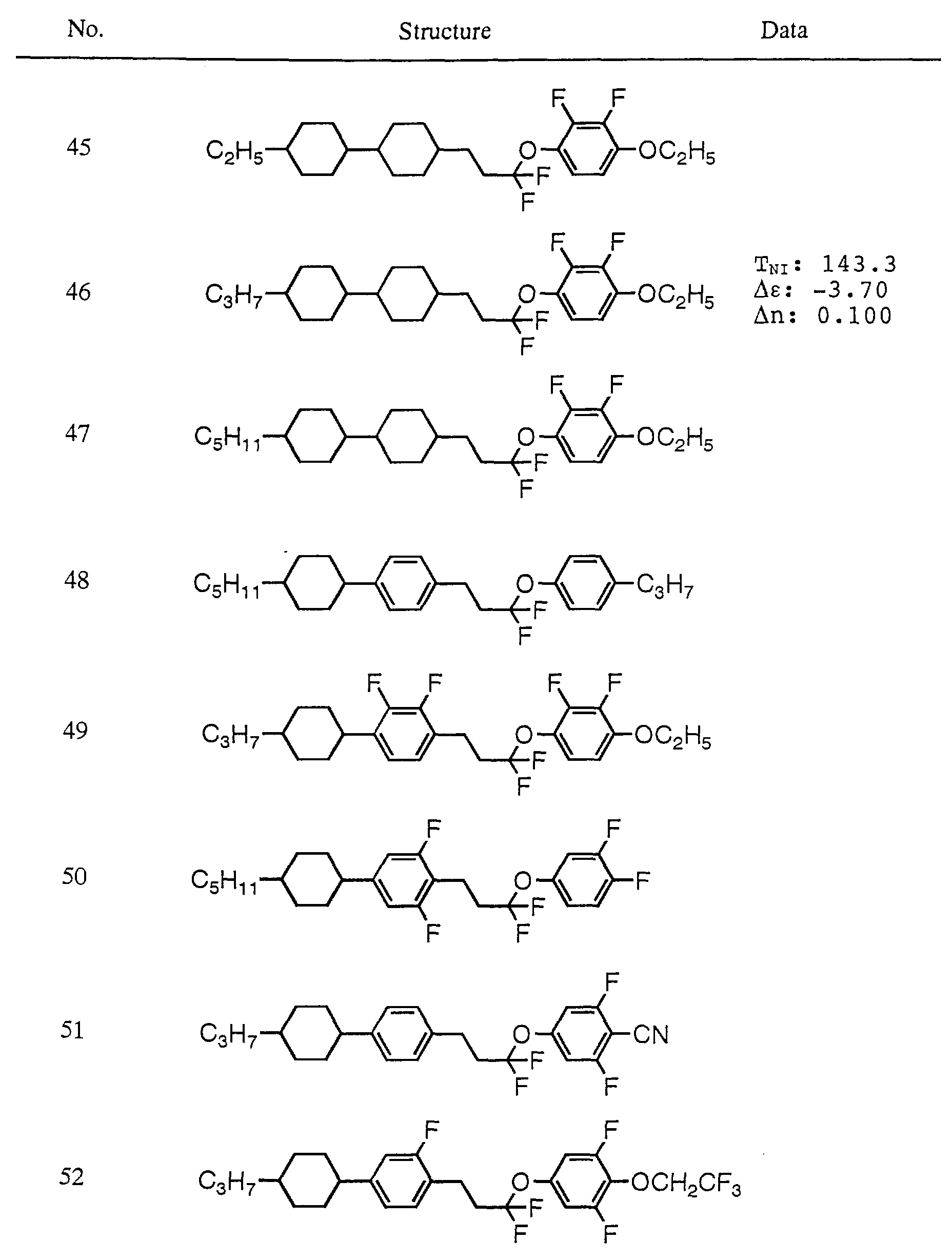


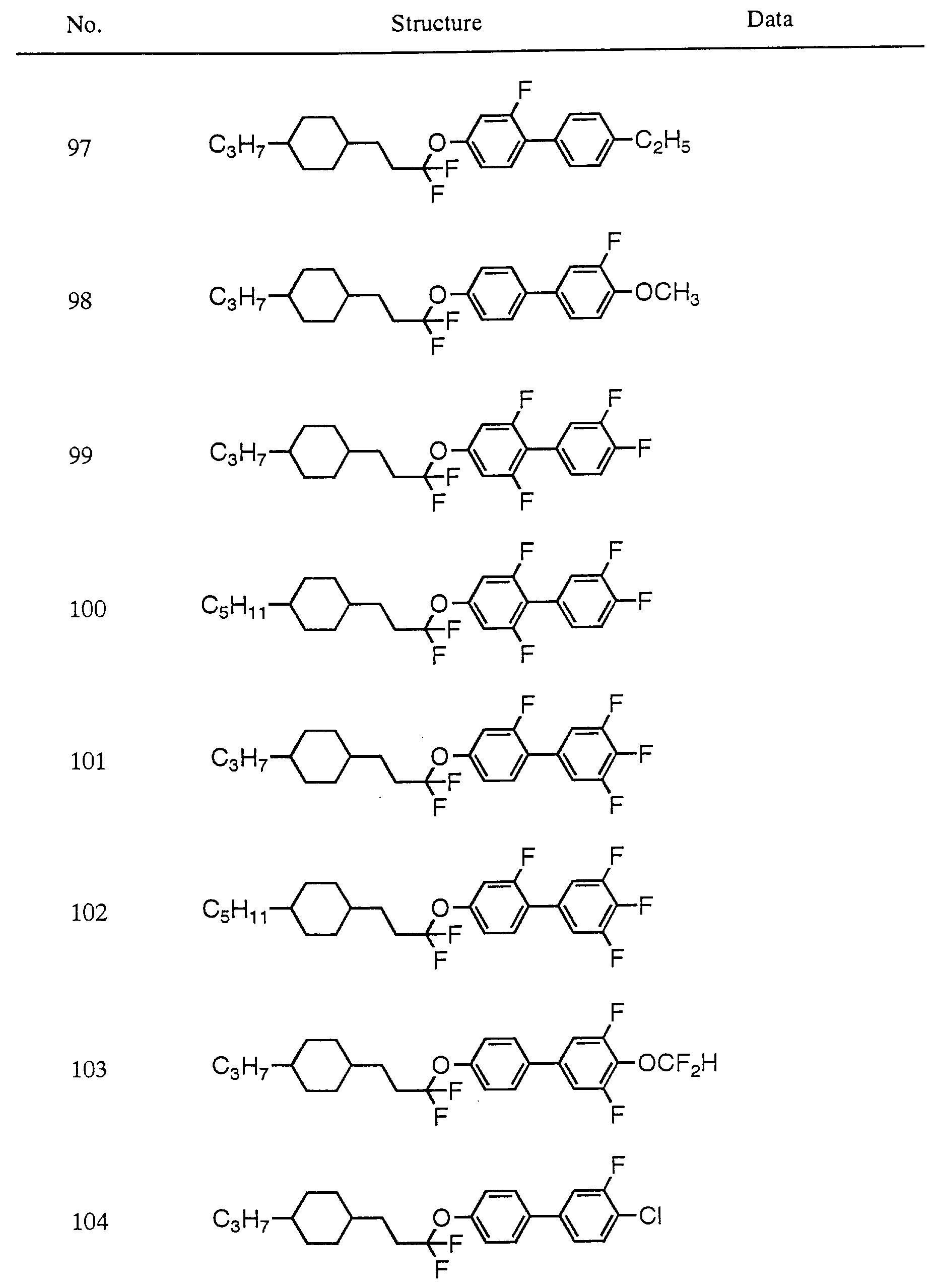

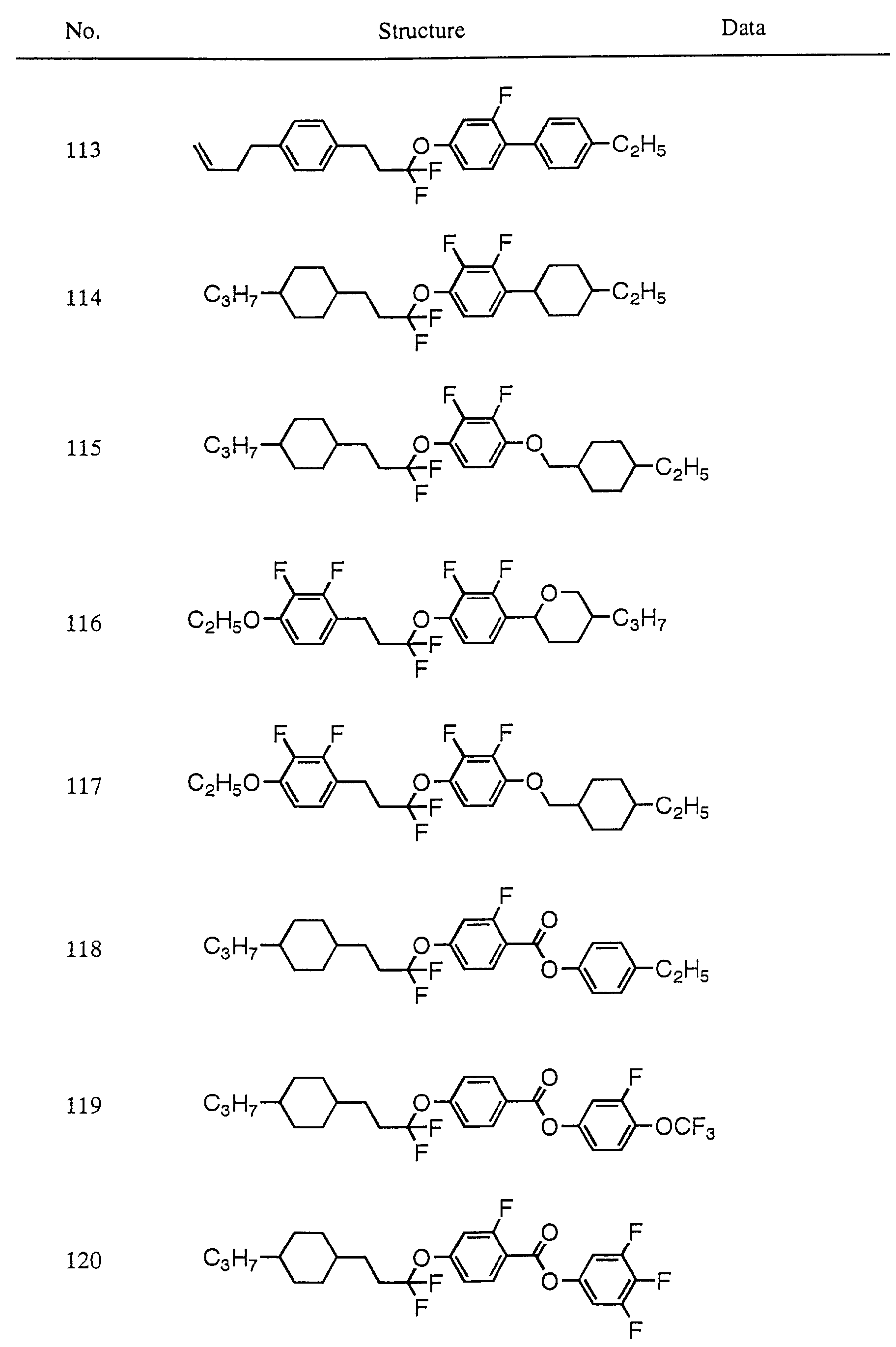


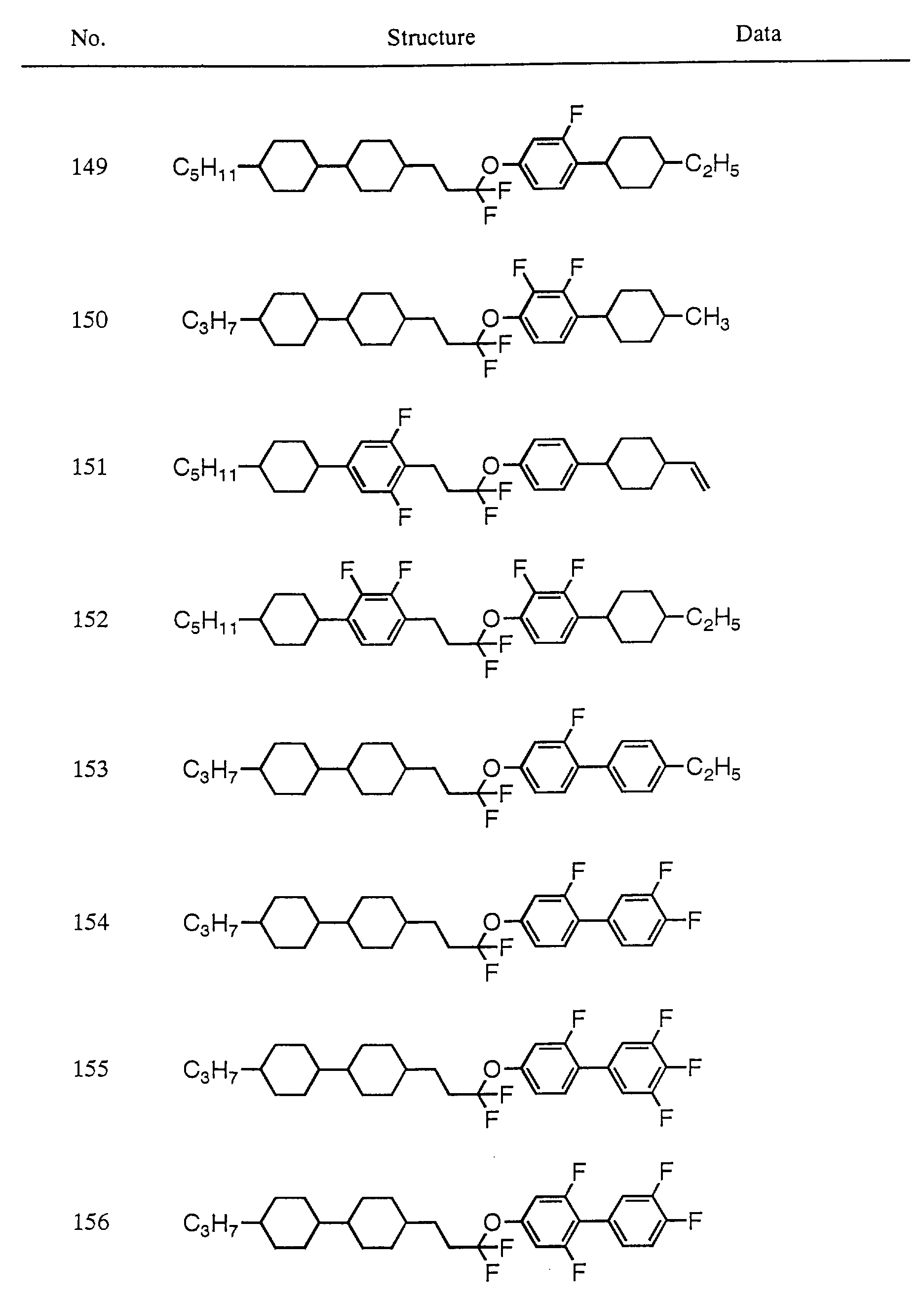

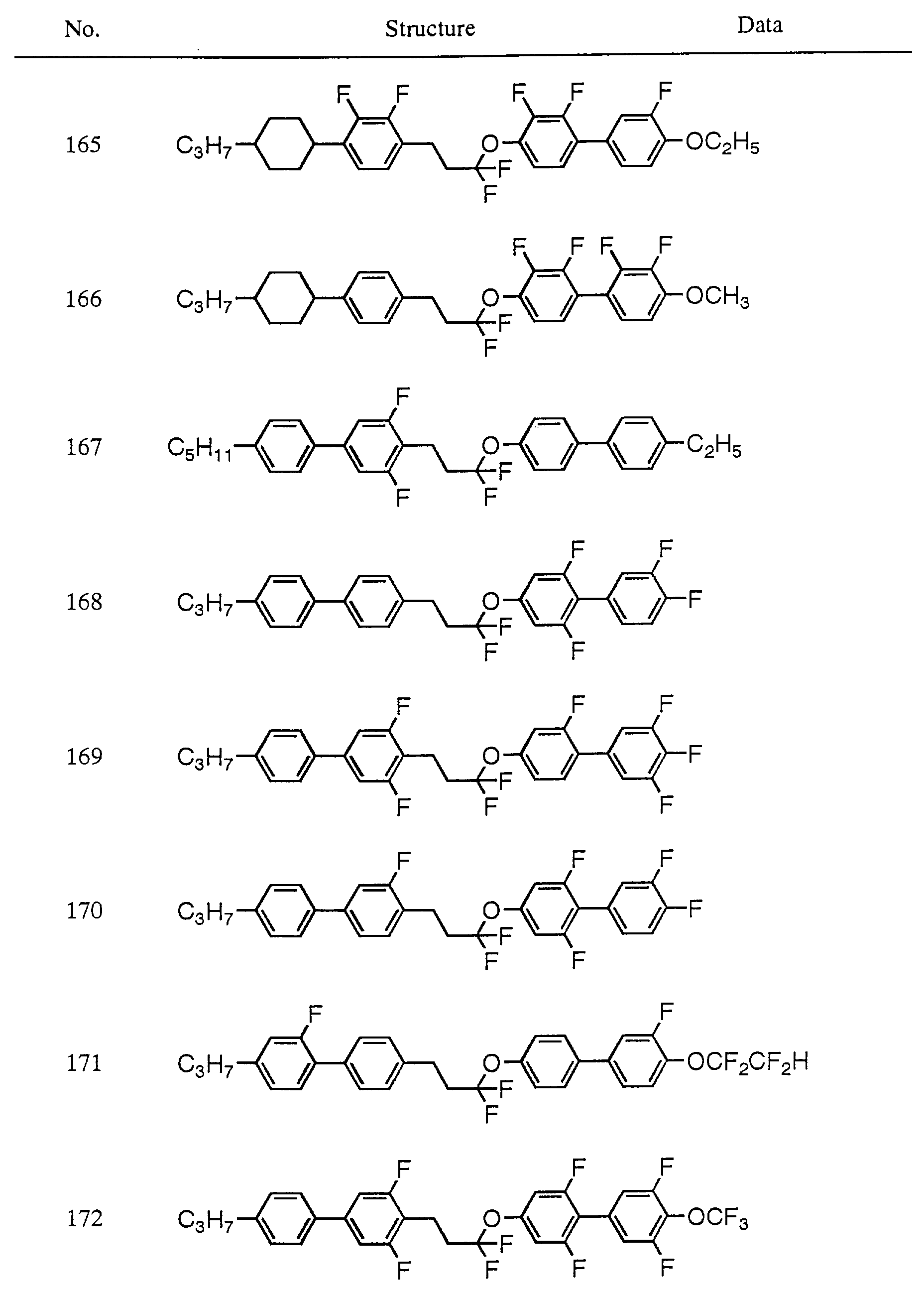


- A nematic liquid crystal composition (hereinafter referred to as a liquid crystal composition A) comprising cyanophenylcyclohexane liquid crystalline compounds:
4-(4-propylcyclohexyl)benzonitrile 24% 4-(4-pentylcyclohexyl)benzonitrile 36% 4-(4-heptylcyclohexyl)benzonitrile 25% 4-(4-(4-pentylcyclohexyl)phenyl)benzonitrile 15%
Clearing point (TNI): 71.7°C; threshold voltage (Vth) in a cell thickness of 8.8 µm: 1.78 V; Δε: 11.0; Δn: 0.137; viscosity (η) at 20°C: 26.3 mPa·s. - A liquid crystal composition comprising 85% by weight of this liquid crystal composition A and 15% by weight of 1-(3-(trans-4-(trans-4-pentylcyclohexyl)-cyclohexyl)-1,1-difluoropropyleneoxy)-3,4,5-trifluorobenzene (Compound No. 40) obtained in Example 1 was prepared. It had the following properties:
Clearing point (TNI): 75.8°C; threshold voltage (Vth) in a cell thickness of 8.9 µm: 1.70 V; Δε: 11.4; Δn: 0.128; viscosity (η) at 20°C: 28.4 mPa·s. - Compound No. 40 had the following physical properties, which were calculated from those of the liquid crystal composition and the mixing ratio of the compounds according to an extrapolation:
Clearing point (TNI): 99.0°C; Δε: 13.7; Δn: 0.077; viscosity (η) at 20°C: 31.8 mPa·s. - A liquid crystal composition comprising 85% by weight of the liquid crystal composition A shown in Example 5 and 15% by weight of 1-(3-(4'-propyl-3,5-difluorobiphenyl-4-yl)-1,1-difluoropropyleneoxy)-3,4,5-trifluorobenzene (Compound No. 63) was prepared. It had the following properties:
Clearing point (TNI): 61.4°C; threshold voltage (Vth) in a cell thickness of 8.9 µm: 1.50 V; Δε: 13.5; Δn: 0.133; viscosity (η) at 20°C: 30.0 mPa·s. - The compound had the following physical properties, which were calculated from those of the liquid crystal composition and the mixing ratio of the compounds according to an extrapolation:
Clearing point (TNI): 4.4°C; Δε: 24.3; Δn: 0.110; viscosity (η) at 20°C: 45.3 mPa·s. - A nematic liquid crystal composition (hereinafter referred to as a liquid crystal composition B):
4-ethoxyphenyl 4-propylcyclohexanecarboxylate 17.2% 4-butoxyphenyl 4-propylcyclohexanecarboxylate 27.6% 4-ethoxyphenyl 4-butylcyclohexanecarboxylate 20.7% 4-methoxyphenyl 4-pentylcyclohexanecarboxylate 20.7% 4-ethoxyphenyl 4-pentylcyclohexanecarboxylate 13.8%
Clearing point (TNI): 74.0°C; Δε: -1.3; Δn: 0.087; viscosity (η) at 20°C: 18.9 mPa·s. - A liquid crystal composition comprising 85% by weight of this liquid crystal composition B and 15% by weight of 1-(3-(trans-4-(trans-4-propylcyclohexyl)cyclohexyl)-1,1-difluoropropyleneoxy)-2,3-difluoro-4-ethoxybenzene (Compound No. 46) obtained in Example 4 was prepared. It had the following properties:
Clearing point (TNI): 84.9°C; Δε: -1.72; Δn: 0.089; viscosity (η) at 20°C: 24.3 mPa·s. - Compound No. 46 had the following physical properties, which were calculated from those of the liquid crystal composition and the mixing ratio of the compounds according to an extrapolation:
Clearing point (TNI): 143.3°C; Δε: -3.70; Δn: 0.100; viscosity (η) at 20°C: 48.1 mPa·s. - A liquid crystal composition comprising 85% by weight of the liquid crystal composition B and 15% by weight of 1-(3-(2,3-difluoro-4-ethoxyphenyl)-1,1-difluoropropyleneoxy)-4-(trans-4-propylcyclohexyl)benzene (Compound No. 201) was prepared according to Example 7. It had the following properties:
Clearing point (TNI): 77.9°C; Δε: -1.88; Δn: 0.092; viscosity (η) at 20°C: 24.2 mPa·s. - Compound No. 201 had the following physical properties, which were calculated from those of the liquid crystal composition and the mixing ratio of the compounds according to an extrapolation:
Clearing point (TNI): 96.6°C; Δε: -4.88; Δn: 0.120; viscosity (η) at 20°C: 48.0 mPa·s. - Shown in the following Examples 9 to 53 are the components and the physical properties of the nematic liquid crystal compositions of the present invention comprising as the first component, the compounds of Formula (1) synthesized by the methods described above.
- The compounds contained in the compositions are represented by the symbols in each column of a left terminal group, a bonding group, a ring structure and a right terminal group of the following Table 2.
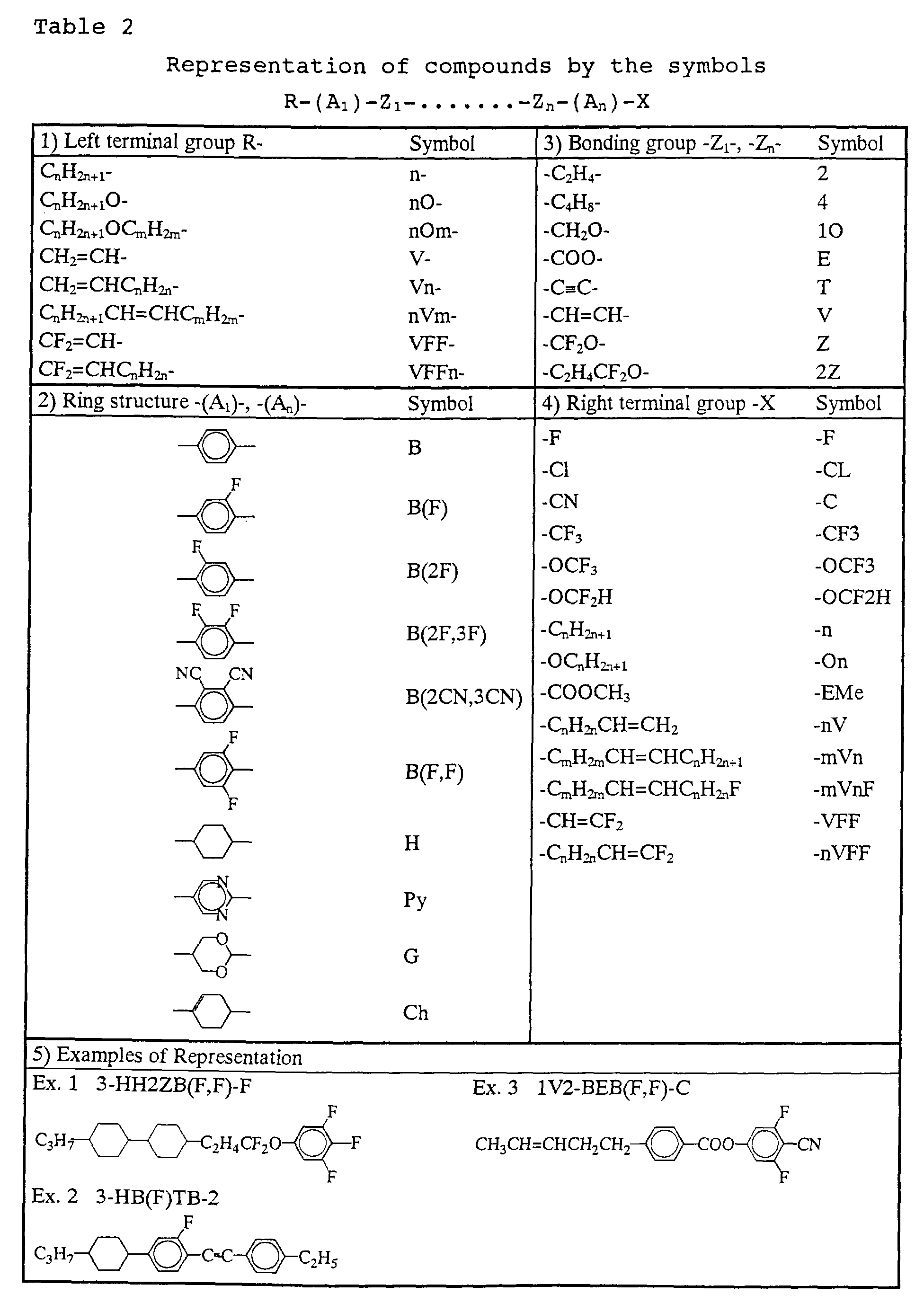
- The numbers of the compounds contained in the compositions are the same as those shown in the examples described above, and the unit of contents of the compounds is % by weight unless otherwise described.
- The property data of the composition examples are shown by NI (nematic-isotropic liquid transition temperature or clearing point), η (viscosity; measured at 20.0°C), Δn (refractive anisotropy; measured at 25.0°C), Δε (dielectric anisotropy; measured at 25.0°C) and Vth (threshold voltage; measured at 25.0°C).
-
5-HH2ZB(F,F)-F (No. 40) 8.0% 5-H2ZB(F,F)-C (No. 11) 7.0% 1V2-BEB(F,F)-C 5.0% 3-HB-C 10.0% 1-BTB-3 5.0% 2-BTB-1 10.0% 3-HH-4 11.0% 3-HHB-1 11.0% 3-HHB-3 9.0% 3-H2BTB-2 4.0% 3-H2BTB-3 4.0% 3-H2BTB-4 4.0% 3-HB(F)TB-2 6.0% 3-HB(F)TB-3 6.0% NI = 92.4 (°C) η = 16.6 (mPa·s) Δn = 0.154 Δε = 8.5 Vth = 1.99 (V) - When adding 0.8 part of CM33 to 100 parts of the above composition, the pitch was 10.7 µm.
-
3-HH2ZB(F)-OCF3 (No. 36) 5.0% 5-HH2ZB(F)-OCF3 (No. 37) 5.0% 3-H2ZB(F,F)B(F)-F (No. 99) 7.0% 5-H2ZB(F,F)B(F)-F (No. 100) 6.0% 2O1-BEB(F)-C 5.0% 3O1-BEB(F)-C 15.0% 4O1-BEB(F)-C 8.0% 5O1-BEB(F)-C 8.0% 2-HHB(F)-C 9.0% 3-HHB(F)-C 8.0% 3-HB(F)TB-2 4.0% 3-HB(F)TB-3 4.0% 3-HB(F)TB-4 4.0% 3-HHB-1 8.0% 3-HHB-O1 4.0% NI = 87.6 (°C) η = 79.0 (mPa·s) Δn = 0.141 Δε = 29.9 Vth = 0.89 (V) -
5-H2ZB(F,F)-F (No. 5) 2.0% 5-H2ZB(F)-OCF3 (No. 7) 2.0% 5-H2ZB(F)B(F,F)-F (No. 102) 3.0% 5-H2ZB(F,F)-C (No. 11) 2.0% 5-PyB-F 2.0% 3-PyB(F)-F 2.0% 2-BB-C 3.0% 4-BB-C 3.0% 5-BB-C 3.0% 2-PyB-2 2.0% 3-PyB-2 2.0% 4-PyB-2 2.0% 6-PyB-O5 3.0% 6-PyB-O6 3.0% 6-PyB-O7 3.0% 6-PyB-O8 3.0% 3-PyBB-F 6.0% 4-PyBB-F 6.0% 5-PyBB-F 6.0% 3-HHB-1 6.0% 3-HHB-3 8.0% 2-H2BTB-2 4.0% 2-H2BTB-3 4.0% 2-H2BTB-4 5.0% 3-H2BTB-2 5.0% 3-H2BTB-3 5.0% 3-H2BTB-4 5.0% NI = 93.5 (°C) η = 35.6 (mPa·s) Δn = 0.193 Δε = 6.6 Vth = 2.26 (V) -
3-HH2ZB(F,F)-F (No. 39) 4.0% 3-H2ZB(F,F)-F (No. 4) 3.0% 3-H2ZB(F)-OCF3 (No. 6) 4.0% 3-GB-C 6.0% 4-GB-C - 6.0% 2-BEB-C 12.0% 3-BEB-C 4.0% 3-PyB(F)-F 3.0% 3-HEB-O4 8.0% 4-HEB-O2 6.0% 5-HEB-O1 6.0% 3-HEB-O2 5.0% 5-HEB-O2 4.0% 5-HEB-5 5.0% 4-HEB-5 5.0% 1O-BEB-2 4.0% 3-HHB-1 6.0% 3-HHEBB-C 3.0% 3-HBEBB-C 3.0% 5-HBEBB-C 3.0% NI = 68.7 (°C) η = 36.7 (mPa·s) Δn = 0.112 Δε = 10.8 Vth = 1.34 (V) -
3-H2ZB(F,F)-F (No. 4) 4.0% 5-H2ZB(F,F)-F (No. 5) 4.0% 3-HH2ZB(F)-OCF3 (No. 6) 9.0% 3-H2ZB(F,F)B(F)-F (No. 99) 3.0% 3-HB-C 8.0% 7-HB-C 3.0% 1O1-HB-C 5.0% 3-HB(F)-C 5.0% 2-PyB-2 2.0% 3-PyB-2 2.0% 4-PyB-2 2.0% 1O1-HH-3 7.0% 2-BTB-O1 7.0% 3-HHB-1 7.0% 3-HHB-F 4.0% 3-HHB-O1 4.0% 3-HHB-3 8.0% 3-H2BTB-2 3.0% 3-H2BTB-3 3.0% 2-PyBH-3 4.0% 3-PyBH-3 3.0% 3 -PyBB-2 3.0% NI = 79.5 (°C) η = 16.4 (mPa·s) Δn = 0.126 Δε = 7.7 Vth = 1.80 (V) -
3-HH2ZB(F,F)-F (No. 39) 3.0% 5-HH2ZB(F)-OCF3 (No. 37) 6.0% 3-H2ZB(F,F)-C (No. 10) 9.0% 2-BEB(F)-C 5.0% 3-BEB(F)-C 4.0% 4-BEB(F)-C 4.0% 1V2-BEB(F,F)-C 6.0% 3-HH-EMe 10.0% 3-HB-O2 18.0% 7-HEB-F 2.0% 3-HHEB-F 2.0% 5-HHEB-F 2.0% 3-HBEB-F 4.0% 2O1-HBEB(F)-C 2.0% 3-HB(F)EB(F)-C 2.0% 3-HBEB(F,F)-C 2.0% 3-HHB-F 4.0% 3-HHB-O1 4.0% 3-HHB-3 7.0% 3-HEBEB-F 2.0% 3-HEBEB-1 2.0% NI = 78.2 (°C) η = 33.6 (mPa·s) Δn = 0.109 Δε = 23.7 Vth = 0.90 (V) -
3-H2ZB(F,F)-C (No. 10) 9.0% 5-H2ZB(F,F)-C (No. 11) 8.0% 2-BEB(F)-C 5.0% 3-BEB(F)-C 4.0% 4-BEB(F)-C 4.0% 1V2-BEB(F,F)-C 7.0% 3-HB-O2 10.0% 3-HH-4 3.0% 3-HHB-F 3.0% 3-HHB-1 8.0% 3-HHB-O1 4.0% 3-HBEB-F 4.0% 3-HHEB-F 7.0% 5-HHEB-F 7.0% 3-H2BTB-2 4.0% 3-H2BTB-3 4.0% 3-H2BTB-4 4.0% 3-HB(F)TB-2 5.0% NI = 87.5 (°C) η = 35.8 (mPa·s) Δn = 0.131 Δε = 24.9 Vth = 1.15 (V) -
5-HH2ZB(F,F)-F (No. 40) 4.0% 5-H2ZB(F,F)-F (No. 5) 3.0% 3-HH2ZB(F)-OCF3 (No. 36) 3.0% 5-HH2ZB(F)-OCF3 (No. 37) 4.0% 3-H2ZB(F,F)B(F)-F (No. 99) 3.0% 3-H2ZB(F)B(F,F)-F (No. 101) 7.0% 5-H2ZB(F)B(F,F)-F (No. 102) 7.0% 3-H2ZB(F,F)-C (No. 10) 4.0% 2-BEB-C 4.0% 3-BEB-C 3.0% 4-BEB-C 3.0% 3-HB-C 5.0% 3-HEB-O4 12.0% 4-HEB-O2 8.0% 5-HEB-O1 8.0% 3-HEB-O2 6.0% 5-HEB-O2 5.0% 3-HHB-1 7.0% 3-HHB-O1 4.0% NI = 63.4 (°C) η = 29.9 (mPa·s) Δn = 0.092 Δε = 10.2 Vth = 1.34 (V) -
3-H2ZB(F,F)B(F)-F (No. 99) 5.0% 5-H2ZBB(F,F)B-2 (No. 182) 6.0% 5-H2ZBB(F,F)B-F (No. 184) 6.0% 2-BEB-C 10.0% 5-BB-C 7.0% 7-BB-C 7.0% 1-BTB-3 7.0% 2-BTB-1 10.0% 1O-BEB-2 7.0% 1O-BEB-5 9.0% 2-HHB-1 4.0% 3-HHB-F 4.0% 3-HHB-1 7.0% 3-HHB-O1 4.0% 3-HHB-3 7.0% -
3-HH2ZB(F)-OCF3 (No. 36) 3.0% 5-HH2ZB(F)-OCF3 (No. 37) 3.0% 2-HB-C 5.0% 3-HB-C 12.0% 3-HB-O2 15.0% 2-BTB-1 3.0% 3-HHB-1 8.0% 3-HHB-F 4.0% 3-HHB-O1 5.0% 3-HHB-3 14.0% 3-HHEB-F 4.0% 5-HHEB-F 4.0% 2-HHB(F)-F 5.0% 3-HHB(F)-F 5.0% 5-HHB(F)-F 5.0% 3-HHB(F,F)-F 5.0% NI = 101.3 (°C) η = 18.3 (mPa·s) Δn = 0.100 Δε = 5.1 Vth = 2.49 (V) -
5-H2ZB(F,F)B(F)-F (No. 100) 3.0% 3-H2ZB(F)B(F,F)-F (No. 101) 3.0% 3-H2ZB(F,F)-C (No. 10) 2.0% 3-BEB(F)-C 4.0% 3-HB-C 4.0% V-HB-C 8.0% 1V-HB-C 8.0% 3-HB-O2 3.0% 3-HH-2V 14.0% 3-HH-2V1 7.0% V2-HHB-1 15.0% 3-HHB-1 5.0% 3-HHEB-F 7.0% 3-H2BTB-2 6.0% 3-H2BTB-3 6.0% 3-H2BTB-4 5.0% NI = 98.8 (°C) η = 17.3 (mPa·s) Δn = 0.129 Δε = 8.0 Vth = 2.24 (V) -
3-HH2ZB(F,F)-F (No. 39) 7.0% 5-HH2ZB(F,F)-F (No. 40) 7.0% 3-H2ZB(F)B(F,F)-F (No. 101) 3.0% 5-H2ZB(F)B(F,F)-F (No. 102) 3.0% 3-H2ZB(F,F)-C (No. 10) 6.0% 5-H2ZB(F,F)-C (No. 11) 5.0% V2-HB-C 6.0% 1V2-HB-C 6.0% 3-HB-C 5.0% 3-HB(F)-C 5.0% 2-BTB-1 2.0% 3-HH-4 8.0% 3-HH-VFF 6.0% 2-HHB-C 3.0% 3-HHB-C 6.0% 3-HB(F)TB-2 8.0% 3-H2BTB-2 5.0% 3-H2BTB-3 5.0% 3-H2BTB-4 4.0% NI = 87.8 (°C) η = 21.4 (mPa·s) Δn = 0.137 Δε = 11.6 Vth = 1.73 (V) -
5-HH2ZB(F)-OCF3 (No. 37) 3.0% 3-H2ZB(F,F)-C (No. 10) 3.0% 5-BEB(F)-C 5.0% V-HB-C 5.0% 5-PyB-C 6.0% 4-BB-3 11.0% 3-HH-2V 10.0% 5-HH-V 11.0% V-HHB-1 7.0% V2-HHB-1 15.0% 3-HHB-1 9.0% 1V2-HBB-2 10.0% 3-HHEBH-3 5.0% NI = 92.9 (°C) η = 16.1 (mPa·s) Δn = 0.112 Δε = 5.5 Vth = 2.28 (V) -
5-H2ZB(F,F)-F (No. 5) 2.0% 3-H2ZB(F)-OCF3 (No. 6) 3.0% 3-HH2ZB(F)-OCF3 (No. 36) 7.0% 5-H2ZB(F)B(F,F)-F (No. 102) 3.0% 1V2-BEB(F,F)-C 3.0% 3-HB-C 7.0% V2V-HB-C 7.0% V2V-HH-3 19.0% 3-HB-O2 4.0% 3-HHB-1 10.0% 3-HHB-3 15.0% 3-HB(F)TB-2 4.0% 3-HB(F)TB-3 4.0% 3-H2BTB-2 4.0% 3-H2BTB-3 4.0% 3-H2BTB-4 4.0% NI = 101.3 (°C) η = 15.2 (mPa·s) Δn = 0.117 Δε = 5.6 Vth = 2.30 (V) -
3-HH2ZB(F,F)-F (No. 39) 3.0% 3-H2ZB(F,F)B(F)-F (No. 99) 4.0% 5-H2ZB(F,F)B(F)-F (No. 100) 4.0% V2-HB-TC 10.0% 3-HB-TC 10.0% 3-HB-C 3.0% 5-HB-C 3.0% 5-BB-C 3.0% 2-BTB-1 10.0% 2-BTB-O1 5.0% 3-HH-4 5.0% 3-HHB-1 10.0% 3-HHB-3 11.0% 3-H2BTB-2 3.0% 3-H2BTB-3 3.0% 3-HB(F)TB-2 3.0% 5-BTB(F)TB-3 10.0% NI = 101.2 (°C) η = 16.7 (mPa·s) Δn = 0.202 Δε = 7.5 Vth = 2.15 (V) -
3-H2ZB(F,F)-C (No. 10) 8.0% 5-H2ZB(F,F)-C (No. 11) 8.0% 1V2-BEB(F,F)-C 3.0% 3-HB-C 5.0% 2-BTB-1 10.0% 5-HH-VFF 30.0% 1-BHH-VFF 8.0% 1-BHH-2VFF 11.0% 3-H2BTB-2 5.0% 3-H2BTB-3 4.0% 3-H2BTB-4 4.0% 3-HHB-1 4.0% NI = 74.8 (°C) η = 13.5 (mPa·s) Δn = 0.120 Δε = 8.1 Vth = 1.75 (V) -
3-H2ZB(F,F)-C (No. 10) 8.0% 5-H2ZB(F,F)-C (No. 11) 7.0% 5-HBZB(F,F)-C 3.0% 3-HB(F,F)ZB(F,F)-C 3.0% 3-HB-C 3.0% 2-BTB-1 10.0% 5-HH-VFF 30.0% 1-BHH-VFF 8.0% 1-BHH-2VFF 11.0% 3-H2BTB-2 5.0% 3-H2BTB-3 4.0% 3-H2BTB-4 4.0% 3-HHB-1 4.0% NI = 76.6 (°C) η = 14.5 (mPa·s) Δn = 0.120 Δε = 7.5 Vth = 1.81 (V) -
3-HH2ZB(F,F)-F (No. 39) 4.0% 3-HH2ZB(F)-OCF3 (No. 36) 3.0% 5-H2ZB(F,F)B(F)-F (No. 100) 3.0% 5-H2ZB(F)B(F,F)-F (No. 102) 5.0% 2-HHB(F)-F 5.0% 3-HHB(F)-F 14.0% 5-HHB(F)-F 16.0% 2-H2HB(F)-F 10.0% 3-H2HB(F)-F 5.0% 5-H2HB(F)-F 10.0% 2-HBB(F)-F 6.0% 3-HBB(F)-F 6.0% 5-HBB(F)-F 13.0% NI = 97.9 (°C) η = 27.3 (mPa·s) Δn = 0.096 Δε = 6.4 Vth = 2.01 (V) - When adding 0.3 part of CN to 100 parts of the above composition, the pitch was 77.5 µm.
-
5-HH2ZB(F,F)-F (No. 40) 7.0% 5-HH2ZB(F)-OCF3 (No. 37) 6.0% 5-H2ZBB(F,F)B-2 (No. 182) 5.0% 5-H2ZBB(F,F)B-F (No. 184) 4.0% 7-HB(F,F)-F 3.0% 3-HB-O2 7.0% 2-HHB(F)-F 8.0% 3-HHB(F)-F 8.0% 5-HHB(F)-F 8.0% 2-HBB(F)-F 6.0% 3-HBB(F)-F 6.0% 5-HBB(F)-F 6.0% 2-HBB-F 4.0% 3-HBB-F 4.0% 5-HBB-F 3.0% 3-HBB(F,F)-F 5.0% 5-HBB(F,F)-F 10.0% -
3-HH2ZB(F,F)-F (No. 39) 3.0% 3-H2ZB(F,F)-F (No. 4) 3.0% 3-H2ZB(F)-OCF3 (No. 6) 3.0% 3-HH2ZB(F)-OCF3 (No. 36) 4.0% 5-HH2ZB(F)-OCF3 (No. 37) 4.0% 3-H2ZB(F,F)B(F)-F (No. 99) 3.0% 5-HB-CL 4.0% 3-HH-4 12.0% 3-HH-5 4.0% 3-HHB-F 4.0% 3-HHB-CL 3.0% 4-HHB-CL 4.0% 3-HHB(F)-F 7.0% 4-HHB(F)-F 7.0% 5-HHB(F)-F 7.0% 7-HHB(F)-F 7.0% 5-HBB(F)-F 4.0% 5-HBBH-1O1 3.0% 3-HHBB(F,F)-F 2.0% 4-HHBB(F,F)-F 3.0% 5-HHBB(F,F)-F 3.0% 3-HH2BB(F,F)-F 3.0% 4-HH2BB(F,F)-F 3.0% NI = 115.8 (°C) η = 23.0 (mPa·s) Δn = 0.087 Δε = 5.5 Vth = 2.42 (V) -
3-HH2ZB(F,F)-F (No. 39) 3.0% 5-HH2ZB(F,F)-F (No. 40) 4.0% 5-H2ZB(F,F)-F (No. 5) 3.0% 5-H2ZB(F)-OCF3 (No. 7) 3.0% 3-HH2ZB(F)-OCF3 (No. 36) 6.0% 5-HH2ZB(F)-OCF3 (No. 37) 6.0% 3-H2ZB(F,F)B(F)-F (No. 99) 3.0% 5-H2ZB(F,F)B(F)-F (No. 100) 4.0% 3-H2ZB(F)B(F,F)-F (No. 101) 3.0% 5-H2ZB(F)B(F,F)-F (No. 102) 4.0% 3-HHB(F,F)-F 9.0% 3-H2HB(F,F)-F 4.0% 4-H2HB(F,F)-F 4.0% 5-H2HB(F,F)-F 4.0% 3-HBB(F,F)-F 10.0% 5-HBB(F,F)-F 10.0% 3-H2BB(F,F)-F 4.0% 5-HHBB(F,F)-F 3.0% 5-HHEBB-F 2.0% 3-HH2BB(F,F)-F 3.0% 4-HBBH-1O1 4.0% 5-HBBH-1O1 4.0% NI = 97.6 (°C) η = 34.2 (mPa·s) Δn = 0.106 Δε = 10.9 Vth = 1.56 (V) -
3-HH2ZB(F)-OCF3 (No. 36) 3.0% 5-H2ZB(F)B(F,F)-F (No. 102) 3.0% 5-HB-F 12.0% 6-HB-F 9.0% 7-HB-F 7.0% 2-HHB-OCF3 7.0% 3-HHB-OCF3 7.0% 4-HHB-OCF3 7.0% 5-HHB-OCF3 5.0% 3-HH2B-OCF3 4.0% 5-HH2B-OCF3 4.0% 3-HHB(F,F)-OCF3 5.0% 3-HBB(F)-F 7.0% 5-HBB(F)-F 7.0% 3-HH2B(F)-F 3.0% 3-HB(F)BH-3 3.0% 5-HBBH-3 3.0% 3-HHB(F,F)-OCF2H 4.0% NI = 84.6 (°C) η = 15.5 (mPa·s) Δn = 0.089 Δε = 5.0 Vth = 2.30 (V) -
3-HH2ZB(-F)-OCF3 (No. 36) 6.0% 5-HH2ZB(F)-OCF3 (No. 37) 6.0% 3-H2ZB(F,F)B(F)-F (No. 99) 4.0% 5-H2ZB(F,F)B(F)-F (No. 100) 4.0% 3-H2ZB(F)B(F,F)-F (No. 101) 8.0% 5-H2ZB(F)B(F,F)-F (No. 102) 8.0% 2-HHB(F)-F 3.0% 2-HBB(F)-F 3.0% 3-HBB(F)-F 7.0% 4-HBB(F)-F 2.0% 5-HBB(F)-F 7.0% 2-H2BB(F)-F 6.0% 3-H2BB(F)-F 6.0% 3-HBB(F,F)-F 6.0% 5-HBB(F,F)-F 6.0% 2-HHB(F,F)-F 5.0% 3-HHB(F,F)-F 5.0% 4-HHB(F,F)-F 5.0% 3-HHB-F 3.0% NI = 96.0 (°C) η = 37.8 (mPa·s) Δn = 0.127 Δε = 10.2 Vth = 1.58 (V) -
3-H2ZB(F,F)-F (No. 4) 3.0% 3-H2ZB(F,F)B(F)-F (No. 99) 5.0% 3-H2ZB(F)B(F,F)-F (No. 101) 5.0% 5-H2ZB(F)B(F,F)-F (No. 102) 5.0% 5-HB-CL 3.0% 3-HH-4 8.0% 3-HBB(F,F)-F 15.0% 5-HBB(F,F)-F 10.0% 3-HHB(F,F)-F 8.0% 3-HHEB(F,F)-F 10.0% 4-HHEB(F,F)-F 3.0% 5-HHEB(F,F)-F 3.0% 2-HBEB(F,F)-F 3.0% 3-HBEB(F,F)-F 5.0% 5-HBEB(F,F)-F 3.0% 3-HHBB(F,F)-F 6.0% 3-HHB-1 5.0% NI = 78.5 (°C) η = 26.6 (mPa·s) Δn = 0.102 Δε = 10.2 Vth = 1.42 (V) -
3-HH2ZB(F,F)-F (No. 39) 5.0% 5-HH2ZB(F,F)-F (No. 40) 5.0% 3-HH2ZB(F)-OCF3 (No. 36) 5.0% 7-HB(F)-F 6.0% 5-H2B(F)-F 6.0% 3-HB-O2 4.0% 3-HH-4 12.0% 2-HHB(F)-F 6.0% 3-HHB(F)-F 6.0% 5-HHB(F)-F 6.0% 2-HBB(F)-F 2.0% 3-HBB(F)-F 2.0% 5-HBB(F)-F 4.0% 3-HBB(F,F)-F 3.0% 2-HHBB(F,F)-F 4.0% 3-HHBB(F,F)-F 5.0% 3-HHEB-F 4.0% 5-HHEB-F 4.0% 3-HHB-1 7.0% 3-HHB-3 4.0% NI = 100.5 (°C) η = 20.4 (mPa·s) Δn = 0.087 Δε = 5.7 Vth = 2.12 (V) -
3-HH2ZB(F,F)-F (No. 39) 6.0% 5-HH2ZB(F,F)-F (No. 40) 6.0% 5-HH2ZB(F)-OCF3 (No. 37) 3.0% 3-H2ZB(F,F)B(F)-F (No. 99) 6.0% 5-H2ZB(F,F)B(F)-F (No. 100) 6.0% 3-H2ZB(F)B(F,F)-F (No. 101) 13.0% 5-H2ZB(F)B(F,F)-F (No. 102) 12.0% 3-HH-4 - 4.0% 3-H2HB(F,F)-F 6.0% 4-H2HB(F,F)-F 6.0% 5-H2HB(F,F)-F 4.0% 3-HBB(F,F)-F 13.0% 5-HBB(F,F)-F 12.0% 3-HHBB(F,F)-F 3.0% NI = 64.2 (°C) η = 33.9 (mPa·s) Δn = 0.103 Δε = 12.2 Vth = 1.34 (V) -
3-H2ZB(F)-OCF3 (No. 6) 2.0% 5-HH2ZB(F)-OCF3 (No. 37) 5.0% 3-H2ZB(F,F)B(F)-F (No. 99) 5.0% 7-HB(F,F)-F 3.0% 3-H2HB(F,F)-F 12.0% 4-H2HB(F,F)-F 10.0% 3-HHB(F,F)-F 10.0% 4-HHB(F,F)-F 5.0% 3-HBB(F,F)-F 10.0% 3-HHEB(F,F)-F 10.0% 4-HHEB(F,F)-F 3.0% 5-HHEB(F,F)-F 3.0% 2-HBEB(F,F)-F 3.0% 3-HBEB(F,F)-F 5.0% 5-HBEB(F,F)-F 3.0% 3-HGB(F,F)-F 5.0% 3-HHBB(F,F)-F 6.0% NI = 77.5 (°C) η = 34.8 (mPa·s) Δn = 0.086 Δε = 13.4 Vth = 1.36 (V) -
3-HH2ZB(F,F)-F (No. 39) 4.0% 5-HH2ZB(F,F)-F (No. 40) 4.0% 5-H4HB(F,F)-F 7.0% 5-H4HB-OCF3 15.0% 3-H4HB(F,F)-CF3 8.0% 5-H4HB(F,F)-CF3 10.0% 3-HB-CL 6.0% 5-HB-CL 4.0% 2-H2BB(F)-F 5.0% 3-H2BB(F)-F 5.0% 5-H2HB(F,F)-F 4.0% 3-HHB-OCF3 5.0% 3-H2HB-OCF3 5.0% V-HHB(F)-F 5.0% 3-HHB(F)-F 4.0% 5-HHB(F)-F 4.0% 3-HBEB(F,F)-F 5.0% NI = 70.5 (°C) η = 25.4 (mPa·s) Δn = 0.094 Δε = 8.9 Vth = 1.64 (V) -
3-HH2ZB(F)-OCF3 (No. 36) 5.0% 5-HH2ZB(F)-OCF3 (No. 37) 4.0% 3-H2ZB(F,F)-C (No. 10) 6.0% 5-H2ZB(F,F)-C (No. 11) 6.0% 5-HB-CL 5.0% 7-HB(F,F)-F 3.0% 3-HH-4 10.0% 3-HH-5 5.0% 3-HB-O2 15.0% 3-H2HB(F,F)-F 5.0% 4-H2HB(F,F)-F 5.0% 3-HHB(F,F)-F 6.0% 2-HHB(F)-F 4.0% 3-HHB(F)-F 4.0% 5-HHB(F)-F 4.0% 3-HHB-1 8.0% 3-HHB-O1 5.0% NI = 71.6 (°C) η = 19.3 (mPa·s) Δn = 0.074 Δε = 6.7 Vth = 1.75 (V) -
5-HH2ZB(F,F)-F (No. 40) 4.0% 5-H2ZB(F,F)-F (No. 5) 3.0% 5-H2ZB(F)-OCF3 (No. 7) 4.0% 3-HH2ZB(F)-OCF3 (No. 36) 3.0% 5-HH2ZB(F)-OCF3 (No. 37) 3.0% 5-HB-CL 4.0% 4-HHB(F)-F 10.0% 5-HHB(F)-F 9.0% 7-HHB(F)-F 9.0% 3-HHB(F,F)-F 8.0% 4-HHB(F,F)-F 3.0% 3-H2HB(F,F)-F 12.0% 3-HBB(F,F)-F 13.0% 2-HHBB(F,F)-F 6.0% 3-GHB(F,F)-F 3.0% 4-GHB(F,F)-F 3.0% 5-GHB(F,F)-F 3.0% NI = 79.9 (°C) η = 26.6 (mPa·s) Δn = 0.082 Δε = 8.0 Vth = 1.65 (V) -
3-HH2ZB(F,F)-F (No. 39) 5.0% 5-H2ZB(F,F)B(F)-F (No. 100) 3.0% 3-H2ZB(F)B(F,F)-F (No. 101) 3.0% 3-H2ZB(F,F)-C (No. 10) 5.0% 2-HHB(F)-F 7.0% 3-HHB(F)-F 8.0% 5-HHB(F)-F 7.0% 3-HHB(F,F)-F 8.0% 3-HBB(F,F)-F 11.0% 3-H2HB(F,F)-F 10.0% 3-HHEB(F,F)-F 10.0% 4-HHEB(F,F)-F 3.0% 2-HBEB(F,F)-F 2.0% 3-HBEB(F,F)-F 3.0% 3-GHB(F,F)-F 3.0% 4-GHB(F,F)-F 4.0% 5-GHB(F,F)-F 4.0% 3-HHBB(F,F)-F 4.0% NI = 79.4 (°C) η = 35.5 (mPa·s) Δn = 0.089 Δε = 11.8 Vth = 1.40 (V) -
3-H2ZB(F)-OCF3 (No. 6) 4.0% 3-H2ZB(F,F)B(F)-F (No. 99) 4.0% 7-HB(F)-F 3.0% 5-HB-CL 3.0% 3-HH-4 9.0% 3-HH-EMe 23.0% 3-HHEB(F,F)-F 10.0% 4-HHEB(F,F)-F 5.0% 3-HHEB-F 8.0% 5-HHEB-F 8.0% 4-HGB(F,F)-F 5.0% 5-HGB(F,F)-F 6.0% 2-H2GB(F,F)-F 4.0% 3-H2GB(F,F)-F 5.0% 5-GHB(F,F)-F 3.0% NI = 79.1 (°C) η = 19.5 (mPa·s) Δn = 0.065 Δε = 5.8 Vth = 1.79 (V) -
3-H2ZB(F,F)B(F)-F (No. 99) 4.0% 5-H2ZB(F,F)B(F)-F (No. 100) 5.0% 3-H2ZB(F)B(F,F)-F (No. 101) 7.0% 5-H2ZB(F)B(F,F)-F (No. 102) 8.0% 3-H2HB(F,F)-F 5.0% 5-H2HB(F,F)-F 5.0% 3-HBB(F,F)-F 20.0% 5-HBB(F,F)-F 16.0% 5-HBB(F)B-2 10.0% 5-HBB(F)B-3 10.0% 3-BB(F)B(F,F)-F 5.0% 5-B2B(F,F)B(F)-F 5.0% NI = 100.8 (°C) η = 53.6 (mPa·s) Δn = 0.149 Δε = 11.8 Vth = 1.50 (V) -
3-HH2ZB(F,F)-F (No. 39) 4.0% 3-H2ZB(F,F)-F (No. 4) 4.0% 3-H2ZB(F)-OCF3 (No. 6) 4.0% 5-H2ZB(F)-OCF3 (No. 7) 3.0% 3-HH2ZB(F)-OCF3 (No. 36) 3.0% 5-H2ZB(F)B(F,F)-F (No. 102) 3.0% 3-HB(F,F)ZB(F,F)-F 5.0% 5-HB(F,F)ZB(F,F)-F 5.0% 5-HB-CL 3.0% 3-HH-4 14.0% 2-HH-5 4.0% 3-HHB-1 4.0% 3-HHEB-F 6.0% 5-HHEB-F 6.0% 3-HHB(F,F)-F 6.0% 4-HHB(F,F)-F 3.0% 3-HHEB(F,F)-F 3.0% 4-HHEB(F,F)-F 3.0% 5-HHEB(F,F)-F 2.0% 2-HBEB(F,F)-F 3.0% 3-HBEB(F,F)-F 3.0% 5-HBEB(F,F)-F 3.0% 2-HHBB(F,F)-F 3.0% 3-HHBB(F,F)-F 3.0% NI = 79.0 (°C) η = 18.6 (mPa·s) Δn = 0.072 Δε = 7.6 Vth = 1.69 (V) -
3-HH2ZB(F,F)-F (No. 39) 3.0% 5-HH2ZB(F,F)-F (No. 40) 3.0% 3-H2ZB(F,F)-F (No. 4) 4.0% 5-H2ZB(F,F)-F (No. 5) 3.0% 3-H2ZB(F)-OCF3 (No. 6) 4.0% 5-H2ZB(F)-OCF3 (No. 7) 3.0% 3-HH2ZB(F)-OCF3 (No. 36) 3.0% 5-HH2ZB(F)-OCF3 (No. 37) 3.0% 3-H2ZB(F,F)B(F)-F (No. 99) 3.0% 5-H2ZB(F,F)B(F)-F (No. 100) 2.0% 3-H2ZB(F)B(F,F)-F (No. 101) 4.0% 5-H2ZB(F)B(F,F)-F (No. 102) 3.0% 3-BB(F,F)ZB(F,F)-F 10.0% 3-HH-4 8.0% 3-HHB(F,F)-F 6.0% 3-H2HB(F,F)-F 9.0% 3-HBB(F,F)-F 6.0% 2-HHBB(F,F)-F 3.0% 3-HHBB(F,F)-F 3.0% 3-HH2BB(F,F)-F 4.0% 3-HHB-1 6.0% 5-HBBH-1O1 7.0% NI = 83.2 (°C) η = 24.1 (mPa·s) Δn = 0.095 Δε = 9.3 Vth = 1.59 (V) -
5-H2ZB(2F,3F)-O2 (No. 14) 11.0% 3-H2ZB(2F,3F)B(2F,3F)-O2 (No. 106) 11.0% 5-H2ZBB(F,F)B-2 (No. 182) 6.0% 5-H2ZBB(F,F)B-F (No. 184) 6.0% 3-HEB-O4 17.0% 4-HEB-O2 15.0% 5-HEB-O1 14.0% 3-HEB-O2 12.0% 5-HEB-O2 8.0% -
3-H2ZB(2F,3F)-O2 (No. 13) 7.0% 3-HH2ZB(2F,3F)-O2 (No. 46) 6.0% 5-HH2ZB(2F,3F)-O2 (No. 47) 7.0% 3-H2ZB(2F,3F)B(2F,3F)-O2 (No. 106) 10.0% 3-HH-2 5.0% 3-HH-4 6.0% 3-HH-O1 4.0% 3-HH-O3 5.0% 5-HH-O1 4.0% 3-HB(2F,3F)-O2 8.0% 5-HB(2F,3F)-O2 8.0% 3-HHB(2F,3F)-O2 8.0% 5-HHB(2F,3F)-O2 8.0% 3-HHB(2F,3F)-2 14.0% NI = 89.2 (°C) Δn = 0.085 Δε = -3.7 -
5-H2ZB(2F,3F)-O2 (No. 14) 5.0% 3-HH2ZB(2F,3F)-O2 (No. 46) 6.0% 3-HH-5 5.0% 3-HH-4 5.0% 3-HH-O1 6.0% 3-HH-O3 6.0% 3-HB-O1 5.0% 3-HB-O2 5.0% 3-HB(2F,3F)-O2 8.0% 5-HB(2F,3F)-O2 7.0% 3-HHB(2F,3F)-O2 9.0% 5-HHB(2F,3F)-O2 10.0% 3-HHB(2F,3F)-2 4.0% 2-HHB(2F,3F)-1 4.0% 3-HHEH-3 5.0% 3-HHEH-5 5.0% 4-HHEH-3 5.0% NI = 87.4 (°C) Δn = 0.078 Δε = -3.1 -
5-H2ZB(2F,3F)-O2 (No. 14) 3.0% 5-HH2ZB(2F,3F)-O2 (No. 47) 6.0% 3-BB(2F,3F)-O2 9.0% 3-BB(2F,3F)-O4 10.0% 5-BB(2F,3F)-O4 10.0% 2-BB(2F,3F)B-3 19.0% 3-BB(2F,3F)B-5 13.0% 5-BB(2F,3F)B-5 14.0% 5-BB(2F,3F)B-7 16.0% NI = 78.9 (°C) Δn = 0.195 Δε = -3.5 -
3-H2ZB(2F,3F)-O2 (No. 13) 3.0% 3-H2ZB(2F,3F)B(2F,3F)-O2 (No. 106) 4.0% 3-HB-O1 15.0% 3-HB-O2 6.0% 3-HEB(2F,3F)-O2 8.0% 4-HEB(2F,3F)-O2 8.0% 5-HEB(2F,3F)-O2 8.0% 2-BB2B-O2 6.0% 3-BB2B-O2 6.0% 5-BB2B-O1 6.0% 5-BB2B-O2 6.0% 1-B2BB(2F)-5 7.0% 3-B2BB(2F)-5 7.0% 5-B(F)BB-O2 7.0% 3-BB(2F,3F)B-3 3.0% NI = 79.3 (°C) η = 23.4 (mPa·s) Δn = 0.161 -
3-H2ZB(2F,3F)-O2 (No. 13) 11.0% 5-HH2ZB(2F,3F)-O2 (No. 47) 6.0% 3-H2ZB(2F,3F)B(2F,3F)-O2 (No. 106) 3.0% 3-HH-O1 8.0% 5-HH-O1 4.0% 3-HH-4 5.0% 3-HB(2F,3F)-O2 10.0% 5-HB(2F,3F)-O2 16.0% 2-HHB(2F,3F)-1 4.0% 3-HHB(2F,3F)-1 5.0% 3-HHB(2F,3F)-O2 14.0% 5-HHB(2F,3F)-O2 14.0% NI = 65.0 (°C) η = 24.9 (mPa·s) Δn = 0.079 Δε = -3.9 -
3-HH2ZB(-2F,3F)-O2 (No. 46) 9.0% 5-HH2ZB(2F,3F)-O2 (No. 47) 9.0% 3-H2ZB(2F,3F)B(2F,3F)-O2 (No. 106) 14.0% 3-HB-O1 15.0% 3-HH-4 5.0% 3-HB(2F,3F)-O2 12.0% 5-HB(2F,3F)-O2 12.0% 2-HHB(2F,3F)-1 5.0% 3-HHB(2F,3F)-1 5.0% 3-HHB(2F,3F)-O2 4.0% 5-HHB(2F,3F)-O2 4.0% 3-HHB-1 6.0% NI = 87.5 (°C) η = 41.7 (mPa·s) Δn = 0.095 Δε = -3.2 -
3-H2ZB(2F,3F)-O2 (No. 13) 6.0% 5-H2ZB(2F,3F)-O2 (No. 14) 6.0% 3-HH2ZB(2F,3F)-O2 (No. 46) 7.0% 5-HH2ZB(2F,3F)-O2 (No. 47) 7.0% 3-H2ZB(2F,3F)B(2F,3F)-O2 (No. 106) 10.0% 3-HB-O1 15.0% 3-HH-4 5.0% 3-HB(2F,3F)-O2 6.0% 5-HB(2F,3F)-O2 6.0% 2-HHB(2F,3F)-1 7.0% 3-HHB(2F,3F)-1 7.0% 3-HHB(2F,3F)-O2 6.0% 5-HHB(2F,3F)-O2 6.0% 6-HEB(2F,3F)-O2 6.0% NI = 85.9 (°C) η = 39.3 (mPa·s) Δn = 0.09 Δε = -3.3 -
3-H2ZB(2F,3F)-O2 (No. 13) 5.0% 3-HH2ZB(2F,3F)-O2 (No. 46) 3.0% 5-HH2ZB(2F,3F)-O2 (No. 47) 3.0% 3-HB-O2 20.0% 1O1-HH-3 6.0% 1O1-HH-5 5.0% 3-HH-EMe 7.0% 4-HEB-O1 9.0% 4-HEB-O2 7.0% 5-HEB-O1 8.0% 3-HHB-1 3.0% 3-HHB-3 3.0% 4-HEB(2CN,3CN)-O4 3.0% 6-HEB(2CN,3CN)-O4 3.0% 3-HEB(2CN,3CN)-O5 4.0% 4-HEB(2CN,3CN)-O5 3.0% 5-HEB(2CN,3CN)-O5 2.0% 2-HBEB(2CN,3CN)-O2 2.0% 4-HBEB(2CN,3CN)-O4 4.0% NI = 62.3 (°C) η = 41.1 (mPa·s) Δn = 0.076 Δε = -6.0 -
3-HH2ZB(2F,3F)-O2 (No. 46) 4.0% 20-B(2F,3F)2ZBH-3 (No. 201) 4.0% 3-HEB-O4 28.0% 4-HEB-O2 20.0% 5-HEB-O1 20.0% 3-HEB-O2 18.0% 5-HEB-O2 10.0% NI = 76.2 (°C) η = 22.0 (mPa·s) Δn = 0.089 -
20-B(2F,3F)2ZBH-3 (No. 201) 14.0% 3-HH-2 5.0% 3-HH-4 6.0% 3-HH-O1 4.0% 3-HH-O3 5.0% 5-HH-O1 4.0% 3-HB(2F,3F)-O2 12.0% 5-HB(2F,3F)-O2 11.0% 5-HHB(2F,3F)-O2 15.0% 3-HHB(2F,3F)-2 24.0% NI = 78.6 (°C) Δn = 0.080 Δε = -3.9 - The present invention provides a liquid crystalline compound, which is excellent in compatibility with other liquid crystalline compounds and has a low viscosity and a low threshold voltage.
- The present invention also provides a novel liquid crystal composition comprising the above liquid crystalline compound as a component, which has the desired physical properties as shown in the above examples by suitably selecting rings, substituents and bonding groups constituting the above liquid crystalline compound, and further provides a liquid crystal display element comprising the above liquid crystal composition.
Claims (23)
- A liquid crystalline compound represented by Formula (1):wherein R1 and R2 each independently represent hydrogen, halogen, a cyano group or an alkyl group having 1 to 20 carbon atoms, in which at least one -CH2- may be substituted with -CH=CH-, -C≡C-, -O- or -S- but -O- is not adjacent to another -O-, and in which at least one hydrogen may be substituted with halogen; rings A1 to A5 each independently represent a 1,4-cyclohexylene group in which at least one -CH2- not adjacent to each other may be substituted with -O- or -S-, a 1,4-cyclohexenylene group, or a 1,4-phenylene group in which at least one =CH- may be substituted with =Nand hydrogen on the ring may be substituted with halogen; Z1 to Z4 each independently represent a single bond, -CH2CH2-, -CH2O-, -OCH2-, -COO-, -OCO-, -CH=CH-, -C≡C-, -CF2O- or -OCF2-; Y1, Y2, Y3 and Y4 each independently represent hydrogen or fluorine; and k, 1, m and n each independently represent 0 or 1.

- The liquid crystalline compound as claimed in claim 1, which is represented by Formulas (1-1) to (1-6):
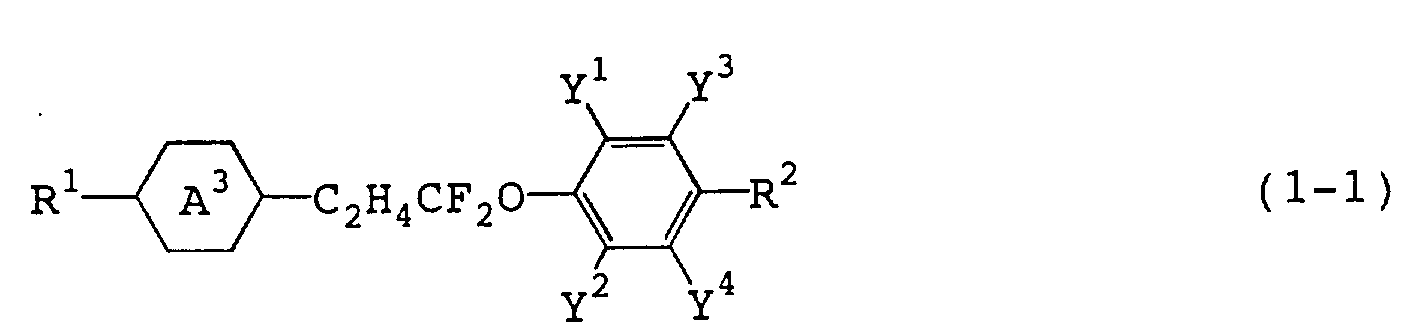



 wherein R1, R2, rings A1 to A5, Z1 to Z4 and Y1 to Y4 have the same meanings as defined in claim 1.
- The liquid crystalline compound of Formula (1) as claimed in claim 1, wherein ring A3 is a 1,4-cyclohexylene group.
- The liquid crystalline compound of Formula (1) as claimed in claim 1, wherein both Y1 and Y3 are fluorine atoms, and both Y2 and Y4 are hydrogen atoms.
- The liquid crystalline compound of Formula (1) as claimed in claim 1, wherein both Y1 and Y2 are hydrogens.
- The liquid crystalline compound of Formula (1-1) as claimed in claim 2, wherein ring A3 is a 1,4-cyclohexylene group, both Y1 and Y3 are fluorines, and both Y2 and Y4 are hydrogens.
- The liquid crystalline compound of Formula (1-1) as claimed in claim 2, wherein ring A3 is a 1,4-cyclohexylene group, and both Y1 and Y2 are hydrogens.
- The liquid crystalline compound of Formula (1-2) as claimed in claim 2, wherein both ring A2 and ring A3 are 1,4-cyclohexylene groups, both Y1 and Y3 are fluorines, and both Y2 and Y4 are hydrogens.
- The liquid crystalline compound of Formula (1-2) as claimed in claim 2, wherein both ring A2 and ring A3 are 1,4-cyclohexylene groups, both Y1 and Y3 are hydrogens, both Y2 and Y4 are fluorines, and R2 is an alkoxy group.
- The liquid crystalline compound of Formula (1-2) as claimed in claim 2, wherein both ring A2 and ring A3 are 1,4-cyclohexylene groups; and both Y1 and Y2 are hydrogens.
- The liquid crystalline compound of Formula (1-2) as claimed in claim 2, wherein both ring A2 and ring A3 are 1,4-cyclohexylene groups, both Y1 and Y2 are hydrogens, both Y3 and Y4 are fluorines, and R2 is fluorine.
- The liquid crystalline compound of Formula (1-2) as claimed in claim 2, wherein both ring A2 and ring A3 are 1,4-phenylene groups in which hydrogen on the ring may be substituted with fluorine, Z2 is a single bond, both Y1 and Y2 are hydrogens, both Y3 and Y4 are fluorines, and R2 is fluorine.
- The liquid crystalline compound of Formula (1-3) as claimed in claim 2, wherein ring A3 is a 2,3-difluoro-1,4-phenylene group.
- A liquid crystal composition comprising at least one compound as claimed in any one of claims 1 to 13.
- A liquid crystal composition comprising at least one compound as claimed in any one of claims 1 to 13 as a first component and at least one compound selected from the group consisting of compounds represented by Formulas (2), (3) and (4) as a second component:

 wherein R3 represents an alkyl group having 1 to 10 carbon atoms, in which any -CH2- not adjacent to each other may be substituted with -O- or -CH=CH- and any hydrogen may be substituted with fluorine; X1 represents fluorine, chlorine, -OCF3, -OCF2H, -CF3, -CF2H, -CFH2, -OCF2CF2H or -OCF2CFHCF3; L1 and L2 each independently represent hydrogen or fluorine; Z5 and Z6 each independently represent -(CH2)2-, -(CH2)4-, -COO-, -CF2O-, -OCF2-, -CH=CH- or a single bond; rings A and B each independently represent 1,4-cyclohexylene, 1,3-dioxane-2,5-diyl, or 1,4-phenylene in which hydrogen may be substituted with fluorine; and ring C represents 1,4-cyclohexylene or 1,4-phenylene in which hydrogen may be substituted with fluorine.
- A liquid crystal composition comprising at least one compound as claimed in any one of claims 1 to 13 as a first component and at least one compound selected from the group consisting of compounds represented by Formulas (5) and (6) as a second component:
 wherein R4 and R5 each independently represent an alkyl group having 1 to 10 carbon atoms, in which any -CH2- not adjacent to each other may be substituted with -O- or -CH=CH- and any hydrogen may be substituted with fluorine; X2 represents -CN or -C≡C-CN; ring D represents 1,4-cyclohexylene, 1,4-phenylene, 1,3-dioxane-2,5-diyl or pyrimidine-2,5-diyl; ring E represents 1,4-cyclohexylene, 1,4-phenylene in which hydrogen may be substituted with fluorine, or pyrimidine-2,5-diyl; ring F represents 1,4-cyclohexylene or 1,4-phenylene; Z7 represents -(CH2)2-, -COO-, -CF2O-, -OCF2- or a single bond; L3, L4 and L5 each independently represent hydrogen or fluorine; and b, c and d each independently represent 0 or 1.
- A liquid crystal composition comprising at least one compound as claimed in any one of claims 1 to 13 as a first component and at least one compound selected from the group consisting of compounds represented by Formulas (7), (8) and (9) as a second component:

 wherein R6 and R7 each independently represent an alkyl group having 1 to 10 carbon atoms, in which any -CH2- not adjacent to each other may be substituted with -O- or -CH=CH- and any hydrogen may be substituted with fluorine; rings G and I each independently represent 1,4-cyclohexylene or 1,4-phenylene; L6 and L7 each independently represent hydrogen or fluorine, but L6 and L7 are not hydrogens at the same time; and Z8 and Z9 each independently represent -(CH2)2-, -COO- or a single bond.
- A liquid crystal composition comprising at least one compound as claimed in any one of claims 1 to 13 as a first component, at least one compound selected from the group consisting of the compounds represented by Formulas (2), (3) and (4) as a second component and at least one compound selected from the group consisting of compounds represented by Formulas (10), (11) and (12) as a third component:

 wherein R8 and R9 each independently represent an alkyl group having 1 to 10 carbon atoms, in which any -CH2- not adjacent to each other may be substituted with -O- or -CH=CH- and any hydrogen may be substituted with fluorine; rings J, K and M each independently represent 1,4-cyclohexylene, pyrimidine-2,5-diyl, or 1,4-phenylene in which hydrogen may be substituted with fluorine; and Z10 and Z11 each independently represent -C≡C-, -COO-, -(CH2)2-, -CH=CH- or a single bond.
- A liquid crystal composition comprising at least one compound as claimed in any one of claims 1 to 13 as a first component, at least one compound selected from the group consisting of the compounds represented by Formulas (5) and (6) as a second component and at least one compound selected from the group consisting of the compounds represented by Formulas (10), (11) and (12) as a third component.
- A liquid crystal composition comprising at least one compound as claimed in any one of claims 1 to 13 as a first component, at least one compound selected from the group consisting of the compounds represented by Formulas (7), (8) and (9) as a second component and at least one compound selected from the group consisting of the compounds represented by Formulas (10), (11) and (12) as a third component.
- A liquid crystal composition comprising at least one compound as claimed in any one of claims 1 to 13 as a first component, at least one compound selected from the group consisting of the compounds represented by Formulas (2), (3) and (4) as a second component, at least one compound selected from the group consisting of the compounds represented by Formulas (5) and (6) as a third component and at least one compound selected from the group consisting of the compounds represented by Formulas (10), (11) and (12) as a fourth component.
- A liquid crystal composition comprising at least one liquid crystal composition as claimed in any one of claims 14 to 21, and further, at least one optically active compound.
- A liquid crystal display element comprising the liquid crystal composition as claimed in any one of claims 14 to 22.
Applications Claiming Priority (4)
| Application Number | Priority Date | Filing Date | Title |
|---|---|---|---|
| JP2000241998 | 2000-08-10 | ||
| JP2000241998 | 2000-08-10 | ||
| JP2001119215 | 2001-04-18 | ||
| JP2001119215 | 2001-04-18 |
Publications (2)
| Publication Number | Publication Date |
|---|---|
| EP1179522A1 true EP1179522A1 (en) | 2002-02-13 |
| EP1179522B1 EP1179522B1 (en) | 2005-12-07 |
Family
ID=26597692
Family Applications (1)
| Application Number | Title | Priority Date | Filing Date |
|---|---|---|---|
| EP01118826A Expired - Lifetime EP1179522B1 (en) | 2000-08-10 | 2001-08-10 | Liquid crystalline compound having a difluoropropyleneoxy group as bonding group, liquid crystal composition and liquid crystal display element |
Country Status (4)
| Country | Link |
|---|---|
| US (1) | US6544604B2 (en) |
| EP (1) | EP1179522B1 (en) |
| KR (1) | KR100794480B1 (en) |
| DE (1) | DE60115552T2 (en) |
Cited By (2)
| Publication number | Priority date | Publication date | Assignee | Title |
|---|---|---|---|---|
| EP1352943A1 (en) * | 2002-04-12 | 2003-10-15 | MERCK PATENT GmbH | Liquid crystalline medium and electrooptical display containing it |
| US8846164B2 (en) | 2010-08-11 | 2014-09-30 | Jnc Corporation | Compound having propyl ether as bonding group, liquid crystal composition thereof and liquid crystal display device thereof |
Families Citing this family (8)
| Publication number | Priority date | Publication date | Assignee | Title |
|---|---|---|---|---|
| JP3918496B2 (en) * | 2001-10-22 | 2007-05-23 | 株式会社日立製作所 | Liquid crystal display device and manufacturing method thereof |
| US7291368B2 (en) * | 2004-04-09 | 2007-11-06 | Chisso Corporation | Liquid crystal composition and liquid crystal display device |
| JP2005298733A (en) | 2004-04-14 | 2005-10-27 | Chisso Corp | Liquid crystal composition and liquid crystal display element |
| US8529537B2 (en) * | 2005-08-05 | 2013-09-10 | Kimberly-Clark Worldwide, Inc. | Absorbent article with enclosures |
| US20070032768A1 (en) * | 2005-08-05 | 2007-02-08 | Kimberly- Clark Worldwide, Inc. | Article with premium |
| US20080141683A1 (en) * | 2006-12-13 | 2008-06-19 | O'connor Amanda L | Chambered instant cold pack |
| WO2010050427A1 (en) | 2008-10-30 | 2010-05-06 | Agcセイミケミカル株式会社 | Liquid crystal compound and process for production thereof, liquid crystal composition, and liquid crystal electrooptical element |
| JP6677122B2 (en) * | 2015-08-20 | 2020-04-08 | Jnc株式会社 | Compound having alkenyl at both ends, liquid crystal composition and liquid crystal display device |
Citations (1)
| Publication number | Priority date | Publication date | Assignee | Title |
|---|---|---|---|---|
| EP0893423A1 (en) * | 1996-04-10 | 1999-01-27 | Chisso Corporation | Liquid crystal compounds having fluorinated linkages, liquid crystal compositions, and liquid crystal display devices |
Family Cites Families (4)
| Publication number | Priority date | Publication date | Assignee | Title |
|---|---|---|---|---|
| JP2696557B2 (en) | 1989-03-07 | 1998-01-14 | チッソ株式会社 | Trifluorobenzene derivative |
| GB2229438B (en) | 1989-03-18 | 1993-06-16 | Merck Patent Gmbh | Difluoromethylene compounds and liquid crystalline-media containing such compounds |
| JP3122199B2 (en) | 1991-10-18 | 2001-01-09 | 旭硝子株式会社 | Liquid crystal composition and liquid crystal display device using the same |
| JP3287288B2 (en) | 1996-11-22 | 2002-06-04 | チッソ株式会社 | Polyhaloalkyl ether derivatives, liquid crystal compositions containing them and liquid crystal display devices |
-
2001
- 2001-08-10 EP EP01118826A patent/EP1179522B1/en not_active Expired - Lifetime
- 2001-08-10 DE DE60115552T patent/DE60115552T2/en not_active Expired - Lifetime
- 2001-08-10 US US09/925,484 patent/US6544604B2/en not_active Expired - Lifetime
- 2001-08-10 KR KR1020010048199A patent/KR100794480B1/en not_active Expired - Fee Related
Patent Citations (1)
| Publication number | Priority date | Publication date | Assignee | Title |
|---|---|---|---|---|
| EP0893423A1 (en) * | 1996-04-10 | 1999-01-27 | Chisso Corporation | Liquid crystal compounds having fluorinated linkages, liquid crystal compositions, and liquid crystal display devices |
Cited By (7)
| Publication number | Priority date | Publication date | Assignee | Title |
|---|---|---|---|---|
| EP1352943A1 (en) * | 2002-04-12 | 2003-10-15 | MERCK PATENT GmbH | Liquid crystalline medium and electrooptical display containing it |
| JP2003327965A (en) * | 2002-04-12 | 2003-11-19 | Merck Patent Gmbh | Liquid crystal medium and electrooptic display containing the medium |
| EP1798273A3 (en) * | 2002-04-12 | 2007-07-25 | Merck Patent GmbH | Liquid crystalline medium and electrooptical display containing it |
| EP1840186A2 (en) | 2002-04-12 | 2007-10-03 | MERCK PATENT GmbH | Liquid crystalline medium and electrooptical display containing it |
| EP1840186A3 (en) * | 2002-04-12 | 2008-03-12 | MERCK PATENT GmbH | Liquid crystalline medium and electrooptical display containing it |
| EP2251397A3 (en) * | 2002-04-12 | 2011-05-25 | Merck Patent GmbH | Liquid crystalline medium and electrooptical display containing it |
| US8846164B2 (en) | 2010-08-11 | 2014-09-30 | Jnc Corporation | Compound having propyl ether as bonding group, liquid crystal composition thereof and liquid crystal display device thereof |
Also Published As
| Publication number | Publication date |
|---|---|
| EP1179522B1 (en) | 2005-12-07 |
| KR100794480B1 (en) | 2008-01-16 |
| DE60115552D1 (en) | 2006-01-12 |
| DE60115552T2 (en) | 2006-08-10 |
| US6544604B2 (en) | 2003-04-08 |
| KR20020013766A (en) | 2002-02-21 |
| US20020119260A1 (en) | 2002-08-29 |
Similar Documents
| Publication | Publication Date | Title |
|---|---|---|
| JP3646671B2 (en) | Liquid crystal compound, liquid crystal composition containing the liquid crystal compound, and liquid crystal display device using the liquid crystal composition | |
| JP3287288B2 (en) | Polyhaloalkyl ether derivatives, liquid crystal compositions containing them and liquid crystal display devices | |
| JP4782255B2 (en) | Dioxane derivative, liquid crystal composition containing the same, and liquid crystal display device using the same | |
| JP4244556B2 (en) | Liquid crystalline compound having bis (trifluoromethyl) phenyl ring, liquid crystal composition and liquid crystal display device | |
| JPWO1997036847A1 (en) | Liquid crystal compound, liquid crystal composition containing the liquid crystal compound, and liquid crystal display element using the liquid crystal composition | |
| EP1026142A1 (en) | 2,3-difluorophenyl derivatives having negative value of permittivity anisotropy, liquid-crystal composition, and liquid-crystal display element | |
| JP4972826B2 (en) | Difluoroalkoxy-terminated compound, liquid crystal composition, and liquid crystal display device | |
| JP4186493B2 (en) | Liquid crystalline compound having naphthalene ring, liquid crystal composition and liquid crystal display element | |
| JP2001302568A (en) | Cyclohexane derivative, liquid crystal composition containing the same, and liquid crystal display device | |
| JP4654474B2 (en) | Liquid crystalline compound having branched methyl group, liquid crystal composition and liquid crystal display device | |
| JP3800051B2 (en) | Liquid crystalline compound, liquid crystal composition and liquid crystal display element having difluoropropyleneoxy group as bonding group | |
| EP1006109A1 (en) | Pyrimidine derivative, liquid crystal composition comprising the derivative, and liquid crystal display device fabricated by using the composition | |
| EP1179522B1 (en) | Liquid crystalline compound having a difluoropropyleneoxy group as bonding group, liquid crystal composition and liquid crystal display element | |
| JP2002020344A (en) | Difluorovinyl compound, liquid crystal composition and liquid crystal display device | |
| JP4492206B2 (en) | Compound having perfluoropropenyl, liquid crystal composition, and liquid crystal display device | |
| JP4098368B2 (en) | Liquid crystalline compound, liquid crystal composition and liquid crystal display element having bicyclo [1.1.1] pentane structure | |
| JPWO1998035924A1 (en) | Liquid crystal compound having a bicyclo[1.1.1]pentane structure, liquid crystal composition, and liquid crystal display device | |
| JP4311055B2 (en) | Liquid crystalline compound in which one of terminal groups is hydrogen, composition thereof, and liquid crystal display device containing the same | |
| KR100982763B1 (en) | Liquid crystal compound having hydrogen as a terminal group, composition comprising the compound, and liquid crystal display element comprising the composition | |
| JP4742210B2 (en) | Acid fluoride derivative and liquid crystal composition containing the same | |
| JP4660916B2 (en) | Liquid crystal compound having a piperidine ring, liquid crystal composition, and liquid crystal display device | |
| JPH09323944A (en) | Liquid crystal compound containing unsaturated bond in bond group, liquid crystal composition and liquid crystal display element | |
| JP2001342195A (en) | Novel liquid crystalline compound having silanediyl group, liquid crystal composition and liquid crystal display device | |
| JP3935954B2 (en) | Difluorophenyl derivative, liquid crystal composition, and liquid crystal display device | |
| JP2003081967A (en) | Liquid crystal compound, liquid crystal composition and liquid crystal display device |
Legal Events
| Date | Code | Title | Description |
|---|---|---|---|
| PUAI | Public reference made under article 153(3) epc to a published international application that has entered the european phase |
Free format text: ORIGINAL CODE: 0009012 |
|
| AK | Designated contracting states |
Kind code of ref document: A1 Designated state(s): DE FR GB Kind code of ref document: A1 Designated state(s): AT BE CH CY DE DK ES FI FR GB GR IE IT LI LU MC NL PT SE TR |
|
| AX | Request for extension of the european patent |
Free format text: AL;LT;LV;MK;RO;SI |
|
| 17P | Request for examination filed |
Effective date: 20020424 |
|
| AKX | Designation fees paid |
Free format text: DE FR GB |
|
| 17Q | First examination report despatched |
Effective date: 20030807 |
|
| GRAP | Despatch of communication of intention to grant a patent |
Free format text: ORIGINAL CODE: EPIDOSNIGR1 |
|
| GRAS | Grant fee paid |
Free format text: ORIGINAL CODE: EPIDOSNIGR3 |
|
| GRAA | (expected) grant |
Free format text: ORIGINAL CODE: 0009210 |
|
| AK | Designated contracting states |
Kind code of ref document: B1 Designated state(s): DE FR GB |
|
| REG | Reference to a national code |
Ref country code: GB Ref legal event code: FG4D |
|
| REF | Corresponds to: |
Ref document number: 60115552 Country of ref document: DE Date of ref document: 20060112 Kind code of ref document: P |
|
| ET | Fr: translation filed | ||
| PLBE | No opposition filed within time limit |
Free format text: ORIGINAL CODE: 0009261 |
|
| STAA | Information on the status of an ep patent application or granted ep patent |
Free format text: STATUS: NO OPPOSITION FILED WITHIN TIME LIMIT |
|
| 26N | No opposition filed |
Effective date: 20060908 |
|
| REG | Reference to a national code |
Ref country code: GB Ref legal event code: 732E Free format text: REGISTERED BETWEEN 20110616 AND 20110622 |
|
| REG | Reference to a national code |
Ref country code: FR Ref legal event code: TQ |
|
| REG | Reference to a national code |
Ref country code: DE Ref legal event code: R082 Ref document number: 60115552 Country of ref document: DE Representative=s name: HOFFMANN - EITLE, DE |
|
| REG | Reference to a national code |
Ref country code: DE Ref legal event code: R082 Ref document number: 60115552 Country of ref document: DE Representative=s name: HOFFMANN - EITLE PATENT- UND RECHTSANWAELTE PA, DE Effective date: 20120215 Ref country code: DE Ref legal event code: R082 Ref document number: 60115552 Country of ref document: DE Representative=s name: HOFFMANN - EITLE PATENT- UND RECHTSANWAELTE PA, DE Effective date: 20120117 Ref country code: DE Ref legal event code: R081 Ref document number: 60115552 Country of ref document: DE Owner name: JNC CORPORATION, JP Free format text: FORMER OWNERS: CHISSO CORP., OSAKA, JP; CHISSO PETROCHEMICAL CORP., TOKIO/TOKYO, JP Effective date: 20120117 Ref country code: DE Ref legal event code: R081 Ref document number: 60115552 Country of ref document: DE Owner name: JNC CORPORATION, JP Free format text: FORMER OWNERS: CHISSO PETROCHEMICAL CORP., TOKIO/TOKYO, JP; JNC CORPORATION, TOKYO, JP Effective date: 20120215 Ref country code: DE Ref legal event code: R081 Ref document number: 60115552 Country of ref document: DE Owner name: JNC PETROCHEMICAL CORPORATION, JP Free format text: FORMER OWNERS: CHISSO CORP., OSAKA, JP; CHISSO PETROCHEMICAL CORP., TOKIO/TOKYO, JP Effective date: 20120117 Ref country code: DE Ref legal event code: R081 Ref document number: 60115552 Country of ref document: DE Owner name: JNC PETROCHEMICAL CORPORATION, JP Free format text: FORMER OWNERS: CHISSO PETROCHEMICAL CORP., TOKIO/TOKYO, JP; JNC CORPORATION, TOKYO, JP Effective date: 20120215 Ref country code: DE Ref legal event code: R081 Ref document number: 60115552 Country of ref document: DE Owner name: JNC CORPORATION, JP Free format text: FORMER OWNER: CHISSO CORP., CHISSO PETROCHEMICAL CORP., , JP Effective date: 20120117 Ref country code: DE Ref legal event code: R081 Ref document number: 60115552 Country of ref document: DE Owner name: JNC CORPORATION, JP Free format text: FORMER OWNER: CHISSO PETROCHEMICAL CORP., JNC CORPORATION, , JP Effective date: 20120215 Ref country code: DE Ref legal event code: R082 Ref document number: 60115552 Country of ref document: DE Representative=s name: HOFFMANN - EITLE, DE Effective date: 20120117 Ref country code: DE Ref legal event code: R082 Ref document number: 60115552 Country of ref document: DE Representative=s name: HOFFMANN - EITLE, DE Effective date: 20120215 Ref country code: DE Ref legal event code: R081 Ref document number: 60115552 Country of ref document: DE Owner name: JNC PETROCHEMICAL CORPORATION, JP Free format text: FORMER OWNER: CHISSO PETROCHEMICAL CORP., JNC CORPORATION, , JP Effective date: 20120215 Ref country code: DE Ref legal event code: R081 Ref document number: 60115552 Country of ref document: DE Owner name: JNC PETROCHEMICAL CORPORATION, JP Free format text: FORMER OWNER: CHISSO CORP., CHISSO PETROCHEMICAL CORP., , JP Effective date: 20120117 |
|
| REG | Reference to a national code |
Ref country code: FR Ref legal event code: CA Effective date: 20120214 Ref country code: FR Ref legal event code: CD Owner name: JNC PETROCHEMICAL CORPORATION, JP Effective date: 20120214 Ref country code: FR Ref legal event code: CD Owner name: JNC CORPORATION, JP Effective date: 20120214 |
|
| PGFP | Annual fee paid to national office [announced via postgrant information from national office to epo] |
Ref country code: FR Payment date: 20120823 Year of fee payment: 12 |
|
| REG | Reference to a national code |
Ref country code: FR Ref legal event code: ST Effective date: 20140430 |
|
| PG25 | Lapsed in a contracting state [announced via postgrant information from national office to epo] |
Ref country code: FR Free format text: LAPSE BECAUSE OF NON-PAYMENT OF DUE FEES Effective date: 20130902 |
|
| PGFP | Annual fee paid to national office [announced via postgrant information from national office to epo] |
Ref country code: GB Payment date: 20180808 Year of fee payment: 18 |
|
| PGFP | Annual fee paid to national office [announced via postgrant information from national office to epo] |
Ref country code: DE Payment date: 20190730 Year of fee payment: 19 |
|
| GBPC | Gb: european patent ceased through non-payment of renewal fee |
Effective date: 20190810 |
|
| PG25 | Lapsed in a contracting state [announced via postgrant information from national office to epo] |
Ref country code: GB Free format text: LAPSE BECAUSE OF NON-PAYMENT OF DUE FEES Effective date: 20190810 |
|
| REG | Reference to a national code |
Ref country code: DE Ref legal event code: R119 Ref document number: 60115552 Country of ref document: DE |
|
| PG25 | Lapsed in a contracting state [announced via postgrant information from national office to epo] |
Ref country code: DE Free format text: LAPSE BECAUSE OF NON-PAYMENT OF DUE FEES Effective date: 20210302 |