EP1178843B1 - Glass-like polysaccharide useful as absorbent for liquids - Google Patents
Glass-like polysaccharide useful as absorbent for liquids Download PDFInfo
- Publication number
- EP1178843B1 EP1178843B1 EP00929165A EP00929165A EP1178843B1 EP 1178843 B1 EP1178843 B1 EP 1178843B1 EP 00929165 A EP00929165 A EP 00929165A EP 00929165 A EP00929165 A EP 00929165A EP 1178843 B1 EP1178843 B1 EP 1178843B1
- Authority
- EP
- European Patent Office
- Prior art keywords
- glass
- absorbent
- particles
- particulate absorbent
- starch
- Prior art date
- Legal status (The legal status is an assumption and is not a legal conclusion. Google has not performed a legal analysis and makes no representation as to the accuracy of the status listed.)
- Expired - Lifetime
Links
- 230000002745 absorbent Effects 0.000 title claims abstract description 122
- 239000002250 absorbent Substances 0.000 title claims abstract description 122
- 150000004676 glycans Chemical class 0.000 title claims abstract description 65
- 229920001282 polysaccharide Polymers 0.000 title claims abstract description 65
- 239000005017 polysaccharide Substances 0.000 title claims abstract description 65
- 239000007788 liquid Substances 0.000 title claims abstract description 26
- 239000002245 particle Substances 0.000 claims abstract description 64
- 239000004094 surface-active agent Substances 0.000 claims abstract description 22
- 238000010521 absorption reaction Methods 0.000 claims abstract description 14
- 239000000203 mixture Substances 0.000 claims description 63
- 229920002472 Starch Polymers 0.000 claims description 50
- XLYOFNOQVPJJNP-UHFFFAOYSA-N water Substances O XLYOFNOQVPJJNP-UHFFFAOYSA-N 0.000 claims description 45
- 235000019698 starch Nutrition 0.000 claims description 44
- 239000008107 starch Substances 0.000 claims description 40
- 238000000034 method Methods 0.000 claims description 37
- 229920002134 Carboxymethyl cellulose Polymers 0.000 claims description 22
- 235000010948 carboxy methyl cellulose Nutrition 0.000 claims description 22
- 239000012530 fluid Substances 0.000 claims description 22
- 239000011159 matrix material Substances 0.000 claims description 18
- 239000001768 carboxy methyl cellulose Substances 0.000 claims description 16
- 239000008112 carboxymethyl-cellulose Substances 0.000 claims description 16
- 239000011358 absorbing material Substances 0.000 claims description 15
- WCUXLLCKKVVCTQ-UHFFFAOYSA-M Potassium chloride Chemical compound [Cl-].[K+] WCUXLLCKKVVCTQ-UHFFFAOYSA-M 0.000 claims description 14
- 230000008569 process Effects 0.000 claims description 13
- 238000003756 stirring Methods 0.000 claims description 12
- 239000012153 distilled water Substances 0.000 claims description 10
- 239000000243 solution Substances 0.000 claims description 10
- 238000001035 drying Methods 0.000 claims description 9
- 239000008187 granular material Substances 0.000 claims description 9
- 229920002907 Guar gum Polymers 0.000 claims description 7
- 235000013305 food Nutrition 0.000 claims description 7
- 239000000665 guar gum Substances 0.000 claims description 7
- 229960002154 guar gum Drugs 0.000 claims description 7
- 235000010417 guar gum Nutrition 0.000 claims description 7
- 239000001103 potassium chloride Substances 0.000 claims description 7
- 235000011164 potassium chloride Nutrition 0.000 claims description 7
- 229920003043 Cellulose fiber Polymers 0.000 claims description 6
- 206010021639 Incontinence Diseases 0.000 claims description 5
- 238000004519 manufacturing process Methods 0.000 claims description 5
- LFQSCWFLJHTTHZ-UHFFFAOYSA-N Ethanol Chemical compound CCO LFQSCWFLJHTTHZ-UHFFFAOYSA-N 0.000 claims description 4
- 229920001131 Pulp (paper) Polymers 0.000 claims description 4
- 210000000481 breast Anatomy 0.000 claims description 4
- 239000012266 salt solution Substances 0.000 claims description 4
- 229920002994 synthetic fiber Polymers 0.000 claims description 4
- 230000009974 thixotropic effect Effects 0.000 claims description 4
- 229940100445 wheat starch Drugs 0.000 claims description 4
- OKTJSMMVPCPJKN-UHFFFAOYSA-N Carbon Chemical compound [C] OKTJSMMVPCPJKN-UHFFFAOYSA-N 0.000 claims description 3
- 229920000742 Cotton Polymers 0.000 claims description 3
- UFHFLCQGNIYNRP-UHFFFAOYSA-N Hydrogen Chemical compound [H][H] UFHFLCQGNIYNRP-UHFFFAOYSA-N 0.000 claims description 3
- 125000000217 alkyl group Chemical group 0.000 claims description 3
- 229910052799 carbon Inorganic materials 0.000 claims description 3
- 125000004432 carbon atom Chemical group C* 0.000 claims description 3
- 239000004744 fabric Substances 0.000 claims description 3
- 238000010438 heat treatment Methods 0.000 claims description 3
- 229910052739 hydrogen Inorganic materials 0.000 claims description 3
- 239000001257 hydrogen Substances 0.000 claims description 3
- 239000003021 water soluble solvent Substances 0.000 claims description 3
- VEXZGXHMUGYJMC-UHFFFAOYSA-M Chloride anion Chemical compound [Cl-] VEXZGXHMUGYJMC-UHFFFAOYSA-M 0.000 claims description 2
- NINIDFKCEFEMDL-UHFFFAOYSA-N Sulfur Chemical compound [S] NINIDFKCEFEMDL-UHFFFAOYSA-N 0.000 claims description 2
- 239000000654 additive Substances 0.000 claims description 2
- QVGXLLKOCUKJST-UHFFFAOYSA-N atomic oxygen Chemical compound [O] QVGXLLKOCUKJST-UHFFFAOYSA-N 0.000 claims description 2
- 238000000227 grinding Methods 0.000 claims description 2
- 239000002563 ionic surfactant Substances 0.000 claims description 2
- 150000002576 ketones Chemical class 0.000 claims description 2
- 229910052760 oxygen Inorganic materials 0.000 claims description 2
- 239000001301 oxygen Substances 0.000 claims description 2
- 210000002966 serum Anatomy 0.000 claims description 2
- 229910052717 sulfur Inorganic materials 0.000 claims description 2
- 239000011593 sulfur Substances 0.000 claims description 2
- 210000002700 urine Anatomy 0.000 claims description 2
- 230000000774 hypoallergenic effect Effects 0.000 abstract description 5
- 238000012360 testing method Methods 0.000 description 31
- 239000000463 material Substances 0.000 description 19
- 239000000047 product Substances 0.000 description 19
- -1 poly(acrylic acid) Polymers 0.000 description 15
- 230000014759 maintenance of location Effects 0.000 description 14
- 206010015150 Erythema Diseases 0.000 description 10
- 231100000321 erythema Toxicity 0.000 description 10
- 239000003349 gelling agent Substances 0.000 description 9
- 230000007794 irritation Effects 0.000 description 8
- 229920000247 superabsorbent polymer Polymers 0.000 description 8
- 244000303965 Cyamopsis psoralioides Species 0.000 description 7
- 230000000717 retained effect Effects 0.000 description 7
- 206010030113 Oedema Diseases 0.000 description 6
- 238000011156 evaluation Methods 0.000 description 6
- 230000006698 induction Effects 0.000 description 6
- RYYKJJJTJZKILX-UHFFFAOYSA-M sodium octadecanoate Chemical compound [Na+].CCCCCCCCCCCCCCCCCC([O-])=O RYYKJJJTJZKILX-UHFFFAOYSA-M 0.000 description 6
- 206010040914 Skin reaction Diseases 0.000 description 4
- 229920000642 polymer Polymers 0.000 description 4
- 230000035483 skin reaction Effects 0.000 description 4
- 231100000430 skin reaction Toxicity 0.000 description 4
- 229910052708 sodium Inorganic materials 0.000 description 4
- 239000011734 sodium Substances 0.000 description 4
- 238000003860 storage Methods 0.000 description 4
- 239000000126 substance Substances 0.000 description 4
- 239000004583 superabsorbent polymers (SAPs) Substances 0.000 description 4
- 206010016807 Fluid retention Diseases 0.000 description 3
- 206010070834 Sensitisation Diseases 0.000 description 3
- 229920002125 Sokalan® Polymers 0.000 description 3
- 230000000172 allergic effect Effects 0.000 description 3
- 239000007864 aqueous solution Substances 0.000 description 3
- 208000010668 atopic eczema Diseases 0.000 description 3
- 235000012970 cakes Nutrition 0.000 description 3
- 230000015556 catabolic process Effects 0.000 description 3
- 229920002678 cellulose Polymers 0.000 description 3
- 235000010980 cellulose Nutrition 0.000 description 3
- 230000000052 comparative effect Effects 0.000 description 3
- 238000010586 diagram Methods 0.000 description 3
- 238000009826 distribution Methods 0.000 description 3
- 238000005516 engineering process Methods 0.000 description 3
- 239000002657 fibrous material Substances 0.000 description 3
- 239000011521 glass Substances 0.000 description 3
- 238000001033 granulometry Methods 0.000 description 3
- 230000000474 nursing effect Effects 0.000 description 3
- 239000008188 pellet Substances 0.000 description 3
- 230000008313 sensitization Effects 0.000 description 3
- 239000011780 sodium chloride Substances 0.000 description 3
- CSCPPACGZOOCGX-UHFFFAOYSA-N Acetone Chemical compound CC(C)=O CSCPPACGZOOCGX-UHFFFAOYSA-N 0.000 description 2
- NLHHRLWOUZZQLW-UHFFFAOYSA-N Acrylonitrile Chemical compound C=CC#N NLHHRLWOUZZQLW-UHFFFAOYSA-N 0.000 description 2
- 229920000945 Amylopectin Polymers 0.000 description 2
- 229920000856 Amylose Polymers 0.000 description 2
- IJGRMHOSHXDMSA-UHFFFAOYSA-N Atomic nitrogen Chemical compound N#N IJGRMHOSHXDMSA-UHFFFAOYSA-N 0.000 description 2
- WQZGKKKJIJFFOK-QTVWNMPRSA-N D-mannopyranose Chemical compound OC[C@H]1OC(O)[C@@H](O)[C@@H](O)[C@@H]1O WQZGKKKJIJFFOK-QTVWNMPRSA-N 0.000 description 2
- 206010020751 Hypersensitivity Diseases 0.000 description 2
- FAPWRFPIFSIZLT-UHFFFAOYSA-M Sodium chloride Chemical compound [Na+].[Cl-] FAPWRFPIFSIZLT-UHFFFAOYSA-M 0.000 description 2
- 208000025865 Ulcer Diseases 0.000 description 2
- 230000006399 behavior Effects 0.000 description 2
- 230000008901 benefit Effects 0.000 description 2
- 208000002352 blister Diseases 0.000 description 2
- 239000001913 cellulose Substances 0.000 description 2
- 230000008859 change Effects 0.000 description 2
- 238000006243 chemical reaction Methods 0.000 description 2
- 229920001577 copolymer Polymers 0.000 description 2
- 230000001186 cumulative effect Effects 0.000 description 2
- 238000006731 degradation reaction Methods 0.000 description 2
- 239000010419 fine particle Substances 0.000 description 2
- 239000002054 inoculum Substances 0.000 description 2
- 125000000311 mannosyl group Chemical group C1([C@@H](O)[C@@H](O)[C@H](O)[C@H](O1)CO)* 0.000 description 2
- 244000005700 microbiome Species 0.000 description 2
- 229920000058 polyacrylate Polymers 0.000 description 2
- 238000012216 screening Methods 0.000 description 2
- 238000013112 stability test Methods 0.000 description 2
- 238000001356 surgical procedure Methods 0.000 description 2
- 230000002195 synergetic effect Effects 0.000 description 2
- 238000012549 training Methods 0.000 description 2
- 230000036269 ulceration Effects 0.000 description 2
- SMZOUWXMTYCWNB-UHFFFAOYSA-N 2-(2-methoxy-5-methylphenyl)ethanamine Chemical compound COC1=CC=C(C)C=C1CCN SMZOUWXMTYCWNB-UHFFFAOYSA-N 0.000 description 1
- NIXOWILDQLNWCW-UHFFFAOYSA-N 2-Propenoic acid Natural products OC(=O)C=C NIXOWILDQLNWCW-UHFFFAOYSA-N 0.000 description 1
- 206010067484 Adverse reaction Diseases 0.000 description 1
- QGZKDVFQNNGYKY-UHFFFAOYSA-O Ammonium Chemical compound [NH4+] QGZKDVFQNNGYKY-UHFFFAOYSA-O 0.000 description 1
- 241000195940 Bryophyta Species 0.000 description 1
- OYPRJOBELJOOCE-UHFFFAOYSA-N Calcium Chemical compound [Ca] OYPRJOBELJOOCE-UHFFFAOYSA-N 0.000 description 1
- 125000002353 D-glucosyl group Chemical group C1([C@H](O)[C@@H](O)[C@H](O)[C@H](O1)CO)* 0.000 description 1
- 235000002918 Fraxinus excelsior Nutrition 0.000 description 1
- IAJILQKETJEXLJ-UHFFFAOYSA-N Galacturonsaeure Natural products O=CC(O)C(O)C(O)C(O)C(O)=O IAJILQKETJEXLJ-UHFFFAOYSA-N 0.000 description 1
- 240000005979 Hordeum vulgare Species 0.000 description 1
- 235000007340 Hordeum vulgare Nutrition 0.000 description 1
- 238000004566 IR spectroscopy Methods 0.000 description 1
- DGAQECJNVWCQMB-PUAWFVPOSA-M Ilexoside XXIX Chemical compound C[C@@H]1CC[C@@]2(CC[C@@]3(C(=CC[C@H]4[C@]3(CC[C@@H]5[C@@]4(CC[C@@H](C5(C)C)OS(=O)(=O)[O-])C)C)[C@@H]2[C@]1(C)O)C)C(=O)O[C@H]6[C@@H]([C@H]([C@@H]([C@H](O6)CO)O)O)O.[Na+] DGAQECJNVWCQMB-PUAWFVPOSA-M 0.000 description 1
- 206010022998 Irritability Diseases 0.000 description 1
- 235000014647 Lens culinaris subsp culinaris Nutrition 0.000 description 1
- 244000043158 Lens esculenta Species 0.000 description 1
- 240000003183 Manihot esculenta Species 0.000 description 1
- 235000016735 Manihot esculenta subsp esculenta Nutrition 0.000 description 1
- 229910019142 PO4 Inorganic materials 0.000 description 1
- 240000004808 Saccharomyces cerevisiae Species 0.000 description 1
- 235000007238 Secale cereale Nutrition 0.000 description 1
- 244000082988 Secale cereale Species 0.000 description 1
- 244000061456 Solanum tuberosum Species 0.000 description 1
- 235000002595 Solanum tuberosum Nutrition 0.000 description 1
- 240000006394 Sorghum bicolor Species 0.000 description 1
- 235000011684 Sorghum saccharatum Nutrition 0.000 description 1
- 235000009430 Thespesia populnea Nutrition 0.000 description 1
- 241000209140 Triticum Species 0.000 description 1
- 235000021307 Triticum Nutrition 0.000 description 1
- 241000589636 Xanthomonas campestris Species 0.000 description 1
- 240000008042 Zea mays Species 0.000 description 1
- 235000005824 Zea mays ssp. parviglumis Nutrition 0.000 description 1
- 235000002017 Zea mays subsp mays Nutrition 0.000 description 1
- 239000008186 active pharmaceutical agent Substances 0.000 description 1
- 239000000853 adhesive Substances 0.000 description 1
- 230000001070 adhesive effect Effects 0.000 description 1
- 230000006838 adverse reaction Effects 0.000 description 1
- 238000010564 aerobic fermentation Methods 0.000 description 1
- 238000013019 agitation Methods 0.000 description 1
- IAJILQKETJEXLJ-QTBDOELSSA-N aldehydo-D-glucuronic acid Chemical compound O=C[C@H](O)[C@@H](O)[C@H](O)[C@H](O)C(O)=O IAJILQKETJEXLJ-QTBDOELSSA-N 0.000 description 1
- 125000005599 alkyl carboxylate group Chemical group 0.000 description 1
- 229940045714 alkyl sulfonate alkylating agent Drugs 0.000 description 1
- 150000008052 alkyl sulfonates Chemical class 0.000 description 1
- 208000026935 allergic disease Diseases 0.000 description 1
- 230000007815 allergy Effects 0.000 description 1
- 239000003945 anionic surfactant Substances 0.000 description 1
- 229940125715 antihistaminic agent Drugs 0.000 description 1
- 239000000739 antihistaminic agent Substances 0.000 description 1
- 239000002956 ash Substances 0.000 description 1
- 231100000209 biodegradability test Toxicity 0.000 description 1
- 230000033228 biological regulation Effects 0.000 description 1
- 229910052791 calcium Inorganic materials 0.000 description 1
- 239000011575 calcium Substances 0.000 description 1
- 125000002091 cationic group Chemical group 0.000 description 1
- 238000005119 centrifugation Methods 0.000 description 1
- 239000013043 chemical agent Substances 0.000 description 1
- 238000012505 colouration Methods 0.000 description 1
- 150000001875 compounds Chemical class 0.000 description 1
- 235000005822 corn Nutrition 0.000 description 1
- 239000002537 cosmetic Substances 0.000 description 1
- 230000008021 deposition Effects 0.000 description 1
- 238000011161 development Methods 0.000 description 1
- 235000014113 dietary fatty acids Nutrition 0.000 description 1
- 238000009792 diffusion process Methods 0.000 description 1
- 229940079593 drug Drugs 0.000 description 1
- 239000003814 drug Substances 0.000 description 1
- 235000021463 dry cake Nutrition 0.000 description 1
- 230000007613 environmental effect Effects 0.000 description 1
- 230000007717 exclusion Effects 0.000 description 1
- 230000001747 exhibiting effect Effects 0.000 description 1
- 238000001125 extrusion Methods 0.000 description 1
- 239000000194 fatty acid Substances 0.000 description 1
- 229930195729 fatty acid Natural products 0.000 description 1
- 238000000855 fermentation Methods 0.000 description 1
- 230000004151 fermentation Effects 0.000 description 1
- 230000006870 function Effects 0.000 description 1
- 229930182830 galactose Natural products 0.000 description 1
- 229940097043 glucuronic acid Drugs 0.000 description 1
- 239000003292 glue Substances 0.000 description 1
- 229920000578 graft copolymer Polymers 0.000 description 1
- 230000036541 health Effects 0.000 description 1
- 230000006872 improvement Effects 0.000 description 1
- 238000011534 incubation Methods 0.000 description 1
- 239000004615 ingredient Substances 0.000 description 1
- 230000000977 initiatory effect Effects 0.000 description 1
- 239000004816 latex Substances 0.000 description 1
- 229920000126 latex Polymers 0.000 description 1
- 150000002632 lipids Chemical class 0.000 description 1
- 208000020442 loss of weight Diseases 0.000 description 1
- FPYJFEHAWHCUMM-UHFFFAOYSA-N maleic anhydride Chemical compound O=C1OC(=O)C=C1 FPYJFEHAWHCUMM-UHFFFAOYSA-N 0.000 description 1
- 235000011929 mousse Nutrition 0.000 description 1
- 210000004400 mucous membrane Anatomy 0.000 description 1
- 229910052757 nitrogen Inorganic materials 0.000 description 1
- QIQXTHQIDYTFRH-UHFFFAOYSA-N octadecanoic acid Chemical class CCCCCCCCCCCCCCCCCC(O)=O QIQXTHQIDYTFRH-UHFFFAOYSA-N 0.000 description 1
- 230000035515 penetration Effects 0.000 description 1
- 235000021317 phosphate Nutrition 0.000 description 1
- 229920002239 polyacrylonitrile Polymers 0.000 description 1
- 239000000843 powder Substances 0.000 description 1
- 238000002360 preparation method Methods 0.000 description 1
- 108090000623 proteins and genes Proteins 0.000 description 1
- 102000004169 proteins and genes Human genes 0.000 description 1
- 230000009257 reactivity Effects 0.000 description 1
- 239000013558 reference substance Substances 0.000 description 1
- 230000003252 repetitive effect Effects 0.000 description 1
- 230000004044 response Effects 0.000 description 1
- 238000007873 sieving Methods 0.000 description 1
- 208000017520 skin disease Diseases 0.000 description 1
- 230000036556 skin irritation Effects 0.000 description 1
- WXMKPNITSTVMEF-UHFFFAOYSA-M sodium benzoate Chemical compound [Na+].[O-]C(=O)C1=CC=CC=C1 WXMKPNITSTVMEF-UHFFFAOYSA-M 0.000 description 1
- 235000010234 sodium benzoate Nutrition 0.000 description 1
- 239000004299 sodium benzoate Substances 0.000 description 1
- 239000007787 solid Substances 0.000 description 1
- 150000003431 steroids Chemical class 0.000 description 1
- 239000006228 supernatant Substances 0.000 description 1
- 230000008961 swelling Effects 0.000 description 1
- 230000009885 systemic effect Effects 0.000 description 1
- 239000004753 textile Substances 0.000 description 1
- 210000001519 tissue Anatomy 0.000 description 1
- 230000000699 topical effect Effects 0.000 description 1
- 231100000419 toxicity Toxicity 0.000 description 1
- 230000001988 toxicity Effects 0.000 description 1
- 231100000820 toxicity test Toxicity 0.000 description 1
Images


Classifications
-
- C—CHEMISTRY; METALLURGY
- C08—ORGANIC MACROMOLECULAR COMPOUNDS; THEIR PREPARATION OR CHEMICAL WORKING-UP; COMPOSITIONS BASED THEREON
- C08J—WORKING-UP; GENERAL PROCESSES OF COMPOUNDING; AFTER-TREATMENT NOT COVERED BY SUBCLASSES C08B, C08C, C08F, C08G or C08H
- C08J3/00—Processes of treating or compounding macromolecular substances
- C08J3/12—Powdering or granulating
-
- A—HUMAN NECESSITIES
- A61—MEDICAL OR VETERINARY SCIENCE; HYGIENE
- A61F—FILTERS IMPLANTABLE INTO BLOOD VESSELS; PROSTHESES; DEVICES PROVIDING PATENCY TO, OR PREVENTING COLLAPSING OF, TUBULAR STRUCTURES OF THE BODY, e.g. STENTS; ORTHOPAEDIC, NURSING OR CONTRACEPTIVE DEVICES; FOMENTATION; TREATMENT OR PROTECTION OF EYES OR EARS; BANDAGES, DRESSINGS OR ABSORBENT PADS; FIRST-AID KITS
- A61F13/00—Bandages or dressings; Absorbent pads
- A61F13/15—Absorbent pads, e.g. sanitary towels, swabs or tampons for external or internal application to the body; Supporting or fastening means therefor; Tampon applicators
- A61F13/53—Absorbent pads, e.g. sanitary towels, swabs or tampons for external or internal application to the body; Supporting or fastening means therefor; Tampon applicators characterised by the absorbing medium
-
- A—HUMAN NECESSITIES
- A61—MEDICAL OR VETERINARY SCIENCE; HYGIENE
- A61L—METHODS OR APPARATUS FOR STERILISING MATERIALS OR OBJECTS IN GENERAL; DISINFECTION, STERILISATION OR DEODORISATION OF AIR; CHEMICAL ASPECTS OF BANDAGES, DRESSINGS, ABSORBENT PADS OR SURGICAL ARTICLES; MATERIALS FOR BANDAGES, DRESSINGS, ABSORBENT PADS OR SURGICAL ARTICLES
- A61L15/00—Chemical aspects of, or use of materials for, bandages, dressings or absorbent pads
- A61L15/16—Bandages, dressings or absorbent pads for physiological fluids such as urine or blood, e.g. sanitary towels, tampons
- A61L15/22—Bandages, dressings or absorbent pads for physiological fluids such as urine or blood, e.g. sanitary towels, tampons containing macromolecular materials
- A61L15/225—Mixtures of macromolecular compounds
-
- A—HUMAN NECESSITIES
- A61—MEDICAL OR VETERINARY SCIENCE; HYGIENE
- A61L—METHODS OR APPARATUS FOR STERILISING MATERIALS OR OBJECTS IN GENERAL; DISINFECTION, STERILISATION OR DEODORISATION OF AIR; CHEMICAL ASPECTS OF BANDAGES, DRESSINGS, ABSORBENT PADS OR SURGICAL ARTICLES; MATERIALS FOR BANDAGES, DRESSINGS, ABSORBENT PADS OR SURGICAL ARTICLES
- A61L15/00—Chemical aspects of, or use of materials for, bandages, dressings or absorbent pads
- A61L15/16—Bandages, dressings or absorbent pads for physiological fluids such as urine or blood, e.g. sanitary towels, tampons
- A61L15/22—Bandages, dressings or absorbent pads for physiological fluids such as urine or blood, e.g. sanitary towels, tampons containing macromolecular materials
- A61L15/28—Polysaccharides or their derivatives
-
- A—HUMAN NECESSITIES
- A61—MEDICAL OR VETERINARY SCIENCE; HYGIENE
- A61L—METHODS OR APPARATUS FOR STERILISING MATERIALS OR OBJECTS IN GENERAL; DISINFECTION, STERILISATION OR DEODORISATION OF AIR; CHEMICAL ASPECTS OF BANDAGES, DRESSINGS, ABSORBENT PADS OR SURGICAL ARTICLES; MATERIALS FOR BANDAGES, DRESSINGS, ABSORBENT PADS OR SURGICAL ARTICLES
- A61L15/00—Chemical aspects of, or use of materials for, bandages, dressings or absorbent pads
- A61L15/16—Bandages, dressings or absorbent pads for physiological fluids such as urine or blood, e.g. sanitary towels, tampons
- A61L15/42—Use of materials characterised by their function or physical properties
- A61L15/48—Surfactants
-
- C—CHEMISTRY; METALLURGY
- C08—ORGANIC MACROMOLECULAR COMPOUNDS; THEIR PREPARATION OR CHEMICAL WORKING-UP; COMPOSITIONS BASED THEREON
- C08B—POLYSACCHARIDES; DERIVATIVES THEREOF
- C08B30/00—Preparation of starch, degraded or non-chemically modified starch, amylose, or amylopectin
- C08B30/12—Degraded, destructured or non-chemically modified starch, e.g. mechanically, enzymatically or by irradiation; Bleaching of starch
-
- C—CHEMISTRY; METALLURGY
- C08—ORGANIC MACROMOLECULAR COMPOUNDS; THEIR PREPARATION OR CHEMICAL WORKING-UP; COMPOSITIONS BASED THEREON
- C08B—POLYSACCHARIDES; DERIVATIVES THEREOF
- C08B30/00—Preparation of starch, degraded or non-chemically modified starch, amylose, or amylopectin
- C08B30/12—Degraded, destructured or non-chemically modified starch, e.g. mechanically, enzymatically or by irradiation; Bleaching of starch
- C08B30/14—Cold water dispersible or pregelatinised starch
-
- C—CHEMISTRY; METALLURGY
- C08—ORGANIC MACROMOLECULAR COMPOUNDS; THEIR PREPARATION OR CHEMICAL WORKING-UP; COMPOSITIONS BASED THEREON
- C08L—COMPOSITIONS OF MACROMOLECULAR COMPOUNDS
- C08L3/00—Compositions of starch, amylose or amylopectin or of their derivatives or degradation products
- C08L3/02—Starch; Degradation products thereof, e.g. dextrin
-
- C—CHEMISTRY; METALLURGY
- C08—ORGANIC MACROMOLECULAR COMPOUNDS; THEIR PREPARATION OR CHEMICAL WORKING-UP; COMPOSITIONS BASED THEREON
- C08J—WORKING-UP; GENERAL PROCESSES OF COMPOUNDING; AFTER-TREATMENT NOT COVERED BY SUBCLASSES C08B, C08C, C08F, C08G or C08H
- C08J2303/00—Characterised by the use of starch, amylose or amylopectin or of their derivatives or degradation products
- C08J2303/02—Starch; Degradation products thereof, e.g. dextrin
Definitions
- the present invention relates to a particulate absorbent, for the absorption of liquids, comprising particles selected from particles of glass-like polysaccharides and of particles of glass-like polysaccharides occluding, in their internal structure, at least one surfactant.
- the present invention further relates to the use of the latter particulate absorbent alone or in combination with additives or intrants, as absorbent of polar liquids and of physiological fluids and more particularly relates to specific absorbent compositions of the particulate absorbent according to the invention with selected carboxymethylcelluloses and/or with selected gums.
- the present invention also concerns absorbent combinations of a predetermined amount of at least one particulate absorbent and/or of a predetermined amount of at least one absorbent composition with a suitable carrier.
- Diapers and more particularly sanitary napkins are traditionally constituted by a first external layer permeable to physiological fluids, a central matrix essentially made of an absorbing material such as cloth, cotton, paper wadding or batts of cellulose fibre and a second external layer impermeable to physiological fluids and to aggregates formed by the physiological fluids with the absorbing material present in the central matrix.
- the central matrix is entrapped between both layers.
- the central matrix of diapers originally essentially made of pads of fluffed cellulose pulp fibres, have over a time span of about 20 years gradually been substituted by synthetic absorbent polymers and by synthetic superabsorbent polymers in the form of a hard, dry, granular powder. A detailed description of such absorbent is given in Modern Superabsorbent Polymer Technology, by Frederic L. Buchholz and A. T. Graham, edited by Wiley-VCH, pages 1 to 16.
- Pads of fluffed cellulose pulp fibres absorb about 12 grams of water whereas a superabsorbent polymer may absorb up to one thousand (1,000) grams of water per gram of polymer.
- superabsorbent polymers are not used alone, but typically used in admixture with at least one another material with absorbing properties, in order to improve the absorbing profile.
- superabsorbent polymer granules are mixed with wood pulp fluff in diapers.
- superabsorbent polymers mainly used commercially are cross linked, partially neutralized poly(acrylic acid) or graft copolymers such as partially neutralized starch-g-poly(acrylic acid) and partially neutralized poly(vinyl alcohol)-g-poly(acrylic acid).
- Others well-known superabsorbent polymers are hydrolyzed starches-g-poly(acrylonitrile).
- US-A-4,935,022 describes absorbent articles which utilize a particular type of stiffened cellulose fibers and a particular type and form of polymeric gelling agent particles to enhance the absorbency characteristics of such articles.
- the gelling agent material combined in particulate form of a certain size with stiffened cellulose fiber material, is primarily placed in a lower fluid storage layer of the absorbent core of the article.
- Such a fluid storage lower layer of the absorbent core is placed underneath an upper, generally larger, fluid acquisition/distribution layer which also contains stiffened cellulose fibers and gelling agent particles of a certain size.
- the gelling particles have a mass median particle size ranging from about 400 to 1680 microns.
- the mentioned gelling agent is a substantially water-insoluble slightly, partially neutralised polymer selected from hydrolysed acrylonitrile grafted starch, polyacrylates, maleic anhydride-based copolymers and combinations of these polymers therefor.
- US-A-5,047,023 describes an absorbent article wherein the deposition region of its absorbent member comprises a storage zone and a acquisition zone having a lower average density and a lower average basis weight per unit area than the storage area.
- the acquisition zone is positioned toward the front of either the absorbent member or the absorbent article so that the acquisition zone may most effectively and efficiently rapidly acquire discharged liquids.
- the absorbent member comprises a mixture of a hydrophylic fibrous material and discrete particles of absorbent gelling material having a particle size distribution so as to enhance the absorbent capacity and acquisition rate of the absorbent member.
- the particles of the absorbent gelling material are selected to have a mass median particle size greater than or equal to about 400 microns with the amounts of very large and very small particles preferably kept below certain minimum concentrations.
- absorbent gelling material particles are those already mentioned in US-A-4,935, 022. Mentioned as preferred absorbent gelling material are hydrolized acrylonitrile grafted starches, acrylic acid grafted starches, polyacrylates, maleic anhydride copolymers and combination thereof.
- US-A-5,061,259 describes absorbent structures and absorbent gelling agent compositions suitable for use in disposable absorbent articles.
- the absorbent structures comprise hydrophylic fiber material and nonfragile particles of polymeric gelling agent.
- the gelling agent particles incorporated into such structures are selected to have a mass median particle size ranging from about 400 to 700 microns, with no more than about 16% by weight of said particles having a particle size less than 200 microns and no more than about 16 % by weight of said particles having a particle size greater than 1000 microns.
- the gelling agent particles are preferably nonfragile particles of hydrogel-forming polymeric gelling agent with a specific granulometry and comprise a specific amount of the grafted starches already mentioned in US-A-5,047,023 and in US-A-4,935,022.
- particulates of synthetic superabsorbents and particulates of semi-synthetic superabsorbents generate irritability of intimate body parts.
- a first object of the present invention is a particulate absorbent, for the absorption of liquids, comprising particles of glass-like polysaccharides and/or of particles of glass-like polysaccharides occluding, in their internal structure, at least one surfactant.
- the glass-like polysaccharides are characterized in that their particles have a specific granulometry.
- These particulate absorbent is biodegradable, non-hygroscopic, hypoalergenic and stable on a wide pH range.
- a second object of the present invention is a process for preparing those particulates absorbent according to the first object of the invention wherein the glass-like polysaccharides occlude at least one surfactant, in their internal structure.
- a third object of the present invention is an absorbing, particularly a biodegradable non-hygroscopic and hypoallergenic absorbing composition
- a biodegradable non-hygroscopic and hypoallergenic absorbing composition comprising, in specific ranges, a particulate absorbent according to the first object of the invention, an insoluble carboxymethylcellulose and a high viscosity carboxymethylcellulose.
- a fourth object of the present invention is an absorbing, particularly a biodegradable, hypoallergen and non-hygroscopic absorbing, composition comprising, in specific ranges: a particulate absorbent according to the first object of the invention, a xanthane gum and a guar gum.
- a fifth object of the present invention is an absorbent combination of at least one particulate absorbent according to the first object of the invention and/or a absorbent composition according to the third or to the fourth object of the present invention with a suitable carrier.
- a sixth object of the present invention is constituted by:
- the first object of the present invention is a particulate absorbent, for the absorption of liquids, comprising particles selected from particles of glass-like polysaccharides and of particles of glass-like polysaccharides occluding, in their internal structure, at least one surfactant, said particles:
- the polysaccharide may preferably be based on an amylaceous polysaccharide such as an amylose or an amylopectine or on a mixture of amylose and amylopectine.
- a suited starting polysaccharide is a native unmodified polysaccharide, preferably a native unmodified starch, more preferably a grade A starch.
- the grade A starch is preferably a wheat starch but may also be a corn, barley, potato, rye, manioc or milo or any other starch sources.
- This starch is mainly constituted by granulates with a lentil form and with a size ranging from 25 to 40 ⁇ m.
- Suited starting grade A wheat starches are those commonly used in paper, food, textile and fermentation industries. Moreover grade A wheat starches in their native as well in their glass-like form are commonly used as ingredient in food industry.
- the mean of the polysaccharide particles present in the particulate absorbent according to the invention may preferably ranges from150 to 500 ⁇ m and may more preferably be about 300 ⁇ m.
- the method used for determining the size of said polysaccharides present in the particulate absorbent also name sieving method is defined as following:
- the standard deviation was calculated from 10 batches corresponding to the production of 218 lots over 3 years.
- the standard deviation is the average of these 10 standard deviations and the given range is the range between the lower standard deviation and the highest standard deviation.
- the standard deviation of the particles of polysaccharides preferably ranges from 100 to 120 microns. According to a most preferred embodiment of the invention the standard deviation is about 110 microns.
- the surfactant which is occluded in the internal structure of the glass-like polysaccharide is preferably an ionic surfactant with a long alkyl linear chain.
- ionic surfactant with a long linear chain are alkyl carboxylates, cationic alkyls ammonium, alkyl sulfonates and alkyl phosphates with at least 11 carbon atoms.
- the long linear chain has from 12 to 20 carbon atoms. More particularly adapted in the meaning of the invention is a surfactant selected from fatty acid salts such as sodium stearate.
- the moisture content of the glass-like polysaccharide is up to 13 %.
- the selected particles of glass-like polysaccharides of the invention are obtained by screening of the particles of a glass-like polysaccharide.
- Said glass-like polysaccharides may be partially crystallized. They have, at least 70 %, more preferably at least 80 %, and according to the best mode 100 % of a glass-like type structure.
- the latter glass-like polysaccharides absorbent are further characterized by their elementary composition, which elementary composition comprises:
- Residuals means nitrogen, sodium, calcium and phosphor ions or any other unidentified compounds, unidentified materials or mixture thereof.
- the glass-like polysaccharides according to the invention as determined by Infrared Spectroscopy conducted by using KBr as reference, comprises up to 3, preferably up to 2, more preferably about one molecule of water for each sugar unit of said polysaccharide.
- a preferred family of glass-like polysaccharide according to the invention is constituted by those glass-like polysaccharide absorbent having the 3 (three) following intensive infrared bands respectively at:
- the particulate absorbents according to the invention exhibit a strong absorbency for polar liquids and for physiological fluids, particularly a strong absorbency by aqueous fluids, and more particularly a stronger absorbency for fluids selected from water, mixtures of water and of at least one in water soluble solvent such as an alcohol or a ketone, urine and blood serum.
- the particulate absorbents according to the invention are particularly efficient for polar liquids and for physiological aqueous fluids with a pH ranging from 2 to 11.
- the polymeric structure which constitutes the particles of the particulate absorbent is hydrolysed .
- the water retention's properties were checked for different pH ranging from 2 to 11, according to the Protocol of Retention according to method 8. No change was noted for the retention properties over a period of 15 minutes. Stability tests by pH of 2 or 11 may be qualified as extreme tests for the considered applications.
- Suitable aqueous solutions are aqueous solutions with ethanol and/or with acetone.
- Those glass-like polysaccharides according to the invention which do not include a surfactant in their internal structure may be prepared by gelatinization, which generally consists in heating an aqueous mixture of native starch granules to a temperature at which the granules breakdown and the individual starch molecule disperse into solution. Then the thereby obtained gelatinized starch is dried and ground.
- gelatinization proceedings are described inter alia in US-A-5,360,903 and in US-A-3,706,598.
- Those particulate absorbent for fluids according to the first object of the invention wherein glass-like polysaccharides occlude a material with tensio-active properties in their internal polymeric structure may be prepared by the following process which constitutes the second object of the present invention.
- the polysaccharide may be heated in the presence of water preferably for 2 hours at a temperature which preferably ranges from 75 to 95°C.
- step (2) the gelatinized polysaccharide is preferably dried in a convection furnace, at a temperature preferably comprised between 40 and 50°C.
- step (3) the glass-like polysaccharide obtained in step (2) is ground with a grinder of any type.
- a third object of the present invention is an absorbent composition comprising:
- insoluble means carboxymethylcelluloses without any solubility or with a low solubility under specific conditions and therefore with a very high viscosity.
- Suitable insoluble carboxymethylcelluloses may have, according to ASTM D-1439, a D.S. ranging from 0.65 to 0.9 and preferably about 0.78 and have a viscosity ranging from 7000 to 12000 and preferably of about 7500 mPas (by a 1% water solution, at 30 rpm, with a spindle no.4).
- Suitable high viscosity carboxymethylcelluloses may have, according to ASTM D-1439, a D.S. ranging from 0.8 to 0.95 and preferably about 0.9 and have a viscosity of ranging from 1500 to 2500 and preferably about 2000 mPa.s (by a 1% water solution at 25°C, according Brookfield LVF spindle no.3 at 30 rpm).
- compositions are biodegradable, non-hygroscopic, hypoallergenic and stable on a wide pH range.
- a fourth object of the invention is an absorbent composition comprising:
- Guar gums which are usually extracted from the albumen of certain seeds consists of mannose units attached together by ⁇ (1-4) bounds. These units form a main chain on which galactose units are attached. The latter units are attached to mannose by bounds of the ⁇ (1-6) type. There is one galactose for two mannose. Guar gums are used for the ability to improve hydratation in cold water to viscous solutions.
- Xanthane gums which are commonly produced during the aerobic fermentation of sugar by the yeast Xanthomonas campestris have a main D-glucose chain bounded in ⁇ (1-4) by the bounding of one glucuronic acid with mannose units.
- the DS is of 0.33.
- Particularly adapted guar and xanthane gums are those commonly used in food industry.
- Such composttions are biodegradable and present a good non-hygroscopic and hypoallergenic potential.
- a fifth object of the present invention is an absorbent combination of a predetermined amount of particulate absorbent for liquid as defined in the above-mentioned first object and/or of an absorbing composition as defined in the above-mentioned third and fourth object with a carrier.
- the carrier may be an air laid, chemically bonded tissues, chemically bonded non-woven wet laid, hydro-entangled fabrics, meltblows or laminated structures.
- the air laid carrier is preferably an air laid latex, an air laid thermal bonded or a dry laid (carded).
- a sixth object of the present invention is constituted by:
- the preferred absorbent combination is selected from diapers (such as sanitary napkin, baby-diaper, adult incontinence products, alimentary blotting paper, medical blotting paper). Particularly preferred is a biodegradable diaper.
- Example of a diaper according to the invention comprises:
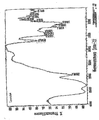
- a glass-like starch was produced from a wheat grade A starch, having the IR diagram represented in attached Figure 1, by using the extrusion step described in example 4 of US-A-5,360,903 except that no chemical agent was used.
- the resulting product was non-expanded, fully gelatinized and had a light brown-yellow colouration and is in form of pellets.
- the pellets were ground to form particles after having been allowed to cool and cure for 24 hours.
- the cooled and cured pallets were then processed in a Raymond Laboratory Hammer Mill and screened on a 30 mesh U.S. standard sieve. The fraction retained on the sieve was recycled into the grinder.
- the pellets were fed into the mill at about 20 pounds per hour.
- the resulting mixture of particles thereby obtained has the following composition: % retained on Mesh US Standard 0.5 30 40 40 32 60 12 70 10 100 4 170 1.5 170 and more
- Lysorb® is a trade mark of Lysac Technology Inc.
- the mixture stays at room temperature until its temperature reaches about 25°C then the mixture is dried.
- the gel exhibits the following viscosity features (measured with a Brookfield apparatus equipped with a number 4 Spindle) which are summarized in the follovang Table II: RPM Shearing (1/sec) Viscosity (Pa.sec) 0.3 0.065 112.721 0.6 0.129 112.725 1.5 0.323 103.033 3 0.647 86.116 6 1.293 60.001 12 2.587 39.838 30 6.467 21.917
- the viscosity profile is represented in the attached Figure 3.
- the drying of the "tray dried type” is then carried out at a temperature comprised between 40 and 50°C for 24 hours so that the % of final humidity, according to the above mentioned method 6 reaches about 0 %. After drying, a dry cake remains. The cake is ground to obtain absorbent particles.
- a mixture of a starch as described in example 1 with 20 parts of water for one part of starch is added with 6 % (calculated on the weight basis of starch) of sodium stearate.
- the latter mixture is heated at a temperature of 95°C for 20 minutes and the gelatinized starch thereby obtained is cooled, before drying, at ambient temperature until a temperature of about 25°C is reached.
- the gel has a Yield stress of 15 Pa which is characterizing of shearthrinning behaviour type.
- the viscosity of the gel measured according to the Brookfield LV model is about 24.7 Pa.sec at 1s -1 .
- a drying (of the tray dried type) is then carried out at a temperature comprised between 40 and 50°C for 24 hours in order to obtain a final humidity rate measured according to the above defined method 6 which is of about 0 %.
- the cake is ground in absorbent granules with a particle size ranging from 0 to 620 ⁇ m and with the following particle profile:
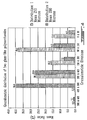
- a study of glass-like starch described in example 1 shows that its properties are dependant upon the selected granulornetry.
- the fine particles exhibit an intense and rapid absorption but are less efficient during swelling under pressure.
- the fine particles are also sensible to saline ions.
- Coarser particles exhibit a better resistance to the pressure and are less sensible to saline ions. However the absorption is slower and less important.
- the absorbency against pressure (AAP) was measured according to the EDANA 442.1-99 method.
- EDANA means European Disposables and Nonwowen Associations.
- the retention was measured according to the above-defined method 8.
- the absorption was measured according to the EDANA method 440.1-99.
- the results shows a synergetic effect obtained for the tertiary mixture when compared to the sum of the retention power of each component of the mixture.
- the mixture T18 shows a retention of 20.6 and the mixture T19 shows a retention of 25 when a retention of 7.8 is reached for the glass-like starch of example 1.
- LYSPILL® 215 compositions according to the invention comprising particles of a glass-like grade A starch, an insoluble carboxymethylcellulose and a high viscosity carboxymethylcellulose were tested for their toxicity over microorganisms and for their biodegradability, by using the 310E method of the "Organisation for Economic Co-operation and Development (OECD)".
- OECD Organic for Economic Co-operation and Development
- Toxicity tests (not included in the OECD tests) which are a preleminary to the biodegradabilty tests reveal that the tested compositions do not inhibit the microorganism of a sample of an activated mud.
- the corresponding biodegradability tests reveals a biodegradability of at least 46 % after 2 weeks.
- the particulate absorbent as well as the specific mixtures with carboxymethylcellulose (CMCs) and /or with xanthane and guar gums according to the invention are biodegradeble and therefore, even when incorporated in disposable structures are not dangerous for the environment. This constitutes a determinant advantage over polyacryamides and other chemical superabsorbents generally used in disposable absorbent structures which are not biodegradable and which accumulates in the environment.
- the particulate absorbent as well as the specific mixtures with CMC and /or with xanthane and guar gums according to the invention which do not irritate nor generate allergy in more than 2 % of cases (in fact 100% in the present case) can be classified as hypoallergen as established by the result of a Consummer Product Testing.
- the objective of the test is to determine by repetitive epidermal contact the potential of a test material to induce primary or cumulative irritation and/or allergic contact sensitization or cumulative irritation and/or allergic contact sensitization.
- the material tested was the glass-like starch Lysorb® alone described in example 1.
- Patches were applied (3) times per week (e.g., Monday, Wednesday, and Friday) for a total of nine (9) applications. The site was marked to ensure the continuity of patch application. Following supervised removal and scoring of the first Induction patch, participants were instructed to remove all subsequent Induction patches at home, twenty-four hours after application.
- a Challenge patch was applied to a virgin test site adjacent to the original Induction patch site, following the same procedure described for Induction. The patch was removed and the site scored at the clinic twenty-four and seventy-two hours post-application.
- test material Lysorb®
- the particulate aborbents according to the invention which comprises particles selected from the group consisting of glass-like polysaccharides and of glass-like polysaccharides occluding at least a surfactant in their internal structure, as well as the specific combinations of the latter absorbents with specific celluloses or gums are particularly suitable as absorbing component of compostable diapers as those disclosed in US-A-5,026,363 or in US-A-5,743,895 both in the name of RMED International, Inc.
- US-A-5,026,363 described more particularly a flushable diaper comprising, in combination, a three layered combined structure made of a thin, moisture permeable, biodegradable material, wherein the middle layer of said three layered combined structure is made of a thin, high moisture absorbing, breathable, biodegradable material.
- biodegradable particulate absorbents as well as the specific combination of the invention may advantageously be present in the middle layer of said flushable diaper for example in combination with wood pulp type material which is also a biodegrable constituting element of the middle layer.
- Such a flushable diaper wherein the bottom will be classified as entirely or substantially biodegradable are particularly suited for ecology purposes.
- US-A-5,743,895 described a disposable diaper in which structure the absorbent of the invention can be advantageously incorporated as further biodegradable component.
- the particulate absorbents of the invention are obtained from a renewable natural source are biodegradable, non-hygroscopic, hypoalergen and exhibiting a nearly ideal acquisition profile adaptable to the considered application.
- the particulate absorbent as well as specific mixtures with CMC and /or with xanthane and guar gums does not abrase the matrix in which they are incorporated for their absorbing properties. Therefore the corresponding diaper would not degrade by handling or transportation. Neither will mechanical degradation of the diaper, generated by the granules of absorbent, will occur during manufacturing.
- the particulate absorbent and the absorbing compositions according to the invention are classified as hypoallergen, as biodegradable, as non-hygroscopic and as stable on a wide pH range according to following definitions:
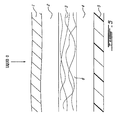
- Figure V illustrates in schematic cross-section an example of an absorbent structure which may incorporate in the central part thereof a particle absorbent as described herein:
- the liquid (0) goes through the first external layer(1), through the air layer (2), is captured by the absorbing material (6) inside of the matrix (3).
- the external layer (5) represent a security layer for stopping any liquid which would not be captured by the absorbing material (6) in the matrix (3).
- the particles may be held to the carrier in any known suitable manner keeping in mind the function of the absorbent.
Landscapes
- Health & Medical Sciences (AREA)
- Chemical & Material Sciences (AREA)
- Engineering & Computer Science (AREA)
- Life Sciences & Earth Sciences (AREA)
- Materials Engineering (AREA)
- Medicinal Chemistry (AREA)
- Organic Chemistry (AREA)
- Polymers & Plastics (AREA)
- Public Health (AREA)
- Veterinary Medicine (AREA)
- Chemical Kinetics & Catalysis (AREA)
- Epidemiology (AREA)
- Animal Behavior & Ethology (AREA)
- General Health & Medical Sciences (AREA)
- Hematology (AREA)
- Crystallography & Structural Chemistry (AREA)
- Biochemistry (AREA)
- Biomedical Technology (AREA)
- Heart & Thoracic Surgery (AREA)
- Vascular Medicine (AREA)
- Absorbent Articles And Supports Therefor (AREA)
- Solid-Sorbent Or Filter-Aiding Compositions (AREA)
- Polysaccharides And Polysaccharide Derivatives (AREA)
- Orthopedics, Nursing, And Contraception (AREA)
- Materials For Medical Uses (AREA)
- Compositions Of Macromolecular Compounds (AREA)
Abstract
Description
- breast pads (nursing pads),
- food pads,
- diapers (disposable and non disposable infant diapers, training pants),
- adult incontinence products (personal pads, bed pads, briefs),
- feminine hygiene products (tampons, sanitary napkins), and
- surgery and surgical pads or bandages,
- having a size of up to 620 µm;
- being at least 70% of a glass-like type structure; and
- being:
- 30 to 45 % of a size comprised between 620 and 420 µm;
- 35 to 55 % of a size comprised between 420 and 210 µm; and
- 5 to 25 % of a size up to 210 µm.
| Comparative features of Grade A starch obtained by the modified Martin and hydrocyclones processes. | ||
| Features | Modified Martin Process | Hydrocyclones Process |
| Humidity (%) | 10.50 | 11.4 |
| Ashes (% dry basis) | 0.31 | 0.22 |
| Total lipids (% dry basis) | 0.41 | 0.94 |
| Solubles (% dry basis) | 0.34 | 0.1 |
| Proteins (% dry basis) | 0.22 | 0.27 |
| PH | 5.90 | 6.5 |
| Residual (% dry basis) | 0.20 | 0.09 |
| Cediment (% dry basis) | 4.70 | 8 |
| Amylography and viscosimetry | ||
| Geletinization temperature (°C) | 88.3 | 86.0 |
| Viscosity at 95°C (UB) | 320 | 370 |
| Temperature peak (°C) | 95 | 95 |
| Viscosity peak (°C) | 340 | 385 |
| Viscosity at 95°C and after 15 mins (UB) | 280 | 340 |
| Viscosity at 50°C (UB) | 720 | 730 |
| Glue test | ||
| Viscosity (s) | 53 | 47 |
| Gel point (°C) | 65.5 | 64.5 |
| Mousse test | ||
| After 15 mins (%) | 5.1 | 0 |
| After 30 mins (%) | 2.0 | 0 |
| *Brabender units | ||
| From: Les Minoteries Ogilvie Ltd., Montreal, Canada |
- each of six sieves of, according to US Standard, 30 mesh, 40 mesh, 50 mesh, 60 mesh, 100 mesh and 170 mesh are tarred,
- 100 grams of the sample is laid down on the first (30 mesh) sieve,
- the fraction of the sample which is not retained by the first sieve falls into the second (40 mesh),
- such a the selection process is repeated for each sieve,
- each sieve is mechanically waved for 20 minutes and then tarred again,
- then the rate of particles retained on each sieve is calculated for 100 grams of the initial sample.
- f is the frequency of the result (for example 16% of particles have a size comprised between 250 and 420 microns),
- x is the central value of the class (comprised between 250 and 420 microns preferably about 350 microns),
-
x is the mean distribution of the lot and n is the number of results (100%).
- from 33 to 40 weight per cent of carbon;
- from 53 to 59 weight per cent of oxygen;
- from 6.6 to 7.5 weight per cent of hydrogen;
- less than 0.15 weight per cent of sulfur;
- less than 0.6 weight per cent of chloride; and
- residuals,
- 1649 ± 5 cm-1;
- 3446 ± 5 cm-1; and
- 3504 ± 5 cm-1,
- having a size up to 620 µm; and
- being at least 70 % of a glass-like type structure; and
- (1) heating a polysaccharide in the presence of water for 0.5 to 2.5 hours at a temperature ranging from 70 to 97°C so as to obtain a warm gelatinized polysaccharide,
- (2) drying the warm gelatinized polysaccharide obtained in step (1) so as to obtain a glass-like polysaccharide; and
- (3) grinding the dry glass-like polysaccharide obtained in step (2) to particles and recovering preferably by screening the particles to a size of up to 620 µm,
- at least one surfactant is added in step (1);
- the weight % of polysaccharide in water ranges from 3.2 to 50; preferably from 4.8 to 16.5 % and more preferably about 9.1 %; and
- the weight % of surfactant in the polysaccharide ranges from 6 to 10, being preferably of about 8.
- 77 to 83 % by weight of a particulate absorbent for liquid as defined in the above mentioned first object of the invention;
- 15 to 17 % by weight of an insoluble carboxymethylcellulose;
- 2 to 6 % by weight of a high viscosity carboxymethylcellulose.
- 79 to 92 % by weight of a particulate absorbent for liquid as defined in the above-mentioned first object of the invention;
- 4 to 10.5 % by weight of a xanthane gum; and
- 4 to 10.5 % by weight of a guar gum.
- the xanthane gum has a viscosity, ranging from1400 to 1650 mPas (cps) at a concentration of 1% in water with 1 % of KCI and a viscosity ranging from 130 to 180 mPas (cps), at 0.2 % in water with 1 % of KCl, the viscosity being measured by preparing a 1 % salt solution of a product by slowly adding a dry blend of 3.0 g product and 3.0 grams potassium chloride to 250 ml of distilled water in a 400 ml beaker, while stirring at 800 rpm using a low-pitched propeller type stirrer, by adding an additional 44 ml of distilled water, rinsing the walls of the beaker and continue stirring at 800 rpm for two hours and, at the end of the period, by adjusting the temperature of the solution to 25°C , by vigorously stirring by hand in a vertical motion to eliminate any thixotropic effects or layering, and immediately measuring the viscosity by using a LV model of the Brookfield viscometer at 60 rpm with No. 3 spindle; and
- the guar gum has a viscosity after 24 hours of at least 3500 mPas (cps), after 30 minutes of 2800 mPas (cps),
- food pads,
- diapers (disposable and non disposable infant diapers, training pants),
- adult incontinence products (personal pads, bed pads, briefs),
- feminine hygiene products (tampons, sanitary napkins), and
- surgery and surgical pads or bandages,
- a first external layer permeable to physiological fluids;
- a central matrix essentially made of an absorbing material; and
- a second external layer impermeable to physiological fluids and to aggregates formed by said physiological fluids with the absorbing material present in the central matrix which is entrapped between both external layers,
the remaining part of the absorbing material in said central matrix being selected from natural fibres, semi-synthetic fibres, synthetic fibres, wood pulp, cellulose fibres, cotton, peat-moss and mixture thereof.
From 100 to 200 mg of absorbent are weighed in a pre-weighed tube for centrifugation of 15 ml. 10 ml of water are added and immediately agitated with a stick for one minute.
The mixture stays for 15 minutes and then centrifugated for 5 minutes at 2000 rpm. The supernatant is discarded and the dottle constituted of the absorbent and the water retained in the form of a paste (similar to a gel) is weighed. The ratio = gram of retained water by gram of absorbent is determined.
| % retained | on Mesh US Standard |
| 0.5 | 30 |
| 40 | 40 |
| 32 | 60 |
| 12 | 70 |
| 10 | 100 |
| 4 | 170 |
| 1.5 | 170 and more |
| RPM | Shearing (1/sec) | Viscosity (Pa.sec) |
| 0.3 | 0.065 | 112.721 |
| 0.6 | 0.129 | 112.725 |
| 1.5 | 0.323 | 103.033 |
| 3 | 0.647 | 86.116 |
| 6 | 1.293 | 60.001 |
| 12 | 2.587 | 39.838 |
| 30 | 6.467 | 21.917 |
| %NaCl | Absorption | Retention | AAP | ||||
| 0 | 0.2 | 0.9 | 0 | 0.2 | 0.9 | 0 | |
| | 8.2 | 8.8 | 6.1 | 9 | 8.7 | 7.5 | 2.9 |
| | 7.9 | 8.8 | 7.5 | 8.4 | 8.4 | 8 | 4.5 |
- the glass-like grade A starch obtained in
part 1 of example 2 which occludes sodium alkyl sulfonate (SAS), - the glass-like starch obtained in
part 2 of example 2 which occludes sodium stearate (SS); and - the glass-like grade A starch obtained by treating the grade A starch described in example 1 according to the gelatinisation process described in example 2 except that no surfactant was added during the gelatinisation, were compared.
| Absorbent: glass-like polysaccharides | R(g/g) value in distilled water |
| SAS derivative | 21.3 |
| Stearate derivative | 60 |
| Grade A starch | 4.6 |
| Retention of Ternary Mixtures | |||||
| Test Number | Guar % | XanthaneHT % | Lysorb® % | Total % | Rentention (H2O) |
| T1 | 0 | 10 | 90 | 100 | 14 |
| T2 | 0 | 20 | 80 | 100 | 26 |
| | 10 | 0 | 90 | 100 | 12 |
| T4 | 20 | 0 | 80 | 100 | 15 |
| T12 | 5 | 15 | 80 | 100 | 27.5 |
| T13 | 3 | 10 | 87 | 100 | 16 |
| | 4 | 9 | 87 | 100 | 16 |
| T17 | 5 | 5 | 90 | 100 | 15 |
| | 6 | 6 | 88 | 100 | 20.6 |
| T19 | 7 | 7 | 86 | 100 | 25 |
| T0 | 0 | 0 | 100 | 100 | 7.8 |
| Substance of Reference | Sodium Benzoate |
| Theorical starting concentration of the reference substance | 20 mg/l |
| Tested product | LYSPILL® TM 215 serie |
| Inoculum | Actived mud, Valcartier |
| Inoculum concentration | 0.5 ml/l |
| Incubation temperature | 20°C |
| Agitation | 175 rpm |
| Carbon analyser | Technicon |
- Male and female subjects, age 16 and over
- Absence of any visible skin disease which might be confused with a skin reaction from the test material,
- Prohibition of the use of topical or systemic steroids and/or antihistamines for at least seven days prior to study initiation,
- Completion of a Medical History form and the understanding and signing of an Informed Consent form,
- Considered reliable and capable of following directions
- III health,
- Under a doctor's care or taking medication(s) which could influence the outcome of the study,
- Females must not be pregnant or nursing,
- A history of adverse reactions to cosmetics or other personal care products.
- hypoallergen means that according to the protocol # 1.01 of the above
defined Consumer Product testing, when applied to 50 person:
- nobody presents an irritation grade of 4;
- nobody presents an irritation grade of 3;
- nobody presents an irritation grade of 2;
- a maximum of one tested person presents the
irritation grade 1; and - a maximum of 2 persons present the irritation grade +; and
- at all, a maximum of 2 persons present an irritation grade other than 0,
- O = no visible skin reaction,
- + = barely perceptible or spotty erythema;
- 1 = mild erythema covering most of the test site;
- 2 = moderate erythema, possible presence of mild edema;
- 3 = marked erythema, possible edema;
- 4 = severe erythema, possible edema, vesiculation, bullae and/or ulceration (according to these definition the Lysorb® product is hypoallergen),
- biodegradable means that according to the OECD 301-E method at least 50 % of the tested particulate absorbent or of the tested absorbing composition is degraded (the 215 product which has been tested according to the method is degraded for 46 % in 14 days can therefor be classified as biodegradable, the same applies to the glass-like polysaccharide Lysorb®),
- non-hygroscopic means that no retention of humidity occurs after 60 minutes, as measured according to the following exemplfied test conducted with Lysorb; the water retention of the absorbent was evaluated by placing a cup containing 1 gram of the absorbent and a cup containing 20 ml of water in a closed test room for 5 hours, the humidity gap immediately at the exit of the test room is relatively low, at about 6 weight %, this humidity is not strongly retained since a complete release in the environment occurs after 60 minutes at ambient, and
- stable over a wide pH range for an absorbent according to the invention,
means a 100 % stability of the retention's capacity when tested,
according to the
method 8, for different pH ranging from 2 to 11, for 15 minutes (such a stability tests by pH as low as 2 and by a pH as high as 11 may be qualified as extreme tests).
- In Figure V the various elements have the following reference numbers:
- (1) represents a first external layer permeable to liquids.
- (2) represents an air layer which may as desired be dispense with.
- (3) represents a central matrix made of an absorbing material.
- (4) represents an air layer which may as desired be dispense with.
- (5) represents a second external layer impermeable to liquid.
Claims (25)
- A particulate absorbent, for the absorption of liquids, comprising particles of glass-like polysaccharides, wherein said particleshave a size of up to 620 µm;being at least 70 % of a glass-like type structure; andfurther being:30 to 45 % of a size comprised between 620 and 420 µm;35 to 55 % of a size comprised between 420 and 210 µm; and5 to 25 % of a size up to 210 µm.
- A particulate absorbent as defined in claim 1, wherein said particulate absorbent comprises particles of glass-like polysaccharides occluding, in the internal structure thereof, at least one surfactant.
- The particulate absorbent as defined in claim 2, wherein said surfactant is an ionic surfactant comprising a linear long alkyl chain comprising from 12 to 20 carbon atoms.
- The particulate absorbent as defined in claim 2, wherein the particles of glass-like polysaccharides occluding, in their internal structure, at least one surfactant have a size in the range of from 5 to 500 µm.
- The particulate absorbent as defined in claim 1 or 2, wherein said glass-like polysaccharide is derived from starch by gelatinization.
- The particulate absorbent as defined in claim 5, wherein said starch has a granulate size ranging from 25 to 40 µm.
- The particulate absorbent as defined in claim 6, wherein said starch is a grade A wheat starch.
- The particulate absorbent as defined in claim 7, wherein said glass-like starch comprises:the weight per cent being expressed by total weight of said glass-like starch.from 33 to 40 weight per cent of carbon;from 53 to 59 weight per cent of oxygen;from 6.6 to 7.5 weight per cent of hydrogen;less than 0.15 weight per cent of sulfur;less than 0.6 weight per cent of chloride; andresiduals,
- A process for preparing a particulate absorbent as defined in claim 2, which process comprises the steps of:(1) heating a polysaccharide in the presence of water at a temperature ranging from 70 to 97 °C so as to obtain a warm gelatinized polysaccharide,(2) drying the warm gelatinized polysaccharide obtained in step (1) so as to obtain a glass-like polysaccharide; and(3) grinding the dry glass-like polysaccharide obtained in step (2) to particles and recovering the particles having a size up to 620 µm, wherein:at least one surfactant is added in step (1);the weight % of polysaccharide in water ranges from 3.2 to 50; andthe weight % of surfactant in the polysaccharide ranging from 6 to 10.
- A process as defined in claim 9 wherein for step (1) a polysaccharide is heated in the presence of water for 0.5 to 2.5 hours.
- A process as defined in claim 9, wherein said glass-like polysaccharide is derived from starch by gelatinization.
- A process as defined in claim 11, wherein said starch has a granulate size ranging from 25 to 40 µm.
- A process as defined in claim 12, wherein said starch is a grade A wheat starch.
- Absorbing composition comprising:77 to 83 % by weight of a particulate absorbent for liquids as defined in claim 1 or 2;15 to 17 % by weight of an insoluble carboxymethylcellulose wherein the insoluble carboxymethylcellulose has a viscosity ranging from 7000 to 12000 mPas; and2 to 6 % by weight of a high viscosity carboxymethylcellulose wherein the high viscosity carboxymethylcellulose has a viscosity ranging from 1500 to 2500 mPas.
- Absorbing composition comprising:79 to 92 % by weight of a particulate absorbent for liquids as defined in claim 1 or 2;4 to 10.5 % by weight of a xanthane gum; and4 to 10.5 % by weight of a guar gum.
- Absorbing composition as defined in claim 15 wherein:the viscosity being measured by preparing a 1 % salt solution of a product by slowly adding a dry blend of 3.0 g product and 3.0 grams potassium chloride to 250 ml of distilled water in a 400 ml beaker, while stirring at 800 rpm using a low-pitched propeller type stirrer, by adding an additional 44 ml of distilled water, rinsing the walls of the beaker and continue stirring at 800 rpm for two hours and, at the end of the period, by adjusting the temperature of the solution to 25 °C, by vigorously stirring by hand in a vertical motion to eliminate any thixotropic effects or layering, and immediately measuring the viscosity by using a LV model of the Brookfield viscometer at 60 rpm with No. 3 spindle.the xanthane gum has a viscosity, ranging from 1400 to 1650 mPa s (cps) at a concentration of 1 % in water with 1 % of KCl and a viscosity ranging from 130 to 180 mPa s (cps), at 0.2 % in water with 1 % of KCl, the viscosity being measured by preparing a 1 % salt solution of a product by slowly adding a dry blend of 3.0 g product and 3.0 grams potassium chloride to 250 ml of distilled water in a 400 ml beaker, while stirring at 800 rpm using a low-pitched propeller type stirrer, byadding an additional 44 ml of distilled water, rinsing the walls of the beaker and continue stirring at 800 rpm for two hours and, at the end of the period, byadjusting the temperature of the solution to 25 °C , by vigorously stirring by handin a vertical motion to eliminate any thixotropic effects or layering, and immediately measuring the viscosity by using a LV model of the Brookfield viscometer at 60 rpm with No. 3 spindle; andthe guar gum has a viscosity after 24 hours of at least 3500 mPa s (cps), after 30 minutes of 2800 mPa s (cps),
- Absorbent combination comprising a member selected fromwith a carrier.a) a particulate absorbent as defined in claim 1 or 2;b) an absorbing composition as defined in claim 14, andc) an absorbing composition as defined in claim 15,
- An absorbing combination as defined in claim 17, wherein the carrier is selected in air laids, chemically bonded tissues, nonwoven wet laids, hydrogen tangled fabrics, melt blows and laminated structures.
- Breast pad, food pad, personal pad, bed pad, adult incontinence product, disposable diaper, non disposable diaper, brief, feminine hygiene product or bandage incorporating a substantial amount of a particulate absorbent for liquids as defined in claim 1 or 2.
- Breast pad, food pad, personal pad, bed pad, adult incontinence product, disposable diaper, non disposable diaper, brief, feminine hygiene product or bandage incorporating a substantial amount of an absorbent composition selected froma) an absorbing composition as defined in claim 14; andb) an absorbing composition as defined in claim 15.
- Diaper consisting of:the remaining part of the absorbing material in said central matrix being selected from natural fibres, semi-synthetic fibres, synthetic fibres, wood pulp, cellulose fibres, cotton, peat-moss and mixture thereof.a first external layer permeable to physiological fluids;a central matrix essentially made of an absorbing material; anda second external layer impermeable to physiological fluids and to aggregates formed by said physiological fluids with the absorbing material present in the central matrix which is entrapped between both external layers, wherein the absorbing material in the central matrix consists of 2 to 27 % (in weight by total weight of the absorbing material present in the matrix) of an absorbent which is selected froma) particulate absorbents for the absorption of liquids, comprising particles selected from particles of glass-like polysaccharides and of particles of glass-like polysaccharides occluding, in their internal structure, at least one surfactant, said particles having a size up to 620 µm and being at least 70% of a glass-like type structure; and further being:30 to 45 % of a size comprised between 620 and 420 µm;35 to 55 % of a size comprised between 420 and 210 µm; and5 to 25 % of a size up to 210 µm;b) absorbing compositions comprising:77 to 83 % of a particulate absorbent for liquids as defined in the above paragraph a);15 to 17 % of an insoluble carboxymethylcellulose wherein the insoluble carboxymethylcellulose has a viscosity ranging from 7000 to 12000 mPas; and;2 to 6 % of a high viscosity carboxymethylcellulose wherein the high viscosity carboxymethylcellulose has a viscosity ranging from 1500 to 2500 mPas.;c) absorbing compositions comprising:79 to 92 % of a particulate absorbent for liquids as defined in the above paragraph a);4 to 10.5 % of a xanthane gum; and4 to 10.5 % of a guar gum; andd) mixtures of at least one particulate absorbent as defined in paragraph a) with at least one absorbing composition as defined in paragraph b) and/or c),
- Use of the particulate absorbent as defined in claim 1 or 2, alone or in combination with additives or intrants, as absorbents of polar liquids and of physiological fluids.
- Use as defined in claim 22, wherein said fluids have a pH ranging from 2 to 11.
- Use as defined in claim 22, wherein the fluids are selected from the group consisting of water, and mixtures of water and of at least a water soluble solvent.
- Use as defined in claim 24, wherein the water soluble solvent is selected from the group consisting of an alcohol, a ketone, urine and blood serum.
Applications Claiming Priority (3)
| Application Number | Priority Date | Filing Date | Title |
|---|---|---|---|
| CA002271423A CA2271423A1 (en) | 1999-05-11 | 1999-05-11 | Glass-like polysaccharides useful as absorbents |
| CA2271423 | 1999-05-11 | ||
| PCT/CA2000/000555 WO2000067809A1 (en) | 1999-05-11 | 2000-05-11 | Glass-like polysaccharide useful as absorbent for liquids |
Publications (2)
| Publication Number | Publication Date |
|---|---|
| EP1178843A1 EP1178843A1 (en) | 2002-02-13 |
| EP1178843B1 true EP1178843B1 (en) | 2005-08-17 |
Family
ID=4163538
Family Applications (1)
| Application Number | Title | Priority Date | Filing Date |
|---|---|---|---|
| EP00929165A Expired - Lifetime EP1178843B1 (en) | 1999-05-11 | 2000-05-11 | Glass-like polysaccharide useful as absorbent for liquids |
Country Status (10)
| Country | Link |
|---|---|
| US (2) | US6444653B1 (en) |
| EP (1) | EP1178843B1 (en) |
| JP (1) | JP4503861B2 (en) |
| AT (1) | ATE302031T1 (en) |
| AU (1) | AU774764B2 (en) |
| CA (2) | CA2271423A1 (en) |
| DE (1) | DE60022023T2 (en) |
| ES (1) | ES2261201T3 (en) |
| MX (1) | MX236054B (en) |
| WO (1) | WO2000067809A1 (en) |
Cited By (1)
| Publication number | Priority date | Publication date | Assignee | Title |
|---|---|---|---|---|
| US11596924B2 (en) | 2018-06-27 | 2023-03-07 | Kimberly-Clark Worldwide, Inc. | Nanoporous superabsorbent particles |
Families Citing this family (49)
| Publication number | Priority date | Publication date | Assignee | Title |
|---|---|---|---|---|
| CA2351253A1 (en) | 2000-11-10 | 2002-05-10 | Groupe Lysac Inc./Lysac Group Inc. | Crosslinked polysaccharide, obtained by crosslinking with substituted polyethylene glycol, as superabsorbent |
| CA2423712A1 (en) | 2003-03-26 | 2004-09-26 | Nicolas Nourry | Crosslinked amylopectin by reactive extrusion and its use as an absorbent or superabsorbent material |
| CA2382419A1 (en) * | 2002-04-24 | 2003-10-24 | Le Groupe Lysac Inc. | Synergistic blends of polysaccharides as biodegradable absorbent materials or superabsorbents |
| WO2004065514A1 (en) * | 2003-01-14 | 2004-08-05 | Archer-Daniels-Midland Company | Glass-like polysaccharides useful for treating manufactured parts |
| US8815008B2 (en) * | 2003-06-04 | 2014-08-26 | Archer Daniels Midland Company | Starch-based abrasive absorbent |
| CA2443059A1 (en) | 2003-09-29 | 2005-03-29 | Le Groupe Lysac Inc. | Polysaccharide-clay superabsorbent nanocomposites |
| CA2481491A1 (en) | 2004-09-14 | 2006-03-14 | Le Groupe Lysac Inc. | Amidinated or guanidinated polysaccharides, their use as absorbents and a process for producing same |
| US7560419B2 (en) * | 2004-11-03 | 2009-07-14 | Halliburton Energy Services, Inc. | Method and biodegradable super absorbent composition for preventing or treating lost circulation |
| US20060147689A1 (en) * | 2004-12-30 | 2006-07-06 | Raj Wallajapet | Absorbent composites containing biodegradable reinforcing fibers |
| CA2492884A1 (en) * | 2005-01-13 | 2006-07-13 | Stephane Chevigny | A high efficiency process for particle size reduction of glass-like polysaccharides |
| US8829107B2 (en) * | 2006-02-28 | 2014-09-09 | Evonik Degussa Gmbh | Biodegradable superabsorbent polymer composition with good absorption and retention properties |
| US20070219521A1 (en) * | 2006-03-17 | 2007-09-20 | The Procter & Gamble Company | Absorbent article comprising a synthetic polymer derived from a renewable resource and methods of producing said article |
| CA2655538C (en) * | 2006-06-20 | 2015-12-01 | Edward Beecher | A process for the manufacture of unexpanded glass-like polysaccharides |
| KR101329658B1 (en) | 2006-09-25 | 2013-11-14 | 아처 다니엘 미드랜드 캄파니 | Superabsorbent surface-treated carboxyalkylated polysaccharides and process for producing same |
| US7717995B2 (en) * | 2006-10-02 | 2010-05-18 | Weyerhaeuser Nr Company | Methods for the preparation of mixed polymer superabsorbent fibers containing cellulose |
| US20080078514A1 (en) * | 2006-10-02 | 2008-04-03 | Weyerhaeuser Co. | Methods for the preparation of cellulose fibers having superabsorbent particles adhered thereto |
| US20080079188A1 (en) * | 2006-10-02 | 2008-04-03 | Weyerhaeuser Co. | Methods for the preparation of mixed polymer superabsorbent fibers |
| US20080081165A1 (en) * | 2006-10-02 | 2008-04-03 | Weyerhaeuser Co. | Fibrous superabsorbent composite containing cellulose |
| US7645806B2 (en) * | 2006-10-02 | 2010-01-12 | Weyerhaeuser Nr Company | Methods for the preparation of superabsorbent particles containing carboxyalkyl cellulose |
| US7625463B2 (en) | 2006-10-02 | 2009-12-01 | Weyerhaeuser Nr Company | Methods for the preparation of fibrous superabsorbent composite containing cellulose |
| US7785710B2 (en) | 2006-10-02 | 2010-08-31 | Weyerhaeuser Nr Company | Superabsorbent particles containing carboxyalkyl cellulose and temporary metal crosslinks |
| US20080200096A1 (en) * | 2007-02-15 | 2008-08-21 | Tyco Healthcare Retail Services Ag | Nursing pad |
| US7591891B2 (en) * | 2007-06-25 | 2009-09-22 | Weyerhaeuser Nr Company | Fibrous blend and methods of preparation |
| US7749317B2 (en) | 2007-06-25 | 2010-07-06 | Weyerhaeuser Nr Company | Fibrous blend and method of making |
| US7874266B2 (en) * | 2007-09-28 | 2011-01-25 | T.F.H. Publications, Inc. | Biodegradable waste pad or litter including nutrients for promoting microbial populations |
| US7833384B2 (en) * | 2008-06-30 | 2010-11-16 | Weyerhaeuser Nr Company | Method for making fiber having biodegradable superabsorbent particles attached thereto |
| US8101543B2 (en) * | 2008-06-30 | 2012-01-24 | Weyerhaeuser Nr Company | Biodegradable superabsorbent particles |
| US8084391B2 (en) * | 2008-06-30 | 2011-12-27 | Weyerhaeuser Nr Company | Fibers having biodegradable superabsorbent particles attached thereto |
| US20090326180A1 (en) * | 2008-06-30 | 2009-12-31 | Weyerhaeuser Co. | Biodegradable Superabsorbent Particles Containing Cellulose Fiber |
| US8641869B2 (en) * | 2008-06-30 | 2014-02-04 | Weyerhaeuser Nr Company | Method for making biodegradable superabsorbent particles |
| US20090325797A1 (en) * | 2008-06-30 | 2009-12-31 | Weyerhaeuser Co. | Biodegradable Superabsorbent Particles |
| US7959762B2 (en) * | 2008-06-30 | 2011-06-14 | Weyerhaeuser Nr Company | Method for making biodegradable superabsorbent particles |
| BRMU9000890U2 (en) * | 2010-06-14 | 2012-02-28 | Aparecida Do Amaral Fátima | disposable and biodegradable female pad (environmentally friendly) |
| WO2011156878A1 (en) * | 2010-06-14 | 2011-12-22 | Fatima Aparecida Do Amaral | Disposable, biodegradable (environmentally friendly) diaper |
| DE102011015889A1 (en) * | 2011-04-01 | 2012-10-04 | Karl Thews | absorbent article |
| CA2844631A1 (en) * | 2011-08-09 | 2013-02-14 | Rhodia Operations | Wettable, non-leachable peat moss, method of preparation, and method of use |
| CA2883137C (en) | 2012-08-29 | 2020-03-10 | 7905122 Canada Inc. | Chromogenic absorbent material for animal litter and related chromogenic solution |
| JP6105947B2 (en) * | 2013-01-18 | 2017-03-29 | ユニ・チャーム株式会社 | Water retention aid and absorbent material, absorbent body and absorbent article containing the same |
| EP3019547B1 (en) * | 2013-03-05 | 2020-07-22 | The Penn State Research Foundation | Composite materials |
| US9850512B2 (en) | 2013-03-15 | 2017-12-26 | The Research Foundation For The State University Of New York | Hydrolysis of cellulosic fines in primary clarified sludge of paper mills and the addition of a surfactant to increase the yield |
| ES2855982T3 (en) | 2014-02-27 | 2021-09-27 | 7905122 Canada Inc | Chromogenic absorbent material for animal bedding |
| US9951363B2 (en) | 2014-03-14 | 2018-04-24 | The Research Foundation for the State University of New York College of Environmental Science and Forestry | Enzymatic hydrolysis of old corrugated cardboard (OCC) fines from recycled linerboard mill waste rejects |
| CA2950148C (en) | 2014-06-02 | 2022-07-12 | Tethis, Inc. | Modified biopolymers and methods of producing and using the same |
| CA3174454C (en) | 2014-10-01 | 2025-07-08 | 7905122 Canada Inc. | Process and apparatus for manufacturing water-absorbing material and use in cat litter |
| WO2017091463A1 (en) | 2015-11-23 | 2017-06-01 | Tethis, Inc. | Coated particles and methods of making and using the same |
| US11013823B2 (en) | 2016-04-01 | 2021-05-25 | 7905122 Canada Inc. | Water-absorbing material and uses thereof |
| GB2579301B (en) | 2017-07-28 | 2022-02-23 | Kimberly Clark Co | Absorbent article containing nanoporous superabsorbent particles |
| WO2019023060A2 (en) | 2017-07-28 | 2019-01-31 | Kimberly-Clark Worldwide, Inc. | Nanoporous superabsorbent particles |
| CN112773928B (en) * | 2021-01-05 | 2021-09-21 | 珠海原妙医学科技股份有限公司 | Starch-based fluffy particles and preparation method and application thereof |
Family Cites Families (14)
| Publication number | Priority date | Publication date | Assignee | Title |
|---|---|---|---|---|
| US3706598A (en) | 1970-07-15 | 1972-12-19 | Cpc International Inc | Solid,glass-like starch hydrolysates having high densities |
| JPS565137A (en) * | 1979-06-27 | 1981-01-20 | Sanyo Chem Ind Ltd | Water absorbing agent with excellent stability against salt |
| JPS5832641A (en) * | 1981-08-20 | 1983-02-25 | Kao Corp | Water-absorbing composition |
| US5047023A (en) | 1986-07-18 | 1991-09-10 | The Procter & Gamble Company | Absorbent members having low density and basis weight acquisition zones |
| US5061259A (en) | 1987-08-19 | 1991-10-29 | The Procter & Gamble Company | Absorbent structures with gelling agent and absorbent articles containing such structures |
| US4935022A (en) | 1988-02-11 | 1990-06-19 | The Procter & Gamble Company | Thin absorbent articles containing gelling agent |
| JPH0637521B2 (en) * | 1989-01-19 | 1994-05-18 | 工業技術院長 | Polysaccharides, water-absorbing / moisture-absorbing / moisturizing-thickeners mainly consisting of them, and culture production method thereof |
| US5066335A (en) | 1989-05-02 | 1991-11-19 | Ogilvie Mills Ltd. | Glass-like polysaccharide abrasive grit |
| US5026363A (en) | 1989-12-27 | 1991-06-25 | Rmed International, Inc. | Flushable diaper device and method |
| DE4318094B4 (en) * | 1993-06-01 | 2004-03-04 | Stockhausen Gmbh & Co. Kg | Superabsorbents, processes for their preparation and their use |
| CA2140979A1 (en) * | 1994-02-15 | 1995-08-16 | Ian William Cottrell | Crosslinked polysaccharides useful as absorbent materials |
| US5743895A (en) | 1996-01-26 | 1998-04-28 | Rmed International, Inc. | Disposable diaper and method therefor |
| AU717286B2 (en) * | 1996-11-06 | 2000-03-23 | Sanyo Chemical Industries Ltd. | Water absorbing agent and absorbent material |
| US6015608A (en) | 1998-06-03 | 2000-01-18 | Koslow Technologies Corporation | Liquid absorbent pad with anti-gel-block laminate |
-
1999
- 1999-05-11 CA CA002271423A patent/CA2271423A1/en not_active Abandoned
-
2000
- 2000-05-11 AT AT00929165T patent/ATE302031T1/en not_active IP Right Cessation
- 2000-05-11 DE DE60022023T patent/DE60022023T2/en not_active Expired - Lifetime
- 2000-05-11 AU AU47377/00A patent/AU774764B2/en not_active Expired
- 2000-05-11 ES ES00929165T patent/ES2261201T3/en not_active Expired - Lifetime
- 2000-05-11 MX MXPA01011526 patent/MX236054B/en active IP Right Grant
- 2000-05-11 JP JP2000616834A patent/JP4503861B2/en not_active Expired - Fee Related
- 2000-05-11 WO PCT/CA2000/000555 patent/WO2000067809A1/en not_active Ceased
- 2000-05-11 EP EP00929165A patent/EP1178843B1/en not_active Expired - Lifetime
- 2000-05-11 CA CA2308537A patent/CA2308537C/en not_active Expired - Lifetime
- 2000-05-11 US US09/569,275 patent/US6444653B1/en not_active Expired - Fee Related
-
2002
- 2002-04-03 US US10/115,412 patent/US6713460B2/en not_active Expired - Lifetime
Cited By (1)
| Publication number | Priority date | Publication date | Assignee | Title |
|---|---|---|---|---|
| US11596924B2 (en) | 2018-06-27 | 2023-03-07 | Kimberly-Clark Worldwide, Inc. | Nanoporous superabsorbent particles |
Also Published As
| Publication number | Publication date |
|---|---|
| DE60022023T2 (en) | 2006-03-30 |
| MX236054B (en) | 2006-04-20 |
| CA2271423A1 (en) | 2000-11-11 |
| EP1178843A1 (en) | 2002-02-13 |
| JP2002543953A (en) | 2002-12-24 |
| AU4737700A (en) | 2000-11-21 |
| MXPA01011526A (en) | 2003-09-10 |
| CA2308537C (en) | 2010-02-16 |
| CA2308537A1 (en) | 2000-11-11 |
| US6444653B1 (en) | 2002-09-03 |
| WO2000067809A1 (en) | 2000-11-16 |
| AU774764B2 (en) | 2004-07-08 |
| US6713460B2 (en) | 2004-03-30 |
| DE60022023D1 (en) | 2005-09-22 |
| JP4503861B2 (en) | 2010-07-14 |
| US20020156048A1 (en) | 2002-10-24 |
| ES2261201T3 (en) | 2006-11-16 |
| ATE302031T1 (en) | 2005-09-15 |
Similar Documents
| Publication | Publication Date | Title |
|---|---|---|
| US6713460B2 (en) | Glass-like polysaccharide useful as absorbent for liquids | |
| US5801116A (en) | Process for producing polysaccharides and their use as absorbent materials | |
| CA2448140C (en) | Superabsorbents, preparation thereof and use thereof | |
| EP0001706B1 (en) | Method of treating absorbent materials | |
| AU767859B2 (en) | Acidic superabsorbent polysaccharides | |
| US4333461A (en) | Borated polysaccharide absorbents and absorbent products | |
| EP1496952B1 (en) | Compositions of polysaccharides as biodegradable absorbent materials | |
| US20100036341A1 (en) | Absorbent product comprising a cationic modified guar gum | |
| US3347236A (en) | Disposable article having a layer of artificial absorbent fibers and supporting sheet | |
| EP1981511B1 (en) | Hemostatic material | |
| EP2944376B1 (en) | Agglomerated superabsorbent polymer particles | |
| MXPA96003669A (en) | S $! mixing process for the preparation of biodegradable fibers, non-woven materials that comprise biodegradable fibrilles and products that comprise such non-teji materials | |
| DE19654745C5 (en) | Biodegradable absorbent, its manufacture and use | |
| JPH09506798A (en) | Hygienic products with assembled absorber | |
| CA2140979A1 (en) | Crosslinked polysaccharides useful as absorbent materials | |
| WO2009034527A2 (en) | Absorbent articles comprising an aglycone derivable from an iridoid glycoside | |
| GB1576475A (en) | Absorbent cross-linked starch materials | |
| JPH10502553A (en) | Alginate fiber, its production method and application | |
| EP3936554A1 (en) | Method for manufacturing carboxymethyl cellulose particles, carboxymethyl cellulose particles manufactured thereby, and absorbent article comprising same | |
| KR102790098B1 (en) | Preparation method of biodegradable highly absorbent material using crustacean shell and use thereof | |
| JPS61501033A (en) | Modified starch as filler for absorbent polymers |
Legal Events
| Date | Code | Title | Description |
|---|---|---|---|
| PUAI | Public reference made under article 153(3) epc to a published international application that has entered the european phase |
Free format text: ORIGINAL CODE: 0009012 |
|
| 17P | Request for examination filed |
Effective date: 20011210 |
|
| AK | Designated contracting states |
Kind code of ref document: A1 Designated state(s): AT BE CH CY DE DK ES FI FR GB GR IE IT LI LU MC NL PT SE |
|
| AX | Request for extension of the european patent |
Free format text: AL;LT;LV;MK;RO;SI |
|
| 17Q | First examination report despatched |
Effective date: 20020610 |
|
| RAP1 | Party data changed (applicant data changed or rights of an application transferred) |
Owner name: LYSAC GROUP INC. |
|
| RIN1 | Information on inventor provided before grant (corrected) |
Inventor name: CHEVIGNY, STEPHANE Inventor name: QUIRION, FRANCOIS Inventor name: HUPPE, SERGE Inventor name: MAHEUX, MARIE-ELISE |
|
| RIN1 | Information on inventor provided before grant (corrected) |
Inventor name: HUPPE, SERGE Inventor name: CHEVIGNY, STEPHANE Inventor name: MAHEUX, MARIE-ELISE Inventor name: QUIRION, FRANCOIS |
|
| RAP1 | Party data changed (applicant data changed or rights of an application transferred) |
Owner name: LYSAC GROUP INC. |
|
| GRAP | Despatch of communication of intention to grant a patent |
Free format text: ORIGINAL CODE: EPIDOSNIGR1 |
|
| GRAS | Grant fee paid |
Free format text: ORIGINAL CODE: EPIDOSNIGR3 |
|
| GRAA | (expected) grant |
Free format text: ORIGINAL CODE: 0009210 |
|
| AK | Designated contracting states |
Kind code of ref document: B1 Designated state(s): AT BE CH CY DE DK ES FI FR GB GR IE IT LI LU MC NL PT SE |
|
| PG25 | Lapsed in a contracting state [announced via postgrant information from national office to epo] |
Ref country code: AT Free format text: LAPSE BECAUSE OF FAILURE TO SUBMIT A TRANSLATION OF THE DESCRIPTION OR TO PAY THE FEE WITHIN THE PRESCRIBED TIME-LIMIT Effective date: 20050817 Ref country code: LI Free format text: LAPSE BECAUSE OF FAILURE TO SUBMIT A TRANSLATION OF THE DESCRIPTION OR TO PAY THE FEE WITHIN THE PRESCRIBED TIME-LIMIT Effective date: 20050817 Ref country code: FI Free format text: LAPSE BECAUSE OF FAILURE TO SUBMIT A TRANSLATION OF THE DESCRIPTION OR TO PAY THE FEE WITHIN THE PRESCRIBED TIME-LIMIT Effective date: 20050817 Ref country code: CH Free format text: LAPSE BECAUSE OF FAILURE TO SUBMIT A TRANSLATION OF THE DESCRIPTION OR TO PAY THE FEE WITHIN THE PRESCRIBED TIME-LIMIT Effective date: 20050817 |
|
| REG | Reference to a national code |
Ref country code: GB Ref legal event code: FG4D |
|
| REG | Reference to a national code |
Ref country code: CH Ref legal event code: EP |
|
| REG | Reference to a national code |
Ref country code: IE Ref legal event code: FG4D |
|
| REF | Corresponds to: |
Ref document number: 60022023 Country of ref document: DE Date of ref document: 20050922 Kind code of ref document: P |
|
| PG25 | Lapsed in a contracting state [announced via postgrant information from national office to epo] |
Ref country code: DK Free format text: LAPSE BECAUSE OF FAILURE TO SUBMIT A TRANSLATION OF THE DESCRIPTION OR TO PAY THE FEE WITHIN THE PRESCRIBED TIME-LIMIT Effective date: 20051117 Ref country code: GR Free format text: LAPSE BECAUSE OF FAILURE TO SUBMIT A TRANSLATION OF THE DESCRIPTION OR TO PAY THE FEE WITHIN THE PRESCRIBED TIME-LIMIT Effective date: 20051117 Ref country code: SE Free format text: LAPSE BECAUSE OF FAILURE TO SUBMIT A TRANSLATION OF THE DESCRIPTION OR TO PAY THE FEE WITHIN THE PRESCRIBED TIME-LIMIT Effective date: 20051117 |
|
| PG25 | Lapsed in a contracting state [announced via postgrant information from national office to epo] |
Ref country code: PT Free format text: LAPSE BECAUSE OF FAILURE TO SUBMIT A TRANSLATION OF THE DESCRIPTION OR TO PAY THE FEE WITHIN THE PRESCRIBED TIME-LIMIT Effective date: 20060117 |
|
| REG | Reference to a national code |
Ref country code: CH Ref legal event code: PL |
|
| ET | Fr: translation filed | ||
| PG25 | Lapsed in a contracting state [announced via postgrant information from national office to epo] |
Ref country code: MC Free format text: LAPSE BECAUSE OF NON-PAYMENT OF DUE FEES Effective date: 20060531 |
|
| PLBE | No opposition filed within time limit |
Free format text: ORIGINAL CODE: 0009261 |
|
| STAA | Information on the status of an ep patent application or granted ep patent |
Free format text: STATUS: NO OPPOSITION FILED WITHIN TIME LIMIT |
|
| 26N | No opposition filed |
Effective date: 20060518 |
|
| REG | Reference to a national code |
Ref country code: ES Ref legal event code: FG2A Ref document number: 2261201 Country of ref document: ES Kind code of ref document: T3 |
|
| REG | Reference to a national code |
Ref country code: GB Ref legal event code: 732E |
|
| REG | Reference to a national code |
Ref country code: FR Ref legal event code: TP |
|
| BECA | Be: change of holder's address |
Owner name: ARCHER-DANIELS-MIDLAND CY4666 FARIES PARKWAY, DECA Effective date: 20050817 |
|
| BECH | Be: change of holder |
Owner name: ARCHER-DANIELS-MIDLAND CY Effective date: 20050817 |
|
| NLS | Nl: assignments of ep-patents |
Owner name: ARCHER DANIELS MIDLAND COMPANY Effective date: 20071217 |
|
| PG25 | Lapsed in a contracting state [announced via postgrant information from national office to epo] |
Ref country code: LU Free format text: LAPSE BECAUSE OF NON-PAYMENT OF DUE FEES Effective date: 20060511 |
|
| PG25 | Lapsed in a contracting state [announced via postgrant information from national office to epo] |
Ref country code: CY Free format text: LAPSE BECAUSE OF FAILURE TO SUBMIT A TRANSLATION OF THE DESCRIPTION OR TO PAY THE FEE WITHIN THE PRESCRIBED TIME-LIMIT Effective date: 20050817 |
|
| REG | Reference to a national code |
Ref country code: ES Ref legal event code: PC2A |
|
| REG | Reference to a national code |
Ref country code: FR Ref legal event code: PLFP Year of fee payment: 17 |
|
| REG | Reference to a national code |
Ref country code: FR Ref legal event code: PLFP Year of fee payment: 18 |
|
| REG | Reference to a national code |
Ref country code: FR Ref legal event code: PLFP Year of fee payment: 19 |
|
| PGFP | Annual fee paid to national office [announced via postgrant information from national office to epo] |
Ref country code: BE Payment date: 20190315 Year of fee payment: 20 |
|
| PGFP | Annual fee paid to national office [announced via postgrant information from national office to epo] |
Ref country code: NL Payment date: 20190515 Year of fee payment: 20 |
|
| PGFP | Annual fee paid to national office [announced via postgrant information from national office to epo] |
Ref country code: IT Payment date: 20190527 Year of fee payment: 20 Ref country code: IE Payment date: 20190509 Year of fee payment: 20 Ref country code: DE Payment date: 20190430 Year of fee payment: 20 Ref country code: ES Payment date: 20190603 Year of fee payment: 20 |
|
| PGFP | Annual fee paid to national office [announced via postgrant information from national office to epo] |
Ref country code: FR Payment date: 20190410 Year of fee payment: 20 |
|
| PGFP | Annual fee paid to national office [announced via postgrant information from national office to epo] |
Ref country code: GB Payment date: 20190508 Year of fee payment: 20 |
|
| REG | Reference to a national code |
Ref country code: DE Ref legal event code: R071 Ref document number: 60022023 Country of ref document: DE |
|
| REG | Reference to a national code |
Ref country code: NL Ref legal event code: MK Effective date: 20200510 |
|
| REG | Reference to a national code |
Ref country code: GB Ref legal event code: PE20 Expiry date: 20200510 |
|
| PG25 | Lapsed in a contracting state [announced via postgrant information from national office to epo] |
Ref country code: IE Free format text: LAPSE BECAUSE OF EXPIRATION OF PROTECTION Effective date: 20200511 |
|
| REG | Reference to a national code |
Ref country code: BE Ref legal event code: MK Effective date: 20200511 |
|
| PG25 | Lapsed in a contracting state [announced via postgrant information from national office to epo] |
Ref country code: GB Free format text: LAPSE BECAUSE OF EXPIRATION OF PROTECTION Effective date: 20200510 |
|
| REG | Reference to a national code |
Ref country code: ES Ref legal event code: FD2A Effective date: 20210903 |
|
| PG25 | Lapsed in a contracting state [announced via postgrant information from national office to epo] |
Ref country code: ES Free format text: LAPSE BECAUSE OF EXPIRATION OF PROTECTION Effective date: 20200512 |