EP1178075A1 - Polyester film composite, light diffuser plate, and utilization thereof - Google Patents
Polyester film composite, light diffuser plate, and utilization thereof Download PDFInfo
- Publication number
- EP1178075A1 EP1178075A1 EP01902837A EP01902837A EP1178075A1 EP 1178075 A1 EP1178075 A1 EP 1178075A1 EP 01902837 A EP01902837 A EP 01902837A EP 01902837 A EP01902837 A EP 01902837A EP 1178075 A1 EP1178075 A1 EP 1178075A1
- Authority
- EP
- European Patent Office
- Prior art keywords
- polyester film
- polyester
- film
- composite material
- biaxially oriented
- Prior art date
- Legal status (The legal status is an assumption and is not a legal conclusion. Google has not performed a legal analysis and makes no representation as to the accuracy of the status listed.)
- Granted
Links
- 229920006267 polyester film Polymers 0.000 title claims abstract description 125
- 239000002131 composite material Substances 0.000 title claims abstract description 56
- 239000011248 coating agent Substances 0.000 claims abstract description 99
- 238000000576 coating method Methods 0.000 claims abstract description 72
- 239000004973 liquid crystal related substance Substances 0.000 claims abstract description 18
- 239000002245 particle Substances 0.000 claims description 83
- 239000010410 layer Substances 0.000 claims description 71
- 229920000728 polyester Polymers 0.000 claims description 56
- -1 polyethylene terephthalate Polymers 0.000 claims description 49
- 239000010419 fine particle Substances 0.000 claims description 43
- VYPSYNLAJGMNEJ-UHFFFAOYSA-N Silicium dioxide Chemical compound O=[Si]=O VYPSYNLAJGMNEJ-UHFFFAOYSA-N 0.000 claims description 36
- 239000004925 Acrylic resin Substances 0.000 claims description 35
- 229920000178 Acrylic resin Polymers 0.000 claims description 35
- 230000009477 glass transition Effects 0.000 claims description 27
- OFOBLEOULBTSOW-UHFFFAOYSA-N Malonic acid Chemical compound OC(=O)CC(O)=O OFOBLEOULBTSOW-UHFFFAOYSA-N 0.000 claims description 25
- 229920001225 polyester resin Polymers 0.000 claims description 25
- 239000004645 polyester resin Substances 0.000 claims description 25
- 239000000203 mixture Substances 0.000 claims description 23
- 239000008199 coating composition Substances 0.000 claims description 22
- 229920000139 polyethylene terephthalate Polymers 0.000 claims description 18
- 239000005020 polyethylene terephthalate Substances 0.000 claims description 18
- YKTSYUJCYHOUJP-UHFFFAOYSA-N [O--].[Al+3].[Al+3].[O-][Si]([O-])([O-])[O-] Chemical compound [O--].[Al+3].[Al+3].[O-][Si]([O-])([O-])[O-] YKTSYUJCYHOUJP-UHFFFAOYSA-N 0.000 claims description 16
- FTQWRYSLUYAIRQ-UHFFFAOYSA-N n-[(octadecanoylamino)methyl]octadecanamide Chemical compound CCCCCCCCCCCCCCCCCC(=O)NCNC(=O)CCCCCCCCCCCCCCCCC FTQWRYSLUYAIRQ-UHFFFAOYSA-N 0.000 claims description 16
- 229910052787 antimony Inorganic materials 0.000 claims description 12
- WATWJIUSRGPENY-UHFFFAOYSA-N antimony atom Chemical compound [Sb] WATWJIUSRGPENY-UHFFFAOYSA-N 0.000 claims description 12
- 239000002253 acid Substances 0.000 claims description 11
- 229910052751 metal Inorganic materials 0.000 claims description 10
- 239000002184 metal Substances 0.000 claims description 10
- 239000011521 glass Substances 0.000 claims description 8
- 150000008431 aliphatic amides Chemical class 0.000 claims description 6
- 125000001931 aliphatic group Chemical group 0.000 claims description 6
- 150000003863 ammonium salts Chemical class 0.000 claims description 6
- 150000004714 phosphonium salts Chemical group 0.000 claims description 6
- QGZKDVFQNNGYKY-UHFFFAOYSA-O ammonium group Chemical group [NH4+] QGZKDVFQNNGYKY-UHFFFAOYSA-O 0.000 claims description 3
- 150000001463 antimony compounds Chemical class 0.000 claims description 3
- 125000005496 phosphonium group Chemical group 0.000 claims description 2
- 239000002356 single layer Substances 0.000 claims 1
- 230000003287 optical effect Effects 0.000 abstract description 3
- 239000000758 substrate Substances 0.000 abstract description 2
- LYCAIKOWRPUZTN-UHFFFAOYSA-N Ethylene glycol Chemical compound OCCO LYCAIKOWRPUZTN-UHFFFAOYSA-N 0.000 description 49
- 239000002585 base Substances 0.000 description 42
- 229920000642 polymer Polymers 0.000 description 33
- 238000000034 method Methods 0.000 description 27
- 230000000052 comparative effect Effects 0.000 description 20
- 239000000243 solution Substances 0.000 description 20
- QQVIHTHCMHWDBS-UHFFFAOYSA-N isophthalic acid Chemical compound OC(=O)C1=CC=CC(C(O)=O)=C1 QQVIHTHCMHWDBS-UHFFFAOYSA-N 0.000 description 18
- 239000011324 bead Substances 0.000 description 15
- 229920001577 copolymer Polymers 0.000 description 15
- 235000014113 dietary fatty acids Nutrition 0.000 description 15
- 239000000194 fatty acid Substances 0.000 description 15
- 229930195729 fatty acid Natural products 0.000 description 15
- 150000004665 fatty acids Chemical class 0.000 description 14
- 239000011164 primary particle Substances 0.000 description 13
- KKEYFWRCBNTPAC-UHFFFAOYSA-N Terephthalic acid Chemical compound OC(=O)C1=CC=C(C(O)=O)C=C1 KKEYFWRCBNTPAC-UHFFFAOYSA-N 0.000 description 12
- 150000001875 compounds Chemical class 0.000 description 11
- 230000007423 decrease Effects 0.000 description 11
- 229920005989 resin Polymers 0.000 description 11
- 239000011347 resin Substances 0.000 description 11
- ZWEHNKRNPOVVGH-UHFFFAOYSA-N 2-Butanone Chemical compound CCC(C)=O ZWEHNKRNPOVVGH-UHFFFAOYSA-N 0.000 description 9
- OKKJLVBELUTLKV-UHFFFAOYSA-N Methanol Chemical compound OC OKKJLVBELUTLKV-UHFFFAOYSA-N 0.000 description 9
- 238000006068 polycondensation reaction Methods 0.000 description 9
- 239000000377 silicon dioxide Substances 0.000 description 9
- BAPJBEWLBFYGME-UHFFFAOYSA-N Methyl acrylate Chemical compound COC(=O)C=C BAPJBEWLBFYGME-UHFFFAOYSA-N 0.000 description 8
- IISBACLAFKSPIT-UHFFFAOYSA-N bisphenol A Chemical compound C=1C=C(O)C=CC=1C(C)(C)C1=CC=C(O)C=C1 IISBACLAFKSPIT-UHFFFAOYSA-N 0.000 description 8
- 238000006243 chemical reaction Methods 0.000 description 8
- 150000002148 esters Chemical class 0.000 description 8
- WGCNASOHLSPBMP-UHFFFAOYSA-N hydroxyacetaldehyde Natural products OCC=O WGCNASOHLSPBMP-UHFFFAOYSA-N 0.000 description 8
- 210000005036 nerve Anatomy 0.000 description 8
- 239000011148 porous material Substances 0.000 description 8
- 238000005259 measurement Methods 0.000 description 7
- YXFVVABEGXRONW-UHFFFAOYSA-N Toluene Chemical compound CC1=CC=CC=C1 YXFVVABEGXRONW-UHFFFAOYSA-N 0.000 description 6
- 230000005540 biological transmission Effects 0.000 description 6
- 239000007795 chemical reaction product Substances 0.000 description 6
- WOZVHXUHUFLZGK-UHFFFAOYSA-N dimethyl terephthalate Chemical compound COC(=O)C1=CC=C(C(=O)OC)C=C1 WOZVHXUHUFLZGK-UHFFFAOYSA-N 0.000 description 6
- YBMRDBCBODYGJE-UHFFFAOYSA-N germanium oxide Inorganic materials O=[Ge]=O YBMRDBCBODYGJE-UHFFFAOYSA-N 0.000 description 6
- 239000000314 lubricant Substances 0.000 description 6
- PVADDRMAFCOOPC-UHFFFAOYSA-N oxogermanium Chemical compound [Ge]=O PVADDRMAFCOOPC-UHFFFAOYSA-N 0.000 description 6
- 230000002441 reversible effect Effects 0.000 description 6
- 238000012360 testing method Methods 0.000 description 6
- 229920001634 Copolyester Polymers 0.000 description 5
- 125000004429 atom Chemical group 0.000 description 5
- 239000003054 catalyst Substances 0.000 description 5
- 238000001816 cooling Methods 0.000 description 5
- 230000000694 effects Effects 0.000 description 5
- 238000004519 manufacturing process Methods 0.000 description 5
- 239000011734 sodium Substances 0.000 description 5
- IJGRMHOSHXDMSA-UHFFFAOYSA-N Atomic nitrogen Chemical compound N#N IJGRMHOSHXDMSA-UHFFFAOYSA-N 0.000 description 4
- JIGUQPWFLRLWPJ-UHFFFAOYSA-N Ethyl acrylate Chemical compound CCOC(=O)C=C JIGUQPWFLRLWPJ-UHFFFAOYSA-N 0.000 description 4
- QIGBRXMKCJKVMJ-UHFFFAOYSA-N Hydroquinone Chemical compound OC1=CC=C(O)C=C1 QIGBRXMKCJKVMJ-UHFFFAOYSA-N 0.000 description 4
- WNLRTRBMVRJNCN-UHFFFAOYSA-N adipic acid Chemical compound OC(=O)CCCCC(O)=O WNLRTRBMVRJNCN-UHFFFAOYSA-N 0.000 description 4
- ADCOVFLJGNWWNZ-UHFFFAOYSA-N antimony trioxide Chemical compound O=[Sb]O[Sb]=O ADCOVFLJGNWWNZ-UHFFFAOYSA-N 0.000 description 4
- 238000005266 casting Methods 0.000 description 4
- 238000002425 crystallisation Methods 0.000 description 4
- 230000008025 crystallization Effects 0.000 description 4
- 239000006185 dispersion Substances 0.000 description 4
- RXOHFPCZGPKIRD-UHFFFAOYSA-N naphthalene-2,6-dicarboxylic acid Chemical compound C1=C(C(O)=O)C=CC2=CC(C(=O)O)=CC=C21 RXOHFPCZGPKIRD-UHFFFAOYSA-N 0.000 description 4
- PNJWIWWMYCMZRO-UHFFFAOYSA-N pent‐4‐en‐2‐one Natural products CC(=O)CC=C PNJWIWWMYCMZRO-UHFFFAOYSA-N 0.000 description 4
- XNGIFLGASWRNHJ-UHFFFAOYSA-N phthalic acid Chemical compound OC(=O)C1=CC=CC=C1C(O)=O XNGIFLGASWRNHJ-UHFFFAOYSA-N 0.000 description 4
- CXMXRPHRNRROMY-UHFFFAOYSA-N sebacic acid Chemical compound OC(=O)CCCCCCCCC(O)=O CXMXRPHRNRROMY-UHFFFAOYSA-N 0.000 description 4
- 239000000126 substance Substances 0.000 description 4
- 239000004094 surface-active agent Substances 0.000 description 4
- XLYOFNOQVPJJNP-UHFFFAOYSA-N water Substances O XLYOFNOQVPJJNP-UHFFFAOYSA-N 0.000 description 4
- AMGNHZVUZWILSB-UHFFFAOYSA-N 1,2-bis(2-chloroethylsulfanyl)ethane Chemical compound ClCCSCCSCCCl AMGNHZVUZWILSB-UHFFFAOYSA-N 0.000 description 3
- 239000005995 Aluminium silicate Substances 0.000 description 3
- 239000004593 Epoxy Substances 0.000 description 3
- 239000005977 Ethylene Substances 0.000 description 3
- PEDCQBHIVMGVHV-UHFFFAOYSA-N Glycerine Chemical compound OCC(O)CO PEDCQBHIVMGVHV-UHFFFAOYSA-N 0.000 description 3
- WOBHKFSMXKNTIM-UHFFFAOYSA-N Hydroxyethyl methacrylate Chemical compound CC(=C)C(=O)OCCO WOBHKFSMXKNTIM-UHFFFAOYSA-N 0.000 description 3
- NIXOWILDQLNWCW-UHFFFAOYSA-N acrylic acid group Chemical group C(C=C)(=O)O NIXOWILDQLNWCW-UHFFFAOYSA-N 0.000 description 3
- 235000012211 aluminium silicate Nutrition 0.000 description 3
- 239000002216 antistatic agent Substances 0.000 description 3
- 230000000903 blocking effect Effects 0.000 description 3
- 125000004432 carbon atom Chemical group C* 0.000 description 3
- MTHSVFCYNBDYFN-UHFFFAOYSA-N diethylene glycol Chemical compound OCCOCCO MTHSVFCYNBDYFN-UHFFFAOYSA-N 0.000 description 3
- 150000002291 germanium compounds Chemical class 0.000 description 3
- 230000001771 impaired effect Effects 0.000 description 3
- NLYAJNPCOHFWQQ-UHFFFAOYSA-N kaolin Chemical compound O.O.O=[Al]O[Si](=O)O[Si](=O)O[Al]=O NLYAJNPCOHFWQQ-UHFFFAOYSA-N 0.000 description 3
- 229940071125 manganese acetate Drugs 0.000 description 3
- UOGMEBQRZBEZQT-UHFFFAOYSA-L manganese(2+);diacetate Chemical compound [Mn+2].CC([O-])=O.CC([O-])=O UOGMEBQRZBEZQT-UHFFFAOYSA-L 0.000 description 3
- 238000002844 melting Methods 0.000 description 3
- 239000000178 monomer Substances 0.000 description 3
- DNTMQTKDNSEIFO-UHFFFAOYSA-N n-(hydroxymethyl)-2-methylprop-2-enamide Chemical compound CC(=C)C(=O)NCO DNTMQTKDNSEIFO-UHFFFAOYSA-N 0.000 description 3
- ZKEDCOQHFGQDFW-UHFFFAOYSA-N n-[2-(octanoylamino)ethyl]octanamide Chemical compound CCCCCCCC(=O)NCCNC(=O)CCCCCCC ZKEDCOQHFGQDFW-UHFFFAOYSA-N 0.000 description 3
- SLCVBVWXLSEKPL-UHFFFAOYSA-N neopentyl glycol Chemical compound OCC(C)(C)CO SLCVBVWXLSEKPL-UHFFFAOYSA-N 0.000 description 3
- 229910052757 nitrogen Inorganic materials 0.000 description 3
- 229910052700 potassium Inorganic materials 0.000 description 3
- 239000000843 powder Substances 0.000 description 3
- 238000001556 precipitation Methods 0.000 description 3
- 238000012545 processing Methods 0.000 description 3
- 239000000047 product Substances 0.000 description 3
- 230000001681 protective effect Effects 0.000 description 3
- 239000011163 secondary particle Substances 0.000 description 3
- 229910052708 sodium Inorganic materials 0.000 description 3
- 238000003756 stirring Methods 0.000 description 3
- WVLBCYQITXONBZ-UHFFFAOYSA-N trimethyl phosphate Chemical compound COP(=O)(OC)OC WVLBCYQITXONBZ-UHFFFAOYSA-N 0.000 description 3
- YZTJKOLMWJNVFH-UHFFFAOYSA-N 2-sulfobenzene-1,3-dicarboxylic acid Chemical compound OC(=O)C1=CC=CC(C(O)=O)=C1S(O)(=O)=O YZTJKOLMWJNVFH-UHFFFAOYSA-N 0.000 description 2
- FJKROLUGYXJWQN-UHFFFAOYSA-N 4-hydroxybenzoic acid Chemical compound OC(=O)C1=CC=C(O)C=C1 FJKROLUGYXJWQN-UHFFFAOYSA-N 0.000 description 2
- SOGAXMICEFXMKE-UHFFFAOYSA-N Butylmethacrylate Chemical compound CCCCOC(=O)C(C)=C SOGAXMICEFXMKE-UHFFFAOYSA-N 0.000 description 2
- VTYYLEPIZMXCLO-UHFFFAOYSA-L Calcium carbonate Chemical compound [Ca+2].[O-]C([O-])=O VTYYLEPIZMXCLO-UHFFFAOYSA-L 0.000 description 2
- IAYPIBMASNFSPL-UHFFFAOYSA-N Ethylene oxide Chemical compound C1CO1 IAYPIBMASNFSPL-UHFFFAOYSA-N 0.000 description 2
- VZCYOOQTPOCHFL-OWOJBTEDSA-N Fumaric acid Chemical compound OC(=O)\C=C\C(O)=O VZCYOOQTPOCHFL-OWOJBTEDSA-N 0.000 description 2
- DGAQECJNVWCQMB-PUAWFVPOSA-M Ilexoside XXIX Chemical compound C[C@@H]1CC[C@@]2(CC[C@@]3(C(=CC[C@H]4[C@]3(CC[C@@H]5[C@@]4(CC[C@@H](C5(C)C)OS(=O)(=O)[O-])C)C)[C@@H]2[C@]1(C)O)C)C(=O)O[C@H]6[C@@H]([C@H]([C@@H]([C@H](O6)CO)O)O)O.[Na+] DGAQECJNVWCQMB-PUAWFVPOSA-M 0.000 description 2
- UQSXHKLRYXJYBZ-UHFFFAOYSA-N Iron oxide Chemical compound [Fe]=O UQSXHKLRYXJYBZ-UHFFFAOYSA-N 0.000 description 2
- VVQNEPGJFQJSBK-UHFFFAOYSA-N Methyl methacrylate Chemical compound COC(=O)C(C)=C VVQNEPGJFQJSBK-UHFFFAOYSA-N 0.000 description 2
- 229920003171 Poly (ethylene oxide) Polymers 0.000 description 2
- ZLMJMSJWJFRBEC-UHFFFAOYSA-N Potassium Chemical compound [K] ZLMJMSJWJFRBEC-UHFFFAOYSA-N 0.000 description 2
- PPBRXRYQALVLMV-UHFFFAOYSA-N Styrene Chemical compound C=CC1=CC=CC=C1 PPBRXRYQALVLMV-UHFFFAOYSA-N 0.000 description 2
- XLOMVQKBTHCTTD-UHFFFAOYSA-N Zinc monoxide Chemical compound [Zn]=O XLOMVQKBTHCTTD-UHFFFAOYSA-N 0.000 description 2
- 230000002745 absorbent Effects 0.000 description 2
- 239000002250 absorbent Substances 0.000 description 2
- 239000001361 adipic acid Substances 0.000 description 2
- 235000011037 adipic acid Nutrition 0.000 description 2
- 229910052783 alkali metal Inorganic materials 0.000 description 2
- 150000001340 alkali metals Chemical class 0.000 description 2
- 229910052784 alkaline earth metal Inorganic materials 0.000 description 2
- 150000001342 alkaline earth metals Chemical class 0.000 description 2
- 125000002947 alkylene group Chemical group 0.000 description 2
- TZCXTZWJZNENPQ-UHFFFAOYSA-L barium sulfate Chemical compound [Ba+2].[O-]S([O-])(=O)=O TZCXTZWJZNENPQ-UHFFFAOYSA-L 0.000 description 2
- WERYXYBDKMZEQL-UHFFFAOYSA-N butane-1,4-diol Chemical compound OCCCCO WERYXYBDKMZEQL-UHFFFAOYSA-N 0.000 description 2
- 239000003795 chemical substances by application Substances 0.000 description 2
- 239000004927 clay Substances 0.000 description 2
- 239000011362 coarse particle Substances 0.000 description 2
- 229920006037 cross link polymer Polymers 0.000 description 2
- 230000002950 deficient Effects 0.000 description 2
- 238000001514 detection method Methods 0.000 description 2
- 150000001991 dicarboxylic acids Chemical class 0.000 description 2
- 150000002009 diols Chemical class 0.000 description 2
- TVIDDXQYHWJXFK-UHFFFAOYSA-N dodecanedioic acid Chemical compound OC(=O)CCCCCCCCCCC(O)=O TVIDDXQYHWJXFK-UHFFFAOYSA-N 0.000 description 2
- 239000000945 filler Substances 0.000 description 2
- 235000011187 glycerol Nutrition 0.000 description 2
- 150000002334 glycols Chemical class 0.000 description 2
- XXMIOPMDWAUFGU-UHFFFAOYSA-N hexane-1,6-diol Chemical compound OCCCCCCO XXMIOPMDWAUFGU-UHFFFAOYSA-N 0.000 description 2
- 229920001519 homopolymer Polymers 0.000 description 2
- 230000006872 improvement Effects 0.000 description 2
- KFZMGEQAYNKOFK-UHFFFAOYSA-N isopropyl alcohol Natural products CC(C)O KFZMGEQAYNKOFK-UHFFFAOYSA-N 0.000 description 2
- 239000000463 material Substances 0.000 description 2
- 230000008018 melting Effects 0.000 description 2
- BDJRBEYXGGNYIS-UHFFFAOYSA-N nonanedioic acid Chemical compound OC(=O)CCCCCCCC(O)=O BDJRBEYXGGNYIS-UHFFFAOYSA-N 0.000 description 2
- 238000006116 polymerization reaction Methods 0.000 description 2
- 239000011591 potassium Substances 0.000 description 2
- YPFDHNVEDLHUCE-UHFFFAOYSA-N propane-1,3-diol Chemical compound OCCCO YPFDHNVEDLHUCE-UHFFFAOYSA-N 0.000 description 2
- 238000004445 quantitative analysis Methods 0.000 description 2
- 239000012508 resin bead Substances 0.000 description 2
- YXTFRJVQOWZDPP-UHFFFAOYSA-M sodium;3,5-dicarboxybenzenesulfonate Chemical compound [Na+].OC(=O)C1=CC(C(O)=O)=CC(S([O-])(=O)=O)=C1 YXTFRJVQOWZDPP-UHFFFAOYSA-M 0.000 description 2
- 239000007787 solid Substances 0.000 description 2
- 239000007858 starting material Substances 0.000 description 2
- VZCYOOQTPOCHFL-UHFFFAOYSA-N trans-butenedioic acid Natural products OC(=O)C=CC(O)=O VZCYOOQTPOCHFL-UHFFFAOYSA-N 0.000 description 2
- ARCGXLSVLAOJQL-UHFFFAOYSA-N trimellitic acid Chemical compound OC(=O)C1=CC=C(C(O)=O)C(C(O)=O)=C1 ARCGXLSVLAOJQL-UHFFFAOYSA-N 0.000 description 2
- PXGZQGDTEZPERC-UHFFFAOYSA-N 1,4-cyclohexanedicarboxylic acid Chemical compound OC(=O)C1CCC(C(O)=O)CC1 PXGZQGDTEZPERC-UHFFFAOYSA-N 0.000 description 1
- PTBDIHRZYDMNKB-UHFFFAOYSA-N 2,2-Bis(hydroxymethyl)propionic acid Chemical compound OCC(C)(CO)C(O)=O PTBDIHRZYDMNKB-UHFFFAOYSA-N 0.000 description 1
- BXJGUBZTZWCMEX-UHFFFAOYSA-N 2,3-dimethylbenzene-1,4-diol Chemical compound CC1=C(C)C(O)=CC=C1O BXJGUBZTZWCMEX-UHFFFAOYSA-N 0.000 description 1
- SMZOUWXMTYCWNB-UHFFFAOYSA-N 2-(2-methoxy-5-methylphenyl)ethanamine Chemical compound COC1=CC=C(C)C=C1CCN SMZOUWXMTYCWNB-UHFFFAOYSA-N 0.000 description 1
- JAHNSTQSQJOJLO-UHFFFAOYSA-N 2-(3-fluorophenyl)-1h-imidazole Chemical compound FC1=CC=CC(C=2NC=CN=2)=C1 JAHNSTQSQJOJLO-UHFFFAOYSA-N 0.000 description 1
- GOXQRTZXKQZDDN-UHFFFAOYSA-N 2-Ethylhexyl acrylate Chemical compound CCCCC(CC)COC(=O)C=C GOXQRTZXKQZDDN-UHFFFAOYSA-N 0.000 description 1
- ISPYQTSUDJAMAB-UHFFFAOYSA-N 2-chlorophenol Chemical compound OC1=CC=CC=C1Cl ISPYQTSUDJAMAB-UHFFFAOYSA-N 0.000 description 1
- 125000000954 2-hydroxyethyl group Chemical group [H]C([*])([H])C([H])([H])O[H] 0.000 description 1
- OMIGHNLMNHATMP-UHFFFAOYSA-N 2-hydroxyethyl prop-2-enoate Chemical compound OCCOC(=O)C=C OMIGHNLMNHATMP-UHFFFAOYSA-N 0.000 description 1
- KXGFMDJXCMQABM-UHFFFAOYSA-N 2-methoxy-6-methylphenol Chemical compound [CH]OC1=CC=CC([CH])=C1O KXGFMDJXCMQABM-UHFFFAOYSA-N 0.000 description 1
- 125000003504 2-oxazolinyl group Chemical group O1C(=NCC1)* 0.000 description 1
- QLIQIXIBZLTPGQ-UHFFFAOYSA-N 4-(2-hydroxyethoxy)benzoic acid Chemical compound OCCOC1=CC=C(C(O)=O)C=C1 QLIQIXIBZLTPGQ-UHFFFAOYSA-N 0.000 description 1
- NEQFBGHQPUXOFH-UHFFFAOYSA-N 4-(4-carboxyphenyl)benzoic acid Chemical compound C1=CC(C(=O)O)=CC=C1C1=CC=C(C(O)=O)C=C1 NEQFBGHQPUXOFH-UHFFFAOYSA-N 0.000 description 1
- 229940090248 4-hydroxybenzoic acid Drugs 0.000 description 1
- LLLVZDVNHNWSDS-UHFFFAOYSA-N 4-methylidene-3,5-dioxabicyclo[5.2.2]undeca-1(9),7,10-triene-2,6-dione Chemical compound C1(C2=CC=C(C(=O)OC(=C)O1)C=C2)=O LLLVZDVNHNWSDS-UHFFFAOYSA-N 0.000 description 1
- CARJPEPCULYFFP-UHFFFAOYSA-N 5-Sulfo-1,3-benzenedicarboxylic acid Chemical class OC(=O)C1=CC(C(O)=O)=CC(S(O)(=O)=O)=C1 CARJPEPCULYFFP-UHFFFAOYSA-N 0.000 description 1
- GZVHEAJQGPRDLQ-UHFFFAOYSA-N 6-phenyl-1,3,5-triazine-2,4-diamine Chemical compound NC1=NC(N)=NC(C=2C=CC=CC=2)=N1 GZVHEAJQGPRDLQ-UHFFFAOYSA-N 0.000 description 1
- HRPVXLWXLXDGHG-UHFFFAOYSA-N Acrylamide Chemical compound NC(=O)C=C HRPVXLWXLXDGHG-UHFFFAOYSA-N 0.000 description 1
- NLHHRLWOUZZQLW-UHFFFAOYSA-N Acrylonitrile Chemical compound C=CC#N NLHHRLWOUZZQLW-UHFFFAOYSA-N 0.000 description 1
- NOWKCMXCCJGMRR-UHFFFAOYSA-N Aziridine Chemical compound C1CN1 NOWKCMXCCJGMRR-UHFFFAOYSA-N 0.000 description 1
- OYPRJOBELJOOCE-UHFFFAOYSA-N Calcium Chemical compound [Ca] OYPRJOBELJOOCE-UHFFFAOYSA-N 0.000 description 1
- 229920000298 Cellophane Polymers 0.000 description 1
- YCKRFDGAMUMZLT-UHFFFAOYSA-N Fluorine atom Chemical compound [F] YCKRFDGAMUMZLT-UHFFFAOYSA-N 0.000 description 1
- 239000005057 Hexamethylene diisocyanate Substances 0.000 description 1
- WHXSMMKQMYFTQS-UHFFFAOYSA-N Lithium Chemical compound [Li] WHXSMMKQMYFTQS-UHFFFAOYSA-N 0.000 description 1
- FYYHWMGAXLPEAU-UHFFFAOYSA-N Magnesium Chemical compound [Mg] FYYHWMGAXLPEAU-UHFFFAOYSA-N 0.000 description 1
- 229920000877 Melamine resin Polymers 0.000 description 1
- CERQOIWHTDAKMF-UHFFFAOYSA-N Methacrylic acid Chemical compound CC(=C)C(O)=O CERQOIWHTDAKMF-UHFFFAOYSA-N 0.000 description 1
- CNCOEDDPFOAUMB-UHFFFAOYSA-N N-Methylolacrylamide Chemical compound OCNC(=O)C=C CNCOEDDPFOAUMB-UHFFFAOYSA-N 0.000 description 1
- 239000004677 Nylon Substances 0.000 description 1
- ALQSHHUCVQOPAS-UHFFFAOYSA-N Pentane-1,5-diol Chemical compound OCCCCCO ALQSHHUCVQOPAS-UHFFFAOYSA-N 0.000 description 1
- 239000004698 Polyethylene Substances 0.000 description 1
- 239000002202 Polyethylene glycol Substances 0.000 description 1
- 239000004115 Sodium Silicate Substances 0.000 description 1
- GWEVSGVZZGPLCZ-UHFFFAOYSA-N Titan oxide Chemical compound O=[Ti]=O GWEVSGVZZGPLCZ-UHFFFAOYSA-N 0.000 description 1
- ZJCCRDAZUWHFQH-UHFFFAOYSA-N Trimethylolpropane Chemical compound CCC(CO)(CO)CO ZJCCRDAZUWHFQH-UHFFFAOYSA-N 0.000 description 1
- ORLQHILJRHBSAY-UHFFFAOYSA-N [1-(hydroxymethyl)cyclohexyl]methanol Chemical compound OCC1(CO)CCCCC1 ORLQHILJRHBSAY-UHFFFAOYSA-N 0.000 description 1
- YIMQCDZDWXUDCA-UHFFFAOYSA-N [4-(hydroxymethyl)cyclohexyl]methanol Chemical compound OCC1CCC(CO)CC1 YIMQCDZDWXUDCA-UHFFFAOYSA-N 0.000 description 1
- 238000010521 absorption reaction Methods 0.000 description 1
- 239000000853 adhesive Substances 0.000 description 1
- 230000001070 adhesive effect Effects 0.000 description 1
- 239000002390 adhesive tape Substances 0.000 description 1
- 238000004220 aggregation Methods 0.000 description 1
- 230000002776 aggregation Effects 0.000 description 1
- 238000007754 air knife coating Methods 0.000 description 1
- 125000005907 alkyl ester group Chemical group 0.000 description 1
- 150000008051 alkyl sulfates Chemical class 0.000 description 1
- 150000008052 alkyl sulfonates Chemical class 0.000 description 1
- 229910052782 aluminium Inorganic materials 0.000 description 1
- XAGFODPZIPBFFR-UHFFFAOYSA-N aluminium Chemical compound [Al] XAGFODPZIPBFFR-UHFFFAOYSA-N 0.000 description 1
- WNROFYMDJYEPJX-UHFFFAOYSA-K aluminium hydroxide Chemical compound [OH-].[OH-].[OH-].[Al+3] WNROFYMDJYEPJX-UHFFFAOYSA-K 0.000 description 1
- 239000003945 anionic surfactant Substances 0.000 description 1
- FNGGVJIEWDRLFV-UHFFFAOYSA-N anthracene-1,2-dicarboxylic acid Chemical compound C1=CC=CC2=CC3=C(C(O)=O)C(C(=O)O)=CC=C3C=C21 FNGGVJIEWDRLFV-UHFFFAOYSA-N 0.000 description 1
- 239000007864 aqueous solution Substances 0.000 description 1
- 238000000149 argon plasma sintering Methods 0.000 description 1
- 239000012298 atmosphere Substances 0.000 description 1
- WPKYZIPODULRBM-UHFFFAOYSA-N azane;prop-2-enoic acid Chemical compound N.OC(=O)C=C WPKYZIPODULRBM-UHFFFAOYSA-N 0.000 description 1
- 230000015572 biosynthetic process Effects 0.000 description 1
- INDXRDWMTVLQID-UHFFFAOYSA-N butane-1,4-diol Chemical compound OCCCCO.OCCCCO INDXRDWMTVLQID-UHFFFAOYSA-N 0.000 description 1
- CQEYYJKEWSMYFG-UHFFFAOYSA-N butyl acrylate Chemical compound CCCCOC(=O)C=C CQEYYJKEWSMYFG-UHFFFAOYSA-N 0.000 description 1
- 229910052791 calcium Inorganic materials 0.000 description 1
- 239000011575 calcium Substances 0.000 description 1
- 229910000019 calcium carbonate Inorganic materials 0.000 description 1
- BRPQOXSCLDDYGP-UHFFFAOYSA-N calcium oxide Chemical compound [O-2].[Ca+2] BRPQOXSCLDDYGP-UHFFFAOYSA-N 0.000 description 1
- 239000000292 calcium oxide Substances 0.000 description 1
- ODINCKMPIJJUCX-UHFFFAOYSA-N calcium oxide Inorganic materials [Ca]=O ODINCKMPIJJUCX-UHFFFAOYSA-N 0.000 description 1
- 238000011088 calibration curve Methods 0.000 description 1
- 239000006229 carbon black Substances 0.000 description 1
- BVKZGUZCCUSVTD-UHFFFAOYSA-N carbonic acid Chemical compound OC(O)=O BVKZGUZCCUSVTD-UHFFFAOYSA-N 0.000 description 1
- 230000003197 catalytic effect Effects 0.000 description 1
- 229910052804 chromium Inorganic materials 0.000 description 1
- 239000011247 coating layer Substances 0.000 description 1
- 239000003086 colorant Substances 0.000 description 1
- 238000004040 coloring Methods 0.000 description 1
- 239000000306 component Substances 0.000 description 1
- 238000004132 cross linking Methods 0.000 description 1
- 239000003431 cross linking reagent Substances 0.000 description 1
- 238000007766 curtain coating Methods 0.000 description 1
- TUTWLYPCGCUWQI-UHFFFAOYSA-N decanamide Chemical compound CCCCCCCCCC(N)=O TUTWLYPCGCUWQI-UHFFFAOYSA-N 0.000 description 1
- FOTKYAAJKYLFFN-UHFFFAOYSA-N decane-1,10-diol Chemical compound OCCCCCCCCCCO FOTKYAAJKYLFFN-UHFFFAOYSA-N 0.000 description 1
- 230000003247 decreasing effect Effects 0.000 description 1
- 230000003111 delayed effect Effects 0.000 description 1
- 125000004427 diamine group Chemical group 0.000 description 1
- 239000003085 diluting agent Substances 0.000 description 1
- PBOFFNYRKURMFP-UHFFFAOYSA-L dipotassium;5-sulfobenzene-1,3-dicarboxylate Chemical compound [K+].[K+].OS(=O)(=O)C1=CC(C([O-])=O)=CC(C([O-])=O)=C1 PBOFFNYRKURMFP-UHFFFAOYSA-L 0.000 description 1
- SZXQTJUDPRGNJN-UHFFFAOYSA-N dipropylene glycol Chemical compound OCCCOCCCO SZXQTJUDPRGNJN-UHFFFAOYSA-N 0.000 description 1
- 238000001035 drying Methods 0.000 description 1
- 238000004049 embossing Methods 0.000 description 1
- 230000001804 emulsifying effect Effects 0.000 description 1
- 239000000839 emulsion Substances 0.000 description 1
- 230000032050 esterification Effects 0.000 description 1
- 238000005886 esterification reaction Methods 0.000 description 1
- RTZKZFJDLAIYFH-UHFFFAOYSA-N ether Substances CCOCC RTZKZFJDLAIYFH-UHFFFAOYSA-N 0.000 description 1
- SUPCQIBBMFXVTL-UHFFFAOYSA-N ethyl 2-methylprop-2-enoate Chemical compound CCOC(=O)C(C)=C SUPCQIBBMFXVTL-UHFFFAOYSA-N 0.000 description 1
- 238000002474 experimental method Methods 0.000 description 1
- 238000001125 extrusion Methods 0.000 description 1
- 239000011737 fluorine Substances 0.000 description 1
- 229910052731 fluorine Inorganic materials 0.000 description 1
- 239000001530 fumaric acid Substances 0.000 description 1
- 229910052732 germanium Inorganic materials 0.000 description 1
- GNPVGFCGXDBREM-UHFFFAOYSA-N germanium atom Chemical compound [Ge] GNPVGFCGXDBREM-UHFFFAOYSA-N 0.000 description 1
- VOZRXNHHFUQHIL-UHFFFAOYSA-N glycidyl methacrylate Chemical compound CC(=C)C(=O)OCC1CO1 VOZRXNHHFUQHIL-UHFFFAOYSA-N 0.000 description 1
- 230000005484 gravity Effects 0.000 description 1
- 238000007756 gravure coating Methods 0.000 description 1
- RRAMGCGOFNQTLD-UHFFFAOYSA-N hexamethylene diisocyanate Chemical compound O=C=NCCCCCCN=C=O RRAMGCGOFNQTLD-UHFFFAOYSA-N 0.000 description 1
- 238000005470 impregnation Methods 0.000 description 1
- 229910052500 inorganic mineral Inorganic materials 0.000 description 1
- 230000010354 integration Effects 0.000 description 1
- 125000001449 isopropyl group Chemical group [H]C([H])([H])C([H])(*)C([H])([H])[H] 0.000 description 1
- SFIHQZFZMWZOJV-HZJYTTRNSA-N linoleamide Chemical compound CCCCC\C=C/C\C=C/CCCCCCCC(N)=O SFIHQZFZMWZOJV-HZJYTTRNSA-N 0.000 description 1
- 229910052744 lithium Inorganic materials 0.000 description 1
- 229910052749 magnesium Inorganic materials 0.000 description 1
- 239000011777 magnesium Substances 0.000 description 1
- ZLNQQNXFFQJAID-UHFFFAOYSA-L magnesium carbonate Chemical compound [Mg+2].[O-]C([O-])=O ZLNQQNXFFQJAID-UHFFFAOYSA-L 0.000 description 1
- 239000001095 magnesium carbonate Substances 0.000 description 1
- 229910000021 magnesium carbonate Inorganic materials 0.000 description 1
- 239000000395 magnesium oxide Substances 0.000 description 1
- CPLXHLVBOLITMK-UHFFFAOYSA-N magnesium oxide Inorganic materials [Mg]=O CPLXHLVBOLITMK-UHFFFAOYSA-N 0.000 description 1
- AXZKOIWUVFPNLO-UHFFFAOYSA-N magnesium;oxygen(2-) Chemical compound [O-2].[Mg+2] AXZKOIWUVFPNLO-UHFFFAOYSA-N 0.000 description 1
- VZCYOOQTPOCHFL-UPHRSURJSA-N maleic acid Chemical compound OC(=O)\C=C/C(O)=O VZCYOOQTPOCHFL-UPHRSURJSA-N 0.000 description 1
- 239000011976 maleic acid Substances 0.000 description 1
- JDSHMPZPIAZGSV-UHFFFAOYSA-N melamine Chemical compound NC1=NC(N)=NC(N)=N1 JDSHMPZPIAZGSV-UHFFFAOYSA-N 0.000 description 1
- LVHBHZANLOWSRM-UHFFFAOYSA-N methylenebutanedioic acid Natural products OC(=O)CC(=C)C(O)=O LVHBHZANLOWSRM-UHFFFAOYSA-N 0.000 description 1
- 239000011707 mineral Substances 0.000 description 1
- CWQXQMHSOZUFJS-UHFFFAOYSA-N molybdenum disulfide Chemical compound S=[Mo]=S CWQXQMHSOZUFJS-UHFFFAOYSA-N 0.000 description 1
- 229910052982 molybdenum disulfide Inorganic materials 0.000 description 1
- ZZJXLPCLJWLLIZ-UHFFFAOYSA-N n-[(dodecanoylamino)methyl]dodecanamide Chemical compound CCCCCCCCCCCC(=O)NCNC(=O)CCCCCCCCCCC ZZJXLPCLJWLLIZ-UHFFFAOYSA-N 0.000 description 1
- UAXZKOFYXXDTFH-UHFFFAOYSA-N n-[2-(hexadecanoylamino)ethyl]hexadecanamide Chemical compound CCCCCCCCCCCCCCCC(=O)NCCNC(=O)CCCCCCCCCCCCCCC UAXZKOFYXXDTFH-UHFFFAOYSA-N 0.000 description 1
- 238000002429 nitrogen sorption measurement Methods 0.000 description 1
- 239000002736 nonionic surfactant Substances 0.000 description 1
- 229920001778 nylon Polymers 0.000 description 1
- LYRFLYHAGKPMFH-UHFFFAOYSA-N octadecanamide Chemical compound CCCCCCCCCCCCCCCCCC(N)=O LYRFLYHAGKPMFH-UHFFFAOYSA-N 0.000 description 1
- RVTZCBVAJQQJTK-UHFFFAOYSA-N oxygen(2-);zirconium(4+) Chemical compound [O-2].[O-2].[Zr+4] RVTZCBVAJQQJTK-UHFFFAOYSA-N 0.000 description 1
- 229920001568 phenolic resin Polymers 0.000 description 1
- 239000005011 phenolic resin Substances 0.000 description 1
- 238000009832 plasma treatment Methods 0.000 description 1
- 238000005498 polishing Methods 0.000 description 1
- 229920001515 polyalkylene glycol Polymers 0.000 description 1
- 229920000573 polyethylene Polymers 0.000 description 1
- 229920001223 polyethylene glycol Polymers 0.000 description 1
- 229920001451 polypropylene glycol Polymers 0.000 description 1
- 238000002360 preparation method Methods 0.000 description 1
- 230000001737 promoting effect Effects 0.000 description 1
- 238000010298 pulverizing process Methods 0.000 description 1
- 238000000746 purification Methods 0.000 description 1
- 239000002994 raw material Substances 0.000 description 1
- 238000004064 recycling Methods 0.000 description 1
- GHMLBKRAJCXXBS-UHFFFAOYSA-N resorcinol Chemical compound OC1=CC=CC(O)=C1 GHMLBKRAJCXXBS-UHFFFAOYSA-N 0.000 description 1
- 229960001755 resorcinol Drugs 0.000 description 1
- 229910052703 rhodium Inorganic materials 0.000 description 1
- 238000007788 roughening Methods 0.000 description 1
- 229920006395 saturated elastomer Polymers 0.000 description 1
- 238000006748 scratching Methods 0.000 description 1
- 230000002393 scratching effect Effects 0.000 description 1
- 238000000926 separation method Methods 0.000 description 1
- 229910052814 silicon oxide Inorganic materials 0.000 description 1
- 229920002050 silicone resin Polymers 0.000 description 1
- 239000000344 soap Substances 0.000 description 1
- NTHWMYGWWRZVTN-UHFFFAOYSA-N sodium silicate Chemical compound [Na+].[Na+].[O-][Si]([O-])=O NTHWMYGWWRZVTN-UHFFFAOYSA-N 0.000 description 1
- 229910052911 sodium silicate Inorganic materials 0.000 description 1
- 239000002904 solvent Substances 0.000 description 1
- 239000011877 solvent mixture Substances 0.000 description 1
- 238000001179 sorption measurement Methods 0.000 description 1
- 238000005507 spraying Methods 0.000 description 1
- 238000003892 spreading Methods 0.000 description 1
- 230000007480 spreading Effects 0.000 description 1
- 238000004381 surface treatment Methods 0.000 description 1
- BJQWBACJIAKDTJ-UHFFFAOYSA-N tetrabutylphosphanium Chemical group CCCC[P+](CCCC)(CCCC)CCCC BJQWBACJIAKDTJ-UHFFFAOYSA-N 0.000 description 1
- CBXCPBUEXACCNR-UHFFFAOYSA-N tetraethylammonium Chemical group CC[N+](CC)(CC)CC CBXCPBUEXACCNR-UHFFFAOYSA-N 0.000 description 1
- XOLBLPGZBRYERU-UHFFFAOYSA-N tin dioxide Chemical compound O=[Sn]=O XOLBLPGZBRYERU-UHFFFAOYSA-N 0.000 description 1
- 229910001887 tin oxide Inorganic materials 0.000 description 1
- 239000010936 titanium Substances 0.000 description 1
- 150000003609 titanium compounds Chemical class 0.000 description 1
- OGIDPMRJRNCKJF-UHFFFAOYSA-N titanium oxide Inorganic materials [Ti]=O OGIDPMRJRNCKJF-UHFFFAOYSA-N 0.000 description 1
- 239000011882 ultra-fine particle Substances 0.000 description 1
- 235000021122 unsaturated fatty acids Nutrition 0.000 description 1
- 150000004670 unsaturated fatty acids Chemical class 0.000 description 1
- 125000000391 vinyl group Chemical group [H]C([*])=C([H])[H] 0.000 description 1
- 229920002554 vinyl polymer Polymers 0.000 description 1
- 238000005406 washing Methods 0.000 description 1
- 238000010333 wet classification Methods 0.000 description 1
- 239000011787 zinc oxide Substances 0.000 description 1
- 229910001928 zirconium oxide Inorganic materials 0.000 description 1
Images

Classifications
-
- C—CHEMISTRY; METALLURGY
- C08—ORGANIC MACROMOLECULAR COMPOUNDS; THEIR PREPARATION OR CHEMICAL WORKING-UP; COMPOSITIONS BASED THEREON
- C08J—WORKING-UP; GENERAL PROCESSES OF COMPOUNDING; AFTER-TREATMENT NOT COVERED BY SUBCLASSES C08B, C08C, C08F, C08G or C08H
- C08J5/00—Manufacture of articles or shaped materials containing macromolecular substances
- C08J5/18—Manufacture of films or sheets
-
- G—PHYSICS
- G02—OPTICS
- G02B—OPTICAL ELEMENTS, SYSTEMS OR APPARATUS
- G02B6/00—Light guides; Structural details of arrangements comprising light guides and other optical elements, e.g. couplings
- G02B6/0001—Light guides; Structural details of arrangements comprising light guides and other optical elements, e.g. couplings specially adapted for lighting devices or systems
- G02B6/0011—Light guides; Structural details of arrangements comprising light guides and other optical elements, e.g. couplings specially adapted for lighting devices or systems the light guides being planar or of plate-like form
- G02B6/0033—Means for improving the coupling-out of light from the light guide
- G02B6/005—Means for improving the coupling-out of light from the light guide provided by one optical element, or plurality thereof, placed on the light output side of the light guide
- G02B6/0051—Diffusing sheet or layer
-
- C—CHEMISTRY; METALLURGY
- C08—ORGANIC MACROMOLECULAR COMPOUNDS; THEIR PREPARATION OR CHEMICAL WORKING-UP; COMPOSITIONS BASED THEREON
- C08J—WORKING-UP; GENERAL PROCESSES OF COMPOUNDING; AFTER-TREATMENT NOT COVERED BY SUBCLASSES C08B, C08C, C08F, C08G or C08H
- C08J7/00—Chemical treatment or coating of shaped articles made of macromolecular substances
- C08J7/04—Coating
- C08J7/0427—Coating with only one layer of a composition containing a polymer binder
-
- C—CHEMISTRY; METALLURGY
- C08—ORGANIC MACROMOLECULAR COMPOUNDS; THEIR PREPARATION OR CHEMICAL WORKING-UP; COMPOSITIONS BASED THEREON
- C08J—WORKING-UP; GENERAL PROCESSES OF COMPOUNDING; AFTER-TREATMENT NOT COVERED BY SUBCLASSES C08B, C08C, C08F, C08G or C08H
- C08J7/00—Chemical treatment or coating of shaped articles made of macromolecular substances
- C08J7/04—Coating
- C08J7/043—Improving the adhesiveness of the coatings per se, e.g. forming primers
-
- G—PHYSICS
- G02—OPTICS
- G02B—OPTICAL ELEMENTS, SYSTEMS OR APPARATUS
- G02B5/00—Optical elements other than lenses
- G02B5/02—Diffusing elements; Afocal elements
- G02B5/0205—Diffusing elements; Afocal elements characterised by the diffusing properties
- G02B5/021—Diffusing elements; Afocal elements characterised by the diffusing properties the diffusion taking place at the element's surface, e.g. by means of surface roughening or microprismatic structures
- G02B5/0226—Diffusing elements; Afocal elements characterised by the diffusing properties the diffusion taking place at the element's surface, e.g. by means of surface roughening or microprismatic structures having particles on the surface
-
- G—PHYSICS
- G02—OPTICS
- G02B—OPTICAL ELEMENTS, SYSTEMS OR APPARATUS
- G02B5/00—Optical elements other than lenses
- G02B5/02—Diffusing elements; Afocal elements
- G02B5/0273—Diffusing elements; Afocal elements characterized by the use
- G02B5/0278—Diffusing elements; Afocal elements characterized by the use used in transmission
-
- G—PHYSICS
- G02—OPTICS
- G02B—OPTICAL ELEMENTS, SYSTEMS OR APPARATUS
- G02B6/00—Light guides; Structural details of arrangements comprising light guides and other optical elements, e.g. couplings
- G02B6/0001—Light guides; Structural details of arrangements comprising light guides and other optical elements, e.g. couplings specially adapted for lighting devices or systems
- G02B6/0011—Light guides; Structural details of arrangements comprising light guides and other optical elements, e.g. couplings specially adapted for lighting devices or systems the light guides being planar or of plate-like form
- G02B6/0065—Manufacturing aspects; Material aspects
-
- C—CHEMISTRY; METALLURGY
- C08—ORGANIC MACROMOLECULAR COMPOUNDS; THEIR PREPARATION OR CHEMICAL WORKING-UP; COMPOSITIONS BASED THEREON
- C08J—WORKING-UP; GENERAL PROCESSES OF COMPOUNDING; AFTER-TREATMENT NOT COVERED BY SUBCLASSES C08B, C08C, C08F, C08G or C08H
- C08J2367/00—Characterised by the use of polyesters obtained by reactions forming a carboxylic ester link in the main chain; Derivatives of such polymers
- C08J2367/02—Polyesters derived from dicarboxylic acids and dihydroxy compounds
-
- C—CHEMISTRY; METALLURGY
- C08—ORGANIC MACROMOLECULAR COMPOUNDS; THEIR PREPARATION OR CHEMICAL WORKING-UP; COMPOSITIONS BASED THEREON
- C08J—WORKING-UP; GENERAL PROCESSES OF COMPOUNDING; AFTER-TREATMENT NOT COVERED BY SUBCLASSES C08B, C08C, C08F, C08G or C08H
- C08J2467/00—Characterised by the use of polyesters obtained by reactions forming a carboxylic ester link in the main chain; Derivatives of such polymers
-
- C—CHEMISTRY; METALLURGY
- C09—DYES; PAINTS; POLISHES; NATURAL RESINS; ADHESIVES; COMPOSITIONS NOT OTHERWISE PROVIDED FOR; APPLICATIONS OF MATERIALS NOT OTHERWISE PROVIDED FOR
- C09K—MATERIALS FOR MISCELLANEOUS APPLICATIONS, NOT PROVIDED FOR ELSEWHERE
- C09K2323/00—Functional layers of liquid crystal optical display excluding electroactive liquid crystal layer characterised by chemical composition
- C09K2323/03—Viewing layer characterised by chemical composition
-
- C—CHEMISTRY; METALLURGY
- C09—DYES; PAINTS; POLISHES; NATURAL RESINS; ADHESIVES; COMPOSITIONS NOT OTHERWISE PROVIDED FOR; APPLICATIONS OF MATERIALS NOT OTHERWISE PROVIDED FOR
- C09K—MATERIALS FOR MISCELLANEOUS APPLICATIONS, NOT PROVIDED FOR ELSEWHERE
- C09K2323/00—Functional layers of liquid crystal optical display excluding electroactive liquid crystal layer characterised by chemical composition
- C09K2323/03—Viewing layer characterised by chemical composition
- C09K2323/035—Ester polymer, e.g. polycarbonate, polyacrylate or polyester
-
- C—CHEMISTRY; METALLURGY
- C09—DYES; PAINTS; POLISHES; NATURAL RESINS; ADHESIVES; COMPOSITIONS NOT OTHERWISE PROVIDED FOR; APPLICATIONS OF MATERIALS NOT OTHERWISE PROVIDED FOR
- C09K—MATERIALS FOR MISCELLANEOUS APPLICATIONS, NOT PROVIDED FOR ELSEWHERE
- C09K2323/00—Functional layers of liquid crystal optical display excluding electroactive liquid crystal layer characterised by chemical composition
- C09K2323/05—Bonding or intermediate layer characterised by chemical composition, e.g. sealant or spacer
- C09K2323/057—Ester polymer, e.g. polycarbonate, polyacrylate or polyester
-
- Y—GENERAL TAGGING OF NEW TECHNOLOGICAL DEVELOPMENTS; GENERAL TAGGING OF CROSS-SECTIONAL TECHNOLOGIES SPANNING OVER SEVERAL SECTIONS OF THE IPC; TECHNICAL SUBJECTS COVERED BY FORMER USPC CROSS-REFERENCE ART COLLECTIONS [XRACs] AND DIGESTS
- Y10—TECHNICAL SUBJECTS COVERED BY FORMER USPC
- Y10S—TECHNICAL SUBJECTS COVERED BY FORMER USPC CROSS-REFERENCE ART COLLECTIONS [XRACs] AND DIGESTS
- Y10S428/00—Stock material or miscellaneous articles
- Y10S428/91—Product with molecular orientation
-
- Y—GENERAL TAGGING OF NEW TECHNOLOGICAL DEVELOPMENTS; GENERAL TAGGING OF CROSS-SECTIONAL TECHNOLOGIES SPANNING OVER SEVERAL SECTIONS OF THE IPC; TECHNICAL SUBJECTS COVERED BY FORMER USPC CROSS-REFERENCE ART COLLECTIONS [XRACs] AND DIGESTS
- Y10—TECHNICAL SUBJECTS COVERED BY FORMER USPC
- Y10T—TECHNICAL SUBJECTS COVERED BY FORMER US CLASSIFICATION
- Y10T428/00—Stock material or miscellaneous articles
- Y10T428/25—Web or sheet containing structurally defined element or component and including a second component containing structurally defined particles
- Y10T428/259—Silicic material
-
- Y—GENERAL TAGGING OF NEW TECHNOLOGICAL DEVELOPMENTS; GENERAL TAGGING OF CROSS-SECTIONAL TECHNOLOGIES SPANNING OVER SEVERAL SECTIONS OF THE IPC; TECHNICAL SUBJECTS COVERED BY FORMER USPC CROSS-REFERENCE ART COLLECTIONS [XRACs] AND DIGESTS
- Y10—TECHNICAL SUBJECTS COVERED BY FORMER USPC
- Y10T—TECHNICAL SUBJECTS COVERED BY FORMER US CLASSIFICATION
- Y10T428/00—Stock material or miscellaneous articles
- Y10T428/28—Web or sheet containing structurally defined element or component and having an adhesive outermost layer
-
- Y—GENERAL TAGGING OF NEW TECHNOLOGICAL DEVELOPMENTS; GENERAL TAGGING OF CROSS-SECTIONAL TECHNOLOGIES SPANNING OVER SEVERAL SECTIONS OF THE IPC; TECHNICAL SUBJECTS COVERED BY FORMER USPC CROSS-REFERENCE ART COLLECTIONS [XRACs] AND DIGESTS
- Y10—TECHNICAL SUBJECTS COVERED BY FORMER USPC
- Y10T—TECHNICAL SUBJECTS COVERED BY FORMER US CLASSIFICATION
- Y10T428/00—Stock material or miscellaneous articles
- Y10T428/31504—Composite [nonstructural laminate]
- Y10T428/31786—Of polyester [e.g., alkyd, etc.]
Definitions
- the present invention relates to a polyester film composite material. More specifically, it relates to a polyester film composite material having a high brilliance and excellent light-scattering properties and having excellent properties as a substrate for a light-diffusing plate of a backlight unit for a liquid crystal display, particularly a liquid crystal display for a personal computer, and use thereof.
- Fig. 1 is a conceptual view of constitution of a light-diffusing plate having a polyester film composite material of the present invention and a light-diffusing layer laminated thereon and a liquid crystal display having the light-diffusing plate arranged therein.
- each member and each symbol are as follows. For explanation of the drawing, members are shown as separate ones, and in an actual constitution, the members are in an intimate contact.
- a backlight liquid crystal display has a structure, for example, as shown in the above-referred Fig. 1, that is, a structure in which a light-guiding plate 5, a light-diffusing plate 4, a lens sheet 3, a liquid crystal panel 2 and a protective glass plate 1 are consecutively laminated on a white film 6.
- a unit in which the light-guiding plate 5 and the light-diffusing plate 4 are laminated on the white film 6 so as to introduce light into the light-guiding plate 5 from a light source 7 refers to a backlight unit.
- Fig. 1 a structure in which a light-guiding plate 5, a light-diffusing plate 4, a lens sheet 3, a liquid crystal panel 2 and a protective glass plate 1 are consecutively laminated on a white film 6.
- JP-A-11-30708 proposes that when a sheet is extruded, the sheet should be taken up with a polishing roll whose surface has a number of convex portions, thereby to form a number of semi-spherical protrusions on the reverse-surface side (light-source side) of the light-diffusing plate (sheet). Further, the above Publication also presents a method of embossing the reverse surface of a light-diffusing sheet and a method of applying a coating solution containing beads, as prior art, together with problems thereof.
- the present inventors it has been found that, when a light-diffusing plate having a biaxially oriented polyester film as a base film and having a light-diffusing layer formed on one surface is produced, it is required to improve the film in adhesion to the light-diffusing layer for allowing the light-diffusing plate to fully exhibit its function. Further, while the above backlight unit is desirably a unit that forms a liquid crystal screen having a high brilliance with a smaller light source, it has been found that it is required to further increase the light transmissivity of the biaxially oriented polyester film for that purpose.
- a polyester film composite material comprising a biaxially oriented polyester film having a thickness of at least 50 ⁇ m but not more than 200 ⁇ m and an easy-adhesion coating applied onto one or each surface thereof, and having a haze value of less than 2 % and a total light transmissivity of at least 90 %.
- a light-diffusing plate having the above polyester film composite material and a light-diffusing layer laminated on the easy-adhesion coating surface thereof.
- the polyester for constituting the polyester film composite material of the present invention is preferably polyethylene terephthalate or polyethylene2,6-naphthalate, particularly preferably polyethylene terephthalate.
- the polyethylene terephthalate and the polyethylene-2,6-naphthalate may be a homopolymer or a copolymer formed by copolymerizing a third component so long as their basic properties are not impaired, while a homopolymer is preferred.
- a polyethylene terephthalate copolymer will be explained as below.
- the recurring unit of ethylene terephthalate preferably accounts for at least 85 mol%, more preferably at least 90 mol%, particularly preferably at least 95 mol% of the total recurring units.
- the content of a third component is too large, undesirably, the light transmissivity of the film decreases, and the thermal stability and dimensional stability thereof are degraded.
- Examples of the third component of the copolymer include aromatic dicarboxylic acids such as isophthalic acid, phthalic acid and 2,6-naphthalenedicarboxylic acid; aliphatic dicarboxylic acids such as adipic acid, azelaic acid, sebacic acid and 1,10-decanedicarboxylic acid; aliphatic diols such as 1,4-butanediol, 1,6-hexanediol and neopentyl glycol, and alicyclic diols such as 1,4-cyclohexanedimethanol. Of these, isophthalic acid is particularly preferred. These may be used alone or in combination of two or more.
- the content of an isophthalic acid component is preferably 5 mol% or less based on the total acid components, and the content of dicarboxylic acid component or a diol component as other third component in the copolymer may be 3 mol% or less as required.
- the above polyethylene terephthalate can be produced, for example, by a method in which terephthalic acid and ethylene glycol are reacted in polycondensation, a method in which a lower alkyl ester of terephthalic acid and ethylene glycol are subjected to an ester interchange reaction and then a reaction product is subjected to polycondensation, or a method in which a bisglycol ester of terephthalic acid is subjected to polycondensation.
- Polyethylene-2,6-naphthalate can be also produced by a similar method.
- the film when the polymerization degree thereof is too low, the film has low mechanical strength, so that the value of its intrinsic viscosity (o-chlorophenol, 35°C) is preferably at least 0.4, more preferably 0.5 to 1.2, particularly preferably 0.55 to 0.85.
- the polyester film When the polyester film is a laminated film formed of two layers or three layers, it has a constitution of layer (X)/layer (Y) or layer (Y)/layer (X)/layer (Y) (this constitution will be explained later).
- the intrinsic viscosity ( ⁇ x ) of the polyester constituting layer (X) is 0.4 to 0.6, preferably 0.45 to 0.58
- the intrinsic viscosity ( ⁇ Y ) of the polyester constituting layer (Y) is equivalent to, or greater than, ( ⁇ x ).
- the intrinsic viscosity ( ⁇ Y ) is 0.5 to 1.2, preferably 0.55 to 0.85.
- a catalyst for use in the polycondensation for the above polyester includes an antimony compound (Sb compound), a titanium compound (Ti compound) and a germanium compound (Ge compound).
- Sb compound antimony compound
- Ti compound titanium compound
- Ge compound germanium compound
- a germanium compound is preferred in that the film is improved in light transmissivity.
- the germanium compound is preferably selected from (a) amorphous germanium oxide, (b) fine crystalline germanium oxide, (c) a solution prepared by dissolving germanium oxide in glycol in the presence of an alkali metal, an alkaline earth metal or compounds thereof and (d) a solution prepared by dissolving germanium oxide in water.
- the content of antimony in the polymer is 15 mmol% or less per mole of the total acid components.
- the polyester film comes to have a light transmissivity of less than 90 %, and the film can be no longer used for a light-diffusing plate.
- the polyester film as a base film for constituting the polyester film composite material of the present invention is a biaxially oriented film, and the thickness thereof is at least 50 ⁇ m but not greater than 200 ⁇ m, preferably at least 75 ⁇ m but not greater than 175 ⁇ m.
- the thickness of the polyester film is less than 50 ⁇ m, the film has a weak nerve (low toughness), and the film is liable to lose its flatness and is liable to be scratched during its processing.
- the thickness of the film exceeds 200 ⁇ m, undesirably, the toughness thereof is too high, the processability thereof comes to be poor, and the transparency thereof also decreases.
- the above polyester film as a base film may be a single-layered film or a laminated film formed of two layers or three layers.
- the polyester film is a laminated film formed of two layers or three layers, there can be obtained a film having different properties between front and reverse surfaces, and there can be obtained a film formed of polyesters having different properties. Specific embodiments of the laminated film will be explained in detail later.
- an easy-adhesion coating is formed on one surface or each surface, preferably each surface, of the above base film.
- the above polyester film composite material is remarkably excellent in transparency. That is, it has a haze value of less than 2 %, preferably less than 1.5 % and a total light transmissivity of at least 90 %, preferably at least 93 %. When the haze value of the polyester film composite material exceeds 2 %, no brilliance required of the light-diffusing plate can be obtained.
- the haze value differs mainly depending upon types, average particle diameters and contents of inert fine particles on the polyester film and degrees of voids that occur around the particles, so that it is preferred to adjust these factors to satisfy a desired haze value.
- the total light transmissivity of the polyester film composite material is less than 90 %, no brilliance required of the light-diffusing plate can be obtained.
- the biaxially oriented film as a base film for the polyester film composite material of the present invention has a number of fine protrusions on one surface or both surfaces thereof.
- a number of the above fine protrusions on the film surface or surfaces are formed by dispersing inert fine particles in the polyester.
- the inert fine particles dispersed in the polyester are not limited in type, size and content so long as occurrence of voids around the fine particles in the film are prevented to the utmost so that the haze value and the total light transmissivity of the film satisfy the above ranges.
- the inert fine particles to be dispersed in the polyester are porous silica particles or plate-like aluminum particles. Particles that are excellent in transparency and serve to prevent scratching of the film during the formation and processing of the film, such as spherical silica, can be also preferably used.
- One type of the inert fine particles may be used, or two or more types of the inert fine particles may be also used.
- the polyester constituting a single-layered film or an outer film of a laminated film contains at least 0.001 % by weight but not more than 0.1 % by weight of porous silica particles and/or plate-like aluminum silicate particles having an average particle diameter of at least 0.1 ⁇ m but not greater than 3 ⁇ m.
- the biaxially oriented polyester film as a base film is a laminated polyester film formed of two layers or three layers, it can be a polyester film in which a polyester layer (B) containing at least 0.001 % by weight but not more than 0.1 % by weight of porous silica particles and/or plate-like aluminum silicate particles having an average particle diameter of at least 0.1 ⁇ m but not greater than 3 ⁇ m is laminated on one surface or each surface of a polyester film (A) having an inert fine particle content of 0.005 % by weight or less.
- the above laminated film can serve to decrease the content of the inert fine particles as a whole and is excellent in retaining transparency at a high level.
- the above porous silica particles are preferably constituted of aggregates of primary particles having an average particle diameter of at least 0.01 ⁇ m but not greater than 0.1 ⁇ m.
- the porous silica particles exhibit high affinity to polyesters, particularly to polyethylene terephthalate.
- the average particle diameter of the primary particles is less than 0.01 ⁇ m, undesirably, the particles have a large specific surface area, so that the particles are liable to aggregate and are liable to form coarse particles. When such coarse particles are incorporated into the film, they come to decrease the light transmissivity of the film.
- the average particle diameter of the primary particles exceeds 0.1 ⁇ m, undesirably, the particles come to loose their porosity, their affinity to polyesters disappears, voids are liable to occur around the particles, and the light transmissivity of the film is caused to decrease.
- the above average particle diameter of primary particles refers to an average particle diameter obtained by tracing or projecting images of primary particles observable in a magnification photograph taken through a transmission electron microscope of 100,000 magnifications and determining diameters of the primary particles as diameters of circles having the same areas as those of the primary particles by means of an image analyzer.
- the average particle diameter (secondary particle diameter) of the above porous silica particles is preferably at least 0.1 ⁇ m but not greater than 3.0 ⁇ m, more preferably at least 0.7 ⁇ m but not greater than 2.5 ⁇ m, particularly preferably at least 1.0 ⁇ m but not greater than 2.3 ⁇ m.
- the content of the porous silica particles is preferably at least 0.001 % by weight but not more than 0.1 % by weight, more preferably at least 0.002 % by weight but not more than 0.08 % by weight, particularly preferably at least 0.003 % by weight but not more than 0.05 % by weight.
- a roller and the film cause friction at the step of forming the film, particularly at a stretching step, and a number of acicular scratches sometimes occur on the surface of the film.
- it exceeds 0.1 % by weight undesirably, the desired haze value or light transmissivity can be obtained in few cases.
- the pore volume of the above porous silica particles is preferably 0.5 to 2.0 ml/g, more preferably 0.6 to 1.8 ml/g.
- the pore volume is less than 0.5 ml/g, undesirably, the porous silica has poor porosity, so that the affinity to the polyester disappears.
- it exceeds 2.0 ml/g undesirably, aggregation is liable to take place, and it is difficult to adjust the particle diameter.
- plate-like aluminum silicate particles can be also called plate-like aluminum silicate particles.
- Any plate-like aluminum silicate particles may be used as any one, and examples thereof include kaolin clay made of naturally occurring kaolin mineral. Further, the kaolin clay may be a product prepared by purification treatment such as washing with water.
- the average particle diameter of the above plate-like aluminum silicate particles is preferably 0.1 to 3.0 ⁇ m, more preferably 0.3 to 2.0 ⁇ m.
- the content thereof is at least 0.001 % by weight but not more than 0.1 % by weight, more preferably at least 0.002 % by weight but not more than 0.08 % by weight.
- the above average particle diameter is less than 0.1 ⁇ m, undesirably, the lubricity of the film is impaired, and the film is degraded in productivity and processability.
- it exceeds 3 ⁇ m undesirably, the light transmissivity of the film decreases.
- the above content is less than 0.001 % by weight, undesirably, a role and the film cause friction at the step of forming the film, particularly at a machine-direction stretching step, and a number of acicular scratches occurs in the film surface.
- the above content exceeds 0.1 % by weight, undesirably, the haze value and light transmissivity of the film decrease.
- the above average particle diameter (secondary particle diameter) of the porous silica particles and the above average particle diameter of the plate-like aluminum silicate particles refer to "equivalent sphere diameter" of particles at the point of 50 % by weight of all the particles measured.
- the "equivalent sphere diameter” refers to a diameter of an imaginary sphere (ideal sphere) having the same volume as that of a particle and can be determined on the basis of an electron microscope photograph of particles or measurement according to a precipitation method.
- the method of incorporating the above inert fine particles into the polyester can be selected from any known methods.
- the inert fine particles can be dispersed in, and incorporated into, the polymer during polymerization of the polyester by dispersing uniformly the inert fine particles in ethylene glycol by means of ultrasonic vibration, wet-classifying and purifying the particles according to a known method as required and adding the purified particles into the polymer.
- the biaxially oriented polyester film in the present invention which is any one of a single-layered film or a laminated film, has a thickness of at least 50 ⁇ m but not more than 200 ⁇ m, preferably at least 75 ⁇ m but not more than 175 ⁇ m.
- the film has a weak nerve, and the flatness may be lost and scratches are liable to occur during its processing.
- it exceeds 200 ⁇ m undesirably, the nerve is too high, so that the workability is poor, and the transparency decreases.
- the above biaxially oriented polyester film is not limited by a production method thereof, and it can be produced, for example, by any one of a consecutive biaxially stretching method, a simultaneous biaxially stretching method and an inflation method that are conventionally known. Of these, a consecutive biaxially stretching method is preferred.
- the laminated polyester film can be obtained by a co-extrusion method that is known per se.
- a polyester having a predetermined composition is melt-extruded through a die and rapidly cooled to solidness on a casting drum pre-set around 20 to 40°C, to obtain an unstretched film.
- the firm surface that comes in contact with the casting drum surface is rapidly cooled, while the cooling of the other surface is delayed.
- the unstretched film particularly has a thickness of 1 mm or greater, the above delay is great and the crystallization of this surface (the other surface) proceeds, so that a biaxially oriented film has a roughened surface, which results in a sharp difference between the front and reverse surfaces in the surface properties.
- the unstretched film As means for reducing the above phenomenon, it is preferred to blow cold air against the unstretched film at a high rate on the casting drum on an air-side surface (surface opposite to the surface that comes in contact with the casting drum surface) to forcibly cool the film.
- the thus-obtained unstretched film preferably has a thickness of at least 0.5 mm. While the unstretched film is then biaxially stretched under generally well-known conditions, it is preferred to stretch the film 3.0 to 4.5 times as large in the film-running direction (machine direction) and stretch the film 3.0 to 4.5 times as large in the parpendicular direction (transverse direction) with the above direction, 9 to 20 times as large in terms of area stretch ratio.
- the stretching temperature is preferably 90°C to 140°C.
- the biaxially stretched film can be thermally set as required.
- the thermally setting temperature is preferably 180 to 250°C, more preferably 210 to 235°C.
- the biaxially stretched film has a thickness of 50 to 200 ⁇ m.
- the above laminated film has a layer structure of (X)/(Y) or (Y)/(X)/(Y).
- the advantages thereof in comparison with a single-layered film are as follows. (1) The inert fine particles in a necessary amount are used in a necessary layer alone, and the amount of lubricant particles in other portion is decreased if possible, whereby the transparency of the entire film can be increased. (2) Different polyesters can be used. That is, a recycled polymer is used in (X) layer, and the yield of use of a source polymer is improved, so that the productivity is improved.
- the recycled polymer used in the above (2) particularly refers to a polymer obtained by recovering those portions that cannot constitute a product, such as a portion gripped with a clip of a lateral stretching machine and a portion that passes through a film-forming machine as a leading end, pulverizing them and melting them during the film-forming.
- This polymer can be used as a raw material for the production.
- the above recycled polymer in (X) layer that constitutes the central layer of the laminated film, since the productivity is improved.
- the recycled polymer is used as the entire polymer for (X) layer, however, the inert fine particles contained in the polymer for (Y) layer are accumulated, and the concentration thereof gradually increases.
- the recycled polymer has a long heat-melting history as compared with a fresh polymer, depolymerization, etc., which take place during its melting, cause the intrinsic viscosity of the recycled polymer to decrease.
- 10 to 70 % by weight of a polyester polymer containing no inert fine particles are used as a polymer for (X) layer in addition to the recycled polymer.
- the recycled polymer and a fresh polymer are mixed in such an amount ratio that the content of the inert fine particles in the polymer for (X) layer is in the range of from 0.00009 to 0.005 % by weight and that the intrinsic viscosity of the polymer for (X) layer is lower than that of the polymer for (Y) layer and is in the range of from 0.40 to 0.6.
- an easy-adhesion coating is formed on one surface or each surface of the above biaxially oriented polyester film.
- the above coating is not limited so long as it exhibits adhesion to a light-diffusing layer.
- the above coating preferably has a composition containing (A) a water-base polyester resin, (B) an acrylic resin and (C) fine particles as main components.
- polyester film composite material as an end product to form the above easy-adhesion coating from the following coating composition (I) or (II).
- the (A) water-base polyester resin is preferably a copolyester resin having a glass transition temperature of 40 to 80°C and having a molecule containing 8 to 20 mol%, preferably 9 to 16 mol%, based on the total dicarboxylic acid components, of a dicarboxylic acid component having a group of -SO 3 M (in which M is a metal atom in an equivalent weight equal to -SO 3 , an ammonium group or a quaternary phosphonium group).
- the coating is excellent in adhesion to transparent resin beads, particularly, acrylic resin beads contained in a light-diffusing layer to be laminated on the coating surface and in adhesion to the base film.
- M is preferably an alkali metal atom such as litium, sodium or potassium, or an alkaline earth metal atom such as magnesium or calcium, particularly preferably sodium or potassium. Further, M is also preferably an ammonium group, a tetraethylammonium group or a tetrabutylphosphonium group.
- Examples of the dicarboxylic acid containing the group of -SO 3 M include 5-sulphoisophthalic acid derivatives represented by the following formula (1). More specifically, examples thereof include compounds of the following formula (1) in which M is Na, K or Li. These may be used alone or in combination two or more.
- Examples of the other dicarboxylic acid components for constituting the above (A) water-base polyester resin include aromatic dicarboxylic acids such as terephthalic acid, phthalic acid, isophthalic acid, 2,6-naphthalenedicarboxylic acid, diphenylketonedicarboxylic acid, 4,4'-diphenyldicarboxylic acid and anthracenedicarboxylic acid; aliphatic dicarboxylic acids such as adipic acid and sebacic acid; alicyclic dicarboxylic acids such as cyclohexane-1,4-dicarboxylic acid; and dimmer acid.
- the copolyester resin contains at least two of these.
- the copolyester resin may further contain, as an acid component, maleic acid, fumaric acid, itaconic acid, etc., together with the above dicarboxylic acids.
- glycol component for constituting the above (A) water-base polyester resin examples include alkylene glycols having 2 to 10 carbon atoms such as ethylene glycol, trimethylene glycol, tetramethylene glycol (1,4-butanediol), pentamethylene glycol, neopentyl glycol, hexamethylene glycol and decamethylene glycol; alicyclic diols such as cyclohexanedimethanol; dialkylene glycols such as diethylene glycol and dipropylene glycol; aromatic-ring-possessing diols such as hydroquinone, resorcin, 2,2-bis(4-hydroxyphenyl)propane and 1,4-dihydroxydimethylbenzene; polyalkylene glycols (polyoxyalkylene glycols) such as polyethylene glycol, polypropylene glycol and polytetramethylene glycol, and others including an alkylene oxide adduct of bisphenol A and an alkylene oxide
- the above water-base polyester resin may contain a small amount of hydroxycarboxylic acid components such as p-hydroxybenzoic acid and p-( ⁇ -hydroxyethoxy)benzoic acid.
- the above water-base polyester resin may further contain a trifunctional or higher polyfunctional compound component in such a small amount that properties of a linear polymer are maintained.
- a trifunctional or higher polyfunctional compound component examples include trimellitic acid, dimethylolpropionic acid, glycerin and trimethylolpropane.
- the above water-base polyester resin preferably has a number average molecular weight of 4,000 to 27,000. Further, it preferably has a glass transition point of 40 to 80°C, more preferably 45 to 75°C. When the glass transition point of the water-base polyester resin is within the above range, the polyester film composite material can be improved in anti-blocking property and can be also improved in transparency.
- the above water-base polyester resin can be produced by a method that is known per se. For example, it can be easily obtained by providing a dicarboxylic acid having a group of -SO 3 M or an ester-forming derivative thereof, other dicarboxylic acid or an ester-forming derivative thereof and a glycol as starting materials, subjecting the starting materials to an esterification or ester-interchange reaction, and carrying out polycondensation of a reaction product. Since the relationship between a polymer composition and a glass transition point can be found by preliminary experiments, the water-base polyester resin having a desired glass transition point can be easily produced on the basis of such a finding.
- the glass transition point of the above (B) acrylic resin is preferably 25 to 70°C, more preferably 40 to 66°C.
- the polyester film composite material of the present invention is excellent in adhesion, anti-blocking property and transparency.
- the number average molecular weight of the acrylic resin is preferably in the range of from 10,000 to 1,000,000, more preferably 100,000 to 500,000.
- the above (B) acrylic resin includes polymers or copolymers of acrylic monomers such as methyl methacrylate, ethyl methacrylate, butyl methacrylate, methyl acrylate, ethyl acrylate, butyl acrylate, acrylic acid, methacrylic acid, acrylamide, N-methylolacrylamide, glycidyl methacrylate, acrylonitrile, ⁇ -hydroxyethyl acrylate and ammonium acrylate, and a copolymer of any one of the above monomers and a small amount of a vinyl monomer typified by styrene.
- the acrylic resin refers to a non-crosslinking polymer.
- the above (B) acrylic resin is preferably a watersoluble resin in view of an easiness in preparation of a coating solution as a water-base solution.
- examples of the above (C) fine particles in the present invention include inorganic fine particles such as calcium carbonate, magnesium carbonate, calcium oxide, zinc oxide, magnesium oxide, silicon oxide, sodium silicate, aluminum hydroxide, iron oxide, zirconium oxide, barium sulfate, titanium oxide, tin oxide, antimony trioxide, carbon black and molybdenum disulfide, and organic fine particles such as an acrylic crosslinked polymer, a styene-based crosslinked polymer, a silicone resin, a fluorine resin, a benzoguanamine resin, a phenolic resin, a nylon resin and polyethylene wax.
- inorganic fine particles such as calcium carbonate, magnesium carbonate, calcium oxide, zinc oxide, magnesium oxide, silicon oxide, sodium silicate, aluminum hydroxide, iron oxide, zirconium oxide, barium sulfate, titanium oxide, tin oxide, antimony trioxide, carbon black and molybdenum disulfide
- organic fine particles such as an acrylic crosslinked polymer,
- ultrafine particles having a specific gravity that does not exceed 3, for avoiding their precipitation in a dispersion thereof in water.
- the above surface-roughening substances work not only to roughen the coating surface but also to strengthen the coating by the fine powders themselves. Further, they work to impart the coating with an anti-blocking property, so that they impart the film with excellent lubricity.
- the average particle diameter of the above (C) fine particles is 0.01 to 0.30 ⁇ m, preferably 0.05 to 0.25 ⁇ m.
- the above particle diameter is less than 0.01 ⁇ m, blocking takes place and causes the yield in the production of diffusing plates to decrease.
- the above average particle diameter exceeds 0.30 ⁇ m, undesirably, particles are liable to drop off from the coating, so that the surface of a light-guiding plate or lens film may be scratched when the diffusing plate is placed on the light-guiding plate or placed on the lens film, or separation of layers may take place to cause non-uniformity in brilliance.
- the (D) fatty acid amide and fatty acid bisamide in the coating composition (II) refer to compounds of R 1 CONH 2 and R 1 CONHR 3 NHOCR 2 , respectively, in which R 1 CO- or R 2 CO-is a fatty acid residue and -NHR 3 NH- is a diamine residue.
- the above fatty acid is preferably a saturated or an unsaturated fatty acid having 6 to 22 carbon atoms.
- the above (D) fatty acid amide and fatty acid bisamide preferably include, for example, N,N'-alkylenebisamide having 13 to 15 carbon atoms and having a molecular weight of 200 to 800. More specifically, examples thereof include N,N'-methylenebis-stearic acid amide, N,N'-ethylenebispalmitic acid amide, N,N'-methylenebislauric acid amide, linoleic acid amide, capric acid amide and stearic acid amide. Of these, bisamide of the following formula (1) is particularly preferred. RCONH(CH 2 ) n NHOCR wherein RCO- is a fatty acid residue, and n is 1 or 2.
- the polyester film composite material is excellent in running properties, adhesion, anti-blocking property and transparency.
- the amount of the (A) water-base polyester resin is 40 to 80 % by weight, preferably 50 to 70 % by weight, and the amount of the (B) acrylic resin is 1 to 50 % by weight, preferably 5 to 45 % by weight.
- the amount of the (C) fine particles is 0.1 to 30 % by weight, preferably 0.3 to 20 % by weight.
- the amount thereof is 0.1 to 10 % by weight.
- the amount thereof is 0.5 to 30 % by weight.
- the content of the (D) fatty acid amide and/or the fatty acid bisamide in the composition for forming the coating is preferably 3 to 10 % by weight, more preferably 4 to 9 % by weight.
- the film is improved in adhesion and is improved in lubricity and anti-blocking property.
- the content of (D) is too large, undesirably, the adhesion between the film and the coating decreases, the coating is caused to be fragile, and the film is also caused to have a high haze.
- the easy-adhesion coating of the polyester film composite material of the present invention may contain other resin, a surfactant, an anti-static agent, a lubricant and an ultraviolet absorbent in such amount ranges that achievement of the object of the present invention is not impaired.
- the thickness of the easy-adhesion coating is preferably 0.06 to 0.16 ⁇ m, more preferably 0.10 to 0.14 ⁇ m.
- the thickness of the coating is less than 0.06 ⁇ m, the strength of adhesion to a light-diffusing material (e.g., acryl beads adhesive) is insufficient, and it is difficult to improve optical property values such as light transmissivity.
- a light-diffusing material e.g., acryl beads adhesive
- coloring caused by selective absorption may take place to impair optical properties, and at the same time, blocking may be caused.
- the coating solution for use in the present invention for forming the easy-adhesion coating is used in the form of an aqueous solution, a dispersion in water or an emulsion.
- the above coating solution may contain other resins such as a polymer having an oxazoline group, melamine and epoxy, a crosslinking agent such as aziridine, an antistatic agent, a colorant, a surfactant and an ultraviolet absorbent as required.
- the solid concentration of the water-base coating solution is generally 0.5 to 30 % by weight, further, preferably 1.0 to 10 % by weight. When the above concentration is less than 0.5 % by weight, undesirably, the coatability to the polyester film is insufficient. When it exceeds 30 % by weight, undesirably, the coating comes to have a poor appearance.
- the easy-adhesion coating can be generally formed on the surface of the biaxially oriented polyester film as a base film by dissolving, dispersing or emulsifying the (A) water-base polyester resin, the (B) acrylic resin and optionally the (C) fatty acid amide and/or fatty acid bisamide, dispersing the (D) fine particles to obtain a water-base dispersion (solution), applying the water-base dispersion (solution) to one surface or both surfaces of the polyester film and drying the thus-formed coating.
- the coating solution can be applied to the polyester film at any stage, it is preferred to carry out the application at the step of producing the polyester film, and it is more preferred to apply the coating solution to the polyester film before completion of orientation crystallization.
- the polyester film before completion of the orientation crystallization includes an unstretched film, a monoaxially stretched film obtained by stretching an unstretched film in one direction, the longitudinal direction or the transverse direction, and an oriented film obtained by stretching an unstretched film in two directions, the longitudinal and transverse directions, at low stretch ratios (biaxially oriented film before final re-stretching that is carried out in the longitudinal and transverse directions to complete orientation crystallization).
- the above surfactant is for promoting wettability of the water-base coating solution to the polyester film, and examples thereof include anionic surfactants and nonionic surfactants such as polyoxyethylene alkylphenyl ether, polyoxyethylene fatty acid ester, sorbitan fatty acid ester, glycerin fatty acid ester, fatty acid metallic soap, alkyl sulfate, alkyl sulfonate and alkylsulfosuccinate.
- anionic surfactants and nonionic surfactants such as polyoxyethylene alkylphenyl ether, polyoxyethylene fatty acid ester, sorbitan fatty acid ester, glycerin fatty acid ester, fatty acid metallic soap, alkyl sulfate, alkyl sulfonate and alkylsulfosuccinate.
- any known application method can be employed.
- a roll coating method, a gravure coating method, a roll blushing method, a spray coating method, an air knife coating method, an impregnation method and a curtain coating method can be employed alone or in combination.
- the application is carried out on both the surfaces of the film.
- the thus-formed coating has a uniform surface and has no non-uniformity. Moreover, the coating has high adhesion strength to the light-diffusing material, beads of an acrylic resin in particular, so that it is excellent in adhesion when a light-diffusing layer containing such beads is formed on one surface or each surface of the film for producing the light-diffusing plate made of such beads.
- the polyester film composite material of the present invention is required to have a haze value of less than 2 %, preferably less than 1.5 %. When the haze value exceeds 2 %, no brilliance required of the light-diffusing plate can be obtained. Since the above haze value differs depending mainly upon types, average particle diameters and contents of the inert fine particles in the polyester film and degrees of voids that take place around the particles, it is preferred to adjust these factors to attain a desired haze value.
- the total light transmissivity of the polyester film composite material of the present invention is at least 90 %, preferably at least 93 %.
- the above total light transmissivity is less than 90 %, no brilliance required of the light-diffusing plate can be obtained.
- An improvement in the total light transmissivity is presumably the anti-reflection effect of the easy-adhesion coating and is an unexpected effect. Further, the use of not an antimony-containing catalyst but a germanium-containing catalyst produces the effect.
- polyester film composite material of the present invention are as shown in the following embodiments (1) to (3).
- Polyester film composite material comprising
- Polyester film composite material comprising
- Polyester film composite material comprising
- a light-diffusing layer is laminated on each surface or one surface thereof, preferably on each surface thereof, and the resultant laminate is advantageously used as a light-diffusing plate.
- the thus-obtained light-diffusing plate has a brilliance of at least 200 cd/m 2 , and it is excellent as a light-diffusing plate for a liquid crystal display.
- the polyester film composite material of the present invention can be also laminated on a glass plate through its easy-adhesion coating surface.
- the thus-obtained composite glass is used as a composite glass having excellent transparency.
- Part stands for “part by weight”. Methods for measuring various properties are as follows.
- a reactor was charged with 96 parts of dimethyl terephthalate, 58 parts of ethylene glycol, 0.038 part of manganese acetate and 0.041 part of antimony trioxide, respectively, and an ester interchange reaction was carried out with stirring while distilling out methanol until an internal temperature reached 240°C. After completion of the ester interchange reaction, 0.097 part of trimethyl phosphate was added. Then, a reaction product was temperature-increased, to finally carry out polycondensation under conditions of high vacuum and 280°C, whereby polyethylene terephthalate chips having an intrinsic viscosity ([ ⁇ ]) of 0.64 were obtained.
- porous silica having an average particle diameter of 1.7 ⁇ m (primary particle diameter 0.004 ⁇ m, pore volume 1.2 ml/g) was added to part of the above polyethylene terephthalate chips, and the mixture was dried at 170°C for 3 hours, fed to a twin-screw extruder, melt-kneaded at 280°C and rapidly cooled to solidness to give master chips.
- the polyethylene terephthalate chips and the above master chips were blended such that the porous silica in the polymer had a concentration of 0.008 % by weight, and the blend was dried at 160°C for 3 hours, melt-extruded at 295°C and rapidly cooled to solidness on a cooling drum maintained at 20°C, to give an unstretched film. Then, the unstretched film was stretched 3.5 times as large in the longitudinal direction at 95°C, and then the following coating agent was applied onto the lower surface thereof and further onto the upper surface thereof, such that a dry coating of the coating agent on each surface had a thickness of 0.04 ⁇ m.
- the film was stretched 3.8 times as large in the transverse direction at 110°C and then heat-treated at 230°C, to give a biaxially oriented polyester film having a thickness of 100 ⁇ m.
- Table 1 shows properties of the thus-obtained film.
- the obtained biaxially oriented polyester film was cut into a 215 x 290 mm film, and semi-spherical acryl beads having a diameter of 20 ⁇ m and a height of 10 ⁇ m were bonded to the entire reverse surface thereof (on the light-guiding plate side) at a projection/projection pitch of approximately 30 ⁇ m. Semi-spherical acryl beads having the above dimensions were also bonded to the entire front surface at a projection/projection pitch of approximately 21 ⁇ m.
- the thus-prepared film was used as a light-diffusing plate, to prepare a test diffusing plate having a structure in which the liquid crystal panel and the lens sheet shown in Fig. 1 were removed, and the test diffusing plate was measured for a brilliance and a brilliance non-uniformity on the front surface thereof. Table 1 shows the results.
- a water-base solution (coating solution) containing 56 parts of a terephthalic acid-isophthalic acid-5-Na sulfoisophthalate (compound of the above chemical formula (1): accounting for 13 mol% based on the total of dicarboxylic acid components)-ethylene glycol-neopentyl glycol copolyester resin P (Tg 49°C), 25 parts of a methyl methacrylate-ethyl acrylate-acrylic acid-methacrylamide-N-methylolacrylamide copolymer S (Tg: 42°C), 10 parts of a crosslinked acrylic resin filler (having a diameter of 40 nm) and 9 parts of an ethylene oxide-propylene oxide copolymer and having their concentration of 4 % was consecutively applied on both the surfaces of the above film with a roll coater.
- a terephthalic acid-isophthalic acid-5-Na sulfoisophthalate compound of the above chemical formula (1): accounting for
- Biaxially oriented polyester films having a thickness of 100 ⁇ m were obtained in the same manner as in Example 1 except that the polyester, the lubricant and the coating agent were changed as shown in Table 1. Table 1 shows properties of these films.
- a water-base polyester resin Q and an acrylic resin T are as follows.
- a 2,6-naphthalenedicarboxylic acid-isophthalic acid-5-potassiumsulfoisophthalate (compound of the above formula (2): accounting for 11 mol% based on the total of dicarboxylic acids)-ethylene glycol-bisphenol A-ethylene oxide adduct copolymer (Tg: 55° C).
- a biaxially oriented polyester film having a thickness of 100 ⁇ m was obtained in the same manner as in Example 1 except that the easy-adhesion coating was not formed.
- the film had no capability of adhesion to acryl beads, so that it was not processable into a light-diffusing plate.
- a biaxially oriented polyester film having a thickness of 100 ⁇ m and a light-diffusing plate were obtained in the same manner as in Example 1 except plate-like aluminum silicate (average particle diameter 0.9 ⁇ m) as lubricant particles were added in an amount of 0.08 % by weight, which amount was similar to a general purpose grade.
- the film had a high haze value, the light-diffusing plate had a low brilliance, and the film was not suitable for a light-diffusing plate.
- a biaxially oriented polyester film having a thickness of 100 ⁇ m was obtained by using, as a polyester, a 23 mol% isophthalic acid/polyethylene terephthalate copolymer and changing temperature conditions in the production step thereof to be applied to the polyester. Since the film had a low softening point, it was not processable into a light-diffusing plate.
- a biaxially oriented polyester film was obtained in the same manner as in Example 1 except that the film thickness was changed to 25 ⁇ m and that an unstretched film was stretched 3.6 times as large in the longitudinal direction and 3.9 times as large in the transverse direction. Since the resultant film had a weak nerve and had poor processability into a light-diffusing plate, it was unsuitable for a light-diffusing plate.
- a biaxially oriented polyester film was obtained in the same manner as in Example 1 except that the film thickness was changed to 250 ⁇ m and that an unstretched film was stretched 3.2 times as large in the longitudinal direction and 3.3 times as large in the transverse direction. Since the resultant film had too strong a nerve and had not only poor processability into a light-diffusing plate but also a high haze value, it was unsuitable for a light-diffusing plate.
- a reactor was charged with 96 parts of dimethyl terephthalate, 58 parts of ethylene glycol and 0.038 part of manganese acetate, respectively, and an ester interchange reaction was carried out with stirring while distilling out methanol until an internal temperature reached 240°C. After completion of the ester interchange reaction, 0.097 part of trimethyl phosphate and a catalytic amount of amorphous germanium oxide were added. Then, a reaction product was temperature-increased, to finally carry out polycondensation under conditions of high vacuum and 280°C, whereby polyester chips having an intrinsic viscosity ( ⁇ ) of 0.64 were obtained.
- ⁇ intrinsic viscosity
- porous silica having an average particle diameter of 1.7 ⁇ m (primary particle diameter 20 nm, pore volume 1.2 ml/g) was added to part of the above polyester chips, and the mixture was dried at 170°C for 3 hours, then fed to a twin-screw extruder, melt-kneaded at 280°C, extruded and rapidly cooled to solidness to give master chips.
- the polyester chips and the above master chips were blended such that the porous silica in the polymer had a concentration of 0.004 % by weight, and the blend was dried at 160°C for 3 hours, melt-extruded at 295°C and rapidly cooled to solidness on a cooling drum maintained at 20°C, to give an unstretched film. Then, the unstretched film was stretched 3.5 times as large in the longitudinal direction at 95°C, and then the following coating agent P (coating solution) was applied onto the lower surface thereof and further onto the upper surface thereof, such that a dry coating of the coating agent on each surface had a thickness of 0.1 ⁇ m.
- the following coating agent P coating solution
- the film was stretched 3.8 times as large in the transverse direction at 110°C and then heat-treated at 230°C, to give a biaxially oriented polyester film having a thickness of 100 ⁇ m.
- Table 2 shows properties of the thus-obtained film.
- the obtained film was cut into a 215 x 290 mm film, and semi-spherical acryl beads having a diameter of 20 ⁇ m and a height of 10 ⁇ m were bonded to the entire reverse surface thereof (on the light-guiding plate side) at a projection/projection pitch of approximately 30 ⁇ m. Semi-spherical acryl beads having the above dimensions were also bonded to the entire front surface at a projection/projection pitch of approximately 21 ⁇ m.
- the thus-prepared film was used as a light-diffusing plate, to prepare a test diffusing plate having a structure in which the liquid crystal panel and the lens sheet shown in Fig. 1 were removed, and the test diffusing plate was measured for a brilliance and a brilliance non-uniformity on the front surface thereof. Table 2 shows the results.
- Biaxially oriented films having a thickness of 100 ⁇ m were obtained in the same manner as in Example 6 except that the polyester and the coating thickness were changed as shown in Table 2. Table 2 shows properties of these films.
- a biaxially oriented film having a thickness of 100 ⁇ m was obtained in the same manner as in Example 6 except that the easy-adhesion coating was not formed.
- Table 2 shows properties of the film.
- the film had no capability of adhesion to acryl beads, so that it was not processable into a light-diffusing plate.
- a biaxially oriented film having a thickness of 100 ⁇ m and light-diffusing plates were obtained in the same manner as in Example 6 except that the amount of antimony was changed.
- Table 2 shows properties of the film and the plates.
- the film had low light transmissivity, and the light-diffusing plate had low brilliance, so that the film was not suitable for a light-diffusing plate.
- a biaxially oriented film having a thickness of 100 ⁇ m was obtained by using, as a polyester, a 23 mol% isophthalic acid/polyethylene terephthalate copolymer and changing temperature conditions in the production step thereof to be applied to be polyester.
- Table 2 shows properties thereof. Since the film had a low softening point, it was not processable into a light-diffusing plate.
- a biaxially oriented film was obtained in the same manner as in Example 6 except that the film thickness was changed to 25 ⁇ m, that an unstretched film was stretched 3.6 times as large in the longitudinal direction and 3.9 times as large in the transverse direction and that the coating agent was replaced with the following coating agent Q.
- Table 2 shows properties thereof. Since the resultant film had a weak nerve, and had poor processability into a light-diffusing plate and insufficient adhesion, it was unsuitable for a light-diffusing plate.
- a biaxially oriented film having a thickness of 100 ⁇ m and a light-diffusing plate were obtained in the same manner as in Example 6 except that the following coating agent R was used.
- Table 2 shows properties thereof. Self-blocking of the film was liable to take place, and its workability was unsatisfactory.
- a biaxially oriented film was obtained in the same manner as in Example 6 except that the film thickness was changed to 250 ⁇ m and that an unstretched film was stretched 3.2 times as large in the longitudinal direction and 3.3 times as large in the transverse direction. Since the resultant film had too strong a nerve and had not only poor processability into a light-diffusing plate but also a high haze value, it was unsuitable for a light-diffusing plate.
- a reactor was charged with 96 parts of dimethyl terephthalate, 58 parts of ethylene glycol and 0.03 part of manganese acetate, respectively, and an ester interchange reaction was carried out with stirring while distilling out methanol until an internal temperature reached 240°C. After completion of the ester interchange reaction, 0.097 part of trimethyl phosphate was added. Then, 0.03 part of amorphous germanium oxide was added, and a reaction product was temperature-increased and ethylene glycol is distilled out, to finally carry out polycondensation under conditions of high vacuum and 280°C, whereby polyester chips having an intrinsic viscosity [ ⁇ ] of 0.62 were obtained.
- porous silica having an average particle diameter of 1.7 ⁇ m (pore volume 1.2 ml/g) was added to part of the above polyester chips, and the mixture was dried at 170°C for 3 hours, then fed to a twin-screw extruder, melt-kneaded at 280°C and rapidly cooled to solidness to give master chips.
- the polyester chips and the above master chips were blended such that the concentration of the porous silica in the polymer was 0.007 % by weight, and the blend was dried at 160°C for 3 hours. The thus-dried blend was to be used for (Y) layer.
- the above chip blends were fed to different extruders and melt-extruded at 295°C through a two-layered die such that a laminate had an (X):(Y) thickness ratio of 19:1 and that (X) layer came into contact with a cooling drum, and the laminate was rapidly cooled to solidness on the cooling drum maintained at 20°C, to give an unstretched film.
- the above unstretched film was stretched 3.5 times as large in the longitudinal direction at 95°C in a state the (Y) layer was in contact with a stretching roller.
- each coating was to have a thickness of 0.1 ⁇ m after dried, and the film was stretched 3.8 times as large in the transverse direction at 110°C and then heat-treated at 230°C to give a biaxially oriented film having a thickness of 100 ⁇ m (95 ⁇ m thick (X) layer and 5 ⁇ m thick (Y) layer).
- Table 3 shows properties of the obtained film.
- the obtained biaxially oriented film was cut into a 215 x 290 mm film, and semi-spherical acryl beads having a diameter of 20 ⁇ m and a height of 10 ⁇ m were bonded to the entire reverse surface thereof (on the light-guiding plate side) at a projection/projection pitch of approximately 30 ⁇ m. Semi-spherical acryl beads having the above dimensions were also bonded to the entire front surface at a projection/projection pitch of approximately 21 ⁇ m.
- the thus-prepared film was used as a light-diffusing plate, to prepare a test diffusing plate having a structure in which the liquid crystal panel and the lens sheet shown in Fig. 1 were removed, and the test diffusing plate was measured for a brilliance and a brilliance non-uniformity on the front surface thereof. Table 3 shows the results.
- Biaxially oriented films having a thickness of 100 ⁇ m were obtained in the same manner as in Example 10 except that the lubricant, the layer constitution and the coating thickness were changed as shown in Table 3.
- Table 3 shows properties of these films. These films were used to prepare light-diffusing plates similar to the light-diffusing plate in Example 10, and the light-diffusing plates were evaluated. Table 3 shows the results.
- Methyl methacrylate-ethyl acrylate-acrylic acid-methacrylamide-N-methylolacrylamide copolymer S (Tg 42° C) ... 25 parts by weight
- Crosslinked acrylic resin filler (having a diameter of 40 nm) ... 10 parts by weight
- a biaxially oriented film having a thickness of 100 ⁇ m was obtained in the same manner as in Example 10 except that the easy-adhesion coating was not formed.
- Table 4 shows properties of the film. The film had low capability of adhesion to acryl beads, so that it was not processable into a light-diffusing plate.
- the coating agent P was applied to both the surfaces of single-layered and 100 ⁇ m thick biaxially oriented film of a generally available, to obtain a film and a light-diffusing plate.
- Table 4 shows properties thereof.
- the film had low light transmissivity, and the light-diffusing plate had low brilliance, so that the film was not suitable for a light-diffusing plate.
- a 100 ⁇ m thick biaxially oriented film and a light-diffusing plate were obtained in the same manner as in Example 10 except that the coating agent was replaced with the above coating agent Q.
- Table 4 shows properties thereof.
- the film had low capability of adhesion to an acryl and was not suitable for a light-diffusing plate.
- a 100 ⁇ m thick biaxially oriented film was obtained in the same manner as in Example 11 except that the coating agent was replaced with the above coating agent R.
- Table 4 shows properties thereof. The film tended to cause blocking and was not smoothly processable into a light-diffusing plate.
- a 100 ⁇ m thick biaxially oriented film was obtained in the same manner as in Example 11 except that the layer structure was changed as shown in Table 4.
- Table 4 shows properties thereof.
- the film had a large haze and had deficient brilliance, so that it was not suitable for a light-diffusing plate. Further, the film had a high concentration of a lubricant from a recycled product, and the film was poor in recycling properties.
- a 100 ⁇ m thick biaxially oriented film and a light-diffusing plate were obtained in the same manner as in Example 10 except that the thickness of the coating formed of the coating agent P was changed to 0.2 ⁇ m.
- Table 4 shows properties thereof. Self-blocking of the film was liable to take place, and its workability was unsatisfactory.
- a 100 ⁇ m thick biaxially oriented film and a light-diffusing plate were obtained in the same manner as in Example 10 except that the coating agent was replaced with the coating agent E and that the coating thickness was changed to 0.4 ⁇ m.
- Table 4 shows properties thereof. Self-blocking of the film was liable to take place, and its workability was unsatisfactory.
- a biaxially oriented film was obtained in the same manner as in Example 10 except that the film thickness was changed to 250 ⁇ m, that the layer constitution was changed as shown in Table 4 and that an unstretched film was stretched 3.2 times as large in the machine direction and 3.3 times as large in the transverse direction. Since the resultant film had too strong a nerve and had not only poor processability into a light-diffusing plate but also a high haze value, it was unsuitable for a light-diffusing plate.
Landscapes
- Physics & Mathematics (AREA)
- Chemical & Material Sciences (AREA)
- Optics & Photonics (AREA)
- General Physics & Mathematics (AREA)
- Medicinal Chemistry (AREA)
- Organic Chemistry (AREA)
- Polymers & Plastics (AREA)
- Health & Medical Sciences (AREA)
- Chemical Kinetics & Catalysis (AREA)
- Engineering & Computer Science (AREA)
- Manufacturing & Machinery (AREA)
- Materials Engineering (AREA)
- Laminated Bodies (AREA)
- Optical Elements Other Than Lenses (AREA)
Abstract
Description

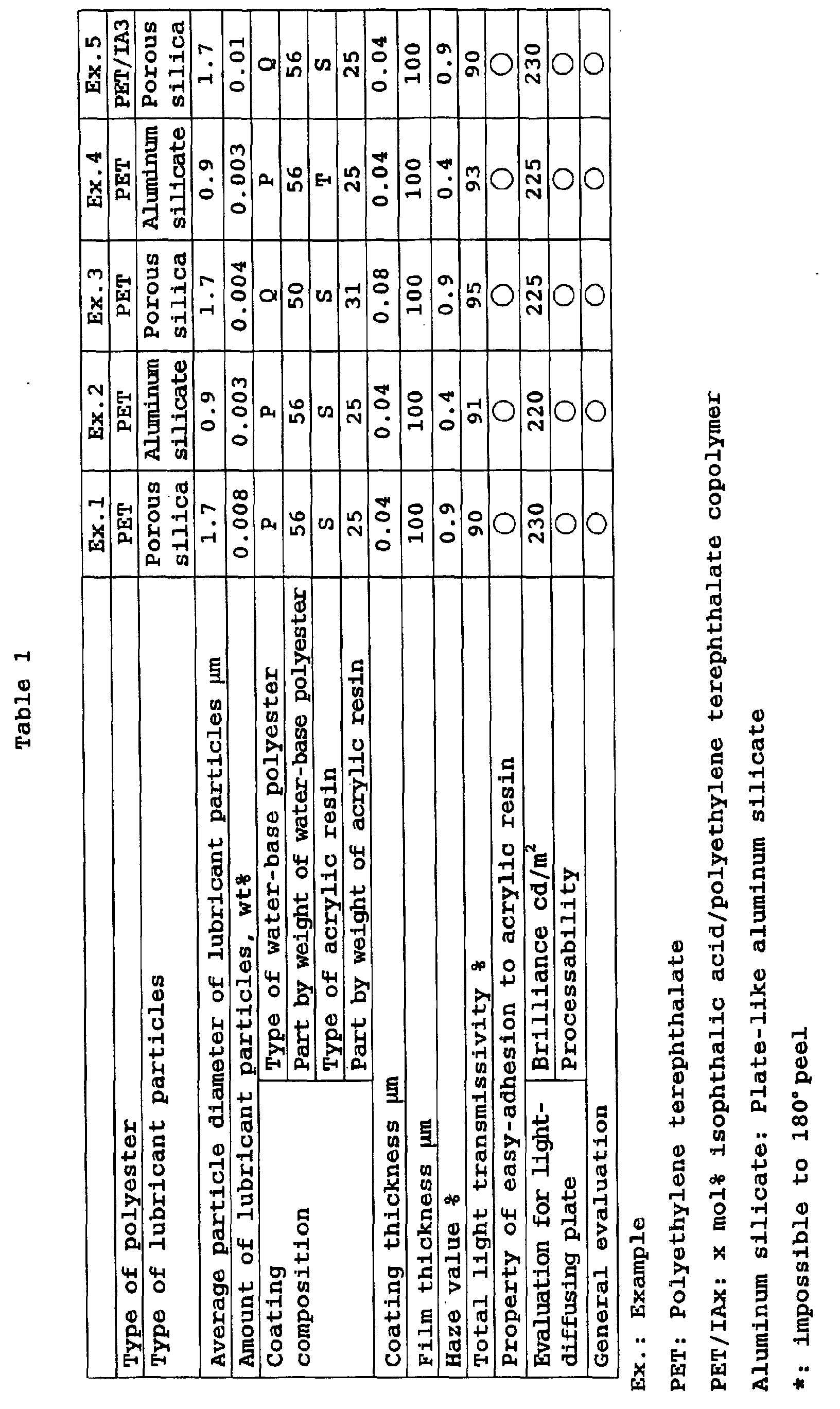


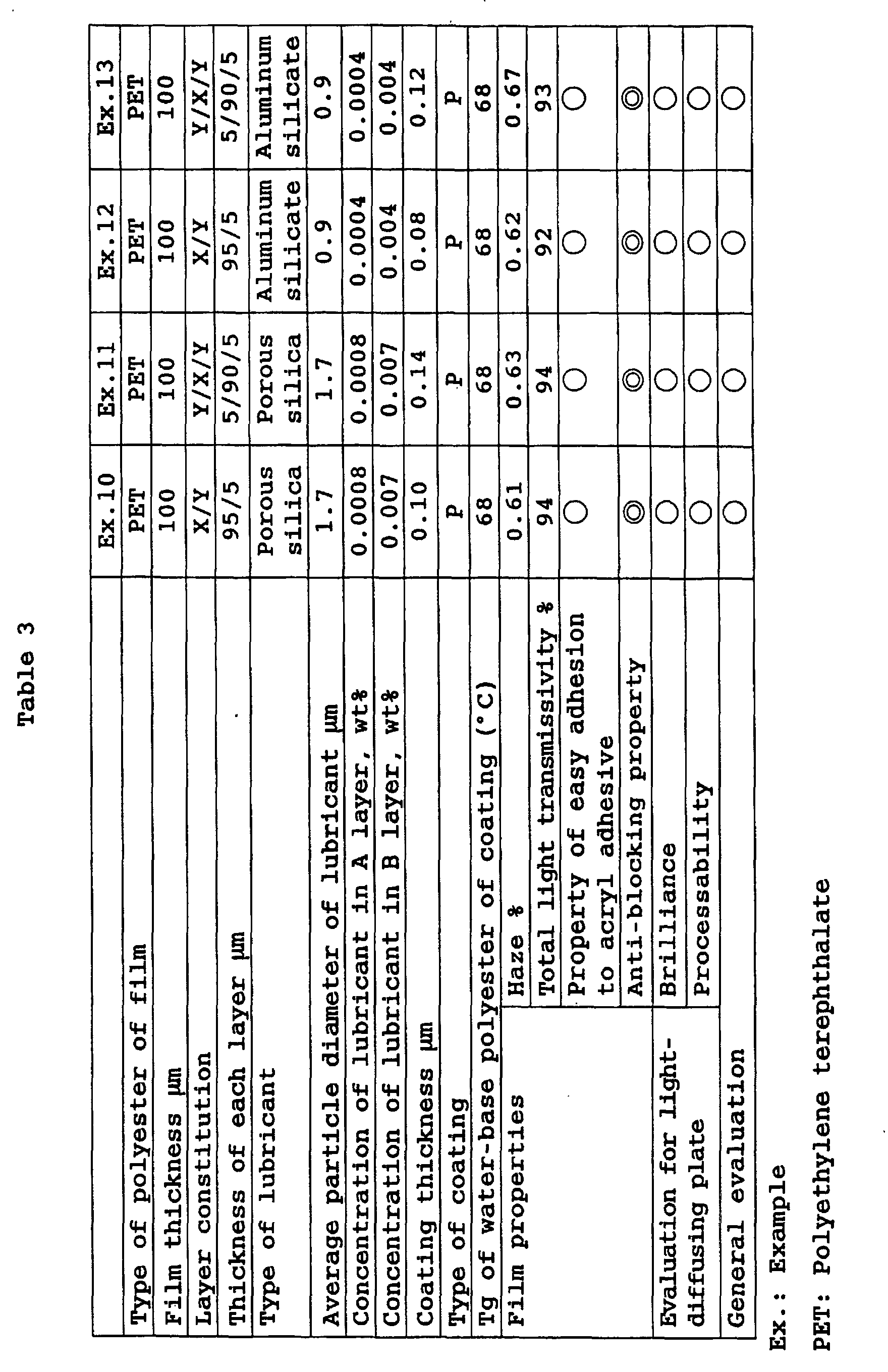

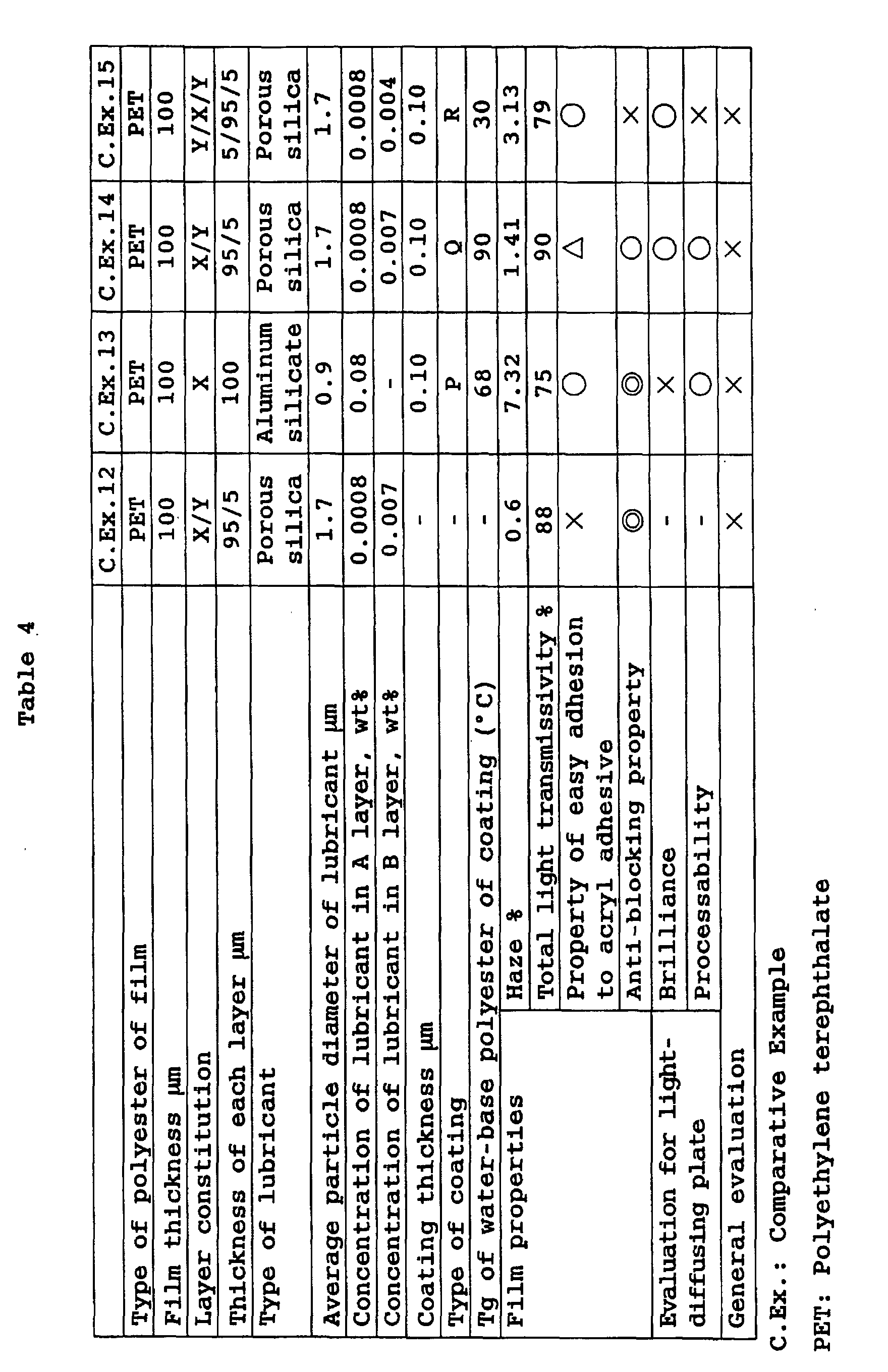

Claims (24)
- A polyester film composite material comprising a biaxially oriented polyester film having a thickness of at least 50 µm but not more than 200 µm and an easy-adhesion coating applied onto one or each surface thereof, and having a haze value of less than 2 % and a total light transmissivity of at least 90 %.
- The polyester film composite material of claim 1, wherein a polyester constituting said biaxially oriented polyester film is polyethylene terephthalate.
- The polyester film composite material of claim 1. wherein a polyester constituting said biaxially oriented polyester film is polyethylene-2,6-naphthalate.
- The polyester film composite material of claim 1, wherein the easy-adhesion coating is formed on each surface of said biaxially oriented polyester film.
- The polyester film composite material of claim 1, which has a haze value of less than 1.5 %.
- The polyester film composite material of claim 1, which has a total light transmissivity of at least 93 %.
- The polyester film composite material of claim 1, wherein the biaxially oriented polyester film is a single-layered polyester film or a laminated polyester film formed of two layers or three layers.
- The polyester film composite material of claim 1, wherein a polyester constituting a single layer or at least an outer film of a laminated film in said biaxially oriented polyester film contains at least 0.001 % by weight but not more than 0.1 % by weight of porous. silica particles and/or plate-like aluminum silicate particles having an average particle diameter of at least 0.1 µm but not greater than 3 µm.
- The polyester film composite material of claim 1, wherein said biaxially oriented polyester film is a laminated polyester film of two or three layers, and a polyester layer (Y) containing at least 0.001 % by weight but not more than 0.1 % by weight of porous silica particles and/or plate-like aluminum silicate particles having an average particle diameter of at least 0.1 µm but not greater than 3 µm is laminated on one surface or each surface of a polyester film layer (X) containing 0.005 % by weight or less of inert fine particles.
- The polyester film composite material of claim 9, wherein a polyester constituting the polyester film layer (X) has an intrinsic viscosity (ηx) of 0.40 to 0.6, a polyester constituting the polyester film layer (Y) has an intrinsic viscosity (ηY) of 0.50 to 0.65 and (ηY) is equivalent to, or greater than, (ηx).
- The polyester film composite material of claim 1, wherein said easy-adhesion coating has a thickness of 0. 06 to 0.16 µm.
- The polyester film composite material of claim 1, wherein said easy-adhesion coating has a composition composed, substantially, of (A) a water-base polyester resin having a glass transition point of 40 to 80°C, (B) an acrylic resin having a glass transition point of 25 to 75°C and (C) fine particles.
- The polyester film composite material of claim 1, wherein said easy-adhesion coating has a composition composed, substantially, of (A) a water-base polyester resin having a glass transition point of 40 to 80°C, (B) an acrylic resin having a glass transition point of 25 to 75°C, (C) fine particles and (D) an aliphatic amide and/or an aliphatic bisamide.
- The polyester film composite material of claim 12 or 13, wherein said (C) fine particles have an average particle diameter of at least 0.01 µm but not greater than 0.30 µm.
- The polyester film composite material of claim 12 or 13, wherein said (A) water-base polyester resin contains 8 to 20 mol%, based on the content of total dicarboxylic acid components, of a dicarboxylic acid component having a molecule containing a group of -SO3M in which M is a metal atom, an ammonium group or a quaternary phosphonium group.
- The polyester film composite material of claim 1, which gives a brilliance of at least 200 cd/m2 when a light-diffusing layer is laminated on a surface of the easy-adhesion coating.
- The polyester film composite material of claim 1, the amount of an antimony compound contained in a polyester constituting the biaxially oriented polyester film is 15 mmol% or less as metal antimony per mole of total acid components of the polyester.
- A polyester film composite material comprising(I) a biaxially oriented polyester film formed of polyethylene terephthalate containing at least 0.001 % by weight but not more than 0.1 % by weight of porous silica particles and/or plate-like aluminum silicate particles having an average particle diameter of at least 0.1 µm but not greater than 3 µm, and(II) a coating composition substantially containing (A') a water-base polyester containing 8 to 20 mol%, based on the content of total dicarboxylic acid components, of a dicarboxylic acid component having a group of -SO3M (in which M is a metal atom, ammonium salt or quaternary phosphonium salt) in its molecule and having a glass transition point of 40 to 80°C, (B) an acrylic resin having a glass transition point of 25 to 75°C and (C) fine particles,(III) the biaxially oriented polyester film having a structure in which a coating of said coating composition is formed on both the surfaces of said biaxially oriented polyester and having a haze value of less than 2 % and a total light transmissivity of at least 90 %.
- A polyester film composite material comprising(I) a biaxially oriented polyester film formed of polyethylene terephthalate containing at least 0.001 % by weight but not more than 0.1 % by weight of porous silica particles and/or plate-like aluminum silicate particles having an average particle diameter of at least 0.1 µm but not greater than 3 µm, and(II) a coating composition substantially containing (A') a water-base polyester containing 8 to 20 mol%, based on the content of total dicarboxylic acid components, of a dicarboxylic acid component having a group of -SO3M (in which M is a metal atom, ammonium salt or quaternary phosphonium salt) in its molecule and having a glass transition point of 40 to 80°C, (B) an acrylic resin having a glass transition point of 25 to 75°C, (C) fine particles and (D) aliphatic amide and/or aliphatic bisamide,(III) the biaxially oriented polyester film having a structure in which a coating of said coating composition is formed on both the surfaces of said biaxially oriented polyester and having a haze value of less than 2 % and a total light transmissivity of at least 90 %.
- A polyester film composite material comprising(I) a polyester film that is a laminated biaxially oriented polyester film formed of laminated two or three layers formed of polyethylene terephthalate, said film being a film wherein a polyester layer (Y) containing at least 0.001 % by weight but not more than 0.1 % by weight of porous silica particles and/or plate-like aluminum silicate particles having an average particle diameter of at least 0.1 µm but not greater than 3 µm is laminated on each surface or one surface of a polyester film layer (X) having an inert-fine-particles content of 0.005 % by weight or less, and(II) a coating composition substantially containing (A') a water-base polyester containing 8 to 20 mol%, based on the content of total dicarboxylic acid components, of a dicarboxylic acid component having a group of -SO3M (in which M is a metal atom, ammonium salt or quaternary phosphonium salt) in its molecule and having a glass transition point of 40 to 80°C, (B) an acrylic resin having a glass transition point of 25 to 75°C, and (C) fine particles,(III) the biaxially oriented polyester film having a structure in which a coating of said coating composition is formed on both the surfaces of said biaxially oriented polyester and having a haze value of less than 2 % and a total light transmissivity of at least 90 %.
- The polyester film composite material of claim 20, wherein the coating composition further contains (D) aliphatic amide and/or aliphatic bisamide,
- A light-diffusing plate comprising the polyester film composite material recited in claim 1 and a light-diffusing layer laminated on the surface of the easy-adhesion coating thereof.
- A liquid crystal display comprising the light-diffusing plate recited in claim 22 arranged therein.
- A composite glass comprising the polyester film composite material recited in claim 1 laminated on a glass plate.
Applications Claiming Priority (7)
| Application Number | Priority Date | Filing Date | Title |
|---|---|---|---|
| JP2000033189 | 2000-02-10 | ||
| JP2000033189A JP4713703B2 (en) | 2000-02-10 | 2000-02-10 | Polyester film for light diffusion plate |
| JP2000058589A JP2001247696A (en) | 2000-03-03 | 2000-03-03 | Polyester film for light diffusion plate |
| JP2000058589 | 2000-03-03 | ||
| JP2000211155 | 2000-07-12 | ||
| JP2000211155A JP4220659B2 (en) | 2000-07-12 | 2000-07-12 | Biaxially oriented laminated polyester film |
| PCT/JP2001/000951 WO2001058991A1 (en) | 2000-02-10 | 2001-02-09 | Polyester film composite, light diffuser plate, and utilization thereof |
Publications (3)
| Publication Number | Publication Date |
|---|---|
| EP1178075A1 true EP1178075A1 (en) | 2002-02-06 |
| EP1178075A4 EP1178075A4 (en) | 2002-11-20 |
| EP1178075B1 EP1178075B1 (en) | 2006-09-20 |
Family
ID=27342315
Family Applications (1)
| Application Number | Title | Priority Date | Filing Date |
|---|---|---|---|
| EP20010902837 Expired - Lifetime EP1178075B1 (en) | 2000-02-10 | 2001-02-09 | Polyester film composite, light diffuser plate, and utilization thereof |
Country Status (6)
| Country | Link |
|---|---|
| US (1) | US6787202B2 (en) |
| EP (1) | EP1178075B1 (en) |
| KR (1) | KR100717092B1 (en) |
| DE (1) | DE60123182T2 (en) |
| TW (1) | TWI247772B (en) |
| WO (1) | WO2001058991A1 (en) |
Cited By (10)
| Publication number | Priority date | Publication date | Assignee | Title |
|---|---|---|---|---|
| WO2003049943A1 (en) | 2001-12-10 | 2003-06-19 | Teijin Dupont Films Japan Limited | Adhesive polyester film for optical use |
| EP1371682A3 (en) * | 2002-06-12 | 2004-03-03 | Mitsubishi Polyester Film Corporation | Polyester film for display |
| EP1510540A4 (en) * | 2002-06-04 | 2005-07-20 | Teijin Dupont Films Japan Ltd | LAMINATED POLYESTER FILM AND LAMINATED FILM |
| EP1502734A4 (en) * | 2002-05-02 | 2007-03-28 | Teijin Dupont Films Japan Ltd | LAMINATED FILM FOR OPTICAL USE |
| EP1912084A1 (en) * | 2006-10-10 | 2008-04-16 | Samsung Electronics Co., Ltd. | Pattern forming ink, method for fabricating the same and light guide plate, light emitting unit and liquid crystal display having the same |
| EP2063293A2 (en) | 2007-11-23 | 2009-05-27 | LG Electronics Inc. | Optical sheet, method for manufacturing the same , and liquid crystal display using the same |
| CN101134865B (en) * | 2006-08-28 | 2010-05-26 | 南亚塑胶工业股份有限公司 | Aqueous coating liquid composition for optical polyester film |
| CN101961940A (en) * | 2009-06-04 | 2011-02-02 | 株式会社Jiro企业策划 | Optical sheet for direct type liquid crystal display device and backlight unit |
| CN103430055A (en) * | 2011-03-14 | 2013-12-04 | 3M创新有限公司 | Multilayer nanostructured articles |
| EP2918649A4 (en) * | 2012-11-07 | 2016-03-23 | Toppan Printing Co Ltd | COATING LIQUID FOR GAS BARRIER, LAMINATED LIGHT BARRIER ARTICLE, PACKAGING MATERIAL, AND PACKAGING MATERIAL FOR THERMOSTERILIZATION |
Families Citing this family (31)
| Publication number | Priority date | Publication date | Assignee | Title |
|---|---|---|---|---|
| US20040190102A1 (en) * | 2000-08-18 | 2004-09-30 | Mullen Patrick W. | Differentially-cured materials and process for forming same |
| EP1309437B1 (en) * | 2000-08-18 | 2006-03-01 | Reflexite Corporation | Differentially cured materials and process for forming same |
| US7230764B2 (en) * | 2000-08-18 | 2007-06-12 | Reflexite Corporation | Differentially-cured materials and process for forming same |
| JP2006525553A (en) | 2003-05-02 | 2006-11-09 | リフレキサイト コーポレイション | Optical reorientation optical structure |
| KR20060116016A (en) * | 2004-01-05 | 2006-11-13 | 다이니폰 인사츠 가부시키가이샤 | Light diffuser film, surface light source device and liquid crystal display device |
| KR100665781B1 (en) * | 2004-09-10 | 2007-01-09 | 주식회사 새 한 | Optical diffuser plate with excellent optical properties, heat resistance and hygroscopicity |
| US7436469B2 (en) * | 2004-10-15 | 2008-10-14 | 3M Innovative Properties Company | Composite diffuser plates and direct-lit liquid crystal displays using same |
| US7710511B2 (en) | 2004-10-15 | 2010-05-04 | 3M Innovative Properties Company | Liquid crystal displays with laminated diffuser plates |
| US7446827B2 (en) * | 2004-10-15 | 2008-11-04 | 3M Innovative Properties Company | Direct-lit liquid crystal displays with laminated diffuser plates |
| US7695805B2 (en) * | 2004-11-30 | 2010-04-13 | Tdk Corporation | Transparent conductor |
| KR20060079724A (en) * | 2005-01-03 | 2006-07-06 | 삼성전자주식회사 | A backlight assembly removing dark portion and a flat display device provided with the same |
| US7622185B2 (en) * | 2005-04-15 | 2009-11-24 | Nitto Denko Corporation | Protective cover sheet comprising a UV-absorbing layer for a polarizer plate and method of making the same |
| JP4759317B2 (en) * | 2005-05-26 | 2011-08-31 | 富士フイルム株式会社 | Polarizing plate and liquid crystal display device using the same |
| US20060291055A1 (en) * | 2005-06-15 | 2006-12-28 | 3M Innovative Properties Company | Diffuse Multilayer Optical Article |
| US20090034235A1 (en) * | 2005-07-11 | 2009-02-05 | Teijin Dupont Films Japan Limited | Laminated film |
| US7924368B2 (en) * | 2005-12-08 | 2011-04-12 | 3M Innovative Properties Company | Diffuse multilayer optical assembly |
| WO2007076430A2 (en) * | 2005-12-29 | 2007-07-05 | Polyone Corporation | Diffused light transmitter |
| US20070203267A1 (en) * | 2006-02-28 | 2007-08-30 | 3M Innovative Properties Company | Optical display with fluted optical plate |
| US7766531B2 (en) * | 2006-03-29 | 2010-08-03 | 3M Innovative Properties Company | Edge-lit optical display with fluted optical plate |
| US20070236413A1 (en) * | 2006-03-29 | 2007-10-11 | 3M Innovative Properties Company | Fluted optical plate with internal light sources and systems using same |
| US20080145647A1 (en) * | 2006-12-13 | 2008-06-19 | Rahul Ganguli | Metal impregnated composites and methods of making |
| JP5239448B2 (en) * | 2007-06-04 | 2013-07-17 | 東レ株式会社 | Antistatic white polyester film |
| JP5492781B2 (en) * | 2007-10-31 | 2014-05-14 | デュポン・テイジン・フィルムズ・ユー・エス・リミテッド・パートナーシップ | Coated articles |
| TW200944840A (en) * | 2008-04-28 | 2009-11-01 | Entire Technology Co Ltd | A compound type diffuser plate structure, backlight module, and liquid crystal display |
| US20110189489A1 (en) * | 2008-09-08 | 2011-08-04 | Taishi Kawasaki | Laminated polyester film |
| JP5553627B2 (en) * | 2010-02-07 | 2014-07-16 | 三菱樹脂株式会社 | Laminated polyester film |
| JP5697461B2 (en) * | 2011-01-17 | 2015-04-08 | ユニチカ株式会社 | Polyester film and photosensitive resin structure |
| JP5934533B2 (en) * | 2012-03-23 | 2016-06-15 | 富士フイルム株式会社 | Multi-layer film and optical sheet |
| CN103592705B (en) * | 2013-11-06 | 2014-09-24 | 苏州东显光电科技有限公司 | Diffusion plate, manufacturing method thereof and backlight module |
| WO2017022765A1 (en) * | 2015-08-05 | 2017-02-09 | 東レ株式会社 | Laminated film and method for manufacturing same |
| TWI819062B (en) * | 2019-08-14 | 2023-10-21 | 南亞塑膠工業股份有限公司 | Polyester film and method for manufacturing the same |
Family Cites Families (28)
| Publication number | Priority date | Publication date | Assignee | Title |
|---|---|---|---|---|
| US3515626A (en) * | 1965-02-22 | 1970-06-02 | Ici Ltd | Thermoplastic laminates having improved surface properties |
| JPS59232857A (en) * | 1983-06-15 | 1984-12-27 | 東洋紡績株式会社 | Gas barriering polyester film |
| JPH01130708A (en) | 1987-11-17 | 1989-05-23 | Nitsukai:Kk | Inorganic flocculant and method for flocculating waste water |
| JP2662031B2 (en) * | 1989-06-15 | 1997-10-08 | 帝人株式会社 | Polyester film |
| JPH03183545A (en) * | 1989-12-14 | 1991-08-09 | Teijin Ltd | Static electricity restrictive and readily adhesive film and manufacture thereof and magnetic card used therewith |
| JP3162734B2 (en) * | 1991-01-25 | 2001-05-08 | リンテック株式会社 | Highly transparent flame-retardant polyethylene terephthalate film |
| EP0559244B1 (en) * | 1992-02-29 | 1998-04-22 | Agfa-Gevaert N.V. | Primed resin film |
| JP3254258B2 (en) * | 1992-09-29 | 2002-02-04 | 三菱化学ポリエステルフィルム株式会社 | Polyethylene-2,6-naphthalate film |
| JPH07145255A (en) * | 1993-11-25 | 1995-06-06 | Teijin Ltd | Polyester film for OHP |
| EP0669359B1 (en) | 1994-02-28 | 1998-10-07 | Teijin Limited | Water-dispersible aromatic polyester, aqueous dispersion thereof and polyester film coated therewith which permits fast adhesion |
| JP3205205B2 (en) | 1995-02-27 | 2001-09-04 | 帝人株式会社 | Polyester film for OHP |
| JP3098404B2 (en) | 1995-09-20 | 2000-10-16 | 帝人株式会社 | Antistatic polyester film |
| TW448106B (en) * | 1996-02-08 | 2001-08-01 | Teijin Ltd | Adherent polyester film laminate |
| JP3464333B2 (en) | 1996-03-07 | 2003-11-10 | 帝人株式会社 | Polyester film for magnetic recording media |
| JPH09254325A (en) * | 1996-03-21 | 1997-09-30 | Toray Ind Inc | CRT protective film laminate |
| JP3193300B2 (en) | 1996-07-12 | 2001-07-30 | 帝人株式会社 | Antistatic polyester film |
| JPH1130708A (en) | 1997-07-11 | 1999-02-02 | Keiwa Shoko Kk | Light diffusion sheet, and manufacture of back light unit using the same and light diffusion sheet |
| JPH11125926A (en) * | 1997-10-20 | 1999-05-11 | Toyobo Co Ltd | Polyester-base film to which toner adheres easily |
| US6391441B1 (en) * | 1997-11-13 | 2002-05-21 | Teijin Limited | Adhesive polyester film |
| JPH11216825A (en) * | 1998-01-30 | 1999-08-10 | Teijin Ltd | Easy-adhesive film and laminate using the same |
| JPH11262989A (en) * | 1998-03-17 | 1999-09-28 | Teijin Ltd | Laminated polyester film |
| JPH11300899A (en) * | 1998-04-17 | 1999-11-02 | Dainippon Printing Co Ltd | Optical functional film and method for producing the same |
| EP0962486B1 (en) | 1998-06-05 | 2003-12-17 | Teijin Limited | Antistatic polyester film and process for producing the same |
| JP2000344875A (en) | 1999-06-02 | 2000-12-12 | Teijin Ltd | Light diffusion plate film, method for producing the same, and light diffusion film |
| JP4517442B2 (en) | 2000-03-28 | 2010-08-04 | 東レ株式会社 | Method for producing laminated light diffusing film |
| JP4423736B2 (en) | 2000-03-30 | 2010-03-03 | 東洋紡績株式会社 | Easy adhesive film for light diffusion plate and light diffusion plate using the same |
| US6589649B2 (en) * | 2000-08-23 | 2003-07-08 | Teijin Limited | Biaxially oriented polyester film, adhesive film and colored hard coating film |
| JP2002127341A (en) | 2000-10-26 | 2002-05-08 | Toyobo Co Ltd | Bead-coated film laminate for light diffusing plate |
-
2001
- 2001-02-09 TW TW90102947A patent/TWI247772B/en not_active IP Right Cessation
- 2001-02-09 DE DE2001623182 patent/DE60123182T2/en not_active Expired - Lifetime
- 2001-02-09 EP EP20010902837 patent/EP1178075B1/en not_active Expired - Lifetime
- 2001-02-09 KR KR1020017012900A patent/KR100717092B1/en not_active Expired - Lifetime
- 2001-02-09 WO PCT/JP2001/000951 patent/WO2001058991A1/en not_active Ceased
- 2001-02-09 US US09/958,276 patent/US6787202B2/en not_active Expired - Fee Related
Cited By (17)
| Publication number | Priority date | Publication date | Assignee | Title |
|---|---|---|---|---|
| WO2003049943A1 (en) | 2001-12-10 | 2003-06-19 | Teijin Dupont Films Japan Limited | Adhesive polyester film for optical use |
| EP1452309A4 (en) * | 2001-12-10 | 2006-09-13 | Teijin Dupont Films Japan Ltd | POLYESTER ADHESIVE FOR OPTICAL USE |
| EP1502734A4 (en) * | 2002-05-02 | 2007-03-28 | Teijin Dupont Films Japan Ltd | LAMINATED FILM FOR OPTICAL USE |
| EP1510540A4 (en) * | 2002-06-04 | 2005-07-20 | Teijin Dupont Films Japan Ltd | LAMINATED POLYESTER FILM AND LAMINATED FILM |
| US7022388B2 (en) | 2002-06-04 | 2006-04-04 | Teijin Dupont Films Japan Limited | Laminated polyester film and laminated film |
| EP1371682A3 (en) * | 2002-06-12 | 2004-03-03 | Mitsubishi Polyester Film Corporation | Polyester film for display |
| CN101134865B (en) * | 2006-08-28 | 2010-05-26 | 南亚塑胶工业股份有限公司 | Aqueous coating liquid composition for optical polyester film |
| EP1912084A1 (en) * | 2006-10-10 | 2008-04-16 | Samsung Electronics Co., Ltd. | Pattern forming ink, method for fabricating the same and light guide plate, light emitting unit and liquid crystal display having the same |
| EP2063293A3 (en) * | 2007-11-23 | 2009-07-15 | LG Electronics Inc. | Optical sheet, method for manufacturing the same , and liquid crystal display using the same |
| EP2063293A2 (en) | 2007-11-23 | 2009-05-27 | LG Electronics Inc. | Optical sheet, method for manufacturing the same , and liquid crystal display using the same |
| US8018654B2 (en) | 2007-11-23 | 2011-09-13 | Lg Electronics Inc. | Optical sheet, method for manufacturing the same, and liquid crystal display using the same |
| CN101961940A (en) * | 2009-06-04 | 2011-02-02 | 株式会社Jiro企业策划 | Optical sheet for direct type liquid crystal display device and backlight unit |
| CN101961940B (en) * | 2009-06-04 | 2013-12-25 | 株式会社Jiro企业策划 | Optical sheet for direct type liquid crystal display device and backlight unit |
| CN103430055A (en) * | 2011-03-14 | 2013-12-04 | 3M创新有限公司 | Multilayer nanostructured articles |
| CN103430055B (en) * | 2011-03-14 | 2016-10-12 | 3M创新有限公司 | Multilayered nanostructured goods |
| EP2918649A4 (en) * | 2012-11-07 | 2016-03-23 | Toppan Printing Co Ltd | COATING LIQUID FOR GAS BARRIER, LAMINATED LIGHT BARRIER ARTICLE, PACKAGING MATERIAL, AND PACKAGING MATERIAL FOR THERMOSTERILIZATION |
| US11279844B2 (en) | 2012-11-07 | 2022-03-22 | Toppan Printing Co., Ltd. | Coating solution for gas barrier, gas barrier laminate, packaging material and packaging material for heat sterilization |
Also Published As
| Publication number | Publication date |
|---|---|
| TWI247772B (en) | 2006-01-21 |
| EP1178075A4 (en) | 2002-11-20 |
| DE60123182T2 (en) | 2007-09-20 |
| US6787202B2 (en) | 2004-09-07 |
| EP1178075B1 (en) | 2006-09-20 |
| KR100717092B1 (en) | 2007-05-10 |
| KR20020005666A (en) | 2002-01-17 |
| WO2001058991A1 (en) | 2001-08-16 |
| DE60123182D1 (en) | 2006-11-02 |
| US20030017281A1 (en) | 2003-01-23 |
Similar Documents
| Publication | Publication Date | Title |
|---|---|---|
| EP1178075B1 (en) | Polyester film composite, light diffuser plate, and utilization thereof | |
| US7026035B2 (en) | Laminated film for optical use | |
| KR100758157B1 (en) | Biaxially oriented polyester film and light diffuser plate for light diffuser plate | |
| JP4257619B2 (en) | Surface light diffusing polyester film | |
| EP1302788B1 (en) | White film for surface light source reflecting members | |
| JP4220659B2 (en) | Biaxially oriented laminated polyester film | |
| JP2004133021A (en) | Polyester film for light diffusion plate of liquid crystal display device and light diffusion plate | |
| JP4352348B2 (en) | Surface light diffusing polyester film | |
| JP3986920B2 (en) | Polyester film and light diffuser | |
| JP2001247696A (en) | Polyester film for light diffusion plate | |
| JP4713703B2 (en) | Polyester film for light diffusion plate | |
| JP2005181648A (en) | Light scattering polyester film for prism sheet | |
| JP5157724B2 (en) | Light diffusion film | |
| JP5076791B2 (en) | Light diffusion film | |
| JP2737881B2 (en) | Laminated polyester film | |
| JP2000344875A (en) | Light diffusion plate film, method for producing the same, and light diffusion film | |
| JP2007298678A (en) | Support film for reflecting member | |
| JP2006292839A (en) | Light diffusion plate film and liquid crystal light diffusion plate | |
| JP2011133872A (en) | Surface light-diffusing polyester film | |
| JP4370538B1 (en) | Surface light diffusing polyester film | |
| JP2010032863A (en) | Light diffusing film | |
| JPH10119215A (en) | Polyester film for cathode-ray tube | |
| JP2011133871A (en) | Light diffusing polyester film | |
| JP2024135269A (en) | Laminated film and film laminate | |
| JP5937846B2 (en) | Laminated polyester film |
Legal Events
| Date | Code | Title | Description |
|---|---|---|---|
| PUAI | Public reference made under article 153(3) epc to a published international application that has entered the european phase |
Free format text: ORIGINAL CODE: 0009012 |
|
| 17P | Request for examination filed |
Effective date: 20011012 |
|
| AK | Designated contracting states |
Kind code of ref document: A1 Designated state(s): AT BE CH CY DE DK ES FI FR GB GR IE IT LI LU MC NL PT SE TR |
|
| A4 | Supplementary search report drawn up and despatched |
Effective date: 20021009 |
|
| AK | Designated contracting states |
Kind code of ref document: A4 Designated state(s): AT BE CH CY DE DK ES FI FR GB GR IE IT LI LU MC NL PT SE TR |
|
| RBV | Designated contracting states (corrected) |
Designated state(s): DE FR GB |
|
| 17Q | First examination report despatched |
Effective date: 20040622 |
|
| GRAP | Despatch of communication of intention to grant a patent |
Free format text: ORIGINAL CODE: EPIDOSNIGR1 |
|
| GRAS | Grant fee paid |
Free format text: ORIGINAL CODE: EPIDOSNIGR3 |
|
| GRAA | (expected) grant |
Free format text: ORIGINAL CODE: 0009210 |
|
| AK | Designated contracting states |
Kind code of ref document: B1 Designated state(s): DE FR GB |
|
| REG | Reference to a national code |
Ref country code: GB Ref legal event code: FG4D |
|
| REF | Corresponds to: |
Ref document number: 60123182 Country of ref document: DE Date of ref document: 20061102 Kind code of ref document: P |
|
| ET | Fr: translation filed | ||
| PLBE | No opposition filed within time limit |
Free format text: ORIGINAL CODE: 0009261 |
|
| STAA | Information on the status of an ep patent application or granted ep patent |
Free format text: STATUS: NO OPPOSITION FILED WITHIN TIME LIMIT |
|
| 26N | No opposition filed |
Effective date: 20070621 |
|
| PGFP | Annual fee paid to national office [announced via postgrant information from national office to epo] |
Ref country code: GB Payment date: 20130215 Year of fee payment: 13 Ref country code: FR Payment date: 20130318 Year of fee payment: 13 |
|
| PGFP | Annual fee paid to national office [announced via postgrant information from national office to epo] |
Ref country code: DE Payment date: 20130416 Year of fee payment: 13 |
|
| REG | Reference to a national code |
Ref country code: DE Ref legal event code: R119 Ref document number: 60123182 Country of ref document: DE |
|
| GBPC | Gb: european patent ceased through non-payment of renewal fee |
Effective date: 20140209 |
|
| REG | Reference to a national code |
Ref country code: FR Ref legal event code: ST Effective date: 20141031 |
|
| REG | Reference to a national code |
Ref country code: DE Ref legal event code: R119 Ref document number: 60123182 Country of ref document: DE Effective date: 20140902 |
|
| PG25 | Lapsed in a contracting state [announced via postgrant information from national office to epo] |
Ref country code: DE Free format text: LAPSE BECAUSE OF NON-PAYMENT OF DUE FEES Effective date: 20140902 Ref country code: GB Free format text: LAPSE BECAUSE OF NON-PAYMENT OF DUE FEES Effective date: 20140209 Ref country code: FR Free format text: LAPSE BECAUSE OF NON-PAYMENT OF DUE FEES Effective date: 20140228 |