EP1178031A1 - Process for the preparation of organic compounds with manganese catalysts or the like - Google Patents
Process for the preparation of organic compounds with manganese catalysts or the like Download PDFInfo
- Publication number
- EP1178031A1 EP1178031A1 EP01912189A EP01912189A EP1178031A1 EP 1178031 A1 EP1178031 A1 EP 1178031A1 EP 01912189 A EP01912189 A EP 01912189A EP 01912189 A EP01912189 A EP 01912189A EP 1178031 A1 EP1178031 A1 EP 1178031A1
- Authority
- EP
- European Patent Office
- Prior art keywords
- group
- compound
- ring
- groups
- represented
- Prior art date
- Legal status (The legal status is an assumption and is not a legal conclusion. Google has not performed a legal analysis and makes no representation as to the accuracy of the status listed.)
- Granted
Links
- 238000000034 method Methods 0.000 title claims abstract description 38
- 230000008569 process Effects 0.000 title claims abstract description 36
- 150000002894 organic compounds Chemical class 0.000 title claims abstract description 12
- 239000003054 catalyst Substances 0.000 title description 40
- 239000011572 manganese Substances 0.000 title description 23
- 229910052748 manganese Inorganic materials 0.000 title description 20
- PWHULOQIROXLJO-UHFFFAOYSA-N Manganese Chemical compound [Mn] PWHULOQIROXLJO-UHFFFAOYSA-N 0.000 title description 19
- 150000001875 compounds Chemical class 0.000 claims abstract description 132
- 125000004432 carbon atom Chemical group C* 0.000 claims abstract description 47
- 229910052760 oxygen Inorganic materials 0.000 claims abstract description 44
- 239000001301 oxygen Substances 0.000 claims abstract description 44
- 125000004435 hydrogen atom Chemical group [H]* 0.000 claims abstract description 28
- 125000000217 alkyl group Chemical group 0.000 claims abstract description 26
- 230000000737 periodic effect Effects 0.000 claims abstract description 26
- 229910052702 rhenium Inorganic materials 0.000 claims abstract description 26
- 125000000962 organic group Chemical group 0.000 claims abstract description 24
- 230000003197 catalytic effect Effects 0.000 claims abstract description 21
- 229910052799 carbon Inorganic materials 0.000 claims abstract description 19
- 125000002887 hydroxy group Chemical group [H]O* 0.000 claims abstract description 19
- 150000001721 carbon Chemical group 0.000 claims abstract description 14
- 229910052727 yttrium Inorganic materials 0.000 claims abstract description 9
- QVGXLLKOCUKJST-UHFFFAOYSA-N atomic oxygen Chemical compound [O] QVGXLLKOCUKJST-UHFFFAOYSA-N 0.000 claims abstract 4
- -1 imide compound Chemical class 0.000 claims description 44
- 125000003118 aryl group Chemical group 0.000 claims description 42
- 150000001336 alkenes Chemical class 0.000 claims description 32
- JRZJOMJEPLMPRA-UHFFFAOYSA-N olefin Natural products CCCCCCCC=C JRZJOMJEPLMPRA-UHFFFAOYSA-N 0.000 claims description 26
- 125000003545 alkoxy group Chemical group 0.000 claims description 18
- 125000002252 acyl group Chemical group 0.000 claims description 14
- 125000004453 alkoxycarbonyl group Chemical group 0.000 claims description 13
- 125000004122 cyclic group Chemical group 0.000 claims description 13
- 125000000753 cycloalkyl group Chemical group 0.000 claims description 13
- 125000001570 methylene group Chemical group [H]C([H])([*:1])[*:2] 0.000 claims description 13
- 125000006574 non-aromatic ring group Chemical group 0.000 claims description 13
- 125000002915 carbonyl group Chemical group [*:2]C([*:1])=O 0.000 claims description 12
- 125000005843 halogen group Chemical group 0.000 claims description 12
- 125000003178 carboxy group Chemical group [H]OC(*)=O 0.000 claims description 9
- 150000001728 carbonyl compounds Chemical class 0.000 claims description 8
- 125000004430 oxygen atom Chemical group O* 0.000 claims description 6
- ICGWWCLWBPLPDF-UHFFFAOYSA-N furan-2-ol Chemical class OC1=CC=CO1 ICGWWCLWBPLPDF-UHFFFAOYSA-N 0.000 claims description 5
- 125000003342 alkenyl group Chemical group 0.000 abstract description 10
- 238000007342 radical addition reaction Methods 0.000 abstract description 3
- QTBSBXVTEAMEQO-UHFFFAOYSA-N Acetic acid Chemical compound CC(O)=O QTBSBXVTEAMEQO-UHFFFAOYSA-N 0.000 description 90
- KWKAKUADMBZCLK-UHFFFAOYSA-N 1-octene Chemical compound CCCCCCC=C KWKAKUADMBZCLK-UHFFFAOYSA-N 0.000 description 89
- 238000006243 chemical reaction Methods 0.000 description 67
- MYMOFIZGZYHOMD-UHFFFAOYSA-N Dioxygen Chemical compound O=O MYMOFIZGZYHOMD-UHFFFAOYSA-N 0.000 description 48
- TVMXDCGIABBOFY-UHFFFAOYSA-N n-Octanol Natural products CCCCCCCC TVMXDCGIABBOFY-UHFFFAOYSA-N 0.000 description 47
- JHIVVAPYMSGYDF-UHFFFAOYSA-N cyclohexanone Chemical compound O=C1CCCCC1 JHIVVAPYMSGYDF-UHFFFAOYSA-N 0.000 description 34
- 125000001424 substituent group Chemical group 0.000 description 33
- IJGRMHOSHXDMSA-UHFFFAOYSA-N Atomic nitrogen Chemical compound N#N IJGRMHOSHXDMSA-UHFFFAOYSA-N 0.000 description 32
- 239000012298 atmosphere Substances 0.000 description 32
- 239000000203 mixture Substances 0.000 description 29
- UOGMEBQRZBEZQT-UHFFFAOYSA-L manganese(2+);diacetate Chemical compound [Mn+2].CC([O-])=O.CC([O-])=O UOGMEBQRZBEZQT-UHFFFAOYSA-L 0.000 description 28
- 239000011541 reaction mixture Substances 0.000 description 27
- QAHREYKOYSIQPH-UHFFFAOYSA-L cobalt(II) acetate Chemical compound [Co+2].CC([O-])=O.CC([O-])=O QAHREYKOYSIQPH-UHFFFAOYSA-L 0.000 description 26
- 125000002534 ethynyl group Chemical group [H]C#C* 0.000 description 26
- HSFWRNGVRCDJHI-UHFFFAOYSA-N alpha-acetylene Natural products C#C HSFWRNGVRCDJHI-UHFFFAOYSA-N 0.000 description 21
- 229910052757 nitrogen Inorganic materials 0.000 description 19
- 239000008246 gaseous mixture Substances 0.000 description 17
- 150000003254 radicals Chemical class 0.000 description 16
- 150000002430 hydrocarbons Chemical class 0.000 description 15
- OKTJSMMVPCPJKN-UHFFFAOYSA-N Carbon Chemical group [C] OKTJSMMVPCPJKN-UHFFFAOYSA-N 0.000 description 14
- 229910017052 cobalt Inorganic materials 0.000 description 14
- 239000010941 cobalt Substances 0.000 description 14
- 125000000623 heterocyclic group Chemical group 0.000 description 14
- GUTLYIVDDKVIGB-UHFFFAOYSA-N cobalt atom Chemical compound [Co] GUTLYIVDDKVIGB-UHFFFAOYSA-N 0.000 description 13
- ZMXDDKWLCZADIW-UHFFFAOYSA-N N,N-Dimethylformamide Chemical compound CN(C)C=O ZMXDDKWLCZADIW-UHFFFAOYSA-N 0.000 description 12
- JFDZBHWFFUWGJE-UHFFFAOYSA-N benzonitrile Chemical compound N#CC1=CC=CC=C1 JFDZBHWFFUWGJE-UHFFFAOYSA-N 0.000 description 12
- 229910052720 vanadium Inorganic materials 0.000 description 12
- LEONUFNNVUYDNQ-UHFFFAOYSA-N vanadium atom Chemical compound [V] LEONUFNNVUYDNQ-UHFFFAOYSA-N 0.000 description 12
- 125000002723 alicyclic group Chemical group 0.000 description 10
- 150000002576 ketones Chemical class 0.000 description 10
- 239000002904 solvent Substances 0.000 description 10
- RGSFGYAAUTVSQA-UHFFFAOYSA-N Cyclopentane Chemical compound C1CCCC1 RGSFGYAAUTVSQA-UHFFFAOYSA-N 0.000 description 9
- 150000008064 anhydrides Chemical class 0.000 description 9
- 125000001997 phenyl group Chemical group [H]C1=C([H])C([H])=C(*)C([H])=C1[H] 0.000 description 9
- 150000003839 salts Chemical class 0.000 description 9
- OZAIFHULBGXAKX-UHFFFAOYSA-N 2-(2-cyanopropan-2-yldiazenyl)-2-methylpropanenitrile Chemical compound N#CC(C)(C)N=NC(C)(C)C#N OZAIFHULBGXAKX-UHFFFAOYSA-N 0.000 description 8
- JUJWROOIHBZHMG-UHFFFAOYSA-N Pyridine Chemical compound C1=CC=NC=C1 JUJWROOIHBZHMG-UHFFFAOYSA-N 0.000 description 8
- PPBRXRYQALVLMV-UHFFFAOYSA-N Styrene Chemical compound C=CC1=CC=CC=C1 PPBRXRYQALVLMV-UHFFFAOYSA-N 0.000 description 8
- 125000001931 aliphatic group Chemical group 0.000 description 8
- 125000006615 aromatic heterocyclic group Chemical group 0.000 description 8
- 125000001624 naphthyl group Chemical group 0.000 description 8
- 125000006239 protecting group Chemical group 0.000 description 8
- 239000010948 rhodium Substances 0.000 description 8
- LFSMYRNGXAHHEQ-UHFFFAOYSA-N 2-octylcyclohexan-1-one Chemical compound CCCCCCCCC1CCCCC1=O LFSMYRNGXAHHEQ-UHFFFAOYSA-N 0.000 description 7
- ZAMOUSCENKQFHK-UHFFFAOYSA-N Chlorine atom Chemical group [Cl] ZAMOUSCENKQFHK-UHFFFAOYSA-N 0.000 description 7
- YLQBMQCUIZJEEH-UHFFFAOYSA-N Furan Chemical compound C=1C=COC=1 YLQBMQCUIZJEEH-UHFFFAOYSA-N 0.000 description 7
- 125000002029 aromatic hydrocarbon group Chemical group 0.000 description 7
- 239000000460 chlorine Chemical group 0.000 description 7
- 229910052801 chlorine Inorganic materials 0.000 description 7
- 150000001869 cobalt compounds Chemical class 0.000 description 7
- 150000002697 manganese compounds Chemical class 0.000 description 7
- 150000002825 nitriles Chemical class 0.000 description 7
- 125000000449 nitro group Chemical group [O-][N+](*)=O 0.000 description 7
- 239000000758 substrate Substances 0.000 description 7
- ZWEHNKRNPOVVGH-UHFFFAOYSA-N 2-Butanone Chemical compound CCC(C)=O ZWEHNKRNPOVVGH-UHFFFAOYSA-N 0.000 description 6
- SXVPOSFURRDKBO-UHFFFAOYSA-N Cyclododecanone Chemical group O=C1CCCCCCCCCCC1 SXVPOSFURRDKBO-UHFFFAOYSA-N 0.000 description 6
- YMWUJEATGCHHMB-UHFFFAOYSA-N Dichloromethane Chemical compound ClCCl YMWUJEATGCHHMB-UHFFFAOYSA-N 0.000 description 6
- UEXCJVNBTNXOEH-UHFFFAOYSA-N Ethynylbenzene Chemical group C#CC1=CC=CC=C1 UEXCJVNBTNXOEH-UHFFFAOYSA-N 0.000 description 6
- XEEYBQQBJWHFJM-UHFFFAOYSA-N Iron Chemical compound [Fe] XEEYBQQBJWHFJM-UHFFFAOYSA-N 0.000 description 6
- YTPLMLYBLZKORZ-UHFFFAOYSA-N Thiophene Chemical compound C=1C=CSC=1 YTPLMLYBLZKORZ-UHFFFAOYSA-N 0.000 description 6
- 125000003277 amino group Chemical group 0.000 description 6
- GDTBXPJZTBHREO-UHFFFAOYSA-N bromine Chemical group BrBr GDTBXPJZTBHREO-UHFFFAOYSA-N 0.000 description 6
- 229910052794 bromium Inorganic materials 0.000 description 6
- HGCIXCUEYOPUTN-UHFFFAOYSA-N cyclohexene Chemical compound C1CCC=CC1 HGCIXCUEYOPUTN-UHFFFAOYSA-N 0.000 description 6
- LPIQUOYDBNQMRZ-UHFFFAOYSA-N cyclopentene Chemical compound C1CC=CC1 LPIQUOYDBNQMRZ-UHFFFAOYSA-N 0.000 description 6
- 125000001188 haloalkyl group Chemical group 0.000 description 6
- RAXXELZNTBOGNW-UHFFFAOYSA-N imidazole Natural products C1=CNC=N1 RAXXELZNTBOGNW-UHFFFAOYSA-N 0.000 description 6
- 229910052751 metal Inorganic materials 0.000 description 6
- VLKZOEOYAKHREP-UHFFFAOYSA-N n-Hexane Chemical compound CCCCCC VLKZOEOYAKHREP-UHFFFAOYSA-N 0.000 description 6
- 150000007524 organic acids Chemical class 0.000 description 6
- 235000005985 organic acids Nutrition 0.000 description 6
- 125000004043 oxo group Chemical group O=* 0.000 description 6
- FDPIMTJIUBPUKL-UHFFFAOYSA-N pentan-3-one Chemical compound CCC(=O)CC FDPIMTJIUBPUKL-UHFFFAOYSA-N 0.000 description 6
- 229910052717 sulfur Inorganic materials 0.000 description 6
- WKBOTKDWSSQWDR-UHFFFAOYSA-N Bromine atom Chemical group [Br] WKBOTKDWSSQWDR-UHFFFAOYSA-N 0.000 description 5
- SIKJAQJRHWYJAI-UHFFFAOYSA-N Indole Chemical compound C1=CC=C2NC=CC2=C1 SIKJAQJRHWYJAI-UHFFFAOYSA-N 0.000 description 5
- XBDQKXXYIPTUBI-UHFFFAOYSA-N Propionic acid Chemical class CCC(O)=O XBDQKXXYIPTUBI-UHFFFAOYSA-N 0.000 description 5
- 239000002253 acid Substances 0.000 description 5
- WNLRTRBMVRJNCN-UHFFFAOYSA-N adipic acid Chemical class OC(=O)CCCCC(O)=O WNLRTRBMVRJNCN-UHFFFAOYSA-N 0.000 description 5
- 125000004093 cyano group Chemical group *C#N 0.000 description 5
- 125000000113 cyclohexyl group Chemical group [H]C1([H])C([H])([H])C([H])([H])C([H])(*)C([H])([H])C1([H])[H] 0.000 description 5
- IIRFCWANHMSDCG-UHFFFAOYSA-N cyclooctanone Chemical group O=C1CCCCCCC1 IIRFCWANHMSDCG-UHFFFAOYSA-N 0.000 description 5
- 229910001882 dioxygen Inorganic materials 0.000 description 5
- 150000002484 inorganic compounds Chemical class 0.000 description 5
- 229910010272 inorganic material Inorganic materials 0.000 description 5
- 150000003951 lactams Chemical class 0.000 description 5
- 239000007800 oxidant agent Substances 0.000 description 5
- 125000000391 vinyl group Chemical group [H]C([*])=C([H])[H] 0.000 description 5
- GETTZEONDQJALK-UHFFFAOYSA-N (trifluoromethyl)benzene Chemical compound FC(F)(F)C1=CC=CC=C1 GETTZEONDQJALK-UHFFFAOYSA-N 0.000 description 4
- FCEHBMOGCRZNNI-UHFFFAOYSA-N 1-benzothiophene Chemical compound C1=CC=C2SC=CC2=C1 FCEHBMOGCRZNNI-UHFFFAOYSA-N 0.000 description 4
- CFMZSMGAMPBRBE-UHFFFAOYSA-N 2-hydroxyisoindole-1,3-dione Chemical compound C1=CC=C2C(=O)N(O)C(=O)C2=C1 CFMZSMGAMPBRBE-UHFFFAOYSA-N 0.000 description 4
- KDCGOANMDULRCW-UHFFFAOYSA-N 7H-purine Chemical compound N1=CNC2=NC=NC2=C1 KDCGOANMDULRCW-UHFFFAOYSA-N 0.000 description 4
- DLFVBJFMPXGRIB-UHFFFAOYSA-N Acetamide Chemical compound CC(N)=O DLFVBJFMPXGRIB-UHFFFAOYSA-N 0.000 description 4
- KWOLFJPFCHCOCG-UHFFFAOYSA-N Acetophenone Chemical compound CC(=O)C1=CC=CC=C1 KWOLFJPFCHCOCG-UHFFFAOYSA-N 0.000 description 4
- HEDRZPFGACZZDS-UHFFFAOYSA-N Chloroform Chemical compound ClC(Cl)Cl HEDRZPFGACZZDS-UHFFFAOYSA-N 0.000 description 4
- XDTMQSROBMDMFD-UHFFFAOYSA-N Cyclohexane Chemical compound C1CCCCC1 XDTMQSROBMDMFD-UHFFFAOYSA-N 0.000 description 4
- PXGOKWXKJXAPGV-UHFFFAOYSA-N Fluorine Chemical group FF PXGOKWXKJXAPGV-UHFFFAOYSA-N 0.000 description 4
- ZHNUHDYFZUAESO-UHFFFAOYSA-N Formamide Chemical compound NC=O ZHNUHDYFZUAESO-UHFFFAOYSA-N 0.000 description 4
- NBBJYMSMWIIQGU-UHFFFAOYSA-N Propionic aldehyde Chemical compound CCC=O NBBJYMSMWIIQGU-UHFFFAOYSA-N 0.000 description 4
- KAESVJOAVNADME-UHFFFAOYSA-N Pyrrole Chemical compound C=1C=CNC=1 KAESVJOAVNADME-UHFFFAOYSA-N 0.000 description 4
- SMWDFEZZVXVKRB-UHFFFAOYSA-N Quinoline Chemical compound N1=CC=CC2=CC=CC=C21 SMWDFEZZVXVKRB-UHFFFAOYSA-N 0.000 description 4
- NINIDFKCEFEMDL-UHFFFAOYSA-N Sulfur Chemical compound [S] NINIDFKCEFEMDL-UHFFFAOYSA-N 0.000 description 4
- 125000002777 acetyl group Chemical group [H]C([H])([H])C(*)=O 0.000 description 4
- 150000008065 acid anhydrides Chemical class 0.000 description 4
- DZBUGLKDJFMEHC-UHFFFAOYSA-N acridine Chemical compound C1=CC=CC2=CC3=CC=CC=C3N=C21 DZBUGLKDJFMEHC-UHFFFAOYSA-N 0.000 description 4
- 150000001408 amides Chemical class 0.000 description 4
- MVPPADPHJFYWMZ-UHFFFAOYSA-N chlorobenzene Chemical compound ClC1=CC=CC=C1 MVPPADPHJFYWMZ-UHFFFAOYSA-N 0.000 description 4
- 239000011651 chromium Substances 0.000 description 4
- 150000003997 cyclic ketones Chemical class 0.000 description 4
- 150000001925 cycloalkenes Chemical group 0.000 description 4
- DDTBPAQBQHZRDW-UHFFFAOYSA-N cyclododecane Chemical group C1CCCCCCCCCCC1 DDTBPAQBQHZRDW-UHFFFAOYSA-N 0.000 description 4
- WJTCGQSWYFHTAC-UHFFFAOYSA-N cyclooctane Chemical compound C1CCCCCCC1 WJTCGQSWYFHTAC-UHFFFAOYSA-N 0.000 description 4
- 239000004914 cyclooctane Substances 0.000 description 4
- BGTOWKSIORTVQH-UHFFFAOYSA-N cyclopentanone Chemical compound O=C1CCCC1 BGTOWKSIORTVQH-UHFFFAOYSA-N 0.000 description 4
- 125000001511 cyclopentyl group Chemical group [H]C1([H])C([H])([H])C([H])([H])C([H])(*)C1([H])[H] 0.000 description 4
- 125000004185 ester group Chemical group 0.000 description 4
- 150000002148 esters Chemical class 0.000 description 4
- 125000001495 ethyl group Chemical group [H]C([H])([H])C([H])([H])* 0.000 description 4
- 229910052731 fluorine Inorganic materials 0.000 description 4
- 239000011737 fluorine Substances 0.000 description 4
- 150000008282 halocarbons Chemical class 0.000 description 4
- 239000011261 inert gas Substances 0.000 description 4
- 150000002596 lactones Chemical class 0.000 description 4
- 125000002496 methyl group Chemical group [H]C([H])([H])* 0.000 description 4
- 150000002828 nitro derivatives Chemical class 0.000 description 4
- LQNUZADURLCDLV-UHFFFAOYSA-N nitrobenzene Chemical compound [O-][N+](=O)C1=CC=CC=C1 LQNUZADURLCDLV-UHFFFAOYSA-N 0.000 description 4
- JFNLZVQOOSMTJK-KNVOCYPGSA-N norbornene Chemical compound C1[C@@H]2CC[C@H]1C=C2 JFNLZVQOOSMTJK-KNVOCYPGSA-N 0.000 description 4
- UMJSCPRVCHMLSP-UHFFFAOYSA-N pyridine Natural products COC1=CC=CN=C1 UMJSCPRVCHMLSP-UHFFFAOYSA-N 0.000 description 4
- 238000000926 separation method Methods 0.000 description 4
- 239000011593 sulfur Substances 0.000 description 4
- VZGDMQKNWNREIO-UHFFFAOYSA-N tetrachloromethane Chemical compound ClC(Cl)(Cl)Cl VZGDMQKNWNREIO-UHFFFAOYSA-N 0.000 description 4
- ILPBINAXDRFYPL-UHFFFAOYSA-N 2-octene Chemical compound CCCCCC=CC ILPBINAXDRFYPL-UHFFFAOYSA-N 0.000 description 3
- YEJRWHAVMIAJKC-UHFFFAOYSA-N 4-Butyrolactone Chemical group O=C1CCCO1 YEJRWHAVMIAJKC-UHFFFAOYSA-N 0.000 description 3
- OZJPLYNZGCXSJM-UHFFFAOYSA-N 5-valerolactone Chemical group O=C1CCCCO1 OZJPLYNZGCXSJM-UHFFFAOYSA-N 0.000 description 3
- CSCPPACGZOOCGX-UHFFFAOYSA-N Acetone Chemical compound CC(C)=O CSCPPACGZOOCGX-UHFFFAOYSA-N 0.000 description 3
- WEVYAHXRMPXWCK-UHFFFAOYSA-N Acetonitrile Chemical compound CC#N WEVYAHXRMPXWCK-UHFFFAOYSA-N 0.000 description 3
- 0 C*1[C@](C)CCCC1 Chemical compound C*1[C@](C)CCCC1 0.000 description 3
- 239000004215 Carbon black (E152) Substances 0.000 description 3
- XEKOWRVHYACXOJ-UHFFFAOYSA-N Ethyl acetate Chemical compound CCOC(C)=O XEKOWRVHYACXOJ-UHFFFAOYSA-N 0.000 description 3
- FXHOOIRPVKKKFG-UHFFFAOYSA-N N,N-Dimethylacetamide Chemical compound CN(C)C(C)=O FXHOOIRPVKKKFG-UHFFFAOYSA-N 0.000 description 3
- RWRDLPDLKQPQOW-UHFFFAOYSA-N Pyrrolidine Chemical compound C1CCNC1 RWRDLPDLKQPQOW-UHFFFAOYSA-N 0.000 description 3
- 230000009471 action Effects 0.000 description 3
- 125000000484 butyl group Chemical group [H]C([*])([H])C([H])([H])C([H])([H])C([H])([H])[H] 0.000 description 3
- 125000003917 carbamoyl group Chemical group [H]N([H])C(*)=O 0.000 description 3
- 239000011203 carbon fibre reinforced carbon Substances 0.000 description 3
- 150000001735 carboxylic acids Chemical class 0.000 description 3
- 239000007795 chemical reaction product Substances 0.000 description 3
- LMGZGXSXHCMSAA-UHFFFAOYSA-N cyclodecane Chemical compound C1CCCCCCCCC1 LMGZGXSXHCMSAA-UHFFFAOYSA-N 0.000 description 3
- SXOZDDAFVJANJP-UHFFFAOYSA-N cyclodecanone Chemical group O=C1CCCCCCCCC1 SXOZDDAFVJANJP-UHFFFAOYSA-N 0.000 description 3
- 125000000596 cyclohexenyl group Chemical group C1(=CCCCC1)* 0.000 description 3
- 125000002704 decyl group Chemical group [H]C([H])([H])C([H])([H])C([H])([H])C([H])([H])C([H])([H])C([H])([H])C([H])([H])C([H])([H])C([H])([H])C([H])([H])* 0.000 description 3
- BEPAFCGSDWSTEL-UHFFFAOYSA-N dimethyl malonate Chemical compound COC(=O)CC(=O)OC BEPAFCGSDWSTEL-UHFFFAOYSA-N 0.000 description 3
- XNMQEEKYCVKGBD-UHFFFAOYSA-N dimethylacetylene Natural products CC#CC XNMQEEKYCVKGBD-UHFFFAOYSA-N 0.000 description 3
- 125000003754 ethoxycarbonyl group Chemical group C(=O)(OCC)* 0.000 description 3
- DMEGYFMYUHOHGS-UHFFFAOYSA-N heptamethylene Natural products C1CCCCCC1 DMEGYFMYUHOHGS-UHFFFAOYSA-N 0.000 description 3
- 125000005842 heteroatom Chemical group 0.000 description 3
- 125000004051 hexyl group Chemical group [H]C([H])([H])C([H])([H])C([H])([H])C([H])([H])C([H])([H])C([H])([H])* 0.000 description 3
- 229930195733 hydrocarbon Natural products 0.000 description 3
- 150000003949 imides Chemical class 0.000 description 3
- 125000000959 isobutyl group Chemical group [H]C([H])([H])C([H])(C([H])([H])[H])C([H])([H])* 0.000 description 3
- 125000001449 isopropyl group Chemical group [H]C([H])([H])C([H])(*)C([H])([H])[H] 0.000 description 3
- 125000000686 lactone group Chemical group 0.000 description 3
- 125000001160 methoxycarbonyl group Chemical group [H]C([H])([H])OC(*)=O 0.000 description 3
- 239000005078 molybdenum compound Substances 0.000 description 3
- 150000002752 molybdenum compounds Chemical class 0.000 description 3
- UMIPWJGWASORKV-UHFFFAOYSA-N oct-1-yne Chemical compound CCCCCCC#C UMIPWJGWASORKV-UHFFFAOYSA-N 0.000 description 3
- 125000002347 octyl group Chemical group [H]C([*])([H])C([H])([H])C([H])([H])C([H])([H])C([H])([H])C([H])([H])C([H])([H])C([H])([H])[H] 0.000 description 3
- 238000005580 one pot reaction Methods 0.000 description 3
- 125000005740 oxycarbonyl group Chemical group [*:1]OC([*:2])=O 0.000 description 3
- 125000001147 pentyl group Chemical group C(CCCC)* 0.000 description 3
- 125000001501 propionyl group Chemical group O=C([*])C([H])([H])C([H])([H])[H] 0.000 description 3
- 125000001436 propyl group Chemical group [H]C([*])([H])C([H])([H])C([H])([H])[H] 0.000 description 3
- 125000002914 sec-butyl group Chemical group [H]C([H])([H])C([H])([H])C([H])(*)C([H])([H])[H] 0.000 description 3
- 125000000999 tert-butyl group Chemical group [H]C([H])([H])C(*)(C([H])([H])[H])C([H])([H])[H] 0.000 description 3
- 229930192474 thiophene Natural products 0.000 description 3
- 125000002023 trifluoromethyl group Chemical group FC(F)(F)* 0.000 description 3
- PAPBSGBWRJIAAV-UHFFFAOYSA-N ε-Caprolactone Chemical group O=C1CCCCCO1 PAPBSGBWRJIAAV-UHFFFAOYSA-N 0.000 description 3
- SCYULBFZEHDVBN-UHFFFAOYSA-N 1,1-Dichloroethane Chemical compound CC(Cl)Cl SCYULBFZEHDVBN-UHFFFAOYSA-N 0.000 description 2
- SPEUIVXLLWOEMJ-UHFFFAOYSA-N 1,1-dimethoxyethane Chemical compound COC(C)OC SPEUIVXLLWOEMJ-UHFFFAOYSA-N 0.000 description 2
- XWJBRBSPAODJER-UHFFFAOYSA-N 1,7-octadiene Chemical compound C=CCCCCC=C XWJBRBSPAODJER-UHFFFAOYSA-N 0.000 description 2
- FLBAYUMRQUHISI-UHFFFAOYSA-N 1,8-naphthyridine Chemical compound N1=CC=CC2=CC=CN=C21 FLBAYUMRQUHISI-UHFFFAOYSA-N 0.000 description 2
- ZGEGCLOFRBLKSE-UHFFFAOYSA-N 1-Heptene Chemical compound CCCCCC=C ZGEGCLOFRBLKSE-UHFFFAOYSA-N 0.000 description 2
- AFFLGGQVNFXPEV-UHFFFAOYSA-N 1-decene Chemical compound CCCCCCCCC=C AFFLGGQVNFXPEV-UHFFFAOYSA-N 0.000 description 2
- CRSBERNSMYQZNG-UHFFFAOYSA-N 1-dodecene Chemical compound CCCCCCCCCCC=C CRSBERNSMYQZNG-UHFFFAOYSA-N 0.000 description 2
- UAJRSHJHFRVGMG-UHFFFAOYSA-N 1-ethenyl-4-methoxybenzene Chemical compound COC1=CC=C(C=C)C=C1 UAJRSHJHFRVGMG-UHFFFAOYSA-N 0.000 description 2
- LIKMAJRDDDTEIG-UHFFFAOYSA-N 1-hexene Chemical compound CCCCC=C LIKMAJRDDDTEIG-UHFFFAOYSA-N 0.000 description 2
- JPSKCQCQZUGWNM-UHFFFAOYSA-N 2,7-Oxepanedione Chemical compound O=C1CCCCC(=O)O1 JPSKCQCQZUGWNM-UHFFFAOYSA-N 0.000 description 2
- RYPKRALMXUUNKS-UHFFFAOYSA-N 2-Hexene Natural products CCCC=CC RYPKRALMXUUNKS-UHFFFAOYSA-N 0.000 description 2
- UXGVMFHEKMGWMA-UHFFFAOYSA-N 2-benzofuran Chemical compound C1=CC=CC2=COC=C21 UXGVMFHEKMGWMA-UHFFFAOYSA-N 0.000 description 2
- ODAXURGHRLJTPH-UHFFFAOYSA-N 2-octylcyclooctan-1-one Chemical compound CCCCCCCCC1CCCCCCC1=O ODAXURGHRLJTPH-UHFFFAOYSA-N 0.000 description 2
- OMQHDIHZSDEIFH-UHFFFAOYSA-N 3-Acetyldihydro-2(3H)-furanone Chemical compound CC(=O)C1CCOC1=O OMQHDIHZSDEIFH-UHFFFAOYSA-N 0.000 description 2
- RPCHNECSJGMRGP-UHFFFAOYSA-N 3-Ethylfuran Chemical compound CCC=1C=COC=1 RPCHNECSJGMRGP-UHFFFAOYSA-N 0.000 description 2
- MFEIKQPHQINPRI-UHFFFAOYSA-N 3-Ethylpyridine Chemical compound CCC1=CC=CN=C1 MFEIKQPHQINPRI-UHFFFAOYSA-N 0.000 description 2
- SYBYTAAJFKOIEJ-UHFFFAOYSA-N 3-Methylbutan-2-one Chemical compound CC(C)C(C)=O SYBYTAAJFKOIEJ-UHFFFAOYSA-N 0.000 description 2
- CYFIOEQOOFDASY-UHFFFAOYSA-N 3-ethenylfuran Chemical compound C=CC=1C=COC=1 CYFIOEQOOFDASY-UHFFFAOYSA-N 0.000 description 2
- DPZYLEIWHTWHCU-UHFFFAOYSA-N 3-ethenylpyridine Chemical compound C=CC1=CC=CN=C1 DPZYLEIWHTWHCU-UHFFFAOYSA-N 0.000 description 2
- BOJMHHBWYPDQQH-UHFFFAOYSA-N 3-ethenylthiophene Chemical compound C=CC=1C=CSC=1 BOJMHHBWYPDQQH-UHFFFAOYSA-N 0.000 description 2
- XKRFYHLGVUSROY-UHFFFAOYSA-N Argon Chemical compound [Ar] XKRFYHLGVUSROY-UHFFFAOYSA-N 0.000 description 2
- CURLTUGMZLYLDI-UHFFFAOYSA-N Carbon dioxide Chemical compound O=C=O CURLTUGMZLYLDI-UHFFFAOYSA-N 0.000 description 2
- VYZAMTAEIAYCRO-UHFFFAOYSA-N Chromium Chemical compound [Cr] VYZAMTAEIAYCRO-UHFFFAOYSA-N 0.000 description 2
- PMPVIKIVABFJJI-UHFFFAOYSA-N Cyclobutane Chemical compound C1CCC1 PMPVIKIVABFJJI-UHFFFAOYSA-N 0.000 description 2
- LVZWSLJZHVFIQJ-UHFFFAOYSA-N Cyclopropane Chemical compound C1CC1 LVZWSLJZHVFIQJ-UHFFFAOYSA-N 0.000 description 2
- LFQSCWFLJHTTHZ-UHFFFAOYSA-N Ethanol Chemical compound CCO LFQSCWFLJHTTHZ-UHFFFAOYSA-N 0.000 description 2
- YNQLUTRBYVCPMQ-UHFFFAOYSA-N Ethylbenzene Chemical compound CCC1=CC=CC=C1 YNQLUTRBYVCPMQ-UHFFFAOYSA-N 0.000 description 2
- AVXURJPOCDRRFD-UHFFFAOYSA-N Hydroxylamine Chemical compound ON AVXURJPOCDRRFD-UHFFFAOYSA-N 0.000 description 2
- VQTUBCCKSQIDNK-UHFFFAOYSA-N Isobutene Chemical compound CC(C)=C VQTUBCCKSQIDNK-UHFFFAOYSA-N 0.000 description 2
- CRZQGDNQQAALAY-UHFFFAOYSA-N Methyl benzeneacetate Chemical compound COC(=O)CC1=CC=CC=C1 CRZQGDNQQAALAY-UHFFFAOYSA-N 0.000 description 2
- ZOKXTWBITQBERF-UHFFFAOYSA-N Molybdenum Chemical compound [Mo] ZOKXTWBITQBERF-UHFFFAOYSA-N 0.000 description 2
- YNAVUWVOSKDBBP-UHFFFAOYSA-N Morpholine Chemical compound C1COCCN1 YNAVUWVOSKDBBP-UHFFFAOYSA-N 0.000 description 2
- PXHVJJICTQNCMI-UHFFFAOYSA-N Nickel Chemical compound [Ni] PXHVJJICTQNCMI-UHFFFAOYSA-N 0.000 description 2
- ZCQWOFVYLHDMMC-UHFFFAOYSA-N Oxazole Chemical compound C1=COC=N1 ZCQWOFVYLHDMMC-UHFFFAOYSA-N 0.000 description 2
- KDLHZDBZIXYQEI-UHFFFAOYSA-N Palladium Chemical compound [Pd] KDLHZDBZIXYQEI-UHFFFAOYSA-N 0.000 description 2
- GLUUGHFHXGJENI-UHFFFAOYSA-N Piperazine Chemical compound C1CNCCN1 GLUUGHFHXGJENI-UHFFFAOYSA-N 0.000 description 2
- NQRYJNQNLNOLGT-UHFFFAOYSA-N Piperidine Chemical compound C1CCNCC1 NQRYJNQNLNOLGT-UHFFFAOYSA-N 0.000 description 2
- CVQUWLDCFXOXEN-UHFFFAOYSA-N Pyran-4-one Chemical compound O=C1C=COC=C1 CVQUWLDCFXOXEN-UHFFFAOYSA-N 0.000 description 2
- KYQCOXFCLRTKLS-UHFFFAOYSA-N Pyrazine Chemical compound C1=CN=CC=N1 KYQCOXFCLRTKLS-UHFFFAOYSA-N 0.000 description 2
- WTKZEGDFNFYCGP-UHFFFAOYSA-N Pyrazole Chemical compound C=1C=NNC=1 WTKZEGDFNFYCGP-UHFFFAOYSA-N 0.000 description 2
- CZPWVGJYEJSRLH-UHFFFAOYSA-N Pyrimidine Chemical compound C1=CN=CN=C1 CZPWVGJYEJSRLH-UHFFFAOYSA-N 0.000 description 2
- VYPSYNLAJGMNEJ-UHFFFAOYSA-N Silicium dioxide Chemical compound O=[Si]=O VYPSYNLAJGMNEJ-UHFFFAOYSA-N 0.000 description 2
- WYURNTSHIVDZCO-UHFFFAOYSA-N Tetrahydrofuran Chemical compound C1CCOC1 WYURNTSHIVDZCO-UHFFFAOYSA-N 0.000 description 2
- FZWLAAWBMGSTSO-UHFFFAOYSA-N Thiazole Chemical compound C1=CSC=N1 FZWLAAWBMGSTSO-UHFFFAOYSA-N 0.000 description 2
- YRKCREAYFQTBPV-UHFFFAOYSA-N acetylacetone Chemical compound CC(=O)CC(C)=O YRKCREAYFQTBPV-UHFFFAOYSA-N 0.000 description 2
- 125000004018 acid anhydride group Chemical group 0.000 description 2
- ORILYTVJVMAKLC-UHFFFAOYSA-N adamantane Chemical group C1C(C2)CC3CC1CC2C3 ORILYTVJVMAKLC-UHFFFAOYSA-N 0.000 description 2
- IYKFYARMMIESOX-SPJNRGJMSA-N adamantanone Chemical group C([C@H](C1)C2)[C@H]3C[C@@H]1C(=O)[C@@H]2C3 IYKFYARMMIESOX-SPJNRGJMSA-N 0.000 description 2
- 239000000654 additive Substances 0.000 description 2
- 239000001361 adipic acid Substances 0.000 description 2
- 235000011037 adipic acid Nutrition 0.000 description 2
- 150000001299 aldehydes Chemical class 0.000 description 2
- 150000001338 aliphatic hydrocarbons Chemical class 0.000 description 2
- XYLMUPLGERFSHI-UHFFFAOYSA-N alpha-Methylstyrene Chemical compound CC(=C)C1=CC=CC=C1 XYLMUPLGERFSHI-UHFFFAOYSA-N 0.000 description 2
- 125000004429 atom Chemical group 0.000 description 2
- RFRXIWQYSOIBDI-UHFFFAOYSA-N benzarone Chemical compound CCC=1OC2=CC=CC=C2C=1C(=O)C1=CC=C(O)C=C1 RFRXIWQYSOIBDI-UHFFFAOYSA-N 0.000 description 2
- VEZXCJBBBCKRPI-UHFFFAOYSA-N beta-propiolactone Chemical group O=C1CCO1 VEZXCJBBBCKRPI-UHFFFAOYSA-N 0.000 description 2
- KDKYADYSIPSCCQ-UHFFFAOYSA-N but-1-yne Chemical compound CCC#C KDKYADYSIPSCCQ-UHFFFAOYSA-N 0.000 description 2
- IAQRGUVFOMOMEM-UHFFFAOYSA-N but-2-ene Chemical compound CC=CC IAQRGUVFOMOMEM-UHFFFAOYSA-N 0.000 description 2
- OCKPCBLVNKHBMX-UHFFFAOYSA-N butylbenzene Chemical compound CCCCC1=CC=CC=C1 OCKPCBLVNKHBMX-UHFFFAOYSA-N 0.000 description 2
- 125000004744 butyloxycarbonyl group Chemical group 0.000 description 2
- ZTQSAGDEMFDKMZ-UHFFFAOYSA-N butyric aldehyde Natural products CCCC=O ZTQSAGDEMFDKMZ-UHFFFAOYSA-N 0.000 description 2
- 125000004063 butyryl group Chemical group O=C([*])C([H])([H])C([H])([H])C([H])([H])[H] 0.000 description 2
- 229910052804 chromium Inorganic materials 0.000 description 2
- OTAFHZMPRISVEM-UHFFFAOYSA-N chromone Chemical compound C1=CC=C2C(=O)C=COC2=C1 OTAFHZMPRISVEM-UHFFFAOYSA-N 0.000 description 2
- 229940011182 cobalt acetate Drugs 0.000 description 2
- 238000004440 column chromatography Methods 0.000 description 2
- 238000007796 conventional method Methods 0.000 description 2
- 238000002425 crystallisation Methods 0.000 description 2
- 230000008025 crystallization Effects 0.000 description 2
- 125000000392 cycloalkenyl group Chemical group 0.000 description 2
- 125000002243 cyclohexanonyl group Chemical group *C1(*)C(=O)C(*)(*)C(*)(*)C(*)(*)C1(*)* 0.000 description 2
- 125000000640 cyclooctyl group Chemical group [H]C1([H])C([H])([H])C([H])([H])C([H])([H])C([H])(*)C([H])([H])C([H])([H])C1([H])[H] 0.000 description 2
- BGTOWKSIORTVQH-HOSYLAQJSA-N cyclopentanone Chemical group O=[13C]1CCCC1 BGTOWKSIORTVQH-HOSYLAQJSA-N 0.000 description 2
- IYGSRTMTPXLKBJ-UHFFFAOYSA-N dimethyl 2,2-dioctylpropanedioate Chemical compound CCCCCCCCC(C(=O)OC)(C(=O)OC)CCCCCCCC IYGSRTMTPXLKBJ-UHFFFAOYSA-N 0.000 description 2
- JTSVOLXUPABAAA-UHFFFAOYSA-N dimethyl 2-(2-hexyldecyl)propanedioate Chemical compound CCCCCCCCC(CC(C(=O)OC)C(=O)OC)CCCCCC JTSVOLXUPABAAA-UHFFFAOYSA-N 0.000 description 2
- SNHYYUWBXYWPNN-UHFFFAOYSA-N dimethyl 2-(2-oxooctyl)propanedioate Chemical compound CCCCCCC(=O)CC(C(=O)OC)C(=O)OC SNHYYUWBXYWPNN-UHFFFAOYSA-N 0.000 description 2
- QMOUQXCRZNURGH-UHFFFAOYSA-N dimethyl 2-octylpropanedioate Chemical compound CCCCCCCCC(C(=O)OC)C(=O)OC QMOUQXCRZNURGH-UHFFFAOYSA-N 0.000 description 2
- 229910001873 dinitrogen Inorganic materials 0.000 description 2
- 238000004821 distillation Methods 0.000 description 2
- JBKVHLHDHHXQEQ-UHFFFAOYSA-N epsilon-caprolactam Chemical compound O=C1CCCCCN1 JBKVHLHDHHXQEQ-UHFFFAOYSA-N 0.000 description 2
- XYIBRDXRRQCHLP-UHFFFAOYSA-N ethyl acetoacetate Chemical compound CCOC(=O)CC(C)=O XYIBRDXRRQCHLP-UHFFFAOYSA-N 0.000 description 2
- SHZIWNPUGXLXDT-UHFFFAOYSA-N ethyl hexanoate Chemical compound CCCCCC(=O)OCC SHZIWNPUGXLXDT-UHFFFAOYSA-N 0.000 description 2
- FKRCODPIKNYEAC-UHFFFAOYSA-N ethyl propionate Chemical compound CCOC(=O)CC FKRCODPIKNYEAC-UHFFFAOYSA-N 0.000 description 2
- 238000000605 extraction Methods 0.000 description 2
- 238000001914 filtration Methods 0.000 description 2
- 125000002485 formyl group Chemical group [H]C(*)=O 0.000 description 2
- 239000007789 gas Substances 0.000 description 2
- 229910021474 group 7 element Inorganic materials 0.000 description 2
- 229910052736 halogen Inorganic materials 0.000 description 2
- 150000002367 halogens Chemical class 0.000 description 2
- FLBJFXNAEMSXGL-UHFFFAOYSA-N het anhydride Chemical compound O=C1OC(=O)C2C1C1(Cl)C(Cl)=C(Cl)C2(Cl)C1(Cl)Cl FLBJFXNAEMSXGL-UHFFFAOYSA-N 0.000 description 2
- AMWRITDGCCNYAT-UHFFFAOYSA-L hydroxy(oxo)manganese;manganese Chemical compound [Mn].O[Mn]=O.O[Mn]=O AMWRITDGCCNYAT-UHFFFAOYSA-L 0.000 description 2
- PZOUSPYUWWUPPK-UHFFFAOYSA-N indole Natural products CC1=CC=CC2=C1C=CN2 PZOUSPYUWWUPPK-UHFFFAOYSA-N 0.000 description 2
- RKJUIXBNRJVNHR-UHFFFAOYSA-N indolenine Natural products C1=CC=C2CC=NC2=C1 RKJUIXBNRJVNHR-UHFFFAOYSA-N 0.000 description 2
- 229910052742 iron Inorganic materials 0.000 description 2
- 125000005928 isopropyloxycarbonyl group Chemical group [H]C([H])([H])C([H])(OC(*)=O)C([H])([H])[H] 0.000 description 2
- ZLTPDFXIESTBQG-UHFFFAOYSA-N isothiazole Chemical compound C=1C=NSC=1 ZLTPDFXIESTBQG-UHFFFAOYSA-N 0.000 description 2
- CTAPFRYPJLPFDF-UHFFFAOYSA-N isoxazole Chemical compound C=1C=NOC=1 CTAPFRYPJLPFDF-UHFFFAOYSA-N 0.000 description 2
- 150000004715 keto acids Chemical class 0.000 description 2
- CUONGYYJJVDODC-UHFFFAOYSA-N malononitrile Chemical compound N#CCC#N CUONGYYJJVDODC-UHFFFAOYSA-N 0.000 description 2
- 229940071125 manganese acetate Drugs 0.000 description 2
- 239000000463 material Substances 0.000 description 2
- LQLLBUOIMHVXME-UHFFFAOYSA-N methyl 5-hexyl-2-oxooxolane-3-carboxylate Chemical compound CCCCCCC1CC(C(=O)OC)C(=O)O1 LQLLBUOIMHVXME-UHFFFAOYSA-N 0.000 description 2
- NUKZAGXMHTUAFE-UHFFFAOYSA-N methyl hexanoate Chemical compound CCCCCC(=O)OC NUKZAGXMHTUAFE-UHFFFAOYSA-N 0.000 description 2
- 229910052750 molybdenum Inorganic materials 0.000 description 2
- 239000011733 molybdenum Substances 0.000 description 2
- 239000010955 niobium Substances 0.000 description 2
- 125000004433 nitrogen atom Chemical group N* 0.000 description 2
- YWAKXRMUMFPDSH-UHFFFAOYSA-N pentene Chemical compound CCCC=C YWAKXRMUMFPDSH-UHFFFAOYSA-N 0.000 description 2
- QMMOXUPEWRXHJS-UHFFFAOYSA-N pentene-2 Natural products CCC=CC QMMOXUPEWRXHJS-UHFFFAOYSA-N 0.000 description 2
- 150000002978 peroxides Chemical class 0.000 description 2
- 150000004965 peroxy acids Chemical class 0.000 description 2
- DTUQWGWMVIHBKE-UHFFFAOYSA-N phenylacetaldehyde Chemical compound O=CCC1=CC=CC=C1 DTUQWGWMVIHBKE-UHFFFAOYSA-N 0.000 description 2
- QCCDLTOVEPVEJK-UHFFFAOYSA-N phenylacetone Chemical compound CC(=O)CC1=CC=CC=C1 QCCDLTOVEPVEJK-UHFFFAOYSA-N 0.000 description 2
- XUWHAWMETYGRKB-UHFFFAOYSA-N piperidin-2-one Chemical compound O=C1CCCCN1 XUWHAWMETYGRKB-UHFFFAOYSA-N 0.000 description 2
- BASFCYQUMIYNBI-UHFFFAOYSA-N platinum Chemical compound [Pt] BASFCYQUMIYNBI-UHFFFAOYSA-N 0.000 description 2
- 239000003505 polymerization initiator Substances 0.000 description 2
- HJWLCRVIBGQPNF-UHFFFAOYSA-N prop-2-enylbenzene Chemical compound C=CCC1=CC=CC=C1 HJWLCRVIBGQPNF-UHFFFAOYSA-N 0.000 description 2
- 235000019260 propionic acid Nutrition 0.000 description 2
- ODLMAHJVESYWTB-UHFFFAOYSA-N propylbenzene Chemical compound CCCC1=CC=CC=C1 ODLMAHJVESYWTB-UHFFFAOYSA-N 0.000 description 2
- PBMFSQRYOILNGV-UHFFFAOYSA-N pyridazine Chemical compound C1=CC=NN=C1 PBMFSQRYOILNGV-UHFFFAOYSA-N 0.000 description 2
- HNJBEVLQSNELDL-UHFFFAOYSA-N pyrrolidin-2-one Chemical compound O=C1CCCN1 HNJBEVLQSNELDL-UHFFFAOYSA-N 0.000 description 2
- JWVCLYRUEFBMGU-UHFFFAOYSA-N quinazoline Chemical compound N1=CN=CC2=CC=CC=C21 JWVCLYRUEFBMGU-UHFFFAOYSA-N 0.000 description 2
- IUVKMZGDUIUOCP-BTNSXGMBSA-N quinbolone Chemical compound O([C@H]1CC[C@H]2[C@H]3[C@@H]([C@]4(C=CC(=O)C=C4CC3)C)CC[C@@]21C)C1=CCCC1 IUVKMZGDUIUOCP-BTNSXGMBSA-N 0.000 description 2
- 238000007348 radical reaction Methods 0.000 description 2
- 239000002994 raw material Substances 0.000 description 2
- 230000035484 reaction time Effects 0.000 description 2
- 230000009257 reactivity Effects 0.000 description 2
- 238000001953 recrystallisation Methods 0.000 description 2
- 229910052703 rhodium Inorganic materials 0.000 description 2
- 229920006395 saturated elastomer Polymers 0.000 description 2
- 125000000542 sulfonic acid group Chemical group 0.000 description 2
- VLLMWSRANPNYQX-UHFFFAOYSA-N thiadiazole Chemical compound C1=CSN=N1.C1=CSN=N1 VLLMWSRANPNYQX-UHFFFAOYSA-N 0.000 description 2
- 125000003396 thiol group Chemical group [H]S* 0.000 description 2
- VNXUJPCYZSNXDG-UHFFFAOYSA-N thiopyran-4-one Chemical compound O=C1C=CSC=C1 VNXUJPCYZSNXDG-UHFFFAOYSA-N 0.000 description 2
- 150000003852 triazoles Chemical class 0.000 description 2
- RIOQSEWOXXDEQQ-UHFFFAOYSA-N triphenylphosphine Chemical compound C1=CC=CC=C1P(C=1C=CC=CC=1)C1=CC=CC=C1 RIOQSEWOXXDEQQ-UHFFFAOYSA-N 0.000 description 2
- 238000002604 ultrasonography Methods 0.000 description 2
- 150000003682 vanadium compounds Chemical class 0.000 description 2
- KNDQHSIWLOJIGP-UMRXKNAASA-N (3ar,4s,7r,7as)-rel-3a,4,7,7a-tetrahydro-4,7-methanoisobenzofuran-1,3-dione Chemical compound O=C1OC(=O)[C@@H]2[C@H]1[C@]1([H])C=C[C@@]2([H])C1 KNDQHSIWLOJIGP-UMRXKNAASA-N 0.000 description 1
- MUTGBJKUEZFXGO-OLQVQODUSA-N (3as,7ar)-3a,4,5,6,7,7a-hexahydro-2-benzofuran-1,3-dione Chemical compound C1CCC[C@@H]2C(=O)OC(=O)[C@@H]21 MUTGBJKUEZFXGO-OLQVQODUSA-N 0.000 description 1
- KMOUUZVZFBCRAM-OLQVQODUSA-N (3as,7ar)-3a,4,7,7a-tetrahydro-2-benzofuran-1,3-dione Chemical compound C1C=CC[C@@H]2C(=O)OC(=O)[C@@H]21 KMOUUZVZFBCRAM-OLQVQODUSA-N 0.000 description 1
- GGQQNYXPYWCUHG-RMTFUQJTSA-N (3e,6e)-deca-3,6-diene Chemical compound CCC\C=C\C\C=C\CC GGQQNYXPYWCUHG-RMTFUQJTSA-N 0.000 description 1
- 125000000008 (C1-C10) alkyl group Chemical group 0.000 description 1
- 125000004178 (C1-C4) alkyl group Chemical group 0.000 description 1
- 125000004765 (C1-C4) haloalkyl group Chemical group 0.000 description 1
- 125000004454 (C1-C6) alkoxycarbonyl group Chemical group 0.000 description 1
- 125000000171 (C1-C6) haloalkyl group Chemical group 0.000 description 1
- 125000006736 (C6-C20) aryl group Chemical group 0.000 description 1
- YCTDZYMMFQCTEO-FNORWQNLSA-N (E)-3-octene Chemical compound CCCC\C=C\CC YCTDZYMMFQCTEO-FNORWQNLSA-N 0.000 description 1
- RDMHXWZYVFGYSF-LNTINUHCSA-N (z)-4-hydroxypent-3-en-2-one;manganese Chemical compound [Mn].C\C(O)=C\C(C)=O.C\C(O)=C\C(C)=O.C\C(O)=C\C(C)=O RDMHXWZYVFGYSF-LNTINUHCSA-N 0.000 description 1
- DHKHKXVYLBGOIT-UHFFFAOYSA-N 1,1-Diethoxyethane Chemical compound CCOC(C)OCC DHKHKXVYLBGOIT-UHFFFAOYSA-N 0.000 description 1
- JLIDRDJNLAWIKT-UHFFFAOYSA-N 1,2-dimethyl-3h-benzo[e]indole Chemical compound C1=CC=CC2=C(C(=C(C)N3)C)C3=CC=C21 JLIDRDJNLAWIKT-UHFFFAOYSA-N 0.000 description 1
- VDFVNEFVBPFDSB-UHFFFAOYSA-N 1,3-dioxane Chemical compound C1COCOC1 VDFVNEFVBPFDSB-UHFFFAOYSA-N 0.000 description 1
- WNXJIVFYUVYPPR-UHFFFAOYSA-N 1,3-dioxolane Chemical compound C1COCO1 WNXJIVFYUVYPPR-UHFFFAOYSA-N 0.000 description 1
- PRBHEGAFLDMLAL-UHFFFAOYSA-N 1,5-Hexadiene Natural products CC=CCC=C PRBHEGAFLDMLAL-UHFFFAOYSA-N 0.000 description 1
- HNAGHMKIPMKKBB-UHFFFAOYSA-N 1-benzylpyrrolidine-3-carboxamide Chemical compound C1C(C(=O)N)CCN1CC1=CC=CC=C1 HNAGHMKIPMKKBB-UHFFFAOYSA-N 0.000 description 1
- BOVQCIDBZXNFEJ-UHFFFAOYSA-N 1-chloro-3-ethenylbenzene Chemical compound ClC1=CC=CC(C=C)=C1 BOVQCIDBZXNFEJ-UHFFFAOYSA-N 0.000 description 1
- KTZVZZJJVJQZHV-UHFFFAOYSA-N 1-chloro-4-ethenylbenzene Chemical compound ClC1=CC=C(C=C)C=C1 KTZVZZJJVJQZHV-UHFFFAOYSA-N 0.000 description 1
- CGHIBGNXEGJPQZ-UHFFFAOYSA-N 1-hexyne Chemical compound CCCCC#C CGHIBGNXEGJPQZ-UHFFFAOYSA-N 0.000 description 1
- BUXKULRFRATXSI-UHFFFAOYSA-N 1-hydroxypyrrole-2,5-dione Chemical compound ON1C(=O)C=CC1=O BUXKULRFRATXSI-UHFFFAOYSA-N 0.000 description 1
- IBXNCJKFFQIKKY-UHFFFAOYSA-N 1-pentyne Chemical compound CCCC#C IBXNCJKFFQIKKY-UHFFFAOYSA-N 0.000 description 1
- 125000006017 1-propenyl group Chemical group 0.000 description 1
- IGGDKDTUCAWDAN-UHFFFAOYSA-N 1-vinylnaphthalene Chemical compound C1=CC=C2C(C=C)=CC=CC2=C1 IGGDKDTUCAWDAN-UHFFFAOYSA-N 0.000 description 1
- YQTCQNIPQMJNTI-UHFFFAOYSA-N 2,2-dimethylpropan-1-one Chemical group CC(C)(C)[C]=O YQTCQNIPQMJNTI-UHFFFAOYSA-N 0.000 description 1
- NJMPVLKNRODMHO-UHFFFAOYSA-N 2,5-dioctylhexanedioic acid Chemical compound CCCCCCCCC(C(O)=O)CCC(C(O)=O)CCCCCCCC NJMPVLKNRODMHO-UHFFFAOYSA-N 0.000 description 1
- VBBUVIWLZBAEEF-UHFFFAOYSA-N 2,6-dihydroxypyrrolo[3,4-f]isoindole-1,3,5,7-tetrone Chemical compound C1=C2C(=O)N(O)C(=O)C2=CC2=C1C(=O)N(O)C2=O VBBUVIWLZBAEEF-UHFFFAOYSA-N 0.000 description 1
- ZSXOKQJEXZCFSE-UHFFFAOYSA-N 2-(2-phenylethenyl)cyclohexan-1-one Chemical compound O=C1CCCCC1C=CC1=CC=CC=C1 ZSXOKQJEXZCFSE-UHFFFAOYSA-N 0.000 description 1
- FALRKNHUBBKYCC-UHFFFAOYSA-N 2-(chloromethyl)pyridine-3-carbonitrile Chemical compound ClCC1=NC=CC=C1C#N FALRKNHUBBKYCC-UHFFFAOYSA-N 0.000 description 1
- WWHZBZXKJJMEFT-JXMROGBWSA-N 2-[(e)-oct-1-enyl]cyclohexan-1-one Chemical compound CCCCCC\C=C\C1CCCCC1=O WWHZBZXKJJMEFT-JXMROGBWSA-N 0.000 description 1
- ISRGONDNXBCDBM-UHFFFAOYSA-N 2-chlorostyrene Chemical compound ClC1=CC=CC=C1C=C ISRGONDNXBCDBM-UHFFFAOYSA-N 0.000 description 1
- NRGGMCIBEHEAIL-UHFFFAOYSA-N 2-ethylpyridine Chemical compound CCC1=CC=CC=N1 NRGGMCIBEHEAIL-UHFFFAOYSA-N 0.000 description 1
- DBWVTDFTWIVIQA-UHFFFAOYSA-N 2-hydroxy-3a,4,5,6,7,7a-hexahydroisoindole-1,3-dione Chemical compound C1CCCC2C(=O)N(O)C(=O)C21 DBWVTDFTWIVIQA-UHFFFAOYSA-N 0.000 description 1
- PAITUROHVRNCEN-UHFFFAOYSA-J 2-hydroxyacetate;zirconium(4+) Chemical compound [Zr+4].OCC([O-])=O.OCC([O-])=O.OCC([O-])=O.OCC([O-])=O PAITUROHVRNCEN-UHFFFAOYSA-J 0.000 description 1
- ODOOFOASCWLNKG-UHFFFAOYSA-N 2-octylcyclopentan-1-one Chemical compound CCCCCCCCC1CCCC1=O ODOOFOASCWLNKG-UHFFFAOYSA-N 0.000 description 1
- XOACUEGSUGJGRX-UHFFFAOYSA-N 2-octylhexanedioic acid Chemical compound CCCCCCCCC(C(O)=O)CCCC(O)=O XOACUEGSUGJGRX-UHFFFAOYSA-N 0.000 description 1
- UNBYPCQLNVSTGB-UHFFFAOYSA-N 2-octylpropanedinitrile Chemical compound CCCCCCCCC(C#N)C#N UNBYPCQLNVSTGB-UHFFFAOYSA-N 0.000 description 1
- HXQSZMQSRLKDBD-UHFFFAOYSA-N 2-phenyl-3,4,4a,5,6,7-hexahydro-2h-cyclopenta[b]pyran-7a-ol Chemical compound O1C2(O)CCCC2CCC1C1=CC=CC=C1 HXQSZMQSRLKDBD-UHFFFAOYSA-N 0.000 description 1
- WLJVXDMOQOGPHL-PPJXEINESA-N 2-phenylacetic acid Chemical compound O[14C](=O)CC1=CC=CC=C1 WLJVXDMOQOGPHL-PPJXEINESA-N 0.000 description 1
- 125000003903 2-propenyl group Chemical group [H]C([*])([H])C([H])=C([H])[H] 0.000 description 1
- KXYAVSFOJVUIHT-UHFFFAOYSA-N 2-vinylnaphthalene Chemical compound C1=CC=CC2=CC(C=C)=CC=C21 KXYAVSFOJVUIHT-UHFFFAOYSA-N 0.000 description 1
- KGIGUEBEKRSTEW-UHFFFAOYSA-N 2-vinylpyridine Chemical compound C=CC1=CC=CC=N1 KGIGUEBEKRSTEW-UHFFFAOYSA-N 0.000 description 1
- WMTJGTXFBKOACT-UHFFFAOYSA-N 3,6-dioctyloxepane-2,7-dione Chemical compound CCCCCCCCC1CCC(CCCCCCCC)C(=O)OC1=O WMTJGTXFBKOACT-UHFFFAOYSA-N 0.000 description 1
- ZXWMJQOYZANBIU-UHFFFAOYSA-N 3-acetyl-3-octyloxolan-2-one Chemical compound CCCCCCCCC1(C(C)=O)CCOC1=O ZXWMJQOYZANBIU-UHFFFAOYSA-N 0.000 description 1
- AIOYYTCXZWWCOP-UHFFFAOYSA-N 3-ethenylquinoline Chemical compound C1=CC=CC2=CC(C=C)=CN=C21 AIOYYTCXZWWCOP-UHFFFAOYSA-N 0.000 description 1
- SLDBAXYJAIRQMX-UHFFFAOYSA-N 3-ethylthiophene Chemical compound CCC=1C=CSC=1 SLDBAXYJAIRQMX-UHFFFAOYSA-N 0.000 description 1
- ZQDPJFUHLCOCRG-UHFFFAOYSA-N 3-hexene Chemical compound CCC=CCC ZQDPJFUHLCOCRG-UHFFFAOYSA-N 0.000 description 1
- ZOEZYRNAUPWLAD-UHFFFAOYSA-N 3-octyloxepan-2-one Chemical compound CCCCCCCCC1CCCCOC1=O ZOEZYRNAUPWLAD-UHFFFAOYSA-N 0.000 description 1
- XLUYQCIQCZUDPE-UHFFFAOYSA-N 3-octyloxepane-2,7-dione Chemical compound CCCCCCCCC1CCCC(=O)OC1=O XLUYQCIQCZUDPE-UHFFFAOYSA-N 0.000 description 1
- JJKMIZGENPMJRC-UHFFFAOYSA-N 3-oxo-3-propan-2-yloxypropanoic acid Chemical compound CC(C)OC(=O)CC(O)=O JJKMIZGENPMJRC-UHFFFAOYSA-N 0.000 description 1
- HDXXKLJVUKAUHH-UHFFFAOYSA-N 3-oxo-3-propoxypropanoic acid Chemical compound CCCOC(=O)CC(O)=O HDXXKLJVUKAUHH-UHFFFAOYSA-N 0.000 description 1
- 125000003349 3-pyridyl group Chemical group N1=C([H])C([*])=C([H])C([H])=C1[H] 0.000 description 1
- DPKHPTVBFHJMBL-UHFFFAOYSA-N 4,5,6,7-tetrabromo-2-hydroxyisoindole-1,3-dione Chemical compound BrC1=C(Br)C(Br)=C(Br)C2=C1C(=O)N(O)C2=O DPKHPTVBFHJMBL-UHFFFAOYSA-N 0.000 description 1
- UTRBHXSKVVPTLY-UHFFFAOYSA-N 4,5,6,7-tetrachloro-2-hydroxyisoindole-1,3-dione Chemical compound ClC1=C(Cl)C(Cl)=C(Cl)C2=C1C(=O)N(O)C2=O UTRBHXSKVVPTLY-UHFFFAOYSA-N 0.000 description 1
- KFDVPJUYSDEJTH-UHFFFAOYSA-N 4-ethenylpyridine Chemical compound C=CC1=CC=NC=C1 KFDVPJUYSDEJTH-UHFFFAOYSA-N 0.000 description 1
- VJXRKZJMGVSXPX-UHFFFAOYSA-N 4-ethylpyridine Chemical compound CCC1=CC=NC=C1 VJXRKZJMGVSXPX-UHFFFAOYSA-N 0.000 description 1
- IOAHPNYTRJCIRH-UHFFFAOYSA-N 4-hydroxy-1-phenyldecan-1-one Chemical compound CCCCCCC(O)CCC(=O)C1=CC=CC=C1 IOAHPNYTRJCIRH-UHFFFAOYSA-N 0.000 description 1
- IQSFVGCGUPUQGT-UHFFFAOYSA-N 4-methyldodecan-3-one Chemical compound CCCCCCCCC(C)C(=O)CC IQSFVGCGUPUQGT-UHFFFAOYSA-N 0.000 description 1
- ROFZMKDROVBLNY-UHFFFAOYSA-N 4-nitro-2-benzofuran-1,3-dione Chemical compound [O-][N+](=O)C1=CC=CC2=C1C(=O)OC2=O ROFZMKDROVBLNY-UHFFFAOYSA-N 0.000 description 1
- ZCYVEMRRCGMTRW-UHFFFAOYSA-N 7553-56-2 Chemical group [I] ZCYVEMRRCGMTRW-UHFFFAOYSA-N 0.000 description 1
- 125000005915 C6-C14 aryl group Chemical group 0.000 description 1
- 229910052684 Cerium Inorganic materials 0.000 description 1
- 229910021503 Cobalt(II) hydroxide Inorganic materials 0.000 description 1
- RYGMFSIKBFXOCR-UHFFFAOYSA-N Copper Chemical compound [Cu] RYGMFSIKBFXOCR-UHFFFAOYSA-N 0.000 description 1
- RPNUMPOLZDHAAY-UHFFFAOYSA-N Diethylenetriamine Chemical compound NCCNCCN RPNUMPOLZDHAAY-UHFFFAOYSA-N 0.000 description 1
- UDSFAEKRVUSQDD-UHFFFAOYSA-N Dimethyl adipate Chemical compound COC(=O)CCCCC(=O)OC UDSFAEKRVUSQDD-UHFFFAOYSA-N 0.000 description 1
- PIICEJLVQHRZGT-UHFFFAOYSA-N Ethylenediamine Chemical compound NCCN PIICEJLVQHRZGT-UHFFFAOYSA-N 0.000 description 1
- JGFBQFKZKSSODQ-UHFFFAOYSA-N Isothiocyanatocyclopropane Chemical compound S=C=NC1CC1 JGFBQFKZKSSODQ-UHFFFAOYSA-N 0.000 description 1
- 229910021380 Manganese Chloride Inorganic materials 0.000 description 1
- GLFNIEUTAYBVOC-UHFFFAOYSA-L Manganese chloride Chemical compound Cl[Mn]Cl GLFNIEUTAYBVOC-UHFFFAOYSA-L 0.000 description 1
- AFVFQIVMOAPDHO-UHFFFAOYSA-M Methanesulfonate Chemical compound CS([O-])(=O)=O AFVFQIVMOAPDHO-UHFFFAOYSA-M 0.000 description 1
- RJUFJBKOKNCXHH-UHFFFAOYSA-N Methyl propionate Chemical compound CCC(=O)OC RJUFJBKOKNCXHH-UHFFFAOYSA-N 0.000 description 1
- WRQNANDWMGAFTP-UHFFFAOYSA-N Methylacetoacetic acid Chemical compound COC(=O)CC(C)=O WRQNANDWMGAFTP-UHFFFAOYSA-N 0.000 description 1
- NQTADLQHYWFPDB-UHFFFAOYSA-N N-Hydroxysuccinimide Chemical compound ON1C(=O)CCC1=O NQTADLQHYWFPDB-UHFFFAOYSA-N 0.000 description 1
- 229910017912 NH2OH Inorganic materials 0.000 description 1
- 229910002651 NO3 Inorganic materials 0.000 description 1
- 229910019142 PO4 Inorganic materials 0.000 description 1
- PCNDJXKNXGMECE-UHFFFAOYSA-N Phenazine Natural products C1=CC=CC2=NC3=CC=CC=C3N=C21 PCNDJXKNXGMECE-UHFFFAOYSA-N 0.000 description 1
- LGRFSURHDFAFJT-UHFFFAOYSA-N Phthalic anhydride Natural products C1=CC=C2C(=O)OC(=O)C2=C1 LGRFSURHDFAFJT-UHFFFAOYSA-N 0.000 description 1
- XBDQKXXYIPTUBI-UHFFFAOYSA-M Propionate Chemical compound CCC([O-])=O XBDQKXXYIPTUBI-UHFFFAOYSA-M 0.000 description 1
- KJTLSVCANCCWHF-UHFFFAOYSA-N Ruthenium Chemical compound [Ru] KJTLSVCANCCWHF-UHFFFAOYSA-N 0.000 description 1
- QHWKHLYUUZGSCW-UHFFFAOYSA-N Tetrabromophthalic anhydride Chemical compound BrC1=C(Br)C(Br)=C2C(=O)OC(=O)C2=C1Br QHWKHLYUUZGSCW-UHFFFAOYSA-N 0.000 description 1
- DHXVGJBLRPWPCS-UHFFFAOYSA-N Tetrahydropyran Chemical compound C1CCOCC1 DHXVGJBLRPWPCS-UHFFFAOYSA-N 0.000 description 1
- RTAQQCXQSZGOHL-UHFFFAOYSA-N Titanium Chemical compound [Ti] RTAQQCXQSZGOHL-UHFFFAOYSA-N 0.000 description 1
- 229910021550 Vanadium Chloride Inorganic materials 0.000 description 1
- 229910021536 Zeolite Inorganic materials 0.000 description 1
- HCHKCACWOHOZIP-UHFFFAOYSA-N Zinc Chemical compound [Zn] HCHKCACWOHOZIP-UHFFFAOYSA-N 0.000 description 1
- QCWXUUIWCKQGHC-UHFFFAOYSA-N Zirconium Chemical compound [Zr] QCWXUUIWCKQGHC-UHFFFAOYSA-N 0.000 description 1
- QROGIFZRVHSFLM-QHHAFSJGSA-N [(e)-prop-1-enyl]benzene Chemical compound C\C=C\C1=CC=CC=C1 QROGIFZRVHSFLM-QHHAFSJGSA-N 0.000 description 1
- DGEZNRSVGBDHLK-UHFFFAOYSA-N [1,10]phenanthroline Chemical compound C1=CN=C2C3=NC=CC=C3C=CC2=C1 DGEZNRSVGBDHLK-UHFFFAOYSA-N 0.000 description 1
- VRIBZFMVQAWISS-UHFFFAOYSA-N [Mo][C]=O Chemical compound [Mo][C]=O VRIBZFMVQAWISS-UHFFFAOYSA-N 0.000 description 1
- XHCLAFWTIXFWPH-UHFFFAOYSA-N [O-2].[O-2].[O-2].[O-2].[O-2].[V+5].[V+5] Chemical compound [O-2].[O-2].[O-2].[O-2].[O-2].[V+5].[V+5] XHCLAFWTIXFWPH-UHFFFAOYSA-N 0.000 description 1
- QKDGGEBMABOMMW-UHFFFAOYSA-I [OH-].[OH-].[OH-].[OH-].[OH-].[V+5] Chemical compound [OH-].[OH-].[OH-].[OH-].[OH-].[V+5] QKDGGEBMABOMMW-UHFFFAOYSA-I 0.000 description 1
- IKHGUXGNUITLKF-XPULMUKRSA-N acetaldehyde Chemical compound [14CH]([14CH3])=O IKHGUXGNUITLKF-XPULMUKRSA-N 0.000 description 1
- 150000001242 acetic acid derivatives Chemical class 0.000 description 1
- IPBVNPXQWQGGJP-UHFFFAOYSA-N acetic acid phenyl ester Natural products CC(=O)OC1=CC=CC=C1 IPBVNPXQWQGGJP-UHFFFAOYSA-N 0.000 description 1
- KXKVLQRXCPHEJC-UHFFFAOYSA-N acetic acid trimethyl ester Natural products COC(C)=O KXKVLQRXCPHEJC-UHFFFAOYSA-N 0.000 description 1
- 125000005595 acetylacetonate group Chemical group 0.000 description 1
- 125000003647 acryloyl group Chemical group O=C([*])C([H])=C([H])[H] 0.000 description 1
- 238000007259 addition reaction Methods 0.000 description 1
- 230000002411 adverse Effects 0.000 description 1
- 239000003905 agrochemical Substances 0.000 description 1
- 229940053991 aldehydes and derivative Drugs 0.000 description 1
- 150000001334 alicyclic compounds Chemical class 0.000 description 1
- 125000000304 alkynyl group Chemical group 0.000 description 1
- PNEYBMLMFCGWSK-UHFFFAOYSA-N aluminium oxide Inorganic materials [O-2].[O-2].[O-2].[Al+3].[Al+3] PNEYBMLMFCGWSK-UHFFFAOYSA-N 0.000 description 1
- 229910052786 argon Inorganic materials 0.000 description 1
- 125000005098 aryl alkoxy carbonyl group Chemical group 0.000 description 1
- 125000005161 aryl oxy carbonyl group Chemical group 0.000 description 1
- MNFORVFSTILPAW-UHFFFAOYSA-N azetidin-2-one Chemical compound O=C1CCN1 MNFORVFSTILPAW-UHFFFAOYSA-N 0.000 description 1
- 239000000440 bentonite Substances 0.000 description 1
- 229910000278 bentonite Inorganic materials 0.000 description 1
- SVPXDRXYRYOSEX-UHFFFAOYSA-N bentoquatam Chemical compound O.O=[Si]=O.O=[Al]O[Al]=O SVPXDRXYRYOSEX-UHFFFAOYSA-N 0.000 description 1
- DULCUDSUACXJJC-UHFFFAOYSA-N benzeneacetic acid ethyl ester Natural products CCOC(=O)CC1=CC=CC=C1 DULCUDSUACXJJC-UHFFFAOYSA-N 0.000 description 1
- 125000003236 benzoyl group Chemical group [H]C1=C([H])C([H])=C(C([H])=C1[H])C(*)=O 0.000 description 1
- 125000001584 benzyloxycarbonyl group Chemical group C(=O)(OCC1=CC=CC=C1)* 0.000 description 1
- 230000015572 biosynthetic process Effects 0.000 description 1
- 150000001642 boronic acid derivatives Chemical class 0.000 description 1
- 150000001649 bromium compounds Chemical class 0.000 description 1
- 125000001246 bromo group Chemical group Br* 0.000 description 1
- OBNCKNCVKJNDBV-UHFFFAOYSA-N butanoic acid ethyl ester Natural products CCCC(=O)OCC OBNCKNCVKJNDBV-UHFFFAOYSA-N 0.000 description 1
- 125000004106 butoxy group Chemical group [*]OC([H])([H])C([H])([H])C(C([H])([H])[H])([H])[H] 0.000 description 1
- JHIWVOJDXOSYLW-UHFFFAOYSA-N butyl 2,2-difluorocyclopropane-1-carboxylate Chemical compound CCCCOC(=O)C1CC1(F)F JHIWVOJDXOSYLW-UHFFFAOYSA-N 0.000 description 1
- PWLNAUNEAKQYLH-UHFFFAOYSA-N butyric acid octyl ester Natural products CCCCCCCCOC(=O)CCC PWLNAUNEAKQYLH-UHFFFAOYSA-N 0.000 description 1
- CREMABGTGYGIQB-UHFFFAOYSA-N carbon carbon Chemical compound C.C CREMABGTGYGIQB-UHFFFAOYSA-N 0.000 description 1
- 229910002092 carbon dioxide Inorganic materials 0.000 description 1
- 239000001569 carbon dioxide Substances 0.000 description 1
- 150000001723 carbon free-radicals Chemical group 0.000 description 1
- 229910002091 carbon monoxide Inorganic materials 0.000 description 1
- 150000004649 carbonic acid derivatives Chemical class 0.000 description 1
- 239000000969 carrier Substances 0.000 description 1
- ZMIGMASIKSOYAM-UHFFFAOYSA-N cerium Chemical compound [Ce][Ce][Ce][Ce][Ce][Ce][Ce][Ce][Ce][Ce][Ce][Ce][Ce][Ce][Ce][Ce][Ce][Ce][Ce][Ce][Ce][Ce][Ce][Ce][Ce][Ce][Ce][Ce][Ce][Ce][Ce][Ce][Ce][Ce][Ce][Ce][Ce][Ce] ZMIGMASIKSOYAM-UHFFFAOYSA-N 0.000 description 1
- 150000001805 chlorine compounds Chemical class 0.000 description 1
- VZWXIQHBIQLMPN-UHFFFAOYSA-N chromane Chemical compound C1=CC=C2CCCOC2=C1 VZWXIQHBIQLMPN-UHFFFAOYSA-N 0.000 description 1
- GVPFVAHMJGGAJG-UHFFFAOYSA-L cobalt dichloride Chemical compound [Cl-].[Cl-].[Co+2] GVPFVAHMJGGAJG-UHFFFAOYSA-L 0.000 description 1
- UFMZWBIQTDUYBN-UHFFFAOYSA-N cobalt dinitrate Chemical compound [Co+2].[O-][N+]([O-])=O.[O-][N+]([O-])=O UFMZWBIQTDUYBN-UHFFFAOYSA-N 0.000 description 1
- 229910001981 cobalt nitrate Inorganic materials 0.000 description 1
- 229910000428 cobalt oxide Inorganic materials 0.000 description 1
- 229910000152 cobalt phosphate Inorganic materials 0.000 description 1
- 229910000361 cobalt sulfate Inorganic materials 0.000 description 1
- 229940044175 cobalt sulfate Drugs 0.000 description 1
- KTVIXTQDYHMGHF-UHFFFAOYSA-L cobalt(2+) sulfate Chemical compound [Co+2].[O-]S([O-])(=O)=O KTVIXTQDYHMGHF-UHFFFAOYSA-L 0.000 description 1
- KYYSIVCCYWZZLR-UHFFFAOYSA-N cobalt(2+);dioxido(dioxo)molybdenum Chemical compound [Co+2].[O-][Mo]([O-])(=O)=O KYYSIVCCYWZZLR-UHFFFAOYSA-N 0.000 description 1
- ZBDSFTZNNQNSQM-UHFFFAOYSA-H cobalt(2+);diphosphate Chemical compound [Co+2].[Co+2].[Co+2].[O-]P([O-])([O-])=O.[O-]P([O-])([O-])=O ZBDSFTZNNQNSQM-UHFFFAOYSA-H 0.000 description 1
- AMFIJXSMYBKJQV-UHFFFAOYSA-L cobalt(2+);octadecanoate Chemical compound [Co+2].CCCCCCCCCCCCCCCCCC([O-])=O.CCCCCCCCCCCCCCCCCC([O-])=O AMFIJXSMYBKJQV-UHFFFAOYSA-L 0.000 description 1
- BZRRQSJJPUGBAA-UHFFFAOYSA-L cobalt(ii) bromide Chemical compound Br[Co]Br BZRRQSJJPUGBAA-UHFFFAOYSA-L 0.000 description 1
- PFQLIVQUKOIJJD-UHFFFAOYSA-L cobalt(ii) formate Chemical compound [Co+2].[O-]C=O.[O-]C=O PFQLIVQUKOIJJD-UHFFFAOYSA-L 0.000 description 1
- ASKVAEGIVYSGNY-UHFFFAOYSA-L cobalt(ii) hydroxide Chemical compound [OH-].[OH-].[Co+2] ASKVAEGIVYSGNY-UHFFFAOYSA-L 0.000 description 1
- IVMYJDGYRUAWML-UHFFFAOYSA-N cobalt(ii) oxide Chemical compound [Co]=O IVMYJDGYRUAWML-UHFFFAOYSA-N 0.000 description 1
- 229910052802 copper Inorganic materials 0.000 description 1
- 239000010949 copper Substances 0.000 description 1
- 150000001923 cyclic compounds Chemical class 0.000 description 1
- 150000001924 cycloalkanes Chemical class 0.000 description 1
- 125000005170 cycloalkyloxycarbonyl group Chemical group 0.000 description 1
- 125000001995 cyclobutyl group Chemical group [H]C1([H])C([H])([H])C([H])(*)C1([H])[H] 0.000 description 1
- UCIYGNATMHQYCT-OWOJBTEDSA-N cyclodecene Chemical compound C1CCCC\C=C\CCC1 UCIYGNATMHQYCT-OWOJBTEDSA-N 0.000 description 1
- HYPABJGVBDSCIT-UPHRSURJSA-N cyclododecene Chemical compound C1CCCCC\C=C/CCCC1 HYPABJGVBDSCIT-UPHRSURJSA-N 0.000 description 1
- SMEJCQZFRMVYGC-UHFFFAOYSA-N cyclohexane-1,2,3,4-tetracarboxylic acid Chemical compound OC(=O)C1CCC(C(O)=O)C(C(O)=O)C1C(O)=O SMEJCQZFRMVYGC-UHFFFAOYSA-N 0.000 description 1
- NKLCHDQGUHMCGL-UHFFFAOYSA-N cyclohexylidenemethanone Chemical group O=C=C1CCCCC1 NKLCHDQGUHMCGL-UHFFFAOYSA-N 0.000 description 1
- URYYVOIYTNXXBN-UPHRSURJSA-N cyclooctene Chemical compound C1CCC\C=C/CC1 URYYVOIYTNXXBN-UPHRSURJSA-N 0.000 description 1
- 239000004913 cyclooctene Substances 0.000 description 1
- 125000000058 cyclopentadienyl group Chemical group C1(=CC=CC1)* 0.000 description 1
- 125000001559 cyclopropyl group Chemical group [H]C1([H])C([H])([H])C1([H])* 0.000 description 1
- KATXJJSCAPBIOB-UHFFFAOYSA-N cyclotetradecane Chemical compound C1CCCCCCCCCCCCC1 KATXJJSCAPBIOB-UHFFFAOYSA-N 0.000 description 1
- FUGDHQXYVPQGLJ-UHFFFAOYSA-N cyclotetradecanone Chemical compound O=C1CCCCCCCCCCCCC1 FUGDHQXYVPQGLJ-UHFFFAOYSA-N 0.000 description 1
- 125000004855 decalinyl group Chemical group C1(CCCC2CCCCC12)* 0.000 description 1
- RJYMRRJVDRJMJW-UHFFFAOYSA-L dibromomanganese Chemical compound Br[Mn]Br RJYMRRJVDRJMJW-UHFFFAOYSA-L 0.000 description 1
- 150000001993 dienes Chemical class 0.000 description 1
- MLZSDBVECJIPFA-UHFFFAOYSA-N dimethyl 2,5-dioctylhexanedioate Chemical compound CCCCCCCCC(C(=O)OC)CCC(C(=O)OC)CCCCCCCC MLZSDBVECJIPFA-UHFFFAOYSA-N 0.000 description 1
- ZCESDVJLJJWHEP-UHFFFAOYSA-N dimethyl 2-(3-bicyclo[2.2.1]heptanyl)propanedioate Chemical compound C1CC2C(C(C(=O)OC)C(=O)OC)CC1C2 ZCESDVJLJJWHEP-UHFFFAOYSA-N 0.000 description 1
- UYUKTNFFRVBFEO-UHFFFAOYSA-N dimethyl 2-methoxy-2-octylpropanedioate Chemical compound CCCCCCCCC(OC)(C(=O)OC)C(=O)OC UYUKTNFFRVBFEO-UHFFFAOYSA-N 0.000 description 1
- ORXJMBXYSGGCHG-UHFFFAOYSA-N dimethyl 2-methoxypropanedioate Chemical compound COC(=O)C(OC)C(=O)OC ORXJMBXYSGGCHG-UHFFFAOYSA-N 0.000 description 1
- YMLXWTVFFXRFIC-UHFFFAOYSA-N dimethyl 2-methyl-2-octylpropanedioate Chemical compound CCCCCCCCC(C)(C(=O)OC)C(=O)OC YMLXWTVFFXRFIC-UHFFFAOYSA-N 0.000 description 1
- LRBPFPZTIZSOGG-UHFFFAOYSA-N dimethyl 2-methylpropanedioate Chemical compound COC(=O)C(C)C(=O)OC LRBPFPZTIZSOGG-UHFFFAOYSA-N 0.000 description 1
- QIPUIAPCPASGSM-UHFFFAOYSA-N dimethyl 2-octylhexanedioate Chemical compound CCCCCCCCC(C(=O)OC)CCCC(=O)OC QIPUIAPCPASGSM-UHFFFAOYSA-N 0.000 description 1
- QXYJCZRRLLQGCR-UHFFFAOYSA-N dioxomolybdenum Chemical compound O=[Mo]=O QXYJCZRRLLQGCR-UHFFFAOYSA-N 0.000 description 1
- HNPSIPDUKPIQMN-UHFFFAOYSA-N dioxosilane;oxo(oxoalumanyloxy)alumane Chemical compound O=[Si]=O.O=[Al]O[Al]=O HNPSIPDUKPIQMN-UHFFFAOYSA-N 0.000 description 1
- 150000004252 dithioacetals Chemical class 0.000 description 1
- 229940069096 dodecene Drugs 0.000 description 1
- 239000003814 drug Substances 0.000 description 1
- 230000000694 effects Effects 0.000 description 1
- RQIFXTOWUNAUJC-UHFFFAOYSA-N ethanesulfinic acid Chemical compound CCS(O)=O RQIFXTOWUNAUJC-UHFFFAOYSA-N 0.000 description 1
- CCIVGXIOQKPBKL-UHFFFAOYSA-M ethanesulfonate Chemical compound CCS([O-])(=O)=O CCIVGXIOQKPBKL-UHFFFAOYSA-M 0.000 description 1
- ZIUSEGSNTOUIPT-UHFFFAOYSA-N ethyl 2-cyanoacetate Chemical compound CCOC(=O)CC#N ZIUSEGSNTOUIPT-UHFFFAOYSA-N 0.000 description 1
- 229940093499 ethyl acetate Drugs 0.000 description 1
- UKFXDFUAPNAMPJ-UHFFFAOYSA-N ethylmalonic acid Chemical compound CCC(C(O)=O)C(O)=O UKFXDFUAPNAMPJ-UHFFFAOYSA-N 0.000 description 1
- 230000001747 exhibiting effect Effects 0.000 description 1
- 239000012847 fine chemical Substances 0.000 description 1
- 150000002222 fluorine compounds Chemical class 0.000 description 1
- ANSXAPJVJOKRDJ-UHFFFAOYSA-N furo[3,4-f][2]benzofuran-1,3,5,7-tetrone Chemical compound C1=C2C(=O)OC(=O)C2=CC2=C1C(=O)OC2=O ANSXAPJVJOKRDJ-UHFFFAOYSA-N 0.000 description 1
- 238000004817 gas chromatography Methods 0.000 description 1
- 229910021478 group 5 element Inorganic materials 0.000 description 1
- 229910021476 group 6 element Inorganic materials 0.000 description 1
- 229910021472 group 8 element Inorganic materials 0.000 description 1
- 150000004820 halides Chemical class 0.000 description 1
- 229910001385 heavy metal Inorganic materials 0.000 description 1
- 239000001307 helium Substances 0.000 description 1
- 229910052734 helium Inorganic materials 0.000 description 1
- SWQJXJOGLNCZEY-UHFFFAOYSA-N helium atom Chemical compound [He] SWQJXJOGLNCZEY-UHFFFAOYSA-N 0.000 description 1
- YVXHZKKCZYLQOP-UHFFFAOYSA-N hept-1-yne Chemical compound CCCCCC#C YVXHZKKCZYLQOP-UHFFFAOYSA-N 0.000 description 1
- GEAWFZNTIFJMHR-UHFFFAOYSA-N hepta-1,6-diene Chemical compound C=CCCCC=C GEAWFZNTIFJMHR-UHFFFAOYSA-N 0.000 description 1
- 125000003187 heptyl group Chemical group [H]C([*])([H])C([H])([H])C([H])([H])C([H])([H])C([H])([H])C([H])([H])C([H])([H])[H] 0.000 description 1
- PYGSKMBEVAICCR-UHFFFAOYSA-N hexa-1,5-diene Chemical compound C=CCCC=C PYGSKMBEVAICCR-UHFFFAOYSA-N 0.000 description 1
- MUTGBJKUEZFXGO-UHFFFAOYSA-N hexahydrophthalic anhydride Chemical compound C1CCCC2C(=O)OC(=O)C21 MUTGBJKUEZFXGO-UHFFFAOYSA-N 0.000 description 1
- 125000005935 hexyloxycarbonyl group Chemical group 0.000 description 1
- 238000004128 high performance liquid chromatography Methods 0.000 description 1
- CPSYWNLKRDURMG-UHFFFAOYSA-L hydron;manganese(2+);phosphate Chemical compound [Mn+2].OP([O-])([O-])=O CPSYWNLKRDURMG-UHFFFAOYSA-L 0.000 description 1
- 150000004679 hydroxides Chemical class 0.000 description 1
- 125000004029 hydroxymethyl group Chemical group [H]OC([H])([H])* 0.000 description 1
- 238000006358 imidation reaction Methods 0.000 description 1
- 150000002466 imines Chemical class 0.000 description 1
- 125000001841 imino group Chemical group [H]N=* 0.000 description 1
- 238000011835 investigation Methods 0.000 description 1
- 150000004694 iodide salts Chemical class 0.000 description 1
- PNDPGZBMCMUPRI-UHFFFAOYSA-N iodine Chemical compound II PNDPGZBMCMUPRI-UHFFFAOYSA-N 0.000 description 1
- 229910052740 iodine Chemical group 0.000 description 1
- 239000011630 iodine Chemical group 0.000 description 1
- 229910052741 iridium Inorganic materials 0.000 description 1
- GKOZUEZYRPOHIO-UHFFFAOYSA-N iridium atom Chemical compound [Ir] GKOZUEZYRPOHIO-UHFFFAOYSA-N 0.000 description 1
- 125000005929 isobutyloxycarbonyl group Chemical group [H]C([H])([H])C([H])(C([H])([H])[H])C([H])([H])OC(*)=O 0.000 description 1
- HEBMCVBCEDMUOF-UHFFFAOYSA-N isochromane Chemical compound C1=CC=C2COCCC2=C1 HEBMCVBCEDMUOF-UHFFFAOYSA-N 0.000 description 1
- 239000003446 ligand Substances 0.000 description 1
- FPYJFEHAWHCUMM-UHFFFAOYSA-N maleic anhydride Chemical compound O=C1OC(=O)C=C1 FPYJFEHAWHCUMM-UHFFFAOYSA-N 0.000 description 1
- 150000002690 malonic acid derivatives Chemical class 0.000 description 1
- 235000006748 manganese carbonate Nutrition 0.000 description 1
- 239000011656 manganese carbonate Substances 0.000 description 1
- 229940093474 manganese carbonate Drugs 0.000 description 1
- 235000002867 manganese chloride Nutrition 0.000 description 1
- 239000011565 manganese chloride Substances 0.000 description 1
- 229940099607 manganese chloride Drugs 0.000 description 1
- IPJKJLXEVHOKSE-UHFFFAOYSA-L manganese dihydroxide Chemical compound [OH-].[OH-].[Mn+2] IPJKJLXEVHOKSE-UHFFFAOYSA-L 0.000 description 1
- 229940077478 manganese phosphate Drugs 0.000 description 1
- 229940099596 manganese sulfate Drugs 0.000 description 1
- 235000007079 manganese sulphate Nutrition 0.000 description 1
- 239000011702 manganese sulphate Substances 0.000 description 1
- BHVPEUGTPDJECS-UHFFFAOYSA-L manganese(2+);diformate Chemical compound [Mn+2].[O-]C=O.[O-]C=O BHVPEUGTPDJECS-UHFFFAOYSA-L 0.000 description 1
- MIVBAHRSNUNMPP-UHFFFAOYSA-N manganese(2+);dinitrate Chemical compound [Mn+2].[O-][N+]([O-])=O.[O-][N+]([O-])=O MIVBAHRSNUNMPP-UHFFFAOYSA-N 0.000 description 1
- FRYUOUHISNWFTE-UHFFFAOYSA-L manganese(2+);dithiocyanate Chemical compound [Mn+2].[S-]C#N.[S-]C#N FRYUOUHISNWFTE-UHFFFAOYSA-L 0.000 description 1
- WPBNNNQJVZRUHP-UHFFFAOYSA-L manganese(2+);methyl n-[[2-(methoxycarbonylcarbamothioylamino)phenyl]carbamothioyl]carbamate;n-[2-(sulfidocarbothioylamino)ethyl]carbamodithioate Chemical compound [Mn+2].[S-]C(=S)NCCNC([S-])=S.COC(=O)NC(=S)NC1=CC=CC=C1NC(=S)NC(=O)OC WPBNNNQJVZRUHP-UHFFFAOYSA-L 0.000 description 1
- SGGOJYZMTYGPCH-UHFFFAOYSA-L manganese(2+);naphthalene-2-carboxylate Chemical compound [Mn+2].C1=CC=CC2=CC(C(=O)[O-])=CC=C21.C1=CC=CC2=CC(C(=O)[O-])=CC=C21 SGGOJYZMTYGPCH-UHFFFAOYSA-L 0.000 description 1
- SZINCDDYCOIOJQ-UHFFFAOYSA-L manganese(2+);octadecanoate Chemical compound [Mn+2].CCCCCCCCCCCCCCCCCC([O-])=O.CCCCCCCCCCCCCCCCCC([O-])=O SZINCDDYCOIOJQ-UHFFFAOYSA-L 0.000 description 1
- ZGIHUCQOMWIMKH-UHFFFAOYSA-L manganese(2+);propanoate Chemical compound [Mn+2].CCC([O-])=O.CCC([O-])=O ZGIHUCQOMWIMKH-UHFFFAOYSA-L 0.000 description 1
- MMIPFLVOWGHZQD-UHFFFAOYSA-N manganese(3+) Chemical class [Mn+3] MMIPFLVOWGHZQD-UHFFFAOYSA-N 0.000 description 1
- 229910000016 manganese(II) carbonate Inorganic materials 0.000 description 1
- SQQMAOCOWKFBNP-UHFFFAOYSA-L manganese(II) sulfate Chemical compound [Mn+2].[O-]S([O-])(=O)=O SQQMAOCOWKFBNP-UHFFFAOYSA-L 0.000 description 1
- XMWCXZJXESXBBY-UHFFFAOYSA-L manganese(ii) carbonate Chemical compound [Mn+2].[O-]C([O-])=O XMWCXZJXESXBBY-UHFFFAOYSA-L 0.000 description 1
- NNYHMCFMPHPHOQ-UHFFFAOYSA-N mellitic anhydride Chemical compound O=C1OC(=O)C2=C1C(C(OC1=O)=O)=C1C1=C2C(=O)OC1=O NNYHMCFMPHPHOQ-UHFFFAOYSA-N 0.000 description 1
- XNEFVTBPCXGIRX-UHFFFAOYSA-N methanesulfinic acid Chemical compound CS(O)=O XNEFVTBPCXGIRX-UHFFFAOYSA-N 0.000 description 1
- 229940017219 methyl propionate Drugs 0.000 description 1
- ZIYVHBGGAOATLY-UHFFFAOYSA-L methylmalonate(2-) Chemical compound [O-]C(=O)C(C)C([O-])=O ZIYVHBGGAOATLY-UHFFFAOYSA-L 0.000 description 1
- 230000004048 modification Effects 0.000 description 1
- 238000012986 modification Methods 0.000 description 1
- MEFBJEMVZONFCJ-UHFFFAOYSA-N molybdate Chemical compound [O-][Mo]([O-])(=O)=O MEFBJEMVZONFCJ-UHFFFAOYSA-N 0.000 description 1
- CWQXQMHSOZUFJS-UHFFFAOYSA-N molybdenum disulfide Chemical compound S=[Mo]=S CWQXQMHSOZUFJS-UHFFFAOYSA-N 0.000 description 1
- 229910000476 molybdenum oxide Inorganic materials 0.000 description 1
- GDXTWKJNMJAERW-UHFFFAOYSA-J molybdenum(4+);tetrahydroxide Chemical compound [OH-].[OH-].[OH-].[OH-].[Mo+4] GDXTWKJNMJAERW-UHFFFAOYSA-J 0.000 description 1
- PDKHNCYLMVRIFV-UHFFFAOYSA-H molybdenum;hexachloride Chemical compound [Cl-].[Cl-].[Cl-].[Cl-].[Cl-].[Cl-].[Mo] PDKHNCYLMVRIFV-UHFFFAOYSA-H 0.000 description 1
- VLAPMBHFAWRUQP-UHFFFAOYSA-L molybdic acid Chemical compound O[Mo](O)(=O)=O VLAPMBHFAWRUQP-UHFFFAOYSA-L 0.000 description 1
- 125000001421 myristyl group Chemical group [H]C([*])([H])C([H])([H])C([H])([H])C([H])([H])C([H])([H])C([H])([H])C([H])([H])C([H])([H])C([H])([H])C([H])([H])C([H])([H])C([H])([H])C([H])([H])C([H])([H])[H] 0.000 description 1
- GEMHFKXPOCTAIP-UHFFFAOYSA-N n,n-dimethyl-n'-phenylcarbamimidoyl chloride Chemical compound CN(C)C(Cl)=NC1=CC=CC=C1 GEMHFKXPOCTAIP-UHFFFAOYSA-N 0.000 description 1
- MBHINSULENHCMF-UHFFFAOYSA-N n,n-dimethylpropanamide Chemical compound CCC(=O)N(C)C MBHINSULENHCMF-UHFFFAOYSA-N 0.000 description 1
- URUWNYQVXHOQAM-UHFFFAOYSA-N n-benzylpropan-2-imine Chemical compound CC(C)=NCC1=CC=CC=C1 URUWNYQVXHOQAM-UHFFFAOYSA-N 0.000 description 1
- YSWBBDGSRZJBIO-UHFFFAOYSA-N n-butylpentan-2-imine Chemical compound CCCCN=C(C)CCC YSWBBDGSRZJBIO-UHFFFAOYSA-N 0.000 description 1
- UUIQMZJEGPQKFD-UHFFFAOYSA-N n-butyric acid methyl ester Natural products CCCC(=O)OC UUIQMZJEGPQKFD-UHFFFAOYSA-N 0.000 description 1
- YEYCASGOSICVMZ-UHFFFAOYSA-N n-phenylpropan-2-imine Chemical compound CC(C)=NC1=CC=CC=C1 YEYCASGOSICVMZ-UHFFFAOYSA-N 0.000 description 1
- 125000005609 naphthenate group Chemical group 0.000 description 1
- 125000001038 naphthoyl group Chemical group C1(=CC=CC2=CC=CC=C12)C(=O)* 0.000 description 1
- 229910052759 nickel Inorganic materials 0.000 description 1
- 229910052758 niobium Inorganic materials 0.000 description 1
- GUCVJGMIXFAOAE-UHFFFAOYSA-N niobium atom Chemical compound [Nb] GUCVJGMIXFAOAE-UHFFFAOYSA-N 0.000 description 1
- 150000002823 nitrates Chemical class 0.000 description 1
- MCSAJNNLRCFZED-UHFFFAOYSA-N nitroethane Chemical compound CC[N+]([O-])=O MCSAJNNLRCFZED-UHFFFAOYSA-N 0.000 description 1
- QJGQUHMNIGDVPM-UHFFFAOYSA-N nitrogen group Chemical group [N] QJGQUHMNIGDVPM-UHFFFAOYSA-N 0.000 description 1
- LYGJENNIWJXYER-UHFFFAOYSA-N nitromethane Chemical compound C[N+]([O-])=O LYGJENNIWJXYER-UHFFFAOYSA-N 0.000 description 1
- JFNLZVQOOSMTJK-UHFFFAOYSA-N norbornene Chemical group C1C2CCC1C=C2 JFNLZVQOOSMTJK-UHFFFAOYSA-N 0.000 description 1
- IRUCBBFNLDIMIK-UHFFFAOYSA-N oct-4-ene Chemical compound CCCC=CCCC IRUCBBFNLDIMIK-UHFFFAOYSA-N 0.000 description 1
- 229910052762 osmium Inorganic materials 0.000 description 1
- SYQBFIAQOQZEGI-UHFFFAOYSA-N osmium atom Chemical compound [Os] SYQBFIAQOQZEGI-UHFFFAOYSA-N 0.000 description 1
- 230000003647 oxidation Effects 0.000 description 1
- 238000007254 oxidation reaction Methods 0.000 description 1
- PQQKPALAQIIWST-UHFFFAOYSA-N oxomolybdenum Chemical compound [Mo]=O PQQKPALAQIIWST-UHFFFAOYSA-N 0.000 description 1
- 239000003973 paint Substances 0.000 description 1
- 229910052763 palladium Inorganic materials 0.000 description 1
- 125000000913 palmityl group Chemical group [H]C([*])([H])C([H])([H])C([H])([H])C([H])([H])C([H])([H])C([H])([H])C([H])([H])C([H])([H])C([H])([H])C([H])([H])C([H])([H])C([H])([H])C([H])([H])C([H])([H])C([H])([H])C([H])([H])[H] 0.000 description 1
- RPESBQCJGHJMTK-UHFFFAOYSA-I pentachlorovanadium Chemical compound [Cl-].[Cl-].[Cl-].[Cl-].[Cl-].[V+5] RPESBQCJGHJMTK-UHFFFAOYSA-I 0.000 description 1
- 125000001148 pentyloxycarbonyl group Chemical group 0.000 description 1
- 239000002304 perfume Substances 0.000 description 1
- 125000006678 phenoxycarbonyl group Chemical group 0.000 description 1
- 229940100595 phenylacetaldehyde Drugs 0.000 description 1
- WLJVXDMOQOGPHL-UHFFFAOYSA-M phenylacetate Chemical compound [O-]C(=O)CC1=CC=CC=C1 WLJVXDMOQOGPHL-UHFFFAOYSA-M 0.000 description 1
- 229940049953 phenylacetate Drugs 0.000 description 1
- UYWQUFXKFGHYNT-UHFFFAOYSA-N phenylmethyl ester of formic acid Natural products O=COCC1=CC=CC=C1 UYWQUFXKFGHYNT-UHFFFAOYSA-N 0.000 description 1
- 235000021317 phosphate Nutrition 0.000 description 1
- 150000003003 phosphines Chemical class 0.000 description 1
- 150000003013 phosphoric acid derivatives Chemical class 0.000 description 1
- DHRLEVQXOMLTIM-UHFFFAOYSA-N phosphoric acid;trioxomolybdenum Chemical compound O=[Mo](=O)=O.O=[Mo](=O)=O.O=[Mo](=O)=O.O=[Mo](=O)=O.O=[Mo](=O)=O.O=[Mo](=O)=O.O=[Mo](=O)=O.O=[Mo](=O)=O.O=[Mo](=O)=O.O=[Mo](=O)=O.O=[Mo](=O)=O.O=[Mo](=O)=O.OP(O)(O)=O DHRLEVQXOMLTIM-UHFFFAOYSA-N 0.000 description 1
- 150000003018 phosphorus compounds Chemical class 0.000 description 1
- 125000000587 piperidin-1-yl group Chemical group [H]C1([H])N(*)C([H])([H])C([H])([H])C([H])([H])C1([H])[H] 0.000 description 1
- 229910052697 platinum Inorganic materials 0.000 description 1
- GVIIRWAJDFKJMJ-UHFFFAOYSA-N propan-2-yl 3-oxobutanoate Chemical compound CC(C)OC(=O)CC(C)=O GVIIRWAJDFKJMJ-UHFFFAOYSA-N 0.000 description 1
- 229960000380 propiolactone Drugs 0.000 description 1
- FVSKHRXBFJPNKK-UHFFFAOYSA-N propionitrile Chemical compound CCC#N FVSKHRXBFJPNKK-UHFFFAOYSA-N 0.000 description 1
- DHGFMVMDBNLMKT-UHFFFAOYSA-N propyl 3-oxobutanoate Chemical compound CCCOC(=O)CC(C)=O DHGFMVMDBNLMKT-UHFFFAOYSA-N 0.000 description 1
- 125000004742 propyloxycarbonyl group Chemical group 0.000 description 1
- MWWATHDPGQKSAR-UHFFFAOYSA-N propyne Chemical compound CC#C MWWATHDPGQKSAR-UHFFFAOYSA-N 0.000 description 1
- 239000011347 resin Substances 0.000 description 1
- 229920005989 resin Polymers 0.000 description 1
- WUAPFZMCVAUBPE-UHFFFAOYSA-N rhenium atom Chemical compound [Re] WUAPFZMCVAUBPE-UHFFFAOYSA-N 0.000 description 1
- MHOVAHRLVXNVSD-UHFFFAOYSA-N rhodium atom Chemical compound [Rh] MHOVAHRLVXNVSD-UHFFFAOYSA-N 0.000 description 1
- 238000007142 ring opening reaction Methods 0.000 description 1
- 229910052707 ruthenium Inorganic materials 0.000 description 1
- 239000000377 silicon dioxide Substances 0.000 description 1
- CMZUMMUJMWNLFH-UHFFFAOYSA-N sodium metavanadate Chemical compound [Na+].[O-][V](=O)=O CMZUMMUJMWNLFH-UHFFFAOYSA-N 0.000 description 1
- 125000004079 stearyl group Chemical group [H]C([*])([H])C([H])([H])C([H])([H])C([H])([H])C([H])([H])C([H])([H])C([H])([H])C([H])([H])C([H])([H])C([H])([H])C([H])([H])C([H])([H])C([H])([H])C([H])([H])C([H])([H])C([H])([H])C([H])([H])C([H])([H])[H] 0.000 description 1
- 239000000126 substance Substances 0.000 description 1
- 229940014800 succinic anhydride Drugs 0.000 description 1
- 125000000626 sulfinic acid group Chemical group 0.000 description 1
- 125000004434 sulfur atom Chemical group 0.000 description 1
- 150000003467 sulfuric acid derivatives Chemical class 0.000 description 1
- 238000003786 synthesis reaction Methods 0.000 description 1
- 229910052715 tantalum Inorganic materials 0.000 description 1
- GUVRBAGPIYLISA-UHFFFAOYSA-N tantalum atom Chemical compound [Ta] GUVRBAGPIYLISA-UHFFFAOYSA-N 0.000 description 1
- 229910052713 technetium Inorganic materials 0.000 description 1
- GKLVYJBZJHMRIY-UHFFFAOYSA-N technetium atom Chemical compound [Tc] GKLVYJBZJHMRIY-UHFFFAOYSA-N 0.000 description 1
- VKSINZNBWVJILC-UHFFFAOYSA-N tert-butyl 4-[(3-aminophenyl)methyl]piperazine-1-carboxylate Chemical compound C1CN(C(=O)OC(C)(C)C)CCN1CC1=CC=CC(N)=C1 VKSINZNBWVJILC-UHFFFAOYSA-N 0.000 description 1
- AUHHYELHRWCWEZ-UHFFFAOYSA-N tetrachlorophthalic anhydride Chemical compound ClC1=C(Cl)C(Cl)=C2C(=O)OC(=O)C2=C1Cl AUHHYELHRWCWEZ-UHFFFAOYSA-N 0.000 description 1
- 229910052719 titanium Inorganic materials 0.000 description 1
- 239000010936 titanium Substances 0.000 description 1
- 229910052723 transition metal Inorganic materials 0.000 description 1
- 150000003623 transition metal compounds Chemical class 0.000 description 1
- 150000003624 transition metals Chemical class 0.000 description 1
- YPFBRNLUIFQCQL-UHFFFAOYSA-K tribromomolybdenum Chemical compound Br[Mo](Br)Br YPFBRNLUIFQCQL-UHFFFAOYSA-K 0.000 description 1
- SRPWOOOHEPICQU-UHFFFAOYSA-N trimellitic anhydride Chemical compound OC(=O)C1=CC=C2C(=O)OC(=O)C2=C1 SRPWOOOHEPICQU-UHFFFAOYSA-N 0.000 description 1
- WFKWXMTUELFFGS-UHFFFAOYSA-N tungsten Chemical compound [W] WFKWXMTUELFFGS-UHFFFAOYSA-N 0.000 description 1
- 229910052721 tungsten Inorganic materials 0.000 description 1
- 239000010937 tungsten Substances 0.000 description 1
- 125000003774 valeryl group Chemical group O=C([*])C([H])([H])C([H])([H])C([H])([H])C([H])([H])[H] 0.000 description 1
- 229910001935 vanadium oxide Inorganic materials 0.000 description 1
- VLOPEOIIELCUML-UHFFFAOYSA-L vanadium(2+);sulfate Chemical compound [V+2].[O-]S([O-])(=O)=O VLOPEOIIELCUML-UHFFFAOYSA-L 0.000 description 1
- UUUGYDOQQLOJQA-UHFFFAOYSA-L vanadyl sulfate Chemical compound [V+2]=O.[O-]S([O-])(=O)=O UUUGYDOQQLOJQA-UHFFFAOYSA-L 0.000 description 1
- 229940041260 vanadyl sulfate Drugs 0.000 description 1
- 229910000352 vanadyl sulfate Inorganic materials 0.000 description 1
- 229920002554 vinyl polymer Polymers 0.000 description 1
- 239000010457 zeolite Substances 0.000 description 1
- 229910052725 zinc Inorganic materials 0.000 description 1
- 239000011701 zinc Substances 0.000 description 1
- XOOUIPVCVHRTMJ-UHFFFAOYSA-L zinc stearate Chemical class [Zn+2].CCCCCCCCCCCCCCCCCC([O-])=O.CCCCCCCCCCCCCCCCCC([O-])=O XOOUIPVCVHRTMJ-UHFFFAOYSA-L 0.000 description 1
- 229910052726 zirconium Inorganic materials 0.000 description 1
- 229910000166 zirconium phosphate Inorganic materials 0.000 description 1
- 239000004711 α-olefin Substances 0.000 description 1
Classifications
-
- C—CHEMISTRY; METALLURGY
- C07—ORGANIC CHEMISTRY
- C07C—ACYCLIC OR CARBOCYCLIC COMPOUNDS
- C07C403/00—Derivatives of cyclohexane or of a cyclohexene or of cyclohexadiene, having a side-chain containing an acyclic unsaturated part of at least four carbon atoms, this part being directly attached to the cyclohexane or cyclohexene or cyclohexadiene rings, e.g. vitamin A, beta-carotene, beta-ionone
- C07C403/02—Derivatives of cyclohexane or of a cyclohexene or of cyclohexadiene, having a side-chain containing an acyclic unsaturated part of at least four carbon atoms, this part being directly attached to the cyclohexane or cyclohexene or cyclohexadiene rings, e.g. vitamin A, beta-carotene, beta-ionone having side-chains containing only carbon and hydrogen atoms
-
- C—CHEMISTRY; METALLURGY
- C07—ORGANIC CHEMISTRY
- C07C—ACYCLIC OR CARBOCYCLIC COMPOUNDS
- C07C253/00—Preparation of carboxylic acid nitriles
- C07C253/30—Preparation of carboxylic acid nitriles by reactions not involving the formation of cyano groups
-
- C—CHEMISTRY; METALLURGY
- C07—ORGANIC CHEMISTRY
- C07C—ACYCLIC OR CARBOCYCLIC COMPOUNDS
- C07C45/00—Preparation of compounds having >C = O groups bound only to carbon or hydrogen atoms; Preparation of chelates of such compounds
- C07C45/27—Preparation of compounds having >C = O groups bound only to carbon or hydrogen atoms; Preparation of chelates of such compounds by oxidation
- C07C45/32—Preparation of compounds having >C = O groups bound only to carbon or hydrogen atoms; Preparation of chelates of such compounds by oxidation with molecular oxygen
- C07C45/33—Preparation of compounds having >C = O groups bound only to carbon or hydrogen atoms; Preparation of chelates of such compounds by oxidation with molecular oxygen of CHx-moieties
-
- C—CHEMISTRY; METALLURGY
- C07—ORGANIC CHEMISTRY
- C07C—ACYCLIC OR CARBOCYCLIC COMPOUNDS
- C07C45/00—Preparation of compounds having >C = O groups bound only to carbon or hydrogen atoms; Preparation of chelates of such compounds
- C07C45/61—Preparation of compounds having >C = O groups bound only to carbon or hydrogen atoms; Preparation of chelates of such compounds by reactions not involving the formation of >C = O groups
- C07C45/67—Preparation of compounds having >C = O groups bound only to carbon or hydrogen atoms; Preparation of chelates of such compounds by reactions not involving the formation of >C = O groups by isomerisation; by change of size of the carbon skeleton
- C07C45/68—Preparation of compounds having >C = O groups bound only to carbon or hydrogen atoms; Preparation of chelates of such compounds by reactions not involving the formation of >C = O groups by isomerisation; by change of size of the carbon skeleton by increase in the number of carbon atoms
- C07C45/69—Preparation of compounds having >C = O groups bound only to carbon or hydrogen atoms; Preparation of chelates of such compounds by reactions not involving the formation of >C = O groups by isomerisation; by change of size of the carbon skeleton by increase in the number of carbon atoms by addition to carbon-to-carbon double or triple bonds
-
- C—CHEMISTRY; METALLURGY
- C07—ORGANIC CHEMISTRY
- C07C—ACYCLIC OR CARBOCYCLIC COMPOUNDS
- C07C51/00—Preparation of carboxylic acids or their salts, halides or anhydrides
- C07C51/54—Preparation of carboxylic acid anhydrides
- C07C51/56—Preparation of carboxylic acid anhydrides from organic acids, their salts, their esters or their halides, e.g. by carboxylation
-
- C—CHEMISTRY; METALLURGY
- C07—ORGANIC CHEMISTRY
- C07C—ACYCLIC OR CARBOCYCLIC COMPOUNDS
- C07C67/00—Preparation of carboxylic acid esters
- C07C67/30—Preparation of carboxylic acid esters by modifying the acid moiety of the ester, such modification not being an introduction of an ester group
- C07C67/333—Preparation of carboxylic acid esters by modifying the acid moiety of the ester, such modification not being an introduction of an ester group by isomerisation; by change of size of the carbon skeleton
- C07C67/343—Preparation of carboxylic acid esters by modifying the acid moiety of the ester, such modification not being an introduction of an ester group by isomerisation; by change of size of the carbon skeleton by increase in the number of carbon atoms
- C07C67/347—Preparation of carboxylic acid esters by modifying the acid moiety of the ester, such modification not being an introduction of an ester group by isomerisation; by change of size of the carbon skeleton by increase in the number of carbon atoms by addition to unsaturated carbon-to-carbon bonds
-
- C—CHEMISTRY; METALLURGY
- C07—ORGANIC CHEMISTRY
- C07D—HETEROCYCLIC COMPOUNDS
- C07D307/00—Heterocyclic compounds containing five-membered rings having one oxygen atom as the only ring hetero atom
- C07D307/02—Heterocyclic compounds containing five-membered rings having one oxygen atom as the only ring hetero atom not condensed with other rings
- C07D307/04—Heterocyclic compounds containing five-membered rings having one oxygen atom as the only ring hetero atom not condensed with other rings having no double bonds between ring members or between ring members and non-ring members
- C07D307/18—Heterocyclic compounds containing five-membered rings having one oxygen atom as the only ring hetero atom not condensed with other rings having no double bonds between ring members or between ring members and non-ring members with hetero atoms or with carbon atoms having three bonds to hetero atoms with at the most one bond to halogen, e.g. ester or nitrile radicals, directly attached to ring carbon atoms
- C07D307/20—Oxygen atoms
-
- C—CHEMISTRY; METALLURGY
- C07—ORGANIC CHEMISTRY
- C07D—HETEROCYCLIC COMPOUNDS
- C07D307/00—Heterocyclic compounds containing five-membered rings having one oxygen atom as the only ring hetero atom
- C07D307/02—Heterocyclic compounds containing five-membered rings having one oxygen atom as the only ring hetero atom not condensed with other rings
- C07D307/26—Heterocyclic compounds containing five-membered rings having one oxygen atom as the only ring hetero atom not condensed with other rings having one double bond between ring members or between a ring member and a non-ring member
- C07D307/30—Heterocyclic compounds containing five-membered rings having one oxygen atom as the only ring hetero atom not condensed with other rings having one double bond between ring members or between a ring member and a non-ring member with hetero atoms or with carbon atoms having three bonds to hetero atoms with at the most one bond to halogen, e.g. ester or nitrile radicals, directly attached to ring carbon atoms
- C07D307/32—Oxygen atoms
- C07D307/33—Oxygen atoms in position 2, the oxygen atom being in its keto or unsubstituted enol form
-
- C—CHEMISTRY; METALLURGY
- C07—ORGANIC CHEMISTRY
- C07D—HETEROCYCLIC COMPOUNDS
- C07D307/00—Heterocyclic compounds containing five-membered rings having one oxygen atom as the only ring hetero atom
- C07D307/77—Heterocyclic compounds containing five-membered rings having one oxygen atom as the only ring hetero atom ortho- or peri-condensed with carbocyclic rings or ring systems
- C07D307/78—Benzo [b] furans; Hydrogenated benzo [b] furans
- C07D307/82—Benzo [b] furans; Hydrogenated benzo [b] furans with hetero atoms or with carbon atoms having three bonds to hetero atoms with at the most one bond to halogen, e.g. ester or nitrile radicals, directly attached to carbon atoms of the hetero ring
- C07D307/83—Oxygen atoms
-
- C—CHEMISTRY; METALLURGY
- C07—ORGANIC CHEMISTRY
- C07D—HETEROCYCLIC COMPOUNDS
- C07D313/00—Heterocyclic compounds containing rings of more than six members having one oxygen atom as the only ring hetero atom
- C07D313/02—Seven-membered rings
- C07D313/04—Seven-membered rings not condensed with other rings
-
- C—CHEMISTRY; METALLURGY
- C07—ORGANIC CHEMISTRY
- C07C—ACYCLIC OR CARBOCYCLIC COMPOUNDS
- C07C2601/00—Systems containing only non-condensed rings
- C07C2601/12—Systems containing only non-condensed rings with a six-membered ring
- C07C2601/14—The ring being saturated
Definitions
- the present invention relates to a process for producing organic compounds such as carbonyl compounds that are useful as, for example, perfumes, paint additives, additives for resin modification, pharmaceuticals, agrochemicals, and other fine chemicals or raw materials therefor.
- an object of the present invention is to provide a process for efficiently producing a compound having an alkyl group or alkenyl group bonded at the alpha position of an electron attractive group, or a derivative thereof, by catalytic radical addition reaction.
- Another object of the present invention is to provide a process for producing a compound having an alkyl group or alkenyl group bonded at the alpha position of an electron attractive group, or a derivative thereof, with a high selectivity from a compound having the electron attractive group, such as a ketone, and a compound having an unsaturated carbon-carbon bond.
- a further object of the present invention is to provide a process for producing a ketone having an alkyl group or alkenyl group bonded at the alpha position of a carbonyl group from a hydrocarbon having a methylene group through one pot.
- the present inventors After intensive investigations to achieve the above objects, the present inventors have found that, when a compound of a Group 5, 6, 7, 8 or 9 element of the Periodic Table of Elements and oxygen are used in combination, they act as an oxidizing agent and a catalyst, respectively, and thereby efficiently yield a corresponding adduct from a compound having an electron attractive group and a compound having an unsaturated carbon-carbon bond (an olefin or an acetylene).
- the present invention has been accomplished based on these findings.
- the present invention provides a process for producing an organic compound, the process including the step of allowing a compound containing an electron attractive group represented by following Formula (1): wherein Y is an electron attractive group; and R b and R c are each independently a hydrogen atom or an organic group, where Y, R b and R c may respectively be combined with each other to form a ring with an adjacent carbon atom, to react with a compound containing an unsaturated carbon-carbon bond represented by following Formula (2) or (7): wherein R d , R e , R f , R g , R i and R j are each independently a hydrogen atom or an organic group, where R d , R e , R f and R g may respectively be combined with each other to form a ring with one or two adjacent carbon atoms, and R i and R j may be combined with each other to form a ring with adjacent two carbon atoms, in the presence of oxygen and a catalytic compound of a Group 5, 6,
- the present invention also provides a process for producing an organic compound, the process including the step of allowing a carbonyl-group-containing compound represented by following Formula (1a): wherein R a is a hydrogen atom or an organic group; and R b and R c are each independently a hydrogen atom or an organic group, where R a , R b and R c may respectively be combined with each other to form a ring with adjacent one or two carbon atoms, to react with an olefin represented by following Formula (2a) : wherein R d , R e and R f are each independently a hydrogen atom or an organic group; and R g1 is an aromatic cyclic group, where R d , R e , R f and R g1 may respectively be combined with each other to form a ring with one or two adjacent carbon atoms, in the presence of oxygen and a catalytic compound of a Group 5, 6, 7, 8 or 9 element of the Periodic Table of Elements to yield a furanol derivative represented
- the present invention provides a process for producing an organic compound, the process including the step of allowing a compound containing a methylene group represented by following Formula (5): wherein R b , R c and R h are each independently a hydrogen atom or an organic group, where R b , R c and R h may respectively be combined with each other to form a ring with adjacent one or two carbon atoms, to react with a compound having an unsaturated carbon-carbon bond represented by following Formula (2) or (7): wherein R d , R e , R f , R g , R i and R j are each independently a hydrogen atom or an organic group, where R d , R e , R f and R g may respectively be combined with each other to form a ring with one or two adjacent carbon atoms, and R i and R j may be combined with each other to form a ring with adjacent two carbon atoms, in the presence of oxygen, a catalytic compound
- organic group in the present description is used in a broad meaning including groups each containing a non-metallic atom in addition to carbon-atom-containing groups.
- groups each containing a non-metallic atom include, for example, halogen atoms, hydroxyl group, mercapto group, amino group, nitro group and sulfonic acid group.
- the compounds represented by Formula (1) for use as raw materials in the present invention include a wide variety of chain or cyclic compounds each having an electron attractive group in a molecule.
- Such compounds include, but are not limited to, ketones and derivatives thereof having a protected carbonyl group, aldehydes and derivatives thereof having a protected carbonyl group, esters, lactones, carboxylic acids, amides, lactams, nitriles, imino compounds and nitro compounds.
- electron attractive groups in Y are not specifically limited and include, for example, formyl, acetyl, propionyl, butyryl, (meth)acryloyl, cyclopentanecarbonyl, cyclohexanecarbonyl, benzoyl, naphthoyl, pyridinecarbonyl, and other aliphatic, alicyclic, aromatic or heterocyclic acyl groups and derivatives thereof having a protected carbonyl group; methoxycarbonyl, ethoxycarbonyl, isopropoxycarbonyl, butoxycarbonyl, vinyloxycarbonyl, cyclopentyloxycarbonyl, cyclohexyloxycarbonyl, phenoxycarbonyl, benzyloxycarbonyl, pyridyloxycarbonyl, acyloxycarbonyl group (acid anhydride group), and other substituted oxycarbonyl groups; carboxyl group; carbamoyl, N-methylcarbamoyl,
- Protected derivatives of the acyl groups include derivatives in which the carbonyl group is protected with a conventional protective group, such as dimethylacetal, diethylacetal, 1,3-dioxane, 1,3-dioxolane, and other acetals; and S,S'-dimethyldithioacetal and other dithioacetals.
- a conventional protective group such as dimethylacetal, diethylacetal, 1,3-dioxane, 1,3-dioxolane, and other acetals
- S,S'-dimethyldithioacetal and other dithioacetals such as S,S'-dimethyldithioacetal and other dithioacetals.
- Organic groups in R b and R c may be any groups, as far as they do not adversely affect the reaction, and include, for example, hydrocarbon groups, heterocyclic groups, hydroxyl group, mercapto group, alkoxy groups, halogen atoms, N-substituted or unsubstituted amino groups, and the aforementioned electron attractive groups.
- the hydroxyl group, carboxyl group and amino groups may be protected with a conventional protective group.
- the hydrocarbon groups include aliphatic hydrocarbon groups, alicyclic hydrocarbon groups and aromatic hydrocarbon groups.
- Such aliphatic hydrocarbon groups include, but are not limited to, methyl, ethyl, propyl, isopropyl, butyl, isobutyl, s-butyl, t-butyl, pentyl, hexyl, octyl, decyl, tetradecyl, hexadecyl, octadecyl, allyl, and other straightor branched-chain aliphatic hydrocarbon groups (alkyl groups, alkenyl groups and alkynyl groups) each having from about 1 to about 20 (preferably from about 1 to about 10, and more preferably from about 1 to about 6) carbon atoms.
- the alicyclic hydrocarbon groups include, but are not limited to, cyclopropyl, cyclobutyl, cyclopentyl, cyclohexyl, cyclohexenyl, cyclooctyl, cyclodecyl, cyclododecyl, and other alicyclic hydrocarbon groups (e.g., cycloalkyl groups and cycloalkenyl groups) each having from about 3 to about 20 carbon atoms (preferably from about 3 to about 15 carbon atoms).
- the aromatic hydrocarbon groups include, but are not limited to, phenyl, naphthyl, and other aromatic hydrocarbon groups each having from about 6 to about 20 carbon atoms.
- hydrocarbon groups may have various substituents.
- substituents include, for example, halogen atoms (e.g., fluorine, chlorine, bromine and iodine atoms), oxo group, hydroxyl group which may be protected with a protective group, hydroxymethyl group which may be protected with a protective group, amino group which may be protected with a protective group, carboxyl group which may be protected with a protective group, substituted oxycarbonyl groups, substituted or unsubstituted carbamoyl groups, nitro group, acyl groups, cyano group, alkyl groups (e.g., methyl, ethyl, and other C 1 -C 4 alkyl groups), cycloalkyl groups, aryl groups (e.g., phenyl and naphthyl groups) and heterocyclic groups.
- Conventional protective groups in the field of organic synthesis can be used as the protective groups.
- Heterocyclic rings constituting heterocyclic groups in R b and R c include aromatic heterocyclic rings and non-aromatic heterocyclic rings.
- Such heterocyclic rings include, but are not limited to, heterocyclic rings each containing an oxygen atom as a hetero atom (e.g., furan, tetrahydrofuran, oxazole, isoxazole, and other 5-membered rings; 4-oxo-4H-pyran, tetrahydropyran, morpholine, and other 6-membered rings; benzofuran, isobenzofuran, 4-oxo-4H-chromene, chroman, isochroman, and other condensed rings), heterocyclic rings each containing a sulfur atom as a hetero atom (e.g., thiophene, thiazole, isothiazole, thiadiazole, and other 5-membered rings; 4-oxo-4H-thiopyran and other 6-membered rings; benzo
- alkoxy groups include, but are not limited to, methoxy, ethoxy, propoxy, butoxy, and other alkoxy groups each having from about 1 to about 6 carbon atoms.
- Halogen atoms include fluorine, chlorine, bromine and iodine atoms.
- N-substituted amino groups include, for example, N,N-dimethylamino, N,N-diethylamino and piperidino groups.
- Rings formed by R b and R c with the adjacent carbon atom include, but are not limited to, cyclopropane, cyclobutane, cyclopentane, cyclopentene, cyclohexane, cyclohexene, cyclooctane, cyclodecane and cyclododecane rings, decalin ring, adamantane ring, and other non-aromatic carbon rings (cycloalkane rings, cycloalkene rings and bridged carbon rings) each having from about 3 to about 20 members (preferably from about 3 to about 15 members, more preferably from about 5 to about 15 members, and typically preferably from about 5 to about 10 members). These rings may have substituents such as the substituents which the hydrocarbon groups may have.
- other rings non-aromatic rings or aromatic rings
- Rings formed by Y and R b or R c with the adjacent carbon atom include, but are not limited to, cyclopentanone ring, cyclohexanone ring, cyclooctanone ring, cyclodecanone ring, cyclododecanone ring, adamantanone ring, and other non-aromatic carbon rings (cycloalkanone rings, cycloalkenone rings and oxo-group-containing bridged carbon rings) each having an oxo group bonded thereto and having from about 3 to about 20 members (preferably from about 3 to about 15 members, more preferably from about 5 to about 15 members, and typically preferably from about 5 to about 10 members) [in this case, the compound (1) constitutes a cyclic ketone]; ⁇ -propiolactone ring, ⁇ -butyrolactone ring, ⁇ -valerolactone ring, ⁇ -caprolactone ring, and other lactone rings each having from about 4 to about 20
- Preferred substituents R b and R c include, for example, hydrogen atom, C 1 -C 10 aliphatic hydrocarbon groups (e.g., methyl, ethyl, propyl, isopropyl, butyl, isobutyl, s-butyl, t-butyl, pentyl, hexyl, octyl, and decyl groups, of which C 1 -C 10 alkyl groups are typically preferred), alicyclic hydrocarbon groups (e.g., cyclopentyl, cyclohexyl, cyclohexenyl, and other C 3 -C 15 cycloalkyl groups or cycloalkenyl groups), and C 6 -C 14 aryl groups.
- C 1 -C 10 aliphatic hydrocarbon groups e.g., methyl, ethyl, propyl, isopropyl, butyl, isobutyl, s-butyl
- non-aromatic carbon rings each having from about 3 to about 15 members (typically preferably from about 5 to about 8 members) formed by R b and R c with the adjacent carbon atom.
- non-aromatic carbon rings each having an oxo group bonded thereto and having from about 3 to about 20 members, lactone rings each having from about 4 to about 20 members and lactam rings each having from about 4 to about 20 members formed by Y and R b or R c with the adjacent carbon atom are also preferred.
- Examples of the compounds represented by Formula (1) each containing an electron attractive group include acetone, methyl ethyl ketone, diethyl ketone, isopropyl methyl ketone, acetophenone, benzyl methyl ketone, acetylacetone, acetoacetic esters (e.g., methyl acetoacetate, ethyl acetoacetate, propyl acetoacetate and isopropyl acetoacetate), ⁇ -acetyl- ⁇ -butyrolactone and other chain ketones (including keto-esters and keto-lactones); cyclopentanone, cyclohexanone, cyclooctanone, cyclodecanone, cyclododecanone, cyclotetradecanone, and other cyclic ketones; acetaldehyde, propionaldehyde, phenylacetaldehyde, and other aldehydes; methyl acetate,
- the compounds each having an unsaturated carbon-carbon bond include olefins represented by Formula (2) and acetylenes represented by Formula (7).
- organic groups in R d , R e , R f , R g , R i and R j include similar organic groups to those in R b and R c .
- Two of the substituents R d , R e , R f and R g may be combined with each other to form a ring with the adjacent one or two carbon atoms.
- Such rings include, but are not limited to, cyclopropane, cyclobutane, cyclopentane, cyclopentene, cyclohexane, cyclohexene, cyclooctane, cyclododecane, norbornene, and other alicyclic carbon rings (e.g., cycloalkane rings, cycloalkene rings and bridged carbon rings) each having from about 3 to about 20 members. These rings may have substituents and may be condensed with other rings (non-aromatic rings or aromatic rings).
- the substituents R i and R j may be combined with each other to form a ring with the adjacent two carbon atoms.
- the ring may have a substituent and may be condensed with another ring (a non-aromatic ring or an aromatic ring).
- R d , R e , R f , R g , R i and R j include, for example, hydrogen atom, hydrocarbon groups [e.g., C 1 -C 20 aliphatic hydrocarbon groups (typically preferably C 1 -C 10 aliphatic hydrocarbon groups), C 6 -C 20 aryl groups (e.g., phenyl group and naphthyl group), cycloalkyl groups (e.g., cycloalkyl groups each having from about 3 to about 8 members), haloalkyl groups (e.g., trifluoromethyl group and other C 1 -C 6 haloalkyl groups, of which C 1 -C 4 haloalkyl groups are typically preferred)], heterocyclic groups, substituted oxycarbonyl groups (e.g., C 1 -C 6 alkoxy-carbonyl groups, aryloxycarbonyl groups, aralkyloxycarbonyl groups and cycloalkyloxycarbon
- the olefins represented by Formula (2) may be any of alpha olefins and internal olefins.
- the olefins also include dienes and other olefins each having a plurality of carbon-carbon double bonds.
- olefins examples include ethylene, propylene, 1-butene, 2-butene, isobutene, 1-pentene, 2-pentene, 1-hexene, 2-hexene, 3-hexene, 1-heptene, 1-octene, 2-octene, 3-octene, 4-octene, 1-nonene, 1-decene, 1-dodecene, 1,5-hexadiene, 1,6-heptadiene; 1,7-octadiene, styrene, vinyltoluene, ⁇ -methylstyrene, 3-vinylpyridine, 3-vinylfuran, 3-vinylthiophene, and other chain olefins (alkenes); cyclopentene, cyclohexene, cyclooctene, cyclodecene, cyclododecene, norbornene, and other cyclic olefin
- the acetylenes represented by Formula (7) also include diynes and other acetylenes each having a plurality of carbon-carbon triple bonds.
- Typical examples of the acetylenes are acetylene, 1-propyne, 1-butyne, 2-butyne, 1-pentyne, 1-hexyne, 1-heptyne, 1-octyne and phenylacetylene.
- the compounds of Groups 5 to 9 elements of the Periodic Table of Elements are used as catalysts.
- the Groups 5 to 9 elements of the Periodic Table of Elements include vanadium V, niobium Nb, tantalum Ta, and other Group 5 elements; chromium Cr, molybdenum Mo, tungsten W, and other Group 6 elements; manganese Mn, technetium Tc, rhenium Re, and other Group 7 elements; iron Fe, ruthenium Ru, osmium Os, and other Group 8 elements; cobalt Co, rhodium Rh, iridium Ir, and other Group 9 elements.
- manganese Mn and other Group 7 elements are preferred.
- Preferred elements include metallic elements of the fourth period (vanadium V, chromium Cr, manganese Mn, iron Fe, and cobalt Co).
- metallic elements compounds each exhibiting activity in one-electron oxidation are preferred.
- the compounds of Groups 5 to 9 elements of the Periodic Table of Elements include, but are not limited to, elementary substances, hydroxides, oxides (including complex oxides), halides (fluorides, chlorides, bromides, and iodides), salts of oxoacids (e.g., nitrates, sulfates, phosphates, borates, and carbonates), oxoacids, isopolyacids, heteropolyacids, and other inorganic compounds of the aforementioned metallic elements; salts of organic acids (e.g., acetates, propionates, prussiates, naphthenates, and stearates), complexes, and other organic compounds of the metallic elements.
- oxoacids e.g., nitrates, sulfates, phosphates, borates, and carbonates
- salts of organic acids e.g., acetates, propionates,
- Ligands for constituting the complexes include OH (hydroxo), alkoxy (e.g., methoxy, ethoxy, propoxy, and butoxy), acyl (e.g., acetyl and propionyl), alkoxycarbonyl (e.g., methoxycarbonyl and ethoxycarbonyl), acetylacetonato, cyclopentadienyl group, halogen atoms (e.g., chlorine and bromine atoms), CO, CN, oxygen atom, H 2 O (aquo), phosphines (triphenylphosphine and other triarylphosphines) and other phosphorus compounds, NH 3 (ammine) , NO, NO 2 (nitro), NO 3 (nitrato), ethylenediamine, diethylenetriamine, pyridine, phenanthroline, and other nitrogen-containing compounds.
- alkoxy e.g., methoxy, ethoxy, prop
- Examples of the compounds of Groups 5 to 9 elements of the Periodic Table of Elements include, by taking manganese compounds as an example, manganese hydroxide, manganese oxide, manganese chloride, manganese bromide and other manganese halides, manganese nitrate, manganese sulfate, manganese phosphate, manganese carbonate, manganates, permanganates, manganese molybdate, and other heteropolyacids containing manganese or salts thereof, and other inorganic compounds; manganese formate, manganese acetate, manganese propionate, manganese naphthenate, manganese stearate, manganese thiocyanate, and other salts of organic acids, and acetylacetonatomanganese and other complexes, and other organic compounds.
- Manganese may be divalent or trivalent. Among these manganese compounds, manganese acetate, and other organic acid salts, and acety
- cobalt compounds include, but are not limited to, cobalt hydroxide, cobalt oxide, cobalt chloride, cobalt bromide and other cobalt halides, cobalt nitrate, cobalt sulfate, cobalt phosphate, cobalt molybdate and other heteropolyacids containing cobalt or salts thereof, and other inorganic compounds; cobalt formate, cobalt acetate, cobalt naphthenate, cobalt stearate, and other organic acid salts, and acetylacetonatocobalt and other complexes, and other organic compounds.
- Cobalt may be divalent or trivalent.
- cobalt compounds cobalt acetate and other organic acid salts, and acetylacetonatocobalt and other complexes, and other organic cobalt compounds are typically preferred.
- vanadium compounds are vanadium hydroxide, vanadium oxide, vanadium chloride, vanadyl chloride, vanadium sulfate, vanadyl sulfate, sodium vanadate, and other inorganic compounds; acetylactonatovanadium, vanadyl acetylacetonato, and other complexes, and other vanadium compounds each having a valency of from 2 to 5.
- molybdenum compounds are molybdenum hydroxide, molybdenum oxide, molybdenum chloride, molybdenum bromide, molybdenum sulfide, molybdic acid or salts thereof, phosphomolybdic acid or salts thereof, silicomolybdic acid or salts thereof, and other inorganic compounds; carbonylmolybdenum, bis(acetylacetonato)dioxomolybdenum, chlorotricarbonyl( ⁇ -cyclopentadienyl)molybdenum, dibromobis( ⁇ -cyclopentadienylmolybdenum, and other complexes, and other molybdenum compounds each having a valency of from 0 to 6.
- Examples of compounds of the other metallic elements include compounds corresponding to the above-mentioned manganese, vanadium or molybdenum compounds.
- the valences of the Groups 5 to 9 elements of the Periodic Table of Elements are not specifically limited and are often from about 0 to about 6.
- Each of these compounds of Groups 5 to 9 elements of the Periodic Table of Elements can be used alone or in combination.
- the combination use of two or more types of compounds respectively containing different elements may improve the rate and selectivity of a reaction in some cases.
- Such combinations include a combination of a manganese compound with another compound of Group 5, 6, 7, 8 or 9 of the Periodic Table of Elements (especially a cobalt compound).
- the amount of the catalytic compound (catalyst) of Group 5, 6, 7, 8 or 9 element of the Periodic Table of Elements is, for example, from about 0.0001 to about 0.1 mole, preferably from about 0.0002 to about 0.05 mole, and more preferably from about 0.0005 to about 0.01 mole, relative to 1 mole of the compound used in a less amount between the compound containing an electron attractive group represented by Formula (1) and the compound having an unsaturated carbon-carbon bond [the olefin represented by Formula (2) or the acetylene represented by Formula (7)].
- the amount of the manganese compound is, for example, from about 0.0001 to about 0.1 mole, preferably from about 0.0002 to about 0.05 mol, and more preferably from about 0.0005 to about 0.01 mole, relative to 1 mole of the compound used in a less amount between the compound containing an electron attractive group represented by Formula (1) and the compound having an unsaturated carbon-carbon bond [the olefin represented by Formula (2) or the acetylene represented by Formula (7)].
- the amount of the cobalt compound is, for example, from about 0.00005 to about 0.1 mole, preferably from about 0.0001 to about 0.01 mole, and more preferably from about 0.0002 to about 0.005 mole, relative to 1 mole of the compound used in a less amount between the compound containing an electron attractive group represented by Formula (1) and the compound having an unsaturated carbon-carbon bond [the olefin represented by Formula (2) or the acetylene represented by Formula (7)].
- the molar ratio of the manganese compound to the cobalt compound is generally from about 1/99 to about 99/1, preferably from about 5/95 to about 98/2, more preferably from about 20/80 to 95/5, and especially preferably from about 40/60 to about 95/5.
- the compounds of Groups 5 to 9 elements of the Periodic Table of Elements can be used in combination with the compounds of the other metallic elements, such as transition metals including cerium, titanium, zirconium, nickel, palladium, platinum, copper and zinc.
- the reaction system may further comprise azobisisobutyronitrile (AIBN) and other polymerization initiators, radical generators, or radical reaction accelerators [e.g., halogens (e.g., chlorine and bromine), peracids and peroxides].
- AIBN azobisisobutyronitrile
- other polymerization initiators e.g., radical generators, or radical reaction accelerators [e.g., halogens (e.g., chlorine and bromine), peracids and peroxides].
- halogens e.g., chlorine and bromine
- peracids and peroxides e.g., chlorine and bromine
- molecular oxygen As oxygen, nascent oxygen can be used, but molecular oxygen is generally used. Such molecular oxygen may be pure oxygen or oxygen (e.g., air) diluted with an inert gas such as nitrogen, helium, argon or carbon dioxide from the viewpoints of higher operating property and safety.
- an inert gas such as nitrogen, helium, argon or carbon dioxide from the viewpoints of higher operating property and safety.
- the use of a gaseous mixture including oxygen and an inert gas e.g., nitrogen gas
- the molar ratio of oxygen to the inert gas in the gaseous mixture is, for example, from about 10/90 to about 95/5, preferably from about 15/85 to about 90/10, and more preferably from about 25/75 to about 80/20.
- the amount of oxygen can appropriately be selected depending on the type of the substrate and is generally equal to or more than about 0.5 mole (e.g., equal to or more than about 1 mole), preferably from about 1 to about 100 moles, and more preferably from about 2 to about 50 moles, relative to 1 mole of the compound used in a less amount between the compound containing an electron attractive group represented by Formula (1) and the compound having an unsaturated carbon-carbon bond [the olefin represented by Formula (2) or the acetylene represented by Formula (7)].
- Oxygen is often used in excess moles to the substrate.
- the reaction is performed in the presence of, or in the absence of, a solvent.
- solvents include, but are not limited to, acetic acid, propionic acid, and other organic acids; benzonitrile and other nitriles; formamide, acetamide, dimethylformamide (DMF), dimethylacetamide, and other amides; hexane, octane, and other aliphatic hydrocarbons; chloroform, dichloromethane, dichloroethane, carbon tetrachloride, chlorobenzene, trifluoromethylbenzene, and other halogenated hydrocarbons; nitrobenzene and other nitro compounds; and mixtures of these solvents.
- acetic acid and other organic acids benzonitrile and other nitriles, and trifluoromethylbenzene and other halogenated hydrocarbons are often used.
- the substrate (reaction material) can also be used as the solvent.
- the molar ratio of the compound containing an electron attractive group represented by Formula (1) to the compound having an unsaturated carbon-carbon bond can appropriately be selected depending on the types of the two compounds and the combination thereof and is generally from about 0.8 to about 50, preferably from about 1.5 to about 30, and more preferably from about 2 to about 20, from the viewpoint of reactivity.
- a reaction temperature can appropriately be selected depending on, for example, the types of the compound containing an electron attractive group and the compound having an unsaturated carbon-carbon bond (the olefin or the acetylene) and is, for example, from about 0°C to about 150°C, and preferably from about 30°C to about 100°C.
- the reaction can be performed at atmospheric pressure or under a pressure (under a load). When the reaction is performed under a pressure (under a load), the pressure is generally from about 1 to about 100 atm (from about 0.101 to about 10.1 MPa), and preferably from bout 1.5 to about 80 atm (from about 0.152 to about 8.08 MPa).
- a reaction time can appropriately be selected within a range of from about 30 minutes to about 48 hours, depending on the reaction temperature and pressure.
- the reaction can be performed in the presence of, or under the flow of, oxygen in a conventional system such as a batch system, semi-batch system or continuos system.
- the above process can produce the compound represented by Formula (3) in a good yield.
- the reaction is supposed to proceed in the following manner.
- a radical is formed at the alpha position of the electron attractive group of the compound containing the electron attractive group, and then the radical adds to the carbon atom of an unsaturated bond (a double bond or triple bond) of the olefin or the acetylene to yield a compound having a corresponding alkyl group or alkenyl group at the alpha position of the electron attractive group [a compound of Formula (3) or Formula (8) where Z is a hydrogen atom).
- a compound of Formula (3) or Formula (8) where Z is a hydroxyl group is supposed to be formed in such a manner that the radical at the alpha position of the electron attractive group adds to the olefin or the acetylene and to yield a secondary radical (adduct radical) , and the secondary radical further reacts with oxygen.
- the compound of Formula (3) or Formula (8) where Z is a hydroxyl group is often formed when the partial oxygen pressure in the system is high or when the secondary radical formed by the addition of the radical to the olefin or acetylene is highly stable (e.g., in the case where R g is an aromatic group).
- reaction products can easily be separated and purified by a conventional technique such as filtration, concentration, distillation, extraction, crystallization, recrystallization, column chromatography, and other separation means or combinations of these separation means.
- the carbonyl-group-containing compound represented by Formula (1a) is used as the compound containing an electron attractive group
- the compound represented by Formula (2a) i.e., a compound having an aromatic group bonded to a carbon atom constituting a double bond
- the furanol derivative represented by Formula (4) is formed in a good yield in addition to, or instead of, the compound represented by Formula (3).
- Organic groups in the substituent R a include similar organic groups to those in R b and R c .
- Typical examples of such organic groups are the aforementioned hydrocarbon groups (aliphatic hydrocarbon groups, alicyclic hydrocarbon groups and aromatic hydrocarbon groups) and the aforementioned heterocyclic groups.
- R a , R b and R c may be combined with each other to form a ring with adjacent one or two carbon atoms.
- Rings formed by R a and R b or R c with the adjacent two carbon atoms include, but are not limited to, cyclopentanone ring, cyclohexanone ring, cyclooctanone ring, cyclodecanone ring, cyclododecanone ring, adamantanone ring, and other non-aromatic carbon rings (cycloalkanone rings, cycloalkenone rings and oxo-group-containing bridged carbon rings) each having an oxo group bonded thereto and having from about 3 to about 20 members (preferably from about 3 to about 15 members, more preferably from about 5 to about 15 members, and typically preferably from about 5 to about 10 members).
- Rings formed by R b and R c with the adjacent carbon atom include similar rings to those mentioned above.
- Typical examples of the compounds represented by Formula (1a) include the aforementioned chain ketones (e.g., methyl ethyl ketone and diethyl ketone), cyclic ketones (e.g., cyclohexanone, cyclooctanone and cyclododecanone), and aldehydes (e.g., propionaldehyde).
- chain ketones e.g., methyl ethyl ketone and diethyl ketone
- cyclic ketones e.g., cyclohexanone, cyclooctanone and cyclododecanone
- aldehydes e.g., propionaldehyde
- Aromatic cyclic rings in the substituent R g1 include, but are not limited to, phenyl, naphthyl, and other aromatic hydrocarbon groups each having from about 6 to about 20 carbon atoms; aromatic heterocyclic groups corresponding to aromatic heterocyclic rings such as furan, oxazole, isoxazole, 4-oxo-4H-pyran, benzofuran, isobenzofuran, 4-oxo-4H-chromene, thiophene, thiazole, isothiazole, thiadiazole, 4-oxo-4H-thiopyran, benzothiophene, pyrrole, pyrazole, imidazole, triazole, pyridine, pyridazine, pyrimidine, indole, quinoline, acridine, naphthyridine, quinazoline, and purine.
- These aromatic cyclic groups may have substituents. Such substituents include similar groups to those which the hydrocarbon groups in R
- Typical examples of the compounds represented by Formula (2a) are styrene, vinyltoluene, o-chlorostyrene, m-chlorostyrene, p-chlorostyrene, p-methoxystyrene, ⁇ -methylstyrene, 1-propenylbenzene, 1-vinylnaphthalene, 2-vinylnaphthalene, and other compounds each havingan aromatic hydrocarbon group carrying a vinyl group (including a substituted vinyl group) bonded thereto; 3-vinylfuran, 3-vinylthiophene, 2-vinylpyridine, 3-vinylpyridine, 4-vinylpyridine, 3-vinylquinoline, and other compounds each having an aromatic heterocyclic group carrying a vinyl group (including a substituted vinyl group) bonded thereto.
- a ketone having an alkyl group or alkenyl group bonded at the alpha position of the carbonyl group can be produced from a hydrocarbon through one pot by using the above reaction.
- the carbonyl compound represented by Formula (3a) or (8a) can be obtained by allowing the compound having a methylene group represented by Formula (5) to react with the olefin represented by Formula (2) or the acetylene represented by Formula (7) in the presence of the imide compound catalyst represented by Formula (6), the manganese catalyst and oxygen.
- organic groups in R b , R c and R h include similar groups to those mentioned above.
- Preferred R b and R c include similar groups to those mentioned above.
- Preferred R h includes, but is not limited to, the aromatic cyclic groups (e.g., phenyl, naphthyl, and dther aromatic hydrocarbon groups; and aromatic heterocyclic groups corresponding to furan, thiophene, pyridine, and other aromatic heterocyclic rings) mentioned in the substituent R g1 .
- Rings formed by R h and R b or R c with the adjacent two carbon atoms include, but are not limited to, cyclopentane ring, cyclohexane ring, cyclooctane ring, cyclodecane ring, cyclododecane ring, adamantane ring, and other non-aromatic carbon rings (cycloalkane rings, cycloalkene rings, and bridged carbon rings) each having from about 3 to about 20 members (preferably from about 3 to about 15 members, more preferably from about 5 to about 15 members, and typically preferably from about 5 to about 10 members). These rings may have substituents such as the substituents which the hydrocarbon groups may have. Rings formed by R b and R c with the adjacent carbon atom include similar rings to those mentioned above.
- Typical examples of the compounds represented by Formula (5) are ethylbenzene, propylbenzene, butylbenzene, 3-ethylfuran, 3-ethylthiophene, 2-ethylpyridine, 3-ethylpyridine, 4-ethylpyridine, and other compounds each having a methylene group at the adjacent position to an aromatic ring; cyclopentane, cyclohexane, cyclooctane, cyclodecane, cyclododecane, cyclotetradecane, and other alicyclic compounds.
- the halogen atom includes iodine, bromine, chlorine and fluorine.
- the alkyl group includes, but is not limited to, methyl, ethyl, propyl, isopropyl, butyl, isobutyl, s-butyl, t-butyl, pentyl, hexyl, heptyl, octyl, decyl, and other straight- or branched-chain alkyl groups each having from about 1 to about 10 carbon atoms.
- Preferred alkyl groups are alkyl groups each having from about 1 to about 6 carbon atoms, of which lower alkyl groups each having from about 1 to about 4 carbon atoms are typically preferred.
- the aryl group includes phenyl and naphthyl groups, for example.
- Illustrative cycloalkyl groups include cyclopentyl, and cyclohexyl groups.
- Illustrative alkoxy groups are methoxy, ethoxy, propoxy, isopropoxy, butoxy, isobutoxy, t-butoxy, pentyloxy, hexyloxy, and other alkoxy groups each having from about 1 to about 10 carbon atoms, and preferably having from about 1 to about 6 carbon atoms. Among them, lower alkoxy groups each having from about 1 to about 4 carbon atoms are typically preferred.
- alkoxycarbonyl group examples include methoxycarbonyl, ethoxycarbonyl, propoxycarbonyl, isopropoxycarbonyl, butoxycarbonyl, isobutoxycarbonyl, t-butoxycarbonyl, pentyloxycarbonyl, hexyloxycarbonyl, and other alkoxycarbonyl groups each having from about 1 to about 10 carbon atoms in the alkoxy moiety.
- Preferred alkoxycarbonyl groups are alkoxycarbonyl groups each having from about 1 to about 6 carbon atoms in the alkoxy moiety, of which lower alkoxycarbonyl groups each having from about 1 to about 4 carbon atoms in the alkoxy moiety are typically preferred.
- acyl groups are formyl, acetyl, propionyl, butyryl, isobutyryl, valeryl, isovaleryl, pivaloyl, and other acyl groups each having from about 1 to about 6 carbon atoms.
- the substituents R 1 and R 2 may be identical to or different from each other.
- the substituents R 1 and R 2 in Formula (6) may be combined to form a double bond, or an aromatic or non-aromatic ring.
- the preferred aromatic or non-aromatic ring has from about 5 to about 12 members, and more preferably from about 6 to about 10 members.
- the ring may be a heterocyclic ring or condensed heterocyclic ring, but it is often a hydrocarbon ring.
- Such rings include, for example, non-aromatic alicyclic rings (e.g., cyclohexane ring and other cycloalkane rings which may have a substituent; and cyclohexene ring and other cycloalkene rings which may have a substituent), non-aromatic bridged rings (e.g., 5-norbornene ring and other bridged hydrocarbon rings which may have a substituent), benzene ring, naphthalene ring, and other aromatic rings (including condensed rings) which may have a substituent.
- the ring comprises an aromatic ring in many cases.
- the ring may have at least one substituent.
- substituents include, but are not limited to, alkyl groups, haloalkyl groups, hydroxyl group, alkoxy groups, carboxyl group, alkoxycarbonyl groups, acyl groups, nitro group, cyano group, amino group, and halogen atoms.
- X represents an oxygen atom or a hydroxyl group
- the bond between the nitrogen atom N and X is a single bond or a double bond.
- One or two of the N-substituted cyclic imido group indicated in Formula (6) may further be formed on R 1 , R 2 , or on the double bond or aromatic or non-aromatic ring formed together by R 1 and R 2 .
- R 1 or R 2 is an alkyl group having two or more carbon atoms
- the N-substituted cyclic imido group may be formed together with the adjacent two carbon atoms constituting the alkyl group.
- R 1 and R 2 are combined to form a double bond
- the N-substituted cyclic imido group may be formed together with the double bond.
- the N-substituted cyclic imido group may be formed with the adjacent two carbon atoms constituting the ring.
- Preferred imide compounds include compounds of the following formulae: wherein R 3 to R 6 are the same or different and are each a hydrogen atom, an alkyl group, a haloalkyl group, a hydroxyl group, an alkoxy group, a carboxyl group, an alkoxycarbonyl group, an acyl group, a nitro group, a cyano group, an amino group, or a halogen atom, where adjacent groups of R 3 to R 6 may be combined to form an aromatic or non-aromatic ring; in Formula (6f), A is a methylene group or an oxygen atom; and R 1 , R 2 and X have the same meanings as defined above, where one or two of N-substituted cyclic imido group indicated in Formula (6c) may further be formed on the benzene ring in Formula (6c).
- the alkyl group includes similar alkyl groups to those exemplified above, of which alkyl groups each having from about 1 to about 6 carbon atoms are typically preferred.
- the haloalkyl group includes trifluoromethyl group and other haloalkyl groups each having from about 1 to about 4 carbon atoms.
- the alkoxy group includes similar alkoxy groups to those mentioned above, of which lower alkoxy groups each having from about 1 to about 4 carbon atoms are typically preferred.
- the alkoxycarbonyl group includes similar alkoxycarbonyl groups to those described above, of which lower alkoxycarbonyl groups each having from about 1 to about 4 carbon atoms in the alkoxy moiety are typically preferred.
- the acyl group includes similar acyl groups to those described above, of which acyl groups each having from about 1 to about 6 carbon atoms are typically preferred.
- the halogen atom includes fluorine, chlorine and bromine atoms.
- Each of the substituents R 3 to R 6 is often a hydrogen atom, a lower alkyl group having from about 1 to about 4 carbon atoms, a carboxyl group, anitrogroup, or a halogen atom.
- the ring formed together by R 3 to R 6 includes similar rings to the aforementioned rings which are formed together by R 1 and R 2 . Among them, aromatic or non-aromatic 5- to 12-membered rings are typically preferred.
- Examples of preferred imide compounds include
- the imide compounds represented by Formula (6) can be prepared by a conventional imidation process (a process for the formation of an imide), such as a process that comprises the steps of allowing a corresponding acid anhydride to react with hydroxylamine NH 2 OH for ring-opening of an acid anhydride group, and closing the ring to form an imide.
- a conventional imidation process a process for the formation of an imide
- Such acid anhydrides include, but are not limited to, succinic anhydride, maleic anhydride, and other saturated or unsaturated aliphatic dicarboxylic anhydrides, tetrahydrophthalic anhydride, hexahydrophthalic anhydride (1,2-cyclohexanedicarboxylic anhydride), 1,2,3,4-cyclohexanetetracarboxylic 1,2-dianhydride, and other saturated or unsaturated non-aromatic cyclic polycarboxylic anhydrides (alicyclic polycarboxylic anhydrides), HET anhydride (chlorendic anhydride), himic anhydride, and other bridged cyclic polycarboxylic anhydrides (alicyclic polycarboxylic anhydrides), phthalic anhydride, tetrabromophthalic anhydride, tetrachlorophthalic anhydride, nitrophthalic anhydride, trimellitic anhydride, methylcyclohexenetricarboxy
- Typical imide compounds include N-hydroxyimide compounds derived from alicyclic polycarboxylic anhydrides or aromatic polycarboxylic anhydrides, of which N-hydroxyphthalimide and other N-hydroxyimide compounds derived from aromatic polycarboxylic anhydrides are typically preferred.
- Each of the imide compounds represented by Formula (6) can be used alone or in combination.
- the imide compounds can be used as being supported on a carrier.
- a carrier As such carriers, activated carbon, zeolite, silica, silica-alumina, bentonite, and other porous carries are often used.
- the amount of the imide compound can be selected within a wide range and is, for example, from about 0.0001 to about 1 mole, preferably from about 0.001 to about 0.5 mole, and more preferably from about 0.01 to about 0.4 mole, relative to 1 mole of the compound having a methylene group represented by Formula (5).
- the catalytic compound of Group 5, 6, 7, 8 or 9 element of the Periodic Table of Elements e.g., a manganese catalyst
- similar catalysts to those mentioned above can be used.
- each of the catalytic compounds of Groups 5 to 9 elements of the Periodic Table of Elements can be used alone or in combination and can be used in combination with transition metal compounds or other metallic compounds.
- a manganese catalyst in combination with a cobalt catalyst and/or a vanadium catalyst the reaction very smoothly proceeds.
- the amount of the catalytic compound of Group 5, 6, 7, 8 or 9 element of the Periodic Table of Elements is, for example, from about 0.0001 to about 0.1 mole, preferably from about 0.0002 to about 0.05 mole, and more preferably from about 0.0005 to about 0.01 mole, relative to 1 mole of the compound used in a less amount between the compound represented by Formula (5) and the compound represented by Formula (2) or (7).
- the amount of the manganese catalyst is, for example, from about 0.0001 to about 0.1 mole, preferably from about 0.0002 to about 0.05 mole, and more preferably from about 0.0005 to about 0.01 mole, relative to 1 mole of the compound used in a less amount between the compound represented by Formula (5) and the compound represented by Formula (2) or (7).
- the total amount of the cobalt catalyst and vanadium catalyst is, for example, from about 0.00005 to about 0.1 mole, preferably from about 0.0001 to about 0.01 mole, and more preferably from about 0.0002 to about 0.005 mole, relative to 1 mole the compound used in a less amount between the compound represented by Formula (5) and the compound represented by Formula (2) or (7).
- the molar ratio of the manganese catalyst to the total of the cobalt catalyst and vanadium catalyst is from about 1/99 to about 99/1, preferably from about 5/95 to about 98/2, more preferably from about 20/80 to about 95/5, and specifically preferably from about 40/60 to 95/5.
- the reaction system may further comprise azobisisobutyronitrile (AIBN) and other polymerization initiators, radical generators, or radical reaction accelerators [e.g., halogens (e.g., chlorine and bromine), peracids, and peroxides].
- AIBN azobisisobutyronitrile
- other polymerization initiators e.g., radical generators, or radical reaction accelerators [e.g., halogens (e.g., chlorine and bromine), peracids, and peroxides].
- radical reaction accelerators e.g., halogens (e.g., chlorine and bromine), peracids, and peroxides.
- light or ultrasound may be applied to the reaction system.
- Oxygen may be pure oxygen or a gaseous mixture (e.g., air) with an inert gas, as described in the above procedure.
- the amount of oxygen can appropriately be selected depending on the type of the substrate and is generally equal to or more than about 0.5 mole (e.g., equal to or more than about 1 mole), preferably from about 1 to about 100 moles, and more preferably from about 2 to about 50 moles, relative to 1 mole of the compound used in a less amount between the compound represented by Formula (5) and the compound having an unsaturated carbon-carbon bond [the olefin represented by Formula (2) or the acetylene represented by Formula (7)].
- Oxygen is often used in excess moles to the substrate.
- the reaction is performed in the presence of, or in the absence of, a solvent.
- solvent include, but are not limited to, acetic acid, propionic acid, and other organic acids; benzonitrile and other nitriles; formamide, acetamide, dimethylformamide (DMF), dimethylacetamide, and other amides; hexane, octane, and other aliphatic hydrocarbons; chloroform, dichloromethane, dichloroethane, carbon tetrachloride, chlorobenzene, trifluoromethylbenzene, and other halogenated hydrocarbons; nitrobenzene and other nitro compounds; and mixtures of these solvents.
- solvent include, but are not limited to, acetic acid, propionic acid, and other organic acids; benzonitrile and other nitriles; formamide, acetamide, dimethylformamide (DMF), dimethylacetamide, and other amides; hexane, o
- acetic acid and other organic acids benzonitrile and other nitriles, and trifluoromethylbenzene and other halogenated hydrocarbons are often used.
- the substrate (reaction material) can also be used as the solvent.
- the molar ratio of the compound having a methylene group represented by Formula (5) to the compound having an unsaturated carbon-carbon bond [the olefin represented by Formula (2) or the acetylene represented by Formula (7)] can appropriately be selected depending on the types of the two compounds and the combination thereof and is generally from about 0.8 to about 50, preferably from about 1.5 to about 30, and more preferably from about 5 to about 15, from the viewpoint of reactivity.
- a reaction temperature can appropriately be selected depending on the types of the compound having a methylene group and the olefin or the acetylene and is, for example, from about 0°C to about 150°C, and preferably from about 30°C to about 100°C.
- the reaction can be performed at atmospheric pressure or under a pressure (under a load). When the reaction is performed under a pressure (under a load), the pressure is generally from about 1 to about 100 atm (from about 0.101 to about 10.1 MPa), and preferably from bout 1.5 to about 80 atm (from about 0.152 to about 8.08 MPa) .
- a reaction time can appropriately be selected within a range of from about 30 minutes to about 48 hours depending on the reaction temperature and pressure.
- the reaction can be performed in the presence of, or under the flow of, oxygen in a conventional system such as a batch system, semi-batch system or continuos system.
- Reaction operations are not specifically limited, but preferred are the following processes: (i) a process in which a mixture containing the compound having a methylene group represented by Formula (5), the compound having an unsaturated carbon-carbon bond [the olefin represented by Formula (2) or the acetylene represented by Formula (7)], the imide compound catalyst and the catalytic compound of Group 5, 6, 7, 8 or 9 element of the Periodic Table of Elements (e.g., a manganese catalyst and a cobalt catalyst and/or vanadium catalyst) is stirred in an atmosphere of an oxygen-containing gas; and (ii) a process in which a mixture containing the compound having amethylene group representedby Formula (5), the imide catalytic compound and, preferably, the catalytic compound of Group 5, 6, 7, 8 or 9 element of the Periodic Table of Elements (e.g., a cobalt catalyst and/or vanadium catalyst, or the manganese catalyst and the cobalt catalyst and/or vanadium catalyst) is stirred in an atmosphere of
- the reaction is supposed to proceed in the following manner.
- the compound having a methylene group represented by Formula (5) is oxidized with oxygen by the action of the imide compound catalyst to yield a carbonyl compound in which the methylene group is converted into a carbonyl group.
- a radical is formed at the alpha position of the carbonyl compound as described above, the radical adds to the carbon atom of a double bond of the olefin or a triple bond of the acetylene to yield the target carbonyl compound represented by Formula (3a) or (8a).
- reaction products can easily be separated and purified by a conventional technique such as filtration, concentration, distillation, extraction, crystallization, recrystallization, column chromatography, and other separation means or combinations of these separation means.
- the process of the present invention can efficiently produce a compound having an alkyl group or alkenyl group bonded at the alpha position of an electron attractive group, or a derivative thereof, by catalytic radical addition reaction.
- the process can produce a compound having an alkyl group or alkenyl group bonded at the alpha position of an electron attractive group, or a derivative thereof, with a high selectivity from a compound having the electron attractive group, such as a ketone, and an olefin or acetylene.
- the process can produce a carbonyl compound having an alkyl group or alkenyl group bonded at the alpha position of a carbonyl group through one pot from a hydrocarbon having a methylene group.
- reaction products were analyzed by gas chromatography or high performance liquid chromatography. Yields were calculated on the basis of the compound having an unsaturated carbon-carbon bond (the olefin or acetylene).
- a reaction was performed in a similar manner as above in an atmosphere of nitrogen gas for 12 hours, and ⁇ -octylcyclohexanone was produced in little amount with a conversion from 1-octene of 22%.
- the resulting reaction mixture was analyzed to find that 4-methyl-3-dodecanone was produced in a yield of 56% with a conversion from 1-octene of 62%.
- the resulting reaction mixture was analyzed to find that dimethyl 2-octylmalonate (yield: 56%), dimethyl 2-(2-oxooctyl)malonate (trace amount), ⁇ -methoxycarbonyl- ⁇ -hexyl- ⁇ -butyrolactone (yield: 6%), dimethyl 2-(2-octyloctyl)malonate (yield: 5%) and dimethyl 2,2-dioctylmalonate (yield: 3%) were produced with a conversion from 1-octene of 96%.
- the resulting reaction mixture was analyzed to find that dimethyl 2-octylmalonate (yield: 22%), dimethyl 2-(2-oxooctyl)malonate (trace amount), ⁇ -methoxycarbonyl- ⁇ -hexyl- ⁇ -butyrolactone (trace amount), dimethyl 2-(2-octyloctyl)malonate (yield: 6%) and dimethyl 2,2-dioctylmalonate (yield: 2%) were produced with a conversion from 1-octene of 60%.
- the resulting reaction mixture was analyzed to find that 2-octyladipic acid and 2, 5-dioctyladipic acid were produced in yields of 14% and 1%, respectively, with a conversion from 1-octene of 33%.
Landscapes
- Chemical & Material Sciences (AREA)
- Organic Chemistry (AREA)
- Chemical Kinetics & Catalysis (AREA)
- Engineering & Computer Science (AREA)
- Oil, Petroleum & Natural Gas (AREA)
- Organic Low-Molecular-Weight Compounds And Preparation Thereof (AREA)
- Low-Molecular Organic Synthesis Reactions Using Catalysts (AREA)
Abstract

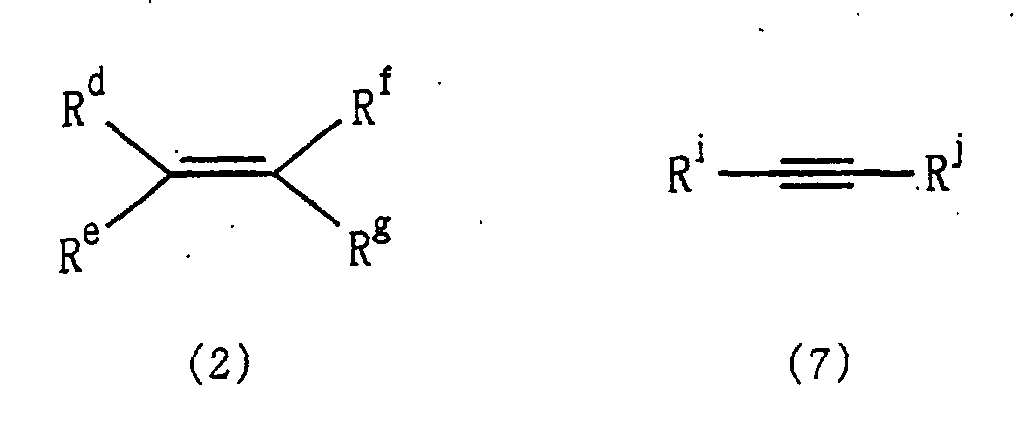
in the presence of oxygen and a catalytic compound of a Group 5, 6, 7, 8 or 9 element of the Periodic Table of Elements to yield a compound of following Formula (3) or (8):
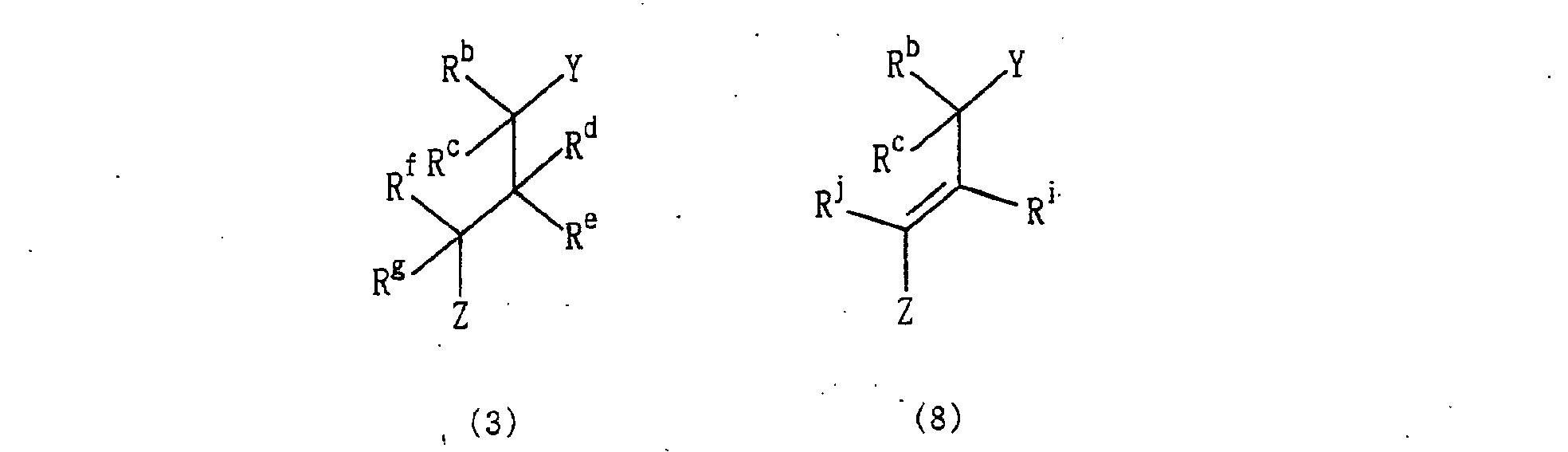
Description
- The present invention relates to a process for producing organic compounds such as carbonyl compounds that are useful as, for example, perfumes, paint additives, additives for resin modification, pharmaceuticals, agrochemicals, and other fine chemicals or raw materials therefor.
- Processes for producing addition compounds are widely known, in which a radical is generated at the alpha position of an electron attractive group of a compound containing the electron attractive group, such as a ketone, and then the formed radical adds to, for example, an olefin to yield a corresponding addition compound. Metallic oxidizing agents such as Mn(III) salts have conventionally been used in this reaction. However, in this type of processes, the used metallic oxidizing agent itself is reduced to proceed an addition reaction, and the process requires a large amount of the metallic oxidizing agent and requires much effort and high cost for treating heavy metal salts after the reaction. In addition, the process using stoichiometric amounts of the metallic oxidizing agent results in low reaction selectivity and cannot significantly produce a corresponding adduct in a high yield.
- Accordingly, an object of the present invention is to provide a process for efficiently producing a compound having an alkyl group or alkenyl group bonded at the alpha position of an electron attractive group, or a derivative thereof, by catalytic radical addition reaction.
- Another object of the present invention is to provide a process for producing a compound having an alkyl group or alkenyl group bonded at the alpha position of an electron attractive group, or a derivative thereof, with a high selectivity from a compound having the electron attractive group, such as a ketone, and a compound having an unsaturated carbon-carbon bond.
- A further object of the present invention is to provide a process for producing a ketone having an alkyl group or alkenyl group bonded at the alpha position of a carbonyl group from a hydrocarbon having a methylene group through one pot.
- After intensive investigations to achieve the above objects, the present inventors have found that, when a compound of a Group 5, 6, 7, 8 or 9 element of the Periodic Table of Elements and oxygen are used in combination, they act as an oxidizing agent and a catalyst, respectively, and thereby efficiently yield a corresponding adduct from a compound having an electron attractive group and a compound having an unsaturated carbon-carbon bond (an olefin or an acetylene). The present invention has been accomplished based on these findings.
- Specifically, the present invention provides a process for producing an organic compound, the process including the step of allowing a compound containing an electron attractive group represented by following Formula (1):wherein Y is an electron attractive group; and Rb and Rc are each independently a hydrogen atom or an organic group, where Y, Rb and Rc may respectively be combined with each other to form a ring with an adjacent carbon atom,

to react with a compound containing an unsaturated carbon-carbon bond represented by following Formula (2) or (7):wherein Rd, Re, Rf, Rg, Ri and Rj are each independently a hydrogen atom or an organic group, where Rd, Re, Rf and Rg may respectively be combined with each other to form a ring with one or two adjacent carbon atoms, and Ri and Rj may be combined with each other to form a ring with adjacent two carbon atoms,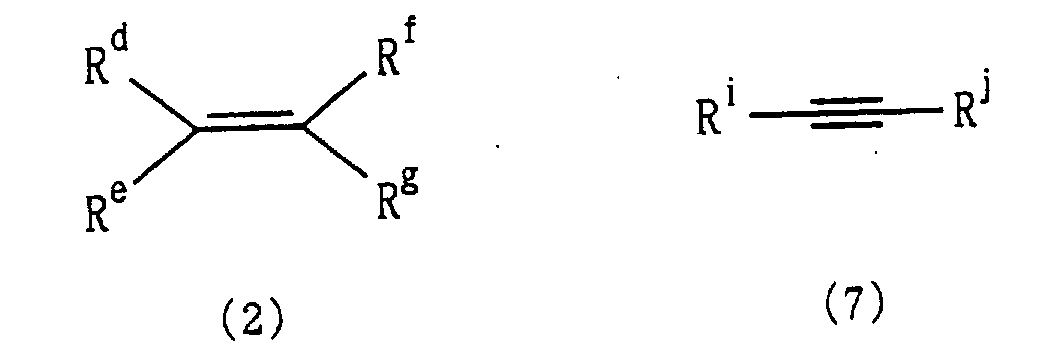
in the presence of oxygen and a catalytic compound of a Group 5, 6, 7, 8 or 9 element of the Periodic Table of Elements to yield a compound represented by following Formula (3) or (8) :wherein Z is a hydrogen atom or a hydroxyl group; and Y, Rb, Rc, Rd, Re, Rf, Rg, Ri and Rj have the same meanings as defined above.
- The present invention also provides a process for producing an organic compound, the process including the step of allowing a carbonyl-group-containing compound represented by following Formula (1a):wherein Ra is a hydrogen atom or an organic group; and Rb and Rc are each independently a hydrogen atom or an organic group, where Ra, Rb and Rc may respectively be combined with each other to form a ring with adjacent one or two carbon atoms, to react with an olefin represented by following Formula (2a) :
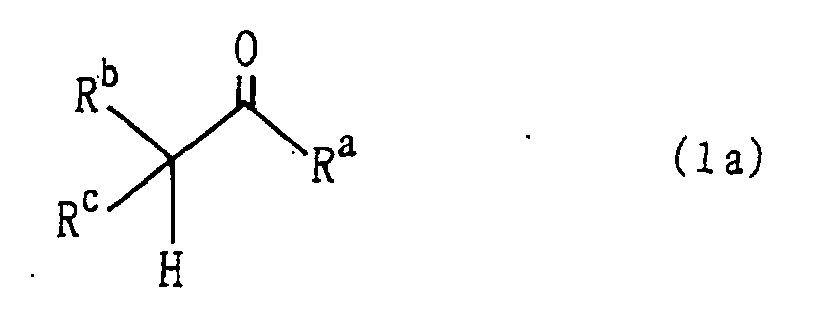 wherein Rd, Re and Rf are each independently a hydrogen atom or an organic group; and Rg1 is an aromatic cyclic group, where Rd, Re, Rf and Rg1 may respectively be combined with each other to form a ring with one or two adjacent carbon atoms,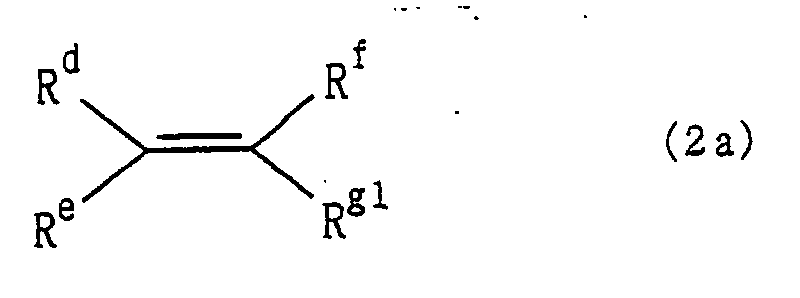
in the presence of oxygen and a catalytic compound of a Group 5, 6, 7, 8 or 9 element of the Periodic Table of Elements to yield a furanol derivative represented by following Formula (4):wherein Ra, Rb, Rc, Rd, Re, Rf and Rg1 have the same meanings as defined above.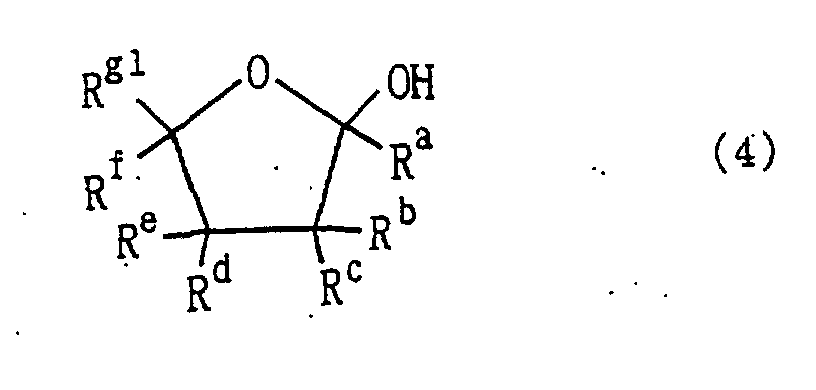
- In addition and advantageously, the present invention provides a process for producing an organic compound, the process including the step of allowing a compound containing a methylene group represented by following Formula (5):wherein Rb, Rc and Rh are each independently a hydrogen atom or an organic group, where Rb, Rc and Rh may respectively be combined with each other to form a ring with adjacent one or two carbon atoms, to react with a compound having an unsaturated carbon-carbon bond represented by following Formula (2) or (7):
 wherein Rd, Re, Rf, Rg, Ri and Rj are each independently a hydrogen atom or an organic group, where Rd, Re, Rf and Rg may respectively be combined with each other to form a ring with one or two adjacent carbon atoms, and Ri and Rj may be combined with each other to form a ring with adjacent two carbon atoms,
in the presence of oxygen, a catalytic compound of a Group 5, 6, 7, 8 or 9 element of the Periodic Table of Elements and an imide compound represented by following Formula (6):wherein R1 and R2 are the same or different and are each a hydrogen atom, a halogen atom, an alkyl group, an aryl group, a cycloalkyl group, a hydroxyl group, an alkoxy group, a carboxyl group, an alkoxycarbonyl group or an acyl group, where R1 and R2 may be combined to form a double bond or an aromatic or non-aromatic ring; X is an oxygen atom or a hydroxyl group; and one or two of N-substituted cyclic imido group indicated in the formula may be further formed on R1, R2, or on the double bond or aromatic or non-aromatic ring formed together by R1 and R2,
to yield a carbonyl compound represented by following Formula (3a) or (8a):wherein Z is a hydrogen atom or a hydroxyl group; and Rb, Rc, Rh, Rd, Re, Rf, Rg, Ri and Rj have the same meanings as defined above.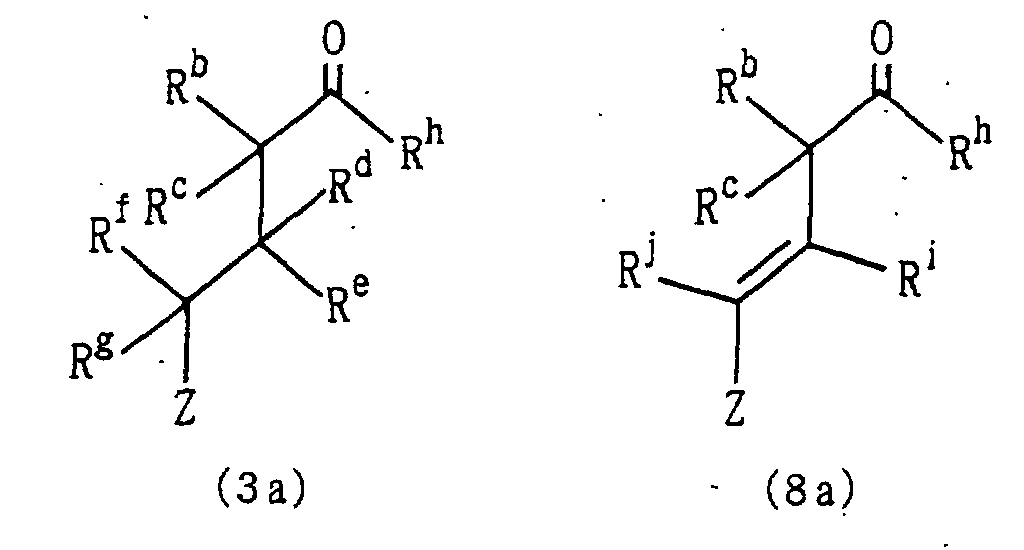
- The term "organic group" in the present description is used in a broad meaning including groups each containing a non-metallic atom in addition to carbon-atom-containing groups. Such groups each containing a non-metallic atom include, for example, halogen atoms, hydroxyl group, mercapto group, amino group, nitro group and sulfonic acid group.
- The compounds represented by Formula (1) for use as raw materials in the present invention include a wide variety of chain or cyclic compounds each having an electron attractive group in a molecule. Such compounds include, but are not limited to, ketones and derivatives thereof having a protected carbonyl group, aldehydes and derivatives thereof having a protected carbonyl group, esters, lactones, carboxylic acids, amides, lactams, nitriles, imino compounds and nitro compounds.
- In Formula (1), electron attractive groups in Y are not specifically limited and include, for example, formyl, acetyl, propionyl, butyryl, (meth)acryloyl, cyclopentanecarbonyl, cyclohexanecarbonyl, benzoyl, naphthoyl, pyridinecarbonyl, and other aliphatic, alicyclic, aromatic or heterocyclic acyl groups and derivatives thereof having a protected carbonyl group; methoxycarbonyl, ethoxycarbonyl, isopropoxycarbonyl, butoxycarbonyl, vinyloxycarbonyl, cyclopentyloxycarbonyl, cyclohexyloxycarbonyl, phenoxycarbonyl, benzyloxycarbonyl, pyridyloxycarbonyl, acyloxycarbonyl group (acid anhydride group), and other substituted oxycarbonyl groups; carboxyl group; carbamoyl, N-methylcarbamoyl, N-phenylcarbamoyl, N,N-dimethylcarbamoyl, 1-pyrrolidinylcarbonyl, piperidinocarbonyl, and other substituted or unsubstituted carbamoyl groups; cyano group; substituted or unsubstituted iminoalkyl groups; nitro group; sulfonic acid group, sulfinic acid group, and other sulfur acid groups; methyl sulfonate, ethyl sulfonate, methyl sulfinate, ethyl sulfinate, and other sulfur acid ester groups (sulfonic ester groups and sulfinic ester groups); phenyl, naphthyl, and other aryl groups; 3-pyridyl and other aromatic heterocyclic groups; vinyl, 1-propenyl, ethynyl, and other 1-alkenyl or 1-alkynyl groups; and trifluoromethyl and other haloalkyl groups. Protected derivatives of the acyl groups include derivatives in which the carbonyl group is protected with a conventional protective group, such as dimethylacetal, diethylacetal, 1,3-dioxane, 1,3-dioxolane, and other acetals; and S,S'-dimethyldithioacetal and other dithioacetals.
- Organic groups in Rb and Rc may be any groups, as far as they do not adversely affect the reaction, and include, for example, hydrocarbon groups, heterocyclic groups, hydroxyl group, mercapto group, alkoxy groups, halogen atoms, N-substituted or unsubstituted amino groups, and the aforementioned electron attractive groups. The hydroxyl group, carboxyl group and amino groups may be protected with a conventional protective group.
- The hydrocarbon groups include aliphatic hydrocarbon groups, alicyclic hydrocarbon groups and aromatic hydrocarbon groups. Such aliphatic hydrocarbon groups include, but are not limited to, methyl, ethyl, propyl, isopropyl, butyl, isobutyl, s-butyl, t-butyl, pentyl, hexyl, octyl, decyl, tetradecyl, hexadecyl, octadecyl, allyl, and other straightor branched-chain aliphatic hydrocarbon groups (alkyl groups, alkenyl groups and alkynyl groups) each having from about 1 to about 20 (preferably from about 1 to about 10, and more preferably from about 1 to about 6) carbon atoms.
- The alicyclic hydrocarbon groups include, but are not limited to, cyclopropyl, cyclobutyl, cyclopentyl, cyclohexyl, cyclohexenyl, cyclooctyl, cyclodecyl, cyclododecyl, and other alicyclic hydrocarbon groups (e.g., cycloalkyl groups and cycloalkenyl groups) each having from about 3 to about 20 carbon atoms (preferably from about 3 to about 15 carbon atoms).
- The aromatic hydrocarbon groups include, but are not limited to, phenyl, naphthyl, and other aromatic hydrocarbon groups each having from about 6 to about 20 carbon atoms.
- These hydrocarbon groups may have various substituents. Such substituents include, for example, halogen atoms (e.g., fluorine, chlorine, bromine and iodine atoms), oxo group, hydroxyl group which may be protected with a protective group, hydroxymethyl group which may be protected with a protective group, amino group which may be protected with a protective group, carboxyl group which may be protected with a protective group, substituted oxycarbonyl groups, substituted or unsubstituted carbamoyl groups, nitro group, acyl groups, cyano group, alkyl groups (e.g., methyl, ethyl, and other C1-C4 alkyl groups), cycloalkyl groups, aryl groups (e.g., phenyl and naphthyl groups) and heterocyclic groups. Conventional protective groups in the field of organic synthesis can be used as the protective groups.
- Heterocyclic rings constituting heterocyclic groups in Rb and Rc include aromatic heterocyclic rings and non-aromatic heterocyclic rings. Such heterocyclic rings include, but are not limited to, heterocyclic rings each containing an oxygen atom as a hetero atom (e.g., furan, tetrahydrofuran, oxazole, isoxazole, and other 5-membered rings; 4-oxo-4H-pyran, tetrahydropyran, morpholine, and other 6-membered rings; benzofuran, isobenzofuran, 4-oxo-4H-chromene, chroman, isochroman, and other condensed rings), heterocyclic rings each containing a sulfur atom as a hetero atom (e.g., thiophene, thiazole, isothiazole, thiadiazole, and other 5-membered rings; 4-oxo-4H-thiopyran and other 6-membered rings; benzothiophene and other condensed rings), heterocyclic rings each containing a nitrogen atom as a hetero atom (e.g., pyrrole, pyrrolidine, pyrazole, imidazole, triazole, and other 5-membered rings; pyridine, pyridazine, pyrimidine, pyrazine, piperidine, piperazine, and other 6-membered rings; indole, indoline, quinoline, acridine, naphthyridine, quinazoline, purine, and other condensed rings). These heterocyclic groups may have substituents such as the substituents which the hydrocarbon groups may have.
- In Rb and Rc, alkoxy groups include, but are not limited to, methoxy, ethoxy, propoxy, butoxy, and other alkoxy groups each having from about 1 to about 6 carbon atoms. Halogen atoms include fluorine, chlorine, bromine and iodine atoms. N-substituted amino groups include, for example, N,N-dimethylamino, N,N-diethylamino and piperidino groups.
- Two of the substituents Y, Rb and Rc may be combined with each other to form a ring with an adjacent carbon atom. Rings formed by Rb and Rc with the adjacent carbon atom include, but are not limited to, cyclopropane, cyclobutane, cyclopentane, cyclopentene, cyclohexane, cyclohexene, cyclooctane, cyclodecane and cyclododecane rings, decalin ring, adamantane ring, and other non-aromatic carbon rings (cycloalkane rings, cycloalkene rings and bridged carbon rings) each having from about 3 to about 20 members (preferably from about 3 to about 15 members, more preferably from about 5 to about 15 members, and typically preferably from about 5 to about 10 members). These rings may have substituents such as the substituents which the hydrocarbon groups may have. Separately, other rings (non-aromatic rings or aromatic rings) may be condensed with these rings.
- Rings formed by Y and Rb or Rc with the adjacent carbon atom include, but are not limited to, cyclopentanone ring, cyclohexanone ring, cyclooctanone ring, cyclodecanone ring, cyclododecanone ring, adamantanone ring, and other non-aromatic carbon rings (cycloalkanone rings, cycloalkenone rings and oxo-group-containing bridged carbon rings) each having an oxo group bonded thereto and having from about 3 to about 20 members (preferably from about 3 to about 15 members, more preferably from about 5 to about 15 members, and typically preferably from about 5 to about 10 members) [in this case, the compound (1) constitutes a cyclic ketone]; β-propiolactone ring, γ-butyrolactone ring, δ-valerolactone ring, ε-caprolactone ring, and other lactone rings each having from about 4 to about 20 members (preferably from about 4 to about 15 members, and more preferably from about 5 to about 7 members) [in this case, the compound (1) constitutes a lactone]; and lactam rings corresponding to the lactone rings [in this case, the compound (1) constitutes a lactam]. These rings may have substituents such as the substituents which the hydrocarbon groups may have. Separately, other rings (non-aromatic rings or aromatic rings) may be condensed with these rings.
- Preferred substituents Rb and Rc include, for example, hydrogen atom, C1-C10 aliphatic hydrocarbon groups (e.g., methyl, ethyl, propyl, isopropyl, butyl, isobutyl, s-butyl, t-butyl, pentyl, hexyl, octyl, and decyl groups, of which C1-C10 alkyl groups are typically preferred), alicyclic hydrocarbon groups (e.g., cyclopentyl, cyclohexyl, cyclohexenyl, and other C3-C15 cycloalkyl groups or cycloalkenyl groups), and C6-C14 aryl groups. Alternatively, preferred are non-aromatic carbon rings each having from about 3 to about 15 members (typically preferably from about 5 to about 8 members) formed by Rb and Rc with the adjacent carbon atom. In addition, non-aromatic carbon rings each having an oxo group bonded thereto and having from about 3 to about 20 members, lactone rings each having from about 4 to about 20 members and lactam rings each having from about 4 to about 20 members formed by Y and Rb or Rc with the adjacent carbon atom are also preferred.
- Examples of the compounds represented by Formula (1) each containing an electron attractive group include acetone, methyl ethyl ketone, diethyl ketone, isopropyl methyl ketone, acetophenone, benzyl methyl ketone, acetylacetone, acetoacetic esters (e.g., methyl acetoacetate, ethyl acetoacetate, propyl acetoacetate and isopropyl acetoacetate), α-acetyl-γ-butyrolactone and other chain ketones (including keto-esters and keto-lactones); cyclopentanone, cyclohexanone, cyclooctanone, cyclodecanone, cyclododecanone, cyclotetradecanone, and other cyclic ketones; acetaldehyde, propionaldehyde, phenylacetaldehyde, and other aldehydes; methyl acetate, ethyl acetate, phenyl acetate, methyl propionate, ethyl propionate, methyl butyrate, ethyl butyrate, methyl hexanoate, ethyl hexanoate, methyl phenylacetate, ethyl phenylacetate, malonates (e.g., methyl malonate, ethyl malonate, propyl malonate and isopropyl malonate), adipates, and other esters; β-propiolactone, γ-butyrolactone, δ-valerolactone, ε-caprolactone, and other lactones; phenylacetic acid, adipic acid, and other carboxylic acids; adipic anhydride and other acid anhydrides; N,N-dimethylacetamide, N,N-dimethylpropionamide, and other amides; β-propiolactam, γ-butyrolactam, δ-valerolactam, ε-caprolactam, and other lactams; acetonitrile, propionitrile, malononitrile, ethyl cyanoacetate, and other nitriles; N-isopropylidenebenzylamine, N-isopropylideneaniline, N-(1-methylbutylidene)butylamine, and other imines; nitromethane, nitroethane, and other nitro compounds. Among them, ketones (chain ketones and cyclic ketones), esters, nitriles, lactones, carboxylic acids and acid anhydrides are typically preferred.
- The compounds each having an unsaturated carbon-carbon bond include olefins represented by Formula (2) and acetylenes represented by Formula (7).
- In the olefins represented by Formula (2) and the acetylenes represented by Formula (7), organic groups in Rd, Re, Rf, Rg, Ri and Rj include similar organic groups to those in Rb and Rc.
- Two of the substituents Rd, Re, Rf and Rg may be combined with each other to form a ring with the adjacent one or two carbon atoms. Such rings include, but are not limited to, cyclopropane, cyclobutane, cyclopentane, cyclopentene, cyclohexane, cyclohexene, cyclooctane, cyclododecane, norbornene, and other alicyclic carbon rings (e.g., cycloalkane rings, cycloalkene rings and bridged carbon rings) each having from about 3 to about 20 members. These rings may have substituents and may be condensed with other rings (non-aromatic rings or aromatic rings).
- The substituents Ri and Rj may be combined with each other to form a ring with the adjacent two carbon atoms. The ring may have a substituent and may be condensed with another ring (a non-aromatic ring or an aromatic ring).
- Preferred Rd, Re, Rf, Rg, Ri and Rj include, for example, hydrogen atom, hydrocarbon groups [e.g., C1-C20 aliphatic hydrocarbon groups (typically preferably C1-C10 aliphatic hydrocarbon groups), C6-C20 aryl groups (e.g., phenyl group and naphthyl group), cycloalkyl groups (e.g., cycloalkyl groups each having from about 3 to about 8 members), haloalkyl groups (e.g., trifluoromethyl group and other C1-C6 haloalkyl groups, of which C1-C4 haloalkyl groups are typically preferred)], heterocyclic groups, substituted oxycarbonyl groups (e.g., C1-C6 alkoxy-carbonyl groups, aryloxycarbonyl groups, aralkyloxycarbonyl groups and cycloalkyloxycarbonyl groups), carboxyl group, substituted or unsubstituted carbamqyl groups, cyano group, nitro group, sulfur acid groups, sulfur acid ester groups, and acyl groups.
- The olefins represented by Formula (2) may be any of alpha olefins and internal olefins. The olefins also include dienes and other olefins each having a plurality of carbon-carbon double bonds. Examples of the olefins are ethylene, propylene, 1-butene, 2-butene, isobutene, 1-pentene, 2-pentene, 1-hexene, 2-hexene, 3-hexene, 1-heptene, 1-octene, 2-octene, 3-octene, 4-octene, 1-nonene, 1-decene, 1-dodecene, 1,5-hexadiene, 1,6-heptadiene; 1,7-octadiene, styrene, vinyltoluene, α-methylstyrene, 3-vinylpyridine, 3-vinylfuran, 3-vinylthiophene, and other chain olefins (alkenes); cyclopentene, cyclohexene, cyclooctene, cyclodecene, cyclododecene, norbornene, and other cyclic olefins (cycloalkanes and bridged cyclic hydrocarbons each having a carbon-carbon double bond).
- The acetylenes represented by Formula (7) also include diynes and other acetylenes each having a plurality of carbon-carbon triple bonds. Typical examples of the acetylenes are acetylene, 1-propyne, 1-butyne, 2-butyne, 1-pentyne, 1-hexyne, 1-heptyne, 1-octyne and phenylacetylene.
- According to the present invention, the compounds of Groups 5 to 9 elements of the Periodic Table of Elements are used as catalysts. The Groups 5 to 9 elements of the Periodic Table of Elements include vanadium V, niobium Nb, tantalum Ta, and other Group 5 elements; chromium Cr, molybdenum Mo, tungsten W, and other Group 6 elements; manganese Mn, technetium Tc, rhenium Re, and other Group 7 elements; iron Fe, ruthenium Ru, osmium Os, and other Group 8 elements; cobalt Co, rhodium Rh, iridium Ir, and other Group 9 elements. Among them, manganese Mn and other Group 7 elements are preferred. Preferred elements include metallic elements of the fourth period (vanadium V, chromium Cr, manganese Mn, iron Fe, and cobalt Co). As the catalysts, metallic elements compounds each exhibiting activity in one-electron oxidation are preferred.
- The compounds of Groups 5 to 9 elements of the Periodic Table of Elements include, but are not limited to, elementary substances, hydroxides, oxides (including complex oxides), halides (fluorides, chlorides, bromides, and iodides), salts of oxoacids (e.g., nitrates, sulfates, phosphates, borates, and carbonates), oxoacids, isopolyacids, heteropolyacids, and other inorganic compounds of the aforementioned metallic elements; salts of organic acids (e.g., acetates, propionates, prussiates, naphthenates, and stearates), complexes, and other organic compounds of the metallic elements. Ligands for constituting the complexes include OH (hydroxo), alkoxy (e.g., methoxy, ethoxy, propoxy, and butoxy), acyl (e.g., acetyl and propionyl), alkoxycarbonyl (e.g., methoxycarbonyl and ethoxycarbonyl), acetylacetonato, cyclopentadienyl group, halogen atoms (e.g., chlorine and bromine atoms), CO, CN, oxygen atom, H2O (aquo), phosphines (triphenylphosphine and other triarylphosphines) and other phosphorus compounds, NH3 (ammine) , NO, NO2 (nitro), NO3 (nitrato), ethylenediamine, diethylenetriamine, pyridine, phenanthroline, and other nitrogen-containing compounds.
- Examples of the compounds of Groups 5 to 9 elements of the Periodic Table of Elements include, by taking manganese compounds as an example, manganese hydroxide, manganese oxide, manganese chloride, manganese bromide and other manganese halides, manganese nitrate, manganese sulfate, manganese phosphate, manganese carbonate, manganates, permanganates, manganese molybdate, and other heteropolyacids containing manganese or salts thereof, and other inorganic compounds; manganese formate, manganese acetate, manganese propionate, manganese naphthenate, manganese stearate, manganese thiocyanate, and other salts of organic acids, and acetylacetonatomanganese and other complexes, and other organic compounds. Manganese may be divalent or trivalent. Among these manganese compounds, manganese acetate, and other organic acid salts, and acetylacetonatomanganese and other complexes, and other organic manganese compounds are preferred.
- Examples of cobalt compounds include, but are not limited to, cobalt hydroxide, cobalt oxide, cobalt chloride, cobalt bromide and other cobalt halides, cobalt nitrate, cobalt sulfate, cobalt phosphate, cobalt molybdate and other heteropolyacids containing cobalt or salts thereof, and other inorganic compounds; cobalt formate, cobalt acetate, cobalt naphthenate, cobalt stearate, and other organic acid salts, and acetylacetonatocobalt and other complexes, and other organic compounds. Cobalt may be divalent or trivalent. Among these cobalt compounds, cobalt acetate and other organic acid salts, and acetylacetonatocobalt and other complexes, and other organic cobalt compounds are typically preferred.
- Examples of vanadium compounds are vanadium hydroxide, vanadium oxide, vanadium chloride, vanadyl chloride, vanadium sulfate, vanadyl sulfate, sodium vanadate, and other inorganic compounds; acetylactonatovanadium, vanadyl acetylacetonato, and other complexes, and other vanadium compounds each having a valency of from 2 to 5.
- Examples of molybdenum compounds are molybdenum hydroxide, molybdenum oxide, molybdenum chloride, molybdenum bromide, molybdenum sulfide, molybdic acid or salts thereof, phosphomolybdic acid or salts thereof, silicomolybdic acid or salts thereof, and other inorganic compounds; carbonylmolybdenum, bis(acetylacetonato)dioxomolybdenum, chlorotricarbonyl(η-cyclopentadienyl)molybdenum, dibromobis(η-cyclopentadienylmolybdenum, and other complexes, and other molybdenum compounds each having a valency of from 0 to 6. Examples of compounds of the other metallic elements include compounds corresponding to the above-mentioned manganese, vanadium or molybdenum compounds. The valences of the Groups 5 to 9 elements of the Periodic Table of Elements are not specifically limited and are often from about 0 to about 6.
- Each of these compounds of Groups 5 to 9 elements of the Periodic Table of Elements can be used alone or in combination. The combination use of two or more types of compounds respectively containing different elements may improve the rate and selectivity of a reaction in some cases. Such combinations include a combination of a manganese compound with another compound of Group 5, 6, 7, 8 or 9 of the Periodic Table of Elements (especially a cobalt compound).
- The amount of the catalytic compound (catalyst) of Group 5, 6, 7, 8 or 9 element of the Periodic Table of Elements is, for example, from about 0.0001 to about 0.1 mole, preferably from about 0.0002 to about 0.05 mole, and more preferably from about 0.0005 to about 0.01 mole, relative to 1 mole of the compound used in a less amount between the compound containing an electron attractive group represented by Formula (1) and the compound having an unsaturated carbon-carbon bond [the olefin represented by Formula (2) or the acetylene represented by Formula (7)].
- When a manganese compound and a cobalt compound are used in combination, the amount of the manganese compound is, for example, from about 0.0001 to about 0.1 mole, preferably from about 0.0002 to about 0.05 mol, and more preferably from about 0.0005 to about 0.01 mole, relative to 1 mole of the compound used in a less amount between the compound containing an electron attractive group represented by Formula (1) and the compound having an unsaturated carbon-carbon bond [the olefin represented by Formula (2) or the acetylene represented by Formula (7)]. The amount of the cobalt compound is, for example, from about 0.00005 to about 0.1 mole, preferably from about 0.0001 to about 0.01 mole, and more preferably from about 0.0002 to about 0.005 mole, relative to 1 mole of the compound used in a less amount between the compound containing an electron attractive group represented by Formula (1) and the compound having an unsaturated carbon-carbon bond [the olefin represented by Formula (2) or the acetylene represented by Formula (7)]. In this case, the molar ratio of the manganese compound to the cobalt compound is generally from about 1/99 to about 99/1, preferably from about 5/95 to about 98/2, more preferably from about 20/80 to 95/5, and especially preferably from about 40/60 to about 95/5.
- In order to improve the rate or selectivity of the reaction according to the present invention, the compounds of Groups 5 to 9 elements of the Periodic Table of Elements can be used in combination with the compounds of the other metallic elements, such as transition metals including cerium, titanium, zirconium, nickel, palladium, platinum, copper and zinc.
- The reaction system may further comprise azobisisobutyronitrile (AIBN) and other polymerization initiators, radical generators, or radical reaction accelerators [e.g., halogens (e.g., chlorine and bromine), peracids and peroxides]. The presence of such components in the reaction system may accelerate or enhance the reaction in some cases. Alternatively, light irradiation or ultrasound application may increase the reaction rate.
- As oxygen, nascent oxygen can be used, but molecular oxygen is generally used. Such molecular oxygen may be pure oxygen or oxygen (e.g., air) diluted with an inert gas such as nitrogen, helium, argon or carbon dioxide from the viewpoints of higher operating property and safety. In some cases depending on the type of the substrate and other conditions, the use of a gaseous mixture including oxygen and an inert gas (e.g., nitrogen gas) produces a target compound in a higher yield than the use of pure oxygen. The molar ratio of oxygen to the inert gas in the gaseous mixture is, for example, from about 10/90 to about 95/5, preferably from about 15/85 to about 90/10, and more preferably from about 25/75 to about 80/20.
- The amount of oxygen can appropriately be selected depending on the type of the substrate and is generally equal to or more than about 0.5 mole (e.g., equal to or more than about 1 mole), preferably from about 1 to about 100 moles, and more preferably from about 2 to about 50 moles, relative to 1 mole of the compound used in a less amount between the compound containing an electron attractive group represented by Formula (1) and the compound having an unsaturated carbon-carbon bond [the olefin represented by Formula (2) or the acetylene represented by Formula (7)]. Oxygen is often used in excess moles to the substrate.
- The reaction is performed in the presence of, or in the absence of, a solvent. Such solvents include, but are not limited to, acetic acid, propionic acid, and other organic acids; benzonitrile and other nitriles; formamide, acetamide, dimethylformamide (DMF), dimethylacetamide, and other amides; hexane, octane, and other aliphatic hydrocarbons; chloroform, dichloromethane, dichloroethane, carbon tetrachloride, chlorobenzene, trifluoromethylbenzene, and other halogenated hydrocarbons; nitrobenzene and other nitro compounds; and mixtures of these solvents. As the solvents, acetic acid and other organic acids, benzonitrile and other nitriles, and trifluoromethylbenzene and other halogenated hydrocarbons are often used. The substrate (reaction material) can also be used as the solvent.
- The molar ratio of the compound containing an electron attractive group represented by Formula (1) to the compound having an unsaturated carbon-carbon bond [the olefin represented by Formula (2) or the acetylene represented by Formula (7)] can appropriately be selected depending on the types of the two compounds and the combination thereof and is generally from about 0.8 to about 50, preferably from about 1.5 to about 30, and more preferably from about 2 to about 20, from the viewpoint of reactivity.
- A reaction temperature can appropriately be selected depending on, for example, the types of the compound containing an electron attractive group and the compound having an unsaturated carbon-carbon bond (the olefin or the acetylene) and is, for example, from about 0°C to about 150°C, and preferably from about 30°C to about 100°C. The reaction can be performed at atmospheric pressure or under a pressure (under a load). When the reaction is performed under a pressure (under a load), the pressure is generally from about 1 to about 100 atm (from about 0.101 to about 10.1 MPa), and preferably from bout 1.5 to about 80 atm (from about 0.152 to about 8.08 MPa). A reaction time can appropriately be selected within a range of from about 30 minutes to about 48 hours, depending on the reaction temperature and pressure. The reaction can be performed in the presence of, or under the flow of, oxygen in a conventional system such as a batch system, semi-batch system or continuos system.
- The above process can produce the compound represented by Formula (3) in a good yield. The reaction is supposed to proceed in the following manner. By action of the catalytic compound of Group 5, 6, 7, 8 or 9 element of the Periodic Table of Elements and oxygen, a radical is formed at the alpha position of the electron attractive group of the compound containing the electron attractive group, and then the radical adds to the carbon atom of an unsaturated bond (a double bond or triple bond) of the olefin or the acetylene to yield a compound having a corresponding alkyl group or alkenyl group at the alpha position of the electron attractive group [a compound of Formula (3) or Formula (8) where Z is a hydrogen atom). A compound of Formula (3) or Formula (8) where Z is a hydroxyl group is supposed to be formed in such a manner that the radical at the alpha position of the electron attractive group adds to the olefin or the acetylene and to yield a secondary radical (adduct radical) , and the secondary radical further reacts with oxygen. The compound of Formula (3) or Formula (8) where Z is a hydroxyl group is often formed when the partial oxygen pressure in the system is high or when the secondary radical formed by the addition of the radical to the olefin or acetylene is highly stable (e.g., in the case where Rg is an aromatic group).
- After the completion of the reaction, the resulting reaction products can easily be separated and purified by a conventional technique such as filtration, concentration, distillation, extraction, crystallization, recrystallization, column chromatography, and other separation means or combinations of these separation means.
- When the carbonyl-group-containing compound represented by Formula (1a) is used as the compound containing an electron attractive group, and the compound represented by Formula (2a), i.e., a compound having an aromatic group bonded to a carbon atom constituting a double bond, is used as the olefin, the furanol derivative represented by Formula (4) is formed in a good yield in addition to, or instead of, the compound represented by Formula (3).
- This is probably because the radical formed at the alpha position of the electron attractive group adds to the olefin to yield a secondary carbon radical species, which is stabilized by the aromatic ring, and this radical is then allowed to react with oxygen and thereby yields an alcohol represented by following Formula (9):wherein Ra, Rb, Rc, Rd, Re, Rf and Rg1 have the same meanings as defined above, and the hydroxyl group of the alcohol attacks the carbonyl group and thereby form a ring.
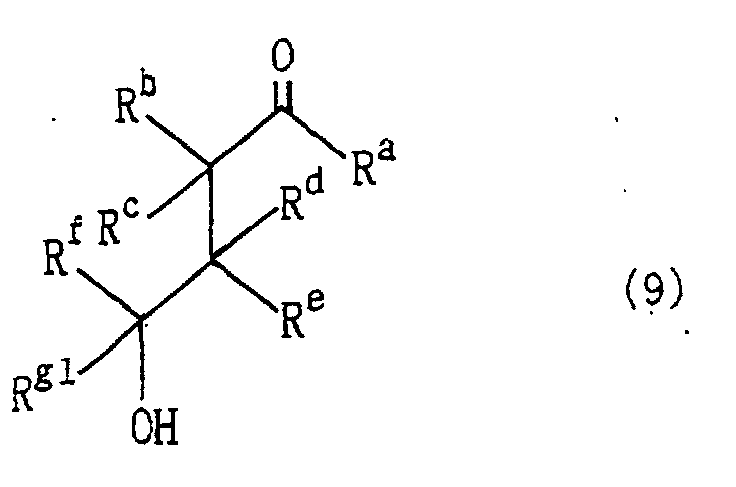
- Organic groups in the substituent Ra include similar organic groups to those in Rb and Rc. Typical examples of such organic groups are the aforementioned hydrocarbon groups (aliphatic hydrocarbon groups, alicyclic hydrocarbon groups and aromatic hydrocarbon groups) and the aforementioned heterocyclic groups.
- In Formulae (1a) and (9), two of Ra, Rb and Rc may be combined with each other to form a ring with adjacent one or two carbon atoms. Rings formed by Ra and Rb or Rc with the adjacent two carbon atoms include, but are not limited to, cyclopentanone ring, cyclohexanone ring, cyclooctanone ring, cyclodecanone ring, cyclododecanone ring, adamantanone ring, and other non-aromatic carbon rings (cycloalkanone rings, cycloalkenone rings and oxo-group-containing bridged carbon rings) each having an oxo group bonded thereto and having from about 3 to about 20 members (preferably from about 3 to about 15 members, more preferably from about 5 to about 15 members, and typically preferably from about 5 to about 10 members). Rings formed by Rb and Rc with the adjacent carbon atom include similar rings to those mentioned above.
- Typical examples of the compounds represented by Formula (1a) include the aforementioned chain ketones (e.g., methyl ethyl ketone and diethyl ketone), cyclic ketones (e.g., cyclohexanone, cyclooctanone and cyclododecanone), and aldehydes (e.g., propionaldehyde).
- Aromatic cyclic rings in the substituent Rg1 include, but are not limited to, phenyl, naphthyl, and other aromatic hydrocarbon groups each having from about 6 to about 20 carbon atoms; aromatic heterocyclic groups corresponding to aromatic heterocyclic rings such as furan, oxazole, isoxazole, 4-oxo-4H-pyran, benzofuran, isobenzofuran, 4-oxo-4H-chromene, thiophene, thiazole, isothiazole, thiadiazole, 4-oxo-4H-thiopyran, benzothiophene, pyrrole, pyrazole, imidazole, triazole, pyridine, pyridazine, pyrimidine, indole, quinoline, acridine, naphthyridine, quinazoline, and purine. These aromatic cyclic groups may have substituents. Such substituents include similar groups to those which the hydrocarbon groups in Rb and Rc may have.
- Typical examples of the compounds represented by Formula (2a) are styrene, vinyltoluene, o-chlorostyrene, m-chlorostyrene, p-chlorostyrene, p-methoxystyrene, α-methylstyrene, 1-propenylbenzene, 1-vinylnaphthalene, 2-vinylnaphthalene, and other compounds each havingan aromatic hydrocarbon group carrying a vinyl group (including a substituted vinyl group) bonded thereto; 3-vinylfuran, 3-vinylthiophene, 2-vinylpyridine, 3-vinylpyridine, 4-vinylpyridine, 3-vinylquinoline, and other compounds each having an aromatic heterocyclic group carrying a vinyl group (including a substituted vinyl group) bonded thereto.
- The reaction conditions and reaction procedures in the reaction to obtain the furanol derivative represented by Formula (4) are similar to those mentioned above.
- According to the present invention, a ketone having an alkyl group or alkenyl group bonded at the alpha position of the carbonyl group can be produced from a hydrocarbon through one pot by using the above reaction. Specifically, the carbonyl compound represented by Formula (3a) or (8a) can be obtained by allowing the compound having a methylene group represented by Formula (5) to react with the olefin represented by Formula (2) or the acetylene represented by Formula (7) in the presence of the imide compound catalyst represented by Formula (6), the manganese catalyst and oxygen.
- In Formula (5), organic groups in Rb, Rc and Rh include similar groups to those mentioned above. Preferred Rb and Rc include similar groups to those mentioned above. Preferred Rh includes, but is not limited to, the aromatic cyclic groups (e.g., phenyl, naphthyl, and dther aromatic hydrocarbon groups; and aromatic heterocyclic groups corresponding to furan, thiophene, pyridine, and other aromatic heterocyclic rings) mentioned in the substituent Rg1.
- Two of the substituents Rb, Rc and Rh may be combined with each other to form a ring with the adjacent one or two carbon atoms. Rings formed by Rh and Rb or Rc with the adjacent two carbon atoms include, but are not limited to, cyclopentane ring, cyclohexane ring, cyclooctane ring, cyclodecane ring, cyclododecane ring, adamantane ring, and other non-aromatic carbon rings (cycloalkane rings, cycloalkene rings, and bridged carbon rings) each having from about 3 to about 20 members (preferably from about 3 to about 15 members, more preferably from about 5 to about 15 members, and typically preferably from about 5 to about 10 members). These rings may have substituents such as the substituents which the hydrocarbon groups may have. Rings formed by Rb and Rc with the adjacent carbon atom include similar rings to those mentioned above.
- Typical examples of the compounds represented by Formula (5) are ethylbenzene, propylbenzene, butylbenzene, 3-ethylfuran, 3-ethylthiophene, 2-ethylpyridine, 3-ethylpyridine, 4-ethylpyridine, and other compounds each having a methylene group at the adjacent position to an aromatic ring; cyclopentane, cyclohexane, cyclooctane, cyclodecane, cyclododecane, cyclotetradecane, and other alicyclic compounds.
- Of the substituents R1 and R2 in the imide compound catalyst represented by Formula (6), the halogen atom includes iodine, bromine, chlorine and fluorine. The alkyl group includes, but is not limited to, methyl, ethyl, propyl, isopropyl, butyl, isobutyl, s-butyl, t-butyl, pentyl, hexyl, heptyl, octyl, decyl, and other straight- or branched-chain alkyl groups each having from about 1 to about 10 carbon atoms. Preferred alkyl groups are alkyl groups each having from about 1 to about 6 carbon atoms, of which lower alkyl groups each having from about 1 to about 4 carbon atoms are typically preferred.
- The aryl group includes phenyl and naphthyl groups, for example. Illustrative cycloalkyl groups include cyclopentyl, and cyclohexyl groups. Illustrative alkoxy groups are methoxy, ethoxy, propoxy, isopropoxy, butoxy, isobutoxy, t-butoxy, pentyloxy, hexyloxy, and other alkoxy groups each having from about 1 to about 10 carbon atoms, and preferably having from about 1 to about 6 carbon atoms. Among them, lower alkoxy groups each having from about 1 to about 4 carbon atoms are typically preferred.
- Examples of the alkoxycarbonyl group are methoxycarbonyl, ethoxycarbonyl, propoxycarbonyl, isopropoxycarbonyl, butoxycarbonyl, isobutoxycarbonyl, t-butoxycarbonyl, pentyloxycarbonyl, hexyloxycarbonyl, and other alkoxycarbonyl groups each having from about 1 to about 10 carbon atoms in the alkoxy moiety. Preferred alkoxycarbonyl groups are alkoxycarbonyl groups each having from about 1 to about 6 carbon atoms in the alkoxy moiety, of which lower alkoxycarbonyl groups each having from about 1 to about 4 carbon atoms in the alkoxy moiety are typically preferred.
- Illustrative acyl groups are formyl, acetyl, propionyl, butyryl, isobutyryl, valeryl, isovaleryl, pivaloyl, and other acyl groups each having from about 1 to about 6 carbon atoms.
- The substituents R1 and R2 may be identical to or different from each other. The substituents R1 and R2 in Formula (6) may be combined to form a double bond, or an aromatic or non-aromatic ring. The preferred aromatic or non-aromatic ring has from about 5 to about 12 members, and more preferably from about 6 to about 10 members. The ring may be a heterocyclic ring or condensed heterocyclic ring, but it is often a hydrocarbon ring. Such rings include, for example, non-aromatic alicyclic rings (e.g., cyclohexane ring and other cycloalkane rings which may have a substituent; and cyclohexene ring and other cycloalkene rings which may have a substituent), non-aromatic bridged rings (e.g., 5-norbornene ring and other bridged hydrocarbon rings which may have a substituent), benzene ring, naphthalene ring, and other aromatic rings (including condensed rings) which may have a substituent. The ring comprises an aromatic ring in many cases. The ring may have at least one substituent. Such substituents include, but are not limited to, alkyl groups, haloalkyl groups, hydroxyl group, alkoxy groups, carboxyl group, alkoxycarbonyl groups, acyl groups, nitro group, cyano group, amino group, and halogen atoms.
- In Formula (6), X represents an oxygen atom or a hydroxyl group, and the bond between the nitrogen atom N and X is a single bond or a double bond.
- One or two of the N-substituted cyclic imido group indicated in Formula (6) may further be formed on R1, R2, or on the double bond or aromatic or non-aromatic ring formed together by R1 and R2. For example, when R1 or R2 is an alkyl group having two or more carbon atoms, the N-substituted cyclic imido group may be formed together with the adjacent two carbon atoms constituting the alkyl group. Likewise, when R1 and R2 are combined to form a double bond, the N-substituted cyclic imido group may be formed together with the double bond. In case that R1 and R2 are combined to form an aromatic or non-aromatic ring, the N-substituted cyclic imido group may be formed with the adjacent two carbon atoms constituting the ring.
- Preferred imide compounds include compounds of the following formulae:
 wherein R3 to R6 are the same or different and are each a hydrogen atom, an alkyl group, a haloalkyl group, a hydroxyl group, an alkoxy group, a carboxyl group, an alkoxycarbonyl group, an acyl group, a nitro group, a cyano group, an amino group, or a halogen atom, where adjacent groups of R3 to R6 may be combined to form an aromatic or non-aromatic ring; in Formula (6f), A is a methylene group or an oxygen atom; and R1, R2 and X have the same meanings as defined above, where one or two of N-substituted cyclic imido group indicated in Formula (6c) may further be formed on the benzene ring in Formula (6c).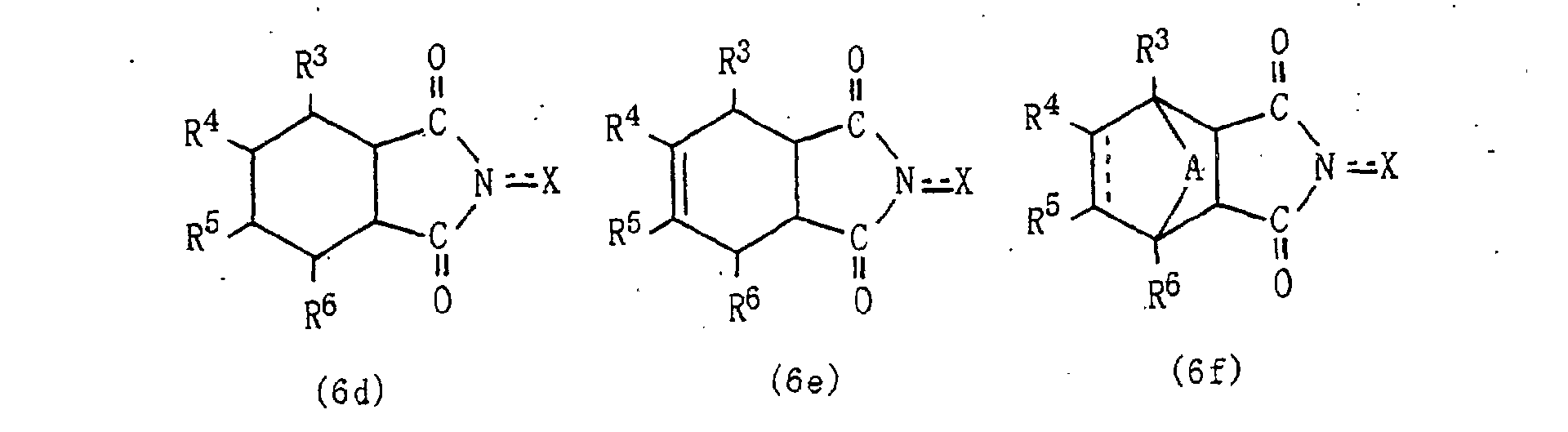
- In the substituents R3 to R6, the alkyl group includes similar alkyl groups to those exemplified above, of which alkyl groups each having from about 1 to about 6 carbon atoms are typically preferred. The haloalkyl group includes trifluoromethyl group and other haloalkyl groups each having from about 1 to about 4 carbon atoms. The alkoxy group includes similar alkoxy groups to those mentioned above, of which lower alkoxy groups each having from about 1 to about 4 carbon atoms are typically preferred. The alkoxycarbonyl group includes similar alkoxycarbonyl groups to those described above, of which lower alkoxycarbonyl groups each having from about 1 to about 4 carbon atoms in the alkoxy moiety are typically preferred. The acyl group includes similar acyl groups to those described above, of which acyl groups each having from about 1 to about 6 carbon atoms are typically preferred. The halogen atom includes fluorine, chlorine and bromine atoms. Each of the substituents R3 to R6 is often a hydrogen atom, a lower alkyl group having from about 1 to about 4 carbon atoms, a carboxyl group, anitrogroup, or a halogen atom. The ring formed together by R3 to R6 includes similar rings to the aforementioned rings which are formed together by R1 and R2. Among them, aromatic or non-aromatic 5- to 12-membered rings are typically preferred.
- Examples of preferred imide compounds include
- N-hydroxysuccinimide, N-hydroxymaleimide,
- N-hydroxyhexahydrophthalimide,
- N,N'-dihydroxycyclohexanetetracarboximide,
- N-hydroxyphthalimide, N-hydroxytetrabromophthalimide,
- N-hydroxytetrachlorophthalimide, N-hydroxychlorendimide,
- N-hydroxyhimimide, N-hydroxytrimellitimide,
- N,N'-dihydroxypyromellitimide, and
- N,N'-dihydroxynaphthalenetetracarboximide.
-
- The imide compounds represented by Formula (6) can be prepared by a conventional imidation process (a process for the formation of an imide), such as a process that comprises the steps of allowing a corresponding acid anhydride to react with hydroxylamine NH2OH for ring-opening of an acid anhydride group, and closing the ring to form an imide.
- Such acid anhydrides include, but are not limited to, succinic anhydride, maleic anhydride, and other saturated or unsaturated aliphatic dicarboxylic anhydrides, tetrahydrophthalic anhydride, hexahydrophthalic anhydride (1,2-cyclohexanedicarboxylic anhydride), 1,2,3,4-cyclohexanetetracarboxylic 1,2-dianhydride, and other saturated or unsaturated non-aromatic cyclic polycarboxylic anhydrides (alicyclic polycarboxylic anhydrides), HET anhydride (chlorendic anhydride), himic anhydride, and other bridged cyclic polycarboxylic anhydrides (alicyclic polycarboxylic anhydrides), phthalic anhydride, tetrabromophthalic anhydride, tetrachlorophthalic anhydride, nitrophthalic anhydride, trimellitic anhydride, methylcyclohexenetricarboxylic anhydride, pyromellitic anhydride, mellitic anhydride, 1,8;4,5-naphthalenetetracarboxylic dianhydride, and other aromatic polycarboxylic anhydrides.
- Typically preferred imide compounds include N-hydroxyimide compounds derived from alicyclic polycarboxylic anhydrides or aromatic polycarboxylic anhydrides, of which N-hydroxyphthalimide and other N-hydroxyimide compounds derived from aromatic polycarboxylic anhydrides are typically preferred.
- Each of the imide compounds represented by Formula (6) can be used alone or in combination. The imide compounds can be used as being supported on a carrier. As such carriers, activated carbon, zeolite, silica, silica-alumina, bentonite, and other porous carries are often used.
- The amount of the imide compound can be selected within a wide range and is, for example, from about 0.0001 to about 1 mole, preferably from about 0.001 to about 0.5 mole, and more preferably from about 0.01 to about 0.4 mole, relative to 1 mole of the compound having a methylene group represented by Formula (5).
- As the catalytic compound of Group 5, 6, 7, 8 or 9 element of the Periodic Table of Elements (e.g., a manganese catalyst), similar catalysts to those mentioned above can be used. Likewise, each of the catalytic compounds of Groups 5 to 9 elements of the Periodic Table of Elements can be used alone or in combination and can be used in combination with transition metal compounds or other metallic compounds. Specifically, by using a manganese catalyst in combination with a cobalt catalyst and/or a vanadium catalyst, the reaction very smoothly proceeds.
- The amount of the catalytic compound of Group 5, 6, 7, 8 or 9 element of the Periodic Table of Elements is, for example, from about 0.0001 to about 0.1 mole, preferably from about 0.0002 to about 0.05 mole, and more preferably from about 0.0005 to about 0.01 mole, relative to 1 mole of the compound used in a less amount between the compound represented by Formula (5) and the compound represented by Formula (2) or (7).
- When a manganese catalyst is used in combination with a cobalt catalyst and/or a vanadium catalyst, the amount of the manganese catalyst is, for example, from about 0.0001 to about 0.1 mole, preferably from about 0.0002 to about 0.05 mole, and more preferably from about 0.0005 to about 0.01 mole, relative to 1 mole of the compound used in a less amount between the compound represented by Formula (5) and the compound represented by Formula (2) or (7). The total amount of the cobalt catalyst and vanadium catalyst is, for example, from about 0.00005 to about 0.1 mole, preferably from about 0.0001 to about 0.01 mole, and more preferably from about 0.0002 to about 0.005 mole, relative to 1 mole the compound used in a less amount between the compound represented by Formula (5) and the compound represented by Formula (2) or (7). When the manganese catalyst is used in combination with the cobalt catalyst and/or vanadium catalyst, the molar ratio of the manganese catalyst to the total of the cobalt catalyst and vanadium catalyst is from about 1/99 to about 99/1, preferably from about 5/95 to about 98/2, more preferably from about 20/80 to about 95/5, and specifically preferably from about 40/60 to 95/5.
- As is described above, the reaction system may further comprise azobisisobutyronitrile (AIBN) and other polymerization initiators, radical generators, or radical reaction accelerators [e.g., halogens (e.g., chlorine and bromine), peracids, and peroxides]. Alternatively, light or ultrasound may be applied to the reaction system.
- Oxygen may be pure oxygen or a gaseous mixture (e.g., air) with an inert gas, as described in the above procedure. The amount of oxygen can appropriately be selected depending on the type of the substrate and is generally equal to or more than about 0.5 mole (e.g., equal to or more than about 1 mole), preferably from about 1 to about 100 moles, and more preferably from about 2 to about 50 moles, relative to 1 mole of the compound used in a less amount between the compound represented by Formula (5) and the compound having an unsaturated carbon-carbon bond [the olefin represented by Formula (2) or the acetylene represented by Formula (7)]. Oxygen is often used in excess moles to the substrate.
- The reaction is performed in the presence of, or in the absence of, a solvent. Such solvent include, but are not limited to, acetic acid, propionic acid, and other organic acids; benzonitrile and other nitriles; formamide, acetamide, dimethylformamide (DMF), dimethylacetamide, and other amides; hexane, octane, and other aliphatic hydrocarbons; chloroform, dichloromethane, dichloroethane, carbon tetrachloride, chlorobenzene, trifluoromethylbenzene, and other halogenated hydrocarbons; nitrobenzene and other nitro compounds; and mixtures of these solvents. As the solvents, acetic acid and other organic acids, benzonitrile and other nitriles, and trifluoromethylbenzene and other halogenated hydrocarbons are often used. The substrate (reaction material) can also be used as the solvent.
- The molar ratio of the compound having a methylene group represented by Formula (5) to the compound having an unsaturated carbon-carbon bond [the olefin represented by Formula (2) or the acetylene represented by Formula (7)] can appropriately be selected depending on the types of the two compounds and the combination thereof and is generally from about 0.8 to about 50, preferably from about 1.5 to about 30, and more preferably from about 5 to about 15, from the viewpoint of reactivity.
- A reaction temperature can appropriately be selected depending on the types of the compound having a methylene group and the olefin or the acetylene and is, for example, from about 0°C to about 150°C, and preferably from about 30°C to about 100°C. The reaction can be performed at atmospheric pressure or under a pressure (under a load). When the reaction is performed under a pressure (under a load), the pressure is generally from about 1 to about 100 atm (from about 0.101 to about 10.1 MPa), and preferably from bout 1.5 to about 80 atm (from about 0.152 to about 8.08 MPa) . A reaction time can appropriately be selected within a range of from about 30 minutes to about 48 hours depending on the reaction temperature and pressure. The reaction can be performed in the presence of, or under the flow of, oxygen in a conventional system such as a batch system, semi-batch system or continuos system.
- Reaction operations are not specifically limited, but preferred are the following processes: (i) a process in which a mixture containing the compound having a methylene group represented by Formula (5), the compound having an unsaturated carbon-carbon bond [the olefin represented by Formula (2) or the acetylene represented by Formula (7)], the imide compound catalyst and the catalytic compound of Group 5, 6, 7, 8 or 9 element of the Periodic Table of Elements (e.g., a manganese catalyst and a cobalt catalyst and/or vanadium catalyst) is stirred in an atmosphere of an oxygen-containing gas; and (ii) a process in which a mixture containing the compound having amethylene group representedby Formula (5), the imide catalytic compound and, preferably, the catalytic compound of Group 5, 6, 7, 8 or 9 element of the Periodic Table of Elements (e.g., a cobalt catalyst and/or vanadium catalyst, or the manganese catalyst and the cobalt catalyst and/or vanadium catalyst) is stirred in an atmosphere of an oxygen-containing gas for a predetermined time (e.g., from about 30 minutes to about 24 hours), and to the resulting mixture, the compound having an unsaturated carbon-carbon bond [the olefin represented by Formula (2) or the acetylene represented by Formula (7)] and the catalytic compound of Group 5, 6, 7, 8 or 9 element of the Periodic Table of Elements (e.g., the manganese catalyst, or the manganese catalyst and the cobalt catalyst and/or vanadium catalyst) is added and is further stirred for a predetermined time (e.g., from about 30 minutes to about 24 hours). In the process (ii), when the catalytic compound of Group 5, 6, 7, 8 or 9 element of the Periodic Table of Elements is added in the former step, it is not always required in the latter step. In the process (ii), the atmosphere, pressure, temperature and other conditions of the reaction can appropriately changed in the latter step from those in the former step.
- In the above process, the reaction is supposed to proceed in the following manner. The compound having a methylene group represented by Formula (5) is oxidized with oxygen by the action of the imide compound catalyst to yield a carbonyl compound in which the methylene group is converted into a carbonyl group. By action of the manganese catalyst and oxygen, a radical is formed at the alpha position of the carbonyl compound as described above, the radical adds to the carbon atom of a double bond of the olefin or a triple bond of the acetylene to yield the target carbonyl compound represented by Formula (3a) or (8a).
- After the completion of the reaction, the resulting reaction products can easily be separated and purified by a conventional technique such as filtration, concentration, distillation, extraction, crystallization, recrystallization, column chromatography, and other separation means or combinations of these separation means.
- The process of the present invention can efficiently produce a compound having an alkyl group or alkenyl group bonded at the alpha position of an electron attractive group, or a derivative thereof, by catalytic radical addition reaction. The process can produce a compound having an alkyl group or alkenyl group bonded at the alpha position of an electron attractive group, or a derivative thereof, with a high selectivity from a compound having the electron attractive group, such as a ketone, and an olefin or acetylene. In addition, the process can produce a carbonyl compound having an alkyl group or alkenyl group bonded at the alpha position of a carbonyl group through one pot from a hydrocarbon having a methylene group.
- The present invention will be illustrated in further detail with reference to several examples below, which are not intended to limit the scope of the invention. In the following examples, reaction products were analyzed by gas chromatography or high performance liquid chromatography. Yields were calculated on the basis of the compound having an unsaturated carbon-carbon bond (the olefin or acetylene).
- A mixture of 20 mmol of cyclohexanone, 2 mmol of 1-octene, 0.01 mmol of manganese(II) acetate and 2 ml of acetic acid was stirred at 80°C in an atmosphere of air (1 atm = 0.101 MPa) for 5 hours. The resulting reaction mixture was analyzed to find that α-octylcyclohexanone was produced in a yield of 23% with a conversion from 1-octene of 37%.
- A mixture of 20 mmol of cyclohexanone, 2 mmol of 1-octene, 0.01 mmol of acetylacetonatomanganese(III) [Mn(acac)3] and 2 ml of acetic acid was stirred at 80°C in an atmosphere of air (1 atm = 0.101 MPa) for 5 hours. The resulting reaction mixture was analyzed to find that α-octylcyclohexanone was produced in a yield of 12% with a conversion from 1-octene of 17%.
- A reaction was performed in a similar manner as above in an atmosphere of nitrogen gas for 12 hours, and α-octylcyclohexanone was produced in little amount with a conversion from 1-octene of 22%.
- A mixture of 20 mmol of cyclohexanone, 2 mmol of 1-octene, 0.01 mmol of manganese(II) acetate, 0.002 mmol of cobalt(II) acetate and 0.5 ml of acetic acid was stirred at 80°C in an atmosphere of air (1 atm= 0.101 MPa) for 10 hours. The resulting reaction mixture was analyzed to find that α-octylcyclohexanone was produced in a yield of 45% with conversions from 1-octene and from cyclohexanone of 57% and 9.9%, respectively.
- A mixture of 20 mmol of cyclohexanone, 2 mmol of 1-octene, 0.01 mmol of manganese(II) acetate, 0.002 mmol of cobalt(II) acetate and 2 ml of acetic acid was stirred at 80°C in an atmosphere of a gaseous mixture of oxygen and nitrogen (molar ratio 1:1) (1 atm = 0.101 MPa) for 10 hours. The resulting reaction mixture was analyzed to find that α-octylcyclohexanone was produced in a yield of 64% with conversions from 1-octene and from cyclohexanone of 72% and 15.8%, respectively.
- A mixture of 20 mmol of cyclohexanone, 2 mmol of 1-octene, 0.01 mmol of manganese(II) acetate, 0.002 mmol of cobalt(II) acetate and 2 ml of acetic acid was stirred at 80°C in an atmosphere of a gaseous mixture of oxygen and nitrogen (molar ratio 2:1) (1 atm=0.101 MPa) for 10 hours. The resulting reaction mixture was analyzed to find that α-octylcyclohexanone was produced in a yield of 58% with a conversion from 1-octene and from cyclohexanone of 69% and 19.6%, respectively.
- A mixture of 20 mmol of cyclohexanone, 2 mmol of 2-octene, 0.01 mmol of manganese(II) acetate, 0.002 mmol of cobalt(II) acetate and 0.5 ml of acetic acid was stirred at 80°C in an atmosphere of air (1 atm=0.101 MPa) for 10 hours. The resulting reaction mixture was analyzed to find that α-(1-methylheptyl)cyclohexanone and α-(1-ethylhexyl)cyclohexanone were produced in yields of 21% and 16%, respectively, with a conversion from 2-octene of 46%.
- A mixture of 20 mmol of cyclopentanone, 2 mmol of 1-octene, 0.01 mmol of manganese(II) acetate, 0.002 mmol of cobalt(II) acetate and 1 ml of acetic acid was stirred at 80°C in an atmosphere of a gaseous mixture of oxygen and nitrogen (molar ratio 1:1) (1 atm=0.101 MPa) for 10 hours. The resulting reaction mixture was analyzed to find that α-octylcyclopentanone was produced in a yield of 66% with a conversion from 1-octene of 78%.
- A mixture of 10 mmol of cyclooctanone, 2 mmol of 1-octene, 0.01 mmol of manganese(II) acetate, 0.002 mmol of cobalt(II) acetate and 1 ml of acetic acid was stirred at 80°C in an atmosphere of a gaseous mixture of oxygen and nitrogen (molar ratio 1:1) (1 atm=0.101 MPa) for 10 hours. The resulting reaction mixture was analyzed to find that α-octylcyclooctanone was produced in a yield of 51% with a conversion from 1-octene of 64%.
- A mixture of 20 mmol of diethyl ketone, 2 mmol of 1-octene, 0.01 mmol of manganese(II) acetate, 0.002 mmol of cobalt(II) acetate and 1 ml of acetic acidwas stirred at 80°C in an atmosphere of air (1 atm=0.101 MPa) for 10 hours. The resulting reaction mixture was analyzed to find that 4-methyl-3-dodecanone was produced in a yield of 56% with a conversion from 1-octene of 62%.
- A mixture of 20 mmol of acetophenone, 2 mmol of 1-octene, 0.01 mmol of manganese(II) acetate, 0.002 mmol of cobalt(II) acetate and 1 ml of acetic acid was stirred at 100°C in an atmosphere of oxygen gas (1 atm = 0.101 MPa) for 10 hours. The resulting reaction mixture was analyzed to find that 3-hydroxynonyl phenyl ketone was produced in a yield of 44% with a conversion from 1-octene of 50%.
- A mixture of 15 mmol of cyclohexanone, 3 mmol of styrene, 0.03 mmol of manganese(II) acetate, 0.003 mmol of cobalt(II) acetate and 1.5 ml of acetic acid was stirred at 80°C in an atmosphere of air (1 atm = 0.101 MPa) for 5 hours. The resulting reaction mixture was analyzed to find that a furanol derivative represented by the following formula (1-hydroxy-3-phenyl-2-oxabicyclo[4.3.0]nonane) was produced in a yield of 70% with a conversion from styrene of equal to or more than 98%.
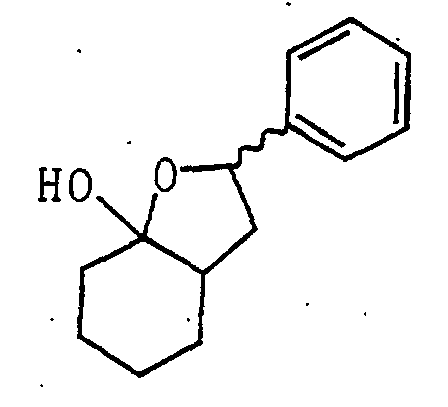
- A mixture of 20 mmol of cyclooctane, 0.4 mmol of N-hydroxyphthalimide, 0.01 mmol of cobalt(II) acetate and 4 ml of acetic acid was stirred at 80°C in an atmosphere of oxygen gas (1 atm = 0.101 MPa) for 3 hours. To the resulting mixture, 2 mmol of 1-octene and 0.002 mmol of manganese (II) acetate were added and were stirred at 80°C in an atmosphere of air (1 atm = 0.101 MPa) over night. The resulting reaction mixture was analyzed to find that α-octylcyclooctanone was produced in a yield of 10%.
- A mixture of 20 mmol of cyclohexane, 2-mmol of 1-octene, 2 mmol of N-hydroxyphthalimide, 0.01 mmol of manganese(II) acetate, 0.002 mmol of cobalt(II) acetate and 1 ml of acetic acid was stirred at 80°C in an atmosphere of oxygen gas (1 atm = 0.101 MPa) for 10 hours. The resulting reaction mixture was analyzed to find that 2-octylcyclohexanone was produced in a yield of 15% with a conversion from 1-octene of 85%.
- A mixture of 20 mmol of cyclohexanone, 2 mmol of 1-octyne, 0.01 mmol of manganese(II) acetate, 0.002 mmol of cobalt(II) acetate and 2 ml of acetic acid was stirred at 50°C in an atmosphere of air (1 atm = 0.101 MPa) for 8 hours. The resulting reaction mixture was analyzed to find that trans-2-(1-octenyl)cyclohexanone and cis-2-(1-octenyl)cyclohexanone were produced in yields of 16% and 13%, respectively, with a conversion from 1-octyne of 45%.
- A mixture of 20 mmol of cyclohexanone, 2 mmol of phenylacetylene, 0.01 mmol of manganese(II) acetate, 0.002 mmol of cobalt(II) acetate and 2 ml of acetic acid was stirred at 50°C in an atmosphere of air (1 atm = 0.101 MPa) for 8 hours. The resulting reaction mixture was analyzed to find that 2-(2-phenyl-1-ethenyl)cyclohexanone was produced in a yield of 20% with a conversion from phenylacetylene of 99%.
- A mixture of 30 mmol of α-acetyl-γ-butyrolactone, 2 mmol of 1-octene, 0.1 mmol of manganese(II) acetate, 0.04 mmol of cobalt (II) acetate and 2 ml of acetic acid was stirred at 90°C in an atmosphere of a gaseous mixture of nitrogen and oxygen (9:1) (1 atm = 0.101 MPa) for 14 hours. The resulting reaction mixture was analyzed to find that α-acetyl-α-octyl-γ-butyrolactone was produced in a yield of 71% with a conversion from 1-octene of 91%.
- A mixture of 30 mmol of ethyl acetoacetate, 2 mmol of 1-octene, 0.1 mmol of manganese(II) acetate, 0.04 mmol of cobalt(II) acetate and 2 ml of acetic acid was stirred at 90°C in an atmosphere of a gaseous mixture of nitrogen and oxygen (9:1) (1 atm = 0.101 MPa) for 5 hours. The resulting reaction mixture was analyzed to find that ethyl 2-octylacetoacetate was produced in a yield of 49% with a conversion from 1-octene of 83%.
- Amixtureof 30 mmol of dimethyl malonate, 2 mmol of 1-octene, 0.04 mmol of manganese(II) acetate, 0.01 mmol of cobalt(II) acetate and 2 ml of acetic acid was stirred at 90°C in an atmosphere of a gaseous mixture of nitrogen and oxygen (9:1) (1 atm = 0.101 MPa) for 3 hours. The resulting reaction mixture was analyzed to find that dimethyl 2-octylmalonate (yield: 56%), dimethyl 2-(2-oxooctyl)malonate (trace amount), α-methoxycarbonyl-γ-hexyl-γ-butyrolactone (yield: 6%), dimethyl 2-(2-octyloctyl)malonate (yield: 5%) and dimethyl 2,2-dioctylmalonate (yield: 3%) were produced with a conversion from 1-octene of 96%.
- Amixture of 30 mmol of dimethyl malonate, 2 mmol of 1-octene, 0.04 mmol of manganese(II) acetate, 0.002 mmol of zirconium hydroxyacetate and 2 ml of acetic acid was stirred at 90°C in an atmosphere of a gaseous mixture of nitrogen and oxygen (9:1) (1 atm = 0.101 MPa) for 3 hours. The resulting reaction mixture was analyzed to find that dimethyl 2-octylmalonate (yield: 22%), dimethyl 2-(2-oxooctyl)malonate (trace amount), α-methoxycarbonyl-γ-hexyl-γ-butyrolactone (trace amount), dimethyl 2-(2-octyloctyl)malonate (yield: 6%) and dimethyl 2,2-dioctylmalonate (yield: 2%) were produced with a conversion from 1-octene of 60%.
- A mixture of 20 mmol of dimethyl 2-methoxymalonate, 2 mmol of 1-octene, 0.1 mmol of manganese(II) acetate, 0.002 mmol of cobalt(II) acetate and 2 ml of acetic acid was stirred at 90°C in an atmosphere of air (1 atm = 0.101 MPa) for 3 hours. The resulting reaction mixture was analyzed to find that dimethyl 2-octyl-2-methoxymalonate was produced in a yield of 12% with a conversion from 1-octene of 23%.
- A mixture of 20 mmol of dimethyl 2-methylmalonate, 2 mmol of 1-octene, 0.04 mmol of manganese(II) acetate, 0.002 mmol of cobalt(II) acetate and 2 ml of acetic acid was stirred at 90°C in an atmosphere of a gaseous mixture of nitrogen and oxygen (9:1) (1 atm = 0.101 MPa) for 3 hours. The resulting reaction mixture was analyzed to find that dimethyl 2-octyl-2-methylmalonate was produced in a yield of 16% with a conversion from 1-octene of 43%.
- A mixture of 30 mmol of malononitrile, 2 mmol of 1-octene, 0.04 mmol of manganese(II) acetate, 0.002 mmol of cobalt(II) acetate and 2 ml of acetic acid was stirred at 90°C in an atmosphere of a gaseous mixture of nitrogen and oxygen (9:1) (1 atm = 0.101 MPa) for 5 hours. The resulting reaction mixture was analyzed to find that 2-octylmalononitrile was produced in a yield of 14% with a conversion from 1-octene of 79%.
- A mixture of 30 mmol of dimethyl malonate, 2 mmol of norbornene, 0.04 mmol of manganese(II) acetate, 0.002 mmol of cobalt(II) acetate and 2 ml of acetic acid was stirred at 90°C in an atmosphere of air (1 atm = 0.101 MPa) for 5 hours. The resulting reaction mixture was analyzed to find that dimethyl 2-(2-norbornyl)malonate was produced in a yield of 62% with a conversion from norbornene of 99%.
- A mixture of 20 mmol of ε-caprolactone, 2 mmol of 1-octane, 0.04 mmol of manganese(II) acetate, 0.002 mmol of cobalt(II) acetate and 2 ml of acetic acid was stirred at 90°C in an atmosphere of a gaseous mixture of nitrogen and oxygen (9:1) (1 atm = 0.101 MPa) for 3 hours. The resulting reaction mixture was analyzed to find that α-octyl-ε-caprolactone was produced in a yield of 32% with a conversion from 1-octene of 68%.
- Amixture of 20 mmol of adipic anhydride, 2 mmol of 1-octene, 0.04 mmol of manganese(II) acetate, 0.002 mmol of cobalt(II) acetate and 2 ml of acetic acid was stirred at 90°C in an atmosphere of a gaseous mixture of nitrogen and oxygen (9:1) (1 atm = 0.101 MPa) for 3 hours. The resulting reaction mixture was analyzed to find that 2-octyladipic anhydride and 2,5-dioctyladipic anhydride were produced in yields of 29% and 2%, respectively, with a conversion from 1-octene of 63%.
- Amixture of 20 mmol of dimethyl adipate, 2 mmol of 1-octene, 0.04 mmol of manganese(II) acetate, 0.002 mmol of cobalt(II) acetate and 2 ml of acetic acid was stirred at 90°C in an atmosphere of a gaseous mixture of nitrogen and oxygen (9:1) (1 atm = 0.101 MPa) for 3 hours. The resulting reaction mixture was analyzed to find that dimethyl 2-octyladipate and dimethyl 2,5-dioctyladipate were produced in yields of 36% and 2%, respectively, with a conversion from 1-octene of 60%.
- A mixture of 20 mmol of adipic acid, 2 mmol of 1-octene, 0.04 mmol of manganese(II) acetate, 0.002 mmol of cobalt(II) acetate and 2 ml of acetic acid was stirred at 90°C in an atmosphere of a gaseous mixture of nitrogen and oxygen (9:1) (1 atm = 0.101 MPa) for 3 hours. The resulting reaction mixture was analyzed to find that 2-octyladipic acid and 2, 5-dioctyladipic acid were produced in yields of 14% and 1%, respectively, with a conversion from 1-octene of 33%.
Claims (3)
- A process for producing an organic compound, the process comprising the step of allowing a compound containing an electron attractive group represented by following Formula (1) :
 wherein Y is an electron attractive group; and Rb and Rc are each independently a hydrogen atom or an organic group, where Y, Rb and Rc may respectively be combined with each other to form a ring with an adjacent carbon atom,
to react with a compound containing an unsaturated carbon-carbon bond represented by following Formula (2) or (7):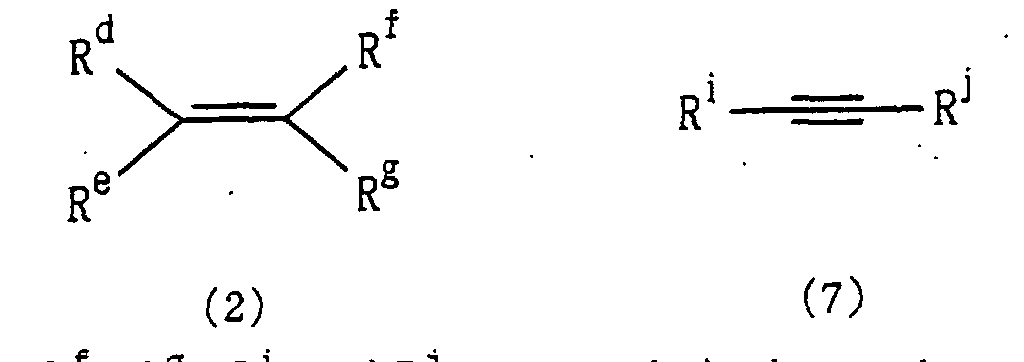 wherein Rd, Re, Rf, Rg, Ri and Rj are each independently a hydrogen atom or an organic group, where Rd, Re, Rf and Rg may respectively be combined with each other to form a ring with one or two adjacent carbon atoms, and Ri and Rj may be combined with each other to form a ring with adjacent two carbon atoms,
in the presence of oxygen and a catalytic compound of a Group 5, 6, 7, 8 or 9 element of the Periodic Table of Elements to yield a compound represented by following Formula (3) or (8) :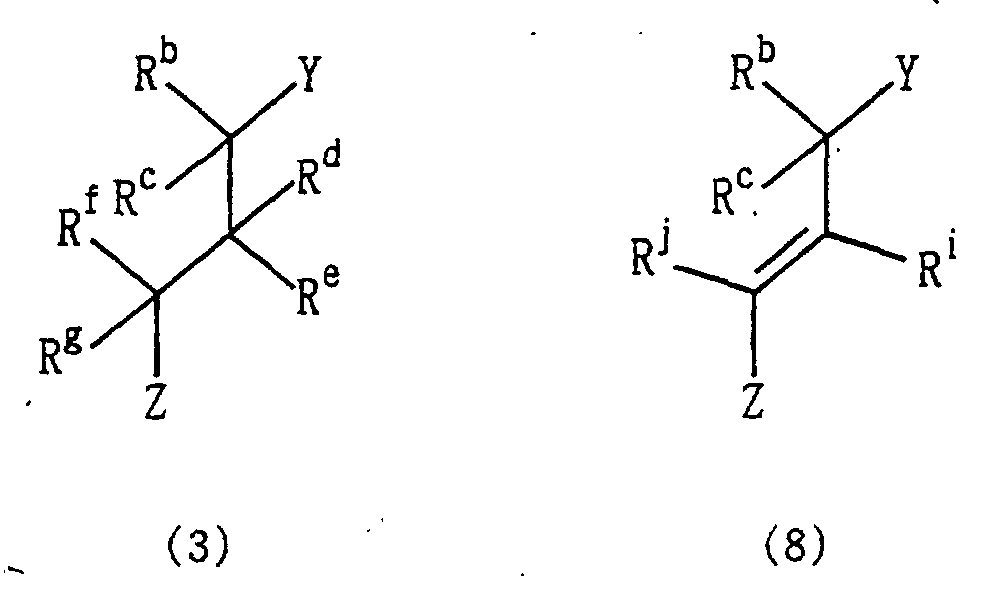 wherein Z is a hydrogen atom or a hydroxyl group; and Y, Rb, Rc, Rd, Re, Rf, Rg, Ri and Rj have the same meanings as defined above.
 - A process for producing an organic compound, the process comprising the step of allowing a compound containing a carbonyl group represented by following Formula (1a):
 wherein Ra is a hydrogen atom or an organic group; and Rb and Rc are each independently a hydrogen atom or an organic group, where Ra, Rb and Rc may respectively be combined with each other to form a ring with adjacent one or two carbon atoms,
to react with an olefin represented by following Formula (2a) :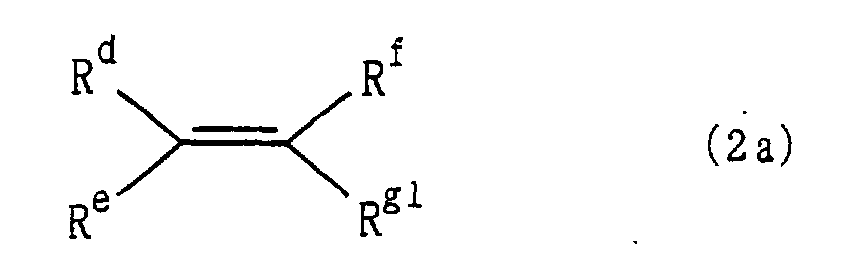 wherein Rd, Re and Rf are each independently a hydrogen atom or an organic group; and Rg1 is an aromatic cyclic group, where Rd, Re, Rf and Rg1 may respectively be combined with each other to form a ring with one or two adjacent carbon atoms,
in the presence of oxygen and a catalytic compound of a Group 5, 6, 7, 8 or 9 element of the Periodic Table of Elements to yield a furanol derivative represented by following Formula (4):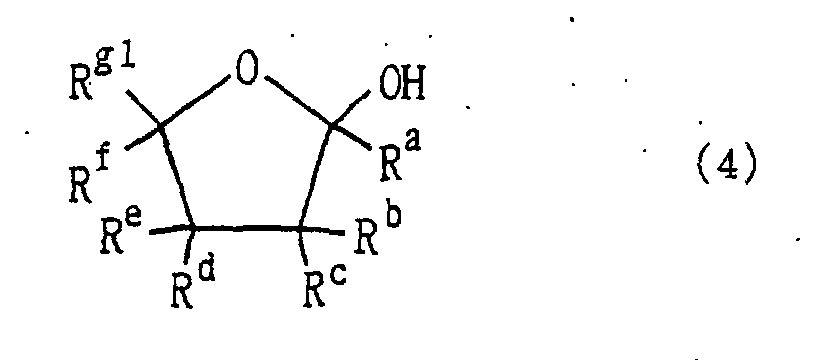 wherein Ra, Rb, Rc, Rd, Re, Rf and Rg1 have the same meanings as defined above.
 - A process for producing an organic compound, the process comprising the step of allowing a compound containing a methylene group represented by following Formula (5):
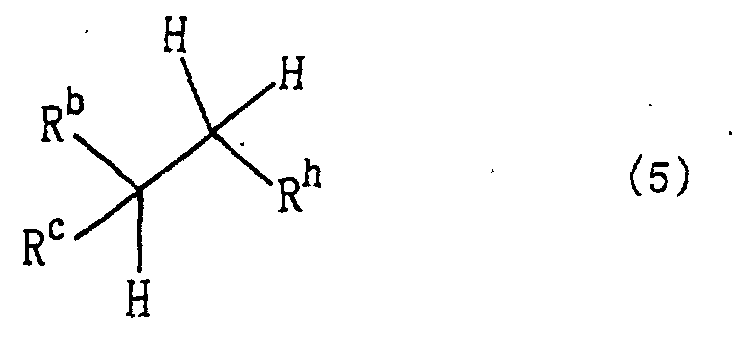 wherein Rb, Rc and Rh are each independently a hydrogen atom or an organic group, where Rb, Rc and Rh may respectively be combined with each other to form a ring with adjacent one or two carbon atoms,
to react with a compound having an unsaturated carbon-carbon bond represented by following Formula (2) or (7): wherein Rd, Re, Rf, Rg, Ri and Rj are each independently a hydrogen atom or an organic group, where Rd, Re, Rf and Rg may respectively be combined with each other to form a ring with one or two adjacent carbon atoms, and Ri and Rj may respectively be combined with each other to form a ring with adjacent two carbon atoms, in the presence of oxygen, a catalytic compound of a Group 5, 6, 7, 8 or 9 element of the Periodic Table of Elements and an imide compound represented by following Formula (6):
 wherein R1 and R2 are the same or different and are each a hydrogen atom, a halogen atom, an alkyl group, an aryl group, a cycloalkyl group, a hydroxyl group, an alkoxy group, a carboxyl group, an alkoxycarbonyl group or an acyl group, where R1 and R2 may be combined to form a double bond or an aromatic or non-aromatic ring; X is an oxygen atom or a hydroxyl group; and one or two of N-substituted cyclic imido group indicated in the formula may be further formed on R1, R2, or on the double bond or aromatic or non-aromatic ring formed together by R1 and R2, to yield a carbonyl compound represented by following Formula (3a) or (8a) :
 wherein Z is a hydrogen atom or a hydroxyl group; and Rb, Rc, Rh, Rd, Re, Rf, Rg, Ri and Rj have the same meanings as defined above.
Applications Claiming Priority (3)
| Application Number | Priority Date | Filing Date | Title |
|---|---|---|---|
| JP2000067679 | 2000-03-10 | ||
| JP2000067679 | 2000-03-10 | ||
| PCT/JP2001/001813 WO2001066501A1 (en) | 2000-03-10 | 2001-03-08 | Process for the preparation of organic compounds with manganese catalysts or the like |
Publications (3)
| Publication Number | Publication Date |
|---|---|
| EP1178031A1 true EP1178031A1 (en) | 2002-02-06 |
| EP1178031A4 EP1178031A4 (en) | 2007-04-18 |
| EP1178031B1 EP1178031B1 (en) | 2012-02-01 |
Family
ID=18586831
Family Applications (1)
| Application Number | Title | Priority Date | Filing Date |
|---|---|---|---|
| EP01912189A Expired - Lifetime EP1178031B1 (en) | 2000-03-10 | 2001-03-08 | Process for the preparation of organic compounds with manganese catalysts or the like |
Country Status (4)
| Country | Link |
|---|---|
| US (1) | US6548713B2 (en) |
| EP (1) | EP1178031B1 (en) |
| JP (1) | JP4912557B2 (en) |
| WO (1) | WO2001066501A1 (en) |
Cited By (2)
| Publication number | Priority date | Publication date | Assignee | Title |
|---|---|---|---|---|
| EP1826202A1 (en) * | 2006-02-23 | 2007-08-29 | Daicel Chemical Industries, Ltd. | Process for the preparation of furan compounds |
| US9139553B2 (en) | 2006-03-21 | 2015-09-22 | The Governors Of The University Of Alberta | Poly(ethylene oxide)-block-poly(ester) block copolymers |
Families Citing this family (4)
| Publication number | Priority date | Publication date | Assignee | Title |
|---|---|---|---|---|
| WO2004046835A2 (en) | 2002-11-15 | 2004-06-03 | Applied Materials, Inc. | Method, system and medium for controlling manufacture process having multivariate input parameters |
| CN101575274B (en) * | 2009-06-10 | 2012-01-11 | 北京北大正元科技有限公司 | The preparation method of 2-alkylcyclopentene (hexanone) |
| CN102516048B (en) * | 2009-06-10 | 2014-03-19 | 北京北大正元科技有限公司 | Preparation method for 2-alkyl-cyclopentanone (cyclohexanone) by using tert-butyl peroxybenzonate |
| EP3050869B1 (en) * | 2015-01-30 | 2019-10-02 | Symrise AG | Method for the preparation of substituted alkyl cycloalkanones |
Family Cites Families (5)
| Publication number | Priority date | Publication date | Assignee | Title |
|---|---|---|---|---|
| US3429901A (en) | 1965-01-05 | 1969-02-25 | Eastman Kodak Co | Telomerization process |
| IT1087514B (en) | 1977-09-14 | 1985-06-04 | Snam Progetti | PROCEDURE FOR THE PREPARATION OF CARBONYL COMPOUNDS |
| JP3314519B2 (en) | 1994-03-10 | 2002-08-12 | 日亜化学工業株式会社 | Method for producing unsaturated carbonyl compound |
| WO1997028897A1 (en) | 1996-02-07 | 1997-08-14 | Daicel Chemical Industries, Ltd. | Oxidation catalyst system and process for oxidation with the same |
| JP3831012B2 (en) * | 1996-02-09 | 2006-10-11 | ダイセル化学工業株式会社 | Method for oxidizing conjugated compounds |
-
2001
- 2001-03-08 WO PCT/JP2001/001813 patent/WO2001066501A1/en not_active Ceased
- 2001-03-08 JP JP2001565322A patent/JP4912557B2/en not_active Expired - Fee Related
- 2001-03-08 US US09/959,843 patent/US6548713B2/en not_active Expired - Fee Related
- 2001-03-08 EP EP01912189A patent/EP1178031B1/en not_active Expired - Lifetime
Non-Patent Citations (2)
| Title |
|---|
| IWAHAMA, TAKAHIRO ET AL: "Catalytic radical addition of ketones to alkenes by a metal-dioxygen redox system" CHEMICAL COMMUNICATIONS (CAMBRIDGE) , (23), 2317-2318 CODEN: CHCOFS; ISSN: 1359-7345, 2000, XP002423965 * |
| See also references of WO0166501A1 * |
Cited By (3)
| Publication number | Priority date | Publication date | Assignee | Title |
|---|---|---|---|---|
| EP1826202A1 (en) * | 2006-02-23 | 2007-08-29 | Daicel Chemical Industries, Ltd. | Process for the preparation of furan compounds |
| US7608727B2 (en) | 2006-02-23 | 2009-10-27 | Daicel Chemical Industries, Ltd. | Process for the preparation of furan compounds |
| US9139553B2 (en) | 2006-03-21 | 2015-09-22 | The Governors Of The University Of Alberta | Poly(ethylene oxide)-block-poly(ester) block copolymers |
Also Published As
| Publication number | Publication date |
|---|---|
| EP1178031A4 (en) | 2007-04-18 |
| US20020165416A1 (en) | 2002-11-07 |
| EP1178031B1 (en) | 2012-02-01 |
| JP4912557B2 (en) | 2012-04-11 |
| US6548713B2 (en) | 2003-04-15 |
| WO2001066501A1 (en) | 2001-09-13 |
Similar Documents
| Publication | Publication Date | Title |
|---|---|---|
| Khumtaveeporn et al. | Transition metal mediated carbonylative ring expansion of heterocyclic compounds | |
| KR100472895B1 (en) | Oxidation Catalytic System and Oxidation Process Using the Same | |
| EP1338336B1 (en) | Use of catalysts comprising n-substituted cyclic imides for preparing organic compounds | |
| CA2597120C (en) | Methods for oxidizing organic compounds | |
| US6548713B2 (en) | Process for the preparation of organic compounds with manganese catalysts or the like | |
| US6229050B1 (en) | Process for the preparation of hydroxyadamantanone derivatives | |
| EP1754693B1 (en) | Process for the production of esters or lactones | |
| JP2000256342A (en) | Method for producing ester or lactone | |
| KR20090128457A (en) | Process for preparing esters or lactones | |
| CA2436939C (en) | Process for producing dicarboxylic acids | |
| JPWO2001066501A1 (en) | Manufacturing method of organic compounds using manganese catalysts | |
| KR19980086962A (en) | Oxygenation catalyst and preparation method of ketone using same | |
| JP3831012B2 (en) | Method for oxidizing conjugated compounds | |
| JP2007254457A (en) | Production of furan compounds | |
| JP4640877B2 (en) | Method for producing organic compound using imide compound as catalyst | |
| JP4024562B2 (en) | Production method of ketones | |
| JP3998845B2 (en) | Production method of carboxylic acid | |
| JP2001192354A (en) | Method for producing β-acyloxycarboxylic acid or β-acyloxyketone | |
| JP4107696B2 (en) | Method for producing epoxy compound | |
| JP5091774B2 (en) | Oxidation catalyst system | |
| JP4024637B2 (en) | Production method of carboxylic acid using manganese catalyst | |
| JP4865742B2 (en) | Method for producing epoxy compound | |
| EP1132369B1 (en) | Malic acid and oxalacetic acid derivatives | |
| JP2003183272A (en) | Method for producing ester | |
| JP2002226422A (en) | Method for producing carbonyl compound using imide compound as catalyst |
Legal Events
| Date | Code | Title | Description |
|---|---|---|---|
| PUAI | Public reference made under article 153(3) epc to a published international application that has entered the european phase |
Free format text: ORIGINAL CODE: 0009012 |
|
| AK | Designated contracting states |
Kind code of ref document: A1 Designated state(s): AT BE CH CY DE DK ES FI FR GB GR IE IT LI LU MC NL PT SE TR |
|
| 17P | Request for examination filed |
Effective date: 20020306 |
|
| RBV | Designated contracting states (corrected) |
Designated state(s): DE FR GB |
|
| A4 | Supplementary search report drawn up and despatched |
Effective date: 20070321 |
|
| RIC1 | Information provided on ipc code assigned before grant |
Ipc: C07C 45/33 20060101ALI20070313BHEP Ipc: C07C 67/347 20060101ALI20070313BHEP Ipc: C07C 45/69 20060101AFI20010918BHEP Ipc: C07D 307/00 20060101ALI20070313BHEP Ipc: C07C 253/30 20060101ALI20070313BHEP |
|
| 17Q | First examination report despatched |
Effective date: 20071106 |
|
| RAP1 | Party data changed (applicant data changed or rights of an application transferred) |
Owner name: DAICEL CHEMICAL INDUSTRIES, LTD. |
|
| GRAP | Despatch of communication of intention to grant a patent |
Free format text: ORIGINAL CODE: EPIDOSNIGR1 |
|
| GRAS | Grant fee paid |
Free format text: ORIGINAL CODE: EPIDOSNIGR3 |
|
| GRAA | (expected) grant |
Free format text: ORIGINAL CODE: 0009210 |
|
| AK | Designated contracting states |
Kind code of ref document: B1 Designated state(s): DE FR GB |
|
| REG | Reference to a national code |
Ref country code: GB Ref legal event code: FG4D |
|
| REG | Reference to a national code |
Ref country code: DE Ref legal event code: R096 Ref document number: 60146066 Country of ref document: DE Effective date: 20120329 |
|
| PGFP | Annual fee paid to national office [announced via postgrant information from national office to epo] |
Ref country code: GB Payment date: 20120327 Year of fee payment: 12 |
|
| PGFP | Annual fee paid to national office [announced via postgrant information from national office to epo] |
Ref country code: DE Payment date: 20120328 Year of fee payment: 12 |
|
| PLBE | No opposition filed within time limit |
Free format text: ORIGINAL CODE: 0009261 |
|
| STAA | Information on the status of an ep patent application or granted ep patent |
Free format text: STATUS: NO OPPOSITION FILED WITHIN TIME LIMIT |
|
| REG | Reference to a national code |
Ref country code: FR Ref legal event code: ST Effective date: 20121130 |
|
| 26N | No opposition filed |
Effective date: 20121105 |
|
| PG25 | Lapsed in a contracting state [announced via postgrant information from national office to epo] |
Ref country code: FR Free format text: LAPSE BECAUSE OF NON-PAYMENT OF DUE FEES Effective date: 20120402 |
|
| REG | Reference to a national code |
Ref country code: DE Ref legal event code: R097 Ref document number: 60146066 Country of ref document: DE Effective date: 20121105 |
|
| GBPC | Gb: european patent ceased through non-payment of renewal fee |
Effective date: 20130308 |
|
| REG | Reference to a national code |
Ref country code: DE Ref legal event code: R119 Ref document number: 60146066 Country of ref document: DE Effective date: 20131001 |
|
| PG25 | Lapsed in a contracting state [announced via postgrant information from national office to epo] |
Ref country code: DE Free format text: LAPSE BECAUSE OF NON-PAYMENT OF DUE FEES Effective date: 20131001 Ref country code: GB Free format text: LAPSE BECAUSE OF NON-PAYMENT OF DUE FEES Effective date: 20130308 |