EP1177911A1 - Photosensitive recording element and method of preparation thereof - Google Patents
Photosensitive recording element and method of preparation thereof Download PDFInfo
- Publication number
- EP1177911A1 EP1177911A1 EP01306757A EP01306757A EP1177911A1 EP 1177911 A1 EP1177911 A1 EP 1177911A1 EP 01306757 A EP01306757 A EP 01306757A EP 01306757 A EP01306757 A EP 01306757A EP 1177911 A1 EP1177911 A1 EP 1177911A1
- Authority
- EP
- European Patent Office
- Prior art keywords
- layer
- imagable
- composition
- substrate
- radiation
- Prior art date
- Legal status (The legal status is an assumption and is not a legal conclusion. Google has not performed a legal analysis and makes no representation as to the accuracy of the status listed.)
- Withdrawn
Links
- 238000000034 method Methods 0.000 title claims description 33
- 238000002360 preparation method Methods 0.000 title description 5
- 239000000203 mixture Substances 0.000 claims abstract description 87
- 230000005855 radiation Effects 0.000 claims abstract description 69
- 239000000758 substrate Substances 0.000 claims abstract description 55
- 238000002679 ablation Methods 0.000 claims description 27
- 229920000642 polymer Polymers 0.000 claims description 22
- 229920001577 copolymer Polymers 0.000 claims description 19
- 150000001875 compounds Chemical class 0.000 claims description 18
- 239000000463 material Substances 0.000 claims description 18
- 239000011230 binding agent Substances 0.000 claims description 16
- 230000008569 process Effects 0.000 claims description 9
- ISWSIDIOOBJBQZ-UHFFFAOYSA-N phenol group Chemical group C1(=CC=CC=C1)O ISWSIDIOOBJBQZ-UHFFFAOYSA-N 0.000 claims description 8
- 239000002253 acid Substances 0.000 claims description 7
- 229920001568 phenolic resin Polymers 0.000 claims description 7
- WSFSSNUMVMOOMR-NJFSPNSNSA-N methanone Chemical compound O=[14CH2] WSFSSNUMVMOOMR-NJFSPNSNSA-N 0.000 claims description 6
- QVEIBLDXZNGPHR-UHFFFAOYSA-N naphthalene-1,4-dione;diazide Chemical compound [N-]=[N+]=[N-].[N-]=[N+]=[N-].C1=CC=C2C(=O)C=CC(=O)C2=C1 QVEIBLDXZNGPHR-UHFFFAOYSA-N 0.000 claims description 6
- 239000005011 phenolic resin Substances 0.000 claims description 6
- 125000000852 azido group Chemical group *N=[N+]=[N-] 0.000 claims description 5
- 125000000751 azo group Chemical group [*]N=N[*] 0.000 claims description 5
- 150000003839 salts Chemical class 0.000 claims description 4
- 229920000178 Acrylic resin Polymers 0.000 claims description 3
- 239000004925 Acrylic resin Substances 0.000 claims description 3
- XLLXMBCBJGATSP-UHFFFAOYSA-N 2-phenylethenol Chemical class OC=CC1=CC=CC=C1 XLLXMBCBJGATSP-UHFFFAOYSA-N 0.000 claims description 2
- 239000012949 free radical photoinitiator Substances 0.000 claims 2
- QJGQUHMNIGDVPM-UHFFFAOYSA-N nitrogen group Chemical group [N] QJGQUHMNIGDVPM-UHFFFAOYSA-N 0.000 claims 2
- 239000003504 photosensitizing agent Substances 0.000 claims 2
- WTQZSMDDRMKJRI-UHFFFAOYSA-N 4-diazoniophenolate Chemical compound [O-]C1=CC=C([N+]#N)C=C1 WTQZSMDDRMKJRI-UHFFFAOYSA-N 0.000 claims 1
- 238000007639 printing Methods 0.000 abstract description 34
- 239000000126 substance Substances 0.000 abstract description 7
- 239000010410 layer Substances 0.000 description 211
- 239000000243 solution Substances 0.000 description 32
- 229920005989 resin Polymers 0.000 description 29
- 239000011347 resin Substances 0.000 description 29
- 239000012954 diazonium Substances 0.000 description 25
- 230000005670 electromagnetic radiation Effects 0.000 description 17
- IJGRMHOSHXDMSA-UHFFFAOYSA-O diazynium Chemical compound [NH+]#N IJGRMHOSHXDMSA-UHFFFAOYSA-O 0.000 description 15
- 150000001989 diazonium salts Chemical class 0.000 description 14
- 239000000047 product Substances 0.000 description 13
- ZWEHNKRNPOVVGH-UHFFFAOYSA-N 2-Butanone Chemical compound CCC(C)=O ZWEHNKRNPOVVGH-UHFFFAOYSA-N 0.000 description 12
- 229910052782 aluminium Inorganic materials 0.000 description 11
- XAGFODPZIPBFFR-UHFFFAOYSA-N aluminium Chemical compound [Al] XAGFODPZIPBFFR-UHFFFAOYSA-N 0.000 description 11
- 239000000975 dye Substances 0.000 description 11
- 239000000049 pigment Substances 0.000 description 11
- -1 silver halide Chemical class 0.000 description 10
- PLXMOAALOJOTIY-FPTXNFDTSA-N Aesculin Natural products OC[C@@H]1[C@@H](O)[C@H](O)[C@@H](O)[C@H](O)[C@H]1Oc2cc3C=CC(=O)Oc3cc2O PLXMOAALOJOTIY-FPTXNFDTSA-N 0.000 description 9
- WSFSSNUMVMOOMR-UHFFFAOYSA-N Formaldehyde Chemical compound O=C WSFSSNUMVMOOMR-UHFFFAOYSA-N 0.000 description 9
- 238000006068 polycondensation reaction Methods 0.000 description 9
- 229920002554 vinyl polymer Polymers 0.000 description 9
- 229920003986 novolac Polymers 0.000 description 8
- 238000010521 absorption reaction Methods 0.000 description 7
- 238000000576 coating method Methods 0.000 description 7
- 238000003384 imaging method Methods 0.000 description 7
- 150000001299 aldehydes Chemical class 0.000 description 6
- 125000003118 aryl group Chemical group 0.000 description 6
- 239000011248 coating agent Substances 0.000 description 6
- 238000011161 development Methods 0.000 description 6
- 238000005516 engineering process Methods 0.000 description 6
- 239000000178 monomer Substances 0.000 description 6
- 239000002904 solvent Substances 0.000 description 6
- ZRYCRPNCXLQHPN-UHFFFAOYSA-N 3-hydroxy-2-methylbenzaldehyde Chemical compound CC1=C(O)C=CC=C1C=O ZRYCRPNCXLQHPN-UHFFFAOYSA-N 0.000 description 5
- ABLZXFCXXLZCGV-UHFFFAOYSA-N Phosphorous acid Chemical compound OP(O)=O ABLZXFCXXLZCGV-UHFFFAOYSA-N 0.000 description 5
- 125000000217 alkyl group Chemical group 0.000 description 5
- 239000007788 liquid Substances 0.000 description 5
- 238000004519 manufacturing process Methods 0.000 description 5
- 229920002451 polyvinyl alcohol Polymers 0.000 description 5
- XNWFRZJHXBZDAG-UHFFFAOYSA-N 2-METHOXYETHANOL Chemical compound COCCO XNWFRZJHXBZDAG-UHFFFAOYSA-N 0.000 description 4
- NBIIXXVUZAFLBC-UHFFFAOYSA-N Phosphoric acid Chemical compound OP(O)(O)=O NBIIXXVUZAFLBC-UHFFFAOYSA-N 0.000 description 4
- QAOWNCQODCNURD-UHFFFAOYSA-N Sulfuric acid Chemical compound OS(O)(=O)=O QAOWNCQODCNURD-UHFFFAOYSA-N 0.000 description 4
- 150000001450 anions Chemical group 0.000 description 4
- 239000007795 chemical reaction product Substances 0.000 description 4
- USIUVYZYUHIAEV-UHFFFAOYSA-N diphenyl ether Chemical compound C=1C=CC=CC=1OC1=CC=CC=C1 USIUVYZYUHIAEV-UHFFFAOYSA-N 0.000 description 4
- 229910052751 metal Inorganic materials 0.000 description 4
- 239000002184 metal Substances 0.000 description 4
- WQGWDDDVZFFDIG-UHFFFAOYSA-N pyrogallol Chemical compound OC1=CC=CC(O)=C1O WQGWDDDVZFFDIG-UHFFFAOYSA-N 0.000 description 4
- 229910052709 silver Inorganic materials 0.000 description 4
- 239000004332 silver Substances 0.000 description 4
- 239000011877 solvent mixture Substances 0.000 description 4
- XLYOFNOQVPJJNP-UHFFFAOYSA-N water Substances O XLYOFNOQVPJJNP-UHFFFAOYSA-N 0.000 description 4
- 125000004178 (C1-C4) alkyl group Chemical group 0.000 description 3
- KETQAJRQOHHATG-UHFFFAOYSA-N 1,2-naphthoquinone Chemical compound C1=CC=C2C(=O)C(=O)C=CC2=C1 KETQAJRQOHHATG-UHFFFAOYSA-N 0.000 description 3
- 229940105324 1,2-naphthoquinone Drugs 0.000 description 3
- 229920000742 Cotton Polymers 0.000 description 3
- OKKJLVBELUTLKV-UHFFFAOYSA-N Methanol Chemical compound OC OKKJLVBELUTLKV-UHFFFAOYSA-N 0.000 description 3
- XTXRWKRVRITETP-UHFFFAOYSA-N Vinyl acetate Chemical compound CC(=O)OC=C XTXRWKRVRITETP-UHFFFAOYSA-N 0.000 description 3
- 125000003710 aryl alkyl group Chemical group 0.000 description 3
- 230000001680 brushing effect Effects 0.000 description 3
- ZTQSAGDEMFDKMZ-UHFFFAOYSA-N butyric aldehyde Natural products CCCC=O ZTQSAGDEMFDKMZ-UHFFFAOYSA-N 0.000 description 3
- 125000004432 carbon atom Chemical group C* 0.000 description 3
- 238000009833 condensation Methods 0.000 description 3
- 230000005494 condensation Effects 0.000 description 3
- 239000007859 condensation product Substances 0.000 description 3
- 125000000664 diazo group Chemical group [N-]=[N+]=[*] 0.000 description 3
- 229910052739 hydrogen Inorganic materials 0.000 description 3
- 239000001257 hydrogen Substances 0.000 description 3
- 150000002576 ketones Chemical class 0.000 description 3
- 238000007645 offset printing Methods 0.000 description 3
- 235000019422 polyvinyl alcohol Nutrition 0.000 description 3
- 238000004528 spin coating Methods 0.000 description 3
- HJIAMFHSAAEUKR-UHFFFAOYSA-N (2-hydroxyphenyl)-phenylmethanone Chemical compound OC1=CC=CC=C1C(=O)C1=CC=CC=C1 HJIAMFHSAAEUKR-UHFFFAOYSA-N 0.000 description 2
- LXFQSRIDYRFTJW-UHFFFAOYSA-N 2,4,6-trimethylbenzenesulfonic acid Chemical compound CC1=CC(C)=C(S(O)(=O)=O)C(C)=C1 LXFQSRIDYRFTJW-UHFFFAOYSA-N 0.000 description 2
- ZRUOTKQBVMWMDK-UHFFFAOYSA-N 2-hydroxy-6-methylbenzaldehyde Chemical compound CC1=CC=CC(O)=C1C=O ZRUOTKQBVMWMDK-UHFFFAOYSA-N 0.000 description 2
- KXGFMDJXCMQABM-UHFFFAOYSA-N 2-methoxy-6-methylphenol Chemical compound [CH]OC1=CC=CC([CH])=C1O KXGFMDJXCMQABM-UHFFFAOYSA-N 0.000 description 2
- CSCPPACGZOOCGX-UHFFFAOYSA-N Acetone Chemical compound CC(C)=O CSCPPACGZOOCGX-UHFFFAOYSA-N 0.000 description 2
- VEXZGXHMUGYJMC-UHFFFAOYSA-N Hydrochloric acid Chemical compound Cl VEXZGXHMUGYJMC-UHFFFAOYSA-N 0.000 description 2
- VVQNEPGJFQJSBK-UHFFFAOYSA-N Methyl methacrylate Chemical compound COC(=O)C(C)=C VVQNEPGJFQJSBK-UHFFFAOYSA-N 0.000 description 2
- 239000004372 Polyvinyl alcohol Substances 0.000 description 2
- NBBJYMSMWIIQGU-UHFFFAOYSA-N Propionic aldehyde Chemical compound CCC=O NBBJYMSMWIIQGU-UHFFFAOYSA-N 0.000 description 2
- PPBRXRYQALVLMV-UHFFFAOYSA-N Styrene Chemical compound C=CC1=CC=CC=C1 PPBRXRYQALVLMV-UHFFFAOYSA-N 0.000 description 2
- 150000001252 acrylic acid derivatives Chemical class 0.000 description 2
- 229910000147 aluminium phosphate Inorganic materials 0.000 description 2
- PYKYMHQGRFAEBM-UHFFFAOYSA-N anthraquinone Natural products CCC(=O)c1c(O)c2C(=O)C3C(C=CC=C3O)C(=O)c2cc1CC(=O)OC PYKYMHQGRFAEBM-UHFFFAOYSA-N 0.000 description 2
- 150000004056 anthraquinones Chemical class 0.000 description 2
- 239000007864 aqueous solution Substances 0.000 description 2
- 230000008901 benefit Effects 0.000 description 2
- HUMNYLRZRPPJDN-UHFFFAOYSA-N benzaldehyde Chemical compound O=CC1=CC=CC=C1 HUMNYLRZRPPJDN-UHFFFAOYSA-N 0.000 description 2
- 239000006229 carbon black Substances 0.000 description 2
- 239000003795 chemical substances by application Substances 0.000 description 2
- LDHQCZJRKDOVOX-NSCUHMNNSA-M crotonate Chemical compound C\C=C\C([O-])=O LDHQCZJRKDOVOX-NSCUHMNNSA-M 0.000 description 2
- 230000007423 decrease Effects 0.000 description 2
- FHIVAFMUCKRCQO-UHFFFAOYSA-N diazinon Chemical compound CCOP(=S)(OCC)OC1=CC(C)=NC(C(C)C)=N1 FHIVAFMUCKRCQO-UHFFFAOYSA-N 0.000 description 2
- USEUJPGSYMRJHM-UHFFFAOYSA-N formaldehyde;4-methylphenol Chemical compound O=C.CC1=CC=C(O)C=C1 USEUJPGSYMRJHM-UHFFFAOYSA-N 0.000 description 2
- 239000007789 gas Substances 0.000 description 2
- 238000007756 gravure coating Methods 0.000 description 2
- 125000004435 hydrogen atom Chemical group [H]* 0.000 description 2
- 125000004356 hydroxy functional group Chemical group O* 0.000 description 2
- 125000002887 hydroxy group Chemical group [H]O* 0.000 description 2
- 230000007246 mechanism Effects 0.000 description 2
- 150000002734 metacrylic acid derivatives Chemical class 0.000 description 2
- 125000002496 methyl group Chemical group [H]C([H])([H])* 0.000 description 2
- 230000005012 migration Effects 0.000 description 2
- 238000013508 migration Methods 0.000 description 2
- 238000012986 modification Methods 0.000 description 2
- 230000004048 modification Effects 0.000 description 2
- 239000002245 particle Substances 0.000 description 2
- 229920000728 polyester Polymers 0.000 description 2
- 238000001556 precipitation Methods 0.000 description 2
- 239000003755 preservative agent Substances 0.000 description 2
- 238000012545 processing Methods 0.000 description 2
- 230000001681 protective effect Effects 0.000 description 2
- 229940079877 pyrogallol Drugs 0.000 description 2
- 229920003987 resole Polymers 0.000 description 2
- 238000001228 spectrum Methods 0.000 description 2
- CXVGEDCSTKKODG-UHFFFAOYSA-N sulisobenzone Chemical compound C1=C(S(O)(=O)=O)C(OC)=CC(O)=C1C(=O)C1=CC=CC=C1 CXVGEDCSTKKODG-UHFFFAOYSA-N 0.000 description 2
- QGKMIGUHVLGJBR-UHFFFAOYSA-M (4z)-1-(3-methylbutyl)-4-[[1-(3-methylbutyl)quinolin-1-ium-4-yl]methylidene]quinoline;iodide Chemical compound [I-].C12=CC=CC=C2N(CCC(C)C)C=CC1=CC1=CC=[N+](CCC(C)C)C2=CC=CC=C12 QGKMIGUHVLGJBR-UHFFFAOYSA-M 0.000 description 1
- 229920002818 (Hydroxyethyl)methacrylate Polymers 0.000 description 1
- FRASJONUBLZVQX-UHFFFAOYSA-N 1,4-naphthoquinone Chemical compound C1=CC=C2C(=O)C=CC(=O)C2=C1 FRASJONUBLZVQX-UHFFFAOYSA-N 0.000 description 1
- QHIGBUQIFLDZPZ-UHFFFAOYSA-N 1-[(4e)-4-diazo-2-methoxycyclohexa-1,5-dien-1-yl]pyrrolidine Chemical compound C1=CC(=[N+]=[N-])CC(OC)=C1N1CCCC1 QHIGBUQIFLDZPZ-UHFFFAOYSA-N 0.000 description 1
- FHDQFPCQZMLBFE-UHFFFAOYSA-N 1-[(4e)-4-diazo-2-methylcyclohexa-1,5-dien-1-yl]pyrrolidine Chemical compound C1=CC(=[N+]=[N-])CC(C)=C1N1CCCC1 FHDQFPCQZMLBFE-UHFFFAOYSA-N 0.000 description 1
- SIKJAQJRHWYJAI-UHFFFAOYSA-O 1H-indol-1-ium Chemical compound C1=CC=C2[NH2+]C=CC2=C1 SIKJAQJRHWYJAI-UHFFFAOYSA-O 0.000 description 1
- OXBLVCZKDOZZOJ-UHFFFAOYSA-N 2,3-Dihydrothiophene Chemical compound C1CC=CS1 OXBLVCZKDOZZOJ-UHFFFAOYSA-N 0.000 description 1
- LXFQSRIDYRFTJW-UHFFFAOYSA-M 2,4,6-trimethylbenzenesulfonate Chemical compound CC1=CC(C)=C(S([O-])(=O)=O)C(C)=C1 LXFQSRIDYRFTJW-UHFFFAOYSA-M 0.000 description 1
- IRLYGRLEBKCYPY-UHFFFAOYSA-N 2,5-dimethylbenzenesulfonic acid Chemical compound CC1=CC=C(C)C(S(O)(=O)=O)=C1 IRLYGRLEBKCYPY-UHFFFAOYSA-N 0.000 description 1
- JLZIIHMTTRXXIN-UHFFFAOYSA-N 2-(2-hydroxy-4-methoxybenzoyl)benzoic acid Chemical compound OC1=CC(OC)=CC=C1C(=O)C1=CC=CC=C1C(O)=O JLZIIHMTTRXXIN-UHFFFAOYSA-N 0.000 description 1
- JECYNCQXXKQDJN-UHFFFAOYSA-N 2-(2-methylhexan-2-yloxymethyl)oxirane Chemical compound CCCCC(C)(C)OCC1CO1 JECYNCQXXKQDJN-UHFFFAOYSA-N 0.000 description 1
- YHCGGLXPGFJNCO-UHFFFAOYSA-N 2-(2H-benzotriazol-4-yl)phenol Chemical class OC1=CC=CC=C1C1=CC=CC2=C1N=NN2 YHCGGLXPGFJNCO-UHFFFAOYSA-N 0.000 description 1
- DXMQZKIEVHKNTN-UHFFFAOYSA-N 2-[carbamimidoyl(ethyl)amino]acetic acid Chemical compound CCN(C(N)=N)CC(O)=O DXMQZKIEVHKNTN-UHFFFAOYSA-N 0.000 description 1
- GNTARUIZNIWBCN-UHFFFAOYSA-N 2-chloro-5-nitrobenzenesulfonic acid Chemical compound OS(=O)(=O)C1=CC([N+]([O-])=O)=CC=C1Cl GNTARUIZNIWBCN-UHFFFAOYSA-N 0.000 description 1
- AGIJRRREJXSQJR-UHFFFAOYSA-N 2h-thiazine Chemical compound N1SC=CC=C1 AGIJRRREJXSQJR-UHFFFAOYSA-N 0.000 description 1
- QDWTXRWOKORYQH-UHFFFAOYSA-N 3-bromobenzenesulfonic acid Chemical compound OS(=O)(=O)C1=CC=CC(Br)=C1 QDWTXRWOKORYQH-UHFFFAOYSA-N 0.000 description 1
- IQOJIHIRSVQTJJ-UHFFFAOYSA-N 3-chlorobenzenesulfonic acid Chemical compound OS(=O)(=O)C1=CC=CC(Cl)=C1 IQOJIHIRSVQTJJ-UHFFFAOYSA-N 0.000 description 1
- ABSXMLODUTXQDJ-UHFFFAOYSA-N 4-(4-sulfophenyl)benzenesulfonic acid Chemical compound C1=CC(S(=O)(=O)O)=CC=C1C1=CC=C(S(O)(=O)=O)C=C1 ABSXMLODUTXQDJ-UHFFFAOYSA-N 0.000 description 1
- SCETWWDGKCBPMK-UHFFFAOYSA-N 4-[(4e)-4-diazocyclohexa-1,5-dien-1-yl]morpholine Chemical compound C1=CC(=[N+]=[N-])CC=C1N1CCOCC1 SCETWWDGKCBPMK-UHFFFAOYSA-N 0.000 description 1
- CZRVTBRNFOROAU-UHFFFAOYSA-N 4-[(4z)-4-diazo-3,6-diethoxycyclohexa-1,5-dien-1-yl]morpholine Chemical compound CCOC1=CC(=[N+]=[N-])C(OCC)C=C1N1CCOCC1 CZRVTBRNFOROAU-UHFFFAOYSA-N 0.000 description 1
- LMVXMJUMQJUKDF-UHFFFAOYSA-N 4-anilino-2-methoxybenzenediazonium Chemical class C1=C([N+]#N)C(OC)=CC(NC=2C=CC=CC=2)=C1 LMVXMJUMQJUKDF-UHFFFAOYSA-N 0.000 description 1
- BIHDOXAXFMXYDF-UHFFFAOYSA-N 4-anilinobenzenediazonium Chemical compound C1=CC([N+]#N)=CC=C1NC1=CC=CC=C1 BIHDOXAXFMXYDF-UHFFFAOYSA-N 0.000 description 1
- LAXPFHMCFLHGKK-UHFFFAOYSA-N 4-diazo-n,n-dimethylcyclohexa-1,5-dien-1-amine Chemical compound CN(C)C1=CCC(=[N+]=[N-])C=C1 LAXPFHMCFLHGKK-UHFFFAOYSA-N 0.000 description 1
- ZDTXQHVBLWYPHS-UHFFFAOYSA-N 4-nitrotoluene-2-sulfonic acid Chemical compound CC1=CC=C([N+]([O-])=O)C=C1S(O)(=O)=O ZDTXQHVBLWYPHS-UHFFFAOYSA-N 0.000 description 1
- YLKCHWCYYNKADS-UHFFFAOYSA-N 5-hydroxynaphthalene-1-sulfonic acid Chemical compound C1=CC=C2C(O)=CC=CC2=C1S(O)(=O)=O YLKCHWCYYNKADS-UHFFFAOYSA-N 0.000 description 1
- YCPXWRQRBFJBPZ-UHFFFAOYSA-N 5-sulfosalicylic acid Chemical compound OC(=O)C1=CC(S(O)(=O)=O)=CC=C1O YCPXWRQRBFJBPZ-UHFFFAOYSA-N 0.000 description 1
- GEGJJEQPYVHPRG-UHFFFAOYSA-N 6-diazo-2,5-dimethoxy-3-(4-methylphenyl)sulfanylcyclohexa-1,3-diene Chemical compound COC1=CC(=[N+]=[N-])C(OC)C=C1SC1=CC=C(C)C=C1 GEGJJEQPYVHPRG-UHFFFAOYSA-N 0.000 description 1
- HWTDMFJYBAURQR-UHFFFAOYSA-N 80-82-0 Chemical compound OS(=O)(=O)C1=CC=CC=C1[N+]([O-])=O HWTDMFJYBAURQR-UHFFFAOYSA-N 0.000 description 1
- GJCOSYZMQJWQCA-UHFFFAOYSA-N 9H-xanthene Chemical compound C1=CC=C2CC3=CC=CC=C3OC2=C1 GJCOSYZMQJWQCA-UHFFFAOYSA-N 0.000 description 1
- IJGRMHOSHXDMSA-UHFFFAOYSA-N Atomic nitrogen Chemical compound N#N IJGRMHOSHXDMSA-UHFFFAOYSA-N 0.000 description 1
- NOWKCMXCCJGMRR-UHFFFAOYSA-N Aziridine Chemical compound C1CN1 NOWKCMXCCJGMRR-UHFFFAOYSA-N 0.000 description 1
- JIGUQPWFLRLWPJ-UHFFFAOYSA-N Ethyl acrylate Chemical class CCOC(=O)C=C JIGUQPWFLRLWPJ-UHFFFAOYSA-N 0.000 description 1
- 229920000084 Gum arabic Polymers 0.000 description 1
- UFHFLCQGNIYNRP-UHFFFAOYSA-N Hydrogen Chemical compound [H][H] UFHFLCQGNIYNRP-UHFFFAOYSA-N 0.000 description 1
- WOBHKFSMXKNTIM-UHFFFAOYSA-N Hydroxyethyl methacrylate Chemical compound CC(=C)C(=O)OCCO WOBHKFSMXKNTIM-UHFFFAOYSA-N 0.000 description 1
- 239000000020 Nitrocellulose Substances 0.000 description 1
- BPQQTUXANYXVAA-UHFFFAOYSA-N Orthosilicate Chemical compound [O-][Si]([O-])([O-])[O-] BPQQTUXANYXVAA-UHFFFAOYSA-N 0.000 description 1
- NRCMAYZCPIVABH-UHFFFAOYSA-N Quinacridone Chemical compound N1C2=CC=CC=C2C(=O)C2=C1C=C1C(=O)C3=CC=CC=C3NC1=C2 NRCMAYZCPIVABH-UHFFFAOYSA-N 0.000 description 1
- BUGBHKTXTAQXES-UHFFFAOYSA-N Selenium Chemical compound [Se] BUGBHKTXTAQXES-UHFFFAOYSA-N 0.000 description 1
- 241000978776 Senegalia senegal Species 0.000 description 1
- BQCADISMDOOEFD-UHFFFAOYSA-N Silver Chemical compound [Ag] BQCADISMDOOEFD-UHFFFAOYSA-N 0.000 description 1
- 229920002472 Starch Polymers 0.000 description 1
- 229910000831 Steel Inorganic materials 0.000 description 1
- QAOWNCQODCNURD-UHFFFAOYSA-L Sulfate Chemical compound [O-]S([O-])(=O)=O QAOWNCQODCNURD-UHFFFAOYSA-L 0.000 description 1
- HCHKCACWOHOZIP-UHFFFAOYSA-N Zinc Chemical compound [Zn] HCHKCACWOHOZIP-UHFFFAOYSA-N 0.000 description 1
- ALVGSDOIXRPZFH-UHFFFAOYSA-N [(1-diazonioimino-3,4-dioxonaphthalen-2-ylidene)hydrazinylidene]azanide Chemical compound C1=CC=C2C(=N[N+]#N)C(=NN=[N-])C(=O)C(=O)C2=C1 ALVGSDOIXRPZFH-UHFFFAOYSA-N 0.000 description 1
- NYESEEYVQKFGTJ-UHFFFAOYSA-N [(e)-diazenylazo]amine Chemical compound NN=NN=N NYESEEYVQKFGTJ-UHFFFAOYSA-N 0.000 description 1
- 239000006096 absorbing agent Substances 0.000 description 1
- 239000000205 acacia gum Substances 0.000 description 1
- 235000010489 acacia gum Nutrition 0.000 description 1
- IKHGUXGNUITLKF-XPULMUKRSA-N acetaldehyde Chemical compound [14CH]([14CH3])=O IKHGUXGNUITLKF-XPULMUKRSA-N 0.000 description 1
- 125000002777 acetyl group Chemical class [H]C([H])([H])C(*)=O 0.000 description 1
- 239000003377 acid catalyst Substances 0.000 description 1
- 150000007513 acids Chemical class 0.000 description 1
- NIXOWILDQLNWCW-UHFFFAOYSA-N acrylic acid group Chemical group C(C=C)(=O)O NIXOWILDQLNWCW-UHFFFAOYSA-N 0.000 description 1
- 229920006397 acrylic thermoplastic Polymers 0.000 description 1
- 239000000654 additive Substances 0.000 description 1
- 125000003172 aldehyde group Chemical group 0.000 description 1
- 125000001931 aliphatic group Chemical group 0.000 description 1
- 229910052910 alkali metal silicate Inorganic materials 0.000 description 1
- 125000004171 alkoxy aryl group Chemical group 0.000 description 1
- 125000003545 alkoxy group Chemical group 0.000 description 1
- 239000000956 alloy Substances 0.000 description 1
- 229910045601 alloy Inorganic materials 0.000 description 1
- 230000001668 ameliorated effect Effects 0.000 description 1
- 150000001412 amines Chemical class 0.000 description 1
- 150000004982 aromatic amines Chemical class 0.000 description 1
- 150000004945 aromatic hydrocarbons Chemical class 0.000 description 1
- 239000000987 azo dye Substances 0.000 description 1
- DMLAVOWQYNRWNQ-UHFFFAOYSA-N azobenzene Chemical compound C1=CC=CC=C1N=NC1=CC=CC=C1 DMLAVOWQYNRWNQ-UHFFFAOYSA-N 0.000 description 1
- 239000002585 base Substances 0.000 description 1
- 230000008033 biological extinction Effects 0.000 description 1
- 230000015572 biosynthetic process Effects 0.000 description 1
- QAOWNCQODCNURD-UHFFFAOYSA-M bisulphate group Chemical group S([O-])(O)(=O)=O QAOWNCQODCNURD-UHFFFAOYSA-M 0.000 description 1
- 239000001055 blue pigment Substances 0.000 description 1
- 239000001058 brown pigment Substances 0.000 description 1
- 239000003054 catalyst Substances 0.000 description 1
- 239000000919 ceramic Substances 0.000 description 1
- 238000012822 chemical development Methods 0.000 description 1
- 239000003086 colorant Substances 0.000 description 1
- 230000000052 comparative effect Effects 0.000 description 1
- 238000006482 condensation reaction Methods 0.000 description 1
- 239000000994 contrast dye Substances 0.000 description 1
- 239000013078 crystal Substances 0.000 description 1
- ZXJXZNDDNMQXFV-UHFFFAOYSA-M crystal violet Chemical compound [Cl-].C1=CC(N(C)C)=CC=C1[C+](C=1C=CC(=CC=1)N(C)C)C1=CC=C(N(C)C)C=C1 ZXJXZNDDNMQXFV-UHFFFAOYSA-M 0.000 description 1
- 229920006237 degradable polymer Polymers 0.000 description 1
- 150000008049 diazo compounds Chemical class 0.000 description 1
- 229910001873 dinitrogen Inorganic materials 0.000 description 1
- 238000004090 dissolution Methods 0.000 description 1
- 238000001035 drying Methods 0.000 description 1
- 229920001971 elastomer Polymers 0.000 description 1
- 239000003792 electrolyte Substances 0.000 description 1
- 239000000839 emulsion Substances 0.000 description 1
- 150000002148 esters Chemical class 0.000 description 1
- SLGWESQGEUXWJQ-UHFFFAOYSA-N formaldehyde;phenol Chemical compound O=C.OC1=CC=CC=C1 SLGWESQGEUXWJQ-UHFFFAOYSA-N 0.000 description 1
- 238000005227 gel permeation chromatography Methods 0.000 description 1
- 239000001056 green pigment Substances 0.000 description 1
- 229910052736 halogen Inorganic materials 0.000 description 1
- 150000002367 halogens Chemical class 0.000 description 1
- 230000020169 heat generation Effects 0.000 description 1
- 238000010438 heat treatment Methods 0.000 description 1
- ZCQWOFVYLHDMMC-UHFFFAOYSA-O hydron;1,3-oxazole Chemical compound C1=COC=[NH+]1 ZCQWOFVYLHDMMC-UHFFFAOYSA-O 0.000 description 1
- 229920001477 hydrophilic polymer Polymers 0.000 description 1
- 238000011065 in-situ storage Methods 0.000 description 1
- HOBCFUWDNJPFHB-UHFFFAOYSA-N indolizine Chemical compound C1=CC=CN2C=CC=C21 HOBCFUWDNJPFHB-UHFFFAOYSA-N 0.000 description 1
- 239000004615 ingredient Substances 0.000 description 1
- 239000001023 inorganic pigment Substances 0.000 description 1
- 238000007648 laser printing Methods 0.000 description 1
- QDLAGTHXVHQKRE-UHFFFAOYSA-N lichenxanthone Natural products COC1=CC(O)=C2C(=O)C3=C(C)C=C(OC)C=C3OC2=C1 QDLAGTHXVHQKRE-UHFFFAOYSA-N 0.000 description 1
- 230000031700 light absorption Effects 0.000 description 1
- FPYJFEHAWHCUMM-UHFFFAOYSA-N maleic anhydride Chemical compound O=C1OC(=O)C=C1 FPYJFEHAWHCUMM-UHFFFAOYSA-N 0.000 description 1
- DZVCFNFOPIZQKX-LTHRDKTGSA-M merocyanine Chemical compound [Na+].O=C1N(CCCC)C(=O)N(CCCC)C(=O)C1=C\C=C\C=C/1N(CCCS([O-])(=O)=O)C2=CC=CC=C2O\1 DZVCFNFOPIZQKX-LTHRDKTGSA-M 0.000 description 1
- 150000002739 metals Chemical class 0.000 description 1
- UZKWTJUDCOPSNM-UHFFFAOYSA-N methoxybenzene Substances CCCCOC=C UZKWTJUDCOPSNM-UHFFFAOYSA-N 0.000 description 1
- ZBOFNBUHQGGQPT-UHFFFAOYSA-N n-[(4z)-4-diazo-3,6-diethoxycyclohexa-1,5-dien-1-yl]benzamide Chemical compound CCOC1=CC(=[N+]=[N-])C(OCC)C=C1NC(=O)C1=CC=CC=C1 ZBOFNBUHQGGQPT-UHFFFAOYSA-N 0.000 description 1
- VXLFYNFOITWQPM-UHFFFAOYSA-N n-phenyl-4-phenyldiazenylaniline Chemical compound C=1C=C(N=NC=2C=CC=CC=2)C=CC=1NC1=CC=CC=C1 VXLFYNFOITWQPM-UHFFFAOYSA-N 0.000 description 1
- 229920001220 nitrocellulos Polymers 0.000 description 1
- 239000001053 orange pigment Substances 0.000 description 1
- 150000007524 organic acids Chemical class 0.000 description 1
- 239000003960 organic solvent Substances 0.000 description 1
- 230000003647 oxidation Effects 0.000 description 1
- 238000007254 oxidation reaction Methods 0.000 description 1
- QNGNSVIICDLXHT-UHFFFAOYSA-N para-ethylbenzaldehyde Natural products CCC1=CC=C(C=O)C=C1 QNGNSVIICDLXHT-UHFFFAOYSA-N 0.000 description 1
- 150000008379 phenol ethers Chemical class 0.000 description 1
- 150000002989 phenols Chemical class 0.000 description 1
- 238000006552 photochemical reaction Methods 0.000 description 1
- IEQIEDJGQAUEQZ-UHFFFAOYSA-N phthalocyanine Chemical compound N1C(N=C2C3=CC=CC=C3C(N=C3C4=CC=CC=C4C(=N4)N3)=N2)=C(C=CC=C2)C2=C1N=C1C2=CC=CC=C2C4=N1 IEQIEDJGQAUEQZ-UHFFFAOYSA-N 0.000 description 1
- 239000001007 phthalocyanine dye Substances 0.000 description 1
- 229920003229 poly(methyl methacrylate) Polymers 0.000 description 1
- 229920000058 polyacrylate Polymers 0.000 description 1
- 229920000767 polyaniline Polymers 0.000 description 1
- 229920000128 polypyrrole Polymers 0.000 description 1
- 229920001296 polysiloxane Polymers 0.000 description 1
- 229920000123 polythiophene Polymers 0.000 description 1
- 229920005749 polyurethane resin Polymers 0.000 description 1
- 238000002203 pretreatment Methods 0.000 description 1
- WVIICGIFSIBFOG-UHFFFAOYSA-N pyrylium Chemical compound C1=CC=[O+]C=C1 WVIICGIFSIBFOG-UHFFFAOYSA-N 0.000 description 1
- 150000003254 radicals Chemical class 0.000 description 1
- 239000000376 reactant Substances 0.000 description 1
- 239000001054 red pigment Substances 0.000 description 1
- 230000000717 retained effect Effects 0.000 description 1
- 239000001022 rhodamine dye Substances 0.000 description 1
- 229910052711 selenium Inorganic materials 0.000 description 1
- 239000011669 selenium Substances 0.000 description 1
- PNGLEYLFMHGIQO-UHFFFAOYSA-M sodium;3-(n-ethyl-3-methoxyanilino)-2-hydroxypropane-1-sulfonate;dihydrate Chemical compound O.O.[Na+].[O-]S(=O)(=O)CC(O)CN(CC)C1=CC=CC(OC)=C1 PNGLEYLFMHGIQO-UHFFFAOYSA-M 0.000 description 1
- 238000005063 solubilization Methods 0.000 description 1
- 230000007928 solubilization Effects 0.000 description 1
- 230000003595 spectral effect Effects 0.000 description 1
- 230000006641 stabilisation Effects 0.000 description 1
- 238000011105 stabilization Methods 0.000 description 1
- 239000008107 starch Substances 0.000 description 1
- 235000019698 starch Nutrition 0.000 description 1
- 239000010959 steel Substances 0.000 description 1
- 238000003860 storage Methods 0.000 description 1
- 150000003440 styrenes Chemical class 0.000 description 1
- 125000001424 substituent group Chemical group 0.000 description 1
- 238000006467 substitution reaction Methods 0.000 description 1
- 150000005846 sugar alcohols Polymers 0.000 description 1
- 125000001273 sulfonato group Chemical group [O-]S(*)(=O)=O 0.000 description 1
- 239000002344 surface layer Substances 0.000 description 1
- 239000000725 suspension Substances 0.000 description 1
- ISXSCDLOGDJUNJ-UHFFFAOYSA-N tert-butyl prop-2-enoate Chemical compound CC(C)(C)OC(=O)C=C ISXSCDLOGDJUNJ-UHFFFAOYSA-N 0.000 description 1
- 150000004655 tetrazenes Chemical class 0.000 description 1
- 238000001931 thermography Methods 0.000 description 1
- VOVUARRWDCVURC-UHFFFAOYSA-N thiirane Chemical compound C1CS1 VOVUARRWDCVURC-UHFFFAOYSA-N 0.000 description 1
- JOXIMZWYDAKGHI-UHFFFAOYSA-N toluene-4-sulfonic acid Chemical compound CC1=CC=C(S(O)(=O)=O)C=C1 JOXIMZWYDAKGHI-UHFFFAOYSA-N 0.000 description 1
- 125000005259 triarylamine group Chemical group 0.000 description 1
- 239000001003 triarylmethane dye Substances 0.000 description 1
- AYNNSCRYTDRFCP-UHFFFAOYSA-N triazene Chemical compound NN=N AYNNSCRYTDRFCP-UHFFFAOYSA-N 0.000 description 1
- JEVGKYBUANQAKG-UHFFFAOYSA-N victoria blue R Chemical compound [Cl-].C12=CC=CC=C2C(=[NH+]CC)C=CC1=C(C=1C=CC(=CC=1)N(C)C)C1=CC=C(N(C)C)C=C1 JEVGKYBUANQAKG-UHFFFAOYSA-N 0.000 description 1
- ROVRRJSRRSGUOL-UHFFFAOYSA-N victoria blue bo Chemical compound [Cl-].C12=CC=CC=C2C(NCC)=CC=C1C(C=1C=CC(=CC=1)N(CC)CC)=C1C=CC(=[N+](CC)CC)C=C1 ROVRRJSRRSGUOL-UHFFFAOYSA-N 0.000 description 1
- 238000005406 washing Methods 0.000 description 1
- 239000000080 wetting agent Substances 0.000 description 1
- 239000001052 yellow pigment Substances 0.000 description 1
- 239000011701 zinc Substances 0.000 description 1
- 229910052725 zinc Inorganic materials 0.000 description 1
Classifications
-
- G—PHYSICS
- G03—PHOTOGRAPHY; CINEMATOGRAPHY; ANALOGOUS TECHNIQUES USING WAVES OTHER THAN OPTICAL WAVES; ELECTROGRAPHY; HOLOGRAPHY
- G03F—PHOTOMECHANICAL PRODUCTION OF TEXTURED OR PATTERNED SURFACES, e.g. FOR PRINTING, FOR PROCESSING OF SEMICONDUCTOR DEVICES; MATERIALS THEREFOR; ORIGINALS THEREFOR; APPARATUS SPECIALLY ADAPTED THEREFOR
- G03F7/00—Photomechanical, e.g. photolithographic, production of textured or patterned surfaces, e.g. printing surfaces; Materials therefor, e.g. comprising photoresists; Apparatus specially adapted therefor
- G03F7/20—Exposure; Apparatus therefor
- G03F7/2002—Exposure; Apparatus therefor with visible light or UV light, through an original having an opaque pattern on a transparent support, e.g. film printing, projection printing; by reflection of visible or UV light from an original such as a printed image
- G03F7/2014—Contact or film exposure of light sensitive plates such as lithographic plates or circuit boards, e.g. in a vacuum frame
- G03F7/2016—Contact mask being integral part of the photosensitive element and subject to destructive removal during post-exposure processing
- G03F7/202—Masking pattern being obtained by thermal means, e.g. laser ablation
-
- B—PERFORMING OPERATIONS; TRANSPORTING
- B41—PRINTING; LINING MACHINES; TYPEWRITERS; STAMPS
- B41C—PROCESSES FOR THE MANUFACTURE OR REPRODUCTION OF PRINTING SURFACES
- B41C1/00—Forme preparation
- B41C1/10—Forme preparation for lithographic printing; Master sheets for transferring a lithographic image to the forme
- B41C1/1008—Forme preparation for lithographic printing; Master sheets for transferring a lithographic image to the forme by removal or destruction of lithographic material on the lithographic support, e.g. by laser or spark ablation; by the use of materials rendered soluble or insoluble by heat exposure, e.g. by heat produced from a light to heat transforming system; by on-the-press exposure or on-the-press development, e.g. by the fountain of photolithographic materials
- B41C1/1033—Forme preparation for lithographic printing; Master sheets for transferring a lithographic image to the forme by removal or destruction of lithographic material on the lithographic support, e.g. by laser or spark ablation; by the use of materials rendered soluble or insoluble by heat exposure, e.g. by heat produced from a light to heat transforming system; by on-the-press exposure or on-the-press development, e.g. by the fountain of photolithographic materials by laser or spark ablation
-
- B—PERFORMING OPERATIONS; TRANSPORTING
- B41—PRINTING; LINING MACHINES; TYPEWRITERS; STAMPS
- B41M—PRINTING, DUPLICATING, MARKING, OR COPYING PROCESSES; COLOUR PRINTING
- B41M5/00—Duplicating or marking methods; Sheet materials for use therein
- B41M5/26—Thermography ; Marking by high energetic means, e.g. laser otherwise than by burning, and characterised by the material used
- B41M5/36—Thermography ; Marking by high energetic means, e.g. laser otherwise than by burning, and characterised by the material used using a polymeric layer, which may be particulate and which is deformed or structurally changed with modification of its' properties, e.g. of its' optical hydrophobic-hydrophilic, solubility or permeability properties
- B41M5/368—Thermography ; Marking by high energetic means, e.g. laser otherwise than by burning, and characterised by the material used using a polymeric layer, which may be particulate and which is deformed or structurally changed with modification of its' properties, e.g. of its' optical hydrophobic-hydrophilic, solubility or permeability properties involving the creation of a soluble/insoluble or hydrophilic/hydrophobic permeability pattern; Peel development
-
- Y—GENERAL TAGGING OF NEW TECHNOLOGICAL DEVELOPMENTS; GENERAL TAGGING OF CROSS-SECTIONAL TECHNOLOGIES SPANNING OVER SEVERAL SECTIONS OF THE IPC; TECHNICAL SUBJECTS COVERED BY FORMER USPC CROSS-REFERENCE ART COLLECTIONS [XRACs] AND DIGESTS
- Y10—TECHNICAL SUBJECTS COVERED BY FORMER USPC
- Y10S—TECHNICAL SUBJECTS COVERED BY FORMER USPC CROSS-REFERENCE ART COLLECTIONS [XRACs] AND DIGESTS
- Y10S430/00—Radiation imagery chemistry: process, composition, or product thereof
- Y10S430/145—Infrared
Definitions
- This invention relates to an imagable element comprising a substrate and an imagable composition supported on the substrate. More particularly, the imagable composition has a first layer applied to the substrate which comprises a photosensitive composition and a photothermal converter, and an ablatable second layer contiguous to the first layer wherein the second layer is opaque to actinic radiation.
- This invention also relates to a printing plate prepared from such an imagable composition, a method of making such printing plates, and a method of printing using such a plate to form a desired image on a medium.
- the offset lithographic printing process generally utilizes a chemically developed planographic printing plate having oleophilic image areas and hydrophilic non-image areas.
- a roller carrying an oil-based ink composition When a roller carrying an oil-based ink composition is passed over a dampened plate, it will be unable to ink the hydrophilic non-image areas covered by aqueous film, but will emulsify the water droplets on the water repellant oleophilic image areas, which will then take up ink.
- the resulting ink image is transferred ("offset"), typically onto a rubber blanket, which is then used to print onto a medium such as paper.
- the oleophilic image areas are formed from a photosensitive layer on a substrate.
- the photosensitive layer is first imagewise exposed to light that cures, hardens, or decreases the rate of dissolution in developer solution of the exposed areas. Subsequently, during the developing step, only the non-exposed areas are removed from the substrate by the developer solution.
- the photosensitive layer is first imagewise exposed to light that renders the exposed areas more rapidly dissolvable in a given developer than the non-exposed areas, a process called photosolubilization. Subsequently, in the developing step, only the exposed areas are removed from the substrate.
- a large number of positive-working photosensitive compositions exist as derivatives of naphthoquinone diazide sulphonates of phenol- or cresol-formaldehyde condensate resins.
- negative-working photosensitive compositions prepared as N-aryl or N-alkyl phenylaminobenzene diazonium salt condensates with formaldehyde.
- a technology widely used to prepare printing plates is POLYCHROME CTX (available from Kodak Polychrome Graphics), which is a two-layer composition in which the outer surface layer is a silver halide photosensitive system that can be exposed by visible light and chemically developed to provide a surface image mask for the layer beneath, which is also photosensitive.
- the developed outer layer is used to mask actinic light for which the layer below is photosensitive.
- removal of the mask layer and portions of the underlayer by developer solution produces a printing plate capable of offset printing in which the substrate and remaining material from the lower layer have different affinities for ink or fountain solution.
- Two developing steps are needed in this system; i.e. one for the mask, and one for the photosensitive layer.
- this system requires additional time and the use of chemicals for processing the mask layer.
- U.S. Patent No. 5,102,756 describes a two-layer composition on a substrate in which the outer mask is created by imagewise exposure to visible light that causes softening of the layer and movement of migration marking particles in the outer layer so that a mask is formed for a photosensitive layer beneath.
- the migration marking particles can be made from selenium and its alloys.
- 5,440,987 claims a lithographic member in which a layer characterized by ablative absorption of imaging radiation is coated by a layer having a different affinity for ink than the substrate, or having a different affinity for ink than a third layer beneath the ablative layer.
- U.S. Patent No. 5,353,705 describes a multilayer system for lithographic printing members in which a nitrocellulose infrared-absorbing layer is ablated beneath a silicone or polyester outer layer. Additional layers may be added to the system to enhance adhesion of the photosensitive layer to the substrate, and to prevent charring of the substrate or photosensitive layer.
- Ablation may also be used to form the mask in the outer layer by direct absorption of light by the outer layer.
- U.S. Patent No. 5,922,502 and European Patent Publication 803,770 describe multilayer systems in which an outer layer comprising carbon black or IR dye in a binder polymer is ablated with IR laser light, creating a mask in the outer layer.
- the exposure to IR laser light was at a scan rate of 1.1 meters per second (spot size 15 micrometers, 1050 nm wavelength).
- U.S. Patent No. 5,858,604 describes a lithographic plate made from a two-layer composition by direct ablation of an outer mask layer that is above a photosensitive layer.
- the plate is prepared by ablation of an outer mask layer by a heat-generating layer between the outer layer and the photosensitive layer that is not necessarily also ablated.
- the IR laser light exposure power density in the focal surface used for ablation was preferably over 200,000 W/cm 2 (not less than 500 nm wavelength).
- the dose of imaging light that is needed to create the mask in these methods is critical because it limits the rate at which the printing plate can be prepared by scanning a laser light beam across the plate. Therefore, a need exists for an imagable composition that can be used to make a printing plate by exposure to a reduced dose of radiation to create a mask for an underlying photosensitive layer. Such a mask could be efficiently and rapidly created for printing plate preparation with a computer-generated and driven radiation source, such as IR radiation. Such a composition would also eliminate the additional time and use of chemicals required in conventional applications such as POLYCHROME CTX silver halide mask technology.
- the imagable element of this invention advantageously provides rapid preparation of printing plates with a reduced dose of mask-generating radiation. It is another object of this invention to provide a method of making such an imagable element.
- the imagable element of this invention which comprises a substrate having applied thereon a first layer and a second layer contiguous to the first layer.
- the first layer comprises a photosensitive material and a photothermal converter.
- the second layer is ablatable and opaque to actinic radiation used to affect the solubility of the first layer.
- the imagable element is first imagewise exposed to ablative electromagnetic radiation (i.e. radiation having a wavelength different than the actinic radiation which affects the solubility of the first layer) .
- the photothermal converter in the first layer imagewise absorbs the ablative electromagnetic radiation (e.g. IR radiation), and thereby causes selective imagewise ablation of the second layer.
- the second layer is ablatable, the second layer itself does not absorb the ablative electromagnetic radiation sufficiently to cause ablation of the second layer. Instead, ablation of the second layer is caused by absorption of electromagnetic radiation (e.g. IR radiation) by the underlying first layer which causes selective removal of the second layer. The remaining (i.e. non-ablated portions) of the second layer provide a mask for the first layer.
- the imagable element is thereafter overall exposed to actinic radiation (e.g. UV or visible radiation) which increases or decreases the solubility of the first layer in a developer solution, corresponding to a positive- or negative-working process, respectively.
- actinic radiation e.g. UV or visible radiation
- this invention is an imagable element comprising the imagable composition and a hydrophilic substrate such as an aluminum substrate.
- the substrate has an affinity for printing solution that is opposite to the photosensitive layer, and the imagable element is suitable for offset printing.
- this invention is a method of forming an image onto a substrate by exposing and developing the imagable element of this invention.
- the imagable element of this invention comprises an imagable composition comprising a first layer and a second layer.
- the first layer which is applied to a surface of the substrate, comprises a photosensitive composition that absorbs actinic radiation (e.g. radiation in the ultraviolet (UV) or visible spectral range, or both), which renders the first layer either more or less soluble in a developer liquid, corresponding to a positive- or negative-working process, respectively.
- actinic radiation refers to radiation that induces photochemical reaction of the photosensitive material of the first layer, not radiation which induces heat generation in the first layer and ablation of the second layer, as discussed further herein.
- ablative radiation refers to electromagnetic radiation which is absorbed by the photothermal converter in the first layer thereby causing imagewise ablation of the second layer.
- Printing plates are negative-working if the imagewise exposed areas become the image areas, i.e. the ink-receptive areas; otherwise they are positive-working. As will be apparent to those skilled in the art, this definition applies to all plates, including CTX-type (as described herein), ablation type, and waterless plates.
- negative-working also referred to as negative tone
- positive-working corresponds to the actinic radiation exposed areas of the photosensitive layer being solubilized
- the terms positive-working and negative-working can apply to each exposure, or to the overall tone.
- the top outer layer including silver emulsions
- the underlying photosensitive layer may also be positive- or negative-working. If both layers are either positive- or negative-working, then the overall tone is positive. If one layer is positive- and the other layer negative-working, then the overall tone is negative.
- the overall tone corresponds to the tone, positive or negative, of the underlying layer.
- photosolubilizable compositions useful for the photosensitive composition in the first layer may be the reaction product of a naphthoquinone diazide reactive derivative with any type of monomer or resin that has a suitable reactive condensable group, for example a condensable hydroxy group.
- a suitable reactive condensable group for example a condensable hydroxy group.
- Resin refers to a polymeric material.
- Naphthoquinone diazide reactive derivatives are known in the art and may be used in this invention, as described for example in U.S. Patent No. 5,858,626, which is hereby incorporated by reference in its entirety.
- Illustrative examples of types of monomers and resins with suitable reactive condensable groups include phenolic resins, copolymers of hydroxystyrenes, acrylic resins containing pendent phenol groups, and mixtures thereof.
- phenolic resins refers to light-stable, water-insoluble, alkali-soluble, film-forming resins that have a multiplicity of phenolic hydroxy groups either on the backbone of the resin or on pendant groups.
- the resins typically have a molecular weight of at least 350, and preferably of at least 1000, as determined by gel permeation chromatography. An upper limit of the molecular weight would be readily apparent to one skilled in the art, but practically it is about 100,000.
- the resins also have a pKa from or about 7 to or about 11, and are soluble in aqueous-alkaline media having a pH of about or greater than 7. Examples of such resins include novolac resins, resole resins, and pyrogallol condensates with ketones.
- Novolac resins suitable for positive-working embodiments of this invention are polymers produced by condensation of a phenol and an aldehyde, such as formaldehyde, or an aldehyde-releasing compound capable of undergoing phenol-aldehyde condensation, in the presence of an acid catalyst.
- Typical novolac resins include phenol formaldehyde resins, m-cresol formaldehyde resins, p-cresol formaldehyde resins, mixed m/p-cresol formaldehyde resins, and mixed phenol/cresol formaldehyde resins.
- Such compounds are well known and are described, for example, in U.S. Pat. No. 4,308,368, U.S. Pat. No. 4,845,008, U.S.
- phenolic resin suitable for this invention is a condensation product of pyrogallol and a ketone, preferably acetone. Illustrative examples of resins of this type and their reaction products with diazo compounds are described in U.S. Patent No. 3,635,709, which is incorporated herein by reference. Yet another useful phenolic resin is a "resole resin” that is a condensation product of a phenol and formaldehyde, in the presence of a base catalyst.
- polyvinyl compound having phenolic hydroxyl groups Another type of resin suitable for condensation with diazide reactive derivatives is a polyvinyl compound having phenolic hydroxyl groups.
- Such compounds include polyhydroxystyrenes, as described for example in U.S. Pat. No. 4,845,008.
- Other hydroxy-containing polyvinyl compounds are described in U.S. Pat. No. 4,306,010 and U.S. Pat. No. 4,306,011 (both of which are incorporated herein by reference), which are prepared by reacting a polyhydric alcohol and an aldehyde or ketone.
- Further polyvinyl compounds suitable for this invention are acrylic resins having pendent phenol groups.
- Naphthoquinone diazide reactive derivatives useful as the photosensitive composition in the first layer of positive-working embodiments of this invention include 1,2- naphthoquinone diazide sulfonate esters.
- polymeric compounds particularly preferred for the photosensitive composition in the first layer are photosolubilizing 1,2-naphthoquinone diazide sulphonates of pyrogallol-acetone copolymers.
- Additional resins useful in positive-working embodiments of this invention include copolymers of acrylates and methacrylates with hydroxy-containing acrylates or methacrylates, as described in U.S. Pat. No. 3,859,099, which is incorporated herein by reference.
- Such copolymers include, for example, copolymers of hydroxyethyl methacrylate and methyl methacrylate. Further examples include copolymers of polyhydroxy styrenes with esters of ethylenically unsaturated acids such as methacrylic methyl esters or acrylic acid ethyl esters.
- a mixture of the resins described above can be used, but in a particularly preferred embodiment, a single novolac resin is present in the first layer of the radiation sensitive imagable composition of this invention.
- photoinsolubilizable compositions useful for the photosensitive composition in the first layer may be diazonium polycondensation products such as the reaction product of a reactive diazonium salt derivative with any type of monomer or resin that has a suitable reactive condensable group.
- such monomers or resins can have reactive condensable aldehyde groups.
- formaldehyde and bis-methoxymethyl diphenyether are used as the condensable reactant.
- Illustrative examples of such diazonium compounds and derivatives which may be used in this invention are described in U.S. Patent No. 4,631,245, which is incorporated herein by reference.
- a particularly preferred compound is the polymeric condensate of 4-phenylamino-2-methoxyphenyl diazonium salt with 4,4'-bismethoxymethyl diphenylether, and isomers thereof.
- Reactive diazonium salt derivatives useful for the photosensitive composition in the first layer of this invention include derivatives of N-aryl and N-alkyl aminoaryl diazonium salts.
- Further illustrative examples of polymeric compounds for the photosensitive composition in the first layer are photohardening condensates of p-phenylaminobenzene diazonium and formaldehyde.
- the photosensitive composition in the first layer may comprise a diazonium salt of the following formula: wherein R 1 is an anion, R 2 and R 3 represent optional substitution, R 4 is -NR 6 - or -S-, and R 5 is a group which after exposure of the radiation sensitive imagable composition renders the residue of the diazonium salt oleophilic and fount insoluble.
- R 4 is -NR 6 -
- R 6 may be H, alkyl, aryl or aralkyl, and is preferably H.
- R 1 is a sulphonate.
- R 2 and R 3 are preferably selected from alkoxy, halogen, alkyl, or amine.
- R 5 is a group of the formula: where R 7 is the residue of a condensing agent, and n is 1 to 100.
- R 7 may be -CH 2 - or:
- the group R 5 comprises a condensable group to convert the diazonium compound to a diazonium resin to prevent the exposed diazonium salt from washing off during processing.
- the photosensitive composition of the first layer is preferably a polymeric condensate of a diazonium salt or mixture of diazonium salts with formaldehyde, 4,4'-bis-methoxymethyl diphenylether and mixtures and derivatives thereof, such as described in U.S. Patent No. 4,631,245.
- diazonium salts useful in the present invention are as follows: where n is 1 to 11, and X - is a counteranion such as SO 3 R - , BF 4 - , PF 6 - , and the like, where R is an alkyl, aryl or aralkyl residue.
- the diazonium polycondensation products used in this invention may be obtained by a condensation reaction of diazo monomers with aldehydes and precipitation of the reaction product with a certain anion prepared by condensing a diazo monomer such as 4-diazo-diphenylamine, 1-diazo-4-N,N-dimethylaminobenzene, 1-diazo-4-N,N-diethylaminobenzene, 1-diazo-4-N-ethyl-N-hydroxyethylaminobenzene, 1-diazo-4-N-methyl-N-hydroxyethylaminobenzene, 1-diazo-2,5-diethoxy-4-benzoylaminobenzene, 1-diazo-4-N-benzylaminobenzene, 1-diazo-4-N,N-dimethylaminobenzene, 1-diazo-4-morpholinobenzene, 1-diazo-2,5-dimethoxy-4-p-tolylmer
- Diazonium polycondensation products soluble in organic solvents are for instance obtained by selecting tetrafluoroboric acid, hexafluorophosphoric acid, hexafluoroantmonic acid, hexafluoroarsenic acid, triisopropylnapthalenesulfonic acid, 4,4'-biphenyldisulfonic acid, 5-nitro-o-toluenesulfonic acid, 5-sulfosalicylic acid, 2,5-dimethylbenzenesulfonic acid, 2,4,6-trimethylbenzenesulfonic acid, 2-nitrobenzenesulfonic acid, 3-chlorobenzenesulfonic acid, 3-bromobenzenesulfonic acid, 2-chloro-5-nitrobenzenesulfonic acid, 2-fluorocaprylnaphthalenesulfonic acid, 1-naphthol-5-sulfonic acid, 2-methoxy-4-hydroxy-5-benzoyl
- mixed condensation products may be used which, apart from the diazonium salt units, comprise other non-photosensitive units, which are derived from condensable compounds, in particular from aromatic amines, phenols, phenol ethers, aromatic thioethers, aromatic hydrocarbons, aromatic heterocycles or organic acid amides.
- diazonium polycondensation products are adducts of diazonium resins with sulfonated polymers. Such diazonium adducts can be used without a binder, in place of the diazonium salt condensates which may be used with a binder.
- Diazonium adducts consisting of diazonium resins with sulfonated acrylic polymers are described in U.S. Patent No. 5,846,685; corresponding adducts consisting of diazonium resins with sulfonated polyesters are disclosed in U.S. Patents No. 4,408,532 and 5,846,685, both of which are incorporated herein by reference.
- diazonium polycondensation products useful for the photosensitive composition in the first layer may contain aryldiazosulfonate groups, as described in European Patent Publication 0 507 008, which is incorporated herein by reference.
- the diazonium polycondensation product or products are preferably present in the radiation sensitive imagable compositions in an amount from about 1 to about 98 wt. %, more preferably from about 5 to 80 wt. % and most preferably from about 20 to about 60 wt. %, based on the composition of the solution used to apply the first layer.
- the first layer may additionally comprise polymeric compounds that act as binders and promote adhesion to the substrate, or other purposes known to those of skill in the art.
- binder polymeric compounds suitable for positive-working embodiments include the phenolic resins described above.
- a particularly preferred binder polymeric compound for a positive-working embodiment is a novolac resin.
- binder polymeric compounds useful as binders should be chosen to reduce intermixing of the first and second layers.
- binder polymeric compounds suitable for negative-working embodiments include copolymers of vinyl acetate such as vinyl acetate/crotonate/vinyl neodecanoate copolymers, copolymers of styrene and maleic anhydride, carboxyl-functionalized polyvinyl acetals, acetal-functionalized polyvinyl alcohols as described in U.S. Patent No. 5,700,619 (incorporated herein by reference), and acrylics.
- the polymeric binder may be any binder known to be useful in conventional printing plates based on diazonium polycondensation products.
- binders are usually alkali-soluble resins. From the standpoint of developability acryl type resins are preferred, while from the standpoint of durability polyurethane resins and an acetal-modified poly(vinyl alcohol) resin are preferred.
- Further suitable binder materials are for instance disclosed in U.S. Patent No. 3,847,614, U.S. Patent No. 4,154,614, DE 19 64 4515, U.S. Patent No. 5,695,905, U.S. Patent No. 4,877,711, and EP 208145, which are all hereby incorporated by reference in their entireties.
- the weight ratio of binder to the photosensitive composition of the first layer is preferably from about 50:1 to about 0.1:1, more preferably from about 20:1 to about 0.2:1, and most preferably from about 5:1 to about 0.3:1, based on the composition of the solution used to apply the first layer.
- the first layer of the imagable composition of this invention also comprises a photothermal converter (PTC) material which is capable of absorbing electromagnetic radiation (e.g. IR radiation).
- PTC photothermal converter
- the PTC material absorbs the electromagnetic radiation and generates heat sufficient to ablate the second layer.
- the PTC absorbs electromagnetic radiation at a different wavelength than the actinic radiation used to affect the solubility of the first layer.
- the PTC preferably absorbs visible to infrared radiation, and converts the radiation into thermal energy. Thus, heat sufficient to selectively ablate or remove the second layer is generated in the first layer.
- the electromagnetic radiation employed to achieve such selective ablation is IR radiation.
- IR radiation IR radiation.
- the radiation efficiently thereby minimizes the energy exposure necessary for generation of the mask in such two-layer systems and increases the rate at which the plate-setter may scan the radiation (e.g. the IR laser beam) to image and prepare the printing plate.
- the printing plate of this invention may advantageously be prepared at increased scan rates, or with lower exposure dose at a fixed scan rate.
- a further advantage of this invention is that the printing plate may be prepared without the need of a second chemical development step as for silver halide mask technology.
- the PTC of this invention is an electromagnetic radiation-absorbing compound which converts the absorbed radiation into heat.
- the PTC should not significantly interfere with the exposure of the photosensitive material in the first layer to actinic radiation (e.g. UV or visible radiation), and so the PTC should not substantially absorb the actinic radiation used to affect the solubility of the first layer, either before or after imagewise exposure of the element.
- the PTC is a pigment or dye which absorbs in the IR or near IR range. Many such products are known to those skilled in the art.
- the PTC comprises a dye or pigment selected from the group consisting of arylamminium, polymethine, quinolium, triarylamine, thiazolium, indolium, oxazolium, polyaniline, polypyrrole, polythiophene, thiolene metal complexes, squarilium, croconate, cyanine, phthalocyanine, merocyanine, chalcogenopyryloarylidine, bis(chalcogenopyrylo)polymethine, oxyindolizine, quinoid, indolizine, pyrylium, thiazine, azulenium, xanthene, carbon black, dark inorganic pigments, black pigments, yellow pigments, orange pigments, brown pigments, red pigments, violet pigments, blue pigments, green pigments, fluorescent pigments, azo pigments bound to a polymer, anthraquinone pigments bound to a dye, an
- infrared-absorbing compounds useful as a PTC are given in U.S. Patent No. 5,858,626 and U.S. Patent No. 5,759,742, incorporated herein by reference.
- Other examples include, but are not limited to Cyasorb IR 99 (Glendale Protective Technology), Epolite IV-62B (Epoline Corp.), PINA-780 (Allied Signal Corp.), Spectra IR-830A (Spectra Colors Corp.), and Project 900 (Zeneca Corp.).
- a particularly preferred PTC is ADS-830A (ADS Corp.) infrared dye.
- the PTC pigments or dyes may be present in the first layer of the radiation sensitive imagable composition of this invention preferably in an amount from or about 0.1 to or about 30 weight percent, more preferably from or about 1 to or about 20 weight percent, and most preferably from or about 3 to or about 15 weight percent, based on the composition of the solution used to apply the first layer.
- the second layer of the radiation sensitive imagable composition of this invention is ablatable, most preferably thermally ablatable.
- thermally ablatable refers to and is meant to convey that imagewise absorption by the first layer of electromagnetic radiation at a wavelength different than the actinic radiation used to affect the solubility of the first layer and generation of heat by the first layer due to such imagewise absorption causes selective removal of the second layer.
- the second layer is opaque to and absorbs the actinic radiation which affects the solubility of the first layer, thereby enabling the second layer to serve as an in situ mask for the first layer. Accordingly, the second layer should have a high extinction coefficient for the actinic radiation used to affect the solubility of the first layer.
- the second layer itself does not itself absorb electromagnetic radiation sufficiently to cause selective ablation of the second layer. Instead, the second layer is selectively removed by ablation upon a first imagewise exposure of the imagable composition to electromagnetic radiation because of heat generated by the PTC located in the first layer. Accordingly, in a preferred embodiment of this invention, the second layer does not contain a PTC. In another preferred embodiment, the second layer is transparent to the thermally ablative radiation. Without intending to be bound by any one theory, it is believed that the second layer may ablate efficiently because of thermally-induced loss of adhesion to the first layer. Further, the use of relatively low molecular weight and brittle polymeric material in the second layer, which may evolve nitrogen gas in the ablation process, may make ablation more efficient.
- the thermally ablatable second layer comprises at least one polymeric material.
- the thermally ablatable second layer comprises a diazonium polycondensation product. Such products have been described above as being useful for the photosensitive composition in the first layer.
- polymeric material suitable for use as the polymeric material included in the second layer of this invention are polymeric compounds containing groups derived from an azo, triazene, tetrazene, pentazadiene, or hexazadiene moiety as described in U.S.
- Patent No. 5,506,085 (incorporated herein by reference), gas-producing polymeric compounds containing azido groups (-CH 2 N 3 ) derived from an oxirane, thiirane, or aziridine, or polymeric compounds derived from polyoxetanes containing azido groups, as described in U.S. Patent No. 5,278,023 (incorporated herein by reference), and polymeric compounds containing aryldiazosulfonate groups or aryldiazonium salt groups, as described in European Patent Publication 507 008 (incorporated herein by reference).
- the second layer does not contain a napthoquinone diazide condensate or derivative.
- the second layer of the radiation sensitive imagable composition of this invention optionally comprises a water soluble polymeric material such as polyvinylalcohol.
- a UV absorber may be added to the second layer to enhance the utility of the layer as a mask.
- a UV absorber may be added to the second layer to enhance UV-masking.
- 2-hydroxybenzophenone or 2-hydroxyphenyl-benzotriazoles, and the like which can be used for UV stabilization, may be added to the second layer to enhance UV-masking.
- non-essential layers may be combined with this invention.
- a protective or other type of layer over the second layer may be used.
- a subbing or antihalation layer can be placed under the first layer, or on the backside of the substrate, such as when the substrate is a transparent polymeric film.
- Exposure indicators may be used in the first layer of this invention as are known to those of skill in the art. Exposure indicators which may be used include those from the series of triarylmethane dyes such as Victoria blue BO, Victoria blue R, and crystal violet, or azo dyes such as 4-phenylazodiphenylamine, azobenzene, or 4-N,N-dimethylaminoazobenzene.
- triarylmethane dyes such as Victoria blue BO, Victoria blue R, and crystal violet
- azo dyes such as 4-phenylazodiphenylamine, azobenzene, or 4-N,N-dimethylaminoazobenzene.
- Suitable dyes for increasing the image contrast are those that are easy to dissolve in the solvent used for coating the layers onto the substrate, or which may be introduced as pigment in dispersed form.
- suitable contrast dyes are rhodamine dyes, methyl violet, anthraquinone pigments, and phthalocyanine dyes.
- the dyes are present in the radiation sensitive imagable composition in an amount from or about 0.1 to or about 15 weight percent, more preferably from or about 0.2 to or about 7 weight percent, based on the composition of the solution used to apply the first layer.
- this invention is an imagable element comprising the imagable composition described herein applied to a hydrophilic substrate, such as a treated aluminum substrate as described herein.
- a hydrophilic substrate such as a treated aluminum substrate as described herein.
- the substrate has an affinity for printing solution that is opposite to the photosensitive layer, and thus suitable for preparing a plate for offset printing.
- the thermally ablatable second layer comprises a diazonium salt
- the photosensitive composition of the first layer is a 1,2-naphthoquinone diazide condensate
- the imagable element is positive-working.
- This invention is, in further embodiments, a method of preparing an imagable element from the imagable composition.
- the first layer which is photosensitive, is coated onto the substrate, by coating methods well known to those skilled in the art, such as roll coating, gravure coating, spin-coating or whirling. Roll coating and gravure coating are particularly preferred.
- the second layer which forms the mask, is then coated onto the first layer, followed by drying.
- the coating solvent used for the second layer preferably does not dissolve or penetrate the first layer.
- the imagable composition is applied, preferably by coating techniques, onto a suitable support such as a metal, polymeric film, ceramic, or polymeric-coated paper using conventional procedures and equipment.
- suitable metals include aluminum, zinc or steel, but preferably, the metal is aluminum.
- a most preferred support is an electrochemically grained and sulfuric acid anodized aluminum sheet that has been further treated with an acrylamide-vinylphosphonic acid copolymer according to the teaching in U.S. Pat. No. 5,368,974 (incorporated herein by reference).
- Such elements are generally known as lithographic printing plates, but other useful elements include printed circuit boards.
- an aluminum substrate is first grained by brushing in dry condition, by brushing with an abrasive suspension, or by electrochemical brushing, for example in a hydrochloric acid electrolyte.
- the grained plates which optionally have been subjected to an anodic oxidation in sulfuric or phosphoric acid, are then subjected to a hydrophilizing treatment, preferably in aqueous solutions of polyvinyl phosphonic acid or phosphoric acid.
- a hydrophilizing treatment preferably in aqueous solutions of polyvinyl phosphonic acid or phosphoric acid.
- the dried substrate is coated with the imagable composition such that the dry weight of the first layer of the imagable element is preferably from about 0.1 to about 5 g/m 2 , more preferably from about 0.2 to about 4 g/m 2 , most preferably from about 0.4 to about 2 g/m 2 .
- the dried substrate is coated with the imagable composition such that the dry weight of the second layer of the imagable element is preferably from about 0.1 to about 2 g/m 2 , more preferably from about 0.2 to about 1 g/m 2 , most preferably from about 0.3 to about 0.6 g/m 2 .
- this invention is a method of making a printing plate by exposing and developing the imagable composition of the imagable element.
- a first exposure is made imagewise with ablative electromagnetic radiation to ablate the imagewise exposed portions of the second layer.
- This first imagewise exposure is preferably made using IR radiation or visible light, most preferably IR radiation which is absorbed by the PTC in the first layer and converted to heat.
- This heating causes selective ablation of the second layer of the imagable composition and the non-ablated portion of the second layer forms a mask for the underlying first layer.
- the portions of the second layer which have been imagewise exposed are rendered easily removable by ablation due to heat generated by absorption of the electromagnetic radiation (e.g. IR or visible light) in the first layer.
- any residual material of the second layer in the imagewise exposed portions may be removed, for example, by wiping with cotton pad, to reveal the underlying first layer.
- the imagable element is overall (i.e. flood) exposed with actinic radiation (e.g. UV) and then developed to form the printing plate, using development methods well known to those skilled in the art.
- the elements of this invention are uniquely adapted for "computer-to-plate” (CTP) imaging applications.
- CTP computer-to-plate
- Such systems utilize digitized image formation, as stored on a computer disk, compact disk, computer tape or other digital information storage media, or information that can be provided directly from a scanner, that is intended to be printed.
- the bits of information in a digitized record correspond to the image elements or pixels of the image to be printed.
- This pixel record is used to control the exposure device, that is a modulated laser beam.
- the position of the laser beam can be controlled using any suitable means known in the art, and turned on and off in correspondence with pixels to be printed.
- the exposing beam is focused onto the unexposed imagable element of this invention. Thus, no developed mask film is needed for this invention, as in the conventional lithographic imaging processes.
- Laser imaging may be carried out using any moderate or high-intensity laser diode writing device.
- the element to be exposed may be placed in the retaining mechanism of the writing device and the write beam scanned across the element to generate an image.
- a laser printing apparatus may be used that includes a mechanism for scanning the write beam across the element.
- the imagable element of this invention is preferably imaged using ablative radiation at energy densities less than about 300 mJ/cm 2 .
- the imagable element after the first (i.e. imaging) exposure, has open portions of the second layer in the regions which were imagewise exposed during the first exposure, and is overall (i.e. flood) exposed to actinic radiation, thereby affecting the solubility of the open (i.e. non-masked) portions of the first layer by a developer liquid, depending upon whether the first layer is positive- or negative-working, as follows: when the first layer is positive-working, the developer liquid selectively removes the open portions of the first layer, thereby revealing the hydrophilic substrate and retaining the portions unexposed during the first exposure as the ink-receiving image areas. The portions of the second layer not exposed during the first exposure are also removed in the development process.
- aqueous alkaline developer solution is a silicate solution containing an alkali metal silicate or metasilicate.
- a developer solution may be obtained from Eastman Kodak Company as KODAK PRODUCTION SERIES MACHINE DEVELOPER/POSITIVE.
- Development may be effected by contacting the imagable element with a fountain solution, ink, or a combination thereof.
- the open portions of the first layer are retained as the ink-receiving image areas and the developer liquid selectively removes the remaining portions, which were unexposed during the first exposure, thereby revealing the hydrophilic substrate.
- Negative-working embodiments of this invention may be on-press developable when photoinsolubilizing or free radical polymerizable materials are used for the photosensitive composition of the first layer.
- positive-working embodiments of this invention may be on-press developable when the photosensitive composition of the first layer is based on acid generation and solubilization of polymers containing acid-labile insolubilizing groups, as described in U.S. Patent No. 5,552,260 and U.S. Patent No. 4,506,003, both of which are incorporated herein by reference.
- the thermally exposed imagable element may be directly mounted on a printing press, subsequent to exposure, in which the fountain solution or ink, or a combination thereof, serves as the developer liquid.
- the developed plates are usually treated with a preserving agent or finisher such as gum arabic, i.e. so-called "gumming".
- a preserving agent or finisher such as gum arabic, i.e. so-called "gumming".
- the preserving agents are aqueous solutions of hydrophilic polymers, wetting agents, and further additives.
- a post-development baking step can be used, if desired, to increase run length of the plate.
- the imagable element of this invention is preferably useable for the preparation of printing plates, including lithographic plates.
- this invention includes a method to copy an image onto a medium by employing such a printing plate.
- a first polymeric solution was prepared by dissolving 3.33 g of a cresol-formaldehyde novolac resin, SD-140A (Borden Chemicals), 1.66g of a 1,2-naphthoquinone diazide-functionalized pyrogallol acetone copolymer, P-3000 (Kodak Polychrome Graphics, Inc.), and 0.9 g of ADS-830A IR dye (ADS, Inc.) into a solvent mixture containing about 40% methyl ethyl ketone and about 60% 2-methoxyethanol.
- the solution was spin-coated on an electrolytically grained and anodized aluminum substrate, hydrophilized with polyvinyl phosphonic acid, to provide a first layer having a dry weight of 1.7 g/m 2 .
- a second polymeric solution was prepared by dissolving 4.0 g of a polymer condensate of p-diazodiphenylamine bisulphate with formaldehyde, DTS-18 (P.C.A.S., France), and 1.0 g of a polyvinyl alcohol resin, Airvol 203-S (Air Products), into a solvent mixture containing 95% water and 5% methanol.
- the second solution was spin-coated onto the first layer on the substrate to provide a second layer having a dry weight of 0.6 g/m 2 .
- the two-layer, coated plate was imaged on a Creo Trendsetter (wavelength 830nm) at an energy density between 140 and 200 mJ/cm 2 . Ablation of the top layer and debonding of the top layer from the bottom layer were in evidence in the exposed areas. Remaining second layer material was removed by wiping with a cotton pad. The plate was then UV flood exposed at 350 mJ/cm 2 and developed, using standard positive plate developer 3000, available from Kodak Polychrome Graphics, to provide a printing plate having high resolution.
- a two-layer coated plate was prepared as described in Example 1, except that a positive-working X-909 substrate plate, as described in Example 4 of U.S. Patent No. 5,858,626 (incorporated herein by reference), was used.
- the two-layer, coated plate was imaged and processed, as described in Example 1, to provide a printing plate having high resolution.
- a first polymeric solution was prepared by dissolving 2.5 g of a vinyl acetate/crotonate/vinyl neodecanoate copolymer, 28-2930 copolymer (National Starch and Chemical Co.), and 2.5 g of a styrene/maleic anhydride copolymer, Scripset-550 (Monsanto), in 70 ml of 2-methoxyethanol and 30 ml of methyl ethyl ketone. To this solution was added 5.0 g of N-5000 negative diazo (P.C.A.S., France) and 1.4 g of ADS-830A infrared dye.
- N-5000 negative diazo P.C.A.S., France
- the resulting mixture was stirred until all ingredients dissolved and then spin-coated on an electrolytically grained and anodized aluminum substrate, hydrophilized with polyvinyl phosphonic acid, to provide a first layer having a dry weight of 2.0 g/m 2 .
- a second polymeric solution was prepared as described for the second polymeric solution in Example 1 and spin-coated onto the first layer to provide a second layer having a dry weight of 0.6 g/m 2 .
- the two-layer, coated plate was thermally imaged, wiped with a cotton pad and flood exposed, as described in Example 1, followed by development with a standard negative developer, PC-956 (available from Kodak Polychrome Graphics) to provide a printing plate having high resolution.
- PC-956 available from Kodak Polychrome Graphics
- a first polymeric solution is prepared by dissolving 3.33 g of a cresol-formaldehyde novolac resin, SD-140A (Borden Chemicals), 1.66g of a 1,2-naphthoquinone diazide-functionalized pyrogallol acetone copolymer, P-3000 (Kodak Polychrome Graphics, Inc.), and 0.9 g of ADS-830A IR dye (ADS, Inc.) into a solvent mixture containing about 40% methyl ethyl ketone and about 60% 2-methoxyethanol.
- the solution is spin-coated on an electrolytically grained and anodized aluminum substrate, hydrophilized with polyvinyl phosphonic acid, to provide a first layer.
- a second polymeric solution is prepared by dissolving a suitable amount of a thermally degradable polymer composed of recurring units containing an azo group as disclosed in U.S. Pat. No. 5,506,085 in a suitable solvent, and spin coating the second solution onto the first layer to provide a thermally ablatable second layer.
- a suitable solvent for dissolving a suitable amount of a thermally degradable polymer composed of recurring units containing an azo group as disclosed in U.S. Pat. No. 5,506,085 in a suitable solvent, and spin coating the second solution onto the first layer to provide a thermally ablatable second layer.
- the amounts and solvents employed may be easily ascertained by those skilled in the art.
- a first polymeric solution is prepared by dissolving 3.33 g of a cresol-formaldehyde novolac resin, SD-140A (Borden Chemicals), 1.66g of a 1,2-naphthoquinone diazide-functionalized pyrogallol acetone copolymer, P-3000 (Kodak Polychrome Graphics, Inc.), and 0.9 g of ADS-830A IR dye (ADS, Inc.) into a solvent mixture containing about 40% methyl ethyl ketone and about 60% 2-methoxyethanol.
- the solution is spin-coated on an electrolytically grained and anodized aluminum substrate, hydrophilized with polyvinyl phosphonic acid, to provide a first layer.
- a second polymeric solution is prepared by dissolving a suitable amount of a gas-producing polymer having recurring units of an azido group, as disclosed in U.S. Patent No. 5,278,023 in a suitable solvent, and spin coating the second solution onto the first layer to provide a thermally ablatable second layer.
- a suitable amount of a gas-producing polymer having recurring units of an azido group as disclosed in U.S. Patent No. 5,278,023 in a suitable solvent
- spin coating the second solution onto the first layer to provide a thermally ablatable second layer.
- the amounts and solvents employed may be easily ascertained by those skilled in the art.
- An imagable element was prepared by applying a first layer comprising a diazonium polycondensation product to an aluminum substrate, and a second layer comprising a 1,2-napthoquinone diazide-functionalized pyro gallol acetone copolymer, P-3000 (Kodak Polychrome Graphics).
- the two-layer, coated plate was imaged on a Creo Trendsetter (wavelength 830 nm) at an energy density between 140 and 200 mJ/cm 2 .
- the top layer did not ablate sufficiently for this imagable element to be used in accordance with the claimed invention.
- the second layer of the imagable element does not contain a naphthoquinone diazide condensate or derivative if ablation of the second layer using electromagnetic radiation at energy densities in the range of 140-200 mJ/cm 2 is desired.
Landscapes
- Physics & Mathematics (AREA)
- Optics & Photonics (AREA)
- Thermal Sciences (AREA)
- Engineering & Computer Science (AREA)
- Manufacturing & Machinery (AREA)
- General Physics & Mathematics (AREA)
- Photosensitive Polymer And Photoresist Processing (AREA)
- Materials For Photolithography (AREA)
- Printing Plates And Materials Therefor (AREA)
Abstract
Description
- This invention relates to an imagable element comprising a substrate and an imagable composition supported on the substrate. More particularly, the imagable composition has a first layer applied to the substrate which comprises a photosensitive composition and a photothermal converter, and an ablatable second layer contiguous to the first layer wherein the second layer is opaque to actinic radiation. This invention also relates to a printing plate prepared from such an imagable composition, a method of making such printing plates, and a method of printing using such a plate to form a desired image on a medium.
- The offset lithographic printing process generally utilizes a chemically developed planographic printing plate having oleophilic image areas and hydrophilic non-image areas. When a roller carrying an oil-based ink composition is passed over a dampened plate, it will be unable to ink the hydrophilic non-image areas covered by aqueous film, but will emulsify the water droplets on the water repellant oleophilic image areas, which will then take up ink. The resulting ink image is transferred ("offset"), typically onto a rubber blanket, which is then used to print onto a medium such as paper.
- In one type of technology used to produce printing plates the oleophilic image areas are formed from a photosensitive layer on a substrate. In negative working compositions, the photosensitive layer is first imagewise exposed to light that cures, hardens, or decreases the rate of dissolution in developer solution of the exposed areas. Subsequently, during the developing step, only the non-exposed areas are removed from the substrate by the developer solution. In positive-working compositions, the photosensitive layer is first imagewise exposed to light that renders the exposed areas more rapidly dissolvable in a given developer than the non-exposed areas, a process called photosolubilization. Subsequently, in the developing step, only the exposed areas are removed from the substrate.
- A large number of positive-working photosensitive compositions exist as derivatives of naphthoquinone diazide sulphonates of phenol- or cresol-formaldehyde condensate resins. Likewise, there are a large number of negative-working photosensitive compositions prepared as N-aryl or N-alkyl phenylaminobenzene diazonium salt condensates with formaldehyde.
- A technology widely used to prepare printing plates is POLYCHROME CTX (available from Kodak Polychrome Graphics), which is a two-layer composition in which the outer surface layer is a silver halide photosensitive system that can be exposed by visible light and chemically developed to provide a surface image mask for the layer beneath, which is also photosensitive. The developed outer layer is used to mask actinic light for which the layer below is photosensitive. After exposure to such actinic radiation, removal of the mask layer and portions of the underlayer by developer solution produces a printing plate capable of offset printing in which the substrate and remaining material from the lower layer have different affinities for ink or fountain solution. Two developing steps are needed in this system; i.e. one for the mask, and one for the photosensitive layer. Thus, this system requires additional time and the use of chemicals for processing the mask layer.
- U.S. Patent No. 5,102,756 describes a two-layer composition on a substrate in which the outer mask is created by imagewise exposure to visible light that causes softening of the layer and movement of migration marking particles in the outer layer so that a mask is formed for a photosensitive layer beneath. The migration marking particles can be made from selenium and its alloys.
- Advances in digital computers and thermal imaging diodes have made possible new methods to image a substrate. For example, another method of making printing plates creates an image on a substrate by thermal ablation of a layer beneath the outer layer. In these methods, an additional layer that strongly absorbs the ablating light, usually infrared (IR) light, is placed between the outer layer and the substrate. The middle layer efficiently absorbs the ablating light and is imagewise ablated, leaving the outer layer imagewise unsupported. The unsupported outer layer is then easily removed to produce the image on the substrate. For example, U.S. Patent No. 5,440,987 claims a lithographic member in which a layer characterized by ablative absorption of imaging radiation is coated by a layer having a different affinity for ink than the substrate, or having a different affinity for ink than a third layer beneath the ablative layer.
- U.S. Patent No. 5,353,705 describes a multilayer system for lithographic printing members in which a nitrocellulose infrared-absorbing layer is ablated beneath a silicone or polyester outer layer. Additional layers may be added to the system to enhance adhesion of the photosensitive layer to the substrate, and to prevent charring of the substrate or photosensitive layer.
- Ablation may also be used to form the mask in the outer layer by direct absorption of light by the outer layer. For example, U.S. Patent No. 5,922,502 and European Patent Publication 803,770 describe multilayer systems in which an outer layer comprising carbon black or IR dye in a binder polymer is ablated with IR laser light, creating a mask in the outer layer. The exposure to IR laser light was at a scan rate of 1.1 meters per second (spot size 15 micrometers, 1050 nm wavelength).
- U.S. Patent No. 5,858,604 describes a lithographic plate made from a two-layer composition by direct ablation of an outer mask layer that is above a photosensitive layer. Alternatively, the plate is prepared by ablation of an outer mask layer by a heat-generating layer between the outer layer and the photosensitive layer that is not necessarily also ablated. The IR laser light exposure power density in the focal surface used for ablation was preferably over 200,000 W/cm2 (not less than 500 nm wavelength).
- The dose of imaging light that is needed to create the mask in these methods is critical because it limits the rate at which the printing plate can be prepared by scanning a laser light beam across the plate. Therefore, a need exists for an imagable composition that can be used to make a printing plate by exposure to a reduced dose of radiation to create a mask for an underlying photosensitive layer. Such a mask could be efficiently and rapidly created for printing plate preparation with a computer-generated and driven radiation source, such as IR radiation. Such a composition would also eliminate the additional time and use of chemicals required in conventional applications such as POLYCHROME CTX silver halide mask technology.
- It is one object of this invention to provide an imagable element which increases the efficiency of use of mask-generating radiation and eliminates or reduces the need for chemicals and additional time to create the mask. The imagable element of this invention advantageously provides rapid preparation of printing plates with a reduced dose of mask-generating radiation. It is another object of this invention to provide a method of making such an imagable element. Other objects, features and advantages of this invention will be apparent to those skilled in the art from this specification and the appended claims.
- The limitations of current technology described above are overcome or ameliorated by the imagable element of this invention, which comprises a substrate having applied thereon a first layer and a second layer contiguous to the first layer. The first layer comprises a photosensitive material and a photothermal converter. The second layer is ablatable and opaque to actinic radiation used to affect the solubility of the first layer. In use, the imagable element is first imagewise exposed to ablative electromagnetic radiation (i.e. radiation having a wavelength different than the actinic radiation which affects the solubility of the first layer) . The photothermal converter in the first layer imagewise absorbs the ablative electromagnetic radiation (e.g. IR radiation), and thereby causes selective imagewise ablation of the second layer. Although the second layer is ablatable, the second layer itself does not absorb the ablative electromagnetic radiation sufficiently to cause ablation of the second layer. Instead, ablation of the second layer is caused by absorption of electromagnetic radiation (e.g. IR radiation) by the underlying first layer which causes selective removal of the second layer. The remaining (i.e. non-ablated portions) of the second layer provide a mask for the first layer. The imagable element is thereafter overall exposed to actinic radiation (e.g. UV or visible radiation) which increases or decreases the solubility of the first layer in a developer solution, corresponding to a positive- or negative-working process, respectively.
- In another embodiment, this invention is an imagable element comprising the imagable composition and a hydrophilic substrate such as an aluminum substrate. The substrate has an affinity for printing solution that is opposite to the photosensitive layer, and the imagable element is suitable for offset printing.
- In another embodiment, this invention is a method of forming an image onto a substrate by exposing and developing the imagable element of this invention.
- For a better understanding of the present invention and its objects, reference is made to the following description to be considered in light of the complete application, and the scope of this invention as pointed out in the appended claims.
- The imagable element of this invention comprises an imagable composition comprising a first layer and a second layer. The first layer, which is applied to a surface of the substrate, comprises a photosensitive composition that absorbs actinic radiation (e.g. radiation in the ultraviolet (UV) or visible spectral range, or both), which renders the first layer either more or less soluble in a developer liquid, corresponding to a positive- or negative-working process, respectively. As used in this specification and the appended claims "actinic radiation" refers to radiation that induces photochemical reaction of the photosensitive material of the first layer, not radiation which induces heat generation in the first layer and ablation of the second layer, as discussed further herein. As used herein, "ablative radiation" refers to electromagnetic radiation which is absorbed by the photothermal converter in the first layer thereby causing imagewise ablation of the second layer.
- Printing plates are negative-working if the imagewise exposed areas become the image areas, i.e. the ink-receptive areas; otherwise they are positive-working. As will be apparent to those skilled in the art, this definition applies to all plates, including CTX-type (as described herein), ablation type, and waterless plates.
- For printing plates made from a photosensitive layer in which the imagewise exposed areas become ink-receptive in the printing plate, it follows from the above definition that negative-working (also referred to as negative tone), corresponds to the actinic radiation exposed areas of the photosensitive layer being insolubilized, and positive-working corresponds to the actinic radiation exposed areas of the photosensitive layer being solubilized.
- If there is more than one exposure, i.e. if there is a mask-forming outer layer, the terms positive-working and negative-working can apply to each exposure, or to the overall tone. For example, in CTX-type plates, the top outer layer, including silver emulsions, may be negative-or positive-working and the underlying photosensitive layer may also be positive- or negative-working. If both layers are either positive- or negative-working, then the overall tone is positive. If one layer is positive- and the other layer negative-working, then the overall tone is negative. When ablation is performed to create the mask in the second layer, as in the invention described here, the overall tone corresponds to the tone, positive or negative, of the underlying layer.
- In positive-working embodiments of this invention, photosolubilizable compositions useful for the photosensitive composition in the first layer may be the reaction product of a naphthoquinone diazide reactive derivative with any type of monomer or resin that has a suitable reactive condensable group, for example a condensable hydroxy group. As used herein "resin" refers to a polymeric material. Naphthoquinone diazide reactive derivatives are known in the art and may be used in this invention, as described for example in U.S. Patent No. 5,858,626, which is hereby incorporated by reference in its entirety. Illustrative examples of types of monomers and resins with suitable reactive condensable groups include phenolic resins, copolymers of hydroxystyrenes, acrylic resins containing pendent phenol groups, and mixtures thereof.
- As used herein, "phenolic resins" refers to light-stable, water-insoluble, alkali-soluble, film-forming resins that have a multiplicity of phenolic hydroxy groups either on the backbone of the resin or on pendant groups. The resins typically have a molecular weight of at least 350, and preferably of at least 1000, as determined by gel permeation chromatography. An upper limit of the molecular weight would be readily apparent to one skilled in the art, but practically it is about 100,000. The resins also have a pKa from or about 7 to or about 11, and are soluble in aqueous-alkaline media having a pH of about or greater than 7. Examples of such resins include novolac resins, resole resins, and pyrogallol condensates with ketones.
- Novolac resins suitable for positive-working embodiments of this invention are polymers produced by condensation of a phenol and an aldehyde, such as formaldehyde, or an aldehyde-releasing compound capable of undergoing phenol-aldehyde condensation, in the presence of an acid catalyst. Typical novolac resins include phenol formaldehyde resins, m-cresol formaldehyde resins, p-cresol formaldehyde resins, mixed m/p-cresol formaldehyde resins, and mixed phenol/cresol formaldehyde resins. Such compounds are well known and are described, for example, in U.S. Pat. No. 4,308,368, U.S. Pat. No. 4,845,008, U.S.
- Pat. No. 5,437,952, U.S. Pat. No. 5,491,046, U.S. Pat. No. 5,143,816, and GB 1,546,633, all of which are incorporated herein by reference.
- Another type of phenolic resin suitable for this invention is a condensation product of pyrogallol and a ketone, preferably acetone. Illustrative examples of resins of this type and their reaction products with diazo compounds are described in U.S. Patent No. 3,635,709, which is incorporated herein by reference. Yet another useful phenolic resin is a "resole resin" that is a condensation product of a phenol and formaldehyde, in the presence of a base catalyst.
- Another type of resin suitable for condensation with diazide reactive derivatives is a polyvinyl compound having phenolic hydroxyl groups. Such compounds include polyhydroxystyrenes, as described for example in U.S. Pat. No. 4,845,008. Other hydroxy-containing polyvinyl compounds are described in U.S. Pat. No. 4,306,010 and U.S. Pat. No. 4,306,011 (both of which are incorporated herein by reference), which are prepared by reacting a polyhydric alcohol and an aldehyde or ketone. Further polyvinyl compounds suitable for this invention are acrylic resins having pendent phenol groups.
- Naphthoquinone diazide reactive derivatives useful as the photosensitive composition in the first layer of positive-working embodiments of this invention include 1,2- naphthoquinone diazide sulfonate esters. Thus, polymeric compounds particularly preferred for the photosensitive composition in the first layer are photosolubilizing 1,2-naphthoquinone diazide sulphonates of pyrogallol-acetone copolymers.
Additional resins useful in positive-working embodiments of this invention include copolymers of acrylates and methacrylates with hydroxy-containing acrylates or methacrylates, as described in U.S. Pat. No. 3,859,099, which is incorporated herein by reference. Such copolymers include, for example, copolymers of hydroxyethyl methacrylate and methyl methacrylate. Further examples include copolymers of polyhydroxy styrenes with esters of ethylenically unsaturated acids such as methacrylic methyl esters or acrylic acid ethyl esters. - A mixture of the resins described above can be used, but in a particularly preferred embodiment, a single novolac resin is present in the first layer of the radiation sensitive imagable composition of this invention.
- In negative-working embodiments of this invention, photoinsolubilizable compositions useful for the photosensitive composition in the first layer may be diazonium polycondensation products such as the reaction product of a reactive diazonium salt derivative with any type of monomer or resin that has a suitable reactive condensable group. For example, such monomers or resins can have reactive condensable aldehyde groups. Preferably, formaldehyde and bis-methoxymethyl diphenyether are used as the condensable reactant. Illustrative examples of such diazonium compounds and derivatives which may be used in this invention are described in U.S. Patent No. 4,631,245, which is incorporated herein by reference. A particularly preferred compound is the polymeric condensate of 4-phenylamino-2-methoxyphenyl diazonium salt with 4,4'-bismethoxymethyl diphenylether, and isomers thereof.
- Reactive diazonium salt derivatives useful for the photosensitive composition in the first layer of this invention include derivatives of N-aryl and N-alkyl aminoaryl diazonium salts. Further illustrative examples of polymeric compounds for the photosensitive composition in the first layer are photohardening condensates of p-phenylaminobenzene diazonium and formaldehyde.
- In preferred embodiments, the photosensitive composition in the first layer may comprise a diazonium salt of the following formula:wherein R1 is an anion, R2 and R3 represent optional substitution, R4 is -NR6- or -S-, and R5 is a group which after exposure of the radiation sensitive imagable composition renders the residue of the diazonium salt oleophilic and fount insoluble. When R4 is -NR6-, R6 may be H, alkyl, aryl or aralkyl, and is preferably H.

- Preferably, R1 is a sulphonate. When present, R2 and R3 are preferably selected from alkoxy, halogen, alkyl, or amine. The presence of a substituent group R2 or R3 helps to stabilize the diazonium compound. Preferably, R5 is a group of the formula:where R7 is the residue of a condensing agent, and n is 1 to 100. For example, R7 may be -CH2- or:
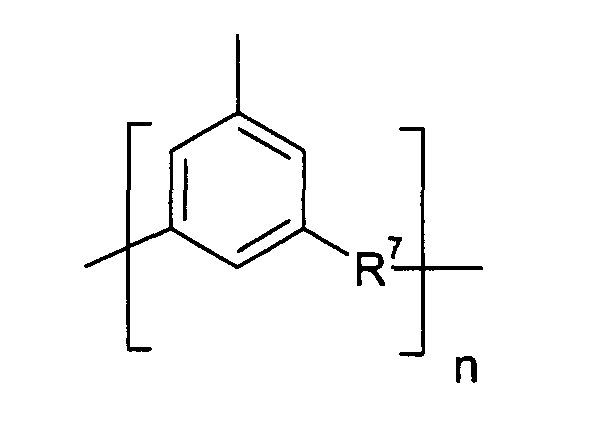 Thus, the group R5 comprises a condensable group to convert the diazonium compound to a diazonium resin to prevent the exposed diazonium salt from washing off during processing.
- The photosensitive composition of the first layer is preferably a polymeric condensate of a diazonium salt or mixture of diazonium salts with formaldehyde, 4,4'-bis-methoxymethyl diphenylether and mixtures and derivatives thereof, such as described in U.S. Patent No. 4,631,245. Further illustrative examples of diazonium salts useful in the present invention are as follows:
 where n is 1 to 11, and X- is a counteranion such as SO3R-, BF4 -, PF6 -, and the like, where R is an alkyl, aryl or aralkyl residue.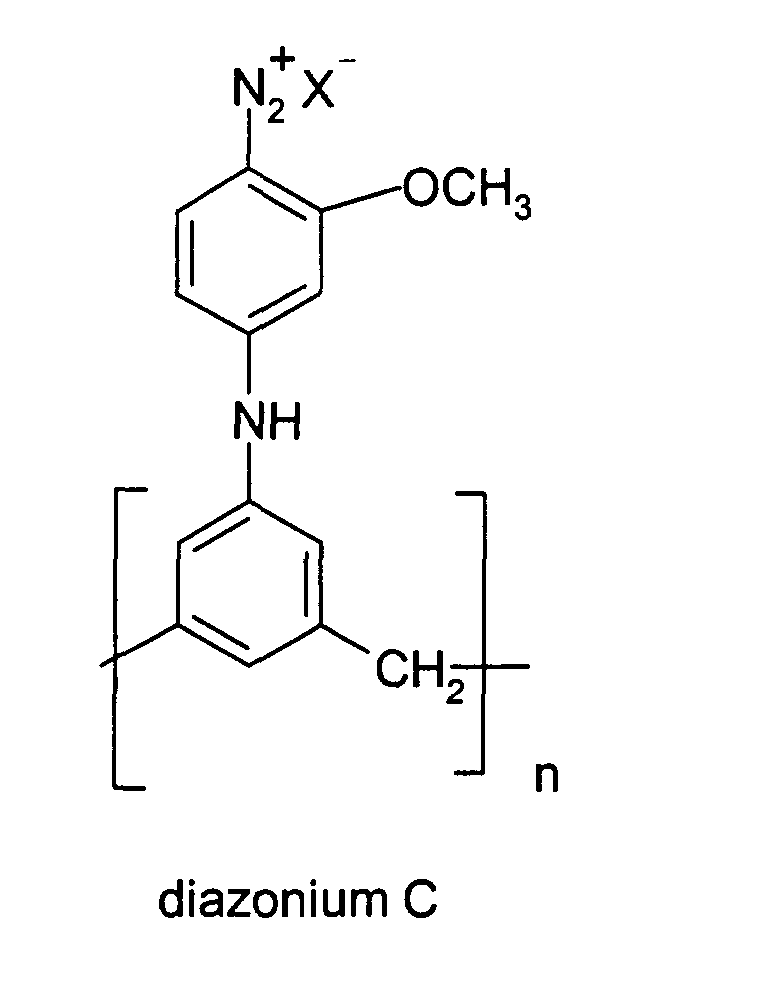
- Illustrative examples of commercially available materials suitable for the photosensitive first layer of this invention are described in U.S. patent No. 4,687,727, which is incorporated herein by reference. An example compound is a condensate of 3-methoxydiphenylamine-4-diazonium sulfate and 4,4'-bismethoxymethyl diphenylether, preferably precipitated as the mesitylene sulfonate, available as NEGA 107 (Panchim).
- The diazonium polycondensation products used in this invention may be obtained by a condensation reaction of diazo monomers with aldehydes and precipitation of the reaction product with a certain anion prepared by condensing a diazo monomer such as 4-diazo-diphenylamine, 1-diazo-4-N,N-dimethylaminobenzene, 1-diazo-4-N,N-diethylaminobenzene, 1-diazo-4-N-ethyl-N-hydroxyethylaminobenzene, 1-diazo-4-N-methyl-N-hydroxyethylaminobenzene, 1-diazo-2,5-diethoxy-4-benzoylaminobenzene, 1-diazo-4-N-benzylaminobenzene, 1-diazo-4-N,N-dimethylaminobenzene, 1-diazo-4-morpholinobenzene, 1-diazo-2,5-dimethoxy-4-p-tolylmercaptobenzene, 1-diazo-2-ethoxy-4-N,N-dimethylaminobenzene, p-diazodimethylaniline, 1-diazo-2,5,-dibutoxy-4-morpholinobenzene, 1-diazo-2,5-diethoxy-4-morpholinobenzene, l-diazo-2,5-dimethoxy-4-p-tolymercaptobenzene, 1-diazo-3-ethoxy-4-N-methyl-N-benzylaminobenzene, 1-diazo-3-chloro-4-N,N-diethylaminobenzene, 1-diazo-3-methyl-4-pyrrolidinobenzene, 1-diazo-2-chloro-4-N,N-dimethylamino-5-methoxybenzene, 1-diazo-3-methoxy-4-pyrrolidinobenzene, 3-methoxy-4-diazodiphenylamine, 3-ethoxy-4-diazodiphenylamine, 3-(n-propoxy)-4-diazodiphenylamine or 3-(isopropoxy) -4-diazodiphenylamine with a condensing agent such as formaldehyde, acetaldehyde, propionaldehyde, butyric aldehyde, isobutyic aldehyde, benzaldehyde or aldehydes containing one or more carboxylic groups as described in U.S. Patent No. 5,112,743 (incorporated herein by reference), preferably in a molar ratio of 1:1 to 1:0.5, more preferably 1:1 to 1:08, by a conventional process, followed by precipitation with a suitable anion.
- Diazonium polycondensation products soluble in organic solvents are for instance obtained by selecting tetrafluoroboric acid, hexafluorophosphoric acid, hexafluoroantmonic acid, hexafluoroarsenic acid, triisopropylnapthalenesulfonic acid, 4,4'-biphenyldisulfonic acid, 5-nitro-o-toluenesulfonic acid, 5-sulfosalicylic acid, 2,5-dimethylbenzenesulfonic acid, 2,4,6-trimethylbenzenesulfonic acid, 2-nitrobenzenesulfonic acid, 3-chlorobenzenesulfonic acid, 3-bromobenzenesulfonic acid, 2-chloro-5-nitrobenzenesulfonic acid, 2-fluorocaprylnaphthalenesulfonic acid, 1-naphthol-5-sulfonic acid, 2-methoxy-4-hydroxy-5-benzoyl-benzenesulfonic acid, 4-toluenesulfonic acid, and the like as anion source. Among these, 2,4,6-trimethylbenzene sulfonic acid and 2-methoxy-4-hydroxy-5-benzoylbenzene-sulfonic acid are particularly preferred.
- Furthermore, mixed condensation products may be used which, apart from the diazonium salt units, comprise other non-photosensitive units, which are derived from condensable compounds, in particular from aromatic amines, phenols, phenol ethers, aromatic thioethers, aromatic hydrocarbons, aromatic heterocycles or organic acid amides.
- Other illustrative examples of diazonium polycondensation products are adducts of diazonium resins with sulfonated polymers. Such diazonium adducts can be used without a binder, in place of the diazonium salt condensates which may be used with a binder. Diazonium adducts consisting of diazonium resins with sulfonated acrylic polymers are described in U.S. Patent No. 5,846,685; corresponding adducts consisting of diazonium resins with sulfonated polyesters are disclosed in U.S. Patents No. 4,408,532 and 5,846,685, both of which are incorporated herein by reference.
- Further illustrative examples of diazonium polycondensation products useful for the photosensitive composition in the first layer may contain aryldiazosulfonate groups, as described in European Patent Publication 0 507 008, which is incorporated herein by reference.
- The diazonium polycondensation product or products are preferably present in the radiation sensitive imagable compositions in an amount from about 1 to about 98 wt. %, more preferably from about 5 to 80 wt. % and most preferably from about 20 to about 60 wt. %, based on the composition of the solution used to apply the first layer. In both positive- and negative-working embodiments of this invention, the first layer may additionally comprise polymeric compounds that act as binders and promote adhesion to the substrate, or other purposes known to those of skill in the art. Illustrative examples of binder polymeric compounds suitable for positive-working embodiments include the phenolic resins described above.
- A particularly preferred binder polymeric compound for a positive-working embodiment is a novolac resin.
- Polymeric compounds useful as binders should be chosen to reduce intermixing of the first and second layers. Illustrative examples of binder polymeric compounds suitable for negative-working embodiments include copolymers of vinyl acetate such as vinyl acetate/crotonate/vinyl neodecanoate copolymers, copolymers of styrene and maleic anhydride, carboxyl-functionalized polyvinyl acetals, acetal-functionalized polyvinyl alcohols as described in U.S. Patent No. 5,700,619 (incorporated herein by reference), and acrylics.
- For negative-working embodiments, the polymeric binder may be any binder known to be useful in conventional printing plates based on diazonium polycondensation products. Such binders are usually alkali-soluble resins. From the standpoint of developability acryl type resins are preferred, while from the standpoint of durability polyurethane resins and an acetal-modified poly(vinyl alcohol) resin are preferred. Further suitable binder materials are for instance disclosed in U.S. Patent No. 3,847,614, U.S. Patent No. 4,154,614, DE 19 64 4515, U.S. Patent No. 5,695,905, U.S. Patent No. 4,877,711, and EP 208145, which are all hereby incorporated by reference in their entireties. Especially preferred are polyvinylacetal binders comprising the following units A, B and C:wherein R1 is H or C1-C4 alkyl, CH=CHCOOH or
 R2 is H, C1-C4 alkyl, aryl,
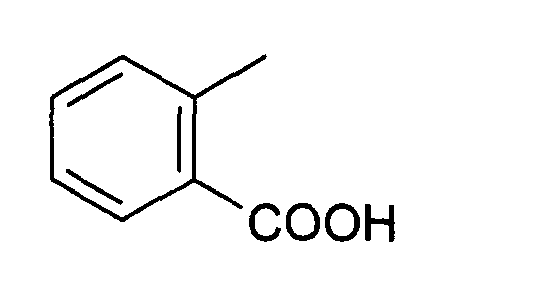 wherein R3 and R4 are independently selected from hydrogen and methyl, n is an integer from 1 to 3 and R5 is alkyl, aralkyl, aryl, alkoxyaryl or alkanoyl amide aryl wherein the alkyl moieties have 1 to 8 carbon atoms and the aryl moieties have 6 or 10 carbon atoms, R6 is hydrogen or an aliphatic, aromatic or araliphatic group having 1 to 10 carbon atoms, Y is -CR7R8-CR9R10-, -CR7=CR8-, or of the following structures: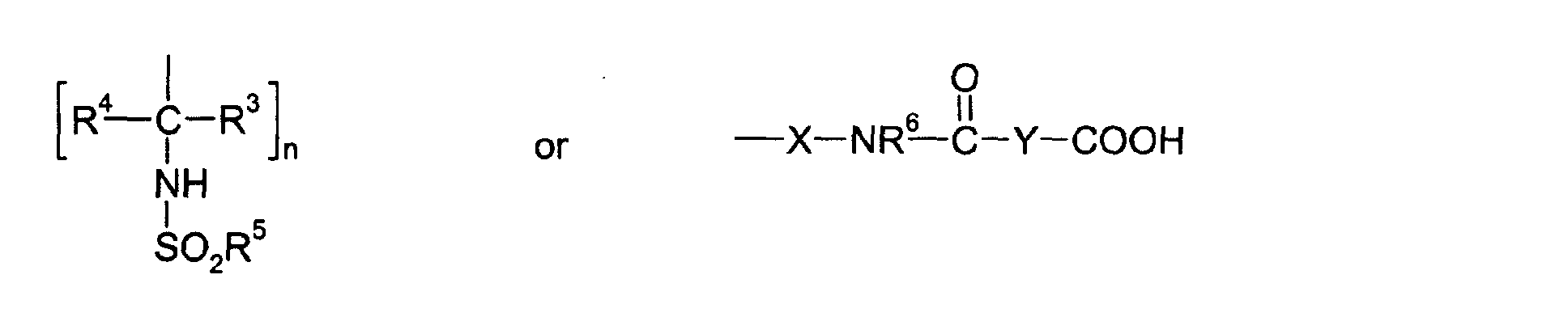

 wherein R7, R8, R9, R10 each are independently hydrogen or C1-C4 alkyl, and X is -CH2, -CH(CH3) or -CH2CH2CH2. Units (B) and (C) may be present more than once in a polymer molecule with independently selected different groups R1 and R2.
- If a binder is present, the weight ratio of binder to the photosensitive composition of the first layer is preferably from about 50:1 to about 0.1:1, more preferably from about 20:1 to about 0.2:1, and most preferably from about 5:1 to about 0.3:1, based on the composition of the solution used to apply the first layer.
- The first layer of the imagable composition of this invention also comprises a photothermal converter (PTC) material which is capable of absorbing electromagnetic radiation (e.g. IR radiation). In a preferred embodiment, the PTC material absorbs the electromagnetic radiation and generates heat sufficient to ablate the second layer. The PTC absorbs electromagnetic radiation at a different wavelength than the actinic radiation used to affect the solubility of the first layer. The PTC preferably absorbs visible to infrared radiation, and converts the radiation into thermal energy. Thus, heat sufficient to selectively ablate or remove the second layer is generated in the first layer.
- It has been discovered that such ablation of the second layer by absorption of electromagnetic radiation in the first layer sufficient to cause such ablation, without absorption of electromagnetic radiation in the second layer itself sufficient to cause such ablation, thereby unexpectedly requiring a relatively low dose of radiation to generate the mask for the photosensitive layer, corresponding to efficient utilization of the exposure energy. Preferably the electromagnetic radiation employed to achieve such selective ablation is IR radiation. Using the radiation efficiently thereby minimizes the energy exposure necessary for generation of the mask in such two-layer systems and increases the rate at which the plate-setter may scan the radiation (e.g. the IR laser beam) to image and prepare the printing plate. Thus, the printing plate of this invention may advantageously be prepared at increased scan rates, or with lower exposure dose at a fixed scan rate.
- A further advantage of this invention is that the printing plate may be prepared without the need of a second chemical development step as for silver halide mask technology.
- The PTC of this invention is an electromagnetic radiation-absorbing compound which converts the absorbed radiation into heat. The PTC should not significantly interfere with the exposure of the photosensitive material in the first layer to actinic radiation (e.g. UV or visible radiation), and so the PTC should not substantially absorb the actinic radiation used to affect the solubility of the first layer, either before or after imagewise exposure of the element. Preferably, the PTC is a pigment or dye which absorbs in the IR or near IR range. Many such products are known to those skilled in the art. Preferably, the PTC comprises a dye or pigment selected from the group consisting of arylamminium, polymethine, quinolium, triarylamine, thiazolium, indolium, oxazolium, polyaniline, polypyrrole, polythiophene, thiolene metal complexes, squarilium, croconate, cyanine, phthalocyanine, merocyanine, chalcogenopyryloarylidine, bis(chalcogenopyrylo)polymethine, oxyindolizine, quinoid, indolizine, pyrylium, thiazine, azulenium, xanthene, carbon black, dark inorganic pigments, black pigments, yellow pigments, orange pigments, brown pigments, red pigments, violet pigments, blue pigments, green pigments, fluorescent pigments, azo pigments bound to a polymer, anthraquinone pigments bound to a polymer, quinacridone pigments bound to a polymer, and mixtures thereof.
- Further illustrative examples of infrared-absorbing compounds useful as a PTC are given in U.S. Patent No. 5,858,626 and U.S. Patent No. 5,759,742, incorporated herein by reference. Other examples include, but are not limited to Cyasorb IR 99 (Glendale Protective Technology), Epolite IV-62B (Epoline Corp.), PINA-780 (Allied Signal Corp.), Spectra IR-830A (Spectra Colors Corp.), and Project 900 (Zeneca Corp.). A particularly preferred PTC is ADS-830A (ADS Corp.) infrared dye.
- The PTC pigments or dyes may be present in the first layer of the radiation sensitive imagable composition of this invention preferably in an amount from or about 0.1 to or about 30 weight percent, more preferably from or about 1 to or about 20 weight percent, and most preferably from or about 3 to or about 15 weight percent, based on the composition of the solution used to apply the first layer.
- The second layer of the radiation sensitive imagable composition of this invention is ablatable, most preferably thermally ablatable. As used herein "thermally ablatable" refers to and is meant to convey that imagewise absorption by the first layer of electromagnetic radiation at a wavelength different than the actinic radiation used to affect the solubility of the first layer and generation of heat by the first layer due to such imagewise absorption causes selective removal of the second layer. The second layer is opaque to and absorbs the actinic radiation which affects the solubility of the first layer, thereby enabling the second layer to serve as an in situ mask for the first layer. Accordingly, the second layer should have a high extinction coefficient for the actinic radiation used to affect the solubility of the first layer.
- The second layer itself does not itself absorb electromagnetic radiation sufficiently to cause selective ablation of the second layer. Instead, the second layer is selectively removed by ablation upon a first imagewise exposure of the imagable composition to electromagnetic radiation because of heat generated by the PTC located in the first layer. Accordingly, in a preferred embodiment of this invention, the second layer does not contain a PTC. In another preferred embodiment, the second layer is transparent to the thermally ablative radiation. Without intending to be bound by any one theory, it is believed that the second layer may ablate efficiently because of thermally-induced loss of adhesion to the first layer. Further, the use of relatively low molecular weight and brittle polymeric material in the second layer, which may evolve nitrogen gas in the ablation process, may make ablation more efficient.
- The thermally ablatable second layer comprises at least one polymeric material. In a preferred embodiment, the thermally ablatable second layer comprises a diazonium polycondensation product. Such products have been described above as being useful for the photosensitive composition in the first layer.
- Further illustrative examples of compounds suitable for use as the polymeric material included in the second layer of this invention are polymeric compounds containing groups derived from an azo, triazene, tetrazene, pentazadiene, or hexazadiene moiety as described in U.S.
- Patent No. 5,506,085 (incorporated herein by reference), gas-producing polymeric compounds containing azido groups (-CH2N3) derived from an oxirane, thiirane, or aziridine, or polymeric compounds derived from polyoxetanes containing azido groups, as described in U.S. Patent No. 5,278,023 (incorporated herein by reference), and polymeric compounds containing aryldiazosulfonate groups or aryldiazonium salt groups, as described in European Patent Publication 507 008 (incorporated herein by reference).
- In preferred embodiments of the invention, the second layer does not contain a napthoquinone diazide condensate or derivative.
- The second layer of the radiation sensitive imagable composition of this invention optionally comprises a water soluble polymeric material such as polyvinylalcohol.
- Optionally, a UV absorber may be added to the second layer to enhance the utility of the layer as a mask. For example, 2-hydroxybenzophenone or 2-hydroxyphenyl-benzotriazoles, and the like, which can be used for UV stabilization, may be added to the second layer to enhance UV-masking.
- Optional, non-essential layers may be combined with this invention. In particular, a protective or other type of layer over the second layer may be used. Further, a subbing or antihalation layer can be placed under the first layer, or on the backside of the substrate, such as when the substrate is a transparent polymeric film.
- Exposure indicators may be used in the first layer of this invention as are known to those of skill in the art. Exposure indicators which may be used include those from the series of triarylmethane dyes such as Victoria blue BO, Victoria blue R, and crystal violet, or azo dyes such as 4-phenylazodiphenylamine, azobenzene, or 4-N,N-dimethylaminoazobenzene.
- Suitable dyes for increasing the image contrast are those that are easy to dissolve in the solvent used for coating the layers onto the substrate, or which may be introduced as pigment in dispersed form. Examples of suitable contrast dyes are rhodamine dyes, methyl violet, anthraquinone pigments, and phthalocyanine dyes. Preferably, the dyes are present in the radiation sensitive imagable composition in an amount from or about 0.1 to or about 15 weight percent, more preferably from or about 0.2 to or about 7 weight percent, based on the composition of the solution used to apply the first layer.
- In another embodiment, this invention is an imagable element comprising the imagable composition described herein applied to a hydrophilic substrate, such as a treated aluminum substrate as described herein. The substrate has an affinity for printing solution that is opposite to the photosensitive layer, and thus suitable for preparing a plate for offset printing.
- In another preferred embodiment of this invention, the thermally ablatable second layer comprises a diazonium salt, the photosensitive composition of the first layer is a 1,2-naphthoquinone diazide condensate, and the imagable element is positive-working.
- This invention is, in further embodiments, a method of preparing an imagable element from the imagable composition. The first layer, which is photosensitive, is coated onto the substrate, by coating methods well known to those skilled in the art, such as roll coating, gravure coating, spin-coating or whirling. Roll coating and gravure coating are particularly preferred. The second layer, which forms the mask, is then coated onto the first layer, followed by drying. The coating solvent used for the second layer preferably does not dissolve or penetrate the first layer. Methods known to those of skill in the art used for coating substrates with imagable compositions, such as those described in European Patent Application EP 909 657 (incorporated herein by reference), can be used.
- For the preparation of printing plates, the imagable composition is applied, preferably by coating techniques, onto a suitable support such as a metal, polymeric film, ceramic, or polymeric-coated paper using conventional procedures and equipment. Suitable metals include aluminum, zinc or steel, but preferably, the metal is aluminum. A most preferred support is an electrochemically grained and sulfuric acid anodized aluminum sheet that has been further treated with an acrylamide-vinylphosphonic acid copolymer according to the teaching in U.S. Pat. No. 5,368,974 (incorporated herein by reference). Such elements are generally known as lithographic printing plates, but other useful elements include printed circuit boards. Typically, an aluminum substrate is first grained by brushing in dry condition, by brushing with an abrasive suspension, or by electrochemical brushing, for example in a hydrochloric acid electrolyte. The grained plates, which optionally have been subjected to an anodic oxidation in sulfuric or phosphoric acid, are then subjected to a hydrophilizing treatment, preferably in aqueous solutions of polyvinyl phosphonic acid or phosphoric acid. Such substrate pretreatments are well known to those of skill in the art.
- The dried substrate is coated with the imagable composition such that the dry weight of the first layer of the imagable element is preferably from about 0.1 to about 5 g/m2, more preferably from about 0.2 to about 4 g/m2, most preferably from about 0.4 to about 2 g/m2. The dried substrate is coated with the imagable composition such that the dry weight of the second layer of the imagable element is preferably from about 0.1 to about 2 g/m2, more preferably from about 0.2 to about 1 g/m2, most preferably from about 0.3 to about 0.6 g/m2.
- In another embodiment, this invention is a method of making a printing plate by exposing and developing the imagable composition of the imagable element. A first exposure is made imagewise with ablative electromagnetic radiation to ablate the imagewise exposed portions of the second layer. This first imagewise exposure is preferably made using IR radiation or visible light, most preferably IR radiation which is absorbed by the PTC in the first layer and converted to heat. This heating causes selective ablation of the second layer of the imagable composition and the non-ablated portion of the second layer forms a mask for the underlying first layer. The portions of the second layer which have been imagewise exposed are rendered easily removable by ablation due to heat generated by absorption of the electromagnetic radiation (e.g. IR or visible light) in the first layer. Any residual material of the second layer in the imagewise exposed portions may be removed, for example, by wiping with cotton pad, to reveal the underlying first layer. Following the first (i.e. imaging) exposure and the ablation and removal of the imagewise exposed portions of the second layer, the imagable element is overall (i.e. flood) exposed with actinic radiation (e.g. UV) and then developed to form the printing plate, using development methods well known to those skilled in the art.
- The elements of this invention are uniquely adapted for "computer-to-plate" (CTP) imaging applications. Such systems utilize digitized image formation, as stored on a computer disk, compact disk, computer tape or other digital information storage media, or information that can be provided directly from a scanner, that is intended to be printed. The bits of information in a digitized record correspond to the image elements or pixels of the image to be printed. This pixel record is used to control the exposure device, that is a modulated laser beam. The position of the laser beam can be controlled using any suitable means known in the art, and turned on and off in correspondence with pixels to be printed. The exposing beam is focused onto the unexposed imagable element of this invention. Thus, no developed mask film is needed for this invention, as in the conventional lithographic imaging processes.
- Laser imaging may be carried out using any moderate or high-intensity laser diode writing device. During operation, the element to be exposed may be placed in the retaining mechanism of the writing device and the write beam scanned across the element to generate an image. A laser printing apparatus may be used that includes a mechanism for scanning the write beam across the element. The imagable element of this invention is preferably imaged using ablative radiation at energy densities less than about 300 mJ/cm2.
- The imagable element, after the first (i.e. imaging) exposure, has open portions of the second layer in the regions which were imagewise exposed during the first exposure, and is overall (i.e. flood) exposed to actinic radiation, thereby affecting the solubility of the open (i.e. non-masked) portions of the first layer by a developer liquid, depending upon whether the first layer is positive- or negative-working, as follows: when the first layer is positive-working, the developer liquid selectively removes the open portions of the first layer, thereby revealing the hydrophilic substrate and retaining the portions unexposed during the first exposure as the ink-receiving image areas. The portions of the second layer not exposed during the first exposure are also removed in the development process. Development may be carried out under conventional conditions, from or about 30 to or about 120 seconds. One useful aqueous alkaline developer solution is a silicate solution containing an alkali metal silicate or metasilicate. Such a developer solution may be obtained from Eastman Kodak Company as KODAK PRODUCTION SERIES MACHINE DEVELOPER/POSITIVE.
- Development may be effected by contacting the imagable element with a fountain solution, ink, or a combination thereof.
- Alternatively, when the first layer is negative-working, the open portions of the first layer are retained as the ink-receiving image areas and the developer liquid selectively removes the remaining portions, which were unexposed during the first exposure, thereby revealing the hydrophilic substrate.
- Negative-working embodiments of this invention may be on-press developable when photoinsolubilizing or free radical polymerizable materials are used for the photosensitive composition of the first layer. In addition, positive-working embodiments of this invention may be on-press developable when the photosensitive composition of the first layer is based on acid generation and solubilization of polymers containing acid-labile insolubilizing groups, as described in U.S. Patent No. 5,552,260 and U.S. Patent No. 4,506,003, both of which are incorporated herein by reference. When the imagable element is on-press developable, the thermally exposed imagable element may be directly mounted on a printing press, subsequent to exposure, in which the fountain solution or ink, or a combination thereof, serves as the developer liquid.
- The developed plates are usually treated with a preserving agent or finisher such as gum arabic, i.e. so-called "gumming". The preserving agents are aqueous solutions of hydrophilic polymers, wetting agents, and further additives. Optionally, a post-development baking step can be used, if desired, to increase run length of the plate.
- The imagable element of this invention is preferably useable for the preparation of printing plates, including lithographic plates. In another embodiment, this invention includes a method to copy an image onto a medium by employing such a printing plate.
- The following examples further describe and demonstrate embodiments within the scope of the present invention. The examples are given solely for the purpose of illustration and are not to be construed as limitations of the present invention. While there have been described illustrative embodiments of this invention, those skilled in the art will recognize that they may be changed or modified without departing from the spirit and scope of this invention, and it is intended to claim all such changes and modifications that fall within the true scope of the invention as set forth in the appended claims.
- A first polymeric solution was prepared by dissolving 3.33 g of a cresol-formaldehyde novolac resin, SD-140A (Borden Chemicals), 1.66g of a 1,2-naphthoquinone diazide-functionalized pyrogallol acetone copolymer, P-3000 (Kodak Polychrome Graphics, Inc.), and 0.9 g of ADS-830A IR dye (ADS, Inc.) into a solvent mixture containing about 40% methyl ethyl ketone and about 60% 2-methoxyethanol. The solution was spin-coated on an electrolytically grained and anodized aluminum substrate, hydrophilized with polyvinyl phosphonic acid, to provide a first layer having a dry weight of 1.7 g/m2.
- A second polymeric solution was prepared by dissolving 4.0 g of a polymer condensate of p-diazodiphenylamine bisulphate with formaldehyde, DTS-18 (P.C.A.S., France), and 1.0 g of a polyvinyl alcohol resin, Airvol 203-S (Air Products), into a solvent mixture containing 95% water and 5% methanol. The second solution was spin-coated onto the first layer on the substrate to provide a second layer having a dry weight of 0.6 g/m2.
- The two-layer, coated plate was imaged on a Creo Trendsetter (wavelength 830nm) at an energy density between 140 and 200 mJ/cm2. Ablation of the top layer and debonding of the top layer from the bottom layer were in evidence in the exposed areas. Remaining second layer material was removed by wiping with a cotton pad. The plate was then UV flood exposed at 350 mJ/cm2 and developed, using standard positive plate developer 3000, available from Kodak Polychrome Graphics, to provide a printing plate having high resolution.
- A two-layer coated plate was prepared as described in Example 1, except that a positive-working X-909 substrate plate, as described in Example 4 of U.S. Patent No. 5,858,626 (incorporated herein by reference), was used. The two-layer, coated plate was imaged and processed, as described in Example 1, to provide a printing plate having high resolution.
- A first polymeric solution was prepared by dissolving 2.5 g of a vinyl acetate/crotonate/vinyl neodecanoate copolymer, 28-2930 copolymer (National Starch and Chemical Co.), and 2.5 g of a styrene/maleic anhydride copolymer, Scripset-550 (Monsanto), in 70 ml of 2-methoxyethanol and 30 ml of methyl ethyl ketone. To this solution was added 5.0 g of N-5000 negative diazo (P.C.A.S., France) and 1.4 g of ADS-830A infrared dye. The resulting mixture was stirred until all ingredients dissolved and then spin-coated on an electrolytically grained and anodized aluminum substrate, hydrophilized with polyvinyl phosphonic acid, to provide a first layer having a dry weight of 2.0 g/m2.
- A second polymeric solution was prepared as described for the second polymeric solution in Example 1 and spin-coated onto the first layer to provide a second layer having a dry weight of 0.6 g/m2.
- The two-layer, coated plate was thermally imaged, wiped with a cotton pad and flood exposed, as described in Example 1, followed by development with a standard negative developer, PC-956 (available from Kodak Polychrome Graphics) to provide a printing plate having high resolution.
- A first polymeric solution is prepared by dissolving 3.33 g of a cresol-formaldehyde novolac resin, SD-140A (Borden Chemicals), 1.66g of a 1,2-naphthoquinone diazide-functionalized pyrogallol acetone copolymer, P-3000 (Kodak Polychrome Graphics, Inc.), and 0.9 g of ADS-830A IR dye (ADS, Inc.) into a solvent mixture containing about 40% methyl ethyl ketone and about 60% 2-methoxyethanol. The solution is spin-coated on an electrolytically grained and anodized aluminum substrate, hydrophilized with polyvinyl phosphonic acid, to provide a first layer.
- A second polymeric solution is prepared by dissolving a suitable amount of a thermally degradable polymer composed of recurring units containing an azo group as disclosed in U.S. Pat. No. 5,506,085 in a suitable solvent, and spin coating the second solution onto the first layer to provide a thermally ablatable second layer. The amounts and solvents employed may be easily ascertained by those skilled in the art.
- A first polymeric solution is prepared by dissolving 3.33 g of a cresol-formaldehyde novolac resin, SD-140A (Borden Chemicals), 1.66g of a 1,2-naphthoquinone diazide-functionalized pyrogallol acetone copolymer, P-3000 (Kodak Polychrome Graphics, Inc.), and 0.9 g of ADS-830A IR dye (ADS, Inc.) into a solvent mixture containing about 40% methyl ethyl ketone and about 60% 2-methoxyethanol. The solution is spin-coated on an electrolytically grained and anodized aluminum substrate, hydrophilized with polyvinyl phosphonic acid, to provide a first layer.
- A second polymeric solution is prepared by dissolving a suitable amount of a gas-producing polymer having recurring units of an azido group, as disclosed in U.S. Patent No. 5,278,023 in a suitable solvent, and spin coating the second solution onto the first layer to provide a thermally ablatable second layer. The amounts and solvents employed may be easily ascertained by those skilled in the art.
- An imagable element was prepared by applying a first layer comprising a diazonium polycondensation product to an aluminum substrate, and a second layer comprising a 1,2-napthoquinone diazide-functionalized pyro gallol acetone copolymer, P-3000 (Kodak Polychrome Graphics). The two-layer, coated plate was imaged on a Creo Trendsetter (wavelength 830 nm) at an energy density between 140 and 200 mJ/cm2. The top layer did not ablate sufficiently for this imagable element to be used in accordance with the claimed invention.
- As described in Example 6 above, it has been found that, when an naphthoquinone diazide condensate or derivative is used in the second layer of the imagable element, insufficient ablation of the second layer occurs at energy densities in the range of 140-200 mJ/cm2. Accordingly, in one preferred embodiment of this invention, the second layer of the imagable element does not contain a naphthoquinone diazide condensate or derivative if ablation of the second layer using electromagnetic radiation at energy densities in the range of 140-200 mJ/cm2 is desired.
- Although this invention has been illustrated by reference to specific embodiments, it will be apparent to those skilled in the art that various changes and modifications may be made which clearly fall within the scope of this invention.
Claims (25)
- An imagable element comprising:(A) a substrate; and(B) an imagable composition applied to the substrate comprising:(1) a first layer applied to the substrate, comprising (a) a photosensitive composition capable of absorbing actinic radiation, and (b) a photothermal converter; and(2) an ablatable second layer contiguous to the first layer, wherein the second layer is opaque to the actinic radiation.
- The imagable element of claim 1, in which the photosensitive composition of the first layer comprises a photosolubilizable composition.
- The imagable element of claim 2, in which the photosolubilizable composition comprises a condensate of a quinone diazide with a compound selected from the group consisting of phenolic resins, copolymers of hydroxystyrenes, acrylic resins containing phenol groups, pyrogallol-acetone copolymers, and mixtures thereof.
- The imagable element of claim 2, in which the photosolubilizable composition comprises a photoinitiator which generates an acid and a polymer having acid-labile side chains.
- The imagable element of any preceding claim, in which the second layer comprises a polymeric material having at least one nitrogen-containing moiety selected from the group consisting of aryldiazosulfonate, aryldiazonium salt, azo, azido, and mixtures thereof.
- The imagable element of claim 1, in which the second layer further comprises a polymeric binder.
- The imagable element of claim 1, in which the photosensitive composition of the first layer comprises a photoinsolubilizable composition.
- The imagable element of claim 7, in which the photoinsolubilizable composition comprises a condensate of an aryldiazonium salt with a compound selected from the group consisting of 4,4'-bis-methoxymethyl diphenylether, formaldehyde, and mixtures thereof.
- The imagable element of claim 7, in which the photoinsolubilizable composition comprises an ethylenically unsaturated photopolymerizable compound or an ethylenically unsaturated compound capable of photocycloaddition.
- The imagable element of any of claims 7 to 9, in which the photoinsolubilizable composition of the first layer further comprises a free radical photoinitiator or photosensitizer.
- The imagable element of any preceding claim, in which the second layer does not contain a photothermal converter.
- The imagable layer of claim 1, in which the second layer does not contain a naphthoquinone diazide condensate or derivative.
- An imagable element prepared by the process comprising:(A) providing a substrate;(B) admixing (i) a photosensitive composition which is capable of absorbing actinic radiation and (ii) a photothermal converter, and applying the admixture to the substrate to provide a first layer; and(C) applying an ablatable second layer which is opaque to the actinic radiation to the first layer.
- A method of forming an image comprising:(I) providing an imagable element comprising:(a) a substrate; and(b) an imagable composition applied on the substrate comprising (i) a first layer applied to the substrate, wherein the first layer comprises (A) a photosensitive composition capable of absorbing actinic radiation, and (B) a photothermal converter, and (ii) an ablatable second layer contiguous to the first layer, wherein the second layer is opaque to the actinic radiation;(II) exposing the imagable element imagewise to ablative radiation thereby causing ablation of the imagewise exposed portions of the second layer;(III) exposing the imagable element uniformly to actinic radiation; and(IV) developing the imagable element.
- The method of claim 14,in which any partially ablated portions of the second layer are removed prior to exposure to the actinic radiation.
- The method of claim 14, in which developing occurs by contacting the imagable element with a fountain solution, ink, or a combination thereof.
- The method of claim 14, in which the ablative radiation is infrared radiation.
- The method of claim 14, in which the second layer does not contain a photothermal converter.
- The method of claim 14, in which the second layer is transparent to the ablative radiation.
- A method of preparing an imagable element comprising:(a) providing a substrate;(b) applying a first layer to a surface of the substrate, the first layer comprising a photosensitive composition capable of absorbing actinic radiation and a photothermal converter; and(c) providing an ablatable second layer contiguous to the first layer, wherein the second layer is opaque to the actinic radiation.
- The method of claim 20, in which the photosensitive composition of the first layer comprises a photosolubilizable composition.
- The method of claim 20 or 21, in which the thermally ablatable second layer comprises a polymeric material comprising at least one nitrogen-containing moiety selected from the group consisting of aryldiazosulfonate, aryldiazonium salt, azo, azido, and mixtures thereof.
- The method of claim 20, in which the photosensitive composition of the first layer comprises a photoinsolubilizable composition.
- The method of claim 23, in which the photoinsolubilizable composition comprises an ethylenically unsaturated photopolymerizable compound or an ethylenically unsaturated compound capable of photocycloaddition.
- The method of claim 23 or 24, in which the photoinsolubilizable composition of the first layer further comprises a free radical photoinitiator or photosensitizer.
Applications Claiming Priority (2)
| Application Number | Priority Date | Filing Date | Title |
|---|---|---|---|
| US09/633,029 US6451505B1 (en) | 2000-08-04 | 2000-08-04 | Imageable element and method of preparation thereof |
| US633029 | 2000-08-04 |
Publications (1)
| Publication Number | Publication Date |
|---|---|
| EP1177911A1 true EP1177911A1 (en) | 2002-02-06 |
Family
ID=24537994
Family Applications (1)
| Application Number | Title | Priority Date | Filing Date |
|---|---|---|---|
| EP01306757A Withdrawn EP1177911A1 (en) | 2000-08-04 | 2001-08-06 | Photosensitive recording element and method of preparation thereof |
Country Status (2)
| Country | Link |
|---|---|
| US (1) | US6451505B1 (en) |
| EP (1) | EP1177911A1 (en) |
Cited By (3)
| Publication number | Priority date | Publication date | Assignee | Title |
|---|---|---|---|---|
| WO2014039321A1 (en) * | 2012-09-04 | 2014-03-13 | Eastman Kodak Company | Positive-working lithographic printing plate precursors and use |
| US8993213B2 (en) | 2009-10-27 | 2015-03-31 | Eastman Kodak Company | Positive-working lithographic printing plate |
| WO2016177702A1 (en) * | 2015-05-04 | 2016-11-10 | Flint Group Germany Gmbh | Laser-engravable pad printing plate |
Families Citing this family (13)
| Publication number | Priority date | Publication date | Assignee | Title |
|---|---|---|---|---|
| JP4623452B2 (en) * | 2000-02-09 | 2011-02-02 | 旭化成イーマテリアルズ株式会社 | Coating liquid for forming infrared sensitive layer |
| US6933064B2 (en) * | 2002-02-15 | 2005-08-23 | Eastman Kodak Company | Multilayer with spacers, touch screen and method |
| US6846579B2 (en) * | 2002-02-15 | 2005-01-25 | Eastman Kodak Company | Multilayer with radiation absorber and touch screen |
| US7589199B2 (en) | 2002-06-12 | 2009-09-15 | Chemocentryx, Inc. | Substituted piperazines |
| US7883643B2 (en) * | 2002-10-21 | 2011-02-08 | Chi-Ming Chan | Overvoltage protection materials and process for preparing same |
| US7493969B2 (en) * | 2003-03-19 | 2009-02-24 | Varco I/P, Inc. | Drill cuttings conveyance systems and methods |
| DE10338257B4 (en) * | 2003-08-20 | 2007-10-18 | Kodak Polychrome Graphics Gmbh | Process for imaging two-layer radiation-sensitive elements |
| JP4420923B2 (en) * | 2003-09-12 | 2010-02-24 | 東京応化工業株式会社 | Photosensitive laminated printing original plate for letterpress printing and method for producing letterpress printing plate |
| US6962765B2 (en) * | 2003-10-20 | 2005-11-08 | Kodak Polychrome Graphics Llc | Laser-generated ultraviolet radiation mask |
| US7014968B2 (en) | 2003-12-30 | 2006-03-21 | Samsung Electronics Co., Ltd. | Organophotoreceptor with charge transport material having a thiiranyl group |
| US7014983B1 (en) | 2004-10-05 | 2006-03-21 | Eastman Kodak Company | Multilayer imageable element |
| US8632940B2 (en) * | 2011-04-19 | 2014-01-21 | Eastman Kodak Company | Aluminum substrates and lithographic printing plate precursors |
| JP6977089B2 (en) * | 2020-03-25 | 2021-12-08 | キヤノン株式会社 | Manufacturing method of structure and manufacturing method of liquid discharge head |
Citations (6)
| Publication number | Priority date | Publication date | Assignee | Title |
|---|---|---|---|---|
| US5102756A (en) * | 1990-12-31 | 1992-04-07 | Xerox Corporation | Camera speed printing plate with in situ mask |
| US5353705A (en) * | 1992-07-20 | 1994-10-11 | Presstek, Inc. | Lithographic printing members having secondary ablation layers for use with laser-discharge imaging apparatus |
| US5440987A (en) * | 1994-01-21 | 1995-08-15 | Presstek, Inc. | Laser imaged seamless lithographic printing members and method of making |
| EP0803770A1 (en) * | 1996-04-23 | 1997-10-29 | Agfa-Gevaert N.V. | An imaging element and a method for producing a lithographic plate therewith |
| US5858604A (en) * | 1994-07-11 | 1999-01-12 | Konica Corporation | Presensitized lithographic printing plate and method for preparing lithographic printing plate |
| US5922502A (en) * | 1996-04-23 | 1999-07-13 | Agfa-Gevaert, N.V. | Imaging element for making a lithographic printing plate wherein that imaging element comprises a thermosensitive mask |
Family Cites Families (34)
| Publication number | Priority date | Publication date | Assignee | Title |
|---|---|---|---|---|
| US3635709A (en) | 1966-12-15 | 1972-01-18 | Polychrome Corp | Light-sensitive lithographic plate |
| US3847614A (en) | 1971-09-13 | 1974-11-12 | Scott Paper Co | Diazo photopolymer composition and article comprising carboxylated resin |
| US3859099A (en) | 1972-12-22 | 1975-01-07 | Eastman Kodak Co | Positive plate incorporating diazoquinone |
| CA1085212A (en) | 1975-05-27 | 1980-09-09 | Ronald H. Engebrecht | Use of volatile carboxylic acids in improved photoresists containing quinone diazides |
| US4154614A (en) | 1975-07-02 | 1979-05-15 | Nippon Paint Co., Ltd. | Photosensitive diazo composition with graft copolymer for use in printing screen |
| US4308368A (en) | 1979-03-16 | 1981-12-29 | Daicel Chemical Industries Ltd. | Photosensitive compositions with reaction product of novolak co-condensate with o-quinone diazide |
| JPS561044A (en) | 1979-06-16 | 1981-01-08 | Konishiroku Photo Ind Co Ltd | Photosensitive composition |
| JPS561045A (en) | 1979-06-16 | 1981-01-08 | Konishiroku Photo Ind Co Ltd | Photosensitive composition |
| US4408532A (en) | 1980-04-30 | 1983-10-11 | Minnesota Mining And Manufacturing Company | Lithographic printing plate with oleophilic area of radiation exposed adduct of diazo resin and sulfonated polymer |
| DE3023201A1 (en) | 1980-06-21 | 1982-01-07 | Hoechst Ag, 6000 Frankfurt | POSITIVELY WORKING RADIATION-SENSITIVE MIXTURE |
| JPS5953836A (en) | 1982-09-21 | 1984-03-28 | Fuji Photo Film Co Ltd | Photosensitive lithographic plate |
| DE3404366A1 (en) | 1984-02-08 | 1985-08-14 | Hoechst Ag, 6230 Frankfurt | LIGHT SENSITIVE MIXTURE BASED ON A DIAZONIUM SALT POLYCONDENSATION PRODUCT AND LIGHT SENSITIVE RECORDING MATERIAL MADE THEREOF |
| DE3678050D1 (en) | 1985-06-07 | 1991-04-18 | Fuji Photo Film Co Ltd | HEARING DEVICE WITH A PIVOTING FLAP. |
| US4845008A (en) | 1986-02-20 | 1989-07-04 | Fuji Photo Film Co., Ltd. | Light-sensitive positive working, o-guinone diazide presensitized plate with mixed solvent |
| US4877711A (en) | 1986-05-19 | 1989-10-31 | Fuji Photo Film Co., Ltd. | Light-sensitive diazo photopolymerizable composition with polyurethane having carbon-carbon unsaturated and a carboxyl group |
| US5112743A (en) | 1989-05-24 | 1992-05-12 | Fuji Photo Film Co., Ltd. | Light-sensitive composition and presensitized plate for use in making lithographic printing plates |
| JP2648969B2 (en) | 1989-07-28 | 1997-09-03 | 富士写真フイルム株式会社 | Photosensitive composition |
| DE69110272T2 (en) | 1991-03-08 | 1996-02-08 | Agfa Gevaert Nv | Lithographic printing form based on a resin containing aryldiazosulfonate. |
| US5437952A (en) | 1992-03-06 | 1995-08-01 | Konica Corporation | Lithographic photosensitive printing plate comprising a photoconductor and a naphtho-quinone diazide sulfonic acid ester of a phenol resin |
| US5278023A (en) | 1992-11-16 | 1994-01-11 | Minnesota Mining And Manufacturing Company | Propellant-containing thermal transfer donor elements |
| US5395734A (en) | 1992-11-30 | 1995-03-07 | Minnesota Mining And Manufacturing Company | Shoot and run printing materials |
| US5368974A (en) | 1993-05-25 | 1994-11-29 | Eastman Kodak Company | Lithographic printing plates having a hydrophilic barrier layer comprised of a copolymer of vinylphosphonic acid and acrylamide overlying an aluminum support |
| EP0706899A1 (en) | 1994-10-13 | 1996-04-17 | Agfa-Gevaert N.V. | Thermal imaging element |
| US5491046A (en) | 1995-02-10 | 1996-02-13 | Eastman Kodak Company | Method of imaging a lithographic printing plate |
| DE19518118C2 (en) | 1995-05-17 | 1998-06-18 | Sun Chemical Corp | Photosensitive composition |
| DE19524851C2 (en) | 1995-07-07 | 1998-05-07 | Sun Chemical Corp | Acetal polymers and use thereof in photosensitive compositions and for lithographic printing plates |
| DE19536805A1 (en) * | 1995-10-02 | 1997-04-03 | Basf Lacke & Farben | Multi-layer recording element suitable for the production of flexographic printing plates by digital information transmission |
| US5759742A (en) | 1996-09-25 | 1998-06-02 | Eastman Kodak Company | Photosensitive element having integral thermally bleachable mask and method of use |
| US5858626A (en) | 1996-09-30 | 1999-01-12 | Kodak Polychrome Graphics | Method of forming a positive image through infrared exposure utilizing diazonaphthoquinone imaging composition |
| DE19644515A1 (en) | 1996-10-25 | 1998-06-25 | Sun Chemical Corp | Amido-substituted acetal polymers and use thereof in photosensitive compositions and lithographic printing plates |
| US5846685A (en) | 1997-01-31 | 1998-12-08 | Kodak Polychrome Graphics, Llc | Radiation sensitive diazo sulfo-acrylic adducts and method for producing a printing plate |
| EP1258369B1 (en) | 1997-10-17 | 2005-03-30 | Fuji Photo Film Co., Ltd. | A positive type photosensitive image-forming material for an infrared laser and a positive type photosensitive composition for an infrared laser |
| US6245481B1 (en) | 1999-10-12 | 2001-06-12 | Gary Ganghui Teng | On-press process of lithographic plates having a laser sensitive mask layer |
| US6245486B1 (en) | 2000-06-30 | 2001-06-12 | Gary Ganghui Teng | Method for imaging a printing plate having a laser ablatable mask layer |
-
2000
- 2000-08-04 US US09/633,029 patent/US6451505B1/en not_active Expired - Fee Related
-
2001
- 2001-08-06 EP EP01306757A patent/EP1177911A1/en not_active Withdrawn
Patent Citations (6)
| Publication number | Priority date | Publication date | Assignee | Title |
|---|---|---|---|---|
| US5102756A (en) * | 1990-12-31 | 1992-04-07 | Xerox Corporation | Camera speed printing plate with in situ mask |
| US5353705A (en) * | 1992-07-20 | 1994-10-11 | Presstek, Inc. | Lithographic printing members having secondary ablation layers for use with laser-discharge imaging apparatus |
| US5440987A (en) * | 1994-01-21 | 1995-08-15 | Presstek, Inc. | Laser imaged seamless lithographic printing members and method of making |
| US5858604A (en) * | 1994-07-11 | 1999-01-12 | Konica Corporation | Presensitized lithographic printing plate and method for preparing lithographic printing plate |
| EP0803770A1 (en) * | 1996-04-23 | 1997-10-29 | Agfa-Gevaert N.V. | An imaging element and a method for producing a lithographic plate therewith |
| US5922502A (en) * | 1996-04-23 | 1999-07-13 | Agfa-Gevaert, N.V. | Imaging element for making a lithographic printing plate wherein that imaging element comprises a thermosensitive mask |
Cited By (8)
| Publication number | Priority date | Publication date | Assignee | Title |
|---|---|---|---|---|
| US8993213B2 (en) | 2009-10-27 | 2015-03-31 | Eastman Kodak Company | Positive-working lithographic printing plate |
| US9310679B2 (en) | 2009-10-27 | 2016-04-12 | Eastman Kodak Company | Making lithographic printing plates |
| WO2014039321A1 (en) * | 2012-09-04 | 2014-03-13 | Eastman Kodak Company | Positive-working lithographic printing plate precursors and use |
| US8936899B2 (en) | 2012-09-04 | 2015-01-20 | Eastman Kodak Company | Positive-working lithographic printing plate precursors and use |
| WO2016177702A1 (en) * | 2015-05-04 | 2016-11-10 | Flint Group Germany Gmbh | Laser-engravable pad printing plate |
| CN108093630A (en) * | 2015-05-04 | 2018-05-29 | 富林特集团德国有限公司 | Pad printing plates that can be laser engraved |
| CN108093630B (en) * | 2015-05-04 | 2020-01-14 | 富林特集团德国有限公司 | Laser-engravable transfer printing plate |
| US10792909B2 (en) | 2015-05-04 | 2020-10-06 | Flint Group Germany Gmbh | Laser-engravable pad printing plate |
Also Published As
| Publication number | Publication date |
|---|---|
| US6451505B1 (en) | 2002-09-17 |
Similar Documents
| Publication | Publication Date | Title |
|---|---|---|
| US5705322A (en) | Method of providing an image using a negative-working infrared photosensitive element | |
| US5705308A (en) | Infrared-sensitive, negative-working diazonaphthoquinone imaging composition and element | |
| EP0969966B1 (en) | Positive-working infrared radiation sensitive composition and printing plate and imaging method | |
| US6451505B1 (en) | Imageable element and method of preparation thereof | |
| US6593055B2 (en) | Multi-layer thermally imageable element | |
| EP0939698B1 (en) | Method for forming lithographic printing plates | |
| US6555291B1 (en) | Thermal digital lithographic printing plate | |
| JP5314051B2 (en) | Image forming and developing method for positive-working imageable element | |
| US5858626A (en) | Method of forming a positive image through infrared exposure utilizing diazonaphthoquinone imaging composition | |
| US6083662A (en) | Methods of imaging and printing with a positive-working infrared radiation sensitive printing plate | |
| US6117610A (en) | Infrared-sensitive diazonaphthoquinone imaging composition and element containing non-basic IR absorbing material and methods of use | |
| US6063544A (en) | Positive-working printing plate and method of providing a positive image therefrom using laser imaging | |
| EP1303399A1 (en) | Thermal digital lithographic printing plate | |
| JP2011521298A (en) | Method for manufacturing and developing positive-working imageable elements | |
| JP2012500419A (en) | Processing of positive planographic printing plate precursors | |
| JP2009524111A (en) | Multilayer imageable element with improved chemical resistance | |
| US6723490B2 (en) | Minimization of ablation in thermally imageable elements | |
| EP0839647B2 (en) | Method for making a lithographic printing plate with improved ink-uptake | |
| US6939663B2 (en) | Sulfated phenolic resins and printing plate precursors comprising sulfated phenolic resins | |
| US6887642B2 (en) | Multi-layer negative working imageable element | |
| US6555283B1 (en) | Imageable element and waterless printing plate | |
| US20040038152A1 (en) | Method for making printing plate by inkjet deposition on positive-working media | |
| JPH10186649A (en) | Infrared sensitive picture forming composition, element and its method | |
| EP0822067B1 (en) | A method for producing lithographic plates by using an imaging element sensitive to IR radiation or heat | |
| CA2393320A1 (en) | Method for making printing plate by inkjet deposition on positive-working media |
Legal Events
| Date | Code | Title | Description |
|---|---|---|---|
| PUAI | Public reference made under article 153(3) epc to a published international application that has entered the european phase |
Free format text: ORIGINAL CODE: 0009012 |
|
| AK | Designated contracting states |
Kind code of ref document: A1 Designated state(s): AT BE CH CY DE DK ES FI FR GB GR IE IT LI LU MC NL PT SE TR |
|
| AX | Request for extension of the european patent |
Free format text: AL;LT;LV;MK;RO;SI |
|
| 17P | Request for examination filed |
Effective date: 20020622 |
|
| AKX | Designation fees paid |
Free format text: AT BE CH CY DE DK ES FI FR GB GR IE IT LI LU MC NL PT SE TR |
|
| 17Q | First examination report despatched |
Effective date: 20021121 |
|
| GRAP | Despatch of communication of intention to grant a patent |
Free format text: ORIGINAL CODE: EPIDOSNIGR1 |
|
| STAA | Information on the status of an ep patent application or granted ep patent |
Free format text: STATUS: THE APPLICATION IS DEEMED TO BE WITHDRAWN |
|
| 18D | Application deemed to be withdrawn |
Effective date: 20040114 |