EP1176648A2 - Process for the preparation of battery - Google Patents
Process for the preparation of battery Download PDFInfo
- Publication number
- EP1176648A2 EP1176648A2 EP01118350A EP01118350A EP1176648A2 EP 1176648 A2 EP1176648 A2 EP 1176648A2 EP 01118350 A EP01118350 A EP 01118350A EP 01118350 A EP01118350 A EP 01118350A EP 1176648 A2 EP1176648 A2 EP 1176648A2
- Authority
- EP
- European Patent Office
- Prior art keywords
- electrode lead
- lead member
- battery case
- battery
- positive electrode
- Prior art date
- Legal status (The legal status is an assumption and is not a legal conclusion. Google has not performed a legal analysis and makes no representation as to the accuracy of the status listed.)
- Withdrawn
Links
- 238000002360 preparation method Methods 0.000 title claims abstract description 17
- 238000000034 method Methods 0.000 title claims abstract description 12
- 229920005989 resin Polymers 0.000 claims description 8
- 239000011347 resin Substances 0.000 claims description 8
- 238000007789 sealing Methods 0.000 claims description 4
- -1 polyethylene terephthalate Polymers 0.000 description 9
- 239000008151 electrolyte solution Substances 0.000 description 8
- 239000004698 Polyethylene Substances 0.000 description 7
- 229910052782 aluminium Inorganic materials 0.000 description 7
- WHXSMMKQMYFTQS-UHFFFAOYSA-N Lithium Chemical group [Li] WHXSMMKQMYFTQS-UHFFFAOYSA-N 0.000 description 6
- XAGFODPZIPBFFR-UHFFFAOYSA-N aluminium Chemical compound [Al] XAGFODPZIPBFFR-UHFFFAOYSA-N 0.000 description 6
- 229910052744 lithium Inorganic materials 0.000 description 6
- 239000007787 solid Substances 0.000 description 6
- 239000011888 foil Substances 0.000 description 5
- 239000000203 mixture Substances 0.000 description 5
- 239000005518 polymer electrolyte Substances 0.000 description 5
- 229920000139 polyethylene terephthalate Polymers 0.000 description 4
- 239000005020 polyethylene terephthalate Substances 0.000 description 4
- 238000004080 punching Methods 0.000 description 4
- WEVYAHXRMPXWCK-UHFFFAOYSA-N Acetonitrile Chemical compound CC#N WEVYAHXRMPXWCK-UHFFFAOYSA-N 0.000 description 3
- OKTJSMMVPCPJKN-UHFFFAOYSA-N Carbon Chemical compound [C] OKTJSMMVPCPJKN-UHFFFAOYSA-N 0.000 description 3
- ZMXDDKWLCZADIW-UHFFFAOYSA-N N,N-Dimethylformamide Chemical compound CN(C)C=O ZMXDDKWLCZADIW-UHFFFAOYSA-N 0.000 description 3
- 239000003792 electrolyte Substances 0.000 description 3
- 229910000625 lithium cobalt oxide Inorganic materials 0.000 description 3
- BFZPBUKRYWOWDV-UHFFFAOYSA-N lithium;oxido(oxo)cobalt Chemical compound [Li+].[O-][Co]=O BFZPBUKRYWOWDV-UHFFFAOYSA-N 0.000 description 3
- 229920000573 polyethylene Polymers 0.000 description 3
- 229920000642 polymer Polymers 0.000 description 3
- 239000007774 positive electrode material Substances 0.000 description 3
- 229920005992 thermoplastic resin Polymers 0.000 description 3
- SZUVGFMDDVSKSI-WIFOCOSTSA-N (1s,2s,3s,5r)-1-(carboxymethyl)-3,5-bis[(4-phenoxyphenyl)methyl-propylcarbamoyl]cyclopentane-1,2-dicarboxylic acid Chemical compound O=C([C@@H]1[C@@H]([C@](CC(O)=O)([C@H](C(=O)N(CCC)CC=2C=CC(OC=3C=CC=CC=3)=CC=2)C1)C(O)=O)C(O)=O)N(CCC)CC(C=C1)=CC=C1OC1=CC=CC=C1 SZUVGFMDDVSKSI-WIFOCOSTSA-N 0.000 description 2
- YEJRWHAVMIAJKC-UHFFFAOYSA-N 4-Butyrolactone Chemical compound O=C1CCCO1 YEJRWHAVMIAJKC-UHFFFAOYSA-N 0.000 description 2
- RYGMFSIKBFXOCR-UHFFFAOYSA-N Copper Chemical compound [Cu] RYGMFSIKBFXOCR-UHFFFAOYSA-N 0.000 description 2
- OIFBSDVPJOWBCH-UHFFFAOYSA-N Diethyl carbonate Chemical compound CCOC(=O)OCC OIFBSDVPJOWBCH-UHFFFAOYSA-N 0.000 description 2
- XTHFKEDIFFGKHM-UHFFFAOYSA-N Dimethoxyethane Chemical compound COCCOC XTHFKEDIFFGKHM-UHFFFAOYSA-N 0.000 description 2
- IAZDPXIOMUYVGZ-UHFFFAOYSA-N Dimethylsulphoxide Chemical compound CS(C)=O IAZDPXIOMUYVGZ-UHFFFAOYSA-N 0.000 description 2
- KMTRUDSVKNLOMY-UHFFFAOYSA-N Ethylene carbonate Chemical compound O=C1OCCO1 KMTRUDSVKNLOMY-UHFFFAOYSA-N 0.000 description 2
- XEEYBQQBJWHFJM-UHFFFAOYSA-N Iron Chemical compound [Fe] XEEYBQQBJWHFJM-UHFFFAOYSA-N 0.000 description 2
- PXHVJJICTQNCMI-UHFFFAOYSA-N Nickel Chemical compound [Ni] PXHVJJICTQNCMI-UHFFFAOYSA-N 0.000 description 2
- WYURNTSHIVDZCO-UHFFFAOYSA-N Tetrahydrofuran Chemical compound C1CCOC1 WYURNTSHIVDZCO-UHFFFAOYSA-N 0.000 description 2
- GWEVSGVZZGPLCZ-UHFFFAOYSA-N Titan oxide Chemical compound O=[Ti]=O GWEVSGVZZGPLCZ-UHFFFAOYSA-N 0.000 description 2
- XRWSZZJLZRKHHD-WVWIJVSJSA-N asunaprevir Chemical compound O=C([C@@H]1C[C@H](CN1C(=O)[C@@H](NC(=O)OC(C)(C)C)C(C)(C)C)OC1=NC=C(C2=CC=C(Cl)C=C21)OC)N[C@]1(C(=O)NS(=O)(=O)C2CC2)C[C@H]1C=C XRWSZZJLZRKHHD-WVWIJVSJSA-N 0.000 description 2
- 229940126543 compound 14 Drugs 0.000 description 2
- 229940125961 compound 24 Drugs 0.000 description 2
- 150000001875 compounds Chemical class 0.000 description 2
- 238000011109 contamination Methods 0.000 description 2
- 239000011889 copper foil Substances 0.000 description 2
- IEJIGPNLZYLLBP-UHFFFAOYSA-N dimethyl carbonate Chemical compound COC(=O)OC IEJIGPNLZYLLBP-UHFFFAOYSA-N 0.000 description 2
- QXYJCZRRLLQGCR-UHFFFAOYSA-N dioxomolybdenum Chemical compound O=[Mo]=O QXYJCZRRLLQGCR-UHFFFAOYSA-N 0.000 description 2
- 229910002804 graphite Inorganic materials 0.000 description 2
- 239000010439 graphite Substances 0.000 description 2
- 229910003002 lithium salt Inorganic materials 0.000 description 2
- 159000000002 lithium salts Chemical class 0.000 description 2
- NUJOXMJBOLGQSY-UHFFFAOYSA-N manganese dioxide Chemical compound O=[Mn]=O NUJOXMJBOLGQSY-UHFFFAOYSA-N 0.000 description 2
- 238000004519 manufacturing process Methods 0.000 description 2
- 239000000463 material Substances 0.000 description 2
- 239000012528 membrane Substances 0.000 description 2
- 229910052751 metal Inorganic materials 0.000 description 2
- 239000002184 metal Substances 0.000 description 2
- 238000012986 modification Methods 0.000 description 2
- 230000004048 modification Effects 0.000 description 2
- 239000007773 negative electrode material Substances 0.000 description 2
- 239000011255 nonaqueous electrolyte Substances 0.000 description 2
- 239000011148 porous material Substances 0.000 description 2
- BHZCMUVGYXEBMY-UHFFFAOYSA-N trilithium;azanide Chemical compound [Li+].[Li+].[Li+].[NH2-] BHZCMUVGYXEBMY-UHFFFAOYSA-N 0.000 description 2
- XLYOFNOQVPJJNP-UHFFFAOYSA-N water Substances O XLYOFNOQVPJJNP-UHFFFAOYSA-N 0.000 description 2
- 238000004804 winding Methods 0.000 description 2
- LZDKZFUFMNSQCJ-UHFFFAOYSA-N 1,2-diethoxyethane Chemical compound CCOCCOCC LZDKZFUFMNSQCJ-UHFFFAOYSA-N 0.000 description 1
- WNXJIVFYUVYPPR-UHFFFAOYSA-N 1,3-dioxolane Chemical compound C1COCO1 WNXJIVFYUVYPPR-UHFFFAOYSA-N 0.000 description 1
- JWUJQDFVADABEY-UHFFFAOYSA-N 2-methyltetrahydrofuran Chemical compound CC1CCCO1 JWUJQDFVADABEY-UHFFFAOYSA-N 0.000 description 1
- 229910000733 Li alloy Inorganic materials 0.000 description 1
- 229910010226 Li2Mn2O4 Inorganic materials 0.000 description 1
- 229910000552 LiCF3SO3 Inorganic materials 0.000 description 1
- 229910010525 LiFe2O3 Inorganic materials 0.000 description 1
- 229910013131 LiN Inorganic materials 0.000 description 1
- 229910013398 LiN(SO2CF2CF3)2 Inorganic materials 0.000 description 1
- 229910013406 LiN(SO2CF3)2 Inorganic materials 0.000 description 1
- 229910003005 LiNiO2 Inorganic materials 0.000 description 1
- 229910001290 LiPF6 Inorganic materials 0.000 description 1
- 229910002097 Lithium manganese(III,IV) oxide Inorganic materials 0.000 description 1
- 229910015530 LixMO2 Inorganic materials 0.000 description 1
- 229910013263 LiyM2O4 Inorganic materials 0.000 description 1
- FXHOOIRPVKKKFG-UHFFFAOYSA-N N,N-Dimethylacetamide Chemical compound CN(C)C(C)=O FXHOOIRPVKKKFG-UHFFFAOYSA-N 0.000 description 1
- XBDQKXXYIPTUBI-UHFFFAOYSA-M Propionate Chemical compound CCC([O-])=O XBDQKXXYIPTUBI-UHFFFAOYSA-M 0.000 description 1
- 229910003092 TiS2 Inorganic materials 0.000 description 1
- KXKVLQRXCPHEJC-UHFFFAOYSA-N acetic acid trimethyl ester Natural products COC(C)=O KXKVLQRXCPHEJC-UHFFFAOYSA-N 0.000 description 1
- 239000011149 active material Substances 0.000 description 1
- 229910052793 cadmium Inorganic materials 0.000 description 1
- 229910052799 carbon Inorganic materials 0.000 description 1
- 239000003575 carbonaceous material Substances 0.000 description 1
- 230000001413 cellular effect Effects 0.000 description 1
- 150000004770 chalcogenides Chemical class 0.000 description 1
- 239000002131 composite material Substances 0.000 description 1
- 229920001940 conductive polymer Polymers 0.000 description 1
- 230000002950 deficient Effects 0.000 description 1
- 230000002708 enhancing effect Effects 0.000 description 1
- 238000010438 heat treatment Methods 0.000 description 1
- 150000002484 inorganic compounds Chemical class 0.000 description 1
- 229910010272 inorganic material Inorganic materials 0.000 description 1
- 229910052742 iron Inorganic materials 0.000 description 1
- 238000003698 laser cutting Methods 0.000 description 1
- 229910052745 lead Inorganic materials 0.000 description 1
- 229910001540 lithium hexafluoroarsenate(V) Inorganic materials 0.000 description 1
- MHCFAGZWMAWTNR-UHFFFAOYSA-M lithium perchlorate Chemical compound [Li+].[O-]Cl(=O)(=O)=O MHCFAGZWMAWTNR-UHFFFAOYSA-M 0.000 description 1
- 229910001486 lithium perchlorate Inorganic materials 0.000 description 1
- 229910001496 lithium tetrafluoroborate Inorganic materials 0.000 description 1
- HSFDLPWPRRSVSM-UHFFFAOYSA-M lithium;2,2,2-trifluoroacetate Chemical compound [Li+].[O-]C(=O)C(F)(F)F HSFDLPWPRRSVSM-UHFFFAOYSA-M 0.000 description 1
- QSZMZKBZAYQGRS-UHFFFAOYSA-N lithium;bis(trifluoromethylsulfonyl)azanide Chemical compound [Li+].FC(F)(F)S(=O)(=O)[N-]S(=O)(=O)C(F)(F)F QSZMZKBZAYQGRS-UHFFFAOYSA-N 0.000 description 1
- 239000007769 metal material Substances 0.000 description 1
- 239000012982 microporous membrane Substances 0.000 description 1
- 229910052759 nickel Inorganic materials 0.000 description 1
- 150000002894 organic compounds Chemical class 0.000 description 1
- 239000003960 organic solvent Substances 0.000 description 1
- 239000002798 polar solvent Substances 0.000 description 1
- 229920000767 polyaniline Polymers 0.000 description 1
- 229920000867 polyelectrolyte Polymers 0.000 description 1
- RUOJZAUFBMNUDX-UHFFFAOYSA-N propylene carbonate Chemical compound CC1COC(=O)O1 RUOJZAUFBMNUDX-UHFFFAOYSA-N 0.000 description 1
- 229910052710 silicon Inorganic materials 0.000 description 1
- 239000002904 solvent Substances 0.000 description 1
- 239000010935 stainless steel Substances 0.000 description 1
- 229910001220 stainless steel Inorganic materials 0.000 description 1
- HXJUTPCZVOIRIF-UHFFFAOYSA-N sulfolane Chemical compound O=S1(=O)CCCC1 HXJUTPCZVOIRIF-UHFFFAOYSA-N 0.000 description 1
- YLQBMQCUIZJEEH-UHFFFAOYSA-N tetrahydrofuran Natural products C=1C=COC=1 YLQBMQCUIZJEEH-UHFFFAOYSA-N 0.000 description 1
- 229910052718 tin Inorganic materials 0.000 description 1
- 229910052723 transition metal Inorganic materials 0.000 description 1
- 229910000314 transition metal oxide Inorganic materials 0.000 description 1
- 150000003624 transition metals Chemical class 0.000 description 1
- TWQULNDIKKJZPH-UHFFFAOYSA-K trilithium;phosphate Chemical class [Li+].[Li+].[Li+].[O-]P([O-])([O-])=O TWQULNDIKKJZPH-UHFFFAOYSA-K 0.000 description 1
- DZKDPOPGYFUOGI-UHFFFAOYSA-N tungsten dioxide Inorganic materials O=[W]=O DZKDPOPGYFUOGI-UHFFFAOYSA-N 0.000 description 1
- 238000007666 vacuum forming Methods 0.000 description 1
- 229910052725 zinc Inorganic materials 0.000 description 1
Images







Classifications
-
- H—ELECTRICITY
- H01—ELECTRIC ELEMENTS
- H01M—PROCESSES OR MEANS, e.g. BATTERIES, FOR THE DIRECT CONVERSION OF CHEMICAL ENERGY INTO ELECTRICAL ENERGY
- H01M10/00—Secondary cells; Manufacture thereof
- H01M10/04—Construction or manufacture in general
- H01M10/0431—Cells with wound or folded electrodes
-
- H—ELECTRICITY
- H01—ELECTRIC ELEMENTS
- H01M—PROCESSES OR MEANS, e.g. BATTERIES, FOR THE DIRECT CONVERSION OF CHEMICAL ENERGY INTO ELECTRICAL ENERGY
- H01M50/00—Constructional details or processes of manufacture of the non-active parts of electrochemical cells other than fuel cells, e.g. hybrid cells
- H01M50/10—Primary casings; Jackets or wrappings
- H01M50/116—Primary casings; Jackets or wrappings characterised by the material
- H01M50/117—Inorganic material
- H01M50/119—Metals
-
- H—ELECTRICITY
- H01—ELECTRIC ELEMENTS
- H01M—PROCESSES OR MEANS, e.g. BATTERIES, FOR THE DIRECT CONVERSION OF CHEMICAL ENERGY INTO ELECTRICAL ENERGY
- H01M50/00—Constructional details or processes of manufacture of the non-active parts of electrochemical cells other than fuel cells, e.g. hybrid cells
- H01M50/10—Primary casings; Jackets or wrappings
- H01M50/116—Primary casings; Jackets or wrappings characterised by the material
- H01M50/121—Organic material
-
- H—ELECTRICITY
- H01—ELECTRIC ELEMENTS
- H01M—PROCESSES OR MEANS, e.g. BATTERIES, FOR THE DIRECT CONVERSION OF CHEMICAL ENERGY INTO ELECTRICAL ENERGY
- H01M50/00—Constructional details or processes of manufacture of the non-active parts of electrochemical cells other than fuel cells, e.g. hybrid cells
- H01M50/10—Primary casings; Jackets or wrappings
- H01M50/116—Primary casings; Jackets or wrappings characterised by the material
- H01M50/124—Primary casings; Jackets or wrappings characterised by the material having a layered structure
-
- H—ELECTRICITY
- H01—ELECTRIC ELEMENTS
- H01M—PROCESSES OR MEANS, e.g. BATTERIES, FOR THE DIRECT CONVERSION OF CHEMICAL ENERGY INTO ELECTRICAL ENERGY
- H01M50/00—Constructional details or processes of manufacture of the non-active parts of electrochemical cells other than fuel cells, e.g. hybrid cells
- H01M50/10—Primary casings; Jackets or wrappings
- H01M50/172—Arrangements of electric connectors penetrating the casing
- H01M50/174—Arrangements of electric connectors penetrating the casing adapted for the shape of the cells
- H01M50/178—Arrangements of electric connectors penetrating the casing adapted for the shape of the cells for pouch or flexible bag cells
-
- H—ELECTRICITY
- H01—ELECTRIC ELEMENTS
- H01M—PROCESSES OR MEANS, e.g. BATTERIES, FOR THE DIRECT CONVERSION OF CHEMICAL ENERGY INTO ELECTRICAL ENERGY
- H01M50/00—Constructional details or processes of manufacture of the non-active parts of electrochemical cells other than fuel cells, e.g. hybrid cells
- H01M50/50—Current conducting connections for cells or batteries
- H01M50/543—Terminals
- H01M50/547—Terminals characterised by the disposition of the terminals on the cells
- H01M50/55—Terminals characterised by the disposition of the terminals on the cells on the same side of the cell
-
- H—ELECTRICITY
- H01—ELECTRIC ELEMENTS
- H01M—PROCESSES OR MEANS, e.g. BATTERIES, FOR THE DIRECT CONVERSION OF CHEMICAL ENERGY INTO ELECTRICAL ENERGY
- H01M50/00—Constructional details or processes of manufacture of the non-active parts of electrochemical cells other than fuel cells, e.g. hybrid cells
- H01M50/50—Current conducting connections for cells or batteries
- H01M50/543—Terminals
- H01M50/552—Terminals characterised by their shape
- H01M50/553—Terminals adapted for prismatic, pouch or rectangular cells
-
- H—ELECTRICITY
- H01—ELECTRIC ELEMENTS
- H01M—PROCESSES OR MEANS, e.g. BATTERIES, FOR THE DIRECT CONVERSION OF CHEMICAL ENERGY INTO ELECTRICAL ENERGY
- H01M10/00—Secondary cells; Manufacture thereof
- H01M10/05—Accumulators with non-aqueous electrolyte
- H01M10/052—Li-accumulators
- H01M10/0525—Rocking-chair batteries, i.e. batteries with lithium insertion or intercalation in both electrodes; Lithium-ion batteries
-
- H—ELECTRICITY
- H01—ELECTRIC ELEMENTS
- H01M—PROCESSES OR MEANS, e.g. BATTERIES, FOR THE DIRECT CONVERSION OF CHEMICAL ENERGY INTO ELECTRICAL ENERGY
- H01M10/00—Secondary cells; Manufacture thereof
- H01M10/05—Accumulators with non-aqueous electrolyte
- H01M10/058—Construction or manufacture
-
- Y—GENERAL TAGGING OF NEW TECHNOLOGICAL DEVELOPMENTS; GENERAL TAGGING OF CROSS-SECTIONAL TECHNOLOGIES SPANNING OVER SEVERAL SECTIONS OF THE IPC; TECHNICAL SUBJECTS COVERED BY FORMER USPC CROSS-REFERENCE ART COLLECTIONS [XRACs] AND DIGESTS
- Y02—TECHNOLOGIES OR APPLICATIONS FOR MITIGATION OR ADAPTATION AGAINST CLIMATE CHANGE
- Y02E—REDUCTION OF GREENHOUSE GAS [GHG] EMISSIONS, RELATED TO ENERGY GENERATION, TRANSMISSION OR DISTRIBUTION
- Y02E60/00—Enabling technologies; Technologies with a potential or indirect contribution to GHG emissions mitigation
- Y02E60/10—Energy storage using batteries
-
- Y—GENERAL TAGGING OF NEW TECHNOLOGICAL DEVELOPMENTS; GENERAL TAGGING OF CROSS-SECTIONAL TECHNOLOGIES SPANNING OVER SEVERAL SECTIONS OF THE IPC; TECHNICAL SUBJECTS COVERED BY FORMER USPC CROSS-REFERENCE ART COLLECTIONS [XRACs] AND DIGESTS
- Y02—TECHNOLOGIES OR APPLICATIONS FOR MITIGATION OR ADAPTATION AGAINST CLIMATE CHANGE
- Y02P—CLIMATE CHANGE MITIGATION TECHNOLOGIES IN THE PRODUCTION OR PROCESSING OF GOODS
- Y02P70/00—Climate change mitigation technologies in the production process for final industrial or consumer products
- Y02P70/50—Manufacturing or production processes characterised by the final manufactured product
-
- Y—GENERAL TAGGING OF NEW TECHNOLOGICAL DEVELOPMENTS; GENERAL TAGGING OF CROSS-SECTIONAL TECHNOLOGIES SPANNING OVER SEVERAL SECTIONS OF THE IPC; TECHNICAL SUBJECTS COVERED BY FORMER USPC CROSS-REFERENCE ART COLLECTIONS [XRACs] AND DIGESTS
- Y10—TECHNICAL SUBJECTS COVERED BY FORMER USPC
- Y10T—TECHNICAL SUBJECTS COVERED BY FORMER US CLASSIFICATION
- Y10T29/00—Metal working
- Y10T29/49—Method of mechanical manufacture
- Y10T29/49002—Electrical device making
- Y10T29/49108—Electric battery cell making
- Y10T29/4911—Electric battery cell making including sealing
Definitions
- non-aqueous electrolyte secondary batteries solid polymer secondary batteries and gel-like polyelectrolyte secondary batteries.
- These batteries are advantageous in that when they comprise a properly selected active material, they exhibit a voltage as high as 4 V or higher, a high energy density per unit weight, and can be available in a small size and light weight and an excellent cycle life performance and used repeatedly charged and discharged.
- a cylindrical or prismatic case made of a metal such as stainless steel, nickel-plated iron, aluminum, etc.
- a battery case has a high airtightness and an excellent mechanical strength.
- the heavy weight of the metallic material causes restrictions on the further reduction of the weight of batteries.
- a method of receiving an electricity-generating element into a bag-shaped battery case has been put to practical use. For example, it has been practiced to prepare a thin secondary battery from a metal-laminated resin film having an airtight structure as a bag-shaped battery case. In this arrangement, a battery having a reduced weight and a high energy density per unit weight free from electrolyte leak and contamination of water from the exterior of the battery can be provided.
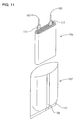
- Such a thin secondary battery has heretofore been prepared, for example, as shown in Figs. 11 to 14.
- Lead members 101 and 103 are ultrasonically welded to positive and negative electrodes, respectively.
- the positive electrode and the negative electrode are then wound with a separator provided interposed therebetween into an ellipsoidal shape to prepare an electricity-generating element 105.
- the electricity-generating element 105 is inserted into the battery case 107 from its opening with the lead members 101 and 103 drawn from the electricity-generating element 105 being extending from the opening of the battery case 107.
- An electrolytic solution is then injected into the interior of the battery case 107.
- the edges of the opening of the battery case 107 are heat-sealed to each other to form a sealed portion 113 and hence seal the opening of the battery case 107.
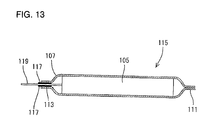
- a thin secondary battery 115 was obtained as shown in Figs. 12 and 13.
- the lead members 101 and 103 extend from the opening of the battery case 107 with a thermoplastic resin coat layer 117 interposed therebetween.
- the lead members 101 and 103 which are outside the sealed portion 113 of the battery case 107 as they are form external terminals 119 and 120, respectively.
- the position of the electricity-generating element 107 relative to the battery case 107 deviates leftward from the predetermined value.
- the position of the electricity-generating element 107 relative to the battery case 107 deviates rightward from the predetermined value. This causes the position of the external terminals 119 and 120 relative to the battery case 107 to vary.
- the battery case 107 is made of a flexible laminated film, the position of the electricity-generating element 105 relative to the battery case 107 can easily vary, increasing the variation of the position of the external terminals 119 and 120.
- the position of attachment can vary.
- the lead members 101 and 103 as they are, form the external terminals 119 and 120, respectively, the variation of the attached position of the lead members 101 and 103 directly cause the position of the external terminals 119 and 120 to vary, respectively.
- the position of the external terminals 119 and 120 can vary, increasing the production of defectives during the production process.
- the opening of the battery case is sealed with both the positive electrode lead member and the negative electrode lead member leading to the exterior thereof, and the position of the battery case and the electricity-generating element relative to each other is fixed.
- the position of the positive electrode lead member and the negative electrode lead member relative to the battery case can be fixed.
- the position of the positive electrode lead member and the negative electrode lead member relative to the battery case can vary.
- the battery case is in the form of bag made of flexible metal-laminated resin film, the resulting variation in the position of the external terminals is great.
- the positive electrode lead member and/or the negative electrode lead member is/are worked with a predetermined position of the battery case as reference. In this manner, the position of the positive electrode lead member and the negative electrode lead member relative to the battery can be corrected to reduce its variation.
- the positive electrode lead member and/or the negative electrode lead member can be worked, making it possible to lessen the variation in position developed due to various causes prior to this working step.
- a very simple method can be used to lessen the variation of the position of the external terminals formed by the positive electrode lead member and the negative electrode lead member, making it possible to provide a battery having external terminals in stable positions.
- the battery prepared by the preparation process of the present invention comprises, for example, an electricity-generating element 50 received in a bag-shaped battery case 51, said electricity-generating element 50 being formed by winding a belt-like positive electrode 10 and a belt-like negative electrode 20 with a separator 30 into a flat shape.
- the positive electrode 10 comprises an aluminum foil 12 as a current collector having a positive active material 14 (shown by the shade in Fig. 1) such as lithium cobalt oxide (LiCoO 2 ) coated on the both sides thereof as shown in Fig. 1.
- the negative electrode 20 comprises a copper foil 22 as a current collector having a negative active material 24 (shown by the shade in Fig. 2) such as graphite coated on the both sides thereof as shown in Fig. 2.
- the aluminum foil 12 constituting the positive electrode 10 is free of positive electrode compound 14 at an end thereof to which a positive electrode lead member 16 made of aluminum is ultrasonically welded.
- the positive electrode lead member 16 extends upward from the electricity-generating element 50.
- the copper foil 22 constituting the negative electrode 20 is free of negative electrode compound 24 at an end thereof to which a negative electrode lead member 26 made of nickel is ultrasonically welded.
- the negative electrode lead member 26 extends upward from the electricity-generating element 50.
- thermoplastic resin coat layer 91 as shown in Figs. 1 and 2 to assure that the thermoplastic resin coat layer 91 can be heat-fused to make airtight sealing.
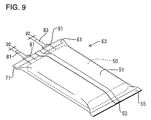
- the positive electrode lead member 16 and the negative electrode lead member 26 to be used herein have a width D1 greater than the width D2 of external terminals 81 and 83 of a completed battery shown in Fig. 9.
- the positive electrode 10 and the negative electrode 20 are laminated on each other with a separator 30 provided interposed therebetween as shown in Fig. 3. As shown in Fig. 4, the laminate is then wound in such an arrangement that it is folded at a predetermined width from the end of the laminate to form a flat electricity-generating element 50. In the wound form, the positive electrode compound 14 and the negative electrode compound 24 are opposed to each other with the separator 30 provided interposed therebetween.
- a non-aqueous electrolyte e.g., 1 : 1 : 1 mixture of ethylene carbonate, diethyl carbonate and dimethyl carbonate having hexafluorinated lithium phosphate incorporated therein
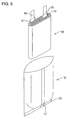
- the electricity-generating element 50 is then received into the battery case 51 through the opening thereof.
- An electrolytic solution is then injected into the battery case.
- the opening of the battery case is closed, and the both edges of the opening is then pressure-bonded to each other under heating to seal the opening of the battery case 51.
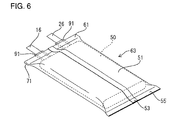
- the both edges of the opening of the battery case 51 are bonded to each other with the positive electrode lead member 16 and the negative electrode lead member 26 interposed therebetween.
- the positive electrode lead member 16 is punched in such an arrangement that the distance between the end 71 of the sealed portion 61 and the edges 73 and 74 of the positive electrode lead member 16 are predetermined values D3 and D4, respectively.
- the negative electrode lead member 26 is punched in such an arrangement that the distance between the end 71 of the sealed portion 61 and the edges 75 and 76 of the negative electrode lead member 26 are predetermined values D5 and D6, respectively.
- the working is conducted in such an arrangement that the position of the external terminals 81 and 83 from the end 71 of the sealed portion 61 are fixed, making it possible to correct the variation of the position of the external terminals 81 and 83 developed during preparation.
- the electrolytic solution to be incorporated in the polymer and the electrolytic solution to be contained in the pores of the polymer may differ from each other.
- the electricity-generating element 50 may be in any other forms such as those having a circular or non-circular coil section, or laminate of flat electrodes with a separator provided interposed therebetween or folded material obtained by folding sheet-like electrodes with a separator provided interposed therebetween.
- the present invention is not limited thereto and the battery case 51 may be obtained by vacuum-forming, air pressure-forming or pressure-forming a film or sheet.
Landscapes
- Chemical & Material Sciences (AREA)
- Chemical Kinetics & Catalysis (AREA)
- Electrochemistry (AREA)
- General Chemical & Material Sciences (AREA)
- Engineering & Computer Science (AREA)
- Manufacturing & Machinery (AREA)
- Inorganic Chemistry (AREA)
- Secondary Cells (AREA)
- Connection Of Batteries Or Terminals (AREA)
- Sealing Battery Cases Or Jackets (AREA)
Abstract
The process for the preparation of a battery
according to the present invention comprises the following
steps. An electricity-generating element having a positive
electrode lead member and a negative electrode lead member
drawn therefrom is inserted into a battery case. The
opening of the battery case is sealed with both the
positive electrode lead member and the negative electrode
lead member leading to the exterior thereof. The position
of the battery case and the electricity-generating element
relative to each other is fixed. The positive electrode
lead member and/or the negative electrode lead member are
worked into an external terminal with a predetermined
position on said battery case as reference. In accordance
with this preparation process, the position of the external
terminals can be corrected by working the lead members even
if there is some variation in the position of the lead
members. In this manner, the variation in the position of
the external terminals can be lessened, making it possible
to provide a battery having external terminals in stable
positions.
Description
The present invention relates to a process for the
preparation of a battery.
In recent years, electronic devices such as cellular
phones, portable personal computers and portable video
cameras have been developed, where the electronic devices
are made into smaller and thinner portable ones. Under
these circumstances, batteries to be incorporated in these
electronic devices are required to have a high energy
density.
As the batteries satisfying this requirement, there
have been developed non-aqueous electrolyte secondary
batteries, solid polymer secondary batteries and gel-like
polyelectrolyte secondary batteries. These batteries are
advantageous in that when they comprise a properly selected
active material, they exhibit a voltage as high as 4 V or
higher, a high energy density per unit weight, and can be
available in a small size and light weight and an excellent
cycle life performance and used repeatedly charged and
discharged.
As the case for these batteries, there has heretofore
been used a cylindrical or prismatic case made of a metal
such as stainless steel, nickel-plated iron, aluminum, etc.
Such a battery case has a high airtightness and an
excellent mechanical strength. However, the heavy weight
of the metallic material causes restrictions on the further
reduction of the weight of batteries. In order to solve
this problem and further reduce the weight and thickness of
the battery, a method of receiving an electricity-generating
element into a bag-shaped battery case has been
put to practical use. For example, it has been practiced
to prepare a thin secondary battery from a metal-laminated
resin film having an airtight structure as a bag-shaped
battery case. In this arrangement, a battery having a
reduced weight and a high energy density per unit weight
free from electrolyte leak and contamination of water from
the exterior of the battery can be provided.
Such a thin secondary battery has heretofore been
prepared, for example, as shown in Figs. 11 to 14. Lead
members 101 and 103 are ultrasonically welded to positive
and negative electrodes, respectively. The positive
electrode and the negative electrode are then wound with a
separator provided interposed therebetween into an
ellipsoidal shape to prepare an electricity-generating
element 105.
Separately, as a battery case 107, a flexible metal-laminated
resin film having various layers such as PET
(polyethylene terephthalate) layer, aluminum foil layer and
PE (polyethylene) layer bonded each other is prepared.
This film is folded with PE layer inside, and then heat-fused
at both ends thereof and one side edge thereof to
form a back sealed portion 109 and a bottom sealed portion
111, respectively, forming a bag.
Subsequently, as shown in Fig. 11, the electricity-generating
element 105 is inserted into the battery case
107 from its opening with the lead members 101 and 103
drawn from the electricity-generating element 105 being
extending from the opening of the battery case 107. An
electrolytic solution is then injected into the interior of
the battery case 107. The edges of the opening of the
battery case 107 are heat-sealed to each other to form a
sealed portion 113 and hence seal the opening of the
battery case 107. In this manner, a thin secondary battery
115 was obtained as shown in Figs. 12 and 13. The lead
members 101 and 103 extend from the opening of the battery
case 107 with a thermoplastic resin coat layer 117
interposed therebetween. In this arrangement, sealing of
the battery case 107 is assured, making it possible to
prevent electrolyte leak and contamination by water from
the exterior of the battery. Further, in this thin
secondary battery 115, the lead members 101 and 103 which
are outside the sealed portion 113 of the battery case 107
as they are form external terminals 119 and 120,
respectively.
The position of the external terminals 119 and 120
are decided depending on the position of the terminals of
the electronic devices for which the thin secondary battery
115 is used. However, this preparation process is
disadvantageous in that the position of the external
terminals 119 and 120 relative to the battery case 107 can
vary. This phenomenon is attributed to the following
reasons. For example, as shown in Fig. 14, the battery
case 107 is prepared somewhat larger than the electricity-generating
element 105 so that it can easily receive the
electricity-generating element 105. Therefore, as shown in
Figs. 14A and 14B, the position of the electricity-generating
element 105 thus inserted relative to the
battery case 107 can deviate somewhat from the
predetermined value. For example, as shown in Fig. 14A,
the position of the electricity-generating element 107
relative to the battery case 107 deviates leftward from the
predetermined value. As shown in Fig. 14B, the position of
the electricity-generating element 107 relative to the
battery case 107 deviates rightward from the predetermined
value. This causes the position of the external terminals
119 and 120 relative to the battery case 107 to vary.
Further, since the battery case 107 is made of a flexible
laminated film, the position of the electricity-generating
element 105 relative to the battery case 107 can easily
vary, increasing the variation of the position of the
external terminals 119 and 120.
Moreover, when the lead members 101 and 103 are
attached to the electrodes, the position of attachment can
vary. In this case, because the lead members 101 and 103,
as they are, form the external terminals 119 and 120,
respectively, the variation of the attached position of the
lead members 101 and 103 directly cause the position of the
external terminals 119 and 120 to vary, respectively.
Moreover, when the positive electrode and the
negative electrode with a separator interposed therebetween
are worked to form an ellipsoidal shape, the position of
the positive electrode and the negative electrode relative
to each other can vary, resulting in the variation of the
position of the external terminals 119 and 120.
Due to these causes, the position of the external
terminals 119 and 120 can vary, increasing the production
of defectives during the production process.
It is therefore an object of the present invention to
provide a battery having a reduced variation in the
position of external terminals formed by lead members and
hence stably-positioned external terminals.
The foregoing object of the present invention will
become apparent from the following detailed description and
examples.
The process for the preparation of a battery
according to the present invention comprises the following
steps. An electricity-generating element having a positive
electrode lead member and a negative electrode lead member
drawn therefrom is inserted into a battery case. The
opening of the battery case is sealed with both the
positive electrode lead member and the negative electrode
lead member leading to the exterior thereof, so that the
position of the battery case and the electricity-generating
element relative to each other is fixed. The positive
electrode lead member and/or the negative electrode lead
member are worked into an external terminal with a
predetermined position on the battery case as reference.
In accordance with the preparation process of the
present invention, the opening of the battery case is
sealed with both the positive electrode lead member and the
negative electrode lead member leading to the exterior
thereof, and the position of the battery case and the
electricity-generating element relative to each other is
fixed. In this manner, the position of the positive
electrode lead member and the negative electrode lead
member relative to the battery case can be fixed. In this
fixed position, the position of the positive electrode lead
member and the negative electrode lead member relative to
the battery case can vary. In particular, in the case
where the battery case is in the form of bag made of
flexible metal-laminated resin film, the resulting
variation in the position of the external terminals is
great.
Accordingly, in accordance with the preparation
process of the invention, after the positioning of the
electricity-generating element relative to the battery
case, the positive electrode lead member and/or the
negative electrode lead member is/are worked with a
predetermined position of the battery case as reference.
In this manner, the position of the positive electrode lead
member and the negative electrode lead member relative to
the battery can be corrected to reduce its variation.
Of course, positioning can be tried when the
electricity-generating element is inserted into the battery
case or the positive electrode lead member and the negative
electrode lead member are attached to the electrodes.
However, it is very difficult and complicated to conduct
positioning in all these procedures. Accordingly, in
accordance with the preparation process of the present
invention, the positive electrode lead member and/or the
negative electrode lead member can be worked, making it
possible to lessen the variation in position developed due
to various causes prior to this working step. Thus, a very
simple method can be used to lessen the variation of the
position of the external terminals formed by the positive
electrode lead member and the negative electrode lead
member, making it possible to provide a battery having
external terminals in stable positions.
By way of example and to make the description more
clear, reference is made to the accompanying drawings in
which:
An embodiment of the preparation process according to
the invention will be described with reference to an
example shown in Figs. 1 to 10.
The battery prepared by the preparation process of
the present invention comprises, for example, an
electricity-generating element 50 received in a bag-shaped
battery case 51, said electricity-generating element 50
being formed by winding a belt-like positive electrode 10
and a belt-like negative electrode 20 with a separator 30
into a flat shape. The positive electrode 10 comprises an
aluminum foil 12 as a current collector having a positive
active material 14 (shown by the shade in Fig. 1) such as
lithium cobalt oxide (LiCoO2) coated on the both sides
thereof as shown in Fig. 1. The negative electrode 20
comprises a copper foil 22 as a current collector having a
negative active material 24 (shown by the shade in Fig. 2)
such as graphite coated on the both sides thereof as shown
in Fig. 2.
The aluminum foil 12 constituting the positive
electrode 10 is free of positive electrode compound 14 at
an end thereof to which a positive electrode lead member 16
made of aluminum is ultrasonically welded. The positive
electrode lead member 16 extends upward from the
electricity-generating element 50. The copper foil 22
constituting the negative electrode 20 is free of negative
electrode compound 24 at an end thereof to which a negative
electrode lead member 26 made of nickel is ultrasonically
welded. The negative electrode lead member 26 extends
upward from the electricity-generating element 50.
The positive electrode lead member 16 and the
negative electrode lead member 26 are each coated with a
thermoplastic resin coat layer 91 as shown in Figs. 1 and 2
to assure that the thermoplastic resin coat layer 91 can be
heat-fused to make airtight sealing.
The positive electrode lead member 16 and the
negative electrode lead member 26 to be used herein have a
width D1 greater than the width D2 of external terminals 81
and 83 of a completed battery shown in Fig. 9.
The positive electrode 10 and the negative electrode
20 are laminated on each other with a separator 30 provided
interposed therebetween as shown in Fig. 3. As shown in
Fig. 4, the laminate is then wound in such an arrangement
that it is folded at a predetermined width from the end of
the laminate to form a flat electricity-generating element
50. In the wound form, the positive electrode compound 14
and the negative electrode compound 24 are opposed to each
other with the separator 30 provided interposed
therebetween. By impregnating the separator 30 with a non-aqueous
electrolyte (e.g., 1 : 1 : 1 mixture of ethylene
carbonate, diethyl carbonate and dimethyl carbonate having
hexafluorinated lithium phosphate incorporated therein), a
secondary lithium battery is formed.
Separately, as the battery case 51, a flexible metal-laminated
resin film is prepared by fusing various layers
such as PET (polyethylene terephthalate) layer, aluminum
foil layer and PE (polyethylene) layer to each other. The
flexible metal-laminated resin film thus prepared is folded
with PE layer being inside, and then heat-fused at both
ends thereof and one side edge thereof to form a back
sealed portion 53 and a bottom sealed portion 55. Thus, a
bag-shaped battery case is formed.
The electricity-generating element 50 is then
received into the battery case 51 through the opening
thereof. An electrolytic solution is then injected into
the battery case. The opening of the battery case is
closed, and the both edges of the opening is then pressure-bonded
to each other under heating to seal the opening of
the battery case 51. As shown in Fig. 6, the both edges of
the opening of the battery case 51 are bonded to each other
with the positive electrode lead member 16 and the negative
electrode lead member 26 interposed therebetween. By
sealing the battery case 51 in this arrangement, the
position of the electricity-generating element 50 relative
to the battery case 51 is fixed. By punching the positive
electrode lead member 16 such that the distance between the
end 71 of the sealed portion 61 and the edges 73 and 74 of
the positive electrode lead member 16 become predetermined
values D3 and D4, an external positive electrode terminal
81 is formed as shown in Fig. 7. Similarly, by punching
the negative electrode lead member 26 such that the
distance between the end 71 of the sealed portion 61 and
the edges 75 and 76 of the negative electrode lead member
26 reach predetermined values D5 and D6, an external
negative electrode terminal 83 is formed. By the punching,
undesirable portions 77, 78, 79 and 80 are removed. The
predetermined distances D3, D4, D5 and D6 are determined
depending on the width D2 of the external terminals 81 and
83 and the predetermined position of the external terminals
81 and 83 from the end 71 of the sealed portion in a
completed battery shown in Fig. 9. Thus, a battery 63 is
prepared. In accordance with this preparation process, a
battery having the external terminals 81 and 83 each in
stable positions can be provided.
In some detail, as shown in Figs. 7 and 8, when the
electricity-generating element 50 is inserted into the
battery case 51, the position of the electricity-generating
element 50 relative to the battery case 51 can deviate
somewhat from the predetermined value.
In accordance with the preparation process of the
present invention, after the positioning of the
electricity-generating element 50 relative to the battery
case 51, the positive electrode lead member 16 and/or the
negative electrode lead member 26 is/are worked with a
predetermined position of the battery case 51 as reference.
That is, at lease one of the positive electrode lead member
16 and the negative electrode lead member 26 is/are worked
to have predetermined position(s) to the battery case and
have predetermined size(s).
In any of the batteries 63 of Figs. 7 and 8, the
positive electrode lead member 16 is punched in such an
arrangement that the distance between the end 71 of the
sealed portion 61 and the edges 73 and 74 of the positive
electrode lead member 16 are predetermined values D3 and
D4, respectively. Similarly, the negative electrode lead
member 26 is punched in such an arrangement that the
distance between the end 71 of the sealed portion 61 and
the edges 75 and 76 of the negative electrode lead member
26 are predetermined values D5 and D6, respectively.
In other words, the working is conducted in such an
arrangement that the position of the external terminals 81
and 83 from the end 71 of the sealed portion 61 are fixed,
making it possible to correct the variation of the position
of the external terminals 81 and 83 developed during
preparation.
The external terminals 81 and 83 may preferably have
wide sections 84 and 85, respectively, left unpunched at
which they are drawn from the battery case 51. By thus
having the wide sections 84 and 85 left unpunched, the
necessity of working the positive electrode lead member 16
and/or negative electrode lead member 26 up to a position
close to the battery case 51 can be eliminated,
facilitating the working and hence enhancing the
productivity and making it unlikely that the battery case
51 can be damaged.
The working of the positive electrode lead member 16
and/or negative electrode lead member 26 is not
specifically limited but may be accomplished by punching as
mentioned above, or laser cutting, dimensional adjustment
by folding or the like.
In another embodiment of implication of the present
invention, the opening of the battery case 51 may be sealed
with the external positive electrode terminal 81 and the
external negative electrode terminal 83 uncoated with a
resin coat layer 91 at the sealed portion 61 as shown in
Fig. 10.
The preparation process of the invention can be
widely used regardless of which the battery is primary or
secondary.
The positive electrode material to be used in the
invention is not specifically limited. In the case of
secondary lithium battery, examples of the compound capable
of absorbing/releasing lithium include an inorganic
compound such as composite oxide represented by the
composition formula LixMO2 or LiyM2O4 (in which M represents
a transition metal, x is from not smaller than 0 to not
greater than 1 (0 ≤ x ≤ 1), and y is from not smaller than
0 to not greater than 2 (0 ≤ y ≤ 2)), oxide having tunnel-like
pores and laminar metal chalcogenide or organic
compound such as electrically-conductive polymer. These
compounds may be used in admixture. Examples of the
positive electrode materials employable herein include
LiCoO2, LiNiO2, LiMn2O4, Li2Mn2O4, MnO2, FeO2, V2O5, V6O13,
TiO2, TiS2, and polyaniline.
The negative electrode material to be used in the
invention is not specifically limited. In the case of
secondary lithium battery, an alloy of lithium with Al, Si,
Pb, Sn, Zn, Cd or the like, transition metal oxide such as
LiFe2O3, WO2 and MoO2, carbon-based material such as
graphite and carbon, lithium nitride such as Li5(Li3N),
metallic lithium foil, or mixture thereof may be used.
The electrolytic solution to be used in the invention
is not specifically limited. In the case of secondary
lithium battery, examples of the solvent for non-aqueous
electrolytic solution include a polar solvent such as
ethylene carbonate, propylene carbonate, dimethyl
carbonate, diethyl carbonate, γ-butyrolactone, sulfolane,
dimethyl sulfoxide, acetonitrile, dimethylformamide,
dimethylacetamide, 1,2-dimethoxyethane, 1,2-diethoxyethane,
tetrahydrofuran, 2-methyltetrahydrofuran, dioxolane and
methyl acetate or mixture thereof.
Examples of the lithium salt to be dissolved in the
organic solvent include a lithium salt such as LiPF6,
LiClO4, LiBF4, LiAsF6, LiCF3CO2, LiCF3SO3, LiN(SO2CF3)2,
LiN(SO2CF2CF3)2, LiN(COCF3)2 and LiN(COCF2CF3)2 or mixture
thereof.
Examples of the separating material such as separator
include an insulating microporous polyethylene membrane
impregnated with an electrolytic solution, solid polymer
electrolyte, gel-like electrolyte comprising a solid
polymer electrolyte having an electrolytic solution
incorporated therein or combination of an insulating
microporous membrane and a solid polymer electrolyte. In
the case where a porous solid polymer electrolyte membrane
is used as the solid polymer electrolyte, the electrolytic
solution to be incorporated in the polymer and the
electrolytic solution to be contained in the pores of the
polymer may differ from each other.
The present invention is not limited to the
embodiments described in the foregoing description in
connection with the attached drawings. For example, the
following embodiments can be included in the technical
scope of the invention. Various changes and modifications
can be made in the invention without departing from the
spirit and scope thereof.
While the invention has been described in detail and
with reference to the case where the electricity-generating
element 50 is in a flat form, the electricity-generating
element 50 may be in any other forms such as those having a
circular or non-circular coil section, or laminate of flat
electrodes with a separator provided interposed
therebetween or folded material obtained by folding sheet-like
electrodes with a separator provided interposed
therebetween.
While the invention has been described in detail and
with reference to the case where the battery case 51 is in
the form of bag made of a flexible metal-laminated resin
film, the present invention is not limited thereto and the
battery case 51 may be obtained by vacuum-forming, air
pressure-forming or pressure-forming a film or sheet.
While the invention has been described in detail and
with reference to the case where both the positive
electrode lead member 16 and the negative electrode lead
member 26 are worked, either one of the positive electrode
lead member 16 and the negative electrode lead member 26
may be worked.
While the invention has been described in detail and
with reference to specific embodiments thereof, it will be
apparent to one skilled in the art that various changes and
modifications can be made therein without departing from
the spirit and scope thereof.
This application is based on Japanese patent
application No. 2000-226740 filed on July 27, 2000, the
entire contents thereof being hereby incorporated by
reference.
Claims (2)
- A process for the preparation of a battery which comprises:(1) inserting an electricity-generating element having a positive electrode lead member and a negative electrode lead member drawn therefrom into a battery case,(2) sealing said battery case with both of said positive electrode lead member and said negative electrode lead member leading to the exterior thereof, so as to fix the position of said battery case and said electricity-generating element relative to each other; and(3) working at least one of said positive electrode lead member and said negative electrode lead member into an external terminal with a predetermined position on said battery case as reference.
- The process for the preparation of a battery according to Claim 1, wherein said battery case is in the form of bag comprising a flexible metallic laminate resin film.
Applications Claiming Priority (2)
| Application Number | Priority Date | Filing Date | Title |
|---|---|---|---|
| JP2000226740A JP2002042778A (en) | 2000-07-27 | 2000-07-27 | Battery manufacturing method and battery |
| JP2000226740 | 2000-07-27 |
Publications (1)
| Publication Number | Publication Date |
|---|---|
| EP1176648A2 true EP1176648A2 (en) | 2002-01-30 |
Family
ID=18720305
Family Applications (1)
| Application Number | Title | Priority Date | Filing Date |
|---|---|---|---|
| EP01118350A Withdrawn EP1176648A2 (en) | 2000-07-27 | 2001-07-27 | Process for the preparation of battery |
Country Status (3)
| Country | Link |
|---|---|
| US (1) | US20020010998A1 (en) |
| EP (1) | EP1176648A2 (en) |
| JP (1) | JP2002042778A (en) |
Families Citing this family (14)
| Publication number | Priority date | Publication date | Assignee | Title |
|---|---|---|---|---|
| US7422823B2 (en) * | 2002-04-03 | 2008-09-09 | Valence Technology, Inc. | Alkali-iron-cobalt phosphates and related electrode active materials |
| US7482097B2 (en) * | 2002-04-03 | 2009-01-27 | Valence Technology, Inc. | Alkali-transition metal phosphates having a +3 valence non-transition element and related electrode active materials |
| US20030190527A1 (en) * | 2002-04-03 | 2003-10-09 | James Pugh | Batteries comprising alkali-transition metal phosphates and preferred electrolytes |
| US7179562B2 (en) * | 2003-02-14 | 2007-02-20 | Quallion Llc | Battery electrode assembly and fabrication method therefor |
| JP4961673B2 (en) * | 2005-03-08 | 2012-06-27 | 住友電気工業株式会社 | Method for producing tab lead for non-aqueous electrolyte battery |
| JP4745122B2 (en) * | 2006-05-18 | 2011-08-10 | 日立ビークルエナジー株式会社 | Secondary battery, battery pack and battery module |
| KR101101046B1 (en) * | 2009-12-01 | 2011-12-29 | 삼성에스디아이 주식회사 | Electrode assembly and secondary battery having same |
| JP2013012458A (en) * | 2011-05-27 | 2013-01-17 | Sony Corp | Battery unit, battery module, power storage system, electronic device, power system, and electric vehicle |
| JP5743791B2 (en) * | 2011-08-02 | 2015-07-01 | 三洋電機株式会社 | Power supply device and vehicle equipped with power supply device |
| KR101867614B1 (en) * | 2011-12-08 | 2018-06-15 | 삼성에스디아이 주식회사 | Electrode assembly and secondary battery having the same |
| US20150072220A1 (en) * | 2012-03-30 | 2015-03-12 | Nec Corporation | Lithium Secondary Battery and Method for Manufacturing Same |
| US20160211547A1 (en) * | 2015-01-15 | 2016-07-21 | Google Inc. | Hybrid Rechargeable Battery |
| JP7135001B2 (en) * | 2017-12-20 | 2022-09-12 | 株式会社エンビジョンAescジャパン | battery |
| JP7232803B2 (en) * | 2020-10-29 | 2023-03-03 | プライムプラネットエナジー&ソリューションズ株式会社 | Storage cell and manufacturing method thereof |
Family Cites Families (7)
| Publication number | Priority date | Publication date | Assignee | Title |
|---|---|---|---|---|
| JPH0197371A (en) * | 1987-10-08 | 1989-04-14 | Seiko Electronic Components Ltd | Manufacture of flat litium battery with lead terminal |
| JPH07320715A (en) * | 1994-05-23 | 1995-12-08 | Matsushita Electric Ind Co Ltd | Method of manufacturing flat battery and terminal plate thereof |
| JPH09274896A (en) * | 1996-04-04 | 1997-10-21 | Sumitomo Electric Ind Ltd | Non-aqueous electrolyte battery |
| JP4057672B2 (en) * | 1997-03-21 | 2008-03-05 | 株式会社東芝 | Tabbed component manufacturing equipment |
| JP4237286B2 (en) * | 1998-02-18 | 2009-03-11 | パナソニック株式会社 | Battery with laminate sheet as outer case |
| JP4491843B2 (en) * | 1998-02-24 | 2010-06-30 | ソニー株式会社 | Lithium ion secondary battery and method of sealing a lithium ion secondary battery container |
| JP3787437B2 (en) * | 1998-07-31 | 2006-06-21 | 日本特殊陶業株式会社 | Flat battery and method of manufacturing the same |
-
2000
- 2000-07-27 JP JP2000226740A patent/JP2002042778A/en active Pending
-
2001
- 2001-07-26 US US09/912,519 patent/US20020010998A1/en not_active Abandoned
- 2001-07-27 EP EP01118350A patent/EP1176648A2/en not_active Withdrawn
Also Published As
| Publication number | Publication date |
|---|---|
| US20020010998A1 (en) | 2002-01-31 |
| JP2002042778A (en) | 2002-02-08 |
Similar Documents
| Publication | Publication Date | Title |
|---|---|---|
| US10461369B2 (en) | Battery and battery pack | |
| JP6250921B2 (en) | battery | |
| EP2461391B1 (en) | Battery | |
| JP4862211B2 (en) | Sealed secondary battery | |
| EP1176648A2 (en) | Process for the preparation of battery | |
| JP2007179803A (en) | Battery container sealing plate and non-aqueous electrolyte battery | |
| JP4432146B2 (en) | Nonaqueous electrolyte secondary battery | |
| JP2025528940A (en) | Energy storage cell and method for manufacturing such an energy storage cell | |
| JP2000277066A5 (en) | ||
| JP4918997B2 (en) | Nonaqueous electrolyte secondary battery | |
| JP2012064459A (en) | Nonaqueous electrolyte battery | |
| JP4751995B2 (en) | battery | |
| JP2003346768A (en) | Non-aqueous electrolyte secondary battery | |
| JP2008027849A (en) | Seal member | |
| US7704636B2 (en) | Cell having film outer casing | |
| JP2000285902A5 (en) | ||
| JP2003346879A (en) | Battery | |
| JPH07220705A (en) | Safety device of layer built lithium secondary battery | |
| JP2004014189A (en) | Non-aqueous electrolyte secondary battery | |
| US20250046925A1 (en) | Unit cell | |
| JP2000277065A (en) | Non-aqueous electrolyte secondary battery | |
| JP3541770B2 (en) | Non-aqueous electrolyte secondary battery | |
| KR101595613B1 (en) | Negative electrode for lithium-ion secondary battery and lithium-ion secondary battery comprising the same | |
| US20230299418A1 (en) | Method for manufacturing battery, battery, and battery intermediate | |
| JP4055395B2 (en) | Sealed battery |
Legal Events
| Date | Code | Title | Description |
|---|---|---|---|
| PUAI | Public reference made under article 153(3) epc to a published international application that has entered the european phase |
Free format text: ORIGINAL CODE: 0009012 |
|
| AK | Designated contracting states |
Kind code of ref document: A2 Designated state(s): AT BE CH CY DE DK ES FI FR GB GR IE IT LI LU MC NL PT SE TR |
|
| AX | Request for extension of the european patent |
Free format text: AL;LT;LV;MK;RO;SI |
|
| STAA | Information on the status of an ep patent application or granted ep patent |
Free format text: STATUS: THE APPLICATION IS DEEMED TO BE WITHDRAWN |
|
| 18D | Application deemed to be withdrawn |
Effective date: 20040203 |