EP1176221A2 - Magnetorestriction control alloy sheet, a part of a Braun tube and a manufacturing method for a magnetorestriction control alloy sheet - Google Patents
Magnetorestriction control alloy sheet, a part of a Braun tube and a manufacturing method for a magnetorestriction control alloy sheet Download PDFInfo
- Publication number
- EP1176221A2 EP1176221A2 EP01117624A EP01117624A EP1176221A2 EP 1176221 A2 EP1176221 A2 EP 1176221A2 EP 01117624 A EP01117624 A EP 01117624A EP 01117624 A EP01117624 A EP 01117624A EP 1176221 A2 EP1176221 A2 EP 1176221A2
- Authority
- EP
- European Patent Office
- Prior art keywords
- magnetostriction
- alloy sheet
- annealing
- control alloy
- shadow mask
- Prior art date
- Legal status (The legal status is an assumption and is not a legal conclusion. Google has not performed a legal analysis and makes no representation as to the accuracy of the status listed.)
- Withdrawn
Links
Images
Classifications
-
- C—CHEMISTRY; METALLURGY
- C21—METALLURGY OF IRON
- C21D—MODIFYING THE PHYSICAL STRUCTURE OF FERROUS METALS; GENERAL DEVICES FOR HEAT TREATMENT OF FERROUS OR NON-FERROUS METALS OR ALLOYS; MAKING METAL MALLEABLE, e.g. BY DECARBURISATION OR TEMPERING
- C21D8/00—Modifying the physical properties of ferrous metals or ferrous alloys by deformation combined with, or followed by, heat treatment
- C21D8/12—Modifying the physical properties of ferrous metals or ferrous alloys by deformation combined with, or followed by, heat treatment during manufacturing of articles with special electromagnetic properties
-
- C—CHEMISTRY; METALLURGY
- C21—METALLURGY OF IRON
- C21D—MODIFYING THE PHYSICAL STRUCTURE OF FERROUS METALS; GENERAL DEVICES FOR HEAT TREATMENT OF FERROUS OR NON-FERROUS METALS OR ALLOYS; MAKING METAL MALLEABLE, e.g. BY DECARBURISATION OR TEMPERING
- C21D8/00—Modifying the physical properties of ferrous metals or ferrous alloys by deformation combined with, or followed by, heat treatment
- C21D8/02—Modifying the physical properties of ferrous metals or ferrous alloys by deformation combined with, or followed by, heat treatment during manufacturing of plates or strips
-
- C—CHEMISTRY; METALLURGY
- C22—METALLURGY; FERROUS OR NON-FERROUS ALLOYS; TREATMENT OF ALLOYS OR NON-FERROUS METALS
- C22C—ALLOYS
- C22C38/00—Ferrous alloys, e.g. steel alloys
- C22C38/004—Very low carbon steels, i.e. having a carbon content of less than 0,01%
-
- C—CHEMISTRY; METALLURGY
- C22—METALLURGY; FERROUS OR NON-FERROUS ALLOYS; TREATMENT OF ALLOYS OR NON-FERROUS METALS
- C22C—ALLOYS
- C22C38/00—Ferrous alloys, e.g. steel alloys
- C22C38/04—Ferrous alloys, e.g. steel alloys containing manganese
-
- C—CHEMISTRY; METALLURGY
- C22—METALLURGY; FERROUS OR NON-FERROUS ALLOYS; TREATMENT OF ALLOYS OR NON-FERROUS METALS
- C22C—ALLOYS
- C22C38/00—Ferrous alloys, e.g. steel alloys
- C22C38/18—Ferrous alloys, e.g. steel alloys containing chromium
- C22C38/40—Ferrous alloys, e.g. steel alloys containing chromium with nickel
- C22C38/52—Ferrous alloys, e.g. steel alloys containing chromium with nickel with cobalt
-
- C—CHEMISTRY; METALLURGY
- C23—COATING METALLIC MATERIAL; COATING MATERIAL WITH METALLIC MATERIAL; CHEMICAL SURFACE TREATMENT; DIFFUSION TREATMENT OF METALLIC MATERIAL; COATING BY VACUUM EVAPORATION, BY SPUTTERING, BY ION IMPLANTATION OR BY CHEMICAL VAPOUR DEPOSITION, IN GENERAL; INHIBITING CORROSION OF METALLIC MATERIAL OR INCRUSTATION IN GENERAL
- C23F—NON-MECHANICAL REMOVAL OF METALLIC MATERIAL FROM SURFACE; INHIBITING CORROSION OF METALLIC MATERIAL OR INCRUSTATION IN GENERAL; MULTI-STEP PROCESSES FOR SURFACE TREATMENT OF METALLIC MATERIAL INVOLVING AT LEAST ONE PROCESS PROVIDED FOR IN CLASS C23 AND AT LEAST ONE PROCESS COVERED BY SUBCLASS C21D OR C22F OR CLASS C25
- C23F1/00—Etching metallic material by chemical means
- C23F1/02—Local etching
-
- H—ELECTRICITY
- H01—ELECTRIC ELEMENTS
- H01J—ELECTRIC DISCHARGE TUBES OR DISCHARGE LAMPS
- H01J29/00—Details of cathode-ray tubes or of electron-beam tubes of the types covered by group H01J31/00
- H01J29/02—Electrodes; Screens; Mounting, supporting, spacing or insulating thereof
- H01J29/06—Screens for shielding; Masks interposed in the electron stream
- H01J29/07—Shadow masks for colour television tubes
-
- C—CHEMISTRY; METALLURGY
- C21—METALLURGY OF IRON
- C21D—MODIFYING THE PHYSICAL STRUCTURE OF FERROUS METALS; GENERAL DEVICES FOR HEAT TREATMENT OF FERROUS OR NON-FERROUS METALS OR ALLOYS; MAKING METAL MALLEABLE, e.g. BY DECARBURISATION OR TEMPERING
- C21D8/00—Modifying the physical properties of ferrous metals or ferrous alloys by deformation combined with, or followed by, heat treatment
- C21D8/02—Modifying the physical properties of ferrous metals or ferrous alloys by deformation combined with, or followed by, heat treatment during manufacturing of plates or strips
- C21D8/0221—Modifying the physical properties of ferrous metals or ferrous alloys by deformation combined with, or followed by, heat treatment during manufacturing of plates or strips characterised by the working steps
- C21D8/0236—Cold rolling
-
- C—CHEMISTRY; METALLURGY
- C21—METALLURGY OF IRON
- C21D—MODIFYING THE PHYSICAL STRUCTURE OF FERROUS METALS; GENERAL DEVICES FOR HEAT TREATMENT OF FERROUS OR NON-FERROUS METALS OR ALLOYS; MAKING METAL MALLEABLE, e.g. BY DECARBURISATION OR TEMPERING
- C21D8/00—Modifying the physical properties of ferrous metals or ferrous alloys by deformation combined with, or followed by, heat treatment
- C21D8/02—Modifying the physical properties of ferrous metals or ferrous alloys by deformation combined with, or followed by, heat treatment during manufacturing of plates or strips
- C21D8/0247—Modifying the physical properties of ferrous metals or ferrous alloys by deformation combined with, or followed by, heat treatment during manufacturing of plates or strips characterised by the heat treatment
- C21D8/0273—Final recrystallisation annealing
-
- H—ELECTRICITY
- H01—ELECTRIC ELEMENTS
- H01J—ELECTRIC DISCHARGE TUBES OR DISCHARGE LAMPS
- H01J2229/00—Details of cathode ray tubes or electron beam tubes
- H01J2229/07—Shadow masks
- H01J2229/0727—Aperture plate
- H01J2229/0733—Aperture plate characterised by the material
Definitions
- the present invention relates to a magnetostriction control alloy sheet having a low thermal expansion and a manufacturing method for the same, and in particular relates to a magnetostriction control alloy sheet advantageous as a shadow mask used in a CRT (cathode-ray tube) and a method of manufacturing for the same.
- a shadow mask used for example in the display for a PC(personal computer)
- an alloy sheet is perforated by a photoetching process, and a plurality of apertures are formed that allow passage of an electron beam.
- the obtained flat mask is softened and annealed, and subsequently, the softened and annealed flat mask is pressed by press formation into a shape that conforms to the shape of the CRT. Finally, the upper surface is blackened.
- softening and annealing is carrying out having the object to be softened at about 750 to 1000° C, followed by carrying out press formation.
- a distorsion of several percent is imparted by this press formation.
- a blackening process is carried out at about 500 to 700° C in an oxidizing atmosphere.
- the alloy sheet is formed into a shadow mask through the sequence of etching and softening, annealing, press formation, and blackening processes, and then mounted in a CRT.
- domeing is a phenomenon in which the shadow mask is heated and thermal expansion occurs due to the radiation of the electron beam that does not pass through the apertures of the shadow mask. Consequently, the electron beam that passes through the apertures of the shadow mask does not land on the determined position on the phosphorescent surface.
- an Fe-Ni invar Ni 36%, remainder Fe
- the plane strength of the shadow mask mounted in the CRT is formulated by the plane buckling strength of the sheet.
- This plane buckling strength is proportional to the square of the sheet thickness and the value of the Young's modulus (E). Therefore, generally in the case of the same sheet thickness, using a material having a high Young's modulus can increase the plane strength.
- the electron beam is deflected by the stray magnetic fields present in the external environment of the color Braun tube, and thereby "color deviation" occurs due to the failure of the electron beam to land on the predetermined pixel, which is of concern in terms of image quality problems.
- the advantageous magnetic properties of high permeability and low coercive force are also required.
- the magnetostriction control alloy sheet according to the present invention is an alloy plate used in a part for a color Braun tube such as a shadow mask, and is characterized in that the magnetostriction ⁇ after softening and annealing is between (-15x10 -6 ) and (25x10 -6 ).
- the magnetostriction control alloy sheet according to the present invention preferably incorporates C at 0.01 wt. % or less, Ni at 30 to 36 wt. %, Co at 1 to 5.0 wt. %, and Cr at 0.1 to 2 wt. %, and also incorporates Si at 0.001 to 0.10 wt. % and/or Mn at 0.001 to 1.0 wt. %, the remainder comprising Fe and unavoidable impurities.
- the parts for a color Braun tube such as the shadow mask according to the present invention are characterized in using the above-described magnetostriction control alloy sheet as a material.
- another example of a part in a color Braun tube for which the present invention can be used is an inner seal or the like.
- a manufacturing method for the magnetostriction control alloy sheet according to the present invention is characterized that after the Ni-Fe-Co alloy that incorporates C at 0.01 wt. % or less, Ni at 30 to 36 wt. %, Co at 1 to 5.0 wt. %, and Cr at 0.1 to 2 wt. %, and also incorporates Si at 0.001 to 0.10 wt. % and/or Mn at 0.001 to 1.0 wt. %, the remainder comprising Fe and unavoidable impurities, undergoes final annealing, there is a temper rolling process having a reduction ratio of 10 to 40%.
- the final annealing temperature is 800 to 1100° C, and the reduction ratio by cold rolling before this final annealing can be 50% or greater.
- the permeability denotes the maximum permeability. Therefore, both “permeability” and “magnetostriction” are absolute numbers.
- the "softening and annealing" in the present invention denote softening and annealing carried out between the etching and press formation processes during the process in which the shadow mask is manufactured from an alloy sheet.
- the present invention due to restricting appropriately the composition and magnetostriction of the Ni-Fe alloy and the Ni-Fe-Co alloy, a magnetostriction control alloy sheet having a high Young's modulus and permeability and a superior plane strength is obtained.
- the magnetostriction is (-15x10 -6 ) to (+25x10 -6 ), and superior magnetic properties for the shadow mask are obtained even after the softening and annealing, press formation, and blackening processes, and at the same time, a high Young's modulus is maintained, and stable physical properties are exhibited.
- the magnetostriction ⁇ of a 36 Ni-Fe alloy used in current standard shadow masks made of invar material are influenced by their manufacturing history, and is about (+26x10 -6 ) to (+35x10 -6 ).
- the inventors of the present application limited the magnetostriction ⁇ to a lower value than the value of the magnetostriction ⁇ of the current 36 Ni-Fe alloy, and made the range of the magnetostriction ⁇ after softening and annealing (-15x10 -6 ) to (+25x10 -6 ).
- a shadow mask is press formed after softening and annealing at a softening temperature of about 750 to 1000° C, as described above, and subsequently a blackening process is conducted in an oxidizing atmosphere at 500 to 700° C.
- a blackening process is conducted in an oxidizing atmosphere at 500 to 700° C.
- the deterioration of the magnetic properties due to press formation becomes small, and thus the deterioration of magnetic properties after the press formation is reduced, and thereby the magnetic properties after the blackening process can be improved.
- C is equal to or less than 0.01 wt. %.
- the Ni content lies outside the range of 30 to 36 wt. %, the coefficient of thermal expansion becomes too large. Moreover, within this range, when the Ni concentration increases, the value of the magnetostriction becomes positive, and thus the Ni content is preferably low.
- Co is added because it has the effect of making the magnetostriction ⁇ negative. This effect is small when the Co content is less than 1.0 wt. %. However, when the Co content exceeds 5.0 wt. %, the coefficient of thermal expansion becomes too large. Therefore, the Co content is 1.0 to 5.0 wt. %.
- the coefficient of thermal expansion can be made smaller than that of the 36 Ni-Fe alloy.
- Cr is also added because it also has the effect of making the value of the magnetostriction ⁇ negative. This effect is small when the Cr content is less than 0.1 wt. %. However, when the Cr content exceeds 2.0 wt. %, the coefficient of thermal expansion becomes too large. Therefore, the Cr content is 0.1 to 2.0 wt. %.
- Si and Mn are preferably added to the raw material as deoxidizers.
- Si In order to prevent damage to the etchability, when adding Si and Mn as deoxidizers, Si must be equal to or less than 0.10 wt. % and Mn must be equal to or less than 1.0 wt. %.
- the Si content is less than 0.001 wt. %, and the Mn content is less than 0.001 wt. %, a sufficient deoxidizing effect cannot be obtained. Therefore, at least either one of Si at 0.001 to 0.10 wt. % and/or Mn at 0.001 to 1.0 wt. % is preferably incorporated.
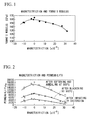
- Fig. 1 is a graph where the abscissa represents the magnetostriction ⁇ and the ordinate represents the Young's modulus, showing the properties of the magnetostriction control alloy sheet.
- Fig. 2 is a graph where the abscissa represents the magnetostriction ⁇ and the ordinate represents the permeability showing the properties of the magnetostriction control alloy sheet.
- the measurement of the magnetostriction ⁇ in Fig. 1 and Fig. 2 uses a commercially available distortion gauge, and measurement is carried out by converting the amount of distortion to an amount of electricity in a bridge circuit. Specifically, after softening and annealing the alloy sheet having a thickness of 0.12 mm, samples were produced having a size that allows attachment of a distortion gauge, the magnetic dependence of the "distortion" is measured in a magnetic field of about 3200 A/m to 4000 A/m, and the magnetostriction is determined.
- the Young's modulus in Fig. 1 was determined by a resonance method. Specifically, a strong vibration was applied to a sample piece, and the coefficient of elasticity was calculated by measuring the resonance frequency.
- the permeability ⁇ m was found by carrying out a direct current magnetic property test according to JIS C 2531.
- the Young's modulus in Fig. 1 and the permeability ⁇ m (after softening and annealing at 800° C) in Fig. 2 are the result of carrying out softening and annealing of the alloy sheet at 800° C and measuring the subsequent state.
- the softening and annealing at 800° C was carried out as a process equivalent to the above-described softening and annealing process.
- the Young's modulus of the shadow mask mounted in the CRT is determined by the Young's modulus before the press formation and after softening and annealing. Therefore, the final Young's modulus can be determined by the Young's modulus after annealing at 800° as described above.
- the permeability ⁇ m (after imparting the distorsion of 2%) in Fig. 2 is the result of imparting the distorsion of 2% after the above-described softening and annealing at 800° C and measuring the subsequent state.
- the permeability ⁇ m (after blackening at 600° C) in Fig. 2 is the result of blackening (600° C in an oxidizing atmosphere) after above-described imparting of the distorsion of 2% and measuring the subsequent state.
- blackening 600° C in an oxidizing atmosphere was carried as a process equivalent to the above-described blackening process.
- a Yong's modulus can be obtained that is higher than the 128 GPa (refer to comparative example 1 explained below) of the invar alloy (36 Ni-Fe).
- the Young's modulus is about 147 to 165 GPa, and compared to the invar alloy, the strength increases about 15 to 29%.
- the Young's modulus becomes high as the magnetostriction ⁇ approaches zero.
- the permeability also becomes high when the magnetostriction ⁇ is in the range of (-15x10 -6 ) to (+25x10 -6 ).
- the permeability of the alloy sheet shows a value that is at one point higher due to the softening and annealing, but deteriorates due to the distorsion imparted by the press formation, while a part thereof is restored by the blackening process.
- the permeability shows a value that becomes higher as the magnetostriction ⁇ after softening and annealing approaches zero.
- the permeability after the blackening process becomes equal to or greater than 4000 when the magnetostriction ⁇ after softening and annealing is restricted to the range of (-15x10 -6 ) to (+25x10 -6 ), while the permeability of the invar alloy is 3000. In this manner, it is clear that by specifying the range of the magnetostriction ⁇ , extremely superior magnetic properties are obtained.
- the magnetostriction control alloy sheet is manufactured by carrying out the processes of hot rolling, cold rolling (one time), annealing, cold rolling (two times), final annealing, and temper rolling.
- the recrystallized grains become uniform due to the softening and annealing process after applying the etching process to the shadow mask shape. That is, even when the softening and annealing, press formation, and blackening processes are applied to the alloy sheet, the variance in the magnetostriction ⁇ decreases, its range becomes (-15x10 -6 ) to (+25x10 -6 ), and stable material properties are attained.
- the temper rolling reduction ratio exceeds 40%, the grain size during recrystallization becomes small due to the annealing at 750 to 1000° C, and there is a tendency to form mixed grain sizes. Thus, the magnetostriction has a tendency to become negative more easily. This means that the values of the Young's modulus and the permeability become low.
- the temper rolling reduction ratio is preferably 10 to 30%.
- the reduction ratio of the final cold roll is equal to or greater than 50%, and preferably by adjusting this to 70% or greater, the ⁇ 100 ⁇ degree of accumulation can be made 40 to 90%.
- the crystal grain size number of the alloy sheet can be limited to 8 to 12. Because the shadow mask is etched, in order to improve the etchability, it is important that the crystal grain size and the crystal orientation of the material before etching be coordinated. The range of the preferable crystal grain size number is 9 to 12, and the preferable ⁇ 100 ⁇ degree of accumulation is 40 to 90%.
- a Ni-Fe-Co alloy that is the constituent shown in Table 1 is melted by vacuum melting, and after tempering within a temperature range of 1200 to 1350° C, the slab is heated treated at 1000 to 1250° C, and hot rolled to a thickness of 3.5 mm. Subsequently, an alloy sheet having a thickness of 0.12 mm is manufactured by cold rolling, annealing, final cold rolling, final annealing, temper rolling, and a stress relief annealing process. In this manufacturing process, each of the final cold reduction ratios, the final annealing temperature, and the temper rolling reduction ratio are shown in Fig. 2. No.
- the final cold rolling reduction ratio was 40%, and the final annealing temperature was 1050° C.
- the temper rolling reduction ratio of the example 8b was set to 8%
- the temper rolling reduction ratio of example 8c was set to 60%.
- the temper rolling reduction ratios for all of the other examples and the comparative examples were set to 20% or 25%.
- Table 2 shows the crystal grain size of each of the obtained magnetostriction control alloy sheets is shown using the crystal grain size number, and also shows the ⁇ 100 ⁇ degree of accumulation.
- ⁇ 100 ⁇ degree of accumulation I (200) / ⁇ I (111) + I(200) + I(220) + I (311) ⁇
- I (hkl) denotes the peak intensities of X-ray diffraction in the orientation of (hkl).
- results of evaluating the etchability are also shown in Table 3.
- the evaluation of the etchability does not relate to etching speed or the like, but before the softening and annealing process described above, when the plurality of apertures are formed by the etching process, it is determined whether or not a roughened surface finish can be identified on the inner surface of the hole.
- the Ni-Fe of comparative example 1 is a standard 36 Ni-Fe invar. Because the range of the magnetostriction of comparative example 1 exceeds the upper limit of the value defined by the present invention, the magnetic properties (permeability) and the Young's modulus are low.
- the Ni-Fe-Co is comparative example 2 is a super invar material, and the coefficient of thermal expansion is lower than invar, the permeability is also at the level of the invar (comparative example 1), the Young's modulus is higher than invar, but in order to improve the flat plane strength, a higher Young's modulus is necessary.
- the constituents and the value of the magnetostriction of the Ni-Fe-Co alloy of examples 4 through 8 and 9 are within the range of the present invention, favorable magnetic properties are exhibited, and at the same time, a high Young's modulus is exhibited.
- example 8a Because the constituents and the temper rolling reduction ratio of example 8a are within the range of the present invention, the magnetostriction properties are maintained and both Young's modulus and the permeability are high, but the crystal grain size number and the ⁇ 100 ⁇ degree of accumulation depart from the favorable range of present invention, and thus roughness occurs in the finish of the etching surface (inside the apertures), and there holes become what are termed rough holes, and the precision of the dimensions after the shadow mask processing is rather bad. However, from the point of utility, this does not comprise a significant hindrance.
- example 8b was below the lower limit of the temper rolling reduction ratio of the range of the present invention, the crystal grains that recrystallized in the softening and annealing at 800° C are a mixture of large and small grains, and the magnetostriction properties fall about 10x10 -6 in comparison to example 8, and the magnetic properties and Young's modulus after the blackening process are somewhat lowered. However, from the point of utility, this does not comprise a significant hindrance.
- example 8c exceeds the upper limit of the temper rolling reduction ratio of the present invention, and the crystal grain size during recrystallizing in the softening and annealing at 800° became small and a mixture of sizes occurred easily, and thus the magnetostriction had a tendency to become more negative, and the Young's modulus and the magnetic properties had values that were lower than the original values (example 8).
- magnetostriction and permeability are mutually related properties. Therefore, like magnetic properties such as permeability, the magnetostriction is a property that is sensitive to the crystal grain size and the residual amount of distortion.
- the magnetostriction greatly changes depending on the production conditions before softening and annealing, even for identical constituents, and as a result, the Young's modulus and the magnetic characteristics also fluctuate.
- the magnetostriction changes because the crystal grain size and the residual magnetostriction after the softening and annealing changes. Therefore, making the temper rolling reduction ratio 10 to 40% is important.
- the magnetostriction control type alloy sheet according to the examples of the present invention remarkably improves the permeability ( ⁇ m ) and the Young's modulus (E) in comparison to the conventional 36 Ni-Fe invar alloy, and clearly the other characteristics are maintained at levels equivalent to those of the conventional product.
Landscapes
- Chemical & Material Sciences (AREA)
- Engineering & Computer Science (AREA)
- Metallurgy (AREA)
- Organic Chemistry (AREA)
- Mechanical Engineering (AREA)
- Materials Engineering (AREA)
- Physics & Mathematics (AREA)
- Crystallography & Structural Chemistry (AREA)
- Thermal Sciences (AREA)
- Chemical Kinetics & Catalysis (AREA)
- General Chemical & Material Sciences (AREA)
- Electromagnetism (AREA)
- Manufacturing & Machinery (AREA)
- Electrodes For Cathode-Ray Tubes (AREA)
- Heat Treatment Of Sheet Steel (AREA)
- Heat Treatment Of Articles (AREA)
- Soft Magnetic Materials (AREA)
Abstract
Description
| No. | Ni | Co | Cr | Si | C | Mn | |
| Comparative examples | 1 | 36 | 0.03 | 0.01 | 0.03 | 0.005 | 0.28 |
| 2 | 32 | 5 | 0.01 | 0.02 | 0.003 | 0.30 | |
| 3 | 33 | 3 | 2.2 | 0.01 | 0.003 | 0.30 | |
| Examples | 4 | 32 | 4 | 1 | 0.01 | 0.005 | 0.29 |
| 5 | 32 | 4 | 0.5 | 0.006 | 0.005 | 0.02 | |
| 6 | 32 | 4 | 0.5 | 0.03 | 0.004 | 0.30 | |
| 7 | 34 | 2 | 1 | 0.02 | 0.003 | 0.28 | |
| 8 | 33 | 3 | 1 | 0.01 | 0.005 | 0.27 | |
| 8a | 33 | 3 | 1 | 0.01 | 0.005 | 0.27 | |
| 8b | 33 | 3 | 1 | 0.01 | 0.005 | 0.27 | |
| 8c | 33 | 3 | 1 | 0.01 | 0.005 | 0.27 | |
| 9 | 33 | 3 | 0.5 | 0.01 | 0.003 | 0.30 |
| No. | Final cold reduction (%) | Final annealing temperature (°C) | Crystal grain size number | {100} degree of accumulation (%) | Temper rolling reduction (%) | |
| Comparative examples | 1 | 70 | 900 | 11 | 70 | 25 |
| 2 | 70 | 900 | 10.5 | 75 | 25 | |
| 3 | 80 | 900 | 10.5 | 70 | 20 | |
| Examples | 4 | 85 | 900 | 10.5 | 80 | 20 |
| 5 | 80 | 900 | 11 | 75 | 25 | |
| 6 | 80 | 900 | 11 | 75 | 25 | |
| 7 | 80 | 900 | 10.5 | 70 | 25 | |
| 8 | 85 | 900 | 10.5 | 70 | 20 | |
| | 40 | 1050 | 8.5 | 40 | 20 | |
| 8b | 80 | 900 | 10.5 | 70 | 8 | |
| 8c | 80 | 900 | 11.0 | 70 | 60 | |
| 9 | 80 | 900 | 11.0 | 80 | 25 |
| No. | Coefficient of thermal expansion α (10-6·K-1) | Magneto striction σ (x10-6) | Young's modulus E (GPa) | Permeabilility µm | Etchability | |||
| After annealing at 800° C | After imparting 2% distortion | After blackening at 600° C | ||||||
| Comparative examples | 1 | 1.5 | 32 | 128 | 8000 | 1400 | 2800 | ○ |
| 2 | 0.5 | 27 | 142 | 8000 | 1500 | 3000 | ○ | |
| 3 | 2.3 | -4 | 158 | 16000 | 5000 | 7500 | ○ | |
| Examples | 4 | 1.4 | 11 | 152 | 14000 | 3500 | 7000 | ○ |
| 5 | 0.9 | 18 | 147 | 12500 | 2900 | 5800 | ○ | |
| 6 | 0.9 | 18 | 148 | 12000 | 2800 | 6200 | ○ | |
| 7 | 1.5 | 5 | 155 | 16000 | 4000 | 8000 | ○ | |
| 8 | 1.2 | 0 | 165 | 18000 | 5000 | 9500 | ○ | |
| 8a | 1.3 | -1 | 160 | 16000 | 4800 | 9200 | Δ | |
| 8b | 1.2 | -11 | 152 | 13000 | 4000 | 7000 | ○ | |
| 8c | 1.2 | -10 | 151 | 14000 | 3000 | 6000 | ○ | |
| 9 | 1 | 3 | 162 | 17000 | 5200 | 9000 | ○ |
Claims (7)
- A magnetostriction control alloy sheet being an alloy sheet used in a part for a color Braun tube such as a shadow mask, and characterized in that the magnetostriction λ after softening and annealing is between (-15x10-6) and (25x10-6).
- A magnetostriction control alloy sheet according to claim 1 incorporates C at 0.01 wt. % or less, Ni at 30 to 36 wt. %, Co at 1 to 5.0 wt. %, and Cr at 0.1 to 2 wt. %, and also incorporates Si at 0.001 to 0.10 wt. % and/or Mn at 0.001 to 1.0 wt. %, the remainder comprising Fe and unavoidable impurities.
- A magnetostriction control alloy sheet according to claim 1 having a crystal grain size number of 8 to 12.
- A magnetostriction control alloy sheet according to claim 1 wherein the {100} degree of accumulation on the rolled surface is 40 to 90%.
- A part for a color Braun tube such as a shadow mask using the magnetostriction control alloy sheet according to claim 1.
- A manufacturing method for the magnetostriction control alloy sheet is characterized that after the Ni-Fe-Co alloy incorporating C at 0.01 wt. % or less, Ni at 30 to 36 wt. %, Co at 1 to 5.0 wt. %, and Cr at 0.1 to 2 wt. %, and also incorporates Si at 0.001 to 0.10 wt. % and/or Mn at 0.001 to 1.0 wt. %, the remainder comprising Fe and unavoidable impurities, undergoes final annealing, there is a temper rolling process in which the reduction ratio is 10 to 40%.
- A manufacturing method for a magnetostriction control alloy sheet according to claim 6 wherein the final annealing temperature is 800 to 1100° C, and the reduction rate of the cold rolling before this final annealing is equal to or greater than 50%.
Applications Claiming Priority (2)
| Application Number | Priority Date | Filing Date | Title |
|---|---|---|---|
| JP2000222335 | 2000-07-24 | ||
| JP2000222335A JP2002038239A (en) | 2000-07-24 | 2000-07-24 | Magnetostriction controlled alloy sheet, component for color cathode ray tube using the same, and method of manufacturing magnetostriction controlled alloy sheet |
Publications (2)
| Publication Number | Publication Date |
|---|---|
| EP1176221A2 true EP1176221A2 (en) | 2002-01-30 |
| EP1176221A3 EP1176221A3 (en) | 2007-03-07 |
Family
ID=18716590
Family Applications (1)
| Application Number | Title | Priority Date | Filing Date |
|---|---|---|---|
| EP01117624A Withdrawn EP1176221A3 (en) | 2000-07-24 | 2001-07-24 | Magnetorestriction control alloy sheet, a part of a Braun tube and a manufacturing method for a magnetorestriction control alloy sheet |
Country Status (6)
| Country | Link |
|---|---|
| US (1) | US6824625B2 (en) |
| EP (1) | EP1176221A3 (en) |
| JP (1) | JP2002038239A (en) |
| KR (1) | KR100756747B1 (en) |
| CN (1) | CN1168843C (en) |
| TW (1) | TW583319B (en) |
Cited By (1)
| Publication number | Priority date | Publication date | Assignee | Title |
|---|---|---|---|---|
| WO2017016604A1 (en) * | 2015-07-29 | 2017-02-02 | Aperam | Feco alloy, fesi alloy or fe sheet or strip and production method thereof, magnetic transformer core produced from said sheet or strip, and transformer comprising same |
Families Citing this family (8)
| Publication number | Priority date | Publication date | Assignee | Title |
|---|---|---|---|---|
| JP2001131707A (en) * | 1999-10-29 | 2001-05-15 | Dainippon Printing Co Ltd | Shadow mask for color CRT |
| DE10146301C1 (en) * | 2001-09-19 | 2002-07-18 | Krupp Vdm Gmbh | Production of a strip made from an iron-nickel alloy, used for shadow masks in flat monitors and TV screens, comprises continuous or batch-type annealing a strip made from an iron alloy containing nickel, molybdenum and chromium |
| US7782574B1 (en) * | 2005-04-11 | 2010-08-24 | Seagate Technology Llc | Magnetic heads disk drives and methods with thicker read shield structures for reduced stray field sensitivity |
| US20050274438A1 (en) * | 2004-06-09 | 2005-12-15 | Hasek David R | Alloys having low coefficient of thermal expansion and methods of making same |
| CN100526493C (en) * | 2004-07-27 | 2009-08-12 | 新日本制铁株式会社 | High Young's modulus steel sheet, hot-dip galvanized steel sheet using the same, alloyed hot-dip galvanized steel sheet, and high Young's modulus steel pipe, and their manufacturing methods |
| JP5526701B2 (en) * | 2009-10-22 | 2014-06-18 | Jfeスチール株式会社 | Motor core |
| CN106353702B (en) * | 2016-09-14 | 2018-11-13 | 广东顺德中山大学卡内基梅隆大学国际联合研究院 | A kind of MEMS magnetic field sensors and preparation method based on the modal resonance device that stretches in face |
| CN108165889B (en) * | 2017-12-27 | 2019-12-20 | 北京北冶功能材料有限公司 | Low-expansion alloy with high maximum magnetic conductivity and preparation method thereof |
Family Cites Families (24)
| Publication number | Priority date | Publication date | Assignee | Title |
|---|---|---|---|---|
| JPH0676645B2 (en) | 1985-02-13 | 1994-09-28 | 株式会社東芝 | Material for pipe parts and manufacturing method thereof |
| JPS6164853A (en) | 1984-09-06 | 1986-04-03 | Toshiba Corp | Base material for pipe parts and its manufacture |
| JPS6119737A (en) * | 1985-05-20 | 1986-01-28 | Toshiba Corp | Shadow mask base plate and its preparation |
| JPS62112759A (en) | 1985-11-12 | 1987-05-23 | Nippon Mining Co Ltd | Shadow mask |
| JPS62174353A (en) | 1986-01-28 | 1987-07-31 | Nippon Yakin Kogyo Co Ltd | Fe-Ni low thermal expansion alloy with excellent press formability and etching properties |
| JPH01124108A (en) * | 1987-11-09 | 1989-05-17 | Hitachi Ltd | thin film magnetic head |
| JP2592884B2 (en) | 1988-02-09 | 1997-03-19 | 株式会社東芝 | Shadow mask |
| US5443664A (en) * | 1988-11-16 | 1995-08-22 | Hitachi Metals, Ltd. | Surge current-suppressing circuit and magnetic device therein |
| US5028280A (en) * | 1988-12-15 | 1991-07-02 | Matsushita Electric Industrial Co., Ltd. | Soft magnetic alloy films having a modulated nitrogen content |
| US5252148A (en) * | 1989-05-27 | 1993-10-12 | Tdk Corporation | Soft magnetic alloy, method for making, magnetic core, magnetic shield and compressed powder core using the same |
| US5164021A (en) * | 1989-11-17 | 1992-11-17 | Yamaha Corporation | Method for manufacturing a shadow mask of a Fe-Ni alloy |
| JPH04120251A (en) * | 1990-09-11 | 1992-04-21 | Nippon Steel Corp | Shadow mask material and its manufacturing method |
| JPH04228545A (en) | 1990-09-11 | 1992-08-18 | Nippon Steel Corp | Shadow mask material and its production |
| KR930009876B1 (en) * | 1990-11-08 | 1993-10-12 | 주식회사 금성사 | Screen color editing circuit of color TV |
| JP2871414B2 (en) * | 1993-08-27 | 1999-03-17 | 日本鋼管株式会社 | Alloy thin plate for shadow mask excellent in press formability and method for producing the same |
| JP2951808B2 (en) | 1993-03-11 | 1999-09-20 | 日本冶金工業 株式会社 | Manufacturing method of shadow mask |
| DE69425189T2 (en) * | 1993-05-28 | 2001-03-22 | Nkk Corp., Tokio/Tokyo | Iron-nickel alloy sheets for shadow mask |
| EP0739992B1 (en) * | 1993-05-31 | 1998-06-10 | Nkk Corporation | Alloy sheet for shadow mask and method for manufacturing thereof |
| JP2669789B2 (en) | 1994-08-11 | 1997-10-29 | 株式会社東芝 | In-pipe parts |
| US5873955A (en) * | 1994-08-12 | 1999-02-23 | Hitachi, Ltd. | Soft magnetic thin film, and magnetic head and magnetic recording device using the same |
| FR2728724B1 (en) | 1994-12-27 | 1997-01-24 | Imphy Sa | METHOD FOR MANUFACTURING AN IRON-NICKEL ALLOY SHADOW MASK |
| KR19990002612A (en) * | 1997-06-20 | 1999-01-15 | 구자홍 | Shadow mask for color cathode ray tube and manufacturing method |
| KR100244231B1 (en) * | 1997-11-29 | 2000-02-01 | 구자홍 | Shadow mask for cathode ray tube |
| KR100259299B1 (en) * | 1998-04-21 | 2000-06-15 | Lg Electronics Inc | Shadow mask of color cathode ray tube and method for fabricating the same |
-
2000
- 2000-07-24 JP JP2000222335A patent/JP2002038239A/en active Pending
-
2001
- 2001-07-19 US US09/909,396 patent/US6824625B2/en not_active Expired - Fee Related
- 2001-07-24 KR KR1020010044527A patent/KR100756747B1/en not_active Expired - Fee Related
- 2001-07-24 EP EP01117624A patent/EP1176221A3/en not_active Withdrawn
- 2001-07-24 CN CNB011259361A patent/CN1168843C/en not_active Expired - Fee Related
- 2001-07-24 TW TW090118044A patent/TW583319B/en not_active IP Right Cessation
Cited By (3)
| Publication number | Priority date | Publication date | Assignee | Title |
|---|---|---|---|---|
| WO2017016604A1 (en) * | 2015-07-29 | 2017-02-02 | Aperam | Feco alloy, fesi alloy or fe sheet or strip and production method thereof, magnetic transformer core produced from said sheet or strip, and transformer comprising same |
| WO2017017256A1 (en) * | 2015-07-29 | 2017-02-02 | Aperam | Feco alloy, fesi alloy or fe sheet or strip and production method thereof, magnetic transformer core produced from said sheet or strip, and transformer comprising same |
| US11767583B2 (en) | 2015-07-29 | 2023-09-26 | Aperam | FeCo alloy, FeSi alloy or Fe sheet or strip and production method thereof, magnetic transformer core produced from said sheet or strip, and transformer comprising same |
Also Published As
| Publication number | Publication date |
|---|---|
| CN1335416A (en) | 2002-02-13 |
| EP1176221A3 (en) | 2007-03-07 |
| TW583319B (en) | 2004-04-11 |
| JP2002038239A (en) | 2002-02-06 |
| US6824625B2 (en) | 2004-11-30 |
| CN1168843C (en) | 2004-09-29 |
| KR100756747B1 (en) | 2007-09-07 |
| KR20020008802A (en) | 2002-01-31 |
| US20020033207A1 (en) | 2002-03-21 |
Similar Documents
| Publication | Publication Date | Title |
|---|---|---|
| US6824625B2 (en) | Magnetostriction control alloy sheet, a part of a braun tube, and a manufacturing method for a magnetostriction control alloy sheet | |
| KR100379871B1 (en) | Process for manufacturing a shadow mask made of an iron-nickel alloy | |
| KR100484481B1 (en) | Fe-Ni-Co ALLOY FOR COMPLETELY FLAT MASK OF PRESS-FORMED TYPE, AND COMPLETELY FLAT MASK AND COLOR CATHODE-RAY TUBE USING THE SAME | |
| JPH1060525A (en) | Manufacturing method of low thermal expansion alloy sheet excellent in sheet shape and heat shrink resistance | |
| JP2871414B2 (en) | Alloy thin plate for shadow mask excellent in press formability and method for producing the same | |
| EP0627494B1 (en) | Alloy sheet for shadow mask and method for manufacturing thereof | |
| JP3379368B2 (en) | Method for producing low thermal expansion alloy sheet excellent in sheet shape and heat shrink resistance | |
| KR20040111602A (en) | Low-thermal expansion alloy thin sheet and its manufacturing method | |
| US20020117241A1 (en) | Method of manufacturing Fe-Ni alloy material for pressed flat mask | |
| JP3538850B2 (en) | Fe-Ni alloy thin plate and Fe-Ni-Co alloy thin plate for shadow mask excellent in press formability and method for producing the same | |
| JP3379301B2 (en) | Method for producing low thermal expansion alloy thin plate for shadow mask excellent in plate shape and heat shrink resistance | |
| JP3348565B2 (en) | Method of producing Fe-Ni-based alloy thin plate for electronic parts and Fe-Ni-Co-based alloy thin plate excellent in degreasing property | |
| JPH06184701A (en) | Fe-Ni alloy plate for shadow mask | |
| KR100519615B1 (en) | Thin Alloy Sheet of Low Thermal Expansion and Shadow Mask Using the Same | |
| JP2933913B1 (en) | Fe-Ni-based shadow mask material and method of manufacturing the same | |
| US6583545B1 (en) | Aperture grill material for color picture tube, production method thereof, aperture grill and picture tube | |
| JP2001152292A (en) | Fe-Ni alloy for semi-tension mask excellent in magnetic properties, semi-tension mask and color cathode ray tube using the same | |
| JP2909299B2 (en) | Material for high-definition shadow mask, mask material and manufacturing method thereof | |
| JP4185000B2 (en) | Manufacturing method of steel plate for magnetic shield inside TV CRT | |
| JP3793122B2 (en) | Method for manufacturing mask material for color picture tube | |
| JP2002060908A (en) | LOW THERMAL EXPANSION Fe-Ni BASED ALLOY SHEET FOR SHADOW MASK EXCELLENT IN ETCHING PROPERTY AND DEFORMATION RESISTANCE AND ITS PRODUCTION METHOD | |
| JP2003239042A (en) | Low thermal expansion alloy sheet excellent in etching accuracy and method of manufacturing the same | |
| JP2004156096A (en) | Tension type alloy thin plate for shadow mask with excellent magnetic shielding properties | |
| JPS61174330A (en) | Manufacture of cold rolled steel sheet for shadow mask having superior magnetic characteristic | |
| JPH08316390A (en) | Fe-Ni system electronic part material and its manufacturing method |
Legal Events
| Date | Code | Title | Description |
|---|---|---|---|
| PUAI | Public reference made under article 153(3) epc to a published international application that has entered the european phase |
Free format text: ORIGINAL CODE: 0009012 |
|
| AK | Designated contracting states |
Kind code of ref document: A2 Designated state(s): AT BE CH CY DE DK ES FI FR GB GR IE IT LI LU MC NL PT SE TR |
|
| AX | Request for extension of the european patent |
Free format text: AL;LT;LV;MK;RO;SI |
|
| RAP1 | Party data changed (applicant data changed or rights of an application transferred) |
Owner name: DAI NIPPON PRINTING CO., LTD. |
|
| PUAL | Search report despatched |
Free format text: ORIGINAL CODE: 0009013 |
|
| AK | Designated contracting states |
Kind code of ref document: A3 Designated state(s): AT BE CH CY DE DK ES FI FR GB GR IE IT LI LU MC NL PT SE TR |
|
| AX | Request for extension of the european patent |
Extension state: AL LT LV MK RO SI |
|
| 17P | Request for examination filed |
Effective date: 20070620 |
|
| AKX | Designation fees paid |
Designated state(s): DE FR |
|
| 17Q | First examination report despatched |
Effective date: 20080327 |
|
| STAA | Information on the status of an ep patent application or granted ep patent |
Free format text: STATUS: THE APPLICATION IS DEEMED TO BE WITHDRAWN |
|
| 18D | Application deemed to be withdrawn |
Effective date: 20080807 |