EP1176122A1 - Magnetic sludge suitable for use in waste water treatment and method for preparing the same and method for waste water treatment - Google Patents
Magnetic sludge suitable for use in waste water treatment and method for preparing the same and method for waste water treatment Download PDFInfo
- Publication number
- EP1176122A1 EP1176122A1 EP00904035A EP00904035A EP1176122A1 EP 1176122 A1 EP1176122 A1 EP 1176122A1 EP 00904035 A EP00904035 A EP 00904035A EP 00904035 A EP00904035 A EP 00904035A EP 1176122 A1 EP1176122 A1 EP 1176122A1
- Authority
- EP
- European Patent Office
- Prior art keywords
- magnetic
- sludge
- wastewater treatment
- microorganisms
- magnetic field
- Prior art date
- Legal status (The legal status is an assumption and is not a legal conclusion. Google has not performed a legal analysis and makes no representation as to the accuracy of the status listed.)
- Granted
Links
Images






Classifications
-
- C—CHEMISTRY; METALLURGY
- C02—TREATMENT OF WATER, WASTE WATER, SEWAGE, OR SLUDGE
- C02F—TREATMENT OF WATER, WASTE WATER, SEWAGE, OR SLUDGE
- C02F3/00—Biological treatment of water, waste water, or sewage
- C02F3/02—Aerobic processes
- C02F3/10—Packings; Fillings; Grids
- C02F3/105—Characterized by the chemical composition
- C02F3/108—Immobilising gels, polymers or the like
-
- C—CHEMISTRY; METALLURGY
- C02—TREATMENT OF WATER, WASTE WATER, SEWAGE, OR SLUDGE
- C02F—TREATMENT OF WATER, WASTE WATER, SEWAGE, OR SLUDGE
- C02F1/00—Treatment of water, waste water, or sewage
- C02F1/48—Treatment of water, waste water, or sewage with magnetic or electric fields
-
- C—CHEMISTRY; METALLURGY
- C02—TREATMENT OF WATER, WASTE WATER, SEWAGE, OR SLUDGE
- C02F—TREATMENT OF WATER, WASTE WATER, SEWAGE, OR SLUDGE
- C02F3/00—Biological treatment of water, waste water, or sewage
- C02F3/02—Aerobic processes
- C02F3/06—Aerobic processes using submerged filters
-
- C—CHEMISTRY; METALLURGY
- C02—TREATMENT OF WATER, WASTE WATER, SEWAGE, OR SLUDGE
- C02F—TREATMENT OF WATER, WASTE WATER, SEWAGE, OR SLUDGE
- C02F3/00—Biological treatment of water, waste water, or sewage
- C02F3/02—Aerobic processes
- C02F3/10—Packings; Fillings; Grids
-
- C—CHEMISTRY; METALLURGY
- C02—TREATMENT OF WATER, WASTE WATER, SEWAGE, OR SLUDGE
- C02F—TREATMENT OF WATER, WASTE WATER, SEWAGE, OR SLUDGE
- C02F3/00—Biological treatment of water, waste water, or sewage
- C02F3/28—Anaerobic digestion processes
- C02F3/2846—Anaerobic digestion processes using upflow anaerobic sludge blanket [UASB] reactors
-
- C—CHEMISTRY; METALLURGY
- C02—TREATMENT OF WATER, WASTE WATER, SEWAGE, OR SLUDGE
- C02F—TREATMENT OF WATER, WASTE WATER, SEWAGE, OR SLUDGE
- C02F2201/00—Apparatus for treatment of water, waste water or sewage
- C02F2201/48—Devices for applying magnetic or electric fields
- C02F2201/483—Devices for applying magnetic or electric fields using coils
-
- Y—GENERAL TAGGING OF NEW TECHNOLOGICAL DEVELOPMENTS; GENERAL TAGGING OF CROSS-SECTIONAL TECHNOLOGIES SPANNING OVER SEVERAL SECTIONS OF THE IPC; TECHNICAL SUBJECTS COVERED BY FORMER USPC CROSS-REFERENCE ART COLLECTIONS [XRACs] AND DIGESTS
- Y02—TECHNOLOGIES OR APPLICATIONS FOR MITIGATION OR ADAPTATION AGAINST CLIMATE CHANGE
- Y02E—REDUCTION OF GREENHOUSE GAS [GHG] EMISSIONS, RELATED TO ENERGY GENERATION, TRANSMISSION OR DISTRIBUTION
- Y02E50/00—Technologies for the production of fuel of non-fossil origin
- Y02E50/30—Fuel from waste, e.g. synthetic alcohol or diesel
-
- Y—GENERAL TAGGING OF NEW TECHNOLOGICAL DEVELOPMENTS; GENERAL TAGGING OF CROSS-SECTIONAL TECHNOLOGIES SPANNING OVER SEVERAL SECTIONS OF THE IPC; TECHNICAL SUBJECTS COVERED BY FORMER USPC CROSS-REFERENCE ART COLLECTIONS [XRACs] AND DIGESTS
- Y02—TECHNOLOGIES OR APPLICATIONS FOR MITIGATION OR ADAPTATION AGAINST CLIMATE CHANGE
- Y02W—CLIMATE CHANGE MITIGATION TECHNOLOGIES RELATED TO WASTEWATER TREATMENT OR WASTE MANAGEMENT
- Y02W10/00—Technologies for wastewater treatment
- Y02W10/10—Biological treatment of water, waste water, or sewage
-
- Y—GENERAL TAGGING OF NEW TECHNOLOGICAL DEVELOPMENTS; GENERAL TAGGING OF CROSS-SECTIONAL TECHNOLOGIES SPANNING OVER SEVERAL SECTIONS OF THE IPC; TECHNICAL SUBJECTS COVERED BY FORMER USPC CROSS-REFERENCE ART COLLECTIONS [XRACs] AND DIGESTS
- Y10—TECHNICAL SUBJECTS COVERED BY FORMER USPC
- Y10S—TECHNICAL SUBJECTS COVERED BY FORMER USPC CROSS-REFERENCE ART COLLECTIONS [XRACs] AND DIGESTS
- Y10S210/00—Liquid purification or separation
- Y10S210/902—Materials removed
- Y10S210/903—Nitrogenous
Definitions
- the invention of the present application concerns a magnetic sludge suitable for use in wastewater treatment, a method for preparing the same and a method for wastewater treatment by using the same.
- the treatment efficiency is remarkably lowered. This is because the microorganism communities deposited and grown on the cord are exposed directly to wastewater and, accordingly, the microorganism communities are formed upon inflow or stirring of wastewater by kinetic energy of solids. Under such a circumstance, the concentration of outflowing solids increases more in the treated water than that before treatment to worsen the water quality.
- the invention of the present application provides, secondly, a magnetic sludge in which paramagnetic material is contained and, thirdly, a magnetic sludge using a polymer as a support and, fourthly, a magnetic sludge in which the polymer comprises an insolubilized chitosan or polyvinyl alcohol.
- the invention of the present application provides, fifthly, a method for preparing a magnetic sludge containing microorganisms and having magnetic field reactivity in which paramagnetic material and a concentrated sludge are caught and supported on a polymer as a support and, sixthly, a preparation method in which a polymer comprises an insolubilized chitosan or polyvinyl alcohol.
- the invention of the present application provides, seventhly, a method for wastewater treatment using the magnetic sludge according to any one of the first to fourth inventions in which the movement of the magnetic sludge is controlled by a magnetic force, eighthly, amethodforwastewater treatment in which denitrification and methane fermentation are conducted simultaneously in one tank and, ninthly, a method for wastewater treatment for retaining the magnetic sludge to porous concretes.
- the invention of the present application provides, tenthly, a method for wastewater treatment by a treatment tank in which an inclusive fixed carrier possessing microorganisms and having magnetic property is filled in a submerged fixed filter bed in which the wastewater treatment is conducted by controlling the position of the magnetic inclusive fixed carrier in water by the change of the direction of the magnetic field by an external magnetic field.
- the invention of the present application provides, thirteenthly, a method for wastewater treatment of incorporating an inclusive fixed carrier possessing microorganisms and having magnetic property in a submerged fixed filter bed, in which a magnetic force application device is disposed for controlling the position of the inclusive fixed carrier in water by the change of the direction of the magnetic field and, fourteenthly, an apparatus for wastewater treatment in which the inclusive fixed carrier is constituted as a beads-like, plate-like, cord-like or agglomerated sludge-like form, fifteenthly, an apparatus for wastewater treatment in which the magnetic force application means comprises a permanent magnet or solenoid coil and, sixteenthly, an apparatus for wastewater treatment in which the magnetic force application device provides a fixed or variable magnetic field.
- an appropriate support is used on which a concentrated sludge is supported and microorganisms are possessed, and the sludge has a sensitive reactivity (responsivity) to the magnetic field as the magnetic sludge.
- a paramagnetic material and a concentrated sludge may be suspended in a solution of acetic acid - chitosan and fixed by the crosslinking reaction of chitosan.
- Chitosan has an effect of dissolving in an acetic acid solution and coagulating to settle suspended matters if they are present in the solution.
- an alkali solution such as of sodium hydroxide
- chitosan is insolubilized to form a sludge that firmly catches the paramagnetic material and the concentrated sludge. About several minutes of time are sufficient to the reaction required for insolubilization and there is little undesired effect on the microorganisms.
- the thus formed sludge is thoroughly washed with water and recovered by using a permanent magnet, a magnetic sludge is obtained.
- the paramagnetic material referred to herein is a special magnetic material found in ferroelectric material which has no remanence magnetization when put under a magnetic field and does not deposit to each other even after taking out of the magnetic field as observed in usual magnetic material. This property is preferred for the wastewater treatment and a fine powder of iron oxide such as magnetite or ferrite can be mentioned as the material.
- the magnetic sludge is in the state of catching microorganisms on the inside upon starting of the wastewater treatment. Since the surface of the insolubilized chitosan is rough and porous, microorganisms are adsorbed and grown thereon. Accordingly, biological membranes are formed also on the surface of the sludge as the treatment proceeds.
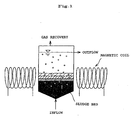
- the first example is utilized as an upflow anaerobic sludge bed reactor in which a sludge head is formed with a magnetic sludge shown in Fig. 1.
- a sludge head is formed with a magnetic sludge shown in Fig. 1.
- the sludge bed vibrates the slightly undergoing a magnetic field from the outside by a magnetic coil or the like, which promotes the release of the generated gas and can also prevent clogging or channeling.
- the second example is a downflow anaerobic sludge bed reactor as shown in Fig. 2.
- the magnetic microorganism inclusive fixed carrier as described above in this invention may be in various kinds of shapes or structures such as magnetic beads, magnetic sludges of agglomerated sludge-like concentrated sludges and . string-like magnetic cords. While the carriers are in the state of possessing concentrated microorganism communities at the start of the wastewater treatment, the microorganisms are grown also on the surface of the carrier during proceeding of the treatment and the biological membranes are formed also on the surface of the carrier when reaching the stationary treatment state.
- the magnetic inclusive fixed carrier itself maybe applied with a magnetic property by using a support for the shape and the structure described above.
- the support may, for example, be a natural or synthesis high molecular polymer. Specifically, they can include, for example, insolubilized chitosan, polyvinyl alcohol, polyester, polyether, polyacrylic material and insolubilized alginic acid.
- those having porosity, particularly, surface porosity are used preferably.
- the magnetic property may be provided by various kinds of means and, for example, a paramagnetic material can be used.
- the paramagnetic material referred to herein is a special magnetic material found in ferroelectric material which has no remanence magnetization when put under a magnetic field and does not deposit to each other even after taking out of the magnetic field as observed in usual magnetic material. This property is preferred for the wastewater treatment and a fine powder of iron oxide such as magnetite or ferrite can be mentioned as the material.
- a string-like magnetic cord is provided characteristically in this invention.
- the magnetic cord can include, for example, more specifically, those formed by suspending a paramagnetic material and a concentrated sludge in a solution of alginic acid - polyvinyl alcohol (PVA) and fixing them by utilizing the crosslinking reaction of molecules in the mixed solution.
- Alginic acid ions in the solution of alginic acid - polyvinyl alcohol (PVA) are combined with calcium ions to forma polymer and are insolubilized.
- the paramagnetic material and the concentrated sludge are included and fixed to the cord-like support. After strength has been obtained to some extent on the surface of the cord, the fixed cord is thoroughly washed with water and frozen at a low temperature of about -20°C.
- the PVA molecules in the solution of alginic acid - polyvinyl alcohol (PVA) has a nature of releasing molecules of water from the polymeric structure upon repeating freezing and thawing to make the structure firm. By utilizing this nature, the physical strength of the magnetic cord is increased by repeating freezing and thawing thereof for about three times.
- the microorganisms While the magnetic cord is in the state of possessing concentrated microorganism communities in the inside of the carrier at the start of the wastewater treatment, the microorganisms are adsorbed and grown also on the porous surface of the cords during progress of the treatment and the biological membranes are formed also on the surface of the cords when the treatment efficiency reaches a stationary state.
- the device for controlling the movement of the magnetic fixed carrier from the outside by the magnetic force may be a permanent magnet or a solenoid coil.
- the permanent magnet is one of device that can be adopted more conveniently.
- the permanent magnet may be various kinds of magnets such as Alnico magnet, ferrite magnet or rare earth magnet. Further, depending on the case, it may be a super conductive magnet.
- chitosan 200 to 300 mg are dissolved in 50 to 100 ml of a diluted acetic acid solution. 1.5 to 3.0 g of magnetite and 15 to 30 g of concentrated sludge (about 3% solid concentration) are mixed and suspended in the solution. When magnetite and concentrated sludge are coagulated, 5 to 30 ml of a sodium hydroxide solution (1 N) is added and stirred vigorously. Chitosan is insolubilized for 2 to 3 min to catch magnetite and concentrated sludge. When they are washed with a great amount of water and centrifugated at 3000 rpm for 15 min, about 10 g of a magnetic sludge is obtained. As shown in Fig.
- An upflow anaerobic sludge bed reactor formed with a magnetic sludge bed is constituted as shown in Fig. 1.
- a great amount of microorganisms are possessed in the inside and on the surface of the magnetic sludge, which decompose organic matters and nitrate nitrogen to form gases. Since a greater amount of microorganisms are possessed in the magnetic sludge compared with usual treatment, the treatment efficiency is improved.
- a magnetic field is applied from the outside of the apparatus to the sludge bed by using, for example, magnetic coils. Magnetic coils are disposed in two or more directions and electric current is supplied to them while changing the time of application to change the direction of the magnetic field periodically. When the sludge bed is moved little by little by the operation, release of generated gases can be promoted and clogging or channeling can also be prevented.
- methane forming bacteria decompose the carbon source flowing from the upper region. While carbon dioxide and methane gas are generated in this step, they are directed upward and partially utilized as a carbon source for the denitrification bacteria.
- the treatment conducted separately so far in two tanks is completed in one tank.
- the method of moving the magnetic sludge bed is identical with that in Example 2.
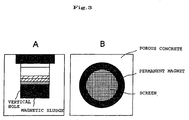
- a magnetic sludge is retained in a hole perforated in porous concretes and applied to purification of water of rivers and lakes.
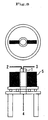
- a doughnuts-like permanent magnet is buried to the lateral side of the entrance of the hole perforated in the concretes as shown in Fig. 3 (A), (B) .
- the magnetic sludge does not escape out of the hole by the magnetic force.
- a screen is disposed at the entrance for preventing intrusion of miscellaneous matters.
- concretes provided with a plurality of such holes are settled in rivers and lakes and contaminated water intruding into them is cleaned by the .magnetic sludge.
- Microorganisms that escape from the magnetic sludge, and grown and suspended are deposited to the fine pores of the concrete and contribute to the improvement of the treatment efficiency.
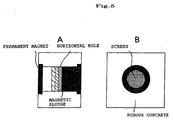
- a magnetic sludge is retained in a hole perforated in porous concretes and applied to the purification of water of rivers and lakes.
- Doughnuts-like permanent magnets are buried to the lateral surface of the inlet and outlet of the hole perforated in the concretes as shown in Fig. 5(A), (B).
- the magnetic sludge does not escape outside of the hole by the magnetic force.
- Screens are disposed at the entrance and the exit for preventing intrusion of miscellaneous matters.
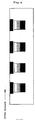
- the direction of disposing the concretes is made in parallel with the flow of water as shown in Fig. 6. This makes the contaminated water to be in contact with the magnetic sludge more positively.
- the magnetic sludge according to this invention suitable for use inwastewater treatment can provide the following effects.
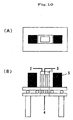
- Appended Fig. 8 shows a plan view and a cross sectional view illustrating an example of a turn table type magnet utilizing wastewater treatment apparatus.
- 1 denotes a treatment tank and 2 denotes a line for guiding the generated gas to a gas retainer.
- the treatment tank can be set as an upflow type or a downflow type.
- a turntable carrying a permanent magnet 5 is turned around the treatment tank to periodically change the direction of the magnetic field generated in the treatment tank.
- Amicroorganism inclusive fixed carrier having magnetic property is filled in the treatment tank and the carrier is moved by utilizing the change of the direction of the magnetic field.
- the carrier is retained in the tank by utilizing the magnetic field in the treatment tank to prevent outflow and keep the bacterial concentration high in the tank.
- the intensity of the magnetic flux density in the treatment tank can be changed by changing the distance from the treatment tank to the magnet. Further, the state of moving the carrier can be changed by varying the rotating speed of the turntable.
- denitrification treatment is conducted actually by using the turntable type magnet utilizing wastewater treatment apparatus shown in Fig. 8.
- About 20 to 25% for an effective volume (solid content 8.4% (w/w)) of a magnetic sludge (comprising insolubilized chitosan support and paramagnetic material) was incorporated in a treatment tank.
- the concentration of nitrate nitrogen in the inflowing liquid was set to 100 mg/l.
- the turn table was rotated at a speed of 1.67 turn/min for 15 min per 1 hour.
- the treatment was conducted by a continuous operation which was started with the average hydraulic mean staying time (HRT) of 4 hr and lowered to 2 hr.
- HRT average hydraulic mean staying time
- a nitrogen removal rate of 90% or higher was attained after the sixth day of the operation.
- the carrier is retained in the tank to prevent outflow by utilizing the magnetic field in the treatment tank and keep the bacterial concentration high in the tank. Further, the state of moving the carrier can be changed by changing the speed of the lateral movement and the amplitude of the lateral movement of the magnets.
- nitrification treatment is conducted actually by using the horizontally moving type magnet utilizing wastewater treatment apparatus shown in Fig. 10.
- About 17 to 25% for an effective volume of magnetic sludge (prepared in accordance with Example 3) was incorporated in a treatment tank.
- the concentration of nitrate nitrogen in the inflow liquid was set to 100 mg/l.
- the treatment was conducted by a continuous operation which was started with average hydraulic mean staying time (HRT) of 6 hr and lowered to 2 hr.
- HRT average hydraulic mean staying time
- a nitrogen removal rate of about 100% was attained after the third day of operation.
- cord-supports for example, yarns or guts derived from natural or synthetic fibers
- the twined amount is controlled by providing the solution A with an appropriate viscosity.
- the cords in this state are dipped in a calcium chloride solution (4% (w/v), solution B).
- a magnetic field is applied from beneath the container filled with the solution B and cords are compulsorily dipped in the solution B and retained therein.
- Alginic acid ions in the solution A and calcium ions in the solution B are bonded to form insoluble calcium alginate on the surface of the cords.
- An appropriate strength can be obtained on the cord surface by dipping in the solution B for about 20 min. The cords are taken out and thoroughly washed with tap water.
- the magnetic cords are frozen at about -20°C for 24 hours. Subsequently, they are thawed and water on the surface is wiped off thoroughly. The operation of freezing/thawing is repeated for about three times. This releases molecules of water in the PVA polymer and makes the polymeric bonds firm to form magnetic cords having physical strength endurable to the wastewater treatment process.
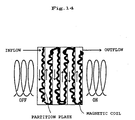
- a plurality of partition plates are disposed in a reactor shown in Fig. 14.
- the magnetic cords are retained magnetically on the surface of the partition plates.
- the magnetic field is generated on the left, they are retained on the opposite surface. It is controlled by repeating the operation so as not to deposit excess sludges.
- the wastewater is consumed by the microorganism communities growing on the magnetic cords during passage between the partition plates.
Landscapes
- Life Sciences & Earth Sciences (AREA)
- Chemical & Material Sciences (AREA)
- Water Supply & Treatment (AREA)
- Hydrology & Water Resources (AREA)
- Engineering & Computer Science (AREA)
- Environmental & Geological Engineering (AREA)
- Microbiology (AREA)
- Organic Chemistry (AREA)
- Biodiversity & Conservation Biology (AREA)
- Chemical Kinetics & Catalysis (AREA)
- General Chemical & Material Sciences (AREA)
- Biological Treatment Of Waste Water (AREA)
- Purification Treatments By Anaerobic Or Anaerobic And Aerobic Bacteria Or Animals (AREA)
Abstract
Description
Claims (17)
- A magnetic sludge containing microorganisms and having reactivity to magnetic field.
- A magnetic sludge as defined in claim 1 in which a paramagnetic material is contained.
- A magnetic sludge as defined in claim 1 or 2, wherein a polymer is used as a support.
- A magnetic sludge as defined in claim 3, wherein the polymer is insolubilized chitosan or polyvinyl alcohol.
- A method of preparing a magnetic sludge containing microorganisms and having a reactivity to magnetic field in which a paramagnetic material and a concentrated sludge are caught and supported on a polymer as a support.
- A preparation method as defined in claim 5, wherein the polymer is insolubilized chitosan or polyvinyl alcohol.
- A method for wastewater treatment by using a magnetic sludge as defined in any one of claims 1 to 4, wherein the movement of the magnetic sludge is controlled by a magnetic force.
- A method for wastewater treatment as defined in claim 7, wherein denitrification and methane fermentation are conducted simultaneously in one tank.
- A method for wastewater treatment as defined in claim 7 or 8, wherein a magnetic sludge is retained in porous concretes.
- A method for wastewater treatment of conducting a wastewater treatment in a treatment tank in which an inclusive fixed carrier possessing microorganisms and having magnetic property is filled in a submerged fixed filter bed wherein the wastewater treatment is conducted by controlling the position of the magnetic inclusive fixed carrier in water by the change of the direction of the magnetic field by an external magnetic field.
- A method for wastewater treatment as defined in claim 10, wherein the inclusive fixed carrier is constituted as a bead-like, plate-like, cord-like or agglomerated sludge-form.
- A method for wastewater treatment as defined in claim 10 or 11, wherein the control by the magnetic force is conducted by a permanent magnet or a solenoid coil.
- A wastewater treatment apparatus for a method for wastewater treatment in which an inclusive fixed carrier possessing microorganisms and having magnetic property is incorporated in a submerged fixed filter bed, having a magnetic force application device for controlling the position of the inclusive fixed carrier in water by the change of the direction of the magnetic field.
- A method for wastewater treatment as defined in claim 13, wherein the inclusive fixed carrier is constituted as abead-like, plate-like, cord-like or agglomerated sludge-form.
- A wastewater treatment apparatus as defined in claim 13,
wherein the magnetic force application device is a permanent magnet or a solenoid coil. - A wastewater treatment apparatus as defined in claim 13 or 15, wherein the magnetic force application device provides a fixed or variable magnetic field.
- A magnetic cord as a cord-like inclusive fixed carrier in the method as defined in claim 11, wherein a paramagnetic material and microorganisms are supported on a high molecular polymer as a string-like support.
Priority Applications (1)
| Application Number | Priority Date | Filing Date | Title |
|---|---|---|---|
| EP20100006580 EP2241537A1 (en) | 1999-02-19 | 2000-02-18 | Apparatus with magnetic sludge for use in wastewater treatment |
Applications Claiming Priority (5)
| Application Number | Priority Date | Filing Date | Title |
|---|---|---|---|
| JP11041969A JP3078533B1 (en) | 1999-02-19 | 1999-02-19 | Wastewater treatment method and apparatus |
| JP4196899 | 1999-02-19 | ||
| JP4196999 | 1999-02-19 | ||
| JP4196899A JP4375832B2 (en) | 1999-02-19 | 1999-02-19 | Waste water treatment apparatus and waste water treatment method using magnetic sludge |
| PCT/JP2000/000932 WO2000048948A1 (en) | 1999-02-19 | 2000-02-18 | Magnetic sludge suitable for use in waste water treatment and method for preparing the same and method for waste water treatment |
Related Child Applications (1)
| Application Number | Title | Priority Date | Filing Date |
|---|---|---|---|
| EP10006580.4 Division-Into | 2010-06-24 |
Publications (3)
| Publication Number | Publication Date |
|---|---|
| EP1176122A1 true EP1176122A1 (en) | 2002-01-30 |
| EP1176122A4 EP1176122A4 (en) | 2004-05-12 |
| EP1176122B1 EP1176122B1 (en) | 2010-08-11 |
Family
ID=26381620
Family Applications (2)
| Application Number | Title | Priority Date | Filing Date |
|---|---|---|---|
| EP20100006580 Withdrawn EP2241537A1 (en) | 1999-02-19 | 2000-02-18 | Apparatus with magnetic sludge for use in wastewater treatment |
| EP00904035A Expired - Lifetime EP1176122B1 (en) | 1999-02-19 | 2000-02-18 | Magnetic sludge suitable for use in waste water treatment and method for preparing the same and method for waste water treatment |
Family Applications Before (1)
| Application Number | Title | Priority Date | Filing Date |
|---|---|---|---|
| EP20100006580 Withdrawn EP2241537A1 (en) | 1999-02-19 | 2000-02-18 | Apparatus with magnetic sludge for use in wastewater treatment |
Country Status (5)
| Country | Link |
|---|---|
| US (1) | US6673244B1 (en) |
| EP (2) | EP2241537A1 (en) |
| CN (1) | CN1241843C (en) |
| DE (1) | DE60044806D1 (en) |
| WO (1) | WO2000048948A1 (en) |
Cited By (1)
| Publication number | Priority date | Publication date | Assignee | Title |
|---|---|---|---|---|
| CN100489032C (en) * | 2007-06-15 | 2009-05-20 | 中国科学院广州地球化学研究所 | Method for preparing composite magnetic polyurethane foam carrier and use thereof |
Families Citing this family (34)
| Publication number | Priority date | Publication date | Assignee | Title |
|---|---|---|---|---|
| CN100537461C (en) * | 2006-12-20 | 2009-09-09 | 中国科学院成都生物研究所 | A treatment method for refractory wastewater |
| CN102923866A (en) * | 2012-11-22 | 2013-02-13 | 南京大学 | Device for implementing strengthened treatment for sewage through changing magnetic field and sewage treatment method |
| CN105858915A (en) * | 2016-06-20 | 2016-08-17 | 孟涛 | Water purification device |
| CN105948273A (en) * | 2016-06-20 | 2016-09-21 | 唐山师范学院 | River water purification device achieved by promoting microbial activity through magnetism and method |
| CN105948254A (en) * | 2016-06-27 | 2016-09-21 | 郭会 | Sewage treatment plant and method under action of magnetic field |
| CN106045042A (en) * | 2016-07-18 | 2016-10-26 | 胡勇飞 | Membrane-process sewage purification system and use method thereof |
| CN106006970A (en) * | 2016-07-18 | 2016-10-12 | 芮少春 | Immobilized microbiologic balls applied to sewage treatment device and using method thereof |
| CN106006960A (en) * | 2016-07-18 | 2016-10-12 | 广德清源水处理设备有限公司 | Anoxic baffled reactor and operation method thereof |
| CN106006971A (en) * | 2016-07-18 | 2016-10-12 | 江超 | Biological denitrifying and dephosphorizing sewage treatment system and using method thereof |
| CN106045043A (en) * | 2016-07-18 | 2016-10-26 | 周可可 | System for removing nitrogen and phosphorus in sewage and operation method of system |
| CN105948262A (en) * | 2016-07-18 | 2016-09-21 | 江超 | Water treatment technology and operation method thereof |
| CN106045211A (en) * | 2016-07-18 | 2016-10-26 | 芮少春 | Oxidation ditch wastewater purification process and operation method thereof |
| CN106045039A (en) * | 2016-07-18 | 2016-10-26 | 合肥益企学科技有限公司 | Sewage treatment system of membrane-containing process and operation method of sewage treatment system |
| CN106045022A (en) * | 2016-07-18 | 2016-10-26 | 程晨 | Oxidation ditch process and application method thereof |
| CN105967321A (en) * | 2016-07-18 | 2016-09-28 | 广德清源水处理设备有限公司 | Immobilized microorganism ball applied to water treatment of membrane component and use method |
| CN105967322A (en) * | 2016-07-18 | 2016-09-28 | 胡勇飞 | Immobilized microbial ball used in sewage treatment plant and operating method thereof |
| CN106007225A (en) * | 2016-07-18 | 2016-10-12 | 程晨 | Assembled water treatment unit and operating method thereof |
| CN106006932A (en) * | 2016-07-18 | 2016-10-12 | 芮少春 | Immobilized microorganism ball applied to membrane technology sewage treatment unit and operation method |
| CN105967459A (en) * | 2016-07-18 | 2016-09-28 | 江超 | Sequencing batch reactor (SBR) water purification technology and operation method thereof |
| CN106006959A (en) * | 2016-07-18 | 2016-10-12 | 广德清源水处理设备有限公司 | Baffled hydrolysis reactor adopting immobilized microbial balls and operation method of baffled hydrolysis reactor |
| CN106001077A (en) * | 2016-07-28 | 2016-10-12 | 崔晓辉 | Device for restoring soil polluted by heavy metal chromium |
| CN106216367A (en) * | 2016-07-28 | 2016-12-14 | 崔晓辉 | Organotin pollution soil sanitation well |
| CN106180176A (en) * | 2016-07-28 | 2016-12-07 | 崔晓辉 | A kind of soil sanitation device for lead contamination |
| CN106216377A (en) * | 2016-07-29 | 2016-12-14 | 广德清源水处理设备有限公司 | A kind of Grown In Zinc Contaminated Soil purifies well |
| CN106180166A (en) * | 2016-07-29 | 2016-12-07 | 广德清源水处理设备有限公司 | A kind of selenium contamination soil restoring device |
| CN106216378A (en) * | 2016-07-29 | 2016-12-14 | 广德清源水处理设备有限公司 | A kind of soil stabilizing apparatus of mercury pollution |
| CN106145556A (en) * | 2016-08-30 | 2016-11-23 | 余浩 | Waste water purifying treatment system and operational approach thereof |
| CN106865788B8 (en) * | 2017-04-09 | 2020-08-04 | 江苏峰业科技环保集团股份有限公司 | A kind of industrial wastewater treatment method |
| CN107352656B (en) * | 2017-04-09 | 2021-04-20 | 刘慧� | Aluminum alloy industrial wastewater treatment method |
| CN109173696B (en) * | 2018-09-19 | 2021-06-04 | 浙江工业大学 | A method of magnetic field strengthening liquid phase absorption combined with biodegradation of organic waste gas |
| CN111547843A (en) * | 2020-05-22 | 2020-08-18 | 吴增敏 | High-efficient anaerobic treatment system of papermaking waste water |
| CN113003857B (en) * | 2021-02-04 | 2022-12-09 | 浙江卓锦环保科技股份有限公司 | Magnetic sludge carbon carrier and sewage standard-lifting capacity-expanding treatment process |
| CN115504568B (en) * | 2022-09-21 | 2023-10-13 | 丁光俊 | Biochemical tank using magnetic core suspended filler and sewage treatment system thereof |
| CN120290290A (en) * | 2025-06-12 | 2025-07-11 | 长沙理工大学 | A device and method for improving anaerobic digestion effect |
Family Cites Families (19)
| Publication number | Priority date | Publication date | Assignee | Title |
|---|---|---|---|---|
| US2188162A (en) * | 1938-02-21 | 1940-01-23 | Henry B Schulhoff | Sewage treatment |
| SE397336B (en) * | 1975-02-28 | 1977-10-31 | Arbman Dev Ab | PROCEDURE AND DEVICE FOR BIOLOGICAL TREATMENT OF LIQUID WASTE |
| AU509548B2 (en) * | 1975-12-24 | 1980-05-15 | Commonwealth Scientific And Industrial Research Organisation | Composite magnetic adsorbent |
| US4200524A (en) * | 1978-10-25 | 1980-04-29 | Biospherics Incorporated | Bio-surface separation process |
| DE3526184A1 (en) * | 1985-07-23 | 1987-02-05 | Bayer Ag | METHOD FOR THE PRODUCTION OF FILLER-CONTAINING POLYMER-TIED SUPPORT MATERIALS, THE SUPPORT MATERIALS OBTAINED BY THIS PROCESS, AND THEIR USE |
| DE3526183A1 (en) * | 1985-07-23 | 1987-02-05 | Bayer Ag | METHOD FOR IMPROVED SEPARATION OF THE CLEANING LIQUID FROM THE BIOMASS IN BIOLOGICAL WASTE WATER TREATMENT |
| DE8811851U1 (en) * | 1988-09-19 | 1989-07-06 | ME/BO/CO Verfahrenstechnik GmbH & Co. KG, 2807 Achim | Filters for cleaning fluids |
| JPH02122893A (en) | 1988-10-31 | 1990-05-10 | Meidensha Corp | Anaerobic treatment equipment |
| JPH03254895A (en) | 1990-03-01 | 1991-11-13 | Nishihara Environ Sanit Res Corp | Gel-reinforced self-granulated sludge |
| US5447633A (en) * | 1991-08-06 | 1995-09-05 | Austrian Energy & Environment Sgp/Waagner Biro Gmbh | Activated sludge process for sewage purification |
| DE4130466C1 (en) * | 1991-09-13 | 1992-06-17 | Forschungszentrum Juelich Gmbh, 5170 Juelich, De | |
| JP3254895B2 (en) | 1994-04-27 | 2002-02-12 | スズキ株式会社 | Integrated electrical unit for small vehicles |
| JPH08257589A (en) | 1995-03-24 | 1996-10-08 | Ngk Insulators Ltd | Device and method for nitrification and denitrification |
| DE19528029B4 (en) * | 1995-07-31 | 2008-01-10 | Chemagen Biopolymer-Technologie Aktiengesellschaft | Magnetic polymer particles based on polyvinyl alcohol, process for their preparation and use |
| IL117783A0 (en) * | 1996-04-02 | 1996-08-04 | Yissum Res Dev Co | Means and process for nitrate removal |
| US6051411A (en) * | 1996-09-20 | 2000-04-18 | National Research Council Of Canada | Microorganisms immobilized in chitosan crosslinked with lignosulphonate for purification of waste water |
| JPH10216762A (en) | 1997-02-13 | 1998-08-18 | Mitsubishi Materials Corp | Concrete block for water purification |
| US6159371A (en) * | 1997-05-30 | 2000-12-12 | Albuquerque Public Schools District No. 12 | Constructed wetlands remediation system |
| JP3839136B2 (en) * | 1997-07-02 | 2006-11-01 | 独立行政法人科学技術振興機構 | Microorganism-immobilized magnetic carrier, production method thereof and wastewater treatment method |
-
2000
- 2000-02-18 EP EP20100006580 patent/EP2241537A1/en not_active Withdrawn
- 2000-02-18 EP EP00904035A patent/EP1176122B1/en not_active Expired - Lifetime
- 2000-02-18 DE DE60044806T patent/DE60044806D1/en not_active Expired - Lifetime
- 2000-02-18 US US09/913,737 patent/US6673244B1/en not_active Expired - Fee Related
- 2000-02-18 WO PCT/JP2000/000932 patent/WO2000048948A1/en not_active Ceased
- 2000-02-18 CN CNB008039658A patent/CN1241843C/en not_active Expired - Fee Related
Cited By (1)
| Publication number | Priority date | Publication date | Assignee | Title |
|---|---|---|---|---|
| CN100489032C (en) * | 2007-06-15 | 2009-05-20 | 中国科学院广州地球化学研究所 | Method for preparing composite magnetic polyurethane foam carrier and use thereof |
Also Published As
| Publication number | Publication date |
|---|---|
| CN1241843C (en) | 2006-02-15 |
| CN1341079A (en) | 2002-03-20 |
| EP1176122B1 (en) | 2010-08-11 |
| US6673244B1 (en) | 2004-01-06 |
| EP2241537A1 (en) | 2010-10-20 |
| WO2000048948A1 (en) | 2000-08-24 |
| EP1176122A4 (en) | 2004-05-12 |
| DE60044806D1 (en) | 2010-09-23 |
Similar Documents
| Publication | Publication Date | Title |
|---|---|---|
| US6673244B1 (en) | Magnetic sludge suitable for use in wastewater treatment, method for preparing the same and method for wastewater treatment | |
| Chen et al. | Biodegradation performance and anti-fouling mechanism of an ICME/electro-biocarriers-MBR system in livestock wastewater (antibiotic-containing) treatment | |
| JP3839136B2 (en) | Microorganism-immobilized magnetic carrier, production method thereof and wastewater treatment method | |
| US10501355B2 (en) | Method for treating and recycling organic wastewater and apparatus | |
| AU598041B2 (en) | Sewage treatment | |
| TWI284119B (en) | Biological membrane filtration system for water treatment and water treatment process using the same | |
| US5618430A (en) | Process for performing reactions | |
| KR100712643B1 (en) | Sewage, sewage and wastewater organic matter and nitrogen treatment equipment using air floating type biofilter and its method | |
| CN1232453C (en) | Mehtod and apparatus for treating waste water | |
| CN102249404A (en) | Magnetic carrier containing sewage treatment device and sewage treatment method | |
| CN101468850A (en) | Intermittent aeration film bioreactor and sewage treatment method using the same | |
| CN114873720A (en) | Method for improving denitrification performance of sulfur autotrophic denitrification filter | |
| CN111362402A (en) | Method and application of strengthening anaerobic dynamic membrane bioreactor by combining GAC and PAC | |
| KR100926008B1 (en) | Water treatment device using magnet with enhanced ability to attach and detach magnetized flocs | |
| CN109701499B (en) | Nitrogen and phosphorus removal wastewater treatment method | |
| KR100784934B1 (en) | Recirculating Nutrients Processing Equipment Using Floating Media | |
| CN109912017A (en) | A kind of magnetic force strengthens the sewage-treatment plant and its sewage water treatment method of MBR | |
| JP3078533B1 (en) | Wastewater treatment method and apparatus | |
| JP4375832B2 (en) | Waste water treatment apparatus and waste water treatment method using magnetic sludge | |
| KR100603182B1 (en) | Advanced sewage treatment method using waste yogurt container as carrier of biofilm | |
| JPH07185589A (en) | Wastewater treatment method and device for nitrogen removal | |
| JPH0623390A (en) | Biological dephosphorizing and denitrifying treatment of organic sewage | |
| JPH07102356B2 (en) | Wastewater treatment equipment using ultrafiltration membrane | |
| JP2520798B2 (en) | Method and apparatus for biological dephosphorization of organic wastewater | |
| CN108675553A (en) | A kind of chemical wastewater treatment method |
Legal Events
| Date | Code | Title | Description |
|---|---|---|---|
| PUAI | Public reference made under article 153(3) epc to a published international application that has entered the european phase |
Free format text: ORIGINAL CODE: 0009012 |
|
| 17P | Request for examination filed |
Effective date: 20010917 |
|
| AK | Designated contracting states |
Kind code of ref document: A1 Designated state(s): AT BE CH CY DE DK ES FI FR GB GR IE IT LI LU MC NL PT SE |
|
| A4 | Supplementary search report drawn up and despatched |
Effective date: 20040329 |
|
| RIC1 | Information provided on ipc code assigned before grant |
Ipc: 7C 02F 3/02 B Ipc: 7C 02F 3/06 B Ipc: 7C 02F 3/10 A Ipc: 7C 12N 11/00 B Ipc: 7C 02F 3/28 B Ipc: 7C 02F 1/48 B |
|
| RBV | Designated contracting states (corrected) |
Designated state(s): DE FR GB |
|
| RAP1 | Party data changed (applicant data changed or rights of an application transferred) |
Owner name: JAPAN SCIENCE AND TECHNOLOGY AGENCY |
|
| 17Q | First examination report despatched |
Effective date: 20040826 |
|
| 17Q | First examination report despatched |
Effective date: 20040826 |
|
| GRAP | Despatch of communication of intention to grant a patent |
Free format text: ORIGINAL CODE: EPIDOSNIGR1 |
|
| GRAS | Grant fee paid |
Free format text: ORIGINAL CODE: EPIDOSNIGR3 |
|
| GRAA | (expected) grant |
Free format text: ORIGINAL CODE: 0009210 |
|
| AK | Designated contracting states |
Kind code of ref document: B1 Designated state(s): DE FR GB |
|
| REG | Reference to a national code |
Ref country code: GB Ref legal event code: FG4D |
|
| REF | Corresponds to: |
Ref document number: 60044806 Country of ref document: DE Date of ref document: 20100923 Kind code of ref document: P |
|
| PGFP | Annual fee paid to national office [announced via postgrant information from national office to epo] |
Ref country code: FR Payment date: 20110210 Year of fee payment: 12 Ref country code: DE Payment date: 20110216 Year of fee payment: 12 |
|
| PLBE | No opposition filed within time limit |
Free format text: ORIGINAL CODE: 0009261 |
|
| STAA | Information on the status of an ep patent application or granted ep patent |
Free format text: STATUS: NO OPPOSITION FILED WITHIN TIME LIMIT |
|
| 26N | No opposition filed |
Effective date: 20110512 |
|
| PGFP | Annual fee paid to national office [announced via postgrant information from national office to epo] |
Ref country code: GB Payment date: 20110208 Year of fee payment: 12 |
|
| REG | Reference to a national code |
Ref country code: DE Ref legal event code: R097 Ref document number: 60044806 Country of ref document: DE Effective date: 20110512 |
|
| GBPC | Gb: european patent ceased through non-payment of renewal fee |
Effective date: 20120218 |
|
| REG | Reference to a national code |
Ref country code: FR Ref legal event code: ST Effective date: 20121031 |
|
| REG | Reference to a national code |
Ref country code: DE Ref legal event code: R119 Ref document number: 60044806 Country of ref document: DE Effective date: 20120901 |
|
| PG25 | Lapsed in a contracting state [announced via postgrant information from national office to epo] |
Ref country code: FR Free format text: LAPSE BECAUSE OF NON-PAYMENT OF DUE FEES Effective date: 20120229 Ref country code: GB Free format text: LAPSE BECAUSE OF NON-PAYMENT OF DUE FEES Effective date: 20120218 |
|
| PG25 | Lapsed in a contracting state [announced via postgrant information from national office to epo] |
Ref country code: DE Free format text: LAPSE BECAUSE OF NON-PAYMENT OF DUE FEES Effective date: 20120901 |