EP1176052A2 - Aiming apparatus and process for manufacturing headlight using the same - Google Patents
Aiming apparatus and process for manufacturing headlight using the same Download PDFInfo
- Publication number
- EP1176052A2 EP1176052A2 EP01118108A EP01118108A EP1176052A2 EP 1176052 A2 EP1176052 A2 EP 1176052A2 EP 01118108 A EP01118108 A EP 01118108A EP 01118108 A EP01118108 A EP 01118108A EP 1176052 A2 EP1176052 A2 EP 1176052A2
- Authority
- EP
- European Patent Office
- Prior art keywords
- nut
- adjusting screw
- pivot
- housing
- reflector
- Prior art date
- Legal status (The legal status is an assumption and is not a legal conclusion. Google has not performed a legal analysis and makes no representation as to the accuracy of the status listed.)
- Withdrawn
Links
- 238000000034 method Methods 0.000 title claims description 19
- 238000004519 manufacturing process Methods 0.000 title claims description 5
- 230000000694 effects Effects 0.000 description 2
- 238000005286 illumination Methods 0.000 description 2
- 238000003825 pressing Methods 0.000 description 2
- 230000035882 stress Effects 0.000 description 2
- 230000006835 compression Effects 0.000 description 1
- 238000007906 compression Methods 0.000 description 1
- 230000001747 exhibiting effect Effects 0.000 description 1
- 230000006355 external stress Effects 0.000 description 1
- 230000002349 favourable effect Effects 0.000 description 1
- 238000010348 incorporation Methods 0.000 description 1
- 238000003780 insertion Methods 0.000 description 1
- 230000037431 insertion Effects 0.000 description 1
Images




Classifications
-
- B—PERFORMING OPERATIONS; TRANSPORTING
- B60—VEHICLES IN GENERAL
- B60Q—ARRANGEMENT OF SIGNALLING OR LIGHTING DEVICES, THE MOUNTING OR SUPPORTING THEREOF OR CIRCUITS THEREFOR, FOR VEHICLES IN GENERAL
- B60Q1/00—Arrangement of optical signalling or lighting devices, the mounting or supporting thereof or circuits therefor
- B60Q1/02—Arrangement of optical signalling or lighting devices, the mounting or supporting thereof or circuits therefor the devices being primarily intended to illuminate the way ahead or to illuminate other areas of way or environments
- B60Q1/04—Arrangement of optical signalling or lighting devices, the mounting or supporting thereof or circuits therefor the devices being primarily intended to illuminate the way ahead or to illuminate other areas of way or environments the devices being headlights
- B60Q1/06—Arrangement of optical signalling or lighting devices, the mounting or supporting thereof or circuits therefor the devices being primarily intended to illuminate the way ahead or to illuminate other areas of way or environments the devices being headlights adjustable, e.g. remotely-controlled from inside vehicle
- B60Q1/068—Arrangement of optical signalling or lighting devices, the mounting or supporting thereof or circuits therefor the devices being primarily intended to illuminate the way ahead or to illuminate other areas of way or environments the devices being headlights adjustable, e.g. remotely-controlled from inside vehicle by mechanical means
- B60Q1/0683—Adjustable by rotation of a screw
Definitions
- the present invention relates to a vehicular headlight, particularly to a aiming apparatus to be incorporated for adjusting orientation of a reflector of the headlight so as to optimize the direction of illumination when the headlight is attached to a vehicular body and also to a process for manufacturing a headlight using the same.
- FIG. 7 and 8 An exemplary constitution of a aiming apparatus 80 in a prior headlight 90 is shown in Figs. 7 and 8.
- a reflector 91 is provided with a ball joint 81 at a lower right corner thereof with respect to the direction of fitting the reflector to a housing 92 and also with adjusting nuts 82 at an upper right corner directly above the ball joint and at a lower left corner (not shown) in alignment horizontally with the ball joint, respectively, in the state where the reflector 91 is attached to the housing 92.
- the housing 92 is provided with a ball receiver 81a at a lower right corner thereof to oppose the ball joint 81 and also with a pair of adjusting screws 82a to oppose the adjusting nuts 82 respectively.
- One adjusting screw 82a located at the upper right corner is for adjusting vertically the orientation of the reflector; whereas the other adjusting screw 82a (not shown) located at the lower left corner is for adjusting horizontally the orientation of the reflector.
- the headlight 90 having the constitution as described above is assembled by fitting first the ball joint 81 in the ball joint receiver 81a and then threading the adjusting screws 82a into the opposing adjusting nuts 82 respectively to achieve fitting of the reflector 91 to the housing 92, followed finally by fitting of a lens 93 to the housing 92.
- Fig. 8 which is directed to minute illustration of the relationship between the adjusting nuts 82 and the adjusting screws 82a
- the adjusting nuts 82 are fixed to substantially C-shaped nut holders 82b formed on the rear side of the reflector 91, respectively; whereas the adjusting screws 82a are each rotatably engaged at around the proximal end with the housing 92. If each adjusting screw 82a is turned from the rear side of the housing, the opposing adjusting nut 82 is caused to move forward or backward along the adjusting screw 82a to enable changing of the orientation of the reflector 91 vertically or horizontally on the ball joint 81 serving as a pivot.
- the prior aiming apparatus 80 involves a problem that the procedures of fitting the reflector 91 to the housing 92 is difficult, intricate and time-consuming, since engagement of the adjusting screws 82a with the adjusting nuts 82 are achieved respectively within the housing 92 under the condition where it is difficult to visually confirm them, and each adjusting screw 82 must be driven into the opposing adjusting nut 82 until the nut reaches an appropriate position of the opposing adjusting screw 82a.
- the present invention provides means, which can solve the problems inherent in the prior aiming apparatus. More specifically, the present invention provides a aiming apparatus to be interposed between a reflector and a housing to adjust direction of light reflected by the reflector; the aiming apparatus comprising an adjusting screw rotatably engaged at one end (proximal end) with the housing at a predetermined position; a pivot nut having at one end (proximal end) a nut portion capable of achieving thread engagement with the other end (distal end) of the adjusting screw and at the other end (distal end) a pivot portion, respectively; a pivot holder attached to a rear side of the reflector; said pivot holder being capable of pivotally holding the pivot portion; and a nut receiver fixed on the front side of the housing at a predetermined position; said nut receiver being capable of receiving slidably a guard-like sliding guide formed at a top of the pivot nut; wherein a longitudinal axial line of the nut receiver is parallel to an axial line X of the
- a height equal to the vertical distance ⁇ means that, one end (proximal end) of the adjusting screw engaged with the nut portion is located at a predetermined engaging position of the housing, in the state where the sliding guides are received in the nut receiver such that the longitudinal axial line of the nut receiver and the axial line of the adjusting screw engaged with the nut portion are parallel to each other.
- the reference numeral 1 in Fig. 1 shows the aiming apparatus of the present invention.
- the aiming apparatus 1 is composed essentially of an adjusting screw 2, a pivot nut 3, a nut receiver 4, a pivot holder 5 and an adjusting screw receiver 6.
- the adjusting screw 2 is adapted to be rotatably engaged at one end (proximal end) with the adjusting screw receiver 6 attached to a housing 11 of a headlight 10.
- a gear 2a is fitted to the proximal end of the adjusting screw 2 that is exposed to the rear external side of the housing to enable the operation of aiming the headlight 10 on that side thereof.
- the other end (distal end) of the adjusting screw 2 is engaged with the pivot nut 3 through its nut portion 31 located on the proximal side, which is engaged, through a pair of sliding guides 31b, with a nut receiver 4 attached to the housing 11.
- the pivot nut can be moved in the direction of the axis X by turning the adjusting screw through the gear 2a.
- the adjusting screw can be advanced or retracted freely by selecting the direction of turning it.
- the pivot nut 3 has a pivot portion 32 on the other side (distal side) that is opposite to the nut portion 31.
- the pivot portion 32 has a shape of ball joint formed coaxial with the adjusting screw 2 (so illustrated, but not necessarily be coaxial for the function of the pivot portion).
- the pivot portion 32 is fitted into the pivot holder 5 located on the rear side of a reflector 12.
- the reflector is additionally provided on the rear side thereof with a mechanism (a ball joint mechanism, not shown) that is substantially composed of a pivot portion 32 and a pivot holder 5 and does not have the mechanism of moving the pivot portion with an adjusting screw. Therefore, the aiming apparatus 1 can turn the reflector 12 on the ball joint serving as a pivot.
- one aiming apparatus in order to enable adjustment of the orientation of the reflector 12 only in one direction (vertically or horizontally), one aiming apparatus according to the present invention may be incorporated in addition to the ball joint mechanism at a suitable position on the rear side of the reflector; whereas two aiming apparatuses may be arranged likewise so as to enable adjustment of the reflector 12 in two directions (vertically and horizontally).
- Figs. 2 and 3 show a favorable embodiment of assembling major parts of the aiming apparatus 1 including the adjusting screw 2, pivot nut 3 and the nut receiver 4 into a unit.
- the adjusting screw is not threaded into the pivot nut in the ordinary way, but engagement between them is designed to be achieved by press-fitting the screw into the nut or clamping it with the nut.
- the engagement may of course be achieved by threading the screw into the nut in the ordinary way.
- the pivot nut 3 has a slit 31a formed at an upper part of the nut portion 31 along the axis of the internal thread thereof.
- a cavity is defined above the slit such that it can receive the adjusting screw substantially horizontally along the axis of the internal thread of the nut portion.
- the slit can be distorted to widen the clearance thereof by applying an external stress (the arrows in the drawings show the directions of stress to be loaded) to upper portions of the pivot nut, so that the adjusting screw can be brought into engagement with the internal thread by passing it from the cavity and through the slit.
- the engagement between the adjusting screw and the nut portion may be achieved by pressing the adjusting screw itself downward against the slit to distort the slit by the stress of pressing.
- the nut portion 31 also has at the top a pair of guard-like sliding guides 31b such that guard-like portions extend therefrom orthogonally outward respectively.
- the nut receiver 4 which is to be fixed to the housing 11 at a predetermined position, has the sliding guides 31b of the pivot nut 3 fitted slidably therein parallel to the axis X, whereas the adjusting screw 2 is brought into thread engagement with the nut portion 31. Therefore, turning of the adjusting screw moves the pivot nut parallel to the axis X being guided by the nut receiver.
- the slit 31a need not be formed at the upper part of the nut portion if the adjusting screw 2 is threaded into the nut portion 31 of the pivot nut by the ordinary way (in this case, the nut portion may be of an embodiment that it merely has an internal thread at the bottom, a pivot portion 32 at the distal end and sliding guides at the top.
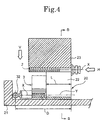
- Fig. 4 shows an example of the step of setting an adjusting screw 2 into a pivot nut 3 in a process of manufacturing a headlight using the aiming apparatus 1 according to the present invention.
- a fitting device 20 is used to define relative location of the adjusting screw 2 and the pivot nut 3, for example, to secure the dimension D therebetween, as illustrated, so as to accurately attain the dimensional relation constantly.
- the final step of aiming the reflector should have been carried out after incorporation of the reflector 12 into the housing 11.
- the reason is that while it is essential to engage the adjusting screw 2 with the pivot nut 3 so as to secure a predetermined value in the relative location of them, it has been difficult to set up an accurate relative location between them within the housing in a condition where they are not visible.
- setting of the adjusting screw 2 into the pivot nut 3 can be achieved by employing the fitting device 20 capable of defining the dimension D.
- the fitting device 20 contains a base 21; a jig-A 22 to be placed on the base, which is abutted at the distal end face and at the proximal end face against the proximal end face (opposite to the pivot portion 32) of the pivot nut and against the lower flange surface of the head of the adjusting screw, respectively, and which also has a guide slit 22a (see Fig. 5) that can receive the adjusting screw slidably and horizontally; and a jig-B 23 for setting the adjusting screw into the pivot nut. More specifically, engagement of the pivot nut with the adjusting screw can be achieved by interposing the jig-A between them and securing a predetermined value L in the relative location of these two members with respect to the axis X.
- Procedures of engaging the adjusting screw with the pivot nut are carried out, for example, as follows:
- a pivot nut 3 is set on the base 21 such that its pivot portion 32 is abutted against one wall of the base.
- the jig-A 22 is set on the base such that the distal end face thereof is abutted against the proximal end face of the pivot nut.
- the jig-A is set such that the longitudinal axial line Y of the guide slit 22a in the jig-A is aligned with the axial line X of the pivot nut (see Fig. 4).
- an adjusting screw is set in the guide slit of the jig-A such that the axial line X of the former is parallel to the axial line Y of the latter and that the lower flange surface of the head of the adjusting screw is abutted against the other end (proximal end) face of the jig-A (see Fig. 5).
- a force is applied to the head of the adjusting screw in the direction H by resilient means such as a compression spring attached to the other wall (not shown) of the base.
- forward and backward movements and rightward and leftward movements are appreciated to be in the direction of the axial line X and in the direction orthogonal to the axial line X and parallel to the upper surface of the base, respectively.
- control of the rightward and leftward movements is substantially achieved by the control of the forward and backward movements, it is positively carried out by forming a dent capable of receiving the pivot portion of the pivot nut in one wall of the base and fitting the pivot portion therein.
- the upper side of the adjusting screw is thrust with the jig-B 23 in the direction V.
- the jig-B has a curved bottom surface that can be abutted against the upper side of the adjusting screw and also has a thickness allowing insertion of itself slidably through the guide slit, as shown in Fig. 5.
- the adjusting screw is thrust into the slit 31a of the pivot nut under guiding by the guide slit of the jig-A and is slid further in the direction V expanding the slit to be engaged finally with the nut portion 31 of the pivot nut.
- the predetermined dimension D is secured in the relative location of the adjusting screw and the pivot nut during the above procedures.
- the length L of the jig-A can secure the dimension D. Therefore, it is of course possible to modify the order of the procedures of engaging the adjusting screw with the pivot nut and the contents of the procedures, so long as they are engaged with each other under abutment against the jig-A.
- the adjusting screw 2 and the pivot nut 3 are parts that can be utilized in common irrespective of the type of the headlight 10. However, it is essential to define the length of the adjusting screw and the range of forming threads thereof, the length of the nut portion of the pivot nut and the range of forming threads thereof, in other words, to define the range of the thread engagement between the threads of these two members within a presumable one. Therefore, if there are provided a set of fitting devices 20 having various optimum dimensions D, more exactly jigs-A 22 having various optimum dimensions L, depending on the type of headlight 10, the final aiming steps can be omitted from the processes of assembling various types of headlights 10, thus improving productivity.
- the nut receiver 4 and the adjusting screw 2 to be set into the pivot holder 5 are adapted to be engaged with each other securing a constant axial distance therebetween, more exactly through fitting of the sliding guides 31b of the pivot nut into the nut receiver.
- the adjusting screw receiver 6 of the housing 11 is provided at a position where it can receive accurately the proximal end of the adjusting screw 2 engaged with the pivot holder such that the axial line of the nut receiver and the axis X of the adjusting screw are parallel to each other.
- Fig. 6 shows a completed set of aiming apparatus 1 incorporated into a headlight having undergone the procedures as described above.
- the aiming apparatus of the present invention enables presetting of an adjusting screw in a pivot nut to a predetermined dimension using jigs and omission of the final aiming step after a headlight is assembled completely, exhibiting excellent effect in improving productivity of headlight.
- the aiming apparatus of the present invention also eliminates, from the process of assembling a headlight, the very difficult and troublesome step of engaging an adjusting screw with a pivot nut within a housing in a condition where they are not visible, and in this regard the apparatus again exhibits excellent effect in improving productivity of headlight.
Landscapes
- Engineering & Computer Science (AREA)
- Mechanical Engineering (AREA)
- Lighting Device Outwards From Vehicle And Optical Signal (AREA)
- Non-Portable Lighting Devices Or Systems Thereof (AREA)
- Securing Globes, Refractors, Reflectors Or The Like (AREA)
Abstract
Description
- The present invention relates to a vehicular headlight, particularly to a aiming apparatus to be incorporated for adjusting orientation of a reflector of the headlight so as to optimize the direction of illumination when the headlight is attached to a vehicular body and also to a process for manufacturing a headlight using the same.
- An exemplary constitution of a aiming
apparatus 80 in aprior headlight 90 is shown in Figs. 7 and 8. Areflector 91 is provided with aball joint 81 at a lower right corner thereof with respect to the direction of fitting the reflector to ahousing 92 and also with adjustingnuts 82 at an upper right corner directly above the ball joint and at a lower left corner (not shown) in alignment horizontally with the ball joint, respectively, in the state where thereflector 91 is attached to thehousing 92. - Meanwhile, the
housing 92 is provided with aball receiver 81a at a lower right corner thereof to oppose theball joint 81 and also with a pair of adjustingscrews 82a to oppose the adjustingnuts 82 respectively. One adjustingscrew 82a located at the upper right corner is for adjusting vertically the orientation of the reflector; whereas the other adjustingscrew 82a (not shown) located at the lower left corner is for adjusting horizontally the orientation of the reflector. - The
headlight 90 having the constitution as described above is assembled by fitting first theball joint 81 in theball joint receiver 81a and then threading the adjustingscrews 82a into the opposing adjustingnuts 82 respectively to achieve fitting of thereflector 91 to thehousing 92, followed finally by fitting of alens 93 to thehousing 92. - It should be noted here that in Fig. 8, which is directed to minute illustration of the relationship between the adjusting
nuts 82 and the adjustingscrews 82a, the adjustingnuts 82 are fixed to substantially C-shaped nut holders 82b formed on the rear side of thereflector 91, respectively; whereas the adjustingscrews 82a are each rotatably engaged at around the proximal end with thehousing 92. If each adjustingscrew 82a is turned from the rear side of the housing, the opposing adjustingnut 82 is caused to move forward or backward along the adjustingscrew 82a to enable changing of the orientation of thereflector 91 vertically or horizontally on theball joint 81 serving as a pivot. - However, the prior aiming
apparatus 80 involves a problem that the procedures of fitting thereflector 91 to thehousing 92 is difficult, intricate and time-consuming, since engagement of the adjustingscrews 82a with the adjustingnuts 82 are achieved respectively within thehousing 92 under the condition where it is difficult to visually confirm them, and each adjustingscrew 82 must be driven into the opposing adjustingnut 82 until the nut reaches an appropriate position of the opposing adjustingscrew 82a. - There is another problem that the number of steps is increased. The reason is that it is difficult to align each adjusting
screw 82a with the opposing adjustingnut 82 between them since the alignment is achieved respectively within thehousing 92. As a result, there occurs a wide variation in the orientation of thereflectors 91 with respect to the housings respectively, and this inevitably requires readjustment of thereflectors 91 with respect to the direction of illumination, after theheadlight 90 is assembled completely. - The present invention provides means, which can solve the problems inherent in the prior aiming apparatus. More specifically, the present invention provides a aiming apparatus to be interposed between a reflector and a housing to adjust direction of light reflected by the reflector; the aiming apparatus comprising an adjusting screw rotatably engaged at one end (proximal end) with the housing at a predetermined position; a pivot nut having at one end (proximal end) a nut portion capable of achieving thread engagement with the other end (distal end) of the adjusting screw and at the other end (distal end) a pivot portion, respectively; a pivot holder attached to a rear side of the reflector; said pivot holder being capable of pivotally holding the pivot portion; and a nut receiver fixed on the front side of the housing at a predetermined position; said nut receiver being capable of receiving slidably a guard-like sliding guide formed at a top of the pivot nut; wherein a longitudinal axial line of the nut receiver is parallel to an axial line X of the adjusting screw engaged with the nut portion; and the pivot nut has a height equal to the vertical distance between a position where the nut receiver is engaged with the housing and a position where one end (proximal end) of the adjusting screw is engaged with the housing.
- It should be noted here that the expression "a height equal to the vertical distance ·········" means that, one end (proximal end) of the adjusting screw engaged with the nut portion is located at a predetermined engaging position of the housing, in the state where the sliding guides are received in the nut receiver such that the longitudinal axial line of the nut receiver and the axial line of the adjusting screw engaged with the nut portion are parallel to each other.
- The invention together with the objects and advantages thereof, may best be understood by reference to the following description of the presently preferred embodiments together with the accompanying drawings in which:
- Fig. 1 is a partly cross-sectional and partly exploded view of the aiming apparatus according to an embodiment of the present invention;
- Fig. 2 is an exploded perspective view showing a mode of setting the adjusting screw into the pivot nut, which are major elements of the aiming apparatus of the present invention, and also a mode of fitting the pivot nut into the housing;
- Fig. 3 is a cross-sectional view taken along the line A-A in Fig. 2;
- Fig. 4 is a partly sectional view for explaining procedures of setting the adjusting screw into the pivot nut in the process for manufacturing a aiming apparatus of the present invention;
- Fig. 5 is a cross-sectional view taken along the line B-B in Fig. 4;
- Fig. 6 is a partly cross-sectional view showing the aiming apparatus of the present invention incorporated into a headlight;
- Fig. 7 is a partially cutaway perspective view showing the constitution of the prior headlight; and
- Fig. 8 is a partly cross-sectional view of the pertinent section in the constitution of the prior art.
-
- The present invention will be described specifically referring to the attached drawings illustrating an embodiment.
- The
reference numeral 1 in Fig. 1 shows the aiming apparatus of the present invention. The aimingapparatus 1 is composed essentially of an adjustingscrew 2, apivot nut 3, anut receiver 4, apivot holder 5 and an adjustingscrew receiver 6. - The adjusting
screw 2 is adapted to be rotatably engaged at one end (proximal end) with the adjustingscrew receiver 6 attached to ahousing 11 of aheadlight 10. Agear 2a is fitted to the proximal end of the adjustingscrew 2 that is exposed to the rear external side of the housing to enable the operation of aiming theheadlight 10 on that side thereof. - Meanwhile, the other end (distal end) of the adjusting
screw 2 is engaged with thepivot nut 3 through itsnut portion 31 located on the proximal side, which is engaged, through a pair ofsliding guides 31b, with anut receiver 4 attached to thehousing 11. Thus, the pivot nut can be moved in the direction of the axis X by turning the adjusting screw through thegear 2a. Here, the adjusting screw can be advanced or retracted freely by selecting the direction of turning it. - The
pivot nut 3 has apivot portion 32 on the other side (distal side) that is opposite to thenut portion 31. Thepivot portion 32 has a shape of ball joint formed coaxial with the adjusting screw 2 (so illustrated, but not necessarily be coaxial for the function of the pivot portion). Thepivot portion 32 is fitted into thepivot holder 5 located on the rear side of areflector 12. It should be noted here that the reflector is additionally provided on the rear side thereof with a mechanism (a ball joint mechanism, not shown) that is substantially composed of apivot portion 32 and apivot holder 5 and does not have the mechanism of moving the pivot portion with an adjusting screw. Therefore, the aimingapparatus 1 can turn thereflector 12 on the ball joint serving as a pivot. Here, in order to enable adjustment of the orientation of thereflector 12 only in one direction (vertically or horizontally), one aiming apparatus according to the present invention may be incorporated in addition to the ball joint mechanism at a suitable position on the rear side of the reflector; whereas two aiming apparatuses may be arranged likewise so as to enable adjustment of thereflector 12 in two directions (vertically and horizontally). - Figs. 2 and 3 show a favorable embodiment of assembling major parts of the aiming
apparatus 1 including the adjustingscrew 2,pivot nut 3 and thenut receiver 4 into a unit. In this embodiment, the adjusting screw is not threaded into the pivot nut in the ordinary way, but engagement between them is designed to be achieved by press-fitting the screw into the nut or clamping it with the nut. However, the engagement may of course be achieved by threading the screw into the nut in the ordinary way. More specifically, as shown also in Fig. 3, thepivot nut 3 has aslit 31a formed at an upper part of thenut portion 31 along the axis of the internal thread thereof. Further, a cavity is defined above the slit such that it can receive the adjusting screw substantially horizontally along the axis of the internal thread of the nut portion. Thus, the slit can be distorted to widen the clearance thereof by applying an external stress (the arrows in the drawings show the directions of stress to be loaded) to upper portions of the pivot nut, so that the adjusting screw can be brought into engagement with the internal thread by passing it from the cavity and through the slit. It should be noted here that the engagement between the adjusting screw and the nut portion may be achieved by pressing the adjusting screw itself downward against the slit to distort the slit by the stress of pressing. - The
nut portion 31 also has at the top a pair of guard-likesliding guides 31b such that guard-like portions extend therefrom orthogonally outward respectively. Once thesliding guides 31b are fitted in thenut receiver 4, the nut portion is prevented from distorting in the direction of widening theslit 31a, so that there occurs no disengagement of the adjustingscrew 2 from thenut portion 31. Here, the adjusting screw and the nut portion thus engaged with each other assume thread engagement. - Here, the
nut receiver 4, which is to be fixed to thehousing 11 at a predetermined position, has thesliding guides 31b of thepivot nut 3 fitted slidably therein parallel to the axis X, whereas the adjustingscrew 2 is brought into thread engagement with thenut portion 31. Therefore, turning of the adjusting screw moves the pivot nut parallel to the axis X being guided by the nut receiver. - As described above, since the main function of the
sliding guides 31b is to ensure moving of thepivot nut 3 in the direction of the axis X and engagement of the pivot nut with thehousing 11, theslit 31a need not be formed at the upper part of the nut portion if the adjustingscrew 2 is threaded into thenut portion 31 of the pivot nut by the ordinary way (in this case, the nut portion may be of an embodiment that it merely has an internal thread at the bottom, apivot portion 32 at the distal end and sliding guides at the top. - Fig. 4 shows an example of the step of setting an adjusting
screw 2 into apivot nut 3 in a process of manufacturing a headlight using the aimingapparatus 1 according to the present invention. When engagement between the adjustingscrew 2 and thepivot nut 3 is carried out in one step by widening theslit 31, as described above, afitting device 20 is used to define relative location of the adjustingscrew 2 and thepivot nut 3, for example, to secure the dimension D therebetween, as illustrated, so as to accurately attain the dimensional relation constantly. - Now, the dimension D will be described.
- As already described in the prior art example, in the process of assembling a
headlight 10, the final step of aiming the reflector should have been carried out after incorporation of thereflector 12 into thehousing 11. The reason is that while it is essential to engage the adjustingscrew 2 with thepivot nut 3 so as to secure a predetermined value in the relative location of them, it has been difficult to set up an accurate relative location between them within the housing in a condition where they are not visible. - On the contrary, if the relative location of the adjusting
screw 2 and thepivot nut 3 can be preset accurately when the former is set into the latter, the final aiming step after the headlight is assembled completely can be omitted. - In the present invention, setting of the adjusting
screw 2 into thepivot nut 3 can be achieved by employing thefitting device 20 capable of defining the dimension D. Thefitting device 20 contains abase 21; a jig-A 22 to be placed on the base, which is abutted at the distal end face and at the proximal end face against the proximal end face (opposite to the pivot portion 32) of the pivot nut and against the lower flange surface of the head of the adjusting screw, respectively, and which also has aguide slit 22a (see Fig. 5) that can receive the adjusting screw slidably and horizontally; and a jig-B 23 for setting the adjusting screw into the pivot nut. More specifically, engagement of the pivot nut with the adjusting screw can be achieved by interposing the jig-A between them and securing a predetermined value L in the relative location of these two members with respect to the axis X. - Procedures of engaging the adjusting screw with the pivot nut are carried out, for example, as follows:
- First, a
pivot nut 3 is set on the base 21 such that itspivot portion 32 is abutted against one wall of the base. - Next, the jig-
A 22 is set on the base such that the distal end face thereof is abutted against the proximal end face of the pivot nut. Here, the jig-A is set such that the longitudinal axial line Y of the guide slit 22a in the jig-A is aligned with the axial line X of the pivot nut (see Fig. 4). - Then, an adjusting screw is set in the guide slit of the jig-A such that the axial line X of the former is parallel to the axial line Y of the latter and that the lower flange surface of the head of the adjusting screw is abutted against the other end (proximal end) face of the jig-A (see Fig. 5). Here, a force is applied to the head of the adjusting screw in the direction H by resilient means such as a compression spring attached to the other wall (not shown) of the base. Thus, since the force is transmitted through the jig-A to the pivot nut, the pivot nut is controlled not to move back and forth, right and left on the base. In the drawings, forward and backward movements and rightward and leftward movements are appreciated to be in the direction of the axial line X and in the direction orthogonal to the axial line X and parallel to the upper surface of the base, respectively. Here, while control of the rightward and leftward movements is substantially achieved by the control of the forward and backward movements, it is positively carried out by forming a dent capable of receiving the pivot portion of the pivot nut in one wall of the base and fitting the pivot portion therein.
- Subsequently, the upper side of the adjusting screw is thrust with the jig-
B 23 in the direction V. The jig-B has a curved bottom surface that can be abutted against the upper side of the adjusting screw and also has a thickness allowing insertion of itself slidably through the guide slit, as shown in Fig. 5. Thus, the adjusting screw is thrust into theslit 31a of the pivot nut under guiding by the guide slit of the jig-A and is slid further in the direction V expanding the slit to be engaged finally with thenut portion 31 of the pivot nut. - As described above, since the procedures of engaging the adjusting
screw 2 with thepivot nut 3 is achieved under abutment of them against the end faces of the jig-A 22, respectively, the predetermined dimension D is secured in the relative location of the adjusting screw and the pivot nut during the above procedures. On the contrary, the length L of the jig-A can secure the dimension D. Therefore, it is of course possible to modify the order of the procedures of engaging the adjusting screw with the pivot nut and the contents of the procedures, so long as they are engaged with each other under abutment against the jig-A. - It should be noted here that the adjusting
screw 2 and thepivot nut 3 are parts that can be utilized in common irrespective of the type of theheadlight 10. However, it is essential to define the length of the adjusting screw and the range of forming threads thereof, the length of the nut portion of the pivot nut and the range of forming threads thereof, in other words, to define the range of the thread engagement between the threads of these two members within a presumable one. Therefore, if there are provided a set offitting devices 20 having various optimum dimensions D, more exactly jigs-A 22 having various optimum dimensions L, depending on the type ofheadlight 10, the final aiming steps can be omitted from the processes of assembling various types ofheadlights 10, thus improving productivity. - Further, according to the aiming
apparatus 1 of the present invention, thenut receiver 4 and the adjustingscrew 2 to be set into thepivot holder 5 are adapted to be engaged with each other securing a constant axial distance therebetween, more exactly through fitting of the slidingguides 31b of the pivot nut into the nut receiver. Besides, the adjustingscrew receiver 6 of thehousing 11 is provided at a position where it can receive accurately the proximal end of the adjustingscrew 2 engaged with the pivot holder such that the axial line of the nut receiver and the axis X of the adjusting screw are parallel to each other. Therefore, for example, if thepivot nut 3 engaged with the adjustingscrew 2 is fitted in thenut receiver 4, and if thereflector 12 is pushed toward the front opening of thehousing 11 after alignment of thepivot holder 5 with thepivot portion 32 of thepivot nut 3, thepivot holder 5, thepivot nut 3, the adjustingscrew 2 and the adjustingscrew receiver 6 are inevitably engaged with one another in position, dispensing with such operations of engaging them within the housing, in a condition where they are not visible, as have been required in the prior art. Fig. 6 shows a completed set of aimingapparatus 1 incorporated into a headlight having undergone the procedures as described above. - As described above, the aiming apparatus of the present invention enables presetting of an adjusting screw in a pivot nut to a predetermined dimension using jigs and omission of the final aiming step after a headlight is assembled completely, exhibiting excellent effect in improving productivity of headlight.
- The aiming apparatus of the present invention also eliminates, from the process of assembling a headlight, the very difficult and troublesome step of engaging an adjusting screw with a pivot nut within a housing in a condition where they are not visible, and in this regard the apparatus again exhibits excellent effect in improving productivity of headlight.
- It should be apparent to those skilled in the art that the present invention may be embodied in many other specific forms without departing from the scope of the invention as defined in the claims.
Claims (6)
- A aiming apparatus (1) to be interposed between a reflector (12) and a housing (11) to adjust direction of light reflected by the reflector; the aiming apparatus comprising:wherein a longitudinal axial line of the nut receiver is parallel to an axial line X of the adjusting screw engaged with the nut portion; and the pivot nut has a height equal to the vertical distance between a position where the nut receiver is engaged with the housing and a position where one end of the adjusting screw is engaged with the housing.an adjusting screw (2) rotatably engaged at one end with the housing at a predetermined position;a pivot nut (3) having at one end a nut portion (31) capable of achieving thread engagement with the other end of the adjusting screw and at the other end a pivot portion (32), respectively;a pivot holder (5) attached to a rear side of the reflector; said pivot holder being capable of pivotally holding the pivot portion; anda nut receiver (4) fixed on the front side of the housing at a predetermined position; said nut receiver being capable of receiving slidably a guard-like sliding guide (31b) formed at a top of the pivot nut;
- The aiming apparatus according to Claim 1, further comprising a through hole (6) defined in the housing at the position where one end of the adjusting screw is engaged therewith, said hole receiving one end of the adjusting screw therethrough, and a gear (2a) fitted to that end of the adjusting screw to turn it.
- The aiming apparatus according to Claim 1 or 2, wherein the nut portion (31) of the pivot nut has at an upper part a cavity defined in an axial direction thereof, which can receive the adjusting screw substantially parallel to its axial line, and a slit (31a) communicating with the cavity and with the nut portion.
- A process for manufacturing a aiming apparatus (1) to be interposed between a reflector (12) and a housing (11) to adjust direction of light reflected by the reflector; the process comprising:
engaging an adjusting screw (2) with a pivot nut (3) using a fitting device (20) that controls relative location thereof;
wherein said fitting device having a right dimension D is selected from those with various dimensions respectively depending on the type of the headlight in which the aiming apparatus is employed. - The process according to Claim 4, wherein the fitting device (20) comprises a substantially horizontal base (21) having a pair of vertical walls on both sides thereof respectively, one of which can be abutted against a pivot portion (32) of the pivot nut (3); a jig-A (22) to be placed on the base, said jig-A being abutted at one end face and at the other end face against one end face of the pivot nut and against a lower flange surface of a head of the adjusting screw and also having a guide slit (22a) that can receive the adjusting screw slidably and horizontally; and a jig-B (23) for thrusting the adjusting screw into the pivot nut, said jig-B having a width allowing slidable movement of itself within the guide slit of said jig-A.
- The process according to Claim 5, wherein the fitting device further comprises in one wall of the base (21) a dent capable of receiving the pivot portion (32) of the pivot nut (3).
Applications Claiming Priority (2)
| Application Number | Priority Date | Filing Date | Title |
|---|---|---|---|
| JP2000228933A JP4335421B2 (en) | 2000-07-28 | 2000-07-28 | Aiming device and manufacturing method thereof |
| JP2000228933 | 2000-07-28 |
Publications (2)
| Publication Number | Publication Date |
|---|---|
| EP1176052A2 true EP1176052A2 (en) | 2002-01-30 |
| EP1176052A3 EP1176052A3 (en) | 2004-01-07 |
Family
ID=18722136
Family Applications (1)
| Application Number | Title | Priority Date | Filing Date |
|---|---|---|---|
| EP01118108A Withdrawn EP1176052A3 (en) | 2000-07-28 | 2001-07-26 | Aiming apparatus and process for manufacturing headlight using the same |
Country Status (3)
| Country | Link |
|---|---|
| US (1) | US6481880B2 (en) |
| EP (1) | EP1176052A3 (en) |
| JP (1) | JP4335421B2 (en) |
Cited By (2)
| Publication number | Priority date | Publication date | Assignee | Title |
|---|---|---|---|---|
| DE10164350B4 (en) * | 2000-12-28 | 2008-03-13 | Koito Manufacturing Co., Ltd. | Motor vehicle headlight with movable reflector |
| KR20170052049A (en) * | 2015-11-03 | 2017-05-12 | 현대모비스 주식회사 | Lighting apparatus for an automobile |
Families Citing this family (5)
| Publication number | Priority date | Publication date | Assignee | Title |
|---|---|---|---|---|
| CA2437458A1 (en) * | 2002-08-09 | 2004-02-09 | Alexandre Curthelet | Modular headlight system for recreational vehicles |
| US7264376B2 (en) * | 2002-11-07 | 2007-09-04 | Burton Technologies Llc | Adjuster and bracket assembly |
| US6974231B2 (en) * | 2002-11-07 | 2005-12-13 | Burton Technologies, Llc | Adjuster and bracket assembly |
| US7052164B2 (en) * | 2002-11-12 | 2006-05-30 | Burton Technologies Llc | Gear screw adjuster |
| JP5535728B2 (en) * | 2010-04-01 | 2014-07-02 | 株式会社小糸製作所 | Aiming screw for headlamp and headlamp |
Family Cites Families (5)
| Publication number | Priority date | Publication date | Assignee | Title |
|---|---|---|---|---|
| DE4111035A1 (en) * | 1991-04-05 | 1992-10-08 | Hella Kg Hueck & Co | Vehicle headlamp unit with adjustable reflector - has display device for indicating reflector position within housing of headlamp unit |
| JP2707372B2 (en) | 1991-07-02 | 1998-01-28 | 株式会社小糸製作所 | Aiming screw support nut for automotive headlights |
| JPH07105702A (en) * | 1993-10-08 | 1995-04-21 | Koito Mfg Co Ltd | Vehicle headlamp tilt measuring instrument |
| GB2285307B (en) * | 1993-12-21 | 1997-11-12 | Koito Mfg Co Ltd | Vehicular headlamp |
| DE19824051A1 (en) * | 1998-05-29 | 1999-12-02 | Hella Kg Hueck & Co | Support element |
-
2000
- 2000-07-28 JP JP2000228933A patent/JP4335421B2/en not_active Expired - Lifetime
-
2001
- 2001-07-24 US US09/911,672 patent/US6481880B2/en not_active Expired - Lifetime
- 2001-07-26 EP EP01118108A patent/EP1176052A3/en not_active Withdrawn
Non-Patent Citations (1)
| Title |
|---|
| None |
Cited By (2)
| Publication number | Priority date | Publication date | Assignee | Title |
|---|---|---|---|---|
| DE10164350B4 (en) * | 2000-12-28 | 2008-03-13 | Koito Manufacturing Co., Ltd. | Motor vehicle headlight with movable reflector |
| KR20170052049A (en) * | 2015-11-03 | 2017-05-12 | 현대모비스 주식회사 | Lighting apparatus for an automobile |
Also Published As
| Publication number | Publication date |
|---|---|
| JP2002042515A (en) | 2002-02-08 |
| US20020015311A1 (en) | 2002-02-07 |
| JP4335421B2 (en) | 2009-09-30 |
| EP1176052A3 (en) | 2004-01-07 |
| US6481880B2 (en) | 2002-11-19 |
Similar Documents
| Publication | Publication Date | Title |
|---|---|---|
| US5086312A (en) | Variable focal length camera with focus adjusting device | |
| US4477865A (en) | Mounting device for lighting device for bicycle | |
| US6481880B2 (en) | Aiming apparatus and process for manufacturing headlight using the same | |
| JP2002193024A (en) | Reflector movable type car headlamp | |
| JP2002510759A (en) | Linear unit with slide guide mechanism for carriage | |
| US5909324A (en) | Mount for adjusting an optical component | |
| US5431461A (en) | Sliding window lock for automotive vehicles | |
| CN211698339U (en) | Optical element adjusting frame | |
| EP1138421A2 (en) | Chuck for machine tool | |
| US4873743A (en) | Hinge | |
| JP2003057031A (en) | Floodlight projector unit of semiconductor laser | |
| JP3193638B2 (en) | Vehicle lighting | |
| JP2000214366A (en) | Lens frame device | |
| JP2001004892A (en) | Mirror frame adjusting device | |
| JP2915782B2 (en) | Resin molded product and its manufacturing method and manufacturing apparatus | |
| JPH0733947Y2 (en) | Optical axis adjustment mechanism for automotive lighting | |
| JP2919622B2 (en) | Assembling method of cardan joint | |
| JP2905297B2 (en) | Assembling method of cardan joint | |
| CN220399713U (en) | Light path fine tuning device | |
| CN224048958U (en) | A buffer assembly, a tailgate system, and a vehicle | |
| JPS6032655Y2 (en) | Lens feeding device | |
| CN219320557U (en) | Optical instrument adapter device convenient to accurate regulation formula | |
| JP3397442B2 (en) | Endoscope light guide connector connection | |
| JP2905298B2 (en) | Cardan joint assembly equipment | |
| KR20030005055A (en) | Spring plunger with positioning function |
Legal Events
| Date | Code | Title | Description |
|---|---|---|---|
| PUAI | Public reference made under article 153(3) epc to a published international application that has entered the european phase |
Free format text: ORIGINAL CODE: 0009012 |
|
| AK | Designated contracting states |
Kind code of ref document: A2 Designated state(s): AT BE CH CY DE DK ES FI FR GB GR IE IT LI LU MC NL PT SE TR |
|
| AX | Request for extension of the european patent |
Free format text: AL;LT;LV;MK;RO;SI |
|
| PUAL | Search report despatched |
Free format text: ORIGINAL CODE: 0009013 |
|
| AK | Designated contracting states |
Kind code of ref document: A3 Designated state(s): AT BE CH CY DE DK ES FI FR GB GR IE IT LI LU MC NL PT SE TR |
|
| AX | Request for extension of the european patent |
Extension state: AL LT LV MK RO SI |
|
| AKX | Designation fees paid | ||
| REG | Reference to a national code |
Ref country code: DE Ref legal event code: 8566 |
|
| STAA | Information on the status of an ep patent application or granted ep patent |
Free format text: STATUS: THE APPLICATION IS DEEMED TO BE WITHDRAWN |
|
| 18D | Application deemed to be withdrawn |
Effective date: 20040708 |