BACKGROUND OF THE INVENTION
Field of the Invention
The present invention relates to slitting an electrode raw material
sheet for an electrical component.
Description of Prior Art
Fig. 16 shows a conventional slitter to slit an electrode raw
material sheet. The slitter a comprises an unwinding section c in a frame b, a
splice f, a feed/nip roller g, a slitting section d, an electrode cleaner h, an
electrode holder i, and a winding section e. All the components of the slitter a
are closely integrated, which damages the operability and accessibility making it
difficult to connect an electrode when the electrode is inadvertently slit off.
Further, the slitter a is designed so that the a wide electrode raw material sheet j
wound on the unwinding section c is slit at the slitting section d to form a
plurality of slit narrower electrode bands to be wound on plural winding sections
e, e. However, convex portions created on a plurality of electrode bands when
slit cause a bad influence, e.g., short-circuit, on an electrical component utilizing
the electrode.
OBJECT AND SUMMARY OF THE INVENTION
An object of this invention is to provide an electrode with an
excellent quality for an electrical component. Another object of this invention is
to provide an electrical component with less possibility of defects and to provide
a slitter with an excellent accessibility.
In order to achieve the above-objectives, this invention provides a slitter for
an electrode raw material sheet comprising an unwinding section to supply an
electrode raw material sheet for an electrical component, a slitting section having
a slitter for the electrode raw material sheet, and a winding section to wind the slit
electrode, wherein the unwinding section, the slitting section, and the winding
section are positioned apart from each other so as to increase the operability.
This invention also discloses a slitter for an electrode raw material sheet
comprising an unwinding section to supply an electrode raw material sheet for an
electrical component, a slitting section having a slitter for the electrode raw
material sheet, a forming section to form a convex portion of the slit electrode, an
electrode cleaning section to clean fragments on the electrode, and a winding
section to wind the slit electrode. This invention also discloses a method of
slitting an electrode raw material sheet of an electrical component comprising
steps of slitting the electrode raw material sheet of the electrical component by a
blade section, forming convex portions on the slit electrode, removing fragments
adhered on the slit electrode.
BRIEF DESCRIPTION OF THE DRAWING
The above and other objects and advantages of the present invention will
become readily apparent by reference to the following detailed description when
considered in conjunction with the accompanying drawings.
- Fig. 1
- represents a drawing of a plurality of types of electrode structures
containing an electrode material;
- Fig. 2
- is a drawing of an electrode structure containing electrode active
material;
- Fig. 3
- is a drawing to explain a fixing or adhesion device;
- Fig. 4
- represents a drawing each showing an ion conductive polymer
layer;
- Fig. 5
- represents a drawing of a slitter structure;
- Fig. 6
- represents a drawing of slitting an electrode raw material sheet;
- Fig. 7
- represents a drawing of upper and lower blades in the slitting
section;
- Fig. 8
- represents an enlarged drawing of the first electrode cleaning
section and a forming section;
- Fig. 9
- represents an enlarged drawing of the forming section;
- Fig. 10
- represents a partially enlarged drawing of the blade and the
blade cleaning section;
- Fig. 11
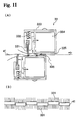
- represents a drawing of the first electrode cleaning section;
- Fig. 12
- represents a drawing of the second electrode cleaning section;
- Fig. 13
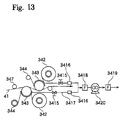
- represents a drawing of explaining a suction device in the second
electrode cleaning section;
- Fig. 14
- represents a drawing of a drive part of the second electrode
cleaning section;
- Fig. 15
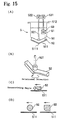
- represents a drawing to explain a press-sliding and kneading
device; and
- Fig. 16
- represents a drawing of a conventional slitter structure.
DETAILED DESCRIPTION OF PREFERRED EMBODIMENT
The embodiments of the invention are next described while referring to the
accompanying drawings.
Electrical component
In an electrical component, in which ions migrate between electrodes, ion
conductive materials are arranged between electrode structures as electrodes,
and ions migrate within the ion conductive materials and electric current flows
between the electrodes. For instance, such an electrical component includes a
battery, an electrical double layer capacitor, etc.
In a battery, ion conductive materials are arranged between two types of
electrode structures, i.e. a positive electrode structure and a negative electrode
structure, and ions (including protons, i.e. cations of hydrogen) migrate from one
of the electrode structures to the other electrode structure and are accumulated
there. In an electrical double layer capacitor, ion conductive materials are
arranged between a pair of electrode structures, and an electrical double layer is
formed between a material with high surface area in the electrode structure and
an electrolyte of the ion conductive material.
Electrode structure
An electrode structure is used as an electrode of an electrical component,
and it can deliver and receive electricity to and from ions or it can attract ions. In
this respect, an electrode structure 1 comprises a layer of electrode material 13
(an electrode material layer 12) on a current collective member 11 as a
conductive material such as aluminum or copper, and the electrode material can
deliver and receive electricity to and from ions and has electric attracting power.
As shown in Fig. 1(A), the electrode material 13 is used as a positive electrode
structure of a battery using particulate material comprising bonded particles of
powdery electrode active material such as LiCoO2. As shown in Fig. 1 (B), the
electrode material 13 is used as a negative electrode structure of a battery and
uses particulate material such as graphite, hard carbon, etc. of powdery
electrode active material.
As shown in Fig. 1(C), the electrode material 13 uses a particulate material such
as activated carbon, i.e. a powdery high surface area material with larger surface
area, and is used as an electrode structure 1 of an electrical double layer
capacitor. In Fig. 1, the electrode material layer 12 is formed on one surface of a
current collective member 11, while the electrode material layer 12 may be
provided on both surfaces.
In Fig. 1(D), the powdery electrode material 13 of Fig. 1(A) is covered with
ion conductive polymer, and it is used as a positive electrode structure of a
battery. In Fig. 1 (E), the powdery electrode material 13 of Fig. 1 (B) is covered
with an ion conductive polymer, and it is used as a negative electrode structure
of a battery. In Fig. 1 (F), the powdery electrode material 13 of Fig. 1(C) is
covered with the ion conductive polymer, and it is used as an electrode structure
1 of an electrical double layer capacitor.
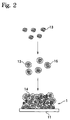
Fig. 2 shows a process to produce the electrode structure 1 of Fig. 1(D).
As shown in Fig. 2, the powdery electrode material 13 comprises bonding
particles such as LiCoO2, and it is covered with an ion conductive polymer 16
and is attached to a current collective member 11. The electrode structure 1 as
shown in each of Fig. 1 (E) - Fig. 1 (F) can also be produced in a similar manner.
The conductive material 14 arranged in the electrode structure enhances
electrical or electronic conductivity between the electrode materials, and also
enhances electrical conductivity between the electrode material 13 and the
current collective member 11 to improve current collecting efficiency.
Here, "adhere" or "adhesion" means that ions are attached in such manner
that the ions can migrate between the ion conductive polymer 16 and the entire
surface of the powdery electrode material. It means that the ion conductive
polymer 16 adheres to the surface of the powdery electrode material 13 and
covers it with the ion conductive polymer 16. The finer the particles are, the
more active the powdery electrode material 13 is. When it is adhered to and
covered by the ion conductive polymer 16, the activity is suppressed and can be
turned to a more stable state.
When the deposit of the ion-conducting polymer 16 is thick, the electrical
conduction decreases, and the current (charge) collection is poor. Accordingly,
forming a thin coating of ion-conducting polymer is preferable.
The word "powdery" in the powdery electrode material 13 and the powdery
conductive material 14 means the condition of a material in a fine powder state.
In certain cases, this fine particle substance refers to a state wherein a large
number of substances in a fine particle state constitute an agglomeration.
Relation to terminologies used to explain the electrode structure 1 will be
explained hereunder. In Fig. 1, the electrode structure 1 is obtained by forming
the electrode material layer 12 on the current collective member 11. The
electrode material layer 12 has the electrode material 13 and also has an
electrically-conductive material 14 and a binder 15 as required. The electrode
material 13 is an electrode active material used as an electrode of a battery or a
high surface area material used as an electrode such as electrical double layer
capacitor.
The electrode active material means a powdery electrode active material for
positive electrode such as LiCoO2 to be used as a positive electrode, or a
powdery electrode active material for negative electrode such as carbon material
to be used as a negative electrode.
Formation of the ion conductive polymer layer to the electrode structure
The ion conductive polymer layer is formed on a surface of the electrode
structure. Dissolving ions on the ion conductive polymer layer facilitates
migration between the pair of electrode structures. Simultaneously, the
electrodes facing each other do not contact, thereby functioning to eliminate the
problem of causing any short-circuit of the electrode.
Electrode raw material sheet
The electrode raw material sheet is to be slit to be used as electrode bands
and for example may be the electrode structure formed on a wide surface of the
current collective member or the electrode structure forming the conductive
polymer layer thereon.
Electrode active material
As the electrode active material, a material where ions can be placed into
or removed from, or a π-conjugate conductive macromolecular material may be
used. For instance, there is no specific restriction on the use of the electrode
active material to be used as a positive electrode of a nonaqueous electrolyte
battery, but in case of a chargeable secondary battery, a chalcogen compound
where lithium ions can be placed into or removed from, or a complex chalcogen
compound containing lithium may be used.
FeS2, TiS2, MoS2, V2O5, V6O13, and MnO2 may be employed as the above-chalcogen
compounds. The chalcogen compound having lithium as described
above includes LiCoO2, LixNiyM1-yO2 (where M represents at least one type of
metal element selected from a transition metal or aluminum, or more preferably,
it represents at least one type of metal element selected from Co, Mn, Ti, Cr, V,
or Al, and 0.05 ≦ x ≦ 1.10 and 0.5 ≦ y ≦ 1.0), e.g., LiNiO2, LiMnO2, LiMn2O4.
Using oxide, salt or hydroxide of lithium, cobalt, nickel, or manganese as starting
materials, these starting materials are mixed in adequate composition, and the
mixture is fired in the temperature range of 600°C - 1000°C under an oxygen
atmosphere.
There are no particular restrictions on the electrode active substance used
as the negative electrode for non-aqueous electrolyte batteries. However, a
material allowing lithium ion insertion/separation may be used, and lithium metal,
lithium alloys (alloys such as lithium and aluminum, lead, indium) and carbon
quality materials may be utilized.
Polyacetylene types, polyaniline types, polypyrrole types, polythiophene
types, poly-ρ(para)-phenylene types, polycarbazole types, polyacene types
and sulfur polymer types are among the useful π-conjugated conductive
macromolecular materials.
In particular, in a nonaqueous electrolyte primary battery, a higher battery
capacity can be obtained when lithium metal is used in the negative electrode.
Lithium metal not in powdery state may be used.
Also, in the nonaqueous electrolyte secondary battery, an excellent cycle
service life can be attained if a carbon material where lithium ions can be placed
into and removed from is used as the negative electrode. There are no particular
restrictions on the carbon material used but materials such as pyrolytic carbon
types, coke types (pitch coke, needle coke and petroleum coke, etc.) graphite
types, glass carbon types, organic macromolecular compound fired products
(carbonized pieces baked to a suitable temperature such as phenol resin, furan
resin) carbon fibers and active carbon may be utilized.
Electrode material with larger surface area
The electrode material with larger surface area is a powdery high surface
area material, which can attract many ions to the surface. It has preferably a
specific surface area of 500 m2/g or more, or more preferably 1000 m2/g or more,
or most preferably 1500 m2/g - 3000 m2/g. Also, it has preferably average
particle size of 30 µm or less, or more preferably 5 - 30 µm. If the specific
surface area and average particle size are out of the above range, capacitance is
too high, and it may be difficult to obtain an electrical double layer capacitor with
low resistance.
As the powdery high surface area material, it is preferable to use activated
carbon, which can be obtained from carbon material by a steam activation
method or by a melted KOH activation process. As the activated carbon,
coconut shell activated carbon, phenol type activated carbon, petroleum cokes
type activated carbon, polyacene, etc. may be used. These materials can be
used alone or in a combination of two types or more. Among those, because of a
large electrostatic capacity, phenol type carbon, petroleum cokes type activated
carbon, and polyacene are preferable
Electrically-conductive material
The conductive material is used to increase electrical conductivity of the
electrode structure, and there is no specific restriction. For instance, carbon
black, kitchen black, acetylene black, carbon whisker, natural graphite, artificial
graphite, metal fiber, and metal power such as titanium oxide, ruthenium oxide,
etc. may be used. These materials may be used alone or in a combination of two
types or more. Above all, it is preferable to use one type of carbon black, i.e.
kitchen black or acetylene black. Average particle size of the powdery
conductive material is preferably 10 - 100 nm, or more preferably 20 - 40 nm.
Ion conductive salt
As the ion conductive salt, any material normally used for electrochemical
product may be used, and there is no specific restriction. In particular, it is
preferable to use a salt obtained by combination of quaternary onium cation
expressed by general formula R1R2R3R4N+ or R1R2R3R4P+ (where R1 - R4 each
represents an alkyl group having 1 - 10 carbon atoms and may be the same or
different) with anion such as BF4 +, N(CF3SO2)2 -, PF6 -, ClO4 -, etc.
More concretely, as the ion conductive salt used for the double-layer
capacitor, the following material may be used: (C2H5)4PBF4, (C3H7)4PBF4,
(C4H9)4PBF4, (C6H13)4PBF4, (C4H9)3CH3PBF4, (C2H5)3(Ph-CH2)PBF4 (where Ph
represents a phenyl group), (C2H5)4PPF4, (C2H6)PCF3SO2, (C2H5)4NBF4,
(C4H9)4NBF4, (C6H13)4NBF4, (C2H6)6NPF6, LiBF4, LiCF3SO3, etc. These materials
may be used alone or in a combination of two types or more.
As the ion conductive salt used for nonaqueous electrolyte secondary
battery such as lithium ion battery, any material normally used for
electrochemical product may be used, and there is no specific restriction. For
instance, LiClO4, LiBF4, LiAsF6, LiPF4, LiSbF6, LiCF8SO3, LiCF3COO, NaClO4,
NaBF4, NaSCN, KBF4, Mg(ClO4)2, Mg(BF4)2, (C4H9)4NBF4, (C2H5)4NBF4,
(C4H9)4NClO4, LiN(CF3SO2)2, Et4NPF3 (where Et represents an ethyl group), etc.
may be used. These materials may be used alone or in a combination of two
types or more.
Electrolyte
As organic electrolyte, for example toroidal or heterocyclic carbonate,
heterocyclic carboxylic acid ester, toroidal or heterocyclic ester, phosphoric acid
ester, lactone compounds, compounds such as amide compounds, or a mixture
of the above, may be employed. As the toroidal carbonate, for example alkylene
carbonate such as butylenes carbonate, propylene carbonate (PC), and ethylene
carbonate (EC), may be employed. As the heterocyclic carbonate, for example
dialkene carbonate such as diethyl carbonate (DEC), dimethyl carbonate (DMC),
and methyl carbonate (MEC), may be employed.
As the heterocyclic carboxylic acid ester, for example methyl acetate and
propionic acid methyl may be employed. As the toroidal or heterocyclic ether, for
example tetrahydrofurane, 1,3-dioxolan, and 1,2-dimethoxyethane may be
employed. As the phosphoric ester, for example phosphoric acid trimethyl,
phosphoric acid ethyldimethyl, phosphoric acid diethylmethyl, phosphoric acid
tripropyl, phosphoric acid tributyl, phosphoric acid tri (trifluoromethyl), phosphoric
acid tri (trichloromethyl), phosphoric acid tri (trifluoroethyl), phosphoric acid
tri (perfluoroethyl), 2- ethoxy 1, 3, 2-dioxaphosphoran-2-on, 2-trifluoroeethoxy-1,
3, 2-dioxaphosphoran-2-on, 2-methoxyethoxy-1, 3, 2-dioxaphosphoran-2-on,
may be employed.
As lactone compounds, for example γ- b utyrolactone may be employed. As
nitrile compounds, for example acetonitrile may be employed. As amide
compounds, for example dimethylformamide may be employed. Among these, it
is preferable if toroidal carbonate, heterocyclic carbonate, phosphoric acid ester,
or a mixture of these are employed because of a battery action with a high
charge-discharge capacity and a high power output.
Ion conductive polymer
The ion conductive polymer is a polymer, which can dissolve at least an ion
conductive salt such as lithium salt as given below at a concentration of 0.1 M
(mol/l) or more, and the polymer dissolving ion conductive salt such as lithium
salt at a concentration of 0.1 M or more shows electrical conductivity or
10-8 S (siemens)/cm or more at room temperature. Preferably, it is an ion
conductive polymer, which dissolves at least ion conductive salt such as lithium
salt at concentration of 0.8 - 1.5 M and exhibits electrical conductivity of
10-3 S/cm to 10-5 S/cm at room temperature.
The lithium salt is at least one type of lithium salt having ClO4 -, CF3SO3 -,
BF4 -, PF6 -, AsF6 -, SbF6 -, CF3CO2 - or (CF3SO2)2N- as anion.
Here, description will be given on the relationship of the terms relating to
the ion conductive polymer. The material for forming the ion conductive polymer
is a material for preparing an ion conductive polymer layer 2 to be formed on the
electrode structure 1 or an ion conductive polymer, which is adhered to a
powdery electrode material. It represents an ion conductive polymer itself, an ion
conductive polymer raw material, or both. A coating material 22 for forming the
ion conductive polymer is a material to be coated for forming the ion conductive
polymer layer, and it is a mixture of the material for forming ion conductive
polymer itself or ion conductive salt or solvent.
Ion conductive polymer raw material
The ion conductive polymer raw material is a material, which is turned to an
ion conductive polymer by polymerization, crosslinking, etc. when energy is
supplied from outside. The energy to be supplied is heat, ultraviolet ray, light,
electronic beam, etc. The ion conductive polymer raw material is added to give
physical strength such as form a retaining property.
Under the condition where the ion conductive polymer itself and the ion
conductive polymer raw material coexist, energy is supplied from outside, and
the ion conductive polymer raw material is allowed to react, and 3-dimensional
network is formed. In this case, the ion conductive polymer itself is entangled
with the 3-dimensional network (entanglement). This is called a "semi-interpenetrating
network system" and shows excellent physical property. The ion
conductive polymer having such a structure is described in the patent publication
JP-A-8-225626 as filed by the present inventors.
The ion conductive polymer thus obtained has a high strength, absorbs the
solvent well and has a high adhesive strength. The ion conductive polymer
obtained from the ion conductive polymer itself and ion conductive polymer raw
material is such that a polymer dissolving lithium salt at a concentration of 0.1 M
or more shows electrical conductivity of 10-8 S (siemens)/cm or more, or more
preferably 10-5 S/cm or more, or most preferably 10-3 S/cm or more at room
temperature.
A cellulose type semi-interpenetrating network system (IPN) is described in
JP-A-8-225626, PVA type semi-interpenetrating network system is disclosed in
Japanese Patent Application 11-78087 (PCT/JP 00/01734), polyglycidol semi-interpenetrating
network system is disclosed in Japanese Patent Application
10-358825 (PCT/JP 99/07039), and polyurethane type semi-interpenetrating
network system is disclosed in Japanese Patent Application 11-78085 (PCT/JP
00/01731).
Current collective member
The current collective member 11 may be any material which allows electric
current to pass. Its shape and material are selected depending upon each
electrical component. As an example, a conductive material such as aluminum,
copper, etc. is formed in planar shape, or in form of a foil or mesh. The surface
is processed by a chemical, electrical or physical process or by a process
combining these processes, and surface irregularities and coarse surface are
formed to provide a current collective member with better adhesion property. In
case of the current collective member 11 in form of planar shape or foil, one
surface or both surfaces are used depending on the structure of the electrical
component, and the electrode material is attached on one surface or both
surfaces. A wider current corrective member may be used for an electrode raw
material sheet.
In the following, description will be given on a method for manufacturing the
electrode raw material sheet:
Process of manufacturing electrode raw material sheet
In a process of manufacturing electrode raw material sheet 4, a solvent is
added to the electrode material to turn it to a liquid and paste-like state to be
thinly coated on the surface of the current collective member 11. After coating,
the solvent is evaporated, the product is dried, and an electrode raw material
sheet 4 with the electrode material layer 12 formed on the wide current collective
member is obtained. As the device to coat on the current collective member 11,
a doctor knife applicator is used. The electrode material 13 existing in the
electrode material layer 12 may be coated with an ion-conducting polymer 16. In
addition, a binder such as a nonion-conducting polymer such as PVDF may be
used here.
The electrode material layer 12 thus coated and dried may be pressed
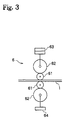
against the current collective member 11 to tightly fix it. To fix this, a fixing or
adhesion device 6 as shown in Fig. 3 is used. In the fixing or adhesion device 6,
the electrode raw material sheet is produced by sandwiching an electrode
structure 1 between pressure rollers 61, rotating the backup rollers 62, 62 under
pressure between the pressure device 63 and a fixed member 64, and tightly
fixing the electrode material layer 12 on the current collective member 11. As the
electrode raw material sheet 4, the ion-conducting polymer layer 2 may be
attached on the electrode material layer 12.
The electrode raw material sheet obtained accordingly may be
100 - 200 µm in total thickness depending on the condition of fixing. However,
the tensile strength is about 1 kg/cm, which has a significantly lower edge
strength comparing with a magnetic tape and a metallic foil.
Formation of the ion conductive polymer layer to the electrode structure
A coating material 22 for forming a paste-like ion conductive polymer layer
to serve as the ion conductive polymer layer 2 is thinly coated on the surface of
the electrode material layer 12 of the electrode structure 1 as shown in Fig. 4
using a doctor knife applicator 21 (Fig. 4 (A)), and an ion conductive polymer
layer 2 is formed on the electrode structure 1 (Fig. 4 (B)). The coating material
22 for forming the ion conductive polymer layer is a material for forming the ion
conductive polymer layer 2 by coating, and it is the ion conductive polymer
forming material or a mixture of this with ion conductive salt such as lithium salt
or a solvent.
In case of the coating material 22 for forming ion conductive polymer layer, which
is a mixture of ion conductive polymer forming material with organic solvent, it is
dried after coating, and the solvent is purged from the ion conductive polymer
layer 2 (Fig. 4 (C)). When the coating material 22 for forming ion conductive
polymer layer mixed with ion conductive salt such as lithium salt is coated on the
ion conductive polymer forming material, ions such as lithium ions are dissolved
in the ion conductive polymer layer 2.
In the following, description will be given on a slitter to slit the electrode raw
material sheet:
Slitter
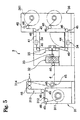
The slitter 3 is to slit the electrode raw material sheet 4 into predetermined
size, and one example of this is shown in Fig. 5. The slitter 3 for the electrode
raw material sheet 4 comprises an unwinding section 31 to supply the electrode
raw material sheet 4, a slitting section 32 having a slitter for the electrode raw
material sheet 4, a forming section 35 to form a convex portion of the slit
electrode, cleaning sections, i.e., a first electrode cleaning section 33 and a
second electrode cleaning section 34 to clean fragments on the electrode, and a
winding section 36 to wind the cleaned electrode.
The unwinding section 31, the slitting section 32, and the winding section 36 are
positioned away from each other for example as shown in Fig. 5 to be positioned
on a floor. The unwinding section 31, the slitting section 32, and the winding
section 36 are independently positionedas required. A rotatable workbench 44
stands or lays between the slitting section 32 and the winding section 36 as
shown in Fig. 5.
An operator may step on the workbench 44 to operate. Accordingly, positioning
the unwinding section 31, the slitting section 32, and the winding section 36 away
from each other and positioning the workbench 44, operability of the slitter
increases, which facilitates the connection of an electrode when accidentally cut
off.
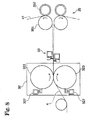
As shown in Fig. 6(A), the wide electrode raw material sheet 4 is slit into
electrode bands 41 by a blade section 320, and the slit adjacent electrode bands
41 are orthogonally separated up and down relative to a pre-slit electrode
surface. As shown in Fig. 6(B), when the wide electrode raw material sheet 4 is
slit by a blade section 320, tips of the blades bite in the electrode raw material
sheet 4.
Accordingly, as in Fig. 6(C), the convex portion 17, i.e., a projection or high edge
portion, is created around the slit portion. The convex portion 17 on the
electrode causes a short-circuit between the electrodes and possibly gives a bad
influence on the electrical component. Then, the forming section 35 presses the
convex portion 17 as in Fig. 6(D) to conduct smoothing on the surface.
Unwinding section
The unwinding section 31 supplies the electrode raw material sheet 4 to the
slitting section 32. In case of using a wide electrode raw material sheet, the
unwinding section 31 is equipped with an unwinding core-like member 311 to
wind to hold the electrode raw material sheet 4. The electrode raw material
sheet 4 unwound from the unwinding core-like member 311 is pulled by an infield
roller 314, guided by a guide rollers 46, 46, passes through a temporary fixing
section 312 having a horizontally arranged splice mount, passes through a
vertically positioned observation section 313 and each tension detection section
45, and supplied to the slitting section 32.
The temporary fixing section 312 is a section to connect the end of the previous
electrode raw material sheet 4 and the top of the current electrode raw material
sheet 4. The observation section 31 is a section where the operator observes
the movement of the electrode raw material sheet 4 to find out any defective
portion in the electrode raw material sheet 4 and any failure in the movement.
The infield roller 314 controls the infield movement of the electrode raw material
sheet 4 and controls the tension accordingly. The tension of the electrode raw
material sheet 4 is detected by each tension detecting section 45 before and
after the infield roller 314.
Slitting section
The slitting section 32 has knives, i.e., blade section 320, to slit the
electrode raw material sheet 4. For example as shown in Fig. 7, the blade
sections 320, 320 are fixed on an upper and a lower rotational shaft 321, 321.
Upper blades 322 of the upper blade section 320 are positioned around the
rotational shaft at the predetermined locations with upper spacers 324 and an
upper gap spacer 325. The upper blades 322 are fixed with the upper spacers
by upper blade coned disc spring holders 326 with intervals. Therefore, a top of
each upper blade 322 is deformable in the axial direction relative to the rotational
shaft 321. The lower blades 323 are positioned around the rotational shaft at the
predetermined locations with lower spacers 324 and an upper gap spacer 325. A
top of each lower blade 323 is flat and is fixed on the side surface of the lower
spacer. Each upper gap spacer 325 is to adjust a gap between the adjacent
upper blades 322 while each lower gap spacer is to adjust a gap between the
adjacent lower blades 323.
Accordingly, the width of the slit electrode is defined, which enables to provide
the electrode 41 with the necessary width. The electrode raw material sheet 4 as
shown in Fig. 8 initially contacts the rotational shaft of the lower blade section to
be inserted between the two blade sections, and the top of the upper blades 322
are deflected and deformed to be slit by upper and lower blades 322, 323
functioning like a scissor.
Fragments 42 such as from the electrode layer adhered on the upper and
lower blades 322, 323 are removed by blade cleaners 327, 327. For example,
the blade cleaners 327, 327 are positioned near outer circumferential surface of
the upper and lower blade sections 320, 320, which suck to supply airflow around
the blade sections 320, 320, thereby removing the fragments 42. Each blade
cleaner 327 has a suction device and is designed to generate an airflow with
appropriate controlled speed to separate the fragments 42 on the blade sections
320 and airflow with appropriate speed to carry the separated fragments 42
thereon. Accordingly, if an air duct 3272 has a wider portion, the airflow
becomes slower and therefore the air duct 3272 is designed to provide constant
airflow speed at any portion.
An arrangement of parallel blocks 3271 of the blade cleaner 327, for
example, is mounted near the blade section 320, supplies airflow of controlled
speed between the blade 320 and the parallel blocks 3271, and carries the
fragments by the airflow via the air duct 3272 formed in the parallel blocks 3271.
The controlled speed of the airflow passing through the clearance between the
blade 320 and the parallel section 3271 at least needs to be uniform, for example
in the range of 0.1mm to 2 mm, preferably 0.1mm to 0.5 mm. The controlled
airflow speed should be in the range of 5 to 25m/s. and preferably 7.5to 20m/s.
The parallel section 3271 needs to be designed in an appropriate length which
enables to provide a uniformed airflow and a stable airflow direction.
Further, the fragments 42 means articles that are not preferable to
electrode such as powder or flakes of 30 µm - 50 µm. In addition, the blade
section 320 is located each at a upper side and a lower side for a convenience of
the explanation. However, the three-dimensional location arrangement may be
decided as necessary.
Forming section
The forming section 35 is to form a convex portion 17. The forming section
35 for example as shown in Fig. 8 has a pair of rollers sandwiching the slit
electrode bands 41 therebetween, and the rollers rotate to press the convex
portions 17 to conduct smoothing thereon. Each pair of rollers for example
include a drive roller 351 and a nipple roller 352, wherein the drive roller 351 is to
rotate while the nipple 352 is abuttable against the drive roller 351. The surface
hardness of the drive roller 351 and the nipple roller 352 is decided according to
the type of electrode to be formed.
For a thin hard electrode, for example a steel roller having a hard surface may be
used for both drive and nipple rollers 351, 352. For a thick elastic easily
deformable electrode, for example a steel roller having a hard surface may be
used for the drive roller 351 while a resilient roller which is more resilient than the
steel roller may be used for the nipple roller 352.
For example as shown in Fig. 9, the drive rollers 351, 351 and the nipple
rollers 352, 352 in the forming section may be mounted on a foundation base
353. The driving shaft 355 rotates the drive roller 351. The nipple roller 352 is
rotatably mounted on a nipple roller arm 356 and abuts against the drive roller
351 to rotate according to the rotational speed of the drive roller 351. A cylinder
354 is connected to the nipple roller arm 356, thereby rotating the nipple roller
arm 356 with the rotational axle as the fulcrum due to the telescopic motion of the
cylinder 354. Because of this telescopic motion of the cylinder 354, the nipple
roller 352 may be abutted against or departed from the drive roller 351, thereby
adjusting the pressure at the abutment between the two rollers.
The steel roller and the resilient roller need to have sufficient hardness to
form the convex portions, and for example the steel roller may be obtained by
using a tool steel as a base metal to be coated with hard chromium plating and
conducting smooth grinding on the same. In addition, as required, a hard metal
and ceramic spraying may be used for finishing. The resilient roller may be
polyimide or denatured urethane, and the hardness for example may be
95 to 97 at Rubber Code Shore D Scale of JIS.
The rollers in the forming section 35 function as out-feed rollers and restrict
the feeding speed of the electrode 41 by the rotational speed. As such, the in-feed
roller 314 and the out-feed rollers in the forming section 35 enable to feed
an electrode therebetween with the predetermined tension and feeding speed.
The blade section 320 is located therebetween and is designed to rotate in the
same direction as the electrode but for example about 0 to 3% faster.
In the forming section 35, adjacent slit electrode bands 41 are separated to
be fed in upper or lower direction. Distance between the upper and lower
sections depends upon the distance relation among the slitting section 32, the
first electrode cleaning section 33, and the forming section 35. Accordingly, the
arrangement above improves operatability of the adjacent slit electrode bands
41.
Electrode cleaning section
The electrode cleaning sections 33, 34 are designed to remove the
fragments 42 such as powder and foreign object adhered on the slit electrode 41.
For example, the first electrode cleaning section 33 is located after the slitting
section 32 before the forming section 35, i.e., between the slitting section 32 and
the forming section 35. The second electrode cleaning section 34 is
appropriately positioned between the forming section 35 and the winding section
36. The fragments 42 are removed more accurately by including the first and
second electrode cleaning sections 33, 34.
First electrode cleaning section
The first electrode cleaning section 33 mainly removes fragments created
at slitting. If forming is conducted on an electrode while having fragments
thereon, the fragments may be adhered and fixed on the electrode. The first
electrode cleaning section 33 for example as in Fig. 11 uses brushes 331 and a
suction device so as to remove the fragments. The brush 331 may be a wire
brush made from plural stainless wires, and plural brushes 331 are positioned in
the width direction of the electrode or the crossing direction with the electrode
feeding with the predetermined intervals sufficient for the fragments to pass
through.
The brushes 331 are arranged not to make one straight line but to make a
staggered line relative to the electrode feeding direction. The brush 331 abuts
against the electrode 41 by a spring 332 so as to contact fragments on any
portion of the electrode 41. The suction device makes an airflow 336 between
wires and sucks to catch the fragments on the electrode at a filter together with
the brushes. As required, the first electrode cleaning section 33 may be provided
at both sides of the electrode. In this case, the brushes 331, 331 at both sides of
the electrode are arranged to indirectly face each other around the contact point
with the electrode and with the brushes 331 at one side comes after the other
side with the predetermined interval between the two in the feeding direction.
Accordingly, the brush 331 contacts the surface of the electrode 41 well.
The first electrode cleaning section 33 is configured such that the brush
331 is installed on a holding member 333 via a spring 332. The electrode 41 is
fed to contact with the brush 331 to be brushed removing the fragments and to
carry the fragments into a transfer tube 334 by the airflow. Then, the fragments
are collected by the filter and are gathered in a dust/fragment collection
container.
The transfer tube 334 for example may be an angular tube which may be
positioned in the crossing direction relative to the electrode feeding direction. An
airflow adjuster 335 is positioned at the electrode side of the transfer tube 334 so
as to adjust a clearance with the electrode 41 into which a high airflow is supplied
to efficiently carry the fragments. The clearance for example may be in the range
of 1.5 mm - 2 mm. A clearance between the pair of the first electrode cleaning
section 33 at their airflow adjusters is in the range of 3 mm - 4 mm.
As shown in Fig. 11(B), the adjacent slit electrodes 41 are orthogonally
separated up and down relative to a pre-slit electrode surface, and a portion near
the tip of brush 331 contacts an end surface of the electrode 41 so that the
fragments on the end surface of the electrode may be well removed. As such, in
order to divide the electrode orthogonally up and down and to brush the end
surface of the electrode, the distance between the upper electrode band and the
lower electrode band is decided based on a various conditions such as an shape
of electrode and location of the device. For example, the first electrode cleaning
section 33 is positioned adjacent to the slitting section 32, and if the distance
between the first electrode cleaning section 33 and the forming section 35 is
200mm - 250mm, the distance between upper and lower electrode bands at the
forming section 35 is about 5mm.
Second electrode cleaning section
The second electrode cleaning section 34 is to remove fragments mainly
created at forming, and for example as shown in Fig. 12 the feeding roller 342
and the storing roller 344, on which the sheet roll 341 is rolled, an abutment roller
343, and a winding guide 347 are installed in a securing body 348. The second
electrode cleaning section 34 for example uses the sheet roll 341 abutting
against the surface of the electrode 41. The sheet roll 341 for example may have
plural holes through which articles such as nonwoven fabric and woven fabric
passes.
The sheet roll 341 for example is formed by forming an electrode band to be
rolled on the feeding roller 342 and feeding the electrode band from the feeding
roller 342 to be rolled on the storing roller 344 via the abutment roller 343
abutting against the electrode 41. The slit electrode 41 is inserted between and
abuts against the winding guide 347 and the abutment roller 343 to be fed. The
sheet roll 341 contacts the electrode 41 at the abutment roller 343 to remove the
fragments from the electrode 41. The electrode cleaning section 34 has a
suction device to suck the inside of the abutment roller 343 as required.
Plural holes are formed on the circumferential surface of the abutment roller 343,
and the fragments are effectively removed by sucking the outside air from the
holes. A suction pipe may be used as the abutment roller 343 having holes on its
circumferential surface. The holes on the abutment roller are arranged to comply
with the width of the electrode. Rotation of the abutment roller, i.e., driving and
braking, is controlled by a motor so as to determine the feeding speed of the
sheet roll 341.
A front half on the circumferential surface of the abutment roller/pipe 343
contacts the sheet roll 341 and a back half of the abutment roller/pipe 343 is
covered by a suction plate 346. Accordingly, suction is conducted only at a
portion where the electrode 41 and the sheet roll 341 are pressed to contact
each other. The suction plate 346 does not rotate and only the abutment
roller/pipe 343 rotates. If the feeding direction of the sheet roll 341 is opposite to
that of electrode 41, a relative speed of the electrode 41 and the sheet roll 341
becomes larger and more sheet roll surface contacts with the electrode.
As a result, the fragments on the electrode can easily be transferred to the sheet
roll 341. When the suction device sucks inside of the abutment roller, the
fragments on the electrode and the sheet roll may be sucked and removed
together with the movement of the sheet roll 341 and filtered to be gathered in
the duct/fragment collection container.
As required, the second electrode cleaning section 34 may be provided at both
sides of the electrode. In this case, the abutment rollers 343 at both sides of the
electrode 41 are arranged to be facing each other around the contact point with
the electrode but are not directly facing each other with the predetermined
interval between the two brush lines in the feeding direction.
Accordingly, a contact point between the sheet roll 341 and the electrode 41
becomes larger/longer, thereby improving the fragment removal effect. The
contacting length for example may be about 10 mm. This contacting length may
be decided according to conditions such as the size of the device and thickness
of the abutment roller. However, unnecessarily long contacting length prevents
from uniformly maintaining the tension of every slit electrode, thereby providing a
possibility of braking or slitting the electrode off.
As shown in Fig. 13, the abutment roller/pipe 343 is connected to the
suction device 3420 via a piping. For example, the piping is connected to a valve
3415, a flowmeter 3416, a dust/fragment collection filter 3418, a suction device
3420, and a high performance filter 3419. The valve 3415 is to adjust the
amount of suction of the pair of second electrode cleaning sections 34. The
flowmeter 3426 is utilized to measure the amount of suction so as to adjust the
amount of suction. The duct/fragment filter 3418 is designed to collect the sucked
fragments and alarms when clogged up. The collected fragments are gathered in
the dust/fragment collection container.
The suction device 3420 for example may be a multistage high static pressure
blower. The high performance filter 3419 has an alarm unit, which alarms when
the filter leaks. A gas suction system such as the piping, the valve 3415, the
flowmeter 3416, the dust/fragment collection filter 3418, the suction device 3420,
the high performane filter 3419, and the suction device 3420 may be used at the
blade cleaning section 327 and the first electrode cleaning section 33.
The securing body 348 for example as shown in Fig. 14 may removably be
assembled with the drive section 349 along the slide rail 3414. The feeding roller
342 mounted on the securing body 348 the storing roller 344, and the abutment
roller 343 are connected to joints so as to rotate and slide in the predetermined
direction by the motor/driving device of the drive section 349 and the brake/slide
device.
For example, the feeding roller 342, the storing roller 344, and the abutment
roller 44 are connected to the unwinding powder brake joint 3411, the winding
torque motor joint 3410, and the motor/brake joint 341, thereby generating a
rotational force and conducting slide control. An ascensor 3412 moves the
second electrode cleaning section 34 to abut against or away from the electrode
41. As such, the second electrode cleaning section 34 may be moved and the
securing body 348 may be detached from the drive section 349, thereby
facilitating the maintenance of the second electrode cleaning section 34 and
exchange of the sheet roll 341.
Winding section
The winding section is to hold the slit electrode 41. The winding section for
example is winding cores 361 including plural reels and cores, and the narrowly
slit electrode bands 41 are to be wound thereon. A stopper pad 46 and a tension
detector 45 are positioned in front of the winding core 361. The stopper pad 46
is to temporary hold and stop the slit electrode band 41. The tension detector 45
is to measure the electrode tension between the forming section 35 and the
winding core 361.
Description will be given below on an example of slitter operation.
Initial setting
A predetermined setting is to be made prior to the slitter operation. As an
example of negative electrode, the setting needs to be made as to a tailoring
speed of e.g., 20/min.), a blade slip ratio of e.g., about 1% added to the electrode
feeding speed, a provisional winding tension, a slit length of e.g., 500 m, a speed
curve at rise time, an automatic stop curve, an automatic on/off function for the
second electrode cleaning section, pressure at the forming section, a unwinding
tension, slitting tension, a nonwoven fabric feeding speed at the second
electrode cleaning section, and a timing of stall tension preventing the nonwoven
fabric sagging prior to the operation.
The remaining electrode raw material sheet and the remaining nonwoven
fabric as to the length are to be displayed on the operation control panel, so that
the operation does not automatically stop for lack of electrode raw material sheet
and nonwoven fabric In addition, it is designed that the operation does not stop
for the dust/fragment collection container full of fragments.
Feeding the electrode into the slitter
First, the electrode raw material sheet 4 is slowly fed from the unwinding core
311 of the unwinding section and is slit into the predetermined width at the slitting
section 32. Then, the slit electrode bands 41 are taped and fixed on the winding
core 361 of the winding section 36 to be stall-tensioned to hold the same prior to
the operation.
Slitter operation
Automatic operation of the slitter 3 starts automatically applying the stall
tension. On of the pair of second electrode cleaning sections 34, for example an
lower second electrode cleaning section 34, is lifted, and the winding tension is
applied to prevent the sagging of the nonwoven fabric. Then, the suction device
3420 is turned on. The feeding speed of the electrode band 41 gradually
increases at the initial stage to be a constant speed, then is tailored and
decelerates at the end. Specifically, the electrode raw material sheet 4 is
unwound from the unwinding core 311 by the in-feed roller 314.
The unwound electrode raw material sheet 4 is guided to the respective guide
roller 46 and is to transferred to the slitting section 32 via the temporary fixing
section 312, the observation section 313, and the respective tension detection
section 45. The observation section 313 observes the feeding condition of the
electrode. An back end of electrode raw material sheet and a front end of the
next electrode raw material sheet are connected to make a flat surface at the
temporary fixing section 312.
The tension and feeding speed of the electrode is restricted by the in feed
roller 314 and the roller of the forming section 35. Feeding of the electrode raw
material sheet starts from 0 and increases by 20/min. to reach the maximum
speed. Then, the feeding speed is held as the constant speed and the electrode
raw material sheet is constantly slit while feeding. The feeding is automatically
slowed down to pause, and the electrode 41 while a stall tension being applied is
held by the stopper pad 46.
Here, since the electrode raw material sheet 4 wound around the unwinding core
311 is rather heavy, it must be carefully controlled so as not to be sagged or slit
off. Therefore, tension detector 45 positioned between the temporary fixing
section 312 and the observation section 313 detects the tension of the electrode
raw material sheet 4 and applies the feed back to adjust the tension so as to
unwind.
The electrode raw material sheet 4 is slit at the slitting section 32, and the
adjacent slit electrode bands 41 are divided into upper and lower electrode bands
passing through the first electrode cleaning section 33, the forming section 35,
the second electrode cleaning section 34, and the tension detector 45, the
stopper pad 46 so as to be wound around the winding core 361. The fragments
created at the slitting are sucked and removed by the blade cleaner 372, and the
fragments 42 on the electrode is sucked and removed by the first electrode
cleaning section 33.
The convex portion 17 created at slitting is formed by press at the forming
section 35, and the fragments 42 adhered on the electrode are sucked and
removed by the second cleaning section 34. If the feeding of the electrode 41 is
paused, the electrode 41 is held by the stopper pad 46 to be fixed. While holding
the electrode 41 by the stopper pad 46, winding operation may be freely
conducted manually. The end of the electrode band may be taped, and the reel
with the wound electrode band may be removed. Then, a new empty reel may
be prepared.
When finishing the operation of the slitter 3, the suction device 3420 of the
second electrode cleaning section is turned off. Feeding of the sheet roll 341 is
paused, and the lower second electrode cleaning section may be lowered. Since
the electrode 41 as slit accordingly has the convex portion 17, the electrode band
41 is wound evenly around the winding core without irregular winding.
In the following, description will be given on a method for manufacturing
electrode material, to which ion conductive polymer is adhered.
Method for manufacturing electrode structures
To manufacture the electrode structures, ion conductive polymer or ion
conductive polymer raw material or a mixture of these, i.e. the material for
forming ion conductive polymer, is attached in very low thickness on the surface
of an electrode material. Then, a solvent is added to turn it to liquid and paste-like
state. This is coated on a current collective member and is dried to
evaporate the solvent. Alternatively, the solvent may be added from the
beginning, and it may be turned to paste-like state at the same time as it is
adhered to the ion conductive polymer forming material.
In this case, only a slight quantity of the ion conductive polymer forming
material is used. The surfaces of particles of the powdery electrode material are
adhered with ion conductive polymer so that there will be no void, and that gaps
between powder particles will be minimized.
To adhere the ion conductive polymer forming material with powdery
electrode material, the ion conductive polymer forming material and the powdery
electrode material are pressurized and ground against each other, and a
pressurized product is obtained.
Pressurizing and sliding
Pressurizing and grinding is defined as an operation to grind a mixture of
the ion conductive polymer forming material and the powdery electrode material
against each other while pressurizing. An external force is applied to the
mixtures so that they adhere to each other and the particles rotate, and this
process is performed repeatedly to obtain a press-sliding product.
Pressurizing, grinding and kneading device
A pressurizing, grinding and kneading device 5 is as shown in Fig. 15, for
instance. The mixture 50 of the ion conductive polymer forming material and the
powdery electrode material 13, or a mixture 50 containing this mixture and
solvent, is placed in a container 51, and a main blade 52 is rotated by the main
motor 522. There is a gap between a bottom 511 of the container 51 and the
main blade 52.
When the main blade 52 is rotated, a part of the mixture 10 is moved between
the bottom 511 of the container and the main blade 52. It is subject to press-sliding
and kneaded. This procedure is repeated, and the ion conductive
polymer forming material is adhered to the powdery electrode material 13. The
bottom 511 of the container 21 may be flat or inclined, and the facing surface
area between the main blade 52 and the bottom 511 is preferably large to
increase the effective press-sliding.
In the pressurizing, grinding and kneading device 5, a dispersing blade 531
is provided in the container 51. A sub-motor 531 rotates the dispersing blade 53
at high speed, and the mixture 50 pressurized and slided is dispersed.
Container
The container 51 is provided for holding the mixture 50 which is press-slide
and stirred. At the bottom of the container 51, there is provided a lower portion
5111 with a part of it at lower position. The bottom surface is inclined upward as
it goes toward peripheral portion.
For instance, it is lower at the center, and it gradually goes up toward the
periphery. It is formed in a bottom 211 in shape of conical mortar. The inclination
angle of the lower portion 5111 is set to 120°C, for example. The bottom 511 of
the container 51 has wear resistant property. It is made of SUS, for instance,
and it is formed by spraying tungsten or carbide. Plural bottom parts of this type
may also be formed on the bottom surface 211.
Main blade
The main blade 52 functions together with the bottom surface 211 of the
container 51, serving to press-slide and stir the mixture 10. The main blade 52,
is positioned via shaft 5111 to the desired location relative to the bottom 5111 of
the container 51 as shown for example in Fig. 15(B). The main blade 52 curves
upwards corresponding to the slant of bottom 211 of the container 21. The main
blade 22 may comprise two blades attached from the center part as shown in
Fig. 15(B), or it may comprise a larger number of blades, e.g. 10 or more,
depending on the amount and type of mixture.
The number of rotations of a main motor 521 driving the main shaft 522 is
set low for example to 120 rpm or less, when press-sliding is performed.
The gap between the bottom surface 211 of the container 51 and the base
surface of the main blade 52 is set as narrow as is necessary for press-sliding
the mixture, for example 15 mm or less. This distance depends on the capacity of
the press-sliding mixer 5 and on the shape of the main blade, etc.
The surface in the motion direction (press-sliding direction) of the main
blade 52 is formed so that a pressing angle relative to the bottom surface of
the container 51 is an acute angle. For example, if the cross-section of the main
blade 52 is a reverse trapezoid as shown in Fig. 15(C), the pressing angle is from
3 degrees to 70 degrees. The cross-section of the main blade 52 may also be
circular or have a rounded corner as shown in Fig. 15(D). The material of the
main blade has wear-resistant properties, and is formed for example by thermal
spraying with tungsten or carbide using SUS.
The surface of the main blade 52 opposite to the advancing direction
(direction of pressurizing and sliding) is designed in such manner that it runs
almost perpendicularly to the bottom surface and at an acute angle. As a result,
when the main shaft 521 is rotated in reverse direction, the mixture 50 can be
collected on the periphery of the main shaft 521.
If there are plural bottom parts on the bottom surface 5111, the center parts of
the main blade 52 are also disposed in positions of the bottom part
corresponding to their number.
Dispersing blade
The dispersion blade 53 disperse the mixture 50 which is press-slid by the
main blade 52. The dispersion blade 53 is disposed in a position at which the
mixture 50 can be dispersed, and it rotates at a high speed such as
1000 to 4000 rpm by the sub-motor 531. By rotating it at high speed, the ion
conductive polymer 16 or its raw material adhered on the surface of the particles
of the powdery electrode material 13 are evenly dispersed over the entire
powdery material.
In the following, description will be given on a method for manufacturing the
electrode raw material sheet:
Example 1 for manufacturing an electrode raw material sheet (example for
manufacturing a positive electrode structure)
Into a pressurizing, grinding, and kneading device, 9.1 weight parts of
LiCoO
2 with average particle size of 5 µm, i.e. powdery electrode active
material, and 0.6 weight part of graphite powder with average particle size of 4
µm, i.e. powdery conductive material, were placed, and the mixture was
pressurized and ground for 20 minutes. Then, 0.546 weight part of an ion
conductive polymer raw material (A1) and 3.5 weight parts of acetonitrile were
added. The ion conductive polymer raw material (A1) is a mixture, and its
composition and mixing ratio are as shown in Table 1.
| Ion-conducting polymer raw material (A1) |
| Substance | Mixing ratio (weight parts) |
| Difunctional (propylene glycol/ethylene glycol) random copolymer, SANNIX FA-103 (PO/EO=2/8, Mw=3,282, Sanyo Chemical Industries, Ltd.) | 8.36 |
| Difunctional 1, 4-butanediol | 0.34 |
| Ethylene cyanohydrin | 1.27 |
| Reaction catalyst NC-IM (Sankyo Air Products K.K.) | 0.03 |
| Total | 10 |
The pressurized product added with the ion conductive polymer raw
material (A1) was pressurized and ground for 5 hours in the pressurizing,
grinding and kneading device. The pressurized product was turned to paste-like
state. To the pressurized product, 0.254 weight part of polymeric MDI (MR-220;
manufactured by NPU) was added, and the mixture was agitated for 5 minutes in
the pressurizing, grinding and kneading device. The pressurized product was
taken out, and this was placed on an aluminum foil of 20 µm in thickness and
was cast using a doctor knife applicator with gap of 100 µm. This was left to
stand at room temperature for 15 minutes and was then heated at 80°C for 1
hour. The positive electrode structure thus prepared had thickness of 80 µm.
Example 2 for manufacturing an electrode raw material sheet (example for
manufacturing a negative electrode structure)
Into a pressurizing, grinding and kneading device (volume capacity: 300
cc), 9.1 weight parts of graphite powder with average particle size of 5 µm, i.e.
powdery electrode active material, 0.682 weight part of ion conductive polymer
raw material (A1), and 3.0 weight parts of acetonitrile were placed, and the
mixture was pressurized and ground for 7 hours. The pressurized product was
turned to paste-like state. Then, 0.318 weight part of polymeric MDI (MR-200;
manufactured by NPU) was added, and the mixture was pressurized and ground
for 5 minutes. The pressurized product was taken out and was placed on a
copper foil of 20 µm in thickness and was cast using a doctor knife applicator
with gap of 100 µm. This was left to stand at room temperature for 15 minutes
and was then heated at 80°C for 1 hours. The electrode thus obtained had
thickness of 80 µm.
Example 3 for manufacturing an electrode raw material sheet (example for
manufacturing an electrode structure for a capacitor)
To prepare an electrode for capacitor, 1.03 weight part of carbon black was
added as powdery conductive material to 9.02 weight part of phenol derived
activated carbon (manufactured by Kansai Chemical Co., Ltd.) as electrode
material. This was processed by dry mixing using a mixer. Then, 0.48 weight
part of polymer A1 was added as a binder and was mixed. Further, 5.6 weight
part of acetonitrile as a solvent was added and was mixed. After mixing, the
material was coated onto the collector element with a doctor knife applicator.
The samples were then heated by infrared radiation or by heated air. The
thickness of the electrode thus prepared was 75 µm.
The details of the procedure for manufacturing the electrode structures as
described above are given in the patent applications filed by the applicants of the
present invention (Japanese Patent Applications 11-262501, 11-262502, 11-2691124,
and 2000-38744). In addition, the ion-conducting polymer coated on
the electrode material layer is not limited to what is used in the embodiments
here.
Example 4 of electrode raw material sheet (coating of the coating material for
forming ion conductive polymer layer on positive electrode structure of the
battery)
One weight part of cyanoethylated dihydroxypropyl cellulose and lithium
perchlorate were dissolved in tetrahydrofurane. This solution was left to stand
under reduced pressure to evaporate tetrahydrofurane. Then, 0.2 weight part of
polyethylene glycol dimethacrylate (oxyethylene unit number = 9) and 0.2 weight
part of methoxypolyethylene glycol monomethacrylate (oxyethylene unit number
= 9) were added. Further, 0.002 weight part of azobis-isobutyronitrile was added
so that lithium perchlorate was to be 1 mol per 1 kg of total weight containing all
components. The complex product thus prepared was viscous solution.
Cyanoethylated dihydroxypropyl cellulose as described above is disclosed in JP-A-8-225626.
The materials are described in: Macromolecules, 24, 4691 (1991)
and Makromol. Chem. 193, 647 (1992).
Specifically, the components were added so that lithium perchlorate was to
be 1 mol per 1 kg of the total weight of the mixture of lithium perchlorate +
cyanoethylated dihydroxypropyl cellulose + polyethylene glycol dimethacrylate +
methoxypolyethylene glycol monomethacrylate + azobis-isobutyronitrile, and the
coating material 22 for forming the ion conductive polymer layer of the complex
product of polymer electrolyte - lithium perchlorate was prepared.
The coating material 22 for forming the ion conductive polymer layer of the
polymer electrolyte - lithium perchlorate complex product thus prepared was cast
on a positive electrode structure (the electrode structure 1 prepared by coating
the positive electrode material on the current collector) using a doctor knife
applicator. It was left to stand at 80 °C for 0.5 hour, and an ion conductive solid
macromolecular electrolyte film layer in semi-solid state (ion conductive polymer
layer 2) was prepared.
Example 5 of electrode raw material sheet (coating of the coating material for
forming ion conductive polymer layer on negative electrode structure of the
battery)
On the negative electrode structure, the complex product of polymer
electrolyte - lithium perchlorate (coating material 22 for forming ion conductive
polymer layer) prepared in Example 4 was cast using a doctor knife applicator.
This was left to stand at 80°C for 0.5 hour, and ion conductive solid
macromolecular electrolyte film layer (ion conductive polymer layer 2) was
formed, and a negative electrode structure with the ion conductive polymer layer
2 was prepared. Then, the same procedure as in Example 1 was performed
except that the negative electrode structure was used.
In addition, the details of the above-procedure of obtaining the ion-conducting
polymer layer may be referred to the patent applications, the
Japanese Patent Application No. 2000-141687, filed by the applicants of the
present invention
Example 6 for manufacturing an electrode raw material sheet (electrode for a
lithium-ion battery utilizing polyvinylidene vinylidene as a binder)
Regarding the preparation of the positive electrode, for example the lithium
carbonate and cobalt carbonate are mixed at the ratio of 0.5 mol-0.5mol and
baked at a temperature of 900°C for 5 hours in order to obtain the positive active
material. Then, the obtained 91 weight parts of LiCoO2, 6 weight parts of
graphite as a conductive material, and 10 weight part of polyvinylidene vinylidene
as a binder are mixed to prepare the negative mixture. This mixture is dispersed
in N-methyl-2-pyrrolidinone-to be slurried. The obtained slurry was evenly
applied on one side of an aluminum foil of 20 µm in thickness up to the
thickness of 100 µm, and after drying an adhesion device was used to conduct
press form thereon.
To prepare a negative electrode, 90 weight parts of the grinded graphite
and 10 weight parts of polyvinylidene vinylidene as a binder were mixed to
prepare a negative mixture, and the mixture was dispersed in N-methyl-2-pyrrolidinone-to
be slurried. This slurry is evenly applied on one side of the
copper foil, as a current collective member, of 10 µm in the thickness, and after
drying an adhesion device was used to conduct press form thereon.
This invention as described above, renders the advantages of providing an
electrode with an excellent quality for an electrical component, an electrical
component with less possibility of defects, and a slitter with an excellent
accessibility.
It is readily apparent that the above-described invention has the
advantages of wide commercial utility. It may be understood that the specific
form of the invention hereinabove described is intended to be representative
only, and certain modifications within the scope of these teachings will be
apparent to those skilled in the art without departing from the spirit and scope of
the invention.