EP1174513A2 - A method for obtaining a genetically modified plant - Google Patents
A method for obtaining a genetically modified plant Download PDFInfo
- Publication number
- EP1174513A2 EP1174513A2 EP00870230A EP00870230A EP1174513A2 EP 1174513 A2 EP1174513 A2 EP 1174513A2 EP 00870230 A EP00870230 A EP 00870230A EP 00870230 A EP00870230 A EP 00870230A EP 1174513 A2 EP1174513 A2 EP 1174513A2
- Authority
- EP
- European Patent Office
- Prior art keywords
- plant
- protoplasts
- cells
- cassette
- genetically modified
- Prior art date
- Legal status (The legal status is an assumption and is not a legal conclusion. Google has not performed a legal analysis and makes no representation as to the accuracy of the status listed.)
- Granted
Links
Images


Classifications
-
- C—CHEMISTRY; METALLURGY
- C12—BIOCHEMISTRY; BEER; SPIRITS; WINE; VINEGAR; MICROBIOLOGY; ENZYMOLOGY; MUTATION OR GENETIC ENGINEERING
- C12N—MICROORGANISMS OR ENZYMES; COMPOSITIONS THEREOF; PROPAGATING, PRESERVING, OR MAINTAINING MICROORGANISMS; MUTATION OR GENETIC ENGINEERING; CULTURE MEDIA
- C12N15/00—Mutation or genetic engineering; DNA or RNA concerning genetic engineering, vectors, e.g. plasmids, or their isolation, preparation or purification; Use of hosts therefor
- C12N15/09—Recombinant DNA-technology
- C12N15/63—Introduction of foreign genetic material using vectors; Vectors; Use of hosts therefor; Regulation of expression
- C12N15/79—Vectors or expression systems specially adapted for eukaryotic hosts
- C12N15/82—Vectors or expression systems specially adapted for eukaryotic hosts for plant cells, e.g. plant artificial chromosomes (PACs)
- C12N15/8201—Methods for introducing genetic material into plant cells, e.g. DNA, RNA, stable or transient incorporation, tissue culture methods adapted for transformation
- C12N15/8206—Methods for introducing genetic material into plant cells, e.g. DNA, RNA, stable or transient incorporation, tissue culture methods adapted for transformation by physical or chemical, i.e. non-biological, means, e.g. electroporation, PEG mediated
-
- C—CHEMISTRY; METALLURGY
- C12—BIOCHEMISTRY; BEER; SPIRITS; WINE; VINEGAR; MICROBIOLOGY; ENZYMOLOGY; MUTATION OR GENETIC ENGINEERING
- C12N—MICROORGANISMS OR ENZYMES; COMPOSITIONS THEREOF; PROPAGATING, PRESERVING, OR MAINTAINING MICROORGANISMS; MUTATION OR GENETIC ENGINEERING; CULTURE MEDIA
- C12N15/00—Mutation or genetic engineering; DNA or RNA concerning genetic engineering, vectors, e.g. plasmids, or their isolation, preparation or purification; Use of hosts therefor
- C12N15/09—Recombinant DNA-technology
- C12N15/63—Introduction of foreign genetic material using vectors; Vectors; Use of hosts therefor; Regulation of expression
- C12N15/79—Vectors or expression systems specially adapted for eukaryotic hosts
- C12N15/82—Vectors or expression systems specially adapted for eukaryotic hosts for plant cells, e.g. plant artificial chromosomes (PACs)
- C12N15/8201—Methods for introducing genetic material into plant cells, e.g. DNA, RNA, stable or transient incorporation, tissue culture methods adapted for transformation
Definitions
- This invention is related to a method for obtaining a genetically modified plant. More particularly, the invention is related to a method for the genetic transformation of plant cells, the regeneration of whole plants from such transformed plant cells.
- the invention is related to a method for obtaining genetically modified plant of Beta vulgaris type.
- This invention is related to new genetically modified plants, preferably obtained by said method.
- Plants are susceptible to different diseases caused by organisms such as viruses, parasites, insects, nematodes or by chemical products. This susceptibility has great economical consequences with estimated losses of several billions of dollars each year.
- plant genetic transformation techniques have been proposed to overcome this problem.
- the final goal of these techniques is to obtain genetically transformed plants.
- the gene of interest has to be transferred into plant cells.
- Stable transformed plant cells i.e. plant cells having integrated said gene of interest into their genome, have then to be selected and have to be used for regeneration of whole plants.
- the transformation techniques can be classified into physical DNA delivery methods such as electroporation, PEG-mediated DNA uptake, biolistics and methods based on Agrobacterium-mediated DNA transfer.
- the international patent application WO 95/10178 describes a method for the genetic transformation of a plant by introducing a DNA construct including a selectable marker gene into a stomatal cell of the plant, said stomatal cell being converted to a protoplast prior to regeneration.
- the transformation is conducted on a cell population containing guard cells.
- the hereditary material is a plasmid DNA produced in E. coli, purified and used in its entirety.
- any region or all of the plasmid DNA may become stably integrated into the plant genome.
- the selectable marker and target transgenes which are part or all of the bacterial plasmid sequence (containing bacterial antibiotic selectable markers such as nptIII) may be cointegrated or even separately integrated in a different genomic site.
- the borders of the gene of interest to be integrated into the genome of the plant can be submitted to the action of exonucleases.
- the present invention aims to provide a method for genetic transformation of plant cells with a genetic sequence of interest and for regeneration of whole plants from transformed cells thus obtained, which is simple to be used and which does not present the drawbacks of the state of the art.
- the present invention aims to provide such a method for genetic transformation of plant cells using techniques which result in a genetically modified plant which is free or substantially free from prokaryotic or plasmidic nucleotide sequences (especially selectable markers which allow an antibiotic resistance).
- the present invention is related to a method for obtaining a genetically modified plant comprising the steps of
- cassette nucleotide sequence a sequence consisting of only a nucleotide sequence of interest to be inserted in the genome of said plant, associated with one or more promotor(s) and terminal nucleotide sequence(s) and possibly regulatory sequences sufficient to obtain an efficient expression of said sequence of interest into the plant.
- said cassette nucleotide sequence is obtained by classical amplification techniques using nucleotide sequences as templates to start off genetic amplification.
- said amplification technique is selected from the group consisting of PCR, RTPCR, LCR, CPT, NASBA, ICR or avalanche DNA amplification techniques well known by the person skilled in the art.
- said templates are deleted before the transformation of said protoplasts by using specific known genetic tools such as nuclease or restriction enzymes and the resulting nucleotide cassette is free or essentially free from other nucleotide sequences (from bacterial or from other origin) than the sequences of interest.
- genome of a plant being free or substantially free from other prokaryotic or plasmidic nucleotide sequences, especially selectable markers encoding antibiotic resistance, the fact that said genome of the plant does not comprise a regulatory or encoding nucleotide sequence of heterologous origin than the cassette sequence to be inserted into the genome of the plant and except few portions of nucleotide sequences of prokaryotes which have not been completely deleted from the cassette nucleotide sequence after amplification.
- Said portions of nucleotide sequences comprise less than 50 nucleotides, preferably less than 20 nucleotides, more preferably less than 10 nucleotides, which do not comprise prokaryotic polypeptides or do not comprise promoter/operated sequences of prokaryotic origin.
- the method according to the present invention preferably comprises also (as preliminary steps) the steps of providing an intact tissue of said plant containing stomatal cells and converting said stomatal cells into protoplasts by enzymatic digestion of the cell walls, said steps being performed before the step of transforming said protoplasts, said plant tissue being preferably senescent leaf tissue or leaf epidermis.
- the stomatal cells correspond to a cell population containing guard cells or to a cell population enriched in guard cells and the step of transforming said protoplasts is advantageously conducted on a suspension of protoplasts.
- the step of transforming said protoplasts correspond to the known PEG-mediated genetic transformation technique (Krens et al., Nature 296, 72-74 (1982)) and comprises mixing said suspension of protoplasts and the hereditary material, preferably an amplicon at a concentration of higher than 1 ⁇ g preferably between about 10 and about 100 ⁇ g DNA /1x 10 6 protoplasts, as described in the example 10 of the document WO 95/10178 incorporated herein by reference.
- Beta vulgaris which is known to be a species transformable at very low frequency.
- Beta vulgaris includes sugar beet, fodder beet, table beet and Swiss chard.
- the nucleotide sequence of interest being inserted into the plant or plant cell is preferably selected from the group consisting of genes involved into a resistance to plant viruses (especially BNYVV resistanec in sugar beet), resistance to plant parasites (nematodes, fungi or insects), resistance to herbicides (preferably glyphosate, imidazolinone such as glufosinate and/or acetochloride resistance), insecticides or fungicides, or involved in the metabolism of carbohydrates (improved production of carbohydrates, polysaccharides, oligosaccharides or monosaccharides such as starch, fructans, glucose, fructose,).
- a resistance to plant viruses especially BNYVV resistanec in sugar beet
- nematodes, fungi or insects resistance to herbicides
- herbicides preferably glyphosate, imidazolinone such as glufosinate and/or acetochloride resistance
- Another aspect of the present invention is related to a plant or a plant cell, preferably a sugar beet ( Beta vulgaris plant or plant cell) comprising into their genome an hereditary material consisting only of a cassette nucleotide sequence, said cassette nucleotide sequence having a nucleotide sequence of interest to be inserted into the plant associated with one or more promoters and terminal nucleotide sequences and possibly regulatory sequence(s) sufficient to obtain an efficient expression of said sequence of interest into the plant; said plant or plant cell being free or substantially free from other heterologous prokaryotic or plasmidic nucleotide sequences, especially selectable markers encoding antibiotic resistance.
- a plant or a plant cell preferably a sugar beet ( Beta vulgaris plant or plant cell) comprising into their genome an hereditary material consisting only of a cassette nucleotide sequence, said cassette nucleotide sequence having a nucleotide sequence of interest to be inserted into the plant associated with one or more promoters and terminal nu
- said plant or plant cell preferably a sugar beet ( Beta vulgaris plant or plant cell) is obtained by the method according to the invention.
- a last aspect of the invention concerns a transgenic plant tissues of said plant, which are preferably selected from the group consisting of fruits, stems, roots, tubers or seeds.
- the clean epidermal fragments were collected on a 297 ⁇ m nylon mesh Nybolt, Zurich, Switzerland) and washed with 200ml sterile tap water before transferring to a 9 cm Petri dish containing 10 ml preincubation medium (Krens et al., 1990) for 1 h. To recover the epidermis fraction, the suspension was centrifuged for 1 min at 55 x g and the supernatant discarded.
- Transformations were performed in 12 ml centrifuge tubes, each containing about 1 x 10 6 protoplasts suspended in 0.75 ml 9M medium. PCR DNA or plasmid DNA (50 ⁇ g) was added and immediately after mixing, 0.75 ml PEG medium (40% PEG 6000 dissolved in F medium (Krens et al.,1982, to complete ) was added dropwise. After gentle but thorough mixing, the suspension was incubated at room temperature for 30 min with intermittant agitation. Subsequently, to remove the PEG, at 5 min intervals, 4 x 2 ml aliquots of F medium were added.
- PEG medium 50% PEG 6000 dissolved in F medium (Krens et al.,1982, to complete .
- the alginate discs were cut into 3 mm strips and transferred to PG1B medium (de Greef and Jacobs, 1979, containing 2 mg/l glycine and 1 ⁇ M BAP) supplemented with 250 ⁇ g/l bialaphos and solidified with 0.9% agarose (Seaplaque, Duchefa, Haarlem, the Netherlands). Two weeks later the resistant calli had grown out from the alginate to form colonies ⁇ 1 mm in diameter. These were transferred to fresh selection plates and cultured for an additional 2 weeks.
- Somatic embryos were transferred to De Greef and Jacobs medium supplemented with 0.25 mg/l BAP and 0.5% S1000 agar (B&V. Gattatico, Italy) on which they developed into plants for rooting and transfer to soil.
- Initial transformations were performed using control plasmid DNA produced by the standard method and DNA produced via PCR.
- the PCR fragments used for the protoplast transformations were prepared with standard PCR techniques using a range of possible PCR primers.
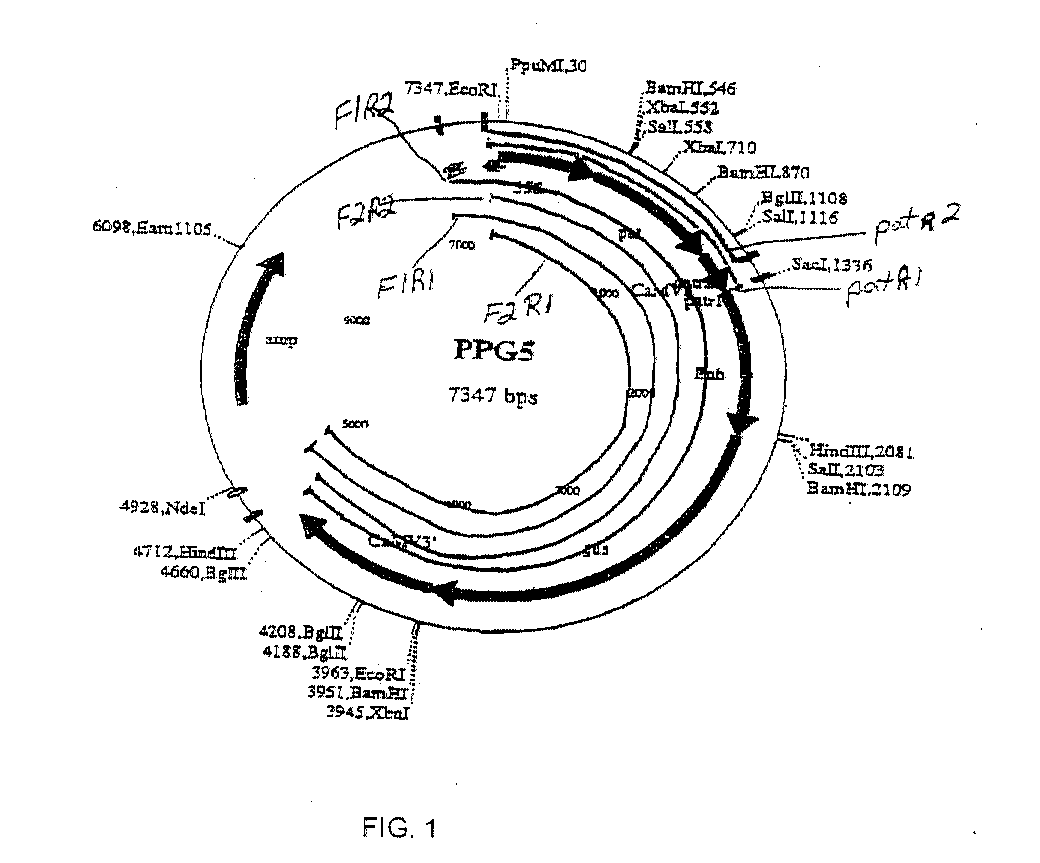
- Four different primers (2 forward and 2 reverse) were designed for the plasmid pPG 5 ( 7347 bp) to make the 4 possible fragments all of which contained the whole gene cassette for both PAT and GUS genes irrespective of F/R primer combination.
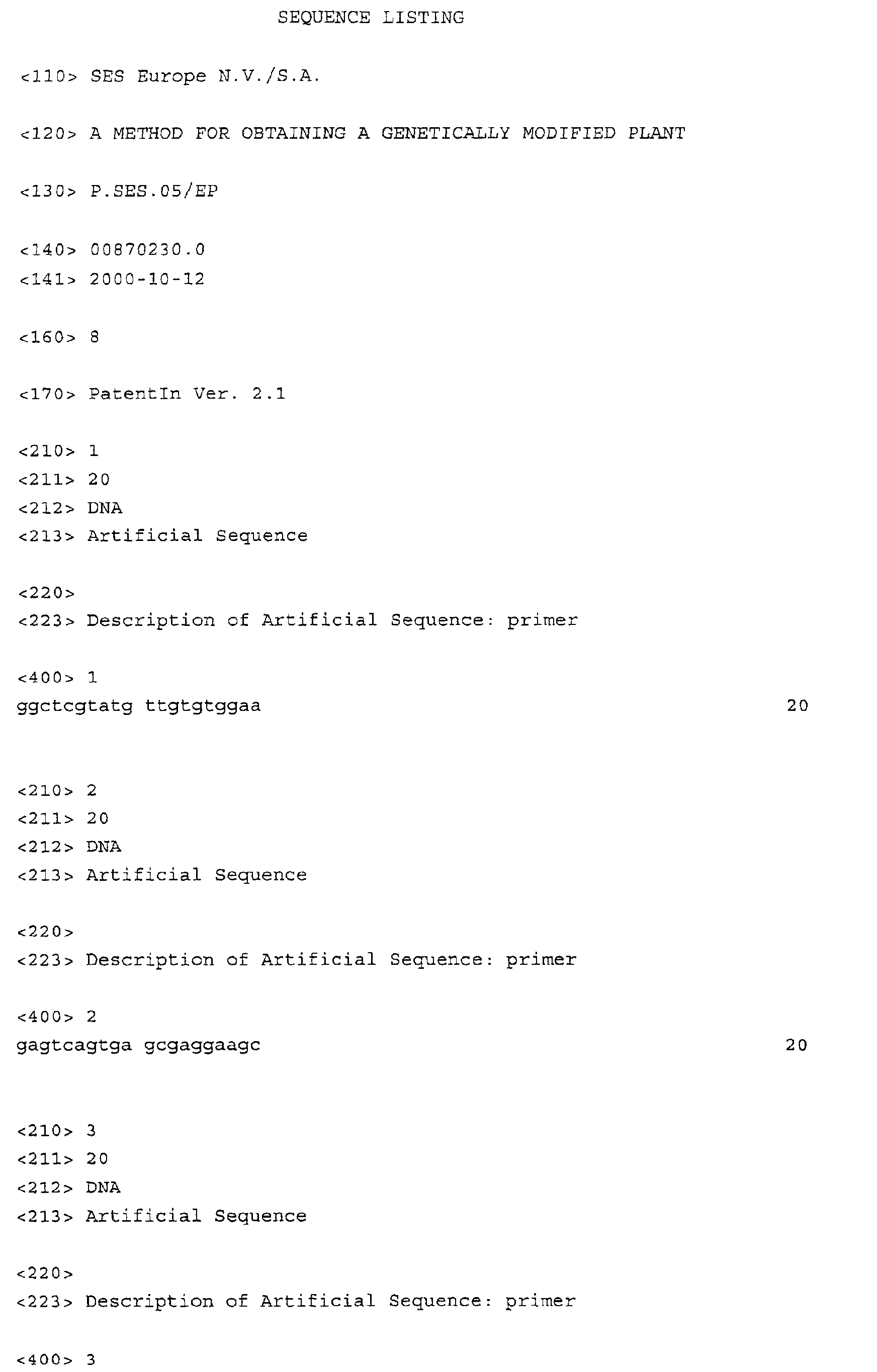
- the first forward primer corresponds to a sequence close to the start of the 35S promoter of the PAT gene (f1), starting at position 7277 bp with the sequence 5'- GGCTCGTATGTTGTGTGGAA.
- the second forward primer starts an extra 200bp before the promoter (f2) at position 7092 bp and has the sequence 5'-GAGTCAGTGAGCGAGGAAGC.
- the first reverse primer corresponds to a sequence adjacent to the terminator of the GUS gene (r1) and starts at position 4788 bp and has the sequence 5'-CTGCAAGGCGATTAAGTTGG.
- the second reverse primer has an extra 200 bp on the terminator side (r2), and starts at position 4913 bp with the sequence 5'-GCACAGATGCGTAAGGAGAA.
- the locations and directions of the primers are shown in Fig 1.With these primers four fragments could be made namely: f1/r1, f1/r2, f2/r1 and f2/r2.
- Reactions were performed using 35 cycles of 1 min denaturation at 94°C, 1 min annealing at 60°C, 5 min extension at 72°C with a final extra extension period of 5 min.
- the DNA was concentrated by precipitation and redissolving in a small volume of sterile water. The DNA concentration was determined by measuring the OD 260nm and the fragment size was checked by gel electrophoresis. All four DNA fragments were then used separately for protoplast transformations.
- PCR fragments containing only the PAT gene cassette were made using the primer f2 and one of two reverse primers, r3 or r4 both of which are close to the end of the CaMV terminator of the PAT gene (Fig 1).
- Primer r3 starts at position 1232 bp with the sequence 5'-GCGAAACCCTATAAGAACCC; primer r4 starts at position 1340 bp with the sequence 5'-AGCTCGGTACCCACTGGATT.
- PCR reactions were performed using 35 cycles of 1 min denaturation at 94°C, 1 min annealing at 65°C, 2 min extension at 72°C with an extension period of 5 min. Further preparation of the DNA was as described above.
- border sequences the extra +/- 200 bp sequence before and / or after the promoter / terminator
- Amount of DNA molecules used in protoplasts transformation with PEG-medium Fragment Length in bp 34 ⁇ g fragment/ 1 10 6 protoplasts 50 ⁇ g fragment/ 1 10 6 protoplasts Ppg5 7347 6.4 10 12 R1/f2 4983 6.4 10 12 9.5 10 12 R1/f3 5170 9.2 10 12 R4/f2 4858 9.7 10 12 R4/f3 5043 9.4 10 12 Patr1/f2 1410 33.6 10 12 Patr2/f2 1302 36.4 10 12 No.
- Fig. 2 is the map of pS63, a plasmid that was obtained by removing 3 regions from pIGPD7.
- RB right border region (about 220 bp, covering the real right border).
- ORI origin of replication of the plasmid.
- T DNA borders can be used. Preferably one is used but both can be employed. We most frequently employ the right border sequence of T DNA (about 25 base pairs) though the left appears equally as useful.
- T DNA border sequences which is not necessarily place in any specific location though the ends are often employed for these border regions.
- Fig. 1 the PatR1 and the PatR2 short fragments that include the entire pat gene and promoter are shown.
- the data is shown in Tables 2a and 2b.
- Tables 2c through 8 show the results of the Southern blot data in tabular form. Fragment r1/f2 No Experiment GUS staining PAT probe GUS probe 55 f1 34 - >10 >10 blot 11b 56 - 1 1 57 + 4 4 58 f1 50 + >8 ⁇ 6 59 - 1 ?
Landscapes
- Health & Medical Sciences (AREA)
- Life Sciences & Earth Sciences (AREA)
- Genetics & Genomics (AREA)
- Engineering & Computer Science (AREA)
- Biomedical Technology (AREA)
- Biotechnology (AREA)
- General Engineering & Computer Science (AREA)
- Organic Chemistry (AREA)
- Chemical & Material Sciences (AREA)
- Zoology (AREA)
- Wood Science & Technology (AREA)
- Bioinformatics & Cheminformatics (AREA)
- Molecular Biology (AREA)
- Plant Pathology (AREA)
- Microbiology (AREA)
- Biophysics (AREA)
- Physics & Mathematics (AREA)
- Biochemistry (AREA)
- General Health & Medical Sciences (AREA)
- Cell Biology (AREA)
- Breeding Of Plants And Reproduction By Means Of Culturing (AREA)
- Micro-Organisms Or Cultivation Processes Thereof (AREA)
- Preparation Of Compounds By Using Micro-Organisms (AREA)
Abstract
Description
- Fig. 1
- represents schematically the construction of a gene cassette used in the method according to the invention and the location and direction of the primer for the amplification of said gene cassette.
- Fig. 2
- represents a map of pS63.
| Amount of DNA molecules used in protoplasts transformation with PEG-medium : | |||
| Fragment | Length in bp | 34µg fragment/ 1 106 protoplasts | 50µg fragment/ 1 106 protoplasts |
| Ppg5 | 7347 | 6.4 1012 | |
| R1/f2 | 4983 | 6.4 1012 | 9.5 1012 |
| R1/f3 | 5170 | 9.2 1012 | |
| R4/f2 | 4858 | 9.7 1012 | |
| R4/f3 | 5043 | 9.4 1012 | |
| Patr1/f2 | 1410 | 33.6 1012 | |
| Patr2/f2 | 1302 | 36.4 1012 |
| No. of experiment | Fragment | Amount of protoplas ts used | Amount of callus | Amount of plants |
| f1 | ppg5 | 368.000 | 12 | |
| r1/f2 34µg | 474.000 | 9 | ||
| 50µg | 513.000 | 20 | 1 | |
| f2 | Besmet (contaminated) | |||
| f3 | Besmet (contaminated) | |||
| f4 | ppg5 | 710.000 | 34 | |
| r1/f2 34µg | 702.000 | 39 | 2 | |
| 50µg | 627.000 | 47 | 2 | |
| f5 | ppg5 | 548.000 | 5 | |
| r1/f3 | 2.100.000 | 16 | 1 | |
| f6 | ppg5 | 513.000 | 4 | |
| r4/f2 | 1.700.000 | 46 | 2 | |
| r4/f3 | 1.000.000 | 20 | ||
| f7 | ppg5 | 1.000.000 | 12 | |
| r1/f3 | 734.000 | 19 | ||
| r4/f2 | 913.000 | 28 | ||
| r4/f3 | 792.000 | 10 | ||
| f8 | r1/f2 | 648.000 | 70 | |
| r1/f3 | 616.000 | 61 | ||
| r4/f2 | 598.000 | 30 | ||
| r4/f3 | 636.000 | 7 | ||
| patr1 | 460.000 | 61 | ||
| patr2 | 427.000 | 48 | ||
| f9 | ppg5 | 508.000 | 46 | |
| patr1 | 1.200.000 | 130 | ||
| patr2 | 1.400.000 | 40 | ||
| f10 | ppg5 | 266.000 | ||
| patr1 | 464.000 | |||
| Patr2 | 852.000 | |||
| ppg5 | 4.605.000 | 113 | ||
| r1/f2 | 2.964.000 | 185 | 5 | |
| r1/f3 | 3.450.000 | 96 | 1 | |
| r4/f2 | 3.211.000 | 104 | 2 | |
| r4/f3 | 2.428.000 | 37 | ||
| patr1 | 2.124.000 | 191 | ||
| patr2 | 2.679.000 | 88 |
| Summary of Table 2a | |||
| Fragment | Amount of protoplasts used | Amount of callus | Amount of plants |
| ppg5 | 4.605.000 | 129 | 1 |
| r1/f2 | 2.964.000 | 185 | 4 |
| r1/f3 | 3.450.000 | 96 | 1 |
| r4/f2 | 3.211.000 | 104 | 7 |
| r4/f3 | 2.428.000 | 37 | |
| patr1 | 2.124.000 | 222 | 4 |
| patr2 | 2.679.000 | 100 |
RB = right border region (about 220 bp, covering the real right border).
ORI = origin of replication of the plasmid.


| Fragment r1/f2 | |||||
| No | Experiment | GUS staining | PAT probe | GUS probe | |
| 55 | f1 34 | - | >10 | >10 | blot 11b |
| 56 | - | 1 | 1 | ||
| 57 | + | 4 | 4 | ||
| 58 | f1 50 | + | >8 | <6 | |
| 59 | - | 1 | ? | ||
| 60 | - | >3 | >2 | ||
| 61 | f4 49 | - | 1 | 2 | |
| 62 | - | >10 | >10 | ||
| 63 | - | 1 | - | ||
| 64 | - | 1 | - | ||
| 65 | f4 71 | - | 2 | - | |
| 66 | - | 9 | 7 |
| Fragment r1/f3 | |||||
| No | Experiment | GUS staining | PAT probe | GUS probe | |
| 67 | f5 | - | 1 | - | blot 11b |
| 68 | - | 2 | 1 | ||
| 69 | - | 1 | - | ||
| 70 | - | 6 | 7 | same as 8? | |
| 71 | - | >5 | >5 | ||
| 8 | - | >10 | >10 | ||
| 1 | - | - | - | blot 12 | |
| 2 | - | 1 | - | ||
| 3 | + | 8 | 4 | ||
| 4 | - | - | - | ||
| 5 | - | - | - | ||
| 6 | - | - | - | ||
| 7 | - | - | - | ||
| 8 | - | 2 | 4 | ||
| 9 | - | 2 | 2 | ||
| 10 | - | 5 | 7 | ||
| 11 | - | >4 | >3 | ||
| 12 | - | >10 | >10 | ||
| 78 | ? | >6 | 3 |
| Fragment r4/f2 | |||||
| No | Experiment | GUS Staining | PAT probe | GUS probe | |
| 19 | f7 | + | >10 | >10 | blot 12a |
| 20 | + | >10 | >10 | ||
| 21 | + | >10 | >10 | ||
| 22 | + | ? | ? | ||
| 23 | - | >10 | >10 | ||
| 24 | + | >10 | >10 | ||
| 25 | + | 6 | 4 | ||
| 26 | - | 3 | - | ||
| 28 | - | 6? | - | ||
| 29 | - | 1 | - | ||
| 30 | + | >10 | >10 | ||
| 74 | f6 | ? | >10 | >10 | |
| 75 | ? | 4 | 3 | ||
| 76 | ? | 2 | - | ||
| 77 | ? | - | - | DNA broken down |
| Fragment r4/f3 | |||||
| No | Experiment | GUS Staining | PAT probe | GUS probe | |
| 72 | f6 | + | 2 | 1? | blot 11b |
| 73 | + | >7 | >7 | ||
| 13 | f7 | - | 1 | - | blot 12a |
| 14 | - | 1 | - | ||
| 15 | - | >10 | >10 | ||
| 16 | - | 3? | 1 | ||
| 17 | - | 3 | 1 | ||
| 18 | - | 1 | - | ||
| 127 | f6 | + | >10 | >10 | blot 14a |
| 128 | f8 | - | - | - | |
| 129 | - | - | - | ||
| 130 | + | 1 | 2 | ||
| 131 | + | 6 | >10 | ||
| 132 | + | >10 | >10 |
| Fragment partr1/f2 (Number of bands on Southern blot) | |||
| No | Experiment | PAT probe | |
| 31 | f8 | >10 | blot 12a SST |
| 32 | ? | ||
| 100 | f9 | >10 | blot 14 EcoR1 |
| 101 | >10 | ||
| 102 | >10 | ||
| 103 | 2 | ||
| 104 | 6 | ||
| 105 | - | ||
| 106 | 1 | ||
| 107 | 2 | ||
| 108 | 1 | ||
| 109 | ? | ||
| 110 | ? | ||
| 111 | >10 |
| Fragment partr2/f2 | |||
| No | Experiment | PAT probe | |
| 33 | | 3 | blot 12a SST |
| 34 | 1 | ||
| 112 | f9 | - | blot 14 EcoR1 |
| 113 | 1 | ||
| 114 | 1 | ||
| 115 | 1 | ||
| 116 | 1 | ||
| 117 | - | ||
| 118 | 1 | ||
| 119 | - |
| Plants | ||||||
| No | Experiment | Fragment | GUS staining | PAT probe | GUS probe | |
| 1 | f6 | r4/f2 | - | - | - | blot 14 |
| 2 | f1 | r1/f2 | - | >10 | >10 | |
| 3 | f4 | r1/f2 | + | 6 | >10 | |
| 4 | f6 | r4/f2 | - | 2 | 3 |


Claims (12)
- A method for obtaining a genetically modified plant comprising the steps of:characterised in that the hereditary material is a cassette nucleotide sequence to be inserted in the genome of said plant and being free or substantially free from other prokaryotic or plasmidic nucleotide sequences.(i) transforming protoplasts, preferably derived from a conversion of stomatal cells, by introducing an hereditary material into the protoplasts of said plant in order to obtain transformants containing at least one copy of the hereditary material per protoplast,(ii) selecting a stable transformant and(iii) regenerating plant cells or a whole plant from said transformant,
- The method according to claim 1, characterised in that the protoplasts are derived from the conversion of stomatal cells, preferably from guard cells.
- The method according to claim 1 or 2, characterised in that the cassette nucleotide sequence is an amplicon resulting from genetic amplification steps.
- The method according to claim 1, characterised in that the step of transforming protoplasts of the plant by introducing an hereditary material into the protoplasts is obtained with amplicons present at the concentration of higher than 10µg DNA /1 x 106 protoplasts.
- The method according to the claim 4, characterised in that the step of transforming protoplasts of the plant is obtained in the presence of PEG-medium.
- The method according to any of the preceding claims, characterised in that it comprises the step of providing an intact tissue of said plant containing stomatal cells and converting said stomatal cells into protoplasts by enzymatic digestion of the cell walls, said step being performed before the step of transforming the protoplasts.
- The method according to claim 5, characterised in that said plant tissue is senescent leaf tissue or leaf epidermis.
- The method according to any one of the preceding claims, characterised in that the cassette sequence comprises a genetic sequence selected from the group consisting of genetic sequences involved in the resistance to plant viruses (especially BNYVV), resistance to plant parasites (nematodes, fungi or insects), resistance to herbicides (preferably glyphosate, glufosinate, imathezethate and/or acetochloride resistance), insecticides or fungicides or involved in the improved metabolism of carbohydrates.
- The method according to any of the preceding claims, characterised in that the plant is a sugar beet (Beta vulgaris).
- A genetically modified plant or plant cell, preferably a sugar beet (Beta vulgaris plant or plant cell), having integrated in its genome a cassette nucleotide sequence being free or essentially free from other prokaryotic or plasmidic nucleotide sequences.
- The genetically modified plant according claim 10 being obtained by the method according to any of the preceding claims 1 to 9.
- A genetically modified plant or plant cell, according to claim 10 wherein the cassette of the nucleotide sequence includes one or more T DNA border sequences.
Applications Claiming Priority (2)
| Application Number | Priority Date | Filing Date | Title |
|---|---|---|---|
| US61765900A | 2000-07-17 | 2000-07-17 | |
| US617659 | 2006-12-28 |
Publications (3)
| Publication Number | Publication Date |
|---|---|
| EP1174513A2 true EP1174513A2 (en) | 2002-01-23 |
| EP1174513A3 EP1174513A3 (en) | 2002-09-25 |
| EP1174513B1 EP1174513B1 (en) | 2007-02-21 |
Family
ID=24474496
Family Applications (1)
| Application Number | Title | Priority Date | Filing Date |
|---|---|---|---|
| EP00870230A Expired - Lifetime EP1174513B1 (en) | 2000-07-17 | 2000-10-12 | A method for obtaining a genetically modified plant |
Country Status (4)
| Country | Link |
|---|---|
| EP (1) | EP1174513B1 (en) |
| AT (1) | ATE354664T1 (en) |
| DE (1) | DE60033512T2 (en) |
| ES (1) | ES2281338T3 (en) |
Cited By (2)
| Publication number | Priority date | Publication date | Assignee | Title |
|---|---|---|---|---|
| EP1407000A4 (en) * | 1999-07-19 | 2004-04-14 | Plant Bioscience Ltd | Transformation method and transgenic plants produced thereby |
| EP1645622A1 (en) * | 1999-07-19 | 2006-04-12 | Plant Bioscience Limited | Transformation method and transgenic plants produced thereby |
Family Cites Families (2)
| Publication number | Priority date | Publication date | Assignee | Title |
|---|---|---|---|---|
| GB9321183D0 (en) * | 1993-10-14 | 1993-12-01 | Zeneca Ltd | A method of plant transformation |
| US6846970B1 (en) * | 1999-07-19 | 2005-01-25 | Plant Bioscience Limited | Transformation method and transgenic plants produced thereby |
-
2000
- 2000-10-12 ES ES00870230T patent/ES2281338T3/en not_active Expired - Lifetime
- 2000-10-12 DE DE60033512T patent/DE60033512T2/en not_active Expired - Lifetime
- 2000-10-12 EP EP00870230A patent/EP1174513B1/en not_active Expired - Lifetime
- 2000-10-12 AT AT00870230T patent/ATE354664T1/en not_active IP Right Cessation
Cited By (3)
| Publication number | Priority date | Publication date | Assignee | Title |
|---|---|---|---|---|
| EP1407000A4 (en) * | 1999-07-19 | 2004-04-14 | Plant Bioscience Ltd | Transformation method and transgenic plants produced thereby |
| US6846970B1 (en) | 1999-07-19 | 2005-01-25 | Plant Bioscience Limited | Transformation method and transgenic plants produced thereby |
| EP1645622A1 (en) * | 1999-07-19 | 2006-04-12 | Plant Bioscience Limited | Transformation method and transgenic plants produced thereby |
Also Published As
| Publication number | Publication date |
|---|---|
| EP1174513A3 (en) | 2002-09-25 |
| DE60033512D1 (en) | 2007-04-05 |
| ATE354664T1 (en) | 2007-03-15 |
| ES2281338T3 (en) | 2007-10-01 |
| DE60033512T2 (en) | 2007-10-31 |
| EP1174513B1 (en) | 2007-02-21 |
Similar Documents
| Publication | Publication Date | Title |
|---|---|---|
| JP2555280B2 (en) | Expression of plant genes | |
| DE60133807T2 (en) | PROMOTERS OF THE CESTRUM YELLOW LEAF CURLING VIRUS | |
| DE69929073T2 (en) | Methods and compositions for the transformation of plants | |
| DE602004004070T2 (en) | USE OF THE REGULATORY SEQUENCE OF THE GOS2 GENE FROM RICE FOR GENE EXPRESSION IN DIKOTYLEDONES PLANTS OR PLANT CELLS | |
| US20120192318A1 (en) | Transformation system for Camelina sativa | |
| US20090151023A1 (en) | Transformation system for Camelina sativa | |
| Li et al. | High frequency generation of fertile transgenic rice plants after PEG-mediated protoplast transformation | |
| DE10101276A1 (en) | Methods and vectors for transforming plastids | |
| CN118440956B (en) | Application of PGIP2 gene in regulating waterlogging tolerance of crops | |
| AU706650B2 (en) | Genetic modification of plants | |
| Koltunow et al. | Regeneration of West Indian limes (Citrus aurantifolia) containing genes for decreased seed set | |
| AU744496B2 (en) | Method of genetically transforming banana plants | |
| CN110951771A (en) | Application of Chunlan miR390a in controlling plant root development | |
| KR101206928B1 (en) | RNA interference cassette against a self-incompatibility factor of Brassica genus, vector comprising the same and transgenic Brassica plant comprising the same | |
| EP1174513B1 (en) | A method for obtaining a genetically modified plant | |
| CN119490989A (en) | Constitutive promoter and its use | |
| Gahan et al. | Evidence that direct DNA uptake through cut shoots leads to genetic transformation of Solanum aviculare Forst | |
| Dutt et al. | Cultivar-dependent gene transfer into citrus using Agrobacterium. | |
| EP2194772B1 (en) | Transformation of poinsettia plants | |
| WO2001073084A2 (en) | Methods for rapidly producing transgenic monocotyledonous plants | |
| Mikhailov et al. | Production of transgenic plum plants from vegetative tissues by means of positive selection | |
| WO1998056932A1 (en) | Genetic modification of plant material | |
| KR20230033830A (en) | UP gene from Arabidopsis thaliana regulating resistance to environment stress in plant and uses thereof | |
| KR101190255B1 (en) | Antibiotics marker free creeping bentgrass having resistance against two herbicides | |
| CN119220594B (en) | Tobacco NtTIRd gene and its application |
Legal Events
| Date | Code | Title | Description |
|---|---|---|---|
| PUAI | Public reference made under article 153(3) epc to a published international application that has entered the european phase |
Free format text: ORIGINAL CODE: 0009012 |
|
| AK | Designated contracting states |
Kind code of ref document: A2 Designated state(s): AT BE CH CY DE DK ES FI FR GB GR IE IT LI LU MC NL PT SE |
|
| AX | Request for extension of the european patent |
Free format text: AL;LT;LV;MK;RO;SI |
|
| PUAL | Search report despatched |
Free format text: ORIGINAL CODE: 0009013 |
|
| AK | Designated contracting states |
Kind code of ref document: A3 Designated state(s): AT BE CH CY DE DK ES FI FR GB GR IE IT LI LU MC NL PT SE |
|
| AX | Request for extension of the european patent |
Free format text: AL;LT;LV;MK;RO;SI |
|
| 17P | Request for examination filed |
Effective date: 20030207 |
|
| AKX | Designation fees paid |
Designated state(s): AT BE CH CY DE DK ES FI FR GB GR IE IT LI LU MC NL PT SE |
|
| 17Q | First examination report despatched |
Effective date: 20031125 |
|
| GRAP | Despatch of communication of intention to grant a patent |
Free format text: ORIGINAL CODE: EPIDOSNIGR1 |
|
| GRAS | Grant fee paid |
Free format text: ORIGINAL CODE: EPIDOSNIGR3 |
|
| GRAA | (expected) grant |
Free format text: ORIGINAL CODE: 0009210 |
|
| AK | Designated contracting states |
Kind code of ref document: B1 Designated state(s): AT BE CH CY DE DK ES FI FR GB GR IE IT LI LU MC NL PT SE |
|
| PG25 | Lapsed in a contracting state [announced via postgrant information from national office to epo] |
Ref country code: AT Free format text: LAPSE BECAUSE OF FAILURE TO SUBMIT A TRANSLATION OF THE DESCRIPTION OR TO PAY THE FEE WITHIN THE PRESCRIBED TIME-LIMIT Effective date: 20070221 Ref country code: FI Free format text: LAPSE BECAUSE OF FAILURE TO SUBMIT A TRANSLATION OF THE DESCRIPTION OR TO PAY THE FEE WITHIN THE PRESCRIBED TIME-LIMIT Effective date: 20070221 Ref country code: DK Free format text: LAPSE BECAUSE OF FAILURE TO SUBMIT A TRANSLATION OF THE DESCRIPTION OR TO PAY THE FEE WITHIN THE PRESCRIBED TIME-LIMIT Effective date: 20070221 Ref country code: LI Free format text: LAPSE BECAUSE OF FAILURE TO SUBMIT A TRANSLATION OF THE DESCRIPTION OR TO PAY THE FEE WITHIN THE PRESCRIBED TIME-LIMIT Effective date: 20070221 Ref country code: CH Free format text: LAPSE BECAUSE OF FAILURE TO SUBMIT A TRANSLATION OF THE DESCRIPTION OR TO PAY THE FEE WITHIN THE PRESCRIBED TIME-LIMIT Effective date: 20070221 Ref country code: NL Free format text: LAPSE BECAUSE OF FAILURE TO SUBMIT A TRANSLATION OF THE DESCRIPTION OR TO PAY THE FEE WITHIN THE PRESCRIBED TIME-LIMIT Effective date: 20070221 |
|
| REG | Reference to a national code |
Ref country code: GB Ref legal event code: FG4D |
|
| REG | Reference to a national code |
Ref country code: CH Ref legal event code: EP |
|
| REF | Corresponds to: |
Ref document number: 60033512 Country of ref document: DE Date of ref document: 20070405 Kind code of ref document: P |
|
| REG | Reference to a national code |
Ref country code: IE Ref legal event code: FG4D |
|
| PG25 | Lapsed in a contracting state [announced via postgrant information from national office to epo] |
Ref country code: SE Free format text: LAPSE BECAUSE OF FAILURE TO SUBMIT A TRANSLATION OF THE DESCRIPTION OR TO PAY THE FEE WITHIN THE PRESCRIBED TIME-LIMIT Effective date: 20070521 |
|
| PG25 | Lapsed in a contracting state [announced via postgrant information from national office to epo] |
Ref country code: PT Free format text: LAPSE BECAUSE OF FAILURE TO SUBMIT A TRANSLATION OF THE DESCRIPTION OR TO PAY THE FEE WITHIN THE PRESCRIBED TIME-LIMIT Effective date: 20070723 |
|
| NLV1 | Nl: lapsed or annulled due to failure to fulfill the requirements of art. 29p and 29m of the patents act | ||
| REG | Reference to a national code |
Ref country code: CH Ref legal event code: PL |
|
| REG | Reference to a national code |
Ref country code: ES Ref legal event code: FG2A Ref document number: 2281338 Country of ref document: ES Kind code of ref document: T3 |
|
| PLBE | No opposition filed within time limit |
Free format text: ORIGINAL CODE: 0009261 |
|
| STAA | Information on the status of an ep patent application or granted ep patent |
Free format text: STATUS: NO OPPOSITION FILED WITHIN TIME LIMIT |
|
| 26N | No opposition filed |
Effective date: 20071122 |
|
| PG25 | Lapsed in a contracting state [announced via postgrant information from national office to epo] |
Ref country code: IT Free format text: LAPSE BECAUSE OF FAILURE TO SUBMIT A TRANSLATION OF THE DESCRIPTION OR TO PAY THE FEE WITHIN THE PRESCRIBED TIME-LIMIT Effective date: 20070221 Ref country code: GR Free format text: LAPSE BECAUSE OF FAILURE TO SUBMIT A TRANSLATION OF THE DESCRIPTION OR TO PAY THE FEE WITHIN THE PRESCRIBED TIME-LIMIT Effective date: 20070522 |
|
| PG25 | Lapsed in a contracting state [announced via postgrant information from national office to epo] |
Ref country code: MC Free format text: LAPSE BECAUSE OF NON-PAYMENT OF DUE FEES Effective date: 20071031 |
|
| PG25 | Lapsed in a contracting state [announced via postgrant information from national office to epo] |
Ref country code: IE Free format text: LAPSE BECAUSE OF NON-PAYMENT OF DUE FEES Effective date: 20071012 |
|
| PG25 | Lapsed in a contracting state [announced via postgrant information from national office to epo] |
Ref country code: CY Free format text: LAPSE BECAUSE OF FAILURE TO SUBMIT A TRANSLATION OF THE DESCRIPTION OR TO PAY THE FEE WITHIN THE PRESCRIBED TIME-LIMIT Effective date: 20070221 |
|
| PG25 | Lapsed in a contracting state [announced via postgrant information from national office to epo] |
Ref country code: LU Free format text: LAPSE BECAUSE OF NON-PAYMENT OF DUE FEES Effective date: 20071012 |
|
| REG | Reference to a national code |
Ref country code: FR Ref legal event code: PLFP Year of fee payment: 17 |
|
| REG | Reference to a national code |
Ref country code: FR Ref legal event code: PLFP Year of fee payment: 18 |
|
| PGFP | Annual fee paid to national office [announced via postgrant information from national office to epo] |
Ref country code: FR Payment date: 20170921 Year of fee payment: 18 Ref country code: GB Payment date: 20170925 Year of fee payment: 18 |
|
| PGFP | Annual fee paid to national office [announced via postgrant information from national office to epo] |
Ref country code: ES Payment date: 20171103 Year of fee payment: 18 |
|
| PGFP | Annual fee paid to national office [announced via postgrant information from national office to epo] |
Ref country code: BE Payment date: 20180921 Year of fee payment: 19 |
|
| PGFP | Annual fee paid to national office [announced via postgrant information from national office to epo] |
Ref country code: DE Payment date: 20180819 Year of fee payment: 19 |
|
| GBPC | Gb: european patent ceased through non-payment of renewal fee |
Effective date: 20181012 |
|
| PG25 | Lapsed in a contracting state [announced via postgrant information from national office to epo] |
Ref country code: FR Free format text: LAPSE BECAUSE OF NON-PAYMENT OF DUE FEES Effective date: 20181031 |
|
| PG25 | Lapsed in a contracting state [announced via postgrant information from national office to epo] |
Ref country code: GB Free format text: LAPSE BECAUSE OF NON-PAYMENT OF DUE FEES Effective date: 20181012 |
|
| REG | Reference to a national code |
Ref country code: ES Ref legal event code: FD2A Effective date: 20191202 |
|
| PG25 | Lapsed in a contracting state [announced via postgrant information from national office to epo] |
Ref country code: ES Free format text: LAPSE BECAUSE OF NON-PAYMENT OF DUE FEES Effective date: 20181013 |
|
| REG | Reference to a national code |
Ref country code: DE Ref legal event code: R119 Ref document number: 60033512 Country of ref document: DE |
|
| PG25 | Lapsed in a contracting state [announced via postgrant information from national office to epo] |
Ref country code: DE Free format text: LAPSE BECAUSE OF NON-PAYMENT OF DUE FEES Effective date: 20200501 |
|
| REG | Reference to a national code |
Ref country code: BE Ref legal event code: MM Effective date: 20191031 |
|
| PG25 | Lapsed in a contracting state [announced via postgrant information from national office to epo] |
Ref country code: BE Free format text: LAPSE BECAUSE OF NON-PAYMENT OF DUE FEES Effective date: 20191031 |