EP1174455A1 - Epoxy resin composition for encapsulating semiconductor - Google Patents
Epoxy resin composition for encapsulating semiconductor Download PDFInfo
- Publication number
- EP1174455A1 EP1174455A1 EP01117045A EP01117045A EP1174455A1 EP 1174455 A1 EP1174455 A1 EP 1174455A1 EP 01117045 A EP01117045 A EP 01117045A EP 01117045 A EP01117045 A EP 01117045A EP 1174455 A1 EP1174455 A1 EP 1174455A1
- Authority
- EP
- European Patent Office
- Prior art keywords
- carbon atoms
- group
- epoxy resin
- resin composition
- formula
- Prior art date
- Legal status (The legal status is an assumption and is not a legal conclusion. Google has not performed a legal analysis and makes no representation as to the accuracy of the status listed.)
- Granted
Links
Classifications
-
- C—CHEMISTRY; METALLURGY
- C08—ORGANIC MACROMOLECULAR COMPOUNDS; THEIR PREPARATION OR CHEMICAL WORKING-UP; COMPOSITIONS BASED THEREON
- C08L—COMPOSITIONS OF MACROMOLECULAR COMPOUNDS
- C08L63/00—Compositions of epoxy resins; Compositions of derivatives of epoxy resins
-
- C—CHEMISTRY; METALLURGY
- C08—ORGANIC MACROMOLECULAR COMPOUNDS; THEIR PREPARATION OR CHEMICAL WORKING-UP; COMPOSITIONS BASED THEREON
- C08G—MACROMOLECULAR COMPOUNDS OBTAINED OTHERWISE THAN BY REACTIONS ONLY INVOLVING UNSATURATED CARBON-TO-CARBON BONDS
- C08G59/00—Polycondensates containing more than one epoxy group per molecule; Macromolecules obtained by polymerising compounds containing more than one epoxy group per molecule using curing agents or catalysts which react with the epoxy groups
- C08G59/02—Polycondensates containing more than one epoxy group per molecule
- C08G59/04—Polycondensates containing more than one epoxy group per molecule of polyhydroxy compounds with epihalohydrins or precursors thereof
- C08G59/06—Polycondensates containing more than one epoxy group per molecule of polyhydroxy compounds with epihalohydrins or precursors thereof of polyhydric phenols
- C08G59/08—Polycondensates containing more than one epoxy group per molecule of polyhydroxy compounds with epihalohydrins or precursors thereof of polyhydric phenols from phenol-aldehyde condensates
-
- C—CHEMISTRY; METALLURGY
- C08—ORGANIC MACROMOLECULAR COMPOUNDS; THEIR PREPARATION OR CHEMICAL WORKING-UP; COMPOSITIONS BASED THEREON
- C08G—MACROMOLECULAR COMPOUNDS OBTAINED OTHERWISE THAN BY REACTIONS ONLY INVOLVING UNSATURATED CARBON-TO-CARBON BONDS
- C08G59/00—Polycondensates containing more than one epoxy group per molecule; Macromolecules obtained by polymerising compounds containing more than one epoxy group per molecule using curing agents or catalysts which react with the epoxy groups
- C08G59/18—Macromolecules obtained by polymerising compounds containing more than one epoxy group per molecule using curing agents or catalysts which react with the epoxy groups ; e.g. general methods of curing
- C08G59/20—Macromolecules obtained by polymerising compounds containing more than one epoxy group per molecule using curing agents or catalysts which react with the epoxy groups ; e.g. general methods of curing characterised by the epoxy compounds used
- C08G59/32—Epoxy compounds containing three or more epoxy groups
- C08G59/3218—Carbocyclic compounds
-
- C—CHEMISTRY; METALLURGY
- C08—ORGANIC MACROMOLECULAR COMPOUNDS; THEIR PREPARATION OR CHEMICAL WORKING-UP; COMPOSITIONS BASED THEREON
- C08G—MACROMOLECULAR COMPOUNDS OBTAINED OTHERWISE THAN BY REACTIONS ONLY INVOLVING UNSATURATED CARBON-TO-CARBON BONDS
- C08G59/00—Polycondensates containing more than one epoxy group per molecule; Macromolecules obtained by polymerising compounds containing more than one epoxy group per molecule using curing agents or catalysts which react with the epoxy groups
- C08G59/18—Macromolecules obtained by polymerising compounds containing more than one epoxy group per molecule using curing agents or catalysts which react with the epoxy groups ; e.g. general methods of curing
- C08G59/40—Macromolecules obtained by polymerising compounds containing more than one epoxy group per molecule using curing agents or catalysts which react with the epoxy groups ; e.g. general methods of curing characterised by the curing agents used
- C08G59/62—Alcohols or phenols
- C08G59/621—Phenols
-
- H—ELECTRICITY
- H10—SEMICONDUCTOR DEVICES; ELECTRIC SOLID-STATE DEVICES NOT OTHERWISE PROVIDED FOR
- H10W—GENERIC PACKAGES, INTERCONNECTIONS, CONNECTORS OR OTHER CONSTRUCTIONAL DETAILS OF DEVICES COVERED BY CLASS H10
- H10W74/00—Encapsulations, e.g. protective coatings
- H10W74/40—Encapsulations, e.g. protective coatings characterised by their materials
- H10W74/47—Encapsulations, e.g. protective coatings characterised by their materials comprising organic materials, e.g. plastics or resins
Definitions
- the present invention relates to an epoxy resin composition having low moisture absorption and excellent solder-crack resistance.
- the composition is useful as an adhesive, a coating material, electric and electronic material such as an encapsulating material and a laminated board, especially useful for encapsulating an electronic device.
- transfer molding of a useful epoxy resin composition is economically performed for encapsulating of semiconductors, such as LSI, IC, and a transistor.
- semiconductors such as LSI, IC, and a transistor.
- surface mounting of LSI is recently conducted and direct immersion into a solder bath is increasing. Since an encapsulating material is exposed to a high temperature of 200 °C or more in this treatment, moisture absorbed in the encapsulating material expands, cracks are formed and peeling occurs at the interface with a die pad.
- the epoxy resin encapsulating material is required for improvement of low moisture absorption, solder-crack resistance, and adhesion.
- an encapsulating material in which glycidyl ether of o-cresol novolak is mainly used as a polyfunctional epoxy resin and a phenol novolak is mainly used as a curing agent.
- the encapsulating material absorbs moisture in storage, the above-mentioned problems occur. In order to avoid these problems, moisture proof packing is carried out in practical use.
- JP-A 60-112813 describes a glycidyl ether of novolak in which phenols are combined with p-xylylene skeleton, but neither the hygroscopic property nor the solder-crack resistance is sufficient enough.
- JP-A 5-222156 describes that a glycidyl ether of aralkyl phenol is excellent in heat resistance or a low dielectric property for laminated boards, but the low moisture absorption and the solder-crack resistance, etc., required for encapsulating, are not sufficient.
- An object of the present invention is to provide an epoxy resin composition having low moisture absorption and excellent solder-crack resistance, and resin-encapsulated type semiconductor apparatus using the same.
- the composition is useful as an adhesive, a coating material, electric and electronic material such as an encapsulating material and a laminated board, especially useful for encapsulating an electronic device.
- the present invention is directed to an epoxy resin composition for encapsulating semiconductor comprising:
- the present invention is directed to a resin-encapsulated type semiconductor apparatus, wherein the semiconductor device is encapsulated by curing the above epoxy resin composition.
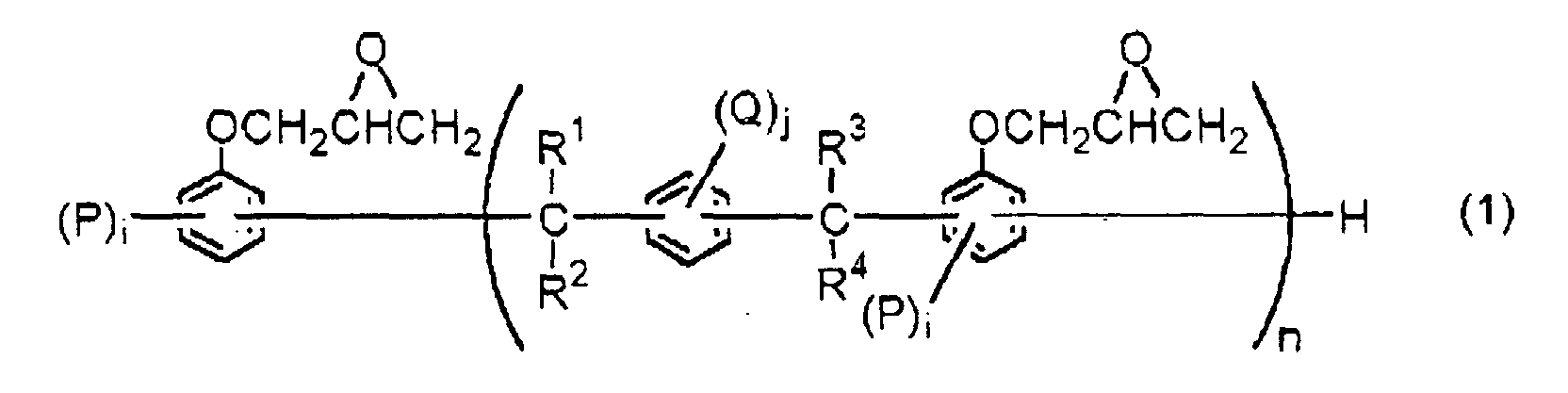
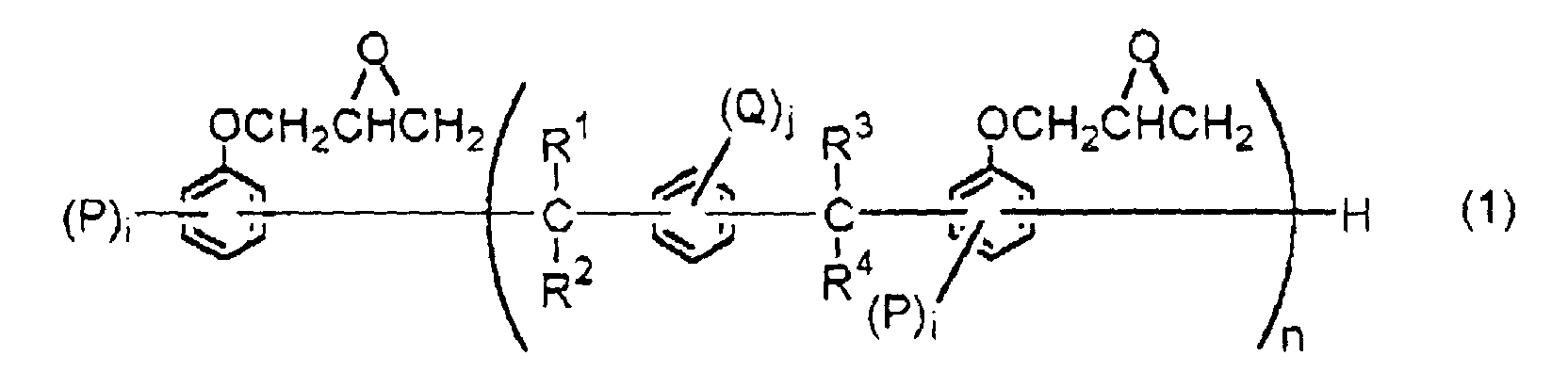
- the epoxy resin (A) used for the present invention is a compound represented by the above formula (1).
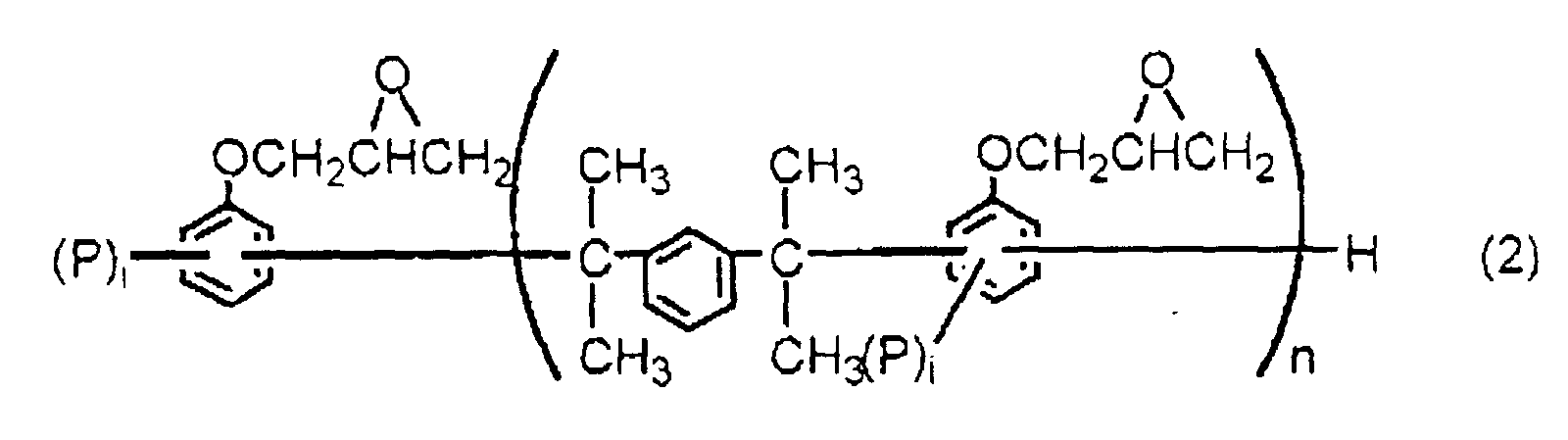
- R 1 , R 2 , R 3 , and R 4 independently represent alkyl groups having 1-4 carbon atoms, cycloalkyl groups having 5-7 carbon atoms, or aryl groups having 6-9 carbon atoms. More suitably, all of R 1 , R 2 , R 3 , and R 4 are methyl groups, further suitably, all Qs are hydrogen atoms, and most suitably, a glycidyl ether of aralkyl phenol represented by the following formula (2).
- P, i and n represent the same meaning as the above.
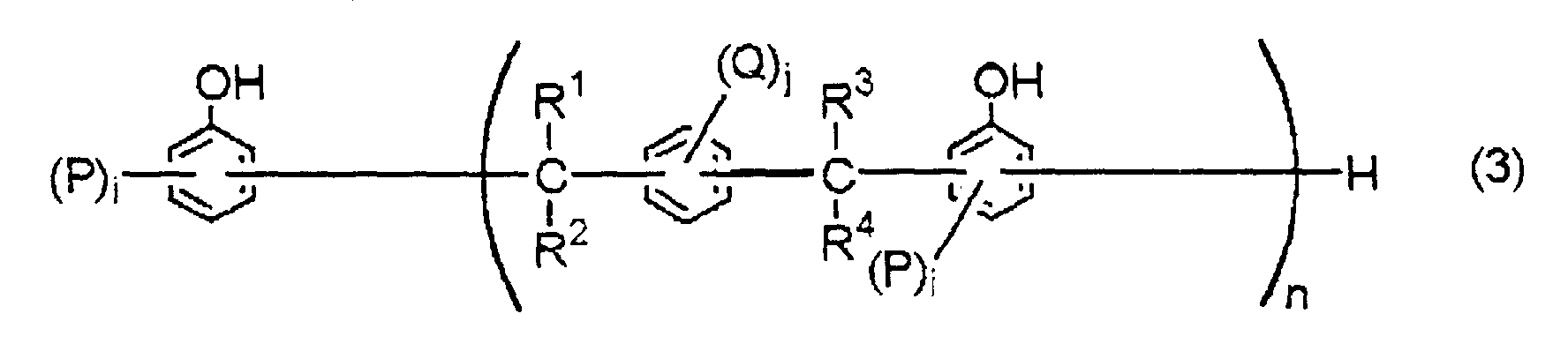
- the compound represented by formula (3) which is a precursor of the epoxy resin represented by formula (1) can be prepared using the method shown in JP-A 58-121230, JP-A 58-121231, JP-A 63-303939, etc.
- R 1 , R 2 , R 3 , R 4 , P, Q, i, j, and n represent the same meaning as the above.
- Phenols are compounds which have at least one phenolic hydroxyl group. Examples thereof include: phenol; various o-, m- and p-isomers of alkyl phenol represented with cresol, ethylphenol, n-propylphenol, isopropylphenol, n-butyl phenol, isobutylphenol, t-butylphenol, octylphenol, nonyl phenol, xylenol, methylbutylphenol, di-t-butylphenol, di-t-amylphenol, etc.; various o-, m- and p-isomers of alkenyl or alkynylphenol represented with vinylphenol, allylphenol, propenylphenol, ethynylphenol, etc.; various o- , m- and p-isomers of alkoxy, alkenyloxy or alkynyloxy phenol represented with methoxyphenol, ethoxyphenol, ary
- phenol various o-, m- and p-isomers of cresol, various o-, m- and p-isomers of xylenol and 3-methyl-6-t-butyl phenol can be exemplified more suitably.
- a well-known curing agent can be used in the present invention.
- examples thereof include, without being limited, polyhydric phenols such as phenol novolak, cresol novolak, fluoroglycine, tris(4-hydroxyphenyl)methane, 1,1,1-trishydroxyphenylethane, and 1,1,2,2-tetrakis(4-hydroxyphenyl)ethane.
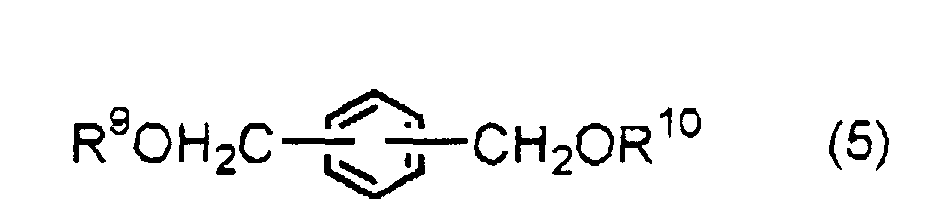
- polyhydric phenols as the above-mentioned curing agent for epoxy resin include: polycondensation products of phenols such as phenol, various alkyl phenols, and naphthols as alone or in combination of two or more, with aldehydes, such as formaldehyde, acetaldehyde, acrolein, glyoxal, benzaldehyde, naphthoaldehyde, andhydroxy benzaldehyde or ketones, such as cyclohexanone and acetophenone; vinyl polymerization type polyhydric phenols, such as poly vinylphenol and polyisopropenyl phenol; reaction products of phenols with diols such as represented by the formula (4), dialkoxy compounds, such as represented by the formula (5), or dihalogen compounds, such as represented by the formula (6), (in the formula, R 5 , R 6 , R 7 , and R 8 independently represent, hydrogen atom, acyclic
- a polyhydric phenol is used suitably.
- these curing agents can be used alone or in combination of two or more.
- a well-known curing accelerator can be used.
- the curing accelerator include, without being limited: organic phosphine compounds, such as tri phenyl phosphine, tri-4-methylphenyl phosphine, tri-4-methoxy phenyl phosphine, tri butyl phosphine, trioctyl phosphine, and tri-2-cyano ethyl phosphine, and tetraphenylborate salts thereof; tertiary amines, such as tributylamine, triethylamine, 1,8-diazabicyclo[5.4.0]undecene-7, and triamylamine, quarternary ammonium salts, such as benzylchloride trimethyl ammonium, benzyltrimethylammonium hydroxide, and triethyl ammonium tetraphenylborate; and imidazole.
- organic phosphine compounds such as tri phen
- organic phosphine compound 1,8-diazabicyclo [5.4.0]undecene-7, and imidazole are suitable from the point of moisture resistance and hardenability.
- Triphenyl phosphine is especially suitable.
- Examples of (C) inorganic filler in the epoxy resin composition include silica, alumina, titanium white, aluminum hydroxide, talc, clay, glass fiber, etc., and silica and alumina are suitable. These can be used by mixing those having different forms (spherical shape or crushed type) or sizes to increase the filling amount, and it is preferable to use a mixture of inorganic fillers having spherical shape and crushed form.
- the amount is 60 % by weight or more and 98 % by weight or less based on the whole amount of the resin composition, suitably 70 % by weight or more and 98 % by weight or less, and more suitably 75 % by weight or more and 98 % by weight or less.
- the epoxy resin composition of the present invention can be added according to requirements are: mold lubricants, such as natural wax, synthetic wax, higher fatty acid and metal salts thereof or paraffin; colorants such as carbon black; and surface treatment agents, such as silane coupling agent, etc.
- flame retardants such antimony trioxide, a phosphorous compound, and a brominated epoxy resin can be added. In order to obtain a flame retardant effect, a brominated epoxy resin is especially preferable.
- various elastomers may be added or previously reacted for use.
- elastomers include addition type or reaction type elastomers and the like such as polybutadiene, butadiene-acrylonitrile copolymer, silicone rubber, silicone oil and the like.
- cure-molding can be carried out by conventionally well-known molding methods, such as transfer molding, compression molding, and injection molding.
- a formulation rate and the kind of catalysts, etc. can be selected appropriately.
- the curing is conducted at a temperature in the range of 100 °C - 200 °C, for 1 to 24 hours.
- the semiconductor device is encapsulated with curing the epoxy resin composition of the present invention, and well-known materials etc. except as the epoxy resin composition, can be used for semiconductor devices.
- Curing condition of the epoxy resin composition is not especially limited, as long as the semiconductor device can be encapsulated, and usually carried out in a range of the above-mentioned curing condition.
- epoxy equivalent is defined as the weight of the epoxy resin per one epoxy group.
- OH equivalent is defined as the weight of OH compound per one OH group.
- aralkyl phenol novolak (trade name Mirex XLC-4L, produced by Mitsui Chemicals Inc. , OH equivalent of 171g/eq, softening point of 61 °C, and represented by the below formula (7)), 1360g of epichlorohydrin and 27.2g of water were charged and dissolved.
- epoxy 2 epoxy resin (hereafter referred to as epoxy 2) was obtained.
- the softening point, the epoxy equivalent and hydrolyzable chlorine of the epoxy 2 were 39 °C, 229g/eq, and 510 ppm, respectively.
- Epoxy 3 Epoxy 2 obtained in Referential Synthetic Example, or an orthocresol novolak type epoxy resin (trade name "ESCN195LL” produced by Sumitomo Chemical Co., Ltd., hereinafter referred to as Epoxy 3) as an epoxy resin
- phenol novolak trade name PSM-4261, produced by Gun-ei Chemical Industry Co., Ltd.
- triphenylphosphine as a curing accelerator
- fused silica as a filler
- 1.5 % by weight of carnauba wax as a mold lubricant 1.5 % by weight of carnauba wax as a mold lubricant
- 2 % by weight of a coupling agent trade name SH-6040, produced by Toray Dow Corning Co.
- Examples 1 to 3 show a good result in performances, such as a hygroscopic resistance, a solder-crack resistance, and adherence, comparing with Comparative Examples 1 to 2.
- the epoxy resin composition of the present invention is excellent in low moisture absorption and adherence. Moreover, the epoxy resin composition of the present invention is excellent in a solder-crack resistance, it is used as an excellent resin composition for encapsulating a semiconductor.
- Example 1 Example 2
Landscapes
- Chemical & Material Sciences (AREA)
- Health & Medical Sciences (AREA)
- Chemical Kinetics & Catalysis (AREA)
- Medicinal Chemistry (AREA)
- Polymers & Plastics (AREA)
- Organic Chemistry (AREA)
- Epoxy Resins (AREA)
- Structures Or Materials For Encapsulating Or Coating Semiconductor Devices Or Solid State Devices (AREA)
Abstract
Description
Since an encapsulating material is exposed to a high temperature of 200 °C or more in this treatment, moisture absorbed in the encapsulating material expands, cracks are formed and peeling occurs at the interface with a die pad.

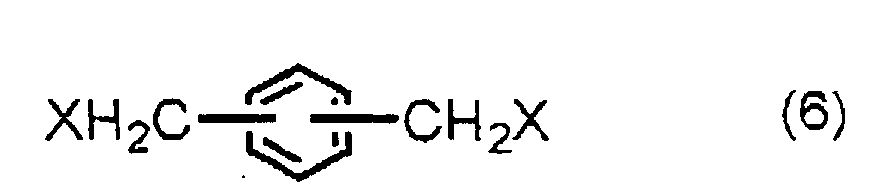
or Friedel-Crafts type reaction products of phenols with alicyclic compounds such as phenol, dicyclopentadiene, and limonene, or diolefins such as diisopropenylbenzene, etc., without being limited thereto.

| Example 1 | Example 2 | Example 3 | Comparative Example 1 | Comparative Example 2 | |
| Epoxy 1 (part by weight) | 100 | 100 | 100 | 0 | 0 |
| Epoxy 2 (part by weight) | 0 | 0 | 0 | 100 | 0 |
| Epoxy 3 (part by weight) | 0 | 0 | 0 | 0 | 100 |
| Phenol novolak (part by weight) | 32 | 32 | 32 | 46 | 53 |
| Triphenylphosphine (part by weight) | 3.5 | 3.5 | 3 | 1.25 | 1.5 |
| Silica (% by weight) | 78 | 80 | 82 | 80 | 82 |
| Gel time (seconds) | 22 | 23 | 38 | 37 | 31 |
| Spiral flow (cm) | 77 | 67 | 50 | 107 | 81 |
| Pulling out adhesive strength (MPa) | 10.8 | 8.25 | 9.68 | 7.22 | 4.73 |
| Water absorption (%) | 0.15 | 0.14 | 0.14 | 0.17 | 0.22 |
| Solder-crack resistance | 9/10 | 8/10 | 10/10 | 2/20 | 0/10 |
Claims (2)
- An epoxy resin composition for encapsulating semiconductor comprising:(A) an epoxy resin having two or more epoxy groups in a molecule represented by formula (1),in the formula, n is an average number of the repeating units, and represents a numerical value of 1 to 20; R1, R2, R3, and R4 independently represent, hydrogen atom, an alkyl group having 1-8 carbon atoms, a cycloalkyl group having 5-12 carbon atoms, an aryl group having 6-12 carbon atoms, or an aralkyl group having 7-20 carbon atoms; P and Q independently represent, halogen atom, an alkyl group having 1-8 carbon atoms, an alkenyl group having 1-8 carbon atoms, an alkynyl group having 1-8 carbon atoms, a cycloalkyl group having 5-12 carbon atoms, an aryl group having 6-14 carbon atoms, an aralkyl group having 7-20 carbon atoms, an alkoxy group having 1-8 carbon atoms, an alkenyloxy group having 1-8 carbon atoms, an alkynyloxy group having 1-8 carbon atoms, an aryloxy group having 6-14 carbon atoms, nitro group or cyano group; when n is 1, i is an integer of 0 to 4, and when n is not 1, i is an integer of 0 to 3; j is an integer of 0 to 4; all of R1, R2, R3, and R4 are not hydrogen atoms at the same time,
 (B) a curing agent having a phenolic hydroxyl group, and(C) inorganic filler in an amount of 60 to 98% by weight based on the whole composition.
 - A resin-encapsulated type semiconductor apparatus, wherein the semiconductor device is encapsulated by curing the epoxy resin composition of claim 1.
Applications Claiming Priority (2)
| Application Number | Priority Date | Filing Date | Title |
|---|---|---|---|
| JP2000218860 | 2000-07-19 | ||
| JP2000218860A JP2002037859A (en) | 2000-07-19 | 2000-07-19 | Epoxy resin composition for semiconductor encapsulation and resin-encapsulated semiconductor device |
Publications (2)
| Publication Number | Publication Date |
|---|---|
| EP1174455A1 true EP1174455A1 (en) | 2002-01-23 |
| EP1174455B1 EP1174455B1 (en) | 2004-09-29 |
Family
ID=18713744
Family Applications (1)
| Application Number | Title | Priority Date | Filing Date |
|---|---|---|---|
| EP01117045A Expired - Lifetime EP1174455B1 (en) | 2000-07-19 | 2001-07-12 | Epoxy resin composition for encapsulating semiconductor |
Country Status (8)
| Country | Link |
|---|---|
| US (1) | US20020053302A1 (en) |
| EP (1) | EP1174455B1 (en) |
| JP (1) | JP2002037859A (en) |
| KR (1) | KR20020008038A (en) |
| CN (1) | CN1334292A (en) |
| DE (1) | DE60105910T2 (en) |
| SG (1) | SG89408A1 (en) |
| TW (1) | TW528770B (en) |
Families Citing this family (8)
| Publication number | Priority date | Publication date | Assignee | Title |
|---|---|---|---|---|
| JP2003268079A (en) * | 2002-03-18 | 2003-09-25 | Sumitomo Bakelite Co Ltd | Epoxy resin composition and semiconductor apparatus |
| TW200307712A (en) * | 2002-06-14 | 2003-12-16 | Sumitomo Chemical Co | Phenolic resin and method of producing the same |
| JP5062714B2 (en) * | 2006-01-19 | 2012-10-31 | 日本化薬株式会社 | Active energy ray-curable resin composition and use thereof |
| JP2007231252A (en) * | 2006-01-31 | 2007-09-13 | Shin Etsu Chem Co Ltd | Epoxy resin composition for semiconductor encapsulation and semiconductor device sealed with the composition |
| MY145942A (en) * | 2006-03-31 | 2012-05-31 | Sumitomo Bakelite Co | Semiconductor encapsulant of epoxy resin, polyphenolic compound, filler and accelerator |
| CN101955629B (en) * | 2009-07-16 | 2011-12-07 | 中芯国际集成电路制造(上海)有限公司 | Epoxy resin composition capable of being used as semiconductor encapsulating material |
| KR101362887B1 (en) * | 2011-05-23 | 2014-02-14 | 제일모직주식회사 | Epoxy resin composition for encapsulating semiconductor device and semiconductor device encapsulated by using the same |
| WO2019017013A1 (en) * | 2017-07-21 | 2019-01-24 | Dic株式会社 | Epoxy resin, epoxy resin composition including same, and cured product using said epoxy resin composition |
Citations (5)
| Publication number | Priority date | Publication date | Assignee | Title |
|---|---|---|---|---|
| US4960634A (en) * | 1990-03-14 | 1990-10-02 | International Business Machines Corporation | Epoxy composition of increased thermal conductivity and use thereof |
| EP0424872A2 (en) * | 1989-10-25 | 1991-05-02 | Sumitomo Chemical Company, Limited | Curing agent for epoxy resin |
| EP0536749A1 (en) * | 1991-10-09 | 1993-04-14 | Sumitomo Chemical Company, Limited | Polyhydric phenol, and epoxy resin and epoxy resin composition derived therefrom |
| EP0536748A1 (en) * | 1991-10-11 | 1993-04-14 | Sumitomo Chemical Company, Limited | Polyhydric phenol and epoxy resin obtained using the same |
| EP0567919A2 (en) * | 1992-04-30 | 1993-11-03 | Sumitomo Chemical Company, Limited | Epoxy resin composition and resin-encapsulated semiconductor device |
Family Cites Families (1)
| Publication number | Priority date | Publication date | Assignee | Title |
|---|---|---|---|---|
| JP3067384B2 (en) * | 1992-04-20 | 2000-07-17 | 住友化学工業株式会社 | Epoxy resin copper clad laminate |
-
2000
- 2000-07-19 JP JP2000218860A patent/JP2002037859A/en active Pending
-
2001
- 2001-07-12 EP EP01117045A patent/EP1174455B1/en not_active Expired - Lifetime
- 2001-07-12 DE DE60105910T patent/DE60105910T2/en not_active Expired - Fee Related
- 2001-07-13 SG SG200104286A patent/SG89408A1/en unknown
- 2001-07-13 TW TW090117247A patent/TW528770B/en not_active IP Right Cessation
- 2001-07-16 KR KR1020010042811A patent/KR20020008038A/en not_active Withdrawn
- 2001-07-17 US US09/906,068 patent/US20020053302A1/en not_active Abandoned
- 2001-07-18 CN CN01124923A patent/CN1334292A/en active Pending
Patent Citations (5)
| Publication number | Priority date | Publication date | Assignee | Title |
|---|---|---|---|---|
| EP0424872A2 (en) * | 1989-10-25 | 1991-05-02 | Sumitomo Chemical Company, Limited | Curing agent for epoxy resin |
| US4960634A (en) * | 1990-03-14 | 1990-10-02 | International Business Machines Corporation | Epoxy composition of increased thermal conductivity and use thereof |
| EP0536749A1 (en) * | 1991-10-09 | 1993-04-14 | Sumitomo Chemical Company, Limited | Polyhydric phenol, and epoxy resin and epoxy resin composition derived therefrom |
| EP0536748A1 (en) * | 1991-10-11 | 1993-04-14 | Sumitomo Chemical Company, Limited | Polyhydric phenol and epoxy resin obtained using the same |
| EP0567919A2 (en) * | 1992-04-30 | 1993-11-03 | Sumitomo Chemical Company, Limited | Epoxy resin composition and resin-encapsulated semiconductor device |
Also Published As
| Publication number | Publication date |
|---|---|
| CN1334292A (en) | 2002-02-06 |
| DE60105910T2 (en) | 2005-10-06 |
| SG89408A1 (en) | 2002-06-18 |
| TW528770B (en) | 2003-04-21 |
| US20020053302A1 (en) | 2002-05-09 |
| EP1174455B1 (en) | 2004-09-29 |
| JP2002037859A (en) | 2002-02-06 |
| KR20020008038A (en) | 2002-01-29 |
| DE60105910D1 (en) | 2004-11-04 |
Similar Documents
| Publication | Publication Date | Title |
|---|---|---|
| JPH08120039A (en) | Benzylated polyphenols, their epoxy resins, their production and use | |
| US5478871A (en) | Polyhydric phenol from naphthaldehyde and epoxy resin obtained using the same | |
| EP1174455B1 (en) | Epoxy resin composition for encapsulating semiconductor | |
| JP3973773B2 (en) | Epoxy resin composition for semiconductor encapsulation | |
| EP0869140B1 (en) | Epoxy resin composition and resin-encapsulated semiconductor device | |
| JPH07258240A (en) | Glycidyl ether compound and epoxy resin composition | |
| EP0536749B1 (en) | Polyhydric phenol, and epoxy resin and epoxy resin composition derived therefrom | |
| JPH10324733A (en) | Epoxy resin composition, method for producing epoxy resin, and semiconductor encapsulant | |
| KR100249925B1 (en) | Epoxy Resin Compositions and Resin-Capsulated Semiconductor Devices | |
| JP3200123B2 (en) | Epoxy resin composition for sealing electronic parts | |
| JPH0625393A (en) | Phenol polymer, production method thereof and use thereof | |
| JP2981759B2 (en) | Epoxy compound and epoxy resin composition | |
| JPH08310985A (en) | Polyphenols, epoxy resins, epoxy resin compositions and cured products thereof | |
| JP3141960B2 (en) | New epoxy resin, resin composition and cured product | |
| JP3063322B2 (en) | Bisphenols, epoxy resins and compositions thereof | |
| JPH07216052A (en) | Epoxy resin and epoxy resin composition | |
| JPH10310631A5 (en) | ||
| JP3084822B2 (en) | Epoxy resin composition | |
| JPH07224142A (en) | Epoxy resin and epoxy resin composition | |
| JPH07258241A (en) | Glycidyl ether compound and epoxy resin composition | |
| JPH02153917A (en) | Modified epoxy compound, composition thereof and sealing agent consisting essentially of said composition | |
| JP3464821B2 (en) | Epoxy resin curing agent and epoxy resin composition | |
| JPS59227873A (en) | Preparation of glycidyl ether of polyhydric phenol | |
| JPH09324030A (en) | Production of epoxy resin, epoxy resin and epoxy resin composition | |
| JPH07278128A (en) | Epoxy resin, production method thereof, and epoxy resin composition |
Legal Events
| Date | Code | Title | Description |
|---|---|---|---|
| PUAI | Public reference made under article 153(3) epc to a published international application that has entered the european phase |
Free format text: ORIGINAL CODE: 0009012 |
|
| AK | Designated contracting states |
Kind code of ref document: A1 Designated state(s): DE FR GB Kind code of ref document: A1 Designated state(s): AT BE CH CY DE DK ES FI FR GB GR IE IT LI LU MC NL PT SE TR |
|
| AX | Request for extension of the european patent |
Free format text: AL;LT;LV;MK;RO;SI |
|
| 17P | Request for examination filed |
Effective date: 20020711 |
|
| AKX | Designation fees paid |
Free format text: DE FR GB |
|
| 17Q | First examination report despatched |
Effective date: 20030709 |
|
| GRAP | Despatch of communication of intention to grant a patent |
Free format text: ORIGINAL CODE: EPIDOSNIGR1 |
|
| GRAS | Grant fee paid |
Free format text: ORIGINAL CODE: EPIDOSNIGR3 |
|
| GRAA | (expected) grant |
Free format text: ORIGINAL CODE: 0009210 |
|
| AK | Designated contracting states |
Kind code of ref document: B1 Designated state(s): DE FR GB |
|
| REG | Reference to a national code |
Ref country code: GB Ref legal event code: FG4D |
|
| REG | Reference to a national code |
Ref country code: IE Ref legal event code: FG4D |
|
| REF | Corresponds to: |
Ref document number: 60105910 Country of ref document: DE Date of ref document: 20041104 Kind code of ref document: P |
|
| RAP2 | Party data changed (patent owner data changed or rights of a patent transferred) |
Owner name: SUMITOMO CHEMICAL COMPANY, LIMITED |
|
| ET | Fr: translation filed | ||
| PGFP | Annual fee paid to national office [announced via postgrant information from national office to epo] |
Ref country code: GB Payment date: 20050706 Year of fee payment: 5 |
|
| PGFP | Annual fee paid to national office [announced via postgrant information from national office to epo] |
Ref country code: DE Payment date: 20050707 Year of fee payment: 5 |
|
| PGFP | Annual fee paid to national office [announced via postgrant information from national office to epo] |
Ref country code: FR Payment date: 20050708 Year of fee payment: 5 |
|
| PLBE | No opposition filed within time limit |
Free format text: ORIGINAL CODE: 0009261 |
|
| STAA | Information on the status of an ep patent application or granted ep patent |
Free format text: STATUS: NO OPPOSITION FILED WITHIN TIME LIMIT |
|
| 26N | No opposition filed |
Effective date: 20050630 |
|
| PG25 | Lapsed in a contracting state [announced via postgrant information from national office to epo] |
Ref country code: GB Free format text: LAPSE BECAUSE OF NON-PAYMENT OF DUE FEES Effective date: 20060712 |
|
| PG25 | Lapsed in a contracting state [announced via postgrant information from national office to epo] |
Ref country code: DE Free format text: LAPSE BECAUSE OF NON-PAYMENT OF DUE FEES Effective date: 20070201 |
|
| GBPC | Gb: european patent ceased through non-payment of renewal fee |
Effective date: 20060712 |
|
| REG | Reference to a national code |
Ref country code: FR Ref legal event code: ST Effective date: 20070330 |
|
| PG25 | Lapsed in a contracting state [announced via postgrant information from national office to epo] |
Ref country code: FR Free format text: LAPSE BECAUSE OF NON-PAYMENT OF DUE FEES Effective date: 20060731 |