EP1174425A1 - Novel method for manufacturing tricyclic amino alcohol derivatives - Google Patents
Novel method for manufacturing tricyclic amino alcohol derivatives Download PDFInfo
- Publication number
- EP1174425A1 EP1174425A1 EP00909753A EP00909753A EP1174425A1 EP 1174425 A1 EP1174425 A1 EP 1174425A1 EP 00909753 A EP00909753 A EP 00909753A EP 00909753 A EP00909753 A EP 00909753A EP 1174425 A1 EP1174425 A1 EP 1174425A1
- Authority
- EP
- European Patent Office
- Prior art keywords
- compound
- formula
- group
- amino
- hydrogen atom
- Prior art date
- Legal status (The legal status is an assumption and is not a legal conclusion. Google has not performed a legal analysis and makes no representation as to the accuracy of the status listed.)
- Withdrawn
Links
- 238000000034 method Methods 0.000 title claims abstract description 140
- 150000001414 amino alcohols Chemical class 0.000 title description 2
- 238000004519 manufacturing process Methods 0.000 title 1
- 150000001875 compounds Chemical class 0.000 claims abstract description 435
- 125000004435 hydrogen atom Chemical group [H]* 0.000 claims abstract description 70
- 125000002887 hydroxy group Chemical group [H]O* 0.000 claims abstract description 65
- 125000004432 carbon atom Chemical group C* 0.000 claims abstract description 33
- 229910052799 carbon Inorganic materials 0.000 claims abstract description 32
- 125000005843 halogen group Chemical group 0.000 claims abstract description 27
- 125000001797 benzyl group Chemical group [H]C1=C([H])C([H])=C(C([H])=C1[H])C([H])([H])* 0.000 claims abstract description 24
- 125000003277 amino group Chemical group 0.000 claims abstract description 18
- 125000000217 alkyl group Chemical group 0.000 claims abstract description 17
- 238000002360 preparation method Methods 0.000 claims abstract description 16
- 229910052717 sulfur Inorganic materials 0.000 claims abstract description 15
- 125000000738 acetamido group Chemical group [H]C([H])([H])C(=O)N([H])[*] 0.000 claims abstract description 13
- 229910052760 oxygen Inorganic materials 0.000 claims abstract description 12
- 230000002829 reductive effect Effects 0.000 claims description 61
- 125000006239 protecting group Chemical group 0.000 claims description 19
- 230000003287 optical effect Effects 0.000 claims description 18
- AVXURJPOCDRRFD-UHFFFAOYSA-N Hydroxylamine Chemical compound ON AVXURJPOCDRRFD-UHFFFAOYSA-N 0.000 claims description 17
- 150000003839 salts Chemical class 0.000 claims description 14
- 230000008878 coupling Effects 0.000 claims description 2
- 238000010168 coupling process Methods 0.000 claims description 2
- 238000005859 coupling reaction Methods 0.000 claims description 2
- 239000000543 intermediate Substances 0.000 abstract description 16
- 208000031226 Hyperlipidaemia Diseases 0.000 abstract description 3
- 208000008589 Obesity Diseases 0.000 abstract description 3
- 206010012601 diabetes mellitus Diseases 0.000 abstract description 3
- 235000020824 obesity Nutrition 0.000 abstract description 3
- OKKJLVBELUTLKV-UHFFFAOYSA-N Methanol Chemical compound OC OKKJLVBELUTLKV-UHFFFAOYSA-N 0.000 description 150
- XEKOWRVHYACXOJ-UHFFFAOYSA-N Ethyl acetate Chemical compound CCOC(C)=O XEKOWRVHYACXOJ-UHFFFAOYSA-N 0.000 description 118
- LFQSCWFLJHTTHZ-UHFFFAOYSA-N Ethanol Chemical compound CCO LFQSCWFLJHTTHZ-UHFFFAOYSA-N 0.000 description 107
- 238000006243 chemical reaction Methods 0.000 description 107
- WRMNZCZEMHIOCP-UHFFFAOYSA-N 2-phenylethanol Chemical compound OCCC1=CC=CC=C1 WRMNZCZEMHIOCP-UHFFFAOYSA-N 0.000 description 102
- WYURNTSHIVDZCO-UHFFFAOYSA-N Tetrahydrofuran Chemical compound C1CCOC1 WYURNTSHIVDZCO-UHFFFAOYSA-N 0.000 description 84
- VEXZGXHMUGYJMC-UHFFFAOYSA-N Hydrochloric acid Chemical compound Cl VEXZGXHMUGYJMC-UHFFFAOYSA-N 0.000 description 65
- 125000001495 ethyl group Chemical group [H]C([H])([H])C([H])([H])* 0.000 description 59
- VLKZOEOYAKHREP-UHFFFAOYSA-N n-Hexane Chemical compound CCCCCC VLKZOEOYAKHREP-UHFFFAOYSA-N 0.000 description 54
- 239000000243 solution Substances 0.000 description 50
- KWOLFJPFCHCOCG-UHFFFAOYSA-N Acetophenone Chemical compound CC(=O)C1=CC=CC=C1 KWOLFJPFCHCOCG-UHFFFAOYSA-N 0.000 description 47
- CSCPPACGZOOCGX-UHFFFAOYSA-N Acetone Chemical compound CC(C)=O CSCPPACGZOOCGX-UHFFFAOYSA-N 0.000 description 45
- 239000002904 solvent Substances 0.000 description 45
- 238000003786 synthesis reaction Methods 0.000 description 45
- 230000015572 biosynthetic process Effects 0.000 description 44
- YLQBMQCUIZJEEH-UHFFFAOYSA-N tetrahydrofuran Natural products C=1C=COC=1 YLQBMQCUIZJEEH-UHFFFAOYSA-N 0.000 description 42
- 239000013078 crystal Substances 0.000 description 41
- HEMHJVSKTPXQMS-UHFFFAOYSA-M Sodium hydroxide Chemical compound [OH-].[Na+] HEMHJVSKTPXQMS-UHFFFAOYSA-M 0.000 description 39
- XLYOFNOQVPJJNP-UHFFFAOYSA-N water Substances O XLYOFNOQVPJJNP-UHFFFAOYSA-N 0.000 description 39
- ZMANZCXQSJIPKH-UHFFFAOYSA-N Triethylamine Chemical compound CCN(CC)CC ZMANZCXQSJIPKH-UHFFFAOYSA-N 0.000 description 36
- 235000019439 ethyl acetate Nutrition 0.000 description 36
- 239000000203 mixture Substances 0.000 description 35
- YMWUJEATGCHHMB-UHFFFAOYSA-N Dichloromethane Chemical compound ClCCl YMWUJEATGCHHMB-UHFFFAOYSA-N 0.000 description 33
- YXFVVABEGXRONW-UHFFFAOYSA-N Toluene Chemical compound CC1=CC=CC=C1 YXFVVABEGXRONW-UHFFFAOYSA-N 0.000 description 33
- 239000012327 Ruthenium complex Substances 0.000 description 32
- HFPZCAJZSCWRBC-UHFFFAOYSA-N p-cymene Chemical compound CC(C)C1=CC=C(C)C=C1 HFPZCAJZSCWRBC-UHFFFAOYSA-N 0.000 description 32
- 239000002253 acid Substances 0.000 description 30
- 230000002194 synthesizing effect Effects 0.000 description 30
- 239000003054 catalyst Substances 0.000 description 28
- WEVYAHXRMPXWCK-UHFFFAOYSA-N Acetonitrile Chemical compound CC#N WEVYAHXRMPXWCK-UHFFFAOYSA-N 0.000 description 27
- IAZDPXIOMUYVGZ-WFGJKAKNSA-N Dimethyl sulfoxide Chemical compound [2H]C([2H])([2H])S(=O)C([2H])([2H])[2H] IAZDPXIOMUYVGZ-WFGJKAKNSA-N 0.000 description 26
- FFBHFFJDDLITSX-UHFFFAOYSA-N benzyl N-[2-hydroxy-4-(3-oxomorpholin-4-yl)phenyl]carbamate Chemical compound OC1=C(NC(=O)OCC2=CC=CC=C2)C=CC(=C1)N1CCOCC1=O FFBHFFJDDLITSX-UHFFFAOYSA-N 0.000 description 25
- -1 sulfonyloxy group Chemical group 0.000 description 25
- 238000005160 1H NMR spectroscopy Methods 0.000 description 24
- HEDRZPFGACZZDS-UHFFFAOYSA-N Chloroform Chemical compound ClC(Cl)Cl HEDRZPFGACZZDS-UHFFFAOYSA-N 0.000 description 22
- QTBSBXVTEAMEQO-UHFFFAOYSA-N Acetic acid Chemical compound CC(O)=O QTBSBXVTEAMEQO-UHFFFAOYSA-N 0.000 description 21
- 230000014759 maintenance of location Effects 0.000 description 21
- ZMXDDKWLCZADIW-UHFFFAOYSA-N N,N-Dimethylformamide Chemical compound CN(C)C=O ZMXDDKWLCZADIW-UHFFFAOYSA-N 0.000 description 20
- XYFCBTPGUUZFHI-UHFFFAOYSA-N Phosphine Chemical compound P XYFCBTPGUUZFHI-UHFFFAOYSA-N 0.000 description 20
- BWHMMNNQKKPAPP-UHFFFAOYSA-L potassium carbonate Chemical compound [K+].[K+].[O-]C([O-])=O BWHMMNNQKKPAPP-UHFFFAOYSA-L 0.000 description 20
- 238000004128 high performance liquid chromatography Methods 0.000 description 19
- 239000002516 radical scavenger Substances 0.000 description 19
- 238000003756 stirring Methods 0.000 description 19
- KWYUFKZDYYNOTN-UHFFFAOYSA-M Potassium hydroxide Chemical compound [OH-].[K+] KWYUFKZDYYNOTN-UHFFFAOYSA-M 0.000 description 18
- HEDRZPFGACZZDS-MICDWDOJSA-N Trichloro(2H)methane Chemical compound [2H]C(Cl)(Cl)Cl HEDRZPFGACZZDS-MICDWDOJSA-N 0.000 description 18
- 239000000126 substance Substances 0.000 description 18
- KFZMGEQAYNKOFK-UHFFFAOYSA-N Isopropanol Chemical compound CC(C)O KFZMGEQAYNKOFK-UHFFFAOYSA-N 0.000 description 17
- JGFZNNIVVJXRND-UHFFFAOYSA-N N,N-Diisopropylethylamine (DIPEA) Chemical compound CCN(C(C)C)C(C)C JGFZNNIVVJXRND-UHFFFAOYSA-N 0.000 description 16
- 239000000460 chlorine Substances 0.000 description 16
- UFHFLCQGNIYNRP-UHFFFAOYSA-N Hydrogen Chemical compound [H][H] UFHFLCQGNIYNRP-UHFFFAOYSA-N 0.000 description 15
- 229910052739 hydrogen Inorganic materials 0.000 description 15
- 239000001257 hydrogen Substances 0.000 description 15
- 239000010948 rhodium Substances 0.000 description 15
- FVAUCKIRQBBSSJ-UHFFFAOYSA-M sodium iodide Chemical compound [Na+].[I-] FVAUCKIRQBBSSJ-UHFFFAOYSA-M 0.000 description 15
- JUJWROOIHBZHMG-UHFFFAOYSA-N Pyridine Chemical compound C1=CC=NC=C1 JUJWROOIHBZHMG-UHFFFAOYSA-N 0.000 description 14
- 238000005259 measurement Methods 0.000 description 14
- 238000006722 reduction reaction Methods 0.000 description 14
- 238000004440 column chromatography Methods 0.000 description 13
- 235000011121 sodium hydroxide Nutrition 0.000 description 13
- UHOVQNZJYSORNB-UHFFFAOYSA-N Benzene Chemical compound C1=CC=CC=C1 UHOVQNZJYSORNB-UHFFFAOYSA-N 0.000 description 12
- 239000012298 atmosphere Substances 0.000 description 12
- GDTBXPJZTBHREO-UHFFFAOYSA-N bromine Substances BrBr GDTBXPJZTBHREO-UHFFFAOYSA-N 0.000 description 12
- 239000003480 eluent Substances 0.000 description 12
- 229910052794 bromium Inorganic materials 0.000 description 11
- 239000003446 ligand Substances 0.000 description 11
- 238000010898 silica gel chromatography Methods 0.000 description 11
- NAWXUBYGYWOOIX-SFHVURJKSA-N (2s)-2-[[4-[2-(2,4-diaminoquinazolin-6-yl)ethyl]benzoyl]amino]-4-methylidenepentanedioic acid Chemical compound C1=CC2=NC(N)=NC(N)=C2C=C1CCC1=CC=C(C(=O)N[C@@H](CC(=C)C(O)=O)C(O)=O)C=C1 NAWXUBYGYWOOIX-SFHVURJKSA-N 0.000 description 10
- WKBOTKDWSSQWDR-UHFFFAOYSA-N Bromine atom Chemical compound [Br] WKBOTKDWSSQWDR-UHFFFAOYSA-N 0.000 description 10
- PMZURENOXWZQFD-UHFFFAOYSA-L Sodium Sulfate Chemical compound [Na+].[Na+].[O-]S([O-])(=O)=O PMZURENOXWZQFD-UHFFFAOYSA-L 0.000 description 10
- 239000002585 base Substances 0.000 description 10
- 229910000027 potassium carbonate Inorganic materials 0.000 description 10
- 235000011181 potassium carbonates Nutrition 0.000 description 10
- HPALAKNZSZLMCH-UHFFFAOYSA-M sodium;chloride;hydrate Chemical class O.[Na+].[Cl-] HPALAKNZSZLMCH-UHFFFAOYSA-M 0.000 description 10
- RIOQSEWOXXDEQQ-UHFFFAOYSA-N triphenylphosphine Chemical compound C1=CC=CC=C1P(C=1C=CC=CC=1)C1=CC=CC=C1 RIOQSEWOXXDEQQ-UHFFFAOYSA-N 0.000 description 10
- SYTBZMRGLBWNTM-SNVBAGLBSA-N (R)-flurbiprofen Chemical compound FC1=CC([C@H](C(O)=O)C)=CC=C1C1=CC=CC=C1 SYTBZMRGLBWNTM-SNVBAGLBSA-N 0.000 description 9
- 0 Cc(cc1)c(**)cc1C(CBr)=O Chemical compound Cc(cc1)c(**)cc1C(CBr)=O 0.000 description 9
- CPELXLSAUQHCOX-UHFFFAOYSA-N Hydrogen bromide Chemical compound Br CPELXLSAUQHCOX-UHFFFAOYSA-N 0.000 description 9
- 229910052801 chlorine Inorganic materials 0.000 description 9
- 239000012044 organic layer Substances 0.000 description 9
- 229910000073 phosphorus hydride Inorganic materials 0.000 description 9
- ZAMOUSCENKQFHK-UHFFFAOYSA-N Chlorine atom Chemical compound [Cl] ZAMOUSCENKQFHK-UHFFFAOYSA-N 0.000 description 8
- CDBYLPFSWZWCQE-UHFFFAOYSA-L Sodium Carbonate Chemical compound [Na+].[Na+].[O-]C([O-])=O CDBYLPFSWZWCQE-UHFFFAOYSA-L 0.000 description 8
- 150000001412 amines Chemical class 0.000 description 8
- HUMNYLRZRPPJDN-UHFFFAOYSA-N benzaldehyde Chemical compound O=CC1=CC=CC=C1 HUMNYLRZRPPJDN-UHFFFAOYSA-N 0.000 description 8
- ZWEHNKRNPOVVGH-UHFFFAOYSA-N 2-Butanone Chemical compound CCC(C)=O ZWEHNKRNPOVVGH-UHFFFAOYSA-N 0.000 description 7
- 238000006751 Mitsunobu reaction Methods 0.000 description 7
- KDLHZDBZIXYQEI-UHFFFAOYSA-N Palladium Chemical compound [Pd] KDLHZDBZIXYQEI-UHFFFAOYSA-N 0.000 description 7
- UOPFIWYXBIHPIP-NHCUHLMSSA-N n-[(1r,2r)-2-amino-1,2-diphenylethyl]-4-methylbenzenesulfonamide Chemical compound C1=CC(C)=CC=C1S(=O)(=O)N[C@H](C=1C=CC=CC=1)[C@H](N)C1=CC=CC=C1 UOPFIWYXBIHPIP-NHCUHLMSSA-N 0.000 description 7
- UMJSCPRVCHMLSP-UHFFFAOYSA-N pyridine Natural products COC1=CC=CN=C1 UMJSCPRVCHMLSP-UHFFFAOYSA-N 0.000 description 7
- 239000012279 sodium borohydride Substances 0.000 description 7
- 229910000033 sodium borohydride Inorganic materials 0.000 description 7
- 125000005931 tert-butyloxycarbonyl group Chemical group [H]C([H])([H])C(OC(*)=O)(C([H])([H])[H])C([H])([H])[H] 0.000 description 7
- GWPGDZPXOZATKL-UHFFFAOYSA-N 9h-carbazol-2-ol Chemical compound C1=CC=C2C3=CC=C(O)C=C3NC2=C1 GWPGDZPXOZATKL-UHFFFAOYSA-N 0.000 description 6
- RTZKZFJDLAIYFH-UHFFFAOYSA-N Diethyl ether Chemical compound CCOCC RTZKZFJDLAIYFH-UHFFFAOYSA-N 0.000 description 6
- IAZDPXIOMUYVGZ-UHFFFAOYSA-N Dimethylsulphoxide Chemical compound CS(C)=O IAZDPXIOMUYVGZ-UHFFFAOYSA-N 0.000 description 6
- UIIMBOGNXHQVGW-UHFFFAOYSA-M Sodium bicarbonate Chemical compound [Na+].OC([O-])=O UIIMBOGNXHQVGW-UHFFFAOYSA-M 0.000 description 6
- 125000002915 carbonyl group Chemical group [*:2]C([*:1])=O 0.000 description 6
- 239000003795 chemical substances by application Substances 0.000 description 6
- 239000012043 crude product Substances 0.000 description 6
- 238000001914 filtration Methods 0.000 description 6
- 238000010438 heat treatment Methods 0.000 description 6
- 239000012046 mixed solvent Substances 0.000 description 6
- BASFCYQUMIYNBI-UHFFFAOYSA-N platinum Chemical group [Pt] BASFCYQUMIYNBI-UHFFFAOYSA-N 0.000 description 6
- 235000011118 potassium hydroxide Nutrition 0.000 description 6
- 125000002924 primary amino group Chemical group [H]N([H])* 0.000 description 6
- BDERNNFJNOPAEC-UHFFFAOYSA-N propan-1-ol Chemical compound CCCO BDERNNFJNOPAEC-UHFFFAOYSA-N 0.000 description 6
- XHFLOLLMZOTPSM-UHFFFAOYSA-M sodium;hydrogen carbonate;hydrate Chemical class [OH-].[Na+].OC(O)=O XHFLOLLMZOTPSM-UHFFFAOYSA-M 0.000 description 6
- 238000000967 suction filtration Methods 0.000 description 6
- RYHBNJHYFVUHQT-UHFFFAOYSA-N 1,4-Dioxane Chemical compound C1COCCO1 RYHBNJHYFVUHQT-UHFFFAOYSA-N 0.000 description 5
- 125000002252 acyl group Chemical group 0.000 description 5
- 239000012752 auxiliary agent Substances 0.000 description 5
- 238000001816 cooling Methods 0.000 description 5
- 239000000463 material Substances 0.000 description 5
- AUHZEENZYGFFBQ-UHFFFAOYSA-N mesitylene Substances CC1=CC(C)=CC(C)=C1 AUHZEENZYGFFBQ-UHFFFAOYSA-N 0.000 description 5
- 125000001827 mesitylenyl group Chemical group [H]C1=C(C(*)=C(C([H])=C1C([H])([H])[H])C([H])([H])[H])C([H])([H])[H] 0.000 description 5
- PSHKMPUSSFXUIA-UHFFFAOYSA-N n,n-dimethylpyridin-2-amine Chemical compound CN(C)C1=CC=CC=N1 PSHKMPUSSFXUIA-UHFFFAOYSA-N 0.000 description 5
- NXJCBFBQEVOTOW-UHFFFAOYSA-L palladium(2+);dihydroxide Chemical compound O[Pd]O NXJCBFBQEVOTOW-UHFFFAOYSA-L 0.000 description 5
- 238000010992 reflux Methods 0.000 description 5
- 229910052703 rhodium Inorganic materials 0.000 description 5
- MHOVAHRLVXNVSD-UHFFFAOYSA-N rhodium atom Chemical compound [Rh] MHOVAHRLVXNVSD-UHFFFAOYSA-N 0.000 description 5
- 235000009518 sodium iodide Nutrition 0.000 description 5
- 150000003512 tertiary amines Chemical class 0.000 description 5
- 229910052723 transition metal Inorganic materials 0.000 description 5
- 150000003624 transition metals Chemical class 0.000 description 5
- QBYIENPQHBMVBV-HFEGYEGKSA-N (2R)-2-hydroxy-2-phenylacetic acid Chemical compound O[C@@H](C(O)=O)c1ccccc1.O[C@@H](C(O)=O)c1ccccc1 QBYIENPQHBMVBV-HFEGYEGKSA-N 0.000 description 4
- PAAZPARNPHGIKF-UHFFFAOYSA-N 1,2-dibromoethane Chemical compound BrCCBr PAAZPARNPHGIKF-UHFFFAOYSA-N 0.000 description 4
- XKRFYHLGVUSROY-UHFFFAOYSA-N Argon Chemical compound [Ar] XKRFYHLGVUSROY-UHFFFAOYSA-N 0.000 description 4
- FXHOOIRPVKKKFG-UHFFFAOYSA-N N,N-Dimethylacetamide Chemical compound CN(C)C(C)=O FXHOOIRPVKKKFG-UHFFFAOYSA-N 0.000 description 4
- PHSPJQZRQAJPPF-UHFFFAOYSA-N N-alpha-Methylhistamine Chemical compound CNCCC1=CN=CN1 PHSPJQZRQAJPPF-UHFFFAOYSA-N 0.000 description 4
- IWYDHOAUDWTVEP-UHFFFAOYSA-N R-2-phenyl-2-hydroxyacetic acid Natural products OC(=O)C(O)C1=CC=CC=C1 IWYDHOAUDWTVEP-UHFFFAOYSA-N 0.000 description 4
- QAOWNCQODCNURD-UHFFFAOYSA-N Sulfuric acid Chemical compound OS(O)(=O)=O QAOWNCQODCNURD-UHFFFAOYSA-N 0.000 description 4
- 125000002777 acetyl group Chemical group [H]C([H])([H])C(*)=O 0.000 description 4
- 150000001491 aromatic compounds Chemical class 0.000 description 4
- 125000003710 aryl alkyl group Chemical group 0.000 description 4
- UORVGPXVDQYIDP-UHFFFAOYSA-N borane Chemical compound B UORVGPXVDQYIDP-UHFFFAOYSA-N 0.000 description 4
- 238000009833 condensation Methods 0.000 description 4
- 230000005494 condensation Effects 0.000 description 4
- 238000006482 condensation reaction Methods 0.000 description 4
- 239000000706 filtrate Substances 0.000 description 4
- 229910052500 inorganic mineral Inorganic materials 0.000 description 4
- 229960002510 mandelic acid Drugs 0.000 description 4
- 125000002496 methyl group Chemical group [H]C([H])([H])* 0.000 description 4
- 235000010755 mineral Nutrition 0.000 description 4
- 239000011707 mineral Substances 0.000 description 4
- 239000011259 mixed solution Substances 0.000 description 4
- QIGHGZFEJDNFCD-UHFFFAOYSA-N n-benzyl-2-(9h-carbazol-2-yloxy)ethanamine Chemical compound C=1C=C(C2=CC=CC=C2N2)C2=CC=1OCCNCC1=CC=CC=C1 QIGHGZFEJDNFCD-UHFFFAOYSA-N 0.000 description 4
- QNGNSVIICDLXHT-UHFFFAOYSA-N para-ethylbenzaldehyde Natural products CCC1=CC=C(C=O)C=C1 QNGNSVIICDLXHT-UHFFFAOYSA-N 0.000 description 4
- 239000002244 precipitate Substances 0.000 description 4
- 239000008213 purified water Substances 0.000 description 4
- 229910000029 sodium carbonate Inorganic materials 0.000 description 4
- 235000017550 sodium carbonate Nutrition 0.000 description 4
- 125000001424 substituent group Chemical group 0.000 description 4
- DYHSDKLCOJIUFX-UHFFFAOYSA-N tert-butoxycarbonyl anhydride Chemical compound CC(C)(C)OC(=O)OC(=O)OC(C)(C)C DYHSDKLCOJIUFX-UHFFFAOYSA-N 0.000 description 4
- FPGGTKZVZWFYPV-UHFFFAOYSA-M tetrabutylammonium fluoride Chemical compound [F-].CCCC[N+](CCCC)(CCCC)CCCC FPGGTKZVZWFYPV-UHFFFAOYSA-M 0.000 description 4
- VZGDMQKNWNREIO-UHFFFAOYSA-N tetrachloromethane Chemical compound ClC(Cl)(Cl)Cl VZGDMQKNWNREIO-UHFFFAOYSA-N 0.000 description 4
- VZCYOOQTPOCHFL-UHFFFAOYSA-N trans-butenedioic acid Natural products OC(=O)C=CC(O)=O VZCYOOQTPOCHFL-UHFFFAOYSA-N 0.000 description 4
- CGZDSONUXGRBTB-UHFFFAOYSA-N 7-methoxy-9h-carbazol-3-ol Chemical compound C1=C(O)C=C2C3=CC=C(OC)C=C3NC2=C1 CGZDSONUXGRBTB-UHFFFAOYSA-N 0.000 description 3
- ZCYVEMRRCGMTRW-UHFFFAOYSA-N 7553-56-2 Chemical group [I] ZCYVEMRRCGMTRW-UHFFFAOYSA-N 0.000 description 3
- WFDIJRYMOXRFFG-UHFFFAOYSA-N Acetic anhydride Chemical compound CC(=O)OC(C)=O WFDIJRYMOXRFFG-UHFFFAOYSA-N 0.000 description 3
- VZCYOOQTPOCHFL-OWOJBTEDSA-N Fumaric acid Chemical compound OC(=O)\C=C\C(O)=O VZCYOOQTPOCHFL-OWOJBTEDSA-N 0.000 description 3
- 239000002841 Lewis acid Substances 0.000 description 3
- WMFOQBRAJBCJND-UHFFFAOYSA-M Lithium hydroxide Chemical compound [Li+].[OH-] WMFOQBRAJBCJND-UHFFFAOYSA-M 0.000 description 3
- AFVFQIVMOAPDHO-UHFFFAOYSA-N Methanesulfonic acid Chemical compound CS(O)(=O)=O AFVFQIVMOAPDHO-UHFFFAOYSA-N 0.000 description 3
- IMNFDUFMRHMDMM-UHFFFAOYSA-N N-Heptane Chemical compound CCCCCCC IMNFDUFMRHMDMM-UHFFFAOYSA-N 0.000 description 3
- 125000004423 acyloxy group Chemical group 0.000 description 3
- 125000003545 alkoxy group Chemical group 0.000 description 3
- 239000012300 argon atmosphere Substances 0.000 description 3
- AGEZXYOZHKGVCM-UHFFFAOYSA-N benzyl bromide Chemical compound BrCC1=CC=CC=C1 AGEZXYOZHKGVCM-UHFFFAOYSA-N 0.000 description 3
- 125000000051 benzyloxy group Chemical group [H]C1=C([H])C([H])=C(C([H])=C1[H])C([H])([H])O* 0.000 description 3
- 239000003638 chemical reducing agent Substances 0.000 description 3
- KRKNYBCHXYNGOX-UHFFFAOYSA-N citric acid Chemical compound OC(=O)CC(O)(C(O)=O)CC(O)=O KRKNYBCHXYNGOX-UHFFFAOYSA-N 0.000 description 3
- 125000000113 cyclohexyl group Chemical group [H]C1([H])C([H])([H])C([H])([H])C([H])(*)C([H])([H])C1([H])[H] 0.000 description 3
- RAXXELZNTBOGNW-UHFFFAOYSA-N imidazole Natural products C1=CNC=N1 RAXXELZNTBOGNW-UHFFFAOYSA-N 0.000 description 3
- 239000013067 intermediate product Substances 0.000 description 3
- 229910052740 iodine Inorganic materials 0.000 description 3
- 238000004898 kneading Methods 0.000 description 3
- 150000007517 lewis acids Chemical class 0.000 description 3
- 125000001624 naphthyl group Chemical group 0.000 description 3
- 239000012299 nitrogen atmosphere Substances 0.000 description 3
- ODUCDPQEXGNKDN-UHFFFAOYSA-N nitroxyl Chemical compound O=N ODUCDPQEXGNKDN-UHFFFAOYSA-N 0.000 description 3
- OSDZHDOKXGSWOD-UHFFFAOYSA-N nitroxyl;hydrochloride Chemical compound Cl.O=N OSDZHDOKXGSWOD-UHFFFAOYSA-N 0.000 description 3
- 238000000655 nuclear magnetic resonance spectrum Methods 0.000 description 3
- NLKNQRATVPKPDG-UHFFFAOYSA-M potassium iodide Chemical compound [K+].[I-] NLKNQRATVPKPDG-UHFFFAOYSA-M 0.000 description 3
- 235000017557 sodium bicarbonate Nutrition 0.000 description 3
- 229910000030 sodium bicarbonate Inorganic materials 0.000 description 3
- 239000007787 solid Substances 0.000 description 3
- FGTJJHCZWOVVNH-UHFFFAOYSA-N tert-butyl-[tert-butyl(dimethyl)silyl]oxy-dimethylsilane Chemical compound CC(C)(C)[Si](C)(C)O[Si](C)(C)C(C)(C)C FGTJJHCZWOVVNH-UHFFFAOYSA-N 0.000 description 3
- 125000001981 tert-butyldimethylsilyl group Chemical group [H]C([H])([H])[Si]([H])(C([H])([H])[H])[*]C(C([H])([H])[H])(C([H])([H])[H])C([H])([H])[H] 0.000 description 3
- 238000004809 thin layer chromatography Methods 0.000 description 3
- VYXHVRARDIDEHS-QGTKBVGQSA-N (1z,5z)-cycloocta-1,5-diene Chemical compound C\1C\C=C/CC\C=C/1 VYXHVRARDIDEHS-QGTKBVGQSA-N 0.000 description 2
- MIOPJNTWMNEORI-GMSGAONNSA-N (S)-camphorsulfonic acid Chemical compound C1C[C@@]2(CS(O)(=O)=O)C(=O)C[C@@H]1C2(C)C MIOPJNTWMNEORI-GMSGAONNSA-N 0.000 description 2
- AZQWKYJCGOJGHM-UHFFFAOYSA-N 1,4-benzoquinone Chemical compound O=C1C=CC(=O)C=C1 AZQWKYJCGOJGHM-UHFFFAOYSA-N 0.000 description 2
- OZMLUMPWPFZWTP-UHFFFAOYSA-N 2-(tributyl-$l^{5}-phosphanylidene)acetonitrile Chemical compound CCCCP(CCCC)(CCCC)=CC#N OZMLUMPWPFZWTP-UHFFFAOYSA-N 0.000 description 2
- KJFJIEHJCVSAKJ-UHFFFAOYSA-N 2-(trimethyl-$l^{5}-phosphanylidene)acetonitrile Chemical compound CP(C)(C)=CC#N KJFJIEHJCVSAKJ-UHFFFAOYSA-N 0.000 description 2
- 125000003903 2-propenyl group Chemical group [H]C([*])([H])C([H])=C([H])[H] 0.000 description 2
- BMYNFMYTOJXKLE-UHFFFAOYSA-N 3-azaniumyl-2-hydroxypropanoate Chemical compound NCC(O)C(O)=O BMYNFMYTOJXKLE-UHFFFAOYSA-N 0.000 description 2
- YYROPELSRYBVMQ-UHFFFAOYSA-N 4-toluenesulfonyl chloride Chemical compound CC1=CC=C(S(Cl)(=O)=O)C=C1 YYROPELSRYBVMQ-UHFFFAOYSA-N 0.000 description 2
- OUDHJVFYYZRJNF-UHFFFAOYSA-N 6-phenylmethoxy-9h-carbazol-2-ol Chemical compound C=1C(O)=CC=C(C2=C3)C=1NC2=CC=C3OCC1=CC=CC=C1 OUDHJVFYYZRJNF-UHFFFAOYSA-N 0.000 description 2
- 241000212978 Amorpha <angiosperm> Species 0.000 description 2
- RGHNJXZEOKUKBD-SQOUGZDYSA-N D-gluconic acid Chemical compound OC[C@@H](O)[C@@H](O)[C@H](O)[C@@H](O)C(O)=O RGHNJXZEOKUKBD-SQOUGZDYSA-N 0.000 description 2
- FEWJPZIEWOKRBE-JCYAYHJZSA-N Dextrotartaric acid Chemical compound OC(=O)[C@H](O)[C@@H](O)C(O)=O FEWJPZIEWOKRBE-JCYAYHJZSA-N 0.000 description 2
- PXGOKWXKJXAPGV-UHFFFAOYSA-N Fluorine Chemical compound FF PXGOKWXKJXAPGV-UHFFFAOYSA-N 0.000 description 2
- WTDHULULXKLSOZ-UHFFFAOYSA-N Hydroxylamine hydrochloride Chemical compound Cl.ON WTDHULULXKLSOZ-UHFFFAOYSA-N 0.000 description 2
- XEEYBQQBJWHFJM-UHFFFAOYSA-N Iron Chemical compound [Fe] XEEYBQQBJWHFJM-UHFFFAOYSA-N 0.000 description 2
- PCLIMKBDDGJMGD-UHFFFAOYSA-N N-bromosuccinimide Chemical compound BrN1C(=O)CCC1=O PCLIMKBDDGJMGD-UHFFFAOYSA-N 0.000 description 2
- PXHVJJICTQNCMI-UHFFFAOYSA-N Nickel Chemical compound [Ni] PXHVJJICTQNCMI-UHFFFAOYSA-N 0.000 description 2
- KJTLSVCANCCWHF-UHFFFAOYSA-N Ruthenium Chemical compound [Ru] KJTLSVCANCCWHF-UHFFFAOYSA-N 0.000 description 2
- VYPSYNLAJGMNEJ-UHFFFAOYSA-N Silicium dioxide Chemical compound O=[Si]=O VYPSYNLAJGMNEJ-UHFFFAOYSA-N 0.000 description 2
- KEAYESYHFKHZAL-UHFFFAOYSA-N Sodium Chemical compound [Na] KEAYESYHFKHZAL-UHFFFAOYSA-N 0.000 description 2
- FAPWRFPIFSIZLT-UHFFFAOYSA-M Sodium chloride Chemical compound [Na+].[Cl-] FAPWRFPIFSIZLT-UHFFFAOYSA-M 0.000 description 2
- WQDUMFSSJAZKTM-UHFFFAOYSA-N Sodium methoxide Chemical compound [Na+].[O-]C WQDUMFSSJAZKTM-UHFFFAOYSA-N 0.000 description 2
- DKGAVHZHDRPRBM-UHFFFAOYSA-N Tert-Butanol Chemical compound CC(C)(C)O DKGAVHZHDRPRBM-UHFFFAOYSA-N 0.000 description 2
- DTQVDTLACAAQTR-UHFFFAOYSA-N Trifluoroacetic acid Chemical compound OC(=O)C(F)(F)F DTQVDTLACAAQTR-UHFFFAOYSA-N 0.000 description 2
- 235000010724 Wisteria floribunda Nutrition 0.000 description 2
- QMPSUPWBJMOGPS-UHFFFAOYSA-N [Ru].CC(C)C1=CC=C(C)C=C1 Chemical compound [Ru].CC(C)C1=CC=C(C)C=C1 QMPSUPWBJMOGPS-UHFFFAOYSA-N 0.000 description 2
- 239000012345 acetylating agent Substances 0.000 description 2
- 239000003513 alkali Substances 0.000 description 2
- 150000004703 alkoxides Chemical class 0.000 description 2
- VSCWAEJMTAWNJL-UHFFFAOYSA-K aluminium trichloride Chemical compound Cl[Al](Cl)Cl VSCWAEJMTAWNJL-UHFFFAOYSA-K 0.000 description 2
- 239000007864 aqueous solution Substances 0.000 description 2
- 229910052786 argon Inorganic materials 0.000 description 2
- 125000003236 benzoyl group Chemical group [H]C1=C([H])C([H])=C(C([H])=C1[H])C(*)=O 0.000 description 2
- 125000001584 benzyloxycarbonyl group Chemical group C(=O)(OCC1=CC=CC=C1)* 0.000 description 2
- MUALRAIOVNYAIW-UHFFFAOYSA-N binap Chemical group C1=CC=CC=C1P(C=1C(=C2C=CC=CC2=CC=1)C=1C2=CC=CC=C2C=CC=1P(C=1C=CC=CC=1)C=1C=CC=CC=1)C1=CC=CC=C1 MUALRAIOVNYAIW-UHFFFAOYSA-N 0.000 description 2
- 229910000085 borane Inorganic materials 0.000 description 2
- 244000309464 bull Species 0.000 description 2
- LADPCMZCENPFGV-UHFFFAOYSA-N chloromethoxymethylbenzene Chemical compound ClCOCC1=CC=CC=C1 LADPCMZCENPFGV-UHFFFAOYSA-N 0.000 description 2
- 238000004587 chromatography analysis Methods 0.000 description 2
- 150000004696 coordination complex Chemical class 0.000 description 2
- 125000000753 cycloalkyl group Chemical group 0.000 description 2
- 125000001995 cyclobutyl group Chemical group [H]C1([H])C([H])([H])C([H])(*)C1([H])[H] 0.000 description 2
- 125000001511 cyclopentyl group Chemical group [H]C1([H])C([H])([H])C([H])([H])C([H])(*)C1([H])[H] 0.000 description 2
- 125000001559 cyclopropyl group Chemical group [H]C1([H])C([H])([H])C1([H])* 0.000 description 2
- 239000002274 desiccant Substances 0.000 description 2
- FAMRKDQNMBBFBR-BQYQJAHWSA-N diethyl azodicarboxylate Substances CCOC(=O)\N=N\C(=O)OCC FAMRKDQNMBBFBR-BQYQJAHWSA-N 0.000 description 2
- 229960004132 diethyl ether Drugs 0.000 description 2
- NBIIXXVUZAFLBC-UHFFFAOYSA-M dihydrogenphosphate Chemical compound OP(O)([O-])=O NBIIXXVUZAFLBC-UHFFFAOYSA-M 0.000 description 2
- IJKVHSBPTUYDLN-UHFFFAOYSA-N dihydroxy(oxo)silane Chemical compound O[Si](O)=O IJKVHSBPTUYDLN-UHFFFAOYSA-N 0.000 description 2
- 230000000694 effects Effects 0.000 description 2
- 150000002148 esters Chemical class 0.000 description 2
- FAMRKDQNMBBFBR-UHFFFAOYSA-N ethyl n-ethoxycarbonyliminocarbamate Chemical compound CCOC(=O)N=NC(=O)OCC FAMRKDQNMBBFBR-UHFFFAOYSA-N 0.000 description 2
- 238000004992 fast atom bombardment mass spectroscopy Methods 0.000 description 2
- 229910052731 fluorine Inorganic materials 0.000 description 2
- 239000011737 fluorine Substances 0.000 description 2
- 238000001640 fractional crystallisation Methods 0.000 description 2
- 125000000524 functional group Chemical group 0.000 description 2
- 230000002140 halogenating effect Effects 0.000 description 2
- 125000005842 heteroatom Chemical group 0.000 description 2
- 125000004051 hexyl group Chemical group [H]C([H])([H])C([H])([H])C([H])([H])C([H])([H])C([H])([H])C([H])([H])* 0.000 description 2
- 150000002430 hydrocarbons Chemical group 0.000 description 2
- 238000007327 hydrogenolysis reaction Methods 0.000 description 2
- QAOWNCQODCNURD-UHFFFAOYSA-M hydrogensulfate Chemical compound OS([O-])(=O)=O QAOWNCQODCNURD-UHFFFAOYSA-M 0.000 description 2
- 238000006460 hydrolysis reaction Methods 0.000 description 2
- 150000007529 inorganic bases Chemical class 0.000 description 2
- 239000011630 iodine Substances 0.000 description 2
- 125000001449 isopropyl group Chemical group [H]C([H])([H])C([H])(*)C([H])([H])[H] 0.000 description 2
- VZCYOOQTPOCHFL-UPHRSURJSA-N maleic acid Chemical compound OC(=O)\C=C/C(O)=O VZCYOOQTPOCHFL-UPHRSURJSA-N 0.000 description 2
- 238000001819 mass spectrum Methods 0.000 description 2
- 229910052751 metal Inorganic materials 0.000 description 2
- 239000002184 metal Substances 0.000 description 2
- QARBMVPHQWIHKH-UHFFFAOYSA-N methanesulfonyl chloride Chemical compound CS(Cl)(=O)=O QARBMVPHQWIHKH-UHFFFAOYSA-N 0.000 description 2
- OQJBFFCUFALWQL-UHFFFAOYSA-N n-(piperidine-1-carbonylimino)piperidine-1-carboxamide Chemical compound C1CCCCN1C(=O)N=NC(=O)N1CCCCC1 OQJBFFCUFALWQL-UHFFFAOYSA-N 0.000 description 2
- FSRRNSLQEDUDTP-HUUCEWRRSA-N n-[(1r,2r)-2-amino-1,2-diphenylethyl]methanesulfonamide Chemical compound C1([C@@H](N)[C@H](NS(=O)(=O)C)C=2C=CC=CC=2)=CC=CC=C1 FSRRNSLQEDUDTP-HUUCEWRRSA-N 0.000 description 2
- 230000007935 neutral effect Effects 0.000 description 2
- 150000002903 organophosphorus compounds Chemical class 0.000 description 2
- MUMZUERVLWJKNR-UHFFFAOYSA-N oxoplatinum Chemical compound [Pt]=O MUMZUERVLWJKNR-UHFFFAOYSA-N 0.000 description 2
- 229910052763 palladium Inorganic materials 0.000 description 2
- 125000001147 pentyl group Chemical group C(CCCC)* 0.000 description 2
- TYZYRCHEVXXLSJ-UHFFFAOYSA-N phenylmethoxymethoxymethoxymethylbenzene Chemical compound C=1C=CC=CC=1COCOCOCC1=CC=CC=C1 TYZYRCHEVXXLSJ-UHFFFAOYSA-N 0.000 description 2
- XHXFXVLFKHQFAL-UHFFFAOYSA-N phosphoryl trichloride Chemical compound ClP(Cl)(Cl)=O XHXFXVLFKHQFAL-UHFFFAOYSA-N 0.000 description 2
- 229910003446 platinum oxide Inorganic materials 0.000 description 2
- IOLCXVTUBQKXJR-UHFFFAOYSA-M potassium bromide Chemical compound [K+].[Br-] IOLCXVTUBQKXJR-UHFFFAOYSA-M 0.000 description 2
- LPNYRYFBWFDTMA-UHFFFAOYSA-N potassium tert-butoxide Chemical compound [K+].CC(C)(C)[O-] LPNYRYFBWFDTMA-UHFFFAOYSA-N 0.000 description 2
- 239000000047 product Substances 0.000 description 2
- 239000011541 reaction mixture Substances 0.000 description 2
- 238000005932 reductive alkylation reaction Methods 0.000 description 2
- 229910052707 ruthenium Inorganic materials 0.000 description 2
- 229930195734 saturated hydrocarbon Natural products 0.000 description 2
- 239000000741 silica gel Substances 0.000 description 2
- 229910002027 silica gel Inorganic materials 0.000 description 2
- JHJLBTNAGRQEKS-UHFFFAOYSA-M sodium bromide Chemical compound [Na+].[Br-] JHJLBTNAGRQEKS-UHFFFAOYSA-M 0.000 description 2
- 239000012312 sodium hydride Substances 0.000 description 2
- 229910000104 sodium hydride Inorganic materials 0.000 description 2
- LPXPTNMVRIOKMN-UHFFFAOYSA-M sodium nitrite Chemical compound [Na+].[O-]N=O LPXPTNMVRIOKMN-UHFFFAOYSA-M 0.000 description 2
- BAZAXWOYCMUHIX-UHFFFAOYSA-M sodium perchlorate Chemical compound [Na+].[O-]Cl(=O)(=O)=O BAZAXWOYCMUHIX-UHFFFAOYSA-M 0.000 description 2
- 229910001488 sodium perchlorate Inorganic materials 0.000 description 2
- HXJUTPCZVOIRIF-UHFFFAOYSA-N sulfolane Chemical compound O=S1(=O)CCCC1 HXJUTPCZVOIRIF-UHFFFAOYSA-N 0.000 description 2
- 125000000999 tert-butyl group Chemical group [H]C([H])([H])C(*)(C([H])([H])[H])C([H])([H])[H] 0.000 description 2
- HJUGFYREWKUQJT-UHFFFAOYSA-N tetrabromomethane Chemical compound BrC(Br)(Br)Br HJUGFYREWKUQJT-UHFFFAOYSA-N 0.000 description 2
- FYSNRJHAOHDILO-UHFFFAOYSA-N thionyl chloride Chemical compound ClS(Cl)=O FYSNRJHAOHDILO-UHFFFAOYSA-N 0.000 description 2
- TUQOTMZNTHZOKS-UHFFFAOYSA-N tributylphosphine Chemical compound CCCCP(CCCC)CCCC TUQOTMZNTHZOKS-UHFFFAOYSA-N 0.000 description 2
- RXJKFRMDXUJTEX-UHFFFAOYSA-N triethylphosphine Chemical compound CCP(CC)CC RXJKFRMDXUJTEX-UHFFFAOYSA-N 0.000 description 2
- CSRZQMIRAZTJOY-UHFFFAOYSA-N trimethylsilyl iodide Chemical compound C[Si](C)(C)I CSRZQMIRAZTJOY-UHFFFAOYSA-N 0.000 description 2
- 229930195735 unsaturated hydrocarbon Natural products 0.000 description 2
- VLSDXINSOMDCBK-BQYQJAHWSA-N (E)-1,1'-azobis(N,N-dimethylformamide) Chemical compound CN(C)C(=O)\N=N\C(=O)N(C)C VLSDXINSOMDCBK-BQYQJAHWSA-N 0.000 description 1
- WSLDOOZREJYCGB-UHFFFAOYSA-N 1,2-Dichloroethane Chemical compound ClCCCl WSLDOOZREJYCGB-UHFFFAOYSA-N 0.000 description 1
- 229940005561 1,4-benzoquinone Drugs 0.000 description 1
- OGFAWKRXZLGJSK-UHFFFAOYSA-N 1-(2,4-dihydroxyphenyl)-2-(4-nitrophenyl)ethanone Chemical compound OC1=CC(O)=CC=C1C(=O)CC1=CC=C([N+]([O-])=O)C=C1 OGFAWKRXZLGJSK-UHFFFAOYSA-N 0.000 description 1
- VFPKIWATTACVJR-UHFFFAOYSA-N 1-(dimethylamino)propan-2-one Chemical compound CN(C)CC(C)=O VFPKIWATTACVJR-UHFFFAOYSA-N 0.000 description 1
- PHRABVHYUHIYGY-UHFFFAOYSA-N 1-methylnaphthalene Chemical group C1=CC=C2C([CH2])=CC=CC2=C1 PHRABVHYUHIYGY-UHFFFAOYSA-N 0.000 description 1
- XJVDGQMQDWZYCP-UHFFFAOYSA-N 2-(2-bromoethoxy)-9h-carbazole Chemical compound C1=CC=C2C3=CC=C(OCCBr)C=C3NC2=C1 XJVDGQMQDWZYCP-UHFFFAOYSA-N 0.000 description 1
- 125000003163 2-(2-naphthyl)ethyl group Chemical group [H]C1=C([H])C([H])=C2C([H])=C(C([H])=C([H])C2=C1[H])C([H])([H])C([H])([H])* 0.000 description 1
- FUJRUPJWQSMMPG-UHFFFAOYSA-N 2-(9h-carbazol-2-yloxy)ethanamine Chemical compound C1=CC=C2C3=CC=C(OCCN)C=C3NC2=C1 FUJRUPJWQSMMPG-UHFFFAOYSA-N 0.000 description 1
- WJAXXWSZNSFVNG-UHFFFAOYSA-N 2-bromoethanamine;hydron;bromide Chemical compound [Br-].[NH3+]CCBr WJAXXWSZNSFVNG-UHFFFAOYSA-N 0.000 description 1
- 125000000094 2-phenylethyl group Chemical group [H]C1=C([H])C([H])=C(C([H])=C1[H])C([H])([H])C([H])([H])* 0.000 description 1
- 125000006201 3-phenylpropyl group Chemical group [H]C1=C([H])C([H])=C(C([H])=C1[H])C([H])([H])C([H])([H])C([H])([H])* 0.000 description 1
- QFMJFXFXQAFGBO-UHFFFAOYSA-N 4-methoxy-2-nitroaniline Chemical compound COC1=CC=C(N)C([N+]([O-])=O)=C1 QFMJFXFXQAFGBO-UHFFFAOYSA-N 0.000 description 1
- HBAQYPYDRFILMT-UHFFFAOYSA-N 8-[3-(1-cyclopropylpyrazol-4-yl)-1H-pyrazolo[4,3-d]pyrimidin-5-yl]-3-methyl-3,8-diazabicyclo[3.2.1]octan-2-one Chemical class C1(CC1)N1N=CC(=C1)C1=NNC2=C1N=C(N=C2)N1C2C(N(CC1CC2)C)=O HBAQYPYDRFILMT-UHFFFAOYSA-N 0.000 description 1
- VHUUQVKOLVNVRT-UHFFFAOYSA-N Ammonium hydroxide Chemical compound [NH4+].[OH-] VHUUQVKOLVNVRT-UHFFFAOYSA-N 0.000 description 1
- VMKAFJQFKBASMU-QGZVFWFLSA-N CB(N1[C@@H]2CCC1)OC2(c1ccccc1)c1ccccc1 Chemical compound CB(N1[C@@H]2CCC1)OC2(c1ccccc1)c1ccccc1 VMKAFJQFKBASMU-QGZVFWFLSA-N 0.000 description 1
- VMKAFJQFKBASMU-KRWDZBQOSA-N CB(N1[C@H]2CCC1)OC2(c1ccccc1)c1ccccc1 Chemical compound CB(N1[C@H]2CCC1)OC2(c1ccccc1)c1ccccc1 VMKAFJQFKBASMU-KRWDZBQOSA-N 0.000 description 1
- OKTJSMMVPCPJKN-UHFFFAOYSA-N Carbon Chemical compound [C] OKTJSMMVPCPJKN-UHFFFAOYSA-N 0.000 description 1
- KZBUYRJDOAKODT-UHFFFAOYSA-N Chlorine Chemical compound ClCl KZBUYRJDOAKODT-UHFFFAOYSA-N 0.000 description 1
- KRKNYBCHXYNGOX-UHFFFAOYSA-K Citrate Chemical compound [O-]C(=O)CC(O)(CC([O-])=O)C([O-])=O KRKNYBCHXYNGOX-UHFFFAOYSA-K 0.000 description 1
- RGHNJXZEOKUKBD-SQOUGZDYSA-M D-gluconate Chemical compound OC[C@@H](O)[C@@H](O)[C@H](O)[C@@H](O)C([O-])=O RGHNJXZEOKUKBD-SQOUGZDYSA-M 0.000 description 1
- RGHNJXZEOKUKBD-UHFFFAOYSA-N D-gluconic acid Natural products OCC(O)C(O)C(O)C(O)C(O)=O RGHNJXZEOKUKBD-UHFFFAOYSA-N 0.000 description 1
- CSNNHWWHGAXBCP-UHFFFAOYSA-L Magnesium sulfate Chemical compound [Mg+2].[O-][S+2]([O-])([O-])[O-] CSNNHWWHGAXBCP-UHFFFAOYSA-L 0.000 description 1
- 239000012359 Methanesulfonyl chloride Substances 0.000 description 1
- INVSNZMFLJLIHZ-OXIQQVKJSA-N N-[(1R,2R)-2-(chloroamino)-1,2-diphenylethyl]-4-methoxybenzenesulfonamide 1-methyl-4-propan-2-ylbenzene ruthenium Chemical compound [Ru].C1(=CC=C(C=C1)C)C(C)C.ClN[C@@H]([C@H](NS(=O)(=O)C1=CC=C(C=C1)OC)C1=CC=CC=C1)C1=CC=CC=C1 INVSNZMFLJLIHZ-OXIQQVKJSA-N 0.000 description 1
- 238000005481 NMR spectroscopy Methods 0.000 description 1
- CTQNGGLPUBDAKN-UHFFFAOYSA-N O-Xylene Chemical compound CC1=CC=CC=C1C CTQNGGLPUBDAKN-UHFFFAOYSA-N 0.000 description 1
- OFOBLEOULBTSOW-UHFFFAOYSA-N Propanedioic acid Natural products OC(=O)CC(O)=O OFOBLEOULBTSOW-UHFFFAOYSA-N 0.000 description 1
- QAOWNCQODCNURD-UHFFFAOYSA-L Sulfate Chemical compound [O-]S([O-])(=O)=O QAOWNCQODCNURD-UHFFFAOYSA-L 0.000 description 1
- FEWJPZIEWOKRBE-UHFFFAOYSA-N Tartaric acid Natural products [H+].[H+].[O-]C(=O)C(O)C(O)C([O-])=O FEWJPZIEWOKRBE-UHFFFAOYSA-N 0.000 description 1
- WDZDLHZHQSHGLT-QCDSWUKFSA-N [(1s,2s)-2-diphenylphosphanylcyclopentyl]methyl-diphenylphosphane Chemical compound C=1C=CC=CC=1P([C@H]1CCC[C@H]1CP(C=1C=CC=CC=1)C=1C=CC=CC=1)C1=CC=CC=C1 WDZDLHZHQSHGLT-QCDSWUKFSA-N 0.000 description 1
- CDJHPMXMJUCLPA-YRNSEASESA-N [(2r,3r)-3-diphenylphosphanyl-2-bicyclo[2.2.1]hept-5-enyl]-diphenylphosphane Chemical compound C=1C=CC=CC=1P([C@H]1[C@@H](C2C=CC1C2)P(C=1C=CC=CC=1)C=1C=CC=CC=1)C1=CC=CC=C1 CDJHPMXMJUCLPA-YRNSEASESA-N 0.000 description 1
- VCHDBLPQYJAQSQ-LOYHVIPDSA-N [(4s,5s)-5-(diphenylphosphanylmethyl)-2,2-dimethyl-1,3-dioxolan-4-yl]methyl-diphenylphosphane Chemical compound C([C@H]1OC(O[C@@H]1CP(C=1C=CC=CC=1)C=1C=CC=CC=1)(C)C)P(C=1C=CC=CC=1)C1=CC=CC=C1 VCHDBLPQYJAQSQ-LOYHVIPDSA-N 0.000 description 1
- GYHQXJTYSBEDPP-UHFFFAOYSA-N [1-(2-diphenylphosphanylnaphthalen-1-yl)naphthalen-2-yl]-diphenylphosphane;ruthenium Chemical compound [Ru].C1=CC=CC=C1P(C=1C(=C2C=CC=CC2=CC=1)C=1C2=CC=CC=C2C=CC=1P(C=1C=CC=CC=1)C=1C=CC=CC=1)C1=CC=CC=C1 GYHQXJTYSBEDPP-UHFFFAOYSA-N 0.000 description 1
- WLLIXJBWWFGEHT-UHFFFAOYSA-N [tert-butyl(dimethyl)silyl] trifluoromethanesulfonate Chemical compound CC(C)(C)[Si](C)(C)OS(=O)(=O)C(F)(F)F WLLIXJBWWFGEHT-UHFFFAOYSA-N 0.000 description 1
- WETWJCDKMRHUPV-UHFFFAOYSA-N acetyl chloride Chemical compound CC(Cl)=O WETWJCDKMRHUPV-UHFFFAOYSA-N 0.000 description 1
- 239000012346 acetyl chloride Substances 0.000 description 1
- 239000013543 active substance Substances 0.000 description 1
- 230000001476 alcoholic effect Effects 0.000 description 1
- 125000004183 alkoxy alkyl group Chemical group 0.000 description 1
- 125000004453 alkoxycarbonyl group Chemical group 0.000 description 1
- 238000005804 alkylation reaction Methods 0.000 description 1
- QGZKDVFQNNGYKY-UHFFFAOYSA-N ammonia Natural products N QGZKDVFQNNGYKY-UHFFFAOYSA-N 0.000 description 1
- SIPUZPBQZHNSDW-UHFFFAOYSA-N bis(2-methylpropyl)aluminum Chemical compound CC(C)C[Al]CC(C)C SIPUZPBQZHNSDW-UHFFFAOYSA-N 0.000 description 1
- IYYIVELXUANFED-UHFFFAOYSA-N bromo(trimethyl)silane Chemical compound C[Si](C)(C)Br IYYIVELXUANFED-UHFFFAOYSA-N 0.000 description 1
- 125000000484 butyl group Chemical group [H]C([*])([H])C([H])([H])C([H])([H])C([H])([H])[H] 0.000 description 1
- 239000006227 byproduct Substances 0.000 description 1
- 125000000609 carbazolyl group Chemical group C1(=CC=CC=2C3=CC=CC=C3NC12)* 0.000 description 1
- 125000003178 carboxy group Chemical group [H]OC(*)=O 0.000 description 1
- 125000002091 cationic group Chemical group 0.000 description 1
- 239000007795 chemical reaction product Substances 0.000 description 1
- 229910017052 cobalt Inorganic materials 0.000 description 1
- 239000010941 cobalt Substances 0.000 description 1
- GUTLYIVDDKVIGB-UHFFFAOYSA-N cobalt atom Chemical compound [Co] GUTLYIVDDKVIGB-UHFFFAOYSA-N 0.000 description 1
- 229940126214 compound 3 Drugs 0.000 description 1
- 239000006184 cosolvent Substances 0.000 description 1
- 239000006071 cream Substances 0.000 description 1
- 238000010511 deprotection reaction Methods 0.000 description 1
- XQLIJISRRMZNPZ-RNAHPLFWSA-N dicyclohexyl-[(1s,2r)-2-(diphenylphosphanylmethyl)cyclopentyl]phosphane Chemical compound C1CCCCC1P([C@H]1CCC[C@@H]1CP(C=1C=CC=CC=1)C=1C=CC=CC=1)C1CCCCC1 XQLIJISRRMZNPZ-RNAHPLFWSA-N 0.000 description 1
- SBZXBUIDTXKZTM-UHFFFAOYSA-N diglyme Chemical compound COCCOCCOC SBZXBUIDTXKZTM-UHFFFAOYSA-N 0.000 description 1
- 239000003814 drug Substances 0.000 description 1
- 238000001035 drying Methods 0.000 description 1
- 230000032050 esterification Effects 0.000 description 1
- 238000005886 esterification reaction Methods 0.000 description 1
- 229940050411 fumarate Drugs 0.000 description 1
- 239000001530 fumaric acid Substances 0.000 description 1
- 235000011087 fumaric acid Nutrition 0.000 description 1
- 229940050410 gluconate Drugs 0.000 description 1
- 239000000174 gluconic acid Substances 0.000 description 1
- 235000012208 gluconic acid Nutrition 0.000 description 1
- 150000004820 halides Chemical class 0.000 description 1
- 125000005179 haloacetyl group Chemical group 0.000 description 1
- 230000026030 halogenation Effects 0.000 description 1
- 238000005658 halogenation reaction Methods 0.000 description 1
- 231100001261 hazardous Toxicity 0.000 description 1
- 125000003187 heptyl group Chemical group [H]C([*])([H])C([H])([H])C([H])([H])C([H])([H])C([H])([H])C([H])([H])C([H])([H])[H] 0.000 description 1
- 229910000042 hydrogen bromide Inorganic materials 0.000 description 1
- XMBWDFGMSWQBCA-UHFFFAOYSA-N hydrogen iodide Chemical compound I XMBWDFGMSWQBCA-UHFFFAOYSA-N 0.000 description 1
- 239000012442 inert solvent Substances 0.000 description 1
- PNDPGZBMCMUPRI-UHFFFAOYSA-N iodine Chemical compound II PNDPGZBMCMUPRI-UHFFFAOYSA-N 0.000 description 1
- 229910052741 iridium Inorganic materials 0.000 description 1
- GKOZUEZYRPOHIO-UHFFFAOYSA-N iridium atom Chemical compound [Ir] GKOZUEZYRPOHIO-UHFFFAOYSA-N 0.000 description 1
- 229910052742 iron Inorganic materials 0.000 description 1
- 125000000959 isobutyl group Chemical group [H]C([H])([H])C([H])(C([H])([H])[H])C([H])([H])* 0.000 description 1
- 239000007788 liquid Substances 0.000 description 1
- 239000011976 maleic acid Substances 0.000 description 1
- 229910052987 metal hydride Inorganic materials 0.000 description 1
- 150000004681 metal hydrides Chemical class 0.000 description 1
- 229940098779 methanesulfonic acid Drugs 0.000 description 1
- 150000007522 mineralic acids Chemical class 0.000 description 1
- GRPVPEZPBVTKIX-XZHZQXPNSA-N n-[(1r,2r)-2-amino-1,2-diphenylethyl]-2,4,6-trimethylbenzenesulfonamide;1-methyl-4-propan-2-ylbenzene;ruthenium Chemical compound [Ru].CC(C)C1=CC=C(C)C=C1.CC1=CC(C)=CC(C)=C1S(=O)(=O)N[C@H](C=1C=CC=CC=1)[C@H](N)C1=CC=CC=C1 GRPVPEZPBVTKIX-XZHZQXPNSA-N 0.000 description 1
- VNNLJRAKSJWJOD-WUMQWIPTSA-N n-[(1r,2r)-2-amino-1,2-diphenylethyl]-4-fluorobenzenesulfonamide;1-methyl-4-propan-2-ylbenzene;ruthenium Chemical compound [Ru].CC(C)C1=CC=C(C)C=C1.N([C@@H]([C@H](N)C=1C=CC=CC=1)C=1C=CC=CC=1)S(=O)(=O)C1=CC=C(F)C=C1 VNNLJRAKSJWJOD-WUMQWIPTSA-N 0.000 description 1
- KLJDPXUVPMBLKM-OXIQQVKJSA-N n-[(1r,2r)-2-amino-1,2-diphenylethyl]-4-methylbenzenesulfonamide;1-methyl-4-propan-2-ylbenzene;ruthenium Chemical compound [Ru].CC(C)C1=CC=C(C)C=C1.C1=CC(C)=CC=C1S(=O)(=O)N[C@H](C=1C=CC=CC=1)[C@H](N)C1=CC=CC=C1 KLJDPXUVPMBLKM-OXIQQVKJSA-N 0.000 description 1
- YDANJPZGUXIGIB-OXIQQVKJSA-N n-[(1r,2r)-2-amino-1,2-diphenylethyl]-4-methylbenzenesulfonamide;ruthenium;1,3,5-trimethylbenzene Chemical compound [Ru].CC1=CC(C)=CC(C)=C1.C1=CC(C)=CC=C1S(=O)(=O)N[C@H](C=1C=CC=CC=1)[C@H](N)C1=CC=CC=C1 YDANJPZGUXIGIB-OXIQQVKJSA-N 0.000 description 1
- UQFIIYNKTOHATG-WOJBJXKFSA-N n-[(1r,2r)-2-amino-1,2-diphenylethyl]benzenesulfonamide Chemical compound N([C@@H]([C@H](N)C=1C=CC=CC=1)C=1C=CC=CC=1)S(=O)(=O)C1=CC=CC=C1 UQFIIYNKTOHATG-WOJBJXKFSA-N 0.000 description 1
- 125000004108 n-butyl group Chemical group [H]C([H])([H])C([H])([H])C([H])([H])C([H])([H])* 0.000 description 1
- 125000004123 n-propyl group Chemical group [H]C([H])([H])C([H])([H])C([H])([H])* 0.000 description 1
- 229910052759 nickel Inorganic materials 0.000 description 1
- FEMOMIGRRWSMCU-UHFFFAOYSA-N ninhydrin Chemical compound C1=CC=C2C(=O)C(O)(O)C(=O)C2=C1 FEMOMIGRRWSMCU-UHFFFAOYSA-N 0.000 description 1
- SJYNFBVQFBRSIB-UHFFFAOYSA-N norbornadiene Chemical compound C1=CC2C=CC1C2 SJYNFBVQFBRSIB-UHFFFAOYSA-N 0.000 description 1
- JRZJOMJEPLMPRA-UHFFFAOYSA-N olefin Natural products CCCCCCCC=C JRZJOMJEPLMPRA-UHFFFAOYSA-N 0.000 description 1
- 150000007524 organic acids Chemical class 0.000 description 1
- 239000003960 organic solvent Substances 0.000 description 1
- 229910052762 osmium Inorganic materials 0.000 description 1
- SYQBFIAQOQZEGI-UHFFFAOYSA-N osmium atom Chemical compound [Os] SYQBFIAQOQZEGI-UHFFFAOYSA-N 0.000 description 1
- 230000000144 pharmacologic effect Effects 0.000 description 1
- 125000001997 phenyl group Chemical group [H]C1=C([H])C([H])=C(*)C([H])=C1[H] 0.000 description 1
- NIXKBAZVOQAHGC-UHFFFAOYSA-N phenylmethanesulfonic acid Chemical compound OS(=O)(=O)CC1=CC=CC=C1 NIXKBAZVOQAHGC-UHFFFAOYSA-N 0.000 description 1
- UYWQUFXKFGHYNT-UHFFFAOYSA-N phenylmethyl ester of formic acid Natural products O=COCC1=CC=CC=C1 UYWQUFXKFGHYNT-UHFFFAOYSA-N 0.000 description 1
- FVZVCSNXTFCBQU-UHFFFAOYSA-N phosphanyl Chemical group [PH2] FVZVCSNXTFCBQU-UHFFFAOYSA-N 0.000 description 1
- UHZYTMXLRWXGPK-UHFFFAOYSA-N phosphorus pentachloride Chemical compound ClP(Cl)(Cl)(Cl)Cl UHZYTMXLRWXGPK-UHFFFAOYSA-N 0.000 description 1
- FAIAAWCVCHQXDN-UHFFFAOYSA-N phosphorus trichloride Chemical compound ClP(Cl)Cl FAIAAWCVCHQXDN-UHFFFAOYSA-N 0.000 description 1
- 230000000704 physical effect Effects 0.000 description 1
- 229910052697 platinum Inorganic materials 0.000 description 1
- 239000011736 potassium bicarbonate Substances 0.000 description 1
- 235000015497 potassium bicarbonate Nutrition 0.000 description 1
- 229910000028 potassium bicarbonate Inorganic materials 0.000 description 1
- NTTOTNSKUYCDAV-UHFFFAOYSA-N potassium hydride Chemical compound [KH] NTTOTNSKUYCDAV-UHFFFAOYSA-N 0.000 description 1
- 229910000105 potassium hydride Inorganic materials 0.000 description 1
- TYJJADVDDVDEDZ-UHFFFAOYSA-M potassium hydrogencarbonate Chemical compound [K+].OC([O-])=O TYJJADVDDVDEDZ-UHFFFAOYSA-M 0.000 description 1
- 229940086066 potassium hydrogencarbonate Drugs 0.000 description 1
- BDAWXSQJJCIFIK-UHFFFAOYSA-N potassium methoxide Chemical compound [K+].[O-]C BDAWXSQJJCIFIK-UHFFFAOYSA-N 0.000 description 1
- 150000003141 primary amines Chemical class 0.000 description 1
- 125000001436 propyl group Chemical group [H]C([*])([H])C([H])([H])C([H])([H])[H] 0.000 description 1
- 238000000746 purification Methods 0.000 description 1
- 239000000376 reactant Substances 0.000 description 1
- 229920006395 saturated elastomer Polymers 0.000 description 1
- 125000002914 sec-butyl group Chemical group [H]C([H])([H])C([H])([H])C([H])(*)C([H])([H])[H] 0.000 description 1
- 239000011780 sodium chloride Substances 0.000 description 1
- 235000010288 sodium nitrite Nutrition 0.000 description 1
- 230000003595 spectral effect Effects 0.000 description 1
- 239000007858 starting material Substances 0.000 description 1
- YBBRCQOCSYXUOC-UHFFFAOYSA-N sulfuryl dichloride Chemical compound ClS(Cl)(=O)=O YBBRCQOCSYXUOC-UHFFFAOYSA-N 0.000 description 1
- 239000011975 tartaric acid Substances 0.000 description 1
- 235000002906 tartaric acid Nutrition 0.000 description 1
- 229940095064 tartrate Drugs 0.000 description 1
- BCNZYOJHNLTNEZ-UHFFFAOYSA-N tert-butyldimethylsilyl chloride Chemical compound CC(C)(C)[Si](C)(C)Cl BCNZYOJHNLTNEZ-UHFFFAOYSA-N 0.000 description 1
- HFRXJVQOXRXOPP-UHFFFAOYSA-N thionyl bromide Chemical compound BrS(Br)=O HFRXJVQOXRXOPP-UHFFFAOYSA-N 0.000 description 1
- 125000004665 trialkylsilyl group Chemical group 0.000 description 1
- 125000005951 trifluoromethanesulfonyloxy group Chemical group 0.000 description 1
- 125000000391 vinyl group Chemical group [H]C([*])=C([H])[H] 0.000 description 1
- 229920002554 vinyl polymer Polymers 0.000 description 1
- 239000008096 xylene Substances 0.000 description 1
Classifications
-
- C—CHEMISTRY; METALLURGY
- C07—ORGANIC CHEMISTRY
- C07D—HETEROCYCLIC COMPOUNDS
- C07D209/00—Heterocyclic compounds containing five-membered rings, condensed with other rings, with one nitrogen atom as the only ring hetero atom
- C07D209/56—Ring systems containing three or more rings
- C07D209/80—[b, c]- or [b, d]-condensed
- C07D209/82—Carbazoles; Hydrogenated carbazoles
- C07D209/88—Carbazoles; Hydrogenated carbazoles with hetero atoms or with carbon atoms having three bonds to hetero atoms with at the most one bond to halogen, e.g. ester or nitrile radicals, directly attached to carbon atoms of the ring system
-
- C—CHEMISTRY; METALLURGY
- C07—ORGANIC CHEMISTRY
- C07C—ACYCLIC OR CARBOCYCLIC COMPOUNDS
- C07C311/00—Amides of sulfonic acids, i.e. compounds having singly-bound oxygen atoms of sulfo groups replaced by nitrogen atoms, not being part of nitro or nitroso groups
- C07C311/01—Sulfonamides having sulfur atoms of sulfonamide groups bound to acyclic carbon atoms
- C07C311/02—Sulfonamides having sulfur atoms of sulfonamide groups bound to acyclic carbon atoms of an acyclic saturated carbon skeleton
- C07C311/08—Sulfonamides having sulfur atoms of sulfonamide groups bound to acyclic carbon atoms of an acyclic saturated carbon skeleton having the nitrogen atom of at least one of the sulfonamide groups bound to a carbon atom of a six-membered aromatic ring
-
- C—CHEMISTRY; METALLURGY
- C07—ORGANIC CHEMISTRY
- C07C—ACYCLIC OR CARBOCYCLIC COMPOUNDS
- C07C311/00—Amides of sulfonic acids, i.e. compounds having singly-bound oxygen atoms of sulfo groups replaced by nitrogen atoms, not being part of nitro or nitroso groups
- C07C311/01—Sulfonamides having sulfur atoms of sulfonamide groups bound to acyclic carbon atoms
- C07C311/12—Sulfonamides having sulfur atoms of sulfonamide groups bound to acyclic carbon atoms of an unsaturated carbon skeleton containing rings
- C07C311/13—Sulfonamides having sulfur atoms of sulfonamide groups bound to acyclic carbon atoms of an unsaturated carbon skeleton containing rings the carbon skeleton containing six-membered aromatic rings
-
- Y—GENERAL TAGGING OF NEW TECHNOLOGICAL DEVELOPMENTS; GENERAL TAGGING OF CROSS-SECTIONAL TECHNOLOGIES SPANNING OVER SEVERAL SECTIONS OF THE IPC; TECHNICAL SUBJECTS COVERED BY FORMER USPC CROSS-REFERENCE ART COLLECTIONS [XRACs] AND DIGESTS
- Y02—TECHNOLOGIES OR APPLICATIONS FOR MITIGATION OR ADAPTATION AGAINST CLIMATE CHANGE
- Y02P—CLIMATE CHANGE MITIGATION TECHNOLOGIES IN THE PRODUCTION OR PROCESSING OF GOODS
- Y02P20/00—Technologies relating to chemical industry
- Y02P20/50—Improvements relating to the production of bulk chemicals
- Y02P20/55—Design of synthesis routes, e.g. reducing the use of auxiliary or protecting groups
Definitions
- the present invention relates to a novel process for the preparation of tricyclic amino-alcohol derivatives or salts thereof which are useful for treating and preventing diabetes, obesity, hyperlipidemia and the like and have the formula (1): wherein
- JP-A-9-249623 (WO 97/25311) and WO 99/01431 describe in detail processes for the preparation of the compounds of the above-mentioned general formula (1) and also describe that these compounds are very useful for treating and preventing diabetes, obesity, hyperlipidemia and the like.
- the chiral auxiliary agent is a hazardous combustible substance and an asymmetric reduction using the said chiral auxiliary agent requires strictly anhydrous conditions, strict temperature controls, complicated works and the like, which will become problematic when the chiral auxiliary agent is industrially used.
- the present inventors examined a variety of synthesizing processes. As a result, the present inventors have established preferred synthesizing processes successivefully and completed the present invention.
- the aspect of the first synthesizing route of the present invention is a process for the preparation of a compound of the formula (1): wherein R 1 represents a lower alkyl group or a benzyl group; R 2 represents a hydrogen atom, a halogen atom or a hydroxyl group; * 1 represents an asymmetric carbon atom; and A represents one of the following groups: wherein X represents NH, O or S; R 6 represents a hydrogen atom, a hydroxyl group, an amino group or an acetylamino group; and * 2 represents an asymmetric carbon atom when R 6 is not a hydrogen atom, which comprises the following steps (a) to (c):
- the aspect of the first synthesizing route of the present invention is a process for the preparation of a compound of the above-mentioned general formula (1), which comprises the following steps (a) to (c):
- a compound represented by the formula (3) is the first preferred intermediate which is a novel compound and is relatively good in crystallinity.
- the said compound does not necessarily need a column chromatography purifying step and may be used in the following reaction step after being subjected to a recrystallizing treatment and the like.
- the said examples also include:
- the step in which a compound of the formula (3) is reduced to give a compound of the formula (2) is a particularly characteristic of the present process.
- a compound of the formula (3) is preferably asymmetrically reduced.
- both of an amino-alcohol of the formula (2) and a compound of the formula (I) are obtained as one of their optical isomers, respectively. This is also characteristic of the present process.
- the step in which a compound of the formula (4) is reacted with a compound of the formula (12) to give a compound of the formula (3) is also characteristic of the present process.
- the aspect of the second synthesizing route of the present invention is a process for the preparation of a compound of the above-mentioned general formula (1), which comprises the following steps :
- a compound represented by the formula (18) including the formulae (6) and (5) is the second preferred intermediate which is a novel compound.
- the said compound does not necessarily need a column chromatography purifying step and may be used in the following reaction step after being subjected to a recrystallizing treatment and the like.
- examples of a compound represented by the formula (5) include:
- the aspect of the third synthesizing route of the present invention is a process for the preparation of a compound of the above-mentioned general formula (1), which comprises the following steps:
- the reduction of a compound of the formula (5) can be carried out by asymmetrically reducing method to give one of the optical isomers of a compound of the formula (7), which can be then subjected to the following steps to give one of the optical isomers of each compound of the formulae (2) and (1). These steps are characteristic of the present process.
- a compound of the formula (7) which is included within the formula (19), is novel and is the third preferred intermediate.
- the compound does not necessarily need a column chromatography purifying step and may be used in the following reaction step after being subjected to a recrystallizing treatment and the like.
- the aspect of the fourth synthesizing route of the present invention is a process for the preparation of a compound of the above-mentioned general formula (1), which comprises the following steps :
- the reduction of a compound of the formula (6) can be carried out by asymmetrically reducing method to give one of the optical isomers of a compound of the formula (8), which can be then subjected to the following steps to give one of the optical isomers of each compound of the formulae (7), (2) and (1). These steps are characteristic of the present process.
- a compound of the formula (8) which is included within the formula (19), is novel and is the third preferred intermediate.
- the compound does not necessarily need a column chromatography purifying step and may be used in the following reaction step after being subjected to a recrystallizing treatment and the like.
- the step in which a compound of the formula (8) is react with a compound represented by A'-OH according to Mitsunobu reaction to give a compound of the formula (2) is characteristic of the present process and is preferred.
- the aspect of the fifth synthesizing route of the present invention is a process for the preparation of a compound of the above-mentioned general formula (1), which comprises the following steps .
- the reduction of a compound of the formula (11) can be carried out by asymmetrically reducing method to give one of the optical isomers of a compound of the formula (10), which can be then subjected to the following steps to give one of the optical isomers of each compound of the formulae (9) and (1). These steps are characteristic of the present process.
- a compound of the formula (11), which is included within the formula (18), and a compound of the formula (10), which is included within the formula (19), are novel and are the forth and fifth preferred intermediates.
- the compounds do not necessarily need a column chromatography purifying step and may be used in the following reaction step after being subjected to a recrystallizing treatment and the like.
- halogen atom includes fluorine, chlorine, bromine and iodine, and among them, chlorine, bromine or iodine atom is generally preferred. Chlorine and bromine are particularly preferred.
- R 21 and R 2 may be a hydrogen atom, a halogen atom or a hydroxyl group (R 21 may also be a protected hydroxyl group), with hydrogen being particularly preferred.
- a halogen atom is also preferred as R 21 and R 2 .
- the halogen atom may be fluorine, chlorine or bromine, with chlorine and bromine being particularly preferred.
- the leaving groups B 1 and B 3 may be, for example, a halogen atom or a substituted sulfonyloxy group.
- the halogen atom includes chlorine, bromine and iodine.
- the substituted sulfonyloxy group includes methanesulfonyloxy, p-toluenesulfonyloxy and trifluoromethane-sulfonyloxy and the like.
- B 2 is a halogen atom, with chlorine, bromine and iodine being generally preferred. Chlorine and bromine are particularly preferred.
- lower alkyl means a straight or branched saturated hydrocarbon containing 1 to 6 carbon atoms and may be preferably a straight or branched alkyl group, such as methyl, ethyl, n-propyl, i-propyl, n-butyl, i-butyl, sec-butyl, tertbutyl, pentyl and hexyl, or a cycloalkyl group such as cyclopropyl, cyclobutyl, cyclopentyl and cyclohexyl. Methyl is particularly preferred.
- R 1 may be preferably the lower alkyl group as set forth above, with methyl being particularly preferred.
- a benzyl group may be also preferred as R 1 .
- R 3 and R 4 may be a hydrogen atom and are preferably an amino-protecting group.
- the amino-protecting group include, for example, an acyl group, an acyloxy group and an easily removable aralkyl group.
- the easily removable aralkyl group may be benzyl, substituted benzyl, naphthyl or substituted naphthyl and the like, with benzyl being particularly preferred.
- the aralkyl group to be used may be, for example, an aralkyl group containing 7 to 16 carbon atoms.
- the amino-protecting group R 5 may be, for example, an easily removable acyl or acyloxy group.
- the acyl or acyloxy group may be, for example, acetyl, haloacetyl, benzoyl, substituted benzoyl, tert-butoxycarbonyl, benzyloxycarbonyl or 9-fluorenylmethoxycarbonyl, with tert-butoxycarbonyl being particularly preferred.
- R 61 and R 6 in A' and A may be a hydrogen atom, a hydroxyl group (in case of R 61 , a protected hydroxyl group), an amino group (in case of R 61 , a protected amino group) or an acetylamino group, with hydrogen being particularly preferred.
- a hydroxyl group in case of R 61 , a protected hydroxyl group
- * 2 represents an asymmetric carbon atom and a compound containing * 2 may be an optically active or racemic compound.
- a carbazole group is particularly preferred as A.
- Each compound of the formulae (1), (2), (7), (8), (9) and (10), in which formulae *1 means an asymmetric carbon atom, can be in the form of two optical isomers. Therefore, not only optically pure isomers of the said compounds, but also a mixture of any two isomers are encompassed in the present invention. From the viewpoint of pharmacological activity, a preferred configuration of the asymmetric carbon may be the absolute configuration R.
- the hydroxyl-protecting group is not limited as long as it is commonly used as a hydroxyl-protecting group.
- Preferred examples of easily and selectively removable protecting group generally include, for example, a trialkylsilyl group, an alkoxyalkyl group and an acyl group. These hydroxyl-protecting groups can be introduced and removed by a known method indicated in literatures (for example, T. W. Greene, P. G. M. Wuts, et al., Protective Groups in Organic Synthesis , Wiley-Interscience Publication).
- a tert-butyldimethylsilyl group may be introduced into the alcohol by treating the alcohol with a sililating agent such as tert-butyldimethylchlorosilane or tert-butyldimethylsilyl trifluoromethanesulfonate in the presence of an acid scavenger.
- a sililating agent such as tert-butyldimethylchlorosilane or tert-butyldimethylsilyl trifluoromethanesulfonate
- the amount of the sililating agent to be added may be generally about 1.0 to 1.5 mol for 1 mol of the alcohol.
- this reaction is preferably carried out in an inert medium.
- the inert medium may be, for example, dichloromethane, tetrahydrofuran, acetonitrile or pyridine.
- the inert medium may be preferably N,N-dimethylformamide.
- the amount of the inert medium to be used may be about 1 to 5 mL for 1 g of the alcohol.
- the acid scavenger may be triethylamine, N,N-diisopropylethylamine, pyridine, N,N-dimethylaminopyridine and the like.
- the acid scavenger may be, for example, preferably imidazole.
- the amount of the acid scavenger to be added may be generally about 1 to 3 mol for 1 mol of the alcohol. Generally, this reaction is preferably carried out at a temperature of about -20 to 80°C, particularly about 0°C to room temperature, for example, for 1 to 5 hours.
- a benzyloxymethyl group may be introduced into the alcohol by treating the alcohol with chloromethyl benzyl ether in the presence of an acid scavenger.
- the amount of chloromethyl benzyl ether to be added may be generally about 1.0 to 1.5 mol for 1 mol of the alcohol.
- this reaction is preferably carried out in an inert medium.
- the inert medium may be tetrahydrofuran, acetonitrile, N,N-dimethylformamide and the like.
- the inert medium may be preferably dichloromethane.
- the amount of the inert medium to be used may be about 1 to 5 mL for 1 g of the alcohol.
- the acid scavenger may be, for example, triethylamine, pyridine or N,N-dimethylaminopyridine.
- the acid scavenger may be preferably N,N-diisopropylethylamine.
- the amount of the acid scavenger to be added may be generally about 1 to 3 mol for 1 mol of the alcohol. Generally, this reaction is preferably carried out at a temperature of about -20 to 80°C, particularly about 0°C to room temperature, for example, for 1 to 5 hours.
- an acetyl group (Ac) may be introduced into the alcohol by treating the alcohol with an acetylating agent such as acetic anhydride, acetyl chloride and the like in the presence of an acid scavenger.
- the amount of the acetylating agent to be added may be generally about 1 to 3 mol for 1 mol of the alcohol.
- this reaction is preferably carried out in an inert medium.
- the inert solvent may be , for example, preferably tetrahydrofuran, acetonitrile, dichloromethane or pyridine.
- the amount of the inert medium to be used may be about 1 to 5 mL for 1 g of the alcohol.
- the acid scavenger may be, for example, preferably triethylamine, N,N-diisopropylethylamine, pyridine or N,N-dimethylaminopyridine.
- the amount of the acid scavenger to be added may be generally about 1 to 3 mol for 1 mol of the alcohol. Generally, this reaction is preferably carried out at a temperature of about -20 to 80°C, particularly about 0°C to room temperature, for example, for 1 to 5 hours.
- the hydroxyl-protecting group can be removed as follows.
- a tert-butyldimethylsilyl group may be removed by treating a tert-butyldimethylsilyl ether with tetrabutylammonium fluoride.
- the amount of tetrabutylammonium fluoride to be added may be generally about 1 to 3 mol for 1 mol of the tert-butyldimethylsilyl ether.
- this reaction is preferably carried out in a medium such as tetrahydrofuran.
- the amount of the medium to be used may be generally about 1 to 5 mL for 1 g of the alcohol.
- this reaction is preferably carried out at a temperature of about -20 to 60°C, particularly about 0°C to room temperature, for example, for 1 to 5 hours.
- This reaction is preferably carried out in the presence of acetic acid.
- the amount of acetic acid to be added may be generally about 1 to 2 mol for 1 mol of the tert-butyldimethylsilyl ether.
- a benzyloxymethyl group may be removed, for example, by hydrogenolysis reaction using a catalyst such as palladium/carbon or palladium hydroxide/carbon.
- the amount of the catalyst to be used may be generally about 5 to 20% by weight with respect to the benzyloxymethyl ether.
- this reaction is preferably carried out in a medium such as methanol, ethanol, tetrahydrofuran, acetic acid and the like.
- the amount of the medium to be used may be generally about 1 to 5 mL for 1 g of the benzyloxymethyl ether.
- this reaction is preferably carried out at a temperature of about -10 to 50°C, particularly at room temperature, for example, for 3 to 10 hours.
- An acetyl group may be removed by subjecting an acetic ester to hydrolysis reaction using a base such as sodium carbonate, potassium carbonate, sodium hydroxide, potassium hydroxide and the like.
- the amount of the base to be added may be generally about 0.1 to 10 mol for 1 mol of the acetic ester.
- this reaction is preferably carried out in a medium such as methanol, ethanol, tetrahydrofuran or 1,4-dioxane, or a water-mixed medium thereof.
- the amount of the medium to be used may be generally about 1 to 5 mL for 1 g of the acetic ester.
- this reaction is preferably carried out at a temperature of about -20 to l00°C, particularly about 0 to 50°C, for example, for 1 to 5 hours.
- a compound having the hydroxyl group attached to the asymmetric carbon atom * 1, which is derived from the reduction of the corresponding carbonyl group can be used in the following reactions without protection of the hydroxyl group. It is preferred, however, that such a compound is used after being protected with a suitable protecting group as occasion requires. .
- the amino-protecting group can be removed by a known method indicated in literatures (for example, T. W. Greene, P. G. M. Wuts, et al., Protective Groups in Organic Synthesis , Wiley-Interscience Publication).
- a benzyl group may be removed by hydrogenolysis reaction using a catalyst such as palladium/carbon or palladium hydroxide/carbon.
- the amount of the catalyst to be used may be generally about 5 to 20% by weight with respect to the protected amine.
- this reaction is preferably carried out in a medium such as methanol, ethanol, tetrahydrofuran, acetic acid and the like.
- the amount of the medium to be used may be generally about 1 to 5 mL for 1 g of the protected amine. Generally, this reaction is preferably carried out at a temperature of about -10 to 50°C, particularly at room temperature, for example, for 3 to 10 hours.
- R 21 is a halogen atom, however, the amino-protecting group is removed by a known method indicated in the literatures (M. Koreeda et al., Journal of Organic Chemistry, 49 , p. 2081 (1984) and S. Gubert et al., Synthesis. 4 , p.318 (1991)).
- An acetyl group may be removed according to the acetic ester-hydrolyzing process using basic condition as set forth above.
- this hydrolysis reaction is generally carried out at a temperature of room temperature to about 100°C.
- a tert-butoxycarbonyl group may be removed by reacting the corresponding protected amine with a known mineral acid or Lewis acid.
- the known mineral acid or Lewis acid may be hydrochloric acid, hydrobromic acid, sulfuric acid, acetic acid, trifluoroacetic acid, aluminum chloride, bromotrimethylsilane, iodotrimethylsilane and the like, with hydrochloric acid being preferred.
- the amount of the mineral acid or Lewis acid to be added may generally vary from about the same molar amount with respect to the protected amine to a solvent amount with respect to the protected amine. This reaction can be carried out in a medium. However, this reaction may also be preferably carried out using the above acid as a medium.
- the medium may be a lower alcohol such as methanol, ethanol and n-propanol, 1,4-dioxane, tetrahydrofuran, acetonitrile, dichloromethane and the like, with methanol and ethanol being preferred.
- this reaction is preferably carried out at a temperature of about -30 to l00°C, particularly about 0°C to room temperature, for example, for 1 to 10 hours.
- the hydroxyl- and amino-protecting groups may be sequentially or simultaneously removed.
- R 21 when R 21 is a benzyloxy group, R 3 is a benzyl group and R 4 is a benzyl or benzyloxycarbonyl group respectively, they can be removed under the same reaction condition and are preferably simultaneously removed.
- R 21 is a benzyloxy group and R 4 is a tert-butoxycarbonyl group respectively, they can be removed by sequential steps comprising, for example, the first removal of the tert-butoxycarbonyl group as R 4 followed by the removal of the benzyloxy group as R 21 .
- the sequence of removal is not limit to the above and is preferably selected depending on the physical properties of the compound to be deprotected.
- the condition for removing each protecting group is as set forth above. In addition, these deprotection can be carried out with reference to the teachings of JP-A-9-249623.
- Examples of a compound represented by the formula (1) include
- a compound of the formula (4) is condensed with a compound of the formula (12) to give a compound of the formula (3), which is then reduced to give an amino-alcohol of the formula (2).
- the protecting groups are simultaneously or sequentially removed to give a compound of the formula (1).
- a compound represented by the formula (4) is a known compound and can be synthesized by the method indicated in the literature (A. A. Larsen et al., J Med. Chem., 10, p. 462 (1967), or C. Kaiser et al., J. Med Chem., Z , p. 49 (1974)).
- a compound represented by the formula (3) which is a novel compound and is relatively good in crystallinity, is characteristic of the present process as an . important intermediate.
- the recrystallizing step can be carried out by a commonly applicable means, which may be preferably a means comprising dissolving a compound of the formula (3) in a lower alcohol such as methanol or ethanol, followed by cooling to allow the compound to crystallize.
- a compound represented by the formula (3) can be obtained by reacting a compound of the formula (4) with a compound of the formula (12).
- the amount of the compound of the formula (12) to be added may be about 0.9 to 5 mol for 1 mol of the compound of the formula (4).
- this reaction is preferably carried out in an inert medium.
- the inert medium may be, for example, acetonitrile, acetone, methyl ethyl ketone, methanol, ethanol, tetrahydrofuran or dichloromethane, with tetrahydrofuran being preferred.
- the amount of the inert medium to be used may be generally about 1 to 100 mL for 1 g of the compound of the formula (4).
- this reaction is preferably carried out at a temperature of about - 20°C to 100°C, particularly about 0 to 50°C, for example, for 3 to 10 hours.
- This reaction is also preferably carried out in the presence of a base as an acid scavenger.
- a base a tertiary amine or an inorganic base can be used.
- the tertiary amine may be, for example, triethylamine, N,N-diisopropylethylamine or N,N-dimethylaminopyridine.
- the inorganic base may be, for example, potassium carbonate or potassium hydrogen carbonate.
- the amount of the acid scavenger to be used may be generally 1 to 5 mol for 1 mol of the compound of the formula (4).
- a compound represented by the formula (12) can be obtained by protecting a primary amine which is a known compound represented by the formula: (synthesized by the known method indicated in JP-A-9-249623) with a protecting group R 4 . That is, when R 4 is a benzyl group, the protecting step can be carried out by reductive alkylation reaction with benzaldehyde, or by alkylation reaction with benzyl halide, benzyl sulfonate and the like.
- the amount of benzaldehyde to be added according to the reductive alkylation reaction may be generally about 1 to 1.5 mol for 1 mol of the compound of the formula (12).
- this reaction is preferably carried out in a medium such as tetrahydrofuran, water, methanol or ethanol. Methanol may be most preferably used as the medium.
- the amount of the medium to be used may be generally about 10 to 100 mL for 1 g of the compound of the formula (12).
- this reaction is preferably carried out at room temperature, for example, for 3 to 10 hours.
- this reaction is generally carried out in the presence of a platinum group metal-comprising catalyst.
- the platinum group metal-comprising catalyst may be preferably platinum oxide.
- the amount of the platinum group metal-comprising catalyst to be used may be generally about 0.01 to 0.1 mol for 1 mol of the compound of the formula (12).
- This reaction is to be carried out under a hydrogen atmosphere. Generally, it may be preferably carried out at a pressure of about 1 to 10 atm, particularly preferably about 1 to 3 atm.
- a compound represented by the formula (12) may be synthesized from a compound represented by A'-OH by a process consisting of 2 steps. That is, a compound of the formula (12) can be obtained by reacting a known compound of A'-OH with 1,2-dibromoethane to give the corresponding brominated compound, followed by reacting with an amine (NH 2 -R 4 )(in case that R 4 is a substituted benzyl group).
- the reaction between a compound represented by A'-OH and 1,2-dibromoethane may be carried out in an organic solvent, generally in the presence of a base at a temperature of room temperature to the reflux temperature of the thus selected solvent.
- the amount of 1,2-dibromoethane to be used is preferably 3 to 15 mol for 1 mol of the compound of A'-OH.
- the solvent may be dimethylformamide, dimethylacetamide, 2-butanone, acetonitrile, diglyme or tetrahydrofuran.
- the base may be potassium carbonate, sodium carbonate, sodium hydroxide, potassium hydroxide, triethylamine, pyridine, sodium hydride, sodium methoxide and the like, which is preferably used at an amount of 1 to 5 mol for 1 mol of the compound of A'-OH.
- the amount of the medium to be used is generally about 5 to 100 mL for 1 g of the compound of A'-OH.
- this reaction is preferably carried out at a temperature of 60 to 90°C, for example, for 3 to 24 hours.
- the reaction of the brominated compound with NH 2 -R 4 may be carried out in a solvent or without solvent at a temperature of 60 to 100°C.
- the amount of NH 2 -R 4 to be used may be 2 to 10 mol for 1 mol of the brominated compound.
- the solvent may be dimethylformamide, dimethylacetamide, dimethylsulfoxide, 2-propanol and the like.
- a compound represented by the formula (2) can be obtained by reducing a compound represented by the formula (3) with a known reducing agent.
- the reducing agent may be, for example, sodium borohydride, borane or diisobutylaluminum hydride.
- the reducing reaction may be preferably carried out with a metal hydride such as sodium borohydride, or with hydrogen in the presence of a platinum group metal-comprising catalyst such as palladium catalyst.
- the amount of sodium borohydride to be added may be generally about 1 to 3 mol for 1 mol of the compound of the formula (3).
- this reaction is preferably carried out in a lower alcohol.
- the lower alcohol may be, for example, methanol or i-propanol, and is preferably ethanol.
- the amount of the lower alcohol to be used may be generally about 1 to 5 mL for 1 g of the compound of the formula (3). However, when the solubility is insufficient, it may be preferred that tetrahydrofuran as a cosolvent is generally added in an amount of about 1 to 5 mL for 1 g of the compound of the formula (3). Generally, this reaction is preferably carried out at a temperature of about -20 to 50°C, particularly about 0°C to room temperature, for example, for 1 to 5 hours.
- an optical isomer of either R-form or S-form with respect to * 1 of the formula (2) is to be obtained, it can be obtained by asymmetric reduction in the presence of an asymmetric reduction catalyst known from a variety of literatures (for example, Achiwa et al. Chem. Pharm., Bull., 43 , p. 748 (1995) or Nozaki et al. J. Org. Chem., 59 , pp. 3064-3076 (1994).
- the method of Nozaki et al. is concerned with an asymmetric reduction with respect to l,1-dimethylaminoacetone, in which method a cationic ruthenium-BINAP(2,2'-bis(diphenylphosphino)-1,1'-binaphthyl) complex of [RuI((S)-BINAP)(p-cymene)] + I - is used, and this method may also be preferred for the present invention.
- WO 97/20789 and JP-A-9-157196 each teach a variety of processes for the preparation of an optically active alcohol from a ketone compound.
- Such processes use a metal complex comprising a transition metal with various ligands, more preferably, for example, a transition metal complex which may be represented by MX m L n wherein M represents a transition metal of the VIII group such as iron, cobalt, nickel, ruthenium, rhodium, iridium, osmium, palladium or platinum; X represents a hydrogen atom, a halogen atom, a carboxyl group, a hydroxyl group or an alkoxyl group; L represents a neutral ligand such as an aromatic compound or an olefin compound; m and n represent an integer.
- Ruthenium is a preferred transition metal to be contained in such transition metal complexes.
- the neutral ligand is an aromatic compound, it may be a monocyclic aromatic compound.
- the aromatic compound may be substituted with various substituents such as a hydrogen atom, a saturated or unsaturated hydrocarbon group, an allyl group or a functional group containing heteroatom(s), at any positions of the aromatic compound, and the number of the substituents is not limited.
- the substituents may be specifically an alkyl group such as methyl, ethyl, propyl, i-propyl, butyl, tert-butyl, pentyl, hexyl, heptyl and the like; a cycloalkyl group such as cyclopropyl, cyclobutyl, cyclopentyl, cyclohexyl and the like; an unsaturated hydrocarbon group such as benzyl, vinyl, allyl and the like; or a functional group containing heteroatom(s) such as hydroxyl group, alkoxyl group, alkoxycarbonyl group and the like.
- alkyl group such as methyl, ethyl, propyl, i-propyl, butyl, tert-butyl, pentyl, hexyl, heptyl and the like
- a cycloalkyl group such as cyclopropyl, cyclobutyl,
- metal complex examples include the followings.
- an asymmetric reduction using a catalyst is known, wherein the catalyst is obtained by reacting the following rhodium complex with the following chiral phosphine ligand.
- the catalyst is obtained by reacting the following rhodium complex with the following chiral phosphine ligand.
- nbd means norbornadiene
- [Rh(nbd)CI] 2 [Rh(cod)Cl] 2 (wherein cod means cycloocta-1,5-diene)
- cod means cycloocta-1,5-diene
- Examples of chiral phosphine ligand include (2R,3R)-2,3-bis(diphenylphosphino)-bicyclo[2,2,1]hept-5-ene [abbr.: (R,R)-NORPHOS]; (R)-5,5'-dimethoxy-4,4',6,6'-tetramethyl-2-diphenylphosphino-2'-dicyclohexylphosphino-1,1'-biphenyl [abbr.: (R)-MOC-BIMOP]; (R)-5,5'-dimethoxy-4,4',6,6'-tetramethyl-2,2'-bis(dicyclohexylphosphino)-1,1'-biphenyl [abbr.: (R)-Cy-BIMOP]; (2S,3S)-1,4-bis[bis(4-methoxy-3,5-dimethylphenyl)phosphino]-2,3-(O
- a suitable catalyst can be previously selected by checking the fact that the said reduction can appropriately proceed in the presence of the catalyst.
- a checking may limit suitable catalysts, there is some possibility that appropriate catalysts to be selected is limited.
- Particularly preferred examples of the catalyst include those obtained by reacting a rhodium complex represented by the formula [Rh(cod)Cl] 2 wherein cod means cycloocta-1,5-diene, with any one of chiral phosphine represented by the formula (16): or the formula (17): wherein Cy means a cyclohexyl group.
- an optically active compound (amino-alcohol) represented by the formula (2) can be obtained by reducing a hydrochloride compound (ketoamine) of the formula (3) with hydrogen in the presence of a catalyst prepared from [Rh(cod)Cl] 2 , a chiral phosphine ligand represented by the formula (16) and a base.
- a chiral phosphine ligand represented by the formula (16) or (17) having the conformation (2R,4R) is preferably used, when an objective compound to be obtained by asymmetric reduction is in the R-form.
- the amount of [Rh(cod)Cl] 2 to be added may be generally about 10- 5 to 10 -1 mol for 1 mol of the ketoamine hydrochloride.
- the amount of the chiral phosphine ligand represented by the formula (16) to be added may be generally about 2.6 mol for 1 mol of Rh.
- the base include N,N-diisopropylethylamine, sodium hydroxide, potassium hydroxide, lithium hydroxide, potassium methoxide and potassium tert-butoxide.
- the base may be preferably triethylamine.
- the amount of the base to be added may be generally about 5 ⁇ 10 -3 mol for 1 mol of the ketoamine hydrochloride.
- this reaction may be preferably carried out under a hydrogen atmosphere at atmospheric pressure to about 50 atm, more preferably at atmospheric pressure to about 20 atm. It is generally preferred to carry out this reaction in a medium.
- Examples of the medium include toluene, xylene, diethyl ether, tetrahydrofuran, 1,4-dioxane, ethanol, n-propanol, i-propanol and water.
- the medium may be preferably methanol.
- the amount of the medium to be used may be generally about 5 to 30 mL for 5 mmol of the ketoamine hydrochloride. This reaction is generally carried out at a temperature of about 0 to 100°C, preferably room temperature to about 50°C, for example, preferably for 0.5 to 2 days.
- the ketoamine in the form of hydrochloride is more preferably used than its free form as a reactant in the present asymmetrically reducing process using a catalyst prepared from a rhodium complex.
- a compound of the formula (1) can be obtained by simultaneously or sequentially removing the protecting groups according to the method as set forth above.
- the produced material is preferably purified by a known purifying means, such as column chromatography.
- a known purifying means such as column chromatography.
- the intermediate products such as a novel compound represented by the formula (3) are relatively good in crystallinity and can be used in the following reaction step after being subjected to a simple recrystallizing treatment without hard labor. Therefore, the present process, which can save cost and complicated process, is a preferred process.
- the present process is also preferred in that each step results in good yield and that the number of steps is relatively few.
- a compound of the above-mentioned general formula (3) may be synthesized by either process as set forth below. That is, a compound of the formula (3) can be obtained by condensing a compound of the formula (4) with a compound of the formula (14) to give a compound of the formula (6); and converting its hydroxyl group into a leaving group B 3 to give a compound of the formula (5), which is then condensed with a compound represented by A'-OH.
- a compound represented by the formula (6) obtained by the condensation of a compound of the formula (4) with a compound of the formula (14) is novel and is a preferred intermediate.
- the compound does not necessarily need a column chromatography purifying step and may be used in the following reaction step after being subjected to a recrystallizing treatment and the like.
- a compound of the formula (14) in which R 4 is a benzyl group is commercially available (mfd. by TOKYO KASEI KOGYO) and is particularly preferred.
- a compound represented by the formula (5) can be obtained by converting the hydroxyl group (the primary hydroxyl group) of the side-chain of a compound of the formula (6) to a leaving group B 3 .
- the conversion into a leaving group B 3 may be carried by halogenation with a known halogenating agent such as hydrogen bromide/acetic acid, phosphorus tribromide, phosphorus pentabromide, phosphorus trichloride, phosphorus pentachloride, phosphorus oxychloride, thionyl chloride, thionyl bromide, bromine/triphenylphosphine, carbon tetrachloride/ triphenylphosphine, carbon tetrabromide/triphenylphosphine, N-bromosuccinimide/triphenylphosphine and the like, or by sulfonic esterification with a sulfonyl chloride such as methanesulfonyl chloride,
- a compound of the formula (5) in which B 3 is bromine may be obtained by treating a compound of the formula (6) with about 1- to 10-fold moles of phosphorus tribromide.
- this reaction is preferably carried out in an inert medium.
- the inert medium may be, for example, 1,2-dichloroethane or carbon tetrachloride, and is preferably dichloromethane.
- the amount of the inert medium to be used may be generally about 1 to 10 mL for 1 g of the compound of the formula (6).
- This reaction is generally carried out at a temperature of about -30 to 100°C,, particularly about 0 to 50°C, for example, preferably for 1 to 5 hours.
- a methanesulfonate ester may be generally obtained by treating a compound of the formula (6) with about 1- to 3-fold moles of methanesulfonic chloride.
- this reaction is preferably carried out in an inert medium.
- the inert medium may be, for example, dichloromethane, tetrahydrofuran or toluene, and is preferably pyridine.
- the amount of the inert medium to be used may be generally about 1 to 10 mL for 1 g of the compound of the formula (6).
- This reaction is generally carried out at a temperature of about -20 to 100°C, preferably about 0 to 50°C, for example, preferably for about 1 to 5 hours.
- This reaction may be also preferably carried out in the presence of a tertiary amine such as triethylamine, N,N-diisopropylethylamine, N,N-dimethylaminopyridine and the like,
- a tertiary amine such as triethylamine, N,N-diisopropylethylamine, N,N-dimethylaminopyridine and the like.
- the amount of the tertiary amine to be used may be about 1- to 5-fold moles.
- sulfonate ester compound may be directly subjected to the following condensation reaction with a compound represented by A'-OH, or may be first halogenated with a halogenating agent such as sodium chloride, sodium bromide, sodium iodide, potassium bromide or potassium iodide by a known method (for example, Org. Syn. Coll. Vol ., 4 , p. 753 (1963)) followed by condensation with a compound represented by A'-OH.
- a halogenating agent such as sodium chloride, sodium bromide, sodium iodide, potassium bromide or potassium iodide by a known method (for example, Org. Syn. Coll. Vol ., 4 , p. 753 (1963)) followed by condensation with a compound represented by A'-OH.
- the iodide may be obtained by treating the corresponding sulfonate ester with about 1- to 10-fold moles of sodium iodide.
- this reaction is preferably carried
- the inert medium may be, for example, 2-butanone, tetrahydrofuran, N,N-dimethylformamide, N,N-dimethylacetamide, dimethylsulfoxide or sulfolane, and is preferably acetone.
- the amount of the inert medium to be used may be generally about I to 10 mL for 1 g of the sulfonate ester. This reaction is generally carried out at a temperature of about 0 to 150°C, preferably about room temperature to about 100°C, for example, preferably for 3 to 10 hours.
- the condensation reaction of a compound of the formula (5) with a compound represented by A'-OH is preferably carried out by reacting 1 to 5 mol of the compound of A'-OH for 1 mol of the compound of the formula (5) in a basic condition.
- the basic condition preferably comprises treatment with an alkali such as potassium carbonate, potassium hydroxide, sodium hydroxide, sodium hydride, potassium hydride and potassium tert-butoxide.
- an alkali such as potassium carbonate, potassium hydroxide, sodium hydroxide, sodium hydride, potassium hydride and potassium tert-butoxide.
- the compound of A'-OH is formed into the metal alkoxide by each alkali.
- the amount of the metal alkoxide to be used may be generally about 1 to 3 mol for 1 mol of the halide or sulfonic ester.
- this reaction is preferably carried out in an inert medium.
- the inert medium may be, for example, acetone, 2-butanone, tetrahydrofuran, N,N-dimethylacetamide, dimethylsulfoxide or sulfolane, and is preferably N,N-dimethylformamide.
- the amount of the inert medium to be used may be generally about 1 to 10 mL for 1 g of the sulfonic ester.
- this reaction is preferably carried out at a temperature of room temperature to about 100°C, for example, for 3 to 10 hours.
- a ketoamine represented by the formula (3) may be obtained by directly condensing a compound of the formula (6) with a compound represented by A'-OH according to Mitsunobu reaction.
- the reaction can be carried out in accordance with the method indicated in literatures (for example, Mitsunobu et al. Journal of Organic Chemistry , 50 , p. 3095 (1985)).
- a compound of the formula (6) may be reacted with 1- to 2-fold moles of a compound of A'-OH in the presence of 1- to 2-fold moles of a condensing agent prepared from a trivalent organophosphorus compound, such as triphenylphosphine, triethylphosphine, triethylphosphine and the like, and an azo compound such as diethyl azodicarboxylate (DEAD), N,N,N',N'-tetramethyl-azodicarboxamide (TMAD), l,1-(azodicarbonyl)dipiperidine (ADDP), cyanomethylenetributyl phosphorane (CMBP) or cyanomethylenetrimethyl phosphorane (CMMP), phosphorane and the like.
- a condensing agent prepared from a trivalent organophosphorus compound, such as triphenylphosphine, triethylphosphine, triethylphosphine and the
- this reaction is preferably carried out in an inert medium.
- the inert medium may be benzene or toluene, and is preferably tetrahydrofuran.
- the amount of the inert medium to be used may be generally about 1 to 10 mL for 1 g of the compound of the formula (6).
- This reaction is generally carried out at a temperature of about 0 to 100°C, preferably about 0 to 50°C, most preferably room temperature to 50°C, for example, preferably for 3 to 10 hours.
- a compound represented by A'-OH can be obtained by the methods disclosed in JP-A-9-249623 (WO 97/25311) and WO 99/01431.
- 2-hydroxycarbazole is commercially available (mfd. by Aldrich) and such commercially available products are easily used and preferred.
- the produced material is preferably purified by a known purifying means, such as column chromatography.
- a known purifying means such as column chromatography.
- the intermediate products such as a novel compound represented by the formula (3) are relatively good in crystallinity and can be used in the following reaction step after being subjected to a simple recrystallizing treatment without hard labor. Therefore, the present process, which can save cost and labor, is a preferred process.
- the present process is also preferred in that each step results in good yield and that the number of steps is relatively few.
- a compound of the above-mentioned general formula (2) may be also synthesized by a process set forth below. That is, an amino-alcohol represented by the formula (2) can be obtained by reducing the carbonyl group of a compound of the formula (5) to give a compound of the formula (7), followed by condensation with a compound represented by A'-OH.
- reaction for reducing or asymmetrically reducing a compound of the formula (5) can be carried out under the same reaction conditions with those of the process for synthesizing a compound of the formula (2) from a compound of the formula (3) set forth above (Preparing Process 1).
- the condensation reaction of a compound of the formula (7) with a compound represented by A'-OH can be carried out under the same reaction conditions with those of the process for synthesizing a compound of the formula (3) from a compound of the formula (5) as set forth above (Preparing Process 2).
- the condensation reaction is preferably carried out in a basic condition.
- the produced material is preferably purified by a known purifying means, such as column chromatography.
- a purifying means such as column chromatography.
- the intermediate products such as a novel compound represented by the formula (6) do not necessarily need a purifying step and can be used in the following reaction step after being subjected to a simple treatment, such as a recrystallizing treatment. Therefore, the present process, which can save cost and labor, is a preferred process.
- the present process is also preferred in that each step results in good yield and that the number of steps is relatively few.
- a compound of the formula (2) may be also synthesized by either process set forth below. That is, a compound represented by the above-mentioned general formula (6) is reduced (or asymmetrically reduced) to give a compound of the formula (8). Next, (i) the primary hydroxyl group of the compound of the formula (8) can be converted into a leaving group B 3 to give a compound of the formula (7), which can be then condensed with a compound represented by A'-OH in accordance with the Preparing Process 3 set forth above to give a compound of the formula (2).
- the compound of the formula (8) can be subjected to Mitsunobu reaction with a compound represented by A'-OH to give a compound of the formula (2).
- reaction for reducing or asymmetrically reducing a compound of the formula (6) can be carried out under the same reaction conditions with those of the process for synthesizing a compound of the formula (2) from a compound of the formula (3) as set forth above (Preparing Process 1).
- a compound represented by the formula (8) obtained by the reduction (or asymmetric reduction) of a compound of the formula (6) is novel and is a preferred intermediate.
- the compound does not necessarily need a purifying step and may be used in the following reaction step after being subjected to a simple treatment, such as a recrystallizing treatment. Therefore, the present process using the said compound can save cost and labor.
- a compound represented by the formula (7) can be obtained by treating the primary hydroxyl group of a compound of the formula (8) in accordance with the same methods with those for preparing a compound of the formula (5) from a compound of the formula (6) as set forth above (Preparing Process 2).
- the step of directly condensing a compound of the formula (8) with a compound represented by A'-OH according to Mitsunobu reaction to give a compound of the formula (2) can be carried out by reacting a compound of the formula (8) with a compound represented by A'-OH in the presence of a trivalent organophosphorus compound and an azo compound or phosphorane as a condensing agent as set forth above (Preparing Process 2).
- the produced material is preferably purified by a known purifying means, such as column chromatography.
- a purifying means such as column chromatography.
- compounds represented by the formulae (6) and (8), which are novel compounds do not necessarily need a purifying step and may be used in the following reaction step after being subjected to a simple treatment, such as a recrystallizing treatment. Therefore, these compounds are preferred intermediates which can save cost and labor.
- the present process is also preferred in that each step results in good yield and that the number of steps is relatively few.
- a compound of the formula (4) is condensed with a compound of the formula (13) to give a compound of the formula (11), the carbonyl group of which is then reduced to give a compound of the formula (10).
- the compound of the formula (10) is condensed with a compound represented by A'-OH to give a compound of the formula (9).
- the amino-protecting groups can be simultaneously or sequentially removed to give a compound of the formula (1).
- a compound of the formula (11) can be obtained by treating a compound of the formula (4) with a compound of the formula (13).
- the amount of the compound of the formula (13) to be added may be generally about ] to 5 mol for 1 mol of the compound of the formula (4).
- this reaction is preferably carried out in the presence of an acid scavenger.
- the acid scavenger may be, for example, a tertiary amine such as triethylamine or N,N-diisopropylethylamine, potassium hydroxide, sodium carbonate or sodium hydrogencarbonate, and is preferably sodium hydroxide.
- the amount of the acid scavenger to be added may be generally about 2 to 10 mol for 1 mol of the compound of the formula (4).
- this reaction is preferably carried out in a lower alcohol such as methanol, ethanol or i-propanol, tetrahydrofuran or 1,4-dioxane, or a water-mixed medium thereof.
- the amount of the medium to be used is generally about 1 to 5 mL for 1 g of the compound of the formula (4).
- this reaction is preferably carried out at a temperature of about 0 to 100°C, particularly about 0 to 50°C, for example, preferably for 3 to 10 hours.
- a compound of the formula (13) in which B 1 and B 2 are chlorine or bromine is commercially available (mfd. by TOKYO KASEI KOGYO) and such commercially available products are easily used and preferred.
- the reaction for reducing or asymmetrically reducing the carbonyl group of a compound of the formula (11) can be carried out under the same reaction conditions with those of the process for synthesizing a compound of the formula (2) from a compound of the formula (3) as set forth above (Preparing Process 1).
- the amino group of a compound of the formula (10) can be protected with a protecting group R 5 in accordance with a known method.
- R 5 is a tert-butoxycarbonyl group
- a compound of the formula (10) in which the amino group is protected with R 5 can be obtained by treating the compound with di-tert-butyl dicarbonate in the presence of an acid scavenger.
- the acid scavenger may be preferably triethylamine, N,N-diisopropylethylamine, sodium hydroxide, potassium hydroxide, sodium carbonate, potassium carbonate, sodium hydrogencarbonate and the like.
- the amount of the acid scavenger to be added may be preferably about 1 to 3 mol for 1 mol of the compound (amino-alcohol hydrochloride) of the formula (10).
- this reaction is preferably carried out in a medium.
- the medium may be preferably a lower alcohol such as methanol, ethanol, n-propanol, i-propanol or tert-butanol, 1,4-dioxane or tetrahydrofuran, or a water-mixed medium thereof.
- the amount of the medium to be used is generally about 1 to 10 mL for 1 g of the amino-alcohol hydrochloride of the formula (10).
- this reaction is preferably carried out at a temperature of about -20 to 80°C, particularly about 0 to 50°C, most preferably about 0°C to room temperature, for example, preferably for 1 to 10 hours.
- the amino-protecting groups of a compound of the formula (9) can be simultaneously or sequentially removed in accordance with a known method to give a compound of the formula (1).
- the produced material is preferably purified by a known purifying means, such as column chromatography.
- a purifying means such as column chromatography.
- each intermediate particularly, a compound of the formula (11), which is included within the formula (18), and a compound of the formula (10), which is included within the formula (19), do not necessarily need a purifying step and may be used in the following reaction step after being subjected to a simple treatment, such as a recrystallizing treatment.
- the present process which can save cost and labor, is a preferred process.
- the present process is also preferred in that each step results in good yield and that the number of steps is relatively few.
- the step for asymmetrically reducing a carbonyl group according to Preparing Processes 1 to 5 set forth above, is characteristic of the present invention and is a particularly preferred step in each Preparing Process.
- Preferred intermediates to be used in the preparing processes of the present invention include compounds represented by the following general formula (18) and salts thereof: wherein R 1 represents a lower alkyl group or a benzyl group; R 21 represents a hydrogen atom, a halogen atom, a hydroxyl group or a protected hydroxyl group; R 3 represents an amino-protecting group or a hydrogen atom; R 4 represents an amino-protecting group or a hydrogen atom; and B represents a hydroxyl group or a leaving group.
- the aforementioned general formulae (5), (6) and (11) are included within the formula (18).
- Compounds of the formula (18) are preferred compounds which are good in crystallinity.
- the other preferred intermediates include compounds represented by the following general formula (19) and salts thereof: wherein R 1 represents a lower alkyl group or a benzyl group; R 21 represents a hydrogen atom, a halogen atom, a hydroxyl group or a protected hydroxyl group; R 3 represents a hydrogen atom or an amino-protecting group; R 4 represents an amino-protecting group or a hydrogen atom; B represents a hydroxyl group or a leaving group; and * 1 represents an asymmetric carbon atom.
- the aforementioned general formulae (7), (8) and (10) are included within the formula (19).
- a compound of the formula (I) in which R 6 is a hydrogen atom can exist in the two different optically active substances.
- the processes described herein can provide a racemic mixture and also an optical isomer as occasion requires.
- the reactions set forth above should not alter the relating stereochemistry.
- R 6 is a hydrogen atom
- a mixture of two optical isomers with respect to * 1 may be obtained.
- the mixture can be resolved into the optical isomers as their acid addition salts with an optically active acid such as camphorsulfonic acid, mandelic acid or substituted mandelic acid by a suitable method such as fractional crystallization.
- a suitable solvent preferably a lower alcohol, such as methanol, ethanol, i-propanol or a mixture thereof.
- Each pair of enantiomers can be resolved into pure isomers by formation of diastereomeric salt, chromatography using an optically active column, or other means.
- the thus obtained mixture of diastereomers can be resolved into pure isomers by the above-mentioned means.
- a compound of the formula (1) but also an intermediate amino-alcohol (2), (7), (8), (9) or (10) each obtained in the intermediate steps of the Preparing Processes 1 to 5 set forth above can be subjected to the said resolution.
- Optical resolution and purification of the present compounds can provide a preferred medicine which comprises a single isomer having higher activities and thereby has improved efficacy with little side effect.
- Salts of a compound of the formula (1), (2), (3), (5), (6), (7), (8), (9), (10), (11), (18) or (19) according to the present invention may be a known salt, and examples thereof include hydrochloride, hydrobromide, sulfate, hydrogensulfate, dihydrogen phosphate, citrate, maleate, tartrate, fumarate, gluconate and methanesulfonate, and acid addition salts with an optically active acid such as camphorsulfonic acid, mandelic acid or substituted mandelic acid. Among them, pharmaceutically acceptable salts are particularly preferred.
- an acid addition salt of the compound can be obtained by dissolving the compound in an alcohol such as methanol or ethanol, to which the equivalent amount to several times amount of the acid is then added.
- the acid to be used may be a pharmaceutically acceptable mineral or organic acid, such as hydrochloric acid, hydrobromic acid, sulfuric acid, hydrogensulfate, dihydrogen phosphate, citric acid, maleic acid, tartaric acid, fumaric acid, gluconic acid, methanesulfonic acid and the like.
- the thin layer chromatography (TLC) used was Precoated silica gel 60 F254 (mfd. by Merck). After developing with chloroform/methanol (1:0 to 4:1), chloroform/acetone (1:0 to 10:1) or n-hexane/ethyl acetate (1:0 to 1:10), the detecting process was carried out with UV (254 nm) irradiation and coloration with ninhydrin. R f values of TLC were obtained on free amines.
- the column chromatography process was carried out on silica gel 60 (230-400 mesh; mfd. by Merck).
- the determination of nuclear magnetic resonance spectrum (NMR) was carried out using Gemini-300 (FT-NMR; mfd. by Varian). Mass spectrum (MS) was determined by the fast atom bombardment mass spectrometry (FAB-MS) with JEOL-JMS-SX102.
- Benzaldehyde (9.38 g) was added to a solution of N-[2-(9H-carbazol-2-yloxy)]ethylamine (20 g; synthesized according to the process indicated in JP-A-9-249623) in methanol (500 mL). The mixture was then stirred at room temperature for 1 hour. Under an argon atmosphere, platinum oxide (1.00 g; mfd. by Wako Pure Chemical Industries) was added to the mixture, which was then stirred under a hydrogen atmosphere at atmospheric pressure for 3 hours. After replacing the atmosphere in the reaction system with argon, benzaldehyde (1.88 g) was added to the mixture, which was then further stirred under a hydrogen atmosphere at atmospheric pressure for 3 hours.
- Triethylamine (0.01 mL) was added to a solution of [Rh(cod)Cl] 2 (87.4 mg; mfd. by Wako Pure Chemical Industries), the (2R, 4R) form (260.7 mg; mfd. by FUJI YAKUHIN) of a chiral phosphine ligand represented by the formula (16) and the hydrochloride (1 g; obtained from Example 1) in degassed methanol (3 mL) under an argon atmosphere, followed by stirring under a hydrogen atmosphere at atmospheric pressure at room temperature for 16 hours.
- Triethylamine (0.01 mL) was added to a solution of [Rh(cod)Cl] 2 (70.4 mg; mfd. by Wako Pure Chemical Industries), the (2R, 4R) form (220 mg; mfd.
- 1,1'-(Azodicarbonyl)dipiperidine (8.36 g; mfd. by TOKYO KASEI KOGYO) was added to a solution of 2-[N-benzyl-N-(2-hydroxyethyl)]amino-1-[3-(N-benzyl-N-methylsulfonylamino)]phenylethanone (10 g; obtained from Example 11), 2-hydroxycarbazole (6.07 g) and tri-n-butylphosphine (6.71 g; mfd. by TOKYO KASEI KOGYO) in tetrahydrofuran (200 mL), which was stirred at room temperature for 12 hours.
- the compound (5 g; obtained from Example 13) was subjected to the synthesizing procedure according to Examples 3 and 7 to give the title compound in the form of hydrochloride (3.77 g) as a white crystal.
- reaction solution was diluted with ethyl acetate, washed sequentially with saturated sodium bicarbonate water, water and saturated brine, and then dried over anhydrous sodium sulfate. After the solvent was distilled off under reduced pressure, the crystal obtained was dried under reduced pressure to give the title compound (10.06 g) as a white crystal.
- R f 0.2 (1:1 hexane/ethyl acetate).
- 1,1'-(Azodicarbonyl)dipiperidine (5.55 g) was added to a solution of (+)-2-[N-benzyl-N-(2-hydroxyethyl)]amino-1-[3-(N-benzyl-N-methylsulfonylamino)]phenylethanol (10 g; obtained from Example 20), 2-hydroxycarbazole (4.03 g) and tri-n-butylphosphine (4.45 g) in tetrahydrofuran (200 mL), which was stirred at room temperature for 12 hours. The precipitated crystal was filtered off and the solvent was distilled off under reduced pressure. The residue was purified by silica gel column chromatography (eluent: 0:1 to 1:20 acetone/toluene) to give the title compound (9.54 g) as an oil.
- the thus obtained compound was shown to be identical to the compound obtained from Example 18 by the fact that they had the same retention time in HPLC measurements.
- Triethylamine (3.69 mL) was slowly added dropwise to a mixed solution of (R)-2-[N-[2-(9H-carbazol-2-yloxy)]ethyl]amino-1-[3-(N-benzyl-N-methylsulfonylamino)]phenylethanol hydrochloride (1 g; obtained from Example 25) and di-tert-butyl dicarbonate (5.78 g; mfd. by Wako Pure Chemical Industries) in water (50 mL) and methanol (150 mL) at 0°C. The reaction solution was stirred overnight at room temperature and then the solvent was distilled off under reduced pressure.
- a crystal obtained by suction filtration was washed with methanol/diethylether (1:1) and then dried under reduced pressure with heating (40°C) to give the corresponding BOC (tert-butoxycarbonyl)-removed compound (872 mg; in the form of hydrochloride) as a white crystal.
- the said hydrochloride 500 mg was dissolved in a mixed solvent of tetrahydrofuran (7.5 mL) and water (1.5 mL), to which was added a palladium hydroxide/carbon catalyst (50 mg) under a nitrogen atmosphere. The mixture was stirred overnight under a hydrogen atmosphere at atmospheric pressure at room temperature. After the catalyst was filtered off, the solvent was distilled off under reduced pressure.
- Step A Synthesis of 1 -[3-(N-benzyl-N-methylsulfonylamino)]phenylethanone
- anhydrous potassium carbonate (29.4 g) and sodium iodide (32 g) were added to the mixture, which was further stirred.
- anhydrous potassium carbonate (29.4 g) and sodium iodide (32 g) were added to the mixture, which was stirred vigorously at the same temperature for 13.5 hours.
- the mixture was allowed to cool to 43°C and purified water (1090 mL) was then added all at once.
- the mixture was stirred vigorously and then extracted with ethyl acetate (495 mL). The organic layer was separated, washed with saturated brine (495 mL) and dried over anhydrous magnesium sulfate (90 g) for 0.5 hour.
- the compound (71.21 g; synthesized in Step A) was dissolved in methanol (3.94 L), to which was added all at once tetra-n-butylammonium tribromide (127g; mfd. by Aldrich). After stirring at room temperature for 13 hours, a mixed solution of 47% hydrobromic acid (985 mL) and purified water (985 mL) was added all at once to the mixture, which was further stirred for 1 hour while maintaining the internal temperature at 35 to 40°C. Purified water (985 mL) was added to the mixture, which was slowly cooled down to a internal temperature of 30° with stirring vigorously over 3 hours and was then further cooled down to 5°C followed by further stirring for 2 hours.
- the compound (40.26 g; obtained from Reference Example) was added to a solution of the compound (22.94 g; obtained from Step B) in tetrahydrofuran (1.57 L), which was stirred overnight. After the precipitate was filtered off, concentrated hydrochloric acid (7.2 mL) was added to the mixture. The precipitate was filtered and the filtrate was then concentrated and kneading washed with 2-propanol (720 mL) to give a crude product.
- the compound (58.31 g; obtained from Step A) was dissolved in 1,4-dioxane (583.1 mL), to which tetra-n-butylammonium tribromide (91.55 g; mfd. by TOKYO KASEI KOGYO) was added all at once.
- the reaction solution was stirred at room temperature for 15 hours, and then concentrated under reduced pressure.
- the thus obtained residue was purified twice by column chromatography on silica gel (1.0 kg) and the title compound (54.26 g) was obtained from the fraction eluted with ethyl acetate/n-hexane (1:5 to 1:2).
- Step C Synthesis of 2-[N-benzyl-N-[2-(9H-carbazol-2-yloxy)]ethyl]amino-1 -[ 4-chloro-3-(N-benzyl-N-methylsulfonylamino)]phenylethanone monohydrochloride
- the compound (34.17 g; obtained from Step B) was reacted with N-benzyl-N-[2-(9H-carbazol-2-yloxy)]ethylamine (54.48 g; obtained from Reference Example) according to the synthesizing method of Example 31.
- the reaction product was purified by silica gel column chromatography (eluent: 1:4 to 3:7 ethyl acetate/n-hexane) and then solidified as its hydrochloride, which was kneading washed with 2-propanol and then dried under reduced pressure to give the title compound (17.64 g).
- R f 0.51 (1:1 ethyl acetate/n-hexane).
- 2-Nitro-4-methoxyaniline (16.8 g) was added to water (30 mL) and concentrated hydrochloric acid (160 mL). The mixture was stirred at room temperature for 20 minutes and further at 70°C for 75 minutes. An aqueous solution (30 mL) containing sodium nitrite (11.5 g) was added dropwise to the reaction solution while the reaction solution was maintained at a temperature of 5°C or less by ice cooling. After the adding was completed, the reaction solution was stirred for 1 hour while maintained at 10°C. The reaction solution was filtered and the residue was washed with water (50 mL).
- the filtrate was cooled with ice, to which a mixed aqueous solution (120 mL) of sodium hydrogencarbonate (123 g) and 1,4-benzoquinone (12.3 g) was added dropwise over 1 hour. After the adding was completed, the reaction solution was stirred for 4 hours with ice cooling and then filtered. The thus obtained crystal was washed with water, dried, and then dissolved in methanol (200 mL) and acetic acid (20 mL). 10% Palladium/carbon (1.0 g) was added to the mixture, which was stirred under a hydrogen atmosphere at room temperature for 3 hours. The reaction solution was filtered and the residue was washed with methanol (30 mL).
- the compound (3.90 g; synthesized in Step A) was dissolved in acetone (90 mL) and DMF (6 mL), to which were added potassium carbonate (10.1 g) and benzyl bromide (3.12 g). The mixture was stirred at room temperature for 25 hours. Benzyl bromide (1.56 g) was added to the mixture which was further stirred at room temperature for 24 hours. Water (500 mL) was added to the reaction solution. The precipitated crystal obtained by filtration was washed with water and then dried in vacuo. The thus obtained crude product was added to ethyl acetate (40 mL), which was then stirred for 10 minutes.
- the compound (5.93 g; obtained from Step B) was dissolved in DMSO (110 mL), to which sodium cyanide (5.75 g) was added. The mixture was stirred at 170°C for 7 hours. Water (150 mL) was added to the reaction solution, which was then extracted with ethyl acetate. The organic layer was washed with water and then dried, followed by distilling off the solvent under reduced pressure. The residue was purified by silica gel column chromatography (eluent: 1:1 hexane/ethyl acetate) to give the 1:1 mixture (1.24 g) of the title compound and 2-methoxy-6-hydroxycarbazole.
- Step D Synthesis of (R)-2-[N-benzyl-N-[2-(6-benzyloxy-9H-carbazol-2-yloxy)]ethyl]amino-1-[3-(N-benzyl-N-methylsulfonylamino)]phenylethanol
- Example 11 The compound obtained from Example 11 was reduced according to Example 4 to give (R)-2-[N-benzyl-N-(2-hydroxyethyl)]amino-1-[3-(N-benzyl-N-methylsulfonylamino)]phenylethanol.
Landscapes
- Chemical & Material Sciences (AREA)
- Organic Chemistry (AREA)
- Organic Low-Molecular-Weight Compounds And Preparation Thereof (AREA)
- Pharmaceuticals Containing Other Organic And Inorganic Compounds (AREA)
- Acyclic And Carbocyclic Compounds In Medicinal Compositions (AREA)
Abstract
The present invention is directed to processes for the preparation of a
compound useful for treating and preventing diabetes, obesity, hyperlipidemia and
the like, which compound is represented by the formula (1) :
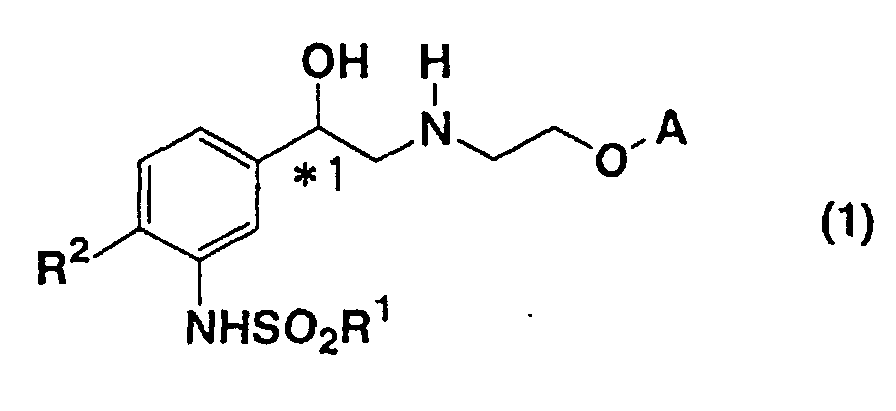 wherein R1 represents a lower alkyl group or a benzyl group; *1 represents an
asymmetric carbon atom; R2 represents a hydrogen atom, a halogen atom or a
hydroxyl group; and A represents one of the following groups:
wherein R1 represents a lower alkyl group or a benzyl group; *1 represents an
asymmetric carbon atom; R2 represents a hydrogen atom, a halogen atom or a
hydroxyl group; and A represents one of the following groups:
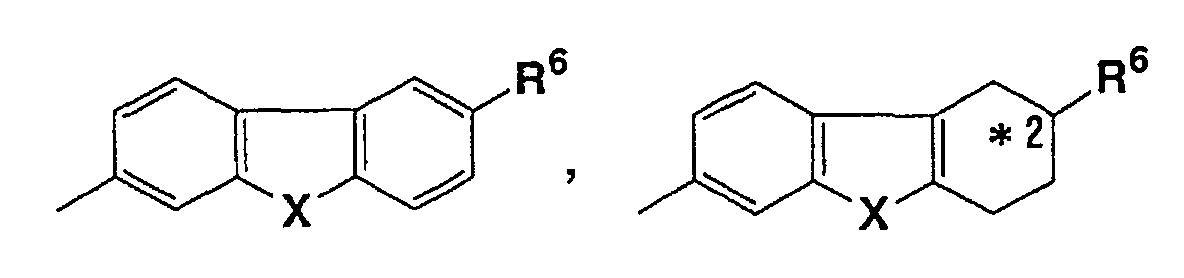 wherein X represents NH, O or S; R6 represents a hydrogen atom, a hydroxyl
group, an amino group or an acetylamino group; and *2 represents an asymmetric
carbon atom when R6 is not a hydrogen atom, and to intermediates useful for the
said processes. The processes of the present invention are convenient, practical
preparing processes with low cost which comprise a small number of steps with
good industrial work efficiency.
wherein X represents NH, O or S; R6 represents a hydrogen atom, a hydroxyl
group, an amino group or an acetylamino group; and *2 represents an asymmetric
carbon atom when R6 is not a hydrogen atom, and to intermediates useful for the
said processes. The processes of the present invention are convenient, practical
preparing processes with low cost which comprise a small number of steps with
good industrial work efficiency.
Description
- The present invention relates to a novel process for the preparation of tricyclic amino-alcohol derivatives or salts thereof which are useful for treating and preventing diabetes, obesity, hyperlipidemia and the like and have the formula (1):wherein
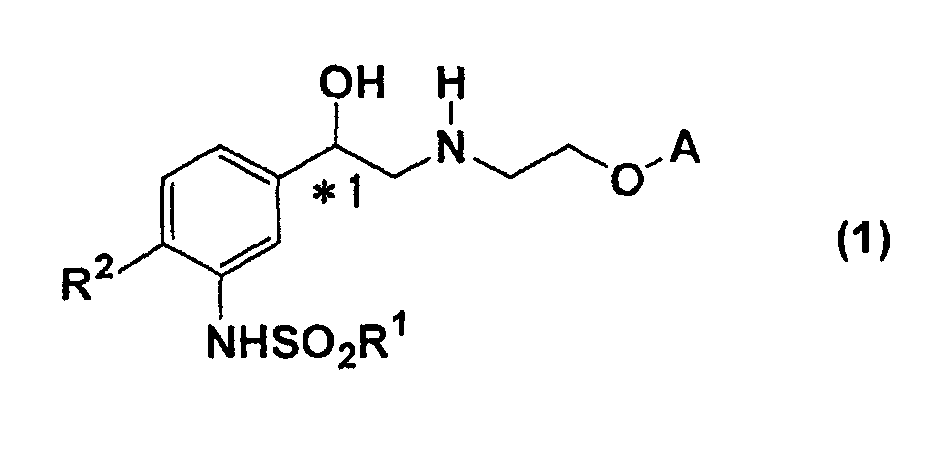
- R1 represents a lower alkyl group or a benzyl group;
- *1 represents an asymmetric carbon atom;
- R2 represents a hydrogen atom, a halogen atom or a hydroxyl group; and
- A represents one of the following groups:
wherein X represents NH, O or S; R6 represents a hydrogen atom, a hydroxyl group, an amino group or an acetylamino group; and *2 represents an asymmetric carbon atom when R6 is not a hydrogen atom. This invention also relates to intermediates useful for the preparing process.

-
- JP-A-9-249623 (WO 97/25311) and WO 99/01431 describe in detail processes for the preparation of the compounds of the above-mentioned general formula (1) and also describe that these compounds are very useful for treating and preventing diabetes, obesity, hyperlipidemia and the like.
- However, the study of the above known processes carried out by the present inventors showed that the said processes were not necessarily a practical process. There has been a need for a convenient, practical preparing process with low cost which comprises a small number of steps with good industrial work efficiency.
- The study carried out by the present inventors showed some disadvantages involved in the conventional processes for preparing a compound of the formula (1) set forth above, wherein the disadvantages were that the processes required many reaction steps and several purifying works such as chromatography, and did not necessarily provide a good yield. In addition, if an optical isomer, such as R-form of a compound of the formula (I) is to be finally obtained according to the synthesizing route disclosed in the above patent publications, the carbonyl group is reduced with borane as a reducing agent in the presence of a chiral auxiliary agent represented by the following general formula (15):This chiral auxiliary agent is very expensive and the process for the preparation thereof is very complicated. Moreover, the chiral auxiliary agent is a hazardous combustible substance and an asymmetric reduction using the said chiral auxiliary agent requires strictly anhydrous conditions, strict temperature controls, complicated works and the like, which will become problematic when the chiral auxiliary agent is industrially used.
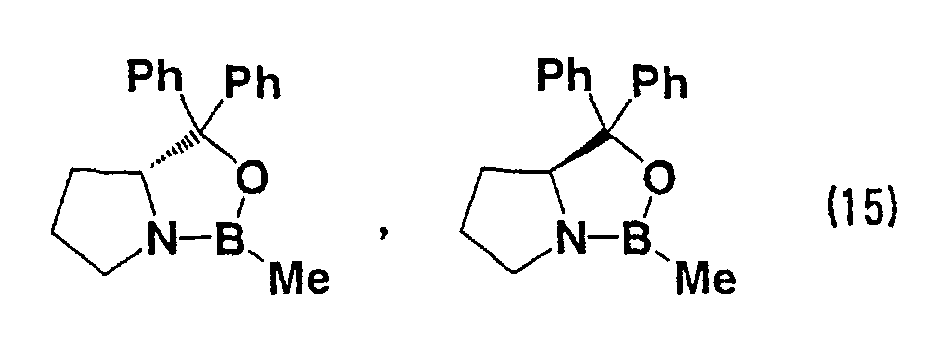
- In order to solve the above problems, the present inventors examined a variety of synthesizing processes. As a result, the present inventors have established preferred synthesizing processes succesfully and completed the present invention.
- That is, the aspect of the first synthesizing route of the present invention is a process for the preparation of a compound of the formula (1):wherein R1 represents a lower alkyl group or a benzyl group; R2 represents a hydrogen atom, a halogen atom or a hydroxyl group; *1 represents an asymmetric carbon atom; and A represents one of the following groups:
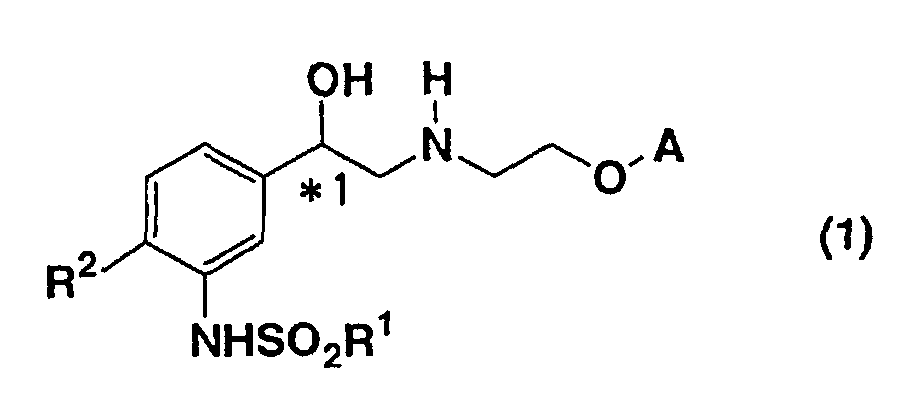 wherein X represents NH, O or S; R6 represents a hydrogen atom, a hydroxyl group, an amino group or an acetylamino group; and *2 represents an asymmetric carbon atom when R6 is not a hydrogen atom,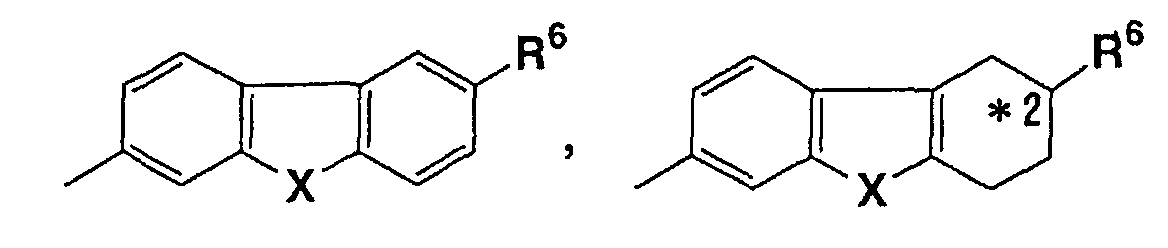
which comprises the following steps (a) to (c): - (a)
- i ) reacting a compound of the formula (4):
wherein R1 is as defined above; R21 represents a hydrogen atom, a halogen atom, a hydroxyl group or a protected hydroxyl group; R3 represents an amino-protecting group or a hydrogen atom, with a compound of the formula (12):
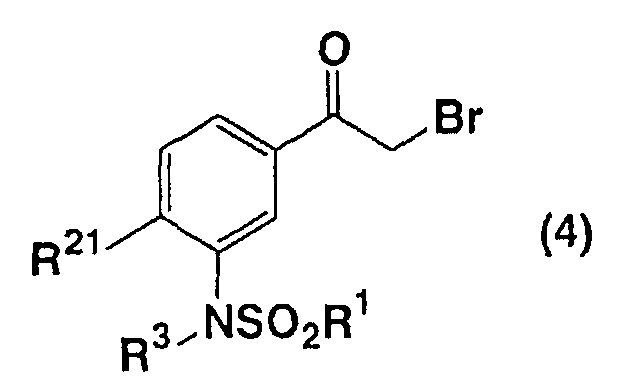 wherein R4 represents an amino-protecting group or a hydrogen atom; and A' represents one of the following groups:
 wherein X represents NH, O or S; R61 represents a hydrogen atom, a protected hydroxyl group, a protected amino group or an acetylamino group; and *2 represents an asymmetric carbon atom when R61 is not a hydrogen atom, to give a compound of the formula (3):
 wherein R1, R21 , R3 , R4 and A' are as defined above; or
- ii) coupling a compound of the formula (4) with a compound of the formula
(14):
wherein R4 is as defined above, to give a compound of the formula (6):
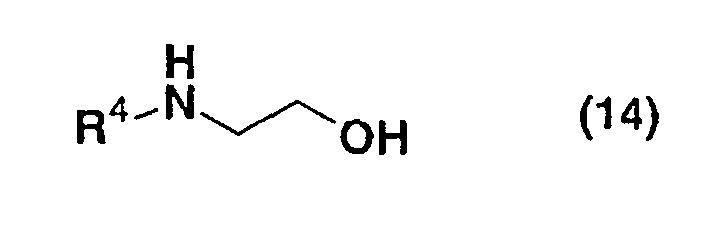 wherein R1, R21 , R3 and R4 are as defined above; or .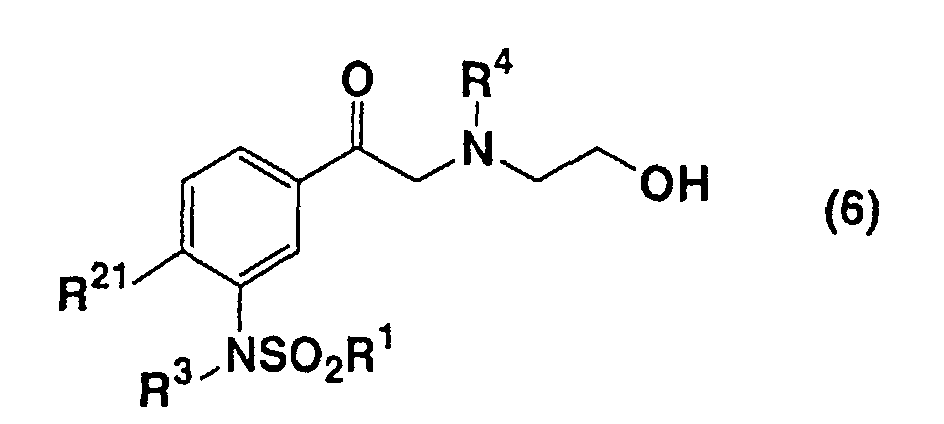
- iii) further converting the primary hydroxyl group of the compound of the
formula (6) into a leaving group B3 to give a compound of the formula (5):
wherein R1, R21 , R3 and R4 are as defined above, and B3 represents a leaving group; or

- iv) further reacting the resulting compound of the formula (5) with a compound represented by A'-OH wherein A' is as defined above to give a compound of the formula (3);
- (b) then reducing the resulting compound of any one of the formulae (3), (5)
and (6) to give a compound of the formula (2) as follows:
- i) reducing the compound of the formula (3) to give an amino-alcohol of the
formula (2):
wherein R1, R21, R3 , R4 and A' are as defined above, and *1 represents an asymmetric carbon atom; or
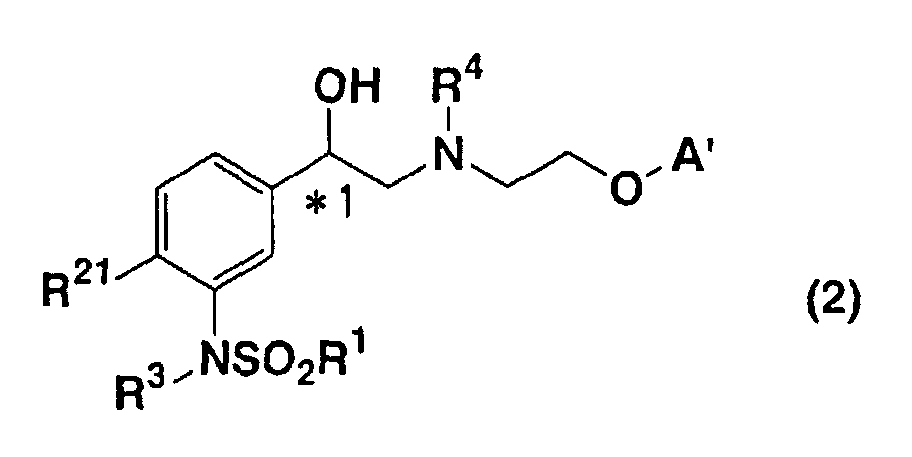
- ii) reducing the compound of the formula (5) to give a compound of the
formula (7):
wherein R1, R21, R3 , R4 and B3 are as defined above, and *1 represents an asymmetric carbon atom, or

- iii) reducing the compound of the formula (6) to give a compound of the
formula (8):
 wherein R1, R21, R3 and R4 are as defined above, and *1 represents an asymmetric
carbon atom, and converting the primary hydroxyl group of the resulting
compound of the formula (8) into a leaving group B3 to give a compound of the
formula (7), then reacting the compound of the formula (7) obtained by either step
as set forth above with a compound represented by A'-OH wherein A' is as
defined above to give an amino-alcohol of the formula (2); and
wherein R1, R21, R3 and R4 are as defined above, and *1 represents an asymmetric
carbon atom, and converting the primary hydroxyl group of the resulting
compound of the formula (8) into a leaving group B3 to give a compound of the
formula (7), then reacting the compound of the formula (7) obtained by either step
as set forth above with a compound represented by A'-OH wherein A' is as
defined above to give an amino-alcohol of the formula (2); and - (c) simultaneously or sequentially removing the protecting groups of the compound of the formula (2) obtained by any one of processes as set forth above to give a compound of the formula (1).
-
- The aspect of the first synthesizing route of the present invention is a process for the preparation of a compound of the above-mentioned general formula (1), which comprises the following steps (a) to (c):
- (a) reacting a compound of the formula (4):
wherein R1 is as defined above; R21 represents a hydrogen atom, a halogen atom, a hydroxyl group or a protected hydroxyl group; R3 represents an amino-protecting group or a hydrogen atom, with a compound of the formula (12):
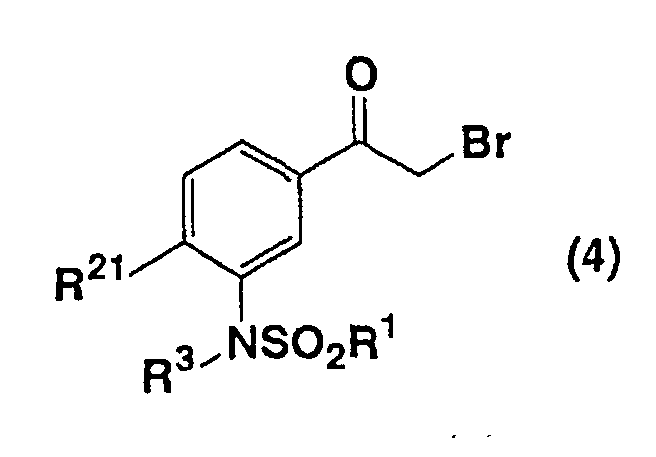 wherein R4 represents an amino-protecting group or a hydrogen atom; and A' represents one of the following groups:
 wherein X represents NH, O or S; R61 represents a hydrogen atom, a protected hydroxyl group, a protected amino group or an acetylamino group; and *2 represents an asymmetric carbon atom when R61 is not a hydrogen atom, to give a compound of the formula (3):
 wherein R1, R21, R3 , R4 and A' are as defined above;
- (b) reducing the resulting compound of the formula (3) to give an amino-alcohol
of the formula (2):
wherein R1, R21, R3 , R4 and A' are as defined above, and *1 represents an asymmetric carbon atom; and
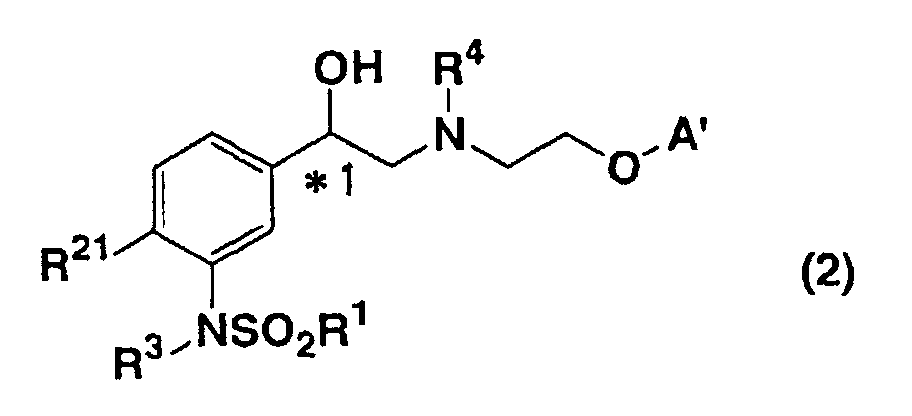
- (c) simultaneously or sequentially removing the protecting groups to give a compound of the formula (I).
-
- In the aspect of the first synthesizing route set forth above, a compound represented by the formula (3) is the first preferred intermediate which is a novel compound and is relatively good in crystallinity. The said compound does not necessarily need a column chromatography purifying step and may be used in the following reaction step after being subjected to a recrystallizing treatment and the like.
- Specific examples of a compound represented by the formula (3) include:
- 2-[N-benzyl-N-[2-(9H-carbazol-2-yloxy)]ethyl] amino-1-(3-methylsulfonylamino)phenylethanone;
- 2-[N-benzyl-N-[2-(9H-carbazol-2-yloxy)]ethyl]amino-1-[3-(N-benzyl-N-methylsulfonylamino)]phenylethanone;
- 2-[N-benzyl-N-[2-(9H-carbazol-2-yloxy)]ethyl]amino-1-(4-benzyloxy-3-methylsulfonylamino)phenylethanone;
- 2-[N-benzyl-N-[2-(9H-carbazol-2-yloxy)] ethyl] amino-1 -[4-benzyloxy-3-(N-benzyl-N-methylsulfonylamino)]phenylethanone;
- 2-[N-benzyl-N-[2-(9H-carbazol-2-yloxy)]ethyl]amino- 1 -(4..chloro-3-methylsulfonylamino)phenylethanone;
- 2-[N-benzyl-N-[2-(9H-carbazol-2-yloxy)]ethyl]amino-1 -[4-chloro-3-(N-benzyl-N-methylsulfonylamino)]phenylethanone;
- 2-[N-benzyl-N-[2-(9H-carbazol-2-yloxy)]ethyl]amino-1-(4-bromo-3-methylsulfonylamino)phenylethanone;
- 2-[N-benzyl-N-[2-(9H-carbazol-2-yloxy)]ethyl]amino-1-[4-bromo-3-(N-benzyl-N-methylsulfonylamino)]phenylethanone;
- 2-[N-benzyl-N-[2-(6-benzyloxy-9H-carbazol-2-yloxy)]ethyl]amino-1-[3-(N-benzyl-N-methylsulfonylamino)]phenylethanone;
- 2-[N-benzyl-N-[2-(6-benzyloxy-9H-carbazol-2-yloxy)]ethyl]amino-1-[4-benzyloxy-3-(N-benzyl-N-methylsulfonylamino)]phenylethanone; and
- 2-[N-benzyl-N-[2-(6-benzyloxy-9H-carbazol-2-yloxy)]ethyl]amino-1-(4-chloro-3-methylsulfonylamino)phenylethanone.
-
- The said examples also include:
- 2-[N-benzyl-N-[2-(dibenzothiophene-3-yloxy)]ethyl]amino-1-(4-benzyloxy-3-methylsulfonylamino)phenylethanone; and
- 2-[N-benzyl-N-[2-(dibenzothiophene-3-yloxy)]ethyl]amino-1-[4-benzyloxy-3-(N-benzyl-N-methylsulfonylamino)]phenylethanone.
-
- In the steps set forth above, the step in which a compound of the formula (3) is reduced to give a compound of the formula (2) is a particularly characteristic of the present process.
- In addition, when one of the optical isomers of a compound of the formula (1) is to be obtained in the steps set forth above, a compound of the formula (3) is preferably asymmetrically reduced. In this case, both of an amino-alcohol of the formula (2) and a compound of the formula (I) are obtained as one of their optical isomers, respectively. This is also characteristic of the present process.
- Further, in the steps set forth above, the step in which a compound of the formula (4) is reacted with a compound of the formula (12) to give a compound of the formula (3) is also characteristic of the present process.
- The aspect of the second synthesizing route of the present invention is a process for the preparation of a compound of the above-mentioned general formula (1), which comprises the following steps :
- reacting a compound of the formula (4) with a compound of the formula
(14):
wherein R4 is as defined above, to give a compound of the formula (6):
 wherein R1, R21, R3 and R4 are as defined above; and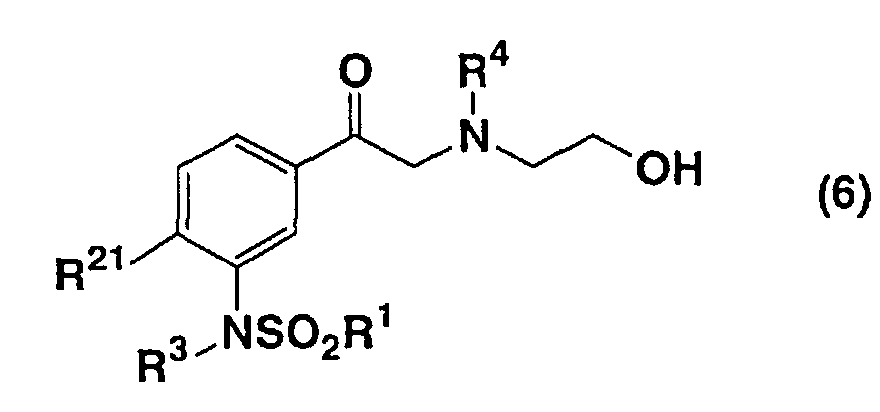
- (i) converting the terminal hydroxyl group (the primary hydroxyl group) of the
side-chain of the compound of the formula (6) into a leaving group B3 to give a
compound of the formula (5):
wherein R1, R21, R3 and R4 are as defined above, and B3 represents a leaving group; and reacting the compound of the formula (5) with a compound represented by A'-OH wherein A' is as defined above to give a compound of the formula (3); or
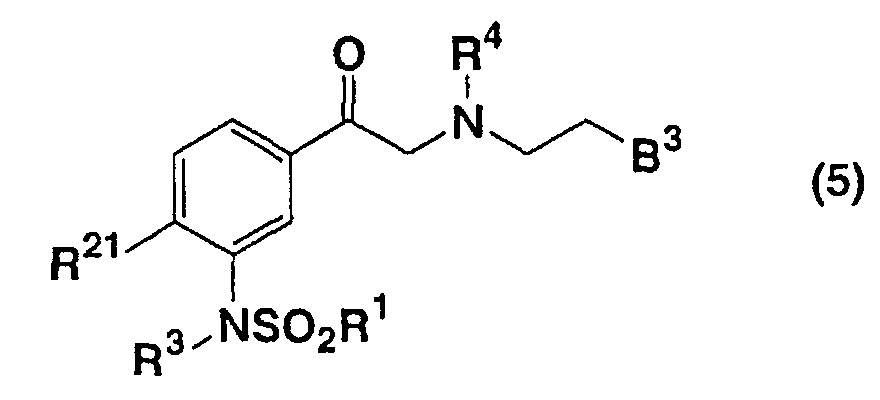
- (ii) reacting the compound of the formula (6) with a compound represented by A'-OH according to Mitsunobu reaction to give a compound of the formula (3); and then the compound of the formula (3), obtained by either step set forth above, is subjected to the sequential reaction steps as set forth above to give a compound of the formula (I) via a compound of the formula (2).
-
- In the aspect of the second synthesizing route set forth above, a compound represented by the formula (18) including the formulae (6) and (5), is the second preferred intermediate which is a novel compound. The said compound does not necessarily need a column chromatography purifying step and may be used in the following reaction step after being subjected to a recrystallizing treatment and the like.
- Specific examples of a compound represented by the formula (6) include:
- 2-[N-benzyl-N-(2-hydroxyethyl)]amino-1-[3-(N-benzyl-N-methylsulfonylamino)]phenylethanone;
- 2-[N-benzyl-N-(2-hydroxyethyl)] amino-1-[4-benzyloxy-3-(N-benzyl-N-methylsulfonylamino)]phenylethanone;
- 2-[N-benzyl-N-(2-hydroxyethyl)]amino-1-[4-chloro-3-(N-benzyl-N-methylsulfonylamino)]phenylethanone; and
- 2-[N-benzyl-N-(2-hydroxyethyl)]amino-1-[4-bromo-3-(N-benzyl-N-methylsulfonylamino)]phenylethanone.
-
- Further, examples of a compound represented by the formula (5) include:
- 2-[N-benzyl-N-(2-bromoethyl)]amino-1-[3-(N-benzyl-N-methylsulfonylamino)]phenylethanone;
- 2-[N-benzyl-N-(2-bromoethyl)]amino-1-[4-benzyloxy-3-(N-benzyl-N-methylsulfonylamino)]phenylethanone;
- 2-[N-benzyl-N-(2-bromoethyl)]amino-1-[4-chloro-3-(N-benzyl-N-methylsulfonylamino)]phenylethanone; and
- 2-[N-benzyl-N-(2-bromoethyl)]amino-1-[4-bromo-3-(N-benzyl-N-methylsulfonylamino)]phenylethanone.
-
- In the steps set forth above, the step in which a compound of the formula (4) is reacted with a compound of the formula (14) to give a compound of the formula (6) is also characteristic of the present process.
- In the steps set forth above, the step in which a compound of the formula (6) is react with a compound represented by A'-OH according to Mitsunobu reaction to give a compound of the formula (3) is also characteristic of the present process.
- The aspect of the third synthesizing route of the present invention is a process for the preparation of a compound of the above-mentioned general formula (1), which comprises the following steps:
- reducing a compound of the formula (5) to give a compound of the formula
(7):
 wherein R1, R21 ,R3 R4 , B3 and *1 are as defined above, which is then condensed
with a compound represented by A'-OH to give an amino-alcohol of the formula
(2). The amino-alcohol is subjected to the same reactions with those as set forth
above to give a compound of the formula (1).
wherein R1, R21 ,R3 R4 , B3 and *1 are as defined above, which is then condensed
with a compound represented by A'-OH to give an amino-alcohol of the formula
(2). The amino-alcohol is subjected to the same reactions with those as set forth
above to give a compound of the formula (1). -
- In this synthesizing route, the reduction of a compound of the formula (5) can be carried out by asymmetrically reducing method to give one of the optical isomers of a compound of the formula (7), which can be then subjected to the following steps to give one of the optical isomers of each compound of the formulae (2) and (1). These steps are characteristic of the present process.
- In the aspect of the third synthesizing route set forth above, a compound of the formula (7), which is included within the formula (19), is novel and is the third preferred intermediate. The compound does not necessarily need a column chromatography purifying step and may be used in the following reaction step after being subjected to a recrystallizing treatment and the like.
- Specific examples of a compound represented by the formula (7) include:
- 2-[N-benzyl-N-(2-bromoethyl)]amino-1-[3-(N-benzyl-N-methylsulfonylamino)]phenylethanol;
- 2-[N-benzyl-N-(2-bromoethyl)]amino-1-[4-chloro-3-(N-benzyl-N-methylsulfonylamino)]phenylethanol;
- 2-[N-benzyl-N-(2-bromoethyl)]amino-1-[4-bromo-3-(N-benzyl-N-methylsulfonylamino)]phenylethanol; and
- 2-[N-benzyl-N-(2-bromoethyl)]amino-1-[4-benzyloxy-3-(N-benzyl-N-methylsulfonylamino)]phenylethanol.
-
- The aspect of the fourth synthesizing route of the present invention is a process for the preparation of a compound of the above-mentioned general formula (1), which comprises the following steps :
- reducing a compound of the formula (6) to give a compound of the formula
(8):
wherein R1, R21, R3 , R4 and *1 are as defined above;

- (i) converting the terminal hydroxyl group of the side-chain of the compound of the formula (8) into a leaving group B3 to give a compound of the above-mentioned general formula (7), which was then condensed with a compound represented by A'-OH to give a compound of the formula (2); or
- (ii) reacting a compound of the formula (8) with a compound represented by A'-OH according to Mitsunobu reaction to give a compound of the formula (2); and subjecting the compound of the formula (2) , obtained by either step, to deprotecting treatment as set forth above to give the compound of the formula (I).
-
- In this synthesizing route, the reduction of a compound of the formula (6) can be carried out by asymmetrically reducing method to give one of the optical isomers of a compound of the formula (8), which can be then subjected to the following steps to give one of the optical isomers of each compound of the formulae (7), (2) and (1). These steps are characteristic of the present process.
- In the aspect of the fourth synthesizing route set forth above, a compound of the formula (8) , which is included within the formula (19), is novel and is the third preferred intermediate. The compound does not necessarily need a column chromatography purifying step and may be used in the following reaction step after being subjected to a recrystallizing treatment and the like.
- Specific examples of a compound represented by the formula (8) include:
- 2-[N-benzyl-N-(2-hydroxyethyl)]amino-1-[3-(N-benzyl-N-methylsulfonylamino)]phenylethanol;
- 2-[N-benzyl-N-(2-hydroxyethyl)]amino-1-[4-benzyloxy-3-(N-benzyl-N-methylsulfonylamino)]phenylethanol;
- 2-[N-benzyl-N-(2-hydroxyethyl)]amino-1-[4-chloro-3-(N-benzyl-N-methylsulfonylamino)]phenylethanol; and
- 2-[N-benzyl-N-(2-hydroxyethyl)]amino-1-[4-bromo-3-(N-benzyl-N-methylsulfonylamino)]phenylethanol.
-
- In the aspect of the fourth synthesizing route set forth above, the step in which a compound of the formula (8) is react with a compound represented by A'-OH according to Mitsunobu reaction to give a compound of the formula (2) is characteristic of the present process and is preferred.
- Furthermore, the aspect of the fifth synthesizing route of the present invention is a process for the preparation of a compound of the above-mentioned general formula (1), which comprises the following steps .
- condensing a compound of the formula (4) with a compound of the formula
(13):
wherein B1 and B2 may be the same or different and represent a halogen atom, to give a compound of the formula (11):
 wherein R1, R21, R3 and B1 are as defined above;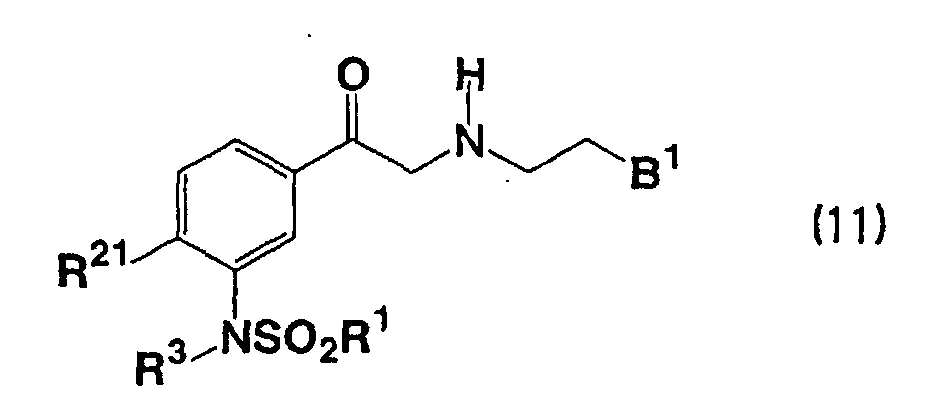
- reducing the compound of the formula (11) to give a compound of the
formula (10):
wherein R1, R21, R3 , B1 and *1 are as defined above, and

- protecting the amino group of which is then protected with an amino-protecting
group R5, followed by condensing the compound with a compound
represented by A'-OH to give a compound of the formula (9):
wherein R1, R21, R3 , A' and *1 are as defined above, and R5 represents an amino-protecting group; and
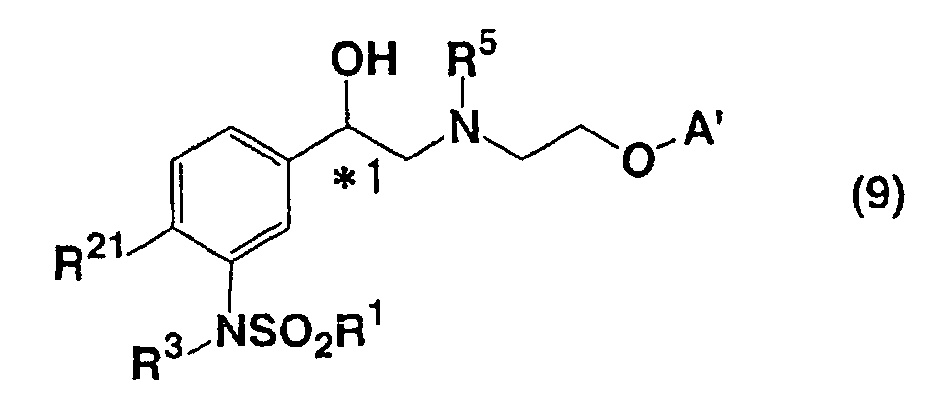 simultaneously or sequentially removing the protecting groups to give a
compound of the formula (1).
simultaneously or sequentially removing the protecting groups to give a
compound of the formula (1). -
- In this synthesizing route, the reduction of a compound of the formula (11) can be carried out by asymmetrically reducing method to give one of the optical isomers of a compound of the formula (10), which can be then subjected to the following steps to give one of the optical isomers of each compound of the formulae (9) and (1). These steps are characteristic of the present process.
- In the aspect of the fifth synthesizing route set forth above, a compound of the formula (11), which is included within the formula (18), and a compound of the formula (10), which is included within the formula (19), are novel and are the forth and fifth preferred intermediates. The compounds do not necessarily need a column chromatography purifying step and may be used in the following reaction step after being subjected to a recrystallizing treatment and the like.
- As used herein, "halogen atom" includes fluorine, chlorine, bromine and iodine, and among them, chlorine, bromine or iodine atom is generally preferred. Chlorine and bromine are particularly preferred.
- R21 and R2 may be a hydrogen atom, a halogen atom or a hydroxyl group (R21 may also be a protected hydroxyl group), with hydrogen being particularly preferred. A halogen atom is also preferred as R21 and R2. The halogen atom may be fluorine, chlorine or bromine, with chlorine and bromine being particularly preferred.
- The leaving groups B1 and B3 may be, for example, a halogen atom or a substituted sulfonyloxy group. The halogen atom includes chlorine, bromine and iodine. The substituted sulfonyloxy group includes methanesulfonyloxy, p-toluenesulfonyloxy and trifluoromethane-sulfonyloxy and the like.
- B2 is a halogen atom, with chlorine, bromine and iodine being generally preferred. Chlorine and bromine are particularly preferred.
- The term "lower alkyl" means a straight or branched saturated hydrocarbon containing 1 to 6 carbon atoms and may be preferably a straight or branched alkyl group, such as methyl, ethyl, n-propyl, i-propyl, n-butyl, i-butyl, sec-butyl, tertbutyl, pentyl and hexyl, or a cycloalkyl group such as cyclopropyl, cyclobutyl, cyclopentyl and cyclohexyl. Methyl is particularly preferred.
- R1 may be preferably the lower alkyl group as set forth above, with methyl being particularly preferred. A benzyl group may be also preferred as R1.
- R3 and R4 may be a hydrogen atom and are preferably an amino-protecting group. Examples of the amino-protecting group include, for example, an acyl group, an acyloxy group and an easily removable aralkyl group. The easily removable aralkyl group may be benzyl, substituted benzyl, naphthyl or substituted naphthyl and the like, with benzyl being particularly preferred. The aralkyl group to be used may be, for example, an aralkyl group containing 7 to 16 carbon atoms. Specific examples thereof include benzyl, phenethyl, 3-phenylpropyl, 4-phenylbutyl, (1 -naphthyl)methyl, 2-(1-naphthyl)ethyl and 2-(2-naphthyl)ethyl, wherein the phenyl or naphthyl moiety may have suitable substituents such as alkyl group, alkoxy group and halogen atom on suitable positions.
- The amino-protecting group R5 may be, for example, an easily removable acyl or acyloxy group. The acyl or acyloxy group may be, for example, acetyl, haloacetyl, benzoyl, substituted benzoyl, tert-butoxycarbonyl, benzyloxycarbonyl or 9-fluorenylmethoxycarbonyl, with tert-butoxycarbonyl being particularly preferred.
- R61 and R6 in A' and A may be a hydrogen atom, a hydroxyl group (in case of R61, a protected hydroxyl group), an amino group (in case of R61, a protected amino group) or an acetylamino group, with hydrogen being particularly preferred. In addition, a hydroxyl group (in case of R61, a protected hydroxyl group) may be also preferred. *2 represents an asymmetric carbon atom and a compound containing *2 may be an optically active or racemic compound.
- A carbazole group is particularly preferred as A.
- Each compound of the formulae (1), (2), (7), (8), (9) and (10), in which formulae *1 means an asymmetric carbon atom, can be in the form of two optical isomers. Therefore, not only optically pure isomers of the said compounds, but also a mixture of any two isomers are encompassed in the present invention. From the viewpoint of pharmacological activity, a preferred configuration of the asymmetric carbon may be the absolute configuration R.
- The hydroxyl-protecting group is not limited as long as it is commonly used as a hydroxyl-protecting group. Preferred examples of easily and selectively removable protecting group generally include, for example, a trialkylsilyl group, an alkoxyalkyl group and an acyl group. These hydroxyl-protecting groups can be introduced and removed by a known method indicated in literatures (for example, T. W. Greene, P. G. M. Wuts, et al., Protective Groups in Organic Synthesis, Wiley-Interscience Publication). For example, a tert-butyldimethylsilyl group (TBDMS) may be introduced into the alcohol by treating the alcohol with a sililating agent such as tert-butyldimethylchlorosilane or tert-butyldimethylsilyl trifluoromethanesulfonate in the presence of an acid scavenger. The amount of the sililating agent to be added may be generally about 1.0 to 1.5 mol for 1 mol of the alcohol. Generally, this reaction is preferably carried out in an inert medium. The inert medium may be, for example, dichloromethane, tetrahydrofuran, acetonitrile or pyridine. The inert medium may be preferably N,N-dimethylformamide. The amount of the inert medium to be used may be about 1 to 5 mL for 1 g of the alcohol. The acid scavenger may be triethylamine, N,N-diisopropylethylamine, pyridine, N,N-dimethylaminopyridine and the like. The acid scavenger may be, for example, preferably imidazole. The amount of the acid scavenger to be added may be generally about 1 to 3 mol for 1 mol of the alcohol. Generally, this reaction is preferably carried out at a temperature of about -20 to 80°C, particularly about 0°C to room temperature, for example, for 1 to 5 hours.
- A benzyloxymethyl group (BOM) may be introduced into the alcohol by treating the alcohol with chloromethyl benzyl ether in the presence of an acid scavenger. The amount of chloromethyl benzyl ether to be added may be generally about 1.0 to 1.5 mol for 1 mol of the alcohol. Generally, this reaction is preferably carried out in an inert medium. The inert medium may be tetrahydrofuran, acetonitrile, N,N-dimethylformamide and the like. The inert medium may be preferably dichloromethane. The amount of the inert medium to be used may be about 1 to 5 mL for 1 g of the alcohol. The acid scavenger may be, for example, triethylamine, pyridine or N,N-dimethylaminopyridine. The acid scavenger may be preferably N,N-diisopropylethylamine. The amount of the acid scavenger to be added may be generally about 1 to 3 mol for 1 mol of the alcohol. Generally, this reaction is preferably carried out at a temperature of about -20 to 80°C, particularly about 0°C to room temperature, for example, for 1 to 5 hours.
- In addition, an acetyl group (Ac) may be introduced into the alcohol by treating the alcohol with an acetylating agent such as acetic anhydride, acetyl chloride and the like in the presence of an acid scavenger. The amount of the acetylating agent to be added may be generally about 1 to 3 mol for 1 mol of the alcohol. Generally, this reaction is preferably carried out in an inert medium. The inert solvent may be , for example, preferably tetrahydrofuran, acetonitrile, dichloromethane or pyridine. The amount of the inert medium to be used may be about 1 to 5 mL for 1 g of the alcohol. The acid scavenger may be, for example, preferably triethylamine, N,N-diisopropylethylamine, pyridine or N,N-dimethylaminopyridine. The amount of the acid scavenger to be added may be generally about 1 to 3 mol for 1 mol of the alcohol. Generally, this reaction is preferably carried out at a temperature of about -20 to 80°C, particularly about 0°C to room temperature, for example, for 1 to 5 hours.
- The hydroxyl-protecting group can be removed as follows. For example, a tert-butyldimethylsilyl group may be removed by treating a tert-butyldimethylsilyl ether with tetrabutylammonium fluoride. The amount of tetrabutylammonium fluoride to be added may be generally about 1 to 3 mol for 1 mol of the tert-butyldimethylsilyl ether. Generally, this reaction is preferably carried out in a medium such as tetrahydrofuran. The amount of the medium to be used may be generally about 1 to 5 mL for 1 g of the alcohol. Generally, this reaction is preferably carried out at a temperature of about -20 to 60°C, particularly about 0°C to room temperature, for example, for 1 to 5 hours. This reaction is preferably carried out in the presence of acetic acid. The amount of acetic acid to be added may be generally about 1 to 2 mol for 1 mol of the tert-butyldimethylsilyl ether.
- A benzyloxymethyl group may be removed, for example, by hydrogenolysis reaction using a catalyst such as palladium/carbon or palladium hydroxide/carbon. The amount of the catalyst to be used may be generally about 5 to 20% by weight with respect to the benzyloxymethyl ether. Generally, this reaction is preferably carried out in a medium such as methanol, ethanol, tetrahydrofuran, acetic acid and the like. The amount of the medium to be used may be generally about 1 to 5 mL for 1 g of the benzyloxymethyl ether. Generally, this reaction is preferably carried out at a temperature of about -10 to 50°C, particularly at room temperature, for example, for 3 to 10 hours.
- An acetyl group may be removed by subjecting an acetic ester to hydrolysis reaction using a base such as sodium carbonate, potassium carbonate, sodium hydroxide, potassium hydroxide and the like. The amount of the base to be added may be generally about 0.1 to 10 mol for 1 mol of the acetic ester. Generally, this reaction is preferably carried out in a medium such as methanol, ethanol, tetrahydrofuran or 1,4-dioxane, or a water-mixed medium thereof. The amount of the medium to be used may be generally about 1 to 5 mL for 1 g of the acetic ester. Generally, this reaction is preferably carried out at a temperature of about -20 to l00°C, particularly about 0 to 50°C, for example, for 1 to 5 hours.
- In accordance with the present invention, a compound having the hydroxyl group attached to the asymmetric carbon atom *1, which is derived from the reduction of the corresponding carbonyl group, can be used in the following reactions without protection of the hydroxyl group. It is preferred, however, that such a compound is used after being protected with a suitable protecting group as occasion requires. .
- The amino-protecting group can be removed by a known method indicated in literatures (for example, T. W. Greene, P. G. M. Wuts, et al., Protective Groups in Organic Synthesis, Wiley-Interscience Publication). For example, a benzyl group may be removed by hydrogenolysis reaction using a catalyst such as palladium/carbon or palladium hydroxide/carbon. The amount of the catalyst to be used may be generally about 5 to 20% by weight with respect to the protected amine. Generally, this reaction is preferably carried out in a medium such as methanol, ethanol, tetrahydrofuran, acetic acid and the like. The amount of the medium to be used may be generally about 1 to 5 mL for 1 g of the protected amine. Generally, this reaction is preferably carried out at a temperature of about -10 to 50°C, particularly at room temperature, for example, for 3 to 10 hours. When R21 is a halogen atom, however, the amino-protecting group is removed by a known method indicated in the literatures (M. Koreeda et al., Journal of Organic Chemistry, 49, p. 2081 (1984) and S. Gubert et al., Synthesis. 4, p.318 (1991)).
- An acetyl group may be removed according to the acetic ester-hydrolyzing process using basic condition as set forth above. When an acyl group is used as the amino-protecting group, however, it may be preferred that this hydrolysis reaction is generally carried out at a temperature of room temperature to about 100°C.
- A tert-butoxycarbonyl group (Boc) may be removed by reacting the corresponding protected amine with a known mineral acid or Lewis acid. The known mineral acid or Lewis acid may be hydrochloric acid, hydrobromic acid, sulfuric acid, acetic acid, trifluoroacetic acid, aluminum chloride, bromotrimethylsilane, iodotrimethylsilane and the like, with hydrochloric acid being preferred. The amount of the mineral acid or Lewis acid to be added may generally vary from about the same molar amount with respect to the protected amine to a solvent amount with respect to the protected amine. This reaction can be carried out in a medium. However, this reaction may also be preferably carried out using the above acid as a medium. The medium may be a lower alcohol such as methanol, ethanol and n-propanol, 1,4-dioxane, tetrahydrofuran, acetonitrile, dichloromethane and the like, with methanol and ethanol being preferred. Generally, this reaction is preferably carried out at a temperature of about -30 to l00°C, particularly about 0°C to room temperature, for example, for 1 to 10 hours.
- The hydroxyl- and amino-protecting groups may be sequentially or simultaneously removed. For example, when R21 is a benzyloxy group, R3 is a benzyl group and R4 is a benzyl or benzyloxycarbonyl group respectively, they can be removed under the same reaction condition and are preferably simultaneously removed. When R21 is a benzyloxy group and R4 is a tert-butoxycarbonyl group respectively, they can be removed by sequential steps comprising, for example, the first removal of the tert-butoxycarbonyl group as R4 followed by the removal of the benzyloxy group as R21. The sequence of removal is not limit to the above and is preferably selected depending on the physical properties of the compound to be deprotected. The condition for removing each protecting group is as set forth above. In addition, these deprotection can be carried out with reference to the teachings of JP-A-9-249623.
- Examples of a compound represented by the formula (1) include
- 2-[N-[2-(9H-carbazol-2-yloxy)]ethyl]amino-1-(3-methylsulfonylamino)phenylethanol;
- 2-[N-[2-(9H-carbazol-2-yloxy)]ethyl]amino-1-(4-hydroxy-3-methylsulfonylamino)phenylethanol;
- 2-[N-[2-(9H-carbazol-2-yloxy)]ethyl]amino-1-(4-bromo-3-methylsulfonylamino)phenylethanol;
- 2-[N-[2-(9H-carbazol-2-yloxy)]ethyl]amino-1-(4-chloro-3-methylsulfonylamino)phenylethanol; and
- 2-[N-[2-(6-hydroxy-9H-carbazol-2-yloxy)]ethyl]amino-1-(3-methylsulfonylamino)phenylethanol. The most preferred examples are the above-mentioned compounds in the R-form.
-
- The processes for the preparation of a compound represented by the formula (1) according to the present invention are illustrated in more detail in the followings.
- A compound of the formula (4) is condensed with a compound of the formula (12) to give a compound of the formula (3), which is then reduced to give an amino-alcohol of the formula (2). At the final step, the protecting groups are simultaneously or sequentially removed to give a compound of the formula (1).
- A compound represented by the formula (4) is a known compound and can be synthesized by the method indicated in the literature (A. A. Larsen et al., J Med. Chem., 10, p. 462 (1967), or C. Kaiser et al., J. Med Chem., Z, p. 49 (1974)).
- A compound represented by the formula (3), which is a novel compound and is relatively good in crystallinity, is characteristic of the present process as an . important intermediate. The recrystallizing step can be carried out by a commonly applicable means, which may be preferably a means comprising dissolving a compound of the formula (3) in a lower alcohol such as methanol or ethanol, followed by cooling to allow the compound to crystallize.
- A compound represented by the formula (3) can be obtained by reacting a compound of the formula (4) with a compound of the formula (12). The amount of the compound of the formula (12) to be added may be about 0.9 to 5 mol for 1 mol of the compound of the formula (4). Generally, this reaction is preferably carried out in an inert medium. The inert medium may be, for example, acetonitrile, acetone, methyl ethyl ketone, methanol, ethanol, tetrahydrofuran or dichloromethane, with tetrahydrofuran being preferred. The amount of the inert medium to be used may be generally about 1 to 100 mL for 1 g of the compound of the formula (4).
- Generally, this reaction is preferably carried out at a temperature of about - 20°C to 100°C, particularly about 0 to 50°C, for example, for 3 to 10 hours. This reaction is also preferably carried out in the presence of a base as an acid scavenger. As the base, a tertiary amine or an inorganic base can be used. The tertiary amine may be, for example, triethylamine, N,N-diisopropylethylamine or N,N-dimethylaminopyridine. The inorganic base may be, for example, potassium carbonate or potassium hydrogen carbonate. The amount of the acid scavenger to be used may be generally 1 to 5 mol for 1 mol of the compound of the formula (4).
- A compound represented by the formula (12) can be obtained by protecting a primary amine which is a known compound represented by the formula:(synthesized by the known method indicated in JP-A-9-249623) with a protecting group R4. That is, when R4 is a benzyl group, the protecting step can be carried out by reductive alkylation reaction with benzaldehyde, or by alkylation reaction with benzyl halide, benzyl sulfonate and the like. For example, the amount of benzaldehyde to be added according to the reductive alkylation reaction may be generally about 1 to 1.5 mol for 1 mol of the compound of the formula (12). Generally, this reaction is preferably carried out in a medium such as tetrahydrofuran, water, methanol or ethanol. Methanol may be most preferably used as the medium. The amount of the medium to be used may be generally about 10 to 100 mL for 1 g of the compound of the formula (12). Generally, this reaction is preferably carried out at room temperature, for example, for 3 to 10 hours. Further, it is also preferred that this reaction is generally carried out in the presence of a platinum group metal-comprising catalyst. The platinum group metal-comprising catalyst may be preferably platinum oxide. The amount of the platinum group metal-comprising catalyst to be used may be generally about 0.01 to 0.1 mol for 1 mol of the compound of the formula (12). This reaction is to be carried out under a hydrogen atmosphere. Generally, it may be preferably carried out at a pressure of about 1 to 10 atm, particularly preferably about 1 to 3 atm.

- Alternatively, a compound represented by the formula (12) may be synthesized from a compound represented by A'-OH by a process consisting of 2 steps. That is, a compound of the formula (12) can be obtained by reacting a known compound of A'-OH with 1,2-dibromoethane to give the corresponding brominated compound, followed by reacting with an amine (NH2-R4)(in case that R4 is a substituted benzyl group).
- The reaction between a compound represented by A'-OH and 1,2-dibromoethane may be carried out in an organic solvent, generally in the presence of a base at a temperature of room temperature to the reflux temperature of the thus selected solvent. The amount of 1,2-dibromoethane to be used is preferably 3 to 15 mol for 1 mol of the compound of A'-OH. The solvent may be dimethylformamide, dimethylacetamide, 2-butanone, acetonitrile, diglyme or tetrahydrofuran. The base may be potassium carbonate, sodium carbonate, sodium hydroxide, potassium hydroxide, triethylamine, pyridine, sodium hydride, sodium methoxide and the like, which is preferably used at an amount of 1 to 5 mol for 1 mol of the compound of A'-OH. The amount of the medium to be used is generally about 5 to 100 mL for 1 g of the compound of A'-OH. Generally, this reaction is preferably carried out at a temperature of 60 to 90°C, for example, for 3 to 24 hours.
- The reaction of the brominated compound with NH2-R4 may be carried out in a solvent or without solvent at a temperature of 60 to 100°C. The amount of NH2-R4 to be used may be 2 to 10 mol for 1 mol of the brominated compound. The solvent may be dimethylformamide, dimethylacetamide, dimethylsulfoxide, 2-propanol and the like.
- A compound represented by the formula (2) can be obtained by reducing a compound represented by the formula (3) with a known reducing agent. The reducing agent may be, for example, sodium borohydride, borane or diisobutylaluminum hydride. The reducing reaction may be preferably carried out with a metal hydride such as sodium borohydride, or with hydrogen in the presence of a platinum group metal-comprising catalyst such as palladium catalyst. The amount of sodium borohydride to be added may be generally about 1 to 3 mol for 1 mol of the compound of the formula (3). Generally, this reaction is preferably carried out in a lower alcohol. The lower alcohol may be, for example, methanol or i-propanol, and is preferably ethanol. The amount of the lower alcohol to be used may be generally about 1 to 5 mL for 1 g of the compound of the formula (3). However, when the solubility is insufficient, it may be preferred that tetrahydrofuran as a cosolvent is generally added in an amount of about 1 to 5 mL for 1 g of the compound of the formula (3). Generally, this reaction is preferably carried out at a temperature of about -20 to 50°C, particularly about 0°C to room temperature, for example, for 1 to 5 hours.
- In addition, if an optical isomer of either R-form or S-form with respect to *1 of the formula (2) is to be obtained, it can be obtained by asymmetric reduction in the presence of an asymmetric reduction catalyst known from a variety of literatures (for example, Achiwa et al. Chem. Pharm., Bull., 43, p. 748 (1995) or Nozaki et al. J. Org. Chem., 59, pp. 3064-3076 (1994).
- The method of Nozaki et al. is concerned with an asymmetric reduction with respect to l,1-dimethylaminoacetone, in which method a cationic ruthenium-BINAP(2,2'-bis(diphenylphosphino)-1,1'-binaphthyl) complex of [RuI((S)-BINAP)(p-cymene)]+ I - is used, and this method may also be preferred for the present invention.
- Further, WO 97/20789 and JP-A-9-157196 each teach a variety of processes for the preparation of an optically active alcohol from a ketone compound. Such processes use a metal complex comprising a transition metal with various ligands, more preferably, for example, a transition metal complex which may be represented by MXmLn wherein M represents a transition metal of the VIII group such as iron, cobalt, nickel, ruthenium, rhodium, iridium, osmium, palladium or platinum; X represents a hydrogen atom, a halogen atom, a carboxyl group, a hydroxyl group or an alkoxyl group; L represents a neutral ligand such as an aromatic compound or an olefin compound; m and n represent an integer. Ruthenium is a preferred transition metal to be contained in such transition metal complexes. When the neutral ligand is an aromatic compound, it may be a monocyclic aromatic compound. The aromatic compound may be substituted with various substituents such as a hydrogen atom, a saturated or unsaturated hydrocarbon group, an allyl group or a functional group containing heteroatom(s), at any positions of the aromatic compound, and the number of the substituents is not limited. The substituents may be specifically an alkyl group such as methyl, ethyl, propyl, i-propyl, butyl, tert-butyl, pentyl, hexyl, heptyl and the like; a cycloalkyl group such as cyclopropyl, cyclobutyl, cyclopentyl, cyclohexyl and the like; an unsaturated hydrocarbon group such as benzyl, vinyl, allyl and the like; or a functional group containing heteroatom(s) such as hydroxyl group, alkoxyl group, alkoxycarbonyl group and the like.
- In addition, specific examples of metal complex include the followings.
- [(R,R)-N-(p-toluenesulfonyl)-1,2-diphenylethylenediamine]benzene ruthenium complex;
- [(R,R)-N-(p-toluenesulfonyl)-1,2-diphenylethylenediamine] (p-cymene) ruthenium complex;
- [(R,R)-N-(o-toluenesulfonyl)-l,2-diphenylethylenediamine] (p-cymene) ruthenium complex;
- [(R,R)-N-(2-mesitylenesulfonyl)-1,2-diphenylethylenediamine] (p-cymene) ruthenium complex;
- ((R,R)-N-methanesulfonyl-1,2-diphenylethylenediamine)(p-cymene) ruthenium complex;
- ((R,R)-N-benzenesulfonyl-1,2-diphenylethylenediamine)(p-cymene) ruthenium complex;
- [(R,R)-N-(p-fluorobenzenesulfonyl)-1,2-diphenylethylenediamine] (p-cymene) ruthenium complex;
- ((R,R)-N-trifluoromethanesulfonyl-1,2-diphenylethylenediarnine) (p-cymene) ruthenium complex;
- [(R,R)-N-(p-methoxybenzenesulfonyl)-1,2-diphenylethylenediamine](p-cymene) ruthenium complex;
- ((R,R)-N-methanesulfonyl-1,2-diphenylethylenediamine)mesitylene ruthenium complex;
- [(R,R)-N-(p-toluenesulfonyl)-1,2-diphenylethylenediamine] mesitylene ruthenium complex;
- hydride-[(R,R)-N-(p-toluenesulfonyl)-1,2-diphenylethylenediamine]benzene ruthenium complex;
- hydride-[(R,R)-N-(p-toluenesulfonyl)-1,2-diphenylethylenediamine](p-cymene) ruthenium complex;
- hydride-[(R,R)-N-(o-toluenesulfonyl)-1 ,2-diphenylethylenediamine] (p-cymene) ruthenium complex;
- hydride-[(R,R)-N-(2-mesitylenesulfonyl)-1,2-diphenylethylenediamine] (p-cymene) ruthenium complex;
- hydride-((R,R)-N-methanesulfonyl-1,2-diphenylethylenediamine)(p-cymene) ruthenium complex;
- hydride-((R,R)-N-benzenesulfonyl-1,2-diphenylethylenediamine)(p-cymene) ruthenium complex;
- hydride-[(R,R)-N-(p-fluorobenzenesulfonyl)-1,2-diphenylethylenediamine](p-cymene) ruthenium complex;
- hydride-((R,R)-N-trifluoromethanesulfonyl-1,2-diphenylethylenediamine)(p-cymene) ruthenium complex;
- hydride-[(R,R)-N-(p-methoxybenzenesulfonyl)- 1,2-diphenylethylenediamine](p-cymene) ruthenium complex;
- hydride-((R,R)-N-methanesulfonyl-1,2-diphenylethylenediamine)mesitylene ruthenium complex;
- hydride-[(R,R)-N-(p-toluenesulfonyl)-1,2-diphenylethylenediamine]mesitylene ruthenium complex;
- chloro-[(R,R)-N-(p-toluenesulfonyl)-1,2-diphenylethylenediamine]benzene ruthenium complex;
- chloro-[(R,R)-N-(p-toluenesulfonyl)-1,2-diphenylethylenediamine](p-cymene) ruthenium complex;
- chloro-[(R,R)-N-(o-toluenesulfonyl)-1,2-diphenylethylenediarnine](p-cymene) ruthenium complex;
- chloro-((R,R)-N-methanesulfonyl-1,2-diphenylethylenediamine)(p-cymene) ruthenium complex;
- chloro-((R,R)-N-benzenesulfonyl-1,2-diphenylethylenediamine)(p-cymene) ruthenium complex;
- chloro-[(R,R)-N-(p-fluorobenzenesulfonyl)-1,2-diphenylethylenediamine](p-cymene) ruthenium complex;
- chloro-((R,R)-N-trifluoromethanesulfonyl)-1,2-diphenylethylenediamine](p-cymene) ruthenium complex;
- chloro-[(R,R)-N-(p-methoxybenzenesulfonyl)-1,2-diphenylethylenediamine] (p-cymene) ruthenium complex;
- chloro-[(R,R)-N-methanesulfonyl-1,2-diphenylethylenediamine]mesitylene ruthenium complex; and
- chloro-[(R,R)-N-(p-toluenesulfonyl)-1,2-diphenylethylenediamine]mesitylene ruthenium complex.
-
- Further, an asymmetric reduction using a catalyst is known, wherein the catalyst is obtained by reacting the following rhodium complex with the following chiral phosphine ligand. For example, [Rh(nbd)2]CIO4 (wherein nbd means norbornadiene),[Rh(nbd)CI]2, [Rh(cod)Cl]2 (wherein cod means cycloocta-1,5-diene), and the like are known as a rhodium complex. Examples of chiral phosphine ligand include (2R,3R)-2,3-bis(diphenylphosphino)-bicyclo[2,2,1]hept-5-ene [abbr.: (R,R)-NORPHOS]; (R)-5,5'-dimethoxy-4,4',6,6'-tetramethyl-2-diphenylphosphino-2'-dicyclohexylphosphino-1,1'-biphenyl [abbr.: (R)-MOC-BIMOP]; (R)-5,5'-dimethoxy-4,4',6,6'-tetramethyl-2,2'-bis(dicyclohexylphosphino)-1,1'-biphenyl [abbr.: (R)-Cy-BIMOP]; (2S,3S)-1,4-bis[bis(4-methoxy-3,5-dimethylphenyl)phosphino]-2,3-(O-isopropylidene)-2,3-butanediol [abbr.: (S,S)-MOD-DIOP]; (2S,3S)-1,4-bis(diphenylphosphino)-2,3-(0-isopropylidene)-2,3-butanediol [abbr.: (S,S)-DIOP]; (2S,3S)-1-diphenylphosphino-4-dicyclohexylphosphino-2,3-(O-isopropylidene)-2,3-butanediol [abbr.: (S,S)-DIOCP]; (R)-1-[(S)-1',2-bis(diphenylphosphino)ferrocenyl]ethanol [abbr.: (R)-(S)-BPPFOH]; (S)-I-[(S)-1',2-bis(diphenylphosphino)ferrocenyl]ethanol [abbr.: (S)-(S)-BPPFOH]; (1S,2S)-1-diphenylphosphino-2-(diphenylphosphinomethyl)cyclopentane [abbr.: (S,S)-PPCP]; and (1S,2R)-1-dicyclohexylphosphino-2-(diphenylphosphinomethyl)cyclopentane [abbr.: (R,R)-CPCP].
- When an asymmetric reduction according to the present invention is carried out in the presence of such a known catalyst, a suitable catalyst can be previously selected by checking the fact that the said reduction can appropriately proceed in the presence of the catalyst. However, such a checking may limit suitable catalysts, there is some possibility that appropriate catalysts to be selected is limited. Particularly preferred examples of the catalyst include those obtained by reacting a rhodium complex represented by the formula [Rh(cod)Cl]2 wherein cod means cycloocta-1,5-diene, with any one of chiral phosphine represented by the formula (16):or the formula (17):
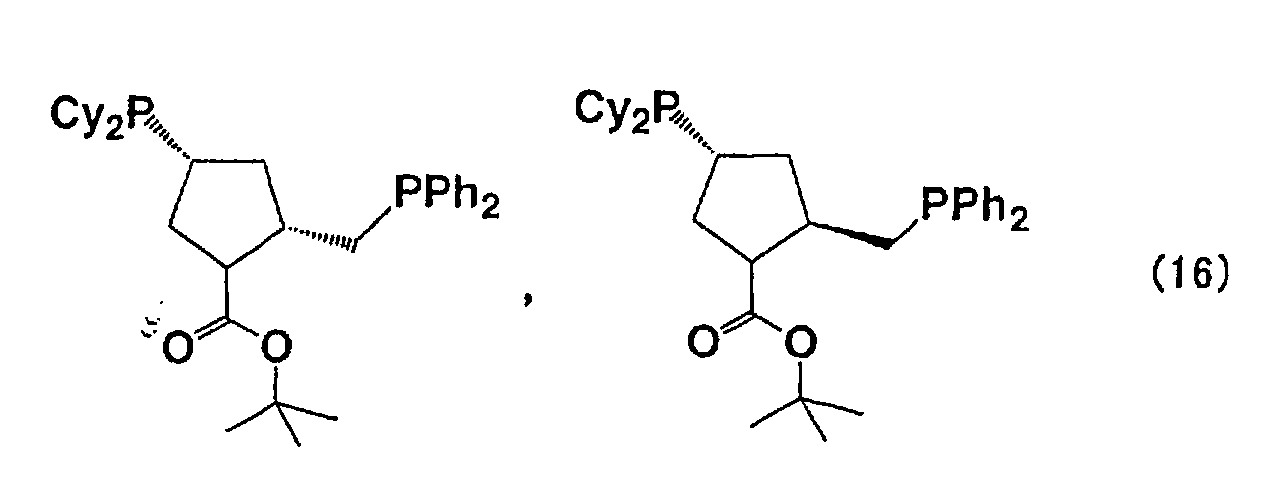 wherein Cy means a cyclohexyl group. That is, a hydrochloride compound of the formula (3) is reduced with hydrogen in the presence of the said complex [Rh(cod)Cl]2 and a chiral phosphine ligand represented by the formula either (16) or (17). These reactions may be carried out according to the literature (Achiwa et al., Chem. Pharm. Bull., 43, p 748 (1995)). For example, an optically active compound (amino-alcohol) represented by the formula (2) can be obtained by reducing a hydrochloride compound (ketoamine) of the formula (3) with hydrogen in the presence of a catalyst prepared from [Rh(cod)Cl]2, a chiral phosphine ligand represented by the formula (16) and a base. A chiral phosphine ligand represented by the formula (16) or (17) having the conformation (2R,4R) is preferably used, when an objective compound to be obtained by asymmetric reduction is in the R-form. The amount of [Rh(cod)Cl]2 to be added may be generally about 10-5 to 10-1 mol for 1 mol of the ketoamine hydrochloride. The amount of the chiral phosphine ligand represented by the formula (16) to be added may be generally about 2.6 mol for 1 mol of Rh. Examples of the base include N,N-diisopropylethylamine, sodium hydroxide, potassium hydroxide, lithium hydroxide, potassium methoxide and potassium tert-butoxide. The base may be preferably triethylamine. The amount of the base to be added may be generally about 5 × 10⁻³ mol for 1 mol of the ketoamine hydrochloride. Generally, this reaction may be preferably carried out under a hydrogen atmosphere at atmospheric pressure to about 50 atm, more preferably at atmospheric pressure to about 20 atm. It is generally preferred to carry out this reaction in a medium. Examples of the medium include toluene, xylene, diethyl ether, tetrahydrofuran, 1,4-dioxane, ethanol, n-propanol, i-propanol and water. The medium may be preferably methanol. The amount of the medium to be used may be generally about 5 to 30 mL for 5 mmol of the ketoamine hydrochloride. This reaction is generally carried out at a temperature of about 0 to 100°C, preferably room temperature to about 50°C, for example, preferably for 0.5 to 2 days.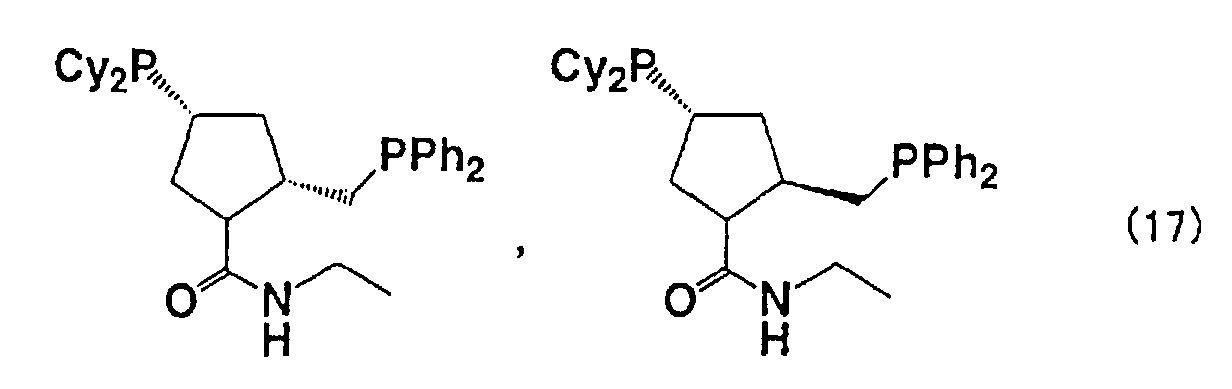
- As set forth above, the ketoamine in the form of hydrochloride is more preferably used than its free form as a reactant in the present asymmetrically reducing process using a catalyst prepared from a rhodium complex.
- Next, a compound of the formula (1) can be obtained by simultaneously or sequentially removing the protecting groups according to the method as set forth above.
- In each step of the synthesizing route set forth above, the produced material is preferably purified by a known purifying means, such as column chromatography. However, the intermediate products such as a novel compound represented by the formula (3) are relatively good in crystallinity and can be used in the following reaction step after being subjected to a simple recrystallizing treatment without hard labor. Therefore, the present process, which can save cost and complicated process, is a preferred process. In addition, the present process is also preferred in that each step results in good yield and that the number of steps is relatively few.
- A compound of the above-mentioned general formula (3) may be synthesized by either process as set forth below. That is, a compound of the formula (3) can be obtained by condensing a compound of the formula (4) with a compound of the formula (14) to give a compound of the formula (6); and converting its hydroxyl group into a leaving group B3 to give a compound of the formula (5), which is then condensed with a compound represented by A'-OH.
- The condensation of a compound of the formula (4) with a compound of the formula (14) can be carried out under the same reaction conditions with those of the reaction of a compound of the formula (4) with a compound of the formula (12) according to the Preparing Process 1 as set forth above. In this connection, R4 in the formula (14) and R4 in the formula (12), which are common in that they are an amino-protecting group, do not necessarily mean the same group and may be different from each other.
- A compound represented by the formula (6) obtained by the condensation of a compound of the formula (4) with a compound of the formula (14) is novel and is a preferred intermediate. The compound does not necessarily need a column chromatography purifying step and may be used in the following reaction step after being subjected to a recrystallizing treatment and the like.
- Among compounds represented by the formula (14), which can be synthesized by the same reaction conditions with those of Referential Examples of the present text of specification, a compound of the formula (14) in which R4 is a benzyl group is commercially available (mfd. by TOKYO KASEI KOGYO) and is particularly preferred.
- A compound represented by the formula (5) can be obtained by converting the hydroxyl group (the primary hydroxyl group) of the side-chain of a compound of the formula (6) to a leaving group B3. The conversion into a leaving group B3 may be carried by halogenation with a known halogenating agent such as hydrogen bromide/acetic acid, phosphorus tribromide, phosphorus pentabromide, phosphorus trichloride, phosphorus pentachloride, phosphorus oxychloride, thionyl chloride, thionyl bromide, bromine/triphenylphosphine, carbon tetrachloride/ triphenylphosphine, carbon tetrabromide/triphenylphosphine, N-bromosuccinimide/triphenylphosphine and the like, or by sulfonic esterification with a sulfonyl chloride such as methanesulfonyl chloride, p-toluenesulfonyl chloride and the like. For example, a compound of the formula (5) in which B3 is bromine may be obtained by treating a compound of the formula (6) with about 1- to 10-fold moles of phosphorus tribromide. Generally, this reaction is preferably carried out in an inert medium. The inert medium may be, for example, 1,2-dichloroethane or carbon tetrachloride, and is preferably dichloromethane. The amount of the inert medium to be used may be generally about 1 to 10 mL for 1 g of the compound of the formula (6). This reaction is generally carried out at a temperature of about -30 to 100°C,, particularly about 0 to 50°C, for example, preferably for 1 to 5 hours. In addition, a methanesulfonate ester may be generally obtained by treating a compound of the formula (6) with about 1- to 3-fold moles of methanesulfonic chloride. Generally, this reaction is preferably carried out in an inert medium. The inert medium may be, for example, dichloromethane, tetrahydrofuran or toluene, and is preferably pyridine. The amount of the inert medium to be used may be generally about 1 to 10 mL for 1 g of the compound of the formula (6). This reaction is generally carried out at a temperature of about -20 to 100°C, preferably about 0 to 50°C, for example, preferably for about 1 to 5 hours. This reaction may be also preferably carried out in the presence of a tertiary amine such as triethylamine, N,N-diisopropylethylamine, N,N-dimethylaminopyridine and the like, The amount of the tertiary amine to be used may be about 1- to 5-fold moles.
- As obtained sulfonate ester compound may be directly subjected to the following condensation reaction with a compound represented by A'-OH, or may be first halogenated with a halogenating agent such as sodium chloride, sodium bromide, sodium iodide, potassium bromide or potassium iodide by a known method (for example, Org. Syn. Coll. Vol., 4, p. 753 (1963)) followed by condensation with a compound represented by A'-OH. Generally, the iodide may be obtained by treating the corresponding sulfonate ester with about 1- to 10-fold moles of sodium iodide. Generally, this reaction is preferably carried out in an inert medium. The inert medium may be, for example, 2-butanone, tetrahydrofuran, N,N-dimethylformamide, N,N-dimethylacetamide, dimethylsulfoxide or sulfolane, and is preferably acetone. The amount of the inert medium to be used may be generally about I to 10 mL for 1 g of the sulfonate ester. This reaction is generally carried out at a temperature of about 0 to 150°C, preferably about room temperature to about 100°C, for example, preferably for 3 to 10 hours.
- Generally, the condensation reaction of a compound of the formula (5) with a compound represented by A'-OH is preferably carried out by reacting 1 to 5 mol of the compound of A'-OH for 1 mol of the compound of the formula (5) in a basic condition. The basic condition preferably comprises treatment with an alkali such as potassium carbonate, potassium hydroxide, sodium hydroxide, sodium hydride, potassium hydride and potassium tert-butoxide. In this basic condition the compound of A'-OH is formed into the metal alkoxide by each alkali. The amount of the metal alkoxide to be used may be generally about 1 to 3 mol for 1 mol of the halide or sulfonic ester. Generally, this reaction is preferably carried out in an inert medium. The inert medium may be, for example, acetone, 2-butanone, tetrahydrofuran, N,N-dimethylacetamide, dimethylsulfoxide or sulfolane, and is preferably N,N-dimethylformamide. The amount of the inert medium to be used may be generally about 1 to 10 mL for 1 g of the sulfonic ester. Generally, this reaction is preferably carried out at a temperature of room temperature to about 100°C, for example, for 3 to 10 hours.
- In addition, a ketoamine represented by the formula (3) may be obtained by directly condensing a compound of the formula (6) with a compound represented by A'-OH according to Mitsunobu reaction. The reaction can be carried out in accordance with the method indicated in literatures (for example, Mitsunobu et al. Journal of Organic Chemistry, 50, p. 3095 (1985)). For example, a compound of the formula (6) may be reacted with 1- to 2-fold moles of a compound of A'-OH in the presence of 1- to 2-fold moles of a condensing agent prepared from a trivalent organophosphorus compound, such as triphenylphosphine, triethylphosphine, triethylphosphine and the like, and an azo compound such as diethyl azodicarboxylate (DEAD), N,N,N',N'-tetramethyl-azodicarboxamide (TMAD), l,1-(azodicarbonyl)dipiperidine (ADDP), cyanomethylenetributyl phosphorane (CMBP) or cyanomethylenetrimethyl phosphorane (CMMP), phosphorane and the like. Generally, this reaction is preferably carried out in an inert medium. The inert medium may be benzene or toluene, and is preferably tetrahydrofuran. The amount of the inert medium to be used may be generally about 1 to 10 mL for 1 g of the compound of the formula (6). This reaction is generally carried out at a temperature of about 0 to 100°C, preferably about 0 to 50°C, most preferably room temperature to 50°C, for example, preferably for 3 to 10 hours.
- A compound represented by A'-OH can be obtained by the methods disclosed in JP-A-9-249623 (WO 97/25311) and WO 99/01431. However, 2-hydroxycarbazole is commercially available (mfd. by Aldrich) and such commercially available products are easily used and preferred.
- The thus obtained compound of the formula (3) can be subjected to the following synthesizing steps in accordance with the same conditions with those of the Preparing Process 1 as set forth above to give each of a compound of the formula (2) and a compound of the formula (1).
- In each step of the synthesizing route set forth above, the produced material is preferably purified by a known purifying means, such as column chromatography. However, the intermediate products such as a novel compound represented by the formula (3) are relatively good in crystallinity and can be used in the following reaction step after being subjected to a simple recrystallizing treatment without hard labor. Therefore, the present process, which can save cost and labor, is a preferred process. In addition, the present process is also preferred in that each step results in good yield and that the number of steps is relatively few.
- A compound of the above-mentioned general formula (2) may be also synthesized by a process set forth below. That is, an amino-alcohol represented by the formula (2) can be obtained by reducing the carbonyl group of a compound of the formula (5) to give a compound of the formula (7), followed by condensation with a compound represented by A'-OH.
- The reaction for reducing or asymmetrically reducing a compound of the formula (5) can be carried out under the same reaction conditions with those of the process for synthesizing a compound of the formula (2) from a compound of the formula (3) set forth above (Preparing Process 1).
- The condensation reaction of a compound of the formula (7) with a compound represented by A'-OH can be carried out under the same reaction conditions with those of the process for synthesizing a compound of the formula (3) from a compound of the formula (5) as set forth above (Preparing Process 2). For example, the condensation reaction is preferably carried out in a basic condition.
- The thus obtained compound of the formula (2) can be subjected to the following synthesizing steps in accordance with the same conditions with those of the Preparing Process 1 set forth above to give a compound of the formula (1).
- In each step of the synthesizing route set forth above, the produced material is preferably purified by a known purifying means, such as column chromatography. However, the intermediate products such as a novel compound represented by the formula (6) do not necessarily need a purifying step and can be used in the following reaction step after being subjected to a simple treatment, such as a recrystallizing treatment. Therefore, the present process, which can save cost and labor, is a preferred process. In addition, the present process is also preferred in that each step results in good yield and that the number of steps is relatively few.
- A compound of the formula (2) may be also synthesized by either process set forth below. That is, a compound represented by the above-mentioned general formula (6) is reduced (or asymmetrically reduced) to give a compound of the formula (8). Next, (i) the primary hydroxyl group of the compound of the formula (8) can be converted into a leaving group B3 to give a compound of the formula (7), which can be then condensed with a compound represented by A'-OH in accordance with the Preparing Process 3 set forth above to give a compound of the formula (2).
- Alternatively, (ii) the compound of the formula (8) can be subjected to Mitsunobu reaction with a compound represented by A'-OH to give a compound of the formula (2).
- The reaction for reducing or asymmetrically reducing a compound of the formula (6) can be carried out under the same reaction conditions with those of the process for synthesizing a compound of the formula (2) from a compound of the formula (3) as set forth above (Preparing Process 1).
- A compound represented by the formula (8) obtained by the reduction (or asymmetric reduction) of a compound of the formula (6) is novel and is a preferred intermediate. The compound does not necessarily need a purifying step and may be used in the following reaction step after being subjected to a simple treatment, such as a recrystallizing treatment. Therefore, the present process using the said compound can save cost and labor.
- A compound represented by the formula (7) can be obtained by treating the primary hydroxyl group of a compound of the formula (8) in accordance with the same methods with those for preparing a compound of the formula (5) from a compound of the formula (6) as set forth above (Preparing Process 2).
- The step of directly condensing a compound of the formula (8) with a compound represented by A'-OH according to Mitsunobu reaction to give a compound of the formula (2), can be carried out by reacting a compound of the formula (8) with a compound represented by A'-OH in the presence of a trivalent organophosphorus compound and an azo compound or phosphorane as a condensing agent as set forth above (Preparing Process 2).
- The thus obtained compound of the formula (2) can be treated under the same conditions with those of the Preparing Process 1 as set forth above to give a compound of the formula (I).
- In each step of the synthesizing route set forth above, the produced material is preferably purified by a known purifying means, such as column chromatography. However, compounds represented by the formulae (6) and (8), which are novel compounds, do not necessarily need a purifying step and may be used in the following reaction step after being subjected to a simple treatment, such as a recrystallizing treatment. Therefore, these compounds are preferred intermediates which can save cost and labor. In addition, the present process is also preferred in that each step results in good yield and that the number of steps is relatively few.
- A compound of the formula (4) is condensed with a compound of the formula (13) to give a compound of the formula (11), the carbonyl group of which is then reduced to give a compound of the formula (10). After the amino groups are protected, the compound of the formula (10) is condensed with a compound represented by A'-OH to give a compound of the formula (9). The amino-protecting groups can be simultaneously or sequentially removed to give a compound of the formula (1).
- A compound of the formula (11) can be obtained by treating a compound of the formula (4) with a compound of the formula (13). The amount of the compound of the formula (13) to be added may be generally about ] to 5 mol for 1 mol of the compound of the formula (4). Generally, this reaction is preferably carried out in the presence of an acid scavenger. The acid scavenger may be, for example, a tertiary amine such as triethylamine or N,N-diisopropylethylamine, potassium hydroxide, sodium carbonate or sodium hydrogencarbonate, and is preferably sodium hydroxide. The amount of the acid scavenger to be added may be generally about 2 to 10 mol for 1 mol of the compound of the formula (4). Generally, this reaction is preferably carried out in a lower alcohol such as methanol, ethanol or i-propanol, tetrahydrofuran or 1,4-dioxane, or a water-mixed medium thereof. The amount of the medium to be used is generally about 1 to 5 mL for 1 g of the compound of the formula (4). Generally, this reaction is preferably carried out at a temperature of about 0 to 100°C, particularly about 0 to 50°C, for example, preferably for 3 to 10 hours.
- A compound of the formula (13) in which B1 and B2 are chlorine or bromine is commercially available (mfd. by TOKYO KASEI KOGYO) and such commercially available products are easily used and preferred.
- The reaction for reducing or asymmetrically reducing the carbonyl group of a compound of the formula (11) can be carried out under the same reaction conditions with those of the process for synthesizing a compound of the formula (2) from a compound of the formula (3) as set forth above (Preparing Process 1).
- The amino group of a compound of the formula (10) can be protected with a protecting group R5 in accordance with a known method. For example, when R5 is a tert-butoxycarbonyl group, a compound of the formula (10) in which the amino group is protected with R5 can be obtained by treating the compound with di-tert-butyl dicarbonate in the presence of an acid scavenger. The acid scavenger may be preferably triethylamine, N,N-diisopropylethylamine, sodium hydroxide, potassium hydroxide, sodium carbonate, potassium carbonate, sodium hydrogencarbonate and the like. Generally, the amount of the acid scavenger to be added may be preferably about 1 to 3 mol for 1 mol of the compound (amino-alcohol hydrochloride) of the formula (10). Generally, this reaction is preferably carried out in a medium. The medium may be preferably a lower alcohol such as methanol, ethanol, n-propanol, i-propanol or tert-butanol, 1,4-dioxane or tetrahydrofuran, or a water-mixed medium thereof. The amount of the medium to be used is generally about 1 to 10 mL for 1 g of the amino-alcohol hydrochloride of the formula (10). Generally, this reaction is preferably carried out at a temperature of about -20 to 80°C, particularly about 0 to 50°C, most preferably about 0°C to room temperature, for example, preferably for 1 to 10 hours.
- The amino-protecting groups of a compound of the formula (9) can be simultaneously or sequentially removed in accordance with a known method to give a compound of the formula (1).
- In each step of the synthesizing route set forth above, the produced material is preferably purified by a known purifying means, such as column chromatography. However, each intermediate, particularly, a compound of the formula (11), which is included within the formula (18), and a compound of the formula (10), which is included within the formula (19), do not necessarily need a purifying step and may be used in the following reaction step after being subjected to a simple treatment, such as a recrystallizing treatment. The present process, which can save cost and labor, is a preferred process. In addition, the present process is also preferred in that each step results in good yield and that the number of steps is relatively few.
- The step for asymmetrically reducing a carbonyl group according to Preparing Processes 1 to 5 set forth above, is characteristic of the present invention and is a particularly preferred step in each Preparing Process.
- Preferred intermediates to be used in the preparing processes of the present invention include compounds represented by the following general formula (18) and salts thereof:wherein R1 represents a lower alkyl group or a benzyl group; R21 represents a hydrogen atom, a halogen atom, a hydroxyl group or a protected hydroxyl group; R3 represents an amino-protecting group or a hydrogen atom; R4 represents an amino-protecting group or a hydrogen atom; and B represents a hydroxyl group or a leaving group. The aforementioned general formulae (5), (6) and (11) are included within the formula (18). Compounds of the formula (18) are preferred compounds which are good in crystallinity.

- The other preferred intermediates include compounds represented by the following general formula (19) and salts thereof:wherein R1 represents a lower alkyl group or a benzyl group; R21 represents a hydrogen atom, a halogen atom, a hydroxyl group or a protected hydroxyl group; R3 represents a hydrogen atom or an amino-protecting group; R4 represents an amino-protecting group or a hydrogen atom; B represents a hydroxyl group or a leaving group; and *1 represents an asymmetric carbon atom. The aforementioned general formulae (7), (8) and (10) are included within the formula (19).
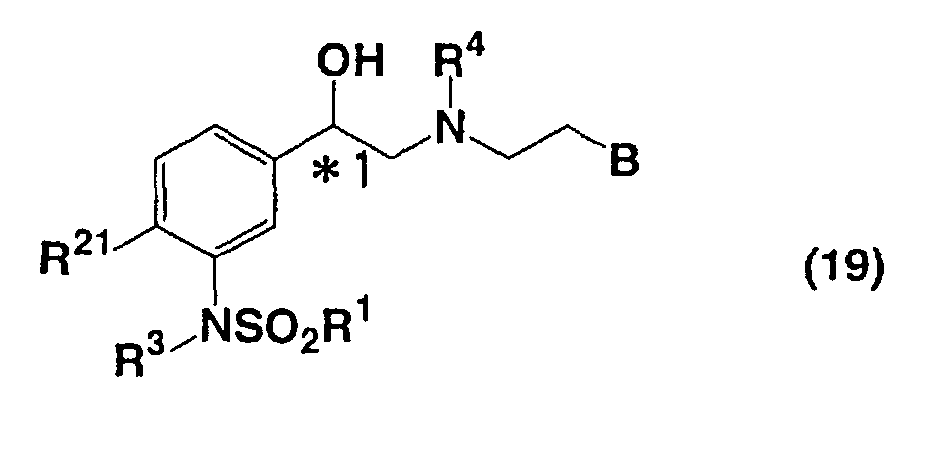
- As set forth above, a compound of the formula (I) in which R6 is a hydrogen atom can exist in the two different optically active substances. The processes described herein can provide a racemic mixture and also an optical isomer as occasion requires. The reactions set forth above should not alter the relating stereochemistry.
- When R6 is a hydrogen atom, a mixture of two optical isomers with respect to *1 may be obtained. The mixture can be resolved into the optical isomers as their acid addition salts with an optically active acid such as camphorsulfonic acid, mandelic acid or substituted mandelic acid by a suitable method such as fractional crystallization. Such a fractional crystallization may be carried out using a suitable solvent, preferably a lower alcohol, such as methanol, ethanol, i-propanol or a mixture thereof. Each pair of enantiomers can be resolved into pure isomers by formation of diastereomeric salt, chromatography using an optically active column, or other means. When one of starting materials is optically active, the thus obtained mixture of diastereomers can be resolved into pure isomers by the above-mentioned means. Not only a compound of the formula (1) but also an intermediate amino-alcohol (2), (7), (8), (9) or (10) each obtained in the intermediate steps of the Preparing Processes 1 to 5 set forth above can be subjected to the said resolution. Optical resolution and purification of the present compounds can provide a preferred medicine which comprises a single isomer having higher activities and thereby has improved efficacy with little side effect.
- Salts of a compound of the formula (1), (2), (3), (5), (6), (7), (8), (9), (10), (11), (18) or (19) according to the present invention may be a known salt, and examples thereof include hydrochloride, hydrobromide, sulfate, hydrogensulfate, dihydrogen phosphate, citrate, maleate, tartrate, fumarate, gluconate and methanesulfonate, and acid addition salts with an optically active acid such as camphorsulfonic acid, mandelic acid or substituted mandelic acid. Among them, pharmaceutically acceptable salts are particularly preferred. When a compound of the formula (1), (2), (3), (5), (6), (7), (8), (9), (10), (11), (18) or (19) is converted into its salt, an acid addition salt of the compound can be obtained by dissolving the compound in an alcohol such as methanol or ethanol, to which the equivalent amount to several times amount of the acid is then added. The acid to be used may be a pharmaceutically acceptable mineral or organic acid, such as hydrochloric acid, hydrobromic acid, sulfuric acid, hydrogensulfate, dihydrogen phosphate, citric acid, maleic acid, tartaric acid, fumaric acid, gluconic acid, methanesulfonic acid and the like.
- This specification includes part or all of the contents as disclosed in the specification of Japanese Patent Application No. 11-83917.
- The following examples further illustrate this invention but are not intended to limit it in any way.
- The thin layer chromatography (TLC) used was Precoated silica gel 60 F254 (mfd. by Merck). After developing with chloroform/methanol (1:0 to 4:1), chloroform/acetone (1:0 to 10:1) or n-hexane/ethyl acetate (1:0 to 1:10), the detecting process was carried out with UV (254 nm) irradiation and coloration with ninhydrin. Rf values of TLC were obtained on free amines. The column chromatography process was carried out on silica gel 60 (230-400 mesh; mfd. by Merck). The determination of nuclear magnetic resonance spectrum (NMR) was carried out using Gemini-300 (FT-NMR; mfd. by Varian). Mass spectrum (MS) was determined by the fast atom bombardment mass spectrometry (FAB-MS) with JEOL-JMS-SX102.
- Benzaldehyde (9.38 g) was added to a solution of N-[2-(9H-carbazol-2-yloxy)]ethylamine (20 g; synthesized according to the process indicated in JP-A-9-249623) in methanol (500 mL). The mixture was then stirred at room temperature for 1 hour. Under an argon atmosphere, platinum oxide (1.00 g; mfd. by Wako Pure Chemical Industries) was added to the mixture, which was then stirred under a hydrogen atmosphere at atmospheric pressure for 3 hours. After replacing the atmosphere in the reaction system with argon, benzaldehyde (1.88 g) was added to the mixture, which was then further stirred under a hydrogen atmosphere at atmospheric pressure for 3 hours. After replacing the atmosphere with argon, the catalyst was filtered off and the solvent was distilled off under reduced pressure. The residue was recrystallized from ethanol and dried under reduced pressure to give the title compound (25.2 g) as a pale yellow crystal.
Rf: 0.6 (10:1 chloroform/methanol).
MH+: 317.
1H-NMR (DMSO-d6; free form): 2.30 (1H, s), 2.91 (2H, t, J=5.8), 3.79 (2H, s), 4.11 (2H, t, J=5.8), 6.77 (1H, dd, J=8.5, 2.2), 6.96 (1H, d, J=2.2), 7.10 (1H, m), 7.20-7.44 (7H, m), 7.92-8.00 (2H, m), 11.09 (1H, s). - A mixture of 2-hydroxycarbazole (30 g; mfd. by Aldrich), potassium carbonate (113.1 g; mfd. by KANTO CHEMICAL) and 1,2-dibromoethane (211 mL; mfd. by TOKYO KASEI KOGYO) in 2-butanone (165 mL; mfd. by Wako Pure Chemical Industries) was stirred vigorously at a reflux temperature for 28 hours. The reaction solution was poured into water (1050 mL) all at once and stirred. The precipitated crystal obtained by filtration was washed with water (1 L) and 2-propanol (250 mL), and then dried under reduced pressure at room temperature to give the title compound (43.43 g) as a white solid.
Rf: 0.51 (1:2 ethyl acetate/n-hexane).
1H-NMR (DMSO-d6): 3.82-3.85 (2H, m), 4.36-4.43 (2H, m), 6.80 (1H, dd, J=8.5, 2.2), 6.99 (1H, d, J=2.2), 7.11 (1H, m), 7.29 (1H, m), 7.42 (1H, d, J=8.3), 7.98 (1H, d, J=8.5), 8.00 (1H, d, J=7.7), 11.13 (1H, s). - A mixture of the compound (80 g; obtained from the step A above) in benzyl amine (270 mL; mfd. by TOKYO KASEI KOGYO) was stirred with heating at an internal temperature of 100°C for 4 hours. The reaction solution was poured into water (2.3 L) all at once and stirred for 30 minutes. The precipitated crystal obtained by filtration was then washed with water (1.5 L) and 2-propanol (1 L), and dried under reduced pressure at room temperature to give the title compound (76.5 g).
Rf: 0.33 (1:2 ethyl acetate/n-hexane). - The thus obtained compound showed the same NMR data with those of the compound of Referential Example 1.
- A solution of 2-bromo-1-(3-methylsulfonylamino)phenylethanone (10 g; prepared according to the method reported by A. A. Larsen et al., J. Med. Chem., 10, p. 462 (1967)) in tetrahydrofuran (100 mL) was added dropwise to a solution of N-benzyl-N-[2-(9H-carbazol-2-yloxy)]ethylamine (21.7 g; obtained from Referential Example) in tetrahydrofuran (100 mL), followed by stirring overnight at room temperature. The precipitate was filtered off and the solvent was distilled off under reduced pressure. The residue was purified by silica gel column chromatography (eluent: 1:0 to 50:1 chloroform/acetone) to give the title compound (16.80 g) as a white crystal.
Rf: 0.3 (20:1 chloroform/acetone).
MH+: 529. - The thus obtained compound in the free form was converted into its hydrochloride using 10% hydrochloric acid/methanol (mfd. by TOKYO KASEI KOGYO).
1H-NMR (CDC13: hydrochloride): 2.99 (3H, s), 3.65-3.80 (2H, m), 4.46-4.70 (4H, m), 5.03-5.18 (2H, m), 6.58 (1H, d, J=8.8), 6.92 (1H, s), 7.10 (1H, t, J=7.4), 7.29 (1H, t, J=7.4), 7.41-7.78 (10H, m), 7.91 (1H, d, J=8.8), 7.98 (1H, d, J=7.7), 10.16 (1H, s), 10.80 (1H, s), 11.20 (1H, s). - A solution of 2-bromo-1-(4-benzyloxy-3-methylsulfonylamino)phenylethanone (10 g; prepared according to the method reported by A. A. Larsen et al., J. Med. Chem., 10, p. 462 (1967)) in tetrahydrofuran (100 mL) was added dropwise to a solution of N-benzyl-N-[2-(9H-carbazol-2-yloxy)]ethylamine (15.9 g; obtained from Referential Example) in tetrahydrofuran (100 mL), followed by stirring overnight at room temperature. The precipitate was filtered off and the solvent was distilled off under reduced pressure. The residue was purified by silica gel column chromatography (eluent: 1:0 to 50:1 chloroform/acetone) to give the title compound (14.80 g) as a white crystal.
Rf: 0.3 (20:1 chloroform/acetone).
MH+: 635.
1H-NMR (CDC13): 2.92 (3H, s), 3.03 (2H, m), 3.87 (2H, s), 4.11 (2H, s), 4.16 (2H, m), 5.25 (2H, s), 6.74-8.05 (20H, m), 9.18 (1H, s), 11.05 (1H, s). - Sodium borohydride (1.44 g; mfd. by KANTO CHEMICAL) was added to a solution of 2-[N-benzyl-N-[2-(9H-carbazol-2-yloxy)]ethyl]amino-1-(3-methylsulfonylamino)phenylethanone (10 g; obtained from Example 1) in ethanol/tetrahydrofuran (1:3; 200 mL) at 0°C. The mixture was stirred at the same temperature for 3 hours. To the reaction solution were added sequentially an excess amount of ethanol and 0.1 N hydrochloric acid, followed by stirring for 30 minutes. The reaction mixture was then diluted with ethyl acetate and washed sequentially with saturated sodium bicarbonate water, water and saturated brine. After drying the organic layer on anhydrous sodium sulfate, the solvent was distilled off under reduced pressure. The residue was dried under reduced pressure to give the title compound (10.04 g) as an amorphas solid.
Rf: 0.33 (2:1 hexane/ethyl acetate).
MH+: 531.
1H-NMR (DMSO-d6): 2.75 (2H, d, J=6.1), 2.91 (3H, s), 2.95-3.01 (2H, m), 3.80 (2H, brs), 4.02-4.09 (2H, m), 4.66-4.69 (2H, m), 5.47 (1H, brs), 6.73 (1H, dd, J=8.4, 1.9), 6.92 (1H, d, J=2.0), 7.02-7.45 (7H, m), 7.93-8.00 (2H, m), 11.06 (1H, s). - Triethylamine (0.01 mL) was added to a solution of [Rh(cod)Cl]2 (87.4 mg; mfd. by Wako Pure Chemical Industries), the (2R, 4R) form (260.7 mg; mfd. by FUJI YAKUHIN) of a chiral phosphine ligand represented by the formula (16) and the hydrochloride (1 g; obtained from Example 1) in degassed methanol (3 mL) under an argon atmosphere, followed by stirring under a hydrogen atmosphere at atmospheric pressure at room temperature for 16 hours. The solvent was distilled off under reduced pressure and the residue was dissolved in ethyl acetate, which was then washed sequentially with saturated sodium bicarbonate water and saturated brine. The organic layer was dried over anhydrous sodium sulfate and then the solvent was distilled off under reduced pressure. The residue was dried under reduced pressure to give the title compound (747 mg) as an oil.
- The thus obtained compound had a retention time in HPLC measurements identical to the retention time corresponding to one of the peaks of the compound obtained in Example 3.
HPLC: Retention Time (R-form: 22.0 min (S-form: 19.2 min)) - Column: CHIRALPAK AD (mfd. by DAICEL CHEMICAL INDUSTRIES; 4.6 mm ID × 250 mm);
- Solvent: 20/80 hexane/ethanol;
- Flow rate: 0.5 mL/min;
- Detecting wave length: 254 nm;
- Temperature: 40°C.
-
- Sodium borohydride (1.19 g; mfd. by KANTO KAGAKU KOGYO) was added to a solution of 2-[N-benzyl-N-[2-(9H-carbazol-2-yloxy)]ethyl]amino 1 -(4-benzyloxy-3-methylsulfonylamino)phenylethanone (10 g; obtained from Example 2) in ethanol/tetrahydrofuran (1:3; 200 mL) at 0°C. The mixture was stirred at the same temperature for 3 hours. To the reaction solution were added sequentially an excess amount of methanol and 0.1 N hydrochloric acid, followed by stirring for 30 minutes. The reaction mixture was then diluted with ethyl acetate and washed sequentially with saturated sodium bicarbonate water, water and saturated brine. After the organic layer was dried on anhydrous sodium sulfate, the solvent was distilled off under reduced pressure. The residue was dried under reduced pressure to give the title compound (10.03 g) as an amorphas solid.
Rf: 0.25 (2:1 hexane/ethyl acetate).
MH+: 637.
1H-NMR (CDC13): 2.8-2.9 (3H, m), 3.0-3.5 (2H, m), 3.5-3.8 (2H, m), 4.1-4.6 (5H, m), 4.9-5.0 (2H, m), 6.7-6.9 (4H, m), 7.0-7.1 (1H, m), 7.1-7.5 (11H, m), 7.5-7.7 (2H, m), 7.8-8.0 (2H, m), 8.7-8.8 (1H, m). - Triethylamine (0.01 mL) was added to a solution of [Rh(cod)Cl]2 (70.4 mg; mfd. by Wako Pure Chemical Industries), the (2R, 4R) form (220 mg; mfd. by FUJI YAKUHIN) of a chiral phosphine ligand represented by the formula (16) and 2-[N-benzyl-N-[2-(9H-carbazol-2-yloxy)]ethyl]amino- 1 -(4-benzyloxy-3-methylsulfonylamino)phenylethanone hydrochloride (1 g; prepared from the compound 3 in the free form of Example 2 with 10% hydrochloric acid/methanol) in degassed methanol (3 mL) under an argon atmosphere, followed by stirring under a hydrogen atmosphere at atmospheric pressure at room temperature for 16 hours. The solvent was distilled off under reduced pressure and the residue was dissolved in ethyl acetate, which was then washed sequentially with saturated sodium bicarbonate water and saturated brine. The organic layer was dried over anhydrous sodium sulfate and then the solvent was distilled off under reduced pressure. The residue was dried under reduced pressure to give the title compound (876 mg) as an oil.
- The thus obtained compound had a retention time in HPLC measurements identical to the retention time corresponding to one of the peaks of the compound obtained in Example 5.
HPLC: Retention Time (R-form: 35 min (S-form: 25 min)) - Column: CHIRALCEL OJ-R (mfd. by DAICEL CHEMICAL INDUSTRIES; 4.6 mm ID × 150 mm);
- Solvent: 75/25 aqueous 0.5 M sodium perchlorate solution/acetonitrile;
- Flow rate: 0.5 mL/min;
- Detecting wave length: 254 nm;
- Temperature: 40°C.
-
- (±)-2-[N-benzyl-N-[2-(9H-carbazol-2-yloxy)]ethyl]amino-1-(3-methylsulfonylamino)phenylethanol (10 g; obtained from Example 3) was dissolved in a mixed solvent of tetrahydrofuran (100 mL) and methanol (100 mL), to which was added a palladium hydroxide/carbon catalyst (1 g; mfd. by nacalai tesque) under a nitrogen atmosphere. The mixture was stirred overnight under a hydrogen atmosphere at atmospheric pressure at room temperature. After the catalyst was filtered off, the solvent was distilled off under reduced pressure. Crystal obtained by suction filtration was washed with a mixed solvent of tetrahydrofuran and methanol (1:1). The crystal was dissolved in methanol (150 mL) and converted into its hydrochloride by adding 0.1 N hydrochloric acid/ethanol. The precipitated crystal was obtained by suction filtration. The thus obtained crystal was dried under reduced pressure with heating at 40°C to give the title compound in the form of hydrochloride (7.50 g) as a white crystal.
Rf: 0.3 (10:1 chloroform/methanol).
MH+: 441 - The thus obtained compound was shown to be identical to the title compound prepared according to the known method (JP-A-9-249623) by the fact that they had the same retention time in HPLC measurements.
- The protecting group was removed from (R)-2-[N-benzyl-N-[2-(9H-carbazol-2-yloxy)]ethyl]amino-1-(3-methylsulfonylamino) phenylethanol (1 g; obtained from Example 4) according to the reaction conditions of Example 7 to give the title compound in the form of hydrochloride (0.75 g).
- The thus obtained compound was shown to be identical to the title compound prepared according to the known method (JP-A-9-249623) by the fact that they had the same retention time in HPLC measurements.
- (±)-2-[N-benzyl-N-[2-(9H-carbazol-2-yloxy)]ethyl]amino-1-(4-benzyloxy-3-methylsulfonylamino)phenylethanol (10 g; obtained from Example 5) was dissolved in a mixed solvent of tetrahydrofuran (100 mL) and methanol (100 mL), to which was added a palladium hydroxide/carbon catalyst (1 g; mfd. by nacalai tesque) under a nitrogen atmosphere. The mixture was stirred overnight under a hydrogen atmosphere at atmospheric pressure at room temperature. After the catalyst was filtered off, the solvent was distilled off under reduced pressure.
The crystal obtained by suction filtration was washed with a mixed solvent of tetrahydrofuran and methanol (1:1). The crystal was then dissolved in methanol (150 mL) and converted into its hydrochloride by adding 0.1 N hydrochloric acid/ethanol (mfd. by TOKYO KASEI KOGYO). The precipitated crystal was obtained by suction filtration. The thus obtained crystal was dried under reduced pressure with heating at 40°C to give the title compound in the form of hydrochloride (6.96 g) as a white crystal.
Rf: 0.3 (10:1 chloroform/methanol).
MH+: 493. - The thus obtained compound was shown to be identical to the title compound prepared according to the known method (JP-A-9-249623) by the fact that they had the same retention time in HPLC measurements.
- The protecting groups were removed from (R)-2-[N-benzyl-N-[2-(9H-carbazol-2-yloxy)]ethyl]amino-1-(4-benzyloxy-3-methylsulfonylamino)phenylethanol (1 g; obtained from Example 6) according to the reaction conditions of Example 9 to give the title compound in the form of hydrochloride (0.70 g).
- The thus obtained compound was shown to be identical to the title compound prepared according to the known method (JP-A-9-249623) by the fact that they had the same retention time in HPLC measurements.
- A solution of 2-bromo-1-[3-(N-benzyl-N-methylsulfonylamino)]phenylethanone (10 g) in tetrahydrofuran (100 mL) was added dropwise to N-benzyl-2-ethanolamine (11.2 mL; mfd. by TOKYO KASEI KOGYO), followed by stirring at room temperature for 16 hours. The reaction solution was diluted with ethyl acetate, washed sequentially with water and saturated brine, and then dried over anhydrous sodium sulfate. After the solvent was distilled off under reduced pressure, the residue was recrystallized from ethanol to give the title compound (11.84 g) as a white crystal.
Rf: 0.2 (1:1 hexane/ethyl acetate).
MH+: 454.
1H-NMR (DMSO-d6): 1.96-2.24 (2H, m), 2.56-2.63 (2H, m), 3.07 (3H, s), 3.45 (2H, s), 3.59 (1H, d, J=11.2), 4.08 (1H, d, J=11.2), 4.83 (2H, s), 7.16-7.44 (14H, m). - A solution of 2-[N-benzyl-N-(2-hydroxyethyl)]amino-1-[3-(N-benzyl-N-methylsulfonylamino)]phenylethanone (10 g; obtained from Example 11) in dichloromethane (150 mL) was cooled to 0°C, to which was added a solution of phosphorus tribromide in dichloromethane (1 M; 110.5 mL; mfd. by Aldrich), followed by stirring for 15 minutes. The mixture was then stirred at 50°C for 1 hour. The solvent was distilled off under reduced pressure and the residue was recrystallized from water/methanol to give the title compound in the form of hydrobromide (10.54 g) as a white crystal.
Rf: 0.62 (3:1 hexane/ethyl acetate).
M+: 515.
1H-NMR (DMSO-d6): 3.0-3.5 (7H, m), 3.5-4.5 (4H, m), 4.8-5.0 (2H, m), 7.1-8.0 (14H, m). - An aqueous 2 N sodium hydroxide solution (16.8 mL) was added to a mixed solution of 2-[N-benzyl-N-(2-bromoethyl)]amino-1-[3-(N-benzyl-N-methylsulfonylamino)]phenylethanone hydrobromide (10 g; obtained from Example 12) and 2-hydroxycarbazole (4.61 g; mfd. by Aldrich) in water (50 mL) and tetrahydrofuran (150 mL) at -10°C, which was stirred at room temperature for 2 hours. The solvent was distilled off under reduced pressure and the residue was dissolved in toluene (200 mL). The organic layer was sequentially washed with an aqueous 2 N sodium hydroxide solution (four times) and saturated brine (once), and was then dried over anhydrous sodium sulfate. After the solvent was distilled off under reduced pressure, the residue was purified by silica gel column chromatography (eluent: 0:1 to 1:40 acetone/toluene) to give the title compound (9.32 g) as an oil.
Rf: 0.3 (1:30 acetone/toluene).
MH+: 619. - The thus obtained compound in the free form was converted into its hydrochloride using 10% hydrochloric acid/methanol (mfd. by TOKYO KASEI KOGYO).
1H-NMR (DMSO-d6; hydrochloride): 3.12 (3H, s), 3.72 (2H, br), 4.46-4.68 (4H, m), 4.95 (2H, s), 5.12 (2H, br), 6.52 (1H, d, J=7.7), 6.95 (1H, d, J=1.9), 7.11 ( 1 H, t, J=7.7), 7.16-7.34 (6H, m), 7.40-7.50 (4H, m), 7.54 (1H, t, J=8.2), 7.66-7.78 (3H, m), 7.83 (1H, d, J=7.7), 7.85 (1H, d, J=8.5), 7.95-8.02 (2H, m), 10.79 (1H, br), 11.23 (1H, br). - 1,1'-(Azodicarbonyl)dipiperidine (8.36 g; mfd. by TOKYO KASEI KOGYO) was added to a solution of 2-[N-benzyl-N-(2-hydroxyethyl)]amino-1-[3-(N-benzyl-N-methylsulfonylamino)]phenylethanone (10 g; obtained from Example 11), 2-hydroxycarbazole (6.07 g) and tri-n-butylphosphine (6.71 g; mfd. by TOKYO KASEI KOGYO) in tetrahydrofuran (200 mL), which was stirred at room temperature for 12 hours. The precipitated crystal was filtered off and the solvent was distilled off under reduced pressure. The residue was purified by silica gel column chromatography (eluent: 0:1 to 1:40 acetone/toluene) to give the title compound (10.24 g) as an oil.
- The thus obtained compound was shown to be identical to the title compound obtained in Example 13 by the fact that they had the same retention time in HPLC measurements.
- The compound (5 g; obtained from Example 13) was subjected to the synthesizing procedure according to Examples 3 and 7 to give the title compound in the form of hydrochloride (3.77 g) as a white crystal.
- The thus obtained compound was shown to be identical to the title compound prepared according to the known method (JP-A-9-249623) by the fact that they had the same retention time in HPLC measurements.
- Sodium borohydride (1.27 g; mfd. by KANTO CHEMICAL) was added to a solution of 2-[N-benzyl-N-(2-bromoethyl)]amino-1-[3-(N-benzyl-N-methylsulfonylamino)]phenylethanone hydrobromide (10 g; obtained from Example 12) in methanol (300 mL) at 0°C, which was stirred at the same temperature for 3 hours. To the reaction solution were added sequentially water (50 mL) and 0.1 N hydrochloric acid (50 mL), followed by stirring for 30 minutes. After the solvent was distilled off under reduced pressure, the precipitated crystal was recrystallized from water/methanol to give the title compound in the form of hydrochloride (8.82 g) as a white crystal.
Rf: 0.4 (2:1 hexane/ethyl acetate).
MH+: 518 - The compound in the form of hydrobromide (1 g; obtained from Example 12) was treated according to Example 4 to give the title compound in the form of hydrochloride (864 mg).
1H-NMR (CDCl3): 2.39-2.48 (1H, m), 2.66-2.71 (1H, m), 2.85-2.94 (1H, m), 2.92 (3H, s), 2.99-3.08 (1H, m), 3.40 (2H, t, d=6.4), 3.58 (1H, d, J=13.4), 3.84 (1H, s), 3.88 (1H, d, J=13.4), 4.59 (1H, dd, J=3.3, 10.1), 4.82 (2H, s), 7.12-7.39 (14H, m). - An aqueous 2 N sodium hydroxide solution (45.1 mL) was added to a mixed solution of ( + )-2-[N-benzyl-N-(2-bromoethyl)]amino-1-[3-(N-benzyl-N-methylsulfonylamino)]phenylethanol hydrochloride (10 g; obtained from Example 16) and 2-hydroxycarbazole (4.96 g) in water (50 mL) and tetrahydrofuran (150 mL) at -10°C, which was stirred at room temperature for 2 hours. The solvent was distilled off under reduced pressure and the residue was dissolved in toluene (200 mL). The organic layer was washed sequentially with an aqueous 2 N sodium hydroxide solution (four times) and saturated brine (once), and then dried over anhydrous sodium sulfate. After the solvent was distilled off under reduced pressure, the residue was purified by silica gel column chromatography (eluent: 0:1 to 1:20 acetone/toluene) to give the title compound (6.22 g) as an oil.
Rf: 0.3 (1:20 acetone/toluene) - The protecting groups were removed from (±)-2-[N-benzyl-N-[2-(9H-carbazol-2-yloxy)]ethyl]amino-1-[3-(N-benzyl-N-methylsulfonylamino)]phenylethanol (5 g; obtained from Example 18) according to the reaction conditions of Example 7 to give the title compound in the form of hydrochloride (3.75 g).
- The thus obtained compound was shown to be identical to the title compound prepared according to the known method (JP-A-9-249623) by the fact that they had the same retention time in HPLC measurements.
- Sodium borohydride (1.67 g; mfd. by KANTO CHEMICAL) was added to a solution of 2-[N-benzyl-N-(2-hydroxyethyl)]amino-1-[3-(N-benzyl-N-methylsulfonylamino)]phenylethanone (10 g; obtained from Example 11) in ethanol/tetrahydrofuran (1:3; 232 mL) at 0°C, which was stirred at the same temperature for 3 hours. To the reaction solution were added sequentially an excess amount of methanol and 0.1 N hydrochloric acid, followed by stirring for 30 minutes. The reaction solution was diluted with ethyl acetate, washed sequentially with saturated sodium bicarbonate water, water and saturated brine, and then dried over anhydrous sodium sulfate. After the solvent was distilled off under reduced pressure, the crystal obtained was dried under reduced pressure to give the title compound (10.06 g) as a white crystal.
Rf: 0.2 (1:1 hexane/ethyl acetate).
MH+: 456
1H-NMR (CDC13): 2.55 (1H, dd, J=13.5, 9.3), 2.61-2.71 (2H, m), 2.76-2.86 (1H, m), 2.91 (3H, s), 3.54-3.72 (3H, m), 3.83 (1H, d, J=13.5), 4.61 (1H, dd, J=9.3, 3.9), 4.82 (2H, s), 7.10-7.37 (14H, m). - 1,1'-(Azodicarbonyl)dipiperidine (5.55 g) was added to a solution of (+)-2-[N-benzyl-N-(2-hydroxyethyl)]amino-1-[3-(N-benzyl-N-methylsulfonylamino)]phenylethanol (10 g; obtained from Example 20), 2-hydroxycarbazole (4.03 g) and tri-n-butylphosphine (4.45 g) in tetrahydrofuran (200 mL), which was stirred at room temperature for 12 hours. The precipitated crystal was filtered off and the solvent was distilled off under reduced pressure. The residue was purified by silica gel column chromatography (eluent: 0:1 to 1:20 acetone/toluene) to give the title compound (9.54 g) as an oil.
- The thus obtained compound was shown to be identical to the compound obtained from Example 18 by the fact that they had the same retention time in HPLC measurements.
- A solution of (±)-2-[N-benzyl-N-(2-hydroxyethyl)]amino-1-[3-(N-benzyl-N-methylsulfonylamino)]phenylethanol (10 g; obtained from Example 20) in dichloromethane (150 mL) was cooled to O°C, to which was added a solution of phosphorus tribromide in dichloromethane (1 M; 66.0 mL; mfd. by Aldrich), followed by stirring for 15 minutes. The mixture was then stirred at 50°C for 1 hour. The solvent was distilled off under reduced pressure and the residue was recrystallized from water/methanol to give the title compound in the form of hydrobromide (9.87 g) as a white crystal.
- The compound in the form of hydrobromide (5 g; obtained from Example 22) was treated according to Example 18 to give the title compound (3.10 g).
- The thus obtained compound was shown to be identical to the compound obtained in Example 18 by the fact that they had the same retention time in HPLC measurements.
- An aqueous 2 N sodium hydroxide solution (32.7 mL) was slowly added dropwise to a mixed solution of 2-bromo-1-[3-(N-benzyl-N-methylsulfonylamino)]phenylethanone (5 g) and 2-bromoethylamine hydrobromide (13.40 g; mfd. by TOKYO KASEI KOGYO) in tetrahydrofuran (90 mL) and water (10 mL) at room temperature, followed by stirring at the same temperature for 5 hours. The reaction solution was then adjusted to pH 1 with 3 N hydrochloric acid. The precipitated crystal was washed with water and dried under reduced pressure to give the title compound (3.02 g) as a white crystal.
MH+: 426. - The compound (1.5 g; obtained from Example 24) was treated according to Example 4 to give the title compound in the form of hydrochloride (1.37 g).
MH+: 428. - Triethylamine (3.69 mL) was slowly added dropwise to a mixed solution of (R)-2-[N-[2-(9H-carbazol-2-yloxy)]ethyl]amino-1-[3-(N-benzyl-N-methylsulfonylamino)]phenylethanol hydrochloride (1 g; obtained from Example 25) and di-tert-butyl dicarbonate (5.78 g; mfd. by Wako Pure Chemical Industries) in water (50 mL) and methanol (150 mL) at 0°C. The reaction solution was stirred overnight at room temperature and then the solvent was distilled off under reduced pressure. The residue was dissolved in ethyl acetate, washed sequentially with water and saturated sodium bicarbonate water, and then dried over anhydrous sodium sulfate. The solvent was distilled off under reduced pressure and the residue was recrystallized from ethanol to give the title compound (1.11 g) as a white crystal.
Rf: 0.5 (1:1 hexane/ethyl acetate).
MH+: 631. - A 10% hydrochloric acid/methanol solution was added to a solution of (R)-2-[N-(tert-butoxycarbonyl)-N-[2-(9H-carbazol-2-yloxy)]ethyl] amino-1 -[3-(N-benzyl-N-methylsulfonylamino)]phenylethanol (1 g; obtained from Example 26) in methanol (200 mL) at O°C, which was stirred at room temperature for 6 hours.
The solvent was distilled off under reduced pressure. A crystal obtained by suction filtration was washed with methanol/diethylether (1:1) and then dried under reduced pressure with heating (40°C) to give the corresponding BOC (tert-butoxycarbonyl)-removed compound (872 mg; in the form of hydrochloride) as a white crystal. The said hydrochloride (500 mg) was dissolved in a mixed solvent of tetrahydrofuran (7.5 mL) and water (1.5 mL), to which was added a palladium hydroxide/carbon catalyst (50 mg) under a nitrogen atmosphere. The mixture was stirred overnight under a hydrogen atmosphere at atmospheric pressure at room temperature. After the catalyst was filtered off, the solvent was distilled off under reduced pressure. A crystal obtained by suction filtration was washed with methanol and then dried under reduced pressure with heating (40°C) to give the title compound in the form of hydrochloride (391 mg) as a white crystal.
Rf: 0.5 (10:1 chloroform/methanol).
MH+: 441. - The thus obtained compound was shown to be identical to the title compound prepared according to the known method (JP-A-9-249623) by the fact that they had the same retention time in HPLC measurements.
- 1-[3-(N-methylsulfonylamino)]phenylethanone (90.68 g; prepared according to the method reported by A. A. Larsen et al., J. Med. Chem., 9, pp. 88-97 (1966)) was dissolved in acetone (639.6 mL) at 23°C, to which was added anhydrous potassium carbonate (66.0 g). Benzyl bromide (56.6 mL; mfd. by Wako Pure Chemical Industries) was added all at once to the mixture with stirring. Subsequently, sodium iodide (13.01 g; mfd. by Wako Pure Chemical Industries) was added to the mixture, which was heated to reflux with stirring vigorously. After 2 hours, anhydrous potassium carbonate (29.4 g) and sodium iodide (32 g) were added to the mixture, which was further stirred. After further 1 hour, anhydrous potassium carbonate (29.4 g) and sodium iodide (32 g) were added to the mixture, which was stirred vigorously at the same temperature for 13.5 hours. The mixture was allowed to cool to 43°C and purified water (1090 mL) was then added all at once. The mixture was stirred vigorously and then extracted with ethyl acetate (495 mL). The organic layer was separated, washed with saturated brine (495 mL) and dried over anhydrous magnesium sulfate (90 g) for 0.5 hour. After the drying agent was filtered off, the solvent was distilled off under reduced pressure. The thus obtained crude product (139.42 g) was suspended in ethyl acetate (343 mL), to which was added n-hexane (445 mL) with heating under reflux. Further, ethyl acetate (20 mL) was added to the mixture with heating under reflux to completely dissolve the crude product, which was then recrystallized with stirring under ice cooling to give the title compound (71.71 g).
Rf: 0.44 (1:1 ethyl acetate/n-hexane).
1H-NMR (CDCl3): 2.55 (3H, s), 2.97 (3H, s), 4.88 (2H, s), 7.20-7.30 (5H, m), 7.41 (1H, m), 7.46 (1H, dt, J=8.2, 1.9), 7.81-7.86 (2H, m). - The compound (71.21 g; synthesized in Step A) was dissolved in methanol (3.94 L), to which was added all at once tetra-n-butylammonium tribromide (127g; mfd. by Aldrich). After stirring at room temperature for 13 hours, a mixed solution of 47% hydrobromic acid (985 mL) and purified water (985 mL) was added all at once to the mixture, which was further stirred for 1 hour while maintaining the internal temperature at 35 to 40°C. Purified water (985 mL) was added to the mixture, which was slowly cooled down to a internal temperature of 30° with stirring vigorously over 3 hours and was then further cooled down to 5°C followed by further stirring for 2 hours. The precipitated crystal obtained by filtration was washed twice with a mixed liquid (2.5 L) of methanol and water. The wet crystal was dried under reduced pressure at 50°C for 24 hours to give the title compound (73.80 g).
Rf: 0.46 (1:1 ethyl acetate/n-hexane).
1H-NMR (CDCl3): 2.98 (3H, s), 4.36 (2H, s), 4.89 (2H, s), 7.20-7.30 (5H, m), 7.44 (1H, t, J=8.0), 7.51 (1H, dt, J=8.0, 1.7), 7.84-7.89 (2H, m) - The compound (40.26 g; obtained from Reference Example) was added to a solution of the compound (22.94 g; obtained from Step B) in tetrahydrofuran (1.57 L), which was stirred overnight. After the precipitate was filtered off, concentrated hydrochloric acid (7.2 mL) was added to the mixture. The precipitate was filtered and the filtrate was then concentrated and kneading washed with 2-propanol (720 mL) to give a crude product. This was further kneading washed with methanol (275 mL), filtered and dried under reduced pressure at 40°, and then further kneading washed with methanol (180 mL), filtered and dried under reduced pressure at 40°C to give the title compound (20.54 g).
Rf: 0.43 (1:1 ethyl acetate/n-hexane).
1H-NMR (DMSO-d6; hydrochloride): 3.12 (3H, s), 3.72 (2H, br), 4.46-4.68 (4H, m), 4.95 (2H, s), 5.12 (2H, br), 6.52 (1H, d, J=7.7), 6.95 (1H, d,1=1.9), 7.11 (1H, t, J=7.7), 7.16-7.34 (6H, m), 7.40-7.50 (4H, m), 7.54 (1H, t, J=8.2), 7.66-7.78 (3H, m), 7.83 (1H, d, J=7.7), 7.85 (1H, d, J=8.5), 7.95-8.02 (2H, m), 10.79 (1H, br), 11.23 (1H,br). - The compound obtained from Example 28 was treated according to Example 4 to give the title compound.
Rf: 0.27 (1:1 n-hexane/ethyl acetate).
1H-NMR (DMSO-d6): 2.65-2.72 (2H, m), 2.91 (2H, m), 3.05 (3H, s), 3.76 (2H, br, s), 3.95-4.03 (2H, m), 4.65-4.73 (1H, m), 4.82 (2H, s), 5.15 (1H, d, J=3.6), 6.72 (1H, dd, J=8.5, 2.2), 6.90 (1H, d, J=2.2), 7.08-7.37 (16H, m), 7.42 (1H, d, J=8.0), 7.95 (1H, d, J=8.5), 7.99 (1H, d, J=7.7), 11.08 (1H, s).
HPLC: Retention Time (R-form: 25.0 min (S-form: 18.2 min)) - Chiral column: CHIRALCEL OJ-R(mfd. by DAICEL CHEMICAL INDUSTRIES; 4.6 mm ID × 150 mm);
- Solvent: 30/70 0.5 M NaCIO4 aq./acetonitrile;
- Flow rate: 0.5 mL/min;
- Detecting wave length: 233 nm;
- Temperature: 40°C.
-
- The protecting group was removed from (R)-2-[N-benzyl-N-[2-(9H-carbazol-2-yloxy)]ethyl]amino-1-(3-methylsulfonylamino)phenylethanol (1 g; obtained from Example 29) according to the reaction conditions of Example 7 to give the title compound in the form of hydrochloride (0.7 g).
- The thus obtained compound was shown to be identical to the title compound prepared according to the known method (JP-A-9-249623) by the fact that they had the same retention time in HPLC measurements.
- A solution of N-benzyl-N-[2-(9H-carbazol-2-yloxy)]ethylamine (51.1 g; obtained from Reference Example) in tetrahydrofuran (1.53 L) was added dropwise to a solution of 2-bromo-1-(4-chloro-3-methylsulfonylamino)phenylethanone (25 g; prepared according to the method reported by A. A. Larsen et al., J. Med. Chem., 10, p. 462 (1967)) in tetrahydrofuran (382 mL), which was stirred overnight at room temperature. The precipitate was filtered off and the solvent was distilled off under reduced pressure. The residue was purified by silica gel column chromatography (eluent: 5:1 to 1:1 hexane/ethyl acetate). After the eluate was concentrated, the crystal was washed with a mixed solvent of hexane and ethyl acetate (1:1) to give the title compound (17.46 g) as a pale cream crystal.
Rf: 0.42 (1:1 hexane/ethyl acetate ).
MH+: 547
1H-NMR (CDCl3): 3.00-3.08 (5H, m), 3.88 (2H, s), 4.15 (2H, t, J=5.5), 4.18 (2H, s), 6.65 (1H, dd, J-2.2. 8.5), 6.90 (1H, d, J=2.2), 7.10 (1H, t, J=7.4), 7.25-7.42 (8H, m), 7.63 (1H, d, J=8.5), 7.83 (1H, dd, J=2.2, 8.5), 7.91 (1H, d, J=8.5), 7.97 (1H, d, J=8.5), 7.99 (1H, d, J=2.2). - The compound obtained from Example 31 was treated according to Example 4 to give the title compound.
Rf: 0.40 (1:1 ethyl acetate/n-hexane).
MH+: 486
1H-NMR (CDCl3): 2.68 (1H, dd, J=12.8, 10.2), 2.84 (1H, dd, J-13.0, 3.4), 3.01 (1H, dt, J=5.0, 14.2), 3.14 (1H, dt, J=5.9, 14.2), 3.72 (1H, d, J=13.5), 3.96 (2H, m), 4.11 (2H, m), 4.61 (1H, dd, J=3.4, 10.0), 6.60 (1H, dd, J=2.0, 8.2), 6.76 (1H, d, J=2.0), 6.86 (2H, m), 7.14-7.37 (9H, m), 7.90-7.98 (3H, m).
HPLC: Retention Time (R-form: 22.0 min (S-form: 27.6 min)) - Chiral column: CHIRALPAK AD(mfd. by DAICEL CHEMICAL INDUSTRIES; 4.6 mm ID × 250 mm);
- Solvent: 20/80 n-hexane/ethanol;
- Flow rate: 0.5 mL/min;
- Detecting wave length: 254 nm;
- Temperature: 40°C.
-
- The protecting group was removed from (R)-2-[N-benzyl-N-[2-(9H-carbazol-2-yloxy)]ethyl]amino-1-(4-chloro-3-methylsulfonylamino)phenylethanol (1 g; obtained from Example 32) according to the reaction conditions of Example 7 to give the title compound in the form of hydrochloride (0.65 g).
- The thus obtained compound was shown to be identical to the title compound prepared according to the known method (JP-A-9-249623) by the fact that they had the same retention time in HPLC measurements.
- 1-[4-Chloro-3-(N-methylsulfonylamino)]phenylethanone (90.68 g; synthesized by the method disclosed in WO 97/25311) was dissolved in DMF (50 mL) at 23°C, to which was added anhydrous potassium carbonate (31.7 g). Benzyl bromide (21.6 g; mfd. by Wako Pure Chemical Industries) was added all at once to the mixture with stirring, which was then stirred vigorously at the same temperature for 2.5 days. After purified water (200 mL) was added all at once and stirred vigorously, the mixture was extracted with ethyl acetate (200 mL) and n-heptane (50 mL). The organic layer was separated, washed with purified water (100 mL; twice) and saturated brine (200 mL) and dried over anhydrous sodium sulfate. After the drying agent was filtered off, the solvent was distilled off under reduced pressure. The thus obtained crude product was purified by column chromatography on silica gel (1.5 kg) and the title compound (27.63 g) was obtained as a pale yellow oil from the fraction eluted with ethyl acetate/n-hexane (1:4 to 3:7).
Rf: 0.43 (1:1 ethyl acetate/n-hexane).
1H-NMR (CDCl3): 2.40 (3H, s), 3.08 (3H, s), 4.58 (1H, br), 5.09 (1H, br), 7.22-7.32 (5H, m), 7.53 (1H, d, J=8.2), 7.56 (1H, d, J=2.2), 7.82 (1H, dd, J=8.2, 2.2). - The compound (58.31 g; obtained from Step A) was dissolved in 1,4-dioxane (583.1 mL), to which tetra-n-butylammonium tribromide (91.55 g; mfd. by TOKYO KASEI KOGYO) was added all at once. The reaction solution was stirred at room temperature for 15 hours, and then concentrated under reduced pressure. The thus obtained residue was purified twice by column chromatography on silica gel (1.0 kg) and the title compound (54.26 g) was obtained from the fraction eluted with ethyl acetate/n-hexane (1:5 to 1:2).
Rf: 0.44 (1:1 ethyl acetate/n-hexane).
1H-NMR (CDCl3): 3.09 (3H, s), 4.21 (2H, br-s), 4.60 (1H, br), 5.11 (1H, br), 7.22-7.32 (5H, m), 7.57 (1H, d, J=8.5), 7.61 (1H, d, J=2.2), 7.87 (1H, dd, J=8.5, 2.2). - The compound (34.17 g; obtained from Step B) was reacted with N-benzyl-N-[2-(9H-carbazol-2-yloxy)]ethylamine (54.48 g; obtained from Reference Example) according to the synthesizing method of Example 31. The reaction product was purified by silica gel column chromatography (eluent: 1:4 to 3:7 ethyl acetate/n-hexane) and then solidified as its hydrochloride, which was kneading washed with 2-propanol and then dried under reduced pressure to give the title compound (17.64 g).
Rf: 0.51 (1:1 ethyl acetate/n-hexane).
1H-NMR (DMSO-d6; hydrochloride): 3.27 (3H, s), 3.72 (2H, m), 4.49-4.72 (4H, m), 4.93 (2H, m), 5.16 (2H, br), 6.55 (1H, d, J=8.0), 6.97 (1H, d, J=1.9), 7.11 (1H, t, J=7.7), 7.18-7.35 (6H, m), 7.39-7.58 (4H, m), 7.65-7.78 (3H, m), 7.83 (1H, d, J=8.5), 7.89 (1H, d, J=8.5), 7.98 (1H, d, J=7.7), 8.08 (1H, s), 11.01 (1H, br), 11.27 (1H, s). - The compound obtained from Example 34 was treated according to Example 4 to give the title compound.
Rf: 0.64 (1:1 ethyl acetate/n-hexane).
1H-NMR (CDCl3): 2.91 (2H, m), 3.16 (3H, s), 3.75 (2H, m), 4.02 (2H, m), 4.61-4.82 (4H, m), 5.23 (1H, m), 6.72 (1H, dd, J=8.5, 2.2), 6.92 (1H, d, J=2.2), 7.07-7.44 (16H, m), 7.93-8.01 (2H, m), 11.07 (1H, s).
HPLC: Retention Time (R-form: 27.0 min (S-form: 20.9 min)) - Chiral column: CHIRALCEL OJ-R(mfd. by DAICEL CHEMICAL INDUSTRIES; 4.6 mm ID × 150 mm);
- Solvent: 30/70 0.5 M NaClO4 aq./acetonitrile;
- Flow rate: 0.5 mL/min;
- Detecting wave length: 233 nm;
- Temperature: 40°C.
-
- 2-Nitro-4-methoxyaniline (16.8 g) was added to water (30 mL) and concentrated hydrochloric acid (160 mL). The mixture was stirred at room temperature for 20 minutes and further at 70°C for 75 minutes. An aqueous solution (30 mL) containing sodium nitrite (11.5 g) was added dropwise to the reaction solution while the reaction solution was maintained at a temperature of 5°C or less by ice cooling. After the adding was completed, the reaction solution was stirred for 1 hour while maintained at 10°C. The reaction solution was filtered and the residue was washed with water (50 mL). The filtrate was cooled with ice, to which a mixed aqueous solution (120 mL) of sodium hydrogencarbonate (123 g) and 1,4-benzoquinone (12.3 g) was added dropwise over 1 hour. After the adding was completed, the reaction solution was stirred for 4 hours with ice cooling and then filtered. The thus obtained crystal was washed with water, dried, and then dissolved in methanol (200 mL) and acetic acid (20 mL). 10% Palladium/carbon (1.0 g) was added to the mixture, which was stirred under a hydrogen atmosphere at room temperature for 3 hours. The reaction solution was filtered and the residue was washed with methanol (30 mL). Concentrated aqueous ammonia (50 mL) was added dropwise to the filtrate with ice cooling over 5 minutes. After the adding was completed, the reaction solution was allowed to warm to room temperature and stirred for 12 hours. The reaction solution was filtered and the crystal was washed with water and then dried under reduced pressure. The thus obtained crude product was purified by silica gel column chromatography (eluent: 3:1 to 0:1 hexane/ethyl acetate) to give the title compound (2.71 g).
Rf: 0.38 (1:1 ethyl acetate/n-hexane).
1H-NMR (DMSO-d6): 3.82 (3H, s), 6.68 (1H, dd, J=2.2, 8.5), 6.77 (1H, dd, J=2.2, 8.5), 6.88 (1H, d, J=2.2), 7.20 (1H, d, J=8.5), 7.30 (1H, d, J=2.2), 7.83 (1H, d, J=8.5), 8.82 (1H, br), 10.73 (1H, br). - The compound (3.90 g; synthesized in Step A) was dissolved in acetone (90 mL) and DMF (6 mL), to which were added potassium carbonate (10.1 g) and benzyl bromide (3.12 g). The mixture was stirred at room temperature for 25 hours. Benzyl bromide (1.56 g) was added to the mixture which was further stirred at room temperature for 24 hours. Water (500 mL) was added to the reaction solution. The precipitated crystal obtained by filtration was washed with water and then dried in vacuo. The thus obtained crude product was added to ethyl acetate (40 mL), which was then stirred for 10 minutes. The crystal obtained by filtration was dried under reduced pressure to give the title compound (3.28 g).
Rf: 0.66 (1:1 ethyl acetate/n-hexane).
1H-NMR (DMSO-d6): 3.83 (3H, s), 5.16 (2H, s), 6.73 (1H, dd, J=2.2, 8.5), 6.92 (1H, d, J=2.2), 6.99 (1H, dd, J=2.5, 8.5), 7.30-7.43 (4H, m), 7.50-7.52 (2H, m), 7.67 (1H, d, J=2.2), 7.92 (1H, d, J=8.5), 10.90 (1H, br). - The compound (5.93 g; obtained from Step B) was dissolved in DMSO (110 mL), to which sodium cyanide (5.75 g) was added. The mixture was stirred at 170°C for 7 hours. Water (150 mL) was added to the reaction solution, which was then extracted with ethyl acetate. The organic layer was washed with water and then dried, followed by distilling off the solvent under reduced pressure.
The residue was purified by silica gel column chromatography (eluent: 1:1 hexane/ethyl acetate) to give the 1:1 mixture (1.24 g) of the title compound and 2-methoxy-6-hydroxycarbazole.
Rf: 0.69 (1:1 ethyl acetate/n-hexane).
The following is a spectral data of 2-hydroxy-6-benzyloxycarbazole. 1H-NMR (DMSO-d6): 5.15 (2H, s), 6.59 (1H, dd, J=2.2, 8.2), 6.76 (1H, d, J=2.5), 6.95 (1H, dd, J=2.5, 8.5), 7.26 (1H, d, J=8.5), 7.32-7.43 (3H, m), 7.49-7.52 (2H, m), 7.60 (1H, d, J=2.5), 7.80 (1H, d, J=8.2), 9.35 (1H, br), 10.72 (1H, br). - The compound obtained from Example 11 was reduced according to Example 4 to give (R)-2-[N-benzyl-N-(2-hydroxyethyl)]amino-1-[3-(N-benzyl-N-methylsulfonylamino)]phenylethanol.
- N-bromosuccinimide (2.04 g; mfd. by TOKYO KASEI KOGYO) was added to a solution of the above obtained compound (5.3 g) and triphenylphosphine (2.98 g; mfd. by Wako Pure Chemical Industries) in dehydrated dichloromethane (100 mL) at -15°C, which was then stirred for 10 minutes (bromine-form: Rf=0.91 (1:9 methanol/chloroform)). The reaction was completed, the reaction product was purified by silica gel column (eluent: 4:1 to 2:1 n-hexane/ethyl acetate) and then concentrated.
- The 1:1 mixture of 2-hydroxy-6-benzyloxycarbazole and 2-methoxy-6-hydroxycarbazole (1.0 g; obtained from Step C) was dissolved in tetrahydrofuran (25 mL), to which an aqueous 2 N sodium hydroxide solution (3.45 mL) was added at room temperature.
- To this mixture was added all at once a previously prepared solution of the said bromine-form in tetrahydrofuran (25 mL), followed by stirring at room temperature for 17 hours. The solvent was distilled off under reduced pressure. The residue was dissolved in ethyl acetate, washed sequentially with an aqueous 2 N sodium hydroxide solution and water, and then dried. After the solvent was distilled off, the residue was purified by silica gel column chromatography (eluent: 3:1 to 1:1 hexane/ethyl acetate) to give the 1:1 mixture (2.71 g) of the title compound and a by-product, (R)-2-[N-benzyl-N-[2-(2-methoxy-9H-carbazol-6-yloxy)]ethyl)amino-1-[3-(N-benzyl-N-methysulfonylamino)]phenylethanol.
- The mixture (2.4 g) of (R)-2-[N-benzyl-N-[2-(6-benzyloxy-9H-carbazol-2-yloxy)]ethyl]amino-1-[3-(N-benzyl-N-methylsulfonylamino)]phenylethanol and the said by-product was dissolved in a mixed solvent of tetrahydrofuran (35 mL) and methanol (35 mL), to which acetic acid (2.4 mL) was added. After 20% palladium hydroxide/carbon (1.2 g) was added to the mixture under an argon atmosphere and the atmosphere was replaced with hydrogen, the resulting mixture was stirred for 15 hours. The catalyst was filtered and washed. The filtrate was placed under reduced pressure to distill off the solvent. The residue was purified by silica gel column chromatography (eluent: 19:1 to 8:1 chloroform/methanol). An alcoholic 0.5 N hydrochloric acid (3.9 mL) was added to the fraction containing the title compound in the free form and the mixture obtained was concentrated. The precipitated crystal obtained by filtration was washed with cooled methanol and then dried to give the title compound (370 mg).
1H-NMR (DMSO-d6): 3.00 (3H, s), 3.05-3.53 (4H, m), 4.33-4.42 (2H, m), 5.02 (1H, d, J=9.6), 6.27 (1H, br), 6.75 (1H, dd, J=2.2, 8.5), 6.80 (1H, dd,J=2.2, 8.5), 6.95 (1H, d, J=2.2), 7.13-7.24 (3H, m), 7.31-7.39 (3H, m), 7.88 (1H, d, J=8.5), 8.88 (1H, br), 8.99 (1H, br), 9.24 (1H, br), 9.86 (1H, br), 10.85 (1H, br). - All the publications, patents and patent applications cited herein are incorporated herein by reference in their entirety.
Claims (11)
- A process for the preparation of a compound of the formula (1):wherein R1 represents a lower alkyl group or a benzyl group; R2 represents a hydrogen atom, a halogen atom or a hydroxyl group; *1 represents an asymmetric carbon atom; and A represents one of the following groups:
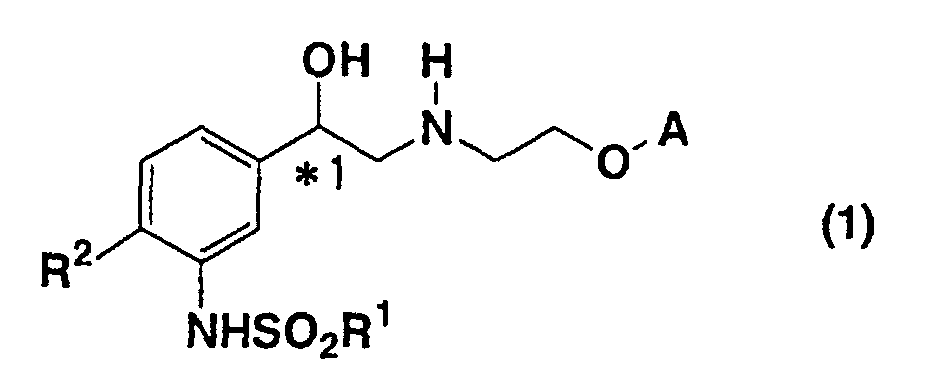 wherein X represents NH, O or S; R6 represents a hydrogen atom, a hydroxyl group, an amino group or an acetylamino group; and *2 represents an asymmetric carbon atom when R6 is not a hydrogen atom,
which comprises the following steps (a) to (c):(a)i ) reacting a compound of the formula (4):wherein R1 is as defined above; R21 represents a hydrogen atom, a halogen atom, a hydroxyl group or a protected hydroxyl group; R3 represents an amino-protecting group or a hydrogen atom, with a compound of the formula (12): wherein R4 represents an amino-protecting group [or a hydrogen atom]; and A' represents one of the following groups:
 wherein X represents NH, O or S; R61 represents a hydrogen atom, a protected hydroxyl group, a protected amino group or an acetylamino group; and *2 represents an asymmetric carbon atom when R61 is not a hydrogen atom, to give a compound of the formula (3):
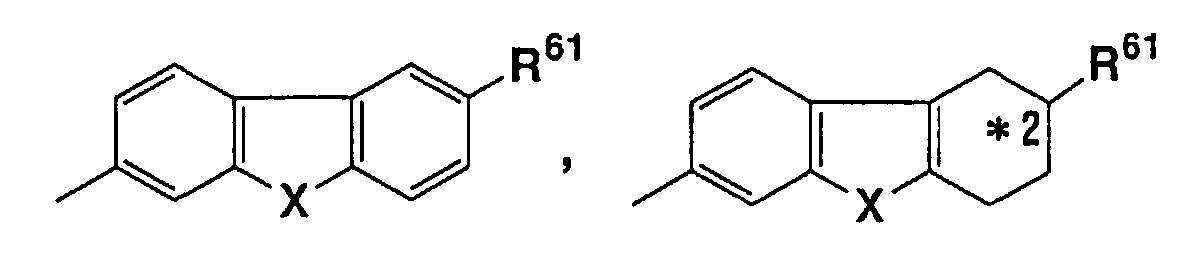 wherein R1, R21, R3 , R4 and A' are as defined above; or
 ii) coupling a compound of the formula (4) with a compound of the formula (14):wherein R4 is as defined above, to give a compound of the formula (6):
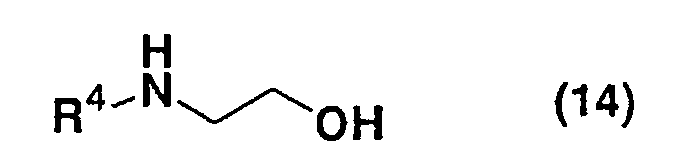 wherein R1, R21, R3 and R4 are as defined above; or
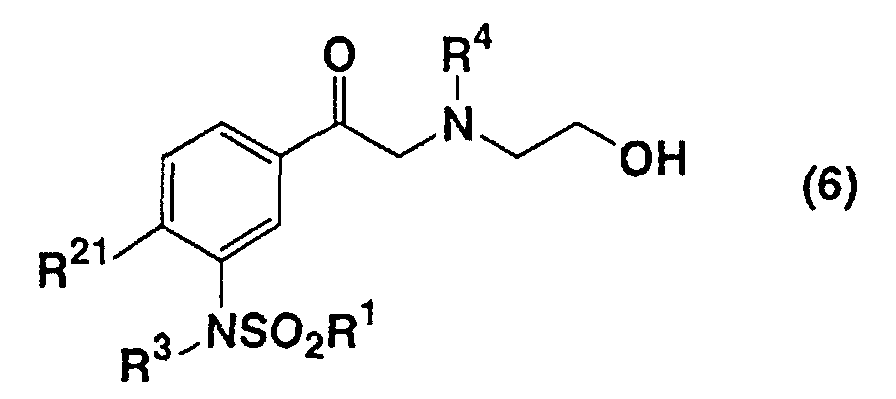 iii) further converting the primary hydroxyl group of the compound of the formula (6) into a leaving group B3 to give a compound of the formula (5):wherein R1, R21, R3 and R4 are as defined above, and B3 represents a leaving group; or
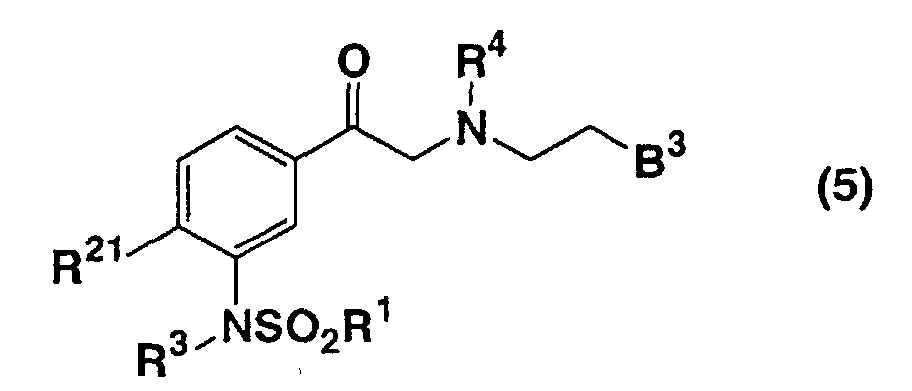 iv) further reacting the resulting compound of the formula (5) with a compound represented by A'-OH wherein A' is as defined above to give a compound of the formula (3);(b) then reducing the resulting compound of any one of the formulae (3), (5) and (6) to give a compound of the formula (2) as follows:wherein R1, R21, R3 and R4 are as defined above, and *1 represents an asymmetric carbon atom, and converting the primary hydroxyl group of the resulting compound of the formula (8) into a leaving group B3 to give a compound of the formula (7), then reacting the compound of the formula (7) obtained by either step as set forth above with a compound represented by A'-OH wherein A' is as . defined above to give an amino-alcohol of the formula (2); andi) reducing the compound of the formula (3) to give an amino-alcohol of the formula (2):wherein R1, R21, R3 , R4 and A' are as defined above, and *1 represents an asymmetric carbon atom; or
 ii) reducing the compound of the formula (5) to give a compound of the formula (7):wherein R1, R21, R3 , R4 and B3 are as defined above, and *1 represents an asymmetric carbon atom, or
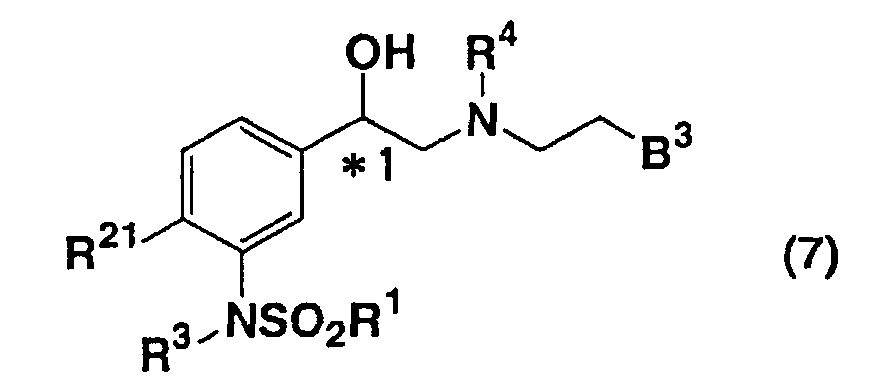 iii) reducing the compound of the formula (6) to give a compound of the formula (8):
 (c) simultaneously or sequentially removing the protecting groups of the compound of the formula (2) obtained by any one of processes as set forth above to give a compound of the formula (1).
 - A process for the preparation of a compound of the formula (1):wherein R1 represents a lower alkyl group or a benzyl group; R2 represents a hydrogen atom, a halogen atom or a hydroxyl group; *1 represents an asymmetric carbon atom; and A represents one of the following groups:
 wherein X represents NH, O or S; R6 represents a hydrogen atom, a hydroxyl group, an amino group or an acetylamino group; and *2 represents an asymmetric carbon atom when R6 is not a hydrogen atom,
which comprises the following steps (a) to (c):(a) reacting a compound of the formula (4):wherein R1 is as defined above; R21 represents a hydrogen atom, a halogen atom, a hydroxyl group or a protected hydroxyl group; R3 represents an amino-protecting group or a hydrogen atom, with a compound of the formula (12):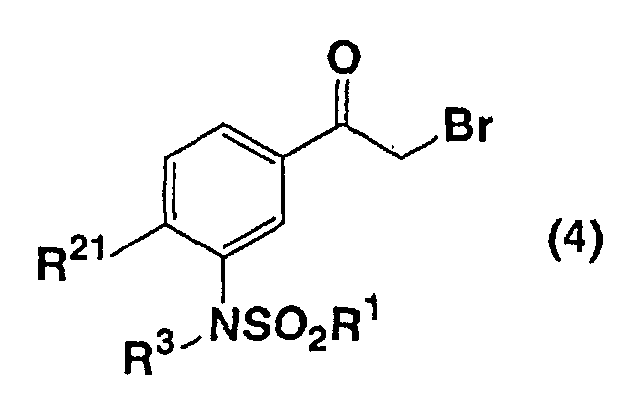 wherein R4 represents an amino-protecting group [or a hydrogen atom]; and A' represents one of the following groups:
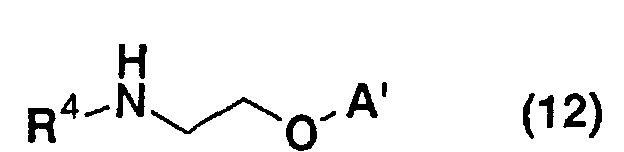 wherein X represents NH, O or S; R61 represents a hydrogen atom, a protected hydroxyl group, a protected amino group or an acetylamino group; and *2 represents an asymmetric carbon atom when R61 is not a hydrogen atom, to give a compound of the formula (3):
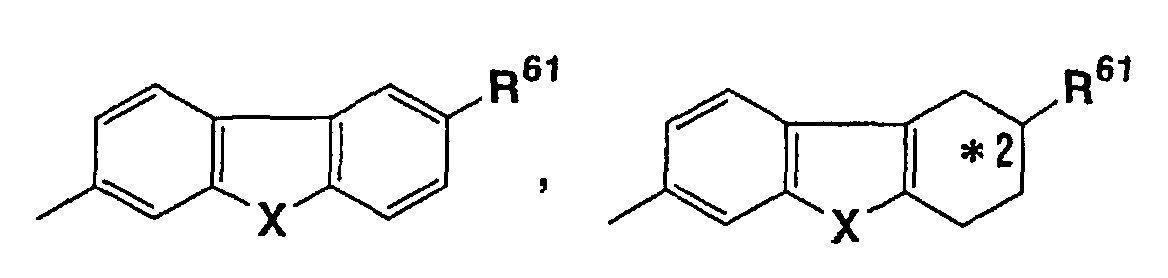 wherein R1, R21, R3 , R4 and A' are as defined above;
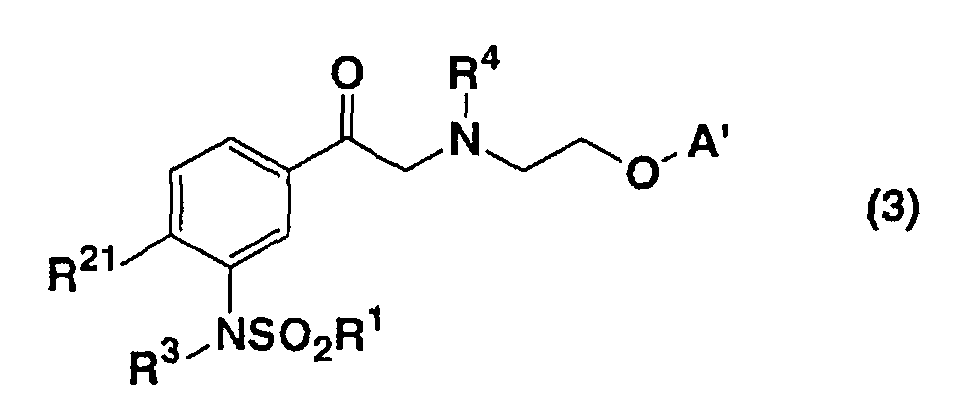 (b) reducing the resulting compound of the formula (3) to give an amino-alcohol of the formula (2):wherein R1, R21, R3 , R4 and A' are as defined above, and *1 represents an asymmetric carbon atom; and
 (c) simultaneously or sequentially removing the protecting groups to give a compound of the formula (1).
 - A process as claimed in claim 1 or 2, wherein R61 is a hydrogen atom.
- A process as claimed in claim 1, wherein in the step of claim 1 for reducing a compound of the formula (3), (6) or (5) to give an amino-alcohol of the formula (2), (8) or (7), characterized by that a compound of the formula (3), (6) or (5) is asymmetrically reduced, and that the amino-alcohol of the formula (2) and the compound of the formula (1) are one of its optical isomers.
- A process as claimed in claim 2 or 3, wherein in the step of claim 2 or 3 for reducing a compound of the formula (3) to give an amino-alcohol of the formula (2), characterized by that a compound of the formula (3) is asymmetrically reduced, and that the amino-alcohol of the formula (2) and the compound of the formula (1) are one of its optical isomers.
- A process for the preparation of a compound of the formula (3):wherein R1 represents a lower alkyl group or a benzyl group; R21 represents a hydrogen atom, a halogen atom, a hydroxyl group or a protected hydroxyl group; R3 represents an amino-protecting group or a hydrogen atom; R4 represents an amino-protecting group [or a hydrogen atom]; and A' represents one of the following groups:
 wherein X represents NH, O or S; R61 represents a hydrogen atom, a protected hydroxyl group, a protected amino group or an acetylamino group; and *2 represents an asymmetric carbon atom when R61 is not a hydrogen atom,
which comprises reacting a compound of the formula (4):wherein R1, R21 and R3 are as defined above, with a compound of the formula (12):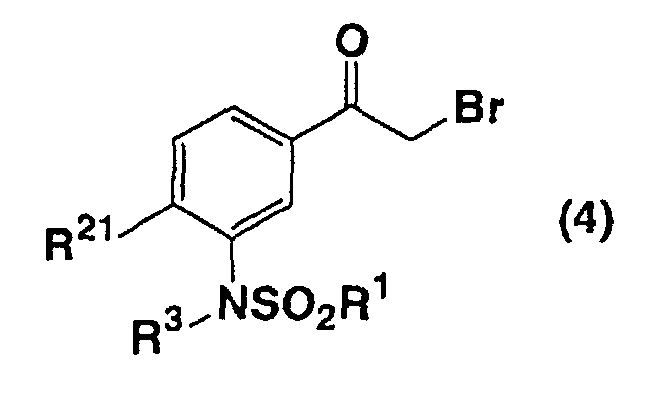 wherein R4 and A' are as defined above, to give a compound of the formula (3).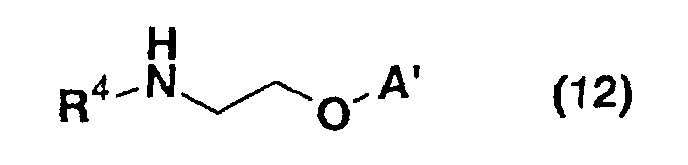
- A process for the preparation of a compound of the formula (2):wherein R1 represents a lower alkyl group or a benzyl group; R21 represents a hydrogen atom, a halogen atom, a hydroxyl group or a protected hydroxyl group; R3 represents an amino-protecting group or a hydrogen atom; R4 represents an amino-protecting group [or a hydrogen atom]; *1 represents an asymmetric carbon atom; and A' represents one of the following groups:
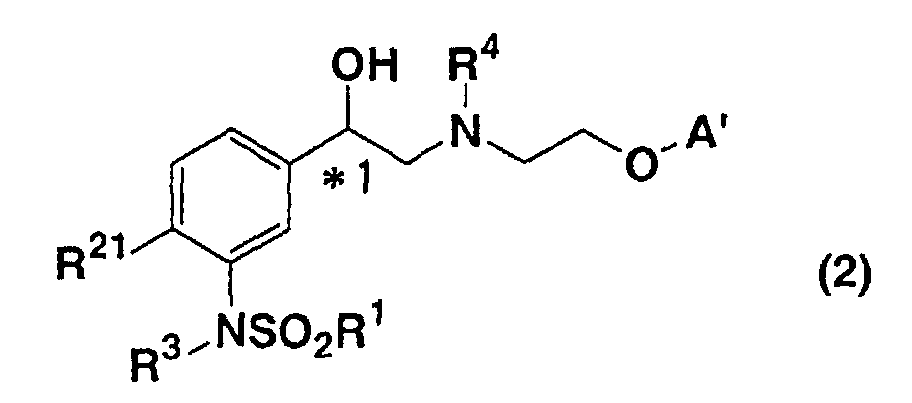 wherein X represents NH, O or S; R61 represents a hydrogen atom, a protected hydroxyl group, a protected amino group or an acetylamino group; and *2 represents an asymmetric carbon atom when R61 is not a hydrogen atom,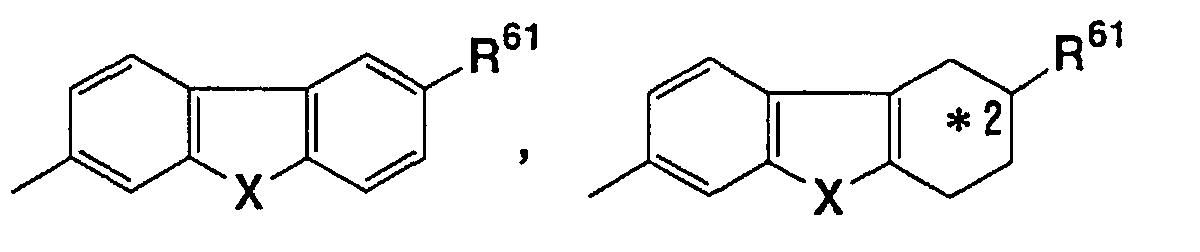
which comprises reducing a compound of the formula (3):wherein R1, R21, R3 , R4 and A' are as defined above, to give a compound of the formula (2).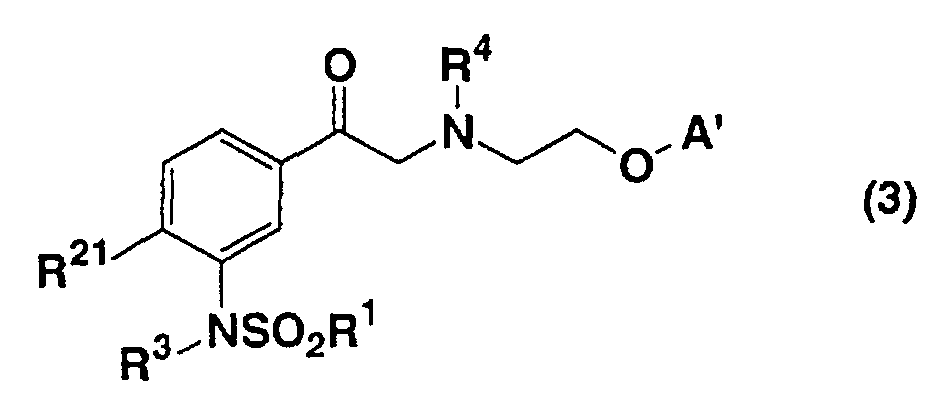
- A process as claimed in claim 7, wherein in the step of claim 7 for reducing a compound of the formula (3), characterized by that a compound of the formula (3) is asymmetrically reduced, and that the compound of the formula (2) is one of its optical isomers.
- A compound represented by the formula (3) or a salt thereof:wherein

R1 represents a lower alkyl group or a benzyl group; R21 represents a hydrogen atom, a halogen atom, a hydroxyl group or a protected hydroxyl group; R3 represents an amino-protecting group or a hydrogen atom; R4 represents an amino-protecting group [or a hydrogen atom]; and A' represents one of the following groups:wherein X represents NH, O or S; R61 represents a hydrogen atom, a protected hydroxyl group, a protected amino group or an acetylamino group; and *2 represents an asymmetric carbon atom when R61 is not a hydrogen atom.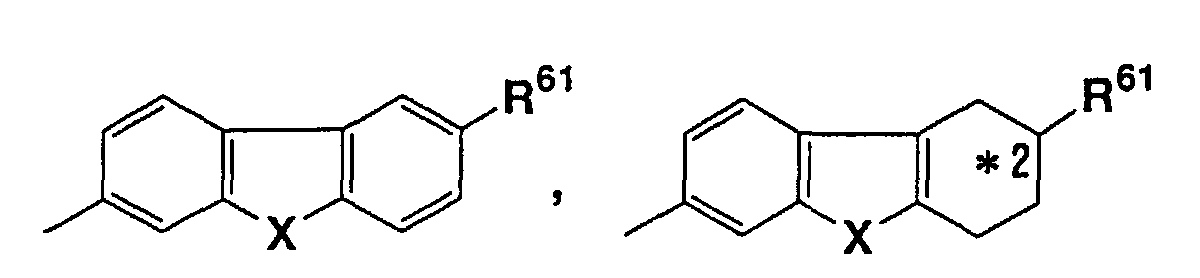
- A compound represented by the formula (18) or a salt thereof:wherein R1 represents a lower alkyl group or a benzyl group; R21 represents a hydrogen atom, a halogen atom, a hydroxyl group or a protected hydroxyl group; R3 represents an amino-protecting group or a hydrogen atom; R4 represents an amino-protecting group [or a hydrogen atom]; and B represents a hydroxyl group or a leaving group.

- A compound represented by the formula (19) or a salt thereof:wherein R1 represents a lower alkyl group or a benzyl group; R21 represents a hydrogen atom, a halogen atom, a hydroxyl group or a protected hydroxyl group; R3 represents a hydrogen atom or an amino-protecting group; R4 represents an amino-protecting group [or a hydrogen atom]; B represents a hydroxyl group or a leaving group; and *1 represents an asymmetric carbon atom.

Applications Claiming Priority (3)
| Application Number | Priority Date | Filing Date | Title |
|---|---|---|---|
| JP8319799 | 1999-03-26 | ||
| JP8319799 | 1999-03-26 | ||
| PCT/JP2000/001696 WO2000058287A1 (en) | 1999-03-26 | 2000-03-21 | Novel method for manufacturing tricyclic amino alcohol derivatives |
Publications (1)
| Publication Number | Publication Date |
|---|---|
| EP1174425A1 true EP1174425A1 (en) | 2002-01-23 |
Family
ID=13795612
Family Applications (1)
| Application Number | Title | Priority Date | Filing Date |
|---|---|---|---|
| EP00909753A Withdrawn EP1174425A1 (en) | 1999-03-26 | 2000-03-21 | Novel method for manufacturing tricyclic amino alcohol derivatives |
Country Status (11)
| Country | Link |
|---|---|
| US (1) | US6495701B1 (en) |
| EP (1) | EP1174425A1 (en) |
| KR (1) | KR20020005630A (en) |
| CN (1) | CN1349501A (en) |
| AU (1) | AU3195800A (en) |
| BR (1) | BR0009315A (en) |
| CA (1) | CA2368448A1 (en) |
| MX (1) | MXPA01009633A (en) |
| NO (1) | NO20014672L (en) |
| TW (1) | TW519537B (en) |
| WO (1) | WO2000058287A1 (en) |
Cited By (4)
| Publication number | Priority date | Publication date | Assignee | Title |
|---|---|---|---|---|
| US6861444B2 (en) | 2000-04-28 | 2005-03-01 | Asahi Kasei Pharma Corporation | Bicyclic compounds |
| US7271190B2 (en) | 2001-10-25 | 2007-09-18 | Asahi Kasei Pharma Corporation | Indazole compounds as β3 adrenoceptor agonist |
| US8008506B2 (en) | 2008-10-09 | 2011-08-30 | Asahi Kasei Pharma Corporation | Indazole compounds |
| US8304443B2 (en) | 2008-10-09 | 2012-11-06 | Asahi Kasei Pharma Corporation | Indazole derivatives |
Families Citing this family (8)
| Publication number | Priority date | Publication date | Assignee | Title |
|---|---|---|---|---|
| WO2001017962A1 (en) * | 1999-09-03 | 2001-03-15 | Asahi Kasei Kabushiki Kaisha | Processes for the preparation of tricyclic amino alcohol derivatives |
| KR20020068513A (en) * | 1999-10-04 | 2002-08-27 | 아사히 가세이 가부시키가이샤 | Method for Improving the Solubility of Tricyclic Amino Alcohol Derivatives |
| AU2001252573A1 (en) * | 2000-04-28 | 2001-11-12 | Asahi Kasei Kabushiki Kaisha | Novel substituted tricyclic compounds |
| AU2001252575A1 (en) * | 2000-04-28 | 2001-11-12 | Asahi Kasei Kabushiki Kaisha | Novel tricyclic compounds |
| WO2002074306A1 (en) * | 2001-03-19 | 2002-09-26 | Asahi Kasei Kabushiki Kaisha | Remedies for fatty liver |
| US7847111B2 (en) * | 2006-06-19 | 2010-12-07 | Canada Inc. | Semi-synthetic route for the preparation of paclitaxel, docetaxel, and 10-deacetylbaccatin III from 9-dihydro-13-acetylbaccatin III |
| KR100821567B1 (en) * | 2006-11-01 | 2008-04-15 | 한국화학연구원 | Method for preparing optically active 2-sulfonyloxy-1-phenylethanol derivative |
| US20100222404A1 (en) * | 2008-11-04 | 2010-09-02 | Asahi Kasei Pharma Corporation | Indazole derivative dihydrochloride |
Family Cites Families (7)
| Publication number | Priority date | Publication date | Assignee | Title |
|---|---|---|---|---|
| JPH04187685A (en) | 1990-11-21 | 1992-07-06 | Eisai Co Ltd | Preparation of optically active naphthylethanol derivative |
| DE69518497T2 (en) | 1994-12-07 | 2001-04-19 | Japan Science And Technology Corp., Kawaguchi | Process for making an alcohol |
| US6184381B1 (en) | 1995-12-06 | 2001-02-06 | Japan Science & Technology Corp. | Process for preparing optically active compounds |
| WO1997025311A1 (en) * | 1996-01-10 | 1997-07-17 | Asahi Kasei Kogyo Kabushiki Kaisha | Novel tricyclic compounds and drug compositions containing the same |
| AU735249B2 (en) * | 1997-07-03 | 2001-07-05 | Asahi Kasei Kabushiki Kaisha | Novel tricyclic compounds having saturated rings and medicinal compositions containing the same |
| DE19846183A1 (en) | 1998-10-07 | 2000-04-27 | Bosch Gmbh Robert | Two-speed gearbox, in particular attachment gear for auxiliary units in motor vehicles |
| KR20020005648A (en) | 1999-04-01 | 2002-01-17 | 야마모토 카즈모토 | Method for the Preparation of Tricyclic Amino Alcohol Derivatives Through Azides |
-
2000
- 2000-03-14 TW TW089104627A patent/TW519537B/en active
- 2000-03-21 WO PCT/JP2000/001696 patent/WO2000058287A1/en not_active Ceased
- 2000-03-21 MX MXPA01009633A patent/MXPA01009633A/en unknown
- 2000-03-21 BR BR0009315-7A patent/BR0009315A/en not_active IP Right Cessation
- 2000-03-21 AU AU31958/00A patent/AU3195800A/en not_active Abandoned
- 2000-03-21 KR KR1020017012195A patent/KR20020005630A/en not_active Ceased
- 2000-03-21 CN CN00806966A patent/CN1349501A/en active Pending
- 2000-03-21 CA CA002368448A patent/CA2368448A1/en not_active Abandoned
- 2000-03-21 US US09/937,488 patent/US6495701B1/en not_active Expired - Fee Related
- 2000-03-21 EP EP00909753A patent/EP1174425A1/en not_active Withdrawn
-
2001
- 2001-09-26 NO NO20014672A patent/NO20014672L/en not_active Application Discontinuation
Non-Patent Citations (1)
| Title |
|---|
| See references of WO0058287A1 * |
Cited By (7)
| Publication number | Priority date | Publication date | Assignee | Title |
|---|---|---|---|---|
| US6861444B2 (en) | 2000-04-28 | 2005-03-01 | Asahi Kasei Pharma Corporation | Bicyclic compounds |
| US7049445B2 (en) | 2000-04-28 | 2006-05-23 | Asahi Kasei Pharma Corporation | Bicyclic compounds |
| US7271190B2 (en) | 2001-10-25 | 2007-09-18 | Asahi Kasei Pharma Corporation | Indazole compounds as β3 adrenoceptor agonist |
| US7511069B2 (en) | 2001-10-25 | 2009-03-31 | Asahi Pharma Corporation | Indazole compounds as β3 andrenoceptor agonist |
| US7598284B2 (en) | 2001-10-25 | 2009-10-06 | Asahi Kasei Pharma Corporation | Indazole compounds as B3 adrenoceptor agonist |
| US8008506B2 (en) | 2008-10-09 | 2011-08-30 | Asahi Kasei Pharma Corporation | Indazole compounds |
| US8304443B2 (en) | 2008-10-09 | 2012-11-06 | Asahi Kasei Pharma Corporation | Indazole derivatives |
Also Published As
| Publication number | Publication date |
|---|---|
| MXPA01009633A (en) | 2003-07-21 |
| CA2368448A1 (en) | 2000-10-05 |
| CN1349501A (en) | 2002-05-15 |
| BR0009315A (en) | 2001-12-18 |
| TW519537B (en) | 2003-02-01 |
| NO20014672D0 (en) | 2001-09-26 |
| WO2000058287A1 (en) | 2000-10-05 |
| AU3195800A (en) | 2000-10-16 |
| US6495701B1 (en) | 2002-12-17 |
| NO20014672L (en) | 2001-11-01 |
| KR20020005630A (en) | 2002-01-17 |
Similar Documents
| Publication | Publication Date | Title |
|---|---|---|
| US6495701B1 (en) | Method for manufacturing tricyclic amino alcohol derivatives | |
| US9012488B2 (en) | Crystalline polymorphic forms of an antidiabetic compound | |
| JP2007508293A (en) | Method for producing O-carbamoyl compound in the presence of active amine group | |
| JP2818763B2 (en) | O-alkylated compounds of N- (hydroxy) aralkylphenylethanolamines | |
| EP1174426A1 (en) | Method for the preparation of tricyclic amino alcohol derivatives through azides | |
| US20030040538A1 (en) | Novel substituted tricyclic compounds | |
| US6696573B1 (en) | Processes for the preparation of tricyclic amino alcohol derivatives | |
| DE69808068T2 (en) | METHOD FOR PRODUCING INDOLDER DERIVATIVES | |
| WO2012062229A1 (en) | A method of manufacturing (-)-l-(3-hydroxypropyl)-5-[(2r)-2-({2,2,2-trifluoroethoxy)- phenoxyethyl}amino)propyl]-2,3-dihydro-lh-indole-7-carboxamide | |
| EP1195371A1 (en) | Process for the preparation of tricyclic amino alcohol derivatives | |
| EP3262031A1 (en) | Process for the preparation of vortioxetine | |
| JP2008505903A (en) | Formation of tetrasubstituted enamides and this stereoselective reduction. | |
| EP1294683B1 (en) | A process for preparing biphenyl compounds | |
| JP2009503035A (en) | Method for obtaining 3,3-diphenylpropylamine | |
| JPWO2000058287A1 (en) | New method for producing tricyclic amino alcohol derivatives | |
| JPWO2001004092A1 (en) | Method for producing tricyclic amino alcohol derivatives | |
| EP4110759A1 (en) | Process for the preparation of panobinostat | |
| JP2002275138A (en) | Method for producing 2-aminoindan derivative and intermediate thereof | |
| JPWO2000059885A1 (en) | Preparation of tricyclic amino alcohol derivatives via azides | |
| JPWO2001017962A1 (en) | Method for producing tricyclic amino alcohol derivatives | |
| JP2009508961A (en) | Production method of amino acid derivatives | |
| US20190359553A1 (en) | A process for the preparation of phenoxybenzamine | |
| WO2001072693A1 (en) | Novel aminophenol derivatives | |
| JP2004131418A (en) | Method for producing 2- (N-ω-hydroxyalkyl) aminomethyl-1-substituted pyrrolidine |
Legal Events
| Date | Code | Title | Description |
|---|---|---|---|
| PUAI | Public reference made under article 153(3) epc to a published international application that has entered the european phase |
Free format text: ORIGINAL CODE: 0009012 |
|
| 17P | Request for examination filed |
Effective date: 20011025 |
|
| AK | Designated contracting states |
Kind code of ref document: A1 Designated state(s): AT BE CH CY DE DK ES FI FR GB GR IE IT LI LU MC NL PT SE |
|
| AX | Request for extension of the european patent |
Free format text: AL;LT;LV;MK;RO;SI |
|
| RIN1 | Information on inventor provided before grant (corrected) |
Inventor name: MATSUBARA, KOKI Inventor name: KIDA, HITOSHI |
|
| STAA | Information on the status of an ep patent application or granted ep patent |
Free format text: STATUS: THE APPLICATION HAS BEEN WITHDRAWN |
|
| 18W | Application withdrawn |
Withdrawal date: 20021126 |