EP1174241B1 - Multilayered structure resin molded product and method of manufacturing multilayered structure resin molded product - Google Patents
Multilayered structure resin molded product and method of manufacturing multilayered structure resin molded product Download PDFInfo
- Publication number
- EP1174241B1 EP1174241B1 EP20010116205 EP01116205A EP1174241B1 EP 1174241 B1 EP1174241 B1 EP 1174241B1 EP 20010116205 EP20010116205 EP 20010116205 EP 01116205 A EP01116205 A EP 01116205A EP 1174241 B1 EP1174241 B1 EP 1174241B1
- Authority
- EP
- European Patent Office
- Prior art keywords
- resin material
- molded product
- skin layer
- resin
- core layer
- Prior art date
- Legal status (The legal status is an assumption and is not a legal conclusion. Google has not performed a legal analysis and makes no representation as to the accuracy of the status listed.)
- Expired - Lifetime
Links
- 229920005989 resin Polymers 0.000 title claims description 248
- 239000011347 resin Substances 0.000 title claims description 248
- 238000004519 manufacturing process Methods 0.000 title claims description 14
- 239000000463 material Substances 0.000 claims description 224
- 239000012792 core layer Substances 0.000 claims description 82
- 239000010410 layer Substances 0.000 claims description 81
- 238000000465 moulding Methods 0.000 claims description 23
- 238000002347 injection Methods 0.000 claims description 19
- 239000007924 injection Substances 0.000 claims description 19
- 238000010298 pulverizing process Methods 0.000 claims description 19
- 229920005992 thermoplastic resin Polymers 0.000 claims description 10
- 238000000034 method Methods 0.000 description 15
- 238000004891 communication Methods 0.000 description 8
- 239000002994 raw material Substances 0.000 description 8
- 238000004064 recycling Methods 0.000 description 8
- 238000001746 injection moulding Methods 0.000 description 6
- 238000004140 cleaning Methods 0.000 description 5
- 239000000470 constituent Substances 0.000 description 5
- 230000000704 physical effect Effects 0.000 description 5
- 239000004431 polycarbonate resin Substances 0.000 description 5
- 229920005668 polycarbonate resin Polymers 0.000 description 5
- 239000011162 core material Substances 0.000 description 4
- 238000005259 measurement Methods 0.000 description 4
- 229910052751 metal Inorganic materials 0.000 description 4
- 239000002184 metal Substances 0.000 description 4
- 230000008569 process Effects 0.000 description 4
- 239000000956 alloy Substances 0.000 description 3
- 229910045601 alloy Inorganic materials 0.000 description 3
- 230000006866 deterioration Effects 0.000 description 3
- 230000007613 environmental effect Effects 0.000 description 3
- 150000002739 metals Chemical class 0.000 description 3
- 239000008188 pellet Substances 0.000 description 3
- 239000000088 plastic resin Substances 0.000 description 3
- KAKZBPTYRLMSJV-UHFFFAOYSA-N Butadiene Chemical compound C=CC=C KAKZBPTYRLMSJV-UHFFFAOYSA-N 0.000 description 2
- PPBRXRYQALVLMV-UHFFFAOYSA-N Styrene Chemical compound C=CC1=CC=CC=C1 PPBRXRYQALVLMV-UHFFFAOYSA-N 0.000 description 2
- 239000003086 colorant Substances 0.000 description 2
- 238000011161 development Methods 0.000 description 2
- 230000018109 developmental process Effects 0.000 description 2
- 239000004033 plastic Substances 0.000 description 2
- 229920003023 plastic Polymers 0.000 description 2
- 239000012815 thermoplastic material Substances 0.000 description 2
- NLHHRLWOUZZQLW-UHFFFAOYSA-N Acrylonitrile Chemical compound C=CC#N NLHHRLWOUZZQLW-UHFFFAOYSA-N 0.000 description 1
- 108010053481 Antifreeze Proteins Proteins 0.000 description 1
- 229920000122 acrylonitrile butadiene styrene Polymers 0.000 description 1
- 230000009471 action Effects 0.000 description 1
- 230000005540 biological transmission Effects 0.000 description 1
- 230000003247 decreasing effect Effects 0.000 description 1
- 230000001419 dependent effect Effects 0.000 description 1
- 230000002542 deteriorative effect Effects 0.000 description 1
- 238000005516 engineering process Methods 0.000 description 1
- 239000010419 fine particle Substances 0.000 description 1
- 230000005484 gravity Effects 0.000 description 1
- 238000010438 heat treatment Methods 0.000 description 1
- 239000012535 impurity Substances 0.000 description 1
- 239000002440 industrial waste Substances 0.000 description 1
- 238000012986 modification Methods 0.000 description 1
- 230000004048 modification Effects 0.000 description 1
- 239000002991 molded plastic Substances 0.000 description 1
- 230000003287 optical effect Effects 0.000 description 1
- 239000003208 petroleum Substances 0.000 description 1
- 238000012545 processing Methods 0.000 description 1
- 239000000243 solution Substances 0.000 description 1
- 125000006850 spacer group Chemical group 0.000 description 1
- 230000007480 spreading Effects 0.000 description 1
- 238000003892 spreading Methods 0.000 description 1
- 239000000126 substance Substances 0.000 description 1
- 239000002344 surface layer Substances 0.000 description 1
- 238000002834 transmittance Methods 0.000 description 1
Images







Classifications
-
- B—PERFORMING OPERATIONS; TRANSPORTING
- B29—WORKING OF PLASTICS; WORKING OF SUBSTANCES IN A PLASTIC STATE IN GENERAL
- B29C—SHAPING OR JOINING OF PLASTICS; SHAPING OF MATERIAL IN A PLASTIC STATE, NOT OTHERWISE PROVIDED FOR; AFTER-TREATMENT OF THE SHAPED PRODUCTS, e.g. REPAIRING
- B29C45/00—Injection moulding, i.e. forcing the required volume of moulding material through a nozzle into a closed mould; Apparatus therefor
- B29C45/16—Making multilayered or multicoloured articles
- B29C45/1642—Making multilayered or multicoloured articles having a "sandwich" structure
-
- B—PERFORMING OPERATIONS; TRANSPORTING
- B29—WORKING OF PLASTICS; WORKING OF SUBSTANCES IN A PLASTIC STATE IN GENERAL
- B29C—SHAPING OR JOINING OF PLASTICS; SHAPING OF MATERIAL IN A PLASTIC STATE, NOT OTHERWISE PROVIDED FOR; AFTER-TREATMENT OF THE SHAPED PRODUCTS, e.g. REPAIRING
- B29C45/00—Injection moulding, i.e. forcing the required volume of moulding material through a nozzle into a closed mould; Apparatus therefor
- B29C45/16—Making multilayered or multicoloured articles
-
- B—PERFORMING OPERATIONS; TRANSPORTING
- B29—WORKING OF PLASTICS; WORKING OF SUBSTANCES IN A PLASTIC STATE IN GENERAL
- B29C—SHAPING OR JOINING OF PLASTICS; SHAPING OF MATERIAL IN A PLASTIC STATE, NOT OTHERWISE PROVIDED FOR; AFTER-TREATMENT OF THE SHAPED PRODUCTS, e.g. REPAIRING
- B29C45/00—Injection moulding, i.e. forcing the required volume of moulding material through a nozzle into a closed mould; Apparatus therefor
- B29C2045/0093—Injection moulding, i.e. forcing the required volume of moulding material through a nozzle into a closed mould; Apparatus therefor of articles provided with an attaching element
-
- B—PERFORMING OPERATIONS; TRANSPORTING
- B29—WORKING OF PLASTICS; WORKING OF SUBSTANCES IN A PLASTIC STATE IN GENERAL
- B29C—SHAPING OR JOINING OF PLASTICS; SHAPING OF MATERIAL IN A PLASTIC STATE, NOT OTHERWISE PROVIDED FOR; AFTER-TREATMENT OF THE SHAPED PRODUCTS, e.g. REPAIRING
- B29C45/00—Injection moulding, i.e. forcing the required volume of moulding material through a nozzle into a closed mould; Apparatus therefor
- B29C45/17—Component parts, details or accessories; Auxiliary operations
- B29C45/26—Moulds
- B29C45/2602—Mould construction elements
-
- B—PERFORMING OPERATIONS; TRANSPORTING
- B29—WORKING OF PLASTICS; WORKING OF SUBSTANCES IN A PLASTIC STATE IN GENERAL
- B29C—SHAPING OR JOINING OF PLASTICS; SHAPING OF MATERIAL IN A PLASTIC STATE, NOT OTHERWISE PROVIDED FOR; AFTER-TREATMENT OF THE SHAPED PRODUCTS, e.g. REPAIRING
- B29C45/00—Injection moulding, i.e. forcing the required volume of moulding material through a nozzle into a closed mould; Apparatus therefor
- B29C45/17—Component parts, details or accessories; Auxiliary operations
- B29C45/26—Moulds
- B29C45/27—Sprue channels ; Runner channels or runner nozzles
- B29C45/2756—Cold runner channels
-
- B—PERFORMING OPERATIONS; TRANSPORTING
- B29—WORKING OF PLASTICS; WORKING OF SUBSTANCES IN A PLASTIC STATE IN GENERAL
- B29K—INDEXING SCHEME ASSOCIATED WITH SUBCLASSES B29B, B29C OR B29D, RELATING TO MOULDING MATERIALS OR TO MATERIALS FOR MOULDS, REINFORCEMENTS, FILLERS OR PREFORMED PARTS, e.g. INSERTS
- B29K2101/00—Use of unspecified macromolecular compounds as moulding material
- B29K2101/12—Thermoplastic materials
-
- B—PERFORMING OPERATIONS; TRANSPORTING
- B29—WORKING OF PLASTICS; WORKING OF SUBSTANCES IN A PLASTIC STATE IN GENERAL
- B29K—INDEXING SCHEME ASSOCIATED WITH SUBCLASSES B29B, B29C OR B29D, RELATING TO MOULDING MATERIALS OR TO MATERIALS FOR MOULDS, REINFORCEMENTS, FILLERS OR PREFORMED PARTS, e.g. INSERTS
- B29K2105/00—Condition, form or state of moulded material or of the material to be shaped
- B29K2105/26—Scrap or recycled material
-
- Y—GENERAL TAGGING OF NEW TECHNOLOGICAL DEVELOPMENTS; GENERAL TAGGING OF CROSS-SECTIONAL TECHNOLOGIES SPANNING OVER SEVERAL SECTIONS OF THE IPC; TECHNICAL SUBJECTS COVERED BY FORMER USPC CROSS-REFERENCE ART COLLECTIONS [XRACs] AND DIGESTS
- Y10—TECHNICAL SUBJECTS COVERED BY FORMER USPC
- Y10T—TECHNICAL SUBJECTS COVERED BY FORMER US CLASSIFICATION
- Y10T428/00—Stock material or miscellaneous articles
- Y10T428/24—Structurally defined web or sheet [e.g., overall dimension, etc.]
- Y10T428/24008—Structurally defined web or sheet [e.g., overall dimension, etc.] including fastener for attaching to external surface
-
- Y—GENERAL TAGGING OF NEW TECHNOLOGICAL DEVELOPMENTS; GENERAL TAGGING OF CROSS-SECTIONAL TECHNOLOGIES SPANNING OVER SEVERAL SECTIONS OF THE IPC; TECHNICAL SUBJECTS COVERED BY FORMER USPC CROSS-REFERENCE ART COLLECTIONS [XRACs] AND DIGESTS
- Y10—TECHNICAL SUBJECTS COVERED BY FORMER USPC
- Y10T—TECHNICAL SUBJECTS COVERED BY FORMER US CLASSIFICATION
- Y10T428/00—Stock material or miscellaneous articles
- Y10T428/24—Structurally defined web or sheet [e.g., overall dimension, etc.]
- Y10T428/24008—Structurally defined web or sheet [e.g., overall dimension, etc.] including fastener for attaching to external surface
- Y10T428/24017—Hook or barb
-
- Y—GENERAL TAGGING OF NEW TECHNOLOGICAL DEVELOPMENTS; GENERAL TAGGING OF CROSS-SECTIONAL TECHNOLOGIES SPANNING OVER SEVERAL SECTIONS OF THE IPC; TECHNICAL SUBJECTS COVERED BY FORMER USPC CROSS-REFERENCE ART COLLECTIONS [XRACs] AND DIGESTS
- Y10—TECHNICAL SUBJECTS COVERED BY FORMER USPC
- Y10T—TECHNICAL SUBJECTS COVERED BY FORMER US CLASSIFICATION
- Y10T428/00—Stock material or miscellaneous articles
- Y10T428/24—Structurally defined web or sheet [e.g., overall dimension, etc.]
- Y10T428/24479—Structurally defined web or sheet [e.g., overall dimension, etc.] including variation in thickness
- Y10T428/24612—Composite web or sheet
-
- Y—GENERAL TAGGING OF NEW TECHNOLOGICAL DEVELOPMENTS; GENERAL TAGGING OF CROSS-SECTIONAL TECHNOLOGIES SPANNING OVER SEVERAL SECTIONS OF THE IPC; TECHNICAL SUBJECTS COVERED BY FORMER USPC CROSS-REFERENCE ART COLLECTIONS [XRACs] AND DIGESTS
- Y10—TECHNICAL SUBJECTS COVERED BY FORMER USPC
- Y10T—TECHNICAL SUBJECTS COVERED BY FORMER US CLASSIFICATION
- Y10T428/00—Stock material or miscellaneous articles
- Y10T428/24—Structurally defined web or sheet [e.g., overall dimension, etc.]
- Y10T428/24942—Structurally defined web or sheet [e.g., overall dimension, etc.] including components having same physical characteristic in differing degree
- Y10T428/2495—Thickness [relative or absolute]
-
- Y—GENERAL TAGGING OF NEW TECHNOLOGICAL DEVELOPMENTS; GENERAL TAGGING OF CROSS-SECTIONAL TECHNOLOGIES SPANNING OVER SEVERAL SECTIONS OF THE IPC; TECHNICAL SUBJECTS COVERED BY FORMER USPC CROSS-REFERENCE ART COLLECTIONS [XRACs] AND DIGESTS
- Y10—TECHNICAL SUBJECTS COVERED BY FORMER USPC
- Y10T—TECHNICAL SUBJECTS COVERED BY FORMER US CLASSIFICATION
- Y10T428/00—Stock material or miscellaneous articles
- Y10T428/26—Web or sheet containing structurally defined element or component, the element or component having a specified physical dimension
-
- Y—GENERAL TAGGING OF NEW TECHNOLOGICAL DEVELOPMENTS; GENERAL TAGGING OF CROSS-SECTIONAL TECHNOLOGIES SPANNING OVER SEVERAL SECTIONS OF THE IPC; TECHNICAL SUBJECTS COVERED BY FORMER USPC CROSS-REFERENCE ART COLLECTIONS [XRACs] AND DIGESTS
- Y10—TECHNICAL SUBJECTS COVERED BY FORMER USPC
- Y10T—TECHNICAL SUBJECTS COVERED BY FORMER US CLASSIFICATION
- Y10T428/00—Stock material or miscellaneous articles
- Y10T428/26—Web or sheet containing structurally defined element or component, the element or component having a specified physical dimension
- Y10T428/263—Coating layer not in excess of 5 mils thick or equivalent
- Y10T428/264—Up to 3 mils
- Y10T428/265—1 mil or less
-
- Y—GENERAL TAGGING OF NEW TECHNOLOGICAL DEVELOPMENTS; GENERAL TAGGING OF CROSS-SECTIONAL TECHNOLOGIES SPANNING OVER SEVERAL SECTIONS OF THE IPC; TECHNICAL SUBJECTS COVERED BY FORMER USPC CROSS-REFERENCE ART COLLECTIONS [XRACs] AND DIGESTS
- Y10—TECHNICAL SUBJECTS COVERED BY FORMER USPC
- Y10T—TECHNICAL SUBJECTS COVERED BY FORMER US CLASSIFICATION
- Y10T428/00—Stock material or miscellaneous articles
- Y10T428/31504—Composite [nonstructural laminate]
-
- Y—GENERAL TAGGING OF NEW TECHNOLOGICAL DEVELOPMENTS; GENERAL TAGGING OF CROSS-SECTIONAL TECHNOLOGIES SPANNING OVER SEVERAL SECTIONS OF THE IPC; TECHNICAL SUBJECTS COVERED BY FORMER USPC CROSS-REFERENCE ART COLLECTIONS [XRACs] AND DIGESTS
- Y10—TECHNICAL SUBJECTS COVERED BY FORMER USPC
- Y10T—TECHNICAL SUBJECTS COVERED BY FORMER US CLASSIFICATION
- Y10T428/00—Stock material or miscellaneous articles
- Y10T428/31504—Composite [nonstructural laminate]
- Y10T428/31507—Of polycarbonate
Definitions
- the present invention relates to a resin molded product having a multilayered molded structure containing a resin material for forming a core layer and a resin material for forming a skin layer.
- the present invention relates to a molded product having a so-called sandwich structure in which a molded portion of the core layer resin material is surrounded by a molded portion of the skin layer resin material.
- the present invention relates to a resin molded product formed by reusing a resin material which is a resin molded product made of a thermoplastic resin material.
- the present invention relates to a technique of pulverizing a molded product of the thermoplastic resin material described above, and using the pulverized resin material as a resin material of injection molding.
- the present invention relates to a resin molded product manufacturing method of forming a multilayered structure resin molded product by injection-molding a resin material for forming a core layer and a resin material for forming a skin layer, wherein a pulverized resin material obtained by pulverizing a thermoplastic resin molded product is used as the resin material for forming the core layer.
- the present invention relates to a technique of recycling plastic resin materials used in, e.g., image forming apparatuses such as copying machines and printers, information communication apparatuses such as facsimile apparatuses and computers, and household electric appliances.
- So-called sandwich structure injection molding is one of injection molding techniques.
- two types of resin materials are injected into a mold cavity to mold a multilayered structure containing a resin molded portion for forming a core layer and a resin molded portion for forming a skin layer.
- the present invention also relates to a technique of reusing molded plastic materials and resin materials.
- Examples of prior art references related to the reuse of resin materials are Japanese Patent Laid-Open Nos. 5-301222 , 5-147036 , and 10-202694 .
- Japanese Patent No. 3031357 describes an example in which a recycled material is used as a core material of a sandwich molded product and a recycled material is also used as a surface material.
- thermoplastic materials are used in various types of electronic apparatuses, e.g., image forming apparatuses such as copying machines and printers, office machines and information communication apparatuses such as facsimile apparatuses and computers, and household electric appliances such as air conditioners, video decks, and audio components.
- Thermoplastic materials removed from used products of these apparatuses are inferior in diverse physical properties such as mechanical strength, fire retardance, and external color.
- a deteriorated used resin material is mixed in an unused resin material. Therefore, a manufactured recycled material is inferior to a molded product of a 100% virgin pellet resin material in mechanical strength, fire retardance, and external color.
- multilayered structure molding so-called sandwich molding, can be used as one means for using a used resin material as the material of a resin molded product.
- this multilayered molded product is obtained by injecting a resin material for forming a core layer and a resin material for forming a skin layer into a mold, thereby forming a resin molded product having a multilayered structure in which the core layer is covered with the skin layer.
- the method uses the used resin material described above as the core layer resin material of this multilayered structure.
- the filling ratio of a core layer resin portion as a recycling material is important.
- the core layer resin sometimes overflows from a portion covered with the skin layer portion.
- external members, housings, and mechanical parts as components of image forming apparatuses and information communication apparatuses such as copying machines, printers, and facsimile apparatuses form functional portions such as threaded portions and fitting portions for connecting to other parts, in addition to flat-plate structures.
- the resin molded product is molded using a pulverized resin material, which is formed by pulverizing a molded product molded from a thermoplastic resin material, as a resin material for forming the core layer, and a virgin material as a resin material for forming the skin layer.
- the resin molded product may be an external part, housing part, or constituent part of an office apparatus, electric apparatus, or information communication apparatus.
- the resin material for forming the core layer may be obtained by pulverizing a resin molded product of an external part, housing part, or constituent part of an office apparatus.
- a resin material obtained by pulverizing a resin molded product molded from a thermoplastic resin material and setting the size of the pulverized resin material to a predetermined size may be used as the resin material for forming the core layer.
- the size of the pulverized resin material to be used as the core layer resin material may be set to preferably 10 mm or less and particularly preferably 4 to 10 mm.
- a method of manufacturing a multilayered structure resin molded product by injecting a resin material for forming a core layer and a resin material for forming a skin layer into a mold, after a predetermined volume of the resin material for forming the skin layer is injected, a resin material for forming the core layer, which is obtained by pulverizing a molded product of a resin material, and a virgin resin material for forming the skin layer may be simultaneously injected, and the virgin resin material for forming the skin layer may be injected again.
- a material obtained by pulverizing a resin molded product molded from a thermoplastic resin material may be used as the core layer resin material.
- the pulverized resin material to be used as the resin material for forming the core layer may be not heated in a step before the pulverized resin material is melted to be injected into the mold.
- a pulverized resin material formed by pulverizing a molded product made of a thermoplastic resin material may be used as a resin material for forming the core layer, a virgin material may be used as a resin material for forming the skin layer, and the resin material for forming the skin layer may be molded using the same type of a resin material as the pulverized resin material.
- the resin molded product is attached to an apparatus as an external part of the apparatus, and a thickness of the skin layer from a surface of the apparatus is defined within a range of numerical values by which transmission of the color of the core layer resin material portion is suppressed.
- the thickness of the skin layer of the resin molded product is 0.3 mm or more.
- the functional part mounting portion is made of a skin layer resin material.
- reference numeral 2 denotes a retainer plate; 4, a movable retainer plate; 6, a front cavity plate member attached to the retainer plate 2; 8 a rear cavity plate member attached to the movable retainer plate 4; and 10, a cavity representing the shape of a molded product formed between the front cavity plate member 6 and the rear cavity plate member 8.
- Reference numeral 12 denotes a front clamping plate; and 14, a rear clamping plate.
- Reference numeral 16 denotes a ejector fixing plate; 18, a ejector plate; 20, a spacer block; and 22, an ejector pin.
- Reference numeral 24 denotes a spring ejector; 26, a runner lock pin; 28, locating ring; 30, a nozzle receiver for an injection cylinder (not shown); 32, a nozzle; 34, a sprue; 36, a runner; and 38, a gate.
- Reference numeral 40 denotes a guide pin.
- Reference numeral 42 denotes an injecting means connected to the nozzle to inject a core layer resin material and a skin layer resin material.
- this injecting means it is possible to use devices disclosed in, e.g., Japanese Patent No. 3017052 and Japanese Patent Laid-Open Nos. 8-224754 and 9-52256 .
- the material of a core layer structural portion which is a raw material of the resin material according to the present invention is a recycled material obtained by collecting the external parts 1, or molded parts of the same resin material as the external parts 1, during the process of disassembling used collected products of, e.g., copying machines and laser printers, and by disassembling, pulverizing, cleaning, and classifying the collected molded parts 1.
- An unused virgin resin material is used as the skin layer resin material.
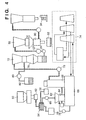
- Fig. 4 is a view showing the arrangement of a system of recycling the core layer resin material as a raw material of the present invention.
- a pulverizer 50 pulverizes the external parts 1 of the collected copying machines and laser printers into a predetermined size.
- the resin materials of the external parts 1 include a polycarbonate resin (PC) and an alloy molded resin material of acrylonitrile, butadiene, and styrene (ABS).
- PC polycarbonate resin
- ABS styrene
- the size of pulverization was set to 4 to 10 mm.
- the set numerical value range of the pulverization size was defined by taking account of clogging of a hopper of a plasticator or clogging in a convey/supply process when the pulverized raw material of the core layer resin material was supplied to the hopper.
- a conveyor apparatus 52 supplies the pulverized material by a predetermined amount at a time to a shaking screen 54.
- a collection tank 56 returns an unpulverized material to the pulverizer.
- Reference numeral 58 denotes a fine-particle collection tank.
- a magnetic selector 60 removes metals from the pulverized material passed through the shaking screen 54.
- the material passed through this magnetic selector 60 is supplied to a cleaning machine 66 via a hopper 62 and a feeder 64.
- the pulverized resin material cleaned by the cleaning machine 66 is supplied to a cyclone 72 by an air blower 70 via a cleaning/dewatering machine 68.
- Reference numeral 74 denotes a cleaning solution density adjusting step; and 76, a circulating device.
- the pulverized resin material supplied to the cyclone 72 is classified by an air classification machine 78. Foreign matter having small specific gravity is discharged to a collection tank 82 by a blower 80.
- the pulverized resin material thus classified is passed through a magnetic selector 84 and supplied to a stock tank 88 by a blower 86.
- metals separated by a metal separator 90 are supplied to a collection tank 92.
- the pulverized resin material from which impurities such as metals are removed is collected as a recycled plastic material in a collection vessel 94.
- the molding conditions of the first embodiment are as follows.
- the cavity surface temperature of the front cavity plate member 6 and the rear cavity plate member 8 is set at 60°C ⁇ 1°C by a heating means (not shown).
- the injection temperature of the skin layer resin material is 250°C.
- the injection temperature of the core layer resin material is 270°C.
- the injection rate of the skin layer resin material is 10 mm/sec.
- the injection rate of the core layer resin material is 20 mm/sec.
- the injection temperature of the core layer resin material is set to be higher than that of the skin layer resin material, thereby setting the viscosity of the core layer resin material to be lower than that of the skin layer resin material.
- the PC + ABS resin material as the skin layer resin material is heated and melted in the first cylinder of the plasticizing means 42 (Fig. 3). Also, the recycled resin material as the core layer resin material, which is pulverized in the processing steps shown in Fig. 4, is heated and melted in the second cylinder.
- a predetermined resin amount Q1 of the skin layer resin material is injected within a predetermined time T1 from the plasticizing means 42.
- a volume Q2 of the skin layer resin material and a volume P1 of the core layer resin material are simultaneously injected within a predetermined time T2.
- the skin layer resin material previously injected into the cavity in the first injection step is pushed by the skin layer resin material and the core layer resin material injected in the second injection step, and thereby advances in the cavity along the circumference wall of the cavity (Fig. 7).
- a predetermined amount Q3 of the skin layer resin material is injected within a predetermined time T3 in the third step.
- the injection temperature of the skin layer resin material is set to be lower than that of the core layer resin material. Therefore, the core layer resin material injected in the second injection step advances in the cavity while pushing the back side of the skin layer resin material previously injected into the cavity, thereby evenly spreading the skin layer resin material on the cavity surface.
- Fig. 6 is a view schematically showing the states of the resin materials injected into the cavity in the individual injection steps. Only the skin layer resin material is injected in the first injection step, and the skin layer resin material and the core layer resin material which is a recycled material are simultaneously injected in the second step. Consequently, as shown in Fig. 6, the skin layer resin material is so injected as to surround the core layer resin material in the cavity.
- the core layer resin material is so injected as to be surrounded by the skin layer resin material. This avoids the core layer resin material from breaking through the skin layer resin material.
- Fig. 7 shows a molded product obtained by the above injection operation of this embodiment. That is, Fig. 7 is a sectional view showing the state in which the skin layer resin material and the core layer resin material are injected and filled.
- a functional portion of a resin molded product is formed.
- This functional portion has a function of connecting to another part.
- External members and constituent members of image forming apparatuses such as copying machines, printers, and laser beam printers (LBPs), and information/communication apparatuses such as facsimile apparatuses, computers, communication interfaces, and portable communication apparatuses are often made of molded products of plastic resin materials, in order to achieve high strength and light weights. Attaching portions for connecting to other parts are sometimes formed on these external members and constituent members.
- LBPs laser beam printers
- Examples are an elastic projecting portion (pawl) 102 for a spring connection and a projecting portion 104 for a screw connection, shown in Figs. 8 and 9, respectively, which are integrally molded from a board 100 of a multilayered structure resin molded product.
- These elastic projecting portions 102 and projecting portion 104 are required to have elasticity and toughness to mechanically connect to a connecting member of a counterpart.
- the objects of the present invention are recycling and effective use of resin materials.
- a recycled raw material obtained by pulverizing resin molded products is used as a core layer resin material, this recycled resin material is inferior to an unused virgin resin material in mechanical characteristics, particularly toughness.
- a recycled resin material is inadequate to form a structural member which is a multilayered structure resin molded product as described above having a functional portion for connecting to another member.
- a thickness t1 of the elastic projecting portion 102 is made smaller than a thickness T1 of the board 100. Hence, only the skin layer resin material flows into a cavity for forming the elastic projecting portion 102, and inflow of the core layer resin material is prevented. This makes it possible to avoid the influence by deterioration of the toughness of the core layer resin material, caused by a pulverized raw material.
- a thickness t2 of the projecting portion 104 for a screw connection is made smaller than a thickness T2 of the board 100. Accordingly, the constituent resin material of the projecting portion 104 can be molded only with the skin layer resin material. As a consequence, high toughness and high elasticity of the projecting portion can be ensured.
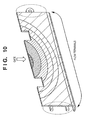
- Fig. 10 is a view schematically showing the state of flow of an injected resin material when a plate-like multilayered structure resin molded product is molded by setting the gate position at substantially the center of a cavity for forming the plate.
- the surface layer of a multilayered structure resin molded product is made of the skin layer resin material by first injecting the skin layer resin material and then injecting the core layer resin material.
- the aforementioned connecting functional portions are formed at the flow terminal positions of a resin material in a cavity. Therefore, only the skin layer resin material flows to these functional portions.
- Figs. 11 and 12 show the structure of a resin molded product 100 for further ensuring the elastic function of the spring projecting portion 102 for achieving the elastic action of the functional portion.
- a groove 100A is formed in a nearby portion around a portion of the plane board 100 from which the spring projecting portion extends. Since this narrows the gap in a cavity portion for forming a flat plate near this groove, the flowability of the core layer resin material lowers. Consequently, only the skin layer resin material flows to the spring projecting portion 102, and inflow of the core layer resin material is prevented.
- Fig. 12 is a sectional view taken along a direction b - b in Fig. 11.
- the inflow amount of the core layer resin material is adjusted by defining a depth t3 of the groove with respect to a thickness T3 of the board 100.
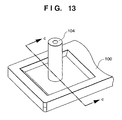
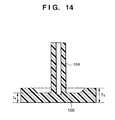
- Figs. 13 and 14 illustrate the screw connecting portion 104.
- a cavity for forming the board 100 is narrowed to prevent inflow of the core layer resin material.
- Fig. 15 shows an example of a self-tap boss 106.
- a height H2 of the boss 106 was set to be three times a thickness T6 of a board 108 or more, it was possible to prevent inflow of the core layer resin material and form the boss 106 only with the skin layer.
- the properties of a color have three attributes: hue, saturation, and lightness.
- Hue is a scale of colors, and saturation is the vividness of color.
- Products used in this embodiment are business machines such as copying machines and printers. The colors of external parts of these products are controlled to lightness having no influence on the use environment. The products used in this embodiment are whitish.
- the color of the resin was dark gray.
- these internal parts are pulverized and reused as a raw material of the core layer resin material.
- the thickness of a plate is 2.0 mm.
- the thickness of the molded portion made of the skin layer resin material was 0.55 to 0.40 mm.
- the external color of a 0.40-mm thick portion of the skin layer of this molded product was measured with an integrating-sphere spectrophotometer (CE-7000A) manufactured by Greta Macbeth.
- the thickness of the skin layer resin molded portion was 0.48 to 0.30 mm.
- the thickness of the skin layer resin portion of molding was decreased to increase the filling amount of the core layer resin material. That is, molding was performed by setting the thickness of the skin layer resin portion to 0.26 to 0.20 mm. Consequently, the color of the resin of the core layer resin material was seen through the surface.
- a multilayered structure resin molded product comprising a core layer and a skin layer, characterized in that the resin molded product is molded using a pulverized resin material, which is formed by pulverizing a molded product molded from a thermoplastic resin material, as a resin material for forming the core layer, and a virgin material as a resin material for forming the skin layer.
- This resin molded product allows the reuse of the core layer resin material.
- this resin molded product as an external part or housing part of, e.g., an office machine, electric apparatus, or information communication apparatus.
- the above embodiments can develop the diversity of the sandwich molding technology by proposing a method of manufacturing a multilayered structure resin molded product comprising a core layer and a skin layer, characterized in that molding is performed by setting molding flowability of a resin material for forming the core layer, which is injected into a cavity of a mold for molding the resin molded product, to be lower than that of a resin material for forming the skin layer.
- the above embodiments can avoid the influence of the reuse of a resin material by proposing a method of manufacturing a multilayered structure resin molded product comprising a core layer and a skin layer, characterized in that a pulverized resin material formed by pulverizing a molded product molded from a thermoplastic resin material is used as a resin material for forming the core layer, a virgin material is used as a resin material for forming the skin layer, and molding is performed by setting the resin temperature of the resin material for forming the core layer to be higher than that of the resin material for forming the skin layer.
- the utilization efficiency of a recycled resin material can be improved by proposing a method of manufacturing a multilayered structure resin molded product by injecting a resin material for forming a core layer and a resin material for forming a skin layer into a mold, characterized in that after a predetermined volume of the resin material for forming the skin layer is injected, a resin material for forming the core layer, which is obtained by pulverizing a molded product of a resin material, and a virgin resin material for forming the skin layer are simultaneously injected, and the virgin resin material for forming the skin layer is injected again.
Landscapes
- Engineering & Computer Science (AREA)
- Manufacturing & Machinery (AREA)
- Mechanical Engineering (AREA)
- Injection Moulding Of Plastics Or The Like (AREA)
- Laminated Bodies (AREA)
Description
- The present invention relates to a resin molded product having a multilayered molded structure containing a resin material for forming a core layer and a resin material for forming a skin layer.
- More particularly, the present invention relates to a molded product having a so-called sandwich structure in which a molded portion of the core layer resin material is surrounded by a molded portion of the skin layer resin material.
- Furthermore, the present invention relates to a resin molded product formed by reusing a resin material which is a resin molded product made of a thermoplastic resin material.
- Also, the present invention relates to a technique of pulverizing a molded product of the thermoplastic resin material described above, and using the pulverized resin material as a resin material of injection molding.
- Additionally, the present invention relates to a resin molded product manufacturing method of forming a multilayered structure resin molded product by injection-molding a resin material for forming a core layer and a resin material for forming a skin layer, wherein a pulverized resin material obtained by pulverizing a thermoplastic resin molded product is used as the resin material for forming the core layer.
- Moreover, the present invention relates to a technique of recycling plastic resin materials used in, e.g., image forming apparatuses such as copying machines and printers, information communication apparatuses such as facsimile apparatuses and computers, and household electric appliances.
- So-called sandwich structure injection molding is one of injection molding techniques. In this injection molding, two types of resin materials are injected into a mold cavity to mold a multilayered structure containing a resin molded portion for forming a core layer and a resin molded portion for forming a skin layer.
- Many prior art references pertaining to this sandwich molding are available, and they are classified into International Patent Classification IPC B29C 45/16. Examples are
Japanese Patent No. 3017052 Japanese Patent Laid-Open No. 8-224754 - The present invention also relates to a technique of reusing molded plastic materials and resin materials. Examples of prior art references related to the reuse of resin materials are
Japanese Patent Laid-Open Nos. 5-301222 5-147036 10-202694 -
Japanese Patent No. 3031357 - Recently, industrial circles are variously influenced to protect the global environment and effectively use natural resources. Also, attempts to reuse plastic materials and resin materials as petroleum resources have been demanded to be put into practical use.
- To meet this demand, development of resin molded product recycling techniques is being extensively made.
- In particular, relatively large amounts of a number of large-sized thermoplastic materials are used in various types of electronic apparatuses, e.g., image forming apparatuses such as copying machines and printers, office machines and information communication apparatuses such as facsimile apparatuses and computers, and household electric appliances such as air conditioners, video decks, and audio components.
- Thermoplastic materials removed from used products of these apparatuses are inferior in diverse physical properties such as mechanical strength, fire retardance, and external color.
- Also, various foreign substances are sticking to the surface to contaminate it.
- Accordingly, as a method of recycling these materials, a method has been proposed by which molded products are pulverized, cleaned, and repelletized, and an unused resin material (virgin pellets) and the used resin material are mixed at a predetermined ratio to recover the physical properties.
- In this method, however, a deteriorated used resin material is mixed in an unused resin material. Therefore, a manufactured recycled material is inferior to a molded product of a 100% virgin pellet resin material in mechanical strength, fire retardance, and external color.
- To solve the environmental problems by effectively using the aforementioned resources and reducing the amount of industrial waste as much as possible, multilayered structure molding, so-called sandwich molding, can be used as one means for using a used resin material as the material of a resin molded product.
- That is, this multilayered molded product is obtained by injecting a resin material for forming a core layer and a resin material for forming a skin layer into a mold, thereby forming a resin molded product having a multilayered structure in which the core layer is covered with the skin layer.
- The method uses the used resin material described above as the core layer resin material of this multilayered structure.
- To increase the resin material recycling ratio by reusing a used resin material as a raw material of the above-mentioned multilayered structure molding, i.e., so-called sandwich molding, the filling ratio of a core layer resin portion as a recycling material is important.
- When the filling amount of a core layer structural portion is increased and the skin layer resin material is injected around the core layer structural portion, the core layer resin sometimes overflows from a portion covered with the skin layer portion.
- It is an object of the present invention to provide a molded product which is evenly filled with as large an amount of core layer resin material as possible, and in which this core layer resin material is completely covered with a skin layer resin material, and to provide a method of manufacturing the same.
- It is another object of the present invention to provide a manufacturing method which uses a material formed by pulverizing a resin molded product to be reused, thereby avoiding physical property deterioration by the thermal hysteresis of a core layer resin material and achieving a merit of the material cost.
- It is still another object of the present invention to prevent a decrease in part strength occurring when a recycled material is used as a core material of sandwich molding (a multilayered molded structure) to solve the above problems.
- That is, external members, housings, and mechanical parts as components of image forming apparatuses and information communication apparatuses such as copying machines, printers, and facsimile apparatuses form functional portions such as threaded portions and fitting portions for connecting to other parts, in addition to flat-plate structures.
- High mechanical strength of such functional portions must be ensured. However, if a recycled material is used as a core material, deterioration of the physical property values of this recycled material makes it difficult to ensure the functions of these functional portions.
- It is still another object of the present invention to ensure high quality when a molded product of an external structural part is formed using a recycled material as a core material of a multilayered structure molded product.
- That is, when a recycled material of a color (dark color) having low lightness is used as a core layer and an unused virgin material of a color having high lightness is used as a skin layer on the surface of the core layer, it is necessary to prevent bad influence of the core layer color on the outer appearance.
- It is still another object of the invention to provide methods of manufacturing a multilayered structure resin molded product meeting the above objects.
- These objects are achieved by the multilayered structure resin molded product of claim 1 and the methods of
claims 6 to 8. The dependent claims relate to further developments. - The resin molded product is molded using a pulverized resin material, which is formed by pulverizing a molded product molded from a thermoplastic resin material, as a resin material for forming the core layer, and a virgin material as a resin material for forming the skin layer.
- Further, the resin molded product may be an external part, housing part, or constituent part of an office apparatus, electric apparatus, or information communication apparatus.
- Still further, the resin material for forming the core layer may be obtained by pulverizing a resin molded product of an external part, housing part, or constituent part of an office apparatus.
- Still further, a resin material obtained by pulverizing a resin molded product molded from a thermoplastic resin material and setting the size of the pulverized resin material to a predetermined size may be used as the resin material for forming the core layer.
- Still further, the size of the pulverized resin material to be used as the core layer resin material may be set to preferably 10 mm or less and particularly preferably 4 to 10 mm.
- Still further, as to a method of manufacturing a multilayered structure resin molded product by injecting a resin material for forming a core layer and a resin material for forming a skin layer into a mold, after a predetermined volume of the resin material for forming the skin layer is injected, a resin material for forming the core layer, which is obtained by pulverizing a molded product of a resin material, and a virgin resin material for forming the skin layer may be simultaneously injected, and the virgin resin material for forming the skin layer may be injected again.
- Still further, a material obtained by pulverizing a resin molded product molded from a thermoplastic resin material may be used as the core layer resin material.
- Still further, the pulverized resin material to be used as the resin material for forming the core layer may be not heated in a step before the pulverized resin material is melted to be injected into the mold.
- Still further, a pulverized resin material formed by pulverizing a molded product made of a thermoplastic resin material may be used as a resin material for forming the core layer, a virgin material may be used as a resin material for forming the skin layer, and the resin material for forming the skin layer may be molded using the same type of a resin material as the pulverized resin material.
- Still further, to solve the problem of the outer appearance as one of the objects described above, the resin molded product is attached to an apparatus as an external part of the apparatus, and a thickness of the skin layer from a surface of the apparatus is defined within a range of numerical values by which transmission of the color of the core layer resin material portion is suppressed.
- Still further the thickness of the skin layer of the resin molded product is 0.3 mm or more.
- To assure the strength of a functional part of the aforementioned multilayered structure resin molded product the functional part mounting portion is made of a skin layer resin material.
- Other objects and advantages besides those discussed above shall be apparent to those skilled in the art from the description of a preferred embodiment of the invention which follows. In the description, reference is made to accompanying drawings, which form a part thereof, and which illustrate an example of the invention. Such example, however, is not exhaustive of the various embodiments of the invention, and therefore reference is made to the claims which follow the description for determining the scope of the invention.
-
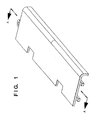
- Fig. 1 is a perspective view of a multilayered resin molded product as used in the present invention;
- Fig. 2 is a sectional view taken along a direction A - A in Fig. 1;
- FIG. 3 is a view for explaining the arrangement of the major parts of a molding machine for molding the resin molded product as used in the present invention;
- Fig. 4 is a view for explaining the steps of pulverizing a recycled resin material used as a core layer resin material used in the present invention;
- Fig. 5 is a view for explaining the process of manufacturing a multilayered structure resin molded product;
- Fig. 6 is a view for explaining the steps of injecting a skin layer resin material and a core layer resin material;
- Fig. 7 is a view for explaining the states of the skin layer resin material and core layer resin material in a mold cavity;
- Fig. 8 is a view for explaining a structure in which a functional portion for connecting to another part is formed on the board surface of a multilayered structure resin molded product;
- Fig. 9 is a view for explaining a structure for a screw connection;
- Fig. 10 is a view for explaining the state of a flow of a resin material into a cavity;
- Fig. 11 is a view for explaining another example;
- Fig. 12 is a sectional view taken along a direction b - b in Fig. 11;
- Fig. 13 is a view for explaining still another example;
- Fig. 14 is a sectional view taken along a direction C - C in Fig. 13; and
- Fig. 15 is a view for explaining still another example.
- Preferred embodiments of the present invention will now be described in detail in accordance with the accompanying drawings.
-
- Fig. 1 is a perspective view of an external part 1 which is a multilayered molded structure molded product as used in the present invention.
- Fig. 2 is a view for explaining the main parts, taken along a line A - A in Fig. 1.
- Fig. 3 is a view for explaining the main components of a molding machine for injection-molding the multilayered molded structure member 1 shown in Figs. 1 and 2.
- Referring to Fig. 3,
reference numeral 2 denotes a retainer plate; 4, a movable retainer plate; 6, a front cavity plate member attached to theretainer plate 2; 8 a rear cavity plate member attached to the movable retainer plate 4; and 10, a cavity representing the shape of a molded product formed between the frontcavity plate member 6 and the rearcavity plate member 8. -
Reference numeral 12 denotes a front clamping plate; and 14, a rear clamping plate. -
Reference numeral 16 denotes a ejector fixing plate; 18, a ejector plate; 20, a spacer block; and 22, an ejector pin. -
Reference numeral 24 denotes a spring ejector; 26, a runner lock pin; 28, locating ring; 30, a nozzle receiver for an injection cylinder (not shown); 32, a nozzle; 34, a sprue; 36, a runner; and 38, a gate. -
Reference numeral 40 denotes a guide pin. -
Reference numeral 42 denotes an injecting means connected to the nozzle to inject a core layer resin material and a skin layer resin material. As this injecting means, it is possible to use devices disclosed in, e.g.,Japanese Patent No. 3017052 Japanese Patent Laid-Open Nos. 8-224754 9-52256 - The material of a core layer structural portion which is a raw material of the resin material according to the present invention is a recycled material obtained by collecting the external parts 1, or molded parts of the same resin material as the external parts 1, during the process of disassembling used collected products of, e.g., copying machines and laser printers, and by disassembling, pulverizing, cleaning, and classifying the collected molded parts 1.
- An unused virgin resin material is used as the skin layer resin material.
- Fig. 4 is a view showing the arrangement of a system of recycling the core layer resin material as a raw material of the present invention.
- A pulverizer 50 pulverizes the external parts 1 of the collected copying machines and laser printers into a predetermined size.
- The resin materials of the external parts 1 include a polycarbonate resin (PC) and an alloy molded resin material of acrylonitrile, butadiene, and styrene (ABS). In this embodiment, the size of pulverization was set to 4 to 10 mm.
- The set numerical value range of the pulverization size was defined by taking account of clogging of a hopper of a plasticator or clogging in a convey/supply process when the pulverized raw material of the core layer resin material was supplied to the hopper.
- A
conveyor apparatus 52 supplies the pulverized material by a predetermined amount at a time to a shakingscreen 54. - A
collection tank 56 returns an unpulverized material to the pulverizer. -
Reference numeral 58 denotes a fine-particle collection tank. - A
magnetic selector 60 removes metals from the pulverized material passed through the shakingscreen 54. - The material passed through this
magnetic selector 60 is supplied to acleaning machine 66 via ahopper 62 and afeeder 64. - The pulverized resin material cleaned by the cleaning
machine 66 is supplied to acyclone 72 by anair blower 70 via a cleaning/dewateringmachine 68. -
Reference numeral 74 denotes a cleaning solution density adjusting step; and 76, a circulating device. - The pulverized resin material supplied to the
cyclone 72 is classified by anair classification machine 78. Foreign matter having small specific gravity is discharged to acollection tank 82 by ablower 80. - The pulverized resin material thus classified is passed through a
magnetic selector 84 and supplied to astock tank 88 by a blower 86. - After that, metals separated by a
metal separator 90 are supplied to acollection tank 92. - The pulverized resin material from which impurities such as metals are removed is collected as a recycled plastic material in a
collection vessel 94. - The process of manufacturing the multilayered resin molded product according to the present invention will be described below with reference to Fig. 5.
- The molding conditions of the first embodiment are as follows. The cavity surface temperature of the front
cavity plate member 6 and the rearcavity plate member 8 is set at 60°C ± 1°C by a heating means (not shown). - The injection temperature of the skin layer resin material is 250°C.
- The injection temperature of the core layer resin material is 270°C.
- The injection rate of the skin layer resin material is 10 mm/sec.
- The injection rate of the core layer resin material is 20 mm/sec.
- In the above setting conditions, the injection temperature of the core layer resin material is set to be higher than that of the skin layer resin material, thereby setting the viscosity of the core layer resin material to be lower than that of the skin layer resin material.
- The PC + ABS resin material as the skin layer resin material is heated and melted in the first cylinder of the plasticizing means 42 (Fig. 3). Also, the recycled resin material as the core layer resin material, which is pulverized in the processing steps shown in Fig. 4, is heated and melted in the second cylinder.
- As shown in Fig. 5, in the first injection step, a predetermined resin amount Q1 of the skin layer resin material is injected within a predetermined time T1 from the plasticizing means 42.
- Subsequently, in the second injection step, a volume Q2 of the skin layer resin material and a volume P1 of the core layer resin material are simultaneously injected within a predetermined time T2.
- In this second injection step, the skin layer resin material previously injected into the cavity in the first injection step is pushed by the skin layer resin material and the core layer resin material injected in the second injection step, and thereby advances in the cavity along the circumference wall of the cavity (Fig. 7).
- Following the second injection step, a predetermined amount Q3 of the skin layer resin material is injected within a predetermined time T3 in the third step.
- As described earlier, the injection temperature of the skin layer resin material is set to be lower than that of the core layer resin material. Therefore, the core layer resin material injected in the second injection step advances in the cavity while pushing the back side of the skin layer resin material previously injected into the cavity, thereby evenly spreading the skin layer resin material on the cavity surface.
- Fig. 6 is a view schematically showing the states of the resin materials injected into the cavity in the individual injection steps. Only the skin layer resin material is injected in the first injection step, and the skin layer resin material and the core layer resin material which is a recycled material are simultaneously injected in the second step. Consequently, as shown in Fig. 6, the skin layer resin material is so injected as to surround the core layer resin material in the cavity.
- As described above, in the second injection step the core layer resin material is so injected as to be surrounded by the skin layer resin material. This avoids the core layer resin material from breaking through the skin layer resin material.
- Fig. 7 shows a molded product obtained by the above injection operation of this embodiment. That is, Fig. 7 is a sectional view showing the state in which the skin layer resin material and the core layer resin material are injected and filled.
- The second embodiment of the present invention will be described below with reference to Figs. 8 to 15.
- In this embodiment, a functional portion of a resin molded product is formed. This functional portion has a function of connecting to another part.
- External members and constituent members of image forming apparatuses such as copying machines, printers, and laser beam printers (LBPs), and information/communication apparatuses such as facsimile apparatuses, computers, communication interfaces, and portable communication apparatuses are often made of molded products of plastic resin materials, in order to achieve high strength and light weights. Attaching portions for connecting to other parts are sometimes formed on these external members and constituent members.
- Examples are an elastic projecting portion (pawl) 102 for a spring connection and a projecting
portion 104 for a screw connection, shown in Figs. 8 and 9, respectively, which are integrally molded from aboard 100 of a multilayered structure resin molded product. - These elastic projecting
portions 102 and projectingportion 104 are required to have elasticity and toughness to mechanically connect to a connecting member of a counterpart. - As described above, the objects of the present invention are recycling and effective use of resin materials. However, if a recycled raw material obtained by pulverizing resin molded products is used as a core layer resin material, this recycled resin material is inferior to an unused virgin resin material in mechanical characteristics, particularly toughness.
- Accordingly, a recycled resin material is inadequate to form a structural member which is a multilayered structure resin molded product as described above having a functional portion for connecting to another member.
- Referring to Fig. 8, a thickness t1 of the elastic projecting
portion 102 is made smaller than a thickness T1 of theboard 100. Hence, only the skin layer resin material flows into a cavity for forming the elastic projectingportion 102, and inflow of the core layer resin material is prevented. This makes it possible to avoid the influence by deterioration of the toughness of the core layer resin material, caused by a pulverized raw material. - Referring to Fig. 9, a thickness t2 of the projecting
portion 104 for a screw connection is made smaller than a thickness T2 of theboard 100. Accordingly, the constituent resin material of the projectingportion 104 can be molded only with the skin layer resin material. As a consequence, high toughness and high elasticity of the projecting portion can be ensured. - Fig. 10 is a view schematically showing the state of flow of an injected resin material when a plate-like multilayered structure resin molded product is molded by setting the gate position at substantially the center of a cavity for forming the plate.
- As shown in Fig. 2, the surface layer of a multilayered structure resin molded product is made of the skin layer resin material by first injecting the skin layer resin material and then injecting the core layer resin material. In this embodiment, the aforementioned connecting functional portions are formed at the flow terminal positions of a resin material in a cavity. Therefore, only the skin layer resin material flows to these functional portions.
- Figs. 11 and 12 show the structure of a resin molded
product 100 for further ensuring the elastic function of thespring projecting portion 102 for achieving the elastic action of the functional portion. - In Figs. 11 and 12, a
groove 100A is formed in a nearby portion around a portion of theplane board 100 from which the spring projecting portion extends. Since this narrows the gap in a cavity portion for forming a flat plate near this groove, the flowability of the core layer resin material lowers. Consequently, only the skin layer resin material flows to thespring projecting portion 102, and inflow of the core layer resin material is prevented. - Fig. 12 is a sectional view taken along a direction b - b in Fig. 11. The inflow amount of the core layer resin material is adjusted by defining a depth t3 of the groove with respect to a thickness T3 of the
board 100. - Figs. 13 and 14 illustrate the
screw connecting portion 104. - To decrease the thickness of a nearby portion around a portion of a plane board from which the
screw connecting portion 104 extends, a cavity for forming theboard 100 is narrowed to prevent inflow of the core layer resin material. - Fig. 15 shows an example of a self-
tap boss 106. - High mechanical strength of screw connection can be assured by molding the
boss 106 only with the skin layer resin material. - Especially when a height H2 of the
boss 106 was set to be three times a thickness T6 of aboard 108 or more, it was possible to prevent inflow of the core layer resin material and form theboss 106 only with the skin layer. - It is the main purpose of the present invention to reuse a material obtained by pulverizing molded products as a raw material of the core layer resin material, without deteriorating physical property values by repelletization, thereby contributing to the recycling efficiency and environmental resource protection and preventing inconvenience of the external color when a dark-color material is used as the core layer resin.
- When a multilayered structure molded product in which a core layer resin molded portion is surrounded by a skin layer resin molded portion is to be formed, if the color of the core layer resin molded portion, particularly the color of the core layer resin material is dark and different in density from the color of the skin layer resin material, this color status appears on the surface in connection with the transmittance of the skin layer resin molded portion. This poses a problem of the external appearance.
- This embodiment solves this problem.
- The properties of a color have three attributes: hue, saturation, and lightness. Hue is a scale of colors, and saturation is the vividness of color. Products used in this embodiment are business machines such as copying machines and printers. The colors of external parts of these products are controlled to lightness having no influence on the use environment. The products used in this embodiment are whitish.
- In this embodiment, internal parts were removed from plastic resin molded products (PC + ABS alloy resin) of copying machines manufactured by CANON and used for two to seven years.
- The color of the resin was dark gray.
- As in the first embodiment, these internal parts are pulverized and reused as a raw material of the core layer resin material.
- As a skin layer resin material, virgin pellets of a PC + ABS alloy resin were molded into the same external part as shown in Fig. 1.
- The thickness of a plate is 2.0 mm.
- Several portions of each molded product were cut, and each section was observed with a toolmaker's optical microscope.
- As a consequence, the thickness of the molded portion made of the skin layer resin material was 0.55 to 0.40 mm. The external color of a 0.40-mm thick portion of the skin layer of this molded product was measured with an integrating-sphere spectrophotometer (CE-7000A) manufactured by Greta Macbeth.
- The measurement result represented by the Lab colorimetric system on the basis of JIS Z 8729 was

- When a portion consisting only of the skin layer resin molded portion was measured, the measurement result was

- In addition, measurement pieces of other molded portions were measured.
- The thickness of the skin layer resin molded portion was 0.48 to 0.30 mm.
- The external color of a 0.30-mm thick portion of the skin layer resin molded portion was measured, and the measurement result was

- Furthermore, the thickness of the skin layer resin portion of molding was decreased to increase the filling amount of the core layer resin material. That is, molding was performed by setting the thickness of the skin layer resin portion to 0.26 to 0.20 mm. Consequently, the color of the resin of the core layer resin material was seen through the surface.
- The external color was measured, and the result was

- In the above embodiments, there is provided a multilayered structure resin molded product comprising a core layer and a skin layer, characterized in that the resin molded product is molded using a pulverized resin material, which is formed by pulverizing a molded product molded from a thermoplastic resin material, as a resin material for forming the core layer, and a virgin material as a resin material for forming the skin layer. This resin molded product allows the reuse of the core layer resin material.
- Also, the environmental problems can be solved by using this resin molded product as an external part or housing part of, e.g., an office machine, electric apparatus, or information communication apparatus.
- The above embodiments can develop the diversity of the sandwich molding technology by proposing a method of manufacturing a multilayered structure resin molded product comprising a core layer and a skin layer,
characterized in that molding is performed by setting molding flowability of a resin material for forming the core layer, which is injected into a cavity of a mold for molding the resin molded product, to be lower than that of a resin material for forming the skin layer. - The above embodiments can avoid the influence of the reuse of a resin material by proposing a method of manufacturing a multilayered structure resin molded product comprising a core layer and a skin layer, characterized in that a pulverized resin material formed by pulverizing a molded product molded from a thermoplastic resin material is used as a resin material for forming the core layer, a virgin material is used as a resin material for forming the skin layer, and molding is performed by setting the resin temperature of the resin material for forming the core layer to be higher than that of the resin material for forming the skin layer.
- Also, the utilization efficiency of a recycled resin material can be improved by proposing a method of manufacturing a multilayered structure resin molded product by injecting a resin material for forming a core layer and a resin material for forming a skin layer into a mold, characterized in that after a predetermined volume of the resin material for forming the skin layer is injected, a resin material for forming the core layer, which is obtained by pulverizing a molded product of a resin material, and a virgin resin material for forming the skin layer are simultaneously injected, and the virgin resin material for forming the skin layer is injected again.
- The present invention is not limited to the above embodiments and various changes and modifications can be made within the scope of the present invention. Therefore, to apprise the public of the scope of the present invention the following claims are made.
Claims (8)
- A multilayered structure resin molded product comprising a core layer and a skin layer,wherein said resin molded product is injection-molded using a pulverized resin material, which is formed by pulverizing a molded product molded from a thermoplastic resin material, as a resin material for forming said core layer, and a virgin material as a resin material for forming said skin layer, andwherein a board-shaped part of the entire said resin molded product has a mounting portion, and said mounting portion is formed integrally with the skin layer only from the same material as the skin layer by setting a thickness of said mounting portion to be smaller than a thickness of the board-shaped part.
- The product according to claim 1, wherein said mounting portion is a projecting portion.
- The product according to claim 1, wherein said mounting portion is a connecting portion having elasticity.
- The product according to claim 1, wherein said mounting portion is a screw connecting portion.
- The product according to claim 1, wherein a small thickness-portion is formed around said mounting portion.
- A method of manufacturing the multilayered structure resin molded product according to any one of claims 1 to 5, wherein molding is performed by setting a viscosity of a resin material for forming the core layer, which is injected into a cavity of a mold for molding the resin molded product, to be lower than that of a resin material for forming the skin layer.
- A method of manufacturing the multilayered structure resin molded product according to any one of claims 1 to 5, wherein molding is performed by setting a resin temperature of the resin material for forming the core layer to be higher than that of the resin material for forming the skin layer.
- A method of manufacturing the multilayered structure resin molded product according to any one of claims 1 to 5, wherein molding is performed by setting, when a resin material for forming the core layer and a resin material for forming the skin layer are simultaneously injected, an injection volume per unit time of the core layer resin material to be larger than that of the skin layer resin material.
Applications Claiming Priority (4)
| Application Number | Priority Date | Filing Date | Title |
|---|---|---|---|
| JP2000214388 | 2000-07-14 | ||
| JP2000214388 | 2000-07-14 | ||
| JP2001167194A JP2002086491A (en) | 2000-07-14 | 2001-06-01 | Multi-layer resin molded product and method for producing multi-layer resin molded product |
| JP2001167194 | 2001-06-01 |
Publications (4)
| Publication Number | Publication Date |
|---|---|
| EP1174241A2 EP1174241A2 (en) | 2002-01-23 |
| EP1174241A3 EP1174241A3 (en) | 2002-12-11 |
| EP1174241B1 true EP1174241B1 (en) | 2007-11-14 |
| EP1174241B8 EP1174241B8 (en) | 2008-01-23 |
Family
ID=26596071
Family Applications (1)
| Application Number | Title | Priority Date | Filing Date |
|---|---|---|---|
| EP20010116205 Expired - Lifetime EP1174241B8 (en) | 2000-07-14 | 2001-07-04 | Multilayered structure resin molded product and method of manufacturing multilayered structure resin molded product |
Country Status (7)
| Country | Link |
|---|---|
| US (1) | US6838131B2 (en) |
| EP (1) | EP1174241B8 (en) |
| JP (1) | JP2002086491A (en) |
| KR (1) | KR100465673B1 (en) |
| CN (1) | CN1221372C (en) |
| DE (1) | DE60131328T2 (en) |
| TW (1) | TW592935B (en) |
Families Citing this family (9)
| Publication number | Priority date | Publication date | Assignee | Title |
|---|---|---|---|---|
| JP2006004657A (en) * | 2004-06-15 | 2006-01-05 | Mitsubishi Electric Corp | Separator for fuel cell and manufacturing method thereof |
| JP4746304B2 (en) * | 2004-10-27 | 2011-08-10 | 積水テクノ成型株式会社 | Bottomed box-type container and manufacturing method thereof |
| US20060099424A1 (en) * | 2004-11-10 | 2006-05-11 | Canon Kabushiki Kaisha | Multilayer injection compression molding method using recycled material, and molded product molded through the same |
| US20070009743A1 (en) | 2005-07-06 | 2007-01-11 | Reinhard Kessing | Three layer composite panel from recycled polyurethanes |
| CN102398342A (en) * | 2011-10-28 | 2012-04-04 | 宁波帅特龙车辆部件有限公司 | Sandwich injection molding method |
| DE102012023112A1 (en) * | 2012-11-27 | 2014-05-28 | Wittmann Battenfeld Gmbh | Method for injection molding of plastic molded parts made of thermoplastic material |
| US9751263B2 (en) * | 2015-04-20 | 2017-09-05 | Xerox Corporation | Injection molding to finish parts printed with a three-dimensional object printer |
| DE102018000233A1 (en) * | 2018-01-15 | 2019-07-18 | Georg Menshen Gmbh & Co. Kg | container closure |
| KR20220008146A (en) | 2020-07-13 | 2022-01-20 | 한국원자력연구원 | Peristaltic type fluid transfer device |
Family Cites Families (24)
| Publication number | Priority date | Publication date | Assignee | Title |
|---|---|---|---|---|
| US4023896A (en) * | 1975-08-07 | 1977-05-17 | Addressograph Multigraph Corporation | Clean margin mechanism for electrostatic copiers |
| US4493806A (en) * | 1981-05-29 | 1985-01-15 | Christopher Hatzikelis | Recycling of contaminated plastic |
| US4546022A (en) * | 1981-08-19 | 1985-10-08 | Ciro Madonia | Composite molding system |
| US4448608A (en) * | 1982-12-30 | 1984-05-15 | Johnson Matthey Public Limited Company | Colored inorganic complex for use as a pigment and compositions containing it |
| GB2146920B (en) * | 1983-09-27 | 1987-03-18 | Nippon Paint Co Ltd | Multi-layer coating method |
| JPS61297116A (en) | 1985-06-27 | 1986-12-27 | Canon Inc | Injection molding machine |
| JPH04267114A (en) * | 1991-02-22 | 1992-09-22 | Mitsui Toatsu Chem Inc | Multilayer constructional molded object |
| JPH05147036A (en) | 1991-11-30 | 1993-06-15 | Yoshiharu Sato | Method and apparatus for reclaiming waste plastic |
| JPH05278068A (en) | 1992-04-02 | 1993-10-26 | Sekisui Chem Co Ltd | Injection molding method |
| JPH05301222A (en) | 1992-04-27 | 1993-11-16 | Isuzu Motors Ltd | How to recycle plastic products |
| DE4217005C2 (en) * | 1992-05-22 | 1994-03-03 | Himont Inc | Process for recovering plastic from painted plastic parts |
| US5340614A (en) * | 1993-02-11 | 1994-08-23 | Minnesota Mining And Manufacturing Company | Methods of polymer impregnation |
| JP3155136B2 (en) * | 1993-10-19 | 2001-04-09 | 本田技研工業株式会社 | Automotive bumper |
| JP2704599B2 (en) | 1993-12-20 | 1998-01-26 | 日精樹脂工業株式会社 | Multi-layer molding method |
| JP3192341B2 (en) | 1994-12-22 | 2001-07-23 | 松下電工株式会社 | Insulated tableware and its manufacturing method |
| JP3017052B2 (en) | 1995-08-10 | 2000-03-06 | 東京大学長 | Multilayer molding method and apparatus |
| US5851624A (en) * | 1995-08-31 | 1998-12-22 | Chrysler Corporation | Soft touch top cover and method of manufacturing |
| US5702148A (en) * | 1996-02-29 | 1997-12-30 | The Standard Products Company | Exterior decorative surround molding module |
| US6068896A (en) * | 1996-02-29 | 2000-05-30 | Toyoda Gosei Co., Ltd. | Molded colored articles |
| US5792397A (en) | 1996-10-08 | 1998-08-11 | Ritchey; Eugene B. | Method of injection molding |
| JPH10202694A (en) | 1997-01-22 | 1998-08-04 | Asahi Chem Ind Co Ltd | Method for molding composite molded product |
| JPH1117052A (en) | 1997-06-23 | 1999-01-22 | Seiko Epson Corp | Semiconductor integrated circuit mounting method |
| JPH11320646A (en) * | 1998-05-12 | 1999-11-24 | Toyoda Gosei Co Ltd | Bright resin molded article and manufacture thereof |
| JP3031357B1 (en) | 1998-10-06 | 2000-04-10 | 日本電気株式会社 | Sandwich molded products containing recycled materials |
-
2001
- 2001-06-01 JP JP2001167194A patent/JP2002086491A/en not_active Withdrawn
- 2001-07-03 US US09/897,014 patent/US6838131B2/en not_active Expired - Lifetime
- 2001-07-04 EP EP20010116205 patent/EP1174241B8/en not_active Expired - Lifetime
- 2001-07-04 DE DE2001631328 patent/DE60131328T2/en not_active Expired - Lifetime
- 2001-07-04 TW TW90116386A patent/TW592935B/en not_active IP Right Cessation
- 2001-07-11 KR KR10-2001-0041424A patent/KR100465673B1/en not_active Expired - Fee Related
- 2001-07-13 CN CNB011224878A patent/CN1221372C/en not_active Expired - Fee Related
Non-Patent Citations (2)
| Title |
|---|
| LEE D.J.; ISAYEV A.I; WHITE J.L.: "Simultaneous Sandwich Injection Molding", ANTEC 1998 PLASTICS: PLASTICS ON MY MIND, VOLUME 1: PROCESSING * |
| MICHAELI W.; BRUNSWICK A.: "Herstellung medienführender Leitungen durch GIT", KUNSTSTOFFE, vol. 88, no. 1, 1998, MONCHEN, pages 34 - 39 * |
Also Published As
| Publication number | Publication date |
|---|---|
| DE60131328T2 (en) | 2008-09-11 |
| CN1221372C (en) | 2005-10-05 |
| US6838131B2 (en) | 2005-01-04 |
| EP1174241B8 (en) | 2008-01-23 |
| EP1174241A3 (en) | 2002-12-11 |
| KR100465673B1 (en) | 2005-01-13 |
| EP1174241A2 (en) | 2002-01-23 |
| CN1333119A (en) | 2002-01-30 |
| DE60131328D1 (en) | 2007-12-27 |
| KR20020009412A (en) | 2002-02-01 |
| US20020015841A1 (en) | 2002-02-07 |
| JP2002086491A (en) | 2002-03-26 |
| TW592935B (en) | 2004-06-21 |
Similar Documents
| Publication | Publication Date | Title |
|---|---|---|
| EP1055500B1 (en) | Recycled thermoplastic material | |
| US6838131B2 (en) | Multilayered structure resin molded product and method of manufacturing multilayered structure resin molded product | |
| Bryce | Plastic injection molding: Manufacturing startup and management | |
| JP4680000B2 (en) | PAPER-CONTAINING RESIN COMPOSITION, MOLDED ARTICLE THEREOF, AND METHOD FOR PRODUCING THEM | |
| KR20040081767A (en) | Recycle system for used plastics, method of reclaiming used abs resin and reclaimed abs resin | |
| Goodship | Troubleshooting injection moulding | |
| US6881368B2 (en) | Recycled ABS resin, recycled ABS alloy resin and production process of ABS alloy resin | |
| Muccio | Plastic part technology | |
| JP3720243B2 (en) | Resin molded product and manufacturing method thereof | |
| JP3688965B2 (en) | Resin molded product and manufacturing method thereof | |
| US20060099424A1 (en) | Multilayer injection compression molding method using recycled material, and molded product molded through the same | |
| JP2002316320A (en) | Recycled ABS resin, recycled ABS alloy resin, method for producing ABS alloy resin | |
| JP2003340315A (en) | Manufacturing method of recycled plastic material | |
| EP1271455A1 (en) | Method for recycling plastic material | |
| JP3031357B1 (en) | Sandwich molded products containing recycled materials | |
| JP2001179740A (en) | Method for treating used toner case and plastic coloring material obtained thereby | |
| Pearson | Gas assisted moulding | |
| US20020197498A1 (en) | Reprocessed plastic material and electrical and electronic equipment using reprocessed plastic material, and method for recycling plastic material and process for manufacturing reprocessed plastic material | |
| JP2006159897A (en) | Multi-layer injection compression molding method using recycled materials and molded products | |
| Berko-Boateng et al. | Recycling of engineered thermoplastics resins in business machine applications through repelletizing process | |
| JPH06818A (en) | Retreatment method of cassette for video printer | |
| Parasnis | An evaluation of foamed plastics lumber produced from scrap business machine housings | |
| EP1873213A1 (en) | Particulate chromatic resin composition | |
| Zhang | Exploring relationships between life-cycle modularity and life-cycle cost | |
| JP2002120255A (en) | Molding using thermosetting resin and its manufacturing method |
Legal Events
| Date | Code | Title | Description |
|---|---|---|---|
| PUAI | Public reference made under article 153(3) epc to a published international application that has entered the european phase |
Free format text: ORIGINAL CODE: 0009012 |
|
| AK | Designated contracting states |
Kind code of ref document: A2 Designated state(s): AT BE CH CY DE DK ES FI FR GB GR IE IT LI LU MC NL PT SE TR |
|
| AX | Request for extension of the european patent |
Free format text: AL;LT;LV;MK;RO;SI |
|
| PUAL | Search report despatched |
Free format text: ORIGINAL CODE: 0009013 |
|
| AK | Designated contracting states |
Kind code of ref document: A3 Designated state(s): AT BE CH CY DE DK ES FI FR GB GR IE IT LI LU MC NL PT SE TR |
|
| AX | Request for extension of the european patent |
Free format text: AL;LT;LV;MK;RO;SI |
|
| 17P | Request for examination filed |
Effective date: 20030424 |
|
| 17Q | First examination report despatched |
Effective date: 20030528 |
|
| AKX | Designation fees paid |
Designated state(s): DE FR GB IT |
|
| 17Q | First examination report despatched |
Effective date: 20030528 |
|
| GRAP | Despatch of communication of intention to grant a patent |
Free format text: ORIGINAL CODE: EPIDOSNIGR1 |
|
| GRAS | Grant fee paid |
Free format text: ORIGINAL CODE: EPIDOSNIGR3 |
|
| GRAA | (expected) grant |
Free format text: ORIGINAL CODE: 0009210 |
|
| AK | Designated contracting states |
Kind code of ref document: B1 Designated state(s): DE FR GB IT |
|
| REG | Reference to a national code |
Ref country code: GB Ref legal event code: FG4D |
|
| REF | Corresponds to: |
Ref document number: 60131328 Country of ref document: DE Date of ref document: 20071227 Kind code of ref document: P |
|
| ET | Fr: translation filed | ||
| PLBE | No opposition filed within time limit |
Free format text: ORIGINAL CODE: 0009261 |
|
| STAA | Information on the status of an ep patent application or granted ep patent |
Free format text: STATUS: NO OPPOSITION FILED WITHIN TIME LIMIT |
|
| 26N | No opposition filed |
Effective date: 20080815 |
|
| PGFP | Annual fee paid to national office [announced via postgrant information from national office to epo] |
Ref country code: GB Payment date: 20140724 Year of fee payment: 14 Ref country code: FR Payment date: 20140728 Year of fee payment: 14 |
|
| PGFP | Annual fee paid to national office [announced via postgrant information from national office to epo] |
Ref country code: IT Payment date: 20140702 Year of fee payment: 14 |
|
| GBPC | Gb: european patent ceased through non-payment of renewal fee |
Effective date: 20150704 |
|
| PG25 | Lapsed in a contracting state [announced via postgrant information from national office to epo] |
Ref country code: GB Free format text: LAPSE BECAUSE OF NON-PAYMENT OF DUE FEES Effective date: 20150704 Ref country code: IT Free format text: LAPSE BECAUSE OF NON-PAYMENT OF DUE FEES Effective date: 20150704 |
|
| REG | Reference to a national code |
Ref country code: FR Ref legal event code: ST Effective date: 20160331 |
|
| PG25 | Lapsed in a contracting state [announced via postgrant information from national office to epo] |
Ref country code: FR Free format text: LAPSE BECAUSE OF NON-PAYMENT OF DUE FEES Effective date: 20150731 |
|
| PGFP | Annual fee paid to national office [announced via postgrant information from national office to epo] |
Ref country code: DE Payment date: 20170731 Year of fee payment: 17 |
|
| REG | Reference to a national code |
Ref country code: DE Ref legal event code: R119 Ref document number: 60131328 Country of ref document: DE |
|
| PG25 | Lapsed in a contracting state [announced via postgrant information from national office to epo] |
Ref country code: DE Free format text: LAPSE BECAUSE OF NON-PAYMENT OF DUE FEES Effective date: 20190201 |