EP1174151A1 - Preventive or therapeutic drugs for various eosinophilia-related diseases containing chymase inhibitors as the active ingredient - Google Patents
Preventive or therapeutic drugs for various eosinophilia-related diseases containing chymase inhibitors as the active ingredient Download PDFInfo
- Publication number
- EP1174151A1 EP1174151A1 EP01906225A EP01906225A EP1174151A1 EP 1174151 A1 EP1174151 A1 EP 1174151A1 EP 01906225 A EP01906225 A EP 01906225A EP 01906225 A EP01906225 A EP 01906225A EP 1174151 A1 EP1174151 A1 EP 1174151A1
- Authority
- EP
- European Patent Office
- Prior art keywords
- group
- carboxylic acid
- substituted
- amino group
- amino
- Prior art date
- Legal status (The legal status is an assumption and is not a legal conclusion. Google has not performed a legal analysis and makes no representation as to the accuracy of the status listed.)
- Granted
Links
- 0 C1*2C1CCC2 Chemical compound C1*2C1CCC2 0.000 description 1
Classifications
-
- C—CHEMISTRY; METALLURGY
- C07—ORGANIC CHEMISTRY
- C07D—HETEROCYCLIC COMPOUNDS
- C07D239/00—Heterocyclic compounds containing 1,3-diazine or hydrogenated 1,3-diazine rings
- C07D239/70—Heterocyclic compounds containing 1,3-diazine or hydrogenated 1,3-diazine rings condensed with carbocyclic rings or ring systems
- C07D239/72—Quinazolines; Hydrogenated quinazolines
- C07D239/95—Quinazolines; Hydrogenated quinazolines with hetero atoms directly attached in positions 2 and 4
- C07D239/96—Two oxygen atoms
-
- A—HUMAN NECESSITIES
- A61—MEDICAL OR VETERINARY SCIENCE; HYGIENE
- A61K—PREPARATIONS FOR MEDICAL, DENTAL OR TOILETRY PURPOSES
- A61K31/00—Medicinal preparations containing organic active ingredients
-
- A—HUMAN NECESSITIES
- A61—MEDICAL OR VETERINARY SCIENCE; HYGIENE
- A61K—PREPARATIONS FOR MEDICAL, DENTAL OR TOILETRY PURPOSES
- A61K31/00—Medicinal preparations containing organic active ingredients
- A61K31/33—Heterocyclic compounds
- A61K31/395—Heterocyclic compounds having nitrogen as a ring hetero atom, e.g. guanethidine or rifamycins
- A61K31/495—Heterocyclic compounds having nitrogen as a ring hetero atom, e.g. guanethidine or rifamycins having six-membered rings with two or more nitrogen atoms as the only ring heteroatoms, e.g. piperazine or tetrazines
- A61K31/505—Pyrimidines; Hydrogenated pyrimidines, e.g. trimethoprim
- A61K31/517—Pyrimidines; Hydrogenated pyrimidines, e.g. trimethoprim ortho- or peri-condensed with carbocyclic ring systems, e.g. quinazoline, perimidine
-
- A—HUMAN NECESSITIES
- A61—MEDICAL OR VETERINARY SCIENCE; HYGIENE
- A61K—PREPARATIONS FOR MEDICAL, DENTAL OR TOILETRY PURPOSES
- A61K31/00—Medicinal preparations containing organic active ingredients
- A61K31/33—Heterocyclic compounds
- A61K31/395—Heterocyclic compounds having nitrogen as a ring hetero atom, e.g. guanethidine or rifamycins
- A61K31/535—Heterocyclic compounds having nitrogen as a ring hetero atom, e.g. guanethidine or rifamycins having six-membered rings with at least one nitrogen and one oxygen as the ring hetero atoms, e.g. 1,2-oxazines
- A61K31/536—Heterocyclic compounds having nitrogen as a ring hetero atom, e.g. guanethidine or rifamycins having six-membered rings with at least one nitrogen and one oxygen as the ring hetero atoms, e.g. 1,2-oxazines ortho- or peri-condensed with carbocyclic ring systems
-
- A—HUMAN NECESSITIES
- A61—MEDICAL OR VETERINARY SCIENCE; HYGIENE
- A61P—SPECIFIC THERAPEUTIC ACTIVITY OF CHEMICAL COMPOUNDS OR MEDICINAL PREPARATIONS
- A61P11/00—Drugs for disorders of the respiratory system
- A61P11/06—Antiasthmatics
-
- A—HUMAN NECESSITIES
- A61—MEDICAL OR VETERINARY SCIENCE; HYGIENE
- A61P—SPECIFIC THERAPEUTIC ACTIVITY OF CHEMICAL COMPOUNDS OR MEDICINAL PREPARATIONS
- A61P17/00—Drugs for dermatological disorders
- A61P17/04—Antipruritics
-
- A—HUMAN NECESSITIES
- A61—MEDICAL OR VETERINARY SCIENCE; HYGIENE
- A61P—SPECIFIC THERAPEUTIC ACTIVITY OF CHEMICAL COMPOUNDS OR MEDICINAL PREPARATIONS
- A61P27/00—Drugs for disorders of the senses
- A61P27/02—Ophthalmic agents
- A61P27/14—Decongestants or antiallergics
-
- A—HUMAN NECESSITIES
- A61—MEDICAL OR VETERINARY SCIENCE; HYGIENE
- A61P—SPECIFIC THERAPEUTIC ACTIVITY OF CHEMICAL COMPOUNDS OR MEDICINAL PREPARATIONS
- A61P27/00—Drugs for disorders of the senses
- A61P27/16—Otologicals
-
- A—HUMAN NECESSITIES
- A61—MEDICAL OR VETERINARY SCIENCE; HYGIENE
- A61P—SPECIFIC THERAPEUTIC ACTIVITY OF CHEMICAL COMPOUNDS OR MEDICINAL PREPARATIONS
- A61P37/00—Drugs for immunological or allergic disorders
- A61P37/08—Antiallergic agents
-
- A—HUMAN NECESSITIES
- A61—MEDICAL OR VETERINARY SCIENCE; HYGIENE
- A61P—SPECIFIC THERAPEUTIC ACTIVITY OF CHEMICAL COMPOUNDS OR MEDICINAL PREPARATIONS
- A61P43/00—Drugs for specific purposes, not provided for in groups A61P1/00-A61P41/00
Definitions
- the present invention relates to a medicament for the prevention or treatment of a disease accompanied with an increase in eosinophils, a pharmaceutical composition for the prevention or treatment of allergic diseases, and a medicament for suppressing an increase in eosinophils.
- Eosinophils are granulocytes comprising 1 to 3% of peripheral blood leukocytes and are believed to be involved in allergic dermatitis or bronchial asthma and other allergic diseases or parasitic infections and other conditions ( Eur. Respir. J. Suppl. 22, 109s, 1996).
- a disease condition where the ratio of eosinophils in the peripheral blood increases to 6% or more is called "eosinophilia”.
- This condition is also observed in various skin disease (e.g., herpes, cnidosis, psoriasis, eczema), hematological diseases (e.g., myelocytic leukemia, pernicious anemia), infectious diseases, (e.g., cholera, malaria), and, bone diseases (e.g., sarcoma, rickets, myelitis), etc. in addition to the above diseases.
- skin disease e.g., herpes, cnidosis, psoriasis, eczema
- hematological diseases e.g., myelocytic leukemia, pernicious anemia
- infectious diseases e.g., cholera, malaria
- bone diseases e.g., sarcoma, rickets, myelitis
- Eosinophils have granules containing basic cytotoxic proteins called MBP (major basic proteins), ECP (eosinophil cationic proteins), EDN (eosinophil-derived neurotoxins), etc. ( Pharmacol. Rev. 51, 213, 1999). When allergic reactions or inflammation reactions occur, it is believed that eosinophils migrate to and infiltrate into these inflammatory areas, then cause degranulation and release these cytotoxic proteins so as to exacerbate these reactions (Trends Pharmacol. Sci. 16, 418, 1995).
- the major cytokines involved in the proliferation and differentiation of eosinophils are IL-5 (Interleukin-5), IL-3 (Interleukin-3), GM-CSF, etc.
- RANTES or eotaxins and other chemokines play an important role in the accumulation of eosinophils in inflamed sites ( Int. Arch. Allerg. Immunol. 113, 196, 1997, J. Leukoc. Biol. 59, 1, 1996).
- chymase is a serine protease stored in mast cell granules, and widely present in tissues such as the skin, heart, vascular walls, intestines, etc. (Mast Cell Proteases in Immunology and Biology; Caughey, G.H., Ed; Marcel Dekker, Inc.; New York, 1995). Recently, it has been reported that administration of human chymase induce infiltration of leukocytes including cosinophils in mice as well as guinea pigs ( Br. J. Pharmacol. 125, 1491, 1998). Further, it has been reported that human chymase acts on the precursor of IL-1 ⁇ (Interleukin 1 ⁇ ) and converts it to active type IL-1 ⁇ ( J.
- IL-1 ⁇ Interleukin 1 ⁇
- chymase inhibitors such as low molecular weight chymase inhibitors such as shown in textbooks (Protease Inhibitors; Barrett et al., Eds; Elssevier Science B.V.; Amsterdam, 1996), ⁇ -keto acid derivatives reported as peptide type inhibitors (W093-25574, Proc. Natl. Acad. Sci. USA, 1995, 92, 6738), ⁇ , ⁇ -difluoro- ⁇ -keto acid derivatives (Japanese Unexamined Patent Publication (Kokai) No.
- non-peptide type inhibitors such as triazine derivatives (Japanese Unexamined Patent Publication (Kokai) No. 8-208654 and Japanese Unexamined Patent Publication (Kokai) No. 10-245384), phenol ester derivatives (Japanese Unexamined Patent Publication (Kokai) No. 10-87567), cephem derivatives (Japanese Unexamined Patent Publication (Kokai) No. 10-87493), isoxazole derivatives (Japanese Unexamined Patent Publication (Kokai) No.
- the object of the present invention is to provide safe medicament for the prevention or treatment of diseases accompanied with an increase in eosinophils, which suppresses the progress of the condition, prevents progress of complications, and improves the quality of life of the patient.
- the present inventors engaged in intensive studies to attain the above object and, as a result, found that a chymase inhibitor specifically reduces the number of eosinophils in the peripheral blood, elucidated the relationship between chymase activity and the increase in number of eosinophils, whereby the present invention is completed.
- a medicament for the prevention or treatment of diseases involving an increase of eosinophils having a chymase inhibitor as its effective ingredient having a chymase inhibitor as its effective ingredient.
- a pharmaceutical composition for the prevention or treatment of allergic diseases containing an amount of a chymase inhibitor suppressing an increase in the eosinophils and a pharmaceutically acceptable vehicle.
- a medicament for the suppression of an increase in eosinophils having a chymase inhibitor as its effective ingredient.
- the diseases involving an increase in eosinophils include diseases whose onset is caused by an increase of eosinophils, diseases whose conditions are aggravated by an increase in eosinophils, and diseases whose cure is delayed by an increase in eosinophils.
- diseases include, for example, allergic diseases such as bronchial asthma, allergic rhinitis, allergic conjunctivitis, cnidosis, and eczema.
- the chymase inhibitor able to be used in the present invention can be selected as a substance inhibiting chymase activity by the use of methods workable by persons skilled in the art.
- the method of selection for example, the method of Example 1 explained below may be used.
- the compounds obtained in this way include known compounds previously reported as chymase inhibitors, for example, the low molecular weight chymase inhibitors such as shown in textbooks (Protease Inhibitors; Barrett et al., Eds; Elssevier Science B.V.; Amsterdam, 1996), ⁇ -keto acid derivatives reported as peptide type inhibitors (WO93-25574, Proc. Natl. Acad. Sci.
- preferable examples of the aryl group represented by the ring A are a benzene ring and a naphthalene ring.
- Preferable examples of the C 1 to C 4 lower alkylamino group which may be substituted with the carboxylic acid group and the C 7 to C 12 lower aralkylamino group which may be substituted with a carboxylic acid group represented by R 1 are a methylamino group, an ethylamino group, a propylamino group, a butylamino group, a carboxymethylamino group, a carboxyethylamino group, a carboxypropylamino group, a carboxybutylamino group, a benzylamino group, a phenetylamino group, a phenylpropylamino group, a phenylbutylamino group, a carboxybenzylamino group, a carboxyphenetylamino group, a carboxyphenylpropylamino group, a carboxyphenylbutylamino group, etc.
- amino group acylated with a C 1 to C 4 lower aliphatic acid which may be substituted with a carboxylic acid group the amino group acylated with an aromatic ring carboxylic acid which may be substituted with a carboxylic acid group, and the amino group acylated with a heteroaromatic ring carboxylic acid which may be substituted with a carboxylic acid group represented by R 1 are a formylamino group, an acetylamino group, a propionylamino group, a butyrylamino group, a benzoylamino group, a naphthoylamino group, a pyridinecarbonylamino group, a pyrrolecarbonylamino group, a carboxyacetylamino group, a carboxypropionylamino group, a carboxybutyrylamino group, a carboxybenzoylamino group, a carboxynaphthoyla
- amino group sulfonylated with a C 1 to C 4 lower alkanesulfonic acid which may be substituted with a carboxylic acid group the amino group sulfonylated with an aromatic ring sulfonic acid which may be substituted with a carboxylic acid group, and the amino group sulfonylated with a heteroaromatic ring sulfonic acid which may be substituted with a carboxylic acid group represented by R 1 are a methanesulfonylamino group, an ethanesulfonylamino group, a propanesulfonylamino group, a butanesulfonylamino group, a benzenesulfonylamino group, a naphthalenesulfonylamino group, a pyridinesulfonylamino group, a pyrrolesulfonylamino group, a carboxyme
- Preferable examples of the C 1 to C 4 lower alkyl group substituted with a carboxylic acid group represented by R 1 are an acetic acid group, a propionic acid group, a butyric acid group, a valeric acid group, etc.
- Preferable examples of the C 2 to C 4 lower alkylene group substituted with a carboxylic acid group represented by R 1 are an acrylic acid group, a crotonic acid group, etc.
- Preferable examples of the unsubstituted or substituted C 1 to C 4 lower alkyl group represented by R 2 or R 3 are a straight-chain alkyl group such as a methyl group, an ethyl group, a n-propyl group, and a n-butyl group and a branched alkyl group such as an isopropyl group, a sec-butyl group, and a t-butyl group.
- the substituent group of the C 1 to C 4 lower alkyl group are a carboxylic acid group, a halogen atom such as a fluorine atom and a chlorine atom, a C 1 to C 4 lower alkoxy group, an amino group, a methylamino group, a dimethylamino group, a carboxymethylamino group, a carboxyethylamino group, etc.
- halogen atom represented by R 2 or R 3 are a fluorine atom, a chlorine atom, a bromine atom and an iodine atom.
- Preferable examples of the C 1 to C 4 lower alkoxyl group represented by R 2 or R 3 are a straight-chain alkyloxy group such as a methoxy group, an ethoxy group, a n-propyloxy group, and a n-butoxy group and a branched alkyloxy group such as an isopropyloxy group, a secbutoxy group, and a t-butoxy group.
- Preferable examples of the unsubstituted or substituted C 1 to C 4 lower alkylamino group represented by R 2 or R 3 are a methylamino group, an ethylamino group, a propylamino group, a butylamino group, etc.
- substituent group of the C 1 to C 4 lower alkylamino group are a carboxylic acid group, a halogen atom such as a fluorine atom and a chlorine atom, a C 1 to C 4 lower alkoxyl group, etc.
- Preferable examples of the unsubstituted or substituted C 7 to C 12 lower aralkylamino group represented by R 2 or R 3 are a benzylamino group, a phenetylamino group, a phenylpropylamino group, a phenylbutylamino group, etc.
- substituent group of the aralkylamino group are a carboxylic acid group, a halogen atom such as a fluorine atom and a chlorine atom, a C 1 to C 4 lower alkoxyl group, etc.
- amino group acylated with a C 1 to C 4 lower aliphatic acid which may be substituted with a carboxylic acid group the amino group acylated with an aromatic ring carboxylic acid which may be substituted with a carboxylic acid group, and the amino group acylated with a heteroaromatic ring carboxylic acid which may be substituted with a carboxylic acid group represented by R 2 or R 3 are a formylamino group, an acetylamino group, a propionylamino group, a butyrylamino group, a benzoylamino group, a naphthoylamino group, a pyridinecarbonylamino group, a pyrrolecarbonylamino group, a carboxyacetylamino group, a carboxypropionylamino group, a carboxybutyrylamino group, a carboxybenzoylamino group, a carboxynaphth
- amino group sulfonylated with a C 1 to C 4 lower alkanesulfonic acid which may be substituted with a carboxylic acid group the amino group sulfonylated with an aromatic ring sulfonic acid which may be substituted with a carboxylic acid group, and the amino group sulfonylated with a heteroaromatic ring sulfonic acid which may be substituted with a carboxylic acid group represented by R 2 or R 3 are a methanesulfonylamino group, an ethanesulfonylamino group, a propanesulfonylamino group, a benzenesulfonylamino group, a naphthalenesulfonylamino group, a pyridinesulfonylamino group, a pyrrolesulfonylamino group, a carboxymethanesulfonylamino group
- fused heterocyclic ring which may be substituted with a carboxylic acid and in which the carbon atom in the ring may form a carbonyl group which R 1 and R 2 form together with the substituting benzene ring when the ring A is a benzene ring
- a tetrahydroquinoline ring and a benzoxazine ring for example, a tetrahydroquinoline, a benzoxazine, a quinoxaline, a benzodioxane, a carboxytetrahydroquinoline, a carboxybenzoxazine, a carboxyquinoxaline, a carboxybenzodioxane, etc.
- Preferable examples of the C 1 to C 4 lower alkyl group represented by X are a straight-chain alkyl group such as a methyl group, an ethyl group, a n-propyl group, and a n-butyl group and a branched alkyl group such as an isopropyl group, a sec-butyl group, and a t-butyl group.
- Preferable examples of the C 1 to C 4 lower alkoxyl group represented by X are a straight-chain alkyloxy group such as a methoxy group, an ethoxy group, a n-propyloxy group, and a n-butoxy group and a branched alkyloxy group such as an isopropyloxy group, a secbutoxy group, and a t-butoxy group.
- halogen atom represented by X are a fluorine atom, a chlorine atom, a bromine atom and an iodine atom.
- examples of a pharmaceutically acceptable salts are an acid salt such as a hydrochloric acid salt, a methanesulfonic acid salt, and a trifluoroacetic acid salt and an alkali metal salt such as a sodium salt and a potassium salt.
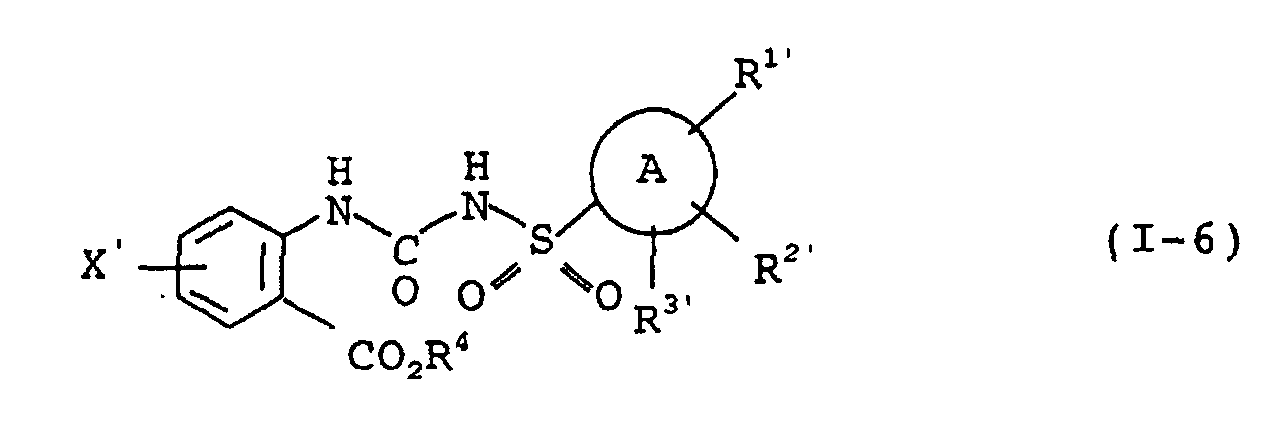
- the quinazoline derivative having the formula (I) according to the present invention may, for example, be synthesized by the following Synthesis Method (A) or (B).
- R 1 , R 2 or R 3 when R 1 , R 2 or R 3 represents a group containing a hydroxyl group, an amino group, or a carboxylic acid group, R 1 , R 2 or R 3 may be optionally protected by a protecting group such as a benzyloxycarbonyl group, a t-butoxycarbonyl group, a benzyl group, an allyl group, a t-butyl group, etc.
- X represents a hydroxyl group or an amino group
- X may be optionally protected with a protecting group such as a benzyloxycarbonyl group, a t-butoxycarbonyl group, a benzyl group, an allyl group, a t-butyl group, etc.
- the compound having the formula (I-1) used in this reaction includes a commercially available or known compound or a compound which can be synthesized by a known method may be used.
- a compound which can be synthesized from the corresponding sulfonamide derivative using chlorosulfonyl isocyanate For example, it is possible to use 3-allyloxycarbonyl-methylbenzenesulfonyl isocyanate, 4-allyloxycarbonyl-methylbenzenesulfonyl isocyanate, 4-allyloxybenzenesulfonyl isocyanate, etc.
- anthranilic acid derivative having the formula (I-2) used for this reaction a commercially available or known compound or a compound which can be synthesized by a known method may be used.
- anthranilic acid, 4-chloroanthranilic acid, 4-methoxyanthranilic acid, 5-chloroanthranilic acid, 4-hydroxyanthranilic acid, etc. may be used.
- the reaction to obtain the quinazoline ring from the sulfonylurea derivative having the formula (I-3) may be carried out using an aprotonic solvent such as, for example, an ether solvent such as tetrahydrofuran and dioxane, a halogen-containing solvent such as methylene chloride, or dimethylformamide etc. at a temperature of -50°C to 50°C, preferably -20°C to room temperature.
- an ordinary condensing agent which includes, for example, CDI, dicyclohexylcarbodiimide (DCC), and similar carbodiimide compounds, mixed anhydrides, etc.
- the deprotecting reaction can be carried out by an ordinary method using hydrolysis with an acid or alkali, reduction or oxidation etc.
- a commercially available or known compound or a compound which can be synthesized by a known method may be used.
- anthranilic acid derivative having the formula (I-5) used in this reaction a commercially available or known compound or a compound which can be synthesized by a known method may be used.
- a commercially available or known compound or a compound which can be synthesized by a known method may be used.
- the reaction for obtaining the compound having the formula (I-4) and the anthranilic acid derivative having the formula (I-5) condense to obtain a sulfonylurea derivative having the formula (I-6), may be carried out using an aprotic solvent, for example, an ether solvent such as tetrahydrofuran or dioxane, a halogen-containing solvent such as methylene chloride, or dimethylformamide etc. at a temperature of -50°C to 50°C, preferably -20°C to room temperature.
- an organic strong base such as DBU
- inorganic bases such as potassium carbonate, sodium carbonate, potassium hydroxide, and sodium hydroxide
- metal bases such as sodium hydride
- the above reaction may be carried out while protecting the functional groups not involved in the reaction.
- the protection is removed by chemical reduction or other ordinary protection-removing reactions.
- the protecting group is a t-butyl group or t-butoxycarbonyl group
- trifluoroacetic acid may be used
- it is an allyl group palladium catalysts such as tetrakis(triphenylphosphine)palladium (0) may be used.
- the compound having the formula (I), wherein R 1 represents an amino group acylated with a C 1 to C 4 lower aliphatic acid which may be substituted with a carboxylic acid, an amino group acylated with an aromatic ring carboxylic acid which may be substituted with a carboxylic acid and an amino group acylated with an heteroaromatic ring carboxylic acid which may be substituted with a carboxylic acid, can be obtained from the compound having the formula (I), wherein R 1 represents an amino group, by acylating the same with carboxylic acid, carboxylic acid chloride, carboxylic acid anhydride using an ordinary method.
- the product obtained according to the above-mentioned processes can be purified by a method such as recrystallization or column chromatography.
- the compounds having the formula (I) of the present invention obtained according to the above-mentioned processes can each be reacted with one of various acids or basis to convert the compound into their salt.
- Exemplary acids usable for the conversion of the compound having the formula (I) into their salts can include inorganic acids such as hydrochloric acid, hydrobromic acid, nitric acid, sulfuric acid, phosphoric acid; and organic acids such as methanesulfonic acid, benzenesulfonic acid, p-toluenesulfonic acid, trifluoroacetic acid, citric acid, lactic acid, maleic acid, fumaric acid, tartaric acid, acetic acid, adipic acid, palmitic acid and tannic acid.
- Exemplary usable basis for the conversion of the compound having the formula (I) into their salts can include sodium hydroxide, lithium hydroxide and potassium hydroxide.
- each racemic mixture can be isolated by one or more of various methods, whereby a single optically-active substance can be obtained.
- Usable methods include, for example:
- Evaluation of a medicament for the prevention or treatment for the disease related to eosinophil increase can be performed by using peripheral eosinophilia models in addition to use of various disease models.
- peripheral eosinophilia models in addition to use of various disease models.
- bronchial asthma e.g., allergic rhinitis, allergic conjunctivitis, cnidosis, eczema
- peripheral eosinophilia models in addition to use of various disease models.
- peripheral eosinophilia models in addition to use of various disease models.
- the number of peripheral eosinophils dramatically increases in the patients with asthma (in particular, chronic asthma) ( Br. Med. J. 285 (6350), 1229, 1982), but administration of a steroid effective against bronchial asthma reduces the number of eosinophils in the peripheral blood ( Eur. Respir. J. Suppl. 430s, 1989).
- Such a parasite-induced model can also be used for evaluating amendicament for the prevention or treatment for other diseases in which eosinophils are involved e.g., allergic rhinitis, allergic conjunctivitis, cnidosis, and eczema.
- the compound of the present invention can be evaluated by the suppressing effect on increase in eosinophils using the method described in Example 2, which is parasite-induced eosinophilia model.
- one or more of the compounds of the present invention may be mixed and formed into a form suitable for use in the method of administration by an ordinary method.
- preparation forms for oral administration include capsules, tablets, granules, fine granules, syrups, dry syrups, and other preparations
- preparation forms for non-oral administration include injections and besides suppositories such as rectal suppositories and vaginal suppositories, transnasal preparations such as sprays and ointments, and percutaneous preparations such as tapes for percutaneous absorption.
- the clinical dose of the compound according to the present invention varies according to the diseased condition, degree of seriousness, age, presence of complications, etc. and also varies according to its preparation form.
- oral administration it may be dosed usually, in terms of effective ingredients, as 1 to 1000 mg per adult per day.
- non-oral administration it is sufficient to administer 1/10 to 1/2 the amount of the case of oral administration.
- the chymase inhibitor can be administered alone as it is without being mixed with another effective ingredient, but considering the disease in question, the symptoms, complications, etc., it may also administered as a medicinal preparation containing other effective ingredients. Further, it may also be combined with these other effective ingredients.
- the amounts of the other effective ingredients used are not particularly limited, but are determined considering the minimum amounts for expression of their effects alone, the occurrence of side effects, etc.
- the form of preparation and the method of combined treatment including preparations containing the chymase inhibitor alone as an effective ingredient and preparations also containing other effective ingredients are suitably selected by a physician in accordance with the age of the patient, the symptoms, etc.
- the toxicity of the compound according to the present invention is low.
- the acute toxicity values LD 50 at 24 hours after oral administration to 5-week old male mice were 1 g/kg or more. This value is 50 or more times of the expected clinical amount of use and therefore these compounds are considered to be highly safe.
- Human heart chymase was purified according to the method of Urata et al. (J. Biol. Chem ., 1990, 265, 22348).
- Suc-Ala-Ala-Pro-Phe-MCA (Peptide Institute Inc.) was dissolved in 10 mM dimethyl sulfoxide (hereinafter referred to as DMSO) and diluted 20-fold with 0.1M Tris-HCl buffer (pH 7.5) containing 1M sodium chloride and 0.01% TritonX-100 to an appropriate concentration to prepare substrate solution.
- DMSO dimethyl sulfoxide
- Tris-HCl buffer pH 7.5
- IC 50 values for representative compounds are shown in Table I.
- mice Male BALB/c mice (7-weeks old) were transcutaneously inflected with 750 parasitic worms of Nippostrongylus brasiliensis (Nb) (third stage larvae) in accordance with an already reported method ( Int. Arch. Allergy Immunol. 117, Suppl. 1, 2, 1998). After two weeks, the number of eosinophils in the peripheral blood and the total number of leukocytes in the peripheral blood were measured. Further, at day 7 and day 10, the number of eggs in the feces was measured. The chymase inhibitor (Compound 18) was dissolved in saline and injected intraperitoneally in 0.2 ml amounts once a day continuously from the day before infection until the end of the test.
- Nb Nippostrongylus brasiliensis
- control group was administered only saline.
- the number of cells in the peripheral blood was measured by sampling peripheral blood from the eye cavity.
- the eosinophils were stained with a Hinkelman's solution, then counted under a microscope. Further, the total number of leukocytes was measured under a microscope after staining with by a Turk's solution.
- the number of eggs in the feces was determined by obtaining individual feces of the mice, measuring their weight, then dissolving them in 1 ml of 10% formalin, counting the number of eggs in the feces solution under a microscope, then expressing the result as the number of eggs per gram of feces.
- Compound 1 100.0 g was mixed with microcrystalline cellulose in an amount of 22.5 g and magnesium stearate in an amount of 2.5 g and then tabletized by a single-action type tabletizing machine to produce tablets each containing 200 mg of Compound 1 and having a diameter of 9 mm and a weight of 250 mg.
- Compound 1 30 g was mixed well with lactose in an amount of 265 g and magnesium stearate in an amount of 5 g. The mixture was pressed molded, then pulverized and the granules sieved to obtain excellent 10% granules of 20 to 50 mesh.
- Vitepsol H-15 (made by Dynamite Nobel Co.) was warmed to melt. To this was added Compound 1 to a concentration of 12.5 mg/ml. This was homogeneously mixed, then was added in 2 ml amounts to a rectal suppository mold and cooled to obtain rectal suppositories each containing 25 mg of the Compound 1. Effects of Chymase Inhibitor (Compound 18) on Number of Eosinophils and Total Number of Leukocytes in Peripheral Blood in Nb Infected Mice Compound 18 Number of eosinophils in peripheral blood (no./mm 3 ) Total no.
- chymase inhibitor can effectively prevent or treat a condition of various diseases in which it is known that eosinophils increase through its effect in suppressing an increase in eosinophils.
Landscapes
- Health & Medical Sciences (AREA)
- Chemical & Material Sciences (AREA)
- Public Health (AREA)
- Pharmacology & Pharmacy (AREA)
- Veterinary Medicine (AREA)
- General Health & Medical Sciences (AREA)
- Animal Behavior & Ethology (AREA)
- Medicinal Chemistry (AREA)
- Life Sciences & Earth Sciences (AREA)
- Organic Chemistry (AREA)
- Epidemiology (AREA)
- General Chemical & Material Sciences (AREA)
- Nuclear Medicine, Radiotherapy & Molecular Imaging (AREA)
- Bioinformatics & Cheminformatics (AREA)
- Chemical Kinetics & Catalysis (AREA)
- Engineering & Computer Science (AREA)
- Pulmonology (AREA)
- Ophthalmology & Optometry (AREA)
- Dermatology (AREA)
- Immunology (AREA)
- Pharmaceuticals Containing Other Organic And Inorganic Compounds (AREA)
- Medicines That Contain Protein Lipid Enzymes And Other Medicines (AREA)
Abstract
Description






| Example No. | IC50 value (µM) |
| 1 | 0.36 |
| 2 | 0.14 |
| 8 | 0.035 |
| 10 | 0.17 |
| 12 | 0.44 |
| 13 | 0.3 |
| 16 | 0.84 |
| 17 | 0.14 |
| 18 | 0.14 |
| 21 | 0.34 |
| 22 | 0.3 |
| 24 | 0.32 |
| 27 | 4.0 |
| 29 | 1.7 |
| 32 | 1.5 |
| 34 | 0.36 |
| Effects of Chymase Inhibitor (Compound 18) on Number of Eosinophils and Total Number of Leukocytes in Peripheral Blood in Nb Infected Mice | ||||
| Compound 18 | Number of eosinophils in peripheral blood (no./mm3) | Total no. of leukocytes in peripheral blood 2 weeks after infection (no./mm3) | ||
| Before infection | 2 weeks after infection | P | ||
| 0 | 30±29 | 1036±158 | 6180±1660 | |
| 2 mg/kg | 30±12 | 1036±240 | NS | |
| 10 mg/kg | 36±11 | 818±155 | NS | |
| 50 mg/kg | 32±16 | 360±66 | <0.001 | 5820±460 |
| Effects of Chymase Inhibitor (Compound 18) on Number of Eggs in Feces in Nb Infected Mice | ||
| Compound 18 | No. of Nb eggs in gram of feces | |
| Day 7 | Day 10 | |
| 0 | 27139±6375 | 800±1789 |
| 50 mg/kg | 30541±12501 | 558±1248 |
Claims (9)
- A medicament for the prevention or treatment of diseases involving an increase of eosinophils having a chymase inhibitor as its effective ingredient.
- A medicament for the prevention or treatment as claimed in claim 1, wherein said disease involving an increase in eosinophils is an allergic disease.
- A medicament for the prevention or treatment as claimed in claim 2, wherein said allergic disease is at least one disease selected from bronchial asthma, allergic rhinitis, allergic conjunctivitis, cnidosis, and eczema.
- A pharmaceutical composition for the prevention or treatment of allergic diseases containing an amount of a chymase inhibitor suppressing an increase in the eosinophils and a pharmaceutically acceptable vehicle.
- A pharmaceutical composition as claimed in claim 4, wherein said allergic disease is at least one disease selected from bronchial asthma, allergic rhinitis, allergic conjunctivitis, cnidosis, and eczema.
- A medicament for the suppression of an increase in eosinophils having a chymase inhibitor as its effective ingredient.
- A medicament for the prevention or treatment as claimed in claim 1 or 2, wherein said chimase inhibitor is a quinazoline derivative having the following formula (I) or a pharmaceutically acceptable salt thereof:wherein the ring A represents an aryl group;
 R1 represents a hydroxyl group, an amino group, a C1 to C4 lower alkylamino group which may be substituted with a carboxylic acid group, a C7 to C10 lower aralkylamino group which may be substituted with a carboxylic acid group, an amino group acylated with a C1 to C4 lower aliphatic acid which may be substituted with a carboxylic acid group, an amino group acylated with an aromatic ring carboxylic acid which may be substituted with a carboxylic acid group, an amino group acylated with a heteroaromatic ring carboxylic acid which may be substituted with a carboxylic acid group, an amino group sulfonylated with a C1 to C4 lower alkanesulfonic acid which may be substituted with a carboxylic acid group, an amino group sulfonylated with an aromatic ring sulfonic acid which may be substituted with a carboxylic acid group, an amino group sulfonylated with a heteroaromatic ring sulfonic acid which may be substituted with a carboxylic acid group, a C1 to C4 lower alkyl group substituted with a carboxylic acid group, or a C2 to C4 lower alkylene group which may be substituted with a carboxylic acid group;R2 and R3 may be the same or different and represent a hydrogen atom, an unsubstituted or substituted C1 to C4 lower alkyl group, a halogen atom, a hydroxyl group, a C1 to C4 lower alkoxyl group, an amino group, an unsubstituted or substituted C1 to C4 lower alkylamino group, an unsubstituted or substituted C7 to C10 aralkylamino group, an amino group acylated with a C1 to C4 lower aliphatic acid which may be substituted with a carboxylic acid group, an amino group acylated with an aromatic ring carboxylic acid which may be substituted with a carboxylic acid group, an amino group acylated with a heteroaromatic ring carboxylic acid which may be substituted with a carboxylic acid group, an amino group sulfonylated with a C1 to C4 lower alkanesulfonic acid which may be substituted with a carboxylic acid group, an amino group sulfonylated with an aromatic ring sulfonic acid which may be substituted with a carboxylic acid group, an amino group sulfonylated with a heteroaromatic ring sulfonic acid which may be substituted with a carboxylic acid group, or a carboxylic acid group orwhen the ring A is a benzene ring, R1 and R2 may form, together with the substituting benzene ring, a fused heterocyclic ring which may be substituted with a carboxylic acid and in which the carbon atom in the ring may form a carbonyl group and R3 is the same as defined above; andX represents a hydrogen atom, a C1 to C4 lower alkyl group, a C1 to C4 lower alkoxy group, a halogen atom, a hydroxyl group, an amino group, or a nitro group.
 - A pharmaceutical composition as claimed in claim 4 or 5, wherein said chimase inhibitor is a quinazoline derivative having the following formula (I) or a pharmaceutically acceptable salt thereof:wherein the ring A represents an aryl group;
 R1 represents a hydroxyl group, an amino group, a C1 to C4 lower alkylamino group which may be substituted with a carboxylic acid group, a C7 to C10 lower aralkylamino group which may be substituted with a carboxylic acid group, an amino group acylated with a C1 to C4 lower aliphatic acid which may be substituted with a carboxylic acid group, an amino group acylated with an aromatic ring carboxylic acid which may be substituted with a carboxylic acid group, an amino group acylated with a heteroaromatic ring carboxylic acid which may be substituted with a carboxylic acid group, an amino group sulfonylated with a C1 to C4 lower alkanesulfonic acid which may be substituted with a carboxylic acid group, an amino group sulfonylated with an aromatic ring sulfonic acid which may be substituted with a carboxylic acid group, an amino group sulfonylated with a heteroaromatic ring sulfonic acid which may be substituted with a carboxylic acid group, a C1 to C4 lower alkyl group substituted with a carboxylic acid group, or a C2 to C4 lower alkylene group which may be substituted with a carboxylic acid group;R2 and R3 may be the same or different and represent a hydrogen atom, an unsubstituted or substituted C1 to C4 lower alkyl group, a halogen atom, a hydroxyl group, a C1 to C4 lower alkoxyl group, an amino group, an unsubstituted or substituted C1 to C4 lower alkylamino group, an unsubstituted or substituted C7 to C10 aralkylamino group, an amino group acylated with a C1 to C4 lower aliphatic acid which may be substituted with a carboxylic acid group, an amino group acylated with an aromatic ring carboxylic acid which may be substituted with a carboxylic acid group, an amino group acylated with a heteroaromatic ring carboxylic acid which may be substituted with a carboxylic acid group, an amino group sulfonylated with a C1 to C4 lower alkanesulfonic acid which may be substituted with a carboxylic acid group, an amino group sulfonylated with an aromatic ring sulfonic acid which may be substituted with a carboxylic acid group, an amino group sulfonylated with a heteroaromatic ring sulfonic acid which may be substituted with a carboxylic acid group, or a carboxylic acid group orwhen the ring A is a benzene ring, R1 and R2 may form, together with the substituting benzene ring, a fused heterocyclic ring which may be substituted with a carboxylic acid and in which the carbon atom in the ring may form a carbonyl group and R3 is the same as defined above; andX represents a hydrogen atom, a C1 to C4 lower alkyl group, a C1 to C4 lower alkoxy group, a halogen atom, a hydroxyl group, an amino group, or a nitro group.
 - A medicament for the suppression of an increase in eosinophils as claimed in claim 6, wherein said chimase inhibitor is a quinazoline derivative having the following formula (I) or a pharmaceutically acceptable salt thereof:wherein the ring A represents an aryl group;
 R1 represents a hydroxyl group, an amino group, a C1 to C4 lower alkylamino group which may be substituted with a carboxylic acid group, a C7 to C10 lower aralkylamino group which may be substituted with a carboxylic acid group, an amino group acylated with a C1 to C4 lower aliphatic acid which may be substituted with a carboxylic acid group, an amino group acylated with an aromatic ring carboxylic acid which may be substituted with a carboxylic acid group, an amino group acylated with a heteroaromatic ring carboxylic acid which may be substituted with a carboxylic acid group, an amino group sulfonylated with a C1 to C4 lower alkanesulfonic acid which may be substituted with a carboxylic acid group, an amino group sulfonylated with an aromatic ring sulfonic acid which may be substituted with a carboxylic acid group, an amino group sulfonylated with a heteroaromatic ring sulfonic acid which may be substituted with a carboxylic acid group, a C1 to C4 lower alkyl group substituted with a carboxylic acid group, or a C2 to C4 lower alkylene group which may be substituted with a carboxylic acid group;R2 and R3 may be the same or different and represent a hydrogen atom, an unsubstituted or substituted C1 to C4 lower alkyl group, a halogen atom, a hydroxyl group, a C1 to C4 lower alkoxyl group, an amino group, an unsubstituted or substituted C1 to C4 lower alkylamino group, an unsubstituted or substituted C7 to C10 aralkylamino group, an amino group acylated with a C1 to C4 lower aliphatic acid which may be substituted with a carboxylic acid group, an amino group acylated with an aromatic ring carboxylic acid which may be substituted with a carboxylic acid group, an amino group acylated with a heteroaromatic ring carboxylic acid which may be substituted with a carboxylic acid group, an amino group sulfonylated with a C1 to C4 lower alkanesulfonic acid which may be substituted with a carboxylic acid group, an amino group sulfonylated with an aromatic ring sulfonic acid which may be substituted with a carboxylic acid group, an amino group sulfonylated with a heteroaromatic ring sulfonic acid which may be substituted with a carboxylic acid group, or a carboxylic acid group orwhen the ring A is a benzene ring, R1 and R2 may form, together with the substituting benzene ring, a fused heterocyclic ring which may be substituted with a carboxylic acid and in which the carbon atom in the ring may form a carbonyl group and R3 is the same as defined above; andX represents a hydrogen atom, a C1 to C4 lower alkyl group, a C1 to C4 lower alkoxy group, a halogen atom, a hydroxyl group, an amino group, or a nitro group.
Applications Claiming Priority (3)
| Application Number | Priority Date | Filing Date | Title |
|---|---|---|---|
| JP2000050487 | 2000-02-22 | ||
| JP2000050487 | 2000-02-22 | ||
| PCT/JP2001/001322 WO2001062293A1 (en) | 2000-02-22 | 2001-02-22 | Preventive or therapeutic drugs for various eosinophilia-related diseases containing chymase inhibitors as the active ingredient |
Publications (3)
| Publication Number | Publication Date |
|---|---|
| EP1174151A1 true EP1174151A1 (en) | 2002-01-23 |
| EP1174151A4 EP1174151A4 (en) | 2003-01-22 |
| EP1174151B1 EP1174151B1 (en) | 2007-01-24 |
Family
ID=18572266
Family Applications (1)
| Application Number | Title | Priority Date | Filing Date |
|---|---|---|---|
| EP01906225A Expired - Lifetime EP1174151B1 (en) | 2000-02-22 | 2001-02-22 | Therapeutic treatment of eosinophilia using chymase inhibitors as the active ingredient |
Country Status (11)
| Country | Link |
|---|---|
| US (1) | US6677344B2 (en) |
| EP (1) | EP1174151B1 (en) |
| KR (1) | KR20010109526A (en) |
| CN (1) | CN1245978C (en) |
| AT (1) | ATE352317T1 (en) |
| AU (1) | AU3413501A (en) |
| CA (1) | CA2365606A1 (en) |
| DE (1) | DE60126199T2 (en) |
| ES (1) | ES2275652T3 (en) |
| HU (1) | HUP0201287A3 (en) |
| WO (1) | WO2001062293A1 (en) |
Cited By (1)
| Publication number | Priority date | Publication date | Assignee | Title |
|---|---|---|---|---|
| US11840543B2 (en) | 2017-05-24 | 2023-12-12 | The University Of Queensland | Compounds and uses |
Families Citing this family (6)
| Publication number | Priority date | Publication date | Assignee | Title |
|---|---|---|---|---|
| DE60121695T2 (en) | 2000-02-22 | 2007-08-30 | Daiichi Asubio Pharma Co., Ltd. | DRUGS WITH CHYMASEINHIBITORS AS EFFECTIVE AGENT FOR THE TREATMENT OF DERMATITIS WITH TWO-PHASE SKIN REACTIONS |
| KR20010108519A (en) | 2000-02-22 | 2001-12-07 | 도리이 신이치로 | Preventive or therapeutic drugs for fibrosis containing chymase inhibitors as the active ingredient |
| KR101278522B1 (en) | 2004-12-02 | 2013-06-25 | 다이이찌 산쿄 가부시키가이샤 | 7-membered ring compound, process for producing the same, and medicinal use thereof |
| JP5117382B2 (en) | 2006-05-31 | 2013-01-16 | 第一三共株式会社 | Method for producing 7-membered ring compound |
| DE102009043745A1 (en) | 2009-09-30 | 2011-04-07 | Carl Zeiss Microlmaging Gmbh | Variable filtering spectral detector by spatial color separation and laser scanning microscope |
| US8846660B2 (en) | 2009-12-25 | 2014-09-30 | Daiichi Sankyo Company, Ltd. | Seven-membered ring compound and pharmaceutical use therefor |
Family Cites Families (22)
| Publication number | Priority date | Publication date | Assignee | Title |
|---|---|---|---|---|
| JPS6351335A (en) * | 1986-08-20 | 1988-03-04 | Fuji Oil Co Ltd | Degranulation inhibitor for mast cell |
| US5199279A (en) | 1991-08-13 | 1993-04-06 | Reynolds Martin M | Drum contact freezer system and method |
| JPH05294930A (en) | 1992-04-21 | 1993-11-09 | Yoshitomi Pharmaceut Ind Ltd | Styryl compound |
| JP2668003B2 (en) | 1992-06-12 | 1997-10-27 | ファイザー インク. | Inhibitors for angiotensin I chymase, including human cardiac chymase |
| RU2139862C1 (en) | 1993-05-12 | 1999-10-20 | Е.И. Дю Пон де Немурс энд Компани | Substituted 4(3h) quinazolinones having fungicidal properties, compositions based thereon, and methods of controlling powdery mildew |
| ES2155134T3 (en) | 1994-07-29 | 2001-05-01 | Suntory Ltd | IMIDAZOLIDINE DERIVATIVES AND ITS USE. |
| CA2163399A1 (en) * | 1994-11-24 | 1996-05-25 | Katsuhiro Kawano | Triazine derivative, chymase activity inhibitor and nitric oxide production inhibitor |
| CN1188401C (en) | 1995-04-27 | 2005-02-09 | 三菱制药株式会社 | Heterocyclic amide compound and its pharmaceutical use |
| US5596111A (en) | 1995-06-05 | 1997-01-21 | North Dakota State University | Method for preparation of carboxylic acids |
| JP3992291B2 (en) * | 1995-09-28 | 2007-10-17 | アスビオファーマ株式会社 | Quinazoline derivatives |
| BR9712000A (en) * | 1996-09-06 | 1999-08-24 | Nippon Kayaku Kk | Derivatives of acetamide salts of the same pharmaceutical composition chymase protease inhibitors of mast degranulation or histamine release from mast cells and eosinophil activation or active oxygen release from eosinophil eosinophile and process for producing acetamide denervates |
| JPH1087493A (en) | 1996-09-18 | 1998-04-07 | Shionogi & Co Ltd | Chymase inhibitors containing cephem compounds |
| JPH10101666A (en) | 1996-10-02 | 1998-04-21 | Shionogi & Co Ltd | Novel benzoxacyclotridesine compound and pharmaceutical composition containing the same |
| US6080738A (en) | 1996-10-25 | 2000-06-27 | Yoshitomi Pharmaceuticals Industries, Ltd. | Heterocyclic amide compounds and medicinal uses thereof |
| JPH10245384A (en) | 1997-03-05 | 1998-09-14 | Teijin Ltd | New triazine sulfone derivative |
| WO1999041277A1 (en) | 1998-02-17 | 1999-08-19 | Nippon Kayaku Kabushiki Kaisha | Novel acetamide derivative and use thereof |
| JPH11246437A (en) | 1998-03-05 | 1999-09-14 | Yoshitomi Pharmaceut Ind Ltd | Gastrointestinal mucosa protective agent |
| ATE326451T1 (en) * | 1998-08-21 | 2006-06-15 | Daiichi Asubio Pharma Co Ltd | QUINAZOLINE DERIVATIVES AND THERAPEUTIC USES THEREOF |
| JP4491866B2 (en) | 1999-09-30 | 2010-06-30 | 三菱化学株式会社 | Acylsulfonamide derivatives |
| EP1142586B1 (en) | 1999-11-01 | 2007-04-25 | Daiichi Asubio Pharma Co., Ltd. | Use of chymase inhibitors against vascular lipid deposition |
| DE60121695T2 (en) | 2000-02-22 | 2007-08-30 | Daiichi Asubio Pharma Co., Ltd. | DRUGS WITH CHYMASEINHIBITORS AS EFFECTIVE AGENT FOR THE TREATMENT OF DERMATITIS WITH TWO-PHASE SKIN REACTIONS |
| KR20010108519A (en) | 2000-02-22 | 2001-12-07 | 도리이 신이치로 | Preventive or therapeutic drugs for fibrosis containing chymase inhibitors as the active ingredient |
-
2001
- 2001-02-22 AU AU34135/01A patent/AU3413501A/en not_active Abandoned
- 2001-02-22 CA CA002365606A patent/CA2365606A1/en not_active Abandoned
- 2001-02-22 EP EP01906225A patent/EP1174151B1/en not_active Expired - Lifetime
- 2001-02-22 AT AT01906225T patent/ATE352317T1/en not_active IP Right Cessation
- 2001-02-22 US US09/959,358 patent/US6677344B2/en not_active Expired - Fee Related
- 2001-02-22 WO PCT/JP2001/001322 patent/WO2001062293A1/en not_active Ceased
- 2001-02-22 DE DE60126199T patent/DE60126199T2/en not_active Expired - Lifetime
- 2001-02-22 ES ES01906225T patent/ES2275652T3/en not_active Expired - Lifetime
- 2001-02-22 KR KR1020017013380A patent/KR20010109526A/en not_active Ceased
- 2001-02-22 CN CNB018007724A patent/CN1245978C/en not_active Expired - Fee Related
- 2001-02-22 HU HU0201287A patent/HUP0201287A3/en unknown
Cited By (1)
| Publication number | Priority date | Publication date | Assignee | Title |
|---|---|---|---|---|
| US11840543B2 (en) | 2017-05-24 | 2023-12-12 | The University Of Queensland | Compounds and uses |
Also Published As
| Publication number | Publication date |
|---|---|
| WO2001062293A1 (en) | 2001-08-30 |
| US20020187989A1 (en) | 2002-12-12 |
| DE60126199D1 (en) | 2007-03-15 |
| AU3413501A (en) | 2001-09-03 |
| EP1174151A4 (en) | 2003-01-22 |
| HUP0201287A3 (en) | 2003-02-28 |
| HUP0201287A2 (en) | 2002-12-28 |
| US6677344B2 (en) | 2004-01-13 |
| KR20010109526A (en) | 2001-12-10 |
| ES2275652T3 (en) | 2007-06-16 |
| ATE352317T1 (en) | 2007-02-15 |
| EP1174151B1 (en) | 2007-01-24 |
| DE60126199T2 (en) | 2008-02-28 |
| CA2365606A1 (en) | 2001-08-30 |
| CN1366459A (en) | 2002-08-28 |
| CN1245978C (en) | 2006-03-22 |
Similar Documents
| Publication | Publication Date | Title |
|---|---|---|
| US6500835B2 (en) | Preventive or therapeutic drugs for fibrosis containing chymase inhibitors as the active ingredient | |
| US20100029695A1 (en) | Method of treating dermatitis comprising administering a chymase inhibitor | |
| US6867214B1 (en) | Quinazoline derivatives and pharmaceutical applications thereof | |
| US6677344B2 (en) | Chymase inhibitor for the treatment of eosinophilia | |
| US6921766B1 (en) | Blood vessel lipid deposition-preventive agent comprising chymase-inhibitor | |
| AU2006201291A1 (en) | Medicament for prevention or treatment of various diseases involving an increase in eosinophils chymase inhibitor as effective ingredient | |
| JPWO2001062293A1 (en) | Preventive or therapeutic drugs for various diseases associated with increased eosinophilia, containing chymase inhibitors as active ingredients | |
| AU2006201292A1 (en) | Medicament for prevention or treatment of fibrosis having chymase inhibitor as effective ingredient | |
| AU2006201254A1 (en) | Medicament for prevention and treatment of dermatitis having chymase inhibitor as effective ingredient | |
| JPWO2001062294A1 (en) | Preventive or therapeutic drug for dermatitis containing a chymase inhibitor as an active ingredient | |
| JPWO2001062292A1 (en) | Preventive or therapeutic drug for fibrosis containing a chymase inhibitor as an active ingredient |
Legal Events
| Date | Code | Title | Description |
|---|---|---|---|
| PUAI | Public reference made under article 153(3) epc to a published international application that has entered the european phase |
Free format text: ORIGINAL CODE: 0009012 |
|
| 17P | Request for examination filed |
Effective date: 20011112 |
|
| AK | Designated contracting states |
Kind code of ref document: A1 Designated state(s): AT BE CH CY DE DK ES FI FR GB GR IE IT LI LU MC NL PT SE TR |
|
| AX | Request for extension of the european patent |
Free format text: AL;LT;LV;MK;RO;SI |
|
| A4 | Supplementary search report drawn up and despatched |
Effective date: 20021205 |
|
| AK | Designated contracting states |
Kind code of ref document: A4 Designated state(s): AT BE CH CY DE DK ES FI FR GB GR IE IT LI LU MC NL PT SE TR |
|
| RIC1 | Information provided on ipc code assigned before grant |
Free format text: 7A 61K 45/00 A, 7A 61K 31/517 B, 7A 61K 31/536 B, 7A 61P 43/00 B, 7A 61P 37/08 B, 7A 61P 11/06 B, 7A 61P 27/16 B, 7A 61P 27/14 B, 7A 61P 17/04 B, 7C 07D 239/96 B, 7C 07D 239/96 J, 7C 07D 401:12 J, 7C 07D 403:12 J |
|
| RAP1 | Party data changed (applicant data changed or rights of an application transferred) |
Owner name: DAIICHI SUNTORY PHARMA CO., LTD. |
|
| 17Q | First examination report despatched |
Effective date: 20040922 |
|
| RAP1 | Party data changed (applicant data changed or rights of an application transferred) |
Owner name: DAIICHI ASUBIO PHARMA CO., LTD. |
|
| GRAP | Despatch of communication of intention to grant a patent |
Free format text: ORIGINAL CODE: EPIDOSNIGR1 |
|
| RTI1 | Title (correction) |
Free format text: THERAPEUTIC TREATMENT OF EOSINOPHILIA USING CHYMASE INHIBITORS AS THE ACTIVE INGREDIENT |
|
| RIC1 | Information provided on ipc code assigned before grant |
Ipc: A61K 31/517 20060101ALI20060530BHEP Ipc: A61P 43/00 20060101ALI20060530BHEP Ipc: A61K 45/00 20060101AFI20060530BHEP Ipc: A61P 17/04 20060101ALI20060530BHEP Ipc: A61P 27/16 20060101ALI20060530BHEP Ipc: A61P 27/14 20060101ALI20060530BHEP Ipc: A61K 31/536 20060101ALI20060530BHEP Ipc: C07D 239/96 20060101ALI20060530BHEP Ipc: A61P 37/08 20060101ALI20060530BHEP Ipc: A61P 11/06 20060101ALI20060530BHEP |
|
| GRAS | Grant fee paid |
Free format text: ORIGINAL CODE: EPIDOSNIGR3 |
|
| GRAA | (expected) grant |
Free format text: ORIGINAL CODE: 0009210 |
|
| RAP1 | Party data changed (applicant data changed or rights of an application transferred) |
Owner name: DAIICHI ASUBIO PHARMA CO., LTD. |
|
| AK | Designated contracting states |
Kind code of ref document: B1 Designated state(s): AT BE CH CY DE DK ES FI FR GB GR IE IT LI LU MC NL PT SE TR |
|
| PG25 | Lapsed in a contracting state [announced via postgrant information from national office to epo] |
Ref country code: DK Free format text: LAPSE BECAUSE OF FAILURE TO SUBMIT A TRANSLATION OF THE DESCRIPTION OR TO PAY THE FEE WITHIN THE PRESCRIBED TIME-LIMIT Effective date: 20070124 Ref country code: AT Free format text: LAPSE BECAUSE OF FAILURE TO SUBMIT A TRANSLATION OF THE DESCRIPTION OR TO PAY THE FEE WITHIN THE PRESCRIBED TIME-LIMIT Effective date: 20070124 Ref country code: NL Free format text: LAPSE BECAUSE OF FAILURE TO SUBMIT A TRANSLATION OF THE DESCRIPTION OR TO PAY THE FEE WITHIN THE PRESCRIBED TIME-LIMIT Effective date: 20070124 Ref country code: FI Free format text: LAPSE BECAUSE OF FAILURE TO SUBMIT A TRANSLATION OF THE DESCRIPTION OR TO PAY THE FEE WITHIN THE PRESCRIBED TIME-LIMIT Effective date: 20070124 Ref country code: LI Free format text: LAPSE BECAUSE OF FAILURE TO SUBMIT A TRANSLATION OF THE DESCRIPTION OR TO PAY THE FEE WITHIN THE PRESCRIBED TIME-LIMIT Effective date: 20070124 Ref country code: CH Free format text: LAPSE BECAUSE OF FAILURE TO SUBMIT A TRANSLATION OF THE DESCRIPTION OR TO PAY THE FEE WITHIN THE PRESCRIBED TIME-LIMIT Effective date: 20070124 |
|
| REG | Reference to a national code |
Ref country code: GB Ref legal event code: FG4D |
|
| REG | Reference to a national code |
Ref country code: CH Ref legal event code: EP |
|
| PG25 | Lapsed in a contracting state [announced via postgrant information from national office to epo] |
Ref country code: MC Free format text: LAPSE BECAUSE OF NON-PAYMENT OF DUE FEES Effective date: 20070228 |
|
| REG | Reference to a national code |
Ref country code: IE Ref legal event code: FG4D |
|
| REF | Corresponds to: |
Ref document number: 60126199 Country of ref document: DE Date of ref document: 20070315 Kind code of ref document: P |
|
| PG25 | Lapsed in a contracting state [announced via postgrant information from national office to epo] |
Ref country code: SE Free format text: LAPSE BECAUSE OF FAILURE TO SUBMIT A TRANSLATION OF THE DESCRIPTION OR TO PAY THE FEE WITHIN THE PRESCRIBED TIME-LIMIT Effective date: 20070424 |
|
| ET | Fr: translation filed | ||
| REG | Reference to a national code |
Ref country code: ES Ref legal event code: FG2A Ref document number: 2275652 Country of ref document: ES Kind code of ref document: T3 |
|
| PG25 | Lapsed in a contracting state [announced via postgrant information from national office to epo] |
Ref country code: PT Free format text: LAPSE BECAUSE OF FAILURE TO SUBMIT A TRANSLATION OF THE DESCRIPTION OR TO PAY THE FEE WITHIN THE PRESCRIBED TIME-LIMIT Effective date: 20070625 |
|
| REG | Reference to a national code |
Ref country code: CH Ref legal event code: PL |
|
| NLV1 | Nl: lapsed or annulled due to failure to fulfill the requirements of art. 29p and 29m of the patents act | ||
| REG | Reference to a national code |
Ref country code: FR Ref legal event code: CD |
|
| PLBE | No opposition filed within time limit |
Free format text: ORIGINAL CODE: 0009261 |
|
| STAA | Information on the status of an ep patent application or granted ep patent |
Free format text: STATUS: NO OPPOSITION FILED WITHIN TIME LIMIT |
|
| 26N | No opposition filed |
Effective date: 20071025 |
|
| PG25 | Lapsed in a contracting state [announced via postgrant information from national office to epo] |
Ref country code: BE Free format text: LAPSE BECAUSE OF FAILURE TO SUBMIT A TRANSLATION OF THE DESCRIPTION OR TO PAY THE FEE WITHIN THE PRESCRIBED TIME-LIMIT Effective date: 20070124 |
|
| PG25 | Lapsed in a contracting state [announced via postgrant information from national office to epo] |
Ref country code: IE Free format text: LAPSE BECAUSE OF NON-PAYMENT OF DUE FEES Effective date: 20070222 |
|
| PG25 | Lapsed in a contracting state [announced via postgrant information from national office to epo] |
Ref country code: GR Free format text: LAPSE BECAUSE OF FAILURE TO SUBMIT A TRANSLATION OF THE DESCRIPTION OR TO PAY THE FEE WITHIN THE PRESCRIBED TIME-LIMIT Effective date: 20070425 |
|
| PG25 | Lapsed in a contracting state [announced via postgrant information from national office to epo] |
Ref country code: CY Free format text: LAPSE BECAUSE OF FAILURE TO SUBMIT A TRANSLATION OF THE DESCRIPTION OR TO PAY THE FEE WITHIN THE PRESCRIBED TIME-LIMIT Effective date: 20070124 |
|
| PG25 | Lapsed in a contracting state [announced via postgrant information from national office to epo] |
Ref country code: LU Free format text: LAPSE BECAUSE OF NON-PAYMENT OF DUE FEES Effective date: 20070222 |
|
| PG25 | Lapsed in a contracting state [announced via postgrant information from national office to epo] |
Ref country code: TR Free format text: LAPSE BECAUSE OF FAILURE TO SUBMIT A TRANSLATION OF THE DESCRIPTION OR TO PAY THE FEE WITHIN THE PRESCRIBED TIME-LIMIT Effective date: 20070124 |
|
| PGFP | Annual fee paid to national office [announced via postgrant information from national office to epo] |
Ref country code: ES Payment date: 20100226 Year of fee payment: 10 |
|
| PGFP | Annual fee paid to national office [announced via postgrant information from national office to epo] |
Ref country code: FR Payment date: 20100223 Year of fee payment: 10 Ref country code: IT Payment date: 20100215 Year of fee payment: 10 |
|
| PGFP | Annual fee paid to national office [announced via postgrant information from national office to epo] |
Ref country code: GB Payment date: 20100202 Year of fee payment: 10 Ref country code: DE Payment date: 20100303 Year of fee payment: 10 |
|
| GBPC | Gb: european patent ceased through non-payment of renewal fee |
Effective date: 20110222 |
|
| REG | Reference to a national code |
Ref country code: FR Ref legal event code: ST Effective date: 20111102 |
|
| PG25 | Lapsed in a contracting state [announced via postgrant information from national office to epo] |
Ref country code: IT Free format text: LAPSE BECAUSE OF NON-PAYMENT OF DUE FEES Effective date: 20110222 |
|
| REG | Reference to a national code |
Ref country code: DE Ref legal event code: R119 Ref document number: 60126199 Country of ref document: DE Effective date: 20110901 |
|
| PG25 | Lapsed in a contracting state [announced via postgrant information from national office to epo] |
Ref country code: FR Free format text: LAPSE BECAUSE OF NON-PAYMENT OF DUE FEES Effective date: 20110228 |
|
| PG25 | Lapsed in a contracting state [announced via postgrant information from national office to epo] |
Ref country code: GB Free format text: LAPSE BECAUSE OF NON-PAYMENT OF DUE FEES Effective date: 20110222 |
|
| REG | Reference to a national code |
Ref country code: ES Ref legal event code: FD2A Effective date: 20120510 |
|
| PG25 | Lapsed in a contracting state [announced via postgrant information from national office to epo] |
Ref country code: ES Free format text: LAPSE BECAUSE OF NON-PAYMENT OF DUE FEES Effective date: 20110223 |
|
| PG25 | Lapsed in a contracting state [announced via postgrant information from national office to epo] |
Ref country code: DE Free format text: LAPSE BECAUSE OF NON-PAYMENT OF DUE FEES Effective date: 20110901 |