EP1173453B1 - Crystallization of glucopyranosylalditols, crystalline glucopyranosylalditol product and use thereof - Google Patents
Crystallization of glucopyranosylalditols, crystalline glucopyranosylalditol product and use thereof Download PDFInfo
- Publication number
- EP1173453B1 EP1173453B1 EP00920768A EP00920768A EP1173453B1 EP 1173453 B1 EP1173453 B1 EP 1173453B1 EP 00920768 A EP00920768 A EP 00920768A EP 00920768 A EP00920768 A EP 00920768A EP 1173453 B1 EP1173453 B1 EP 1173453B1
- Authority
- EP
- European Patent Office
- Prior art keywords
- glucopyranosylalditol
- glucopyranosyl
- product
- sorbitol
- particles
- Prior art date
- Legal status (The legal status is an assumption and is not a legal conclusion. Google has not performed a legal analysis and makes no representation as to the accuracy of the status listed.)
- Expired - Lifetime
Links
Images


Classifications
-
- A—HUMAN NECESSITIES
- A23—FOODS OR FOODSTUFFS; TREATMENT THEREOF, NOT COVERED BY OTHER CLASSES
- A23G—COCOA; COCOA PRODUCTS, e.g. CHOCOLATE; SUBSTITUTES FOR COCOA OR COCOA PRODUCTS; CONFECTIONERY; CHEWING GUM; ICE-CREAM; PREPARATION THEREOF
- A23G1/00—Cocoa; Cocoa products, e.g. chocolate; Substitutes therefor
- A23G1/30—Cocoa products, e.g. chocolate; Substitutes therefor
- A23G1/32—Cocoa products, e.g. chocolate; Substitutes therefor characterised by the composition containing organic or inorganic compounds
- A23G1/40—Cocoa products, e.g. chocolate; Substitutes therefor characterised by the composition containing organic or inorganic compounds characterised by the carbohydrates used, e.g. polysaccharides
-
- A—HUMAN NECESSITIES
- A23—FOODS OR FOODSTUFFS; TREATMENT THEREOF, NOT COVERED BY OTHER CLASSES
- A23G—COCOA; COCOA PRODUCTS, e.g. CHOCOLATE; SUBSTITUTES FOR COCOA OR COCOA PRODUCTS; CONFECTIONERY; CHEWING GUM; ICE-CREAM; PREPARATION THEREOF
- A23G3/00—Sweetmeats; Confectionery; Marzipan; Coated or filled products
- A23G3/34—Sweetmeats, confectionery or marzipan; Processes for the preparation thereof
- A23G3/36—Sweetmeats, confectionery or marzipan; Processes for the preparation thereof characterised by the composition containing organic or inorganic compounds
- A23G3/38—Sucrose-free products
-
- A—HUMAN NECESSITIES
- A23—FOODS OR FOODSTUFFS; TREATMENT THEREOF, NOT COVERED BY OTHER CLASSES
- A23G—COCOA; COCOA PRODUCTS, e.g. CHOCOLATE; SUBSTITUTES FOR COCOA OR COCOA PRODUCTS; CONFECTIONERY; CHEWING GUM; ICE-CREAM; PREPARATION THEREOF
- A23G3/00—Sweetmeats; Confectionery; Marzipan; Coated or filled products
- A23G3/34—Sweetmeats, confectionery or marzipan; Processes for the preparation thereof
- A23G3/36—Sweetmeats, confectionery or marzipan; Processes for the preparation thereof characterised by the composition containing organic or inorganic compounds
- A23G3/42—Sweetmeats, confectionery or marzipan; Processes for the preparation thereof characterised by the composition containing organic or inorganic compounds characterised by the carbohydrates used, e.g. polysaccharides
-
- A—HUMAN NECESSITIES
- A23—FOODS OR FOODSTUFFS; TREATMENT THEREOF, NOT COVERED BY OTHER CLASSES
- A23G—COCOA; COCOA PRODUCTS, e.g. CHOCOLATE; SUBSTITUTES FOR COCOA OR COCOA PRODUCTS; CONFECTIONERY; CHEWING GUM; ICE-CREAM; PREPARATION THEREOF
- A23G4/00—Chewing gum
- A23G4/06—Chewing gum characterised by the composition containing organic or inorganic compounds
- A23G4/10—Chewing gum characterised by the composition containing organic or inorganic compounds characterised by the carbohydrates used, e.g. polysaccharides
-
- A—HUMAN NECESSITIES
- A23—FOODS OR FOODSTUFFS; TREATMENT THEREOF, NOT COVERED BY OTHER CLASSES
- A23L—FOODS, FOODSTUFFS OR NON-ALCOHOLIC BEVERAGES, NOT OTHERWISE PROVIDED FOR; PREPARATION OR TREATMENT THEREOF
- A23L27/00—Spices; Flavouring agents or condiments; Artificial sweetening agents; Table salts; Dietetic salt substitutes; Preparation or treatment thereof
- A23L27/30—Artificial sweetening agents
- A23L27/33—Artificial sweetening agents containing sugars or derivatives
- A23L27/34—Sugar alcohols
-
- C—CHEMISTRY; METALLURGY
- C07—ORGANIC CHEMISTRY
- C07H—SUGARS; DERIVATIVES THEREOF; NUCLEOSIDES; NUCLEOTIDES; NUCLEIC ACIDS
- C07H15/00—Compounds containing hydrocarbon or substituted hydrocarbon radicals directly attached to hetero atoms of saccharide radicals
- C07H15/02—Acyclic radicals, not substituted by cyclic structures
- C07H15/04—Acyclic radicals, not substituted by cyclic structures attached to an oxygen atom of the saccharide radical
-
- C—CHEMISTRY; METALLURGY
- C07—ORGANIC CHEMISTRY
- C07H—SUGARS; DERIVATIVES THEREOF; NUCLEOSIDES; NUCLEOTIDES; NUCLEIC ACIDS
- C07H15/00—Compounds containing hydrocarbon or substituted hydrocarbon radicals directly attached to hetero atoms of saccharide radicals
- C07H15/02—Acyclic radicals, not substituted by cyclic structures
- C07H15/04—Acyclic radicals, not substituted by cyclic structures attached to an oxygen atom of the saccharide radical
- C07H15/08—Polyoxyalkylene derivatives
Definitions
- the present invention relates to a novel process for the crystallization of glucopyranosylalditols, to a particulate glucopyranosylalditol product having novel properties, to the use thereof in confectionery, foodstuffs and pharmaceuticals, and to special products comprising the same.
- the present invention specifically provides a product containing crystalline glucopyranosylalditol, wherein the crystals are produced by microcrystallization of glucopyranosylalditol from a liquid glucopyranosylalditol solution.
- the glucopyranosylalditols of the present invention are selected from the group consisting of 1-O- ⁇ -D-glucopyranosyl-D-mannitol (1,1-GPM), 6-O- ⁇ -D-glucopyranosyl-D-sorbitol (1, 6-GPS) and 1-O- ⁇ -D-glucopyranosyl-D-sorbitol (1,1-GPS).
- the glucopyranosylalditols are generally produced by hydrogenation of isomaltulose and trehalulose which in turn are produced by isomerization of sucrose by specific bacterial strains or enzymes.
- the most well known of the isomerizing bacterial strains are Protaminobacter rubrum (CBS 574,77) and Erwinia rhapontici (NCPPB 1578) which produce predominantly isomaltulose from sucrose, while some bacterial strains such as Pseudomonas mesoacidophila MX-45 (FERM BP 3619) and Agrobacterium radiobacter MX-232 (PERM BP 3620) are known to produce a larger proportion of trehalulose in the isomerization of sucrose as described, for instance, in US Patent 5,578,339 (Südzucker Aktiengesellschaft).
- the ratio between isomaltulose and trehalulose may also be adjusted by controlling the conversion conditions.
- the isomaltulose and trehalulose may be hydrogenated as a mixture or they may be separated from each other prior to hydrogenation e.g. by crystallization, chromatography, etc. Hydrogenation of pure isomaltulose produces a mixture of 6-O- ⁇ -D-glucopyranosyl-D-sorbitol (1,6-GPS) and 1-O- ⁇ -D-glucopyranosyl-D-mannitol (1,1-GPM). Although the hydrogenation theoretically should yield an equimolar mixture of the two glucopyranosylalditols, it has been shown that the proportion of each isomer may vary between, for example, 43 % and 57 %.
- Hydrogenation of trehalulose produces a mixture of 1-O- ⁇ -D-glucopyranosyl-D-mannitol (1,1-GPM) and 1-O- ⁇ -D-glucopyranosyl-D-sorbitol (1,1-GPS).
- the ratio of the different glucopyranosylalditols may be adjusted by adjusting the proportions of isomaltulose and trehalulose before hydrogenation e.g. by crystallization of isomaltulose from mixtures of the two, by selecting the bacterial strains as shown in US Patent 5,578,339 or by adjusting the hydrogenation conditions as shown in EP-A 1-0854148.
- the glucopyranosylalditols may also be produced as individual compounds or they may be separated into such from mixtures thereof in a manner well known to those skilled in the art, e.g. by crystallization. Thus, any ratios of the three glucopyranosylalditols may be obtained as desired.
- Both 1,6-GPS and 1,1-GPM have a sweet taste which has about half the sweetness of sucrose. Their substantially equimolar mixture is known as isomalt or Palatinit R and has found use as a commercial sweetener. 1,1-GPS also has a sweet taste but in contrast to 1,1-GPM and 1, 6-GPS, 1,1-GPS has not been found to crystallize easily from water.
- the glucopyranosylalditols are attractive as sugar substitutes in food contexts because of their metabolic, dental and technical characteristics.
- the glucopyranosylalditols have slightly less than half the sweetness of sugar and a caloric content which is less than that of sugar.
- other sugar alcohols such as xylitol, sorbitol, maltitol or intense sweeteners a synergistic effect may be obtained which easily raises the sweetness of the product to that of sucrose as described in Carbohydrates in Industrial Synthesis, Edited by M.A. Clarke, Verlag Dr. Albert Bartens KG, Berlin, 1992, pages 37 to 55.
- the glucopyranosylalditols have been used as sweetening agents resembling sugar.
- isomalt has been used in confectionery, bakery products, desserts, jams, chocolates, chewing gums, and in various dietetic products.
- the glucopyranosylalditols are metabolized largely independently of insulin, so they can be safely consumed by non-insulin dependent diabetics.
- Isomalt has been commercially produced in crystalline form by crystallization in a special equipment which provides a combination of vacuum evaporation, crystallization and drying (Carbohydrates in Industrial Synthesis, Edited by M.A. Clarke, Verlag Dr. Albert Bartens KG, Berlin, 1992, page 48).
- a liquid containing the three glucopyranosylalditols as well as mannitol and sorbitol may be obtained in a dry form by evaporation of the aqueous solvent.
- Increasing the proportion of 1,1-GPS in the glucopyranosylalditol mixture reduces the tendency of the glucopyranosylalditols to crystallize out in candies and jam.
- 1,6-GPS and 1,1-GPM have been separated from their mixtures by fractional crystallization, as described in GB Patent 1 483 998.
- Such a crystallization of the glucopyranosylalditols from a liquid such as from an aqueous solution requires specific crystallization conditions and fairly long crystallization times. Due to the nature of conventional crystallization methods all of the glucopyranosylalditols in the solution cannot be obtained in crystalline form. A part of the glucopyranosylalditols will always remain in the mother liquor and will be discarded with the mother liquor even after repeated series of crystallizations. This provides a comparatively low yield of the process. A possible presence of 1,1-GPS complicates the crystallization further.
- the object of the present invention is thus to provide an improved process for the crystallization of glucopyranosylalditol(s).
- An object of the present invention is also to provide a solid particulate glucopyranosylalditol product.
- Another object of the present invention is to provide a particulate glucopyranosylalditol product in a process which transforms a glucopyranosylalditol solution into a solid glucopyranosylalditol product in one overall operation.
- An object of the invention is also to provide a novel particulate glucopyranosylalditol product which is suitable for use in the food industry.
- the present invention provides a novel process for producing a solid particulate glucopyranosylalditol product.
- Said process comprises contacting a liquid containing one or more dissolved glucopyranosylalditols selected from the group consisting of 1-O- ⁇ -D-glucopyranosyl-D-mannitol (1,1-GPM) and 6-O- ⁇ -D-glucopyranosyl-D-sorbitol (1,6-GPS), and optionally 1-O- ⁇ -D-glucopyranosyl-D-sorbitol (1,1-GPS), with gas suspended fine solid particles containing one or more of said glucopyranosylalditols; causing substantial removal of the solvent component of said liquid and allowing the resulting glucopyranosylalditol material to form an essentially solid composition of matter comprising a multitude of microcrystals of said glucopyrano
- the fine solid particles consist essentially of microcrystals of one or more of said glucopyranosylalditol(s), preferably microcrystals of 1,6-GPS and 1,1-GPM (isomalt).
- a specially preferred product of said process consists essentially throughout its entire structure of a multitude of microcrystals of one or more of said glucopyranosylalditol(s), especially of isomalt, agglomerated together in a random manner.
- an aqueous solution of glucopyranosyl-alditol(s) is brought into contact with fluidized particles containing microcrystalline glucopyranosylalditol(s), the wetted particles are dried in a flow of warm gas, and the glucopyranosylalditol(s) on the surface of the particles is/are allowed to form new microcrystals on said surface.
- the microcrystallization is allowed to proceed for a sufficient time to provide a final product consisting substantially of microcrystalline glucopyranosylalditol(s).
- the resulting product preferably consists essentially throughout its entire structure of microcrystalline glucopyranosylalditol(s).
- the wetted particles are substantially dried while falling down with a co-current air stream and allowed to settle into a porous layer of agglomerated microcrystallizing glucopyranosylalditol(s), which is then conditioned and cooled.
- the microcrystallization conditions are selected so that the cooled layer is dry, porous and brittle. If desired, the layer may be broken up into smaller fractions. Only a mild crushing action is needed to break up the agglomerated mass of microcrystals. The agglomerated product will primarily be broken up at the interfaces between individual crystals rather than by disrupting the crystals themselves.
- the particles are retained in a suspended state in a gas such as an air stream while additional solution is sprayed onto their surfaces until the particles have grown to a predetermined size or weight.
- the particles are then removed from the air stream, e.g. by gravity and conditioned as described above.
- the gas suspended fine solid glucopyranosylalditol particles are preferably provided by recirculating a portion of the microcrystals containing product produced in the process itself.
- Said particles may comprise dust entrained in circulating drying air or it may be dust or fine particles provided by the crushing of the agglomerated microcrystal containing mass.
- the solid feed of the process may comprise milled crystalline glucopyranosylalditol from another source. This solid feed should, however, be progressively replaced by recycling part of the microcrystal containing product, in order to provide a total or in any case a substantial microcrystalline structure to the product.
- microcrystalline and “microcrystal” as used throughout the present specification and claims should be understood to mean very small crystals having a size which on an average is below 50 ⁇ , and generally is of the order of about 10 ⁇ , on an average.
- crystals obtainable by crystallization of 1,6-GPS or 1,1-GPM from liquid suspensions by prior known crystallization techniques are discrete crystals the particle size of which, on an average, is of the order of about 100-1000 ⁇ or larger.
- the present invention provides a novel particulate glucopyranosylalditol product wherein each product particle comprises a multitude of microcrystal containing particles of one or more glucopyranosylalditols selected from the group consisting of 1-O- ⁇ -D-glucopyranosyl-D-mannitol (1,1-GPM) and 6-O- ⁇ -D-glucopyranosyl-D-sorbitol (1,6-GPS), and optionally 1-O- ⁇ -D-glucopyranosyl-D-sorbitol (1,1-GPS) agglomerated together in a random manner.
- each particle throughout its entire structure consists essentially only of a multitude of microcrystals of glucopyranosylalditol(s).
- the mean particle size of the glucopyranosylalditol product is generally between about 0.05 and 2.0 mm.
- the preferred mean particle size is generally about 0.15-0.4 mm.
- Each particle contains a mass of minute crystals. The particle size and distribution may be controlled to suit the intended use.
- the glucopyranosylalditol product may be used as such as obtained directly from the process, it may be broken up or it may even be cast in the form of ordinary sugar lumps or cubes.
- the individual 1,6-GPS microcrystals generally comprise anhydrous 6-O- ⁇ -D-glucopyranosyl-D-sorbitol, while the individual 1,1-GPM microcrystals generally comprise 1-O- ⁇ -D-glucopyranosyl-D-mannitol dihydrate.
- 1,1-GPS has not been found to crystallize easily from an aqueous solution and, consequently, the 1,1-GPS optionally included in the product will generally dry by evaporation of the solvent without crystallizing. Amorphous 1,1-GPS may thus be included in the mixture.
- the crystal mass may also include portions of amorphous 1,1-GPM and/or 1,6-GPS.
- the microcrystals consist essentially of an equimolar mixture of anhydrous 1,6-GPS and 1,1-GPM dihydrate, i.e. of crystalline isomalt.
- the term "equimolar" mixture in this context is intended to cover also such mixtures where the glucopyranosylalditol isomers are present in a mixture of up to about 57 % of one and, correspondingly, about 43 % of the other, such a mixture being included in the term isomalt.
- the resulting product particle will contain 1,1-GPM dihydrate or anhydrous 1,6-GPS, respectively.
- the microcrystal containing glucopyranosylalditol product according to the present invention may be used as a bulk sweetener for the total or partial replacement of sucrose or other sweetening agents.
- it is useful in dietetic products, in confectionery, bakery products, cereals, desserts, ice cream, jams, beverages, etc., especially in chocolate, marzipan, hard candy and granulated or tabletted table top sweeteners.
- the glucopyranosylalditol product according to the present invention is also useful in pharmaceuticals where it is preferably included as a sweetener, an excipient, a diluent and/or a carrier.
- the microcrystals containing product according to the present invention can be tabletted into a tablet.
- a preferred embodiment of the present invention relates to a special sweetener which comprises microcrystals of glucopyranosylalditol(s).
- a sweetener may include other components such as excipients, binders and/or other sweeteners.
- Such other sweeteners are preferably also non-cariogenic sweeteners such as intense sweeteners taken from the group comprising dipeptide sweeteners, saccharin, acesulfame K, aspartame, polyols, stevioside, cyclamate, sucralose and neohesperidin dihydrochalcone, etc.
- a combination of the present glucopyranosylalditol product with such sweeteners provides a synergistic sweetening effect which enhances the inherent sweetening power of the glucopyranosylalditol(s).
- a combination of isomalt and about 10 to 25% of polyols such as xylitol, maltitol, lactitol and/or sorbitol provides a product having a sweetness similar to that of sucrose.
- the preferred non-cariogenic sweetener according to the present invention consists essentially of microcrystalline isomalt or of microcrystalline isomalt in combination with xylitol, maltitol, lactitol and/or sorbitol.
- compositions which may be used in the sweetener and/or other applications such as in pharmaceutical preparations may comprise, for instance, microcrystalline cellulose, carboxymethyl cellulose, polydextrose, dextrose, maltodextrin, lactose, sugar, etc. as well as other sugar alcohols.
- microcrystal containing glucopyranosylalditol product of the present invention is preferably produced in a pure isomalt form, i.e. containing throughout essentially microcrystalline isomalt.
- the present microcrystal containing glucopyranosylalditol may, however, also be microcrystallized with other compounds.
- the solid and/or liquid feed comprises other components, such as one or more of the above mentioned sweeteners or excipients, binders, active ingredients, etc. the product discharged from the microcrystallization apparatus will contain said other components).
- a secondary spray of another solid or liquid component may also be fed into the microcrystallization apparatus into contact with the microcrystallizing glucopyranosylalditol(s).
- additional components can be used which do not significantly and adversely interfere with the microcrystallization according to the present invention. Specifically, it is necessary that the additional components and the amounts thereof are selected so that the microcrystallizing particles will be substantially dry by the time they leave the suspended state. If the initially dried particles contain too much moisture, they will be clogged together forming large compact structures, wherein the microcrystallization throughout the product cannot be ensured.
- Such products are typically edible products, pharmaceutical products and/or oral hygiene products such as those mentioned above.
- the microcrystal containing glucopyranosylalditol of the present invention may, for instance, be advantageously used in the production of hard candy and chewing gum or in technological use.
- microcrystal containing glucopyranosylalditol particles produced according to the present invention are shown in the accompanying drawing, wherein
- Fig. 1 is a SEM photo showing the microcrystal containing glucopyranosylalditol structure in 200x magnification.
- Fig. 2 is a SEM photo showing the microcrystal containing structure in 1000x magnification.
- Fig. 3 is a SEM photo showing conventional crystalline 1,6-GPS in 200x magnification.
- Fig. 4 is a SEM photo showing conventional crystalline 1,1-GPM in 200x magnification.
- a liquid containing dissolved glucopyranosylalditol(s) is provided.
- the solvent component of said liquid is preferably water, although the glucopyranosylalditol(s) may also be microcrystallized from other solvents such as alcohols, e.g. ethanol or isopropanol.
- the glucopyranosylalditol concentration of said aqueous feed solution should be between about 30% by weight and about 80% by weight in order to quickly provide supersaturation for the crystallization. Said concentration is preferably about 50-70% by weight.
- the solution Prior to feeding the solution into a microcrystallization apparatus, the solution is preferably heated in order to facilitate the subsequent removal of the solvent component and in order to more quickly provide suitable crystallization conditions in said apparatus.
- An aqueous solution is preferably heated to a temperature of about 45-95 °C, preferably about 60-80°C prior to feeding into said apparatus.
- the temperature should be kept in the lower range in order to avoid dissolving the solid fine glucopyranosylalditol particles.
- the solution should preferably be distributed in the form of small droplets in the microcrystallization apparatus.
- the solution is preferably fed at a pressure through a nozzle into said apparatus.
- the solution is brought into contact with solid particles containing microcrystalline glucopyranosylalditol which are simultaneously fed into the apparatus so as to be fluidized or suspended in air in said apparatus.
- the fine solid glucopyranosylalditol particles used as dry feed should contain microcrystalline glucopyranosylalditol.
- the particles consist essentially of microcrystalline glucopyranosylalditol(s).
- These particles may be provided by recirculation from the microcrystallization apparatus.
- Most preferably a fine fraction of the product is recirculated.
- Such a fine fraction typically has a mean particle size below about 0.2 mm, preferably below about 0.1 mm.
- the dry solid particles may also be dust or fine particles entrained in the drying air and fed back into the apparatus as solid feed.
- the solution is generally contacted with the gas suspended solid particles in an upper portion of the microcrystallization apparatus.
- a drying gas such as heated air which is introduced into the apparatus to provide removal of the solvent component of said solution.
- the drying air is preferably heated to a temperature of about 45-250°C, preferably about 70-160°C.
- the drying should be accomplished in such a way as to substantially remove the solvent while said glucopyranosylalditol material is still in a gas suspended state.
- the solvent is water
- said drying should provide a suspended glucopyranosylalditol material dried to a free moisture content of about 0.1 to 2%, preferably below 1%.
- the free moisture is calculated as any water which is not bound as crystal water in the microcrystallizing glucopyranosylalditol.
- the glucopyranosylalditol material will be too wet and the crystals will stick together to form a dense or syrup-like structure where separate microcrystals can no longer be properly discerned.
- a substantial amount of solid glucopyranosylalditol feed is required in order to obtain a satisfactory particulate microcrystal containing product.
- the suitable ratio of liquid glucopyranosylalditol feed to solid glucopyranosylalditol feed varies with the microcrystallization conditions. The ratio should be selected so as to provide a wetting of the solid particle surfaces without dissolving the core of the seed particles.
- the amount of liquid component also depends on the ease of volatilization of the solvent and on the temperature of the liquid feed as well as the temperature and amount of the drying gas.
- the suspended wetted particles may be dried by a co-current or a counter-current stream of drying air.
- the co-current air will flow downwards with the falling particles while a counter-current air stream will retain the particles in a gas suspended or fluidized state for a longer time.
- the particles carried downwards with a co-current air stream in a microcrystallization apparatus should be substantially dry by the time they reach the bottom portion of the apparatus and are allowed to settle there.
- the settling surface is preferably a means allowing building up of a suitable layer and for adjusting the reaction time in the layer.
- a belt moving at a speed sufficient to allow build up of a porous agglomerated layer of glucopyranosylalditol(s) is generally suitable.
- the layer typically has a thickness of about 0.5 to 15 cm, preferably about 3-7 cm. The layer should preferably be so porous that air easily penetrates therethrough.
- the agglomerated layer of solidified glucopyranosylalditol should further be conditioned so as to allow microcrystallization to proceed in the layer.
- Said conditioning preferably includes two or more separate steps or phases with different temperatures.
- the layer is preferably treated e.g. by blowing a hot drying gas therethrough.
- the temperature and amount of the drying gas is selected so as to provide suitable microcrystallization conditions in the layer.
- the temperature of the drying gas is typically about 40-150°C, preferably about 50-90°C.
- the conditioning may preferably be performed in several successive steps with, for instance, decreasing temperatures of the drying gas so as to ensure a proper drying and microcrystallization of the glucopyranosylalditol.
- the conditioning should continue for a sufficient time to allow microcrystallization of any liquid glucopyranosylalditol to take place in the layer. Typically, the conditioning should continue for a time of about 10-180 min or more, preferably about 20-40 min. After conditioning a stable product is obtained.
- the agglomerated particle layer is preferably post-conditioned while being allowed to dry completely.
- the result will be a substantially flat porous and brittle plate comprising microcrystalline glucopyranosylalditol(s).
- the microcrystallizing glucopyranosylalditol product may also be gathered in moulds having any desired form such as resembling ordinary sugar lumps, or bars, strings, cubes, spades, hearts, flowers, etc.
- microcrystal containing product When the microcrystal containing product is in the form of a continuous layer, it is generally desirable to break up the agglomerated layer to provide discrete particles. Only a mild comminuting action is required for breaking up the bonds between individual microcrystals.
- the glucopyranosylalditol product is preferably comminuted while warm.
- the resulting microcrystal containing glucopyranosylalditol particles are preferably fractionated after an eventual milling and a portion thereof is recirculated to provide a feed of solid particles containing microcrystalline glucopyranosylalditol into the microcrystallization apparatus.
- the microcrystal containing glucopyranosylalditol particles are broken up so as to provide particles having a mean particle size of about 0.05 to 2.0 mm, preferably about 0.15-0.4 mm. It is generally desirable to recirculate fine particles having a mean particle size below about 0.2 mm, preferably below about 0.1 mm, although larger particles may be recirculated, especially in cases where the desired end product comprises larger particles.
- the particles will be fluidized therein.
- the particles will be made to recirculate within the apparatus.
- a simultaneous wetting, drying and microcrystallization of particles will take place.
- Each particle will pass through several wetting and drying/micro-crystallization stages, colliding with other particles and growing ever bigger until the particle reaches the size and weight wherein the fluidizing air no longer manages to retain them in a fluidized state.
- the particles will fall to the bottom of the apparatus and may be removed therefrom to be conditioned, for instance as described above.
- the solid feed to the microcrystallization apparatus in the counter-current case preferably comprises dust and fine particles recovered from the circulation of drying air.
- each particle substantially throughout its entire structure comprises a multitude of microcrystals of glucopyranosylalditol agglomerated together in a random manner.
- the total glucopyranosylalditol purity of the product is preferably more than 80%, preferably more than 90%, most preferably up to 98% or more.
- the dry substance derives from a feed of solid microcrystal containing particles, preferably recirculated from the production line or from the drying air.
- a substantial amount of solid feed is essential in glucopyranosylalditol microcrystallization.
- the co-current system often requires slightly more solid feed than the counter-current system.
- the preferred amount of dry substance deriving from the solid particles is 50-80%.
- microcrystals in each product particle of the present invention are individually very small compared to the crystals formed by prior art crystallization processes. Generally, the size of the microcrystals in each particle is on an average below 50 ⁇ , preferably about 10 ⁇ on an average.
- 1,6-GPS crystallizes predominantly in the anhydrous crystal form and 1,1-GPM as a dihydrate in the process according to the present invention
- some amorphous glucopyranosylalditol(s) may be present.
- the degree of crystallinity of a microcrystalline isomalt product is, however, generally high, generally as high as 90 % or more.
- the water content of the preferred microcrystalline isomalt product varies according to production parameters in the range of about 3 to 7 %.
- the product comprises dihydrate and anhydrous crystals although some of the dihydrate crystals may be partly or totally dehydrated.
- An isomalt solution (dry solid concentration 54.1 % by weight, purity over 98 % on dry substance with a 1,1-GPM to 1,6-GPS ratio of approximately 1:1) was fed into a heated feed tank.
- the temperature of the solution in the feed tank was kept at 65 to 68°C.
- Solution was supplied from the tank to a spray nozzle at a rate of 36.9 kg/h.
- the feed pressure of the solution varied from 100 to 140 bar.
- the apparatus was operated under these conditions for 9 minutes. During this time an agglomerated, porous fluffy layer having a thickness of about 5 cm built up on the screen.
- the isomalt layer was conditioned on the screen for about 30 minutes and the temperature dropped slowly from 67 °C to 45 °C.
- the microcrystallized product was collected from the screen, subjected to a gentle milling at about 40°C and sieved.
- the water content of the microcrystalline isomalt product was found to be about 6.2 % by the Karl Fischer method.
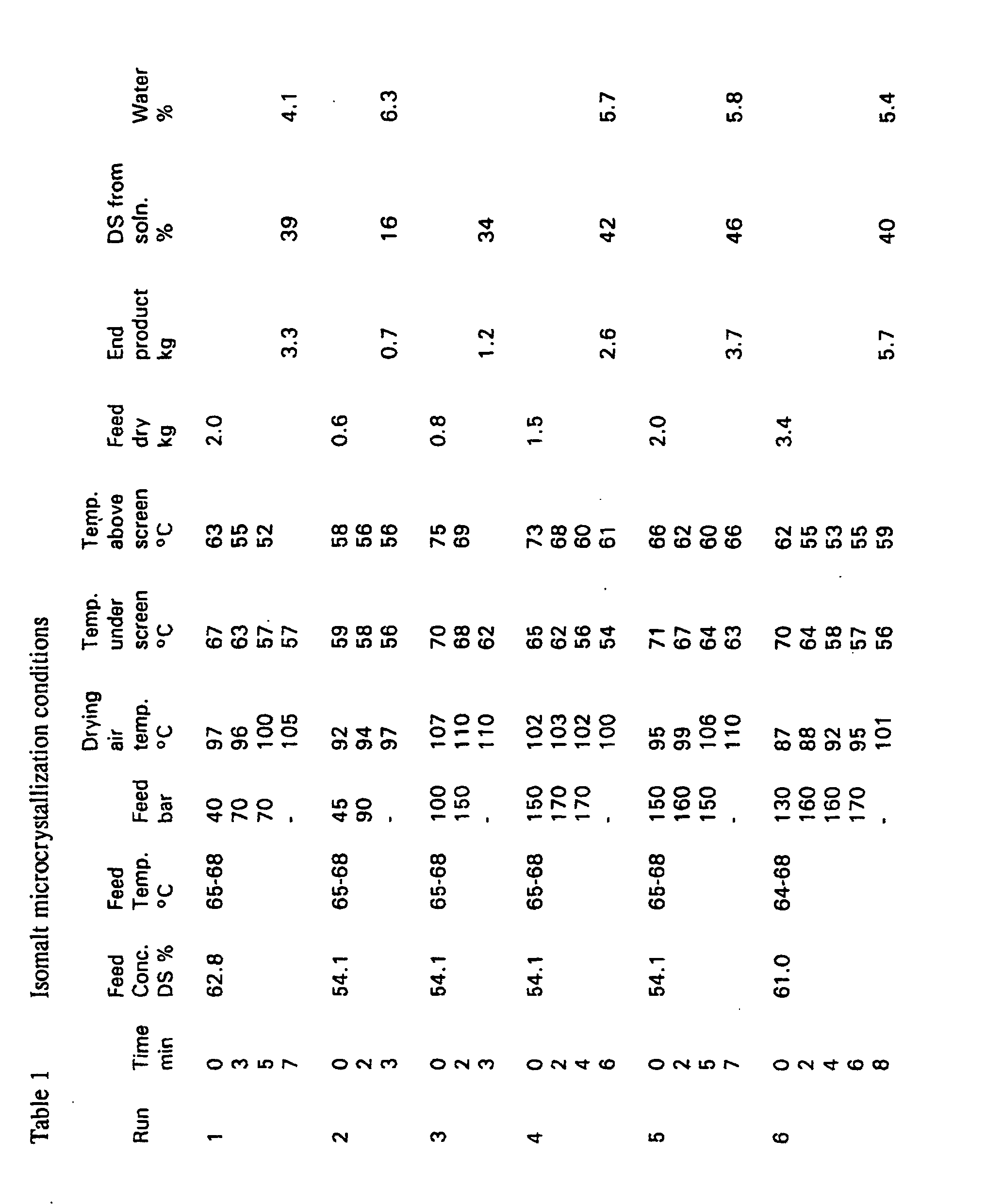
- Example 1 The procedure of Example 1 was repeated several times under varying test conditions.
- the solid feed comprised recirculated microcrystalline isomalt from Example 1.
- the test conditions are indicated in Table 1.
- Dry feed is essential in isomalt microcrystallization. Problems occurred when the dry feed was a recycled material which was moist. Cooling when moist made the layer hard. The microcrystallized layer was warm at milling.
- a continuous fluid bed 1,6-GPS microcrystallization is performed in an apparatus having a fluid bed drying chamber, equipped with a spray nozzle system inside in the middle of the chamber.
- the apparatus comprises a bottom screen with a hole for the discharge of the heaviest particles, and a cyclone to recover light particles.
- the chamber is loaded with 1 kg of powdered 1,6-GPS to act as seed material for the microcrystallization of 1,6-GPS.
- the powdered 1,6-GPS is fluidized with a flow of air (temperature 55-85 °C) through the bottom screen.
- a 1,6-GPS solution (concentration 60 %, purity over 99 % D.S.) at a temperature of 70 °C is fed into the chamber with a pump, atomized by means of a nozzle and sprayed over the fluidized isomalt powder.
- the solution is supplied at a rate of 1 kg/h at a pressure of 1.5 bar to the fluidized 1,6-GPS powder.
- the air flow rate is adjusted to fluidize the 1,6-GPS and to evaporate water at a rate sufficient to crystallize the 1,6-GPS.
- a microcrystalline agglomerate is formed when the 1,6-GPS crystallizes around the powder particles.
- the agglomerates remain in a fluidized state until they fall down when their weight is high enough. 1,6-GPS agglomerates are discharged continuously through the bottom opening.
- the drying chamber In the drying chamber the lightest, non-agglomerated 1,6-GPS particles are removed from the top of the chamber entrained in the exiting air stream. This fine 1,6-GPS material is recovered in a cyclone and fed back to the chamber to act as a continuous seed stream.
- the discharged agglomerated product is conditioned at a temperature of 45-50°C for 30 minutes to balance the microcrystallization.
- a microcrystalline isomalt product produced according to the process of Example 1 having a mean particle size of about 200 ⁇ m was evaluated in a standard stick chewing gum production and compared to a chewing gum made from commercially available isomalt having a particle size wherein 90% was ⁇ 100 ⁇ m.
- the isomalt a) was commercial crystalline isomalt and isomalt b) was microcrystalline isomalt produced according to the present invention.
- the chewing gums were produced by placing the isomalt powder in a Z-blade mixer and mixing in the softened gum base at a mixer temperature of 40 °C. The ingredients were thoroughly combined before the next ingredient was added. Then the sorbitol liquid was added followed by the mannitol and the powdered flavour.
- the glycerin was combined with the liquid flavour and aspartame and added to the mixer. As soon as a homogeneous paste was formed, it was removed from the mixer and dusted with milled mannitol. The paste was laminated to required thickness and cut.
- the commercial crystalline isomalt gum processed well in about 12 minutes.
- the finished gum had a good chew and posed no problems during processing.
- the microcrystalline isomalt gum processed slightly quicker, in about 10 minutes.
- the paste produced was very soft and the finished gum had a softer texture than the batch produced with the commercial crystalline isomalt. This can be attributed to the larger particle size of the material. No grittiness was detected when chewing the sample.
- microcrystalline isomalt is suitable for use in a stick chewing gum.
- Microcrystalline isomalt product produced according to the process of Example 1 was evaluated in a standard hard candy production and compared to a hard candy made from a commercially available isomalt (Isomalt Type PF, Südzucker AG).
- a 1.5 kg batch (dry substance) of 1) 100 % Isomalt Type PF and 2) microcrystalline isomalt was diluted to 85 % solids with water and placed in a sauce pan.
- the batch was first heated on a hot plate until all the material was solubilized.
- the batch was then transferred to a vacuum cooker and heated to approximately 160 to 165 °C before a vacuum of 0.3 bar was applied for 10 minutes.
- the syrup was then transferred from the cooker to a slab and tempered until a suitable texture for drop rolling was achieved.
- the tempered mass was fed through a drop roller and the finished candies were wrapped in cellophane after a few minutes cooling time and some of the candies from each batch was left unwrapped.
- the syrup viscosity, the tempering time, the handling characteristics of the mass, the temperature of the mass prior to drop rolling and the finished candy quality were noted.
- Moisture contents of the finished samples were measured using a Mettler Toledo DL35 Karl Fischer titrator.
- microcrystalline isomalt performed very similarly to Isomalt Type PF.
- a mixture of microcrystalline 1,6-GPS and 1,1-GPS (isomalt) produced according to the procedure described in Example 1 was assessed in a standard chocolate production and compared to chocolate made from commercially available milled grade isomalt.
- the sweeteners a) and b) were each mixed with the cocoa liquor. The resulting mixture was then passed through a three roll refiner to produce a flake. The flake was mixed again and a part of the cocoa butter was added. The mix was re-refined with increased pressures to produce a flake with a fat content of 32 %. The resulting flakes were stored prior to conching.
- Example 2 A batch of microcrystalline isomalt produced in accordance with the procedure described in Example 1 was analyzed as to its physical properties and compared with those of commercial grade isomalt (Isomalt F, Südzucker AG).
- the total crystallinity of the microcrystalline isomalt determined from DSC-grams was over 65%.
- the difference in hygroscopicity between the microcrystalline isomalt and the commercial product was significant.
- microcrystalline isomalt in SEM photos in 200x magnification showed a myriad of small crystals looking like normal crystal lumps but smaller.
- the microcrystalline structure showed very clearly in 1000x magnification (Fig. 2).
Landscapes
- Chemical & Material Sciences (AREA)
- Life Sciences & Earth Sciences (AREA)
- Engineering & Computer Science (AREA)
- Health & Medical Sciences (AREA)
- Molecular Biology (AREA)
- Food Science & Technology (AREA)
- Polymers & Plastics (AREA)
- Inorganic Chemistry (AREA)
- Organic Chemistry (AREA)
- Biotechnology (AREA)
- Biochemistry (AREA)
- General Health & Medical Sciences (AREA)
- Genetics & Genomics (AREA)
- Crystallography & Structural Chemistry (AREA)
- Proteomics, Peptides & Aminoacids (AREA)
- Nutrition Science (AREA)
- Saccharide Compounds (AREA)
- Seasonings (AREA)
- Compounds Of Unknown Constitution (AREA)
- Steroid Compounds (AREA)
- Confectionery (AREA)
- Medicinal Preparation (AREA)
Abstract
Description
| Ingredient | % Fresh Basis |
| Gum base, Nova Base (Dreyfus) | 25.0 |
| Sorbitol Syrup, Sorbifin LS (Xyrofin) | 7.2 |
| a) Isomalt PF (Südzucker AG) | 47.0 |
| b) Microcrystalline isomalt | 47.0 |
| Mannitol, milled (Cerestar) | 8.0 |
| Glycerine (Henkel) | 10.0 |
| Peppermint Flavour liquid (IFF) | 1.2 |
| Peppermint Flavour powder (IFF) | 1.6 |
| Aspartame (Nutrasweet) | q.s (0.05) |
| Analysis results | ||||
| Batch | Boiling time | Tempering time | Forming temp. | % Solids |
| Isomalt PF | 16 min 35 s | 6 min 40 s | 76 °C | 99.1 % |
| Microcryst. isomalt | 14 min 57 s | 6 min 10 s | 82 °C | 99.3 % |
| a) Microcrystalline isomalt | 46.0% |
| b) Isomalt PF (Südzucker AG) | 46.0% |
| Cocoa Liquor (BCM) | 42.0% |
| Cocoa Butter (BCM) | 11.8% |
| Lecithin (Lucas Myer) | 0.2% |
| Isomalt: Analysis results | ||
| Analysis | Microcryst. isomalt | Isomalt F |
| Moisture, % | 5.5 | 2.5 |
| DSC, 10 °C/min, peak at °C | 102.0 | 94.2 |
| 154.2 | 147.3 | |
| Flowability, s | 18 | 15 |
| Bulk density, g/500 ml | 340 | 418 |
| Heat of solution, cal/g | 12.8 | 7.0 |
| Hygroscopicity | ||
| at 25°C, % H2O/48h | 0.22 | 1.19 |
| RH 60%, % H2O/216h | 0.23 | 2.05 |
| at 40°C, % H2O/48h | 0.69 | 3.07 |
| RH 70%, % H2O/216h | 0.75 | 3.15 |
| Sieve analysis | ||
| > 0.710 mm | 17.0 | 2.3 |
| > 0.560 mm | 21.6 | 25.8 |
| > 0.450 mm | 14.9 | 31.7 |
| > 0.315 mm | 14.2 | 30.0 |
| > 0.250 mm | 13.6 | 7.3 |
| > 0.180 mm | 12.2 | 2.9 |
| > 0. 100 mm | 6.0 | 0.2 |
| 0 | 0.6 | 0.1 |
| Mean particle size, mm | 0.48 | 0.48 |
| Coefficient of variation, % | 39 | 26 |
Claims (44)
- A process for the crystallization of glucopyranosylalditols, comprisingcontacting a liquid containing one or more dissolved glucopyranosylalditols selected from the group consisting of 1-O-α-D-glucopyranosyl-D-mannitol (1,1-GPM) and 6-O-α-D-gluco-pyranosyl-D-sorbitol (1,6-GPS) and optionally 1-O-α-D-glucopyranosyl-D-sorbitol (1,1-GPS), with gas suspended fine solid particles containing one or more of said glucopyranosylalditols for wetting the particles;causing substantial removal of the solvent component of said liquid and allowing the resulting glucopyranosylalditol material to form an essentially solid composition of matter comprising a multitude of microcrystals of said glucopyranosylalditol(s); andcausing said glucopyranosylalditol composition to be conditioned during a further drying step to provide a product with a multitude of microcrystal containing particles of gluco-pyranosylalditol(s) agglomerated together in a random manner, said microcrystals having on an average a size below 50µ.
- The process according to claim 1, wherein said gas suspended fine solid particles consist essentially of microcrystals of one or more of said glucopyranosylalditol(s).
- The process according to claim 2, wherein said product consists essentially throughout its entire structure of a multitude of microcrystals of one or more of said glucopyranosylalditol(s) agglomerated together in a random manner.
- The process according to any one of claims 1, 2 or 3, wherein said glucopyranosylalditol is 1-O-α-D-glucopyranosyl-D-mannitol (1,1-GPM) or 6-O-α-D-glucopyranosyl-D-sorbitol (1,6-GPS) or a mixture thereof, preferably an equimolar mixture thereof (isomalt).
- The process according to any one of the preceding claims, wherein said liquid is an aqueous solution of one or more glucopyranosylalditols having a glucopyranosylalditol concentration of about 30-80% by weight, preferably about 50-70% by weight.
- The process according to any one of the preceding claims, comprising heating said liquid to a temperature of about 45-95 °C, preferably about 60-80 °C prior to said contacting.
- The process according to any one of the preceding claims, wherein said contacting comprises spraying said liquid into contact with said gas suspended fine solid particles.
- The process according to any one of the preceding claims, wherein said liquid contains a minor portion of an excipient, a binder, an active ingredient and/or other sweetener than a glucopyranosylalditol.
- The process according to any one of the preceding claims, wherein a secondary spray of another liquid containing an excipient, a binder, an active ingredient and/or other sweetener is simultaneously provided.
- The process according to any one of the preceding claims, wherein said removal of said solvent is performed by the introduction of a drying gas such as air heated to a temperature of about 45-250 °C, preferably about 70-160 °C.
- The process according to claim 10, wherein said solvent is water and said solvent removal provides a glucopyranosylalditol material dried to a free moisture content of about 0.1 to 2 %, preferably below 1% while said glucopyranosylalditol material is still in a gas suspended state.
- The process according to any one of the preceding claims, wherein said conditioning is maintained so as to allow glucopyranosylalditol microcrystallization to proceed in said composition.
- The process according to any one of the preceding claims, wherein said glucopyranosylalditol composition is allowed to settle on a moving belt and to form thereon a substantially continuous agglomerated porous layer having a thickness of about 0.5-15 cm, preferably about 3-7 cm.
- The process according to claim 13, wherein said conditioning includes treating said composition in said agglomerated layer with a drying gas having a temperature of about 40-100°C, for a time of about 10-180 min or more.
- The process according to claim 14, wherein said conditioning is performed in several successive steps with decreasing drying gas temperatures. .
- The process according to claim 14 or 15, which further comprises cooling said conditioned agglomerated layer to provide a flat porous and brittle plate comprising microcrystalline glucopyranosylalditol(s).
- The process according to claim 15 or 16, comprising subjecting said plate to a comminuting action so as to break up said agglomerated layer, and optionally comminuting the product.
- The process according to any one of the preceding claims, which further comprises fractionating said microcrystalline particles and recirculating at least a portion thereof to provide a feed of said fine solid particles containing microcrystalline glucopyranosyl-alditol(s).
- The process according to any one of the preceding claims, wherein about 30-70%, preferably about 40-60% of the dry substance derives from a feed of solid microcrystalline particles.
- The process according to any one of claims 1 to 11, wherein said solid particles are retained in a fluidized state until they have grown to a predetermined weight.
- The process according to any one of the preceding claims, comprising recirculating microcrystalline glucopyranosylalditol particles having a mean particle size below about 0.2 mm, preferably below about 0.1 mm.
- The process according to any one of the preceding claims, wherein said microcrystalline glucopyranosylalditol is microcrystalline dihydrate of 1-O-α-D-glucopyranosyl-D-mannitol (1,1-GPM) or anhydrous 6-O-α-D-glucopyranosyl-D-sorbitol (1,6-GPS) or a mixture thereof, preferably a substantially equimolar mixture thereof (isomalt).
- A particulate glucopyranosylalditol product wherein each product particle comprises a multitude of microcrystal containing particles of one or more glucopyranosylalditols selected from the group consisting of 1-O-α-D-glucopyranosyl-D-mannitol (1,1-GPM) and 6-O-α-D-glucopyranosyl-D-sorbitol (1,6-GPS) and optionally 1-O-α-D-glucopyranosyl-D-sorbitol (1,1-GPS) agglomerated together in a random manner, said microcrystals having on an average a size below 50µ.
- The glucopyranosylalditol product according to claim 23, wherein said product particle consists essentially throughout its entire structure of a multitude of microcrystals of one or more of said glucopyranosylalditol(s) agglomerated together in a random manner.
- The glucopyranosylalditol product according to claim 23 or 24, wherein said micro-crytals consist of 1-O-α-D-glucopyranosyl-D-mannitol dihydrate or anhydrous 6-O-α-D-glucopyranosyl-D-sorbitol, or a mixture thereof, preferably an equimolar mixture thereof (isomalt).
- The glucopyranosylalditol product according claim 23 or 24, wherein said microcrystals consist essentially of anhydrous 6-O-α-D-glucopyranosyl-D-sorbitol.
- The glucopyranosylalditol product according to claim 23 or 24, wherein said microcrystals consist essentially of 1-O-α-D-glucopyranosyl-D-mannitol in the form of the dihydrate or in a partly or totally dehydrated form.
- The glucopyranosylalditol product according claim 23 or 24, wherein said product particle contains amorphous 1-O-α-D-glucopyranosyl-D-sorbitol.
- The glucopyranosylalditol product according to claim 23, having a total 1-O-α-D-glucopyranosyl-D-mannitol, 6-O-α-D-glucopyranosyl-D-sorbitol and 1-O-α-D-glucopyranosyl-D-sorbitol content of more than 80%, preferably more than 90%, most preferably 98% or more.
- The glucopyranosylalditol product according to claim 24, said product particles having been produced by microcrystallization of a liquid containing dissolved glucopyranosylalditol(s) together with fine gas suspended solid particles containing microcrystalline glucopyranosylalditol(s).
- The glucopyranosylalditol product according to claim 23, wherein about 10-90%, preferably about 30-80%, most preferably 40-60% of the dry substance of the final product derives from a feed of solid microcrystalline particles.
- The glucopyranosylalditol product according to any one of the preceding claims 23 to 31, comprising product particles having a mean particle size of about 0.1-2 mm, preferably about 0.15-0.4 mm.
- The glucopyranosylalditol product according to any one of the preceding claims 23 to 32, wherein the size of the microcrystals in each particle is on an average below 50µ, preferably about 10µ.
- The glucopyranosylalditol product according to any one of the preceding claims 23 to 33, wherein said product particle additionally contains integrally in its structure additional components such as excipients, binders, active ingredients and/or other sweeteners.
- Use of the microcrystal containing glucopyranosylalditol product according to claim 23 as a bulk sweetener for the total or partial replacement of sucrose.
- Use of the microcrystal containing glucopyranosylalditol product according to claim 23 in confectionery, bakery products, cereals, desserts, jams, beverages, chocolate, marzipan, table top sweeteners, chewing gum, ice cream, and dietetic products as well as in pharmaceutical products.
- The use according to claim 36 wherein said glucopyranosylalditol product is used in hard candies. .
- Use of the microcrystal containing glucopyranosylalditol product according to claim 23 in a non-cariogenic chewing gum.
- A special sweetener which comprises microcrystal containing glucopyranosylalditol according to claim 23.
- The special sweetener according to claim 39 which is mainly composed of microcrystalline dihydrate of 1-O-α-D-glucopyranosyl-D-mannitol (1,1-GPM) or anhydrous 6-O-α-D-glucopyranosyl-D-sorbitol (1,6-GPS) or a mixture thereof, preferably a substantially equimolar mixture thereof (isomalt).
- The special sweetener according to claim 39 which additionally contains other sweeteners selected from the group consisting of xylitol, maltitol, lactitol and sorbitol.
- A glucopyranosylalditol chewing gum characterized in that it contains one or more glucopyranosylalditol(s) selected from the group consisting of microcrystalline 1-O-α-D-glucopyranosyl-D-mannitol dihydrate, microcrystalline anhydrous 6-O-α-D-glucopyranosyl-D-sorbitol and 1-O-α-D-glucopyranosyl-D-sorbitol, said microcrystals having on an average a size below 50µ.
- The chewing gum according to claim 42, wherein said microcrystalline glucopyranosylalditol has been produced by contacting suspended microcrystalline glucopyranosylalditol particles with a glucopyranosylalditol solution, drying the resulting composition to cause glucopyranosylalditol microcrystallization, and conditioning said composition to provide a product consisting essentially throughout its entire structure of a multitude of microcrystals of glucopyranosylalditol agglomerated together in a random manner.
- A glucopyranosylalditol hard candy, characterized in that it is made from a glucopyranosylalditol product obtainable according to the process of claim 1 and produced by contacting gas suspended particles comprising one or more microcrystalline glucopyranosylalditol(s) selected from the group consisting of 1-O-α-D-glucopyranosyl-D-mannitol dihydrate and anhydrous 6-O-α-D-glucopyranosyl-D-sorbitol with a solution of one or more glucopyranosylalditol(s) selected from the group consisting of 1-O-α-D-glucopyranosyl-D-mannitol, 6-O-α-D-glucopyranosyl-D-sorbitol and/or 1-O-α-D-glucopyranosyl-D-sorbitol, drying the resulting composition to cause glucopyranosylalditol microcrystallization, and conditioning said composition to provide a product with a multitude of microcrystal containing particles of glucopyranosylalditol(s) agglomerated together in a random manner.
Applications Claiming Priority (3)
| Application Number | Priority Date | Filing Date | Title |
|---|---|---|---|
| FI990924A FI990924L (en) | 1999-04-23 | 1999-04-23 | Crystallization of glucopyranosyl alditols, crystalline glucopyranosyl alditol products and their use |
| FI990924 | 1999-04-23 | ||
| PCT/FI2000/000338 WO2000064916A1 (en) | 1999-04-23 | 2000-04-19 | Crystallization of glucopyranosylalditols, crystalline glucopyranosylalditol product and use thereof |
Publications (2)
| Publication Number | Publication Date |
|---|---|
| EP1173453A1 EP1173453A1 (en) | 2002-01-23 |
| EP1173453B1 true EP1173453B1 (en) | 2004-06-30 |
Family
ID=8554507
Family Applications (1)
| Application Number | Title | Priority Date | Filing Date |
|---|---|---|---|
| EP00920768A Expired - Lifetime EP1173453B1 (en) | 1999-04-23 | 2000-04-19 | Crystallization of glucopyranosylalditols, crystalline glucopyranosylalditol product and use thereof |
Country Status (7)
| Country | Link |
|---|---|
| EP (1) | EP1173453B1 (en) |
| JP (1) | JP2002543087A (en) |
| AT (1) | ATE270300T1 (en) |
| AU (1) | AU4122000A (en) |
| DE (1) | DE60011890T2 (en) |
| FI (1) | FI990924L (en) |
| WO (1) | WO2000064916A1 (en) |
Families Citing this family (11)
| Publication number | Priority date | Publication date | Assignee | Title |
|---|---|---|---|---|
| DE19943496C1 (en) * | 1999-09-10 | 2001-05-17 | Suedzucker Ag | Directly compressible raw material for compressed air |
| EP1172370B1 (en) | 2000-02-17 | 2004-12-15 | Kabushiki Kaisha Ueno Seiyaku Oyo Kenkyusho | Molasses-containing crystal composition and method for producing the same |
| AU779640B2 (en) * | 2000-05-22 | 2005-02-03 | Ueno Fine Chemicals Industry, Ltd. | Syrup-containing compositions and process for producing the same |
| FI20021312A7 (en) * | 2002-07-03 | 2004-01-04 | Danisco Sweeteners Oy | Crystallization of polyol compositions, crystalline polyol composition product and use thereof |
| US20070148284A1 (en) * | 2004-08-25 | 2007-06-28 | Cadbury Adams Usa Llc. | Liquid-filled chewing gum |
| FR2879603B1 (en) | 2004-12-21 | 2007-04-06 | Roquette Freres | PROCESS FOR PRODUCING A POWDER CONTAINING CRYSTALLINE PARTICLES OF GLUCOPYRANOSYL-ALDITOLS |
| US20120315366A1 (en) * | 2009-12-23 | 2012-12-13 | Evonik Degussa Gmbh | Sweetener and method of production thereof |
| EP2742806A1 (en) | 2012-12-13 | 2014-06-18 | Südzucker Aktiengesellschaft | Process for reducing the stickiness of a chewing gum core composition to a surface of a processing machinery using isomalt |
| PL3849991T3 (en) * | 2018-09-11 | 2026-02-09 | Südzucker AG | Method for improved production of isomalt |
| CN112920235A (en) * | 2021-01-29 | 2021-06-08 | 山东健奕宏生物制药有限公司 | Preparation method of isomalt |
| CN113754523B (en) * | 2021-09-29 | 2023-11-07 | 潍坊裕凯化工有限公司 | Method for separating out methyl octabromoether crystal |
Family Cites Families (5)
| Publication number | Priority date | Publication date | Assignee | Title |
|---|---|---|---|---|
| DE2520173C3 (en) * | 1975-05-06 | 1989-08-10 | Südzucker AG Mannheim/Ochsenfurt, 6800 Mannheim | Process for the preparation of glucopyranosido-1,6-mannitol and its use as a sugar substitute |
| FI104787B (en) * | 1989-06-07 | 2000-04-14 | Xyrofin Oy | Granulated product based on fructose and process for its preparation |
| DE9321600U1 (en) * | 1993-05-06 | 2000-04-06 | Südzucker Aktiengesellschaft Mannheim/Ochsenfurt, 68165 Mannheim | Sweeteners |
| DE19701439C2 (en) * | 1997-01-17 | 2001-01-25 | Suedzucker Ag | Process for the hydrogenation of sugars |
| DE19705664B4 (en) * | 1997-02-14 | 2004-01-22 | Südzucker AG Mannheim/Ochsenfurt | Process for the preparation of phases enriched in 1,1-GPM with over 75% by weight of TS up to over 99% by weight of TS 1,1-GPM and 1,6-GPS-enriched phases with more than 80% by weight a.TS up to over 99% by weight a.TS 1.6 GPS |
-
1999
- 1999-04-23 FI FI990924A patent/FI990924L/en unknown
-
2000
- 2000-04-19 JP JP2000614266A patent/JP2002543087A/en active Pending
- 2000-04-19 AU AU41220/00A patent/AU4122000A/en not_active Abandoned
- 2000-04-19 WO PCT/FI2000/000338 patent/WO2000064916A1/en not_active Ceased
- 2000-04-19 AT AT00920768T patent/ATE270300T1/en not_active IP Right Cessation
- 2000-04-19 DE DE60011890T patent/DE60011890T2/en not_active Expired - Lifetime
- 2000-04-19 EP EP00920768A patent/EP1173453B1/en not_active Expired - Lifetime
Also Published As
| Publication number | Publication date |
|---|---|
| JP2002543087A (en) | 2002-12-17 |
| DE60011890T2 (en) | 2005-08-25 |
| FI990924A7 (en) | 2000-10-24 |
| WO2000064916A1 (en) | 2000-11-02 |
| AU4122000A (en) | 2000-11-10 |
| DE60011890D1 (en) | 2004-08-05 |
| EP1173453A1 (en) | 2002-01-23 |
| ATE270300T1 (en) | 2004-07-15 |
| FI990924A0 (en) | 1999-04-23 |
| FI990924L (en) | 2000-10-24 |
Similar Documents
| Publication | Publication Date | Title |
|---|---|---|
| EP1539664B1 (en) | Crystallization of polyol compositions, crystalline polyol composition product and use thereof | |
| AU752693B2 (en) | Crystallization of xylitol, crystalline xylitol product and use thereof | |
| US6555146B1 (en) | Sugar-free foodstuff products | |
| JP3224270B2 (en) | Low calorie chocolate | |
| AU716114B2 (en) | Sugar-free coating obtained by hard coating and process for producing it | |
| JP3789496B2 (en) | Method for producing sugarless coating and product obtained by the method | |
| EP0497439A1 (en) | Erythritol compositions | |
| US6620791B1 (en) | Edible compositions containing trehalose | |
| US6548095B1 (en) | Sugar-free compressed products | |
| EP1173453A1 (en) | Crystallization of glucopyranosylalditols, crystalline glucopyranosylalditol product and use thereof | |
| EP2143336A1 (en) | Powdered chewing gum compositions, the use thereof and a method for preparing such compositions | |
| EP1064293B1 (en) | Crystallization of lactitol, crystalline lactitol product and use thereof | |
| WO1995026645A1 (en) | Sweetener in crystal form |
Legal Events
| Date | Code | Title | Description |
|---|---|---|---|
| PUAI | Public reference made under article 153(3) epc to a published international application that has entered the european phase |
Free format text: ORIGINAL CODE: 0009012 |
|
| 17P | Request for examination filed |
Effective date: 20010822 |
|
| AK | Designated contracting states |
Kind code of ref document: A1 Designated state(s): AT BE CH CY DE DK ES FI FR GB GR IE IT LI LU MC NL PT SE |
|
| AX | Request for extension of the european patent |
Free format text: AL;LT;LV;MK;RO;SI |
|
| RAP1 | Party data changed (applicant data changed or rights of an application transferred) |
Owner name: DANISCO SWEETENERS OY |
|
| GRAP | Despatch of communication of intention to grant a patent |
Free format text: ORIGINAL CODE: EPIDOSNIGR1 |
|
| GRAS | Grant fee paid |
Free format text: ORIGINAL CODE: EPIDOSNIGR3 |
|
| GRAA | (expected) grant |
Free format text: ORIGINAL CODE: 0009210 |
|
| AK | Designated contracting states |
Kind code of ref document: B1 Designated state(s): AT BE CH CY DE DK ES FI FR GB GR IE IT LI LU MC NL PT SE |
|
| PG25 | Lapsed in a contracting state [announced via postgrant information from national office to epo] |
Ref country code: IT Free format text: LAPSE BECAUSE OF FAILURE TO SUBMIT A TRANSLATION OF THE DESCRIPTION OR TO PAY THE FEE WITHIN THE PRESCRIBED TIME-LIMIT;WARNING: LAPSES OF ITALIAN PATENTS WITH EFFECTIVE DATE BEFORE 2007 MAY HAVE OCCURRED AT ANY TIME BEFORE 2007. THE CORRECT EFFECTIVE DATE MAY BE DIFFERENT FROM THE ONE RECORDED. Effective date: 20040630 Ref country code: BE Free format text: LAPSE BECAUSE OF FAILURE TO SUBMIT A TRANSLATION OF THE DESCRIPTION OR TO PAY THE FEE WITHIN THE PRESCRIBED TIME-LIMIT Effective date: 20040630 Ref country code: AT Free format text: LAPSE BECAUSE OF FAILURE TO SUBMIT A TRANSLATION OF THE DESCRIPTION OR TO PAY THE FEE WITHIN THE PRESCRIBED TIME-LIMIT Effective date: 20040630 Ref country code: NL Free format text: LAPSE BECAUSE OF FAILURE TO SUBMIT A TRANSLATION OF THE DESCRIPTION OR TO PAY THE FEE WITHIN THE PRESCRIBED TIME-LIMIT Effective date: 20040630 Ref country code: FI Free format text: LAPSE BECAUSE OF FAILURE TO SUBMIT A TRANSLATION OF THE DESCRIPTION OR TO PAY THE FEE WITHIN THE PRESCRIBED TIME-LIMIT Effective date: 20040630 Ref country code: CH Free format text: LAPSE BECAUSE OF FAILURE TO SUBMIT A TRANSLATION OF THE DESCRIPTION OR TO PAY THE FEE WITHIN THE PRESCRIBED TIME-LIMIT Effective date: 20040630 Ref country code: LI Free format text: LAPSE BECAUSE OF FAILURE TO SUBMIT A TRANSLATION OF THE DESCRIPTION OR TO PAY THE FEE WITHIN THE PRESCRIBED TIME-LIMIT Effective date: 20040630 |
|
| REG | Reference to a national code |
Ref country code: GB Ref legal event code: FG4D Ref country code: CH Ref legal event code: EP |
|
| REG | Reference to a national code |
Ref country code: IE Ref legal event code: FG4D |
|
| REF | Corresponds to: |
Ref document number: 60011890 Country of ref document: DE Date of ref document: 20040805 Kind code of ref document: P |
|
| PG25 | Lapsed in a contracting state [announced via postgrant information from national office to epo] |
Ref country code: DK Free format text: LAPSE BECAUSE OF FAILURE TO SUBMIT A TRANSLATION OF THE DESCRIPTION OR TO PAY THE FEE WITHIN THE PRESCRIBED TIME-LIMIT Effective date: 20040930 Ref country code: GR Free format text: LAPSE BECAUSE OF FAILURE TO SUBMIT A TRANSLATION OF THE DESCRIPTION OR TO PAY THE FEE WITHIN THE PRESCRIBED TIME-LIMIT Effective date: 20040930 Ref country code: SE Free format text: LAPSE BECAUSE OF FAILURE TO SUBMIT A TRANSLATION OF THE DESCRIPTION OR TO PAY THE FEE WITHIN THE PRESCRIBED TIME-LIMIT Effective date: 20040930 |
|
| PG25 | Lapsed in a contracting state [announced via postgrant information from national office to epo] |
Ref country code: ES Free format text: LAPSE BECAUSE OF FAILURE TO SUBMIT A TRANSLATION OF THE DESCRIPTION OR TO PAY THE FEE WITHIN THE PRESCRIBED TIME-LIMIT Effective date: 20041011 |
|
| LTIE | Lt: invalidation of european patent or patent extension |
Effective date: 20040630 |
|
| NLV1 | Nl: lapsed or annulled due to failure to fulfill the requirements of art. 29p and 29m of the patents act | ||
| REG | Reference to a national code |
Ref country code: CH Ref legal event code: PL |
|
| PLAQ | Examination of admissibility of opposition: information related to despatch of communication + time limit deleted |
Free format text: ORIGINAL CODE: EPIDOSDOPE2 |
|
| PLBQ | Unpublished change to opponent data |
Free format text: ORIGINAL CODE: EPIDOS OPPO |
|
| PLBI | Opposition filed |
Free format text: ORIGINAL CODE: 0009260 |
|
| PLAQ | Examination of admissibility of opposition: information related to despatch of communication + time limit deleted |
Free format text: ORIGINAL CODE: EPIDOSDOPE2 |
|
| PLAR | Examination of admissibility of opposition: information related to receipt of reply deleted |
Free format text: ORIGINAL CODE: EPIDOSDOPE4 |
|
| PLBQ | Unpublished change to opponent data |
Free format text: ORIGINAL CODE: EPIDOS OPPO |
|
| PLAB | Opposition data, opponent's data or that of the opponent's representative modified |
Free format text: ORIGINAL CODE: 0009299OPPO |
|
| PG25 | Lapsed in a contracting state [announced via postgrant information from national office to epo] |
Ref country code: IE Free format text: LAPSE BECAUSE OF NON-PAYMENT OF DUE FEES Effective date: 20050419 Ref country code: LU Free format text: LAPSE BECAUSE OF NON-PAYMENT OF DUE FEES Effective date: 20050419 Ref country code: CY Free format text: LAPSE BECAUSE OF FAILURE TO SUBMIT A TRANSLATION OF THE DESCRIPTION OR TO PAY THE FEE WITHIN THE PRESCRIBED TIME-LIMIT Effective date: 20050419 |
|
| ET | Fr: translation filed | ||
| PG25 | Lapsed in a contracting state [announced via postgrant information from national office to epo] |
Ref country code: MC Free format text: LAPSE BECAUSE OF NON-PAYMENT OF DUE FEES Effective date: 20050430 |
|
| PLAX | Notice of opposition and request to file observation + time limit sent |
Free format text: ORIGINAL CODE: EPIDOSNOBS2 |
|
| 26 | Opposition filed |
Opponent name: SUEDZUCKER AKTIENGESELLSCHAFTMANNHEIM/OCHSENFURT Effective date: 20050329 |
|
| R26 | Opposition filed (corrected) |
Opponent name: SUEDZUCKER AKTIENGESELLSCHAFTMANNHEIM/OCHSENFURT Effective date: 20050329 |
|
| PLAF | Information modified related to communication of a notice of opposition and request to file observations + time limit |
Free format text: ORIGINAL CODE: EPIDOSCOBS2 |
|
| PLBB | Reply of patent proprietor to notice(s) of opposition received |
Free format text: ORIGINAL CODE: EPIDOSNOBS3 |
|
| PLBP | Opposition withdrawn |
Free format text: ORIGINAL CODE: 0009264 |
|
| PLBD | Termination of opposition procedure: decision despatched |
Free format text: ORIGINAL CODE: EPIDOSNOPC1 |
|
| PLAM | Termination of opposition procedure: information related to despatch of decision modified |
Free format text: ORIGINAL CODE: EPIDOSCOPC1 |
|
| PLBM | Termination of opposition procedure: date of legal effect published |
Free format text: ORIGINAL CODE: 0009276 |
|
| STAA | Information on the status of an ep patent application or granted ep patent |
Free format text: STATUS: OPPOSITION PROCEDURE CLOSED |
|
| 27C | Opposition proceedings terminated |
Effective date: 20061216 |
|
| PG25 | Lapsed in a contracting state [announced via postgrant information from national office to epo] |
Ref country code: PT Free format text: LAPSE BECAUSE OF NON-PAYMENT OF DUE FEES Effective date: 20041130 |
|
| REG | Reference to a national code |
Ref country code: FR Ref legal event code: PLFP Year of fee payment: 16 |
|
| PGFP | Annual fee paid to national office [announced via postgrant information from national office to epo] |
Ref country code: DE Payment date: 20150414 Year of fee payment: 16 Ref country code: GB Payment date: 20150415 Year of fee payment: 16 |
|
| PGFP | Annual fee paid to national office [announced via postgrant information from national office to epo] |
Ref country code: FR Payment date: 20150408 Year of fee payment: 16 |
|
| REG | Reference to a national code |
Ref country code: DE Ref legal event code: R119 Ref document number: 60011890 Country of ref document: DE |
|
| GBPC | Gb: european patent ceased through non-payment of renewal fee |
Effective date: 20160419 |
|
| REG | Reference to a national code |
Ref country code: FR Ref legal event code: ST Effective date: 20161230 |
|
| PG25 | Lapsed in a contracting state [announced via postgrant information from national office to epo] |
Ref country code: GB Free format text: LAPSE BECAUSE OF NON-PAYMENT OF DUE FEES Effective date: 20160419 Ref country code: FR Free format text: LAPSE BECAUSE OF NON-PAYMENT OF DUE FEES Effective date: 20160502 Ref country code: DE Free format text: LAPSE BECAUSE OF NON-PAYMENT OF DUE FEES Effective date: 20161101 |