EP1173405B1 - Synthesis of n4, n4' -diphenyl-n4, n4' -di-m-tolyl-biphenyl-4,4'-diamine from an unsymmetrical amine - Google Patents
Synthesis of n4, n4' -diphenyl-n4, n4' -di-m-tolyl-biphenyl-4,4'-diamine from an unsymmetrical amine Download PDFInfo
- Publication number
- EP1173405B1 EP1173405B1 EP01906590A EP01906590A EP1173405B1 EP 1173405 B1 EP1173405 B1 EP 1173405B1 EP 01906590 A EP01906590 A EP 01906590A EP 01906590 A EP01906590 A EP 01906590A EP 1173405 B1 EP1173405 B1 EP 1173405B1
- Authority
- EP
- European Patent Office
- Prior art keywords
- phenyl
- reaction mixture
- amine
- tolyl
- iii
- Prior art date
- Legal status (The legal status is an assumption and is not a legal conclusion. Google has not performed a legal analysis and makes no representation as to the accuracy of the status listed.)
- Expired - Lifetime
Links
- 230000015572 biosynthetic process Effects 0.000 title description 7
- 238000003786 synthesis reaction Methods 0.000 title description 5
- 150000001412 amines Chemical class 0.000 title description 2
- IJGRMHOSHXDMSA-UHFFFAOYSA-N Atomic nitrogen Chemical compound N#N IJGRMHOSHXDMSA-UHFFFAOYSA-N 0.000 claims description 20
- YXFVVABEGXRONW-UHFFFAOYSA-N Toluene Chemical compound CC1=CC=CC=C1 YXFVVABEGXRONW-UHFFFAOYSA-N 0.000 claims description 15
- PXHVJJICTQNCMI-UHFFFAOYSA-N Nickel Chemical compound [Ni] PXHVJJICTQNCMI-UHFFFAOYSA-N 0.000 claims description 13
- 239000011541 reaction mixture Substances 0.000 claims description 13
- 238000000034 method Methods 0.000 claims description 12
- MFRIHAYPQRLWNB-UHFFFAOYSA-N sodium tert-butoxide Chemical compound [Na+].CC(C)(C)[O-] MFRIHAYPQRLWNB-UHFFFAOYSA-N 0.000 claims description 12
- JJYPMNFTHPTTDI-UHFFFAOYSA-N 3-methylaniline Chemical compound CC1=CC=CC(N)=C1 JJYPMNFTHPTTDI-UHFFFAOYSA-N 0.000 claims description 10
- 150000001875 compounds Chemical class 0.000 claims description 10
- 229910052757 nitrogen Inorganic materials 0.000 claims description 10
- 230000008878 coupling Effects 0.000 claims description 9
- 238000010168 coupling process Methods 0.000 claims description 9
- 238000005859 coupling reaction Methods 0.000 claims description 9
- UCPDXACXSRJFLV-UHFFFAOYSA-N n-(4-chlorophenyl)-3-methyl-n-phenylaniline Chemical compound CC1=CC=CC(N(C=2C=CC=CC=2)C=2C=CC(Cl)=CC=2)=C1 UCPDXACXSRJFLV-UHFFFAOYSA-N 0.000 claims description 9
- RIOQSEWOXXDEQQ-UHFFFAOYSA-N triphenylphosphine Chemical class C1=CC=CC=C1P(C=1C=CC=CC=1)C1=CC=CC=C1 RIOQSEWOXXDEQQ-UHFFFAOYSA-N 0.000 claims description 9
- QARVLSVVCXYDNA-UHFFFAOYSA-N bromobenzene Chemical compound BrC1=CC=CC=C1 QARVLSVVCXYDNA-UHFFFAOYSA-N 0.000 claims description 8
- BWHDROKFUHTORW-UHFFFAOYSA-N tritert-butylphosphane Chemical compound CC(C)(C)P(C(C)(C)C)C(C)(C)C BWHDROKFUHTORW-UHFFFAOYSA-N 0.000 claims description 8
- HCHKCACWOHOZIP-UHFFFAOYSA-N Zinc Chemical compound [Zn] HCHKCACWOHOZIP-UHFFFAOYSA-N 0.000 claims description 7
- 239000000203 mixture Substances 0.000 claims description 7
- 239000007787 solid Substances 0.000 claims description 7
- 229910052759 nickel Inorganic materials 0.000 claims description 6
- ROFVEXUMMXZLPA-UHFFFAOYSA-N Bipyridyl Chemical group N1=CC=CC=C1C1=CC=CC=N1 ROFVEXUMMXZLPA-UHFFFAOYSA-N 0.000 claims description 5
- 229910021586 Nickel(II) chloride Inorganic materials 0.000 claims description 5
- QMMRZOWCJAIUJA-UHFFFAOYSA-L nickel dichloride Chemical compound Cl[Ni]Cl QMMRZOWCJAIUJA-UHFFFAOYSA-L 0.000 claims description 5
- 125000005259 triarylamine group Chemical group 0.000 claims description 5
- NHDODQWIKUYWMW-UHFFFAOYSA-N 1-bromo-4-chlorobenzene Chemical compound ClC1=CC=C(Br)C=C1 NHDODQWIKUYWMW-UHFFFAOYSA-N 0.000 claims description 4
- OGGKVJMNFFSDEV-UHFFFAOYSA-N 3-methyl-n-[4-[4-(n-(3-methylphenyl)anilino)phenyl]phenyl]-n-phenylaniline Chemical compound CC1=CC=CC(N(C=2C=CC=CC=2)C=2C=CC(=CC=2)C=2C=CC(=CC=2)N(C=2C=CC=CC=2)C=2C=C(C)C=CC=2)=C1 OGGKVJMNFFSDEV-UHFFFAOYSA-N 0.000 claims description 4
- 238000010438 heat treatment Methods 0.000 claims description 3
- YJVFFLUZDVXJQI-UHFFFAOYSA-L palladium(ii) acetate Chemical compound [Pd+2].CC([O-])=O.CC([O-])=O YJVFFLUZDVXJQI-UHFFFAOYSA-L 0.000 claims description 3
- 229910052736 halogen Inorganic materials 0.000 claims description 2
- 125000003118 aryl group Chemical group 0.000 claims 2
- 125000005843 halogen group Chemical group 0.000 claims 1
- 150000002816 nickel compounds Chemical class 0.000 claims 1
- 230000002194 synthesizing effect Effects 0.000 claims 1
- ZUOUZKKEUPVFJK-UHFFFAOYSA-N phenylbenzene Natural products C1=CC=CC=C1C1=CC=CC=C1 ZUOUZKKEUPVFJK-UHFFFAOYSA-N 0.000 abstract description 7
- 235000010290 biphenyl Nutrition 0.000 abstract description 4
- 239000004305 biphenyl Substances 0.000 abstract description 4
- -1 biphenyl tolyl amines Chemical class 0.000 abstract description 3
- YMWUJEATGCHHMB-UHFFFAOYSA-N Dichloromethane Chemical compound ClCCl YMWUJEATGCHHMB-UHFFFAOYSA-N 0.000 description 15
- ZMXDDKWLCZADIW-UHFFFAOYSA-N N,N-Dimethylformamide Chemical compound CN(C)C=O ZMXDDKWLCZADIW-UHFFFAOYSA-N 0.000 description 12
- 238000006243 chemical reaction Methods 0.000 description 11
- 238000003756 stirring Methods 0.000 description 5
- KDLHZDBZIXYQEI-UHFFFAOYSA-N Palladium Chemical compound [Pd] KDLHZDBZIXYQEI-UHFFFAOYSA-N 0.000 description 4
- 239000000706 filtrate Substances 0.000 description 4
- 239000011701 zinc Substances 0.000 description 4
- 229910052725 zinc Inorganic materials 0.000 description 4
- RTZKZFJDLAIYFH-UHFFFAOYSA-N Diethyl ether Chemical compound CCOCC RTZKZFJDLAIYFH-UHFFFAOYSA-N 0.000 description 3
- XEKOWRVHYACXOJ-UHFFFAOYSA-N Ethyl acetate Chemical compound CCOC(C)=O XEKOWRVHYACXOJ-UHFFFAOYSA-N 0.000 description 3
- OKKJLVBELUTLKV-UHFFFAOYSA-N Methanol Chemical compound OC OKKJLVBELUTLKV-UHFFFAOYSA-N 0.000 description 3
- KWYUFKZDYYNOTN-UHFFFAOYSA-M Potassium hydroxide Chemical compound [OH-].[K+] KWYUFKZDYYNOTN-UHFFFAOYSA-M 0.000 description 3
- PNEYBMLMFCGWSK-UHFFFAOYSA-N aluminium oxide Inorganic materials [O-2].[O-2].[O-2].[Al+3].[Al+3] PNEYBMLMFCGWSK-UHFFFAOYSA-N 0.000 description 3
- 239000010410 layer Substances 0.000 description 3
- VLKZOEOYAKHREP-UHFFFAOYSA-N n-Hexane Chemical compound CCCCCC VLKZOEOYAKHREP-UHFFFAOYSA-N 0.000 description 3
- 230000007935 neutral effect Effects 0.000 description 3
- 238000010992 reflux Methods 0.000 description 3
- XLYOFNOQVPJJNP-UHFFFAOYSA-N water Substances O XLYOFNOQVPJJNP-UHFFFAOYSA-N 0.000 description 3
- RYGMFSIKBFXOCR-UHFFFAOYSA-N Copper Chemical compound [Cu] RYGMFSIKBFXOCR-UHFFFAOYSA-N 0.000 description 2
- VYPSYNLAJGMNEJ-UHFFFAOYSA-N Silicium dioxide Chemical compound O=[Si]=O VYPSYNLAJGMNEJ-UHFFFAOYSA-N 0.000 description 2
- PMZURENOXWZQFD-UHFFFAOYSA-L Sodium Sulfate Chemical compound [Na+].[Na+].[O-]S([O-])(=O)=O PMZURENOXWZQFD-UHFFFAOYSA-L 0.000 description 2
- 238000004458 analytical method Methods 0.000 description 2
- 150000001500 aryl chlorides Chemical class 0.000 description 2
- MVPPADPHJFYWMZ-UHFFFAOYSA-N chlorobenzene Chemical compound ClC1=CC=CC=C1 MVPPADPHJFYWMZ-UHFFFAOYSA-N 0.000 description 2
- 238000005580 one pot reaction Methods 0.000 description 2
- 229910052763 palladium Inorganic materials 0.000 description 2
- 238000002360 preparation method Methods 0.000 description 2
- 239000000047 product Substances 0.000 description 2
- 239000000741 silica gel Substances 0.000 description 2
- 229910002027 silica gel Inorganic materials 0.000 description 2
- URGAHOPLAPQHLN-UHFFFAOYSA-N sodium aluminosilicate Chemical class [Na+].[Al+3].[O-][Si]([O-])=O.[O-][Si]([O-])=O URGAHOPLAPQHLN-UHFFFAOYSA-N 0.000 description 2
- 229910052938 sodium sulfate Inorganic materials 0.000 description 2
- 235000011152 sodium sulphate Nutrition 0.000 description 2
- 239000002904 solvent Substances 0.000 description 2
- 125000000008 (C1-C10) alkyl group Chemical group 0.000 description 1
- HQJQYILBCQPYBI-UHFFFAOYSA-N 1-bromo-4-(4-bromophenyl)benzene Chemical group C1=CC(Br)=CC=C1C1=CC=C(Br)C=C1 HQJQYILBCQPYBI-UHFFFAOYSA-N 0.000 description 1
- GPYDMVZCPRONLW-UHFFFAOYSA-N 1-iodo-4-(4-iodophenyl)benzene Chemical group C1=CC(I)=CC=C1C1=CC=C(I)C=C1 GPYDMVZCPRONLW-UHFFFAOYSA-N 0.000 description 1
- QSNSCYSYFYORTR-UHFFFAOYSA-N 4-chloroaniline Chemical compound NC1=CC=C(Cl)C=C1 QSNSCYSYFYORTR-UHFFFAOYSA-N 0.000 description 1
- WKBOTKDWSSQWDR-UHFFFAOYSA-N Bromine atom Chemical compound [Br] WKBOTKDWSSQWDR-UHFFFAOYSA-N 0.000 description 1
- VEXZGXHMUGYJMC-UHFFFAOYSA-M Chloride anion Chemical compound [Cl-] VEXZGXHMUGYJMC-UHFFFAOYSA-M 0.000 description 1
- VMQMZMRVKUZKQL-UHFFFAOYSA-N Cu+ Chemical class [Cu+] VMQMZMRVKUZKQL-UHFFFAOYSA-N 0.000 description 1
- PXGOKWXKJXAPGV-UHFFFAOYSA-N Fluorine Chemical compound FF PXGOKWXKJXAPGV-UHFFFAOYSA-N 0.000 description 1
- DGEZNRSVGBDHLK-UHFFFAOYSA-N [1,10]phenanthroline Chemical compound C1=CN=C2C3=NC=CC=C3C=CC2=C1 DGEZNRSVGBDHLK-UHFFFAOYSA-N 0.000 description 1
- 238000005576 amination reaction Methods 0.000 description 1
- 239000000538 analytical sample Substances 0.000 description 1
- HFACYLZERDEVSX-UHFFFAOYSA-N benzidine Chemical group C1=CC(N)=CC=C1C1=CC=C(N)C=C1 HFACYLZERDEVSX-UHFFFAOYSA-N 0.000 description 1
- 238000009835 boiling Methods 0.000 description 1
- GDTBXPJZTBHREO-UHFFFAOYSA-N bromine Substances BrBr GDTBXPJZTBHREO-UHFFFAOYSA-N 0.000 description 1
- 229910052794 bromium Inorganic materials 0.000 description 1
- 238000006555 catalytic reaction Methods 0.000 description 1
- 239000003153 chemical reaction reagent Substances 0.000 description 1
- 239000003638 chemical reducing agent Substances 0.000 description 1
- 238000004587 chromatography analysis Methods 0.000 description 1
- 229910052802 copper Inorganic materials 0.000 description 1
- 239000010949 copper Substances 0.000 description 1
- 238000002425 crystallisation Methods 0.000 description 1
- 230000008025 crystallization Effects 0.000 description 1
- 229910052731 fluorine Inorganic materials 0.000 description 1
- 239000011737 fluorine Substances 0.000 description 1
- 238000002290 gas chromatography-mass spectrometry Methods 0.000 description 1
- 150000002367 halogens Chemical class 0.000 description 1
- 238000011065 in-situ storage Methods 0.000 description 1
- 239000003701 inert diluent Substances 0.000 description 1
- 238000004519 manufacturing process Methods 0.000 description 1
- 239000002808 molecular sieve Substances 0.000 description 1
- 150000002815 nickel Chemical class 0.000 description 1
- 239000012044 organic layer Substances 0.000 description 1
- 239000000376 reactant Substances 0.000 description 1
- 239000007858 starting material Substances 0.000 description 1
- 150000003512 tertiary amines Chemical class 0.000 description 1
- ITMCEJHCFYSIIV-UHFFFAOYSA-M triflate Chemical compound [O-]S(=O)(=O)C(F)(F)F ITMCEJHCFYSIIV-UHFFFAOYSA-M 0.000 description 1
Classifications
-
- C—CHEMISTRY; METALLURGY
- C07—ORGANIC CHEMISTRY
- C07C—ACYCLIC OR CARBOCYCLIC COMPOUNDS
- C07C209/00—Preparation of compounds containing amino groups bound to a carbon skeleton
- C07C209/68—Preparation of compounds containing amino groups bound to a carbon skeleton from amines, by reactions not involving amino groups, e.g. reduction of unsaturated amines, aromatisation, or substitution of the carbon skeleton
Definitions
- This invention relates to the nickel catalyzed formation of novel unsymmetrical tertiary amines. More particularly, the invention relates to (4-halo-phenyl)-phenyl- m -tolyl-amines which may be converted to N 4 ,N 4' -diphenyl-N 4 ,N 4' -di- m -tolyl-biphenyl-4,4'diamine by nickel catalyzed coupling.
- 1,10-phenanthroline has been used to ligate copper and the use of Cu(I) salts has been reported to reduce the temperature of this reaction to 125°C. See Goodbrand, J.Org.Chem. (1999) 64 :4290 and United States patents 5,654,482; 5,648,539; 5,648,542; 5,705,697; 5,723,669 and 5,723,671. Coupling of chlorobenzene to afford biphenyl and 4-chloroaniline to afford 4,4'-diaminobiphenyl using NiCl 2 , triphenylphosphine, zinc and DMF with and without 2,2' bipyridyl is described in J.Org.Chem. (1986) 51 :2367-2370. Patent 4,263,466 describes a method for coupling aryl chlorides in which a nickel catalyst is generated in situ from nickel salts and excess reducing agents.
- the biphenyl moiety of compounds such as (II) is assembled after the amine moieties are in place.
- a novel intermediate (I) is synthesized. The intermediate is then coupled in a mild nickel catalyzed reaction.
- a novel intermediate, e.g., unsymmetrical, triarylamine (4-halo-phenyl)-phenyl- m -tolyl amine (I) is first synthesized from cheap building blocks, typically m -toluidine, bromobenzene, and 1,4 bromo-chlorobenzene to yield triaryl amine chloride. The synthesis is accomplished via two, sequential palladium catalyzed animations in one pot.
- the compound (I) may be crystallized in good yield, e.g., above 80% yield, and high purity, e.g., 95% purity.
- (II) is produced by nickel catalyzed coupling of (I).
- the pot is charged under nitrogen with palladium acetate, tri-tert-butyl phosphine and dry deoxygenated toluene.
- a first reaction mixture of a red color results.
- Bromobenzene, sodium t -butoxide and m -toluidine are added sequentially under nitrogen.
- the reaction is heated with stirring under reflux for a time sufficient, e.g., 1 to 2.5 hours, to produce a reaction mixture containing 95-97% of m -methyl diphenyl amine.
- m -toluidine may be replaced by a compound of the formula: in which R is an ortho, meta, or para C 1 to C 10 alkyl substituent, may be replaced by any compound of the formula: in which X is any halogen or triflate.
- the reaction is heated with stirring to reflux for 2.5 hours, at the end of which it was cooled down and analyzed by GC/MS to contain 95-97% of m-methyldiphenylamine.
- 25.8 g (0.26 mol) of sodium t-butoxide and 38.8 g (0.2 mol) of 1,4-bromochlorobenzene are added; the reaction is filled with nitrogen, and heated to reflux with stirring for 18 hours.
- the reaction is cooled, water is added, extract the aqueous with toluene.
- the combined organic layers are dried over sodium sulfate, filtered through a pad of neutral alumina, and the filtrate is distilled to remove the bulk of the solvent.
- the concentrated solution is treated with MeOH slowly with stirring.
- the solid is collected to afford 50 g (83%) of (4-chloro-phenyl)-phenyl- m -tolyl amine as an off-white solid.
- Coupling of (4-chloro-phenyl)-phenyl- m -tolyl amine to produce (II) may be accomplished in two steps, preferably in one pot.
- a dry nitrogen filled pot is charge with zinc powder, triphenyl phosphine, 2,2' bipyridyl, anhydrous NiCl 2 , deoxygenated DMF and activated molecular sieves.
- Presently preferred coupling conditions are 0.5 eq NiCl 2 , 0.05 eq 2,2'-bipyridyl, 0.26 eq triphenylphosphine, 1.5 eq zinc in 60-70°C. DMF.
- the mixture is heated under conditions effective to produce a color change from gray to dark brown. Appropriate conditions include heating at a temperature of 50°C. to 100°C., preferably about 65°C., for about 10-15 minutes.
- the pot temperature is maintained at about 50-60°C, a solution of (4-chloro-phenyl)-phenyl- m -tolyl amine in DMF is added dropwise.
- the reaction mixture is maintained at about 60-65°C with stirring, preferably until complete consumption of (4-chloro-phenyl)-phenyl- m -tolyl amine as may be evidenced by TLC analysis is achieved.
- the reaction mixture may then be diluted with an inert diluent, such as dichloromethane, diethyl ether, or toluene, and filtered to remove excess zinc and solids.
- the filtrate is washed with water several times resulting in the formation of an aqueous layer and a dichloromethane layer which is separated, treated with silica gel, filtered, and the filtrate is treated with neutral alumina.
- the product (II) is recovered by crystallization.
- Equation 2 The reaction is illustrated by Equation 2:
- the reactant (a) may be replaced by a similar compound in which -CH 3 is replaced by any ortho, meta, or para C 1 to C 10 alkyl group, and Cl is replaced by bromine or fluorine.
Landscapes
- Chemical & Material Sciences (AREA)
- Organic Chemistry (AREA)
- Chemical Kinetics & Catalysis (AREA)
- Organic Low-Molecular-Weight Compounds And Preparation Thereof (AREA)
- Low-Molecular Organic Synthesis Reactions Using Catalysts (AREA)
- Luminescent Compositions (AREA)
- Photoreceptors In Electrophotography (AREA)
- Macromolecular Compounds Obtained By Forming Nitrogen-Containing Linkages In General (AREA)
Abstract
Description
- This application is a continuation of United States application Serial No. 09/492,327 filed 27 January 2000.
- This invention relates to the nickel catalyzed formation of novel unsymmetrical tertiary amines. More particularly, the invention relates to
- It is known to produce (II) by palladium catalyzed amination using m-methyldiphenylamine, 4,4'-dibromobiphenyl and tri-tert-butyl phosphine. See Yamamoto, T., et al., Tetrahedron Letters (1998) 39:2367-2370. It is also known to produce (II) by reaction of m-methyldiphenyl amine with 4,4'-diiodobiphenyl under copper powder in potassium hydroxide or other bases in high boiling solvents at 150-200°C. See, e.g., United States patent 4,764,625. 1,10-phenanthroline has been used to ligate copper and the use of Cu(I) salts has been reported to reduce the temperature of this reaction to 125°C. See Goodbrand, J.Org.Chem. (1999) 64:4290 and United States patents 5,654,482; 5,648,539; 5,648,542; 5,705,697; 5,723,669 and 5,723,671. Coupling of chlorobenzene to afford biphenyl and 4-chloroaniline to afford 4,4'-diaminobiphenyl using NiCl2, triphenylphosphine, zinc and DMF with and without 2,2' bipyridyl is described in J.Org.Chem. (1986) 51:2367-2370. Patent 4,263,466 describes a method for coupling aryl chlorides in which a nickel catalyst is generated in situ from nickel salts and excess reducing agents.
- In general, a problem exists in that prior art procedures for producing (II) and similar compounds entail the use of biphenyl starting material including expensive dihalobiphenyls and harsh high temperature conditions.
- A need exists for a more cost effective method for producing such compounds.
- There is a particular need for a mild, low temperature nickel catalyzed synthesis of an intermediate which may be converted to compounds typified by (II).
- Pursuant to this invention, the biphenyl moiety of compounds such as (II) is assembled after the amine moieties are in place. A novel intermediate (I) is synthesized. The intermediate is then coupled in a mild nickel catalyzed reaction. A novel intermediate, e.g., unsymmetrical, triarylamine (4-halo-phenyl)-phenyl-m-tolyl amine (I) is first synthesized from cheap building blocks, typically m-toluidine, bromobenzene, and 1,4 bromo-chlorobenzene to yield triaryl amine chloride. The synthesis is accomplished via two, sequential palladium catalyzed animations in one pot. The compound (I) may be crystallized in good yield, e.g., above 80% yield, and high purity, e.g., 95% purity. (II) is produced by nickel catalyzed coupling of (I).
- In the first step, the pot is charged under nitrogen with palladium acetate, tri-tert-butyl phosphine and dry deoxygenated toluene. A first reaction mixture of a red color results. Bromobenzene, sodium t-butoxide and m-toluidine are added sequentially under nitrogen. The reaction is heated with stirring under reflux for a time sufficient, e.g., 1 to 2.5 hours, to produce a reaction mixture containing 95-97% of m-methyl diphenyl amine. 1,4-bromo chlorobenzene and sodium t-butoxide are then added, and the reaction is stirred to reflect overnight to afford (4-chloro-phenyl)-phenyl-m-tolyl amine. The reaction is illustrated by Equation 1:

- In Equation 1, m-toluidine may be replaced by a compound of the formula:in which R is an ortho, meta, or para C1 to C10 alkyl substituent,
 may be replaced by any compound of the formula:
 in which X is any halogen or triflate.
- Under nitrogen, a flask is charged with 138 mg (0.0006 mol) of palladium acetate, 0.48 g (0.002 mol) of tri-tert-butylphosphine, 180 grams of dry, deoxygenated toluene. The solution is stirred for 5 minutes until the pale yellow color changed to a red color. The other reagents are added sequentially under nitrogen: 22 mL (0.2 mol) of bromobenzene, 25.3 g (0.26 mol) of sodium t-butoxide and m-toluidine (22 mL, 0.2 mol). The reaction is heated with stirring to reflux for 2.5 hours, at the end of which it was cooled down and analyzed by GC/MS to contain 95-97% of m-methyldiphenylamine. 25.8 g (0.26 mol) of sodium t-butoxide and 38.8 g (0.2 mol) of 1,4-bromochlorobenzene are added; the reaction is filled with nitrogen, and heated to reflux with stirring for 18 hours. The reaction is cooled, water is added, extract the aqueous with toluene. The combined organic layers are dried over sodium sulfate, filtered through a pad of neutral alumina, and the filtrate is distilled to remove the bulk of the solvent. The concentrated solution is treated with MeOH slowly with stirring. The solid is collected to afford 50 g (83%) of (4-chloro-phenyl)-phenyl-m-tolyl amine as an off-white solid.
- Coupling of (4-chloro-phenyl)-phenyl-m-tolyl amine to produce (II) may be accomplished in two steps, preferably in one pot.
- In a first step, a dry nitrogen filled pot is charge with zinc powder, triphenyl phosphine, 2,2' bipyridyl, anhydrous NiCl2, deoxygenated DMF and activated molecular sieves. Presently preferred coupling conditions are 0.5 eq NiCl2, 0.05 eq 2,2'-bipyridyl, 0.26 eq triphenylphosphine, 1.5 eq zinc in 60-70°C. DMF. The mixture is heated under conditions effective to produce a color change from gray to dark brown. Appropriate conditions include heating at a temperature of 50°C. to 100°C., preferably about 65°C., for about 10-15 minutes.
- Thereafter, in a second step, the pot temperature is maintained at about 50-60°C, a solution of (4-chloro-phenyl)-phenyl-m-tolyl amine in DMF is added dropwise. The reaction mixture is maintained at about 60-65°C with stirring, preferably until complete consumption of (4-chloro-phenyl)-phenyl-m-tolyl amine as may be evidenced by TLC analysis is achieved. The reaction mixture may then be diluted with an inert diluent, such as dichloromethane, diethyl ether, or toluene, and filtered to remove excess zinc and solids. The filtrate is washed with water several times resulting in the formation of an aqueous layer and a dichloromethane layer which is separated, treated with silica gel, filtered, and the filtrate is treated with neutral alumina. The product (II) is recovered by crystallization.
- The reaction is illustrated by Equation 2:
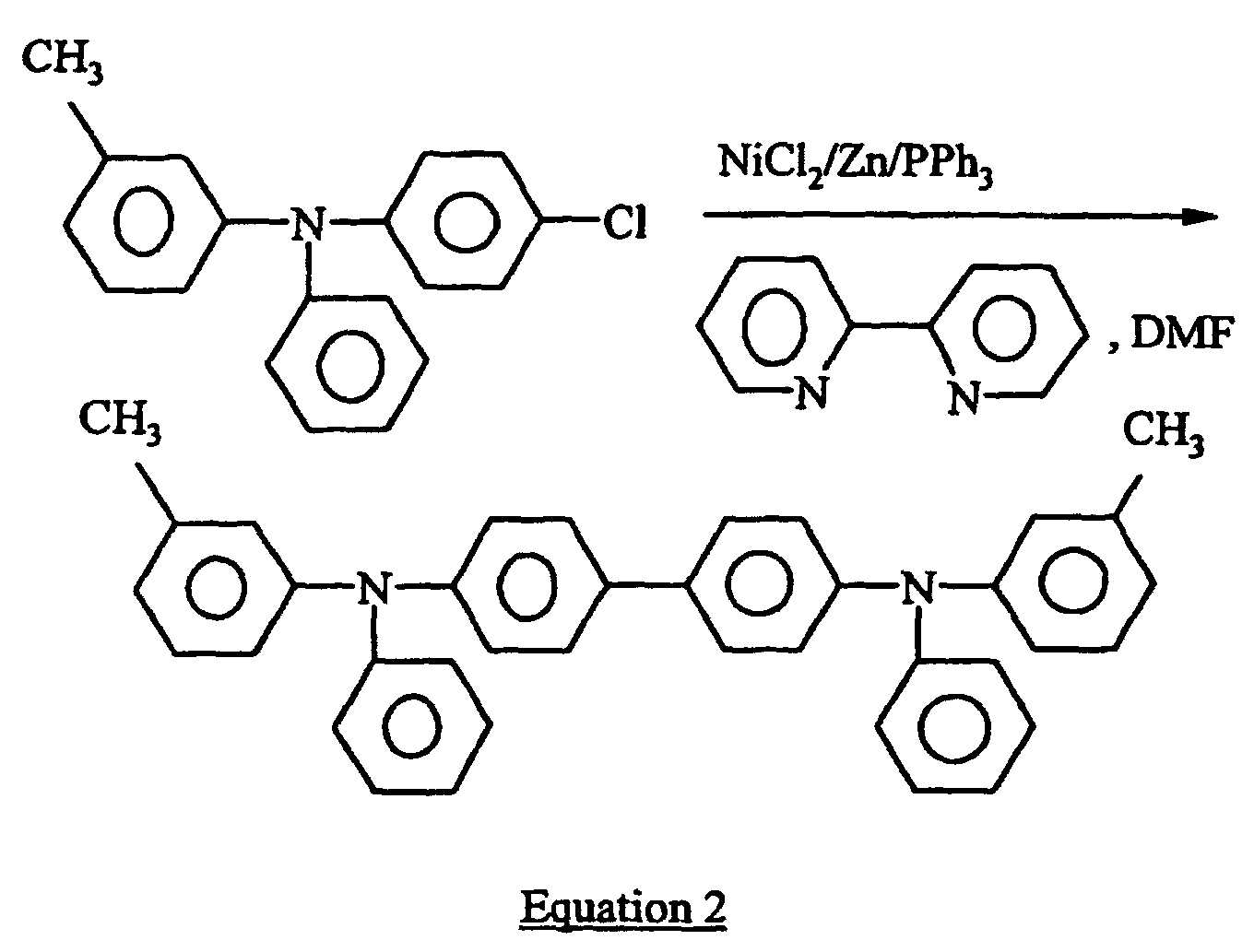
- In Equation 2, the reactant (a) may be replaced by a similar compound in which -CH3 is replaced by any ortho, meta, or para C1 to C10 alkyl group, and Cl is replaced by bromine or fluorine.
- Charge a dry, nitrogen filled flask with 4.9 g (0.07 mol of zinc powder), 3.4 g (0.01 mol) of triphenylphosphine. 0.4 g (0.002 mol) of 2,2'-bipyridyl, 0.3 g (0.002 mol) of anhydrous NiCl2, 30 mL of dry, deoxygenated DMF, and 2 g of activated 3A molecular sieves. The mixture is heated under nitrogen to 65°C until the gray color changed to dark brown (about 10-15 minutes). Maintaining a pot temperature of 60°C, a solution of (4-chloro-phenyl)-phenyl-m-tolyl amine (13.4 g, 0.04 mol) in 40 mL of DMF is added dropwise. After addition is over, the reaction is stirred between 60-65°C for 2-5 hours, until TLC analysis revealed complete consumption of starting aryl chloride. The reaction is diluted with dichloromethane, filtered to remove excess zinc and solids. The filtrate washed four times with water. The dichloromethane layer is dried over sodium sulfate, filtered and concentrated to a reduced volume. The dichloromethane solution is treated with silica gel, filtered, and solution is treated with neutral alumina until the solution is pale yellow. The product is crystallized twice to afford 8.7 g (80%) of N4,N4'-diphenyl-N4,N4'-di-m-tolyl-biphenyl-4,4'-diamine as a white solid. An analytical sample can be obtained by chromatography using a slow gradient of 0-5% ethyl acetate in hexane.
Claims (11)
- (4-chloro-phenyl)-phenyl-m-tolyl-amine.
- A method for synthesizing (4-halo-phenyl)-phenyl-m-tolyl-amine (I) which comprises:(i) charging a nitrogen filled reactor with palladium acetate, tri-tert butyl phosphine and deoxygenated toluene;(ii) agitating the step (i) pale yellow reaction mixture to produce a red colour and thereafter(iii) sequentially adding to the step (ii) red reaction mixture bromobenzene, sodium t-butoxide, and m-toluidine;(iv) heating the step (iii) reaction mixture to produce a step (iv) reaction mixture containing m-methyldiphenyl amine;(v) treating said step (iv) reaction mixture with sodium t-butoxide and 1,4-halobromobenzene, wherein a step (v) reaction mixture containing (I) is produced.
- The method of claim 2, wherein the 1,4-halobromobenzene in step (v) is 1,4-chlorobromobenzene.
- The method of claim 2 or 3 further comprising a step (vi) recovering (I) as a solid from said step (v) reaction mixture.
- The method of claim 4 further comprising a step (vii) converting said solid (I) recovered in step (vi) to N,N'-diphenyl-N,N'-di-m-tolyl-biphenyl-4,4'-diamine (II).
- The method of claim 5 wherein said converting step (vii) is accomplished by a nickel catalyzed coupling of (I).
- A method of coupling a triaryl amine having the formula (A):wherein Ar1, Ar2 and Ar3 are the same or different aryl groups, and X is a halogen wherein at least one of said aryl groups may or may not have one or more ortho, meta or para C1 to C10 alkyl substituent which comprises:
 is produced.(i) charging a nitrogen filled reactor with a mixture of zinc powder, triphenylphosphines, 2,2'-bipyridyl, anhydrous NiCl2 and deoxygenated DMF, wherein said mixture is gray in colour;(ii) heating said step (i) mixture in said reactor to provide a step (ii) mixture dark brown in colour;(iii) treating said step (ii) mixture in said reactor with a DMF solution of a compound of formula (A), wherein step (iii) reaction mixture containing a compound of formula (B)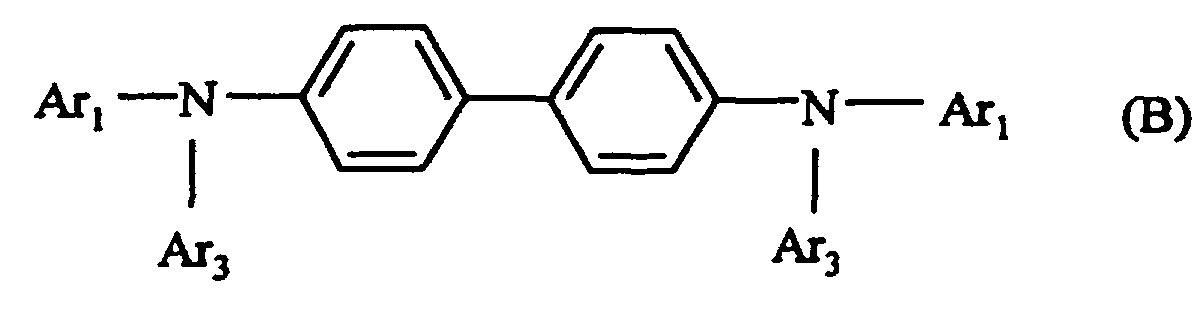
- The method of claim 7, wherein said triaryl amine is (4-halo-phenyl)-phenyl-m-tolyl amine (I).
- The method of claim 8, wherein said triaryl amine is (4-chloro-phenyl)-phenyl-m-tolyl amine.
- The method of any of claims 7 to 9 further comprising a step (iv) recovering said (B) from said step (iii) reaction mixture.
- The method of claim 7, wherein a nickel compound is added during step (i) to catalyse the coupling of (A).
Applications Claiming Priority (3)
| Application Number | Priority Date | Filing Date | Title |
|---|---|---|---|
| US492327 | 1990-03-12 | ||
| US09/492,327 US6407289B1 (en) | 2000-01-27 | 2000-01-27 | Synthesis of N4, N4-diphenyl-N4,N4-di-m-tolyl-biphenyl-4,4'-diamine from an unsymmetrical amine |
| PCT/US2001/001702 WO2001055087A1 (en) | 2000-01-27 | 2001-01-18 | Synthesis of n4, n4'-diphenyl-n4, n4'-di-m-tolyl-biphenyl-4,4'-diamine from an unsymmetrical amine |
Publications (3)
| Publication Number | Publication Date |
|---|---|
| EP1173405A1 EP1173405A1 (en) | 2002-01-23 |
| EP1173405A4 EP1173405A4 (en) | 2002-04-17 |
| EP1173405B1 true EP1173405B1 (en) | 2004-09-15 |
Family
ID=23955830
Family Applications (1)
| Application Number | Title | Priority Date | Filing Date |
|---|---|---|---|
| EP01906590A Expired - Lifetime EP1173405B1 (en) | 2000-01-27 | 2001-01-18 | Synthesis of n4, n4' -diphenyl-n4, n4' -di-m-tolyl-biphenyl-4,4'-diamine from an unsymmetrical amine |
Country Status (8)
| Country | Link |
|---|---|
| US (1) | US6407289B1 (en) |
| EP (1) | EP1173405B1 (en) |
| JP (1) | JP2003520840A (en) |
| AT (1) | ATE276228T1 (en) |
| AU (1) | AU3448201A (en) |
| CA (1) | CA2368794A1 (en) |
| DE (1) | DE60105506T2 (en) |
| WO (1) | WO2001055087A1 (en) |
Families Citing this family (5)
| Publication number | Priority date | Publication date | Assignee | Title |
|---|---|---|---|---|
| JP4467935B2 (en) | 2002-10-03 | 2010-05-26 | キヤノン株式会社 | Method for producing halogenated aromatic amine compound |
| CN100410232C (en) * | 2003-02-14 | 2008-08-13 | 出光兴产株式会社 | Preparation method of aromatic diamine derivative |
| US7402699B2 (en) * | 2004-11-22 | 2008-07-22 | Xerox Corporation | Process for arylamine production |
| US7521581B2 (en) * | 2005-03-30 | 2009-04-21 | Tosoh Corporation | Catalyst composition and process for producing cross-coupled compound using same |
| JP5028788B2 (en) * | 2005-11-04 | 2012-09-19 | 東ソー株式会社 | Method for producing arylamines |
Family Cites Families (2)
| Publication number | Priority date | Publication date | Assignee | Title |
|---|---|---|---|---|
| US4263466A (en) * | 1978-10-30 | 1981-04-21 | Union Carbide Corporation | Coupling of aryl and heteroaryl mono chlorides |
| JPH05323642A (en) * | 1991-01-10 | 1993-12-07 | Mitsubishi Kasei Corp | Electrophotographic sensitive body |
-
2000
- 2000-01-27 US US09/492,327 patent/US6407289B1/en not_active Expired - Lifetime
-
2001
- 2001-01-18 AU AU34482/01A patent/AU3448201A/en not_active Abandoned
- 2001-01-18 WO PCT/US2001/001702 patent/WO2001055087A1/en not_active Ceased
- 2001-01-18 JP JP2001555030A patent/JP2003520840A/en active Pending
- 2001-01-18 AT AT01906590T patent/ATE276228T1/en not_active IP Right Cessation
- 2001-01-18 EP EP01906590A patent/EP1173405B1/en not_active Expired - Lifetime
- 2001-01-18 CA CA002368794A patent/CA2368794A1/en not_active Abandoned
- 2001-01-18 DE DE60105506T patent/DE60105506T2/en not_active Expired - Fee Related
Also Published As
| Publication number | Publication date |
|---|---|
| ATE276228T1 (en) | 2004-10-15 |
| DE60105506D1 (en) | 2004-10-21 |
| EP1173405A1 (en) | 2002-01-23 |
| WO2001055087A1 (en) | 2001-08-02 |
| DE60105506T2 (en) | 2005-01-20 |
| EP1173405A4 (en) | 2002-04-17 |
| JP2003520840A (en) | 2003-07-08 |
| AU3448201A (en) | 2001-08-07 |
| US6407289B1 (en) | 2002-06-18 |
| CA2368794A1 (en) | 2001-08-02 |
Similar Documents
| Publication | Publication Date | Title |
|---|---|---|
| JPH09323958A (en) | Production of triarylamine and arylamine | |
| JP3173602B2 (en) | Novel intermediate for the production of enyne derivatives and its production method | |
| US6407289B1 (en) | Synthesis of N4, N4-diphenyl-N4,N4-di-m-tolyl-biphenyl-4,4'-diamine from an unsymmetrical amine | |
| US4145364A (en) | Preparation of fluorinated anilines | |
| GB2271990A (en) | Process for the preparation of L-5-(2-acetoxy-propionyl-amino)-2,4,6-triiodo- isophthalic acid dichloride | |
| EP1405842B1 (en) | Process for producing halogenated aromatic amine compound | |
| US7087798B2 (en) | Process for preparation of spirofluorenols | |
| IE51211B1 (en) | Process for introducing alkyl radicals into nitrile compounds | |
| Rodríguez et al. | Combined application of organozinc chemistry and one-pot hydroboration–Suzuki coupling to the synthesis of amino acids | |
| KR100332160B1 (en) | Improved preparation of cycloalkyl and haloalkyl O-aminophenyl ketones | |
| JP4307108B2 (en) | Method for producing orthobenzidine compounds | |
| JP2003277333A (en) | Method for producing halotriarylamines and method for producing vinyltriarylamines using the same | |
| EP1999091B1 (en) | Synthesis of substituted fluorenes | |
| US5089651A (en) | Process for producing 3-iminonitriles | |
| JP5023683B2 (en) | Process for producing benzofluorene derivative and intermediate thereof | |
| US7002034B2 (en) | Method for the production of biphenyl-4-carbonitrile | |
| US6953871B2 (en) | Processes for producing poly-ethynyl-substituted aromatic compound | |
| CN116410137B (en) | Trifluoromethyl substituted pyrazole novel compounds is prepared by the preparation method of (2) | |
| JP2997763B2 (en) | Method for producing tertiary amines | |
| JP2003055320A (en) | Method for producing aromatic diamine derivative | |
| US20030060637A1 (en) | Cyclic aniline sulfide and process for preparing the same | |
| EP0661263A2 (en) | Process for the preparation of 2,4,5-tribromopyrrole-3-carbonitrile | |
| JP2003055285A (en) | 4-tert-butoxy-4'-halogenobiphenyl and method for producing the same, and method for producing 4-halogeno-4'-hydroxybiphenyl | |
| JP4839678B2 (en) | Method for producing dihalogenated biaryl derivative | |
| KR910003635B1 (en) | Process for the preparation of 2-(2-naphthyloxy)propion anilide derivatives |
Legal Events
| Date | Code | Title | Description |
|---|---|---|---|
| PUAI | Public reference made under article 153(3) epc to a published international application that has entered the european phase |
Free format text: ORIGINAL CODE: 0009012 |
|
| 17P | Request for examination filed |
Effective date: 20011022 |
|
| AK | Designated contracting states |
Kind code of ref document: A1 Designated state(s): AT BE CH CY DE DK ES FI FR GB GR IE IT LI LU MC NL PT SE TR |
|
| A4 | Supplementary search report drawn up and despatched |
Effective date: 20020301 |
|
| AK | Designated contracting states |
Kind code of ref document: A4 Designated state(s): AT BE CH CY DE DK ES FI FR GB GR IE IT LI LU MC NL PT SE TR |
|
| 17Q | First examination report despatched |
Effective date: 20030415 |
|
| GRAP | Despatch of communication of intention to grant a patent |
Free format text: ORIGINAL CODE: EPIDOSNIGR1 |
|
| GRAS | Grant fee paid |
Free format text: ORIGINAL CODE: EPIDOSNIGR3 |
|
| GRAA | (expected) grant |
Free format text: ORIGINAL CODE: 0009210 |
|
| AK | Designated contracting states |
Kind code of ref document: B1 Designated state(s): AT BE CH CY DE DK ES FI FR GB GR IE IT LI LU MC NL PT SE TR |
|
| PG25 | Lapsed in a contracting state [announced via postgrant information from national office to epo] |
Ref country code: FI Free format text: LAPSE BECAUSE OF FAILURE TO SUBMIT A TRANSLATION OF THE DESCRIPTION OR TO PAY THE FEE WITHIN THE PRESCRIBED TIME-LIMIT Effective date: 20040915 Ref country code: CH Free format text: LAPSE BECAUSE OF FAILURE TO SUBMIT A TRANSLATION OF THE DESCRIPTION OR TO PAY THE FEE WITHIN THE PRESCRIBED TIME-LIMIT Effective date: 20040915 Ref country code: AT Free format text: LAPSE BECAUSE OF FAILURE TO SUBMIT A TRANSLATION OF THE DESCRIPTION OR TO PAY THE FEE WITHIN THE PRESCRIBED TIME-LIMIT Effective date: 20040915 Ref country code: TR Free format text: LAPSE BECAUSE OF FAILURE TO SUBMIT A TRANSLATION OF THE DESCRIPTION OR TO PAY THE FEE WITHIN THE PRESCRIBED TIME-LIMIT Effective date: 20040915 Ref country code: NL Free format text: LAPSE BECAUSE OF FAILURE TO SUBMIT A TRANSLATION OF THE DESCRIPTION OR TO PAY THE FEE WITHIN THE PRESCRIBED TIME-LIMIT Effective date: 20040915 Ref country code: LI Free format text: LAPSE BECAUSE OF FAILURE TO SUBMIT A TRANSLATION OF THE DESCRIPTION OR TO PAY THE FEE WITHIN THE PRESCRIBED TIME-LIMIT Effective date: 20040915 Ref country code: FR Free format text: LAPSE BECAUSE OF FAILURE TO SUBMIT A TRANSLATION OF THE DESCRIPTION OR TO PAY THE FEE WITHIN THE PRESCRIBED TIME-LIMIT Effective date: 20040915 Ref country code: ES Free format text: LAPSE BECAUSE OF FAILURE TO SUBMIT A TRANSLATION OF THE DESCRIPTION OR TO PAY THE FEE WITHIN THE PRESCRIBED TIME-LIMIT Effective date: 20040915 Ref country code: BE Free format text: LAPSE BECAUSE OF FAILURE TO SUBMIT A TRANSLATION OF THE DESCRIPTION OR TO PAY THE FEE WITHIN THE PRESCRIBED TIME-LIMIT Effective date: 20040915 Ref country code: IT Free format text: LAPSE BECAUSE OF FAILURE TO SUBMIT A TRANSLATION OF THE DESCRIPTION OR TO PAY THE FEE WITHIN THE PRESCRIBED TIME-LIMIT;WARNING: LAPSES OF ITALIAN PATENTS WITH EFFECTIVE DATE BEFORE 2007 MAY HAVE OCCURRED AT ANY TIME BEFORE 2007. THE CORRECT EFFECTIVE DATE MAY BE DIFFERENT FROM THE ONE RECORDED. Effective date: 20040915 |
|
| REG | Reference to a national code |
Ref country code: CH Ref legal event code: EP Ref country code: GB Ref legal event code: FG4D |
|
| REG | Reference to a national code |
Ref country code: IE Ref legal event code: FG4D |
|
| REF | Corresponds to: |
Ref document number: 60105506 Country of ref document: DE Date of ref document: 20041021 Kind code of ref document: P |
|
| PG25 | Lapsed in a contracting state [announced via postgrant information from national office to epo] |
Ref country code: DK Free format text: LAPSE BECAUSE OF FAILURE TO SUBMIT A TRANSLATION OF THE DESCRIPTION OR TO PAY THE FEE WITHIN THE PRESCRIBED TIME-LIMIT Effective date: 20041215 Ref country code: SE Free format text: LAPSE BECAUSE OF FAILURE TO SUBMIT A TRANSLATION OF THE DESCRIPTION OR TO PAY THE FEE WITHIN THE PRESCRIBED TIME-LIMIT Effective date: 20041215 Ref country code: GR Free format text: LAPSE BECAUSE OF FAILURE TO SUBMIT A TRANSLATION OF THE DESCRIPTION OR TO PAY THE FEE WITHIN THE PRESCRIBED TIME-LIMIT Effective date: 20041215 |
|
| PG25 | Lapsed in a contracting state [announced via postgrant information from national office to epo] |
Ref country code: CY Free format text: LAPSE BECAUSE OF FAILURE TO SUBMIT A TRANSLATION OF THE DESCRIPTION OR TO PAY THE FEE WITHIN THE PRESCRIBED TIME-LIMIT Effective date: 20050118 Ref country code: LU Free format text: LAPSE BECAUSE OF NON-PAYMENT OF DUE FEES Effective date: 20050118 Ref country code: GB Free format text: LAPSE BECAUSE OF NON-PAYMENT OF DUE FEES Effective date: 20050118 Ref country code: IE Free format text: LAPSE BECAUSE OF NON-PAYMENT OF DUE FEES Effective date: 20050118 |
|
| PG25 | Lapsed in a contracting state [announced via postgrant information from national office to epo] |
Ref country code: MC Free format text: LAPSE BECAUSE OF NON-PAYMENT OF DUE FEES Effective date: 20050131 |
|
| REG | Reference to a national code |
Ref country code: CH Ref legal event code: PL |
|
| NLV1 | Nl: lapsed or annulled due to failure to fulfill the requirements of art. 29p and 29m of the patents act | ||
| PLBE | No opposition filed within time limit |
Free format text: ORIGINAL CODE: 0009261 |
|
| STAA | Information on the status of an ep patent application or granted ep patent |
Free format text: STATUS: NO OPPOSITION FILED WITHIN TIME LIMIT |
|
| PG25 | Lapsed in a contracting state [announced via postgrant information from national office to epo] |
Ref country code: DE Free format text: LAPSE BECAUSE OF NON-PAYMENT OF DUE FEES Effective date: 20050802 |
|
| 26N | No opposition filed |
Effective date: 20050616 |
|
| GBPC | Gb: european patent ceased through non-payment of renewal fee |
Effective date: 20050118 |
|
| EN | Fr: translation not filed | ||
| REG | Reference to a national code |
Ref country code: IE Ref legal event code: MM4A |
|
| PG25 | Lapsed in a contracting state [announced via postgrant information from national office to epo] |
Ref country code: PT Free format text: LAPSE BECAUSE OF NON-PAYMENT OF DUE FEES Effective date: 20050215 |