EP1173184B1 - para-BORONOPHENYLALANINE COMPLEXES WITH FRUCTOSE AND RELATED CARBOHYDRATES AND POLYOLS - Google Patents
para-BORONOPHENYLALANINE COMPLEXES WITH FRUCTOSE AND RELATED CARBOHYDRATES AND POLYOLS Download PDFInfo
- Publication number
- EP1173184B1 EP1173184B1 EP00918342A EP00918342A EP1173184B1 EP 1173184 B1 EP1173184 B1 EP 1173184B1 EP 00918342 A EP00918342 A EP 00918342A EP 00918342 A EP00918342 A EP 00918342A EP 1173184 B1 EP1173184 B1 EP 1173184B1
- Authority
- EP
- European Patent Office
- Prior art keywords
- boronophenylalanine
- complex
- free
- salt
- solution
- Prior art date
- Legal status (The legal status is an assumption and is not a legal conclusion. Google has not performed a legal analysis and makes no representation as to the accuracy of the status listed.)
- Expired - Lifetime
Links
- NFIVJOSXJDORSP-QMMMGPOBSA-N (2s)-2-amino-3-(4-boronophenyl)propanoic acid Chemical class OC(=O)[C@@H](N)CC1=CC=C(B(O)O)C=C1 NFIVJOSXJDORSP-QMMMGPOBSA-N 0.000 title claims abstract description 166
- 229920005862 polyol Polymers 0.000 title claims abstract description 69
- 150000003077 polyols Chemical class 0.000 title claims description 50
- 235000014633 carbohydrates Nutrition 0.000 title claims description 42
- 150000001720 carbohydrates Chemical class 0.000 title claims description 40
- RFSUNEUAIZKAJO-ARQDHWQXSA-N Fructose Chemical compound OC[C@H]1O[C@](O)(CO)[C@@H](O)[C@@H]1O RFSUNEUAIZKAJO-ARQDHWQXSA-N 0.000 title claims description 29
- 239000005715 Fructose Substances 0.000 title claims description 29
- 229930091371 Fructose Natural products 0.000 title claims description 23
- 238000000034 method Methods 0.000 claims abstract description 48
- 239000000203 mixture Substances 0.000 claims abstract description 19
- 150000001875 compounds Chemical class 0.000 claims abstract description 13
- 230000003381 solubilizing effect Effects 0.000 claims abstract description 9
- 239000000243 solution Substances 0.000 claims description 82
- HEMHJVSKTPXQMS-UHFFFAOYSA-M Sodium hydroxide Chemical compound [OH-].[Na+] HEMHJVSKTPXQMS-UHFFFAOYSA-M 0.000 claims description 54
- XLYOFNOQVPJJNP-UHFFFAOYSA-N water Substances O XLYOFNOQVPJJNP-UHFFFAOYSA-N 0.000 claims description 39
- 239000012500 ion exchange media Substances 0.000 claims description 32
- 239000002585 base Substances 0.000 claims description 27
- 239000003637 basic solution Substances 0.000 claims description 21
- FAPWRFPIFSIZLT-UHFFFAOYSA-M Sodium chloride Chemical compound [Na+].[Cl-] FAPWRFPIFSIZLT-UHFFFAOYSA-M 0.000 claims description 18
- 239000003456 ion exchange resin Substances 0.000 claims description 17
- 229920003303 ion-exchange polymer Polymers 0.000 claims description 17
- NWUYHJFMYQTDRP-UHFFFAOYSA-N 1,2-bis(ethenyl)benzene;1-ethenyl-2-ethylbenzene;styrene Chemical compound C=CC1=CC=CC=C1.CCC1=CC=CC=C1C=C.C=CC1=CC=CC=C1C=C NWUYHJFMYQTDRP-UHFFFAOYSA-N 0.000 claims description 16
- 239000002904 solvent Substances 0.000 claims description 16
- KWYUFKZDYYNOTN-UHFFFAOYSA-M Potassium hydroxide Chemical compound [OH-].[K+] KWYUFKZDYYNOTN-UHFFFAOYSA-M 0.000 claims description 15
- 150000002772 monosaccharides Chemical class 0.000 claims description 14
- 150000002016 disaccharides Chemical class 0.000 claims description 13
- 229960000511 lactulose Drugs 0.000 claims description 12
- HEBKCHPVOIAQTA-UHFFFAOYSA-N meso ribitol Natural products OCC(O)C(O)C(O)CO HEBKCHPVOIAQTA-UHFFFAOYSA-N 0.000 claims description 12
- 229920001467 poly(styrenesulfonates) Polymers 0.000 claims description 12
- 238000004108 freeze drying Methods 0.000 claims description 10
- DXALOGXSFLZLLN-WTZPKTTFSA-N (3s,4s,5r)-1,3,4,6-tetrahydroxy-5-[(2r,3r,4s,5s,6r)-3,4,5-trihydroxy-6-(hydroxymethyl)oxan-2-yl]oxyhexan-2-one Chemical compound OCC(=O)[C@@H](O)[C@H](O)[C@@H](CO)O[C@H]1O[C@H](CO)[C@@H](O)[C@H](O)[C@H]1O DXALOGXSFLZLLN-WTZPKTTFSA-N 0.000 claims description 9
- LKDRXBCSQODPBY-AMVSKUEXSA-N L-(-)-Sorbose Chemical compound OCC1(O)OC[C@H](O)[C@@H](O)[C@@H]1O LKDRXBCSQODPBY-AMVSKUEXSA-N 0.000 claims description 9
- JPFGFRMPGVDDGE-UHFFFAOYSA-N Leucrose Natural products OC1C(O)C(O)C(CO)OC1OC1C(O)C(O)C(O)(CO)OC1 JPFGFRMPGVDDGE-UHFFFAOYSA-N 0.000 claims description 9
- PVXPPJIGRGXGCY-DJHAAKORSA-N 6-O-alpha-D-glucopyranosyl-alpha-D-fructofuranose Chemical compound O[C@@H]1[C@@H](O)[C@H](O)[C@@H](CO)O[C@@H]1OC[C@@H]1[C@@H](O)[C@H](O)[C@](O)(CO)O1 PVXPPJIGRGXGCY-DJHAAKORSA-N 0.000 claims description 8
- DRQXUCVJDCRJDB-UHFFFAOYSA-N Turanose Natural products OC1C(CO)OC(O)(CO)C1OC1C(O)C(O)C(O)C(CO)O1 DRQXUCVJDCRJDB-UHFFFAOYSA-N 0.000 claims description 8
- 238000001914 filtration Methods 0.000 claims description 8
- RULSWEULPANCDV-PIXUTMIVSA-N turanose Chemical compound OC[C@@H](O)[C@@H](O)[C@@H](C(=O)CO)O[C@H]1O[C@H](CO)[C@@H](O)[C@H](O)[C@H]1O RULSWEULPANCDV-PIXUTMIVSA-N 0.000 claims description 8
- OWEGMIWEEQEYGQ-UHFFFAOYSA-N 100676-05-9 Natural products OC1C(O)C(O)C(CO)OC1OCC1C(O)C(O)C(O)C(OC2C(OC(O)C(O)C2O)CO)O1 OWEGMIWEEQEYGQ-UHFFFAOYSA-N 0.000 claims description 7
- GUBGYTABKSRVRQ-XLOQQCSPSA-N Alpha-Lactose Chemical compound O[C@@H]1[C@@H](O)[C@@H](O)[C@@H](CO)O[C@H]1O[C@@H]1[C@@H](CO)O[C@H](O)[C@H](O)[C@H]1O GUBGYTABKSRVRQ-XLOQQCSPSA-N 0.000 claims description 7
- FBPFZTCFMRRESA-FSIIMWSLSA-N D-Glucitol Natural products OC[C@H](O)[C@H](O)[C@@H](O)[C@H](O)CO FBPFZTCFMRRESA-FSIIMWSLSA-N 0.000 claims description 7
- FBPFZTCFMRRESA-KVTDHHQDSA-N D-Mannitol Chemical compound OC[C@@H](O)[C@@H](O)[C@H](O)[C@H](O)CO FBPFZTCFMRRESA-KVTDHHQDSA-N 0.000 claims description 7
- FBPFZTCFMRRESA-JGWLITMVSA-N D-glucitol Chemical compound OC[C@H](O)[C@@H](O)[C@H](O)[C@H](O)CO FBPFZTCFMRRESA-JGWLITMVSA-N 0.000 claims description 7
- WQZGKKKJIJFFOK-GASJEMHNSA-N Glucose Natural products OC[C@H]1OC(O)[C@H](O)[C@@H](O)[C@@H]1O WQZGKKKJIJFFOK-GASJEMHNSA-N 0.000 claims description 7
- GUBGYTABKSRVRQ-QKKXKWKRSA-N Lactose Natural products OC[C@H]1O[C@@H](O[C@H]2[C@H](O)[C@@H](O)C(O)O[C@@H]2CO)[C@H](O)[C@@H](O)[C@H]1O GUBGYTABKSRVRQ-QKKXKWKRSA-N 0.000 claims description 7
- GUBGYTABKSRVRQ-PICCSMPSSA-N Maltose Natural products O[C@@H]1[C@@H](O)[C@H](O)[C@@H](CO)O[C@@H]1O[C@@H]1[C@@H](CO)OC(O)[C@H](O)[C@H]1O GUBGYTABKSRVRQ-PICCSMPSSA-N 0.000 claims description 7
- NBGXQZRRLOGAJF-UHFFFAOYSA-N Maltulose Natural products OC1C(O)C(O)C(CO)OC1OC1C(O)C(O)(CO)OCC1O NBGXQZRRLOGAJF-UHFFFAOYSA-N 0.000 claims description 7
- 229930195725 Mannitol Natural products 0.000 claims description 7
- TVXBFESIOXBWNM-UHFFFAOYSA-N Xylitol Natural products OCCC(O)C(O)C(O)CCO TVXBFESIOXBWNM-UHFFFAOYSA-N 0.000 claims description 7
- WQZGKKKJIJFFOK-VFUOTHLCSA-N beta-D-glucose Chemical compound OC[C@H]1O[C@@H](O)[C@H](O)[C@@H](O)[C@@H]1O WQZGKKKJIJFFOK-VFUOTHLCSA-N 0.000 claims description 7
- GUBGYTABKSRVRQ-QUYVBRFLSA-N beta-maltose Chemical compound OC[C@H]1O[C@H](O[C@H]2[C@H](O)[C@@H](O)[C@H](O)O[C@@H]2CO)[C@H](O)[C@@H](O)[C@@H]1O GUBGYTABKSRVRQ-QUYVBRFLSA-N 0.000 claims description 7
- 239000008103 glucose Substances 0.000 claims description 7
- 239000008101 lactose Substances 0.000 claims description 7
- JCQLYHFGKNRPGE-FCVZTGTOSA-N lactulose Chemical compound OC[C@H]1O[C@](O)(CO)[C@@H](O)[C@@H]1O[C@H]1[C@H](O)[C@@H](O)[C@@H](O)[C@@H](CO)O1 JCQLYHFGKNRPGE-FCVZTGTOSA-N 0.000 claims description 7
- PFCRQPBOOFTZGQ-UHFFFAOYSA-N lactulose keto form Natural products OCC(=O)C(O)C(C(O)CO)OC1OC(CO)C(O)C(O)C1O PFCRQPBOOFTZGQ-UHFFFAOYSA-N 0.000 claims description 7
- JCQLYHFGKNRPGE-HFZVAGMNSA-N maltulose Chemical compound OC[C@H]1O[C@](O)(CO)[C@@H](O)[C@@H]1O[C@@H]1[C@H](O)[C@@H](O)[C@H](O)[C@@H](CO)O1 JCQLYHFGKNRPGE-HFZVAGMNSA-N 0.000 claims description 7
- 239000000594 mannitol Substances 0.000 claims description 7
- 235000010355 mannitol Nutrition 0.000 claims description 7
- 239000000600 sorbitol Substances 0.000 claims description 7
- 229960002920 sorbitol Drugs 0.000 claims description 7
- 239000000811 xylitol Substances 0.000 claims description 7
- HEBKCHPVOIAQTA-SCDXWVJYSA-N xylitol Chemical compound OC[C@H](O)[C@@H](O)[C@H](O)CO HEBKCHPVOIAQTA-SCDXWVJYSA-N 0.000 claims description 7
- 235000010447 xylitol Nutrition 0.000 claims description 7
- 229960002675 xylitol Drugs 0.000 claims description 7
- PSWYBAVQBPKQRW-ODCKYCSKSA-N (2s)-2-amino-3-(4-boronophenyl)propanoic acid;(3s,4r,5r)-1,3,4,5,6-pentahydroxyhexan-2-one Chemical compound OC[C@@H](O)[C@@H](O)[C@H](O)C(=O)CO.OC(=O)[C@@H](N)CC1=CC=C(B(O)O)C=C1 PSWYBAVQBPKQRW-ODCKYCSKSA-N 0.000 claims description 6
- VRYALKFFQXWPIH-PBXRRBTRSA-N (3r,4s,5r)-3,4,5,6-tetrahydroxyhexanal Chemical compound OC[C@@H](O)[C@@H](O)[C@H](O)CC=O VRYALKFFQXWPIH-PBXRRBTRSA-N 0.000 claims description 6
- VRYALKFFQXWPIH-HSUXUTPPSA-N 2-deoxy-D-galactose Chemical compound OC[C@@H](O)[C@H](O)[C@H](O)CC=O VRYALKFFQXWPIH-HSUXUTPPSA-N 0.000 claims description 6
- WQZGKKKJIJFFOK-QTVWNMPRSA-N D-mannopyranose Chemical compound OC[C@H]1OC(O)[C@@H](O)[C@@H](O)[C@@H]1O WQZGKKKJIJFFOK-QTVWNMPRSA-N 0.000 claims description 6
- HMFHBZSHGGEWLO-SOOFDHNKSA-N D-ribofuranose Chemical compound OC[C@H]1OC(O)[C@H](O)[C@@H]1O HMFHBZSHGGEWLO-SOOFDHNKSA-N 0.000 claims description 6
- PYMYPHUHKUWMLA-LMVFSUKVSA-N Ribose Natural products OC[C@@H](O)[C@@H](O)[C@@H](O)C=O PYMYPHUHKUWMLA-LMVFSUKVSA-N 0.000 claims description 6
- HMFHBZSHGGEWLO-UHFFFAOYSA-N alpha-D-Furanose-Ribose Natural products OCC1OC(O)C(O)C1O HMFHBZSHGGEWLO-UHFFFAOYSA-N 0.000 claims description 6
- PMMURAAUARKVCB-UHFFFAOYSA-N alpha-D-ara-dHexp Natural products OCC1OC(O)CC(O)C1O PMMURAAUARKVCB-UHFFFAOYSA-N 0.000 claims description 6
- WQZGKKKJIJFFOK-PHYPRBDBSA-N alpha-D-galactose Chemical compound OC[C@H]1O[C@H](O)[C@H](O)[C@@H](O)[C@H]1O WQZGKKKJIJFFOK-PHYPRBDBSA-N 0.000 claims description 6
- FBPFZTCFMRRESA-GUCUJZIJSA-N galactitol Chemical compound OC[C@H](O)[C@@H](O)[C@@H](O)[C@H](O)CO FBPFZTCFMRRESA-GUCUJZIJSA-N 0.000 claims description 6
- 229930182830 galactose Natural products 0.000 claims description 6
- 238000001990 intravenous administration Methods 0.000 claims description 6
- 239000011780 sodium chloride Substances 0.000 claims description 6
- UNXHWFMMPAWVPI-QWWZWVQMSA-N D-threitol Chemical compound OC[C@@H](O)[C@H](O)CO UNXHWFMMPAWVPI-QWWZWVQMSA-N 0.000 claims description 5
- UNXHWFMMPAWVPI-UHFFFAOYSA-N Erythritol Natural products OCC(O)C(O)CO UNXHWFMMPAWVPI-UHFFFAOYSA-N 0.000 claims description 5
- AXCZMVOFGPJBDE-UHFFFAOYSA-L calcium dihydroxide Chemical compound [OH-].[OH-].[Ca+2] AXCZMVOFGPJBDE-UHFFFAOYSA-L 0.000 claims description 5
- 239000000920 calcium hydroxide Substances 0.000 claims description 5
- 229910001861 calcium hydroxide Inorganic materials 0.000 claims description 5
- VTHJTEIRLNZDEV-UHFFFAOYSA-L magnesium dihydroxide Chemical compound [OH-].[OH-].[Mg+2] VTHJTEIRLNZDEV-UHFFFAOYSA-L 0.000 claims description 5
- 239000000347 magnesium hydroxide Substances 0.000 claims description 5
- 229910001862 magnesium hydroxide Inorganic materials 0.000 claims description 5
- HEBKCHPVOIAQTA-ZXFHETKHSA-N ribitol Chemical compound OC[C@H](O)[C@H](O)[C@H](O)CO HEBKCHPVOIAQTA-ZXFHETKHSA-N 0.000 claims description 5
- FNBAOWPDPGEVBZ-BPXIMWISSA-N OC[C@@H](O)[C@@H](O)[C@H](O)[C@H](O)CO.OC(=O)[C@@H](N)CC1=CC=C(B(O)O)C=C1 Chemical compound OC[C@@H](O)[C@@H](O)[C@H](O)[C@H](O)CO.OC(=O)[C@@H](N)CC1=CC=C(B(O)O)C=C1 FNBAOWPDPGEVBZ-BPXIMWISSA-N 0.000 claims description 4
- BSXFSBGSGXWEGP-UZJOMYMCSA-N OC[C@H](O)[C@@H](O)[C@H](O)CO.OC(=O)[C@@H](N)CC1=CC=C(B(O)O)C=C1 Chemical compound OC[C@H](O)[C@@H](O)[C@H](O)CO.OC(=O)[C@@H](N)CC1=CC=C(B(O)O)C=C1 BSXFSBGSGXWEGP-UZJOMYMCSA-N 0.000 claims description 4
- FNBAOWPDPGEVBZ-RKMHJMJGSA-N OC[C@H](O)[C@@H](O)[C@H](O)[C@H](O)CO.OC(=O)[C@@H](N)CC1=CC=C(B(O)O)C=C1 Chemical compound OC[C@H](O)[C@@H](O)[C@H](O)[C@H](O)CO.OC(=O)[C@@H](N)CC1=CC=C(B(O)O)C=C1 FNBAOWPDPGEVBZ-RKMHJMJGSA-N 0.000 claims description 4
- 238000002156 mixing Methods 0.000 claims description 4
- PSWYBAVQBPKQRW-QLONQEIRSA-N (2s)-2-amino-3-(4-boronophenyl)propanoic acid;(3r,4s,5r)-1,3,4,5,6-pentahydroxyhexan-2-one Chemical compound OC[C@@H](O)[C@H](O)[C@@H](O)C(=O)CO.OC(=O)[C@@H](N)CC1=CC=C(B(O)O)C=C1 PSWYBAVQBPKQRW-QLONQEIRSA-N 0.000 claims description 2
- 150000003839 salts Chemical class 0.000 claims description 2
- 239000008194 pharmaceutical composition Substances 0.000 claims 2
- 238000004519 manufacturing process Methods 0.000 claims 1
- 230000002708 enhancing effect Effects 0.000 abstract description 2
- 229960002737 fructose Drugs 0.000 description 27
- 239000007787 solid Substances 0.000 description 22
- 239000000126 substance Substances 0.000 description 21
- 239000011347 resin Substances 0.000 description 20
- 229920005989 resin Polymers 0.000 description 20
- 206010028980 Neoplasm Diseases 0.000 description 16
- 238000002560 therapeutic procedure Methods 0.000 description 16
- 201000011510 cancer Diseases 0.000 description 12
- 238000005342 ion exchange Methods 0.000 description 12
- 238000005160 1H NMR spectroscopy Methods 0.000 description 11
- 229940077731 carbohydrate nutrients Drugs 0.000 description 11
- 238000002360 preparation method Methods 0.000 description 11
- 238000001644 13C nuclear magnetic resonance spectroscopy Methods 0.000 description 10
- 229910052796 boron Inorganic materials 0.000 description 10
- ZOXJGFHDIHLPTG-UHFFFAOYSA-N Boron Chemical compound [B] ZOXJGFHDIHLPTG-UHFFFAOYSA-N 0.000 description 9
- -1 aromatic boronic acids Chemical class 0.000 description 9
- BNIILDVGGAEEIG-UHFFFAOYSA-L disodium hydrogen phosphate Chemical compound [Na+].[Na+].OP([O-])([O-])=O BNIILDVGGAEEIG-UHFFFAOYSA-L 0.000 description 9
- 229910000397 disodium phosphate Inorganic materials 0.000 description 9
- 238000010438 heat treatment Methods 0.000 description 9
- AJPJDKMHJJGVTQ-UHFFFAOYSA-M sodium dihydrogen phosphate Chemical compound [Na+].OP(O)([O-])=O AJPJDKMHJJGVTQ-UHFFFAOYSA-M 0.000 description 9
- 229910000162 sodium phosphate Inorganic materials 0.000 description 9
- 238000003756 stirring Methods 0.000 description 9
- 238000010792 warming Methods 0.000 description 9
- 239000002253 acid Substances 0.000 description 8
- 230000009918 complex formation Effects 0.000 description 8
- 239000012153 distilled water Substances 0.000 description 8
- 125000002887 hydroxy group Chemical group [H]O* 0.000 description 8
- 230000007246 mechanism Effects 0.000 description 7
- 239000011734 sodium Substances 0.000 description 7
- 229910052708 sodium Inorganic materials 0.000 description 7
- VEXZGXHMUGYJMC-UHFFFAOYSA-N Hydrochloric acid Chemical class Cl VEXZGXHMUGYJMC-UHFFFAOYSA-N 0.000 description 6
- 210000004027 cell Anatomy 0.000 description 6
- 150000002500 ions Chemical class 0.000 description 6
- DGAQECJNVWCQMB-PUAWFVPOSA-M Ilexoside XXIX Chemical compound C[C@@H]1CC[C@@]2(CC[C@@]3(C(=CC[C@H]4[C@]3(CC[C@@H]5[C@@]4(CC[C@@H](C5(C)C)OS(=O)(=O)[O-])C)C)[C@@H]2[C@]1(C)O)C)C(=O)O[C@H]6[C@@H]([C@H]([C@@H]([C@H](O6)CO)O)O)O.[Na+] DGAQECJNVWCQMB-PUAWFVPOSA-M 0.000 description 5
- 238000005481 NMR spectroscopy Methods 0.000 description 5
- 150000007513 acids Chemical class 0.000 description 5
- 239000008280 blood Substances 0.000 description 5
- 210000004369 blood Anatomy 0.000 description 5
- 201000001441 melanoma Diseases 0.000 description 5
- 230000005855 radiation Effects 0.000 description 5
- BIWQNIMLAISTBV-UHFFFAOYSA-N (4-methylphenyl)boronic acid Chemical compound CC1=CC=C(B(O)O)C=C1 BIWQNIMLAISTBV-UHFFFAOYSA-N 0.000 description 4
- XLYOFNOQVPJJNP-ZSJDYOACSA-N Heavy water Chemical compound [2H]O[2H] XLYOFNOQVPJJNP-ZSJDYOACSA-N 0.000 description 4
- CZMRCDWAGMRECN-UGDNZRGBSA-N Sucrose Chemical compound O[C@H]1[C@H](O)[C@@H](CO)O[C@@]1(CO)O[C@@H]1[C@H](O)[C@@H](O)[C@H](O)[C@@H](CO)O1 CZMRCDWAGMRECN-UGDNZRGBSA-N 0.000 description 4
- 238000006243 chemical reaction Methods 0.000 description 4
- 229940079593 drug Drugs 0.000 description 4
- 239000003814 drug Substances 0.000 description 4
- 230000001965 increasing effect Effects 0.000 description 4
- 239000007788 liquid Substances 0.000 description 4
- RFSUNEUAIZKAJO-VRPWFDPXSA-N D-fructofuranose Chemical group OC[C@H]1OC(O)(CO)[C@@H](O)[C@@H]1O RFSUNEUAIZKAJO-VRPWFDPXSA-N 0.000 description 3
- 229930006000 Sucrose Natural products 0.000 description 3
- 150000001413 amino acids Chemical class 0.000 description 3
- 239000007864 aqueous solution Substances 0.000 description 3
- 125000004429 atom Chemical group 0.000 description 3
- 238000010668 complexation reaction Methods 0.000 description 3
- 230000008878 coupling Effects 0.000 description 3
- 238000010168 coupling process Methods 0.000 description 3
- 238000005859 coupling reaction Methods 0.000 description 3
- BJHIKXHVCXFQLS-UYFOZJQFSA-N fructose group Chemical group OCC(=O)[C@@H](O)[C@H](O)[C@H](O)CO BJHIKXHVCXFQLS-UYFOZJQFSA-N 0.000 description 3
- 125000002791 glucosyl group Chemical group C1([C@H](O)[C@@H](O)[C@H](O)[C@H](O1)CO)* 0.000 description 3
- 239000001257 hydrogen Substances 0.000 description 3
- 229910052739 hydrogen Inorganic materials 0.000 description 3
- 239000000047 product Substances 0.000 description 3
- 150000003214 pyranose derivatives Chemical group 0.000 description 3
- 238000001228 spectrum Methods 0.000 description 3
- 239000005720 sucrose Substances 0.000 description 3
- 229960004793 sucrose Drugs 0.000 description 3
- 235000000346 sugar Nutrition 0.000 description 3
- UFHFLCQGNIYNRP-UHFFFAOYSA-N Hydrogen Chemical compound [H][H] UFHFLCQGNIYNRP-UHFFFAOYSA-N 0.000 description 2
- TWRXJAOTZQYOKJ-UHFFFAOYSA-L Magnesium chloride Chemical compound [Mg+2].[Cl-].[Cl-] TWRXJAOTZQYOKJ-UHFFFAOYSA-L 0.000 description 2
- CSNNHWWHGAXBCP-UHFFFAOYSA-L Magnesium sulfate Chemical compound [Mg+2].[O-][S+2]([O-])([O-])[O-] CSNNHWWHGAXBCP-UHFFFAOYSA-L 0.000 description 2
- XUMBMVFBXHLACL-UHFFFAOYSA-N Melanin Chemical compound O=C1C(=O)C(C2=CNC3=C(C(C(=O)C4=C32)=O)C)=C2C4=CNC2=C1C XUMBMVFBXHLACL-UHFFFAOYSA-N 0.000 description 2
- ISWSIDIOOBJBQZ-UHFFFAOYSA-N Phenol Chemical compound OC1=CC=CC=C1 ISWSIDIOOBJBQZ-UHFFFAOYSA-N 0.000 description 2
- 239000012670 alkaline solution Substances 0.000 description 2
- 125000003118 aryl group Chemical group 0.000 description 2
- QVGXLLKOCUKJST-UHFFFAOYSA-N atomic oxygen Chemical compound [O] QVGXLLKOCUKJST-UHFFFAOYSA-N 0.000 description 2
- 150000001639 boron compounds Chemical class 0.000 description 2
- 238000001460 carbon-13 nuclear magnetic resonance spectrum Methods 0.000 description 2
- 239000013043 chemical agent Substances 0.000 description 2
- 230000000536 complexating effect Effects 0.000 description 2
- 239000008139 complexing agent Substances 0.000 description 2
- MNQZXJOMYWMBOU-UHFFFAOYSA-N glyceraldehyde Chemical compound OCC(O)C=O MNQZXJOMYWMBOU-UHFFFAOYSA-N 0.000 description 2
- XLYOFNOQVPJJNP-UHFFFAOYSA-M hydroxide Chemical compound [OH-] XLYOFNOQVPJJNP-UHFFFAOYSA-M 0.000 description 2
- 231100000518 lethal Toxicity 0.000 description 2
- 230000001665 lethal effect Effects 0.000 description 2
- 239000002502 liposome Substances 0.000 description 2
- 238000002844 melting Methods 0.000 description 2
- 230000008018 melting Effects 0.000 description 2
- HOVAGTYPODGVJG-VOQCIKJUSA-N methyl beta-D-galactoside Chemical compound CO[C@@H]1O[C@H](CO)[C@H](O)[C@H](O)[C@H]1O HOVAGTYPODGVJG-VOQCIKJUSA-N 0.000 description 2
- 230000004048 modification Effects 0.000 description 2
- 238000012986 modification Methods 0.000 description 2
- 230000007935 neutral effect Effects 0.000 description 2
- 230000003204 osmotic effect Effects 0.000 description 2
- 239000001301 oxygen Substances 0.000 description 2
- 229910052760 oxygen Inorganic materials 0.000 description 2
- 238000001556 precipitation Methods 0.000 description 2
- 230000008569 process Effects 0.000 description 2
- 238000000425 proton nuclear magnetic resonance spectrum Methods 0.000 description 2
- 230000002441 reversible effect Effects 0.000 description 2
- JHJLBTNAGRQEKS-UHFFFAOYSA-M sodium bromide Chemical compound [Na+].[Br-] JHJLBTNAGRQEKS-UHFFFAOYSA-M 0.000 description 2
- 150000005846 sugar alcohols Polymers 0.000 description 2
- 150000008163 sugars Chemical class 0.000 description 2
- 210000004881 tumor cell Anatomy 0.000 description 2
- NMELTECMHKKXLF-YNMYPSOUSA-N (3s,4r,5r)-3,4,5,6-tetrahydroxy-1-[(2r,3r,4s,5r,6r)-3,4,5-trihydroxy-6-(hydroxymethyl)oxan-2-yl]oxyhexan-2-one Chemical compound OC[C@@H](O)[C@@H](O)[C@H](O)C(=O)CO[C@@H]1O[C@H](CO)[C@H](O)[C@H](O)[C@H]1O NMELTECMHKKXLF-YNMYPSOUSA-N 0.000 description 1
- 0 *[C@](CC12C=CC([S@@]3(OC4[C@@]5O)OCC5O[C@@]4(CO)O3)=CC1C2)N Chemical compound *[C@](CC12C=CC([S@@]3(OC4[C@@]5O)OCC5O[C@@]4(CO)O3)=CC1C2)N 0.000 description 1
- 238000004607 11B NMR spectroscopy Methods 0.000 description 1
- KHOITXIGCFIULA-UHFFFAOYSA-N Alophen Chemical compound C1=CC(OC(=O)C)=CC=C1C(C=1N=CC=CC=1)C1=CC=C(OC(C)=O)C=C1 KHOITXIGCFIULA-UHFFFAOYSA-N 0.000 description 1
- VHUUQVKOLVNVRT-UHFFFAOYSA-N Ammonium hydroxide Chemical compound [NH4+].[OH-] VHUUQVKOLVNVRT-UHFFFAOYSA-N 0.000 description 1
- BTBUEUYNUDRHOZ-UHFFFAOYSA-N Borate Chemical compound [O-]B([O-])[O-] BTBUEUYNUDRHOZ-UHFFFAOYSA-N 0.000 description 1
- RDXSAYWWUBROSN-PCYDJNEQSA-N C([C@@H](O)[C@@H](O)[C@H](O)[C@H](O)CO)O.B(O)(O)C1=CC=C(C[C@H](N)C(=O)O)C=C1.[Na] Chemical compound C([C@@H](O)[C@@H](O)[C@H](O)[C@H](O)CO)O.B(O)(O)C1=CC=C(C[C@H](N)C(=O)O)C=C1.[Na] RDXSAYWWUBROSN-PCYDJNEQSA-N 0.000 description 1
- ZTCRVCCADOLQST-KUBSKLTESA-N C([C@H](O)[C@@H](O)[C@H](O)CO)O.B(O)(O)C1=CC=C(C[C@H](N)C(=O)O)C=C1.[Na] Chemical compound C([C@H](O)[C@@H](O)[C@H](O)CO)O.B(O)(O)C1=CC=C(C[C@H](N)C(=O)O)C=C1.[Na] ZTCRVCCADOLQST-KUBSKLTESA-N 0.000 description 1
- UXVMQQNJUSDDNG-UHFFFAOYSA-L Calcium chloride Chemical compound [Cl-].[Cl-].[Ca+2] UXVMQQNJUSDDNG-UHFFFAOYSA-L 0.000 description 1
- OKTJSMMVPCPJKN-UHFFFAOYSA-N Carbon Chemical compound [C] OKTJSMMVPCPJKN-UHFFFAOYSA-N 0.000 description 1
- OKTJSMMVPCPJKN-OUBTZVSYSA-N Carbon-13 Chemical compound [13C] OKTJSMMVPCPJKN-OUBTZVSYSA-N 0.000 description 1
- GUBGYTABKSRVRQ-CUHNMECISA-N D-Cellobiose Chemical compound O[C@@H]1[C@@H](O)[C@H](O)[C@@H](CO)O[C@H]1O[C@@H]1[C@@H](CO)OC(O)[C@H](O)[C@H]1O GUBGYTABKSRVRQ-CUHNMECISA-N 0.000 description 1
- LFQSCWFLJHTTHZ-UHFFFAOYSA-N Ethanol Chemical compound CCO LFQSCWFLJHTTHZ-UHFFFAOYSA-N 0.000 description 1
- 206010018338 Glioma Diseases 0.000 description 1
- MNQZXJOMYWMBOU-GSVOUGTGSA-N L-(-)-glyceraldehyde Chemical compound OC[C@H](O)C=O MNQZXJOMYWMBOU-GSVOUGTGSA-N 0.000 description 1
- COLNVLDHVKWLRT-QMMMGPOBSA-N L-phenylalanine Chemical compound OC(=O)[C@@H](N)CC1=CC=CC=C1 COLNVLDHVKWLRT-QMMMGPOBSA-N 0.000 description 1
- 238000005684 Liebig rearrangement reaction Methods 0.000 description 1
- HBBGRARXTFLTSG-UHFFFAOYSA-N Lithium ion Chemical compound [Li+] HBBGRARXTFLTSG-UHFFFAOYSA-N 0.000 description 1
- 241001529936 Murinae Species 0.000 description 1
- 239000007832 Na2SO4 Substances 0.000 description 1
- GRYLNZFGIOXLOG-UHFFFAOYSA-N Nitric acid Chemical compound O[N+]([O-])=O GRYLNZFGIOXLOG-UHFFFAOYSA-N 0.000 description 1
- LGFOQTBGIFLXNT-XCOBIMIOSA-N OCC(=O)[C@@H](O)[C@H](O)[C@H](O)CO.B(O)(O)C1=CC=C(C[C@H](N)C(=O)O)C=C1.[Na] Chemical compound OCC(=O)[C@@H](O)[C@H](O)[C@H](O)CO.B(O)(O)C1=CC=C(C[C@H](N)C(=O)O)C=C1.[Na] LGFOQTBGIFLXNT-XCOBIMIOSA-N 0.000 description 1
- RDXSAYWWUBROSN-PXBNXWQISA-N OC[C@H](O)[C@@H](O)[C@H](O)[C@H](O)CO.B(O)(O)C1=CC=C(C[C@H](N)C(=O)O)C=C1.[Na] Chemical compound OC[C@H](O)[C@@H](O)[C@H](O)[C@H](O)CO.B(O)(O)C1=CC=C(C[C@H](N)C(=O)O)C=C1.[Na] RDXSAYWWUBROSN-PXBNXWQISA-N 0.000 description 1
- PMZURENOXWZQFD-UHFFFAOYSA-L Sodium Sulfate Chemical compound [Na+].[Na+].[O-]S([O-])(=O)=O PMZURENOXWZQFD-UHFFFAOYSA-L 0.000 description 1
- QAOWNCQODCNURD-UHFFFAOYSA-N Sulfuric acid Chemical compound OS(O)(=O)=O QAOWNCQODCNURD-UHFFFAOYSA-N 0.000 description 1
- 230000002378 acidificating effect Effects 0.000 description 1
- 150000001312 aldohexoses Chemical class 0.000 description 1
- 150000001320 aldopentoses Chemical class 0.000 description 1
- RFSUNEUAIZKAJO-ZXXMMSQZSA-N alpha-D-fructofuranose Chemical compound OC[C@H]1O[C@@](O)(CO)[C@@H](O)[C@@H]1O RFSUNEUAIZKAJO-ZXXMMSQZSA-N 0.000 description 1
- LKDRXBCSQODPBY-ZXXMMSQZSA-N alpha-D-fructopyranose Chemical compound OC[C@]1(O)OC[C@@H](O)[C@@H](O)[C@@H]1O LKDRXBCSQODPBY-ZXXMMSQZSA-N 0.000 description 1
- 125000003277 amino group Chemical group 0.000 description 1
- 239000000908 ammonium hydroxide Substances 0.000 description 1
- 238000004458 analytical method Methods 0.000 description 1
- 150000001450 anions Chemical class 0.000 description 1
- 238000013459 approach Methods 0.000 description 1
- LKDRXBCSQODPBY-ARQDHWQXSA-N beta-D-fructopyranose Chemical compound OC[C@@]1(O)OC[C@@H](O)[C@@H](O)[C@@H]1O LKDRXBCSQODPBY-ARQDHWQXSA-N 0.000 description 1
- 229910002056 binary alloy Inorganic materials 0.000 description 1
- 239000012620 biological material Substances 0.000 description 1
- 229960000074 biopharmaceutical Drugs 0.000 description 1
- 230000015572 biosynthetic process Effects 0.000 description 1
- KGBXLFKZBHKPEV-UHFFFAOYSA-N boric acid Chemical compound OB(O)O KGBXLFKZBHKPEV-UHFFFAOYSA-N 0.000 description 1
- 239000004327 boric acid Substances 0.000 description 1
- 239000001110 calcium chloride Substances 0.000 description 1
- 229910001628 calcium chloride Inorganic materials 0.000 description 1
- 229910052799 carbon Inorganic materials 0.000 description 1
- 150000001768 cations Chemical class 0.000 description 1
- 230000008859 change Effects 0.000 description 1
- 239000007795 chemical reaction product Substances 0.000 description 1
- 239000003153 chemical reaction reagent Substances 0.000 description 1
- 235000009508 confectionery Nutrition 0.000 description 1
- 238000005138 cryopreservation Methods 0.000 description 1
- 208000035250 cutaneous malignant susceptibility to 1 melanoma Diseases 0.000 description 1
- 230000003247 decreasing effect Effects 0.000 description 1
- 230000018044 dehydration Effects 0.000 description 1
- 238000006297 dehydration reaction Methods 0.000 description 1
- 230000001419 dependent effect Effects 0.000 description 1
- 238000011161 development Methods 0.000 description 1
- 150000002009 diols Chemical group 0.000 description 1
- 238000001035 drying Methods 0.000 description 1
- 230000000694 effects Effects 0.000 description 1
- 238000005538 encapsulation Methods 0.000 description 1
- 239000012634 fragment Substances 0.000 description 1
- 150000002231 fructose derivatives Chemical class 0.000 description 1
- 150000002243 furanoses Chemical group 0.000 description 1
- 125000002519 galactosyl group Chemical group C1([C@H](O)[C@@H](O)[C@@H](O)[C@H](O1)CO)* 0.000 description 1
- 150000004676 glycans Chemical class 0.000 description 1
- 235000011187 glycerol Nutrition 0.000 description 1
- 150000002314 glycerols Chemical class 0.000 description 1
- 239000001307 helium Substances 0.000 description 1
- 229910052734 helium Inorganic materials 0.000 description 1
- SWQJXJOGLNCZEY-UHFFFAOYSA-N helium atom Chemical compound [He] SWQJXJOGLNCZEY-UHFFFAOYSA-N 0.000 description 1
- 150000002431 hydrogen Chemical class 0.000 description 1
- 230000007062 hydrolysis Effects 0.000 description 1
- 238000006460 hydrolysis reaction Methods 0.000 description 1
- GPRLSGONYQIRFK-UHFFFAOYSA-N hydron Chemical compound [H+] GPRLSGONYQIRFK-UHFFFAOYSA-N 0.000 description 1
- CBOIHMRHGLHBPB-UHFFFAOYSA-N hydroxymethyl Chemical compound O[CH2] CBOIHMRHGLHBPB-UHFFFAOYSA-N 0.000 description 1
- 239000012535 impurity Substances 0.000 description 1
- 238000001802 infusion Methods 0.000 description 1
- 230000010354 integration Effects 0.000 description 1
- 239000000644 isotonic solution Substances 0.000 description 1
- 231100000636 lethal dose Toxicity 0.000 description 1
- 239000003446 ligand Substances 0.000 description 1
- 239000006193 liquid solution Substances 0.000 description 1
- 229910001416 lithium ion Inorganic materials 0.000 description 1
- 229910001629 magnesium chloride Inorganic materials 0.000 description 1
- 229910052943 magnesium sulfate Inorganic materials 0.000 description 1
- 239000000463 material Substances 0.000 description 1
- 238000005259 measurement Methods 0.000 description 1
- 238000012544 monitoring process Methods 0.000 description 1
- 238000006386 neutralization reaction Methods 0.000 description 1
- 238000009203 neutron therapy Methods 0.000 description 1
- 229910017604 nitric acid Inorganic materials 0.000 description 1
- 235000015097 nutrients Nutrition 0.000 description 1
- 229920001542 oligosaccharide Polymers 0.000 description 1
- 150000002482 oligosaccharides Chemical class 0.000 description 1
- 230000003287 optical effect Effects 0.000 description 1
- 210000000056 organ Anatomy 0.000 description 1
- XLYOFNOQVPJJNP-UHFFFAOYSA-O oxonium Chemical compound [OH3+] XLYOFNOQVPJJNP-UHFFFAOYSA-O 0.000 description 1
- 238000010979 pH adjustment Methods 0.000 description 1
- 239000006174 pH buffer Substances 0.000 description 1
- COLNVLDHVKWLRT-UHFFFAOYSA-N phenylalanine Natural products OC(=O)C(N)CC1=CC=CC=C1 COLNVLDHVKWLRT-UHFFFAOYSA-N 0.000 description 1
- 229920001282 polysaccharide Polymers 0.000 description 1
- 239000005017 polysaccharide Substances 0.000 description 1
- 230000008092 positive effect Effects 0.000 description 1
- 239000002243 precursor Substances 0.000 description 1
- 230000002035 prolonged effect Effects 0.000 description 1
- 238000011127 radiochemotherapy Methods 0.000 description 1
- 239000012266 salt solution Substances 0.000 description 1
- 238000000926 separation method Methods 0.000 description 1
- 235000021309 simple sugar Nutrition 0.000 description 1
- 239000002002 slurry Substances 0.000 description 1
- 229910052938 sodium sulfate Inorganic materials 0.000 description 1
- 230000007928 solubilization Effects 0.000 description 1
- 238000005063 solubilization Methods 0.000 description 1
- 239000007858 starting material Substances 0.000 description 1
- 238000000859 sublimation Methods 0.000 description 1
- 230000008022 sublimation Effects 0.000 description 1
- 239000000725 suspension Substances 0.000 description 1
- 230000009897 systematic effect Effects 0.000 description 1
- 238000007910 systemic administration Methods 0.000 description 1
- 231100000419 toxicity Toxicity 0.000 description 1
- 230000001988 toxicity Effects 0.000 description 1
- 210000003462 vein Anatomy 0.000 description 1
- 239000002023 wood Substances 0.000 description 1
Images


Classifications
-
- C—CHEMISTRY; METALLURGY
- C07—ORGANIC CHEMISTRY
- C07F—ACYCLIC, CARBOCYCLIC OR HETEROCYCLIC COMPOUNDS CONTAINING ELEMENTS OTHER THAN CARBON, HYDROGEN, HALOGEN, OXYGEN, NITROGEN, SULFUR, SELENIUM OR TELLURIUM
- C07F5/00—Compounds containing elements of Groups 3 or 13 of the Periodic Table
- C07F5/02—Boron compounds
- C07F5/025—Boronic and borinic acid compounds
-
- C—CHEMISTRY; METALLURGY
- C07—ORGANIC CHEMISTRY
- C07B—GENERAL METHODS OF ORGANIC CHEMISTRY; APPARATUS THEREFOR
- C07B59/00—Introduction of isotopes of elements into organic compounds ; Labelled organic compounds per se
- C07B59/005—Sugars; Derivatives thereof; Nucleosides; Nucleotides; Nucleic acids
-
- C—CHEMISTRY; METALLURGY
- C07—ORGANIC CHEMISTRY
- C07H—SUGARS; DERIVATIVES THEREOF; NUCLEOSIDES; NUCLEOTIDES; NUCLEIC ACIDS
- C07H1/00—Processes for the preparation of sugar derivatives
Definitions
- the present invention relates to the preparation of salt-free or essentially salt-free p -boronophenylalanine complexes with enhanced solubility.
- Neutron capture therapy (NCT), first postulated by Locher in 1936 (Locher, Am. J. Roenten. Rad. Ther . 36: 1-13 [1936]) and Sweet (Javid et al., J. Clin. Invest . 31: 603 [1952]); Sweet et al., N. Engl . J. Med . 245: 875 [1951]), is a binary system for treating tumors in which a chemical agent and thermal or isothermal neutrons are directed to a tumor where they combine to release a lethal dose of radiation to the cell.
- a commonly used chemical agent usually includes at least one 10 B atom, although other compounds (i.e ., 157 Gd) have also been investigated (Shi et al., Med. Phys . 19: 733 [1992]; Miller and Horton, in Advances in Neutron Capture Therapy, Vol II , Larsson et al ., eds., Elsevier Science B. V., pp. 545-546 [1997]).
- the neutron source is typically generated by a nuclear reactor, accelerator or generator, although other sources ( i . e ., 252 Cf) have been explored ( See e . g ., Maruyama et al., Int. J. Radiat. Oncol. Biol.
- BNCT Boron neutron capture therapy
- 10 B boron compound
- n th neutron
- p -Boronophenylalanine ( p -BPA) was initially proposed as a boron delivery drug for BNCT of malignant melanoma because it was postulated that this amino acid would selectively accumulate in melanoma cells by mimicking phenylalanine, an amino acid precursor of melanin.
- p -Boronophenylalanine has been shown to be selectively taken up by melanoma cells ( See e.g ., Packer et al., Invest Ophthalmol. Vis. Sci . 33: 395-403 [1992]; Coderre et al., Cancer Res . 47: 6377-6383 [1987]).
- Intravenous infusion of p -BPA was a possible route for delivering p -BPA to tumor cells, but was not widely used because p -BPA exhibits poor water solubility at physiological pH (7.4).
- p -Boronophenylalanine has a solubility of 1.6g/L in water, which is insufficient for medical uses (Mori et al ., Pig. Cell Res. 2: 273-277 [1989]).
- Hydrochloric acid salts of p -BPA have been used to increase p -BPA solubility ( See e.g ., Ichihashi et al., J. Invest. Dermatol . 78: 215 [1982]; Yoshino et al., Proc. 2nd International Symp. on Neutron Capture Therapy, p. 291 [1986]).
- p-BPA exists in different forms at different pH values, and complexing of p-BPA with monosaccharides is a pH dependent process.
- Recent studies have reported a method of solubilizing p-BPA at neutral pH using fructose, to yield a p -BPA-fructose complex ( See , Mori et al ., supra ; U.S. Patent No. 5,492,900, supra ). These methods involve mixing equimolar amounts of p -BPA and fructose in water, increasing the pH to about 10 to dissolve all solids, and subsequent pH adjustment to 7.4 using a concentrated acid ( i . e ., hydrochloric acid).
- the present invention relates to salt-free and essentially salt-free p -boronophenylalanine-carbohydrate complexes and p -boronophenylalanine-polyol complexes, and methods of making such compounds, both as solutions and solids.
- the present invention also relates to methods of substantially solubilizing freeze-dried p -boronophenylalanine-carbohydrate and p -boronophenylalanine-polyol complexes.
- the present invention relates to L- p -boronophenylalanine-carbohydrate or polyol complexes. In other preferred embodiments, the present invention relates to racemic (D,L)- p -boronophenylalaninecarbohydrate or polyol complexes.
- the present invention relates to methods of making an essentially salt-free or salt-free ( p -boronophenylalanine)-carbohydrate complex, comprising the steps of: a) providing: i) p -boronophenylalanine, ii) water, iii) a carbohydrate, iv) a base, and v) an ion-exchange media; b) mixing p -boronophenylalanine, water, carbohydrate and base to produce a basic solution such that p -boronophenylalanine and the carbohydrate are solubilized therein; c) adding ion-exchange media to the basic solution comprising p -boronophenylalanine and the carbohydrate, thereby adjusting the pH to the range of between about 7.3 and 7.5, to produce a mixture at physiological pH; and d) removing the ion-exchange media from the mixture to produce a salt-free or essentially salt-free
- the method of the present invention further comprises the step of: f) freeze-drying the salt-free or essentially salt-free ( p -boronophenylalanine)-carbohydrate complex in solution, to produce a freeze-dried salt-free or essentially salt-free ( p -boronophenylalanine)-carbohydrate complex.
- the ion-exchange media is removed by filtration. In another embodiment, the ion-exchange media is removed by decanting.
- p -boronophenylalanine is selected from the group consisting of racemic (D,L)- p -boronophenylalanine and L- p -boronophenylalanine.
- ion-exchange media is removed by filtration. In other embodiments, ion-exchange media is removed by decanting. In preferred embodiments, the ion-exchange media is an ion-exchange resin. In particular embodiments, the ion-exchange resin is Dowex 50WX4-50 ion-exchange resin.
- the molar ratio of p -boronophenylalanine to carbohydrate is approximately 1:1.1. In alternative embodiments, the molar ratio of p -boronophenylalanine to carbohydrate is 1 equivalent and an excess of up to 8 equivalents of carbohydrate.
- p -boronophenylalanine, water, carbohydrate and base are mixed to produce a basic solution having a pH of between about 8 and 10.
- Bases with physiologically acceptable counter-ions are used in preferred embodiments, which include, but are not limited to NaOH, KOH, Ca(OH) 2 , and Mg(OH) 2 .
- Carbohydrates complexed to p -boronophenylalanine include, but are not limited to monosaccharides and disaccharides.
- the monosaccharides is selected from the group consisting of fructose, sorbose, ribose, galactose, glucose, mannose, 2-deoxygalactose and 2-deoxyglucose.
- the disaccharides is selected from the group consisting of maltulose, lactulose, palatinose, leucrose, turanose, lactose and maltose.
- the present invention relates to methods of making an essentially salt-free or salt-free ( p -boronophenylalanine)-polyol complex, comprising the steps of: a) providing: i) p -boronophenylalanine, ii) water, iii) a polyol, iv) a base, and v) an ion-exchange media; b) mixing p -boronophenylalanine, water, polyol and base to produce a basic solution such that p -boronophenylalanine and the polyol are solubilized therein; c) adding ion-exchange media to the basic solution comprising p -boronophenylalanine and the polyol, thereby adjusting the pH to the range of between about 7.3 and 7.5, to produce a mixture at physiological pH; and d) removing the ion-exchange media from the mixture to produce an essentially salt-free or salt-free (
- the method of the present invention further comprises the step of: f) freeze-drying the essentially salt-free or salt-free ( p -boronophenylalanine)-polyol complex in solution, to produce a freeze-dried essentially salt-free or salt-free ( p -boronophenylalanine)-polyol complex.
- the ion-exchange media is removed by filtration. In another embodiment, the ion-exchange media is removed by decanting.
- p -boronophenylalanine is selected from the group consisting of racemic (D,L)- p -boronophenylalanine and L- p -boronophenylalanine.
- ion-exchange media is removed by filtration. In other embodiments, ion-exchange media is removed by decanting. In preferred embodiments, the ion-exchange media is an ion-exchange resin. In particular embodiments, the ion-exchange resin is Dowex 50WX4-50 ion-exchange resin.
- the molar ratio of p -boronophenylalanine to polyol is approximately 1:1.1. In alternative embodiments, the molar ratio of p -boronophenylalanine to polyol is 1 equivalent and an excess of up to 8 equivalents of polyol.
- p -boronophenylalanine, water, polyol and base are mixed to produce a basic solution having a pH of between about 8 and 10.
- Bases with physiologically acceptable counter-ions are used in preferred embodiments, which include, but are not limited to NaOH, KOH, Ca(OH) 2 , and Mg(OH) 2 .
- Polyols complexed to p -boronophenylalanine include, but are not limited to, sorbitol, mannitol, dulcitol, xylitol, adonitol and threitol.
- the present invention relates to compositions comprising an essentially salt-free or salt-free ( p -boronophenylalanine)-carbohydrate complex.
- Carbohydrates complexed to p -boronophenylalanine include, but are not limited to monosaccharides, disaccharides, fructose, sorbose, ribose, galactose, glucose, mannose, 2-deoxygalactose, 2-deoxyglucose, maltulose, lactulose, palatinose, leucrose, turanose, lactose and maltose.
- the salt-free ( p -boronophenylalanine)-carbohydrate complex is in solution.
- the essentially salt-free or salt-free ( p -boronophenylalanine)-carbohydrate complex is freeze-dried.
- Freeze-dried salt-free p -boronophenylalanine-carbohydrate complexes include, but are not limited to L- p -boronophenylalanine-D-fructose complex, L- p -boronophenylalanine-D-sorbose complex, L- p -boronophenylalanine-D-maltulose complex, L- p -boronophenylalanine-D-lactulose complex, and L- p -boronophenylalanine-D-palatinose complex.
- the present invention also relates to compositions comprising an essentially salt-free or salt-free ( p -boronophenylalanine)-polyol complex.
- Polyols complexed to p -boronophenylalanine include but are not limited to sorbitol, mannitol, dulcitol; xylitol, adonitol and threitol.
- the essentially salt-free or salt-free ( p -boronophenylalanine)-polyol complex is in solution.
- the essentially salt-free or salt-free ( p -boronophenylalanine)-polyol complex is freeze-dried.
- Freeze-dried essentially salt-free or salt-free p -boronophenylalanine-polyol complexes include, but are not limited to L- p -boronophenylalanine-D-sorbitol complex, L- p -boronophenylalanine-D-mannitol complex, L- p -boronophenylalanine-dulcitol complex, and L- p -boronophenylalanine-xylitol complex.
- the present invention relates to methods of substantially solubilizing freeze-dried essentially salt-free or salt-free (L- p -boronophenylalanine)-carbohydrate or polyol complexes, comprising the steps of: a) providing, in any order: i) a freeze-dried salt-free (L- p -boronophenylalanine)-carbohydrate or polyol complex, and ii) a solvent selected from the group consisting of water, isotonic saline, and dilute saline; and b) substantially solubilizing the freeze-dried salt-free (L- p -boronophenylalanine)-carbohydrate or polyol complex with solvent, to provide an iso-osmotic solution.
- the present invention relates to composition and methods of enhancing the solubility of boronophenylalanine.
- the present invention relates to composition and methods of making p -boronophenylalanine ( p -BPA)-carbohydrate or polyol complexes as essentially salt-free or salt-free isolated solids, or as essentially salt-free or salt-free complexes in solution.
- the present invention relates to L- p -boronophenylalanine-carbohydrate or polyol complexes.
- the present invention relates to racemic (D,L)- p -boronophenylalanine-carbohydrate or polyol complexes.
- the p -boronophenylalanine ( p -BPA)-carbohydrate or polyol complexes are substantially dissolved in a solvent, and less than 1% of the solid is suspended.
- the presently claimed invention would reduce both costs and risks for the clinics using the p -BPA monosaccharide complex.
- the present invention removes the risk involved in handling strong acids and bases when preparing p -BPA solution with a monosaccharide, or with related carbohydrates and polyols, and also removes any concerns about whether the solution has been properly neutralized or not.
- the present invention is salt-free or essentially salt-free, and can be administered as an intravenous solution with either isotonic saline, with a buffered salt solution, or with water.
- p -Boronophenylalanine, water, carbohydrate or polyol and base are mixed together to produce a basic solution such that p -boronophenylalanine and the carbohydrate or polyol are substantially solubilized therein (e.g. , pH of between 8 and 10). It is not intended that p -boronophenylalanine, water, base, and the carbohydrate or polyol be mixed in a particular order.
- the ion-exchange media is then added to the basic solution, thereby adjusting the pH to physiological pH (e.g. , pH of between 7.3 and 7.5).
- the ion-exchange media is removed by filtration or decanting, to produce a salt-free or essentially salt-free solution of the p -BPA-carbohydrate or the p -BPA-polyol complex.
- Freeze-drying of the solution gives an essentially salt-free or salt-free p -BPA complex as a white solid.
- the ion-exchange media is added as the last reagent to the mixture of p -boronophenylalanine, base, and the carbohydrate or polyol, for successful solubilization. It is also important that the ion-exchange media is added carefully to the basic solution comprising p -BPA and the carbohydrate or polyol.
- the approach of simply running the p -BPA carbohydrate or polyol complex through an ion-exchange column fails due to a lack of control in the pH, resulting in the removal of all sodium cations, lowering of the pH of the solution to roughly 6.5, and the precipitation of p -BPA.
- small amounts of ion-exchange media are added to the solution, with careful monitoring of the pH of the solution.
- p -boronophenylalanine is selected from the group consisting of racemic (D,L)- p -boronophenylalanine and L- p -boronophenylalanine.
- the ion-exchange media is an ion-exchange resin.
- the ion-exchange resin is a Dowex50WX4-50 ion-exchange resin.
- the base comprises physiologically acceptable counter-ions, and is selected from the group consisting of NaOH, KOH, Ca(OH) 2 and Mg(OH) 2 .
- p -BPA is first suspended in water, followed by addition of varying amounts of carbohydrate or polyol in conditions such that the solids substantially dissolve, and the pH of the resulting solution is adjusted to physiological pH using an ion-exchange media.
- a slight excess i.e ., approximately 1.1 eq
- the slight excess is used to compensate for the slight impurities found in commercially available carbohydrates and polyols (e.g., carbohydrate or polyol is usually supplied in 98% purity).
- the slight excess also compensates for less than a 100% binding between p -BPA and the carbohydrate or polyol.
- up to 8 equivalents or more is necessary.
- p -BPA and the carbohydrate or polyol are suspended together in water.
- One equivalent of base i . e ., 0.5 M NaOH
- base i . e ., 0.5 M NaOH
- the pH of the solution is monitored and increased to a pH between 8 and 10, to produce a p -BPA-carbohydrate or p -BPA-polyol complex in basic solution.
- the pH of the basic solution is then adjusted to physiological pH in the range of between 7.3 and 7.5, by the addition of an ion-exchange media to the p -BPA-carbohydrate or p -BPA-polyol complex, to provide an essentially salt-free or salt-free p -BPA-carbohydrate or polyol complexes.
- p -boronophenylalanine be added to an ice cold, basic solution of the carbohydrate or polyol, and the resultant solution, with a pH of between about 8 to 10, can be neutralized with an ion-exchange media, thereby adjusting the resulting pH to physiological pH, to provide an essentially salt-free or salt-free p -BPA carbohydrate or polyol complexes.
- the carbohydrates used for complexing p -BPA include monosaccharides and disaccharides.
- Monosaccharides can take on either a pyranose or furanose ring form and include, but are not limited to fructose, sorbose, ribose, galactose, glucose, mannose, 2-deoxygalactose, and 2-deoxyglucose.
- Disaccharides include, but are not limited to, maltulose, lactulose, palatinose, leucrose, turanose, lactose, and maltose.
- Polyols of the present invention include, but are not limited to, mannitol, sorbitol, dulcitol, and xylitol.
- the ratio of free p -BPA to p -BPA:carbohydrate complex can be determined by integration of the aromatic protons resonances ( p -BPA, 7.73 and 7.33 ppm; p -BPA-carbohydrate complex, 7.5 and 7.2 ppm) in the 1 H NMR spectrum using D 2 O buffered to physiological pH as the solvent.
- this low 1 J CC value indicates complexation that also involves C-6 in a manner such that the B-O-C-6-C-5 torsional angle approximates 60° while the O-C-6-C-5-O dihedral angle has decreased.
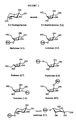
- a ⁇ -D-fructofuranose structure as shown in complex 1 ( Figure 1), was assigned to the p -tolylboronic acid and fructose complex.
- carbohydrates refers to compounds of carbon, hydrogen, and oxygen that contains the saccharose unit or its first reaction product, and in which the ratio of hydrogen to oxygen is the same as in water, giving molecular formulas of C n (H 2 O) m . They comprise: 1) monosaccharides, which refer to simple sugars that do not undergo hydrolysis of glycosidic bonds to give smaller sugar molecules ( e.g ., fructose and glucose); 2) disaccharides, sucrose, maltose, cellobiose, and lactose; and 3) polysaccharides ( i . e ., high polymeric substances).
- polyol refers to a polyhydric alcohol (i . e ., an alcohol containing three or more hydroxyl groups). Those having three hydroxyl groups ( i . e ., trihydric) are glycerols; those with more than three are called sugar alcohols, with the general formula CH 2 OH(CHOH) n CH 2 OH.
- D and L (i.e ., L- p -BPA) pertain to relative configurations of sugars and amino acids, based on an assumed configuration for (+)-glyceraldehyde.
- the "D” series has the same configuration as (+)-glyceraldehyde, and the “L” series, as (-)-glyceraldehyde.
- a racemic mixture (D,L) contains both "D” and "L” configurations.
- solubility is defined as the amount of a substance (i . e ., solute) that dissolves in a given volume of solvent at a given temperature. Solubility can be measured in terms of the mass ( i.e ., grams) of solute that dissolves per given volume or solvent, or in terms of the number of moles of solute that dissolves in a given volume of solution.
- solute refers to the process of dissolving a substance in a given volume of solvent.
- solvent refers to a substance capable of dissolving another substance (i.e., solute) to form a uniformly dispersed mixture (i.e., solution).
- solvent refers to one or more substances dissolved in another substance (i.e., solvent).
- solution refers to a uniformly dispersed mixture at the molecular or ionic level, of one or more substances ( i.e ., the solute) in one or more substances ( i . e ., the solvent).
- the terms “substantially dissolved” and “substantially solubilizing” refer to the extent that a solid substance (i . e ., L- p -boronophenylalanine-carbohydrate or polyol complex) is dissolved in a liquid (e.g ., water, isotonic saline or dilute saline solution), such that about less than 1% of the solid remain undissolved and suspended in solution.
- a liquid e.g ., water, isotonic saline or dilute saline solution
- freeze-drying or “lyophilization” refers to a method of dehydration or separation of water from biological materials.
- the material is first frozen and then placed in a high vacuum so that the water (i.e ., ice) vaporizes in the vacuum ( i . e ., sublimes) without melting, and the non-volatile components are left behind.
- filtration and “decanting” refer to methods for separating the components of a mixture containing a solid and a liquid.
- filtration the mixture is poured into a mesh, such as a filter paper, so that the liquid passes through and the solid is left behind.
- decanting the liquid is carefully poured out from the mixture.
- acid refers to a substance that produces hydronium ions in solution (H 3 O + ). Acids are referred to as strong or weak according to the concentration of H + ion that results from ionization. Examples of strong acids for use in the present invention include, but are not limited to hydrochloric, sulfuric and nitric acid.
- base refers to a substance that produces hydroxide (OH - ) ions in an aqueous solution. Bases are referred to as strong or weak according to the concentration of hydroxyl ion that results from ionization. Examples of strong bases for use in the present invention include, but are not limited to sodium hydroxide, potassium hydroxide, magnesium hydroxide, calcium hydroxide, and ammonium hydroxide.
- basic solution refers to a solution having a pH range of about 8-14.
- the basic solution for use in the presently claimed invention has a pH range of 8-10.
- salt-free refers to a solution or solid that does not contain the products of an acid-base neutralization reaction, such as NaCl, NaBr, Na 2 SO 4 , MgSO 4 , MgCl 2 , CaCl 2 , etc.
- essentially salt-free and "essentially salt-free complexes” refer to complexes with 1 equivalent or less of salt ( i . e ., NaCl) with respect to the complex ( i . e ., L- p -boronophenylalanine complexes).
- An "essentially salt-free" L- p -boronophenylalanine-fructose complex” refers to the complex having less than 10% by weight of NaCl salt.
- complex or “complex compound” refer to compounds formed by the bonding of a central ion with a molecule called a ligand or complexing agent.
- the present invention refers to L- p -boronophenylalanine complexed with carbohydrates or polyols.
- pH refers to a value representing the acidity or alkalinity of an aqueous solution, and is defined as the logarithm of the reciprocal of the hydrogen-ion concentration [H + ] of a solution.
- the pH scale characterizes the acidity of aqueous acid-base systems, using pure water having a pH of 7, as the standard.
- the pH range of acids is from about 6.9 to 1, and the pH range of bases is from 7.1 to 14. Solutions that are neither acidic nor basic are “neutral,” and has a pH of 7.
- physiological pH is used to refer to the pH of blood, which has a pH value of between 7.3 and 7.5.
- pD refers to a value representing the acidity or alkalinity of a deuterated solution.
- ion-exchange refers to a reversible chemical reaction between a solid (i . e ., an ion exchanger) and a liquid solution (i.e ., an aqueous solution), by means of which ions may be interchanged from one substance to another.
- ion-exchange media refers to the means by which ion-exchange can be performed.
- a preferred ion-exchange media is an ion-exchange resin, although other ion-exchange media are also contemplated for use in the present invention.
- ion-exchange resin refers to resins containing active groups (e.g ., sulfonic, carboxylic, phenol, or substituted amino groups), that are capable of exchanging a cation or an anion for a variety of ions brought into contact with the resin.
- active groups e.g ., sulfonic, carboxylic, phenol, or substituted amino groups
- An example of an ion-exchange resin for use in the present invention is the Dowex50WX4-50 ion exchange resin, although other ion-exchange resins performing similar function are also contemplated for use in the present invention.
- isotonic refers to the property of having the same concentration of solutes as blood (e . g ., “isotonic solution” refers to a saline solution having the same concentration of solutes as blood).
- iso-osmotic refers to the property of having equal osmotic pressure.
- iso-osmotic solution refers to a solution having equal osmotic pressure with that of blood.
- intravenous refers to a mode of administration of a substance such as a drug or a nutrient solution, within or into a vein.
- the room temperature solution was then filtered through a 0.2 ⁇ filter and then freeze-dried to give sodium L- p -boronophenylalanine-D-fructose complex (0.934 g).
- the solid can be hydrated with warm water (60 °C, solubility approximately 0.1 g/mL), and remains completely dissolved after prolonged standing ( i.e ., 48 hrs) at room temperature.
Landscapes
- Chemical & Material Sciences (AREA)
- Organic Chemistry (AREA)
- General Health & Medical Sciences (AREA)
- Biochemistry (AREA)
- Health & Medical Sciences (AREA)
- Molecular Biology (AREA)
- Life Sciences & Earth Sciences (AREA)
- Engineering & Computer Science (AREA)
- Biotechnology (AREA)
- Genetics & Genomics (AREA)
- Pharmaceuticals Containing Other Organic And Inorganic Compounds (AREA)
- Steroid Compounds (AREA)
- Saccharide Compounds (AREA)
- Polymers With Sulfur, Phosphorus Or Metals In The Main Chain (AREA)
- Medicinal Preparation (AREA)
Abstract
Description
Perugini et al. have investigated the encapsulation of p-BPA into liposomes applicable for boron neutron capture therapy as a complex with fructose and also as a free drug in two different pH-buffers. The influence of several variables on liposome morphology and drug content was investigated (Perugini et al., Journal of Microen-capsulation, Taylor and Francis Inc. London, GB, vol. 15, no. 4, 1 July 1998, pages 473 - 483).
| Complex Formation Constants for p-BPA and Some Monosaccharides. | |
| Monosaccharide | log Keq |
| Fructose | 3.2 |
| Sorbose | 2.7 |
| Ribose | 1.8 |
| Galactose | 1.6 |
| Glucose | 1.4 |
| Mannose | 1.3 |
| 2-Deoxygalactose | 0.6 |
| 2-Deoxyglucose | <0 |
| Complex Formation Constants for p-BPA and Some Disaccharides | |
| Disaccharide | log Keq |
| Maltulose | 3.1 |
| Lactulose | 3.0 |
| Palatinose | 2.6 |
| Leucrose | 1.7 |
| Turanose | 1.6 |
| Lactose | 0.2 |
| Maltose | 0.2 |
| Complex Formation Constants for p-BPA and Some Polyols | |
| Polyol | log Keq |
| Sorbitol | 3.2 |
| Mannitol | 2.7 |
| Xylitol | 2.5 |
| Adonitol | 1.7 |
| D,L Threitol | 1.3 |

Claims (20)
- A method of making essentially salt-free (p-boronophenylalanine) complexes, comprising:a) providing:i) p-boronophenylalanine,ii) water,iii) a compound selected from the group consisting of carbohydrates and polyols,iv) a base, andv) an ion-exchange media;b) mixing said p-boronophenylalanine, said water, said compound, and said base, to produce a basic solution, such that said p-boronophenylalanine and said compound are substantially dissolved in said basic solution, such that less than 1% of said p-boronophenylalanine and said compound remain undissolved;c) adding said ion-exchange media to said basic solution, thereby adjusting the pH of said basic solution to the range of between about 7.3 and 7.5, to produce a mixture at physiological pH; andd) removing said ion-exchange media from said mixture to produce an essentially salt-free (p-boronophenylalanine) complex in solution, wherein said essentially salt-free complex comprises less than 10% by weight of salt.
- The method of claim 1, further comprising the step of:e) freeze-drying said essentially salt-free (p-boronophenylalanine) complex in solution, to produce a freeze-dried essentially salt-free (p-boronophenylalanine) complex.
- The method according to claim 1, wherein said removing step comprises filtration.
- The method of claim 1, wherein said removing step comprises decanting.
- The method according to claim 1, wherein said ion-exchange media comprises an ion-exchange resin.
- The method according to claim 5, wherein said ion-exchange resin is Dowex 50WX4-50 ion-exchange resin.
- The method according to claim 1, wherein said basic solution comprises 1 equivalent of said p-boronophenylalanine and approximately 1.1 equivalents of said compound.
- The method according to claim 1, wherein said basic solution comprises 1 equivalent of said p-boronophenylalanine and an excess of up to 8 equivalents of said compound.
- The method according to claim 1, wherein said basic solution has a pH of between about 8 and 10.
- The method according to claim 1, wherein said compound is selected from the group consisting of monosaccharides, disaccharides, fructose, sorbose, ribose, galactose, glucose, mannose, 2-deoxygalactose, 2-deoxyglucose, maltulose, lactulose, palatinose, leucrose, turanose, lactose, maltose, sorbitol, mannitol, dulcitol, xylitol, adonitol and threitol.
- The method according to claim 1, wherein said base is selected from the group consisting of NaOH, KOH, Ca(OH)2 and Mg(OH)2.
- The method according to claim 1, wherein said p-boronophenylalanine is selected from the group consisting of (D,L)-p-boronophenylalanine and L-p-boronophenylalanine.
- A pharmaceutical composition comprising the freeze-dried essentially salt-free (p-boronophenylalanine) complex obtainable according to the method of claim 2 suitable for physiological use.
- A pharmaceutical composition according to claim 13, wherein the freeze-dried essentially salt-free p-boronophenylalanine complex is selected from the group consisting of L-p-boronophenylalanine-D-fructose complex, L-p-boronophenylalanine-D-sorbose complex, L-p-boronophenylalanine-D-maltulose complex, L-p-boronophenylalanine-D-lactulose complex, L-p-boronophenylalanine-D-palatinose complex, L-p-boronophenylalanine-D-sorbitol complex, L-p-borono-phenylalanine-D-mannitol complex, L-p-boronophenylalanine-dulcitol complex, and L-p-boronophenylalanine-xylitol complex.
- A method comprising the steps of:a) providing, in any order:i) the freeze-dried essentially salt-free (L-p-boronophenylalanine)-carbohydrate complex obtainable according to the method of claim 2, andii) a solvent, said solvent is selected from the group consisting of water, isotonic saline, and dilute saline;b) substantially solubilizing said freeze-dried salt-free (L-p-boronophenylalanine)-carbohydrate complex with said solvent, such that less than 1% of said freeze-dried salt-free (L-p-boronophenylalanine)-carbohydrate complex remains undissolved, to provide an iso-osmotic solution.
- The method of claim 15, wherein said freeze-dried salt-free (L-p-boronophenylalanine)-carbohydrate complex comprises a carbohydrate selected from the group consisting of monosaccharides, disaccharides, frutose, sorbose, ribose, galactose, glucose, mannose, 2-deoxygalactose, 2-deoxyglucose, maltulose, lactulose, palatinose, leucrose, turanose, lactose and maltose.
- The method of claim 15, wherein said iso-osmotic solution is suitable for intravenous use.
- A method comprising the steps of:a) providing, in any order:i) the freeze-dried essentially salt-free (L-p-boronophenylalanine)-polyol complex obtainable according to the method of claim 2, andii) a solvent, said solvent is selected from the group consisting of water, isotonic saline, and dilute saline;b) substantially solubilizing said freeze-dried salt-free (L-p-boronophenylalanine)-polyol complex with said solvent, such that less than 1% of said freeze-dried salt-free (L-p-boronophenylalanine)-polyol complex remains undissolved, to provide an iso-osmotic solution.
- The method of claim 18, wherein said iso-osmotic solution is suitable for intravenous use.
- The method of claim 18, wherein said essentially freeze-dried salt-free (L-p-boronophenylalanine)-polyol complex comprises a polyol selected from the group consisting of sorbitol, mannitol, dulcitol, xylitol, adonitol and threitol.
Applications Claiming Priority (3)
| Application Number | Priority Date | Filing Date | Title |
|---|---|---|---|
| US282847 | 1999-03-31 | ||
| US09/282,847 US6169076B1 (en) | 1999-03-31 | 1999-03-31 | P-Boronophenylalanine complexes with fructose and related carbohydrates and polyols |
| PCT/US2000/007833 WO2000057887A1 (en) | 1999-03-31 | 2000-03-24 | p-BORONOPHENYLALANINE COMPLEXES WITH FRUCTOSE AND RELATED CARBOHYDRATES AND POLYOLS |
Publications (3)
| Publication Number | Publication Date |
|---|---|
| EP1173184A1 EP1173184A1 (en) | 2002-01-23 |
| EP1173184A4 EP1173184A4 (en) | 2003-05-02 |
| EP1173184B1 true EP1173184B1 (en) | 2004-10-13 |
Family
ID=23083384
Family Applications (1)
| Application Number | Title | Priority Date | Filing Date |
|---|---|---|---|
| EP00918342A Expired - Lifetime EP1173184B1 (en) | 1999-03-31 | 2000-03-24 | para-BORONOPHENYLALANINE COMPLEXES WITH FRUCTOSE AND RELATED CARBOHYDRATES AND POLYOLS |
Country Status (8)
| Country | Link |
|---|---|
| US (1) | US6169076B1 (en) |
| EP (1) | EP1173184B1 (en) |
| JP (1) | JP4643017B2 (en) |
| AT (1) | ATE279201T1 (en) |
| AU (1) | AU3917000A (en) |
| CA (1) | CA2368634C (en) |
| DE (1) | DE60014881D1 (en) |
| WO (1) | WO2000057887A1 (en) |
Families Citing this family (19)
| Publication number | Priority date | Publication date | Assignee | Title |
|---|---|---|---|---|
| PT3078667T (en) | 2001-01-25 | 2018-12-28 | The United States Of America Represented By The Sec Dep Of Health And Human Services | FORMULATION OF BORONIC ACID COMPOUNDS |
| GB0222945D0 (en) * | 2002-10-03 | 2002-11-13 | Psimei Pharmaceuticals Plc | Therapeutic compositions |
| US20070104648A1 (en) * | 2005-11-09 | 2007-05-10 | Glyconix Corporation | Compositions, methods of preparing amino acids, and nuclear magnetic resonance spectroscopy |
| US20080050309A1 (en) * | 2006-08-25 | 2008-02-28 | Hadron Systems | Compositions of pharmaceuticals for use in low energy neutron therapy |
| JP5150084B2 (en) * | 2006-10-17 | 2013-02-20 | 日本ケミカルリサーチ株式会社 | Highly water-soluble p-boronophenylalanine-containing composition |
| US7442830B1 (en) | 2007-08-06 | 2008-10-28 | Millenium Pharmaceuticals, Inc. | Proteasome inhibitors |
| JP5345771B2 (en) * | 2007-08-27 | 2013-11-20 | 公立大学法人大阪府立大学 | Liquid composition containing p-boronophenylalanine and sorbitol |
| HRP20150592T4 (en) | 2008-06-17 | 2025-02-14 | Millennium Pharmaceuticals, Inc | ORGANOBORO ESTER COMPOUNDS AND THEIR PHARMACEUTICAL COMPOSITIONS |
| AR075090A1 (en) | 2008-09-29 | 2011-03-09 | Millennium Pharm Inc | ACID DERIVATIVES 1-AMINO-2-CYCLLOBUTILETILBORONICO PROTEOSOMA INHIBITORS, USEFUL AS ANTI-BANKER AGENTS, AND PHARMACEUTICAL COMPOSITIONS THAT UNDERSTAND THEM. |
| JP5933523B2 (en) | 2010-03-31 | 2016-06-08 | ミレニアム ファーマシューティカルズ, インコーポレイテッドMillennium Pharmaceuticals, Inc. | Derivatives of 1-amino-2-cyclopropylethylboronic acid |
| US8921533B2 (en) | 2011-07-25 | 2014-12-30 | Chromatin Technologies | Glycosylated valproic acid analogs and uses thereof |
| US9327025B2 (en) * | 2012-10-11 | 2016-05-03 | Hanif Kazerooni | Enriched 10-boron composition for cancer therapy and a method of synthesizing the same |
| SG10202003693RA (en) | 2014-05-20 | 2020-05-28 | Millennium Pharm Inc | Boron-containing proteasome inhibitors for use after primary cancer therapy |
| EP3757137B1 (en) * | 2018-02-20 | 2022-09-07 | Tokyo Institute of Technology | P-boronophenylalanine derivative and composition containing same, and kit for producing said derivative and composition |
| KR102562968B1 (en) * | 2018-11-01 | 2023-08-04 | 주식회사 셀비온 | p-Boronophenylalanine composition for Boron Neutron Capture Therapy and preparing method thereof |
| JP7297077B2 (en) * | 2019-04-26 | 2023-06-23 | 南京中硼▲聯▼康医▲療▼科技有限公司 | BPA freeze-dried formulation and manufacturing method |
| AU2020347682B2 (en) | 2019-09-12 | 2025-08-28 | Stella Pharma Corporation | Injection containing p-boronophenylalanine |
| AU2020345320B2 (en) | 2019-09-12 | 2025-09-04 | Stella Pharma Corporation | Method for preventing precipitation of injectable solution containing p-boronophenylalanine |
| AU2022409776A1 (en) * | 2021-12-13 | 2024-05-16 | Tenboron Oy | Pharmaceutical composition comprising p-boronophenylalanine |
Family Cites Families (2)
| Publication number | Priority date | Publication date | Assignee | Title |
|---|---|---|---|---|
| US5492900A (en) | 1993-09-10 | 1996-02-20 | Neutron Technology Corporation | Method for enhancing the solubility of the boron delivery drug, boronophenylalanine (BPA) |
| JP2979139B2 (en) * | 1998-03-11 | 1999-11-15 | 東北大学長 | Method for producing L-paraboronophenylalanine |
-
1999
- 1999-03-31 US US09/282,847 patent/US6169076B1/en not_active Expired - Fee Related
-
2000
- 2000-03-24 JP JP2000607637A patent/JP4643017B2/en not_active Expired - Fee Related
- 2000-03-24 AT AT00918342T patent/ATE279201T1/en not_active IP Right Cessation
- 2000-03-24 AU AU39170/00A patent/AU3917000A/en not_active Abandoned
- 2000-03-24 WO PCT/US2000/007833 patent/WO2000057887A1/en not_active Ceased
- 2000-03-24 DE DE2000614881 patent/DE60014881D1/en not_active Expired - Lifetime
- 2000-03-24 CA CA002368634A patent/CA2368634C/en not_active Expired - Fee Related
- 2000-03-24 EP EP00918342A patent/EP1173184B1/en not_active Expired - Lifetime
Also Published As
| Publication number | Publication date |
|---|---|
| WO2000057887A1 (en) | 2000-10-05 |
| JP4643017B2 (en) | 2011-03-02 |
| DE60014881D1 (en) | 2004-11-18 |
| CA2368634C (en) | 2007-06-26 |
| ATE279201T1 (en) | 2004-10-15 |
| AU3917000A (en) | 2000-10-16 |
| EP1173184A1 (en) | 2002-01-23 |
| JP2002540159A (en) | 2002-11-26 |
| EP1173184A4 (en) | 2003-05-02 |
| CA2368634A1 (en) | 2000-10-05 |
| US6169076B1 (en) | 2001-01-02 |
Similar Documents
| Publication | Publication Date | Title |
|---|---|---|
| US6169076B1 (en) | P-Boronophenylalanine complexes with fructose and related carbohydrates and polyols | |
| EP0413016B1 (en) | Novel compositions containing hyaluronic acid associates and a process for preparing same | |
| Tjarks et al. | Synthesis and in vitro evaluation of boronated uridine and glucose derivatives for boron neutron capture therapy. | |
| NL192683C (en) | "4" -Demethyl-epipodophyllotoxin glucoside compound as well as pharmaceutical composition with anti-tumor activity | |
| EP0306312B1 (en) | Lyophilized pharmaceutical composition of neocarzinostatin derivative | |
| Goulding | Liquid chromatography of sugars and related polyhydric alcohols on cation exchangers: The effect of cation variation | |
| US6048851A (en) | Solid pharmaceutical compositions for the oral administration of gallium | |
| Isbell et al. | Behavior of certain sugars and sugar alcohols in the présence of tetraborates-Correlation of optical rotation and compound formation | |
| CA2259520C (en) | Preparation for injection containing a lipid a analog and process for preparing the same | |
| EP3424932A1 (en) | Boronophthalides for therapeutic use | |
| PT93366A (en) | PROCESS FOR THE PREPARATION OF NEW SPECIALLY GLYCOSILATED INSULINES AND PHARMACEUTICAL DECOMPOSICO THAT CONTAINS THEM | |
| Shull et al. | Studies on the structure of the complex of the boron neutron capture therapy drug, L‐p‐boronophenylalanine, with fructose and related carbohydrates: Chemical and 13C NMR evidence for the β‐D‐fructofuranose 2, 3, 6‐(p‐phenylalanylorthoboronate) structure | |
| KR920009838A (en) | Complexes containing S (+)-phenyl alkanoic acid and amino sugars | |
| Hansbro et al. | The conformational behaviour of phosphatidylinositol in model membranes: 2H-NMR studies | |
| Yano et al. | Recent progress of functional glycoconjugated metal complexes | |
| HU228681B1 (en) | Crystal of diuridine tetraphosphate or salt thereof and method for preparing the same, and method for producing said compound | |
| JPH056557B2 (en) | ||
| EP0013625B1 (en) | Solubilized thymidine composition and method of producing same | |
| US3833729A (en) | Novel pyrazolidone derivatives in pharmaceutical compositions and methods | |
| HU213872B (en) | Oligo- and polygalacturonate mixed complex, pharmaceutical and food compositions containing them, further process for preparing these compounds | |
| CN103184196B (en) | Phosphatidyl-ethanolamine base superoxide dismutase composition and preparation method thereof | |
| Hecht et al. | Stereochemistry of nucleic acids and their constituents. XXVI. Crystal and molecular structure of a 1: 1 adduct of ethanol and 3'-deoxy-3'-(dihydroxyphosphinylmethyl) adenosine, and analog of adenosine 3'-monophosphate | |
| Schowen et al. | Catalysis in ester cleavage. I. Nucleophilic catalysis by acetate ion in the methanolysis of p-nitrophenyl acetate | |
| EP0533940A1 (en) | Crystalline potassium thionicotinamide-adenine dinucleotide phosphate and production thereof | |
| EP4431112A1 (en) | Lyophilized powder containing boron complex and method of forming the same |
Legal Events
| Date | Code | Title | Description |
|---|---|---|---|
| PUAI | Public reference made under article 153(3) epc to a published international application that has entered the european phase |
Free format text: ORIGINAL CODE: 0009012 |
|
| 17P | Request for examination filed |
Effective date: 20011005 |
|
| AK | Designated contracting states |
Kind code of ref document: A1 Designated state(s): AT BE CH CY DE DK ES FI FR GB GR IE IT LI LU MC NL PT SE |
|
| AX | Request for extension of the european patent |
Free format text: AL PAYMENT 20011005;LT PAYMENT 20011005;LV PAYMENT 20011005;MK PAYMENT 20011005;RO PAYMENT 20011005;SI PAYMENT 20011005 |
|
| A4 | Supplementary search report drawn up and despatched |
Effective date: 20030318 |
|
| 17Q | First examination report despatched |
Effective date: 20030626 |
|
| GRAP | Despatch of communication of intention to grant a patent |
Free format text: ORIGINAL CODE: EPIDOSNIGR1 |
|
| RTI1 | Title (correction) |
Free format text: PARA-BORONOPHENYLALANINE COMPLEXES WITH FRUCTOSE AND RELATED CARBOHYDRATES AND POLYOLS |
|
| GRAS | Grant fee paid |
Free format text: ORIGINAL CODE: EPIDOSNIGR3 |
|
| GRAA | (expected) grant |
Free format text: ORIGINAL CODE: 0009210 |
|
| AK | Designated contracting states |
Kind code of ref document: B1 Designated state(s): AT BE CH CY DE DK ES FI FR GB GR IE IT LI LU MC NL PT SE |
|
| AX | Request for extension of the european patent |
Extension state: AL LT LV MK RO SI |
|
| PG25 | Lapsed in a contracting state [announced via postgrant information from national office to epo] |
Ref country code: FR Free format text: LAPSE BECAUSE OF FAILURE TO SUBMIT A TRANSLATION OF THE DESCRIPTION OR TO PAY THE FEE WITHIN THE PRESCRIBED TIME-LIMIT Effective date: 20041013 Ref country code: IT Free format text: LAPSE BECAUSE OF FAILURE TO SUBMIT A TRANSLATION OF THE DESCRIPTION OR TO PAY THE FEE WITHIN THE PRESCRIBED TIME-LIMIT;WARNING: LAPSES OF ITALIAN PATENTS WITH EFFECTIVE DATE BEFORE 2007 MAY HAVE OCCURRED AT ANY TIME BEFORE 2007. THE CORRECT EFFECTIVE DATE MAY BE DIFFERENT FROM THE ONE RECORDED. Effective date: 20041013 Ref country code: AT Free format text: LAPSE BECAUSE OF FAILURE TO SUBMIT A TRANSLATION OF THE DESCRIPTION OR TO PAY THE FEE WITHIN THE PRESCRIBED TIME-LIMIT Effective date: 20041013 Ref country code: BE Free format text: LAPSE BECAUSE OF FAILURE TO SUBMIT A TRANSLATION OF THE DESCRIPTION OR TO PAY THE FEE WITHIN THE PRESCRIBED TIME-LIMIT Effective date: 20041013 Ref country code: NL Free format text: LAPSE BECAUSE OF FAILURE TO SUBMIT A TRANSLATION OF THE DESCRIPTION OR TO PAY THE FEE WITHIN THE PRESCRIBED TIME-LIMIT Effective date: 20041013 Ref country code: LI Free format text: LAPSE BECAUSE OF FAILURE TO SUBMIT A TRANSLATION OF THE DESCRIPTION OR TO PAY THE FEE WITHIN THE PRESCRIBED TIME-LIMIT Effective date: 20041013 Ref country code: CH Free format text: LAPSE BECAUSE OF FAILURE TO SUBMIT A TRANSLATION OF THE DESCRIPTION OR TO PAY THE FEE WITHIN THE PRESCRIBED TIME-LIMIT Effective date: 20041013 Ref country code: FI Free format text: LAPSE BECAUSE OF FAILURE TO SUBMIT A TRANSLATION OF THE DESCRIPTION OR TO PAY THE FEE WITHIN THE PRESCRIBED TIME-LIMIT Effective date: 20041013 |
|
| REG | Reference to a national code |
Ref country code: GB Ref legal event code: FG4D |
|
| REG | Reference to a national code |
Ref country code: CH Ref legal event code: EP |
|
| REG | Reference to a national code |
Ref country code: IE Ref legal event code: FG4D |
|
| REF | Corresponds to: |
Ref document number: 60014881 Country of ref document: DE Date of ref document: 20041118 Kind code of ref document: P |
|
| PG25 | Lapsed in a contracting state [announced via postgrant information from national office to epo] |
Ref country code: DK Free format text: LAPSE BECAUSE OF FAILURE TO SUBMIT A TRANSLATION OF THE DESCRIPTION OR TO PAY THE FEE WITHIN THE PRESCRIBED TIME-LIMIT Effective date: 20050113 Ref country code: SE Free format text: LAPSE BECAUSE OF FAILURE TO SUBMIT A TRANSLATION OF THE DESCRIPTION OR TO PAY THE FEE WITHIN THE PRESCRIBED TIME-LIMIT Effective date: 20050113 Ref country code: GR Free format text: LAPSE BECAUSE OF FAILURE TO SUBMIT A TRANSLATION OF THE DESCRIPTION OR TO PAY THE FEE WITHIN THE PRESCRIBED TIME-LIMIT Effective date: 20050113 |
|
| PG25 | Lapsed in a contracting state [announced via postgrant information from national office to epo] |
Ref country code: DE Free format text: LAPSE BECAUSE OF FAILURE TO SUBMIT A TRANSLATION OF THE DESCRIPTION OR TO PAY THE FEE WITHIN THE PRESCRIBED TIME-LIMIT Effective date: 20050114 |
|
| PG25 | Lapsed in a contracting state [announced via postgrant information from national office to epo] |
Ref country code: ES Free format text: LAPSE BECAUSE OF FAILURE TO SUBMIT A TRANSLATION OF THE DESCRIPTION OR TO PAY THE FEE WITHIN THE PRESCRIBED TIME-LIMIT Effective date: 20050124 |
|
| PG25 | Lapsed in a contracting state [announced via postgrant information from national office to epo] |
Ref country code: LU Free format text: LAPSE BECAUSE OF NON-PAYMENT OF DUE FEES Effective date: 20050324 Ref country code: CY Free format text: LAPSE BECAUSE OF FAILURE TO SUBMIT A TRANSLATION OF THE DESCRIPTION OR TO PAY THE FEE WITHIN THE PRESCRIBED TIME-LIMIT Effective date: 20050324 Ref country code: IE Free format text: LAPSE BECAUSE OF NON-PAYMENT OF DUE FEES Effective date: 20050324 |
|
| LTIE | Lt: invalidation of european patent or patent extension |
Effective date: 20041013 |
|
| PG25 | Lapsed in a contracting state [announced via postgrant information from national office to epo] |
Ref country code: MC Free format text: LAPSE BECAUSE OF NON-PAYMENT OF DUE FEES Effective date: 20050331 |
|
| NLV1 | Nl: lapsed or annulled due to failure to fulfill the requirements of art. 29p and 29m of the patents act | ||
| PLBE | No opposition filed within time limit |
Free format text: ORIGINAL CODE: 0009261 |
|
| STAA | Information on the status of an ep patent application or granted ep patent |
Free format text: STATUS: NO OPPOSITION FILED WITHIN TIME LIMIT |
|
| 26N | No opposition filed |
Effective date: 20050714 |
|
| EN | Fr: translation not filed | ||
| REG | Reference to a national code |
Ref country code: IE Ref legal event code: MM4A |
|
| PG25 | Lapsed in a contracting state [announced via postgrant information from national office to epo] |
Ref country code: PT Free format text: LAPSE BECAUSE OF NON-PAYMENT OF DUE FEES Effective date: 20050313 |
|
| REG | Reference to a national code |
Ref country code: CH Ref legal event code: PL Ref country code: CH Ref legal event code: PK Free format text: DAS PATENT WURDE INFOLGE NICHTEINTRITT DER WIRKUNG FUER CH/LI AUF DAS ERTEILUNGSDATUM ZURUECK GELOESCHT. |
|
| PGFP | Annual fee paid to national office [announced via postgrant information from national office to epo] |
Ref country code: GB Payment date: 20090330 Year of fee payment: 10 |
|
| GBPC | Gb: european patent ceased through non-payment of renewal fee |
Effective date: 20100324 |
|
| PG25 | Lapsed in a contracting state [announced via postgrant information from national office to epo] |
Ref country code: GB Free format text: LAPSE BECAUSE OF NON-PAYMENT OF DUE FEES Effective date: 20100324 |