EP1172871A2 - Fuel cells with gaseous electrolyte - Google Patents
Fuel cells with gaseous electrolyte Download PDFInfo
- Publication number
- EP1172871A2 EP1172871A2 EP01830458A EP01830458A EP1172871A2 EP 1172871 A2 EP1172871 A2 EP 1172871A2 EP 01830458 A EP01830458 A EP 01830458A EP 01830458 A EP01830458 A EP 01830458A EP 1172871 A2 EP1172871 A2 EP 1172871A2
- Authority
- EP
- European Patent Office
- Prior art keywords
- fuel cell
- comprised
- fuel
- cell according
- anode
- Prior art date
- Legal status (The legal status is an assumption and is not a legal conclusion. Google has not performed a legal analysis and makes no representation as to the accuracy of the status listed.)
- Withdrawn
Links
Images
Classifications
-
- H—ELECTRICITY
- H01—ELECTRIC ELEMENTS
- H01M—PROCESSES OR MEANS, e.g. BATTERIES, FOR THE DIRECT CONVERSION OF CHEMICAL ENERGY INTO ELECTRICAL ENERGY
- H01M8/00—Fuel cells; Manufacture thereof
-
- H—ELECTRICITY
- H01—ELECTRIC ELEMENTS
- H01M—PROCESSES OR MEANS, e.g. BATTERIES, FOR THE DIRECT CONVERSION OF CHEMICAL ENERGY INTO ELECTRICAL ENERGY
- H01M4/00—Electrodes
- H01M4/86—Inert electrodes with catalytic activity, e.g. for fuel cells
- H01M4/90—Selection of catalytic material
-
- Y—GENERAL TAGGING OF NEW TECHNOLOGICAL DEVELOPMENTS; GENERAL TAGGING OF CROSS-SECTIONAL TECHNOLOGIES SPANNING OVER SEVERAL SECTIONS OF THE IPC; TECHNICAL SUBJECTS COVERED BY FORMER USPC CROSS-REFERENCE ART COLLECTIONS [XRACs] AND DIGESTS
- Y02—TECHNOLOGIES OR APPLICATIONS FOR MITIGATION OR ADAPTATION AGAINST CLIMATE CHANGE
- Y02E—REDUCTION OF GREENHOUSE GAS [GHG] EMISSIONS, RELATED TO ENERGY GENERATION, TRANSMISSION OR DISTRIBUTION
- Y02E60/00—Enabling technologies; Technologies with a potential or indirect contribution to GHG emissions mitigation
- Y02E60/30—Hydrogen technology
- Y02E60/50—Fuel cells
Definitions
- the present invention concerns a fuel cell with gaseous electrolyte.
- the invention relates to a fuel cell and to the batteries and electric energy generation systems obtained by the same, exploiting the gaseous intermediate products of the catalytic combustion reactions of hydrocarbons, or of the gas mixtures having features equivalent, as electrolyte.
- Each one of the above mentioned passages involves a loss of energy, involving the reduction of the efficiency that can be obtained, calculated as power that can be effectively used with respect to the nominally available power.
- a fuel cell works as a battery, with the difference due to the fact that electrochemical reactions, generating electric energy, are due to the fuel introduced from outward, being in this way possible to deliver infinite energy until the feeding of the fuel is prosecuted.
- a fuel cell is essentially comprised of two electrodes, anode and cathode, between which an electrolyte is interposed, allowing the migration of ions.
- the oxidation reaction of the fuel gas occurs on the anode, with the production of electrons, flowing along the outer circuit, while the reduction reaction of the comburent gas occurs on the cathode, using the same electrons coming from the outer electric circuit.
- Electrolyte is the means through which the passage of the ion flow occurs. According to the nature of the electrolyte, migrating ions can be positive ions (directed toward the cathode) or negative ions (directed toward the anode). After having passed through the electrolyte, ions react with the relevant counter-ions to create the final product, with the generation of energy.
- Fuel fed to the anode can be hydrogen, carbon (and in this case they are called direct fuel cells) or their compounds, along with other elements, such as, for example, carbon oxide, alcohol, methane or other hydrocarbons, (in this case they are called indirect fuel cells); furthermore, fuel can be solid, liquid or gaseous.
- oxygen or more simply air, is fed to the cathode.
- each carbon atom must first free four electrons by the formation of a carbon ion; oxygen atoms catch these four electrons and consequently assume a negative charge.
- the principle of the fuel cell is essentially the separation in the space of the two partial ionisation reactions; in this way, transfer of electrons can not directly occur from atom to atom (or from molecule to molecule), but only through a suitable conductor; passing through the user circuit, electrons must produce a work and only after, once reached the calculation, can reduce the oxygen in a suitable way according to the following reaction: O 2 + 4 e ⁇ 2 O 2-
- Negative oxygen ions thus obtained diffuse through the electrolyte and arrive to the anode where they combine with the carbon ions to form CO 2 .
- the determining feature to improve the kinetic of a reaction is the control of the electrochemical phenomenons occurring to the electrodes and within the electrolyte.
- PAFC phosphoric acid fuel cells
- MCFC molten carbonate fuel cells
- SOFC solid oxide fuel cells
- AFC alkaline fuel cells
- SPFC solid polymer fuel cells
- AFC, SPFC, PAFC fuel cells work at low temperatures and consequently have minor technological problems and allow the use of structural materials not particularly valuable. On the contrary, they require noble metal based catalysts and have worse efficiencies than the MCFC and SOFC cells. The latter work at very higher temperatures (600 - 1000°C) and have higher technological difficulties, but they have a higher flexibility with respect to the fuel (being of the indirect kind). Furthermore, high temperature of the residual heat can allow the integration in combined cycles, thus allowing to reach total efficiencies of 60 - 65%.
- Fuel cell and battery subject matter of the present invention are completely new and inventive, since for the first time they employ a gaseous electrolyte, obtained by the catalytic combustion of hydrocarbons, allowing power density and efficiencies remarkably higher with respect to the systems presently available.
- the present invention is extremely advantageous since uses for its working gases usually manufactured in the traditional industrial systems such as refineries and power generation systems.
- a fuel cell to generate electric energy from the electrolytic reaction of a fuel with oxygen comprising at least a system comprised of an anode and a cathode separated by an electrolyte that allows the passage of a ion flow and of an outer circuit that allows the passage of an electron flow, characterised in that the electrolyte is a gas.
- said gaseous electrolyte can be comprised of gaseous intermediate products of the catalytic combustion reaction of hydrocarbons.
- said hydrocarbons can be methane, propane or other gaseous hydrocarbons.
- catalyst of said catalytic combustion reaction is comprised of different ceramic materials, such as porous or dust, or wire shaped, wire woven and other ceramic materials commonly used for similar reactions; said catalyst particularly comprising clay ( 3Al 2 O 3 ⁇ 2SiO 2 ) and albite feldspar( NaAlSi 3 O 8 ) in different types, porous or dust solid form, wire shaped, wire woven.
- oxygen reacting to the cathode is provided by an air feeding as comburent gas
- fuel reacting at the anode comprises a fraction of the gaseous intermediate products of said catalytic combustion reaction, and can further comprise hydrogen, carbon, or their compounds, along with or with other elements, such as steam, carbon oxide, alcohol, methane and other hydrocarbons.
- cathode is comprised of iron, while anode is comprised of nickel, but electrodes can also be comprised of nickel, platinum, and other catalysts usually employed for the same use.
- a voltage continua G can be applied, generating an excitation electrical field.
- Gaseous electrolyte subject matter of the present invention can be obtained from the catalytic combustion of hydrocarbons.
- hydrocarbons For exemplificative, but not limitative, purposes, in this and in the following examples the use of methane will be taken into consideration.
- ceramic material such as solid, porous or dusty, wire shaped, wire woven, materials, can be employed, or other materials normally used for this kind of reactions.
- Catalysts have acid nature, in other words they are electron acceptors.
- radical groups their chemical formula has the symbol ( ⁇ ), while ionic groups will be individuated by the mark of the electric charge characterising the same. It must be remembered that the difference between a radical and a ion essentially is in the fact that, even having both valence free, the first one is electrically neutral, while the second one has a positive or negative charge, i.e. it has one or more electrons, less or exceeding.
- paracetic acid CH 3 COOH
- HCHO a single intermediate compound is obtained, paracetic acid ( CH 3 COOH ), further oxidisable to produce free radicals, water, carbon oxide and HCHO .
- air can be mixed with fuel and make flowing, for example, through a clay catalyst ( 3Al 2 O 3 ⁇ 2SiO 2 ) and albite feldspar( NaAlSi 3 O 8 ), in the dusty solid form or in the form of thin woven wires.
- a clay catalyst 3Al 2 O 3 ⁇ 2SiO 2
- albite feldspar NaAlSi 3 O 8
- the mass of stoichiometric air can be determined with the following formula: wherein by m and n the numbers of carbon atoms and hydrogen are indicated intervening in the hydrocarbon molecule C m H n and ⁇ is a summation comprising all the present hydrocarbons in the fuel.
- ⁇ a ⁇ 0 p p 0 T 0 T
- ⁇ 0 1,296 kg/m 3
- p 0 1 bar
- T 0 273 K
- p and T are respectively inlet pressure and temperature.
- theoretic air necessary for the combustion is, in the ratio in weight with respect to the fuel, 17.45 ( kg/kg ) and, in the ratio in volume, 10.54 ( m 3 /m 3 ). Methane concentration within air corresponds to 6.8% in volume.
- Inflammability limits for methane in air, in volume, are 5% and 15%.
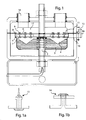
- a Venturi mixer 1 such as Bunsen burner
- Mixture passes into the filtering chamber 2 and, through a ceramic catalyst 3, into a subsequent combustion chamber 4, wherein, after having been ignited by a spark or a pilot flame, the catalytic combustion of methane occurs, mainly with the formation of CO 2 , ions and radicals that, as a whole, comprise the gaseous electrolyte.
- Clay 3Al 2 O 3 ⁇ 2SiO 2
- albite feldspar NaAlSi 3 O 8
- catalyst such as porous solid or dusty, wire shaped, woven wires. The methane reaction occurs on the catalyst, in a condition of low air.
- Gaseous electrolyte so generated on the limit surface between catalyst 3 and combustion chamber 4 passes, through a holed septum 5, comprised of a not conductive material, within the production cell 6.
- Production cell is comprised of the holed septum 5, provided with different iron cathodes 7, series/parallel coupled each other, and of another holed septum 8, comprised of not conductive material, provided with different nickel anodes 9, series/parallel coupled each other.
- Holed septums 5 and 8 are comprised of ceramic material to withstand to the high temperatures of the catalytic combustion.
- Cathodes 5 are connected to a positive terminal 10.
- Anodes 8 are connected to a negative terminal 11.
- reactions occurring on the cathode are the following: O 2 + 4 e ⁇ 2 O 2- 2 O 2- +2 CO 2 ⁇ 2 CO 2- 3 i.e., as a whole O 2 + 2 CO 2 + 4 e ⁇ 2 CO 2- 3 wherein electrons are those produced on the anode, oxygen is that of air and CO 2 is a product of the preceding combustion.
- Ions CO 2- / 3 produced on the cathode are displaced toward anode by the auxiliary excitation electric field, where they react with the instable ions CH + / 2 e H + , produced by the preceding catalytic combustion, yielding electrons and creating carbon dioxide, according to the following reactions: CO 2- 3 + CH + 2 ⁇ CO 2- 2 + H 2 O CO 2- 3 + 2 H + ⁇ CO 2 + H 2 O CO 2- 2 ⁇ CO 2 + 4 e i.e., as a whole, 2 CO 2- 3 + CH + 2 + 2 H - ⁇ 2 CO 2 + 2 H 2 O + 4 e
- Electrons produced on the anode passes to the cathode by the outer loading 16, or, in absence of this load, determine the potential difference between electrodes.
- the reaction can be improved according to the following scheme: CH 4 + H 2 O ⁇ CO + 3H 2 CO + H 2 O ⁇ CO 2 + H 2 i.e. as a whole, CH 4 + 2 H 2 O ⁇ CO 2 + 4 H 2 and 2 H 2 ⁇ 4 H + + 4 e 2 CO 2- 3 + 4 H + ⁇ 2 CO 2 + 2 H 2 O i.e. as a whole 2 H 2 + 2 CO 2- 3 ⁇ 2 CO 2 + 2 H 2 O + 4e
- Burnt gases, along with the residual of the production cells, are collected within the chamber 17 and vented in the atmosphere by the suitable conducts 18.
- Scheme of the elementary cell of figure 1 can be repeated many times, with the cell connected each other in series, to obtain the wished voltage and continuos current.
Landscapes
- Life Sciences & Earth Sciences (AREA)
- Engineering & Computer Science (AREA)
- Manufacturing & Machinery (AREA)
- Sustainable Development (AREA)
- Sustainable Energy (AREA)
- Chemical & Material Sciences (AREA)
- Chemical Kinetics & Catalysis (AREA)
- Electrochemistry (AREA)
- General Chemical & Material Sciences (AREA)
- Fuel Cell (AREA)
- Inert Electrodes (AREA)
Abstract
Description
- a pre-mixer of the gaseous hydrocarbon and oxygen or air;
- a filtering chamber and a subsequent catalytic combustion chamber for said gaseous mixture;
- a fuel battery according to the present invention;
- a chamber to collect burnt gases and to exhaust the same in the atmosphere.



| Fuel | CH4 , C3H8 , other hydrocarbons |
| Working temperature | 800-1100 |
| Working pressure | |
| 1 kg/cm2 | |
| Pair voltage | 0,8-1,2 V |
| Current density | 100-300 mA/cm2 |
Claims (14)
- Fuel cell to generate electric energy from the electrolytic reaction of a fuel with oxygen, comprising at least a system comprised of an anode and a cathode separated by an electrolyte that allows the passage of a ion flow and of an outer circuit that allows the passage of an electron flow, characterised in that the electrolyte is a gas.
- Fuel cell according to claim 1, characterised in that said gaseous electrolyte is comprised of gaseous intermediate products of the catalytic combustion reaction of hydrocarbons.
- Fuel cell according to claim 2, characterised in that said hydrocarbons can be methane, propane or other gaseous hydrocarbons.
- Fuel cell according to claim 2 or 3, characterised in that catalyst of said catalytic combustion reaction is comprised of different ceramic materials, such as porous or dust, or wire shaped, wire woven and other ceramic materials commonly used for similar reactions.
- Fuel cell according to one of the preceding claims 2 - 4, characterised in that said catalyst comprises clay (3Al2O3·2SiO2 ) and albite feldspar(NaAlSi3O8 ) in different types, porous or dust solid form, wire shaped, wire woven.
- Fuel cell according to one of the preceding claims, characterised in that oxygen reacting to the cathode is provided by an air feeding as comburent gas.
- Fuel cell according to one of the preceding claims, characterised in that fuel reacting at the anode comprises a fraction of the gaseous intermediate products of said catalytic combustion reaction.
- Fuel cell according to one of the preceding claims 1 - 6, characterised in that said fuel reacting at the anode comprises hydrogen, carbon, or their compounds, along with or with other elements, such as steam, carbon oxide, alcohol, methane and other hydrocarbons.
- Fuel cell according to one of the preceding claims 1 - 7, characterised in that cathode is comprised of iron, while anode is comprised of nickel.
- Fuel cell according to one of the preceding claims 1 - 6 and 8, characterised in that electrodes are be comprised of nickel, platinum, and other catalysts usually employed for the same use.
- Fuel cell according to one of the preceding claims, characterised in that between anode and cathode a voltage continua G can be applied, said voltage generating an excitation electrical field.
- Fuel battery characterised in that it is comprised of at least an elementary cell as claimed in each one of the preceding claims.
- Electrical energy generator, characterised in that it comprises:a pre-mixer of the gaseous hydrocarbon and oxygen or air;a filtering chamber and a subsequent catalytic combustion chamber for said gaseous mixture;at least a fuel cell according to each one of the preceding claims;a chamber to collect burnt gases, andat least an exhaust conduct to exhaust the burnt gases in the atmosphere.
- Electrical energy generator according to claim 13, characterised in that it further comprises:a holed septum comprised of not conductive material, placed between the combustion chamber and the fuel cell;a second holed septum comprised of not conductive material, placed between the fuel cell and the chamber for collecting the burnt gases, anda system for the direct introduction of air on the cathode and of a fuel on the anode.
Applications Claiming Priority (2)
| Application Number | Priority Date | Filing Date | Title |
|---|---|---|---|
| IT2000RM000375A IT1317057B1 (en) | 2000-07-10 | 2000-07-10 | GAS ELECTROLYTE FUEL CELL. |
| ITRM000375 | 2000-07-10 |
Publications (2)
| Publication Number | Publication Date |
|---|---|
| EP1172871A2 true EP1172871A2 (en) | 2002-01-16 |
| EP1172871A3 EP1172871A3 (en) | 2004-12-22 |
Family
ID=11454825
Family Applications (1)
| Application Number | Title | Priority Date | Filing Date |
|---|---|---|---|
| EP01830458A Withdrawn EP1172871A3 (en) | 2000-07-10 | 2001-07-10 | Fuel cells with gaseous electrolyte |
Country Status (2)
| Country | Link |
|---|---|
| EP (1) | EP1172871A3 (en) |
| IT (1) | IT1317057B1 (en) |
Family Cites Families (2)
| Publication number | Priority date | Publication date | Assignee | Title |
|---|---|---|---|---|
| US4377445A (en) * | 1980-11-07 | 1983-03-22 | Exxon Research And Engineering Co. | Shunt current elimination for series connected cells |
| WO2001089024A1 (en) * | 2000-05-16 | 2001-11-22 | University College London | Electrochemical methods and cells |
-
2000
- 2000-07-10 IT IT2000RM000375A patent/IT1317057B1/en active
-
2001
- 2001-07-10 EP EP01830458A patent/EP1172871A3/en not_active Withdrawn
Also Published As
| Publication number | Publication date |
|---|---|
| ITRM20000375A1 (en) | 2002-01-10 |
| ITRM20000375A0 (en) | 2000-07-10 |
| IT1317057B1 (en) | 2003-05-26 |
| EP1172871A3 (en) | 2004-12-22 |
Similar Documents
| Publication | Publication Date | Title |
|---|---|---|
| Huang et al. | Superior perovskite oxide‐ion conductor; strontium‐and magnesium‐doped lagaO3: III, performance tests of single ceramic fuel cells | |
| US5874183A (en) | Molten carbonate fuel cell and power generation system including the same | |
| EP1228547B1 (en) | Fuel cell system | |
| AU2013276596B2 (en) | Gas distribution element for a fuel cell | |
| US7163759B2 (en) | Solid oxide fuel cell stack assembly having tapered diffusion layers | |
| CA2343740A1 (en) | Solid oxide fuel cell which operates with an excess of fuel | |
| EP2675006A1 (en) | Gas distribution element with a supporting layer | |
| EP2675007A1 (en) | A gas flow dividing element | |
| US5587251A (en) | Ceramic gas supply components for fuel cells comprising zirconium oxide solid electrolyte | |
| US20050233188A1 (en) | Fuel cell operation method | |
| US6991867B1 (en) | Fuel cell | |
| CN113241462A (en) | Combined type molten carbonate fuel cell power generation system and method | |
| EP1172871A2 (en) | Fuel cells with gaseous electrolyte | |
| US20110053032A1 (en) | Manifold for series connection on fuel cell | |
| CN218160479U (en) | Near-zero carbon emission direct coal fuel cell stack power generation device | |
| CN114335633B (en) | A near-zero carbon emission direct coal fuel cell stack power generation device and power generation method | |
| Mogensen et al. | Fuel cells-familiar principles for electricity generation | |
| KR100488723B1 (en) | A bipolar plate for fuel cell comprising prominence and depression type gas flow channel | |
| Kiatkittipong et al. | Simulation of oxidative coupling of methane in solid oxide fuel cell type reactor for C2 hydrocarbon and electricity co-generation | |
| KR100424195B1 (en) | Fuel cell separator plate comprising bidirectional slot plate | |
| Sasaki et al. | Power generation characteristics of SOFCs for alcohols and hydrocarbon-based fuels | |
| JP2004281257A (en) | A method for co-production of electric power hydrogen using nuclear heat | |
| WO2025198483A1 (en) | Hybrid seal for stack of electrochemical cells, especially solid electrolyte cells, stack of electrochemical cells and method for manufacturing a stack of electrochemical cells | |
| Tian et al. | Study of a Single‐Chamber Solid Oxide Fuel Cell Microstack with V‐Shaped Congener‐Electrode‐Facing Configuration | |
| KR100477201B1 (en) | Bipolar Plate for Fuel Cell comprising Zigzag Type Gas Flow Channel |
Legal Events
| Date | Code | Title | Description |
|---|---|---|---|
| PUAI | Public reference made under article 153(3) epc to a published international application that has entered the european phase |
Free format text: ORIGINAL CODE: 0009012 |
|
| AK | Designated contracting states |
Kind code of ref document: A2 Designated state(s): AT BE CH CY DE DK ES FI FR GB GR IE IT LI LU MC NL PT SE TR |
|
| AX | Request for extension of the european patent |
Free format text: AL;LT;LV;MK;RO;SI |
|
| PUAL | Search report despatched |
Free format text: ORIGINAL CODE: 0009013 |
|
| RIC1 | Information provided on ipc code assigned before grant |
Ipc: 7H 01M 8/24 B Ipc: 7H 01M 8/00 A |
|
| AK | Designated contracting states |
Kind code of ref document: A3 Designated state(s): AT BE CH CY DE DK ES FI FR GB GR IE IT LI LU MC NL PT SE TR |
|
| AX | Request for extension of the european patent |
Extension state: AL LT LV MK RO SI |
|
| AKX | Designation fees paid | ||
| REG | Reference to a national code |
Ref country code: DE Ref legal event code: 8566 |
|
| STAA | Information on the status of an ep patent application or granted ep patent |
Free format text: STATUS: THE APPLICATION IS DEEMED TO BE WITHDRAWN |
|
| 18D | Application deemed to be withdrawn |
Effective date: 20050623 |