Background of the Invention
Field of the Invention
The present invention relates to a copying machine for
generating copies of an image on an original document, a
copying-operation control device for controlling operations
of a scanner and a printer for a copying operation, and a computer
readable recording medium for operating a computer as such a
copying-operation control device.
Related Art
Some types of copying machines allow a user to designate
copying conditions (e.g., density and magnifying power) for
the next copying work when the copying machine performs a copying
operation. Those types of copying machines are disclosed in
JP-A-62-166369, JP-B-2820262, JP-B-2901688 and others.
Those copying machines are of the analog type in which
an image on an original document located on a document table
is directly imaged on a photosensitive drum, and the formed
image is developed onto a copy sheet by electrophotography
technique. A recent general copying machine is made up of a
reading section for generating image data representative of
an image on an original document, a printing section for printing
a picture representative of the image data, and a control section
having copying conditions accepting function for accepting a
designation of copying conditions and control function for
controlling the reading section and the printing section in
an integrating manner and causing the printing section to
generate copies of the document image.
In this type of copying machine (referred to as a digital
copying machine), the process executed by the mechanical system
in the analog copying machine is allotted to the control section,
and electronically executed.
Specifically, the control section of the digital copying
machine executes a procedural process as shown in Fig. 18 when
a copy start is instructed (when a copy start button is depressed) .
The procedural process illustrated in the figure is executed
when the copying machine with an automatic document feeder
generates one copy of a document image under control of its
control section.
Namely, the control section instructs the reading section
to read an image on a first original document (step S300). When
the printing section can accept a predetermined amount of data
(step S301; YES), the control section judges whether storage
image data (to be described in detail later) is stored (retained)
(step S302). If the storage image data is not stored (step
S302; NO) , the control section transfers a predetermined amount
of image data (usually image data of several lines) from the
reading section to the printing section (step SS303).
Thereafter, the control section judges whether the reading
process of the original document is completed (step S306), and
if the reading process is not completed (step S306; NO), the
control section executes the process that starts from the step
S301.
The procedural steps mentioned above is progressively
and repeatedly executed, and the printing section is put in
a state that it cannot accept the data (step S301; NO), the
control section obtains a predetermined amount of the image
data from the reading section, and stores it as storage image
data into an internal memory (step S305). Then, the control
section judges whether the reading process of the document image
is completed in the step S306.
When the control section recognizes that the storage image
data is present in the internal memory (step S302; YES) and
the printing section can accept the data (step S301; YES), the
control section supplies a predetermined amount of the storage
image data (which was earliest stored) to the printing section,
and abandons the storage image data (makes free the memory area
storing the storage image data having been supplied) (step S304).
Then, the control section obtains the image data from the reading
section and stores it (step S305), and executes (judges) a
process of a step S306.
The control section progressively operates according to
the procedural steps mentioned above, and when the reading
process of the document image is completed (step S306; YES),
the control section judges whether the storage image data is
present (step S307). The control section judges whether the
supplying of one sheet of the image data to the printing section
is completed on the basis of the result of the judgment of whether
the storage image data is present.
When the storage image data is present (step S307; YES),
the control section waits till the printing section becomes
ready for accepting the predetermined amount of data. When
the printing section becomes ready for accepting the data (step
S308; YES), the control section supplies the predetermined
amount of the image data to the printing section and abandons
the data (step S309), and the control section returns to the
step S307.
The control section gets out of a loop consisting of steps
S307 to S309 when the storage image data is used up (step S307;
NO), and judges whether the next document is present (step S310).
At a stage that the document reading operation ends (step S306;
YES), if the storage image data is not present (step S307; NO) ,
the control section executes the step S301 to judge whether
the next document is present without executing the step S308
and the other.
If the next document is present (step S310; YES), the
control section instructs the reading section to read an image
on the next original document (step S311), and then executes
again the process starting from the step S301. If the document
to be copied runs out (step S310; YES), the control section
ends the illustrated process.
As described above, the related digital copying machine
repeats the execution of the process every document, as the
analog copying machine does so.
Accordingly, in the related digital copying machine, even
if it is of such a type that copying conditions may be set during
the execution of a copying process, when the machine is executing
a copying process on a document, it is impossible to start a
copying process on another document. The reason for this is
that the related copying machine, in which the execution of
a copying process progresses, rejects the setting of another
document thereto (or does not start the reading of the document
set) till the current copying process execution ends.
Summary of the Invention
Accordingly, a first object of the present invention is
to provide a copying machine in which a waiting time for a user
to wait till a copying process being executed in response to
an instruction by another user or the user himself ends, is
shorter than in the related copying machine.
A second object of the present invention is to provide
a copying-operation control device which operates as the copying
machine of the first object when it is combined with a scanner
and a printer.
A third object of the present invention is to provide
a computer readable recording medium whose contents enables
a computer to operate as the copying-operation control device
of the second object.
To achieve the above objects, there is provided a copying
machine comprising:
Thus, in the copying machine of the present invention,
to end a copy job, a process to generate image data from an
original document and a process to cause a printing section
to print (output the copying result) in accordance with the
image data are independently and concurrently carried out.
When the reading unit is not in reading operation, the machine
accepts a start command of a copy job. When the reading unit
and the printing unit are constituted by a general hardware,
the reading unit completes its operation earlier than the
printing unit. Accordingly, in a copying machine using the
printing unit and the reading unit which are designed in general
structure, an original document to next be copied may be set
to the machine and a start command of a copy job may be issued
(for example, a start button may be pushed) before the printing
unit outputs the printing result of one printing sheet (or a
plurality of printing sheets) . Accordingly, where the copying
machine thus constructed is used, a time for a user to wait
till a copying process being executed in response to an
instruction by another user or the user himself ends, is shorter
than in the conventional copying machine.
The copying machine may be realized by additionally
including:
In the copying machine of the invention, the image data
generation and the image data printing are independently carried
out. Accordingly, there is a chance that some copy jobs being
not yet completed in execution are present. Use of the copying
machine arranged as last mentioned is preferable in order to
designate a copy job to be halted in execution in such a case.
The copying machine may also be realized by additionally
including:
A copying-operation control device connectable to a
scanner and a printer of the present invention comprises:
When the copying-operation control device of the
invention is connected to a scanner and a printer, it operates
as a copying machine, which functions like the copying machine
of the invention.
The present invention provides another copying-operation
control device connectable to at least one scanner and at least
one printer, the copying-operation control device comprising:
When the copying-operation control device is connected
to one or more scanners and one or more printers, it operates
like the copying machine of the invention. In this case, the
scanner used for reading a document image may be selected from
among one or more scanners, and the printer for outputting the
result of copying operation may be selected from among one or
more printers.
According to the present invention, a recording medium
storing a program including instructions, wherein the
instructions, when executed by a computer connected to a scanner
and a printer, cause the computer to perform the steps of:
Accordingly, when the program is executed, a system
including a scanner, a printer and a computer may be operated
like the copying machine of the invention.
The present invention provides another copying machine
comprising:
wherein the copy-job management data forming unit forms
copy-job management data whether or not the printing unit is
in operation.
The above copying machine may be realized such that the
copy-job management data forming unit forms the copy-job
management data including information of the reading operation
and information of the printing operation; the managing unit
is capable of managing a plurality of copy-job management data,
and transfers another copy-job management data to the copy-job
executing unit at a time point that a reading operation of a
copy job being currently executed ends; and the copy-job
executing units refers to the information of the reading
operation and the information of the printing operation which
are contained in the copy-job management data received from
the managing unit, and concurrently operates the reading unit
and the printing unit.
The copying machine may also be realized such that the
copying machine includes a job cancel accepting unit which
accepts the designation of the copy job to be canceled, and
the managing unit manages the copy-job management data in the
order of forming the copy-job management data, causes the
copy-job executing unit to execute the copy-job management data
in the data forming order, and abandons the copy-job management
data on the copy job when the job cancel accepting unit accepts
the designation of the copy job to be canceled.
The present disclosure relates to the subject matter
contained in Japanese patent application Nos. 2000-195506
(filed on June 29, 2001) and 2001-105525 (filed on April 4,
2001), which are expressly incorporated herein by reference
in their entireties.
Brief Description of the Drawings
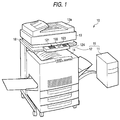
Fig. 1 is an outer appearance of a copying machine which
is an embodiment of the present invention.
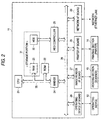
Fig. 2 is a block diagram showing a hardware arrangement
of the copying machine of the invention.
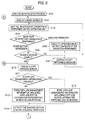
Fig. 3 is a flow chart showing a process which is executed
in a main body of a copying-operation control device.
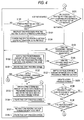
Fig. 4 is a flow chart showing the process executed in
the main body of the copying-operation control device.
Fig. 5 is a flow chart showing the process executed in
the main body.
Fig. 6 is a flow chart showing the process executed in
the main body.
Fig. 7 is a flow chart showing the process executed in
the main body.
Fig. 8 is a flow chart showing the process executed in
the main body.
Fig. 9 is a diagram showing a basic screen presented by
an operating device of the copying machine.
Fig. 10 is a diagram showing a screen a copy process screen
presented by the operating device.
Fig. 11 is a diagram showing a list of copy-job management
information stored in the main body of the copying-operation
control device.
Fig. 12 is a diagram showing a copy process screen, which
is presented by the operating device when a reading control
process is completed.
Fig. 13 is a diagram showing a basic screen presented
by the operating device when a "next copying" button is
depressed.
Fig. 14 is a timing chart showing a control operation
of the main body of the copying-operation control device.
Fig. 15 is a flow chart showing an operation procedure
of the main body of the copying-operation control device when
a stop button is depressed.
Fig. 16 is a diagram showing a copying-being-halted screen
presented by the operating device when the Fig. 15 process is
executed.
Fig. 17 is a diagram showing another copying-being-halted
screen presented by the operating device when the Fig. 15 process
is executed.
Fig. 18 is a flow chart showing an operation procedure
executed under control of a control section in a general copying
machine.
Description of the Preferred Embodiments
The preferred embodiments of the present invention will
be described with reference to the accompanying drawings.
An arrangement of a copying machine which is an embodiment
of the present invention will be described with reference to
Figs. 1 and 2 . Fig. 1 is an outer appearance of a copying machine
which is an embodiment of the present invention. Fig. 2 is
a block diagram showing a hardware arrangement of the copying
machine of the invention.
As shown in Fig. 1, a copying machine 10 of the present
embodiment comprises a copying-operation control device 15
including a main body 11 and an operating device 12, a reading
section 13 and a printing section 14. In the embodiment, the
reading section 13 corresponds to a reading unit (or scanner)
and the printing section 14 corresponds to a printing unit (or
printer). Further, a section including the operating device
12 and a portion for controlling the operating device 12 and
its related portions within the main body 11 of the
copying-operation control device corresponds to a
start-command accepting unit and a halting-command accepting
unit. The main body 11 corresponds to other units.
The reading section 13 is a device (called a scanner)
for optically reading an image on an original document set
thereon and generating image data representing the image. In
the copying machine 10, the reading section 13 is a scanner
with an ADF (automatic document feeder) and an SCSI interface.
The printing section 14 is a device for printing in accordance
with print job data supplied. The copying machine 10 uses a
color laser printer with the IEEE1284 interface for the printing
section 14.
The operating device 12 is an interface between the copying
machine 10 (copying-operation control device 15) and an operator
(user) . The operating device 12 is provided with a touch screen
121 in which a touch panel is laid on a liquid crystal display
panel, a start button 122, a stop button 123, ten keys 124,
and the like. The operating device 12 is mounted on a member
having a predetermined shape. When the operating device 12
is combined with the reading section 13 and the printing section
14, generally, an exclusive cabinet 18 is provided for mounting
the operating device 12 (for arranging the operating device
12, reading section 13 and the printing section 14 into an
integral form).
The main body 11 controls the reading section 13 and the
printing section 14, thereby causing the printing section 14
to output (print) a copy of an original document set on the
reading section 13, and carries out controls (which will be
described in detail later) in accordance with instructions given
by the operator when he operates the operating device 12.
The main body 11 is a kind of computer, and as shown in
Fig. 2, includes a CPU 21, a ROM 22, a RAM 23, and a bridge
24, which are interconnected through a CPU bus 35. The main
body 11 further includes an HDD controller 25, an operating
device I/F board 26, an image reader I/F board 27, a printer
I/F board 28, and a network I/F board 29, which are connected
to the bridge 24 through a general bus 36. The main body 11
further includes an HDD (hard disc drive) 30 connected to the
HDD controller 25.
The CPU 21 is a circuit for controlling the respective
portions within the main body 11, the operating device 12, the
reading section 13 and the printing section 14. The ROM 22
is a memory for storing BIOS for controlling various hardware
components forming the main body 11, and the like. The RAM 23
is a memory into which various programs within the ROM 22 and
various programs in the HDD 30 are read out. The RAM 23 is
also used for storing copy-job management information and
storage image data (which will be described in detail later) .
The bridge 24 is an interface circuit between the CPU
bus 35 and the general bus 36. The HDD controller 25 is a control
circuit for the HDD 30 (interface circuit between the HDD 30
and the general bus 36). The HDD 30 is an auxiliary memory
device for storing an operating system, various programs running
under the operating system, various drivers (for controlling
the reading section 13 and the printing section 14), and others.
The HDD 30 is also used for temporally storing the storage image
data. For ease of explanation, the memory portions of the RAM
23 and the HDD 30, which are used for temporarily storing the
storage image data, will be generally expressed as a storage
portion 31 (corresponding to a data storing unit).
The operating device I/F board 26 is an interface board
which enables the CPU 21 to control the operating device 12.
The operating device I/F board 26 includes an input/output
control circuit for various electronics devices (touch screen
121, start button 122 and others) contained in the operating
device 12.
The image reader I/F board 27 is an SCSI interface board
which enables the CPU 21 to control the reading section 13.
The printer I/F board 28 is an interface board including an
image processing circuit and an interface circuit which enables
the CPU 21 to control the printing section 14. The network
I/F board 29 is an interface board for connecting the main body
11 to a network (it is an Ethernet LAN in the embodiment).
The main body 11 also serves as a so-calledprinter server.
Specifically, when the main body 11 is connected to the network
through the network I/F board 29, and receives a print job data
from a computer on the network, the main body 11 causes the
printing section 14 to print in accordance with the print job
data. The main body 11 also includes such a function as to
control the reading section 13 according to an instruction from
a computer on the network connected thereto (the function: to
cause the reading section 13 to output image data and to transmit
the image data to the computer on the network).
When the main body 11 is connected to the network, the
copying machine 10 may select a printer on the network for
outputting the copying result, not the printing section 14.
When two or more reading sections 13 are connected to the image
reader I/F board 27, the copying machine 10 is able to select
the reading section 13 used for reading a document image.
In the description to follow, it is assumed that the main
body 11 is connected to the network, and connected to a plurality
of reading sections 13. On this assumption, the operation of
the copying machine 10 will be described in detail. In the
description follow, the printer on the network is also expressed
as the printing section 14.
Figs. 3 to 8 show an operation procedure on a copying
operation of the main body 11 (CPU 21) of the copying-operation
control device. Note that, an operationprocedure to be carried
out in response to an instruction to halt a copy job is not
shown in those figures. This operation procedure will be
described later with reference to another flow chart.
As shown in Fig. 3, upon power on, the CPU 21 in the main
body 11 executes an initializing process (step S101). During
the initializing process, the CPU 21 judges operation states
of the respective portions within the main body 11 and the
respective portions connected to the main body 11. When finding
out a portion whose operation is not normal, the CPU 21 causes
the touch screen (liquid display panel) 121 to display thereon
information to the effect that a portion is abnormally operating
(viz., the CPU 121 supplies data to display the information
to the touch screen 121 via the operating device I/F board 26).
When the judge result shows that every portion is normally
operating, the CPU 21 ends the initializing process, and causes
the touch screen 121 to display a basic screen (step S102).
Fig. 9 shows an example of a basic screen presented on
the touch screen 121. As shown, the basic screen contains set
values of various copying conditions (power rate, paper,
document type, etc.), and a plurality of buttons which the
operator presses when the operator changes those values.
After the basic screen is displayed, the CPU 21 is put
in a state that the CPU 21 monitors that an effective operation
is performed on the operating device 12(step S103). When
detecting that an effective operation is performed, the CPU
21 ends the execution of the step S103. When the effective
operation is performed in the way other than depressing the
start button 122 (step S104; others), the CPU 21 executes a
process to change the contents of the basic screen to a display
contents based on the effective operation (step S105), and
returns to the step S103.
For example, when a "pale" or "deep" button is depressed
on the basic screen (Fig. 9), a step S105 is executed to move
a figure position, which indicates the present set value of
copy density, on a copy-density display section to the left
or right. When one or more of the ten keys 124 is depressed,
a step S105 is executed to change the number of copies (numerical
value "001" in the upper corner in Fig. 9) to another. When
a button "paper selection" button is depressed, a process is
executed to cause the touch screen 121 to present a screen for
selecting (or input by the ten key) the copying condition
according to the button depressed in the step S105.
Specifically, the CPU executes a processing loop of steps
S103 to S105, and then grasps the contents (copying conditions
for the reading section 13 and the printing section 14 which
are used for the copying) of a copy job to be processed when
the start button 122 is depressed.
When an operation performed on the operating device 12
is the depression of the start button 122 (step S104; start
button depression), the CPU 21 judges whether the reading section
13 designated for the copying by the operator (this reading
section 13; referred to as a "processed reading section 13")
is usable (step S106). If the processed reading section 13
is not usable (step S106; NO), the CPU 21 displays a copy
impossible message for informing the operator of the copying
being impossible, on the basic screen (step S107). Thereafter,
the CPU 21 returns to the step S103 and waits till an effective
operation is performed on the operating device 12.
When the reading section 13 is usable (step S106; YES),
the CPU 21 causes the touch screen 121 to present a copy process
screen thereon (step S110).
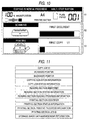
As shown in Fig. 10, the copy process screen contains
a job information area 51 for displaying information on a copy
job being executed, a reading area 52 for displaying a reading
progress of reading a document image by the processed reading
section 13, and a printing progress area 53 for display a printing
progress of the printing operation by the processed printing
section 14 (the printing section 14 being supplied with print
job data from the main body 11 of the copying-operation control
device) . In a step S110 following the step S106, a copy process
screen is displayed which contains a reading progress area for
displaying that the reading of the document image is no started
yet, and a printing progress area for displaying that the
printing operation is not started yet.
After causing the touch screen 121 to display the copy
process screen, the CPU 21 judges whether or not the copy-job
management information is present in the RAM 23 (step S111).
A configuration of the copy-job management information
will be described with reference to Fig. 11.
As illustrated, the copy-job management information
contains copy job ID, forwardpointer, backward pointer, copying
condition information, copy job status information, reading
section identifier, reading section status information,
reading section reading progress information, printing section
identifier, printing section status information, printing
section printing progress information, printing section job
ID, and storage image data management information.
As will be described in detail later, the copy-job
management information is stored into the RAM 23 every time
an execution command to execute a copy job is issued (the start
button 122 is depressed in a state that the processed reading
section 13 is usable). The copy-job management information
is erased from the RAM 23 when the copy job ends in its execution
(the processed printing section 14 completes the printing of
the image data on all the documents to be copied and a discharging
of copy sheets bearing the printed pictures thereon).
The copying condition information forming the copy-job
management information comprises values indicative of various
copying conditions (set values of various copying conditions
when the start button 122 is depressed). The reading section
identifier is identifying information for identifying the
reading section 13 designated as the reading section 13 to be
used for the copying by the operator. The printing section
identifier is identifying information for identifying the
processed printing section 14 designated as the printing section
used for the copying by the operator.
The copy job ID is identifying information for identifying
a copy job generated by the CPU 21. The forward pointer and
the backward pointer are data which identifies a storing position
of another copy job management information formed (stored) on
the RAM 23 and arranges the copy job management information
on the RAM 23 in information forming order. Specifically, the
forward pointer and the backward pointer are data in which its
values are set and altered as described below.
For the copy-job management information formed in a state
that another copy-job management information is absent, a
predetermined value indicating that the self-copy-job
management information is the latest information is set for
the backward pointer, and a value equal to that is set for the
forward pointer (when only one piece of copy-job management
information is present, its forward pointer is not used actually).
At the time of its formation, the leading job pointer (data
stored in a given memory area of the RAM 23) for managing a
memory position of the oldest copy-job management information
is changed to data indicative of a memory position of the copy-job
management information formed.
For copy-job management information formed in a state
that one or more pieces of copy-job management information are
present, data indicative of a memory position of the copy-job
management information previously formed (the copy-job
management information whose backward pointer is a
predetermined value) is set for the forward pointer, and a
predetermined value indicating that the self-copy-job
management information is the latest information is set for
the backward pointer. At the time of its formation, the backward
pointer of the copy-job management information previously
formed is changed to data indicative of a memory position of
copy-job management information formed anew.
When the copy-job management information is erased since
the copy job ends or the halt of the copy job is instructed,
a value of the backward pointer (the leading job pointer when
the copy-job management information to be erased is the oldest
one) of the copy-job management information which is indicated
by the forward pointer of the copy-job management information
to be erased is changed to a value equal to that of the backward
pointer of the copy-job management information to be erased.
When the value of the backward pointer of the copy-job management
information to be erased is not a predetermined one (the copy-job
management information to be erased is not the latest one),
a value of the forward pointer of the copy-job management
information indicated by its backward pointer is changed to
a value equal to that of the forward pointer of the copy-job
management information to be erased.
That is, in the main body 11, the copy-job management
information stored at a memory position indicated by the leading
job pointer is set to the oldest copy-job management information,
and the values of the forward pointer and the backward pointer
of the copy-job management information are set and changed so
that the previous and next copy-job management information are
respectively stored at positions indicated by the forward
pointer and the backward pointer of certain copy-job management
information.
The copy-job status information forming the copy-job
management information is information indicative of a status
(processing status) of a copy job whose contents are defined
by the copying condition information, the reading section
identifier and the printing section identifier. Any one of
"In reading and printing", "In reading" and "Waiting" is set
as copy-job status information to each copy-job management
information of the RAM 23 in accordance with a status of the
copy job on the copy-job management information.
Specifically, the main body 11 of the copying-operation
control device is arranged so as to independently and
concurrently execute the following two process; a process to
obtain image data of one or more documents to be copied from
the processed reading section 13 (referred to as "reading
control process"), and a process to supply print job data for
outputting (printing) copy/copies of the document(s) to the
processed printing section 14 and to monitor the end of sheet
discharging (referred to as "printing control process").
Further, the main body 11 is arranged such that when the reading
control process ends, even if the printing control process of
the copy job whose reading control process is not yet completed,
the main body 11 receives a command to execute a next copy job
and starts the reading control process for the next copy job.
Accordingly, a copy job whose execution is instructed
in the copying machine 10 takes one of the following statuses:
1) a status in which the reading control process and the printing
control process are under execution, 2) a status in which the
printing control process is under execution, but the reading
control process is not under execution, 3) a status in which
the reading control process is completed in execution and the
printing control process is still under execution, and 4) a
status in which the reading control process is completed in
execution and the controller waits for the execution of the
printing control process. Therefore, when the status of the
copy job is in one of the statuses 1) to 4), the copy-job status
information in the copy-job management information for this
copy job is correspondingly set in "In reading and printing",
"In reading", "In printing" or "Waiting".
The reading section status information forming the
copy-job management information is information indicating
whether or not the reading operation is performed by the reading
section 13 identified by the reading section identifier (the
reading section 13 is to be subjected to the reading control
process). The reading section reading progress information
is information indicating which page of the documents and which
location of the page of the documents that the processed reading
section identified by the reading section identifier has read.
The printing section status information is information
indicating whether or not the supplying of print job data to
the printing section 14 identified by the printing section
identifier is actually started. When the copy-job management
information is formed, "Not yet started" indicating that the
supply of the print job data is not stated is set as the printing
section status information. The printing section status
information is changed to "In printing" when the supply of the
print job data to the printing section 14 identified by the
printing section identifier is started. In other words, even
when the copy-job status information is changed to "In reading
and printing" or "In printing", "Not yet started" is maintained
for the printing section status information when the printing
section 14 cannot start supplying the print job data.
The printing section printing progress information is
information indicating which page of the image data and which
location of the page of the image data that the printing section
14 identified by the printing section identifier has supplied
and printed. The printing section job ID is identifying
information assigned to a print job accepted by the printing
section 14 identifiedby the printing section identifier. When
the printing section 14 identified by the printing section
identifier is a device which assigns job IDs to print jobs
supplied thereto and manages them (viz., it is capable of
accepting a plurality of print jobs), the job ID is set as this
printing section job ID. This printing section job ID is used
for instructing the such printing section 14 to halt a specific
print job.
The storage image data management information is
information indicative of a memory position of the storage image
data related to the copy-job in the storage portion 31. The
storage image data is image data which is obtained from the
processed reading section 13 but cannot be transferred to the
printing section 14, and hence is stored in the storage portion
31. As will be described in detail subsequently, the image
data is stored into the storage portion 31 every predetermined
amount of data. The image data (storage image data) represented
by the predetermined amounts of data is read out of the storage
portion 31, processed the image processing and supplied to the
printing section 14 in order of time points where the image
data are stored. When the use of the data is completed, those
predetermined amounts of image data are abandoned (the memory
area occupied by the image data is made free). The storage
image data management information contains such information
allowing an access, and the storage image data management
information is updated when the predetermined amount of image
data is stored into the storage portion 31 or the storage image
data is abandoned.
Returning to Fig. 3, the description of the operation
of the main body 11 will be continued.
When the copy-job management information is not stored
into the RAM 23 (step S111; NO), the CPU 21 forms on the RAM
23, the copy-job management information which includes copying
condition information representing the contents of a copy job
whose execution is instructed, the reading section identifier
and printing section identifier, the copy-job status
information representing "In reading and printing", and the
printing section status information representing "Not yet
started" (step S113). Then, the CPU 21 instructs the processed
reading section 13 to start a reading operation (step S114).
When the copy-job management information is stored in
the RAM 23 (step S111; YES), the CPU 21 forms on the RAM 23,
the copy-job management information which include the copying
condition representing the contents of a copy job whose execution
is instructed, the reading section identifier, the printing
section identifier, the copy-job status information
representing "In reading", and the printing section status
information representing "Not yet started"(step S112).
Thereafter, the CPU 21 advances to a step S114, and instructs
the processed reading section 13 to start a reading operation
of reading an image on an original document.
As shownin Fig. 4, after instructing the processed reading
section 13 to start the document reading operation, the CPU
21 judges whether the printing section status information of
the copy-job management information (copy-job management
information in which the leading job pointer indicates its
storing position) which is earliest stored in the RAM 23
represents "Not yet started" or "In printing" (step S121).
Specifically, when the step S111 is branched to the "NO" side,
the copy-job management information formed by the step S113
is the oldest copy-job management information, its printing
section status information is processed for judgment in the
step S121. When the step S111 is branched to the YES side,
the printing section status information of copy-job management
information, which is different from that formed by the step
S112, is processed in the step S121.
For ease of explanation, copy-job management information
which is earliest stored in the RAM 23 is referred to as "printed
copy-job management information". A copy job (copy job to be
subjected to the printing control process) which is managed
by the printed copy-job management information is referred to
as "printed copy job". Printing section status information
of the printed copy-job management information is referred to
as "printed printing-section status information". The copy
job management information (copy-job management information
whose backward pointer has a predetermined value) which is the
latest information on the RAM 23, is referred to as "read copy-job
management information". A copy job (which is subjected to
the reading control process) which is managed by the read
copy-job management information is referred to as "read copy
job".
When the printed printing-section status information
represents "In printing" (step S121; in printing), the CPU 21
advances to a step S125 (to be described in detail later) . When
the printed printing-section status information represents
"Not yet started" (step S121; not yet started), the CPU 21 judges
whether the processed printing section 14 (printing section
14 identified by the printing section identifier in the printed
copy-job management information) is usable, that is, whether
the processed printing section 14 is used by another computer
(S122). When the processed printing section 14 is usable (step
S122; YES), the CPU 21 instructs the processed printing section
14 to start a printing operation (supplies a control command
group for designating copying conditions to the printer) (step
S123). Then, the CPU 21 changes the printed printing-section
status information to "In printing" (step S124), and advances
to step S125.
In the step S125, the CPU 21 judges whether the processed
printing section 14 is put in such a state that it accepts a
predetermined amount of image data. If the processed printing
section 14 can accept the image data (step S125; YES), the CPU
21 judges whether the storage image data on the copy job to
be printed are stored in the storage portion 31 (step S126).
When the storage image data on the printed copy job is
not stored in the storage portion 31 (step S126; NO), the CPU
21 obtains a predetermined amount of image data (image data
of plural lines which consists of image data elements each of
byte length in the embodiment) from the processed reading section
13, and supplies the obtained image data to the processed
printing section 14 (step S127). In the step S127, the image
data obtained from the processed reading section 13 is image
processed as specified by the copying condition information.
The image data thus processed is transferred to the printing
section 14. Further in the step S127, the reading section
reading progress information and the printing section printing
progress information of the read copy-job management
information (read copy-job management information = printed
copy-job management information when this step is executed)
are updated.
After the execution of the step S127, the CPU 21 updates
the display contents of the reading progress area 52 and the
printing progress area 53 on the copy process screen (viz.,
it changes the copy process screen to another for showing that
the reading control process and the printing control process
have progressed) (step S128).
Thereafter, the CPU 21 judges whether the reading of one
page of document image is completed (step 135). If the answer
is NO (step S135; NO), the CPU executes the process starting
from the step S121.
Through the repeating of such procedure, the printing
section 14 is put in a state that the printing section 14 cannot
accept the data (step S125; NO), the CPU 21 obtains a
predetermined amount of image data from the processed reading
section 13 and stores the obtained image data as storage image
data into the storage portion 31 (step S133). When the step
S133 is executed, the CPU refers to the storage image data
management information of the read copy-job management
information, and updates it. When the memory capacity capable
of storing the predetermined amount of image data is not left
in the storage portion 31, the CPU executes a step S135, while
not executing the steps S133 and S134 (not illustrated).
In the step S122 which is executed since the printed
printing-section status information represents "Not yet
started" (step S121; Not yet started), when it is detected that
the processed printing section 14 is not usable (step S122;
NO), the CPU 21 executes the step S133 is executed.
After the CPU 21 executes the step S133, the CPU 21 updates
the display contents of the reading progress status area 52
on the copy process screen (step S134), and executes a step
S135.
When the processed printing section 14 is ready for
accepting the data (step S125; YES), and the storage image data
on the copy job to be printed is stored in the storage portion
31 (step S126; YES), the CPU 21 transfers the predetermined
amount of the oldest storage image data stored in the storage
portion 31 to the printing section 14, and abandons the
predetermined amount of the storage image data (makes the memory
area occupied by the storage image data free) (step S130). In
this step S130, the storage image data is image-processed as
indicated by the copying condition information, and the storage
image data thus processed is transferred to the processed
printing section 14. At the time of executing the step S130,
the CPU refers and updates the storage image data management
information of the printed copy-job management information,
and updates the printing section printing progress information.
Then, the CPU 21 changes the copy process screen to a
screen showing that the printing control process has progressed
by a predetermined amount of processing (step S131). The CPU
21 judges whether the printing control process is completed
(step S132), and if it is not yet completed, the CPU 21 (step
S132; NO) , the CPU 21 executes the step S133 and the subsequent
ones.
When repeating such a process execution, the reading of
one page of document is completed (step S135; YES), and then
CPU 21 judges whether the next document is present (step S136) .
If it is present (step S136; YES), the CPU instructs the reading
section 13 to read the next document (step S137), and changes
the copy process screen to a screen showing that the reading
of the next document is started (step S138), and returns to
the step S121.
When the next document is absent (step S136; NO), that
is, the reading control process on the copy job to be read is
completed, the CPU 21 judges whether the read copy-job status
information (copy-job status information of the read copy-job
management information) represents "In reading and printing"
or "In reading" (step S141), as shown in Fig. 5. In other words,
the CPU judges whether the copy job of which the reading control
process is completed is a copy job of which the printing control
process has started or a copy job which only the reading control
process has been executed (if the copy job to be read is equal
to the copy job to be printed).
When the read copy-job status information represents "In
reading and printing" (step S141; in reading and printing),
that is, when the copy job to be read is equal to the copy job
to be printed, the CPU 21 judges whether the printing control
process is completed (step S143). When the printing control
process is completed (step S143; YES), the CPU 21 abandons the
read copy-job management information (step S144), and returns
to the step S102 (Fig. 3). The step S144 is executed in following
case: a copy job is started in execution after the "in reading
and printing" is set to the copy-job status information (the
copy job is not a copy job in which the copy job status information
is changed from "in printing" to "In reading and printing") ;
the copy job undergoes processes shown in Fig. 4; and the process
is ended without executing the step S133.
When the printing control process is not completed (step
S143; NO), the CPU 21 changes the read copy-job status
information (= printed copy-job status information) to "In
printing" (step S145), and changes the copy process screen (step
S146) to another screen. In this step S146, the CPU 21 changes
the copy process screen to a screen including a job information
area 51 showing that "Copy reservation" (setting of the copying
conditions for the next copying) may be carried out, and the
reading progress status area 52 showing a "next copy" button
(as shown in Fig. 12).
When the read copy-job status information represents "In
reading" (step S141; in reading), viz., when the copy-job to
be read is different from the copy job to be printed, the CPU
21 changes the read copy-job status information to "In waiting"
(step S142), and executes a step S146.
Then, it causes the touch screen 121 to present the copy
process screen including a "next copying" button and then
executes a process shown in Fig. 6.
Specifically, the CPU 21 first judges whether the printed
printing-section status information represents "In printing"
or "Not yet started" (step S150). When it represents "In
printing" (step S150; in printing), the CPU 21 advances to a
step S154 (will be described in detail later). When it
represents "Not yet started" (step S150; not yet started), the
CPU 21 judges whether the processed printing section 14 is usable
(step S151). When the processed printing section 4 is usable
(step S151; YES), the CPU 21 instructs the processed printing
section 14 to start a printing operation (step S152). Then,
the CPU 21 changes the printed printing-section status
information to "In printing" (step S153), and advances to a
step s154.
In the step S154, the CPU 21 judges whether the processed
printing section 14 is ready for accepting the predetermined
amount of image data. When the processed printing section 14
is ready for accepting it (step S154; YES), the CPU 21 supplies
the oldest storage image data to the processed printing section
14, and abandons the supplied one (step S155). In the step
S155, as in the step S130, the CPU 21 refers and updates the
storage image data management information of the printed
copy-job management information, and updates the printing
section printing progress information.
Then, the CPU 21 changes the copy process screen to a
screen showing that the printing control process has progressed
(step S156), and then judges whether the printing control process
has been completed (step S157).
When it is not completed (step S157; NO), the CPU 21
advances to a step S158 to judge whether an operation is performed
on the operating device 12.
When no effective operation is performed on the operating
device 12 (step S158; none), the CPU 21 returns to the step
S150. When an effective operation except the depression of
the start button 122 is performed on the operating device 12
(step S158; another), the CPU 21 executes a process based on
the contents of the effective operation performed (step S159),
and returns to the step S150.
When the CPU 21 detects in the step S158 that the "next
copying" button has been depressed, the CPU 21 causes the touch
screen 121 to display the basic screen showing that the copy
job being executed is present. For example, when the copy job
being executed and the copy job being in a waiting or stand-by
state are present, the CPU 21 causes the touch screen 121 to
display the basic screen in which the copy job being executed
and the copy job being in a waiting state are present ("first
page 1/1 in waiting 1") in the upper part of the screen (Fig.
13).
When the start button 122 is depressed (step S158; start
button depression), the operating device 12 judges whether the
processed reading section 13 is usable (step S160). If it is
not usable (step S160; NO), the CPU 21 displays a copying
impossible message on the touch screen 121 (step S161), and
returns to the step S150. If it is usable (step S160; YES),
the CPU 21 returns to step S110 (Fig. 3).
When the processed printing section 14 is not usable (step
S151; NO) or when the processed printing section 14 is put in
a state that it cannot accept the predetermined amount of image
data (step S154; NO), the CPU 21 executes the process starting
from the step S158.
After the predetermined amount of storage image data is
supplied to the printing section 14 (step S155), when the CPU
21 detects that the printing control process is completed (step
S157; YES), the CPU 21 carries out the process shown in Fig.
7.
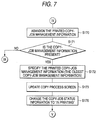
Specifically, the CPU 21 abandons the printed copy-job
management information (step S170). Thereafter, the CPU 21
judges whether the copy-job management information is present
(step S171). When it is not present (step S171; NO), the CPU
returns to the step S102 (Fig. 3). That is, the CPU 21 causes
the touch screen 121 to display the basic screen, and then waits
till the copying conditions are set (altered) or a copying start
instruction is given (the start button 122 is depressed).
When the copy-job management information is present (step
S171; YES), the CPU 21 specifies the printed copy-job management
information (the oldest copy-job management information) (step
S172). And the CPU 21 changes the printed copy-job status
information (copy-job status information of the printed
copy-job management information) to "In printing" (step S176).
The process shown in Fig. 6 is carried out when the reading
control process is not executed, and the process shown Fig.
7 is started in execution when the printing control process
ends during the execution of the Fig. 6 process. Accordingly,
when the step S172 is executed, the CPU 21 specifies that the
copy-job status information of the copy-job management
information (the printing-section status information
represents "Not yet started") represents "In waiting". In the
step S176, the copy-job status information is changed from "In
waiting" to "In printing".
The CPU 21 rewrites the printed copy-job status
information, and then starts the process starting from the step
S158 shown in Fig. 6.
Also when the CPU 21 detects that the printing control
process is completed when the reading control process is being
executed, CPU 21 executes a similar process.
Specifically, when the CPU 21 detects that the printing
control process is completed during the reading control process
is being executed (step S132; YES in Fig. 4), firstly, the CPU
21 abandons the printed copy-job management information (step
S180). Thereafter, the CPU 21 specifies the printed copy-job
management information (the oldest copy-job management
information) (step S182). When the printed copy-job status
information (copy-job status information of the printed
copy-job management information) represents "In reading" (step
S184; in reading), the CPU 21 changes the printed copy-job status
information to "In reading and printing" (step S185). When
the printed copy-job status information represents "In waiting"
(step S184; in waiting), the CPU changes the printed copy-job
status information to "In printing" (step S186).
After the CPU rewrites the printed copy-job status
information by such a procedure, the CPU 21 returns to the step
S133 (Fig. 4).
A control operation by the copying-operation control
device 15 will be described in detail with reference to Fig.
14 and Figs. 3 through 8. In the description to be given
hereafter, the reading section 13 and the printing section 14
are not used by another computer (the steps are branched to
the YES side in the steps to judge if the printing section 14
is usable, such as steps S106 and S122).
The execution of a copy job A is instructed at a time
point t0 at which the copy-job management information is not
yet stored in the RAM 23.
In this case, the step S111 branches to the "NO" side
(Fig. 3). Only one copy job management information (the oldest
and latest copy-job management information) is formed, and "In
reading and printing" is set as the copy-job status information
and "Not yet started" is set up as the printing-section status
information. Accordingly, the copy-job management information
is handled as the printed copy-job management information and
the read copy-job management information.
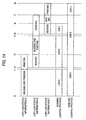
As shown in a chart of Fig. 14, when the execution of
the copy job A is instructed to start at a time point t0, the
copy-job status information (copy-job status information A in
the figure) of the copy-job management information on the copy
job A represents "In reading and printing" (in the figure,
"reading & printing") . And a state that an object to be processed
by the reading control process and an object to be processed
by the printing control process are both the copy job A, is
set up, and the process shown in Fig. 4 is started in execution.
At this time point, the printed printing-section status
information represents still "Not yet started". Then, in the
step S121 of Fig. 4, the step S121 is branched to the "Not yet
started" side. Since the processed printing section 14 is not
used by another computer, the steps S123 and S124 are executed
so that control data is supplied to the processed printing
section 14 and the printed printing-section status information
is rewritten into "In printing".
The processed printing section 14 which does not yet
receive image data is ready for accepting the image data. In
the step S125 following the step S124, the step S125 is branched
to the "YES" side. At this time point, the storage image data
is not yet stored in the storage portion 31, thus, the step
S126 is branched to the "NO" side. As a result, the step 127
is executed, so that the predetermined amount of image data
obtained from the reading section 13 is supplied to the processed
printing section 14 without stored in the storage portion 31.
Then, the step S128 is executed to change the copy process screen
presented in the step S110 to a screen showing that the reading
control process and the printing control process have
progressed.
Subsequently, the step S135 is branched to the "NO" side,
and the step S121 is executed again. At this time point, the
printed printing-section status information represents "In
printing". Accordingly, the step S121 is branched to the "In
printing" side. The steps S125 and S126 are respectively
branched to the "YES" side and the "NO" side, and the steps
S127 and S128 are executed.
When the processed printing section 14 is put in a state
that it cannot accept the image data before the reading control
process for all the original documents is completed (before
the step S136 is branched to the "NO" side), the step S125 is
branched to the "NO" side. And the step S133 executes a process
in which the predetermined amount of image data obtained from
the reading section 13 is stored into the storage portion 31
without supplied to the printing section 14. As the result
of processing by the step S134, the copy process screen is changed
to a screen showing that only the reading control process has
progressed.
When the processed printing section 14 becomes ready for
accepting the image data during the execution of the process
in which the predetermined amount of image data is stored into
the storage portion 31 without supplied to the processed printing
section 14, the step S125 is branched to the "YES" side. And
in the step S126, the storage image data is present, and hence
the step is branched to the "YES" side. Accordingly, the step
S130 is executed, so that part (the predetermined amount of
image data earliest stored) of the storage image data stored
in the storage portion 31 is supplied to the processed printing
section 14. The subsequent step S131 is executed, so that the
copy process screen is changed to a screen showing that the
printing process has progressed.
At this time point, since the printing control process
on the copy job A is not yet completed (there is no case that
before the reading control process on a copy job is completed,
the printing control process on that copy job is completed),
the step S132 is branched to the "NO" side. As a result, the
predetermined amount of image data generated by the reading
section 13 in the step S133 is stored into the storage portion
31. In the step S134, the copy process screen is changed to
a screen showing that the reading control process has progressed.
As the result of repeating the execution of the steps
S130 to S134, when the reading control process on the copy job
A is completed at time point t1 (Fig. 14) (step S136; NO), the
step S141 (Fig. 5) is executed to judge whether the copy job
Ahas undergone both the reading control process and the printing
control process or only the reading control process.
Since the copy job A has undergone both the reading control
process and the printing control process (the copy-job status
information A represents "In reading and printing"), the CPU
judges whether the printing control process is completed. When
the step S133 is executed during the execution of the copy job
A, the copy-job status information A as the read copy-job status
information is changed to "In printing" since there is no case
that the printing control process is completed at this stage.
Thereafter, a copy process screen showing that an instruction
to execute the next copy job is accepted is displayed on the
touch screen 121. By the process shown in Fig. 6, the CPU
continues the printing control process on the copy job A while
monitoring whether a new instruction to execute the copy job
is present or not.
When the execution of a copy job B is instructed by
depressing the start button at the preceding time point t2 (Fig.
14) before the printing control process on the copy job A ends,
the step S160 is executed and the step is branched to the "YES"
side. As a result, the process is started from the step S110
(Fig. 3). In this case, the copy-job management information
is present, and hence the step S112 is executed to form read
copy-job management information on the copy job B whose the
copy-job status information represents "In reading".
The process shown in Fig. 4 is started in a state that
the copy job to be read (= copy job A) is different from the
copy job to be printed (= copy job B) (see Fig. 14). In this
state, there is a case that the printing control process on
the copy job B may be completed before the reading control process
on the copy job A is completed, and that the printing control
process on the copy job B may be completed after the reading
control process on the copy job A is completed.
When the printing control process on the copy job A is
completed at a time point t3 before the reading control process
on the copy job B is completed, the step 132 is branched to
the "YES" side. The process shown in Fig. 8 is started to specify
the copy-job management information on a copy job to be subjected
to the printing control process in the step S182. In this case,
the copy-job management information regarding the copy job B
(the copy-job management information whose copy-job status
information represents "In reading") is specified as the print
copy-job management information. Since the copy-job status
information represents "In reading", the copy-job status
information B is changed to "In reading and printing".
And the process starting from the step S133 in Fig. 4
is continued. Since the printed printing-section status
information represents "Not yet started" at this time point,
the step S121 is branched to the "Not yet started" side after
the steps S133 to S135 are executed, and control commands are
supplied to the processed printing section 14. Thereafter,
the reading control process and the printing control process,
which are executed for the copy job B, are concurrently executed
by repeating the execution of the steps S130 to S134 (Fig. 14;
t3 to t4).
The reading control process on the copy job B is completed
at a time point t4. At the subsequent time point t5, the
execution of a copy job C is instructed. Then, the copy job
C will undergo the same process as at the start of processing
the copy job B.
When the reading control process on the copy job C is
finished before the printing control process on the copy job
B is finished, the step S136 is branched to the "NO" side in
Fig. 4. In this case, the process shown in Fig. 5 is executed.
Since the copy-job status information C as the read copy-job
status information represents "In reading", the copy-job status
information C is changed to "In waiting". And by the process
shown in Fig. 6, the printing control process on the copy job
B is continued (t6 to t7 in Fig. 14). When the printing control
process is completed (step S157; YES), the process shown in
Fig. 7 is executed to change the copy-job status information
C to "In printing". The printing control process on the copy
job C is carried out under the Fig. 6 process (t7 to t8 in Fig.
14).
An operation of the machine when the stop button 123 is
depressed will be described.
When the stop button 123 is depressed, the CPU 21 refers
to the copy-job management information stored in the storage
portion 31 and causes the touch screen 121 to display a select
screen which guides the operator to select a copy job to be
halted (step S201) (Fig. 15). Then, the CPU 21 waits till the
operator selects the copy job (step S202). These steps S201
and S202 are executed concurrently with the process shown in
Figs. 3 to 8. When the copy job is completed, the CPU rewrites
the contents of the select screen to another.
When the copy job is selected, the CPU halts the process
on coping operations, which is being executed (step S203), and
starts a process based on the copy-job status information on
the selected copy job as follows.
When the copy-job status information on the selected copy
job represents "In reading and printing" (step S204; in reading
and printing), the CPU 21 causes the touch screen 121 to display
a copying-being-halted screen (step S211). The
copying-being-halted screen displayed in this step is as shown
in Fig. 16.
Then, the CPU 21 instructs the reading section 13 and
the printing section 14 to halt the processes (step S212).
Thereafter, the CPU 21 abandons the storage image data (in some
cases, it is not stored) on the copy job instructed to be halted
and the copy-job management information (step S213), and starts
the process from the step S102 (Fig. 3).
When the copy-job status information on the selected copy
job represents "In printing" (step S204; in printing), that
is, a copy job to be printed is selected, the CPU 21 causes
the touch screen 121 to display a screen showing that the copying
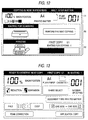
operation is halted (step S221). This screen is as shown in
Fig. 17.
Subsequently, the CPU 21 instructs the processed printing
section 14 to halt the printing operation (step S222). Then,
the CPU 21 abandons (deletes) the storage image data on the
copy job instructed to be halted (step S223). When the "In
reading" copy job (the copy-job status information represents
"In reading") is present (step S224; YES), the CPU proceeds
to the step S180 in Fig. 8, abandons the printed copy-job
management information, and executes the prescribed processes.
When the "In reading" copy job is not present (step S224; NO),
the CPU proceeds to the step S170 in Fig. 7, abandons the printed
copy-job management information, and executes the prescribed
processes.
That is, a process to be executed after the storage image
data on the "In printing" copy job and the copy-job management
information are abandoned (deleted) is the same as when the
"In printing" copy job is normally completed (steps S132, S157).
For executing the same process as the "In printing" copy job
is normally completed, the step S224 is branched depending on
whether or not the "In reading" copy job is present.
When the copy-job status information on the selected copy
job represent "In reading" (step S204; in reading), the CPU
causes the touch screen 121 to display the copying-being-halted
screen (step S231). This screen presented in this step is
similar to that presented in the step S211 (Fig. 16).
Then, the CPU 21 instructs the processed reading section
13 to halt the process execution (step S232). Thereafter, the
CPU 21 abandons the storage image data on the copy job instructed
to be halted and the copy-job management information (step S233).
The CPU 21 causes the touch screen 121 to display the copy process
screen including a button of "next copying" (step S234). In
this case, since the "In printing " copy job is present, the
CPU starts the process starting from the step S150 (Fig. 6)
to continue the printing control process on the "In printing"
copy job.
When the copy-job status information on the copy job
instructed to be halted represents "In waiting" (step S204;
in waiting), the CPU causes the touch screen 121 to display
the copying-being-halted screen (step S241). This screen
displayed in this step is similarly to the screen displayed
in the step S221 (Fig. 17). And the CPU abandons the storage
image data on the copy job instructed to be halted and the copy-job
management information (step S242), and executes again the
process interrupted.
As described above, the copying machine 10 is arranged
such that a process to generate image data from an original
document to complete a copy job and a process to cause the printing
section 14 to print (output the copy result) based on the image
data are independently and concurrently carried out. When the
reading section 13 is not in a reading operation, it accepts
an instruction to start the execution of the copy job.
Accordingly, before the copy result of one sheet (or plural
sheets) is output from the printing section 14, the next original
document may be set to the machine and an instruction to start
the copy job may be issued (the start button 122 is depressed).
As a result, the copying machine 10 reduces a time for the operator
to be consumed for the copying work requiring the resetting
of the document, and a time for the operator to wait till the
machine is ready for the copying operation.
It is should be understood that the copying machine 10
of the embodiment may be modified variously. The scanner and
the printer coupled to the copying machine 10 are commercially
available; however, those may be designed exclusively for the
copying machine 10. In the copying machine 10, the amount of
image data obtained at a time from the reading section 13 is
equal to the amount of image data supplied at a time to the
printing section 14 (more properly, the image data amount which
is the base for the data supplied to the printing section 14).
It is evident that both the data amounts, a frequency at which
the image data is obtained from the reading section 13, a
frequency at which the data is supplied to the printing section
14, and the like may be selected to be those different from
those in the copying machine 10.
In the copying machine 10 of the embodiment, when the
reading section 13 is operating, it is impossible to set (alter)
copying conditions. If required, it may be modified such that
even when the reading section 13 is operating, the copying
conditions may be set (the depression of the start button 122
is neglected).
In the above-mentioned embodiment, the copying-operation
control device 15 are used for controlling the operations of
the scanner and the printer. A general computer system
(including an input/output device and a computer main frame)
may be used instead. In this case, a computer mouse and a key
board are required for setting copying conditions. To avoid
this, it is preferable to use the above-mentioned arrangement
(the operating device 12 designed exclusively for the machine
is used for the input/output device).
As seen from the foregoing description, in the copying
machine of the invention, a time for a user to wait till a copying
process being executed in response to an instruction by another
user or the user himself ends, is shorter than in the conventional
copying machine. Further, a system equivalent to the copying
machine of the invention may be constructed by using a scanner
and a printer. Additionally, the computer readable recording
medium enables a computer to operate as the copying-operation
control device of the invention.