EP1172582A1 - Belt for non-stage transmissions - Google Patents
Belt for non-stage transmissions Download PDFInfo
- Publication number
- EP1172582A1 EP1172582A1 EP00985838A EP00985838A EP1172582A1 EP 1172582 A1 EP1172582 A1 EP 1172582A1 EP 00985838 A EP00985838 A EP 00985838A EP 00985838 A EP00985838 A EP 00985838A EP 1172582 A1 EP1172582 A1 EP 1172582A1
- Authority
- EP
- European Patent Office
- Prior art keywords
- metal
- ring assembly
- metal element
- clearance
- belt
- Prior art date
- Legal status (The legal status is an assumption and is not a legal conclusion. Google has not performed a legal analysis and makes no representation as to the accuracy of the status listed.)
- Granted
Links
- 230000005540 biological transmission Effects 0.000 title claims abstract description 22
- 229910052751 metal Inorganic materials 0.000 claims abstract description 176
- 239000002184 metal Substances 0.000 claims abstract description 154
- 230000000712 assembly Effects 0.000 description 17
- 238000000429 assembly Methods 0.000 description 17
- 230000003247 decreasing effect Effects 0.000 description 7
- 238000010586 diagram Methods 0.000 description 3
- 230000002093 peripheral effect Effects 0.000 description 2
- 238000005096 rolling process Methods 0.000 description 2
- 230000002411 adverse Effects 0.000 description 1
- 238000009826 distribution Methods 0.000 description 1
- 239000000463 material Substances 0.000 description 1
- 238000012986 modification Methods 0.000 description 1
- 230000004048 modification Effects 0.000 description 1
- 238000004080 punching Methods 0.000 description 1
Images


Classifications
-
- F—MECHANICAL ENGINEERING; LIGHTING; HEATING; WEAPONS; BLASTING
- F16—ENGINEERING ELEMENTS AND UNITS; GENERAL MEASURES FOR PRODUCING AND MAINTAINING EFFECTIVE FUNCTIONING OF MACHINES OR INSTALLATIONS; THERMAL INSULATION IN GENERAL
- F16G—BELTS, CABLES, OR ROPES, PREDOMINANTLY USED FOR DRIVING PURPOSES; CHAINS; FITTINGS PREDOMINANTLY USED THEREFOR
- F16G5/00—V-belts, i.e. belts of tapered cross-section
- F16G5/16—V-belts, i.e. belts of tapered cross-section consisting of several parts
Definitions
- the present invention relates to a belt for a continuously variable transmission, which comprises a metal ring assembly comprising a plurality of endless metal rings laminated one on another, and a large number of metal elements each having a ring slot into which the metal ring assembly is fitted, the belt being wound around a drive pulley and a driven pulley to transmit a driving force between both of the pulleys.
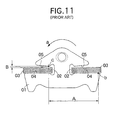
- Fig.11 shows a cross section of the belt for the continuously variable transmission described in the above-described Japanese Patent Application Laid-open No.7-12177.
- metal ring assemblies 03, 03 are engaged in a pair of left and right ring slots 0.2, 02 in a metal element 01.
- lower surfaces of the metal ring assemblies 03, 03 are in contact with saddle surfaces 04, 04, and a clearance B is established between upper surfaces of the metal ring assemblies 03, 03 and lower ear surfaces 05, 05.
- the belt described in the above-described Japanese Patent Application Laid-open No.7-12177 is designed, so that the rolling of the metal element is inhibited.
- the clearance between the upper surface of the metal ring assembly and the lower ear surface also exerts a large influence to the durability of the metal ring assembly, when the metal element has been pitched. More specifically, when the metal element has been pitched, an edge of the lower ear surface is brought into contact with the upper surface of the metal ring assembly to generate a stress at such contact portion, thereby reducing the durability of the metal ring assembly.
- the pitching of the metal element occurs in the vicinity of an exit of a driven pulley by the following reason:
- the forward inclination of the metal element 32 in the direction of movement is generated by a tangent frictional force F received by the metal element 32 at its surface of contact with the pulley and by an urging force E between the metal elements 32.
- a tendency is particularly remarkable at an exit area of the driven pulley (see Fig.10). The reason will be described below.
- a moment generated in the direction of an arrow M by the tangent frictional force F acts to bring down the metal element 32 forwards in the direction of movement about the swinging center C.
- a radial (vertical) frictional force ⁇ E generated by the urging force E between the metal elements 32 generates a moment in the direction opposite from the arrow M in the metal element 32 and acts to bring down the metal element 32 backwards in the direction of movement about the swinging center C.
- the urging force E between the metal elements 32 has a large value in the exit area of the drive pulley 6, but assumes zero in the exit area of the driven pulley 11. Therefore, the metal element 32 is most liable to be inclined forwards in the direction of movement in a position where the tangent frictional force F acting to incline the metal element 32 forwards in the direction of movement assumes a maximum value and the urging force E acting to inhibit the forward inclination of the metal element 32 in the direction of movement assumes zero, i.e., in the exit area of the driven pulley 11.
- the present invention has been accomplished with the above circumstances in view, and it is an object of the present invention to ensure a power transmitting efficiency, while preventing a reduction in durability of the metal ring assembly due to the pitching of the metal element.
- a belt for a continuously variable transmission which comprises a metal ring assembly comprising a plurality of endless metal rings laminated one on another, and a large number of metal elements each having a ring slot into which the metal ring assembly is fitted, the belt being wound around a drive pulley and a driven pulley to transmit a driving force between both of the pulleys, each of the metal elements having a projection and a recess provided on front and rear surfaces thereof for engaging with preceding and succeeding ones of the metal elements, respectively, characterized in that when the size of a first vertical clearance between the projection and the recess of the metal element is represented by CL NH ; the size of a second vertical clearance in the metal ring assembly within the ring slot is represented by CLy; a thickness of the metal ring assembly is represented by T L ; and a vertical opening of the ring slot is represented by D, the following expression is established: (CL NH /T L ) + 1 ⁇ D
- the second vertical clearance CLy in the metal ring assembly within the ring slot is sized to be larger than the first vertical clearance CL NH between the projection and the recess of the metal element. Therefore , when the metal element has been pitched, the first clearance CL NH is first distinguished, whereby a further increase in pitch angle is inhibited, and the second clearance CLy is prevented from being distinguished. As a result, the upper surface of the metal ring assembly is prevented from being brought into contact with an upper edge of the ring slot to avoid a reduction in durability of the metal ring assembly.
- Figs.1 to 10 show an embodiment of the present invention.
- Fig.1 is a skeleton illustration of a power transmitting system in a vehicle having a continuously variable transmission mounted thereon;
- Fig.2 is a partial perspective view of a metal belt;
- Fig.3 is an enlarged view taken in the direction of an arrow 3 in Fig.2;
- Figs.4A, 4B and 4C are diagrams for explaining the operation when the metal element has been pitched;
- Fig.5 is a graph showing variations in pitch angles ⁇ NH and ⁇ y up to a time point of contact of the metal elements with each other with respect to a variation in second clearance CLy (when the size of a first clearance CL NH is equal to 0.10 mm);
- Fig.6 is a graph showing variations in pitch angles ⁇ NH and ⁇ y up to the time point of contact of the metal elements with each other with respect to a variation in second clearance CLy (when the size of the first clearance CL NH is equal to 0.
- Figs.1 to 10 show an embodiment of the present invention.
- Fig.2 the definition of forward and rearward directions, a lateral direction and a vertical direction of a metal element used in the embodiment is shown in Fig.2.
- Fig.1 schematically shows the structure of a metal belt type continuous variable transmission T mounted in an automobile.
- An input shaft 3 connected to a crankshaft 1 of an engine E through a damper 2 is connected to a drive shaft 5 of the metal belt type continuous variable transmission T through a start clutch 4.
- a drive pulley 6 provided on the drive shaft 5 includes a stationary pulley half 7 secured to the drive shaft 5, and a movable pulley half 8 which can be moved toward and away from the stationary pulley half 7.
- the movable pulley half 8 is biased toward the stationary pulley half 7 by a hydraulic pressure applied to an oil chamber 9.
- a driven pulley 11 is provided on a driven shaft 10 disposed in parallel to the drive shaft 5, and includes a stationary pulley half 12 secured to the driven shaft 10, and a movable pulley half 13 which can be moved toward and away from the stationary pulley half 12.
- the movable pulley half 13 is biased toward the stationary pulley half 12 by a hydraulic pressure applied to an oil chamber 14.
- a metal belt 15 is wound around the drive pulley 6 and the driven pulley 11.
- the metal belt 15 comprises a large number of metal elements 32 supported on a pair of left and right metal ring assemblies 31, 31 (see Fig.2).
- Each of the metal ring assemblies 31 comprises twelve metal rings 33 which are laminated on one another.
- a forward drive gear 16 and a backward drive gear 17 are relatively rotatably supported on the driven shaft 10.
- the forward and backward drive gears 16 and 17 can be coupled selectively to the driven shaft 10 by a selector 18.
- a forward driven gear 20 meshed with the forward drive gear 16 and a backward driven gear 22 meshed with the backward drive gear 17 through a backward idling gear 21 are secured to an output shaft 19 which is disposed in parallel to the driven shaft 10.
- the revolution or rotation of the output shaft 19 is input to a differential 25 through a final drive gear 23 and a final driven gear 24, and is transmitted therefrom through left and right axles 26, 26 to driven wheels W, W.
- a driving force of the engine E is transmitted to the driven shaft 10 through the crankshaft 1, the damper 2, the input shaft 3, the start clutch 4, the drive shaft 5, the drive pulley 6, the metal belt 15 and the driven pulley 11.
- the driving force of the driven shaft 10 is transmitted to the output shaft 19 through the forward drive gear 16 and the forward driven gear 20, thereby allowing the vehicle to travel forwards.
- the driving force of the driven shaft 10 is transmitted to the output shaft 19 through the backward drive gear 17, the backward idling gear 21 and the backward driven gear 22, thereby allowing the vehicle to travel backwards.
- hydraulic pressures applied to the oil chamber 9 of the drive pulley 6 and the oil chamber 14 of the driven pulley 11 of the metal belt type continuous variable transmission T are controlled by a hydraulic control unit U 2 which is operated by a command from an electronic control unit U 1 , thereby adjusting the change gear ratio continuously or in a stepless manner. More specifically, if a hydraulic pressure applied to the oil chamber 14 of the driven pulley 11 is increased relative to a hydraulic pressure applied to the oil chamber 9 of the drive pulley 6, the grove width of the driven pulley 11 is reduced, leading to an increased effective radius, and correspondingly, the groove width of the drive pulley 6 is increased, leading to a reduced effective radius.
- the change gear ratio of the metal belt type continuous variable transmission T is varied toward "LOW" continuously or in the stepless manner.
- the hydraulic pressure applied to the oil chamber 9 of the drive pulley 6 is increased relative to the hydraulic pressure applied to the oil chamber 14 of the driven pulley 11, the groove width of the drive pulley 6 is reduced, leading to an increased effective radius, and correspondingly, the groove width of the driven pulley 11 is increased, leading to a reduced effective radius. Therefore, the change gear ratio of the metal belt type continuous variable transmission T is varied toward "OD" continuously or in the stepless manner.
- each of the metal elements 32 which is formed from a metal plate material by punching or stamping includes a substantially trapezoidal element body 34, a neck 36 located between a pair of left and right ring slots 35, 35 into which the metal ring assemblies 31, 31 are fitted, and a substantially triangular ear 37 connected to an upper portion of the element body 34 through the neck 36.
- the element body 34 is formed at its laterally opposite ends with a pair of pulley abutment faces 39, 39 capable of abutting against V-faces of the drive pulley 6 and the driven pulley 11.
- the metal element 32 is formed, at its front and rear portions in the direction of movement, with a pair of front and rear main surfaces 40, 40 which are perpendicular to the direction of movement and parallel to each other.
- An inclined surface 42 is formed below the front main surface 40 in the direction of movement with a laterally extending rocking edge 41 located therebetween.
- the ear 37 is formed, at its front and rear surfaces, with a projection 43f and a recess 43r to connect the metal elements 32, 32 adjacent to each other in the forward and backward directions.
- Lower edges and upper edges of the ring slots 35, 35 are referred to as called saddle surfaces 44, 44 and lower ear surfaces 45, 45, respectively.
- Lower surfaces of the metal ring assemblies 31, 31 are in abutment against the saddle surfaces 44, 44, and upper surfaces of the metal ring assemblies 31, 31 are opposed to the lower ear surfaces 45, 45.
- the diameter of the projection 43f formed at the front surface of the metal element 32 is set smaller than that of the recess 43r formed in the rear surface, and a first clearance CL NH is defined between the projection 43f and the recess 43r.
- the projection 43f and recess 43r have cross sections circular about the same axis and hence, a clearance between an outer peripheral surface of the projection 43f and an inner peripheral surface of the recess 43r is sized to be equal to CL NH /2.
- a second clearance CLy is defined between the upper surface of each of the metal ring assemblies 31, 31 and each of the lower ear surfaces 45, 45 of the metal element 32, and is sized to correspond to a difference between the groove width of each of the ring slots 35, 35 and the thickness of each of the metal ring assemblies 31, 31.
- the thickness of the metal ring assembly 31 is represented by T L
- a vertical opening of each of the ring slots 35, 35 is represented by D.
- Fig.4C shows the metal elements 32 with CLy set at a value equal to CL NH in a state in which the metal element 32 has been pitched forward relative to the preceding metal element 32.
- the pitch angle of the metal element 32 is increased, the first clearance CL NH is decreased, whereby the recess 43r of the preceding metal element 32 and the projection 43f of the succeeding metal element 32 are brought into contact with each other at a point d and at the same time, the second clearance CLy is decreased, whereby the upper surface of the metal ring assembly 31 and the lower ear surface 45 of the metal element 32 are brought into contact with each other at a point e .
- Fig.5 shows how the pitch angles ⁇ y and ⁇ NH are varied when the size of the second clearance CLy is varied with the size of the first clearance CL NH fixed at 0.10 mm.
- ⁇ NH > ⁇ y is maintained, until the size of the second clearance CLy reaches 0.10 mm equal to the size of the first clearance CL NH ; and the actual pitch angle of the metal element 32 is limited by ⁇ y.
- the actual pitch angle of the metal element 32 is limited by the contact of the upper surface of the metal ring assembly 31 and the lower ear surface 45 of the metal element 32 with each other.
- the projection 43f and the recess 43r of the preceding and succeeding metal elements 32 can be first brought into contact with each other, and the upper surface of the metal ring assembly 31 and the lower ear surface 45 of the metal element 32 can be prevented from being brought into contact with each other.
- Fig.6 shows how the pitch angles ⁇ y and ⁇ NH are varied when the size of the second clearance CLy is varied with the size of the first clearance CL NH fixed at 0.18 mm. Even in this case, when the size of the second clearance CLy exceeds 0.18 mm equal to the size of the first clearance CL NH , the relation, ⁇ y > ⁇ NH is established. Thus, the projection 43f and the recess 43r of the preceding and succeeding metal elements 32 can be first brought into contact with each other, and the upper surface of the metal ring assembly 31 and the lower ear surface 45 of the metal element 32 can be prevented from being brought into contact with each other.
- Figs.7A and 7B show results provided by measuring a variation in power transmitting efficiency, while decreasing the number of the metal rings 33 of the metal ring assembly 31 one by one from twelve and gradually increasing the size of the second clearance CLy.
- Fig.7A corresponds to a case where the metal belt type continuously variable transmission T has been operated with a ratio of 0.61, an input torque of 5 kgfm, and input rotational speeds of 2,000 rpm and 4,000 rpm
- Fg.7B corresponds to a case where the metal belt type continuously variable transmission T has been operated with a ratio of 0.61, an input torque of 10 kgfm, and input rotational speeds of 2,000 rpm and 4,000 rpm.
- Figs.8A and 8B show results provided by simulating a variation in power transmitting efficiency provided when the size of the second clearance CLy has been increased with the number of the metal rings 33 of the metal ring assembly 31 being maintained at 12, based on Figs.7A and 7B, and further calculating a range of D/T L from the size of the second clearance CLy using the above expression.
- Fig.8A corresponds to a case where the metal belt type continuously variable transmission T has been operated with a ratio of 0.61, an input torque of 5 kgfm and input rotational speeds of 2,000 rpm and 4,000 rpm
- Fig.8B corresponds to a case where the metal belt type continuously variable transmission T has been operated with a ratio of 0.61, an input torque of 10 kgfm and input rotational speeds of 2,000 rpm and 4,000 rpm.
- the projection 43f and the recess 43r are set at a height within a range of 0.8 mm to 0.9 mm (a direction of thickness). Therefore, to prevent the pitching of the metal element 32 in a chord section, it is desirable that the size value of the second clearance CLy is equal to or smaller than such range, and the result of this test satisfies this condition.
- the values of D and T L are set in a range represented by (CL NH /T L ) + 1 ⁇ D/T L ⁇ (0.86/T L ) + 1
- the values of D and T L are set in a range represented by 1 ⁇ D/T L ⁇ 11/8
- the belt for the continuously variable transmission according to the present invention can be suitably used in a belt-type continuously variable transmission for an automobile, but can be also used in a belt-type continuously variable transmission in an application other than the automobile.
Landscapes
- Engineering & Computer Science (AREA)
- General Engineering & Computer Science (AREA)
- Mechanical Engineering (AREA)
- Transmissions By Endless Flexible Members (AREA)
Abstract
Description
- The present invention relates to a belt for a continuously variable transmission, which comprises a metal ring assembly comprising a plurality of endless metal rings laminated one on another, and a large number of metal elements each having a ring slot into which the metal ring assembly is fitted, the belt being wound around a drive pulley and a driven pulley to transmit a driving force between both of the pulleys.
- There is an invention relating to such a belt for a continuously variable transmission, which is conventionally known from Japanese Patent Application Laid-open No.7-12177, and in which in order to inhibit the rolling of metal elements supported on a pair of metal ring assemblies to smoothly engage the metal elements in pulleys, a vertical (in a direction of thickness of the belt) clearance in each of the metal ring assemblies within a ring slot in a metal element (a difference between a groove width of the ring slot and a thickness of the metal ring assembly) is defined.
- Fig.11 shows a cross section of the belt for the continuously variable transmission described in the above-described Japanese Patent Application Laid-open No.7-12177. In this belt,
metal ring assemblies metal element 01. When themetal element 01 is not rolled, lower surfaces of themetal ring assemblies saddle surfaces metal ring assemblies lower ear surfaces metal element 01 has been rolled in a direction of an arrow a in Fig.11, the lower surface of one of themetal ring assemblies 03 is brought into contact with thesaddle surface 04 at a point b, and an upper surface of the othermetal ring assembly 03 is brought into contact with thelower ear surface 05 at a point c. By setting the clearance B so as to establish an expression, tan-1B/A < 1° wherein A represents a distance between the points b and c, it can be prevented that when themetal element 01 has been rolled at least at 1°, the pair ofmetal ring assemblies saddle surface 04 and thelower ear surface 05 at the points b and c, whereby themetal element 01 is further rolled by a reaction force resulting from such contact. - The belt described in the above-described Japanese Patent Application Laid-open No.7-12177 is designed, so that the rolling of the metal element is inhibited. However, it is known that the clearance between the upper surface of the metal ring assembly and the lower ear surface also exerts a large influence to the durability of the metal ring assembly, when the metal element has been pitched. More specifically, when the metal element has been pitched, an edge of the lower ear surface is brought into contact with the upper surface of the metal ring assembly to generate a stress at such contact portion, thereby reducing the durability of the metal ring assembly. The pitching of the metal element occurs in the vicinity of an exit of a driven pulley by the following reason:
- When the
metal element 32 supported with thering slots metal ring assemblies lower ear surfaces ring slots metal ring assemblies 31, 31 (see a mark ○ in Fig.3) and hence, a large hertz stress is generated at such contact portion to exert an adverse influence to the durability of themetal ring assemblies metal element 32 in the direction of movement is generated by a tangent frictional force F received by themetal element 32 at its surface of contact with the pulley and by an urging force E between themetal elements 32. Such a tendency is particularly remarkable at an exit area of the driven pulley (see Fig.10). The reason will be described below. - In Fig.3, a moment generated in the direction of an arrow M by the tangent frictional force F acts to bring down the
metal element 32 forwards in the direction of movement about the swinging center C. On the other hand, a radial (vertical) frictional force µE generated by the urging force E between themetal elements 32 generates a moment in the direction opposite from the arrow M in themetal element 32 and acts to bring down themetal element 32 backwards in the direction of movement about the swinging center C. - It is known that the tangent frictional force F received by the
metal element 32 from thedrive pulley 6 or the drivenpulley 11 is large in the exit area of thedrive pulley 6 or the drivenpulley 11, as shown in Fig.9A, and the value of such tangent frictional force F reaches four times a value provided when it is supposed that the tangent frictional force F has been averagely distributed over the entire wounded region of thepulley pulley metal elements 32 has a large value in the exit area of thedrive pulley 6, but assumes zero in the exit area of the drivenpulley 11. Therefore, themetal element 32 is most liable to be inclined forwards in the direction of movement in a position where the tangent frictional force F acting to incline themetal element 32 forwards in the direction of movement assumes a maximum value and the urging force E acting to inhibit the forward inclination of themetal element 32 in the direction of movement assumes zero, i.e., in the exit area of the drivenpulley 11. - The present invention has been accomplished with the above circumstances in view, and it is an object of the present invention to ensure a power transmitting efficiency, while preventing a reduction in durability of the metal ring assembly due to the pitching of the metal element.
- To achieve the above object, according to the present invention, there is provided a belt for a continuously variable transmission, which comprises a metal ring assembly comprising a plurality of endless metal rings laminated one on another, and a large number of metal elements each having a ring slot into which the metal ring assembly is fitted, the belt being wound around a drive pulley and a driven pulley to transmit a driving force between both of the pulleys, each of the metal elements having a projection and a recess provided on front and rear surfaces thereof for engaging with preceding and succeeding ones of the metal elements, respectively, characterized in that when the size of a first vertical clearance between the projection and the recess of the metal element is represented by CLNH; the size of a second vertical clearance in the metal ring assembly within the ring slot is represented by CLy; a thickness of the metal ring assembly is represented by TL; and a vertical opening of the ring slot is represented by D, the following expression is established:
- With the above arrangement, the second vertical clearance CLy in the metal ring assembly within the ring slot is sized to be larger than the first vertical clearance CLNH between the projection and the recess of the metal element. Therefore , when the metal element has been pitched, the first clearance CLNH is first distinguished, whereby a further increase in pitch angle is inhibited, and the second clearance CLy is prevented from being distinguished. As a result, the upper surface of the metal ring assembly is prevented from being brought into contact with an upper edge of the ring slot to avoid a reduction in durability of the metal ring assembly.
- When D/TL exceeds (0.86/TL) + 1, the power transmitting efficiency is reduced and hence, a reduction in power transmitting efficiency can be prevented by setting D/TL at a smaller value than (0.86/TL) + 1.
- There is provided a belt for a continuously variable transmission, in addition to the above arrangement, wherein an expression, 1 < D/TL < 11/8 is established.
- With the above arrangement, a reduction in power transmitting efficiency can be prevented, while avoiding a reduction in durability of the metal ring assembly by setting the ratio D/TL, so that the expression, 1 < D/TL < 11/8 is established in a common metal belt having a width of about 24mm.
- Figs.1 to 10 show an embodiment of the present invention. Fig.1 is a skeleton illustration of a power transmitting system in a vehicle having a continuously variable transmission mounted thereon; Fig.2 is a partial perspective view of a metal belt; Fig.3 is an enlarged view taken in the direction of an
arrow 3 in Fig.2; Figs.4A, 4B and 4C are diagrams for explaining the operation when the metal element has been pitched; Fig.5 is a graph showing variations in pitch angles NH and y up to a time point of contact of the metal elements with each other with respect to a variation in second clearance CLy (when the size of a first clearance CLNH is equal to 0.10 mm); Fig.6 is a graph showing variations in pitch angles NH and y up to the time point of contact of the metal elements with each other with respect to a variation in second clearance CLy (when the size of the first clearance CLNH is equal to 0.18 mm); Figs.7A and 7B are graphs each showing a variation in power transmitting efficiency with respect to a variation in size of the second clearance CLy (when the number of metal rings has been varied); Figs.8A and 8B are graphs each showing a variation in power transmitting efficiency with respect to a variation in size of the second clearance CLy (when the number of metal rings has been fixed at twelve and further, a range of D/TL has been calculated from the size of CLy); Figs.9A and 9B are diagrams each showing distributions of a tangent frictional force F received by the metal element from a pulley and an urging force E between the metal elements; Fig.10 is an illustration showing an inclination of the metal element in the vicinity of an exit of a driven pulley; and Fig.11 is a diagram showing a cross section of a conventional metal belt. - A mode for carrying out the present invention will now be described with reference to an embodiment of the invention shown in the accompanying drawings.
- Figs.1 to 10 show an embodiment of the present invention.
- Incidentally, the definition of forward and rearward directions, a lateral direction and a vertical direction of a metal element used in the embodiment is shown in Fig.2.
- Fig.1 schematically shows the structure of a metal belt type continuous variable transmission T mounted in an automobile. An
input shaft 3 connected to acrankshaft 1 of an engine E through adamper 2 is connected to adrive shaft 5 of the metal belt type continuous variable transmission T through astart clutch 4. Adrive pulley 6 provided on thedrive shaft 5 includes astationary pulley half 7 secured to thedrive shaft 5, and amovable pulley half 8 which can be moved toward and away from thestationary pulley half 7. Themovable pulley half 8 is biased toward thestationary pulley half 7 by a hydraulic pressure applied to anoil chamber 9. - A driven
pulley 11 is provided on a drivenshaft 10 disposed in parallel to thedrive shaft 5, and includes astationary pulley half 12 secured to the drivenshaft 10, and amovable pulley half 13 which can be moved toward and away from thestationary pulley half 12. Themovable pulley half 13 is biased toward thestationary pulley half 12 by a hydraulic pressure applied to anoil chamber 14. Ametal belt 15 is wound around thedrive pulley 6 and the drivenpulley 11. Themetal belt 15 comprises a large number ofmetal elements 32 supported on a pair of left and rightmetal ring assemblies 31, 31 (see Fig.2). Each of themetal ring assemblies 31 comprises twelvemetal rings 33 which are laminated on one another. - A
forward drive gear 16 and a backwarddrive gear 17 are relatively rotatably supported on the drivenshaft 10. The forward and backwarddrive gears shaft 10 by aselector 18. A forward drivengear 20 meshed with theforward drive gear 16 and a backward drivengear 22 meshed with the backwarddrive gear 17 through a backwardidling gear 21 are secured to anoutput shaft 19 which is disposed in parallel to the drivenshaft 10. - The revolution or rotation of the
output shaft 19 is input to adifferential 25 through afinal drive gear 23 and a final drivengear 24, and is transmitted therefrom through left andright axles - A driving force of the engine E is transmitted to the driven
shaft 10 through thecrankshaft 1, thedamper 2, theinput shaft 3, thestart clutch 4, thedrive shaft 5, thedrive pulley 6, themetal belt 15 and the drivenpulley 11. When a forward travel range is selected, the driving force of the drivenshaft 10 is transmitted to theoutput shaft 19 through theforward drive gear 16 and the forward drivengear 20, thereby allowing the vehicle to travel forwards. When a backward travel range is selected, the driving force of the drivenshaft 10 is transmitted to theoutput shaft 19 through the backwarddrive gear 17, the backwardidling gear 21 and the backward drivengear 22, thereby allowing the vehicle to travel backwards. - At that time, hydraulic pressures applied to the
oil chamber 9 of thedrive pulley 6 and theoil chamber 14 of the drivenpulley 11 of the metal belt type continuous variable transmission T are controlled by a hydraulic control unit U2 which is operated by a command from an electronic control unit U1, thereby adjusting the change gear ratio continuously or in a stepless manner. More specifically, if a hydraulic pressure applied to theoil chamber 14 of the drivenpulley 11 is increased relative to a hydraulic pressure applied to theoil chamber 9 of thedrive pulley 6, the grove width of the drivenpulley 11 is reduced, leading to an increased effective radius, and correspondingly, the groove width of thedrive pulley 6 is increased, leading to a reduced effective radius. Therefore, the change gear ratio of the metal belt type continuous variable transmission T is varied toward "LOW" continuously or in the stepless manner. On the other hand, if the hydraulic pressure applied to theoil chamber 9 of thedrive pulley 6 is increased relative to the hydraulic pressure applied to theoil chamber 14 of the drivenpulley 11, the groove width of thedrive pulley 6 is reduced, leading to an increased effective radius, and correspondingly, the groove width of the drivenpulley 11 is increased, leading to a reduced effective radius. Therefore, the change gear ratio of the metal belt type continuous variable transmission T is varied toward "OD" continuously or in the stepless manner. - As shown in Figs.2 and 3, each of the
metal elements 32 which is formed from a metal plate material by punching or stamping includes a substantiallytrapezoidal element body 34, aneck 36 located between a pair of left andright ring slots triangular ear 37 connected to an upper portion of theelement body 34 through theneck 36. Theelement body 34 is formed at its laterally opposite ends with a pair of pulley abutment faces 39, 39 capable of abutting against V-faces of thedrive pulley 6 and the drivenpulley 11. Themetal element 32 is formed, at its front and rear portions in the direction of movement, with a pair of front and rearmain surfaces inclined surface 42 is formed below the frontmain surface 40 in the direction of movement with a laterally extendingrocking edge 41 located therebetween. Further, theear 37 is formed, at its front and rear surfaces, with aprojection 43f and arecess 43r to connect themetal elements ring slots saddle surfaces lower ear surfaces saddle surfaces metal ring assemblies lower ear surfaces - As can be seen from Fig.3, the diameter of the
projection 43f formed at the front surface of themetal element 32 is set smaller than that of therecess 43r formed in the rear surface, and a first clearance CLNH is defined between theprojection 43f and therecess 43r. Theprojection 43f andrecess 43r have cross sections circular about the same axis and hence, a clearance between an outer peripheral surface of theprojection 43f and an inner peripheral surface of therecess 43r is sized to be equal to CLNH/2. On the other hand, a second clearance CLy is defined between the upper surface of each of themetal ring assemblies metal element 32, and is sized to correspond to a difference between the groove width of each of thering slots metal ring assemblies metal ring assembly 31 is represented by TL, and a vertical opening of each of thering slots - Fig.4C shows the
metal elements 32 with CLy set at a value equal to CLNH in a state in which themetal element 32 has been pitched forward relative to the precedingmetal element 32. In this case, when the pitch angle of themetal element 32 is increased, the first clearance CLNH is decreased, whereby therecess 43r of the precedingmetal element 32 and theprojection 43f of the succeedingmetal element 32 are brought into contact with each other at a point d and at the same time, the second clearance CLy is decreased, whereby the upper surface of themetal ring assembly 31 and thelower ear surface 45 of themetal element 32 are brought into contact with each other at a point e. Therefore, if a relation, CLy < CLNH is established, as shown in Fig.4A, the upper surface of themetal ring assembly 31 and thelower ear surface 45 of themetal element 32 are brought into contact with each other at the point e earlier than at the point d with an increase of the pitch angle of themetal element 32. The pitch angle of themetal element 32 at that time is defined as y. On the other hand, if a relation, CLy > CLNH, as shown in Fig.4B, theprojection 43f and therecess 43r of themetal element 32 are brought into contact with each other at the point d earlier than at the point e with an increase of the pitch angle of themetal element 32. The pitch angle of themetal element 32 at that time is defined as NH. - Fig.5 shows how the pitch angles y and NH are varied when the size of the second clearance CLy is varied with the size of the first clearance CLNH fixed at 0.10 mm. A relation, NH > y is maintained, until the size of the second clearance CLy reaches 0.10 mm equal to the size of the first clearance CLNH; and the actual pitch angle of the
metal element 32 is limited by y. Namely, the actual pitch angle of themetal element 32 is limited by the contact of the upper surface of themetal ring assembly 31 and thelower ear surface 45 of themetal element 32 with each other. On the other hand, when the size of the second clearance CLy exceeds 0.10 mm equal to the size of the first clearance CLNH, a relation, y > NH is established, and the actual pitch angle of themetal element 32 is limited by NH. Namely, the actual pitch angle of themetal element 32 is limited by the contact of theprojection 43f and therecess 43r of the preceding and succeedingmetal elements 32 with each other. Therefore, by establishing the relation, y > NH, theprojection 43f and therecess 43r of the preceding and succeedingmetal elements 32 can be first brought into contact with each other, and the upper surface of themetal ring assembly 31 and thelower ear surface 45 of themetal element 32 can be prevented from being brought into contact with each other. - Fig.6 shows how the pitch angles y and NH are varied when the size of the second clearance CLy is varied with the size of the first clearance CLNH fixed at 0.18 mm. Even in this case, when the size of the second clearance CLy exceeds 0.18 mm equal to the size of the first clearance CLNH, the relation, y > NH is established. Thus, the
projection 43f and therecess 43r of the preceding and succeedingmetal elements 32 can be first brought into contact with each other, and the upper surface of themetal ring assembly 31 and thelower ear surface 45 of themetal element 32 can be prevented from being brought into contact with each other. - Figs.7A and 7B show results provided by measuring a variation in power transmitting efficiency, while decreasing the number of the metal rings 33 of the
metal ring assembly 31 one by one from twelve and gradually increasing the size of the second clearance CLy. Fig.7A corresponds to a case where the metal belt type continuously variable transmission T has been operated with a ratio of 0.61, an input torque of 5 kgfm, and input rotational speeds of 2,000 rpm and 4,000 rpm, and Fg.7B corresponds to a case where the metal belt type continuously variable transmission T has been operated with a ratio of 0.61, an input torque of 10 kgfm, and input rotational speeds of 2,000 rpm and 4,000 rpm. - As is apparent from Figs.7A and 7B, as the number of the metal rings 33 of the
metal ring assembly 31 is decreased from twelve, the power transmitting efficiency is increased, and when the number of the metal rings 33 is eight, the power transmitting efficiency reaches a maximum value. Thereafter, the power transmitting efficiency is decreased. Namely, it can be seen that when the number of the metal rings 33 is eight, i.e., when the size of the second clearance CLy between the upper surface of themetal ring assembly 31 and thelower ear surface 45 is 0.86 mm, the power transmitting efficiency assumes the maximum value. - If the following expression (1) is established as described above, the power transmitting efficiency can be maintained at a high value, while preventing the upper surface of the
metal ring assembly 31 and thelower ear surface 45 of themetal element 32 from being brought into contact with each other. - In a
common metal belt 15 having a width of 24 mm, CLNH ≈ 0.1 mm and hence, the maximum value of the thickness TL of ametal ring assembly 31 comprising twelve metal rings laminated one on another, if a tolerance is 0.006 mm, is represented by the following equation:common metal belt 15 having the width of 24 mm, if the value of D/TL is in a range represented by the expression (10), the power transmitting efficiency can be maintained at a high value, while preventing the upper surface of themetal ring assembly 31 and thelower ear surface 45 of themetal element 32 from being brought into contact with each other. - Figs.8A and 8B show results provided by simulating a variation in power transmitting efficiency provided when the size of the second clearance CLy has been increased with the number of the metal rings 33 of the
metal ring assembly 31 being maintained at 12, based on Figs.7A and 7B, and further calculating a range of D/TL from the size of the second clearance CLy using the above expression. Fig.8A corresponds to a case where the metal belt type continuously variable transmission T has been operated with a ratio of 0.61, an input torque of 5 kgfm and input rotational speeds of 2,000 rpm and 4,000 rpm, and Fig.8B corresponds to a case where the metal belt type continuously variable transmission T has been operated with a ratio of 0.61, an input torque of 10 kgfm and input rotational speeds of 2,000 rpm and 4,000 rpm. - As is apparent from Figs.8A and 8B, when the value of D/TL is from 1.0 to 11/8, the power transmitting efficiency is maintained substantially constant, but when the value of D/TL is equal to or larger 11/8, the power transmitting efficiency is decreased. Therefore, the power transmitting efficiency can be prevented from being decreased, by maintaining the value of D/TL smaller than 11/8.
- In general, when the thickness of the
metal element 32 is 1. 5mm, theprojection 43f and therecess 43r are set at a height within a range of 0.8 mm to 0.9 mm (a direction of thickness). Therefore, to prevent the pitching of themetal element 32 in a chord section, it is desirable that the size value of the second clearance CLy is equal to or smaller than such range, and the result of this test satisfies this condition. - It is possible to prevent the upper surfaces of the metal ring assembles 31, 31 from being brought into contact with the lower ear surfaces 45, 45 to reduce the durability by setting the size of the second clearance CLy larger than the size of the first clearance CLNH, as described above. In addition, it is possible to prevent the power transmitting efficiency of the
metal belt 15 from being reduced by setting the size of the second clearance CLy smaller than 0.86 mm. Specifically, when the thickness of themetal ring assembly 31 is represented by TL, and the vertical opening of each of thering slots metal belt 15 having the width of 24 mm, it is desirable that the values of D and TL are set in a range represented by - Although the embodiment of the present invention has been described in detail, it will be understood that various modifications in design may be made without departing from the subject matter of the invention defined by the claims.
- As discussed above, the belt for the continuously variable transmission according to the present invention can be suitably used in a belt-type continuously variable transmission for an automobile, but can be also used in a belt-type continuously variable transmission in an application other than the automobile.
Claims (2)
- A belt for a continuously variable transmission, which comprises a metal ring assembly (31) comprising a plurality of endless metal rings (33) laminated one on another, and a large number of metal elements (32) each having a ring slot (35) into which the metal ring assembly (31) is fitted, said belt being wound around a drive pulley (6) and a driven pulley (11) to transmit a driving force between both of the pulleys (6 and 11),
each of the metal elements (32) having a projection (43f) and a recess (43r) provided on front and rear surfaces thereof for engaging with preceding and succeeding ones of the metal elements (32), respectively,
characterized in that when the size of a first vertical clearance between the projection (43f) and the recess (43r) of the metal element (32) is represented by CLNH; the size of a second vertical clearance in the metal ring assembly (31) within the ring slot (35) is represented by CLy; a thickness of the metal ring assembly (31) is represented by TL; and a vertical opening of the ring slot (35) is represented by D, the following expression is established: - A belt for a continuously variable transmission according to claim 1, wherein an expression, 1 < D/TL < 11/8 is established.
Applications Claiming Priority (3)
| Application Number | Priority Date | Filing Date | Title |
|---|---|---|---|
| JP2000014118 | 2000-01-19 | ||
| JP2000014118A JP3715166B2 (en) | 2000-01-19 | 2000-01-19 | Belt for continuously variable transmission |
| PCT/JP2000/009149 WO2001053717A1 (en) | 2000-01-19 | 2000-12-22 | Belt for non-stage transmissions |
Publications (3)
| Publication Number | Publication Date |
|---|---|
| EP1172582A1 true EP1172582A1 (en) | 2002-01-16 |
| EP1172582A4 EP1172582A4 (en) | 2006-06-14 |
| EP1172582B1 EP1172582B1 (en) | 2010-12-15 |
Family
ID=18541620
Family Applications (1)
| Application Number | Title | Priority Date | Filing Date |
|---|---|---|---|
| EP00985838A Expired - Lifetime EP1172582B1 (en) | 2000-01-19 | 2000-12-22 | Belt for non-stage transmissions |
Country Status (8)
| Country | Link |
|---|---|
| US (1) | US6755760B2 (en) |
| EP (1) | EP1172582B1 (en) |
| JP (1) | JP3715166B2 (en) |
| CN (1) | CN1123709C (en) |
| BR (1) | BR0009142B1 (en) |
| CA (1) | CA2372245C (en) |
| DE (1) | DE60045369D1 (en) |
| WO (1) | WO2001053717A1 (en) |
Cited By (1)
| Publication number | Priority date | Publication date | Assignee | Title |
|---|---|---|---|---|
| EP2053269A1 (en) * | 2007-10-25 | 2009-04-29 | Honda Motor Co., Ltd. | Metal V-Belt |
Families Citing this family (18)
| Publication number | Priority date | Publication date | Assignee | Title |
|---|---|---|---|---|
| JP4168839B2 (en) * | 2003-03-06 | 2008-10-22 | 日産自動車株式会社 | Metal belt |
| JP4517657B2 (en) * | 2004-02-05 | 2010-08-04 | トヨタ自動車株式会社 | element |
| JP4690738B2 (en) * | 2005-02-14 | 2011-06-01 | 本田技研工業株式会社 | Metal belt |
| JP4371131B2 (en) * | 2006-08-28 | 2009-11-25 | トヨタ自動車株式会社 | Transmission belt, its assembling device and its assembling method |
| JP4424376B2 (en) * | 2007-06-06 | 2010-03-03 | トヨタ自動車株式会社 | Transmission belt |
| US8272984B2 (en) * | 2007-11-20 | 2012-09-25 | Aisin Aw Co., Ltd. | Endless metal belt |
| JP5693465B2 (en) * | 2008-12-19 | 2015-04-01 | ローベルト ボツシユ ゲゼルシヤフト ミツト ベシユレンクテル ハフツングRobert Bosch Gmbh | Drive belt |
| CN102438766B (en) * | 2009-04-27 | 2014-06-25 | 本田技研工业株式会社 | Method for manufacturing element for belt of continuously variable transmission |
| NL1037483C2 (en) * | 2009-11-19 | 2011-05-23 | Bosch Gmbh Robert | Push belt for a continuously variable transmission, comprising different types of transverse elements. |
| JP5158252B2 (en) * | 2009-11-20 | 2013-03-06 | トヨタ自動車株式会社 | Pressing type transmission belt |
| NL1038481C2 (en) * | 2010-12-28 | 2012-07-02 | Bosch Gmbh Robert | Transverse element with a protruding conical stud for a drive belt. |
| JP5302992B2 (en) * | 2011-02-15 | 2013-10-02 | トヨタ自動車株式会社 | Element of transmission belt in belt type continuously variable transmission for vehicle |
| JP6506062B2 (en) * | 2015-03-24 | 2019-04-24 | 本田技研工業株式会社 | Method of manufacturing metal element for continuously variable transmission |
| NL1041657B1 (en) * | 2015-12-30 | 2017-07-11 | Bosch Gmbh Robert | Method for assembling a set of nested steel flexible rings and a drive belt provided there with. |
| JP6444355B2 (en) * | 2016-11-04 | 2018-12-26 | 本田技研工業株式会社 | Metal element for continuously variable transmission and method for manufacturing metal element for continuously variable transmission |
| US11149820B2 (en) * | 2017-03-03 | 2021-10-19 | Aisin Aw Co., Ltd. | Element designing method and power transfer belt |
| JP6523381B2 (en) * | 2017-07-28 | 2019-05-29 | 本田技研工業株式会社 | Method of manufacturing metal element for continuously variable transmission |
| NL1043501B1 (en) * | 2019-12-10 | 2021-08-31 | Bosch Gmbh Robert | A transverse segment for a drive belt and a drive belt for a continuously variable transmission including the transverse segment and a ring stack |
Family Cites Families (15)
| Publication number | Priority date | Publication date | Assignee | Title |
|---|---|---|---|---|
| NL8204379A (en) * | 1982-11-12 | 1984-06-01 | Doornes Transmissie Bv | DRIVE BELT FITTED WITH CROSS ELEMENTS AND CROSS ELEMENT FOR SUCH A DRIVE BELT. |
| JPS60192146A (en) * | 1984-03-14 | 1985-09-30 | Toyota Motor Corp | Power transmission endless belt |
| JPS6415554A (en) * | 1987-07-08 | 1989-01-19 | Nhk Spring Co Ltd | Block of power transmission belt |
| FR2625783B1 (en) * | 1988-01-11 | 1990-05-11 | Caoutchouc Manuf Plastique | TRANSMISSION MEMBER FOR CONTINUOUS SPEED VARIATOR, WITH PUSHING CROSS LINKS AND FLEXIBLE CORE, OPERATING BY DRY FRICTION |
| NL8800336A (en) * | 1988-02-11 | 1989-09-01 | Doornes Transmissie Bv | COMPOSITE DRIVE BELT. |
| CA2047048C (en) * | 1990-07-25 | 1996-07-30 | Takashi Masuda | High load force transmission belt |
| JP2529017B2 (en) * | 1990-07-25 | 1996-08-28 | 日産自動車株式会社 | Transmission belt |
| NL9300880A (en) | 1993-05-24 | 1994-12-16 | Doornes Transmissie Bv | Drive belt. |
| US5439422A (en) * | 1993-05-24 | 1995-08-08 | Van Doorne's Transmissie B.V. | Drive belt |
| JPH10331920A (en) * | 1997-05-30 | 1998-12-15 | Fuji Heavy Ind Ltd | Metal belt for continuously variable transmission |
| JPH11351335A (en) | 1998-04-10 | 1999-12-24 | Honda Motor Co Ltd | Belt for continuously variable transmission |
| JP3646009B2 (en) | 1998-08-28 | 2005-05-11 | 本田技研工業株式会社 | Belt for continuously variable transmission |
| JP3527418B2 (en) * | 1998-08-31 | 2004-05-17 | 本田技研工業株式会社 | Metal V belt |
| JP2000193041A (en) | 1998-12-24 | 2000-07-14 | Honda Motor Co Ltd | Metal V belt |
| ATE295492T1 (en) * | 1999-12-20 | 2005-05-15 | Doornes Transmissie Bv | DRIVE BELT FOR A CONTINUOUSLY VARIABLE TRANSMISSION, ENDLESS BELT THEREFOR AND PROCESS FOR PRODUCTION OF SUCH A BELT |
-
2000
- 2000-01-19 JP JP2000014118A patent/JP3715166B2/en not_active Expired - Fee Related
- 2000-12-22 WO PCT/JP2000/009149 patent/WO2001053717A1/en not_active Ceased
- 2000-12-22 EP EP00985838A patent/EP1172582B1/en not_active Expired - Lifetime
- 2000-12-22 BR BRPI0009142-1A patent/BR0009142B1/en not_active IP Right Cessation
- 2000-12-22 US US09/926,170 patent/US6755760B2/en not_active Expired - Lifetime
- 2000-12-22 CA CA002372245A patent/CA2372245C/en not_active Expired - Fee Related
- 2000-12-22 CN CN00806789A patent/CN1123709C/en not_active Expired - Fee Related
- 2000-12-22 DE DE60045369T patent/DE60045369D1/en not_active Expired - Lifetime
Non-Patent Citations (2)
| Title |
|---|
| No further relevant documents disclosed * |
| See also references of WO0153717A1 * |
Cited By (2)
| Publication number | Priority date | Publication date | Assignee | Title |
|---|---|---|---|---|
| EP2053269A1 (en) * | 2007-10-25 | 2009-04-29 | Honda Motor Co., Ltd. | Metal V-Belt |
| US7867121B2 (en) | 2007-10-25 | 2011-01-11 | Honda Motor Co., Ltd. | Metal V-belt |
Also Published As
| Publication number | Publication date |
|---|---|
| US6755760B2 (en) | 2004-06-29 |
| JP2001200894A (en) | 2001-07-27 |
| EP1172582B1 (en) | 2010-12-15 |
| BR0009142A (en) | 2001-12-26 |
| EP1172582A4 (en) | 2006-06-14 |
| WO2001053717A1 (en) | 2001-07-26 |
| CN1349595A (en) | 2002-05-15 |
| CA2372245A1 (en) | 2001-07-26 |
| CA2372245C (en) | 2004-08-31 |
| BR0009142B1 (en) | 2011-02-22 |
| CN1123709C (en) | 2003-10-08 |
| JP3715166B2 (en) | 2005-11-09 |
| DE60045369D1 (en) | 2011-01-27 |
| US20030050142A1 (en) | 2003-03-13 |
Similar Documents
| Publication | Publication Date | Title |
|---|---|---|
| US6755760B2 (en) | Belt for non-stage transmissions | |
| EP1067311B1 (en) | Belt for continuously variable transmission | |
| US6440025B1 (en) | Belt for continuously variable transmission | |
| US20080051235A1 (en) | Power transmission chain, method for manufacturing power transmission member of the power transmission chain, and power transmission device | |
| EP1162387B1 (en) | Belt for non-stage transmissions | |
| EP1061285B1 (en) | Belt for continuously variable transmission | |
| US6409620B1 (en) | Belt for continuosly variable transmission | |
| US6332854B1 (en) | Belt for continuously variable transmission | |
| US6612954B2 (en) | Belt for continuously variable transmission | |
| US6270437B1 (en) | Belt for continuously variable transmission | |
| EP1371876B1 (en) | Belt for continuously variable transmission | |
| EP1199494B1 (en) | Belt for continuously variable transmission | |
| EP1566567B1 (en) | Metallic belt for stepless speed changer | |
| EP1231407B1 (en) | Belt for continuously variable transmission | |
| US6613334B2 (en) | Belt for continuously variable transmission | |
| US6626783B1 (en) | Belt for continuously variable transmission | |
| US6336884B1 (en) | Belt for continuously variable transmission | |
| EP1138976B1 (en) | Process for combining metal elements in belt for continuously variable transmission and belt |
Legal Events
| Date | Code | Title | Description |
|---|---|---|---|
| PUAI | Public reference made under article 153(3) epc to a published international application that has entered the european phase |
Free format text: ORIGINAL CODE: 0009012 |
|
| 17P | Request for examination filed |
Effective date: 20011011 |
|
| AK | Designated contracting states |
Kind code of ref document: A1 Designated state(s): AT BE CH CY DE DK ES FI FR GB GR IE IT LI LU MC NL PT SE TR |
|
| RBV | Designated contracting states (corrected) |
Designated state(s): DE FR GB NL |
|
| A4 | Supplementary search report drawn up and despatched |
Effective date: 20060516 |
|
| 17Q | First examination report despatched |
Effective date: 20061215 |
|
| GRAP | Despatch of communication of intention to grant a patent |
Free format text: ORIGINAL CODE: EPIDOSNIGR1 |
|
| GRAS | Grant fee paid |
Free format text: ORIGINAL CODE: EPIDOSNIGR3 |
|
| GRAA | (expected) grant |
Free format text: ORIGINAL CODE: 0009210 |
|
| AK | Designated contracting states |
Kind code of ref document: B1 Designated state(s): DE FR GB NL |
|
| REG | Reference to a national code |
Ref country code: GB Ref legal event code: FG4D |
|
| RIN2 | Information on inventor provided after grant (corrected) |
Inventor name: SHIMADA, TAKAMICHI Inventor name: AKAGI, HIROFUMI |
|
| REF | Corresponds to: |
Ref document number: 60045369 Country of ref document: DE Date of ref document: 20110127 Kind code of ref document: P |
|
| REG | Reference to a national code |
Ref country code: NL Ref legal event code: T3 |
|
| PGFP | Annual fee paid to national office [announced via postgrant information from national office to epo] |
Ref country code: NL Payment date: 20101231 Year of fee payment: 11 |
|
| PLBE | No opposition filed within time limit |
Free format text: ORIGINAL CODE: 0009261 |
|
| STAA | Information on the status of an ep patent application or granted ep patent |
Free format text: STATUS: NO OPPOSITION FILED WITHIN TIME LIMIT |
|
| 26N | No opposition filed |
Effective date: 20110916 |
|
| GBPC | Gb: european patent ceased through non-payment of renewal fee |
Effective date: 20110315 |
|
| REG | Reference to a national code |
Ref country code: DE Ref legal event code: R097 Ref document number: 60045369 Country of ref document: DE Effective date: 20110916 |
|
| PG25 | Lapsed in a contracting state [announced via postgrant information from national office to epo] |
Ref country code: GB Free format text: LAPSE BECAUSE OF NON-PAYMENT OF DUE FEES Effective date: 20110315 |
|
| REG | Reference to a national code |
Ref country code: FR Ref legal event code: ST Effective date: 20120127 |
|
| PG25 | Lapsed in a contracting state [announced via postgrant information from national office to epo] |
Ref country code: FR Free format text: LAPSE BECAUSE OF NON-PAYMENT OF DUE FEES Effective date: 20110215 |
|
| REG | Reference to a national code |
Ref country code: NL Ref legal event code: V1 Effective date: 20120701 |
|
| REG | Reference to a national code |
Ref country code: DE Ref legal event code: R084 Ref document number: 60045369 Country of ref document: DE Effective date: 20120813 |
|
| PG25 | Lapsed in a contracting state [announced via postgrant information from national office to epo] |
Ref country code: NL Free format text: LAPSE BECAUSE OF NON-PAYMENT OF DUE FEES Effective date: 20120701 |
|
| PGFP | Annual fee paid to national office [announced via postgrant information from national office to epo] |
Ref country code: DE Payment date: 20131218 Year of fee payment: 14 |
|
| REG | Reference to a national code |
Ref country code: DE Ref legal event code: R119 Ref document number: 60045369 Country of ref document: DE |
|
| PG25 | Lapsed in a contracting state [announced via postgrant information from national office to epo] |
Ref country code: DE Free format text: LAPSE BECAUSE OF NON-PAYMENT OF DUE FEES Effective date: 20150701 |