EP1172442A1 - Vitamin d derivatives and process for producing the same - Google Patents
Vitamin d derivatives and process for producing the same Download PDFInfo
- Publication number
- EP1172442A1 EP1172442A1 EP00917304A EP00917304A EP1172442A1 EP 1172442 A1 EP1172442 A1 EP 1172442A1 EP 00917304 A EP00917304 A EP 00917304A EP 00917304 A EP00917304 A EP 00917304A EP 1172442 A1 EP1172442 A1 EP 1172442A1
- Authority
- EP
- European Patent Office
- Prior art keywords
- vitamin
- hydroxyvitamin
- dihydroxyvitamin
- derivatives
- difluoro
- Prior art date
- Legal status (The legal status is an assumption and is not a legal conclusion. Google has not performed a legal analysis and makes no representation as to the accuracy of the status listed.)
- Withdrawn
Links
- 0 C[C@](CCC(*)C(C)(*)C*)C(CC1)C(C)(CCC2)C1C2=CC=C(C(*)(*)[C@@](C(*)[C@@]1*)O)C1=C* Chemical compound C[C@](CCC(*)C(C)(*)C*)C(CC1)C(C)(CCC2)C1C2=CC=C(C(*)(*)[C@@](C(*)[C@@]1*)O)C1=C* 0.000 description 3
- XUHUJRAIKJWYBI-CFJBYMRGSA-N CC(C)C(CC[C@@H](C)C(CC1)C(C)(CCC2)C1/C2=C/C=C(/C[C@H](CC1)O)\C1=C\F)O Chemical compound CC(C)C(CC[C@@H](C)C(CC1)C(C)(CCC2)C1/C2=C/C=C(/C[C@H](CC1)O)\C1=C\F)O XUHUJRAIKJWYBI-CFJBYMRGSA-N 0.000 description 1
- QVGZNWYNOVNFGG-PEPZXVMGSA-N CC(C)CCC[C@@H](C)C(CC1)C(C)(CCC2)C1/C2=C/C=C(/C([C@H](C[C@@H]1O)O)(F)F)\C1=C Chemical compound CC(C)CCC[C@@H](C)C(CC1)C(C)(CCC2)C1/C2=C/C=C(/C([C@H](C[C@@H]1O)O)(F)F)\C1=C QVGZNWYNOVNFGG-PEPZXVMGSA-N 0.000 description 1
- PNGBUFYIODVVOV-HRLJIRSFSA-N CC(CCC[C@@H](C)C(CC1)C(C)(CCC2)C1/C2=C/C=C(/C[C@H](C[C@@H]1O)O)\C1=C\F)CO Chemical compound CC(CCC[C@@H](C)C(CC1)C(C)(CCC2)C1/C2=C/C=C(/C[C@H](C[C@@H]1O)O)\C1=C\F)CO PNGBUFYIODVVOV-HRLJIRSFSA-N 0.000 description 1
- MRQNIIPAACDGCD-QKVYUYSOSA-N C[C@H](CCCC(C)(C)O)C(CC1)C(C)(CCC2)C1/C2=C/C=C(/C[C@H](CC1)O)\C1=C\F Chemical compound C[C@H](CCCC(C)(C)O)C(CC1)C(C)(CCC2)C1/C2=C/C=C(/C[C@H](CC1)O)\C1=C\F MRQNIIPAACDGCD-QKVYUYSOSA-N 0.000 description 1
Classifications
-
- C—CHEMISTRY; METALLURGY
- C12—BIOCHEMISTRY; BEER; SPIRITS; WINE; VINEGAR; MICROBIOLOGY; ENZYMOLOGY; MUTATION OR GENETIC ENGINEERING
- C12N—MICROORGANISMS OR ENZYMES; COMPOSITIONS THEREOF; PROPAGATING, PRESERVING, OR MAINTAINING MICROORGANISMS; MUTATION OR GENETIC ENGINEERING; CULTURE MEDIA
- C12N9/00—Enzymes; Proenzymes; Compositions thereof; Processes for preparing, activating, inhibiting, separating or purifying enzymes
- C12N9/0004—Oxidoreductases (1.)
- C12N9/0067—Oxidoreductases (1.) acting on hydrogen as donor (1.12)
-
- C—CHEMISTRY; METALLURGY
- C12—BIOCHEMISTRY; BEER; SPIRITS; WINE; VINEGAR; MICROBIOLOGY; ENZYMOLOGY; MUTATION OR GENETIC ENGINEERING
- C12P—FERMENTATION OR ENZYME-USING PROCESSES TO SYNTHESISE A DESIRED CHEMICAL COMPOUND OR COMPOSITION OR TO SEPARATE OPTICAL ISOMERS FROM A RACEMIC MIXTURE
- C12P15/00—Preparation of compounds containing at least three condensed carbocyclic rings
-
- C—CHEMISTRY; METALLURGY
- C12—BIOCHEMISTRY; BEER; SPIRITS; WINE; VINEGAR; MICROBIOLOGY; ENZYMOLOGY; MUTATION OR GENETIC ENGINEERING
- C12P—FERMENTATION OR ENZYME-USING PROCESSES TO SYNTHESISE A DESIRED CHEMICAL COMPOUND OR COMPOSITION OR TO SEPARATE OPTICAL ISOMERS FROM A RACEMIC MIXTURE
- C12P7/00—Preparation of oxygen-containing organic compounds
- C12P7/02—Preparation of oxygen-containing organic compounds containing a hydroxy group
Definitions
- the present invention relates to a biological hydroxylation process in which a hydrogen atom or atoms at the 2-position, 24-position, 25-position and/or 26-position of a vitamin D derivative are converted into a hydroxyl group or groups, and to novel vitamin D 3 derivatives produced by that process. More particularly, the invention relates to
- Vitamin D derivatives are an important vitamin which relates to absorption of calcium, facilitation of bone calcium metabolism, or differentiation of epidermal keratinocytes in vivo, and it is known that their activity is exhibited upon hydroxylation at the 25-position in liver and at the 1 ⁇ -position in kidney [H.F. Deluca and H.K. Jones: Ann. Rev. Biochem ., Vol. 52, p.411 (1983)].
- in vivo production quantity of 25-hydroxyvitamin D 3 is insufficient in patients with hepatic dysfunction, and administration of 25-hydroxyvitamin D 3 to these patients is effective in the light of making up in vivo shortfall.
- 1 ⁇ ,25-Dihydroxyvitamin D 3 reveals remarkable effects on patients with renal failure (rachitis with renal failure and the like) and osteoporosis.
- the present inventors previously proposed a process for increasing the conversion efficiency under the coexistence of a cyclodextrin in the reaction solution in conversion process from vitamin D derivatives to 25-hydroxyvitamin D derivatives or 1 ⁇ ,25-dihydroxyvitamin D derivatives using a microorganism (Japanese Patent Laid-Open No. 166090/1992 (U.S. Patent No. 5,474,923)).
- vitamin D derivatives are expected to enhance their original activities such as absorption of calcium, facilitation of bone calcium metabolism, differentiation of epidermal keratinocytes and the like, to augment selectivity, or to improve in vivo absorptivity.
- the present inventors further studied on reaction solutions used for converting vitamin D derivatives into hydroxyvitamin D derivatives using microorganisms, which the present inventors previously developed. As a result, several kinds of novel hydroxyvitamin D derivative having unknown structures were confirmed. With respect to these novel compounds, while the details of their activities are being examined, they are expected to be new medicines having vitamin D actions.
- the present inventors still further studied on the reaction solutions used in the process for producing vitamins hydroxylated at the 25-position of 1 ⁇ -vitamin D 3 by the biological method as previously proposed (Japanese Patent Laid-Open No. 166090/1992 (U.S. Patent No. 5,474,923), examining vitamin D 3 , 19-fluorovitamin D 3 , 19-fluoro-1 ⁇ -dihydroxyvitamin D 3 , 4,4-difluorovitamin D 3 , 4,4-difluoro-1 ⁇ -hydroxyvitamin D 3 , and 1 ⁇ -hydroxyvitamin D 3 as substrates.
- novel hydroxyvitamin D 3 with hydroxyl groups being introduced therein at not only the 25-position but also the 2-position, 24-position and 26-position, they completed the present invention.
- the present invention provides:
- novel vitamin D 3 derivatives represented by the formula (I) include the following (1) to (10) compounds.
- Vitamin Ds which are to be hydroxylated in the microbiological production process of the present invention are vitamin D derivatives having a hydrogen atom or atoms at the 2-position, 24-position, 25-position and/or 26-position.
- Such vitamin D derivatives are, for example, vitamin D 2 derivatives, vitamin D 3 derivatives, vitamin D 4 derivatives, vitamin D 5 derivatives and vitamin D 7 derivatives, wherein hydrogen atom(s) or hydroxyl group(s) may be substituted with halogen atom(s) such as a fluorine atom, a hydroxyl group, a lower alkyl group or the like. Further, the two hydrogen atoms at the 4,4-positions and/or the hydrogen atom at the 19-position may be substituted with a halogen atom such as a fluorine atom.
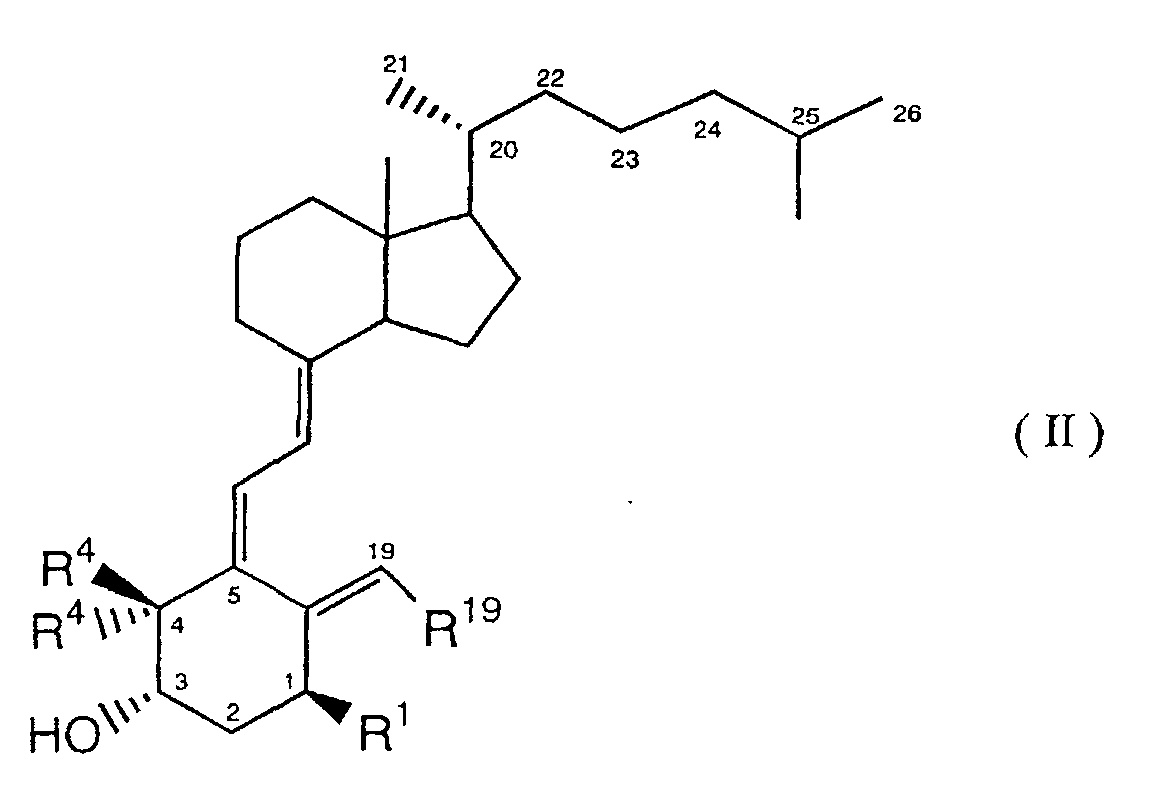
- vitamin D 3 derivatives represented by the following formula (II) wherein the symbols have the same meanings as described above, specifically, vitamin D 3 , 19-fluorovitamin D 3 , 19-fluoro-1 ⁇ -hydroxyvitamin D 3 , 4,4-difluorovitamin D 3 , 4,4-difluoro-1 ⁇ -hydroxyvitamin D 3 , 1 ⁇ -hydroxyvitamin D 3 and the like.
- microorganisms capable of hydroxylating vitamin Ds which are used in the present invention, belong to the genus Nocardia , Streptomyces, Sphingomonas or Amycolata.
- Nocardia autotrophica N-102 examples include Nocardia autotrophica N-102 (FERM BP-1573), etc.
- Streptomyces examples include Streptomyces roseosporus A-5797 (FERM BP-1574), Streptomyces sclerotialus T-JSI (FERM BP-1370), etc.
- Sphingomonas mali IFO15500 Sphingomonas paucimobilis IFO13935, Sphingomonas parapaucimobilis IFO15100, Sphingomonas yanoikuyae IFO15102, Sphingomonas adhaesiva IFO15099, Sphingomonas capsulata IFO12533, Sphingomonas sanguis IFO13937, Sphingomonas macrogoltabidus IFO15033, Sphingomonas terrae IFO15098.
- Amycolata examples include Amycolata saturnea A-7983 (FERM BP-2307), Amycolata saturnea A-1246 (FERM BP-5544) as well as Amycolata saturnea IFO14499, Amycolata autotrophica ATCC19727, Amycolata autotrophica ATCC13181, Amycolata autotrophica ATCC33794, Amycolata autotrophica ATCC33795, Amycolata autotrophica ATCC33796, Amycolata autotrophica ATCC33797, Amycolata autotrophica JCM4010, Amycolata hydrocarbonoxidans IFO14498, and the like.
- Amycolata saturnea A-7983 examples include Amycolata saturnea A-7983 (FERM BP-2307), Amycolata saturnea A-1246 (FERM BP-5544) as well as Amycolata saturnea IFO14499, Amycola
- the hydroxylation reaction proceeds even without addition of a cyclodextrin, but preferably, the addition of a cyclodextrin is an effective procedure.
- Cyclodextrins used herein are ⁇ -cyclodextrin, ⁇ -cyclodextrin, ⁇ -cyclodextrin, ⁇ -dimethylcyclodextrin, ⁇ -trimethylcyclodextrin, partial methylated cyclodextrin (sometimes abbreviated as PMCD, hereinafter), branched cyclodextrin, and the like. These cyclodextrins may be used singly or in admixture of two or more thereof.
- the reaction rate and reaction efficiency can be enhanced by coexistence of cyclodextrin in the solution containing the microorganism or the enzyme produced by that microorganism.
- Liquid media are principally used as the media for culture of microorganisms, and glucose, maltose, sucrose, dextrin, starch, arabinose, xylose, glyceride, plant fats and oils, and animal fats and oils are used as a carbon source singly or in admixture.
- Soy bean powder, cottonseed meal, gluten meal, casein, peptone, casamino acids, yeast extract, meat extract, corn steep liquor and the like are used as a nitrogen source singly or in admixture.
- Other organic and inorganic materials which are needed for growth or facilitation of the production of hydroxylase for the 24-position, 25-position, 26-position, 1-position or 2-position can be added, if necessary.
- An aerobic culture such as shaking culture and aerobic culture with stirring is suitable for the culture method.
- the culture temperature is from 20 to 33°C, preferably from 25 to 30°C, and the vitamin D derivative as a substrate and if desired, the cyclodextrin, are added 12 to 96 hours, preferably 24 to 48 hours after the initiation of the culture.
- a suitable amount of the vitamin D derivative added is from 10 to 1000 ⁇ g/mL, and preferably from 50 to 500 ⁇ g/mL, in the medium, and a suitable amount of the cyclodextrin added is from 0.1 to 15% by weight, preferably from 0.1 to 2% by weight.
- a suitable pH in the medium is from 5 to 9, preferably from 6 to 8.
- the production process of the present invention can be suitably performed by shaking or aerobically stirring the medium or the solution containing the microorganism or the enzyme.
- the aerobic stirring can be conducted for 1 to 130 hours after the addition of the vitamin D derivative as the substrate and if desired, cyclodextrin.
- Increasing pressure in an incubator or reacting under an oxygen gas stream is also effective for obtaining aerobic conditions.
- the method of adding cyclodextrin can be any of the following methods; the method where the cyclodextrin is mixed with vitamin D derivative as the substrate in advance; the method where vitamin D derivative is first added, followed by addition of the cyclodextrin, and the method where the cyclodextrin is first added, followed by addition of vitamin D derivative.
- Methods of isolating the vitamin D derivatives produced by these reactions include, for example, extraction with organic solvents, column chromatography, and the like.
- the reaction solution is extracted with methylene chloride, concentrated and dried up. This is dissolved in an appropriate solvent such as 2-propanol, n-hexane, and the like, insoluble matters are removed by filtration, centrifugation and the like, and then, the hydroxyvitamin D derivative can be isolated by high-performance liquid chromatography (HPLC) using a silica gel column, for example, Zorbax SIL (made by Du Pont, U.S.A.), Simpack ODS (made by Shimadzu Corporation), Hibar RT 250-10 LiChrosorb Si60 (made by Sica-Merck).
- HPLC high-performance liquid chromatography
- novel vitamin D 3 derivatives in which the hydrogen atom or atoms at the 2-position, 24-position, 25-position and/or 26-position are converted into a hydroxyl group or groups can be produced using a microorganism or an enzyme produced by that microorganism.
- monohydroxylated or dihydroxylated compounds in which one or two of hydrogen atoms of corresponding substrate bound at the 2-position, 24-position, 25-positin and/or 26-position are converted into a hydroxyl group or groups can be readily produced.
- novel vitamin D 3 derivatives produced by the process of the present invention are expected to enhance their original activities such as absorption of calcium, facilitation of bone calcium metabolism, differentiation of epidermal keratinocytes and the like, to augment selectivity or to improve in vivo absorptivity.
- VDR vitamin D receptor
- RRA radio receptor assay
- 1,25(OH) 2 D 3 and each specimen were serially diluted at from 10 -11 M to 10 -6 M.
- 20 ⁇ L of a [26,27- 3 H]-1,25-dihydroxyvitamin D 3 ( 3 H-1,25(OH) 2 D 3 ) solution and 60 ⁇ L of 1,25(OH) 2 D 3 or each specimen solution were added in a small test tube, and 0.5 mL of a VDR (chicken small intestine receptor) solution was added and mixed, and then allowed to stand at 4°C for 3 hours.
- VDR dry small intestine receptor
- the binding ability to VDR of each specimen was evaluated by calculating and comparing the B/B 0 50% value. This is the amount of the specimen bound to VDR when the amount (B) of 3 H-1,25(OH) 2 D 3 bound to VDR was competitively inhibited by the specimen to 50% of B 0 , which is the amount of 3 H-1,25(OH) 2 D 3 bound to VDR when only 3 H-1,25(OH) 2 D 3 exists.
- the VDR binding ability was shown in Table 1 as a relative value of each specimen when B/B 0 50% value of 1,25(OH) 2 D 3 is taken to be 100.
- vitamin D receptor VDR
- Table 1 the vitamin D 3 derivatives of the present invention have the binding ability to VDR and the medicinal use that possesses various actions as described above is expected.
- the binding ability to DBP was evaluated using the following competitive protein binding assay (CPBA).
- CPBA competitive protein binding assay
- 1,25(OH) 2 D 3 and each specimen were diluted to concentrations from 10 -11 M to 10 -5 M.
- 50 ⁇ L of a [26,27- 3 H]-25-hydroxyvitamin D 3 ( 3 H-25(OH)D 3 ) solution and 100 ⁇ L of 1,25(OH) 2 D 3 or each specimen solution were placed in a small test tube, and 1 mL of a DBP (rat serum diluted with a barbital acetate buffer) solution was added and mixed, and then allowed to stand at 4°C for 1 hour.
- DBP rat serum diluted with a barbital acetate buffer
- the binding ability to DBP of each specimen was evaluated by calculating and comparing the B/B 0 50% value. This is the amount of the specimen bound to DBP when the amount (B) of 3 H-25(OH)D 3 bound to DBP was competitively inhibited by the coexisting specimen and 1,25(OH) 2 D 3 to 50% of B 0 , which is the amount of 3 H-25(OH)D 3 bound to DBP when only 3 H-25(OH)D 3 exists.
- the DBP binding ability was shown in Table 1 as a relative value of each specimen when B/B 0 50% value of 1,25(OH) 2 D 3 is taken to be 100.
- Vitamin Ds are stable in blood when they are bound to the vitamin D binding protein (DBP).
- DBP vitamin D binding protein
- the property of vitamin D 3 derivatives of the present invention to bind to DBP implies their stability in blood, suggesting that the vitamin D derivatives transported to sites and organs in needs via blood can express actions as vitamin D.
- the vitamin D 3 derivatives of the present invention are expected to be useful as medicines which exist stably in blood or are transported to target organs via a blood flow.
- HL60 cells were passaged in RPMI 1640 medium containing 10% fetal bovine serum in an atmosphere 5% CO 2 at 37°C.
- Differentiation of HL60 cells by vitamin D derivative was induced by culturing in the media containing from 10 -11 to 10 M -5 of 1,25(OH) 2 D 3 or each specimen at 37°C for 4 days.
- the ability to induce differentiation was evaluated by measuring reduction of cytochrome C as an index in respect of the amount of super oxide which was produced by the cells stimulated with phorbol myristate acetate (PMA). Namely, after removing the culture medium by aspiration, the cells treated with vitamin D derivatives were suspended in 1.5 mL of a reaction mixture (ferricytochrome C (80 ⁇ M), PMA (500 ng/mL)) and cultured at 37°C for 1 hour.
- the induction ability of differentiation of HL-60 was compared with respect to the EC 50 value calculated from the concentration of reduced cytochrome C, and a relative value of each specimen is shown in Table 1 when the EC 50 value of 1,25(OH) 2 D 3 is taken to be 100.
- the vitamin Ds have the action that leads undifferentiated tumor cells to differentiated normal cells (macrophages).
- the HL-60 cells are a human promyelocytic leukemia cell strain, and as shown in Table 1, the vitamin D 3 derivatives of the present invention having the action to induce HL-60 differentiation are expected to possess medicinal use that induces differentiation.
- a sample after microbial conversion was isolated and purified using an HPLC system equipped with an MD-910 type multiple detector supplied by JASCO Corporation, and then subjected to the following analyses.
- BG medium a medium consisting of 1.5% bactosoyton (supplied by Difco), 0.5% corn steep liquor, 1.5% glucose, 0.5% NaCl, and 0.2% CaCO 3 (pH 7.2) was placed in a 500 mL-Erlenmeyer flask and autoclaved at 120°C for 20 minutes. This was inoculated with one platinum loop of Amycolata autotrophica ATCC 33797 and shaken at 28°C for 72 hours to culture aerobically.
- BG medium consisting of 1.5% bactosoyton (supplied by Difco), 0.5% corn steep liquor, 1.5% glucose, 0.5% NaCl, and 0.2% CaCO 3 (pH 7.2) was placed in a 500 mL-Erlenmeyer flask and autoclaved at 120°C for 20 minutes. This was inoculated with one platinum loop of Amycolata autotrophica ATCC 33797 and shaken at 28°C for 72 hours to culture aerobically.
- the cultured broth was centrifuged, and the mycelium were collected and washed once with 0.01 M of tris-acetate buffer (containing 2 mM magnesium acetate, 7 mM 2-mercaptoethanol and 20% glycerin) (pH 7.4), followed by suspension in 100 mL of the same buffer.
- This suspension was sonicated (at 20 kHz and 50 W for 2 minutes) and centrifuged (10,000 ⁇ g for 15 minutes ) to obtain the supernatant.
- Polyethylene Glycol 6000 was gradually added to this supernatant to a final concentration of 25%, followed by allowing to stand at 4°C for 10 minutes. A crude enzyme precipitation was obtained by centrifugation.
- This crude enzyme precipitation at a wet weight of 1 g was suspended in 10 mL of tris-acetate buffer (containing 70 mM nicotine amide, 2 mM magnesium acetate, 100 mM NADP, 5 mM ATP, and 6 mM glucose-6-phosphate)(pH 7.4), followed by adding 5 units of glucose-6-phosphate dehydrogenase, 0.2 mL of a solution of 10 mg/mL vitamin D 3 in ethanol and 0.1 mL of a 50% partial methylated ⁇ -cyclodextrin (supplied by Mercian Corporation) solution thereto. Then, the mixture was stirred and shaken at 28°C for one hour to effect enzymatic reaction.
- tris-acetate buffer containing 70 mM nicotine amide, 2 mM magnesium acetate, 100 mM NADP, 5 mM ATP, and 6 mM glucose-6-phosphate
- methanol at the equivalent amount to the cultured solution was added and mixed, then centrifuged at 3000 rpm for 10 minutes (Type CST060LF type, supplied by Shimadzu Corporation) to collect the supernatant.
- the collected supernatant was passed through a column (an inner diameter 1 cm ⁇ a length 15 cm) packed with Diaion HP20SS (supplied by Mitsubishi Chemical Industries, Ltd.) at a flow rate of 0.5 mL/min., and eluted with a methanol concentration gradient from 50 to 100% to obtain a peak fraction.
- This peak fraction was concentrated, dried up, and dissolved in 3 mL of a mixed solvent of 2-propanol/n-hexane (1/9), then allowed to stand at -20°C for 2 hours. The resulting insoluble component was eliminated by centrifugation. This supernatant was concentrated under reduced pressure to afford a product (2.2 mg). Each peak fraction was collected by HPLC and concentrated under reduced pressure and dried up while purging with a nitrogen gas at 40°C or less to afford 2 ⁇ ,25-dihydroxyvitamin D 3 (20 ⁇ g) as shown below.
- BG medium a medium consisting of 1.5% bactosoyton (supplied by Difco), 0.5% corn steep liquor, 1.5% glucose, 0.5% NaCl, and 0.2% CaCO 3 (pH 7.2) was placed in a 500 mL-Erlenmeyer flask and autoclaved at 120°C for 20 minutes. This was inoculated with one platinum loop of Amycolata autotrophica ATCC 33797 and shaken at 28°C and at 220 rpm for 48 hours to culture aerobically.
- BG medium consisting of 1.5% bactosoyton (supplied by Difco), 0.5% corn steep liquor, 1.5% glucose, 0.5% NaCl, and 0.2% CaCO 3 (pH 7.2) was placed in a 500 mL-Erlenmeyer flask and autoclaved at 120°C for 20 minutes. This was inoculated with one platinum loop of Amycolata autotrophica ATCC 33797 and shaken at 28°C and at 220 rpm for 48 hours to culture
- methanol at the equivalent amount to the cultured solution was added and mixed, then centrifuged at 3000 rpm for 10 minutes (Type CST060LF, supplied by Shimadzu Corporation) to collect the supernatant.
- the collected supernatant was passed through a column (an inner diameter 1 cm ⁇ a length 15 cm) packed with Diaion HP20SS (supplied by Mitsubishi Chemical Industries, Ltd.) at a flow rate of 0.5 mL/min. and eluted with a methanol concentration gradient from 50 to 100% to obtain a peak fraction.
- Example 2 The same procedure as in Example 2 was carried out to obtain a product (1.7 mg), except that 19-fluorovitamin D 3 (4.90 mg) was used as the substrate. After purification by semi-preparative HPLC under the following condition, 19-fluoro-24-hydroxyvitamin D 3 (14 ⁇ g), 19-fluoro-25-hydroxyvitamin D 3 (206 ⁇ g) and 19-fluoro-26-hydroxyvitamin D 3 (28 ⁇ g) were obtained. HPLC conditions:
- Example 2 The same procedure as in Example 2 was carried out to obtain a product (2.8 mg), except that 19-fluoro-1 ⁇ -hydroxyvitamin D 3 (2.44 mg) was used as the substrate. After purification by semi-preparative HPLC under the following condition, 19-fluoro-1 ⁇ ,24-dihydroxyvitamin D 3 (46 ⁇ g), 19-fluoro-1 ⁇ ,25-dihydroxyvitamin D 3 (980 ⁇ g) and 19-fluoro-1 ⁇ ,26-dihydroxyvitamin D 3 (50 ⁇ g) were obtained. HPLC conditions:
- Example 2 The same procedure as in Example 2 was carried out to obtain a product (3.3 mg), except that 4,4-difluorovitamin D 3 (4.90 mg) was used as the substrate. After purification by semi-preparative HPLC under the following condition, 4,4-difluoro-24-hydroxyvitamin D 3 (86 ⁇ g), 4,4-difluoro-25-hydroxyvitamin D 3 (857 ⁇ g) and 4,4-difluoro-26-hydroxyvitamin D 3 (137 ⁇ g). HPLC conditions:
- Example 6 Microbial conversion of 4,4-difluoro-1 ⁇ -hydroxy vitamin D 3 :
- Example 2 The same procedure as in Example 2 was carried out to obtain a product (0.9 mg), except that 4,4-difluoro-1 ⁇ -hydroxyvitamin D 3 (1.76 mg) was used as the substrate.
- 4,4-difluoro-1 ⁇ -hydroxyvitamin D 3 (1.76 mg) was used as the substrate.
Landscapes
- Chemical & Material Sciences (AREA)
- Organic Chemistry (AREA)
- Life Sciences & Earth Sciences (AREA)
- Zoology (AREA)
- Engineering & Computer Science (AREA)
- Wood Science & Technology (AREA)
- Health & Medical Sciences (AREA)
- Genetics & Genomics (AREA)
- Bioinformatics & Cheminformatics (AREA)
- Microbiology (AREA)
- Biotechnology (AREA)
- Biochemistry (AREA)
- General Engineering & Computer Science (AREA)
- General Health & Medical Sciences (AREA)
- Chemical Kinetics & Catalysis (AREA)
- General Chemical & Material Sciences (AREA)
- Biomedical Technology (AREA)
- Molecular Biology (AREA)
- Medicinal Chemistry (AREA)
- Organic Low-Molecular-Weight Compounds And Preparation Thereof (AREA)
- Preparation Of Compounds By Using Micro-Organisms (AREA)
Abstract
Description
- The present invention relates to a biological hydroxylation process in which a hydrogen atom or atoms at the 2-position, 24-position, 25-position and/or 26-position of a vitamin D derivative are converted into a hydroxyl group or groups, and to novel vitamin D3 derivatives produced by that process. More particularly, the invention relates to
- (1) a process for producing vitamin D derivatives, characterized by converting a hydrogen atom or atoms at the 2-position, 24-position, 25-position and/or 26-position of a vitamin D derivative into a hydroxyl group or groups using a microorganism (a hydroxylation process) and to
- (2) novel vitamin D3 derivatives represented by the formula (I)
 wherein all symbols have the same meanings as described later.
-
- Vitamin D derivatives are an important vitamin which relates to absorption of calcium, facilitation of bone calcium metabolism, or differentiation of epidermal keratinocytes in vivo, and it is known that their activity is exhibited upon hydroxylation at the 25-position in liver and at the 1α-position in kidney [H.F. Deluca and H.K. Jones: Ann. Rev. Biochem., Vol. 52, p.411 (1983)]. However, it is known that in vivo production quantity of 25-hydroxyvitamin D3 is insufficient in patients with hepatic dysfunction, and administration of 25-hydroxyvitamin D3 to these patients is effective in the light of making up in vivo shortfall. 1α,25-Dihydroxyvitamin D3 reveals remarkable effects on patients with renal failure (rachitis with renal failure and the like) and osteoporosis.
- While it is known that 1α,25-dihydroxyvitamin D3 can be obtained from a raw material, 25-hydroxyvitamin D3 by enzymatic chemical conversion using a microorganism, its conversion efficiency was not sufficient (Japanese Patent Laid-Open No. 469/1990 and No. 231089/1990 (U.S. Patent No. 4,892,821)).
- Thus, the present inventors previously proposed a process for increasing the conversion efficiency under the coexistence of a cyclodextrin in the reaction solution in conversion process from vitamin D derivatives to 25-hydroxyvitamin D derivatives or 1α,25-dihydroxyvitamin D derivatives using a microorganism (Japanese Patent Laid-Open No. 166090/1992 (U.S. Patent No. 5,474,923)).
- Moreover, in recent years, it is reported that a synthetic vitamin D derivative hydroxylated at the 1α- and 24-positions (1α,24-dihydroxyvitamin D3) binds to a receptor specific for 1α,25-dihydroxyvitamin D3 and shows similar activities to those of 1α,25-dihydroxyvitamin D3 [The Journal of Dermatology, Vol. 17, p.135 (1990)].
- Thus, various vitamin D derivatives are expected to enhance their original activities such as absorption of calcium, facilitation of bone calcium metabolism, differentiation of epidermal keratinocytes and the like, to augment selectivity, or to improve in vivo absorptivity.
- The present inventors further studied on reaction solutions used for converting vitamin D derivatives into hydroxyvitamin D derivatives using microorganisms, which the present inventors previously developed. As a result, several kinds of novel hydroxyvitamin D derivative having unknown structures were confirmed. With respect to these novel compounds, while the details of their activities are being examined, they are expected to be new medicines having vitamin D actions.
- The present inventors still further studied on the reaction solutions used in the process for producing vitamins hydroxylated at the 25-position of 1α-vitamin D3 by the biological method as previously proposed (Japanese Patent Laid-Open No. 166090/1992 (U.S. Patent No. 5,474,923), examining vitamin D3, 19-fluorovitamin D3, 19-fluoro-1α-dihydroxyvitamin D3, 4,4-difluorovitamin D3, 4,4-difluoro-1α-hydroxyvitamin D3, and 1α-hydroxyvitamin D3 as substrates. As a result, finding novel hydroxyvitamin D3 with hydroxyl groups being introduced therein at not only the 25-position but also the 2-position, 24-position and 26-position, they completed the present invention.
- Specifically, the present invention provides:
- (1) A biological process for producing hydroxyvitamin D derivatives, characterized by converting a hydrogen atom or atoms at the 2-position, 24-position, 25-position and/or 26-position of a vitamin D into a hydroxyl group or groups in a solution containing a microorganism which can hydroxylate vitamin Ds or an enzyme produced by that microorganism, and optionally under the coexistence of a cyclodextrin; and
- (2) Vitamin D3 derivatives represented by the formula (I):
 wherein R1, R2, R24, R25 and R26 each independently represents a
hydrogen atom or a hydroxyl group; and R4 and R19 each independently
represents a hydrogen atom or a fluorine atom, provided that one
of R2, R24 and R26 is a hydroxyl group, and the others are each a
hydrogen atom,
provided that 1α,24-dihydroxyvitamin D3 wherein R1 and R24 each
represents a hydroxyl group, and R2, R4, R19, R25 and R26 each
represents a hydrogen atom is excluded.
-
- Specific examples of novel vitamin D3 derivatives represented by the formula (I) include the following (1) to (10) compounds.
- (1) 1α,26-Dihydroxyvitamin D3
- (2) 2α,25-Dihydroxyvitamin D3
- (3) 19-Fluoro-24-hydroxyvitamin D3
- (4) 19-Fluoro-26-hydroxyvitamin D3
- (5) 19-Fluoro-1α,24-dihydroxyvitamin D3
- (6) 19-Fluoro-1α,26-dihydroxyvitamin D3
- (7) 4,4-Difluoro-24-hydroxyvitamin D3
- (8) 4,4-Difluoro-26-hydroxyvitamin D3
- (9) 4,4-Difluoro-1α,24-dihydroxyvitamin D3
- (10) 4,4-Difluoro-1α,26-dihydroxyvitamin D3
-
- Vitamin Ds which are to be hydroxylated in the microbiological production process of the present invention are vitamin D derivatives having a hydrogen atom or atoms at the 2-position, 24-position, 25-position and/or 26-position.
- Such vitamin D derivatives are, for example, vitamin D2 derivatives, vitamin D3 derivatives, vitamin D4 derivatives, vitamin D5 derivatives and vitamin D7 derivatives, wherein hydrogen atom(s) or hydroxyl group(s) may be substituted with halogen atom(s) such as a fluorine atom, a hydroxyl group, a lower alkyl group or the like. Further, the two hydrogen atoms at the 4,4-positions and/or the hydrogen atom at the 19-position may be substituted with a halogen atom such as a fluorine atom.
- Specific examples include:
- vitamin D2,
- vitamin D3,
- vitamin D4,
- vitamin D5,
- vitamin D6,
- vitamin D7,
- 24-oxovitamin D3,
- 1α-hydroxyvitamin D2,
- 1α-hydroxyvitamin D3,
- 1α-hydroxyvitamin D4,
- 1α-hydroxyvitamin D5,
- 1α-hydroxyvitamin D6,
- 1α-hydroxyvitamin D7,
- 1α-hydroxy-24-oxovitamin D3,
- 1a,24-dihydroxyvitamin D3,
- 2α-hydroxyvitamin D2,
- 2α-hydroxyvitamin D3,
- 2α-hydroxyvitamin D4,
- 2α-hydroxyvitamin D5,
- α-hydroxyvitamin D6,
- 2α-hydroxyvitamin D7,
- 2α-hydroxy-24-oxovitamin D3,
- 2α,24-dihydroxyvitamin D3,
- 24-hydroxyvitamin D3,
- 23-hydroxyvitamin D3,
- 23-hydroxyvitamin D4,
- 1α,23-dihydroxyvitamin D3,
- 1α,23-dihydroxyvitamin D4,
- 2α,23-dihydroxyvitamin D3,
- 2α,23-dihydroxyvitamin D4,
- 26-hydroxyvitamin D2,
- 26-hydroxyvitamin D3,
- 26-hydroxyvitamin D4,
- 1α,26-dihydroxyvitamin D2,
- 1α,26-dihydroxyvitamin D3,
- 1α,26-dihydroxyvitamin D4,
- 2α,26-dihydroxyvitamin D2,
- 2α,26-dihydroxyvitamin D3,
- 2α,26-dihydroxyvitamin D4,
- 23,24-dihydroxyvitamin D3,
- 23,26-dihydroxyvitamin D3,
- 23,26-dihydroxyvitamin D4,
- vitamin D3-26,23-lactone,
- 1α-hydroxyvitamin D3-26,23-lactone,
- 2α-hydroxyvitamin D3-26,23-lactone,
- 24,24-difluorovitamin D3,
- 24,24-dichlorovitamin D3,
- 24,24-dibromovitamin D3,
- 26,26,26,27,27,27-hexafluorovitamin D3,
- 26,26,26,27,27,27-hexachlorovitamin D3,
- 24,24-difluoro-25-hydroxy-26,27-dimethylvitamin D3,
- 24,24-dichloro-25-hydroxy-26,27-dimethylvitamin D3,
- 25-hydroxyvitamin D2,
- 25-hydroxyvitamin D3,
- 25-hydroxyvitamin D4,
- 25-hydroxyvitamin D5,
- 25-hydroxyvitamin D6,
- 25-hydroxyvitamin D7,
- 24-oxo-25-hydroxyvitamin D3,
- 24,25-dihydroxyvitamin D3,
- 23,25-dihydroxyvitamin D3,
- 23,25-dihydroxyvitamin D4,
- 25,26-dihydroxyvitamin D2,
- 25,26-dihydroxyvitamin D3,
- 25,26-dihydroxyvitamin D4,
- 25-hydroxyvitamin D3-26,23-lactone,
- (10E)-19-fluorovitamin D3,
- (10E)-19-fluoro-1α-hydroxyvitamin D3,
- (10E)-19-fluoro-2α-hydroxyvitamin D3,
- 4,4-difluorovitamin D3,
- 4,4-difluoro-la-hydroxyvitamin D3,
- 4,4-difluoro-2a-hydroxyvitamin D3,
- 4,4-difluoro-provitamin D3,
- (10E)-19-chlorovitamin D3,
- (10E)-19-chloro-1α-hydroxyvitamin D3,
- (10E)-19-chloro-2a-hydroxyvitamin D3,
- 4,4-dichlorovitamin D3,
- 4,4-dichloro-1α-hydroxyvitamin D3,
- 4,4-dichloro-2α-hydroxyvitamin D3,
- 4,4-dichloro-provitamin D3, and the like.
-
- Examples of preferred compounds among these include vitamin D3 derivatives represented by the following formula (II)wherein the symbols have the same meanings as described above, specifically, vitamin D3, 19-fluorovitamin D3, 19-fluoro-1α-hydroxyvitamin D3, 4,4-difluorovitamin D3, 4,4-difluoro-1α-hydroxyvitamin D3, 1α-hydroxyvitamin D3 and the like.
- The microorganisms capable of hydroxylating vitamin Ds, which are used in the present invention, belong to the genus Nocardia, Streptomyces, Sphingomonas or Amycolata.
- Examples of those belonging to the genus Nocardia include Nocardia autotrophica N-102 (FERM BP-1573), etc.
- Examples of those belonging to the genus Streptomyces include Streptomyces roseosporus A-5797 (FERM BP-1574), Streptomyces sclerotialus T-JSI (FERM BP-1370), etc.
- Examples of those belonging to the genus Sphingomonas include Sphingomonas mali IFO15500, Sphingomonas paucimobilis IFO13935, Sphingomonas parapaucimobilis IFO15100, Sphingomonas yanoikuyae IFO15102, Sphingomonas adhaesiva IFO15099, Sphingomonas capsulata IFO12533, Sphingomonas sanguis IFO13937, Sphingomonas macrogoltabidus IFO15033, Sphingomonas terrae IFO15098.
- Examples of those belonging to the genus Amycolata include Amycolata saturnea A-7983 (FERM BP-2307), Amycolata saturnea A-1246 (FERM BP-5544) as well as Amycolata saturnea IFO14499, Amycolata autotrophica ATCC19727, Amycolata autotrophica ATCC13181, Amycolata autotrophica ATCC33794, Amycolata autotrophica ATCC33795, Amycolata autotrophica ATCC33796, Amycolata autotrophica ATCC33797, Amycolata autotrophica JCM4010, Amycolata hydrocarbonoxidans IFO14498, and the like.
- These may be used singly or in admixture of two or more thereof.
- In the present invention, the hydroxylation reaction proceeds even without addition of a cyclodextrin, but preferably, the addition of a cyclodextrin is an effective procedure.
- Cyclodextrins used herein are α-cyclodextrin, β-cyclodextrin, γ-cyclodextrin, β-dimethylcyclodextrin, β-trimethylcyclodextrin, partial methylated cyclodextrin (sometimes abbreviated as PMCD, hereinafter), branched cyclodextrin, and the like. These cyclodextrins may be used singly or in admixture of two or more thereof.
- In the process of the present invention, the reaction rate and reaction efficiency can be enhanced by coexistence of cyclodextrin in the solution containing the microorganism or the enzyme produced by that microorganism. Liquid media are principally used as the media for culture of microorganisms, and glucose, maltose, sucrose, dextrin, starch, arabinose, xylose, glyceride, plant fats and oils, and animal fats and oils are used as a carbon source singly or in admixture. Soy bean powder, cottonseed meal, gluten meal, casein, peptone, casamino acids, yeast extract, meat extract, corn steep liquor and the like are used as a nitrogen source singly or in admixture. Other organic and inorganic materials which are needed for growth or facilitation of the production of hydroxylase for the 24-position, 25-position, 26-position, 1-position or 2-position can be added, if necessary.
- An aerobic culture such as shaking culture and aerobic culture with stirring is suitable for the culture method.
- The culture temperature is from 20 to 33°C, preferably from 25 to 30°C, and the vitamin D derivative as a substrate and if desired, the cyclodextrin, are added 12 to 96 hours, preferably 24 to 48 hours after the initiation of the culture. A suitable amount of the vitamin D derivative added is from 10 to 1000 µg/mL, and preferably from 50 to 500 µg/mL, in the medium, and a suitable amount of the cyclodextrin added is from 0.1 to 15% by weight, preferably from 0.1 to 2% by weight. A suitable pH in the medium is from 5 to 9, preferably from 6 to 8.
- The production process of the present invention can be suitably performed by shaking or aerobically stirring the medium or the solution containing the microorganism or the enzyme. The aerobic stirring can be conducted for 1 to 130 hours after the addition of the vitamin D derivative as the substrate and if desired, cyclodextrin. Increasing pressure in an incubator or reacting under an oxygen gas stream is also effective for obtaining aerobic conditions.
- The method of adding cyclodextrin can be any of the following methods; the method where the cyclodextrin is mixed with vitamin D derivative as the substrate in advance; the method where vitamin D derivative is first added, followed by addition of the cyclodextrin, and the method where the cyclodextrin is first added, followed by addition of vitamin D derivative.
- Methods of isolating the vitamin D derivatives produced by these reactions include, for example, extraction with organic solvents, column chromatography, and the like. For example, after completion of the reactions, the reaction solution is extracted with methylene chloride, concentrated and dried up. This is dissolved in an appropriate solvent such as 2-propanol, n-hexane, and the like, insoluble matters are removed by filtration, centrifugation and the like, and then, the hydroxyvitamin D derivative can be isolated by high-performance liquid chromatography (HPLC) using a silica gel column, for example, Zorbax SIL (made by Du Pont, U.S.A.), Simpack ODS (made by Shimadzu Corporation), Hibar RT 250-10 LiChrosorb Si60 (made by Sica-Merck).
- According to the process of the present invention, novel vitamin D3 derivatives in which the hydrogen atom or atoms at the 2-position, 24-position, 25-position and/or 26-position are converted into a hydroxyl group or groups can be produced using a microorganism or an enzyme produced by that microorganism.
- In particular, according to the process of the present invention, monohydroxylated or dihydroxylated compounds in which one or two of hydrogen atoms of corresponding substrate bound at the 2-position, 24-position, 25-positin and/or 26-position are converted into a hydroxyl group or groups can be readily produced.
- The novel vitamin D3 derivatives produced by the process of the present invention are expected to enhance their original activities such as absorption of calcium, facilitation of bone calcium metabolism, differentiation of epidermal keratinocytes and the like, to augment selectivity or to improve in vivo absorptivity.
- Evaluation studies on (1) binding ability to vitamin D receptor (VDR), (2) binding ability to vitamin D-bound protein (DBP) and (3) induction ability of differentiation of HL-60 were performed on the following eight novel vitamin D3 derivatives described in the Examples and a control compound (specimens 1 to 9).
- Specimen 1: Control (1α,25-dihydroxyvitamin D3 (1,25(OH)2D3))
- Specimen 2: Example 1(1) (2α,25-dihydroxyvitamin D3)
- Specimen 3: Example 2 (1α,26-dihydroxyvitamin D3)
- Specimen 4: Example 4(1) (19-fluoro-1α,24-dihydroxyvitamin D3)
- Specimen 5: Example 4(2) (19-fluoro-1α,25-dihydroxyvitamin D3)
- Specimen 6: Example 4(3) (19-fluoro-1α,26-dihydroxyvitamin D3)
- Specimen 7: Example 5(1) (4,4-difluoro-24-hydroxyvitamin D3)
- Specimen 8: Example 5(3) (4,4-difluoro-26-dihydroxyvitamin D3)
- Specimen 9: Example 6(2) (4,4-difluoro-1α,25-dihydroxyvitamin D3)
-
- Binding ability to VDR was examined by the following radio receptor assay (RRA) method.
- 1,25(OH)2D3 and each specimen were serially diluted at from 10-11 M to 10-6 M. 20µL of a [26,27-3H]-1,25-dihydroxyvitamin D3 (3H-1,25(OH)2D3) solution and 60 µL of 1,25(OH)2D3 or each specimen solution were added in a small test tube, and 0.5 mL of a VDR (chicken small intestine receptor) solution was added and mixed, and then allowed to stand at 4°C for 3 hours. Then, after 0.125 mL of a dextran-active carbon suspension was added and mixed, the mixture was allowed to stand on ice for 30 minutes, 3H-1,25(OH)2D3 unbound to VDR was removed by centrifugation at 3000 rpm for 15 minutes, and then the quantity of 3H-1,25 (OH)2D3 bound to VDR was measured using 0.5 mL of the supernatant.
- The binding ability to VDR of each specimen was evaluated by calculating and comparing the B/B0 50% value. This is the amount of the specimen bound to VDR when the amount (B) of 3H-1,25(OH)2D3 bound to VDR was competitively inhibited by the specimen to 50% of B0, which is the amount of 3H-1,25(OH)2D3 bound to VDR when only 3H-1,25(OH)2D3 exists. The VDR binding ability was shown in Table 1 as a relative value of each specimen when B/B0 50% value of 1,25(OH)2D3 is taken to be 100.
- Various actions of the vitamin D such as regulation of calcium metabolism, suppression of cellular proliferation, induction of differentiation, and the like are expressed via the vitamin D receptor (VDR). As shown in Table 1, the vitamin D3 derivatives of the present invention have the binding ability to VDR and the medicinal use that possesses various actions as described above is expected.
- The binding ability to DBP was evaluated using the following competitive protein binding assay (CPBA). 1,25(OH)2D3 and each specimen were diluted to concentrations from 10-11 M to 10-5 M. 50 µL of a [26,27-3H]-25-hydroxyvitamin D3 (3H-25(OH)D3) solution and 100 µL of 1,25(OH)2D3 or each specimen solution were placed in a small test tube, and 1 mL of a DBP (rat serum diluted with a barbital acetate buffer) solution was added and mixed, and then allowed to stand at 4°C for 1 hour. Then, after 0.5 mL of a dextran-active carbon suspension was added and mixed, the mixture was allowed to stand on ice for 10 minutes, 3H-25(OH)D3 unbound to DBP was removed by centrifugation at 3000 rpm for 15 minutes, and then the quantity of 3H-25(OH)D3 bound to DBP was measured using 1 mL of the supernatant.
- The binding ability to DBP of each specimen was evaluated by calculating and comparing the B/B0 50% value. This is the amount of the specimen bound to DBP when the amount (B) of 3H-25(OH)D3 bound to DBP was competitively inhibited by the coexisting specimen and 1,25(OH)2D3 to 50% of B0, which is the amount of 3H-25(OH)D3 bound to DBP when only 3H-25(OH)D3 exists. The DBP binding ability was shown in Table 1 as a relative value of each specimen when B/B0 50% value of 1,25(OH)2D3 is taken to be 100.
- Vitamin Ds are stable in blood when they are bound to the vitamin D binding protein (DBP). The property of vitamin D3 derivatives of the present invention to bind to DBP implies their stability in blood, suggesting that the vitamin D derivatives transported to sites and organs in needs via blood can express actions as vitamin D. Thus, the vitamin D3 derivatives of the present invention are expected to be useful as medicines which exist stably in blood or are transported to target organs via a blood flow.
- HL60 cells were passaged in RPMI 1640 medium containing 10% fetal bovine serum in an atmosphere 5% CO2 at 37°C.
- Differentiation of HL60 cells by vitamin D derivative was induced by culturing in the media containing from 10-11 to 10 M-5 of 1,25(OH)2D3 or each specimen at 37°C for 4 days. The ability to induce differentiation was evaluated by measuring reduction of cytochrome C as an index in respect of the amount of super oxide which was produced by the cells stimulated with phorbol myristate acetate (PMA). Namely, after removing the culture medium by aspiration, the cells treated with vitamin D derivatives were suspended in 1.5 mL of a reaction mixture (ferricytochrome C (80 µM), PMA (500 ng/mL)) and cultured at 37°C for 1 hour. After completion of the culture, an absorbance, OD550~OD540 of a centrifuged supernatant was measured. A concentration of the reduced cytochrome C was calculated by the following formula using a molecular absorption constant, 19.1 × 103 cm-1.
- The induction ability of differentiation of HL-60 was compared with respect to the EC50 value calculated from the concentration of reduced cytochrome C, and a relative value of each specimen is shown in Table 1 when the EC50 value of 1,25(OH)2D3 is taken to be 100.
- The vitamin Ds have the action that leads undifferentiated tumor cells to differentiated normal cells (macrophages). The HL-60 cells are a human promyelocytic leukemia cell strain, and as shown in Table 1, the vitamin D3 derivatives of the present invention having the action to induce HL-60 differentiation are expected to possess medicinal use that induces differentiation.
Specimen Binding ability to VDR Induction ability of differentiation of HL-60 Binding ability to DBP No. 1 Control 100.00 100.00 100.00 2 Example 1(1) 32.480 3.285 11433.718 3 Example 2 107.557 34.715 168.529 4 Example 4(1) 72.878 196.572 23.665 5 Example 4(2) 62.386 87.404 35.792 6 Example 4(3) 29.129 12.296 35.257 7 Example 5(1) 81.860 105.243 16.633 8 Example 5(3) 34.067 <6.092 28.106 9 Example 6(2) 92.716 79.906 26.684 - The present invention will be described in details by the following Examples, but it should not be construed that the invention is limited to these Examples. The percentages below are on a weight basis unless otherwise designated.
- The following methods were used for instrumental analysis of each sample in the Examples.
- A sample after microbial conversion was isolated and purified using an HPLC system equipped with an MD-910 type multiple detector supplied by JASCO Corporation, and then subjected to the following analyses.
- 1H-NMR and 19F-NMR were measured by Type ARX-400 supplied by Bruker. Tetramethylsilane (TMS) as an internal standard for 1H-NMR and trifluorotoluene as an external standard (δ = -63 ppm) for 19F-NMR were used, and chemical shifts were represented as δ values. NMR data were described by the following abbreviations ; s = singlet, d = doublet, t = triplet, m = multiplet, and br = broad signal. MS spectra were measured by an electron impact (EI) method using Type JMS-AX505HA supplied by JEOL Ltd. UV spectra were measured using Type U-3200 supplied by Hitachi, Ltd.
-

- 100 mL of a medium (BG medium) consisting of 1.5% bactosoyton (supplied by Difco), 0.5% corn steep liquor, 1.5% glucose, 0.5% NaCl, and 0.2% CaCO3 (pH 7.2) was placed in a 500 mL-Erlenmeyer flask and autoclaved at 120°C for 20 minutes. This was inoculated with one platinum loop of Amycolata autotrophica ATCC 33797 and shaken at 28°C for 72 hours to culture aerobically.
- The cultured broth was centrifuged, and the mycelium were collected and washed once with 0.01 M of tris-acetate buffer (containing 2 mM magnesium acetate, 7 mM 2-mercaptoethanol and 20% glycerin) (pH 7.4), , followed by suspension in 100 mL of the same buffer. This suspension was sonicated (at 20 kHz and 50 W for 2 minutes) and centrifuged (10,000 × g for 15 minutes ) to obtain the supernatant. Polyethylene Glycol 6000 was gradually added to this supernatant to a final concentration of 25%, followed by allowing to stand at 4°C for 10 minutes. A crude enzyme precipitation was obtained by centrifugation. This crude enzyme precipitation at a wet weight of 1 g was suspended in 10 mL of tris-acetate buffer (containing 70 mM nicotine amide, 2 mM magnesium acetate, 100 mM NADP, 5 mM ATP, and 6 mM glucose-6-phosphate)(pH 7.4), followed by adding 5 units of glucose-6-phosphate dehydrogenase, 0.2 mL of a solution of 10 mg/mL vitamin D3 in ethanol and 0.1 mL of a 50% partial methylated β-cyclodextrin (supplied by Mercian Corporation) solution thereto. Then, the mixture was stirred and shaken at 28°C for one hour to effect enzymatic reaction.
- After completion of the reaction, methanol at the equivalent amount to the cultured solution was added and mixed, then centrifuged at 3000 rpm for 10 minutes (Type CST060LF type, supplied by Shimadzu Corporation) to collect the supernatant. The collected supernatant was passed through a column (an inner diameter 1 cm × a length 15 cm) packed with Diaion HP20SS (supplied by Mitsubishi Chemical Industries, Ltd.) at a flow rate of 0.5 mL/min., and eluted with a methanol concentration gradient from 50 to 100% to obtain a peak fraction. This peak fraction was concentrated, dried up, and dissolved in 3 mL of a mixed solvent of 2-propanol/n-hexane (1/9), then allowed to stand at -20°C for 2 hours. The resulting insoluble component was eliminated by centrifugation. This supernatant was concentrated under reduced pressure to afford a product (2.2 mg). Each peak fraction was collected by HPLC and concentrated under reduced pressure and dried up while purging with a nitrogen gas at 40°C or less to afford 2α,25-dihydroxyvitamin D3 (20 µg) as shown below.
- Also, fractions other than the above fraction were purified by semi-preparative HPLC to afford 1α,25-dihydroxyvitamin D3 (400 µg).
HPLC conditions: - Column: Hibar RT 250-10 LiChrosorb Si60 (7 µm)
- Elution solvent: 15% 2-propanol-hexane
- Flow rate: 7 mL/min.
- Temperature: room temperature
- Detection wavelength: 265 nm
-
-

- 1H-NMR (CDCl3) : δ 0.54 (3H, s, 18-H), 0.93 (3H, d, J=6.4 Hz, 21-H), 1.22 (6H, s, 26-H, 27-H), 2.62 (2H, m, 1-H, 4-H), 2.82 (1H, m, 9-H), 3.59 (2H, m, 2-H, 3-H), 4.91 (1H, dd, J=1.8, 1.8 Hz, 19-H), 5.12 (1H, br.s, 19-H), 5.9 (1H, d, J=11.3 Hz, 7-H), 6.27 (1H, d, J=11.3 Hz, 6-H);
- 13C-NMR (CDCl3) : δ 12.3, 19.0, 21.0, 22.3, 23.7, 27.9, 29.2, 29.4, 29.5, 36.3, 36.6, 40.7, 41.2, 42.2, 44.6, 46.1, 56.5, 56.7, 71.4, 74.8, 75.1, 115.2, 117.6, 122.9, 134.2, 141.9, 143.3;
- MSm/z (%): 416 (M+, 49), 398(21), 383(21), 365(14), 287(17), 269(10), 251(9), 152(100), 134(49);
- UV λmax (EtOH): 265 nm
-
-
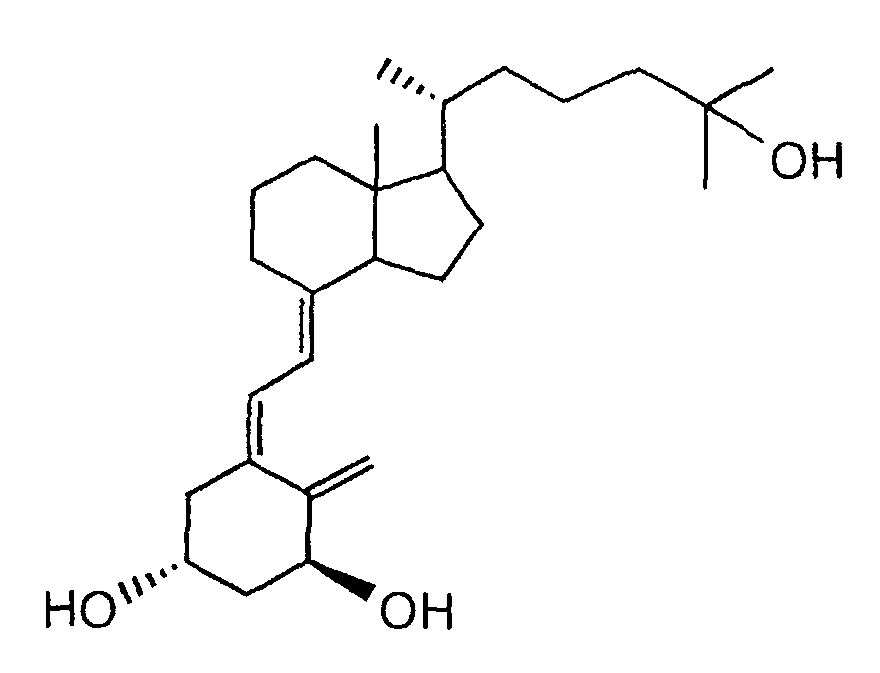
- 1H-NMR (CDCl3) : δ 0.54 (3H, s, 18-H), 0.94 (3H, d, J=6.4 Hz, 21-H), 1.22 (6H, s, 26-H, 27-H), 2.31 (1H, dd, J=13.3, 6.6 Hz, 4-H), 2.60 (1H, dd, J=13.3, 3.3 Hz, 4-H), 2.82 (1H, m, 9-H), 4.23 (1H, m, 3-H), 4.43 (1H, m, 1-H), 5.01 (1H, s, 19-H), 5.33 (1H, s, 19-H), 6.02 (1H, d, J=11.2 Hz, 7-H), 6.38 (1H, d, J=11.2 Hz, 6H);
- MSm/z (%): 416(M+, 15), 398(91), 380(93), 365(18), 362(24), 287(9), 285(16), 251(27), 152(36), 134(100);
- UV λmax (EtOH): 264 nm
-
-
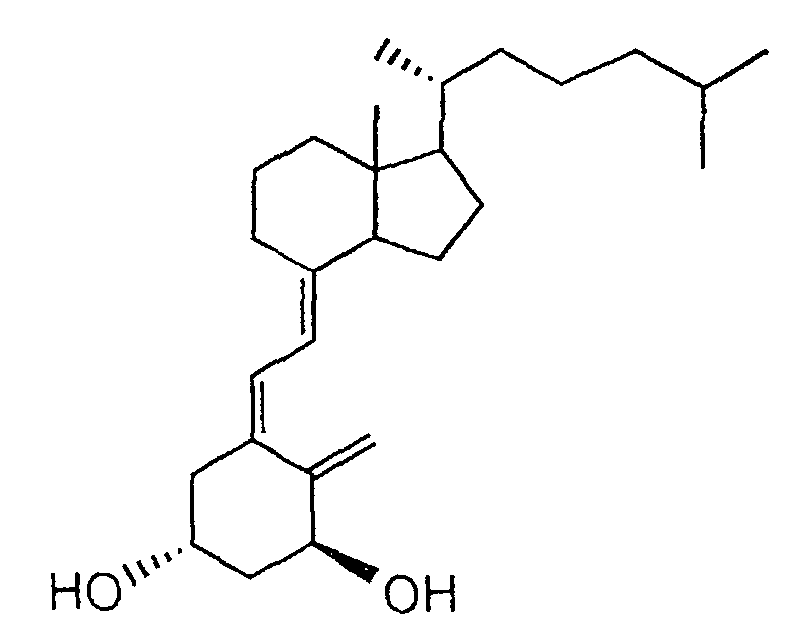
- 100 mL of a medium (BG medium) consisting of 1.5% bactosoyton (supplied by Difco), 0.5% corn steep liquor, 1.5% glucose, 0.5% NaCl, and 0.2% CaCO3 (pH 7.2) was placed in a 500 mL-Erlenmeyer flask and autoclaved at 120°C for 20 minutes. This was inoculated with one platinum loop of Amycolata autotrophica ATCC 33797 and shaken at 28°C and at 220 rpm for 48 hours to culture aerobically.
- Also, 50 mL of a BG medium having 1% partial methylated β-cyclodextrin (supplied by Mercian Corporation) added thereto was placed in a 250 mL-Erlenmeyer flask and autoclaved at 121°C for 20 minutes.
- To this BG medium, 1 mL of the previously cultured broth was transferred sterilely, and cultured at 28°C and at 200 rpm for 48 hours. To this culture solution, 1α-hydroxyvitamin D3 (15 mg) dissolved in 0.5 mL of ethanol was added and subjected to enzymatic reaction for 33 hours.
- After completion of the reaction, methanol at the equivalent amount to the cultured solution was added and mixed, then centrifuged at 3000 rpm for 10 minutes (Type CST060LF, supplied by Shimadzu Corporation) to collect the supernatant. The collected supernatant was passed through a column (an inner diameter 1 cm × a length 15 cm) packed with Diaion HP20SS (supplied by Mitsubishi Chemical Industries, Ltd.) at a flow rate of 0.5 mL/min. and eluted with a methanol concentration gradient from 50 to 100% to obtain a peak fraction. This peak fraction was concentrated, dried up, and dissolved in 3 mL of a mixed solvent of 2-propanol/n-hexane (1/9), then allowed to stand at -20°C for 2 hours. The resulting insoluble component was eliminated by centrifugation. This supernatant was concentrated under reduced pressure to afford a product (20.5 mg). Each peak fraction was collected by HPLC and concentrated under reduced pressure and dried up while purging with a nitrogen gas at 40°C or lower to afford ,1α 24-dihydroxyvitamin D3 (808 µg), 1α,25-dihydroxyvitamin D3 (5.41 mg) and 1α,26-dihydroxyvitamin D3 (531 µg).
HPLC conditions: - Column: Hibar RT 250-10 LiChrosorb Si60 (7 µm)
- Elution solvent: 15% 2-propanol-hexane
- Flow rate: 7 mL/min.
- Temperature: room temperature
- Detection wavelength: 265 nm
-
-

- 1 H-NMR (CDCl3) : δ 0.54 (3H, s, 18-H), 0.92 and 0.93 (each 3H, d, J=6.6 Hz, 21-H, 27-H), 2.31 (1H, dd, J=13.3, 6.6 Hz, 4-H), 2.60 (1H, dd, J=13.3, 3.2 Hz, 4-H), 2.82 (1H, m, 9-H), 3.42 (1H, dd, J=10.5, 6.5 Hz, 26-H), 3.52 (1H, dd, J=10.5, 5.6 Hz, 26-H), 4.23 (1H, m, 3-H), 4.43 (1H, m, 1-H), 5.01 and 5.33 (each 1H, s, 19-H), 6.01 (1H, d, J=11.3 Hz, 7-H), 6.38 (1H, d, J=11.3 Hz, 6-H);
- MS m/z (%): 416(M+, 38), 398(58), 380(48), 365(5), 287(9), 251(16), 152(50), 134(100);
- UV λmax (EtOH) : 264 nm
-
-
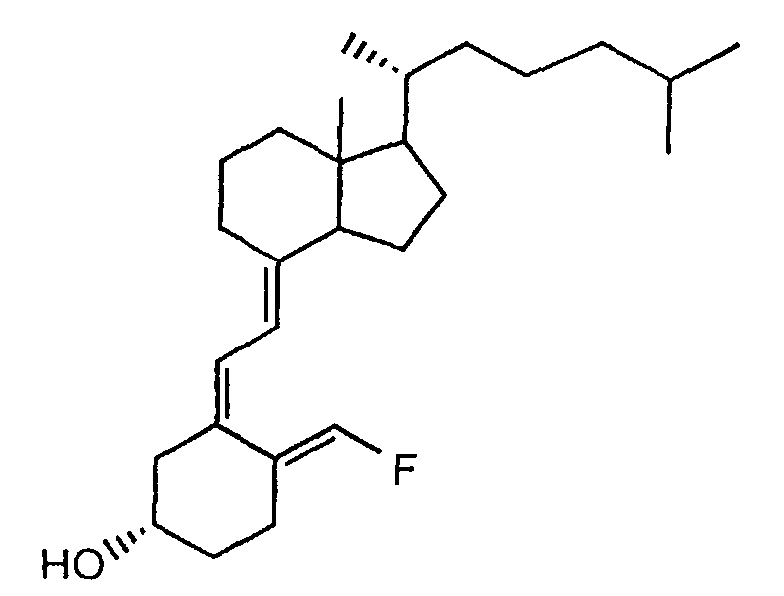
- The same procedure as in Example 2 was carried out to obtain a product (1.7 mg), except that 19-fluorovitamin D3 (4.90 mg) was used as the substrate. After purification by semi-preparative HPLC under the following condition, 19-fluoro-24-hydroxyvitamin D3 (14 µg), 19-fluoro-25-hydroxyvitamin D3 (206 µg) and 19-fluoro-26-hydroxyvitamin D3 (28 µg) were obtained.
HPLC conditions: - Column: Hibar RT 250-10 LiChrosorb Si60 (7 µm)
- Elution solvent: 8% 2-propanol-hexane
- Flow rate: 5 mL/min.
- Temperature: room temperature
- Detection wavelength: 265 nm
-
-
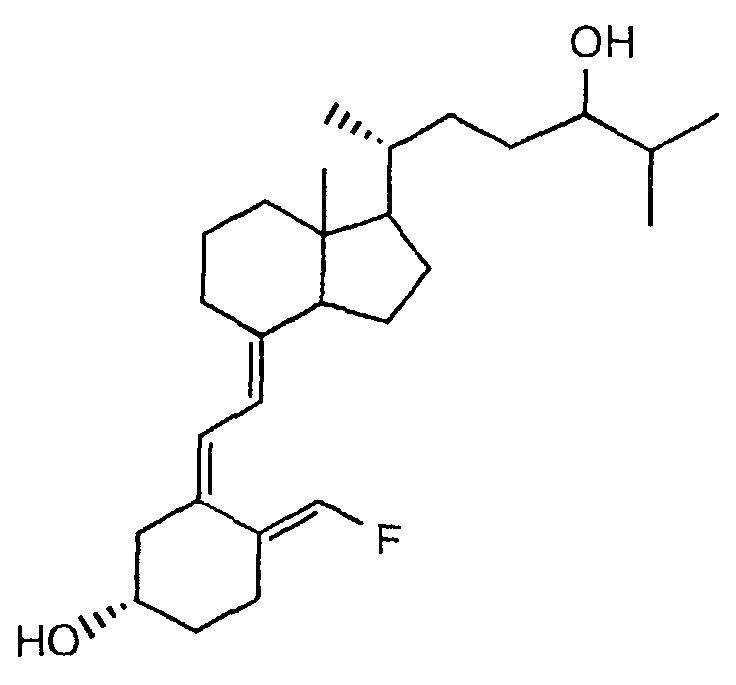
- 1H-NMR (CDCl3): δ 0.55 (3H, s, 18-H), 0.90-0.95 (m, 21-H, 26-H, 27-H), 2.57 (2H, m), 2.80 (1H, m, 9-H), 3.33 (1H, m, 24-H), 3.93 (1H, m, 3-H), 5.93 (1H, d, J=11.2 Hz, 7-H), 6.28 (11H, d, J=11.1 Hz, 6-H), 6.51 (1H, d, J=87.3 Hz, 19-H);
- MS m/z (%): 418(M+, 28), 400(19), 398(21), 380(21), 362(6), 289(15), 271(19), 269(16), 251(17), 154(57), 136(98), 135(100);
- UV λmax (EtOH): 261.2 nm
-
-

- 1H-NMR (CDCl3) : δ 0.54 (3H, s, 18-H), 0.94 (3H, d, J=6.4 Hz, 21-H), 1.22 (6H, s, 26-H, 27-H), 2.26 (1H, dd, J=13.1, 7.8 Hz), 2.56 (2H, m), 2.79 (1H, m, 9-H), 3.94 (1H, m, 3-H), 5.93 (1H, d, J=11.1 Hz, 7-H), 6.28 (1H, d, J=11.1 Hz, 6-H), 6.51 (1H, d, J=87.3 Hz, 19H);
- 19F-NMR (CDCl3) δ: -132.5(d, J=87.3 Hz);
- MS m/z (%): 418(M+, 7), 400(18), 380(13), 362(6), 289(9), 271(10), 269(10), 251(13), 154(53), 136(100), 135(98);
- UV λmax (EtOH): 260.0 nm
-
-

- 1H-NMR (CDCl3) : δ 0.54 (3H, s, 18-H), 0.90-0.94 (6H, m, 21-H, 27-H), 2.80 (1H, m, 9-H), 3.40-3.56 (2H, m, 26-H), 3.94 (1H, m, 3-H), 5.93 (1H, d, J=11.1 Hz, 7-H), 6.28 (1H, d, J=11.1 Hz, 6-H), 6.51 (1H, d, J=87.3 Hz, 19H);
- MS m/z (%): 418 (M+, 18), 400(40), 380(16), 362(9), 289(27), 271(21), 269(12), 251(16), 154(55), 136(91), 135(100);
- UV λmax (EtOH): 260 nm
-
-

- The same procedure as in Example 2 was carried out to obtain a product (2.8 mg), except that 19-fluoro-1α-hydroxyvitamin D3 (2.44 mg) was used as the substrate. After purification by semi-preparative HPLC under the following condition, 19-fluoro-1α,24-dihydroxyvitamin D3 (46 µg), 19-fluoro-1α,25-dihydroxyvitamin D3 (980 µg) and 19-fluoro-1α,26-dihydroxyvitamin D3 (50 µg) were obtained.
HPLC conditions: - Column: Hibar RT 250-10 LiChrosorb Si60 (7 µm)
- Elution solvent: 15% 2-propanol-hexane
- Flow rate: 6 mL/min.
- Temperature: room temperature
- Detection wavelength: 265 nm
-
-

- 1H-NMR (CDCl3): δ 0.54 (3H, s, 18-H), 0.917 and 0.927 (each 3H, d, J=6.9 Hz, 26-H, 27-H), 0.935 (3H, d, J=6.7 Hz, 21-H), 2.19 (1H, m), 2.32 (1H, m), 2.68 (1H, m), 2.80 (1H, m, 9-H), 3.32 (1H, m, 24-H), 4.17 (1H, m, 3-H), 5.09 (1H, m, 1-H), 5.90 (1H, d, J=11.2 Hz, 7-H), 6.46 (1H, d, J=11.2 Hz, 6-H), 6.50 (1H, d, J=86.0 Hz, 19-H);
- MS m/z (%): 434(M+, 8), 416(4), 396(9), 378(28), 360(100), 135(40);
- UV λmax (EtOH): 261.6 nm
-
-
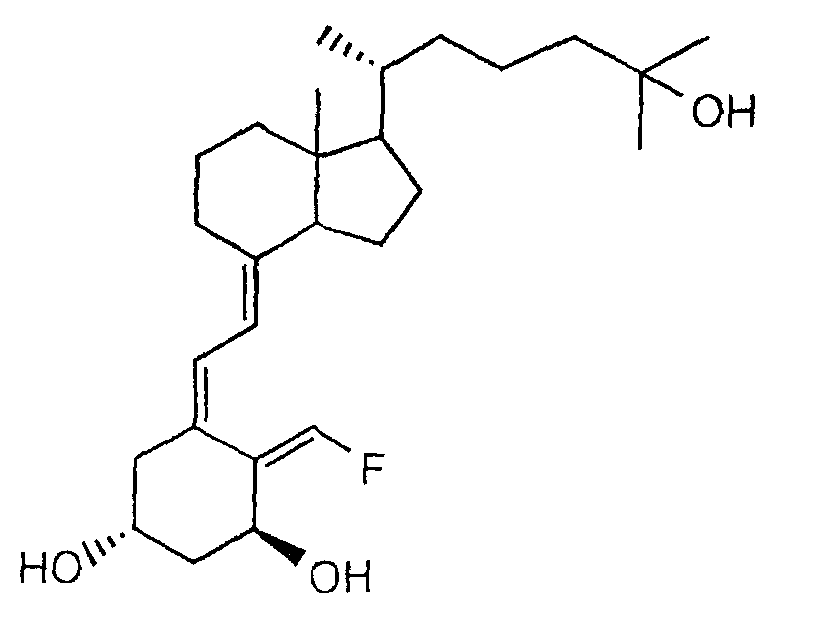
- 1H-NMR (CDCl3) : δ 0.53 (3H, s, 18-H), 0.94(3H, d, J=6.4 Hz, 21-H), 1.22 (6H, s, 26-H, 27-H), 2.19 (1H, t, J=11.5 Hz, 4-H), 2.32 (1H, m), 2.68 (1H, m), 2.80 (1H, m, 9-H), 4.17 (1H, m, 3-H), 5.09 (1H, m, 1-H), 5.90 (1H, d, J=11.1 Hz, 7-H), 6.47 (1H, d, J=11.1 Hz, 6-H), 6.51 (1H, d, J=86.1 Hz, 19H);
- 19F-NMR (CDCl3): δ -129.8 (d, J=86.1 Hz);
- MS m/z (%): 434(M+, 2), 416(9), 396(9), 378(17), 360(100), 305(2), 287(4), 267(6), 135(32);
- UV λmax (EtOH): 262.2 nm
-
-
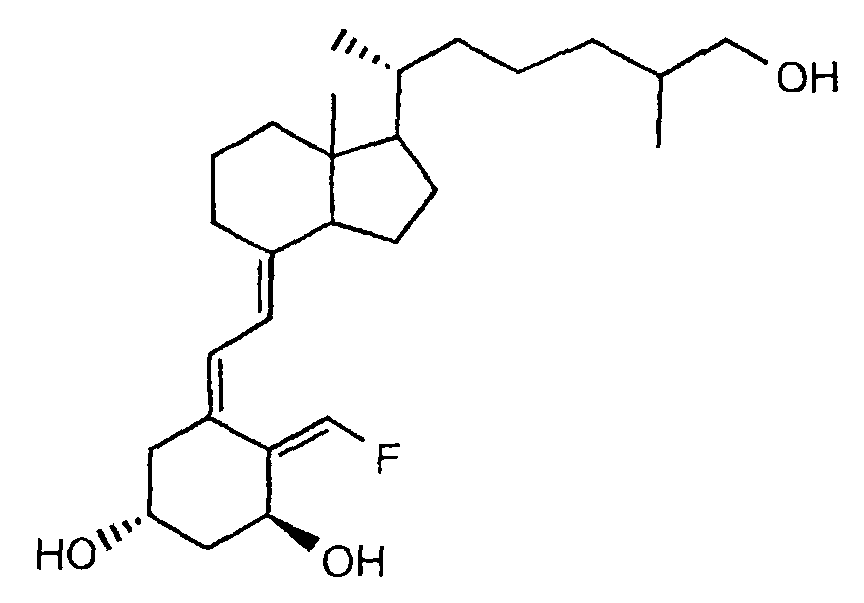
- 1H-NMR (CDCl3): δ 0.53 (3H, s, 18-H), 0.92 and 0.93 (each 3H, d, J=6.2 Hz, 21-H, 27-H), 2.19 (1H, m), 2.32 (1H, m), 2.68 (1H, m, 4-H), 2.80 (1H, m, 9-H), 3.40-3.56 (2H, m, 26-H), 4.17 (1H, m, 3-H), 5.09 (1H, m, 1-H), 5.90 (1H, d, J=11.7 Hz, 7-H), 6.46 (1H, d, J=11.7 Hz, 6-H), 6.51 (1H, d, J=86.0 Hz, 19H);
- MS m/z (%): 434(M+, 9), 416(8), 396(17), 378(56), 360(21), 305(3), 287(10), 267(12), 135(100);
- UV λmax (EtOH): 263.2 nm
-
-

- The same procedure as in Example 2 was carried out to obtain a product (3.3 mg), except that 4,4-difluorovitamin D3 (4.90 mg) was used as the substrate. After purification by semi-preparative HPLC under the following condition, 4,4-difluoro-24-hydroxyvitamin D3 (86 µg), 4,4-difluoro-25-hydroxyvitamin D3 (857 µg) and 4,4-difluoro-26-hydroxyvitamin D3 (137 µg).
HPLC conditions: - Column: Hibar RT 250-10 LiChrosorb Si60 (7 µm)
- Elution solvent: 7% 2-propanol-hexane
- Flow rate: 5 mL/min.
- Temperature: room temperature
- Detection wavelength: 265 nm
-
-
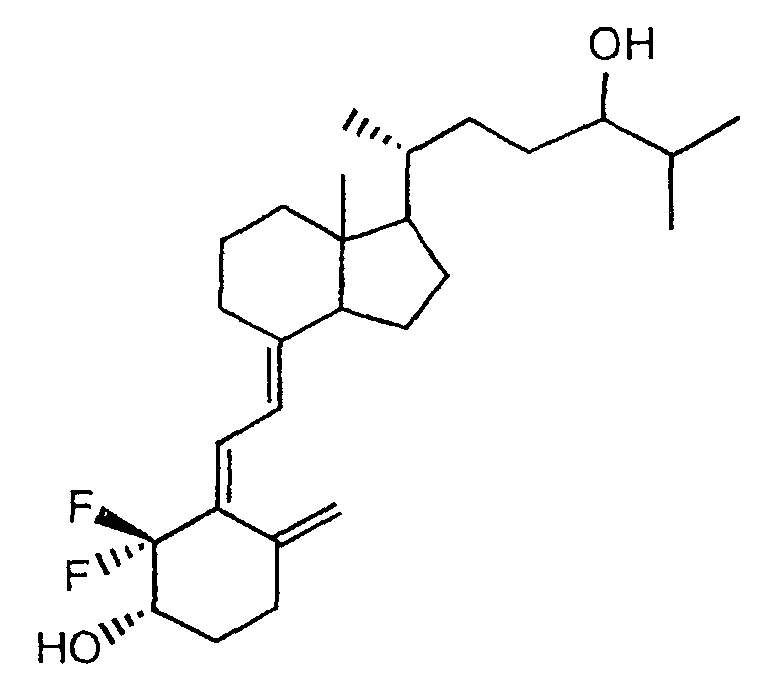
- 1H-NMR (CDCl3): δ 0.56 (3H, s, 18-H), 0.92 and 0.93 (each 3H, d, J=6.6 Hz, 26-H, 27-H, overlapped with 21-H), 2.47 (1H, m), 2.90 (1H, m, 9-H), 3.32 (1H, m, 24-H), 3.98 (1H, m, 3-H), 5.00 (1H, s, 19-H), 5.23 (1H, s, 19-H), 6.09 (1H, d, J=11.4 Hz, 7-H), 6.94 (1H, d, J=11.4 Hz, 6-H);
- MS m/z (%): 436(M+, 34), 418(6), 398(83), 380(74), 378(48), 307(28), 269(100), 135(79);
- UV λmax (EtOH): 269.8 nm
-
-
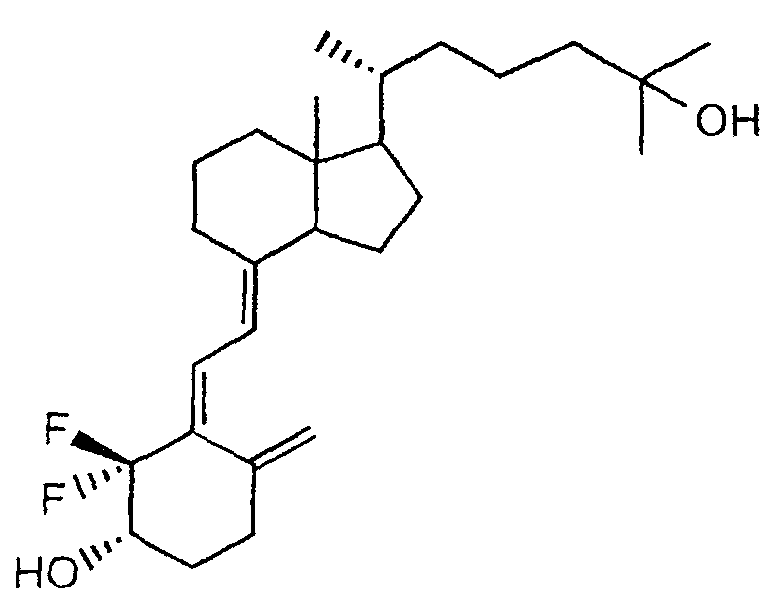
- 1H-NMR (CDCl3) : δ 0.55 (3H, s, 18-H), 0.94 (3H, d, J=6.4 Hz, 21-H), 1.22 (6H, s, 26, 27-H), 2.21 (1H, m), 2.47 (1H, m), 2.89 (1H, m, 9-H), 3.98 (1H, m, 3-H), 5.00 (1H, d, J=1.4 Hz, 19-H), 5.23 (1H, s, 19-H), 6.09 (1H, d, J=11.5 Hz, 7-H), 6.94 (1H, d, J=11.5 Hz, 6-H);
- 19F-NMR (CDCl3) : δ-114.1(dd, J=234.1 and 11.5 Hz), -108.0(d, J=234.1 Hz);
- MS m/z (%) : 436(M+, 61), 418(61), 398(60), 380(100), 378(38), 307(64), 269(58), 135(79);
- UV λmax (EtOH): 269.6 nm
-
-

- 1H-NMR (CDCl3): δ 0.55 (3H, s, 18-H), 0.92-0.94 (m, 21-H, 27-H), 2.35 (1H, m), 2.47 (1H, m), 2.89 (1H, m, 9-H), 3.40-3.56 (2H, m, 26-H), 3.98 (H, m, 3-H), 5.00 (1H, d, J=1.4 Hz, 19-H), 5.23 (1H, s, 19-H), 6.09 (1H, d, J=11.5 Hz, 7-H), 6.94 (1H, d, J=11.5 Hz, 6-H);
- MSm/z (%): 436(M+, 71), 418(10), 398(44), 378(34), 376(100), 307(48), 269(33), 135(70);
- UV λmax (EtOH): 270.0 nm
-
-

- The same procedure as in Example 2 was carried out to obtain a product (0.9 mg), except that 4,4-difluoro-1α-hydroxyvitamin D3 (1.76 mg) was used as the substrate. After purification by semi-preparative HPLC under the following condition, 4,4-difluoro-1α,24-dihydroxyvitamin D3 (115 µg), 4,4-difluoro-1α,25-dihydroxyvitamin D3 (652 µg), and 4,4-difluoro-1α,26-dihydroxyvitamin D3 (33 µg) were obtained.
HPLC conditions: - Column: Hibar RT 250-10 LiChrosorb Si60 (7 µm)
- Elution solvent: 15% 2-propanol-hexane
- Flow rate: 6 mL/min.
- Temperature: room temperature
- Detection wavelength: 265 nm
-
-

- 1H-NMR (CDCl3): δ 0.56 (3H, s, 18-H), 0.92 and 0.93 (each 3H, d, J=6.7 Hz, 26-H, 27-H, overlapped with 21-H), 2.90 (1H, m, 9-H), 3.32 (1H, m, 24-H), 4.26 (1H, m, 3-H), 4.49 (1H, m, 1-H), 5.18 (1H, s, 19-H), 5.50 (1H, s, 19-H), 6.07 (1H, d, J=11.4 Hz, 7-H), 7.06 (1H, d, J=11.4 Hz, 6-H);
- MS m/z (%): 452(M+, 34), 434(25), 414(41), 396(100), 378(80), 376(80), 323(29), 305(33), 285(46), 267(79), 265(54), 135(92);
- UV λmax (EtOH): 270.6 nm.
-
-
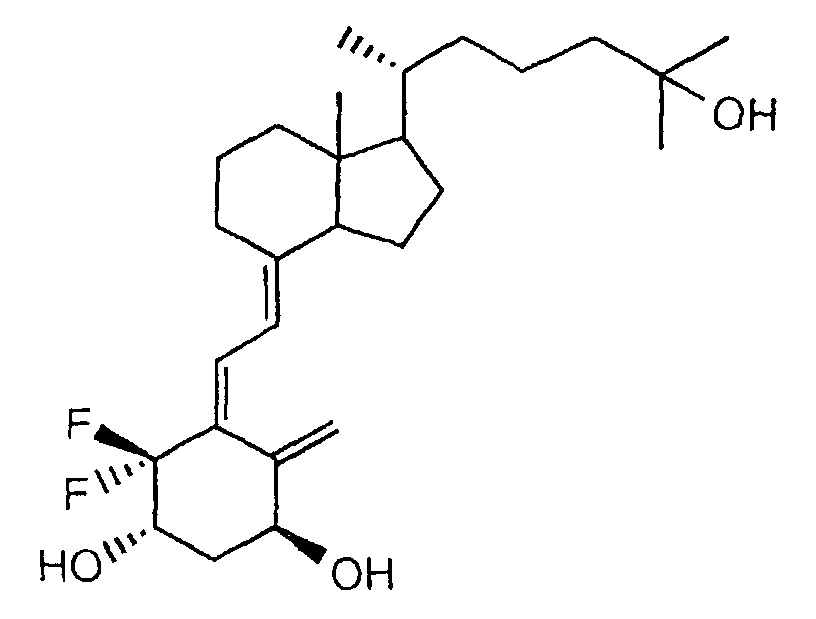
- 1 H-NMR (CDCl3): δ 0.56 (3H, s, 18-H), 0.94 (3H, d, J=6.3 Hz, 21-H), 1.22 (6H, s, 26-H, 27-H), 2.90 (1H, m, 9-H), 4.25 (1H, m, 3-H), 4.49 (1H, m, 1-H), 5.18 (1H, s, 19-H), 5.50 (1H, s, 19-H), 6.07 (1H, d, J=11.5 Hz, 7-H), 7.06 (1H, d, J=11.4 Hz, 6-H);
- 19F-NMR (CDCl3) : δ-116.3 (d, J=234.2 Hz), -107.7 (d, J=234.2 Hz);
- MS m/z (%): 452(M+, 15), 434(45), 416(22), 396(65), 378(58), 376(31), 323(49), 305(20), 285(27), 267(48), 265(27), 135(100);
- UV λmax (EtOH): 270.6 nm
-
-
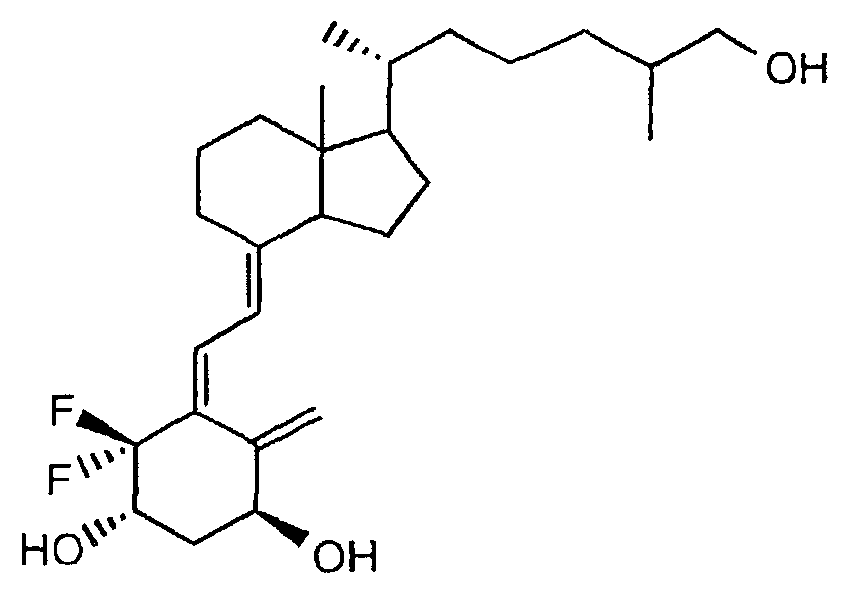
- 1H-NMR (CDCl3): δ 0.55(3H, s, 18-H), 0.92 and 0.93 (each 3H, d=6.8 Hz, 26-H, 27-H, overlapped with 21-H), 2.90 (1H, m, 9-H), 3.40-3.56 (2H, m, 26-H), 4.26 (1H, m, 3-H), 4.49 (1H, m, 1-H), 5.18 (1H, s, 19-H), 5.50 (1H, s, 19-H), 6.07 (1H, d, J=11.6 Hz, 7-H), 7.06 (1H, d, J=11.6 Hz, 6-H);
- MSm/z (%) : 452(M+, 32), 434(17), 414(21), 396(32), 378(13), 323(55), 305(18), 285(25), 267(39), 265(20), 135(100);
- UV λmax (EtOH): 270.4 nm.
-
Claims (8)
- A process for producing hydroxyvitamin D derivatives (provided that vitamin D derivatives in which only the 25-position is converted into a hydroxyl group are excluded), characterized by converting a hydrogen atom or atoms at the 2-position, 24-position, 25-position and/or 26-position of a vitamin D into a hydroxyl group or groups in a solution containing a microorganism which can hydroxylate vitamin Ds or an enzyme produced by that microorganism.
- The process for producing hydroxyvitamin D derivatives according to claim 1, wherein a cyclodextrin is present together with the vitamin D in the solution containing the microorganism capable of hydroxylating vitamin Ds or the enzyme produced by that microorganism.
- The process for producing hydroxyvitamin D derivatives according to claims 1 or 2, wherein the microorganism capable of hydroxylating vitamin Ds belongs to the genus Nocardia, Streptomyces, Sphingomonas or Amycolata.
- The process for producing hydroxyvitamin D derivatives according to any one of claims 1 to 3, characterized by converting the hydrogen atom or atoms at the 2-position or 2-position and 25-position of the vitamin D into a hydroxyl group or groups.
- The process for producing hydroxyvitamin D derivatives according to any one of claims 1 to 3, characterized by converting the hydrogen atom at the 24-position of the vitamin D into a hydroxyl group.
- The process for producing hydroxyvitamin D derivatives according to any one of claims 1 to 3, characterized by converting the hydrogen atom at the 26-position of the vitamin D into a hydroxyl group.
- A vitamin D3 derivative represented by the formula (I):wherein R1, R2, R24, R25 and R26 each independently represents a hydrogen atom or a hydroxyl group; and R4 and R19 each independently represents a hydrogen atom or a fluorine atom, provided that one of R2, R24 and R26 is a hydroxyl group, and the others are each a hydrogen atom, provided that 1α,24-dihydroxyvitamin D3 wherein R1 and R24 each represents a hydroxyl group, and R2, R4, R19, R25 and R26 each represents a hydrogen atom is excluded.

- The vitamin D3 derivative according to claim 7, wherein the vitamin D3 derivative represented by the formula (I) is:(1) 1α,26-dihydroxyvitamin D3,(2) 2α,25-dihydroxyvitamin D3,(3) 19-fluoro-24-hydroxyvitamin D3,(4) 19-fluoro-26-hydroxyvitamin D3,(5) 19-fluoro-1α,24-dihydroxyvitamin D3,(6) 19-fluoro-1α,26-dihydroxyvitamin D3,(7) 4,4-difluoro-24-hydroxyvitamin D3,(8) 4,4-difluoro-26-hydroxyvitamin D3,(9) 4,4-difluoro-1α,24-dihydroxyvitamin D3, or(10) 4,4-difluoro-1α,26-dihydroxyvitamin D3.
Applications Claiming Priority (3)
| Application Number | Priority Date | Filing Date | Title |
|---|---|---|---|
| JP10662299 | 1999-04-14 | ||
| JP10662299 | 1999-04-14 | ||
| PCT/JP2000/002410 WO2000061776A1 (en) | 1999-04-14 | 2000-04-13 | Vitamin d derivatives and process for producing the same |
Publications (2)
| Publication Number | Publication Date |
|---|---|
| EP1172442A1 true EP1172442A1 (en) | 2002-01-16 |
| EP1172442A4 EP1172442A4 (en) | 2004-10-13 |
Family
ID=14438221
Family Applications (1)
| Application Number | Title | Priority Date | Filing Date |
|---|---|---|---|
| EP00917304A Withdrawn EP1172442A4 (en) | 1999-04-14 | 2000-04-13 | VITAMIN D DERIVATIVES AND PROCESS FOR PRODUCING THE SAME |
Country Status (3)
| Country | Link |
|---|---|
| EP (1) | EP1172442A4 (en) |
| AU (1) | AU3837100A (en) |
| WO (1) | WO2000061776A1 (en) |
Cited By (2)
| Publication number | Priority date | Publication date | Assignee | Title |
|---|---|---|---|---|
| WO2011002756A3 (en) * | 2009-07-01 | 2011-06-03 | Vitamin Derivatives, Inc. | Vitamin d compounds and methods for preparing same |
| EP2377942A4 (en) * | 2008-12-19 | 2012-12-05 | Ildong Pharmaceutical Co Ltd | BUFFER COMPOSITION FOR CATALYZING THE PREPARATION OF CALCITRIOL OR CALCIFEDIOL AND PROCESS FOR THE PREPARATION OF CALCITRIOL OR CALCIFEDIOL USING THE SAME |
Families Citing this family (3)
| Publication number | Priority date | Publication date | Assignee | Title |
|---|---|---|---|---|
| CA2586679A1 (en) | 2004-11-12 | 2006-05-18 | Bioxell Spa | Combined use of vitamin d derivatives and anti-proliferative agents for treating bladder cancer |
| CN102660618B (en) * | 2012-04-17 | 2013-12-11 | 四川汪氏动物保健有限责任公司 | Method for preparing 25-hydroxyvitamin D by microbial transformation |
| CN120948161B (en) * | 2025-10-15 | 2025-12-30 | 山西瑞亚力科技有限公司 | Method for removing vitamin D in horse serum |
Family Cites Families (13)
| Publication number | Priority date | Publication date | Assignee | Title |
|---|---|---|---|---|
| JPS5726272B2 (en) * | 1974-01-11 | 1982-06-03 | ||
| JPS5119752A (en) * | 1974-08-07 | 1976-02-17 | Masayuki Ishikawa | 1 arufua* 2 arufuaa jihidorokishikorekarushifuerooruno seiho |
| JPS5846506B2 (en) * | 1975-11-06 | 1983-10-17 | 帝人株式会社 | 5,6-trans-24-hydroxycholecalciferol |
| CA1054052A (en) * | 1976-08-14 | 1979-05-08 | Edward Shanbrom | Simplified method for preparation of high yield, high purity factor viii concentrate |
| NL8204070A (en) * | 1982-10-21 | 1984-05-16 | Emiel Gradus Johannes Staring | METHOD FOR PREPARING A CYCLO ADDITION COMPOUND |
| US4892821A (en) * | 1987-07-08 | 1990-01-09 | Taisho Pharmaceutical Co., Ltd. | Method for preparing vitamin D compounds |
| JP2663294B2 (en) * | 1989-03-04 | 1997-10-15 | メルシャン株式会社 | Method for producing vitamin D |
| JPH04356190A (en) * | 1990-05-08 | 1992-12-09 | Taisho Pharmaceut Co Ltd | Production of vitamin ds |
| JP3201411B2 (en) * | 1990-06-15 | 2001-08-20 | メルシャン株式会社 | Biological production of vitamin Ds |
| JPH05153980A (en) * | 1991-12-04 | 1993-06-22 | Sumitomo Chem Co Ltd | Rat renal p450c24-producing bacterial strain |
| JP3178134B2 (en) * | 1993-01-11 | 2001-06-18 | 住友化学工業株式会社 | Method for producing vitamin D3 derivative |
| JPH07241197A (en) * | 1994-01-11 | 1995-09-19 | Kyowa Hakko Kogyo Co Ltd | Method for producing 25-hydroxyvitamin Ds |
| DE69832699T2 (en) * | 1997-05-16 | 2006-08-24 | Woman & Infants Hospital | CYCLIC ETHERIC VITAMIN D3 COMPOUNDS, 1ALFA (OH) 3-EPI-VITAMIN D3 COMPOUNDS AND ITS USES |
-
2000
- 2000-04-13 EP EP00917304A patent/EP1172442A4/en not_active Withdrawn
- 2000-04-13 AU AU38371/00A patent/AU3837100A/en not_active Abandoned
- 2000-04-13 WO PCT/JP2000/002410 patent/WO2000061776A1/en not_active Ceased
Non-Patent Citations (5)
Cited By (2)
| Publication number | Priority date | Publication date | Assignee | Title |
|---|---|---|---|---|
| EP2377942A4 (en) * | 2008-12-19 | 2012-12-05 | Ildong Pharmaceutical Co Ltd | BUFFER COMPOSITION FOR CATALYZING THE PREPARATION OF CALCITRIOL OR CALCIFEDIOL AND PROCESS FOR THE PREPARATION OF CALCITRIOL OR CALCIFEDIOL USING THE SAME |
| WO2011002756A3 (en) * | 2009-07-01 | 2011-06-03 | Vitamin Derivatives, Inc. | Vitamin d compounds and methods for preparing same |
Also Published As
| Publication number | Publication date |
|---|---|
| WO2000061776A1 (en) | 2000-10-19 |
| EP1172442A4 (en) | 2004-10-13 |
| AU3837100A (en) | 2000-11-14 |
Similar Documents
| Publication | Publication Date | Title |
|---|---|---|
| KR960004452B1 (en) | Method of Making Vitamin D Compounds | |
| Sasaki et al. | Transformation of vitamin D3 to 1α, 25-dihydroxyvitamin D3 via 25-hydroxyvitamin D3 using Amycolata sp. strains | |
| JPH10287662A (en) | FO-5637A and B substances and their production | |
| Sasaki et al. | Transformation of 25-and 1 alpha-hydroxyvitamin D3 to 1 alpha, 25-dihydroxyvitamin D3 by using Streptomyces sp. strains | |
| KR100190412B1 (en) | Biological Preparation of Hydroxy Vitamin D Compounds | |
| KR100366258B1 (en) | Novel substances kf-1040 and process for producing the same | |
| FR2499985A1 (en) | 1A, 25-DIHYDROXY-2B-FLUOROVITAMIN D3 | |
| JP2663294B2 (en) | Method for producing vitamin D | |
| FR2512819A1 (en) | MACBECINE DERIVATIVES AND THEIR PREPARATION | |
| JPH0366302B2 (en) | ||
| JP4351395B2 (en) | WK-5344A substance, WK-5344B substance and methods for producing them | |
| US5021240A (en) | WS7622A, B, C and D substances, derivatives thereof, processes for preparation thereof and use thereof | |
| WO2000061776A1 (en) | Vitamin d derivatives and process for producing the same | |
| JP3589685B2 (en) | Biological production of 25-position hydroxide of steroids | |
| JP2000295999A (en) | Biological production of 1α, 24-dihydroxyvitamin D3 | |
| JPWO2000061776A1 (en) | Vitamin D derivatives and their manufacturing method | |
| JPH0464678B2 (en) | ||
| JP2810752B2 (en) | Cyclooctatin, a new physiologically active substance, its production method and its use | |
| JP3735393B2 (en) | Method for producing 1α-hydroxyvitamin Ds | |
| JP3768226B2 (en) | Method for producing 1α-hydroxyvitamin Ds | |
| JPS59170092A (en) | Novel antibiotic, ss8201d and its preparation | |
| JP2006314248A (en) | Method for producing triterpene derivative | |
| JPH01168660A (en) | Yl-0710m compound and production thereof | |
| JPS58212793A (en) | Compound analogous to macbecin and its preparation | |
| JPH04243894A (en) | New q-6402 compound and production thereof |
Legal Events
| Date | Code | Title | Description |
|---|---|---|---|
| PUAI | Public reference made under article 153(3) epc to a published international application that has entered the european phase |
Free format text: ORIGINAL CODE: 0009012 |
|
| 17P | Request for examination filed |
Effective date: 20011025 |
|
| AK | Designated contracting states |
Kind code of ref document: A1 Designated state(s): AT BE CH CY DE DK ES FI FR GB GR IE IT LI LU MC NL PT SE |
|
| AX | Request for extension of the european patent |
Free format text: AL;LT;LV;MK;RO;SI |
|
| A4 | Supplementary search report drawn up and despatched |
Effective date: 20040831 |
|
| RIC1 | Information provided on ipc code assigned before grant |
Ipc: 7C 12P 7/02 A Ipc: 7C 07C 401/00 B Ipc: 7C 12R 1/365 B Ipc: 7C 12R 1/01 B Ipc: 7C 12R 1/465 B |
|
| STAA | Information on the status of an ep patent application or granted ep patent |
Free format text: STATUS: THE APPLICATION IS DEEMED TO BE WITHDRAWN |
|
| 18D | Application deemed to be withdrawn |
Effective date: 20041116 |