EP1172426A1 - Coating composition capable of forming alkali-soluble lubricating film suitable for forming and use thereof - Google Patents
Coating composition capable of forming alkali-soluble lubricating film suitable for forming and use thereof Download PDFInfo
- Publication number
- EP1172426A1 EP1172426A1 EP00905370A EP00905370A EP1172426A1 EP 1172426 A1 EP1172426 A1 EP 1172426A1 EP 00905370 A EP00905370 A EP 00905370A EP 00905370 A EP00905370 A EP 00905370A EP 1172426 A1 EP1172426 A1 EP 1172426A1
- Authority
- EP
- European Patent Office
- Prior art keywords
- lubricating
- aqueous polyurethane
- alkali
- polyurethane composition
- coating composition
- Prior art date
- Legal status (The legal status is an assumption and is not a legal conclusion. Google has not performed a legal analysis and makes no representation as to the accuracy of the status listed.)
- Granted
Links
Images

Classifications
-
- C—CHEMISTRY; METALLURGY
- C08—ORGANIC MACROMOLECULAR COMPOUNDS; THEIR PREPARATION OR CHEMICAL WORKING-UP; COMPOSITIONS BASED THEREON
- C08G—MACROMOLECULAR COMPOUNDS OBTAINED OTHERWISE THAN BY REACTIONS ONLY INVOLVING UNSATURATED CARBON-TO-CARBON BONDS
- C08G18/00—Polymeric products of isocyanates or isothiocyanates
- C08G18/06—Polymeric products of isocyanates or isothiocyanates with compounds having active hydrogen
- C08G18/08—Processes
- C08G18/10—Prepolymer processes involving reaction of isocyanates or isothiocyanates with compounds having active hydrogen in a first reaction step
- C08G18/12—Prepolymer processes involving reaction of isocyanates or isothiocyanates with compounds having active hydrogen in a first reaction step using two or more compounds having active hydrogen in the first polymerisation step
-
- C—CHEMISTRY; METALLURGY
- C08—ORGANIC MACROMOLECULAR COMPOUNDS; THEIR PREPARATION OR CHEMICAL WORKING-UP; COMPOSITIONS BASED THEREON
- C08G—MACROMOLECULAR COMPOUNDS OBTAINED OTHERWISE THAN BY REACTIONS ONLY INVOLVING UNSATURATED CARBON-TO-CARBON BONDS
- C08G18/00—Polymeric products of isocyanates or isothiocyanates
- C08G18/06—Polymeric products of isocyanates or isothiocyanates with compounds having active hydrogen
- C08G18/08—Processes
- C08G18/0804—Manufacture of polymers containing ionic or ionogenic groups
- C08G18/0819—Manufacture of polymers containing ionic or ionogenic groups containing anionic or anionogenic groups
- C08G18/0823—Manufacture of polymers containing ionic or ionogenic groups containing anionic or anionogenic groups containing carboxylate salt groups or groups forming them
-
- C—CHEMISTRY; METALLURGY
- C08—ORGANIC MACROMOLECULAR COMPOUNDS; THEIR PREPARATION OR CHEMICAL WORKING-UP; COMPOSITIONS BASED THEREON
- C08G—MACROMOLECULAR COMPOUNDS OBTAINED OTHERWISE THAN BY REACTIONS ONLY INVOLVING UNSATURATED CARBON-TO-CARBON BONDS
- C08G18/00—Polymeric products of isocyanates or isothiocyanates
- C08G18/06—Polymeric products of isocyanates or isothiocyanates with compounds having active hydrogen
- C08G18/28—Polymeric products of isocyanates or isothiocyanates with compounds having active hydrogen characterised by the compounds used containing active hydrogen
- C08G18/65—Low-molecular-weight compounds having active hydrogen with high-molecular-weight compounds having active hydrogen
- C08G18/66—Compounds of groups C08G18/42, C08G18/48, or C08G18/52
- C08G18/6633—Compounds of group C08G18/42
- C08G18/6659—Compounds of group C08G18/42 with compounds of group C08G18/34
-
- C—CHEMISTRY; METALLURGY
- C09—DYES; PAINTS; POLISHES; NATURAL RESINS; ADHESIVES; COMPOSITIONS NOT OTHERWISE PROVIDED FOR; APPLICATIONS OF MATERIALS NOT OTHERWISE PROVIDED FOR
- C09D—COATING COMPOSITIONS, e.g. PAINTS, VARNISHES OR LACQUERS; FILLING PASTES; CHEMICAL PAINT OR INK REMOVERS; INKS; CORRECTING FLUIDS; WOODSTAINS; PASTES OR SOLIDS FOR COLOURING OR PRINTING; USE OF MATERIALS THEREFOR
- C09D175/00—Coating compositions based on polyureas or polyurethanes; Coating compositions based on derivatives of such polymers
- C09D175/04—Polyurethanes
- C09D175/06—Polyurethanes from polyesters
-
- Y—GENERAL TAGGING OF NEW TECHNOLOGICAL DEVELOPMENTS; GENERAL TAGGING OF CROSS-SECTIONAL TECHNOLOGIES SPANNING OVER SEVERAL SECTIONS OF THE IPC; TECHNICAL SUBJECTS COVERED BY FORMER USPC CROSS-REFERENCE ART COLLECTIONS [XRACs] AND DIGESTS
- Y10—TECHNICAL SUBJECTS COVERED BY FORMER USPC
- Y10T—TECHNICAL SUBJECTS COVERED BY FORMER US CLASSIFICATION
- Y10T428/00—Stock material or miscellaneous articles
- Y10T428/31504—Composite [nonstructural laminate]
- Y10T428/31551—Of polyamidoester [polyurethane, polyisocyanate, polycarbamate, etc.]
- Y10T428/31605—Next to free metal
Definitions
- the present invention relates to a coating composition capable of forming an alkali-soluble lubricating film suitable for shape working, to lubricating surface treated metal articles coated with the coating composition, and to a process for production of metal articles that are coated with the coating composition and shape worked.
- alkali-strippable lubricating films employing acrylic-based resins.
- alkali-strippable lubricating films employing acrylic-based resins often fail to offer adequate shapeability, as they undergo scratching under severe press molding, conditions such as deep drawing or wipe working.
- the present inventors have conducted much diligent research aimed at solving the aforementioned problems and obtaining a coating composition with excellent press moldability and scratch resistance, which can form alkali-soluble lubricating films suitable for shape working, as well as lubricating surface treated metal articles. As a result they have completed the present invention upon finding that this object can be achieved by a coating composition comprising an aqueous polyurethane composition and a lubriction functionality-providing agent.
- the coating composition capable of forming an alkali-soluble lubricating film according to the invention (1) is characterized in that it contains as main components an aqueous polyurethane composition (A) and a lubricating functionality-providing agent (B) at 1-30 wt% with respect to the solid content of the aqueous polyurethane composition, and in that the coating composition is film-formable and its formed films are alkali-soluble.
- This coating composition (1) that comprises an aqueous polyurethane composition (A) and a lubricating functionality-providing agent (B) exhibits sufficient lubricating properties and ground layer protection even under severe shape working conditions such as press working, deep drawing, wipe working and roll forming.
- the coating composition capable of forming an alkali-soluble lubricating film according to the invention (2) is characterized in that it contains, in addition to the aqueous polyurethane composition (A) and the lubricating functionality-providing agent (B), also silica particles (C) at 1-30 wt% with respect to the solid content of the aqueous polyurethane composition.
- the coating composition capable of forming an alkali-soluble lubricating film according to the invention (3) is a coating composition according to (1) or (2) above characterized in that the aqueous polyurethane composition (A) comprises a polyester polyol.
- This aqueous polyurethane composition (A) that comprises a polyester polyol can easily provide the alkali solubility required for the invention.
- the coating composition capable of forming an alkali-soluble lubricating film according to the invention (4) is a coating composition according to (1) or (2) above characterized in that the aqueous polyurethane composition (A) contains a carboxyl group or sulfonic acid group, or a salt thereof, as a hydrophilic group.
- the aqueous polyurethane composition (A) wherein the hydrophilic group is a carboxyl group or sulfonic acid group or a salt thereof can exhibit excellent adhesion with metal sheet surfaces, and provide adequate shapeability under severe press molding conditions such as deep drawing and wipe working.
- the coating composition capable of forming an alkali-soluble lubricating film according to the invention (5) is a coating composition according to (1) or (2) above characterized in that the hydrophilic group of the aqueous polyurethane composition (A) is a Na salt or K salt of a carboxyl group or sulfonic acid group.
- the carboxyl group or sulfonic acid group as the hydrophilic group of the aqueous polyurethane composition (A) is neutralized by the Na or K to achieve a satisfactory stripping property with alkali degreasing agents.
- the coating composition capable of forming an alkali-soluble lubricating film according to the invention (6) is a coating composition according to (1) or (2) above characterized in that the carboxyl group or sulfonic acid group as the hydrophilic group of the aqueous polyurethane composition (A), or its salt, is included to an acid value in the range of 25-180.
- the coating composition capable of forming an alkali-soluble lubricating film according to the invention (7) is a coating composition according to (3) above characterized in that the polyester polyol in the aqueous polyurethane composition (A) is prepared by reacting ethylene glycol with an aliphatic dibasic acid or its dialkyl ester, or a mixture thereof.
- the aqueous polyurethane composition (A) comprising a polyester polyol composed of ethylene glycol and a dicarboxylic acid can easily provide the alkali solubility required for the invention even at lower temperatures such as room temperature.
- the coating composition capable of forming an alkali-soluble lubricating film according to the invention (8) is a coating composition according to (1) or a coating composition according to (2) above characterized in that the hydrophilic group of the aqueous polyurethane composition (A) is a carboxyl group or sulfonic acid group, or a salt thereof.
- the aqueous polyurethane composition (A) wherein the hydrophilic group is a carboxyl group or sulfonic acid group or salt thereof can exhibit excellent adhesion with metal sheet surfaces, and provide adequate shapeability under severe press molding conditions such as deep drawing and wipe working.
- the coating composition capable of forming an alkali-soluble lubricating film according to the invention (6) is a coating composition according to (1) to (5) above, characterized in that the lubricating functionality-providing agent (B) comprises one or more from among polyolefin-based waxes, fluorine-based waxes, paraffin-based waxes and stearic acid-based waxes.
- the lubricating surface treated metal articles of the invention are steel sheets with excellent press moldability and scratch resistance, characterized by being coated with any of the aforementioned coating compositions to a dry film thickness of 0.5-5 ⁇ m.
- surface treated metal articles obtained by coating metal surfaces with the aforementioned coating compositions capable of forming alkali-soluble lubricating films, and a process for production of metal articles involving shape working of such surface treated metal articles.
- a lubricating surface treated metal article according to the invention is characterized in that a lubricating film comprising a polyurethane resin (A') and a lubricating functionality-providing agent (B) at 1-30 wt% with respect to the polyurethane resin, is formed on the surface of a metal article, wherein the lubricating film is alkali soluble and the film thickness is 0.5-5 ⁇ m.
- the process for production of metal articles according to the invention is characterized by comprising
- Figs. 1 to 3 are illustrations of a process in which a coating composition capable of forming an alkali-soluble lubricating film according to the invention is coated onto a steel sheet surface, the lubricating film-formed steel sheet is shape worked and the lubricating film is then removed.
- a coating composition that exhibits adequate shapeability under severe press molding conditions such as deep drawing or wipe working and that forms alkali-soluble lubricating films which can be dissolved and degreased in an alkali degreasing step after press molding, and on lubricating surface treated metal articles coated with the coating composition
- the present inventors have determined that a coating composition comprising an aqueous polyurethane composition and a lubricating functionality-providing agent is able to provide this desired performance.
- the aqueous polyurethane composition of the invention is prepared by dissolving or dispersing in water a polyurethane resin obtained by reacting a compound having at least two active hydrogen groups per molecule with a compound having at least two isocyanate groups per molecule.
- An advantageous reaction method is one in which a compound having two active hydrogen groups is reacted with a compound having at least two isocyanate groups per molecule, under an excess of isocyanate groups in terms of the ratio of isocyanate groups to active hydrogen groups (NCO groups/OH groups), to first prepare an isocyanate group-containing polyurethane prepolymer, dissolving or dispersing this in water, and then reacting it with a chain extender such as a polyamine compound to produce a higher molecular weight polymer.
- the ratio of the isocyanate groups and active hydrogen groups is preferably 1.1-3.0, and more preferably 1.2-2.0.
- the molecular weight of the polyurethane resin in the aqueous polyurethane composition of the invention is, for example, a weight average molecular weight of 10,000-1,000,000, and preferably 50,000-500,000.
- the molecular weight of the polyurethane resin film obtained from the aqueous polyurethane composition of the invention is the same.
- compounds having at least two active hydrogen groups per molecule there may be mentioned, for example, compounds with groups having an active hydrogen, such as amino groups, hydroxyl groups and mercapto groups, but in consideration of the reaction rate with the isocyanate groups and the mechanical properties after coating, compounds with hydroxyl groups are preferred.
- the number of functional groups in the compound having active hydrogen groups is preferably 2-6, and especially 2-4, from the standpoint of satisfactorily supporting the mechanical properties of the coating.
- the molecular weight of the compound having active hydrogen groups is preferably 200-10,000, and especially 300-5000, from the standpoint of the final density of urethane bonds contributing to the coating performance and the workability during production.
- polyester polyols examples include polyester polyols, polyether polyols, polyether ester polyols, polyesteramide polyols, acryl polyols, polycarbonate polyols, polyhydroxyalkanes, castor oil, polyurethane polyols and mixtures thereof.
- polyester polyols obtained by reaction of, for example, dibasic acids such as terephthalic acid, isophthalic acid, adipic acid, azelaic acid and sebacic acid, or their dialkyl esters or mixtures thereof, with for example, glycols such as ethylene glycol, propylene glycol, diethylene glycol, butylene glycol, neopentyl glycol, 1,6-hexaneglycol, 3-methyl-1,5-pentanediol, 3,3'-dimethylolheptane, polyoxyethylene glycol, polyoxypropylene glycol and polytetramethylene ether glycol, or their mixtures, and polyester polyols obtained, for example, by ring-opening polymerization of lactones such as polycaprolactone, polyvalerolactone and poly( ⁇ -methyl- ⁇ -valerolactone).
- lactones such as polycaprolactone, polyvalerolactone and poly( ⁇ -methyl- ⁇ -
- polyether polyols there may be mentioned polyether polyols obtained by polymerization of, for example, oxirane compounds such as ethylene oxide, propylene oxide, butylene oxide or tetrahydrofuran using, for example, water or a low molecular weight polyol such as ethylene glycol, propylene glycol, trimethylolpropane or glycerin as the initiator.
- oxirane compounds such as ethylene oxide, propylene oxide, butylene oxide or tetrahydrofuran using, for example, water or a low molecular weight polyol such as ethylene glycol, propylene glycol, trimethylolpropane or glycerin as the initiator.
- polyether ester polyols there may be mentioned polyether ester polyols obtained by reaction of, for example, dibasic acids such as terephthalic acid, isophthalic acid, adipic acid, azelaic acid and sebacic acid, or their dialkyl esters or mixtures thereof, with the aforementioned polyether polyols.
- dibasic acids such as terephthalic acid, isophthalic acid, adipic acid, azelaic acid and sebacic acid, or their dialkyl esters or mixtures thereof, with the aforementioned polyether polyols.
- polyesteramide polyols there may be mentioned those obtained by reaction of an amino group-containing aliphatic diamine such as ethylenediamine, propylenediamine or hexamethylenediamine as a starting material in addition to the starting materials for the polyesterification reaction product, during the aforementioned polyesterification reaction.
- an amino group-containing aliphatic diamine such as ethylenediamine, propylenediamine or hexamethylenediamine
- acryl polyols there may be mentioned those obtained by copolymerization of a polymerizable monomer with one or more hydroxyl groups in the molecule, such as hydroxyethyl acrylate, hydroxypropyl acrylate or hydroxybutyl acrylate, or its corresponding methacrylic acid derivative, with, for example, acrylic acid, methacrylic acid or an ester thereof.
- polycarbonate polyols there may be mentioned those obtained by reacting, for example, one or more different glycols selected from the group consisting of ethylene glycol, propylene glycol, 1,3-propanediol, 1,4-butanediol, 1,5-pentanediol, 1,6-hexanediol, 1,9-nonanediol, 1,8-nonanediol, neopentylglycol, diethyleneglycol, dipropyleneglycol, 1,4-cyclohexanediol, 1,4-cyclohexanedimethanol and bisphenol A, with dimethyl carbonate, diphenyl carbonate, ethylene carbonate, phosgene or the like.
- one or more different glycols selected from the group consisting of ethylene glycol, propylene glycol, 1,3-propanediol, 1,4-butanediol, 1,5-pentanedi
- polystyrene resin As specific polyhydroxyalkanes there may be mentioned polyisoprene, polybutadiene and liquid rubbers obtained by copolymerization of butadiene and acrylamide.
- polyurethane polyols there may be mentioned polyols with a urethane bond in each molecule, wherein the polyol is obtained by reaction with a compound with at least two isocyanate groups per molecule as described later, for example a polyether polyol, polyester polyol or polyether ester polyol with a molecular weight of 200-5000, to less than 1, and preferably no greater than 0.9 moles of (NCO groups/OH groups).
- low molecular weight polyols with a molecular weight of 62-200.
- glycols used in the production of polyester polyols such as ethylene glycol, propylene glycol, 1,3-propanediol, 1,4-butanediol, 1,5-pentanediol, 1,6-hexanediol, 1,9-nonanediol, 1,8-nonanediol, neopentylglycol, 2-methylpentanediol, 3-methylpentanediol, 3,3-dimethylolheptane, 2,2,4-trimethyl-1,3-pentanediol, 2,4-diethyl-1,5-pentanediol, diethyleneglycol, dipropyleneglycol, 1,4-cyclo
- polyester polyols and polyurethane polyols composed of polyester polyols are preferred.
- polyester polyols obtained by reacting ethylene glycol with an aliphatic dibasic acid such as adipic acid, azelaic acid or sebacic acid, or its dialkyl ester or a mixture thereof.
- polyisocyanate monomers including aliphatic diisocyanates, for example, trimethylene diisocyanate, tetramethylene diisocyanate, hexamethylene diisocyanate, pentamethylene diisocyanate, 1,2-propylene diisocyanate, 1,2-butylene diisocyanate, 2,3-butylene diisocyanate, 1,3-butylene diisocyanate, 2,4,4- or 2,2,4-trimethylhexamethylene diisocyanate and 2,6-diisocyanatemethyl caproate; alicyclic diisocyanates, for example, 1,3-cyclopentane diisocyanate, 1,4-cyclohexane diisocyanate, 1,3-cyclohexane diisocyanate, 3-isocyanatemethyl-3,5,5-trimethylcyclohexyl isocyanate, 4,4'-methylene
- Any of these compounds with different isocyanate groups may be used, but aromatic, aromatic/aliphatic or aliphatic isocyanate compounds are preferred in order to achieve satisfactory working properties.
- a hydrophilic group is introduced or a surfactant is added to the polyurethane prepolymer for dissolution or dispersion of the polyurethane prepolymer in water.
- a hydrophilic group for example, at least one type of compound having at least one active hydrogen group in the molecule and containing a hydrophilic group such as a carboxyl, sulfonic acid, sulfonate, epoxy or polyoxyethylene group, may be copolymerized during production of the polyurethane prepolymer.
- hydrophilic group-containing compounds there may be mentioned sulfonic acid-containing compounds such as, for example, 2-oxyethanesulfonic acid, phenolsulfonic acid, sulfobenzoic acid, sulfosuccinic acid, 5-sulfoisophthalic acid, sulfanilic acid, 1,3-phenylenediamine-4,6-disulfonic acid, 2,4-diaminotoluene-5-sulfonic acid and their derivatives, as well as polyester polyols obtained by copolymerization thereof; carboxyl group-containing compounds such as, for example, 2,2-dimethylolpropionic acid, 2,2-dimethylolbutyric acid, 2,2-dimethylolvaleric acid, dioxymaleic acid, 2,6-dioxybenzoic acid, 3,4-diaminobenzoic acid and their derivatives, as well as polyester polyols obtained by copolymerization thereof; carboxyl group-containing compounds obtained
- a surfactant may also be used for further improved aqueous solubility or dispersability of the hydrophilic group-containing polyurethane prepolymer, or for dissolution or dispersion in water of a polyurethane prepolymer containing no hydrophilic group in the molecule.
- nonionic surfactants such as polyoxyethylene nonylphenyl ether or polyoxyethylene-oxypropylene block copolymer
- anionic surfactants such as sodium lauryl sulfate or sodium dodecylbenzenesulfonate.
- soap-free types containing no surfactants are preferred from the standpoint of performance including adhesion to steel sheets, and in particular there are preferred aqueous polyurethane compositions containing carboxylic group-containing compounds and/or sulfonic acid groups.
- aqueous polyurethane compositions containing carboxyl groups and/or sulfonic acid groups, or their salts, to an acid value of 25-180.
- a neutralizing agent may be used for satisfactory dissolution or dispersion in water.
- neutralizing agents to be used for neutralization there may be mentioned basic substances including tertiary amines such as ammonia, triethylamine, triethanolamine, triisopropanolamine, trimethylamine and dimethylethanolamine, and hydroxides of alkali metals such as sodium hydroxide and potassium hydroxide. These may be used alone or in mixtures of two or more, but in order to achieve a satisfactory stripping property with alkali stripping agents, it is preferred to use sodium hydroxide and/or potassium hydroxide.
- tertiary amines such as ammonia, triethylamine, triethanolamine, triisopropanolamine, trimethylamine and dimethylethanolamine
- hydroxides of alkali metals such as sodium hydroxide and potassium hydroxide.
- the method of adding the neutralizing agent may be direct addition to the polyurethane prepolymer, or addition to the water during dissolution or dispersion in water.
- the amount of neutralizing agent added is 0.1-2.0 equivalents, and more preferably 0.3-1.3 equivalents, with respect to the hydrophilic groups.
- organic solvent may be used during synthesis of the polyurethane prepolymer.
- the organic solvent may specifically be, for example, acetone, methyl ethyl ketone, ethyl acetate, acetonitrile or N-methylpyrrolidone.
- the amount of the organic solvent with respect to the reaction starting materials is preferably about 3-50 wt%.
- the polyurethane prepolymer is dissolved or dispersed in water using a homogenizer, mixer or the like.
- the temperature is preferably from room temperature to about 70°C to prevent evaporation of the basic substances neutralizing the hydrophilic groups and to ensure handleability.
- the concentration of the aqueous polyurethane composition when dispersed in a medium such as water is preferably 10-50 wt%, in order to avoid excessively increasing the viscosity and to maintain the shelf-life.
- the chain extenders used may be publicly known polyamine compounds or the like.
- polyamine compounds there may be mentioned diamines such as ethylenediamine, 1,2-propanediamine, 1,6-hexamethylenediamine, piperazine, 2,5-dimethylpiperazine, isophoronediamine, 4,4'-dicyclohexylmethanediamine, 3,3'-dimethyl-4,4'-dicyclohexylmethanediamine and 1,4-cyclohexanediamine; polyamines such as diethylenetriamine, dipropylenetriamine, triethylenetetramine and tetraethylenepentamine; compounds with amino groups and hydroxyl groups, such as hydroxyethyl hydrazine, hydroxyethyl diethylenetriamine, 2-[(2-aminoethyl)amino]ethanol and 3-aminopropanediol; as well as hydrazines and acid hydraz
- a polyurethane emulsion according to the invention may also, if necessary, contain an added film-forming aid for the purpose of improving the coating formability.
- alcohols such as methyl alcohol, ethyl alcohol, n-propyl alcohol, isopropyl alcohol, n-butyl alcohol, isobutyl alcohol, hexyl alcohol, octyl alcohol and 2,2,4-trimethyl-1,3-pentanediol monoisobutyrate
- ethers such as cellosolve, ethyl cellosolve, butyl cellosolve, diethyleneglycol monoethylether, diethyleneglycol monobutylether, propyleneglycol monoethylether, propyleneglycol monobutylether, dipropyleneglycol monoethylether, dipropyleneglycol monobutylether, dipropyleneglycol monoisobutylether, tripropyleneglycol monoethylether, tripropyleneglycol monobutylether and tripropyleneglycol monoisobutylether, tripropyleneglycol mono
- the lubricating functionality-providing agent has the function of further contributing to the lubricity by lowering the surface friction coefficient, and preventing scratching for improved press workability and wipe working properties.
- the lubricating functionality-providing agent may be any one which provides lubrication for the resulting film, but preferred are one or more types from among polyolefin-based agents (polyethylene, polypropylene, etc.), fluorine-based agents (polytetrafluoroethylene, polychlorotrifluoroethylene, polyvinylidene fluoride, polyvinyl fluoride, etc.), paraffin-based agents and stearic acid-based waxes.
- the mean particle size for a granular lubricating functionality-providing agent is no greater than 5 ⁇ m. At greater than 5 ⁇ m the continuity and uniformity of the film is lost, the cohesion with the ground layer and the coating adhesion are reduced and peeling of the agent with the lubricating function occurs, while the shelf-life of the coating composition is also reduced.
- a more preferred mean particle size for the lubricating functionality-providing agent is in the range of 0.5-4 ⁇ m.
- the amount of the lubricating functionality-providing agent added is preferably 1-30 wt% with respect to the solid content of the aqueous polyurethane composition. At less than 1% the required lubricating effect cannot be obtained. At greater than 30 wt% problems may occur such as reduced film strength and peeling of the agent with the lubricating function. A more preferred content for the agent with the lubricating function is in the range of 5-20 wt%.
- silica (C) is added to improve the film strength and the cohesion with the steel sheet.
- Silica particles may be any type of silica particles including water-dispersible colloidal silica, crushed silica and vapor phase silica.
- the primary particle size is preferably 2-30 nm and the secondary aggregate particle size is preferably no greater than 100 nm.
- the amount of silica added is preferably 1-30 wt% with respect to the solid content of the aqueous polyurethane composition. At less than 1% a sufficient effect of improvement in corrosion resistance may not be obtained and sufficient adhesion may not be exhibited with the ground layer. At greater than 30%, extension of the film will be reduced, tending to lower the workability and produce scratching.
- the lubricating resin film of the invention may also contain, in addition to components (A, A'), (B) and (C), also added pigments for decorative design, or conductive additives to confer conductivity, as well as thickeners, defoaming agents, dispersing agents, desiccators, stabilizers, anti-skinning agents, anti-fungal agents, preservatives, freeze proofing agents and the like depending on the purpose and within a range that does not impair the properties of the resin.
- the thickness of the lubricating resin film of the invention is preferably in the range of 0.5-5 ⁇ m. If the thickness is less than 0.5 ⁇ m it may not be possible to prevent scratches produced by pressure during working from reaching the plating layer, and the required workability may not be achieved for sliding. At 5 ⁇ m or more, a greater amount of coat peeling powder will be released during shaping thus making more frequent die care necessary, and therefore the productivity will be compromised.
- the lubricating resin film of the invention may be coated on either or both sides of a metal plate, as necessary.
- the method of forming the lubricating resin film of the invention may include coating by a conventional publicly known method for polyurethane coating compositions, such as roll coater coating, wringer roll coating, spray coating, bar coater coating, air knife draw coating, immersion coating, brush coating or the like, followed by drying and baking in a metal sheet carry-over temperature range of 40-200°C during a drying step in a hot air furnace, induction heating furnace, infrared furnace or the like.
- a conventional publicly known method for polyurethane coating compositions such as roll coater coating, wringer roll coating, spray coating, bar coater coating, air knife draw coating, immersion coating, brush coating or the like.
- the ground layer may be further subjected to phosphate treatment or chromate treatment to achieve better corrosion resistance or adhesion.
- the chromating treatment in this case may be electrolytic chromating, reactive chromating or application chromating treatment.
- the chromate film is preferably one formed by coating and drying a chromate solution containing one or more from among silica, phosphoric acid and hydrophilic resins.
- the phosphate coverage is preferably in the range of 0.5-3.5 g/m 2 in terms of the phosphate.
- the chromate coverage is preferably in the range of 5-150 mg/m 2 and more preferably 10-50 mg/m 2 in terms of metallic chromium. At less than 5 mg/m 2 it will not be possible to obtain an excellent corrosion resistance effect, and at greater than 150 mg/m 2 the workability during shaping may be impaired by aggregate destruction of the chromate film, etc.
- the ground layer may also be subjected to acid washing treatment, alkali treatment, electrolytic reduction treatment, cobalt plating treatment, nickel plating treatment, silane coupling treatment or inorganic silicate treatment.
- Metal articles that are suitable for application of the present invention include zinc-based electroplated, hot-dip plated and vapor deposition plated steel sheets, such as zinc-plated steel sheets, zinc/nickel-plated steel sheets, zinc/iron-plated steel sheets, zinc/chromium-plated steel sheets, zinc/aluminum-plated steel sheets, zinc/titanium-plated steel sheets, zinc/magnesium-plated steel sheets and zinc/manganese-plated steel sheets; aluminum- or aluminum alloy-plated steel sheets; lead- or lead alloy-plated steel sheets; tin- or tin alloy-plated steel sheets; as well as these plated layers containing trace amounts of different metal elements or containing cobalt, molybdenum, tungsten, nickel, titanium, chromium, aluminum, manganese, iron, magnesium, lead, antimony, tin, copper, cadmium, arsenic or the like as impurities; and/or those with an inorganic substance such as silica, alumina, titania or the like dispersed
- stainless steel sheets there may also be used stainless steel sheets, cold-rolled steel sheets, hot-rolled steel sheets, zinc sheets, zinc alloy sheets, aluminum sheets, aluminum alloy sheets and the like.
- the steel sheet on which the lubricating film of the invention is formed may be further coated with a lubricating oil or lubricating rust preventive oil.
- a lubricating oil or lubricating rust preventive oil that is coated is preferably one that does not cause expansion of dissolution of the lubricating film of the invention.
- metal article such as a steel sheet on which the lubricating film of the invention has been formed is then subjected to shape working including press working, deep drawing, wipe working, roll forming, etc.
- shape working including press working, deep drawing, wipe working, roll forming, etc.
- metal articles such as steel sheets on which lubricating films of the invention have been formed exhibit adequate shapeability and lubricating properties due to the shape working resistance of the polyurethane and the lubricating action of the lubricating functionality-providing agent, and are therefore resistant to metal surface scratching, scratching, etc.
- the lubricating film of the metal article may be alkali-treated for removal.
- a steel sheet 1 is coated with an alkali-soluble lubricating film-forming coating composition of the invention to form a lubricating film 2 (Fig. 1).
- the steel sheet 1 on which the lubricating film 2 has been formed is, for example, worked by deep drawing to obtain a molded product 3.
- the molded product comprises a steel sheet 4 and a lubricating film 5, and no scratches or scratching are seen in the steel sheet 4 (Fig. 2).
- the metal product 3 is treated with an alkali solution by immersion or spraying to remove the lubricating film 5, thus obtaining a metal product 4 as the final product (Fig. 3).
- a roll coater was used to coat the above plated steel sheets with a coating chromate solution containing colloidal silica added to chromic acid with a chromium reduction rate (Cr(VI)/total Cr) of 0.4, to a chromium coverage of 20 mg/m 2 in terms of metallic chromium, and the plated steel sheets were heated and dried to form chromate films.
- the stainless steel sheet, aluminum alloy sheet and cold-rolled sheet were not chromate treated.
- a Homodisper was used to disperse 402.86 g of this polyurethane prepolymer ethyl acetate solution in an aqueous solution obtained by dissolving 11.28 g of sodium hydroxide in 650.00 g of water, for emulsification, and then 6.72 g of hydrazine monohydrate diluted with 50.00 g of water was added for chain extension reaction, and the ethyl acetate used for synthesis of the polyurethane prepolymer was distilled off under reduced pressure of 150 mmHg at 50°C, to obtain polyurethane emulsion A containing substantially no solvent and having a solid content of 30% and a viscosity of 100 cps.
- a Homodisper was used to disperse 375.96 g of this polyurethane prepolymer solution in an aqueous solution obtained by dissolving 29.46 g of triisopropanolamine in 537.21 g of water, for emulsification, and then 7.37 g of hydrazine monohydrate diluted with 50.00 g of water was added for chain extension reaction, to obtain polyurethane emulsion B having a solid content of 30% and a viscosity of 50 cps.
- a Homodisper was used to disperse 377.82 g of this polyurethane prepolymer solution in an aqueous solution obtained by dissolving 28.12 g of triisopropanolamine in 630 g of water, for emulsification, and then 7.41 g of hydrazine monohydrate diluted with 70.00 g of water was added for chain extension reaction, and the acetonitrile used for synthesis of the polyurethane prepolymer was distilled off under reduced pressure of 150 mmHg at 50°C, to obtain polyurethane emulsion C containing substantially no solvent and having a solid content of 30% and a viscosity of 20 cps.
- a Homodisper was used to disperse 346.71 g of this polyurethane prepolymer solution in an aqueous solution obtained by dissolving 12.32 g of sodium hydroxide in 639.12 g of water, for emulsification, and then 12.32 g of 2-[(2-aminoethyl)amino]ethanol diluted with 110.88 g of water was added to the polyurethane emulsion for chain extension reaction, and the acetonitrile used for synthesis of the polyurethane prepolymer was distilled off under reduced pressure of 150 mmHg at 50°C, to obtain polyurethane emulsion D containing substantially no solvent and having a solid content of 25% and a viscosity of 30 cps.
- a Homodisper was used to disperse 341.12 g of this polyurethane prepolymer solution in an aqueous solution obtained by dissolving 16.15 g of potassium hydroxide in 640.92 g of water, for emulsification, and then 12.12 g of 2-[(2-aminoethyl)amino]ethanol diluted with 109.08 g of water was added to the polyurethane emulsion for chain extension reaction, and the acetonitrile used for synthesis of the polyurethane prepolymer was distilled off under reduced pressure of 150 mmHg at 50°C, to obtain polyurethane emulsion E containing substantially no solvent and having a solid content of 25% and a viscosity of 30 cps.
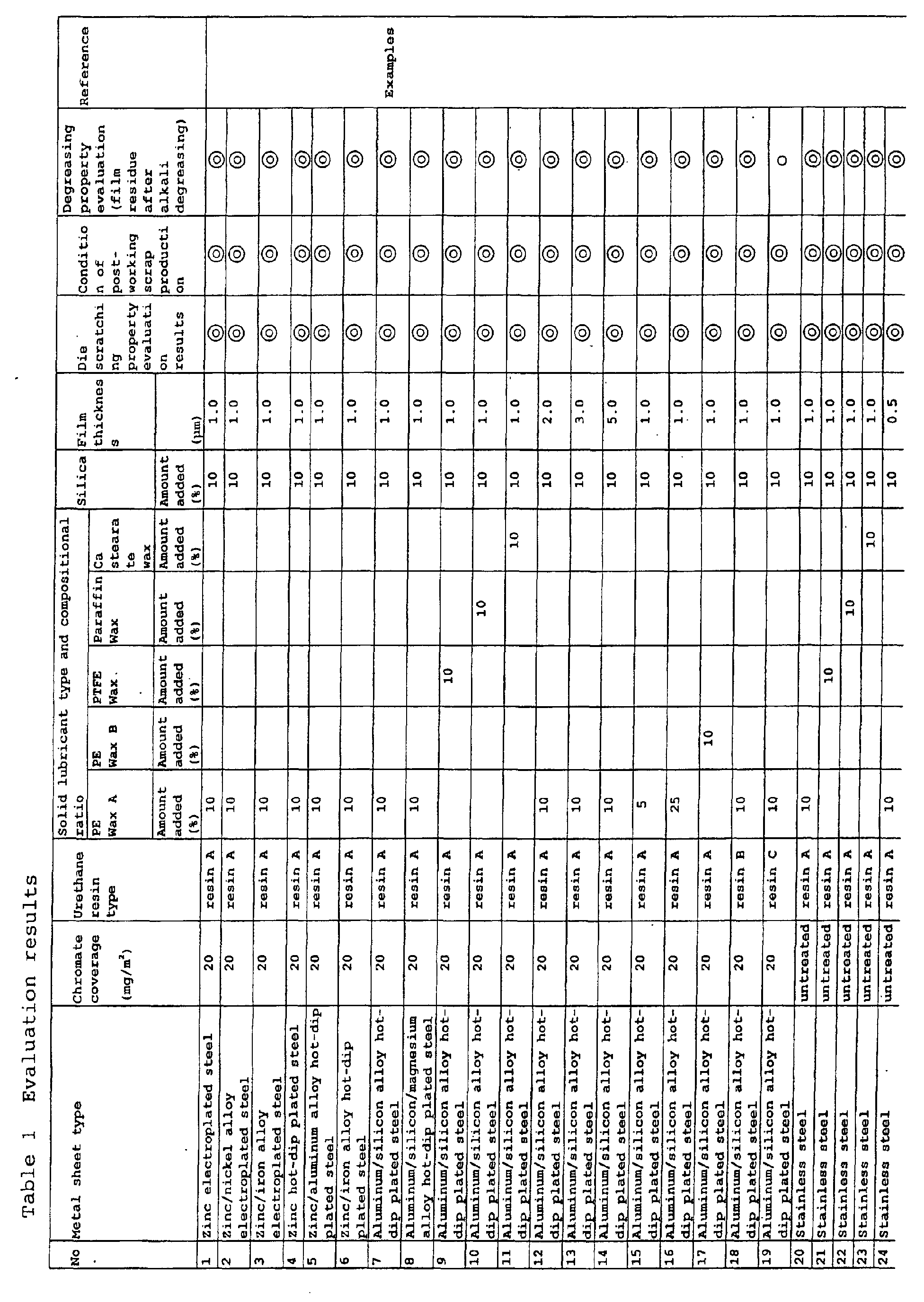
- Aqueous polyurethane composition obtained in Production Example 1 500 pts. by wt. Solid lubricant (Note 1) 37 pts. by wt. (10) Silica (Note 2) 75 pts. by wt. (10)
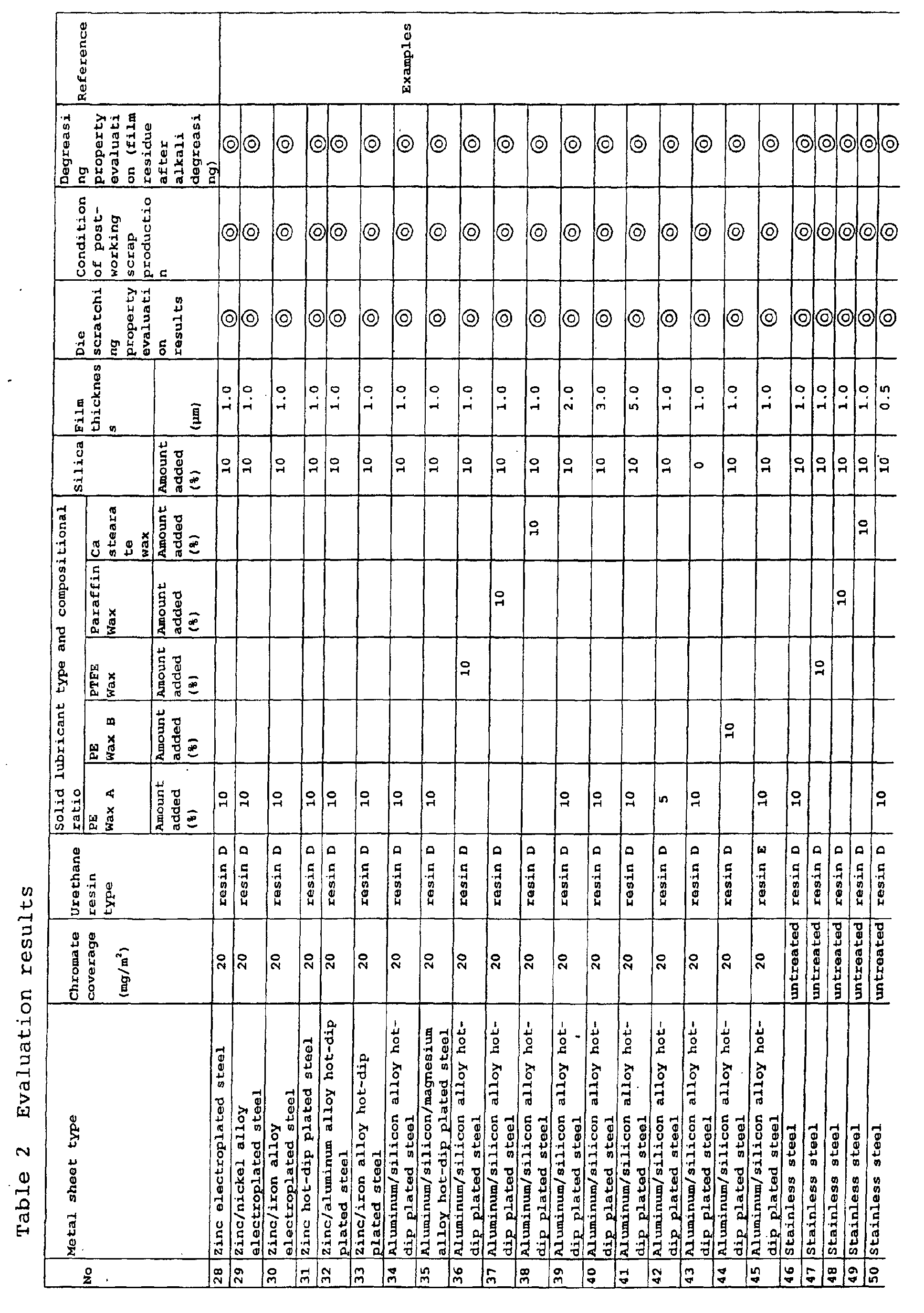
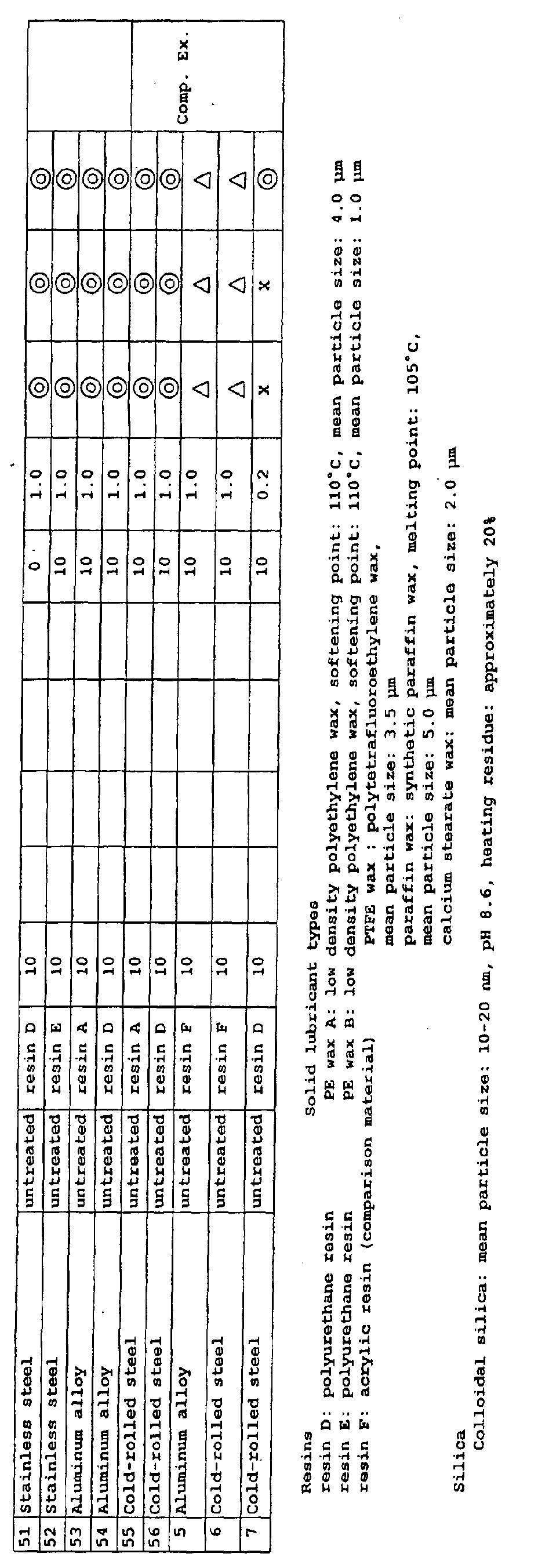
- Lubricating films with the structures described above and the compositional ratios listed in Tables 1 and 2 were coated onto the aforementioned metal sheets with a bar coater, and a heating furnace at 180°C was used for film formation by baking and drying at a metal sheet carry over temperature of 80°C.
- Lubricating surface treated metal articles were fabricated in the same manner as Example 1, except that the metal sheets and lubricating film compositions were combined as shown in Tables 1 and 2. An acrylic resin was evaluated in the same manner as a comparison resin material.
- a molding test was carried out under the conditions given below using a cylindrical punch hydraulic molding tester, and the die scratching was evaluated.
- FC-4358 degreasing solution pH adjusted to 10.5, temperature: 70°C, product of Nihon Parkerizing
- a coating composition allowing formation of alkali-soluble lubricating films with excellent press molding properties and scratch resistance, and lubricating surface treated metal articles employing it, which are expected to offer a notable contribution for uses of steel sheets that are subjected to alkali degreasing after shaping.
- the present invention may therefore be said to have a very high industrial value.
Landscapes
- Chemical & Material Sciences (AREA)
- Organic Chemistry (AREA)
- Engineering & Computer Science (AREA)
- Medicinal Chemistry (AREA)
- Polymers & Plastics (AREA)
- Health & Medical Sciences (AREA)
- Chemical Kinetics & Catalysis (AREA)
- Life Sciences & Earth Sciences (AREA)
- Materials Engineering (AREA)
- Wood Science & Technology (AREA)
- Manufacturing & Machinery (AREA)
- Paints Or Removers (AREA)
- Laminated Bodies (AREA)
- Application Of Or Painting With Fluid Materials (AREA)
- Lubricants (AREA)
Abstract
Description
(sheet thickness: 0.8 mm, plating coverage: 20 g/m2)
(sheet thickness: 0.8 mm, plating coverage: 20 g/m2)
(sheet thickness: 0.8 mm, plating coverage: 20 g/m2)
(sheet thickness: 0.8 mm, plating coverage: 150 g/m2)
(sheet thickness: 0.8 mm, plating coverage: 45 g/m2)
(sheet thickness: 0.8 mm, plating coverage: 150 g/m2)
(sheet thickness: 0.8 mm, plating coverage: 50 g/m2)
(sheet thickness: 0.8 mm, plating coverage: 50 g/m2)
(sheet thickness: 0.8 mm, SUS430, 2B finishing)
| Aqueous polyurethane composition obtained in Production Example 1 | 500 pts. by wt. |
| Solid lubricant (Note 1) | 37 pts. by wt. (10) |
| Silica (Note 2) | 75 pts. by wt. (10) |
- punch diameter: 70 mm
- blank diameter: 150 mm
- press load: 5 kgf/cm2
- molding speed 3.3 x 10⁻² m/s
- tool conditions: FCD-500

Claims (24)
- A coating composition capable of forming an alkali-soluble lubricating film, which contains an aqueous polyurethane composition (A) and a lubricating functionality-providing agent (B) at 1-30 wt% with respect to the solid content of said aqueous polyurethane composition, wherein said aqueous polyurethane composition is film-formable and its formed films are alkali-soluble.
- A coating composition according to claim 1, which further contains silica particles (C) at 1-30 wt% with respect to the solid content of said aqueous polyurethane composition.
- A coating composition according to claim 1 or 2, wherein the aqueous polyurethane composition (A) comprises a polyester polyol.
- A coating composition according to claim 1 or 2, wherein the aqueous polyurethane composition (A) contains a carboxyl group or sulfonic acid group or salt thereof as a hydrophilic group.
- A coating composition according to claim 4, wherein said hydrophilic group of the aqueous polyurethane composition (A) is a Na salt or K salt of a carboxyl group or sulfonic acid group.
- A coating composition according to claim 5, wherein the carboxyl group or sulfonic acid group is contained in the aqueous polyurethane composition (A) to an acid value in the range of 25-180.
- A coating composition according to claim 3, wherein the polyester polyol composing the aqueous polyurethane composition (A) is prepared by reacting ethylene glycol with an aliphatic dibasic acid or its dialkyl ester, or a mixture thereof.
- A coating composition according to any one of claims 1 to 5, wherein the lubricating functionality-providing agent (B) comprises one or more from among polyolefin-based waxes, fluorine-based waxes, paraffin-based waxes and stearic acid-based waxes.
- A lubricating surface treated metal article wherein a lubricating film comprising a polyurethane resin (A') and a lubricating functionality-providing agent (B) at 1-30 wt% with respect to said polyurethane resin, is formed on the surface of a metal article, wherein said lubricating film is alkali soluble and the film thickness is 0.5-5 µm.
- A lubricating surface treated metal article according to claim 9, wherein said lubricating film contains silica particles (C) at 1-30 wt% with respect to said polyurethane resin.
- A lubricating surface treated metal article according to claim 9 or 10, wherein the polyurethane resin (A') comprises a polyester polyol.
- A lubricating surface treated metal article according to claim 9 or 10, wherein the polyurethane resin (A') contains a carboxyl group or sulfonic acid group or salt thereof as a hydrophilic group.
- A lubricating surface treated metal article according to claim 12, wherein said hydrophilic group of the polyurethane resin (A') is a Na salt or K salt of a carboxyl group or sulfonic acid group.
- A lubricating surface treated metal article according to claim 13, wherein the carboxyl group or sulfonic acid group is contained in the polyurethane resin (A') to an acid value in the range of 25-180.
- A lubricating surface treated metal article according to claim 11, wherein the polyester polyol composing the polyurethane resin (A') is prepared by reacting ethylene glycol with an aliphatic dibasic acid or its dialkyl ester, or a mixture thereof.
- A lubricating surface treated metal article according to any one of claims 9 to 14, wherein the lubricating functionality-providing agent (B) comprises one or more from among polyolefin-based waxes, fluorine-based waxes, paraffin-based waxes and stearic acid-based waxes.
- A process for production of metal articles that comprisesi) a step of coating the surface of a metal article with a coating composition containing an aqueous polyurethane composition (A) and a lubricating functionality-providing agent (B) at 1-30 wt% with respect to the solid content of said aqueous polyurethane composition (A), said aqueous polyurethane composition being film-formable and the formed film being alkali soluble, to form an alkali-soluble lubricating film,ii) a step of shape working the metal article surface treated with said alkali-soluble lubricating film, andiii) a step of treating said shape worked metal article with an alkali to remove said alkali-soluble lubricating film.
- A process according to claim 17, wherein silica particles (C) are also included at 1-30 wt% with respect to the solid content of said aqueous polyurethane composition.
- A process according to claim 17 or 18, wherein the aqueous polyurethane composition (A) comprises a polyester polyol.
- A process according to claim 17 or 18, wherein the aqueous polyurethane composition (A) contains a carboxyl group or sulfonic acid group or salt thereof as a hydrophilic group.
- A process according to claim 20, wherein said hydrophilic group of the aqueous polyurethane composition (A) is a Na salt or K salt of a carboxyl group or sulfonic acid group.
- A process according to claim 21, wherein the carboxyl group or sulfonic acid group is contained in the aqueous polyurethane composition (A) to an acid value in the range of 25-180.
- A process according to claim 19, wherein the polyester polyol composing the aqueous polyurethane composition (A) is prepared by reacting ethylene glycol with an aliphatic dibasic acid or its dialkyl ester, or a mixture thereof.
- A process according to any one of claims 19 to 23, wherein the lubricating functionality-providing agent (B) comprises one or more from among polyolefin-based waxes, fluorine-based waxes, paraffin-based waxes and stearic acid-based waxes.
Applications Claiming Priority (5)
| Application Number | Priority Date | Filing Date | Title |
|---|---|---|---|
| JP4953099 | 1999-02-26 | ||
| JP4953099 | 1999-02-26 | ||
| JP36047699A JP4324296B2 (en) | 1999-02-26 | 1999-12-20 | Coating composition capable of forming an alkali-soluble lubricating film excellent in press formability and galling resistance, and lubricated surface-treated metal product using this composition |
| JP36047699 | 1999-12-20 | ||
| PCT/JP2000/001127 WO2000050526A1 (en) | 1999-02-26 | 2000-02-25 | Coating composition capable of forming alkali-soluble lubricating film suitable for forming and use thereof |
Publications (3)
| Publication Number | Publication Date |
|---|---|
| EP1172426A1 true EP1172426A1 (en) | 2002-01-16 |
| EP1172426A4 EP1172426A4 (en) | 2002-10-25 |
| EP1172426B1 EP1172426B1 (en) | 2018-04-04 |
Family
ID=26389935
Family Applications (1)
| Application Number | Title | Priority Date | Filing Date |
|---|---|---|---|
| EP00905370.3A Expired - Lifetime EP1172426B1 (en) | 1999-02-26 | 2000-02-25 | Coating composition capable of forming alkali-soluble lubricating film suitable for shape working and uses thereof |
Country Status (10)
| Country | Link |
|---|---|
| US (1) | US6797770B1 (en) |
| EP (1) | EP1172426B1 (en) |
| JP (1) | JP4324296B2 (en) |
| KR (1) | KR100455221B1 (en) |
| CN (2) | CN101050333B (en) |
| AU (1) | AU761261B2 (en) |
| CA (1) | CA2363657C (en) |
| HK (1) | HK1045708A1 (en) |
| TW (1) | TW497995B (en) |
| WO (1) | WO2000050526A1 (en) |
Cited By (7)
| Publication number | Priority date | Publication date | Assignee | Title |
|---|---|---|---|---|
| WO2007022885A1 (en) * | 2005-08-25 | 2007-03-01 | Bayer Materialscience Ag | Polyurethane-polyurea dispersions |
| WO2007028760A1 (en) * | 2005-09-09 | 2007-03-15 | Basf Se | Polyurethane dispersion containing alkanolamines |
| WO2008034717A1 (en) * | 2006-09-21 | 2008-03-27 | Clariant International Ltd | Aqueous polyurethane/polyurea dispersions |
| WO2008084041A1 (en) * | 2007-01-12 | 2008-07-17 | Lamberti Spa | Volatile amines free polyurethane aqueous dispersions |
| EP2357265A4 (en) * | 2008-12-12 | 2012-04-18 | Kobe Steel Ltd | Titanium or titanium alloy plate having excellent balance between press formability and strength |
| EP3263329A1 (en) * | 2012-03-30 | 2018-01-03 | Nisshin Steel Co., Ltd. | Shaped and coated metallic material |
| CN117487123A (en) * | 2023-12-29 | 2024-02-02 | 山东一诺威聚氨酯股份有限公司 | High toughness and high strength polyurethane rock climbing fulcrum material and preparation method thereof |
Families Citing this family (28)
| Publication number | Priority date | Publication date | Assignee | Title |
|---|---|---|---|---|
| DE19945574A1 (en) * | 1999-09-23 | 2001-04-05 | Basf Coatings Ag | Use of associative thickeners based on polyurethane and / or dipropylene glycol monoalkyl ethers to suppress optical defects in color and / or effect multi-layer coatings or their refinish coatings |
| JP2002144478A (en) * | 2000-11-16 | 2002-05-21 | Nippon Steel Corp | Alkali-soluble lubricated surface treated metal product with excellent moldability |
| CA2442748C (en) * | 2001-03-30 | 2011-05-31 | Nippon Steel Corporation | Alkali-soluble-film surface-lubricated metal product excellent in moldability and long-term stable film-removability independent of film drying temperature |
| DE102005030862B4 (en) * | 2005-07-01 | 2009-12-24 | Sintec Keramik Gmbh | First wetting auxiliary material for an evaporator body, its use for preparing the evaporator surface of an evaporator body and an electrically heatable ceramic evaporator body |
| US20080220224A1 (en) * | 2007-03-06 | 2008-09-11 | Naoki Tokumoto | Decorative Material |
| JP5270133B2 (en) * | 2007-10-29 | 2013-08-21 | 住友軽金属工業株式会社 | Hydroform lubricant, hydroform metal tube using the same, and hydroform molding method |
| JP6136105B2 (en) * | 2012-05-07 | 2017-05-31 | 東洋インキScホールディングス株式会社 | Aqueous polyurethane resin and use thereof |
| JP2013189640A (en) * | 2013-05-09 | 2013-09-26 | Sumitomo Light Metal Ind Ltd | Hydroforming lubricant, hydroforming metallic tube using the same, and hydroforming processing method |
| CN109468050B (en) * | 2018-09-26 | 2021-01-22 | 江苏乘鹰新材料股份有限公司 | Water-based flexible hand feeling coating and preparation method thereof |
| CN110240834A (en) * | 2019-06-14 | 2019-09-17 | 武汉钢铁有限公司 | Alloying hot dip galvanized sheet manufacturing method with good surface characteristic |
| US12134709B2 (en) * | 2019-07-09 | 2024-11-05 | The Boeing Company | Coatings for sterilization with UV light |
| WO2022123930A1 (en) | 2020-12-09 | 2022-06-16 | Jfeスチール株式会社 | Steel sheet and method for producing same |
| JP7552576B2 (en) * | 2021-06-04 | 2024-09-18 | Jfeスチール株式会社 | Steel plate and its manufacturing method |
| JP7164063B1 (en) | 2021-10-14 | 2022-11-01 | Jfeスチール株式会社 | Steel plate and its manufacturing method |
| US20240400853A1 (en) | 2021-10-14 | 2024-12-05 | Jfe Steel Corporation | Coating solution for coating metal sheet |
| JP7533427B2 (en) | 2021-11-19 | 2024-08-14 | Jfeスチール株式会社 | cold-rolled steel plate |
| CN116355515B (en) * | 2021-12-29 | 2024-10-18 | 江苏奥斯佳材料科技股份有限公司 | Application of water-based strippable paint |
| JP7647590B2 (en) | 2022-01-04 | 2025-03-18 | Jfeスチール株式会社 | Lubricating film coated zinc-based plated steel sheet and its manufacturing method |
| WO2023171173A1 (en) | 2022-03-11 | 2023-09-14 | Jfeスチール株式会社 | Organic resin-coated steel sheet |
| US12617951B2 (en) | 2022-03-25 | 2026-05-05 | Jfe Steel Corporation | Steel sheet and method for producing the same |
| EP4477410A4 (en) | 2022-03-30 | 2025-05-28 | JFE Steel Corporation | STEEL SHEET AND ITS MANUFACTURING PROCESS |
| CN119136977B (en) | 2022-06-07 | 2026-05-12 | 杰富意钢铁株式会社 | Coated steel sheet and method for producing same |
| US20250346783A1 (en) | 2022-06-07 | 2025-11-13 | Jfe Steel Corporation | Coated steel sheet and method of producing same |
| EP4509309A4 (en) | 2022-06-07 | 2025-09-03 | Jfe Steel Corp | Coated steel sheet and method for producing the same |
| KR20250024995A (en) | 2022-07-26 | 2025-02-20 | 제이에프이 스틸 가부시키가이샤 | Zinc-coated steel sheet and its manufacturing method |
| CN120530160A (en) * | 2023-01-26 | 2025-08-22 | Ppg工业俄亥俄公司 | Wear-resistant and lubricating coating compositions for flexible substrates |
| CN116948479B (en) * | 2023-07-22 | 2024-12-31 | 广州翔铭环保新材料有限公司 | A water-based primer coating for golf head and preparation method thereof |
| CN118834592B (en) * | 2024-08-06 | 2025-09-09 | 青岛科技大学 | Preparation method of polyurethane surface coating material capable of rapidly removing labels |
Family Cites Families (12)
| Publication number | Priority date | Publication date | Assignee | Title |
|---|---|---|---|---|
| JP3026385B2 (en) | 1992-03-13 | 2000-03-27 | 関西ペイント株式会社 | Coating composition for lubricating steel sheet excellent in press workability and lubricating steel sheet using the same |
| JP2719571B2 (en) | 1992-11-12 | 1998-02-25 | 日本パーカライジング株式会社 | Water-based lubricating coating composition |
| JP2743237B2 (en) * | 1992-12-02 | 1998-04-22 | 新日本製鐵株式会社 | Non-delamination type lubricated steel sheet which can be omitted press oil |
| JP2545700B2 (en) * | 1993-12-22 | 1996-10-23 | 株式会社神戸製鋼所 | Resin coated aluminum material or aluminum alloy material with excellent press formability, corrosion resistance and paintability |
| JPH08127735A (en) | 1994-10-31 | 1996-05-21 | Sumitomo Light Metal Ind Ltd | Lubricated aluminum sheet having excellent press formability and method for producing the same |
| JP3378393B2 (en) | 1994-12-05 | 2003-02-17 | 日新製鋼株式会社 | Alkali-soluble high adhesion protective coating coated stainless steel plate |
| JP3305913B2 (en) | 1995-03-16 | 2002-07-24 | 日新製鋼株式会社 | Alkali-soluble protective coating-coated stainless steel sheet with excellent galling resistance |
| JP3343842B2 (en) * | 1996-03-18 | 2002-11-11 | 日新製鋼株式会社 | Alkali-soluble resin film coated zinc-coated steel sheet with excellent adhesiveness and powdering resistance |
| JPH1088364A (en) | 1996-09-13 | 1998-04-07 | Sumitomo Light Metal Ind Ltd | Stripping type lubricated aluminum plate and method of manufacturing the same |
| JPH10109376A (en) * | 1996-10-08 | 1998-04-28 | Kawasaki Steel Corp | Non-alkali delaminated lubricating resin-treated steel sheet and method for producing the same |
| JPH10114014A (en) | 1996-10-15 | 1998-05-06 | Sumitomo Metal Ind Ltd | Surface lubricated steel sheet with excellent scratch resistance and film removal properties |
| JPH10237478A (en) * | 1996-12-24 | 1998-09-08 | Nippon Parkerizing Co Ltd | Water-based metal surface treatment composition with excellent corrosion resistance at the damaged part |
-
1999
- 1999-12-20 JP JP36047699A patent/JP4324296B2/en not_active Expired - Fee Related
-
2000
- 2000-02-25 TW TW89103391A patent/TW497995B/en not_active IP Right Cessation
- 2000-02-25 AU AU26941/00A patent/AU761261B2/en not_active Expired
- 2000-02-25 CA CA002363657A patent/CA2363657C/en not_active Expired - Lifetime
- 2000-02-25 US US09/914,112 patent/US6797770B1/en not_active Expired - Lifetime
- 2000-02-25 CN CN2007100053155A patent/CN101050333B/en not_active Expired - Lifetime
- 2000-02-25 WO PCT/JP2000/001127 patent/WO2000050526A1/en not_active Ceased
- 2000-02-25 HK HK02107260.6A patent/HK1045708A1/en unknown
- 2000-02-25 KR KR10-2001-7010879A patent/KR100455221B1/en not_active Expired - Lifetime
- 2000-02-25 CN CN00805545A patent/CN1345359A/en active Pending
- 2000-02-25 EP EP00905370.3A patent/EP1172426B1/en not_active Expired - Lifetime
Cited By (10)
| Publication number | Priority date | Publication date | Assignee | Title |
|---|---|---|---|---|
| WO2007022885A1 (en) * | 2005-08-25 | 2007-03-01 | Bayer Materialscience Ag | Polyurethane-polyurea dispersions |
| WO2007028760A1 (en) * | 2005-09-09 | 2007-03-15 | Basf Se | Polyurethane dispersion containing alkanolamines |
| WO2008034717A1 (en) * | 2006-09-21 | 2008-03-27 | Clariant International Ltd | Aqueous polyurethane/polyurea dispersions |
| CN101516943B (en) * | 2006-09-21 | 2013-05-29 | 克莱里安特财务(Bvi)有限公司 | Aqueous polyurethane/polyurea dispersions |
| US9102781B2 (en) | 2006-09-21 | 2015-08-11 | Stahl International Bv | Aqueous polyurethane/polyurea dispersions |
| WO2008084041A1 (en) * | 2007-01-12 | 2008-07-17 | Lamberti Spa | Volatile amines free polyurethane aqueous dispersions |
| EP2357265A4 (en) * | 2008-12-12 | 2012-04-18 | Kobe Steel Ltd | Titanium or titanium alloy plate having excellent balance between press formability and strength |
| US9790576B2 (en) | 2008-12-12 | 2017-10-17 | Kobe Steel, Ltd. | Titanium or titanium alloy plate excellent in balance between press formability and strength |
| EP3263329A1 (en) * | 2012-03-30 | 2018-01-03 | Nisshin Steel Co., Ltd. | Shaped and coated metallic material |
| CN117487123A (en) * | 2023-12-29 | 2024-02-02 | 山东一诺威聚氨酯股份有限公司 | High toughness and high strength polyurethane rock climbing fulcrum material and preparation method thereof |
Also Published As
| Publication number | Publication date |
|---|---|
| JP2000309747A (en) | 2000-11-07 |
| CN1345359A (en) | 2002-04-17 |
| EP1172426A4 (en) | 2002-10-25 |
| CN101050333A (en) | 2007-10-10 |
| CA2363657A1 (en) | 2000-08-31 |
| JP4324296B2 (en) | 2009-09-02 |
| WO2000050526A1 (en) | 2000-08-31 |
| TW497995B (en) | 2002-08-11 |
| US6797770B1 (en) | 2004-09-28 |
| KR100455221B1 (en) | 2004-11-06 |
| CN101050333B (en) | 2012-08-29 |
| AU761261B2 (en) | 2003-05-29 |
| CA2363657C (en) | 2007-04-10 |
| KR20010108261A (en) | 2001-12-07 |
| AU2694100A (en) | 2000-09-14 |
| EP1172426B1 (en) | 2018-04-04 |
| HK1045708A1 (en) | 2002-12-06 |
Similar Documents
| Publication | Publication Date | Title |
|---|---|---|
| EP1172426B1 (en) | Coating composition capable of forming alkali-soluble lubricating film suitable for shape working and uses thereof | |
| EP1186351B1 (en) | Soluble lubricating surface-treated stainless steel sheet with excellent shapability for fuel tank and method for manufacturing fuel tank | |
| CN101473067B (en) | Surface-treated metal material and metal surface treating agent | |
| CA2442748C (en) | Alkali-soluble-film surface-lubricated metal product excellent in moldability and long-term stable film-removability independent of film drying temperature | |
| KR100521284B1 (en) | Metal product with excellent moldability surface-treated with alkali-soluble lubricant | |
| JP2000102765A (en) | Coating composition for lubricating surface treatment | |
| JP4132729B2 (en) | A soluble type lubricated surface-treated stainless steel plate for fuel tanks with excellent formability and a method for producing fuel tanks | |
| KR970004371B1 (en) | Zinc-plated steel plate having high press formability and corrosion resistance | |
| JP3872969B2 (en) | Soluble-type lubricated surface-treated metal product for hydrofoam excellent in moldability and emulsion type hydraulic oil resistance, and its molding method | |
| JP4397073B2 (en) | Coating composition capable of forming lubricating film excellent in press workability and weldability, and lubricated surface-treated steel sheet using this composition | |
| JP2001342577A (en) | Aluminum alloy plate with excellent press formability | |
| JP2003027256A (en) | An alkali-soluble lubricated surface-treated metal product that excels in long-term stable film removal regardless of moldability and film drying temperature | |
| JP4392967B2 (en) | Alkali-soluble lubricated surface-treated metal products with excellent moldability | |
| JP2000102764A (en) | Resin-coated plated steel sheet with excellent continuous press workability, continuous ironing workability, and corrosion resistance | |
| JP2006218856A (en) | Alkali-soluble lubricating steel sheet with excellent ironing process and emulsion type press oil resistance | |
| JP2003003278A (en) | Alkali-soluble lubricated surface-treated metal products with excellent continuous formability |
Legal Events
| Date | Code | Title | Description |
|---|---|---|---|
| PUAI | Public reference made under article 153(3) epc to a published international application that has entered the european phase |
Free format text: ORIGINAL CODE: 0009012 |
|
| 17P | Request for examination filed |
Effective date: 20010926 |
|
| AK | Designated contracting states |
Kind code of ref document: A1 Designated state(s): AT BE CH CY DE DK ES FI FR GB GR IE IT LI LU MC NL PT SE Kind code of ref document: A1 Designated state(s): FR GB |
|
| A4 | Supplementary search report drawn up and despatched | ||
| AK | Designated contracting states |
Kind code of ref document: A4 Designated state(s): AT BE CH CY DE DK ES FI FR GB GR IE IT LI LU MC NL PT SE |
|
| A4 | Supplementary search report drawn up and despatched |
Effective date: 20021025 |
|
| RIC1 | Information provided on ipc code assigned before grant |
Free format text: 7C 09D 175/06 A, 7C 09D 5/00 B, 7C 08G 18/66 B, 7C 08G 18/08 B |
|
| REG | Reference to a national code |
Ref country code: DE Ref legal event code: 8566 |
|
| RBV | Designated contracting states (corrected) |
Designated state(s): FR GB |
|
| 17Q | First examination report despatched |
Effective date: 20050122 |
|
| 17Q | First examination report despatched |
Effective date: 20050222 |
|
| RAP1 | Party data changed (applicant data changed or rights of an application transferred) |
Owner name: NIPPON STEEL & SUMIKIN STAINLESS STEEL CORPORATION |
|
| GRAP | Despatch of communication of intention to grant a patent |
Free format text: ORIGINAL CODE: EPIDOSNIGR1 |
|
| INTG | Intention to grant announced |
Effective date: 20170322 |
|
| GRAS | Grant fee paid |
Free format text: ORIGINAL CODE: EPIDOSNIGR3 |
|
| GRAJ | Information related to disapproval of communication of intention to grant by the applicant or resumption of examination proceedings by the epo deleted |
Free format text: ORIGINAL CODE: EPIDOSDIGR1 |
|
| GRAL | Information related to payment of fee for publishing/printing deleted |
Free format text: ORIGINAL CODE: EPIDOSDIGR3 |
|
| RIN1 | Information on inventor provided before grant (corrected) |
Inventor name: MORI, YOICHIRO Inventor name: HIRATA, FUMIAKI Inventor name: TAWA, TSUTOMU Inventor name: YAMAZAKI, MAKOTO Inventor name: WAKE, RYOUSUKE Inventor name: KOUDA, CHIKAKO Inventor name: FUDA, MASAHIRO |
|
| GRAP | Despatch of communication of intention to grant a patent |
Free format text: ORIGINAL CODE: EPIDOSNIGR1 |
|
| INTC | Intention to grant announced (deleted) | ||
| INTG | Intention to grant announced |
Effective date: 20170919 |
|
| GRAA | (expected) grant |
Free format text: ORIGINAL CODE: 0009210 |
|
| AK | Designated contracting states |
Kind code of ref document: B1 Designated state(s): FR GB |
|
| REG | Reference to a national code |
Ref country code: GB Ref legal event code: FG4D |
|
| PLBE | No opposition filed within time limit |
Free format text: ORIGINAL CODE: 0009261 |
|
| STAA | Information on the status of an ep patent application or granted ep patent |
Free format text: STATUS: NO OPPOSITION FILED WITHIN TIME LIMIT |
|
| 26N | No opposition filed |
Effective date: 20190107 |
|
| PGFP | Annual fee paid to national office [announced via postgrant information from national office to epo] |
Ref country code: FR Payment date: 20190108 Year of fee payment: 20 Ref country code: GB Payment date: 20190218 Year of fee payment: 20 |
|
| REG | Reference to a national code |
Ref country code: GB Ref legal event code: PE20 Expiry date: 20200224 |
|
| PG25 | Lapsed in a contracting state [announced via postgrant information from national office to epo] |
Ref country code: GB Free format text: LAPSE BECAUSE OF EXPIRATION OF PROTECTION Effective date: 20200224 |