EP1172417A2 - Process of making finely divided opaque particles - Google Patents
Process of making finely divided opaque particles Download PDFInfo
- Publication number
- EP1172417A2 EP1172417A2 EP01810693A EP01810693A EP1172417A2 EP 1172417 A2 EP1172417 A2 EP 1172417A2 EP 01810693 A EP01810693 A EP 01810693A EP 01810693 A EP01810693 A EP 01810693A EP 1172417 A2 EP1172417 A2 EP 1172417A2
- Authority
- EP
- European Patent Office
- Prior art keywords
- parts
- alkyl
- aryl
- water
- finely divided
- Prior art date
- Legal status (The legal status is an assumption and is not a legal conclusion. Google has not performed a legal analysis and makes no representation as to the accuracy of the status listed.)
- Withdrawn
Links
- 239000002245 particle Substances 0.000 title claims abstract description 34
- 238000000034 method Methods 0.000 title claims description 24
- 229920005989 resin Polymers 0.000 claims abstract description 51
- 239000011347 resin Substances 0.000 claims abstract description 51
- 230000001788 irregular Effects 0.000 claims abstract description 9
- XLYOFNOQVPJJNP-UHFFFAOYSA-N water Substances O XLYOFNOQVPJJNP-UHFFFAOYSA-N 0.000 claims description 49
- WSFSSNUMVMOOMR-UHFFFAOYSA-N Formaldehyde Chemical compound O=C WSFSSNUMVMOOMR-UHFFFAOYSA-N 0.000 claims description 37
- 239000000975 dye Substances 0.000 claims description 32
- 239000000203 mixture Substances 0.000 claims description 31
- 239000000084 colloidal system Substances 0.000 claims description 25
- 230000001681 protective effect Effects 0.000 claims description 25
- 239000000725 suspension Substances 0.000 claims description 23
- 239000007864 aqueous solution Substances 0.000 claims description 19
- GZVHEAJQGPRDLQ-UHFFFAOYSA-N 6-phenyl-1,3,5-triazine-2,4-diamine Chemical compound NC1=NC(N)=NC(C=2C=CC=CC=2)=N1 GZVHEAJQGPRDLQ-UHFFFAOYSA-N 0.000 claims description 12
- 229910052736 halogen Inorganic materials 0.000 claims description 12
- 150000002367 halogens Chemical class 0.000 claims description 12
- XSQUKJJJFZCRTK-UHFFFAOYSA-N Urea Chemical compound NC(N)=O XSQUKJJJFZCRTK-UHFFFAOYSA-N 0.000 claims description 11
- 239000004202 carbamide Substances 0.000 claims description 11
- 229910052739 hydrogen Inorganic materials 0.000 claims description 11
- 239000003960 organic solvent Substances 0.000 claims description 11
- 125000004169 (C1-C6) alkyl group Chemical group 0.000 claims description 10
- 125000003118 aryl group Chemical group 0.000 claims description 10
- 239000001257 hydrogen Substances 0.000 claims description 10
- 239000002736 nonionic surfactant Substances 0.000 claims description 9
- 125000004191 (C1-C6) alkoxy group Chemical group 0.000 claims description 8
- 125000000217 alkyl group Chemical group 0.000 claims description 8
- 150000005840 aryl radicals Chemical class 0.000 claims description 8
- 239000007850 fluorescent dye Substances 0.000 claims description 8
- 150000002431 hydrogen Chemical class 0.000 claims description 8
- 125000002887 hydroxy group Chemical group [H]O* 0.000 claims description 8
- 239000003054 catalyst Substances 0.000 claims description 7
- 239000007788 liquid Substances 0.000 claims description 7
- 239000002563 ionic surfactant Substances 0.000 claims description 5
- 229920003169 water-soluble polymer Polymers 0.000 claims description 5
- 150000001875 compounds Chemical class 0.000 claims description 4
- 230000002378 acidificating effect Effects 0.000 claims description 3
- 239000012736 aqueous medium Substances 0.000 claims description 3
- 238000009835 boiling Methods 0.000 claims description 3
- 235000001671 coumarin Nutrition 0.000 claims description 3
- 238000001035 drying Methods 0.000 claims description 3
- UFHFLCQGNIYNRP-UHFFFAOYSA-N Hydrogen Chemical compound [H][H] UFHFLCQGNIYNRP-UHFFFAOYSA-N 0.000 claims description 2
- NINIDFKCEFEMDL-UHFFFAOYSA-N Sulfur Chemical group [S] NINIDFKCEFEMDL-UHFFFAOYSA-N 0.000 claims description 2
- 239000005864 Sulphur Substances 0.000 claims description 2
- QVGXLLKOCUKJST-UHFFFAOYSA-N atomic oxygen Chemical group [O] QVGXLLKOCUKJST-UHFFFAOYSA-N 0.000 claims description 2
- XJHABGPPCLHLLV-UHFFFAOYSA-N benzo[de]isoquinoline-1,3-dione Chemical class C1=CC(C(=O)NC2=O)=C3C2=CC=CC3=C1 XJHABGPPCLHLLV-UHFFFAOYSA-N 0.000 claims description 2
- 238000004043 dyeing Methods 0.000 claims description 2
- 239000001301 oxygen Chemical group 0.000 claims description 2
- 229910052760 oxygen Inorganic materials 0.000 claims description 2
- 125000000332 coumarinyl group Chemical group O1C(=O)C(=CC2=CC=CC=C12)* 0.000 claims 1
- 239000000049 pigment Substances 0.000 abstract description 15
- ZHNUHDYFZUAESO-OUBTZVSYSA-N aminoformaldehyde Chemical compound N[13CH]=O ZHNUHDYFZUAESO-OUBTZVSYSA-N 0.000 abstract description 8
- MUBZPKHOEPUJKR-UHFFFAOYSA-N Oxalic acid Chemical compound OC(=O)C(O)=O MUBZPKHOEPUJKR-UHFFFAOYSA-N 0.000 description 34
- OKKJLVBELUTLKV-UHFFFAOYSA-N Methanol Chemical compound OC OKKJLVBELUTLKV-UHFFFAOYSA-N 0.000 description 30
- CSCPPACGZOOCGX-UHFFFAOYSA-N Acetone Chemical compound CC(C)=O CSCPPACGZOOCGX-UHFFFAOYSA-N 0.000 description 27
- 239000000243 solution Substances 0.000 description 27
- 239000000047 product Substances 0.000 description 23
- 229920000663 Hydroxyethyl cellulose Polymers 0.000 description 16
- 239000011541 reaction mixture Substances 0.000 description 16
- 239000004354 Hydroxyethyl cellulose Substances 0.000 description 14
- 235000019447 hydroxyethyl cellulose Nutrition 0.000 description 13
- 239000002904 solvent Substances 0.000 description 13
- 235000006408 oxalic acid Nutrition 0.000 description 11
- 239000000843 powder Substances 0.000 description 11
- 239000004094 surface-active agent Substances 0.000 description 11
- CDBYLPFSWZWCQE-UHFFFAOYSA-L Sodium Carbonate Chemical compound [Na+].[Na+].[O-]C([O-])=O CDBYLPFSWZWCQE-UHFFFAOYSA-L 0.000 description 10
- 238000002360 preparation method Methods 0.000 description 10
- VEXZGXHMUGYJMC-UHFFFAOYSA-N Hydrochloric acid Chemical compound Cl VEXZGXHMUGYJMC-UHFFFAOYSA-N 0.000 description 8
- NAQMVNRVTILPCV-UHFFFAOYSA-N hexane-1,6-diamine Chemical compound NCCCCCCN NAQMVNRVTILPCV-UHFFFAOYSA-N 0.000 description 8
- VRAHPESAMYMDQI-UHFFFAOYSA-N Nicomol Chemical compound C1CCC(COC(=O)C=2C=NC=CC=2)(COC(=O)C=2C=NC=CC=2)C(O)C1(COC(=O)C=1C=NC=CC=1)COC(=O)C1=CC=CN=C1 VRAHPESAMYMDQI-UHFFFAOYSA-N 0.000 description 7
- KWYUFKZDYYNOTN-UHFFFAOYSA-M Potassium hydroxide Chemical compound [OH-].[K+] KWYUFKZDYYNOTN-UHFFFAOYSA-M 0.000 description 7
- 239000012299 nitrogen atmosphere Substances 0.000 description 7
- ZWEHNKRNPOVVGH-UHFFFAOYSA-N 2-Butanone Chemical compound CCC(C)=O ZWEHNKRNPOVVGH-UHFFFAOYSA-N 0.000 description 6
- LFQSCWFLJHTTHZ-UHFFFAOYSA-N Ethanol Chemical compound CCO LFQSCWFLJHTTHZ-UHFFFAOYSA-N 0.000 description 5
- 238000013459 approach Methods 0.000 description 5
- 235000011167 hydrochloric acid Nutrition 0.000 description 5
- 238000010992 reflux Methods 0.000 description 5
- 229910000029 sodium carbonate Inorganic materials 0.000 description 5
- -1 aliphatic ketones Chemical class 0.000 description 4
- 229920000642 polymer Polymers 0.000 description 4
- 238000003756 stirring Methods 0.000 description 4
- VEJIQHRMIYFYPS-UHFFFAOYSA-N (3-phenyl-1,2-oxazol-5-yl)boronic acid Chemical compound O1C(B(O)O)=CC(C=2C=CC=CC=2)=N1 VEJIQHRMIYFYPS-UHFFFAOYSA-N 0.000 description 3
- 238000004438 BET method Methods 0.000 description 3
- ZMXDDKWLCZADIW-UHFFFAOYSA-N N,N-Dimethylformamide Chemical compound CN(C)C=O ZMXDDKWLCZADIW-UHFFFAOYSA-N 0.000 description 3
- 229920001807 Urea-formaldehyde Polymers 0.000 description 3
- 229920001577 copolymer Polymers 0.000 description 3
- 238000001914 filtration Methods 0.000 description 3
- 239000000463 material Substances 0.000 description 3
- CLYVDMAATCIVBF-UHFFFAOYSA-N pigment red 224 Chemical compound C=12C3=CC=C(C(OC4=O)=O)C2=C4C=CC=1C1=CC=C2C(=O)OC(=O)C4=CC=C3C1=C42 CLYVDMAATCIVBF-UHFFFAOYSA-N 0.000 description 3
- ODGAOXROABLFNM-UHFFFAOYSA-N polynoxylin Chemical compound O=C.NC(N)=O ODGAOXROABLFNM-UHFFFAOYSA-N 0.000 description 3
- 239000000126 substance Substances 0.000 description 3
- DDHUNHGZUHZNKB-UHFFFAOYSA-N 2,2-dimethylpropane-1,3-diamine Chemical compound NCC(C)(C)CN DDHUNHGZUHZNKB-UHFFFAOYSA-N 0.000 description 2
- MTJGVAJYTOXFJH-UHFFFAOYSA-N 3-aminonaphthalene-1,5-disulfonic acid Chemical compound C1=CC=C(S(O)(=O)=O)C2=CC(N)=CC(S(O)(=O)=O)=C21 MTJGVAJYTOXFJH-UHFFFAOYSA-N 0.000 description 2
- HRPVXLWXLXDGHG-UHFFFAOYSA-N Acrylamide Chemical compound NC(=O)C=C HRPVXLWXLXDGHG-UHFFFAOYSA-N 0.000 description 2
- 229920001560 Cyanamer® Polymers 0.000 description 2
- 229920000877 Melamine resin Polymers 0.000 description 2
- 229930040373 Paraformaldehyde Natural products 0.000 description 2
- ZLMJMSJWJFRBEC-UHFFFAOYSA-N Potassium Chemical compound [K] ZLMJMSJWJFRBEC-UHFFFAOYSA-N 0.000 description 2
- DBMJMQXJHONAFJ-UHFFFAOYSA-M Sodium laurylsulphate Chemical compound [Na+].CCCCCCCCCCCCOS([O-])(=O)=O DBMJMQXJHONAFJ-UHFFFAOYSA-M 0.000 description 2
- QAOWNCQODCNURD-UHFFFAOYSA-N Sulfuric acid Chemical compound OS(O)(=O)=O QAOWNCQODCNURD-UHFFFAOYSA-N 0.000 description 2
- 239000002253 acid Substances 0.000 description 2
- 150000007513 acids Chemical class 0.000 description 2
- 238000013019 agitation Methods 0.000 description 2
- 229920002214 alkoxylated polymer Polymers 0.000 description 2
- 229920003180 amino resin Polymers 0.000 description 2
- 239000007900 aqueous suspension Substances 0.000 description 2
- 125000005605 benzo group Chemical group 0.000 description 2
- ZYGHJZDHTFUPRJ-UHFFFAOYSA-N benzo-alpha-pyrone Natural products C1=CC=C2OC(=O)C=CC2=C1 ZYGHJZDHTFUPRJ-UHFFFAOYSA-N 0.000 description 2
- 230000015572 biosynthetic process Effects 0.000 description 2
- 238000001816 cooling Methods 0.000 description 2
- 150000004775 coumarins Chemical class 0.000 description 2
- 239000002270 dispersing agent Substances 0.000 description 2
- MSYLJRIXVZCQHW-UHFFFAOYSA-N formaldehyde;6-phenyl-1,3,5-triazine-2,4-diamine Chemical compound O=C.NC1=NC(N)=NC(C=2C=CC=CC=2)=N1 MSYLJRIXVZCQHW-UHFFFAOYSA-N 0.000 description 2
- 238000010438 heat treatment Methods 0.000 description 2
- 239000000976 ink Substances 0.000 description 2
- JDSHMPZPIAZGSV-UHFFFAOYSA-N melamine Chemical compound NC1=NC(N)=NC(N)=N1 JDSHMPZPIAZGSV-UHFFFAOYSA-N 0.000 description 2
- 239000011859 microparticle Substances 0.000 description 2
- 239000003791 organic solvent mixture Substances 0.000 description 2
- 239000000123 paper Substances 0.000 description 2
- 229920002866 paraformaldehyde Polymers 0.000 description 2
- 239000011591 potassium Substances 0.000 description 2
- 229910052700 potassium Inorganic materials 0.000 description 2
- KIDHWZJUCRJVML-UHFFFAOYSA-N putrescine Chemical compound NCCCCN KIDHWZJUCRJVML-UHFFFAOYSA-N 0.000 description 2
- 229940047670 sodium acrylate Drugs 0.000 description 2
- 235000019333 sodium laurylsulphate Nutrition 0.000 description 2
- 235000019832 sodium triphosphate Nutrition 0.000 description 2
- 239000012798 spherical particle Substances 0.000 description 2
- UNXRWKVEANCORM-UHFFFAOYSA-I triphosphate(5-) Chemical compound [O-]P([O-])(=O)OP([O-])(=O)OP([O-])([O-])=O UNXRWKVEANCORM-UHFFFAOYSA-I 0.000 description 2
- LNAZSHAWQACDHT-XIYTZBAFSA-N (2r,3r,4s,5r,6s)-4,5-dimethoxy-2-(methoxymethyl)-3-[(2s,3r,4s,5r,6r)-3,4,5-trimethoxy-6-(methoxymethyl)oxan-2-yl]oxy-6-[(2r,3r,4s,5r,6r)-4,5,6-trimethoxy-2-(methoxymethyl)oxan-3-yl]oxyoxane Chemical compound CO[C@@H]1[C@@H](OC)[C@H](OC)[C@@H](COC)O[C@H]1O[C@H]1[C@H](OC)[C@@H](OC)[C@H](O[C@H]2[C@@H]([C@@H](OC)[C@H](OC)O[C@@H]2COC)OC)O[C@@H]1COC LNAZSHAWQACDHT-XIYTZBAFSA-N 0.000 description 1
- PDVFSPNIEOYOQL-UHFFFAOYSA-N (4-methylphenyl)sulfonyl 4-methylbenzenesulfonate Chemical compound C1=CC(C)=CC=C1S(=O)(=O)OS(=O)(=O)C1=CC=C(C)C=C1 PDVFSPNIEOYOQL-UHFFFAOYSA-N 0.000 description 1
- GEYOCULIXLDCMW-UHFFFAOYSA-N 1,2-phenylenediamine Chemical compound NC1=CC=CC=C1N GEYOCULIXLDCMW-UHFFFAOYSA-N 0.000 description 1
- LXOFYPKXCSULTL-UHFFFAOYSA-N 2,4,7,9-tetramethyldec-5-yne-4,7-diol Chemical compound CC(C)CC(C)(O)C#CC(C)(O)CC(C)C LXOFYPKXCSULTL-UHFFFAOYSA-N 0.000 description 1
- SMZOUWXMTYCWNB-UHFFFAOYSA-N 2-(2-methoxy-5-methylphenyl)ethanamine Chemical compound COC1=CC=C(C)C=C1CCN SMZOUWXMTYCWNB-UHFFFAOYSA-N 0.000 description 1
- WBIQQQGBSDOWNP-UHFFFAOYSA-N 2-dodecylbenzenesulfonic acid Chemical class CCCCCCCCCCCCC1=CC=CC=C1S(O)(=O)=O WBIQQQGBSDOWNP-UHFFFAOYSA-N 0.000 description 1
- DEPQGPYANDNZMP-UHFFFAOYSA-N 4-oxahexacyclo[10.9.1.113,17.02,6.08,22.021,23]tricosa-1(22),2(6),7,9,11,13,15,17(23),18,20-decaene-3,5-dione Chemical compound C1=CC(C=2C=3C(=O)OC(C=3C=C3C=2C2=CC=C3)=O)=C3C2=CC=CC3=C1 DEPQGPYANDNZMP-UHFFFAOYSA-N 0.000 description 1
- 239000001856 Ethyl cellulose Substances 0.000 description 1
- ZZSNKZQZMQGXPY-UHFFFAOYSA-N Ethyl cellulose Chemical compound CCOCC1OC(OC)C(OCC)C(OCC)C1OC1C(O)C(O)C(OC)C(CO)O1 ZZSNKZQZMQGXPY-UHFFFAOYSA-N 0.000 description 1
- DGAQECJNVWCQMB-PUAWFVPOSA-M Ilexoside XXIX Chemical compound C[C@@H]1CC[C@@]2(CC[C@@]3(C(=CC[C@H]4[C@]3(CC[C@@H]5[C@@]4(CC[C@@H](C5(C)C)OS(=O)(=O)[O-])C)C)[C@@H]2[C@]1(C)O)C)C(=O)O[C@H]6[C@@H]([C@H]([C@@H]([C@H](O6)CO)O)O)O.[Na+] DGAQECJNVWCQMB-PUAWFVPOSA-M 0.000 description 1
- OFOBLEOULBTSOW-UHFFFAOYSA-N Malonic acid Chemical compound OC(=O)CC(O)=O OFOBLEOULBTSOW-UHFFFAOYSA-N 0.000 description 1
- CERQOIWHTDAKMF-UHFFFAOYSA-N Methacrylic acid Chemical compound CC(=C)C(O)=O CERQOIWHTDAKMF-UHFFFAOYSA-N 0.000 description 1
- CTQNGGLPUBDAKN-UHFFFAOYSA-N O-Xylene Chemical compound CC1=CC=CC=C1C CTQNGGLPUBDAKN-UHFFFAOYSA-N 0.000 description 1
- 239000004372 Polyvinyl alcohol Substances 0.000 description 1
- SMWDFEZZVXVKRB-UHFFFAOYSA-N Quinoline Chemical compound N1=CC=CC2=CC=CC=C21 SMWDFEZZVXVKRB-UHFFFAOYSA-N 0.000 description 1
- 229920013802 TRITON CF-10 Polymers 0.000 description 1
- DPXJVFZANSGRMM-UHFFFAOYSA-N acetic acid;2,3,4,5,6-pentahydroxyhexanal;sodium Chemical compound [Na].CC(O)=O.OCC(O)C(O)C(O)C(O)C=O DPXJVFZANSGRMM-UHFFFAOYSA-N 0.000 description 1
- ZOIORXHNWRGPMV-UHFFFAOYSA-N acetic acid;zinc Chemical compound [Zn].CC(O)=O.CC(O)=O ZOIORXHNWRGPMV-UHFFFAOYSA-N 0.000 description 1
- 238000004220 aggregation Methods 0.000 description 1
- 230000002776 aggregation Effects 0.000 description 1
- 150000001298 alcohols Chemical class 0.000 description 1
- 125000005263 alkylenediamine group Chemical group 0.000 description 1
- PCEBXUVLPFHORU-UHFFFAOYSA-N benzoic acid Chemical compound OC(=O)C1=CC=CC=C1.OC(=O)C1=CC=CC=C1.OC(=O)C1=CC=CC=C1.OC(=O)C1=CC=CC=C1 PCEBXUVLPFHORU-UHFFFAOYSA-N 0.000 description 1
- 239000011248 coating agent Substances 0.000 description 1
- 238000000576 coating method Methods 0.000 description 1
- 239000003086 colorant Substances 0.000 description 1
- 238000009833 condensation Methods 0.000 description 1
- 230000005494 condensation Effects 0.000 description 1
- 230000003247 decreasing effect Effects 0.000 description 1
- 239000000839 emulsion Substances 0.000 description 1
- 229920001249 ethyl cellulose Polymers 0.000 description 1
- 235000019325 ethyl cellulose Nutrition 0.000 description 1
- 238000001704 evaporation Methods 0.000 description 1
- 230000008020 evaporation Effects 0.000 description 1
- 239000012065 filter cake Substances 0.000 description 1
- 239000010419 fine particle Substances 0.000 description 1
- 150000002391 heterocyclic compounds Chemical class 0.000 description 1
- 229910052500 inorganic mineral Inorganic materials 0.000 description 1
- 125000003010 ionic group Chemical group 0.000 description 1
- 230000014759 maintenance of location Effects 0.000 description 1
- 229920000609 methyl cellulose Polymers 0.000 description 1
- 239000001923 methylcellulose Substances 0.000 description 1
- 235000010981 methylcellulose Nutrition 0.000 description 1
- 239000004530 micro-emulsion Substances 0.000 description 1
- 239000004005 microsphere Substances 0.000 description 1
- 239000011707 mineral Substances 0.000 description 1
- LNOPIUAQISRISI-UHFFFAOYSA-N n'-hydroxy-2-propan-2-ylsulfonylethanimidamide Chemical compound CC(C)S(=O)(=O)CC(N)=NO LNOPIUAQISRISI-UHFFFAOYSA-N 0.000 description 1
- 230000003287 optical effect Effects 0.000 description 1
- 150000007524 organic acids Chemical class 0.000 description 1
- 235000005985 organic acids Nutrition 0.000 description 1
- 239000003973 paint Substances 0.000 description 1
- 150000004986 phenylenediamines Chemical class 0.000 description 1
- 235000011007 phosphoric acid Nutrition 0.000 description 1
- 150000003016 phosphoric acids Chemical class 0.000 description 1
- 229920003023 plastic Polymers 0.000 description 1
- 239000004033 plastic Substances 0.000 description 1
- 229920002451 polyvinyl alcohol Polymers 0.000 description 1
- 235000019422 polyvinyl alcohol Nutrition 0.000 description 1
- 239000012429 reaction media Substances 0.000 description 1
- 230000035484 reaction time Effects 0.000 description 1
- 239000005060 rubber Substances 0.000 description 1
- 239000011734 sodium Substances 0.000 description 1
- 229910052708 sodium Inorganic materials 0.000 description 1
- 235000019812 sodium carboxymethyl cellulose Nutrition 0.000 description 1
- 239000007787 solid Substances 0.000 description 1
- 238000010186 staining Methods 0.000 description 1
- IIACRCGMVDHOTQ-UHFFFAOYSA-N sulfamic acid Chemical compound NS(O)(=O)=O IIACRCGMVDHOTQ-UHFFFAOYSA-N 0.000 description 1
- 150000003460 sulfonic acids Chemical class 0.000 description 1
- 235000011149 sulphuric acid Nutrition 0.000 description 1
- 150000000000 tetracarboxylic acids Chemical class 0.000 description 1
- 239000007762 w/o emulsion Substances 0.000 description 1
- 239000008096 xylene Substances 0.000 description 1
- 239000001052 yellow pigment Substances 0.000 description 1
- 239000004246 zinc acetate Substances 0.000 description 1
Classifications
-
- C—CHEMISTRY; METALLURGY
- C09—DYES; PAINTS; POLISHES; NATURAL RESINS; ADHESIVES; COMPOSITIONS NOT OTHERWISE PROVIDED FOR; APPLICATIONS OF MATERIALS NOT OTHERWISE PROVIDED FOR
- C09B—ORGANIC DYES OR CLOSELY-RELATED COMPOUNDS FOR PRODUCING DYES, e.g. PIGMENTS; MORDANTS; LAKES
- C09B67/00—Influencing the physical, e.g. the dyeing or printing properties of dyestuffs without chemical reactions, e.g. by treating with solvents grinding or grinding assistants, coating of pigments or dyes; Process features in the making of dyestuff preparations; Dyestuff preparations of a special physical nature, e.g. tablets, films
- C09B67/0001—Post-treatment of organic pigments or dyes
- C09B67/0004—Coated particulate pigments or dyes
-
- C—CHEMISTRY; METALLURGY
- C09—DYES; PAINTS; POLISHES; NATURAL RESINS; ADHESIVES; COMPOSITIONS NOT OTHERWISE PROVIDED FOR; APPLICATIONS OF MATERIALS NOT OTHERWISE PROVIDED FOR
- C09B—ORGANIC DYES OR CLOSELY-RELATED COMPOUNDS FOR PRODUCING DYES, e.g. PIGMENTS; MORDANTS; LAKES
- C09B67/00—Influencing the physical, e.g. the dyeing or printing properties of dyestuffs without chemical reactions, e.g. by treating with solvents grinding or grinding assistants, coating of pigments or dyes; Process features in the making of dyestuff preparations; Dyestuff preparations of a special physical nature, e.g. tablets, films
- C09B67/006—Preparation of organic pigments
- C09B67/0061—Preparation of organic pigments by grinding a dyed resin
-
- C—CHEMISTRY; METALLURGY
- C09—DYES; PAINTS; POLISHES; NATURAL RESINS; ADHESIVES; COMPOSITIONS NOT OTHERWISE PROVIDED FOR; APPLICATIONS OF MATERIALS NOT OTHERWISE PROVIDED FOR
- C09B—ORGANIC DYES OR CLOSELY-RELATED COMPOUNDS FOR PRODUCING DYES, e.g. PIGMENTS; MORDANTS; LAKES
- C09B19/00—Oxazine dyes
- C09B19/02—Bisoxazines prepared from aminoquinones
-
- C—CHEMISTRY; METALLURGY
- C09—DYES; PAINTS; POLISHES; NATURAL RESINS; ADHESIVES; COMPOSITIONS NOT OTHERWISE PROVIDED FOR; APPLICATIONS OF MATERIALS NOT OTHERWISE PROVIDED FOR
- C09B—ORGANIC DYES OR CLOSELY-RELATED COMPOUNDS FOR PRODUCING DYES, e.g. PIGMENTS; MORDANTS; LAKES
- C09B5/00—Dyes with an anthracene nucleus condensed with one or more heterocyclic rings with or without carbocyclic rings
- C09B5/62—Cyclic imides or amidines of peri-dicarboxylic acids of the anthracene, benzanthrene, or perylene series
-
- C—CHEMISTRY; METALLURGY
- C09—DYES; PAINTS; POLISHES; NATURAL RESINS; ADHESIVES; COMPOSITIONS NOT OTHERWISE PROVIDED FOR; APPLICATIONS OF MATERIALS NOT OTHERWISE PROVIDED FOR
- C09B—ORGANIC DYES OR CLOSELY-RELATED COMPOUNDS FOR PRODUCING DYES, e.g. PIGMENTS; MORDANTS; LAKES
- C09B57/00—Other synthetic dyes of known constitution
- C09B57/12—Perinones, i.e. naphthoylene-aryl-imidazoles
-
- C—CHEMISTRY; METALLURGY
- C09—DYES; PAINTS; POLISHES; NATURAL RESINS; ADHESIVES; COMPOSITIONS NOT OTHERWISE PROVIDED FOR; APPLICATIONS OF MATERIALS NOT OTHERWISE PROVIDED FOR
- C09B—ORGANIC DYES OR CLOSELY-RELATED COMPOUNDS FOR PRODUCING DYES, e.g. PIGMENTS; MORDANTS; LAKES
- C09B57/00—Other synthetic dyes of known constitution
- C09B57/14—Benzoxanthene dyes; Benzothioxanthene dyes
-
- C—CHEMISTRY; METALLURGY
- C09—DYES; PAINTS; POLISHES; NATURAL RESINS; ADHESIVES; COMPOSITIONS NOT OTHERWISE PROVIDED FOR; APPLICATIONS OF MATERIALS NOT OTHERWISE PROVIDED FOR
- C09B—ORGANIC DYES OR CLOSELY-RELATED COMPOUNDS FOR PRODUCING DYES, e.g. PIGMENTS; MORDANTS; LAKES
- C09B69/00—Dyes not provided for by a single group of this subclass
- C09B69/10—Polymeric dyes; Reaction products of dyes with monomers or with macromolecular compounds
- C09B69/101—Polymeric dyes; Reaction products of dyes with monomers or with macromolecular compounds containing an anthracene dye
- C09B69/102—Polymeric dyes; Reaction products of dyes with monomers or with macromolecular compounds containing an anthracene dye containing a perylene dye
Definitions
- This invention relates to a process of making colored finely divided opaque particles based on aminoformaldehyde resin having high surface area and being suitable as pigments in the fields of plastic, rubber, paint, paper coating and printing ink.
- the second approach includes the stage of formation of a water-in-oil emulsion when a water solution of urea-formaldehyde prepolymer is admixed with high shear to a nonsolvent, like xylene [USP 3,928,272].
- a nonsolvent like xylene [USP 3,928,272].
- This process has been used for preparation of particles with an average diameter from 0.2 to 4 microns and a specific surface area up to 90 square meters per gram.
- a dispersing agent like potassium tripolyphosphate, sodium hexamethaphosphate or sodium laurylsulfate is added to prevent the particles from clustering.
- a third approach involves the preparation of a soluble and fusible aminoformaldehyde resin by reacting benzoguanamine or its mixture with melamine and formaldehyde in an aqueous medium, introducing this aqueous liquid to an aqueous solution of protective colloid with stirring to prepare a microemulsion, and adding a curing catalyst to said emulsion [USP 3,945,980, USP 4,069,176].
- microspheres of mainly spheroidal shape consisting of crosslinked amino-formaldehyde polymer with an average particle size smaller than 5 microns. Because of the approximately spherical shape of the polymer particles having a substantially uniform size, the level of opacity of said products is limited.
- a high degree of opacity is achieved with particles of an irregular shape of crosslinked amino-formaldehyde resin having high surface area and an average particle size below 1 micron.
- the level of opacity can be monitored and the shape (spherical or irregular) of particles changed, depending on the presence of surfactants (dispersing agents).
- the instant invention provides novel highly dispersed particles of solid insoluble and infusible amino-formaldehyde condensation polymer in the form of a fluffy bright colored powder, said product having a specific surface area of more than 100 square meters per gram, said product essentially consisting of non-spherical microparticles having substantially uniform size and irregular shape (if no surfactants are used) or mainly spherical microparticles having mainly submicron size: up to 70% below 0.7 microns and up to 40% below 0.5 microns (if a surfactant or a mixture of surfactants are used).
- a process for producing such finely divided particles in colored form comprises the steps of reacting in aqueous medium at a pH of 6-9 a member selected from the group consisting of either urea or benzoguanamine and a mixture of 100-0% by weight of urea and 0-100% by weight of benzoguanamine with formaldehyde in a ratio of 1 mol of the former to 1.3-3 moles of the latter to prepare an aqueous liquid of a soluble and fusible prepolymer, introducing this water-containing prepolymer into an organic solvent with boiling point below 80°C and completely mixable with the water in a ratio of 70-30% by weight of prepolymer and 30-70% by weight of organic solvent, dyeing said mixture with a single fluorescent dye or a combination of several dyes, introducing with high shear the dyed resin-containing mixture into an aqueous solution of protective colloid consisting of 92-98.5 % of water, 1-3% of water-soluble polymer, 0-3% of a nonionic surfact
- the dyed finely divided particles can be obtained in accordance with the present invention in the following manner.
- Either urea or benzoguanamine or a mixture of 100-0% by weight of urea and 0-100% by weight of benzoguanamine and 1.3-3 moles, preferably 1.5-2.5 moles, per mole thereof of formaldehyde are reacted at a pH range of 6-9, and preferably 7-8.5, and suitably a temperature in the range of 50-95°C, preferably 70-90°C using water as the reaction medium to prepare an aqueous solution of a soluble and fusible prepolymer.
- the reaction time should appropriately be so long that the greater part of formaldehyde (about 90%) has the opportunity of reacting with either urea or benzoguanamine, but not so long that the molecular weight of the prepolymer becomes so high that it can not be homogeneously mixed with water-mixable organic solvent.
- Typical representatives of organic solvents are aliphatic ketones and alcohols, like acetone, methylethylketone, methanol or ethanol.
- the concentration of either urea or benzoguanamine or a mixture thereof and formaldehyde are selected so that the concentration of the prepolymer is in the optimum range of 20-35%, preferably 25-30% by weight.
- the organic solvent is added to the prepolymer at a temperature in the range of 40-60°C in a ratio of 70-30% by weight of prepolymer and 30-70% by weight of organic solvent.
- a ratio between the prepolymer and organic solvent is selected preferably so that complete solubility of fluorescent dyes in said mixture can be achieved.
- a ratio of 70-50% by weight of prepolymer and 30-50% by weight of organic solvent is recommended.
- an oil-soluble (water-insoluble) dye is used, a ratio of 50-30% by weight of prepolymer and 50-70% by weight of organic solvent is recommended.
- the typical representatives of water-soluble dyes are rhodamines, fluoresceines and some coumarins, containing ionic groups in their structure, like Basic Yellow 40.
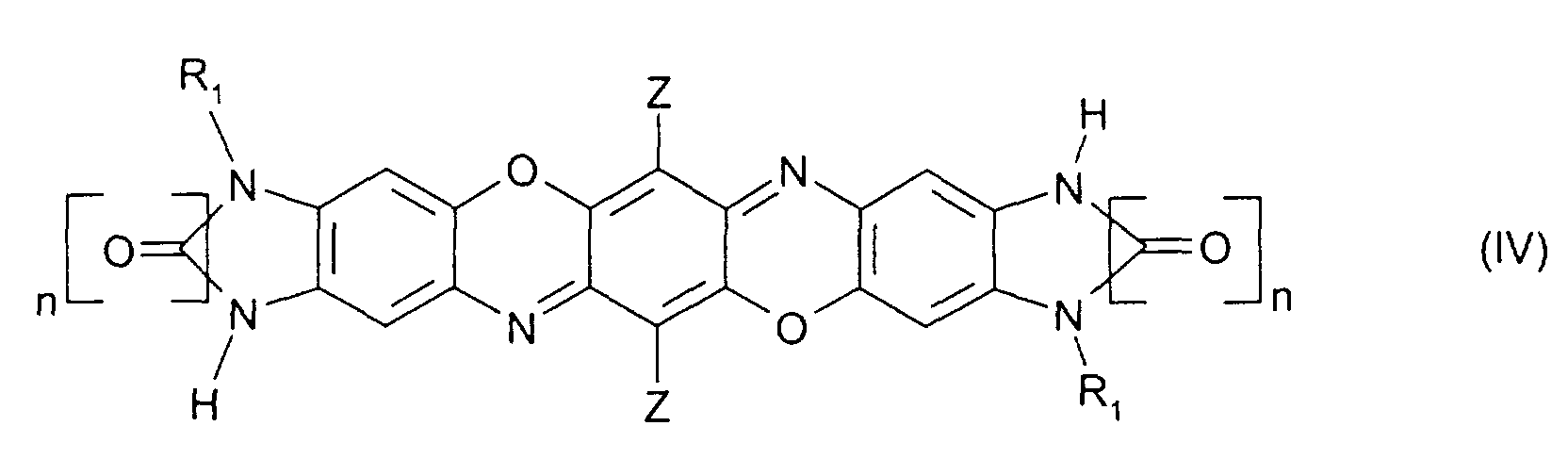
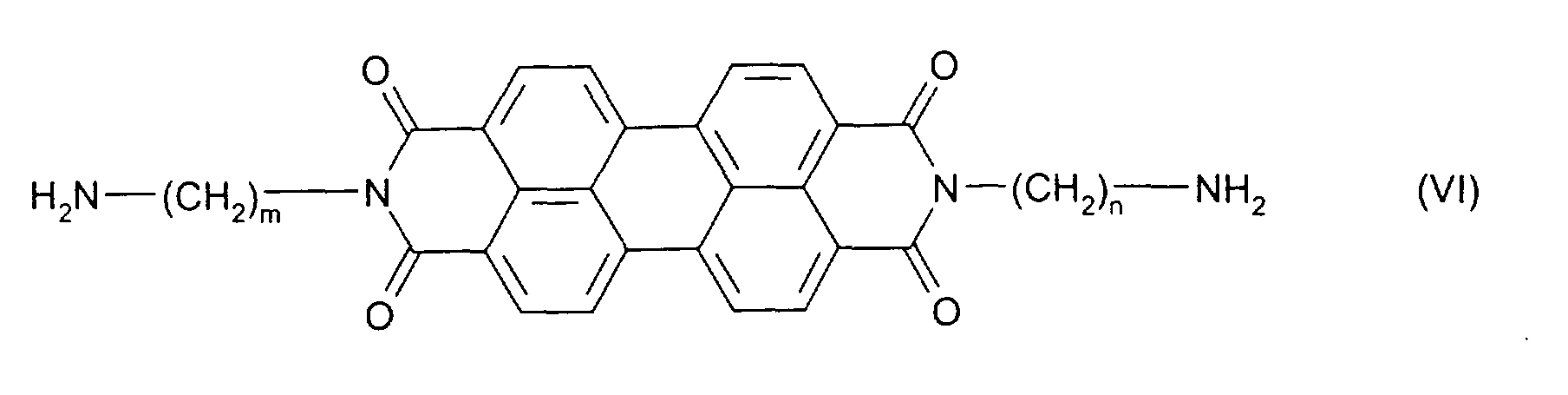
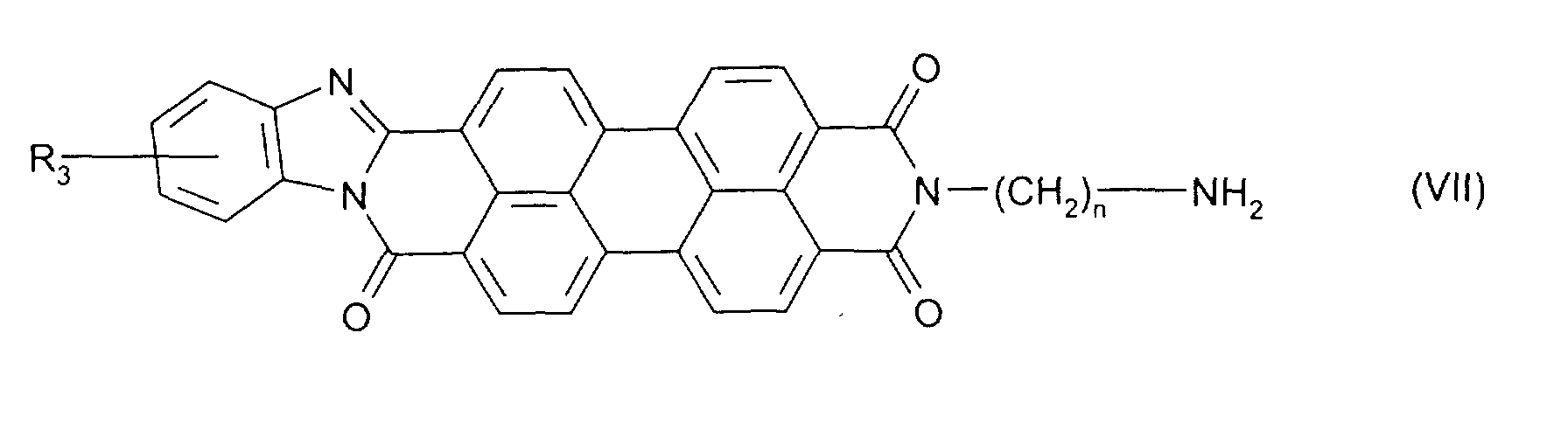
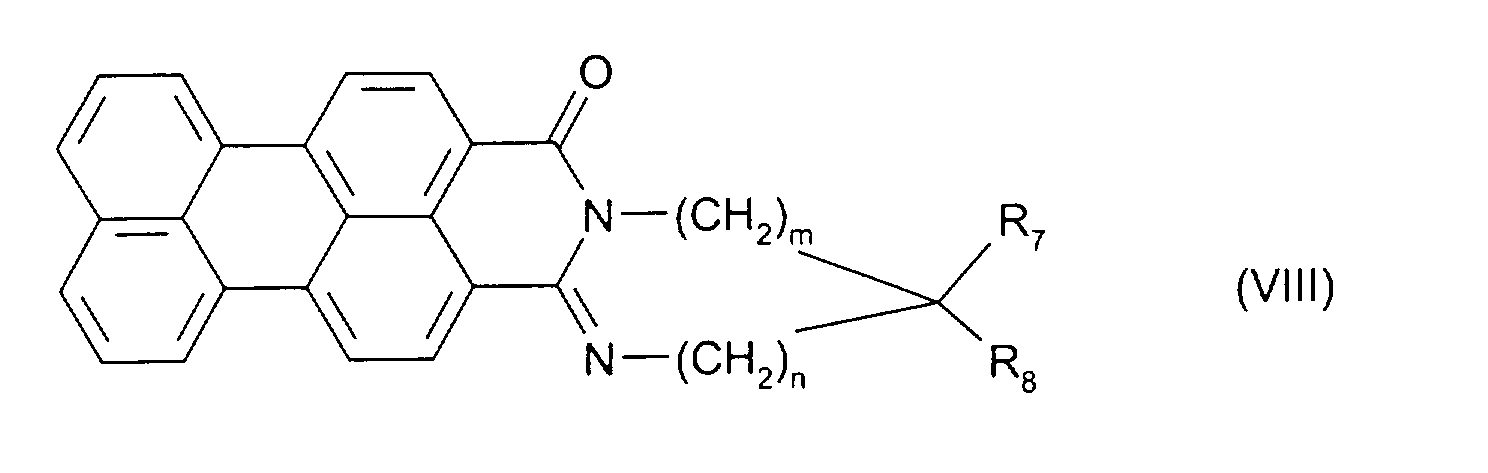
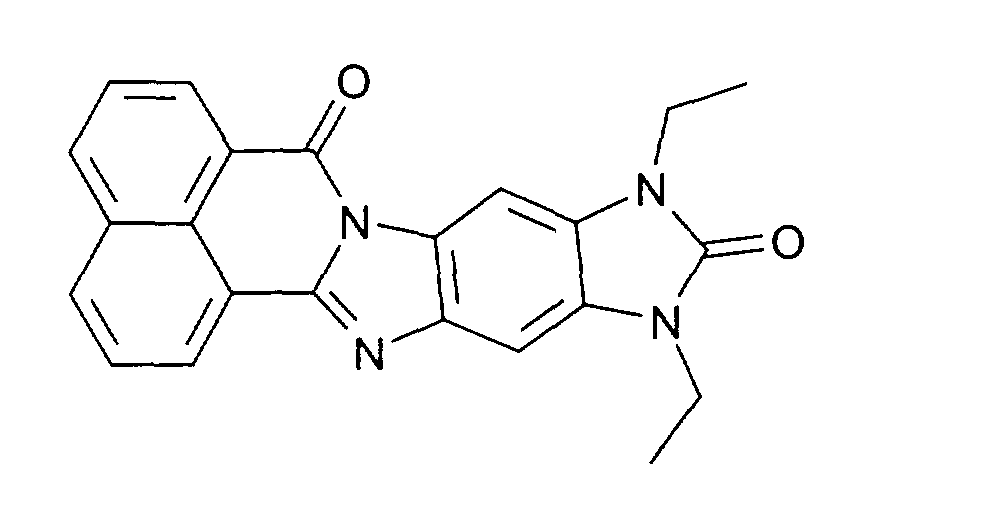
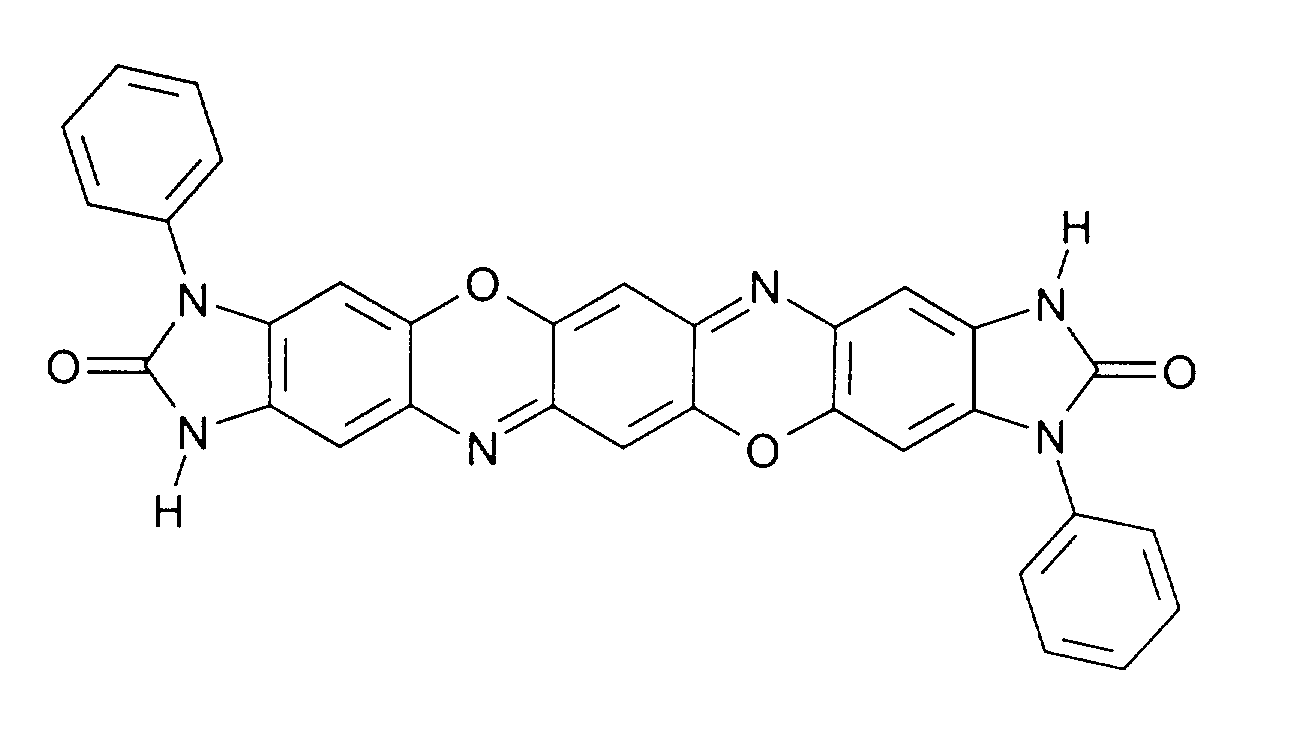
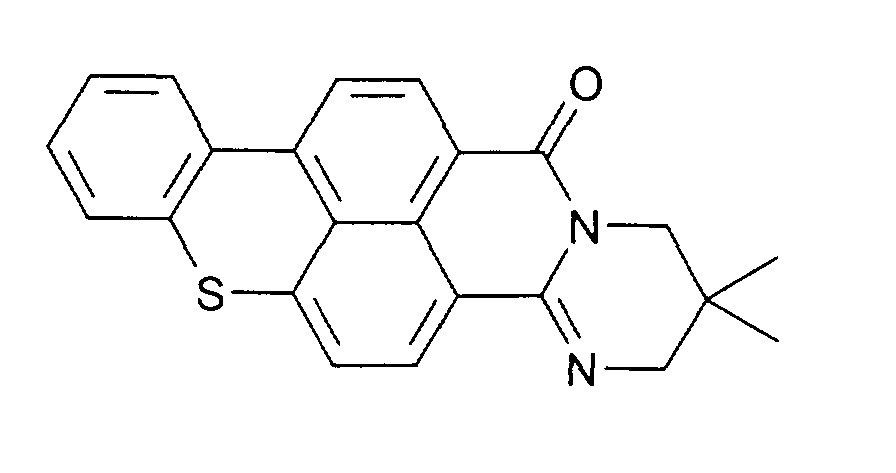
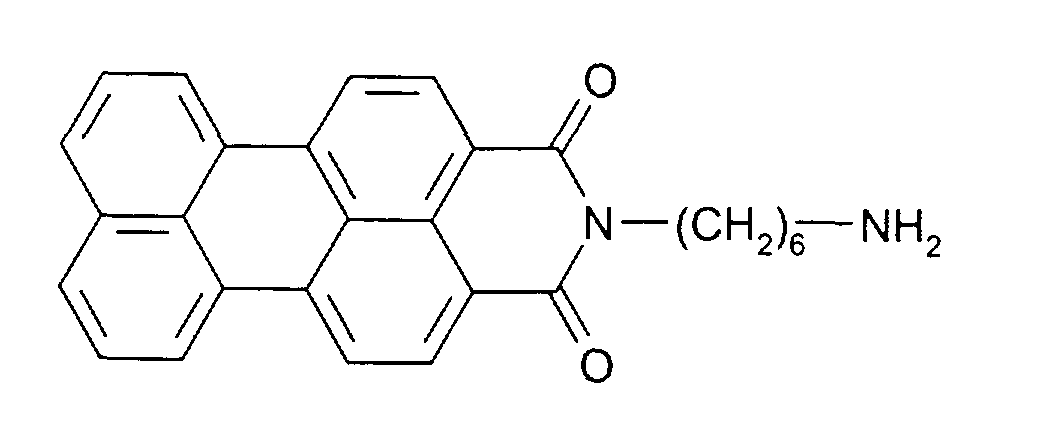
- the typical representatives of oil-soluble (water-insoluble) dyes are coumarins, like Blankophor SOL, Solvent Yellow 135, naphthalimides and non-fluorescent polymer-soluble dyes , like heterocyclic compounds with structures I-IX or a combination of the above mentioned dyes in a ratio of 10-90% by weight of fluorescent dyes and 90-10% by weight of dye with structure (I) - (IX).
- R 1 and R 2 are identical or different and are hydrogen, C 1-6 alkyl, C 6-10 aryl, (C 6-10 )aryl-(C 1-6 )alkyl or (C 1-6 )alkyl-(C 6-10 )aryl, it being possible for the alkyl and/or aryl radicals to be substituted by hydroxyl, C 1-6 alkoxy, C 6-10 aryloxy or halogen; and
- the dyes with structures (I) to (IX) are, in part, novel compounds and can be prepared in accordance with well known processes. More particularly, dyes of structure (II) in which n is not zero or 2, all dyes of structures (III) and (V), dyes of structure (VI) in which m and n are not zero, 2 or 6, dyes of structure (VIII) in which m and n ⁇ 1, all dyes with structures (VII) and (IX) are novel.
- the processes for their preparation are as follows:
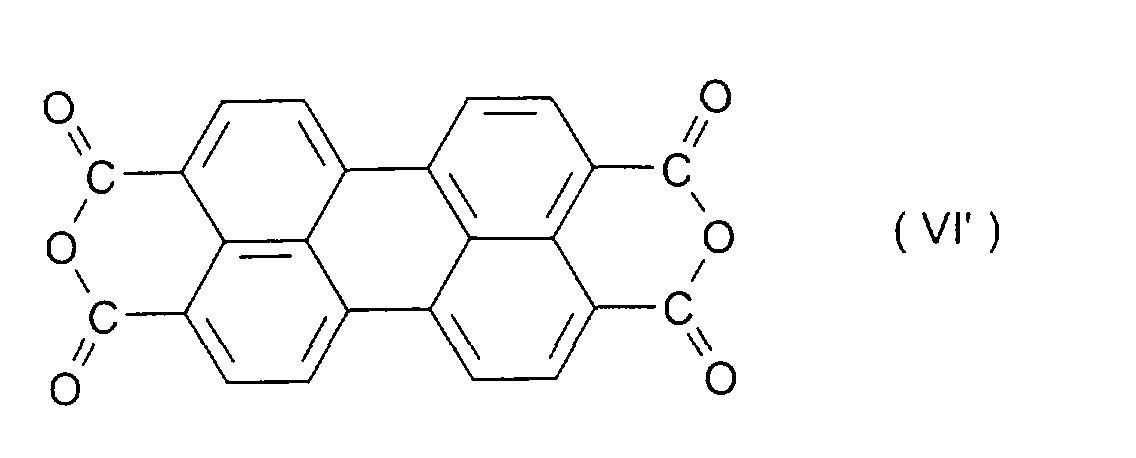
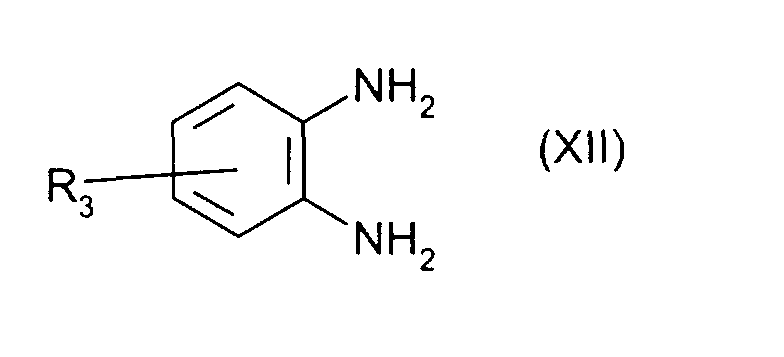
- the corresponding dicarboxylic or tetracarboxylic acid anhydrides of the formulae are condensed with the corresponding alkylene diamines H 2 N-(CH 2 ) n -NH 2 or and optionally further reacted resp. first reacted with an appropriate phenylene diamine
- the respective reaction conditions can be chosen e.g. as in the preparation examples A to F.
- the protective colloid solution in water is prepared separately with the concentration of water-soluble polymer being between 0.2 and 1%, preferably 0.4-0.7%.
- Typical representatives of this class of compounds are hydroxyethylcellulose, sodium salt of carboxymethylcellulose, methylcellulose, ethylcellulose, polyvinyl alcohol, and water-soluble polymers and copolymers of acrylic or methacrylic acid.
- the protective colloid is used in an amount of 5-30 parts by weight, preferably 12-20 parts by weight, per 100 parts by weight of prepolymer.
- the dyed soluble and fusible prepolymer is transformed to the insoluble and infusible hardened resin by slowly adding with high shear (6000-7000 rpm with a Homomixer) the prepolymer-organic solvent mixture to an aqueous solution of protective colloid containing either no surfactants or a non-ionic surfactant or a mixture of non-ionic and ionic surfactants and an acidic curing catalyst at a reaction temperature in the range from 70-100°C.
- Non-ionic surfactants are Solsperse 41090 (Phosphated alkoxylated polymer from ZENECA Specialties), Surfinol CT-111 (2,4,7,9-tetramethyl-5-decyn-4,7-diol from Air Product & Chemicals, Inc.) and Triton CF-10 (Alkylarylpolyether from Union Carbide).
- non-ionic and ionic surfactants examples include the compositions of the above mentioned non-ionic surfactants and potassium tripolyphosphate, sodium lauryl sulfate or Surfinol CT-131 (from Air Product & Chemical, Inc.) in a ratio of 2-3 parts by weight of non-ionic and 1-2 parts by weight of ionic surfactant. These surfactants are effectively used in an amount in the range of 5-15 parts, preferably 8-12 parts by weight per 100 parts by weight of prepolymer.
- Appropriate curing catalysts are mineral acids such as hydrochloric, sulphuric and phosphoric acids, sulfonic acids such as benzenesulfonic, toluenesulfonic and dodecylbenzenesulfonic acids, organic acids such as phtalic, benzoic, oxalic and sulfamic acid. These acids are effectively used in an amount in the range of 0.1-5 parts, and preferably about 1-2 parts by weight per 100 parts by weight of prepolymer.
- the rate of adding the prepolymer-organic solvent mixture, as well as the temperature range of protective colloid solution is selected preferably so that the complete and fast evaporation of low-boiling point solvent from the said mixture can be achieved.
- a finely divided hardened resin is obtained by separating from the suspension and drying the resin with heating at a temperature ranging from 60 to 150°C for about 2 to 10 hours and thereafter crushing the aggregates by means of a pin mill or jet mill. If a sufficient concentration of surfactants (higher than 8 parts by weight per 100 parts of prepolymer) is used, two main fractions of product can be obtained by filtration:
- the resulting resin obtained by the invention process demonstrates extremely superior opacity, dispersibility, heat resistance and resistance to solvents when used as a pigment. Hence, the vividness and staining power of the dye used can be manifested effectively, the finely divided hardened resin of this invention can be used effectively in a very wide range of application.
- a 4-necked flask equipped with a stirrer, a reflux condenser and a thermocouple was charged with 150 parts of benzoguanamine, 50 parts of paraformaldehyde (formaldehyde content 95%) and 120 parts of water.
- the pH of the mixture was adjusted to 8.5 with a 10% aqueous solution of sodium carbonate. While agitating this mixture, its temperature was raised to 90°C, and its reaction was carried out for 5 hours to obtain an aqueous liquid of a soluble and fusible benzoguanamine-formaldehyde prepolymer.
- the prepolymer thus obtained is cooled to 50°C and rapidly mixed with 100 part of acetone which has also been warmed to 50°C.
- the product is mixed with 3.0 parts of fluorescent dye Solvent Yellow 135 at temperature 40-50°C.
- an aqueous protective colloid solution was prepared by dissolving in 400 part of water 3.0 parts of acrylamide/sodium acrylate copolymer (CYANAMER 370 produced by Cytec Industries Inc.). After raising the temperature of this aqueous solution to 80°C, 2.5 part of oxalic acid was added, and the mixture was stirred at 7000 rpm with a high speed agitator. While this aqueous solution of protective colloid was being stirred, the foregoing acetone solution of prepolymer was slowly introduced to the protective colloid solution within 1 hour to obtain a bright yellow suspension. Next, the suspension was held for 2 hours at 80°C with an intense stirring.
- the obtained product was separated from the suspension by filtration, and the filter cake was dried at a temperature of 100°C followed by heating for 3 hours at a temperature of 150°C to obtain 130 parts of aggregates of the finely divided hardened resin.
- the obtained product was examined with a scanning electron microscope. It was found that the particles were present discretely and they had an irregular shape with substantially uniform size.
- the finely divided hardened resin demonstrates extremely superior opacity, dispersibility, heat resistance and resistance to solvents when used as a pigment.
- the specific surface area of the particles as measured by the Brunauer, Emmet and Teller Method (hereinafter to be referred to as the BET Method) is 110 m 2 /g.
- a 4-necked flask equipped with a stirrer, a reflux condenser and a thermocouple was charged with 50 parts of urea, 100 parts of formalin (formaldehyde content 37%) and 110 parts of water.
- the pH of the mixture was adjusted to 7.5 with a 10% aqueous solution of sodium carbonate. While agitating this mixture, its temperature was raised to 70°C, and its reaction was carried out for 3 hours to obtain an aqueous liquid of a soluble and fusible urea-formaldehyde prepolymer.
- the prepolymer thus obtained is cooled to 50°C and rapidly mixed with 100 part of acetone which has also been warmed to 50°C
- the product is mixed with 2.0 parts of fluorescent dye Basic Yellow 40 at temperature 40-50°C.
- an aqueous protective colloid solution was prepared by dissolving in 400 part of water 1.7 parts of hydroxyethylcellulose (NATROSOL 250MR produced by Hercules Inc.). After raising the temperature of this aqueous solution to 80°C, 1.5 part of sulphamic acid was added, and the mixture was stirred at 7000 rpm with a high speed agitator.
- aqueous protective colloid solution was prepared by dissolving in 400 part of water 1.7 parts of hydroxyethylcellulose (NATROSOL 250MR produced by Hercules Inc.). After raising the temperature of this aqueous solution to 80°C, 1.5 part of sulphamic acid was added, and the mixture was stirred at 7000 rpm with a high speed agitator.
- a finely divided hardened resin was prepared and treated by operating as in Example 1.
- the so obtained product as in the case with the resin obtained in Example 1, exhibited excellent opacity (the specific surface area of the particles as measured by the BET Method is 120 m 2 /g) and dispersibility.
- a 4-necked flask equipped with a stirrer, a reflux condenser and a thermocouple was charged with 40.5 parts of urea, 29.6 parts of benzoguanamine, 100 parts of formalin (formaldehyde content 37%) and 110 parts of water.
- the pH of the mixture was adjusted to 7.5 with a 10% aqueous solution of sodium carbonate. While agitating this mixture, its temperature was raised to 75°C, and its reaction was carried out for 4 hours to obtain an aqueous liquid of a soluble and fusible urea-benzoguanamine-formaldehyde prepolymer.
- the prepolymer thus obtained is cooled to 50°C and rapidly mixed with 100 part of methanol which has also been warmed to 50°C.
- the product is mixed with 30 parts of the water solution of 1.62 parts of fluorescent dye Basic Yellow 40, 0.39 parts of Basonyl Red 485 and 0.21 parts of Basonyl Red 560 with preliminary adjustment of pH to 7.5 with 10% aqueous solution of sodium carbonate, at temperature 40-50°C.
- an aqueous protective colloid solution was prepared by dissolving in 400 parts of water 8.0 parts of acrylamide/sodium acrylate copolymer (CYANAMER P-21 produced by Cytec Industries Inc.), 8.0 parts of Solsperse 41090 (Phosphated alkoxylated polymer from ZENECA Specialties), and 4.0 parts of SURFINOL CT-131 (produced by Air Product & Chemicals, Inc.). After raising the temperature of this aqueous solution to 80°C, 2.5 parts of oxalic acid was added, and the mixture was stirred at 7000 rpm with a high speed agitator.
- CYANAMER P-21 produced by Cytec Industries Inc.
- Solsperse 41090 Phosphated alkoxylated polymer from ZENECA Specialties
- SURFINOL CT-131 produced by Air Product & Chemicals, Inc.
- a finely divided hardened resin was separated from the stable suspension of mostly spherical particles by filtration through Whatman filter paper # 4 and treated by the same operation as in Example 1.
- the finely divided hardened resin demonstrates extremely superior opacity, dispersibility, heat resistance and resistance to solvents when used as a pigment.
- the specific surface area of the particles is 107 m 2 /g.
- the stable suspension consists of mainly spherical particles having submicron size: up to 70% below 0.7 microns and up to 40% below 0.5 microns.
- a 4-necked flask equipped with a stirrer, a reflux condenser and a thermocouple was charged with 150 parts of benzoguanamine, 50 parts of paraformaldehyde (formaldehyde content 95%) and 120 parts of water.
- the pH of the mixture was adjusted to 8.5 with a 10% aqueous solution of sodium carbonate. While agitating this mixture, its temperature was raised to 90°C, and its reaction was carried out for 5 hours to obtain an aqueous liquid of a soluble and fusible benzoguanamine-formaldehyde prepolymer.
- the product is mixed with 2.0 parts of the dye with structure (I) and 2.0 parts of Solvent Yellow 135 at temperature 85-90°C for 15 min.
- the prepolymer thus obtained is cooled to 50°C and rapidly mixed with 100 parts of acetone which has also been warmed to 50°C.
- an aqueous protective colloid solution was prepared by dissolving in 400 part of water 1.7 parts of hydroxyethylcellulose (NATROSOL 250MR produced by Hercules Inc.). After raising the temperature of this aqueous solution to 80°C, 1.5 part of oxalic acid was added and the mixture was stirred at 2000 rpm with a high speed agitator.
- aqueous protective colloid solution was prepared by dissolving in 400 part of water 1.7 parts of hydroxyethylcellulose (NATROSOL 250MR produced by Hercules Inc.). After raising the temperature of this aqueous solution to 80°C, 1.5 part of oxalic acid was added and the mixture was stirred at 2000 rpm with a high speed agitator.
- a finely divided hardened resin was prepared and treated by operating as in Example 1.
- the so obtained product as in the case with the resin obtained in Example 1, demonstrates extremely superior opacity, dispersibility, lightfastness, heat resistance and resistance to solvents when used as a pigment.
- the lightfastness of the obtained pigment is superior to the known yellow pigment containing 2.0 parts of Solvent Yellow 135 and 100 parts of prepolymer.
- the values for the retention of fluorescence intensity after irradiation in fade-o-meter for 104 hrs are 96 and 45%.
- the specific surface area of the particles as measured by the BET Method is 118 m 2 /g.
- prepolymer 200 parts are prepared by operating as in example 4 and mixed with 4 parts of dye with the structure (II) at temperature 85-90°C for 15 min.
- the prepolymer thus obtained is cooled to 50°C and rapidly mixed with 100 parts of methanol which has also been warmed to 50°C.
- an aqueous protective colloid solution containing 400 parts of water,1.7 parts of hydroxyethylcellulose and 1.5 parts of oxalic acid was prepared by operating as in example 4.
- a finely divided hardened resin was prepared and treated by operating as in Example 1.
- the obtained product as in the case with the resin obtained in Example 1 , demonstrates extremely superior opacity, dispersibility, heat resistance, lightfastness and resistance to solvents when used as a pigment.
- the prepolymer thus obtained is cooled to 50°C and rapidly mixed with 100 parts of acetone which has also been warmed to 50°C.
- an aqueous protective colloid solution containing 400 parts of water,1.7 parts of hydroxyethylcellulose and 1.5 parts of oxalic acid was prepared by operating as in example 4.
- a finely divided hardened resin was prepared and treated by operating as in Example 1.
- the yellow color of the prepolymer-dye III solution in acetone became orange after the treatment with oxalic acid-hydroxyethylcellulose solution.
- the obtained product as in the case with the resin obtained in Example 1 , demonstrates extremely superior opacity, dispersibility, heat resistance, lightfastness and resistance to solvents when used as a pigment.
- prepolymer 200 parts are prepared by operating as in example 4 and mixed with 4.0 parts of dye with the structure (IV) and 2.0 parts of optical brightener Blankophor SOL at temperature 85-90°C for 15 min.
- the prepolymer thus obtained is cooled to 50°C and rapidly mixed with 100 parts of acetone which has also been warmed to 50°C.
- an aqueous protective colloid solution containing 400 parts of water,1.7 parts of hydroxyethylcellulose and 1.5 parts of oxalic acid was prepared by operating as in example 4.
- a finely divided hardened resin was prepared and treated by operating as in Example 1.
- the obtained product as in the case with the resin obtained in Example 1 , demonstrates extremely superior opacity, dispersibility, heat resistance, lightfastness and resistance to solvents when used as a pigment.
- prepolymer 200 parts are prepared by operating as in example 4 and mixed with 2.0 parts of dye with the structure (V) and 2.0 parts of Solvent Yellow 135 at temperature 85-90°C for 15 min.
- the prepolymer thus obtained is cooled to 50°C and rapidly mixed with 100 parts of methanol which has also been warmed to 50°C.
- an aqueous protective colloid solution containing 400 parts of water,1.7 parts of hydroxyethylcellulose and 1.5 parts of oxalic acid was prepared by operating as in example 4.
- a finely divided hardened resin was prepared and treated by operating as in Example 1.
- the obtained product as in the case with the resin obtained in Example 1 , demonstrates extremely superior opacity, dispersibility, heat resistance, lightfastness and resistance to solvents when used as a pigment.
- the prepolymer thus obtained is cooled to 50°C and rapidly mixed with 100 parts of methanol which has also been warmed to 50°C.
- an aqueous protective colloid solution containing 400 parts of water,1.7 parts of hydroxyethylcellulose and 1.5 parts of oxalic acid was prepared by operating as in example 4.
- a finely divided hardened resin was prepared and treated by operating as in Example 1.
- the obtained product as in the case with the resin obtained in Example 1 , demonstrates extremely superior opacity, dispersibility, heat resistance, lightfastness and resistance to solvents when used as a pigment.
- the prepolymer thus obtained is cooled to 50°C and rapidly mixed with 100 parts of methanol which has also been warmed to 50°C.
- an aqueous protective colloid solution containing 400 parts of water,1.7 parts of hydroxyethylcellulose and 1.5 parts of oxalic acid was prepared by operating as in example 4.
- a finely divided hardened resin was prepared and treated by operating as in Example 1.
- the obtained product as in the case with the resin obtained in Example 1, demonstrates extremely superior opacity, dispersibility, heat resistance, lightfastness and resistance to solvents when used as a pigment.
- prepolymer 200 parts are prepared by operating as in example 4 and mixed with 2.0 parts of dye with the structure (VIII) and 2.0 parts of Blankophor SOL at temperature 85-90°C for 15 min.
- the prepolymer thus obtained is cooled to 50°C and rapidly mixed with 100 parts of acetone which has also been warmed to 50°C.
- an aqueous protective colloid solution containing 400 parts of water,1.7 parts of hydroxyethylcellulose and 1.5 parts of oxalic acid was prepared by operating as in example 4.
- a finely divided hardened resin was prepared and treated by operating as in Example 1.
- the yellow color of the prepolymer-dye VIII solution in acetone became orange after the treatment with oxalic acid-hydroxyethylcellulose solution
- the obtained product as in the case with the resin obtained in Example 1 , demonstrates extremely superior opacity, dispersibility, heat resistance, lightfastness and resistance to solvents when used as a pigment.
- the prepolymer thus obtained is cooled to 50°C and rapidly mixed with 100 parts of acetone which has also been warmed to 50°C.
- an aqueous protective colloid solution containing 400 parts of water,1.7 parts of hydroxyethylcellulose and 1.5 parts of oxalic acid was prepared by operating as in example 4.
- a finely divided hardened resin was prepared and treated by operating as in Example 1.
- the yellow color of the prepolymer-dye IX solution in acetone became orange after the treatment with oxalic acid-hydroxyethylcellulose solution.
- the obtained product as in the case with the resin obtained in Example 1 , demonstrates extremely superior opacity, dispersibility, heat resistance, lightfastness and resistance to solvents when used as a pigment.
- 35 parts of tetramethylenediamine are melted at 100°C under nitrogen atmosphere. 10 parts of perylene tetracarboxylic acid dianhydride are added over a 3 hours period at this temperature. The resulting red suspension is stirred for 6 hours at 100°C. 100 parts of 5% potassium hydroxide solution in water are then introduced at this temperature and the reaction mixture is stirred for 30 minutes. The suspension is then filtered at 80°C, washed with hot water (80°C) and then dried. This gives 12 parts of a red-colored powder.
- Hydrochloric acid is added to 10 parts of the resulting red powder firstly suspended in 100 parts of water, in order to reach pH 1.
- the reaction mixture is stirred 30 minutes at 100°C, filtered and washed with water.
- 10 parts of the presscake are added over a 3 hours period to 20 parts of melted hexamethylenediamine at 100°C under nitrogen atmosphere.
- the reaction mixture is stirred 4 hours at 100°C and precipitated in 200 parts of hot water.
- the reaction mixture is then filtered at 80°C, washed with hot water and dried to provide 10 parts of a red-colored powder.
- Hydrochloric acid is added to 10 parts of the resulting red presscake firstly suspended in 100 parts of water, in order to reach pH 1.
- the reaction mixture is stirred 30 minutes at 100°C, filtered and washed with water.
- 10 parts of the presscake are added over a 3 hours period to 20 parts of melted hexamethylenediamine at 100°C under nitrogen atmosphere.
- the reaction mixture is stirred 4 hours at 100°C and precipitated in 200 parts of hot water.
- the reaction mixture is then filtered at 80°C, washed with hot water and dried to provide 12 parts of a red-colored powder.
Landscapes
- Chemical & Material Sciences (AREA)
- Organic Chemistry (AREA)
- Chemical Kinetics & Catalysis (AREA)
- Compositions Of Macromolecular Compounds (AREA)
- Phenolic Resins Or Amino Resins (AREA)
- Processes Of Treating Macromolecular Substances (AREA)
Abstract
Description
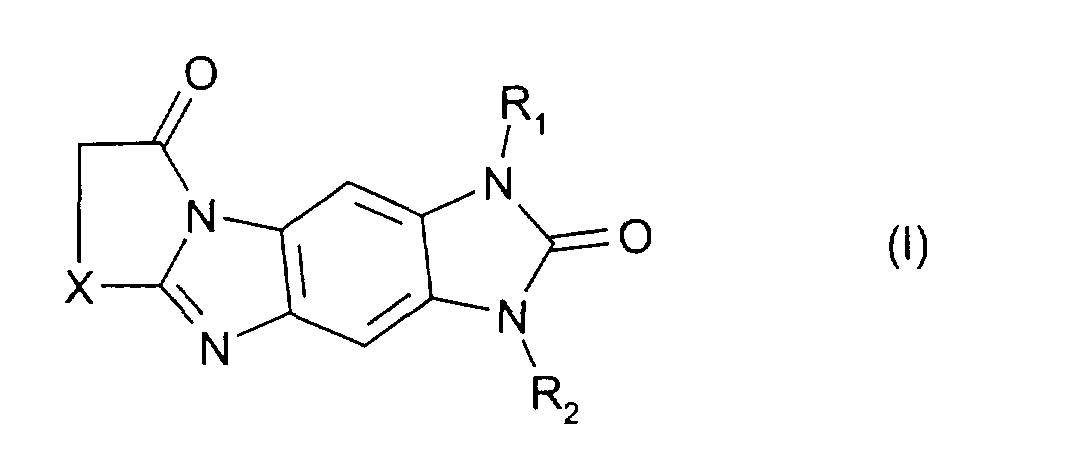
R1 and R2 are identical or different and are hydrogen, C1-6alkyl, C6-10aryl, (C6-10)aryl-(C1-6)alkyl or (C1-6)alkyl-(C6-10)aryl, it being possible for the alkyl and/or aryl radicals to be substituted by hydroxyl, C1-6alkoxy, C6-10aryloxy or halogen; and
- X
- is
wherein

- R3
- is is hydrogen, halogen, -NR4R6, R6-O- or R6-S-, in which R6 is C1-6alkyl, C6-10aryl, (C6-10)aryl-(C1-6)alkyl or (C1-6)alkyl-(C6-10)aryl, in which the alkyl and/or aryl radicals can be substituted by hydroxyl, C1-6alkoxy, C6-10aryloxy or halogen; and
- R4
- is hydrogen, C1-6alkyl, C6-10aryl, (C6-10)aryl-(C1-6)alkyl or (C1-6)alkyl-(C6-10)aryl, it being possible for the alkyl and/or aryl radicals to be substituted by hydroxyl, C1-6alkoxy, C6-10aryloxy or halogen; and
- Y
- is sulphur, oxygen or N-R4, in which R4 has the meaning given above.
wherein R3 and Y have the meanings given above; and n is 0-12.
 wherein
- R3
- and Y have the meanings given above;
- R7 and R8
- are identical or different and are hydrogen, C1-6alkyl, C6-10aryl, (C6-10)aryl(C1-6)alkyl or (C1-6)alkyl-(C6-10)aryl, it being possible for the alkyl and/or aryl radicals to be substituted by hydroxyl, C1-6alkoxy, C6-10aryloxy or halogen; and
- m and n
- are 0-12.
wherein each R1, independently, has the meaning given above; Z is hydrogen or halogen; and n is 1 or 2.
 wherein n is 0-12.
 wherein m and n are 0-12.
 wherein R3 has the meaning given above; and n is 0-12.
 wherein R7 and R8 have the meanings given above; and m and n are 0-12.
 wherein R7 and R8 have the meanings given above; and m, n and p are 0-12.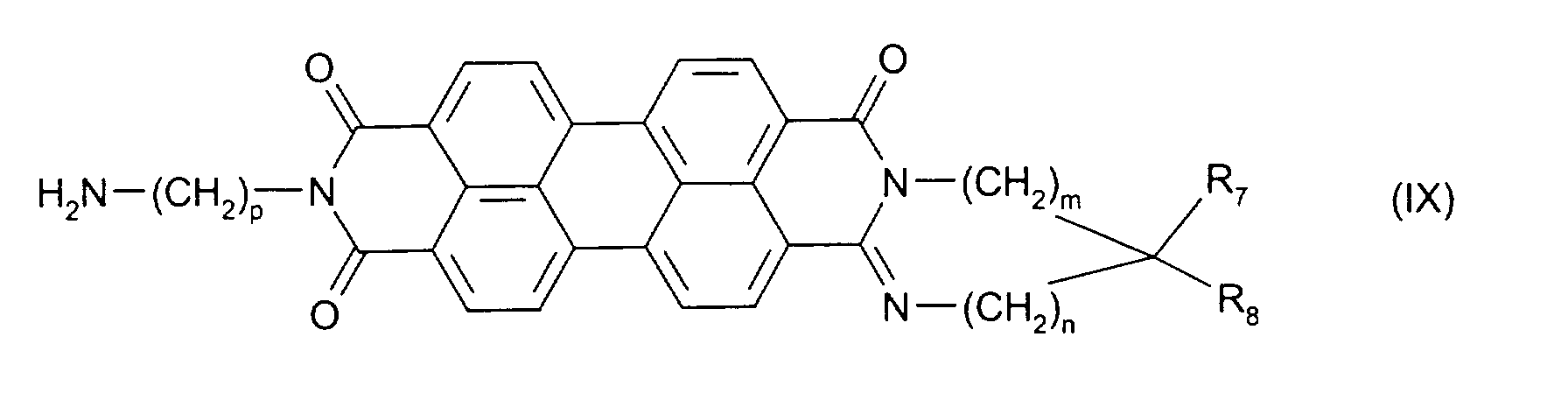









Claims (10)
- A process for producing dyed finely divided particles comprising, in combination, the steps of:reacting in aqueous medium at a pH of 6-9 a member selected from the group consisting of either urea or benzoguanamine or a mixture of 100-0% by weight of urea and 0-100% by weight of benzoguanamine with formaldehyde in a ratio of 1 mol of the former to 1.3-3 moles of the latter to prepare an aqueous liquid of a soluble and fusible prepolymer;mixing this water-containing prepolymer with an organic solvent having a boiling point below 80°C and being completely mixable with water in a ratio of 70-30% by weight of prepolymer and 30-70% by weight of organic solvent, dyeing said mixture with a single fluorescent dye or a combination of several dyes;introducing with high shear the dyed resin-containing mixture into an aqueous solution of protective colloid consisting of 92-98.5 % of water, 1-3% of water-soluble polymer, 0-3% of a nonionic surfactant or a mixture of non-ionic and ionic surfactants and 0.5 -2.0% of acidic curing catalyst at a reaction temperature in the range from 70-100°C, and thereafter;separating the hardened resin from the suspension followed by drying and deaggregating the dried hardened resin.
- The process of claim 1 wherein the fluorescent dye is either water-soluble or oil-soluble (water-insoluble).
- The process of claim 1 wherein a combination of coumarines or naphthalimides with non-fluorescent polymer-soluble dye is used.
- The process of claim 3 wherein the non-fluorescent polymer-soluble dye has the structure of one of the formulae:wherein

R1 and R2 are identical or different and are hydrogen, C1-6alkyl, C6-10aryl, (C6--10)aryl(C1-6)alkyl or (C1-6)alkyl-(C6-10)aryl, it being possible for the alkyl and/or aryl radicals to be substituted by hydroxyl, C1-6alkoxy, C6-10aryloxy or halogen; and- X
- is
wherein

- R3
- is hydrogen, halogen, -NR4R6, R6-O- or R6-S-, in which R6 is C1-6alkyl, C6-10aryl, (C6-10)aryl-(C1-6)alkyl or (C1-6)alkyl-(C6-10)aryl, in which the alkyl and/or aryl radicals can be substituted by hydroxyl, C1-6alkoxy, C6-10aryloxy or halogen; and R4 is hydrogen, C1-6alkyl, C6-10aryl, (C6-10)aryl-(C1-6)alkyl or (C1-6)alkyl-(C6-10)aryl, it being possible for the alkyl and/or aryl radicals to be substituted by hydroxyl, C1-6alkoxy, C6-10aryloxy or halogen and
- Y
- is sulphur, oxygen or N-R4, in which R4 has the meaning given above;
wherein R3 and Y have the meanings given above and n is 0-12;
 wherein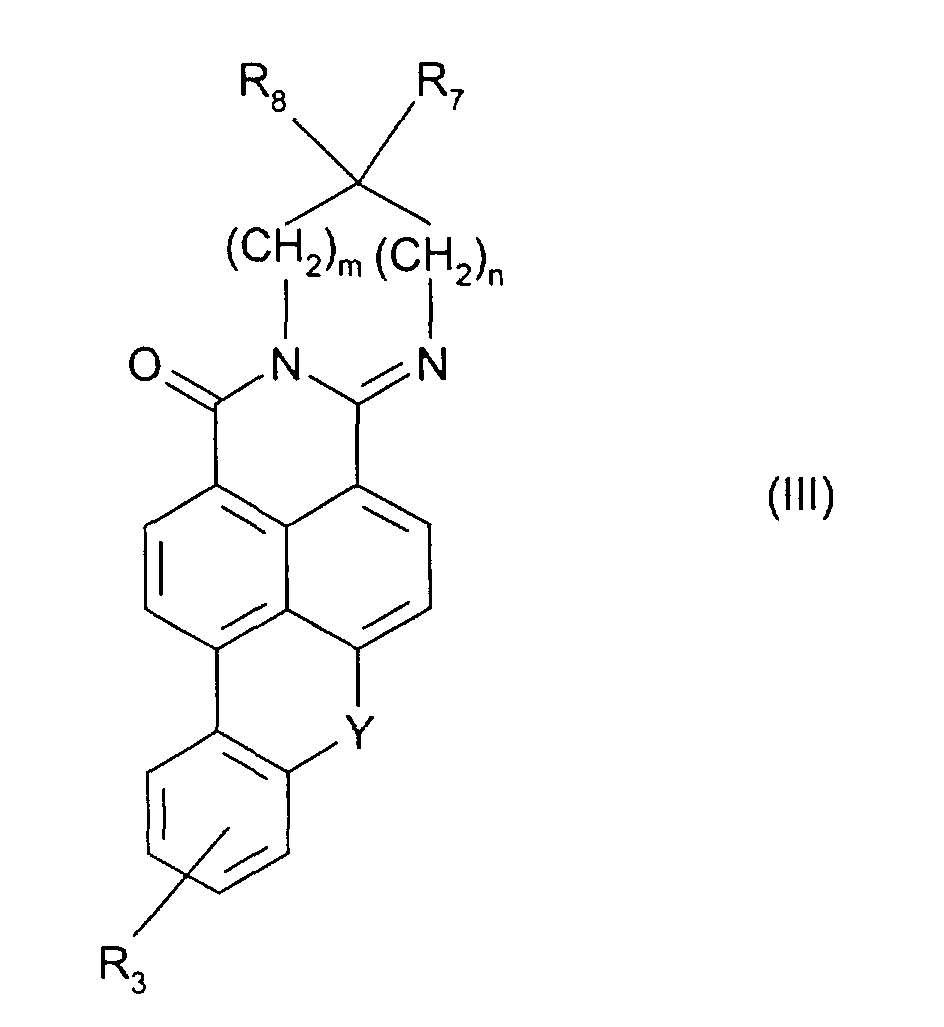
- R3 and Y
- have the meanings given above;
- R7 and R8
- are identical or different and are hydrogen, C1-6alkyl, C6-10aryl, (C6-10)aryl-(C1-6)alkyl or (C1-6)alkyl-(C6-10)aryl, it being possible for the alkyl and/or aryl radicals to be substituted by hydroxyl, C1-6alkoxy, C6-10aryloxy or halogen and
- m and n
- are 0-12;
wherein

- Z
- is hydrogen or halogen; and n is 1 or 2;
wherein n is 0-12;
 wherein m and n are 0-12;
 wherein R3 has the meaning given above; and n is 0-12;
 wherein R7 and R8 have the meanings given above; and m and n are 0-12;
 wherein R7 and R8 have the meanings given above; and m, n and p are 0-12.
- A dyed finely divided hardened resin of substantially uniform particle size, irregular shape, excellent dispersibility and opacity as prepared by the process of claim 1.
- A dyed finely divided hardened resin of substantially uniform particle size, irregular shape, excellent dispersibility and opacity as prepared by the process of claim 2.
- A dyed finely divided hardened resin of substantially uniform particle size, irregular shape, excellent dispersibility and opacity as prepared by the process of claim 3.
- A dyed finely divided hardened resin of substantially uniform particle size, irregular shape, excellent dispersibility and opacity as prepared by the process of claim 4.
- Compounds of structure (III) as defined in claim 4.
- Compounds of structure (VIII) as defined in claim 4 in which n and m ≠ 1.
Applications Claiming Priority (2)
| Application Number | Priority Date | Filing Date | Title |
|---|---|---|---|
| US09/616,356 US6462128B1 (en) | 2000-07-14 | 2000-07-14 | Process of making finely divided opaque particles |
| US616356 | 2000-07-14 |
Publications (2)
| Publication Number | Publication Date |
|---|---|
| EP1172417A2 true EP1172417A2 (en) | 2002-01-16 |
| EP1172417A3 EP1172417A3 (en) | 2004-01-07 |
Family
ID=24469077
Family Applications (1)
| Application Number | Title | Priority Date | Filing Date |
|---|---|---|---|
| EP01810693A Withdrawn EP1172417A3 (en) | 2000-07-14 | 2001-07-12 | Process of making finely divided opaque particles |
Country Status (4)
| Country | Link |
|---|---|
| US (1) | US6462128B1 (en) |
| EP (1) | EP1172417A3 (en) |
| JP (1) | JP2002080607A (en) |
| KR (1) | KR20020007190A (en) |
Cited By (7)
| Publication number | Priority date | Publication date | Assignee | Title |
|---|---|---|---|---|
| WO2005119223A1 (en) * | 2004-04-14 | 2005-12-15 | Bioprocessors Corp. | Compositions of matter useful as ph indicators and related methods |
| EP1626050A4 (en) * | 2003-04-30 | 2008-03-05 | Univ East China Science & Tech | Sulfur-containing naphthoylimide derivatives |
| WO2009074504A3 (en) * | 2007-12-10 | 2009-12-30 | Basf Se | Synthesis of dyes in mixing units |
| WO2012012813A1 (en) * | 2010-07-27 | 2012-02-02 | Lenzing Ag | Fluorescent fibres and their use |
| CN103910727A (en) * | 2012-12-31 | 2014-07-09 | 北京大学 | STAT3-Hif1 alpha signal pathway inhibitor and application in tumor resistance thereof |
| DE102013003680A1 (en) | 2013-02-28 | 2014-09-11 | LMU Universität München Department Chemie | Chromophors arranged as 'metatoms': building blocks for molecular metamaterials |
| EP2976316A4 (en) * | 2013-03-18 | 2016-11-16 | Basf Se | PERYLENEMONOIMIDE AND NAPHTHALENEMONOIMIDE DERIVATIVES AND THEIR USE IN DYE SENSITIZED PHOTOPILES |
Families Citing this family (10)
| Publication number | Priority date | Publication date | Assignee | Title |
|---|---|---|---|---|
| GB0104236D0 (en) * | 2001-02-21 | 2001-04-11 | Clariant Int Ltd | New dye compounds |
| DE102004024700A1 (en) * | 2004-05-19 | 2005-12-15 | Clariant Gmbh | Powder round grain |
| ES2355734T3 (en) * | 2004-08-23 | 2011-03-30 | Basf Se | COSMETIC COMPOSITIONS CONTAINING FLUORESCENT COLORS FOR THE NATURAL APPEARANCE OF THE SKIN. |
| US8697792B2 (en) * | 2009-09-24 | 2014-04-15 | Basf Se | Migration-free coloured copolycondensates for colouring polymers |
| GEP20156283B (en) * | 2010-05-25 | 2015-05-11 | Sicpa Holding Sa | Polymer-bonded perylene dyes and compositions containing same |
| RU2014125285A (en) * | 2011-11-23 | 2015-12-27 | Сикпа Холдинг Са | POLYCYCLIC AROMATIC HYDROCARBON COMPOUNDS CONTAINING S ATOM OR S (= O) 2 GROUP IN ITS BASIC STRUCTURE |
| US9546930B2 (en) | 2014-06-27 | 2017-01-17 | Pulse Heath Llc | Analysis cartridge |
| JP6821490B2 (en) * | 2017-04-03 | 2021-01-27 | 日本化薬株式会社 | Coumarin compounds or salts thereof, and pigment compositions containing them. |
| WO2021206059A1 (en) * | 2020-04-07 | 2021-10-14 | オリヱント化学工業株式会社 | Colorant, master batch containing same, colored resin composition, and molded article |
| CN113248433B (en) * | 2021-04-15 | 2022-09-09 | 中山大学 | Supermolecular compound nano-carrier and preparation method and application thereof |
Family Cites Families (11)
| Publication number | Priority date | Publication date | Assignee | Title |
|---|---|---|---|---|
| GB672763A (en) | 1945-07-30 | 1952-05-28 | Joseph Lyman Switzer | Improvements in or relating to fluorescent materials |
| GB748484A (en) | 1952-04-20 | 1956-05-02 | Robert Charles Switzer | Improvements in and relating to pigments |
| US2851424A (en) | 1957-06-28 | 1958-09-09 | Switzer Brothers Inc | Fluorescent compositions |
| US3981845A (en) | 1963-08-23 | 1976-09-21 | Ciba-Geigy Ag | High surface area polycondensation polymer particulates based on urea and formaldehyde |
| JPS5227679B2 (en) * | 1972-10-04 | 1977-07-21 | ||
| US3928122A (en) * | 1973-01-03 | 1975-12-23 | Westvaco Corp | Paper containing a urea-formaldehyde pigment |
| US3928272A (en) | 1974-03-25 | 1975-12-23 | Nl Industries Inc | Process of making urea-formaldehyde solid microspheres |
| JPS5216594A (en) * | 1975-07-30 | 1977-02-07 | Nippon Shokubai Kagaku Kogyo Co Ltd | Process for preparing finely powdered colored resin with improved disp ersibility |
| US4767807A (en) * | 1985-08-21 | 1988-08-30 | Nippon Shokubai Kagaku Kogyo Co. Ltd. | Coloring agent for dope-dyeing viscose rayon |
| DE59407520D1 (en) * | 1993-08-13 | 1999-02-04 | Ciba Geigy Ag | Perylenamidinimide dyes, a process for their preparation and their use |
| TW279860B (en) * | 1993-11-12 | 1996-07-01 | Ciba Geigy Ag |
-
2000
- 2000-07-14 US US09/616,356 patent/US6462128B1/en not_active Expired - Fee Related
-
2001
- 2001-07-12 EP EP01810693A patent/EP1172417A3/en not_active Withdrawn
- 2001-07-13 KR KR1020010042248A patent/KR20020007190A/en not_active Withdrawn
- 2001-07-13 JP JP2001213201A patent/JP2002080607A/en not_active Withdrawn
Cited By (10)
| Publication number | Priority date | Publication date | Assignee | Title |
|---|---|---|---|---|
| EP1626050A4 (en) * | 2003-04-30 | 2008-03-05 | Univ East China Science & Tech | Sulfur-containing naphthoylimide derivatives |
| WO2005119223A1 (en) * | 2004-04-14 | 2005-12-15 | Bioprocessors Corp. | Compositions of matter useful as ph indicators and related methods |
| WO2009074504A3 (en) * | 2007-12-10 | 2009-12-30 | Basf Se | Synthesis of dyes in mixing units |
| US8551237B2 (en) | 2007-12-10 | 2013-10-08 | Basf Se | Synthesis of colorants in mixing apparatus |
| WO2012012813A1 (en) * | 2010-07-27 | 2012-02-02 | Lenzing Ag | Fluorescent fibres and their use |
| CN103002760A (en) * | 2010-07-27 | 2013-03-27 | 连津格股份公司 | Fluorescent fibres and their use |
| CN103910727A (en) * | 2012-12-31 | 2014-07-09 | 北京大学 | STAT3-Hif1 alpha signal pathway inhibitor and application in tumor resistance thereof |
| CN103910727B (en) * | 2012-12-31 | 2016-06-15 | 北京大学 | STAT3-Hif1 alpha signal pathway inhibitor and the application in antitumor thereof |
| DE102013003680A1 (en) | 2013-02-28 | 2014-09-11 | LMU Universität München Department Chemie | Chromophors arranged as 'metatoms': building blocks for molecular metamaterials |
| EP2976316A4 (en) * | 2013-03-18 | 2016-11-16 | Basf Se | PERYLENEMONOIMIDE AND NAPHTHALENEMONOIMIDE DERIVATIVES AND THEIR USE IN DYE SENSITIZED PHOTOPILES |
Also Published As
| Publication number | Publication date |
|---|---|
| US6462128B1 (en) | 2002-10-08 |
| KR20020007190A (en) | 2002-01-26 |
| EP1172417A3 (en) | 2004-01-07 |
| JP2002080607A (en) | 2002-03-19 |
Similar Documents
| Publication | Publication Date | Title |
|---|---|---|
| US6462128B1 (en) | Process of making finely divided opaque particles | |
| CN101538339B (en) | Preparation method of fluorescent pigment latex | |
| US6800127B2 (en) | Pigment preparations | |
| US3455856A (en) | Pigmented printing ink and method | |
| US3969302A (en) | Process for the dyeing of colored shaped articles of high polymer, synthetic resins and preparations for such process | |
| CN1995154B (en) | A kind of disperse orange dye composition and disperse dye | |
| US4306875A (en) | Salts of basic dyes, preparation and uses of same | |
| US3948828A (en) | Liquid to pasty dyestuff preparations | |
| US4069176A (en) | Process for producing dyed finely divided hardened benzoguanamine resins having uniform particle size and excelling in dispersibility | |
| US20100083869A1 (en) | Fluorescent nanoscale particles | |
| ES2886849T3 (en) | Procedure for preparing an aqueous dispersion of particles containing pigments | |
| JP2002097381A (en) | New dye compound | |
| KR102151724B1 (en) | Aqueous polymer dispersing agent, color mill base comprising the same and manufacturing method therof | |
| CN107163929A (en) | A kind of high weather-resistant fluorescent colored particles preparation method | |
| CN1158357C (en) | Fuchsia pigment composition and use thereof | |
| CN110527287A (en) | A kind of polyamide masterbatch and preparation method thereof | |
| KR100800720B1 (en) | Use of Pigment Dyes for Disperse Dyeing in Aqueous Media | |
| US7018711B2 (en) | Micro-capsules comprising a capsule core containing water-soluble substances | |
| CN118599336A (en) | Anthraquinone blue solid solution pigment and preparation method and application thereof | |
| CN1271373A (en) | Dispersing agents and dispersions made therefrom | |
| EP1366230B1 (en) | Use of pigment dyes for dispersion dyeing from aqueous media | |
| JPH0625552A (en) | Dye mixture for dyeing textile hydrophobic fiber | |
| CN108166272B (en) | High-light-resistance stable coating pigment color paste and preparation method thereof | |
| JPH0625546A (en) | Monoazo dye and mixture comprising the same | |
| US3923452A (en) | Amine salt of a dyestuff in a ketone solution |
Legal Events
| Date | Code | Title | Description |
|---|---|---|---|
| PUAI | Public reference made under article 153(3) epc to a published international application that has entered the european phase |
Free format text: ORIGINAL CODE: 0009012 |
|
| AK | Designated contracting states |
Kind code of ref document: A2 Designated state(s): AT BE CH CY DE DK ES FI FR GB GR IE IT LI LU MC NL PT SE TR |
|
| AX | Request for extension of the european patent |
Free format text: AL;LT;LV;MK;RO;SI |
|
| PUAL | Search report despatched |
Free format text: ORIGINAL CODE: 0009013 |
|
| AK | Designated contracting states |
Kind code of ref document: A3 Designated state(s): AT BE CH CY DE DK ES FI FR GB GR IE IT LI LU MC NL PT SE TR |
|
| AX | Request for extension of the european patent |
Extension state: AL LT LV MK RO SI |
|
| RIC1 | Information provided on ipc code assigned before grant |
Ipc: 7C 09B 67/22 - Ipc: 7C 08G 12/02 B Ipc: 7C 09B 5/62 B Ipc: 7C 09B 67/00 B Ipc: 7C 09B 57/14 B Ipc: 7C 09B 67/20 A |
|
| STAA | Information on the status of an ep patent application or granted ep patent |
Free format text: STATUS: THE APPLICATION HAS BEEN WITHDRAWN |
|
| 18W | Application withdrawn |
Effective date: 20040624 |