EP1172342A1 - Method for preparing article covered with light absorption pattern film and article covered with light absorption pattern film - Google Patents
Method for preparing article covered with light absorption pattern film and article covered with light absorption pattern film Download PDFInfo
- Publication number
- EP1172342A1 EP1172342A1 EP00970020A EP00970020A EP1172342A1 EP 1172342 A1 EP1172342 A1 EP 1172342A1 EP 00970020 A EP00970020 A EP 00970020A EP 00970020 A EP00970020 A EP 00970020A EP 1172342 A1 EP1172342 A1 EP 1172342A1
- Authority
- EP
- European Patent Office
- Prior art keywords
- oxide
- film
- light absorbing
- raw material
- titanium oxide
- Prior art date
- Legal status (The legal status is an assumption and is not a legal conclusion. Google has not performed a legal analysis and makes no representation as to the accuracy of the status listed.)
- Withdrawn
Links
- 238000000034 method Methods 0.000 title claims abstract description 30
- 230000031700 light absorption Effects 0.000 title description 10
- GWEVSGVZZGPLCZ-UHFFFAOYSA-N Titan oxide Chemical compound O=[Ti]=O GWEVSGVZZGPLCZ-UHFFFAOYSA-N 0.000 claims abstract description 120
- 239000011859 microparticle Substances 0.000 claims abstract description 95
- OGIDPMRJRNCKJF-UHFFFAOYSA-N titanium oxide Inorganic materials [Ti]=O OGIDPMRJRNCKJF-UHFFFAOYSA-N 0.000 claims abstract description 87
- 239000002994 raw material Substances 0.000 claims abstract description 71
- 239000010931 gold Substances 0.000 claims abstract description 67
- PCHJSUWPFVWCPO-UHFFFAOYSA-N gold Chemical compound [Au] PCHJSUWPFVWCPO-UHFFFAOYSA-N 0.000 claims abstract description 62
- 229910052737 gold Inorganic materials 0.000 claims abstract description 61
- VYPSYNLAJGMNEJ-UHFFFAOYSA-N Silicium dioxide Chemical compound O=[Si]=O VYPSYNLAJGMNEJ-UHFFFAOYSA-N 0.000 claims abstract description 40
- 239000007888 film coating Substances 0.000 claims abstract description 29
- 238000009501 film coating Methods 0.000 claims abstract description 29
- 238000009826 distribution Methods 0.000 claims abstract description 24
- 229910052814 silicon oxide Inorganic materials 0.000 claims abstract description 23
- 239000000758 substrate Substances 0.000 claims abstract description 19
- 238000001228 spectrum Methods 0.000 claims abstract description 16
- 239000011521 glass Substances 0.000 claims description 57
- 230000005540 biological transmission Effects 0.000 claims description 32
- 238000000576 coating method Methods 0.000 claims description 28
- 239000011248 coating agent Substances 0.000 claims description 23
- 230000000903 blocking effect Effects 0.000 claims description 21
- 239000002245 particle Substances 0.000 claims description 13
- XLOMVQKBTHCTTD-UHFFFAOYSA-N Zinc monoxide Chemical compound [Zn]=O XLOMVQKBTHCTTD-UHFFFAOYSA-N 0.000 claims description 8
- QPLDLSVMHZLSFG-UHFFFAOYSA-N Copper oxide Chemical compound [Cu]=O QPLDLSVMHZLSFG-UHFFFAOYSA-N 0.000 claims description 6
- XOLBLPGZBRYERU-UHFFFAOYSA-N tin dioxide Chemical compound O=[Sn]=O XOLBLPGZBRYERU-UHFFFAOYSA-N 0.000 claims description 6
- 239000000377 silicon dioxide Substances 0.000 claims description 5
- 239000007787 solid Substances 0.000 claims description 5
- UQSXHKLRYXJYBZ-UHFFFAOYSA-N Iron oxide Chemical compound [Fe]=O UQSXHKLRYXJYBZ-UHFFFAOYSA-N 0.000 claims description 4
- WMWLMWRWZQELOS-UHFFFAOYSA-N bismuth(iii) oxide Chemical compound O=[Bi]O[Bi]=O WMWLMWRWZQELOS-UHFFFAOYSA-N 0.000 claims description 4
- JKWMSGQKBLHBQQ-UHFFFAOYSA-N diboron trioxide Chemical compound O=BOB=O JKWMSGQKBLHBQQ-UHFFFAOYSA-N 0.000 claims description 4
- QDOXWKRWXJOMAK-UHFFFAOYSA-N dichromium trioxide Chemical compound O=[Cr]O[Cr]=O QDOXWKRWXJOMAK-UHFFFAOYSA-N 0.000 claims description 4
- GNTDGMZSJNCJKK-UHFFFAOYSA-N divanadium pentaoxide Chemical compound O=[V](=O)O[V](=O)=O GNTDGMZSJNCJKK-UHFFFAOYSA-N 0.000 claims description 4
- AMWRITDGCCNYAT-UHFFFAOYSA-L hydroxy(oxo)manganese;manganese Chemical compound [Mn].O[Mn]=O.O[Mn]=O AMWRITDGCCNYAT-UHFFFAOYSA-L 0.000 claims description 4
- PJXISJQVUVHSOJ-UHFFFAOYSA-N indium(iii) oxide Chemical compound [O-2].[O-2].[O-2].[In+3].[In+3] PJXISJQVUVHSOJ-UHFFFAOYSA-N 0.000 claims description 4
- GNRSAWUEBMWBQH-UHFFFAOYSA-N oxonickel Chemical compound [Ni]=O GNRSAWUEBMWBQH-UHFFFAOYSA-N 0.000 claims description 4
- 239000011787 zinc oxide Substances 0.000 claims description 4
- MCMNRKCIXSYSNV-UHFFFAOYSA-N ZrO2 Inorganic materials O=[Zr]=O MCMNRKCIXSYSNV-UHFFFAOYSA-N 0.000 claims description 3
- 239000000919 ceramic Substances 0.000 claims description 3
- 229910052681 coesite Inorganic materials 0.000 claims description 3
- 229910052906 cristobalite Inorganic materials 0.000 claims description 3
- 229910052682 stishovite Inorganic materials 0.000 claims description 3
- 229910052905 tridymite Inorganic materials 0.000 claims description 3
- 229910011255 B2O3 Inorganic materials 0.000 claims description 2
- 239000005751 Copper oxide Substances 0.000 claims description 2
- WGLPBDUCMAPZCE-UHFFFAOYSA-N Trioxochromium Chemical compound O=[Cr](=O)=O WGLPBDUCMAPZCE-UHFFFAOYSA-N 0.000 claims description 2
- XHCLAFWTIXFWPH-UHFFFAOYSA-N [O-2].[O-2].[O-2].[O-2].[O-2].[V+5].[V+5] Chemical compound [O-2].[O-2].[O-2].[O-2].[O-2].[V+5].[V+5] XHCLAFWTIXFWPH-UHFFFAOYSA-N 0.000 claims description 2
- PNEYBMLMFCGWSK-UHFFFAOYSA-N aluminium oxide Inorganic materials [O-2].[O-2].[O-2].[Al+3].[Al+3] PNEYBMLMFCGWSK-UHFFFAOYSA-N 0.000 claims description 2
- 229910000410 antimony oxide Inorganic materials 0.000 claims description 2
- GHPGOEFPKIHBNM-UHFFFAOYSA-N antimony(3+);oxygen(2-) Chemical compound [O-2].[O-2].[O-2].[Sb+3].[Sb+3] GHPGOEFPKIHBNM-UHFFFAOYSA-N 0.000 claims description 2
- 229910000416 bismuth oxide Inorganic materials 0.000 claims description 2
- 229910052810 boron oxide Inorganic materials 0.000 claims description 2
- 229910000420 cerium oxide Inorganic materials 0.000 claims description 2
- 229910000421 cerium(III) oxide Inorganic materials 0.000 claims description 2
- 229910000423 chromium oxide Inorganic materials 0.000 claims description 2
- 229910000428 cobalt oxide Inorganic materials 0.000 claims description 2
- UBEWDCMIDFGDOO-UHFFFAOYSA-N cobalt(II,III) oxide Inorganic materials [O-2].[O-2].[O-2].[O-2].[Co+2].[Co+3].[Co+3] UBEWDCMIDFGDOO-UHFFFAOYSA-N 0.000 claims description 2
- IVMYJDGYRUAWML-UHFFFAOYSA-N cobalt(ii) oxide Chemical compound [Co]=O IVMYJDGYRUAWML-UHFFFAOYSA-N 0.000 claims description 2
- 229910000431 copper oxide Inorganic materials 0.000 claims description 2
- 229910052593 corundum Inorganic materials 0.000 claims description 2
- TYIXMATWDRGMPF-UHFFFAOYSA-N dibismuth;oxygen(2-) Chemical compound [O-2].[O-2].[O-2].[Bi+3].[Bi+3] TYIXMATWDRGMPF-UHFFFAOYSA-N 0.000 claims description 2
- 229910003437 indium oxide Inorganic materials 0.000 claims description 2
- JEIPFZHSYJVQDO-UHFFFAOYSA-N iron(III) oxide Inorganic materials O=[Fe]O[Fe]=O JEIPFZHSYJVQDO-UHFFFAOYSA-N 0.000 claims description 2
- VASIZKWUTCETSD-UHFFFAOYSA-N manganese(II) oxide Inorganic materials [Mn]=O VASIZKWUTCETSD-UHFFFAOYSA-N 0.000 claims description 2
- 229910000480 nickel oxide Inorganic materials 0.000 claims description 2
- QGLKJKCYBOYXKC-UHFFFAOYSA-N nonaoxidotritungsten Chemical compound O=[W]1(=O)O[W](=O)(=O)O[W](=O)(=O)O1 QGLKJKCYBOYXKC-UHFFFAOYSA-N 0.000 claims description 2
- TWNQGVIAIRXVLR-UHFFFAOYSA-N oxo(oxoalumanyloxy)alumane Chemical compound O=[Al]O[Al]=O TWNQGVIAIRXVLR-UHFFFAOYSA-N 0.000 claims description 2
- BMMGVYCKOGBVEV-UHFFFAOYSA-N oxo(oxoceriooxy)cerium Chemical compound [Ce]=O.O=[Ce]=O BMMGVYCKOGBVEV-UHFFFAOYSA-N 0.000 claims description 2
- VTRUBDSFZJNXHI-UHFFFAOYSA-N oxoantimony Chemical compound [Sb]=O VTRUBDSFZJNXHI-UHFFFAOYSA-N 0.000 claims description 2
- FMLYSTGQBVZCGN-UHFFFAOYSA-N oxosilicon(2+) oxygen(2-) titanium(4+) Chemical compound [O-2].[Ti+4].[Si+2]=O.[O-2].[O-2] FMLYSTGQBVZCGN-UHFFFAOYSA-N 0.000 claims description 2
- BPUBBGLMJRNUCC-UHFFFAOYSA-N oxygen(2-);tantalum(5+) Chemical compound [O-2].[O-2].[O-2].[O-2].[O-2].[Ta+5].[Ta+5] BPUBBGLMJRNUCC-UHFFFAOYSA-N 0.000 claims description 2
- UZLYXNNZYFBAQO-UHFFFAOYSA-N oxygen(2-);ytterbium(3+) Chemical compound [O-2].[O-2].[O-2].[Yb+3].[Yb+3] UZLYXNNZYFBAQO-UHFFFAOYSA-N 0.000 claims description 2
- RVTZCBVAJQQJTK-UHFFFAOYSA-N oxygen(2-);zirconium(4+) Chemical compound [O-2].[O-2].[Zr+4] RVTZCBVAJQQJTK-UHFFFAOYSA-N 0.000 claims description 2
- 239000011347 resin Substances 0.000 claims description 2
- 229920005989 resin Polymers 0.000 claims description 2
- 229910001936 tantalum oxide Inorganic materials 0.000 claims description 2
- PBCFLUZVCVVTBY-UHFFFAOYSA-N tantalum pentoxide Inorganic materials O=[Ta](=O)O[Ta](=O)=O PBCFLUZVCVVTBY-UHFFFAOYSA-N 0.000 claims description 2
- 229910001887 tin oxide Inorganic materials 0.000 claims description 2
- 229910001930 tungsten oxide Inorganic materials 0.000 claims description 2
- ZNOKGRXACCSDPY-UHFFFAOYSA-N tungsten(VI) oxide Inorganic materials O=[W](=O)=O ZNOKGRXACCSDPY-UHFFFAOYSA-N 0.000 claims description 2
- 229910001935 vanadium oxide Inorganic materials 0.000 claims description 2
- 229910001845 yogo sapphire Inorganic materials 0.000 claims description 2
- 229910003454 ytterbium oxide Inorganic materials 0.000 claims description 2
- 229940075624 ytterbium oxide Drugs 0.000 claims description 2
- FIXNOXLJNSSSLJ-UHFFFAOYSA-N ytterbium(III) oxide Inorganic materials O=[Yb]O[Yb]=O FIXNOXLJNSSSLJ-UHFFFAOYSA-N 0.000 claims description 2
- 229910001928 zirconium oxide Inorganic materials 0.000 claims description 2
- 238000001579 optical reflectometry Methods 0.000 abstract description 8
- 239000010408 film Substances 0.000 description 123
- 239000000243 solution Substances 0.000 description 40
- 235000019646 color tone Nutrition 0.000 description 38
- 238000002834 transmittance Methods 0.000 description 25
- -1 silicon alkoxide Chemical class 0.000 description 21
- 239000000203 mixture Substances 0.000 description 20
- 239000002904 solvent Substances 0.000 description 19
- 230000000052 comparative effect Effects 0.000 description 15
- 239000010936 titanium Substances 0.000 description 13
- 238000010438 heat treatment Methods 0.000 description 12
- 229910052719 titanium Inorganic materials 0.000 description 12
- 238000001704 evaporation Methods 0.000 description 9
- 230000008020 evaporation Effects 0.000 description 9
- ZNQVEEAIQZEUHB-UHFFFAOYSA-N 2-ethoxyethanol Chemical compound CCOCCO ZNQVEEAIQZEUHB-UHFFFAOYSA-N 0.000 description 7
- 238000007639 printing Methods 0.000 description 7
- 230000003287 optical effect Effects 0.000 description 6
- 150000003377 silicon compounds Chemical class 0.000 description 6
- LFQSCWFLJHTTHZ-UHFFFAOYSA-N Ethanol Chemical compound CCO LFQSCWFLJHTTHZ-UHFFFAOYSA-N 0.000 description 5
- LYCAIKOWRPUZTN-UHFFFAOYSA-N Ethylene glycol Chemical compound OCCO LYCAIKOWRPUZTN-UHFFFAOYSA-N 0.000 description 5
- 239000002253 acid Substances 0.000 description 5
- 229910052710 silicon Inorganic materials 0.000 description 5
- 239000010703 silicon Substances 0.000 description 5
- XLYOFNOQVPJJNP-UHFFFAOYSA-N water Substances O XLYOFNOQVPJJNP-UHFFFAOYSA-N 0.000 description 5
- GRYLNZFGIOXLOG-UHFFFAOYSA-N Nitric acid Chemical compound O[N+]([O-])=O GRYLNZFGIOXLOG-UHFFFAOYSA-N 0.000 description 4
- 238000010521 absorption reaction Methods 0.000 description 4
- YRKCREAYFQTBPV-UHFFFAOYSA-N acetylacetone Chemical compound CC(=O)CC(C)=O YRKCREAYFQTBPV-UHFFFAOYSA-N 0.000 description 4
- 239000007859 condensation product Substances 0.000 description 4
- 150000002344 gold compounds Chemical class 0.000 description 4
- 238000007756 gravure coating Methods 0.000 description 4
- 239000011159 matrix material Substances 0.000 description 4
- 238000002156 mixing Methods 0.000 description 4
- 229910017604 nitric acid Inorganic materials 0.000 description 4
- 238000007540 photo-reduction reaction Methods 0.000 description 4
- 230000001699 photocatalysis Effects 0.000 description 4
- 238000005979 thermal decomposition reaction Methods 0.000 description 4
- VXUYXOFXAQZZMF-UHFFFAOYSA-N titanium(IV) isopropoxide Chemical compound CC(C)O[Ti](OC(C)C)(OC(C)C)OC(C)C VXUYXOFXAQZZMF-UHFFFAOYSA-N 0.000 description 4
- QTBSBXVTEAMEQO-UHFFFAOYSA-N Acetic acid Chemical compound CC(O)=O QTBSBXVTEAMEQO-UHFFFAOYSA-N 0.000 description 3
- OKKJLVBELUTLKV-UHFFFAOYSA-N Methanol Chemical compound OC OKKJLVBELUTLKV-UHFFFAOYSA-N 0.000 description 3
- MUBZPKHOEPUJKR-UHFFFAOYSA-N Oxalic acid Chemical compound OC(=O)C(O)=O MUBZPKHOEPUJKR-UHFFFAOYSA-N 0.000 description 3
- 101100258086 Postia placenta (strain ATCC 44394 / Madison 698-R) STS-01 gene Proteins 0.000 description 3
- DNIAPMSPPWPWGF-UHFFFAOYSA-N Propylene glycol Chemical compound CC(O)CO DNIAPMSPPWPWGF-UHFFFAOYSA-N 0.000 description 3
- BOTDANWDWHJENH-UHFFFAOYSA-N Tetraethyl orthosilicate Chemical compound CCO[Si](OCC)(OCC)OCC BOTDANWDWHJENH-UHFFFAOYSA-N 0.000 description 3
- RTAQQCXQSZGOHL-UHFFFAOYSA-N Titanium Chemical compound [Ti] RTAQQCXQSZGOHL-UHFFFAOYSA-N 0.000 description 3
- 150000001875 compounds Chemical class 0.000 description 3
- 230000007062 hydrolysis Effects 0.000 description 3
- 238000006460 hydrolysis reaction Methods 0.000 description 3
- 230000001678 irradiating effect Effects 0.000 description 3
- 239000000463 material Substances 0.000 description 3
- 229910044991 metal oxide Inorganic materials 0.000 description 3
- 150000004706 metal oxides Chemical class 0.000 description 3
- 238000002360 preparation method Methods 0.000 description 3
- 239000000047 product Substances 0.000 description 3
- 239000000126 substance Substances 0.000 description 3
- 238000009281 ultraviolet germicidal irradiation Methods 0.000 description 3
- JAJIPIAHCFBEPI-UHFFFAOYSA-N 9,10-dioxoanthracene-1-sulfonic acid Chemical compound O=C1C2=CC=CC=C2C(=O)C2=C1C=CC=C2S(=O)(=O)O JAJIPIAHCFBEPI-UHFFFAOYSA-N 0.000 description 2
- WFDIJRYMOXRFFG-UHFFFAOYSA-N Acetic anhydride Chemical compound CC(=O)OC(C)=O WFDIJRYMOXRFFG-UHFFFAOYSA-N 0.000 description 2
- VEXZGXHMUGYJMC-UHFFFAOYSA-N Hydrochloric acid Chemical compound Cl VEXZGXHMUGYJMC-UHFFFAOYSA-N 0.000 description 2
- QAOWNCQODCNURD-UHFFFAOYSA-N Sulfuric acid Chemical compound OS(O)(=O)=O QAOWNCQODCNURD-UHFFFAOYSA-N 0.000 description 2
- 238000007605 air drying Methods 0.000 description 2
- 150000004703 alkoxides Chemical class 0.000 description 2
- 125000003545 alkoxy group Chemical group 0.000 description 2
- 125000000217 alkyl group Chemical group 0.000 description 2
- 125000003118 aryl group Chemical group 0.000 description 2
- 239000003054 catalyst Substances 0.000 description 2
- 239000003086 colorant Substances 0.000 description 2
- 238000009833 condensation Methods 0.000 description 2
- 230000005494 condensation Effects 0.000 description 2
- SWXVUIWOUIDPGS-UHFFFAOYSA-N diacetone alcohol Chemical compound CC(=O)CC(C)(C)O SWXVUIWOUIDPGS-UHFFFAOYSA-N 0.000 description 2
- XBDQKXXYIPTUBI-UHFFFAOYSA-N dimethylselenoniopropionate Natural products CCC(O)=O XBDQKXXYIPTUBI-UHFFFAOYSA-N 0.000 description 2
- 230000002349 favourable effect Effects 0.000 description 2
- 229910017053 inorganic salt Inorganic materials 0.000 description 2
- 230000003993 interaction Effects 0.000 description 2
- 239000007788 liquid Substances 0.000 description 2
- 238000005259 measurement Methods 0.000 description 2
- BDAGIHXWWSANSR-UHFFFAOYSA-N methanoic acid Natural products OC=O BDAGIHXWWSANSR-UHFFFAOYSA-N 0.000 description 2
- 239000000178 monomer Substances 0.000 description 2
- 150000002894 organic compounds Chemical class 0.000 description 2
- 239000003960 organic solvent Substances 0.000 description 2
- BDERNNFJNOPAEC-UHFFFAOYSA-N propan-1-ol Chemical compound CCCO BDERNNFJNOPAEC-UHFFFAOYSA-N 0.000 description 2
- 238000002310 reflectometry Methods 0.000 description 2
- 238000007650 screen-printing Methods 0.000 description 2
- HUAUNKAZQWMVFY-UHFFFAOYSA-M sodium;oxocalcium;hydroxide Chemical compound [OH-].[Na+].[Ca]=O HUAUNKAZQWMVFY-UHFFFAOYSA-M 0.000 description 2
- 239000011550 stock solution Substances 0.000 description 2
- JOXIMZWYDAKGHI-UHFFFAOYSA-N toluene-4-sulfonic acid Chemical compound CC1=CC=C(S(O)(=O)=O)C=C1 JOXIMZWYDAKGHI-UHFFFAOYSA-N 0.000 description 2
- RYSXWUYLAWPLES-MTOQALJVSA-N (Z)-4-hydroxypent-3-en-2-one titanium Chemical compound [Ti].C\C(O)=C\C(C)=O.C\C(O)=C\C(C)=O.C\C(O)=C\C(C)=O.C\C(O)=C\C(C)=O RYSXWUYLAWPLES-MTOQALJVSA-N 0.000 description 1
- LCZVSXRMYJUNFX-UHFFFAOYSA-N 2-[2-(2-hydroxypropoxy)propoxy]propan-1-ol Chemical compound CC(O)COC(C)COC(C)CO LCZVSXRMYJUNFX-UHFFFAOYSA-N 0.000 description 1
- POAOYUHQDCAZBD-UHFFFAOYSA-N 2-butoxyethanol Chemical compound CCCCOCCO POAOYUHQDCAZBD-UHFFFAOYSA-N 0.000 description 1
- SVONRAPFKPVNKG-UHFFFAOYSA-N 2-ethoxyethyl acetate Chemical compound CCOCCOC(C)=O SVONRAPFKPVNKG-UHFFFAOYSA-N 0.000 description 1
- 125000006176 2-ethylbutyl group Chemical group [H]C([H])([H])C([H])([H])C([H])(C([H])([H])*)C([H])([H])C([H])([H])[H] 0.000 description 1
- OSWFIVFLDKOXQC-UHFFFAOYSA-N 4-(3-methoxyphenyl)aniline Chemical compound COC1=CC=CC(C=2C=CC(N)=CC=2)=C1 OSWFIVFLDKOXQC-UHFFFAOYSA-N 0.000 description 1
- 229910000906 Bronze Inorganic materials 0.000 description 1
- DKPFZGUDAPQIHT-UHFFFAOYSA-N Butyl acetate Natural products CCCCOC(C)=O DKPFZGUDAPQIHT-UHFFFAOYSA-N 0.000 description 1
- DGAQECJNVWCQMB-PUAWFVPOSA-M Ilexoside XXIX Chemical compound C[C@@H]1CC[C@@]2(CC[C@@]3(C(=CC[C@H]4[C@]3(CC[C@@H]5[C@@]4(CC[C@@H](C5(C)C)OS(=O)(=O)[O-])C)C)[C@@H]2[C@]1(C)O)C)C(=O)O[C@H]6[C@@H]([C@H]([C@@H]([C@H](O6)CO)O)O)O.[Na+] DGAQECJNVWCQMB-PUAWFVPOSA-M 0.000 description 1
- 101100422634 Postia placenta (strain ATCC 44394 / Madison 698-R) STS-02 gene Proteins 0.000 description 1
- XUIMIQQOPSSXEZ-UHFFFAOYSA-N Silicon Chemical compound [Si] XUIMIQQOPSSXEZ-UHFFFAOYSA-N 0.000 description 1
- BQCADISMDOOEFD-UHFFFAOYSA-N Silver Chemical compound [Ag] BQCADISMDOOEFD-UHFFFAOYSA-N 0.000 description 1
- 238000002083 X-ray spectrum Methods 0.000 description 1
- 239000001089 [(2R)-oxolan-2-yl]methanol Substances 0.000 description 1
- NNKAHFKLYXCFDQ-UHFFFAOYSA-N [diethoxy(triethoxysilyloxy)silyl] diethyl triethoxysilyl silicate Chemical compound CCO[Si](OCC)(OCC)O[Si](OCC)(OCC)O[Si](OCC)(OCC)O[Si](OCC)(OCC)OCC NNKAHFKLYXCFDQ-UHFFFAOYSA-N 0.000 description 1
- 235000011054 acetic acid Nutrition 0.000 description 1
- 125000003342 alkenyl group Chemical group 0.000 description 1
- 125000003710 aryl alkyl group Chemical group 0.000 description 1
- 125000001797 benzyl group Chemical group [H]C1=C([H])C([H])=C(C([H])=C1[H])C([H])([H])* 0.000 description 1
- 239000011230 binding agent Substances 0.000 description 1
- 239000010974 bronze Substances 0.000 description 1
- 125000000484 butyl group Chemical group [H]C([*])([H])C([H])([H])C([H])([H])C([H])([H])[H] 0.000 description 1
- 239000003795 chemical substances by application Substances 0.000 description 1
- 239000000084 colloidal system Substances 0.000 description 1
- 239000002131 composite material Substances 0.000 description 1
- 238000010276 construction Methods 0.000 description 1
- KUNSUQLRTQLHQQ-UHFFFAOYSA-N copper tin Chemical compound [Cu].[Sn] KUNSUQLRTQLHQQ-UHFFFAOYSA-N 0.000 description 1
- 125000000753 cycloalkyl group Chemical group 0.000 description 1
- 125000000113 cyclohexyl group Chemical group [H]C1([H])C([H])([H])C([H])([H])C([H])(*)C([H])([H])C1([H])[H] 0.000 description 1
- 125000001511 cyclopentyl group Chemical group [H]C1([H])C([H])([H])C([H])([H])C([H])(*)C1([H])[H] 0.000 description 1
- 230000001419 dependent effect Effects 0.000 description 1
- SCCMALBMEASKCM-UHFFFAOYSA-N diethyl bis(triethoxysilyl) silicate Chemical compound CCO[Si](OCC)(OCC)O[Si](OCC)(OCC)O[Si](OCC)(OCC)OCC SCCMALBMEASKCM-UHFFFAOYSA-N 0.000 description 1
- XXJWXESWEXIICW-UHFFFAOYSA-N diethylene glycol monoethyl ether Chemical compound CCOCCOCCO XXJWXESWEXIICW-UHFFFAOYSA-N 0.000 description 1
- 229940075557 diethylene glycol monoethyl ether Drugs 0.000 description 1
- IJKVHSBPTUYDLN-UHFFFAOYSA-N dihydroxy(oxo)silane Chemical compound O[Si](O)=O IJKVHSBPTUYDLN-UHFFFAOYSA-N 0.000 description 1
- 239000000539 dimer Substances 0.000 description 1
- 238000003618 dip coating Methods 0.000 description 1
- 239000006185 dispersion Substances 0.000 description 1
- 230000000694 effects Effects 0.000 description 1
- 238000000724 energy-dispersive X-ray spectrum Methods 0.000 description 1
- 238000005516 engineering process Methods 0.000 description 1
- 125000001495 ethyl group Chemical group [H]C([H])([H])C([H])([H])* 0.000 description 1
- 238000007775 flexo coating Methods 0.000 description 1
- 239000005329 float glass Substances 0.000 description 1
- 235000019253 formic acid Nutrition 0.000 description 1
- 238000007429 general method Methods 0.000 description 1
- FUZZWVXGSFPDMH-UHFFFAOYSA-M hexanoate Chemical compound CCCCCC([O-])=O FUZZWVXGSFPDMH-UHFFFAOYSA-M 0.000 description 1
- 125000001183 hydrocarbyl group Chemical group 0.000 description 1
- 230000003301 hydrolyzing effect Effects 0.000 description 1
- WGCNASOHLSPBMP-UHFFFAOYSA-N hydroxyacetaldehyde Natural products OCC=O WGCNASOHLSPBMP-UHFFFAOYSA-N 0.000 description 1
- 238000005342 ion exchange Methods 0.000 description 1
- 239000004973 liquid crystal related substance Substances 0.000 description 1
- 238000004519 manufacturing process Methods 0.000 description 1
- 229910052751 metal Inorganic materials 0.000 description 1
- 239000002184 metal Substances 0.000 description 1
- 150000002736 metal compounds Chemical class 0.000 description 1
- 125000002496 methyl group Chemical group [H]C([H])([H])* 0.000 description 1
- 150000007522 mineralic acids Chemical class 0.000 description 1
- 239000012046 mixed solvent Substances 0.000 description 1
- 238000009828 non-uniform distribution Methods 0.000 description 1
- 125000002347 octyl group Chemical group [H]C([*])([H])C([H])([H])C([H])([H])C([H])([H])C([H])([H])C([H])([H])C([H])([H])C([H])([H])[H] 0.000 description 1
- 239000005304 optical glass Substances 0.000 description 1
- 150000007524 organic acids Chemical class 0.000 description 1
- 150000003961 organosilicon compounds Chemical class 0.000 description 1
- 235000006408 oxalic acid Nutrition 0.000 description 1
- SOQBVABWOPYFQZ-UHFFFAOYSA-N oxygen(2-);titanium(4+) Chemical class [O-2].[O-2].[Ti+4] SOQBVABWOPYFQZ-UHFFFAOYSA-N 0.000 description 1
- 238000000059 patterning Methods 0.000 description 1
- 239000012466 permeate Substances 0.000 description 1
- 125000001997 phenyl group Chemical group [H]C1=C([H])C([H])=C(*)C([H])=C1[H] 0.000 description 1
- 229920003023 plastic Polymers 0.000 description 1
- 239000002985 plastic film Substances 0.000 description 1
- 238000012643 polycondensation polymerization Methods 0.000 description 1
- 229920000642 polymer Polymers 0.000 description 1
- 230000002265 prevention Effects 0.000 description 1
- 235000019260 propionic acid Nutrition 0.000 description 1
- 125000001436 propyl group Chemical group [H]C([*])([H])C([H])([H])C([H])([H])[H] 0.000 description 1
- IUVKMZGDUIUOCP-BTNSXGMBSA-N quinbolone Chemical compound O([C@H]1CC[C@H]2[C@H]3[C@@H]([C@]4(C=CC(=O)C=C4CC3)C)CC[C@@]21C)C1=CCCC1 IUVKMZGDUIUOCP-BTNSXGMBSA-N 0.000 description 1
- 238000006722 reduction reaction Methods 0.000 description 1
- 239000004065 semiconductor Substances 0.000 description 1
- 239000005368 silicate glass Substances 0.000 description 1
- RMAQACBXLXPBSY-UHFFFAOYSA-N silicic acid Chemical compound O[Si](O)(O)O RMAQACBXLXPBSY-UHFFFAOYSA-N 0.000 description 1
- 229910052709 silver Inorganic materials 0.000 description 1
- 239000004332 silver Substances 0.000 description 1
- 229910052708 sodium Inorganic materials 0.000 description 1
- 239000011734 sodium Substances 0.000 description 1
- 238000003980 solgel method Methods 0.000 description 1
- 238000004528 spin coating Methods 0.000 description 1
- 238000005507 spraying Methods 0.000 description 1
- 238000003756 stirring Methods 0.000 description 1
- UQMOLLPKNHFRAC-UHFFFAOYSA-N tetrabutyl silicate Chemical compound CCCCO[Si](OCCCC)(OCCCC)OCCCC UQMOLLPKNHFRAC-UHFFFAOYSA-N 0.000 description 1
- BSYVTEYKTMYBMK-UHFFFAOYSA-N tetrahydrofurfuryl alcohol Chemical compound OCC1CCCO1 BSYVTEYKTMYBMK-UHFFFAOYSA-N 0.000 description 1
- LFQCEHFDDXELDD-UHFFFAOYSA-N tetramethyl orthosilicate Chemical compound CO[Si](OC)(OC)OC LFQCEHFDDXELDD-UHFFFAOYSA-N 0.000 description 1
- ZQZCOBSUOFHDEE-UHFFFAOYSA-N tetrapropyl silicate Chemical compound CCCO[Si](OCCC)(OCCC)OCCC ZQZCOBSUOFHDEE-UHFFFAOYSA-N 0.000 description 1
- 239000010409 thin film Substances 0.000 description 1
- 150000003609 titanium compounds Chemical class 0.000 description 1
- 125000005425 toluyl group Chemical group 0.000 description 1
- 238000012546 transfer Methods 0.000 description 1
- 238000000411 transmission spectrum Methods 0.000 description 1
- CPUDPFPXCZDNGI-UHFFFAOYSA-N triethoxy(methyl)silane Chemical compound CCO[Si](C)(OCC)OCC CPUDPFPXCZDNGI-UHFFFAOYSA-N 0.000 description 1
- GYTROFMCUJZKNA-UHFFFAOYSA-N triethyl triethoxysilyl silicate Chemical compound CCO[Si](OCC)(OCC)O[Si](OCC)(OCC)OCC GYTROFMCUJZKNA-UHFFFAOYSA-N 0.000 description 1
- 239000013638 trimer Substances 0.000 description 1
- 125000000391 vinyl group Chemical group [H]C([*])=C([H])[H] 0.000 description 1
- 125000005023 xylyl group Chemical group 0.000 description 1
Images
Classifications
-
- C—CHEMISTRY; METALLURGY
- C09—DYES; PAINTS; POLISHES; NATURAL RESINS; ADHESIVES; COMPOSITIONS NOT OTHERWISE PROVIDED FOR; APPLICATIONS OF MATERIALS NOT OTHERWISE PROVIDED FOR
- C09D—COATING COMPOSITIONS, e.g. PAINTS, VARNISHES OR LACQUERS; FILLING PASTES; CHEMICAL PAINT OR INK REMOVERS; INKS; CORRECTING FLUIDS; WOODSTAINS; PASTES OR SOLIDS FOR COLOURING OR PRINTING; USE OF MATERIALS THEREFOR
- C09D5/00—Coating compositions, e.g. paints, varnishes or lacquers, characterised by their physical nature or the effects produced; Filling pastes
- C09D5/38—Paints containing free metal not provided for above in groups C09D5/00 - C09D5/36
-
- C—CHEMISTRY; METALLURGY
- C03—GLASS; MINERAL OR SLAG WOOL
- C03C—CHEMICAL COMPOSITION OF GLASSES, GLAZES OR VITREOUS ENAMELS; SURFACE TREATMENT OF GLASS; SURFACE TREATMENT OF FIBRES OR FILAMENTS MADE FROM GLASS, MINERALS OR SLAGS; JOINING GLASS TO GLASS OR OTHER MATERIALS
- C03C17/00—Surface treatment of glass, not in the form of fibres or filaments, by coating
- C03C17/006—Surface treatment of glass, not in the form of fibres or filaments, by coating with materials of composite character
- C03C17/007—Surface treatment of glass, not in the form of fibres or filaments, by coating with materials of composite character containing a dispersed phase, e.g. particles, fibres or flakes, in a continuous phase
-
- C—CHEMISTRY; METALLURGY
- C03—GLASS; MINERAL OR SLAG WOOL
- C03C—CHEMICAL COMPOSITION OF GLASSES, GLAZES OR VITREOUS ENAMELS; SURFACE TREATMENT OF GLASS; SURFACE TREATMENT OF FIBRES OR FILAMENTS MADE FROM GLASS, MINERALS OR SLAGS; JOINING GLASS TO GLASS OR OTHER MATERIALS
- C03C17/00—Surface treatment of glass, not in the form of fibres or filaments, by coating
- C03C17/006—Surface treatment of glass, not in the form of fibres or filaments, by coating with materials of composite character
- C03C17/008—Surface treatment of glass, not in the form of fibres or filaments, by coating with materials of composite character comprising a mixture of materials covered by two or more of the groups C03C17/02, C03C17/06, C03C17/22 and C03C17/28
-
- C—CHEMISTRY; METALLURGY
- C09—DYES; PAINTS; POLISHES; NATURAL RESINS; ADHESIVES; COMPOSITIONS NOT OTHERWISE PROVIDED FOR; APPLICATIONS OF MATERIALS NOT OTHERWISE PROVIDED FOR
- C09D—COATING COMPOSITIONS, e.g. PAINTS, VARNISHES OR LACQUERS; FILLING PASTES; CHEMICAL PAINT OR INK REMOVERS; INKS; CORRECTING FLUIDS; WOODSTAINS; PASTES OR SOLIDS FOR COLOURING OR PRINTING; USE OF MATERIALS THEREFOR
- C09D1/00—Coating compositions, e.g. paints, varnishes or lacquers, based on inorganic substances
-
- C—CHEMISTRY; METALLURGY
- C09—DYES; PAINTS; POLISHES; NATURAL RESINS; ADHESIVES; COMPOSITIONS NOT OTHERWISE PROVIDED FOR; APPLICATIONS OF MATERIALS NOT OTHERWISE PROVIDED FOR
- C09D—COATING COMPOSITIONS, e.g. PAINTS, VARNISHES OR LACQUERS; FILLING PASTES; CHEMICAL PAINT OR INK REMOVERS; INKS; CORRECTING FLUIDS; WOODSTAINS; PASTES OR SOLIDS FOR COLOURING OR PRINTING; USE OF MATERIALS THEREFOR
- C09D5/00—Coating compositions, e.g. paints, varnishes or lacquers, characterised by their physical nature or the effects produced; Filling pastes
- C09D5/32—Radiation-absorbing paints
-
- G—PHYSICS
- G02—OPTICS
- G02B—OPTICAL ELEMENTS, SYSTEMS OR APPARATUS
- G02B5/00—Optical elements other than lenses
- G02B5/20—Filters
- G02B5/22—Absorbing filters
-
- C—CHEMISTRY; METALLURGY
- C03—GLASS; MINERAL OR SLAG WOOL
- C03C—CHEMICAL COMPOSITION OF GLASSES, GLAZES OR VITREOUS ENAMELS; SURFACE TREATMENT OF GLASS; SURFACE TREATMENT OF FIBRES OR FILAMENTS MADE FROM GLASS, MINERALS OR SLAGS; JOINING GLASS TO GLASS OR OTHER MATERIALS
- C03C2217/00—Coatings on glass
- C03C2217/40—Coatings comprising at least one inhomogeneous layer
- C03C2217/43—Coatings comprising at least one inhomogeneous layer consisting of a dispersed phase in a continuous phase
- C03C2217/44—Coatings comprising at least one inhomogeneous layer consisting of a dispersed phase in a continuous phase characterized by the composition of the continuous phase
- C03C2217/45—Inorganic continuous phases
-
- C—CHEMISTRY; METALLURGY
- C03—GLASS; MINERAL OR SLAG WOOL
- C03C—CHEMICAL COMPOSITION OF GLASSES, GLAZES OR VITREOUS ENAMELS; SURFACE TREATMENT OF GLASS; SURFACE TREATMENT OF FIBRES OR FILAMENTS MADE FROM GLASS, MINERALS OR SLAGS; JOINING GLASS TO GLASS OR OTHER MATERIALS
- C03C2217/00—Coatings on glass
- C03C2217/40—Coatings comprising at least one inhomogeneous layer
- C03C2217/43—Coatings comprising at least one inhomogeneous layer consisting of a dispersed phase in a continuous phase
- C03C2217/46—Coatings comprising at least one inhomogeneous layer consisting of a dispersed phase in a continuous phase characterized by the dispersed phase
- C03C2217/47—Coatings comprising at least one inhomogeneous layer consisting of a dispersed phase in a continuous phase characterized by the dispersed phase consisting of a specific material
- C03C2217/475—Inorganic materials
- C03C2217/477—Titanium oxide
-
- C—CHEMISTRY; METALLURGY
- C03—GLASS; MINERAL OR SLAG WOOL
- C03C—CHEMICAL COMPOSITION OF GLASSES, GLAZES OR VITREOUS ENAMELS; SURFACE TREATMENT OF GLASS; SURFACE TREATMENT OF FIBRES OR FILAMENTS MADE FROM GLASS, MINERALS OR SLAGS; JOINING GLASS TO GLASS OR OTHER MATERIALS
- C03C2217/00—Coatings on glass
- C03C2217/40—Coatings comprising at least one inhomogeneous layer
- C03C2217/43—Coatings comprising at least one inhomogeneous layer consisting of a dispersed phase in a continuous phase
- C03C2217/46—Coatings comprising at least one inhomogeneous layer consisting of a dispersed phase in a continuous phase characterized by the dispersed phase
- C03C2217/47—Coatings comprising at least one inhomogeneous layer consisting of a dispersed phase in a continuous phase characterized by the dispersed phase consisting of a specific material
- C03C2217/475—Inorganic materials
- C03C2217/479—Metals
-
- Y—GENERAL TAGGING OF NEW TECHNOLOGICAL DEVELOPMENTS; GENERAL TAGGING OF CROSS-SECTIONAL TECHNOLOGIES SPANNING OVER SEVERAL SECTIONS OF THE IPC; TECHNICAL SUBJECTS COVERED BY FORMER USPC CROSS-REFERENCE ART COLLECTIONS [XRACs] AND DIGESTS
- Y10—TECHNICAL SUBJECTS COVERED BY FORMER USPC
- Y10T—TECHNICAL SUBJECTS COVERED BY FORMER US CLASSIFICATION
- Y10T428/00—Stock material or miscellaneous articles
- Y10T428/24—Structurally defined web or sheet [e.g., overall dimension, etc.]
- Y10T428/24802—Discontinuous or differential coating, impregnation or bond [e.g., artwork, printing, retouched photograph, etc.]
-
- Y—GENERAL TAGGING OF NEW TECHNOLOGICAL DEVELOPMENTS; GENERAL TAGGING OF CROSS-SECTIONAL TECHNOLOGIES SPANNING OVER SEVERAL SECTIONS OF THE IPC; TECHNICAL SUBJECTS COVERED BY FORMER USPC CROSS-REFERENCE ART COLLECTIONS [XRACs] AND DIGESTS
- Y10—TECHNICAL SUBJECTS COVERED BY FORMER USPC
- Y10T—TECHNICAL SUBJECTS COVERED BY FORMER US CLASSIFICATION
- Y10T428/00—Stock material or miscellaneous articles
- Y10T428/25—Web or sheet containing structurally defined element or component and including a second component containing structurally defined particles
Definitions
- This invention concerns a method of producing film coated articles, in particular, light absorbing film coated articles that are suitable as the glass, etc. for window materials and mirrors for automobiles and other vehicles and buildings, optical glass products, ceramic products, optical parts, miscellaneous goods, etc.
- a general method for obtaining microparticle dispersed glass using gold is the ion exchange method, with which an inorganic salt of gold is coated onto a glass surface and then baked to cause the gold in the inorganic salt to permeate into the glass substrate and cause colloidal coloration of the glass.
- a gold salt is dissolved in a silicon alkoxide solution, this solution is coated onto a substrate, and heat treatment is performed to form a silicon oxide film that contains gold microparticles and is colored by the surface plasmons of the gold microparticles.
- glass colored by the surface plasmons of gold microparticles is excellent in heat resistance and light resistance and has been used since priorly as colored glass or filter glass. It is generally known that the coloration due to absorption by the surface plasmons of gold microparticles is dependent on the refractive index of the medium that surrounds the gold microparticles, and for example among silicon oxide - titanium oxide films that contain gold microparticles, films, which are rich in titanium oxide and have a high refractive index, take on a blue color while films, which are rich in silicon oxide and have a low refractive index, take on a red color.
- the coloration tone is changed and the principal wavelength of visible transmitted light is changed by the irradiating of ultraviolet rays after coating of a liquid that contains the silicon alkoxide, titanium oxide raw material, and gold salt but before the baking of the film (for example, Japanese Unexamined Patent Publication No. 6-191896).
- Such glass with which gold microparticles are dispersed in the glass or gold microparticles are dispersed in a film that is coated onto the glass, have been used since priorly as ornamental glass.
- the color of the glass that is obtained is normally a single color since the color is determined by the refractive index of the medium that surrounds the gold microparticles and the size and shape of the microparticles.
- separate coating had to be performed for the respective color tones by means of flexo coating, screen printing, etc.
- This not only required highly precise patterning position control technology for prevention of the overlapping of films on top of each other but liquid compositions corresponding to the respective color tones had to be developed as well, making it disadvantageous in terms of cost to provide such color tones.
- the reflectivity of the film also becomes higher as the refractive index of the medium becomes higher.
- glass plates for automobiles and glass plates for construction, etc. are required in many cases to be low in visible light reflectivity for the purpose of appearance, and in the case where various transmission color tones are to be realized by changing the refractive index of the film, the highness of the visible light reflectivity of the film can become a disadvantage.
- the present inventors have noted such problems and have come to complete this invention, the object of which is to provide light absorbing film coated articles, with which while keeping the visible light reflectivity low, various transmission color tones or various transmitted light spectrum distribution are realized in a single light absorbing film coated article or among individual or differing lots of light absorbing film coated articles.
- This invention provides in a method of producing a light absorbing pattern film coated article having a transmitted light spectrum distribution corresponding to the pattern of a photomask, a method wherein a light absorbing film coating solution, which contains silicon oxide raw material, a titanium oxide raw material, containing titanium oxide microparticles, and gold microparticle raw material, is coated onto the surface of a substrate, positioning the abovementioned photomask on top of the abovementioned coated film, irradiating ultraviolet light onto the abovementioned coated film, and thereafter heating the abovementioned coated film.
- a light absorbing film coating solution which contains silicon oxide raw material, a titanium oxide raw material, containing titanium oxide microparticles, and gold microparticle raw material
- Silicon oxide is necessary as the matrix material for fixing the gold microparticles in the film and also serves an important role as a low refractive index material that keeps down the visible light reflectivity of the film.
- a hydrolyzable, condensable silicon compound is used as the raw material of the silicon oxide. If the content of the silicon oxide raw material among the solids of the light absorbing film coating solution is too low, the visible light reflectance of the film will become too high.
- the content of silicon oxide as SiO 2 in the total amount of metal oxides and metal components in the light absorbing film coating solution is therefore preferably 45 to 93 weight % and more preferably 55 to 90 weight %.
- a silicon compound, etc., with which a strong, transparent film can be formed by the sol-gel method and is excellent in stability that is, a silicon compound, etc., which can be subject to hydrolysis and condensation polymerization, can be used.
- a silicon compound which can be subject to hydrolysis and condensation polymerization
- an alkoxide of silicon is favorable.
- examples include tetralkoxysilanes, such as tetramethoxysilane, tetraethoxysilane, tetrapropoxysilane, and tetrabutoxysilane.
- a condensation product of such a compound (with n ⁇ 2, where n indicates the degree of condensation) or a mixture of such condensation products may also be used favorably.
- An alkyltrialkoxysilane with which a part of the alkoxyl groups of an abovementioned compound has been substituted by an alkyl group or other hydrocarbon group, may also be used.
- Examples include compounds with which an alkoxyl group has been substituted by a straight chain or branched chain alkyl group, such as the methyl group, ethyl group, propyl group, butyl group, 2-ethylbutyl group, octyl group, etc., a cycloalkyl group, such as the cyclopentyl group, cyclohexyl group, etc., an alkenyl group, such as the vinyl group, aryl group, ⁇ -methacryloxypropyl group, ⁇ -acryloxypropyl group, etc., an aryl group, such as the phenyl group, toluyl group, xylyl group, etc., an aralkyl group, such as the benzyl group
- Titanium oxide is the component that raises the refractive index of the film and shifts the coloration (transmission color tone) by the gold microparticles from a red color to a blue-green color. Titanium oxide is also a component that increases the water resistance of the film. Titanium oxide is furthermore a component that increases the visible light reflectivity of the film coated glass article in accompaniment with the increase of the refractive index of the film.
- titanium oxide microparticles are greater in the degree of shifting the transmission color tone of the film from a red color to a blue-green color and smaller in the degree of increasing the visible light reflectivity of the film coated article in comparison to the same amount (as TiO 2 ) in the light absorbing film coating solution of a titanium oxide raw material besides titanium oxide microparticles.
- titanium oxide microparticles be present in the light absorbing film coating solution at an amount as TiO 2 that is equal to or greater than the amount of a titanium oxide rawmaterial besides titanium oxide microparticles, a gold microparticle dispersed film can be obtained that exhibits absorption in the optical wavelength range of 300 to 1200nm and is low in visible light reflectance. Furthermore, by making titanium oxide microparticles be contained in the light absorbing film coating solution, the change of transmission color tone, by the change of the amount of ultraviolet ray irradiated after coating of the light absorbing coating solution but prior to the baking of the film, can be made extremely large.
- the content as TiO 2 of the titanium oxide raw material is preferably 3 to 30 weight %, more preferably 5 to 25 weight %, and even more preferably 10 to 25 weight %.
- Titanium oxide microparticles are used at an amount of 1/2 or more, in other words, 50 weight % or more, more preferably 60 weight % or more, even more preferably 80 weight %, and most preferably 100 weight % of the abovementioned titanium oxide raw material (as TiO 2 ).
- An organic compound of titanium such as a titanium alkoxide, titanium acetyl acetonate, titanium carboxylate, etc., may be used at an amount of less than 50 weight % of the abovementioned titanium oxide raw material.
- the average particle diameter of the titanium oxide microparticles is preferably 500nm or less and 1nm or more and more preferably 100nm or less and 2nm or more.
- a titanium oxide raw material an organic compound of titanium
- titanium oxide microparticles can shift the transmission color tone of the film towards a blue-green color
- the degree of shifting towards a blue-green color is less and the degree of increasing the visible light reflectivity of the film coated article is greater than that of microparticulate titanium oxide
- the amount of use of an abovementioned organic titanium compound as the abovementioned titanium oxide raw material is preferably limited to a small amount as possible as has been mentioned above.
- titanium oxide microparticles to be used as the titanium oxide raw material in this invention include commercially-sold water-dispersed sols, such as the photocatalytic titanium oxide microparticles made by Ishihara Sangyo Co., Ltd. (trade names "STS-01” (particle diameter (particle diameter by X-ray measurement): 7nm), “STS-02” (particle diameter (particle diameter by X-ray measurement): 7nm), and "CS-N”), the titania sol “M-6" (crystallite size: 5nm), made by Tagi Chemicals Co., Ltd., etc.
- commercially-sold water-dispersed sols such as the photocatalytic titanium oxide microparticles made by Ishihara Sangyo Co., Ltd. (trade names "STS-01” (particle diameter (particle diameter by X-ray measurement): 7nm), “STS-02” (particle diameter (particle diameter by X-ray measurement): 7nm), and “CS-N
- the gold microparticles are the material that gives the film a light absorbing function, and if the amount thereof is too low, an adequate light absorbing function will not be obtained while if the amount thereof is too high, the durability of the film becomes low.
- the content of the gold microparticle raw material (as gold (Au)) in the total solids content (as metal oxide and gold (Au)) of the light absorbing film coating solution is preferably 4 to 30 weight %, more preferably 6 to 25 weight %, and even more preferably 7 to 22 weight %.
- Gold compounds such as chloroauric acid, sodium chloroaurate, etc.
- Gold colloid is not preferable for use in this invention since the change of the light transmission spectrum distribution by light irradiation (change of the transmitted light color tone in the visible light region) will be small.
- the light absorbing film coating solution of this invention may contain the raw material of at least one oxide selected from the group comprised of cobalt oxide, zirconium oxide, aluminum oxide, iron oxide, bismuth oxide, zinc oxide, tin oxide, indium oxide, antimony oxide, vanadium oxide, chromium oxide, copper oxide, manganese oxide, nickel oxide, cerium oxide, boron oxide, tantalum oxide, tungsten oxide, ytterbium oxide, etc.
- the film coating solution of this invention is obtained by respectively dissolving each of the raw materials described above in a solvent and mixing the resulting solutions at prescribed proportions.
- the total concentration of raw material (solids) in each solution is preferably 3 to 20 weight %.
- an inorganic acid such as hydrochloric acid, nitric acid, sulfuric acid, etc. or an organic acid, such as acetic acid, oxalic acid, formic acid, propionic acid, p-toluenesulfonic acid, etc.
- acetic acid, oxalic acid, formic acid, propionic acid, p-toluenesulfonic acid, etc. is used at a concentration of preferably 0.01 to 15 weight % as the hydrolytic catalyst for the alkoxide. Since the above catalysts, etc. contain an adequate amount of water for hydrolysis, water does not to have to be added in particular normally.
- the abovementioned solvent to be used in this invention depends on the film forming method.
- a solvent that is low in evaporation rate is preferable as the organic solvent for the gravure coating method, flexo printing method, and roll coating method. This is because with a solvent with a high evaporation rate, the solvent will evaporate before adequate leveling occurs.
- the evaporation rate of a solvent is generally evaluated as a relative evaporation rate index with that of butyl acetate being set to 100.
- a solvent with which the value of this index is 40 or less is classified as a solvent with an extremely low evaporation rate, and such a solvent is preferable as the organic solvent for the gravure coating method, flexo printing method, and roll coating method.
- Examples of such a solvent include ethyl cellosolve, butyl cellosolve, cellosolve acetate, diethylene glycol monoethyl ether, ethylene glycol, propylene glycol, tripropylene glycol, diacetone alcohol, tetrahydrofurfuryl alcohol, etc. Glycol solvents also act as leveling agents for the coat.
- the solvent of the coat forming composition (coating solution) used in this invention preferably contains at least one type of such a solvent, and a plurality of the abovementioned solvents may be used to adjust the viscosity, surface tension, etc. of the coating solution.
- a solvent that is high in evaporation rate and has a relative evaporation rate index of greater than 100 such as methanol (relative evaporation rate : 610; the same applies in the following), ethanol (340), or n-propanol (300) may be added to the abovedescribed solvent with a relative evaporation rate index of 40 or less.
- the film coating solution of this invention is applied onto the substrate by the coating method to be described below, and after positioning a photomask on top of the coat, light irradiation treatment is performed.
- the ultraviolet ray light source for light irradiation an ultraviolet irradiation device, which emits light of wavelengths of 250 to 400nm and with which the intensity of the irradiated ultraviolet rays on the irradiated surface will be 1mW/cm 2 , can be used.
- the light from this light source is irradiated from 1 second to a few minutes onto the abovementioned coated film.
- Heating is then performed for 1 to 200 minutes at a temperature of 200 to 700°C to form a light absorbing thin film with a film thickness of 50 to 10000nm.
- the film portion (exposed region) which is exposed by the ultraviolet rays that pass through the ultraviolet ray transmitting area of the photomask, and the film portion (unexposed region), which is not exposed by the ultraviolet rays due to the ultraviolet ray blocking region of the photomask, are heated, the exposed region and the unexposed region will come to have different optical characteristics.
- Glass, mirrors, quartz glass, semiconductors, ceramics, and resins can be used favorably as the substrates onto which the film coating solution of this invention is applied, and besides glass substrates of non-colored, transparent, soda lime silicate glass compositions, glass colored in green, glass colored in bronze, and glass plates provided with an ultraviolet ray absorbing property may be used as the glass substrate as well.
- an ultraviolet ray / infrared ray absorbing glass plate of a thickness of 1.0mm to 5.5mm and with which the transmittance of ultraviolet light of 370nm wavelength (T370nm) is 0 to 50%, the visible ray transmittance is 30 to 95%, and the solar ray transmittance is 30 to 85%, is used favorably.
- T370nm transmittance of ultraviolet light of 370nm wavelength
- the solar ray transmittance is 30 to 85%
- the coating method to be used in this invention is not limited in particular and examples include the spin coating method, dip coating method, spray coating method, printing methods, etc.
- Printing methods such as the gravure coating method, flexo printing method, roll coating method, screen printing method, etc., are favorable as they are high in productivity and good in the efficiency of use of the coating solution composition.
- the types and mixing proportions of the silicon compound, titanium oxide rawmaterial, and gold microparticle rawmaterial of this invention are preferably determined in consideration of the compatibility and stability of the solvent, titanium oxide rawmaterial, gold microparticle raw material, and silicon compound, the optical factor of color, and the mechanical factors of wear resistance and chemical durability.
- a photomask is positioned on top of the coated film, and ultraviolet light is irradiated via the photomask onto the coated film for a prescribed amount of time.
- the photomask is preferably positioned as close to the film surface as possible.
- regions that are exposed to high amounts of ultraviolet light and regions that are exposed to low amounts of ultraviolet light are formed on the coated film.
- regions that are exposed to high amounts of ultraviolet rays a larger proportion of the gold microparticle raw material in the coated film undergo photoreduction and more gold microparticles are formed in comparison to regions that are exposed to low amounts of ultraviolet light.
- silicon oxide and titanium oxide are formed by the hydrolysis/condensation or thermal decomposition of the silicon oxide raw material and the titanium oxide raw material, and in the lowly exposed regions (or unexposed regions), the gold microparticle raw materials, which were not subject to photoreduction and have thus remained in their original form, undergo thermal decomposition to form gold microparticles of a form that differs from the photoreduced gold microparticles in the highly exposed regions.
- a film, screen film, or quartz glass thin plate which is used for example to prepare a flexo-plate and with which a pattern is drawn on the surface of a transparent plate, can be used.
- a photomask having a pattern that is comprised of ultraviolet light transmitting regions and ultraviolet light blocking regions and forms predetermined characters or figures, etc.
- a photomask having a pattern with which the ultraviolet light transmittance varies continuously or discontinuously according to location, etc. may be used.
- the pattern to be formed on the photomask may be a so-called large pattern, provided with ultraviolet light transmitting regions and ultraviolet light blocking regions of comparatively large dimensions that are suitable for forming a light absorbing pattern on the light absorbing film that can be observed by the naked eye and without the use of a magnifying glass, or may be a so-called small pattern, provided with ultraviolet light transmitting regions and ultraviolet light blocking regions of minute dimensions, with which the pattern itself is difficult to observe with the naked eye without the aid of a magnifying glass but which are suitable for obtaining various forms of light absorption.
- a photomask of the latter type a photomask, with which a pattern, comprised of microscopic ultraviolet light transmitting regions and microscopic ultraviolet light blocking regions, is formed by the forming of a distribution of numerous ultraviolet ray blocking regions with diameters (or minimum widths) of 0.5 to 100 ⁇ m by printing on a surface of film that is transparent to ultraviolet rays or by the forming of a distribution of numerous ultraviolet ray transmitting holes with diameters (or minimum widths) of 0.5 to 100 ⁇ m on the surface of a film that blocks ultraviolet rays, can be used favorably.
- a light absorbing film having a pattern with a definition of 0.5 to 100 ⁇ m in correspondence to the pattern of the mask may be prepared.
- the amounts of titanium alkoxide (a representative of titanium oxide raw materials besides titanium oxide microparticles) and titanium oxide microparticles are varied while keeping the content (as TiO 2 ) of the titanium oxide raw material constant in the abovedescribed gold-compound-containing composition of the coating solution, the light absorption peak at the long wavelength side (600 to 700nm) becomes large and the light absorption peak wavelength shifts from 530 to 580nm towards the long wavelength side (600 to 700nm) as the content of titanium oxide microparticles is increased. That is, the transmission color tone of the light absorbing film shifts from red to blue and then furthermore to green.
- microparticulate titanium oxide does not exist and only a titanium alkoxide exists in the light absorbing film coating solution, the titanium alkoxide will coact with silica to form a matrix when the coated film is heated and the titanium oxide will therefore exist uniformly in the interior of the film.
- the titanium oxide microparticles will, by the interaction with the gold microparticles in the process of heat treatment of the coated film, come to be distributed near the gold particles or bond with the gold microparticles to form composite microparticles so that the titanium oxide will exhibit a non-uniform distribution inside the film.
- the gold particles become surrounded by a medium that is high in the concentration of titanium oxide (and exhibits a higher refractive index than the refractive index of the film) so that the light absorption by the surface plasmons of the gold particles will exhibit an effect likened to dispersing the gold microparticles inside a film of a higher refractive index than the refractive index of the coated film and cause the shift value of the light absorption peak towards the long wavelength side to be extremely large.
- a photomask having a pattern that is comprised of ultraviolet light transmitting regions and ultraviolet light blocking regions and forms predetermined characters or figures, etc., or a photomask, having a pattern with which the ultraviolet light transmittance varies continuously or discontinuously according to location, a continuous or discontinuous transmission light spectrum distribution or transmission color tone distribution, which corresponds to the abovedescribed pattern, will be formed in the light absorbing film.
- a transmitted light color tone that is intermediate the transmitted light color tone of the unexposed regions in the light absorbing film and the transmitted light color tone of the exposed regions can be obtained by adjusting the amount of ultraviolet rays irradiated, the duration of irradiation, etc., and an intermediate color tone can also be obtained favorably by a mixing method similar to the dot matrix method in CRT's and liquid crystal displays as shall be described below.
- each of these microscopic light absorbing parts are extremely small in area and cannot be viewed as distinct parts by the naked eye without the aid of a magnifying glass, the color tone that is observed by the naked eye will be that resulting from a mixture of the transmitted light of the respective light absorbing parts.
- the transmitted color tone that is obtained can be adjusted.
- titanium oxide microparticles be present in the titanium oxide raw material (as TiO 2 ) of the light absorbing film coating solution, preferably at an amount of at least 50 weight %, a light absorbing pattern film coated article with a transmission light spectrum distribution or transmitted light color tone distribution that corresponds to the pattern can be obtained.
- transmitted color tones that differ between the exposed regions and unexposed regions of the light absorbing film will also be exhibited when a titanium oxide raw material that does not contain titanium oxide microparticles is used in the light absorbing film coating solution, since it is considered that this difference will then be due merely to the difference between gold microparticles resulting from photoreduction and gold microparticles resulting from thermal decomposition, the difference in transmitted light color tone that is obtained will be extremely small in comparison to that obtained by the present invention.
- the difference in the transmission light spectra (difference in coloration in the visible range) of exposed regions and unexposed regions can be made greater by using titanium oxide microparticles in place of a titanium alkoxide as the titanium oxide raw material.
- this difference in coloration is expressed in the form of transmitted light chromaticity, that is, by the Lab color specification system, and the difference ( ⁇ C), between the transmitted light chromaticity (a 1 , b 1 ) of an exposed region and the transmitted light chromaticity (a 2 , b 2 ) of an unexposed region, is defined as ((a 1 - a 2 ) 2 + (b 1 - b 2 ) 2 ) 1/2 , whereas the chromaticity difference ( ⁇ C) that can be obtained by using a titanium alkoxide for example as the titanium oxide raw material will only be approximately 2 to 3, a chromaticity difference ( ⁇ C) of 10 or more can be obtained by this invention that uses titanium oxide microparticles as the titanium oxide rawmaterial.
- the difference in coloration of the exposed regions and unexposed regions is expressed by the hue difference (angle; degrees)
- the hue difference that can be obtained by using a titanium alkoxide for example as the titanium oxide raw material will only be approximately 8 to 10 degrees
- a hue difference of 90 degrees or more can be obtained by this invention.
- This copied transparent sheet (thickness: 0.2mm) was used as photomask 1.
- the character portions (large pattern) of the letter "A" of photomask 1 are the ultraviolet ray blocking regions and the other portions are the ultraviolet ray transmitting regions.
- Photomask 2 was prepared by forming the left half of the letter “A” as ultraviolet ray blocking regions in the same manner as the abovedescribed photomask 1 and printing numerous circular ultraviolet ray blocking dots of 28.2 ⁇ m diameter at the respective intersections of square grid-like lattice so that the distance between the centers of dots will be 50 ⁇ m over the entire character surface of the right half of the letter "A". Approximately 50% of the area of the character portion of the right half of the letter "A” of photomask 2 blocks ultraviolet rays and the remaining approximately 50% of the area is made to transmit ultraviolet rays.
- the dots were printed with the side length of the dots at one side of this quartz glass plate being 1 ⁇ m so that the ultraviolet ray transmitting area percentage (ultraviolet ray transmitting area / mask area) will be approximately 100% at this portion, the side length of the square dots at the other side of the quartz glass plate being 50 ⁇ m so that the ultraviolet ray transmitting area percentage of this portion will be approximately 0%, and the side lengths of the dots becoming gradually larger from 1 ⁇ m to 50 ⁇ m from one side of the quartz glass plate to the other side (small pattern).
- the ultraviolet ray transmitting area percentage was thus made to vary gradually from 100% to 0% from one side of the quartz glass plate to the other side. This was used as photomask 3.
- Silicon oxide raw material A 62.6g of "Ethyl Silicate 40" (made by Colcoat Co.), 55.04g of ethyl cellosolve, and 7.52g of 0.1mol/L (0.1 normal) nitric acid (HNO 3 ) were stirred for two hours and after then adding 14.64g of methyltriethoxysilane, 58.26g of ethyl cellosolve, and 1.8g of 0.1mol/L nitric acid, stirring was performed for another 2 hours to prepare a silicon oxide raw material solution A.
- titanium oxide raw material C Titanium isopropoxide chelated by acetyl acetone at a ratio of 2 moles of titanium isopropoxide to 1 mole of acetyl acetone was used as titanium oxide raw material C. This was then diluted with ethyl cellosolve so that the TiO 2 solids content will be 16.5 weight %.
- titanium oxide microparticles TiO 2 microparticles, average particle diameter: 7nm
- titanium oxide raw material C titanium oxide raw material C
- solvent ethyl cellosolve
- chloroauric acid gold microparticle raw material
- the abovedescribed photomask 1 was positioned on top of the abovementioned coated surface with an interval of approximately 1 mm in between and ultraviolet light from an Ushio UV irradiation device (central ultraviolet ray wavelength: 365nm) was irradiated through the photomask 1 for approximately 30 seconds.
- the intensity of the ultraviolet rays on the irradiated surface was 10mW/cm 2 as shown in Table 2.
- the coated glass plates were subject to heat treatment at a temperature of 350°C for 10 minutes as shown in Table 2.
- Table 2 two colored glass plates, that is, the glass plate of Example 1, having a gold microparticle dispersed silica-titania film with which the letter "A" portions (unexposed regions) were colored in blue and the portions besides the letter "A” (exposed portions) were colored in pink
- the glass plate of Comparative Example 1 having a gold microparticle dispersed silica-titania film with which the letter "A" portions (unexposed regions) were colored in pink and the portions besides the letter "A” (exposed portions) were colored in reddish purple, were obtained.
- compositions, refractive indices, and film thickness values of the gold-microparticle-dispersed films and the visible ray transmittance (Ya), solar ray transmittance (Tg), ultraviolet ray transmittance (Tuv), visible ray reflectance, color (transmittance), and other characteristics of the respective regions of the glass plates with colored films are shown in Tables 3 to 5.
- the film thickness was measured using a stylus.
- the visible ray transmittance, solar ray transmittance, and visible ray reflectance were measured in accordance with JIS R 3106, the ultraviolet ray transmittance was measured in accordance with ISO Standard 9050, and the transmission chromaticity and reflection chromaticity were measured in accordance with JIS Z 8729.
- the transmitted light chromaticity difference ( ⁇ c) and the transmitted light hue difference between the exposed regions and unexposed regions were determined from the transmitted light chromaticity (a 1 , b 1 ) of the exposed regions and the transmitted light chromaticity (a 2 , b 2 ) of the unexposed regions and using the equations of ((a 1 -a 2 ) 2 + (b 1 -b 2 ) 2 ) 1/2 and
- the refractive index of the film was calculated using a value of 2.2 as the refractive index of titanium oxide and a value of 1.46 as the refractive index of silicon oxide in a matrix that does not contain any gold or silver microparticles.
- the colored films obtained in both Example 1 and Comparative Example 1 exhibited satisfactory results in terms of water resistance, chemical resistance, and wear resistance.
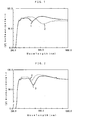
- Example 1 A comparison of Example 1 and Comparative Example 1 shows that the transmitted light chromaticity difference ( ⁇ C) between the exposed regions and the unexposed regions of Example 1 was 13.1 and thus greater than the value of 2.4 for Comparative Example 1, and that the transmitted light hue difference between the exposed regions and the unexposed regions of Example 1 was 126 degrees and thus greater than the value of 9 degrees for Comparative Example 1. Also, for both the glass surface reflectance (the visible light reflectance for light incident on the surface on which the light absorbing film was not coated) and the film surface reflectance (the visible light reflectance for light incident on the surface on which the light absorbing film was coated), the values exhibited by Example 1 were smaller than those exhibited by Comparative Example 1.
- Fig. 1 The transmitted light spectrum distribution of an exposed region and an unexposed region of Example 1 are shown in Fig. 1.
- the solid line 1 indicates the transmittance of an exposed region and the dotted line 2 indicates the transmittance of an unexposed region.
- the transmitted light spectrum distribution of an exposed region and an unexposed region of Comparative Example 1 are shown in Fig. 2.
- the solid line 3 indicates the transmittance of an exposed region and dotted line 4 indicates the transmittance of an unexposed region.
- a glass plate with light absorbing film was also made in the same manner as Example 1 but using photomask 2 instead of the photomask 1 used in Example 1. Though the transmission colors of this glass plate at the left half portion of the letter "A” (the unexposed region) and at the portions besides the letter "A” (the exposed region) were the same blue color and pink color, respectively, as Example 1, the right half portion of the letter "A” (semi-exposed region) was colored in bluish purple.
- Coating was performed using the same coating solution, glass substrates (11 substrates), and coating device, and after air drying, the abovedescribed nine types of filter were respectively positioned close to the film surfaces of nine samples and ultraviolet light was irradiated for approximately 30 seconds using the same UV irradiation device as Example 1. Irradiation was performed without a mask on one of the remaining glass substrates and irradiation was not performed on one of the other remaining glass substrate.
- the respective ultraviolet light irradiated samples and the non-irradiated sample were heat treated for 2 minutes at a temperature of 650°C as shown in Table 2, and 11 glass plates with gold-microparticle-dispersed silica-titania films, which were colored in bluish green to reddish purple, were obtained.
- the compositions, refractive indices, and film thickness values of the gold-microparticle-dispersed films and the visible ray transmittance (Ya), solar ray transmittance (Tg), ultraviolet ray transmittance (Tuv), visible ray reflectance, color (transmitted light), and other characteristics of the glass plates with light absorbing films were measured in the same manner as in Example 1, and the results thereof are shown in Table 3 and the rows indicated by Nos. 2-1 to 2-11 in Tables 6 and 7.
- the value of "10%" in the "Ultraviolet irradiation" column of No. 2-2 indicates that the [total area of ultraviolet ray transmitting holes] / [photomask area] of this mask is 10%. It can be understood that as the area exposed to ultraviolet rays increases with respect to the area of the irradiated film surface, the color tone varies gradually from bluish green to reddish purple. This indicates that the transmission color tone can be controlled freely by selecting the area of the exposed region.
- a glass plate with light absorbing film was produced in the same manner as in Example 2.
- a gradated transmission color tone distribution which varies gradually from bluish green to blue, bluish purple, purple, reddish purple, and pink from the abovementioned other end side (ultraviolet blocking region: 100%) of the corresponding photomask 3 to the abovementioned one end side (one end side of the glass plate, ultraviolet transmitting region: 100%), was obtained.
- the value of "10%" in the "Ultraviolet irradiation" column of No. 2-2 indicates the film portion corresponding to the ultraviolet ray transmission area percentage of 10% of the abovementioned photomask 3.
- titanium oxide microparticles TiO 2 microparticles, average particle diameter: 7nm, photocatalytic titanium oxide microparticles "STS-01,” made by Ishihara Sangyo
- titanium oxide raw material C titanium oxide raw material C
- solvent ethyl cellosolve
- chloroauric acid gold microparticle raw material
- compositions, refractive indices, and film thickness values of the gold-microparticle-dispersed film and the visible ray transmittance (Ya), solar ray transmittance (Tg), ultraviolet ray transmittance (Tuv), visible ray reflectance, color (transmitted light), and other characteristics of the glass plate with colored film are shown in Tables 3 to 5.
- No. Silicon oxide stock solution A (g) Titanium oxide micro-particles (g) Titanium oxide raw material C (g) Chloroauric acid (g) EC (g) Example 1 26.3 2.66 0 1.6 19.4 Comparative Example 1 26.3 0 5.34 1.6 17.3 Example 3 26.3 2.13 1.96 1.6 18.0 No.
- UV irradiation treatment conditions (365nm) Heat treatment temperature
- Film composition (weight % as oxide)
- Film thickness (nm) SiO 2 TiO 2 Au Refractive index
- Example 1 Exposed region 5.1 2.2/-1.6 8.4 -2.0/-1.6 540 Unexposed region 5.4 0.8/0.8 6.4 2.1/0.9 680 Comparative Example 1 Exposed region 7.9 3.0/1.0 8.8 3.1/1.3 550 Unexposed region 8.3 4.0/3.1 9.3 7.3/3.7 530 Example 3 Exposed region 6.2 3.6/-2.1 7.2 4.6/-1.7 550 Unexposed region 6.5 1.9/-1.2 6.3 2.7/-4.1 600 No.
- the present invention provides in a method of producing a glass article coated with a silica light absorbing film containing gold microparticles, a method that enables the production of a light absorbing pattern film coated article, with which the optical characteristics of exposed regions and unexposed regions differ or with which the transmission color tone or transmitted light spectrum is made to vary gradually by the use of a graded pattern in the light irradiation process.
- the present invention also enables a plurality of light absorbing film coated articles that differ respectively in transmission color tone or transmitted light spectrum distribution without having to vary the composition of the light absorbing film coating solution, in other words, simply by using a light absorbing film coating solution of a fixed composition and using photomasks that differ in ultraviolet ray transmitting area percentage.
Landscapes
- Chemical & Material Sciences (AREA)
- Materials Engineering (AREA)
- Life Sciences & Earth Sciences (AREA)
- Engineering & Computer Science (AREA)
- Organic Chemistry (AREA)
- Wood Science & Technology (AREA)
- General Chemical & Material Sciences (AREA)
- Geochemistry & Mineralogy (AREA)
- Composite Materials (AREA)
- Physics & Mathematics (AREA)
- Chemical Kinetics & Catalysis (AREA)
- Dispersion Chemistry (AREA)
- General Physics & Mathematics (AREA)
- Optics & Photonics (AREA)
- Inorganic Chemistry (AREA)
- Surface Treatment Of Glass (AREA)
- Laminated Bodies (AREA)
- Glass Compositions (AREA)
Abstract
A method of producing a light absorbing pattern film coated
article with a transmitted light spectrum distribution
corresponding to the pattern of a photomask, wherein a light
absorbing film coating solution, containing a silicon oxide raw
material, a titanium oxide raw material, which contains titanium
oxide microparticles, and a gold microparticle raw material,
is coated onto the surface of a substrate, the photomask is
positioned on top of said coated film, ultraviolet light is
irradiated onto said coated film, and said coated film is
thereafter heated.
By the abovementioned method of producing, this invention
can provide light absorbing film coated articles with various
transmitted light spectra distribution while keeping the visible
light reflectivity low.
Description
This invention concerns a method of producing film coated
articles, in particular, light absorbing film coated articles
that are suitable as the glass, etc. for window materials and
mirrors for automobiles and other vehicles and buildings,
optical glass products, ceramic products, optical parts,
miscellaneous goods, etc.
A general method for obtaining microparticle dispersed
glass using gold is the ion exchange method, with which an
inorganic salt of gold is coated onto a glass surface and then
baked to cause the gold in the inorganic salt to permeate into
the glass substrate and cause colloidal coloration of the glass.
There are also methods with which a gold salt is dissolved in
a silicon alkoxide solution, this solution is coated onto a
substrate, and heat treatment is performed to form a silicon
oxide film that contains gold microparticles and is colored
by the surface plasmons of the gold microparticles.
In particular, glass colored by the surface plasmons of
gold microparticles is excellent in heat resistance and light
resistance and has been used since priorly as colored glass
or filter glass. It is generally known that the coloration
due to absorption by the surface plasmons of gold microparticles
is dependent on the refractive index of the medium that surrounds
the gold microparticles, and for example among silicon oxide
- titanium oxide films that contain gold microparticles, films,
which are rich in titanium oxide and have a high refractive
index, take on a blue color while films, which are rich in silicon
oxide and have a low refractive index, take on a red color.
It is also known that in this case, the coloration tone is changed
and the principal wavelength of visible transmitted light is
changed by the irradiating of ultraviolet rays after coating
of a liquid that contains the silicon alkoxide, titanium oxide
raw material, and gold salt but before the baking of the film
(for example, Japanese Unexamined Patent Publication No.
6-191896).
Such glass, with which gold microparticles are dispersed
in the glass or gold microparticles are dispersed in a film
that is coated onto the glass, have been used since priorly
as ornamental glass. However, the color of the glass that is
obtained is normally a single color since the color is determined
by the refractive index of the medium that surrounds the gold
microparticles and the size and shape of the microparticles.
Thus in the case where various color tones are to be provided
within the same substrate, separate coating had to be performed
for the respective color tones by means of flexo coating, screen
printing, etc. This not only required highly precise patterning
position control technology for prevention of the overlapping
of films on top of each other but liquid compositions
corresponding to the respective color tones had to be developed
as well, making it disadvantageous in terms of cost to provide
such color tones.
Furthermore, though the color tone obtained by gold
microparticles varies with the refractive index of the medium
and whether or not ultraviolet irradiation is carried out prior
to the baking of the film, the reflectivity of the film also
becomes higher as the refractive index of the medium becomes
higher. However, for example, glass plates for automobiles
and glass plates for construction, etc. are required in many
cases to be low in visible light reflectivity for the purpose
of appearance, and in the case where various transmission color
tones are to be realized by changing the refractive index of
the film, the highness of the visible light reflectivity of
the film can become a disadvantage.
The present inventors have noted such problems and have
come to complete this invention, the object of which is to provide
light absorbing film coated articles, with which while keeping
the visible light reflectivity low, various transmission color
tones or various transmitted light spectrum distribution are
realized in a single light absorbing film coated article or
among individual or differing lots of light absorbing film coated
articles.
This invention provides in a method of producing a light
absorbing pattern film coated article having a transmitted light
spectrum distribution corresponding to the pattern of a
photomask, a method wherein a light absorbing film coating
solution, which contains silicon oxide raw material, a titanium
oxide raw material, containing titanium oxide microparticles,
and gold microparticle raw material, is coated onto the surface
of a substrate, positioning the abovementioned photomask on
top of the abovementioned coated film, irradiating ultraviolet
light onto the abovementioned coated film, and thereafter
heating the abovementioned coated film.
The various components of the composition of the light
absorbing film coating solution of this invention shall now
be described.
Silicon oxide is necessary as the matrix material for
fixing the gold microparticles in the film and also serves an
important role as a low refractive index material that keeps
down the visible light reflectivity of the film. A hydrolyzable,
condensable silicon compound is used as the raw material of
the silicon oxide. If the content of the silicon oxide raw
material among the solids of the light absorbing film coating
solution is too low, the visible light reflectance of the film
will become too high. The content of silicon oxide as SiO2 in
the total amount of metal oxides and metal components in the
light absorbing film coating solution is therefore preferably
45 to 93 weight % and more preferably 55 to 90 weight %.
As the raw material of the silicon oxide that forms the
film in this invention, a silicon compound, etc., with which
a strong, transparent film can be formed by the sol-gel method
and is excellent in stability, that is, a silicon compound,
etc., which can be subject to hydrolysis and condensation
polymerization, can be used. Such a. silicon compound shall
be described more specifically below.
As an organosilicon compound, which is to be the raw
material for silicon oxide, an alkoxide of silicon is favorable.
Examples include tetralkoxysilanes, such as tetramethoxysilane,
tetraethoxysilane, tetrapropoxysilane, and tetrabutoxysilane.
A condensation product of such a compound (with n ≧ 2, where
n indicates the degree of condensation) or a mixture of such
condensation products may also be used favorably. Examples
of condensation products that can be used include
hexaethoxydisiloxane (n = 2), octaethoxytrisiloxane (n = 3),
decaethoxytetrasiloxane (n = 4), and ethoxypolysiloxane (n ≧
5). Also, "Ethyl Silicate 40" (trade name; made by Colcoat Co.,
Ltd.), which is comprised of a mixture of a monomer (n = 1)
and condensation products (n ≧ 2) [the composition in terms
of weight ratios of this product is indicated in the reference,
J. Cihlar, Colloids and Surfaces A : Physicochem. Eng. Aspects
70 (1993) pp. 253 to 268, as being 12.8 weight % monomer (n
= 1), 10.2 weight % dimer (n = 2), 12.0 weight % trimer (n =
3), 7.0 weight % tetramer (n = 4), 56.2 weight % polymer (n
≧ 5), and 1.8 weight % ethanol], etc. can be used favorably.
An alkyltrialkoxysilane, with which a part of the alkoxyl
groups of an abovementioned compound has been substituted by
an alkyl group or other hydrocarbon group, may also be used.
Examples include compounds with which an alkoxyl group has been
substituted by a straight chain or branched chain alkyl group,
such as the methyl group, ethyl group, propyl group, butyl group,
2-ethylbutyl group, octyl group, etc., a cycloalkyl group, such
as the cyclopentyl group, cyclohexyl group, etc., an alkenyl
group, such as the vinyl group, aryl group, γ
-methacryloxypropyl group, γ-acryloxypropyl group, etc., an
aryl group, such as the phenyl group, toluyl group, xylyl group,
etc., an aralkyl group, such as the benzyl group, phenetyl group,
etc., or the γ-mercaptopropyl group, γ-chloropropyl group,
γ-aminopropyl group, etc. Besides silicon alkoxides, silicon
oxide microparticles, such as "Snowtex-OL," which is a silica
sol made by Nissan Chemical Industry Co., Ltd., may also be
used.
Titanium oxide is the component that raises the refractive
index of the film and shifts the coloration (transmission color
tone) by the gold microparticles from a red color to a blue-green
color. Titanium oxide is also a component that increases the
water resistance of the film. Titanium oxide is furthermore
a component that increases the visible light reflectivity of
the film coated glass article in accompaniment with the increase
of the refractive index of the film.
In the case where gold microparticles are to be formed
in the film, titanium oxide microparticles are greater in the
degree of shifting the transmission color tone of the film from
a red color to a blue-green color and smaller in the degree
of increasing the visible light reflectivity of the film coated
article in comparison to the same amount (as TiO2) in the light
absorbing film coating solution of a titanium oxide raw material
besides titanium oxide microparticles. Thus by making titanium
oxide microparticles be present in the light absorbing film
coating solution at an amount as TiO2 that is equal to or greater
than the amount of a titanium oxide rawmaterial besides titanium
oxide microparticles, a gold microparticle dispersed film can
be obtained that exhibits absorption in the optical wavelength
range of 300 to 1200nm and is low in visible light reflectance.
Furthermore, by making titanium oxide microparticles be
contained in the light absorbing film coating solution, the
change of transmission color tone, by the change of the amount
of ultraviolet ray irradiated after coating of the light
absorbing coating solution but prior to the baking of the film,
can be made extremely large.
If the amount of titanium oxide in the total weight of
metal compounds (total weight as metal oxide and gold) in the
light absorbing film coating solution is made too high, the
refractive index of the film will become too high and the
reflectivity will become too high. Thus the content as TiO2
of the titanium oxide raw material is preferably 3 to 30 weight %,
more preferably 5 to 25 weight %, and even more preferably 10
to 25 weight %. Titanium oxide microparticles are used at an
amount of 1/2 or more, in other words, 50 weight % or more,
more preferably 60 weight % or more, even more preferably 80
weight %, and most preferably 100 weight % of the abovementioned
titanium oxide raw material (as TiO2). An organic compound of
titanium, such as a titanium alkoxide, titanium acetyl acetonate,
titanium carboxylate, etc., may be used at an amount of less
than 50 weight % of the abovementioned titanium oxide raw
material.
Since the transparency of the film will be lost if the
particle size of the titanium oxide microparticles to be used
as the abovementioned titanium oxide raw material is too large,
the average particle diameter of the titanium oxide
microparticles is preferably 500nm or less and 1nm or more and
more preferably 100nm or less and 2nm or more. Though a titanium
oxide raw material (an organic compound of titanium) besides
titanium oxide microparticles can shift the transmission color
tone of the film towards a blue-green color, since the degree
of shifting towards a blue-green color is less and the degree
of increasing the visible light reflectivity of the film coated
article is greater than that of microparticulate titanium oxide,
the amount of use of an abovementioned organic titanium compound
as the abovementioned titanium oxide raw material is preferably
limited to a small amount as possible as has been mentioned
above.
Examples of titanium oxide microparticles to be used as
the titanium oxide raw material in this invention include
commercially-sold water-dispersed sols, such as the
photocatalytic titanium oxide microparticles made by Ishihara
Sangyo Co., Ltd. (trade names "STS-01" (particle diameter
(particle diameter by X-ray measurement): 7nm), "STS-02"
(particle diameter (particle diameter by X-ray measurement):
7nm), and "CS-N"), the titania sol "M-6" (crystallite size:
5nm), made by Tagi Chemicals Co., Ltd., etc. and
commercially-sold titania sols, dispersed in a mixed solvent
of water and alcohol and containing a binder, such as the
photocatalytic titanium oxides made by Teika Co., Ltd. (trade
names: "TKS 201" (particlediameter: 6nm) and "TKS 202" (particle
diameter: 6nm)) and "ST-K01" and "ST-K03," made by Ishihara
Sangyo Co., Ltd.
The gold microparticles are the material that gives the
film a light absorbing function, and if the amount thereof is
too low, an adequate light absorbing function will not be obtained
while if the amount thereof is too high, the durability of the
film becomes low. Thus the content of the gold microparticle
raw material (as gold (Au)) in the total solids content (as
metal oxide and gold (Au)) of the light absorbing film coating
solution is preferably 4 to 30 weight %, more preferably 6 to
25 weight %, and even more preferably 7 to 22 weight %.
Gold compounds, such as chloroauric acid, sodium
chloroaurate, etc., can be used as the gold microparticle raw
material, and among these chloroauric acid is most preferable
in being stable and soluble. Gold colloid is not preferable
for use in this invention since the change of the light
transmission spectrum distribution by light irradiation (change
of the transmitted light color tone in the visible light region)
will be small.
In addition to the abovedescribed silicon oxide raw
material, the abovedescribed titanium oxide raw material, and
the abovedescribed gold microparticle raw material, the light
absorbing film coating solution of this invention may contain
the raw material of at least one oxide selected from the group
comprised of cobalt oxide, zirconium oxide, aluminum oxide,
iron oxide, bismuth oxide, zinc oxide, tin oxide, indium oxide,
antimony oxide, vanadium oxide, chromium oxide, copper oxide,
manganese oxide, nickel oxide, cerium oxide, boron oxide,
tantalum oxide, tungsten oxide, ytterbium oxide, etc. at a total
content as Co3O4, ZrO2, Al2O3, Fe2O3, Bi2O3, ZnO, SnO2, In2O3, Sb2O3,
V2O5, Cr2O3, CuO, MnO, NiO, Ce2O3, B2O3, Ta2O5, WO3, and Yb2O3,
respectively, of 15 weight % or less and more preferably 10
weight % or less.
The film coating solution of this invention is obtained
by respectively dissolving each of the raw materials described
above in a solvent and mixing the resulting solutions at
prescribed proportions. The total concentration of raw
material (solids) in each solution is preferably 3 to 20 weight %.
In the case where a silicon alkoxide is to be used for this
invention, an inorganic acid, such as hydrochloric acid, nitric
acid, sulfuric acid, etc. or an organic acid, such as acetic
acid, oxalic acid, formic acid, propionic acid,
p-toluenesulfonic acid, etc., is used at a concentration of
preferably 0.01 to 15 weight % as the hydrolytic catalyst for
the alkoxide. Since the above catalysts, etc. contain an
adequate amount of water for hydrolysis, water does not to have
to be added in particular normally.
The abovementioned solvent to be used in this invention
depends on the film forming method. For example, a solvent
that is low in evaporation rate is preferable as the organic
solvent for the gravure coating method, flexo printing method,
and roll coating method. This is because with a solvent with
a high evaporation rate, the solvent will evaporate before
adequate leveling occurs. The evaporation rate of a solvent
is generally evaluated as a relative evaporation rate index
with that of butyl acetate being set to 100. A solvent with
which the value of this index is 40 or less is classified as
a solvent with an extremely low evaporation rate, and such a
solvent is preferable as the organic solvent for the gravure
coating method, flexo printing method, and roll coating method.
Examples of such a solvent include ethyl cellosolve, butyl
cellosolve, cellosolve acetate, diethylene glycol monoethyl
ether, ethylene glycol, propylene glycol, tripropylene glycol,
diacetone alcohol, tetrahydrofurfuryl alcohol, etc. Glycol
solvents also act as leveling agents for the coat.
The solvent of the coat forming composition (coating
solution) used in this invention preferably contains at least
one type of such a solvent, and a plurality of the abovementioned
solvents may be used to adjust the viscosity, surface tension,
etc. of the coating solution. Also, a solvent that is high
in evaporation rate and has a relative evaporation rate index
of greater than 100, such as methanol (relative evaporation
rate : 610; the same applies in the following), ethanol (340),
or n-propanol (300) may be added to the abovedescribed solvent
with a relative evaporation rate index of 40 or less.
The film coating solution of this invention is applied
onto the substrate by the coating method to be described below,
and after positioning a photomask on top of the coat, light
irradiation treatment is performed. As the ultraviolet ray
light source for light irradiation, an ultraviolet irradiation
device, which emits light of wavelengths of 250 to 400nm and
with which the intensity of the irradiated ultraviolet rays
on the irradiated surface will be 1mW/cm2, can be used. The
light from this light source is irradiated from 1 second to
a few minutes onto the abovementioned coated film.
Heating is then performed for 1 to 200 minutes at a
temperature of 200 to 700°C to form a light absorbing thin film
with a film thickness of 50 to 10000nm. Though both the film
portion (exposed region), which is exposed by the ultraviolet
rays that pass through the ultraviolet ray transmitting area
of the photomask, and the film portion (unexposed region), which
is not exposed by the ultraviolet rays due to the ultraviolet
ray blocking region of the photomask, are heated, the exposed
region and the unexposed region will come to have different
optical characteristics.
Glass, mirrors, quartz glass, semiconductors, ceramics,
and resins can be used favorably as the substrates onto which
the film coating solution of this invention is applied, and
besides glass substrates of non-colored, transparent, soda lime
silicate glass compositions, glass colored in green, glass
colored in bronze, and glass plates provided with an ultraviolet
ray absorbing property may be used as the glass substrate as
well. As a glass substrate with an ultraviolet ray absorbing
property, an ultraviolet ray / infrared ray absorbing glass
plate, of a thickness of 1.0mm to 5.5mm and with which the
transmittance of ultraviolet light of 370nm wavelength (T370nm)
is 0 to 50%, the visible ray transmittance is 30 to 95%, and
the solar ray transmittance is 30 to 85%, is used favorably.
By coating the film forming composition of this invention onto
such an ultraviolet ray absorbing glass plate, a film coated
glass substrate with a high ultraviolet ray absorbing property
can be obtained.
The coating method to be used in this invention is not
limited in particular and examples include the spin coating
method, dip coating method, spray coating method, printing
methods, etc. Printing methods, such as the gravure coating
method, flexo printing method, roll coating method, screen
printing method, etc., are favorable as they are high in
productivity and good in the efficiency of use of the coating
solution composition.
The types and mixing proportions of the silicon compound,
titanium oxide rawmaterial, and gold microparticle rawmaterial
of this invention are preferably determined in consideration
of the compatibility and stability of the solvent, titanium
oxide rawmaterial, gold microparticle raw material, and silicon
compound, the optical factor of color, and the mechanical factors
of wear resistance and chemical durability.
A description shall now be given for the case where a
light absorbing pattern film coated article is to be produced
using a photomask.
After coating the abovedescribed light absorbing film
coating solution onto the substrate surface, a photomask is
positioned on top of the coated film, and ultraviolet light
is irradiated via the photomask onto the coated film for a
prescribed amount of time. In order to accomplish exposure
to the ultraviolet light and transfer the shape of the photomask
onto the coated film surface accurately, the photomask is
preferably positioned as close to the film surface as possible.
In accordance with the differences according to location in
the ultraviolet ray blocking rates of the photomask, regions
that are exposed to high amounts of ultraviolet light and regions
that are exposed to low amounts of ultraviolet light (or unexposed
regions) are formed on the coated film. In regions that are
exposed to high amounts of ultraviolet rays, a larger proportion
of the gold microparticle raw material in the coated film undergo
photoreduction and more gold microparticles are formed in
comparison to regions that are exposed to low amounts of
ultraviolet light.
In the subsequent heat treatment process, silicon oxide
and titanium oxide are formed by the hydrolysis/condensation
or thermal decomposition of the silicon oxide raw material and
the titanium oxide raw material, and in the lowly exposed regions
(or unexposed regions), the gold microparticle raw materials,
which were not subject to photoreduction and have thus remained
in their original form, undergo thermal decomposition to form
gold microparticles of a form that differs from the photoreduced
gold microparticles in the highly exposed regions.
As a result, a distribution in the proportions of the
amounts of photoreduced gold microparticles and gold
microparticles formed by thermal decomposition is formed on
the coated film in correspondence to the pattern of the mask,
and a light absorbing film having a transmission light spectrum
distribution (transmitted light color tone distribution in the
visible light range) corresponding to the abovementioned
pattern is obtained. Between the exposed regions and the
unexposed regions of the light absorbing film, the exposed
regions will tend to exhibit light absorption that is more shifted
to the short wavelength side in comparison to the unexposed
regions.
As the photomask to be used in the process of ultraviolet
light irradiation, a film, screen film, or quartz glass thin
plate, which is used for example to prepare a flexo-plate and
with which a pattern is drawn on the surface of a transparent
plate, can be used. As this photomask, a photomask, having
a pattern that is comprised of ultraviolet light transmitting
regions and ultraviolet light blocking regions and forms
predetermined characters or figures, etc., a photomask, having
a pattern with which the ultraviolet light transmittance varies
continuously or discontinuously according to location, etc.
may be used.
The pattern to be formed on the photomask may be a so-called
large pattern, provided with ultraviolet light transmitting
regions and ultraviolet light blocking regions of comparatively
large dimensions that are suitable for forming a light absorbing
pattern on the light absorbing film that can be observed by
the naked eye and without the use of a magnifying glass, or
may be a so-called small pattern, provided with ultraviolet
light transmitting regions and ultraviolet light blocking
regions of minute dimensions, with which the pattern itself
is difficult to observe with the naked eye without the aid of
a magnifying glass but which are suitable for obtaining various
forms of light absorption. As a photomask of the latter type,
a photomask, with which a pattern, comprised of microscopic
ultraviolet light transmitting regions and microscopic
ultraviolet light blocking regions, is formed by the forming
of a distribution of numerous ultraviolet ray blocking regions
with diameters (or minimum widths) of 0.5 to 100µm by printing
on a surface of film that is transparent to ultraviolet rays
or by the forming of a distribution of numerous ultraviolet
ray transmitting holes with diameters (or minimum widths) of
0.5 to 100µm on the surface of a film that blocks ultraviolet
rays, can be used favorably. By the use of such a mask, a light
absorbing film having a pattern with a definition of 0.5 to
100µm in correspondence to the pattern of the mask may be
prepared.
The reason as to why the difference in the transmission
light spectrum distribution (the colorations (transmitted light
chromaticity) in the visible range) of the exposed regions and
unexposed regions is made large when titanium oxide
microparticles are used in place of a titanium alkoxide while
keeping the content (as TiO2) of the titanium oxide raw material
the same in the abovedescribed gold-compound-containing
composition of the coating solution is presumed to be as follows.
First, an explanation shall be given for the case where
heat treatment is performed without irradiating ultraviolet
light after the coating on of the light absorbing film coating
solution.
When the amounts of titanium alkoxide (a representative
of titanium oxide raw materials besides titanium oxide
microparticles) and titanium oxide microparticles are varied
while keeping the content (as TiO2) of the titanium oxide raw
material constant in the abovedescribed
gold-compound-containing composition of the coating solution,
the light absorption peak at the long wavelength side (600 to
700nm) becomes large and the light absorption peak wavelength
shifts from 530 to 580nm towards the long wavelength side (600
to 700nm) as the content of titanium oxide microparticles is
increased. That is, the transmission color tone of the light
absorbing film shifts from red to blue and then furthermore
to green.
If microparticulate titanium oxide does not exist and
only a titanium alkoxide exists in the light absorbing film
coating solution, the titanium alkoxide will coact with silica
to form a matrix when the coated film is heated and the titanium
oxide will therefore exist uniformly in the interior of the
film. However, it is considered that when microparticulate
titanium oxide exists in the light absorbing film coating
solution, the titanium oxide microparticles will, by the
interaction with the gold microparticles in the process of heat
treatment of the coated film, come to be distributed near the
gold particles or bond with the gold microparticles to form
composite microparticles so that the titanium oxide will exhibit
a non-uniform distribution inside the film.
The above is presumed from the following observation.
That is, when the microparticles in the film are observed using
a transmission electron microscope (TEM) outfitted with an
energy dispersion type X-ray spectrum analyzer (EDX) and the
EDX spectrum of the microparticles is measured, only gold (Au)
is detected from the microparticles in a film, which does not
use titanium oxide microparticles and exhibits a red
transmission color tone, even if the same amount of titanium
oxide is contained in the film. On the other hand, gold (Au)
and titanium (Ti) are detected from the microparticles in a
film, which uses titanium oxide microparticles as the titanium
oxide raw material and exhibits a blue transmission color tone.
It is thus considered that the gold particles become
surrounded by a medium that is high in the concentration of
titanium oxide (and exhibits a higher refractive index than
the refractive index of the film) so that the light absorption
by the surface plasmons of the gold particles will exhibit an
effect likened to dispersing the gold microparticles inside
a film of a higher refractive index than the refractive index
of the coated film and cause the shift value of the light
absorption peak towards the long wavelength side to be extremely
large.
The above description concerned the case where heat
treatment is performed without performing light irradiation
after coating of the light absorbing film coating solution.
The case where light irradiation is performed upon positioning
a photomask after coating of the light absorbing film coating
solution and heat treatment is performed thereafter shall now
be described.
In this case, though the conditions of the unexposed
regions in the coated film will be the same as that described
above, since the gold microparticle raw material in the exposed
region in the coated film will be photoreduced where they are,
an interaction of titanium oxide microparticles and gold
microparticles will not occur in the subsequent heat treatment
process. A large difference in the color tone of transmitted
light will therefore arise between the unexposed regions and
the exposed regions in the light absorbing film. Thus by using
as the photomask, a photomask, having a pattern that is comprised
of ultraviolet light transmitting regions and ultraviolet light
blocking regions and forms predetermined characters or figures,
etc., or a photomask, having a pattern with which the ultraviolet
light transmittance varies continuously or discontinuously
according to location, a continuous or discontinuous
transmission light spectrum distribution or transmission color
tone distribution, which corresponds to the abovedescribed
pattern, will be formed in the light absorbing film.
Though a transmitted light color tone that is intermediate
the transmitted light color tone of the unexposed regions in
the light absorbing film and the transmitted light color tone
of the exposed regions can be obtained by adjusting the amount
of ultraviolet rays irradiated, the duration of irradiation,
etc., and an intermediate color tone can also be obtained
favorably by a mixing method similar to the dot matrix method
in CRT's and liquid crystal displays as shall be described below.
In the case where a photomask, having a pattern with which
large numbers of microscopic ultraviolet ray transmitting
regions and microscopic ultraviolet ray blocking regions exist
in a mutually adjacent and continuous manner, is used, light
absorption (considered to be due mainly to gold microparticles
obtained by photoreduction) at portions corresponding the
abovementioned microscopic ultraviolet ray transmitting
regions and light absorption (considered to be due mainly to
gold microparticles due to thermal reduction and uneven
distribution of titanium oxide microparticles) at portions
corresponding to the abovementioned microscopic ultraviolet
ray blocking regions occur in the light absorbing film. Since
each of these microscopic light absorbing parts are extremely
small in area and cannot be viewed as distinct parts by the
naked eye without the aid of a magnifying glass, the color tone
that is observed by the naked eye will be that resulting from
a mixture of the transmitted light of the respective light
absorbing parts. Thus by varying the area ratios of the
ultraviolet ray transmitting regions and ultraviolet ray
blocking regions of the photomask, the transmitted color tone
that is obtained can be adjusted.
By thus making titanium oxide microparticles be present
in the titanium oxide raw material (as TiO2) of the light absorbing
film coating solution, preferably at an amount of at least 50
weight %, a light absorbing pattern film coated article with
a transmission light spectrum distribution or transmitted light
color tone distribution that corresponds to the pattern can
be obtained.
Though transmitted color tones that differ between the
exposed regions and unexposed regions of the light absorbing
film will also be exhibited when a titanium oxide raw material
that does not contain titanium oxide microparticles is used
in the light absorbing film coating solution, since it is
considered that this difference will then be due merely to the
difference between gold microparticles resulting from
photoreduction and gold microparticles resulting from thermal
decomposition, the difference in transmitted light color tone
that is obtained will be extremely small in comparison to that
obtained by the present invention.
With the gold-compound-containing composition of the
abovedescribed film coating solution, if the content of titanium
oxide is fixed, the difference in the transmission light spectra
(difference in coloration in the visible range) of exposed
regions and unexposed regions can be made greater by using
titanium oxide microparticles in place of a titanium alkoxide
as the titanium oxide raw material.
If this difference in coloration is expressed in the form
of transmitted light chromaticity, that is, by the Lab color
specification system, and the difference (ΔC), between the
transmitted light chromaticity (a1, b1) of an exposed region
and the transmitted light chromaticity (a2, b2) of an unexposed
region, is defined as ((a1 - a2)2 + (b1 - b2)2)1/2, whereas the
chromaticity difference (ΔC) that can be obtained by using
a titanium alkoxide for example as the titanium oxide raw material
will only be approximately 2 to 3, a chromaticity difference
(ΔC) of 10 or more can be obtained by this invention that uses
titanium oxide microparticles as the titanium oxide rawmaterial.
Also, if the difference in coloration of the exposed regions
and unexposed regions is expressed by the hue difference (angle;
degrees), whereas the hue difference that can be obtained by
using a titanium alkoxide for example as the titanium oxide
raw material will only be approximately 8 to 10 degrees, a hue
difference of 90 degrees or more can be obtained by this
invention.
The case where a light absorbing pattern film coated
article having a transmitted light color tone distribution is
produced was mainly described above. However, this invention
is not limited to this case, and by using photomasks having
uniformly distributed microscopic ultraviolet ray transmitting
regions and microscopic ultraviolet ray blocking regions and
applying such photomasks that differ in the ratio of the total
area of the ultraviolet ray transmitting regions and the total
area of the ultraviolet ray blocking regions, light absorbing
film coated articles that differ in the transmitted light color
tone can be produced using light absorbing film coating solutions
of the same blending composition.
Though this invention shall now be described in more detail
by way of specific examples, this invention is not limited
thereto.
A 10 × 10cm paper, on which a 120-point bold letter "A" was
printed in black, was copied at 100% magnification onto a
transparent plastic sheet for overhead projector by means of
a copier. This copied transparent sheet (thickness: 0.2mm)
was used as photomask 1. The character portions (large pattern)
of the letter "A" of photomask 1 are the ultraviolet ray blocking
regions and the other portions are the ultraviolet ray
transmitting regions.
Also, numerous circular ultraviolet ray blocking dots
of square shapes, with side lengths of 1 to 50µm, were printed,
at the respective intersections of square grid-like lattice
so that the distance between the centers of dots will be 50
µm, onto a quartz glass plate of a thickness of 0.5mm and
dimensions of 10cm × 10cm. The dots were printed with the side
length of the dots at one side of this quartz glass plate being
1µm so that the ultraviolet ray transmitting area percentage
(ultraviolet ray transmitting area / mask area) will be
approximately 100% at this portion, the side length of the square
dots at the other side of the quartz glass plate being 50µm
so that the ultraviolet ray transmitting area percentage of
this portion will be approximately 0%, and the side lengths
of the dots becoming gradually larger from 1µm to 50µm from
one side of the quartz glass plate to the other side (small
pattern). The ultraviolet ray transmitting area percentage
was thus made to vary gradually from 100% to 0% from one side
of the quartz glass plate to the other side. This was used
as photomask 3.
Silicon oxide raw material A: 62.6g of "Ethyl Silicate 40"
(made by Colcoat Co.), 55.04g of ethyl cellosolve, and 7.52g
of 0.1mol/L (0.1 normal) nitric acid (HNO3) were stirred for
two hours and after then adding 14.64g of methyltriethoxysilane,
58.26g of ethyl cellosolve, and 1.8g of 0.1mol/L nitric acid,
stirring was performed for another 2 hours to prepare a silicon
oxide raw material solution A.
Preparation of titanium oxide raw material C: Titanium
isopropoxide chelated by acetyl acetone at a ratio of 2 moles
of titanium isopropoxide to 1 mole of acetyl acetone was used
as titanium oxide raw material C. This was then diluted with
ethyl cellosolve so that the TiO2 solids content will be 16.5
weight %.
The abovedescribed silicon oxide raw material A, titanium oxide
microparticles (TiO2 microparticles, average particle
diameter: 7nm, photocatalytic titanium oxide microparticles
"STS-01," made by Ishihara Sangyo), titanium oxide raw material
C, solvent (ethyl cellosolve), and chloroauric acid (gold
microparticle raw material) were mixed at the amounts shown
in Table 1 to prepare two types of coating solution. In Table
1, "EC" indicates ethyl cellosolve.
Each of the prepared coating solutions described above
was coated onto a non-colored, transparent glass substrate (soda
lime silicate float glass, visible ray transmittance Ya: 90.0%,
solar ray transmittance Tg: 81.7%, ultraviolet ray
transmittance Tuv (ISO): 55.7%, visible ray reflectance 8.0%,
transmitted light chromaticity and lightness as expressed by
the Lab color specification system: a = -1.41, b = 0.32, L =
95.1) of a thickness of 3.4mm and dimensions of 10cm × 10cm
by means of a gravure coating device. After air drying, the
abovedescribed photomask 1 was positioned on top of the
abovementioned coated surface with an interval of approximately
1 mm in between and ultraviolet light from an Ushio UV irradiation
device (central ultraviolet ray wavelength: 365nm) was
irradiated through the photomask 1 for approximately 30 seconds.
The intensity of the ultraviolet rays on the irradiated surface
was 10mW/cm2 as shown in Table 2.
After irradiation, the coated glass plates were subject
to heat treatment at a temperature of 350°C for 10 minutes as
shown in Table 2. As a result, two colored glass plates, that
is, the glass plate of Example 1, having a gold microparticle
dispersed silica-titania film with which the letter "A" portions
(unexposed regions) were colored in blue and the portions besides
the letter "A" (exposed portions) were colored in pink, and
the glass plate of Comparative Example 1, having a gold
microparticle dispersed silica-titania film with which the
letter "A" portions (unexposed regions) were colored in pink
and the portions besides the letter "A" (exposed portions) were
colored in reddish purple, were obtained. The compositions,
refractive indices, and film thickness values of the
gold-microparticle-dispersed films and the visible ray
transmittance (Ya), solar ray transmittance (Tg), ultraviolet
ray transmittance (Tuv), visible ray reflectance, color
(transmittance), and other characteristics of the respective
regions of the glass plates with colored films are shown in
Tables 3 to 5. The film thickness was measured using a stylus.
The visible ray transmittance, solar ray transmittance,
and visible ray reflectance were measured in accordance with
JIS R 3106, the ultraviolet ray transmittance was measured in
accordance with ISO Standard 9050, and the transmission
chromaticity and reflection chromaticity were measured in
accordance with JIS Z 8729. The transmitted light chromaticity
difference (Δc) and the transmitted light hue difference
between the exposed regions and unexposed regions were
determined from the transmitted light chromaticity (a1, b1) of
the exposed regions and the transmitted light chromaticity (a2,
b2) of the unexposed regions and using the equations of ((a1
-a2)2 + (b1-b2)2)1/2 and | tan-1(b1/a1)-tan-1(b2/a2)|, respectively.
The refractive index of the film was calculated using a value
of 2.2 as the refractive index of titanium oxide and a value
of 1.46 as the refractive index of silicon oxide in a matrix
that does not contain any gold or silver microparticles. The
colored films obtained in both Example 1 and Comparative Example
1 exhibited satisfactory results in terms of water resistance,
chemical resistance, and wear resistance.
A comparison of Example 1 and Comparative Example 1 shows
that the transmitted light chromaticity difference (ΔC) between
the exposed regions and the unexposed regions of Example 1 was
13.1 and thus greater than the value of 2.4 for Comparative
Example 1, and that the transmitted light hue difference between
the exposed regions and the unexposed regions of Example 1 was
126 degrees and thus greater than the value of 9 degrees for
Comparative Example 1. Also, for both the glass surface
reflectance (the visible light reflectance for light incident
on the surface on which the light absorbing film was not coated)
and the film surface reflectance (the visible light reflectance
for light incident on the surface on which the light absorbing
film was coated), the values exhibited by Example 1 were smaller
than those exhibited by Comparative Example 1.
The transmitted light spectrum distribution of an exposed
region and an unexposed region of Example 1 are shown in Fig.
1. In Fig. 1, the solid line 1 indicates the transmittance
of an exposed region and the dotted line 2 indicates the
transmittance of an unexposed region. Also, the transmitted
light spectrum distribution of an exposed region and an unexposed
region of Comparative Example 1 are shown in Fig. 2. In Fig.
2, the solid line 3 indicates the transmittance of an exposed
region and dotted line 4 indicates the transmittance of an
unexposed region.
As can be understood from the above, with Comparative
Example 1, with which a raw material chelated by acetyl acetate
was used as the titanium oxide raw material, the difference
in the transmitted light color tones of the exposed regions
and the unexposed regions of the colored film was small in
comparison to that for Example 1, with which titanium oxide
microparticles were used.
A glass plate with light absorbing film was also made
in the same manner as Example 1 but using photomask 2 instead
of the photomask 1 used in Example 1. Though the transmission
colors of this glass plate at the left half portion of the letter
"A" (the unexposed region) and at the portions besides the letter
"A" (the exposed region) were the same blue color and pink color,
respectively, as Example 1, the right half portion of the letter
"A" (semi-exposed region) was colored in bluish purple.
Observation of this right half portion of the letter "A"
(semi-exposed region) under a microscope showed the circular
portions of approximately 28µm diameter, which correspond to
the ultraviolet ray blocking dots of 28.2µm diameter of
photomask 2, to be colored in blue and the film portions
corresponding to the ultraviolet ray transmitting areas that
surround the dots to be colored in pink. This blue-colored
transmitted light and the same amount of pink-colored
transmitted light thus become mixed to appear bluish purple
in color to the naked eye.
Nine photomasks were prepared as follows. On the surface of
each of nine ultraviolet ray blocking films (10cm × 10cm),
numerous, square-shaped ultraviolet ray transmitting holes,
with the same side length in the range of 6.3 to 19µm, were
opened at the positions of the respective intersections of a
square grid-like lattice so that the distance between the hole
centers will be 20µm and so that the [total area of ultraviolet
ray transmitting holes] / [photomask area] will vary from 10
to 90% at 10% increments. For example, with a photomask with
a [total area of ultraviolet ray transmitting holes] / [photomask
area] of 10%, square-shaped ultraviolet ray transmitting holes
of a side length of 6.3µm were opened at the respective
intersections of the abovementioned lattice.
Coating was performed using the same coating solution,
glass substrates (11 substrates), and coating device, and after
air drying, the abovedescribed nine types of filter were
respectively positioned close to the film surfaces of nine
samples and ultraviolet light was irradiated for approximately
30 seconds using the same UV irradiation device as Example 1.
Irradiation was performed without a mask on one of the remaining
glass substrates and irradiation was not performed on one of
the other remaining glass substrate.
The respective ultraviolet light irradiated samples and
the non-irradiated sample were heat treated for 2 minutes at
a temperature of 650°C as shown in Table 2, and 11 glass plates
with gold-microparticle-dispersed silica-titania films, which
were colored in bluish green to reddish purple, were obtained.
The compositions, refractive indices, and film thickness values
of the gold-microparticle-dispersed films and the visible ray
transmittance (Ya), solar ray transmittance (Tg), ultraviolet
ray transmittance (Tuv), visible ray reflectance, color
(transmitted light), and other characteristics of the glass
plates with light absorbing films were measured in the same
manner as in Example 1, and the results thereof are shown in
Table 3 and the rows indicated by Nos. 2-1 to 2-11 in Tables
6 and 7.
For example, the value of "10%" in the "Ultraviolet
irradiation" column of No. 2-2 indicates that the [total area
of ultraviolet ray transmitting holes] / [photomask area] of
this mask is 10%. It can be understood that as the area exposed
to ultraviolet rays increases with respect to the area of the
irradiated film surface, the color tone varies gradually from
bluish green to reddish purple. This indicates that the
transmission color tone can be controlled freely by selecting
the area of the exposed region.
Also, using the photomask 3, with which the ultraviolet
ray transmitting area percentage was varied gradually from 0
to 100%, a glass plate with light absorbing film was produced
in the same manner as in Example 2. With the transmission colors
of this glass plate, a gradated transmission color tone
distribution, which varies gradually from bluish green to blue,
bluish purple, purple, reddish purple, and pink from the
abovementioned other end side (ultraviolet blocking region:
100%) of the corresponding photomask 3 to the abovementioned
one end side (one end side of the glass plate, ultraviolet
transmitting region: 100%), was obtained. The optical
characteristics of each of the respective regions of the glass
with light absorbing film corresponding to each of 11 sections
into which photomask 3 was divided from the abovementioned other
end side to the abovementioned one end side coincided with those
of Nos. 2-1 to 2-11 of Tables 6 and 7 for Example 2.
For example, the value of "10%" in the "Ultraviolet
irradiation" column of No. 2-2 indicates the film portion
corresponding to the ultraviolet ray transmission area
percentage of 10% of the abovementioned photomask 3. By using
this method, shade bands for automobiles, glass plates having
a gradation with which the transmission color tone varies
gradually, etc. can be prepared.
Besides using the abovementioned silicon oxide raw material
A, titanium oxide microparticles (TiO2 microparticles, average
particle diameter: 7nm, photocatalytic titanium oxide
microparticles "STS-01," made by Ishihara Sangyo), titanium
oxide raw material C, solvent (ethyl cellosolve), and
chloroauric acid (gold microparticle raw material) in the
amounts shown in Table 1 to prepare a coating solution, coating,
photomask positioning, ultraviolet light irradiation, and heat
treatment were carried out in the same manner as in Example
1. The compositions, refractive indices, and film thickness
values of the gold-microparticle-dispersed film and the visible
ray transmittance (Ya), solar ray transmittance (Tg),
ultraviolet ray transmittance (Tuv), visible ray reflectance,
color (transmitted light), and other characteristics of the
glass plate with colored film are shown in Tables 3 to 5.
| No. | Silicon oxide stock solution A (g) | Titanium oxide micro-particles (g) | Titanium oxide raw material C (g) | Chloroauric acid (g) | EC (g) |
| Example 1 | 26.3 | 2.66 | 0 | 1.6 | 19.4 |
| Comparative Example 1 | 26.3 | 0 | 5.34 | 1.6 | 17.3 |
| Example 3 | 26.3 | 2.13 | 1.96 | 1.6 | 18.0 |
| No. | UV irradiation treatment conditions (365nm) | Heat treatment temperature |
| Example 1 | 10mW/cm2 | 350°C |
| Comparative Example 1 | 10mW/cm2 | 350°C |
| Example 2 | 10mW/cm2 | 650°C |
| Example 3 | 10mW/cm2 | 350°C |
| Example No. | Film composition (weight % as oxide) | Film thickness (nm) | |||
| SiO2 | TiO2 | Au | Refractive index | ||
| Example 1 Comparative | 71.8 | 14.4 | 13.8 | 1.56 | 150 |
| Example 1 | 71.7 | 14.5 | 13.8 | 1.56 | 140 |
| Example 2 | 71.8 | 14.4 | 13.8 | 1.56 | 140 |
| Example 3 | 71.8 | 14.4 | 13.8 | 1.56 | 144 |
| No. | Ya | Tg | Tuv | Transmission color tone | Transmission chromaticity and lightness | Exposed region and Unexposed region | |
| Region | (%) | (%) | (%) | (a/b/L) | Transcolor tone difference | Transmission hue difference | |
| Example 1 | |||||||
| Exposed region | 72.2 | 71.6 | 45.7 | reddish purple | 6.9/-2.8/84.4 | -- | -- |
| Unexposed region | 70.0 | 71.4 | 43.8 | blue | -6.2/-3.9/84.9 | 13.1 | 126 degrees |
| Comparative Example 1 | |||||||
| Exposed region | 68.9 | 72.8 | 44.2 | pink | 6.5/-3.2/81.5 | -- | -- |
| Unexposed region | 71.8 | 73.3 | 42.8 | red | 4.8/-1.5/84.3 | 2.4 | 9 degrees |
| Example 3 | |||||||
| Exposed region | 62.8 | 70.3 | 39.4 | pink | 7.1/-6.7/78.9 | -- | -- |
| Unexposed region | 61.6 | 70.1 | 40.4 | blue | -2.2/-8.1/79.4 | 9.5 | 118 degrees |
| No. | Glass surface reflectance | Glass surface reflection chromaticity | Film surface reflectance | Film surface reflection chromaticity | Absorption peak wavelength |
| Region | (%) | (a/b) | (%) | (a/b) | (nm) |
| Example 1 | |||||
| Exposed region | 5.1 | 2.2/-1.6 | 8.4 | -2.0/-1.6 | 540 |
| Unexposed region | 5.4 | 0.8/0.8 | 6.4 | 2.1/0.9 | 680 |
| Comparative Example 1 | |||||
| Exposed region | 7.9 | 3.0/1.0 | 8.8 | 3.1/1.3 | 550 |
| Unexposed region | 8.3 | 4.0/3.1 | 9.3 | 7.3/3.7 | 530 |
| Example 3 | |||||
| Exposed region | 6.2 | 3.6/-2.1 | 7.2 | 4.6/-1.7 | 550 |
| Unexposed region | 6.5 | 1.9/-1.2 | 6.3 | 2.7/-4.1 | 600 |
| No. | Ultra-violet irradiation | Ya (%) | Tg (%) | Tuv (%) | Transmission color tone | Transmission chromaticity and lightness (a/b/L) |
| Example 2 | ||||||
| 2-1 | 0% | 71.5 | 71.4 | 43.8 | bluish green bluish | -5.2/-4.3/83.1 |
| 2-2 | 10% | 72.3 | 71.5 | 45.6 | green bluish | -4.4/-3.3/82.6 |
| 2-3 | 20% | 72.0 | 71.3 | 44.6 | green bluish | -3.7/-3.6/81.9 |
| 2-4 | 30% | 72.2 | 71.1 | 45.7 | green | -2.5/-3.7/82.4 |
| 2-5 | 40% | 71.2 | 71.2 | 45.3 | blue | -1.3/-4.0/80.9 |
| 2-6 | 50% | 71.3 | 72.1 | 44.7 | blue | 0.1/-4.2/81.6 |
| 2-7 | 60% | 70.5 | 71.8 | 45.3 | bluish purple | 1.8/-4.4/82.8 |
| 2-8 | 70% | 70.4 | 72.1 | 44.2 | purple | 2.8/-4.9/83.1 |
| 2-9 | 80% | 70.0 | 71.6 | 43.9 | reddish purple | 4.3/-5.0/84.4 |
| 2-10 | 90% | 70.4 | 71.9 | 43.8 | pink | 5.9/-4.8/84.5 |
| 2-11 | 100% | 72.2 | 71.6 | 45.7 | pink | 6.9/-2.8/84.4 |
| Example No. | Ultraviolet irradiation | Glass surface surface reflectance | Glass surface reflection chromaticity | Film surface reflectance | Film surface reflection chromaticity | Absorption peak wavelength |
| (%) | (a/b) | (%) | (a/b) | (nm) | ||
| Example 2 | ||||||
| 2-1 | 0% | 5.4 | 0.8/0.8 | 6.4 | 2.1/0.9 | 610 |
| 2-2 | 10% | 5.5 | 0.9/1.3 | 7.5 | 1.5/0.8 | 550,610 |
| 2-3 | 20% | 5.3 | 1.0/1.5 | 7.6 | 2.1/1.1 | 550,610 |
| 2-4 | 30% | 5.6 | 1.2/0.7 | 8.1 | 1.8/1.1 | 550,610 |
| 2-5 | 40% | 5.8 | 1.6/-0.6 | 7.8 | 1.1/0.6 | 550,610 |
| 2-6 | 50% | 5.9 | 1.7/-1.3 | 7.5 | -1.8/-0.9 | 550,610 |
| 2-7 | 60% | 6.1 | 1.6/-0.9 | 7.8 | -2.1/-0.9 | 550,610 |
| 2-8 | 70% | 5.5 | 1.8/-1.2 | 8.1 | -1.8/-1.1 | 550,610 |
| 2-9 | 80% | 5.4 | 1.9/-1.5 | 7.6 | -2.1/-2.1 | 550,610 |
| 2-10 | 90% | 5.6 | 1.8/-1.3 | 8.2 | -1.5/-1.8 | 550,610 |
| 2-11 | 100% | 5.1 | 2.2/-1.6 | 8.4 | -2.0/-1.6 | 550 |
As has been described above, the present invention
provides in a method of producing a glass article coated with
a silica light absorbing film containing gold microparticles,
a method that enables the production of a light absorbing pattern
film coated article, with which the optical characteristics
of exposed regions and unexposed regions differ or with which
the transmission color tone or transmitted light spectrum is
made to vary gradually by the use of a graded pattern in the
light irradiation process. The present invention also enables
a plurality of light absorbing film coated articles that differ
respectively in transmission color tone or transmitted light
spectrum distribution without having to vary the composition
of the light absorbing film coating solution, in other words,
simply by using a light absorbing film coating solution of a
fixed composition and using photomasks that differ in
ultraviolet ray transmitting area percentage.
Claims (7)
- A method of producing a light absorbing pattern film coated article with a transmitted light spectrum distribution corresponding to the pattern of a photomask, characterized in that a light absorbing film coating solution, containing a silicon oxide raw material, a titanium oxide raw material, which contains titanium oxide microparticles, and a gold microparticle raw material, is coated onto the surface of a substrate, the photomask is positioned on top of said coated film, ultraviolet light is irradiated onto said coated film, and said coated film is thereafter heated.
- A method of producing a light absorbing pattern film coated article as set forth in Claim 1, wherein said light absorbing film coating solution contains the following as main components at the following weight % of solid components;
said silicon oxide raw material 45 to 93% (as SiO2),
said titanium oxide raw material 3 to 30% (as TiO2),
with at least 50 weight % (as TiO2) of said titanium oxide raw material being titanium oxide microparticles, and
said gold microparticle raw material 4 to 30% (as Au). - A method of producing a light absorbing pattern film coated article as set forth in Claim 2, wherein said light absorbing film coating solution contains, in addition to said silicon oxide raw material, said titanium oxide raw material, and said gold microparticle raw material, the raw material of at least one oxide selected from a group comprised of cobalt oxide, zirconium oxide, aluminum oxide, iron oxide, bismuth oxide, zinc oxide, tin oxide, indium oxide, antimony oxide, vanadium oxide, chromium oxide, copper oxide, manganese oxide, nickel oxide, cerium oxide, boron oxide, tantalum oxide, tungsten oxide, ytterbium oxide at a total content as Co3O4, Zr02, Al2O3, Fe2O3, Bi2O3, ZnO, SnO2, In2O3, Sb2O3, V2O5, Cr2O3, CuO, MnO, NiO, Ce2O3, B2O3, Ta2O5, WO3, and Yb2O3, respectively, of 15 weight % or less.
- A method of producing a light absorbing pattern film coated article as set forth in any of Claims 1 through 3, wherein said photomask has a pattern comprised of microscopic ultraviolet ray transmitting regions and microscopic ultraviolet ray blocking regions.
- Amethod of producing a light absorbing pattern film coated article as set forth in any of Claims 1 through 4, wherein said titanium oxide microparticles have an average particle diameter of 100nm or less.
- Amethod of producing a light absorbing pattern film coated article as set forth in any of Claims 1 through 5, wherein said substrate is comprised of glass, ceramic, or resin.
- A light absorbing pattern film coated article arranged by coating a silicon oxide - titanium oxide light absorbing film containing gold micro particles characterized in that, said light absorbing film has a plurality of at least first light absorbing microscopic regions, containing gold microparticles that are mainly reduced by ultraviolet rays and having a pink transmission color tone, and second light absorbing microscopic regions, containing gold microparticles that are mainly reduced by heat and having a blue transmission color tone, in a neighboring manner.
Applications Claiming Priority (3)
| Application Number | Priority Date | Filing Date | Title |
|---|---|---|---|
| JP30226599 | 1999-10-25 | ||
| JP30226599 | 1999-10-25 | ||
| PCT/JP2000/007413 WO2001030716A1 (en) | 1999-10-25 | 2000-10-24 | Method for preparing article covered with light absorption pattern film and article covered with light absorption pattern film |
Publications (1)
| Publication Number | Publication Date |
|---|---|
| EP1172342A1 true EP1172342A1 (en) | 2002-01-16 |
Family
ID=17906940
Family Applications (1)
| Application Number | Title | Priority Date | Filing Date |
|---|---|---|---|
| EP00970020A Withdrawn EP1172342A1 (en) | 1999-10-25 | 2000-10-24 | Method for preparing article covered with light absorption pattern film and article covered with light absorption pattern film |
Country Status (6)
| Country | Link |
|---|---|
| US (1) | US6790583B2 (en) |
| EP (1) | EP1172342A1 (en) |
| CN (1) | CN1327437A (en) |
| CA (1) | CA2352058A1 (en) |
| TW (1) | TW593187B (en) |
| WO (1) | WO2001030716A1 (en) |
Cited By (3)
| Publication number | Priority date | Publication date | Assignee | Title |
|---|---|---|---|---|
| WO2004034106A1 (en) * | 2002-10-11 | 2004-04-22 | Koninklijke Philips Electronics N.V. | Light-transmitting substrate provided with a light-absorbing coating |
| WO2004037738A1 (en) * | 2002-10-23 | 2004-05-06 | Koninklijke Philips Electronics N.V. | Low-pressure mercury vapor discharge lamp |
| WO2006030369A3 (en) * | 2004-09-15 | 2006-08-10 | Koninkl Philips Electronics Nv | Light-transmitting substrate provided with a light-absorbing coating, light absorbing coating as well as method of preparing a light-absorbing coating. |
Families Citing this family (23)
| Publication number | Priority date | Publication date | Assignee | Title |
|---|---|---|---|---|
| TW382110B (en) * | 1998-08-17 | 2000-02-11 | Acer Peripherals Inc | Manufacturing method for scanner light source luminance compensation sheet of adjustable luminance distribution and the scanning device employing the light source luminance compensation sheet |
| JP4144204B2 (en) * | 2001-09-20 | 2008-09-03 | 日産自動車株式会社 | Light absorbing film and manufacturing method thereof |
| US7579771B2 (en) | 2002-04-23 | 2009-08-25 | Semiconductor Energy Laboratory Co., Ltd. | Light emitting device and method of manufacturing the same |
| US7786496B2 (en) | 2002-04-24 | 2010-08-31 | Semiconductor Energy Laboratory Co., Ltd. | Semiconductor device and method of manufacturing same |
| US7897979B2 (en) | 2002-06-07 | 2011-03-01 | Semiconductor Energy Laboratory Co., Ltd. | Light emitting device and manufacturing method thereof |
| JP4216008B2 (en) * | 2002-06-27 | 2009-01-28 | 株式会社半導体エネルギー研究所 | LIGHT EMITTING DEVICE AND ITS MANUFACTURING METHOD, AND VIDEO CAMERA, DIGITAL CAMERA, GOGGLE TYPE DISPLAY, CAR NAVIGATION, PERSONAL COMPUTER, DVD PLAYER, ELECTRONIC GAME EQUIPMENT, OR PORTABLE INFORMATION TERMINAL HAVING THE LIGHT EMITTING DEVICE |
| US6913830B2 (en) * | 2003-08-14 | 2005-07-05 | Ppg Industries Ohio, Inc. | Coating compositions containing semiconductor colorants |
| KR100581133B1 (en) * | 2004-04-16 | 2006-05-16 | 자동차부품연구원 | Photocatalyst oxide for automobile side mirror and manufacturing method thereof |
| DE102010052033A1 (en) | 2010-11-23 | 2012-05-24 | Leibniz-Institut Für Neue Materialien Gemeinnützige Gmbh | Process for the production of metallic structures |
| CN102206048B (en) * | 2011-04-14 | 2012-10-03 | 徐小勇 | A kind of preparation method of self-assembled vanadium oxide film |
| TWI443153B (en) * | 2011-10-12 | 2014-07-01 | Ind Tech Res Inst | White inorganic coating composition, and device employing a coating made of the composition |
| CN102795788A (en) * | 2012-08-16 | 2012-11-28 | 大连交通大学 | A kind of preparation method and application of SiO2 film |
| KR20150138192A (en) * | 2013-04-02 | 2015-12-09 | 아사히 가라스 가부시키가이샤 | Protective-film-equipped glass product and method for producing same |
| CN105073674A (en) * | 2013-04-02 | 2015-11-18 | 旭硝子株式会社 | Film-coated glass substrate and manufacturing method thereof |
| JP6339755B1 (en) * | 2016-11-14 | 2018-06-06 | 日本板硝子株式会社 | Light absorbing composition and optical filter |
| RU2660408C1 (en) * | 2017-08-11 | 2018-07-06 | Российская Федерация, от имени которой выступает Государственная корпорация по атомной энергии "Росатом" (Госкорпорация "Росатом") | Method of manufacturing light-absorbing elements of optical systems on titanium substrates |
| JP7060406B2 (en) * | 2018-02-28 | 2022-04-26 | 東ソー・ファインケム株式会社 | A composition for forming a zinc oxide thin film and a method for producing a zinc oxide thin film. |
| US12699274B2 (en) * | 2018-07-14 | 2026-08-04 | Beau David Whitaker | Protecting horses and other animals from blue light |
| JP7385894B2 (en) * | 2019-06-11 | 2023-11-24 | 東海光学株式会社 | Plastic-based ND filter and plastic-based ND filter for eyeglasses |
| FR3116756B1 (en) * | 2020-12-02 | 2023-05-19 | Saint Gobain | Laminated glazing with electrically controllable optical properties for vehicles provided with a semi-transparent reflective printed inscription on the exterior face of a vehicle |
| WO2022158006A1 (en) * | 2021-01-19 | 2022-07-28 | 凸版印刷株式会社 | Optical film and display device |
| EP4283347A4 (en) * | 2021-01-19 | 2025-05-21 | Toppan Inc. | OPTICAL FILM, DISPLAY DEVICE AND COMPOSITION FOR FORMING A COLORED LAYER |
| CN116874279B (en) * | 2023-07-18 | 2024-04-16 | 福建省德化县华茂陶瓷有限公司 | Foundation glazed ceramic with hollowed-out green grains and preparation method thereof |
Family Cites Families (6)
| Publication number | Priority date | Publication date | Assignee | Title |
|---|---|---|---|---|
| JPS4716816B1 (en) * | 1970-12-23 | 1972-05-17 | ||
| US4134747A (en) * | 1977-03-16 | 1979-01-16 | Corning Glass Works | Method of forming transparent and opaque portions in a reducing atmosphere glass |
| JPH06191896A (en) * | 1992-10-07 | 1994-07-12 | Asahi Glass Co Ltd | Method for manufacturing window glass with thin film |
| US5976678A (en) * | 1996-02-27 | 1999-11-02 | Nippon Sheet Glass Co., Ltd. | Colored film-covered glass articles |
| JPH09278488A (en) * | 1996-04-12 | 1997-10-28 | Nippon Sheet Glass Co Ltd | Method for producing oxide film having noble metal particles dispersed therein |
| JP2000272935A (en) * | 1999-03-26 | 2000-10-03 | Nippon Sheet Glass Co Ltd | Method for producing colored film-coated glass article and colored film-coated glass article |
-
2000
- 2000-10-23 TW TW089122251A patent/TW593187B/en active
- 2000-10-24 CA CA002352058A patent/CA2352058A1/en not_active Abandoned
- 2000-10-24 CN CN00802374.3A patent/CN1327437A/en active Pending
- 2000-10-24 WO PCT/JP2000/007413 patent/WO2001030716A1/en not_active Ceased
- 2000-10-24 EP EP00970020A patent/EP1172342A1/en not_active Withdrawn
-
2001
- 2001-06-22 US US09/887,967 patent/US6790583B2/en not_active Expired - Fee Related
Non-Patent Citations (1)
| Title |
|---|
| See references of WO0130716A1 * |
Cited By (4)
| Publication number | Priority date | Publication date | Assignee | Title |
|---|---|---|---|---|
| WO2004034106A1 (en) * | 2002-10-11 | 2004-04-22 | Koninklijke Philips Electronics N.V. | Light-transmitting substrate provided with a light-absorbing coating |
| WO2004037738A1 (en) * | 2002-10-23 | 2004-05-06 | Koninklijke Philips Electronics N.V. | Low-pressure mercury vapor discharge lamp |
| WO2006030369A3 (en) * | 2004-09-15 | 2006-08-10 | Koninkl Philips Electronics Nv | Light-transmitting substrate provided with a light-absorbing coating, light absorbing coating as well as method of preparing a light-absorbing coating. |
| US7804249B2 (en) | 2004-09-15 | 2010-09-28 | Koninklijke Philips Electronics N.V. | Light-transmitting substrate provided with a light-absorbing coating, light absorbing coating as well as method of preparing a light-absorbing coating |
Also Published As
| Publication number | Publication date |
|---|---|
| US20020025425A1 (en) | 2002-02-28 |
| TW593187B (en) | 2004-06-21 |
| US6790583B2 (en) | 2004-09-14 |
| CA2352058A1 (en) | 2001-05-03 |
| WO2001030716A1 (en) | 2001-05-03 |
| CN1327437A (en) | 2001-12-19 |
Similar Documents
| Publication | Publication Date | Title |
|---|---|---|
| US6790583B2 (en) | Light absorbing pattern film coated article production method and light absorbing pattern film coated articles | |
| EP0811583B1 (en) | Glass article covered with ultraviolet-absorbing colored coat | |
| EP0820966B1 (en) | Colored film-coated glass article | |
| US5976678A (en) | Colored film-covered glass articles | |
| NL9401408A (en) | Anti-glare film. | |
| DE69706787T2 (en) | GLASS ITEM COVERED WITH A COLORED FILM | |
| AU706945B2 (en) | Colored film forming composition and method of manufacturing colored film coated glass product | |
| JP3328493B2 (en) | Substrate with thin film and method of manufacturing the same | |
| JPH09235141A (en) | UV absorbing colored film coated glass article | |
| JPH0930836A (en) | Glass with light-shielding film and manufacturing method thereof | |
| JP2001192236A (en) | Method for producing light-absorbing pattern film-coated article and light-absorbing pattern film-coated article | |
| JP2002145644A (en) | Method for producing colored film-coated article | |
| JP2000119043A (en) | Production of pattern film-covered article | |
| JP3870538B2 (en) | Colored film-forming composition and method for producing colored film-coated glass article | |
| JP3678043B2 (en) | Low reflection glass articles for automobiles | |
| JP2000272935A (en) | Method for producing colored film-coated glass article and colored film-coated glass article | |
| JP2001206736A (en) | Method for producing colored film-coated glass article and colored film-coated glass article | |
| JPH06191896A (en) | Method for manufacturing window glass with thin film | |
| JPH10316885A5 (en) | ||
| KR100839367B1 (en) | Coating film forming composition and manufacturing method thereof | |
| JP2001270742A (en) | Organic pigment-colored glass having protecting film and method for producing the same | |
| JPH082941A (en) | Ultraviolet ray-shielding glass and its production | |
| JP2003286416A (en) | Organic colorant and colored film for glass | |
| JPH09227163A (en) | Heat ray shielding colored coated glass article | |
| KR100370287B1 (en) | A method of preparing oxide pigments for forming filter layer and compositions comprising the pigments |
Legal Events
| Date | Code | Title | Description |
|---|---|---|---|
| PUAI | Public reference made under article 153(3) epc to a published international application that has entered the european phase |
Free format text: ORIGINAL CODE: 0009012 |
|
| 17P | Request for examination filed |
Effective date: 20010723 |
|
| AK | Designated contracting states |
Kind code of ref document: A1 Designated state(s): DE FR GB IT |
|
| STAA | Information on the status of an ep patent application or granted ep patent |
Free format text: STATUS: THE APPLICATION IS DEEMED TO BE WITHDRAWN |
|
| 18D | Application deemed to be withdrawn |
Effective date: 20050503 |