Technical Field
The present invention relates to sheets for removal of
a solvent-containing substance (material) and to methods for
removing a solvent-containing substance (material). Such
solvent-containing substances include pastes (inks) turned
about backs of screen printing plates during screen printing
operation, inks deposited on rollers of printing machines for
offset printing, gravure printing or flexographic printing,
as well as inks for ink-jet printers and paints.
Background Art
Solvent-containing substances such as pastes, inks, and
other semisolid substances containing solvents and being in
wet conditions are widely used in the fields of printing,
paints, and adhesives. However, when these
solvent-containing substances are in existence in excess in
a specific region or are in existence in an undesired region,
they stain or contaminate machinery, equipment or hands,
deteriorate the qualities of products and invite other various
problems.
For example, when a certain number of printing operations
is performed in screen printing, a paste (an ink) turns about
the back of a screen printing plate to thereby stain a printed
matter or to thereby stain a print image. Thus, precise and
beautiful printing cannot be performed. Known methods for
removing a paste deposited on a screen printing plate include
a method in which the paste is mechanically scraped off using
a squeegee, a method in which the paste is wiped off using a
wiping rag (waste) and a method in which the screen printing
plate is immersed and cleaned in a solvent in a cleaning tank.
Known methods for cleaning floors, desks and walls carrying,
for example, a deposited fluorescent agent or paint containing
a solvent include a method in which the deposit is wiped off
using a wiping rag, and a method in which the deposit is scraped
off with a spatula or squeegee. However, such methods for
cleaning machines or floors carrying deposited
solvent-containing substances using a squeegee or wiping rag
may damage an article to be cleaned due to physical forces
applied on the article and may highly possibly broaden stained
portions toward surroundings.
To avoid, for example, bleeding during screen printing,
several methods have been proposed in which a paste turned
about the back of a printing plate is removed by the use of
a pressure-sensitive adhesive sheet. For example, Japanese
Unexamined Patent Application Publication No. 3-74893
discloses a method for screen printing of a printed-wiring
board in which a paste turned about the back of a printing plate
is removed by subjecting the back of the printing plate to
screen printing on a pressure-sensitive adhesive side of a
pressure-sensitive adhesive sheet. Likewise, Japanese
Unexamined Patent Application Publication No. 6-297681
describes a method for removing a paste turned about the back
of a printing plate in which a pressure-sensitive adhesive
sheet is stuck to and peeled off from the printing plate. The
publication mentions that the method is not affected by dirt
or dust derived from wiping rags or paper to thereby avoid
imperfect printing as compared with a method, in which the
paste is wiped off with a wiping rag or paper using a solvent.
However, the aforementioned publications substantially lack
the description about pressure-sensitive adhesive sheets for
use in removal of the paste turned about, and Japanese
Unexamined Patent Application Publication No. 3-74893 only
describes the thickness and tackiness of an appropriate film.
Japanese Unexamined Patent Application Publication No.
59-114055 discloses a method for removing an ink remained on
a blanket cylinder of an offset printing machine, in which
pressure-sensitive adhesive tape is used, but this
publication fails to describe any required characteristics of
the pressure-sensitive adhesive tape.
The present inventors therefore made attempts to remove
pastes or inks by actually using pressure-sensitive adhesive
sheets, but expected effects could not be obtained in any of
conventionally used pressure-sensitive adhesive tapes or
sheets. For example, when a pressure-sensitive adhesive
sheet was used, part of the paste was stuck to a
pressure-sensitive adhesive surface of the sheet but the
remainder of the paste remained on the back of a screen
printing plate, and the paste seemed to undergo cohesive
failure between screen printing plate and the
pressure-sensitive adhesive sheet. When another
pressure-sensitive adhesive sheet was used, a
pressure-sensitive adhesive layer absorbed a solvent in a
paste and lost its tackiness, and a residue (a glop) of the
paste after the absorption of the solvent was fixed to the back
of the screen printing plate. Additionally, when a highly
tacky pressure-sensitive adhesive sheet was used, the
pressure-sensitive adhesive sheet could remove the paste but
could not be significantly peeled off from the screen printing
plate due to its excessively high tackiness and an emulsion
of the screen printing plate was peeled off from the printing
plate.
Additionally, the present inventors found that, when a
conventionally used pressure-sensitive adhesive tape or
sheets was used, components derived from the
pressure-sensitive adhesive tape or sheet migrated to, for
example, screen printing plate after the pressure-sensitive
adhesive tape or sheet was peeled off to thereby stain a
surface of the screen printing plate. Such stain causes
problems of an article to be treated. For example, when a
fluorescent material is screen-printed on a plasma display,
the stain of the fluorescent material markedly deteriorate
light-emitting characteristics of the fluorescent material.
If an inappropriate pressure-sensitive adhesive tape is
used for removal of a solvent-containing substance by sticking
the pressure-sensitive adhesive tape to the
solvent-containing substance, stains are contrarily
broadened. However, according to conventional techniques,
several types of such conventional pressure-sensitive
adhesive tapes must be actually subjected to testing before
selecting an appropriate pressure-sensitive adhesive tape
that can clean a target article to be cleaned.
Separately, static electricity builds up during removal
of a solvent-containing substance such as a paste with the use
of a pressure-sensitive adhesive sheet and invites problems.
When two plies of pressure-sensitive adhesive sheets are
electrostatically charged and approach each other on a pass
line, the pressure-sensitive adhesive sheets are attracted or
repel each other due to the static electricity. Additionally,
when the pressure-sensitive adhesive sheet is brought close
to a screen printing plate carrying a deposited paste (an ink),
the static electricity makes the paste (ink) blown off in some
cases. If an operator touches the pressure-sensitive
adhesive sheet during operation, he (she) may feel discomfort
caused by electrostatical shock. Furthermore, the static
electricity may make surrounding dirt or dust deposited on the
pressure-sensitive adhesive sheet, thus inhibiting the
removal of the paste (ink).
As a possible solution to these problems, a static
eliminator is provided in a cleaning unit for a screen printing
machine. However, a multitude of static eliminators must be
provided in order to inhibit electrostatic buildup in every
region of the screen printing machine, thus increasing demerit
in cost. Additionally, if the type of a pressure-sensitive
adhesive sheet or another means to remove the paste is changed,
the region where the static electricity is accumulated changes
and an extra static eliminator must be added to the cleaning
unit in some cases.
Disclosure of Invention
Accordingly, an object of the present invention is to
provide a pressure-sensitive adhesive sheet for removal of a
solvent-containing substance, which can reliably adhere to
and remove the solvent-containing substance, as well as to
provide a method for removing a solvent-containing substance
using the pressure-sensitive adhesive sheet. The
solvent-containing substance includes, for example, a paste
turned about the back of a screen printing plate, an ink
remained on a blanket cylinder of an offset printing machine,
and an ink stain in the vicinity of an ink jet orifice of an
ink jet printer.
Another object of the present invention is to provide a
pressure-sensitive adhesive sheet for removal of a
solvent-containing substance, which can reliably and quickly
adhere to and remove the solvent-containing substance without
staining of an article to be treated such as a screen printing
plate with components derived from the pressure-sensitive
adhesive sheet, as well as to provide a method for removing
a solvent-containing substance using the pressure-sensitive
adhesive sheet.
A further object of the present invention is to provide
a sheet for removal of a solvent-containing substance, which
can reliably adhere to and remove the solvent-containing
substance deposited on, for example, a machine or floor
without broadening stains toward surroundings, as well as to
provide a method for removing a solvent-containing substance
using the pressure-sensitive adhesive sheet.
Yet another object of the present invention is to provide
a pressure-sensitive adhesive sheet for removal of
solvent-containing substance, which can easily clean an
article to be cleaned, does not damage the article and does
not broaden stains, as well as to provide a method for removing
a solvent-containing substance using the pressure-sensitive
adhesive sheet.
Still another object of the present invention is to
provide a pressure-sensitive adhesive sheet for removal of a
solvent-containing substance, which is highly versatile and
can be applied to a wide variety of articles to be cleaned and
solvent-containing substances (deposits), as well as to
provide a method for removing a solvent-containing substance
using the pressure-sensitive adhesive sheet.
Another object of the present invention is to provide a
method for removing a solvent-containing substance, which
method can easily select and use an optimum pressure-sensitive
adhesive sheet depending on the type of a solvent in the
solvent-containing substance deposited on an article to be
cleaned.
A further object of the present invention is to provide
a pressure-sensitive adhesive sheet for removal of a
solvent-containing substance, which can satisfactorily
remove the solvent-containing substance such as a paste turned
about the back of a screen printing plate and can be peeled
off without damaging the article to be cleaned such as the
screen printing plate, as well as to provide a method for
removing a solvent-containing substance using the
pressure-sensitive adhesive sheet.
Yet another object of the present invention is to provide
a sheet for removal of a solvent-containing substance, which
can efficiently remove the solvent-containing substance such
as a paste turned about the back of a screen printing plate
while preventing electrostatic buildup, as well as to provide
a method for removing a solvent-containing substance using the
sheet.
After intensive investigations to achieve the above
objects, the present inventors have found that, when a
pressure-sensitive adhesive sheet contains a
pressure-sensitive adhesive layer that can absorb at least a
predetermined amount of a solvent contained in a
solvent-containing substance to be removed, the resulting
pressure-sensitive adhesive sheet can reliably adhere to and
remove the solvent-containing substance to be removed, that,
when a pressure-sensitive adhesive sheet contains a
pressure-sensitive adhesive layer that can absorb at least a
predetermined amount of a solvent contained in a
solvent-containing substance to be removed in a short time and
has a tackiness within a specific range after absorbing the
solvent, the resulting pressure-sensitive adhesive sheet can
reliably adhere to and remove the solvent-containing
substance to be removed, and that; when a pressure-sensitive
adhesive sheet has a pressure-sensitive adhesive layer that
can absorb at least a predetermined amount of a solvent
contained in a solvent-containing substance to be removed in
a short time, and components constituting the
pressure-sensitive adhesive layer do not migrate into an
adherend in a predetermined peel test after absorbing a
predetermined amount of the solvent, the resulting
pressure-sensitive adhesive sheet can efficiently remove the
solvent-containing substance to be removed from an article to
be treated without staining of the article to be treated after
the removal.
Additionally, the present inventors have found a relation
between the capability of a pressure-sensitive adhesive sheet
for removal of a solvent-containing substance and the
dissolving property of a pressure-sensitive adhesive
constituting a pressure-sensitive adhesive layer. The
present inventors therefore have made further investigations
on solubility parameters that are used as indicators of
dissolution phenomenon and have found that the
pressure-sensitive adhesive sheet can reliably adhere to and
remove a solvent-containing substance without broadening the
same toward surroundings, when the solubility parameter of the
pressure-sensitive adhesive is in a specific relation with the
solubility parameter of a solvent contained in the
solvent-containing substance to be removed.
The present inventors have further found that, when a
pressure-sensitive adhesive sheet has a pressure-sensitive
adhesive layer containing fine particles, the resulting
pressure-sensitive adhesive sheet can reliably adhere to and
remove a solvent-containing substance such as a paste (an ink)
turn about the back of a screen printing plate without damaging
the article to be cleaned such as the screen printing plate.
In addition, the present inventors have found that, when
a sheet for removal of a solvent-containing substance has been
subjected to antistatic treatment, the resulting sheet can
prevent electrostatic buildup during a process of removing a
solvent-containing substance such as a paste (an ink) turned
about the back of a screen printing plate and can prevent the
occurrence of malfunctions caused by the static electricity.
The present invention has been accomplished based on
these findings.
Specifically, the present invention provides a
pressure-sensitive adhesive'sheet for removal of a
solvent-containing substance, which pressure-sensitive
adhesive sheet includes a substrate and a pressure-sensitive
adhesive layer formed at least on one side of the substrate.
In this pressure-sensitive adhesive sheet (hereinafter
briefly referred to as "sheet 1 for removal of a
solvent-containing substance"), the pressure sensitive
adhesive layer adsorbs 20 g/m2 or more of a solvent contained
in the substance to be removed when the pressure-sensitive
adhesive sheet is immersed in the solvent for 3 minutes.
The present invention provides a pressure-sensitive
adhesive sheet for removal of a solvent-containing substance,
which pressure-sensitive adhesive sheet includes a substrate
and a pressure sensitive adhesive layer formed at least on one
side of the substrate. In this pressure-sensitive adhesive
sheet (hereinafter briefly referred to as "sheet 2 for removal
of a solvent-containing substance"), the pressure-sensitive
adhesive layer absorbs 5 g/m2 or more of a solvent contained
in the substance to be removed when the pressure-sensitive
adhesive sheet is immersed in the solvent for 1 second, and
the pressure-sensitive adhesive sheet after absorbing 5 g/m2
of the solvent has a tackiness of 1 cN/25-mm or more as
determined by a method in conformity with Japanese Industrial
Standards (JIS) Z 0237.
The present invention further provides a
pressure-sensitive adhesive sheet for removal of a
solvent-containing substance, which includes a substrate and
a pressure sensitive adhesive layer formed at least on one side
of the substrate. In this pressure-sensitive adhesive sheet
(hereinafter briefly referred to as "sheet 3 for removal of
a solvent-containing substance"), the pressure-sensitive
adhesive layer absorbs 5 g/m2 or more of a solvent contained
in the substance to be removed when the pressure-sensitive
adhesive sheet is immersed in the solvent for 1 second, and
no stain is observed in a stainless steel plate (a SUS 430BA
plate) by visual inspection when the pressure-sensitive
adhesive sheet after absorbing 5 g/m2 of the solvent is stuck
to the stainless steel plate by a reciprocating motion of a
2-kg rubber roller and is peeled off from the stainless steel
plate. In the sheet 3 for removal of a solvent-containing
substance, a pressure-sensitive adhesive constituting the
pressure-sensitive adhesive layer may include insoluble
components alone with respect to the solvent contained in the
substance to be removed.
The present invention further provides a
pressure-sensitive adhesive sheet for removal of a
solvent-containing substance, which includes a substrate and
a pressure-sensitive adhesive layer formed at least on one
side of the substrate. In this pressure-sensitive adhesive
sheet (hereinafter briefly referred to as "sheet 4 for removal
of a solvent-containing substance"), a difference Δδ between
the solubility parameter (SP) δ1 [(J/cm3)1/2] of a
pressure-sensitive adhesive constituting the
pressure-sensitive adhesive layer and the solubility
parameter (SP) δ2 [(J/cm3)1/2] of a solvent contained in the
solvent-containing substance to be removed falls within a
range of ±4 [(J/cm3)1/2].
The present invention still further provides a
pressure-sensitive adhesive sheet for removal of a
solvent-containing substance, which includes a substrate and
a pressure-sensitive adhesive layer formed at least on one
side of the substrate. In this pressure-sensitive adhesive
sheet (hereinafter briefly referred to as "sheet 5 for removal
of a solvent-containing substance"), the pressure-sensitive
adhesive layer contains fine particles. The fine particles
may have a mean particle size of, for example, from about 0.01
to about 10 µm.
In the sheets 1 to 5 for removal of a solvent-containing
substance, the pressure-sensitive adhesive layer before use
may have a tackiness of from 1 to 400 cN/25-mm as determined
by a method in conformity with JIS Z 0237. The sheets 1 to
5 for removal of a solvent-containing substance are for use
in cleaning of a screen printing plate, for example.
The present invention provides, in another aspect, a
method for removing a solvent-containing substance deposited
on an article to be cleaned, which method includes the step
of using a pressure-sensitive adhesive sheet, and the
pressure-sensitive adhesive sheet includes a substrate and a
pressure-sensitive adhesive layer formed at least on one side
of the substrate. In this method (hereinafter briefly
referred to as "removing method 1"), the pressure sensitive
adhesive layer adsorbs 20 g/m2 or more of a solvent contained
in the solvent-containing substance to be removed when the
pressure-sensitive adhesive sheet is immersed in the solvent
for 3 minutes.
The present invention additionally provides a method for
removing a solvent-containing substance deposited on an
article to be cleaned, which method includes the step of using
a pressure-sensitive adhesive sheet, and the
pressure-sensitive adhesive sheet includes a substrate and a
pressure-sensitive adhesive layer formed at least on one side
of the substrate. In this method (hereinafter briefly
referred to as "removing method 2"), the pressure-sensitive
adhesive layer absorbs 5 g/m2 or more of a solvent contained
in the solvent-containing substance to be removed when the
pressure-sensitive adhesive sheet is immersed in the solvent
for 1 second, and the pressure-sensitive adhesive sheet after
absorbing 5 g/m2 of the solvent has a tackiness of 1 cN/25-mm
or more as determined by a method in conformity with JIS Z 0237.
The present invention still further provides a method for
removing a solvent-containing substance deposited on an
article to be cleaned, which method includes the step of using
a pressure-sensitive adhesive sheet including a substrate and
a pressure-sensitive adhesive layer formed at least on one
side of the substrate. In this method (hereinafter briefly
referred to as "removing method 3"), the pressure-sensitive
adhesive layer absorbs 5 g/m2 or more of a solvent contained
in the substance to be removed when the pressure-sensitive
adhesive sheet is immersed in the solvent for 1 second, and
no stain is observed in a stainless steel plate (a SUS 430BA
plate) by visual inspection when the pressure-sensitive
adhesive sheet after absorbing 5 g/m2 of the solvent is stuck
to a stainless steel plate by a reciprocating motion of a 2-kg
rubber roller and is peeled off from the stainless steel plate.
The present invention further provides a method for
removing a solvent-containing substance deposited on an
article to be cleaned by using a pressure-sensitive adhesive
sheet including a substrate and a pressure-sensitive adhesive
layer formed at least on one side of the substrate. This
method (hereinafter briefly referred to as "removing method
4") includes the steps of (a) determining the solubility
parameter (SP) δ1 [(J/cm3)1/2] of a pressure-sensitive adhesive
constituting the pressure-sensitive adhesive layer, (b)
determining the solubility parameter (SP) δ2 [(J/cm3)1/2] of a
solvent contained in the solvent-containing substance to be
removed, and (c) selecting such a pressure-sensitive adhesive
sheet that a difference Δδ between δ1 and δ2 falls within a range
of ±4°[(J/cm3)1/2] and removing the solvent-containing
substance with the use of the selected pressure-sensitive
adhesive sheet. In Step (a), the pressure-sensitive adhesive
sheet may be immersed respectively in plural solvents having
different solubility parameters (SPs) to determine the degree
of swelling or gel fraction of the pressure-sensitive adhesive
constituting the pressure-sensitive adhesive layer, and the
solubility parameter (SP) of a solvent, in which the
pressure-sensitive adhesive exhibits the maximum degree of
swelling or the minimum gel fraction, may be defined as the
solubility parameter (SP) δ1 [(J/cm3)1/2] of the
pressure-sensitive adhesive constituting the
pressure-sensitive adhesive layer of the pressure-sensitive
adhesive sheet.
The present invention provides a method for removing a
solvent-containing substance deposited on an article to be
cleaned, which method includes the step of using a
pressure-sensitive adhesive sheet including a substrate and
a pressure-sensitive adhesive layer formed at least on one
side of the substrate. In this method (hereinafter briefly
referred to as "removing method 5"), the pressure-sensitive
adhesive layer of the pressure-sensitive adhesive sheet
contains fine particles.
In addition, the present invention provides a sheet for
removal of a solvent-containing substance, which sheet
includes a substrate and a pressure-sensitive adhesive layer
or a foam layer formed at least on one side of the substrate.
This sheet (hereinafter briefly referred to as "sheet 6 for
removal of a solvent-containing substance") has been
subjected to antistatic treatment. In the sheet 6 for removal
of a solvent-containing substance, at least one of both sides
of the sheet may have a surface resistivity of 1013 Ω or less.
The sheet 6 for removal of a solvent-containing substance may
be for use in cleaning of a screen printing plate.
In addition and advantageously, the present invention
provides a method for removing a solvent-containing substance
deposited on an article to be cleaned, which method includes
the step of using a sheet including a substrate and a
pressure-sensitive adhesive layer or a foam layer formed at
least on one side of the substrate. In this method
(hereinafter briefly referred to as "removing method 6"), the
sheet has been subjected to antistatic treatment.
Best Mode for Carrying Out the Invention
Substrates (bases) for use in the invented sheets for
removal of a solvent-containing substance are not
specifically limited. To avoid contamination of dust or
foreign matters, polyethylene films, polypropylene films, and
other polyolefin films; poly(ethylene terephthalate) films
and other polyester films, and other plastic films can be
advantageously used, since these plastic films do not form
powdery paper dust. However, paper and similar substances
can be used as the substrate when the sheets are used for simple
cleaning of, for example, rollers. Foam of polyurethanes,
polyethylenes, ethylene-propylene-diene rubber (EPDM) and
other materials can be advantageously used as the substrate
for removal of pastes or inks on uneven surfaces.
Additionally, unwoven fabrics, cloths and metallic foils can
also be used as the substrate in some applications.
The thickness of the substrate is not specifically
limited and can be appropriately set in view of required
strength and workability and is generally from about 10 to
about 500 µm, preferably from about 12 to about 200 µm, and
more preferably from about 15 to about 100 µm. When the
substrate is a foam, it generally has a thickness of from about
several millimeters to about several ten millimeters.
Pressure-sensitive adhesives (tacky adhesives) for
constituting the pressure-sensitive adhesive layer of the
invented sheets for removal of a solvent-containing substance
are not specifically limited, and any pressure-sensitive
adhesives can be used as far as the aforementioned
characteristics according to the present invention can be
obtained. Such pressure-sensitive adhesives include, but
are not limited to, rubber pressure-sensitive adhesives (e.g.,
natural rubber pressure-sensitive adhesives;
styrene-butadiene copolymer, polyisobutylene,
styrene-isoprene-styrene copolymer, and other
pressure-sensitive adhesives) and acrylic pressure-sensitive
adhesives. Among them, acrylic pressure-sensitive adhesives
are preferred.
Such acrylic pressure-sensitive adhesives generally
comprise a base monomer for imparting adhesion,
a comonomer for imparting cohesiveness (agglomeration
property) and a functional-group-containing monomer for
improving tackiness or for forming crosslinking points. Such
base monomers include, but are not limited to, ethyl acrylate,
propyl acrylate, isopropyl acrylate, butyl acrylate, isobutyl
acrylate, pentyl acrylate, hexyl acrylate, heptyl acrylate,
octyl acrylate, 2-ethylhexyl acrylate, nonyl acrylate, decyl
acrylate, and other acrylic C2-C10 alkyl esters.
The comonomer for imparting cohesiveness includes, but
is not limited to, methyl acrylate; methyl methacrylate, ethyl
methacrylate, isopropyl methacrylate, and other alkyl
methacrylates; vinyl acetate and other vinyl esters; styrene,
α-methylstyrene, vinyltoluene, and other styrenic monomers;
and acrylonitrile, of which vinyl esters and acrylonitrile are
preferred.
The functional-group-containing monomer includes, but is
not limited to, acrylic acid, methacrylic acid, itaconic acid,
maleic anhydride, and other monomers each containing a
carboxyl group or an acid anhydride group; 2-hydroxyethyl
acrylate, 2-hydroxyethyl methacrylate, hydroxypropyl
methacrylate, and other hydroxyl-group-containing monomers;
glycidyl acrylate, glycidyl methacrylate, and other
epoxy-group-containing monomers; N-methylolacrylamide,
N-methylolmethacrylamide, and other amido-group-containing
monomers; dimethylaminoethyl methacrylate,
t-butylaminoethyl methacrylate, and other
amino-group-containing monomers. Among them, acrylic acid
and other monomers each containing a carboxyl group or an acid
anhydride group are preferred as the
functional-group-containing monomer.
The proportions of the base monomer, the comonomer and
the functional-group-containing monomer each constituting
the acrylic pressure-sensitive adhesive can be appropriately
selected depending on, for example, the type of the
solvent-containing substance to be removed (the type of a
solid matter and the type of a solvent) . For example, the base
monomer occupies from about 40% to about 98% by weight and
preferably from about 50% to about 95% by weight, the comonomer
occupies from about 0% to about 50% by weight and preferably
from about 2% to about 40% by weight, and the
functional-group-containing monomer occupies from about 0.5%
to about 15% by weight and preferably from about 1% to about
10% by weight of the total monomer components.
The pressure-sensitive adhesive layer may further
comprise various additives in addition to the
pressure-sensitive adhesive polymer (base polymer). Such
additives include, but are not limited to, crosslinking agents
(e.g., isocyanate crosslinking agents, epoxy crosslinking
agents, urea crosslinking agents, melamine crosslinking
agents, carboxylic-acid or acid-anhydride crosslinking
agents, metallic-compound crosslinking agents), tackifiers
[e.g., terpene resins, terpene-phenol resins, modified
aromatic terpene resins, hydrogenated terpene resins, and
other terpene resins; aliphatic, aromatic, or alicyclic
petroleum resins; rosin, hydrogenated rosin esters, and other
rosin resins; coumarone-indene resins; and styrenic resins],
surfactants [e.g., phosphates, sulfates, sulfonic acids,
carboxylic acids, and other anionic surfactants; amine salts,
quaternary ammonium salts, and other cationic surfactants;
esters, ethers, ester-ethers, alkanolamides, and other
nonionic surfactants; carboxy betaines, glycine, and other
amphoteric surfactants], plasticizers, antioxidants,
coloring agents, antistatic agents, fillers, and foaming
agents. Preferred crosslinking agents include isocyanate
crosslinking agents, and preferred tackifiers include
terpene-phenol resins and other terpene resins.
The amounts of these additives can be appropriately
selected within ranges not deteriorating tackiness and
solvent absorptivity. For example, the amount of
crosslinking agent is from about 1 to about 30 parts by weight
and preferably from about 2 to about 15 parts by weight
relative to 100 parts by weight of the pressure-sensitive
adhesive polymer (base polymer). The amount of the
surfactant is from about 0 to about 10 parts by weight (e.g.,
from about 0.1 to about 10 parts by weight) and preferably from
about 0 to about 5 (e.g., from about 0.2 to about 5 parts by
weight) relative to 100 parts by weight of the
pressure-sensitive adhesive polymer (base polymer).
In the invented sheet 3 for removal of a
solvent-containing substance, the pressure-sensitive
adhesive constituting the pressure-sensitive adhesive layer
should be preferably composed of components alone which are
insoluble in a solvent contained in the substance to be removed.
For example, additives such as plasticizers and surfactants
other than crosslinking agents tend to dissolve into a solvent
contained in, for example, a paste for screen printing, and
the sheet 3 for removal of a solvent-containing substance
should preferably contain the minimum amounts of these
additives. Additionally, it is better to avoid addition of
such additives as to be dissolved in the solvent contained in
the substance to be removed (to be dissolved out into the
solvent).
In the present invention, the pressure-sensitive
adhesive layers of the pressure-sensitive adhesive sheets
before use preferably have a tackiness (adhesive strength) of
400 cN/25-mm or less (e.g., from 1 to 400 cN/25-mm) as
determined by a method in conformity with JIS Z 0237. The
tackiness is determined after 1-minute contact-bonding of the
pressure-sensitive adhesive sheet and a test plate, a SUS
430BA plate. The upper and lower limits of the tackiness are
more preferably 300 cN/25-mm and 3 cN/25-mm, respectively.
If the tackiness before use exceeds 400 cN/25-mm, the
resulting pressure-sensitive adhesive sheet becomes
resistant to peeling off from, for example, a screen printing
plate, and an emulsion may be peeled off from the screen
printing plate, or repeated operations may elongate the screen
to thereby invite imperfect printing. If the tackiness
before use is less than 1 cN/25-mm, the pressure-sensitive
adhesive surface becomes resistant to adhere to, for example,
a paste turned about the back of the printing plate, and
desired cleaning effect cannot be significantly obtained.
The tackiness of the pressure-sensitive adhesive sheets
before use can be controlled by appropriately selecting the
types and proportions of constitutional monomers, the type and
proportion of the crosslinking agent, glass transition
temperature, and average molecular weight of the
pressure-sensitive adhesive (resin) constituting the
pressure-sensitive adhesive layer, the thickness of the
pressure-sensitive adhesive layer, and the type, particle
size and amount of the fine particles in the
pressure-sensitive adhesive layer.
The thickness of the pressure-sensitive adhesive layer
can be freely selected depending on the intended use within
a range in which the characteristics according to the present
invention can be obtained, and is, for example, from about 5
to about 5000 µm, and preferably from about 10 to about 2000
µm. The pressure-sensitive adhesive sheets may further
comprise an undercoat between the substrate and the
pressure-sensitive adhesive layer and may have
pressure-sensitive adhesive layers on both sides of the
substrate. The pressure-sensitive adhesive layer can be
formed on the substrate by conventional techniques such as
coating.
Solvent-containing substances (materials) to be removed
according to the present invention are not specifically
limited and include semisolid substances (materials) that
contain solvents and are in wet conditions, such as pastes,
inks, glues, adhesives, and paints (coating materials).
Solvents contained in the solvent-containing substances
include, but are not limited to, hexane, heptane, mineral
spirit, and other aliphatic hydrocarbons; cyclohexane and
other alicyclic hydrocarbons; toluene, xylene, solvent
naphtha, tetralin, dipentene, and other aromatic
hydrocarbons; methyl alcohol, ethyl alcohol, isopropyl
alcohol, butyl alcohol, isobutyl alcohol, s-butyl alcohol,
cyclohexyl alcohol, 2-methylcyclohexyl alcohol, tridecyl
alcohol, and other alcohols; methyl acetate, ethyl acetate,
isopropyl acetate, butyl acetate, and other esters; acetone,
methyl ethyl ketone, methyl isobutyl ketone, cyclohexanone,
methylcyclohexanone, diacetone alcohol, isophorone, and
other ketones; ethylene glycol, propylene glycol, diethylene
glycol, triethylene glycol, dipropylene glycol, and other
glycols; butyl β-hydroxyethyl ether (butyl cellosolve),
propylene glycol monomethyl ether, propylene glycol monoethyl
ether, propylene glycol monobutyl ether, diethylene glycol
monobutyl ether, and other glycol ethers; butyl cellosolve
acetate, propylene glycol monomethyl ether acetate, propylene
glycol monoethyl ether acetate, diethylene glycol monobutyl
ether acetate, and other glycol ether esters; and water. In
the case of inks for screen printing, medium-boiling solvents
(boiling point: from about 120°C to about 230°C) and
high-boiling solvents (boiling point: from about 230°C to
about 320°C) are frequently used. Typical solvents for use
in determination of the solvent absorption are diethylene
glycol monobutyl ether acetate and diethylene glycol
monobutyl ether [e.g., a mixture of diethylene glycol
monobutyl ether acetate and diethylene glycol monobutyl ether
[9:1 (by weight)]].
An important feature of the invented sheet 1 for removal
of a solvent-containing substance is that (i) the
pressure-sensitive adhesive layer absorbs 20 g/m2 or more of
a solvent contained in the substance to be removed when the
pressure-sensitive adhesive sheet is immersed in the solvent
for 3 minutes.
An important feature of the invented sheet 2 for removal
of a solvent-containing substance is that (ii) the
pressure-sensitive adhesive layer absorbs 5 g/m2 or more of
a solvent contained in the substance to be removed when the
pressure-sensitive adhesive sheet is immersed in the solvent
for 1 second, and (iii) the pressure-sensitive adhesive sheet
after absorbing 5 g/m2 of the solvent has a tackiness (adhesive
strength) of 1 cN/25-mm or more as determined by a method in
conformity with JIS Z 0237.
An important feature of the invented sheet 3 for removal
of a solvent-containing substance is that (ii) the
pressure-sensitive adhesive layer absorbs 5 g/m2 or more of
a solvent contained in the substance to be removed when the
pressure-sensitive adhesive sheet is immersed in the solvent
for 1 second, and (iv) no stain is observed in a stainless steel
plate (a SUS 430BA plate) by visual inspection when the
pressure-sensitive adhesive sheet (20 mm wide) after
absorbing 5 g/m2 of the solvent is stuck to the stainless steel
plate by a reciprocating motion of a 2-kg rubber roller and
is peeled off from the stainless steel plate.
The absorption of the solvent (hereinafter referred to
as "solvent absorption") in the characteristics (i) and (ii)
is determined in the following manner: A sample of a
pressure-sensitive adhesive sheet is cut to 30 to 50 mm square
and is weighed, and the weighed sample is immersed in a solvent
contained in a solvent-containing substance to be removed for
3 minutes or for 1 second, is taken out from the solvent, the
solvent deposited on a surface of the sheet is immediately
wiped off with a waste rag, and the sample is again weighed
to thereby calculate increase in weight per unit area. The
tackiness in the characteristic (iii) is determined one minute
after the tested pressure-sensitive adhesive sheet is pressed
to a test plate, SUS 430BA. The visual inspection in the
characteristic (iv) can be performed according to the visual
inspection to verify migration of a pressure-sensitive
adhesive of a pressure-sensitive adhesive tape as specified
in Japanese Industrial Standards.
In assumed applications of the present invention, the
time of contact between the pressure-sensitive adhesive sheet
and a cleaning region carrying a solvent-containing substance
to be removed is not so long and is assumed to be within 10
minutes. When the solvent absorption of the
pressure-sensitive adhesive sheet is determined by the
aforementioned method to thereby find the relation between the
time of immersing the pressure-sensitive adhesive sheet in a
solvent (up to 10 minutes) and the solvent absorption, the
solvent absorption becomes almost saturated in 3 minutes.
Consequently, by specifying the solvent absorption when the
pressure-sensitive adhesive sheet is immersed in a solvent for
3 minutes (nearly equal to saturated solvent absorption) at
a predetermined level or higher as in the characteristic (i),
a pressure-sensitive adhesive sheet suitable for the
application can be specified. In the characteristic (ii),
the solvent absorption when the pressure-sensitive adhesive
sheet is immersed in a solvent for 1 second is specified. This
is because the time of contact between the pressure-sensitive
adhesive sheet and a cleaning region carrying a
solvent-containing substance to be removed is preferably
minimized when the article to be cleaned tends to cause
troubles when it is contaminated with components derived from
the pressure-sensitive adhesive sheet, and the
solvent-containing substance must be removed as efficiently
as possible. In addition, in the case where the time of
contact between the pressure-sensitive adhesive sheet and the
cleaning region is short, for example, in the case when the
pressure-sensitive adhesive sheet is stuck to and is
immediately peeled off from the cleaning region, the
pressure-sensitive adhesive layer must absorb at least a
predetermined amount of the solvent in 1 second.
In the sheet 1 for removal of a solvent-containing
substance, the solvent absorption in the characteristic (i)
should be 20 g/m2 or more for sufficient advantages, is more
preferably 25 g/m2 or more and is further preferably 30 g/m2
or more. The upper limit of the solvent absorption is not
especially specified and is generally about 100 g/m2. The
solvent absorption in the sheet 1 for removal of a
solvent-containing substance can be controlled by
appropriately selecting the types and proportions of
constitutional monomers, the type and proportion of the
crosslinking agent, glass transition temperature, and average
molecular weight of the pressure-sensitive adhesive (base
polymer) constituting the pressure-sensitive adhesive layer,
and the thickness of the pressure-sensitive adhesive layer.
The solvent absorption in the characteristic (ii) is
should be 5 g/m2 or more for sufficient advantages, is more
preferably 6 g/m2 or more and is further preferably 7 g/m2 or
more. The upper limit of the solvent absorption is not
especially specified and is generally about 50 g/m2. The
tackiness after absorbing 5 g/m2 of a solvent in the
characteristic (iii) as determined by the above method should
be preferably 1 cN/25-mm or more (e.g., from about 1 to about
200 cN/25-mm) for good results, is more preferably 3 cN/25-mm
or more (e.g., from about 3 to about 100 cN/25-mm). The
solvent absorption and tackiness after absorbing 5 g/m2 of the
solvent can be controlled by appropriately selecting the types
and proportions of constitutional monomers, the type and
proportion of the crosslinking agent, glass transition
temperature and average molecular weight of the
pressure-sensitive adhesive (base polymer) constituting the
pressure-sensitive adhesive layer, the thickness of the
pressure-sensitive adhesive layer, and the types and amounts
of additives added to the pressure-sensitive adhesive layer.
In the sheet 3 for removal of a solvent-containing
substance, the solvent absorption in the characteristic (ii)
should be 5 g/m2 or more for sufficient advantages, is more
preferably 6 g/m2 or more and is further preferably 7 g/m2 or
more. The upper limit of the solvent absorption is not
especially specified and is generally about 50 g/m2. The
tackiness after absorbing 5 g/m2 of the solvent is preferably
1 cN/25-mm or more (e.g., from about 1 to about 200 cN/25-mm)
and more preferably 3 cN/25-mm or more (e.g., from about 1 to
about 100 cN/25-mm) as determined by the method in conformity
with JIS Z 0237, in which a SUS 430BA plate is used as a test
plate, and the tackiness is measured after 1-minute
contact-bonding of the pressure-sensitive adhesive sheet and
the test plate. The characteristics (ii) and (iv) of the
sheet 3 for removal of a solvent-containing substance can be
controlled by appropriately selecting the types and
proportions of constitutional monomers, the type and
proportion of the crosslinking agent, glass transition
temperature, and average molecular weight of the
pressure-sensitive adhesive (base polymer) constituting the
pressure-sensitive adhesive layer, the thickness of the
pressure-sensitive adhesive layer, and the types and amounts
of additives added to the pressure-sensitive adhesive layer.
According to the invented sheet 1 for removal of a
solvent-containing substance and removing method 1, the
pressure-sensitive adhesive sheet can absorb 20 g/m2 or more
of a solvent contained in a solvent-containing substance such
as a paste (an ink) for use in screen printing or an ink
deposited on a roll of a printing machine such as an offset
printing machine. Accordingly, by sticking the
pressure-sensitive adhesive sheet to the back of a screen
printing plate or the roll, the pressure-sensitive adhesive
sheet can absorb almost all of the solvent contained in the
paste turn about the back of the screen printing plate or the
ink deposited on the roll to thereby solidify the paste or ink..
Additionally, the pressure-sensitive adhesive sheet has
sufficient and extra solvent absorptivity, and the
pressure-sensitive adhesive sheet still has some tackiness
remained in the sheet even after absorbing a predetermined
amount of the solvent. Accordingly, when the
pressure-sensitive adhesive sheet is peeled off from the
article to be treated, the solidified matter after absorption
of the solvent is stuck to the pressure-sensitive adhesive
sheet and is removed off from the article to be cleaned. Thus,
the pressure-sensitive adhesive sheet can highly effectively
remove the solvent-containing substance. If the
pressure-sensitive adhesive sheet does not have sufficient
solvent absorptivity, it loses tackiness at the time when it
absorbs the solvent to thereby fail to remove the
solvent-containing substance.
According to the invented sheet 2 for removal of a
solvent-containing substance and removing method 2, the
pressure-sensitive adhesive sheet can absorb, in a short time,
5 g/m2 or more of a solvent contained in a solvent-containing
substance such as a paste (an ink) for use in screen printing
or an ink deposited on a roll of a printing machine such as
an offset printing machine. Accordingly, by sticking the
pressure-sensitive adhesive sheet to the back of a screen
printing plate or the roll, the pressure-sensitive adhesive
sheet can efficiently absorb, in a short time, the solvent
contained in the paste turned about the back of the screen
printing plate or the ink deposited on the roll to thereby
solidify the paste or ink. Additionally, the
pressure-sensitive adhesive sheet still has remained
tackiness of 1 cN/25-mm or more even after absorbing a
predetermined amount of the solvent. Accordingly, when the
pressure-sensitive adhesive sheet is peeled off from the
article to be treated, the solidified matter after absorption
of the solvent is stuck to the pressure-sensitive adhesive
sheet and is removed off from the article to be treated. Thus,
the pressure-sensitive adhesive sheet can highly effectively
remove the solvent-containing substance.
According to the invented sheet 3 for removal of a
solvent-containing substance and removing method 3, the
pressure-sensitive adhesive sheet can absorb, in a short time,
5 g/m2 or more of a solvent contained in a solvent-containing
substance such as a paste (an ink) for use in screen printing
or an ink deposited on a roll of a printing machine such as
an offset printing machine. Accordingly, by sticking the
pressure-sensitive adhesive sheet to the back of a screen
printing plate or the roll, the pressure-sensitive adhesive
sheet can immediately absorb almost all of the solvent
contained in the paste turned about the back of the screen
printing plate or the ink deposited on the roll to solidify
the paste or ink to thereby efficiently remove the paste or
ink. The pressure-sensitive adhesive sheet used herein has
a characteristic in that components of the pressure-sensitive
adhesive layer do not migrate into an adherend in the
predetermined peel test after absorbing the predetermined
amount of a solvent, and the components of the
pressure-sensitive adhesive layer do not contaminate or stain
a surface of an article to be treated after removing the
solvent-containing substance deposited on the article to be
treated.
An important feature of the invented sheet 4 for removal
of a solvent-containing substance is that a difference Δδ
between the solubility parameter (SP) δ1 [(J/cm3)1/2] of a
pressure-sensitive adhesive constituting the
pressure-sensitive adhesive layer and the solubility
parameter (SP) δ2 [(J/cm3)1/2] of a solvent contained in the
solvent-containing substance to be removed falls within a
range of ±4 [(J/cm3)1/2].
When the solubility parameter δ1 of the
pressure-sensitive adhesive satisfies the above relation, the
pressure-sensitive adhesive rapidly absorbs the solvent in
the solvent-containing substance to be removed, and the
pressure-sensitive adhesive constituting the
pressure-sensitive adhesive layer maintains its tackiness
(adhesion). 'Accordingly, the pressure-sensitive adhesive
sheet can reliably adhere to and remove the solvent-containing
substance from the article to be cleaned without broadening
stains toward surroundings. In contrast, if a
pressure-sensitive adhesive sheet, in which the solubility
parameter δ1 [(J/cm3)1/2] of the pressure-sensitive adhesive
does not satisfy the above relation, is stuck to a
solvent-containing substance, a solvent in the
solvent-containing substance cannot be significantly
absorbed by the pressure-sensitive adhesive and the tackiness
(adhesion) of the pressure-sensitive adhesive is destroyed.
Accordingly, stained portions are broadened and the
solvent-containing substance cannot be removed by action of
tackiness. The difference Δδ more preferably falls within a
range of ±3 [(J/cm3)1/2].
The solubility parameter (SP) δ1 [(J/cm3)1/2] of the
pressure-sensitive adhesive constituting the
pressure-sensitive adhesive layer can be determined, for
example, by the following method. Specifically, the
pressure-sensitive adhesive sheet is immersed in several
types (at least three types) of solvents having different
solubility parameters (SPs); the degree of swelling or gel
fraction of the pressure-sensitive adhesive constituting the
pressure-sensitive adhesive layer is determined; and the
solubility parameter (SP) of a solvent, in which the
pressure-sensitive adhesive exhibits the maximum degree of
swelling or the minimum gel fraction, is defined as the
solubility parameter (SP) (typical) of the pressure-sensitive
adhesive. The solubility parameters (SPs) of solvents can be
obtained by calculation according to the Fedors method or from
known data books or lists.
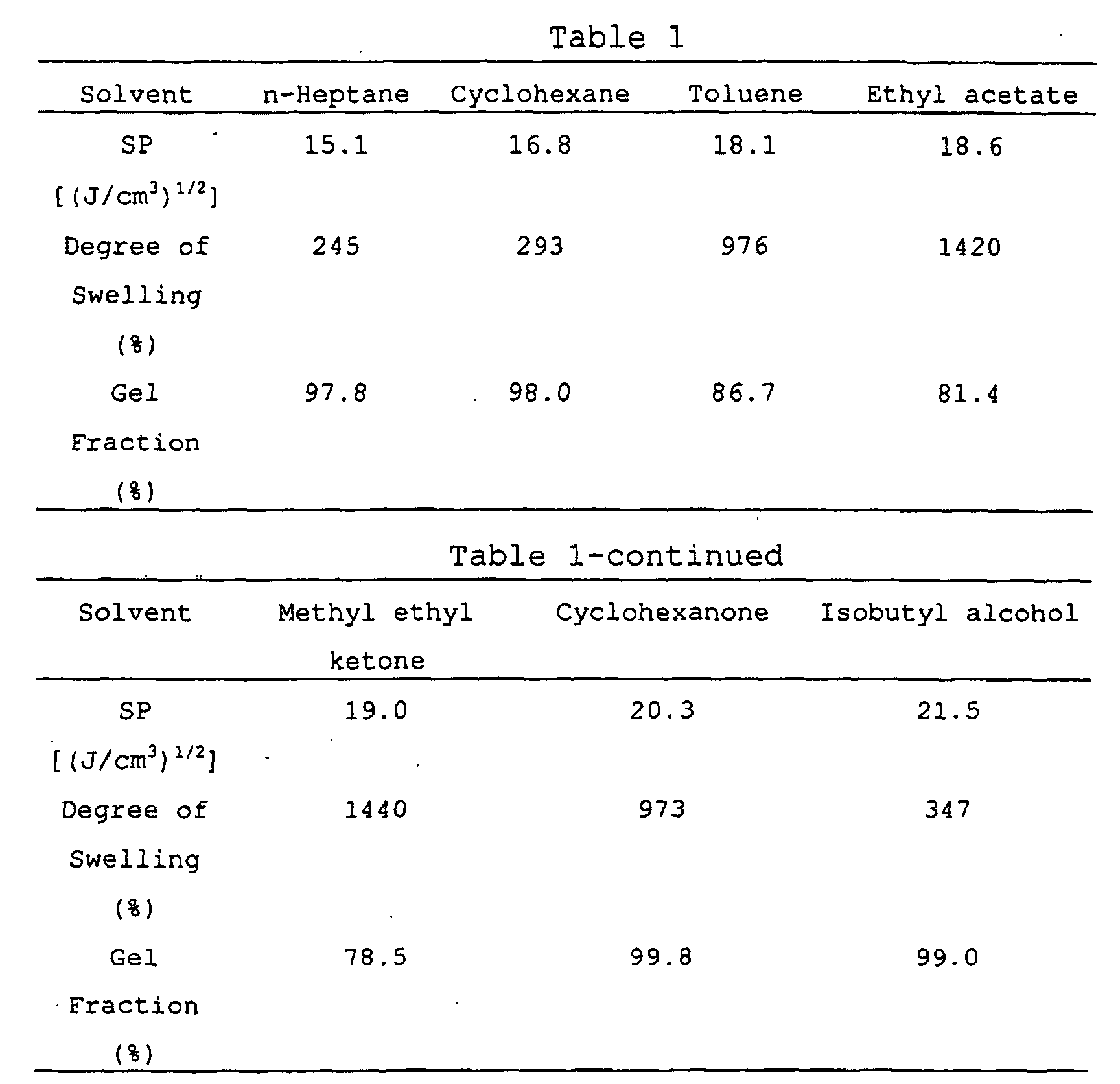
Typical solvents for use in the determination of the
solubility parameter (SP) of the pressure-sensitive adhesive
include, for example, n-heptane (15.1), cyclohexane (16.8),
toluene (18.1), ethyl acetate (18.6), methyl ethyl ketone
(19.0), cyclohexanone (20.3), isobutyl alcohol (21.5), and
isopropyl alcohol (23.5). The figures in the parentheses are
solubility parameters (SPs) [(J/cm3)1/2].
The degree of swelling and gel fraction of the
pressure-sensitive adhesive can be determined in the
following manner:
In the above determination, when a highly viscous solvent
is used, a nylon gauze can be used instead of the Teflon film.
When a high boiling solvent is used, the drying temperature
should be set in the vicinity of the boiling point of the
solvent.
When the pressure-sensitive adhesive is polyisobutylene
or another pressure-sensitive adhesive that is not
crosslinked and completely dissolves out in a solvent, the
solubility parameter (SP) of the pressure-sensitive adhesive
can be determined in the same manner as above, except that the
time period for immersing the sample in the solvent is
shortened. Alternatively, the solve-out rate of the
pressure-sensitive adhesive is calculated from the test
results, and the solubility parameter (SP) of a solvent, in
which the pressure-sensitive adhesive exhibits the maximum
solve-out rate, may be determined as the solubility parameter
(SP) (typical) of the pressure-sensitive adhesive.
When the solubility parameter (SP) of the polymer of the
pressure-sensitive adhesive in question is listed as a value
obtained as a result of precedent tests or calculation in
literature such as "Polymer Handbook" (John Wiley & Sons,
Inc.), the listed value may be employed as the solubility
parameter (SP) δ1 of the pressure-sensitive adhesive for use
in the present invention.
The solubility parameter (SP) δ2 [(J/cm3)1/2] of the
solvent contained in the solvent-containing substance to be
removed can also be determined by calculation according to the
Fedors method or from known data books. When plural solvents
are contained in the solvent-containing substance to be
removed, the total sum of the products of the solubility
parameters (SPs) and molar fractions of the individual
solvents can be used as the solubility parameter (SP) δ2.
However, if at least one of the plural solvents is a solvent
that does not solve the pressure-sensitive adhesive, the
degree of swelling or gel fraction is determined according to
the above method using plural polymers having known SPs listed
in literature such as "Polymer Handbook", and SP of a polymer
which exhibits the maximum degree of swelling or the minimum
gel fraction can be defined as the solubility parameter (SP)
δ2 of the solvent mixture composed of the plural solvents. The
solubility parameter (SP) δ2 of the solvent mixture can also
be determined by calculation from the value of latent heat of
evaporation, vapor pressure, or other physical properties by
known techniques.
In the invented sheet 4 for removal of a
solvent-containing substance, the solubility parameter of a
pressure-sensitive adhesive constituting the
pressure-sensitive adhesive layer of the pressure-sensitive
adhesive sheet is in a specific relation with the solubility
parameter of a solvent contained in the solvent-containing
substance to be removed, and the invented pressure-sensitive
adhesive sheet can therefore rapidly absorb the solvent and
can maintain its tackiness. Accordingly,'the
pressure-sensitive adhesive sheet can reliably adhere to and
remove solvent-containing substances deposited on, for
example, machines or floors, without broadening stains toward
surroundings. Additionally, the invented sheet 4 can easily
clean an article to be cleaned without damaging the article
and without broadening stains and can be applied to a wide
variety of articles to be cleaned and solvent-containing
substances (deposits) to be removed. Accordingly, the
invented sheet 4 for removal of a solvent-containing substance
can realize cleaning operations using an adhesive sheet in
printing and painting processes, which cleaning operations
have been performed only by wiping with wastes (wiping rags).
The invented removing method 4 includes, as described
above, the steps of (a) determining the solubility parameter
(SP) δ1 [(J/cm3)1/2] of a pressure-sensitive adhesive
constituting a pressure-sensitive adhesive layer, (b)
determining the solubility parameter (SP) δ2 [(J/cm3)1/2] of a
solvent contained in a solvent-containing substance to be
removed, and (c) selecting such a pressure-sensitive adhesive
sheet that a difference Δδ between δ1 and δ2 falls within a range
of ±4 [(J/cm3)1/2] and removing the solvent-containing
substance with the use of the selected pressure-sensitive
adhesive sheet. According to this method, once SP of a
pressure-sensitive adhesive constituting the
pressure-sensitive adhesive layer in each pressure-sensitive
adhesive sheet is determined, a usable pressure-sensitive
adhesive sheet can be rapidly selected depending on the type
(structure) of the solvent contained in the
solvent-containing substance to be removed which is deposited
on an article to be cleaned.
An important feature of the invented sheet 5 for removal
of a solvent-containing substance is that the
pressure-sensitive adhesive layer contains fine particles.
The pressure-sensitive adhesive layer containing fine
particles can be prepared by adding and dispersing the fine
particles into a pressure-sensitive adhesive, and applying
the resulting pressure-sensitive adhesive composition to a
substrate. Such fine particles are not specifically limited
as far as they are not miscible with the pressure-sensitive
adhesive and include, for example, organic fine particles
comprising poly(methyl methacrylate) resins, melamine resins,
and other synthetic resins or natural resins; inorganic fine
particles comprising amorphous silica, alumina and other
inorganic oxides, inorganic hydroxides and inorganic salts.
The content of the fine particles in the
pressure-sensitive adhesive layer depends on the type of the
fine particles and is generally from about 5 to about 70 parts
by weight, and preferably from about 10 to about 50 parts by
weight relative to 100 parts by weight of the base polymer
constituting the pressure-sensitive adhesive layer (a base
polymer of the pressure-sensitive adhesive).
The pressure-sensitive adhesive layer containing the
fine particles does not necessarily require to be prepared by
adding and dispersing fine particles to a pressure-sensitive
adhesive and applying the resulting pressure-sensitive
adhesive composition. It is enough that the resulting
pressure-sensitive adhesive layer contains dispersed fine
particles even though the pressure-sensitive adhesive
composition is at first uniform. For example, when the
pressure-sensitive adhesive layer is formed by applying a
solvent-containing pressure-sensitive adhesive to a
substrate, the pressure-sensitive adhesive layer containing
fine particles can also be obtained in the following manner:
A uniform pressure-sensitive adhesive composition containing
components incorporated with each other, the solvent is
removed by drying, and domains in the form of fine particles
mainly containing a non-adhesive component are formed by phase
separation. These domains in the form of fine particles such
as in the island-in-sea structure are also included in the
scope of the "fine particles" for use in the present invention.
More specifically, the pressure-sensitive adhesive layer
containing fine particles can be prepared by adding a
component to a pressure-sensitive adhesive composition before
application, which component is soluble in the solvent for the
application of the pressure-sensitive adhesive and becomes
insoluble with the base polymer constituting the
pressure-sensitive adhesive after application and drying. A
typical example of such processes includes a process in which
a crosslinking agent such as an isocyanate crosslinking agent
is added to an acrylic pressure-sensitive adhesive in excess
(e.g., from about 10 to about 30 parts by weight relative to
100 parts by weight of the acrylic polymer), and the resulting
composition is applied to a substrate to thereby form the
pressure-sensitive adhesive layer. Alternatively, a vinyl
chloride resin, vinyl acetate resin, a copolymer thereof, or
a vinyl chloride-methyl methacrylate copolymer is added to an
acrylic or rubber pressure-sensitive adhesive, and the
resulting composition is applied to a substrate to thereby
form the pressure-sensitive adhesive layer.
The fine particles have a mean particle size of, for
example, from about 0.01 to about 10 µm, and preferably from
about 0.01 to about 5 µm. If the fine particles have a mean
particle size of less than 0.01 µm, the resulting
pressure-sensitive adhesive sheet has excessively high
tackiness and becomes resistant to be peeled off from an
article to be cleaned such as a screen printing plate. If the
fine particles have a mean particle size exceeding 10 µm, the
resulting pressure-sensitive adhesive sheet may have
excessively low tackiness and to thereby less effectively
remove a solvent-containing substance such as a paste turned
about the back of the screen printing plate.
In the sheet 5 for removal of a solvent-containing
substance, the pressure-sensitive adhesive layer preferably
has a tackiness (adhesive strength) of from about 50 to about
400 cN/25-mm, and more preferably from about 100 to about 350
cN/25-mm as determined by the method in conformity with JIS
Z 0237, in which a SUS 430BA plate is used as a test plate,
and the tackiness is measured after 1-minute contact-bonding
of the pressure-sensitive adhesive sheet and the test plate.
In general, the property for removing a paste decreases with
a decreasing tackiness. However, the present invention can
markedly decrease damage of the screen printing plate while
maintaining the property for removing a paste at high level,
since the tackiness of the pressure-sensitive adhesive layer
is reduced by the addition or formation of the fine particles.
According to the invented sheet 5 for removal of a
solvent-containing substance and removing method 5, the
pressure-sensitive adhesive layer has a decreased apparent
tackiness due to the presence of the fine particles in the
pressure-sensitive adhesive layer even if the
pressure-sensitive adhesive inherently has a high tackiness.
The pressure-sensitive adhesive sheet can therefore peel off
a solvent-containing substance such as a paste turned about
the back of a screen printing plate from an article to be
cleaned such as the screen printing plate with an appropriate
force, while maintaining the property for removing the
solvent-containing substance. Thus, the pressure-sensitive
adhesive sheet does not damage the article to be cleaned.
In the invented sheet 6 for removal of a
solvent-containing substance, when a pressure-sensitive
adhesive layer is formed on a substrate, the configuration of
the pressure-sensitive adhesive layer is the same as in those
mentioned above. The tackiness (adhesive strength) of the
pressure-sensitive adhesive layer can be appropriately set in
consideration of the property for removing the
solvent-containing substance and the peeling property of the
pressure-sensitive adhesive sheet from the article to be
treated (article to be cleaned), depending on the application
thereof. The tackiness is preferably from about 10 to about
400 cN/25-mm, and more preferably from about 20 to about 350
cN/25-mm as determined by the method in conformity with JIS
Z 0237, in which a SUS 430BA plate is used as a test plate,
and the tackiness is measured after 1-minute contact-bonding
of the pressure-sensitive adhesive sheet and the test plate.
When a foam layer is formed on a substrate in the invented
sheet 6 for removal of a solvent-containing substance, resins
for constituting the foam layer are not specifically limited
as far as they are foamable resins. Such resins include, for
example, rubbers, acrylic resins, urethane resins, olefinic
resins, silicone resins, vinyl ether resins, styrenic resins,
vinyl chloride resins, phenolic resins, urea resins, and epoxy
resins. Among these resins, preferred are tacky resins such
as rubbers (e.g., natural rubbers, styrene-butadiene
copolymer rubbers, polyisobutylenes, butyl rubbers,
reclaimed rubbers, rubber latex, styrene-isoprene-styrene
block copolymers, polybutadienes, chloroprene rubbers, and
acrylic rubbers), acrylic resins (e.g., acrylic resins each
mainly containing a C2-C10 alkyl acrylate as a base monomer and
having Tg of from about -20°C to about -70°C; and
styrene-acrylic ester copolymers), urethane resins, olefinic
resins (e.g., polyethylenes; polypropylenes;
ethylene-propylene copolymers, ethylene-vinyl acetate
copolymers, ethylene-acrylic ester copolymers, and other
ethylenic copolymers), and silicone resins. The resins may
be crosslinked. Each of these resins can be used alone or in
combination.
The expansion ratio of the foam layer depends on the type
of the resin and the process of foaming and is, for example,
from about 1.2 to about 100 times. The foam layer may further
comprise various additives such as plasticizers, antioxidants,
flame retarders, UV absorbers, coloring agents, fillers,
pressure-sensitive adhesives, tackifiers, and crosslinking
agents.
The thickness of the foam layer can be appropriately
selected within a range not deteriorating the strength and
workability and is, for example, from about 0.05 to about 5
mm, and preferably from about 0.1 to about 2 mm. The sheet
may further comprise a primer coat or other additional layers
between the substrate and the foam layer. The foam layer may
be formed on both sides of the substrate.
A surface of the foam layer preferably has such a
tackiness that the sheet can adhere to an article to be treated
such as a screen printing plate and can be easily peeled off
from the article without significant resistance. In a
preferred embodiment, the surface of the foam layer has a
tackiness of, for example, from about 1 to 200 cN/25-mm as
determined by the method in conformity with JIS Z 0237, in
which a SUS 430BA plate is used as a test plate, and the
tackiness is measured after 1-minute contact-bonding of the
pressure-sensitive adhesive sheet and the test plate. The
tackiness can be controlled by appropriately selecting the
type of the resin constituting the foam layer, and the types
and amounts of incorporated additives.
Of the invented sheets 6 for removal of a
solvent-containing substance, the removing sheet having the
foam layer on a substrate can be prepared by conventional
foaming techniques such as extrusion foaming and injection
foaming. Alternatively, the sheet can be prepared by
applying a mixture containing a resin to constitute the foam
layer and an appropriate foaming agent to a substrate, and
heating and foaming the applied mixture. A foaming process
can be appropriately selected, for example, depending on the
type of the resin, from any processes. Such processes include
a process in which the mixture is foamed by mechanical
agitation (mechanical foaming), a process using a gas produced
as a result of reaction, a process using a foaming agent (a
volatile foaming agent or decomposable foaming agent), a
process in which a soluble substance is removed, a process of
foaming the mixture by spraying, a process in which a syntactic
foam is formed, and a sintering process.
An important feature of the invented sheet 6 for removal
of a solvent-containing substance is that the sheet for
removal of a solvent-containing substance as mentioned above
has been subjected to antistatic treatment. Processes for
subjecting the sheet to antistatic treatment are not
specifically limited and include, for example, (i) processes
in which an electrically conductive layer is formed in at least
one region selected from a surface on the substrate side, a
surface on the pressure-sensitive adhesive layer side or foam
layer side, and an interface between the substrate and the
pressure-sensitive adhesive layer or foam layer, (ii)
processes in which an agent for imparting electrical
conductivity (e.g., an antistatic agent or electrically
conductive substance) is added to a material constituting the
substrate, (iii) processes in which a material itself
constituting the substrate is composed of an electrically
conductive substance, and (iv) processes in which an agent for
imparting electrical conductivity (e.g., an antistatic agent
or electrically conductive substance) is added to the
pressure-sensitive adhesive layer or foam layer.
The processes (i) include, for example, a process in which
a thin film layer of a metal, metal oxide or another
electrically conductive substance is formed on a surface of,
for example, the substrate by electroplating, electroless
plating, vacuum deposition, sputtering, or ion plating; a
process in which a metallic foil is laminated onto, for example,
the substrate to thereby form a metal thin film layer; and a
process in which a coat of a composition containing an agent
for imparting electrical conductivity is applied to a surface
of, for example, the substrate. The thickness of the
electrically conductive layer can be appropriately set, for
example, depending on the process for the formation of the
electrically conductive layer.
The processes (ii) include, for example, a process in
which an agent for imparting electrical conductivity is
kneaded into a material constituting the substrate; and a
process in which a material constituting the substrate is
impregnated with a solution or dispersion containing an agent
for imparting electrical conductivity. The processes (iii)
include, for example, a process in which the substrate is
composed of a metallic foil (e.g., a foil of copper, aluminium,
nickel, iron, lead or silver). The processes (iv) include,
for example, a resin composition containing a resin for
constituting the pressure-sensitive adhesive layer or foam
layer and an agent for imparting electrical conductivity is
subjected to a conventional molding to thereby form the
pressure-sensitive adhesive layer or foam layer; and a process
in which an electrically conductive polymer is used as a resin
for constituting the pressure-sensitive adhesive layer or
foam layer.
Such agents for imparting electrical conductivity
include, but are not limited to, copper, nickel, aluminium,
iron, chromium, cobalt, antimony, molybdenum, silver,
platinum, gold, and other metals or alloys of these metals
(e.g., fine powders or fibers) ; carbon black and other carbons
(e.g., powders or fibers); electrically conductive tin oxide,
silica, zinc oxide and other inorganic oxides such as metal
oxides; anionic antistatic agents (e.g., alkyl sulfate
antistatic agents, alkyl aryl sulfate antistatic agents,
alkyl phosphate antistatic agents, and alkylamine sulfate
antistatic agents), cationic antistatic agents (e.g.,
quaternary ammonium salt antistatic agents, quaternary
ammonium resin antistatic agents, and imidazoline antistatic
agents), nonionic antistatic agents (e.g., sorbitan
antistatic agents, ether antistatic agents, amine and amide
antistatic agents, ethanolamide antistatic agents, and
polyethylene glycol antistatic agents), amphoteric
antistatic agents (e.g., betaine antistatic agents), and
other surfactant-based antistatic agents; TCNQ
(tetracyanoquinodimethane), polyene polymers (e.g.,
polyacetylene), aromatic polymers [e.g., poly(p-phenylene)
and poly(2,6-naphthalene)], heterocyclic polymers [e.g.,
polypyrrole, poly(2,5-thienylene) and
poly(pyridine-2,5-diyl)], hetero-chain polymers [e.g.,
poly(phenylene sulfide) and polyaniline], copolymerized
polymers [e.g., copoly(phenylene/vinylene) and
poly(dithienylpolyene)], ladder polymers (e.g., polyacenes),
and other electrically conductive polymers (organic
semiconductor polymers). Each of these agents for imparting
electrical conductivity can be used alone or in combination.
The amount of the agent for imparting electrical
conductivity can be appropriately selected depending on a
process for subjecting the sheet for removal of a
solvent-containing substance to antistatic treatment within
a range not deteriorating film-forming property or other
properties.
In the invented sheet 6 for removal of a
solvent-containing substance, at least one (preferably both)
of both sides of the sheet has a surface resistivity of
preferably 1013 Ω or less (e.g., from about 10° Ω to about 1013
Ω) and more preferably 1011 Ω or less (e.g., from about 10°
Ω to about 1011 Ω). The surface resistivity can be controlled
by appropriately selecting, for example, the type and amount
of the agent for imparting electrical conductivity.
According to the invented sheet 6 for removal of a
solvent-containing substance and removing method 6, the
pressure-sensitive adhesive layer or foam layer is formed at
least on one side of the substrate, and the sheet can
efficiently remove a solvent-containing substance by such an
easy operation that the sheet is stuck to or pressed to and
peeled off from the solvent-containing substance. Such
solvent-containing substances include, for example, a paste
(an ink) for use in screen printing or an ink deposited on a
roll of a printing machine such as an offset printing machine.
Additionally, the sheet has been subjected to antistatic
treatment and can therefore prevent electrostatic buildup.
Consequently, there is no need of static eliminators,
malfunctions caused by static electricity are avoided, and
yields and operating ratio of facilities are improved.
Industrial Applicability
The invented sheets for removal of a solvent-containing
substance can be used for cleaning of articles carrying
deposited solvent-containing substances (specifically,
semisolid substances). Such solvent-containing substances
include, for example, a paste (an ink) deposited on a screen
printing plate, an ink deposited on a roll of a printing
machine such as an offset printing machine, an ink stain in
the vicinity of an ink jet orifice of an ink jet printer, and
a paint deposited on an article, floor or wall. The sheets
are specifically suitable as cleaning sheets for removal of
a paste (an ink) turned about the back of a screen printing
plate.
According to the invented sheets for removal of a
solvent-containing substance and removing methods, the sheets
can reliably adhere to and remove solvent-containing
substances and can highly efficiently remove these
solvent-containing substances. Such solvent-containing
substances include, for example, a paste turned about the back
of a screen printing plate, an ink remained in a blanket
cylinder of an offset printing machine, and an ink stain in
the vicinity of an ink jet orifice of an ink jet printer.
In the invented sheet for removal of a solvent-containing
substance and removing method, the pressure-sensitive
adhesive layer can absorb at least a predetermined amount of
a solvent and has extra absorptivity of the solvent, and the
sheets can reliably adhere to and remove a solvent-containing
substance deposited on an article to be treated, such as a
paste turned about the back of a screen printing plate.
According to the invented sheet for removal of a
solvent-containing substance and removing method, the
pressure-sensitive adhesive layer can absorb at least a
predetermined amount of a solvent in a short time and has a
tackiness within a specific range after absorbing the solvent,
and the sheet can reliably and efficiently adhere to and remove
a solvent-containing substance deposited on an article to be
treated, such as a paste turned about the back of a screen
printing plate. The invented sheet and removing method can
therefore reduce imperfect printing due to bleeding in screen
printing, can shorten the time of cleaning for rolls to thereby
improve productivity in offset printing, gravure printing and
flexographic printing.
The invented pressure-sensitive adhesive sheet and
removing method have features in that the pressure-sensitive
adhesive layer can absorb at least a predetermined amount of
a solvent in a short time and that the components of the
pressure-sensitive adhesive layer do not migrate into an
adherend in a predetermined peel test after absorbing a
predetermined amount of the solvent. Accordingly, the sheet
and removing method can efficiently remove a
solvent-containing substance deposited on an article to be
treated and can avoid contamination or stain of a surface of
the article to be treated with the components of the
pressure-sensitive adhesive layer after removal of the
solvent-containing substance. When, for example, a paste
turned about the back of a screen printing plate is removed,
a printed matter is not stained to thereby increase yields in
printing.
According to the invented pressure-sensitive adhesive
sheet for removal of a solvent-containing substance and
removing method, the solubility parameter of a
pressure-sensitive adhesive constituting the
pressure-sensitive adhesive layer of the pressure-sensitive
adhesive sheet is in a specific relation with the solubility
parameter of a solvent contained in the solvent-containing
substance to be removed, and the invented cleaning sheet
therefore can rapidly absorb the solvent and can maintain its
tackiness. Accordingly, the pressure-sensitive adhesive
sheet can reliably adhere to and remove solvent-containing
substances deposited on, for example, machines or floors,
without broadening stains toward surroundings and without
damaging the article to be cleaned. Additionally, the
invented sheet and removing method can easily clean an article
to be cleaned without damaging the article and without
broadening stains toward surroundings and can be applied to
a wide variety of articles to be cleaned and
solvent-containing substances (deposits) to be removed. The
invented pressure-sensitive adhesive sheet and removing
method can therefore realize cleaning operations using
pressure-sensitive adhesive sheets in printing and painting
processes, which cleaning operations have been performed only
by wiping with wastes (wiping rags). The invented removing
method can rapidly select and use an optimum
pressure-sensitive adhesive sheet depending on the type of a
solvent contained in the solvent-containing substance
deposited on an article to be cleaned, without subjecting a
variety of pressure-sensitive adhesive sheets to actual
testing.
In the invented pressure-sensitive adhesive sheet for
removal of a solvent-containing substance and removing method,
the pressure-sensitive adhesive layer comprises fine
particles. Accordingly, the pressure-sensitive adhesive
sheet can have an appropriately controlled tackiness, can
satisfactorily remove a solvent-containing substance such as
a paste turned about the back of a screen printing plate and
can peel off the solvent-containing substance without
damaging an article to be cleaned such as the screen printing
plate.
The invented sheet for removal of a solvent-containing
substance and removing method can efficiently remove a
solvent-containing substance such as a paste turned about the
back of a screen printing plate while preventing electrostatic
buildup. Consequently, there is no need of static
eliminators, malfunctions caused by static electricity are
avoided, and yields and operating ratio of facilities are
improved.
EXAMPLES
The present invention will be illustrated in further
detail with reference to several examples below, which are not
intended to limit the scope of the invention. Figures within
parentheses after the name of a solvent in Examples 13 and 14
are solubility parameters (SPs) [(J/cm3)1/2].
EXAMPLE 1
A pressure-sensitive adhesive sheet was prepared by
applying an acrylic pressure-sensitive adhesive to a
thickness after drying of 10 µm to one side of a polyethylene
film (substrate) 0.06 mm thick, and drying the applied acrylic
pressure-sensitive adhesive. The acrylic
pressure-sensitive adhesive was composed of 100 parts by
weight of a copoly(butyl acrylate/acrylonitrile/acrylic
acid) (weight ratio: 90/10/2) and 15 parts by weight of an
isocyanate crosslinking agent.
The pressure-sensitive adhesive sheet before use had a
tackiness (adhesive strength) of 140 cN/25-mm as determined
by the method in conformity with JIS Z 0237, in which a SUS
430BA plate was used as a test plate, and the tackiness was
measured after 1-minute contact-bonding of the
pressure-sensitive adhesive sheet with the test plate.
The above-prepared pressure-sensitive adhesive sheet was
cut to a size of 30 mm times 30 mm (30 mm x 30 mm), was weighed,
was immersed in a solvent [diethylene glycol monobutyl ether
acetate/diethylene glycol monobutyl ether (weight ratio:
9/1)] for 3 minutes, was taken out from the solvent, the
solvent deposited on a surface of the sheet was immediately
wiped off with a waste rag, the sheet was then weighed again,
and the solvent absorption per unit area was calculated to find
to be 35 g/m2.
The pressure-sensitive adhesive sheet was then stuck to
and peeled off from the back of a screen printing plate, which
had been used a predetermined number of times and carried a
paste (a fluorescent paste for use in the manufacture of a
plasma display panel) turned about the back. As a result, the
pressure-sensitive adhesive sheet could be satisfactorily
peeled off from the screen printing plate and could fully
remove the turned-about paste.
EXAMPLE 2
A pressure-sensitive adhesive sheet was prepared by
applying an acrylic pressure-sensitive adhesive to a
thickness after drying of 5 µm to one side of a
polypropylene/polyethylene (weight ratio: 90/10) blend film
(substrate) 0.04 mm thick, and drying the applied acrylic
pressure-sensitive adhesive. The acrylic
pressure-sensitive adhesive was composed of 100 parts by
weight of a copoly(butyl acrylate/acrylonitrile/acrylic
acid) (weight ratio: 90/10/2), 7 parts by weight of a terpene
phenol tackifier, 3 parts by weight of an isocyanate
crosslinking agent, and 1 part by weight of a phosphate
surfactant.
The tackiness before use and solvent absorption of the
above-prepared pressure-sensitive adhesive sheet were 150
cN/25-mm and 33 g/m2, respectively, as determined in the same
manner as in Example 1.
The pressure-sensitive adhesive sheet was then stuck to
and peeled off from the back of a screen printing plate, which
had been used a predetermined number of times and carried a
paste (a fluorescent paste for use in the manufacture of a
plasma display panel) turned about the back. As a result, the
pressure-sensitive adhesive sheet could be satisfactorily
peeled off from the screen printing plate and could fully
remove the turned-about paste.
EXAMPLE 3
A pressure-sensitive adhesive sheet was prepared by
applying an acrylic pressure-sensitive adhesive to a
thickness after drying of 10 µm to one side of a polyethylene
film (substrate) 0.06 mm thick, and drying the applied acrylic
pressure-sensitive adhesive. The acrylic
pressure-sensitive adhesive was composed of 100 parts by
weight of a copoly(butyl acrylate/acrylic acid) (weight
ratio: 96/4) and 15 parts by weight of an isocyanate
crosslinking agent.
The tackiness before use and solvent absorption of the
above-prepared pressure-sensitive adhesive sheet were 180
cN/25-mm and 25 g/m2, respectively, as determined in the same
manner as in Example 1.
The pressure-sensitive adhesive sheet was then stuck to
and peeled off from the back of a screen printing plate, which
had been used a predetermined number of times and carried a
paste (a fluorescent paste for use in the manufacture of a
plasma display panel) turned about the back. As a result, the
pressure-sensitive adhesive sheet could be satisfactorily
peeled off from the screen printing plate and could fully
remove the turned-about paste.
EXAMPLE 4
A pressure-sensitive adhesive sheet was prepared by
applying an acrylic pressure-sensitive adhesive to a
thickness after drying of 10 µm to one side of a polyethylene
film (substrate) 0.06 mm thick, and drying the applied acrylic
pressure-sensitive adhesive. The acrylic
pressure-sensitive adhesive was composed of 100 parts by
weight of a copoly(butyl acrylate/acrylonitrile/acrylic
acid) (weight ratio: 90/10/2) and 0.5 part by weight of an
epoxy crosslinking agent.
The tackiness before use and solvent absorption of the
above-prepared pressure-sensitive adhesive sheet were 140
cN/25-mm and 28 g/m2, respectively, as determined in the same
manner as in Example 1.
The pressure-sensitive adhesive sheet was then stuck to
and peeled off from the back of a screen printing plate, which
had been used a predetermined number of times and carried a
paste (a fluorescent paste for use in the manufacture of a
plasma display panel) turned about the back. As a result, the
pressure-sensitive adhesive sheet could be satisfactorily
peeled off from the screen printing plate and could fully
remove the turned-about paste.
COMPARATIVE EXAMPLE 1
A pressure-sensitive adhesive sheet was prepared by
applying an acrylic pressure-sensitive adhesive to a
thickness after drying of 10 µm to one side of a polyethylene
film (substrate) 0.06 mm thick, and drying the applied acrylic
pressure-sensitive adhesive. The acrylic
pressure-sensitive adhesive was composed of 100 parts by
weight of a copoly(butyl acrylate/ acrylic acid) (weight
ratio: 96/4), 8 parts by weight of a rosin tackifier, and 2
parts by weight of an epoxy crosslinking agent.
The tackiness before use and solvent absorption of the
above-prepared pressure-sensitive adhesive sheet were 110
cN/25-mm and 15 g/m2, respectively, as determined in the same
manner as in Example 1.
The pressure-sensitive adhesive sheet was then stuck to
and peeled off from the back of a screen printing plate, which
had been used a predetermined number of times and carried a
paste (a fluorescent paste for use in the manufacture of a
plasma display panel) turned about the back. As a result, the
pressure-sensitive adhesive sheet could be peeled off from the
screen printing plate without problems, but the paste was
remained on the back of the screen printing plate.
COMPARATIVE EXAMPLE 2
A pressure-sensitive adhesive sheet was prepared by
applying polyisobutylene as a pressure-sensitive adhesive to
a thickness after drying of 7 µm to one side of a
polypropylene/polyethylene (weight ratio: 90/10) blend film
(substrate) 0.04 mm thick, and drying the applied
pressure-sensitive adhesive.
The tackiness before use and solvent absorption of the
above-prepared pressure-sensitive adhesive sheet were 500
cN/25-mm and 1 g/m2, respectively, as determined in the same
manner as in Example 1.
The pressure-sensitive adhesive sheet was then stuck to
and peeled off from the back of a screen printing plate, which
had been used a predetermined number of times and carried a
paste (a fluorescent paste for use in the manufacture of a
plasma display panel) turned about the back. As a result, the
pressure-sensitive adhesive sheet could be neither
satisfactorily peeled off from the screen printing plate nor
sufficiently remove the turned-about paste.
EXAMPLE 5
A pressure-sensitive adhesive sheet was prepared by
applying an acrylic pressure-sensitive adhesive to a
thickness after drying of 10 µm to one side of a polyethylene
film (substrate) 0.06 mm thick, and drying the applied acrylic
pressure-sensitive adhesive. The acrylic
pressure-sensitive adhesive was composed of 100 parts by
weight of a copoly(butyl acrylate/acrylonitrile/acrylic
acid) (weight ratio: 90/10/2) and 15 parts by weight of an
isocyanate crosslinking agent.
The tackiness before use of the pressure-sensitive
adhesive sheet was 140 cN/25-mm (140 gf/25-mm) as determined
by the method in conformity with JIS Z 0237, in which a SUS
430BA plate was used as a test plate and the tackiness was
measured after 1-minute contact-bonding of the
pressure-sensitive adhesive sheet and the test plate. The
above-prepared pressure-sensitive adhesive sheet was cut to
a size of 30 mm times 30 mm (30 mm x 30 mm), was weighed, was
immersed in a solvent [diethylene glycol monobutyl ether
acetate/diethylene glycol monobutyl ether (weight ratio:
9/1)] for 1 second, was taken out from the solvent, the solvent
deposited on a surface of the sheet was immediately wiped off
with a waste rag, the sheet was then weighed again, and the
solvent absorption per unit area was calculated to find to be
10 g/m2. Separately, 5 g/m2 of the solvent was applied to a
poly(ethylene terephthalate) film using a wire bar, the
pressure-sensitive adhesive sheet having the same size as
above was stuck to the film carrying the solvent to thereby
permit the pressure-sensitive adhesive layer of the
pressure-sensitive adhesive sheet to absorb 5 g/m2 of the
solvent, and the tackiness of the pressure-sensitive adhesive
sheet was then determined in the same manner as above to find
to be 5 cN/25-mm (5 gf/25-mm).
The pressure-sensitive adhesive sheet was then stuck to
and peeled off from the back of a screen printing plate, which
had been used a predetermined number of times and carried a
paste (a fluorescent paste for use in the manufacture of a
plasma display panel) turned about the back. As a result, the
pressure-sensitive adhesive sheet could be satisfactorily
peeled off from the screen printing plate and could fully
remove the turned-about paste.
EXAMPLE 6
A pressure-sensitive adhesive sheet was prepared by
applying an acrylic pressure-sensitive adhesive to a
thickness after drying of 5 µm to one side of a
polypropylene/polyethylene (weight ratio: 90/10) blend film
(substrate) 0.04 mm thick, and drying the applied acrylic
pressure-sensitive adhesive. The acrylic
pressure-sensitive adhesive was composed of 100 parts by
weight of a copoly(butyl acrylate/acrylonitrile/acrylic
acid) (weight ratio: 90/10/2), 7 parts by weight of a terpene
phenol tackifier, 3 parts by weight of an isocyanate
crosslinking agent, and 1 part by weight of a phosphate
surfactant.
The tackiness before use, solvent absorption and
tackiness after absorbing the solvent of the above-prepared
pressure-sensitive adhesive sheet were 150 cN/25-mm (150
gf/25-mm), 17 g/m2 and 3 cN/25-mm (3 gf/25-mm), respectively,
as determined in the same manner as in Example 5.
The pressure-sensitive adhesive sheet was then stuck to
and peeled off from the back of a screen printing plate, which
had been used a predetermined number of times and carried a
paste (a fluorescent paste for use in the manufacture of a
plasma display panel) turned about the back. As a result, the
pressure-sensitive adhesive sheet could be satisfactorily
peeled off from the screen printing plate and could fully
remove the turned-about paste.
EXAMPLE 7
A pressure-sensitive adhesive sheet was prepared by
applying an acrylic pressure-sensitive adhesive to a
thickness after drying of 15 µm to one side of a polyethylene
film (substrate) 0.06 mm thick, and drying the applied acrylic
pressure-sensitive adhesive. The acrylic
pressure-sensitive adhesive was composed of 100 parts by
weight of a copoly(2-ethylhexyl acrylate/vinyl
acetate/acrylic acid) (weight ratio: 60/30/5), 30 parts by
weight of a terpene phenol tackifier, 7 parts by weight of an
isocyanate crosslinking agent, and 1 part by weight of a
phosphate surfactant.
The tackiness before use, solvent absorption and
tackiness after absorbing the solvent of the above-prepared
pressure-sensitive adhesive sheet were 130 cN/25-mm (130
gf/25-mm), 19 g/m2 and 31 cN/25-mm (32 gf/25-mm), respectively,
as determined in the same manner as in Example 5.
The pressure-sensitive adhesive sheet was then stuck to
and peeled off from the back of a screen printing plate, which
had been used a predetermined number of times and carried a
paste (a fluorescent paste for use in the manufacture of a
plasma display panel) turned about the back. As a result, the
pressure-sensitive adhesive sheet could be satisfactorily
peeled off from the screen printing plate and could fully
remove the turned-about paste.
COMPARATIVE EXAMPLE 3
A pressure-sensitive adhesive sheet was prepared by
applying an acrylic pressure-sensitive adhesive to a
thickness after drying of 10 µm to one side of a polyethylene
film (substrate) 0.06 mm thick, and drying the applied acrylic
pressure-sensitive adhesive. The acrylic
pressure-sensitive adhesive was composed of 100 parts by
weight of a copoly(butyl acrylate/acrylic acid) (weight
ratio: 96/4), 8 parts by weight of a rosin tackifier, and 5
parts by weight of an epoxy crosslinking agent.
The tackiness before use, solvent absorption and
tackiness after absorbing the solvent of the above-prepared
pressure-sensitive adhesive sheet were 110 cN/25-mm (110
gf/25-mm), 9 g/m2 and 0 cN/25-mm (0 gf/25-mm), respectively,
as determined in the same manner as in Example 5.
The pressure-sensitive adhesive sheet was then stuck to
and peeled off from the back of a screen printing plate, which
had been used a predetermined number of times and carried a
paste (a fluorescent paste for use in the manufacture of a
plasma display panel) turned about the back. As a result, the
pressure-sensitive adhesive sheet could be peeled off from the
screen printing plate without problems, but the paste was
remained on the back of the screen printing plate.
COMPARATIVE EXAMPLE 4
A pressure-sensitive adhesive sheet was prepared by
applying polyisobutylene as a pressure-sensitive adhesive to
a thickness after drying of 7 µm to one side of a
polypropylene/polyethylene (weight ratio: 90/10) blend film
(substrate) 0.04 mm thick, and drying the applied
pressure-sensitive adhesive.
The tackiness before use, solvent absorption and
tackiness after absorbing the solvent of the above-prepared
pressure-sensitive adhesive sheet were 490 cN/25-mm (500
gf/25-mm), 1 g/m2 and 0 cN/25-mm (0 gf/25-mm), respectively,
as determined in the same manner as in Example 5.
The pressure-sensitive adhesive sheet was then stuck to
and peeled off from the back of a screen printing plate, which
had been used a predetermined number of times and carried a
paste (a fluorescent paste for use in the manufacture of a
plasma display panel) turned about the back. As a result, the
pressure-sensitive adhesive sheet could neither be
satisfactorily peeled off from the screen printing plate nor
sufficiently remove the turned-about paste.
EXAMPLE 8
A pressure-sensitive adhesive sheet was prepared in the
same manner as in Example 5 and was then cut to a size of 30
mm times 30 mm (30 mm x 30 mm), was weighed, was immersed in
a solvent [toluene/ethyl acetate/methyl ethyl ketone (weight
ratio: 20/40/40)] for 1 second, was taken out from the
solvent, the solvent deposited on a surface of the sheet was
immediately wiped off with a waste rag, the sheet was then
weighed again, and the solvent absorption per unit area was
calculated to find to be 15 g/m2. Separately, 5 g/m2 of the
solvent was applied to a poly(ethylene terephthalate) film
using a wire bar, the pressure-sensitive adhesive sheet having
the same size as above was stuck to the film carrying the
solvent to thereby permit the pressure-sensitive adhesive
layer of the pressure-sensitive adhesive sheet to absorb 5 g/m2
of the solvent, and the tackiness of the pressure-sensitive
adhesive sheet was determined in the same manner as above to
find to be 20 cN/25-mm.
The pressure-sensitive adhesive sheet was then stuck to
and peeled off from a plate cylinder of a gravure printing
machine, which carried a remained ink containing the solvent.
As a result, the pressure-sensitive adhesive sheet could be
satisfactorily peeled off from the plate cylinder and could
fully remove the ink.
EXAMPLE 9
A pressure-sensitive adhesive sheet was prepared in the
same manner as in Example 6. The solvent absorption and the
tackiness after absorbing the solvent of the
pressure-sensitive adhesive sheet were 20 g/m2 and 5 cN/25-mm,
respectively, as determined in the same manner as in Example
8.
The pressure-sensitive adhesive sheet was then stuck to
and peeled off from a plate cylinder of a gravure printing
machine in the same manner as in Example 8, which plate
cylinder carried a remained ink containing the solvent. As
a result, the pressure-sensitive adhesive sheet could be
satisfactorily peeled off from the plate cylinder and could
fully remove the ink.
EXAMPLE 10
A pressure-sensitive adhesive sheet was prepared in the
same manner as in Example 7. The solvent absorption and the
tackiness after absorbing the solvent of the
pressure-sensitive adhesive sheet were 30 g/m2 and 43 cN/25-mm,
respectively, as determined in the same manner as in Example
8.
The pressure-sensitive adhesive sheet was then stuck to
and peeled off from a plate cylinder of a gravure printing
machine in the same manner as in Example 8, which plate
cylinder carried a remained ink containing the solvent. As
a result, the pressure-sensitive adhesive sheet could be
satisfactorily peeled off from the plate cylinder and could
fully remove the ink.
COMPARATIVE EXAMPLE 5
A pressure-sensitive adhesive sheet was prepared in the
same manner as in Comparative Example 3. The solvent
absorption and the tackiness after absorbing the solvent of
the pressure-sensitive adhesive sheet were 15 g/m2 and 0
cN/25-mm, respectively, as determined in the same manner as
in Example 8.
The pressure-sensitive adhesive sheet was then stuck to
and peeled off from a plate cylinder of a gravure printing
machine in the same manner as in Example 8, which plate
cylinder carried a remained ink containing the solvent. As
a result, the pressure-sensitive adhesive sheet could be
peeled off from the plate cylinder without problems, but the
ink was remained on the plate cylinder.
EXAMPLE 11
A pressure-sensitive adhesive sheet was prepared in the
same manner as in Comparative Example 4. The solvent
absorption and the tackiness after absorbing the solvent of
the pressure-sensitive adhesive sheet were 7 g/m2 and 5
cN/25-mm, respectively, as determined in the same manner as
in Example 8.
The pressure-sensitive adhesive sheet was then stuck to
and peeled off from a plate cylinder of a gravure printing
machine in the same manner as in Example 8, which plate
cylinder carried a remained ink containing the solvent. As
a result, the pressure-sensitive adhesive sheet could be
satisfactorily peeled off from the plate cylinder and could
fully remove the ink.
EXAMPLE 12
A pressure-sensitive adhesive sheet was prepared by
applying an acrylic pressure-sensitive adhesive to a
thickness after drying of 10 µm to one side of a polyethylene
film (substrate) 0.06 mm thick, and drying the applied acrylic
pressure-sensitive adhesive. The acrylic
pressure-sensitive adhesive was composed of 100 parts by
weight of a copoly(butyl acrylate/acrylonitrile/acrylic
acid) (weight ratio: 90/10/2) and 15 parts by weight of an
isocyanate crosslinking agent.
The above-prepared pressure-sensitive adhesive sheet was
cut to a size of 30 mm times 30 mm (30 mm x 30 mm), was weighed,
was immersed in a solvent [diethylene glycol monobutyl ether
acetate/diethylene glycol monobutyl ether (weight ratio:
9/1)] for 1 second, was taken out from the solvent, the solvent
deposited on a surface of the sheet was immediately wiped off
with a waste rag, the sheet was then weighed again, and the
solvent absorption per unit area was calculated to find to be
10 g/m2. Separately, 5 g/m2 of the solvent was applied to a
poly(ethylene terephthalate) film using a wire bar, the
pressure-sensitive adhesive sheet having the same size as
above was stuck to the film carrying the solvent to thereby
permit the pressure-sensitive adhesive layer of the
pressure-sensitive adhesive sheet to absorb 5 g/m2 of the
solvent, the pressure-sensitive adhesive sheet was then stuck
to a stainless steel plate (a SUS 430BA plate) by a
reciprocating motion of a 2-kg rubber roller and was peeled
off without delay. As a result, no stain was observed in the
stainless steel plate.
The pressure-sensitive adhesive sheet was then stuck to
and peeled off from the back of a screen printing plate, which
had been used a predetermined number of times and carried a
paste (a fluorescent paste for use in the manufacture of a
plasma display panel) turned about the back. As a result, the
pressure-sensitive adhesive sheet could be satisfactorily
peeled off from the screen printing plate and could fully
remove the turned-back paste without any stain observed in the
screen printing plate.
EXAMPLE 13
A pressure-sensitive adhesive sheet was prepared by
applying an acrylic pressure-sensitive adhesive to a
thickness after drying of 5 µm to one side of a
polypropylene/polyethylene (weight ratio: 90/10) blend film
(substrate) 0.04 mm thick, and drying the applied acrylic
pressure-sensitive adhesive. The acrylic
pressure-sensitive adhesive was composed of 100 parts by
weight of a copoly(butyl acrylate/acrylonitrile/acrylic
acid) (weight ratio: 90/10/2), 7 parts by weight of a terpene
phenol tackifier, and 3 parts by weight of an isocyanate
crosslinking agent.
The solvent absorption of the pressure-sensitive
adhesive sheet was 17 g/m2 as determined in the same manner
as in Example 12. After permitting the pressure-sensitive
adhesive layer of the pressure-sensitive adhesive sheet to
absorb 5 g/m2 of the solvent, the pressure-sensitive adhesive
sheet was stuck to a stainless steel plate (a SUS 430BA plate)
by a reciprocating motion of a 2-kg rubber roller and was
peeled off without delay in the same manner as in Example 12.
As a result, no stain was observed in the stainless steel
plate.
The pressure-sensitive adhesive sheet was then stuck to
and peeled off from the back of a screen printing plate, which
had been used a predetermined number of times and carried a
paste (a fluorescent paste for use in the manufacture of a
plasma display panel) turned about the back. As a result, the
pressure-sensitive adhesive sheet could fully remove the
turned-back paste without any stain observed in the screen
printing plate.
COMPARATIVE EXAMPLE 6
A pressure-sensitive adhesive sheet was prepared by
applying an acrylic pressure-sensitive adhesive to a
thickness after drying of 10 µm to one side of a polyethylene
film (substrate) 0.06 mm thick, and drying the applied acrylic
pressure-sensitive adhesive. The acrylic
pressure-sensitive adhesive was composed of 100 parts by
weight of a copoly(butyl acrylate/acrylic acid) (weight
ratio: 96/4) and 5 parts by weight of an epoxy crosslinking
agent.
The solvent absorption of the pressure-sensitive
adhesive sheet was 9 g/m2 as determined in the same manner as
in Example 12. After permitting the pressure-sensitive
adhesive layer of the pressure-sensitive adhesive sheet to
absorb 5 g/m2 of the solvent, the pressure-sensitive adhesive
sheet was stuck to a stainless steel plate (a SUS 430BA plate)
by a reciprocating motion of a 2-kg rubber roller and was
peeled off without delay in the same manner as in Example 12.
As a result, a stain was observed in the stainless steel plate.
The pressure-sensitive adhesive sheet was then stuck to
and peeled off from the back of a screen printing plate, which
had been used a predetermined number of times and carried a
paste (a fluorescent paste for use in the manufacture of a
plasma display panel) turned about the back. As a result, the
pressure-sensitive adhesive sheet could be peeled off from the
screen printing plate without problems, but the paste was
remained on the back of the screen printing plate.
COMPARATIVE EXAMPLE 7
A pressure-sensitive adhesive sheet was prepared by
applying polyisobutylene as a pressure-sensitive adhesive to
a thickness after drying of 7 µm to one side of a
polypropylene/polyethylene (weight ratio: 90/10) blend film
(substrate) 0.04 mm thick, and drying the applied
pressure-sensitive adhesive.
The solvent absorption of the pressure-sensitive
adhesive sheet was 1 g/m2 as determined in the same manner as
in Example 12. After permitting the pressure-sensitive
adhesive layer of the pressure-sensitive adhesive sheet to
absorb 5 g/m2 of the solvent, the pressure-sensitive adhesive
sheet was stuck to a stainless steel plate (a SUS 430BA plate)
by a reciprocating motion of a 2-kg rubber roller and was
peeled off without delay in the same manner as in Example 12.
As a result, a stain was observed in the stainless steel plate.
The pressure-sensitive adhesive sheet was then stuck to
and peeled off from the back of a screen printing plate, which
had been used a predetermined number of times and carried a
paste (a fluorescent paste for use in the manufacture of a
plasma display panel) turned about the back. As a result, the
pressure-sensitive adhesive sheet could not sufficiently
remove the turned-about paste.
COMPARATIVE EXAMPLE 8
A pressure-sensitive adhesive sheet was prepared by
applying an acrylic pressure-sensitive adhesive to a
thickness after drying of 10 µm to one side of a polyethylene
film (substrate) 0.06 mm thick, and drying the applied acrylic
pressure-sensitive adhesive. The acrylic
pressure-sensitive adhesive was composed of 100 parts by
weight of a copoly(butyl acrylate/acrylonitrile/acrylic
acid) (weight ratio: 90/10/2).
The solvent absorption of the pressure-sensitive
adhesive sheet was 40 g/m2 as determined in the same manner
as in Example 12. After permitting the pressure-sensitive
adhesive layer of the pressure-sensitive adhesive sheet to
absorb 5 g/m2 of the solvent, the pressure-sensitive adhesive
sheet was stuck to a stainless steel plate (a SUS 430BA plate)
by a reciprocating motion of a 2-kg rubber roller and was
peeled off without delay in the same manner as in Example 12.
As a result, a stain was observed in the stainless steel plate.
The stain was analyzed to find to be a mixture of the solvent
and the pressure-sensitive adhesive polymer.
The pressure-sensitive adhesive sheet was then stuck to
and peeled off from the back of a screen printing plate, which
had been used a predetermined number of times and carried a
paste (a fluorescent paste for use in the manufacture of a
plasma display panel) turned about the back. As a result, the
pressure-sensitive adhesive sheet could remove the
turned-about paste without problems, but a stain was observed
in the screen printing plate. The stain was analyzed to find
to be the pressure-sensitive adhesive polymer swelled by
action of the solvent.
EXAMPLE 14
(1) Determination of Solubility Parameter (SP) δ1 of
Pressure-sensitive Adhesive
A cleaning sheet was prepared by forming a
pressure-sensitive adhesive layer 10 µm thick on one side of
a polyethylene film (substrate) 0.06 mm thick. The
pressure-sensitive adhesive layer was composed of an acrylic
pressure-sensitive adhesive containing 100 parts by weight of
a copoly(butyl acrylate/acrylic acid) (weight ratio: 95/5)
'and 15 parts by weight of an isocyanate crosslinking agent.
About 0.5 g of each of samples obtained by cutting the
pressure-sensitive adhesive of the cleaning sheet was
accurately weighed, and the weighed samples were immersed
respectively in n-heptane (15.1), cyclohexane (16.8), toluene
(18.1), ethyl acetate (18.6), methyl ethyl ketone (19.0),
cyclohexanone (20.3), and isobutyl alcohol (21.5) at room
temperature for 7 days. The degree of swelling (%) and gel
fraction (%) of the pressure-sensitive adhesive constituting
the pressure-sensitive layer in each sample were determined
according to the aforementioned procedure. The results are
shown in Table 1.
Table 1 shows that the solubility parameter (SP)
(typical) of the pressure-sensitive adhesive constituting the
pressure-sensitive adhesive layer of cleaning sheet was
defined as 19.0 [(J/cm3)1/2] (i.e., SP of a solvent in which
the pressure-sensitive adhesive exhibited the maximum degree
of swelling).
(2) Determination of Tackiness (180 degree peel strength)
of Cleaning Sheet
About 5 g/m2 of each of the following seven high boiling
solvents was applied onto a surface of a substrate [a
poly(ethylene terephthalate) (PET) film 38 µm thick] using a
Meyer bar #04, and the above-prepared cleaning sheet was stuck
thereto, and the peel strength was determined according to the
method described in JIS Z 0237, in which a stainless steel
plate (a SUS 430 BA plate) was used as an adherend and the peel
strength was measured after 1-minute contact-bonding of the
cleaning sheet and the adherend. The results are shown in
Table 2.
Used solvents: dodecane (16.2), decahydronaphthalene
(18.0), diethyl phthalate (18.2), diethylene glycol monobutyl
ether acetate (19.2), dibenzyl ether (20.5), diethylene
glycol monobutyl ether (21.5), and 1,4-butanediol (24.8)
Table 2 shows that, when the cleaning sheet was stuck to
a region wetted with a solvent having a solubility parameter
within a range of ±4 [(J/cm3)1/2] with respect to the solubility
parameter (SP) (=19.0 [(J/cm3)1/2]) of the pressure-sensitive
adhesive of the pressure-sensitive adhesive layer of the
cleaning sheet, the cleaning sheet after sticking exhibited
a tackiness exceeding 0, indicating that the tackiness
(adhesion) was maintained. Accordingly, this cleaning sheet
can effectively clean off deposits containing solvents having
solubility parameters within the above range.
EXAMPLE 15
(1) Determination of Solubility Parameter (SP) δ1 of
Pressure-sensitive Adhesive
A cleaning sheet was prepared by forming a
pressure-sensitive adhesive layer 10 µm thick composed of
polyisobutylene on one side of a polyethylene film (substrate)
0.06 mm thick.
Using the above-prepared cleaning sheet, the degree of
swelling (%) and gel fraction (%) were determined according
to the aforementioned procedure. The results are shown in
Table 3.
Table 3 shows that the solubility parameter (SP)
(typical) of the pressure-sensitive adhesive constituting the
pressure-sensitive adhesive layer of the cleaning sheet was
defined as 16.8 [(J/cm3)1/2] (i.e., SP of a solvent in which
the pressure-sensitive adhesive exhibited the maximum degree
of swelling).
(2) Determination of Tackiness (180 degree peel strength)
of Cleaning Sheet
The tackiness (180 degree peel strength) of the cleaning
sheet was determined in the same manner as in Example 14. The
results are shown in Table 4.
Table 4 shows that, when the cleaning sheet was stuck to
a region wetted with a solvent having a solubility parameter
within a range of ±4 [(J/cm3)1/2] with respect to the solubility
parameter (SP) (=16.8 [(J/cm3)1/2]) of the pressure-sensitive
adhesive of the pressure-sensitive adhesive layer of the
cleaning sheet, the cleaning sheet after sticking exhibited
a tackiness exceeding 0, indicating that the tackiness
(adhesion) was maintained. Accordingly, this cleaning sheet
can effectively clean off deposits containing solvents having
solubility parameters within the above range.
EXAMPLE 16
A pressure-sensitive adhesive sheet was prepared by
applying a pressure-sensitive adhesive composition to a
thickness after drying of 10 µm to one side of a polyethylene
film (substrate) 0.06 mm thick, and drying the applied
pressure-sensitive adhesive composition. The
pressure-sensitive adhesive composition was composed of 100
parts by weight of an acrylic polymer [a copoly(butyl
acrylate/acrylonitrile/acrylic acid) (weight ratio:
90/10/2)] and 20 parts by weight of dispersed fine particles
of poly(methyl methacrylate) having a mean particle size of
from 1 to 2 µm.
The tackiness of the pressure-sensitive adhesive sheet
was 2.3 N/25-mm as determined by the method in conformity with
JIS Z 0237, in which a SUS 430BA plate was used as a test plate
and the tackiness was measured after 1-minute contact-bonding
of the pressure-sensitive adhesive sheet and the test plate.
EXAMPLE 17
A pressure-sensitive adhesive sheet was prepared by
applying a pressure-sensitive adhesive composition to a
thickness after drying of 10 µm to one side of a
polypropylene/polyethylene (weight ratio: 90/10) blend film
(substrate) 0.04 mm thick, and drying the applied
pressure-sensitive adhesive composition. The
pressure-sensitive adhesive composition was composed of 100
parts by weight of an acrylic copolymer [a copoly(butyl
acrylate/acrylonitrile/acrylic acid) (weight ratio:
90/10/2) and 17 parts by weight of an isocyanate crosslinking
agent. The isocyanate crosslinking agent was not in the form
of a fine particle, but a myriad of domains each having a size
of 0.01 micrometers to several micrometers was observed in the
resulting pressure-sensitive adhesive layer.
The tackiness of the above-prepared pressure-sensitive
adhesive sheet was 2.0 N/25-mm as determined in the same manner
as in Example 16.
EXAMPLE 18
A pressure-sensitive adhesive sheet was prepared by
applying a pressure-sensitive adhesive composition to a
thickness after drying of 20 µm to one side of a polyethylene
film (substrate) 0.06 mm thick, and drying the applied
pressure-sensitive adhesive composition. The
pressure-sensitive adhesive composition was composed of 100
parts by weight of an acrylic polymer [a copoly(butyl
acrylate/acrylic acid) (weight ratio: 96/4)] and 30 parts by
weight of dispersed melamine fine particles having a mean
particle size of from 1 to 2 µm.
The tackiness of the above-prepared pressure-sensitive
adhesive sheet was 2.5 N/25-mm as determined in the same manner
as in Example 16.
COMPARATIVE EXAMPLE 9
A pressure-sensitive adhesive sheet was prepared by
applying an acrylic polymer as a pressure-sensitive adhesive
to a thickness after drying of 10 µm to one side of a
polyethylene film (substrate) 0.06 mm thick, and drying the
applied acrylic polymer. The acrylic polymer was a
copoly(butyl acrylate/acrylonitrile/acrylic acid (weight
ratio: 90/10/2).
The tackiness of the above-prepared pressure-sensitive
adhesive sheet was 5.0 N/25-mm as determined in the same manner
as in Example 16.
COMPARATIVE EXAMPLE 10
A pressure-sensitive adhesive sheet was prepared by
applying an acrylic polymer as a pressure-sensitive adhesive
to a thickness after drying of 20 µm to one side of a
polypropylene/polyethylene (weight ratio: 90/10) blend film
(substrate) 0.04 mm thick, and drying the applied acrylic
polymer. The acrylic polymer was a copoly(butyl
acrylate/acrylic acid) (weight ratio: 96/4).
The tackiness of the above-prepared pressure-sensitive
adhesive sheet was 7.5 N/25-mm as determined in the same manner
as in Example 16.
Evaluation Test
Each of the pressure-sensitive adhesive sheets obtained
according to Examples 16 to 18 and Comparative Examples 9 and
10 was stuck to and peeled off from the back of a screen
printing plate, which had been used a predetermined number of
times and carried a paste (a fluorescent paste for use in the
manufacture of a plasma display panel) turned about the back.
Whether be smoothly peeled off from the screen printing plate
(releasability) and whether each pressure-sensitive adhesive
sheet could satisfactorily remove the turned-about paste
(removing property) were evaluated according to the following
criteria. The results are shown in Table 5.
(1) Releasability from Screen Printing Plate
Good: The sheet could be easily peeled off without
damaging the screen printing plate.
Poor: An emulsion of the screen printing plate was
peeled off from the screen printing plate when the sheet was
peeled off.
(2) Property for Removing Turned-about Paste
Good: The turned-about paste could be fully removed.
Poor: The turned-about paste could not be
sufficiently removed.
| | Ex. 16 | Ex. 17 | Ex. 18 | Com. Ex. 9 | Com. Ex. 10 |
| Tackiness (cN/25-mm) | 230 | 200 | 250 | 500 | 750 |
| Releasability | good | good | good | poor | poor |
| Removing Property | good | good | good | good | good |
A cleaning pressure-sensitive adhesive sheet was
prepared by applying an antistatic agent containing a nonionic
surfactant to one side of a polyethylene film (substrate) 0.06
mm thick to thereby subject the side to antistatic treatment;
applying an acrylic pressure-sensitive adhesive to the other
side to a thickness after drying of 10 µm; and drying the
applied acrylic pressure-sensitive adhesive. The acrylic
pressure-sensitive adhesive was composed of 100 parts by
weight of a copoly(butyl acrylate/acrylic acid (weight ratio:
95/5) and 15 parts by weight of an isocyanate crosslinking
agent.
The tackiness before use of the above-prepared cleaning
pressure-sensitive adhesive sheet was 1.4 N/25-mm as
determined by the method in conformity with JIS Z 0237, in
which a SUS 430BA plate was used as a test plate and the
tackiness was measured after 1-minute contact-bonding of the
pressure-sensitive adhesive sheet and the test plate. The
surface resistivity (ASTM D-257) of the pressure-sensitive
adhesive sheet on the antistatic-treated side was 6 x 10⁹ Ω.
EXAMPLE 20
A cleaning pressure-sensitive adhesive sheet was
prepared by evaporating aluminium as an electrically
conductive substance to a thickness of 1000 angstroms onto one
side of a polyester film (substrate) 0.05 mm thick; applying
an acrylic pressure-sensitive adhesive to a thickness after
drying of 10 µm to the other side of the polyethylene film;
and drying the applied pressure-sensitive adhesive. The
acrylic pressure-sensitive adhesive was composed of 100 parts
by weight of a copoly(butyl acrylate/acrylic acid) (weight
ratio: 95/5) and 15 parts by weight of an isocyanate
crosslinking agent. The pressure-sensitive adhesive sheet
had a tackiness of 1.0 N/25-mm as determined in the same manner
as in Example 19 and had a surface resistivity (ASTM D-257)
of 1 x 10² Ω on the antistatic-treated side
(aluminium-deposited side).
EXAMPLE 21
A cleaning sheet was prepared by evaporating aluminium
as an electrically conductive substance to a thickness of 1000
angstroms onto one side of a polyester film (substrate) 0.05
mm thick; and forming a layer of a foam 0.8 mm thick on the
other side. The foam layer was composed of a rubber latex and
was formed by mechanical foaming. The cleaning sheet had a
surface resistivity (ASTM D-257) of 1 x 10² Ω on the
antistatic-treated side (aluminium-deposited side).
COMPARATIVE EXAMPLE 11
A cleaning pressure-sensitive adhesive sheet was
prepared in the same manner as in Example 19, except that the
substrate was not subjected to antistatic treatment. The
cleaning pressure-sensitive adhesive sheet had a tackiness of
1.4 N/25-mm as determined in the same manner as in Example 19
and had a surface resistivity (ASTM D-257) of 6 x 10¹⁶ Ω on
the side where the pressure-sensitive adhesive was not
applied.
COMPARATIVE EXAMPLE 12
A cleaning pressure-sensitive adhesive sheet was
prepared in the same manner as in Example 20, except that the
substrate was not subjected to antistatic treatment
(aluminium deposition). The cleaning pressure-sensitive
adhesive sheet had a tackiness of 1.0 N/25-mm as determined
in the same manner as in Example 19 and had a surface
resistivity (ASTM D-257) of 3 x 10¹⁵ Ω on the side where the
pressure-sensitive adhesive was not applied.
COMPARATIVE EXAMPLE 13
A cleaning pressure-sensitive adhesive sheet was
prepared in the same manner as in Example 21, except that the
substrate was not subjected to antistatic treatment
(aluminium deposition). The cleaning sheet had a surface
resistivity of 3 x 10¹⁵ Ω on the side where the foam layer was
not formed.
Evaluation Test
Each of the cleaning sheets obtained according to
Examples 19 to 21 and Comparative Examples 11 to 13 was evenly
stuck to and peeled off from the back of a screen printing plate,
which had been used a predetermined number of times and carried
a paste (a fluorescent paste for use in the manufacture of a
plasma display panel) turned about the back to thereby clean
the screen printing plate. As a result, when each of the
cleaning sheets according to Examples 19 to 21 was used, no
bleeding occurred in a printed matter printed after cleaning
and no malfunction occurred due to static electricity. In
contrast, when each of the cleaning sheets according to
comparative Examples 11 to 13 was used, droplets of the paste
on the screen printing plate spread around, and an operator
felt electrical shock when he/she touched the sheet during
cleaning operation, although no bleeding occurred in a printed
matter printed after cleaning.